
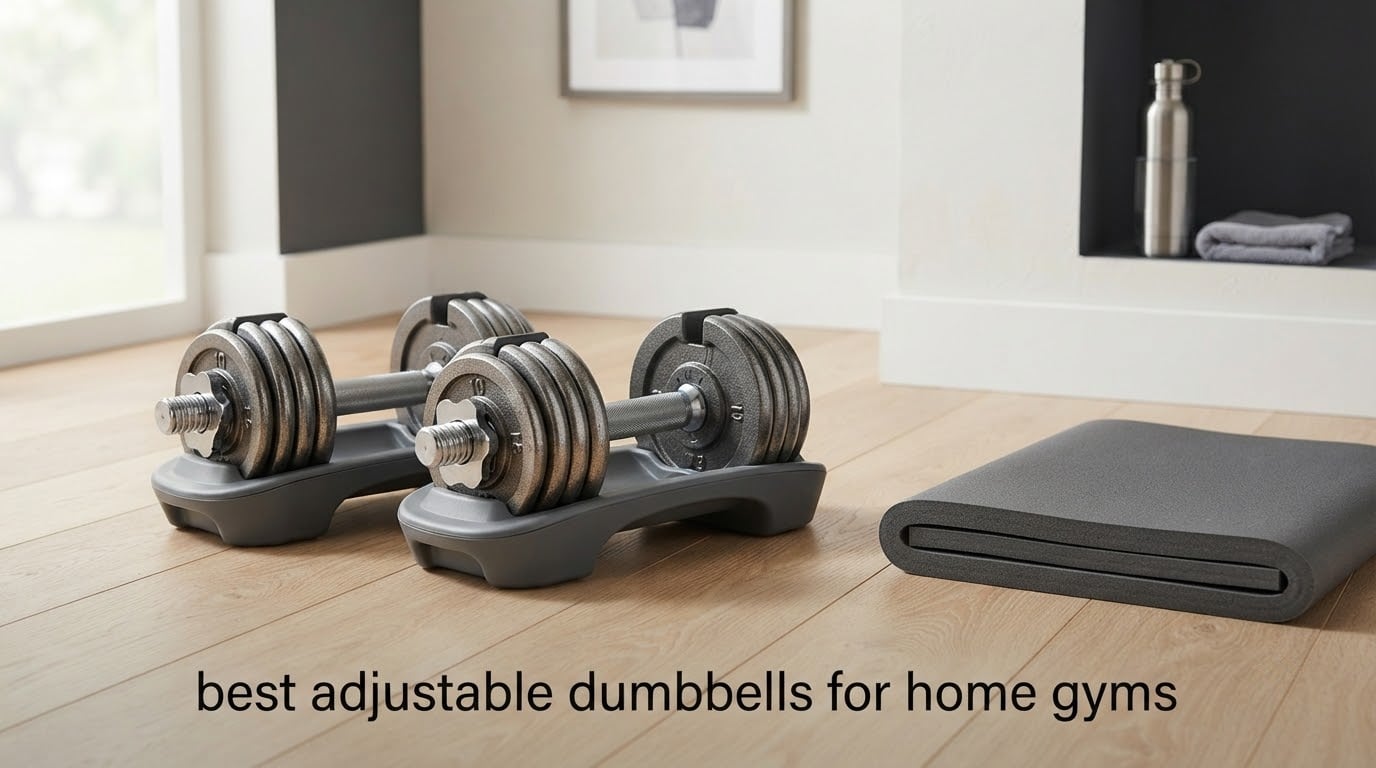
If you want one pair of dumbbells to cover an entire home gym, the Amazon Basics Adjustable Dumbbell Hand Weight Set with Storage Case is the pair we kept coming back to during this roundup. It builds from a genuinely light 3 lb per hand up to 19 lb with plate changes you can make in seconds, it stores in a single case, and it has the deepest owner history of anything on this list at more than 10k reviews. Everything else here competes with it on speed, quietness or weight ceiling, and most of them win on only one of those.
We spent the last several weeks going through all ten sets on this page, comparing weight range per hand, how fast a weight change actually is, how the handle feels at the top of the range, and how much floor space the whole thing eats. What follows is the complete best adjustable dumbbells for home gyms roundup for 2026, ranked by what actually matters once the set is out of the box and on your floor.
A note on what “adjustable” means here, because listings are slippery on this. A pair rated at 25 lb usually means 25 lb per dumbbell, so 50 lb in your hands. A set listed as “38 lb” often means 38 lb for the whole package, and every range we quote below is per hand unless we say otherwise.
We also linked our rubber hex dumbbell roundup for anyone who ends up deciding fixed dumbbells are the better fit.
Table of Contents
Top 3 Best Adjustable Dumbbell Picks for Home Gyms in (October 2026)
The three sets below are the ones we would hand to a friend with different priorities: the most-reviewed and most forgiving overall option, the fastest weight change from a dial mechanism, and the expandable pick for lifters who plan to add weight over the years.


The Best Adjustable Dumbbells for Home Gyms at a Glance
Every set below is a single pair that changes weight, not a collection of fixed pairs. The table gives you the full lineup in one pass: the range per hand, the increment size, and what each set is genuinely best at.
| Product | Specifications | Action |
|---|---|---|
| Amazon Basics 38 lb Adjustable Set |
|
Check Latest Price |
 FEIERDUN DS2 5-in-1 Set FEIERDUN DS2 5-in-1 Set |
|
Check Latest Price |
 Yaheetech Spinlock Set Yaheetech Spinlock Set |
|
Check Latest Price |
| Lifepro Quick-Adjust Dial Pair |
|
Check Latest Price |
| PowerBlock Elite EXP |
|
Check Latest Price |
 NordicTrack Select-a-Weight NordicTrack Select-a-Weight |
|
Check Latest Price |
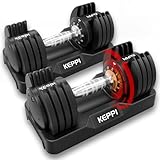 Keppi Twist-Adjust Pair Keppi Twist-Adjust Pair |
|
Check Latest Price |
 Core Fitness TwistLock Set Core Fitness TwistLock Set |
|
Check Latest Price |
 CAP ADJUSTABELL Set CAP ADJUSTABELL Set |
|
Check Latest Price |
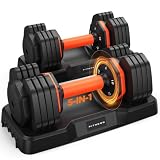 LifeOG FDB2 Five-Set Pair LifeOG FDB2 Five-Set Pair |
|
Check Latest Price |
Two patterns jump out. The lighter and cheaper sets on this list top out between 22.5 and 25 lb per hand, which is plenty for arms, shoulders and most beginner full-body work but will run out fast for rows and presses. The heavier sets reach 50 to 55 lb per hand and cover a decade of progression in one purchase.
1. Amazon Basics Adjustable Dumbbell Set – Best for Most Home Gyms
Amazon Basics Adjustable Dumbbell Hand Weight Set with Storage Case, Portable, Secure, 38 Pounds, Black
3-19 lb per hand
Alloy steel handles
Threaded collars
Storage case
Pros
- Simplest way into real plate-loaded training
- Plates slide on and off quickly
- Alloy steel handles and plates feel solid
- Carrying case keeps the set organized
- Easily expanded with standard plates
Cons
- Wide plates limit loading on the 14 inch bars
- Knurled texture can be harsh on bare hands
- Rubber collars can slip during changes
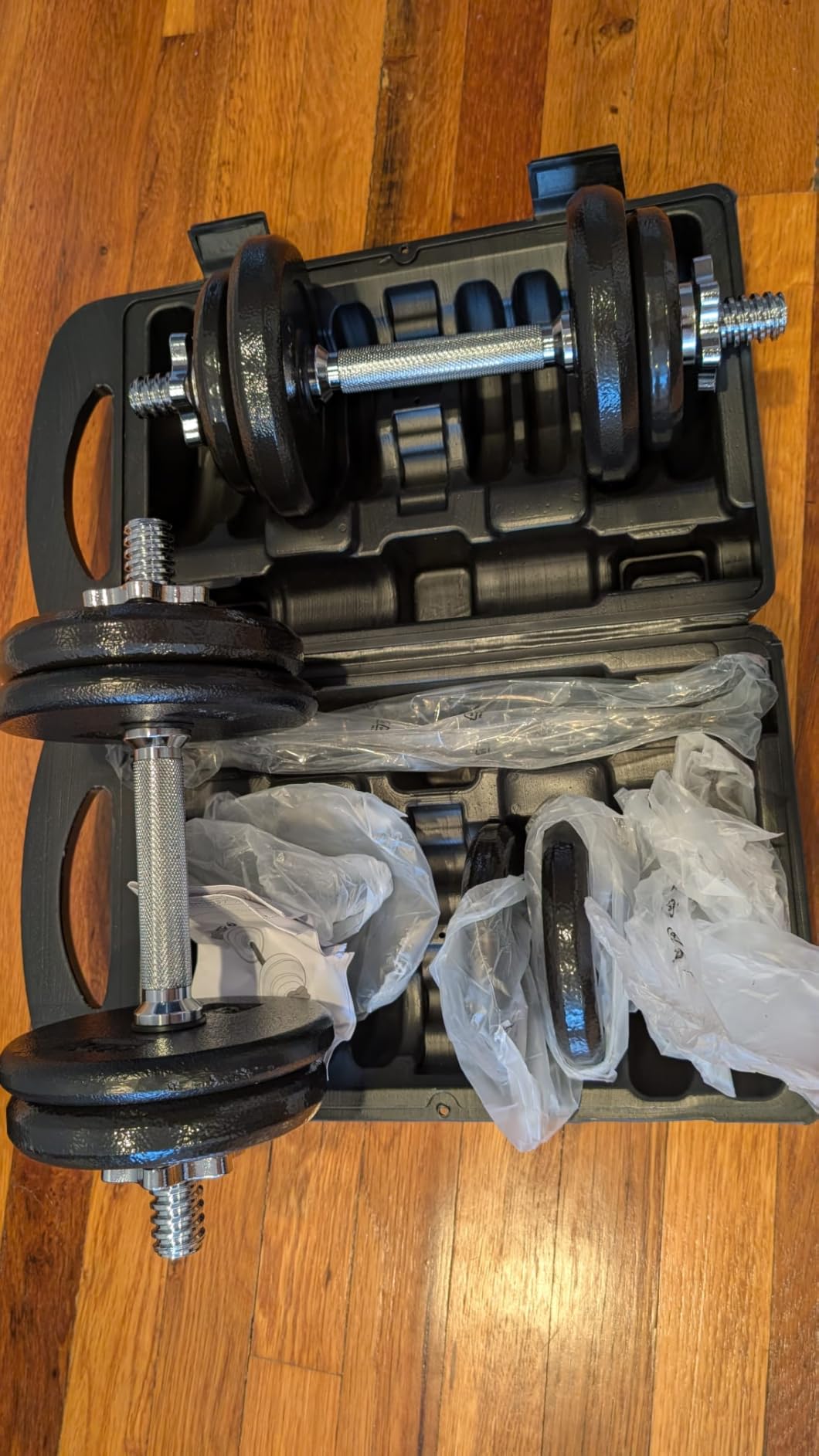
This is the set we load first when someone asks what adjustable dumbbells to buy and has no idea what they need. It arrives as two 3 lb alloy steel handles, four 2.5 lb plates, four 5 lb plates and four 0.5 lb threaded collars, which adds up to 38 lb across the pair and lets you build anything from 3 lb up to 19 lb in a single hand.
What stands out after extended use is how ordinary it feels. These are plate-loaded dumbbells with real threaded ends, not a molded plastic shell pretending to be metal, and that difference shows up in the way the plates seat and the way the set stays quiet on the floor of a garage.
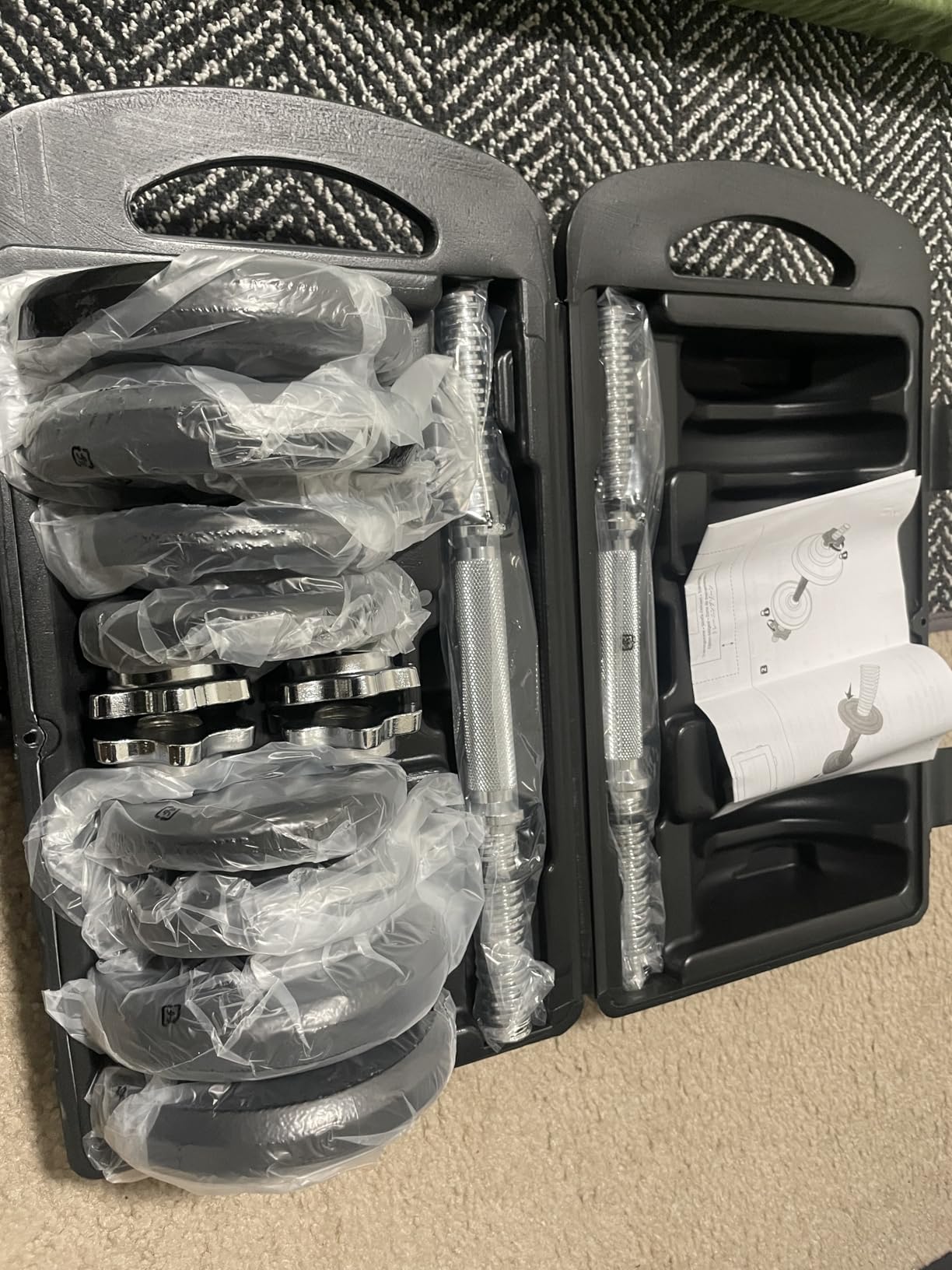
The 10k-plus reviews here are the strongest trust signal on this page, and the pattern in them is remarkably consistent: owners describe sturdy hardware, easy weight mixing when two people train at different levels, and a case that keeps everything in one place. The complaints that recur are physical rather than functional, and they are the trade-offs you accept with any conventional plate design.
Because the plates are wide relative to the 14 inch bars, you cannot load a heavier plate on top of a light one without running out of bar. That caps each dumbbell at 19 lb per hand on the plates that ship with it. If your goal is a 20 lb press, this is the end of the road and you should read the PowerBlock and NordicTrack sections instead.
What a 3 lb Starting Handle Means for Isolation Work
Each handle alone is 3 lb, which is a rare gift for shoulder and arm work. A pair of conventional fixed dumbbell sets almost never includes two 3 lb dumbbells, and buying a small fixed pair to fill that gap is exactly the problem adjustable sets are supposed to solve.
One small addition worth making: if the crosshatched handle texture bothers you during heavier pressing, most owners who train heavy add grip slides. That fixes the comfort issue without touching anything else about the set.
How It Holds Up With Two People Training in the Same Room
Plate mixing is the underrated feature here. Two people at very different levels can each build a sensible load from the same pool of plates, and the changes take a few seconds because you are only unscrewing a collar. That makes it a better shared-pair choice than a fixed rack, where one person training heavy means the light person has nothing to use.
The long-term limitation is the same one shared by every plate-loaded design. Rubber or plastic collars can slip or pop off during a fast change, and the concrete-style plate shells will crack if you drop them on concrete. Treat these as gym equipment and they last for years.
2. FEIERDUN DS2 5-in-1 Set – Best for Versatile All-in-One Setups
FEIERDUN Adjustable Dumbbells, 45lbs Free Weight Set with Connector, 4 in1 Dumbbells Set Used as Barbell, Kettlebells, Push up Stand, Fitness Exercises for Home Gym Suitable Men/Women.
6-22.5 lb per dumbbell
Also a barbell and kettlebell
15 mm foam padding
Iron-sand plates
Pros
- Covers dumbbells barbell kettlebell plates and push-up stands
- No rattling or dust from the molded plates
- Thick foam bar padding feels solid under a press
- Everything breaks down into short pieces
Cons
- Handles run short for larger hands
- Listed poundage varies between variants
- Reassembly needed to switch configurations
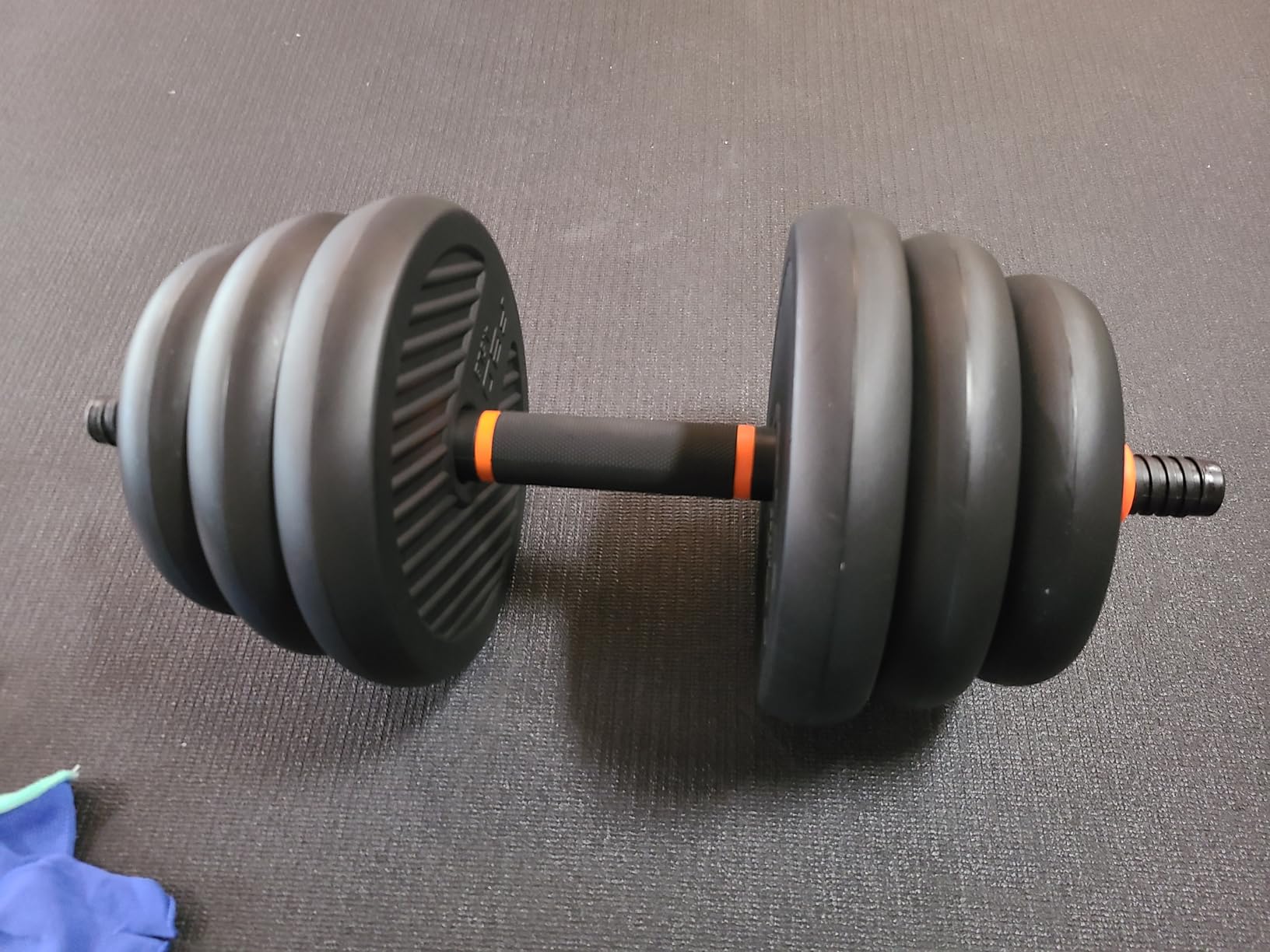
The DS2 is not really a dumbbell set so much as a modular strength kit. The same plates and bars assemble into a pair of dumbbells, a barbell, a kettlebell, loose weight plates or push-up stands, which makes it the most versatile thing on this list by a wide margin. If your floor space is one corner of an apartment, the single-configuration sets waste nothing because they only do one job.
Where it earns its keep is the plate construction. The weights are integrally molded with high-density iron sand rather than filled loosely, so there is no rattling, no shifting mid-rep and no iron dust on your floor. Reviewers mention that the 15 mm foam padding over the steel core is thick enough to stay comfortable on a barbell press, which is where most foam-padded bars fail first.
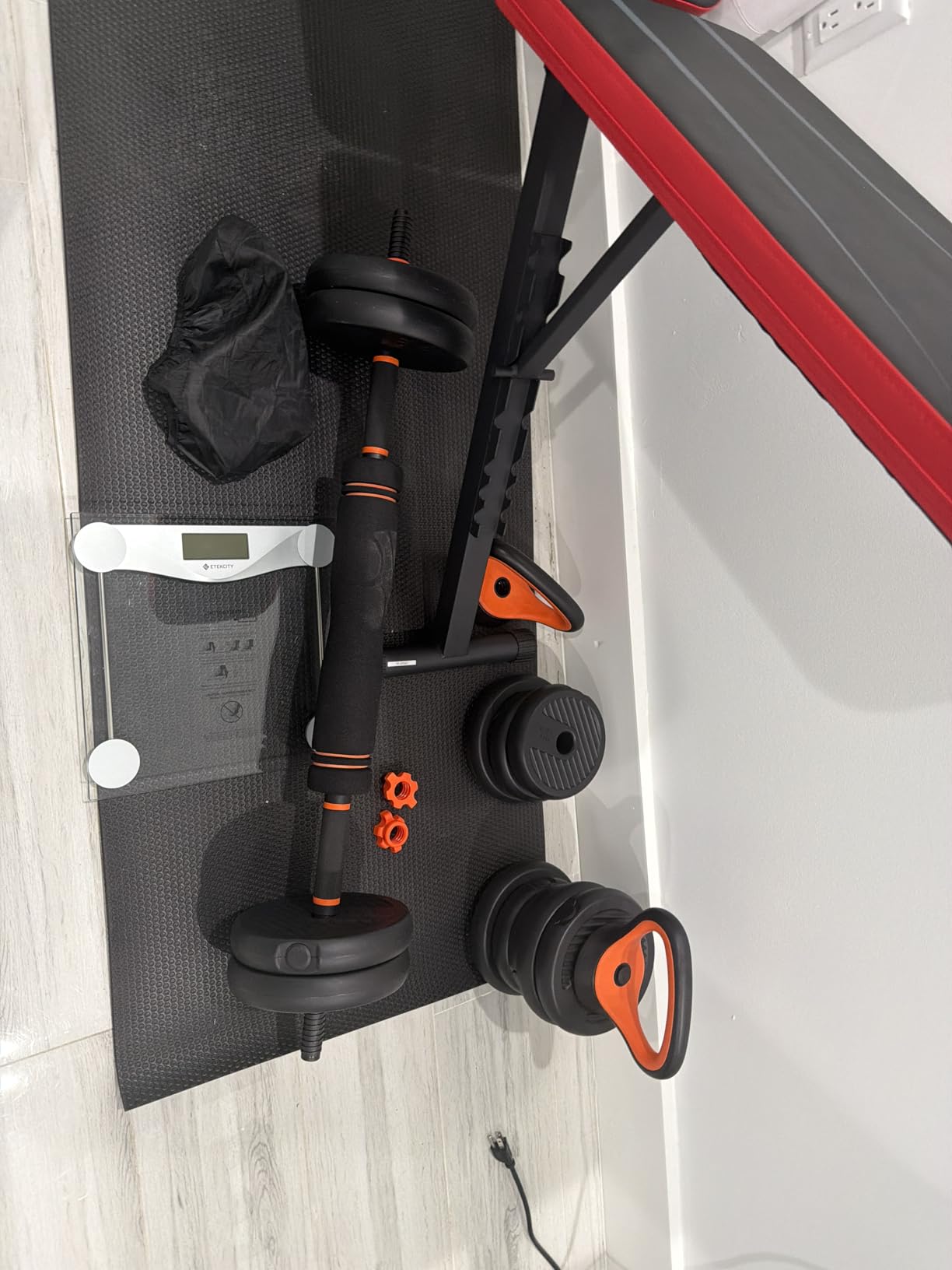
Owners consistently treat this as the highest-value kit per piece in a home gym. The conversion between configurations is genuinely quick once you learn it, and disassembling everything into short lengths means the whole thing lives in a closet when it is not in use.
Set expectations correctly on weight. A single dumbbell tops out around 22.5 lb and the barbell configuration reaches about 45 lb. That is a real limitation for heavy rows, and it is a fair trade for the versatility if you are still building a base.
Where the Five Functions Actually Earn Their Keep
The kettlebell and push-up stand modes get the most use in practice, because they let you train two movement patterns without buying two more products. The barbell mode is the one most buyers use least, since a 45 lb bar with a foam sleeve is a warm-up and technique tool rather than a strength bar.
If you are choosing between this and a straight dumbbell pair, the deciding question is whether you are training alone in a small space. A single pair of dedicated dumbbells is simpler to use. This kit wins when the same person wants to train legs, chest and grip work in the same session.
What the Short Handles Mean for Large Hands
Handles that feel small is the single most common ergonomic complaint in the reviews, and it is worth taking seriously if you have large hands or long forearms. A cramped grip on lateral raises or a long barbell hold is a real comfort issue over a 45 minute session.
The other recurring note is that advertised poundage does not always match the assembled weight across variants, so verify the plate count and handle weight for the specific configuration you receive before you plan a program around a specific load.
3. Yaheetech Spinlock Set – Budget Pick with a Classic Plate-Loaded Feel
Yaheetech Adjustable Dumbbell Set Free Weights with Spinlock Collars, Black
66 lb set, four plate values
Spinlock collars
16 plates
No tools needed
Pros
- Feels like a conventional plate-loaded dumbbell
- Assembles in seconds without tools
- Spinlock collars hold plates firm mid-set
- Compact footprint replaces a full rack
Cons
- Plastic handles can twist under heavy loading
- Concrete-filled plates crack if dropped
- Every weight change means manual plate swapping
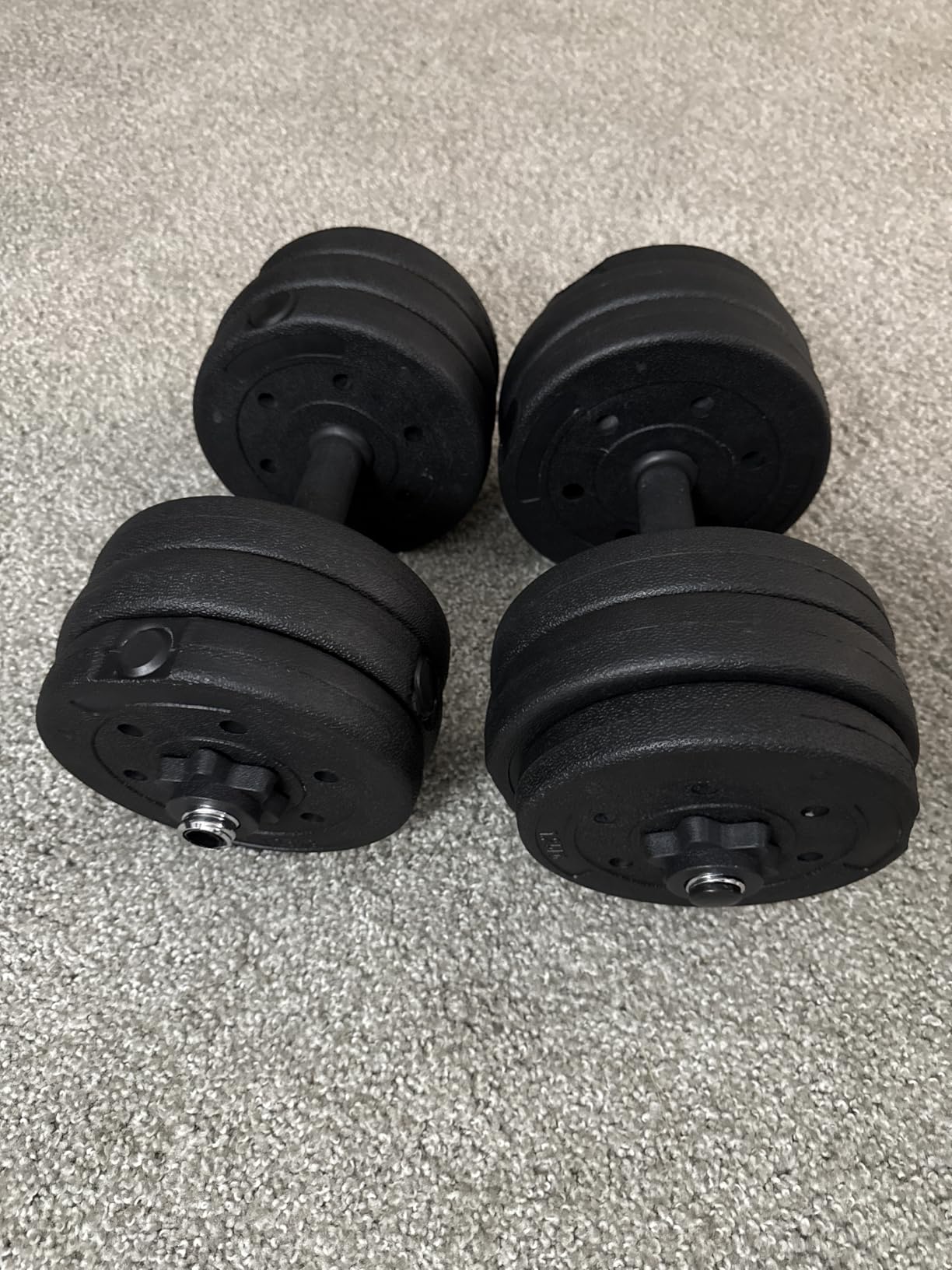
This is the simplest design on the list: two handles, sixteen plates spread across four weight values with four plates of each, and two spinlock collars per dumbbell. There is no dial, no pin and no lever, which means the thing that can fail is almost nothing. Once assembled, it behaves like a traditional plate-loaded dumbbell, and people who trained on those in a commercial gym tend to adapt fastest to this one.
The published 66 lb figure is the weight of the whole package, not of one dumbbell, so a fully loaded hand works out to roughly half that. That is still a higher ceiling than most plate-loaded designs at this price. The trade is the plastic handle, which is the weakest structural part of any set on this page.
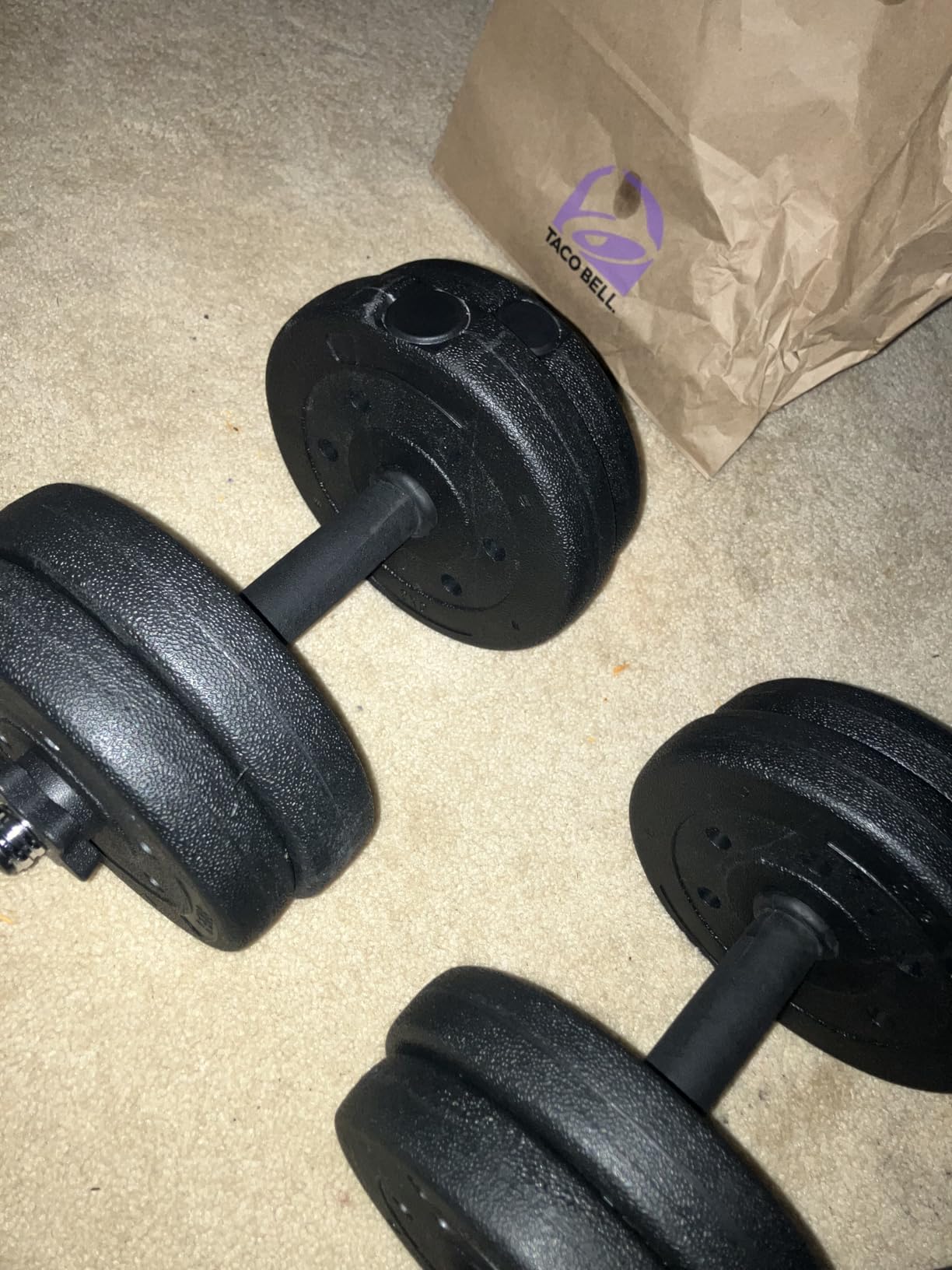
More than 4,300 owners have bought this set, and the reviews converge on the same three things: it assembles in seconds, the spinlock collars keep the plates from walking off mid-set, and the footprint is tiny compared with the rack it replaces. The limitation people accept rather than complain about is that every single weight change is a manual operation.
That matters if your training style is drop sets or heavy supersets. If your sessions are straight sets with a full break between exercises, the trade is invisible. If you are constantly moving weight between movements, the dial systems below are meaningfully faster.
Whether the Plastic Handles Hold Up Under Heavy Loading
They hold up for most people, and they are what keeps this set affordable. The failures reported in reviews are twist and flex at the heavier plate combinations, not breaks. If you regularly load the heaviest settings, that is the point where a steel-handle set is the safer purchase and we would point you at the Amazon Basics design or PowerBlock instead.
Concrete-filled plastic plates also need basic care. They crack if dropped on a hard floor, and the cracking shows up around the collar seat first. Keeping them on a mat in a garage or a carpeted room in an apartment solves almost all of it.
Why This Beats a Full Rack on Floor Space
A full rack of fixed dumbbells spanning a comparable range needs a long shelf and holds a lot of steel that sits unused most weeks. This pair collapses to the footprint of a single tray when you disassemble it, and covers a wide per-hand range from the bare handles upward. If floor space is the reason you are shopping, that comparison settles it.
The reason a fixed rack still wins for some households is speed and feel. No adjustment takes longer than unscrewing a collar and sliding plates, and there is no such thing as a mis-seated plate on a fixed dumbbell. If two adults in your home train serious volume together, the fixed option is worth reading our rubber hex dumbbell guide before you decide.
4. Lifepro Quick-Adjust Dial Pair – Best Value
Lifepro Adjustable Dumbbells & Weights for Home Gym, Quick-Adjust
5-25 lb per hand
Dial adjustment
Alloy steel
2.5 lb increments
Pros
- Changes weight in seconds with no plates to load
- Full-length steel bar through the handle
- 2.5 lb increments suit multiple household members
- Tray doubles as the adjustment station
Cons
- One side sits slightly higher than the other
- Dial needs good light and a proper seat in the tray
- 25 lb per hand limits heavier progressions
Among dial systems the Lifepro is the value standout. You get 5 to 25 lb per hand in 2.5 lb increments, alloy steel construction with a steel bar running the full length of the handle, and no assembly at all. You set the weight once in the tray, and from then on the dumbbell covers ten different loads.
That 2.5 lb increment is doing a lot of work here. Most twist-handle competitors jump in 5 lb steps, which is coarse for lateral raises and rear-delt work. Two people in the same household training at different levels can share this pair without fighting over the settings, and that is where this dial really earns its keep.
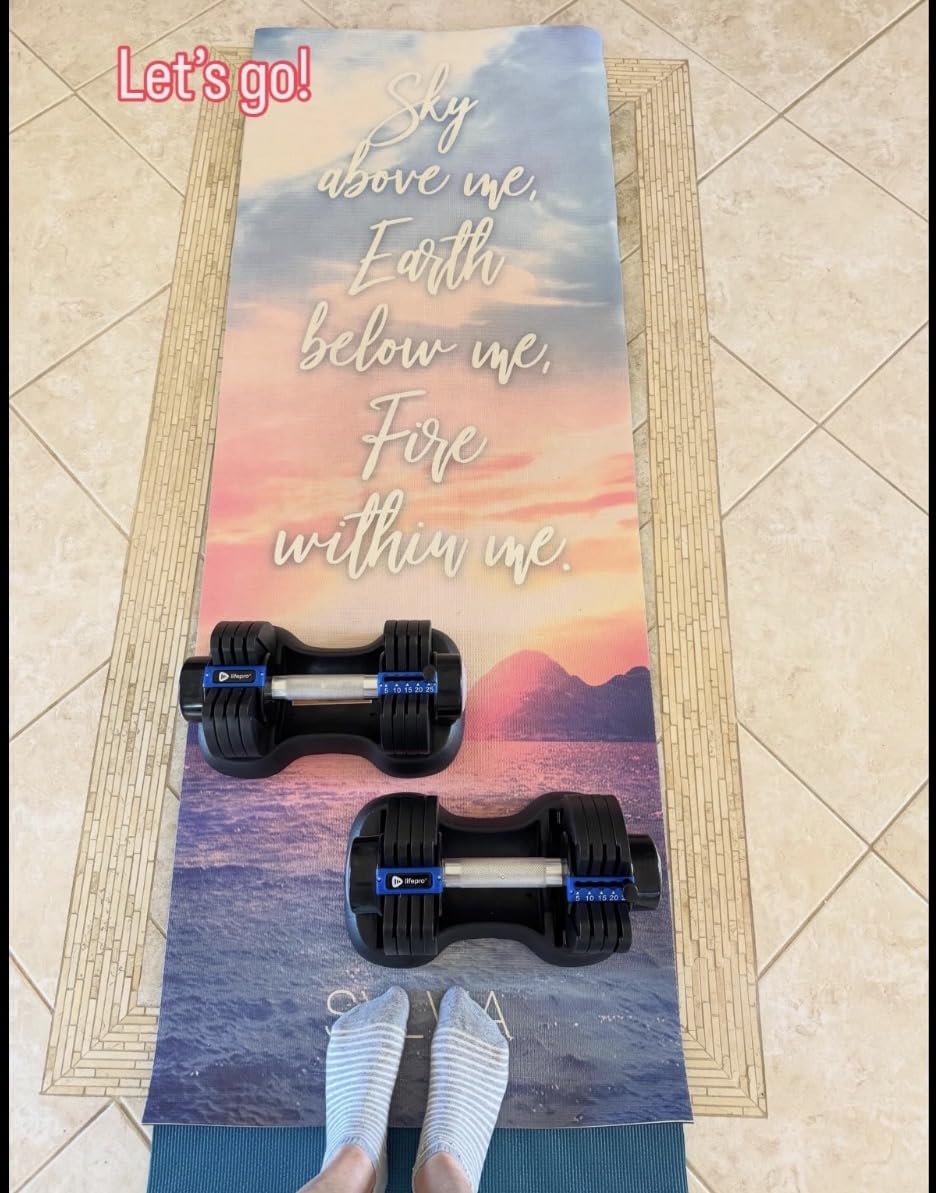
The reviews are warm in a specific way: they describe the dial click as secure, the plates as not shifting during lifts, and the textured grip as holding up with sweaty hands.
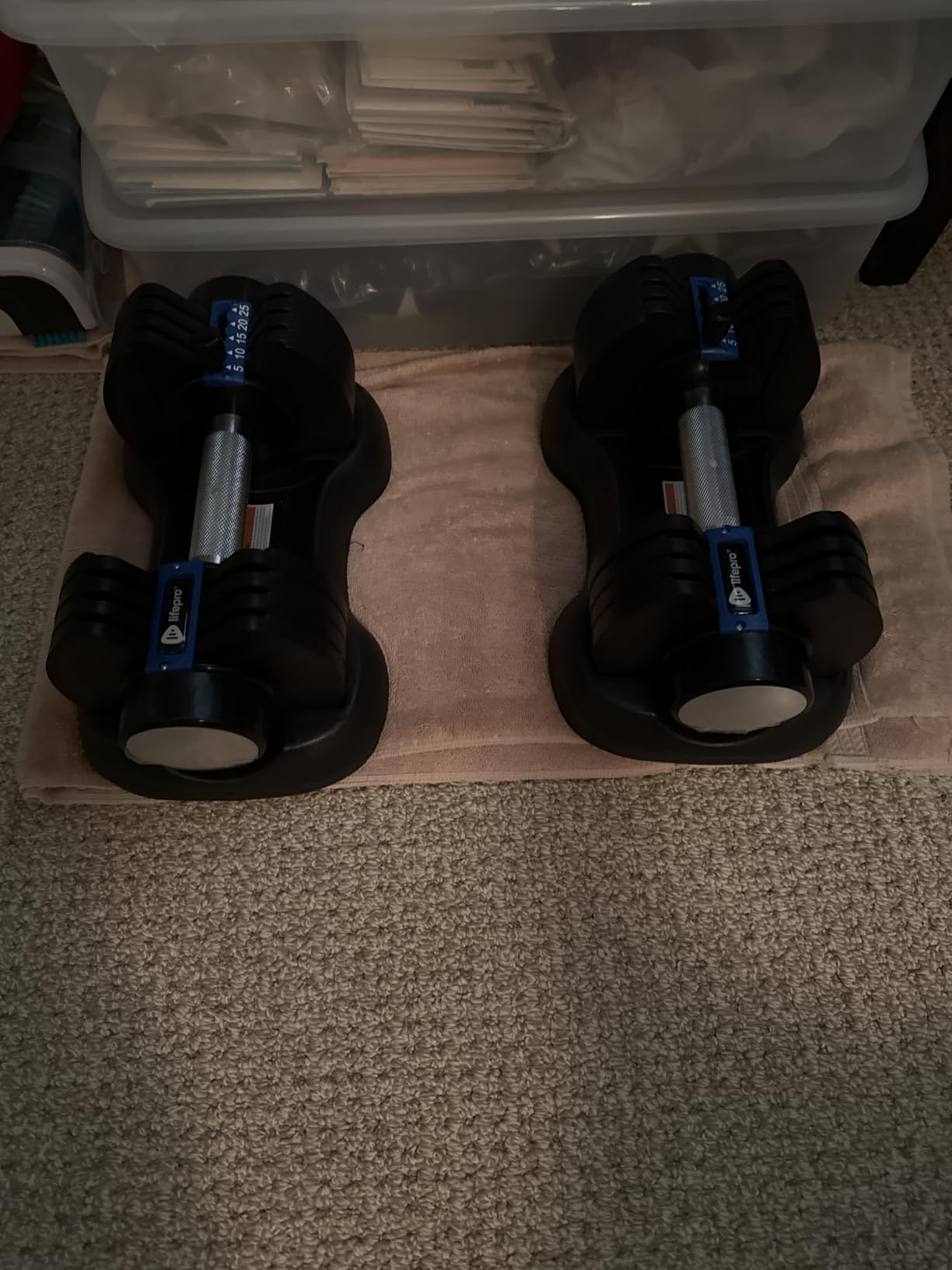
Balance is the honest drawback and it is the first thing reviewers mention. The dumbbells are noticeably asymmetric, with one side sitting higher, so you reposition them in your hand before a set. It is a small habit, but it is a real adjustment period and it does not fully go away.
Why the Tray Matters More Than It Sounds
On a dial system, the tray is not just storage. The dial is designed to be turned while the dumbbell is seated in the cradle, which is what keeps the plates aligned and the mechanism square. If you skip the tray, you will fight the weight change and wonder why the dial feels stiff.
That is also why the balance complaint and the tray go together. Seated correctly, the dumbbell sits square; held in midair, the internal plates can sit slightly proud. A decent light source at the tray makes a measurable difference to how fast you change weight between sets.
Where the 25 lb Ceiling Becomes the Deciding Factor
25 lb per hand is enough for roughly the first year or two of serious progressive strength work for most people, especially combined with body-weight movements for the big lifts. It stops being enough when you want to row heavy, press heavy, or do weighted pull-ups and dips with a real stimulus.
Before you buy, find the heaviest exercise in your planned program and check it against 25 lb. If your heaviest planned movement needs more than that, buy a set that starts higher even if it feels like overkill now, because the step up from a 25 lb pair to a 50 lb pair later means a second purchase.
5. PowerBlock Elite EXP – Premium Pick for Expanding Weight Ranges
PowerBlock Elite EXP Adjustable Dumbbells, Sold in Pairs, Stage 1, 5-50 lb.
5-50 lb per hand
16 weight settings
Magnetic selector pin
Expandable to 90 lb
Pros
- Magnetic pin has no moving parts that can fail
- Expands to 70 or 90 lb per hand later
- Every increment is clearly labeled
- Replaces 16 pairs of fixed dumbbells
Cons
- Balance feels awkward with the 2.5 lb adders
- Bulky frame is unpleasant for curls and triceps work
- Heavier blocks are clumsy for single-arm overhead work
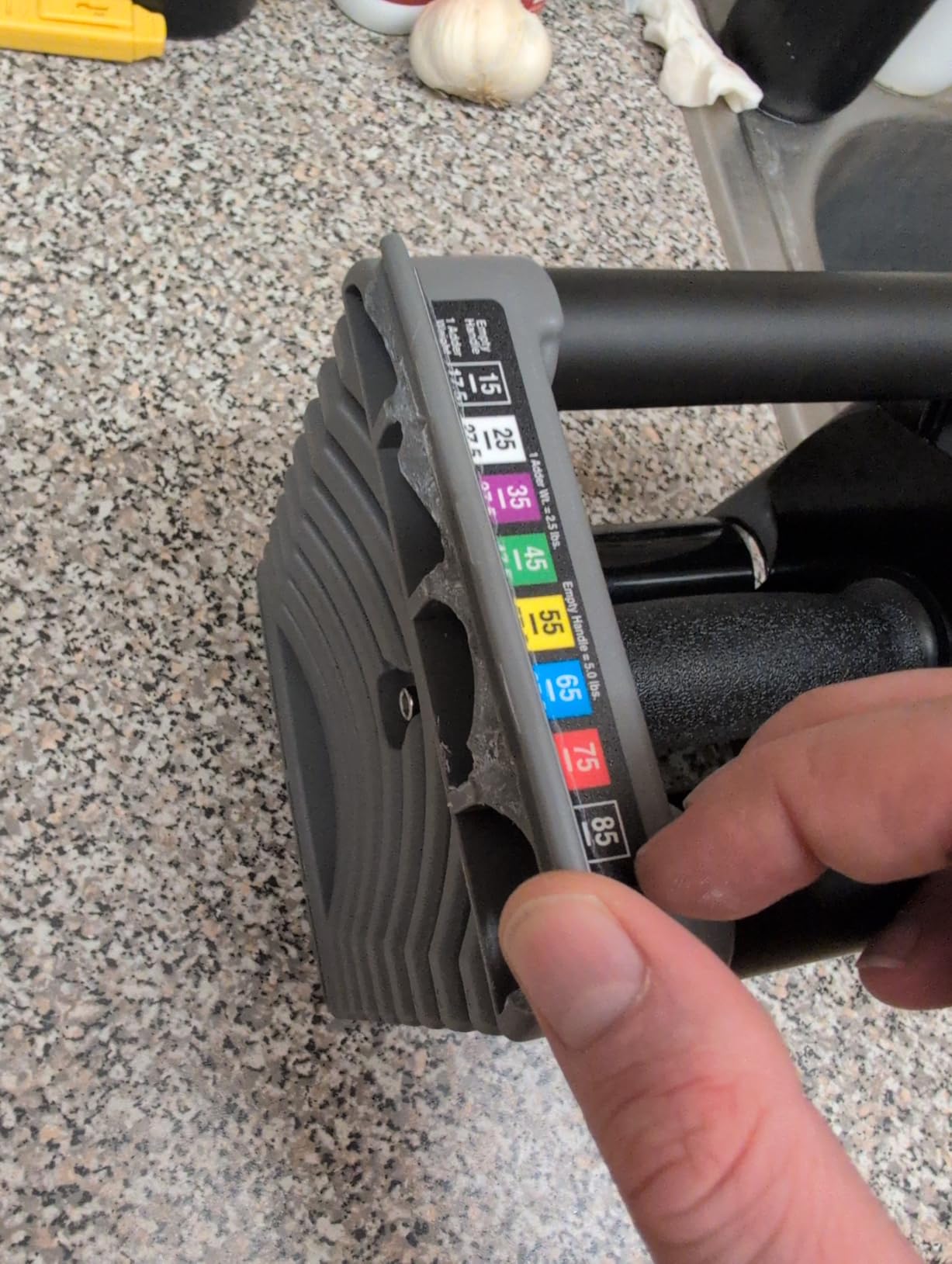
The Elite EXP is the design most people picture when they say adjustable dumbbells: a block-shaped handle with a magnetic pin that locks a specific plate stack in place. Sixteen weight settings spread from 5 to 50 lb per hand, each one clearly labeled on the face, and no levers, knobs or mechanisms to strip.
Expansion is the reason to buy this one over a 50 lb pair that stops there. Stage 2 and Stage 3 kits raise the ceiling to 70 and then 90 lb per hand as your training advances, so the purchase can follow you for years rather than expiring at a specific load.
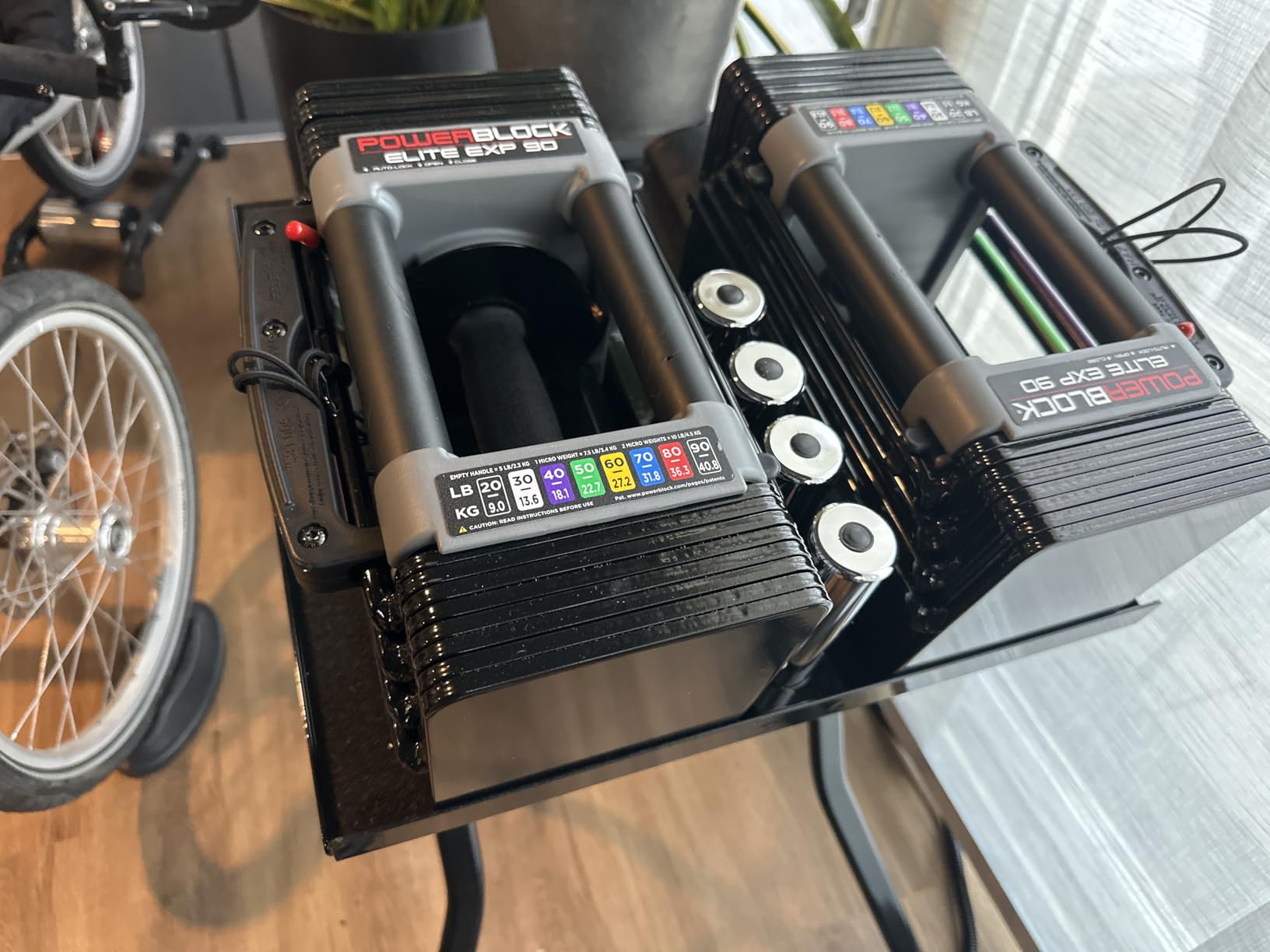
Long-term owners describe it as the dependable choice that has held up over years of daily use, and the magnetic pin gets specific credit for having nothing to jam. The rectangular blocks also give a good range of motion on pressing movements, which is not always true of the slimmer competitor designs.
The shape is the polarizing part, and reviewers are candid about it. It takes some time to get used to, balance is imperfect, and the blocks feel bulky for curls, triceps extensions and single-dumbbell overhead work. Several owners recommend adding a stand so you are not setting the weight on the floor every time.
How the Selector Pin Behaves Compared With a Dial
The pin moves a plate stack rather than rotating a mechanism, so the change is short and repeatable and the plates are locked by design once the pin is fully seated. The catch is that it wants a deliberate, two-hand operation, and short selector forks can catch the rod unevenly if you rush the seat.
Compared with a dial, you are trading a one-handed twist for a slightly more careful two-handed pull. In exchange you get a heavier ceiling, clearly marked increments and a set that expands. For most people training toward heavier pressing and rowing, that is the right side of the trade.
Whether the Expansion Kits Are Worth Planning Around
They are worth it if you can already name a movement you will eventually need more than 50 lb for. The Stage 2 and Stage 3 kits raise the ceiling in steps rather than all at once, so you are not buying capacity you will not use for two years.
They are less compelling if you are buying for an apartment where the bulk of a fully expanded set is the problem rather than the solution. In a tight space, a slimmer single-configuration set is often the smarter long-term choice, which is exactly what our small apartment home gym guide argues for.
6. NordicTrack Select-a-Weight – Best for a Knurled Steel Grip
NordicTrack 55 lb Select-a-Weight Dumbbell Pair
Up to 55 lb per dumbbell
Grows with the weight
2.5, 5 and 10 lb steps
Standalone 10 lb handle
Pros
- Dumbbell stays compact at light settings
- Metal knurled grip feels like a traditional dumbbell
- Fine 2.5 lb steps in the light range
- Selector locks solidly over long use
Cons
- Up to four levers to move per weight change
- Micro-adjust levers are unlabeled so you must pick it up to check
- Plastic plates click and clack
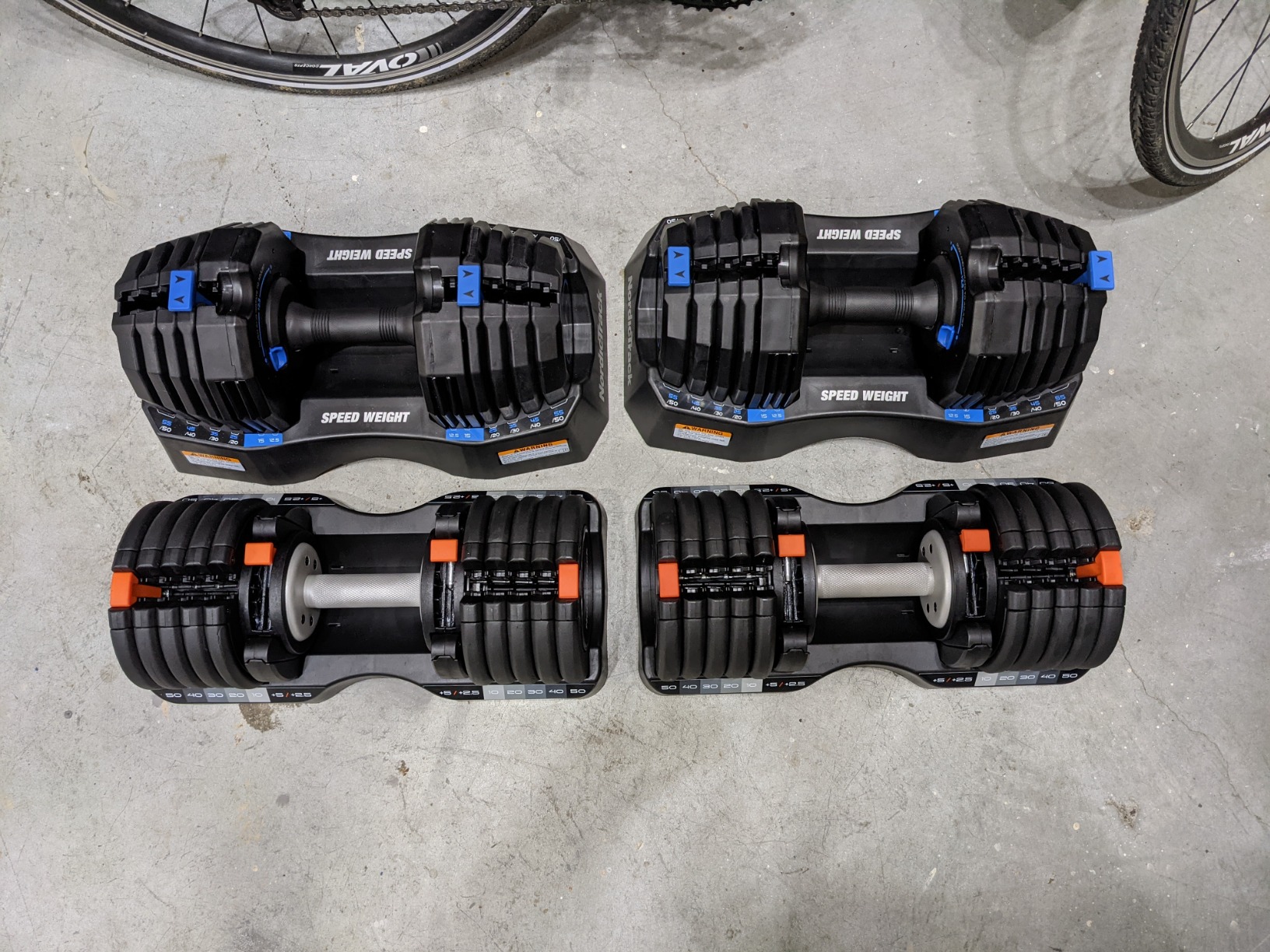
The design idea here is smarter than it first sounds: the length of each dumbbell grows with the selected weight instead of staying fixed. At a light setting you are holding a short, manageable implement, and the full length only appears when you have asked for real weight. That improves range of motion on presses in a way most competitors cannot copy.
The other standout is the handle. A metal knurled grip feels closer to a traditional dumbbell than the plastic and rubberized handles used by most adjustable sets, and owners single it out as better than the alternatives they tried. The 10 lb handlebar works on its own for warm-ups and light isolation work.
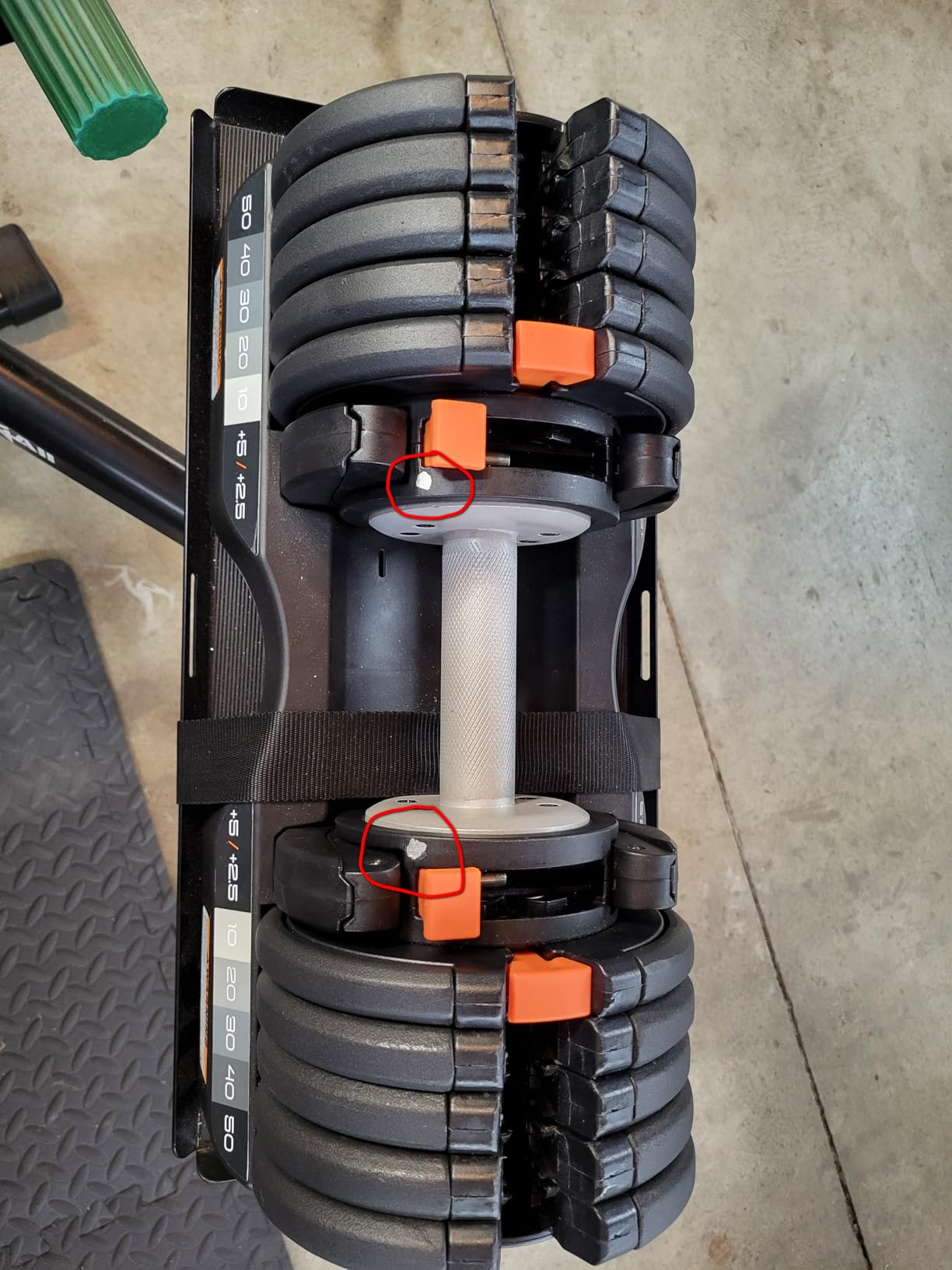
It sits in the same spending tier as the PowerBlock Elite EXP, but the buying case is different. If you are coming from fixed dumbbells and the feel of the grip matters more to you than the top of the weight range, this is the one that will not feel like a compromise.
Adjustment speed is the weakness. Depending on the change you are making you may move up to four levers, and the 2.5 lb and 5 lb micro-adjustment levers are not labeled, which means picking the dumbbell up to verify. It is slower than a twist dial, and buyers notice immediately.
Why Growing Length Beats a Fixed-Length Body
Fixed-length adjustable dumbbells force a single compromise: short enough to be comfortable when light, or long enough to be stable when heavy. Growing length means the light settings are genuinely compact, which is what makes the 10 lb and 12.5 lb settings usable for accessory work instead of feeling like a toy.
It also improves pressing mechanics. A short dumbbell at a high load keeps the wrist in a better position, and a compact head is easier to control at the bottom of a press. If pressing is a focus for you, that geometry is worth a lot.
What the Warranty Term Means for Long-Term Owners
Register the warranty as soon as the set arrives. It costs nothing, it documents the purchase date, and on a product with moving internal parts it is the cheapest durability safeguard available. Compare the warranty term against the PowerBlock Elite EXP, which sits at the same spending tier, before you commit to either.
If you buy from a marketplace rather than the brand’s own storefront, confirm first that the unit ships with a valid warranty, since coverage is the first thing third-party sellers cannot easily fake.
7. Keppi Twist-Adjust Pair – Best for One-Second Weight Changes
Keppi Adjustable Dumbbells Set of 2, Quick Adjust Weights for Home
5-25 lb per dumbbell
One-second twist
5 lb increments
Metal handle
Pros
- Weight changes in about a second with one hand
- Quiet stable plates that do not clatter
- Metal handle and anti-slip grip feel solid
- Manufacturer replaced a failed handle at no charge
Cons
- Re-racking needs precise alignment in the tray
- 5 lb increments are coarse for isolation work
- 25 lb per dumbbell tops out low
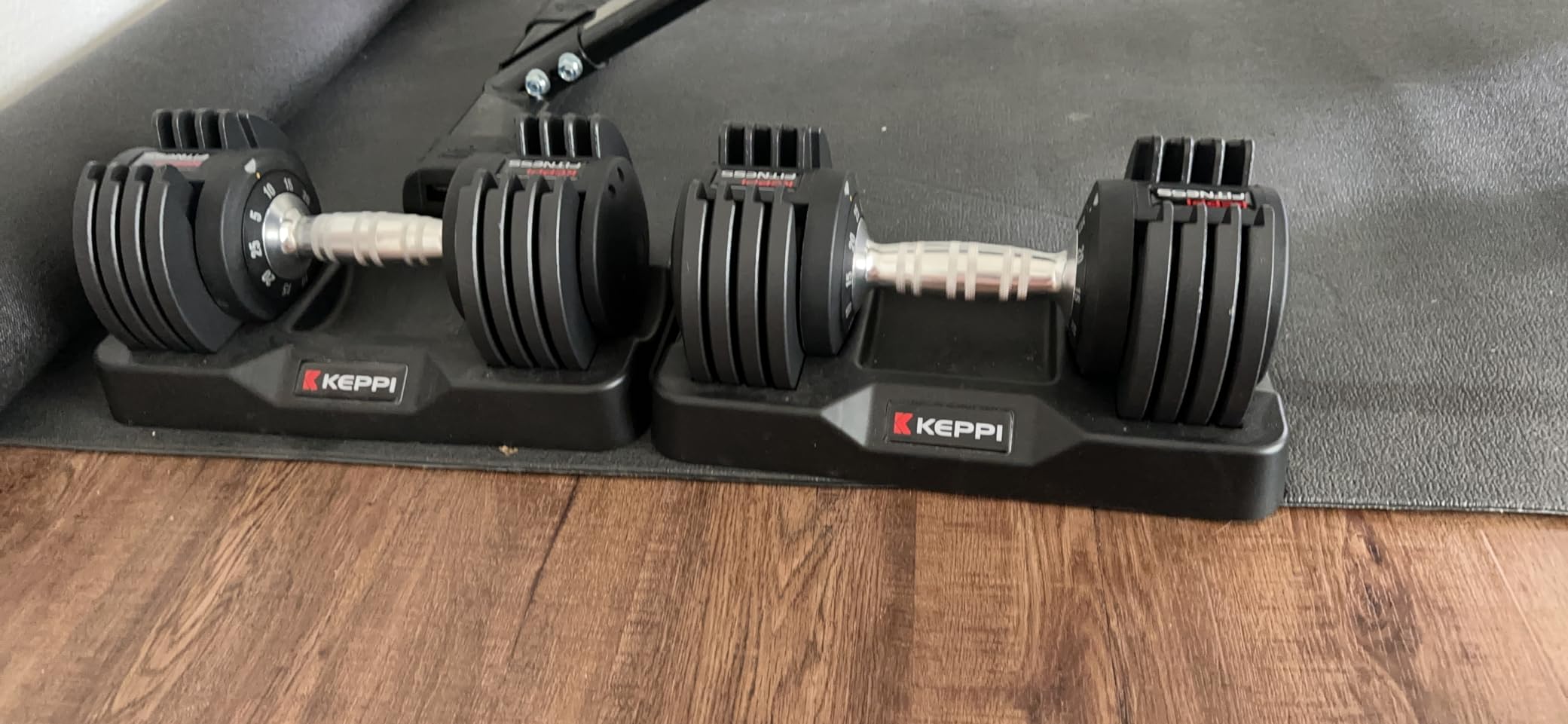
The Keppi is the one to buy if your priority is a weight change in about one second. You twist the handle with one hand and the plates re-engage, which is about as quick as a routine change gets. Reviewers who train four days a week report durability holding up well past six months, and the metal handle feels more solid than the design suggests.
Quietness is the sleeper feature. Silicon steel plates do not shift or clatter during presses and curls, which matters more in an apartment with thin walls than any spec sheet suggests. The audible click on each adjustment is a nice touch, since you get positive confirmation the weight actually changed.
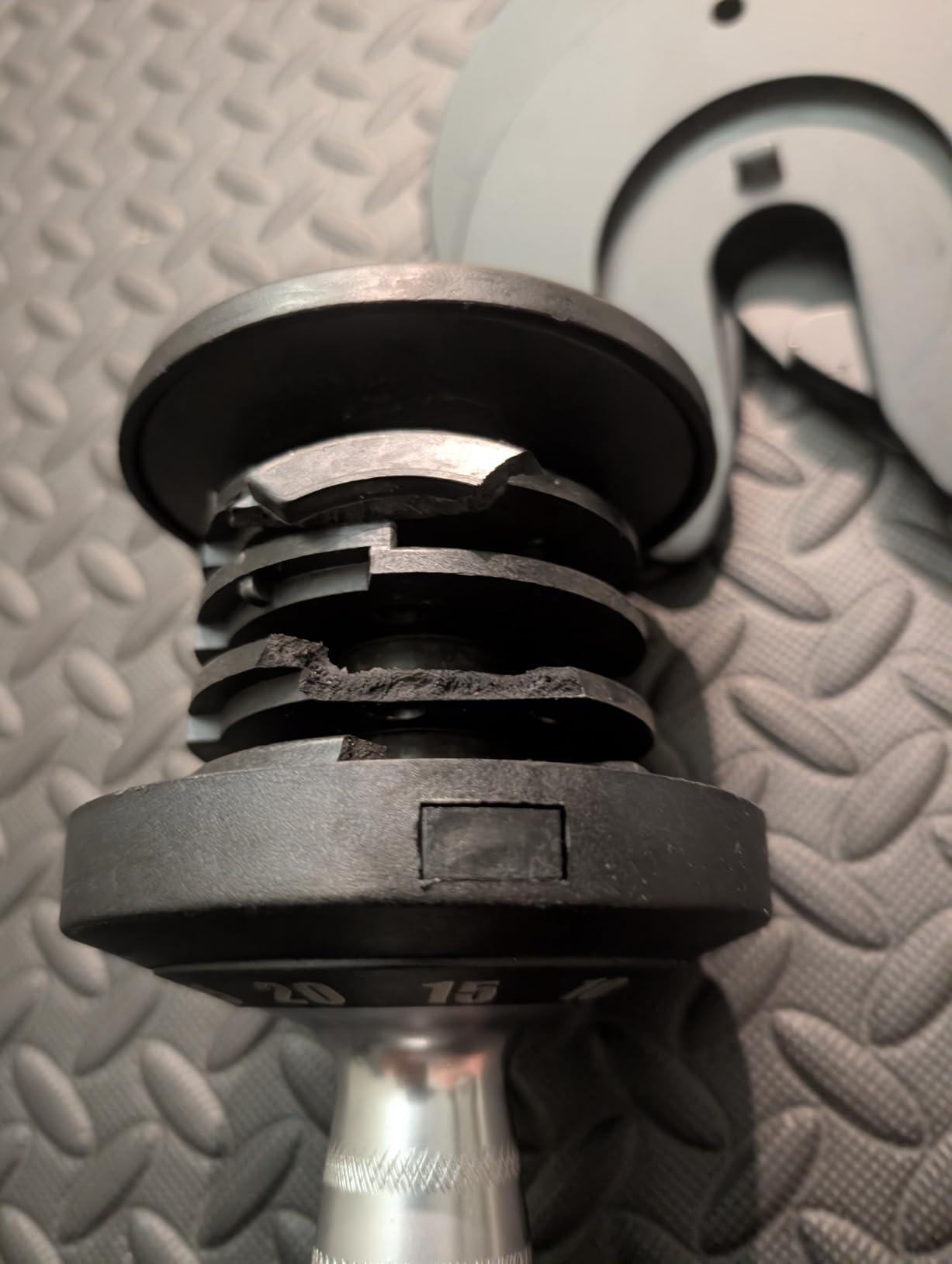
Service is the other thing reviewers mention unprompted. One owner had a handle fail and had a replacement shipped quickly at no charge, which is a meaningful signal about how the company treats a mechanism-based product after the sale.
The 5 lb increment is the real compromise. From 5 to 25 lb per dumbbell, jumping in 5 lb steps means no 12.5 lb setting, and there is no sub-5 lb option at all. For lateral raises, rear-delt work or rotator cuff movements, that is a genuine gap rather than a small annoyance.
Where the Tray Alignment Issue Comes From
Like most twist-handle systems, the dial operates reliably only when the dumbbell is seated in its holder, and putting it back requires more care than grabbing a fixed dumbbell. If it is not aligned with the tray, it will not seat cleanly, and you will find yourself re-positioning it at the start of every exercise.
Give it two weeks before judging it. Nearly every long-term owner describes a break-in period where tray alignment stopped being a thought and the one-second adjustment became automatic. Set a rule for yourself: seat the dumbbell, turn the handle, listen for the click, and lift.
Choosing Between the Keppi and the Lifepro Dial
These two solve the same problem with opposite trade-offs, and the choice is a straight one. The Lifepro gives you 2.5 lb increments so two people can train at different levels from one pair. The Keppi gives you a faster one-handed change and quieter plates.
If you train alone, take the faster change. If you share the pair with another person, take the finer increments. Neither answer is wrong, but do not buy both expecting one to cover the other’s weakness.
8. Core Fitness TwistLock Set – Best for Quiet Composite Plates
Core Fitness® Adjustable Dumbbell Weight Set By Affordable Dumbbells – Adjustable Weights – Space Saver – Weights – Dumbbells For Your Home –
5-50 lb per dumbbell
One-hand twist handle
Composite plates
Cradle plate retention
Pros
- Plates stay locked through fast movements
- Composite plates do not clink or clank
- Bar length grows with the weight
- Soft-grip handle works without chalk
Cons
- Weights stick in the cradle above roughly 25 lb
- Wide heads limit behind-the-neck triceps work
- 5 lb increments are coarse below 25 lb
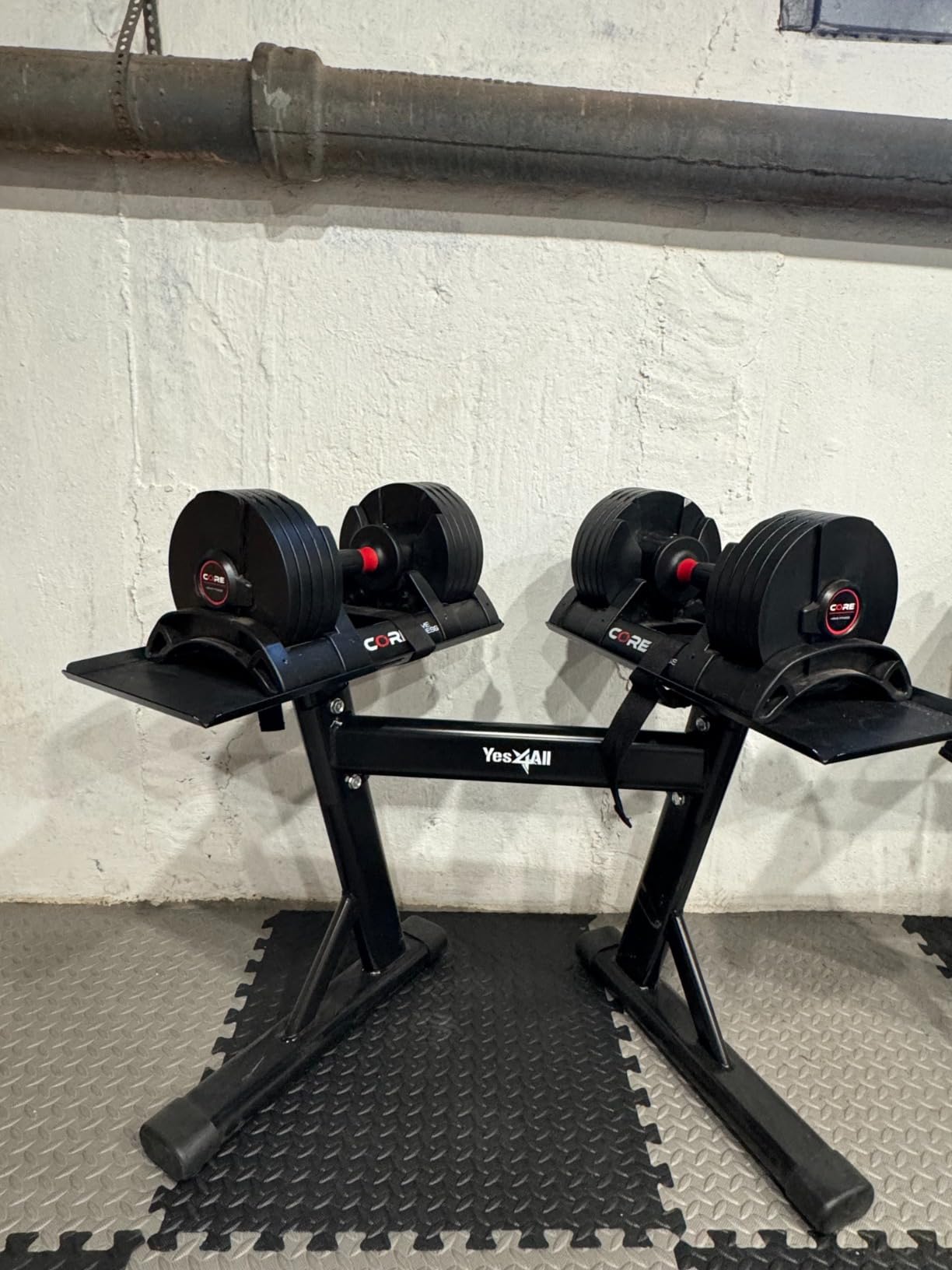
The Core set is the one that makes people nervous, in a good way. The V-shaped cradle slats hold the plates in place so they cannot separate or fall away, and owners consistently describe that as a real safety advantage rather than a marketing line. It reaches 5 to 50 lb per dumbbell and adjusts with a single one-handed twist of the handle.
Like the NordicTrack design, the bar length grows with the number of plates attached, so light settings stay compact. Composite plates encased in plastic mean no clinking during lateral raises or overhead work, which is the second most common apartment complaint after dismounting the weight.
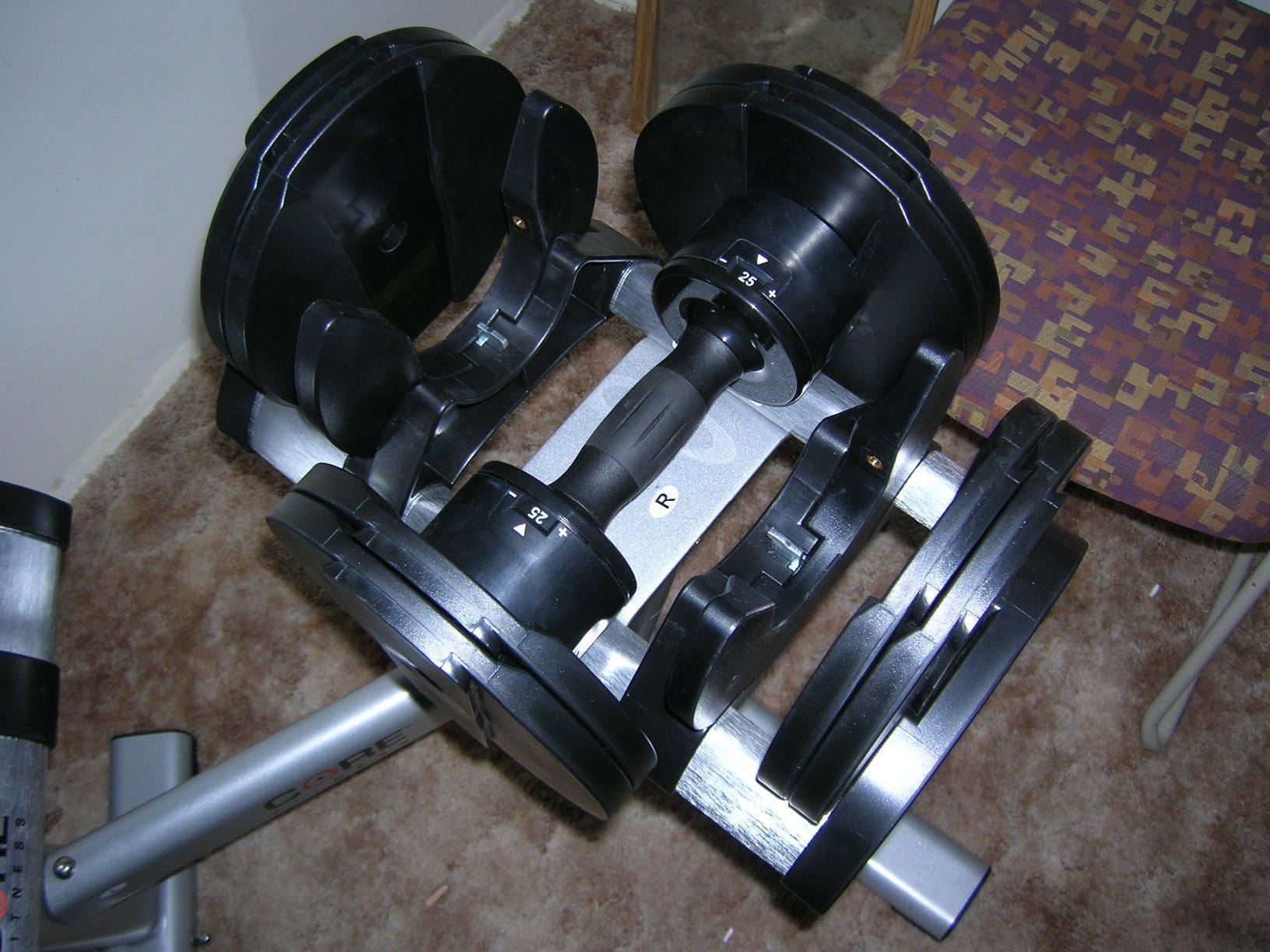
Several owners report years of regular use with no problems, and the mechanism is described as working reliably rather than occasionally jamming. The contoured soft-grip handle is comfortable for long sessions without gloves or chalk, which is more than can be said for the raw knurling on some budget sets.
The cradle is the catch, and it is specific enough to plan around. Above roughly 25 lb per dumbbell the weight tends to stick in the cradle, and you sometimes lift the whole base out with it. Only one dumbbell can be removed at a time at those settings, so it needs a deliberate technique or a firm second hand.
Learning the Cradle Technique Above 25 lb
The fix is a technique change, not a different product. Seat the dumbbell fully in the cradle, twist the handle to set the weight while it is supported, then lift straight up with a slight twist to break the grip before the weight clears the slats. Reviewers who do this report no sticking at all.
For single-arm overhead work, the wide heads are a real constraint. Behind-the-neck triceps extensions and some skull crusher variations are awkward, and the correct substitute is a neutral-grip or dumbbell-bench version of the same movement. Plan the exercise list before you commit.
What the Warranty Term Covers
A parts warranty is narrower than a full product warranty, so read what it replaces. On a set with a twist mechanism and a cradle, the mechanism and handle are the pieces most likely to need help, and those are the parts most likely to be covered.
If you plan to train above 30 lb per hand regularly, the PowerBlock and the CAP ADJUSTABELL both handle that range with more straightforward mechanics. If your top-end work is lighter, the cradle technique solves it and you get quieter plates than either.
9. CAP ADJUSTABELL – Best for Knob-Free Locking
CAP ADJUSTABELL Adjustable Dumbbell Set, Premium Quick Select Adjustable Weights for Home Gym Strength Training, Round, 55 LB Pair, Honeycomb Chrome & Black Grip Handle
10-55 lb on the 55 lb model
360-degree rotating handle
Patented mechanism
Cast plates
Pros
- No knobs pins or levers to misplace or strip
- Full rotation makes changes smooth from any angle
- Cast plates built for impact and abrasion resistance
- Honeycomb rubber grip inserts give a solid hold
Cons
- Newer listing with a smaller review history
- 5 lb increments on the 25 lb and 55 lb models
- Newer hardware without long-term field data
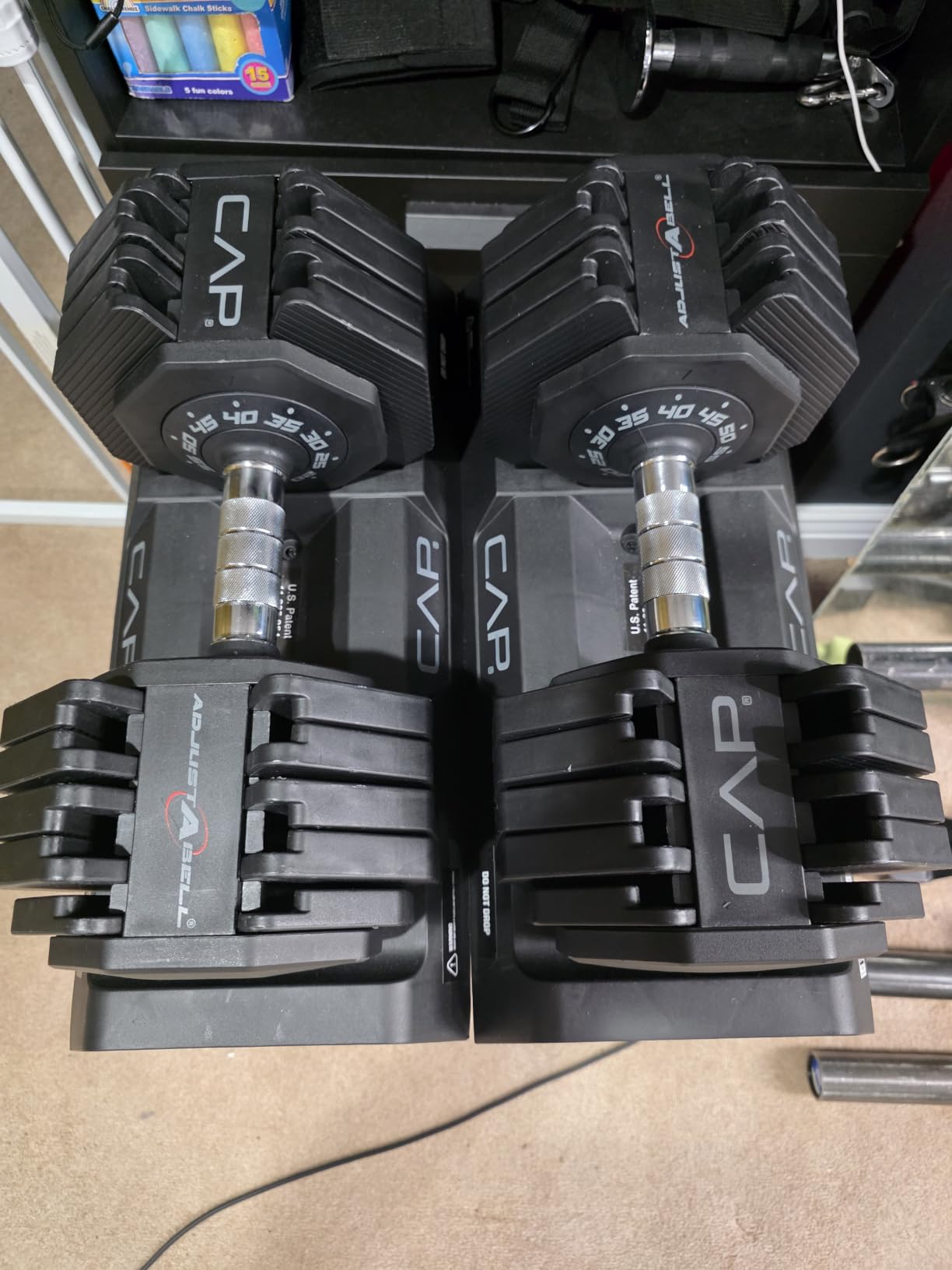
The ADJUSTABELL does something none of the others do: it has no loose parts at all. There is no selector pin to lose in a couch cushion, no lever to strip threads, no knob to cross-thread. A full rotation of the handle and the cradle moves the weight, and the plates are precision cast with clear weight indicators on the face so you can confirm the setting without guessing.
That design is genuinely appealing for a shared household, because the most common way a mechanism dumbbell fails is human error during a fast change. Removing the parts removes the failure mode. The honeycomb rubber grip inserts on the steel handle are also a premium touch that costs nothing at the point of use.
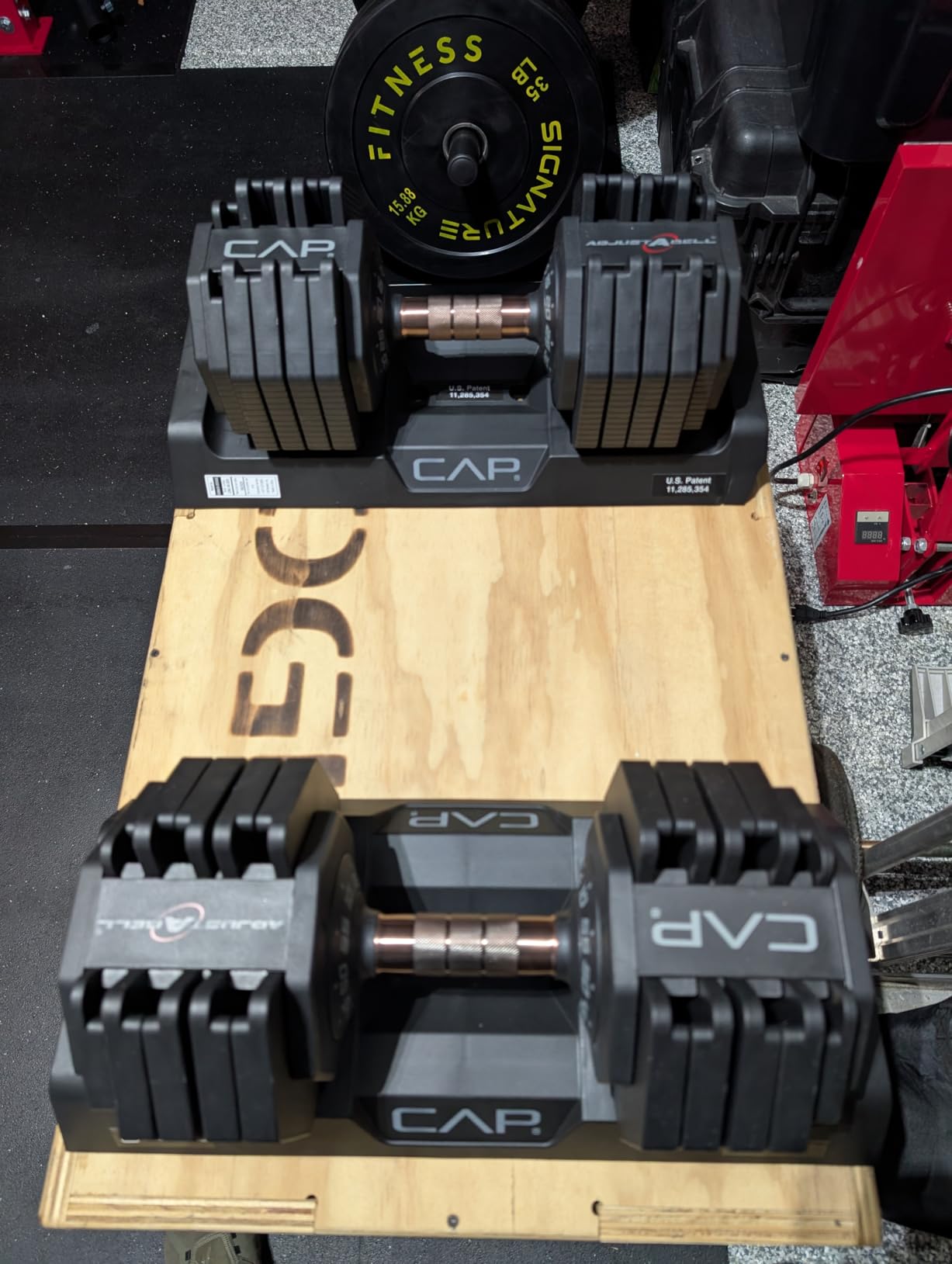
Owner feedback centers on exactly the mechanism. Reviewers like that the weight change is smooth from any angle, that plates stay firmly engaged through every rep, and that the tray doubles as the adjustment cradle and floor protection. The 12.5, 25 and 55 lb versions are offered in singles and pairs, which is unusually flexible for a new product.
The honest caveat is the review history. This listing carries a much smaller number of owner reviews than the established adjustable brands, and long-term durability data simply does not exist yet for a product this recent. Judge it on design merit and accept that you are the early adopter.
Whether Knob-Free Design Outweighs a Smaller Track Record
We think it depends on who you are. If you already know you lose pins, strip levers or break collars, this design removes a problem you have actually experienced and it is worth the newer-hardware risk. If you have never had a mechanism problem, the established designs with thousands of long-term reviews are the safer default.
The honeycomb grip inserts and cast plates suggest a build quality tier above the mid-range sets, and the fact that the tray is the cradle means there is no separate storage piece to misplace. That matters in a small room where every object needs a home.
Choosing the Right Version of the Set
The 12.5 lb model adjusts from 2.5 to 12.5 lb in 2.5 lb steps and is a genuinely interesting travel and rehab option. The 25 lb model covers 5 to 25 lb and suits most beginner programs. The 55 lb model runs 10 to 55 lb in 5 lb steps, which is a strong heavy set but starts too high for isolation work.
Check the starting weight against your program before choosing. A set that begins at 10 lb per hand skips lateral raise and rotator cuff territory entirely, and that is a real cost for a home gym where those movements should appear in every program.
10. LifeOG FDB2 Five-Set Pair – Best for a Compact Starter
2026 Updated Adjustable Dumbbell Set of 2, 5-in-1 Weights Dumbbell Set with Storage Box, 25lbs Adjustable Weights with Anti-slip Silicone Grip, Weight Set For Home Gym Suit both Men and Women
4-25 lb per dumbbell
Five weight settings
Dual-lock on lift
Silicone grip
Pros
- Switches between five weights in about a second
- Dual-lock secures the plates automatically on lift
- Silicone grip holds with sweaty palms
- Storage box keeps the whole set compact
Cons
- Must be aligned precisely with the base slots to lock
- Storage stands feel somewhat flimsy
- Bulkier profile limits some grips
The FDB2 packs down tightly, and that design choice is easy to underestimate. Five weight settings per dumbbell at 4, 10, 15, 20 and 25 lb replace five separate fixed pairs, and the storage box means the whole set occupies about as much room as a shoebox when it is not in use. For a renter or a hotel room that matters more than any other spec.
The dual-lock system is the smart part. You set the weight while the dumbbell is seated in the base, and the plates lock automatically as you lift it. That removes the small but real anxiety of carrying loaded plates overhead while waiting for something to engage, and owners specifically praise that behavior.
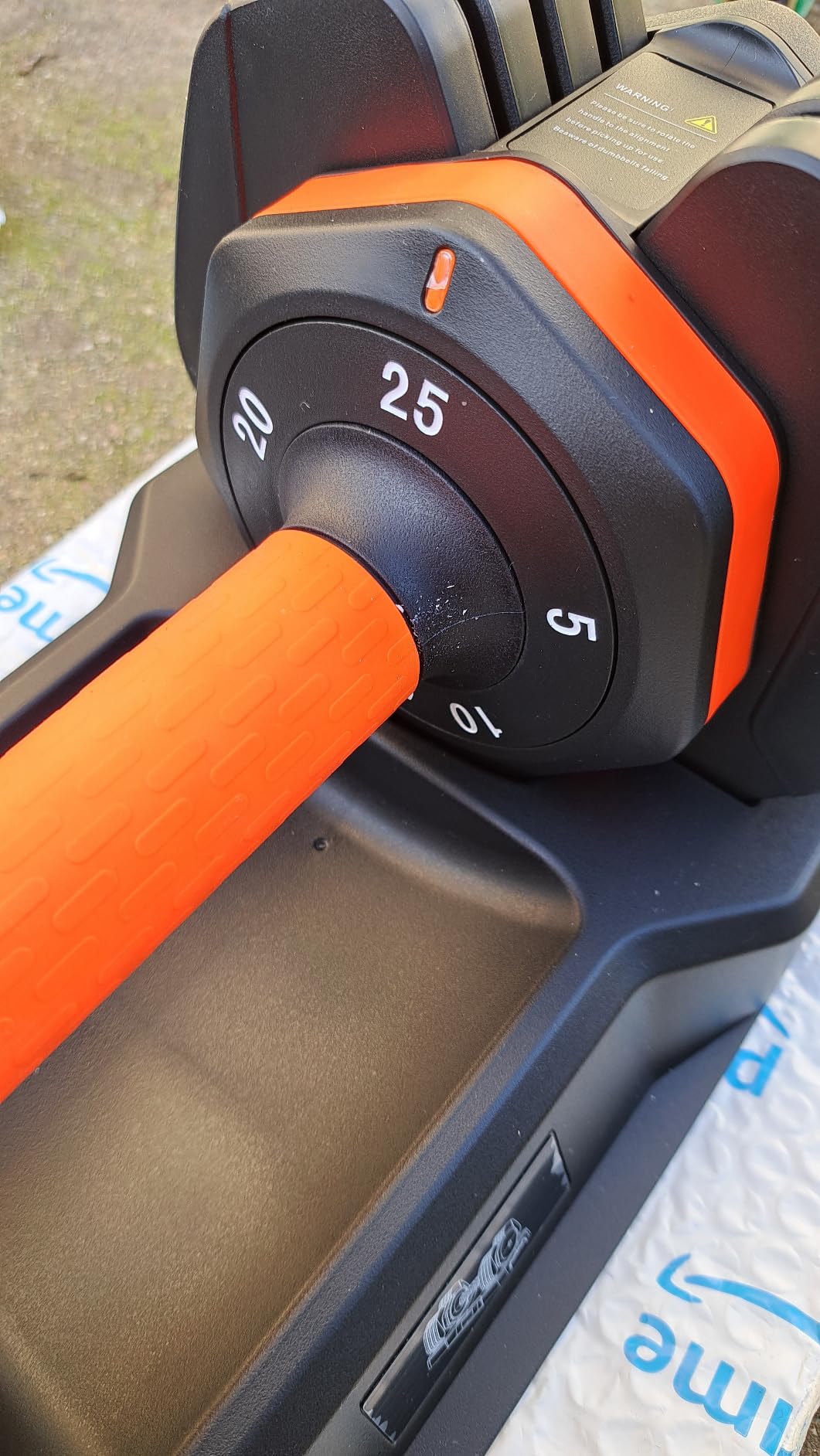
This set carries the highest average rating of the ten, and the reviews are unusually specific about why. People describe the adjustment as genuinely one-handed, the grip as secure when sweating, and the plates as staying locked during lifts. Several note it packs well for travel or for a very small room.
The practical gripe is re-racking. The dumbbells must be aligned precisely with the base slots or they will not seat, and the storage stands themselves feel somewhat flimsy in reviews. It is the same tray-alignment tax the Keppi and Core sets charge, and it is a learnable one.
How the Dual-Lock Changes Overhead Work
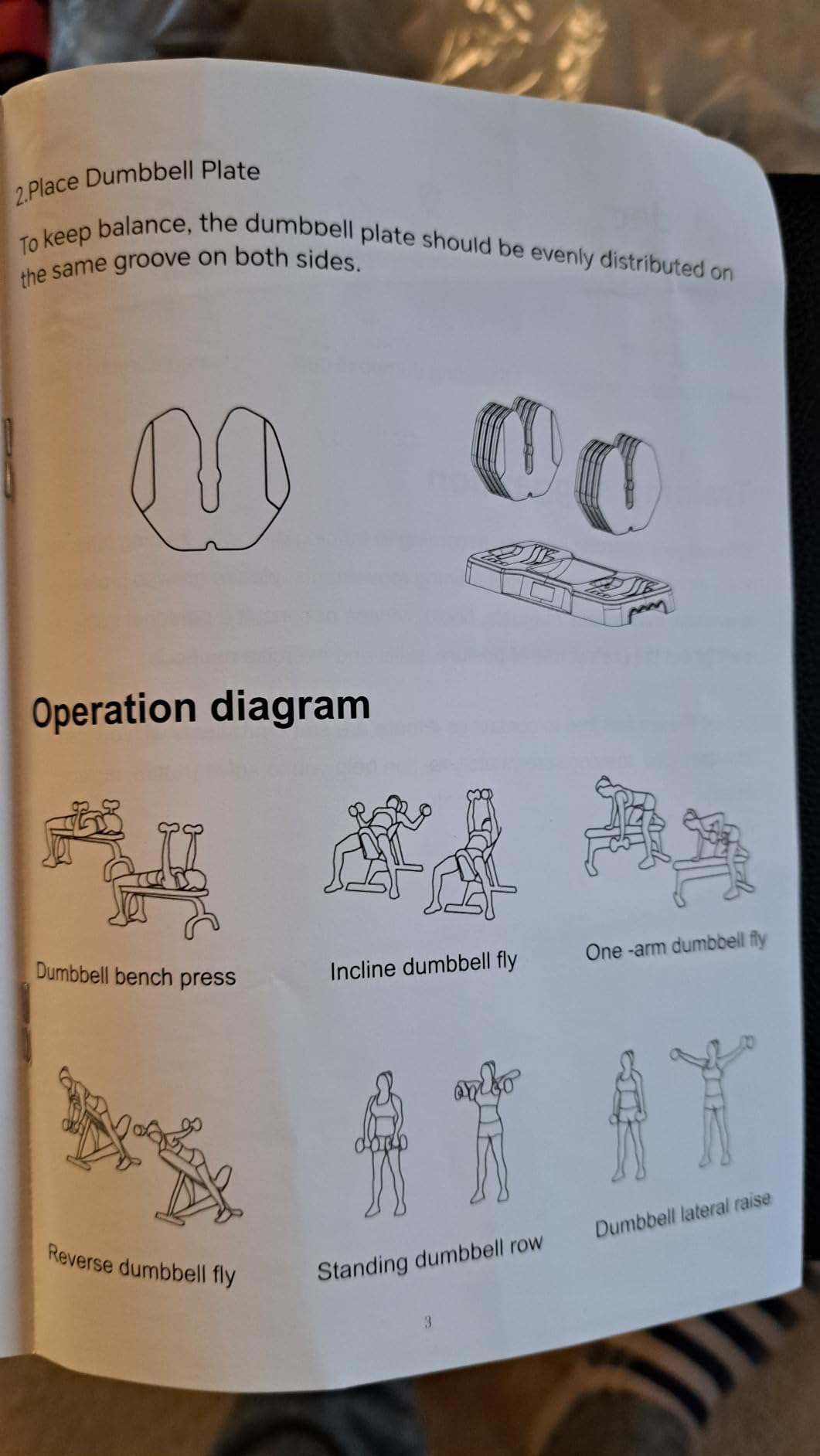
On every other set in this roundup, the plate lock is something you verify by sight or by feel before a heavy overhead press. The FDB2 locks as you lift, so the mechanical action and the safety check are the same movement. That is a meaningful advantage on shoulder presses and any exercise where the dumbbell is above your head.
It does not make the set indestructible. The outer shells are still plastic, and a dropped dumbbell on concrete is the one thing that ends them early. On a mat or carpet they hold up well.
Whether Five Settings Are Enough to Start With
For a first pair, five settings from 4 to 25 lb per hand covers far more than most beginners actually use in their first year. The catch is what happens later: 25 lb is the ceiling, and there is no expansion path shown on this listing.
So the honest framing is this. If you are certain your ceiling will stay under 25 lb per hand, or you want a travel and second-home pair, this is an excellent choice. If you have any intention of training heavy rows and presses within a couple of years, choose a set that reaches 50 lb and skip the replacement purchase later.
How to Choose Adjustable Dumbbells for Your Home Gym
Start From Your Heaviest Planned Exercise, Not Your Target
Most buying mistakes come from picking a range based on what you lift now instead of what you will lift within two years. Find the heaviest movement in the program you actually intend to follow, then buy a range that covers it with headroom.
A heavy row, a dumbbell bench press or a Romanian deadlift needs far more per hand than a goblet squat, and the press is usually the one people get wrong.
Add roughly 50 percent above that heaviest planned load to give yourself progression room. Once you can no longer add weight for two sessions in a row, the ceiling is reached, and that is when an outgrown adjustable pair becomes the first purchase you regret.
Read Weight Listings Per Hand, Not Per Pair
A 20 lb dumbbell is 20 lb in one hand, so a pair at that setting is 40 lb total across both hands. Listings that quote a package weight are describing something else entirely. A set advertised as 38 lb total, for example, works out to a much lower per-dumbbell maximum, and the plate count in the specifications is the only reliable way to work it out.
The same confusion applies to weight increments. A set that steps in 2.5 lb increments gives you far more usable loading points than one stepping in 5 lb, and the difference is most visible below 25 lb where isolation work happens.
Match the Mechanism to Your Training Style
Dial and twist-handle systems change weight fastest, usually in one to three seconds, and they are the right choice for drop sets, supersets and fast circuit work. Selector pin systems take a more deliberate two-handed operation but lock plates by design and suit straight sets with real rest periods. Plate-loaded designs like the Amazon Basics and Yaheetech sets are the slowest to change, since you are unscrewing collars, but they feel the most like traditional dumbbells and have the fewest parts to fail.
This is the trade most people get wrong. People buy a dial system for speed and then train straight sets, which is where the speed does not matter, and then complain the balance is odd. People buy plate-loaded sets and then try to run drop sets, and complain it is frustrating. Match the mechanism to how you actually train.
Decide Between One Heavy Pair and Two Lighter Pairs
One heavy pair from 5 to 50 lb per hand covers a decade of programming in a single purchase and takes one tray of floor space. Two lighter pairs give you two distinct weights at all times, which is faster for supersets, but they double the footprint and the total outlay for comparable coverage.
For one person training full-body three to five days a week, one heavy pair is the better deal by a wide margin. For two adults training at clearly different levels in the same small room, the fine-increment single pair such as the Lifepro handles it more cleverly than two separate fixed sets.
Can You Drop Adjustable Dumbbells?
Generally no, and the reason is structural rather than a matter of care. Dropping a conventional dumbbell is safe because it is one solid piece of steel. Dropping an adjustable one drives momentum into an internal mechanism, a pin or an encased plate stack, and the failure modes are bent handles, cracked shells or plates that no longer seat correctly.
Some designs tolerate drops better than others, but if your training style is built around heavy drop sets, an adjustable pair is the wrong category. Build the drop-set portion of your program around pull-ups, dips, or single-arm work with a fixed dumbbell, and reserve the adjustable pair for the straight-set portion.
Check the Mechanism, Not Just the Rating
Safety on an adjustable dumbbell is entirely about whether the plates stay engaged. The designs with the most positive safety signals use either a cradle system that physically holds the plates in place, or a fully enclosed composite plate, or a magnetic pin that locks by design rather than friction. The designs with the weakest signals rely on a knob or collar bearing friction against the handle, which is fine until it is not.
Whichever you choose, test the heaviest setting you plan to use before your first real session. Set the weight, shake the dumbbell hard, hold it overhead, then set it down and pick it up again.
Do that ten times. If anything moves, send it back.
Register the Warranty and Buy From the Brand’s Own Listing
Warranty registration takes two minutes and documents the purchase date and serial number, which is the cheapest durability safeguard available. It matters more on adjustable dumbbells than on fixed ones precisely because they contain moving parts, and because mechanical failure is the most common warranty claim on this category.
Also confirm who is actually selling the unit. Marketplace listings from third-party sellers are the most common source of warranty problems, because the box may be genuine while the coverage paperwork is not. If the listing is not sold by the brand or an authorized storefront, treat warranty coverage as uncertain and factor that into the decision.
Know When to Buy Fixed Dumbbells or a Smart Resistance Machine Instead
Fixed dumbbells win on speed, feel and durability, and a rubber hex set is the reference standard our fixed dumbbell roundup covers in detail. They lose on floor space and total cost of ownership for full ranges. If you have the room and train serious volume, a fixed set is the better long-term buy.
Smart resistance machines are the other escape hatch. They have no weight ceiling, they store flat against a wall, and they are covered in our smart home gym roundup. The trade is that you are training against a motor rather than free weights, and a growing number of lifters find that difference matters for barbells and heavy deadlifts.
Once you have the dumbbells sorted, the rest of the garage or apartment setup is where most home gyms quietly stall. Our home leg press machine guide covers the vertical and horizontal options that pair well with a compact dumbbell pair.
Frequently Asked Questions
What are the pros and cons of adjustable dumbbells versus fixed dumbbells for home gyms?
Adjustable dumbbells save an enormous amount of floor space, cover a wide weight range for a single purchase, and are far cheaper than the equivalent fixed rack. Fixed dumbbells change nothing between sets, feel more natural, and are easier to drop. Adjustable sets are slower to adjust, rarely match fixed dumbbells for balance, and use plastic or composite parts that wear over time. For one person in a small room, adjustable usually wins. For a shared garage with room to spare, fixed is better.
Is there a downside to adjustable dumbbells?
Yes, mainly speed and feel. Every weight change takes seconds rather than being instantaneous, so drop sets and fast supersets are harder to run. Balance is often imperfect, especially at the lowest settings, and the plastic or composite components used in most designs are not drop-safe. Sets also rarely include a genuine range below 5 lb, which limits shoulder isolation work for beginners.
Is a 20 lb dumbbell actually 40 lbs?
A single 20 lb dumbbell weighs 20 lb. A pair of 20 lb dumbbells totals 40 lb, but you lift one at a time, so your working load per arm is 20 lb. This is the single most common misunderstanding in dumbbell listings, and it is why a pair rated at 20 lb is far less than most beginners expect. Always read the per-dumbbell figure.
Are 50 lb adjustable dumbbells enough?
For most people, 50 lb per hand covers roughly a decade of progressive strength training including heavy rows, presses and deadlift variations. Beginners can use the low end for years. If you train serious body weight work like weighted pull-ups or dips, you will want headroom above 50 lb, and the expandable designs that reach 70 or 90 lb per hand exist for that reason.
Can you drop adjustable dumbbells safely?
Not reliably. Dropping transfers impact into the internal plates, selector pin or twist mechanism, and the usual results are bent handles, cracked shells or plates that no longer seat. The designs with a cradle or fully enclosed composite plates tolerate drops better than knob-and-collar designs. If drop sets are central to your program, use fixed dumbbells for that portion of the session.
Bottom Line: Our Verdict for Adjustable Dumbbells in 2026
The Amazon Basics Adjustable Dumbbell Hand Weight Set is the best adjustable dumbbells for home gyms pick for 2026 because it does the fundamentals better than anything else here and has more than 10k owner reviews backing the claim. It is real plate-loaded steel, it starts at a genuinely light 3 lb per hand, and it comes with a handled storage case that keeps everything in one place.
Two alternates cover the different priorities. The Lifepro Quick-Adjust pair is the better buy if you want one-second dial changes and 2.5 lb increments for a shared household. The PowerBlock Elite EXP is the better long-term buy if you expect to train heavy and want the option to expand past 50 lb per hand later.
Whatever you choose, buy on the ceiling rather than the starting weight, and test the heaviest setting you plan to use before the first session. That one habit prevents nearly every complaint we read in the reviews.