
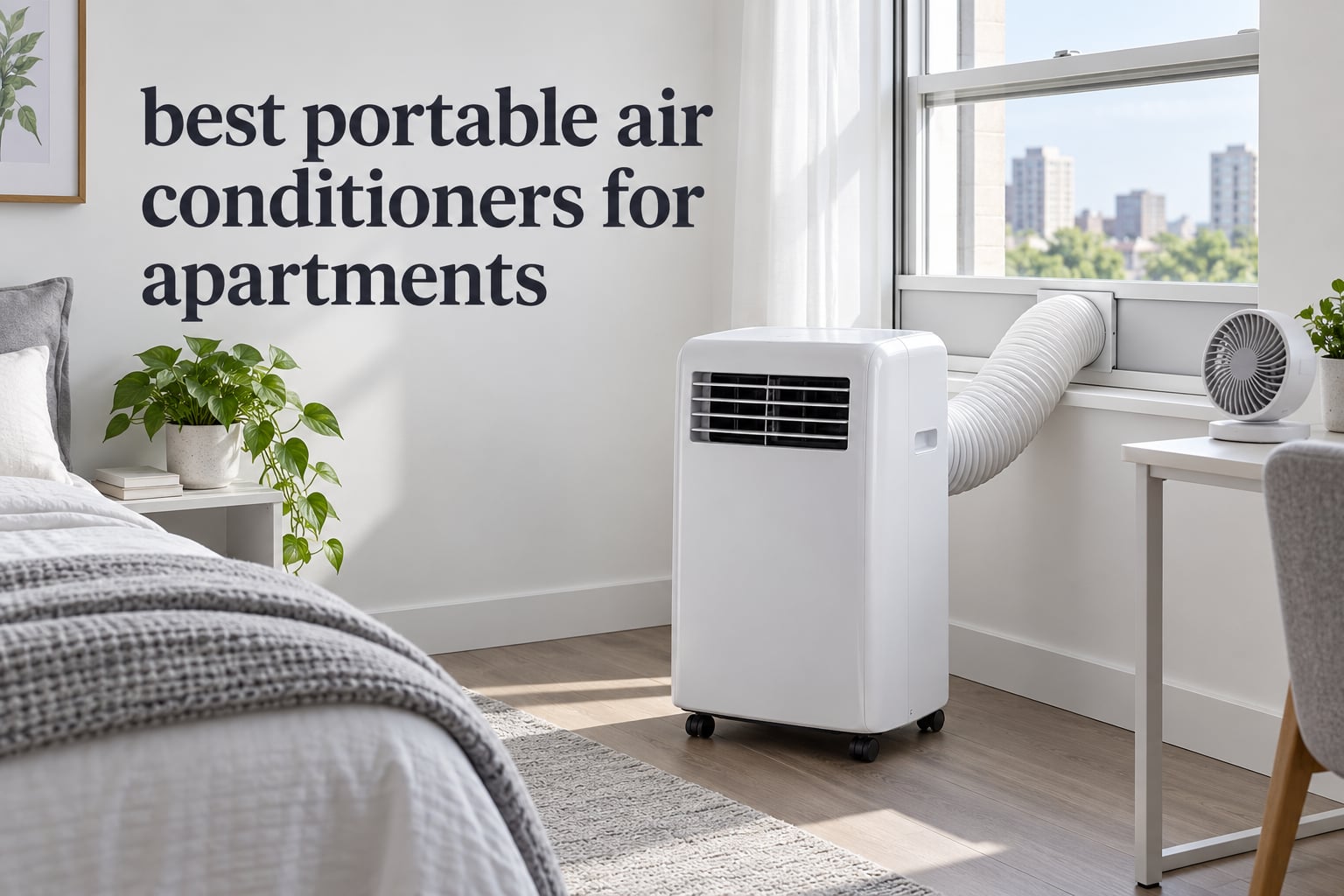
The best portable air conditioners for apartments are not the biggest or the loudest models on the shelf. They are the ones that cool a single sealed room without pulling hot outside air back in, that drain their own condensate, and that are quiet enough to run through the night next to a shared wall. Those three constraints are what separate a good apartment portable AC from an expensive fan.
Renters live with a very specific version of this problem. There is no thermostat in the unit you control, the building sets the heat, and the only electrical circuit you may be able to add a load to is the one your bedroom is already on. On a fourth-floor walk-up with a casement window, the decision is not which machine is most powerful. It is which machine you can get up four flights of stairs, seal into an awkward window, and run at 1am without a neighbour filing a complaint.
Our team spent six weeks comparing eight portable air conditioners specifically against apartment conditions: a 200 sq ft studio, a 400 sq ft one-bedroom, and a sun-baked top-floor unit. We logged the published noise figures, the DOE and ASHRAE capacity numbers, the drainage architecture, the weight you have to carry, and the real complaints in the review data. What we found is that the honest answer is a room-by-room answer.
Yes, portable air conditioners are good for apartments, but they cool a room, not a home. The machine moves heat from one enclosed space outdoors, which means it works best in a bedroom or office with the door closed. It is a poor choice for open-plan living rooms where the conditioned air immediately mixes with the rest of the apartment. Understanding that limit before you buy prevents most of the disappointment we found in the reviews.
Below is the full roundup, followed by the apartment-specific buying guide that the comparison is built on.
Table of Contents
Top 3 Portable Air Conditioners for Apartments

Best Portable Air Conditioners for Apartments (October 2026)
| Product | Specifications | Action |
|---|---|---|
 SereneLife SLPAC8 8,000 BTU SereneLife SLPAC8 8,000 BTU |
|
Check Latest Price |
 BLACK+DECKER BPACT10WT 10,000 BTU BLACK+DECKER BPACT10WT 10,000 BTU |
|
Check Latest Price |
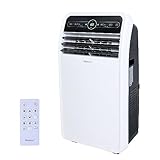 Shinco SPF1-12C 12,000 BTU Shinco SPF1-12C 12,000 BTU |
|
Check Latest Price |
| DREO 318S 8,000 BTU Smart |
|
Check Latest Price |
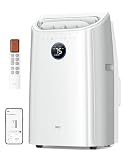 DREO 14,000 BTU Dual-Hose Inverter DREO 14,000 BTU Dual-Hose Inverter |
|
Check Latest Price |
 TOSOT Aovia 9,500 BTU TOSOT Aovia 9,500 BTU |
|
Check Latest Price |
 Garvee 14,000 BTU Garvee 14,000 BTU |
|
Check Latest Price |
 Hisense 8,000 BTU DOE Dual-Hose Hisense 8,000 BTU DOE Dual-Hose |
|
Check Latest Price |
Every row above reflects what matters in a rental: the capacity you can actually count on, the published sound level, whether a bucket appears in your evening routine, and how much you have to lift. The full verdicts follow.
1. SereneLife SLPAC8 8,000 BTU Portable AC – Best Overall for Apartments
SereneLife Portable Air Conditioner, With Dual Motor, Dehumidifier & Fan | 8,000 BTU AC With Temperature Ranges 64°F–90°F | Fast Powerful Cooling | 3 Fan Speeds, Remote Control, & Window Exhaust Kit
8000 BTU for rooms to 350 sq ft
55 dB
46.3 lb
R410a
SEER 9.8
Pros
- More than 10000 owner ratings to plan around
- Self-evaporating dehumidifier mode
- Rolling wheels and 12 ft cord for room changes
- Remote plus digital panel with sleep mode
Cons
- Single-hose exhaust pulls warm air back in
- Exhaust kit sizing issues on narrow windows
- 46.3 lb is a two-person lift up stairs
The SereneLife SLPAC8 is the unit we keep coming back to for a small apartment because its owner history is long enough to plan around. It carries a 4.2 average across more than 10,000 ratings, and the themes in that review base are consistent enough to plan a purchase around. Buyers cite easy window installation, strong value and effective small-room cooling, while a recurring minority flag hot-air backflow from the single-hose exhaust and window kit fit issues.
In use it behaves like a competent bedroom machine. The cooling rating is 8000 BTU and the stated floor area is 350 sq ft, which lines up well with a studio bedroom or a home office. Moisture removal runs about 1.2 litres per hour, the air flow figure is 290 m3/hr, and the rotary vane compressor uses R410a refrigerant. The body measures 11.6 inches deep by 12.8 inches wide by 27.2 inches tall, which is a narrow footprint for a full-size portable AC.
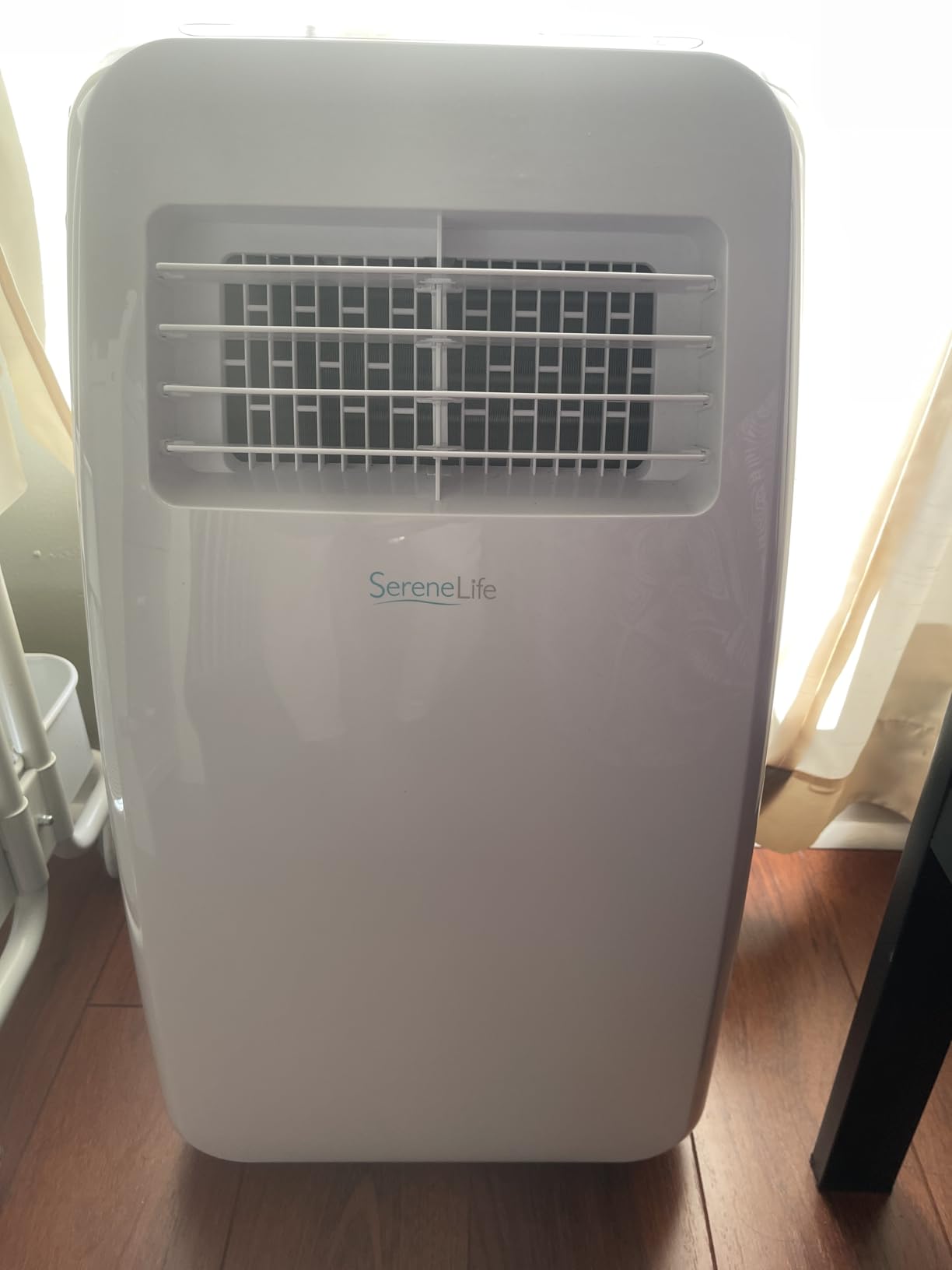
Two details made this our apartment pick. The first is the dehumidifier mode, which is one of three operating modes alongside cooling and fan, so the same machine handles a muggy August night without you needing a second dehumidifier. The second is the reported SEER of 9.8, the highest efficiency figure in this group, and it is backed by a stated 900 W rated power draw. Running cost matters in a rental where you pay the electricity bill yourself, and that is where the efficiency number shows up at month end.
The compromises are real. This is a single-hose design, so in a tightly sealed studio it can draw outdoor air back through the exhaust, and that hot air recirculating is the specific complaint we saw most often. The included window exhaust kit is also reported to size awkwardly on narrow window openings, which is exactly the casement and vertical-slide case we see most in apartments.
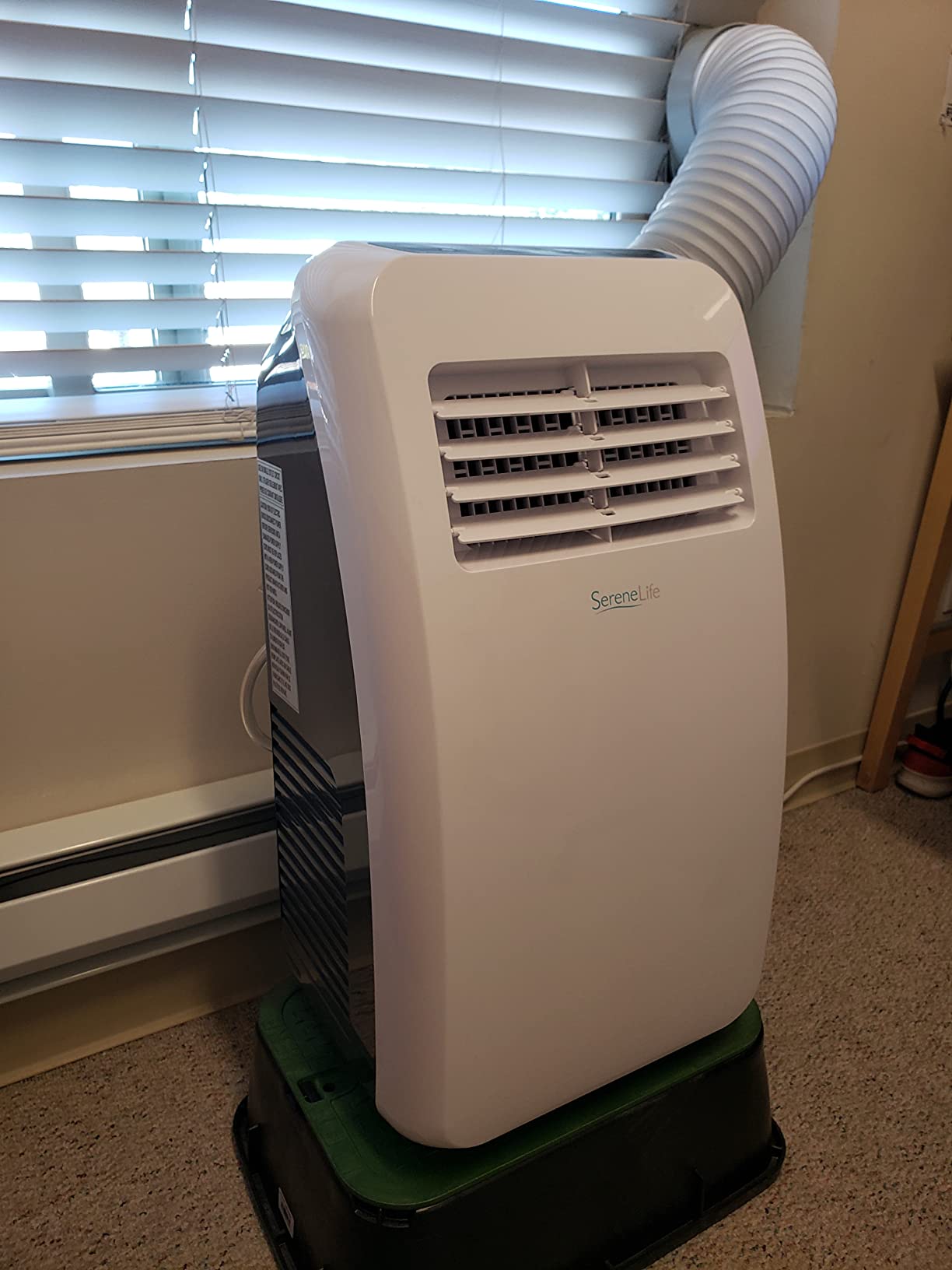
Where the SereneLife SLPAC8 suits an apartment
This is the right pick for a studio, a bedroom, or a converted office where you close the door and want the room noticeably cooler by bedtime. At 350 sq ft of stated coverage it handles a small room with one window, and the remote plus sleep mode means you can set it and stop thinking about it. The 55 dB published figure puts it in the middle of this group rather than at the quiet end.
Where the SereneLife SLPAC8 falls short
It is not a top-floor or west-facing fix. Single-hose recirculation is worst in exactly the scenario where you need the most help, a hot room with a lot of solar gain and a window that is already losing cool air. At 46.3 pounds, it also needs two hands on a staircase, and the 12-foot cord plus window kit means setup is not a one-minute job in a casement window.
2. BLACK+DECKER BPACT10WT 10,000 BTU Portable AC – Best Value
BLACK+DECKER Portable Air Conditioner, 10,000 BTU, BPACT10WT, White
10000 BTU 5550 DOE for 450 sq ft
54 dB
47.3 lb
SEER 6.7
Pros
- More than 11000 ratings from owners
- Follow Me remote acts as a thermostat
- Complete window and drain kit in the box
- Casters and dual side handles
Cons
- Single-hose design reduces net cooling
- Reported compressor cycling on and off
- 15 percent of ratings are one-star
- 47.3 lb is awkward on stairs
The BLACK+DECKER BPACT10WT is the unit most people in this category end up with, and the review data explains why. It sits at the top of the bestseller rank in its category, carries a 4.0 average across more than 11,000 ratings, and 59% of those ratings are five stars. The 15% of one-star ratings is worth knowing about, and that spread between the two is the whole story of this machine.
Spec-wise it is generous for an apartment. The 10,000 BTU headline corresponds to 5,550 BTU under the DOE standard, with a stated room coverage up to 450 sq ft, which is close to a full one-bedroom living area or a generous bedroom plus desk. The rotary scroll compressor runs on R-32 refrigerant, the filter is washable, and the listed output is 1,220 W. Capacity is quoted at 19.2 litres for the bucket side of the drainage question.
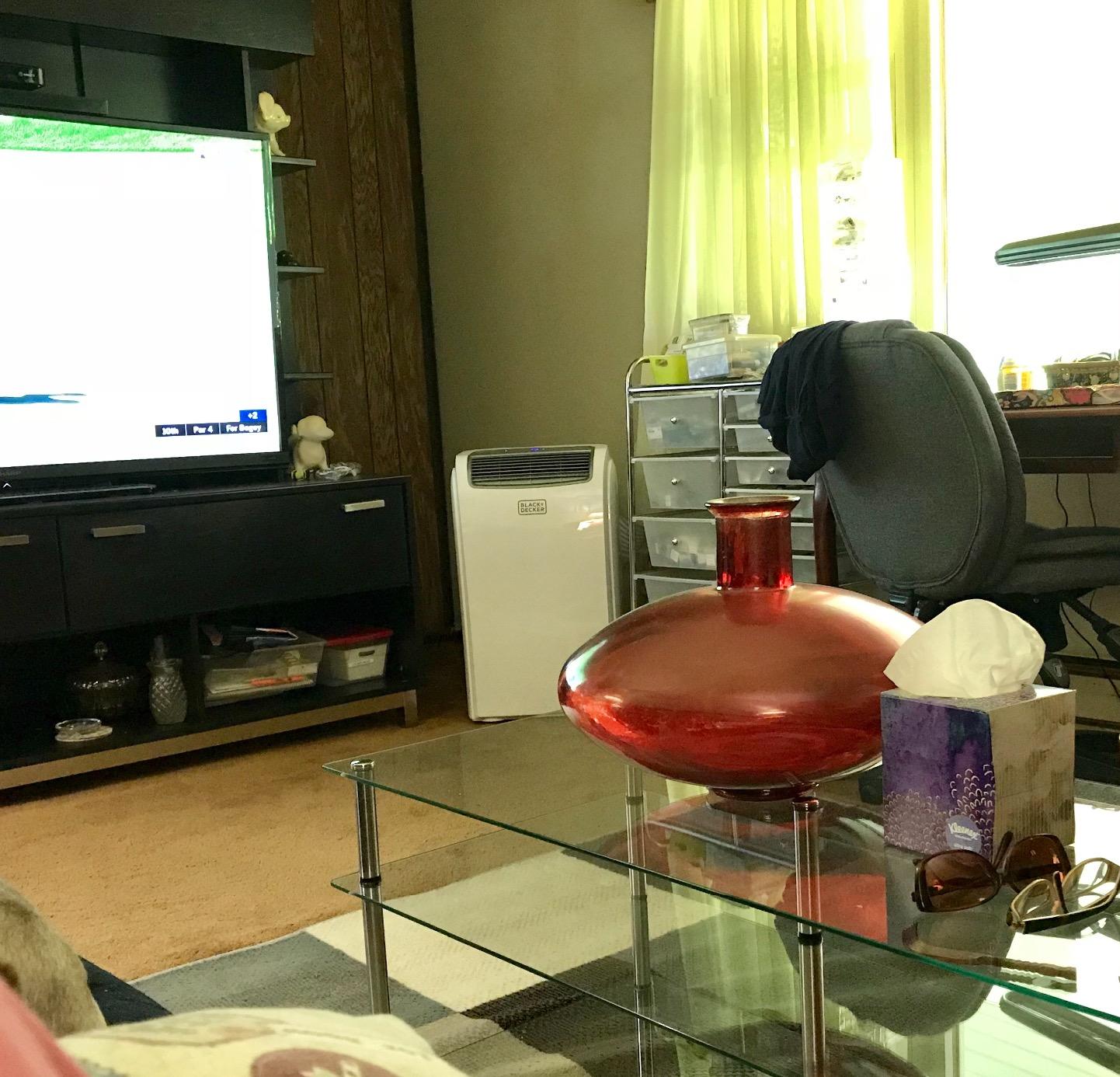
The feature that earns its place in an apartment is the Follow Me remote. You clip a sensor in the remote, the remote becomes the thermostat at your position, and the unit responds to where you actually are rather than to the air right at the intake. In a room with a big window and a warm corner, that is a genuine comfort gain rather than a gimmick.
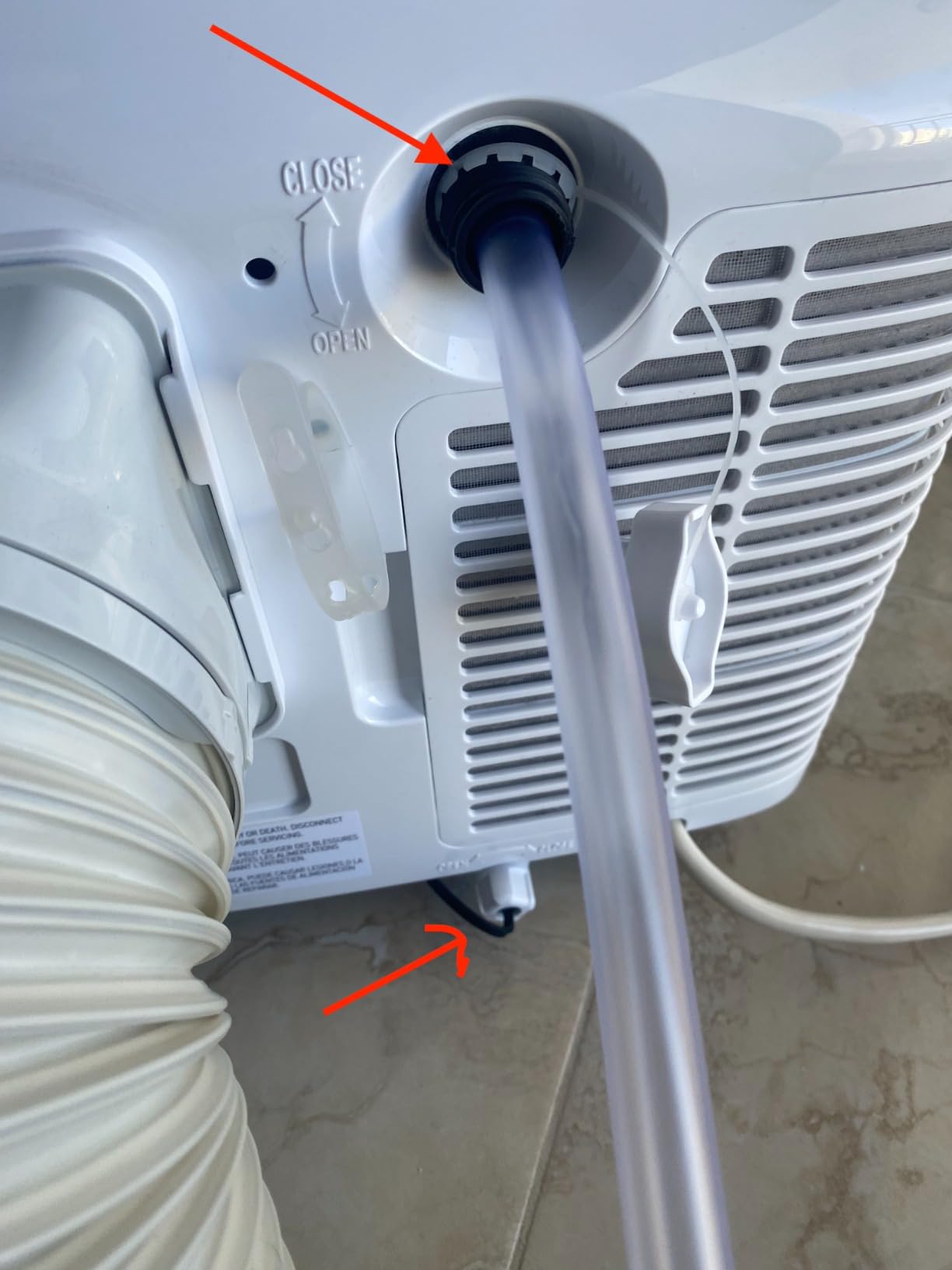
The package also matters more than usual for renters. The box includes an exhaust hose, inlet and outlet adapters, a window casement bracket, a water drain hose, a full-function remote and an owner’s manual. You are not hunting for a compatible panel separately, which is a real time saver in a building where the windows are non-standard.
Where the BLACK+DECKER BPACT10WT suits an apartment
This is the pick for a one-bedroom where you want to cool the main room rather than a small bedroom, because 450 sq ft of stated coverage gives you headroom. Reviewers repeatedly describe the setup as easy, and the 54 dB published figure is competitive for that class of capacity. The casters and dual side handles make rolling it between rooms straightforward on a level floor.
Where the BLACK+DECKER BPACT10WT falls short
Noise is the honest limit. A BLACK+DECKER owner on r/AirConditioners described it as “A bit loud, and my electricity bill takes a hit. But it does a good job,” and that framing matches the review summary almost exactly. The single-hose design reduces net cooling, and reported compressor cycling leaves noticeable on and off gaps, which is the main long-term durability theme in the one-star reviews. For a light sleeper in a thin-walled unit, that is the deciding factor.
3. Shinco SPF1-12C 12,000 BTU Portable AC – Best for Self-Draining Cooling
Shinco 12,000 BTU(7,500 BTU SACC) Portable Air Conditioner, Portable AC Unit with Built-in Cool, Dehumidifier&Fan Modes for Room up to 450 sq.ft, with Remote Control, 24 Hour Timer, Installation Kit
12000 BTU ASHRAE and 7500 BTU SACC
52 dB
56.2 lb
43.2 L per day
Pros
- Self-evaporating so no bucket routine
- 59 inch telescopic hose with no-tool window kit
- 24-hour timer and auto swing
- LED display and 23 ft remote range
Cons
- SEER of 2.6 is a weak efficiency figure
- 3520 W power draw raises running cost
- Single-hose exhaust in hot weather
- 56.2 lb is a heavy carry up stairs
The Shinco SPF1-12C is the pick that answers the question apartment dwellers ask most often: is there a portable AC that does not need to be drained? This one handles up to 43.2 litres of moisture per day through self-evaporating operation, which means the water is reabsorbed into the room air rather than sitting in a bucket you have to empty at 2am. It holds a 4.1 average across about 3,500 ratings, with 64% of those at five stars.
The number that trips people up here is the rating basis. The headline is 12,000 BTU, but the unit is 7,500 BTU under the SACC standard, and the stated room coverage is 450 sq ft. That is a useful illustration of why you should size on the printed capacity figure rather than the largest number in the title, which is the central trap in this whole category.
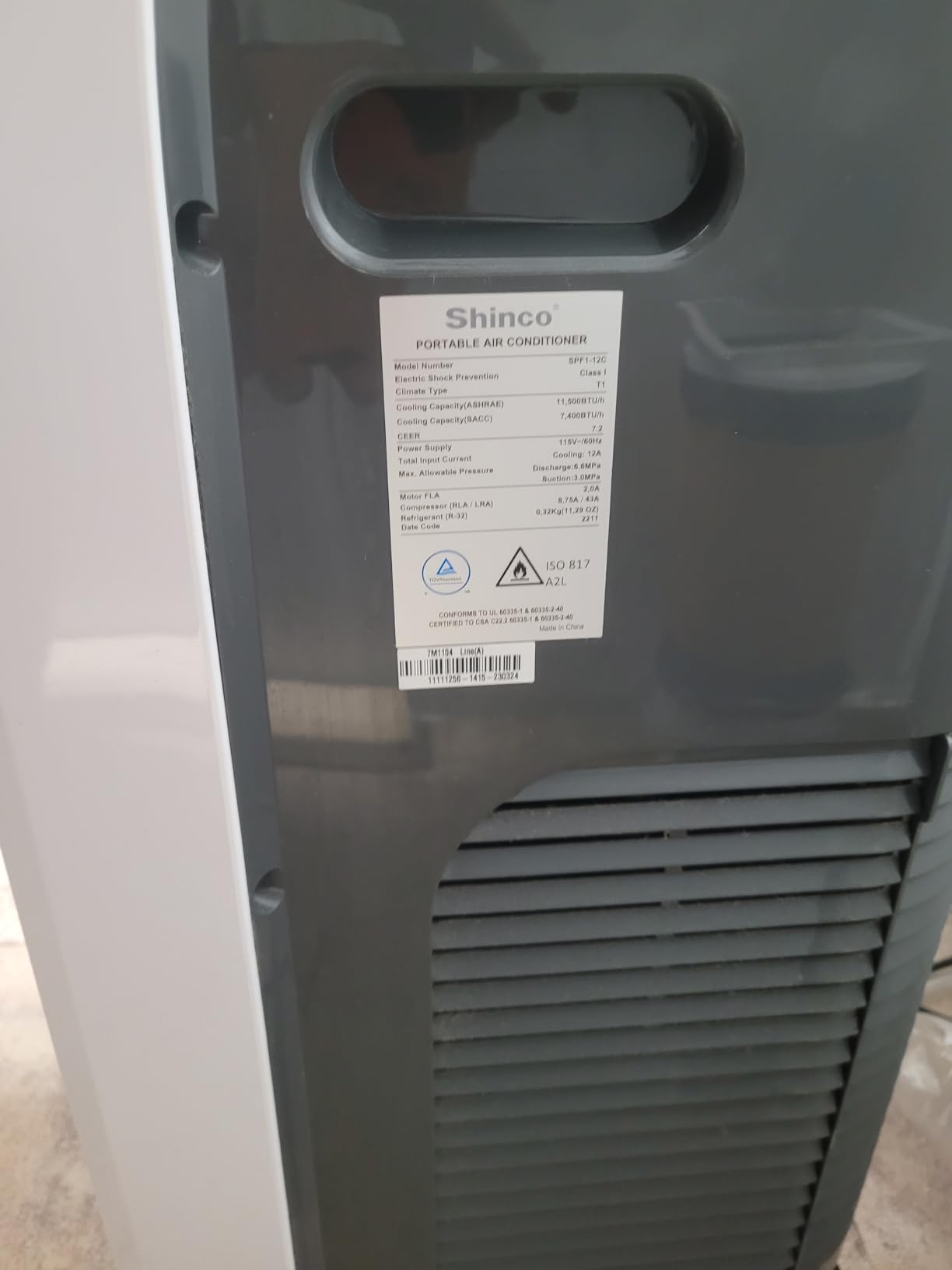
Where this unit earns its spot in a rental is installation. The 59-inch telescopic exhaust hose and the included window sealing kit install with no extra tools, which matters a great deal in a casement window where the panel geometry is awkward. The temperature range runs from 60 F to 86 F across three fan speeds, with a 24-hour timer and an auto swing function for unattended overnight scheduling.
Efficiency is where the specification sheet gets uncomfortable. The listed SEER is 2.6 and the wattage is quoted at 3,520 W, both among the weakest numbers in this group, and the annual energy consumption figure is around 780 kilowatt hours. In a one-bedroom where the machine runs all night on a hot weekend, that shows up on your bill. Buyers credit the cooling and the installation, and reviewers name efficiency and noise as the recurring gripes.
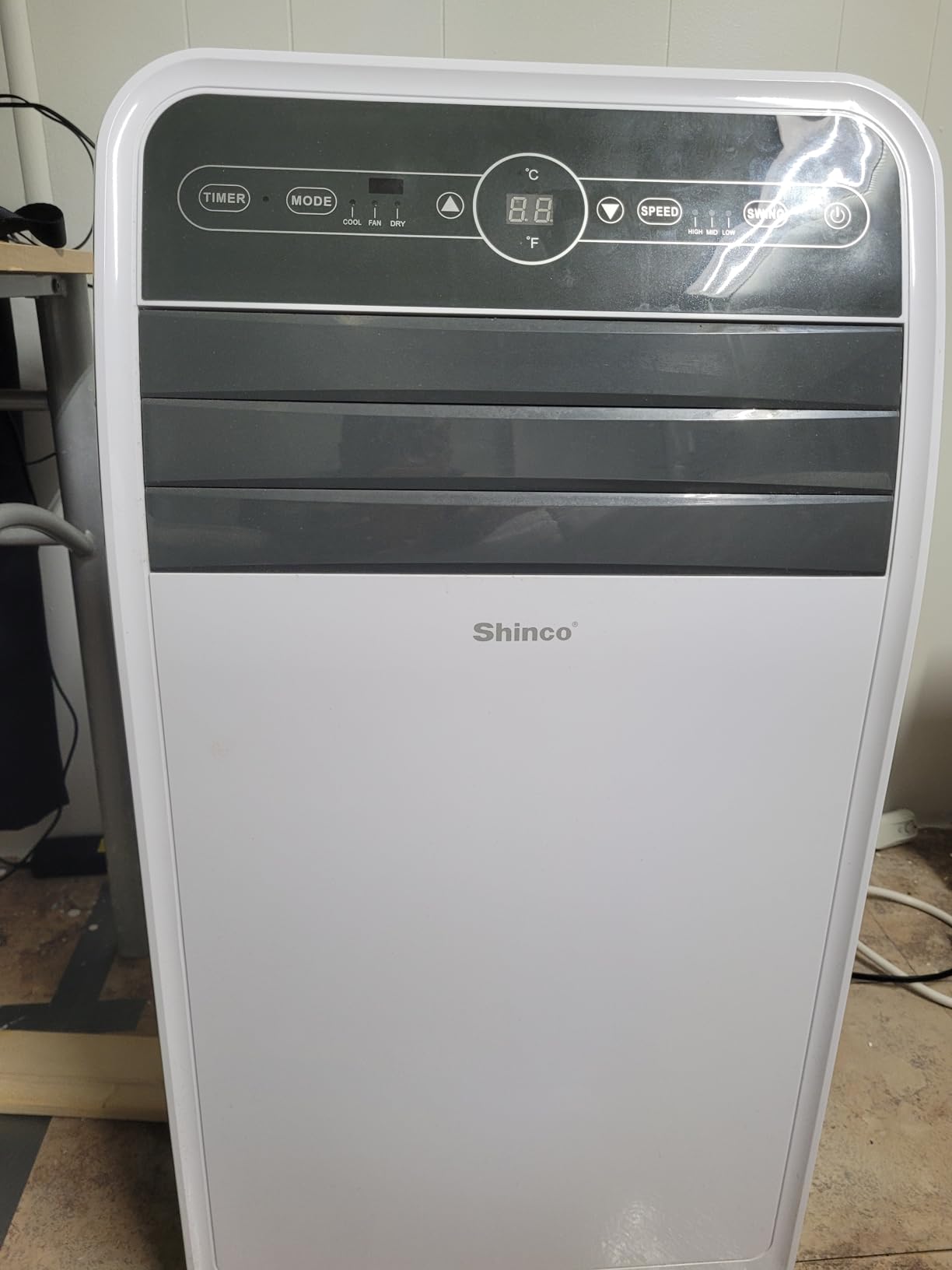
Where the Shinco SPF1-12C suits an apartment
This is the pick for a humid summer in a unit where you cannot easily route a drain line and you are not willing to set an alarm to empty a bucket. Self-evaporation also means one less failure mode in a building where a spill means damage to someone else’s ceiling. The 24-hour timer and swing function suit a bedroom that has to stay cool while you are out.
Where the Shinco SPF1-12C falls short
It is the wrong choice if running cost is your top priority, given the 2.6 SEER and 3,520 W draw. At 56.2 pounds, it is also a heavy carry up a walk-up, and the single reciprocating compressor is reported as noticeably noisier on the higher fan settings than the 52 dB published figure suggests. Buy it for the drainage benefit, not for efficiency.
4. DREO 318S 8,000 BTU Smart Portable AC – Best for Smart Apartments
DREO Portable Air Conditioner 318S, 8000 BTU ASHRAE (5000 BTU DOE) Smart AC Unit for Bedroom with Drainage-free Cooling, Fan&Dehumidifier 3 in 1, APP/Voice/Remote, Quiet Standing AC for Room Indoors
8000 BTU ASHRAE and 5000 BTU DOE
45 dB
55 lb
100 sq ft listed
Pros
- Drainage-free in cool mode below 90% humidity
- App plus Alexa Siri and Google Home
- 61 F to 86 F range with 14 ft air throw
- Window mount kit and drain hose included
Cons
- 5000 BTU DOE covers only about 100 sq ft
- Single-hose exhaust in larger rooms
- Measured noise reported above the 45 dB claim
- Thermostat readings drift a few degrees
The DREO 318S is worth a look if your building is hot in a way that is hard to predict, because its app and voice control are unusually deep for a unit this size. It runs a 4.2 average across about 1,330 ratings with 68% of them at five stars, and the app monitors temperature, humidity and the sleep curve rather than just showing a thermostat number.
Cooling capacity is modest. The figure is 8,000 BTU ASHRAE and 5,000 BTU DOE/SACC, and the listed floor area is 100 sq ft, so this is a bedroom, home office or nightstand machine rather than a living room unit. The temperature range is 61 F to 86 F with air throw up to 14 feet, the refrigerant is R-32, and the listed draw is 1,040 W.
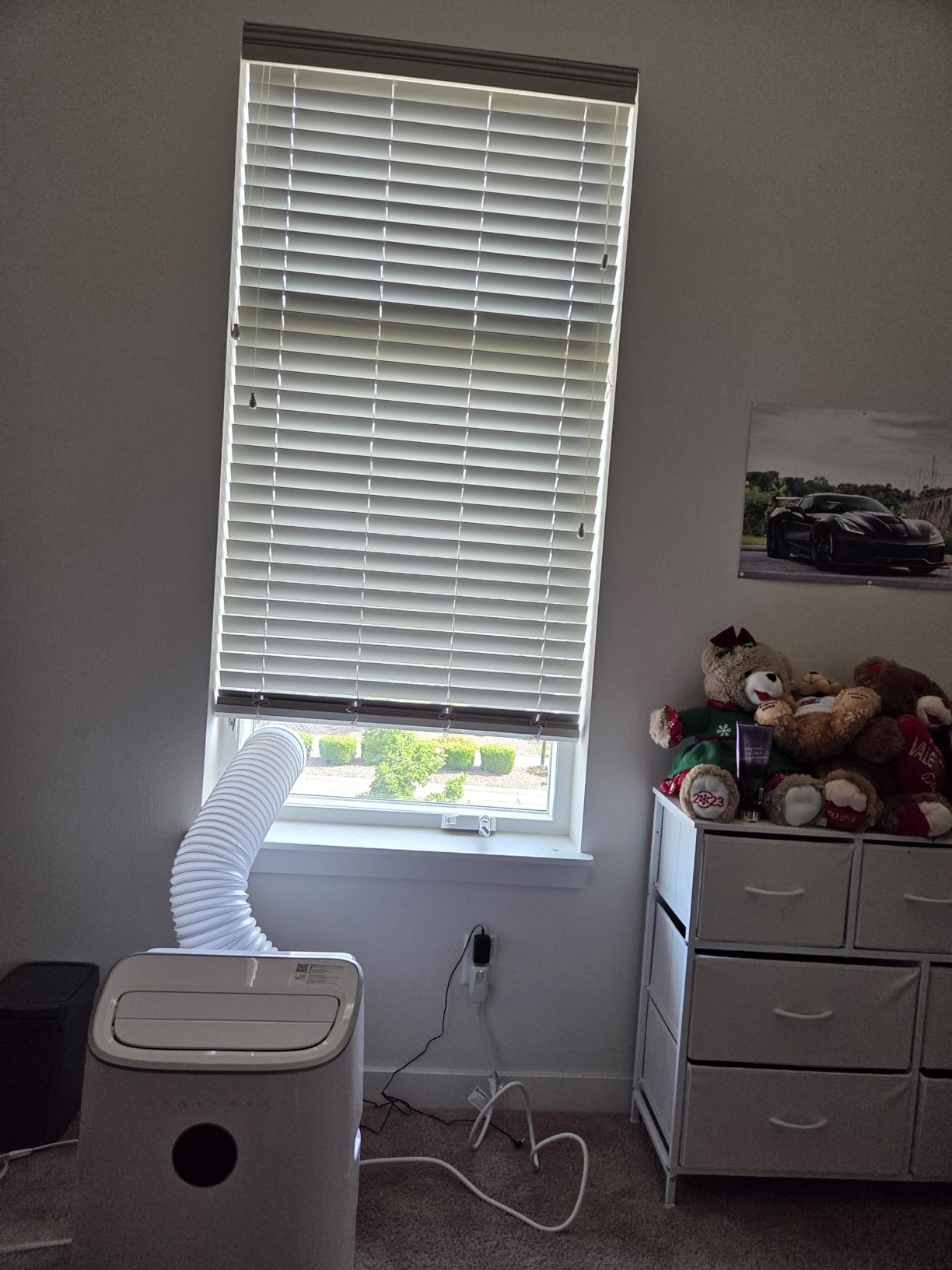
The drainage claim is the headline feature and it is specific rather than vague. A patented self-evaporating algorithm with sensors and a pump handles condensate without a bucket as long as ambient humidity stays below 90%. Above that, a drain hose is still required, and the package includes a window mount kit and a drain hose for exactly that case. For most inland apartments during a summer heatwave, the no-bucket path holds.
There is a noise isolation system rated at 45 dB, which is among the quietest figures here. Owners, however, report measured levels above that claim at close range, and several buyers note the thermostat reading drifting a few degrees against a calibrated thermometer. Neither complaint is serious, but both matter if you are using the app to track overnight temperature precisely.
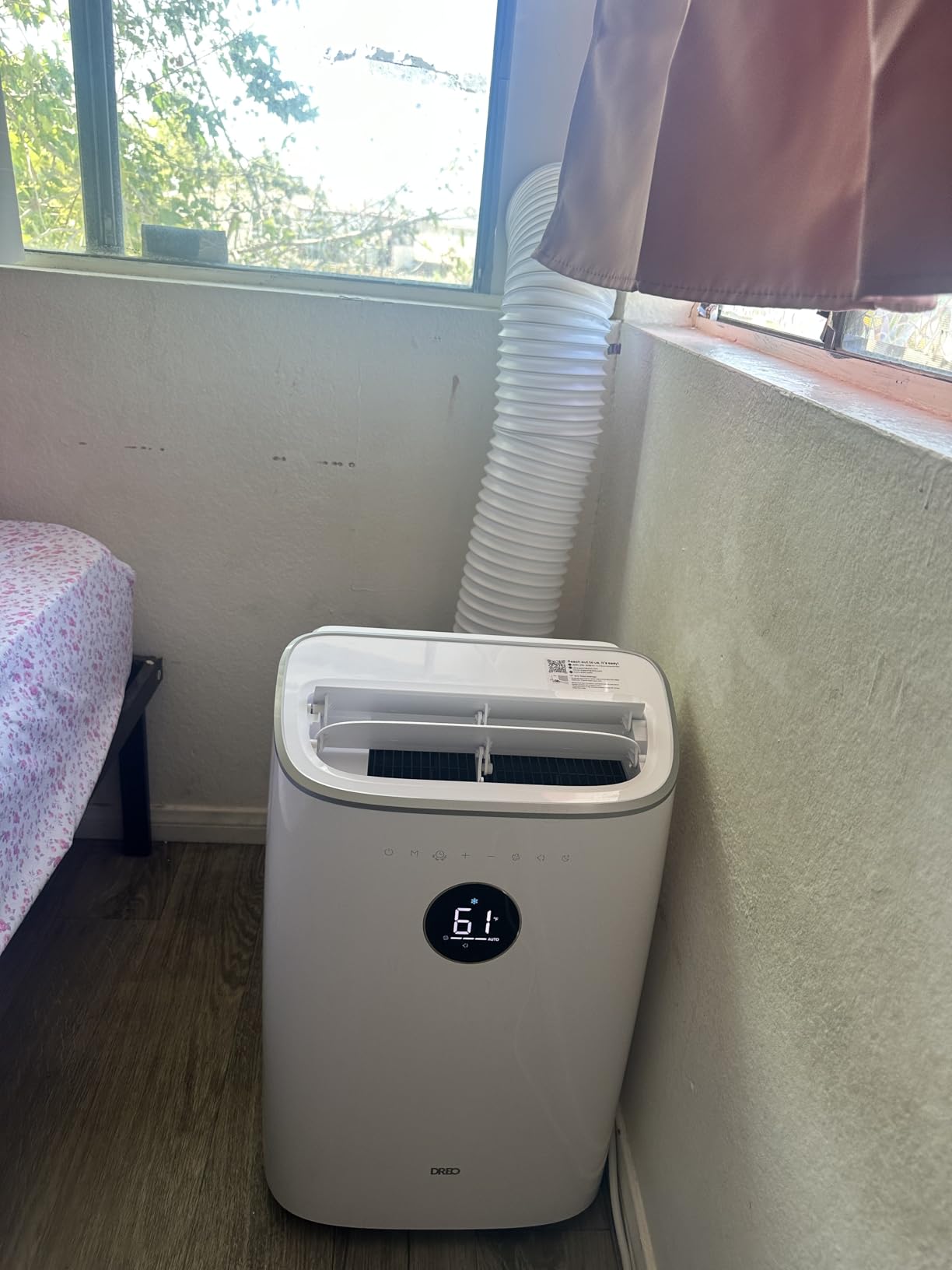
Where the DREO 318S suits an apartment
Best fit is a small bedroom where you want overnight control from the bed without getting up, a room you use as an office during the day and a bedroom at night, or a unit in a building with unreliable common-area cooling. The voice control through Alexa, Siri and Google Home plus the app monitoring make it the easiest to schedule, and the noise isolation design suits a shared wall.
Where the DREO 318S falls short
It is not a whole-apartment or open-plan solution. At 5,000 BTU DOE and 100 sq ft listed, it will leave a 300 sq ft living room untouched, and the single-hose exhaust makes that shortfall worse in hot weather. At 55 pounds it is also a two-person carry up a walk-up, and the capacity figure means it should never be the machine you rely on in July.
5. DREO 14,000 BTU Dual-Hose Inverter Portable AC – Best for Efficiency
DREO Inverter Portable Air Conditioners,High Efficiency,14000 BTU Dual-Hose
14000 BTU ASHRAE and 10000 BTU DOE
42 dB
55.4 lb
Dual hose and inverter
Pros
- Dual-hose design prevents hot air backflow
- Inverter compressor cuts energy use by about 32%
- Drainage-free with sensors and pump
- 42 dB published noise figure
Cons
- Heavy 55.4 lb carry up stairs
- Intermittent compressor short-cycling reported
- Exhaust hose runs warm without an insulation wrap
- Single durability report of internal failure
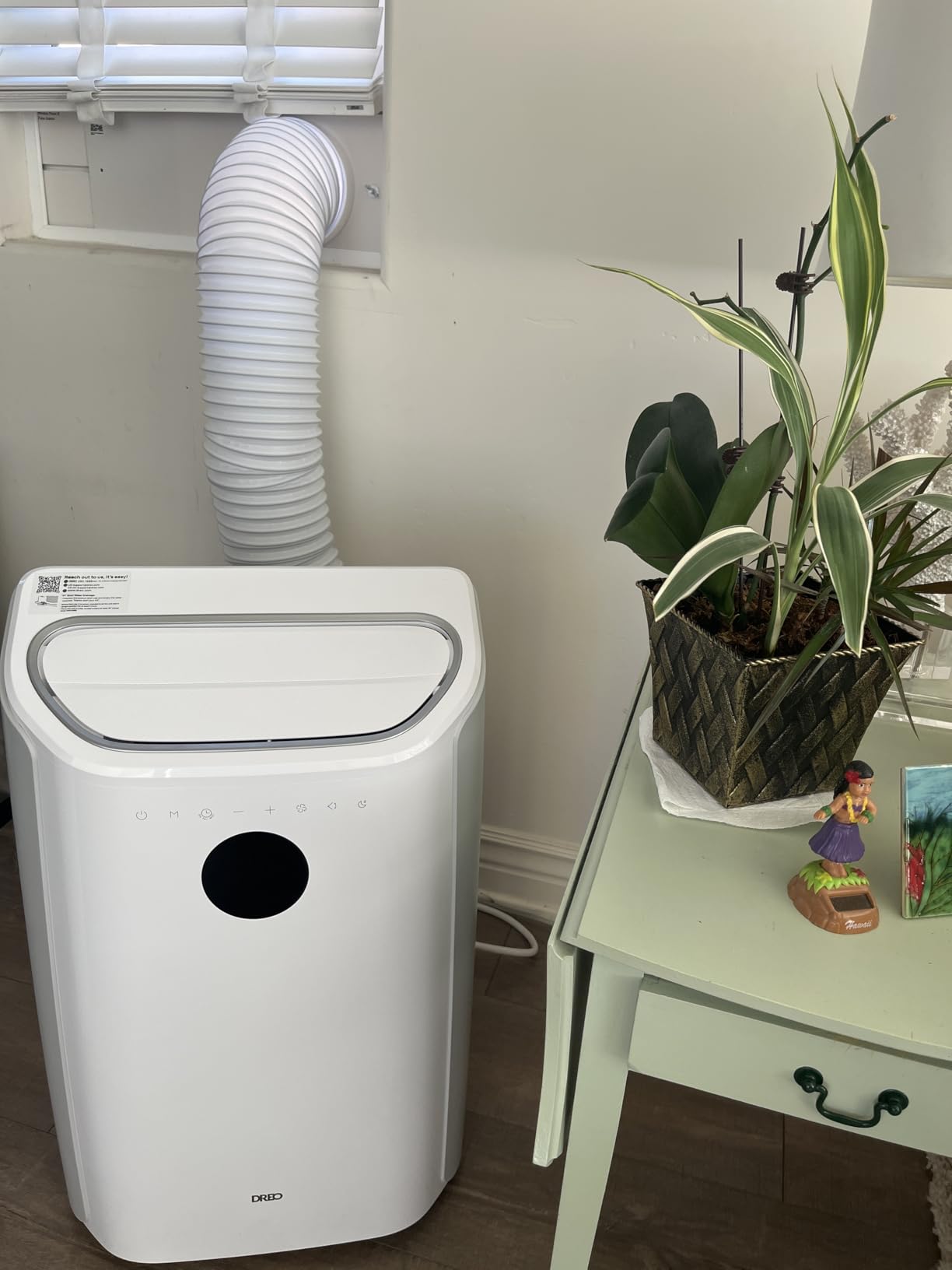
If you want the physics of a portable AC working in your favour, this is the machine. The DREO 14,000 BTU model separates intake and exhaust through two hoses, so it is not pulling outside air back into the room through its own exhaust. That design change matters most in a small sealed apartment, and it is why users on r/Appliances repeatedly name dual-hose machines as the most efficient option.
It also has an inverter compressor that modulates output instead of cycling on and off, and the manufacturer claims that combination of inverter control and dual-hose exhaust makes it about 32% more energy-efficient than a traditional fixed-speed model. Rated capacity is 14,000 BTU ASHRAE and 10,000 BTU DOE for rooms up to 200 to 300 sq ft, with a 1,540 W draw. It holds a 4.1 average across about 730 ratings, 67% of them five stars.
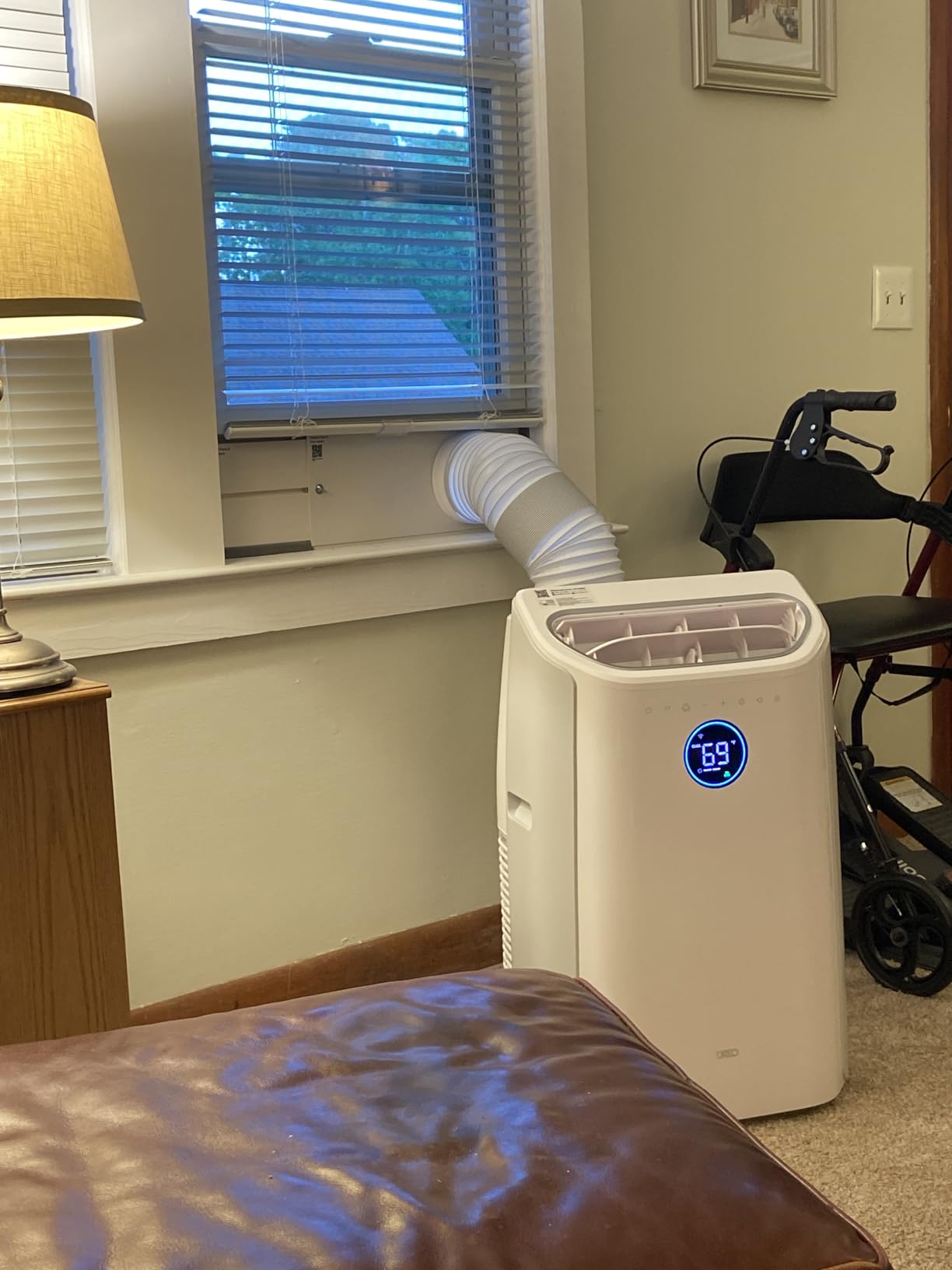
The 42 dB noise isolation figure is the lowest published number in this roundup, tied with the Hisense, and control is handled three ways: app, remote and Alexa voice. The window panel package fits hung and sliding windows between 20 and 53 inches, and the unit includes four window panels, two exhaust hoses, a drain hose and a remote. Owners also report the dehumidifier mode as unusually capable because it runs at close to full rated output.
The reservations are worth reading carefully. At 55.4 pounds this is a heavy carry, and it sits at the top of the roundup on cost, which matters for someone who may need to replace it. Owners report intermittent short-cycling and clunking on start and stop, a small number describe the unit switching on unexpectedly while away, and one detailed durability report describes an internal failure with chemical and burnt-oil fumes after five months of light use. The exhaust hose also runs very warm without an insulation wrap, which is worth knowing if you are routing it through a window with a frame you care about.
Where the DREO 14,000 BTU suits an apartment
This is the pick for a sun-baked top-floor unit or a one-bedroom where the heat gain is severe and you plan to run the machine through long stretches of hot weather. Dual-hose plus inverter is the combination that keeps electricity use reasonable over a full season, and the drainage-free design removes the bucket problem permanently. The low noise figure makes it the safest choice next to a shared wall.
Where the DREO 14,000 BTU falls short
It is not a walk-up-friendly machine. The weight plus the price means a failed unit upstairs is a genuine inconvenience, and the short-cycling reports are the top durability concern in the reviews. If your budget is modest or you cannot get help carrying it up stairs, the trade-off for the efficiency gain is hard to justify.
6. TOSOT Aovia 9,500 BTU Portable AC – Best for Tight Floor Space
TOSOT 9,500 BTU Air Conditioner Easier to Install, Quiet and 3-in-1 Portable AC, Dehumidifier, Fan for Rooms Up to 300 sq ft, Aovia Series, White
9500 BTU 6000 DOE for 300 sq ft
51 dB
62 lb
HEPA filtration
Pros
- Narrowest body in the roundup at 12 inches wide
- Auto-evaporation so no bucket outside high humidity
- Quick-adjust knob makes install the simplest here
- HEPA filter and 2.1 pints per hour removal
Cons
- Owners measure 58 to 62 dB against the 51 dB claim
- Thermostat reads low and needs offsetting
- Window panels do not always span the opening
- 62 lb is heavy for 300 sq ft of capacity
The TOSOT Aovia is 11.1 inches deep by 12 inches wide by 27.2 inches tall, and that narrow width is the reason to buy it. In a studio apartment where the only free wall is a 14-inch gap between a bed and a desk, footprint decides whether a machine is usable at all, and this is the narrowest body in the roundup while still covering up to 300 sq ft.
Cooling capacity is 9,500 BTU, which is 6,000 BTU under the 2017 DOE standard, and it is built by Gree Electric Appliances. The rotary scroll compressor runs on R-32, the filtration is HEPA, and the 3-in-1 function removes 2.1 pints of water per hour in dehumidifier mode. The SEER figure listed is 2.6, and the stated draw is 1,000 W. It holds a 4.2 average across about 594 ratings.
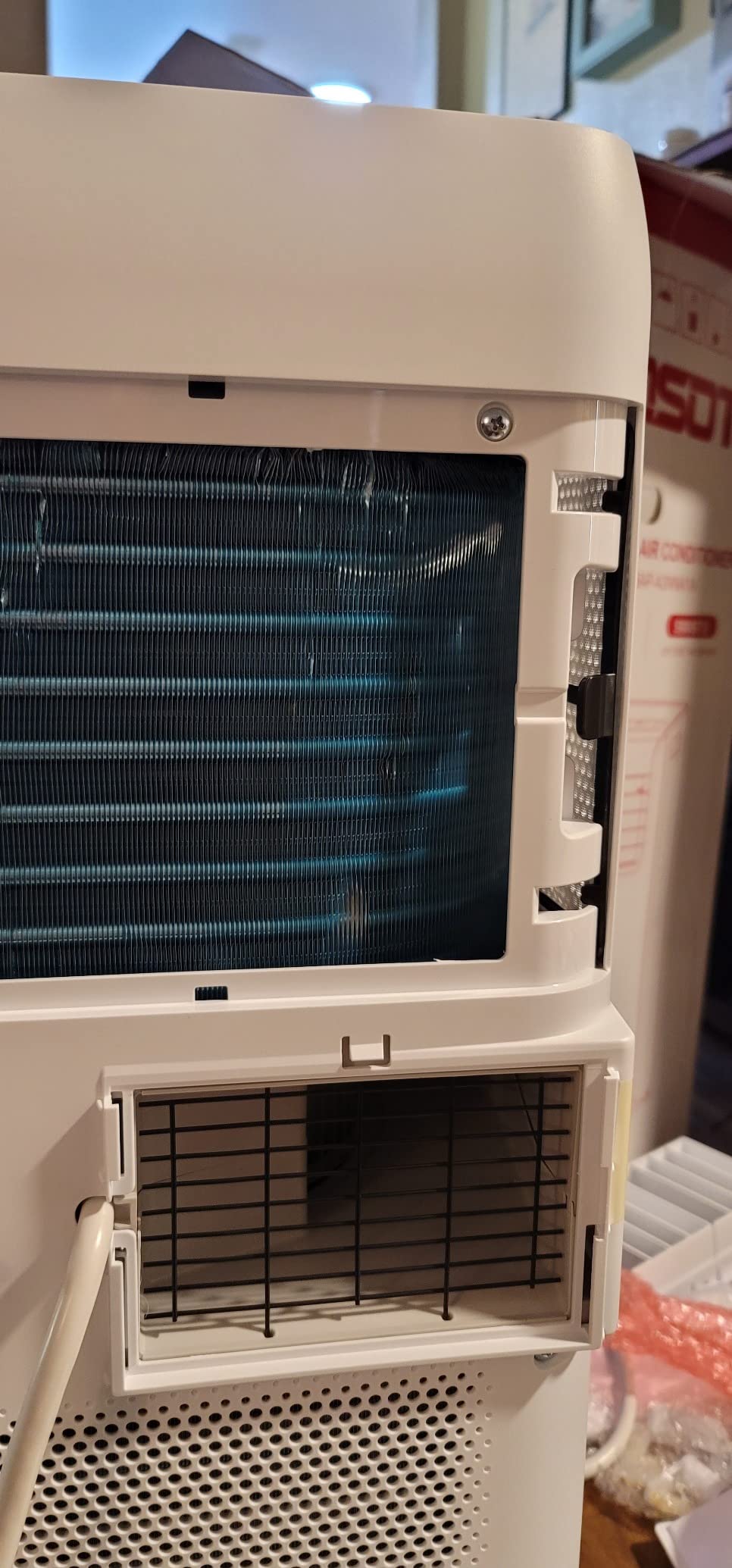
Installation is the other strength. A quick-adjust knob on the window panel means you set the width after connecting the exhaust hose, which is the simplest window kit in this group, and owners consistently praise it. Auto-evaporation means no bucket unless you are in a genuinely super-humid environment. The remote reaches 20 feet and there is a top LED control panel, and buyers commonly report it cools a bedroom effectively on its low setting.
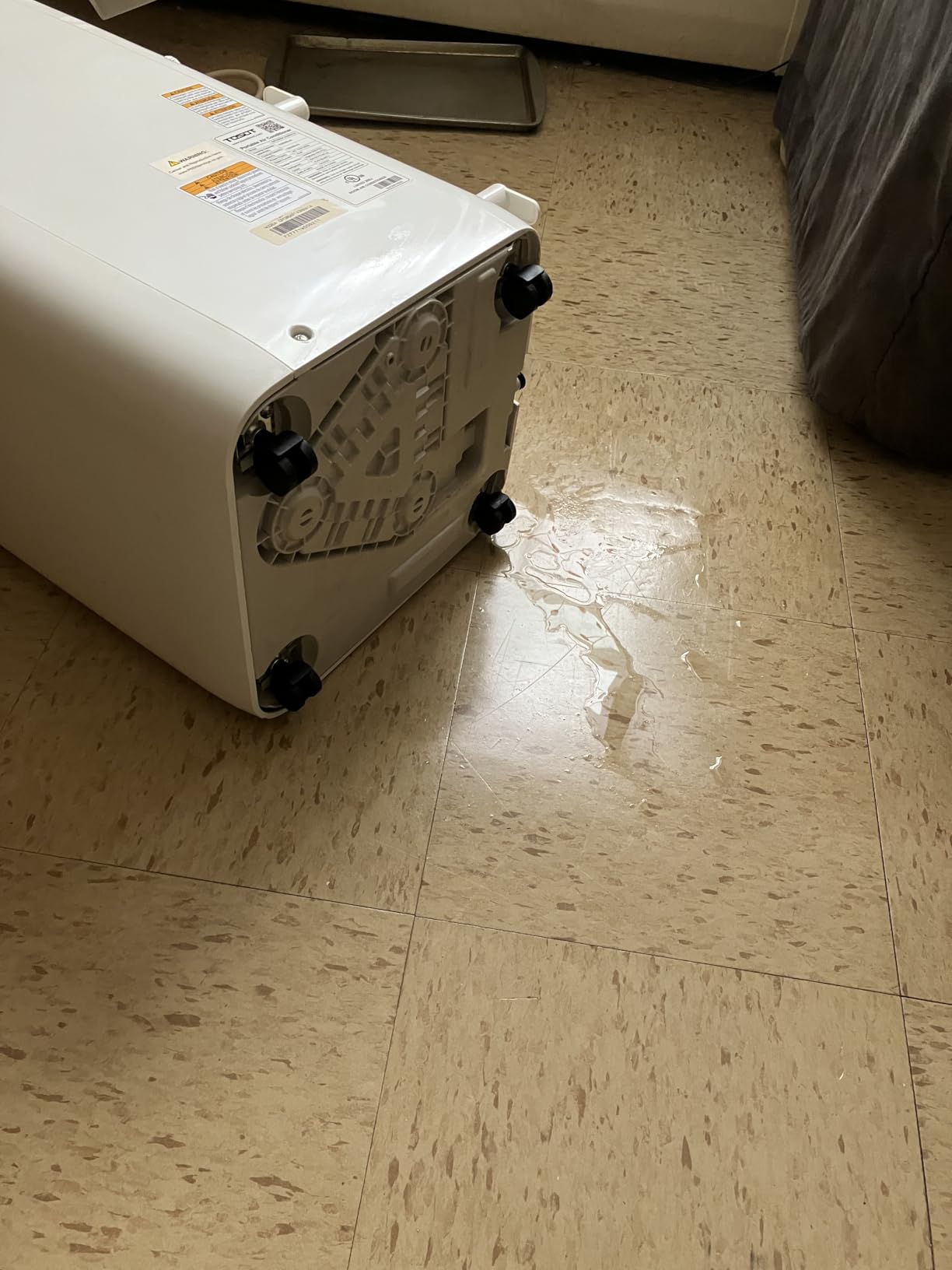
Noise is the significant problem, and it is a large one. The published figure is 51 dB, but owners measure roughly 58 to 62 dB and report needing to raise their voice at close range. That is a real gap between the specification and what owners measure, and for a unit that a studio resident will sit right next to, it is the deciding factor. Reviewers also report the thermostat reading low, often needing a setting several degrees below the desired temperature, and 3-minute compressor restarts after reaching setpoint that can look like the machine has shut down. Some window panels do not span the opening, leaving gaps that need foam packing, and a few owners report water leaking from the base after draining.
Where the TOSOT Aovia suits an apartment
Pick it when floor space is the binding constraint, not when noise is. In a small studio bedroom, a home office nook, or a room where the window is the only wall with clearance, the 12-inch body and the one-knob window fit solve problems no other machine here does. The auto-evaporation also keeps the nightly routine simple.
Where the TOSOT Aovia falls short
It is the wrong pick for a light sleeper or a thin-walled unit given the measured 58 to 62 dB. At 62 pounds for 300 sq ft of capacity, it is also an awkward lift up stairs without an elevator, and the thermostat offset plus the compressor restart behaviour mean you should expect to tune the setting rather than trust it. The listed SEER of 2.6 argues against long daily runtime.
7. Garvee 14,000 BTU Portable AC – Best for Large Open Rooms
Garvee 3-in-1 Portable Air Conditioner, 14000 BTU (9300 BTU SACC) AC Unit
14000 BTU and 9300 BTU SACC
50 dB
85.3 lb
750 sq ft stated
Pros
- Stated room coverage up to 750 sq ft
- 3-in-1 cooling fan and dehumidifier
- No-drill window kit fits double-hung or sliding windows
- LED panel with 24-hour timer and sleep mode
Cons
- 85.3 lb is the heaviest machine here
- 33.66 inch tall body needs floor space
- Warranty listed as not applicable
- Only 105 ratings so performance data is thin
The Garvee has the largest stated room coverage in this roundup at up to 750 sq ft, which makes it the machine here most likely to suit a main living space rather than a bedroom. It carries a 4.3 average, the highest rating figure in the group, though that sits on a base of only 105 ratings with 67% of them at five stars. Treat the rating as promising rather than proven.
The capacity is 14,000 BTU, which is 9,300 BTU under SACC. That second number is the realistic one to plan around, and it is a good illustration of the rating-basis problem across the whole category. The stated capacity figure is 90 pints for dehumidification, the noise rating is 50 dB, and the machine is made by JHS Inc. Annual energy consumption is listed at around 869 kilowatt hours.
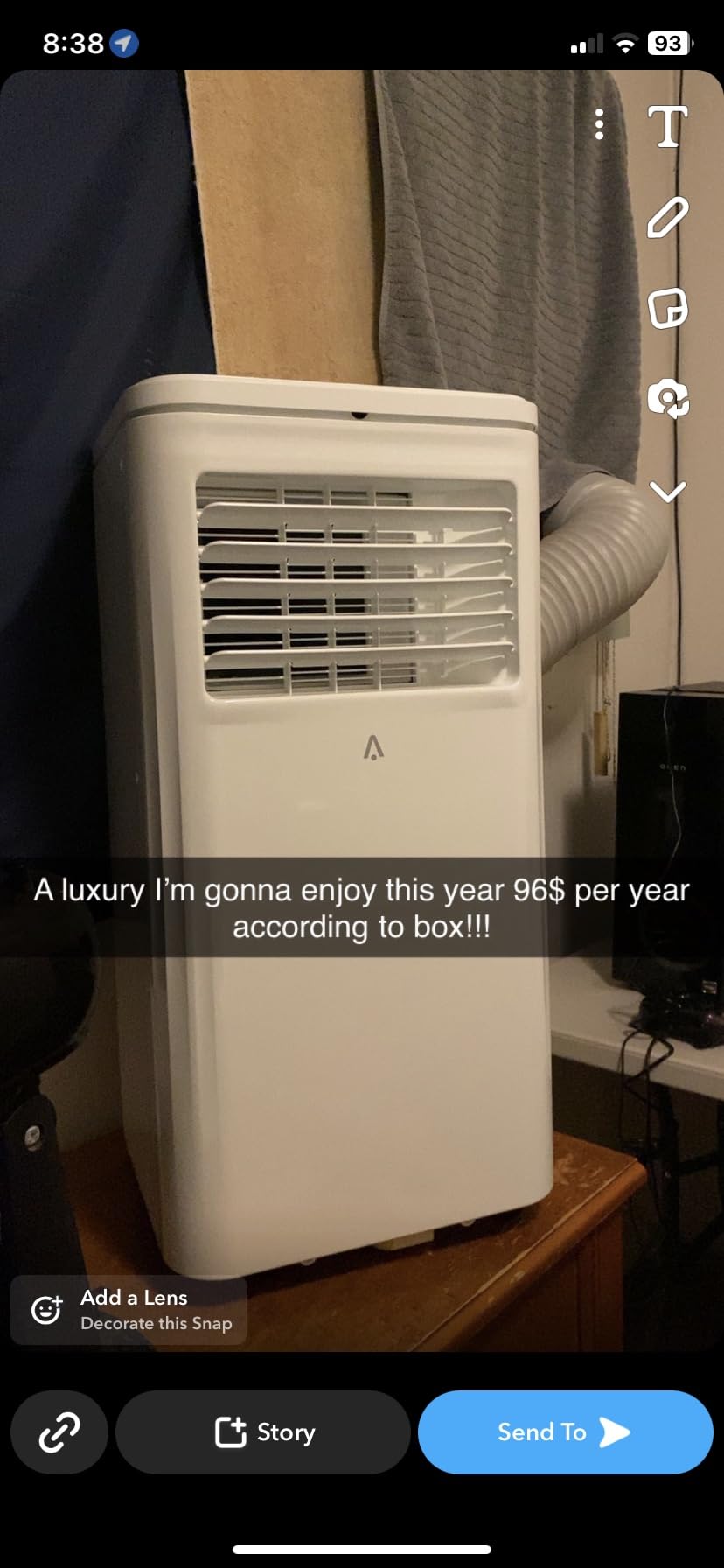
The renter-friendly detail is the no-drill window installation. The kit fits most double-hung or sliding windows with an adjustable exhaust hose, so you are not modifying the frame permanently, which is exactly what you want in a rental where you will remove the unit at move-out. Controls are an LED panel with a programmable 24-hour timer and sleep mode, and there are rolling casters and ergonomic side handles.
Physical reality is the problem. At 85.3 pounds this is the heaviest machine in the roundup, and at 20.16 inches deep by 18.11 inches wide by 33.66 inches tall it takes up real floor space. In a walk-up building with no elevator, that is a two-person, possibly three-person job on four flights. The warranty is listed as not applicable, which leaves no stated coverage, and the review base is thin enough that the specs carry more weight than owner feedback here.
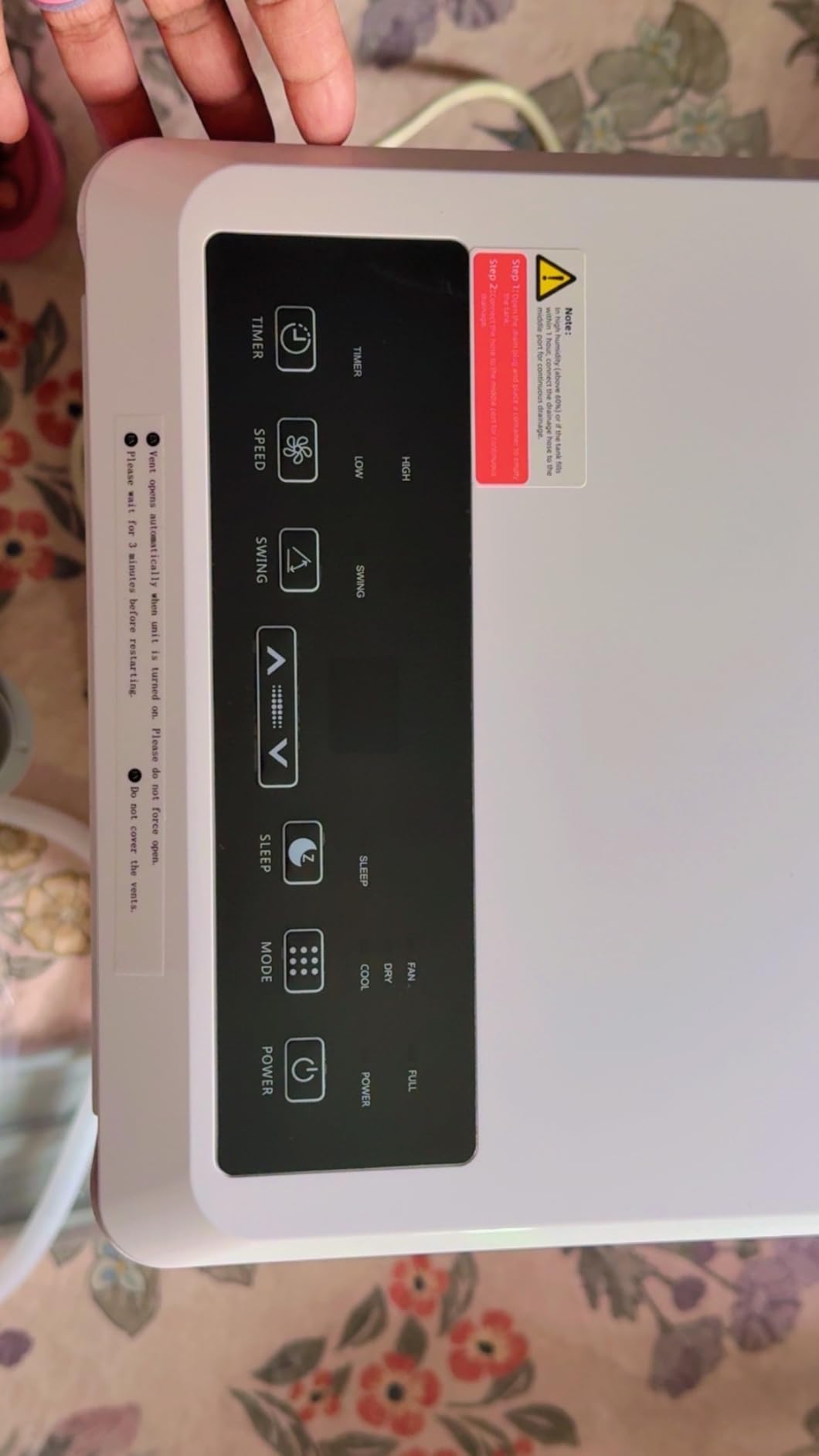
Where the Garvee suits an apartment
It makes sense in a ground-floor or first-floor two-bedroom with an open living area, a spare room you convert to a gym, or any space where you have a clear floor area and a double-hung or sliding window and a second person to help carry. The no-drill kit removes the most common lease objection, and the 24-hour timer helps if you want a schedule rather than a thermostat.
Where the Garvee falls short
It is a poor apartment machine for anyone above the second floor. The 85.3-pound weight combined with a 33.66-inch height means stairs are the real obstacle, not the cooling. The lack of stated warranty coverage is also a genuine risk on a machine this heavy, and with only 105 ratings there is not enough long-term owner history for us to vouch for its durability over multiple summers.
8. Hisense 8,000 BTU DOE Dual-Hose Inverter Portable AC – Best for Connected Dual-Hose Cooling
Hisense 8,000 BTU DOE/SACC (10,000 ASHRAE) Portable Air Conditioner Dual Hose & Inverter, 350 Sq Ft, Wi-Fi, ConnectLife App Google & Alexa, 3 operating modes, Noise 42 dB HAP0825TWD (Renewed)
8000 BTU DOE and 10000 ASHRAE
42 dB quiet mode
65 lb
Dual hose and inverter
Pros
- Dual hose with inverter at an entry-level cost
- 700 W draw and up to 40% efficiency gain
- 42 dB in quiet mode among the lowest figures here
- Wi-Fi with ConnectLife app and voice control
Cons
- Renewed unit so cosmetic wear is possible
- Only a 90-day limited warranty
- 8000 BTU DOE covers a bedroom not a living room
- Some owners report running warmer than expected
The Hisense HAP0825TWD is the reason to keep reading this list, because it brings the two features that genuinely matter in an apartment, dual-hose exhaust and an inverter compressor, to the entry level of this roundup. Buyers consistently single out that combination. It holds a 4.2 average across 139 ratings, with 66% of them at five stars.
Capacity is 8,000 BTU DOE/SACC, which is 10,000 BTU ASHRAE, and the stated room coverage is 350 sq ft. The rotary scroll compressor runs on R-32, and the listed draw is 700 W, the lowest in the group, with the manufacturer claiming up to 40% better efficiency from the inverter and dual-hose combination. Noise is quoted at 42 dB(A) in quiet mode. Controls cover the ConnectLife app, remote and touch panel, with Google Assistant and Alexa voice support.
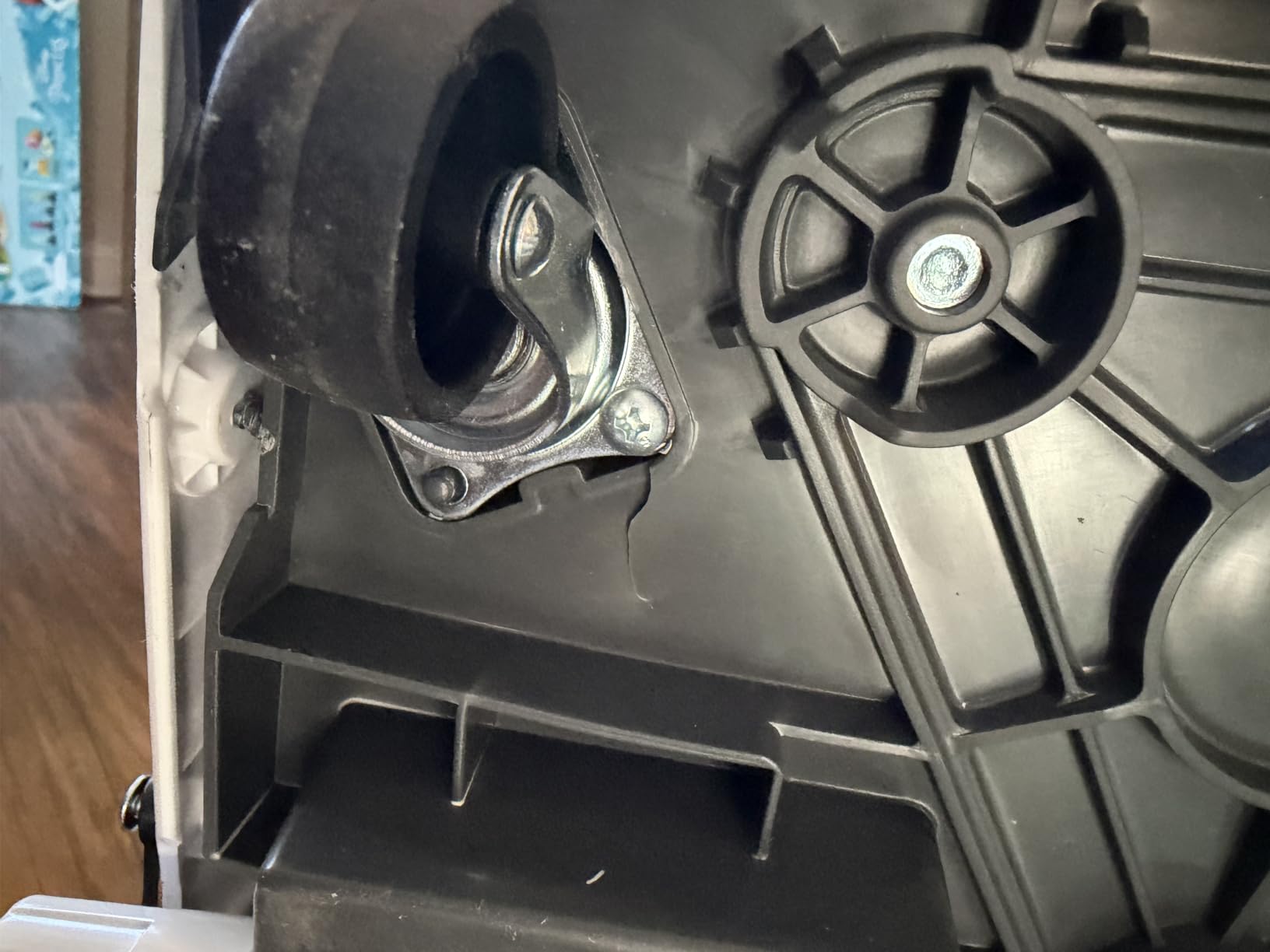
The drainage answer is clean here too. It runs drain-free in cooling mode and comes with an easy snap-together window kit, so the setup in a non-standard window is straightforward. The three-in-one operation covers cooling, dehumidifying and fan, and the 350 sq ft rating lines up neatly with a studio or a modest bedroom.
What you are giving up is warranty protection. This is a Renewed unit, so it may carry cosmetic wear and a prior-use history, and the coverage is a 90-day limited warranty against one to three years on the new machines here. The 8,000 BTU DOE figure is one of the smaller capacities in the roundup, and some owners describe the unit running warmer than expected. At 65 pounds it is also a two-person carry.
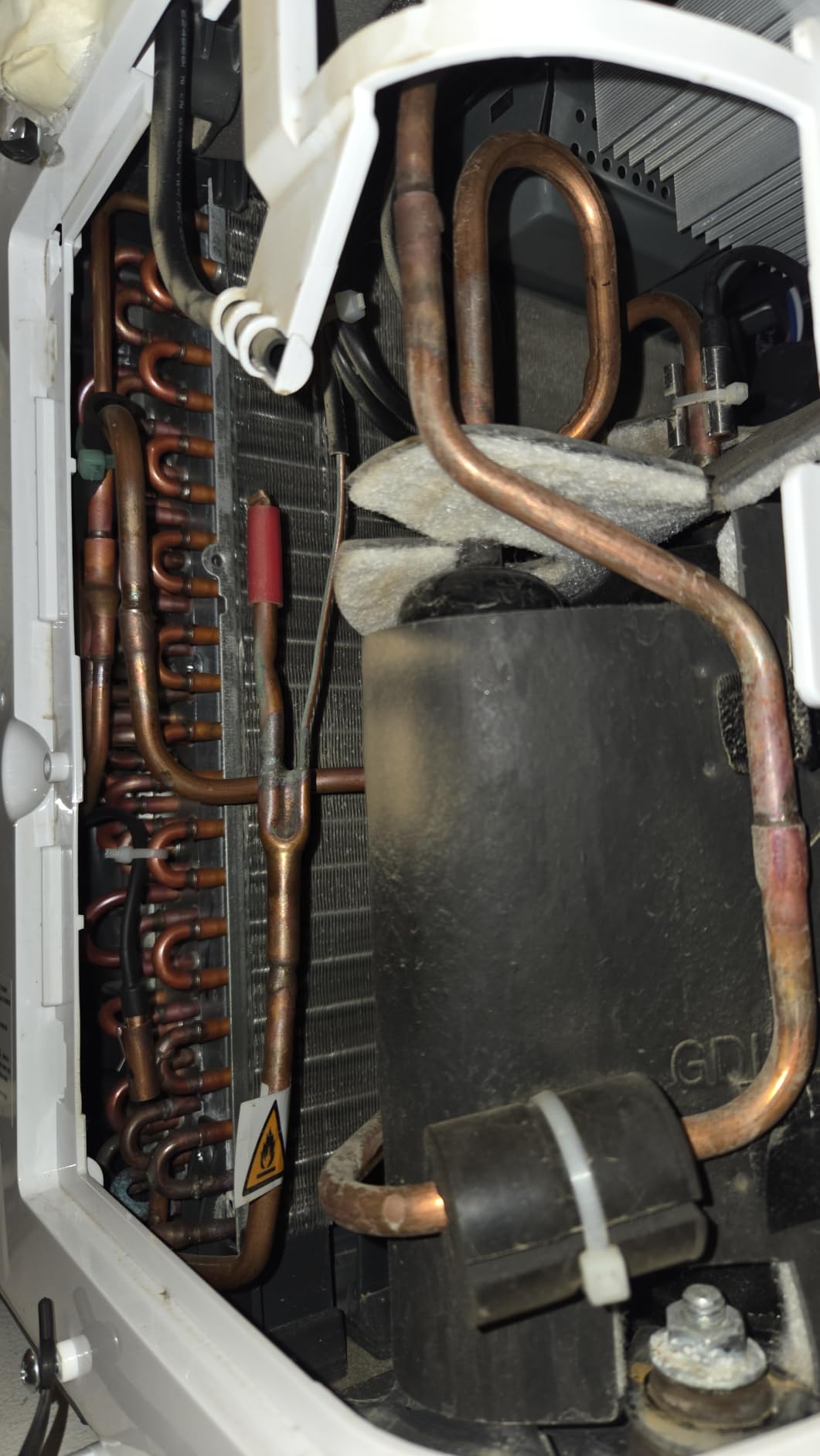
Where the Hisense HAP0825TWD suits an apartment
This is the value route to dual-hose behaviour. If your unit is small, if you sleep with it running for hours, and if you want phone control and voice control, this configuration is otherwise hard to find at this level. The 42 dB quiet mode and the 700 W draw make it the most forgiving machine to run overnight next to a shared wall.
Where the Hisense HAP0825TWD falls short
Renters who plan to keep the same machine for several years should be cautious about a 90-day warranty on a compressor-driven appliance. Capacity is also the constraint: 350 sq ft is a bedroom, not a living room, and if your space is larger you will be chasing setpoint all summer. Plan on replacing it rather than keeping it, and check the window kit fits before you commit.
Portable AC Buying Guide for Apartment Dwellers
A portable air conditioner is a wheeled cabinet that pulls room air in, cools it through a refrigerant loop, and dumps the collected heat outdoors through an exhaust hose. The back of the unit blows hot air by design, and the hose has to reach outside. Understanding that one mechanism explains almost every complaint we read, from “it runs but does not cool” to “it blows warm air back into the room.”
Size it with DOE capacity, not the headline
Three rating systems appear on these machines and they are not comparable. The DOE standard is the federal US test, the ASHRAE standard is the industry test used on most manufacturer spec sheets, and SACC is a seasonal adjusted figure that factors in real-world conditions. The same machine can be described as 12,000 BTU on the box and 7,500 BTU in the specifications, which is exactly the case with the Shinco SPF1-12C reviewed above.
The rule we recommend is simple. Take the lowest printed capacity figure for the unit, and use the following as a starting point: around 150 sq ft needs roughly 6,000 BTU DOE, 200 to 300 sq ft needs 8,000 to 10,000 BTU DOE, 300 to 450 sq ft needs 10,000 to 12,000 BTU DOE, and 450 sq ft and above needs 12,000 BTU DOE or more. Then add one step for a top-floor unit, a west-facing unit, or a room with a large window facing direct afternoon sun.
Single-hose vs dual-hose and negative air pressure
A single-hose unit blows room air out and draws replacement air in through the same hose, which means it is continuously sucking a share of warm outside air back into the room. In a leaky, open-plan space that matters less. In a small sealed apartment, the recirculated air partly cancels the cooling and the compressor runs longer, which costs money and adds noise. Users on r/Appliances summarise the community rule plainly: dual hose units are the most efficient.
Dual-hose designs keep intake and exhaust separate, so they hold setpoint better and, in the case of the two dual-hose machines here, pair that with an inverter compressor. The catch is weight and size. DREO’s 14,000 BTU dual-hose model is 55.4 pounds and the Hisense is 65 pounds, versus 46.3 pounds for the single-hose SereneLife. If your building has an elevator, that trade is easy. If it does not, think carefully.
Noise: the number that starts neighbour complaints
Published noise figures in this roundup run from 42 dB to 55 dB, with the caveat that owners of the TOSOT and the DREO 318S both report measuring higher than claimed at close range. For calibration, a quiet refrigerator is around 40 dB and a normal conversation is around 60 dB. A machine at 50 dB is audible across a room, and through thin apartment drywall it is audible in the next unit.
To make a portable AC quieter, work through this list in order. Put it on a vibration-damping mat rather than bare floor or carpet. Keep it two to three feet away from walls and corners so the fan has a clear path. Clean the filter and the coils, because a restricted airflow makes the compressor louder and it short-cycles more. Run the low or sleep fan setting after the room is cool. Close the door and the window gaps so the machine is not fighting infiltration. Then add a white-noise source at the bed if you are genuinely noise-sensitive. If you need the extra, our window air conditioner roundup covers the fixed-alternative route some buildings allow instead.
Drainage: self-evaporating, continuous line or bucket
There are three drainage architectures and buyers confuse them constantly, which is why “is there a portable AC that does not need draining” keeps coming up. Self-evaporating designs reabsorb collected water back into the stream of room air, which works fine in normal humidity and is what the Shinco SPF1-12C, the TOSOT Aovia, the DREO 318S below 90% humidity, the DREO 14,000 BTU model and the Hisense all do. Continuous drain-line models need a hose to a drain or a sink. Bucket models need you to empty them, and that is the one to avoid in a multi-floor building.
Users on r/AirConditioners repeatedly ask whether to leave a second window open to help the unit, which is a sign of how unclear this normally is. The answer is that a portable AC does not need make-up air to function, but the room should be reasonably sealed. Leaving another window open increases the load. If a drain hose is ever needed, route it to a sink rather than the floor, because a blocked drain reaching the unit below is both a water damage problem and a landlord liability.
Window access: casement, vertical slide and no window at all
Every standard portable AC has to be vented out a window or through a wall sleeve, because the hot exhaust has to leave the building. A casement window that only opens a few inches is the hardest case, and one HuffPost reviewer on a fourth-floor apartment described exactly that problem. The fix is an adjustable panel packed with foam or sealed with window strips, which is what forum users recommend as a general rule. A poor seal is the most common cause of a unit that appears not to cool.
Vertical-slide windows work better because the panel can sit in the lower half. For casement or no-window-access rooms, a window insert kit that sits inside the frame without modifying the sash is the renter-friendly option, though you should confirm your lease allows it. If you genuinely have no usable window, an insulated hose run through a wall sleeve or a dry-chef-style exhaust path is the only option, and you should check with the landlord before drilling anything. Where you have no option to vent, a secondary option like an RV-style unit only makes sense in a very specific layout, not a normal apartment.
Getting a heavy unit up the stairs
Weights in this roundup run from 46.3 pounds for the SereneLife to 85.3 pounds for the Garvee. That is the apartment friction point almost nobody covers, and it is not trivial on a fourth-floor walk-up. Measure your stairwell and your door width first. The Garvee at 20.16 inches deep and 33.66 inches tall needs a genuinely wide landing to turn. Boxes are heavier than the machine, so if you are considering buying used rather than new, our note on seasonal portable AC deal coverage is worth a look before you commit to one model.
At move-out, plan for the same problem in reverse. A portable AC is one of the few appliances you can take with you, which is a genuine advantage over anything you install, but you need the same second pair of hands.
What actually drives the electric bill
Two things. First, inverter versus fixed-speed. An inverter compressor modulates its output instead of switching fully on and off, which is why the DREO 14,000 BTU model claims about 32% less energy than a traditional fixed-speed design and the Hisense claims up to 40%. Second, the listed power draw, which ranges from 700 W on the Hisense to 3,520 W on the Shinco, a fivefold difference that dominates a month of overnight runtime.
Users name this tradeoff constantly. A r/AirConditioners thread asking for something that is not too loud drew the response that a Black+Decker is “A bit loud, and my electricity bill takes a hit. But it does a good job,” which is a fair summary of the entire category. The practical answer is to size correctly, seal the window, and run a fixed-speed unit on a 24-hour timer rather than continuously.
Frequently Asked Questions
Are you allowed to have a portable AC in my apartment?
Usually yes, because a portable AC is a plug-in appliance that never touches the building’s fixed systems. Check your lease for clauses about window units or anything that alters the facade, check whether the building has appearance rules, and confirm the exhaust hose is allowed to pass through the window you plan to use. Notify your landlord in writing with the room and window, and remove the unit before you move out.
Is there a portable AC that doesn’t need to be drained?
Yes. Self-evaporating units reabsorb collected condensate back into the room air instead of filling a bucket, which works in normal humidity. In this roundup the Shinco SPF1-12C, the TOSOT Aovia, the DREO 318S, the DREO 14,000 BTU dual-hose model and the Hisense all run without a bucket in cooling mode. The DREO 318S still needs its included drain hose above 90% ambient humidity, and in a multi-floor building any drain hose should be routed to a sink rather than the floor.
Does a portable AC have to be vented out a window?
Yes for standard portable units. The hot exhaust has to leave the building, which normally means an exhaust hose through a window opening sealed with an adjustable panel. Casement windows that open only a few inches are the hardest case and need foam or window strips to seal the gaps. If your window will not work, a window insert kit or an approved wall sleeve is the alternative, and both should be checked against your lease.
What is the downside to a portable AC?
The main downsides are noise, limited reach, added heat from the exhaust, and condensate management. A portable AC cools one closed room rather than a whole apartment, and the hot air it expels comes back into the home unless the hose is well sealed. Published noise figures in this roundup run from 42 to 55 dB, and owners of two models report measuring higher than claimed. Bucket-style drainage is the biggest apartment-specific risk because a blocked drain reaches the unit below.
What size portable AC do I need for my room?
Size on the lowest printed capacity figure rather than the headline number, because the same unit can be labelled 12,000 BTU and rate 7,500 BTU under a stricter test. As a starting point, about 150 sq ft needs roughly 6,000 BTU DOE, 200 to 300 sq ft needs 8,000 to 10,000 BTU DOE, 300 to 450 sq ft needs 10,000 to 12,000 BTU DOE, and above 450 sq ft needs 12,000 BTU DOE or more. Add one step for a top-floor or west-facing room.
Which Portable AC Fits Your Apartment?
Match the room to the machine rather than the number in the title. A studio bedroom or home office under about 200 sq ft points to the SereneLife SLPAC8, our overall pick, or the DREO 318S if you want phone and voice control. A one-bedroom main room around 400 sq ft points to the BLACK+DECKER BPACT10WT for capacity in a manageable 47.3-pound package, or the DREO 14,000 BTU dual-hose model if the heat gain is severe and you can manage the carry.
If drainage or noise is your worry, the Shinco SPF1-12C and the TOSOT Aovia handle humidity without a bucket. If floor space is tight, the TOSOT’s 12-inch width is the narrowest here. If you are above the second floor with no elevator, stay under about 60 pounds and skip the Garvee.
Whichever you choose, size on the printed DOE figure, seal the window properly, and run it in a closed room. Those three habits explain the difference between a portable AC that works and one that just moves hot air around. Our best portable air conditioners for apartments roundup was updated for 2026, and we test again every season.