
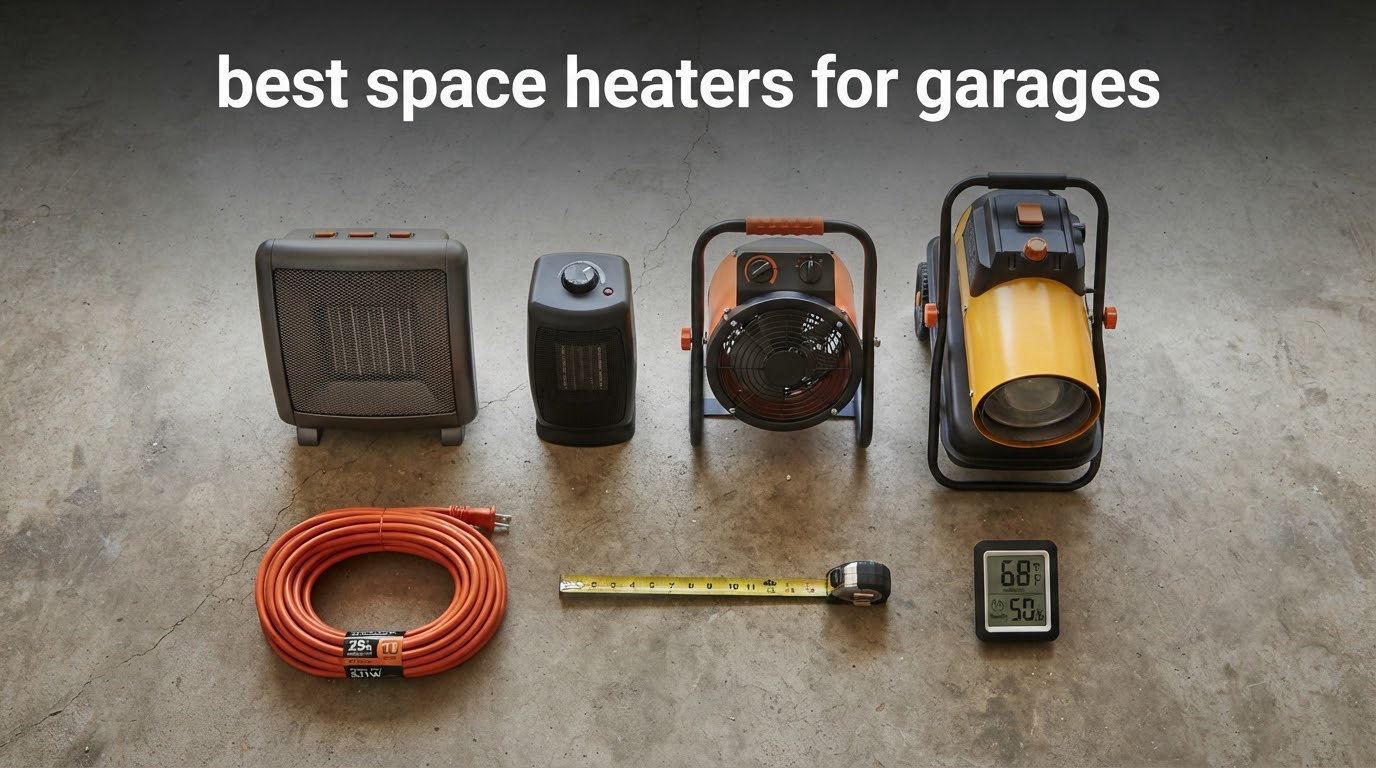
Garages are the one room in the house where household heat fails fastest. A 1500W bathroom heater that keeps a 12 by 12 bedroom comfortable will do almost nothing for a 24 by 24 two-car garage, because you are not fighting drafts anymore, you are fighting 576 square feet of uninsulated steel and concrete. That is why the best space heaters for garages are a different product category than the ones on the living room shelf, and why the wrong pick wastes a winter.
We compared ten of the highest-rated high-output heaters available for garages right now, weighing heat output, coverage claims, installation type, safety sensors and real owner reports. The short version: the Mr. Heater 9,000 BTU Buddy is the most versatile of the best space heaters for garages for most people, the Dr. Infrared DR-988 covers a full two-car bay on 240V power, and the Comfort Zone ceiling heater is the most capable permanent install. If you need a different answer, this is where to start.
Before the individual reviews, here is how the ten split by garage size. A one-car garage roughly 200 square feet needs about 1,500W of radiant comfort heat or 9,000 to 15,000 BTU. A two-car garage at 576 square feet wants 5,000W minimum, and a three-car space above 1,000 square feet realistically needs a 50,000 BTU gas unit heater or the largest electric unit you can wire. Insulation changes everything, and we cover that math later in the guide.
Table of Contents
Top 3 Space Heaters for Garages
Mr. Heater 9,000 BTU Buddy
- 4000 or 9000 BTU radiant
- Indoor and outdoor rated
- Heats about 225 sq ft
- 7.1 lb portable propane

Dr. Infrared DR-988
- 5600W forced air and radiant
- 600 sq ft coverage
- 240V NEMA 6-30R plug
- UL and C-UL listed

Comfort Zone 5000W
- 5000W or 17065 BTU
- Up to 1000 sq ft
- Hard-wired 240V
- ETL listed with overheat cutoff
Best Space Heaters for Garages in 2026 at a Glance
| Product | Specifications | Action |
|---|---|---|
| Mr. Heater 9,000 BTU Portable Buddy Radiant Propane Heater |
|
Check Latest Price |
| Dr. Infrared DR-988 5600W Electric Garage and Workshop Heater |
|
Check Latest Price |
| Comfort Zone 5000W Ceiling Mounted 240V Garage Heater |
|
Check Latest Price |
 Mr. Heater 30,000 BTU Vent Free Radiant Propane Heater Mr. Heater 30,000 BTU Vent Free Radiant Propane Heater |
|
Check Latest Price |
 Mr. Heater 50,000 BTU Forced-Air Unit Heater Mr. Heater 50,000 BTU Forced-Air Unit Heater |
|
Check Latest Price |
 Shinic 2-Pack 120V Ceiling Mounted Quartz Garage Heater Shinic 2-Pack 120V Ceiling Mounted Quartz Garage Heater |
|
Check Latest Price |
 Dr. Infrared DR-218 1500W Greenhouse and Garage Heater Dr. Infrared DR-218 1500W Greenhouse and Garage Heater |
|
Check Latest Price |
 InoKraft 7500W Electric Garage Heater with NEMA 14-50P Plug InoKraft 7500W Electric Garage Heater with NEMA 14-50P Plug |
|
Check Latest Price |
 ROVSUN 6000W Hardwired Ceiling Mount Garage Heater with App Control ROVSUN 6000W Hardwired Ceiling Mount Garage Heater with App Control |
|
Check Latest Price |
 Dr. Infrared Portable Infrared Indoor and Outdoor Space Heater Dr. Infrared Portable Infrared Indoor and Outdoor Space Heater |
|
Check Latest Price |
1. Mr. Heater 9,000 BTU Portable Buddy Radiant Propane Heater – Best All-Round Spot Heat
Mr. Heater 9,000 BTU Portable Buddy Radiant Propane Heater
Propane radiant
4000 or 9000 BTU
About 225 sq ft
Indoor and outdoor rated
Pros
- Dual 4000 and 9000 BTU radiant output
- Approved for both indoor and outdoor use
- Only 7.1 lb so it moves anywhere
- 5.4 hr runtime on low with a 1 lb cylinder
- Emergency low oxygen shutoff and self-extinguishing build
Cons
- Radiant heat only warms what is in front of it
- 225 sq ft covers a bay or a bench rather than a whole garage
- Needs a refillable propane cylinder and no electric hookup
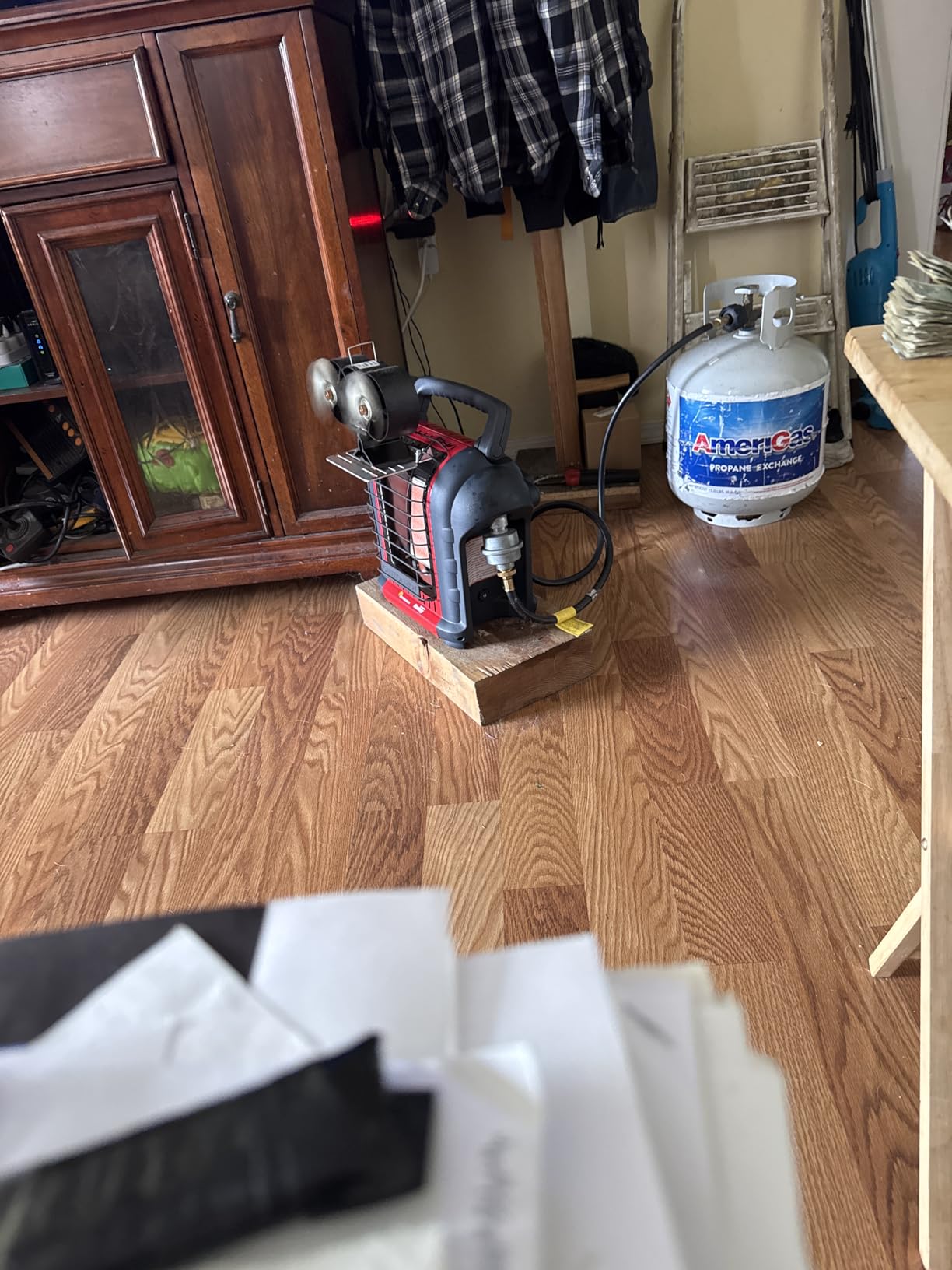
This is the heater we kept coming back to while writing this guide, mostly because it does the one thing garage heat is asked to do most often: put warmth exactly where you are standing. It emits 4,000 or 9,000 BTU per hour of radiant heat, has a two-position toggle, and weighs 7.1 pounds, so you carry it from the workbench to the vehicle bay in one hand.
Rated for both indoor and outdoor use, it clears the safety bar for a garage in a way most patio heaters do not. The low oxygen safety system and self-extinguishing construction are exactly the two features you want in a room with a vehicle in it. Over more than 29,000 reviews it holds a 4.7 average, and the complaints that show up are about scope rather than safety.
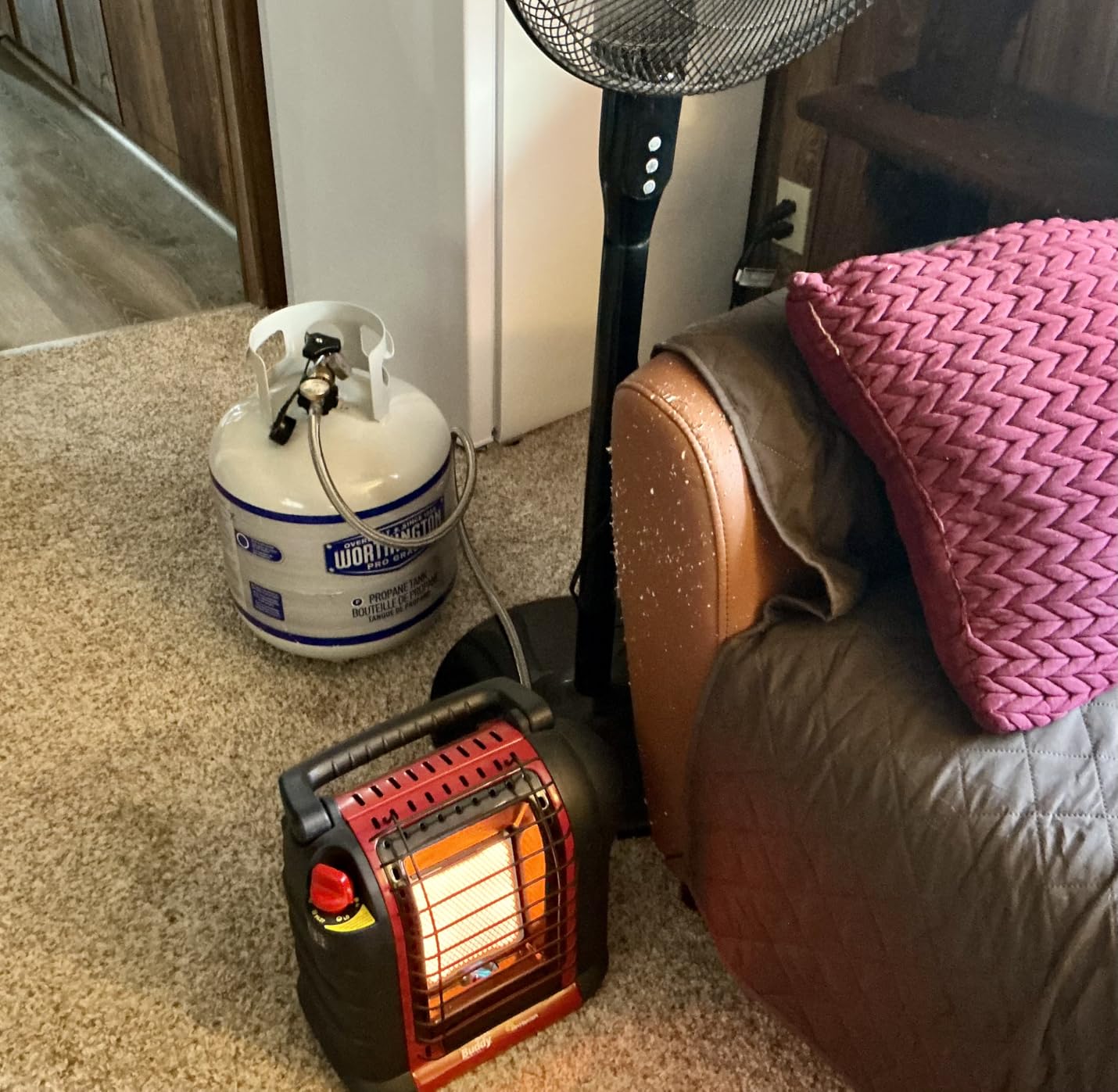
Runtime is where the low setting earns its keep. On a single 1 lb propane cylinder it runs 5.4 hours on low and 2.4 hours on high, which means a full evening of intermittent warmth while you work at the bench without a generator running. Coverage of about 225 square feet is honest for radiant heat, because radiant heaters warm bodies and objects rather than the air mass.
Owners describe a simple, rugged product with a low and high switch that just works. The cylinder is a refillable 1 lb propane bottle rather than a disposable 20 lb grill tank, which keeps the weight down and the storage easy. If your garage is a detached shop, a garage you heat only on the days you are out there, or a spot you need warm for ten minutes, this is the most flexible pick here.
Who this heater suits
A one-car garage, a detached workshop you use part-time, or a garage bay where you want heat on a specific person rather than in the whole volume. It also works well for a garage doorway or a vehicle you are winterizing, since radiant heat is felt immediately on arrival.
It is equally at home outdoors on a covered patio, which is why the dual indoor and outdoor rating matters. No wiring, no gas line, no electrician, and nothing to install. You need a cylinder and a clear spot to stand it.
Who should skip this heater
Anyone trying to heat a two-car or larger garage to a working temperature. At 225 square feet of claimed coverage and radiant-only delivery, it will warm the spot in front of it and leave the far wall freezing. It also fails anyone who wants thermostat-controlled heat, since the only control is a two-position toggle.
Skip it if you are averse to fuel burning indoors at all and would rather run an electric unit off a 120V outlet. The Buddy needs a propane cylinder on hand and a periodic refill, and it should never be run in a closed garage with the door down.
2. Dr. Infrared DR-988 5600W Electric Heater – Best for a 24×24 Garage
DR. INFRARED HEATER DR-988 240V Electric Industrial Garage, Workshop, Warehouse, Construction Heater, 5600W, Thermostat 37-113 °F, Portable, Wall Ceiling Mount
240V electric
5600W forced air and radiant
600 sq ft coverage
NEMA 6-30R circuit
Pros
- Strong 5600W output on a 30A 240V circuit
- No gas line and no combustion byproducts
- Wall ceiling or freestanding mounting with cord storage
- All-metal housing with UL and C-UL listing
- External thermostat hookup supported
Cons
- Needs a dedicated 240V 30A NEMA 6-30R circuit
- Supplied plug is often swapped for a welder receptacle
- Coarse internal thermostat differential
This is the heater that actually moves the needle on a standard two-car garage. A 5600W element pushing 600 square feet of claimed coverage lands right on the 576 square feet of a 24 by 24 bay, and unlike the propane picks there is no combustion, no cylinder and no venting to think about.
Owners in uninsulated and semi-insulated shops report temperature gains of roughly 10 degrees Fahrenheit per hour in moderate cold, settling to about 5 degrees per hour on the coldest mornings. That is the realistic expectation in a drafty space, and it is a very different result from a living room heater that reaches temperature in ten minutes.
Installation is the part people are surprised by. The unit ships with a 6-foot cord and a NEMA 6-30P plug, which means you need a matching NEMA 6-30R 250V 30A receptacle on a dedicated circuit. Many owners replace the supplied plug with a welder receptacle, and most of them used an electrician rather than doing it themselves.
Mounting flexibility is a real advantage. It runs freestanding on the floor, on the wall, or from the ceiling, and the built-in cord storage keeps the plug tidy when you are not using it. The thermostat covers 37 to 113 degrees Fahrenheit, and the fan switch offers ON and AUTO modes. For finer control, the case accepts an external wall thermostat, which is the single most repeated upgrade recommendation in the reviews.
Safety hardware is where the metal construction pays off. An all-metal housing, a steel safety grille, aluminum fan blades, an automatic overheat cut-off, and UL plus C-UL listing make it a sensible choice for a shop or jobsite. It carries a 4.3 average across more than 4,000 ratings.
What to check before you buy
Check your electrical panel first. If you do not already have a 240V 30A circuit with a NEMA 6-30R outlet in the garage, add the electrician visit to your budget before you commit to any 240V heater. This is the single most common buyer surprise in the category and it is the reason several one-star reviews exist.
Also check your insulation and your expectations. Forced air warms air, and air leaks out through an uninsulated garage door faster than any element can replace it. In a well-sealed or semi-insulated space, the numbers above are realistic. In a bare shell with a metal door in the wind, no heater wins permanently.
Who should skip this heater
Skip it if you rent, if your panel has no spare 240V capacity, or if you want a unit you can carry to a different bay. Wall and ceiling mounting means it becomes a fixed installation once you hang it.
It is also the wrong tool for spot heat at a workbench in a huge space. A minority of owners report that the high-volume air output feels lukewarm even when the elements are clearly hot, which is normal for fan-forced units but disappointing if you expect radiant warmth on your hands. If you work seated and stationary, pair it with a small radiant heater instead.
3. Comfort Zone 5000W Ceiling Mounted Garage Heater – Best Ceiling Mount
COMFORT ZONE 5000-Watt Fan-Forced Ceiling Mount Garage Heater – Grey
240V hard-wired
5000W or 17065 BTU
Up to 1000 sq ft
ETL listed
Pros
- Ceiling mount keeps the garage floor clear
- 1000 sq ft of coverage for the output
- Heavy-gauge steel body suits an unheated shop
- Simple mechanical dual-knob thermostat
- Overheat sensor and power indicator light
Cons
- Hard-wired only so an electrician is required
- Manual knobs instead of a digital or remote thermostat
- Warms air rather than objects
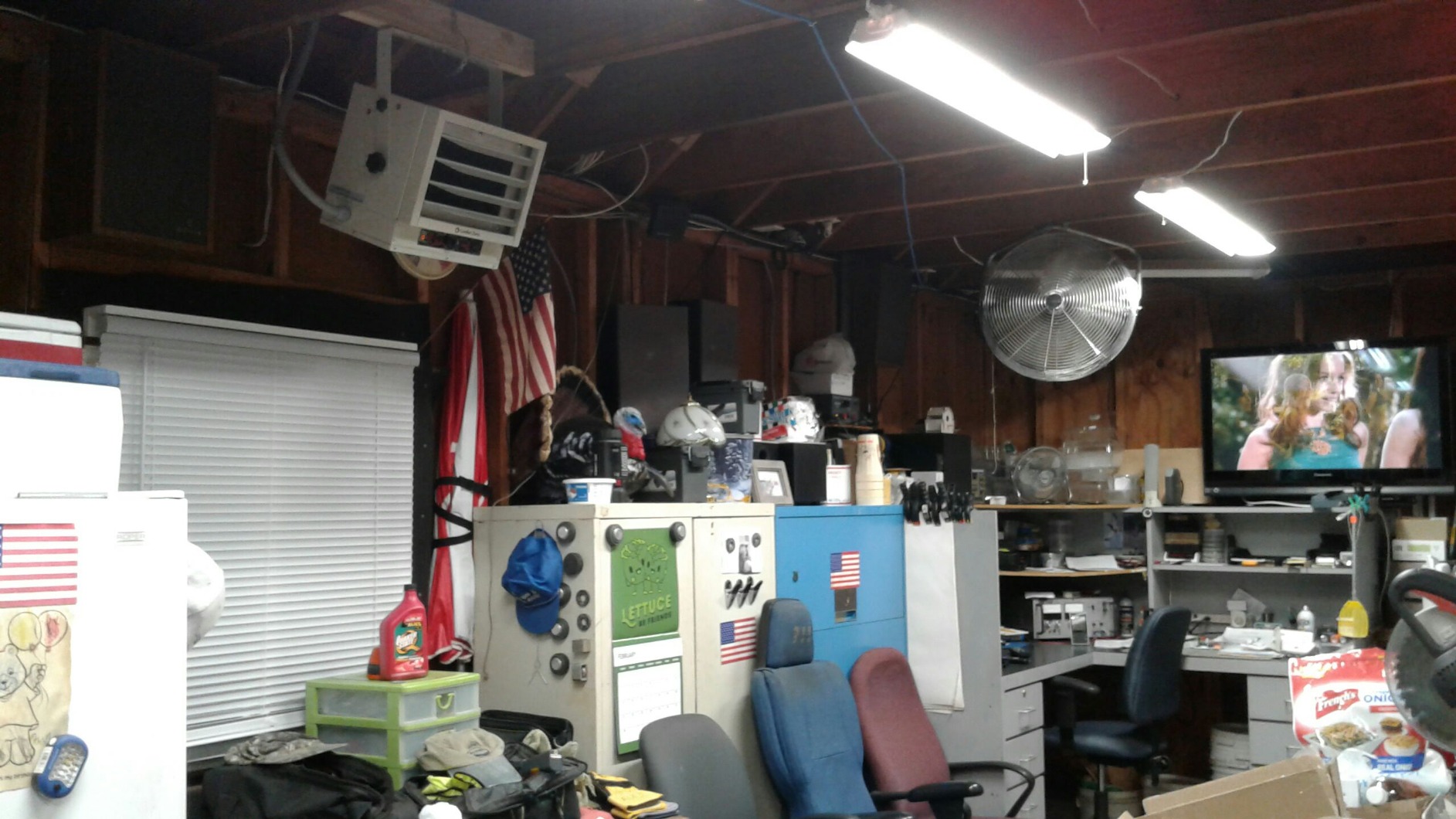
Ceiling mounting is the quiet luxury of garage heat. Nothing on the floor means you can park a car, run a lift, or stack material without moving the heater, and the warm air falls from above into the working volume where you are. The Comfort Zone 5000W does that with 17,065 BTU of fan-forced output and a claimed 1,000 square feet of coverage.
That coverage-per-watt figure is unusually good, and it is the reason this unit turns up in detached shop and warehouse roundups. Buyers in those settings point to the ceiling footprint and the simple dual-knob controls, which have no app, no remote and nothing to program. You set a temperature, you flip the heat, and it runs.
Construction suits a rough environment. A heavy-gauge steel body with a cool-touch exterior tolerates the temperature swings of a poorly insulated space without cracking, which matters when the unit is overhead and nobody is watching it. A built-in temperature sensor triggers automatic overheat shutoff, and a power indicator light tells you the circuit is live from the floor.
Three heat settings and a dual-knob thermostat with quick on and off give more control than a single-speed box fan, and the louvers plus adjustable mounting angle let you aim the discharge away from a work area. Maximum temperature setting is 95 degrees Fahrenheit, which is about right for a garage you need usable but not hot.
One useful detail: this model is part of a range offered in 5,000W, 7,500W and 10,000W versions and several finishes, so if your garage is bigger than 1,000 square feet you can step up within the same design instead of starting over. It holds a 4.4 average across more than 3,500 ratings.
What to check before you buy
Confirm a 240V circuit is present and ready to terminate. This heater is hard-wired, with a 5-foot cord, and the installation is not a homeowner job in most cases. There is no plug option, so an electrician is part of the purchase, not an optional extra.
Measure your ceiling height and plan the discharge path. A ceiling heater throws air outward, so mounting it over your workbench wastes output, while mounting it over the open floor puts warmed air where you need it. Aim it into the room rather than down your own neck.
Who should skip this heater
Skip it for a spot-heating job. Forced air warms the air mass, and the only heat a seated person at the far end of the garage feels is the outlet air. If you are welding, detailing, or working at a bench with your hands for hours, a radiant unit aimed at the bench is a better pairing.
Skip it too if you want remote or app control, or if you want to move the heater between seasons. The manual thermostat is coarse by design, and the unit is fixed overhead once installed. Anyone who works nights and wants a phone to warm the garage before driving over is better served by the smart unit later in this list.
4. Mr. Heater 30,000 BTU Vent Free Radiant Propane Heater – Best for Power Outages
Mr. Heater 30,000 BTU Vent Free Radiant Propane Heater
Propane radiant
30000 BTU
Heats 750 to 1000 sq ft
Wall mount vent free
Pros
- Very high radiant output for a cabinet heater
- Ceramic elements off-gas less than an open flame design
- Battery ignition runs with no electricity at all
- Wall mounting frees the floor
- Adjustable thermostat holds a steady target
Cons
- Blower fan kit is sold separately and reported loud
- Front gets very hot so mount it out of reach of children
- Hose and regulator must be sourced separately
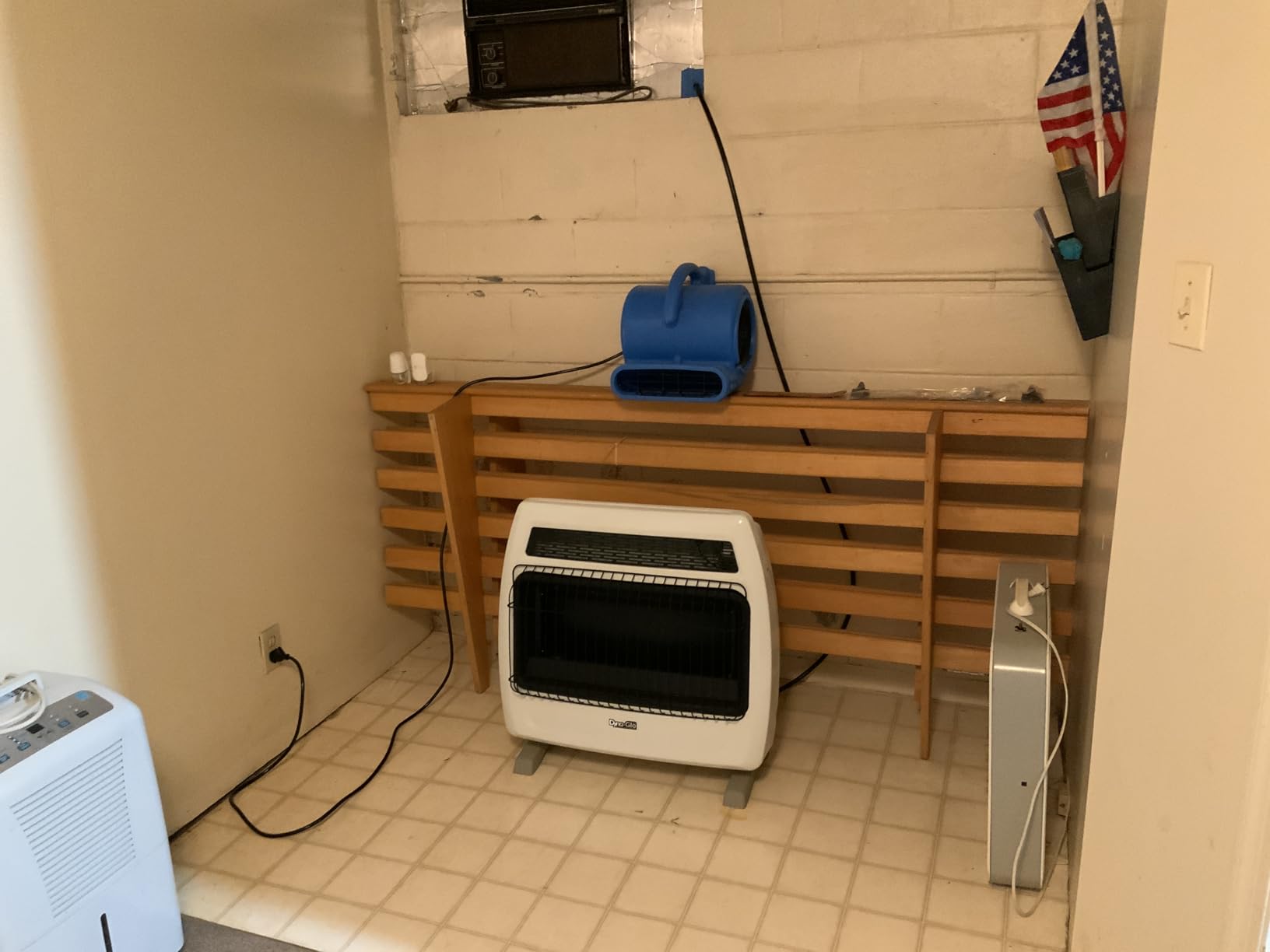
This is the heater to buy when the power going out is part of the problem. Battery-operated electronic ignition means it lights with no electricity at all, and vent-free operation means no flue, no roof penetration and no gas line. Thirty thousand BTU per hour of radiant output is a step change from everything portable in this roundup.
Owners describe a wall of radiant heat felt from many feet away, and several report heating basements, shops and even whole homes to comfortable temperatures in single-digit outdoor conditions. The listing itself is honest about the range: 750 square feet of coverage, with plenty of owners claiming 1,000 square feet or more in practice.
Two details separate it from an open-flame torpedo style heater. The ceramic elements produce considerably less off-gassing than a bare flame design, and the built-in adjustable thermostat with multiple heat settings lets you hold a target temperature instead of cycling a switch. Wall mounting hardware is included, so the 26.3-pound cabinet can go up out of the way.
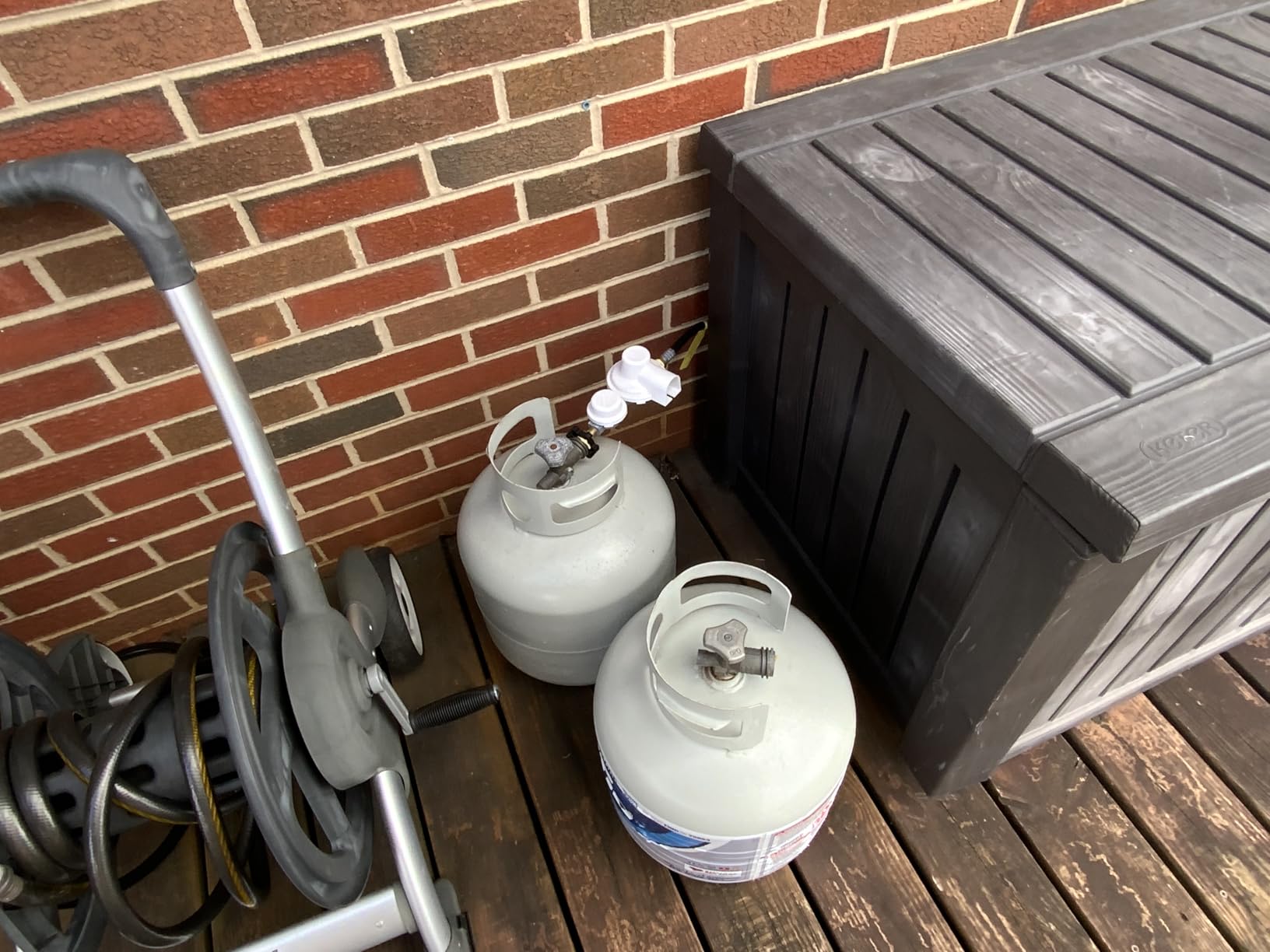
On fuel planning, owners report roughly 31 hours of run time on a standard 4 lb barbecue cylinder. The regulator and propane hose are not included and the cylinder threads run in the opposite direction from a standard grill rig, so factor that into your first setup.
It is rated indoor safe, carries a low oxygen safety shutoff, and includes a 1-year limited warranty. It also carries a 4,500 ft high altitude restriction, which matters if you are in a mountain garage.
What to check before you buy
Check whether you want radiant heat or moving air. Without the optional blower fan kit, this heater does not circulate air, so a large open garage will have a hot zone near the unit and cool zones elsewhere. Owners who want whole-room comfort either sit near it or add the fan kit, which is sold separately and reported to be both loud and low-moving.
Check clearance around the front of the cabinet. Reviews mention the front getting very hot, and one owner reported flames projecting forward. This is a heater for adults who understand combustion, mounted where children and pets cannot reach it.
Who should skip this heater
Skip it if you plan to leave it running while you are away or asleep. It is not designed for unattended operation, and that is not a criticism of the product, it is how fuel-burning radiant heaters work.
Skip it in a large detached shop you want at a uniform temperature, and skip it above 4,500 feet. If your priority is a heated workspace for eight hours a day with a thermostat holding steady, the gas unit heater later in this list is the more appropriate machine.
5. Mr. Heater 50,000 BTU Forced-Air Unit Heater – Best for 3-Car Garages
Mr. Heater 50,000 BTU Forced-Air Unit Heater (Propane or Natural Gas)
Propane or natural gas
50000 BTU forced air
1667 sq ft or 3-car garage
Ceiling mount
Pros
- Most heat output available in this roundup
- Ceiling mount clears floor and wall space
- Quiet once the fan set screw is torqued
- Works with 24V or Wi-Fi thermostats
- LP conversion kit included
Cons
- Gas line and venting must be professionally installed
- Vent kit is not included
- Loose fan set screw causes wobble on some
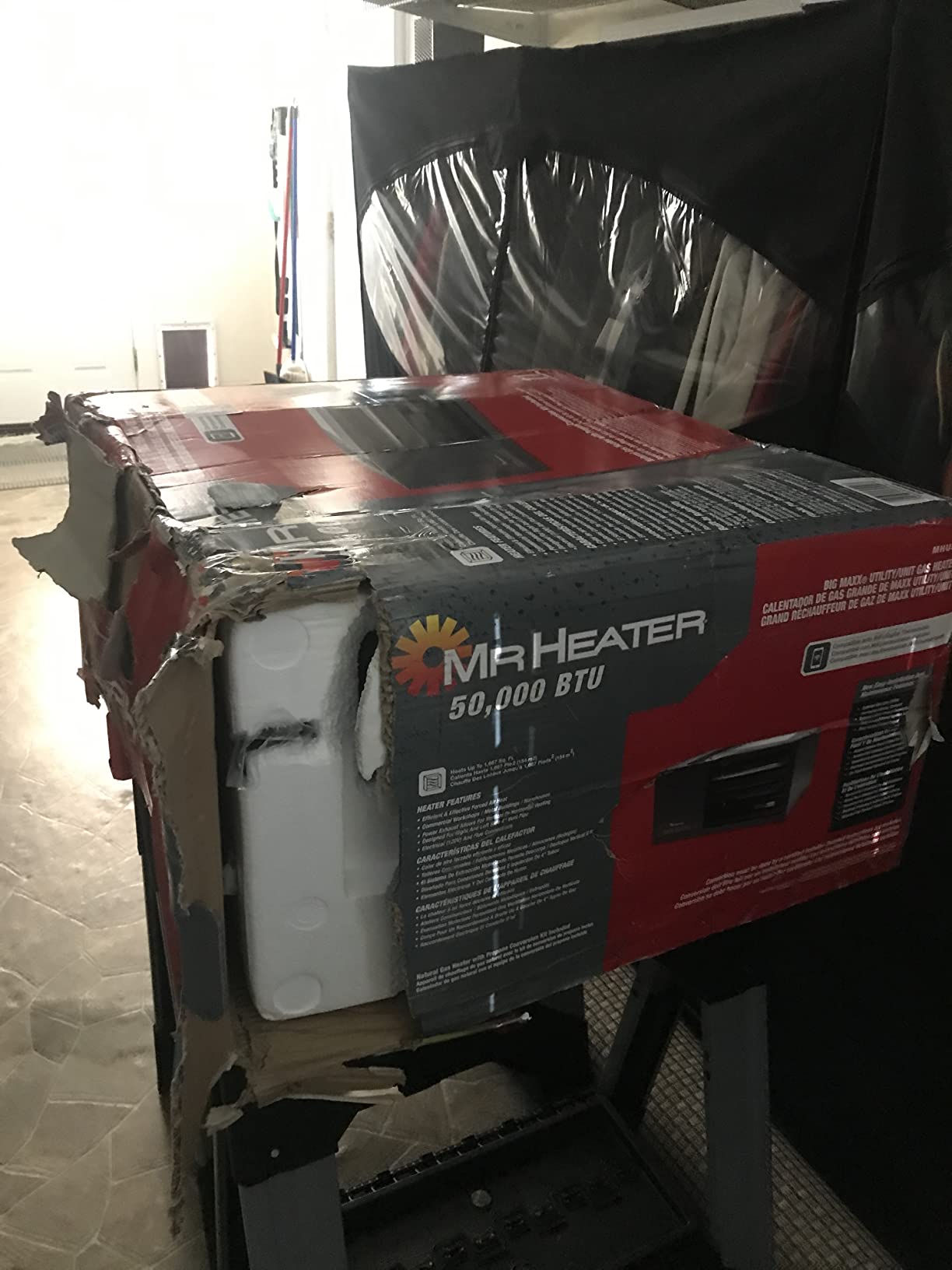
At fifty thousand BTU per hour this is the highest-output heater in the roundup, and its 1,667 square feet rating matches a three-car space almost exactly. Owners in insulated and semi-insulated garages report raising interior temperatures from the teens to a comfortable 60 to 70 degrees in roughly two hours.
Once warm, the burner runs only a small fraction of the day, which is the real argument for a forced-air unit over radiant. Radiant heat stops working the moment you walk away from it. Forced air stores heat in the room air mass and keeps delivering it.
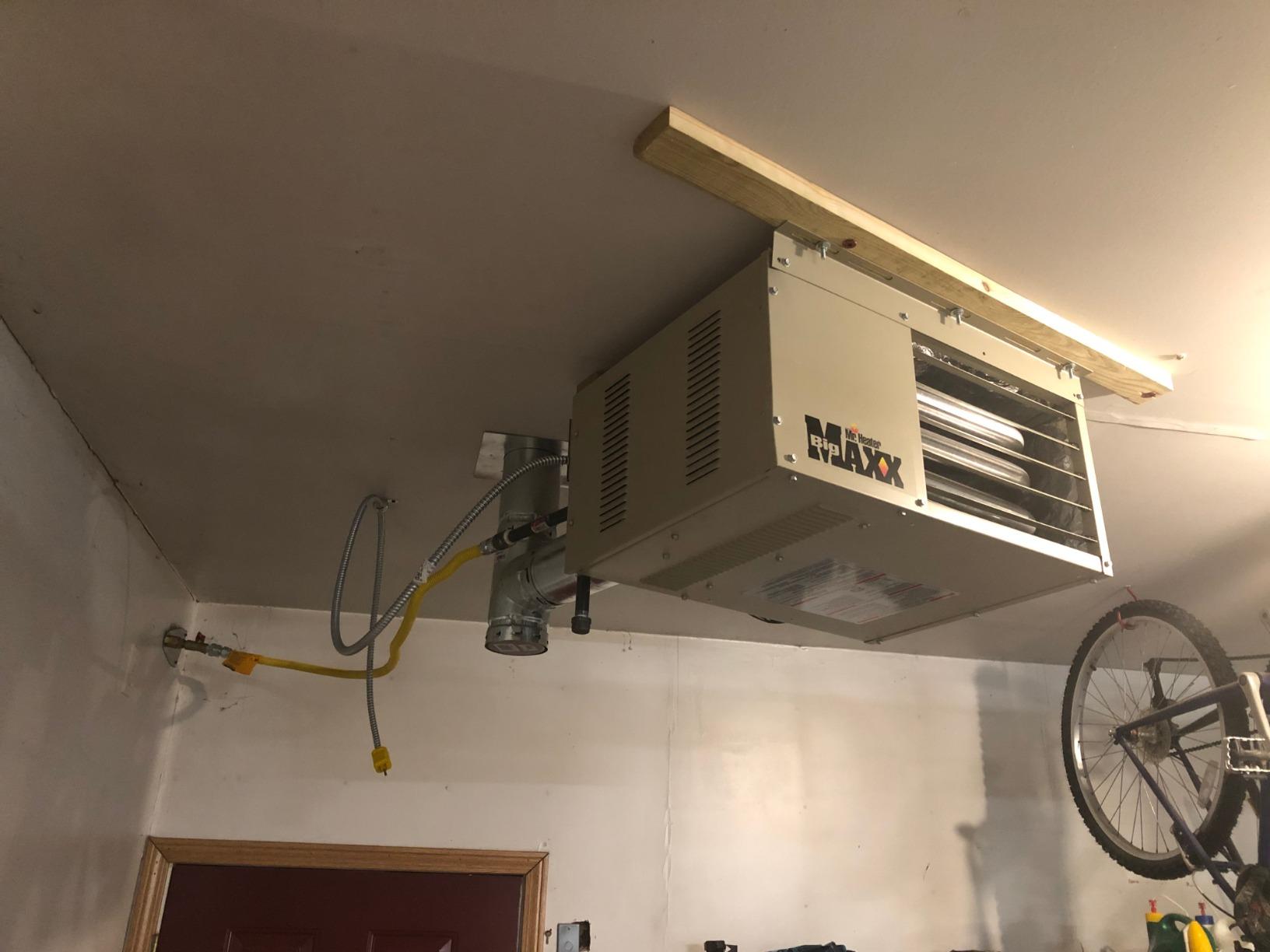
It accepts standard 24-volt thermostats and the newer Wi-Fi enabled models, sold separately, so you can control it from a phone or wire it into a home automation system. A high-temperature safety shutoff switch and a gas safety flame sensor are built in, and the natural gas to LP conversion kit is in the box if you run propane.
Two mounting brackets for ceiling installation are included. The unit needs a minimum 10 ft ceiling height and 8 ft of clearance from the base of the heater to the floor, which is a real constraint in older garages. At 60.3 pounds, this is not a two-person lift without a plan.
Owners also report the fan running very quietly once the fan set screw is properly torqued, and one recurring fit issue is that the fan set screw arrives loose and causes a wobble until tightened. It holds a 4.4 average across close to 1,500 ratings.
What to check before you buy
Check that you can have a gas line run and a vent installed. This is a vented unit, and venting installation is required but the kit is not included. A gas fitter or HVAC contractor handles both, and that labor is the single largest cost in this entire roundup.
Check your ceiling height and your floor clearance before you plan the location. A garage with exposed joists under nine feet may not accept this unit at all, which would push you toward a wall-mounted or a high-output electric alternative.
Who should skip this heater
Skip it for a one-car or small two-car garage. You would be installing a permanent gas line and a flue to heat a space a 5,000W electric unit handles with a single circuit. It is also the wrong answer for a rental property or a space where you cannot drill through the roof.
Skip it if you want heat without a professional install. The realistic cost of this heater is the unit plus gas line plus venting plus a thermostat, and reviews point to installation rather than output as the source of friction.
6. Shinic 2-Pack 120V Ceiling Mounted Quartz Heater – Best for Workbench Zoning
Shinic 2-Pack 120V Electric Garage Heater,1500W/750W Ceiling Mounted Heater
120V electric radiant
1500W or 5120 BTU
400 to 600 sq ft for the pair
Ceiling mount
Pros
- Two heaters in one pack for zoning a space
- Plugs into a standard 120V outlet with no electrician
- Quartz elements give instant heat at the aim point
- Built-in halogen work light for night work
- Ceiling mount rotates up to 90 degrees
Cons
- Lowest average rating in the group at 4.0 stars
- 1500W suits a bench or single bay not a whole garage
- Pull-string switch is the only control
Zoning is the idea most people miss. You do not need the whole garage warm, you need the bench warm, and that is exactly what two 1500W ceiling-mounted quartz units deliver for the price of one permanent install. Each runs on 120V, plugs into a standard outlet, and needs no electrician.
Each heater uses dual quartz tubes, mounts to the ceiling on an adjustable bracket, and rotates up to 90 degrees to aim radiant heat. The pack includes two heaters, two brackets and a manual. Claimed coverage is 400 to 600 square feet for the pair, which is a fair reading of two radiant zones rather than whole-room air heating.
The built-in halogen work light is the feature owners mention most warmly. Working under a car at night with a headlamp on your forehead is miserable, and a lamp above the bay solves it without a second fixture. Five settings come from a pull-string: 750W low, 1500W high, either with the light, and off.
Safety hardware is reasonable for a radiant unit: overheat auto-off, a three-prong grounded safety plug, a metal housing and ETL listing. At 4.0 stars across 639 ratings, this carries the lowest average in the roundup, and reviews reflect that with an 11 percent one-star share tied mostly to modest output and the basic pull-string control.
What to check before you buy
Check your circuit. Each unit draws 12.5 amps on 120V, which is most of a standard 15-amp branch circuit. Running both from one outlet will trip the breaker, and forums filled with garage owners report lowering household heaters to the 750W setting specifically to avoid that.
Check what you actually need. If you want the air in a two-car garage to reach working temperature, neither of these heaters will do it. Radiant heat is felt on skin and objects within a few feet, and it does not raise the air temperature across the room.
Who should skip this heater
Skip it for whole-garage comfort heat, and skip it if you want a thermostat. The pull-string switch is the only control, so you are choosing a fixed power level rather than a target temperature. That is fine for a five-minute repair under a car and poor for an eight-hour session.
Also skip it if you already own one solid 240V forced-air unit and are short on circuits. Two radiant 1500W heaters add up to less heat than one of the 5,000W electric heaters in this roundup.
7. Dr. Infrared DR-218 1500W – Best for Freeze Protection
DR. INFRARED HEATER DR218-1500W Greenhouse Garage Workshop Infrared Heater, 1500-watt
120V electric
1500W infrared
150 sq ft coverage
Floor stand cabinet
Pros
- Plugs into any 120V outlet with no installation
- Owners report a 1-car garage going from 36F to 65F overnight
- Steady quiet thermostat-controlled fan
- IPX4 splash protection suits damp spaces
- Compact 11.5 lb cabinet that moves easily
Cons
- Smallest electric coverage here at 150 sq ft
- Single heat setting and one fan speed
- A few owners had thermostat wiring burn out
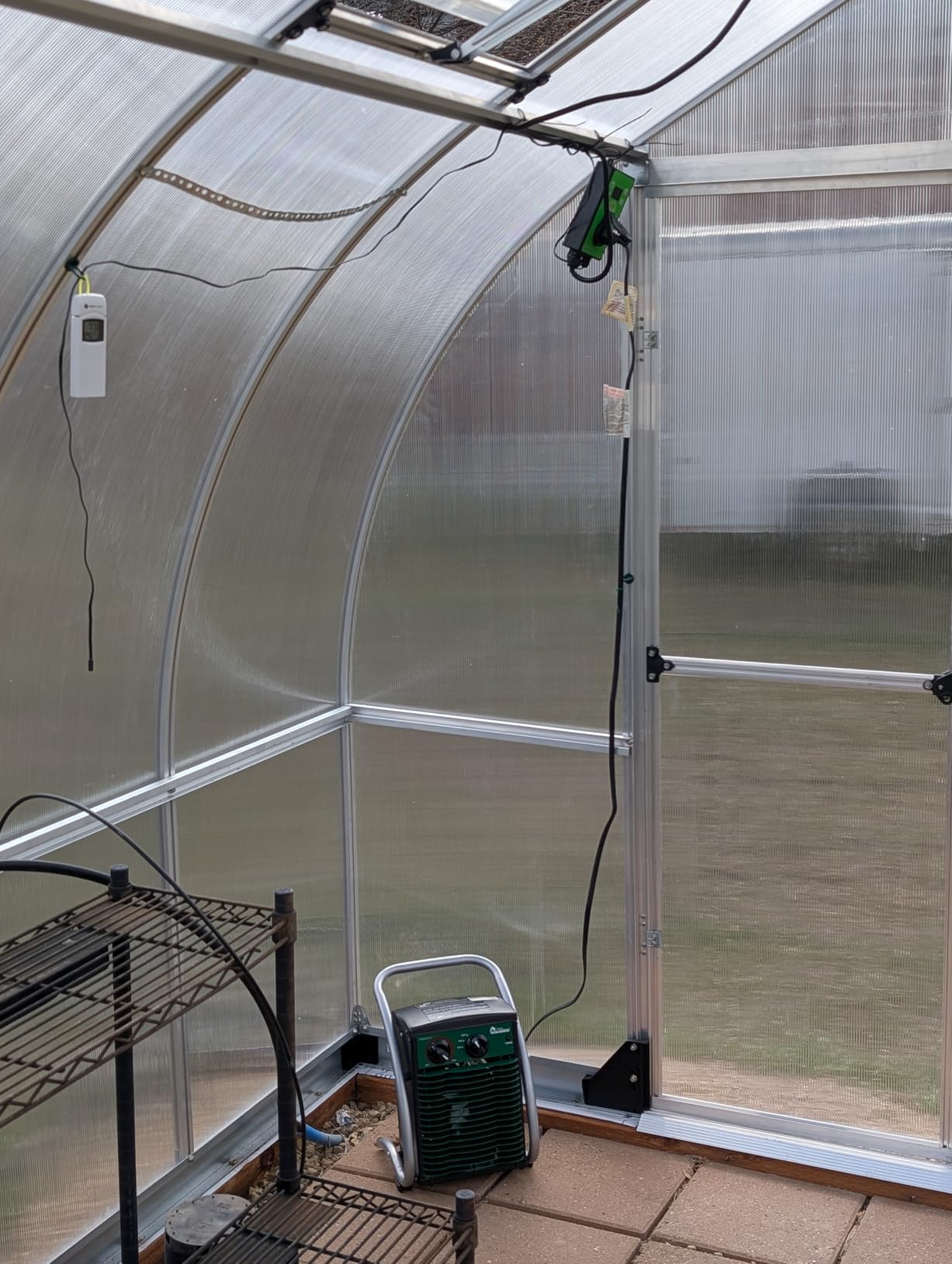
There is a different job than heating a garage: stopping the temperature from falling below freezing so batteries, paint, sealants and stored tools are not damaged. That is freeze protection, and it is where this 1500W cabinet earns its place in the roundup.
Owners report raising a one-car garage from 36 degrees to 65 degrees Fahrenheit overnight, and the dominant use case in reviews is greenhouses, a single-car garage and stored plants. The built-in thermostat covers 32 to 104 degrees Fahrenheit, so you can hold a target rather than cycling a switch.
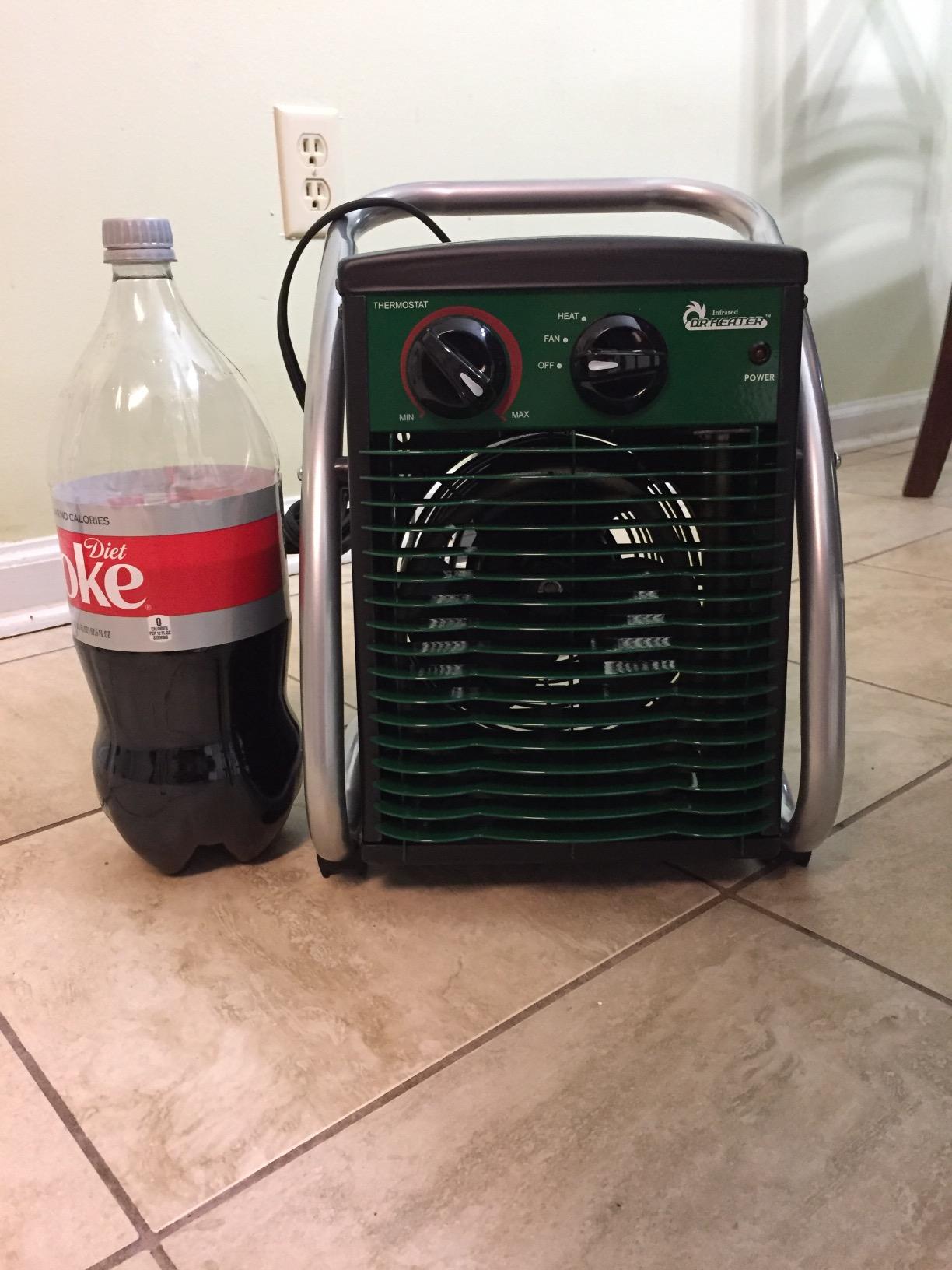
It is also the simplest product here in practical terms. It plugs into a 120V outlet, stands on the floor at 11.5 pounds, needs no mounting and no install, and carries a 1-year warranty. Move it between the garage, the greenhouse and the shed as the season changes.
IPX4 splash protection is a genuine advantage in a garage or greenhouse where damp floors and condensation are normal. It runs quietly and thermostatically, and it holds a 4.2 average across 881 ratings. The recurring complaint is that it is louder than a small box fan, which matters less in a garage than in an office.
What to check before you buy
Check the square footage expectation. At 1500W and 150 square feet of claimed coverage, this is the smallest electric output in the roundup. It is a spot and overnight device, not a workshop heater, and treating it as one is the reason some buyers are disappointed.
Check your noise tolerance. If you plan to run it while you are working at a bench, the fan is noticeable. If it runs overnight while the garage is closed, that is not a factor at all.
Who should skip this heater
Skip it if you need to heat a two-car bay to work in during the day, and skip it if you want a remote, a timer or more than one heat setting. There is one power level and one fan speed, and the fan does not change.
A small number of owners have had the internal thermostat wiring burn out, which accounts for much of the 10 percent one-star share. If you are buying for unattended overnight use, a unit with an overheat cut-off and a more rugged thermostat is a safer bet.
8. InoKraft 7500W Electric Garage Heater – Best Plug-In 240V Option
InoKraft 7500W Electric Garage Heater, 240V with NEMA 14-50P Plug
240V electric
7500W forced air
750 sq ft coverage
NEMA 14-50P plug
Pros
- Highest rated 240V electric unit in the roundup
- NEMA 14-50P plug matches a common welder receptacle
- 7500W is the biggest plug-in electric output
- Digital thermostat remote and 24 hour timer
- ECO mode and quiet 65 dB operation
Cons
- Still needs a 240V 50A circuit and professional installation
- Only 286 ratings so less long-term field history
- Wall or ceiling mounting removes portability
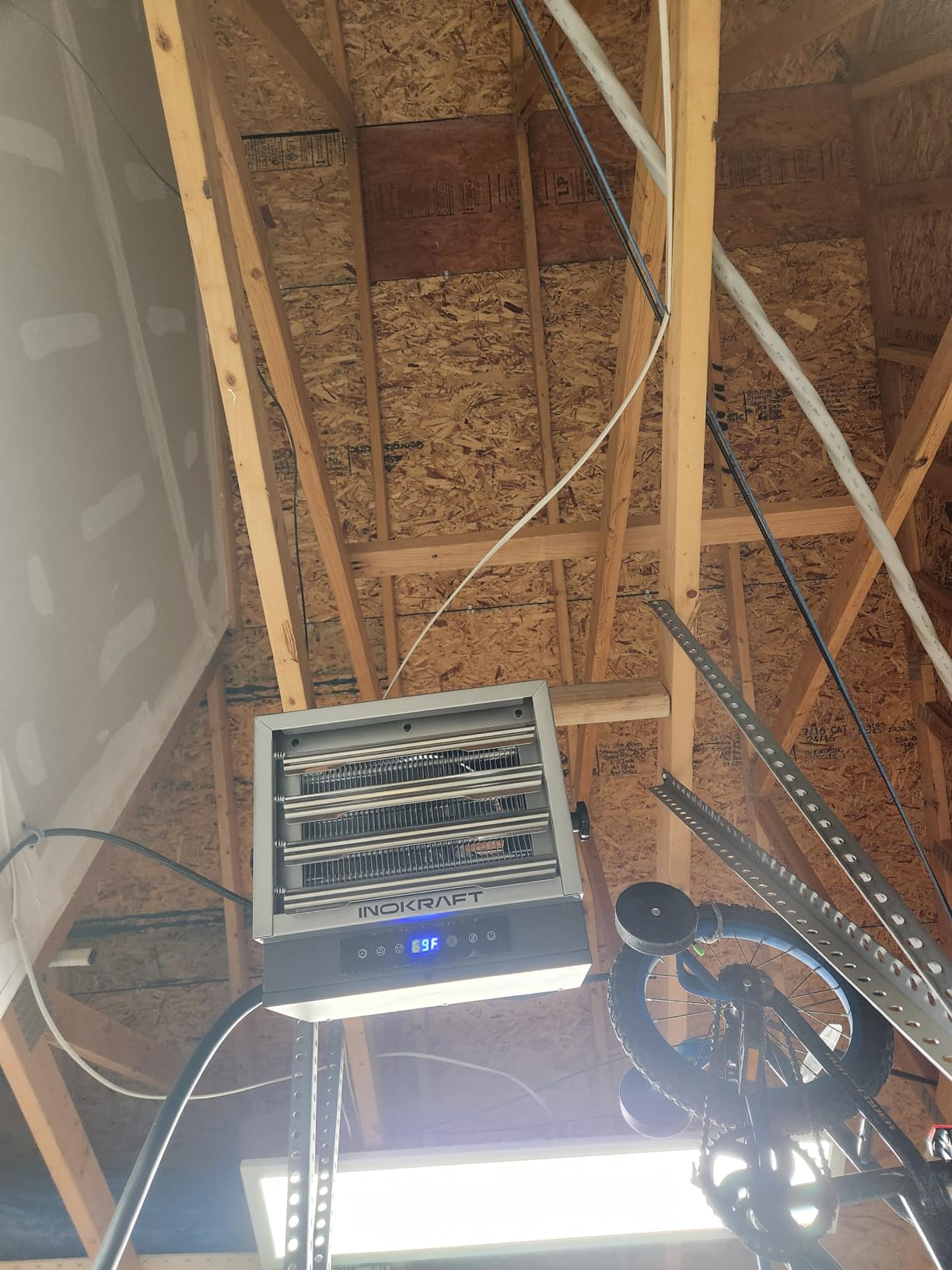
This is the newest listing in the roundup and the highest-rated electric heater on it, at 4.6 stars with 82 percent five-star ratings. The reason is the plug. A NEMA 14-50P connector is the same receptacle your welder uses, which is far more common in a garage subpanel than a 6-30 outlet and therefore easier to have an electrician fit.
Output is 7500W of fan-forced heat covering up to 750 square feet, the highest plug-in electric figure here. For a two-car garage in semi-insulated space that is genuinely substantial heat, and it needs no gas line, no flue and no combustion products.
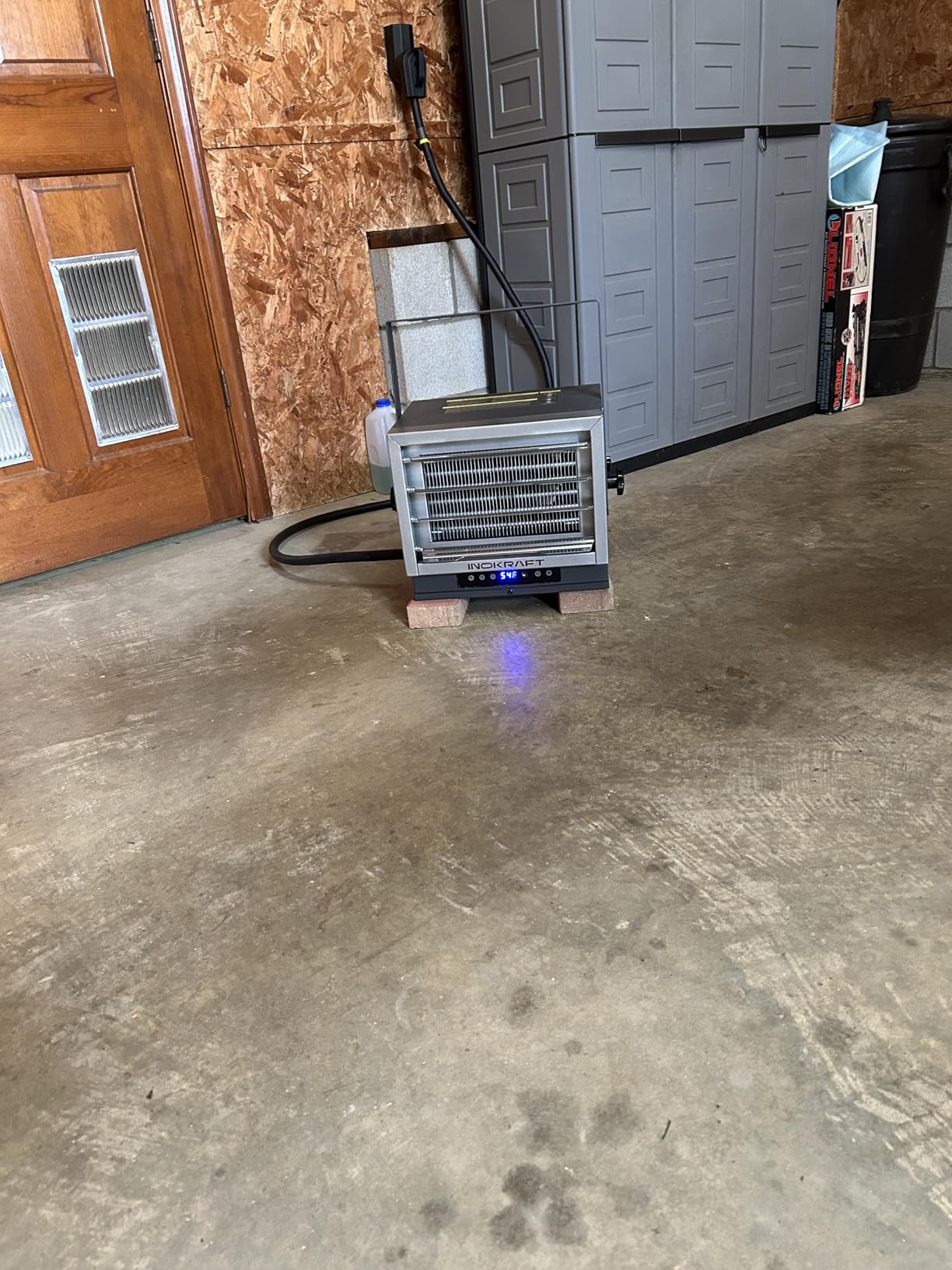
Control is where it beats every other 240V unit on this list. A digital thermostat adjustable from 40 to 99 degrees Fahrenheit, a 1 to 24 hour programmable timer, a remote control, manual high and low modes, and an automatic ECO mode that adjusts output to ambient temperature and cuts power when it is not needed.
Mounting gets five adjustable angles, and louvers direct airflow where you want it. An automatic fan delay runs the fan briefly after the heat stops, which spreads warmth further across the room. It also mounts on a wall or hangs from the ceiling.
At 65 dB it is quieter than most 240V fan-forced heaters, which matters in a workshop. It includes overheat protection with automatic shutoff, and professional electrician installation is recommended.
What to check before you buy
Check your panel for a 240V 50A circuit and a NEMA 14-50R receptacle. The 8.2-foot cord with the plug is included, which removes one step, but the circuit itself is still an electrician job in most homes.
Check your square footage honestly. 750 square feet covers a two-car bay or a good-sized workshop. It does not cover a three-car space with an uninsulated door, and no 240V electric unit in this roundup will.
Who should skip this heater
Skip it if you need portability, because wall and ceiling mounting makes it a fixed piece of the garage once installed. Skip it if you are a renter or if your subpanel cannot take a 50A double-pole breaker.
Also weigh the thin review base. With 286 ratings it has the least long-term field history in this roundup, and the complaints that do exist are about installation logistics rather than performance. If you want a decade of known serviceability, the Dr. Infrared DR-988 has more than 4,000 ratings behind it.
9. ROVSUN 6000W Hardwired Heater – Best for App Control
ROVSUN 6000W Electric Garage Heater with Remote & APP Control, Digital Fan-Forced Ceiling Mount Heater with Thermostat, 12H Timer & Overheat Protection, 240V Hardwired for Workshop Factory
240V hard-wired
6000W or 20000 BTU
1100 sq ft
Ceiling mount with app control
Pros
- Only heater here with Wi-Fi and app control
- 1100 sq ft is the largest electric coverage claim
- Hardwired so there is no plug in a busy shop
- 12 hour timer and 45 to 95F thermostat
- Three louver angles aim the airflow
Cons
- Smallest review base in the roundup at 103 ratings
- Hardwired only and no power cord included
- Fixed once it is mounted
Phone control is the feature that separates this from everything else here. The ROVSUN offers a control panel, a handheld remote and app control, so you can start warming the garage from the house before you walk out to a cold vehicle, or shut it down when you leave.
Output is 6000W, which converts to 20,000 BTU, with claimed coverage up to 1,100 square feet. That is the largest coverage figure among the electric heaters in this roundup, and the fan-forced delivery means it warms air rather than a narrow cone.
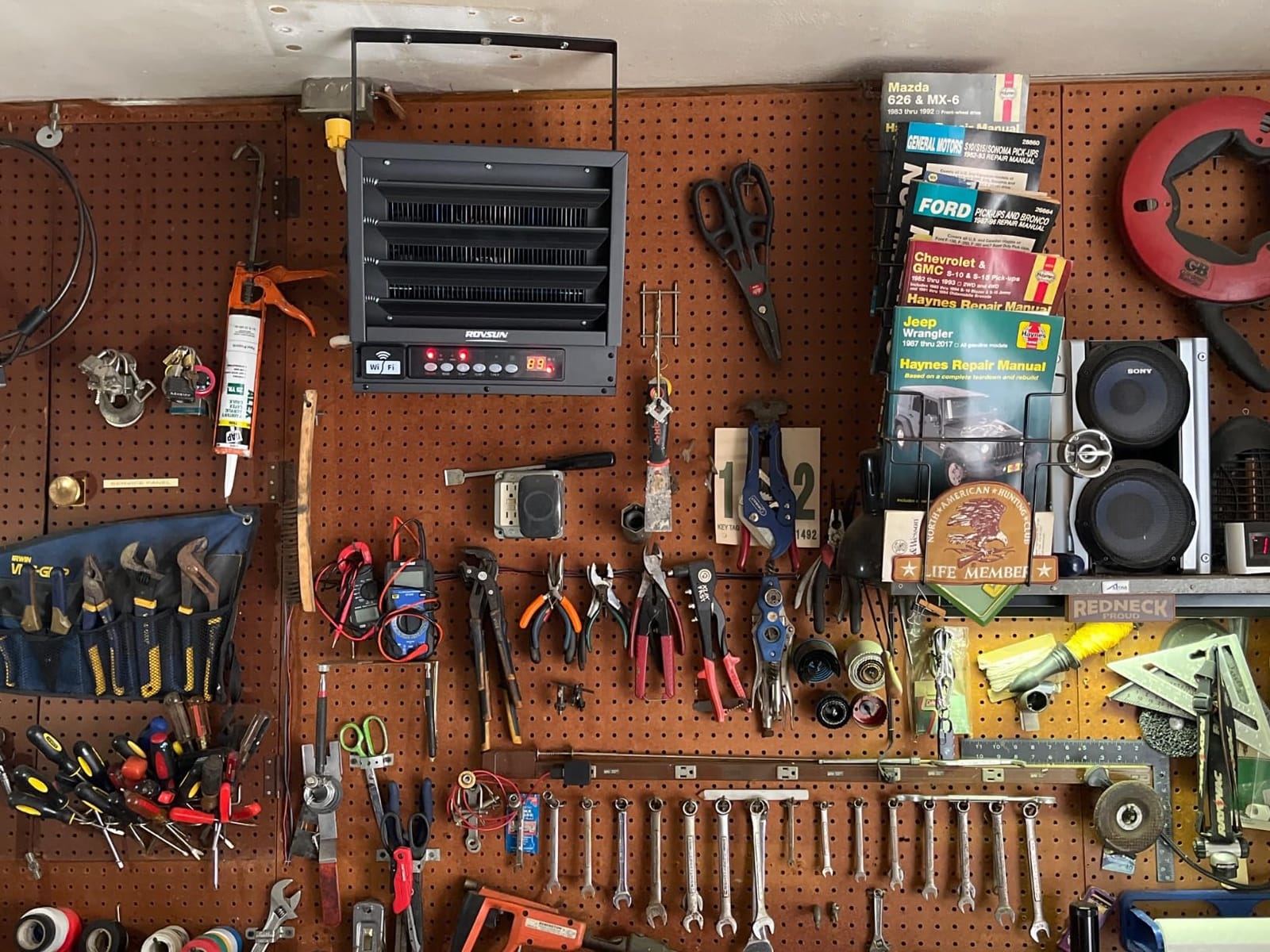
The thermostat is adjustable from 45 to 95 degrees Fahrenheit and a 12-hour timer handles scheduling, which covers a typical work session. Adjustable 0, 20 and 40 degree directional outlets let you aim the discharge so the heat lands where the work happens rather than on a wall.
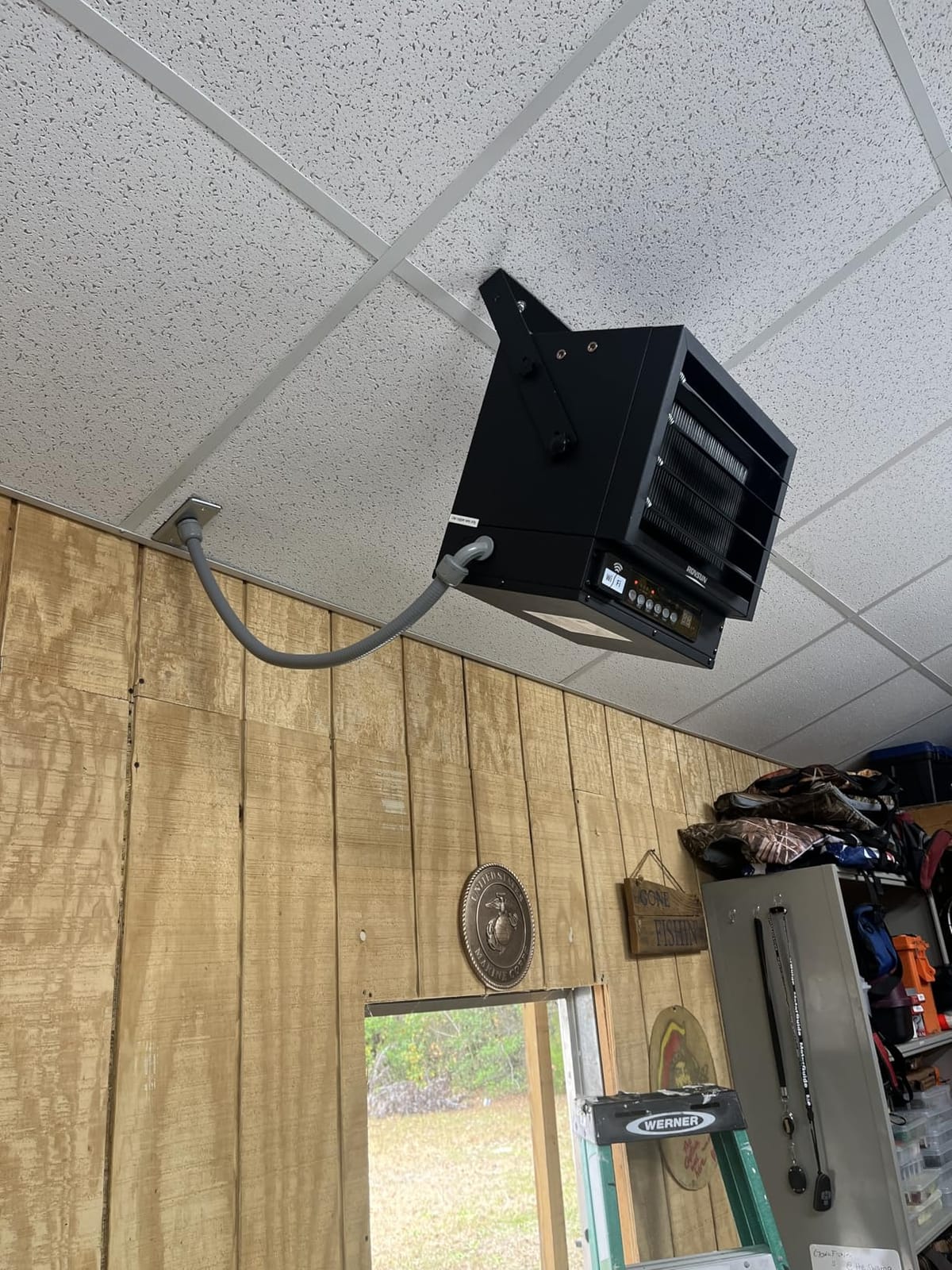
Construction is a sturdy steel frame with overheat protection and ETL certification, and the customizable mounting bracket is designed for overhead installation. It is a warehouse, factory and workshop unit rather than a living-room-style product.
It holds a 4.3 average, but from only 103 ratings, the smallest sample in the roundup. The 11 percent three-star share suggests some variance between the 1,100 square foot claim and delivered performance in real spaces.
What to check before you buy
Check the electrical plan, because this is one of the more demanding installations in the roundup. It is hardwired 240V on 10 AWG wire, no power cord is included, and the manufacturer specifies installation by an electrician. There is no way to plug this in and start.
Check your signal. App control needs the phone on the same network as the heater, and a metal detached garage is the worst case for Wi-Fi range. Test coverage in your garage before you commit to a unit whose main selling point is remote control.
Who should skip this heater
Skip it if you value a long service history over smart features, since 103 ratings is a very small sample for a permanent installation. Skip it if you want a portable heater, a plug-in connection, or a unit that works during a power cut.
It is also the wrong choice for a small garage, where 6000W of hardwired heat is far more than the space needs and the effort goes into installation rather than result.
10. Dr. Infrared Portable Infrared Space Heater – Best Portable Spot Heater
DR. INFRARED HEATER Portable Infrared Indoor and Outdoor Space Heater for Patio, Garage, Commercial & Residential With Remote Control, Without Thermostat, Black
120V electric infrared
900W 1200W or 1500W
IP55 rated
Wall and ceiling mount
Pros
- Weighs 8 lb so it moves with one hand
- Plug-in 120V with no wiring venting or gas line
- IP55 rated for a damp open bay
- Remote with three distinct heat levels
- Mirror reflector with 90 percent reflectivity
Cons
- Highly directional and does not heat the air
- No built-in thermostat
- Does not retain settings after a power interruption
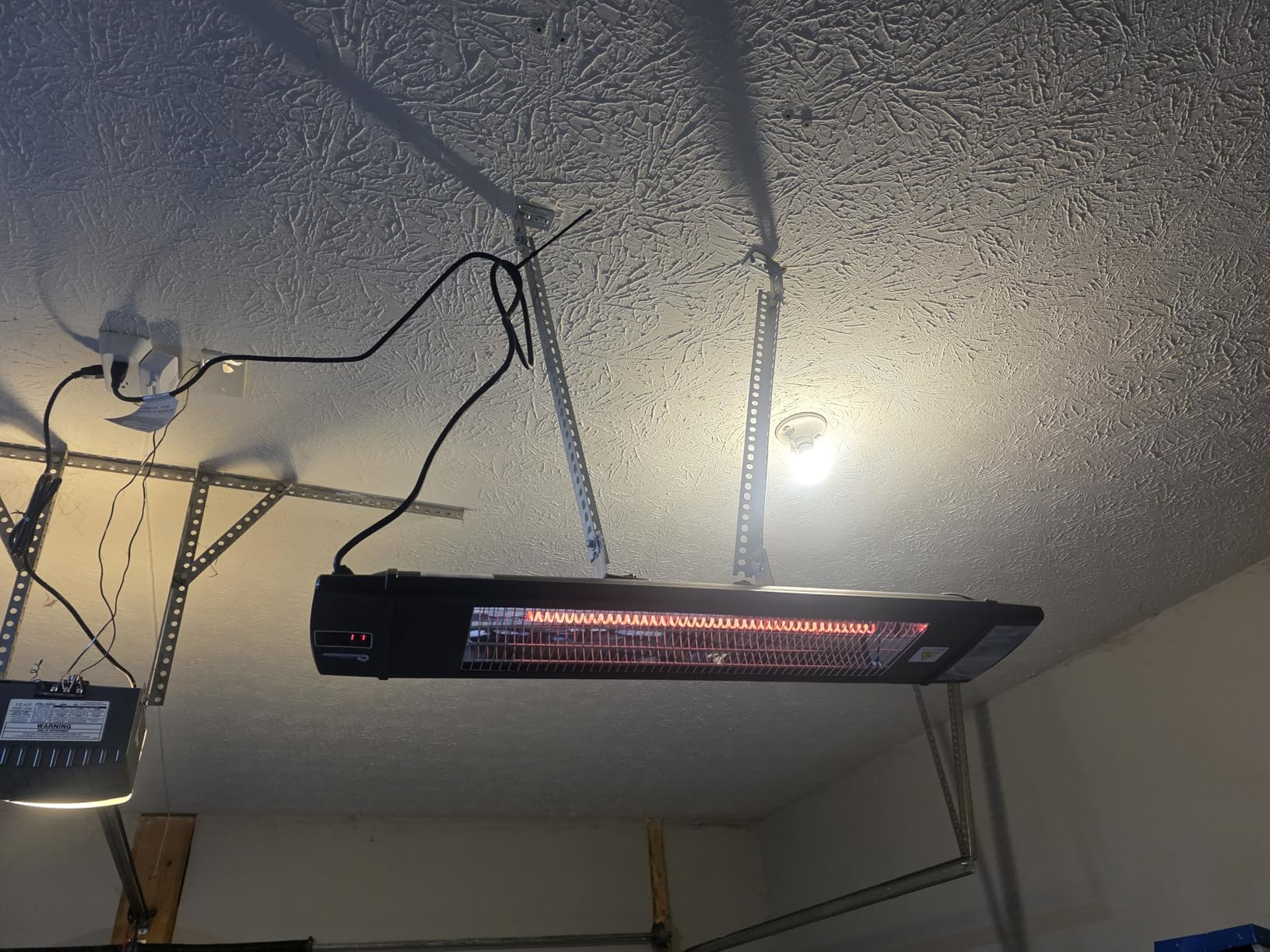
With more than 6,000 ratings this is the most reviewed electric heater in the roundup, and it is the simplest to justify. It is eight pounds, it plugs into any 120V outlet, and it mounts on a wall or a ceiling using the included bracket, or stands wherever you put it.
It is IP55 approved for indoor and outdoor use, which is unusual and useful in a garage bay that is open to weather or damp. Three power settings at 900W, 1200W and 1500W give clear steps, and the remote control removes the need to reach the unit.
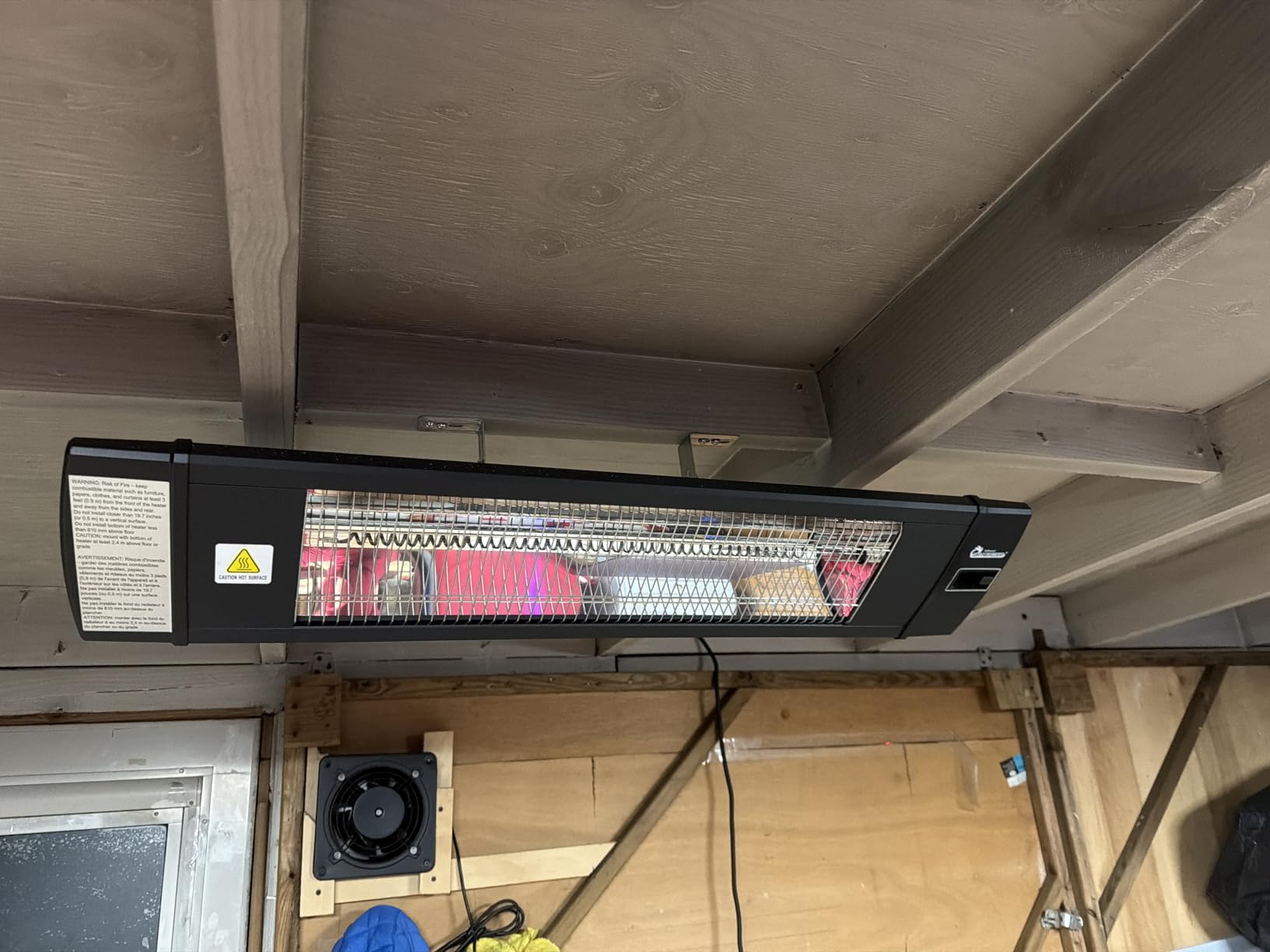
The reflector is the reason it feels stronger than 1500W suggests. A high-level mirror aluminum reflector with 90 percent reflectivity directs the infrared output forward instead of letting it scatter, so the heat is concentrated on a bench, a doorway or a person rather than lost to the room.
Owners who understand infrared rate it highly for spot warming. The one-to-three-star reviews come from people who expected it to heat the air of a large space, which is a category misunderstanding rather than a defect. One owner reports four years of continuous seasonal use without failure.
What to check before you buy
Check your expectations about direction. Heat is only felt within a few feet of the reflector, and this unit will not raise the air temperature of a two-car garage. Think of it as a targeted heat source, like a sunbeam, rather than a room heater.
Check what happens after a power cut, because this is the most-cited practical limitation in reviews. It does not retain its settings after a power interruption, so it needs the remote to turn back on. If you plan to leave it on through an outage, plan on that.
Who should skip this heater
Skip it if you want thermostat-controlled heat, since there is no built-in thermostat and you set power level and duration manually. Skip it for a workshop where you need uniform air temperature.
It is also not the choice for a one-person garage you sit in for hours, because radiant heat on the body is comfortable but the room stays cold. And if you share a circuit with LED lighting, the lower power settings can cause flicker, which is why it belongs on a circuit of its own.
How Big a Garage Heater Do You Need?
Start with square footage, because most garage heater disappointments are sizing errors. Multiply the length by the width of the space with the garage door closed and the heater in mind. A one-car garage is roughly 200 square feet, a standard two-car bay is 576 square feet, and a three-car or workshop space runs from 1,000 up toward 1,700.
Then convert. Electric fan-forced heaters are measured in watts, and a useful garage rule is roughly 10 watts per square foot as a starting point for a semi-insulated space, climbing to 15 watts per square foot for an uninsulated one. Gas and propane heaters are measured in BTU per hour, where 30,000 to 35,000 BTU per hour per square foot of ceiling area is the common residential figure, adjusted downward for height.
For a 24 by 24 two-car garage at 576 square feet, that gives you about 5,760W of electric at 10 watts per square foot, which is exactly where the Dr. Infrared DR-988 at 5600W and the Comfort Zone at 5,000W land. A household 1500W heater would need more than four hours of continuous operation to deliver the same energy, which is why it feels useless in a garage.
Here is how the ten map to real garage sizes. A one-car garage of roughly 200 square feet works with the Dr. Infrared DR-218 at 1500W for freeze protection, the Dr. Infrared portable infrared unit for spot heat, or the Mr. Heater Buddy for a person rather than a room. A two-car bay at 576 square feet is the sweet spot for 5,000W to 7,500W fan-forced electric, which covers the Comfort Zone, the ROVSUN and the InoKraft.
A three-car space above 1,000 square feet pushes you toward the largest electric option you can wire or into combustion territory entirely, where the 50,000 BTU Mr. Heater unit heater matches a 1,667 square foot garage. Below 300 square feet, anything above 5,000W is wasted capacity, and radiant heat aimed at a bench is often the smarter buy than air heat for the whole room.
Insulation is the second variable, and it changes the answer more than most buyers expect. In a semi-insulated garage with insulated walls, a stripped ceiling and a fitted garage door, forced-air electric units hit their claimed coverage comfortably. In a bare shell with an uninsulated metal door, every unit on this list is fighting constant heat loss through the largest opening in the room, and no heater of any size wins permanently.
Before shopping hard, spend an afternoon on losses instead. Insulate the garage door, add weatherstripping to the header and jambs, and seal gaps around the entry door. Garage owners on the forums we read report that two heaters run at half power beat one heater cranked to full, which tells you the limit is often the envelope rather than the appliance.
Noise deserves its own mention for a working garage. The fan-forced 240V units in this roundup range from about 65 dB on the InoKraft up to noticeably louder on smaller 1200W cabinets, and a fan running all day beside a bench is something you tune out after a week, or you do not. If you work next to the unit for hours, check the noise level before you buy, and keep the heater across the bay rather than under your ear.
Dust and combustion are the other two workshop realities. Forced-air heaters pull air across dusty surfaces and blow that dust back into the room, so a unit overhead is cleaner than one at head height. Combustion heaters add water vapor to the air as a by-product, which in an uninsulated garage in January is often welcome, but in a paint-curcing project it is not.
Choose between forced air and radiant by how you work. Forced air raises the air temperature and is right when you need a uniformly usable room. Radiant heaters warm you and your workpiece directly and are far more efficient for spot tasks at a bench, under a vehicle hood, or at a doorway, but they leave the air cold. In a drafty garage many owners end up owning both.
Garage Heater Safety: CO, Clearances, and Circuits
The safest heater in a garage is an electric unit with no combustion, mounted with its stated clearances, on a dedicated circuit. That is not a hedge, it is the actual answer to the most common safety question we get, and it is why so much of this roundup is electric.
Any fuel-burning heater introduces carbon monoxide risk, and an oxygen depletion sensor, the ODS, is the mechanism that manages it. The Mr. Heater Buddy and the 30,000 BTU vent-free radiant heater both carry low oxygen shutoff systems that close the gas valve if oxygen in the room drops. Treat that sensor as a safety device and not a convenience feature, and test it if the manual tells you to.
Vented versus ventless is the second distinction. A vented unit heater such as the 50,000 BTU Mr. Heater exhausts combustion gases outdoors through a flue and requires professional installation. A ventless unit such as the 30,000 BTU radiant heater exchanges combustion air indoors and needs a room with adequate ventilation. Neither belongs in a closed garage with the door down.
Clearance is the third. Respect the manufacturer clearance from combustibles on every side, and remember that a garage is full of combustibles: cardboard, sawdust, shelving, plastic fuel cans, vehicle upholstery. Never run a heater inside a storage closet, under a workbench piled with material, or within reach of a parked vehicle’s fuel system.
Circuit requirements matter as much as clearance. A 120V heater drawing 12.5 amps needs its own 15-amp branch circuit, and forum owners routinely report tripping breakers by running two of them on one outlet. A 240V unit at 30 amps or 50 amps needs a dedicated double-pole breaker and a matching receptacle, installed by an electrician.
Finally, put a working carbon monoxide detector inside the garage, mounted on a wall or ceiling per the detector’s instructions, and near the entry if the garage is attached to the house. A smoke and CO combination alarm is the standard answer for a garage that shares air with living space. It does not make a ventless heater safe in a sealed room, but it is the last line of defense.
Electric vs Propane vs Natural Gas: What Actually Costs Less to Run
Electric is easiest to install and has zero combustion risk, but it draws a lot of power, and power is usually the most expensive thing you can heat a garage with. A 5,000W heater running for one hour consumes 5 kilowatt-hours. A 7,500W unit consumes 7.5. That math is simple enough to do before you buy.
Propane carries more heat per unit of volume. The Mr. Heater Buddy runs about 5.4 hours on low with a 1 lb cylinder and 2.4 hours on high, and the 30,000 BTU vent-free heater runs roughly 31 hours on a standard 4 lb barbecue cylinder. Cylinder refills are a per-hour cost you can calculate, and there is no electrical install.
Natural gas only appears in the 50,000 BTU Mr. Heater unit heater, which ships with an LP conversion kit. Natural gas is usually the cheapest fuel per hour of heat and the most stable, but it requires a professionally installed gas line, which is the cost that stops most residential projects.
The practical answer is that fuel choice follows installation reality more than running cost. No gas line, no 240V circuit, no landlord permission means a 120V electric unit. A 240V circuit already exists means a 5,000W to 7,500W electric fan-forced unit. A gas line and a vent are already in place, or a professional install is on the table, means a gas unit heater and lower hourly cost with more heat.
Portable propane occupies the in-between ground: no install, no circuit, moderate running cost, and the ability to heat one zone rather than a whole building. That is why propane holds the largest review base in this roundup even though the very highest ratings sit with the electric units.
How to Get More Heat Out of Any Garage Heater
Insulate the garage door first. It is typically the largest single opening in the room and often an uninsulated single-layer steel slab. Kits with rigid foam panels and weatherstripping are inexpensive, and the improvement shows up in the first cold night.
Seal the header, the jambs and the gap under the door with weatherstripping, and add a threshold seal. Even a quarter inch of daylight around a garage door is a steady cold draft that offsets a heater’s output all night.
Insulate the walls you are not using. You do not need to bring an entire uninsulated garage to wall R-value, because that is expensive. But closing off the two or three walls you never touch, and insulating above the ceiling joists, changes the volume you are heating more cheaply than a larger heater does.
Set a target you can live with rather than chasing a thermostat number. Sixty to seventy degrees in the working area is comfortable in a T-shirt, and it needs far less heat than trying to make a garage feel like a house. Lower the set point by a few degrees and the running hours drop noticeably.
Finally, close the interior door between the garage and the house while the heater runs. The whole point of heating a garage is not heating the rest of the house through the ceiling and the stairwell. If you work with the house door open, you are running a room heater and a space heater with one appliance.
Frequently Asked Questions
What is the safest heater to use in a garage?
An electric unit with no combustion is the safest heater for a garage, because it produces no carbon monoxide. If you choose propane or natural gas, use a model with an oxygen depletion sensor, install a vented unit if the space is enclosed, and mount a working carbon monoxide detector inside the garage. Respect the manufacturer clearance from combustibles on every side.
How many BTUs do I need to heat a 24×24 garage?
A 24×24 two-car garage is 576 square feet. As a forced-air electric rule of thumb, plan on about 10 watts per square foot for a semi-insulated space, which lands near 5,000W to 5,600W, or roughly 17,000 to 19,000 BTU. In an uninsulated garage, plan higher. For combustion heating, a 50,000 BTU unit heater covers about 1,667 square feet.
Is it okay to use a space heater in a garage?
Yes, as long as the heater is rated for indoor use, you keep its stated clearance from combustibles, and you have a working carbon monoxide detector. Never use an outdoor-only radiant patio heater indoors, never run a fuel-burning heater in a closed garage, and never leave one unattended. A 1500W household heater is safe but ineffective above about 200 square feet.
What is the best economical heater for a garage?
The cheapest option is a 120V plug-in electric unit, because there is no install cost and no fuel storage. A 1500W model uses 1.5 kilowatt-hours per hour of operation. Propane carries more heat per volume of fuel, and natural gas is cheapest per hour of heat but needs a professional gas line. With no gas line and no 240V circuit, a 120V electric unit is the economical answer.
Do I need a 240V outlet for a garage heater?
Only for high-output units. Anything rated 5,000W or more generally needs 240V, usually on a dedicated double-pole breaker at 30 amps or 50 amps, and a matching NEMA receptacle. A 1500W heater runs on a standard 120V outlet. Check your panel and add an electrician visit to your budget before buying any 240V model.
How long does a propane garage heater run on a tank?
It depends on the unit and the setting. The 9,000 BTU portable radiant heater runs about 5.4 hours on low and 2.4 hours on high with a 1 lb cylinder. The 30,000 BTU vent-free radiant heater runs roughly 31 hours on a standard 4 lb barbecue cylinder. A forced-air unit heater burns fuel only while the thermostat calls for heat, so runtime depends on temperature and insulation.
Final Verdict: Which Garage Heater Should You Buy?
The Mr. Heater 9,000 BTU Buddy takes our EDITOR’S CHOICE for one reason: it works, it is safe indoors, and it asks nothing of you but a propane cylinder. For a two-car bay where you want a licensed electrician and a 240V circuit, the Dr. Infrared DR-988 covers the space with no combustion involved. For a permanent shop install, the Comfort Zone 5000W ceiling unit gives you the most coverage per watt and keeps the floor clear.
Match the heater to the job rather than the other way around. Spot heat at a bench, heat for a whole bay, and freeze protection overnight are three different requirements, and the best space heaters for garages only makes sense once you know which one you are solving. Check your panel, measure the square footage, and take a CO detector advice seriously before the first cold snap of 2026.
While you are sizing things up, our guides to [portable garages](https://www.thirstybear.com/best-portable-garages/) and [metal garages](https://www.thirstybear.com/best-metal-garages/) cover the structures themselves, and [livestock heaters](https://www.thirstybear.com/best-livestock-heaters/) cover a very different cold-weather heating problem.