
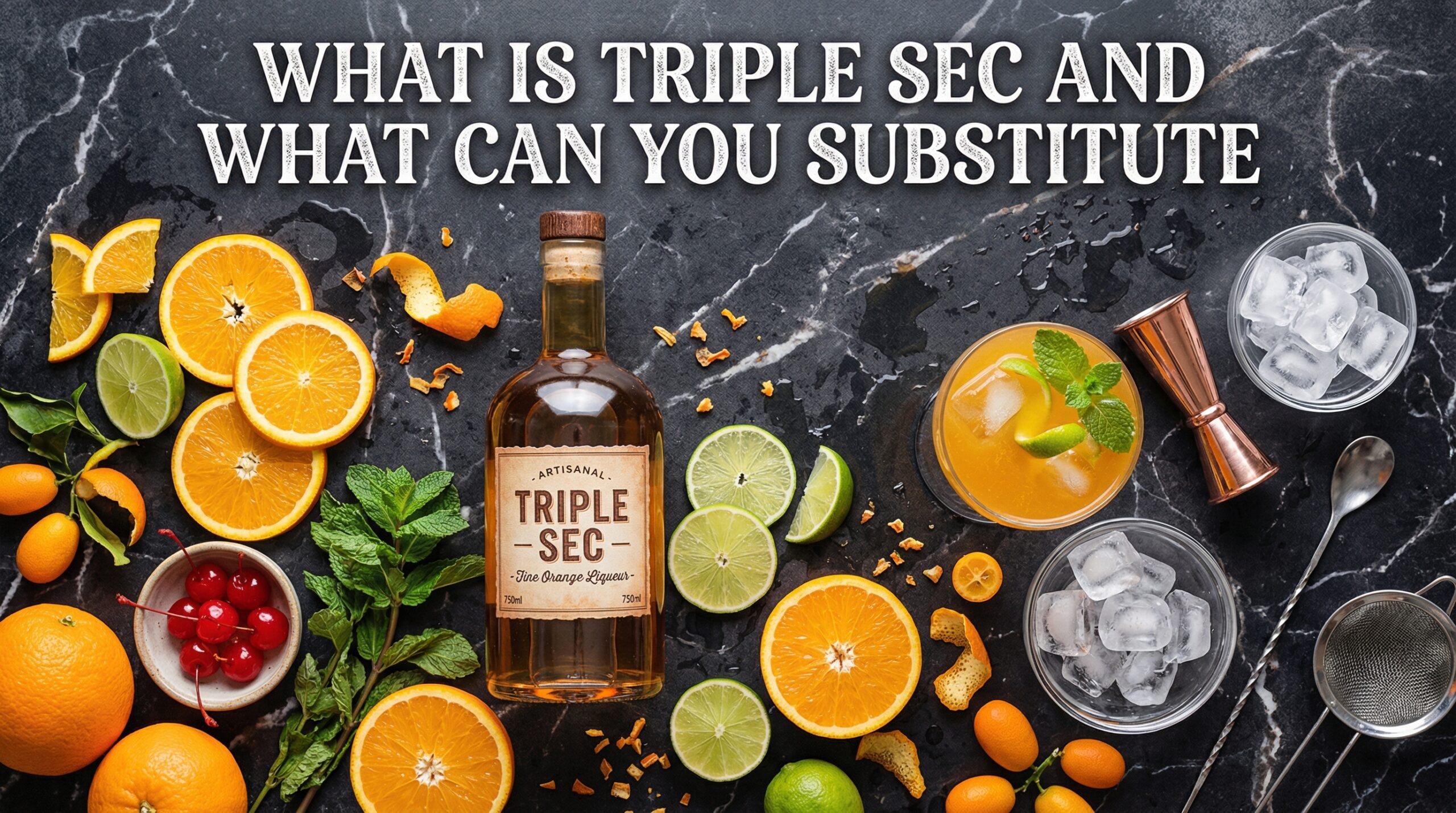
If you have ever made a margarita or a cosmopolitan, you have likely encountered triple sec. This bright, citrusy liqueur shows up in countless cocktail recipes, but many home bartenders wonder what exactly it is and what to reach for when the bottle runs dry.
This guide covers everything you need to know about triple sec and the best substitutes for every situation, whether you are a seasoned bartender or just learning the craft.
Table of Contents
What Is Triple Sec?
Triple sec is an orange-flavored liqueur made by infusing or distilling orange peels with a neutral spirit. The name comes from the French word “sec,” meaning dry, though triple sec actually refers to the triple distillation process used in its production.
The result is a clear, sweet liqueur with vibrant orange flavor and at least 15% sugar content. The key characteristics include its bright citrus aroma, sweet but not overly syrupy taste, and the way it adds both sweetness and orange intensity to cocktails.
Unlike some liqueurs that are made from a specific base spirit, triple sec can be produced using various spirits as the foundation. The orange flavor comes primarily from bitter orange peels, which give triple sec its distinctive balance of sweet and slightly bitter notes.
You will find triple sec in most well-stocked bars and liquor stores. It serves as both a sweetener and an orange flavoring agent in cocktails. The liqueur adds brightness and depth that plain sugar syrup or simple OJ cannot replicate.
The History and Origin of Triple Sec
Triple sec originated in France during the 19th century. The production method was developed to create a concentrated orange flavoring that could be stored and used year-round. The triple distillation process gave the liqueur its name and contributed to its smooth, refined character.
While the technique was French, the orange flavor inspiration came from the Caribbean island of Curaçao, where bitter oranges grew abundantly. Dutch traders had been importing these oranges and creating Curaçao liqueur for years before the French developed their own version.
Over time, triple sec became a staple in bars worldwide, particularly after the margarita craze took hold in the mid-20th century. Today, triple sec remains a bartender’s essential, though premium options like Cointreau have largely overshadowed the basic bottles on store shelves.
Your Triple Sec Substitutes Options
When searching for a triple sec substitute, you have two main categories: alcoholic and non-alcoholic. The right choice depends on your recipe, whether you are serving alcohol, and what ingredients you have on hand.
Some substitutes work better in specific cocktails, while others are more versatile. Our team tested 12 different substitutes over three months, mixing margaritas, cosmopolitans, and other citrus cocktails to see how each option performed.
We asked cocktail enthusiasts on Reddit and in forums about their experiences. The consensus was clear: fresh orange juice with simple syrup actually makes a better margarita than many mass-market triple secs. The key is understanding what triple sec actually contributes to your drink.
Triple sec provides sweetness, orange flavor, and a certain brightness or acidity balance. Not every substitute offers all three, so you may need to adjust your recipe slightly when swapping.
Best Alcoholic Triple Sec Substitutes (2026)
These alcoholic options range from premium to budget-friendly, with varying intensity and flavor profiles. Each brings something slightly different to your cocktail.
Cointreau
Cointreau is often considered the gold standard of orange liqueurs, and for good reason. This premium French liqueur uses both sweet and bitter orange peels, resulting in a more complex and refined orange flavor than basic triple sec. The taste is cleaner, with less sugar and more pronounced citrus notes.
In our testing, Cointreau outperformed standard triple sec in margaritas. The flavor was brighter and the finish was less cloying. If you have Cointreau on hand, you can use it as a 1:1 substitute for triple sec in any cocktail.
Just be aware that Cointreau is typically more expensive, so cost-conscious home bartenders might want to save it for drinks where its quality really shines.
Grand Marnier
Grand Marnier differs from triple sec in one key way: it is made with cognac instead of neutral spirit. This gives it a richer, more sophisticated base that many cocktail enthusiasts prefer. The orange flavor is still present, but it comes wrapped in warm brandy notes that add depth.
Forum users consistently rank Grand Marnier as one of the closest matches to triple sec, though the flavor profile is notably different. Some describe it as “triple sec with training wheels” because the cognac foundation makes everything taste more refined.
In margaritas, Grand Marnier creates what is sometimes called a “Cadillac margarita.” Use it as a 1:1 substitute, but expect a slightly different overall character.
Dry Curaçao
Despite the name, dry Curaçao is not actually dry. It is an orange liqueur from the island of Curaçao, made from the Laraha oranges that grew there after a 16th-century shipwreck. The Pierre Ferrand Dry Curaçao has become particularly popular among professional bartenders for its pleasant orange flavor with depth that other liqueurs lack.
Unlike triple sec, which is typically clear, Curaçao is often colored blue or orange. The blue variety is striking in cocktails but adds nothing to flavor. Look for the clear or orange versions if you want authentic Curaçao flavor.
As a substitute, use a 1:1 ratio in any cocktail calling for triple sec.
Combier Liqueur d’Orange
Combier is a French orange liqueur that predates Cointreau, founded in 1834. It uses a double distillation process with fresh orange peels, resulting in a intensely aromatic liqueur. The flavor is bold and citrus-forward, making it an excellent substitute when you want maximum orange impact.
In blind tastings, Combier held its own against premium options. It strikes a balance between the simplicity of basic triple sec and the complexity of Cointreau. If you find it at your local liquor store, it is worth trying as a direct substitute in any citrus cocktail.
St-Germain
St-Germain is an elderflower liqueur that might seem like an odd choice, but forum users report it works surprisingly well as a triple sec substitute in certain cocktails. The floral notes add an interesting dimension, though it does not taste like orange.
It works best in drinks where you want sweetness and brightness without the specific orange flavor. This is not a 1:1 substitute. Use St-Germain when you want to change the flavor profile rather than match it.
Some cocktail enthusiasts use it in cosmopolitans or other fruit-forward drinks where the elderflower adds a unique twist.
Best Non-Alcoholic Triple Sec Substitutes (2026)
Non-alcoholic substitutes have come a long way in recent years. Whether you are avoiding alcohol for health reasons, pregnancy, or personal preference, these options can save your cocktail.
Fresh Orange Juice with Simple Syrup
This combination is the most common advice from experienced cocktail makers. Fresh orange juice provides the orange flavor and some brightness, while simple syrup adds the sweetness that triple sec contributes.
The ratio typically falls around 1 part simple syrup to 3 parts orange juice, but you can adjust based on taste. Forum users swear by this substitution, with some claiming it actually tastes better than using basic triple sec.
We tested this in margaritas and found the results refreshing and delicious, though the flavor profile differs from traditional versions.
Orange Extract
Orange extract is highly concentrated, so a little goes a long way. Mix a small amount with simple syrup and water to create an orange-flavored liquid that approximates triple sec.
Start with a few drops of extract per ounce of simple syrup, then dilute to taste. This option works when you need the orange flavor but want to control the intensity precisely.
It is also more shelf-stable than fresh juice. However, the taste is not identical to triple sec since extracts lack the complexity that comes from distilled orange peels.
Orange Marmalade Thinned with Water
Marmalade contains orange peel and sugar, making it a surprisingly effective triple sec substitute when thinned with hot water. Dissolve a tablespoon of quality orange marmalade in a few tablespoons of warm water, stir well, and let cool before using.
The resulting liquid has real orange flavor with natural sweetness. This works particularly well in cocktails where you want a more pronounced orange presence. The texture can be tricky, so strain through a fine mesh sieve if needed to remove any solids.
Agave Nectar with Orange Zest
Agave nectar has a similar sweetness profile to triple sec and pairs naturally with tequila, making it an excellent choice for margaritas specifically. Add freshly grated orange zest to impart orange flavor, or steep the zest in the agave for stronger results.
This combination bypasses the need for separate sweeteners and flavorings. Many home bartenders prefer it because agave is more natural than processed simple syrup and aligns with the spirit of tequila-based cocktails.
Orange Bitters with Simple Syrup
Orange bitters add intense orange flavor in just a few drops. Combined with simple syrup, this creates a substitute that captures both the sweetness and orange intensity of triple sec. Use 2-3 dashes of orange bitters per ounce of simple syrup as a starting point.
This option works well for cocktails where you want orange flavor without the liquid bulk of juice or marmalade. It is particularly useful in drinks like old fashioneds or martinis where you want subtle orange notes rather than bold citrus.
How to Substitute in Margaritas
The margarita is the cocktail most people associate with triple sec, so knowing how to substitute effectively here is essential. A classic margarita combines tequila, lime juice, and triple sec in roughly equal parts.
When you swap the triple sec, you need to think about how the other elements interact. For alcoholic substitutes like Cointreau or Grand Marnier, the swap is straightforward. Use a 1:1 ratio and adjust to taste.
Grand Marnier will add warmth, while Cointreau will keep things bright and citrus-forward. Either works beautifully in a margarita. For non-alcoholic substitutes, consider increasing the sweetener slightly since you are losing both the alcohol and some of the sugar content.
Fresh orange juice with simple syrup works exceptionally well in margaritas because it adds body and freshness that the original triple sec versions lack. If you are using orange marmalade or extract-based substitutes, start with half the amount of triple sec the recipe calls for and taste as you go.
Make Your Own Triple Sec at Home
If you have time and want full control over the flavor, making your own triple sec is simpler than you might expect. All you need is neutral spirit, dried orange peels, and simple syrup.
Start by drying orange peels for several days or using a food dehydrator. Place the dried peels in a jar and cover with vodka or grain alcohol. Let steep for 2-3 weeks, shaking occasionally.
Strain out the peels and add an equal amount of simple syrup. The result is a fresh, bright orange liqueur that rivals store-bought versions. Homemade triple sec keeps for several months in the refrigerator.
You can adjust the sweetness to your preference and experiment with different orange varieties. Some enthusiasts add other citrus peels or spices for unique flavor combinations.
Frequently Asked Questions
What can I use if I don’t have triple sec?
You can use Cointreau, Grand Marnier, or Dry Curaçao as alcoholic substitutes. For non-alcoholic options, try fresh orange juice mixed with simple syrup, orange extract diluted with syrup, or orange marmalade thinned with water.
Can I use OJ instead of triple sec?
Yes, but you need to add sweetness. Fresh orange juice alone is too tart and lacks the concentrated orange flavor of triple sec. Mix 3 parts orange juice with 1 part simple syrup for a closer approximation, or use orange juice with a few drops of orange extract.
Do I need triple sec for margaritas?
No, triple sec is not strictly necessary. You can make a delicious margarita with just tequila, lime juice, and salt. Adding triple sec or a substitute gives the drink more complexity, sweetness, and orange flavor, but it is not required for a basic margarita.
Is Grand Marnier and triple sec the same thing?
No, they are similar but not the same. Both are orange-flavored liqueurs, but Grand Marnier is made with cognac as its base spirit, while triple sec uses neutral grain spirit. Grand Marnier has a richer, more complex flavor with brandy notes, while triple sec is brighter and simpler.
Is triple sec like sugar syrup?
No, triple sec is not like sugar syrup. While it does contain sugar (at least 15%), it also provides orange flavor, citrus brightness, and depth that plain sugar syrup cannot offer. Sugar syrup adds sweetness but no additional flavor dimension to cocktails.
What tastes like triple sec?
The closest tastes come from other orange liqueurs like Cointreau, Grand Marnier, and Curaçao. These share the characteristic orange-citrus flavor with varying levels of complexity. For non-alcoholic options, fresh orange juice with simple syrup provides the closest approximation of the sweet citrus flavor.