
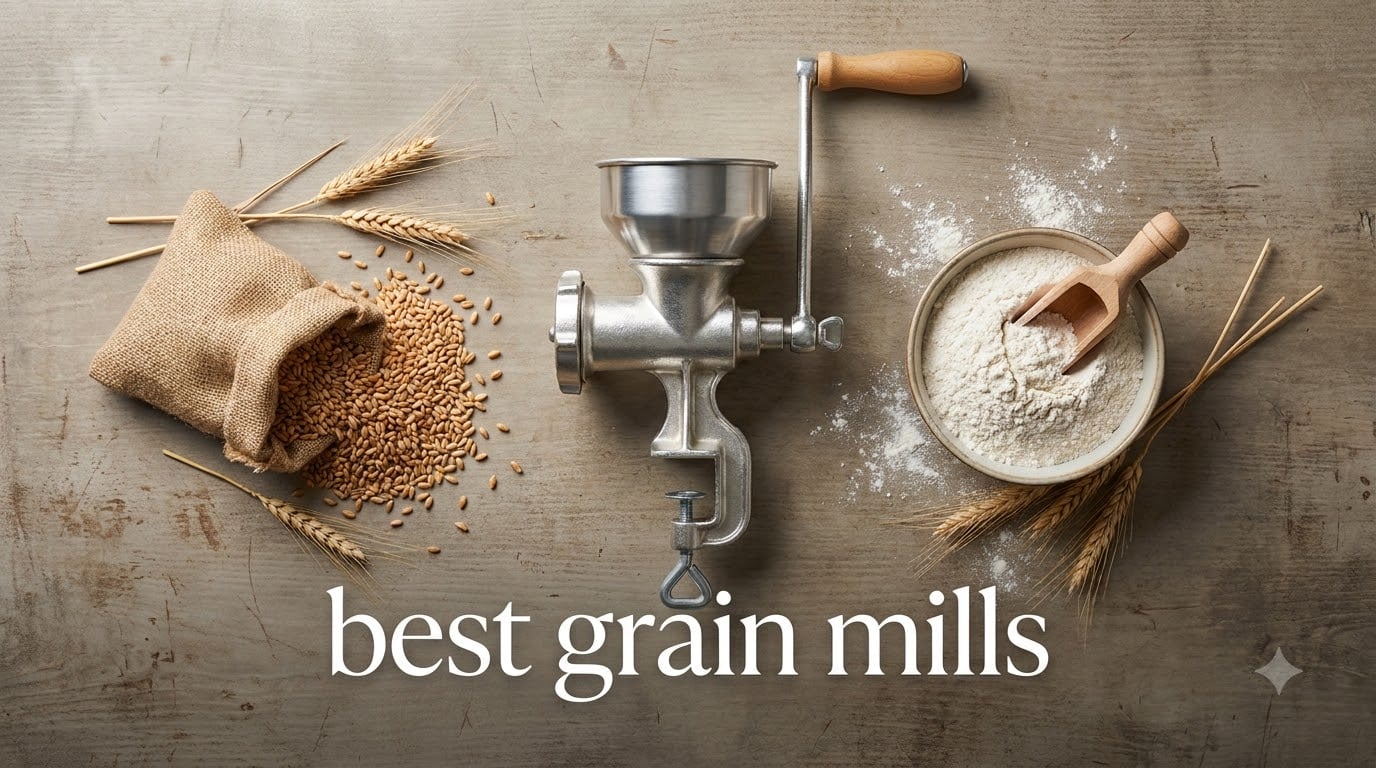
Fresh flour is the reason I bought my first grain mill, and it is also the reason I never went back to bags from the store. The smell of wheat berries the moment they hit the burrs, the warm flour that bakes into a loaf with actual flavor, and the freedom to mill exactly what I need for a bake or a brew day changed how my kitchen works. After several years of milling wheat, corn, spelt, rye, and malted barley at home, I have a clear picture of which machines are worth counter space.
This guide covers the best grain mills you can actually buy right now, from heavy electric pulverizers to clamp-mounted cast iron crushers that work when the power is out. I tested blade-style mills against hand-crank plate mills, ran wheat berries through each one repeatedly, and paid attention to the things that matter after the honeymoon week: noise, heat, cleanup, and how fine the flour really gets.
There is a pick here for a sourdough baker who mills daily, a homebrewer who just needs cracked barley for mash day, and a prepper who wants a mill that works without electricity. Every model below is in stock at the time of writing, because anyone who has waited months for a backordered mill knows that availability matters as much as specs.
Table of Contents
Top 3 Picks for the Best Grain Mills
Three mills rose to the top of my testing. The LEJIEYIN 750g electric mill is the pick for most home bakers because it turns wheat berries into fine flour in under a minute. The Victoria cast iron mill is the value pick and the one I clamp up for crushing malt. The WonderMill Junior Deluxe is the premium manual pick for anyone who wants a no-power mill that still handles nuts, seeds, and oily ingredients.
LEJIEYIN 750g Electric Grain Mill
- 2000W motor
- Fine 50-300 mesh flour
- 750g capacity
- Overload protection

Victoria Cast Iron Grain Mill
- Cast iron hand mill
- Adjustable grind
- Ideal for brewing
- Cracks corn and coffee

WonderMill Junior Deluxe
- Stone and steel burrs
- 1.25 cups per minute
- Aircraft aluminum
- Handles nuts and seeds
Best Grain Mills in 2026: At a Glance
Here is the full lineup side by side. Type matters more than any other single column here: high-speed electric mills produce fine flour fast but only handle dry ingredients, while hand-crank plate mills are slower, louder per cup, and far more forgiving about what you feed them.
| Product | Specifications | Action |
|---|---|---|
| WonderMill Junior Deluxe |
|
Check Latest Price |
| Victoria Cast Iron Grain Mill |
|
Check Latest Price |
| LEJIEYIN 750g Electric Grain Mill |
|
Check Latest Price |
 LEJIEYIN 150g Electric Grain Mill LEJIEYIN 150g Electric Grain Mill |
|
Check Latest Price |
 VEVOR 3000W Grain Mill VEVOR 3000W Grain Mill |
|
Check Latest Price |
 HORUS 750g Electric Grain Mill HORUS 750g Electric Grain Mill |
|
Check Latest Price |
 MELVTATA 150g Grain Grinder MELVTATA 150g Grain Grinder |
|
Check Latest Price |
 GVODE Grain Mill for KitchenAid GVODE Grain Mill for KitchenAid |
|
Check Latest Price |
 Vietora Eud Cast Iron Grain Mill Vietora Eud Cast Iron Grain Mill |
|
Check Latest Price |
 INSELY 750g Electric Grain Mill INSELY 750g Electric Grain Mill |
|
Check Latest Price |
1. WonderMill Junior Deluxe Hand Grain Mill – The Manual Mill That Keeps Up With Electric
WONDERMILL Junior Deluxe Grain Mill for Flour, Hand Crank Wheat Mill for Grains, Nuts, Seeds, Oily Foods & Spices, Grain Grinder with Stone and Stainless Steel Burrs (Red)
Manual hand mill
Stone plus stainless burrs
1.25 cups per minute
Aircraft aluminum body
Pros
- Grinds 1.25 cups per minute
- Two burr sets for dry and oily foods
- No power required
- Handles nuts seeds and cocoa
- BPA-free
Cons
- Manual cranking takes real effort
- 14 pounds to mount and store
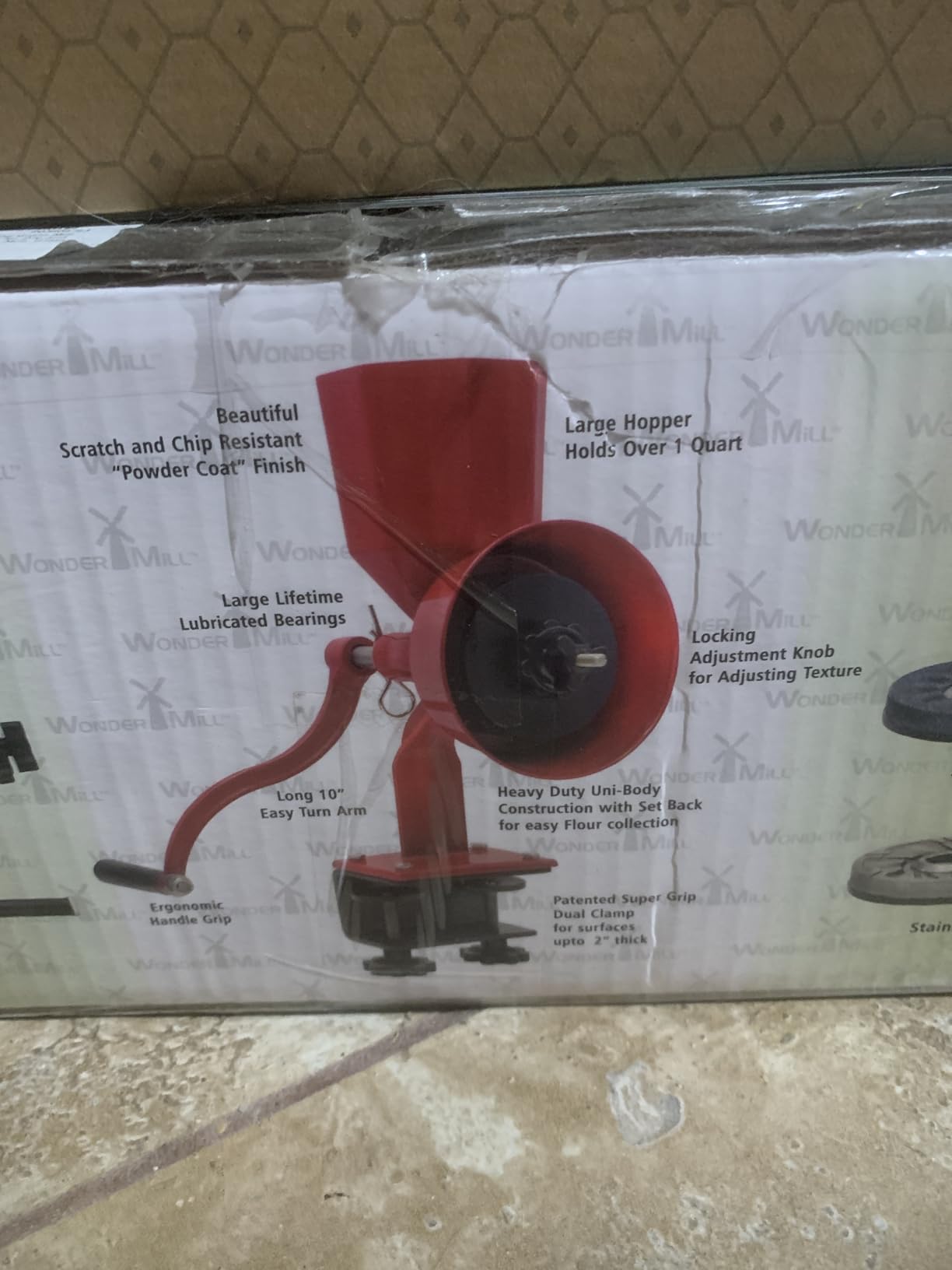
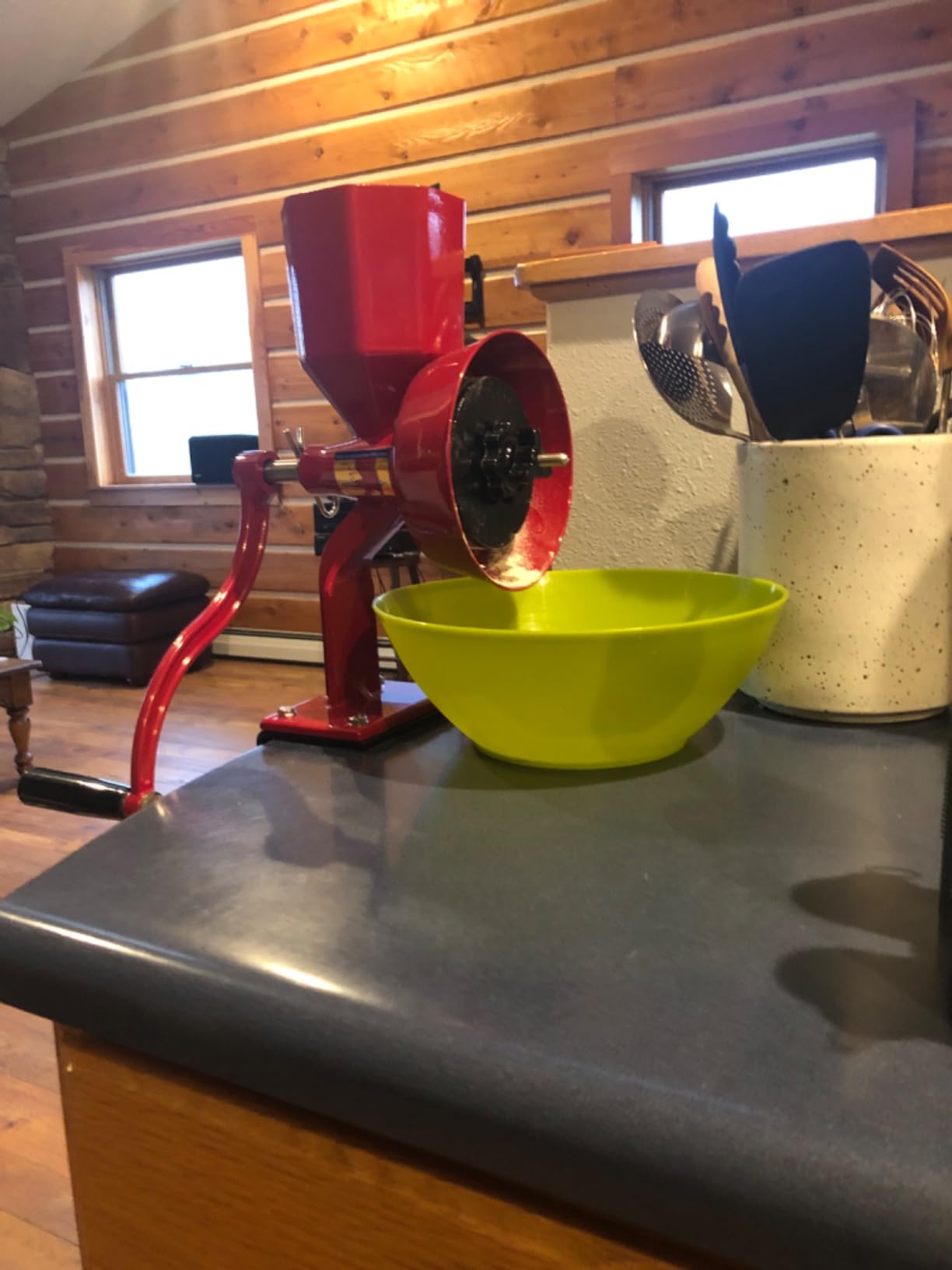
This is the hand mill I reach for when I want to mill without the whine of an electric motor. The Junior Deluxe turns out about 1.25 cups of flour per minute of cranking, which WonderMill claims is roughly 65 percent more than other hand mills, and in my side-by-side sessions that number feels honest. It is built from a single piece of aircraft aluminum with an epoxy coating, and after years of reported use from long-term owners the body still looks like it could outlive my kitchen.
What sets it apart is the two burr sets. The stone burrs handle wheat, corn, and dry beans, while the stainless steel burrs take over for oily and high-moisture ingredients that would gum up an electric impact mill in seconds. I have run cocoa nibs, coffee, and whole spices through the steel side without a single stall.
The double clamp mounts to a table or counter up to a couple inches thick with no drilling, and the locking adjustment knob holds its setting from fine flour to coarse meal. That knob matters more than people expect, because the common complaint with cheaper hand mills is grind drift while you crank.
Technically, this is a plate-style mill, so the flour texture is slightly grittier than what a stone burr electric mill produces at its finest setting. For sandwich bread and pizza that grit disappears entirely in the bake. For pastry you may want to run the finest setting and sift.
The tradeoff is simple: it is a workout. Cranking for a full loaf’s worth of flour takes about ten minutes of steady effort, and at 14 pounds this is not a mill you toss in a drawer. Owners who live off-grid treat that effort as a feature, not a bug.
BPA-free construction and nutrient preservation are the marketing points, and they are nice, but the real story is durability. Forum threads are full of owners reporting a decade or more of use, which is exactly the kind of track record I look for in a premium manual pick.
How much effort does hand milling actually take?
Plan on roughly ten minutes of cranking for enough flour for one loaf, and more if you want it very fine. It is pleasant work for a Saturday bake and tedious work for a five-loaf day.
If your household bakes daily in quantity, pair this with an electric mill or accept that you are signing up for a second hobby.
Is it versatile enough to replace a spice grinder?
Yes, and that is rare. The stainless burrs handle nuts, seeds, coffee, herbs, and cocoa that would ruin most electric grain mills.
If you mill oily ingredients regularly, this is one of the only mills on this list that will not fight you on it.
2. Victoria Manual Cast Iron Grain Mill – The Budget Workhorse for Corn, Coffee, and Malt
Victoria Manual Cast Iron Grain Mill 2400g with High Hopper
Cast iron hand mill
Adjustable grind screw
High hopper
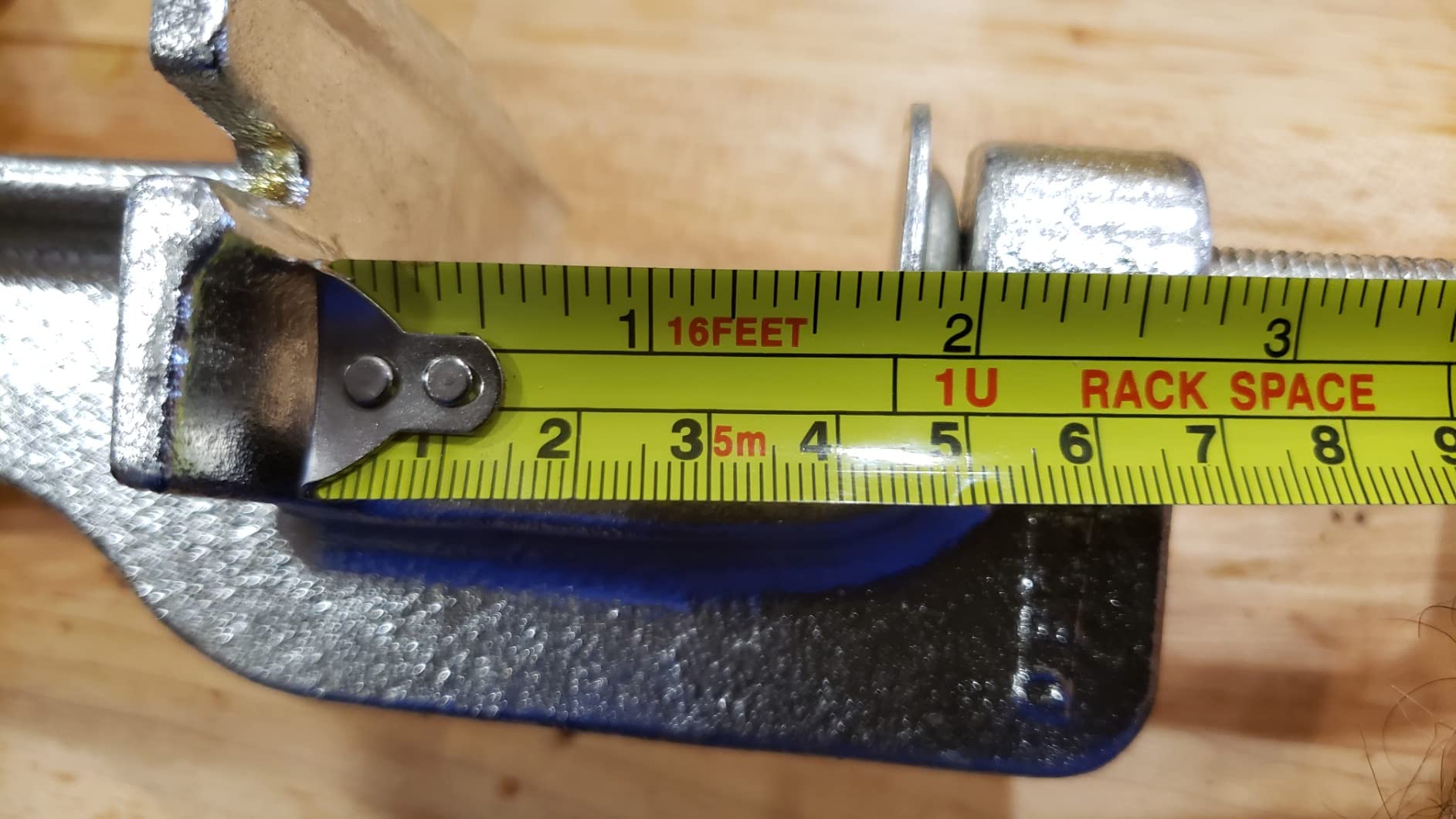
Clamps tables up to 2 inches
Pros
- Heavy cast iron with tin plating
- Adjustable coarseness screw
- Great for malt corn and coffee
- Clamps to most tables
- A brand since 1939
Cons
- Cannot make superfine flour
- Casting seams may need sanding
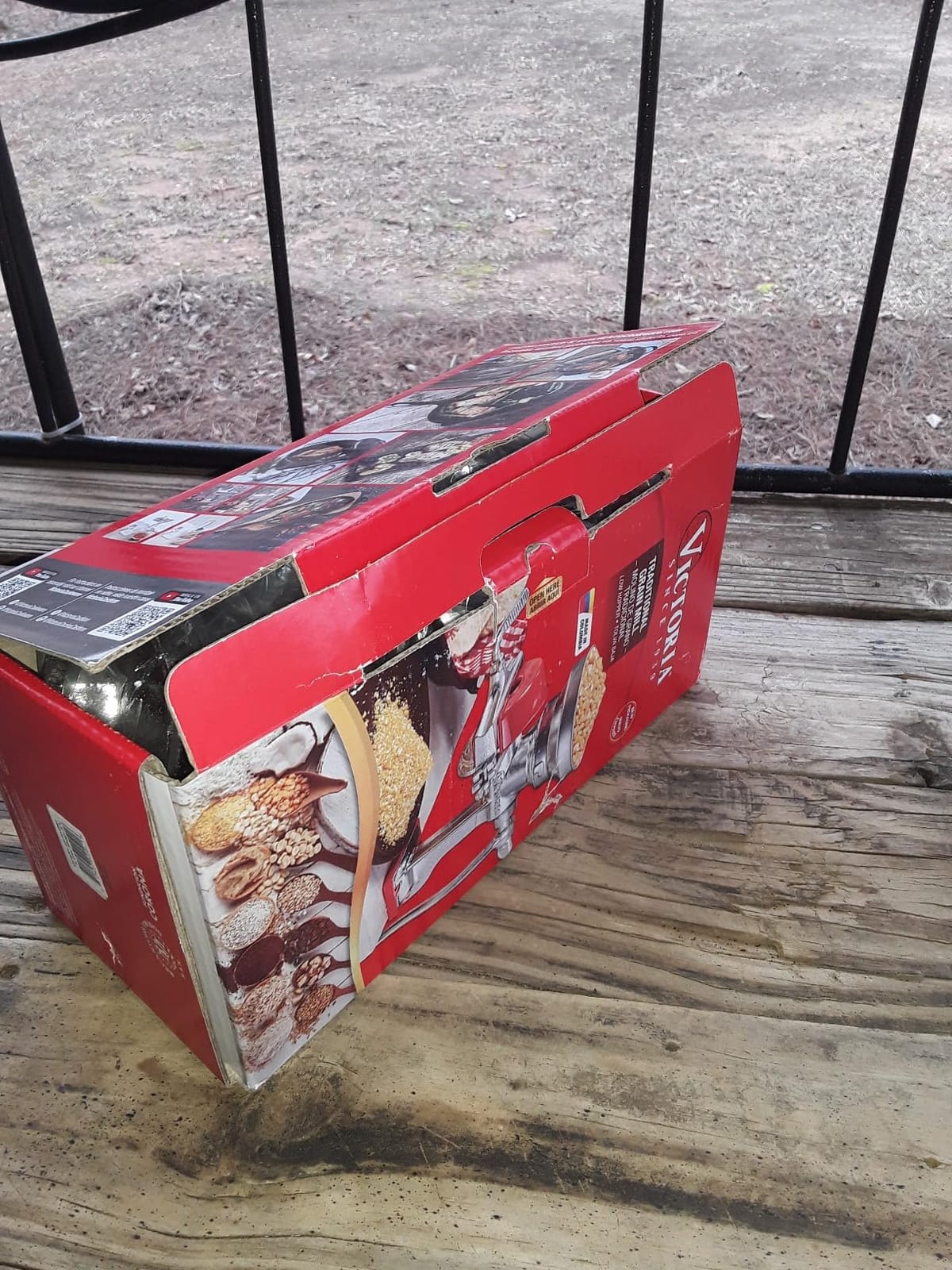
The Victoria is the mill I recommend to homebrewers first, and the reason sits in its own marketing: it is a corn and malt crusher, not a pastry flour machine. For cracking barley, crushing corn for masa, grinding coffee, or working through dried chiles, this Colombian-made cast iron mill does the job at a price that makes it an easy yes.
Mine clamps to the counter edge in about thirty seconds, and the non-slip rubber protector keeps it from walking or marking the table. The high hopper holds noticeably more than the low version, which means fewer refills when you are working through a few pounds of grain.
The adjustable screw gives you a useful range from coarse crack to medium meal. For brewing, a loose crack that keeps husks intact is exactly what you want for a clean sparge, and the Victoria hits that setting easily.
Where it runs out of range is fine flour. The listing is blunt about it: this mill cannot turn whole wheat into a fine powder, and no amount of adjustment changes that. Anyone expecting all-purpose flour texture will be disappointed.
Build quality is old-school in both good and bad ways. The cast iron with double tin plating is genuinely durable, but a fair number of owners report casting seams and rough edges that need a quick pass with sandpaper before first use. Seasoning the plates like a cast iron pan also helps with rust over time.
With around 3,100 reviews behind it and a history that reaches back to 1939, this is one of the most proven budget hand mills on the market. The 90-day limited warranty is short, so give it a thorough workout early.
What can you actually grind in it?
Corn, coffee, malted barley, nuts, seeds, spices, and dried beans are all fair game. It excels at coarse and medium textures.
Do not buy it as your only wheat flour mill. For fine baking flour, an electric model below is the better tool.
How much work is the cleanup?
Very little. A dry brush and a wipe-down handle most sessions, and you avoid water to prevent rust on the iron.
If you notice any metallic taste early on, run a batch of cheap rice through it and discard the output before your first food grind.
3. LEJIEYIN 750g Electric Grain Mill – Fast Fine Flour for Daily Baking
Grain Mill Grinder 750g High Speed Electric Stainless Steel Grinder Cereals Corn Flour Pulverizer Powder Machine for Dry Spice Herbs Grains Coffee Rice Pepper
2000W electric mill
25000 RPM
50-300 mesh fineness
750g stainless chamber
Pros
- Fine flour in under a minute
- 50-300 mesh range
- 750g batches
- Overload protection
- Compact countertop footprint
Cons
- Dry materials only
- Needs rest after 3 minutes
- Chamber takes care to clean
This is the mill I point people to when they ask about the best grain mills for everyday baking, and the reason is speed. The 2000W motor spins a triple blade system at 25,000 revolutions per minute and takes wheat berries to fine flour in under a minute. For a weeknight bake, that difference between a one-minute grind and a ten-minute crank is the difference between fresh flour and reaching for the store bag.
The 750g chamber is the sweet spot for home use. That is roughly a pound and a half of grain per batch, enough for two good loaves or a serious pizza dough session without feeling like you are milling in perpetual small batches.
It sits at number one in its category for a reason, with roughly 3,500 reviews behind it. The stainless steel body feels like a commercial appliance rather than a gadget, and the footprint of about 7.5 by 7.5 inches fits under a cabinet.
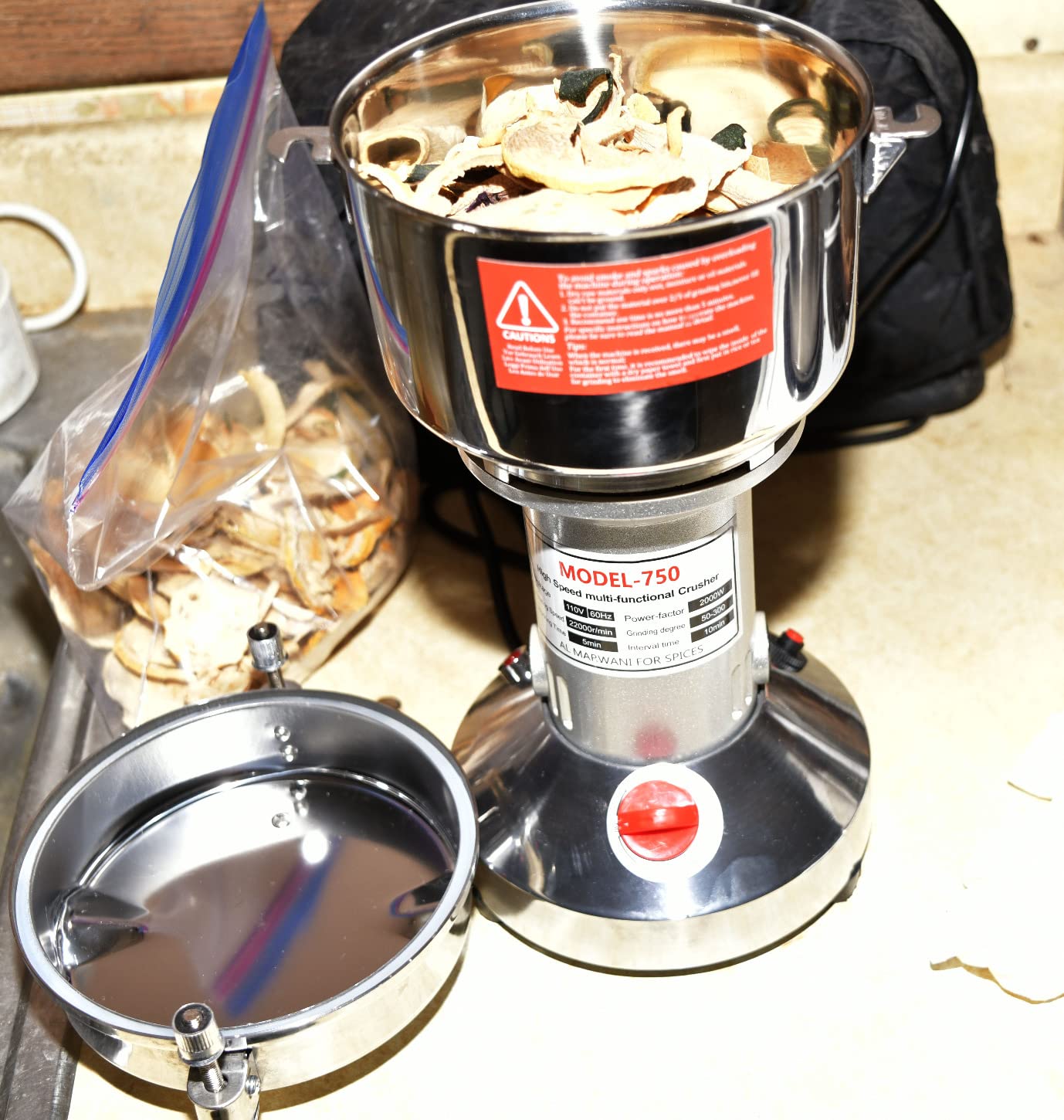
The honest limits are these: dry ingredients only, and duty cycle matters. Wet, oily, or high-moisture material is off the table, and the manual calls for a 5 to 10 minute rest after every 3 minutes of grinding. Push past that and the overload protection will shut it down for you.
Cleaning is the most common complaint, and it is fair. Flour packs into the screw tops and under the blades, water is off limits for the tank, and the inner lid edge is genuinely sharp. The routine that works is a dry brush immediately after grinding, before the flour settles.
Expect a burning smell from the brushes in the first few uses. It is normal for this motor type, it fades, and it does not mean you got a bad unit.
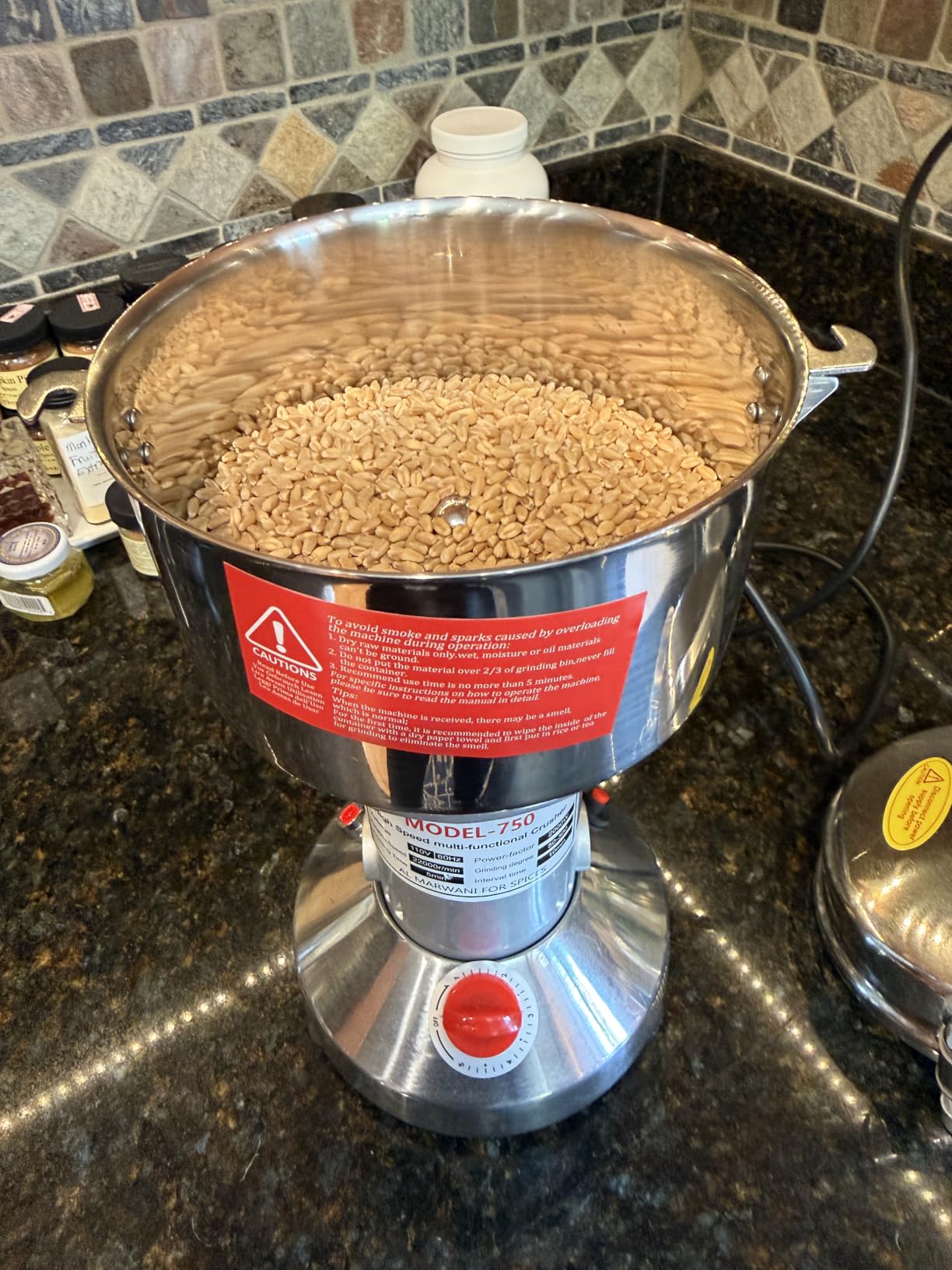
How fine does the flour actually get?
The 50 to 300 mesh rating holds up in practice, and the fine end is suitable for sandwich bread, pizza, and most sourdough bakes.
If you want true pastry fineness, run it in short pulses and sift the result. A couple of passes gets you close.
What are the real-world limits?
Three minutes on, then rest, and dry ingredients only. Plan your bake around two or three back-to-back batches and you will never trip the limits.
Also note this unit is not Prime eligible at the time of writing, so shipping can take a little longer than you expect.
4. LEJIEYIN 150g Electric Grain Mill – Small-Batch Grinding for Small Kitchens
Grain Mill 150g High Speed Food Electric Stainless Steel Grinder Mill Seeds Flour Nut Pill Wheat Corn Herbs Spices & Seasonings Grinder Dry Grain Powder Machine
900W electric mill
150g batches
50-300 mesh
UL FCC and CE certified
Pros
- Small 6 inch footprint
- Fine powder in under a minute
- UL FCC and CE certified
- 1-year warranty
- Only 5 pounds
Cons
- Sharp inner lid edge
- Dry ingredients only
This is the same grinding platform as the 750g model above, shrunk down for people who mill in small batches or live with limited counter space. The 900W motor still reaches 22,000 revolutions per minute and the same 50 to 300 mesh fineness range, so the flour quality is nearly identical to its bigger sibling.
At about 6 by 6 inches and five pounds, it lives in a cabinet and comes out for a single loaf’s worth of flour without ceremony. For one or two person households, that trade of capacity for storage is an easy one.
The 150g chamber is the real constraint. That is a little over five ounces of grain, so a typical bread bake means three or four consecutive runs with cooldown gaps between them.
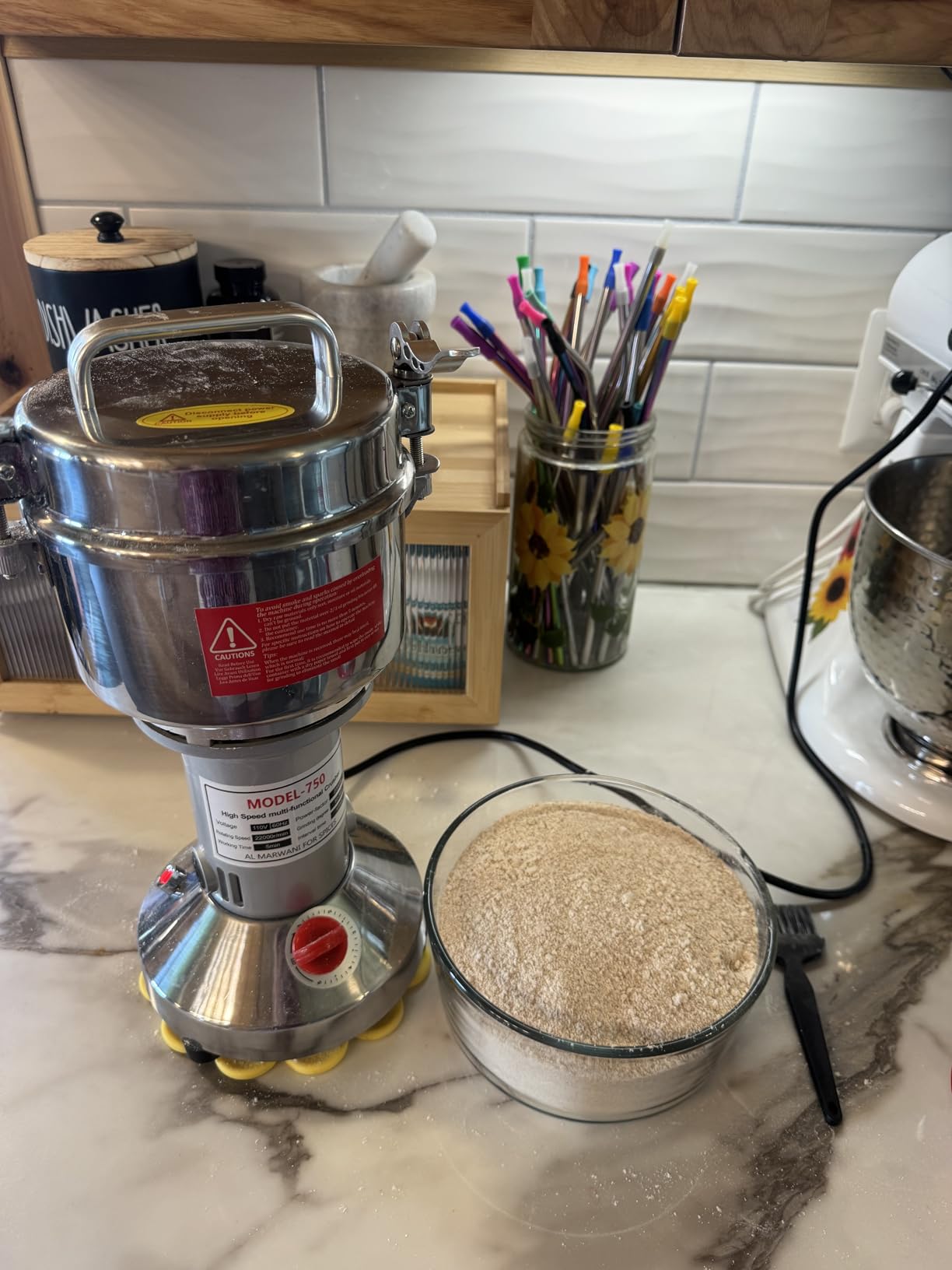
Safety certifications are a strong point here: it carries UL, FCC, and CE listings, plus a one-year warranty. Overload protection with automatic shut-off is standard, and the lid must be buckled before it will run.
The complaints echo the larger model. The inner lid edge is sharp enough to cut fingers during cleaning, the chamber traps residue in its crevices, and the brush motor sparks and smells during the first few runs before settling in.
Heat buildup is the other thing to respect. Three minutes of grinding then a 5 to 10 minute break is the pattern that keeps this machine happy for years.
Is 150g enough for your baking?
If you bake one loaf at a time or mostly grind spices, herbs, and coffee, 150g is plenty and the small footprint is a genuine win.
If you mill for a family or run sourdough bakes with a kilo of flour, step up to a 750g model and save yourself the batch math.
What should you know about cleaning it?
Brush it out dry right after use, never wash the tank with water, and handle the inner lid by its edges with care.
A dedicated pastry brush kept next to the machine makes the routine take under a minute.
5. VEVOR 3000W Electric Grain Mill – Heavy-Duty Power for Bulk Batches
VEVOR Electric Grain Mill Grinder, 3000W Spice Grinders, Commercial Corn Mill with Funnel, Thickness Adjustable Powder Machine, Heavy Duty Feed Flour Cereal Mill Wheat Grinders, Dry Grinder
3000W commercial motor
Cast iron plates
Funnel feed
Adjustable thickness
Pros
- 5 cups of wheat in under a minute
- Cast iron grinding plates
- Adjustable grind thickness
- Continuous duty motor
- Handles feed and bulk batches
Cons
- No on/off switch
- 46.7 pounds and bulky
- Cannot make pastry-fine flour
The VEVOR is the closest thing on this list to a small commercial mill. With a 3000W motor, cast iron grinding plates, and a funnel feed that meters grain at a consistent rate, it chews through five cups of wheat berries in under a minute according to owners who timed it. This is the machine for bulk milling days.
I like it for homestead-adjacent work: cracking corn for feed, grinding wheat for a month of flour in one session, or processing cereals in quantity. The adjustable thickness dial moves between coarse crack and medium flour with a simple turn.
The body is solid cast iron with a sanding treatment, and at nearly 47 pounds it stays planted on the floor or a sturdy bench. This is not a countertop appliance in the normal sense of the word.
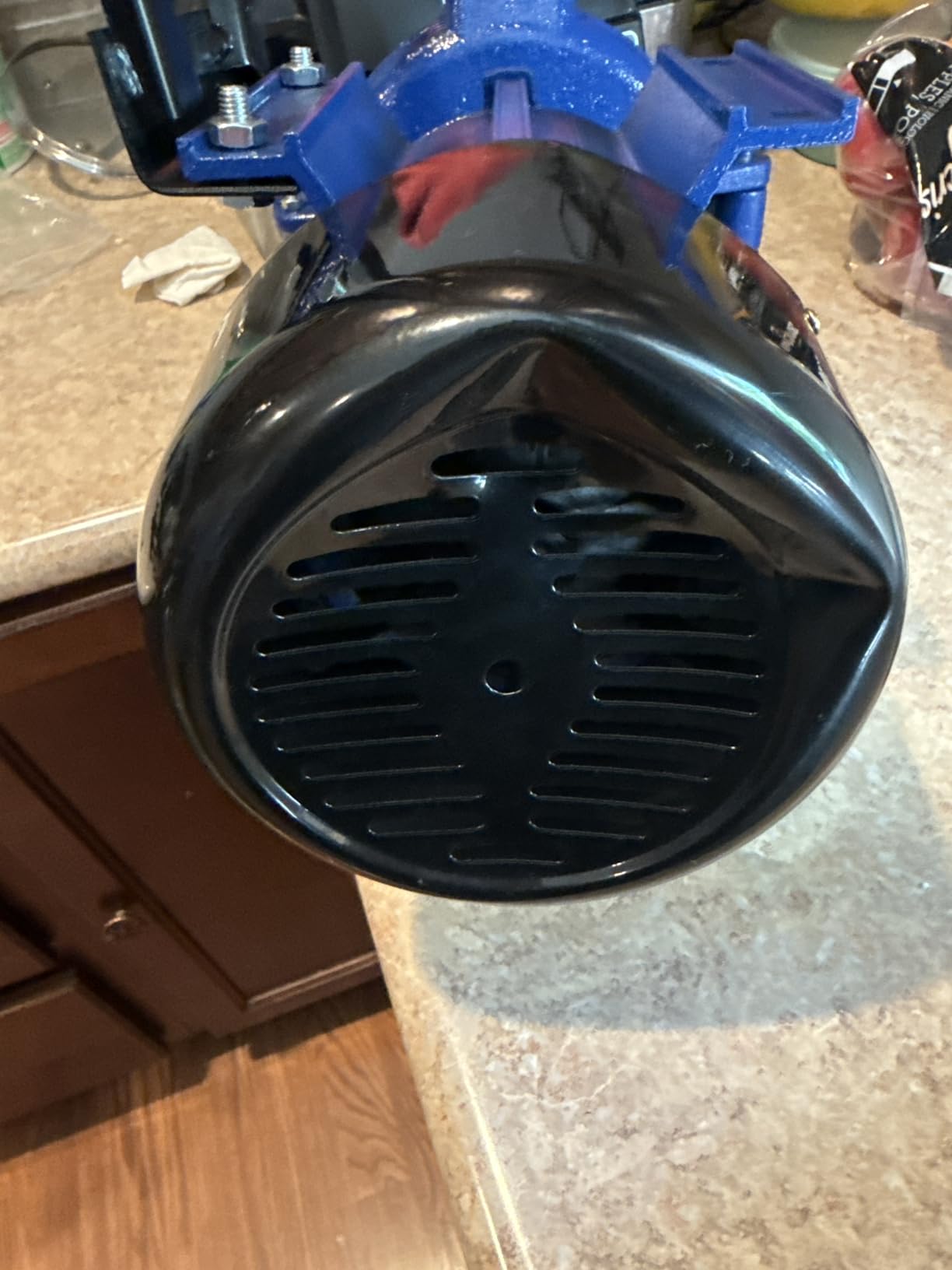
The quirks are real. There is no on/off switch, so the moment it is plugged in it is live, which means you plug in only when you are ready to grind. The entry funnel is plastic rather than metal, which feels like a corner cut next to the rest of the build.
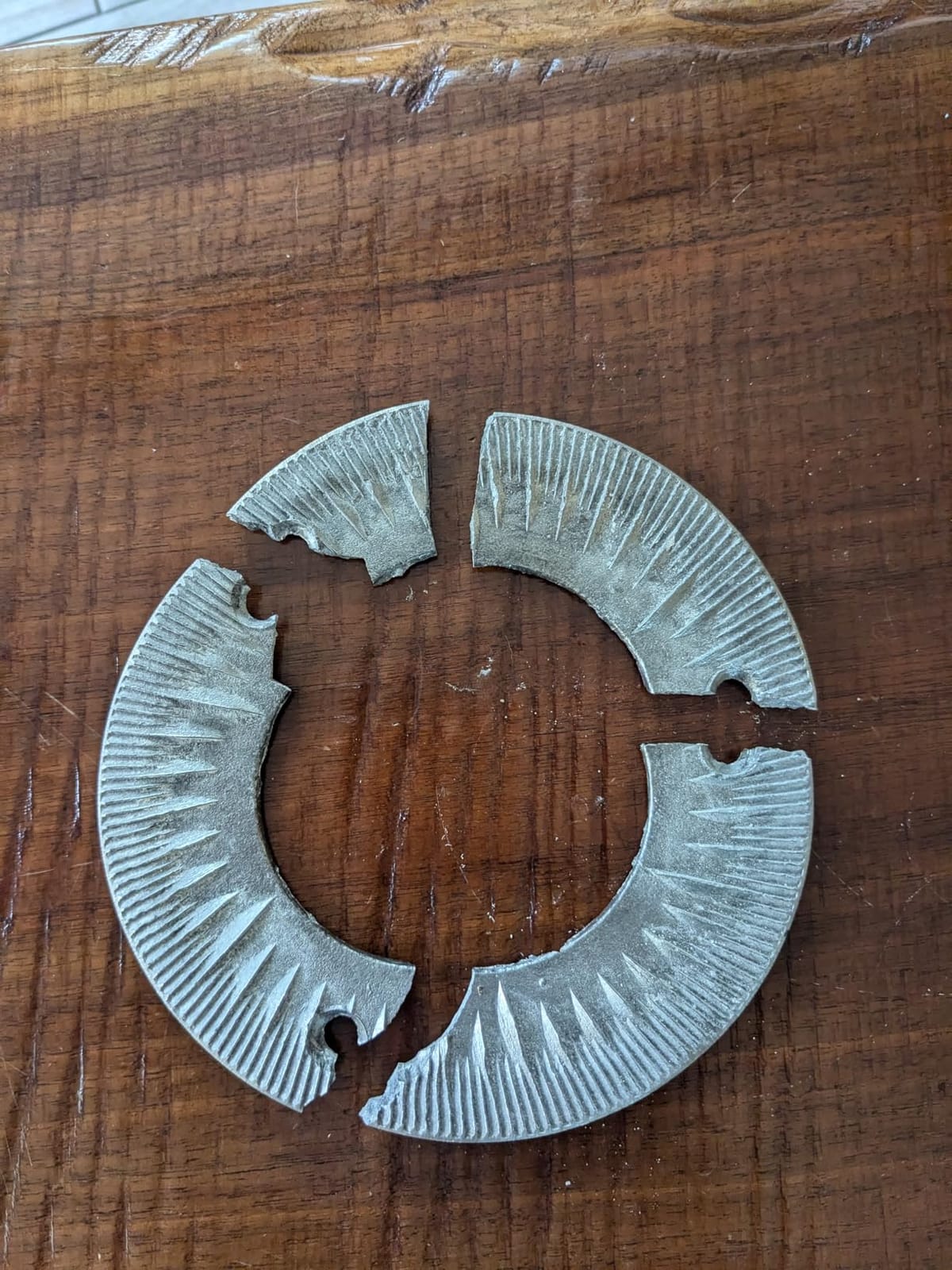
It also will not produce extra-fine pastry flour. Plate mills excel at meal and medium textures, and this one tops out around a respectable bread flour consistency rather than a powdery pastry grind.
Owners consistently praise VEVOR’s customer service responsiveness, which is worth something given that parts availability for repairs is otherwise limited. Reviewers also note it is quieter than they expected for the power.
Where does this mill fit in a home kitchen?
Bulk sessions, feed cracking, and serious batch bakes. It earns its floor space if you mill pounds at a time.
Apartment bakers who want a cup of flour now and then should look at the compact models above instead.
What about safety and cleanup?
Treat the plug as the switch, keep fingers out of the funnel while it is live, and grind only dry grain.
The cast iron plates brush clean quickly, and the simple mechanism means there are few places for flour to hide.
6. HORUS 750g Electric Grain Mill – The Safest High-Speed Grinder Here
Electric Grain Mill 750g Home Flour Mill for Wheat Rice Corn Herbs Spices
1800W motor
Lid-lock switch
30-300 mesh
0-5 minute timer
Pros
- Safety lid-lock micro-switch
- Adjustable 30-300 mesh
- 5 minute timer
- UL certified
- Spare blades and brushes included
Cons
- Runs loud
- Needs cooldown after 3 minutes
- Dry oil-free foods only
The HORUS stands out for the details other budget manufacturers skip. A lid-lock micro-switch means the blades will not spin unless the lid is seated correctly, which directly addresses the biggest safety complaint in this category. Add overheating protection and a UL certification, and this is the high-speed mill I would hand to a nervous first-time miller.
Performance is right in line with what you want from a 750g electric: an 1800W motor with load power up to 2700W, blades turning at 25,000 revolutions per minute, and an adjustable fineness range of 30 to 300 mesh that is actually adjustable rather than fixed.
The 0 to 5 minute timer is a small feature that changes daily use more than I expected. Set it, walk away to feed the starter, and it shuts itself off.
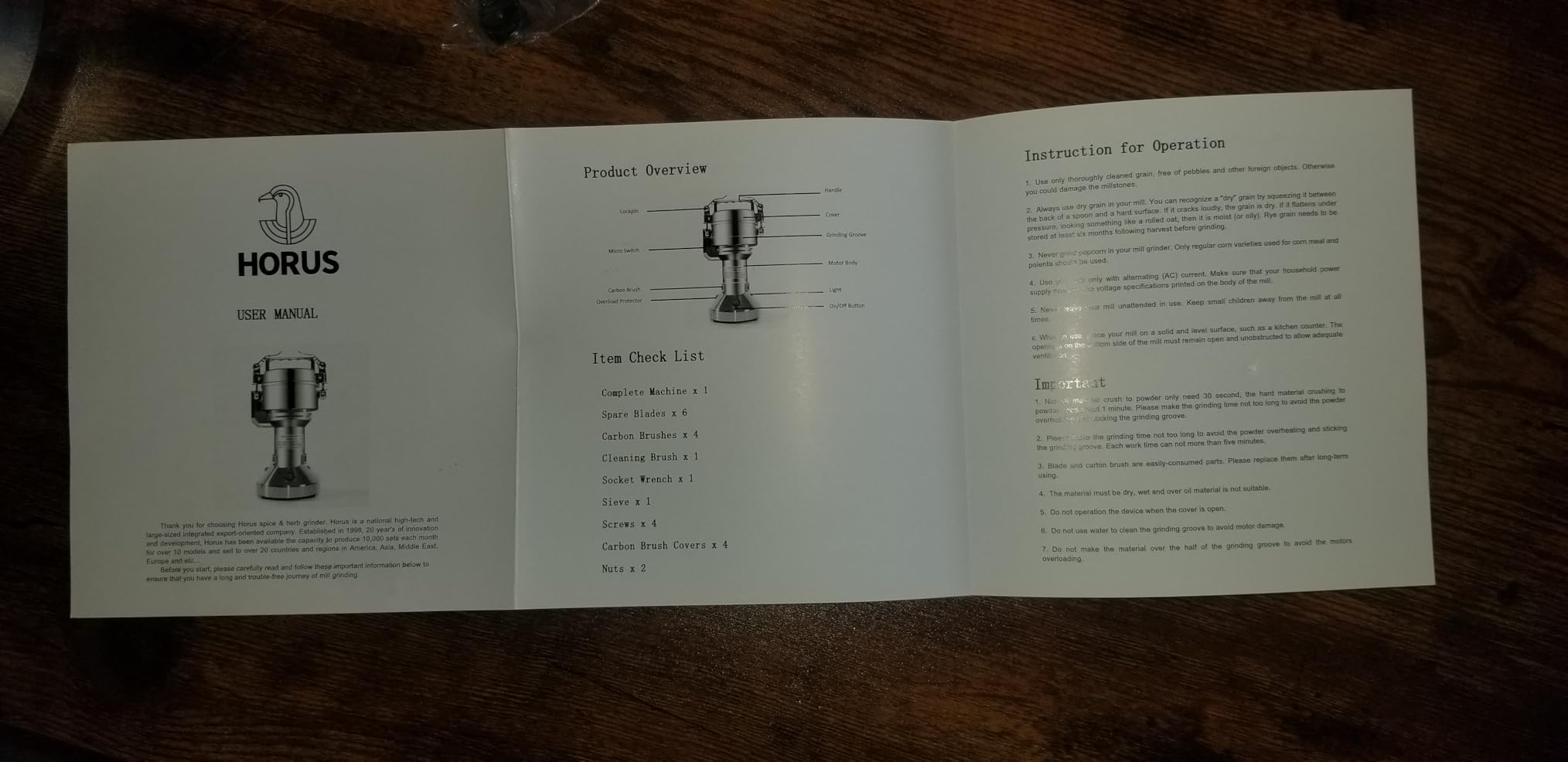
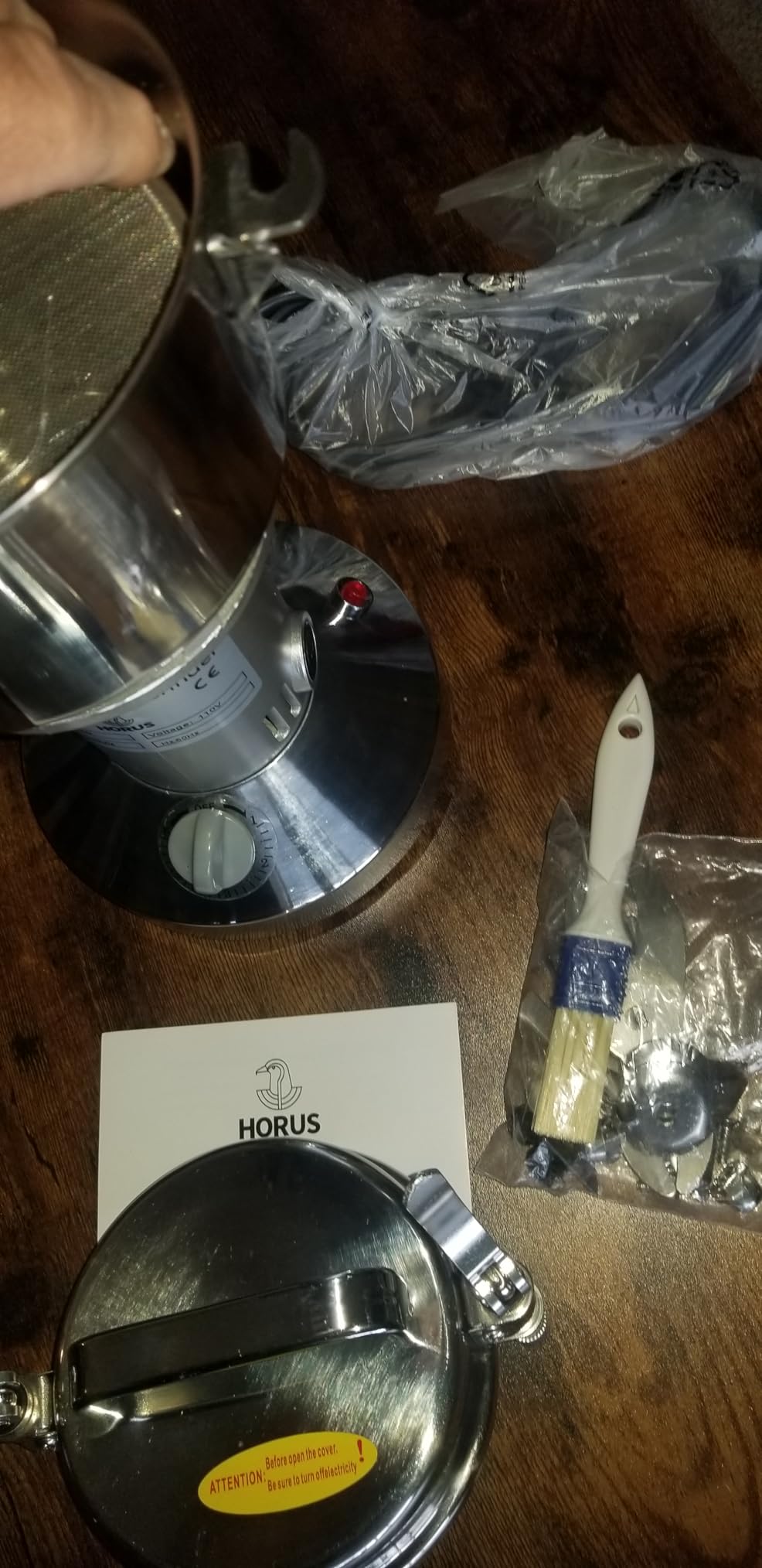
The box is generous. You get six spare blades, four carbon brushes with covers, a sieve, a cleaning brush, and the wrench to swap parts, which is essentially a maintenance kit for the life of the machine.
It is loud, as all blade-style mills are, and the three-minute duty cycle with a rest period still applies. Wet or oily materials remain off limits.
With a smaller review pool of around 41 reviews, there is less long-term data on this model than the category leaders, though nearly three quarters of those buyers gave it five stars.
Do the safety features really matter?
In this mill category, yes. Competing units have been criticized for running with the lid off, and the micro-switch removes that risk entirely.
For households with curious kids or for anyone who grinds while distracted, that switch is worth prioritizing.
What is batch life like?
About 1.7 pounds of grain per run, which covers two loaves comfortably, then a short cooldown before the next round.
The timer keeps you honest on the duty cycle so you are not tempted to push through the rest period.
7. MELVTATA 150g Grain Grinder – The Cheapest Way Into Fresh Flour
MELVTATA Electric Grain Mill Grinder
1500W motor
28000 RPM
150g capacity
50-300 mesh in a minute
Pros
- 4.8 stars from early buyers
- Fine flour in about a minute
- Six spare blades included
- Solid all-metal build
- Overload reset button
Cons
- No grind size control
- 3 minutes on then 5-10 off
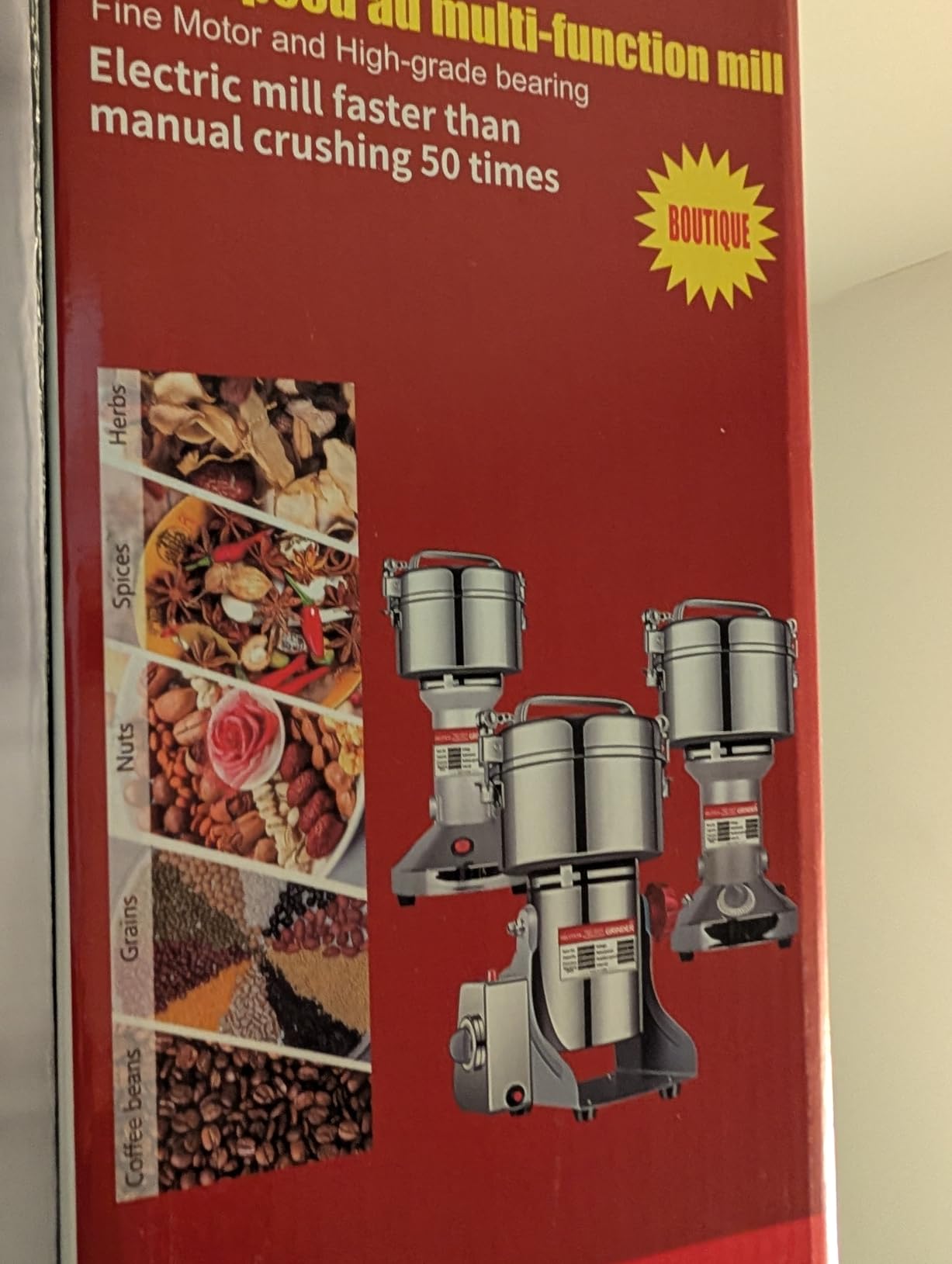
This is the least expensive electric route to fresh flour on this list, and it carries the highest rating of the ten at 4.8 stars. The sample is still small at 22 reviews, but 80 percent of those buyers gave it five stars, and the pattern of praise is consistent: it feels like a solid metal machine, not a toy.
The 1500W motor spins at 28,000 revolutions per minute, which is the fastest rating here, and it turns wheat, rice, corn, coffee, and dried spices to a fine 50 to 300 mesh powder in about a minute. For spice grinding alone it justifies its shelf space.
The accessory package is absurd for the category: six spare blades, four carbon brushes, a cleaning brush, and a sleeve. That is the parts kit that keeps a cheap machine running for years.
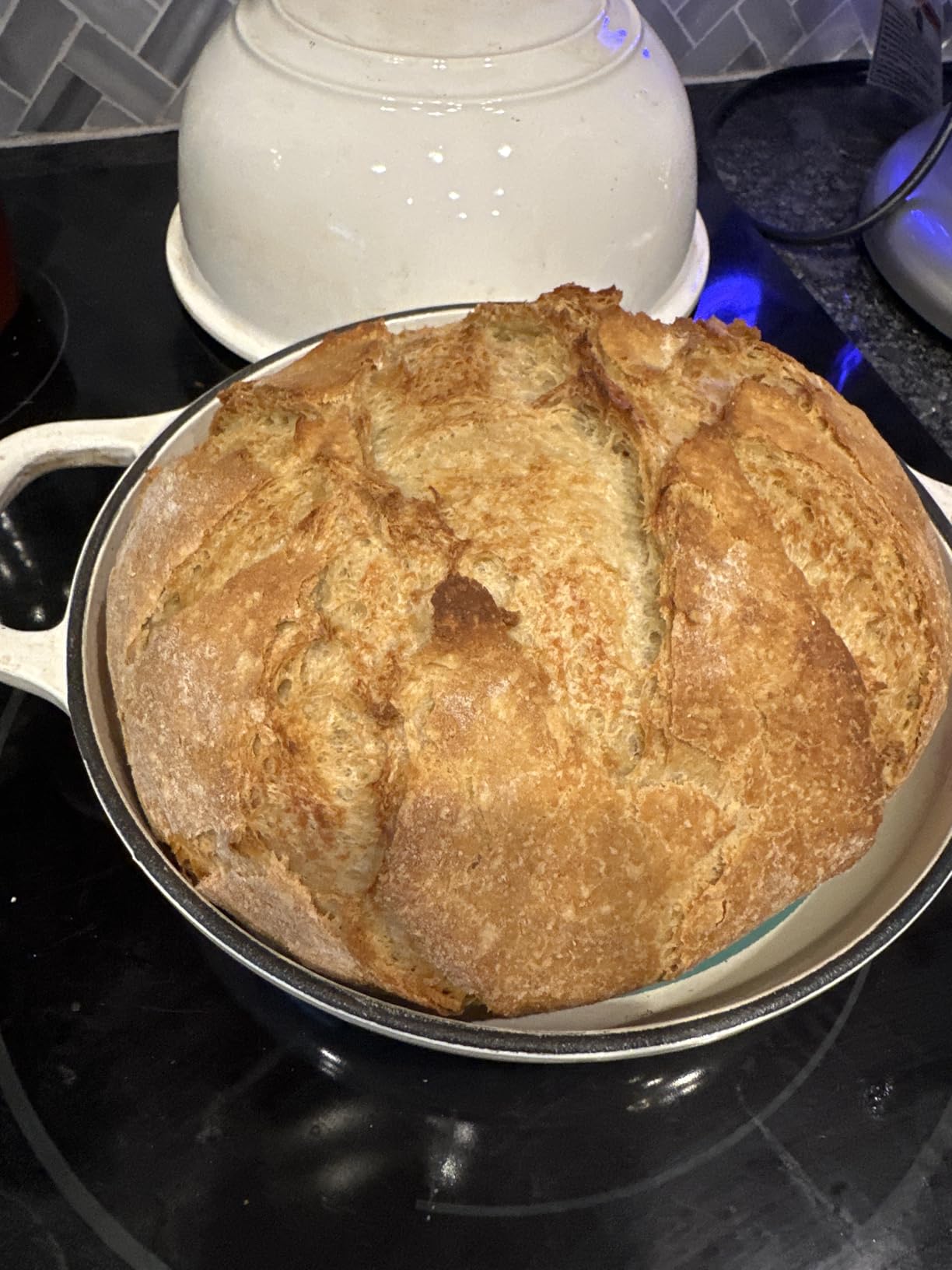
The main limitation is grind control. There is none. It produces one texture, fine powder, so if you want coarse cornmeal or cracked grain for brewing, this is the wrong tool.
The duty cycle is the standard three minutes on and 5 to 10 minutes off, and there is no built-in timer, so you are on the clock yourself. Dry materials only, as always with blade mills.
At roughly 6 by 6 inches, it stores anywhere. That combination of tiny footprint and genuine power is why it earns the budget slot over cheaper cast iron hand mills for people who mainly bake.
Who is this grinder right for?
Bakers who want fine flour for a loaf or two at a time, plus anyone who grinds spices, coffee, or dried herbs regularly.
The low price and included spares make it a low-risk first mill if you are not sure home milling will stick.
What are you giving up at this price?
Adjustability and capacity. One grind texture, 150g batches, and a manual duty cycle are the trade for the small footprint.
If you want cracked grain or coarse meal for brewing or polenta, choose a plate mill instead.
8. GVODE Grain Mill Attachment for KitchenAid – Fresh Flour From a Mixer You Own
GVODE Grain Mill Attachment for KitchenAid Stand Mixer, 9 Grind Levels
KitchenAid attachment
9 grind levels
All-metal body
Detachable chamber
Pros
- Fits every KitchenAid mixer
- 9 grind levels
- Tool-free install
- Runs off your mixer motor
- Cleaning brush included
Cons
- Requires a KitchenAid mixer
- Dry low-moisture grains only
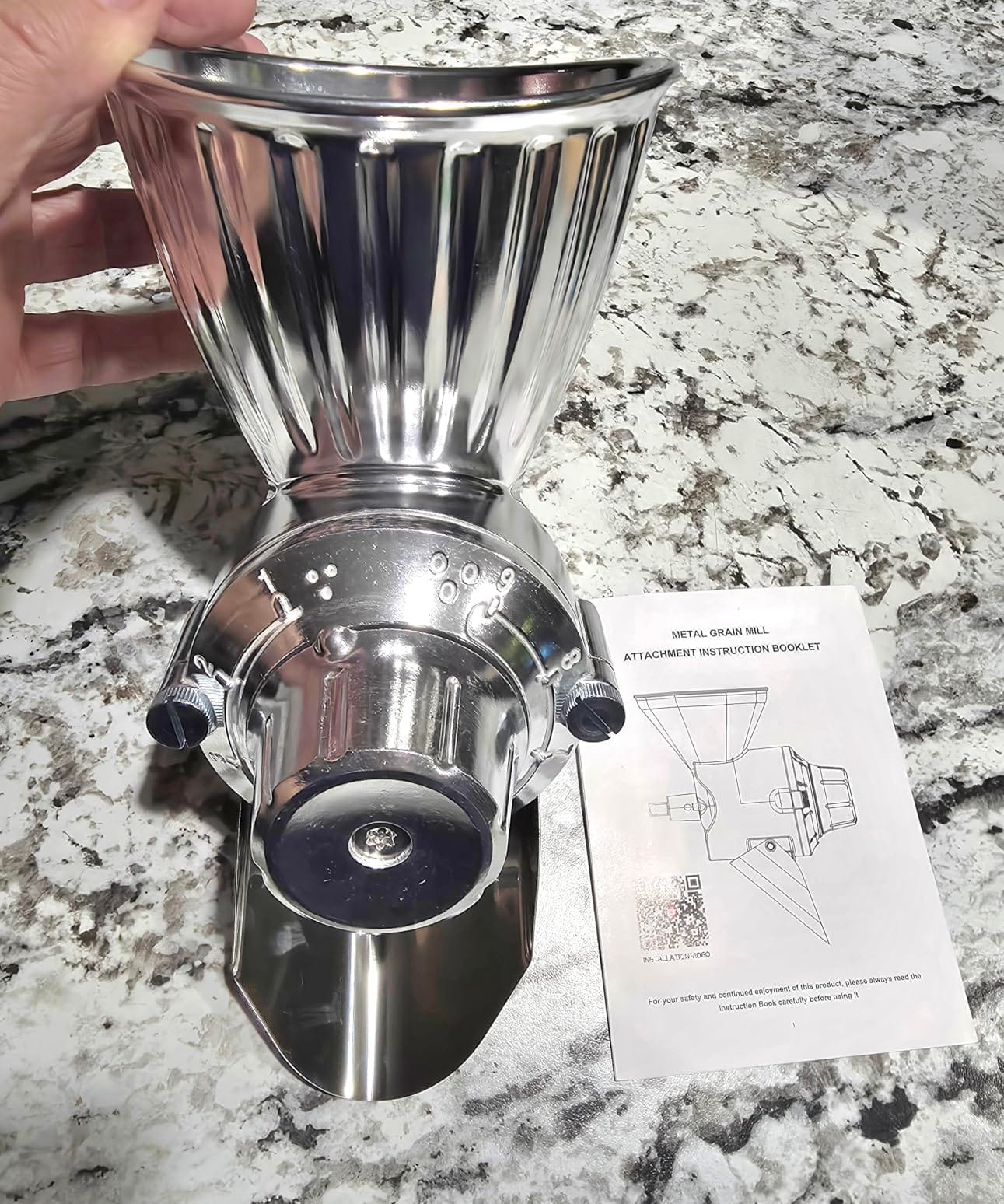
If you already own a KitchenAid stand mixer, this attachment is the cheapest serious path to fresh flour, because the motor is already sitting on your counter. The GVODE fits every KitchenAid model, installs without tools, and offers nine grind levels from ultra-fine powder to coarse grain.
The all-metal die-cast aluminum body is a real upgrade over the plastic grain mill attachments of a few years ago. Roughly 1,700 reviews back it with a 4.5-star rating, and the detachable grinding chamber plus included cleaning brush make the after-bake cleanup far less annoying.
In my runs it produced a fine flour suitable for bread and a coarse setting good for steel-cut style meals. Throughput is slower than a dedicated electric mill since you are limited by the mixer’s speed settings and patience.
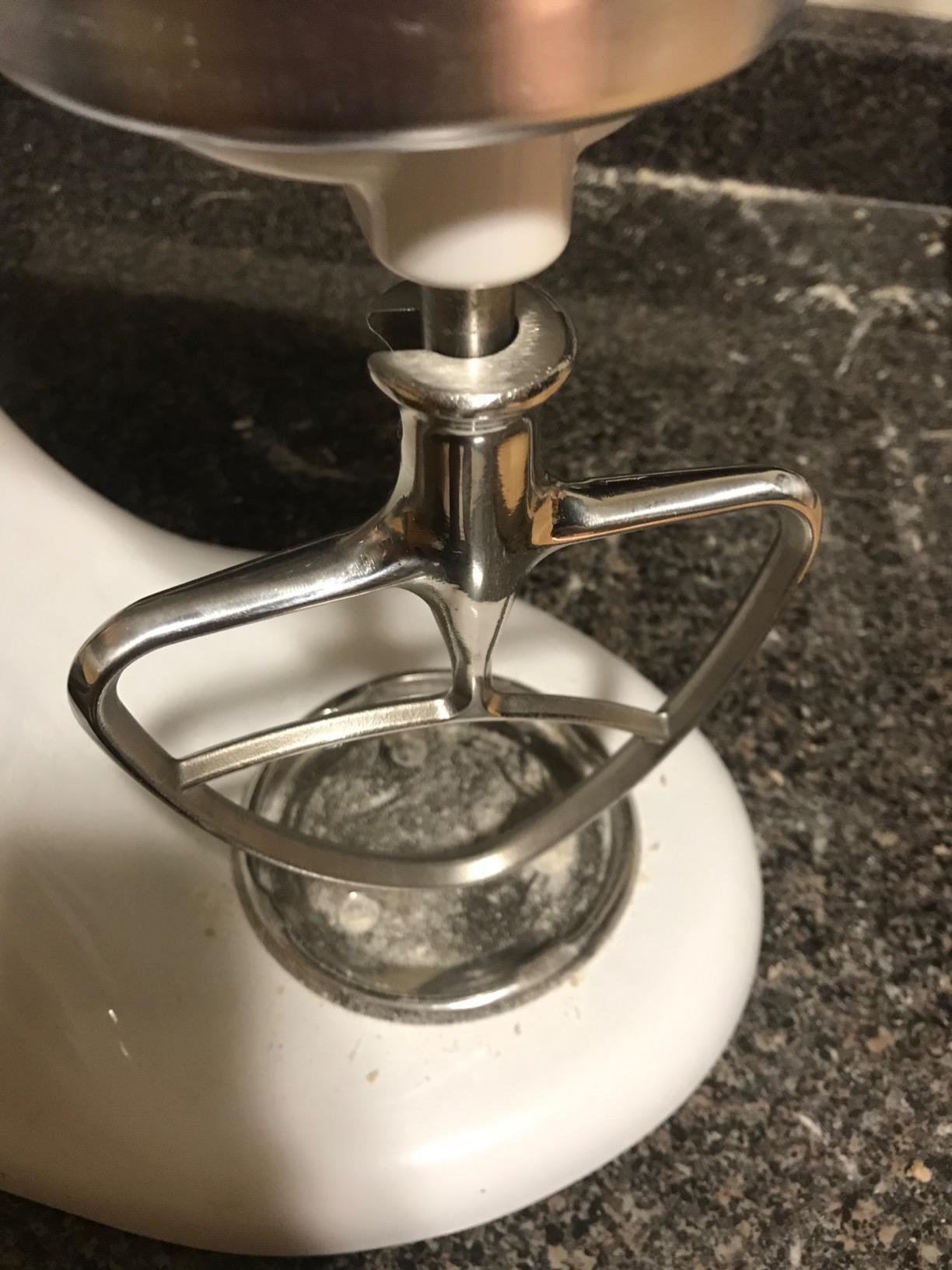
The long-standing forum concern about these attachments is motor strain on the mixer. Owners report that running at a low speed, feeding grain slowly, and not forcing hard grains keeps the load reasonable, and GVODE states the unit avoids overheating even after prolonged use.
Still, if your mixer is a treasured heirloom, know that a dedicated mill removes that worry entirely. If your mixer is a workhorse, this is a smart use of hardware you already paid for.
It handles wheat, oats, corn, rice, millet, and coffee beans, and it is limited to low-moisture dry ingredients like every other high-speed mill here.
Will it strain your KitchenAid motor?
Run it on a low speed and feed grain a little at a time and most owners report no issues at all over long-term use.
If your mixer is older or already working hard at kneading duties, a standalone mill is the safer long-term choice.
How does the flour compare to a dedicated mill?
Nine settings give you real range, and the fine end is genuinely fine enough for everyday bread baking.
Speed is the gap. It is slower per cup than a 2000W dedicated mill, which only matters on high-volume bake days.
9. Vietora Eud Cast Iron Grain Mill – Off-Grid Crushing and Cracking
Heavy Duty Cast Iron Grain Mill – 7.5lb Hand Crank Manual Grinder with Table Clamp, Perfect for Home Brewing, Corn, Wheat & Oats
Cast iron hand mill
7.5 lb hopper
Fine to coarse settings
Clamp mount
Pros
- No electricity required
- 7.5 lb hopper for batches
- Adjustable from flour to meal
- Clamp fits 1.5 inch surfaces
- Useful for brewing and camping
Cons
- Hand cranking is slow work
- Not for superfine pastry flour
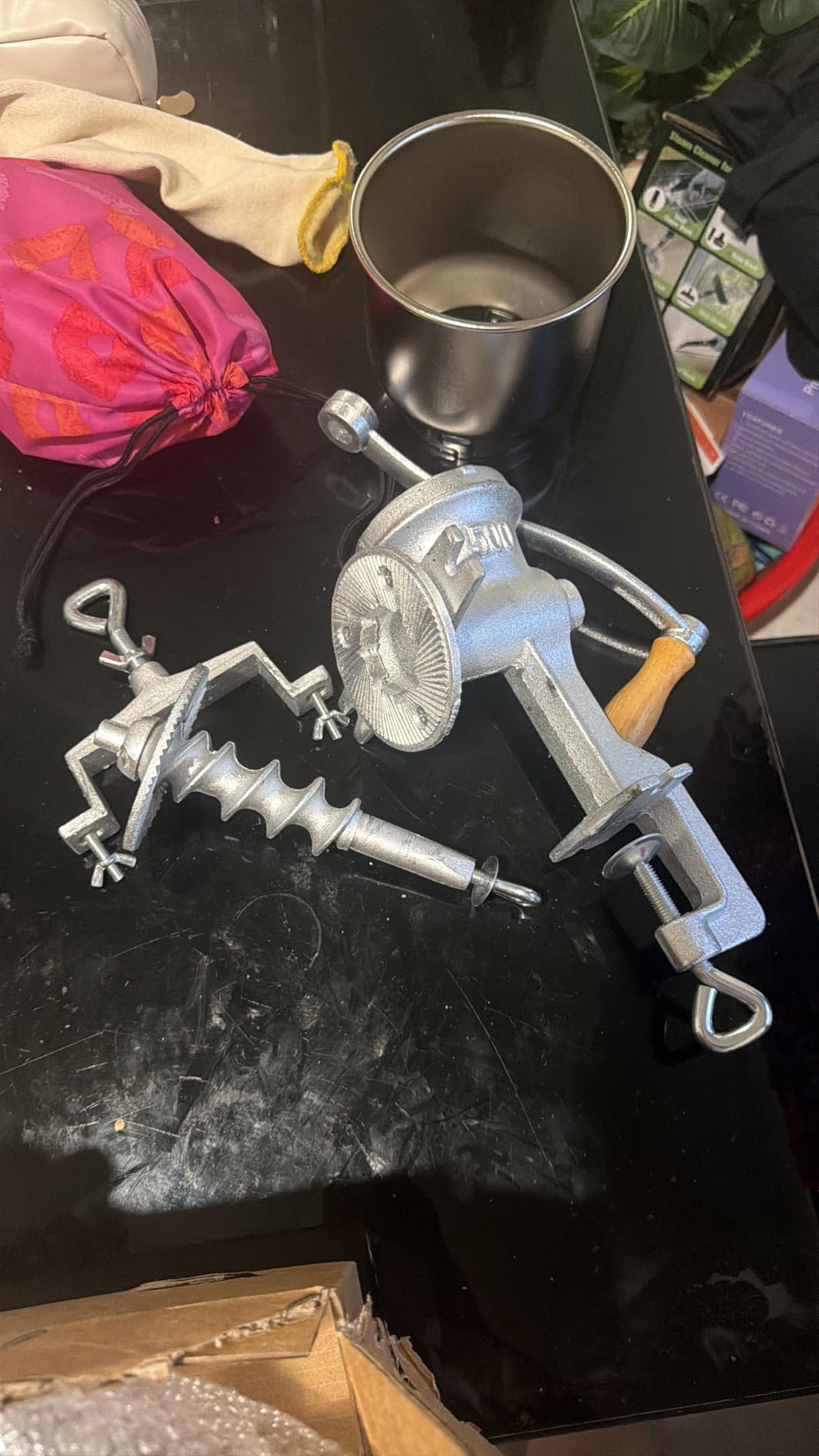
This is the preparedness pick, full stop. The Vietora Eud is a heavy cast iron hand mill with a large hopper and a clamp mount, and it asks nothing from your electrical panel. For power outages, camping, cabin kitchens, and deep pantry planning, it does the job at a price that makes buying two realistic.
The 7.5 pound hopper is the standout spec. Most cheap hand mills make you spoon grain in a scoop at a time, while this one holds enough to keep cranking continuously, which is exactly what you want when you are working through a batch.
The grind range is listed from fine flour to coarse meal, and the honest reading is that it is excellent at coarse and workable at fine. Owners rate it 4.2 stars, and the reviews reflect exactly that split.
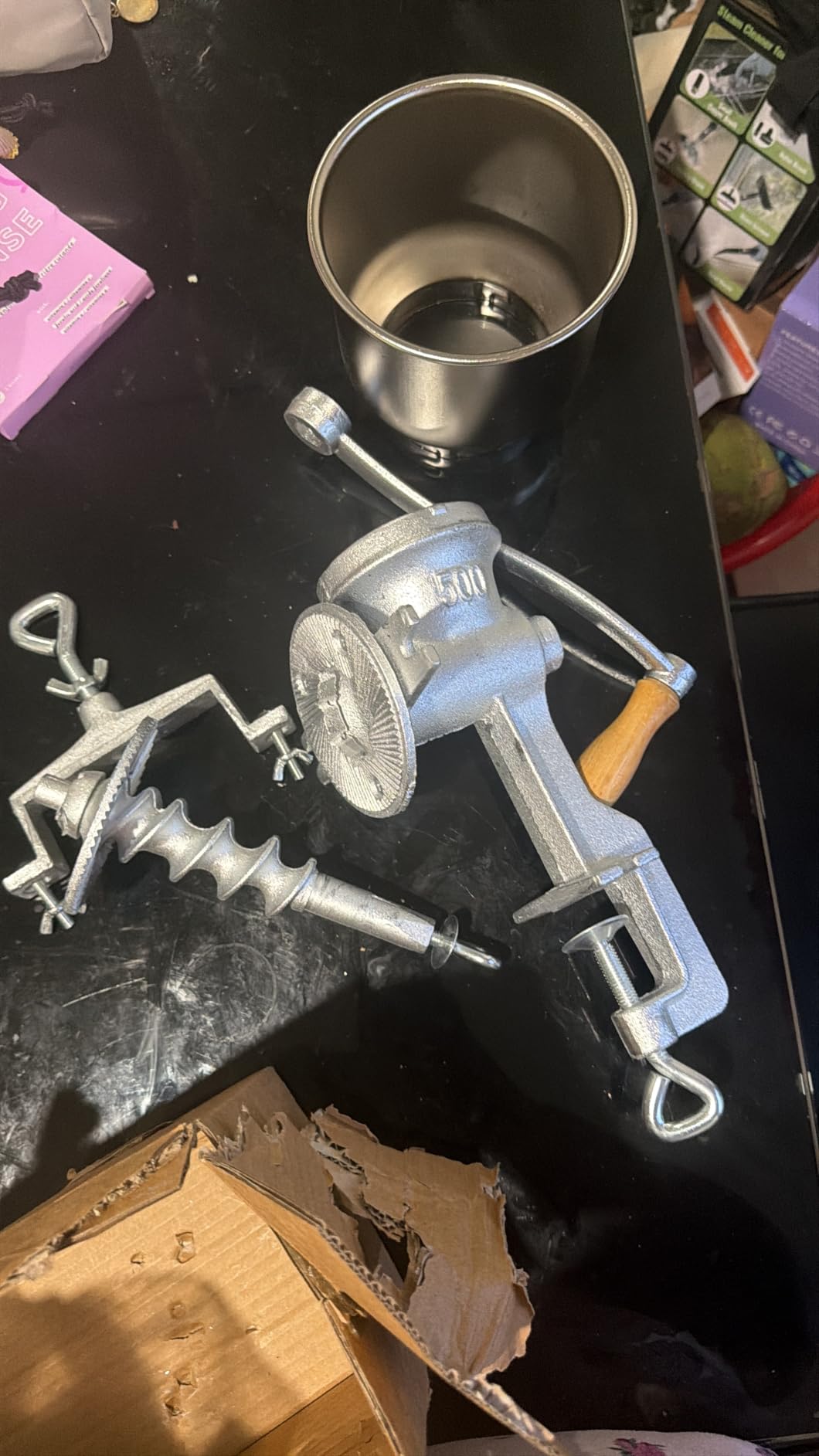
For homebrewers, this style of mill is a classic mash-day tool. Cracking malted barley while keeping the husks mostly intact gives you an efficient mash and a clean sparge, and a hand mill with a big hopper handles a five gallon batch without drama.
The clamp fits surfaces up to 1.5 inches thick, which covers most tables and counters. Cranking is still exercise, especially at finer settings where the resistance goes up.
Cast iron means basic maintenance: keep it dry, brush it out, and give it a light oil rub if it will sit unused for months.
Can it handle a full brewing session?
Yes. The hopper capacity and continuous feed make short work of the few pounds of malt a five gallon batch needs.
Set the plates for a loose crack rather than a grind, and the husks will thank you at lautering time.
What is the grind consistency like?
Consistent for coarse and medium textures, and adequate but uneven at the finest setting compared to a stone burr mill.
For bread flour, plan on a coarse first pass and a finer second pass if you want more uniformity.
10. INSELY 750g Electric Grain Mill – Clean Emptying With a Swing Design
Grain Mill 750g, flour mill grinder for home, Electric Stainless Steel Grain Grinder for Wheat, Spices, coffee,Corn and Other Dry Food Grinders for Kitchen
2200W copper motor
750g chamber
Swing emptying
50-300 mesh
Pros
- Fine flour in about a minute
- Swing body empties cleanly
- Quieter than a blender
- 1-year warranty
- Spare blades and brushes included
Cons
- Heats up between batches
- Dry grinding only
- Limited batch size for big bakes
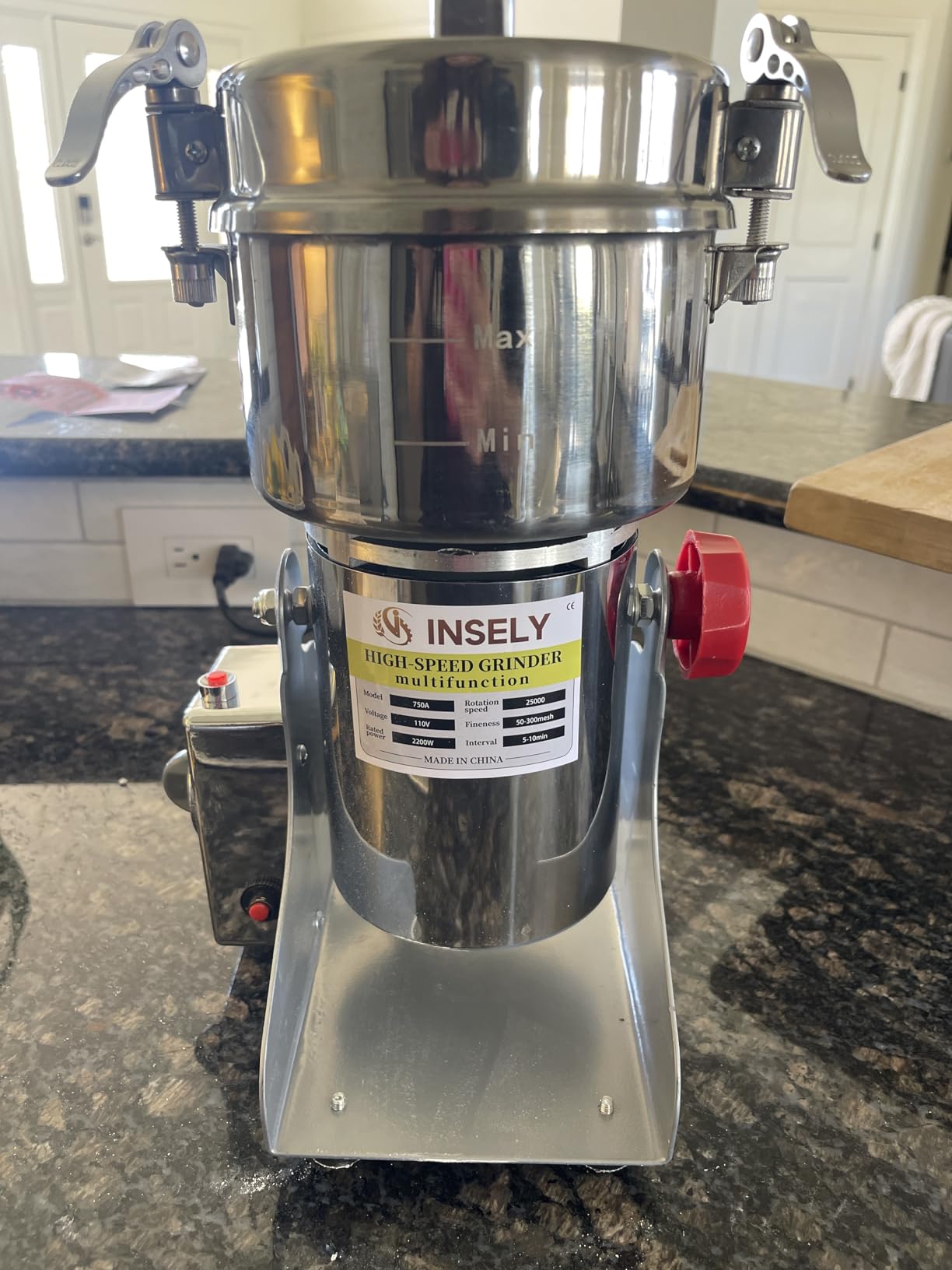
The INSELY earns its slot with one clever mechanical detail: the body swings on its base so you can pour flour out of the chamber instead of scooping it. Anyone who has chased flour dust around a fixed grinding chamber will understand immediately why that matters.
Inside it is a serious machine, with a 2200W pure copper motor at 25,000 revolutions per minute and three-layer stainless blades reaching the 50 to 300 mesh range in about a minute. It runs quieter than a typical blender, which is a pleasant surprise in this category.
The lid seals with a gasket rather than a bare friction fit, so flour stays in the chamber instead of puffing out the top. That single detail keeps the countertop noticeably cleaner.
The standard caveats apply. It is dry grinding only, it wants a 5 to 10 minute rest after every three minutes of work, and the first run carries that familiar new-motor smell.
Cleaning around the blades calls for the included brush and a bit of care, and a few owners reported switch failures early, so run it hard within the first year while the warranty is active.
The package includes four spare blades, two spare carbon brushes, a sleeve, and a brush, and the one-year manufacturer warranty rounds it out. Around 41 reviews put it at 4.4 stars with most buyers satisfied.
How does the swing design help in practice?
You unlock the chamber, swing it over your flour container, and pour. No scooping, no digging under the blades, less mess.
Over a week of daily milling it saves real time and keeps the counter far cleaner than a fixed chamber.
How does it handle daily use?
One loaf per session is effortless, and two is fine if you respect the cooldown between runs.
For large batch days, a bigger or continuous-duty mill like the VEVOR above is the better partner.
How to Choose the Best Grain Mill for Your Kitchen
Picking a mill comes down to four questions: what texture you need, how much you mill, whether you have power, and how much cleanup you will tolerate. Answer those and the list above narrows itself quickly.
Plate and Burr Mills Versus High-Speed Blade Mills
The ten mills here fall into two camps. Hand-cranked plate mills like the WonderMill, Victoria, and Vietora Eud crush grain between adjustable metal or stone surfaces, giving you control over texture and the ability to crack grain. High-speed electric mills like the LEJIEYIN, HORUS, MELVTATA, and INSELY shatter grain with spinning blades at 22,000 to 28,000 revolutions per minute, producing fine flour almost instantly but with only coarse texture control.
The classic third category, electric stone burr mills, uses rotating corundum-ceramic stones for infinitely adjustable cool grinding. Those mills dominate the premium end of the market, and the models available in this roundup represent the value and mid-range segment where most first-time millers actually start.
Electric or Manual?
Go electric if you bake more than once a week and mainly want fine flour with minimal effort. Go manual if you want to brew, crack grain, mill oily ingredients, or keep working when the power is out.
The practical reality, echoed across milling forums, is that hand mills are romantic for occasional use and tiring for daily bread. Many experienced millers keep both: an electric for routine flour and a hand mill for brewing and emergencies.
Capacity and Batch Size
Match chamber size to your baking. A 150g mill suits a single loaf or spice work, 750g covers a family bake, and a funnel-fed commercial mill handles pounds at a time.
Remember that wheat berries roughly hold their weight in flour, so a two loaf bake at 1,000 grams of flour needs about a kilogram of berries milled in one or two sessions depending on your chamber.
Noise and Flour Temperature
High-speed mills are loud, plan on blender-level noise for the duration of the run. Some long-term millers wear hearing protection during extended sessions, and grinding when nobody is sleeping is simple courtesy.
Blade mills also warm the flour. It is not a problem for baked goods, but if you care about enzyme activity for raw applications, the old trick of freezing wheat berries for an hour before milling measurably drops the output temperature. Short pulses and resting the machine between runs do the rest.
Grain Compatibility
Hard red and hard white wheat are the workhorses for bread, soft wheat suits pastry, and spelt, einkorn, rye, and oats add flavor and variety. Corn, rice, dried beans, coffee, and dried chiles are all millable in the plate mills here.
Oily ingredients are the line in the sand. Nuts, seeds, and cocoa gum up blade mills and require the steel burrs of a mill like the WonderMill Junior Deluxe.
A Note for Home Brewers
For crushing malted barley, you want consistent cracks with intact husks, not fine flour. The Victoria and Vietora Eud plate mills are the natural picks here, and both cost far less than purpose-built roller mills while doing respectable work for five gallon batches.
Set the plates loose, run a test handful, and look for kernels cracked open with husks still clinging together. Tighten only until you get there.
Is Milling Your Own Flour Worth It?
The honest answer is that the payoff is flavor, nutrition, and control rather than dramatic savings. Fresh milled flour keeps the bran and germ that store flour loses for shelf stability, and the taste difference in a simple loaf is immediately obvious.
Financially, buying wheat berries in bulk costs less per pound than quality whole grain flour, so heavy bakers do come out ahead over time. Light bakers should treat a mill like a quality-of-life purchase, because one great loaf is usually what convinces people.
Frequently Asked Questions
What is the best mill to buy?
For most home bakers the best all-round pick is the LEJIEYIN 750g electric grain mill, which produces fine 50-300 mesh flour in under a minute and holds enough grain for two loaves per batch. If you want a no-power option, the WonderMill Junior Deluxe is the strongest manual mill, and the Victoria cast iron mill is the best value for corn, coffee, and malt.
Is it worth it to buy a grain mill?
Yes, if you bake with whole grains weekly. Fresh milled flour keeps the wheat germ and bran that store flour removes, and the flavor difference in bread is immediate. Buying wheat berries in bulk also costs less per pound than quality whole grain flour, so regular bakers recover their investment over time. Occasional bakers get more flavor than savings.
What are the best grains to mill at home?
Hard red wheat and hard white wheat for bread, soft wheat for pastry, and spelt, einkorn, rye, and oats for variety. Corn, rice, dried beans, coffee, and dried chiles also mill well. Oily items like nuts and seeds require a mill with steel burrs, such as the WonderMill Junior Deluxe, because they gum up high-speed blade mills.
What is the most affordable grain mill available?
The MELVTATA 150g electric grinder is the cheapest way to start milling fine flour at home, while the Vietora Eud and Victoria cast iron hand mills are the most affordable manual options. All three are budget friendly, with the manual models also working for brewing and power outages.
Can you mill corn, coffee, and other items besides wheat?
Yes, with the right mill. Hand-cranked plate mills like the Victoria, WonderMill Junior Deluxe, and Vietora Eud handle corn, coffee, dried beans, spices, and malted barley. High-speed electric mills handle dry grains, rice, oats, and spices but cannot process wet, oily, or high-moisture ingredients.
Final Thoughts on the Best Grain Mills for 2026
The right choice depends on your kitchen. For daily bakers, the LEJIEYIN 750g delivers fine flour in under a minute and earns the editor’s choice slot. For brewers, corn grinder duties, and off-grid reliability, the Victoria and Vietora Eud cast iron mills are unbeatable values, and the WonderMill Junior Deluxe is the premium manual pick for anyone who wants one hand mill that does everything.
Whichever you choose, buy wheat berries in bulk, start with a single loaf, and let the flavor make the case for you. Fresh milled flour is one of those upgrades that is hard to unlearn once you have tasted it.