
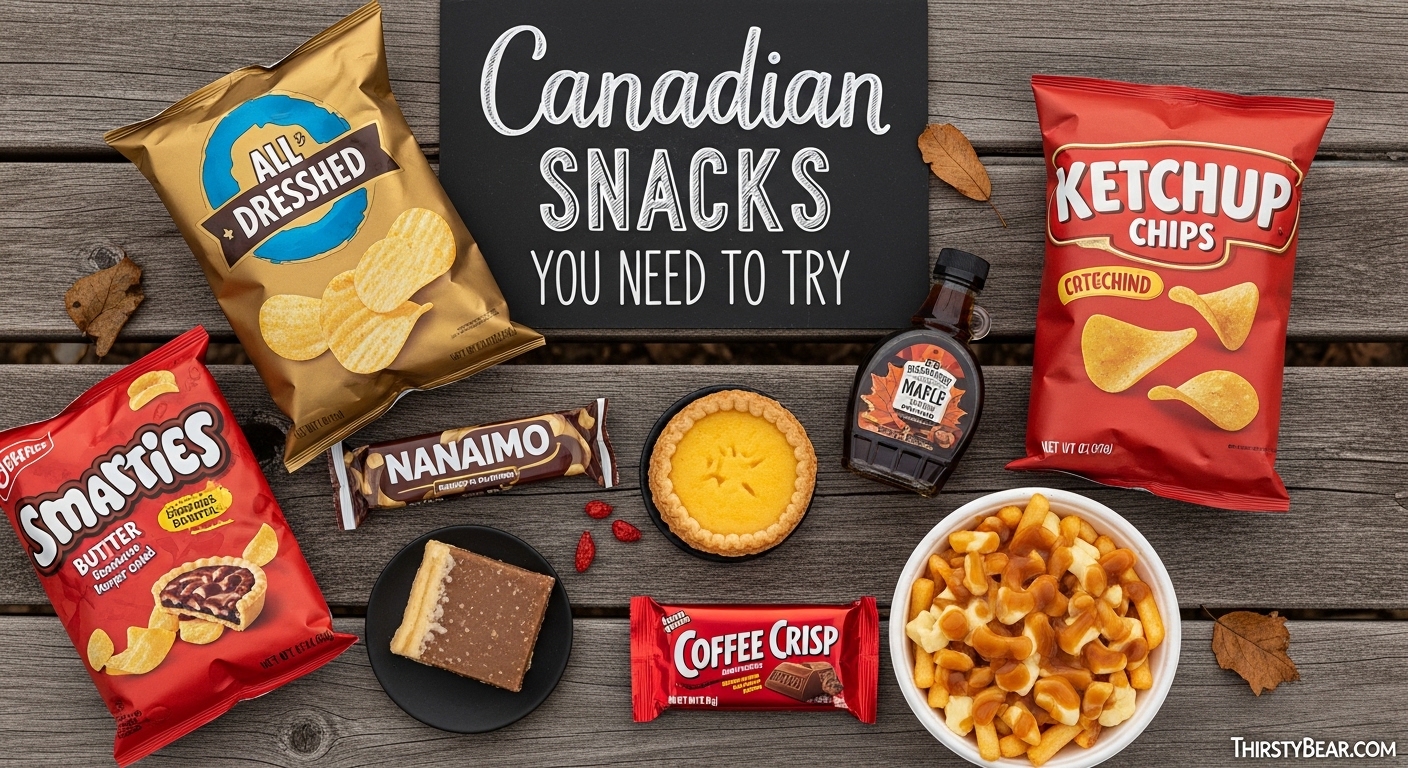
Canadian snacks represent a unique culinary landscape that often surprises visitors and newcomers. These treats range from chip flavors you won’t find south of the border to chocolate bars that have fueled Canadian childhoods for generations. I’ve spent years exploring Canadian convenience stores and grocery aisles to discover what makes these snacks special.
The world of Canadian snacks reflects the country’s multicultural influences, blending British confectionery traditions, French Canadian heritage, and uniquely North American innovation. Some of these treats have achieved cult status, with Canadians living abroad organizing snack exchanges just to get a taste of home. Others remain local treasures that surprise first-time tasters with their unexpected flavor combinations.
Table of Contents
What Makes a Snack Uniquely Canadian
Canadian snacks distinguish themselves through distinctive flavor profiles and formulations you won’t find elsewhere. All Dressed chips, for example, combine barbecue, sour cream and onion, ketchup, and salt and vinegar flavors into one perfectly balanced chip. This flavor doesn’t exist in American markets, making it a true Canadian original.
Major Canadian manufacturers like Nestle, Cadbury, and Old Dutch have created products specifically for the Canadian palate. These companies develop snacks that reflect local preferences, often influenced by British and European traditions that remained stronger in Canada than in the United States. The result is a snack culture that feels familiar yet distinctly different.
Canadian snacks also carry significant cultural weight. They’re part of shared experiences, from road trips to movie nights, from school lunches to hockey games. When expats talk about missing home, these snacks are almost always mentioned. They’re not just food—they’re memories, traditions, and a connection to Canadian identity.
Canadian Chips: The Holy Trinity of Flavors
Canadian chip culture stands apart from the rest of the world, with three flavors dominating the landscape. These aren’t minor variations but full-fledged taste experiences that define snacking in Canada. Reddit discussions consistently rank these chips among the most missed snacks by Canadians living abroad.
All Dressed Chips: The Ultimate Canadian Flavor
All Dressed chips represent everything that makes Canadian snacking unique. This flavor combines the best of multiple chip varieties into one perfectly balanced experience. You get the smokiness of barbecue, the creaminess of sour cream and onion, the tanginess of ketchup, and the sharp bite of salt and vinegar—all in every chip.
Created by Hostess (later acquired by Lay’s) in 1978, All Dressed chips were initially a limited-time flavor that proved too popular to discontinue. Today, they’re arguably the most Canadian chip flavor available, consistently ranking as the country’s favorite. The flavor profile is so balanced that it’s hard to identify individual notes—you just know it works.
Both Lay’s and Old Dutch produce All Dressed chips in Canada, with slight variations between brands. Serious Canadian snackers often have strong opinions about which version is superior. The flavor remains unavailable in most international markets, making it a true Canadian exclusive.
Ketchup Chips: Most Missed by Expats
Ketchup chips inspire strong reactions—you either love them or you’re confused by them. For Canadians, they’re a childhood staple that combines tangy tomato flavor with the perfect amount of sweetness. The red dust coating these chips leaves evidence of your snacking habit on your fingertips.
The flavor originated in Canada and remains unavailable in most American markets, though it has spread to some European countries. Canadian expats consistently name ketchup chips as the snack they miss most when living abroad. The taste reminds them of childhood summers, cottage weekends, and after-school snacks.
Both Lay’s and Old Dutch produce excellent versions of ketchup chips, with Old Dutch often favored for its heavier dusting of seasoning. The flavor profile is tangier than you’d expect, with less sweetness than actual ketchup. It’s a uniquely satisfying experience that has won over many skeptical first-timers.
Dill Pickle Chips: The Tangy Favorite
Dill pickle chips deliver exactly what the name promises—intense dill flavor with a vinegar punch that awakens your taste buds. These bright green chips have gained popularity across Canada, offering a refreshing alternative to heavier cheese or barbecue flavors.
The seasoning combines dill weed, garlic, and vinegar in proportions that make these chips incredibly addictive. Unlike some novelty flavors that taste artificial, dill pickle chips capture the authentic experience of eating a crisp dill pickle. They’re perfect alongside sandwiches or as a standalone snack when you want something bold and tangy.
Old Dutch and Miss Vickie’s both produce popular dill pickle chip varieties, with Miss Vickie’s offering a kettle-cooked version that provides extra crunch. The flavor has gained enough traction that you can now find dill pickle-flavored popcorn and other snacks expanding on this Canadian favorite.
Classic Canadian Chocolate Bars
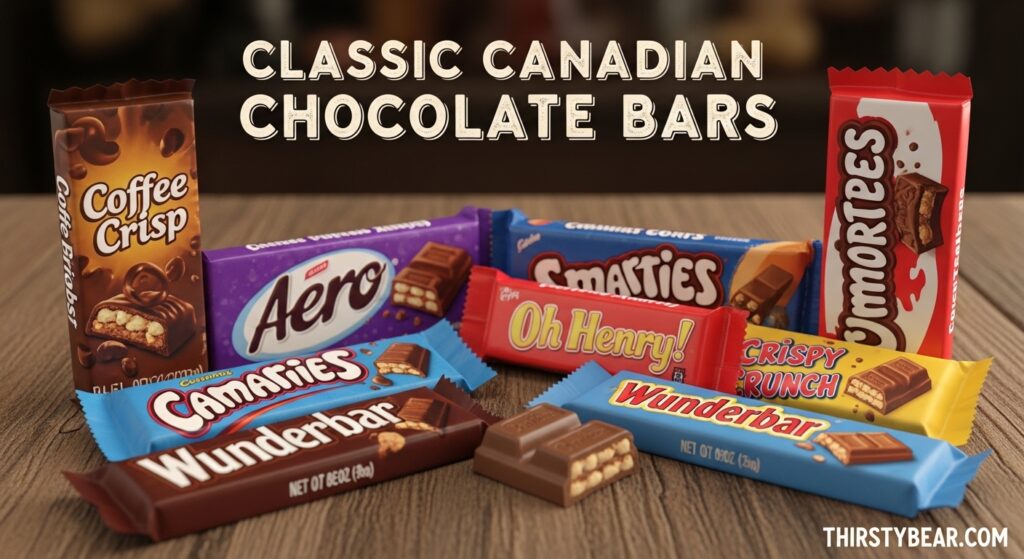
Canadian chocolate bars occupy a special place in the country’s snacking hierarchy. While some international bars are available in Canada, several homegrown favorites have achieved legendary status. These chocolate bars represent Canadian confectionery at its finest and remain unavailable in most international markets.
Coffee Crisp: The Canadian Legend
Coffee Crisp stands as perhaps the most iconic Canadian chocolate bar, featuring layers of crispy vanilla wafer coated in coffee-flavored chocolate. The bar delivers a satisfying crunch with each bite, balanced by a mild coffee flavor that never becomes overwhelming. It’s been produced by Nestle Canada since the 1930s and remains unavailable in most international markets.
The bar’s history dates back to the United Kingdom’s original Rowntree’s Coffee Cream bar, which was reformulated for Canadian tastes. Canadian expats consistently rank Coffee Crisp as the chocolate bar they miss most, with many organizing care packages specifically to include this favorite. The flavor profile reminds many of similar British chocolate bars like Time Out or KitKat Coffee.
Coffee Crisp has expanded its lineup over the years to include variations like Coffee Crisp Orange, Coffee Crisp French Vanilla, and limited-edition flavors. However, the original remains the gold standard and the bar most often requested by Canadians living abroad. If you try only one Canadian chocolate bar, this should be it.
Caramilk: The Secret Center Controversy
Caramilk captures the Canadian imagination with its smooth caramel center enrobed in milk chocolate. The bar spawned one of Canada’s most famous advertising campaigns, which asked consumers how the company got the soft caramel inside the chocolate bar. The “Caramilk Secret” became part of Canadian pop culture in the 1990s.
The bar’s appeal lies in its simplicity—quality milk chocolate surrounding a silky caramel that flows when you bite into it. Unlike some caramel bars that feature chewy caramel, Caramilk’s center is smooth and almost liquid. This texture difference makes it distinctive among caramel chocolate bars.
While similar bars exist in other countries, Caramilk remains uniquely Canadian in its formulation. The bar has inspired countless imitators but none have quite replicated the exact balance of chocolate to caramel that makes the original so satisfying. It’s a staple in Canadian Halloween candy aisles and convenience store checkout counters.
Wunderbar: Peanut Butter Caramel Perfection
Wunderbar combines peanut butter, caramel, and rice crisps in a chocolate coating, creating a complex texture and flavor profile that has won devoted fans across Canada. The bar delivers the crunch of crisps, the smoothness of peanut butter, and the chew of caramel in each bite.
First introduced in the 1970s, Wunderbar has maintained a loyal following despite less extensive marketing than some other Canadian chocolate bars. Its fans describe it as Snickers’ more sophisticated Canadian cousin, with better balance between ingredients and superior chocolate quality.
The bar remains unavailable in most international markets, making it a genuine Canadian treat. Visitors trying Wunderbar for the first time are often surprised by how much they enjoy the combination of flavors and textures. It’s the kind of chocolate bar that inspires brand loyalty once you’ve experienced it.
Other Notable Canadian Chocolate Bars
Mr. Big combines vanilla wafers, rice crisps, peanuts, and caramel in chocolate—a virtual everything-but-the-kitchen-sink approach that somehow works. The bar delivers substantial crunch and has remained a Canadian favorite since its introduction.
Aero chocolate, while available in some international markets, was invented in Canada and features a unique aerated chocolate structure that creates a distinctive melting experience. The bubbles throughout the bar make it lighter than traditional chocolate bars.
Cherry Blossom represents an old-school Canadian treat, combining cherry, peanut, and coconut in a chocolate coating. The bar’s appearance isn’t its strength, but the complex flavor profile has maintained a dedicated following over decades.
Iconic Canadian Sweets and Candy
Canadian candy extends beyond chocolate bars to include gummies, hard candies, and unique treats that have become part of the national snacking fabric. These sweets often reflect Canada’s British heritage while incorporating distinctly Canadian elements.
Canadian Smarties: Not the American Kind
This is where Canadian-American snack confusion peaks. Canadian Smarties are candy-coated chocolate buttons similar to M&M’s, not the tart fruit-flavored disks sold in the United States (which are called Rockets in Canada). Canadian Smarties have been produced by Nestle since 1937 and feature a colorful candy shell with milk chocolate inside.
The difference causes significant confusion for Canadians visiting the United States and Americans visiting Canada. Canadians are consistently disappointed by American “Smarties,” while Americans are confused by the chocolate Canadian version. Canadian Smarties remain unavailable in most international markets.
The candy comes in the classic colorful tubes and remains a staple in Canadian Halloween candy assortments. Serious Smarties fans often have strong opinions about the best way to eat them—some sort by color, others bite them in half, and true connoisseurs claim the red ones taste different.
Swedish Berries and Wine Gums
Swedish Berries and Wine Gums, produced by Maynards, represent the Canadian gummy candy landscape. Swedish Berries are chewy berry-shaped candies with a unique flavor that doesn’t clearly correspond to any specific fruit. They’re slightly tart with a floral note that makes them addictive.
Wine Gums, despite the name, contain no alcohol. These firm gummy candies come in shapes resembling wine bottles and barrels, with flavors inspired by different types of wine—port, sherry, burgundy, and champagne. The flavors are sophisticated compared to typical fruit gummies, with less sweetness and more depth.
Both candies have been Canadian staples for generations and maintain devoted followings. They’re frequently included in Canadian snack care packages sent abroad and represent the kind of candy that Canadian children grew up enjoying.
Hickory Sticks: The Smoky Potato Snack
Hickory Sticks are thin, crunchy potato sticks coated in a smoky, savory seasoning. They’ve been produced by Hostess (now part of Lays) since the 1970s and maintain a dedicated following despite limited marketing. The sticks deliver intense hickory smoke flavor with each bite.
These snacks consistently appear in Reddit discussions about Canadian snacks, with multiple users naming them as favorites. They’re the kind of snack that disappeared from the radar for years before returning due to popular demand. Hickory Sticks represent the kind of quiet Canadian classic that doesn’t need flashy marketing to maintain popularity.
Classic Canadian Baked Goods and Desserts
Canadian baked goods occupy a space between snacks and desserts, with several treats achieving iconic status. These items often have regional origins but have spread across the country to become national favorites.
Nanaimo Bars: BC’s Contribution to Snacking
Nanaimo bars originated in Nanaimo, British Columbia, and consist of three distinct layers: a crumb-based bottom layer, custard-flavored middle, and chocolate topping. These no-bake bars require no oven and deliver intense sweetness in every bite.
The bars have achieved international recognition, appearing in Canadian cookbooks worldwide and even being featured on Canadian postage stamps. Despite this fame, authentic Nanaimo bars remain difficult to find outside of Canada. The original recipe from the 1950s continues to be the standard, though variations exist.
Reddit discussions reveal that Nanaimo bars are polarizing—the coconut in the base layer divides Canadians into love-it or hate-it camps. For fans, the combination of textures and flavors represents Canadian baking at its finest. The bars are so iconic that they’ve been designated the official dessert of British Columbia.
Butter Tarts: Ontario’s Classic
Butter tarts consist of pastry shells filled with a mixture of butter, sugar, syrup, and egg. The result is a rich, sweet, gooey filling that oozes out of the flaky crust. These tarts have been a Canadian staple since the early 1900s and remain deeply embedded in Canadian food culture.
The great Canadian butter tart debate centers on whether raisins belong in the filling. This divides families and communities across the country, with strong feelings on both sides. What everyone agrees on is that butter tarts should be gooey—the filling should be slightly runny when baked properly.
Butter tarts remain predominantly Canadian, rarely appearing in international bakeries. They’re the kind of treat that Canadian expats crave and that visitors find surprising in their richness. A proper butter tart delivers an intense sugar hit balanced by the buttery pastry crust.
Maple Leaf Cookies and Maple Treats
Maple represents Canada’s signature flavor, and maple cookies showcase this distinctive taste. Maple leaf cream cookies consist of two maple-flavored shortbread cookies sandwiching a maple cream filling. They’re produced by Dare Foods and have been a Canadian staple for decades.
Beyond cookies, maple appears in various Canadian snack formats, including maple popcorn, maple fudge, and maple-coated nuts. The distinctive flavor of pure Canadian maple syrup makes these treats unique to the country. While maple syrup itself is exported globally, maple-flavored snacks remain predominantly Canadian.
These maple treats often appear in Canadian souvenir shops and gift shops, marketed to visitors as authentically Canadian. Unlike some tourist-targeted foods, maple cookies and maple treats are also genuinely popular with Canadians, appearing in grocery stores across the country.
Vachon Cakes: May West, Lune 1/2 Moon, and Lady Fingers
Vachon, a Quebec-based company, produces several iconic Canadian snack cakes. May West cakes consist of chocolate cake with vanilla cream filling and chocolate coating. They’re similar to American snack cakes but with a distinctive Canadian formulation.
Lune 1/2 Moon (Half Moon) cakes feature a crescent shape with yellow cake and either vanilla or chocolate coating. They’ve been produced since the 1940s and remain a lunchbox staple for Canadian children.
Lady Fingers are elongated sponge cakes with cream filling, offering a lighter alternative to heavier snack cakes. These Vachon products represent the kind of Canadian treat that locals take for granted but that visitors find distinctive.
Savory Canadian Snacks
Not all Canadian snacks are sweet. Several savory options have achieved iconic status in Canadian snacking culture, offering alternatives to the sugar-heavy options that dominate the convenience store shelves.
Hawkins Cheezies: The Divisive Cheese Snack
Hawkins Cheezies are crunchy cheese curls made from real aged cheddar cheese. These bright orange snacks have been produced in Ontario since the 1950s and maintain a cult following. The cheese flavor is intense and authentic, not the artificial cheese taste of many similar snacks.
Reddit discussions reveal that Hawkins Cheezies are polarizing. Some love the intense cheese flavor and satisfying crunch, while others find them too salty and hard. The company produces their Cheezies in small batches, which creates variations in size and intensity that fans appreciate.
Unlike many Canadian snacks that have been acquired by multinational conglomerates, Hawkins remains an independent Canadian company. Their Cheezies are largely unavailable in international markets, making them a genuine Canadian treat. The bright orange dust that coats your fingers after eating Cheezies is a badge of honor for serious fans.
Pizza Pops: The Canadian Hot Pocket Alternative
Pizza Pops are turnover-style snacks filled with pizza toppings, produced by Pillsbury Canada. These portable snacks combine a flaky crust with fillings like pepperoni, cheese, and pizza sauce. They’ve been a Canadian staple since the 1960s and predate similar products in other markets.
Unlike American pizza snacks that often feature softer crusts, Pizza Pops deliver a distinctly flaky, almost pastry-like exterior. The fillings are chunkier and more substantial than international competitors, with real pepperoni pieces rather than processed meat.
Pizza Pops are the kind of snack that Canadian teenagers heat up after school or that families keep in the freezer for quick meals. They represent the Canadian approach to portable snacking—substantial, satisfying, and uniquely formulated for local tastes.
Where to Buy Canadian Snacks in 2026?
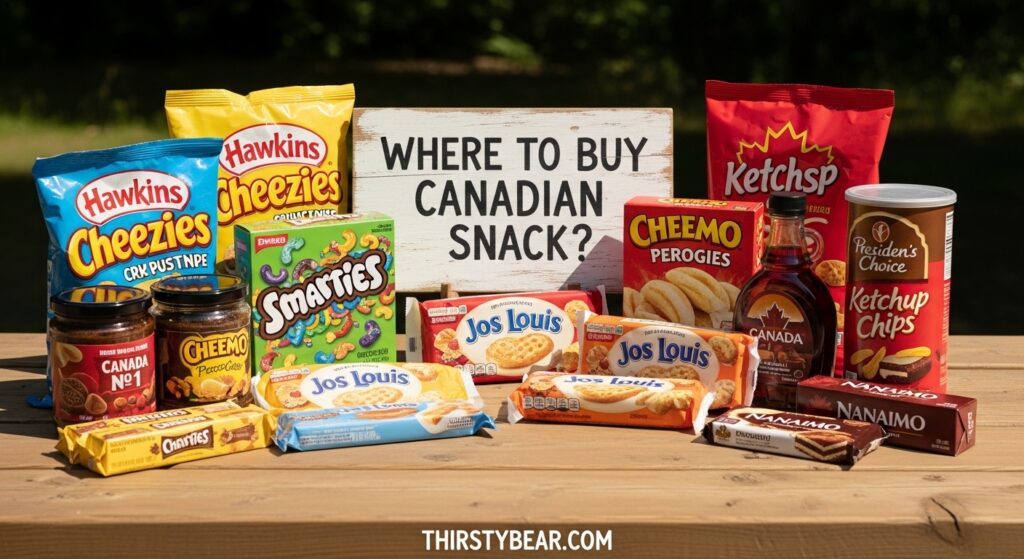
The most common question about Canadian snacks, both from visitors and expats, is where to find them. For those outside Canada, accessing these treats requires knowing where to look and which retailers specialize in Canadian products.
Finding Canadian Snacks in the United States
American consumers near the Canadian border often find Canadian snacks in stores that cater to cross-border shoppers. Retailers like World Market sometimes stock Canadian treats, particularly items like Coffee Crisp and certain chocolate bars. However, selection varies significantly by location.
Specialty retailers like Canadian Snack and Canadian Food to USA focus specifically on bringing Canadian treats to American consumers. These online retailers ship across the United States, though shipping costs can be significant. They typically carry the most-requested items like ketchup chips, All Dressed chips, and iconic chocolate bars.
Some American grocery chains, particularly in northern states, occasionally carry Canadian snacks in their international food aisles. Trader Joe’s has been known to stock Canadian items seasonally, while Target has carried Canadian chocolate bars during promotional periods.
Online Canadian Snack Retailers
Several online retailers specialize in shipping Canadian snacks internationally. Sites like Canadian Snack Box, Maple Express, and True North Treats offer curated selections of Canadian snacks shipped worldwide. These retailers are invaluable to expats craving a taste of home.
Amazon also carries some Canadian snacks, though availability varies by region and can be inconsistent. Third-party sellers often offer popular items at premium prices, with shipping costs adding significantly to the total.
Reddit users frequently organize snack exchanges, connecting Canadians abroad with those in Canada who can ship authentic treats. These community-driven arrangements often provide better selection and more reasonable prices than commercial alternatives.
Canadian Grocery Stores to Visit
For visitors to Canada, certain grocery store chains offer the best selection of iconic snacks. Loblaws, No Frills, and Real Canadian Superstock carry extensive selections of national brands. These stores are particularly good for chips, chocolate bars, and packaged treats.
Shoppers Drug Mart, while primarily a pharmacy, carries an extensive snack selection including many Canadian exclusives. Their stores are widespread and often carry seasonal variations of popular snacks.
Convenience stores like Mac’s, Couche-Tard, and 7-Eleven Canada stock the most popular grab-and-go items. These are the places to find classic Canadian treats when you’re traveling or need a quick snack fix.
Cross-Border Shopping Tips
When shopping for Canadian snacks to bring home, focus on items that ship well and won’t melt. Chocolate bars should be purchased in cool weather or packed with cold packs. Chips travel well but should be packed carefully to avoid crushing.
Customs regulations typically allow personal quantities of commercially packaged food across borders. However, some items containing certain ingredients may be restricted. Always check current regulations before attempting to transport food across international borders.
FAQs
What are uniquely Canadian snacks?
Uniquely Canadian snacks include ketchup chips, All Dressed chips, Coffee Crisp chocolate bars, Nanaimo bars, butter tarts, and Hawkins Cheezies. These treats are either unavailable outside Canada or have distinctly Canadian formulations that differ from international versions. Canadian snacks reflect the country’s multicultural influences and have become part of national identity.
What’s the most popular snack in Canada?
All Dressed chips are consistently ranked as Canada’s most popular snack. Created in 1978, this flavor combines barbecue, sour cream and onion, ketchup, and salt and vinegar into one perfectly balanced chip. Other top contenders include Coffee Crisp chocolate bars, ketchup chips, and Nanaimo bars. These snacks appear consistently in rankings and are the most requested by Canadian expats living abroad.
What snack foods are Canadian made?
Iconic Canadian-made snacks include Coffee Crisp, Caramilk, and Wunderbar chocolate bars from Nestle Canada; ketchup, All Dressed, and dill pickle chips from Lay’s and Old Dutch; Nanaimo bars and butter tarts from local bakeries; Hawkins Cheezies from Hawkins; and various treats from Maynards, Vachon, and Dare Foods. These products are manufactured in Canada and formulated specifically for Canadian tastes.
What food is uniquely Canadian?
Beyond snacks, uniquely Canadian foods include poutine (fries with cheese curds and gravy), butter tarts, Nanaimo bars, maple syrup products, peameal bacon (Canadian bacon), and tourtière meat pie. Canadian snacks are part of this broader food culture that reflects the country’s unique culinary heritage. Many of these foods originated in specific regions but have spread across the country to become national symbols.
Conclusion
Canadian snacks offer a window into the country’s culture and culinary traditions. From the controversial ketchup chip to the universally loved Coffee Crisp, these treats tell stories about Canadian identity, regional differences, and the flavors that define a nation.
Whether you’re a newcomer to Canada, an American curious about northern treats, or an expat missing home, exploring Canadian snacks provides a genuine taste of what makes the country unique. These snacks aren’t just food—they’re memories, traditions, and connections to Canadian identity that you can experience with every bite.