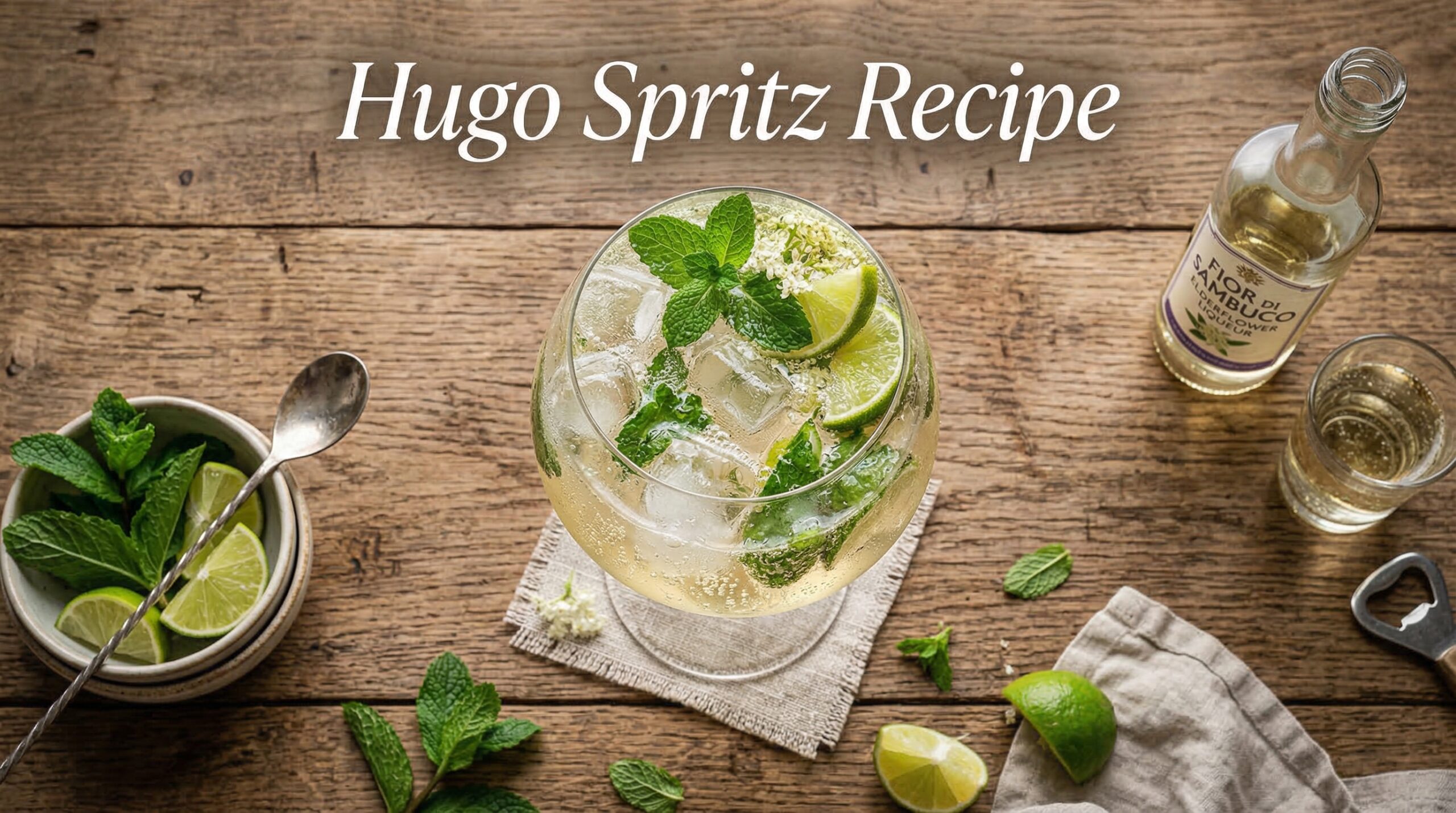
If you’ve spent any time on a sun-drenched patio in Europe, you’ve probably seen someone sipping a tall, fizzy glass filled with greenery and bubbles. That drink is almost certainly a Hugo Spritz — and once you taste it, you’ll understand why it swept across Italy and then the rest of the world. This Hugo Spritz recipe takes less than five minutes to make, uses just a handful of ingredients, and delivers something genuinely refreshing.
Unlike heavier, more bitter cocktails, the Hugo is floral, light, and a little sweet. It’s the kind of drink you want in your hand at a summer dinner party, a Sunday brunch, or just a slow afternoon on the back porch.
What Is a Hugo Spritz?
A Hugo Spritz is an Italian sparkling cocktail built on Prosecco, elderflower liqueur, and club soda, finished with fresh mint and a squeeze of lime. It belongs to the Spritz family — that broad category of sparkling wine cocktails that also includes the Aperol Spritz and the Campari Spritz — but it stands apart with a softer, more floral character.
The drink was created in 2005 by Roland Gruber, a bartender working in South Tyrol, Italy. The region sits in the northern Italian Alps, bordering Austria, and its cocktail culture blends Italian and Central European influences. Gruber originally made the Hugo with lemon balm syrup, but elderflower liqueur (most famously St-Germain) became the standard over time and turned the drink into an international hit.
Compared to an Aperol Spritz, the Hugo is lighter and less bitter. Aperol has a distinctly orange, slightly medicinal bite. The Hugo, by contrast, is gentle — almost delicate. The elderflower adds a honeyed floral note, and the fresh mint keeps everything bright and clean. It’s the Spritz for people who find Aperol a bit too assertive.
Hugo Spritz Ingredients
The classic Hugo Spritz uses five ingredients. Here’s what you’ll need for one serving:
- 3 ounces Prosecco — chilled, dry (Brut or Extra Dry both work well)
- 1 ounce elderflower liqueur — St-Germain is the gold standard, but any elderflower liqueur works
- 1 ounce club soda — chilled; seltzer or sparkling mineral water also work
- 4–6 fresh mint leaves — plus an extra sprig for garnish
- 1–2 lime wedges — for garnish and a light squeeze of juice
- Ice — large cubes keep the drink cold without diluting it too fast
A note on elderflower liqueur: some people find St-Germain on the sweeter side. If that’s you, start with 3/4 ounce and taste as you go. You can always add more, but you can’t take it back. Bartenders on Reddit’s r/cocktails community frequently mention this — the 3:1:1 ratio is a starting point, not a rule.
The Prosecco quality matters more than you might expect. You don’t need anything expensive, but avoid very cheap options that taste sharp or thin. A dry Brut Prosecco gives you cleaner bubbles and lets the elderflower flavor shine rather than competing with it.
Hugo Spritz Recipe: Step-by-Step Instructions
Prep time: 3 minutes | Yield: 1 cocktail
Step 1: Prepare your mint. Place 4–6 mint leaves in your palm and give them a firm slap with your other hand. This is called “slapping” the mint, and it’s the preferred technique. It releases the essential oils without bruising the leaves, which can turn them bitter and darken the drink. Drop the slapped mint into the bottom of a large wine glass or balloon glass.
Step 2: Add the elderflower liqueur. Pour 1 ounce of St-Germain (or your chosen elderflower liqueur) directly over the mint. Give it a gentle swirl so the mint starts to infuse into the liqueur for about 20–30 seconds.
Step 3: Load up the ice. Fill the glass nearly to the top with ice cubes. Large cubes are best here — they melt slowly and keep your drink cold for longer without watering it down. If you only have standard ice cubes, that’s completely fine.
Step 4: Pour the Prosecco. Add 3 ounces of chilled Prosecco, pouring slowly down the side of the glass to preserve the bubbles. Tilting the glass slightly as you pour helps keep the fizz alive.
Step 5: Top with club soda. Add 1 ounce of chilled club soda. Again, pour gently to maintain the carbonation.
Step 6: Stir gently. Use a long bar spoon and stir just once or twice — a slow, gentle lift from bottom to top. Over-stirring will flatten the drink.
Step 7: Garnish and serve. Add a fresh mint sprig (you can give it another quick slap before dropping it in) and 1–2 lime wedges. Squeeze one wedge lightly over the top if you like a hint of citrus. Serve immediately.
Pro Tip: Glassware Matters
The Hugo Spritz is traditionally served in a large balloon wine glass. The wide bowl lets you fit plenty of ice and mint, and the opening directs the floral aromas straight to your nose as you sip. If you don’t have a balloon glass, a large red wine glass works perfectly.
The Hugo Spritz Ratio Guide
The classic ratio is 3:1:1 — three parts Prosecco, one part elderflower liqueur, one part club soda. For a single serving, that translates to 3 ounces Prosecco, 1 ounce elderflower, and 1 ounce soda.
But ratios are personal. Here’s how to adjust based on your taste:
- Lighter and drier: Try 4:1:1 — more Prosecco, less sweetness. Good for people who find the standard recipe a bit sweet.
- Stronger elderflower flavor: Go 3:1.5:0.5 — bump the elderflower and reduce the soda. You get more of that honeyed floral punch.
- More refreshing and lower ABV: Try 3:1:2 — extra soda stretches the drink and makes it even lighter.
The beauty of the Hugo is that there’s no wrong answer. Taste it after you build it, and adjust the next round to your preference.
Variations and Substitutions
Hugo Spritz vs St-Germain Spritz
You’ll sometimes see “St-Germain Spritz” used interchangeably with “Hugo Spritz,” but they’re not quite the same drink. The St-Germain Spritz — developed by the brand itself — typically uses a 2:1:3 ratio with white wine or Champagne rather than Prosecco, and skips the mint entirely. The Hugo is the folk version: more casual, mint-forward, and built for outdoor drinking.
Elderflower Syrup (Non-Alcoholic Substitution)
If you want to skip the alcohol in the elderflower component, elderflower cordial or syrup (like Belvoir Elderflower Cordial) is a solid substitute. Use about 1/2 to 3/4 ounce since it’s sweeter and more concentrated than the liqueur.
For a fully non-alcoholic Hugo Spritz, replace the Prosecco with a good sparkling grape juice or non-alcoholic sparkling wine, use elderflower cordial, and top with soda. You keep the floral character and the fizz without the alcohol.
Prosecco Alternatives
Any dry sparkling wine works here. Cava from Spain is a budget-friendly option with similar bubbles and dryness. A dry Champagne will give you more complexity, though it’s heavier than Prosecco. Some people love a Pét-Nat (pétillant naturel) for a slightly cloudy, rustic take on the drink.
Spirit Twists
Forum discussions in r/bartenders show plenty of people adding a splash of gin or vodka for extra kick — typically 1/2 ounce. A floral gin (like Hendrick’s or St. George Botanivore) pairs beautifully with the elderflower notes. This makes the Hugo more of a full cocktail and less of a low-ABV aperitif.
Batch Hugo Spritz for Parties
To make a pitcher serving 6–8, combine 1 bottle of Prosecco (750ml), 6 ounces elderflower liqueur, and 6 ounces club soda in a large pitcher over ice. Add a big handful of mint and several lime wedges. Stir gently once and serve immediately. Note: add the soda and Prosecco right before serving to preserve the fizz.
Tips for the Perfect Hugo Spritz
Chill everything. The Prosecco and soda should be cold from the fridge. Room-temperature sparkling wine goes flat faster and makes the drink feel heavy. Some bartenders even chill the glass itself in the freezer for a few minutes before building the drink.
Don’t muddle the mint. This is the mistake most beginners make. Muddling — crushing the mint with a muddler or spoon — releases bitter chlorophyll from the leaves. The slap technique keeps the flavor bright and clean.
Use fresh mint, not dried. Dried mint tastes like tea and has none of the freshness that makes this drink work. If your mint has wilted, revive it by soaking the leaves in ice water for 5–10 minutes before using.
Serve immediately. Once the Prosecco and soda are in the glass, the clock is ticking on those bubbles. Don’t build Hugo Spritzes in advance — pour them and serve right away.
Squeeze the lime at the table. Adding a lime wedge to the garnish and letting your guest squeeze it themselves keeps the citrus brightness in their hands. Over-squeezing can make the drink tart and mask the floral notes.
FAQs
What are the ingredients of a Hugo Spritz?
A Hugo Spritz is made with Prosecco (3 oz), elderflower liqueur such as St-Germain (1 oz), club soda (1 oz), fresh mint leaves, and a lime wedge. The classic ratio is 3:1:1 — three parts Prosecco, one part elderflower liqueur, one part soda.
Is Hugo Spritz the same as St-Germain Spritz?
They are related but not identical. The Hugo Spritz is a folk cocktail from South Tyrol made with Prosecco, elderflower liqueur, soda, and fresh mint. The St-Germain Spritz is a brand-created version that typically uses white wine or Champagne and omits the mint. The Hugo is the more casual, mint-forward version.
What’s stronger, Aperol Spritz or Hugo Spritz?
Aperol Spritz is slightly stronger. Aperol has an ABV of about 11%, while St-Germain elderflower liqueur sits at around 20%. However, the Hugo Spritz uses less liqueur overall — typically just 1 ounce — so the final drink lands at a similar low-ABV level to an Aperol Spritz. The Hugo tastes lighter because it lacks the bitter edge of Aperol.
What can I use instead of St-Germain in a Hugo Spritz?
The best substitute is any other elderflower liqueur, such as Patron Citronge Elderflower or Bottega ElderFlower. If you want a non-alcoholic option, use elderflower cordial or syrup (like Belvoir) at about half the amount since it’s sweeter and more concentrated. Plain elderflower-infused simple syrup also works in a pinch.
Is a Hugo Spritz made with club soda or seltzer?
Either works. Club soda, seltzer, and sparkling mineral water all produce a similar result. The subtle mineral flavor in some sparkling waters can add a slight complexity, but the difference is minor. What matters most is that the water is cold and well-carbonated.
Ready to Make Your Hugo Spritz?
The Hugo Spritz recipe is one of those rare cocktails that’s genuinely easy to make, consistently impressive, and endlessly adjustable. Whether you’re making one glass for yourself on a weekday evening or mixing a big batch pitcher for a garden party, the formula is the same: cold Prosecco, good elderflower liqueur, plenty of ice, and fresh mint handled with care.
Start with the classic 3:1:1 ratio, taste it, and tweak from there. That’s exactly how Roland Gruber built it back in 2005 in South Tyrol — by feel, by season, and for the people around him. Cheers to that.