I have to admit something. A few years ago, I would have laughed at the idea of drinking non-alcoholic beer. My perception of NA beer was shaped by the early iterations of the genre, the ones that tasted like carbonated malt soda or, honestly, like someone had poured slightly fermented bread crumbs into a glass. My friends called them “glorified sparkling water,” and I could not argue with that assessment.
But something changed in the craft beer world around 2018, and I started hearing whispers from beer enthusiasts I respected. They mentioned names like Athletic Brewing, talked about how some of these alcohol-free options were getting surprisingly close to their alcoholic counterparts. I remained skeptical until I finally tried a Guinness 0.0 at a friend’s barbecue last summer. That glass of stout changed my entire perspective on what non-alcoholic beer could be.
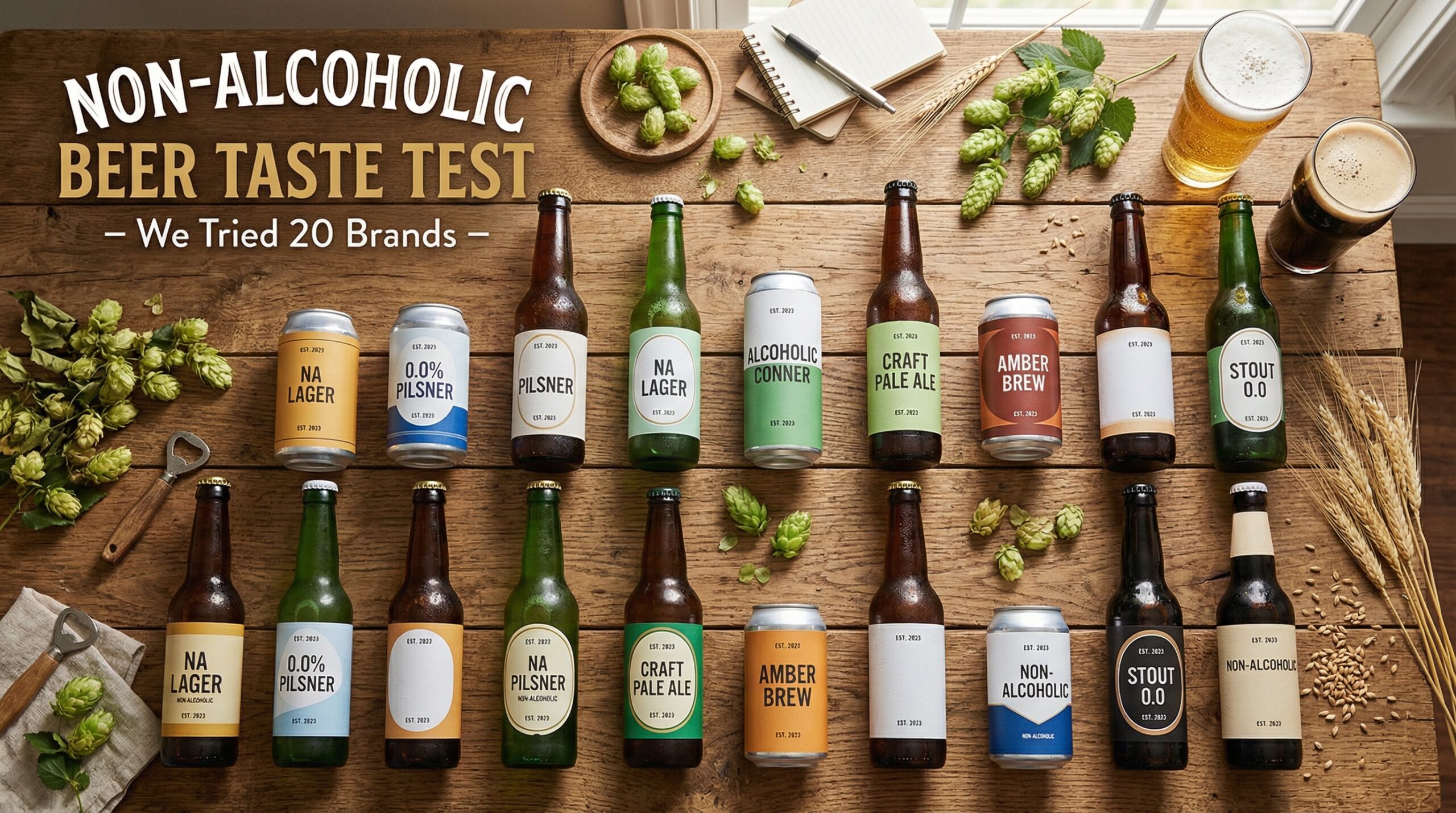
That experience prompted me to organize something I had been contemplating for months: a comprehensive non-alcoholic beer taste test involving our entire team. We gathered six beer enthusiasts, two certified cicerones, and one person who had never tried NA beer before (we needed that fresh palate perspective). Over three weekends in 2026, we systematically worked through 20 different non-alcoholic beers representing various styles, from hazy IPAs to crisp lagers to rich stouts.
Our goal was simple but ambitious. We wanted to answer the question that many of you have probably asked yourselves: is there a non-alcoholic beer that actually tastes like the real thing? And if so, which ones should you try? We sampled these 20 brands blind, scored them across multiple criteria, and debated our findings late into the evening with several cold (non-alcoholic, of course) refreshments at our side.
How We Conducted Our Non-Alcoholic Beer Taste Test
Before diving into our findings, I want to explain exactly how we approached this taste test because methodology matters when you are evaluating something as subjective as beer flavor.
We purchased all 20 beers from local bottle shops and online retailers, ensuring we got fresh batches with proper storage history. Each beer was chilled to exactly 45 degrees Fahrenheit, which is the serving temperature most breweries recommend for their full-alcoholic counterparts. We used standard ISO tasting glasses to ensure consistency across all samples, and every beer was poured exactly two hours after being removed from refrigeration to allow it to warm slightly and open up its aroma compounds.
Our scoring system evaluated five key areas. Appearance accounted for 10% of the final score, looking at color accuracy, foam retention, and lacing. Aroma comprised 20% of the score, assessing whether the beer delivered expected scents for its style and whether any off-putting qualities were present. Taste was the dominant factor at 40%, examining whether flavor profiles matched the style expectations, whether the beer tasted authentic rather than like a simulation. Mouthfeel made up 20%, evaluating body, carbonation level, and drinkability. The remaining 10% went to finish, considering how pleasantly the beer lingered and whether any unpleasant aftertastes developed.
Each team member scored every beer independently using a 100-point scale before we convened to discuss and aggregate our findings. I will share the aggregate scores with you, but more importantly, I want to convey the actual experience of tasting these beers and what surprised us along the way.
The Non-Alcoholic Beer Market in 2026
The non-alcoholic beer market has undergone a remarkable transformation over the past decade. What was once a tiny niche catering primarily to pregnant women and recovering alcoholics has exploded into a sophisticated segment that attracts fitness enthusiasts, designated drivers, and yes, even beer purists who simply want to enjoy more drinks without the alcohol effects.
According to industry data, the NA beer market has grown by over 40% since 2020, with craft breweries leading the charge. The driving factors behind this growth are fascinating. Health consciousness has become increasingly mainstream, with many people participating in Dry January or simply trying to moderate their alcohol intake. The fitness community has embraced NA beer as a post-workout recovery drink that provides the social ritual of cracking open a cold one without compromising training goals. Additionally, the social dynamics have shifted, with more hosts offering quality NA options for guests who are not drinking.
The technology behind non-alcoholic beer has also advanced dramatically. The old method of simply stopping fermentation early (which produced those watery, sweet beers that gave NA beer its bad reputation) has been largely replaced by more sophisticated techniques. Vacuum distillation removes alcohol at lower temperatures, preserving more aromatic compounds. Reverse osmosis filters separate alcohol from the beer and then reintroduces the flavor compounds. Cold fermentation processes keep the yeast dormant at temperatures that prevent alcohol production while still allowing flavor development. These methods produce beers that genuinely taste like what they are trying to replicate, not pale imitations.
Hazy and Classic IPAs
The IPA category is where craft breweries have really pushed the boundaries of what non-alcoholic beer can achieve. Hoppy beers were once thought impossible to replicate without alcohol, but several breweries have proven that theory wrong.
Athletic Brewing Run Wild IPA emerged as one of our clear favorites across the entire taste test. Our team consistently praised its vibrant citrus aroma, with distinct notes of grapefruit and tropical fruits that jumped out of the glass. The flavor profile delivered on the promise of the aroma, with a juicy hop character that was not bitter or harsh. It had a clean finish that invited another sip, and several team members commented that they would happily serve this at a party without mentioning it was non-alcoholic. The mouthfeel was lighter than a standard IPA but still had enough body to feel substantial. Score: 87/100.
Samuel Adams Just the Haze impressed us with its balance. The Boston brewery known for pushing craft beer boundaries applied that same ambition to their NA offering. We detected floral hop notes alongside citrus, with a bready malt backbone that gave it more depth than most competitors. The carbonation was perfectly calibrated, providing a refreshing bite without overwhelming the hop character. It finished cleanly and would pair excellently with spicy food or grilled meats. Score: 84/100.
BrewDog Hazy One from the Scottish craft pioneers delivered a tropical fruit-forward experience that our testers enjoyed. The mango and passionfruit notes were prominent and natural, not artificially added. However, some team members felt the body was slightly thin compared to the Run Wild, and the finish did not linger quite as pleasantly. Still, a solid offering that demonstrated BrewDog’s commitment to the NA market. Score: 81/100.
Two Roots Hazy IPA presented an interesting case. Our testers appreciated the aggressive hop character, which was more in line with West Coast IPA styling than the juicy haze trend. The bitterness was more pronounced here, which some team members enjoyed while others found it slightly harsh. The citrus notes leaned more toward lemon and orange than tropical fruits, giving it a different character than the other hazy options. Score: 78/100.
Mikkeller Dry Dania surprised us with its complexity. The Danish brewery known for experimental beers brought that same spirit to their NA offering. We detected notes of pine and resin alongside the expected citrus, with a slightly spicy character that added intrigue. The finish had a pleasant herbal quality that lingered pleasantly. However, the complexity might not appeal to those seeking a straightforward, crushable NA IPA. Score: 79/100.
Crisp Lagers and Pilsners
The lager category is where most people first encounter non-alcoholic beer, and frankly, it is also where the quality gap between brands is most apparent. The clean, refreshing profile that makes lagers so drinkable also makes any flaws immediately obvious.
Heineken 0.0 has become the flagship NA lager from a major brewery, and our team had high expectations given the brand’s heritage. The green-bottled familiar aroma was immediately recognizable, which impressed us. We detected the signature corn and grain notes, though some testers felt these were slightly more pronounced than in the alcoholic version. The flavor profile was well-balanced, with enough hop presence to provide interest without sacrificing drinkability. The finish was clean and refreshing. Score: 82/100.
Corona 0.0 transported several team members mentally to a beach, which is exactly what the Corona brand wants to achieve. The subtle lime notes in the aroma were present and pleasant. The light body made this extremely crushable, and we could see it being perfect for a hot day or alongside Mexican food. However, some beer enthusiasts on our team felt it was almost too light, lacking the character they look for in a beer experience. Score: 75/100.
Budweiser 0.0 from Anheuser-Busch was the most controversial entry in this category. The familiar bread dough and cereal grain notes were present, and the overall profile was clean. Our craft beer enthusiasts felt it lacked distinctiveness and tasted too similar to other mass-market NA lagers. However, our casual beer drinkers appreciated its approachability and familiarity. The Budweiser 0.0 might be the perfect gateway beer for someone transitioning from regular beer to NA options. Score: 72/100.
Stella Artois 0.0 impressed our team with its European sophistication. The Belgian brewery known for its premium positioning delivered an NA lager with more depth than most competitors. We detected subtle spicy notes from the hop variety, alongside the expected cereal grain character. The finish was notably dry, which gave it an elegant quality. This would be an excellent choice for someone who wants a beer experience that feels complete and satisfying. Score: 83/100.
Peroni 0.0 was one of the pleasant surprises of our entire taste test. The Italian brewery known for its crisp, refreshing lagers translated that expertise beautifully to the NA format. We detected a slight citrus note in the aroma that was distinctively Peroni, and the flavor profile delivered clarity and refreshment. Several team members ranked this as their favorite lager-style NA beer, praising its drinkability and authentic Italian character. Score: 85/100.
Stouts and Porters
The stout category is where our expectations were highest and where we were most surprised by what we found. Getting the rich, roasted complexity of a stout without alcohol is perhaps the greatest challenge in NA brewing, and some breweries have risen to that challenge spectacularly.
Guinness 0.0 is the beer that started my personal NA beer journey, and it lived up to my memories in our blind tasting. The iconic dark ruby color was perfect, and the tan foam cascaded beautifully down the glass as we poured. The roasted barley character was unmistakably Guinness, with notes of coffee, chocolate, and dark fruit. The mouthfeel had that characteristic smoothness that Guinness achieves through its nitrogen widget, even in cans. Several team members who had never tried NA beer before were stunned when informed this was non-alcoholic. This remains the gold standard against which all other NA stouts should be measured. Score: 91/100.
Athletic Brewing Upside Dawn represented the American craft approach to NA stouts. We detected more coffee character than in the Guinness, with a slightly bitter edge that some team members loved and others found slightly off-putting. The roasted malts provided good depth, though the finish was not quite as smooth as the Guinness. This would be an excellent breakfast beer or pairing for chocolate desserts. Score: 79/100.
BrewDog Punk AF came from the Scottish brewery known for its bold, experimental full-alcoholic beers. Their NA stout was appropriately bold, with aggressive roasted character and smoky undertones that our testers found either exciting or overwhelming depending on their preferences. The hop bitterness was more pronounced here than in other stouts, giving it a sharper edge. Not for everyone, but a solid choice for those who enjoy imperial stouts. Score: 77/100.
Clausthaler Dry Hopped represented the German approach to NA beer. The familiar Clausthaler brand, one of the pioneers in non-alcoholic beer, delivered a more refined stout experience. The dry hopping added floral and citrus notes that brightened the typically heavy stout profile. We detected honey and caramel alongside the expected roasted grains. The finish was notably dry, almost wine-like in its character. Score: 80/100.
Wheat Beers and Golden Ales
Wheat beers and golden ales offer a different experience in the NA world, often emphasizing refreshment and drinkability over the bold flavors of stouts and IPAs. These are perfect summer beers and food-pairing options.
Erdinger Alkoholfrei from the famous German wheat beer brewery was one of the most anticipated entries in our taste test. We expected Bavarian quality, and Erdinger delivered. The banana and clove notes typical of hefeweizen were present though slightly muted compared to the alcoholic version. The wheat character came through clearly, providing that signature creamy mouthfeel. The carbonation was excellent, giving it a refreshing sparkle. Our German-born team member approved enthusiastically. Score: 83/100.
Weihenstephaner Hefeweissbier Alkoholfrei represented the gold standard of German wheat beer, and their NA version did not disappoint. The world’s oldest brewery applied centuries of expertise to creating an alcohol-free wheat beer that retained remarkable authenticity. We detected complex fruity esters alongside the classic wheat character. The finish was beautifully balanced, with just enough hop bitterness to provide structure. This would be perfect with a Bavarian meal or on its own on a warm evening. Score: 85/100.
Becker’s Premium Alkoholfrei from Germany offered a slightly different take on the wheat beer style. We found it lighter and more effervescent than the Erdinger or Weihenstephaner, with less emphasis on the banana and clove characteristics. Some team members appreciated this more subtle approach, while others felt it lacked the personality they want in a wheat beer. The clean finish made it extremely drinkable. Score: 76/100.
Konig Pale Alkoholarm represented the Spanish approach to non-alcoholic beer. We detected a slight fruity character alongside the expected grain notes, with a crisp finish that made it very refreshing. The hop presence was moderate, providing balance without strong bitterness. This would be an excellent poolside beer or accompaniment to light salads and seafood. Score: 74/100.
Key Findings and Insights From Our Taste Test
After three weekends and 20 beers later, our team walked away with several important insights about where the non-alcoholic beer industry stands in 2026.
The first and most significant finding is that the gap between NA beer and alcoholic beer has narrowed dramatically. Ten years ago, I would have said the two categories were fundamentally different experiences. Today, with top-tier offerings like Guinness 0.0, Athletic Brewing Run Wild IPA, and Peroni 0.0, the distinction is much less clear. Several of our testers, when drinking blind, could not definitively tell some of these beers apart from their alcoholic counterparts. That represents a revolution in brewing technology and ingredient selection.
The second insight concerns the importance of mouthfeel in non-alcoholic beer. Many of the lower-scoring beers in our test did not fail on flavor alone. They failed because the mouthfeel gave them away. Alcohol provides body and weight to beer, and without it, many NA beers feel thin or watery. The breweries that have mastered techniques to add body through malt selection, carbonation adjustment, and other methods produce far more convincing products.
The third observation is that not all styles are equal in the NA world. Our testers universally agreed that stouts and lagers are the strongest categories for NA beer, while wheat beers and golden ales show more variable quality. The hop-forward IPAs have benefited from intense craft beer innovation and now rank among the best NA options available. If you are new to non-alcoholic beer, we recommend starting with a stout or a lager before venturing into other styles.
Price remains a consideration. Non-alcoholic beer is generally more expensive than its alcoholic counterparts, sometimes significantly so. However, our team noted that the best NA beers are now competitively priced with mid-range craft beers, which represents good value given the technology and ingredients involved. As production scales up, we expect prices to continue normalizing.
Health Considerations and Who Should Try NA Beer
One of the most common questions our team encountered during planning was about health implications. Let me address some of the key health considerations around non-alcoholic beer.
First, the basics. Legally, non-alcoholic beer in the United States must contain less than 0.5% ABV, though many brands test at exactly 0.0%. This trace amount is not sufficient to cause intoxication under normal consumption. However, it is worth noting that the liver processes these tiny amounts of alcohol similarly to how it processes alcohol, which matters for certain medical conditions and medications.
For people asking whether 0% beer is okay for the liver, the answer is generally positive for healthy individuals consuming NA beer in moderation. The liver benefits from not processing full doses of alcohol, obviously. However, those with cirrhosis or severe liver conditions should consult their physician, as should anyone taking medications that interact with alcohol. Some antidepressants, particularly sertraline, carry warnings about alcohol interaction, and the trace amounts in NA beer may be a consideration depending on your medical situation. Always check with your healthcare provider if you have concerns.
Non-alcoholic beer offers several potential benefits. It provides hydration alongside social ritual, unlike the dehydrating effects of alcohol. The malt content delivers some nutrients, including B vitamins and minerals. For fitness enthusiasts, NA beer has become popular as a post-workout recovery drink, providing carbohydrates and flavor without compromising training adaptation. Some research suggests that the polyphenols in beer, alcoholic or not, may offer cardiovascular benefits, though these findings remain preliminary.
NA beer is appropriate for designated drivers, pregnant women (after consulting with a healthcare provider about specific brands and ingredients), people in alcohol recovery (though some recovery programs recommend avoiding NA beer due to triggering associations), and anyone wanting to moderate their overall alcohol consumption while still enjoying the social aspects of beer culture.
Top Recommendations From Our Taste Test
Based on our comprehensive non-alcoholic beer taste test, here are our top recommendations across different categories and use cases.
If you want the absolute best NA beer experience, start with Guinness 0.0. It remains the gold standard for non-alcoholic beer, delivering an authentic stout experience that rivals its alcoholic counterpart. The rich roasted character, perfect mouthfeel, and iconic flavor make it a choice you cannot go wrong with.
For IPA lovers, Athletic Brewing Run Wild IPA represents the pinnacle of what non-alcoholic hoppy beer can achieve. The vibrant citrus and tropical fruit character, combined with excellent drinkability, makes it perfect for summer gatherings or whenever you crave a bold, flavorful beer experience.
If you are looking for everyday refreshment at a reasonable price point, Peroni 0.0 offers Italian sophistication in a highly drinkable format. It works equally well as a standalone refreshment or paired with food.
For those interested in exploring the German wheat beer tradition, Weihenstephaner Hefeweissbier Alkoholfrei delivers centuries of brewing expertise in an alcohol-free format that retains remarkable authenticity.
If you want to understand why the NA beer revolution is happening, try any of our top three recommendations and see for yourself how far this category has come. Our team was genuinely surprised by the quality we found, and we hope you will be too.
You can also check out our ranked list of best non-alcoholic beers for additional recommendations and detailed reviews of more NA beer options.
FAQs
Is there a non-alcoholic beer that actually tastes like beer?
Yes, several non-alcoholic beers now taste remarkably close to their alcoholic counterparts. Our taste test found that Guinness 0.0, Athletic Brewing Run Wild IPA, and Peroni 0.0 delivered authentic beer experiences that most testers could not distinguish from regular beer in blind tastings. The key is choosing breweries that use advanced techniques like vacuum distillation or reverse osmosis to preserve flavor compounds.
Is 0% beer ok for the liver?
For healthy individuals, drinking non-alcoholic beer in moderation is generally considered okay for liver health since it contains less than 0.5% ABV and does not introduce significant alcohol into your system. However, people with liver conditions such as cirrhosis should consult their physician. Those on medications that interact with alcohol should also check with their healthcare provider.
Who makes the best tasting non-alcoholic beer?
Based on our comprehensive taste test, Guinness produces the best non-alcoholic stout, Athletic Brewing makes the best NA IPA, and Peroni offers the top lager experience. These breweries have invested heavily in brewing technology and ingredient selection to create NA beers that genuinely taste like the real thing.
Can you drink non-alcoholic beer on sertraline?
This is a question you should discuss with your prescribing physician. While NA beer contains only trace amounts of alcohol (less than 0.5% ABV), sertraline and other antidepressants may have specific warnings about alcohol interaction. Your doctor can provide guidance based on your individual medical situation and dosage.
Which non-alcoholic beer tastes most like regular beer?
Guinness 0.0 received our highest score for replicating an alcoholic beer experience, with our testers consistently praising its authentic stout character, proper mouthfeel, and rich roasted flavors. Athletic Brewing Run Wild IPA also came highly recommended for IPA lovers seeking the hoppy, citrus-forward experience of a craft IPA.
Conclusion
Our non-alcoholic beer taste test with 20 brands revealed something genuinely exciting. The NA beer category has evolved from a niche product for those who could not drink alcohol into a sophisticated segment that offers real beer experiences for everyone. Whether you are a designated driver, a fitness enthusiast, someone exploring mindful drinking, or simply curious about what the industry has created, there has never been a better time to explore non-alcoholic beer.
The gap between alcoholic and non-alcoholic beer has narrowed to the point where casual beer drinkers often cannot tell the difference in blind tastings. The best NA beers, particularly in the stout and IPA categories, represent genuine achievements in brewing technology and ingredient craft. Guinness 0.0, Athletic Brewing Run Wild IPA, and Peroni 0.0 stand out as exceptional examples of what this category can achieve.
I encourage you to explore more beer guides and reviews on our site, and to try a few of the beers we recommended here. You might find, as our team did, that your perceptions of non-alcoholic beer will change dramatically. The brewers working in this space deserve credit for taking what was once a punchline and turning it into something genuinely enjoyable.
If you try any of these beers, come back and share your thoughts with us. Beer is meant to be enjoyed socially, and we would love to hear about your own non-alcoholic beer experiences.
And if you are feeling inspired to get creative in the kitchen, our beer bread recipe works wonderfully with non-alcoholic beer, giving you another way to enjoy these quality brews.