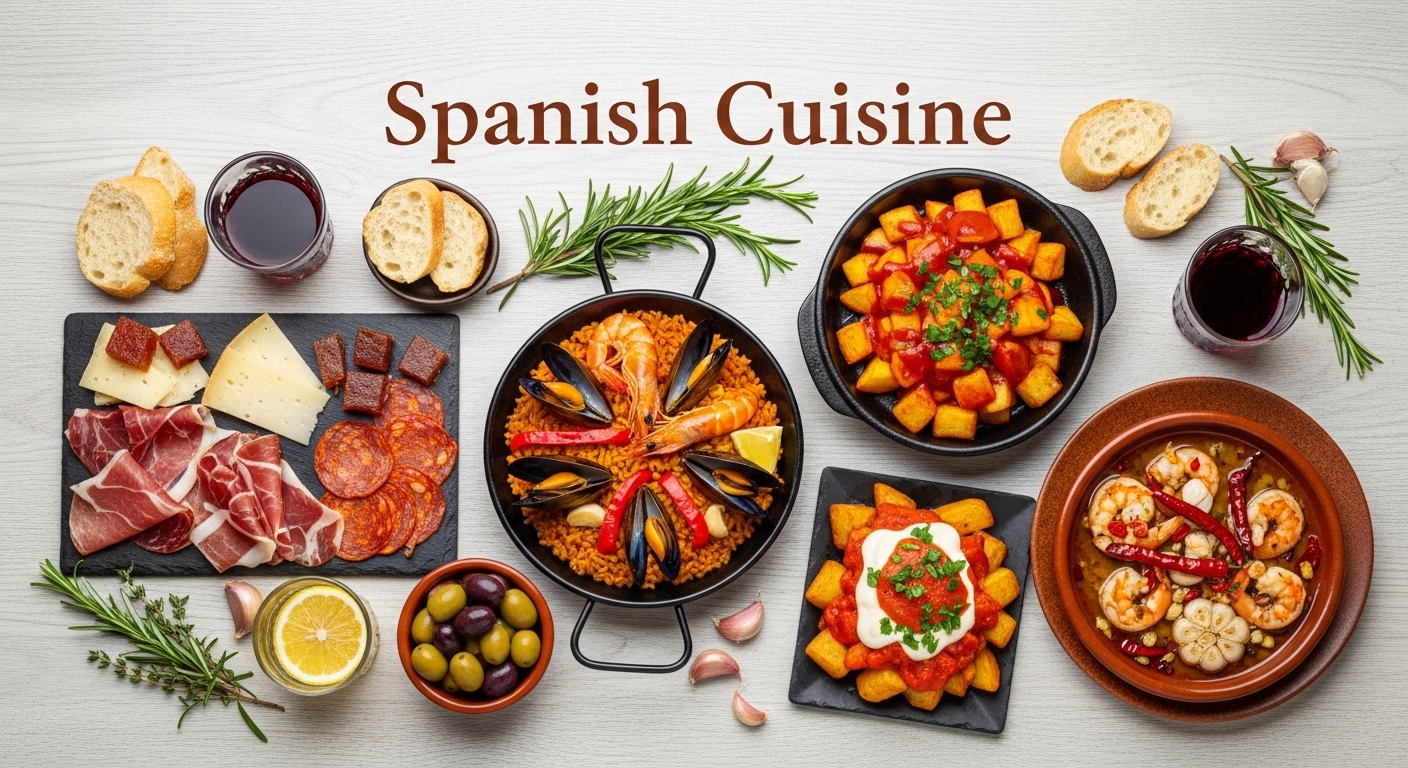
Where Spain Meets San Francisco
Spanish cuisine is one of the world’s great culinary traditions — bold, communal, deeply rooted in regional identity, and built around the pleasure of sharing. At the heart of it all is a philosophy that needs no translation: good food is better with good company, and both are better with something excellent in your glass.
The pairing of Spanish cuisine with craft beer is a natural one. The same values that define great Spanish cooking — quality ingredients, honest preparation, respect for tradition — are the values that drive serious brewing. When the two come together thoughtfully, the result is a dining experience greater than the sum of its parts.
The Soul of Spanish Cooking
Spanish cuisine is not one thing. It is a mosaic of regional traditions shaped by geography, climate, and centuries of cultural exchange. The rugged coast of the Basque Country gave the world pintxos and grilled fish. Andalusia contributed fried seafood, gazpacho, and flamenco nights in sun-warmed courtyards. Castile is the land of roast lamb and suckling pig. Catalonia blends French refinement with Mediterranean abundance.
What ties it all together is an unwavering commitment to the ingredient. Spanish cooks have long understood what farm-to-table advocates in California took decades to rediscover: that the best dish is almost always the simplest one, made with the finest produce, meat, or seafood you can find.
Olive oil, garlic, smoked paprika, saffron, sherry vinegar — these are not merely flavoring agents. They are the backbone of an entire culinary worldview.
Tapas: The Art of Small Plates
No discussion of Spanish cuisine is complete without tapas — the small, shareable plates that turn a meal into a social occasion. The word itself comes from the Spanish verb tapar, to cover, and the tradition is said to have begun with bartenders placing a small plate of food atop a glass of wine or sherry to keep out flies.
Whatever their origin, tapas became something far more important: a way of eating that encourages conversation, exploration, and generosity. You order several. You share. You eat slowly. You linger.
Classic tapas that have stood the test of time include:
- Tortilla Española — Spain’s great egg and potato omelette. Deceptively simple, endlessly satisfying. Every Spanish cook has their own method and defends it fiercely. The debate over whether the center should be runny or set is the kind of argument Spaniards have with genuine passion.
- Gambas al Ajillo — Shrimp sizzled in olive oil with garlic and a touch of dried chili. One of the most intoxicating dishes in the Spanish repertoire, as much about the fragrant oil as the shrimp themselves. Best eaten with crusty bread to soak up every last drop.
- Patatas Bravas — Crispy fried potatoes served with a bold, smoky tomato sauce and a cooling aioli. Humble ingredients, maximum pleasure.
- Albóndigas — Spanish meatballs, typically braised in a rich tomato and herb sauce. Comforting, deeply savory, and a perfect match for a malt-forward ale.
- Croquetas — Crispy-fried béchamel croquettes studded with jamón, salt cod, or mushrooms. A masterclass in contrast — crunchy outside, silky within.
- Pan con Tomate — Grilled bread rubbed with ripe tomato and drizzled with olive oil. It sounds too simple to be remarkable. It is remarkably good.
- Jamón Ibérico — The crown jewel of Spanish charcuterie. Dry-cured Iberian ham, sliced paper-thin, with a buttery, nutty richness that no other cured meat in the world quite matches. Best eaten at room temperature, on its own.
Paella: Spain’s Most Celebrated Dish
If tapas are the soul of Spanish dining, paella is its grand statement. Originating in the Valencia region on Spain’s eastern coast, paella is a rice dish cooked in a wide, shallow pan over open flame — traditionally over wood or orange branches — until the bottom layer develops a golden, caramelized crust called the socarrat. That crust is not an accident. It is the goal.
True Valencian paella is made with rabbit, chicken, green beans, and white beans — a far cry from the seafood versions that became famous abroad. But Spain’s coastal regions adapted the dish to their own larders, and today the world knows paella most often as a saffron-scented seafood spectacle featuring clams, mussels, shrimp, and squid.
What all paellas share is the rice — short-grain Bomba or Calasparra varieties, grown specifically for their ability to absorb enormous amounts of flavorful liquid without becoming mushy. The stock matters enormously. The sofrito — a slow-cooked base of tomato, onion, and garlic — matters enormously. The fire matters enormously.
Paella is not a dish that rewards shortcuts.
Empanadas: The Perfect Handheld
The empanada occupies a special place in the Spanish culinary tradition — a stuffed and baked or fried pastry that has traveled from Spain to Latin America and beyond, adapting to local ingredients wherever it lands while retaining its essential character.
In Spain, the Galician empanada is baked large and sliced like a pie, filled with tuna, peppers, and onions or braised pork with chorizo. In other regions, individual hand-sized empanadas are stuffed with spiced meat, cheese, or vegetables.
The beauty of the empanada is in the crust — thin, flaky, and slightly rich — and in the balance between pastry and filling. A well-made empanada is one of the most satisfying things you can eat standing up.
The Spanish Pantry: Ingredients Worth Knowing
Great Spanish cooking depends on a handful of exceptional pantry staples. Understanding them deepens the appreciation of every dish:
- Pimentón (Smoked Paprika) — Made from peppers that are dried and smoked over oak fires in the La Vera region of Extremadura. It comes in sweet (dulce), bittersweet (agridulce), and hot (picante) varieties. Its deep, smoky-sweet flavor appears in chorizo, patatas bravas, marinades, and stews.
- Saffron — The dried stigmas of the Crocus sativus flower, harvested by hand. Spain’s La Mancha region produces some of the world’s finest saffron — the ingredient that gives paella its golden color and haunting, floral depth.
- Sherry Vinegar — Aged in oak barrels in Jerez, sherry vinegar brings a mellow, complex acidity unlike any other vinegar. It is the secret behind many a Spanish vinaigrette and the finishing touch on countless dishes.
- Olive Oil — Spain is the world’s largest producer of olive oil, and Spanish varieties — Arbequina, Picual, Hojiblanca — each bring distinct character. In Spanish cooking, olive oil is not a cooking medium. It is an ingredient.
- Jamón — Spanish dry-cured ham ranges from the widely available Serrano to the extraordinary Ibérico de Bellota, made from free-range black Iberian pigs fattened on acorns. The difference in quality and price is vast. The difference in flavor is vaster.
- Chorizo — Spanish chorizo is a cured and dried sausage, intensely flavored with pimentón. It is not the same as Mexican chorizo — it is firmer, sliceable, and eaten as charcuterie as often as it is cooked. It perfumes any dish it enters.
Pairing Spanish Food with Craft Beer
Wine — particularly sherry, Rioja, and Albariño — has long been the default companion to Spanish food. But craft beer holds its own remarkably well, and in some cases surpasses wine as a pairing partner.
The carbonation in beer cuts through the richness of aioli and croquetas in a way that a still wine cannot. The bitterness of a well-hopped pale ale provides the same refreshing contrast as a dry sherry alongside jamón. The roasty depth of a stout echoes the char and smoke of a wood-fired grill.
Some combinations worth exploring:
- Tortilla Española + Pilsner — The clean crispness of a pilsner complements the egg-rich, potato-dense tortilla without overwhelming it.
- Gambas al Ajillo + West Coast IPA — The citrus and pine of a West Coast IPA mirror the garlic and chili heat, with enough bitterness to cut through the olive oil.
- Paella + Saison — The fruity, peppery complexity of a farmhouse saison brings out the saffron and sofrito in paella beautifully.
- Albóndigas + Amber Ale — The caramel malt sweetness of an amber ale matches the tomato-braised richness of Spanish meatballs.
- Jamón Ibérico + Barrel-Aged Beer — The nutty, oxidative complexity of barrel-aged beer finds a natural echo in the flavor of aged Ibérico ham.
- Chocolate Desserts + Stout — Spain’s love of dark chocolate and the roasty bitterness of a stout are one of the great natural pairings in the food-and-beer world.
Flamenco and the Spanish Table
Spanish cuisine has never existed in isolation from the culture that surrounds it. The Spanish table is theatrical — designed for long evenings, animated conversation, and the kind of unhurried pleasure that modern life tends to crowd out.
Flamenco — the passionate, percussive art form born in Andalusia — captures something essential about that spirit. The intensity, the emotion, the technical mastery disguised as pure spontaneity. Watching flamenco while eating tapas and drinking a glass of something excellent is not merely entertainment. It is an argument for a different, slower, richer way of spending an evening.
The Spanish Approach to Eating: A Philosophy Worth Adopting
Perhaps the most important thing Spanish cuisine offers is not a recipe or an ingredient but an attitude. The Spanish approach to eating is fundamentally unhurried. Lunch, not dinner, is traditionally the main meal of the day — a multi-course affair that stretches across the early afternoon. Dinner comes late, after 9pm, and is lighter. In between, there are snacks, coffee, and conversation.
The tapas tradition embodies this philosophy most completely. You do not order one dish and eat it alone. You order many, share them all, and discover something new in every bite. The meal is a reason to gather, not merely a biological necessity.
In a world that increasingly eats at desks, in cars, and over phones, that philosophy feels less like nostalgia and more like wisdom.