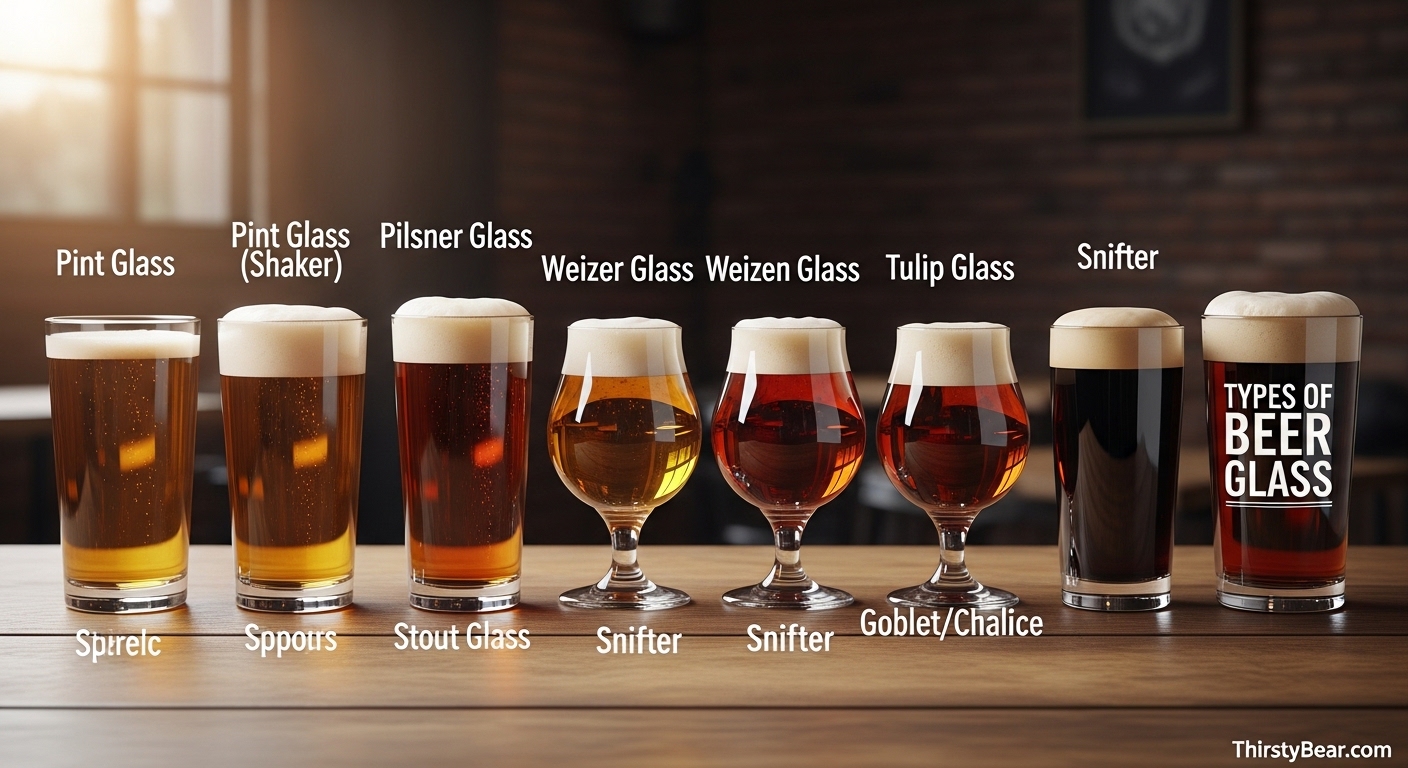
The right glass transforms how beer tastes, smells, and feels. Research shows 70-90% of what we perceive as taste actually comes from our sense of smell, which means the glass shape directly impacts flavor experience. Different types of beer glass are designed to enhance specific beer styles by capturing aromatics, maintaining carbonation, and creating the perfect head. Whether you’re building a home bar or simply want to enjoy your best non-alcoholic beers properly, understanding beer glassware makes every sip better.
Beer enthusiasts have known for centuries that glassware matters. The perfect glass elevates a good beer to greatness, while the wrong glass can mask subtle flavors and aromas. This comprehensive guide covers every major type of beer glass, explaining what each style is designed for and why it works.
Why Glass Shape Matters for Beer
Beer glassware isn’t just about aesthetics. The shape of a glass affects how volatile aroma compounds reach your nose, how carbonation bubbles form, and how the beer feels in your mouth. A tulip glass concentrates delicate hop aromatics for IPAs, while a wide-mouthed mug lets you quickly consume session lagers. The thickness of glass walls impacts temperature retention, and nucleation points etched into the bottom create streams of bubbles that refresh the beer with every sip. Understanding the science behind each glass type helps you choose the perfect vessel for any beer style.
The connection between smell and taste is profound. When you take a sip of beer, volatile compounds travel through the back of your mouth to your nasal cavity. This retronasal olfaction is responsible for most of what we perceive as flavor. A glass that captures and concentrates these aromatics, like a tulip or snifter, dramatically enhances the tasting experience.
Carbonation plays a crucial role too. The right glass maintains lively carbonation, which carries aromatics to your nose and creates a pleasing mouthfeel. Laser-etched nucleation points, found in many modern craft beer glasses, create continuous streams of bubbles that refresh the beer’s head and aroma with every sip.
Temperature control is equally important. Different beer styles shine at different temperatures, and glassware affects how quickly beer warms in your hand. A stemmed glass keeps body heat away from the beer, while a thick-walled mug provides insulation to keep cold beers colder longer.
Types of Beer Glass: The Essential Guide
There are dozens of beer glass styles, but most fall into a few main categories. Each glass type serves a specific purpose, from showcasing a beer’s color to concentrating its aroma. Here are the most important types of beer glass you need to know.
American Pint Glass
The American pint glass is the most ubiquitous beer glass in the United States. Holding 16 ounces, this cylindrical glass tapers slightly near the mouth and has thick, sturdy walls. Its stackable design makes it popular in bars and restaurants, while its durability makes it a practical choice for home use. The American pint glass works well for almost any beer style, including American ales, IPAs, lagers, and stouts.
The versatility of the American pint is its greatest strength. You can serve virtually anything in it, which is why it’s often called the “shaker” glass. Bartenders love them because they stack easily and resist breaking. Home drinkers appreciate that you can put them in the dishwasher without worry. At a typical pub or sports bar, the American pint is what you’ll get by default.
However, its wide mouth lets aromatics escape quickly, and it doesn’t do much to enhance a beer’s presentation. For casual drinking or session beers, it’s perfectly adequate. For showcasing special craft beers, you might want something more specialized. Hop-forward IPAs lose some of their aromatic punch in a standard pint glass, while delicate Belgian ales don’t get the aroma concentration they deserve.
Reddit homebrewers often recommend the American pint as one of three essential glasses for a starter home bar. It’s inexpensive, widely available, and works for most situations. If you only buy one type of beer glass, the American pint is a solid choice. Think of it as your everyday workhorse—the glass you reach for when you just want a beer without worrying about the perfect presentation.
Imperial Pint Glass (Nonic)
The Imperial pint glass holds 20 ounces and features a distinctive bulge near the rim. This design element, called a “nonic” (no-nick), serves a practical purpose: it prevents the rim from chipping when glasses clink together. The extra capacity provides more head space, which helps maintain a proper foam head on British ales and stouts.
British pub culture made the Imperial pint famous. Walk into any pub in London or Manchester, and this is the glass you’ll receive. The glass’s slightly tapered shape and robust construction feel substantial in hand, adding to the traditional pub experience. It’s ideal for British ales, stouts, porters, and any beer that benefits from a generous head of foam.
The Imperial pint has interesting history behind it. The British Weights and Measures Act of 1824 established the imperial system, including the 20-ounce pint. This became the standard throughout the British Empire and remains in use today. When you order a “pint” in the UK, you’re getting four more ounces than an American pint.
The main difference between American and Imperial pint glasses is capacity. The American pint holds 16 ounces while the Imperial holds 20. This extra volume makes a difference, especially with beers that have lots of foam. The additional head space lets you pour a full beer with proper foam without overflow. Both glasses are sturdy and stackable, but the Imperial’s extra volume and chipping resistance make it preferred in high-traffic pubs.
For home use, the Imperial pint is excellent for British-style beers. Bitters, milds, porters, and traditional stouts all shine in this glass. The extra capacity means you can pour a full bottle or can with room for head. If you enjoy British beer styles, an Imperial pint glass is worth adding to your collection.
Pilsner Glass
Pilsner glasses are tall, slender vessels designed specifically to showcase light-colored beers. Holding 12-16 ounces, these glasses feature a narrow base that widens toward the middle before tapering again at the mouth. This elegant shape displays the golden color and effervescence of pilsners and other light lagers to beautiful effect.
The tapered design serves a functional purpose too. The narrow base helps maintain carbonation, forcing bubbles to rise through a smaller column of beer. The wider middle allows you to admire the beer’s clarity and color. As you drink, the tapered mouth concentrates aromatics toward your nose, enhancing the hoppy notes characteristic of pilsners. Light lagers, wheat beers, and any beer where appearance matters benefit from a pilsner glass.
Pilsner originated in the Czech city of Plzen in 1842, and the glass style evolved alongside the beer. Brewers wanted a vessel that would showcase the beer’s brilliant clarity and golden color—the result of new bottom-fermenting yeast strains and lagering techniques. The pilsner glass became the perfect showcase for this revolutionary beer style.
Pilsner glasses are more fragile than pint glasses, and their narrow openings make swirling difficult. They’re not ideal for heavy, dark beers or anything you want to swirl and examine. But for showing off a crystal-clear pilsner or wheat beer, nothing beats the classic pilsner glass presentation. The visual appeal is undeniable—bubbles rising through golden beer in a slender, elegant glass.
German and Czech pilsners are the obvious candidates for this glass, but it works well for any light-colored lager. Helles, Dortmunder, kolsch, and even American craft lagers benefit from the pilsner glass presentation. If you enjoy lighter beer styles, a pilsner glass is a worthwhile addition to your glassware collection.
Tulip Glass
The tulip glass earns its name from its distinctive shape: a bulbous bottom that curves outward like a tulip before flaring at the lip. This design is perfect for Belgian ales, sour beers, and aromatic IPAs. The bulbous bowl allows room for a substantial head, while the flared lip directs aromatics toward your nose.
The tulip’s design is brilliant in its simplicity. The bulbous bowl provides space for a healthy foam head, which protects the beer from oxidation and traps aromatic compounds. As you drink, the tapered middle concentrates these aromatics, pushing them toward the flared lip. The flare then directs those aromatics right to your nose, enhancing flavor perception with every sip.
Belgian brewers created tulip glasses specifically for their complex, highly aromatic ales. The shape captures and concentrates volatile aroma compounds, making every sip more flavorful. The flared rim also helps maintain the beer’s head, which is crucial for enjoying the full sensory experience of Belgian dubbels, tripels, and quads. Belgian monks have understood this connection for centuries, developing glassware that enhances their carefully crafted beers.
Craft beer enthusiasts love tulip glasses for IPAs too. The bulbous bowl lets you swirl the beer to release hop aromatics, while the flared lip delivers those aromatics directly to your nose. Modern American IPAs, with their intense hop profiles, benefit enormously from this glass design. If you enjoy aromatic, complex beers, a tulip glass is one of the best investments you can make for your home bar.
Tulip glasses work exceptionally well with sour beers and wild ales. The complex fruity and funky aromatics of Belgian lambics, Flanders red ales, and American sour beers all benefit from the tulip’s aroma-concentrating design. For beer lovers who appreciate aromatic complexity, the tulip glass is indispensable.
Snifter
Snifters are designed for high-ABV beers like barleywines, imperial stouts, and Belgian quads. These glasses feature a short stem, wide bowl, and narrow top—similar to a brandy snifter. The wide bowl allows you to swirl the beer to release aromatics, while the narrow opening concentrates those aromas toward your nose.
The snifter’s design is all about concentrating aroma. High-alcohol beers are complex, with layers of flavor that reveal themselves slowly. The wide bowl provides surface area for swirling, which volatilizes aromatic compounds. The narrow opening then captures these compounds and directs them toward your nose. This is the same principle used in wine tasting, and it works equally well for strong beers.
Temperature control is crucial for strong beers. The short stem of a snifter lets you hold the bowl with your hand, gently warming the beer to release additional flavors. This intentional warming is actually desirable for high-ABV beers, which benefit from being served slightly warmer than lighter styles. A barleywine at 55-60F reveals more complexity than the same beer at 40F.
Snifters aren’t for session beers or anything you want to drink quickly. Holding an 8-12 ounce snifter of 12% barleywine is meant to be a slow, contemplative experience. These are beers meant for sipping and savoring, not gulping. The small capacity is intentional—you’re meant to finish the beer while it’s still pleasant to drink, before the alcohol becomes overwhelming.
If you enjoy sipping and savoring strong, complex beers, a snifter is essential. Many beer enthusiasts consider it one of the top three glasses for a serious home bar. Imperial stouts, barleywines, Belgian quadrupels, and old ales all shine in a snifter. For special occasion beers and after-dinner sippers, nothing beats a snifter.
Weizen Glass
The Weizen glass, also called a wheat beer glass, is designed specifically for German wheat beers like Hefeweizen and Weissbier. These tall, curved glasses hold 16-23 ounces and feature a graceful, hourglass shape. The design showcases the beer’s cloudy appearance from suspended yeast and creates an impressive head of foam.
The Weizen glass’s distinctive shape serves multiple purposes. The wide bottom allows plenty of room for the characteristic tall, fluffy head of wheat beers. The tapered middle concentrates aromatics toward the nose. The slightly flared lip helps maintain that impressive head while you drink. Together, these design elements create the perfect wheat beer experience.
German wheat beers are known for their banana and clove notes from specific yeast strains. The Weizen glass’s shape concentrates these aromatics while maintaining the beer’s characteristic tall, fluffy head. The curved silhouette looks elegant and traditional, making it perfect for serving authentic German wheat beers. Bavarian brewers have been serving wheat beer in similar glasses for centuries.
The cloudiness of wheat beer is part of its charm. Traditional German wheat beers are bottle-conditioned with yeast in the bottle. When poured, the yeast creates a hazy, cloudy appearance that wheat beer lovers appreciate. The Weizen glass’s transparent design showcases this cloudiness beautifully, turning the beer itself into part of the visual presentation.
While the Weizen glass is highly specialized, it performs its job perfectly. If you enjoy wheat beer styles, a Weizen glass is worth owning. The dramatic presentation and aroma enhancement make it a favorite among wheat beer enthusiasts. Hefeweizen, dunkelweizen, weizenbock, and even American wheat beers all benefit from this specialized glass.
Beer Mug (Dimple Mug)
Beer mugs are the workhorses of beer glassware. Featuring thick walls, sturdy handles, and often a dimpled pattern on the exterior, these glasses are designed for durability and temperature retention. A standard beer mug holds 16-20 ounces, making it perfect for lagers, Oktoberfest beers, and casual drinking.
The thick walls of a beer mug provide excellent insulation, keeping your beer cold longer. This is especially important for session drinking, where you want your beer to stay refreshing from start to finish. The handle lets you hold the mug without warming the beer with your hand heat—a simple but effective design solution that’s been used for centuries.
Dimple mugs, with their distinctive texture, add a classic European pub feel to the drinking experience. The dimples aren’t just decorative—they increase surface area and provide grip, making the mug easier to hold. German and British pubs have used dimpled mugs for generations, and they’ve become synonymous with traditional beer culture.
Beer mugs aren’t ideal for aromatic or delicate beers. The wide mouth lets aromatics escape quickly, and the utilitarian design doesn’t enhance presentation. But for session lagers, Oktoberfest celebrations, or any situation where durability and cold retention matter most, a beer mug is hard to beat. Many beer lovers keep a set of mugs specifically for outdoor events and parties.
The beer mug’s strength is its versatility and durability. You can clink mugs together enthusiastically without worry. They’re perfect for camping, backyard barbecues, and parties where glass breakage is a concern. While serious beer enthusiasts might prefer more specialized glassware, there’s always a place for a sturdy beer mug in any collection.
IPA Glass
The IPA glass is a specialized design created specifically for India Pale Ales and other hoppy beers. Developed through collaboration between brewers and glassware companies like Spiegelau, these glasses feature a unique wave-like design and a laser-etched nucleation point at the bottom. The glass holds 15-19 ounces and is engineered to maximize hop aromatics.
The distinctive shape of an IPA glass serves multiple purposes. The narrow base maintains carbonation, forcing bubbles to rise through a smaller column. The wave-like middle creates turbulence as you drink, releasing hop oils and aromatics that would otherwise remain trapped. The laser-etched nucleation point generates streams of bubbles that continuously refresh the beer’s head and aroma. The flared lip delivers those concentrated aromatics directly to your nose.
The development of the modern IPA glass is a fascinating story. Spiegelau partnered with Sierra Nevada and Dogfish Head to create a glass specifically optimized for IPA. They tested multiple designs with actual brewers and beer enthusiasts, using sensory analysis to determine which shape best showcased hop aromatics. The result was the distinctive, wave-like design that’s become popular among craft beer enthusiasts.
Reddit beer enthusiasts frequently mention the Spiegelau IPA glass as a top recommendation for hoppy beer lovers. While it’s specialized and not suitable for all beer styles, it performs exceptionally well for its intended purpose. The difference between an IPA in a standard pint glass versus a dedicated IPA glass is noticeable to even casual drinkers.
If you drink a lot of IPAs, pale ales, or other hop-forward beers, an IPA glass is worth adding to your collection. Modern American IPAs, with their intense tropical and citrus hop character, really shine in this specialized glass. Double IPAs, New England IPAs, and West Coast IPAs all benefit from the IPA glass’s aroma-enhancing design.
Stout Glass
Stout glasses are designed specifically for dark beers like stouts and porters. These glasses typically feature a narrow base that widens toward the top, sometimes with a stem. The design showcases the dark, rich color of the beer while creating and maintaining a proper head of foam. Standard capacity ranges from 12-20 ounces.
The shape of a stout glass isn’t just about appearance. The narrowing near the bottom helps maintain carbonation, while the wider top allows for a generous head of foam. This foam protects the beer from oxygen and traps aromatics, which is crucial for enjoying the roasted, chocolate, and coffee notes characteristic of stouts. Dark beers have different aromatic compounds than light beers, and the stout glass is designed to capture these specific aromatics.
Some stout glasses, like the famous Guinness pint, have specific dimensions engineered to create the perfect cascade effect when pouring. The nitrogenated stout cascades beautifully in the glass, creating the iconic swirling pattern that settles into a creamy white head atop dark beer. This visual drama is part of the stout experience, and the glass is designed to maximize it.
The famous Guinness pint glass is actually a modified tulip design with a narrower base and wider top. This shape, combined with nitrogen gas and the famous “surge” pour technique, creates Guinness’s signature presentation. Other breweries have developed their own stout glasses, each optimized for their specific beer characteristics.
While you can drink stout from any glass, a dedicated stout glass enhances the experience. The visual appeal of dark beer in a properly shaped glass adds to the enjoyment. For fans of imperial stouts, oatmeal stouts, and porters, a stout glass is a worthy addition to any glassware collection. The difference in aroma and flavor perception is real, especially for highly roasted beers.
Goblet (Chalice)
Goblets and chalices are elegant, stemmed glasses designed for Belgian strong ales, dubbels, tripels, and other complex brews. These glasses feature wide bowls and often ornate designs, making them the most ceremonial of beer glassware. Capacity typically ranges from 12-20 ounces, with some larger chalices holding even more.
The wide bowl of a goblet allows for substantial carbonation and a healthy head of foam. This is important for bottle-conditioned Belgian ales, which naturally have lively carbonation. Belgian brewers have been using this style of glassware for centuries, understanding that proper carbonation is essential to the beer’s character. The stem keeps your hand away from the bowl, preventing body heat from warming the beer.
Many goblets feature decorative etching inside the bowl, which creates nucleation points to maintain head and carbonation. These tiny imperfections in the glass surface provide sites for bubble formation, creating a continuous stream of bubbles that refresh the beer’s head. This is especially important for high-carbonation Belgian ales, which can go flat quickly without proper glassware.
Chalices are essentially larger, more ornate goblets—often reserved for the strongest and most prestigious Belgian beers. Trappist breweries like Westvleteren and Rochefort serve their beers in distinctive chalices that have become iconic in the beer world. The ritual aspect of drinking from a chalice adds to the experience, making each beer feel special.
While they’re beautiful and traditional, the stem can be fragile, and the wide bowl means your hand’s heat can affect the beer if you hold it by the bowl. For special occasions or when you want to elevate the beer-drinking experience, a goblet or chalice is perfect. Belgian strong ales, quadrupels, and abbey ales all shine in these elegant glasses.
Stange (Cylinder) Glass
The Stange, also called a cylinder or pole glass, is a traditional German glass for delicate beers like Kolsch and Altbier. These exceptionally narrow, tall glasses hold only 6-10 ounces. The design is deliberately minimal to concentrate subtle aromatics and maintain carbonation in delicate beer styles.
The Stange’s minimalist design serves a specific purpose. Delicate German beers have subtle aromatics that would be lost in a wider glass. The narrow opening captures these aromatics and delivers them directly to your nose. The tall, slender shape showcases the beer’s clarity and color, while the small capacity means you finish the beer while it’s still fresh and properly carbonated.
In Cologne, Germany, Kolsch is traditionally served in Stange glasses by waiters called “Köbes” who circulate through pubs serving fresh glasses continuously. The small size isn’t a drawback—it’s intentional. You’re meant to drink the beer quickly while it’s at its peak freshness and carbonation. When you finish one, another appears automatically.
Stange glasses force you to drink slowly and appreciate subtle flavors. The narrow opening captures delicate aromatics that would be lost in a wider glass, while the tall, slender shape showcases the beer’s clarity. The small capacity means you finish the beer while it’s still fresh and properly carbonated, which is crucial for delicate German styles.
While Stange glasses are limited in their application, they’re perfect for their intended purpose. If you enjoy Kolsch, Altbier, or other delicate German lagers, a Stange glass is essential. The traditional presentation adds authenticity to the experience, and the aroma enhancement is noticeable even to casual drinkers.
Willi Becher
The Willi Becher is the standard pint glass of Germany, named after its inventor Wilhelm. This versatile glass holds 16-20 ounces and features a gentle taper from base to mouth with a slight reinforcement near the rim. It’s the go-to glass for German lagers, pilsners, and Helles throughout Germany.
The Willi Becher represents a middle ground between the American pint’s versatility and more specialized designs. The gentle taper helps maintain carbonation and head, while the sturdy construction makes it practical for everyday use. The reinforced rim prevents chipping, similar to the British nonic pint. It’s elegant enough for fine German lagers but durable enough for casual drinking.
Despite being the most common glass in German beer culture, the Willi Becher is relatively unknown outside Germany. This represents a content gap in many English-language beer guides. Walk into any beer hall in Munich, Frankfurt, or Berlin, and you’ll likely be served a Willi Becher. It’s the glass that Germans reach for by default, much like Americans reach for the standard shaker pint.
German beer purists value the Willi Becher for its balance of form and function. The taper is subtle enough not to be ostentatious but pronounced enough to maintain head. The reinforcement near the rim adds durability without being obvious. It’s a utilitarian design that has stood the test of time through decades of use in German beer halls.
If you enjoy German lagers or want an alternative to the American pint, the Willi Becher is an excellent addition to your glassware collection. It works particularly well for pilsners, helles, dortmunder, and other German lager styles. The Willi Becher proves that sometimes the best design is one that doesn’t call attention to itself—it just works.
How Glass Shape Affects Beer Experience?
The science behind beer glassware is fascinating. When beer is poured into a glass, several factors interact to create the drinking experience. The glass shape determines how aroma compounds reach your nose, how carbonation behaves, and how the beer feels in your mouth.
Nucleation is the formation of carbonation bubbles, often triggered by microscopic imperfections or laser-etched points in the glass bottom. These nucleation points create streams of bubbles that continuously refresh the beer’s head and aroma. The IPA glass and many stout glasses feature engineered nucleation points specifically for this purpose. Without proper nucleation, beer can go flat quickly and lose its aromatic intensity.
The physics of bubble formation is remarkable. Carbon dioxide is more soluble in cold liquid than warm. As beer warms slightly in the glass, CO2 comes out of solution and forms bubbles. These bubbles need a nucleation site—a microscopic imperfection where they can form. Once formed, bubbles rise through the beer, carrying aromatic compounds to the surface. A well-designed glass maximizes this process.
Volatile aroma compounds are released as beer warms and is disturbed by swirling or drinking. A tulip glass or snifter concentrates these compounds and directs them toward your nose, enhancing flavor perception. A wide-mouthed mug lets aromatics escape quickly, which is fine for simple lagers but not ideal for complex ales. The difference in aroma concentration between glasses can be dramatic.
Head retention affects mouthfeel and aroma delivery. A glass that maintains a healthy foam head protects the beer from oxygen and provides a creamy texture. The Imperial pint and goblet excel at head retention, while American pint glasses struggle with it for highly carbonated beers. Foam isn’t just aesthetic—it’s functional, trapping aromatics and protecting the beer beneath.
Temperature control is often overlooked but crucial. A glass with a stem keeps your hand away from the beer, preventing unwanted warming. A mug’s thick walls insulate the beer, keeping it cold longer. For strong beers meant to be sipped slowly, a snifter lets you intentionally warm the beer with your hand to release additional flavors. Different beer styles require different serving temperatures, and glassware affects how quickly beer reaches its ideal temperature.
The psychology of presentation matters too. Beer served in an appropriate glass simply tastes better to most people. This isn’t imagination—expectations affect perception. When beer is presented in a glass that signals quality and care, we’re primed to enjoy it more. This is why fancy restaurants use specialized glassware, and it applies equally to beer.
Essential Glasses for a Home Bar
You don’t need a dozen different glasses to enjoy beer properly. Reddit beer enthusiasts and homebrewers recommend three essential glass types for a starter home bar: an American pint, a snifter, and a tulip. These three glasses cover 90% of beer styles you’ll encounter.
The American pint handles session ales, lagers, and casual drinking. It’s your everyday glass for when you just want a beer without ceremony. The snifter is perfect for strong, complex beers you want to sip slowly. Imperial stouts, barleywines, and Belgian quads all shine in a snifter. The tulip excels with aromatic beers like IPAs and Belgian ales, capturing and concentrating the delicate aromatics that make these styles special.
With just these three glasses, you’re prepared for virtually any beer experience. You can serve a light lager in your American pint, a barrel-aged stout in your snifter, and a double IPA in your tulip. This minimalist approach keeps your collection manageable while ensuring every beer gets appropriate treatment.
Expand from there based on your preferences. If you love wheat beers, add a Weizen glass. If you drink lots of IPAs, an IPA glass is worth the investment. If German lagers are your favorite, a Willi Becher or pilsner glass will enhance your enjoyment. Build your collection around the beer styles you actually drink rather than trying to own every possible glass.
Quality matters more than quantity. A few well-made glasses from reputable manufacturers will serve you better than a dozen cheap glasses. Look for glasses with thin lips (unless it’s a mug) and proper clarity. Avoid decorative gimmicks that might affect the beer’s presentation. The best beer glassware is elegant, functional, and designed specifically for beer.
Frequently Asked Questions About Types of Beer Glass
What are the types of beer glasses?
The main types of beer glasses include American pint (16 oz), Imperial pint (20 oz), pilsner glass, tulip glass, snifter, weizen glass, beer mug, IPA glass, stout glass, goblet/chalice, stange, and Willi Becher. Each glass is designed for specific beer styles to enhance aroma, carbonation, and presentation.
Why does glass shape matter for beer?
Glass shape matters because 70-90% of taste perception comes from smell. A tulip glass or snifter concentrates aroma compounds toward your nose, enhancing flavor. The shape also affects head retention, carbonation behavior, and temperature control, all of which impact the overall drinking experience.
What glass should I use for IPA?
An IPA glass is specifically designed for India Pale Ales, featuring a wave-like shape and laser-etched nucleation point to maximize hop aromatics. A tulip glass also works excellently for IPAs, while an American pint is acceptable for casual drinking.
What’s the difference between American and Imperial pint glasses?
The American pint glass holds 16 ounces and has a simple cylindrical shape. The Imperial pint holds 20 ounces and features a bulge near the rim (called a nonic) that prevents chipping. The Imperial pint is traditional in British pubs while the American pint is standard in the United States.
What glass is best for wheat beer?
A Weizen glass is specifically designed for German wheat beers like Hefeweizen and Weissbier. This tall, curved glass showcases the cloudy appearance and maintains a tall, fluffy head while concentrating the banana and clove aromatics characteristic of wheat beers. A Berliner Weisse also benefits from this glass style.
Conclusion
Understanding types of beer glass transforms how you enjoy every beer. The right glass enhances aroma, maintains proper carbonation, and elevates the overall experience. Start with three essential glasses—an American pint, a snifter, and a tulip—and build your collection based on the beer styles you love most. Whether you’re drinking a simple lager or a complex Belgian quad, proper glassware makes a noticeable difference.
The science behind beer glassware is well-established. Glass shape affects aroma delivery, carbonation behavior, head retention, and temperature control. Different beer styles benefit from different glass designs, which is why serious beer enthusiasts have collections of specialized glasses. You don’t need to own every possible glass, but having the right tools for the beers you drink most will enhance your enjoyment significantly.
Invest in quality glassware, treat it with care, and discover how much better beer tastes when served in the perfect vessel. Hand-wash your glasses when possible, avoid extreme temperature changes, and store them properly to prevent chips and cracks. With the right glassware and proper care, you’ll get more enjoyment from every beer you drink.