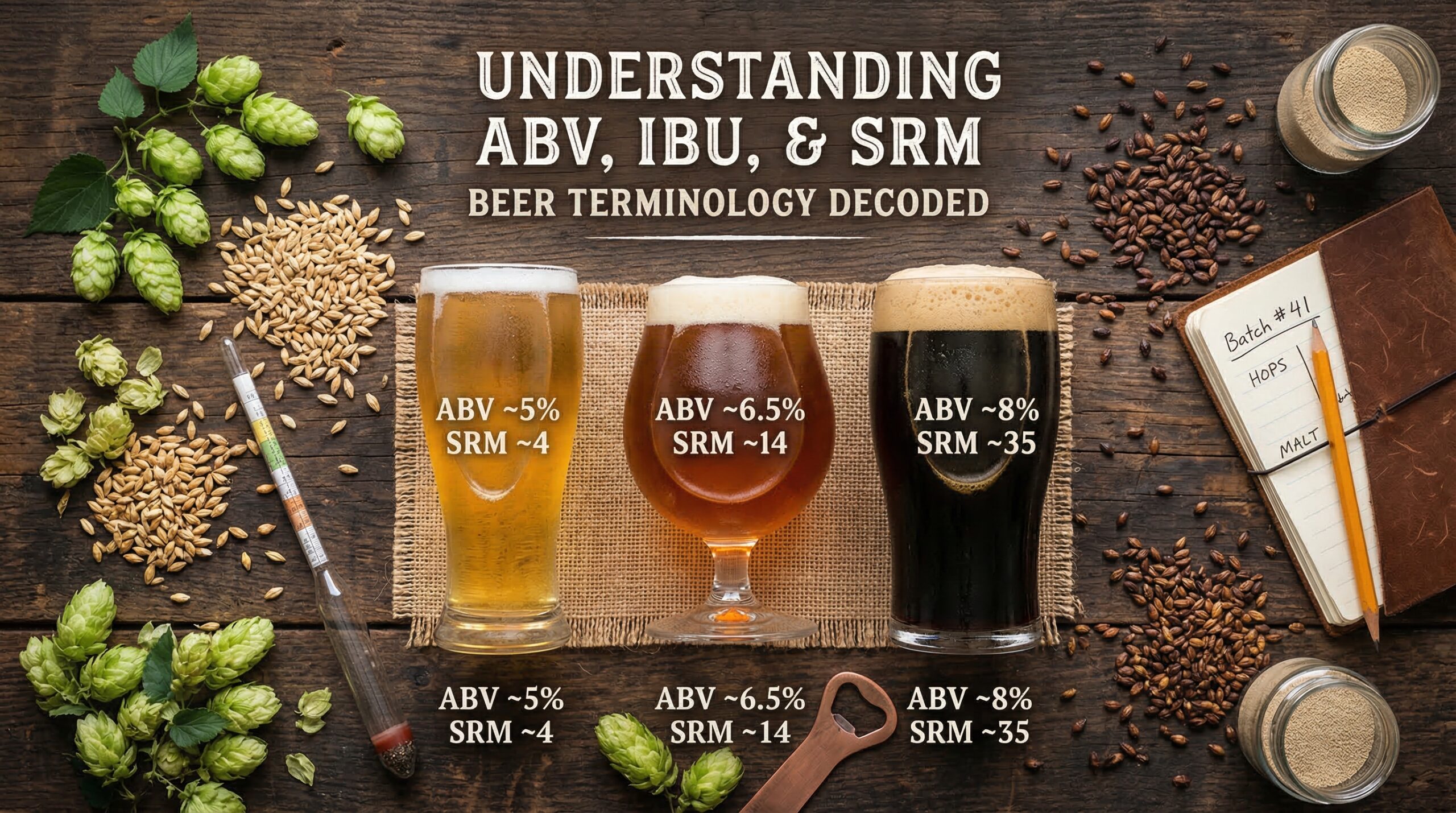
Ever stared at a beer label and wondered what those three-letter acronyms actually mean? You are not alone. Every day, thousands of beer drinkers pick up a bottle, see ABV 7.5%, IBU 65, SRM 15, and have no clue what any of it means for their drinking experience.
I remember the first time I encountered these numbers. I was at a craft brewery, staring at a chalkboard menu that looked more like a chemistry exam than a drink list. I ordered blindly, ended up with a 10% Imperial Stout when I wanted something light, and learned my lesson the hard way.
Here is the truth: ABV, IBU, and SRM are not just random codes. They are your cheat sheet for knowing exactly what you are about to drink before the first sip touches your lips. These beer terminology metrics tell you about alcohol strength, hop bitterness, and color intensity. Let me decode them for you.
What is ABV (Alcohol by Volume)?
ABV stands for Alcohol by Volume, and it tells you exactly what percentage of your beer is pure alcohol. This is the number that determines how strong your beer will hit you. Think of it as the horsepower rating for your drink.
Technically, ABV is calculated by measuring the difference between your beer’s Original Gravity (sugar content before fermentation) and Final Gravity (sugar content after fermentation). The more sugar the yeast converts to alcohol, the higher your ABV climbs. A hydrometer is the tool brewers use to take these measurements.
The ABV Scale Explained
Not all beers are created equal when it comes to alcohol content. Here is how the ABV scale breaks down:
Under 3% ABV: These are your near-beers and lightest session options. They exist but are relatively rare in craft brewing.
3-4% ABV: Light and sessionable. American Light Lagers, some Wheat Beers, and British Bitters live here. You can have a few without feeling it too hard.
4-6% ABV: The standard range for most beer styles. Pilsners, Pale Ales, Amber Ales, and Stouts typically fall in this bracket. This is your everyday drinking zone.
6-9% ABV: Strong territory. IPAs, Double IPAs, and stronger Belgian styles start appearing here. One pint of an 8% beer equals nearly two standard drinks.
Above 9% ABV: Heavy hitters. Imperial Stouts, Barleywines, Belgian Quads, and Triple IPAs. These are sip-and-savor beers, not chugging material.
As beer expert Randy Mosher notes in his book “Tasting Beer,” ABV affects more than just intoxication. Higher alcohol beers have a warming sensation, thicker mouthfeel, and often more complex flavors from the increased malt needed to produce that alcohol.
What is IBU (International Bitterness Units)?
IBU stands for International Bitterness Units, and it measures the concentration of hop-derived bittering compounds in your beer. Specifically, it measures parts per million of isohumulone, the primary compound that creates bitter flavor.
Here is where it gets interesting: IBU is a scientific measurement, not a taste measurement. A beer with 80 IBUs might taste less bitter than one with 50 IBUs. Why? Because malt sweetness can mask hop bitterness completely. An Imperial Stout with 60 IBUs often tastes less bitter than a Pale Ale with 40 IBUs because the stout has so much more sweet malt character.
The IBU Scale Breakdown
IBUs typically range from 0 to over 100, though most beers fall between 5 and 100. Here is what those numbers mean:
5-20 IBU: Mildly bitter. Light Lagers, Hefeweizens, and Cream Ales live here. These are gateway beers for people who say they do not like bitter flavors.
20-40 IBU: Moderately bitter. Amber Ales, Irish Reds, and Porters fit in this range. You will notice the hops, but they will not overwhelm.
40-60 IBU: Noticeably bitter. This is IPA territory. American Pale Ales, standard IPAs, and ESBs (Extra Special Bitters) typically fall here.
60-80 IBU: Strong bitterness. Double IPAs, Imperial IPAs, and aggressively hopped Pale Ales. Hop heads love this zone.
Above 80 IBU: Extreme bitterness. Some Triple IPAs and specialty beers push into this range. Your tongue will know it is there.
One thing I learned from homebrewing forums: do not judge a beer by IBU alone. The BU:GU ratio (which I will explain later) matters more for predicting how bitter a beer will actually taste.
What is SRM (Standard Reference Method)?
SRM stands for Standard Reference Method, and it measures beer color. The scale runs from 1 (nearly transparent) to 40+ (pitch black). SRM works by shining light through a beer sample and measuring how much light gets absorbed. The more light blocked, the higher the SRM number.
SRM comes from the color of the malt used. Pale malts make light beers. Roasted malts, chocolate malts, and black malts create darker colors. Crystal malts add amber to reddish tones.
The SRM Color Scale
Here is what SRM numbers look like in your glass:
1-4 SRM: Pale straw to yellow. American Light Lagers, Pilsners, and some Wheat Beers. You can read a newspaper through these.
5-8 SRM: Gold to amber. Pale Ales, Belgian Tripels, and some IPAs. Still fairly transparent.
9-14 SRM: Amber to copper. Amber Ales, Oktoberfests, and Scottish Ales. Rich color, slight haze possible.
15-20 SRM: Deep amber to brown. Brown Ales, Porters, and some Red Ales. Getting into darker territory.
21-30 SRM: Dark brown to black. Stouts and Schwarzbiers. Light will not pass through easily.
Above 30 SRM: Deep black. Imperial Stouts and some extreme dark beers. These look like coffee or motor oil.
In Europe, you might see EBC (European Brewing Convention) instead of SRM. The two scales measure the same thing but use different formulas. Roughly, EBC equals SRM multiplied by 1.97.
ABV, IBU, and SRM Comparison Table
This table gives you quick reference ranges for common beer styles. Use it to decode any beer label you encounter:
| Beer Style | ABV Range | IBU Range | SRM Range |
|---|---|---|---|
| American Light Lager | 3.0-4.2% | 5-15 | 2-4 |
| Pilsner | 4.5-5.5% | 25-45 | 3-5 |
| Wheat Beer | 4.0-5.5% | 10-20 | 3-6 |
| Pale Ale | 4.5-6.0% | 30-50 | 5-12 |
| IPA | 5.5-7.5% | 40-70 | 6-14 |
| Double/Imperial IPA | 7.5-10.0% | 60-120 | 6-14 |
| Amber Ale | 4.5-6.0% | 25-40 | 10-17 |
| Brown Ale | 4.5-6.5% | 20-30 | 15-25 |
| Porter | 4.0-6.0% | 20-40 | 20-30 |
| Stout | 4.0-7.0% | 30-60 | 25-40 |
| Imperial Stout | 8.0-12.0% | 50-90 | 30-40+ |
| Belgian Tripel | 7.5-9.5% | 20-40 | 4-7 |
Keep this table handy. Next time you see a beer with ABV 6.5%, IBU 35, and SRM 12, you will know you are looking at something similar to an American Pale Ale or Amber Ale.
Using the BU:GU Ratio for Hop Balance
BU:GU stands for Bitterness Units to Gravity Units. It is a simple ratio that tells you whether a beer is balanced, hop-forward, or malt-forward. Homebrewers swear by this metric because it predicts perceived bitterness better than IBU alone.
Here is how to calculate it: Divide the IBU by the last two digits of the Original Gravity (OG). For example, a beer with 40 IBU and OG 1.060 gives you 40 divided by 60, which equals 0.67.
Interpret the BU:GU ratio like this:
Below 0.4: Malt-forward. The beer will taste sweet with minimal bitterness. Many Belgian styles and malt-heavy Amber Ales fall here.
0.4 to 0.6: Balanced. The malt sweetness and hop bitterness are in harmony. Classic English Bitters and balanced Pale Ales typically hit this range.
Above 0.6: Hop-forward. You will notice the bitterness first. Most American IPAs sit between 0.7 and 1.0.
Above 1.0: Extremely hop-forward. These beers are aggressively bitter. Some Double IPAs and Imperial IPAs push into this territory.
The beauty of BU:GU is that it accounts for the malt backbone. A 60 IBU Imperial Stout with high OG might have a ratio of 0.5 (balanced), while a 60 IBU IPA with lower OG could hit 0.9 (very bitter). Same IBU, totally different drinking experience.
How to Use These Metrics Together
Now that you understand ABV, IBU, and SRM individually, here is how to read them together on a beer label.
Start with ABV to gauge strength. Under 5% means sessionable and easy drinking. Over 7% means slow down and savor. Over 9% means this is a special occasion beer.
Check IBU for bitterness guidance, but remember the malt factor. High IBU with high ABV often means the bitterness is balanced by malt sweetness. High IBU with low ABV means prepare for a hop punch.
Look at SRM to set color expectations. Light SRM usually means crisp and refreshing. Dark SRM suggests roasty, chocolate, or coffee flavors. Amber SRM indicates caramel and toffee notes.
Here are some real-world examples:
ABV 4.5%, IBU 12, SRM 3: Light, low bitterness, pale color. Think American Wheat Beer or Hefeweizen. Refreshing and approachable.
ABV 6.5%, IBU 65, SRM 8: Moderate strength, high bitterness, amber color. Classic American IPA territory. Expect citrus and pine hop flavors.
ABV 9%, IBU 70, SRM 35: Strong, moderately bitter, very dark. Imperial Stout range. The high ABV means plenty of malt to balance those IBUs.
The more you practice reading these numbers, the better you will get at predicting what a beer tastes like before you buy it. No more surprise Imperial Stouts when you wanted a light lager.
Bonus: The 3-30-300 Beer Storage Rule
Here is a bonus metric that has nothing to do with drinking but everything to do with keeping your beer fresh. It is called the 3-30-300 rule, and it explains how temperature affects beer spoilage.
The rule works like this:
3 days at 90°F: That is how long it takes for beer to spoil if left in a hot car or garage in summer. The heat accelerates oxidation and creates off-flavors. Your beer will taste like cardboard and wet paper.
30 days at 72°F: Room temperature storage for a month causes noticeable degradation. The beer is not spoiled, but it has lost its fresh hop character and developed some stale flavors.
300 days at 38°F: Proper refrigeration keeps beer fresh for nearly a year. Cold temperatures slow oxidation and preserve the intended flavor profile.
The lesson is simple: treat beer like milk, not like wine. Keep it cold. If a store keeps their craft beer section at room temperature, that beer is aging fast. Buy from refrigerated cases when possible, and never let your beer sit in a hot car.
Hop-forward styles like IPAs are especially sensitive to heat and light. The compounds that create those wonderful citrus and pine aromas break down quickly when warm. Darker, higher ABV beers like Imperial Stouts handle temperature fluctuations better, but they still prefer the cold.
Understanding Beer Terminology ABV IBU SRM: Frequently Asked Questions
What is ABV vs IBU vs SRM?
ABV (Alcohol by Volume) measures the percentage of alcohol in your beer. IBU (International Bitterness Units) measures hop bitterness concentration. SRM (Standard Reference Method) measures beer color from pale to dark. Together they tell you about a beer’s strength, bitterness level, and appearance.
What does 35 IBU mean?
An IBU of 35 means moderate bitterness. You will notice the hop character, but it will not overwhelm your palate. Most Pale Ales and Amber Ales fall in the 30-40 IBU range. The perceived bitterness also depends on malt sweetness – 35 IBU in a malty Amber Ale tastes less bitter than 35 IBU in a crisp Pilsner.
What is the difference between ABV and IBU?
ABV measures alcohol content as a percentage of volume. IBU measures hop bitterness in parts per million of isohumulone. ABV tells you how strong the beer is and how fast you will feel the alcohol. IBU tells you how bitter the beer tastes from hops. They measure completely different characteristics.
Does higher IBU mean more bitter taste?
Not always. While higher IBU means more bittering compounds, malt sweetness can mask bitterness. A 60 IBU Imperial Stout often tastes less bitter than a 40 IBU Pale Ale because the stout has much more residual sugar. Use the BU:GU ratio for a better prediction of perceived bitterness.
What is a good ABV for beginners?
Beginners should start with beers in the 4-6% ABV range. This includes most Pilsners, Wheat Beers, and Pale Ales. These provide flavor complexity without overwhelming alcohol warmth. Save the 8%+ Imperial beers for after you have developed your palate and know your tolerance.
Conclusion: Understanding Beer Terminology ABV IBU SRM
You now have everything you need to decode any beer label you encounter. ABV tells you the alcohol strength and how the beer will hit you. IBU gives you a scientific measure of hop bitterness, though malt plays a huge role in how bitter it actually tastes. SRM shows you the color, which hints at the malt flavors inside.
Use these metrics together, and you will never be surprised by a beer again. Check the comparison table when you are unsure. Calculate the BU:GU ratio when you want to know if a beer is balanced. And remember the 3-30-300 rule to keep your beer fresh.
The best way to learn is to practice. Next time you are at a bar or bottle shop, read the labels before you order. Compare the numbers to what you taste. Soon you will be the friend who can predict exactly what a beer will taste like before anyone takes a sip.