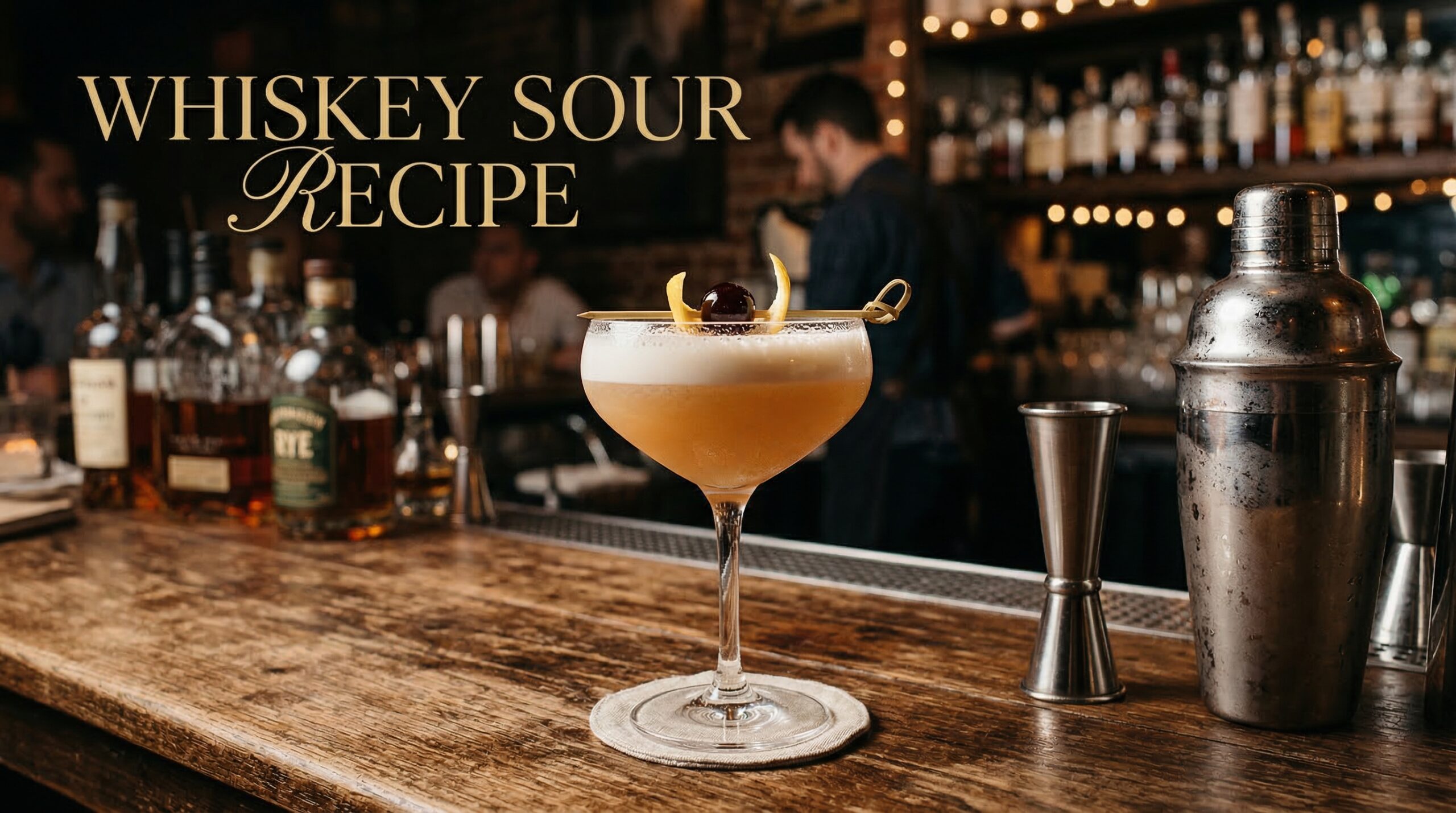
There’s something timeless about a perfectly balanced whiskey sour. This classic cocktail has been a staple in bars and homes for over 150 years, and for good reason. The combination of whiskey, fresh citrus, and sweetener creates a drink that’s both refreshing and complex. Whether you’re a complete beginner or looking to refine your technique, this whiskey sour recipe will walk you through everything you need to know to make this iconic drink at home.
In this guide, I’ll share the exact measurements, explain the famous dry shake technique, and help you decide whether to use egg white (and why). If you enjoy exploring classic cocktails, you might also want to check out our lychee martini recipe for another sophisticated option.
What Is a Whiskey Sour?
A whiskey sour is one of the original cocktails, belonging to the “sour” family of drinks that combine a base spirit with citrus juice and a sweetener. The formula is beautifully simple: whiskey (typically bourbon or rye), fresh lemon juice, and simple syrup. Many recipes also include egg white, which creates a silky, frothy texture on top.
The whiskey sour first appeared in print in the 1860s, though its roots likely stretch back even further. Jerry Thomas included a version in his 1862 bartending guide, cementing its place in cocktail history. What makes this drink special is how it balances three fundamental elements: strong (whiskey), sour (lemon), and sweet (syrup). When done right, none of these overpowers the others.
This drink is perfect for home bartenders because it requires minimal equipment and ingredients, yet delivers restaurant-quality results. It’s also incredibly versatile. You can adjust the ratios to your taste, swap ingredients for variations, and even prepare it in batches for parties.
Classic Whiskey Sour Recipe
Before we dive into the technique, let’s gather everything you need. The beauty of this cocktail lies in its simplicity, but that also means quality ingredients matter more than ever.
Ingredients
Here’s what you’ll need for one serving:
- 2 oz bourbon or rye whiskey – Bourbon gives a sweeter, richer flavor while rye adds spicier notes. Either works beautifully.
- 3/4 oz fresh lemon juice – Must be freshly squeezed. Bottled juice will noticeably diminish the quality.
- 1/2 to 3/4 oz simple syrup – Start with 1/2 oz and adjust based on your sweetness preference and the whiskey’s character.
- 1/2 oz egg white (optional) – About half a large egg white. This creates the signature foam.
- Garnish: maraschino cherry and/or lemon twist
The classic ratio for a whiskey sour is often described as 2:1:1 (whiskey:lemon:syrup), though many bartenders prefer 2:3/4:1/2 for a drier, more spirit-forward drink. I recommend starting with the recipe above and adjusting to your taste.
Equipment You’ll Need
You don’t need a fully stocked bar to make an excellent whiskey sour. Here’s the essential equipment:
- Cocktail shaker – A Boston shaker (two-piece tin and glass) or cobbler shaker (three-piece with built-in strainer) both work well.
- Jigger or measuring tool – Precision matters in cocktails. A standard jigger has 1 oz and 1.5 oz sides.
- Hawthorne strainer – If using a Boston shaker, this spring-equipped strainer fits over the tin to catch ice.
- Fine-mesh strainer (optional) – For double straining to remove any ice shards or pulp.
- Glassware – A rocks glass over ice is traditional, but a coupe glass works beautifully for an elegant presentation.
That’s it. No fancy gadgets required. The most important tool is your shaker, and even that can be improvised with a mason jar in a pinch.
How to Make a Whiskey Sour Step by Step
Now for the main event. Follow these steps carefully, especially if you’re using egg white. The technique makes all the difference between a good whiskey sour and a great one.
Step 1: Prepare Your Glass
Fill your serving glass with fresh ice and set it aside. If you’re serving up (without ice), chill your coupe glass in the freezer for a few minutes. Cold glassware keeps your drink colder longer and shows attention to detail.
Step 2: Add Ingredients to Shaker
Pour your whiskey, fresh lemon juice, and simple syrup into the shaker. If using egg white, add it now. The order doesn’t strictly matter, but I like to add the egg white first so I can see it clearly and ensure the full amount goes in.
Step 3: The Dry Shake (If Using Egg White)
This is the crucial step that many people skip. Seal your shaker and shake vigorously for 15-20 seconds without ice. This “dry shake” emulsifies the egg white, creating a thick, silky foam. You’ll feel the shaker get slightly warm from the friction. Don’t rush this step.
Step 4: Add Ice and Shake Again
Add ice to the shaker (fill it about 3/4 full). Seal and shake again for another 10-15 seconds. This is your “wet shake” that chills and dilutes the drink. You want the outside of the shaker to frost over completely. Proper shaking also adds a small amount of dilution that opens up the whiskey’s flavors.
Step 5: Double Strain Into Glass
Strain the cocktail into your prepared glass. For the smoothest texture, hold a fine-mesh strainer over the glass and pour through both strainers simultaneously. This catches any ice chips, pulp, or bits of unincorporated egg white.
Step 6: Garnish and Serve
Add your garnish. A maraschino cherry is traditional, though some prefer a lemon twist or both. If using a lemon twist, express the oils over the drink by squeezing the peel, then run it around the rim before dropping it in. The aromatics enhance every sip.
If you’ve used egg white, you should see a beautiful layer of white foam on top. For an extra touch, add 2-3 drops of Angostura bitters on the foam and swirl gently with a toothpick for a decorative pattern.
The Egg White Question: To Use or Not to Use?
This is probably the most debated aspect of the whiskey sour. Let me break down both sides so you can decide what works for you.
Why Egg White Creates That Perfect Foam
Egg white doesn’t add flavor to the cocktail. What it adds is texture. When shaken vigorously, the proteins in egg white unfold and trap air, creating a stable foam similar to a meringue. This foam sits on top of the drink and creates a creamy mouthfeel that coats your tongue with each sip.
The foam also serves an aromatic purpose. It holds the citrus oils and any bitters you’ve added, releasing them gradually as you drink. Many experienced cocktail enthusiasts consider the egg white version the “true” whiskey sour for this reason.
If you’re concerned about raw egg safety, use pasteurized eggs or egg whites sold in cartons. These have been heat-treated to eliminate salmonella while remaining raw enough to foam. Most grocery stores carry them in the dairy or baking aisle.
Egg White Alternatives for Vegans
If you’re vegan or simply prefer not to use eggs, you have options. The most popular alternative is aquafaba, the liquid from a can of chickpeas. Use the same amount as egg white (1/2 oz or about 1 tablespoon).
Aquafaba foams beautifully, though the texture is slightly lighter and breaks down faster than egg white foam. Shake it the same way: dry shake first, then add ice. Some bartenders report better results by shaking aquafaba a bit longer than egg white.
Commercial cocktail foamers are another option. These products are designed specifically for cocktails and create stable foam without animal products. Follow the package instructions, as concentrations vary by brand.
You can also simply skip the foam entirely. A whiskey sour without egg white is still a delicious, refreshing cocktail. It just lacks that silky texture and visual appeal.
Pro Tips for the Perfect Whiskey Sour
After making countless whiskey sours, I’ve learned a few things that take this drink from good to exceptional. Here are my top tips.
Choosing the Right Whiskey
Your choice of whiskey dramatically affects the final drink. Bourbon produces a sweeter, more mellow whiskey sour with notes of vanilla and caramel. Rye creates a spicier, more assertive drink with a drier finish.
For beginners, I usually recommend a mid-range bourbon like Buffalo Trace, Woodford Reserve, or Four Roses. These offer good complexity without breaking the bank. If you want more kick, try a rye like Rittenhouse or Sazerac Rye.
Proof matters too. Higher-proof whiskeys (100 proof or higher) actually create better texture and hold up better to dilution. The alcohol helps stabilize the foam. If using a lower-proof whiskey, you may need to adjust your shaking technique.
The Dry Shake Technique Explained
I mentioned the dry shake earlier, but let me explain why it’s so important. When you shake egg white without ice, you’re purely emulsifying. There’s no cold to slow down the protein action. This creates the maximum possible foam volume and stability.
Shake hard and long. I’m talking 15-20 seconds of vigorous shaking. You want to hear the egg white sloshing around aggressively. A lazy shake produces lazy foam.
Some bartenders use a “reverse dry shake” method: shake with ice first, strain out the ice, then dry shake. This works too, though I find the traditional method (dry first, then wet) produces slightly better texture.
Common Mistakes to Avoid
Even with such a simple drink, things can go wrong. Here are the mistakes I see most often:
- Using bottled lemon juice: This is the biggest offender. Bottled juice has preservatives and a cooked flavor that ruins the bright, fresh taste of a whiskey sour. Fresh lemons are non-negotiable.
- Not shaking long enough: Under-shaking leaves you with a warm, inadequately diluted drink. When in doubt, shake longer. Your arms should feel it.
- Using old simple syrup: Simple syrup can develop off-flavors and mold if stored too long. Make it fresh or store it in the refrigerator for up to a month.
- Skip the double strain: Ice chips in your drink melt unevenly and create an unpleasant texture. Take the extra ten seconds to double strain.
- Bad ice: Old ice picks up freezer flavors. Use fresh ice for both shaking and serving. Clear ice looks better and melts more slowly.
Delicious Whiskey Sour Variations
Once you’ve mastered the classic whiskey sour recipe, the fun really begins. These variations use the same technique but swap ingredients for entirely different flavor profiles.
Boston Sour
The Boston Sour is a whiskey sour with a float of dry red wine on top. After straining your cocktail into the glass, carefully pour about 1/2 oz of dry red wine over the back of a spoon so it sits on top of the foam. The wine adds color, complexity, and a nice tart contrast. Use a medium-bodied wine like a Cabernet Sauvignon or Merlot.
This variation is visually striking and offers more complexity than the standard version. The wine and whiskey play surprisingly well together.
Maple Whiskey Sour
Replace the simple syrup with pure maple syrup for an earthy, autumnal twist. Use the same amount (1/2 to 3/4 oz), though you may want slightly less since maple is more flavorful than simple syrup.
This variation pairs beautifully with rye whiskey, which complements maple’s robust character. Add a cinnamon stick garnish for extra warmth.
Demerara Sour
Substitute demerara syrup (simple syrup made with demerara sugar) for regular simple syrup. Demerara has a rich, molasses-like flavor that adds depth without being cloying. Many cocktail enthusiasts actually prefer this version to the standard.
To make demerara syrup, combine equal parts demerara sugar and water, heat until dissolved, and cool. It keeps in the refrigerator for weeks.
Batch Preparation for Parties
Need to serve whiskey sours to a crowd? You can pre-batch everything except the egg white and shaking. Combine whiskey, lemon juice, and simple syrup in the ratio you prefer, multiply by the number of servings, and store in the refrigerator.
When guests arrive, shake individual servings with ice (and egg white if desired). A typical batch ratio for 8 servings: 16 oz whiskey, 6 oz lemon juice, 4-6 oz simple syrup. Adjust based on your taste and the whiskey’s character.
For truly hands-off serving, you can even pre-dilute by adding water (about 3 oz per 8 servings) and serving over ice without shaking. It won’t be quite as good as freshly shaken, but it’s acceptable for casual parties.
FAQs
What are the ingredients for a Whiskey Sour?
A classic whiskey sour requires just four ingredients: 2 oz bourbon or rye whiskey, 3/4 oz fresh lemon juice, 1/2 oz simple syrup, and optionally 1/2 oz egg white for foam. Garnish with a maraschino cherry or lemon twist.
What is a 3:2:1 Whiskey Sour?
The 3:2:1 ratio refers to a whiskey sour made with 3 parts whiskey, 2 parts lemon juice, and 1 part sweetener. For a single drink, this translates to roughly 2 oz whiskey, 1 1/3 oz lemon juice, and 2/3 oz syrup. This ratio creates a more spirit-forward, intensely flavored cocktail than the traditional 2:1:1 formula.
Why do you put an egg in Whiskey Sour?
Egg white adds texture, not flavor, to a whiskey sour. When shaken, the proteins emulsify and trap air, creating a thick, silky foam on top of the drink. This foam provides a creamy mouthfeel, holds aromatic compounds for a better smell, and creates the classic visual presentation. The egg white itself is tasteless in the final cocktail.
Can you make a whiskey sour without egg white?
Absolutely. Simply skip the egg white and the dry shake step. Your whiskey sour will still be delicious, just without the frothy top layer. For a vegan-friendly foam alternative, use 1/2 oz aquafaba (chickpea liquid) shaken the same way as egg white.
Final Thoughts
The whiskey sour is one of those cocktails that rewards attention to detail. Quality ingredients, proper technique, and a bit of patience transform simple components into something genuinely special. Whether you go the traditional route with egg white foam or keep it simple without, mastering this whiskey sour recipe gives you a reliable go-to drink for any occasion.
Remember, the best cocktail is the one you enjoy. Use this recipe as a starting point, then adjust the ratios to match your taste. Some people like their sours tart, others prefer them sweet. There’s no wrong answer.
Ready to expand your cocktail repertoire? Check out our more cocktail recipes for inspiration. Cheers to your home bartending journey.