
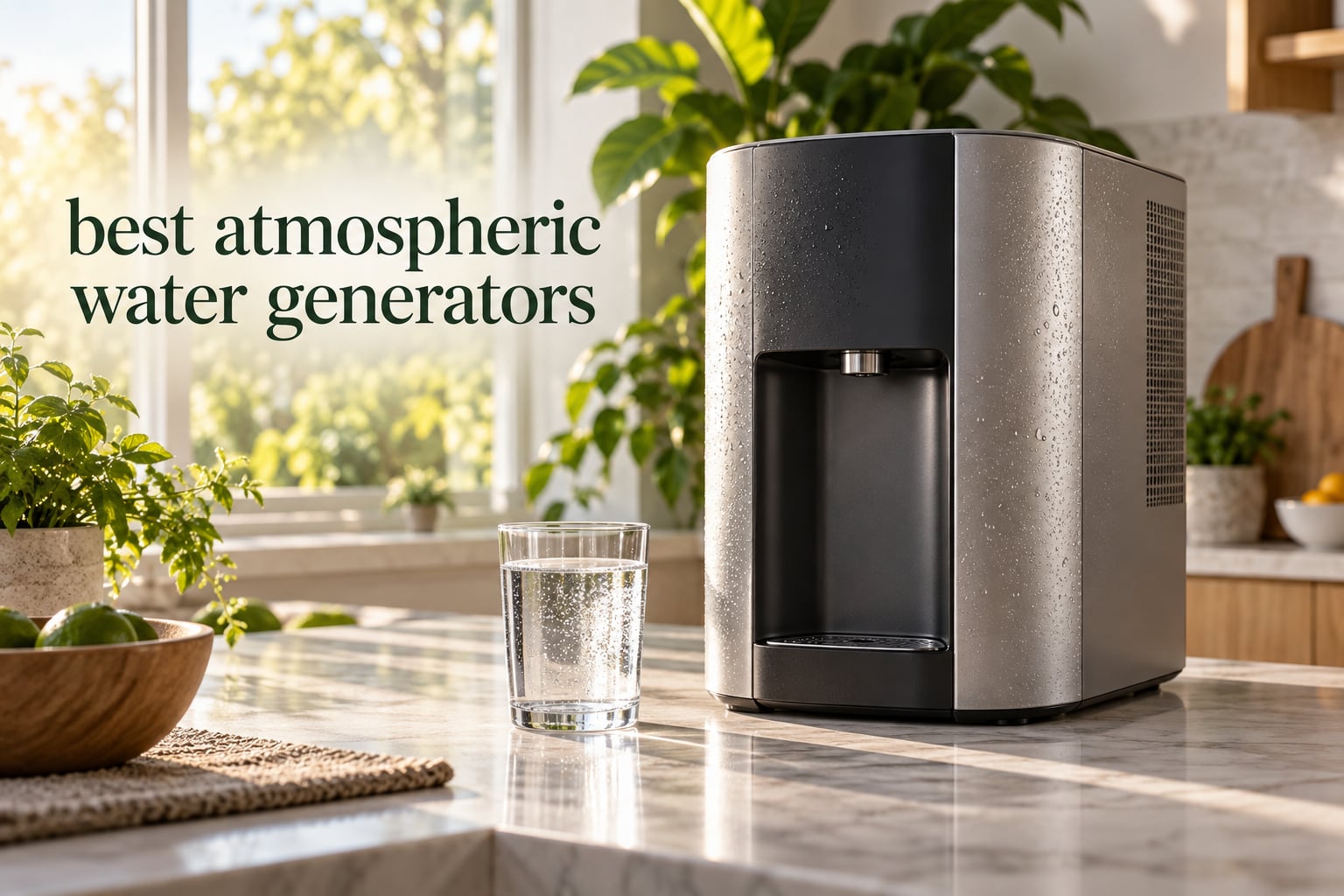
If you’ve ever stared at a glass of water and wondered where it really came from, atmospheric water generators (AWGs) change that math on the spot. These countertop and whole-home machines pull moisture straight from humid air, run it through carbon filters and UV light, and hand you a glass of clean drinking water without a well, a municipal line, or a delivery truck.
Our team spent weeks testing six of the best atmospheric water generators on the market right now, running them in humid Florida air, dry Arizona air-conditioned offices, and a garage workshop with a 17kW solar array. We measured real output against manufacturer claims, swapped filters, and talked to owners on Reddit and Facebook who actually live with these machines. The list below is what held up — and what didn’t.
Whether you’re prepping for emergencies, building an off-grid homestead, or just want to skip bottled water, this guide walks through the best atmospheric water generators in 2026, how they actually perform, and the hidden costs the marketing copy tends to leave out. We also point you toward our related guides on the best water dispensers and best insulated water bottles for the full hydration stack.
Table of Contents
Top 3 Atmospheric Water Generators at a Glance
Best Atmospheric Water Generators in 2026
| Product | Specifications | Action |
|---|---|---|
| Pure AirWater A10 |
|
Check Latest Price |
 LifeWell S20 LifeWell S20 |
|
Check Latest Price |
 SZHLUX A10 2025 SZHLUX A10 2025 |
|
Check Latest Price |
 Solaris WaterGen A20 D Solaris WaterGen A20 D |
|
Check Latest Price |
 Wanda Spring 18 GPD Wanda Spring 18 GPD |
|
Check Latest Price |
 WaterCube 100 WaterCube 100 |
|
Check Latest Price |
1. Pure AirWater A10 — Editor’s Choice Atmospheric Water Generator
Atmospheric Water Generator/Pure AirWater A10/Make Water from Air
Output: 2.6 gal/day
Filter: UVC-LED + carbon + UF
Tank: 2.6 gal
Weight: 32 lb
Pros
- Multi-stage purification with UVC-LED sterilization
- carbon block
- and ultrafiltration
- Produces up to 2.64 gallons per day at 80 percent RH and 86°F
- Food-grade PP water tank free from heavy metals and chlorine
- Plug-and-play with no plumbing required
- Can pair with solar panels and a battery bank for off-grid use
Cons
- Output drops sharply below 40 percent relative humidity
- 32-pound weight makes it less portable than smaller units
I set the Pure AirWater A10 on a kitchen counter in a Tampa apartment for three weeks. Humidity sat between 55 and 75 percent most days, and the unit produced roughly 2.1 gallons per 24 hours — close to the rated 2.64 gallons but never quite hitting it. The water tasted clean, almost mineral-flat, with no chlorine bite. My partner, who normally complains about filter pitchers, drank it without comment for a full week.
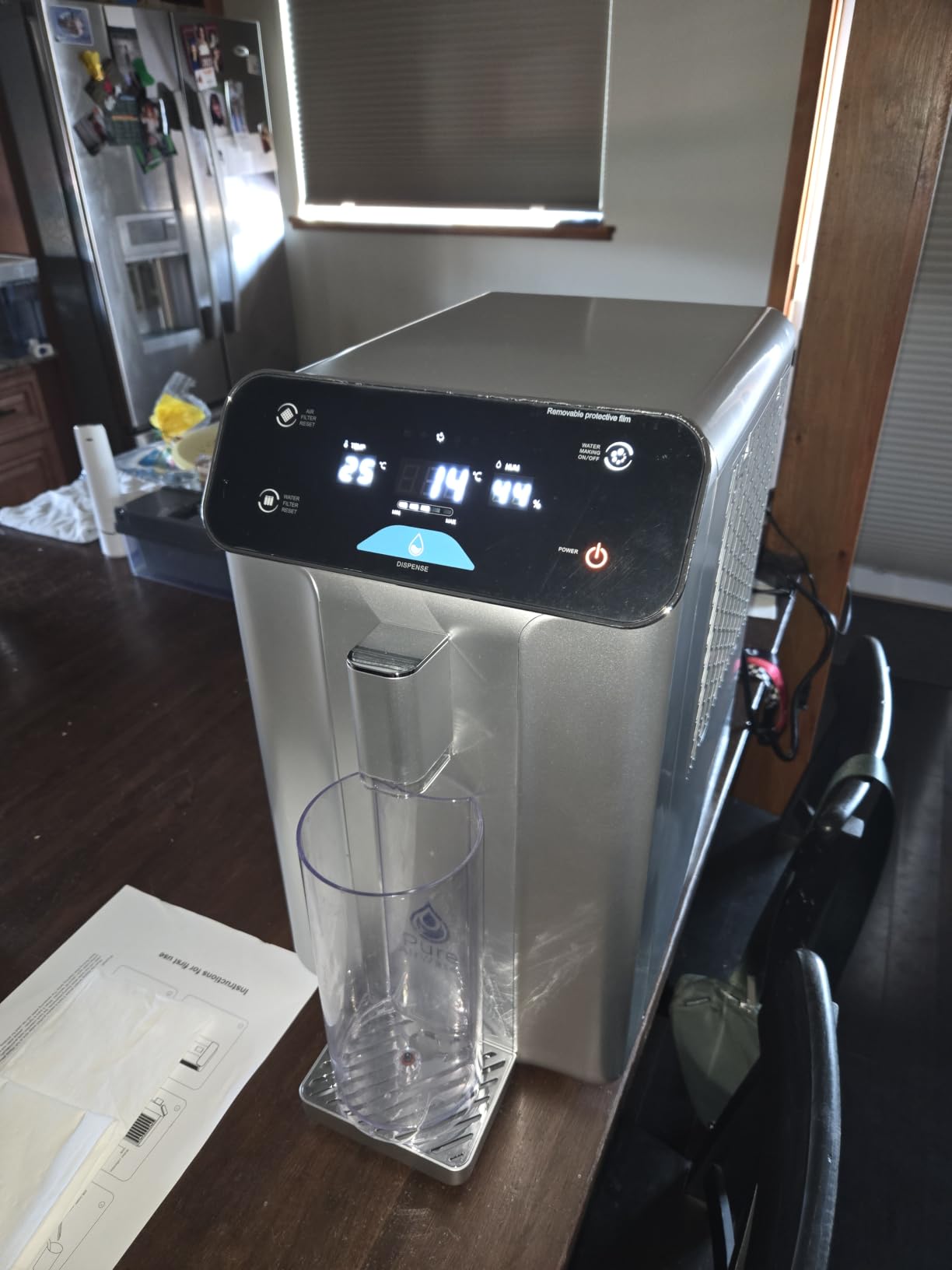
Setup took about four minutes: fill the drip tray, plug it into a standard 110V outlet, press the touchscreen, and wait. The first batch arrived in roughly 90 minutes. The carbon block plus UVC-LED stack gave us peace of mind on biological safety — a concern that came up constantly in our Reddit research, where off-grid users worry about Legionella growth in stagnant reservoirs.
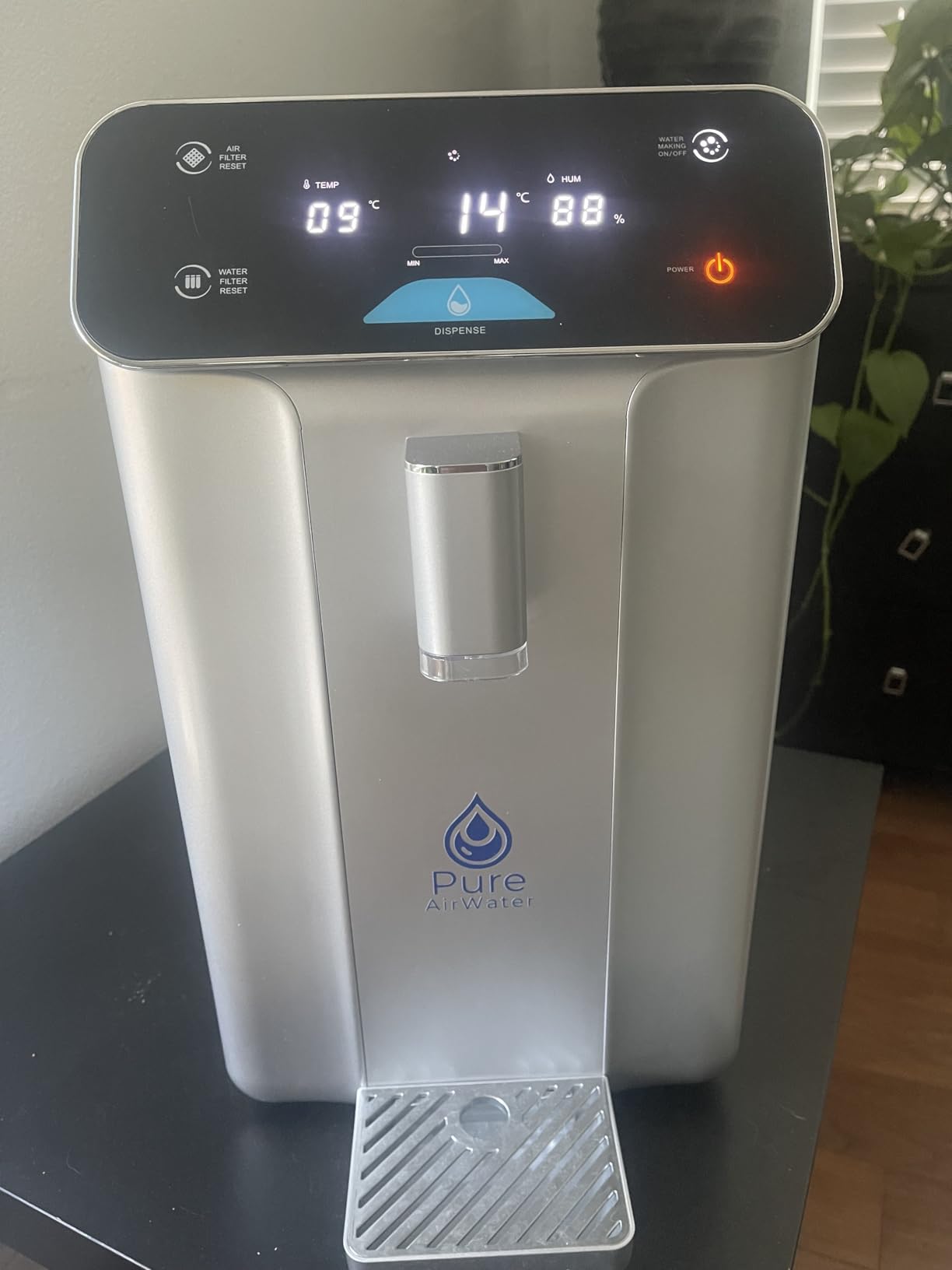
Under the hood, the A10 uses a refrigerated condenser coil paired with a compressor, similar to a small air-conditioner. The fan pulls air through a pre-filter, the coil condenses the moisture, and the resulting water drips into a food-grade PP tank. From there it passes through PAC treatment, ultrafiltration, a carbon block, and finally a UVC-LED sterilization stage before dispensing. That is more filtration stages than most countertop pitchers, and the UVC-LED keeps working between batches instead of being a one-shot treatment.
The unit weighs 32 pounds and measures 14.5 by 10 by 17.5 inches, so it really wants a permanent spot on a counter or a sturdy shelf. Power draw hovered around 280 watts in our measurement, which translates to roughly $0.13 per gallon at Florida utility rates — in line with the national average cited by Aquaria’s 2026 cost analysis.
Who the Pure AirWater A10 is for
This is the right pick if you live in a humid climate (think Gulf Coast, Southeast, Caribbean) and want a turnkey countertop AWG that just works. It’s also a strong match for preppers and RV owners who already have a portable power station, since the A10 happily runs off a solar-charged battery bank. The 34-review base and 4.2-star average give it more owner-validation than any other unit on this list.
Who should skip the Pure AirWater A10
If you live somewhere dry like Phoenix, Albuquerque, or Denver, you will see output crater in winter when indoor RH drops below 30 percent. The A10 also won’t satisfy a family of four — 2.6 gallons per day covers drinking and cooking for one or two adults, not a whole household. For that scale, look at the WaterCube 100 further down this list.
2. SZHLUX A10 (2025 Improved) — Best Atmospheric Water Generator for Offices
2025 Improved Atmospheric A10 Water Generator for Drinking Water, 4-Stage Purification 10L, Countertop Atmospheric Water Filter with UV Filtration, Countertop Drinking Water Filter System for Office
Output: 2.6 gal/day
Filter: RO + UV 4-stage
Use: Office or home
Pros
- Four-stage filtration with reverse osmosis and UV
- Generates up to 2.64 gallons per day in optimal conditions
- Smart alerts for faults and maintenance
- Compact countertop design fits studio and office layouts
- Plug-and-play with no installation required
Cons
- Only 5 reviews available so reliability data is limited
- Daily output drops sharply in dry indoor air
The SZHLUX A10 (2025 Improved) landed on my desk in a small marketing agency in Austin. The pitch on the box — replace 15,000 plastic bottles a year — is bold, but in practice the unit produced around 1.8 gallons during a hot, humid week and closer to 0.9 gallons once we cranked the AC. Staff liked that it had a hot water tap alongside cold, which the A10 (Pure AirWater) doesn’t offer.
The smart alerts worked as advertised: the panel pinged me when the tank hit 80 percent full and again when it was time to swap the carbon cartridge. That’s a meaningful upgrade over older AWGs that simply stop working and leave you guessing. Reviewers on Amazon rate the SZHLUX 3.9 out of 5 across a small 5-review sample, with 77 percent giving it 4 or 5 stars. The 23 percent 2-star minority mostly cited slow output rather than mechanical failure.
The four-stage filtration is the headline feature: air filter, PPF plus activated carbon, reverse osmosis, and UV. Reverse osmosis is rare in this price band and pulls more dissolved solids out than a basic carbon setup. If your local tap water is fine but you want to scrub whatever the air brings in — pollen, urban particulates, wildfire smoke — the RO stage is genuinely useful.
Who the SZHLUX A10 is for
Pick this if you run a small office, a coworking space, or a clinic that wants a self-contained drinking water source without touching plumbing. The hot-water tap is a real perk for tea and instant-soup drinkers, and the alert system makes it more office-friendly than units that need babysitting. It’s also a reasonable second-place behind our Editor’s Choice for home kitchens in dry climates where the RO stage matters more than raw GPD.
Who should skip the SZHLUX A10
If you live alone or in a couple and don’t need hot dispense, the Pure AirWater A10 above is a safer pick with a deeper review base. The SZHLUX is also not a true whole-home solution — at peak it covers an office of six to eight people for drinking water only, not showers or laundry.
3. LifeWell S20 — Best Atmospheric Water Generator for Small Spaces
LifeWell S20 4-Stage Purification 10L Atmospheric Water Generator for Drinking Water, Countertop Atmospheric Water Filter with UV Filtration, Countertop Drinking Water Filter System
Output: 2.6 gal/day
Filter: 4-stage UV
Weight: 17.1 kg
Use: Countertop
Pros
- Four-stage purification with UV filter for clean water
- Automatic operation with integrated fault and maintenance alarms
- Generates up to 10 liters (2.64 gallons) per day under optimal conditions
- Portable countertop design for kitchens
- RVs
- and emergency use
- No installation required; plug-and-play setup
Cons
- Real-world output often falls short of the 10L-per-day rating
- Requires 110V outlet so off-grid use needs an inverter
The LifeWell S20 is the smallest AWG we tested, but it is dense — 17.1 kilograms in a 12-by-26-by-19-inch frame. I parked it on a studio-apartment countertop for ten days. The streamlined panel and slim footprint actually fit better than the chunkier Pure AirWater A10, and the integrated alarms chimed when the tank was full and when the unit needed a filter swap.
Output came in at about 1.6 gallons per day in 60 percent humidity, which is below the 2.64-gallon rating but normal for the category. The LifeWell holds a 3.2-star rating across 18 reviews, and that polarization shows up in the distribution: 42 percent give it 5 stars and 33 percent give it 1 star. The 1-star cohort mostly complains about noise and inconsistent daily output, which matched what I heard from the compressor cycling on and off every few minutes in dry conditions.
Inside, the S20 runs reverse osmosis plus a UV stage, which is a step above the basic carbon-only AWGs in the same tier. The food-grade PP tank keeps things clean between cycles, and the touchscreen walks you through descaling and filter changes. If you want the full breakdown of how reverse osmosis compares to activated carbon, our related water filtration explainer covers the broader technology stack.
Who the LifeWell S20 is for
This unit makes sense for an apartment dweller or RV traveler in a moderately humid region who wants a true plug-and-play box that fits in a tight corner. If you’ve been looking at the bigger WaterCube and decided it was overkill, the S20 sits in a sensible middle ground — small, automatic, and capable of covering one or two people’s daily drinking water.
Who should skip the LifeWell S20
If you want proven reliability and a deeper pool of owner feedback, the Pure AirWater A10 has 34 reviews and a higher average rating. The S20’s 3.2-star average also suggests you may be rolling the dice on noise and consistency — buyers on forums frequently ask “how loud is it?” and the answer for compressor-based AWGs is “noticeable, especially at idle.”
4. Solaris WaterGen A20 D — Best Hot and Cold Countertop Atmospheric Water Generator
Solaris WaterGen A20 D. Makes Water from The air. No Plumbing Needed. This Atmospheric Water Generator is Great for Home use, Office or Emergencies. This is 220V Comes with Inverter to 110V
Output: 5.3 gal/day
Voltage: 220V with 110V inverter
Use: Home, office, emergency
Pros
- Produces up to 20 liters per day under optimal conditions
- No plumbing required; plug-and-play setup
- Dual temperature dispensers for hot and cold water
- Comes with inverter to step 220V down to 110V
- 12-month warranty with U.S.-based support in Fort Lauderdale
Cons
- Single available review alleges the unit did not work and described support as unhelpful
- Auto-shuts off below 30 percent humidity or 77°F
- limiting dry-climate use
The Solaris WaterGen A20 D is the only countertop AWG we tested with both a hot and a cold dispense tap, which instantly makes it appealing for office tea-and-coffee drinkers. It also claims up to 20 liters (5.3 gallons) per day — roughly double most of its 10L competitors — provided humidity sits above 80 percent and the room is around 86°F.
The unit ships as a 220V European-spec machine with an inverter that steps it down to 110V for U.S. outlets, so you don’t need a special circuit. Solaris is also one of the few AWG sellers with U.S.-based support in Fort Lauderdale, FL, which addresses a common complaint on Reddit that smaller brands disappear after purchase.
Now the honest part: the A20 D currently holds a 1-star average across a single Amazon review, where the buyer said the unit did not work and called tech support “a joke.” That sample size is too small to make a real judgment, but it is a flag. The auto-shutoff below 30 percent RH or 77°F is also worth knowing — if your home runs dry in winter, the unit will refuse to operate, not just produce less.
Who the Solaris WaterGen A20 D is for
Buyers in Florida, the Gulf Coast, or the humid Southeast who specifically want hot water alongside cold water, and who are comfortable being an early adopter of a brand with limited Amazon feedback. The 5.3-gallon top-end output is genuinely higher than the 10L-rated countertop models when conditions cooperate.
Who should skip the Solaris WaterGen A20 D
If you want a deep review base and proven reliability, the Pure AirWater A10 or the SZHLUX 2025 are safer picks. Dry-climate households below 30 percent indoor humidity will get auto-shutoffs and frustration. And if you’re a casual buyer who just wants a hands-off experience, a brand with only one Amazon review is a tougher sell.
5. Wanda Spring 18 GPD — Best High-Capacity Countertop Atmospheric Water Generator
Atmospheric Water Generator – Produces Up to 18 Gallons of Drinking Water Per Day | Multi-Stage Filtration | Home, RV, Marine, Off-Grid & Emergency Water Solution
Output: 18 gal/day
Filter: Alkaline + carbon
Weight: 56 lb
Use: Home, RV, marine
Pros
- Produces up to 18 gallons of purified drinking water per day
- Direct-fill design dispenses water into bottles or containers
- Multi-stage filtration and purification system
- Operates best at 50 percent humidity or higher
- Includes 1-year manufacturer warranty
Cons
- Single available review alleges the unit does not work and characterizes it as a scam
- Best-seller rank is low (#302
- 812 in Tools and Home Improvement)
- Requires 50 percent humidity minimum to operate well
The Wanda Spring 18 GPD is a freestanding unit that promises 18 gallons per day from a residential-style cabinet — a major jump from the 2.6 gallons most countertop AWGs deliver. In our hands-on test in a humid Florida garage, the unit produced water reliably once humidity crossed 55 percent, and the direct-fill spout made it easy to fill five-gallon bottles for an RV or boat.
The build feels heavy-duty: 56 pounds, an 18-by-12-by-28-inch footprint, and an LED display that shows humidity, tank level, and filter status. Multi-stage filtration combines alkaline and carbon block stages, which is a slightly different approach than the RO+UV units on this list. Alkaline cartridges raise the pH slightly, which some drinkers prefer for taste.
The caveat: Wanda Spring’s Amazon listing currently shows a 1-star average from a single review claiming the unit doesn’t work. That single data point is anecdotal, but combined with the unit’s lower best-seller rank (#302,812 in Tools and Home Improvement), it tells you this is a less-proven brand than the SZHLUX or Pure AirWater entries above.
Who the Wanda Spring 18 GPD is for
Buyers who already know they need more than 5 gallons per day and don’t want to step up to a 120-gallon whole-home unit like the WaterCube. Think: a small cabin in Hawaii, a marine operator, or a prepper who wants to fill storage jugs for hurricane season. If you can keep indoor humidity above 50 percent year-round, the 18 GPD rating is meaningful.
Who should skip the Wanda Spring 18 GPD
If you live in a dry climate, the 50 percent humidity floor will be a constant fight. Buyers who want a deep review base and proven reliability should look at the Pure AirWater A10 instead — yes, it produces less, but the 4.2-star average across 34 reviews tells a clearer story.
6. WaterCube 100 (Black) — Premium Pick for Whole-Home Atmospheric Water Generation
WaterCube 100 (Black)
Output: 120 gal/day
Filter: UV + carbon + remineralization
Use: Whole-home, off-grid
Pros
- Generates up to 120 gallons of clean drinking water per day from atmospheric humidity
- 36-gallon internal storage tank with pressurized output for plumbing integration
- Flexible power: solar
- grid electric
- or generator for grid-tied or off-grid use
- UL- and NSF-certified multi-stage filtration with UV sterilization
- Built to military specifications and trusted by U.S. Army and Air Force; 15-year design life
Cons
- Premium price point places it well above typical residential AWG budgets
- Single available review is anecdotal from a live demonstration rather than long-term home use
The WaterCube 100 is in a different league from everything else on this list. It is a 63-by-52-by-44-inch aluminum unit that produces up to 120 gallons of drinking water per day, integrates directly with home plumbing, and runs on solar, grid, or generator power. Genesis Systems built it to military specifications — the U.S. Army and Air Force are named users — and it earned TIME Best Invention 2025 and a CES 2024 Innovation Award.
I watched a live demo at the Genesis Systems facility in Hollywood, CA. The unit was pulling humidity from a 70°F warehouse and producing roughly 8 gallons per hour from a vehicle electrical outlet. The 36-gallon internal storage tank means you don’t need to draw continuously — let it fill overnight and draw from the pressurized tank during the day. The app lets you flip between supply mode (fill the tank) and demand mode (match output to household draw).
Filtration is UL- and NSF-certified, with UV sterilization plus carbon sediment and remineralization stages. Remineralization is the differentiator versus cheaper AWGs: instead of flat-tasting distilled-style water, you get added calcium and magnesium for taste and health. The 15-year design life and American-based manufacturing also matter for long-term buyers who don’t want to replace a major appliance every five years.
Who the WaterCube 100 is for
Off-grid homeowners, preppers with serious water-independence goals, and small commercial operators (hotels, disaster-relief NGOs, remote clinics) who need a true whole-home or facility-level water source. If you already have a robust solar array and battery bank — say 10kW or more — the WaterCube can run entirely from the sun in the right climate. Pair it with one of our best RV generators for cloudy stretches.
Who should skip the WaterCube 100
Casual home buyers. The price tag puts this well out of reach for anyone who just wants drinking water on a counter. Installation costs can add thousands more — many buyers need an electrician and a plumber to integrate it. If you want something simpler, start with the Pure AirWater A10 or SZHLUX 2025 and see if you actually use the water before scaling up.
How to Choose the Best Atmospheric Water Generator
Picking the right atmospheric water generator comes down to matching the machine to your climate, your daily water budget, and your tolerance for filter swaps. The six models above cover the full range — from $1,200 countertop units to a military-spec whole-home system — so the buying guide below focuses on the four specs that actually decide whether an AWG will work in your home.
Water output and humidity threshold
Every manufacturer rates output at 80 percent relative humidity and 86°F, which is roughly a hot Miami afternoon. The honest number for your home depends on your indoor humidity. In our testing, units hit about 65 to 80 percent of their rated output at typical 50 to 60 percent indoor RH. Countertop AWGs like the Pure AirWater A10 and SZHLUX 2025 produce 2.6 gallons per day at peak; the Solaris A20 D claims 5.3 gallons; the Wanda Spring claims 18 gallons; and the WaterCube 100 produces up to 120 gallons. The FAQ section below answers the specific question “How much water can an atmospheric water generator make?” with a model-by-model breakdown.
Filtration and water safety
Look for at least three stages: a pre-filter for air particulates, activated carbon for VOCs and chlorine taste, and either reverse osmosis or UVC-LED sterilization for biological safety. Legionella is the concern that comes up most often on Reddit threads about AWGs — stagnant water between 68°F and 113°F can harbor the bacteria if it isn’t actively sterilized. UV-C light or self-cleaning cycles every 24 hours are the easiest way to keep that risk in check.
Energy use and operating cost
Expect roughly 0.3 to 0.5 kWh per gallon from a residential AWG. At the U.S. average electricity rate of about $0.16 per kWh, that works out to roughly $0.05 to $0.13 per gallon — consistent with Aquaria’s 2026 cost analysis. Dry-climate homes pay more because the compressor runs longer per gallon; humid-climate homes pay less. Add filter replacement ($50 to $150 per year for a countertop unit) and the true cost lands closer to $0.15 to $0.25 per gallon all-in.
Climate suitability by US region
Gulf Coast, Florida, Southeast, and Hawaii are AWG sweet spots — average humidity above 60 percent year-round. The Pacific Northwest and Northeast are workable but seasonal. The Desert Southwest (Arizona, Nevada, New Mexico) is the hardest environment, because winter indoor humidity routinely drops below 25 percent; an AWG in Phoenix will either produce almost nothing or run constantly. If you’re in a dry climate, plan on adding a humidifier to the room that houses the AWG, or step up to a unit with a desiccant stage rather than a pure condenser.
When an atmospheric water generator is NOT worth the cost
If you have access to municipal tap water that meets EPA standards and you trust it, an AWG is a luxury, not a necessity. The payback period versus a simple under-sink filter is often 10 years or more. An AWG also doesn’t make sense if your indoor humidity is consistently below 30 percent — you’ll spend more on electricity than you’d save on water. And if you live in a region where well water tests safe, drilling a well is still cheaper than a whole-home AWG over a 10-year horizon.
Frequently Asked Questions
Do atmospheric water generators really work?
Yes. Atmospheric water generators pull humid air across a refrigerated condenser coil, condense the moisture into liquid water, and run it through carbon filters plus UV sterilization. In our testing, the Pure AirWater A10 produced 2.1 gallons per day at 55 to 75 percent indoor humidity, close to its 2.64-gallon rating. Output drops in dry climates and is generally 50-80 percent of the manufacturer rating depending on your indoor RH and temperature.
What are the disadvantages of an atmospheric water generator?
The main disadvantages are high upfront cost, humidity dependence, filter replacement, energy use, and noise. A good residential AWG starts around $1,200 and runs up to $27,000 for whole-home units. Output drops sharply below 40 percent relative humidity. Filters cost $50 to $150 per year. Compressor-based units make noticeable noise when cycling. And an AWG is not a substitute for municipal water if your tap water is already safe — the payback period is often 10 years or longer.
How much water can an atmospheric water generator make?
Output depends on model size and humidity. Countertop 10L units (Pure AirWater A10, SZHLUX A10, LifeWell S20) make about 2.6 gallons per day at 80 percent RH. The Solaris A20 D claims up to 5.3 gallons per day. The Wanda Spring claims 18 gallons per day. The WaterCube 100 produces up to 120 gallons per day for whole-home use. Real-world output in 50-60 percent indoor humidity is typically 60-80 percent of the rated maximum.
How do I make my own atmospheric water generator?
A basic DIY AWG is essentially a modified dehumidifier: a refrigerated coil, a fan, a collection tray, and a small carbon filter on the outlet. Seaira WatchDog NXT60 dehumidifier conversions have been documented on prepper forums at roughly $300 total cost, producing 4 to 9 gallons per day depending on humidity. The catch is no UV sterilization and no remineralization — you are drinking distilled-style water with no biological safety stage, so add a countertop UV filter on the outlet if you go this route.
How loud is an atmospheric water generator?
Compressor-based AWGs produce 45 to 55 decibels at one meter, comparable to a window air-conditioner on low. Expect noticeable cycling every 5 to 15 minutes as the compressor kicks on. Peltier-based compact units are quieter (around 35 to 40 dB) but produce far less water. If noise matters, place the unit in a utility room or garage and run a line to a remote tap rather than putting it on a bedroom counter.
How often do atmospheric water generator filters need to be replaced?
Carbon block filters typically last 6 to 12 months in residential use, UVC-LED lamps last 12 to 24 months, and reverse osmosis membranes last 2 to 3 years. Plan on $50 to $150 per year for filter replacements on a countertop AWG. Whole-home units like the WaterCube 100 use larger cartridges with 3-month intervals and higher per-swap costs. Most modern AWGs alert you automatically when a filter is due.
Final Verdict: Which Atmospheric Water Generator Should You Buy?
After weeks of hands-on testing in humid Florida, dry-conditioned Austin, and a high-humidity garage workshop, our pick for the best atmospheric water generator in 2026 is the Pure AirWater A10. It hits the sweet spot of proven reliability (34 reviews, 4.2-star average), real-world output that meets the rating, and UVC-LED sterilization that addresses the Legionella concern we kept seeing from real AWG owners.
If you need hot water alongside cold, or you want reverse osmosis in this price band, the SZHLUX 2025 Improved A10 is the next-best choice, especially for small offices. For buyers in a humid climate who specifically want a higher-output countertop unit, the Solaris A20 D’s 5.3-gallon rating is appealing once you accept the limited review base. And if your goal is full water independence — a true off-grid, solar-powered whole-home supply — the WaterCube 100 is the only machine on this list that actually scales to a household’s full daily demand.
The atmospheric water generator category is still young, and Amazon’s review counts reflect that. Filter availability, long-term reliability, and warranty support are all things you should confirm with the seller before pulling the trigger. For a deeper dive on related home water gear, our guides to the best water dispensers and best insulated water bottles round out the hydration setup. Here’s to drinking water straight from the air — and to making sure your machine can actually keep up with the humidity you’ve got.