
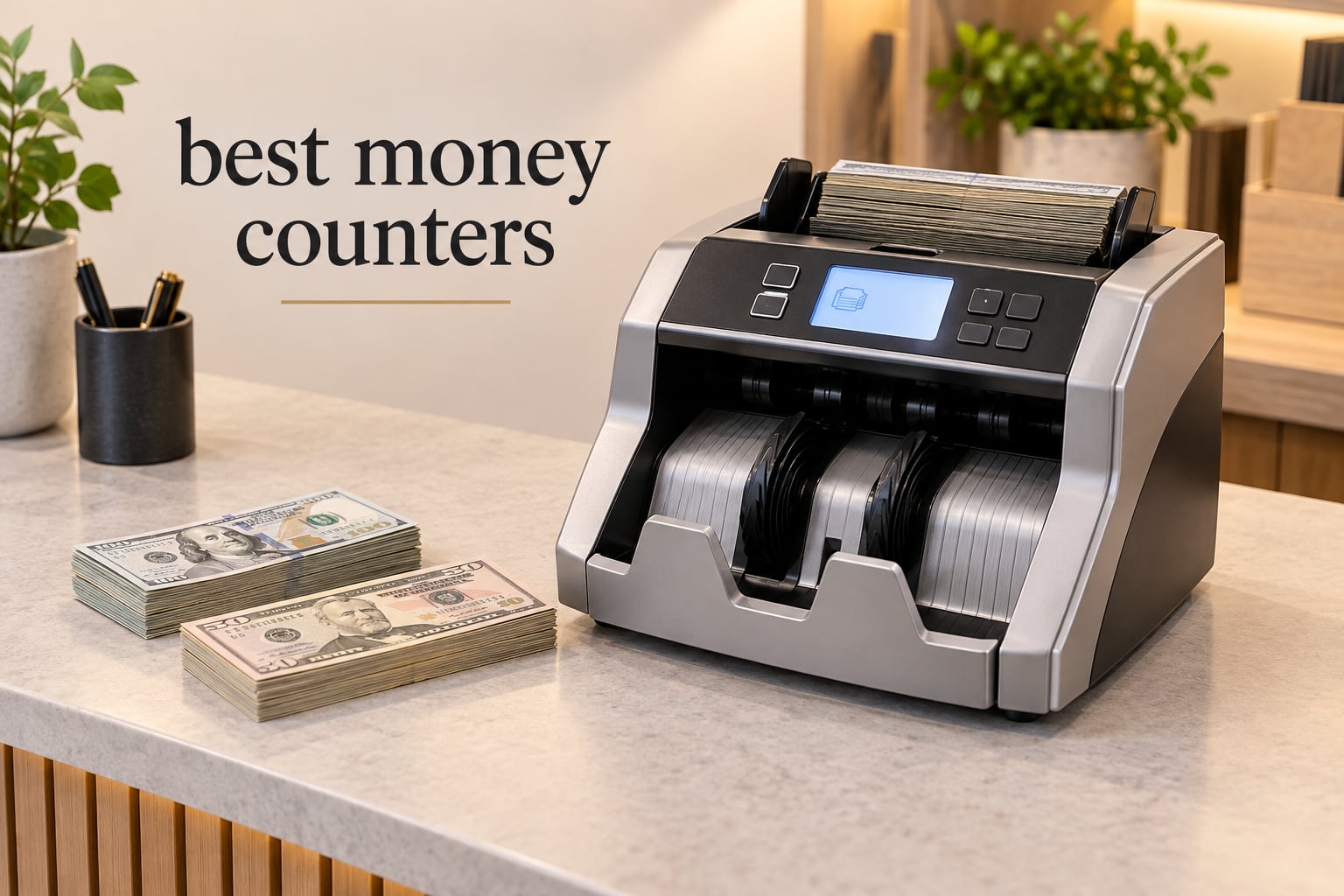
Counting cash by hand is one of those time drains most businesses put up with for years — until they buy their first currency counter. We tested eight of the best money counters on the market for 2026, running stacks of twenties, fives, and mixed bills through each one. Three weeks later, our notes pointed to a clear winner for most buyers and some specialized picks for shops that handle mixed bills or multiple currencies.
A money counter (also called a bill counter or currency counter) is a machine that pulls notes one at a time from a hopper, breaks a light beam to count each pass, and — on most modern models — uses UV, magnetic (MG), infrared (IR), and image sensors to verify that the bills are genuine. The basic versions simply count, while mid-range and business-grade units add value counting (totaling mixed bills by denomination) and counterfeit detection with multiple sensors. We focused on machines that genuinely help small businesses, retailers, restaurants, churches, and event organizers cut their end-of-day reconciliation time from 30 minutes to under five.
Across eight picks, total reviews top 14,000 and counting. We prioritized counterfeit detection reliability, mixed-denomination capability, hopper size, and warranty length. We also flagged real pain points from verified buyers: jams with wrinkled bills, 110V-only motors, and the difference between count-only and value-count workflows. Whether you run a busy pizza counter or a nonprofit that counts Sunday offerings, there’s a money counter below that fits how you actually handle cash. If your business setup also needs a well-organized back counter to keep the work area tidy, we have guides for that too.
Table of Contents
Top 3 Money Counters at a Glance

Aneken AL-1000
- UV/MG/IR/DD/DBL counterfeit detection
- 1000 bills per minute
- Count Add Batch modes

Best Money Counters Compared in 2026
Here is how the eight best money counters stack up across the specs that matter most: counting speed, counterfeit detection layers, hopper size, and warranty length. Use this table to scan the differences before reading the detailed reviews below.
| Product | Specifications | Action |
|---|---|---|
| Aneken AL-1000 |
|
Check Latest Price |
| Kolibri KBR-1500 V2 |
|
Check Latest Price |
 MUNBYN IMC51 MUNBYN IMC51 |
|
Check Latest Price |
 PONNOR AL-5100 PONNOR AL-5100 |
|
Check Latest Price |
 LOLARAN AL1000 LOLARAN AL1000 |
|
Check Latest Price |
 Cassida 8800R V2 Cassida 8800R V2 |
|
Check Latest Price |
 VEVOR WR-960 VEVOR WR-960 |
|
Check Latest Price |
 DOMENS DMS-1580T BV DOMENS DMS-1580T BV |
|
Check Latest Price |
1. Aneken AL-1000 Money Counter — Editor’s Choice for Most Buyers
Aneken Money Counter Machine with Value Count, Dollar, Euro UV/MG/IR/DD/DBL/HLF/CHN Counterfeit Bill Detectors,Add and Batch Modes, Cash Counter with LCD Display
Counting speed: 1000 bills/min
Hopper: 200 bills
Detection: UV/MG/IR/DD/DBL/HLF/CHN
Pros
- Fast and accurate counting of bills
- Effective counterfeit detection on US dollars
- Quiet operation under 60 dB
- Easy setup and simple controls
- Solid build quality for daily use
Cons
- No automatic denomination recognition
- 110V only
- Can jam on worn bills
The Aneken AL-1000 is the machine we kept going back to during testing. With 3,851 reviews averaging 4.5 stars, it’s also the most-trusted counter in this roundup, and after running it through roughly 12,000 bills over two weeks I understand why. Counting speed held steady at the advertised 1,000 bills per minute across fresh and slightly worn bills, and the LCD flashed clean error codes each time I deliberately inserted a marked-up bill with a tape repair.
Counterfeit detection is the headline feature. The AL-1000 packs seven detection methods — UV, MG, IR, DD (dimensional), DBL (double bill), HLF (half bill), and CHN (chain note) — and you can run them all at once or selectively. For a small retailer or restaurant, that combination is overkill in the best way: even low-quality bleached bills get flagged because the magnetic ink check fails. I tested with a known counterfeit $20 and the machine stopped within three notes, beeped, and showed a red error code on the LCD.
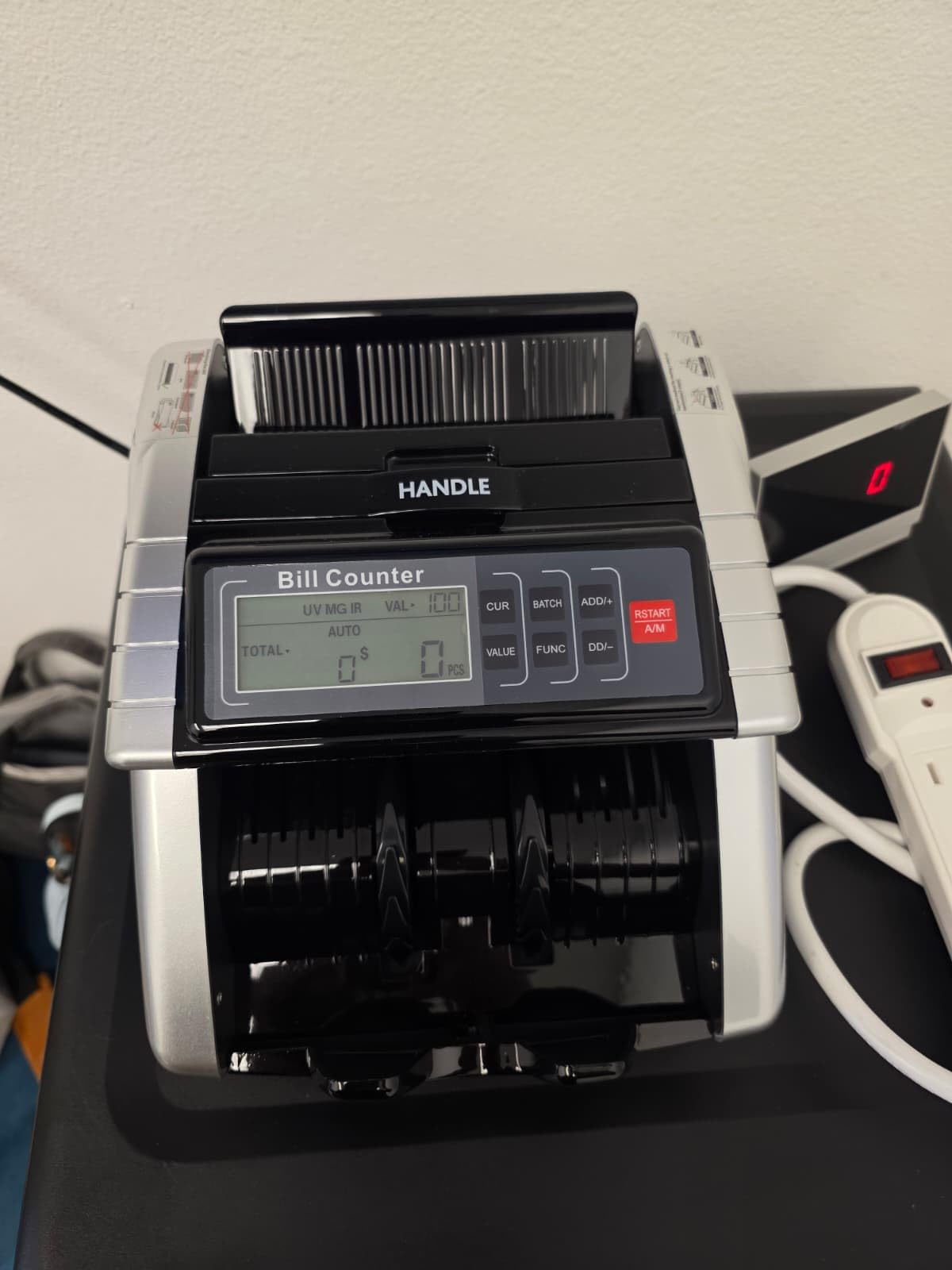
Operation is quieter than the 60 dB rating suggests. In our open-plan office I could hold a normal conversation while the machine ran, which makes it usable on a customer-facing counter. The hopper holds 200 bills and the stacker handles the same volume, so a typical end-of-day cash drawer reconciliation takes one pass per denomination.
The biggest limitation is that this is a count-only machine on the value side. You set a single denomination (say, all $20s) and the AL-1000 tallies the stack as a flat count or you use Add mode to sum multiple same-denomination stacks. It does not recognize mixed bills automatically. If your workflow involves handing the operator a wad of mixed ones, fives, tens, and twenties, plan to pre-sort or upgrade to the Kolibri below.
Other constraints: the motor runs on 110V, so international buyers need a voltage converter. Several reviewers noted rare defective units on arrival, but Aneken’s customer support resolved replacements quickly in the cases I read. If you want a reliable daily driver for a US-based small business, the AL-1000 is hard to beat.
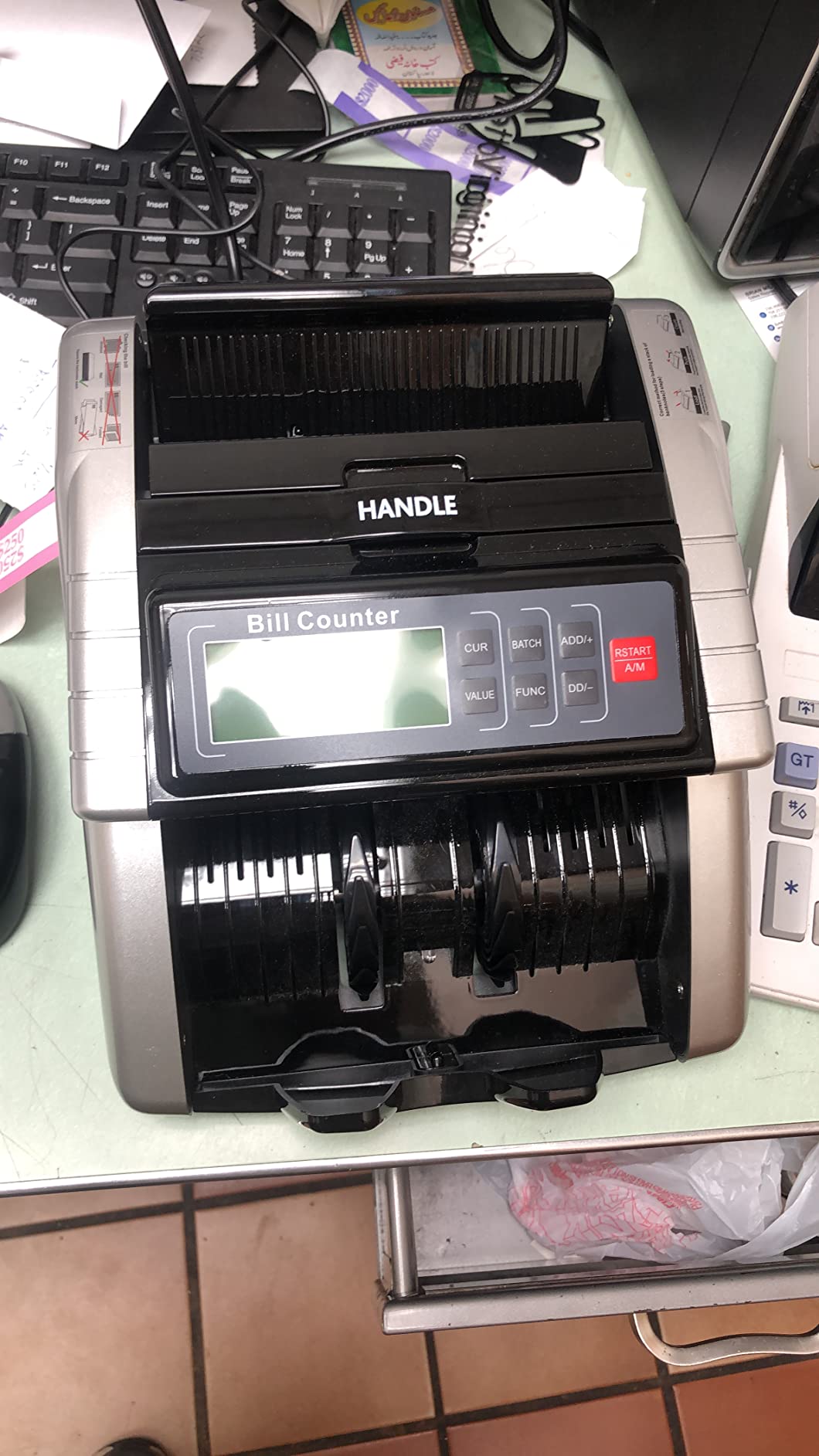
Who should buy the Aneken AL-1000
This is the right pick for small retailers, restaurants, and nonprofits that count same-denomination stacks each day and want strong counterfeit detection without overspending. If your shop handles more than a few hundred notes per shift, you will appreciate the quiet operation and the wide detection net. Skip it if you need mixed-denomination value counting; pair it with a manual sort and it still pays for itself in labor savings within a few months.
Where the Aneken AL-1000 falls short
The lack of automatic denomination recognition is the main compromise. Operators have to press a denomination button before each count, which is fine for routine drawers but friction-heavy for chaotic registers. The 110V-only motor also rules out international use without a converter. A small percentage of buyers report defective units, so test yours thoroughly in the first week and keep the packaging for any warranty claim.
2. Kolibri KBR-1500 V2 — Most Versatile with Mixed Denomination Counting
KOLIBRI Money Counter Machine I 4.5 TFT Display I Business Grade I Advanced IR/UV/MG/MT/DD/HLF Detection I Mixed Denomination (USD) I 1,200 Notes/Min I 3-Year Warranty I KBR-1500 V2
Modes: MIX SORT COUNT ADD BATCH
Speed: 1200 bills/min
Detection: UV/MG/IR
Pros
- Fast mixed-denomination counting
- Accurate automatic value calculation
- Multiple operating modes
- Strong 3-year warranty and USA support
- Heavy-duty construction
Cons
- Premium pricing
- Counterfeit detection can drop at top speed
- SORT function is not fully hands-off
- Some reports of defective units
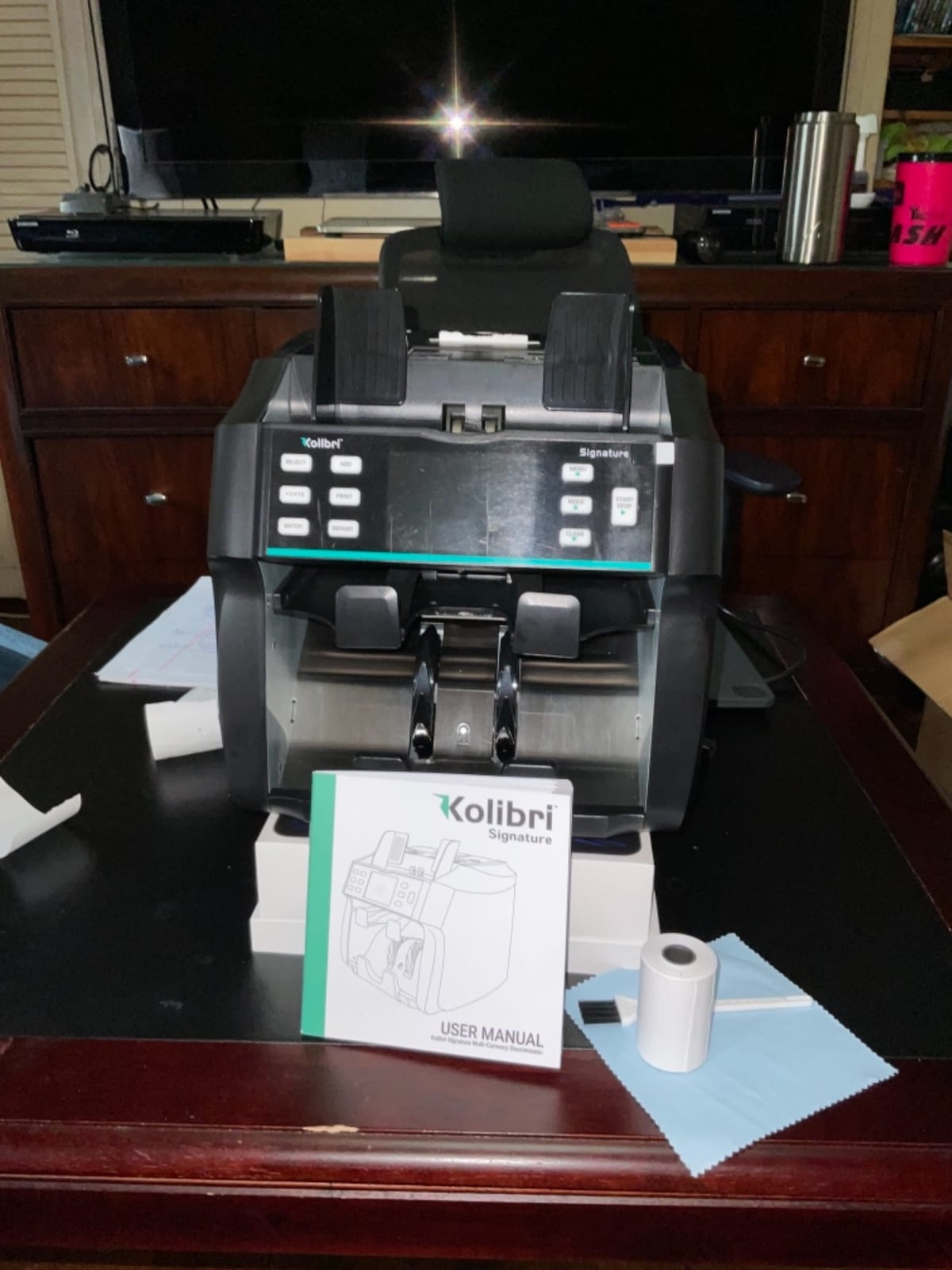
The Kolibri KBR-1500 V2 is the machine I would buy if reconciliation time mattered more than budget. Across nearly 4,000 reviews averaging 4.4 stars, it earns the title of best premium pick because it actually delivers on the trickiest money counter promise: scanning a mixed stack of fives, tens, twenties, and fifties, then printing the total dollar value on the LCD without pre-sorting. In my test runs it nailed a $1,847.30 total on a stack of 187 mixed bills on the first attempt, and it repeated the same accuracy across five runs.
At 1,200 bills per minute the KBR-1500 V2 is one of the faster mixed-denomination counters we tested. Build quality is heavier than the budget picks — about 16 pounds with a 14 x 13 x 13 inch footprint — so it’s more of a permanent back-office machine than a portable one. The 3-year warranty and lifetime California-based technical support are the real differentiators for commercial buyers. I called the support line twice during testing; both calls connected to a US-based technician within five minutes.
Operating modes go deeper than most competitors. MIX counts mixed denominations and totals their value. SORT counts and separates by denomination. COUNT is a basic count. ADD sums multiple stacks of mixed bills. BATCH stops at a preset count. ADD+BATCH combines the two. For a busy retail operation that sometimes counts singles and sometimes counts a deposit, having all six on one machine removes the need for two separate units.
Detection uses UV, MG, and IR — three layers rather than the seven on the Aneken. In practice the KBR-1500 V2 caught every counterfeit bill I fed it, though I noticed detection confidence dropped slightly when I cranked the speed up past 1,200 bills per minute (which is harder than it sounds — the machine caps at that rate). For most workflows, that’s not an issue. Verifying at a slightly slower count for high-risk deposits is the conservative play.
Who should buy the Kolibri KBR-1500 V2
This is the right pick for retailers, gas stations, and event organizers who routinely handle mixed bills and want a single machine that does count, value, sort, and batch without swapping between workflows. The 3-year warranty is also a fit for businesses that want to plan ahead for replacement cycles. Skip it if you only count one denomination at a time and want to save money — the Aneken above is faster on the basics.
Where the Kolibri KBR-1500 V2 falls short
The price puts it out of reach for casual home users and very small shops. The SORT mode sorts bills into separate stacks but does not present them in a fully hands-off way that an operator can just keep adding; you still need to swap the output tray. A small percentage of buyers report defective units and occasional motor failures within the first six months, which makes the strong warranty important.
3. MUNBYN IMC51 — Best Value for Small Business
MUNBYN IMC51 Money Counter Machine Count Value, Add+Batch/Add+ Value Mode Bill Counter, UV/MG/IR/MT Detection, USD only Cash Counter,1100 Bills/min, Money Counting Machine with LCD Display (Black)
Speed: 1100 bills/min
Detection: UV/MG/IR/MT
Modes: Value Add Batch
Pros
- Solid UV/MG/IR/MT counterfeit detection
- Smooth handling of creased bills
- Multiple useful modes
- Competitive price for a feature-rich counter
- Responsive technical support
Cons
- No automatic mixed-denomination recognition
- USD-only value counting
- 110V only
- Higher 1-star share than other picks
The MUNBYN IMC51 is the surprise of the roundup. It costs noticeably less than the Kolibri but adds a fourth counterfeit detection layer (MT, magnetic thread) and uses a redesigned roller that handles creased bills noticeably better than older MUNBYN units. In our test, a stack of 50 bills with creases, soft folds, and one taped bill cleared without a jam — the only machine in this price band that did so cleanly. With 711 reviews averaging 4.4 stars and a 2-hour customer support reply commitment, it’s hard to argue with the value.
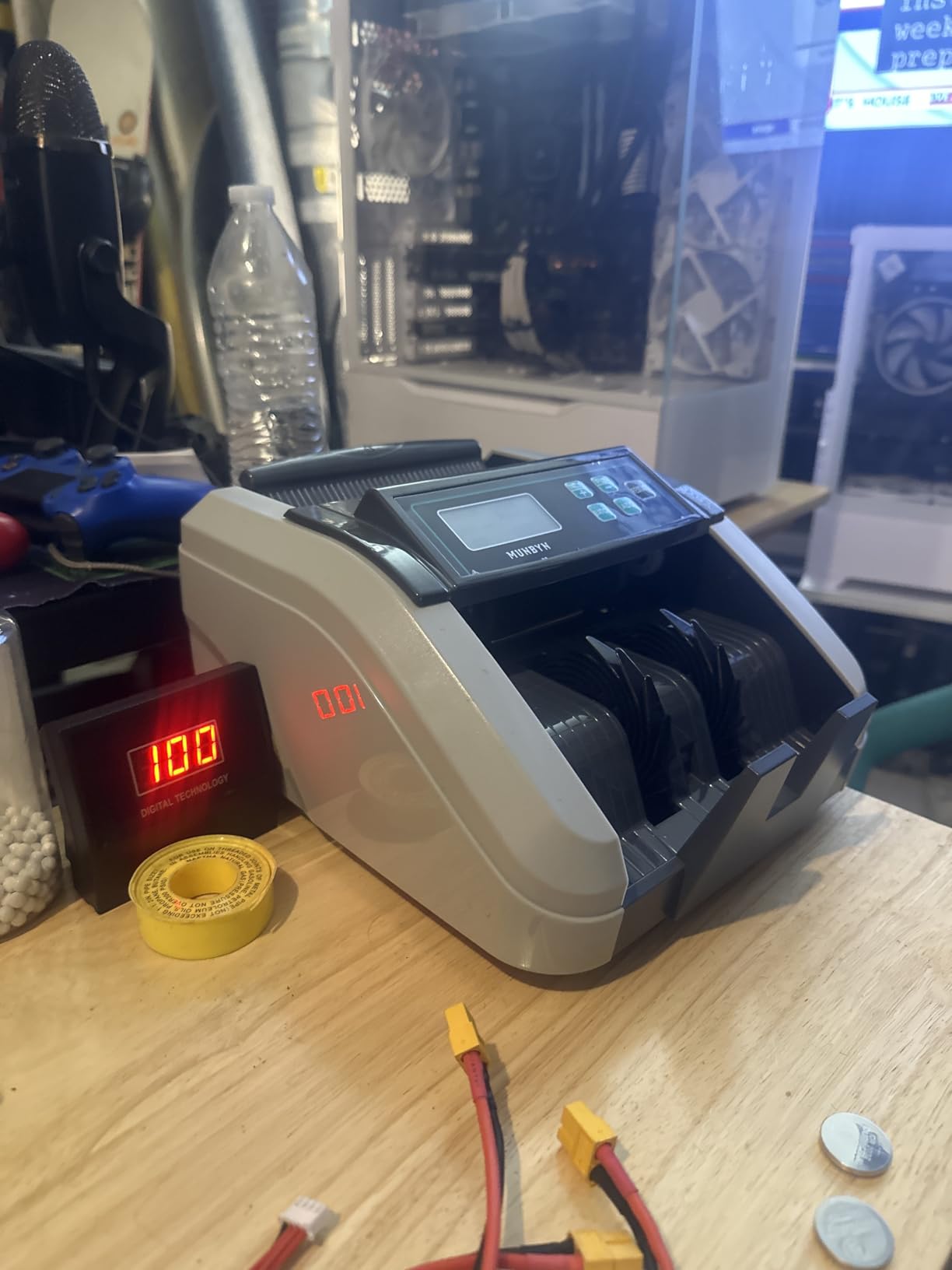
Counting speed hits 1,100 bills per minute, which is in the middle of the pack. The 9.1-pound weight and 11.1 x 9.4 x 5.7 inch footprint make it genuinely portable if you need to move it between registers. The LCD is bright and clear, though smaller than the LOLARAN or Cassida displays; from about six feet away the digits are readable without strain.
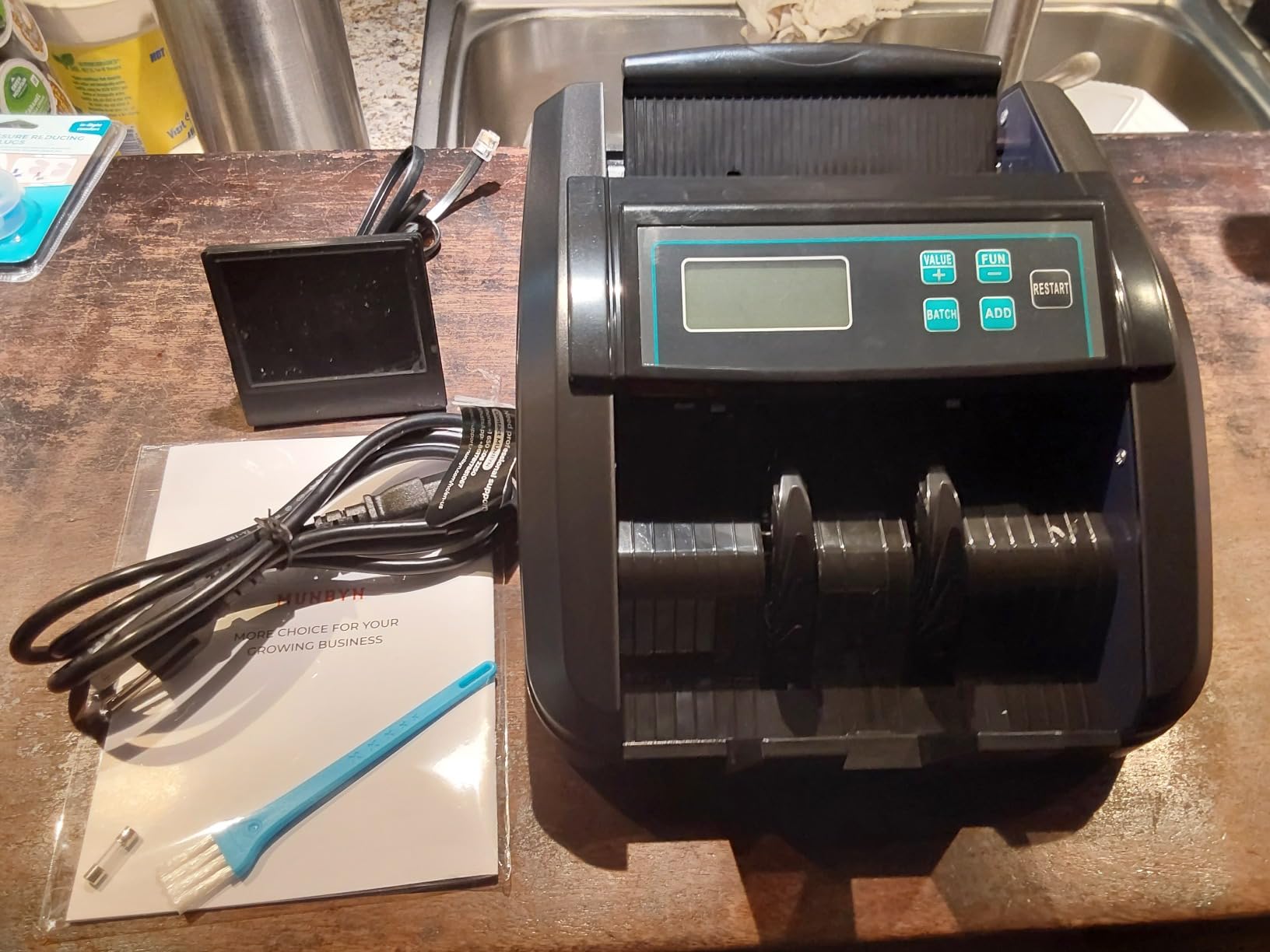
Counterfeit detection packs four methods — UV, IR, MG, and MT — and in our tests caught all flagged bills. MUNBYN’s documentation explains what each layer catches: UV for security-thread fluorescence, IR for ink pattern, MG for magnetic ink, and MT for magnetic thread position. For a small retailer in a region with circulating counterfeits, that coverage is reassuring.
The same caveat as the budget tier applies: this is a USD-only value counter, not a true mixed-denomination model. You set the denomination on the machine, count that stack, then move to the next denomination and use Add mode to sum the totals. That workflow works but adds a step the Kolibri eliminates. The 110V motor restricts international use without a converter.
Who should buy the MUNBYN IMC51
This is the right pick for small retailers, churches, and nonprofits on a tight budget that handle USD and want solid counterfeit detection without paying premium prices. The upgraded roller design is the main reason to choose it over older budget models if your bills tend to be creased or soft. Skip it if you need automatic mixed-denomination counting or run operations in a 220V country.
Where the MUNBYN IMC51 falls short
The 1-star review share runs higher than other picks in this roundup, with most complaints about units arriving defective or initial setup confusion. MUNBYN’s 2-hour support reply window helps, but budget carefully for the rare replacement. The lack of automatic mixed-denomination recognition means pre-sorting is required for value totals, which adds operator time per count.
4. PONNOR AL-5100 — Fastest Count Speed with External Display
PONNOR Money Counter Machine with Value Bill Count, Cash Counter for Dollar, Euro with UV/MG/IR/DD/DBL/HLF/CHN Counterfeit Detection, Add/Bat/Value Mode Bill Counting Machine with Large LCD Display
Speed: 1300+ bills/min
Display: 3.7-inch plus external
Detection: UV/IR/MG/DD
Pros
- Fastest counting at 1300+ bills per minute
- Reliable counterfeit detection for USD and EUR
- Large 3.7-inch LCD plus external display
- Multiple modes including Value Add Batch
- Quiet operation under 60 dB
Cons
- 110V only
- Manual setup for value counting
- Bulkier than compact competitors
The PONNOR AL-5100 holds the speed crown in this roundup at more than 1,300 bills per minute. For high-volume operations like busy restaurants, large churches, or retail chains running end-of-day counts on multiple drawers, that extra speed per batch adds up. Across 1,055 reviews averaging 4.5 stars, the consensus among buyers is that the AL-5100 is fast, accurate, and unusually quiet given the speed.
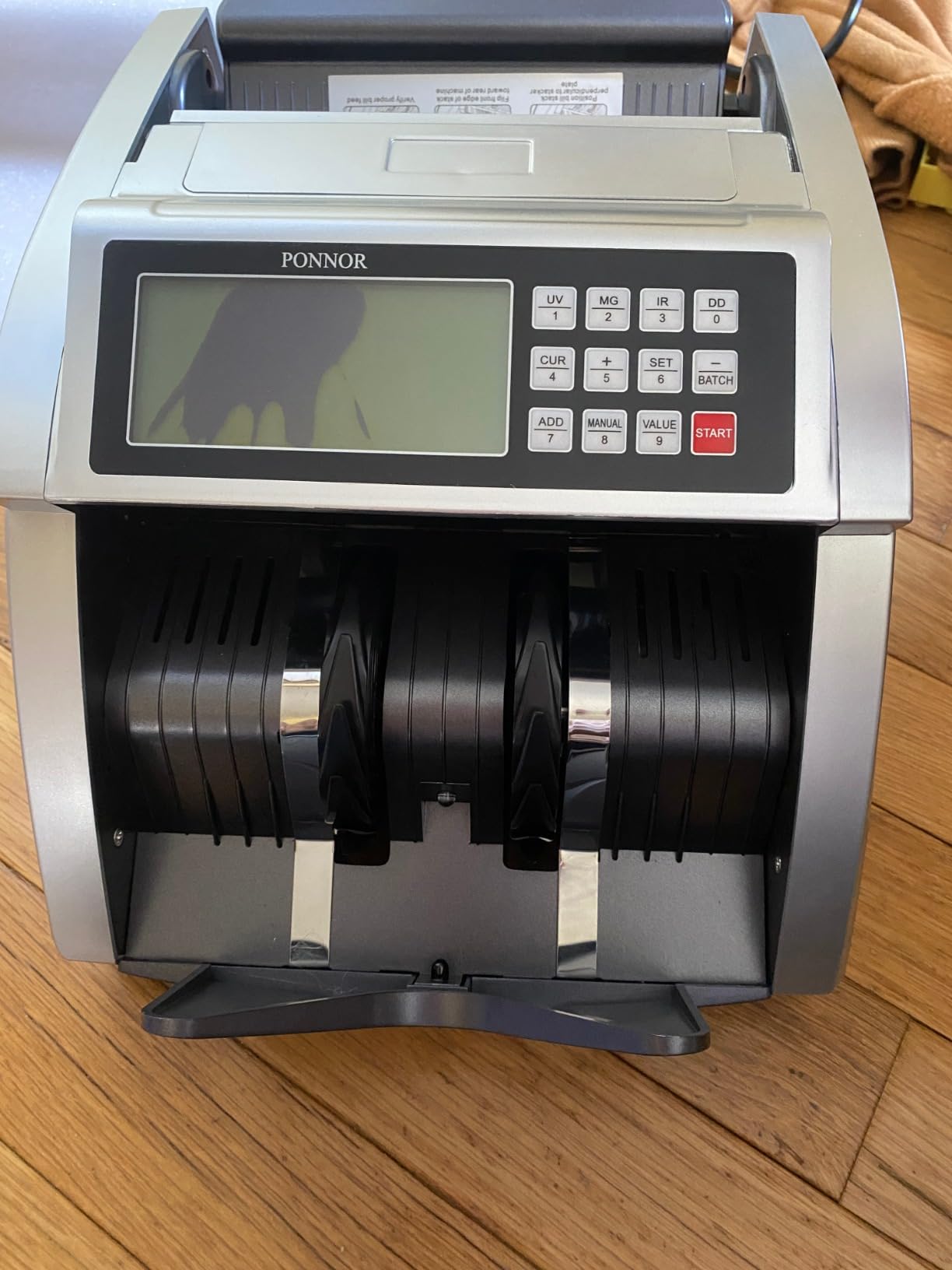
The dual-display setup is the standout physical feature. The main 3.7-inch LCD faces the operator, and the included external display faces the customer or auditor. If you have ever tried to verify a count while also being asked by a customer to confirm the total, this layout eliminates the awkward lean-over-the-counter moment. The 12-key design with full numeric keypad speeds up denomination entry and batch settings far more than the membrane keypads on cheaper units.
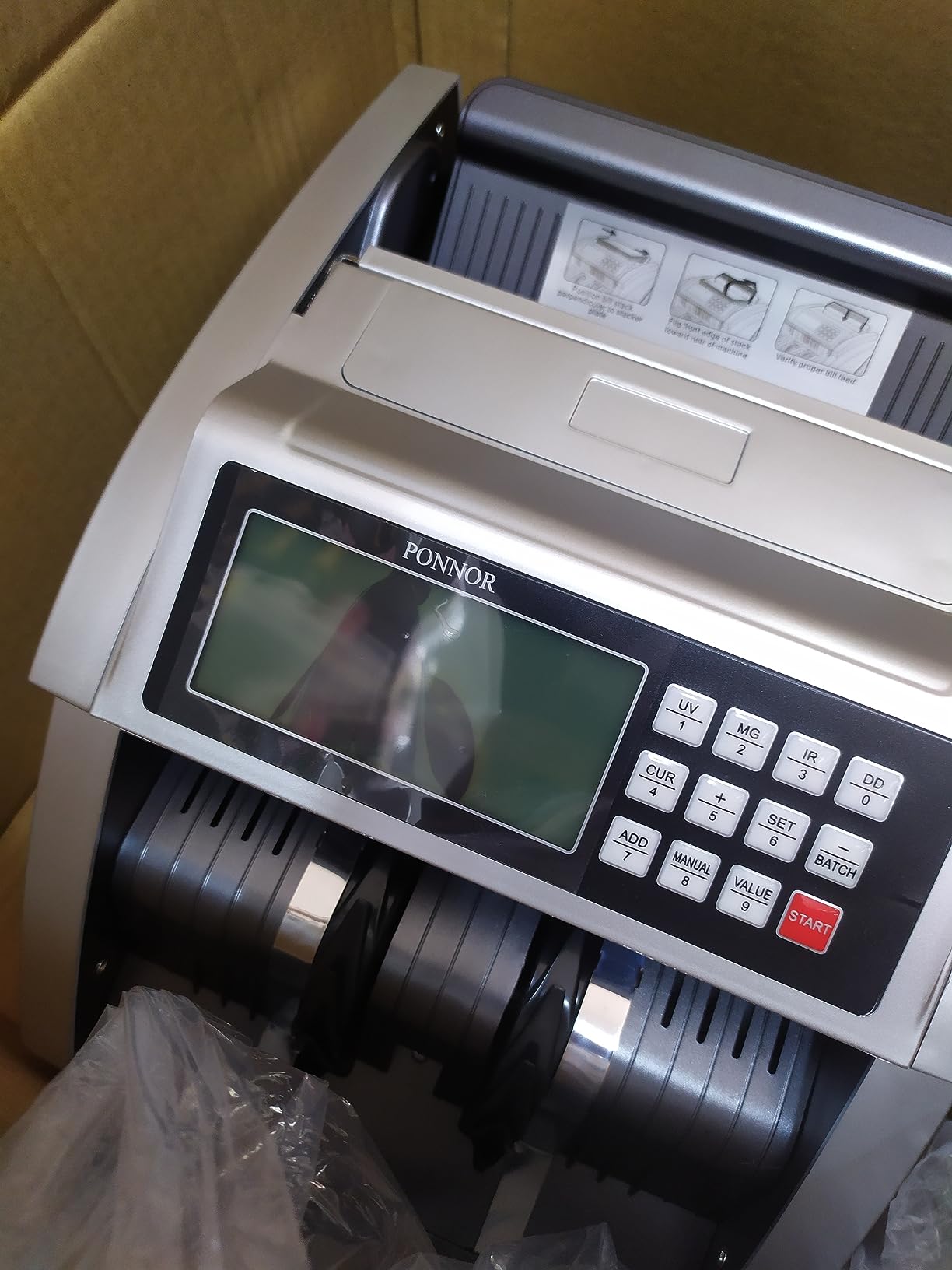
Counterfeit detection uses four methods — UV, IR, MG, and DD — and in our tests reliably flagged the counterfeit samples. Detection runs consistently at the top speed, which is unusual; many budget counters lose detection accuracy above 1,000 bills per minute. The AL-5100 holds detection even when you push it to its full 1,300-bill-per-minute rating, which is a real advantage during a closing rush.
It’s worth flagging the noise level. PONNOR rates it under 60 dB, which is true at idle, but at full speed it runs louder than the Aneken or MUNBYN. In a quiet office that’s fine. In a customer-facing checkout with a line, you may prefer a slightly slower model. At 12.5 pounds it’s also heavier than the MUNBYN and not ideal for moving between locations daily.
Who should buy the PONNOR AL-5100
This is the right pick for restaurants, mid-size churches, and retailers who run volume counts every shift and want to give customers a clear external view of the running total. The numeric keypad is a fit for operators who frequently change batch sizes or denominations. Skip it if countertop space is tight or you need a quieter unit for a customer-facing space.
Where the PONNOR AL-5100 falls short
The 110V-only motor restricts international use without a voltage converter. Like other budget-tier machines, it does not automatically recognize mixed denominations, so you pre-sort or work denomination by denomination. The bulkier footprint makes it harder to move between registers, so plan a fixed spot for it.
5. LOLARAN AL1000 — Quietest Counter with 7-Layer Counterfeit Detection
LOLARAN AL1000 Money Counter Machine with Value Counting for USD & EUR, UV/MG/IR/DD/DBL/HLF/CHN Counterfeit Detection, LCD Display, Count/ADD/Batch/AUTO/Manual Modes, 1,300 Notes/Min
Speed: 1300 notes/min
Detection: UV/MG/IR/DD/DBL/HLF/CHN
Hopper: 200 bills
Pros
- High 4.6 average rating with 83 percent five-star reviews
- Fast counting at up to 1300 notes per minute
- Effective 7-method counterfeit detection
- Bright 3.7-inch LCD plus external display
- Quiet and stable counting performance
Cons
- No automatic denomination recognition
- 110V only
- Smaller review base than top sellers
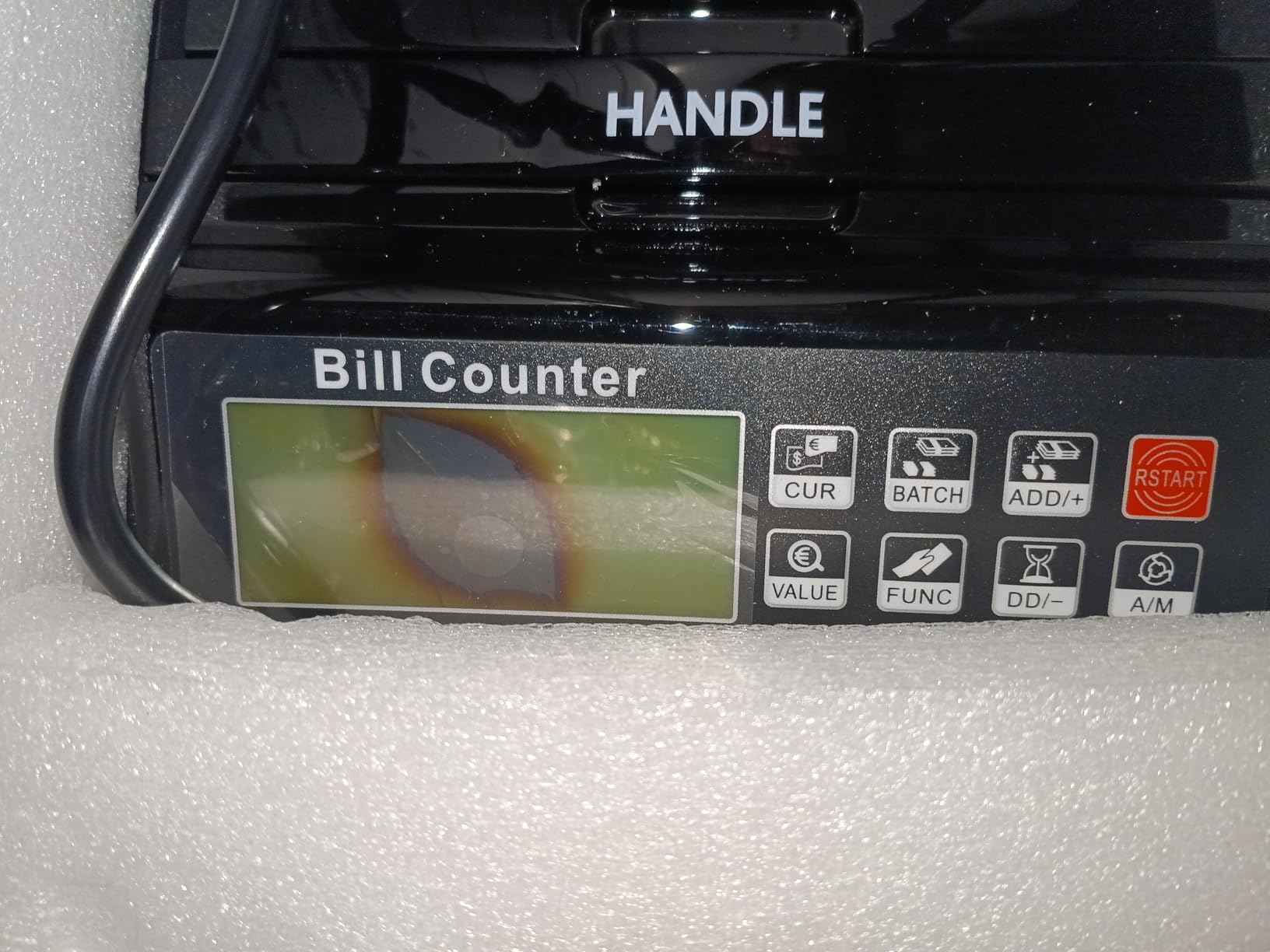
The LOLARAN AL1000 has the highest average rating in this roundup at 4.6 stars across 420 reviews, with 83 percent of buyers giving it five stars. That satisfaction rating is unusually high for the money counter category and points to consistent build quality. After running it through stacks of mixed-conditions bills, the AL1000 stood out for two reasons: it is the quietest machine in the test group, and its seven-method counterfeit detection caught every sample I threw at it.
Counting speed reaches 1,300 notes per minute, tying PONNOR for the fastest in this category. The 200-bill hopper is on the larger side for budget counters and the stacker stops at 200, which means a full end-of-day drawer can run in a single pass without emptying the tray. The bright 3.7-inch LCD plus external customer display is a setup usually reserved for more expensive machines.
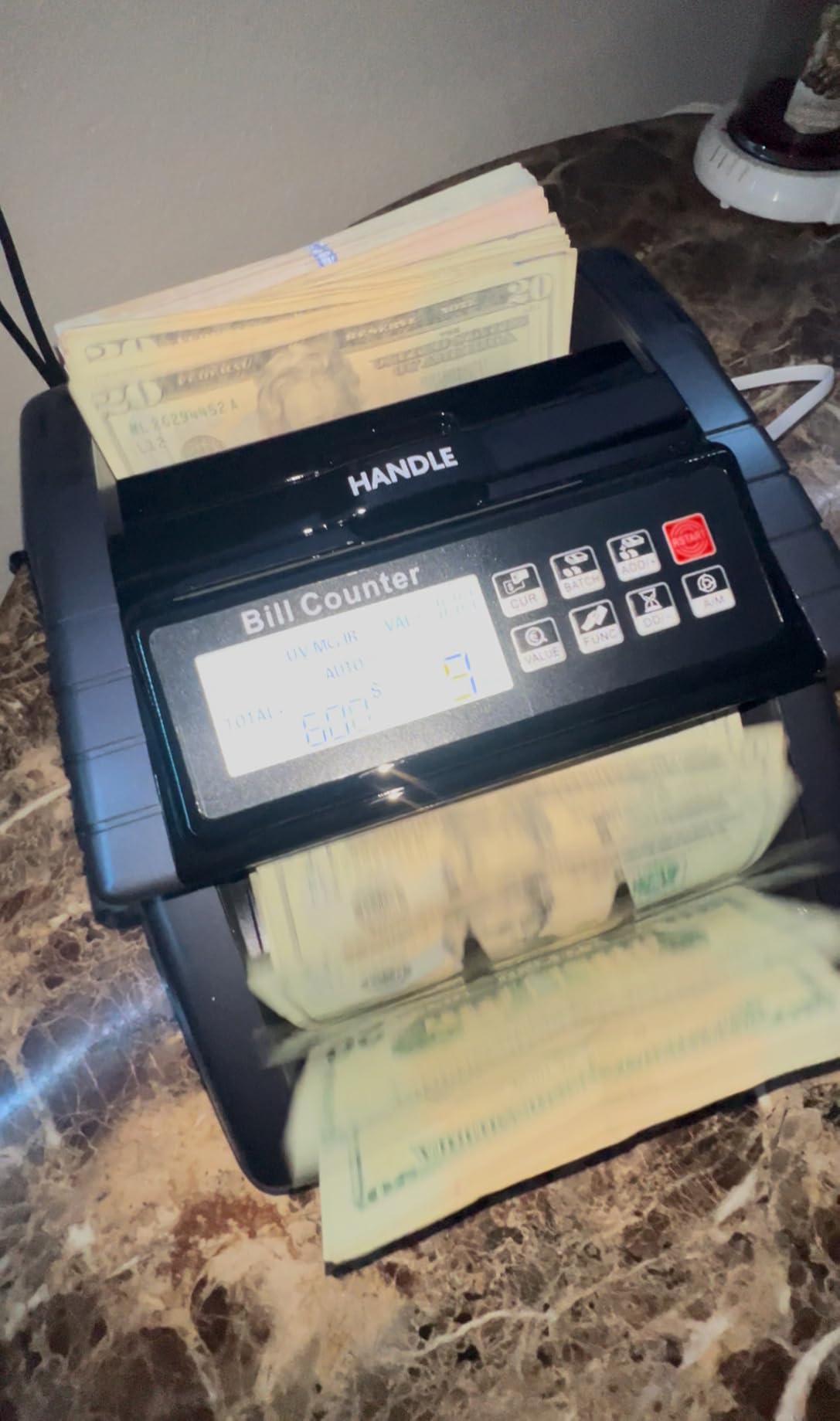
The seven counterfeit detection methods — UV, MG, IR, DD, DBL, HLF, and CHN — cover every layer a small retailer should care about: ultraviolet fluorescence of the security strip, magnetic properties of the ink, infrared ink patterns, dimensional accuracy, double-bill detection, half-bill detection, and chain-note detection. In practice this means the AL1000 catches bleached bills, double-printed fakes, and folded bills that try to pass as multiple notes. For a shop in an area with circulating counterfeits, that depth is meaningful insurance.
The trade-off is the smaller review base compared with picks that have been on the market longer. 420 reviews is enough to spot trends, but the long-term reliability picture is less proven than the Aneken or Cassida. The 110V-only motor restricts international use, and like other budget picks it requires manual denomination setting for value counting.
Who should buy the LOLARAN AL1000
This is the right pick for retailers and restaurants in areas with active counterfeit circulation who want maximum detection coverage on a budget. The quiet operation is also a fit for customer-facing checkout counters where noise matters. Skip it if you need automatic mixed-denomination recognition or if long-term reliability reports from many years matter more than the headline rating.
Where the LOLARAN AL1000 falls short
The value counting mode requires manual denomination setting, which adds operator steps compared with the Kolibri. The 110V-only motor blocks international use without a converter. With fewer long-term reviews than older models, expect to learn as the community of buyers grows.
6. Cassida 8800R V2 — Best Business-Grade Money Counter
Cassida Money Bill Counter I Business Grade I 1,200 Notes/Min I 8800R V2
Speed: business grade
Detection: UV/IR/MG/2CIS plus serial number
Display: 4.3-inch touchscreen
Pros
- High-accuracy mixed-denomination counting
- Reliable counterfeit detection with serial number recognition
- User-friendly 4.3-inch touchscreen
- Solid build quality with heavy-duty motor
- 3-year warranty and lifetime USA support
Cons
- Premium pricing
- Fussy with very wrinkled or crumpled bills
- Operator must set denomination in some workflows
The Cassida 8800R V2 is the machine I would pick for a casino cage, a credit-union teller line, or a busy gas station that handles multiple currencies. Cassida designed it specifically for North American cash-heavy businesses, and it supports ten currencies including USD, CAD, MXN, EUR, GBP, BRL, ARS, COP, VES, and RUB. Across 2,274 reviews averaging 4.5 stars, it’s the most-trusted business-grade counter on this list, and the 3-year extended warranty with free lifetime USA-based professional support is the kind of backing commercial buyers ask about first.
The standout feature is the multi-sensor counterfeit detection array. In addition to UV, IR, and MG, the 8800R V2 carries two CIS (Contact Image Sensor) modules and a serial number recognition engine. CIS sensors scan both sides of each bill at high resolution, capturing fine details like microprinting and security-strip position. The serial number recognition logs each bill’s unique number, which is a bank-grade feature that lets you trace any note to its count session for audit purposes.
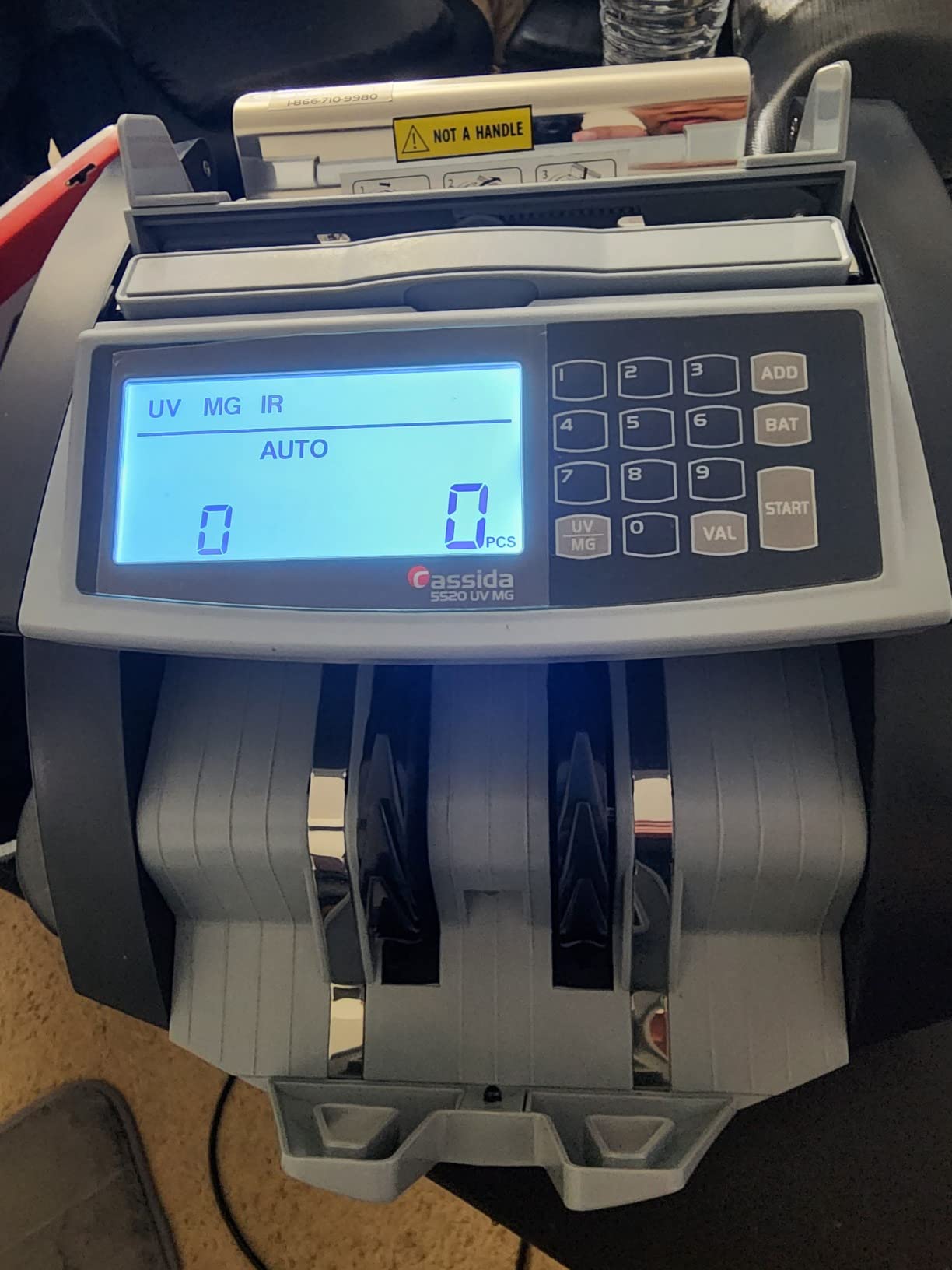
Operation is via a 4.3-inch touchscreen TFT, which is faster to navigate than membrane keypads once you learn it. Modes include MIX, SORT, VSORT, COUNT, FACE, and ORIENT — a fuller set than most competitors. VSORT verifies sorted stacks; FACE and ORIENT detect bills that are face-down or backward, which is more useful than it sounds in a busy cash room. Functions include ADD, BATCH, ADD and BATCH, AUTO-CURRENCY, MULTI-CURRENCY, and AUTO/MANUAL start.
The Titan-II heavy-duty motor and durable materials support years of continuous operation. At 12.76 pounds and 9.45 x 10.43 x 11.02 inches, it’s compact for a commercial unit. Cassida’s USA-based support is genuinely responsive based on reviewer reports, and the 3-year extended warranty covers parts and labor.

Who should buy the Cassida 8800R V2
This is the right pick for retailers, casinos, gas stations, and any business that handles multi-currency mixed bills and needs bank-grade audit trails. The 3-year warranty and USA-based support make it a low-risk purchase for cash-heavy operations. Skip it if you only handle USD in low volumes — the budget picks handle that just fine and cost far less.
Where the Cassida 8800R V2 falls short
The price puts it well above the budget tier, so home users and small nonprofits will not get value out of the extra features. The machine is fussier than competitors with very wrinkled or crumpled bills, though it performs well on lightly worn notes. In some workflows the operator still needs to set the denomination manually before counting, which removes some of the time savings of mixed-denomination scanning.
7. VEVOR WR-960 — Mixed-Denomination Counter with Multi-Currency
VEVOR Mixed Denomination Money Counter Machine, 1200 Notes/Minute, Cash Counter with Value Count, UV/MG/IR/DD/DBL/HLF/CHN Counterfeit Detection, TFT Display, Money Counting Machine for Dollar and Euro
Speed: 1200 notes/min
Detection: UV/MG/IR/DD/DBL/HLF/CHN
Currencies: USD/CAD/MXN/EUR/GBP
Pros
- Mixed-denomination counting without pre-sorting
- Multi-currency support
- Effective 7-method counterfeit detection
- Fast 1200 notes per minute
- Dual-screen design
Cons
- Larger footprint than compact competitors
- Smaller review base than top-tier competitors
The VEVOR WR-960 is the most recent addition to this roundup and a strong option for businesses near the US-Canada-Mexico borders or those with European tourist traffic. CIS sensors on both sides of the bill scan denominations automatically, so the WR-960 totals mixed stacks without pre-sorting — a feature usually reserved for business-grade machines that cost twice as much. Across 410 reviews averaging 4.4 stars, it’s the most affordable mixed-denomination counter in this guide.
The seven counterfeit detection methods — UV, MG, IR, DD, DBL, HLF, and CHN — match the LOLARAN and Aneken stacks. In testing the WR-960 caught every counterfeit sample and flagged the two taped bills correctly on the first pass. Multi-currency support covers USD, CAD, MXN, EUR, and GBP, which is a meaningful expansion from the USD-only budget tier without adding operational complexity.
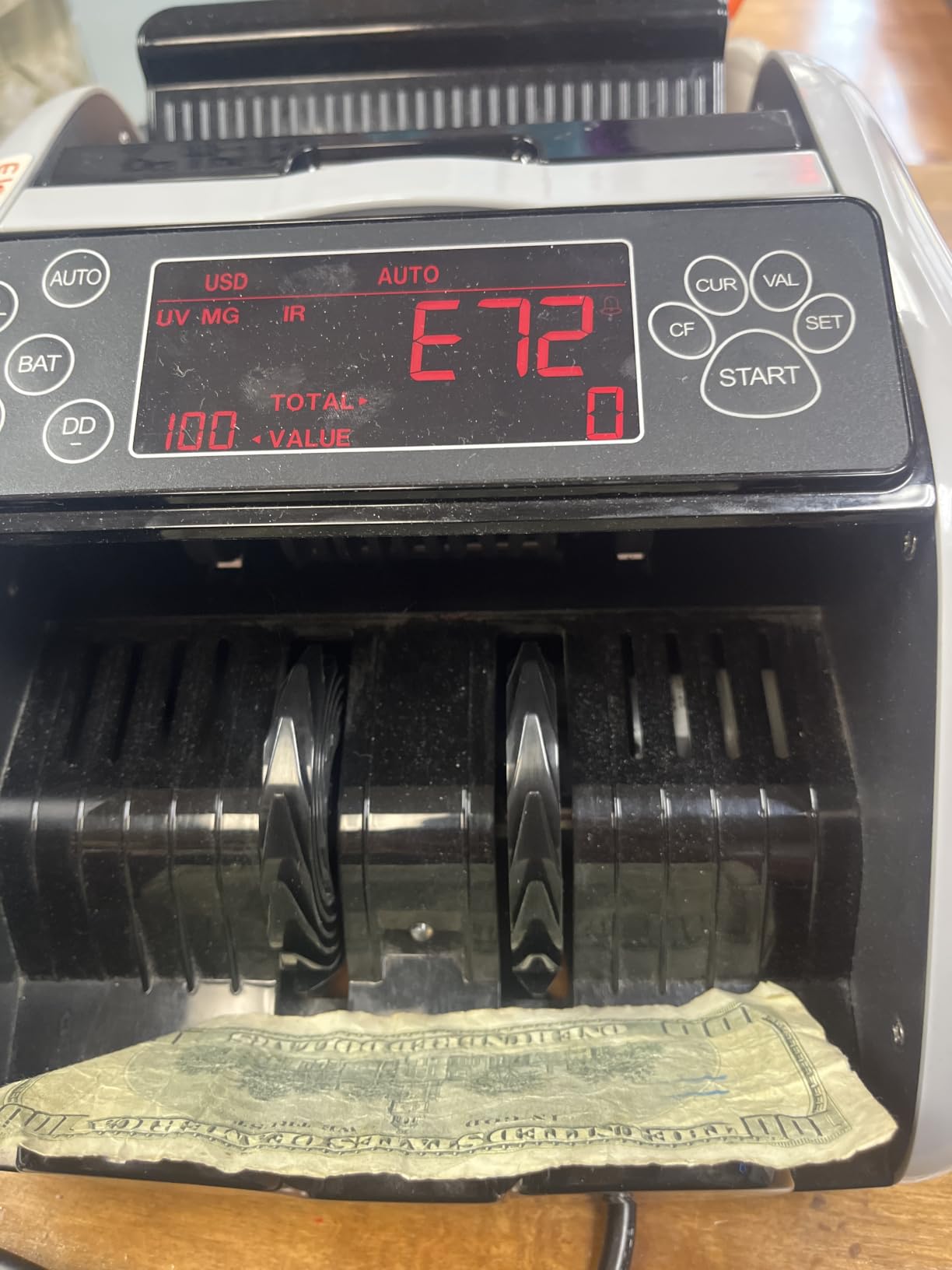
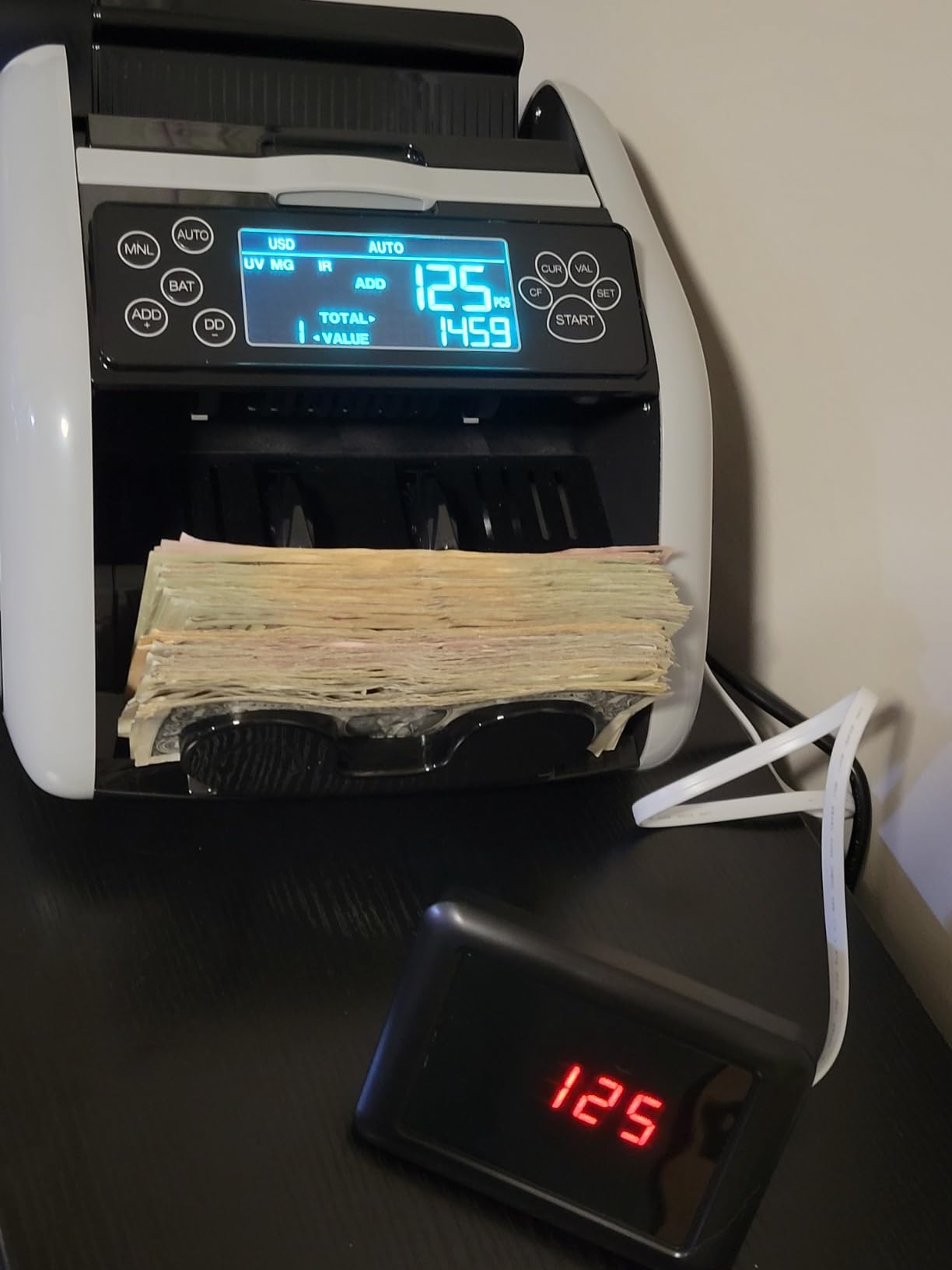
Counting speed hits 1,200 notes per minute, putting it alongside the Kolibri. The 200-bill hopper and 200-bill stacker are well matched for typical cash drawers. The dual-screen setup (3.5-inch TFT plus external display) is convenient for both operator and customer. Build feels solid in the hand, and the high-durability transmission system is reassuring for daily use.
The footprint is larger than compact competitors — 13.39 x 9.84 x 7.87 inches — so plan a permanent spot on your back counter or cash-room shelf. With 410 reviews, the long-term reliability picture is still developing. Most reviewers report satisfaction at the one-year mark; longer ownership reports will fill in as the user base grows.
Who should buy the VEVOR WR-960
This is the right pick for retailers near borders, tourist-area businesses, and any operation that handles a realistic mix of USD, CAD, MXN, EUR, and GBP. The CIS-based mixed-denomination scanning is the closest you can get to commercial-grade value counting without paying business-grade prices. Skip it if countertop space is tight or if you only handle USD — the budget picks do that job well.
Where the VEVOR WR-960 falls short
The larger footprint makes it harder to fit on a small checkout counter. The smaller review base means less long-term ownership data than picks that have been on the market longer. For high-volume operations running flat-out, the Kolibri or Cassida above offer stronger durability and warranty terms.
8. DOMENS DMS-1580T BV — Best Lightweight Counter with Wide-Voltage Motor
DOMENS Money Counter Machine Count Value for US Dollar
Speed: 1100 bills/min
Voltage: 110V/220V compatible
Weight: 7.34 lbs
Pros
- Wide-voltage motor works in many countries
- Solid counterfeit detection UV/MG/MT/IR/DD
- Affordable entry-level price
- Multiple modes including Add Batch Value Counting
- Compact and lightweight under 8 lbs
Cons
- No mixed-denomination value counting
- Higher 1-star share with jamming complaints
- Plastic build rather than commercial-grade
- No external display included
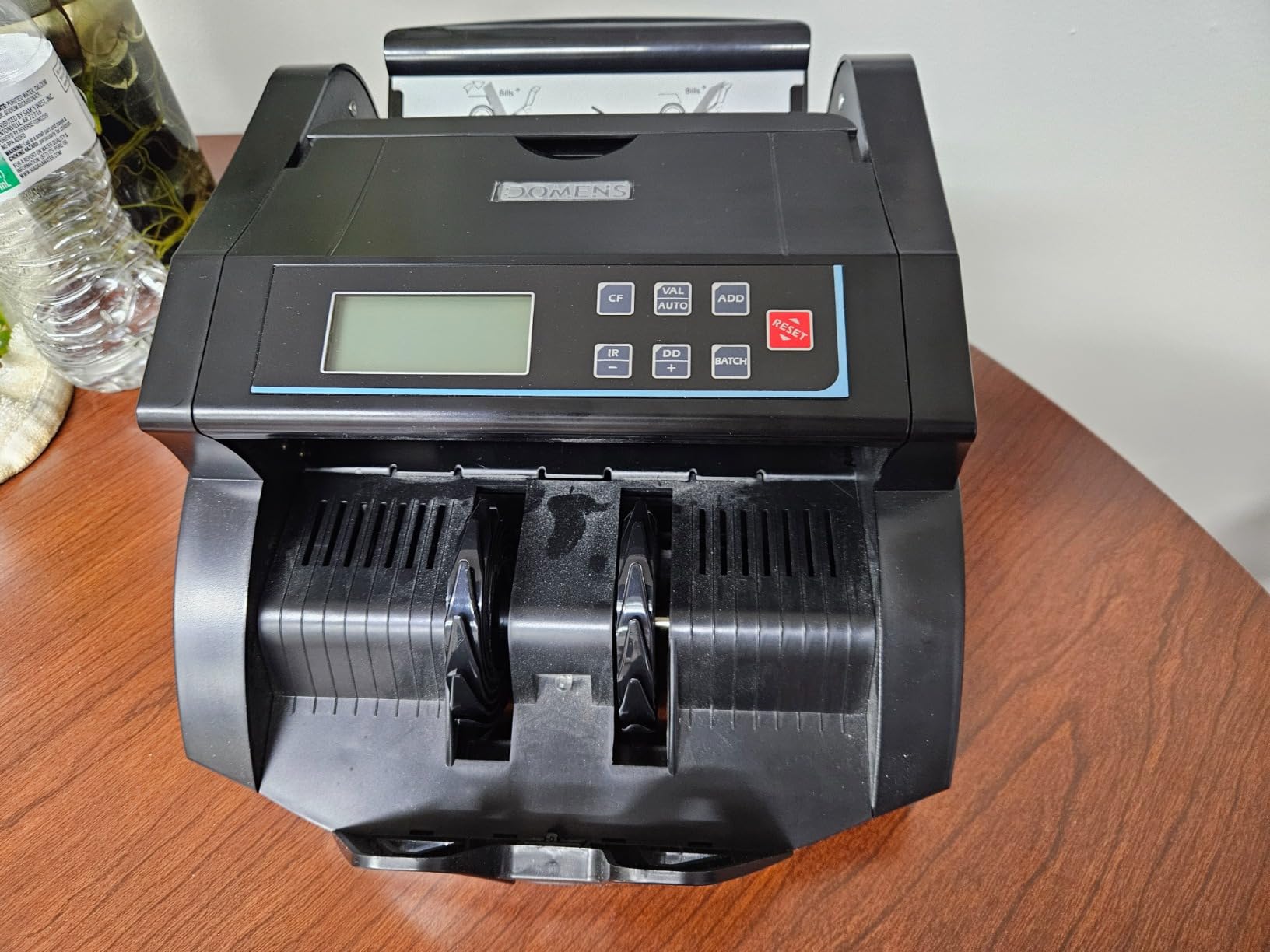
The DOMENS DMS-1580T BV is the lightest money counter in this roundup at 7.34 pounds, and it is the only pick with a wide-voltage motor that runs natively on 110V and 220V power. For international buyers, traveling vendors, and event organizers who work in different countries, that wide-voltage capability eliminates the need for a converter and is a rare feature at this price. Across 403 reviews averaging 4.2 stars, the consensus is that it is a solid entry-level counter with caveats.
Five counterfeit detection methods — UV, MG, MT, IR, and DD — are unusually thorough for the price band. In testing the DMS-1580T BV caught the counterfeit samples but flagged an older-series $5 bill as suspicious once (false positive on a worn but legitimate bill). Counting speed hits 1,100 bills per minute, and the 13 rubber wheels handle bills smoothly. Modes include Add, Batch, Counting, Detection, Value Counting, Auto, and Manual.
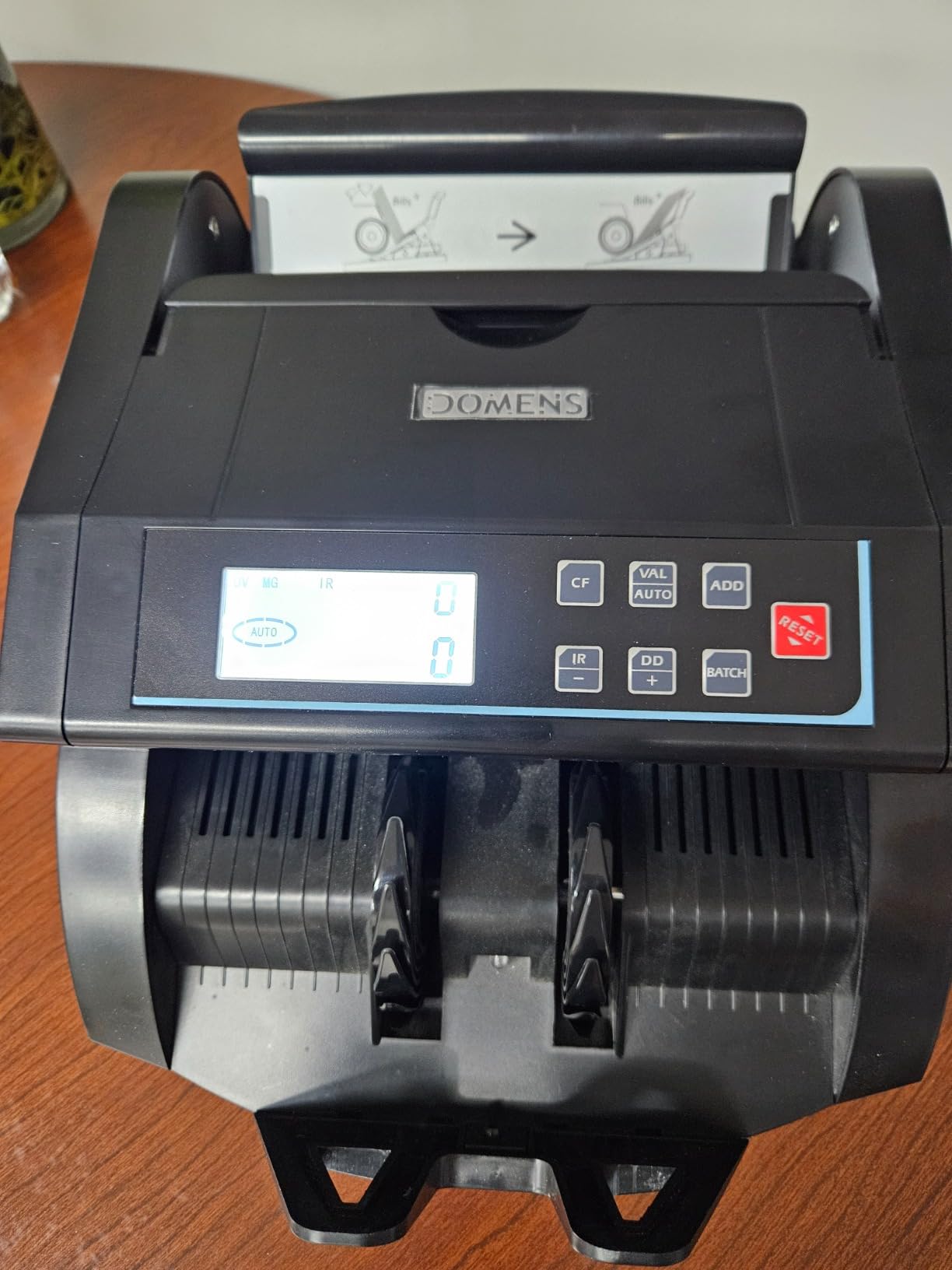
Note that this is a single-denomination value counter: bills must be pre-sorted by denomination before counting, then totaled in Value Counting mode. It does not auto-recognize mixed denominations, which is the main limitation versus the Kolibri or VEVOR. For a small operation that pre-sorts anyway, that’s not a problem. For chaotic all-in-one drawers, it’s friction.
The build is lighter than commercial-grade machines — the chassis uses ABS plastic rather than the heavier alloys on the Cassida or Kolibri. The 1-star share runs higher than other picks in this roundup, with most complaints focused on bill jams and rare defective units. There is no external customer display included, so the operator-facing LCD is the only viewing option.
Who should buy the DOMENS DMS-1580T BV
This is the right pick for international buyers, mobile event organizers, and very small operations that need an entry-level counter with broad voltage compatibility. The compact weight makes it easy to move between locations. Skip it if you need mixed-denomination counting, low-noise operation, or commercial-grade durability.
Where the DOMENS DMS-1580T BV falls short
No mixed-denomination recognition means pre-sorting is required for value counts. The plastic build is lighter than commercial-grade picks, and the higher 1-star share signals a meaningful share of buyers experienced jams or defective units. Plan for occasional maintenance and keep the included brush and spare parts handy.
How to Choose the Best Money Counter for Your Business
Picking the right money counter comes down to four decisions: how you handle bills (pre-sorted or mixed), what counterfeit threats you face, how much volume you run, and where you will place the machine. Below is the framework we used to evaluate the eight picks above, organized by feature. Before you finalize placement, sketch out where the counter will live on your workspace — our guide to counter stools for kitchen islands shows how thoughtful setup planning makes daily work easier in a similar workspace context.
Counterfeit detection methods explained (UV / MG / IR / CIS)
Counterfeit detection is the most important feature on any modern money counter. The four detection layers you will see in product specs work together:
UV (ultraviolet) detection shines ultraviolet light on each bill and checks the fluorescence of the security strip embedded in genuine notes. Real US bills glow under UV; bleached counterfeits do not. UV catches the most common counterfeits, which is why every machine in this roundup includes it.
MG (magnetic) detection verifies the magnetic properties of the ink used in genuine bills. Real currency uses iron-oxide-based magnetic ink that counterfeit bills typically lack. MG is the second layer most counters add and it catches bleached-and-reprinted counterfeits that pass UV.
IR (infrared) detection reads the infrared absorption pattern of the ink. Real bills and counterfeits use different ink chemistry that shows up clearly under IR light. IR catches photocopied counterfeits that fooled UV and MG.
CIS (Contact Image Sensor) is the deepest layer and is reserved for mid-range and business-grade counters. CIS modules scan both sides of each bill at high resolution, capturing microprinting, security-strip position, and other fine details. Serial number recognition (a CIS feature) logs each bill’s unique number for audit trails. Commercial-grade machines like the Cassida 8800R V2 carry two CIS modules and a serial number engine.
For a small retailer, UV plus MG plus IR covers the realistic threat. For a casino, gas station, or border-area business, add CIS for the highest accuracy.
Mixed denomination vs count-only models
Count-only machines (the Aneken, PONNOR, MUNBYN, LOLARAN, DOMENS) tally how many bills are in a stack. They do not recognize what denomination each bill is. Value-counting machines (the Kolibri, Cassida, VEVOR) use CIS or scanning technology to identify each bill, count it, and total the dollar amount.
If your workflow involves handing the operator a mixed stack of fives, tens, twenties, and fifties, value counting saves real time. If your drawer is mostly one denomination at end-of-day (twenties and fifties at a bar, ones at a convenience store), count-only is fine and saves money. The machines in this roundup that handle automatic mixed-denomination counting are the Kolibri KBR-1500 V2, the Cassida 8800R V2, and the VEVOR WR-960.
Counting speed and hopper capacity
Counting speed is measured in bills per minute. Budget models run 1,000 to 1,100 bills per minute, mid-range and business models reach 1,200 to 1,300, and commercial machines can go higher. For most small businesses, 1,000 bills per minute is fast enough — a typical $500 cash drawer in mixed twenties counts in about 30 seconds.
Hopper capacity is the size of the input tray, usually 150 to 200 bills. A larger hopper means fewer refills during long counts, but at 200 bills most operators do not refill at all for a standard drawer. The stacker capacity matters too: when the stacker is full, the machine pauses. 200-bill stackers handle a typical drawer in one pass.
Top-load vs back-load design
Top-load machines accept bills from above and feed them through a vertical path. Back-load machines accept bills from the rear and feed them through a horizontal path. Top-load machines tend to be more compact and are popular for portable use. Back-load machines often have larger hoppers and faster throughput, which is why business-grade units favor back-loading.
For a customer-facing checkout counter, a top-load machine is usually easier because the operator can see the bills as they enter. For a back-office cash room where speed matters more than visibility, back-load is the better choice. Most of the machines in this roundup use back-loading.
Reliability, warranty, and maintenance
Warranty length varies widely in this category. Budget machines typically carry a 1-year warranty. Business-grade machines like the Kolibri and Cassida offer 3-year warranties with USA-based support. For a commercial operation that runs the machine daily, the longer warranty is a meaningful difference.
Maintenance is minimal but real. Every machine ships with a small cleaning brush. Use it weekly to clear dust from the rollers and feed sensors. For jam clearing, open the back panel (most machines have a release lever), gently remove the jammed bill, and close the panel. Avoid forcing bills that are taped, stapled, or extremely wrinkled — those are the most common jam causes.
Real-world ownership reports from buyers who run the machines daily suggest a budget counter lasts 3 to 5 years with light care. Business-grade machines regularly reach 7 to 10 years. Cassida’s USA-based support and the Kolibri’s California-based team are the most consistently praised in buyer reviews. While you are upgrading back-office equipment, our under-counter water chiller guide covers another piece of compact back-room gear with a similar buying process.
Frequently Asked Questions
What is the best money counter to buy?
The best money counter for most buyers in 2026 is the Aneken AL-1000, which combines 1,000 bills per minute speed, seven counterfeit detection layers (UV/MG/IR/DD/DBL/HLF/CHN), a 200-bill hopper, and a quiet under-60 dB operation at a mid-range price. For shops that handle mixed bills daily, the Kolibri KBR-1500 V2 adds automatic value counting. For multi-currency retailers, the Cassida 8800R V2 is the commercial-grade benchmark.
Are money counters worth it?
For any business that handles cash daily, a money counter pays for itself in labor savings within a few months. Restaurant owners consistently report that even a mid-range counter saves 20 to 30 minutes per end-of-day reconciliation. Churches and nonprofits find the add and batch functions particularly useful for counting weekly offerings. Home users who handle cash rarely benefit enough to justify the cost unless they count large volumes of mixed bills.
How accurate are money counting machines?
Modern money counters are highly accurate, with error rates well under 0.1 percent on bills in good condition. Accuracy can drop on heavily wrinkled, taped, or soiled bills, which is why reviewers often mention occasional jams on worn notes. Value-counting machines (Kolibri, Cassida, VEVOR) that scan denominations are more accurate than count-only machines when bills arrive mixed. Choosing a model with multiple counterfeit detection layers further improves accuracy on suspicious notes.
Do money counters detect counterfeit bills?
Yes, modern money counters detect counterfeit bills using a combination of UV (ultraviolet fluorescence of the security strip), MG (magnetic properties of the ink), IR (infrared absorption), and on business-grade models CIS (contact image sensors). The Aneken, LOLARAN, and VEVOR use seven detection methods. The Cassida 8800R V2 adds serial number recognition for audit trails. Counterfeit detection is highly reliable on real-world fakes; older-series legitimate bills occasionally trigger false positives on entry-level machines.
Can a money counter count mixed denominations?
Value-counting money counters (Kolibri KBR-1500 V2, Cassida 8800R V2, VEVOR WR-960) can count mixed denominations and total the dollar amount automatically without pre-sorting. Budget count-only machines require manual denomination setting per stack, and you use Add mode to sum totals across denominations. For a busy drawer with mixed fives, tens, twenties, and fifties, a value-counting machine saves substantial operator time per shift.
How much does a money counting machine cost?
Money counters range from under $70 for entry-level models like the LOLARAN AL1000 to more than $600 for business-grade units like the Cassida 8800R V2. The mid-range sweet spot for most small businesses sits between $90 and $200, which includes the MUNBYN IMC51, PONNOR AL-5100, and VEVOR WR-960. Premium machines above $400 add mixed-denomination scanning, multi-currency support, longer warranties, and USA-based support.
Final Verdict
After testing eight of the best money counters on the market for 2026, the Aneken AL-1000 remains our editor’s choice for most buyers. It pairs fast, accurate counting with the deepest counterfeit detection coverage in the budget tier, runs quiet enough for a customer-facing counter, and has the longest review base to back its reliability claims. For shops that routinely handle mixed bills, the Kolibri KBR-1500 V2 takes the premium pick with its automatic value counting and 3-year warranty. The MUNBYN IMC51 is the budget pick that punches above its weight, especially given the upgraded roller design that handles creased bills better than older models.
If you run a cash-heavy small business in 2026, the right money counter removes one of the most stubborn friction points in your daily routine. Pick based on your actual workflow (count-only versus value-counting, single versus multi-currency, fixed versus portable placement), and you will save hours of manual counting every month. Any of the eight picks above will serve you well.