
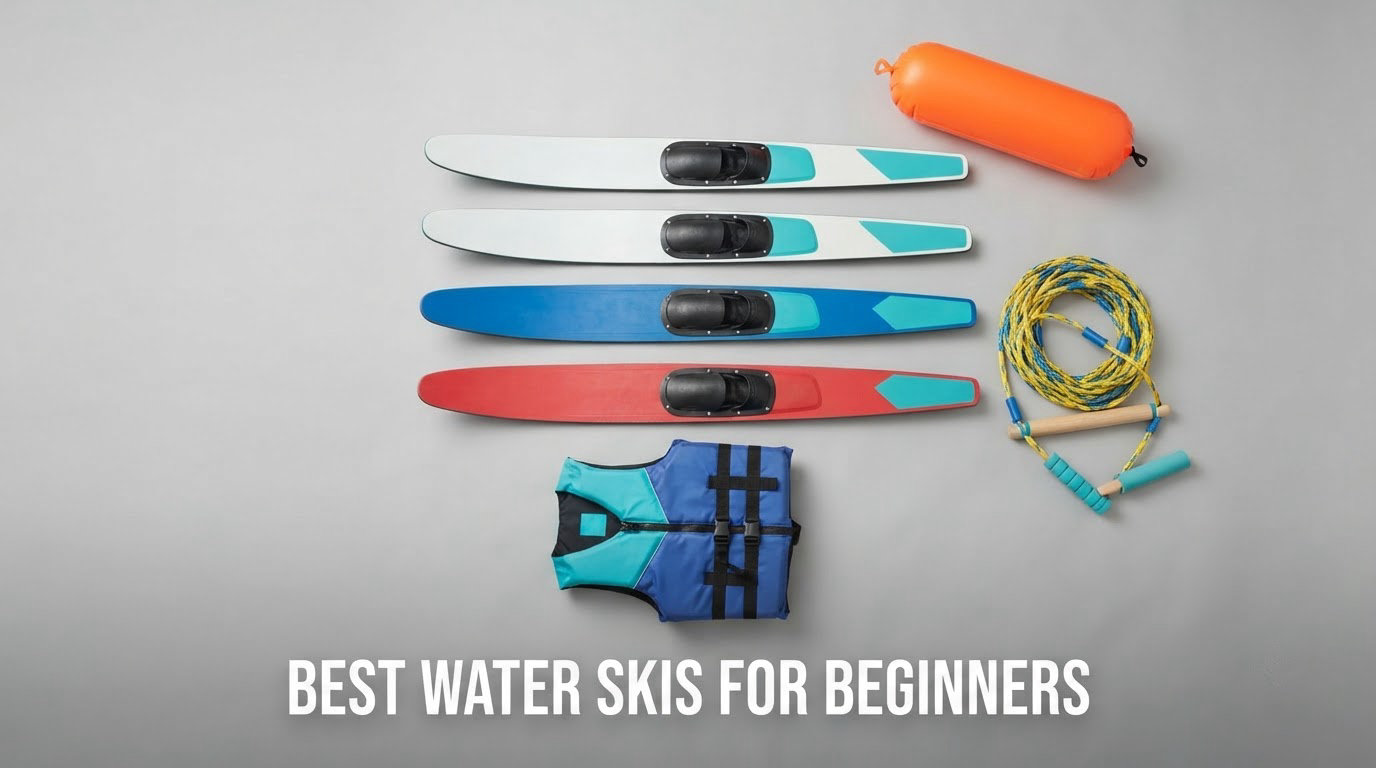
The best water skis for beginners are wide-body combo skis, and the reason is simple physics: a wider ski pushes more water aside as the boat accelerates, so it planes out of the water sooner and at a lower tow speed than a narrow slalom ski. That extra surface area is what makes the get-up survivable on your first ten tries instead of your first hundred.
Almost every beginner failure happens during that get-up, not on the turns. Ski length, width and rocker decide how fast the ski rises and how forgiving it is when you lean off balance, and those three variables shorten the learning curve more than any amount of coaching. Get them wrong and you spend a season fighting equipment instead of learning to ski.
We compared ten beginner water ski sets against each other, weighing the published rider weight ranges, binding fit, ski width and rocker profile of every model, then checked what owners actually report after a season on the water. What follows is a full roundup of the best water skis for beginners in 2026, split by who is skiing, how much they weigh, and what boat is pulling them.
If you are starting from zero, the [best water skis roundup on Thirsty Bear](https://www.thirstybear.com/best-water-skis/) covers the wider field of adult setups. If your family is splitting time between a ski boat and a towable, our [best jet skis guide](https://www.thirstybear.com/best-jet-skis/) covers the other half of the tow-sports setup. For the land version of the same balance problem, the [best cross country skis](https://www.thirstybear.com/best-cross-country-skis/) guide is the relevant read.
Table of Contents
Top 3 Picks for Best Water Skis for Beginners in (October 2026)
We kept the shortlist to the three sets that solve the widest range of beginner problems, and we weighted review volume as heavily as star rating. A 4.6 from 231 owners tells you something a 4.6 from 12 owners does not, especially on a product where the failure mode is a binding that does not release.

O’Brien Celebrity 68 inch Combo
- X-7 adjustable binding fits US men's 4.5-13
- Dual V-shaped tunnel bottom
- Flatter rocker for deep-water starts
- Boat-friendly nylon fins

RAVE Sports Rhyme Combo
- Center ridge and deep edge channels
- Easy-adjust bindings
- 67 inch length for riders over 125 lbs

Connelly Quantum 68 inch Combo
- Rated 135-240 lbs
- Stabilizer bar inserts included
- Bindings fit sizes 9-14
- Reinforced composite construction
Best Water Skis for Beginners in 2026: All 10 Compared
Every set below is a two-ski combo, which is the format we recommend for a first season. The columns that matter most when narrowing the field are rider weight capacity, binding foot size range and whether the ski carries a stabilizer bar, because those three decide whether the skis actually fit the person in front of them.
| Product | Specifications | Action |
|---|---|---|
| O’Brien Celebrity 68 inch Combo Water Skis with Adjustable Bindings |
|
Check Latest Price |
| RAVE Sports Rhyme Combo Water Skis |
|
Check Latest Price |
 Cadet Combo Waterskis Cadet Combo Waterskis |
|
Check Latest Price |
| Connelly Quantum Waterski Combos 68 inch, Adjustable Bindings |
|
Check Latest Price |
 Rave Sports Jr. Shredder Youth Water Skis Rave Sports Jr. Shredder Youth Water Skis |
|
Check Latest Price |
 Connelly Supersport Combo Waterskis Connelly Supersport Combo Waterskis |
|
Check Latest Price |
 RAVE Sports Steady Eddy Water Skis RAVE Sports Steady Eddy Water Skis |
|
Check Latest Price |
 O’Brien Reactor Combo Water Skis, 67 inch, Red O’Brien Reactor Combo Water Skis, 67 inch, Red |
|
Check Latest Price |
 O’Brien Performer Combo Water Skis Sizes 7-13 O’Brien Performer Combo Water Skis Sizes 7-13 |
|
Check Latest Price |
 Airhead Youth Trainer Water Skis Airhead Youth Trainer Water Skis |
|
Check Latest Price |
Two things jump out of that comparison. Five of the ten sets carry a stabilizer bar or the inserts for one, and that is the single biggest predictor of how quickly a beginner stands up. Second, every model here is a combo pair, which tells you how strongly the category has settled on the two-ski format for new skiers.
1. O’Brien Celebrity 68 inch Combo Water Skis – The Best Overall Beginner Ski
O’Brien Celebrity 68″ Combo Water Skis with Adjustable Bindings
68 inch combo
X-7 binding fits US men's 4.5-13
Dual V-tunnel base
18 lb
Pros
- Widest binding range in the roundup at US men's 4.5-13
- V-shaped dual tunnel tracks straight in rough water
- Flatter rocker and side-cut bevel ease deep-water starts
- Nylon fins grip water without marking the hull
Cons
- Listed as intermediate skill level rather than a dedicated trainer
- Heaviest adult set alongside the Performer at 18 lb
- Only one product image on the listing
The Celebrity is the set we would put an adult beginner on without hesitation, and the reason is the X-7 binding. Fitting US men’s shoe sizes 4.5 through 13, it is the widest range in this roundup by several sizes, which means the skis can be handed between two adults, or between an adult and a teenager, without a fitting trip.
Out on the water the flatter rocker and side-cut bevel do the work that a beginner instructor would otherwise be doing by hand. The ski is designed to reduce drag and build surface lift earlier in the acceleration, so it comes up out of the hole at a speed you can control rather than the speed the boat happens to be running.
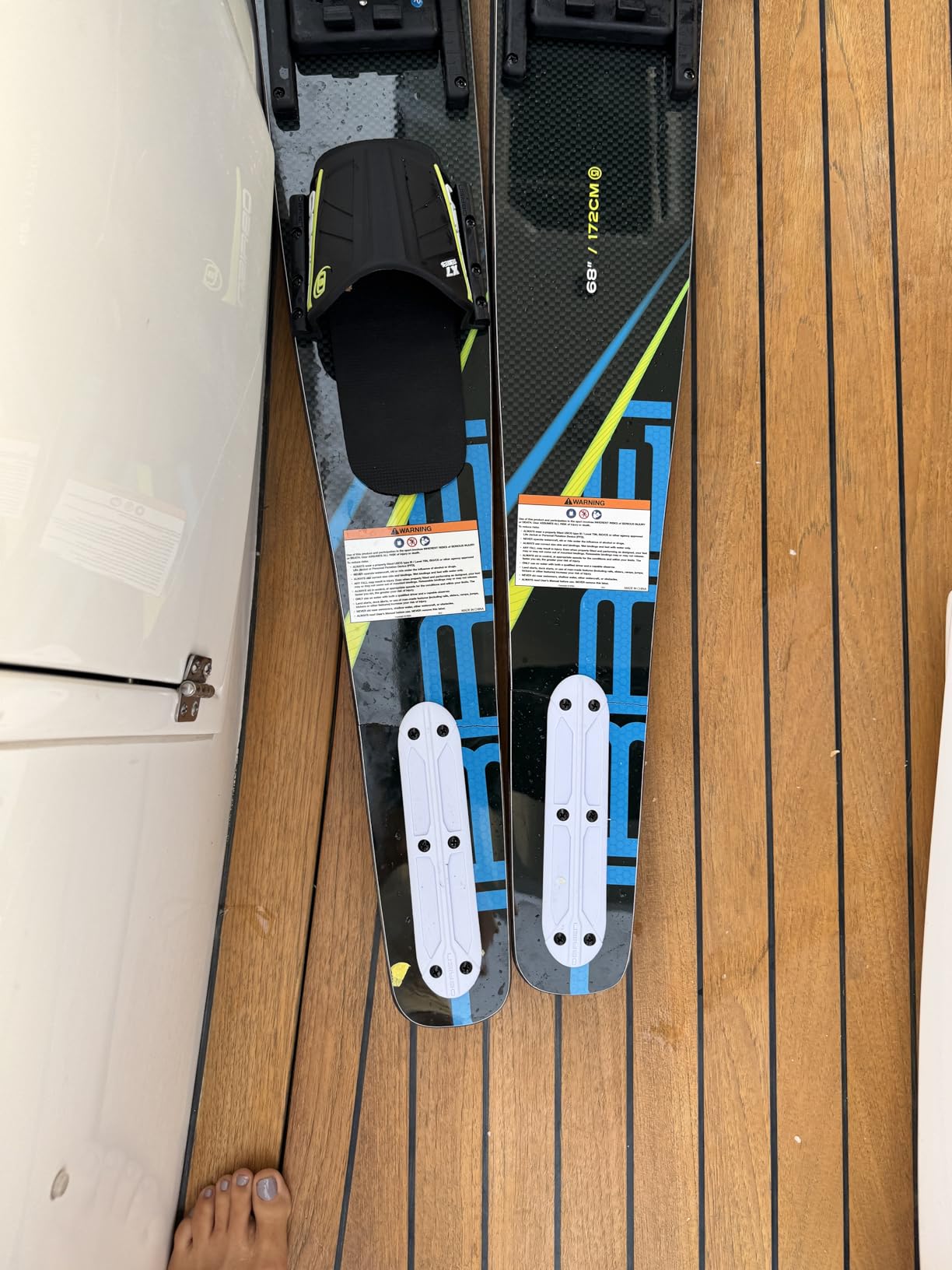
The V-shaped dual tunnel bottom is the piece most worth understanding. A tunnel is a channel cut into the underside of the ski, and a V-shaped one is designed to give the ski lateral control so it tracks straight through chop and through the wake of the boat rather than wandering side to side. For a first-timer, straight tracking is everything, because every degree of wander costs you balance you do not have yet.
The boat-friendly nylon fin is a smaller detail that pays off constantly. A nylon fin grips the water without leaving gouges in the carpet or gelcoat of your boat, and it is far less likely to snap a deck off the ski on a hard landing than a thin plastic fin. The ski pair weighs 18 pounds, which is real weight to carry up a boat ladder, though it splits evenly between two skis.
Owners rate this set 4.6 out of 5 across 231 reviews, the largest sample in the roundup, and 77% of those are five-star. The recurring themes are easy deep-water starts, a binding that fits a genuine range of feet, and tracking that stays predictable when the water is not flat. That is exactly the brief for a first season.
Who the Celebrity suits
Adult beginners roughly 100 to 190 pounds are the sweet spot, though the binding range extends well past that. If more than one person in your household will use the pair, or if your feet sit at either end of the size scale, this is the set that will not exclude you.
It also works well for a couple who wants to ski doubles together on a sterndrive runabout, because a 68 inch ski handles a 20 to 30 mph tow without feeling twitchy.
Where it falls short
O’Brien lists these as intermediate rather than a dedicated beginner trainer, and that shows in the spec sheet even though the behavior on the water is forgiving. If you want a ski with a stabilizer bar built in, this is not the one.
At 18 pounds for the pair, it is also a step up in carry weight from the 7 pound kid sets if you are hauling it across a parking lot by yourself. Everything else about it is hard to argue with.
2. RAVE Sports Rhyme Combo Water Skis – The Best Value Combo
Pure Combo Water Skis
67 inch plastic combo
Max 125 lb riders
Center ridge and deep edge channels
18.3 lb
Pros
- Gentlest entry point of the adult sets in this roundup
- Center ridge and deeper edge channels help deep-water starts
- Bindings adjust easily so a family can share one pair
- 4.5 star average across 182 reviews
Cons
- Capped at a 125 lb maximum rider weight
- Only a 90-day warranty
- No stabilizer bar or stabilizer bar inserts
The Rhyme is the value pick here, and the value is real: it is the least expensive adult-rated set in the group and it still carries a 4.5 star average from 182 owners. For a family that wants to try a full season of skiing before committing to a premium setup, that is an unusually favorable entry point.
The shape is the story. A center ridge runs the length of the underside and the edge channels are deeper than on most beginner molds, and together they resist the twisting that pulls a skier’s skis apart during a deep-water start. That is the same job a stabilizer bar does, achieved through mold geometry instead of hardware.
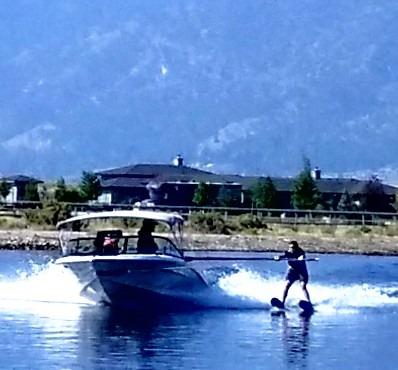
What makes the Rhyme genuinely useful in a family is the binding. The adjustment is simple and secure enough that an adult and a teenager can swap places between runs without fuss, which matters in a sport where you frequently start over after a fall and want a different pair of legs on the skis.
The ski is 67 inches, or 170 cm, and RAVE specifies it for riders over 125 pounds. That 67 inch figure comes up constantly in skier discussion as a good universal starting length, and it is why this set works as well for a 130 pound teenager as for a 190 pound parent.
Owners consistently point to easy adjustability and forgiving stability as the reasons they keep skiing on the pair, with 75% five-star ratings among the 182 reviews. The complaints are consistent too, and both are fit issues rather than performance issues: the 125 pound ceiling and the short warranty.
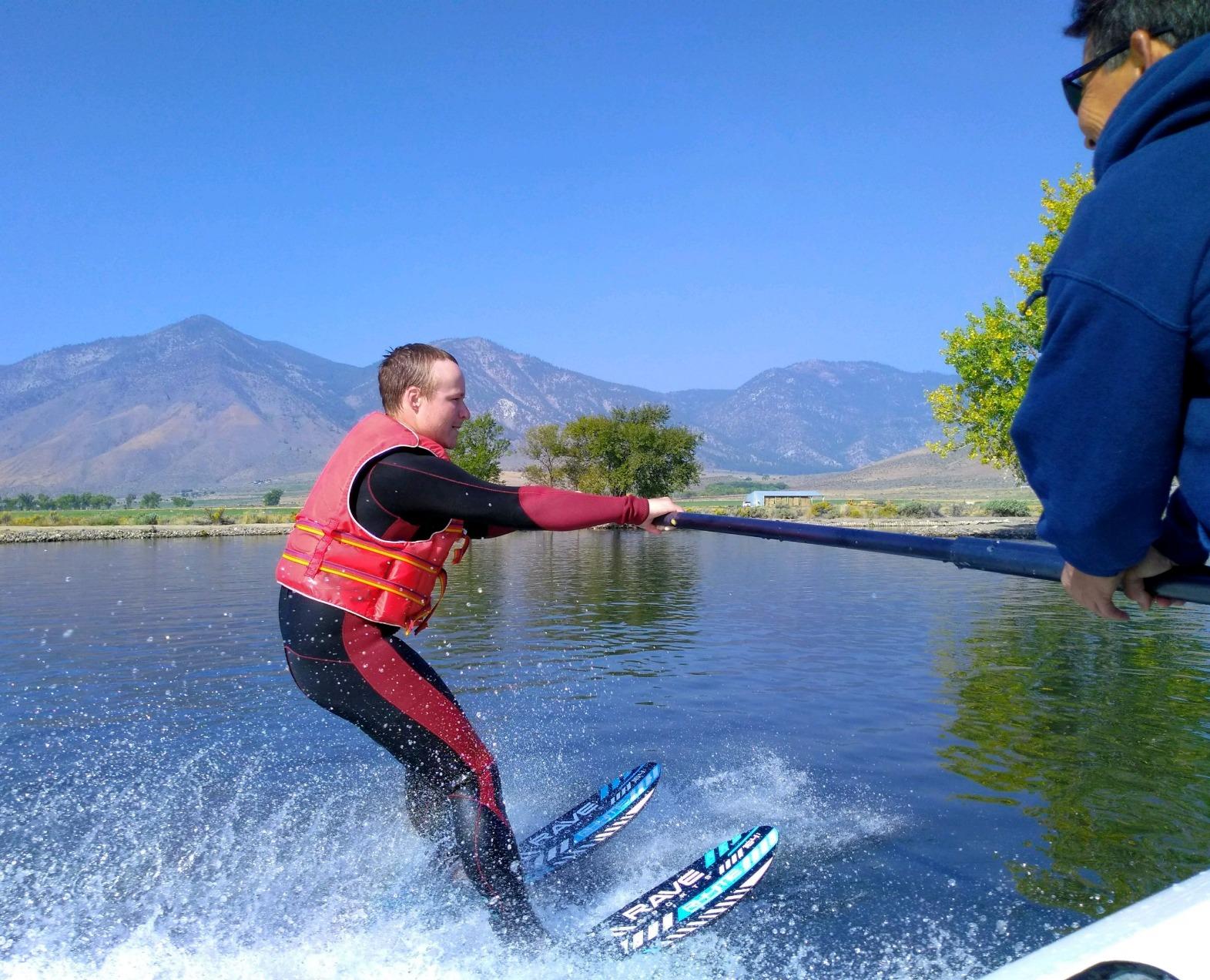
Who the Rhyme suits
Adults between about 125 and 160 pounds are the intended range, and a 67 inch ski at that weight is stable enough for a boat with modest horsepower. It is our pick if the budget is the first constraint and the plan is one season of learning.
Because the bindings are straightforward rather than technical, this is also the easiest set to hand to a second skier in the family mid-day.
Where it falls short
The 125 pound maximum is a hard wall, and it is the reason heavier adults should look at the Connelly Quantum instead. Buy the Rhyme for a teenager and you will outgrow it in a season.
A 90-day warranty is short by ski standards, so treat the first few sessions as the trial period and inspect the bindings and fin closely before the window closes.
3. Connelly Cadet Combo Waterskis – The Best for Kids Under 80 Pounds
Connelly Cadet Combo Waterskis
Two 45 inch composite skis
Rated for skiers up to 80 lbs
Foot sizes 1-4
7 lb pair with bar and rope
Pros
- Lightest adult-carried design at 7 lb for the pair
- Removable stabilizer bar and rear strap hold the skis together
- Two-handle rope gives the boat adult direct control
- Glass-filled nylon fin and UV-coated gloss finish
Cons
- Limited to skiers up to 80 lbs and foot sizes 1-4
- Bindings suit the youngest riders rather than adults
- 4.2 average with a mixed share of three-star fit reports
The Cadet is built for one specific job: putting a small child on the water and getting them upright. At 45 inches a ski and 7 pounds for the pair, it is small enough that a parent can carry it down a dock single-handed, and short enough that a child’s arms do not have to reach for a handle positioned far out in front of them.
The removable stabilizer bar with a rear strap is the feature that matters. It physically holds the two skis at the correct spacing and keeps a small skier’s feet tracking together, which is the single most common cause of the scissoring crash that scares first-timers.
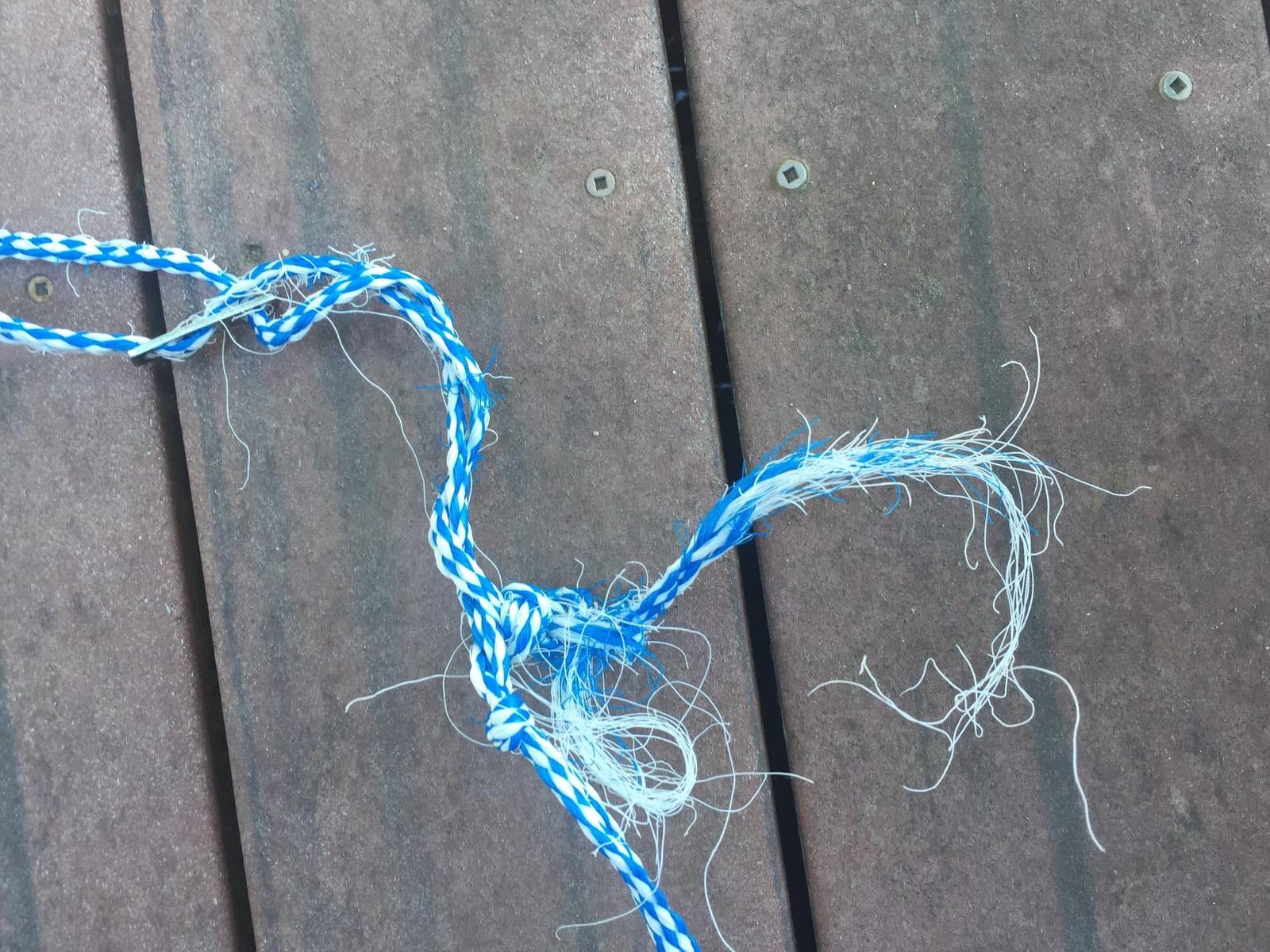
The two-handle Cadet rope is the other differentiator. One handle goes to the child on the short rope and the second handle stays with an adult in the boat, who can control the pull, keep the child centered and drop their end of the handle immediately if the child falls. That is a real safety design, not a convenience feature.
Construction is reinforced composite with Connelly’s tracking system, finished in a high-gloss UV coat to slow the fading and surface degradation that come with a season of lake water and sun. The fin is glass-filled nylon, which is the right material for a beginner set that will be dragged over boat carpet.
With a 4.2 average across 131 reviews and 62% five-star ratings, the feedback is more mixed than the rest of this list, and the reason is nearly always fit. Families credit the bar and the rope for getting small children up quickly, but the 80 pound ceiling and foot sizes 1 through 4 exclude more children than you might expect.
Who the Cadet suits
Children in the roughly 30 to 80 pound range with feet in sizes 1 through 4, learning on a boat with a driver patient enough to coach over a two-handle rope. This is a first-summer ski and it is honest about that.
It also works well as the loaner pair when grandparents or aunts and uncles want to take a young child out without committing an adult-sized setup to a season of kid duty.
Where it falls short
The 80 pound limit is the whole story. A child who outgrows it usually needs a step up to a 53 to 57 inch trainer rather than a full adult ski, so plan the purchase around a year or two of use rather than a decade.
The 4.2 average also carries the largest three-star share of the roundup, and the fit complaints are not fixable with an adjustment. Measure the child’s foot before ordering.
4. Connelly Quantum 68 inch Combo Water Skis – The Best for Heavy Adults
Connelly Quantum Waterski Combo’s 68″, Adjustable Bindings
68 inch (173 cm) composite combo
Rated 135-240 lbs
Bindings fit sizes 9-14
15 lb pair
Pros
- Widest rider capacity in the roundup at 135-240 lbs
- Ships with stabilizer bar inserts so a training bar can be added
- Reinforced composite with classic adjustable bindings
- 70% five-star ratings across 92 reviews
Cons
- The stabilizer bar is sold separately
- Bindings only fit shoe sizes 9-14
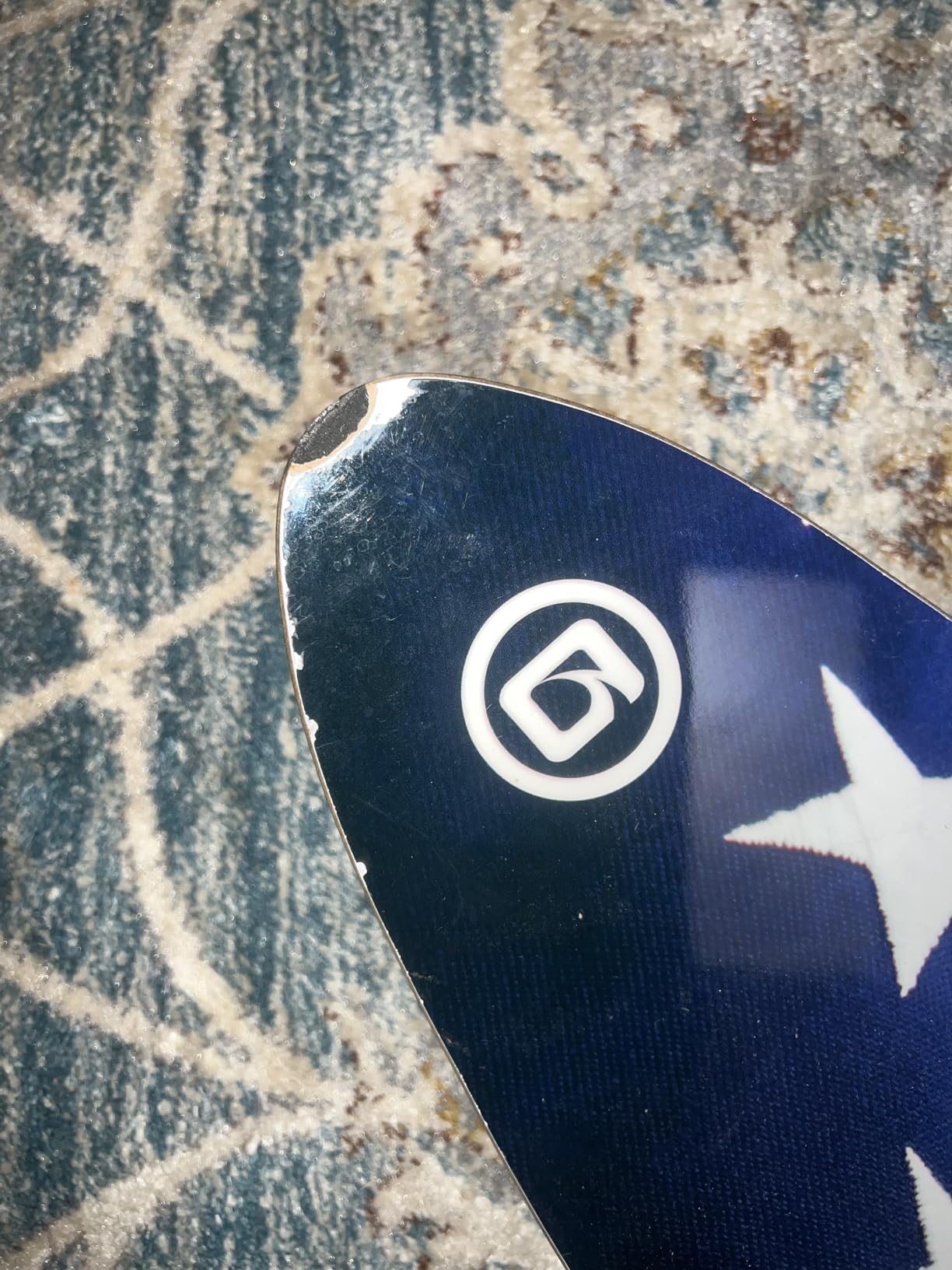
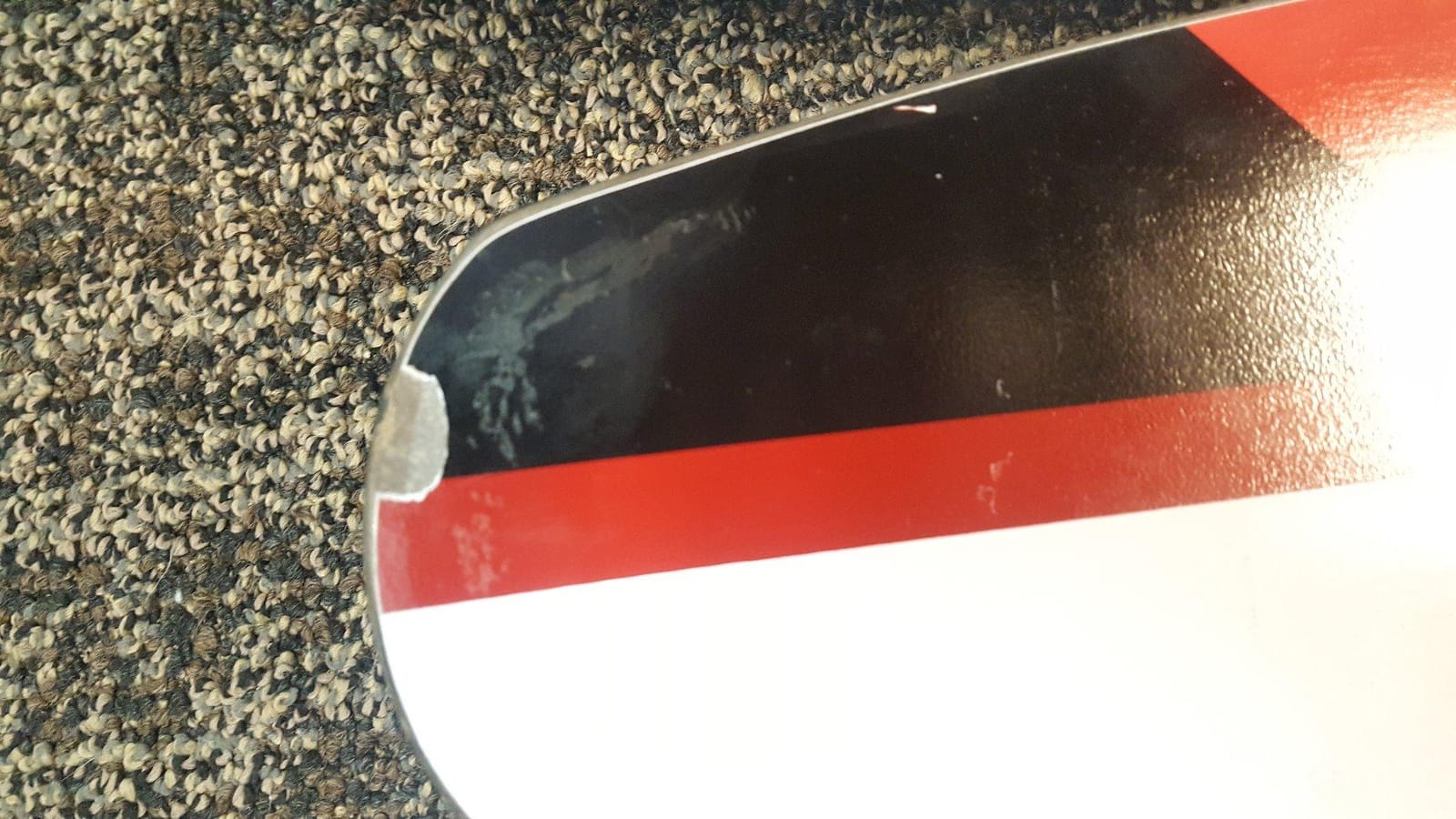
- At least one delivery arrived with a chipped ski
If you weigh 200 pounds or more, the Quantum is the set the rest of this list is not built for. Connelly rates it from 135 to 240 pounds, a 240 pound ceiling that no other combo here approaches, and the 68 inch length gives enough surface area to plane properly under a heavier rider.
Lighter riders often make the mistake of sizing a ski on height alone, and that is exactly what produces the sluggish, hard-to-start feeling that ends a season early. Weight capacity is the number that determines whether the ski planes at a speed your boat can actually hold.
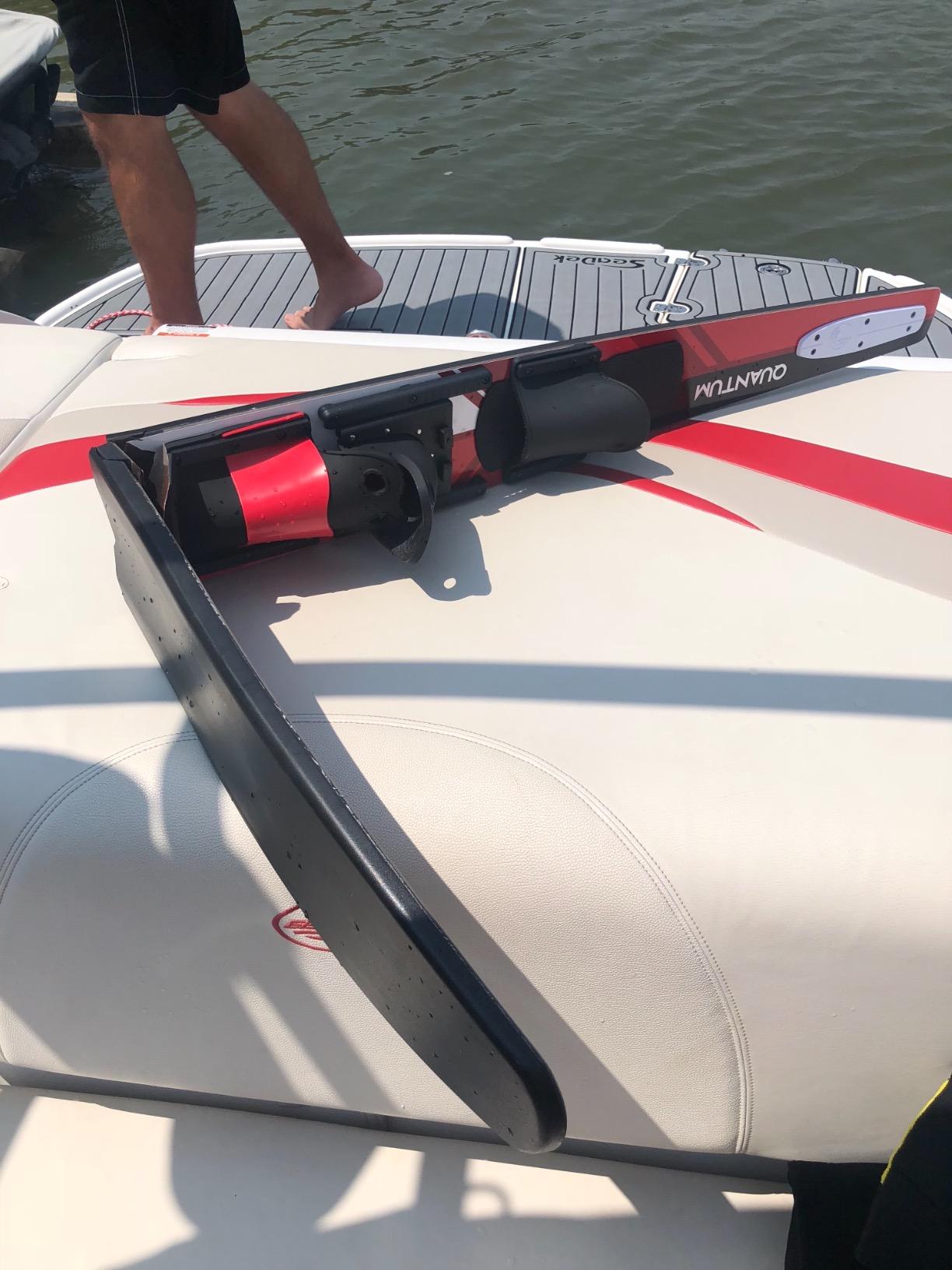
The stabilizer bar inserts are a thoughtful inclusion. Molds come pre-drilled for a training bar, so if you are learning alongside someone who is struggling, or if your own confidence is low, you can add a bar later without the cost or the fit problems of a mismatched accessory.
Construction is reinforced composite, and the bindings are the old-school adjustable style that experienced skiers still praise. The useful detail is the size range: 9 through 14 covers a lot of adult feet, and if you fall inside it, the fit is described as snug and secure rather than loose.
Owners give it 4.4 out of 5 from 92 reviews with 70% five-star ratings, and the praise is concentrated on build quality. The negative feedback is mostly logistics: the bar not being included, and a few reports of packaging damage in transit leaving a chip in one ski. Inspect the ski on arrival.
Who the Quantum suits
Riders between roughly 135 and 240 pounds, especially anyone who has been told by a boat operator that they are too heavy for the beginner skis at the rental dock. The weight rating is the number to trust here, not your height.
It is also a sensible family ski when the adults are large, since 68 inches is long enough to feel planted rather than twitchy at speed.
Where it falls short
Shoe sizes 9 through 14 is a real restriction. If your feet fall outside that band, skip this one even if the weight rating fits, because a binding that does not hold your foot is a distraction you cannot afford while learning.
Plan to buy the stabilizer bar separately if you want one, and check the ski for chips before the first run since the packaging is not always protective enough.
5. RAVE Sports Jr. Shredder Youth Water Skis – The Best Path to Slalom
Rave Sports Junior Shredder Kids Water Skis
57 inch wide-body combo
80-125 lb rider range
Pre-mounted slalom toe
Removable stabilizer bar
Pros
- Pre-mounted slalom toe lets a child move from two skis to one
- Dual-density bindings are comfortable and adjust easily
- Removable bar supports early starts and comes off later
- 4.6 star average with no one-star ratings in 75 reviews
Cons
- Runs short for riders near the 125 lb ceiling
- One report of a fiberglass chip after a single use
- Only a 90-day warranty
The Shredder is the only set in this roundup designed around a progression path rather than a single destination. A slalom toe is pre-mounted on the binding, so when a child is ready to drop from two skis to one, the hardware that makes a single-ski tow possible is already there.
For an 80 to 125 pound rider that is genuinely useful. Many children plateau on combo skis because the binding they own cannot accept a slalom setup, and the answer is a new pair of adult skis at twice the size and twice the carry weight. The Shredder sidesteps that.
The wide body shape is tuned for young skiers who are still learning balance, and the removable stabilizer bar gives you a way to dial support up or down. Start with the bar fitted, then remove it once the child can hold a steady knee bend and a consistent handle position.
The double-density slide binding is worth calling out. It combines a softer inner density for comfort with a stiffer outer shell for ankle support, which is a smarter approach than a single-density binding that is either comfortable or supportive but not both. It tightens and loosens without tools, which matters when you are adjusting a binding on a wet dock.
The rating here is notable: 4.6 out of 5 from 75 reviews with 75% five-star ratings and zero one-star reviews. Parents repeatedly report children getting up within the first or second attempt using the detachable bar, which is the outcome the whole trainer category exists to produce.
Who the Shredder suits
Children and young teenagers in the 80 to 125 pound band who will likely be skiing a single slalom ski within a season or two. It is a strong pick for a family with a patient driver and a lake that is not too rough.
It also makes sense for a child who has already outgrown a 45 inch trainer and needs more ski under them without moving to a full adult length.
Where it falls short
Near the top of the weight range, 57 inches starts to feel short. Parents of skiers approaching 125 pounds report the ski feeling tight and twitchy, and the fix is a longer adult ski rather than an adjustment.
One buyer reported a fiberglass chip after a single use, and the 90-day warranty gives you a narrow window to find a manufacturing flaw. Check the ski and the fin carefully the day it arrives.
6. Connelly Supersport Combo Waterskis – The Best for Teens and Riders Under 135 Pounds
Connelly Supersport Combo Waterskis
56 inch composite combo
For riders under 135 lbs
300 sq in surface area
9 lb pair
Pros
- Larger than typical 48 inch kid skis so teens do not outgrow them fast
- Included stabilizer bar got a 9-year-old up in a handful of pulls
- Slide-adjustable bindings double as slalom bindings
- 9 lb weight is easy to carry to the launch
Cons
- Bar-to-ski screw reported pulling out after a fall
- Stabilizer can sit wider than a child's natural stance
- Capped at a 135 lb rider weight
The Supersport solves a specific problem: the gap between 48 inch kid skis and full adult combos. At 56 inches with 300 square inches of surface area per ski, there is enough ski under a preteen or young teenager that they do not outgrow it in a single season, which is the usual fate of a dedicated youth trainer.
Owners single out the included stabilizer bar as the reason their kids came up quickly. One parent reports getting a 9-year-old up after a handful of pulls on a pair of skis that had already defeated them on other setups, which is exactly the kind of result that justifies buying a trainer rather than the cheapest combo available.
The slide-adjustable bindings are the second reason. They function as both combo bindings and slalom bindings, so the same pair covers a child’s first season and their first attempts at skiing on one ski later on. That is the same progression logic as the RAVE Shredder, in a different mold.
Reinforced composite construction with a glass-filled nylon fin keeps the whole set at 9 pounds, light enough for a teenager to carry down a dock alone. The 4.4 average from 67 reviews with 69% five-star ratings reflects a set that mostly does its one job well.
Who the Supersport suits
Riders under 135 pounds who are past the smallest trainers but not ready for a 67 or 68 inch adult ski. Practically, that means kids roughly 9 to 14 who have already had one or two lessons.
It is also a good set for a parent and teen who want to learn together on two pairs at similar difficulty levels.
Where it falls short
The stabilizer bar can sit wider than a smaller child’s natural stance, and at least one parent had to narrow it. Measure the child’s stance against the bar span before the first session rather than during it.
There is also a report of the bar-to-ski screw pulling out after a fall. Check that hardware every time you re-attach the bar, and treat a loose screw as a reason to stop for the day.
7. RAVE Sports Steady Eddy Water Skis – The Best Parent-Handled Trainer Set
Rave Sports Steady Eddy Kids Trainer Water Skis – 46-Inch Youth Combo Water Skis for Beginners Under 100 lbs – Includes Removable Stabilizer Bar & Double-Handle Parent Training Rope System
46 inch wide-body combo
Under 100 lb riders
Removable front bar and rear strap
Dual training rope
Pros
- Only set that includes a full parent-handled training rope system
- Removable bar and rear strap let you reduce support as the child improves
- Wide body with center bottom ridge for first attempts
- Soft bindings adjust as the skier grows
Cons
- Smallest rider ceiling in the roundup at 100 lb
- Heaviest listed item weight in the set at 4.99 kg
- Only a 90-day warranty
The Steady Eddy is built around a situation most beginner gear ignores: an adult standing in the boat with a handle in one hand, responsible for whether a small child gets up. It is the only set here that ships a complete dual training rope, with a long rope to the front bar for the adult and a short rope for the child.
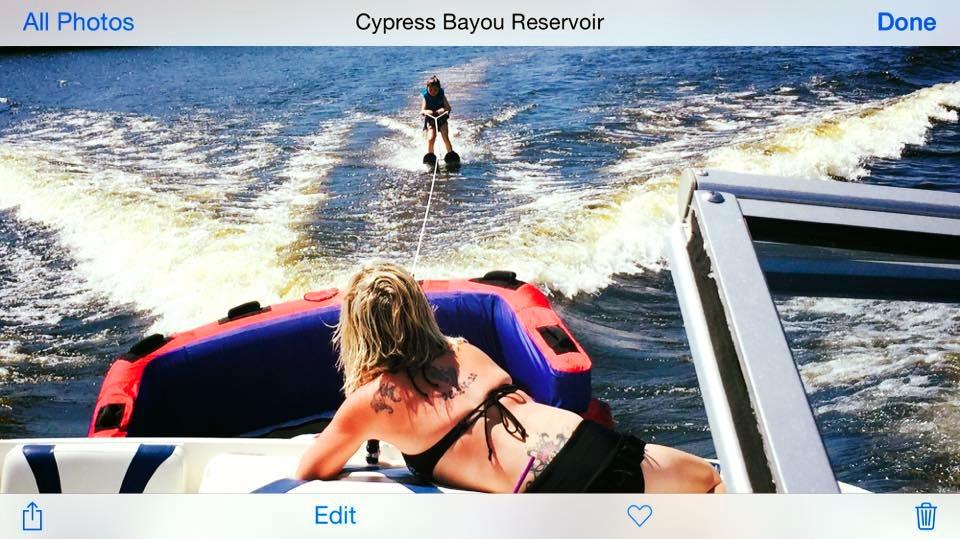
That system lets a non-expert parent act as the instructor. The adult controls the pull, keeps the child facing forward with the skis flat, and releases their handle the instant the child falls. For families with no access to a ski school or a seasoned skier in the boat, it removes the single largest variable.
The wide body with a center bottom ridge underneath is what keeps the skis tracking. As with the Rhyme, the ridge does geometrically what a stabilizer bar does with hardware, and on this set the bar is there as a second layer. Both the front bar and the rear strap are removable, so support can be reduced in stages as the child improves.
The 4.2 average from 63 reviews with 63% five-star ratings is dragged down by the weight ceiling rather than by build quality. The feedback centers on the training rope as the standout feature and the 100 pound limit as the boundary.
Who the Steady Eddy suits
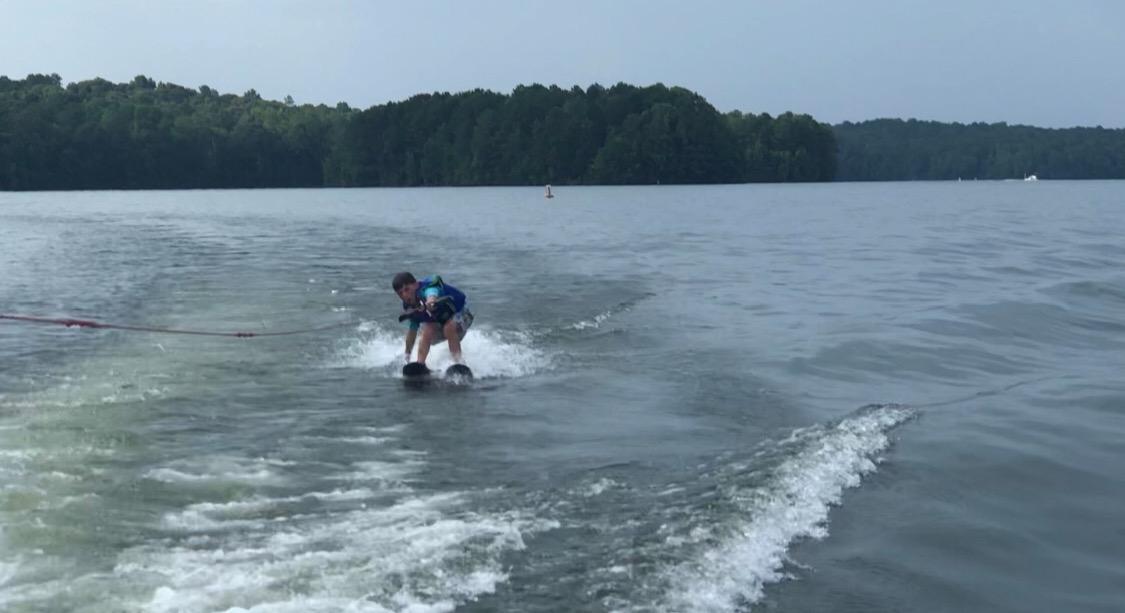
Children under 100 pounds learning with an adult in the boat who is not an experienced skier. If your plan is a couple of calm weekend sessions rather than a full season of instruction, the training rope is worth more to you than any other feature on this list.
It is also a good loaner set for a grandparent or a relative taking a small child out alone.
Where it falls short
The 100 pound ceiling is the smallest in the roundup, so a child who is already filling out a youth trainer will outgrow this quickly. The binding range is soft and adjustable, but the ski length is fixed.
At a listed 4.99 kg for the set, it is also the heaviest thing in the group to carry from a vehicle to a dock, which is the opposite of what a young family wants. Pack it in a wheeled bag.
8. O’Brien Reactor 67 inch Combo Water Skis – The Best for Quick Learners
O’Brien Reactor Combo Water Skis, 67″,Red
67 inch fiberglass combo
700 Series binding, US men 4.5-13
Deep center tunnel
Pros
- Narrower cut gives new skiers more maneuverability than a wide trainer
- Deep center tunnel tracks predictably
- Binding range of US men's 4.5-13 is very wide
- Simple enough for a young teenager to set up alone
Cons
- One of the lowest averages here at 4.1 with an 8% one-star share
- One buyer reported the binding range not fitting smaller feet despite the stated size
- One review describes a ski failing during use
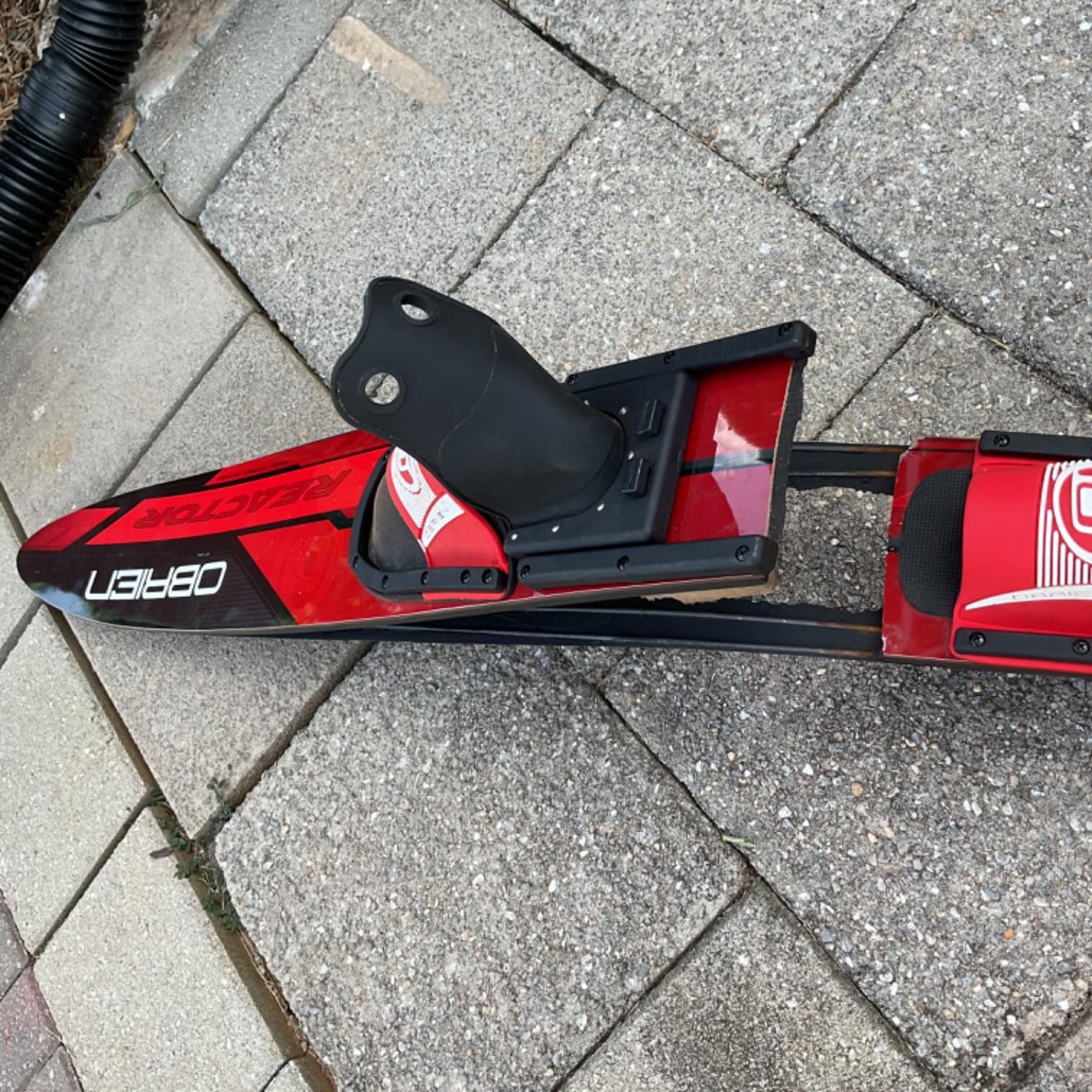
The Reactor is the pick for a beginner who gets up quickly and then wants to start turning instead of just cruising. A narrower cut is more responsive off the edge than a wide trainer, so the ski reacts to a weight shift rather than ignoring it, and that is what makes the jump from straight-line riding to linked turns feel like progress.
The deep center tunnel runs the length of the base and is the stability feature here. It resists the side-to-side wander that makes a narrow ski feel twitchy, so you get maneuverability without the fishtailing that usually comes with a slim beginner ski.
The padded rear toe plate is a comfort feature that matters over a long afternoon, since the back of your foot presses against it continuously. The 700 Series pinch-slide binding is the same family as the Celebrity’s X-7 and offers the same wide 4.5 to 13 range.
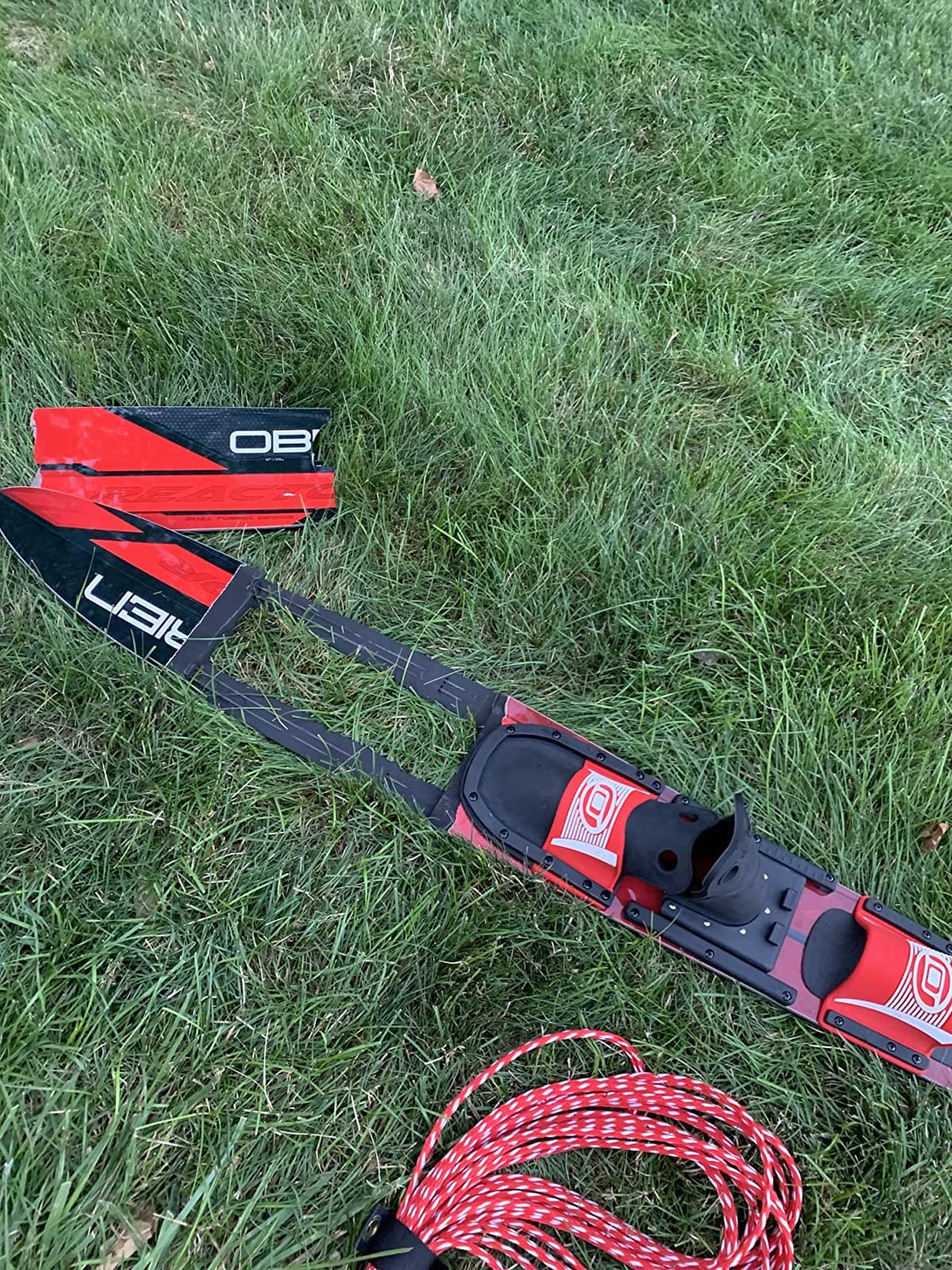
This is the set with the weakest consistency in the roundup, and the reviews explain why. It sits at 4.1 out of 5 from 46 reviews, with 63% five-star but an 8% one-star share. Several buyers call the quality good, while a smaller group report binding fit problems and one describes a ski self-destructing during use.
Who the Reactor suits
Adults roughly 125 to 180 pounds who expect to be linking turns within a few sessions, and who already know they can handle a ski that responds to input. If you are nervous about responsiveness, start on a wider trainer instead.
The wide binding range also makes it a candidate for a shared pair where one skier has large feet and the other does not.
Where it falls short
The 4.1 average and the 8% one-star share are the honest warning. At 46 reviews, this is the thinnest sample in the adult group alongside the Performer, so the negative experiences are less visible but not absent.
There is also a direct conflict in the feedback: one buyer says the adjustment range did not fit smaller feet despite the stated 4.5 to 13 sizing. If your feet are at the small end, the Rhyme or the Quantum is a safer bet.
9. O’Brien Performer 68 inch Combo Water Skis – The Best Doubles Setup
O’Brien Watersports 2191106 Adult 68 inches Performer Combo Water Skis Sizes 7-13, Yellow and Black
68 inch fiberglass combo
X-8 binding, US men 7-13
22 lb pair
Deep center tunnel
Pros
- Traditional wide shape makes deep-water starts easy for first-timers
- Bindings fit a wide adult range and feel snug
- Fiberglass construction praised by long-time skiers
- Doubles well before progressing to slalom
Cons
- Heaviest combo here at 22 lb for the pair
- Lowest average in the roundup at 4.0 with a 13% one-star share
- Nylon fins widely criticized as fragile
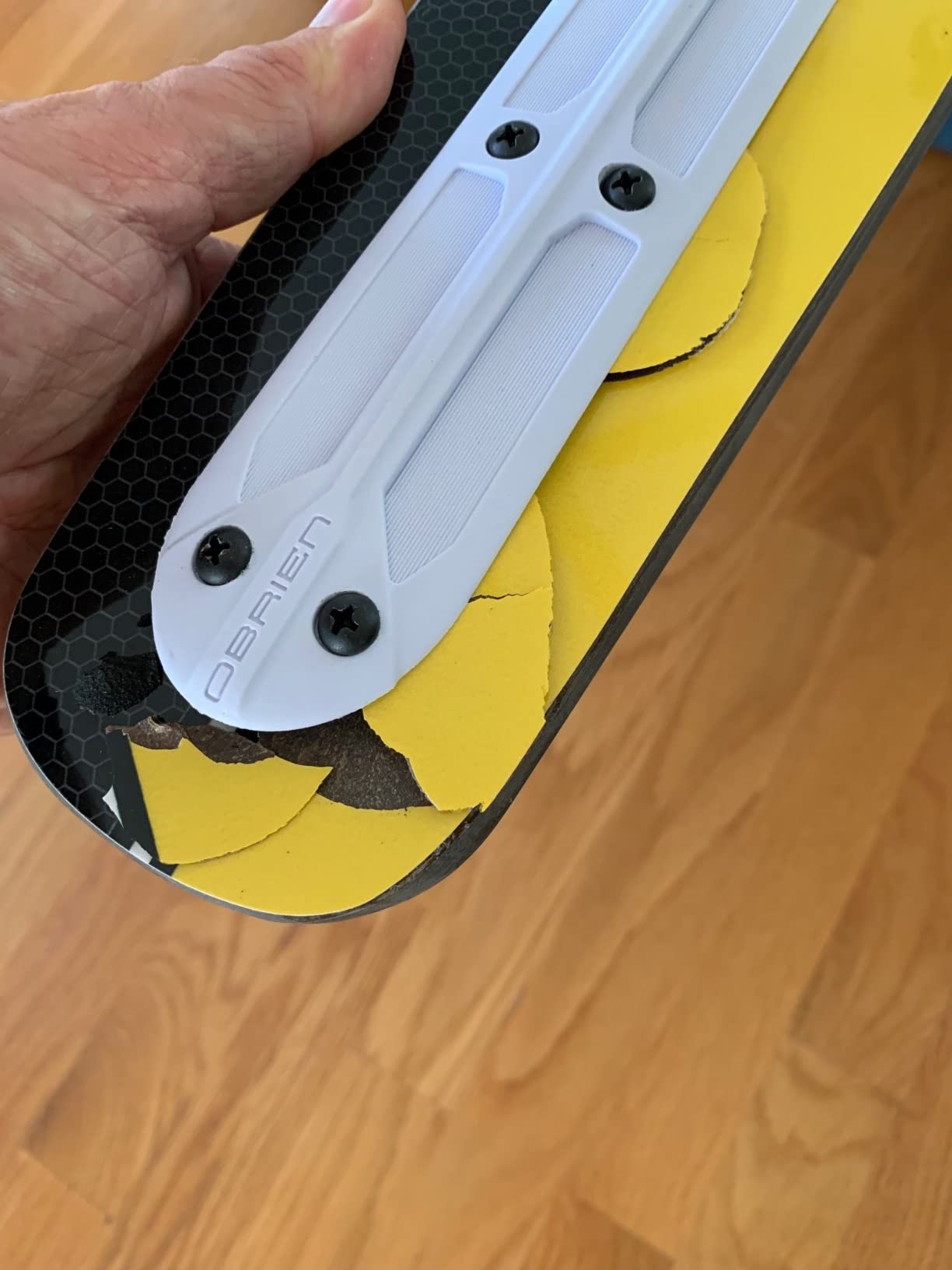
The Performer is the traditional-shape ski in this group, and that means it is the least trend-chasing. The wide forebody and deep center tunnel are a proven geometry for getting a first-timer out of the hole, and skiers who have been on the water for decades tend to rate the fiberglass construction highly.
If your goal is a doubles setup, a pair of adults skiing side by side at a steady cruise speed, the 68 inch length and the wide traditional shape handle that well. It is stable enough that the second skier is not a liability to the first.
The pinch-slide X-8 binding covers US men’s sizes 7 through 13, which is a narrower window than the Celebrity’s 4.5 to 13 but still a substantial adult range, and owners report the fit as snug rather than loose.
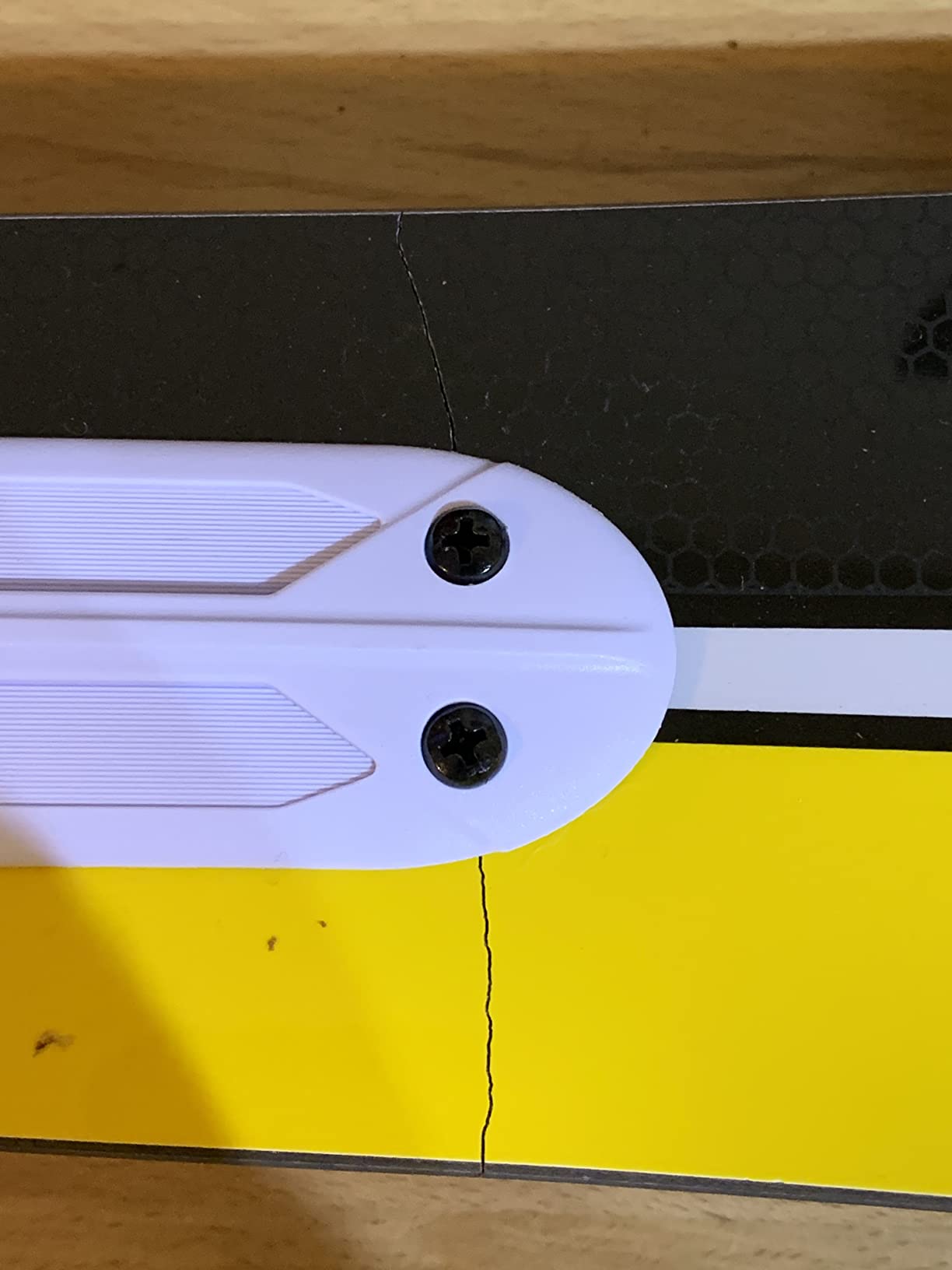
Two things drag the rating down. The pair weighs 22 pounds, the heaviest here, which matters on a ramp or in a slip. More significantly, the nylon fins draw repeated criticism for fragility, and at least one fin reportedly snapped through the packaging, which points to thin protective packaging more than to the fin material itself.
Who the Performer suits
Two adults of similar weight who want to ski doubles together, particularly on a boat with enough horsepower to hold a steady speed. Riders in the upper adult weight band who prefer a traditional shape to a modern molded forebody will also like it.
It is a reasonable first pair for a family that treats skiing as a shared weekend activity rather than a technical progression.
Where it falls short
At 4.0 out of 5 with a 13% one-star share, this is the lowest average in the roundup, and the fin complaints are consistent rather than isolated. Inspect the fins on arrival and again after your first hard falls.
Twenty-two pounds is a genuine burden to carry alone, and the binding range starting at a size 7 excludes skiers with smaller feet entirely. If either of those applies to you, the Celebrity covers the same ground more comfortably.
10. Airhead Youth Trainer Water Skis – The Best for Growing Feet
AIRHEAD WIDE BODY Combo Skis, 53″, pair
54 inch composite and foam core
Fits child size 12 to adult size 5
Removable crossbar
Pros
- Highest-rated dedicated youth trainer in the roundup at 4.5 with 76% five-star
- Bindings span child size 12 to adult size 5 so the skis grow with the skier
- Removable crossbar supports early starts and comes off later
- Lightweight composite and foam core is easy to handle
Cons
- Most expensive option here despite targeting kids
- Binding range tops out at adult size 5
- Cost sits above adult skis that cover a wider weight band
The Airhead Youth Trainer is a well-rated dedicated youth set, at 4.5 out of 5 from 43 reviews with 76% five-star ratings. That number is earned by two decisions: a 54 inch length tuned for teenage learners rather than small children, and a binding range that runs from child size 12 all the way to adult size 5.
That binding range is unusual and it is the reason this set appears on a list otherwise tilted toward adults. A child who starts at a size 12 or 13 can keep skiing the same pair into their early teens, which turns a one-season purchase into a multi-year one.
The removable crossbar is a simple balance support that goes on for the first attempts and comes off once the skier is steady. The double-handle rope assembly makes starting and stopping quick, giving a beginner two places to hold and a driver an easy way to bring them to a halt.
Construction is composite and foam core, which keeps the pair light without feeling cheap in the hand. The fiberglass-reinforced nylon fins hold stability in choppy water, which is where a 54 inch ski is most likely to feel under-supported.
The clear drawback is cost relative to position. This sits near the top of the price band for a set aimed at kids, and the same money buys an adult ski with a wider weight ceiling. You are paying for the binding range and the rating, not for more ski.
Who the Airhead Youth Trainer suits
Children and teenagers whose foot size runs from about a 12 through an adult 5, roughly a 60 to 130 pound band. The 54 inch length is specifically tuned for teenage learners who are past the small-child trainers but not ready for a full adult combo.
It is a strong pick when you want one pair to cover a child and a smaller adult in the same family.
Where it falls short
The binding range stops at adult size 5, so anyone with larger feet is excluded no matter how light they are. If the intended skier is an adult with a full-size foot, choose an adult ski instead.
Like most beginner sets, the fins are fiberglass-reinforced nylon and are the part most likely to chip on a hard landing into boat carpet. Check them after the first session.
How to Pick the Right Water Ski for a First-Time Skier
Rider weight decides the ski, height only breaks the tie, and the boat decides everything else. Get those three in the right order and the rest of the buying process takes about ten minutes. Start with the two questions buyers most often get backwards.
Combo pair or single slalom ski: what a first season should actually buy
Start with a combo pair. A combo is two separate skis ridden side by side, and the two skis together give you roughly twice the surface area of a single ski at any given speed, which means the pair rises out of the water sooner and holds a wider, more forgiving platform under a beginner who is wobbling.
A single slalom ski is one long ski, ridden on one foot. It is the shape every competitive skier uses because it is faster, carves harder and is far more sensitive to edge control. That sensitivity is precisely the problem for a beginner, because it rewards a level of balance you have not built yet.
So do beginners need slalom skis? No, not in the first season. Learn on a combo, and move to a single ski once you can hold a consistent edge across the wake without falling on roughly half your passes. Two of the sets in this roundup, the RAVE Shredder and the Connelly Supersport, are built with that transition in mind because their bindings accept a slalom setup later.
Water ski size guide: match rider weight first, height second
A ski has to be long enough to plane at a tow speed your boat can actually hold. Too short and it never rises properly, too long and it is difficult to start. The weight rating printed on the ski or its spec sheet is the number that tells you whether it will plane, and that is why every pick in this list is organized around rider weight.
As a general rule, a beginner needs a ski roughly one third of their height in inches, with weight taking priority when the two disagree. A 5 foot 9 inch skier at 135 pounds lands in the 67 inch range, which is why 67 inch skis come up so often as a universal starting length in skier discussion. A 6 foot 5 inch beginner weighing 230 pounds needs the 68 inch ski rated to 240 pounds, not a longer one.
Match the band below to your weight first, then confirm the binding size range covers your shoe size. If either fails, move up or down a size rather than trying to make a ski work.
Up to 80 lbs: 45 to 46 inch kids trainers, foot sizes 1 to 4. The Connelly Cadet and RAVE Steady Eddy both live here.
80 to 125 lbs: 53 to 57 inch youth combos with a stabilizer bar. The RAVE Shredder and Airhead Youth Trainer are built for this band.
125 to 165 lbs: 67 inch adult combos, the most common starting length for a first-season adult.
165 to 200 lbs: 67 to 68 inch adult combos with a wider waist and a binding that reaches at least a size 13.
200 lbs and above: 68 inch skis rated to 240 lbs or more, and expect to need a stronger tow boat.
Rocker, dual tunnel, widebody and beveled edge, defined
Rocker is the upward curve at the front of a ski. A deep rocker lets the nose rise easily out of the water, which makes a deep-water start simpler. An aggressive rocker is easy to start but slow to hold speed and unstable in a crosswind, while a flatter rocker planes sooner and tracks better at the cost of a harder start. For a beginner, a gentle to moderate rocker is the sweet spot.
A deep water start means the skier is in water deep enough that the ski is submerged and cannot touch bottom, so the ski has to do all the work of rising. This is where most first-timer failures happen, and it is why wide shapes and flatter rockers matter most in the first ten minutes.
A dual tunnel is a pair of channels cut into the base of the ski, usually in a V shape. The tunnels add directional control so the ski tracks straight instead of wandering, which is what keeps a beginner’s skis parallel during a pull-up.
A widebody ski is simply a wider ski, and the extra width is what creates planing pressure earlier. A beveled edge is an angled edge along the bottom of the ski. It gives the ski enough grip to carve a turn and stops it from sliding sideways, which is how a beginner makes their first directional change.
A nylon fin is the small fin mounted on the underside of the ski that resists side slip and provides tracking. Nylon is the right material for a beginner ski because it grips the water and will not gouge a boat deck when you come down hard. A stabilizer bar, sometimes called a trainer bar, is a removable bar that spans the two skis and holds them at the correct spacing and angle during a start.
Bindings and foot fit, where most first-time buyers go wrong
A binding has to hold your foot through a hard start and let go when you fall. Those two requirements pull in opposite directions, which is why binding fit is the most common source of frustration in beginner reviews, and why foot size is a hard filter rather than a preference.
Check three things. First, the stated shoe size range, which on this roundup runs from a size 1 to 4 on the Cadet up to a 4.5 to 13 on the O’Brien Celebrity and Reactor. If your size sits outside the range, do not buy the ski, because a binding that does not hold your foot is a problem you cannot train around.
Second, fit the binding snug enough that your heel does not lift when the ski is under load, but loose enough that you can get out of it. Third, test the release by pulling hard in a controlled setting before your first day on the water. Nobody should ever ski a binding that has not been checked.
On the safety side, the skier wears a properly fitted impact-rated life vest, the boat carries an observer who is not the driver, and the observer’s job is to watch the skier continuously and signal the driver to slow down when the skier signals for it. Skiers should also know the hand signals for stop, slow down and turn around before the boat ever starts moving.
Boat horsepower and tow speed you actually need
Is 25 mph fast enough to water ski? Yes, 25 mph is plenty for a beginner on a wide combo, and it is the speed at which most combo skis start best. The number that matters more is not your top speed but the speed your boat can hold at steady throttle with an adult in it, because that is the speed the skier pulls against.
Roughly 115 to 150 horsepower is enough to get a beginner up reliably, and a lighter boat accelerates more cleanly than a heavy one at the same power. The failure mode of an underpowered boat is not that the skier cannot rise, it is that the boat bogs down in the water as the skier pulls, which makes the start slower and the wake deeper.
Boat weight matters as much as horsepower. A 115 hp pontoon and a 115 hp runabout do not behave the same way, because the pontoon has to move considerably more mass. For heavier adults above 200 pounds, plan on a boat in the 150 horsepower range or above, since the ski is carrying more load and needs more pull to plane.
How long the first get-up really takes
Most adult beginners are standing within the first few attempts, and a few get up on the first pull. The variance is enormous and depends far less on the ski than people expect: tow speed, boat response and how quickly the driver reacts to the skier’s signal all matter more than ski shape.
Where the ski does help is in the failure cases. A wide shape with a gentle rocker rises sooner, a stabilizer bar stops the skis crossing, and deeper edge channels stop them wandering. Those three things reduce the number of failed attempts rather than changing the learning curve itself.
Plan on spending more time than expected at the start of each run, and more time than expected on the water overall. Skiers repeatedly note that most people underestimate how much practice the get-up takes.
Five mistakes that keep beginners in the water
The first is holding the handle with one hand. Use both hands, elbows straight and arms relaxed, so the pull comes from your body rather than your arms.
The second is sitting back. When the skis start to rise, a beginner instinctively drops their hips, which lifts the skis out from under the body and usually ends in a face-plant. Keep your weight forward over the skis until the handle is at your hip.
The third is not keeping the skis flat. On a deep-water start, both skis should be pointing up at the surface and level with each other. If only one breaks the surface, ease off the handle briefly and let the second ski come up.
The fourth is pulling too early. The skis need to be planing before the handle gets pulled in. Let the boat do the work until you feel the ski lift, then bring the handle in.
The fifth is the most common fear, and the easiest to fix: the skis crossing during the start. A wide-body shape, a stabilizer bar, or both together are the direct countermeasures, which is why we keep recommending them for the first season.
Frequently Asked Questions
What type of skis should a beginner use?
A beginner should use a wide-body combo pair, which is two shorter, wider skis ridden together. The extra surface area builds planing pressure sooner at a lower tow speed, so the skis rise out of the water easier and stay stable. Save the single slalom ski for after you can hold a consistent edge across the wake.
What size ski should a beginner skier wear?
Size by rider weight first and height second. A beginner needs a ski roughly one third of their height in inches, and the weight rating printed on the ski must cover you. A general guide is 45 to 46 inches under 80 lbs, 53 to 57 inches from 80 to 125 lbs, and 67 to 68 inches for adults from 125 lbs up to 240 lbs.
Is 25 mph fast enough to water ski?
Yes. Around 25 mph is enough for a beginner on a wide combo ski, and it is often the best starting speed. What matters more than top speed is the speed your boat can hold at a steady throttle with an adult in it, since that is the speed you are actually pulling against during the get-up.
How hard is it to learn to water ski?
Most adult beginners are standing within their first few attempts, and a few get up on the first pull. The harder part is holding the skis up and linking turns, which usually takes a full season of regular sessions. The most common causes of failure are pulling too early, sitting back, and the skis crossing during the start.
What type of water ski is best for older adults?
A wide-body combo ski rated for your weight, with adjustable bindings that release on a fall. Older skiers and returning skiers benefit most from a wide forebody and a gentle rocker because both reduce the effort needed to rise in deep water. Check the stated binding shoe size range before buying, since a binding that does not release is a real injury risk.
The Best Water Skis for Beginners in 2026: Final Word
The O’Brien Celebrity 68 inch Combo is the best water skis for beginners pick because the binding range covers most adult feet and the flatter rocker makes deep-water starts forgiving. Adults over 200 pounds should size up to the Connelly Quantum, and children should start with a trainer that has a stabilizer bar.
Decide three things before you buy: your rider weight, your shoe size, and your boat’s horsepower. Once you know those, take the pair that matches all three and give the first season a real chance.