
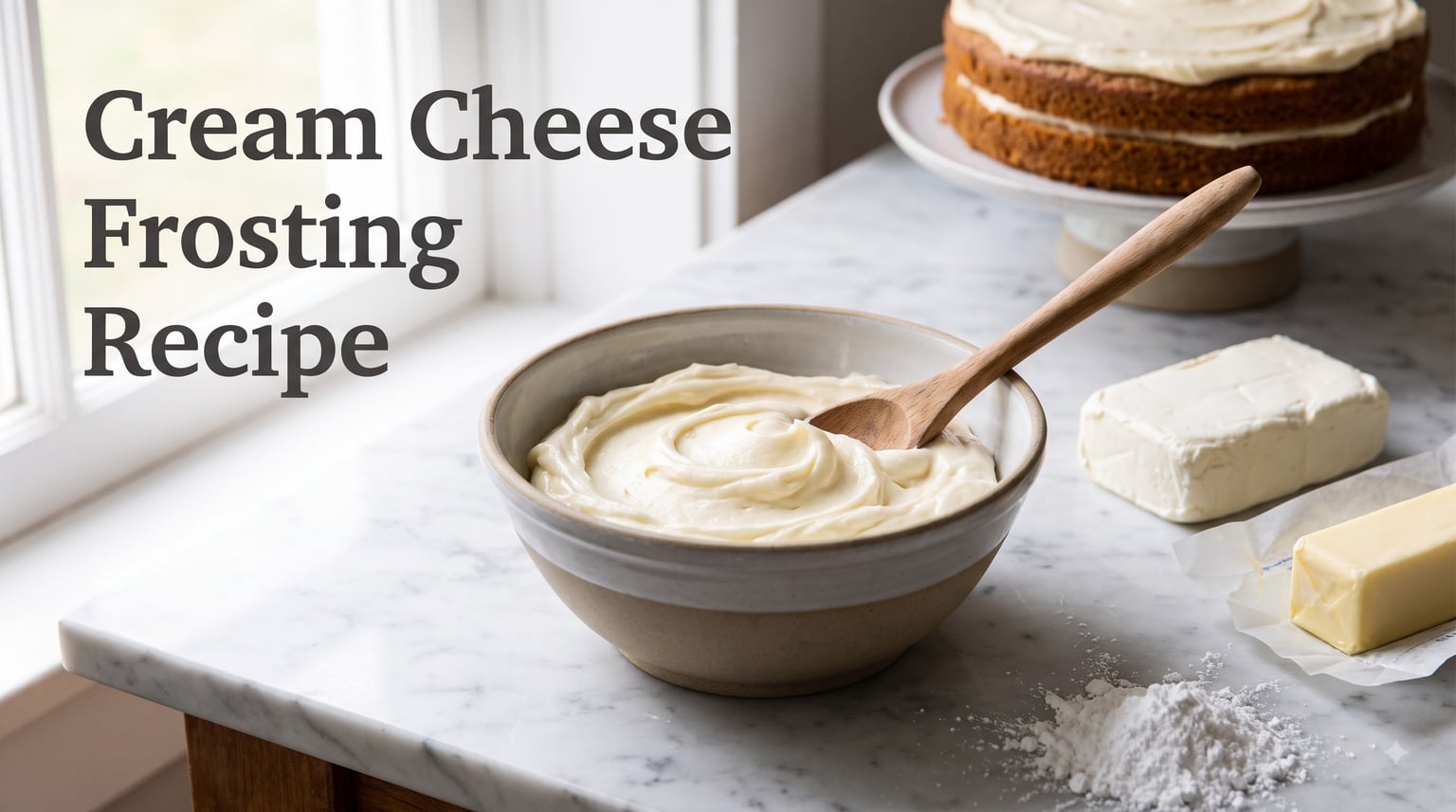
I have made cream cheese frosting more times than I can count — for birthday carrot cakes, Thanksgiving cinnamon rolls, and late-night red velvet cupcakes when a craving hits. After testing ratios across dozens of batches, I landed on a formula that is tangy, fluffy, sweet without being cloying, and sturdy enough to pipe beautiful swirls.
This cream cheese frosting recipe uses just five ingredients you probably already have. I will walk you through every step, share the tips that separate grainy disappointment from silky perfection, and troubleshoot every common problem along the way.
Whether you are frosting a layer cake, filling cupcakes, or upgrading store-bought cinnamon rolls, this is the only cream cheese frosting recipe you need.
Table of Contents
Cream Cheese Frosting Recipe: Ingredients You Need
This recipe makes enough to frost one two-layer 8-inch cake, a 9×13 sheet cake, or about 18 to 24 cupcakes generously. The ingredient list is short, which means quality matters more than usual.
Standard Measurements
8 oz cream cheese (one standard brick), full-fat, at room temperature
1/2 cup (1 stick) unsalted butter, softened to room temperature
3 to 4 cups powdered sugar (confectioners sugar), sifted
1 teaspoon pure vanilla extract
1/4 teaspoon kosher salt
Metric Measurements
226 g full-fat cream cheese, brick-style, room temperature
113 g unsalted butter, room temperature
360 to 480 g powdered sugar, sifted
5 ml pure vanilla extract
1.5 g kosher salt
Weighing your ingredients — especially the powdered sugar — produces consistently better results than volume measurements. A packed cup of powdered sugar can weigh 30 to 40 grams more than a lightly spooned one, which completely changes the sweetness and texture.
I recommend starting with 3 cups (360 g) of powdered sugar and tasting. If you want it sweeter, add the fourth cup. This recipe lands in the sweet spot where the tang of cream cheese still cuts through.
Brick vs Tub Cream Cheese: Why It Matters
This is the single most important decision you will make, and it trips up more home bakers than any other step.
Always use brick-style cream cheese, never tub cream cheese. Tub cream cheese (the kind sold in a plastic tub for spreading on bagels) contains more moisture and added stabilizers that make your frosting thin, runny, and impossible to pipe. Brick cream cheese — the kind sold in a foil-wrapped block — has a higher fat content and lower moisture, which creates thick, stable, fluffy frosting.
Philadelphia original brick cream cheese is the gold standard that most professional bakers reach for. Store brands can work, but some contain slightly more water. If you use a store brand and your frosting seems thin, you may need an extra quarter cup of powdered sugar to compensate.
Full-fat cream cheese is non-negotiable. Neufchatel (one-third less fat) and fat-free versions contain too much water and will leave you with a soupy mess, no matter how long you beat it.
How to Make Cream Cheese Frosting (Step-by-Step)
The process takes about 10 minutes from start to finish. Your electric mixer — whether a stand mixer with a paddle attachment or a hand mixer — does the heavy lifting. Here is exactly how I make it every time.
Step 1: Prepare Your Ingredients
Take your cream cheese and butter out of the refrigerator 1 to 2 hours before you plan to make the frosting. They should be soft enough to hold a fingerprint when pressed but not melting or greasy. If you forget to pull them ahead, cut both into small cubes and let them sit at room temperature for 30 to 45 minutes.
Sift your powdered sugar to remove lumps. This is not optional if you want smooth frosting — clumps of sugar will not fully dissolve and will leave gritty spots.
Step 2: Beat the Cream Cheese and Butter
Place the softened cream cheese and butter in the bowl of your stand mixer or a large mixing bowl. Beat on medium speed for 2 to 3 minutes until completely smooth, light, and creamy. Stop and scrape down the sides and bottom of the bowl with a rubber spatula at least twice during this step.
You are looking for a uniform, silky texture with zero lumps. If you see any flecks or bumps, keep beating. This is the foundation — if the base is not smooth, the finished frosting will not be either.
Step 3: Add Vanilla and Salt
With the mixer running on low, add the vanilla extract and salt. Beat for about 30 seconds until incorporated. Use pure vanilla extract, not imitation — the flavor difference is noticeable in a recipe with so few ingredients.
Step 4: Gradually Add the Powdered Sugar
Turn the mixer to low speed. Add the sifted powdered sugar one cup at a time, waiting until each addition is mostly incorporated before adding the next. Adding it all at once will create a sugar cloud in your kitchen and overwhelm your mixer.
After the third cup, stop and taste. If you want it sweeter, add the fourth cup. Once all the sugar is in, increase the speed to medium-high and beat for 2 to 3 more minutes until the frosting is light, fluffy, and smooth.
Step 5: Check Consistency
The frosting should hold soft peaks and spread easily with a spatula. If it is too thick, add milk or heavy cream one teaspoon at a time until you reach the right consistency. If it is too thin, add powdered sugar a quarter cup at a time.
Your cream cheese frosting is now ready to use. Frost your cake, pipe your cupcakes, or spread it on warm cinnamon rolls immediately.
Tips for the Best Cream Cheese Frosting
These are the details that take your frosting from good to bakery-quality. I learned most of these the hard way.
Room Temperature Ingredients Are Non-Negotiable
Cold cream cheese and cold butter will not blend smoothly. You will get lumps that never dissolve no matter how long you beat. If your ingredients are cold, the frosting will look curdled and separated. Let everything come to room temperature fully before starting.
To test if cream cheese is ready, press your finger into the block. It should leave a deep indent without resistance. If the center still feels firm, it needs more time.
Do Not Over-Beat
This is the number one cause of runny cream cheese frosting. Once the frosting is smooth and fluffy, stop. Beating for too long breaks down the structure of the cream cheese and butter, causing the frosting to become thin and weepy. Two to three minutes on medium-high after the last sugar addition is plenty.
How to Get Fluffy Cream Cheese Frosting
For the fluffiest texture, make sure you beat the cream cheese and butter together for the full 2 to 3 minutes before adding sugar. This incorporates air into the base. Then, after all the sugar is added, beat on medium-high for another 2 to 3 minutes. The extended beating at each stage builds volume.
Some professional bakers use a technique where they whip heavy cream separately and fold it into the finished frosting. This creates an airy, mousse-like texture that is incredible on cupcakes but too soft for detailed piping.
How to Make Whiter Frosting?
Cream cheese frosting tends to be slightly off-white or ivory. For a brighter white, use a clear vanilla extract instead of regular brown vanilla. Skip the butter entirely and use all cream cheese (with a little shortening for stability) if you want the whitest possible result. Some bakers add a tiny drop of violet food coloring gel to neutralize yellow tones.
How to Fix Common Frosting Problems
Even experienced bakers run into issues. Here is how to rescue every common problem.
Why Is My Cream Cheese Frosting Runny?
Runny frosting is usually caused by one of three things: your ingredients were too warm, you used tub cream cheese, or you over-beat the mixture. To fix it, place the bowl in the refrigerator for 15 to 20 minutes, then re-whip. If it is still too thin, add powdered sugar a quarter cup at a time until it thickens.
In hot or humid weather, your frosting may soften as you work. Pop it in the fridge for 10 minutes and re-whip to bring it back to life.
How to Fix Lumpy Frosting
Lumps mean your cream cheese or butter was too cold when you started mixing. The fix is patience — keep beating on medium speed and press any remaining lumps against the bowl wall with your spatula. If lumps persist, briefly microwave the frosting in 5-second bursts and beat again. Do not microwave too long or the frosting will melt and separate.
How to Fix Too-Sweet Frosting
If your frosting tastes cloying, add a pinch more salt and a squeeze of lemon juice (no more than half a teaspoon). The acid and salt cut through the sweetness and bring the cream cheese tang forward. You can also add an extra ounce of cream cheese to rebalance the ratio.
Best Cakes and Desserts for Cream Cheese Frosting
This frosting pairs beautifully with spiced, fruity, and chocolate desserts. Here are my favorite combinations.
Carrot cake — the classic pairing. The tang balances the warm spices and sweetness of carrots.
Red velvet cake — traditional and unbeatable. The slight cocoa flavor of red velvet needs the contrast of tangy cream cheese.
Spice cake and pumpkin cake — cinnamon, nutmeg, and ginger love the creamy, tangy counterpoint.
Banana cake and banana bread — the sweetness of ripe banana with tangy frosting is a revelation.
Zucchini bread and hummingbird cake — earthy, moist cakes that benefit from the brightness.
Lemon cake — double the tang for a citrus-forward dessert.
Cream cheese frosting is also incredible on cinnamon rolls. If you have ever tried our canned cinnamon roll rankings, spreading this cream cheese frosting on top takes them to a completely different level.
Can You Pipe Cream Cheese Frosting?
Yes, you can pipe cream cheese frosting, but it is softer than buttercream and needs some care. For best results, refrigerate the frosting for 20 to 30 minutes before piping so it firms up. Use a large piping tip — round or star — and avoid intricate designs that require stiff frosting to hold shape.
If you are piping cupcakes in warm weather, place each finished cupcake in the fridge immediately after piping. The frosting will set and hold its shape. For highly decorative work like rosettes or flowers, add an extra half cup of powdered sugar to stiffen the frosting before piping.
Cream Cheese Frosting Flavor Variations
Once you master the base recipe, these variations open up a world of possibilities. Add these after the frosting is fully mixed.
Chocolate cream cheese frosting — add 1/2 cup sifted cocoa powder and an extra 1/2 cup powdered sugar. Deep, rich, and incredible on devil’s food cake.
Lemon cream cheese frosting — add 1 tablespoon fresh lemon zest and 1 teaspoon lemon juice. Bright and perfect on lemon or blueberry cake.
Maple pecan frosting — replace the vanilla with 1 teaspoon maple extract and fold in 1/2 cup chopped toasted pecans. Dreamy on banana bread.
Strawberry frosting — fold in 3 tablespoons freeze-dried strawberry powder. Beautiful pink color and intense berry flavor.
Brown butter variation — brown the butter first, let it cool to room temperature, then proceed with the recipe. Adds a nutty, caramel depth.
For a lighter dessert frosting, try folding 1/2 cup of lightly sweetened whipped cream into the finished frosting. This creates a cloud-like texture that is amazing on angel food cake or as a fruit dip.
How to Store Cream Cheese Frosting
Because cream cheese frosting contains dairy, it requires refrigeration. Here is how to store it properly.
In the refrigerator: Transfer the frosting to an airtight container and store for up to 1 week. Before using, let it come to room temperature (about 1 hour) and re-whip with your mixer for 1 to 2 minutes until smooth and fluffy again. It will look separated and sad straight from the fridge, but the re-whip brings it right back.
In the freezer: Cream cheese frosting freezes well for up to 3 months. Store in an airtight container with plastic wrap pressed directly against the surface to prevent freezer burn. Thaw overnight in the refrigerator, then bring to room temperature and re-whip before using.
Frosted cakes and cupcakes can sit at room temperature for 2 to 4 hours during serving. For longer storage, refrigerate frosted desserts and bring them to room temperature before serving for the best texture and flavor.
Cream Cheese Frosting Recipe FAQ
What are the ingredients for cream cheese frosting?
The ingredients for cream cheese frosting are 8 oz full-fat brick cream cheese, 1/2 cup unsalted butter, 3 to 4 cups powdered sugar, 1 teaspoon pure vanilla extract, and 1/4 teaspoon salt. All ingredients should be at room temperature before mixing.
What is the secret to good cream cheese frosting?
The secret to good cream cheese frosting is using full-fat brick-style cream cheese (never tub cream cheese), ensuring all ingredients are at room temperature before mixing, and beating the cream cheese and butter together until completely smooth before adding sugar. Avoid over-beating after the sugar is added, which makes the frosting runny.
How to get fluffy cream cheese frosting?
To get fluffy cream cheese frosting, beat the softened cream cheese and butter on medium speed for 2 to 3 minutes before adding any sugar. This incorporates air into the base. After adding all the powdered sugar, beat on medium-high for another 2 to 3 minutes. Using room-temperature ingredients is essential for achieving maximum volume.
How to make frosting out of Philadelphia cream cheese?
To make frosting with Philadelphia cream cheese, use one 8 oz brick of full-fat Philadelphia cream cheese at room temperature. Beat it with 1/2 cup softened unsalted butter until smooth, then add 1 teaspoon vanilla and 1/4 teaspoon salt. Gradually mix in 3 to 4 cups sifted powdered sugar, beating until fluffy. Philadelphia brick cream cheese is the most recommended brand by professional bakers.
Can you pipe cream cheese frosting?
Yes, you can pipe cream cheese frosting. Refrigerate it for 20 to 30 minutes before piping to let it firm up, use a large piping tip, and work relatively quickly. For detailed decorative piping, add an extra half cup of powdered sugar to stiffen the frosting. Place piped items in the fridge immediately to help them hold their shape.
How long does cream cheese frosting last?
Cream cheese frosting lasts up to 1 week in the refrigerator in an airtight container and up to 3 months in the freezer. Always let refrigerated or thawed frosting come to room temperature and re-whip for 1 to 2 minutes before using to restore its smooth, fluffy texture.
Wrapping Up the Perfect Cream Cheese Frosting Recipe
This cream cheese frosting recipe proves that five simple ingredients, treated with care, create something far better than anything from a can. The keys are full-fat brick cream cheese, room-temperature ingredients, patience during the creaming stage, and knowing when to stop beating.
Once you nail the base recipe, the flavor variations and cake pairings keep it interesting for years. Try it on your next carrot cake, red velvet cupcakes, or even a batch of warm cinnamon rolls. Your desserts will never go back to store-bought frosting.
Keep this recipe saved — you will come back to it again and again.