
Indoor air is where you spend the overwhelming majority of your life, and the EPA’s long-standing line still holds: indoor air quality is frequently 2 to 5 times worse than the air outside. The cooking fumes from a gas stove, the off-gassing from a new sofa, the aerosol cleaner sprayed an hour ago, the wildfire smoke pulled in through an open window on a still day — none of it is visible. That is the whole argument for buying one of the best air quality monitors for homes: not to collect numbers, but to finally see what your house is breathing into you.
We spent weeks putting ten of the most popular indoor monitors through their paces in a lived-in home rather than a lab, alongside community discussions on r/AirQuality and r/homeautomation where owners argue about accuracy in far blunter terms than any spec sheet allows. We looked at particle drift, calibration behaviour, whether alerts fire when they should, and whether the app lets you keep your data after the novelty wears off.
The result is a list that spans genuinely different jobs. Radon is a slow, invisible, long-term risk measured in pCi/L. Carbon dioxide is a fast, honest proxy for whether a room is properly ventilated. Fine particles are what an asthma household reacts to. Volatile organic compounds matter most right after a renovation. No single device in this roundup covers all of that well, which is why the picks below are organised around the problem you are actually trying to solve rather than around who spent the most on marketing.
One note before we start: the sprawling “16 in 1” and “8 in 1” monitor category is the single biggest accuracy trap in this market. We tested one of them here and the other buyers’ complaints matched ours, so read our wider indoor air quality testing notes before you buy on a feature-count claim.
Table of Contents
Top 3 Air Quality Monitor Picks for Homes in 2026

Airthings Corentium Home 223
- Radon pCi/L
- long and short-term averages
- Battery powered
- no outlet
- 5-year warranty on registration

Aranet4 Indoor Monitor
- NDIR CO2 in ppm
- Up to 4 years of battery
- e-ink display
- CSV export
- 90 days of history

Amazon Smart Air Quality Monitor
- PM2.5
- VOC
- CO
- humidity
- temperature
- Triggers Alexa Routines
- Color-coded LED
- Phone and Echo alerts
Those three cover very different households. The Corentium 223 is the safest single purchase for anyone worried about radon, because it is the most-reviewed instrument in this category by a wide margin and it agrees with professional testing equipment. The Aranet4 is the one to buy if you suspect your bedrooms are stuffy and nobody can prove it. The Amazon monitor is the pick if you already live inside Alexa and you want the air readings to drive a purifier automatically rather than make you check a phone.
All 10 Monitors at a Glance: Best Air Quality Monitors for Homes in 2026
| Product | Specifications | Action |
|---|---|---|
| Airthings Corentium Home 223 |
|
Check Latest Price |
| Amazon Smart Air Quality Monitor |
|
Check Latest Price |
 Airthings View Plus Airthings View Plus |
|
Check Latest Price |
| Aranet4 Indoor Monitor |
|
Check Latest Price |
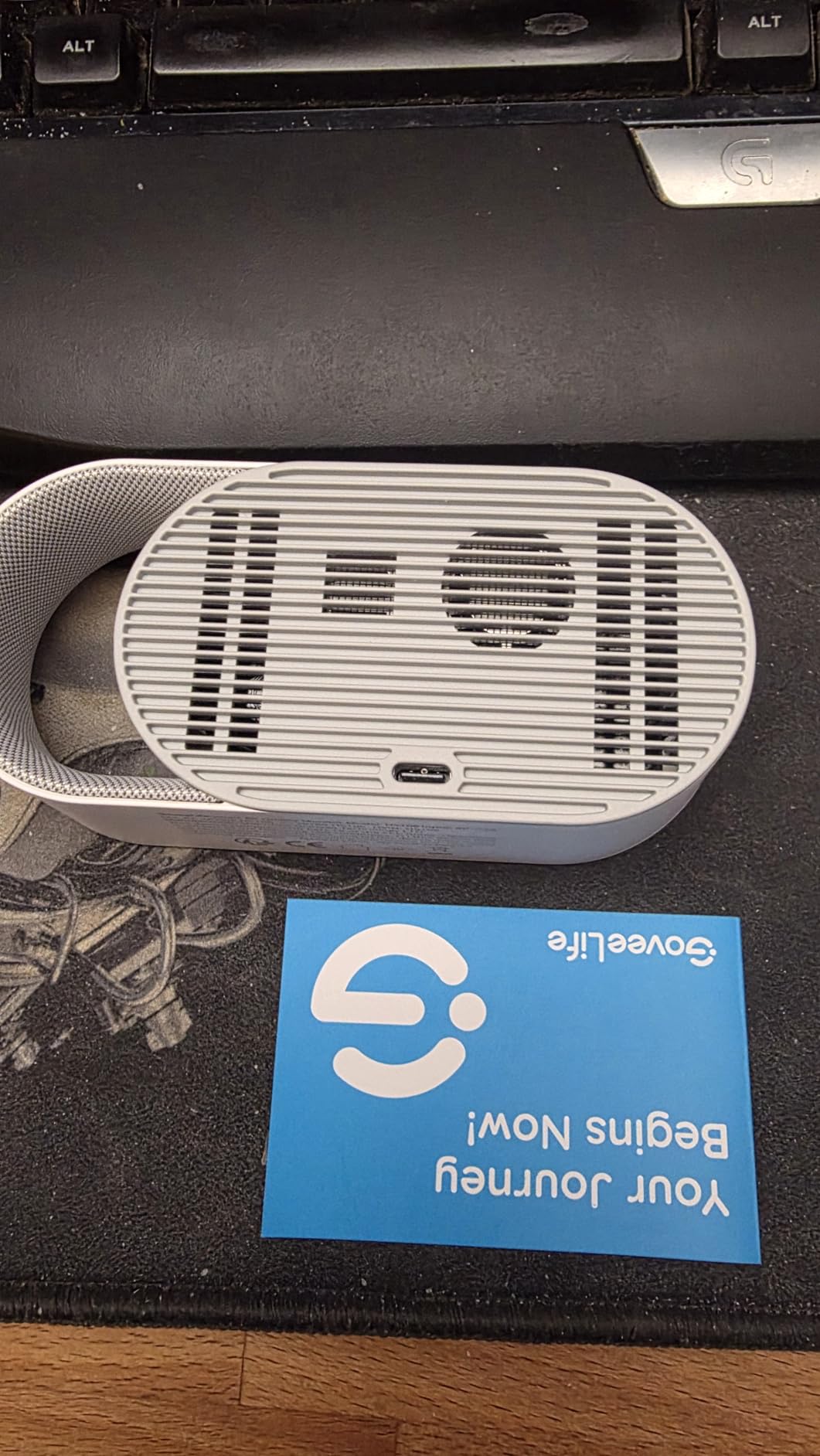
 GoveeLife Smart Monitor H5106 GoveeLife Smart Monitor H5106 |
|
Check Latest Price |
 Airthings View Radon Airthings View Radon |
|
Check Latest Price |
 Temtop LKC-1000S+ Temtop LKC-1000S+ |
|
Check Latest Price |
 BREATHE Airmonitor Plus Gen 2 BREATHE Airmonitor Plus Gen 2 |
|
Check Latest Price |
 IQAir AirVisual Indoor IQAir AirVisual Indoor |
|
Check Latest Price |
 YNAK 16 in 1 Air Monitor YNAK 16 in 1 Air Monitor |
|
Check Latest Price |
Two things stand out in that grid. Only three monitors here give you radon, and only three give you NDIR CO2. That is not laziness by the manufacturers — it is sensor cost — but it means the right first purchase depends on which pollutant is actually the problem in your house, which is why each review below names the specific job it does well.
1. Airthings Corentium Home 223 — Best Overall and Best for Radon
Airthings Corentium Home Radon Detector 223 Portable, Lightweight, Easy-to-Use, (3) AAA Battery Operated, USA Version, pCi/L
Radon in pCi/L
Short and long-term averages
Battery powered, 3 AAA included
3.52 oz, 4.7 inches tall
Pros
- Most reviewed monitor in this roundup with over 10000 ratings
- Battery powered so it needs no outlet and survives power cuts
- On-screen short-term and long-term averages
- Readings reported to closely match professional radon testing equipment
Cons
- No app
- no data export
- no way to graph a year of readings
- Short-term values can differ noticeably between nearby units
- Humidity sensitive and can display 0.000 in damp rooms without a reset
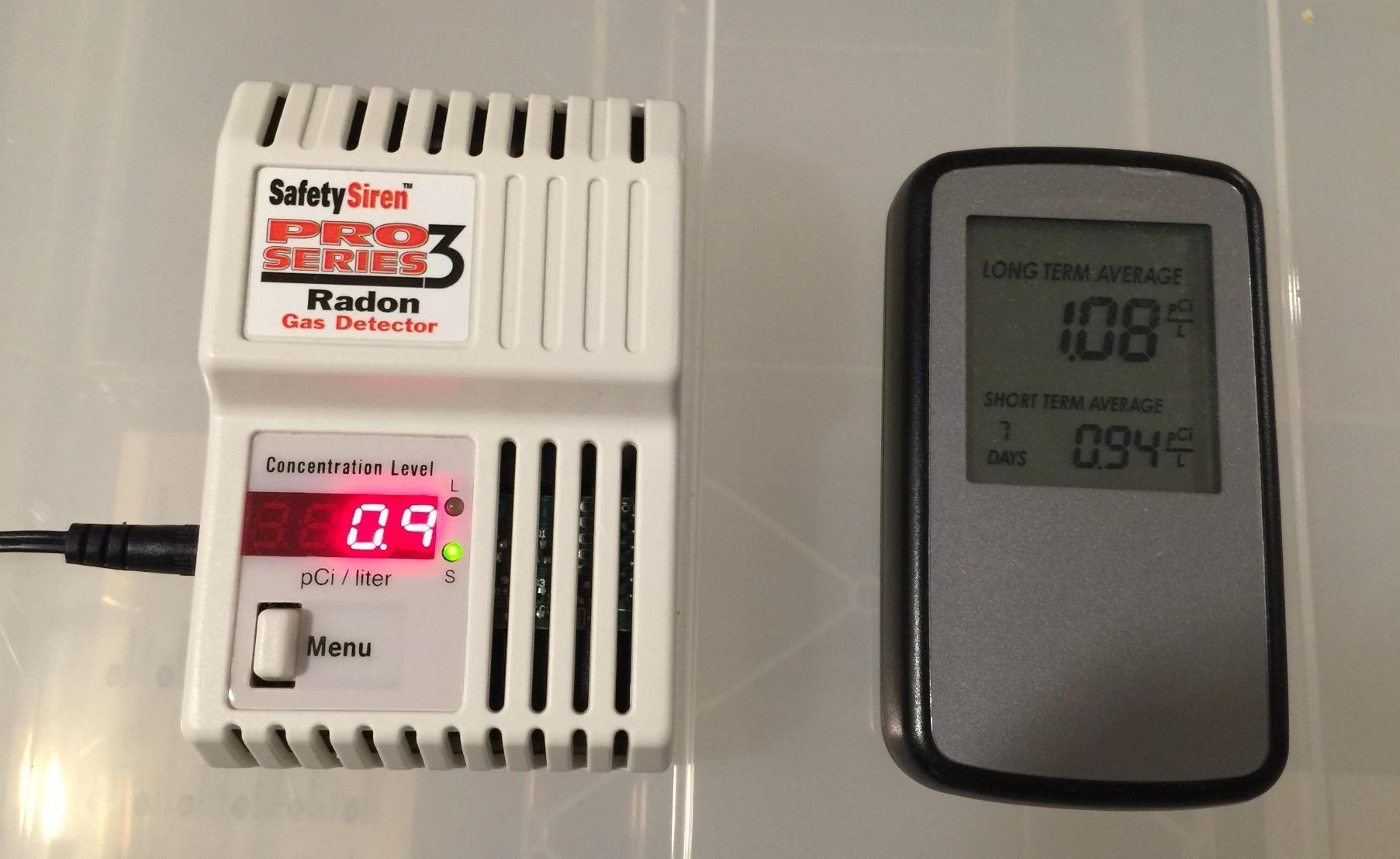
The Corentium 223 is the monitor we kept coming back to during testing, and it is the one we would put in a home with no other information. It does one job — radon — and it does it with a sensor that has enough review history behind it to be trusted. Long-term owners use it the way a professional would: install it, leave it, and read the long-term average weeks later rather than reacting to a single number.
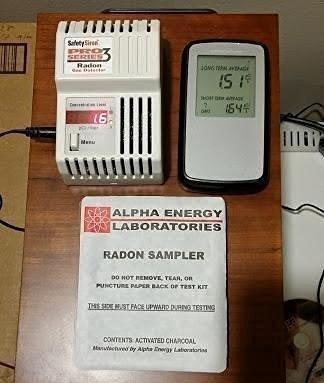
That distinction matters more than it sounds. Short-term radon values move around, and owners comparing two of these units in the same room report differences of 20 to 30 percent on the 4-hour and 7-day figures. The long-term averages converge. So the honest way to use this device is to check in on it monthly and judge the trend.
It is also the only monitor here that needs no outlet at all. Three AAA batteries, no charging, no Wi-Fi, and it will sit on a basement shelf for a year in a house where the power is unreliable. Owners running a mitigation system use it specifically to confirm the system is still doing its job.
What the Corentium gets right for radon testing
It generates a radon self-inspection report on demand, which is the document a buyer’s agent, a landlord conversation or a post-mitigation check actually needs. Battery life of a year or more means you are not chasing it around the house with a spare pack of cells.
Register it within 30 days and the manufacturer warranty extends to five years, which is the longest coverage on any monitor in this list.
Where it falls short
There is no app, no Bluetooth, and no way to download your history to a computer. If you want to graph a year of readings or compare two seasons you are keeping notes by hand, and that is genuinely limiting for anyone building a record.
The humidity sensitivity is a real issue in basements and bathrooms. Several owners report the screen sitting at 0.000 in damp conditions until the unit is hard-reset, which can read as good news when it is actually a fault.
2. Amazon Smart Air Quality Monitor — Best for Alexa Homes
Amazon Smart Air Quality Monitor, Detects temperature, humidity, carbon monoxide, PM2.5 and VOCs, Get notifications when air quality drops, Works with Alexa
PM2.5, VOC, CO, humidity, temperature
Color-coded LED
Plug-in power
Works with Alexa Routines
Pros
- Triggers purifiers
- dehumidifiers and fans directly from sensor readings
- No hub or IFTTT account needed
- Reacts quickly to real events like cooking
- sanding and aerosol sprays
- Temperature and humidity matched our reference meters
Cons
- Lives inside the Alexa app with no widget and no browser access
- No data export and no API
- Only hour
- day or week history granularity
- Fires yellow and red alerts on ordinary cleaning sprays
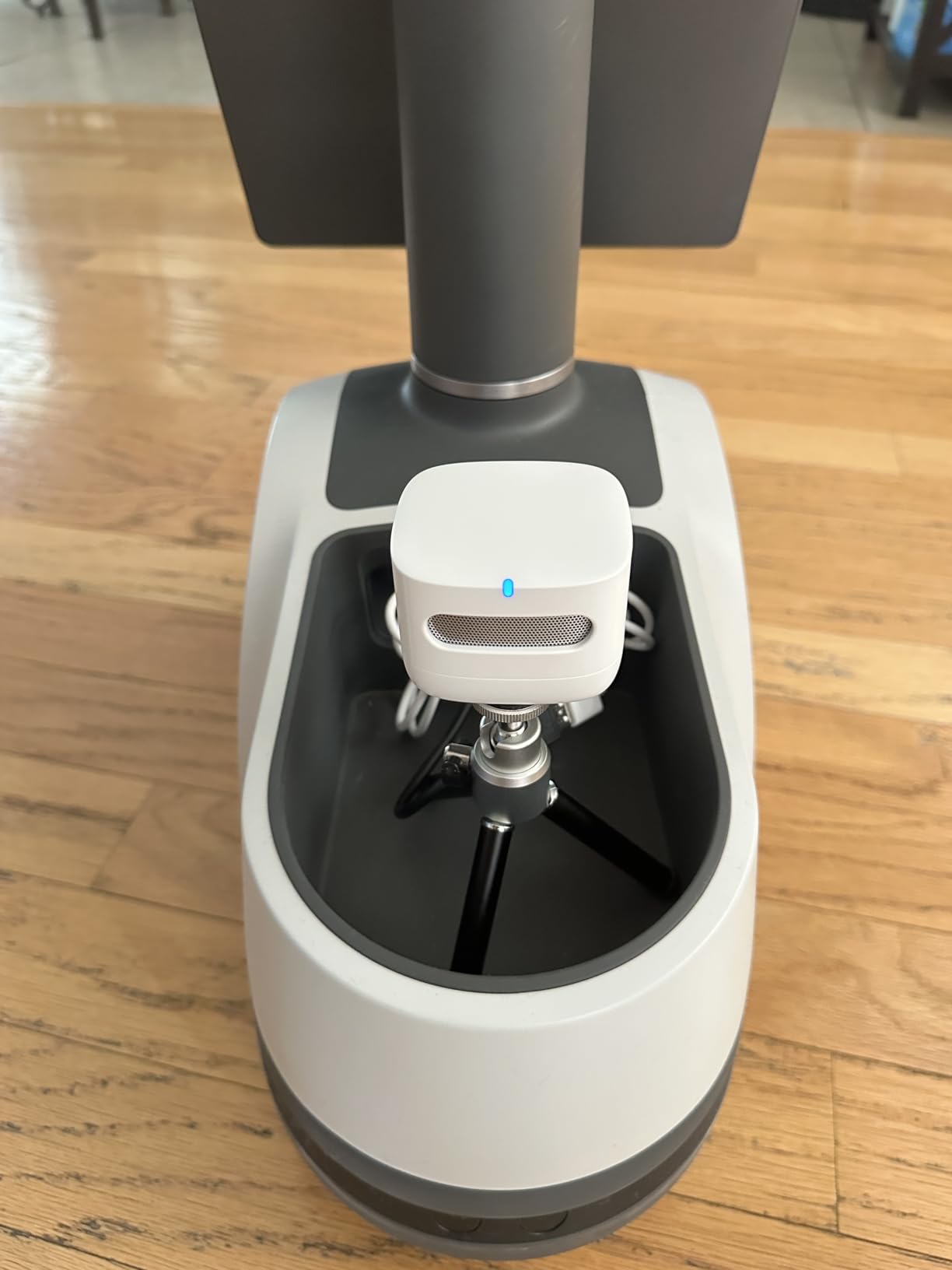
This is the monitor for a household that has already surrendered to the Alexa ecosystem, and it does something none of the others do: it closes the loop. Readings feed straight into Alexa Routines, so a purifier, dehumidifier or fan switches on when the air quality score drops, without a hub, without IFTTT and without you checking a phone at 2am.
During testing it was also the most responsive unit to real events. We ran an aerosol cleaner and the VOC and PM readings moved almost immediately. If you want to know that your child is painting a bedroom or you are cooking with the extractor off, this tells you within minutes.
Its carbon monoxide reading is a bonus, not a certification. Owners are clear that this does not replace a dedicated CO or radon alarm, and it should not be the reason you skip one.
Why it wins for automation
The gap between a monitor that reports and a monitor that acts is the whole point here. A purifier that runs on a schedule wastes energy and does nothing; one that runs on an actual PM2.5 reading runs when it is needed. It also ties into the Amazon Smart Thermostat, so temperature and humidity readings feed comfort control as well.
Setup took under ten minutes on an existing Alexa household, and readings appeared within minutes of pairing.
What the Alexa-only software costs you
The single most-criticised review in this product’s history, with close to 2000 helpful votes, makes the fairest version of the objection: the hardware works, but the data is effectively locked inside a bloated app with no widget, no browser access and no export.
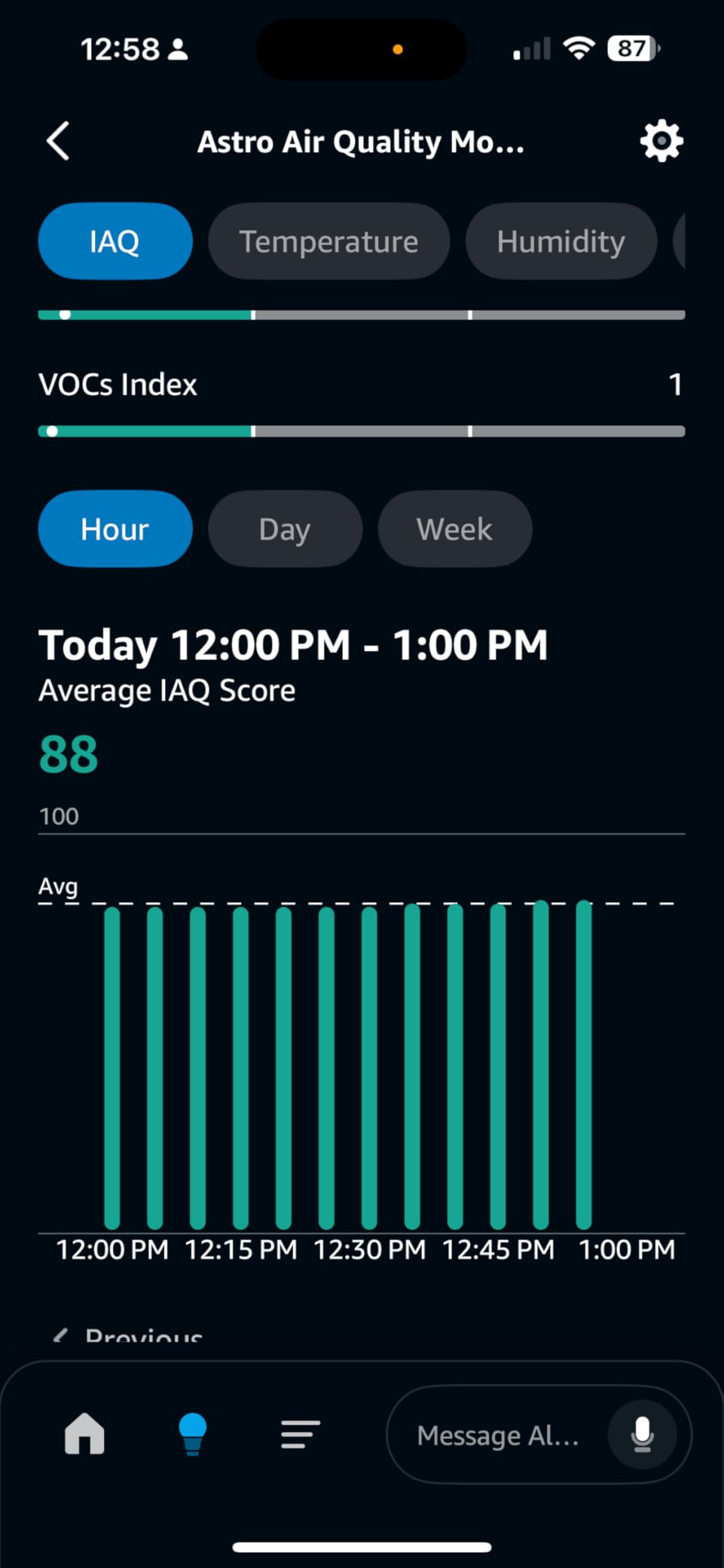
Historical handling is genuinely weak. You get hour, day and week granularity with slow paging and no date range selector. It is also very sensitive, triggering red alerts on ordinary aerosol sprays, and the red LED cannot be switched off even when you kill the light.
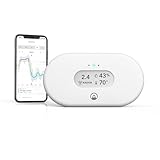
3. Airthings View Plus — Best All-in-One Sensor Coverage
Airthings 2960 View Plus – Battery Powered Radon & Air Quality Monitor (PM, CO2, VOC, Humidity, Temp, Pressure)
Radon, PM2.5, CO2, VOC, humidity, pressure
4 by 4 by 2 inches
eInk display, hand-wave readout
Battery or USB-C
Pros
- Only monitor here covering radon
- PM2.5
- CO2
- VOC
- humidity
- temperature and pressure together
- Wi-Fi dashboard with graphing and downloadable CSV data
- No paywall on history or statistics
- Doubles as a hub for other Airthings devices
Cons
- The most expensive monitor in this roundup
- Alert thresholds cannot be adjusted by the user
- Supplied AA batteries ran well short of the advertised two years
- Only two metrics visible on the device screen at once
Fewer than half the monitors in this roundup measure radon. Only three add carbon dioxide. The View Plus is the only device here that does both, plus particulates, VOCs, humidity, temperature and barometric pressure, and that breadth is the entire reason to pay for it.
Owners consistently describe it as an instrument rather than a gadget. People have used it to prove their bedroom CO2 climbs overnight in a closed room, to catch radon above 20 pCi/L before installing mitigation, and to watch PM spike while wildfire smoke came through an open window. Those are problems you cannot solve by guessing.
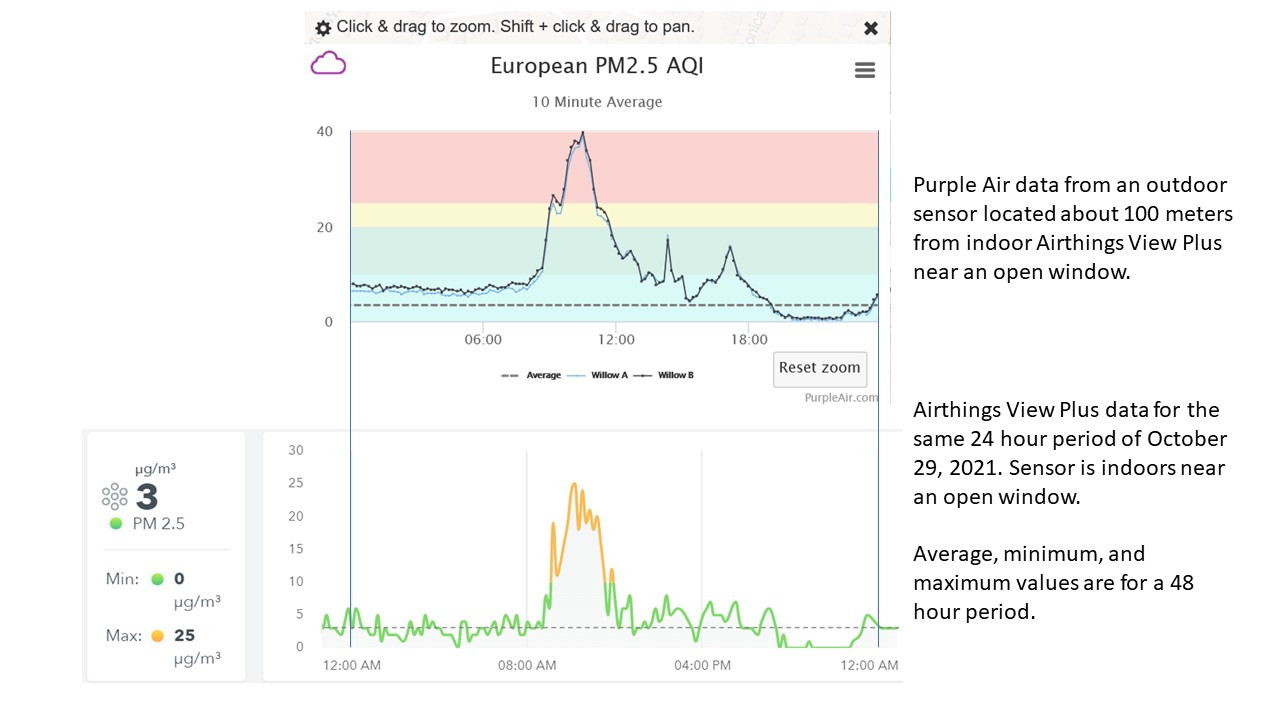
The software is the best in this roundup. The phone app and web dashboard handle trends and notifications properly, full history and statistics are included with no subscription, and CSV export means your data survives outside the vendor’s ecosystem. That matters more in 2026 than it used to, when several community favourites have changed their data access policies.
What makes it worth the money
Buy this once and you stop wondering whether the next pollutant is covered. The e-ink screen and hand-wave gesture give you a quick overall status without unlocking anything, and the pollen forecast through Breezometer data is a genuinely useful addition for allergy households.
Register within 30 days for the free five-year extended warranty, and power it over USB-C if you want it to act as a hub for your other Airthings devices.
Where the compromises bite
Alert thresholds are not adjustable. CO2 and PM alerts fire for events the owner may not care about, and there is no way to widen them once you have tuned your household around the defaults.
Battery life is overstated by owners in practice — the supplied AA cells ran 75 to 120 days for many, with no low-battery warning in the app. There is also a small cluster of units failing within months, most often Wi-Fi scanning failures or a temperature sensor stuck around 28 to 31 degrees C. Renaming a location in the app also wipes the historical statistics for that room.
4. Aranet4 Indoor Monitor — Most Accurate CO2 Reading in the Roundup
Aranet4 Indoor Air Quality Monitor, Wireless CO2 Detector for Home, Office
NDIR CO2 in ppm
Temperature, humidity, pressure
2.76 inch square, 3.67 oz
Up to 4 years of battery
Pros
- Highest rating in the roundup with 84 percent five-star reviews
- Within 10 to 15 ppm of an AC powered reference sensor after calibration
- Battery life measured in years with no recharge in 18 months
- Data stored locally in the app with graphs and CSV export
- Colour bar and large e-ink digits readable across a room
Cons
- Requires manual calibration out of the box and the app warns this erases factory data
- Bluetooth only with roughly 6 to 8 m range
- No particle
- VOC
- radon or CO sensing at all
- Humidity reads high against budget meters
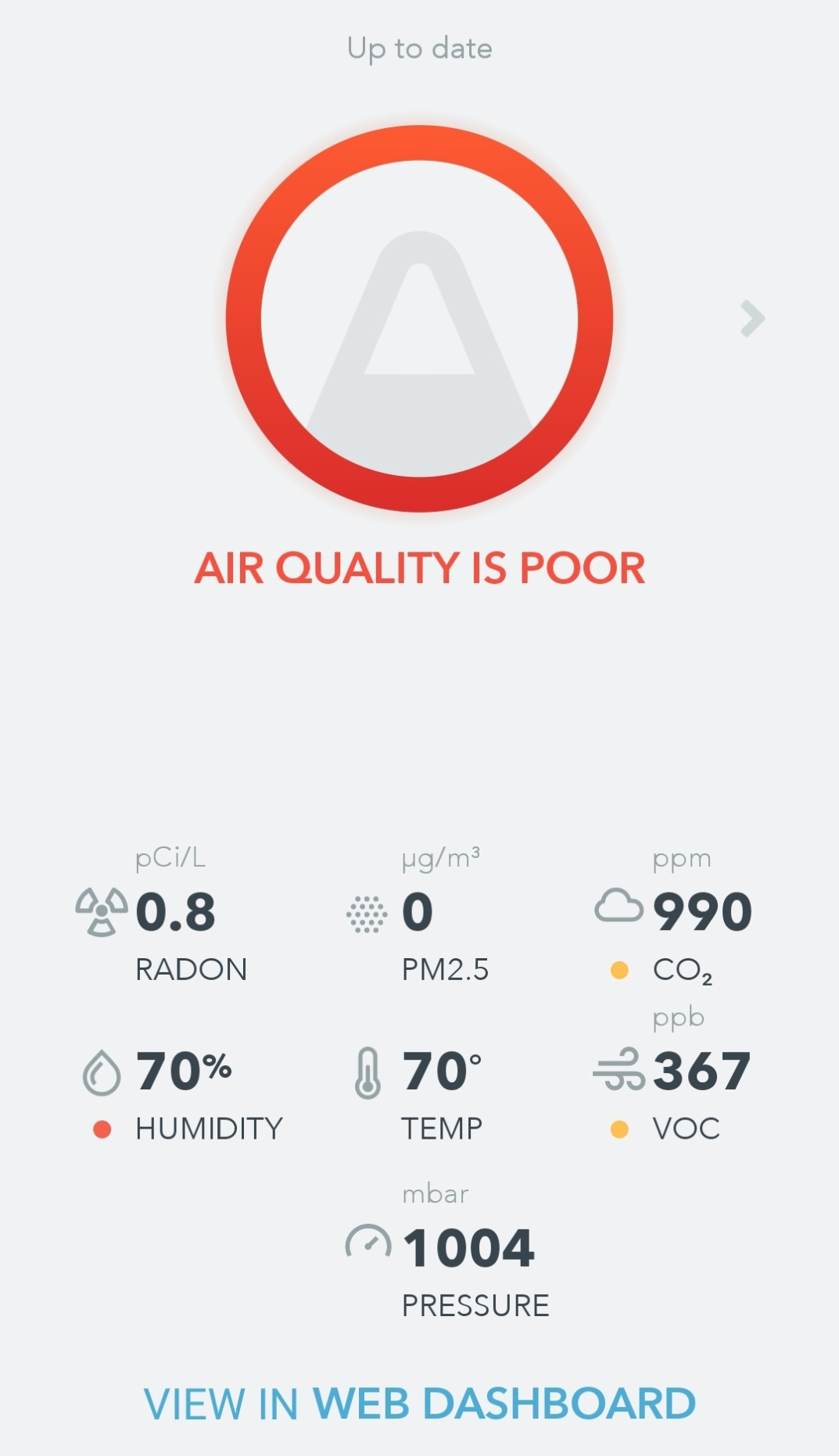
Carbon dioxide is the metric the online communities actually trust. In the r/AirQuality discussions, the consensus is consistent: NDIR CO2 sensors are reliable and useful as a ventilation proxy, and most particulate sensors are broadly acceptable. The Aranet4 is the purest expression of that position, because it measures CO2 and temperature, humidity and pressure, and nothing else.
After the one-time calibration it tracked within 10 to 15 ppm of an AC powered reference sensor sitting beside it. That is close enough that you are reading the room, not the instrument. It is also the highest rated product in this entire roundup, with 84 percent of its ratings at five stars.
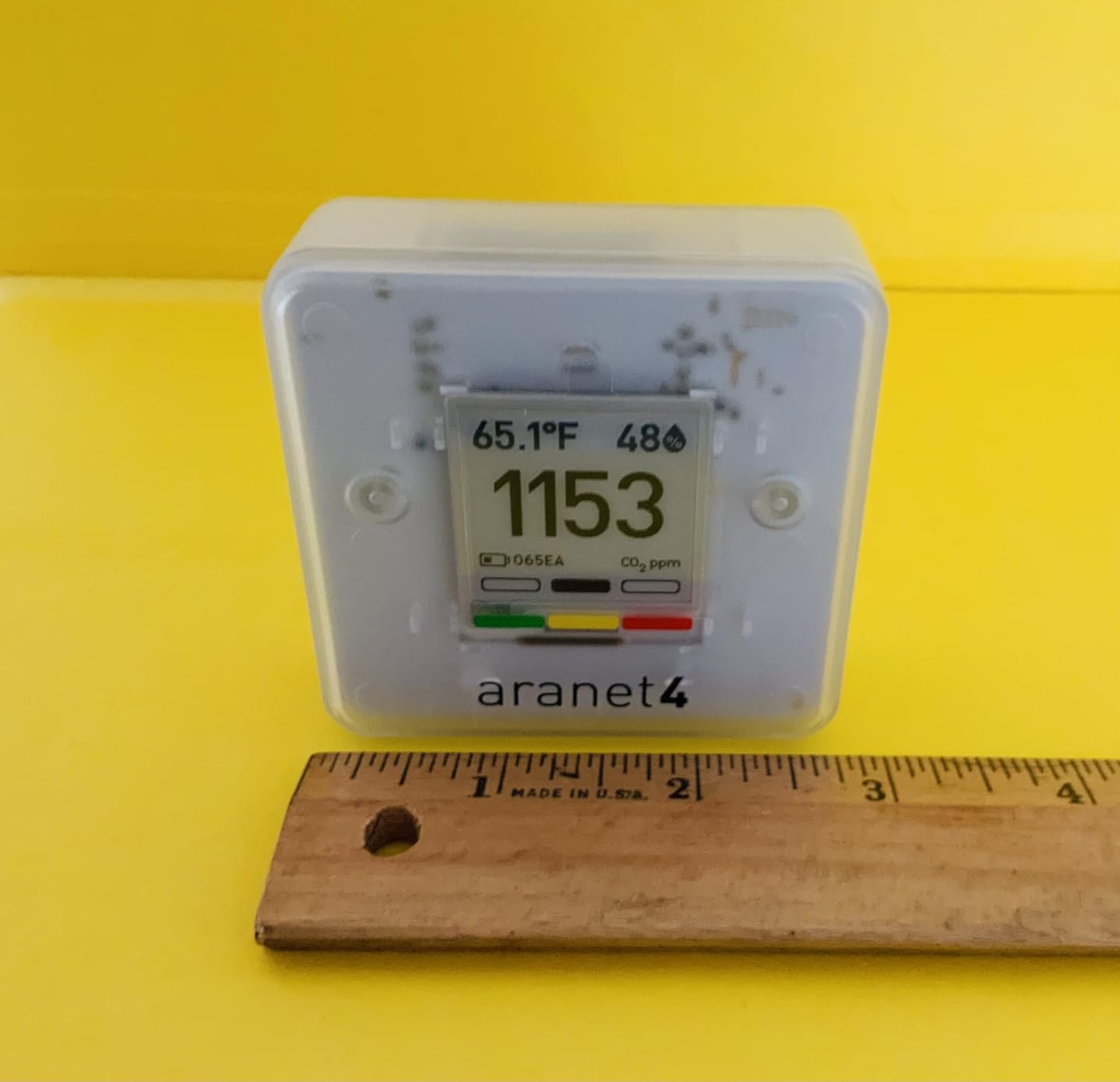
The e-ink display with a colour-coded air quality bar means you can check the number from across a room without walking over, and the battery genuinely lasts years rather than weeks. It has been running through our testing without a single recharge.
Why CO2 deserves to be your first metric
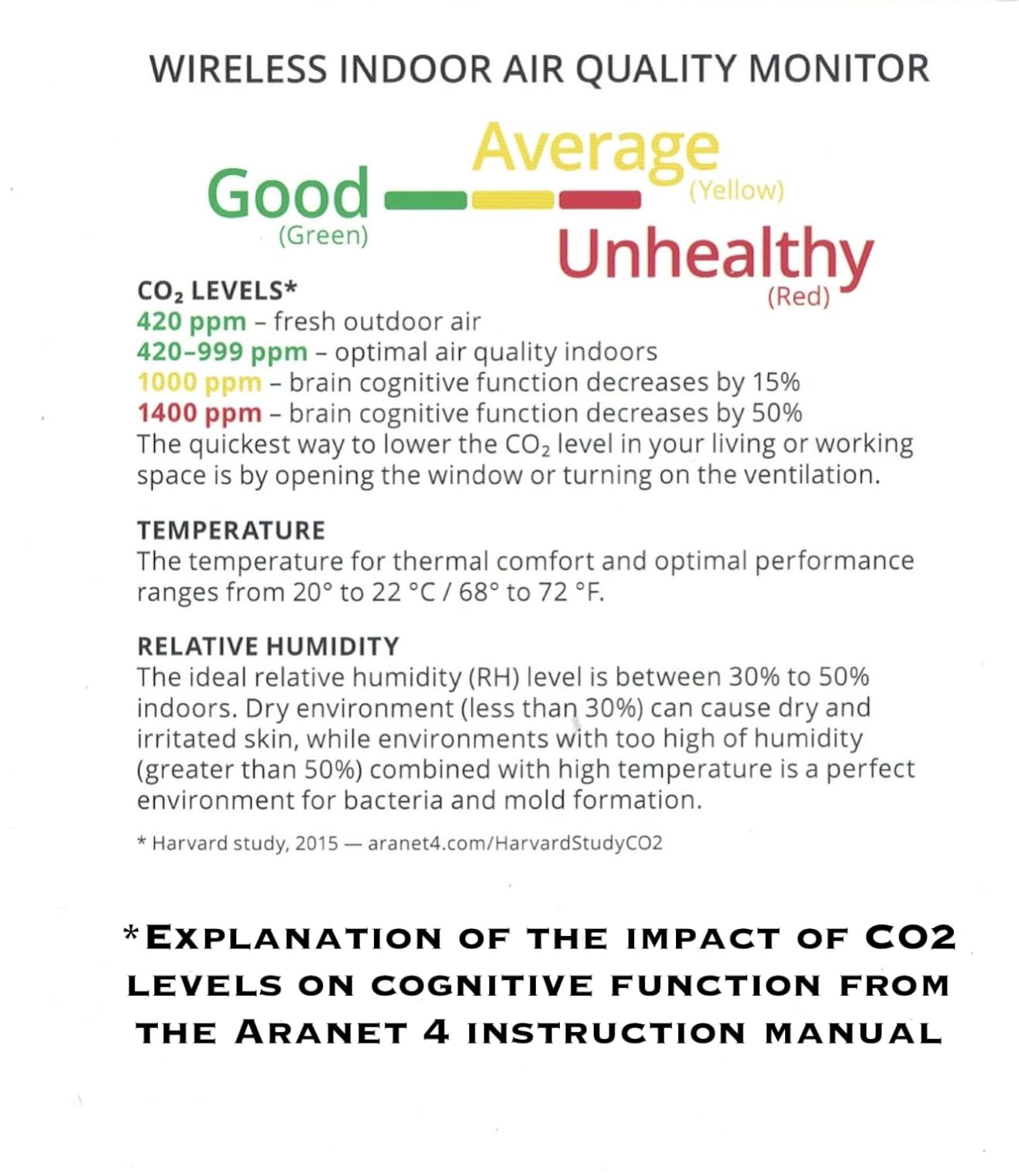
CO2 is the cleanest proxy for ventilation in a home. It rises when a room is occupied with stale air, it falls when you open a window, and it needs no reference monitor to interpret. In a bedroom with a sleeping person, a rising overnight curve is the clearest possible evidence that the room is under-ventilated.
It is also the only metric in this category you can act on directly. Open the window, watch the number fall, learn what your house actually does.
What you give up for that focus
Calibration is mandatory out of the box and the app explicitly warns that doing it erases the factory calibration data, which feels like a strange thing to ask of a new device. The Bluetooth-only connection means it cannot join a wider Wi-Fi system and the practical range is roughly 6 to 8 metres.
There is no particle, VOC, radon or CO sensing, so this is not an asthma monitor. Several reviewers also note that cheaper USB powered meters land within 0 to 40 ppm, which makes the price hard to justify if CO2 is all you care about. Humidity also runs higher than budget meters, and the screen blanks briefly on every e-ink refresh with no backlight.
5. GoveeLife Smart Monitor H5106 — Best Budget Pick for Particles
GoveeLife Smart Air Quality Monitor with PM2.5 H5106, LED Display Wired
PM2.5, temperature, humidity
2-second response
5.31 by 1.57 by 2.47 inches
5.44 oz, USB-C wired
Pros
- Cheapest credible particle monitor in this roundup
- PM2.5 accuracy of plus or minus 15 ug/m3
- 2-second refresh with a readable LED and night mode
- 13 days of online graphs plus 2 years of exportable data
- Drives Govee purifiers
- humidifiers and heaters automatically
Cons
- Wired with no built-in battery so it is fixed in one spot
- Measures only three parameters with no CO2
- VOC
- formaldehyde or radon
- Needs 2.4 GHz Wi-Fi for the on-device clock
- keep the sensor grille clear for accurate detection
This is the sensible first purchase for a household that just wants to see particle numbers and act on them. It reports PM2.5, temperature and humidity with a two-second refresh, and its stated PM2.5 accuracy of plus or minus 15 ug/m3 through 100 ug/m3 is honest for this class of hardware.
The LED display switches between a clock, the PM2.5 reading, a bright mode and a night mode, with a four-level air quality indicator. At 5.31 by 1.57 by 2.47 inches it is small enough to disappear on a shelf, and the 13 days of online graphs plus two years of exportable storage is more history than the pricier devices here offer.
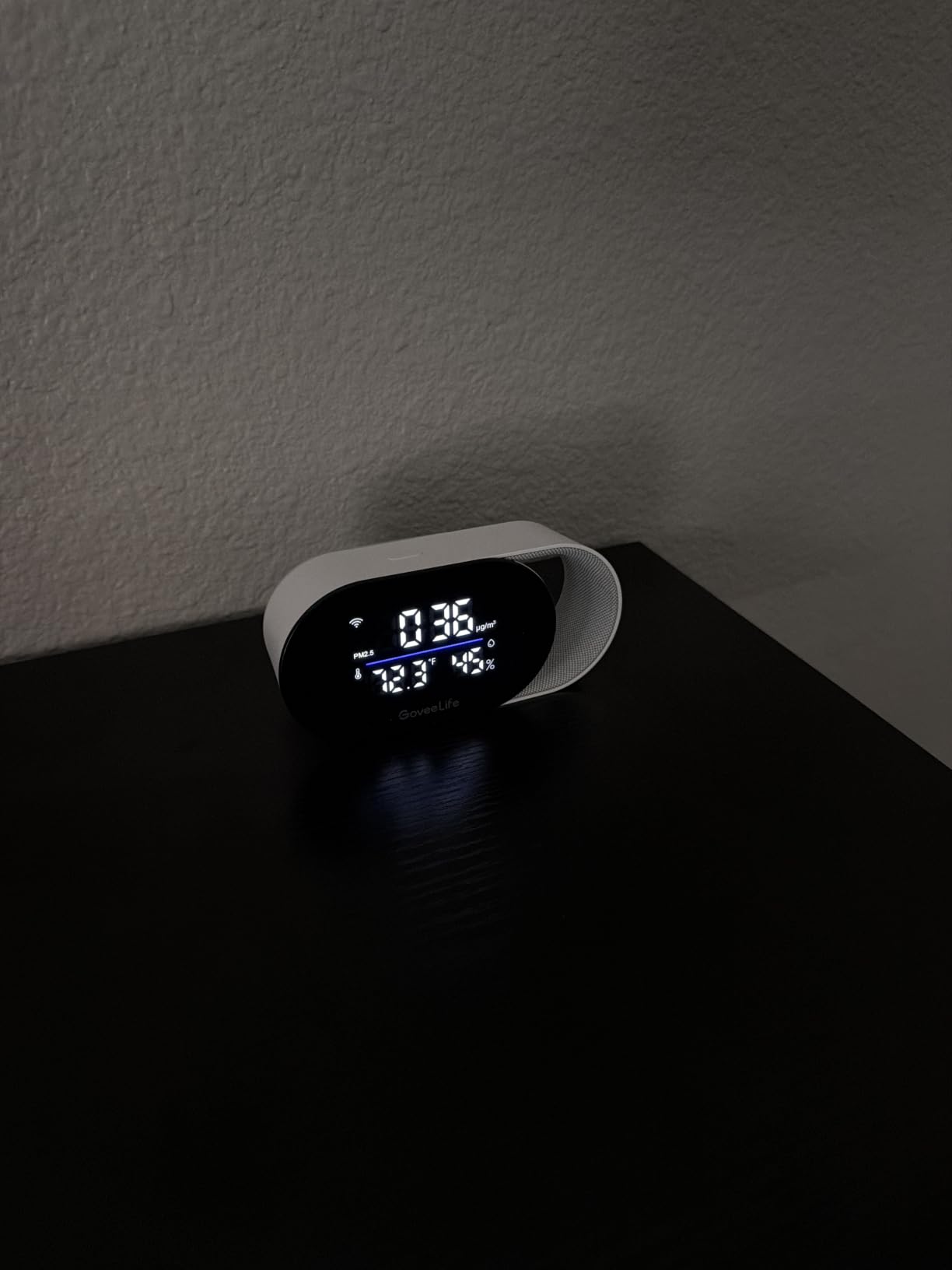
If you own a Govee purifier, humidifier or space heater, this monitor is the missing half of that setup. The appliances switch automatically when air quality changes, which is a better outcome than buying a purifier that runs on a timer.
Why this one at the budget end
Two reasons. It measures only the three things it measures well, which is the entire lesson of the 16-in-1 accuracy problem. And its 2-year data export is a real feature at this price, not a promise.
Keep the intake grille clear. Owners who drifted the sensor behind a curtain or an appliance report drift, and that is a placement problem rather than a hardware one.
What you have to give up
It is wired only, with no internal battery, so unlike the Aranet4 or the Temtop it is nailed to one spot for good. That is a real constraint in a house where the worst air is in a different room from the outlet.
Three parameters is three parameters. There is no carbon dioxide reading, so you cannot tell a stuffy room from a polluted one, and no VOC or formaldehyde channel. The 2.4 GHz-only Wi-Fi requirement for the on-device clock will also fail on a modern dual-band router with the 2.4 GHz band disabled.
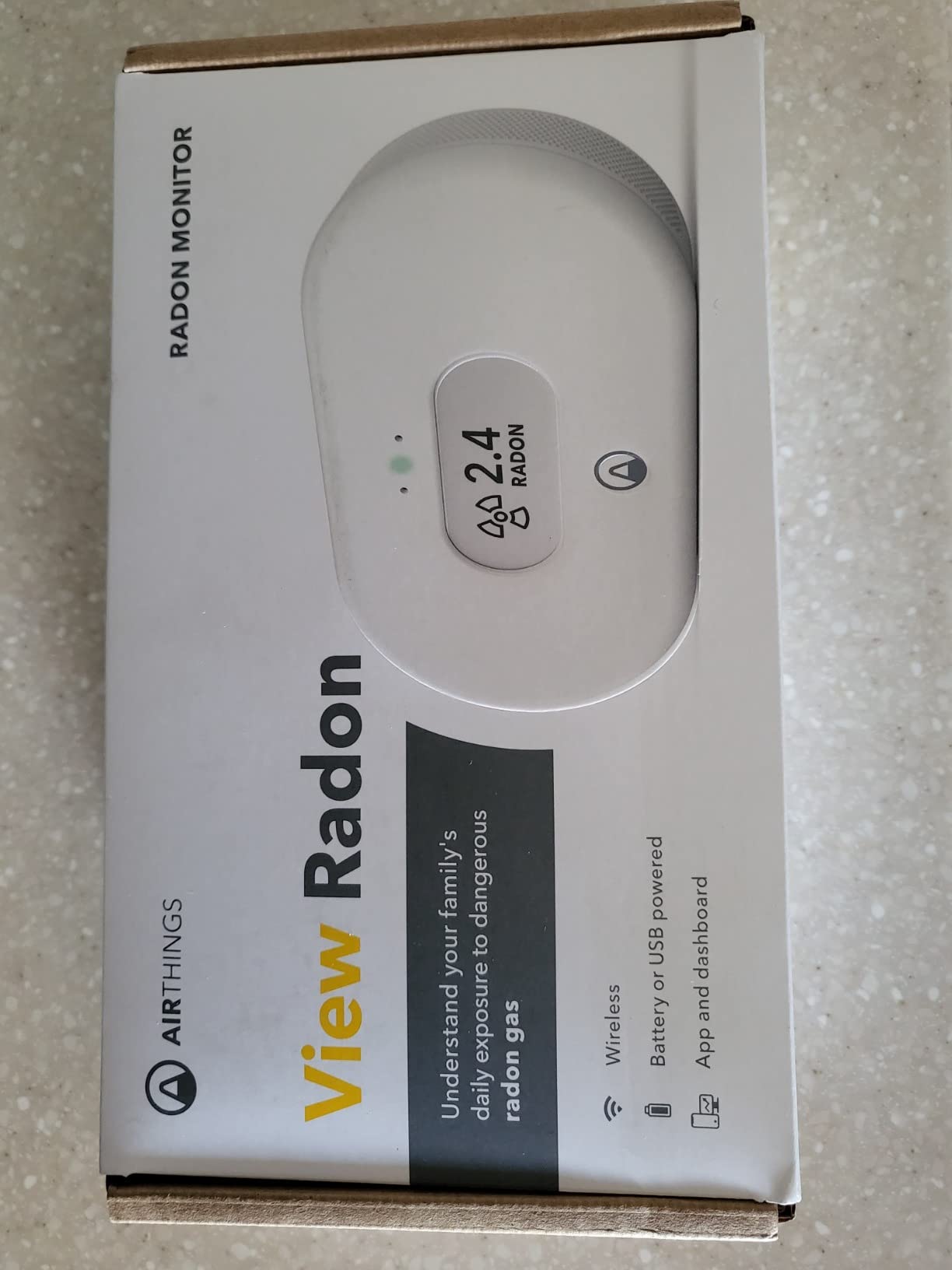
6. Airthings View Radon — Best for Remote Radon Alerts
Airthings 2989 View Radon – Radon Monitor with Humidity & Temperature Detector – Battery Powered Mobile APP, WiFi, Alerts & Notifications
Radon, humidity, temperature
6.69 by 1.3 by 3.54 inches
7.68 oz
Wi-Fi with up to 3 years of battery
Pros
- Remote radon checks from the phone while you are away
- Trend windows at 3-hour
- 24-hour
- 7-day
- 30-day and 1-year
- Push alerts when levels exceed limits you set
- Battery keeps it running through power outages or when moved between rooms
- Calibrated owners report agreement with professional units
Cons
- Measures no particulates
- CO2 or VOCs
- One owner could not move the reading at all after hours of airing out
- Another saw two identical units side by side disagree entirely after a month
- App interface is English only
This is the Corentium’s connected sibling, and it exists for one situation: you have radon mitigation installed and you want confirmation from work, from a hotel, from a month away that the system is still reducing levels. The Airthings app gives you a live number plus trend windows from three hours out to a full year, and pushes alerts when a reading crosses a limit you set.
Battery life is rated at up to three years, with USB power as an alternative. That matters for a monitor in a basement or an unoccupied property, and it means a power cut does not silently end your radon record.
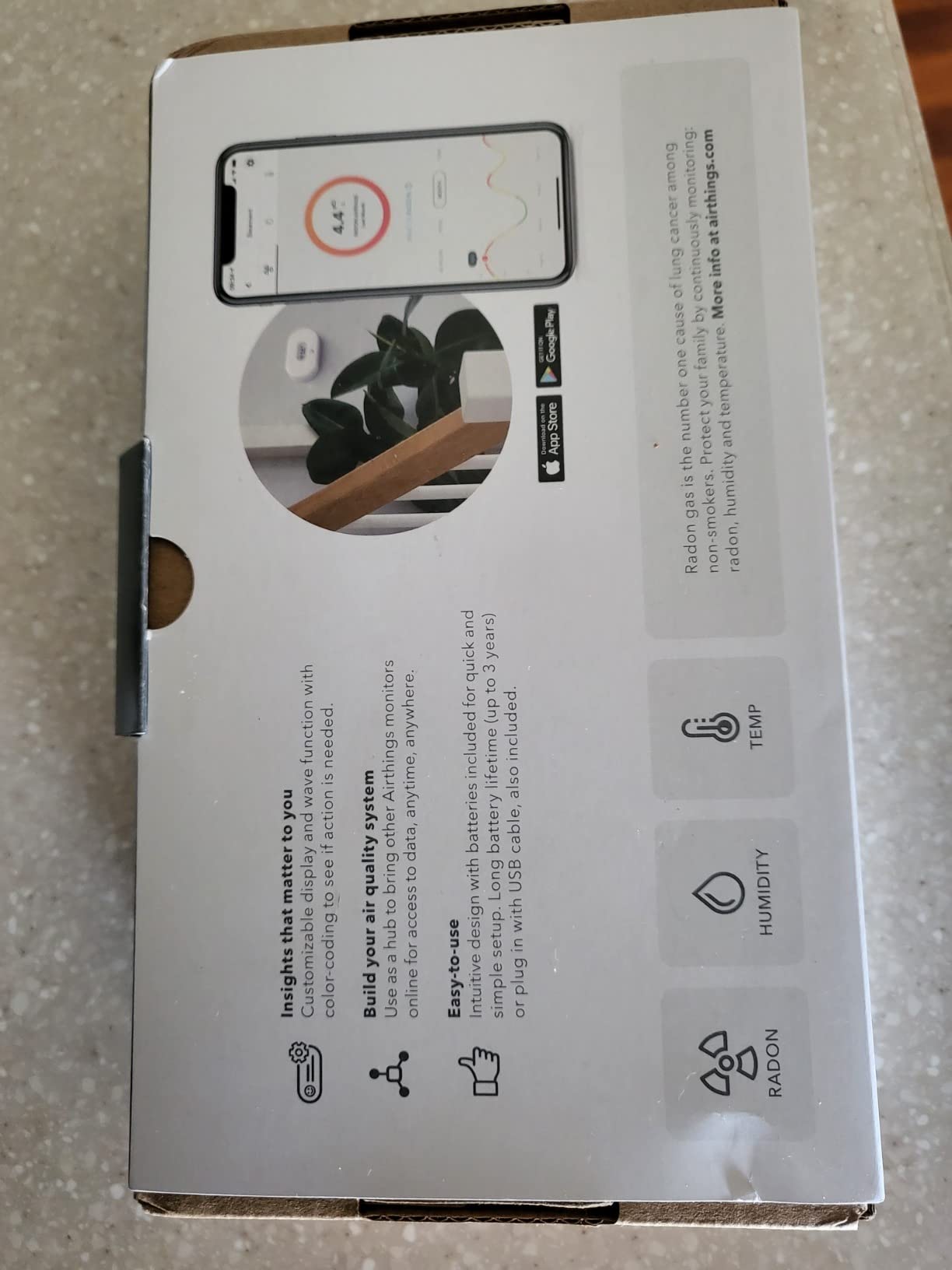
The e-ink display shows up to four values with a hand-wave gesture readout, and you can use it as a hub to bring other Airthings devices online. Owners with a mitigation system treat it as a verification tool, which is exactly the right framing.
Where it beats the standalone radon detector
Everything that makes the 223 useful in person is better here: a phone instead of a button-free screen, trend graphs instead of a single number, and alerts that reach you when you are not standing next to it. There is no subscription and setup is app-based.
If you only care about radon, it is the version to buy. If you also want to know what your air is doing while you sleep, the View Plus covers both.
What the critical reviews raise
The one-star reviews concentrate entirely on disputed radon accuracy, and they are worth taking seriously. One owner could not move the reading after hours of airing out a cabin nor by placing the unit outdoors, and a reset did not help. Another reports two identical units side by side giving completely different values after a month.
Those are isolated reports rather than a pattern, but radon is precisely the pollutant where a wrong number is worst, so confirm any reading above 4 pCi/L with a professional test before you act on it.
7. Temtop LKC-1000S+ — Best for Formaldehyde After a Renovation
Temtop Air Quality Monitor PM2.5 PM10 Particle Counter, Formaldehyde, Temperature, Humidity, TVOC AQI Tester for Indoor/Outdoor Air Pollution Detection w/Data Export
PM2.5, PM10, HCHO, TVOC, humidity, temperature
Electrochemical HCHO sensor
3-month logging to Excel
14.4 oz
Pros
- Electrochemical formaldehyde sensor rather than a cheap semiconductor
- Lab-tested correlation up to R2 of 0.999
- 3 months of continuous logging exported to Excel with no subscription or app
- 12-hour trend histogram that shows pollution peaks
- Factory calibrated with a 6 to 8 hour internal battery
Cons
- No gas or carbon monoxide leak detection
- Readings distorted by alcohol
- perfume and cleaning sprays nearby
- Needs a 10 minute warm-up after a big temperature change
- Heaviest monitor in this roundup at 14.4 oz
Formaldehyde is the pollutant most home monitors fake, and this is the one that does not. The Temtop LKC-1000S+ uses an electrochemical HCHO sensor rather than the semiconductor units found in the generic 16-in-1 crowd, and the manufacturer reports a lab-tested correlation of R2 up to 0.999. Owners who compare readings find the numbers move when the source does.
That makes it the pick for a new home, a recently renovated room, or anyone with chemical sensitivity. It covers seven parameters — PM2.5, PM10, formaldehyde, VOCs, humidity, temperature and a live AQI — with a large IPS colour screen that shows green, yellow or red at a glance.
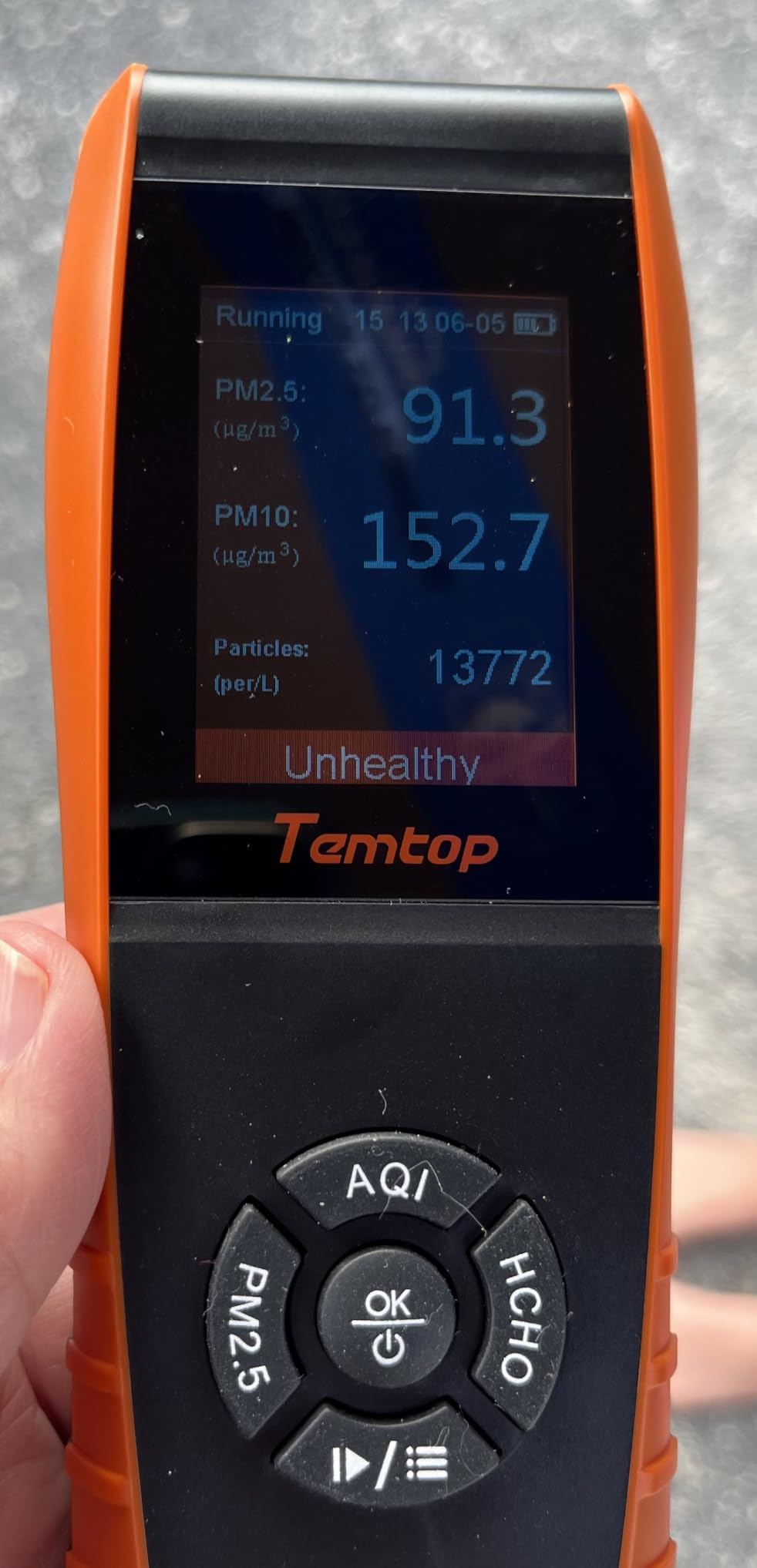
The second reason to like it is that it treats the data as yours. Three months of continuous logging export over USB straight into Excel, with no app, no account and no subscription, plus a 12-hour on-device trend histogram for spotting peaks from cooking, incense or renovation fumes.
Why formaldehyde deserves its own sensor
Formaldehyde comes off new carpets, composite wood, paint, adhesives and flat-pack furniture, and it is a recognised respiratory irritant that a particle counter cannot see at all. If you moved into a newly built or newly refitted home, this is the reading you actually want to watch.
The laser particle sensor has a three-year designed lifespan, and the 12-month warranty with US-based support is the longest on this list.
What to watch out for
Readings are distorted by anything volatile in the air. Alcohol, perfume, disinfectant sprays and strong cleaning agents will move the HCHO and TVOC channels, so test in a settled room, not while cleaning.
It also needs a ten-minute warm-up after moving between hot and cold environments, and it is the heaviest unit here at 14.4 ounces. The built-in battery only lasts 6 to 8 hours, so treat it as a spot-check tool rather than a portable instrument. It detects no gas or carbon monoxide leaks, so it does not replace a dedicated alarm.
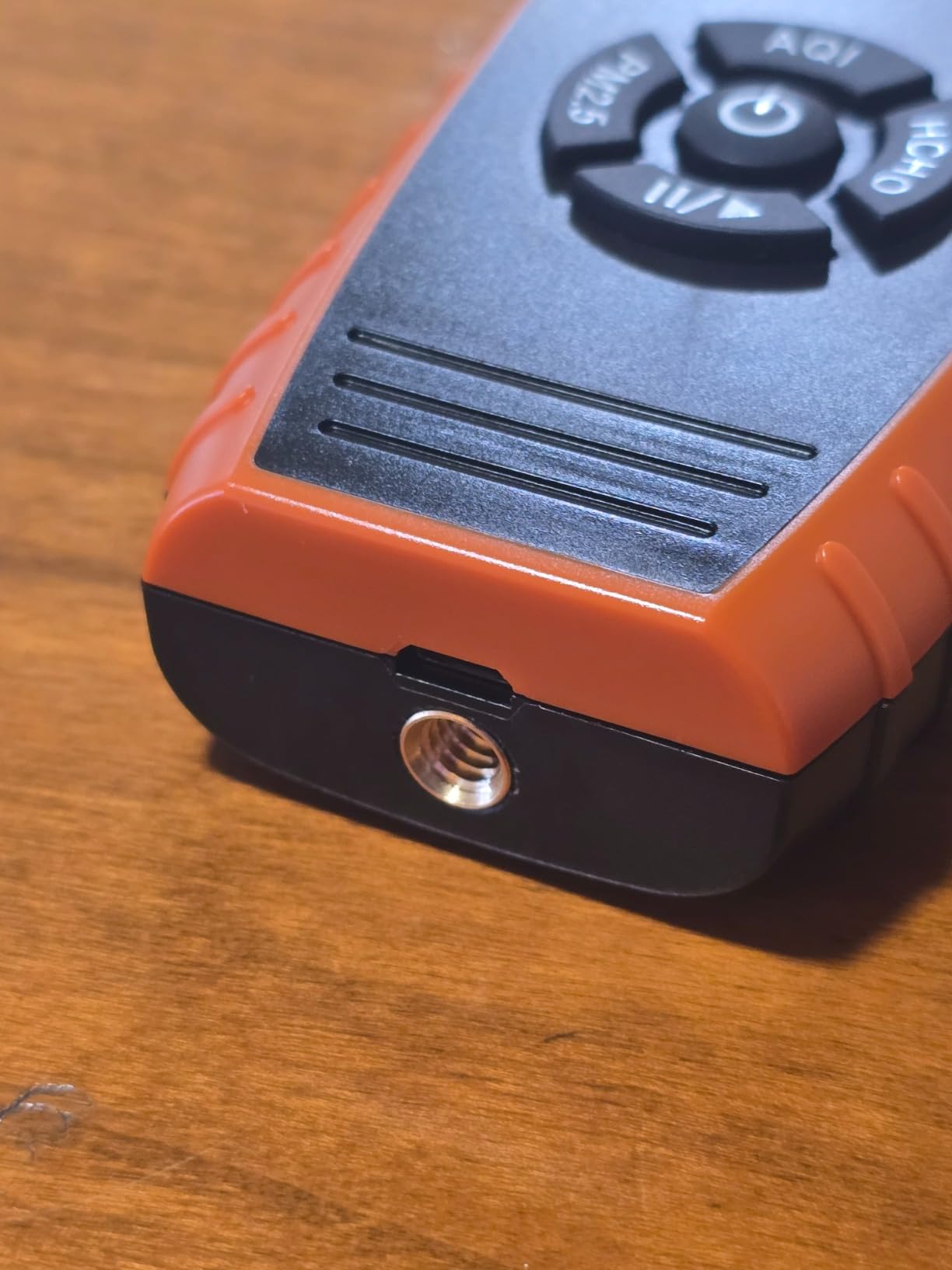
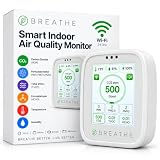
8. BREATHE Airmonitor Plus Gen 2 — Best Sensor Breadth for the Money
BREATHE Airmonitor Plus Indoor Air Quality Monitor w/CO₂, PM & App. Gen 2.
CO2, PM1, PM2.5, PM10, TVOC, HCHO
NDIR CO2 plus laser particle
1.4 by 2.8 by 3.3 inches
4 oz, 6-hour battery
Pros
- Eight parameters including NDIR CO2
- three particle sizes
- TVOC and formaldehyde
- Configurable CO2 and PM2.5 alerts so it only speaks up about what matters
- 90 days of app history plus data export
- Quick CO2 calibration and simple app pairing
- Compact at 4 oz with a colour display and USB-C
Cons
- Modest 4.0 average rating with a meaningful one-star share
- Only 6 hours of portable battery compared with dedicated CO2 meters
- 2.4 GHz Wi-Fi only with no dual-band or Bluetooth path
- Sized for a room
- not a whole floor
Take the View Plus’s pollutant list, drop the radon sensor, and you get this: NDIR CO2, PM1, PM2.5, PM10, TVOC, formaldehyde, temperature and humidity in a 4-ounce unit. Very few monitors in this roundup give you a real NDIR CO2 channel at this position in the market, and even fewer pair it with formaldehyde.
Unlike the Airthings devices, the CO2 and PM2.5 alert thresholds are configurable, which owners single out as the feature that makes the difference between a monitor you keep and a monitor you mute. The app graphs make it easy to line readings up with cooking, cleaning, occupancy and HVAC behaviour.
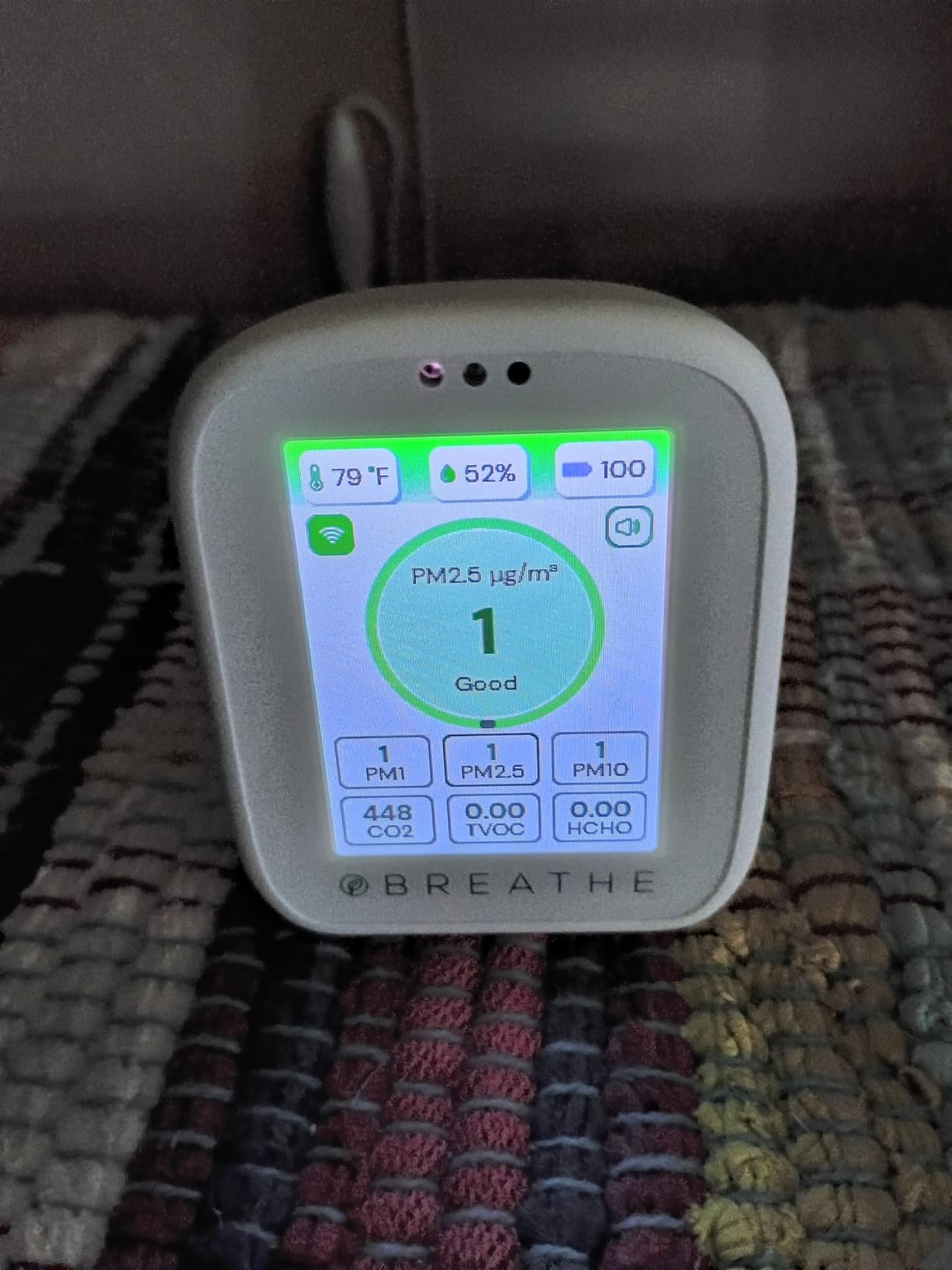
Gen 2 added the things that were missing: up to six hours of internal battery for room-to-room checks, 90 days of app history and data export. It is a two-year warranty on top of that.
Why breadth matters for a mixed-pollutant house
If your concern list includes both stuffiness and a new mattress, this is the only monitor here that covers both without a radon sensor you would have to pay extra for. The PM1 channel in particular is the one most cheap units omit, and it is the fraction that reaches deepest into the lungs.
It also doubles as a portable spot-check instrument thanks to the internal battery, which is useful for testing rooms you do not want to wire up.
Where it disappoints
The 4.0 average with 13 percent one-star reviews points to mixed real-world satisfaction, and it is the weakest rating among the devices we would actively recommend. Six hours of battery is short for a device that otherwise reads like a continuous monitor, and six hours will not get you through a workday away from an outlet.
The app connection is 2.4 GHz Wi-Fi only, with no dual-band or Bluetooth fallback, and the compact enclosure suits a bedroom, classroom or office rather than open-plan coverage.
9. IQAir AirVisual Indoor — Best Built-in Display
IQAir Air Quality Monitor Indoor, Swiss Design, Professional Grade, Detects PM2.5, CO2, AQI, Temperature, Humidity, Indoor Air Quality Real-Time Air Quality & Forecasting, Historic Data
PM2.5, CO2, AQI, temperature, humidity
381 g, Swiss design
Built-in screen with advice
Rechargeable, keeps reading in outages
Pros
- PM2.5 and CO2 readings independently checked against other monitors and judged very accurate
- Built-in screen readable from across the room showing indoor and outdoor side by side
- Free app with a worldwide map of live public and private station readings
- Rechargeable battery keeps it measuring through power outages
- Cross-references against outdoor conditions or a paired outdoor unit
Cons
- Displayed AQI is calculated from PM2.5 only
- No VOC or ozone sensor for chemical sensitivity
- PM1 and PM10 need a Windows 10 PC console CSV export to see
- Internal battery lasts only 4 to 5 hours with the display off
The IQAir is the monitor you put on a shelf and glance at rather than one you check on a phone. Its built-in display shows indoor and outdoor values together with a direct recommendation, which makes it unusually good for a household where nobody will ever open an app. In an allergy-driven home during wildfire season, that visibility is the feature that gets used.
The sensors themselves hold up. Owners cross-checked PM2.5 and CO2 against other monitors and, in one case, against a separate VOC and CO2 device, and found close agreement. It is also the one monitor here that keeps measuring through a power outage on its internal battery, which is exactly the scenario people buy a monitor for.
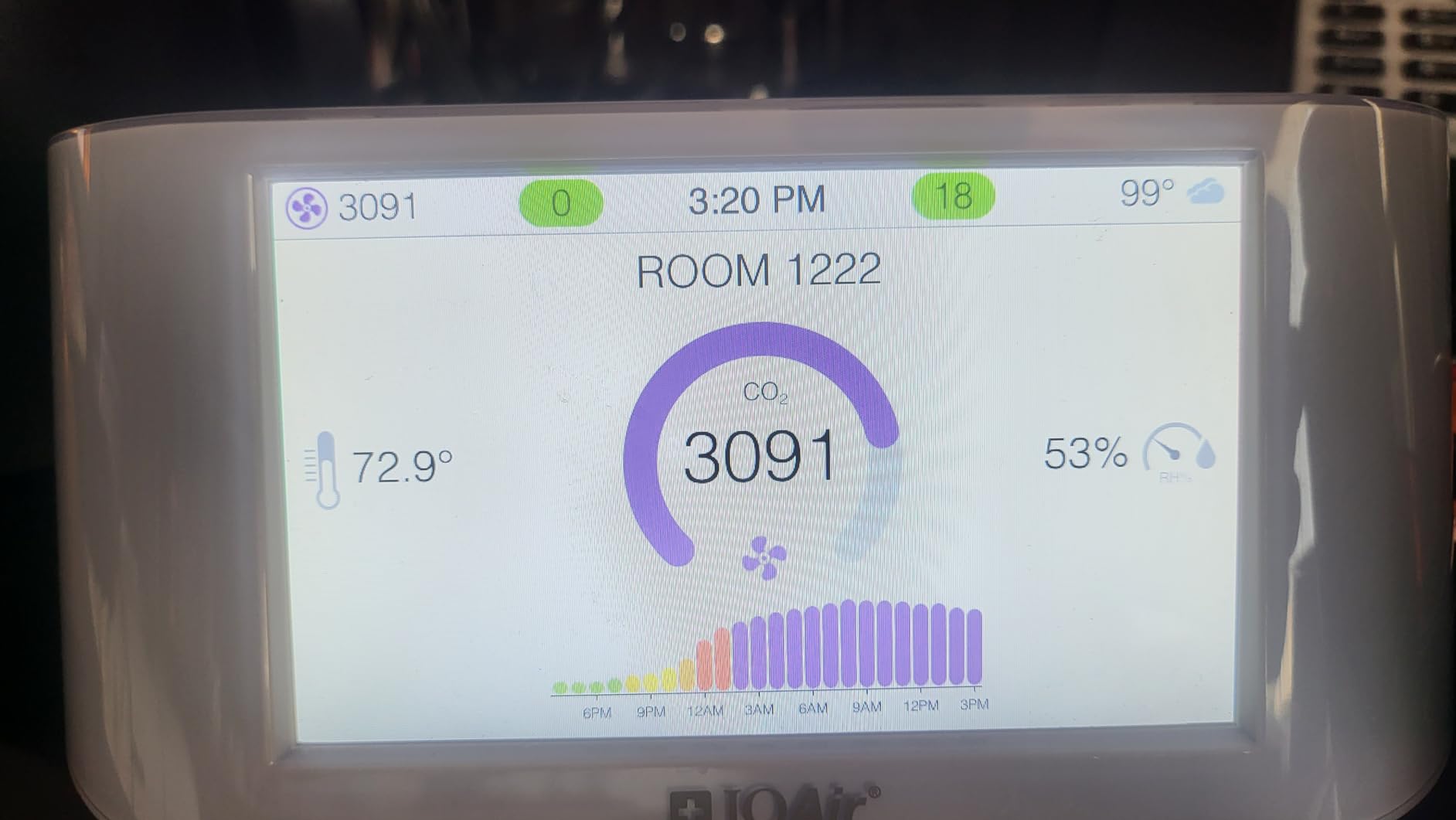
The free app opens a worldwide map of live readings from public and private stations, and IFTTT integration is supported for anyone automating around it. Swiss-designed hardware with a clear interface.
Why the on-device display matters
A number on a wall that everyone can see changes behaviour in a way a phone notification does not. Put it where the family eats or where the child sleeps and it becomes ambient information rather than a thing you have to remember to check, which is the failure mode of most app-only monitors.
Pairing it with the matching outdoor unit lets you see the difference between what is coming in and what is staying inside, which is the only way to know whether ventilation is helping or hurting.
What the software gets wrong
The AQI score on the device is calculated from PM2.5 only. A home with high PM10 can therefore read as good air quality, which is a genuine gap in how the headline number is presented.
PM1 and PM10 are not shown on the device, in the app or on the website. You need a Windows 10 PC and a console CSV export, which several buyers discovered only after purchase. Historical data is thinner than advertised too — roughly 48 hours of hourly, 30 days of daily, a year of monthly — and the internal battery manages only 4 to 5 hours with the display off while the screen forces to full brightness on plug and unplug. One buyer also reported a unit stuck at 0 PM2.5 indefinitely after warranty expired with no replacement offered.
10. YNAK 16 in 1 Air Monitor — Big Screen, Mixed Accuracy Results
16 in 1 Air Quality Monitor Indoor 7″ High-Precision Real-Time CO2 Monitor
CO2, PM1.0, PM2.5, PM10, HCHO, TVOC, humidity
7-inch LED display
10.56 oz
USB-C battery
Pros
- 7-inch display with three brightness settings
- readable from across the room
- Nine parameters visible at once with no menu navigation
- Sensitive enough to register bathroom humidity spikes and foggy weather PM
- Internal battery makes room-to-room checks convenient
- Audible alerts for seven conditions with a mute button
Cons
- One buyer found it read 400 ppm CO2 while four others showed 3000 to 4000 ppm in the same conditions
- Particulate readings reported stuck under 5 while a reference monitor showed 50
- Cleaning products produced no change in TVOC
- HCHO or PM readings
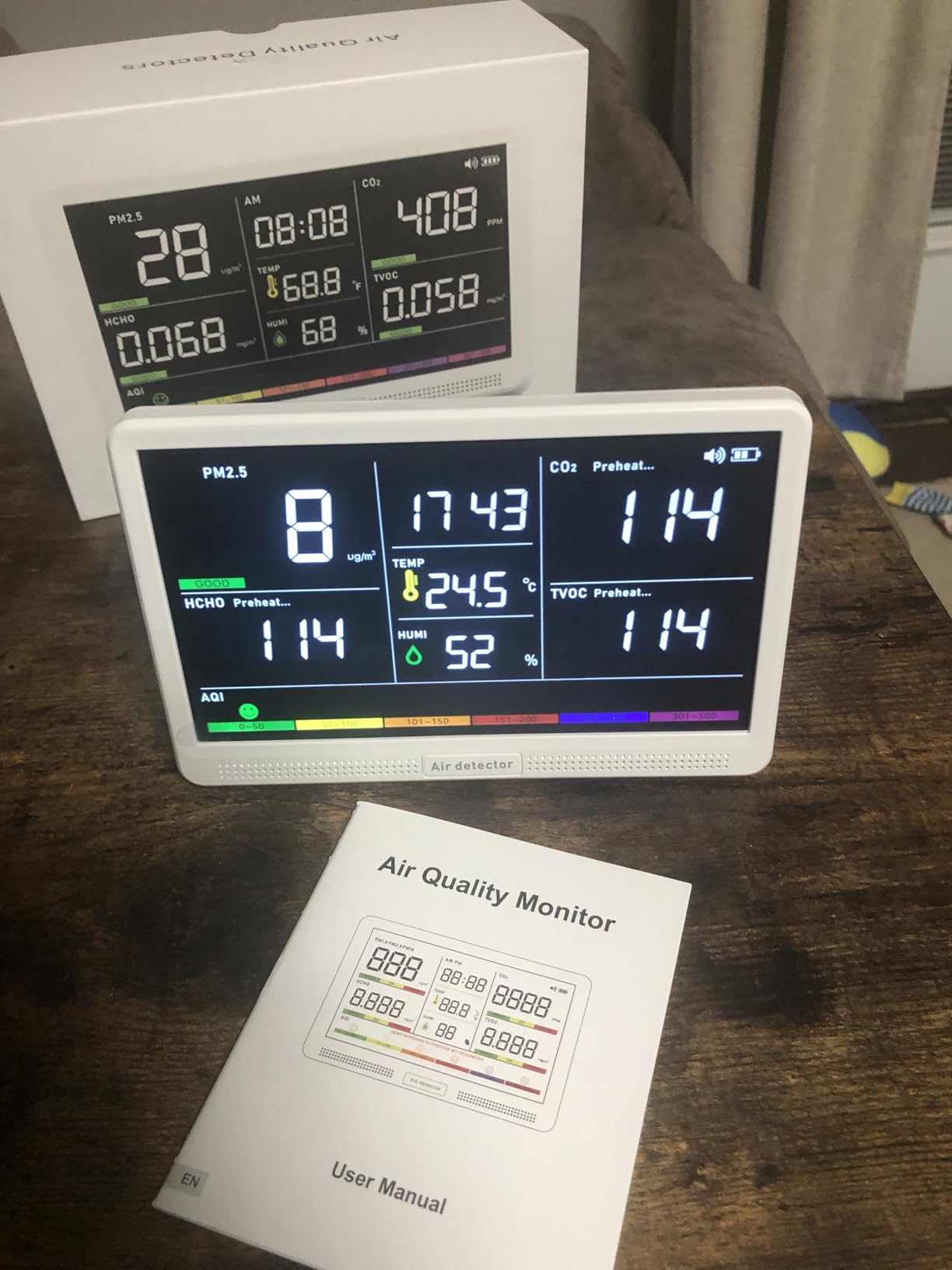
- Boots with Wi-Fi and mirror-display icons not covered in the booklet
We are including this one as a case study rather than a recommendation, because the 16-in-1 category is the mistake we see people about to make most often. The hardware is genuinely appealing: a 7-inch LED screen with three brightness settings showing nine parameters at once with no menu navigation, and a battery that lets you carry it between rooms.
Then you compare it against other devices. One buyer tested five monitors side by side and this one reported a safe 400 ppm CO2 while four others showed levels in the 3,000 to 4,000 ppm range in the same air. Other owners report particulate readings pinned under 5 while a reference monitor outside showed 50, and one found that spraying cleaning chemicals changed nothing at all on the TVOC, HCHO or PM channels.
To its credit, the seller issued a prompt full refund and a quality control escalation when readings proved wrong. That is a better response than most sellers in this category manage, but the point stands: a feature count is not a sensor.
What it does well
As a glanceable display it is excellent. The 7-inch panel is legible from across an open-plan room, all nine readings sit on one screen, and the audible threshold alerts with a mute button are genuinely useful if you want the unit to speak up rather than make you watch it.
Setup takes under five minutes, and the sensors are sensitive enough to register humidity spikes in a steamy bathroom and particulate increases during foggy weather.
Why we would not run a health decision off it
A CO2 sensor that reads 400 ppm in a closed, occupied room is not a ventilation monitor, and a TVOC channel that does not respond to cleaning spray is not a VOC monitor. Both of those failures are exactly the kind you would never notice without a second device to compare against, which defeats the point of buying a monitor to save money.
The specification of 0.001 unit accuracy is a claim about a number format, not about accuracy against a reference. If a wide display is what you want, the IQAir gives you that with sensors that hold up.
How to Monitor Your Home’s Air Quality Effectively
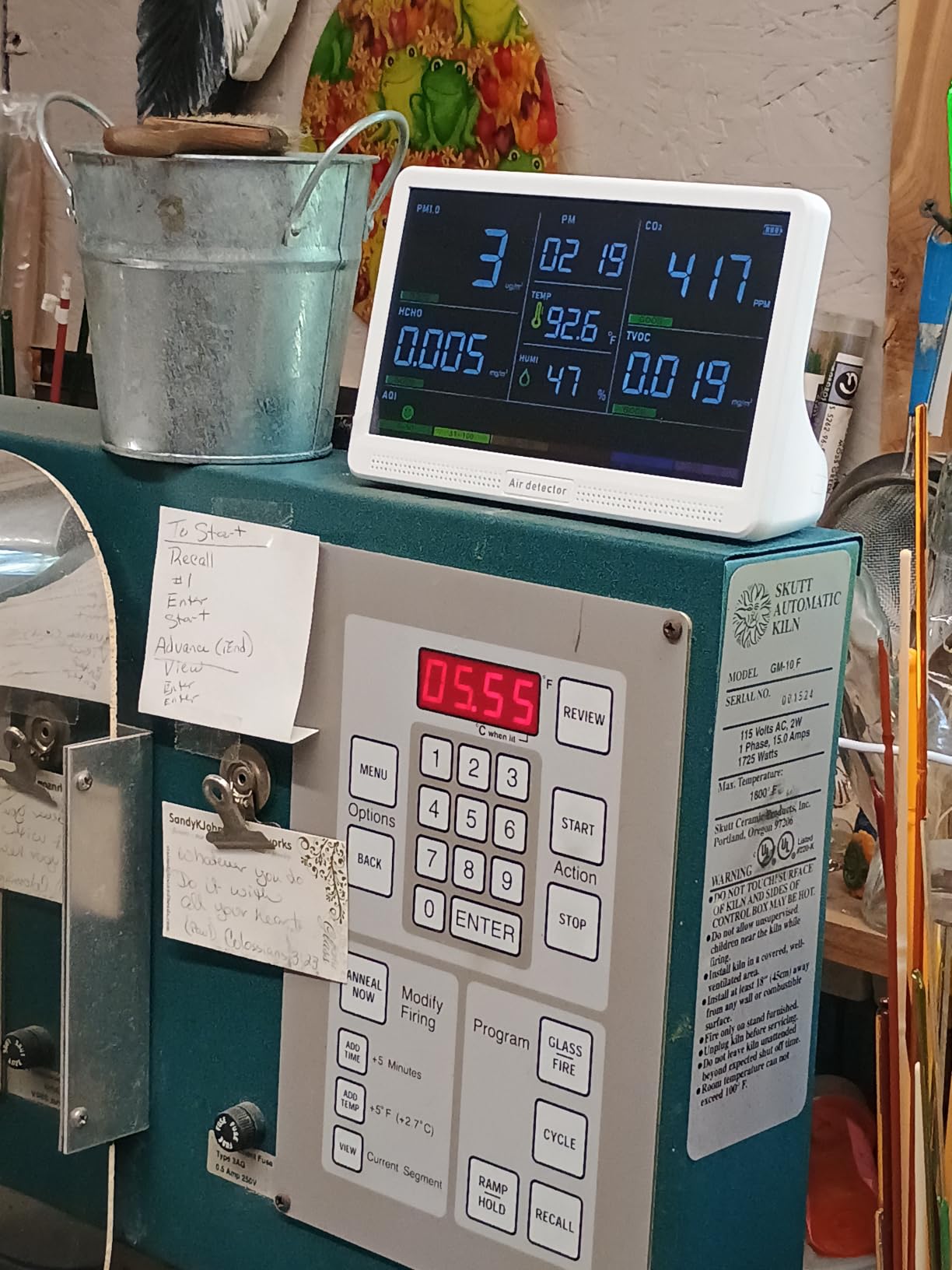
This is the section that matters more than any of the picks above, and it is the one almost every buying guide skips. A monitor in the wrong place reports the wrong room with total confidence.
1. Put it in the breathing zone. Three to six feet off the floor, in the part of the room where people actually sit and sleep. A monitor on a shelf near the ceiling will miss the cooking plume and the dust you are breathing in.
2. Keep it away from the source and the draft. Not directly beside a window, a stove, a vent, a dehumidifier or a halogen lamp. Airflow from a window or an extract fan drags readings away from the volume you care about, and proximity to a stove cooks the sensor.
3. Avoid direct sunlight and humidity extremes. Optical particle sensors drift in high humidity, and a basement at 80 percent relative humidity will read differently from a bedroom at 45 percent. Keep the intake grille clear of curtains, walls and appliances.
4. One monitor per critical room. One for the room where the family spends the most time, one for the sleeping area if that is different. A single monitor in a hallway tells you about a hallway.
5. Let it run before you judge it. NDIR CO2 sensors, VOC channels and electrochemical formaldehyde sensors all need time to stabilise. The View Plus in particular will not give you valid CO2 and VOC numbers in the first hours. Let a new monitor run for several days before drawing conclusions.
6. Learn your own thresholds. Under roughly 800 ppm CO2 the air is fine. Between 800 and 1,200 ppm open a window. Above 1,200 ppm in a bedroom, ventilation is genuinely inadequate. For particles, sustained PM2.5 above 12 ug/m3 is the point to run a purifier, while a short spike from cooking is solved by the extract fan.
7. Use it to check your purifier. An independent monitor in the same room is the only honest way to verify a purifier’s claims. Put the monitor in the breathing zone, run the purifier on high for 30 minutes, and see whether the number actually falls.
What to Look for When Buying an Air Quality Monitor
Decide which pollutant is the problem first. Radon needs a dedicated alpha spectrometer and nothing else substitutes for it. CO2 needs an NDIR sensor, because eCO2 and metal oxide sensors drift badly and are why people conclude monitors do not work. Formaldehyde needs an electrochemical sensor rather than a semiconductor. Fine particles need a laser scattering counter, and PM2.5 versus PM10 matters more than most buyers realise.
Second, check the certification. RESET and UL 2905 are the standards that independent bodies in the community treat as decisive quality filters, and a manufacturer publishing an accuracy claim against a reference instrument is a stronger signal than any number printed on the box. If a brand will not name its sensor chip, that tells you something too.
Third, decide what you are going to do with the data. A monitor with no export locks your history inside a vendor’s app, and several brands in this category have changed their data access policies, pushing users toward open hardware projects. If you intend to keep a long record — and for radon you should — check for CSV export or an open API before you buy.
Fourth, look at maintenance rather than at feature lists. Optical particle sensors have a finite designed lifespan, measured in years, and they drift. A monitor with a sealed sensor module that cannot be replaced is a disposable instrument, and a replaceable one is an investment. A feature-count claim like “16 in 1” tells you nothing about any of this.
Finally, consider the AQI colour bands you will be reading all day. Green is good, yellow is moderate and acceptable for most people, orange is unhealthy for sensitive groups, red means everyone should limit exposure, purple and maroon are emergency levels. Knowing which band you are in tells you whether to open a window, run a purifier or leave the room with a child in it.
Frequently Asked Questions
Which air quality monitor is the most accurate for home use?
Among the ten we tested, the Aranet4 is the most accurate for carbon dioxide, landing within 10 to 15 ppm of an AC powered reference sensor after a one-time calibration, and it also holds the highest rating in the group. For radon accuracy, the Airthings Corentium Home 223 is the safest pick because it has the largest review base in the category and owners report agreement with professional testing equipment. Accuracy also depends on the metric: a laser particle counter is broadly reliable for PM2.5, while formaldehyde needs a real electrochemical sensor rather than a semiconductor.
What is the best air quality monitor for home use?
It depends entirely on which pollutant is the problem in your house. The Aranet4 is the best general choice if you suspect poor ventilation, because NDIR CO2 is the most trustworthy metric and the reading drives a direct action. The Airthings Corentium 223 is the best choice for radon. The GoveeLife H5106 is the best budget option for particles. The Temtop LKC-1000S+ is the pick after a renovation because its formaldehyde sensor is electrochemical rather than a cheap semiconductor. The Airthings View Plus is the only one here that covers radon, CO2, particulates and VOCs together.
Do home air quality monitors actually work?
Yes, with clear tiers of accuracy. NDIR CO2 sensors are reliable enough to make decisions on, laser particle counters are broadly trustworthy for PM2.5, and electrochemical formaldehyde sensors give usable numbers. What does not work is the generic 16-in-1 and 8-in-1 category, where buyers report CO2 readings off by thousands of parts per million against reference devices and VOC channels that do not respond to cleaning sprays. The rule of thumb from the air quality community is simple: named sensor technology beats feature-count claims every time.
What is the most effective way to monitor air quality in my home?
Place one monitor in the breathing zone of the room where you spend the most time, three to six feet off the floor and away from windows, stoves, vents and direct sunlight. Keep the intake grille unobstructed, because high humidity and dust will make optical particle sensors drift. Use one monitor per critical room rather than a single hallway unit, and let a new monitor run for several days before judging it, since CO2 and VOC channels need time to stabilise. Finally, learn your thresholds so a number turns into an action.
Which app is the most accurate for monitoring air quality?
It helps to separate two different things. For outdoor conditions, the EPA AirNow app, the IQAir AirVisual map and Google Maps all read from validated public monitoring stations and are the most accurate sources. For indoor readings, no app is more accurate than the sensor feeding it, because the app simply displays what the hardware reports. The app differences that actually matter are historical depth and data ownership. Devices with CSV export, 90 days or more of history and local storage preserve your data, while app-only devices can lose access to it entirely.
Are cheap air quality monitors accurate?
The budget category splits cleanly. A single-purpose PM2.5 monitor with a laser sensor and a stated accuracy tolerance, like the GoveeLife H5106 at plus or minus 15 ug/m3, is accurate enough to act on. Generic multi-parameter monitors are not, and their low accuracy comes from sensor choice rather than build quality. Formaldehyde and VOC channels are the first things sacrificed at the budget end, usually replaced with a semiconductor that reacts to almost anything volatile in the room.
How often do air quality monitors need calibrating?
Most consumer monitors need no routine calibration, but two exceptions matter. The Aranet4 requires a manual calibration out of the box and warns that doing it erases the factory calibration data, after which it tracks within 10 to 15 ppm of a reference sensor. Optical particle sensors drift gradually over a designed lifespan of a few years rather than needing scheduled correction, so treat a slow baseline shift as ageing rather than a fault. The Aranet4 also needs a 10 minute warm-up after moving between hot and cold environments, and the Temtop needs the same after a temperature change.
What does tVOC mean on an air quality monitor?
tVOC is total volatile organic compounds, measured in micrograms per cubic metre or shown as a unitless VOC Index on some devices. It is a broad signal rather than a specific measurement, so it tells you that something is off-gassing without telling you what. Aerosol sprays, alcohol, perfume, cleaning products, cooking and new furniture all move the reading. That is why a VOC channel should be treated as a trigger to investigate a room rather than as a health verdict, and why readings taken while cleaning are meaningless.
The Verdict for the 2026 Buying Season
Buy the Airthings Corentium Home 223 if you have not thought about radon and live in a ground floor or basement. Buy the Aranet4 if your bedrooms feel stuffy and you want a number that proves it, and pair it with a cheap particle monitor in the living room. Buy the GoveeLife H5106 if you only need PM2.5 and you already run a smart purifier.
For everything else, match the sensor to the pollutant: a real NDIR channel for CO2, an electrochemical channel for formaldehyde, a dedicated radon sensor if the property warrants it. Whatever you choose, place it in the breathing zone, let it settle, and learn two thresholds so the readings turn into decisions. That is what separates the best air quality monitors for homes from a screen you check once and forget.
We keep testing and updating this roundup throughout 2026. If you want the wider picture on indoor air, start with our full indoor air quality monitor testing notes.