
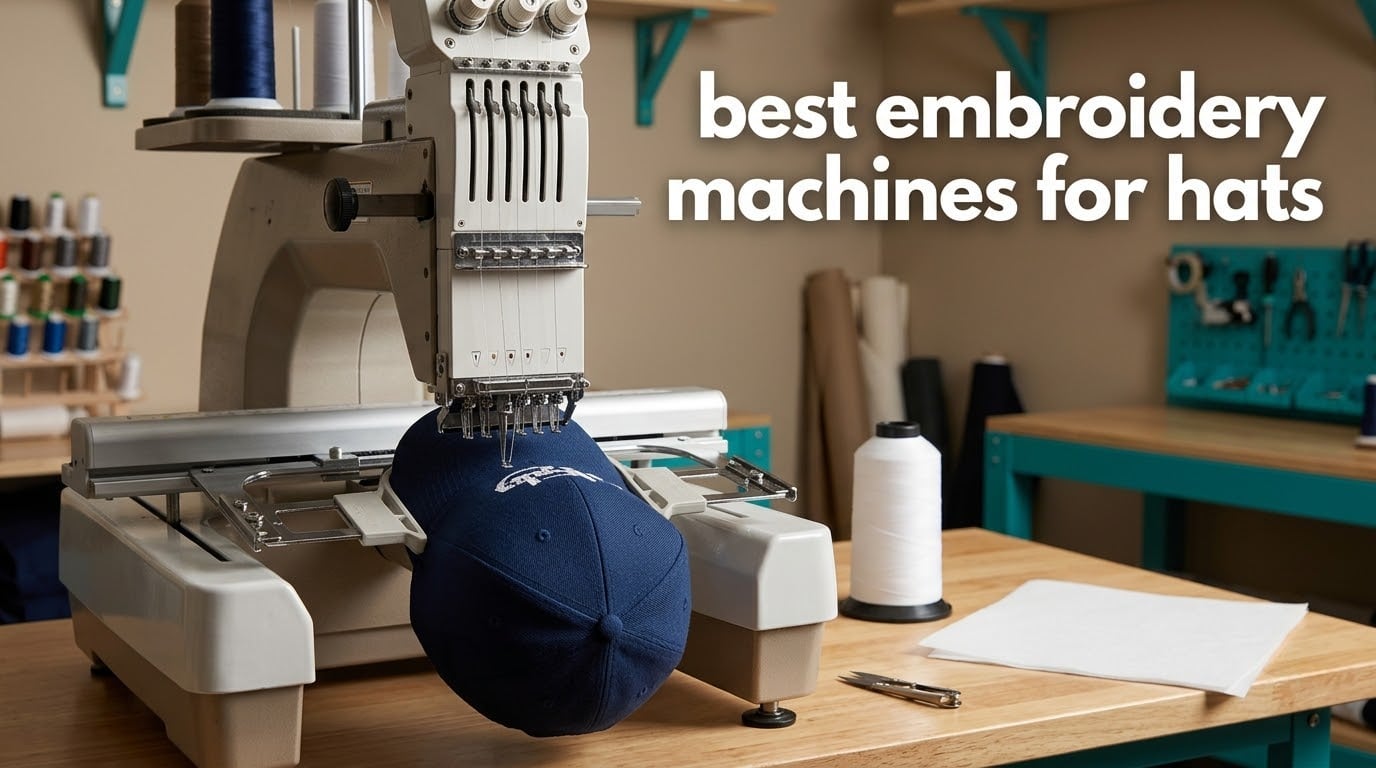
Hat embroidery punishes a machine that was not built for it. A crown is curved, slippery and stitched shut at the center seam, so a design that sits flat on a towel will drift, pucker or land off-center on a cap. After working through the cap-capable lineup in detail, the BAI The Mirror is the best embroidery machine for hats overall, because it holds 850 SPM on structured caps while still running 1200 SPM on flat goods, wraps a 20 by 14 inch field around the front and side of a crown, and arrives with local tech support and training. If you want a wider range of opinions before you commit, our general embroidery machine roundup covers the home and hobby tier in more depth.
That answer assumes one thing: the machine has a real cap frame. Every pick below ships in a class that can hold a cap crown taut during stitching, either through a cap driver mounted to the embroidery arm or a tubular free arm. A standard flatbed home machine cannot do that job on a structured six-panel crown, no matter how good its needle and thread handling are. You can get unstructured dad caps and bucket hats to work on a hoop-and-flat surface, and that is where flatbed territory ends.
We compared nine machines across needle count, cap speed, embroidery field, cap system, included accessories and the size of the box you have to fit in your workspace. Nine entries rather than a dozen, because the cap-capable corner of the market is genuinely narrow and padding it with home machines that need a separately purchased attachment would not help you. The roundup is organized so you can scan the table first, read the machine that matches your volume, and jump to the buying guide when you are ready to compare tiers.
One more note before we start. If you are shopping for a hat rather than a machine, the heated hats roundup covers a completely different product category, and the western hats guide is useful if your embroidery client base is rodeo and trail wear.
Table of Contents
Top 3 Picks for Embroidery Machines for Hats (October 2026)
The three machines below are the ones we would put in front of a serious cap buyer first. The Mirror takes the overall spot on cap speed and field size, the Smartstitch S-1501 has the most capable wide-angle cap system in the group, and the Smartstitch S-1201 Plus is the quietest head we tested with a large embroidery area for its needle count.

BAI The Mirror 15-Needle
- 850 SPM on structured caps
- 1200 SPM flat
- 20 x 14 inch field
- 15 needles

Smartstitch S-1501 15-Needle
- 270-degree cap system
- 1200 SPM
- 14 x 20 inch area
- 12 inch touchscreen

Smartstitch S-1201 Plus
- 12 x 16 inch field
- 1200 SPM
- auto trimming and break detection
- direct vertical guiding
9 Best Embroidery Machines for Hats in 2026
Every machine in this table can hold a cap. What separates them is cap speed, how much of the crown the frame can reach, how many thread changes a multi-color logo costs you, and what is actually in the box when the crate is opened.
| Product | Specifications | Action |
|---|---|---|
| BAI The Mirror 15-Needle |
|
Check Latest Price |
| Smartstitch S-1501 15-Needle |
|
Check Latest Price |
| Smartstitch S-1201 Plus 12-Needle |
|
Check Latest Price |
 Smartstitch S-1502HC Beast Two-Head Smartstitch S-1502HC Beast Two-Head |
|
Check Latest Price |
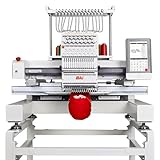 BAI The Vision 15-Needle BAI The Vision 15-Needle |
|
Check Latest Price |
 Poolin EOM 15-Needle Poolin EOM 15-Needle |
|
Check Latest Price |
 Poolin 15-Needle PEM150101 Poolin 15-Needle PEM150101 |
|
Check Latest Price |
 Brother PRS100 Single Needle Free Arm Brother PRS100 Single Needle Free Arm |
|
Check Latest Price |
 FUJA 10-Needle FJ-1001 FUJA 10-Needle FJ-1001 |
|
Check Latest Price |
1. BAI The Mirror: Best Embroidery Machine for Hats Overall
BAI The Mirror 15 Needle 20″x14″ Large Area Commercial Embroidery Machine,1200 SPM High Speed & 850 SPM on Hats,Institch OS5 Intuitive Control,Software Included,Local Tech Support
15 needles
850 SPM on structured caps
20 x 14 inch field
1200 SPM flat
391 pounds
Pros
- Holds 850 SPM on structured caps
- 15 needles cut thread changes on multi-color logos
- Institch OS5 guided workflow
- Local tech support and free training included
- Preset accessory range reduces extra buying
Cons
- 391 pounds so moving it takes several people
- Real learning curve for first-time operators
- Thin written hat-hoop installation guidance
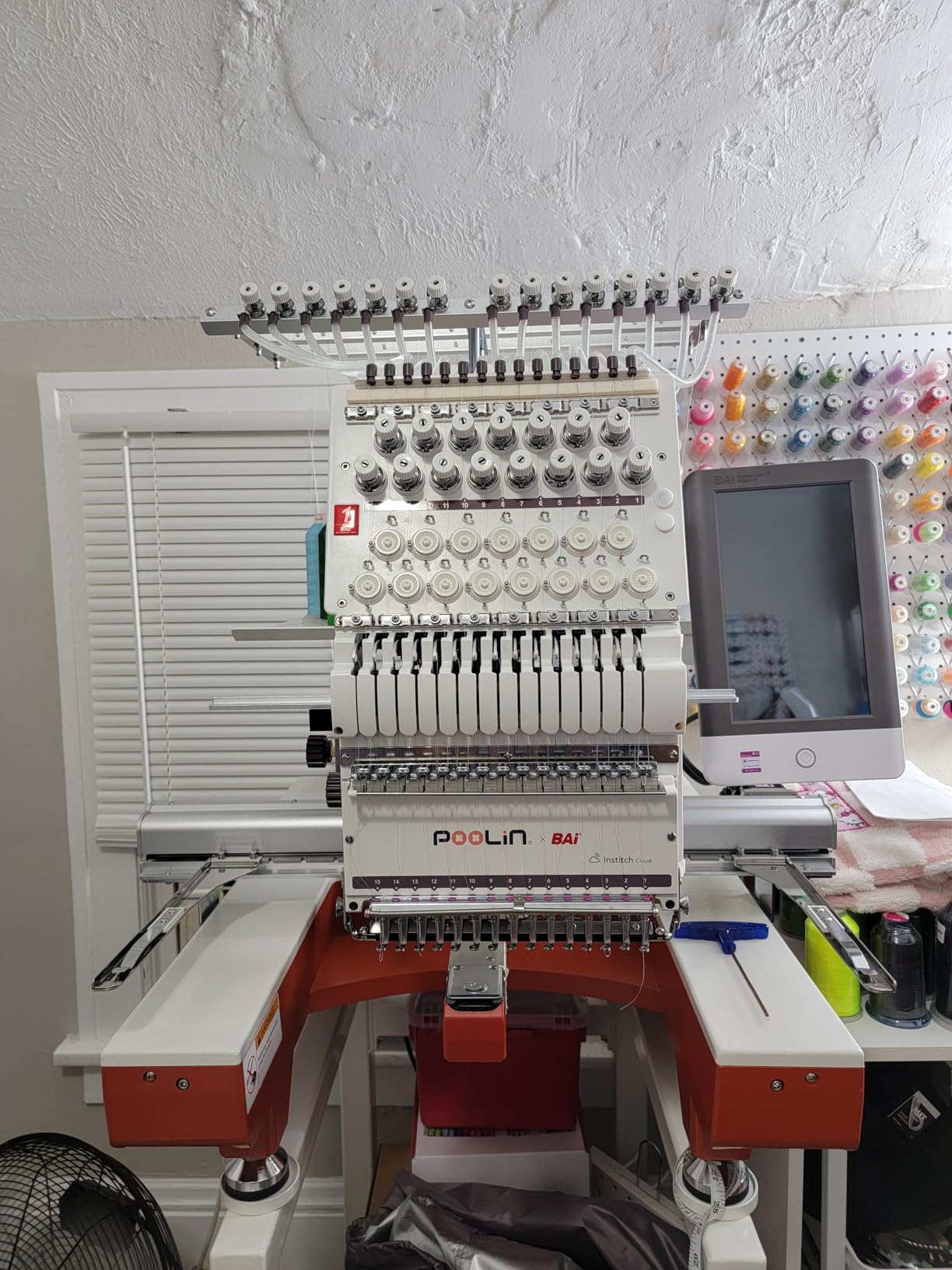
This is the machine I would put in a small cap shop’s corner today. The Mirror is a 15-needle single head built around a 20 by 14 inch field, and that combination is what makes it work on a crown: the field is big enough to take a full front panel design plus wrap toward the side seam, and the frame rotation carries the curved surface through the stitch path without the machine bogging down. Owners describe stitching structured caps cleanly and still using the head for flat production at full speed, which is the balance most cap businesses actually need.
The 15-needle head is the part that changes daily output. A multi-color logo does not stop the machine for a manual re-thread at every color, so a six or eight color cap design finishes without someone standing over it with a pair of scissors. For a maker selling finished caps, that is the difference between a machine that helps and a machine that eats your afternoon.
Two speed figures matter here and they are different numbers. The head reaches up to 1200 SPM on flat work, and it holds a stable 850 SPM on structured caps. That distinction is the honest one for cap work, because crown curvature, stabilizer tension and needle penetration all pull against speed, and a quoted flat maximum tells you nothing about a cap run. Long-term owners report the machine paid off quickly, which suggests the throughput is real rather than a spec-sheet claim.
The trade-offs are physical and practical. At 391 pounds it is not going up a ramp or moving between rooms without several strong people, and the box measures 27.6 by 29.5 by 33.2 inches before the cap driver is mounted. The written manual and hat hoop instructions are thin, so owners lean on the video library, and that is exactly where the included local technical support and free training earn their keep.
The control side is Institch OS5 on a guided 1-3 step workflow, which is friendlier than the raw control panels on older commercial heads. Brand-name components throughout and a stated service life of up to 10 years in a production environment make it a sensible anchor machine. The listing also points to a large user community, which matters more than usual for a product with thin printed documentation.
Who the BAI The Mirror suits best
It suits a maker moving from a home machine to commercial cap output, or a side-hustle seller who has landed a team-uniform or local-brand order and needs a cap frame that arrives with the machine. The included support and training matter most here, because the single most common complaint is the setup learning curve rather than stitch quality, and that is a solvable problem with a technician on the phone.
It also suits anyone who wants one head to do caps and flat goods. A 15-needle head at 1200 SPM handles shirts, towels, patches and canvas without a second machine, and the 20 by 14 inch field keeps rehooping down on tall front-panel logos.
Who the BAI The Mirror does not suit
It does not suit a hobbyist in a small apartment, or anyone who might need to move the machine between a home studio and a market stall. 391 pounds is a permanent commitment to a floor space, and the frame is fixed to the arm rather than rolling around.
It is not the right machine for a shop already running two machines and adding volume. One head caps your daily output, and at that point a two-head unit or a second single head buys more than another 15 needles on the same frame would.
2. Smartstitch S-1501: Best for 3D Caps and Side-of-Cap Work
Smartstitch S-1501 Commercial Embroidery Machine with 15 Needles,14″x20″ Embroidery Area,1200SPM Max Speed,12″ Touch Screen, Wifi available, capable of embroidering on 3D Caps, Flat, T-shirt and more
15 needles
270 degree cap system
14 x 20 inch area
1200 SPM
12 inch touchscreen
Pros
- 270 degree cap system handles 3D caps and side-of-cap work
- 12 inch touchscreen simplifies design and machine control
- 15 needles with automatic color change
- Starter pack includes threads and stabilizers
- Live demos and local technical support
Cons
- Noticeable learning curve for new commercial operators
- Returns require original pallet boxes and proof photos or video
The S-1501 is the pick for anyone whose caps are not flat front panels. Its 270-degree wide-angle cap system rotates the cap far enough around the frame to reach a 3D curved crown, the side of the cap, and areas a conventional cap driver simply cannot address. If your design work includes 3D puff, chenille or a logo that wraps past the front panel, this is the machine that makes those jobs routine rather than an experiment.
Underneath, it is a 15-needle head rated to 1200 SPM across a 14 by 20 inch area, which is a large field for a single-head commercial machine. The area matters for caps in a specific way: a tall front panel design with text above and below the logo needs vertical room, and a shallow field forces you to split the job and rehoop across a center seam that will never line up perfectly.
The 12 inch touchscreen is the standout control feature. Reviewers consistently single it out for design editing and machine setup, and at this size you can actually see the design footprint relative to the cap outline instead of squinting at a thumbnail. Laser positioning, automatic color change and WiFi plus USB transfer in DST and DSB formats round out a workflow that suits someone digitizing their own artwork.
It also handles flat work, denim, canvas, leather, vinyl, shoes and bags, so the head is not stranded on cap season. One detail worth planning for: returns on this machine require keeping the wooden pallet, inner boxes and hardware intact and providing photos or video, so measure your doorway and decide where the machine will live before the crate arrives.
Support is repeatedly cited as a reason buyers feel confident, with live demo appointments, manuals, video training and local technical help listed with the machine. The starter pack covers threads, stabilizers and bobbin threads, so you can stitch a test cap the same week rather than waiting on a supply order.
Who the Smartstitch S-1501 suits best
It suits a cap business whose order book is full of 3D puff caps, trucker hats with side-panel text, and unstructured dad caps that need a softer frame than a structured crown. The 270-degree system is the reason to choose it over a cheaper 15-needle head, and it is a capability the cheaper heads do not have.
First-time commercial buyers who want a machine with an unusually large screen and hands-on support included are also well served. The 14 by 20 inch field and 15 needles mean a complex eight-color logo runs in one pass with no rehooping.
Who the Smartstitch S-1501 does not suit
It does not suit a buyer who will not read the documentation or watch the training. The learning curve is the most common complaint, and while the included training covers it, the machine assumes an operator who is willing to spend time on setup and tension tuning before the first run.
At 209 pounds it is lighter than several machines here, but it is still a floor unit rather than a desk machine, and the return policy means your move-in plan has to be right the first time.
3. Smartstitch S-1201 Plus: Best for Quiet Operation and Large Work Areas
Smartstitch S-1201 Plus Embroidery Machine with 12 Needles, 1200SPM Max Speed, 10″ Touch Screen, 12″x16″ Embroidery Area, Wifi, New Gen of Commercial Embroidery Machine for Flat, Hat, T-shirt and more
12 needles
12 x 16 inch field
1200 SPM
Direct vertical guiding
10 inch touchscreen
Pros
- Direct vertical guiding system keeps it the quietest head in its class
- 12 x 16 inch area is unusually large for a 12-needle head
- Auto trimming and thread break detection cut manual steps
- V7 control with 100 million stitch memory
- 10 inch touchscreen plus physical buttons
Cons
- 12 needles means more thread changes than a 15-needle head
- Learning curve for new commercial operators
The S-1201 Plus is the machine to buy if your cap work happens in a shared room. Its direct vertical guiding system keeps the head stable and quiet in a way buyers describe as the quietest in its class, and that matters when the embroidery machine sits in a home studio, a shared workshop or a retail unit where a rattling head is genuinely disruptive.
The unusual part of this one is the embroidery area. At 12 by 16 inches it is the largest field available on a head with fewer than 15 needles, and on a cap that translates to fewer rehoops on a tall front-panel design. The vertical guiding also improves stability, which on a curved crown means the needle penetration stays consistent from the center seam out toward the side panel.
Automation is where this machine saves the most time. Automatic thread trimming, automatic color change, self-lubrication and thread break detection mean fewer interruptions per cap, and thread break detection in particular keeps a long run from turning into a stop-start job when a spool runs out on the last color of a 12-needle design.
The control system is V7 with storage for up to 100 million stitches, which is more than most cap jobs need and means you can keep a large client library loaded without pruning. Files transfer over WiFi or USB in DST and DSB formats, so a design made in the common digitizing packages drops straight onto the head.
Laser positioning and newly added physical buttons round out a control setup that reviewers describe as straightforward, with the 10 inch touchscreen handling the interface and the buttons handling the functions you reach for mid-run. The 1200 SPM maximum is a flat-work figure, so treat cap runs at a lower setting.
Who the Smartstitch S-1201 Plus suits best
It suits a home studio or a small shop where noise is a real constraint, and it suits a maker whose cap designs are tall and vertical rather than small and centered. A 12 by 16 inch field on a 12-needle head is a combination you will not find again in this lineup, and it removes the rehoop across the center seam that ruins alignment.
Anyone running lots of small repeat jobs also benefits. Thread break detection and automatic trimming mean a 20-cap run of the same logo does not need an operator hovering to catch the machine between every design.
Who the Smartstitch S-1201 Plus does not suit
It does not suit a shop whose logos are highly multi-color. Twelve needles against fifteen means more thread changes on a design that uses the full palette, and that difference shows up across a full production week rather than on a single cap.
It is also not the machine for 3D puff or aggressive side-of-cap placement the way a 270-degree cap system would be, so if that work is on your roadmap, the wider cap frame is worth the extra spend even with the quieter head.
4. Smartstitch S-1502HC Beast: Best for Two-Head High-Volume Production
Smartstitch S-1502HC Beast Embroidery Machine with Two Heads 15 Needles each, 20″x16″ Embroidery Area, 1200SPM Max Speed, 12″ Touch Screen, Wifi available, Embroidering on Cap, T-shirt, Flat and more
Two heads of 15 needles
20 x 16 inch per head
1200 SPM
C-type body
772 pounds
Pros
- Two heads embroider two items at once and roughly halve production time
- C-type body stays steady at high speed
- 5.0 rating across every review on the listing
- Large 20 x 16 inch area and 15 needles per head
- Training and local technical support included
Cons
- 772 pounds and the listing states at least 6 people to set it up
- Needs a front end loader or engine lift to place on its base
- Highest capital outlay in the group
The Beast is the only two-head machine in this roundup, and that changes the arithmetic completely. Two heads of 15 needles means two caps stitched simultaneously, so a 200-cap order that took four single-head sessions takes two. If you are past the point where one head is the bottleneck, this is the machine that removes the bottleneck rather than speeding it up.
Each head carries a 20 by 16 inch embroidery area and the whole machine runs to 1200 SPM. The C-type body is engineered to resist shaking and rocking at high speed, which is not a cosmetic feature on a two-head unit, because a frame that moves under load is a frame that shifts the registration between head one and head two.
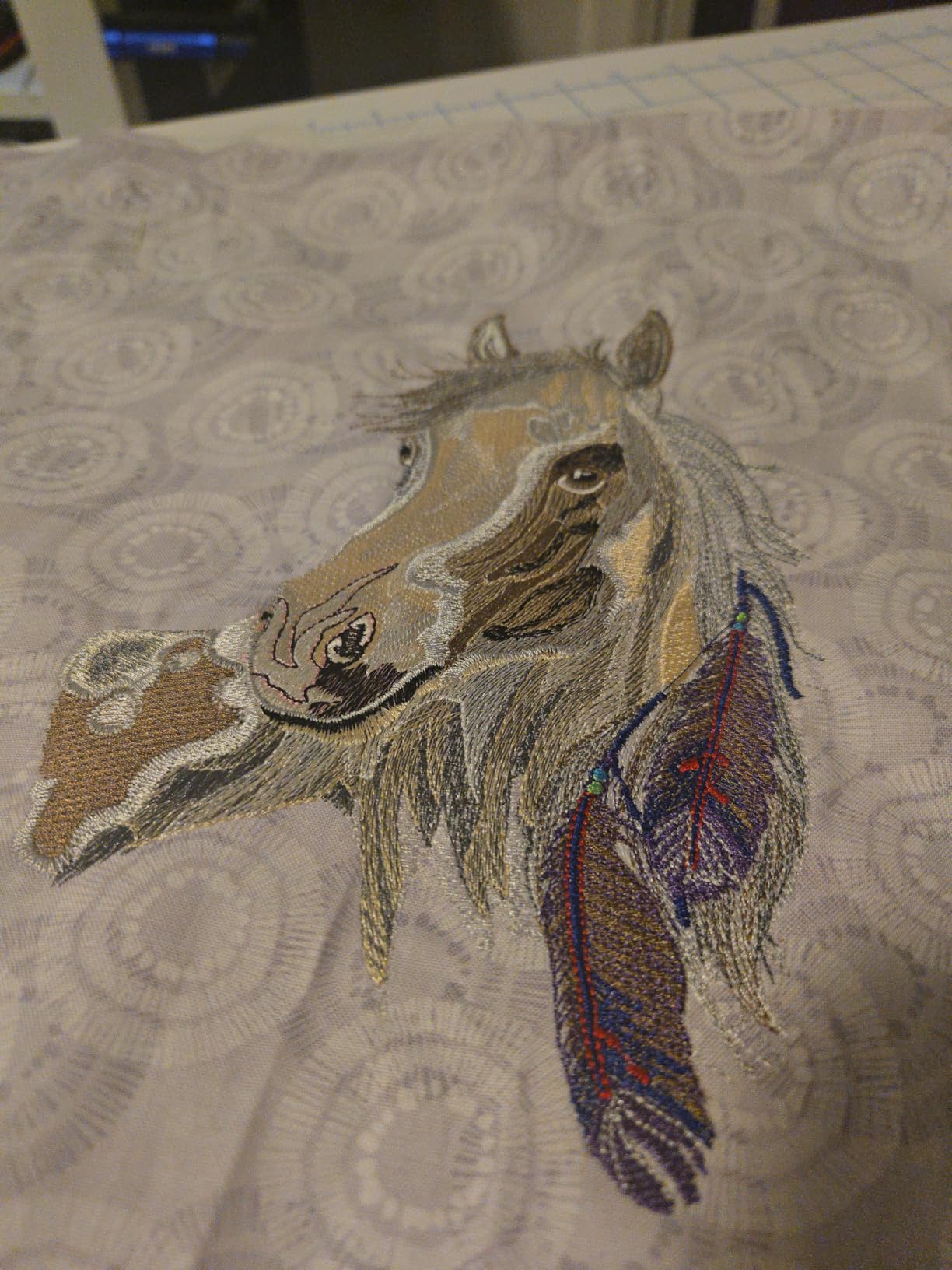
Review-wise, this one is unusual: every one of the 52 reviews on the listing carries a five-star rating. Owners point at throughput and frame stability as the reasons, and the honest caveat in the same reviews is the setup logistics rather than the machine. Laser positioning, automatic color change, self-lubrication and thread break detection cover the same automation set as the single-head units, and the V6 control system holds up to 100 million stitches.
It also handles flat work, denim, canvas, leather, vinyl, shoes, bags, tennis balls and applique, so a two-head investment is not wasted on cap-only work. WiFi and USB DST and DSB transfer keep the file workflow identical to the single-head Smartstitch machines, which matters if your operator already knows the software.
Plan the installation properly. At 772 pounds the listing states at least six people are needed to set it up, and the machine needs a front end loader or engine lift to get onto its base. The footprint is 43 by 55 by 43 inches, so this is a dedicated production room rather than a corner of a workshop.
Who the Smartstitch S-1502HC Beast suits best
It suits a production shop that has already proven demand and is turning away cap orders because of throughput. Two heads running identical designs keep the operator in a rhythm of hoop, hoop, stitch, stitch rather than stitching one cap and rehooping the next, and the 20 by 16 inch field per head handles large front panels without splitting.
It also suits a mixed shop where caps are only part of the work. Two heads on flat blanks, patches, shoes or bags keep the same utilization, and the two-head format means one operator can supervise far more running time.
Who the Smartstitch S-1502HC Beast does not suit
It does not suit a first machine, full stop. A 772-pound machine with a six-person installation requirement, an engine lift and a dedicated room is the wrong first purchase for someone who has not yet proven a cap business, and the return window on that kind of capital outlay has to be modeled before the order rather than after.
It is also a poor fit for a maker who needs a small design area. The large per-head field is wasted on a small front-panel logo, and the capital goes into capacity you do not yet have orders for.
5. BAI The Vision: Best for the Fastest Cap Speed in the Lineup
BAI The Vision 15-Needle Commercial Embroidery Machine, 20x16inch Areas, True 1200SPM Stable Production via Institch to Wi-Fi, Calculating Costs and Design Software High-Precision for Business
15 needles
950 SPM on structured caps
20 x 16 inch area
Welded frame with German belts
727 pounds
Pros
- Reaches 950 SPM on structured caps with strong penetration
- German belts and Swedish bearings cut vibration and noise
- Institch cost tools help price labor and materials
- 10 inch touchscreen many operators run without a manual
- Complete accessory set and design software included
Cons
- Heaviest single-head unit here at 727 pounds
- Two-star reviews concentrate on reliability and thread breaks
- 1-star share reported at 4 percent
The Vision posts the highest structured-cap speed in this group at up to 950 SPM, which is roughly 100 SPM above the next machine. That gap looks small on a spec sheet and shows up as real finished caps at the end of a shift, because cap runs are the slowest part of a production day and every hundred stitches per minute is time you get back.
Under the hood it is a 15-needle head across a 20 by 16 inch field, reaching 1200 SPM on flat work. The frame is fully welded with German belts and Swedish bearings, a specification aimed squarely at the vibration and noise that cause registration drift and operator fatigue on a long cap run.
The business software is the quietly important part for a paid cap shop. Institch OS5 on a 10 inch touchscreen includes WiFi design transfer, cloud file management and built-in cost calculation, so you can price a job from the machine using labor, rent and materials rather than guessing. Memory covers 100 million stitches or 1,000 designs, and the bundled Doodle software means you can start digitizing without a separate purchase.
Oil-point maintenance and simplified servicing are specified for this frame, which is what makes the stated lifespan of up to 10 years in a production environment credible. Free training and dedicated technical support cover unboxing, assembly, threading and tension, and the touchscreen is described by reviewers as intuitive enough that many operators never open the manual.
Against that, the review profile is slightly softer than the Smartstitch units at 4.6. Owners single out cap performance and the cost tooling, while a minority report reliability and tension issues concentrated in the 2-star and 1-star reviews. The 727-pound weight is also the heaviest single-head machine here, so installation needs planning.
Who the BAI The Vision suits best
It suits a cap shop where structured crowns are the majority of the order book and speed on those crowns is the metric that matters. If your competitors are quoting 48-hour turnaround on structured caps, 950 SPM across a 15-needle head is the spec that moves that number.
It also suits owners who want the business tooling built in. The cost calculation inside Institch is not a gimmick for a shop pricing team hats or a club order, and the cloud file management keeps a customer library organized without a separate server.
Who the BAI The Vision does not suit
It does not suit a buyer who wants the quietest possible operation or the newest control generation, because the welded frame and heavy build trade some of that. If noise in a shared space is your main constraint, the direct vertical guiding head is the better answer.
It also does not suit a first commercial machine bought on a tight budget with no service network nearby. The free training and support help, but the machine is engineered as a second or third machine for a shop that already knows what it is doing.
6. Poolin EOM: Best Complete Cap Kit at the Lightest Weight
Poolin EOM 15 Needle Commercial Embroidery Machine
15 needles
270 degree cap system
850 SPM on caps
14.2 x 9.5 inch area
165 pounds
Pros
- 270 degree cap system covers front side and back plus 3D puff
- Lightest multi-needle unit here at 165 pounds
- Most complete starter bundle in the group
- Automatic color change trimming and laser alignment
- Built-in cost estimation for pricing custom jobs
Cons
- Smallest embroidery field among the multi-needle units
- Older InStitch OS4 control generation
- Highest single-star concentration of the well-reviewed models
The EOM is the one to look at if your priority is getting caps out of the door without a parts list. The box includes five standard hoops, two cap hoops, a cap station, a cap drive, basic tools, 25 prewound bobbins, four spools of 4000-yard thread and fifty 12 by 12 inch cut-away stabilizer sheets. That is a working cap setup on day one rather than a machine and a wish.
Underneath it is a 15-needle head rated to 1200 SPM on flat work and 850 SPM on caps, across a 14.2 by 9.5 inch embroidery area. The 270-degree cap system covers the front, side and back of structured and unstructured hats, and the listing calls out 3D puff capability directly, which is rare to see stated plainly.
At 165 pounds it is by far the easiest multi-needle machine here to install, and that matters more than it sounds. Several competitors in this list need three to six people and lifting equipment, so the EOM is the realistic choice for a home studio, a garage unit or a small retail space where you are not calling in a riggers crew.
Automation covers automatic color change, automatic thread trimming and thread break detection, and the built-in laser alignment helps repeat placement consistency across a batch of identical caps, which is exactly where cap work usually drifts. The 9-inch touchscreen runs InStitch OS4 with InStitch Doodle digitizing, cloud save and integrated cost estimation, and files import over WiFi or USB in DST and DSB.
The compromises are clear. The 14.2 by 9.5 inch field is the smallest among the multi-needle machines here, so a tall design with a lot of vertical content will need rehooping, and OS4 is an older control generation than the OS5 machines in this roundup. The single-star share is also the highest of the well-reviewed models, so read the negative reviews before committing.
Who the Poolin EOM suits best
It suits a first-time commercial buyer who wants a full cap setup in one purchase. Everything needed to hoop, stitch, thread and back a cap is in the crate, which removes the most common early failure, which is a machine that arrives and then sits waiting on a cap frame order.
It also suits a home studio or small retail space where 165 pounds is the difference between a machine you can install yourself and one you cannot. For unstructured caps, back-of-cap work and 3D puff on a modest scale, the 270-degree system covers the placement options you would otherwise have to buy a dedicated attachment for.
Who the Poolin EOM does not suit
It does not suit a shop with large or tall designs, because the 14.2 by 9.5 inch field is the tightest here and the rehoop across a cap center seam is the one seam where a split design shows. Long vertical logos, back prints and jacket-back style placements are outside what this head handles in one pass.
It is also not the choice for a buyer who wants the newest software generation, since OS4 is an earlier control generation than the OS5 platforms, and a one-year warranty is shorter than the multi-year cover some commercial heads carry.
7. Poolin PEM150101: Best for Pre-Sale Demos and Seller Support
Poolin 15 Needle Commercial Embroidery Machine, 20″ x 14″ Large Embroidery Area,10″ Touchscreen, InStitch OS5 System,270° Cap Embroidery, WiFi & USB, 11 Hoops for Hats, Shirts, Patches and Shoes
15 needles
20 x 14 inch area
270 degree caps
1200 SPM
10 inch HD touchscreen
Pros
- 270 degree cap rotation improves visibility on structured caps
- 20 x 14 inch field cuts rehooping
- Stitches from 1 mm detail to 9 mm satin
- Free live video demo with an engineer before purchase
- Comes pre-threaded with 54 spools tool kit and hat hoops
Cons
- Digitizing relies on free apps some buyers find hard to set up
- Heaviest Poolin unit at 400 pounds needing 2-3 people to move
- Printed documentation does not cover hooping clearly
This is the machine to buy if you want to see it working before you commit. The seller offers a free live video demo with an engineer before purchase, and that single feature is worth more on a 400-pound commercial machine than any spec comparison, because cap performance is something you can only judge by watching a crown stitched in real time.
The head is a 15-needle unit with a 20 by 14 inch embroidery area at up to 1200 SPM, running on a cast aluminum frame with reinforced steel structure. The 20 by 14 field is one of the larger single-head areas in this roundup, and that is the practical difference between a full front-panel design in one pass and a two-hoop job across the center seam.
Stitch detail runs from 1 mm to 9 mm satin, which covers everything from fine line text on a premium wool cap to a bold chenille puff. The 270-degree cap embroidery is specified for smoother rotation and better visibility, and owners handling very structured caps report strong results, which is the hardest test in this category.
Control is a 10-inch HD touchscreen on InStitch OS5 with Institch Cloud, WiFi and USB transfer in DST and DSB formats, and eleven hoops for hats, shirts, patches and shoes are included. The machine arrives pre-threaded with 54 spools, a tool kit, a hat embroidery frame, a hoodie frame, a T-shirt frame and a WiFi module, so a buyer can test a cap the day it is delivered.
The honest caveat is software. Digitizing relies on free apps that some buyers found hard to get working, and paid software may be needed for custom artwork. At 400 pounds it is the heaviest Poolin unit and needs two or three people to move, and the printed documentation does not cover hooping or frame installation clearly enough to work from alone.
Who the Poolin PEM150101 suits best
It suits a buyer comparing machines remotely who wants to see structured cap work before spending, and it suits a shop that stitches many different product types since the included frames cover hats, hoodies, T-shirts, patches and shoes. Eleven hoops in the box removes the most tedious part of a multi-product shop setup.
It also suits a maker working across a wide stitch range, since the 1 mm to 9 mm satin window covers small fine text and heavy puff in the same design file without rescaling.
Who the Poolin PEM150101 does not suit
It does not suit a beginner who wants to digitize their own artwork out of the box. The free app workflow is the most common complaint in the reviews, and if you already have a design library or plan to digitize customer logos yourself, budget for proper software before the machine arrives.
It is also not ideal for a small space. At 400 pounds with a 27.6 by 33.2 by 29.5 inch footprint, this needs a real work corner and a planned move-in rather than a delivery through a narrow doorway.
8. Brother PRS100: Best Hat Embroidery Machine for Small Spaces
Brother PRS100 Single Needle Embroidery Machine Free Arm
Single needle with 4-spool stand
Tubular free arm
Cap frame and driver included
68.3 pounds
Smallest field
Pros
- Tubular free arm reaches caps sleeves and small T-shirts
- Cap frame and driver included with the machine
- Only 68.3 pounds so it is easy to move and install
- Vertical bobbin swapped without removing the hoop
- Side bobbin winding runs while stitching
Cons
- Single needle means a thread change at every color
- Smallest embroidery field in the group for compact placements only
The PRS100 is the only machine here light enough to carry up a set of stairs yourself, and one of only three where the cap hardware comes in the box. If you are making a handful of personalized caps in a home studio and the commercial machines above are simply out of reach, this is the honest starting point, and the free arm is the reason it can touch a cap at all.
Brother built the arm as a tubular free arm, which reaches into the crown of a cap, a sleeve, or a small T-shirt in ways a flatbed physically cannot. Four compact frames from 1.25 by 1.75 inches up to 2 by 2 inches handle small placements, and the vertical bobbin can be changed without removing the hoop, which saves real time on a short-run cap order.
The 4-spool thread stand is a small but genuine convenience. It is not a 15-needle head, so a multi-color logo still stops for a thread change, but you are not hunting through a thread stand for the right color either. Side bobbin winding runs while the machine is embroidering, so a bobbin change no longer means an idle machine.
The trade-offs are structural rather than fixable. A single needle means one color at a time, so an eight-color front-panel logo becomes eight stops and the run time is dominated by threading. The embroidery field is the smallest of any machine in this roundup, which suits compact front-panel placements but rules out tall designs and anything that needs a large area in one pass.
On quality, reviewers like the placement and the simplicity, and rate it modestly below the multi-needle units at 4.5, which is a fair reflection of a machine built for a different job. If your caps are simple single-color or two-color monograms, the PRS100 handles them well. If they are full multi-color logos, the threading overhead is the story.
Who the Brother PRS100 suits best
It suits a home maker producing monograms, initials, simple two-color marks and a few personalized caps a week. The cap frame and driver included means you are not starting with a search for a part number, and the vertical bobbin and side winding keep small runs efficient.
It also suits a crafter who also sews sleeves and small garments, because the tubular free arm is genuinely versatile beyond caps, and the four compact frames cover socks and headbands as well.
Who the Brother PRS100 does not suit
It does not suit a business. At one color at a time there is no version of a commercial cap operation that runs on a single needle, and owners posting about multi-color hat work report that the threading is what stops them.
It also does not suit large placements. With the smallest field in the group, a tall front-panel design is out of reach, and you will be choosing designs around the machine rather than the other way around.
9. FUJA 10-Needle FJ-1001: Best Budget Entry Into Multi-Needle Cap Work
FUJA 10 Needle Commercial Embroidery Machine for Hats & Small Business
10 needles
9.5 x 14.2 inch area
1200 SPM
Cap drive and cap ring included
289 pounds
Pros
- Lowest entry point into multi-needle cap work
- Cap drive cap ring hoops thread and stabilizer included
- Runs quiet in one buyer comparison against a rival unit
- Support via WhatsApp and Facebook group is responsive
- Starter kit covers caps shirts patches and 3D puff
Cons
- Lowest rating in the group at 4.1 with a fifth of reviews at one star
- Setup and troubleshooting guides described as incomplete
- Hook case cannot be removed for maintenance
- Thread birdnesting on some threads at higher speeds
The FJ-1001 is the most affordable route onto multi-needle cap embroidery, and the box supports that claim better than the machine itself. It includes the machine, stand, a cap drive, a cap ring, a garment frame, embroidery thread and tear-away stabilizer, so the cap path is covered without a second order.
Underneath it is a 10-needle head with automatic color change and automatic thread trimming, a 9.5 by 14.2 inch embroidery area and up to 1200 SPM. Thread break detection, laser positioning, physical buttons, self-lubrication and a low-noise structure cover the feature set, and memory holds up to 100 million stitches with WiFi and USB transfer in DST and DSB.
Owners who get on well with it report good cap speeds, fast applique order output from someone with three years in the trade, and support through WhatsApp and a Facebook group that they describe as fast and responsive. The cap station, hoops and 3D puff capability are all supported in the box, and it stitches shirts, patches, leather, denim, shoes, bags and uniforms as well.
It is also the most polarized machine in this roundup, and the 4.1 rating is the reason. One fifth of reviews sit at one star, and the specific complaints are worth reading in full: setup and troubleshooting guides described as half useless, an unremovable hook case that complicates maintenance, birdnesting with some threads, and one unit whose touch screen froze and had to be returned. One owner recommends dropping to around 400 SPM for bold projects when threads misbehave.
At 289 pounds it arrives on a wooden pallet and needs two people to move, so plan the room before ordering. It carries a one-year limited warranty, which is the shortest cover here.
Who the FUJA 10-Needle FJ-1001 suits best
It suits a maker who has outgrown a home single-needle machine, has a real order book starting to form, and wants ten needles and a cap station without the commitment of a 15-needle commercial head. For simple two and three-color cap logos, automatic color change already removes most of the manual threading.
It also suits a buyer who likes leaning on seller support. The WhatsApp channel, Facebook group and video library are described as responsive, and that matters when the printed documentation is the weak point.
Who the FUJA 10-Needle FJ-1001 does not suit
It does not suit someone who cannot tolerate a support-dependent workflow. With weak setup guides, a hook case that cannot be removed for maintenance and a one-year warranty, you are relying on the manufacturer to answer questions that a better-documented machine would answer in print.
It is also not the right pick for a shop with demanding cap work. The 9.5 by 14.2 inch area is tight, thread birdnesting is reported on some threads at higher speeds, and the fifth of one-star reviews is a signal you should read before spending, not after.
How to Choose a Hat Embroidery Machine Without Guessing
Cap embroidery has its own vocabulary, and most wrong purchases come from buying a machine without knowing which of these terms actually applies to your order book. Here is what matters, in the order that matters.
The cap frame, cap driver and cap ring are three different things
A cap frame is the rigid structure the crown is stretched over. A cap driver is the motorized unit that mounts the frame to the embroidery arm and rotates it. A cap ring, sometimes called a cap ring or cap station, is the hoop assembly a cap is hooped into before it goes on the driver. A machine cannot do caps with only some of these, and the reason many home machines are excluded from this roundup is that their frame mounts do not accept a cap driver at all.
Which means the accessory bundle is not a detail. The Poolin EOM, the FUJA FJ-1001 and the Brother PRS100 include the cap hardware, while machines that arrive with a cap station as a separate purchase add both a cost and a week of waiting before your first cap. Check the included components list before you order, not the marketing photos.
Why a standard flatbed home machine cannot do a structured crown
A structured six-panel cap is a rigid curved shell with a closed center seam and a stiff front panel. Flat fabric lies in a hoop and stays put. A cap crown wants to spring back, slide across the needle plate, and pull the design toward the side seam the moment the first row of underlay goes down. The long-standing owner consensus is blunt about this: flatbeds can handle unstructured dad caps and bucket hats, and they cannot handle the high-value structured caps that a cap business is built on.
This is a physical limit, not a quality gap. A better home machine stitches flat fabric beautifully and still will not hold a crown. If structured caps are in your plan, budget for a machine in this roundup rather than a cap attachment for a flatbed.
Single needle, multi-needle or multi-head
A single needle machine stitches one color at a time and stops for a thread change at every color. It is fine for monograms and a two-color mark, and it is the wrong tool for a full-color logo. The Brother PRS100 in this roundup is the single-needle example, and the thread changes are its defining constraint rather than a quirk.
Multi-needle machines hold 10 to 15 thread colors on the head and change automatically. That is the category most cap businesses operate in, and it is where this roundup is concentrated. Multi-head machines run two or more identical heads at once, doubling output without doubling operators, and the Smartstitch S-1502HC Beast is the example here. A single needle is good enough for hats only if your hats are simple; the moment a design has more than about three colors, it stops being viable.
Embroidery field size and design rotation
The embroidery field is the maximum design the machine can stitch without releasing and rehooping the item. On a cap, the field decides whether a tall front-panel logo fits in one pass. Anything wider than about 14 by 9 inches gives you room for text above and below a logo; a 20 by 16 inch area gives you room for jackets and full front panels. The smallest field here is 9.5 by 14.2 inches and the largest per head is 20 by 16 inches, and that spread is the most consequential spec difference in this roundup.
Rotation is the other half. Caps are hooped with the brim facing away from the machine and the design is rotated 90 degrees so it stitches bottom to top, which puts the stabilizing underlay in the right order. Some machines rotate automatically, some do it in software, and some require a sensor override clip to stop the machine complaining about the cap frame. Confirm which one before you buy, because it changes your per-cap setup time.
Stabilizer pairing by cap material
Structured crowns want cut-away stabilizer, usually a 2 oz weight, because the shell needs support that stays under the fabric after the frame comes off. Unstructured dad caps and knit beanies want tear-away or a wash-away topper over a lighter cut-away, since a soft crown cannot hold heavy backing. Across the machines here, the Poolin EOM includes 12 by 12 inch cut-away sheets and the FUJA FJ-1001 includes tear-away, and most of the others include a starter stabilizer pack.
Speed settings follow the material. Structured caps hold up in the 600 to 800 SPM range, knit caps at 400 to 600, delicate fabrics at 300 to 500, and 3D puff work at 300 to 400 because the foam needs time to settle. Every cap speed quoted in these reviews sits inside that envelope, which is the honest way to read a machine’s SPM figure.
Budget tiers, if you are mapping this to a purchase plan. Entry home machines get you a flatbed with a separately purchased cap frame and a small field. Advanced home and entry multi-needle territory covers the first machines with 10 to 15 needles and a cap system. Semi-commercial single-head 15-needle machines are where most cap businesses start. Above that, multi-head and heavy production machines begin, and you are making a facility decision rather than an equipment one.
How to Stop Puckering and Shifting on Caps
Puckering and drift on a cap are the two complaints that come up most, and both are workflow problems rather than machine problems. The order below is the order to try.
Hoop the cap taut, not tight. The drum test is the standard check: press the cap crown inside the frame and if you can push the surface down more than a finger width, it is loose enough to drift. Tension the crown evenly, align the center seam to the center of the frame, tape the sweatband out of the stitch path, and keep the brim facing away from the head.
Match stabilizer to material. Cut-away for structured crowns at a weight that supports the shell, tear-away or a topper for unstructured and knit caps. A structured cap on tear-away will pucker because nothing is holding the front panel flat, and that is not fixable with tension alone.
Reduce density on the curves. The flat front panel can carry 7 to 8 stitches per millimeter while the side panels need 5 to 6, because the same density on a curved surface compresses. Digitizing for the side zones is the difference between a clean wrap and a bunched one.
Drop the speed. Running a structured crown at the flat-work maximum of 1200 SPM is the most common cause of thread breaks and registration drift. Staying in the 600 to 800 range on structured caps and lower for puff is the single biggest improvement most operators get.
Rotate the design and check the underlay. A design stitched top to bottom on a cap puts the underlay in the wrong order, and the crown lifts under it. Rotate 90 degrees and confirm the underlay is a dense edge-and-center run rather than a single sparse line.
Other hat categories exist if caps are not the only headwear you stitch. Our panama hat roundup and cowboy hat guide both cover brim shapes that change the hooping approach entirely, since a wide structured brim needs a different frame logic than a cap crown.
Frequently Asked Questions
Which embroidery machine is best for making hats?
The BAI The Mirror is the best embroidery machine for hats overall, because it holds 850 SPM on structured caps while still running 1200 SPM on flat work, wraps a 20 by 14 inch field around the crown, and includes local technical support and training. For 3D caps and side-of-cap work specifically, the Smartstitch S-1501 with its 270-degree cap system is the stronger choice.
Can an embroidery machine embroider hats?
Yes, but only a machine built with a cap frame, cap driver or tubular free arm can hold a curved crown in place while stitching. A standard flatbed home machine can handle unstructured dad caps and bucket hats in some cases, but it cannot handle a high-value structured six-panel crown. On a cap, the crown is hooped taut, the center seam is aligned, the sweatband is taped back and the design is rotated 90 degrees so it stitches bottom to top.
Do I need a cap frame to embroider hats?
Yes. A cap frame, cap hoop and cap driver are required to stretch a crown and rotate it through the stitch path. The Poolin EOM, the FUJA FJ-1001 and the Brother PRS100 include cap hardware in the box. Many home machines that appear hat-capable need a separately purchased cap frame and driver, and that accessory cost is a real part of the true price of a cap setup.
Is a single needle machine good enough for hats?
Only for simple designs. A single needle machine stops for a manual thread change at every color, so a two-color monogram is fine and a six-color logo is dominated by threading time. Most cap businesses need at least a 10-needle head, and a 15-needle head such as the BAI The Mirror or Smartstitch S-1501 is the practical starting point for multi-color work.
Why does my hat embroidery keep puckering or shifting?
Usually it is stabilizer weight, hooping tension or stitch density on the curve. Structured crowns need cut-away stabilizer at a supporting weight, unstructured and knit caps need tear-away or a topper. The crown must be tensioned evenly in the frame, the center seam aligned, the sweatband taped clear and the brim facing away from the head. Digitizing also needs lower stitch density on the side panels than on the flat front panel, and speed should drop to 600 to 800 SPM on structured caps.
What size hoop do I need for hat embroidery?
For front-panel cap work, aim for a field of at least 14 by 9 inches so a logo with text above and below fits in one pass. Anything smaller forces a rehoop across the center seam, which never lines up cleanly. Multi-needle machines here range from a 9.5 by 14.2 inch field on the FUJA FJ-1001 up to a 20 by 16 inch field per head on the Smartstitch S-1502HC Beast.
Final Verdict: Which Hat Embroidery Machine Should You Buy in 2026?
The BAI The Mirror wins this roundup and it wins it on caps specifically, holding 850 SPM on structured crowns with a 20 by 14 inch field and 15 needles behind it. Add local technical support, free training and a 4.8 rating across 324 reviews, and it is the machine we would put in a small cap shop today.
Buy the Smartstitch S-1501 instead if your work includes 3D caps, chenille or side-of-cap placement that a standard cap driver cannot reach. Buy the Smartstitch S-1201 Plus if noise in a shared room matters and you want a large field on 12 needles. Buy the BAI The Vision if structured cap speed is the only metric you care about, and the Poolin EOM if you want a complete cap kit and the lightest multi-needle install in the group. The Brother PRS100 remains the sensible home monogram option, and the FUJA FJ-1001 is the budget route into multi-needle work for buyers comfortable leaning on seller support.
Whichever one you pick, the cap hardware is what makes it a hat machine, so confirm the frame, driver and hoops are included before you order. If you are still working out whether embroidery is the right route at all, our full embroidery machine roundup covers the tiers below commercial in more detail, and it is worth reading before you commit to a five-figure decision.