
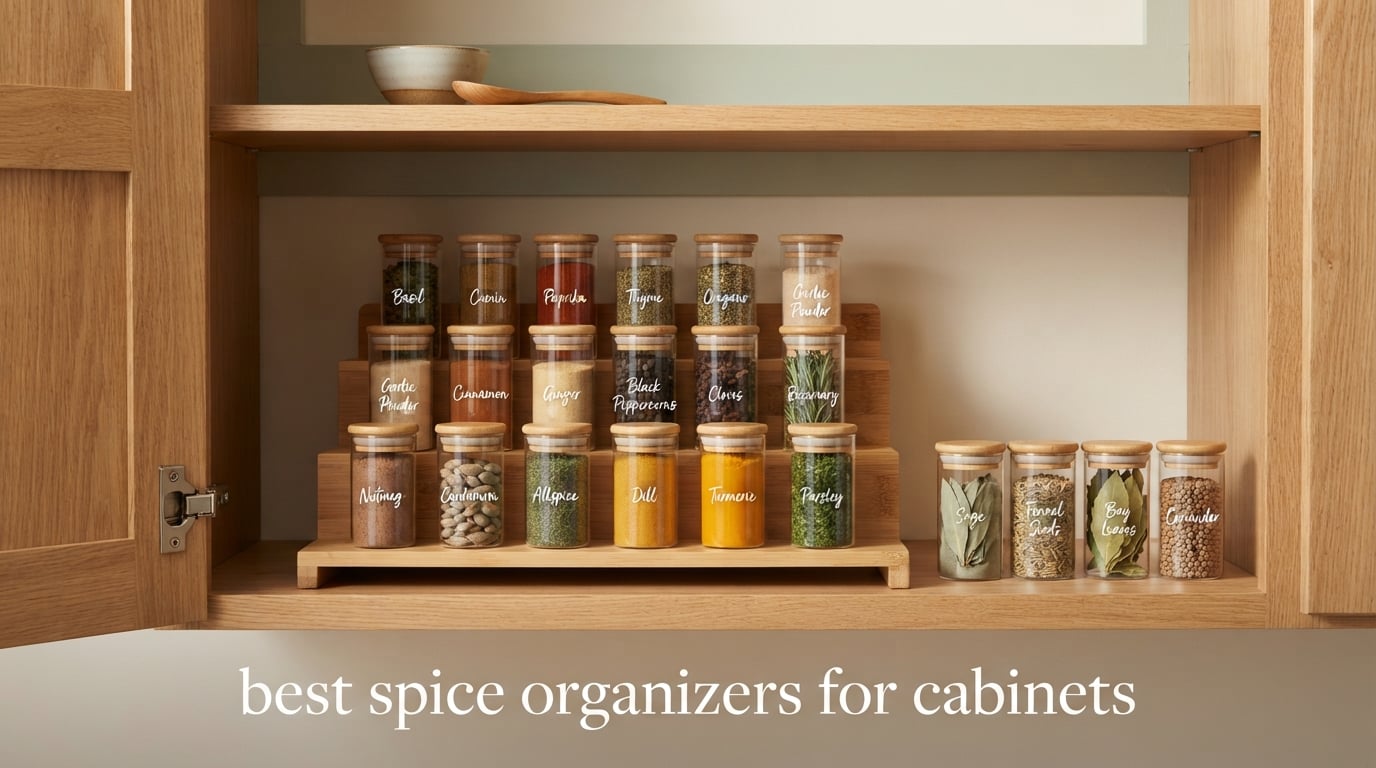
The average kitchen cabinet is the worst-lit, most forgotten room in the house. Spices go in at the back, get buried behind taller bottles, and quietly expire in the dark until someone finds a jar of oregano that smells like nothing. A good cabinet spice organizer fixes that in one move, and the best spice organizers for cabinets turn a dead back row into a display you can read at a glance.
We spent weeks with these racks in a working kitchen, loading them with mismatched jars and watching what stayed reachable. The differences that mattered turned out to be mundane but decisive: how wide the unit is against your opening, whether back-row labels stay visible, and whether the hardware stays level when fully extended.
This roundup covers 12 organizers across the four formats found in real kitchens: tiered step shelves, slide-out and drop-down drawers, rotating turntables, and riser shelves that double cabinet depth. Every unit fits a standard cabinet without remodeling, and most need no tools.
If your problem is narrow upper cabinets rather than deep base ones, start with the measurement guide below. It takes ninety seconds and is the step most people skip, then come back to the picks. For shelves you plan to keep on the counter instead, our countertop spice tower roundup covers the vertical display style separately.
Table of Contents
Top 3 Spice Organizers For Cabinets (October 2026)
Three products earned the right to lead this list. The Copco 3-Tier is the one we recommend to most people, the LYNK PROFESSIONAL slide-out solves cabinets where the back is unusable dead space, and the Oizeir expandable rack gives the best reach per inch of cabinet width.

Copco 3-Tier Cabinet Spice Rack
- 3 tiers in a 3.5 inch deep footprint
- 5 pound shelf capacity
- Rated 4.7 across 34138 reviews

LYNK PROFESSIONAL Slide-Out Rack
- Two tiers on ball-bearing glides
- Only 4.3 inch wide
- Two-screw cabinet mount

Oizeir 3-Tier Expandable Rack
- Telescopes to fit cabinet width
- Anti-slip shelf lining
- Deep enough for front-to-back rows
Best Spice Organizers for Cabinets in 2026
All 12 organizers are listed below with format, key feature, and the cabinet situation each handles best. No two use the same design, so you can narrow the field by format before reading the write-ups.
| Product | Specifications | Action |
|---|---|---|
| Copco 3-Tier Cabinet Spice Rack Organizer |
|
Check Latest Price |
 SONGMICS Cabinet Organizer Shelf Set of 2 SONGMICS Cabinet Organizer Shelf Set of 2 |
|
Check Latest Price |
| LYNK PROFESSIONAL Pull Out Spice Rack |
|
Check Latest Price |
 Zri Bamboo 3-Tier Expandable Shelf Zri Bamboo 3-Tier Expandable Shelf |
|
Check Latest Price |
 LAMU 2-Tier Lazy Susan LAMU 2-Tier Lazy Susan |
|
Check Latest Price |
| Oizeir 3-Tier Expandable Rack |
|
Check Latest Price |
 YouCopia SpiceStack 24-Bottle YouCopia SpiceStack 24-Bottle |
|
Check Latest Price |
 Oizeir Clear Acrylic 3-Tier Rack Oizeir Clear Acrylic 3-Tier Rack |
|
Check Latest Price |
 HOLDN’ STORAGE Pull Out Spice Rack HOLDN’ STORAGE Pull Out Spice Rack |
|
Check Latest Price |
 SpaceAid Pull Out 3-Drawer Organizer SpaceAid Pull Out 3-Drawer Organizer |
|
Check Latest Price |
 GOENDR 3-Tier Expandable Metal Rack GOENDR 3-Tier Expandable Metal Rack |
|
Check Latest Price |
 YAN & HIN Expandable 2-Pack YAN & HIN Expandable 2-Pack |
|
Check Latest Price |
1. Copco 3-Tier Cabinet Spice Rack Organizer – Best Overall Tiered Shelf
Copco 3-Tier Cabinet Spice Rack Organizer, 10 Inch Tiered Shelf Riser for Kitchen Cabinets, Pantry, and Countertop – Holds Spices, Seasonings, Oils, and Condiments
3 tiers
3.5 inch D x 8.75 inch W x 10.5 inch H
9.92 ounces
5 pound shelf capacity
Pros
- Three tiers multiply storage in a tiny footprint
- Step design suits standard jar shapes
- Lightweight enough to reposition anytime
- Doubles as a countertop riser
Cons
- Fixed width may not span a wide opening
- Open front contains bottles less securely than a drawer rack
This is the shelf we kept coming back to. At 3.5 inches deep and just under 10.5 inches tall, it disappears into the front of a base cabinet and turns three rows of bottles into one readable face. We loaded it with an entire everyday collection and still had a free tier, which is how much dead space a flat cabinet shelf wastes.
The step geometry is the whole trick. Each tier rises high enough that the label in front is never blocked by the bottle behind it, and the 5-pound per-shelf rating means a full load of glass jars does not bow the plastic. It is also the least demanding format to load, because you set bottles on an open surface instead of threading them into a slot.
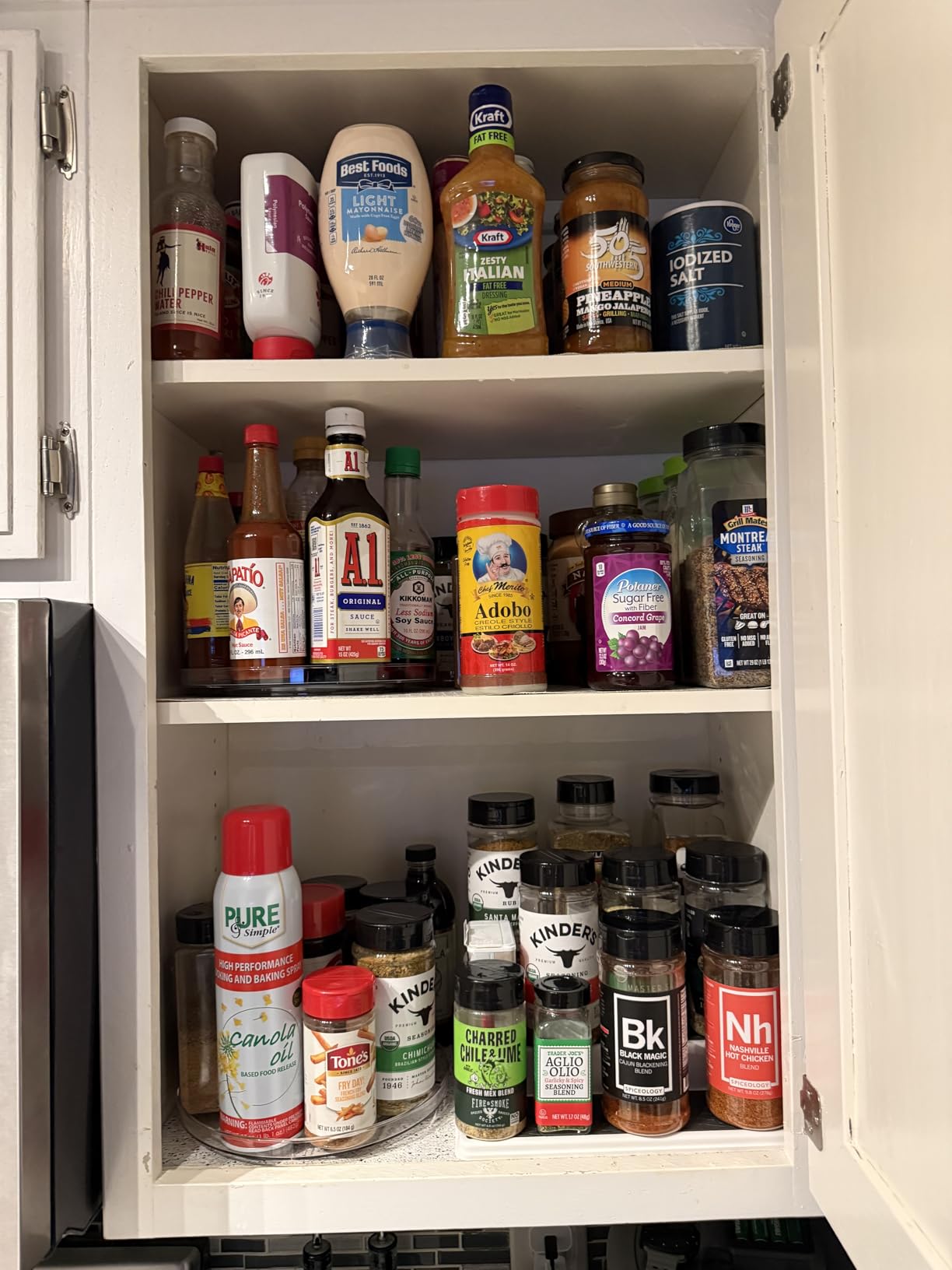
Two things keep it from being universal. The width is fixed at 8.75 inches, so in a 12-inch opening you either accept a gap on each side or pair it with another. And because the front is open, a hard knock from a closing door can send a bottle rolling to the back.
The 3.5-inch depth is the honest limit. This is a shelf for small and medium jars, not for tall bulk containers or large tins. Owners who rate it highly almost always describe the same fix: move it to the front of the cabinet so the labels face out.
Why the three-step layout works?
Step shelves, sometimes called stadium seating, raise each row by roughly the height of a standard jar. You get three rows of visible labels in the depth of one, and you can pull any single bottle straight forward without shifting its neighbours.
Assign tiers by frequency of use rather than by name. The salt you reach for twelve times a week goes on the front row, and the smoked paprika you use twice a month sits at the back.
Where it falls short?
If your cabinet is deep enough for a slide-out, a pull-out will outperform a step shelf because you see every label at once instead of three rows. Copco is the right call for shallow cabinets, corner spaces, and anywhere you do not want to drill.
It is also plastic, so it will not take a heavy load of large glass or oil bottles without flexing. We have not seen it crack, but it is not built for bulk pantry goods.
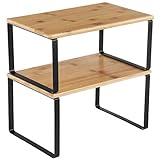
2. SONGMICS Cabinet Organizer Shelf Set of 2 – Best for Heavy Bottles
SONGMICS Cabinet Organizer Shelf, Set of 2 Spice Rack, Kitchen Storage
Set of 2 shelves
7.7 inch D x 11.7 inch W x 6.2 inch H
1.4 kg
33 pound per shelf
Pros
- 33 pound load rating in wood and metal
- Two sizes can be stacked nested or set in an L
- Assembles in about three minutes
- Doubles usable space in deep cabinets
Cons
- Instruction sheet in the box is for a different product
- Screws can seat loosely and leave the larger unit wobbly
- Boards are thin for very heavy storage
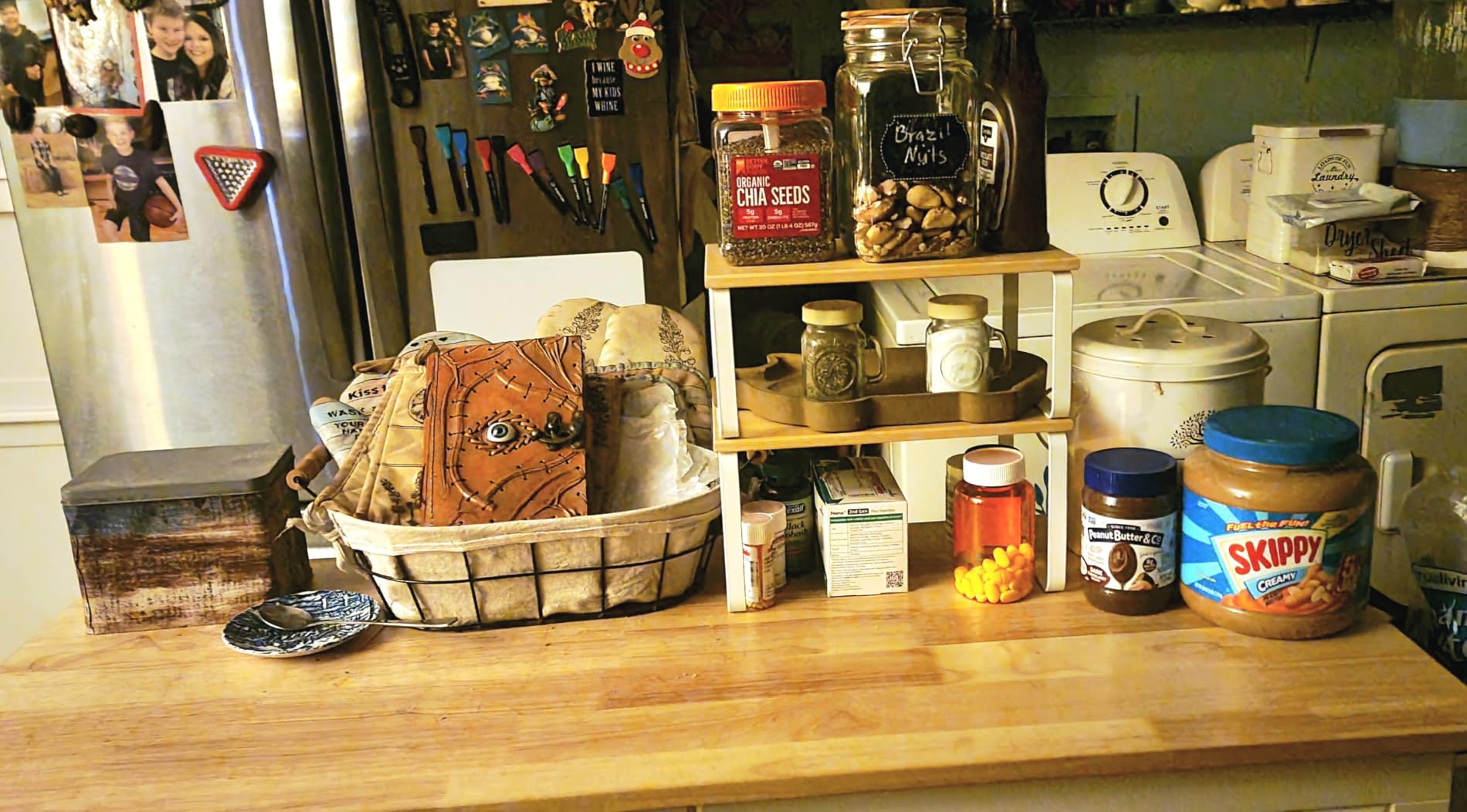
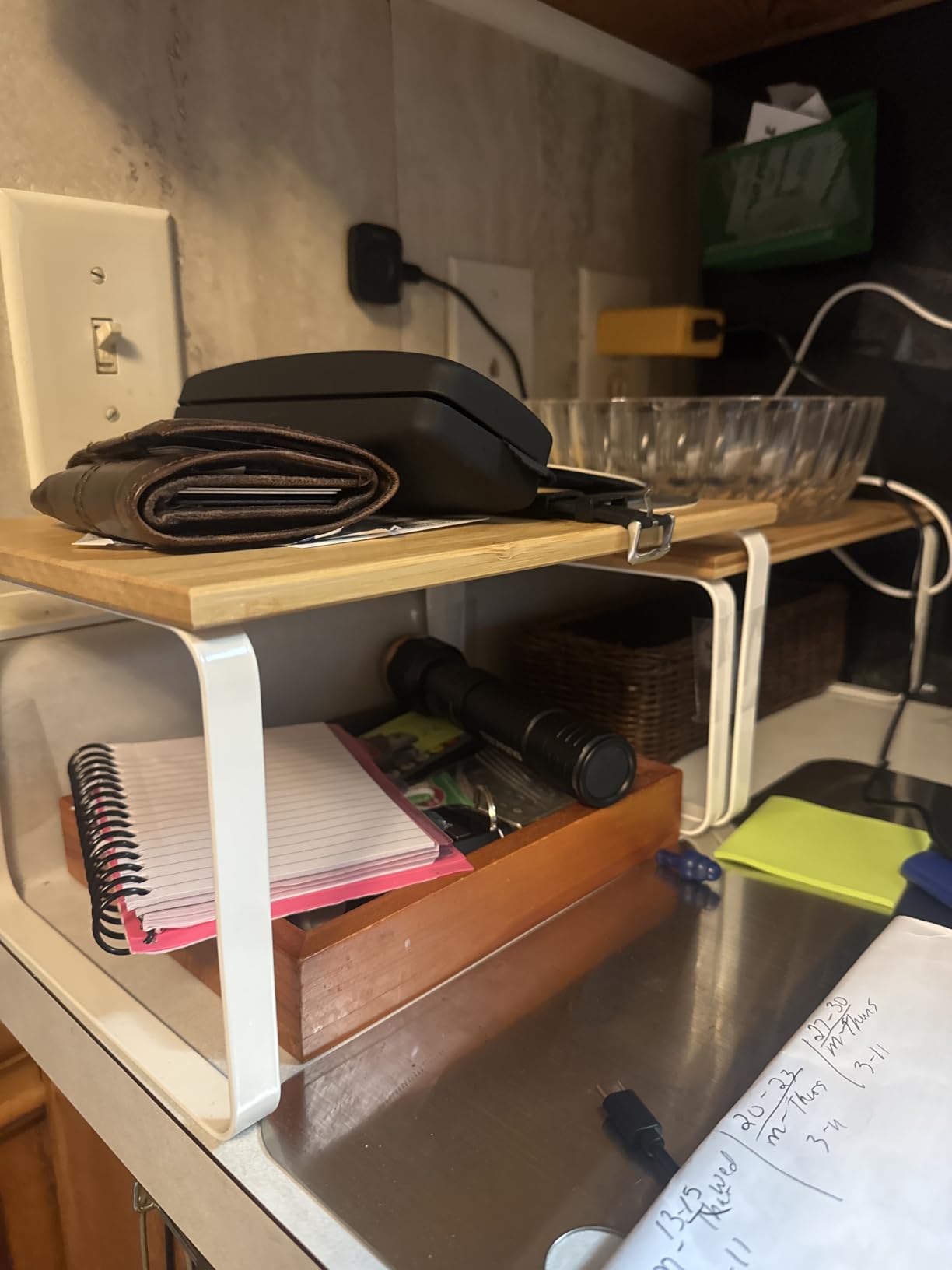
Every other shelf here is plastic or steel wire. This one is engineered wood with metal legs, and the 33-pound rating per shelf is roughly six times what the plastic risers carry. If your cabinet holds bulk spice bottles, large glass jars, or oil next to the spices, this is the shelf that will not bow.
Being able to stack, nest, or arrange the two boards in an L-shape means one purchase covers two different cabinet problems. The painted finish suits modern, farmhouse, and transitional kitchens alike.
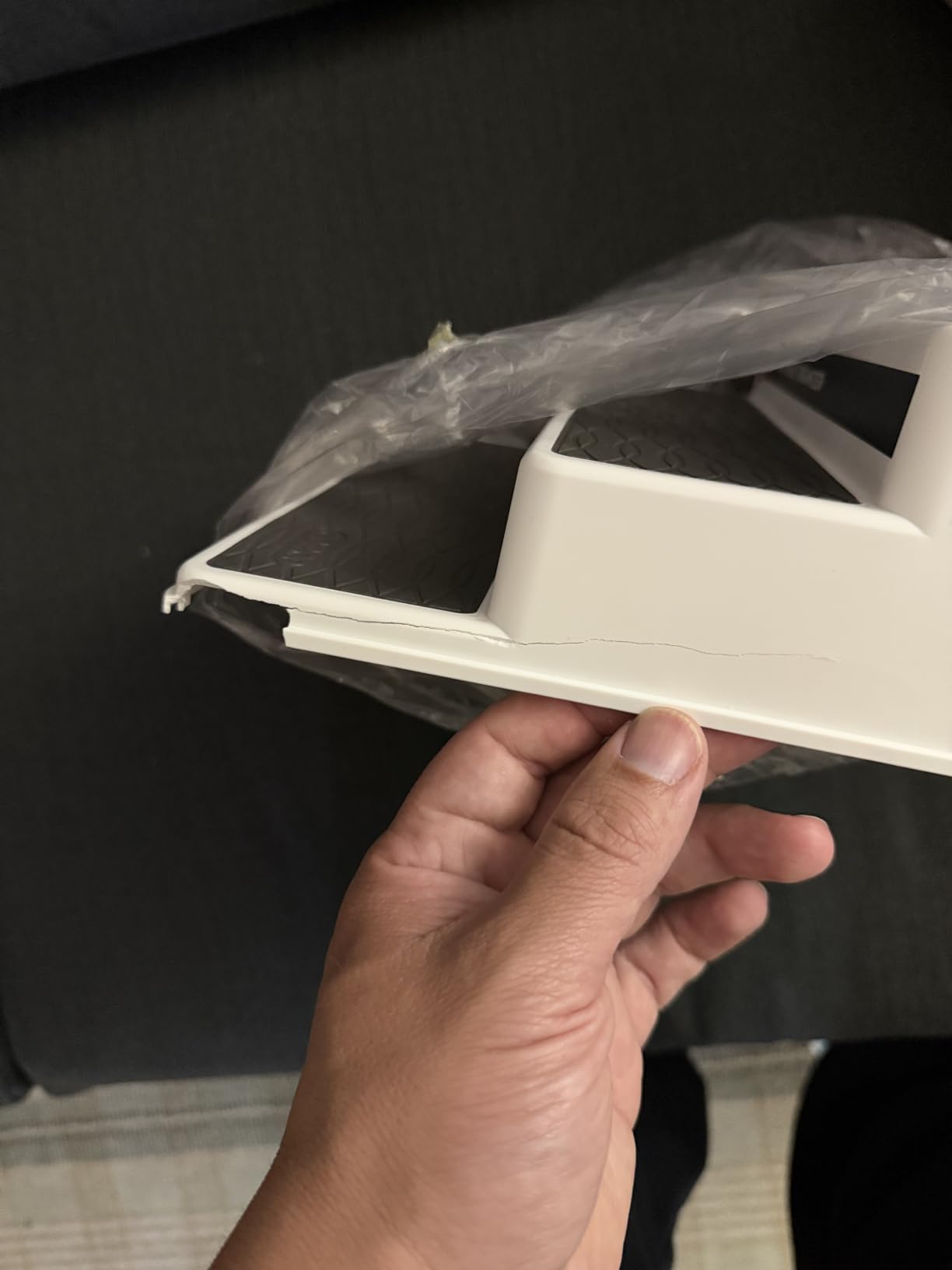
The most-reported issue has nothing to do with the shelves. Buyers repeatedly note the instruction sheet in the box is for a different product, which sent a surprising number of people back to returns. Check the model number printed on the underside of each board before touching the screws.
Assembly is a genuine three-minute job with the included kit and wrench, but the predrilled holes are not always a perfect match. If a screw stops turning before it feels tight, back it out and restart by hand rather than forcing it.
Why the weight rating matters more than it looks?
Most spice racks are engineered around an empty cabinet. Once you add a shelf, it carries the shelf above plus every bottle on both, and plastic steps flex under that load until a neat block of jars becomes a leaning pile.
At 33 pounds per shelf, this unit carries roughly 18 bottles of a typical glass jar with room to spare. That headroom is what lets you add a bulk container later without replacing the system.
Where it falls short?
The boards are thin and shallow, so they work as raised platforms rather than deep bins. Bottles on the top surface are not contained by a lip, and a tall bottle near the front edge is one cabinet door away from the floor.
Because it is wood, standing water is the enemy. Wipe spills promptly and keep the boards away from the sink or dishwasher.
3. LYNK PROFESSIONAL Pull Out Spice Rack – Best Pull-Out for Narrow Cabinets
LYNK PROFESSIONAL® Pull Out Spice Organization for Cabinets – 4-3/8 inch Wide – Spice Rack for Inside Cabinets, Slide Out Spice Rack Organizer for cabinet – Pull Out Spice Rack, Sliding 2 Tier Chrome
2 tiers
10.3 inch D x 4.3 inch W x 8.5 inch H
4.3 pounds
Ball-bearing glide
Pros
- Ball-bearing glides stay level when fully loaded
- Two-screw mount at the cabinet back
- Spill-guard tray protects cabinet floor
- Anti-rust polished chrome finish
Cons
- 4.3 inch width limits bottles per tier
- One rack per purchase so a full cabinet needs more
A pull-out rack changes how a cabinet works. Instead of reaching past a front row, you slide the back row forward until the label you wanted is at arm’s length. In a deep base cabinet that is the biggest usability gain available, and this is the narrowest version of it we found.
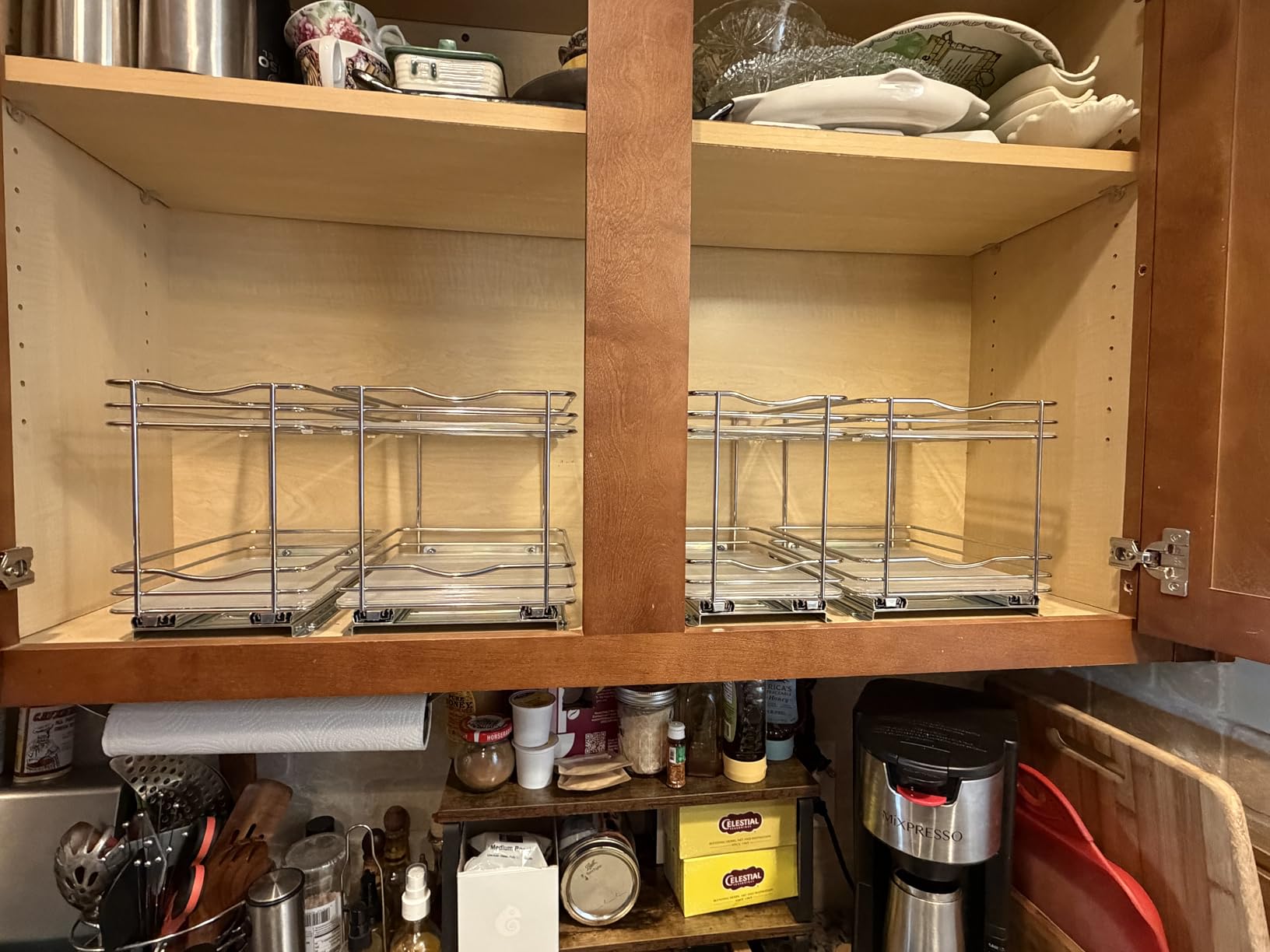
At 4.3 inches wide it fits inside a single 9-inch cabinet alongside a pot, which is the situation most kitchens have. Two tiers double the capacity, and the ball-bearing glides stayed level and quiet even with every bottle loaded on the lower shelf.
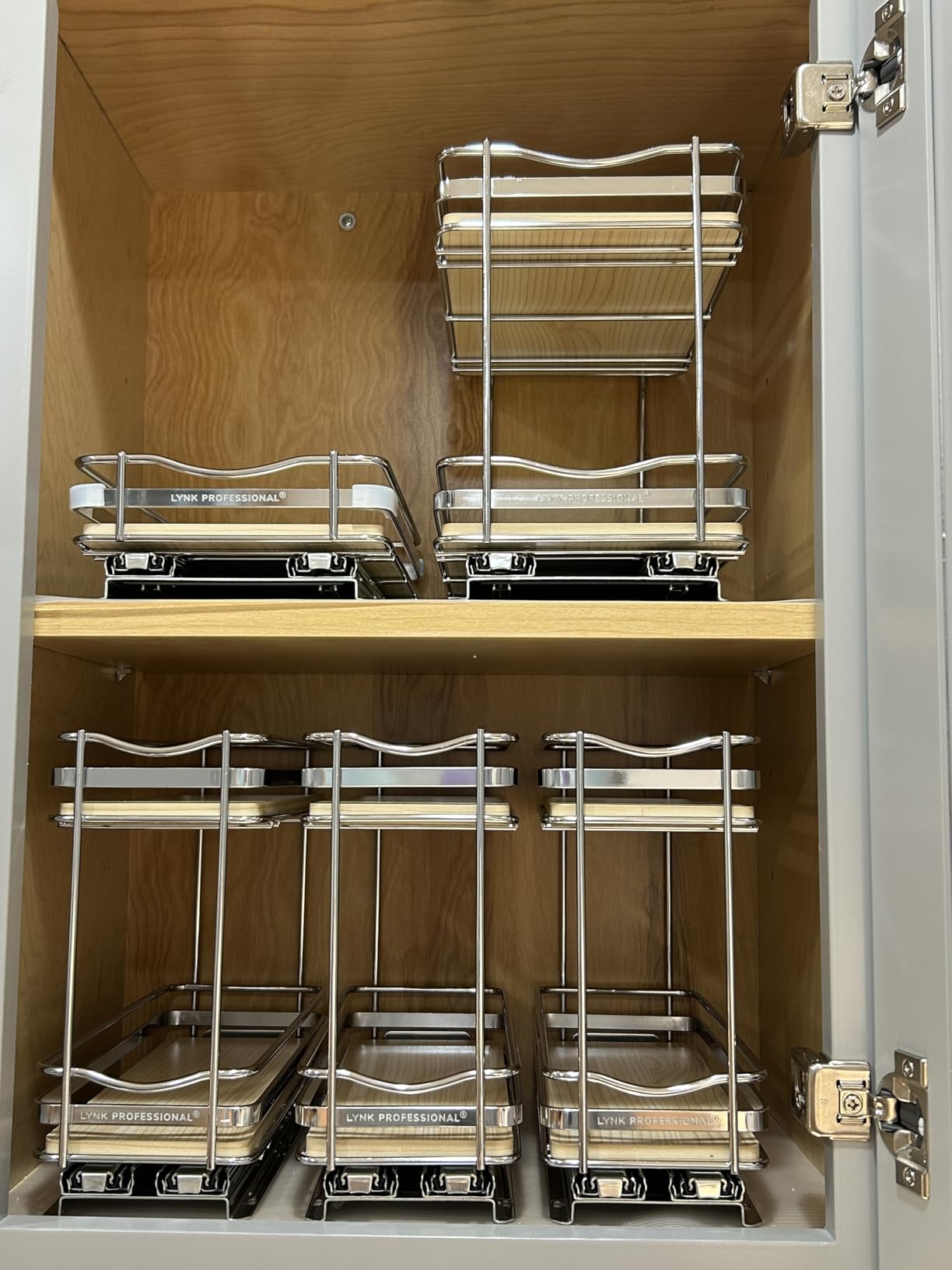
The hardware is the point. Cheaper pull-outs use a friction rail that sags under load, tilting bottles and making the shelf feel unsafe when extended. The locking polymer tray underneath does double duty as a spill guard and a base that keeps small jars from falling through the wire floor.
Installation is two screws at the back of the cabinet and no measuring, a real advantage over racks that need a width match. The polished chrome finish carries a lifetime limited warranty.
What full-extension glides do for you?
A glide is the hardware that lets a shelf slide out. Friction glides travel only partway; ball-bearing glides roll on steel bearings and extend the full cabinet depth, so the back of the shelf clears the door frame entirely.
That full travel is what makes a narrow pull-out worth buying. A 4.3-inch-wide rack that only slides halfway is useless, because the row you want is still at the back.
Where it falls short?
Four inches of width fits about six bottles per tier, so a full collection needs several units. The wire tiers are another limit, and heavy glass or oil bottles will crowd them long before the glide gives out.
Like any mounted rack it needs drilling. Renters should look at the drop-down systems, which need no fasteners at all.
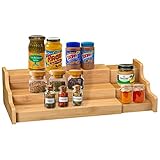
4. Zri Bamboo 3-Tier Expandable Shelf – Best Expandable Bamboo Shelf
Spice Rack Kitchen Cabinet Organizer- 3 Tier Bamboo Expandable Display Shelf Yellow
3 tiers
Expands 12.7 to 22.2 inch
7.7 inch D x 4.29 inch H
350 g
Solid Moso bamboo
Pros
- Expands to match the cabinet opening
- Three visible levels
- Side barriers stop bottles sliding
- Works with any existing jar brand and size
Cons
- One unit holds relatively few bottles
- Some units arrive with cracked bamboo ends
- Hand wash only
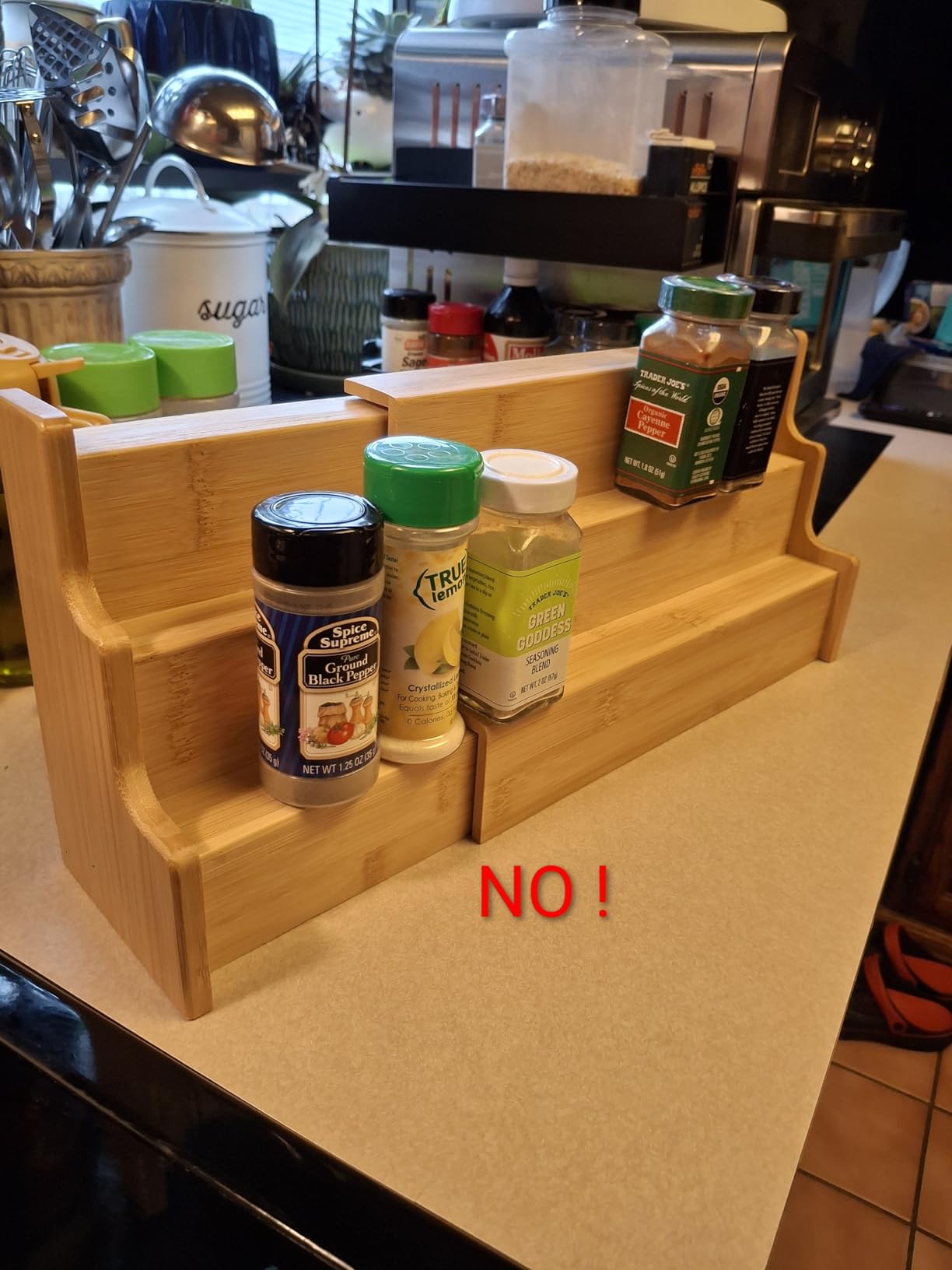
This is the shelf for people who refuse to decant. The tiers slide outward to match whatever width you have, so it fits a 12.7-inch upper cabinet and a 22.2-inch base cabinet without a different product, and every jar you already own drops straight onto it.
Bamboo is the material choice, and it matters more than appearance. It is rigid, tolerates humidity better than engineered wood, and the finish feels more like furniture than injection-moulded plastic. Our yellow-finished unit was good enough that a visitor commented on it.
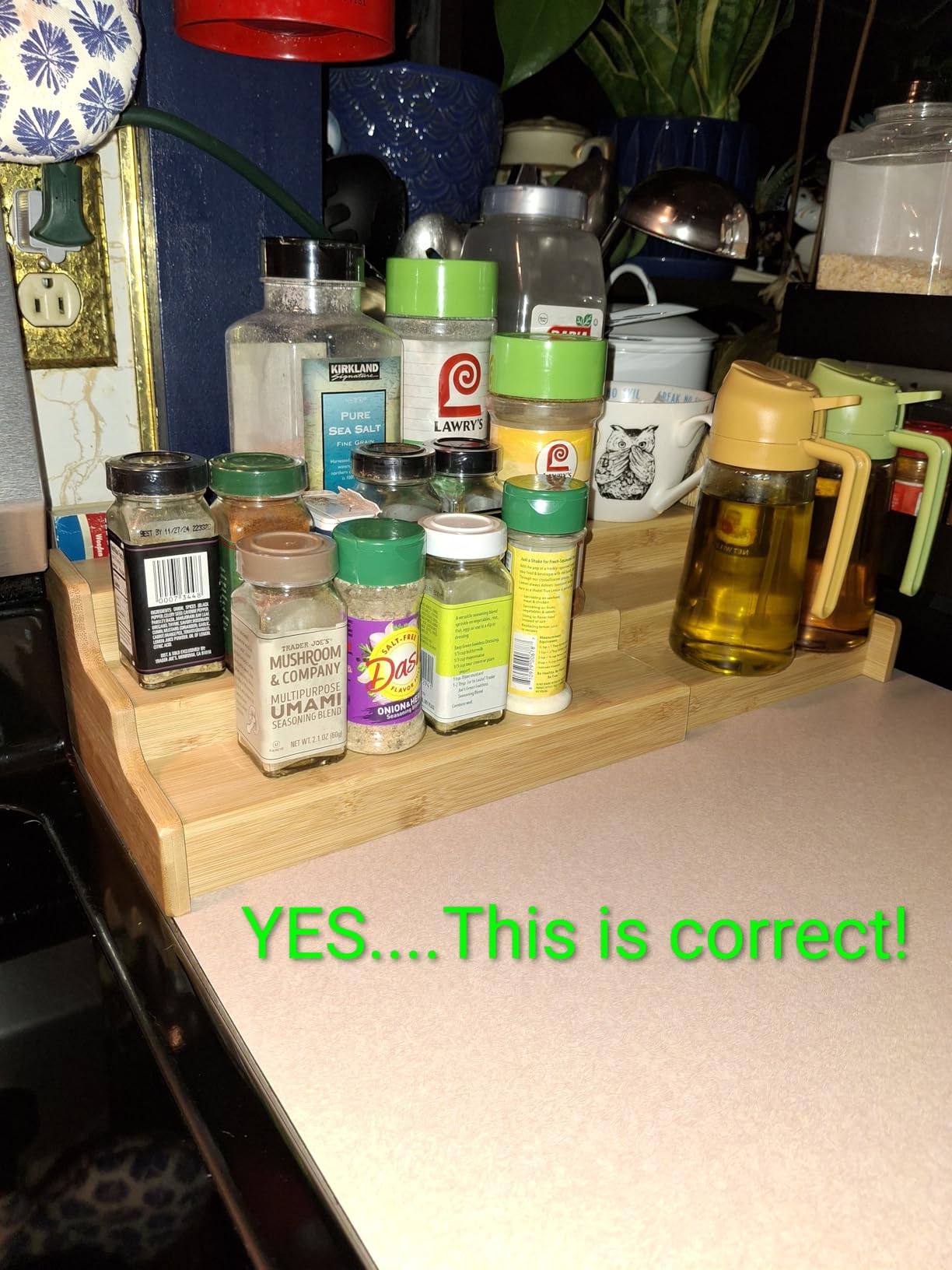
The tiers are rimmed on all sides, so bottles stay put when you pull one from the middle. That containment is the difference between this and a plain step riser, and it is why small glass jars can live here without anxiety.
Two complaint clusters recur. Buyers report occasional cracked or split bamboo ends on arrival, so inspect the tier ends as soon as it is delivered. And because one unit is fairly small, most people order two or three to fill a cabinet.
How expanding to fit the cabinet works?
An expandable shelf uses telescoping panels that slide into each other. You pull the ends apart until the total width matches the opening, which removes the most common complaint about fixed-width racks: not fitting.
The trade-off is that a telescoping joint can rack slightly under load, so expand only as far as the cabinet needs. Check the collapsed width against your opening first, since the minimum setting is what has to clear the cabinet sides.
Where it falls short?
Bamboo will not survive a dishwasher or a soak. Wipe it clean, dry it fully, and keep it away from a sink or stovetop where steam condenses.
It also has to sit flat on the cabinet shelf. The tiers are not meant to be used vertically, and at 4.29 inches tall it adds less vertical height than the plastic or steel options, so you gain width rather than height.
5. LAMU 2-Tier Lazy Susan – Best Turntable for Round Cabinet Spaces
LAMU 2 Tier Lazy Susan Turntable Organizer 9.25” Rotating Spice Rack Organization for Cabinet, Kitchen, Pantry, Countertop, Bathroom, Vanity, Medicine Cabinet Organizer, Clear
2 tiers
9.25 inch diameter x 7.7 inch H
15.84 ounces
Ball-bearing rotation
Pros
- Two tiers double storage in a narrow cabinet
- Metal support rods add real rigidity
- Smooth 360 degree ball-bearing rotation
Cons
- 9.25 inch diameter is small for large containers
- Two pieces needed for the taller stacked version
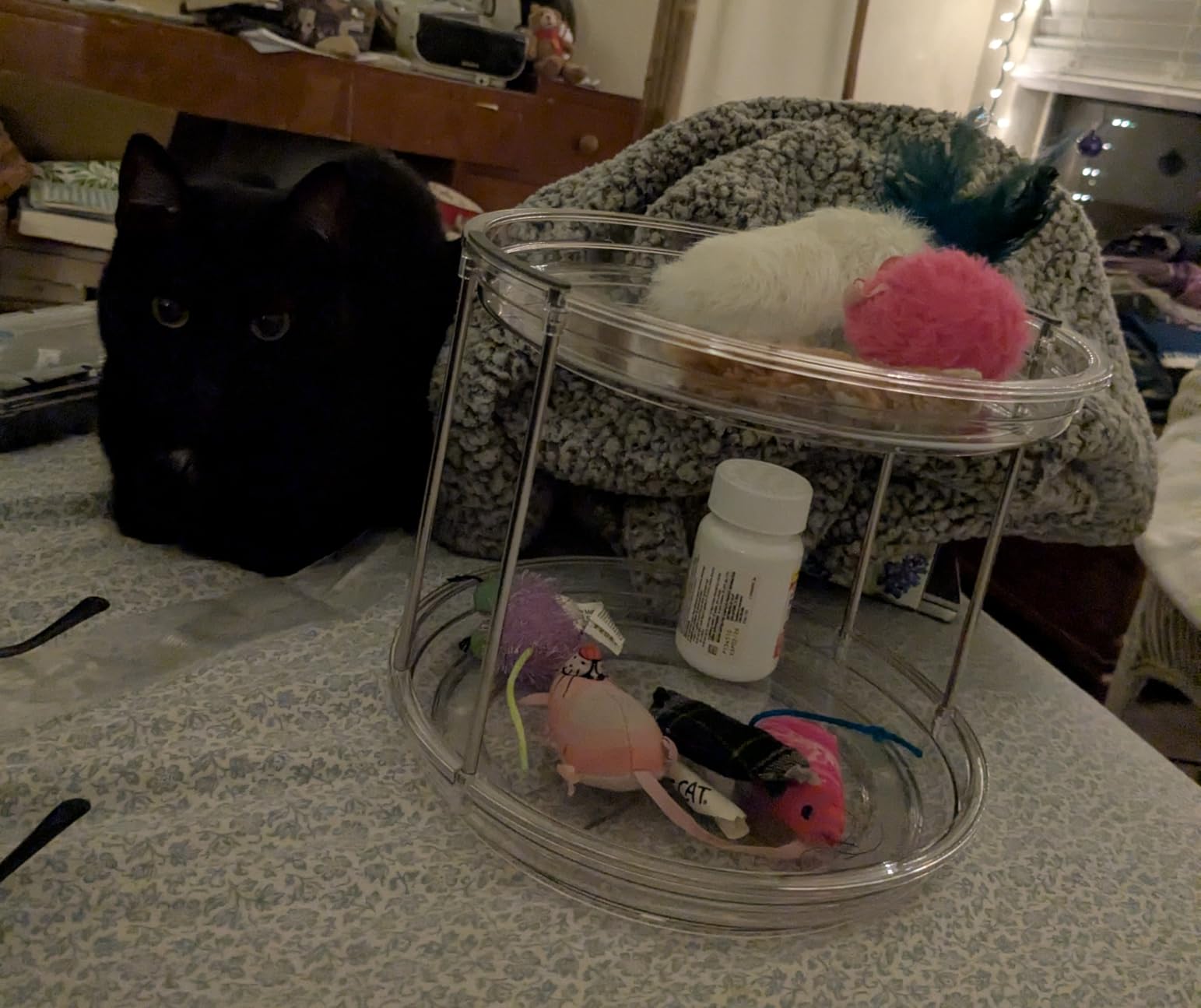
A turntable solves a problem tiers cannot: a corner cabinet or L-shaped run where a rectangular shelf will not sit square. Spin the top tier and the back of the cabinet becomes reachable without pulling anything out, which also lets the rack live further back where it wastes less usable space.
The metal support rods between tiers are the detail that separates this from cheap all-plastic turntables. They resist the flexing that makes a loaded plastic turntable feel wobbly, and the ball-bearing rotation stayed smooth after weeks of daily spinning.
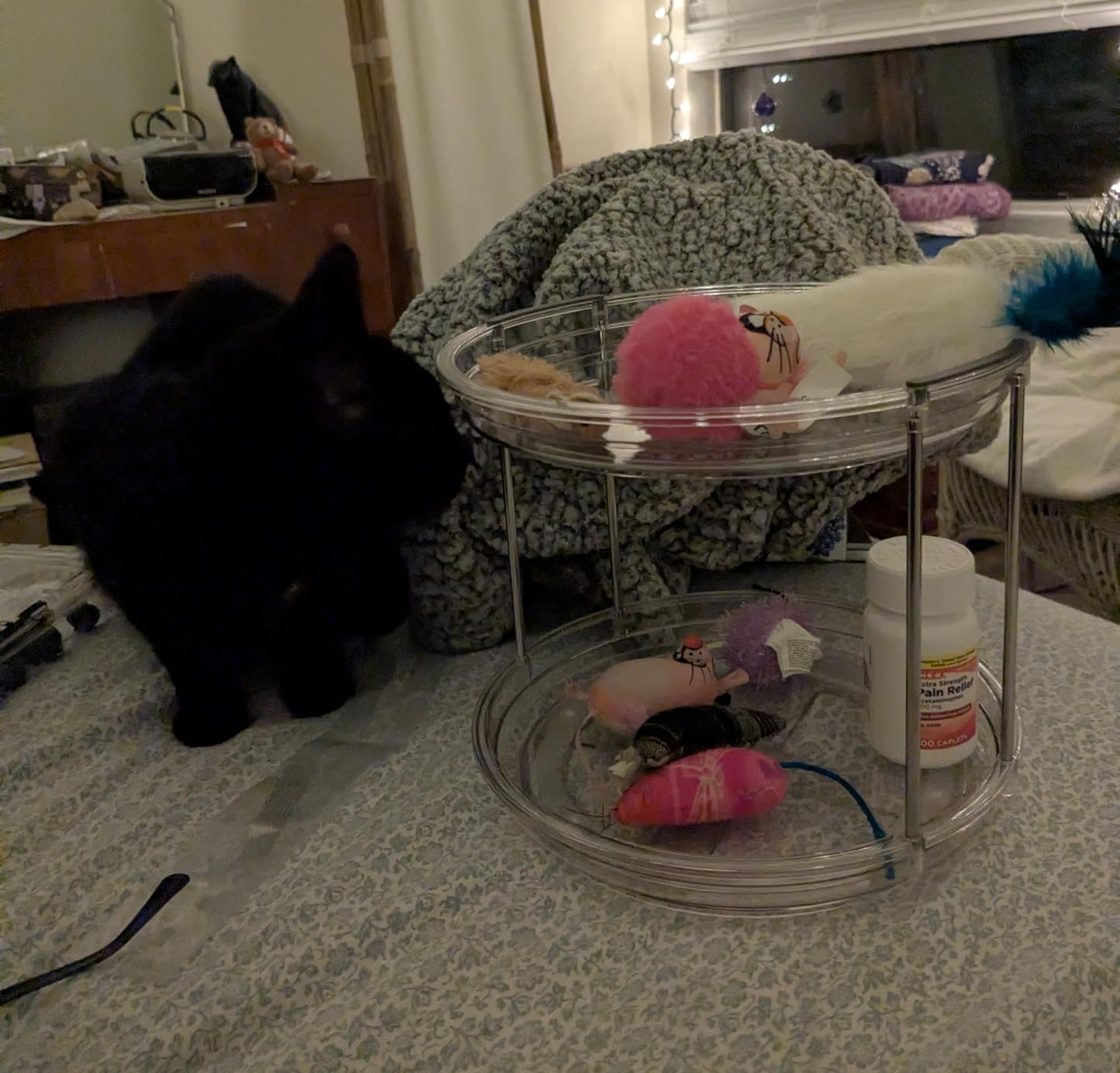
Jars sit inside a raised tray rather than on a flat disc, so a knocked bottle does not skate off the side. We also used it in a medicine cabinet, which is the second most common use owners report.
Setup is genuinely tool-free. The tiers assemble and come apart under water, which matters more than it sounds when a rack lives over a stovetop and collects seasoning dust and oil film.
When a rotating base beats a tiered shelf?
A lazy Susan wins when depth is the problem. In a cabinet deeper than about 18 inches, the back of a static shelf is effectively lost, and a turntable brings it forward with one push of a finger.
It also wins in round or awkward openings. A 9.25-inch diameter fits inside a corner cabinet where a rectangular rack has to sit at an angle, and a spinning rack does not care which way the cabinet faces.
Where it falls short?
Nine and a quarter inches of diameter is not much. Large square tins, wide containers, and tall bulk bottles do not fit, so this solves standard jar sizes rather than a general pantry.
Spinning is also one more thing to think about when you reach in. With a shallow cabinet face in front of it, the turntable can hit the door before you have turned it far enough.
6. Oizeir 3-Tier Expandable Rack – Best Value Expandable Tiered Shelf
Oizeir 3-Tier Expandable Spice Rack Organizer for Cabinet, White/Grey
3 tiers
9 inch D x 17.5 inch W x 3.5 inch H
16 ounces
Slides to fit width
Pros
- Three tiers roughly triple items in one footprint
- One-pull extension slides to cabinet width
- Grey anti-slip lining keeps bottles secure
- Deep enough for front-to-back rows
Cons
- Labels get partly hidden when rows are packed full
- Light-duty plastic limits heavy loads
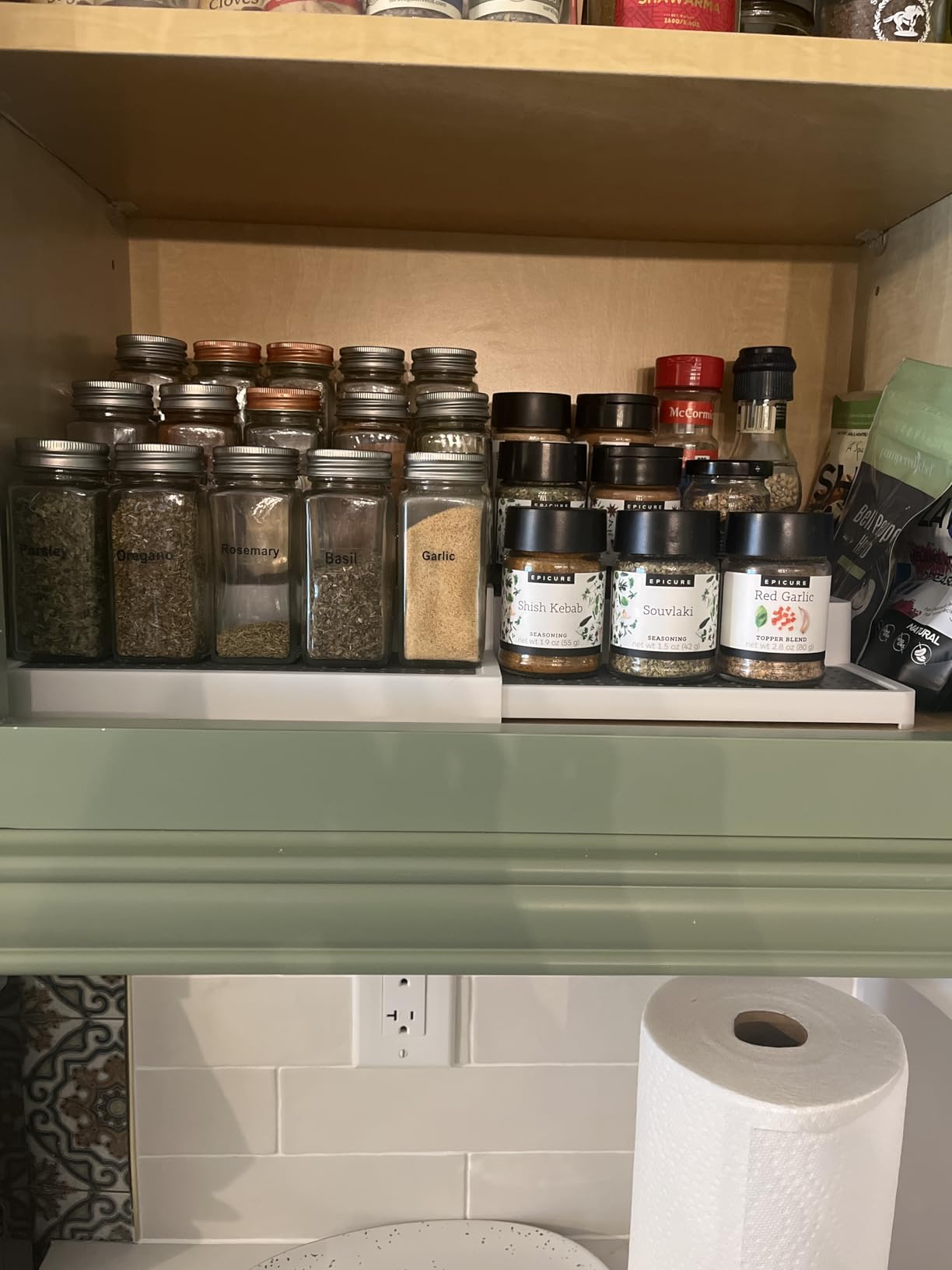
This is the rack we would hand someone who asked for one good general-purpose shelf and did not want to overthink it. Three tiers, an expandable width, and a 9-inch depth deep enough to hold a row of bottles front to back rather than single file.
That front-to-back depth is the feature other tiered shelves skip. Once the first row is gone, the second is right there rather than at the back of the cabinet, which roughly doubles effective capacity without adding width.
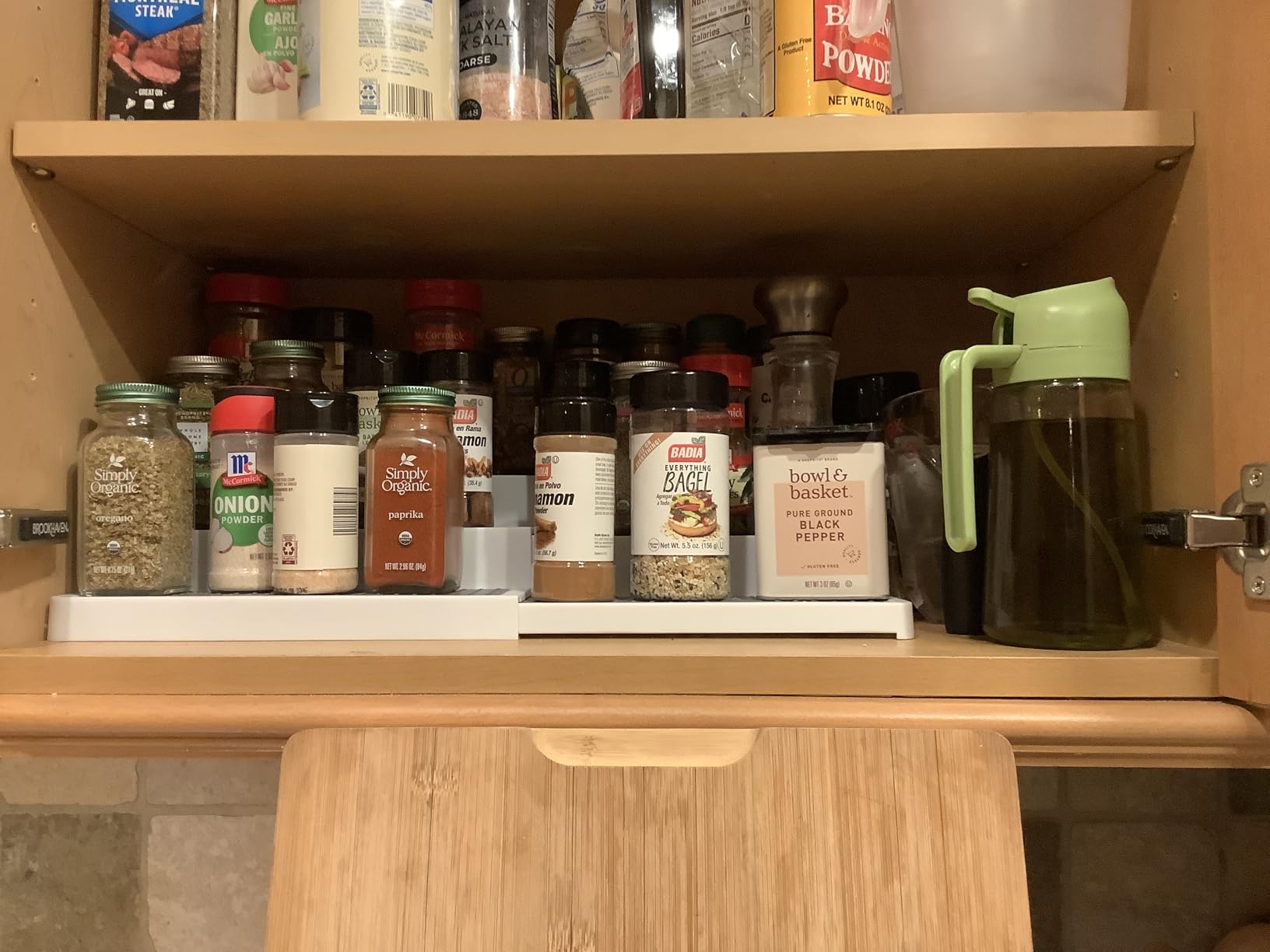
The grey textured lining is a small thing that changes daily use. Bottles sit on a grippy surface rather than slick plastic, so a nudge from a closing drawer does not start a slow migration to the back of the shelf.
Owners repurpose it constantly, and the reviews reflect that: cups, supplement bottles, canned goods, and craft supplies all appear. If one shelf serves several categories in a small kitchen, that flexibility is genuinely useful.
Why shelf depth beats shelf width?
Most people optimise for width because it is the number on the box. Depth determines whether you can double up bottles, and a 9-inch depth means the back row is retrievable rather than a shadow behind the front row.
The trade-off is that a deep tier eats cabinet depth. Measure usable depth first, because a 9-inch-deep rack in a shallow upper cabinet will stick out past the door line and stop it closing.
Where it falls short?
The honest limitation is the light-duty plastic. It handled glass spice jars without trouble, but this is not the rack for a load of large oil bottles or glass canisters.
Labels are also partly obscured when a row is packed completely, the most common complaint in the reviews. Loading the front row only and leaving the back row sparser fixes it in about five seconds.
7. YouCopia SpiceStack 24-Bottle – Best Drop-Down System With No Drilling
YouCopia SpiceStack® Adjustable Spice Rack Organizer, Pull-Down 24-Bottle Seasonings and Spices Holder for Kitchen Cabinet and Pantry Organization with 104 Included Labels
3 pull-down drawers
11 inch D x 10.5 inch W x 8.3 inch H
2 pounds
Holds 24 four ounce jars
Pros
- Pull-down drawers bring back spices to eye level
- Three adjustable dividers handle mixed shapes
- 104 labels included
- No tools or mounting required
Cons
- Dividers are hard to press in and plastic feels cheap
- Drawers tip if more than one tray is extended
- Some labels peel and are not wipeable
The SpiceStack works from a different direction. Instead of pulling a shelf toward you, you pull a tray down toward you so the bottles tilt into view at eye level. Nothing is mounted, drilled, or screwed, which makes it the strongest option for a rental.
Three drawers hold 24 standard 4-ounce jars, and three adjustable dividers let you mix round jars, square tins, and short containers in one tray. The included label set is the largest practical one here, with 104 stickers split between pre-printed and blank.
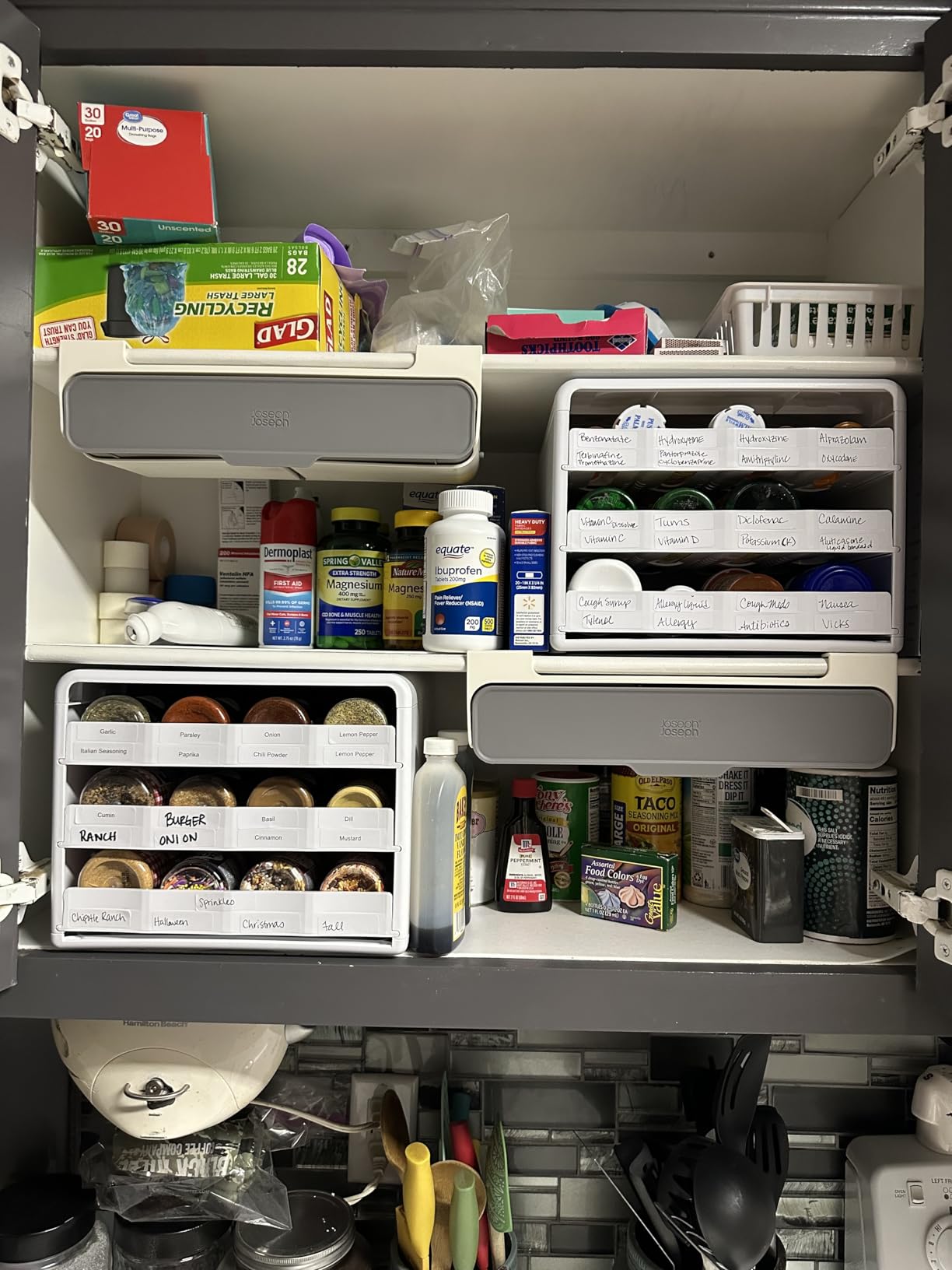
Two behaviours to know before committing. If you extend more than one tray at a time the unit tips forward, so the rule is one drawer at a time. And heavily loaded trays can wobble enough to shift bottles, which the dividers reduce but do not solve.
Build feel is the other common criticism. The plastic feels light, the dividers resist when pressed in, and some buyers have had labels peel or found the pre-printed ones are not wipeable in a greasy cabinet. Write your own on the blank stickers in pencil.
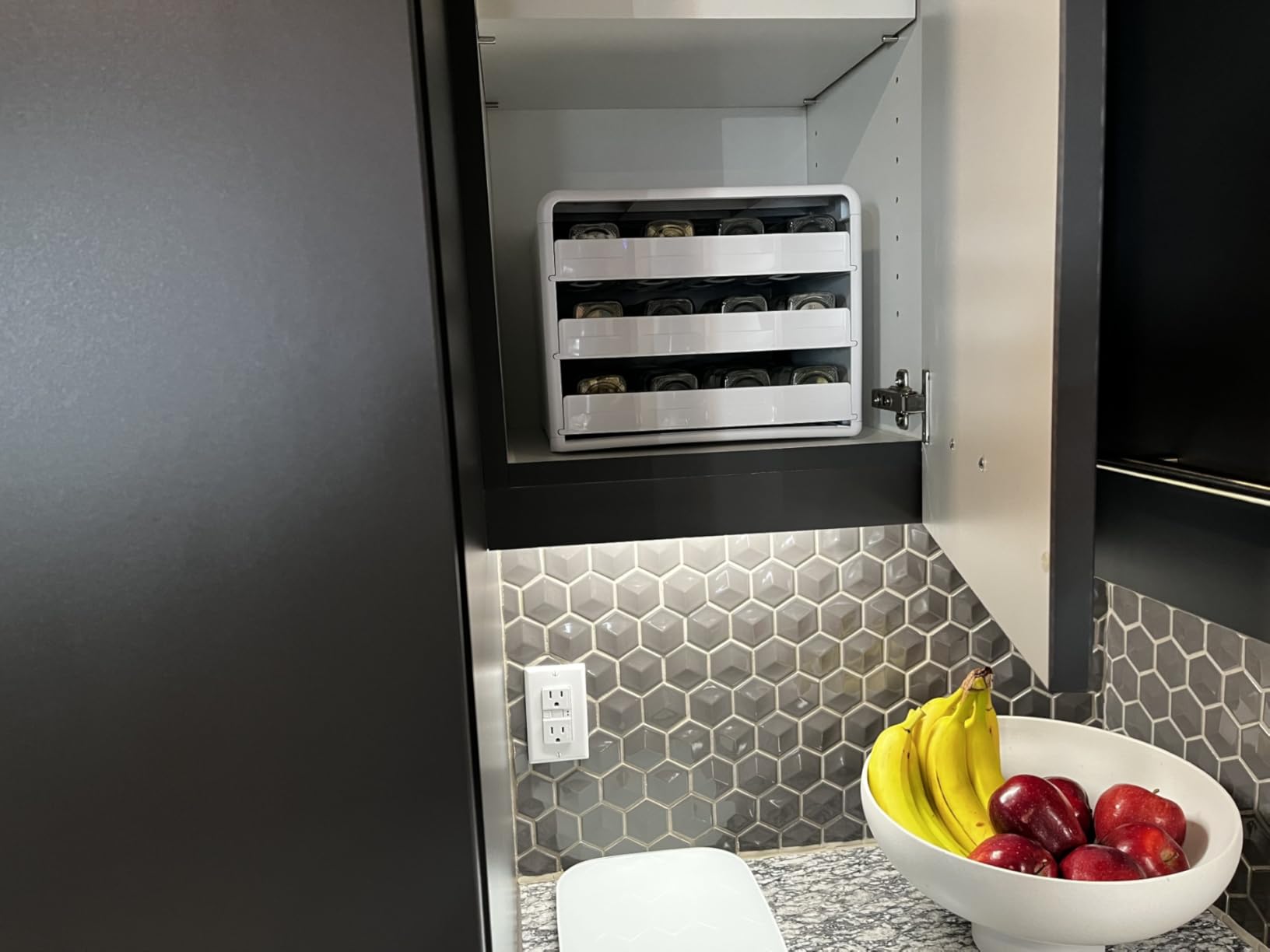
How a drop-down mechanism works?
Each drawer is hinged at the front and slides forward on its own rail, so pulling the handle lowers the tray like a flap. Gravity does the rest, and you see the front of every bottle on that row at once, which is the best visibility of any format here.
The trade-off is vertical clearance. When a tray is down it needs room in front of the cabinet, so this works best in a base cabinet or on a counter, not a shallow upper cabinet where the door would hit the tray.
Where it falls short?
The 24-bottle ceiling is real. If you have more than that you need a second unit, and it has to sit beside this one because these are wide.
Uniform or similar jar sizes genuinely help, since the dividers are sized for standard 4-ounce containers. Very tall bottles, oversized square tins, and anything with a wide cap will not slot in, and the plastic will not forgive forcing it.
8. Oizeir Clear Acrylic 3-Tier Rack – Best for Seeing Every Jar
Oizeir Clear Acrylic 3-Tier Spice Rack, Cabinet Pantry Organizer
3 tiers
4 inch D x 10.4 inch W x 4 inch H
1.01 kg
360 degree ledge
Pros
- Clear acrylic shows contents from every angle
- Three tiers in a shallow 4 inch depth
- 360 degree ledge stops items falling
- No assembly required
Cons
- Fixed 10.4 inch width needs careful measuring
- Light material suits lighter loads
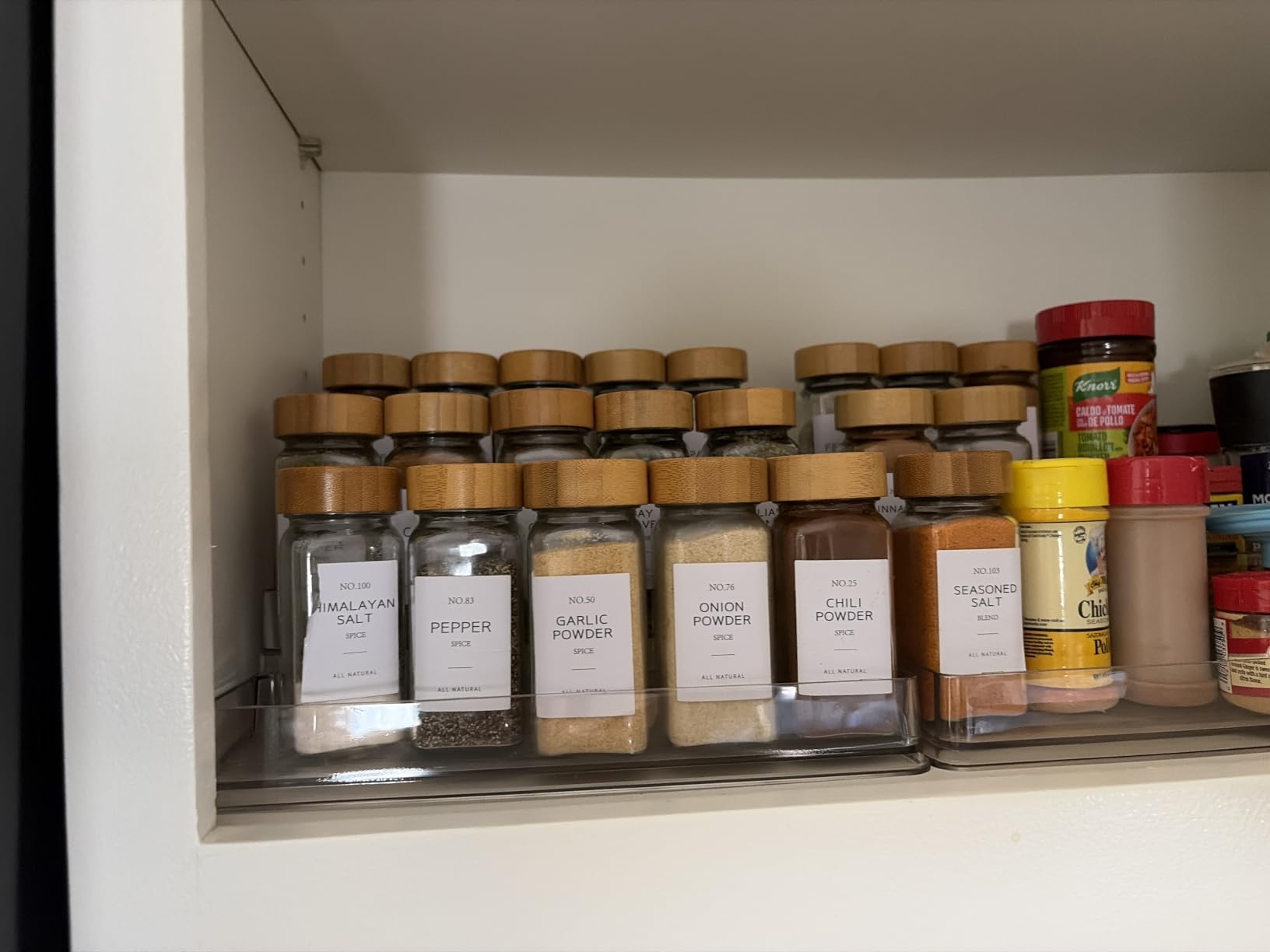
Light is the enemy of spice storage, and clear acrylic fights it from a different angle than the others. Because the material is transparent you can see jars on the back tier from the front and side, so a crowded rack still looks readable rather than like a wall of plastic.
Each rack arrives as a single moulded piece, so there is no assembly and no hardware to lose. The deep shelves have a continuous 360-degree ledge, which is what keeps a bottle from sliding off the back when you pull one from the front.
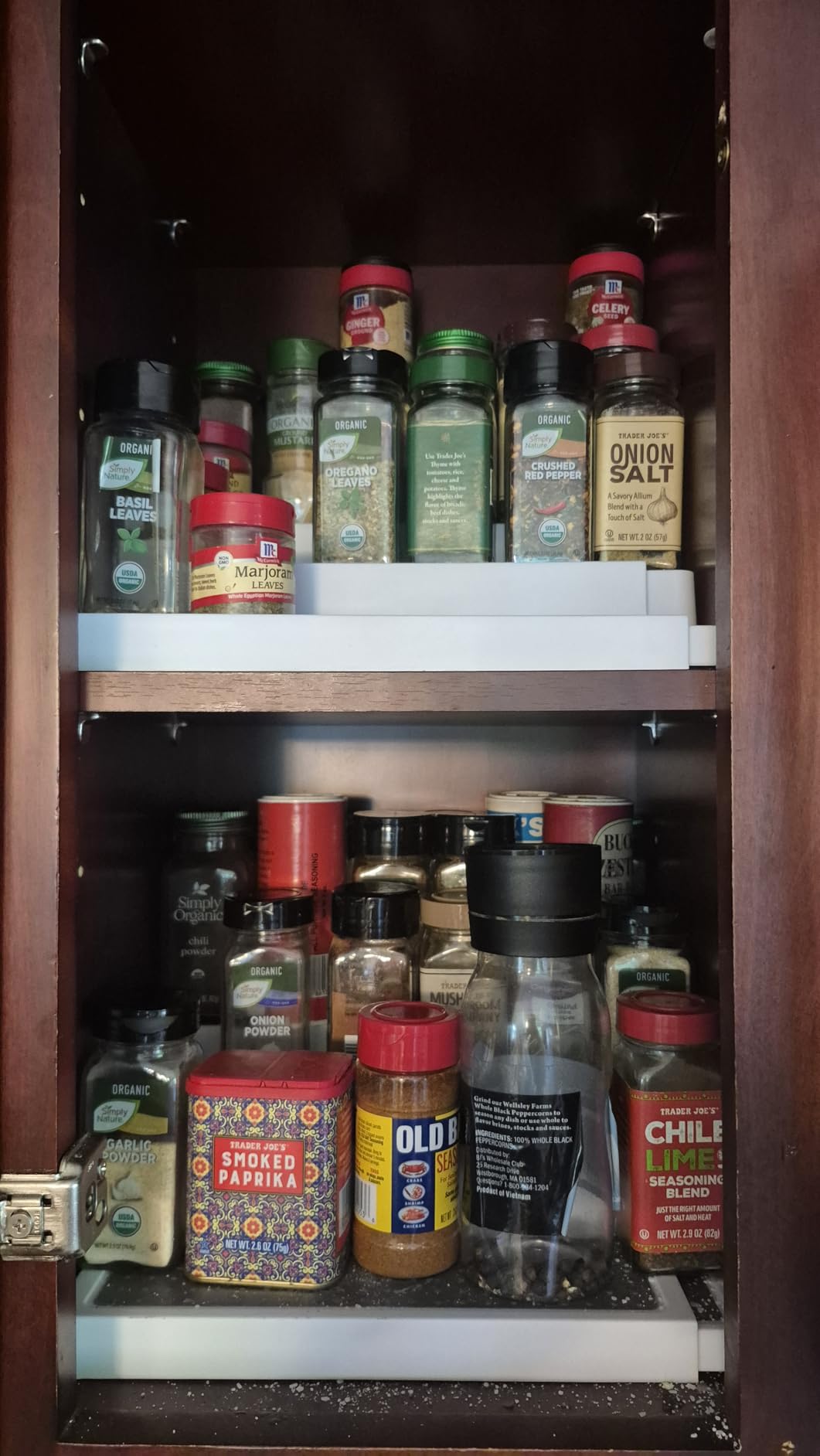
One unit is rarely enough on its own, which is why most buyers add a second rack rather than spreading one thin. A single rack fills one section of a base cabinet shelf, and a second unit in an upper cabinet or the pantry doubles the gain for a small outlay.
What clear acrylic does not do is add strength. It is lighter and less rigid than steel or wood, so it suits spice jars better than bulk containers, canned goods, or anything you plan to stack on top of.
What a clear material does for a dark cabinet?
Interior cabinets get almost no natural light, so anything on a back row is read by touch and guesswork. A transparent rack lets light bounce further in and, more importantly, lets you see the sides of bottles and the gaps between them.
It also suits a cabinet that doubles as display, since the bottles are the visible object rather than the rack. The trade-off is that it shows dust and fingerprints more readily than a solid finish.
Where it falls short?
The width is fixed at 10.4 inches and does not expand, so measure the opening first. A rack two inches too wide will not go in, and one much too narrow leaves a gap that swallows the space you were trying to save.
At 4 inches deep it holds standard jars and small bottles only, and it scratches if cleaned with anything abrasive. Use a soft cloth and a mild wipe.
9. HOLDN’ STORAGE Pull Out Spice Rack – Best Sturdy Steel Slide-Out
Pull Out Spice Rack for Cabinet, Spice Organizer 10 ⅜”W x 10 ⅜”D x 2 ¾”H
Steel slide-out
10 inch D x 10 inch W x 2.13 inch H
1.5 pounds
Full-extension glides
Pros
- Full-extension steel glides stay level and quiet
- Frame feels solid when fully loaded
- Four-screw installation takes about two minutes
- Chrome finish resists rust
Cons
- Included screws are often too short for solid cabinet material
- Both shelves extend together rather than independently
- Lower shelf is hard to see when mounted low
This rack carries the highest average rating in our group, and the reason shows the first time you pull it out. The steel rails extend the full cabinet depth, the shelf stays level under a full load, and the movement is quiet enough not to wake the household at 7am.
At roughly 10 by 10 inches it fits a standard base cabinet shelf without any width hunting, and the chrome-plated frame shrugs off the humidity that collects under cabinets. Owners report using it for vitamin bottles and small cookware, which tells you how stiff the frame is.
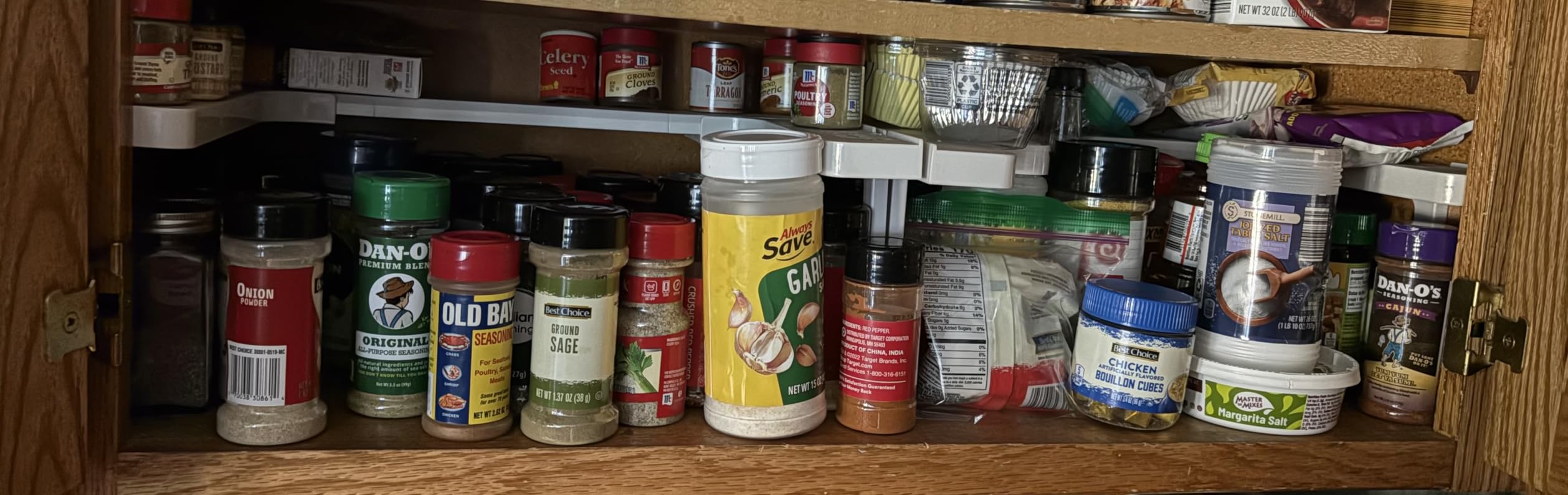
Two practical warnings from the reviews. The included screws are frequently too short for solid hardwood cabinet material, so have a longer box of screws ready before you start. And because the two tiers are linked, both extend at once, so you cannot reach the lower shelf on its own.
Mount height matters too. Installed low under a cooktop or island, the lower tier is hard to see into. Mount it where you can look down into the lower shelf rather than up into it.
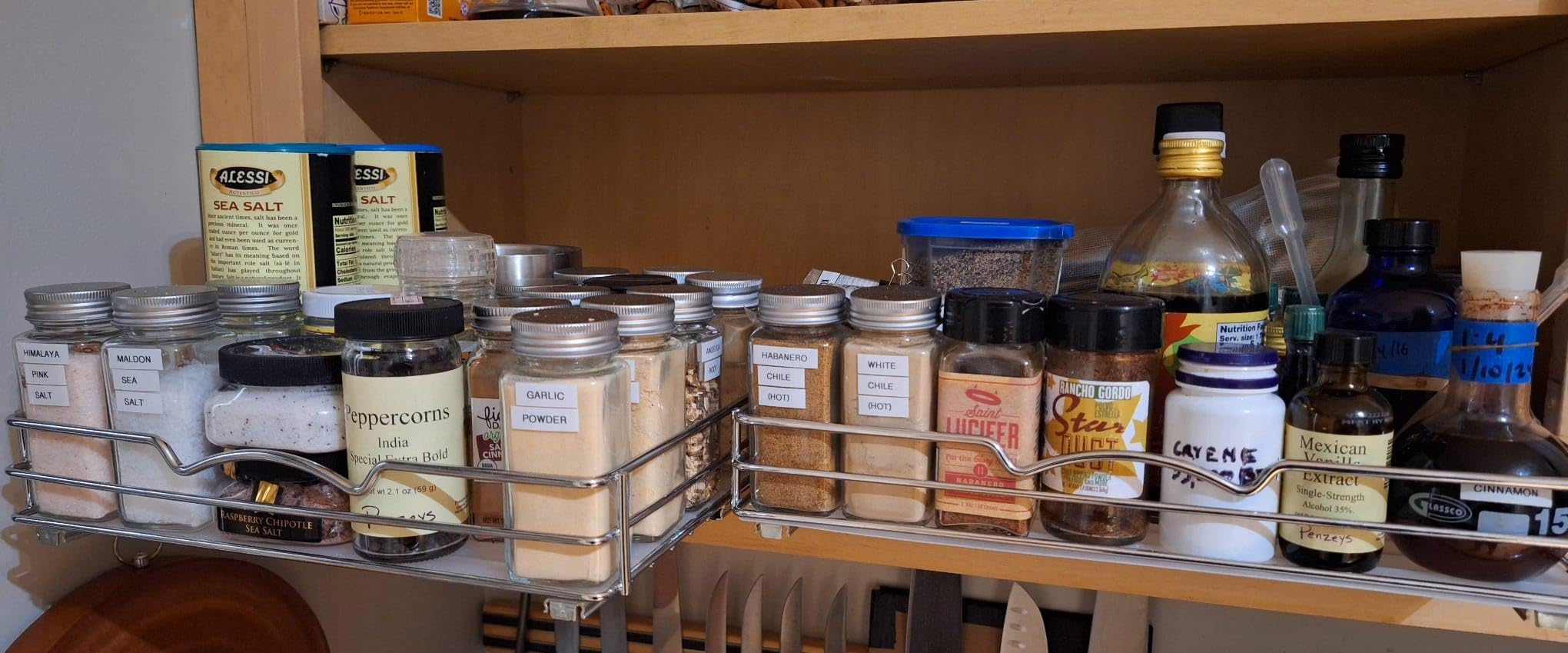
Matching a slide-out to your cabinet width
Slide-out racks come in a range of widths, commonly 10 to 18 inches, and the number that matters is the clear width between your cabinet walls. Measure at the front and at the back, because cabinets are rarely perfectly square.
A rack 2 inches narrower than the opening will rock, and a wider one will not install at all. A fixed-width rack is fine if you measure carefully, but an expandable one forgives a small error.
Where it falls short?
It requires four screws, so it is a permanent change and not a rental solution. The paired extension is the other limitation, since independent movement is genuinely useful when you only need the front row.
It is also a fixed-height rack with no tiers to add, so it does not adapt if your collection grows in a way that needs more levels rather than more width.
10. SpaceAid Pull Out 3-Drawer Organizer – Best for Labelled Spice Systems
SpaceAid Pull Out Spice Rack Organizer for Cabinet, Heavy Duty Slide Out Seasoning Kitchen Organizer, Cabinet Organizer, with Labels, 7.7″ W x10.75 D x10 H, 3 Drawers 2-Tier
2 tiers, 3 drawers
7.7 inch W x 10.75 inch D x 10 inch H
4 pounds
About 30 jars
Pros
- Three narrow drawers hold roughly 30 jars in a small footprint
- Full-extension glides do not drift open
- Every bottle visible when a drawer is pulled
- Label set included
Cons
- Drawers scrape the cabinet lip unless the base is shimmed
- Trays can feel loose once loaded
- Bottles shift in a wobbly unit
This is the most label-forward organizer here, and for a large collection that is the feature. Each of the three narrow drawers holds a column of bottles, so pulling one out reveals a full vertical slice of your spice inventory rather than the top of a row. Buyers with 30 or more spices tend to love it for that reason.
The glides have a slight built-in resistance, which is a design feature rather than a fault. A friction-free drawer drifts open on its own, so that resistance is what keeps the unit closed until you pull it.
There is a real installation detail. The drawers can catch on the cabinet lip at the front, and owners who shim the base slightly report that clears it. It is a five-minute fix but worth knowing before you mount it.
It also needs proper clearance: the manufacturer calls for roughly 7.7 inches wide by 10.75 inches deep by 10 inches high of empty cabinet. Check that space is genuinely empty, because this unit will not sit in a cabinet you still use for anything.
Why a labelling system changes how you cook?
A label set turns an organizer into a system. With the labels supplied here you can name every bottle by spice, by cuisine, or by heat level, and they mount on the drawer front where you read them at eye level.
That is what makes frequency-based organising possible. If the front drawer holds daily spices and the back holds holiday-only blends, you stop reading labels and reach for position instead, which is faster in a busy kitchen.
Where it falls short?
It occupies a large volume for what it stores. Thirty small jars do not need ten inches of height and nearly eleven of depth, and a shallower tiered shelf would hold the same bottles in less space.
The build is the loosest of the pull-outs we tested. Bottles shift in a tray that develops wobble, and a small number of buyers found a row leaning outward on arrival, so inspect it before loading it completely.
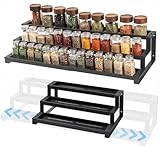
11. GOENDR 3-Tier Expandable Metal Rack – Best for Wide Cabinets
3-Tier Spice Rack Organizer for Kitchen Cabinet or Pantry, 16″-29″ Expandable Spice Organization Shelf, Seasoning Organizer, Metal Display Shelf, Slip-Resistant Design for Jars and Bottles, Black
3 tiers
Expands 16 to 29.5 inch
9.25 inch D x 5.5 inch H
Powder-coated steel
Pros
- Widest expansion range on this list
- Three tiers keep labels visible
- Powder-coated steel carries heavy loads
- Works in kitchens
- bathrooms
- pantries and garages
Cons
- Requires screw assembly
- 9.25 inch depth will not suit very deep cabinets
- Fixed tier height excludes very tall bottles
Most expandable racks cover 10 to 22 inches of width. This one extends from 16 to 29.5 inches, which puts it in a different category: a wide base cabinet, a pantry shelf, or a two-door run where a smaller rack would leave a third of the space empty.
The construction is powder-coated steel, so it carries far more than the plastic racks here. The stepped design keeps labels visible, and the slip-resistant shelf surface stops a bottle sliding when you pull a neighbour out.
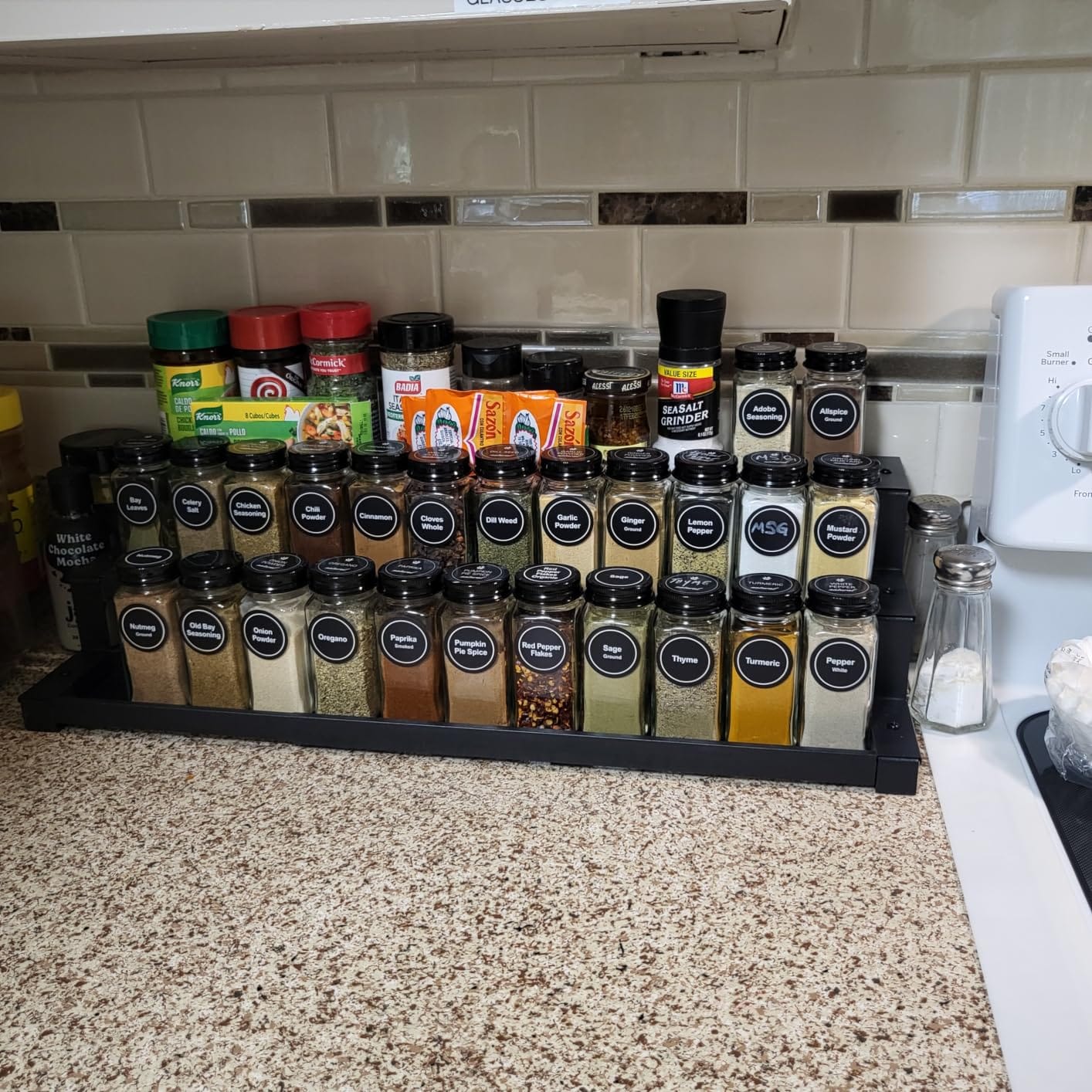
It is also the widest unit here, which makes it the natural fit for a pantry shelf or a two-door base cabinet run where a narrow rack would leave empty space on both sides. Screws and a stand are included, so it works freestanding out of the box as well as mounted.
Owners use it well beyond spices, since the same rack appears in bathrooms, home offices, and garages as a general tiered shelf.
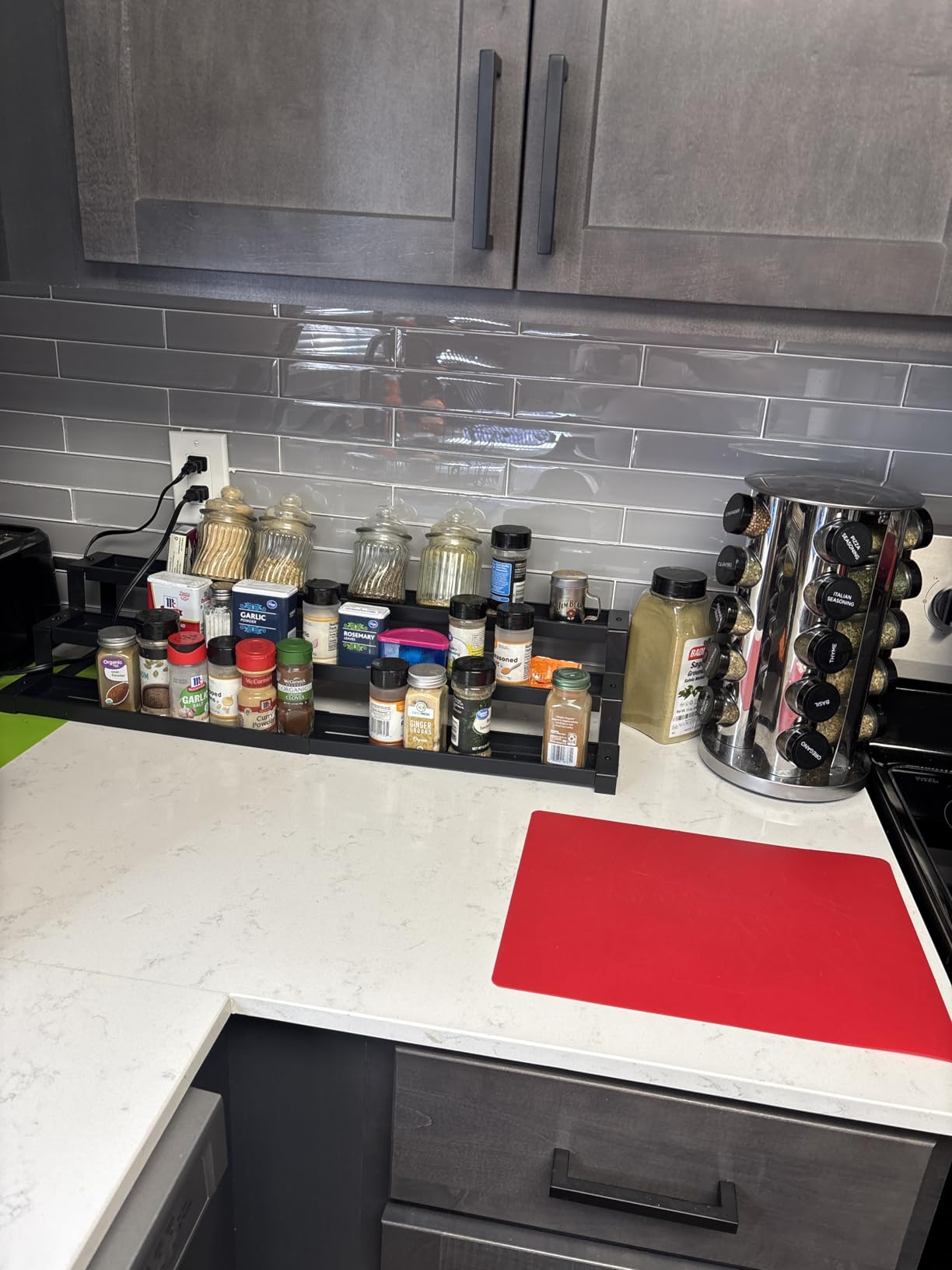
When one wide rack beats two narrow ones?
Two 12-inch racks in a 30-inch cabinet leave a gap and cost more than one wide rack. A single expandable unit sized to the opening uses the full width, keeps the tiers continuous, and looks tidier from the front.
The catch is that expansion means joints, and a very wide telescoping frame can develop a slight twist at the middle if you force the ends. Set it to the exact opening width rather than pushing it to the stops.
Where it falls short?
It is the only rack here needing screw assembly, so budget fifteen minutes and read the hardware list first. Having extra screws in the right length is cheap insurance.
At 9.25 inches deep it is a moderate depth, and the fixed tier spacing will not take very tall bottles. In a much deeper cabinet, that extra depth goes unused.
12. YAN & HIN Expandable 2-Pack – Best Two-Pack for Multiple Cabinets
YAN & HIN Expandable Spice Rack Organizer for Cabinet (2 Pack), 3-Tier Tiered Spice Shelf Organizer with Non-Skid Surface, Spice Riser, Adjustable Pantry Organizer for Spices, Cans & Medicine Cabinet
2 racks
9.5 inch D x 17.8 inch W x 4.3 inch H
Expands 9.5 to 17 inch
Tool-free setup
Pros
- Two racks cover two cabinets at once
- No assembly
- expands by hand
- Non-skid surface keeps bottles secure
- Lightweight and easy to move
Cons
- Plastic construction less rigid than metal
- Less suited to large bulk spice jars
- Fixed tier spacing excludes very tall bottles
Most kitchens do not have one spice problem, they have two: a base cabinet and an upper cabinet, or two different rooms. This two-pack solves both with expandable shelves running from 9.5 to 17 inches, so one rack fits a narrow upper cabinet and the other fits a wider base cabinet.
There is no assembly at all. The shelves expand by hand, the fastest setup on this list, and the non-skid textured surface keeps bottles from migrating. In a rental or a kitchen that gets rearranged, tool-free setup matters.
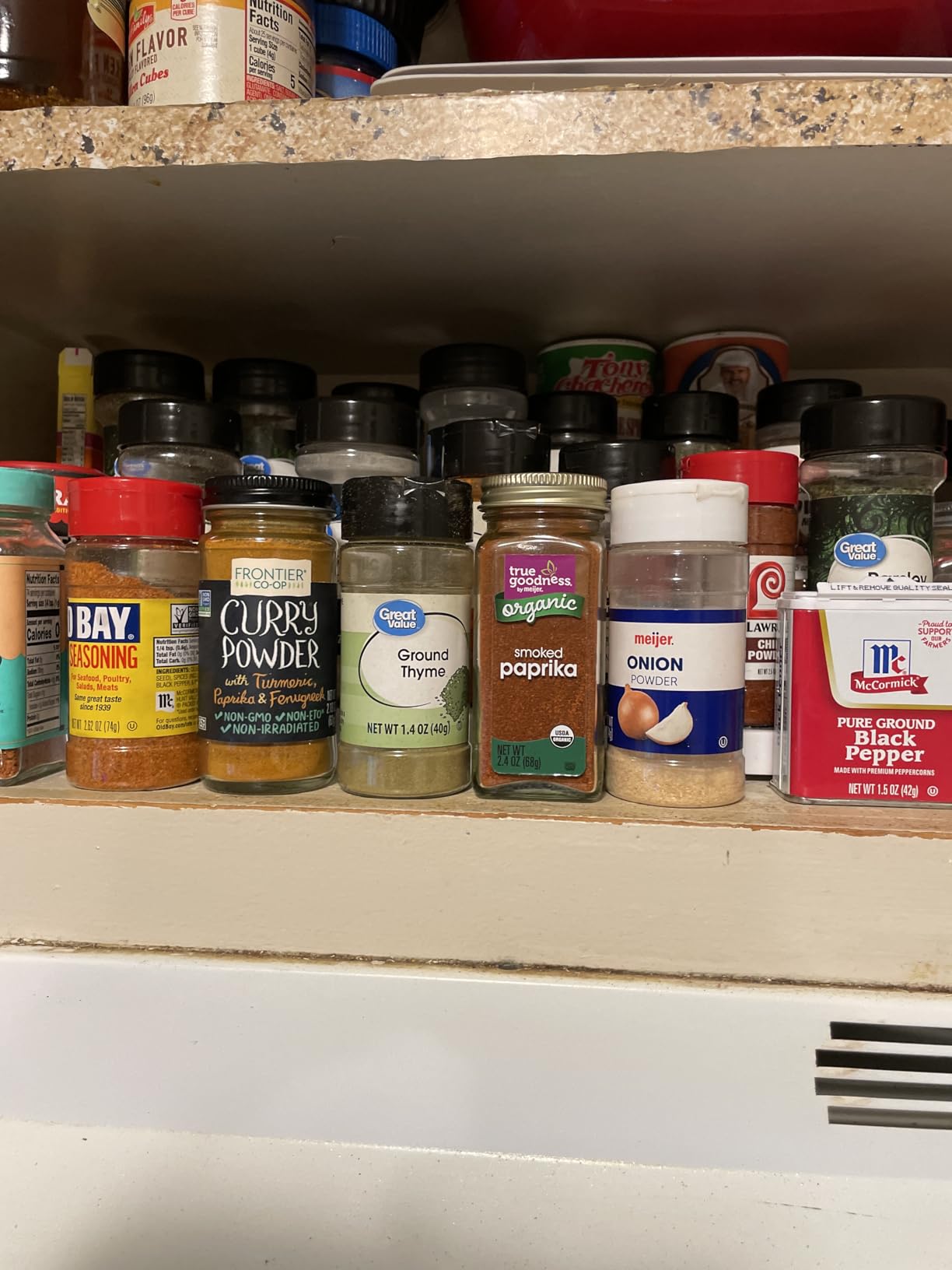
Reviews describe it as a strong fit for small and awkward cabinet spaces, which is exactly the gap the bigger racks leave. Two lightweight racks you can lift with one hand are also far easier to reposition when you want the counter space back.
Beyond spices, owners use it for vitamins, medications, and cans, so it functions as a general riser rather than a specialist product. That versatility is what makes a two-pack a better buy than a single large rack when your storage needs are split.
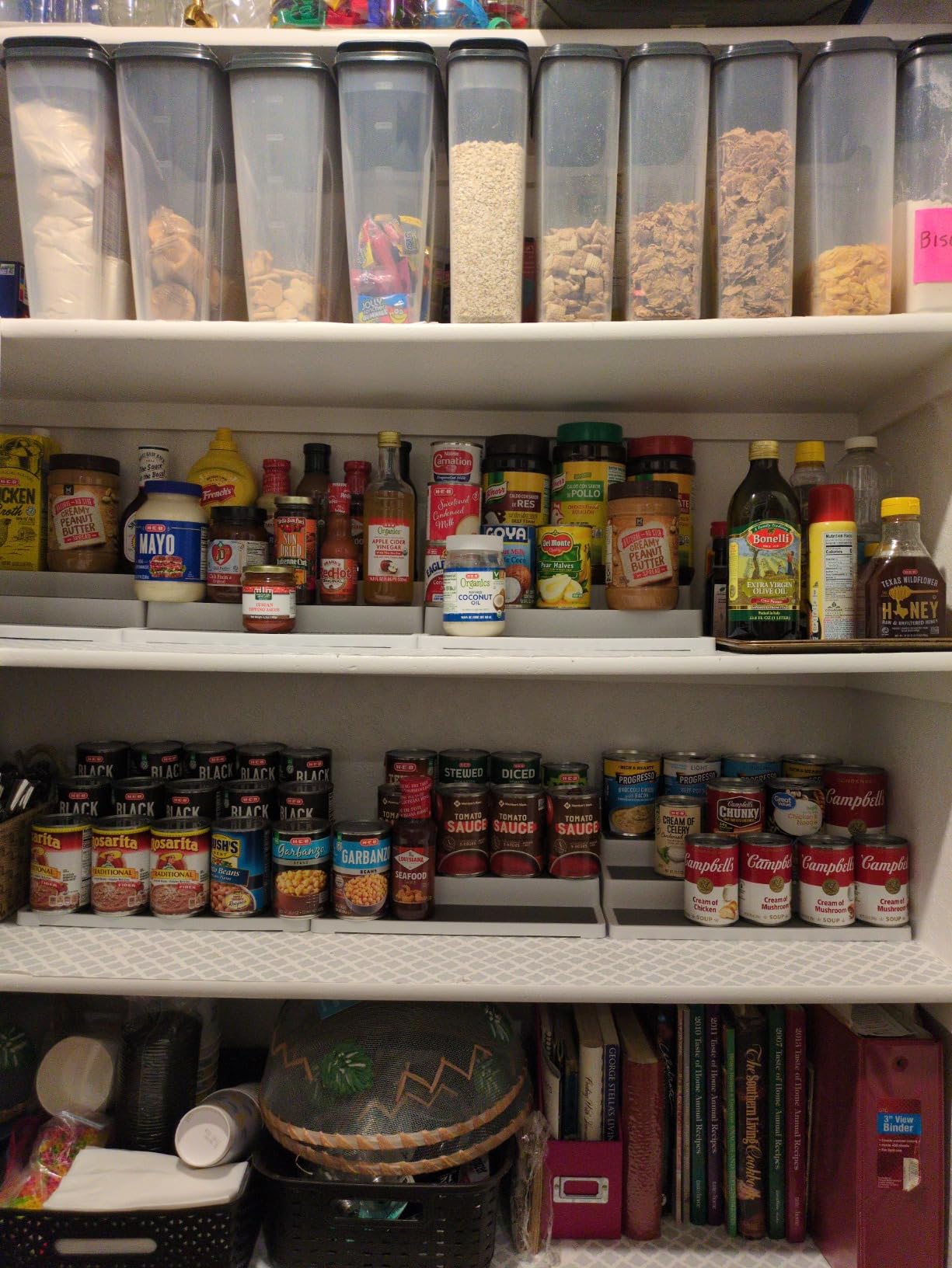
When a two-pack is the smarter purchase?
Count your cabinets before buying a single rack. If two separate cupboards need spices, a two-pack costs less than two singles, arrives in one delivery, and gives you matching racks instead of two that look unrelated.
Two-packs also make sense as spares. A lightweight plastic rack that gets knocked can be replaced without a second order, and it takes very little room to store over a summer when the spices live on the counter.
Where it falls short?
Plastic is less rigid than the steel and bamboo options, and the fixed tier spacing means tall bottles and large bulk jars will not sit properly. Reviewers who expected a heavy-duty pantry rack are the ones who send it back.
At 4.3 inches tall it adds less vertical height than the taller racks, so it multiplies what fits in a footprint rather than adding storage above it.
How to Measure Your Cabinet Before You Buy?
Nearly every disappointment with a cabinet spice organizer comes down to a measurement never taken. It takes about ninety seconds, and it decides whether a rack lives in your cabinet or in a return pile.
Measure three numbers, at both the front and the back of the cabinet. First, the clear width between the cabinet walls, read at the narrowest point. Second, the clear depth from the cabinet face to the back wall. Third, the clear height from the cabinet floor to the underside of the shelf above, which is the number people most often forget.
Keep the smaller of the two readings you take. Cabinets are frequently wider at the front than at the back, and a fixed-width rack that fits the front opening can still foul the back wall as you slide it in.
For an expandable rack, the collapsed width matters more than the expanded width, because the collapsed size has to clear the cabinet sides as you angle it in. For a fixed-width rack, the largest opening matters, since that is the space you want to fill.
For a pull-out, allow installation clearance rather than just the rack dimensions. A 10-inch-deep rack in a 10-inch-deep cabinet works only if you are happy for the shelf to project beyond the door line. Mounted racks also need the cabinet fully cleared first.
Finally, decide what you are storing before you measure, because depth requirements change everything. Standard 4-ounce spice jars need about 4 inches of depth. Bulk spice containers, oil bottles, and tall vanilla extract need 8 inches or more, and a shallow step shelf will not hold them upright.
Buying Guide: 7 Factors That Decide the Fit
1. Tiered step shelf, slide-out, drop-down, or turntable
Choose a tiered step shelf when you want three rows of labels visible at once with no mechanism to break. Choose a slide-out when the cabinet is deep and the back row is genuinely unreachable, and accept that it needs screws. Choose a drop-down system when you cannot drill, or when you want a counter-height view while cooking.
Choose a rotating turntable for a corner cabinet, a round opening, or a cabinet deeper than about 18 inches. Each format fails in a specific case: a step shelf wastes deep space, a slide-out needs mounting, a drop-down needs clearance in front, and a turntable loses the corners to its own diameter.
2. Deep cabinets versus shallow upper cabinets
This split decides most purchases. A deep base cabinet rewards a pull-out or turntable, because the point is reclaiming depth that a static shelf throws away. A shallow upper cabinet rewards a step shelf, drop-down, or expandable riser, because you are adding vertical tiers inside a small volume rather than pulling anything forward.
Rule of thumb: measure depth first, and if the answer is under 8 inches, avoid any design needing front-to-back clearance for a second row. If it is over 18 inches, a pull-out pays for itself immediately.
3. Original jars or uniform jars
This is the decision most people get stuck on. Keeping original jars means no decanting, no wasted spice, and no risk of mislabelling, and it preserves the sentiment people attach to jars bought in a specific shop or on a specific trip. It also restricts you to organizers that accept mixed sizes, which is most tiered shelves and almost no drawer system.
Moving to uniform jars, including ones that ship with a drawer organizer, gives consistent dividers, consistent label placement, and a much neater drawer. You pay with a decanting session and the loss of original packaging. Uniform jars win in a drawer-based organizer, original jars win in a tiered shelf, and there is no wrong answer beyond that.
4. Organise by frequency, name, or cuisine
Frequency is fastest for a working cook. Put daily spices at eye level or in the front row, weekly ones in the middle, and baking or holiday blends at the back or in a separate cabinet. You stop reading labels and reach for position instead.
Alphabetical is tidier and easier for a second cook or a guest to navigate, but too many spices beginning with the same letter crowd one section. Grouping by cuisine, with an Italian section, an Asian section, and a baking section, is the compromise most people settle on and works well with drawer systems that have labelled fronts.
5. Installation and whether you rent
No-drill is not optional if you rent, and it is why drop-down systems and riser shelves exist. Mounted pull-outs use two to four screws and are a permanent change, but they are the only format that reliably turns unusable depth into reachable storage.
If you do drill, use screws longer than the ones supplied, especially in hardwood or plywood, and shim the base if drawers catch on the cabinet lip. A piece of cardboard under one corner is a legitimate fix and takes a minute.
6. Material, load rating, and humidity
Plastic is right for standard spice jars in a dry cabinet and is easiest to wipe clean. Steel wire and powder-coated steel carry the heaviest loads and resist humidity, which matters in a humid kitchen or a cabinet near the stovetop. Engineered wood suits bulk bottles and looks like furniture, but must stay away from standing water.
Bamboo sits between the two, rigid and moisture-tolerant, and needs a wipe rather than a wash. Clear acrylic is best when visibility matters more than strength. Whatever you choose, check the per-shelf rating against what you will actually load, because a bowed shelf is the failure that shows up after a month.
7. Cleaning, dust, and long-term upkeep
Anything in a cabinet collects seasoning dust and oil film, and a textured surface holds more than a smooth one. Wipe-clean plastic and acrylic are easiest to maintain, and full-extension glides that stay level under load, as offered on the steel slide-outs, are the most useful long-term feature.
Plan on a two-minute wipe-down every few months, and keep natural materials out of the dishwasher. If you want the counter clear, our guide to tiered spice rack organizers covers freestanding options in more depth, and magnetic spice jar storage is worth a look if cabinet space is genuinely exhausted.
One last practical note. If you grind your own spices regularly, an organizer is the natural companion to a dedicated grinder, and our picks for electric spice grinders cover the tools that make refilling those jars quick.
Frequently Asked Questions
What is the best way to store spices in a cabinet?
Use a tiered step shelf for shallow cabinets so all three rows stay visible, and a pull-out slide-out rack for deep cabinets so the back row comes to you. Measure the clear width, depth, and height before buying, and put daily spices at eye level or in the front row.
What is a good spice rack cabinet organizer?
A good cabinet spice organizer matches the cabinet depth and holds mixed jar sizes. Good picks include the Copco 3-Tier step shelf for shallow cabinets, the LYNK PROFESSIONAL slide-out for narrow deep cabinets, and the YouCopia SpiceStack if you cannot drill.
What is the best pull-out spice rack organizer for cabinets?
The LYNK PROFESSIONAL pull-out is the best fit for narrow cabinets because it is only 4.3 inches wide and rides on ball-bearing glides that stay level when loaded. It installs with two screws at the back of the cabinet. For wider cabinets the HOLDN’ STORAGE rack carries more per shelf.
Which spice drawer organizer is the best rated?
Among the drawer and pull-out systems we rated, the HOLDN’ STORAGE steel pull-out holds the highest average rating at 4.8, followed by the YouCopia SpiceStack and the SpaceAid three-drawer organizer, both rated 4.6. Ratings reflect owner satisfaction rather than lab testing.
Is it better to store spices in glass or plastic containers?
Glass keeps spices fresher for longer because it blocks light and does not absorb oils, and it lets you see the product. Plastic containers are lighter and safer if dropped. If you keep original glass jars, choose a tiered shelf that accepts mixed sizes rather than a drawer with fixed dividers.
How do I measure my cabinet for a spice rack?
Measure the clear width between cabinet walls, the clear depth from the face to the back wall, and the clear height from the cabinet floor to the shelf above. Take each measurement at the front and the back, and use the smaller figure. For pull-outs, allow extra clearance in front for the shelf to extend.
Conclusion
After testing all 12, the best spice organizers for cabinets split by cabinet type rather than by price. For a standard cabinet with mixed jars, the Copco 3-Tier remains the single best recommendation, backed by more owner reviews than anything else we looked at and a footprint small enough to hide at the front.
For a deep base cabinet where the back row is wasted space, the LYNK PROFESSIONAL pull-out converts that depth into reach, and the HOLDN’ STORAGE rack does the same job with more capacity in a wider cabinet. If you cannot drill, the YouCopia SpiceStack is the answer, and the LAMU turntable covers corner and round openings nothing else fits.
Measure first, then buy for the format your cabinet rewards. Everything after that is preference, and no shelf fixes a cabinet that was never measured.