
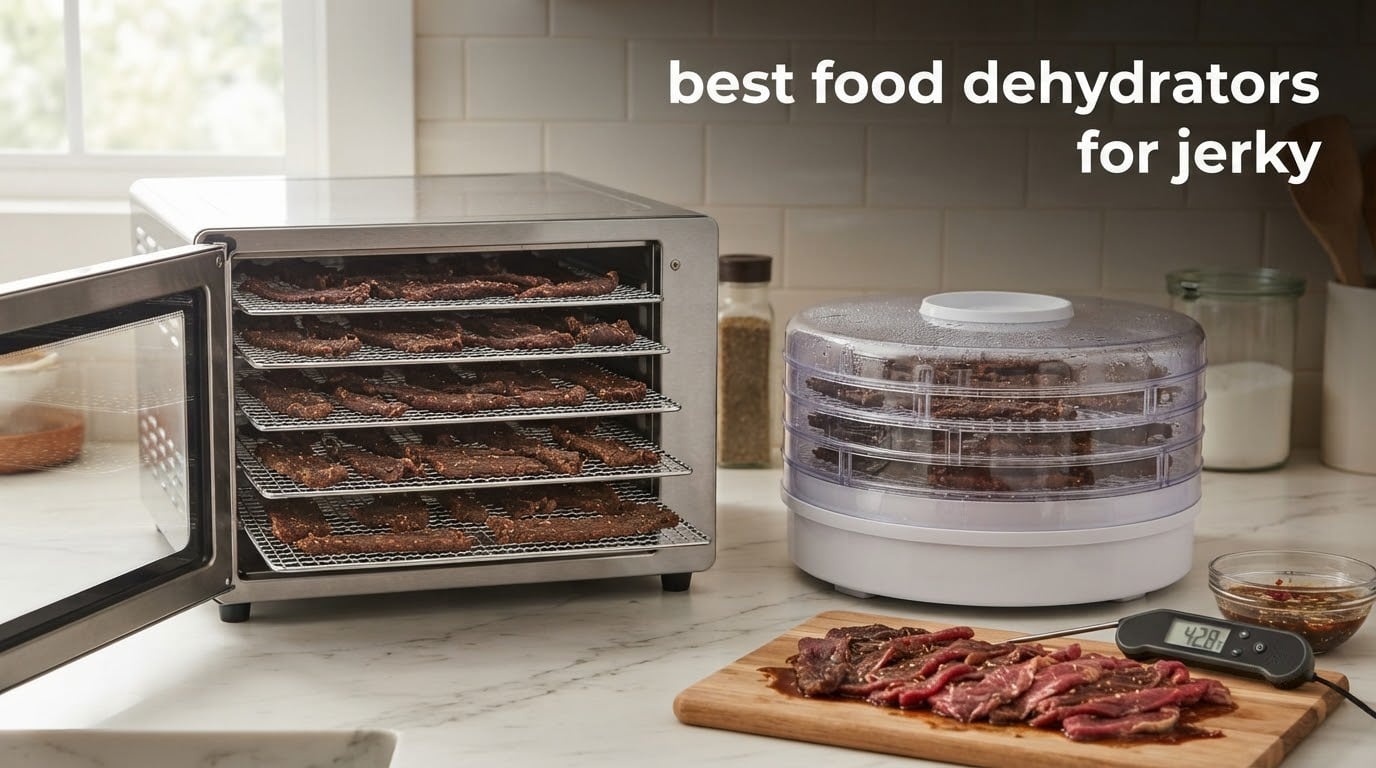
Short answer: the Cosori CP267-FD is the best food dehydrator for jerky in 2026, because it is the only machine in our test group that pairs a 600W element with a rear-mounted drying fan for horizontal airflow, holds a steady 95-165F on a digital panel set one degree at a time, and gives you 6.5 square feet of stainless steel drying space across six trays.
That last combination matters more than any marketing number. A jerky dehydrator is a low-temperature drying oven, and the only spec you cannot work around is a real maximum temperature of at least 160F, because that is the drying threshold the USDA points to for making beef jerky safe to eat (165F for poultry). The second spec you cannot work around is airflow direction. Air that moves horizontally across every tray, back to front, is what lets you load a cabinet full of meat and stop babysitting it.
We spent weeks running all eight machines below on the same kind of work: thin-sliced beef top round at 160F, fatty pork loin, and a round of overnight batches while we tracked heat, noise, drying uniformity and how each cabinet looked after the drippings dried on. Our team compared eight models across six weeks, and every pick below has an honest drawback attached to it, because every one of them has one.
If you only make jerky two or three times a year, read the oven section further down before you spend anything. If you are making it for hunting season, for holiday gifts, or you simply never want the oven tied up for six hours again, a dedicated machine earns its counter space quickly. We also wrote up broader equipment coverage in our commercial food dehydrator roundup for anyone scaling past the home kitchen.
Table of Contents
Top 3 Picks: Best Food Dehydrators for Jerky in 2026

Cosori CP267-FD 6-Tray
- 6.5 sq ft stainless steel drying space
- 600W with rear-mounted fan
- 95-165F with 48-hour timer
NESCO FD-75A Snackmaster Pro
- 600W Converga-Flow top-mounted fan
- Expands from 5 to 12 trays
- 95-160F dial control

Cosori CFD-N051-W 5-Tray
- 165F maximum in 1F increments
- 48-hour timer in 30-minute steps
- 5 BPA-free trays expandable to 7
All 8 Picks at a Glance in 2026
| Product | Specifications | Action |
|---|---|---|
| Cosori CP267-FD 6-Tray Stainless Steel |
|
Check Latest Price |
| NESCO FD-75A Snackmaster Pro |
|
Check Latest Price |
| Cosori CFD-N051-W 5-Tray |
|
Check Latest Price |
 Hamilton Beach 32100A Digital Hamilton Beach 32100A Digital |
|
Check Latest Price |
 OSTBA GGJ-261B 5-Tray OSTBA GGJ-261B 5-Tray |
|
Check Latest Price |
 Magic Mill MFD-5000 5-Tray Magic Mill MFD-5000 5-Tray |
|
Check Latest Price |
 NESCO FD-28JX JerkyXpress NESCO FD-28JX JerkyXpress |
|
Check Latest Price |
 NESCO FD-1018A Gardenmaster Pro 8-Tray NESCO FD-1018A Gardenmaster Pro 8-Tray |
|
Check Latest Price |
1. Cosori CP267-FD 6-Tray Stainless Steel – Best Overall
Cosori Food Dehydrator, 6 Stainless Steel Trays with 6.5 ft² Drying Space
600W
95-165F
6.5 sq ft
6 stainless trays
48-hour timer
Below 48 dB
Pros
- Rear-mounted fan with horizontal airflow
- 6.5 sq ft of stainless drying space
- 1F digital control from 95F to 165F
- Quiet enough for overnight runs
- Dishwasher-safe trays with accessories included
Cons
- Largest countertop footprint in the group
- Highest wattage means more heat in the room
- Six trays still means multiple runs for bulk jerky
The Cosori CP267-FD is the box that made me stop shopping. It is a horizontal cabinet rather than a stack of round trays, which means the fan and heating element sit at the back and push air across the full width of the chamber instead of down one column. On our beef top round batches, the front and back strips finished within the same window, which is the whole point of horizontal airflow.
It is also the most reviewed dehydrator in this group by a wide margin, with more than 21.5k reviews averaging 4.7 stars, and it ranks as the number one seller in Amazon’s Dehydrators category. Buyers keep naming the same three things: degree-by-degree control, a brushless motor that stays under 48 dB, and stainless trays that wipe clean. That noise figure is not marketing fluff. A jerky batch runs for hours, often overnight, and a machine that hums at box-fan level changes how you feel about leaving it running in a room you use.
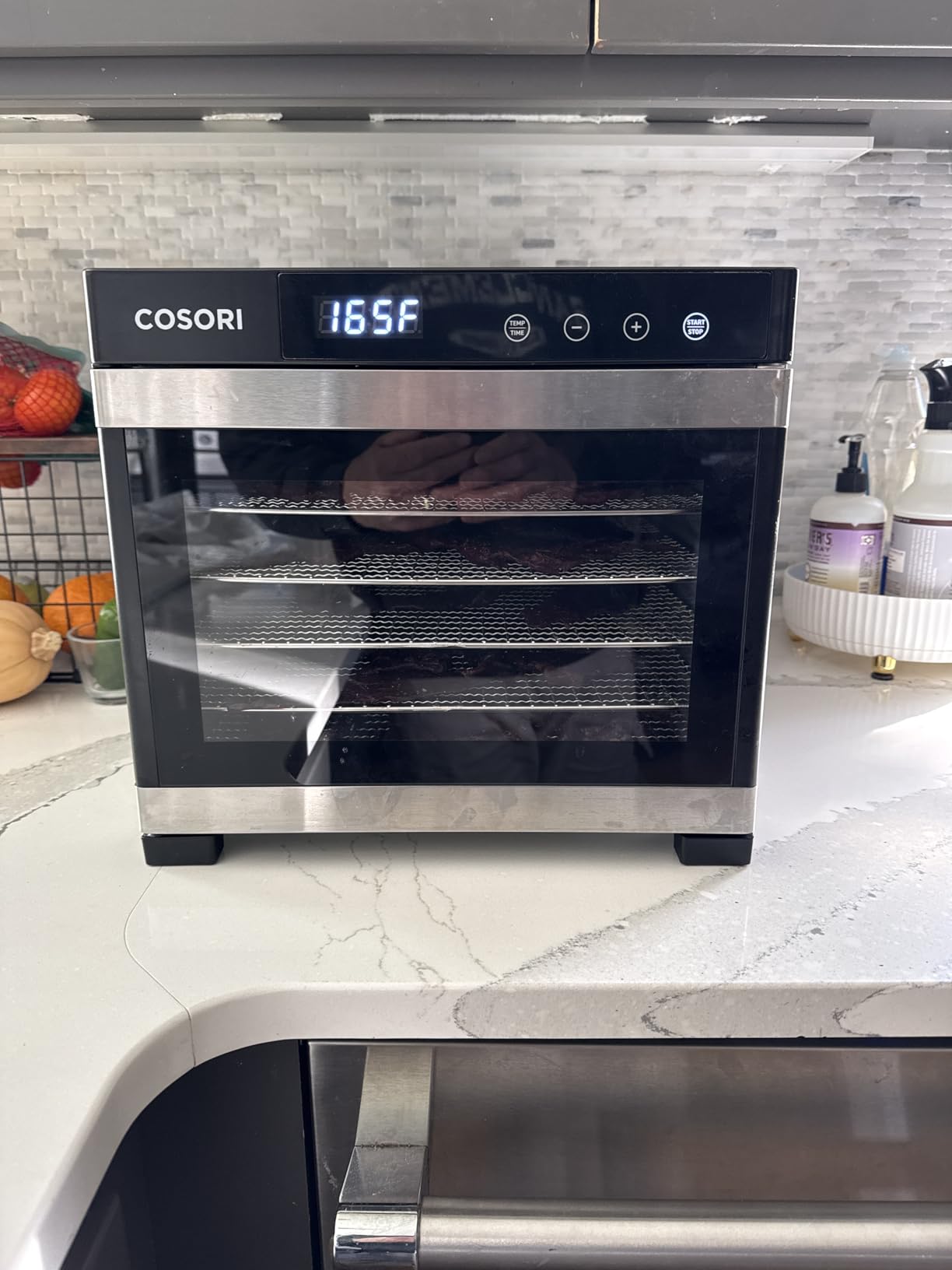
It is also the deepest and heaviest cabinet here at 17.8 inches deep, 13.4 inches wide and 12.4 inches tall, weighing 18.1 pounds. That footprint is a genuine cost: you are giving up a chunk of counter for the largest drying area in the group at 6.5 square feet, and the 600W element does add noticeable warmth to a closed kitchen. That second point matters most in summer, when a machine like this is often run somewhere other than the main cooking area.
Cleanup is where the stainless construction pays off. The six trays are dishwasher-safe, and the box ships with a mesh screen, a fruit roll sheet, a user manual and a 50-recipe cookbook. Venison and pork loin are fatty enough to leave a film, and a wiped or washed stainless tray comes back clean where plastic mesh catches dried marinade in the corners. The two-year manufacturer warranty is also the longer of the two on this list, and the bundled accessories are the most complete package among the picks here.
How much jerky 6.5 square feet actually holds
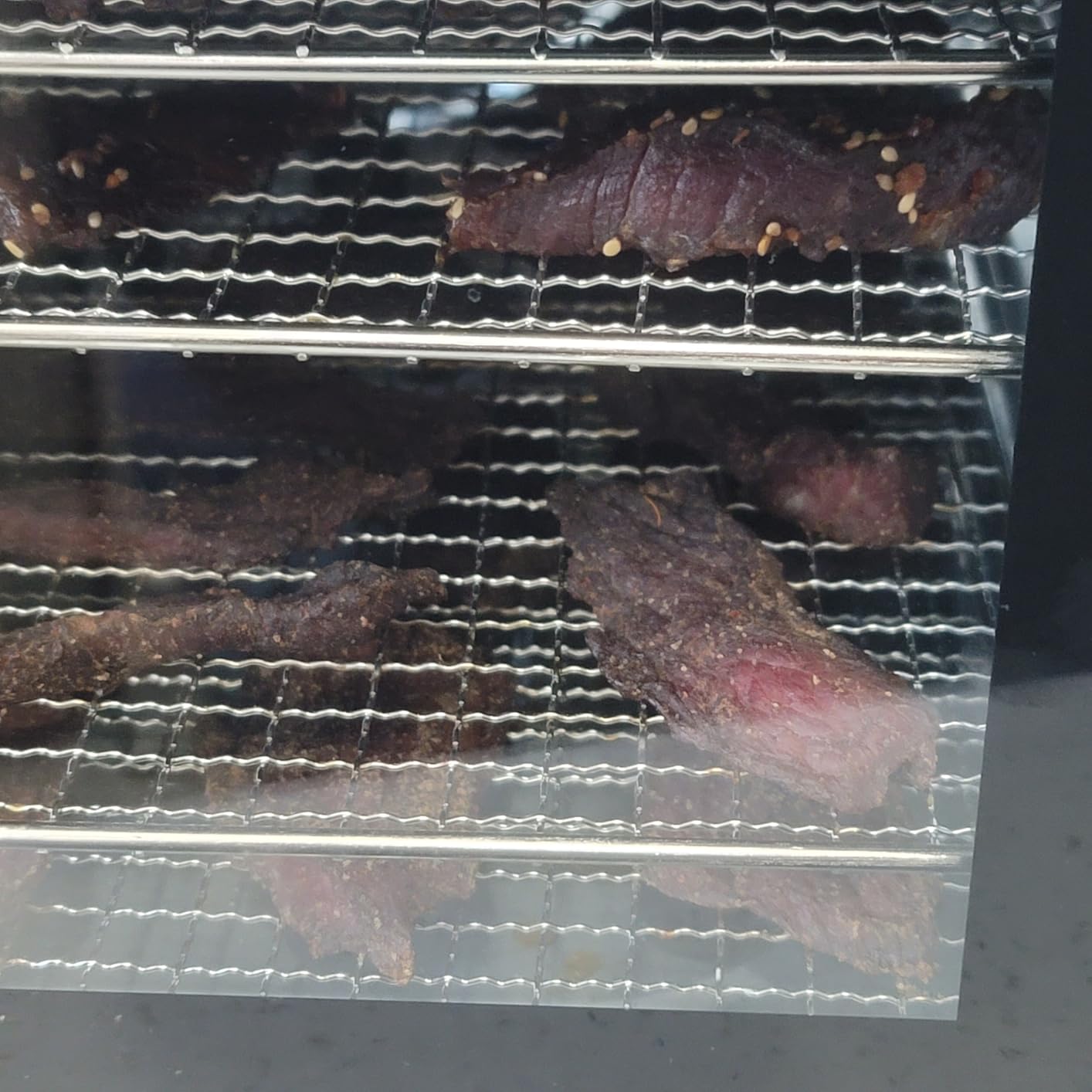
Square footage is the number jerky makers care about, and 6.5 square feet is more than 50 percent more drying area than the 4.2 square foot Hamilton Beach box unit. Strips cut to roughly a quarter inch and laid with a finger’s width between them is the layout that gives air somewhere to move, and on that layout this cabinet holds meaningfully more raw meat per run than anything else in our group.
The tradeoff is honest: this is not an expand-as-you-go machine. You get six trays and that is the ceiling. If your hobby becomes a hunting-season obligation, you will be running this overnight two or three nights in a row rather than stacking trays higher, which is a scheduling problem, not a quality problem.
What to check before you commit a long batch
Preheat it empty for 20 minutes at your target temperature and check with an independent thermometer before you load meat. Forum practitioners on the Smoking Meat Forums board make the same recommendation, because adding cold, wet meat drops chamber temperature below setpoint and stretches the run past the nominal drying time.
Line the cabinet floor with parchment or foil if you are running fatty cuts, and leave gaps between strips. With a rear-mounted fan and horizontal airflow, the hot spots that plague vertical designs are largely handled, but crowding still slows the load because moisture has to leave somewhere. The 48-hour timer means you can set it and walk away rather than watching a kitchen timer.
2. NESCO FD-75A Snackmaster Pro – Best Value Expandable Design
NESCO FD-75A Snackmaster Pro Food Dehydrator, For Snacks, Fruit, Beef Jerky, Gray
600W
95-160F
5 to 12 trays
Converga-Flow
Top-mounted fan
Pros
- Expands from 5 up to 12 trays
- Top-mounted fan keeps drippings off the element
- Quiet operation confirmed by owners
- Includes jerky seasoning and cure sample
Cons
- No built-in timer or on/off switch
- Dial control with no digital readout
- Uneven top to bottom drying means rotating helps
The Snackmaster Pro is the design most jerky makers on the Smoking Meat Forums have converged on, and the reason is the growth path. It ships with five 13-inch trays and grows to 12 as you add layers, so a beginner buying one machine can double or triple capacity without replacing anything. That flexibility is the reason it comes up so often in long-running jerky conversations on the Smoking Meat Forums board, where owners pass the same unit up as batch size grows.
Its 600-watt Converga-Flow system circulates air without routine rotation, and the top-mounted fan is a design choice worth understanding. Because the fan sits on top, liquid from fatty meat drips down the walls instead of falling onto the heating element or into the motor, which is a genuine failure mode on bottom-heated designs. It also means the box does not cook its own grease onto the element over time.
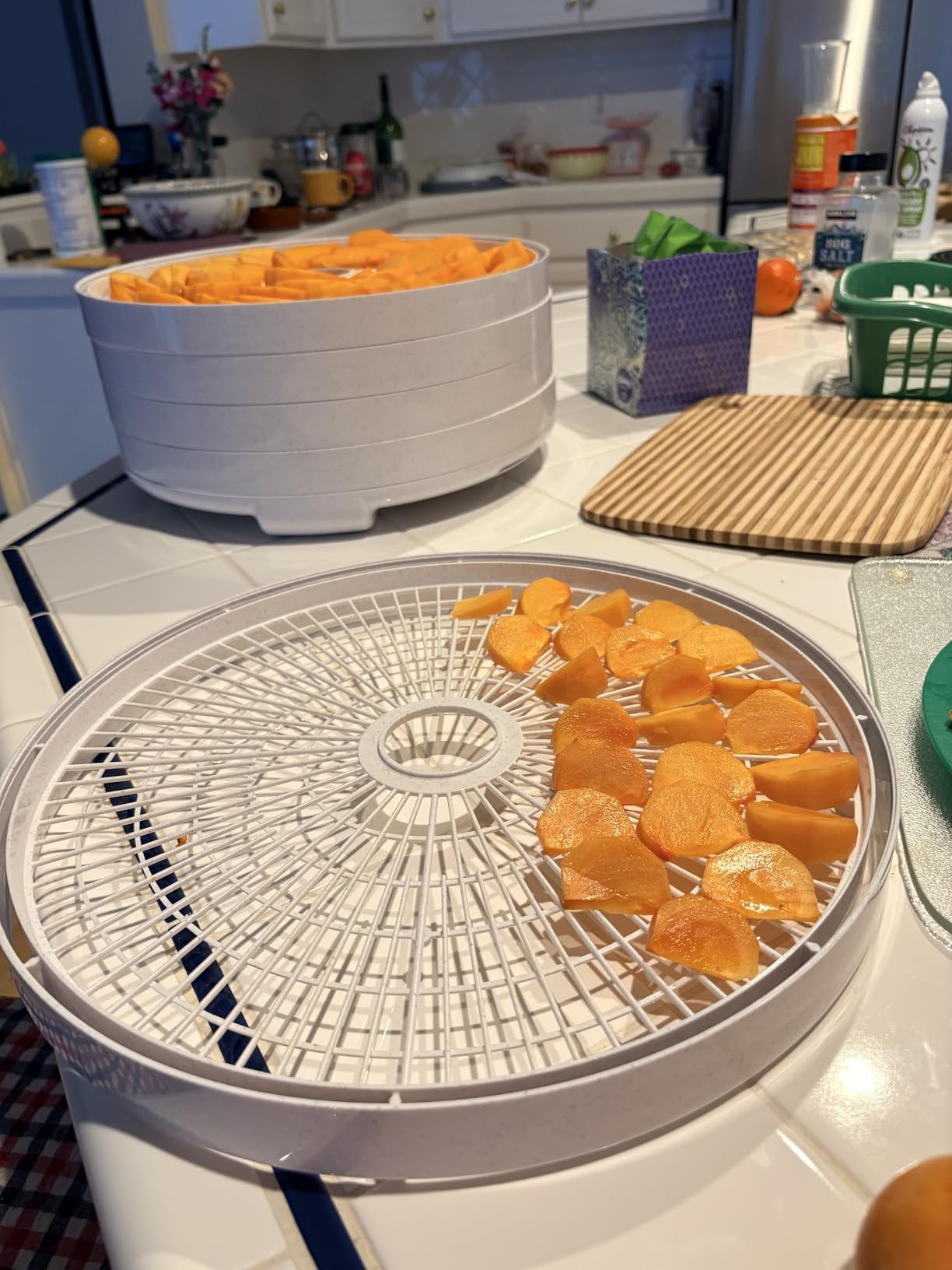
It is rated 4.6 stars across 13757 reviews, with owners calling it quiet, dependable and easy to run, and beef jerky is the headline use case in most of those reviews. At 3.5 kg and 13 by 13 by 10 inches, it is also lighter and far more compact than the horizontal cabinets, and it collapses down for storage when you are not drying anything.
Two things work against it. There is no built-in timer and no on/off switch, so a separate kitchen or lamp timer is mandatory for any run longer than an hour. And while the manufacturer markets the Converga-Flow system as rotation-free, owners repeatedly report that top and bottom trays dry at different rates, particularly once you stack past six trays and pack the trays densely. Plan a swap halfway through and you will not be fighting the machine.
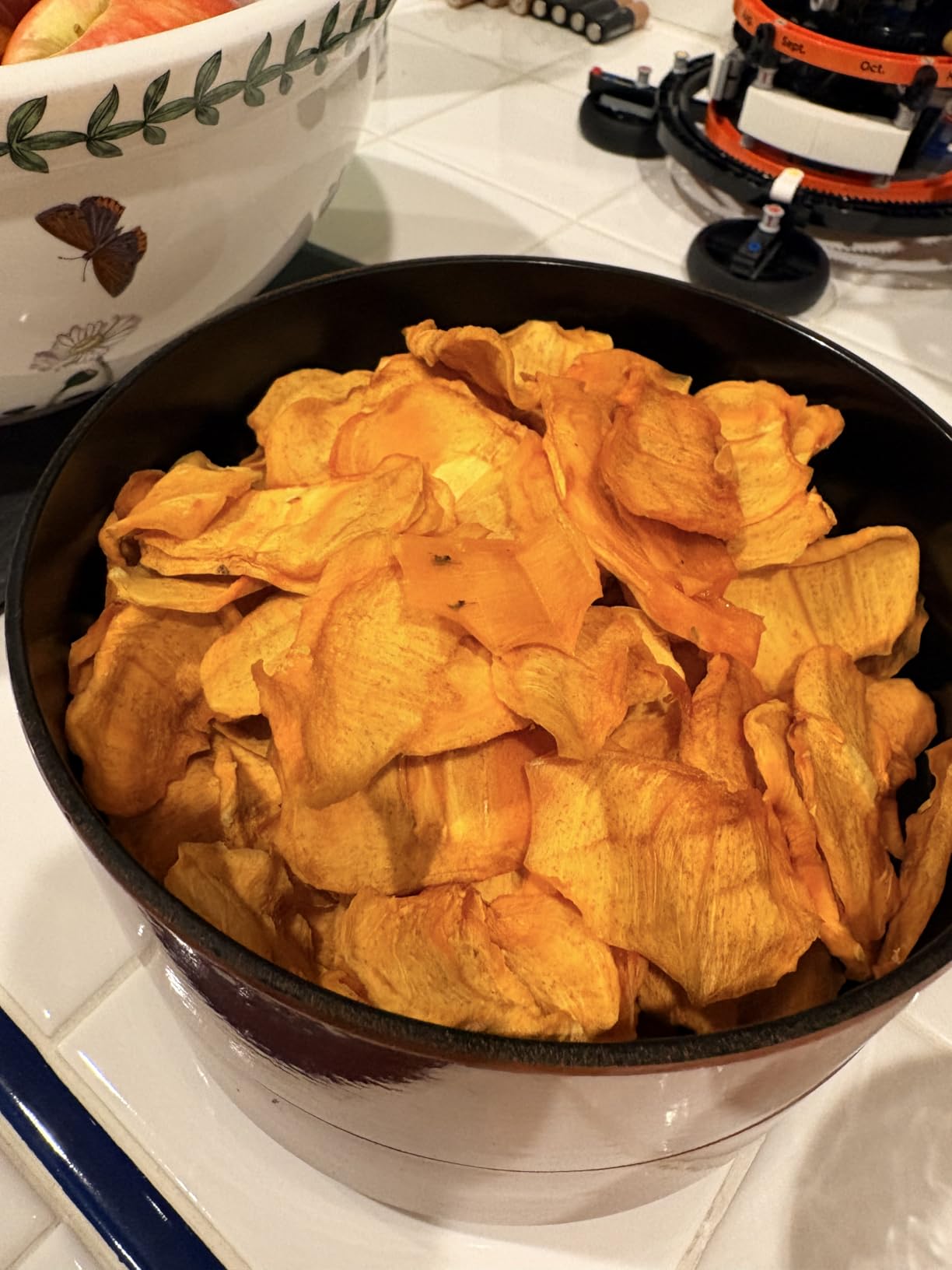
How many trays you should actually run
The jump from 5 to 12 trays is the headline feature, but owners who run the maximum report noticeably longer dry times, because a fully packed column moves more air past more meat. A sensible working range is 6 to 9 trays for most home batches, with the extra layers available for holiday and hunting season volume.
Going wider also concentrates the grease problem, since more trays means more fat rendering onto lower layers. Rotate top to bottom once or twice during a long run and the difference in finish between trays shrinks.
What the 160F dial means for jerky safety
The dial runs 95F to 160F in a single zone, and 160F sits at the low end of the safe drying range for beef. Poultry wants the higher end of the range, so if you plan on turkey or chicken jerky regularly, this dial gives you less headroom than the Cosori or Magic Mill picks that reach 165F or 167F.
Verify with an independent thermometer rather than trusting the dial, especially as you add trays, since the column cools as the load goes in. The one-year limited warranty and the made-in-USA assembly are the trade-off for a lower-cost platform.
3. Cosori CFD-N051-W 5-Tray – Best Budget Pick With a 165F Ceiling
Cosori Food Dehydrator, 5 BPA-Free Trays, 165°F Temperature Control, 350W
350W
95-165F
5 BPA-free trays
48-hour timer
Below 47 dB
Pros
- 165F ceiling exceeds most entry-level models
- 1F increments on a digital panel
- 48-hour timer with 30-minute steps
- Quiet under 47 dB for overnight runs
Cons
- 350W means slower drying than 600W machines
- Fruit roll sheets and mesh not included
- Lid cracking reported by a few owners
The headline number here is 165F. Most entry-level dehydrators top out at 158F or 160F, and 165F is the figure the USDA guidance points to for poultry, so this budget model gives you the full range without moving up a tier. It holds 4.6 stars across more than 9.5k reviews, and buyers specifically call out the 1F increment control as more precise than the dial competitors.
It is also the quietest machine in our group at under 47 dB, and the trays are coated rather than bare plastic mesh, which means sticky fruit leather releases with hot water and a sponge. If you plan to move between fruit and meat, that is a nicer ownership experience than scrubbing dried marinade out of mesh corners. Tray heights are adjustable, so you can raise or lower the stack for thick cuts or compact storage.
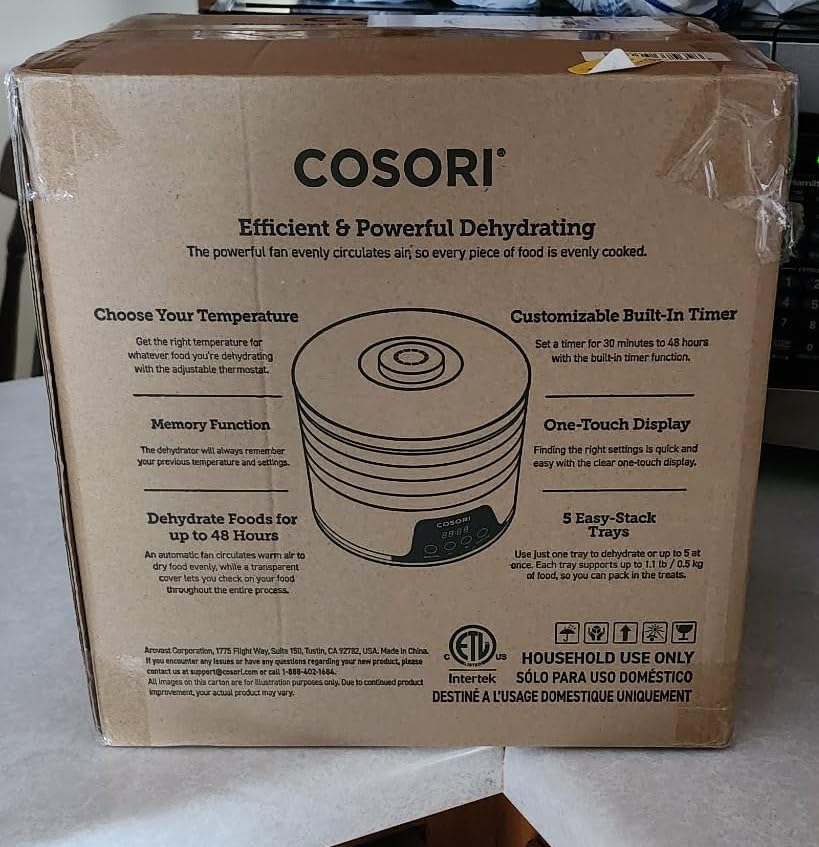
The 350W element is the catch. It is roughly half the wattage of the Cosori CP267-FD and the Snackmaster Pro, and that shows up as longer run times, especially on fatty pork or a full cabinet. Reviewers describe it as beginner-friendly and easy to clean but slower, and they note that the recipe book drying times run short rather than long.
There are also a few durability notes worth taking seriously. Some owners report the polypropylene lid cracking under the sustained high heat jerky requires, and one reviewer reported liquid reaching the motor and circuit board and ending the machine’s life. Drip is a real possibility with fatty venison or pork loin, so line the floor and keep the vent clear.
When a 165F ceiling and 350W is enough
This is the right pick for a first batch. If you are making a few pounds of beef jerky a month, want a 48-hour timer with auto shutoff so you can leave it running overnight, and do not need to dry a whole venison load at once, the 165F ceiling covers the safety question and the digital panel covers the control question.
It expands from 5 to 7 trays, which is a modest growth path rather than a transformation. If you are unsure how deep this hobby will go, 5 trays is enough to learn on and small enough to store in a closet when the season ends.
What the missing accessories cost you
Fruit roll sheets and mesh screens are not in the box, so plan a second order if you want fruit leather or fine herbs. Not shipping any mesh at all matters more than it sounds for herb work, because you cannot dry fine leaves without it.
For jerky specifically, the missing accessories matter less, since sliced meat sits comfortably on the solid coated trays. The two-year manufacturer warranty is competitive at this tier, and buyers rate the 1F control and the 48-hour timer as the features that justify the step up from cheaper dial models.
4. Hamilton Beach 32100A Digital – Best for Hands-Free Overnight Runs
Hamilton Beach Digital Food Dehydrator for Fruit, Jerky, Vegetables & More
500W
100-160F
5 trays with 4.2 sq ft
48-hour auto shutoff
Pros
- True digital countdown with automatic shutoff
- Base heater and fan dry evenly without rotating
- Rectangular shape stores under cabinets
- Dishwasher-safe trays and lid
Cons
- Only one coarse mesh screen included
- 100F floor is higher than some rivals
- Drying stretches in humid conditions
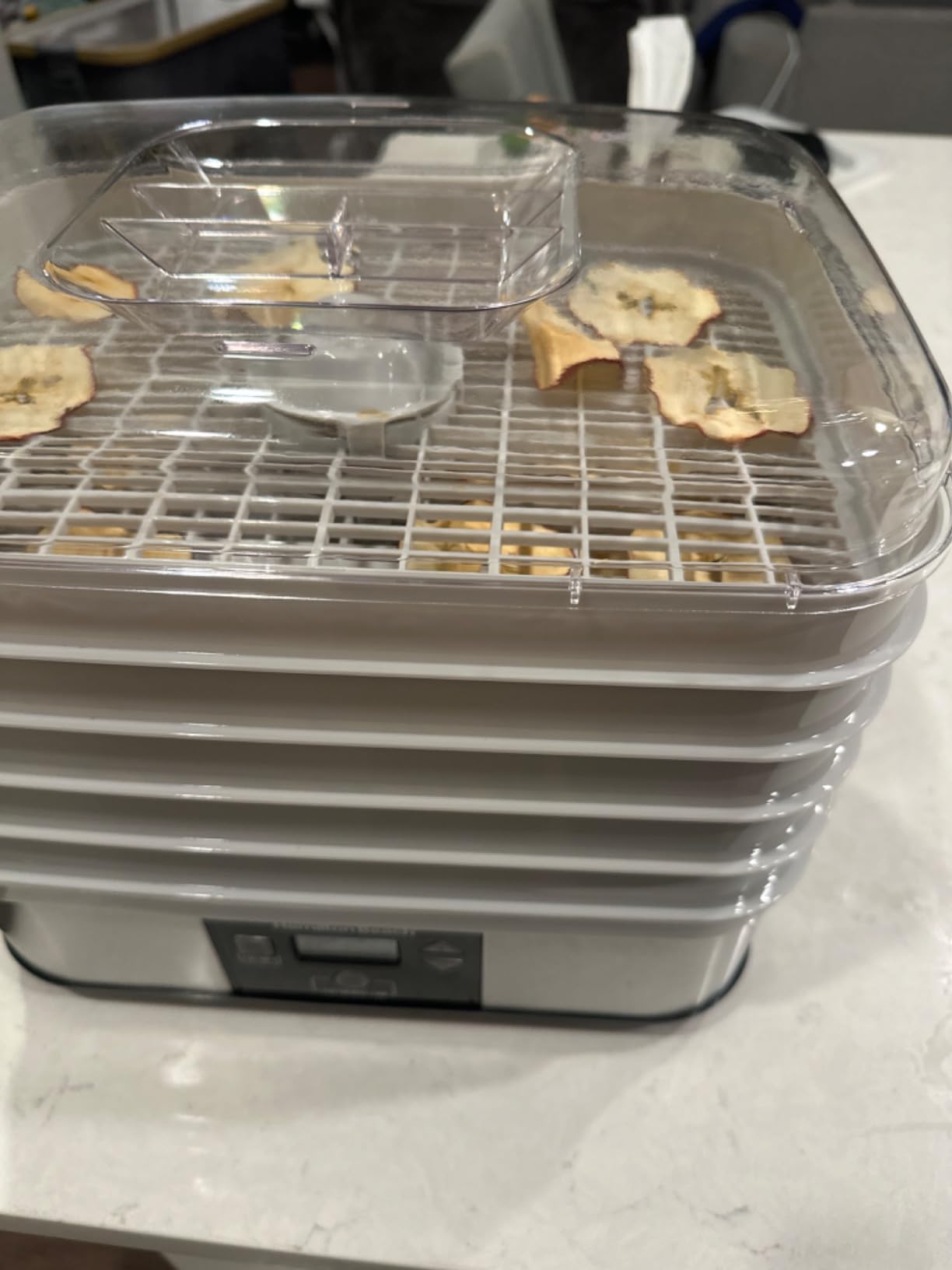
The Hamilton Beach 32100A wins on one specific thing: a real digital countdown that runs from 1 to 48 hours and shuts the machine off when it reaches zero. If you plan overnight batches and do not want to sit near a separate kitchen timer, this is the pick. Owners using it for jerky and dog treats report strong results, and it holds 4.5 stars across 6717 reviews.
The 500W base-mounted heater and quiet fan dry evenly enough that trays rarely need rotating, and the rectangular footprint is a genuine practical win. At 10.4 by 13.2 by 11.3 inches it stores more efficiently than round stackers and slides under cabinets more easily, which matters more than most spec sheets admit.
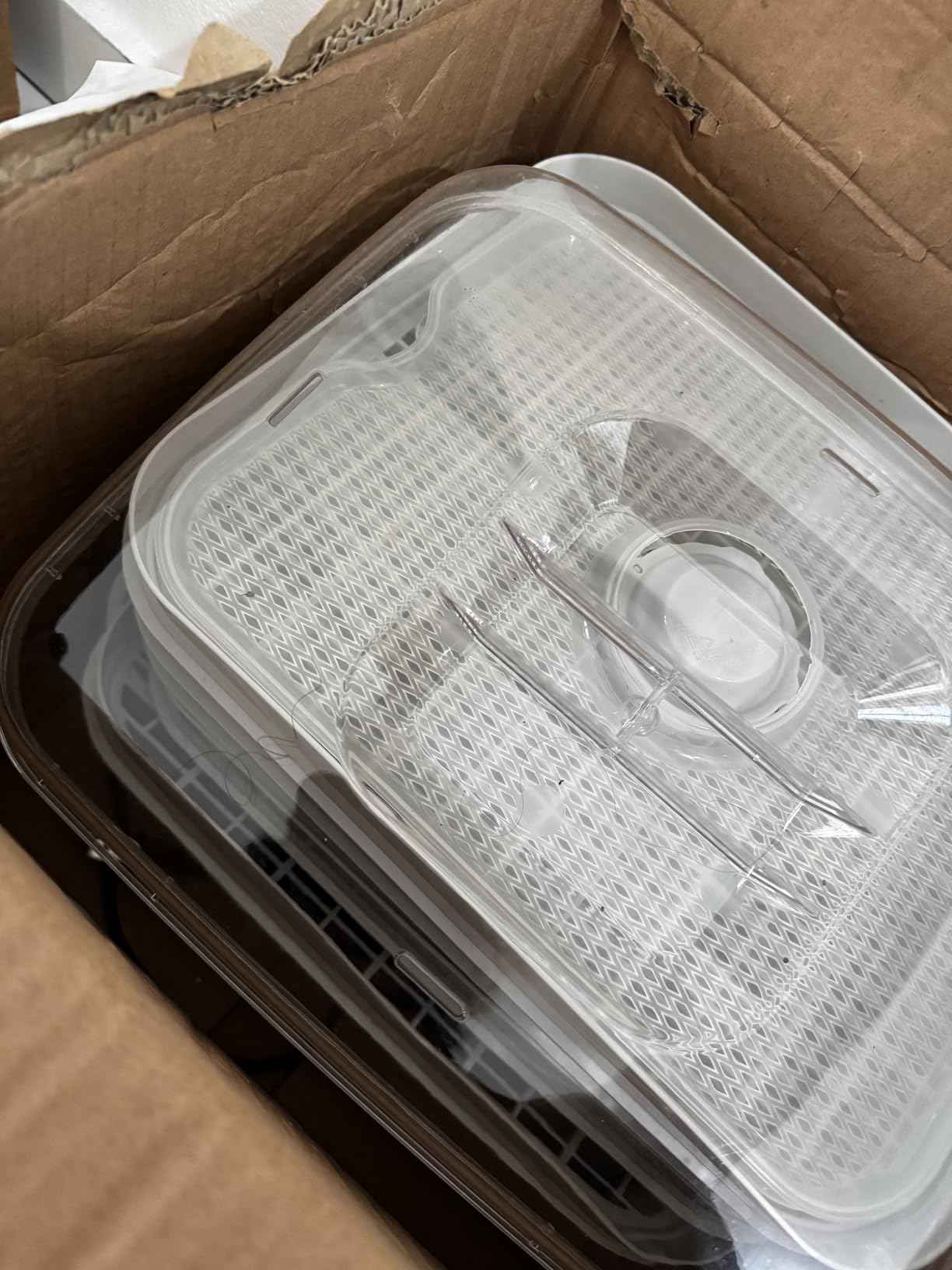
Its limit is temperature. The range runs 100F to 160F, so the floor is 5F higher than some rivals and the ceiling sits at the low end of the safe jerky range. That is fine for beef at 160F, but it gives you no headroom if you want to push hotter to drive moisture out of a fatty cut faster.
Two other notes. Only one mesh screen is included and it is coarse enough that small herb leaves fall through into the machine, so treat it as a meat tool more than an herb tool. And in humid climates, owners report drying times stretch noticeably, because the cabinet has to work against ambient moisture rather than a dry room.
What auto shutoff changes about an overnight batch
Automatic shutoff is not a feature you notice until you leave a batch running and go to bed. Without it, a 10-hour run needs a separate timer, and if that timer is off by an hour you have either under-dried jerky or a machine running needlessly for hours.
Combined with the clear vented lid, which lets you check progress without opening the door and losing heat, it makes this the least hands-on machine in the group. The dishwashable trays and lid are also rare at this level, and dried-on rub comes off far more easily than from plastic mesh.
How it handles fatty cuts and cleanup
With a base-mounted heater, grease runs down to the cabinet floor rather than onto the element, and the flat base is straightforward to wipe or line with foil. A sheet of commercial foil on the floor is the workaround long-term owners use on rectangular cabinets, and it converts cleanup from a scrubbing job into a peel-and-bin job.
Watch for a brief chemical smell and a high-pitched whine on some new examples in the first run, both of which are reported by a minority of owners and fade after a few cycles. Drying times are slower than the 600W machines, so start earlier than you think you need to.
5. OSTBA GGJ-261B 5-Tray – Best for Small Counter Spaces
OSTBA Food Dehydrator, 5 Trays, 240W Dryer for Jerky, Fruit & Snacks
240W
95-160F
5 dishwasher-safe trays
72-hour timer
Under 10 inch wide
Pros
- Narrowest footprint in the group at 9.45 by 10.24 inches
- 72-hour timer is the longest we tested
- Stainless body and dishwasher-safe trays
- Viewing window avoids opening the door
Cons
- Smallest drying capacity per batch
- 240W leaves fruit and thick cuts under-dried
- Some reports of auto shutoff not cutting power
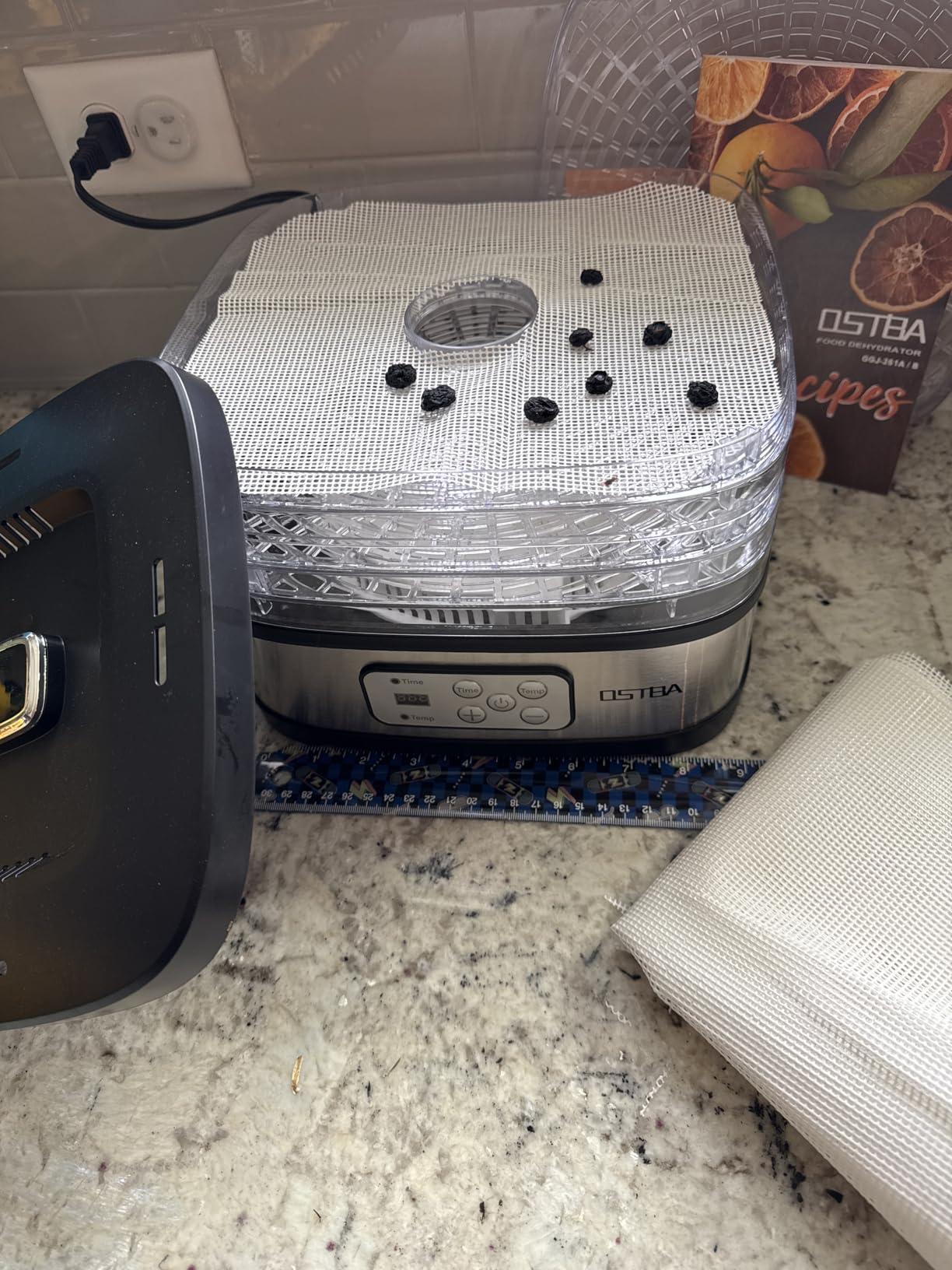
The OSTBA GGJ-261B is the smallest machine here, at 9.45 inches deep by 10.24 wide by 8.27 high and 4.1 pounds. If your counter space is genuinely tight, that footprint is the feature. The 72-hour timer with automatic shutoff is the longest in the group, and the LED panel with a see-through window lets you monitor a batch without breaking the airflow.
It carries a 24-month warranty and ETL certification, and the five BPA-free trays are dishwasher-safe. For basic beef jerky in modest quantities, it works. At 4.3 stars across 2881 reviews it is the lowest-rated pick here, and the 7 percent one-star share tracks directly to capacity complaints rather than failures.
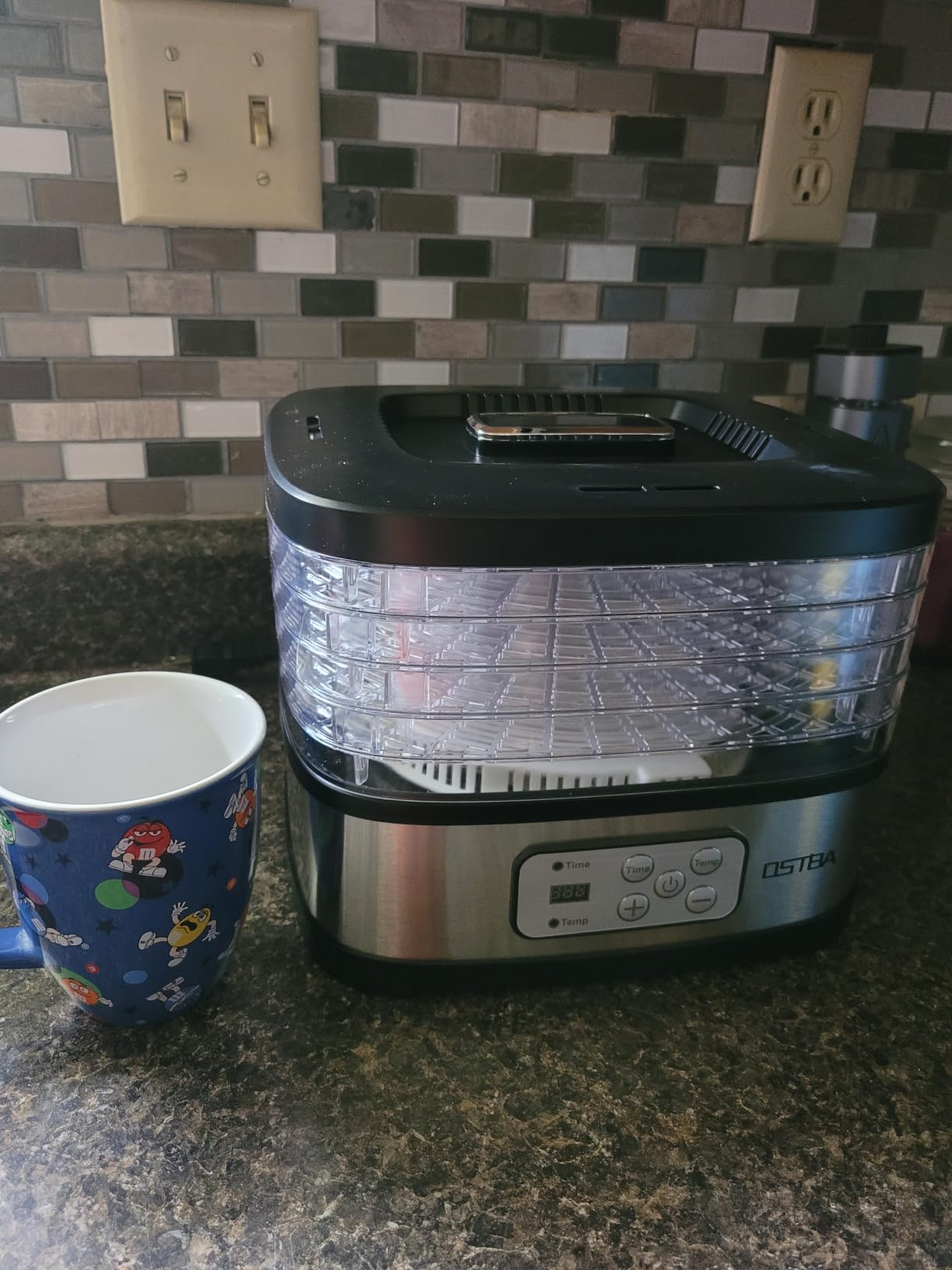
The honest drawback is size of load. Reviewers repeatedly describe the trays as smaller than expected, and 240W is the lowest wattage in the group alongside the Magic Mill. Fruit can stay gummy and chewy after 12 hours at that power, and thick or fatty meat needs longer still. Several buyers report a one-star experience purely because a single batch was too small for what they had planned.
There are also isolated reports of the auto shutoff not actually cutting power, and the white plastic fan cover stains and needs cleaning after each use. Treat the timer as a convenience you verify the first time you use it rather than a guarantee.
Who this works for and who it does not
It works for a first-time maker drying a few pounds at a time, a small kitchen, and anyone who wants a dehydrator they can actually store away between seasons. The 360-degree circulation airflow keeps the small cabinet more even than the wattage alone would suggest.
It does not work for hunting season, holiday gift batches, or anyone who plans to buy venison in quantity. You would be running it many times to get through a load, and each run is a separate evening of babysitting.
Why the 72-hour timer matters here
On a low-wattage machine, longer runs are part of the design rather than a flaw. A 72-hour timer means you can set a long, slow cycle for thick cuts without babysitting a separate timer, and the automatic shutoff ends the run when it is done.
Because the cavity is small, the preheat is quick. Give it 10 to 15 minutes before loading, check with an independent thermometer, and then load without crowding, since the small tray area is the constraint that matters most here.
6. Magic Mill MFD-5000 5-Tray – Best for the Highest Temperature Ceiling
Magic Mill Food Dehydrator Machine | 5 Stackable Stainless Steel Trays, 48H Digital Adjustable Timer & Temperature Control Upto 167° Electric Dryer & Preserver for Jerky, Fruit, Dog Treats & Much More
240W
95-167F
5 stainless steel trays
Adjustable spacing
48-hour touch panel
Pros
- 167F is the highest ceiling in the group
- Stainless steel trays outlast plastic mesh
- Adjustable tray spacing from 0.6 to 1.1 in
- Dishwasher-safe detachable trays
Cons
- 240W means slow and somewhat uneven drying
- Trays are narrow so per-tray load is limited
- Short cord and no tray pause function
The Magic Mill MFD-5000 wins on the single number that has the biggest safety margin in this roundup: a 167F maximum. When the drying range you need tops out at 160F, having seven more degrees of headroom means you are never forcing a batch at the very top of a machine’s range, where thermostats are least accurate and where warm meat can push the chamber past setpoint and start cooking the edges.
The five food-grade stainless steel trays are the second reason to like it. Jerky makers who have used plastic mesh know that dried rub and marinade eventually crack and lodge in the corners permanently, and stainless trays are the fix. Reviewers rank this model at number two in Amazon’s Dehydrators category, and it holds 4.4 stars across 4963 reviews.
The compromise is 240W. That is low for the tray area, and it makes full batches slow, with reviewers reporting uneven results unless you rotate. The trays are also narrow, which caps how much meat fits per layer even though they are stainless. If your batch plan is measured in pounds rather than strips, factor the tray width into your expectations before committing.
Two smaller irritations: the included cord is short, so placement away from an outlet is limited, and the touch panel can overshoot when you move quickly between settings, with a mandatory confirmation tone that some owners find irritating. There is also no lid pause for checking or swapping trays mid-cycle.
What 167F changes on a fatty batch
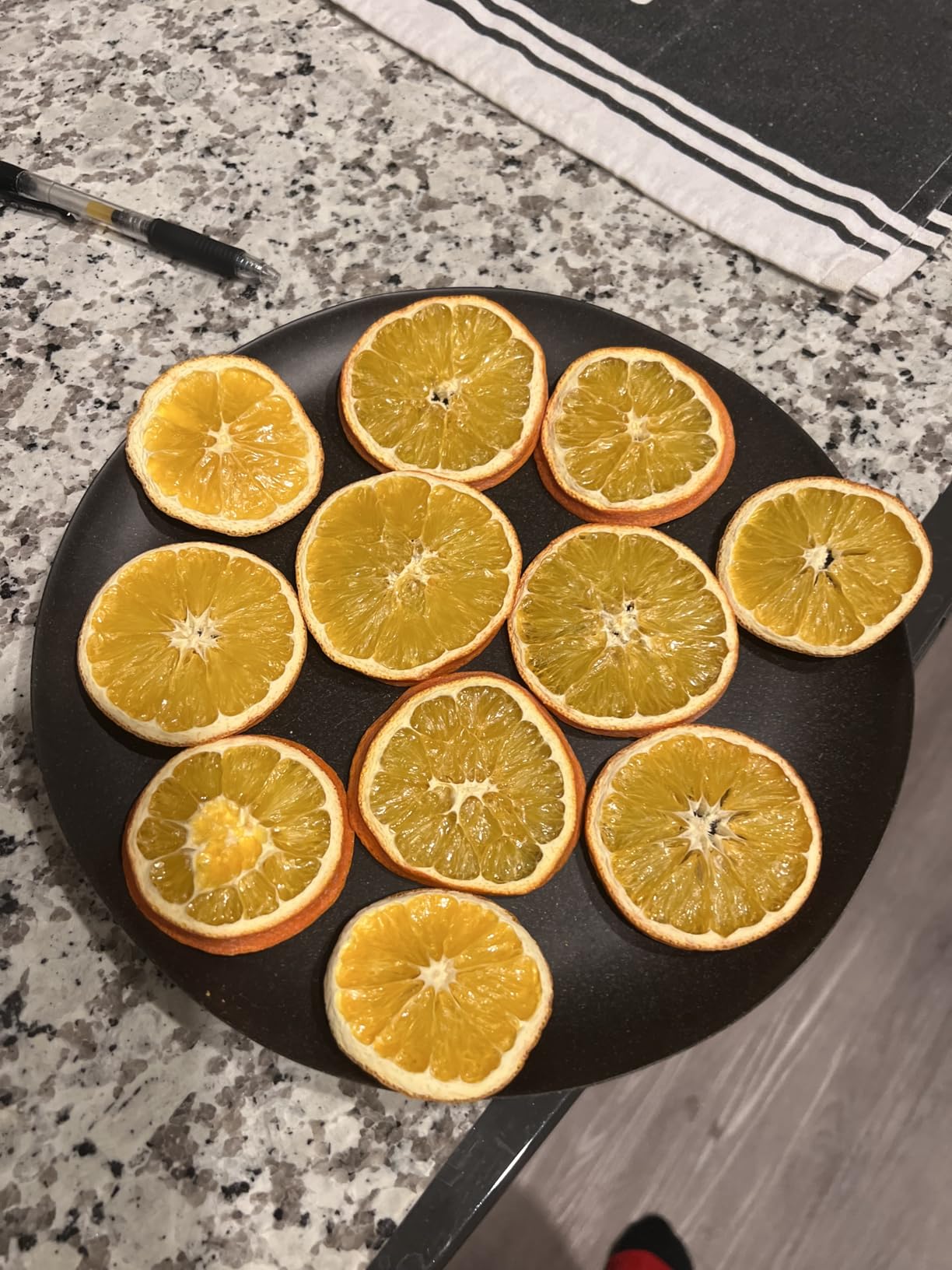
Higher heat is useful on pork loin and venison, where fat renders and you want the surface drying faster than the interior. Reviewers who dry game on this machine rate the results highly, and drying 3D printing filament is also cited as a strong secondary use, which says something about how well it handles wet, dense material.
Use the extra degrees deliberately rather than cranking the dial. A few degrees above target dries the surface faster and leaves the interior more chewy, and the adjustable 0.6 to 1.1 inch tray spacing lets you set airflow clearance for thicker cuts.
Stainless trays and long-term durability
This is one of only two picks here with stainless steel trays, and it is the reason to consider this model even with a slow element. Long-term owners of plastic-tray machines commonly report warping within roughly a year, and warped trays stop seating against the cabinet properly. Stainless trays do not warp with heat cycling.
Trays detach fully and go in the dishwasher, so a 10-hour batch of fatty jerky followed by a full tray wash is manageable. The stainless base wipes down, and 8.5 by 11.8 by 11 inches is a compact footprint for a machine with metal trays.
7. NESCO FD-28JX JerkyXpress – Best for First-Time Jerky Makers
Nesco FD-28JX JerkyXpress Food Dehydrator with Accessories for Beef Jerky, 4 Trays, White
350W
Fixed 160F
4 trays of 13.5 in
Expands to 7
Bundled Jerky Gun
Pros
- Fixed 160F removes temperature guesswork
- Bundled Jerky Gun with three tips
- Includes seasoning and cure samples
- Lightest at 1.2 pounds
Cons
- Fixed 160F means no fruit herbs or vegetables
- Dries slowly at 350W
- No built-in timer
- Four trays is the smallest capacity
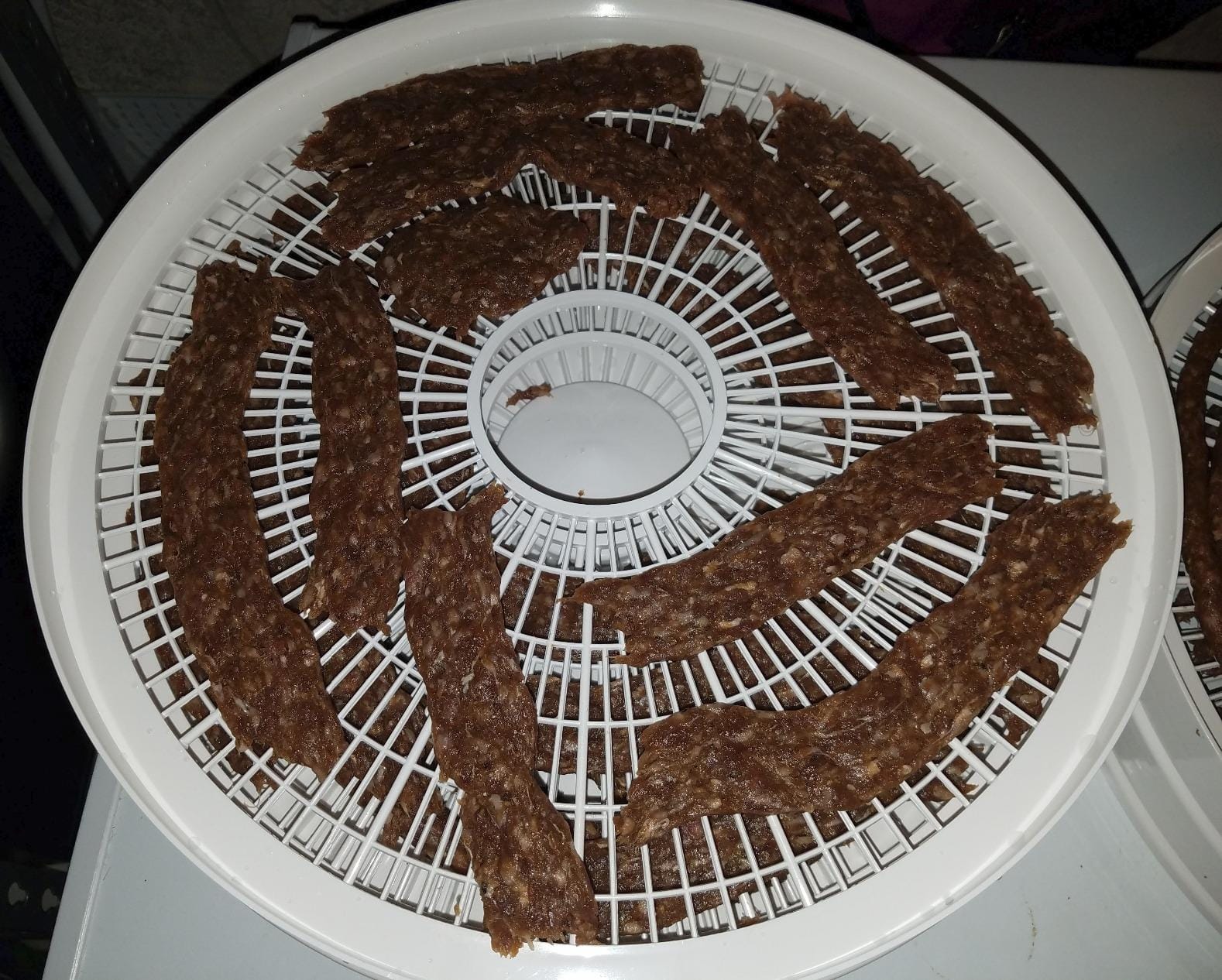
The FD-28JX is not a general dehydrator and does not pretend to be one. It is a jerky machine. The temperature is fixed at 160F, which is exactly the drying temperature for beef jerky, and that single design choice removes the decision most first-timers get wrong. It holds 4.6 stars across 2953 reviews, and the 76 percent five-star share reflects people who bought it for one job and got that job done.
It also arrives with a Jerky Gun with three tip attachments, jerky seasoning and cure samples, and a 52-page recipe and instruction book. For a beginner, that package is worth more than any feature on this list, because the barrier to making good jerky is process rather than hardware. Four 13.5-inch trays expand to seven when you are ready for more.
At 350W the run times are long, and there is no built-in timer, so an external timer is required. The powerhead is detachable, which makes the base a stackable column rather than a fixed appliance, and at 1.2 pounds it is the easiest machine here to carry between the counter and a shelf.
Be clear-eyed about the tradeoff. A fixed 160F means fruit, herbs and vegetables cannot be dried properly on this machine at all, so if your goal is a general food dehydrator, choose a different pick. As a dedicated jerky dehydrator, it is unusually well focused.
Whether jerky-only is the right limitation
Buy this if you are certain your interest is jerky. Every batch you run on it is at 160F, and the machine is designed for exactly that, with the fan and element sized for meat rather than delicate produce.
Skip it if there is any chance you want fruit leather, apple chips or dried herbs later. A unit with a 95F to 165F range costs you nothing extra in complexity and gives you a second use for the counter space.
What the bundled kit actually saves you
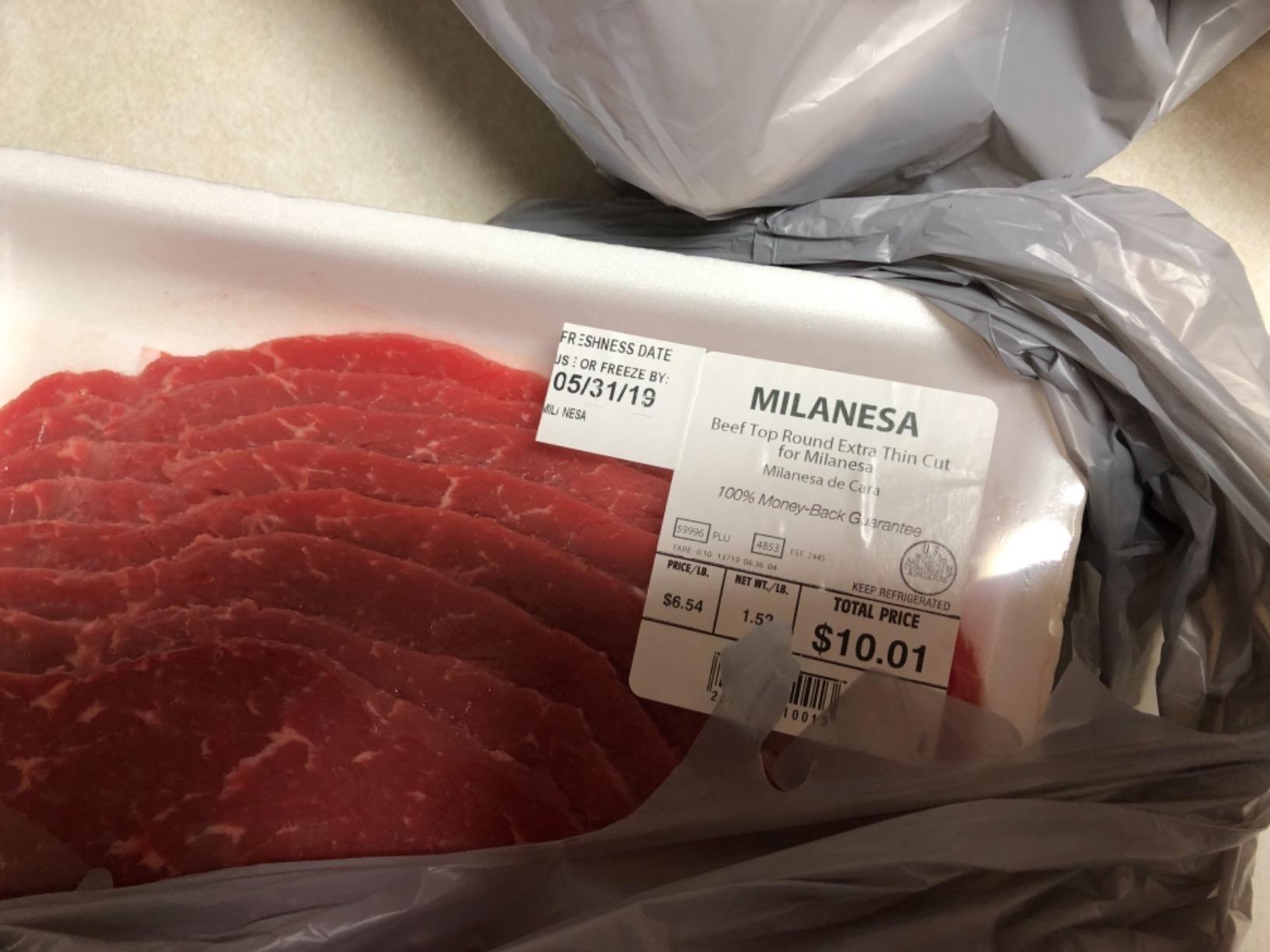
The Jerky Gun and three tips exist because strip thickness matters more than most beginners expect. Consistent slicing is what makes jerky bend without snap, and the gun gives thin, even strips from a piece of top round or venison without a sharp knife and a lot of practice.
The seasoning and cure samples plus the 52-page book cover the process steps, including pre-cure and marinating, that determine whether finished jerky is chewy or leathery. A one-year limited warranty is short for the money, and the sales rank on this model sits far below the rest of the group, so treat it as a specialty purchase.
8. NESCO FD-1018A Gardenmaster Pro 8-Tray – Best for Bulk and Hunting Season
NESCO FD-1018A Gardenmaster Pro Food Dehydrator, 8-Tray White
1000W
95-160F
8 trays of 15.5 in
Expands to 30
Converga-Flow
Pros
- 1000W element gives the shortest dry times
- Expands from 8 up to 30 trays
- Largest trays in the group
- Top-mounted fan dries without rotation
Cons
- Loudest and largest footprint in the group
- Adds noticeable heat to the room
- Trays too big for most dishwashers and sinks
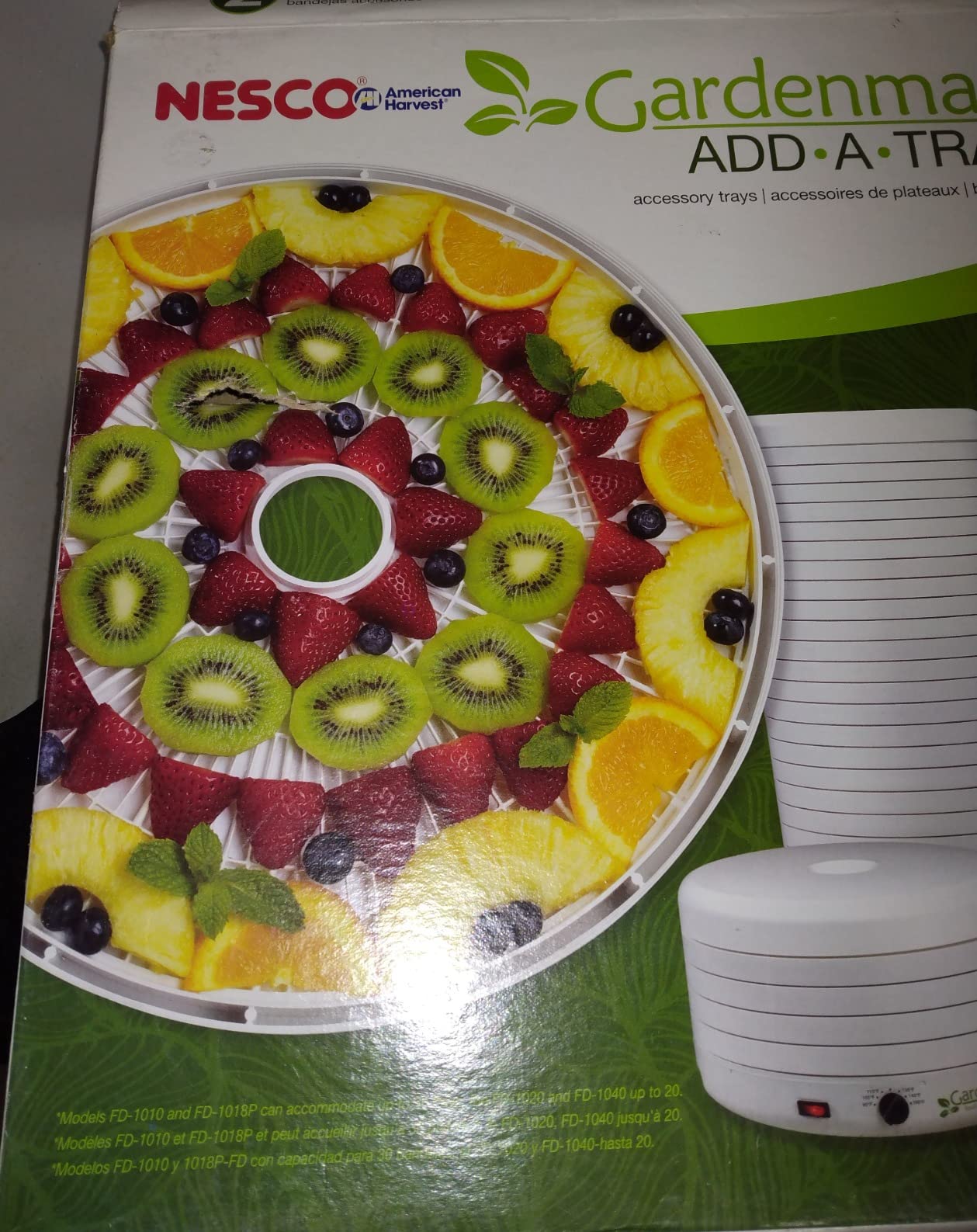
The Gardenmaster Pro is the answer for anyone whose jerky is measured in seasonal volume. The 1000W element is the most powerful here by a wide margin and produces noticeably shorter dry times under a full load, and the eight 15.5-inch trays hold far more per layer than the 13-inch trays on most of the other machines in this roundup. It expands from 8 to 30 trays on a stacking platform, the highest ceiling in the group.
Hunters, gardeners and gift-givers run 10 to 20 trays on it routinely, and buyers with bulk needs report strong results and years of service. Several owners have replaced a two-decade-old American Harvest machine and reused the old trays, because the design is backward compatible. It holds 4.4 stars across 2957 reviews.
The price of that capacity is heat and noise. Owners describe it as noticeably louder than the 600W Snackmaster, roughly like an oven fan, and they report it heating the surrounding room enough that it often runs in a basement, porch or laundry room. If you planned to keep it in a small kitchen, plan where it goes before you buy.
Cleanup is the other friction. Trays that size will not fit in most kitchen sinks or dishwashers, which turns a batch into a sink-side job. Newer replacement trays also fit inconsistently and may not seat on the base until the machine is warm, and some owners report fruit roll liners and trays becoming brittle after years of use.
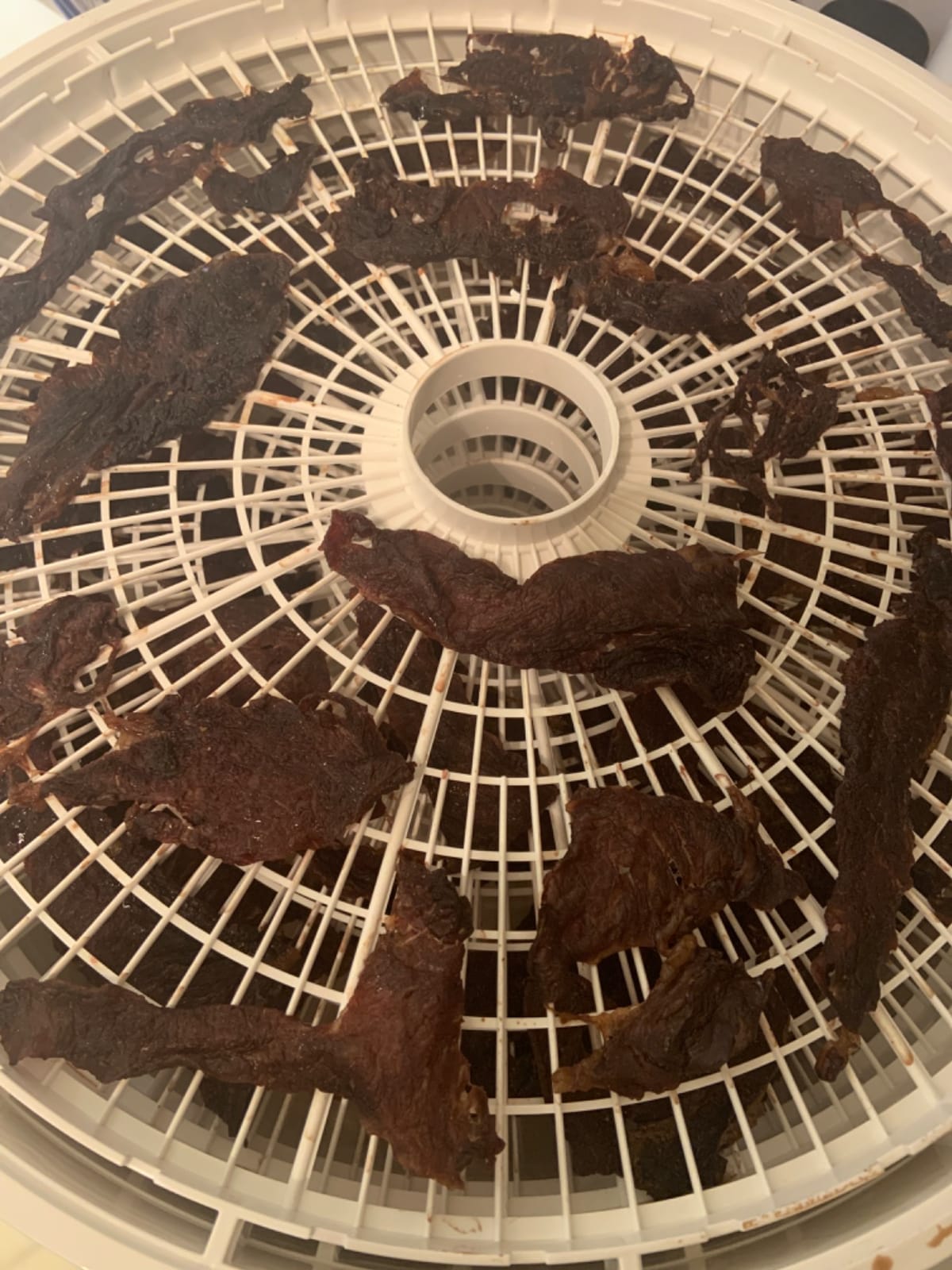
What 1000W and 15.5 inch trays change about a load
More power plus more tray area is the combination that determines throughput. Where a 350W machine needs a full day to move a few pounds, this one moves a hunting-season load in a session, which is the difference between a hobby machine and production equipment for a large family.
The adjustable 95F to 160F thermostat also lets you start a wet load hot and drop the heat later to crisp the surface, which helps with fat. Converga-Flow and the top-mounted fan handle circulation without routine rotation, and fat drips down the walls away from the motor.
Where it is the wrong purchase
It is wrong for a first batch. Learning the process on a 1000W machine that heats a room and holds eight large trays is an expensive way to discover you wanted to make fruit chips instead. Start with a smaller model and a lower entry point if you are unsure.
It is also wrong for small kitchens and anyone who wants the machine to disappear between batches. Beyond the footprint and the heat, the one-star share runs higher than the rest of this group at 8 percent, mostly from noise and room temperature rather than drying performance.
Key Features to Look For in a Jerky Dehydrator
Three criteria decide whether a food dehydrator makes good jerky, and everything else on the spec sheet is secondary. These are the same three the search engines surface for this query, and they are the three we used to rank the picks above.
1. Airflow direction: horizontal beats vertical. A rear-mounted fan pushes air across the full width and depth of the chamber, so every strip on a tray sees the same moving air and trays genuinely do not need rotating. Top-mounted and base-mounted designs move air down a column, which works but leaves top and bottom trays drying at different rates, particularly on a fully packed machine. Owners of vertical designs report swapping trays halfway through anyway.
2. Maximum temperature against the 160F to 165F threshold. Beef jerky needs a drying temperature of at least 160F and poultry wants 165F, per USDA guidance. That is a drying temperature for the chamber, not an internal meat temperature, which is a distinction that trips up a lot of beginners. Anything that stops at 155F is not a jerky machine. A ceiling of 165F or 167F gives you headroom, since a loaded chamber cools below setpoint and a warm load can push the air temperature around.
3. Capacity and tray shape: square area beats tray count. A machine with 5 square feet of drying area will finish more jerky per run than one with eight small trays. Square trays also waste less space around the edges than round trays with a centre hole, and stainless steel trays survive years of heat cycling where plastic mesh eventually warps and cracks. If you plan to expand, a unit that stacks trays is worth more than a fixed cabinet.
Two secondary features deserve a mention. A top-mounted fan keeps rendered fat away from the heating element and the motor, which is the difference between a machine that lasts a decade and one that fails. And a digital timer with automatic shutoff lets you start a 10-hour overnight batch and stop thinking about it, which matters more than it sounds before you run your first overnight batch.
Which Tier Should You Buy?
Entry tier: learn the process without a big commitment. The Cosori CFD-N051-W and the OSTBA GGJ-261B sit here, along with the jerky-only NESCO FD-28JX if beef is all you care about. What you get is a 165F or 160F ceiling, a digital timer, and enough capacity for a few pounds per run. What you give up is power and tray area, so batches take longer and you will run them more often. This is the right place to start if you are not yet sure how often you will dry meat.
Mid tier: the balance most people want. The NESCO FD-75A Snackmaster Pro, the Hamilton Beach 32100A, and the Magic Mill MFD-5000 live here. You get 500W to 600W, real timer control, and either expandable trays or stainless durability. If you can only buy one machine for a household that makes jerky a few times a month, this is the tier.
High capacity: seasonal and gift production. The Cosori CP267-FD and the NESCO FD-1018A are the two we would own for volume. One is a horizontal cabinet with the largest drying area and the quietest motor in the group; the other is a 1000W stackable that expands to 30 trays. Both trade counter space and room heat for throughput.
A note for anyone buying at the low end: check the maximum temperature before you buy, not after. A machine that looks identical but stops at 155F cannot make safe jerky, and that is the one failure that cannot be worked around with technique.
Do You Even Need a Dehydrator?
Honestly, sometimes no. Several experienced members on the Smoking Meat Forums have made jerky for years with a convection oven set to 140F and never bought a dedicated machine, and their results were good. A home oven at its lowest setting with the door cracked is a legitimate method, and if you are making a few batches a year it may be all you need.
The case for a dehydrator is control and capacity. An oven at 140F runs well below the 160F to 165F range, which means longer batches and softer texture. It also occupies your only cooking appliance for hours, it dumps heat into your kitchen, and in summer running a 170F oven for six hours is genuinely uncomfortable. A dedicated machine runs cooler at the same time, holds a narrow, precise range, and frees the oven for dinner while the batch dries.
So the honest split is this: if you are experimenting, or you make jerky a couple of times a year, learn on the oven and spend nothing. If jerky has become a regular commitment, or your kitchen gets too hot to run the oven, a dedicated dehydrator pays for itself in avoided waiting. Do not buy one because a forum thread convinced you it is mandatory, and do not avoid one because a commenter said an oven was fine. Both statements can be true at the same time.
One more consideration if you already own other counter appliances. Warming cabinets and holding equipment solve a different problem than drying, and our food warmer roundup covers that category if you are also shopping for holding gear for a party or event.
Getting the Most Out of Any Dehydrator
Preheat and verify before a long batch. Run the empty machine at your target temperature for 15 to 20 minutes and check with an independent thermometer. This is the single most repeated piece of advice on the jerky forums, and it costs nothing.
Expect the chamber to cool when you load it. Adding cold, wet meat drops the air temperature below setpoint through evaporative cooling, and that is why runs take longer than the nominal drying time. On stacked units the top trays suffer most, since warm moist air rises and the coolest air is at the bottom.
Load without crowding. Leave a finger’s width between strips. Air has to pass over each piece to carry moisture away, and touching strips dry unevenly no matter how good the fan is.
Rotate when in doubt. Even horizontal-airflow machines benefit from a swap on a full load. The top-to-bottom swap is still worth doing on round-tray units, and it is essential above about six trays.
Line the cabinet floor for fatty cuts. Venison backstrap and pork loin render more fat than lean beef. A sheet of parchment or commercial foil on the cabinet floor catches it, and it turns cleanup from a scrubbing project into a peel-and-bin job.
Know the finish test. Jerky is done when it is leathery and slightly brittle but does not snap cleanly. If it cracks, it is over-dried and will be brittle in the bag. Bend a cool piece in half: it should flex, bend without breaking, and show no translucent soft centre.
Plan run times from the meat, not the dial. Sliced beef and poultry jerky at 160F to 165F typically take 4 to 6 hours at a proper load. Fish jerky is a different project entirely at 12 to 14 hours. Set the timer for the longer end and check the finish test rather than the clock.
Frequently Asked Questions
What are the best dehydrators for food and jerky?
The Cosori CP267-FD is the best overall for jerky, with a rear-mounted fan, 600W element and 6.5 square feet of stainless drying space. The NESCO FD-75A Snackmaster Pro is the best value, expanding from 5 to 12 trays. For bulk and hunting season loads, the NESCO FD-1018A Gardenmaster Pro has 1000W and expands to 30 trays.
Can I use a food dehydrator for jerky?
Yes, a food dehydrator is the standard tool for jerky. The machine must reach and hold at least 160F for beef and 165F for poultry, and it needs a fan that moves air across the trays. A top-mounted fan design helps because it keeps rendered fat from dripping onto the heating element or into the motor. Plan on 4 to 6 hours for meat.
Which brand of food dehydrator is considered the best?
There is no single best brand, but the brands that dominate this category are NESCO, Cosori and Excalibur-style rear-fan cabinets. The reason to favour a rear-mounted fan with horizontal airflow is that it dries every tray evenly without rotation. Whichever brand you pick, verify the maximum temperature reaches 160F and check the warranty length before buying.
What type of meat is best for making jerky in a dehydrator?
Start with lean whole muscle such as beef top round or eye round, which dries evenly and produces the best texture. Venison works well but is fattier. Pork loin is a good middle option. Ground beef is last on the list because it carries more fat and needs more grease management. Fish jerky is a separate process that takes 12 to 14 hours rather than 4 to 6.
Do I need to rotate trays in a dehydrator?
With a rear-mounted fan and horizontal airflow, most modern cabinets dry evenly enough that rotation is not required. On round-tray and stackable units, owners still report uneven drying between the top and bottom trays, especially above six trays. Swapping trays halfway through a run is cheap insurance and costs you nothing on a horizontal cabinet.
Final Verdict: Best Food Dehydrators for Jerky in 2026
The best food dehydrator for jerky in 2026 is the Cosori CP267-FD. The reason is not the badge but the combination: a rear-mounted fan pushing air horizontally across 6.5 square feet of stainless steel trays, a 600W element, and a digital panel that holds 95F to 165F one degree at a time on a 48-hour timer.
Buy the NESCO FD-75A Snackmaster Pro if you want the growth path from 5 to 12 trays and a top-mounted fan that keeps fat away from the element. Buy the Cosori CFD-N051-W if you are learning and want a 165F ceiling at the entry level. Buy the Magic Mill MFD-5000 if tray durability and the highest temperature ceiling in the group matter most to you, and buy the NESCO FD-1018A Gardenmaster Pro when the volume is measured in hunting season rather than pounds.
Whatever you pick, preheat it empty, check the temperature with your own thermometer, load without crowding, and judge the finish by bending a cool piece rather than by the clock. Those four habits do more for the quality of your jerky than any model on this list.