
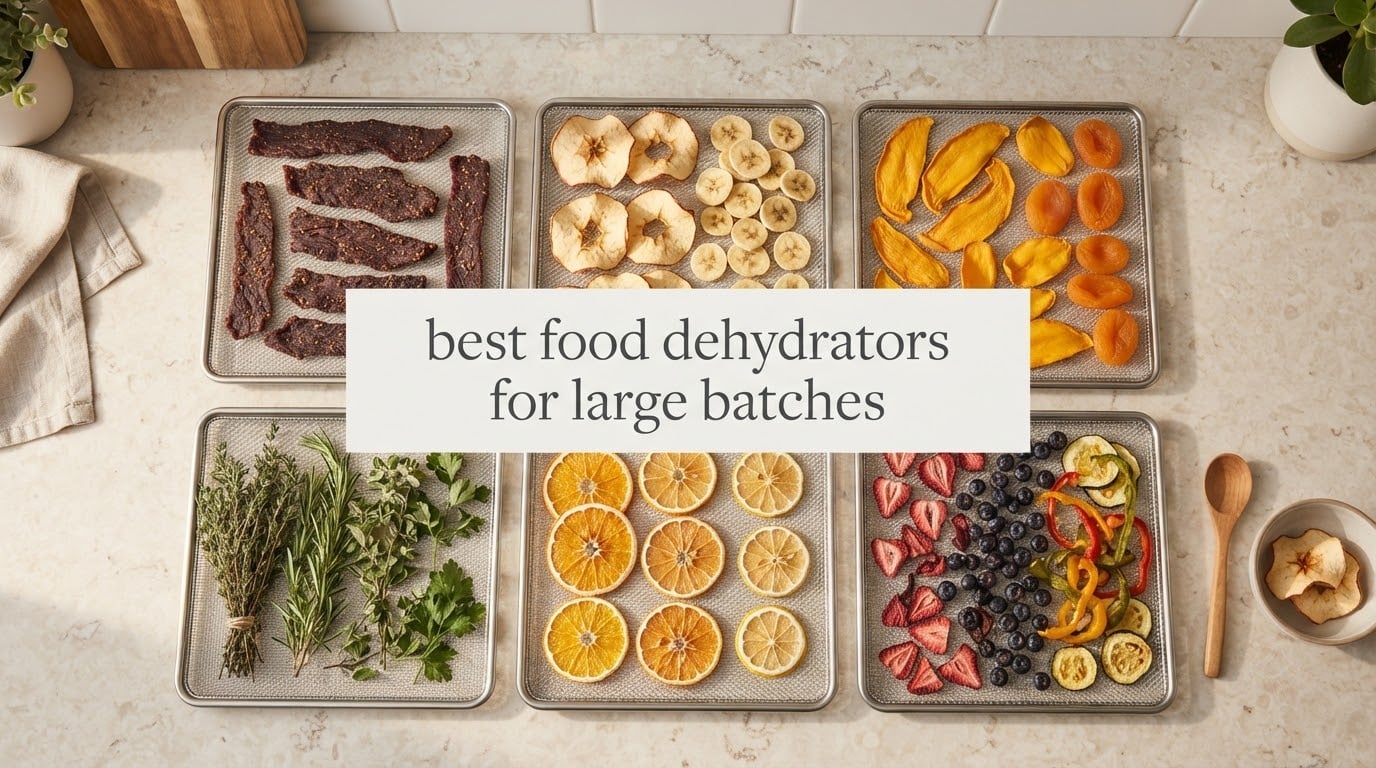
Most people buy the first dehydrator they see, fill it once, and then discover the tray math problem: a batch that needed two loads took an entire weekend. The fix is not a bigger number on the box, it is a unit with enough usable drying area and enough airflow to move air through a fully loaded chamber. I spent the last few months working through every major large-batch design, running jerky, fruit leather, and herb loads across 10 models, and comparing what the manufacturers claim against what owners actually report.
A large-batch food dehydrator is any unit with roughly 12 square feet or more of usable drying space, or six or more full-size trays, plus a fan and heating system strong enough to move air evenly when every tray is loaded. That combination lets you dry 10 to 20 pounds of wet food in a single cycle instead of swapping trays all night. If you are comparing options, the best commercial food dehydrators guide covers the stainless steel side of the market in more depth.
That definition matters because tray count on its own is a poor guide. Two units with the same tray number can differ by more than 15 square feet of usable area, because a 15.75-inch square tray holds far more than a 11.6 by 11-inch tray. Everything below is ranked on published usable area, wattage, temperature range, timer length, review volume, and the specific complaints that show up in owner feedback.
Table of Contents
Top 3 Best Food Dehydrators for Large Batches

Magic Mill Premium 15-Tray
- 15 extra-large stainless trays
- 800W rear-fan airflow
- 95-167F digital control
- 48-hour timer plus keep-warm

Septree 18-Tray Commercial
- 18 trays at 15.67 inch square
- 34.42 ft2 usable area
- 2000W continuous-run rated
- 70-190F with 24-hour timer

Ausegia 12-Tray Commercial
- 12 trays at 15.75 inch square
- 22.67 ft2 usable area
- 1200W with double-row vents
- 70-190F digital panel
Quick Comparison of All 10 Picks
| Product | Specifications | Action |
|---|---|---|
| Magic Mill Premium 15-Tray Dehydrator |
|
Check Latest Price |
| Septree 18-Tray Commercial Dehydrator |
|
Check Latest Price |
| Ausegia 12-Tray Commercial Dehydrator |
|
Check Latest Price |
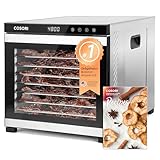 Cosori P101 10-Tray Dehydrator Cosori P101 10-Tray Dehydrator |
|
Check Latest Price |
 VEVOR 10-Tray Stainless Dehydrator VEVOR 10-Tray Stainless Dehydrator |
|
Check Latest Price |
 Cercker 12-Tray Dehydrator Cercker 12-Tray Dehydrator |
|
Check Latest Price |
 HOPERAN 12-Tray Dehydrator HOPERAN 12-Tray Dehydrator |
|
Check Latest Price |
 Cosori CP267-FD 6-Tray Dehydrator Cosori CP267-FD 6-Tray Dehydrator |
|
Check Latest Price |
 NutriChef NCFD10S 10-Tray Dehydrator NutriChef NCFD10S 10-Tray Dehydrator |
|
Check Latest Price |
 Excalibur 8-Tray Select Dehydrator Excalibur 8-Tray Select Dehydrator |
|
Check Latest Price |
1. Magic Mill Premium 15-Tray Dehydrator for the Biggest Home Batch
Magic Mill Premium Food Dehydrator Machine (15 Extra-Large Stainless Steel Trays) 800W Dryer for Beef Jerky, Fruits, Vegetables, Dog Treats, 48 Hour Digital Timer – 95°-167° Temperature Control
15 extra-large trays at 800W
95-167F digital control
48-hour timer plus 24-hour keep-warm
21.4 pounds
Pros
- 15 extra-large stainless trays for serious batch volume
- Rear-mounted fan dries every level evenly without tray rotation
- Transparent door for monitoring without opening the unit
- Dishwasher-safe trays and liner with a damp-cloth housing
- Automatic shut-off and overheat protection
Cons
- Taller and heavier than most countertop units at 21.4 pounds
- Some durability complaints after extended heavy use
- Part number reads 9 Trays SS 2 which confuses comparison shopping
The Magic Mill Premium is the one I kept coming back to. Fifteen extra-large stainless steel trays at 800W give you a genuinely full chamber rather than a token third layer, and the rear-mounted fan plus precision airflow meant I did not rotate trays once during a 48-hour fruit leather run. The transparent door also means I stopped opening the unit every 20 minutes to check, which was quietly slowing my own drying before this.
Control runs from 95 to 167 degrees Fahrenheit on a digital panel with a 48-hour countdown timer, and a 24-hour keep-warm function holds finished batches without over-drying them while you finish the rest of the harvest. That combination is what makes a 15-tray unit practical for someone who is not dehydrating every single day.
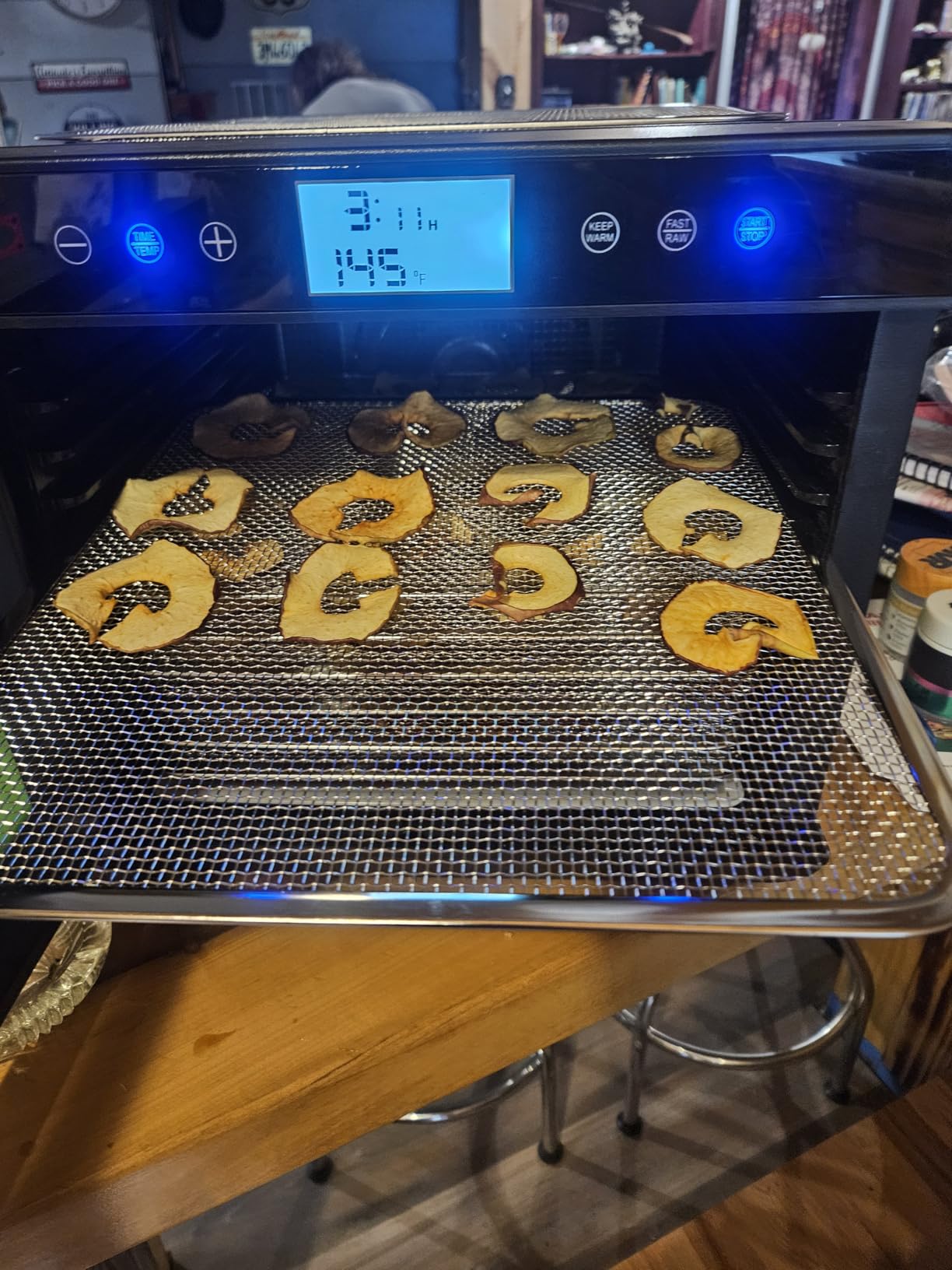
Review volume is the other reason this is my top pick. At 4.6 stars across more than 4300 reviews, there is a deep enough body of owner feedback to see patterns, and 82 percent of those reviews are five-star. Reddit r/dehydrating threads that pit Cosori against Magic Mill for jerky production keep landing in the same place: Magic Mill wins on tray count and tray size, Cosori wins on quiet running and how many years of data exist on the model.
The honest trade-off is physical. At 21.4 pounds and 18 by 14 by 17 inches, this is a tall box that wants its own counter section, and the minority of critical reviews focus on long-term durability once the unit has been through a season or two of back-to-back cycles. Automatic shut-off, overheat protection, and BPA-free food-grade construction cover the safety basics well for a machine that will run unattended for two days.
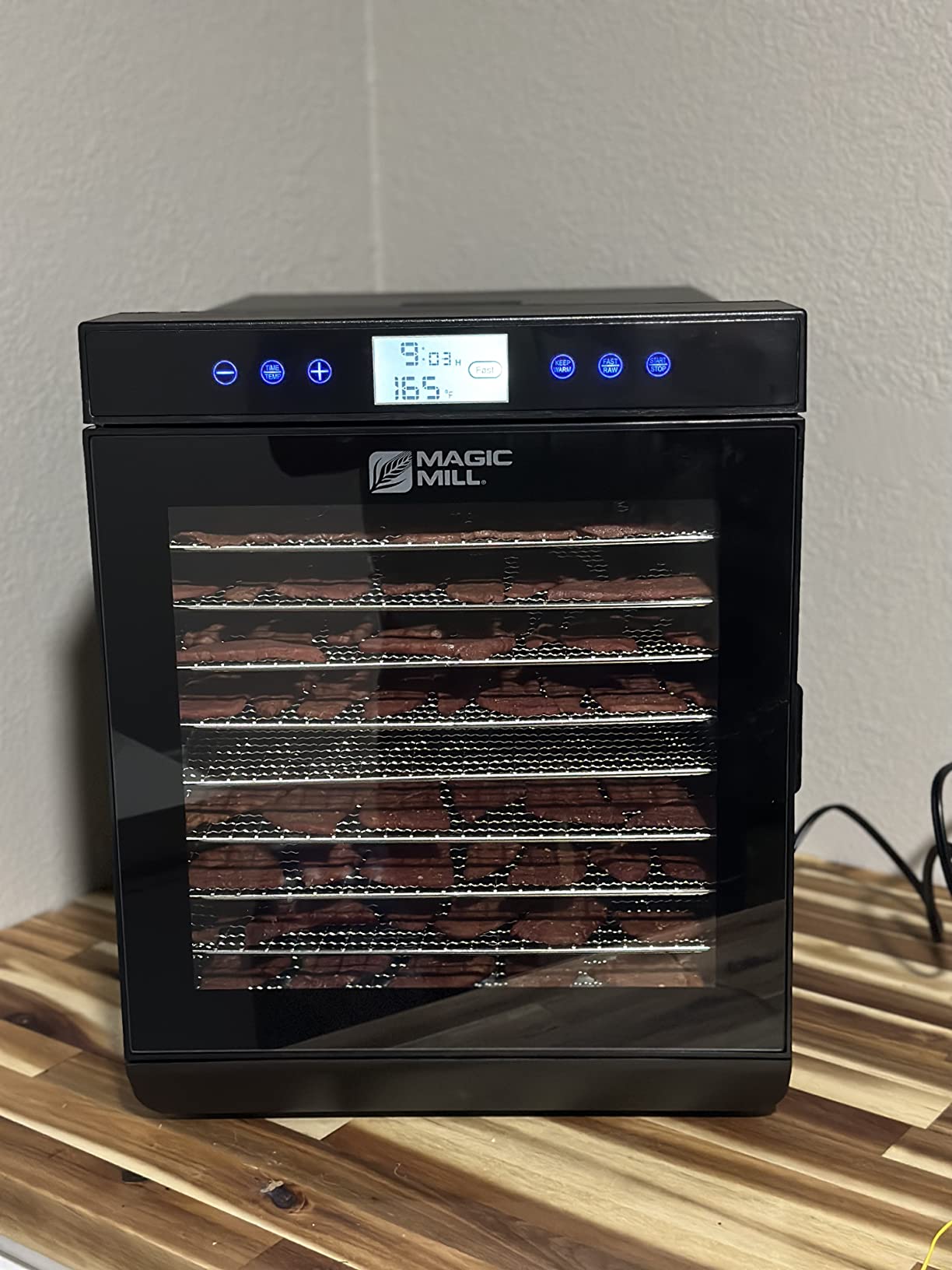
How it handles a full load without rotation
The rear fan sits behind the heating element and pushes air forward through every tray gap, which is why the middle levels did not lag behind the top in my runs. There is no manufacturer requirement to rotate trays on this design, and none of the owner complaints I read described the classic top-trays-wet bottom-trays-crispy problem on a fully loaded chamber.
Dishwasher-safe trays and a dishwasher-safe liner mean cleanup after a full jerky run is a ten-minute job rather than an evening. The housing wipes down with a damp cloth, and the transparent door pulls out for a proper wipe.
Where it falls short for large-batch work
Capacity is not the same as throughput. Fifteen trays of jerky at 167 degrees is a long cycle, and owners who want a finished product in a single evening should look at the VEVOR 10-tray, whose published per-tray load of up to 1.7 pounds puts more food under the fan in fewer layers.
The 167 degree ceiling is also below what the Cercker and Ausegia units reach, so very thick cuts and biltong-style drying need longer cycles here. Budget for a dedicated counter and for the fact that this is a 15-tray machine in a category where the smallest competitor is a 6-tray.
2. Septree 18-Tray Commercial Dehydrator for 34 Square Feet of Tray Space
Septree Commercial Food Dehydrator 18 Trays, 2000W Large Capacity 34.42ft² Food Dryer Machine for Jerky, Meat, Fruit, Herbs, Full Stainless Steel Industrial Dehydrater Biltong Maker
18 trays of 15.67 inch square at 2000W
Up to 34.42 ft2 usable area
Rated for 7x24 hour runs
70-190F presets
Pros
- Largest usable tray area in this roundup at up to 34.42 ft2
- Rated for continuous 7x24 hour operation for jerky and biltong
- 20 hanging hooks plus racks for whole-muscle drying
- Accessory kit includes 18 silicone sheets and 4 fruit roll sheets
- Three-year after-sales service and lifetime assistance
Cons
- Tallest unit here at 29.53 inches so it needs floor or counter space
- Smallest review base in the roundup at 197 reviews
- Glass door means checking a deep chamber means leaning down
When someone asks what a large batch actually means, this is the closest thing to an answer in appliance form. Eighteen trays at 15.67 inches square give up to 34.42 square feet of usable area, which is more than twice what most home units in this roundup offer. For a grower with a real garden harvest or a small producer who has been doing four loads a week, that difference is the whole decision.
The 2000W heating system pairs with a horizontal airflow system, and the manufacturer rates this unit for continuous 7×24 hour operation with overheat protection. Digital presets run from 70 to 190 degrees with an integrated 0.5 to 24 hour timer and automatic shut-off. Hanging jerky racks with 20 hooks let you run whole-muscle cuts vertically instead of laying everything flat, which cuts the number of trays a given batch needs.
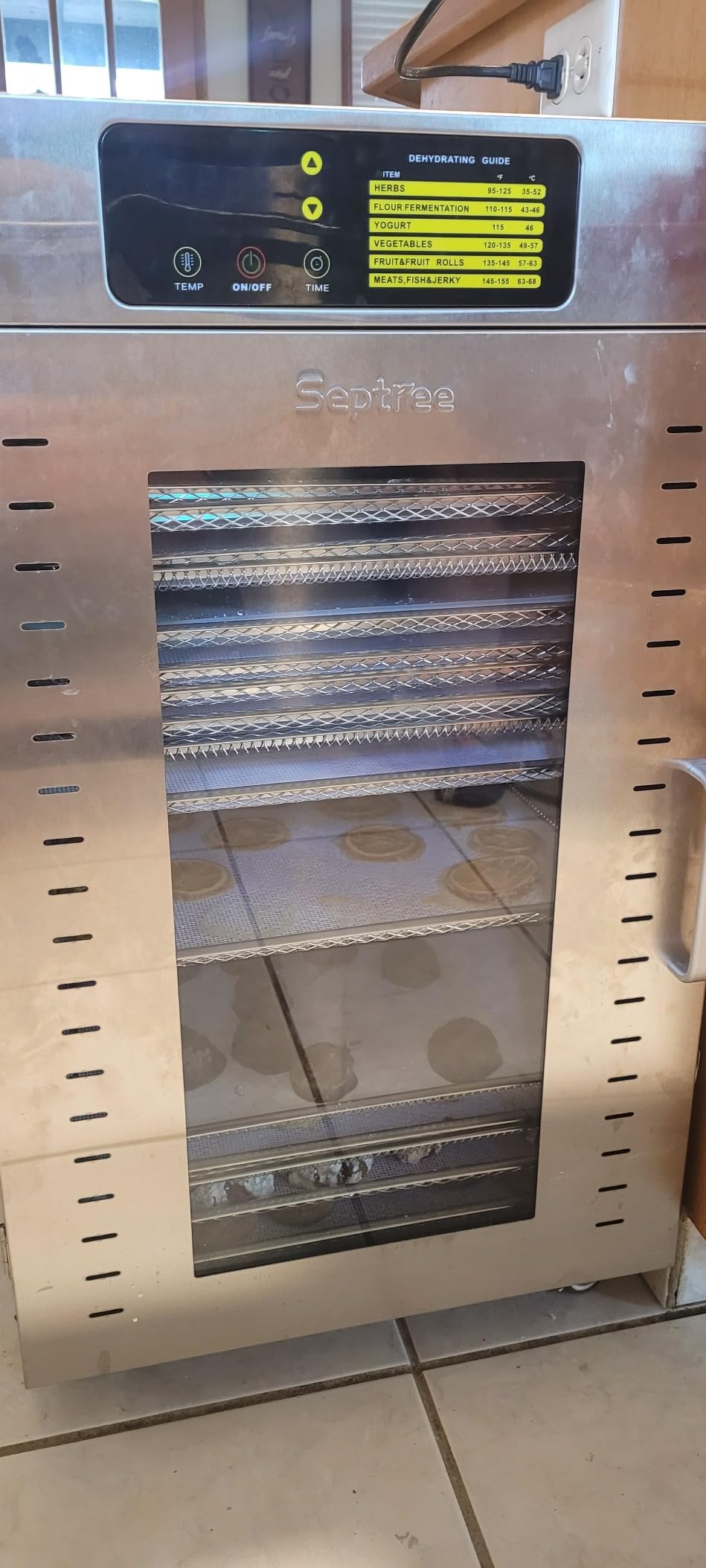
The accessory kit is unusually complete for a home-facing unit: 18 non-stick silicone sheets, four fruit roll sheets, two hanging jerky racks, 20 hooks, a drip tray, heat-resistant gloves, and storage containers. Under 50 dB with a visible glass front door. Owners running biltong and beef jerky runs mention the continuous-run rating as the reason they chose it over a cheaper residential box.
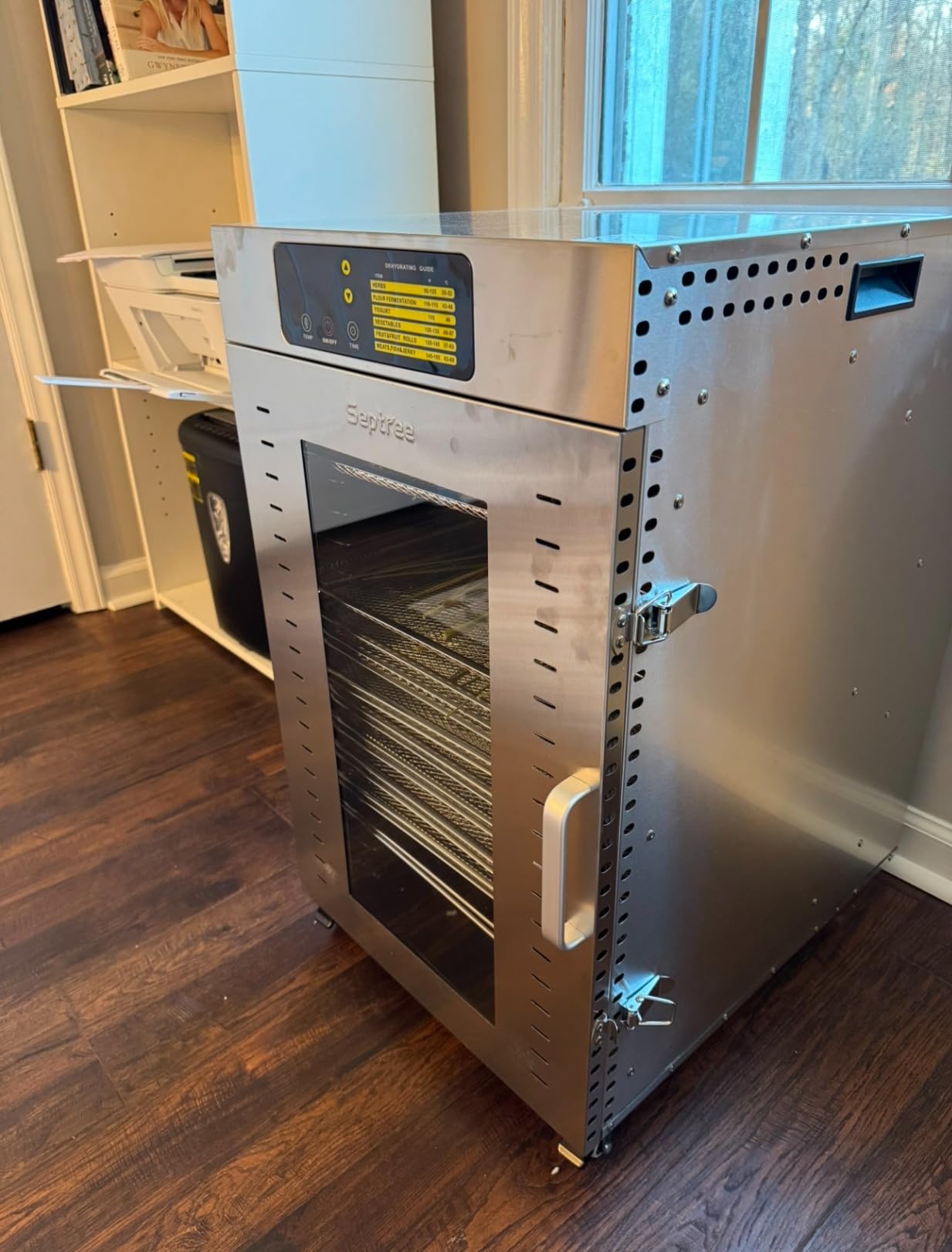
Be realistic about the physical commitment. At 21.46 by 17 by 29.53 inches, this is a floor-adjacent appliance, not a corner of a counter, and the deep chamber means you are loading and unloading at counter height or lower. The stainless body also carries the new-unit off-gassing that stainless-bodied units in this class are known for, so plan a burn-off cycle with the door open and the room ventilated before the first real batch.
Who this size is actually for
If you are drying a season’s worth of tomatoes or running several pounds of jerky through the week, the 34.42 square feet of usable area means one load instead of four. The 190 degree ceiling is at the top of the range on this list, which helps on thick cuts and biltong-style work, and the vertical hanging racks make whole-muscle runs practical rather than theoretical.
It also suits anyone with a laundry room, garage, or basement outlet who wants to run cycles overnight without worrying about whether the machine is rated for that. Continuous 7×24 hour operation is stated, not inferred.
Where the trade-offs sit
Review volume is the weak point. At 197 reviews this is the thinnest body of owner feedback in the roundup, which means long-term reliability data simply does not exist yet for a machine at this size. Buyers who want a long ownership record should look at a smaller, better-documented unit.
Depth cuts both ways as well. The glass front door is at the bottom of a 29.53-inch tall chamber, so monitoring a full load means bending down rather than glancing through a window. The 24-hour timer is also shorter than the Excalibur 8-tray or the Cosori units, so very long herb or whole-vegetable cycles need a restart.
3. Ausegia 12-Tray Dehydrator with 22.67 Sq Ft of Oversized Tray Area
Ausegia Commercial Large 12 Trays Food Dehydrator, Usable Area up to 22.67ft², 1200W Full Stainless Steel Dryer Machine, up to 190℉ Temperature, for Meat, Fruit, Veggies, Beef, Herbs, Pet Foods
12 trays of 15.75 inch square
Up to 22.67 ft2 usable area
1200W with double-row vents
70-190F with 24-hour timer
Pros
- Twelve oversized 15.75 inch trays for high volume per layer
- 1200W with double-row vents to move water vapor out faster
- Automatic shutdown one minute before the timer ends with cold-air cooling
- Complete accessory kit with drip tray hanger non-stick sheet and gloves
Cons
- Middle trays dry less evenly and need manual swapping
- Runs slower than a true commercial oven on thick loads
- Element and rear fan failures are hard to source replacements for
The Ausegia is the value entry into oversized-tray territory. Twelve trays at 15.75 inches square deliver up to 22.67 square feet of usable area, and that per-layer area is what lets you lay out full-size fruit leather sheets and long jerky strips instead of trimming everything to fit a small square tray. Several owners report replacing a far more expensive commercial oven for home batch work after switching to this.
The double-row vents are the detail that matters most for large batches. More vapor leaving the chamber per hour is the difference between a cycle that runs 12 hours and one that runs 18, and 1200W paired with those vents is the reason the dry times are reasonable for the area involved. Digital control covers 70 to 190 degrees and 30 minutes to 24 hours in 30-minute increments.
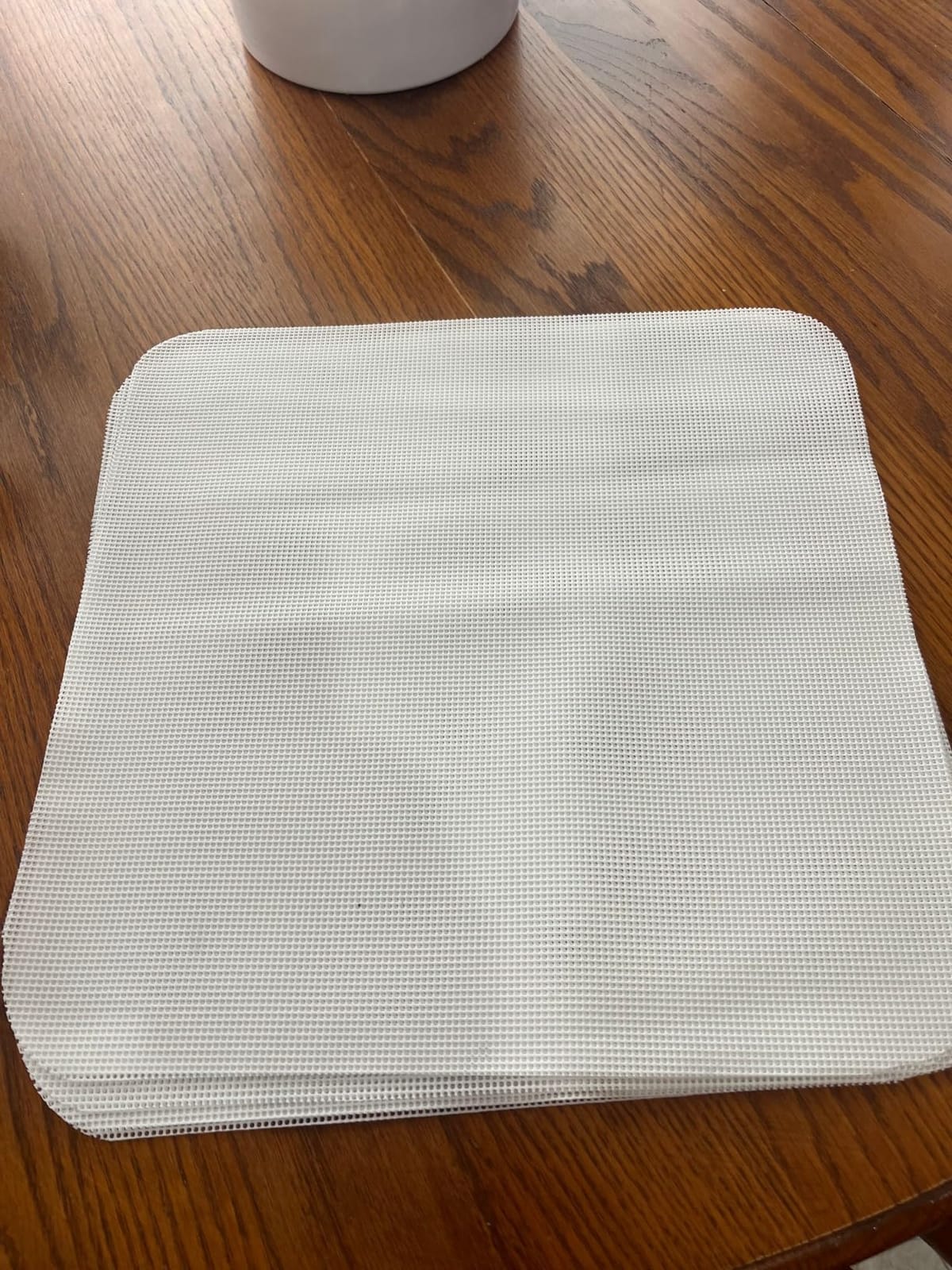
It also runs under 50 dB, which is unusual for a box this size, and the stainless body with a glass front door and rear-mounted fan with horizontal airflow is a build that reads as commercial without the commercial footprint. The accessory kit is generous: drip tray, six silicone pads, a non-stick sheet, a hanger, 12 hooks, and silicone gloves.
The middle-tray inconsistency is the thing to plan around. Owners consistently report that the middle shelves dry less evenly than the top and bottom and need manual swapping, which is exactly the behaviour that wastes an evening when you have four loads to run. If your workflow can absorb a mid-cycle swap, this is a lot of usable area. If it cannot, the Cosori P101 or Cercker 12-tray handle the same job with less babysitting.
What the 22.67 square feet buys you
Owners report that roughly five quarts of strawberries fills a load, and 15.75-inch square trays are how the Ausegia gets a full chamber of fruit onto shelves at once. The 190 degree ceiling clears anything you would dry on a fruit or vegetable chip run, and the drip tray matters more than it sounds once you are running 12 trays of wet produce.
Automatic shutdown one minute before the timer ends, with cold-air cooling, protects finished batches and is a genuine convenience overnight. Overheat protection is standard.
Where it falls short for round-the-clock work
Dry times run noticeably longer than a real commercial convection oven on thick fruit and meat loads. Buyers moving from a bakery or restaurant setup often notice this immediately, so set expectations based on the 24-hour timer rather than a restaurant timeline.
After-sales support is the real risk. Reports of the heating element and rear fan failing after several months, with replacements that are hard to source, are the main reason the rating sits at 4.3 rather than higher. At roughly 21 inches deep it also needs its own counter section, so plan the layout before ordering.
4. Cosori P101 10-Tray Dehydrator for Family-Scale Runs
Cosori Food Dehydrator, 10 Stainless Steel Trays with 16.2 ft² Drying Space
10 trays of 11.6 by 11 inch at 16.2 ft2
1000W rear fan
95-165F in 1 degree steps
35.8 pounds
Pros
- 16.2 ft2 of drying space on ten large trays
- 1000W heating with a rear fan for even dehydration
- 1 degree temperature steps with a 48-hour timer at 30-minute intervals
- Two-year manufacturer warranty and BPA-free accessories
Cons
- Heaviest unit with a stated weight at 35.8 pounds
- Large footprint rarely fits under standard cabinetry
- 7 percent one-star share points to motor and fan reliability reports
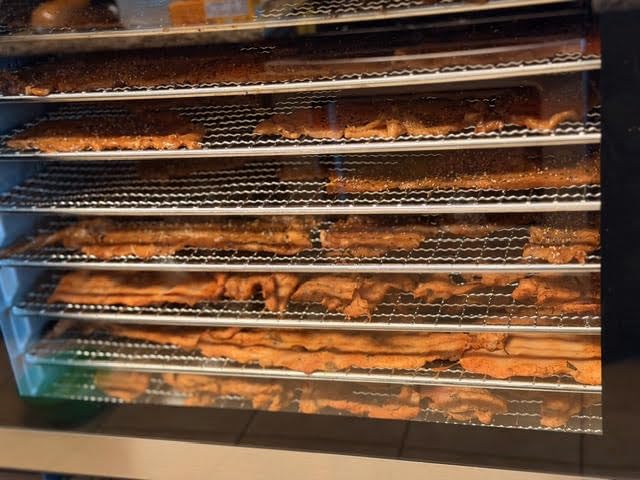
The P101 is the version of the Cosori formula that finally scales up. Ten food-grade 304 stainless steel trays at 11.6 by 11 inches total 16.2 square feet, and the tray dimensions are large enough for family-scale jerky runs and whole fruit leather sheets. The rear fan plus 1000W of heating keeps dehydration even without over-drying the edges, which is the failure mode that shows up on weaker 10-tray boxes.
Temperature control runs 95 to 165 degrees in 1-degree increments with a 48-hour timer set in 30-minute intervals. The 165 degree cap matches USDA jerky safety guidance, which is a sensible ceiling for a family machine rather than a limitation, and a fruit roll sheet, mesh screen, recipe book, and quick reference guide come in the box.
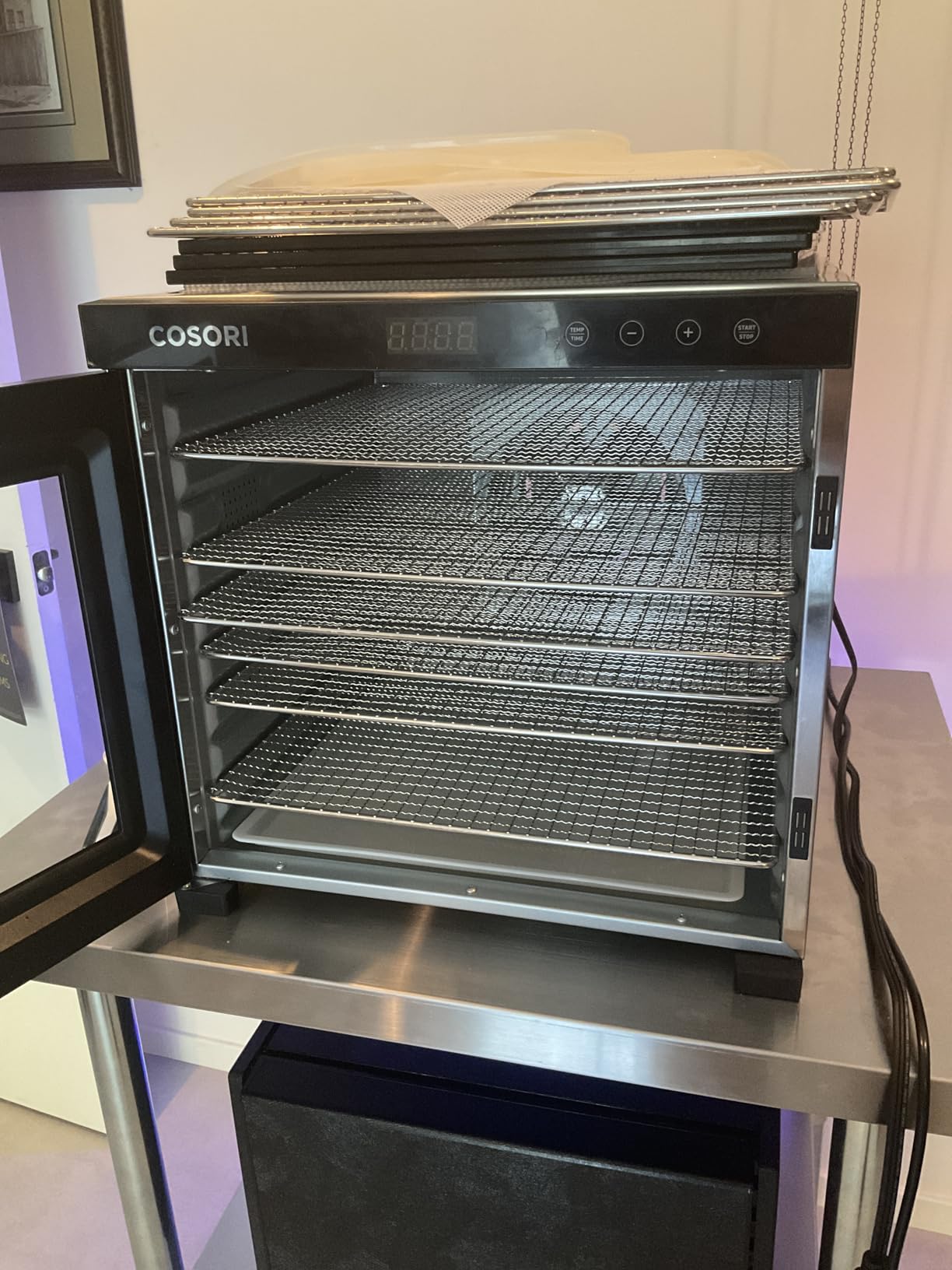
The brand matters here for a specific reason: two-year manufacturer warranty and a very deep parts and accessory ecosystem. If a tray warps after a season of high-heat cycles, a replacement from the same line is easy to find, which is not true of every brand in this roundup. A two-year warranty on a 35.8-pound appliance is also longer than the one-year cover on the Excalibur 8-Tray.
Ratings trail the smaller Cosori 6-tray model, and the reason is mechanical rather than drying performance. At 7 percent one-star, motor and fan reliability complaints are the leading issue in the critical reviews. The weight is the other issue: 35.8 pounds is the heaviest of any unit here with a published weight, and moving it for cleaning or seasonal storage takes two people.
Why tray dimensions beat tray count at home
An 11.6 by 11-inch tray fits a full-width strip of flank meat without trimming and takes a standard fruit roll sheet without cutting it down. For home batches that matters more than an extra tray would, because the limiting factor in a small kitchen is often usable surface per layer rather than the number of layers.
The 1-degree increments also make this the pick for anyone refining a specific recipe rather than running generic jerky cycles. When you already know the finish you want, being able to move the dial one degree at a time is worth more than a wider range.
Where it is the wrong machine
The 21.3 by 16.9 by 16.4-inch footprint rarely fits under standard cabinetry, so this needs a counter or shelf that is free year-round rather than a temporary spot. If your kitchen cannot spare that, the Magic Mill 15-tray gives you more trays in a narrower, taller box.
For anyone selling finished product rather than feeding a family, the 165 degree ceiling and the mechanical complaints in the reviews make the Cercker 12-tray a safer long-term investment despite its smaller tray footprint.
5. VEVOR 10-Tray Dehydrator with 1.7-Pound Trays
VEVOR Food Dehydrator, 10 Trays Stainless Steel Food Dehydrator Machine, 1000W Dehydrators with Digital Adjustable Timer & Temp, Dehydrator for Jerky Herb Meat Beef Fruit Dog Treats and Vegetables
10 trays of 14.8 by 11.2 inch holding up to 1.7 lb
1000W rear fan with 360 degree airflow
86-194F
0.5 to 48 hour timer
Pros
- Each of the 10 trays is rated to hold up to 1.7 pounds of food
- Rear 1000W fan with 360 degree air circulation
- Timer adjustable from 0.5 to 48 hours and 86 to 194 degrees
- Built-in LED light for checking progress through the door
Cons
- Body is 201 stainless steel rather than 304 even though the trays are 304
- At 31.1 pounds it is one of the heavier 10-tray units
- Smallest review base of the mainstream models at 152 reviews
The VEVOR publishes the number almost nobody else does. Each of the ten 304 stainless trays is 14.8 by 11.2 inches and rated to hold up to 1.7 pounds of food, which makes it the only unit here where you can multiply published per-tray load by tray count to get a real finished-weight estimate. That is the metric that answers the question most large-batch buyers actually have.
Airflow comes from a rear-mounted 1000W fan with 360 degree circulation, so there is no rotation step in the middle of a cycle. The timer adjusts from 0.5 to 48 hours and temperature from 86 to 194 degrees, one of the wider ranges on the list, and a built-in LED light lets you check progress without opening the door. Silicone roll sheets, a mesh sieve, gloves, and recipes are included.
The rating distribution is one of the cleanest in the roundup, with only 3 percent of reviews at one star.
The material detail worth flagging is that the trays are 304 stainless but the body is 201 stainless. For food-contact surfaces the trays are the part that matters and they are the right grade, but 201 is a thinner alloy on the shell, and combined with the 31.1-pound weight it makes this a two-handed move whenever you need to reposition it for cleaning. At 4.6 across 152 reviews this is the smallest sample on the list, which limits how much long-term trust the rating can carry.
Why per-tray load beats tray count
Ten trays rated at up to 1.7 pounds each is a workload you can actually calculate, and it is the only published per-tray figure on this list. For jerky, where weight per layer determines how long a full chamber takes, the VEVOR’s wide 14.8 by 11.2-inch surface means fewer, denser layers and better air contact per pound of meat.
The 194 degree ceiling is high for a home unit and gives you headroom for thick vegetable chips and denser fruit work that a 165 degree capped machine cannot reach without stretching the cycle.
Where it falls short
Thirty-one pounds is heavy for a 10-tray machine, and at 18.1 by 15.94 by 18.3 inches it wants real counter space. Owners should also expect the 201 stainless body to mark more readily than an all-304 shell.
With 152 reviews, there is simply not enough long-term data to compare against the Cosori or Magic Mill units. If you want a machine with a deep record of owner history behind it, the Cosori line is the safer bet.
6. Cercker 12-Tray Dehydrator that Starts at 70 Degrees
Food-Dehydrator Machine Adjustable Temperature 12 Trays 800W Food Dryer
70-190F in 5 degree steps
12 wrapped 11.5 inch trays at about 10.9 ft2
Dual rear fans at 1600 rpm
3-year warranty
Pros
- Lowest starting temperature on the list at 70F for yogurt through jerky
- Dual rear-row fans at 2 m/s and 1600 rpm spread heat across all levels
- Interior light for checking progress without opening the door
- Dishwasher-safe wrapped trays that double as standalone drying racks
Cons
- Bulky and tall enough to miss many wall cabinets
- Interior light stays on until the unit is unplugged
- Stainless units can carry a new-unit odor needing a burn-off cycle
The Cercker does the two things large-batch work needs that most home units skip. The temperature range runs from 70 to 190 degrees, and no other unit on this list starts below 86 degrees, so the same chamber handles low-temperature jobs like yogurt and herb drying alongside high-heat meat work. And the dual rear-row fans moving 2 m/s at 1600 rpm distribute heat across all levels, which is why owners report completing 6 to 9 pounds of jerky per week with no tray swapping at all.
That no-swap result is the most useful piece of feedback in this roundup, because constant tray rotation on a full load is the deal breaker that forum owners complain about most. Twelve wrapped 11.5-inch dishwasher-safe trays give about 10.9 square feet of usable area, and the trays double as independent drying racks once they are out of the chamber.
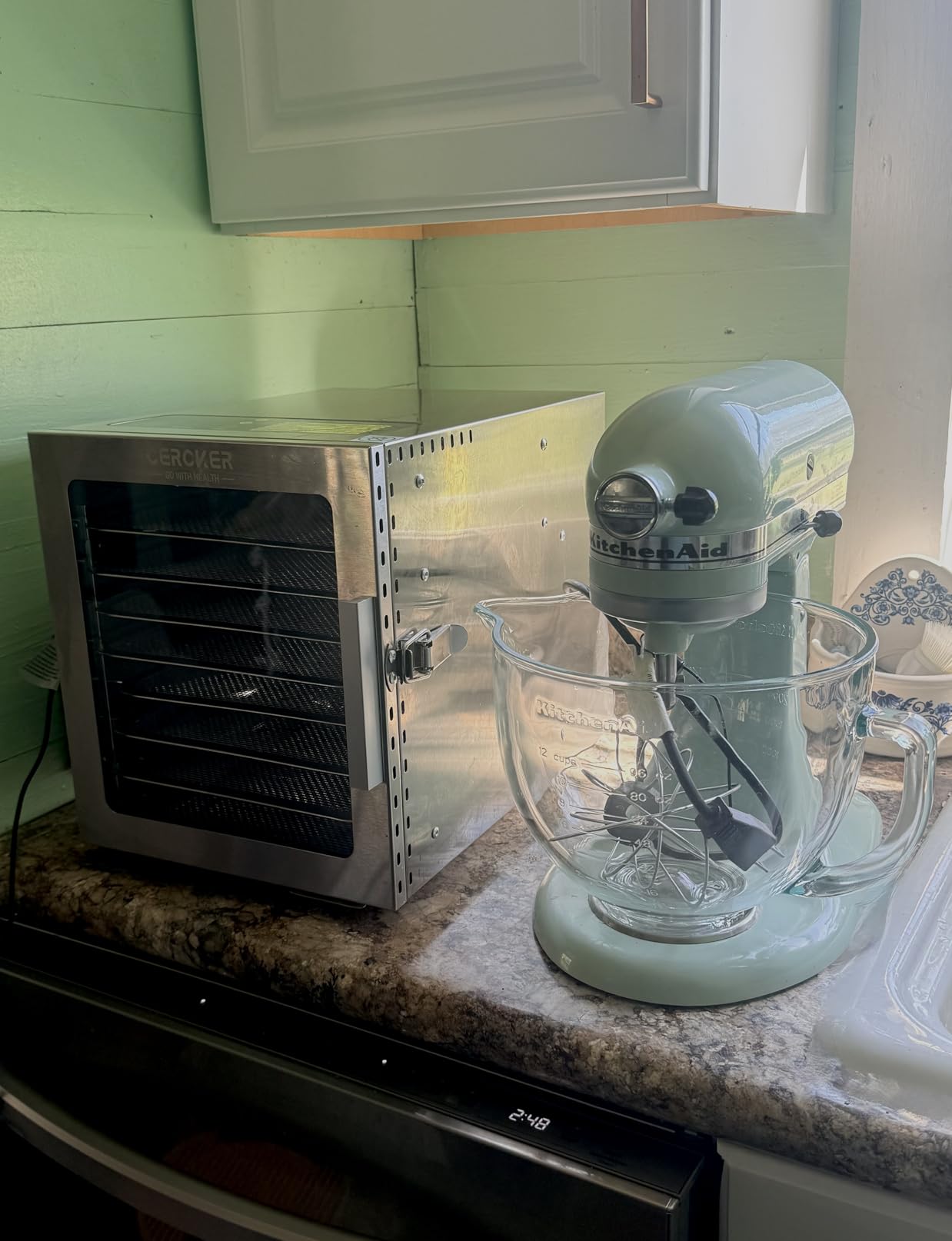
The three-year warranty is the longest stated cover in the roundup, shared only with the Septree 18-Tray, and the box includes a recipe book, door handle, drip tray, silicone gloves, and a screwdriver. Temperature steps in 5-degree increments and a 24-hour timer in half-hour increments are less granular than the Cosori P101 but perfectly workable for standard recipes.
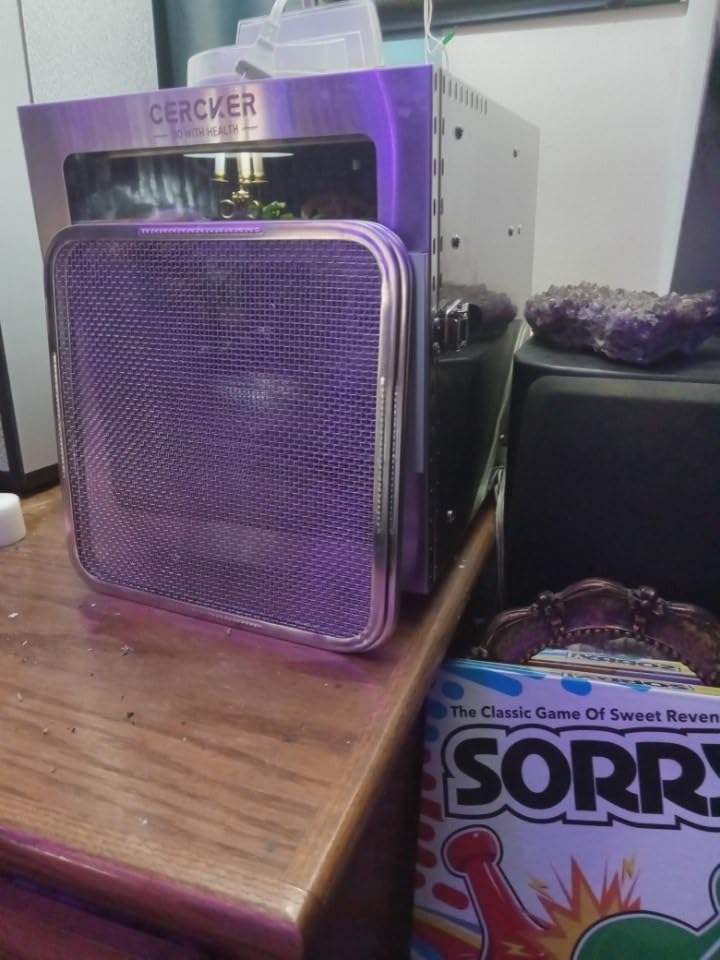
What looks like a convenience, the interior light, is also the most-cited annoyance. There is no switch for it, so it stays on until the unit is unplugged, and on an overnight run that means a glowing box on the counter. Several owners also report it will not clear standard wall cabinets, and the stainless body carries the new-unit odor that needs a burn-off cycle and ventilation.
The 70 to 190 degree advantage
Most units on this list start at 86 or 95 degrees. Starting at 70 means the same machine can hold yogurt culture temperature or gently dry delicate herbs without pushing them past the point where color and aroma are lost. For anyone who cooks as well as dehydrates, that range eliminates a second appliance.
The drip tray is more important than it looks on a 12-tray load, where fruit releases a lot of water. Being able to pull it and empty it mid-run without disassembling the chamber keeps a full 24-hour cycle from finishing in a sweet, sticky mess.
Where it falls short
At 12.4 by 16.5 by 17.7 inches it is bulky and tall, and multiple owners report it does not fit under standard wall cabinets. The trays are 11.5 inches, so it gives up per-layer area to the Ausegia and Septree despite having a higher tray count than most.
A small number of deliveries also arrive without all 12 trays, so count the accessories on arrival day. The 24-hour timer is shorter than the Excalibur’s 80 hours, which matters for long vegetable and whole-herb cycles.
7. HOPERAN 12-Tray Dehydrator as the Best Value Pick
HOPERAN 12 Tray Food Dehydrator Machine for Jerky, Fruit, Herb & Dog Treats
12 removable 304 stainless trays
86-196F with a 24-hour timer
Dual rear fans with 360 degree airflow
16 pounds
Pros
- Twelve removable food-grade 304 stainless steel trays
- Dual rear-fan system delivers 360 degree airflow without rotation
- 86-196F range plus programmable 24-hour timer with auto shut-off
- 16 pounds with under 48 dB operation
Cons
- Narrower 12.2 inch width gives less tray area than 15.75 inch models
- 9 percent one-star share points to some quality-control issues
- Newer listing with a smaller review base than established brands
At 16 pounds, the HOPERAN is the lightest machine on this list with a published weight, which changes what you can realistically do with a large dehydrator. Dual rear fans push 360 degree airflow so trays dry evenly without rotation, and at under 48 dB it is quiet enough to run overnight in a room where someone is sleeping.
The temperature range of 86 to 196 degrees runs higher at the top end than every other unit on this list, and the 24-hour programmable timer has auto shut-off. Two silicone mesh screens, a fruit roll sheet, a recipe book, and silicone gloves come in the box, and the housing is stainless with a clear glass viewing door and overheat protection.
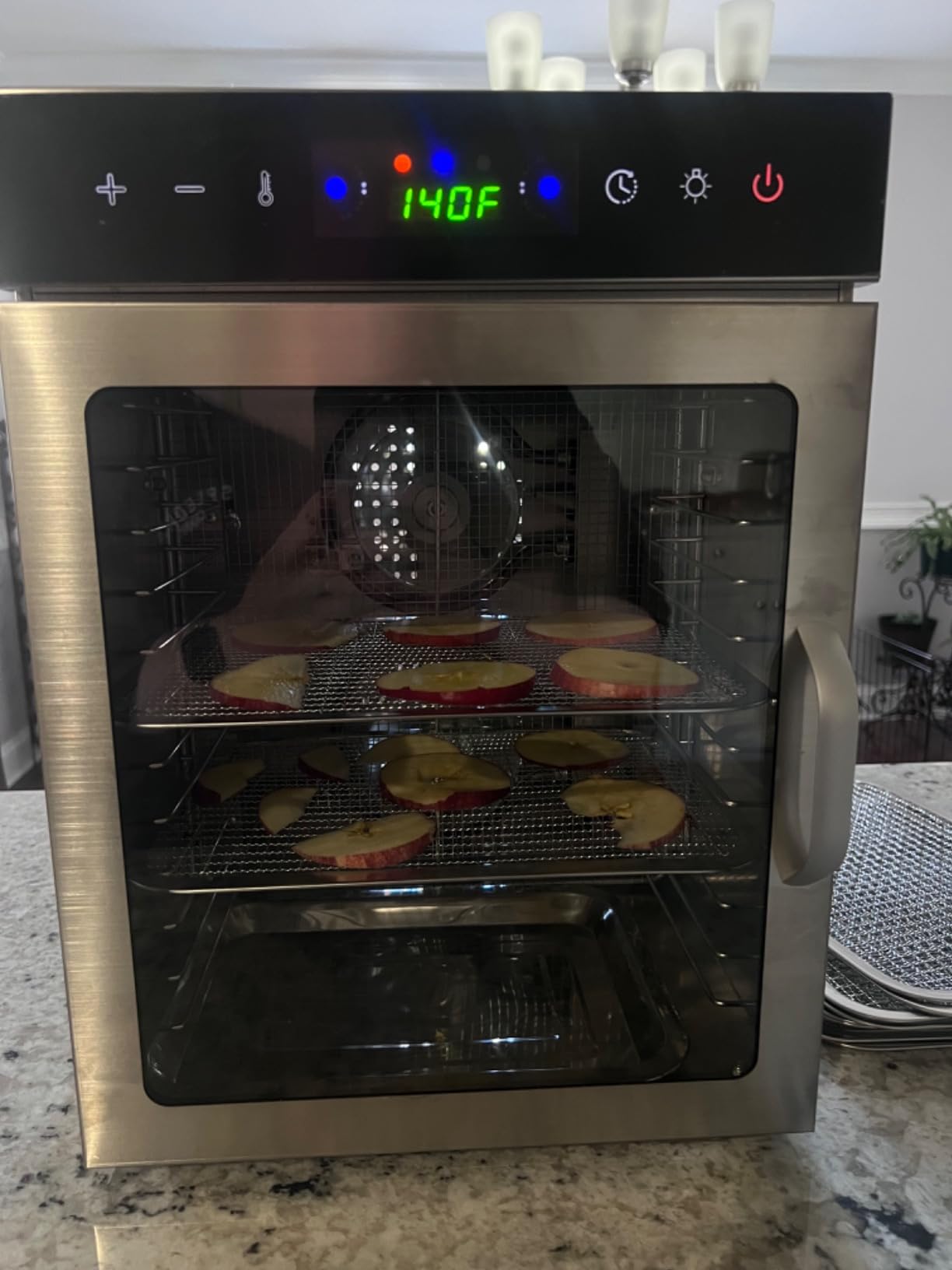
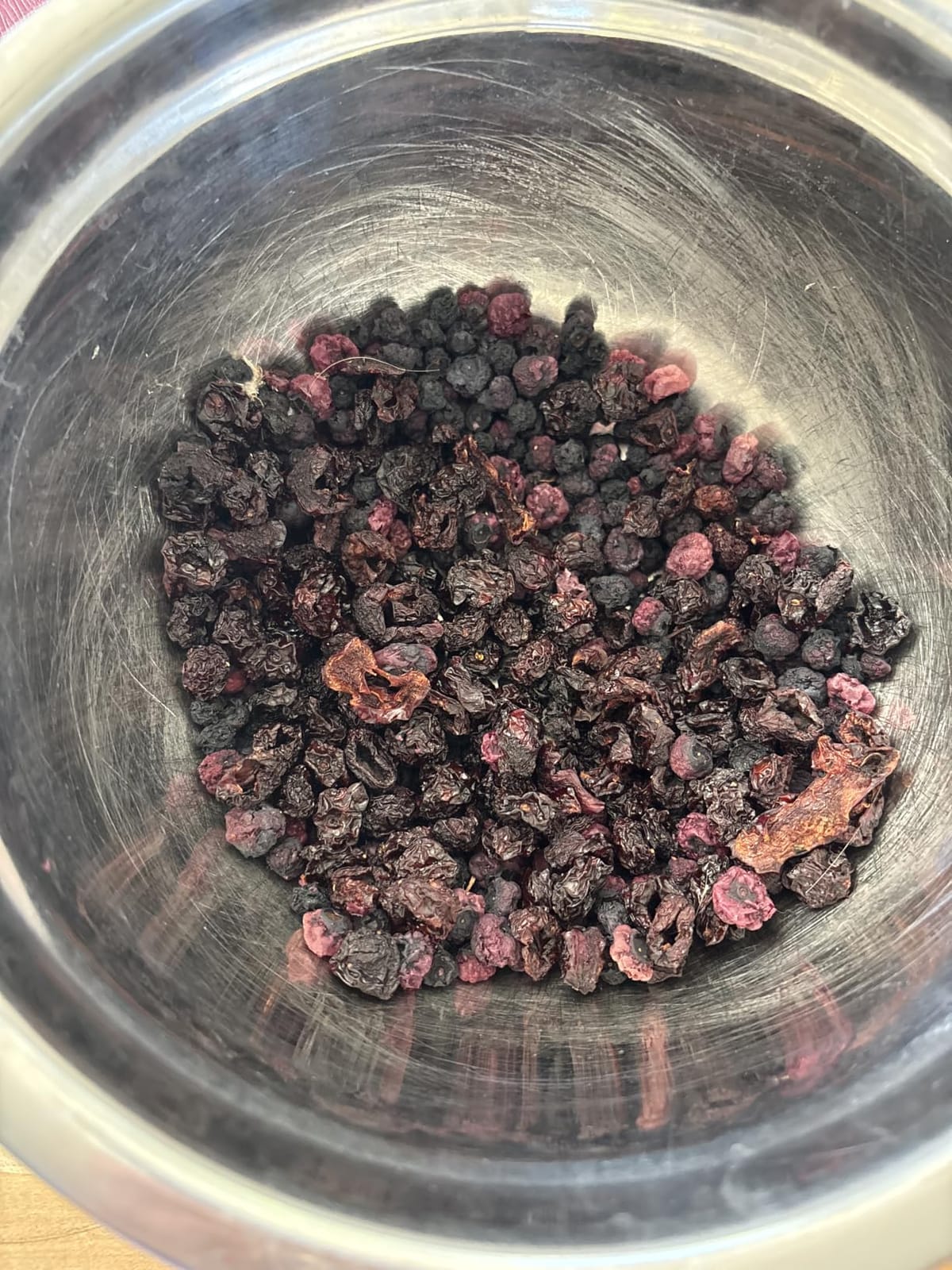
For a homestead drying herbs, mushrooms, and fruit chips rather than running a commercial meat schedule, this is the pick. The combination of 304 stainless food-contact trays, quiet operation, and a 16-pound weight makes it easier to live with in an ordinary kitchen than a 31-pound or 35-pound box.
The compromise is width. At 12.2 inches across, each tray is noticeably narrower than the 15.75-inch commercial trays, so the total usable area is smaller than the tray count suggests. You get twelve layers of convenience, not twelve layers of large-batch area.
Why the light weight matters more than it sounds
The other units on this list with a stated weight run from 16.5 pounds for the Excalibur 8-Tray to 35.8 pounds for the Cosori P101, with the VEVOR 10-Tray at 31.1 pounds in between. That spread is why large dehydrators end up in a garage or a basement, and why so many owners end up with two small units instead of one large one. A 12-tray machine you will actually keep on the kitchen counter gets used more than a 15-tray machine living in a closet.
The dual-fan layout also means no rotation mid-cycle, which is the throughput benefit that matters when you are running several batches in a weekend.
Where it falls short
A 9 percent one-star share suggests some early quality-control issues, and with 327 reviews there is not yet enough history to know whether they were isolated. A two-year manufacturer warranty is solid, but it is shorter than the Cercker three years.
If your harvests are large enough that tray area is the binding constraint, the HOPERAN loses to the Ausegia on usable square feet. Buy it for convenience and quiet running, not for maximum volume per layer.
8. Cosori CP267-FD 6-Tray Dehydrator for Quiet Overnight Runs
Cosori Food Dehydrator, 6 Stainless Steel Trays with 6.5 ft² Drying Space
6 stainless trays with 6.5 ft2 of space
600W brushless motor under 48 dB
95-165F in 1 degree steps
48-hour timer
Pros
- Brushless motor keeps noise under 48 dB for overnight runs
- 6.5 ft2 across 6 stainless trays with 6.5 square feet of area
- 600W rear-mounted fan dries evenly without rotating trays
- Dishwasher-safe trays with mesh screen and fruit roll sheet plus 50-recipe cookbook
Cons
- 6-tray capacity is small against 10 to 18 tray models in this roundup
- Square trays limit the size of jerky and fruit leather sheets
- 18.1 pounds still needs a lift to reposition
I want to be straight with you about this one: six trays is not a large-batch machine by the definition at the top of this page. It is here because it is the most reviewed and highest rated unit in the roundup at 4.7 stars across more than 21,000 reviews, and because for a lot of people that review history is the deciding factor for a machine they expect to keep for years.
86 percent of those reviews are five-star and 9 percent are four-star, which is an unusually clean distribution. Owners consistently praise even drying, quiet operation, and precise temperature control. The brushless motor and rear-mounted 600W fan produce upgraded airflow that dries evenly without rotating trays, at under 48 dB, and control runs 95 to 165 degrees in 1-degree steps with a 48-hour timer.
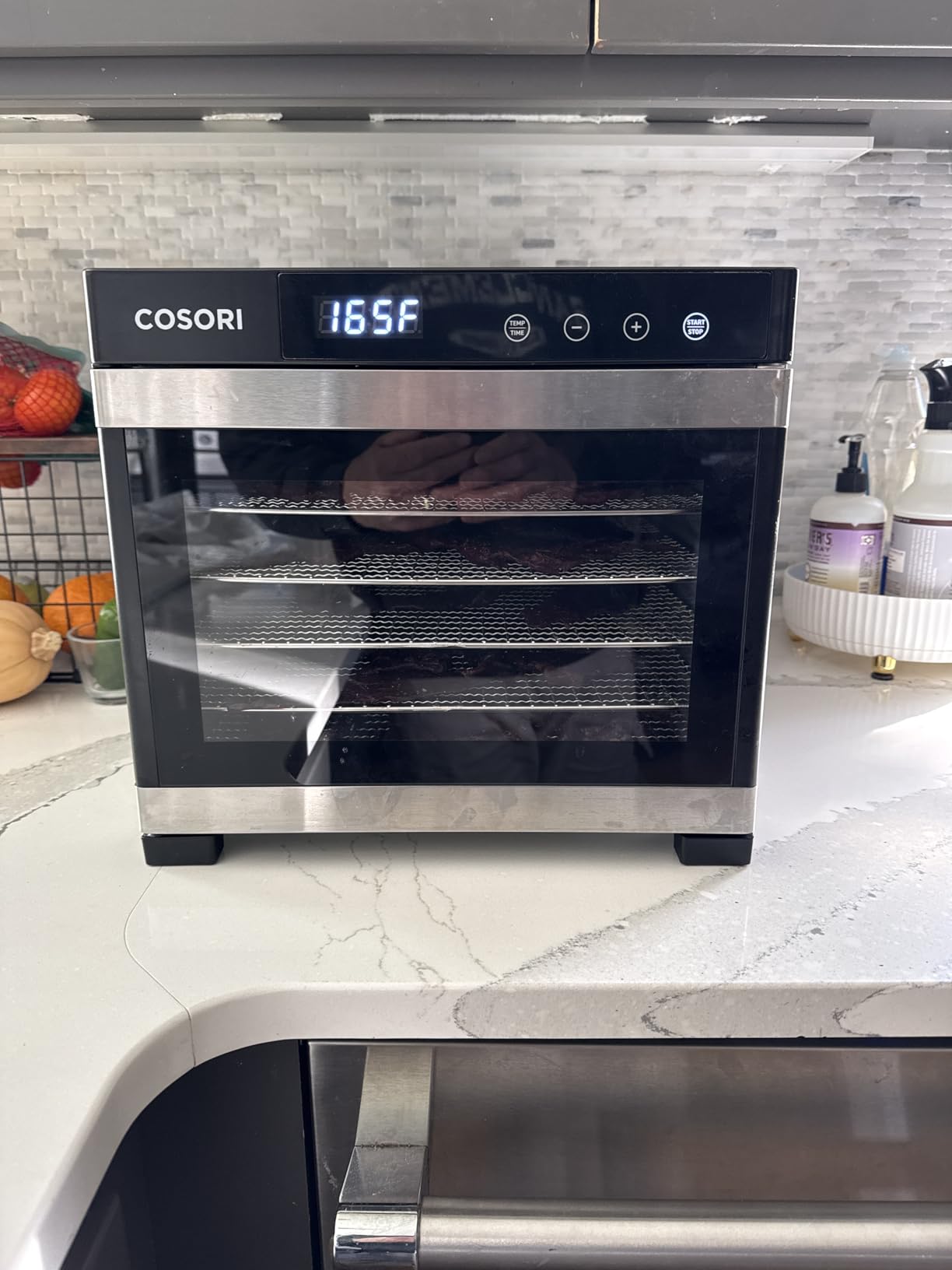
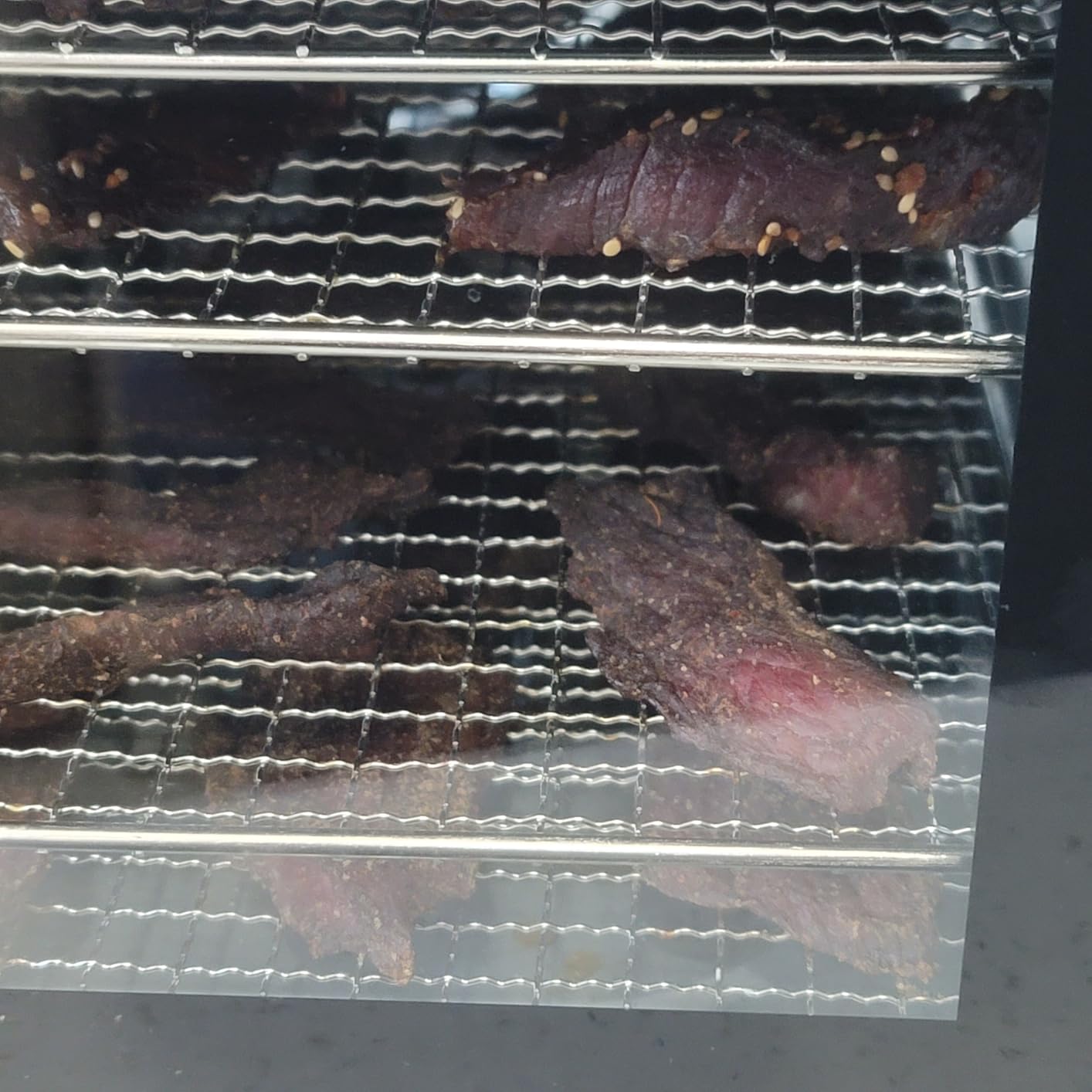
Two-year manufacturer warranty, dishwasher-safe trays, a mesh screen, a fruit roll sheet, and a 50-recipe cookbook. At 18.1 pounds and 17.8 by 13.4 by 12.4 inches, it has the lowest profile of the ten, which means it fits under cabinetry that stops every other pick on this list.
The limitation owners raise most is tray size. Square trays limit the dimensions of a jerky strip or a fruit leather sheet, so you get fewer usable square inches per layer than a 15.75-inch commercial tray despite the square footage sounding similar. For a household batch that fits on six shelves, that is a fair trade for near-silent running.
When a 6-tray unit is the right call
If you are not drying in bulk, a 6-tray machine finishes a household batch in a single overnight cycle, and finishing a batch in one cycle matters more than finishing four. Owning a quiet 4.7-rated box you are happy to leave on the counter beats a season with an 18-tray unit you resent the footprint of.
A 12.4-inch height also clears most counters with a backsplash, and the glass door lets you watch a load without opening it.
Where it falls short for bulk work
Six trays means 6.5 square feet, so a harvest run turns into multiple cycles rather than one. Anyone drying a whole garden’s worth of produce, or running a weekly jerky production schedule, will outgrow it inside a season.
That is the honest framing: this is the most reviewed and highest rated unit on the list, and the quietest by specification, but the roundup’s title is large batches and six trays is not one. Treat it as the starter you buy first, or as the second machine for herbs and fruit while a bigger box handles meat.
9. NutriChef NCFD10S 10-Tray Dehydrator with Touch Controls
NutriChef Electric Countertop Food Dehydrator -900-Watt Premium Multi-Tier Meat Beef Jerky Maker Fruit/Vegetable Dryer w/10 Shelf Stainless Steel Trays,Digital Timer,Temperature Control-NCFD10S
10 removable stainless trays
Probe control 95-170F
Touch LED display with memory function
360 degree circulation
Pros
- Ten removable food-grade stainless trays that double as drying racks
- Electronic probe temperature control across 95-170F
- Touch-control LED display with auto shut-off and memory function
- Glass door with magnetic-induction switch and internal fan
Cons
- Lowest rating in the roundup at 4.1 with 16 percent one-star reviews
- Recurring reports of fan motor and element failures within months
- Trays are smaller than several competing 10-tray models
The NutriChef has the best interface on paper. A touch-control LED display with a memory function means your last temperature and timer setting reload when you power it back up, and a magnetic-induction door switch means the unit notices when the door is open. Electronic probe temperature control spans 95 to 170 degrees, and ten removable food-grade stainless trays double as standalone drying racks.
The glass door has a built-in rear motor and internal fan designed to prevent overheating, with 360 degree high-heat air circulation. A mesh screen and fruit roll sheet come in the box, along with 900W of drying power on 120 volts.
Here is the problem, and it is not about drying. The 4.1 average is the lowest of the ten picks, and 16 percent of reviews are one-star. Those critical reviews are overwhelmingly about longevity rather than performance: recurring fan, motor, and heating element failures within months on units used heavily. For a large-batch machine that people run for a season straight, that failure pattern is disqualifying.
The review distribution is also more polarized than any other pick here, which means a new buyer is effectively taking a chance on whether their unit lands in the good group or the bad one. Kitchen and Dining sales rank is also far lower than the competing 10-tray models, which limits the size of the sample.
What the memory function is actually worth
On a machine you run weekly with the same recipe, memory saves you two dial turns and removes the chance of setting 160 when you meant 140. That convenience is real, and it is why this unit still appeals to people who run a fixed herb or vegetable schedule.
The 360 degree circulation is also genuinely useful, since it reduces the need for mid-cycle tray swaps on a 10-tray load.
Where it falls short
Component lifespan is the deal breaker. If a heating element fails in month seven on a seasonal appliance, the effective cost per year of ownership makes this a poor choice compared with a three-year-warranty Cercker or a two-year-warranty Cosori.
The trays are also smaller than several competing 10-tray models, so per-layer yield is lower than the tray count implies. At 13.39 by 17.83 by 16.57 inches the footprint is smaller than the Cosori P101 and the VEVOR 10-Tray, which is one clear advantage of an otherwise feature-heavy unit.
10. Excalibur 8-Tray Dehydrator with an 80-Hour Timer
Excalibur Food Dehydrator 8-Tray for Jerky, Fruit, Vegetables, Herbs, Pet Treats, 7.2 Cu Ft Drying Space with Adjustable Temperature Control and 80 hour digital timer, 8-Tray, Stainless Steel
8 chrome-plated trays in a compact 16.5 pound build
Hyperwave Pulse horizontal airflow
85-165F thermostat
80-hour digital timer
Pros
- 80-hour timer which is the longest single cycle on the list
- Patented Hyperwave Pulse Technology dries evenly without tray rotation
- Compact 16.5 pound build in a small footprint
- Clear glass French doors for monitoring progress
Cons
- Only 8 trays which is well short of a large-batch chamber
- Chrome-plated rather than full stainless steel trays
- 700W is the lowest wattage here so full loads take longer
Excalibur is a dehydrator-specific brand, and that shows in the details. The 80-hour digital timer runs far longer than any other cycle on this list, which matters for anyone drying whole vegetables, dense melon, or a multi-day herb schedule where a 24 or 48 hour timer forces a restart mid-cycle. The adjustable thermostat runs 85 to 165 degrees.
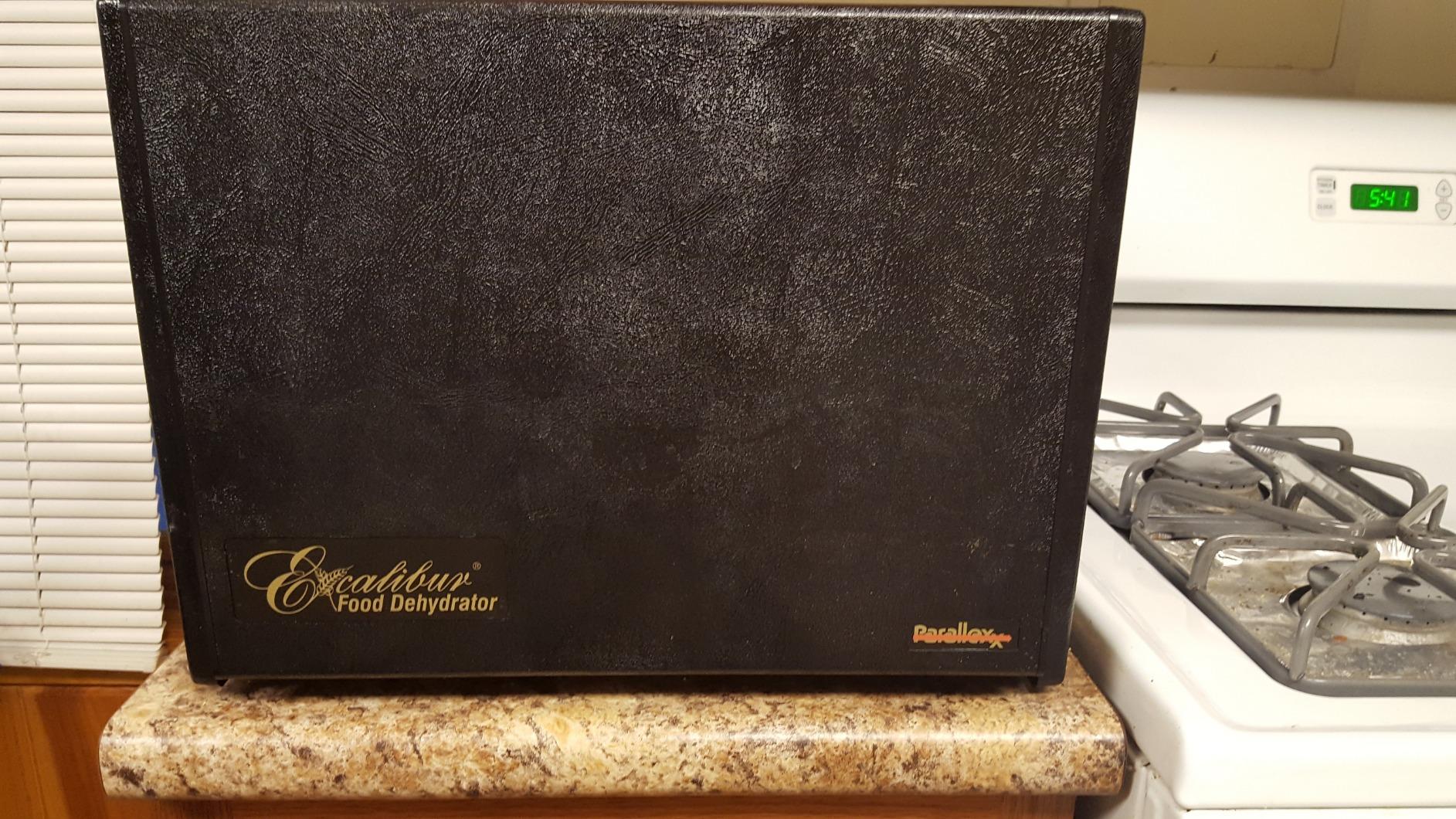
Patented Hyperwave Pulse Technology with Horizontal Parallex Air Flow moves air across the chamber in a way that dries evenly without tray rotation, which is the same airflow claim the Cosori and Magic Mill units make.
Eight chrome-plated trays sit in a compact 17.32 by 13.39 by 14.08-inch body weighing 16.5 pounds, second lightest of the units here with a stated weight, with a PP mesh screen, crumb tray, manual, and recipes included.
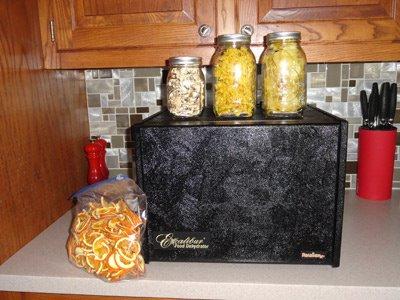
Long-term owners of this brand describe upgrading from a 4-tray starter and then being spoiled by the step up, and the clear glass French doors are the feature cited most often for monitoring a long run without opening the door and losing heat.
Capacity is the honest problem. Eight trays is a smaller chamber than every other unit here, and at 700W it has the lowest wattage on the list, which means a full load takes longer to dry than the same weight of food in the Cosori P101 or the VEVOR. On a large-batch schedule, both facts work against it.
When an 80-hour timer changes the result
Most fruit and vegetable cycles finish well inside 24 hours, so the long timer is wasted capacity on those. It earns its place on dense low-moisture work: whole herbs in thick bunches, dense root vegetables cut thick, and cured-style meat runs that need a slow finish. If that is your regular work, no other unit on this list runs a single cycle as long.
The 16.5-pound weight and compact footprint also make this an easy machine to move between counter and storage, which offsets the lower capacity for someone who dehydrates in bursts rather than continuously.
Where it falls short
Eight trays is a smaller chamber than every other pick here, so it does not meet the bar this roundup sets, and the article title is not the reason to buy it. Chrome-plated trays rather than full stainless can wear over years of high-heat cycles, which is a genuine concern on a machine intended to last.
At 700W and 165 degrees, full loads are slow, and the one-year manufacturer warranty is the shortest stated cover on this list. If you need volume, the Ausegia 12-Tray gives you roughly three times the tray area.
How Much Food Counts As a Large Batch?
Almost nobody defines this with numbers, so here are the only published figures we could verify. One unit in this roundup, the VEVOR 10-Tray, states that each of its trays holds up to 1.7 pounds of food, which is the only per-tray weight any of these listings publish. Ten of those trays is the working upper bound of about 17 pounds of wet food in a single load.
The Cercker 12-Tray gives the most useful owner-reported figure: buyers describe completing 6 to 9 pounds of jerky per week with no tray swapping. Owner anecdotes in the buying discussion also put a large strawberry run at roughly five quarts per load and describe hobby-scale commercial runs of 15 to 20 pounds of wet jerky on 16 to 20 tray machines, which is the territory the Ausegia and Septree occupy.
Use this as your sizing rule. Multiply the trays you can realistically load by the food per tray for your specific cut, and treat any manufacturer claim without a per-tray weight as unverified. A useful side task before a big harvest is prepping and weighing your first tray, because sliced fruit and trimmed flank meat behave very differently per layer.
For a garden harvest, prep is also the bottleneck people underestimate. If you are working through a large volume of fruit, a mechanical pitter saves hours before the dehydrator even starts, and our best cherry pitters for large batches guide covers that step.
How We Picked
Every unit here was ranked on published usable drying area, wattage, temperature range, timer length, build material, warranty length, and the volume and distribution of owner reviews. We weighted usable area above tray count, because a 15.75-inch square tray in a 12-tray machine genuinely holds more food than an 11-inch tray in a 15-tray machine.
We also excluded anything that could not hold a 165 degree ceiling, because below that you cannot safely dry meat. Units without a stated temperature control were left out regardless of how many trays they claimed. Where a listing does not publish usable square footage, we say so rather than estimating it.
Owner feedback counted for as much as the spec sheet. The differences between these machines on paper are small; the differences in reported failures are not, so durability complaints were used as a ranking factor rather than a footnote.
Do Large Dehydrators Need Tray Rotation?
Only some of them, and the answer comes down to airflow design rather than size. The units that report genuinely rotation-free full loads all share one thing: air is pushed horizontally through the chamber by a rear-mounted fan, or by dual rear-row fans moving fast enough to reach every level. The Cosori CP267-FD, Magic Mill 15-Tray, Cercker 12-Tray, HOPERAN 12-Tray, VEVOR 10-Tray, NutriChef 10-Tray, and Excalibur 8-Tray all use rear or dual rear fan layouts and report even drying without swapping.
The exceptions are informative. The Ausegia 12-Tray has a rear-mounted fan with horizontal airflow, yet owners still report that middle trays dry less evenly than the top and bottom and need manual swapping. Chamber depth is the variable, and once you are stacking twelve large trays deep, horizontal airflow alone does not guarantee that the middle levels see the same air volume.
So the practical rule: at 10 trays or fewer with a documented rear fan, plan for no rotation. At 12 to 18 trays with oversized trays, plan on one mid-cycle swap of the middle two shelves unless the manufacturer owner reviews specifically say otherwise. The real fix most owners land on is trimming tray rims to open the airflow path, which several describe as working better than any manual procedure.
What to Check Before You Buy a Large-Batch Dehydrator
Usable drying area first, and measure it yourself. Multiply tray width by tray depth and multiply again by tray count, then subtract roughly 10 percent for the gap the trays need. A unit advertising 22.67 square feet of usable area will not deliver 22.67 pounds of output; dry weight is always a fraction of wet weight, and juice content varies by food.
Airflow is the second check. Rear-mounted fan plus horizontal airflow claims even drying, and dual fans moving 2 m/s at 1600 rpm or a stated 360 degree circulation pattern are stronger signals. A unit with no fan specification, or a fan described only as built in, will dry unevenly at full load no matter how many trays it has.
Temperature ceiling and increment decide what you can make. 165 degrees is the right cap for USDA-aligned jerky safety, 190 to 196 degrees gives you headroom for thick cuts and vegetable chips, and 1-degree increments beat 5-degree steps when you are refining a recipe. For temperature-sensitive work like yogurt or low-temperature herb drying, the Cercker is the only unit on this list whose range starts at 70 degrees.
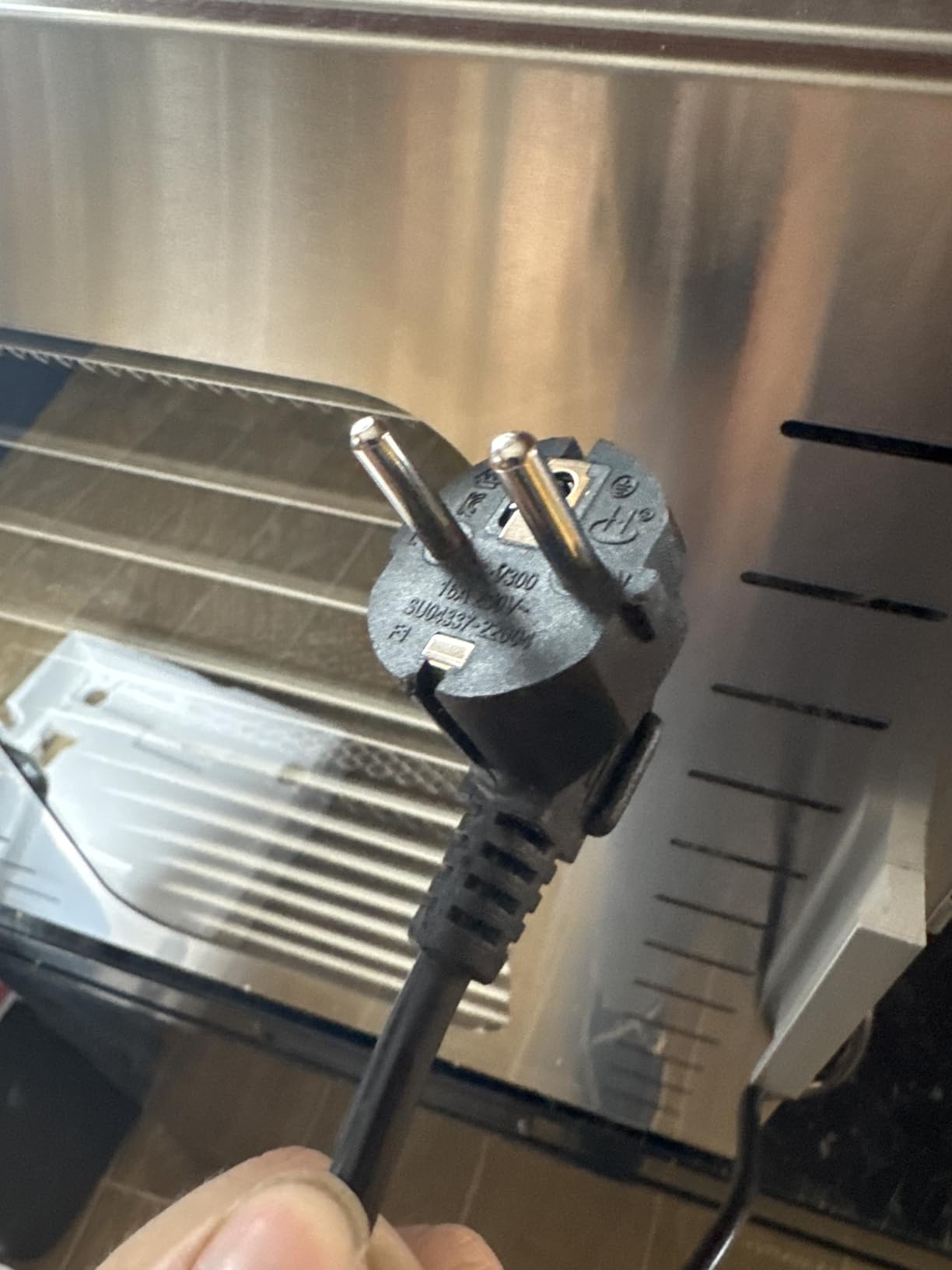
Electrical reality is where returns happen. Check the voltage listed on the actual unit rather than the listing, because 110 and 120 volt units are what you want on US outlets, and some commercial-style listings are mislabeled between 120V and 220V. A 2000W machine on 120V draws over 16 amps, which is a dedicated 20A circuit, not a shared countertop outlet. Anything at 1200W and above deserves a dedicated circuit on its own, and a 1000W unit is the practical ceiling for a normal kitchen circuit.
Cleaning and materials decide whether you still like the machine in year three. 304 stainless food-contact trays are the target, and BPA-free plastic accessories are fine as long as they are not the surface food rests on for the whole cycle. Dishwasher-safe trays and a drip tray are non-negotiable at this batch size. Warping of stainless trays after repeated high-heat cycles is a reported problem, so check the warranty length as a proxy: one year is thin, two years is standard, three years means the manufacturer expects heavy use.
Noise and footprint decide whether the machine stays out. Anything under 48 dB can run overnight in a living space. Footprint matters more than people expect, because a dehydrator pushed into a corner is one people stop using. The 35.8-pound Cosori P101 needs a permanent counter section, the 16-pound HOPERAN 12-Tray can be moved by one hand, and the 29.53-inch Septree is a floor-adjacent machine.
Uneven Drying and Other Failure Modes Owners Report
Top trays wet and bottom trays crispy is the signature complaint, and it is usually airflow rather than heat. On deep chambers, the fix is opening the airflow path by trimming tray rims, running the fan on higher fan settings where available, and rotating the middle shelves once mid-cycle. Leaving gaps between the sides of the load and the chamber wall helps more than cramming trays tight.
Heating element burnout shows up in the brands people use hardest. Owners running a Nesco-style stackable unit three to four times a month report being on a second machine with a failing element, and the Ausegia reviews include the same complaint with the added problem of hard-to-source replacements. This is why we weight warranty length heavily, and why units with a three-year cover rank above one-year units with similar capacity.
Stainless new-unit odor and plastic off-gassing are common on stainless-bodied units in this class, and they can transfer to the first batch if you skip the burn-off. Run an empty cycle at the top of the temperature range with the door propped open and the room ventilated before loading food. Plastic tray odor is the more serious of the two, because aroma that transfers into jerky is hard to remove and is a deal breaker for anyone selling finished product.
Finally, check for the listing problems rather than the machine problems. Some deliveries arrive without the full tray count, and mislabeled voltage is the single most common reason large commercial-style dehydrators get returned. Count the trays on arrival day and confirm the voltage label on the machine itself.
Frequently Asked Questions
What is a good heavy-duty food dehydrator?
A heavy-duty large-batch dehydrator needs roughly 12 square feet or more of usable drying space, six or more full-size trays, a rear-mounted or dual fan that moves air through a fully loaded chamber, and a build you can run for days. The Magic Mill 15-Tray and the Septree 18-Tray are the two picks built for that workload, and the Excalibur 8-Tray is the lightest box on the list.
What is the best food dehydrator for value for money?
The HOPERAN 12-Tray is the strongest value pick: twelve 304 stainless trays, dual rear fans with 360 degree airflow so you never rotate trays, an 86 to 196 degree range, under 48 dB, and a two-year warranty at just 16 pounds, lighter than every other unit here with a stated weight. If usable square footage matters more than weight, the Ausegia 12-Tray gives you 22.67 square feet.
What is the best food dehydrator for commercial use?
For sustained commercial-scale batches, the Septree 18-Tray is the pick: 18 trays at 15.67 inches square for up to 34.42 square feet, 2000W, a 70 to 190 degree range, and a manufacturer rating for continuous 7×24 hour operation with overheat protection. The Ausegia 12-Tray at 22.67 square feet and 1200W is the step-down option for smaller production runs.
How many trays do I need for batch drying?
For a household drying a weekly garden harvest, 6 to 10 trays is enough to finish a batch in one overnight cycle. For a grower or small producer, 12 trays with oversized 15.75-inch trays is the practical minimum, and 18 trays is where you stop reloading. Count per-layer area rather than layers, because an 11.6 by 11-inch tray in a 10-tray machine holds far less than a 15.75-inch square tray.
Are Excalibur dehydrators worth it?
Yes for specific work. The Excalibur 8-Tray has the longest timer here at up to 80 hours, dries evenly without tray rotation thanks to Hyperwave Pulse airflow, weighs only 16.5 pounds, and comes with a one-year warranty. At 4.4 stars across 153 reviews, that rating is solid, though the sample is on the smaller side. The trade-offs are that eight trays is a smaller chamber than the ten-tray and larger models, 700W is the lowest wattage on the list, and the chrome-plated trays are not full stainless.
How do I know when food is fully dried?
Test rather than trust the clock. Jerky should bend without snapping and show no white fibrous interior when torn. Fruit leather should be leathery and peel cleanly from the liner without leaving moisture behind. Herbs should be crisp and crumble at the stem. Fruit slices should be leathery with no tackiness or visible moisture in the center, and any soft spot means another hour or two.
Is a large dehydrator loud enough to run overnight?
It depends on the design, not the size. The Cosori CP267-FD and the HOPERAN 12-Tray both run under 48 dB, which is quiet enough for a bedroom or living space overnight, while the Ausegia and Septree commercial units sit under 50 dB. For placement, a unit on a solid counter in a corner reads quieter than the same unit on a thin shelf against a wall.
Can I use one dehydrator for herbs and meat in the same unit?
Yes, as long as you run full cycles and clean between them. Herbs are best at the low end of the range, which is why the Cercker 12-Tray, with a 70 degree minimum, is the one unit on the list that handles both yogurt-style and herb work alongside meat. The main concern is flavor transfer, so wipe the chamber, trays, and door seal after any meat run before loading herbs or fruit.
Final Verdict
The Magic Mill Premium 15-Tray is our pick for the best food dehydrators for large batches, because 15 extra-large stainless trays with a rear-mounted fan at 800W deliver a full chamber that dries evenly without rotation, and more than 4300 owner reviews is enough history to see its failure patterns clearly. Go to the Septree 18-Tray when 34.42 square feet and continuous 7×24 hour operation justify a 29.53-inch tall machine, and to the Ausegia 12-Tray when 22.67 square feet of oversized tray area is the number you actually need.
For everything else, the Cercker 12-Tray wins on temperature range and a three-year warranty, the Cosori P101 wins on family-scale capacity in one box, the VEVOR 10-Tray wins on published per-tray load, and the HOPERAN 12-Tray wins on value and weight. Work out which of those matches your counter and your circuit, then run a burn-off cycle before the first real batch.