
The best Dutch ovens for bread baking are heavy, lidded cast iron pots that trap the steam a loaf needs to spring and then brown. A preheated pot holds the dough in a sealed humidity chamber, the lid traps the moisture, and when you take the lid off the crust sets and crisps. The same recipe that gives you a pale, dense loaf in an open pan turns into a blistered artisan loaf in a Dutch oven.
We baked in all ten pots below across sourdough, no-knead and quick breads, checking crust, oven spring, how the pot handles at 500 degrees F, and how heavy it felt with a raw dough inside. The picks cover three categories: bare seasoned cast iron, enameled cast iron, and one dedicated domed bread oven. Last updated for October 2026.
Most of the market is enameled pot + enameled lid, and the differences between brands are smaller than the difference between a 4-quart pot and a 6-quart pot. Read the size guide below before you buy anything. If you already own cast iron, you may prefer our Lodge Dutch oven roundup or our Le Creuset reviews for the brand side of the story.
Table of Contents
Top 3 Picks for Best Dutch Ovens for Bread Baking in 2026

Lodge 5 Quart Cast Iron Dutch Oven
- Seasoned bare cast iron
- Self-basting lid
- Lifetime warranty


Le Creuset 7.25 qt Round Dutch Oven
- Light interior enamel
- Tight-fitting lid
- Limited lifetime warranty
All 10 Dutch Ovens Compared Side by Side in 2026
| Product | Specifications | Action |
|---|---|---|
| Lodge Cast Iron Dutch Oven 5 Quart |
|
Check Latest Price |
| Overmont Enameled Cast Iron Dutch Oven 5.5QT |
|
Check Latest Price |
| Le Creuset Enameled Round Dutch Oven 7.25 qt |
|
Check Latest Price |
 Nuovva Enamelled Cast Iron Dutch Oven 6.4 Quart Nuovva Enamelled Cast Iron Dutch Oven 6.4 Quart |
|
Check Latest Price |
 Mueller DuraCast 6 Quart Enameled Dutch Oven Mueller DuraCast 6 Quart Enameled Dutch Oven |
|
Check Latest Price |
 Umite Chef Enameled Cast Iron Dutch Oven 5QT Umite Chef Enameled Cast Iron Dutch Oven 5QT |
|
Check Latest Price |
 Umite Chef Enameled Bread Oven 6 Qt Dome Lid Umite Chef Enameled Bread Oven 6 Qt Dome Lid |
|
Check Latest Price |
 Northriver Casting Oval Enameled Dutch Oven 5 Qt Northriver Casting Oval Enameled Dutch Oven 5 Qt |
|
Check Latest Price |
 EDGING CASTING 2-in-1 Cast Iron Dutch Oven 5 Qt EDGING CASTING 2-in-1 Cast Iron Dutch Oven 5 Qt |
|
Check Latest Price |
 CRUSTLOVE Pre-Seasoned Dutch Oven 5 QT with Kit CRUSTLOVE Pre-Seasoned Dutch Oven 5 QT with Kit |
|
Check Latest Price |
1. Lodge 5 Quart Cast Iron Dutch Oven – the one that handles everything
Lodge Cast Iron Dutch Oven with Loop Handle, Oven-Safe, 5 Quart
Bare seasoned cast iron
4.7 liter / 5 quart round
12.8 pounds
Lifetime limited warranty
Pros
- Even dependable heat with no hot spots
- Lid seats very flush and holds steam
- Tolerates high heat without warping
- Repairable and reseasonable for life
Cons
- Around 13 pounds empty
- Real seasoning routine required
- Rusts if left wet
This is the pot we reach for first, and the one we would put in a beginner’s hands. The 5-quart size is the sweet spot for a single boule, the lid seats flush enough that steam stays in, and the cast iron handles are smooth with no sharp edges to catch your mitts. It is the largest-reviewed pot in this roundup at more than 17,000 ratings, and the pattern across those reviews is consistent: durable, repairable, and reliable at high heat.
Sourdough bakers on the forums call the 5-quart the right size and note it handles the highest baking temperatures. One thing worth knowing: the listing rates this pot to 400 degrees F, below the 500 degree F ceiling that the enameled pots here carry, so plan your bake around the lower figure if you buy this one.
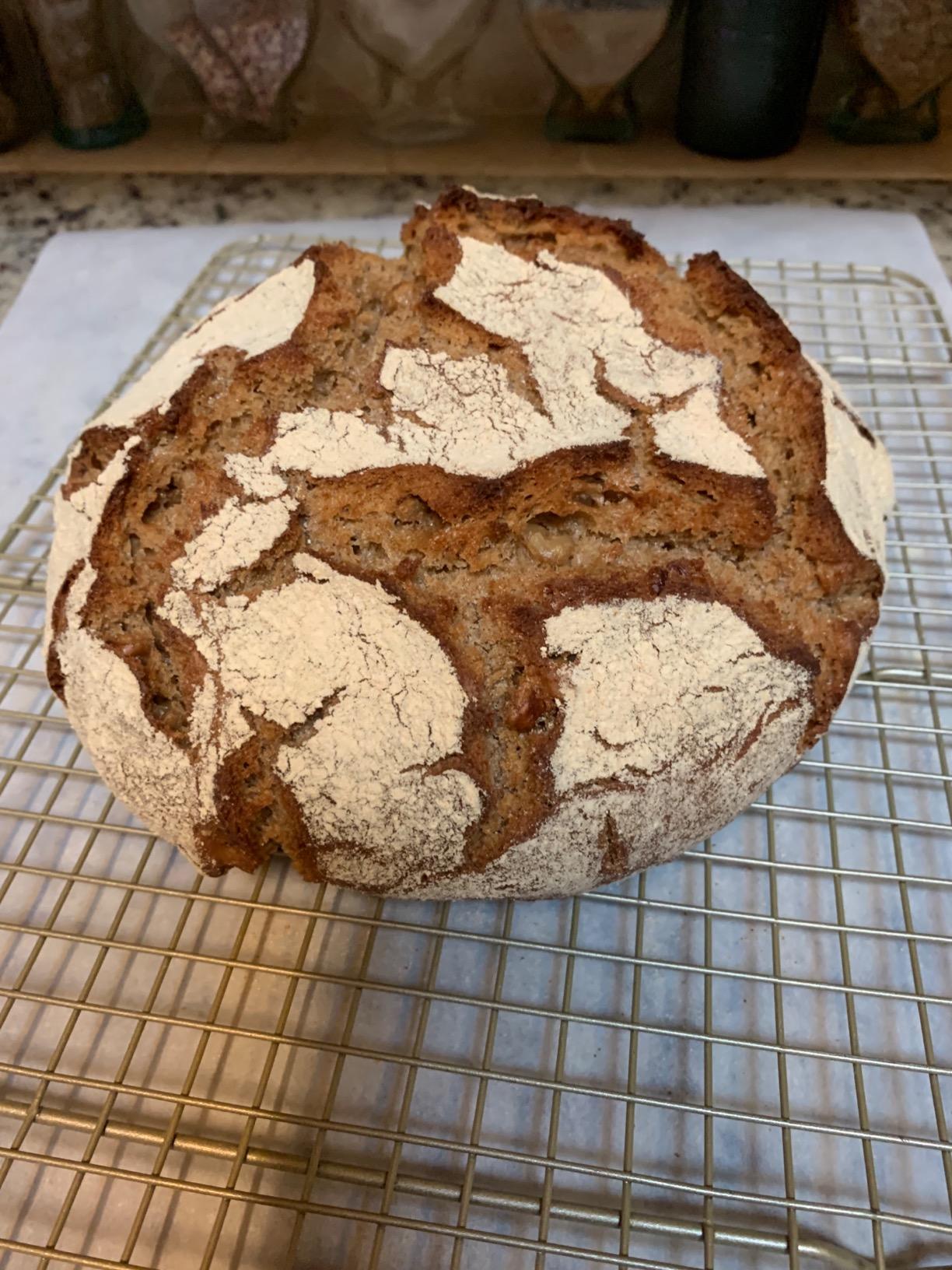
The honest part of the Lodge conversation is upkeep. This is bare seasoned iron, so the factory seasoning is a starting point, not a finish, and if you leave it wet or scrub it with steel wool you will be re-seasoning. New buyers routinely underestimate that, and it is the single most common regret we see in the reviews.
The payoff is that a seasoned pot can be restored indefinitely, and it is the only pick here that also goes straight onto a campfire or grill. Over years of use the surface only improves.
Check fit before you buy
It measures 12.56 x 10.43 x 6 inches, so measure your oven cavity and your oven rack spacing before you commit. A deep lid handle can foul the upper rack or the broil element in a compact kitchen.
For whom it is bad
If you have wrist or back problems, roughly 13 pounds empty plus the weight of wet dough is a genuine strain. Consider an enameled pot with side handles, or bake in a smaller 4-quart size.
2. Overmont 5.5QT Enameled Cast Iron Dutch Oven – best value for bread
Overmont Enameled Cast Iron Dutch Oven – 5.5QT Pot with Lid Cookbook & Cotton Potholders – Heavy-Duty Cookware for Braising, Stews, Roasting, Sourdough Baking White
Enameled cast iron
5.5 quart round
Warm white
13.2 x 13.2 x 7.1 inches
Pros
- Even heat with no hot spots
- Enamel releases baked-on food after a soak
- Self-basting lid aids crust development
- Rated number one in Dutch Ovens
Cons
- Lid is disproportionately heavy
- Very heavy to lift when full
- Lid handle can clash with a broil element
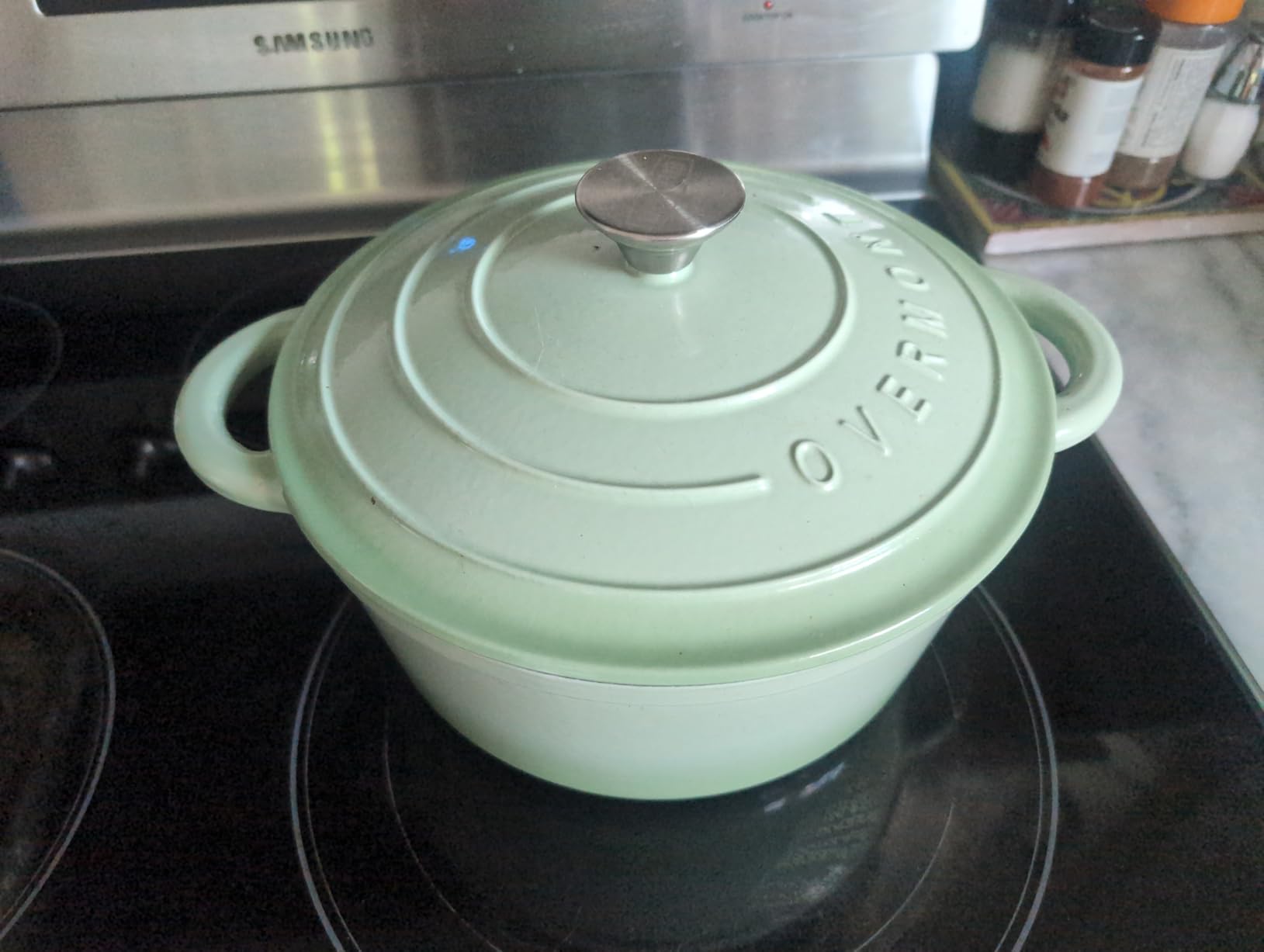
The Overmont is the pot that convinced us enamel does not have to cost what a European brand costs. It carries a triple-layer enamel coating that needs no seasoning, a self-basting lid with condensation bumps, and a 500 degree F rating. Owners regularly describe a premium-looking pot at a fraction of premium-brand pricing, and multiple international reviews report performance they compare to expensive European pots.
At 5.5 quarts it is our default recommendation for a standard 1.5 pound loaf. It sits at #1 in the Dutch Ovens category, and the reviews specifically call out sourdough and round-baking results, not just braising.
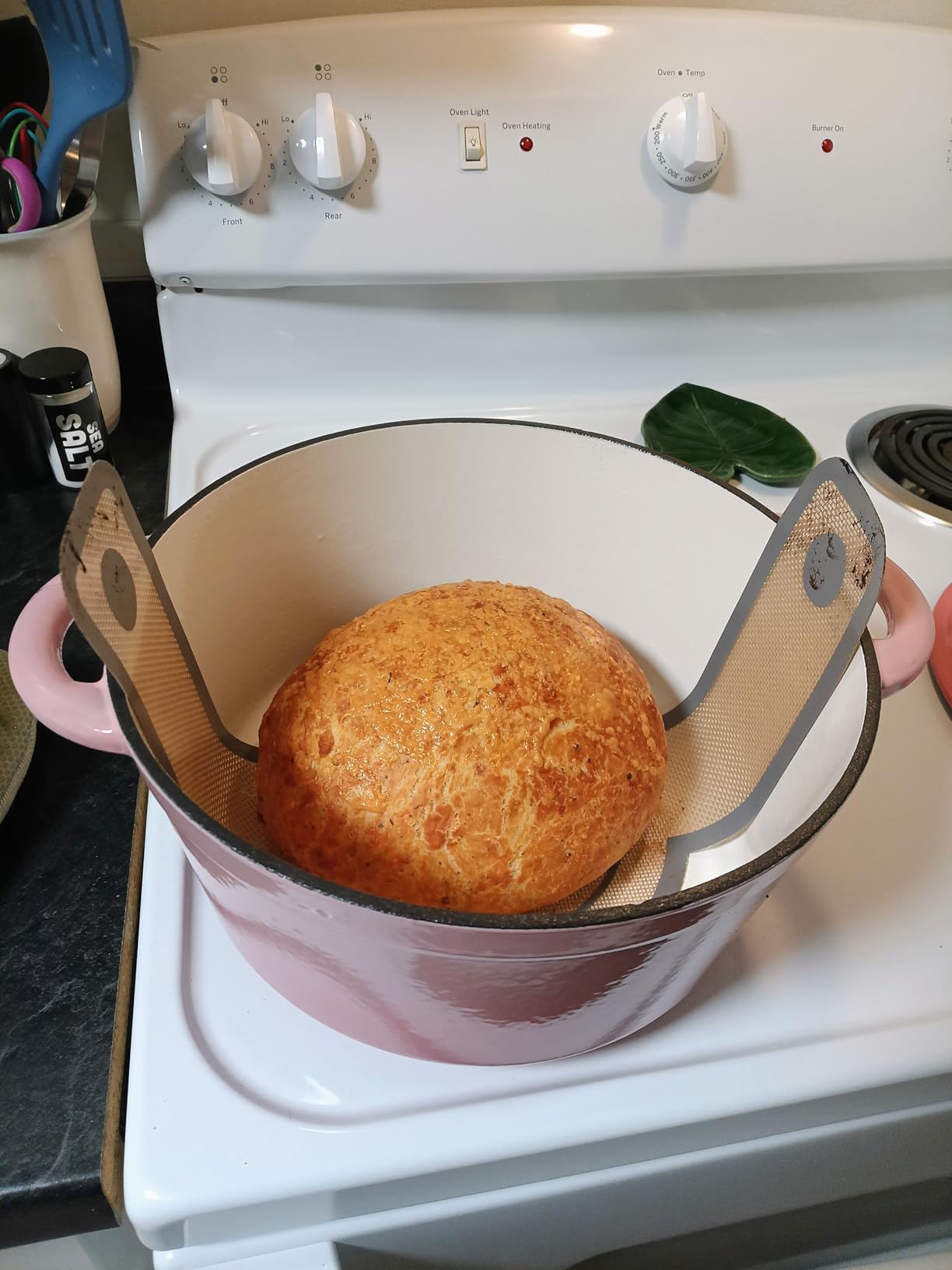
The recurring complaint is weight, and specifically the lid. The lid feels heavier than the pot deserves, which matters because you are lifting it away from the loaf at the end of the covered bake. A second theme is oven clearance: the lid handle needs vertical room, so check the gap between your rack and the broil element before a tall bake.
Cleaning is the easier half of the deal. A soak and a sponge lifts baked-on flour and crust off the enamel, and there is no seasoning film to maintain. The pot comes with a cookbook and cotton potholders, though bakers report the potholders are sized for a smaller pot than the one in the box.
Check the interior color
The finish type is listed as enameled in warm white, so you can see dough colour and crust colour against the interior. That matters more than it sounds: judging doneness by colour is far easier on a light interior than on bare black iron.
For whom it is bad
If you want one pan for frying, searing and bread, a heavy enameled lid adds weight to a job that bare iron handles more easily. And if you preheat at 500 degrees F for a long stretch, read the enamel preheating section further down before you do.
3. Nuovva 6.4 Quart Enamelled Cast Iron Dutch Oven – best for a bigger bake
Nuovva Enamelled Cast Iron Dutch Oven Pot with Lid-6.4 Quart Non Stick Casserole Pot-Heavy Duty & Oven Safe up to 500° F for Bread Baking, Braising, Stews, Roasting – 28cm Dark Blue
Enamelled cast iron
6.4 quart round 28cm
6.46 kg
Dark blue
Pros
- No seasoning needed and wipes clean
- Solid heat retention for long bakes
- Double handles move easily from hob to oven
- Available in a wide colour range
Cons
- Very heavy at the 6.4-quart size
- Bulky for small ovens and storage
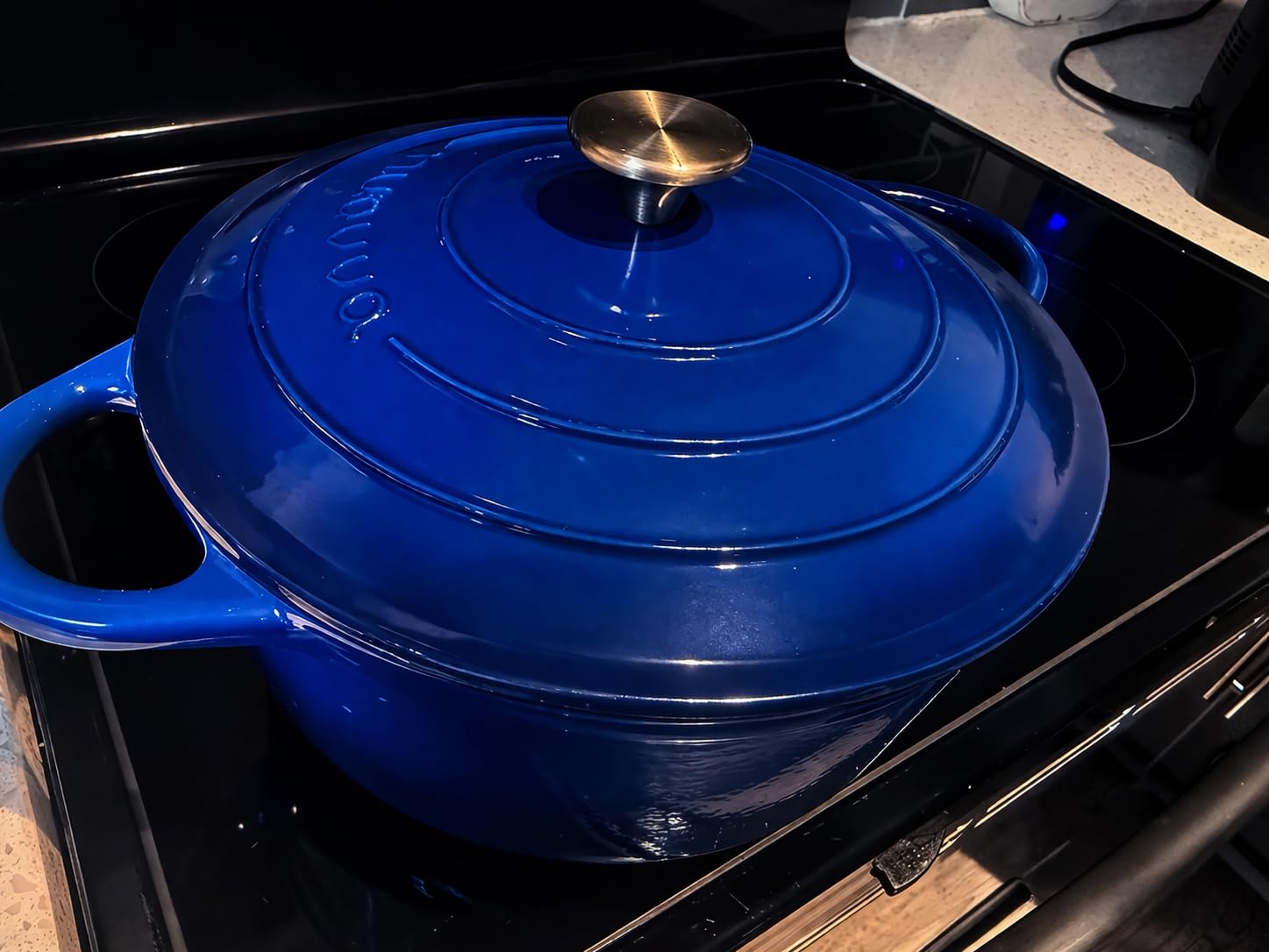
Six point four quarts is the largest round pot in this group, and that headroom matters more than most buyers expect. Sourdough can expand to four times its original volume, so a pot that feels generous at 5.5 quarts can crowd a lively loaf. The 28cm body gives a full boule room to rise without touching the lid.
The double side handles are the detail we liked most. A pot with bail handles forces one hand under hot iron, and the Nuovva lets you use two hands on mitts, which is safer and steadier when lowering dough into a preheated pot.
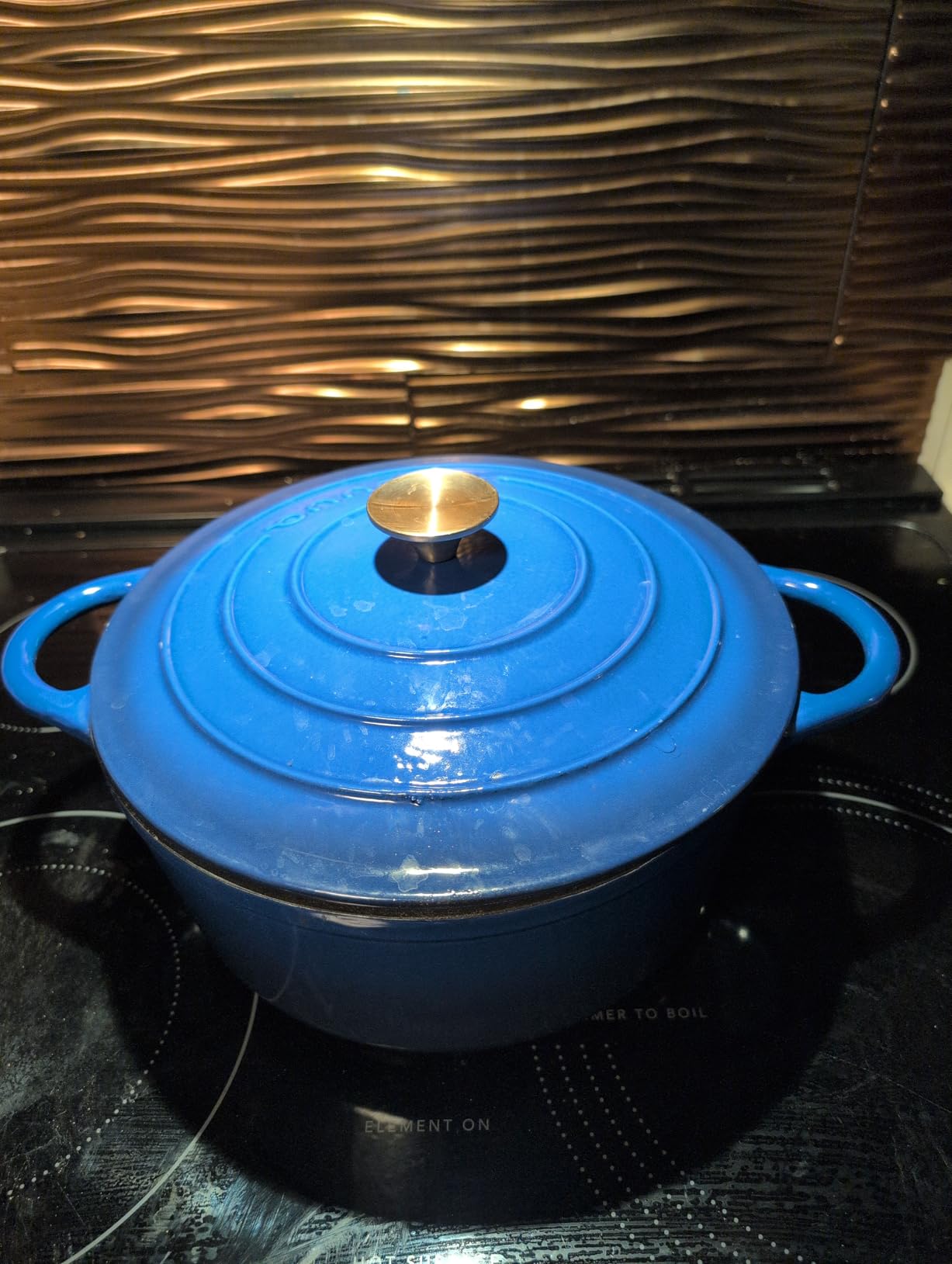
The weight is the whole trade-off. At 6.46 kg before dough, this is a genuinely heavy lift, and the reviews name weight and bulk as the recurring drawback across the 6.4-quart body. It also measures 11 x 11 x 6.5 inches, which is fine in a full-size oven and awkward in a small one.
On the bread side, the enamel coating removes the seasoning routine entirely and the pot is rated to 500 degrees F. Buyers treat it as a low-maintenance alternative to bare cast iron while still keeping the heat retention that a bread bake needs.
Check it fits your oven
Measure the cavity, not just the rack. A 28cm pot plus a hot lid plus a loaf near the top of the rise needs real clearance, and a compact oven is where this pot becomes frustrating.
For whom it is bad
For a single 1.5 pound loaf this is more pot than you need, and the extra mass works against you rather than for you. Choose it if you bake large, high-hydration loaves or batch rolls, not if you make one small boule a week.
4. Umite Chef 5QT Enameled Cast Iron Dutch Oven – best cream interior
Enameled Cast Iron Dutch Oven – Umite Chef 5QT Pot with Lid & Cotton Potholders – Heavy-Duty Cookware for Bread Baking, Braising, Stews, Roasting(Cream White)
Enameled cast iron
5 quart round cream white
12.6 inch wide by 7.22 inch high
Oven safe to 500F
Pros
- Even steady heat with no scorching
- Tight lid seal for oven spring
- Light interior shows doneness clearly
- Includes thick cotton oven mitts
Cons
- Very heavy to handle when full
- Enamel can chip on arrival or with thermal shock
The selling feature here is the cream-colored interior. Bread bakers single it out because you can see the loaf colour against a light background, which turns crust colour judgement from guesswork into a decision. Yeast-bread bakers report consistent success with even bakes and a tight steam seal, and the smooth glaze cleans with a soft sponge.
Under the lid there are raised interior nodes that redistribute condensation over the loaf, which is the same self-basting idea the bigger brands use. It works on induction, gas, electric and ceramic, and the pot is rated to 500 degrees F.
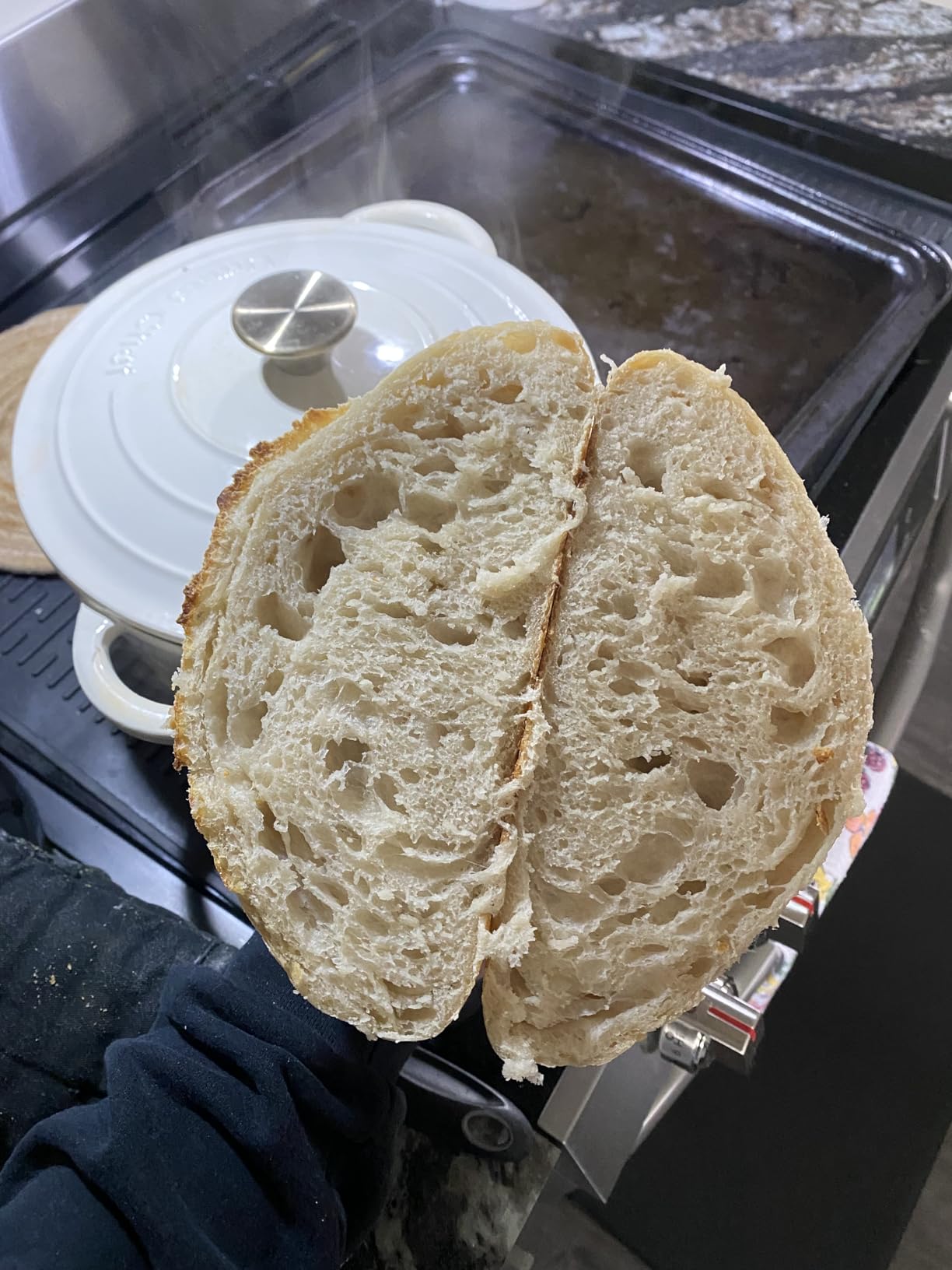
Two cautions. First, the manufacturer asks you to let the pot cool naturally for 45 minutes or more before washing, because thermal shock is what cracks enamel, and rushing that step is how chips start. Second, a handful of reviews mention cosmetic enamel chipping on arrival, so inspect the box before you bake with it.
Weight when full is the most common complaint, exactly as it is across this category. A small documentation issue also shows up in the listing: the listed dimensions are recorded as 1 x 1 x 1 inches, so treat the size specs as approximate and measure the physical pot.
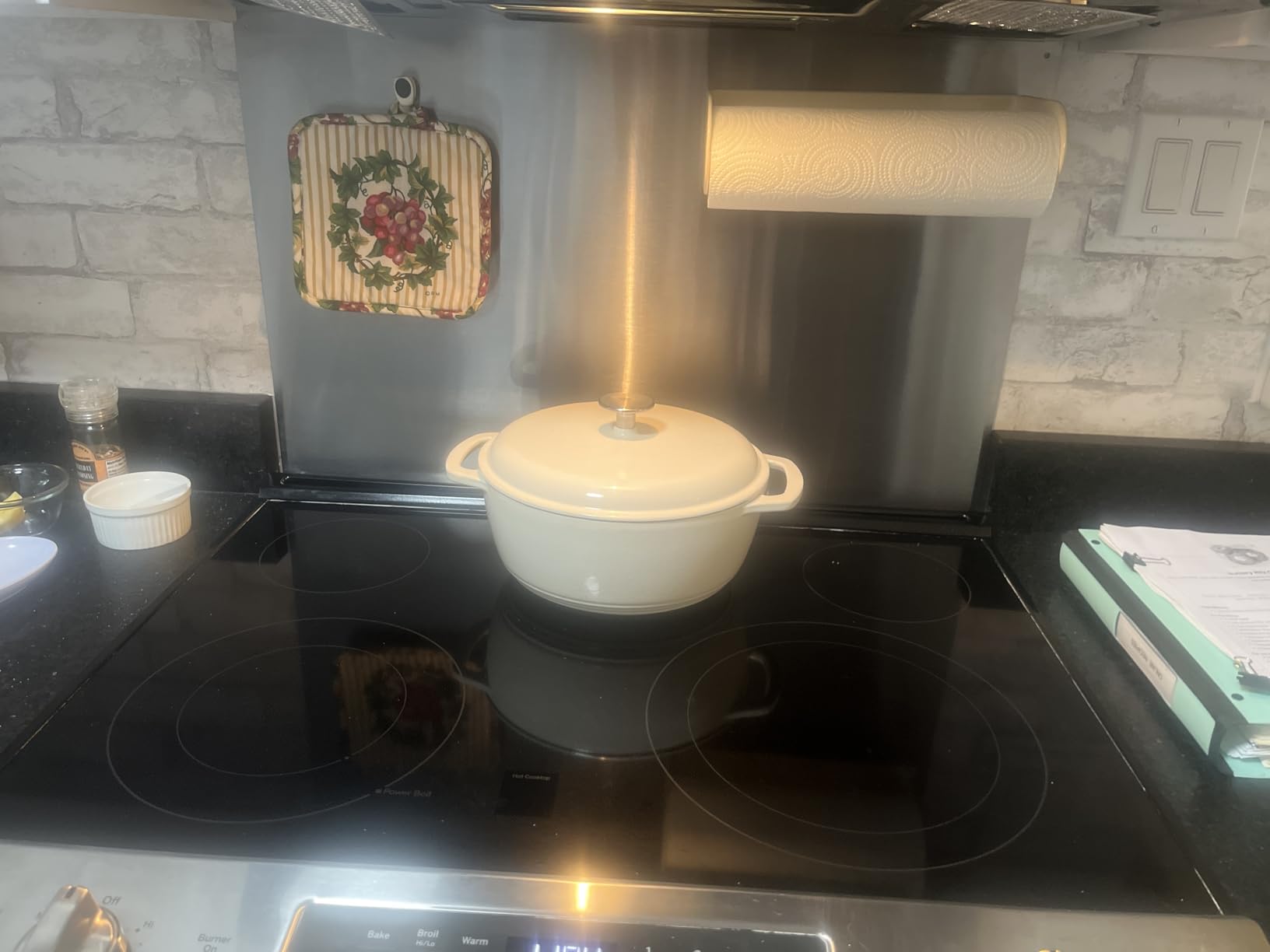
Check the light interior is a plus for you
If you bake by colour rather than by temperature probe, a cream interior is a genuine advantage over black iron. If you mostly bake by internal temperature, it matters much less.
For whom it is bad
If you need the pot in a rush between bake and sink, the 45-minute cooling guidance makes it a slow tool. It is a bread-and-braise pot, not a weeknight one.
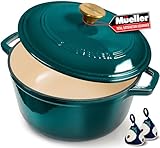
5. Mueller DuraCast 6 Quart Enameled Dutch Oven – best for bread and stews
Mueller DuraCast 6 Quart Enameled Cast Iron Dutch Oven Pot with Lid
Enameled cast iron
6 quart round emerald
12.5 pounds
13.3 x 11 x 7.7 inches
Pros
- Sustained heat gives excellent crust at 450F
- White interior survives acidic bolognese
- 6-quart size suits family batches
- Stainless knob and wide dual handles
Cons
- Around 14 pounds with the lid
- Some owners report rim rust and interior chipping
- Stains the exterior above 450F
Bread bakers report exactly what you want from a Dutch oven: sustained heat and excellent crust on sourdough at 450 degrees F. The lid is self-basting with raised condensation nodes, the enamel is PFOA-free and PTFE-free, and there is no seasoning or break-in period. It works on gas, electric, ceramic, halogen and induction.
Six quarts is repeatedly described in the reviews as the practical family size, and the stainless steel knob will take heat that a plastic knob will not. Wide handles are usable with thick oven mitts, which matters when the pot weighs what this one does.
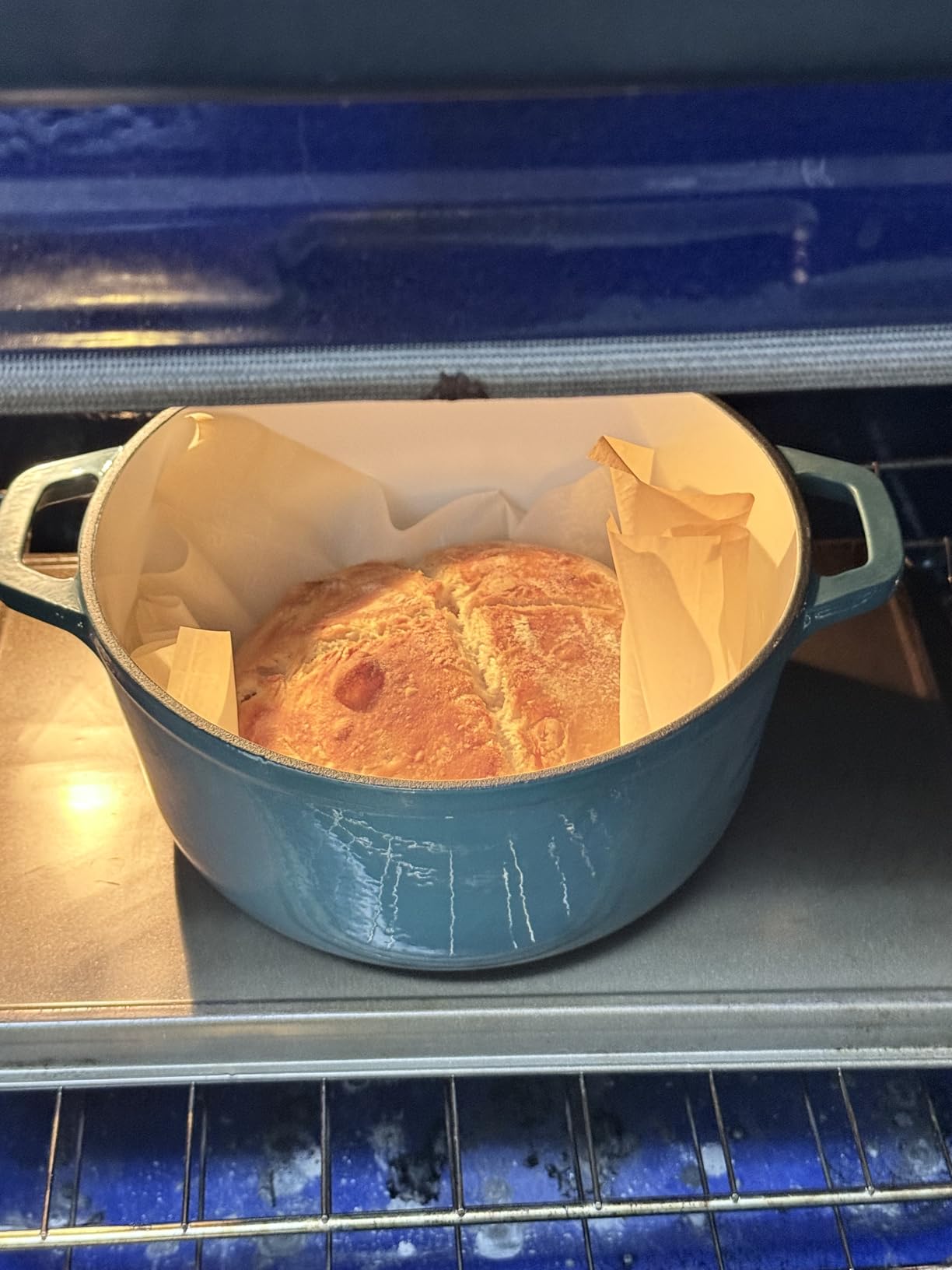
Durability is the split point here, and it is worth being straight about. Several longer-term reviews describe rim rust, interior chipping and discoloration developing earlier than expected, and a few describe the pot arriving in a different colourway than ordered. If you buy it for bread only, you may never notice; if you also cook daily acidic sauces, the white interior is durable but the rim is the part to watch.
There is a specific bread caution in the reviews too: bakes above 450 degrees F can stain the exterior and take real scrubbing. For a bread pot that is arguably a fair trade, since you gain a fast covered bake in exchange.
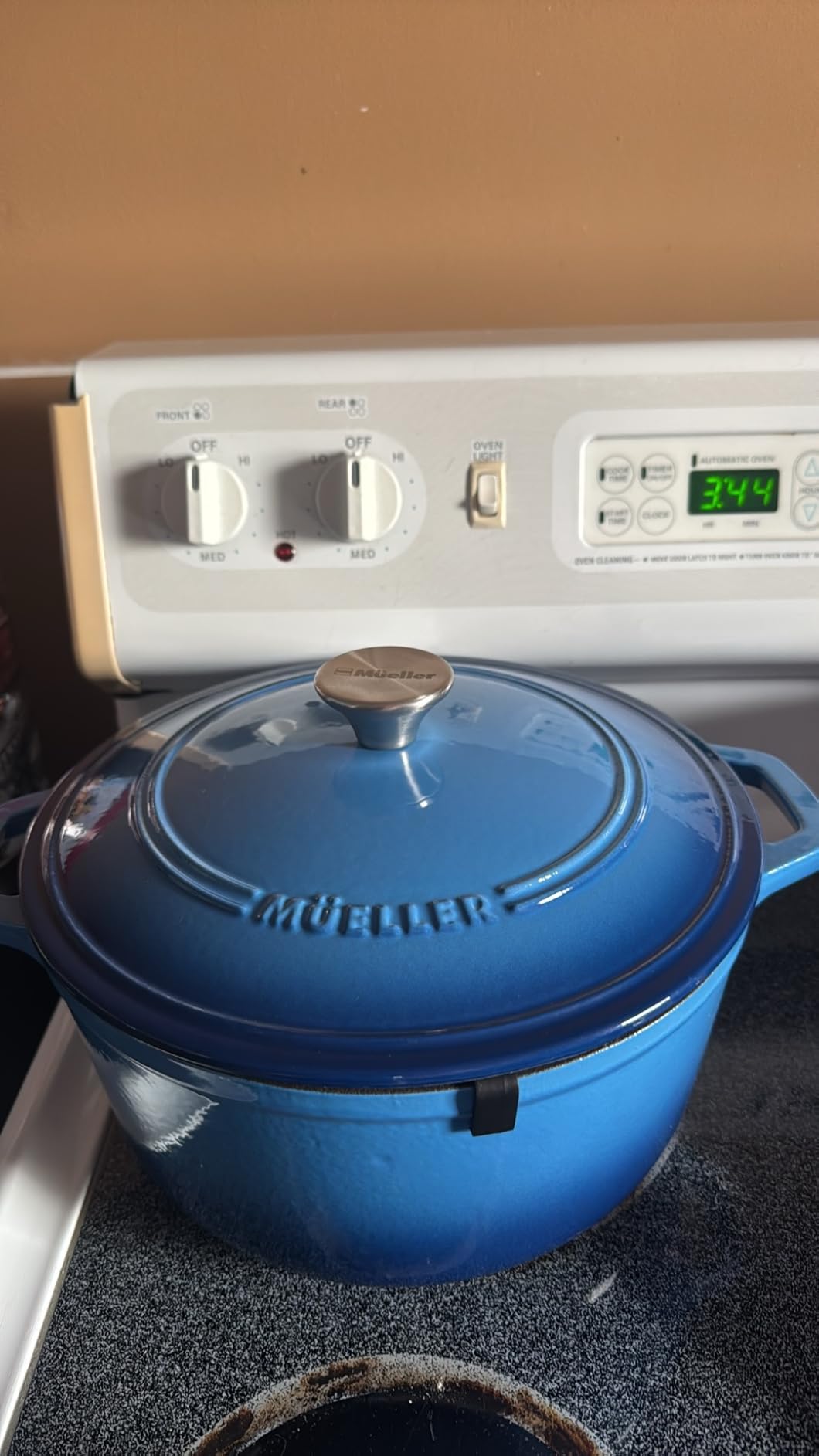
Check you can lift it
The listing weight is 12.5 pounds, and owners put the pot with lid nearer 14 pounds. Add a wet dough and that is a two-handed lift every time, so plan your work surface and your mitts before the first bake.
For whom it is bad
If you want one pan for a small household or you dislike permanent staining, skip this one. It is built for people who cook in it daily and care more about performance than a spotless finish.
6. EDGING CASTING 2-in-1 Cast Iron Dutch Oven 5 Qt – two pieces for the price of one
EDGING CASTING 2-in-1 Pre-Seasoned Cast Iron Dutch Oven Pot with Skillet Lid Cooking Pan, Cast Iron Skillet Cookware Pan Set with Dual Handles, Indoor Outdoor for Bread/Frying/Baking/Camping/BBQ, 5 Qt
Pre-seasoned cast iron
5 quart round with skillet lid
10 inch diameter
Pros
- Skillet lid doubles as a separate pan
- Factory seasoning survives acidic dishes
- Handles open flame and grill heat
- Good value against heritage brands
Cons
- Bare cast iron needs seasoning upkeep
- Bulky and awkward to store
The format is the point. You get a deep 5-quart pot plus a shallow skillet that doubles as the lid, so effectively two pieces of cookware in one. Owners use the shallow piece for cornbread and for separate frying while the deep pot handles stews and bread. Cast-iron-experienced reviewers judge the seasoning and finish competitive with pricier heritage brands, especially after one round of seasoning.
For bread it does the job: a heavy tight lid, an even base and a 500 degree F rating, and it comes in 3, 5 and 7 quart versions if you later decide you want a different size.
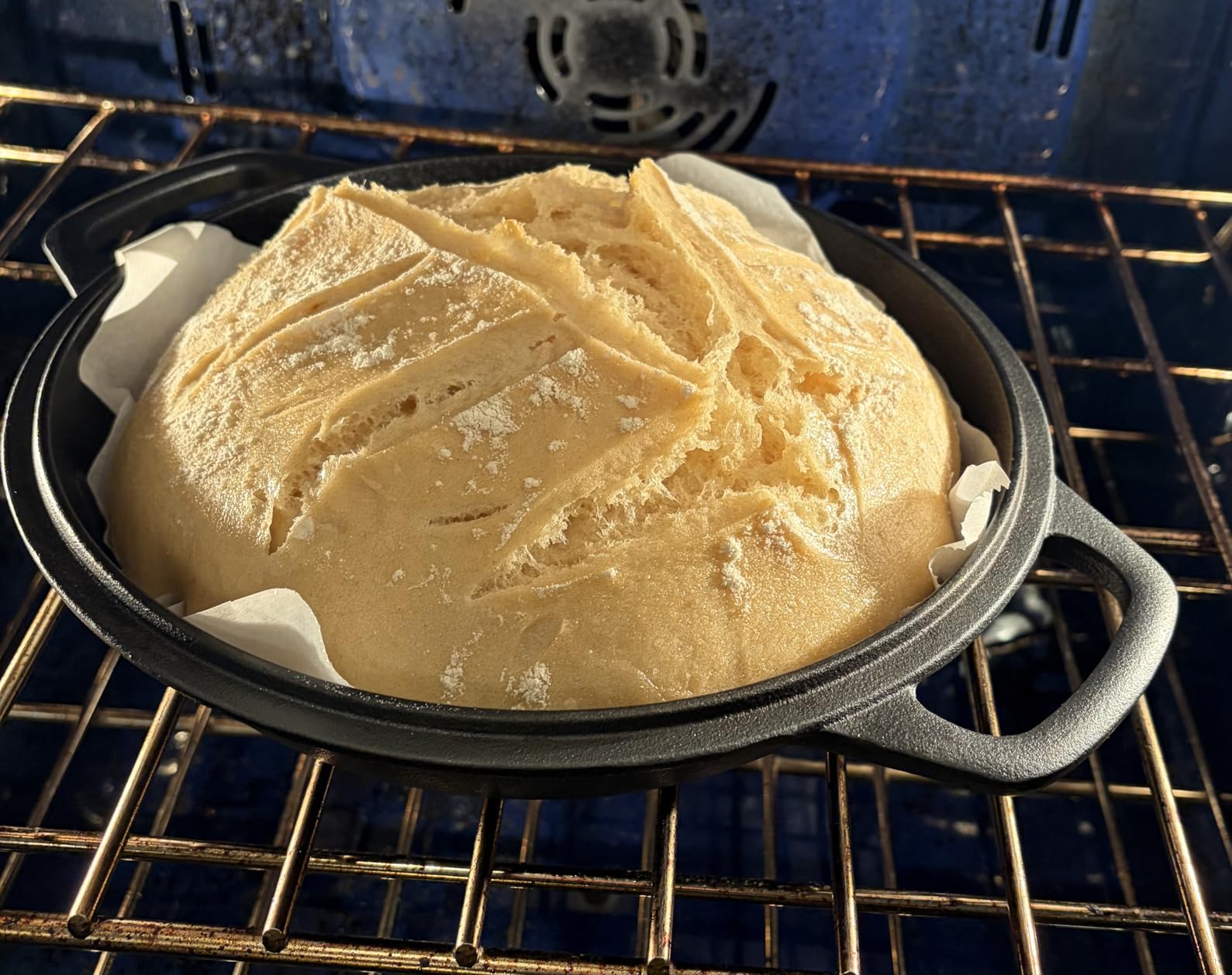
It is bare cast iron, so all the usual rules apply, and owners who do not dry the pan promptly report rust. The seasoning is factory-applied with vegetable oil and no synthetic coating, which means it is a starting point that responds well to a round of your own oil but can need reinforcing after the first few cooks.
Because it is also grill and campfire safe, it is the pick here for bakers who want one piece that leaves the kitchen. That versatility is exactly what you pay for with a 2-in-1, and reviewers consistently treat the value as strong.
Check the lid fit matters more than usual
A skillet lid is a different fit problem from a cast iron Dutch oven lid. If your bread depends on a tight steam seal, test the seal with cold water before your first hot bake.
For whom it is bad
If you never want to maintain seasoning, or if you need one shallow pan and one deep pot that are not sold as a set, this format is not for you. The storage footprint is also large, since you are keeping two pieces.
7. CRUSTLOVE 5 QT Pre-Seasoned Dutch Oven – best for a first sourdough setup
CRUSTLOVE 5 QT Pre-Seasoned Dutch Oven for Bread Baking with Lid and Kit
Pre-seasoned cast iron
5 quart round
10 x 10 x 4.5 inches
Bundled bread tool kit
Pros
- Holds heat for crisp golden crust
- Lid traps steam the way bakers want
- Banneton sling lame whisk and scrapers included
- Built for long-term daily use
Cons
- Very heavy and sturdy to handle
- Dough whisk broke for one owner
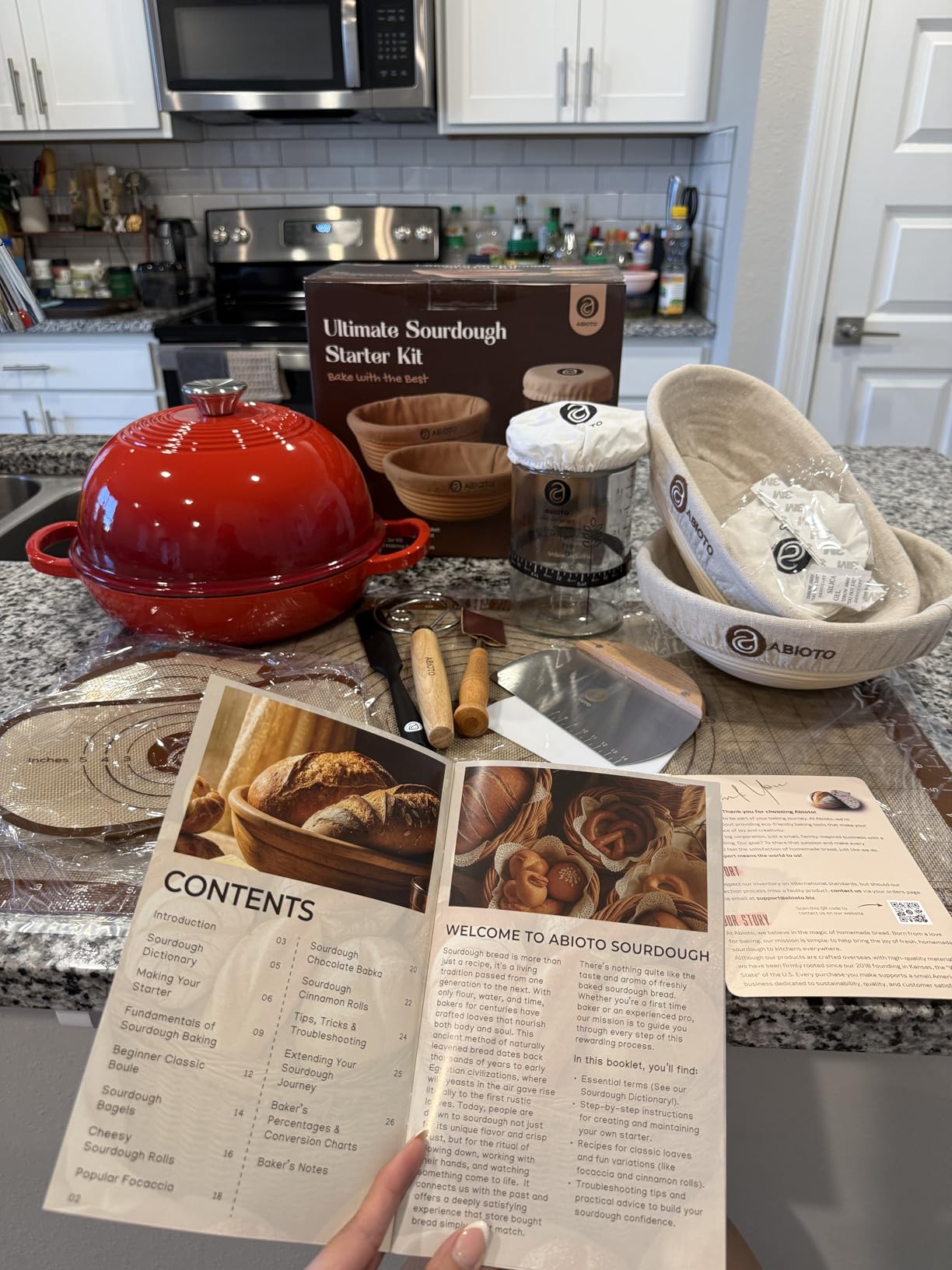
This is the kit pick. In the box you get the 5-quart pre-seasoned pot and lid, a proofing banneton, a silicone bead bread sling, a scoring lame, a dough whisk, metal and plastic scrapers, a brush and a starter booklet in English and Spanish. Beginners describe it as a complete first sourdough setup in one box, which is genuinely useful if you are starting from nothing.
The pot itself is not an afterthought. It holds heat well and gives crisp golden sourdough crust with good rise, and owners who bake regularly use it for soups and roasting too, so it is not treated as a single-purpose bread tool.
The complaints concentrate on the accessories rather than the cast iron. One owner’s dough whisk broke after a couple of weeks, and the booklet is thin on sourdough-specific recipes, so treat the kit as a helpful head start rather than a course.
Note the shape: 10 x 10 x 4.5 inches makes this a shallower, wider format than a tall French oven. That is good for a wide boule and less good for a tall, airy, high-hydration loaf that needs vertical headroom.
Check the depth suits your loaves
At 4.5 inches tall this pot suits a squat boule better than a vertical oven-springing loaf. If your bread climbs, a deeper cloche or a taller pot will serve you better.
For whom it is bad
If you already own a banneton, a lame and a sling, the bundled tools add nothing and the pot is priced above simpler bare iron options. It also needs the same seasoning care as any bare cast iron.
8. Northriver Casting 5 Qt Oval Enameled Dutch Oven – best for batard loaves
Northriver Casting Enameled Cast Iron Oval Dutch Oven for Bread Baking,12″x8″ Bread Pot with Lid,Ideal for Sourdough, Artisan Loaves & Family Meals,5 Qt
Enameled cast iron
5 quart oval 12 by 8 inch
15 x 8.2 x 5.7 inches
Oven safe to 500F
Pros
- Crust quality matches a round boule bake
- Oval format gives toaster-friendly sandwich loaves
- Two pans usable separately for two bakes
- Enamel resists stains odours and rust
Cons
- Not non-stick so parchment is needed
- Very heavy to lift in and out
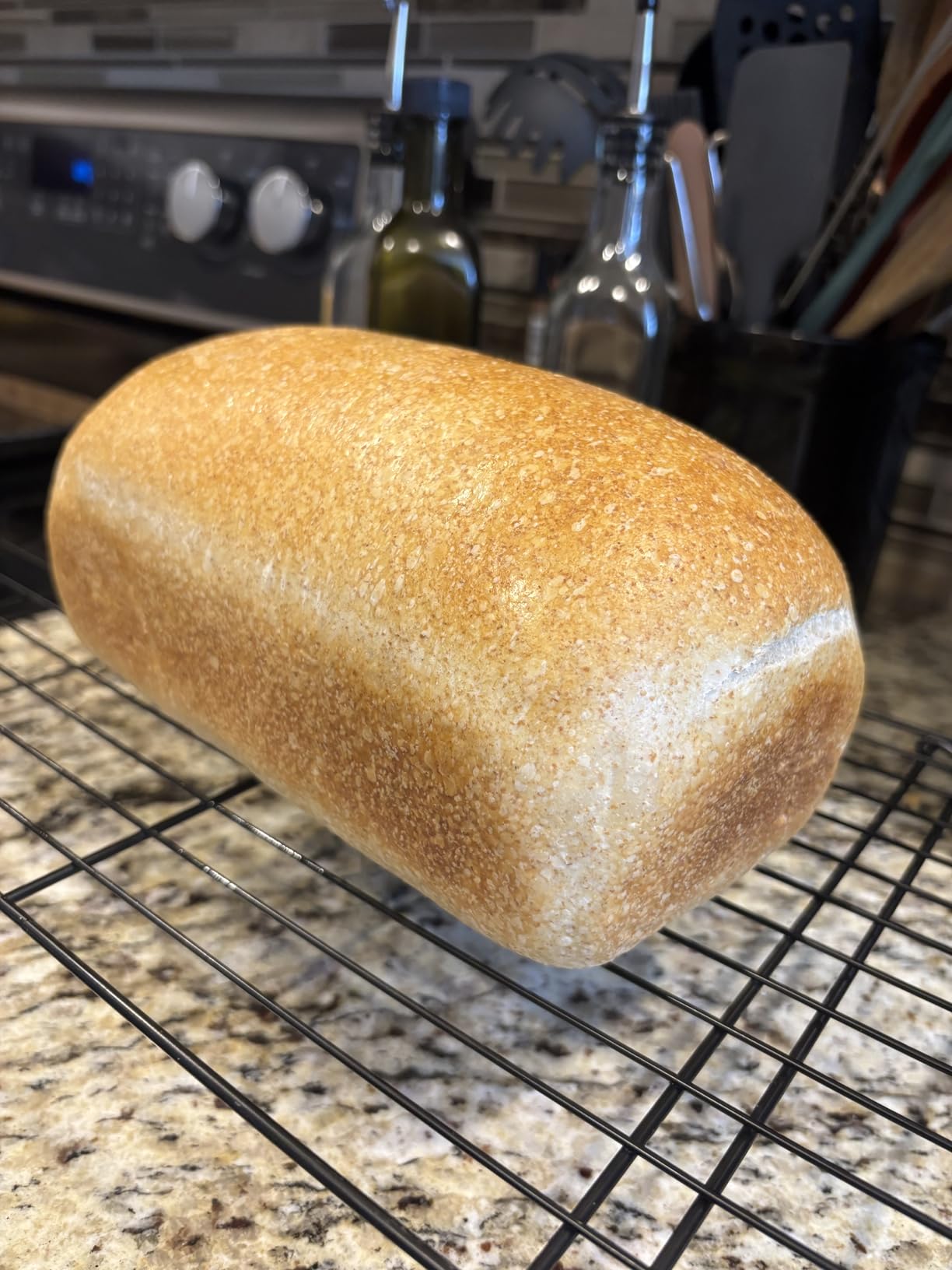
People buy this one for shape, not capacity. If you want a tall sandwich-style loaf that slices cleanly, an oval 12 by 8 inch body is the right tool, and the 9 by 5 inch variant exists too. Bakers, including gluten-free bakers, report Dutch-oven-quality crust results from the oval format.
The 2-in-1 design works unusually well here. The deep lid and the shallow base combine as a 5-quart pot for bread, and you can also use the two pieces separately, which means you can bake two quick breads at once.
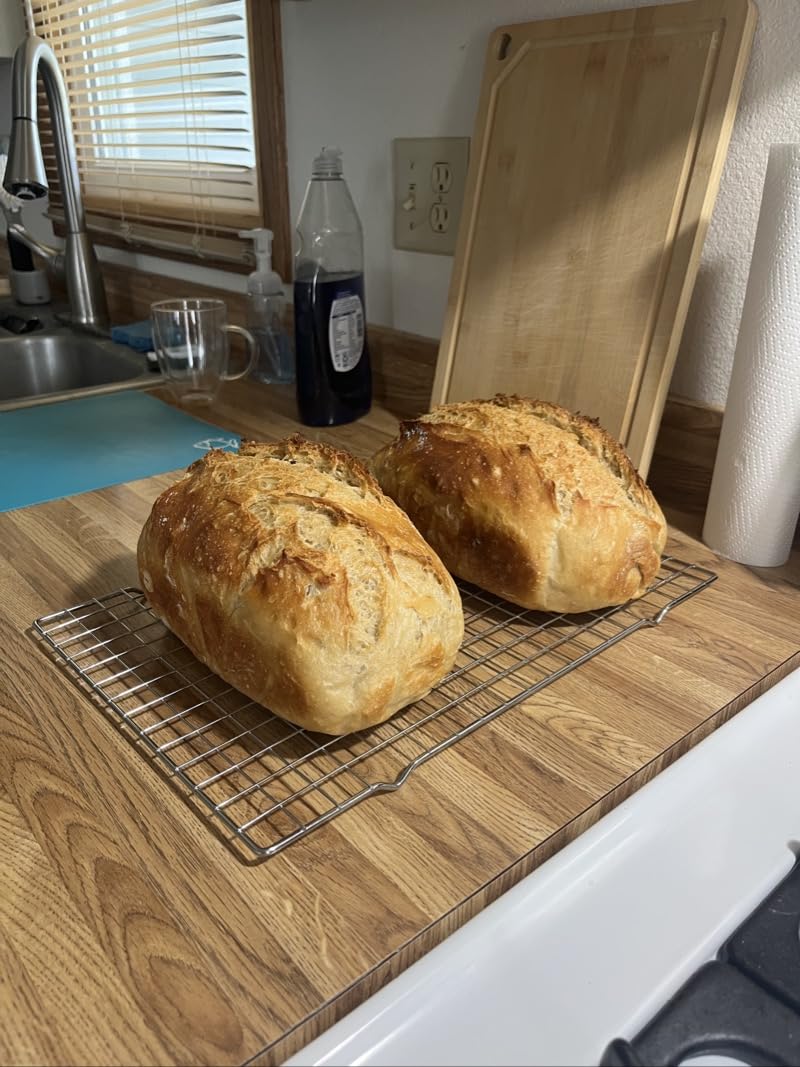
The practical advice that appears in almost every review is simple: line the pan with parchment. The enamel resists sticking better than bare iron but is not a true non-stick surface, and bread will adhere to the sides if you skip it. Cleaning is otherwise straightforward, since the enamel needs no seasoning and wipes down with a soft sponge.
Weight is the recurring complaint, and one review reported small enamel chips on arrival, so inspect the pot before its first bake.
Check shape before size
If you bake boules, a round pot is the right call. Choose this one only if a bâtard or sandwich loaf shape changes what you can do with the bread afterwards, because a boule in an oval pot bakes unevenly.
For whom it is bad
If you dislike baking with parchment paper, skip it. It is also the widest footprint in the roundup at 15 inches, so check oven and shelf clearance before ordering.
9. Umite Chef 6 Qt Bread Oven with Dome Lid – best for high loaf volume
Enameled Round Cast Iron Bread Oven, 6 Qt Cast Iron Dutch Oven for Homemade Sourdough Bread Baking, Bread Pot with Dome Lid & Cotton Potholders (Cream White)
Enameled cast iron
6 quart round with domed cloche lid
Cream white
Oven safe to 500F
Pros
- Consistent crust and strong oven spring from the dome
- Tall dome gives air around an uncovered loaf
- No seasoning needed
- Doubles as roasting and serving piece
Cons
- Burns fairly easily without a baking soda paste
- Tall profile may need the rack moved down
- Lid handle position is awkward
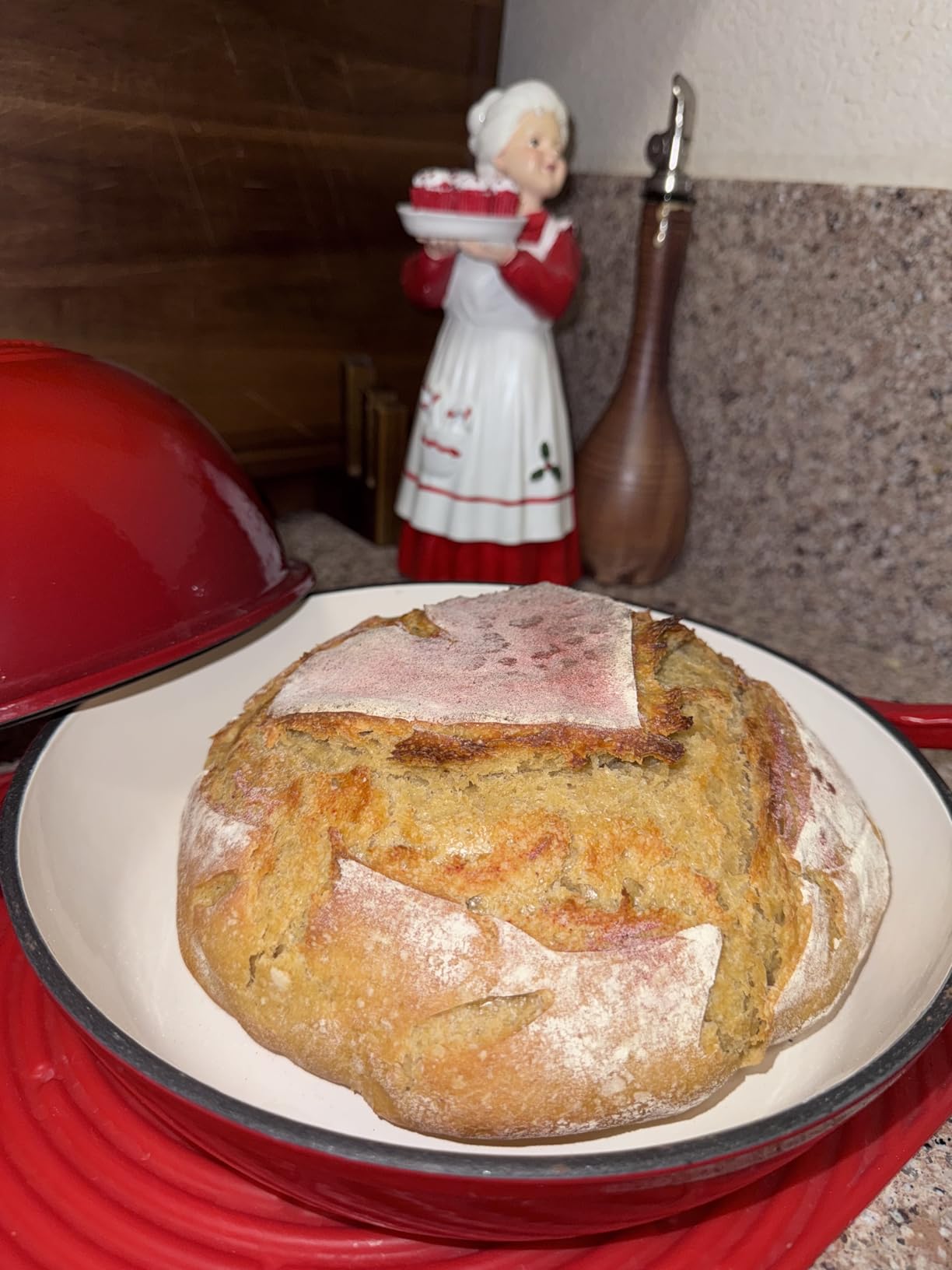
This is a dedicated bread oven rather than a general Dutch oven, and the domed cloche lid is the reason. The tall dome traps moisture for the covered phase, then gives the uncovered loaf air to circulate so it browns and spreads properly. Owners who bake daily describe it as the pot they reach for, with well-shaped and well-browned results.
At 6 quarts it also has the volume for a high-hydration loaf with a dramatic rise, and the enamel needs no seasoning. It is compatible with gas, electric, induction and halogen and rated to 500 degrees F.
The dome has a cost. Because the pot is tall, several reviewers mention rearranging the oven rack to make it fit, and a few find the lid handle position burns their hand when lifting the lid off at the end of the covered phase. Plan your mitts and your rack position before the bake, not during it.
Minor scorching on the base is reported but stays manageable with a baking soda paste. One documentation note: the listed item dimensions are recorded as 1 x 1 x 1 inches, so the physical measurements are the ones to trust.
Check your rack height
A tall domed pot plus a hot lid needs real vertical clearance. Measure your cavity with the rack in the lowest useful position before this one, not after.
For whom it is bad
For a small kitchen oven with a low ceiling, this is the wrong pot. For anyone who wants a single pan for frying and baking, a domed bread oven is inefficient, since the shape does nothing for stovetop work.
10. Le Creuset 7.25 qt Enameled Round Dutch Oven – the premium build
Le Creuset Enameled Cast Iron Round Dutch Oven, 7.25 qt., Cerise
Enameled cast iron
7.25 quart 6.7 liter round cerise
6.13 kg
Limited lifetime warranty
Pros
- Exceptional heat distribution and retention
- Enamel resists acids and staining
- Dishwasher safe and easy to clean
- Tight lid seals moisture for bread and braises
Cons
- Heavy and awkward at 7.25 quarts
- Sand-coloured enamel can stain at high heat
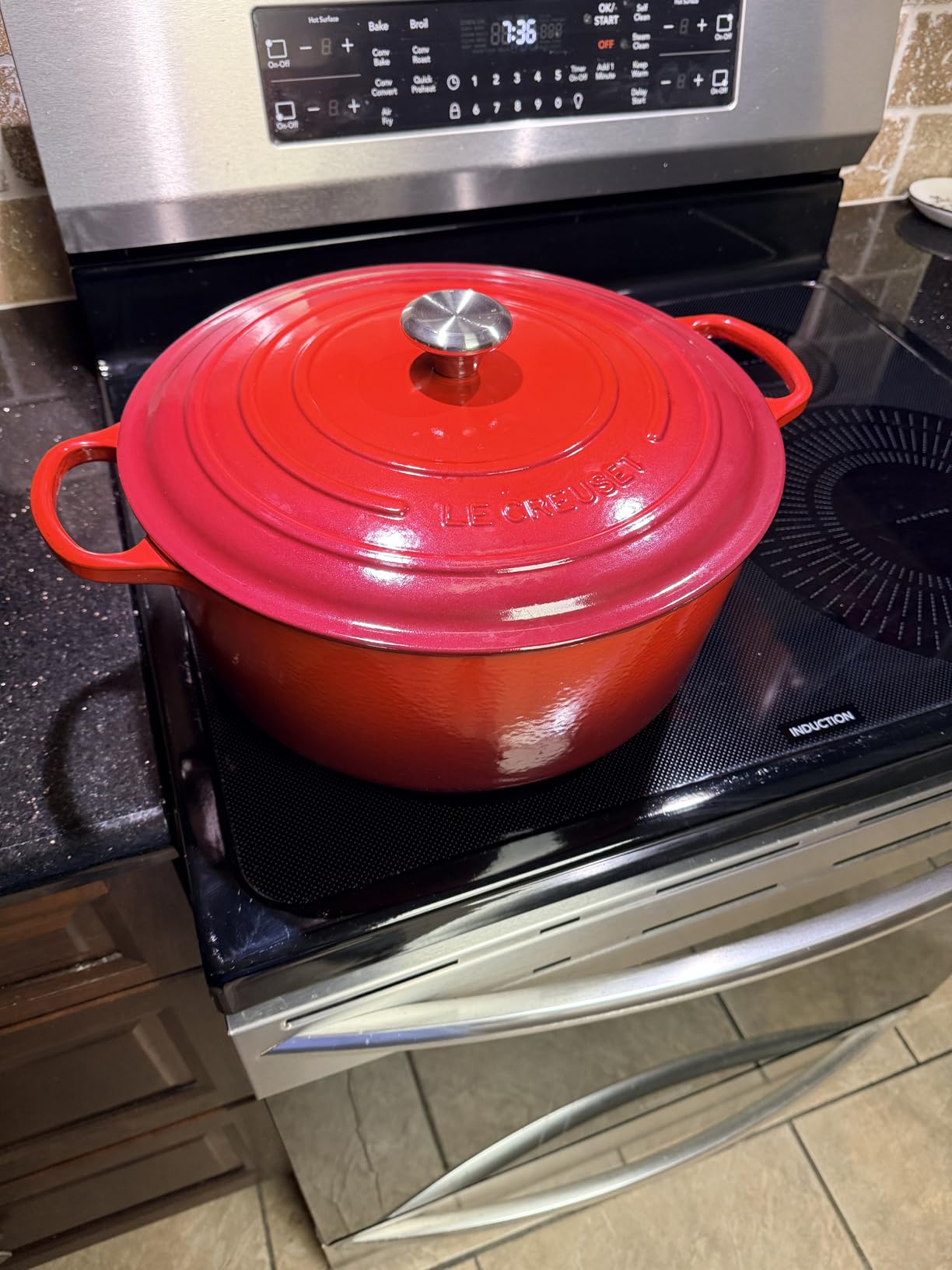
The Le Creuset is the pot owners describe as buying once. It has the widest specification sheet here: 28cm diameter, 6.7 liters, 6.13 kg, a light-coloured interior, a tight-fitting lid, tall sides to contain splatter, compatibility with all cooktops, a 500 degree F ceiling and a limited lifetime warranty. It is also dishwasher safe, which no other pick in this roundup is.
For bread it performs exactly as the category promises. Exceptional heat distribution and retention, a tight lid that seals in moisture, and a light interior so you can judge doneness by colour. Baking, searing, braising and serving straight from the pot are the dominant use cases in the reviews.
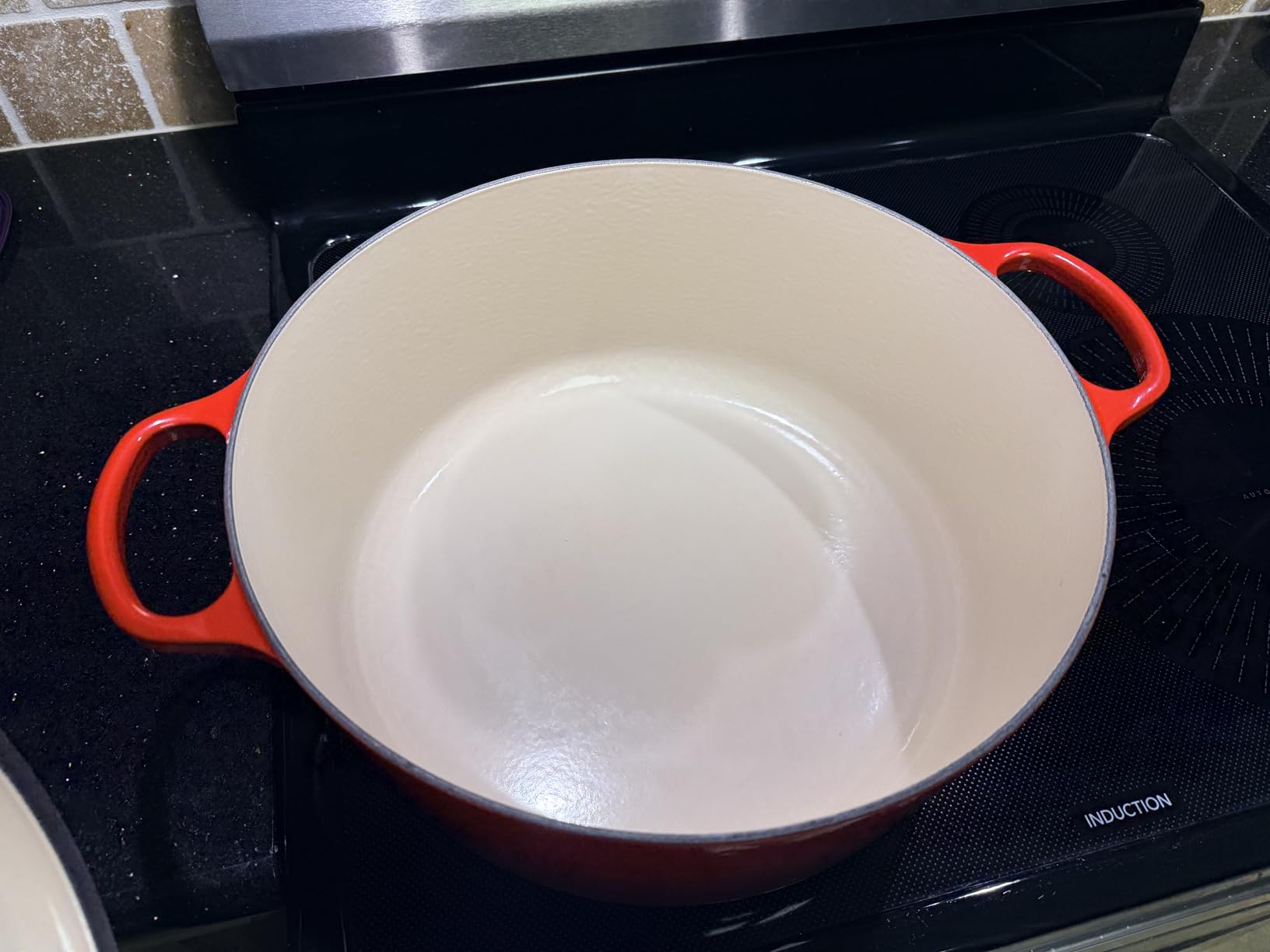
Owners largely accept the outlay as the price of a lifetime piece, and the reviews frame it as a deliberate step up rather than a casual purchase. The most repeated caveat is weight, especially at 7.25 quarts. Second is the sand-coloured enamel, which can stain if you take it past medium heat for long periods, which is a real consideration in a 500 degree F bread bake.
It is also not a non-stick surface, which matters if you prefer building fond. And 14.84 inches across is wide, so check that it clears your oven and your worktop.
Check whether you need 7.25 quarts
This is the biggest round pot here. For one 1.5 pound loaf you are buying unused volume and extra lifting weight, so measure your baking before committing.
For whom it is bad
For a first Dutch oven on a tight budget, or for anyone with lifting problems, the smaller and lighter enameled picks here do the same job. This is the choice for a kitchen that keeps pots for decades.
What Size Dutch Oven Do You Need for Bread?
Pick by dough weight, not by family size. A standard loaf is about 1.5 pounds, and a 5 to 5.5 quart round pot handles it with room for oven spring, which is why that range is the sweet spot most bakers land on. Dough that can expand to four times its original volume needs headroom above the dough, not an exact match.
Under 5 quarts suits rolls, small loaves and one-person bakes. Five to 5.5 quarts covers a standard 1.5 pound boule or bâtard. Six quarts and up suits large high-hydration sourdough, and anything above 7 quarts starts wasting heat and energy on a small loaf. A 3 to 4 quart pot is too small for a full boule, which is the most common size mistake we see.
For an oval pot, match the interior to the loaf shape rather than the volume: a 9 by 5 inch interior gives you a toaster-friendly sandwich loaf, and a 12 by 8 inch interior gives you a tall rustic one. Round is better for a boule, and oval is better for a bâtard.
The 500 Degree F Enamel Preheating Rule
Yes, you can preheat an empty enameled pot to 500 degrees F, but only if the manufacturer rates it to 500 degrees F, and even then a lower temperature is the safer default. Bakers in the bread forums overwhelmingly preheat at 450 degrees F for 30 minutes as a safer habit, especially with enameled pots, and that produces excellent crust on its own.
Never take an enameled pot above its rated temperature, and never preheat one empty above that rating. Bakers repeatedly report unpleasant fumes and discoloration from over-heated empty enamel, and enamel can chip when it is heated past its limit or shocked by temperature swings. The pot in your hand should be rated to the temperature you set, and the lid should be rated with it.
Watch the knob. A metal knob takes heat; a plastic knob does not, and at 500 degrees F inside a preheating pot that difference matters. For bare seasoned cast iron, use an oil with a smoke point above your bake temperature, or you will get smoke inside your oven and into your kitchen.
Our practical rule: preheat empty for 30 minutes at 450 degrees F unless the pot is specifically rated to 500 degrees F, and let any pot cool naturally for 45 minutes or more before washing it.
Seasoned vs Enameled Cast Iron for Bread
Seasoned bare cast iron gives you the most oven headroom and a surface that improves with decades of use, and it is the only option here that goes on a campfire. Its cost is a real maintenance routine: dry it promptly, oil it, and re-season it after any metal or harsh cleaning. It also runs darker inside, which makes colour-based doneness judgement harder.
Enameled cast iron needs no seasoning and wipes clean, handles acidic foods without reacting, and gives you a light interior for judging crust. Its limits are the temperature ceiling and the fact that a chip in enamel is permanent. Every enameled pick in this roundup is rated to 500 degrees F except where the listing says otherwise, and the Lodge is rated to 400 degrees F.
If you already have seasoned iron, buy enameled for a second pot. If you are starting fresh and never want to maintain a pan, buy enameled.
Round vs Oval vs a Dedicated Bread Oven
Round is the all-rounder: it heats evenly, suits a boule, and works on the stovetop. Oval is a shape decision: it is the right call for a tall bâtard or sandwich loaf and wrong for an even boule bake. A dedicated bread oven with a domed cloche lid is a third category, with a shallow base that makes lowering dough easier and a dome that gives the uncovered loaf air.
Weight follows the same logic. Deep round pots with bail handles are the heaviest and most awkward to lift; a domed bread oven with side handles is easier to lower dough into, which solves the burned-knuckles complaint that appears in forum threads. If you already own a baking steel and want open-oven control instead, our baking steel guide covers that route.
How to Bake Bread in a Dutch Oven
Preheat first. Put the empty pot with its lid in a 450 degree F oven for 30 minutes, or 500 degrees F if the pot is rated for it. A cold-start bake works, but you trade oven spring for a longer total bake, and the crust is less even.
Lower the dough in carefully. Lace the dough onto parchment or a floured peel and lower it seam-up into the hot pot. Dust the base with cornmeal or flour if you are using bare cast iron. The dough should touch the base, not float, and you should feel the heat through the parchment immediately.
Score, cover, and wait. Score the loaf once the dough is in the pot, put the lid on, and bake covered for 20 minutes at 450 degrees F. This is the steam phase, and it is where oven spring happens.
Uncover and brown. Take the lid off, drop the temperature to 425 to 450 degrees F, and bake for another 20 to 25 minutes until the crust is dark and the internal temperature reads 200 to 210 degrees F. If you bake hotter and uncovered, the pot’s retained heat can push the crust past dark quickly.
Cool in the pot for at least 10 minutes before turning out. Bread keeps baking in the residual heat, and pulling it early is the most common way to get a gummy crumb.
Six Common Dutch Oven Bread Mistakes
Overheating an empty enameled pot. Going above the rating causes fumes, discoloration and chipping. Preheat at 450 degrees F for enamel and stay inside the rating.
Using too small a pot. A 3 or 4 quart pot leaves no headroom, and a lively dough hits the lid. Go to 5 or 5.5 quarts for a standard loaf.
Skipping the dusting or parchment. Bare cast iron will grab dough, especially a wet high-hydration dough. Use cornmeal, flour or a parchment liner.
Lifting the dough by hand into the pot. Your knuckles will be in a pot at 450 degrees F. Use a peel or parchment sling, and lower rather than drop.
Pulling the bread too early. The loaf is still cooking off the heat. Wait for 200 to 210 degrees F internal and cool it in the pot.
Washing a hot pot. Thermal shock cracks enamel. Let it cool naturally for 45 minutes or more, then hand wash and dry immediately.
Caring for Your Dutch Oven
Bare cast iron wants three things: dry it fully, oil it lightly, and store it uncovered. If it is stored wet or with moist food inside, it will rust, and reviews describe owners re-seasoning after exactly that. Never put bare cast iron in the dishwasher, and avoid steel wool unless you are prepared to re-season.
Enameled cast iron wants less work. Soak baked-on residue, clean with a soft sponge, dry, and skip the oil. Let it cool first, and treat chips as end-of-life marks rather than something to scrub out.
For proofing and slower rises, a dedicated warmer keeps your kitchen temperature steady while the dough works. Our bread proofer guide covers that side of the process, and our Staub Dutch oven roundup covers the premium enameled category in more depth.
Frequently Asked Questions
Which Dutch oven size is best for baking bread?
A 5 to 5.5 quart round pot is the best all-round size for bread, because it holds a standard 1.5 pound loaf with headroom for oven spring. Go to 6 quarts for large high-hydration sourdough, and use 3 to 4 quarts only for rolls and small loaves.
What type of Dutch oven is best for baking bread?
An enameled cast iron pot rated to 500 degrees F is the easiest choice, because it needs no seasoning and has a light interior for judging crust colour. Bare seasoned cast iron gives more oven headroom and lasts longest, but it needs a real maintenance routine.
Is it safe to preheat enamel in a Dutch oven?
Yes, as long as you stay at or below the pot’s rated temperature, which is usually 500 degrees F. Never heat an empty enameled pot above its rating, since that can release fumes, discolour the enamel or chip it. Bakers often use 450 degrees F as a safer default.
Should I preheat my Dutch oven when baking bread?
Yes. Put the empty pot and lid in the oven for 30 minutes before the dough goes in, which is what creates the steam chamber that drives oven spring. A cold-start bake works, but the rise is smaller and the crust is less even.
What temperature should I cook bread in a Dutch oven at?
Most bakers use 450 degrees F covered for 20 minutes, then drop to 425 to 450 degrees F uncovered for another 20 to 25 minutes. Baking at 500 degrees F speeds things up but the pot retains heat and can push the crust past dark before the crumb is set.
Is a bread oven or a Dutch oven better for bread?
A dedicated bread oven is better for a tall, high-hydration loaf because its domed lid gives the uncovered loaf air to spread, and its shallow base makes lowering dough easier. A round Dutch oven is more versatile and also works on the stovetop for stews and braises.
What are the most common Dutch oven bread mistakes?
The usual ones are overheating an empty enameled pot, using a pot that is too small, forgetting flour or parchment so the dough sticks, pulling the bread before it reaches 200 to 210 degrees F, and washing a hot pot that can crack the enamel.
Do I need a banneton if I use a Dutch oven?
No. A banneton or proofing basket is for shaping and supporting dough during proofing, and a Dutch oven does the shaping and the baking. A basket is still useful for getting good surface tension before the dough goes in.
The Best Dutch Oven for Bread Baking in 2026
The Lodge 5-quart cast iron Dutch oven is our pick for 2026. It is the most-reviewed pot here by a wide margin, the lid seats flush enough to hold real steam, and it is the only one you can put on a campfire. Accept the seasoning routine and the 13 pounds, and it will outlive the rest of your kitchen.
If you would rather never maintain a pan, take the Overmont 5.5-quart enameled pot. It needs no seasoning, has a 500 degree F rating, and the self-basting lid gives you an excellent crust for far less money. For a tall high-hydration loaf, the 6-quart domed bread oven is the right shape; for sandwich loaves, the oval pot is the right shape.
Whatever you pick, buy on dough weight, preheat for 30 minutes, stay inside the pot’s temperature rating, and wait for 200 to 210 degrees F before you pull the loaf. Use the button below to see the current configuration for your pick.