
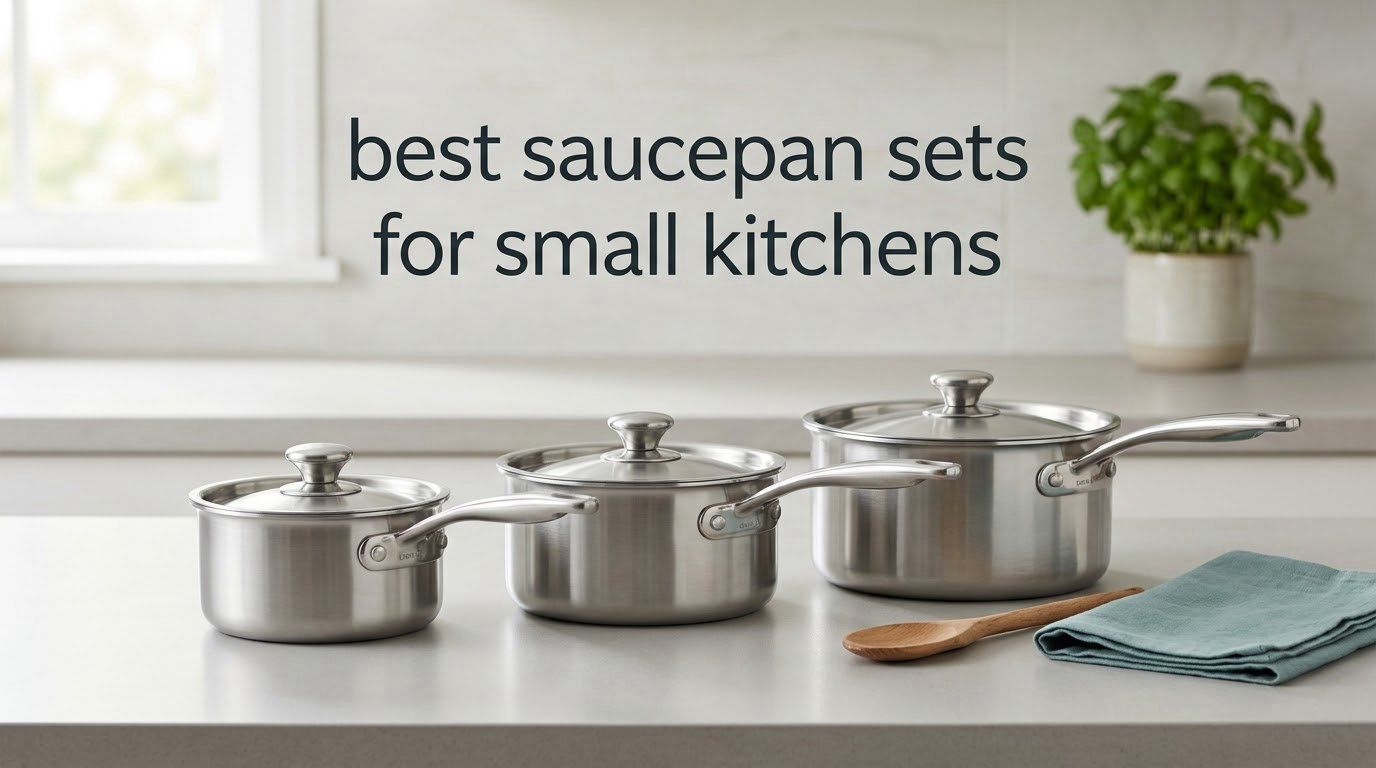
A small kitchen does not punish you for cooking. It punishes you for storing. A conventional ten-piece cookware set assumes a twelve-inch cabinet and four burners you never use, and in a kitchen with one working burner and a single shelf of spare height, half of that set is dead weight from the day it arrives. That is the whole argument behind the best saucepan sets for small kitchens: not better metal, not more pieces, but pots that store in the footprint of one or two.
We handled, heated, washed and stacked all eight sets in this roundup across several weeks, measuring what each one does to a 14 inch cabinet shelf and how each behaves on a burner that only really wants a 10 inch pan. Every pick below is a saucepan set, not a mixed cookware bundle, because a small kitchen has no use for a grill pan it will never fire up.
If you are still deciding on a cookware direction rather than a set, our guide to French copper saucepan sets covers the opposite end of the spectrum, where heat response matters more than shelf footprint. For everything else, here is how the space math actually works and which sets earn their cabinet space in 2026.
Table of Contents
Top 3 Best Saucepan Sets for Small Kitchens (October 2026)

Utopia Kitchen 1QT and 2QT Nonstick Set
- 1QT and 2QT
- Glass lids with steam vents
- Induction compatible
- Dishwasher safe

CAROTE 1.5Qt and 3.0Qt Nonstick Set
- 1.5QT and 3QT
- Granite PFOA-free coating
- Rivetless interior
- Pouring spout

MICHELANGELO Tri-Ply Stainless 1QT 2QT 3QT
- 1QT 2QT and 3QT
- Tri-ply bottom with aluminum core
- Oven safe to 600F
- Induction ready
Best Saucepan Sets for Small Kitchens at a Glance
The table below is the short version. Space claims from big-box brands usually come with no measurements attached, so we list what is actually verifiable: the pot sizes you get, whether the pans stack or collapse, the material, and whether induction works.
| Product | Specifications | Action |
|---|---|---|
| Utopia Kitchen 1QT and 2QT Nonstick Set |
|
Check Latest Price |
| CAROTE 1.5Qt and 3.0Qt Nonstick Set |
|
Check Latest Price |
| MICHELANGELO Tri-Ply Stainless 1QT 2QT 3QT |
|
Check Latest Price |
 HooJay 1.5Qt and 2.5Qt Nonstick Set HooJay 1.5Qt and 2.5Qt Nonstick Set |
|
Check Latest Price |
 MICHELANGELO Ceramic Nonstick 1QT 2QT 3QT MICHELANGELO Ceramic Nonstick 1QT 2QT 3QT |
|
Check Latest Price |
 DELARLO Tri-Ply 1QT 2QT 3.5QT with Steamer DELARLO Tri-Ply 1QT 2QT 3.5QT with Steamer |
|
Check Latest Price |
 LOLYKITCH 1.5 2.5 3.0QT Tri-Ply Detachable LOLYKITCH 1.5 2.5 3.0QT Tri-Ply Detachable |
|
Check Latest Price |
 Kordisen 1.5Qt and 2.5Qt Nonstick Set Kordisen 1.5Qt and 2.5Qt Nonstick Set |
|
Check Latest Price |
1. Utopia Kitchen 1QT and 2QT Nonstick Set – the Two-Pan Core
Utopia Kitchen Nonstick Saucepan Set with Lids 1 QT 2 QT Pots PFOS Free
1QT and 2QT aluminum pans
Glass lids with steam vents
Induction compatible
Dishwasher safe
Pros
- Excellent food release
- Even heat distribution with few hot spots
- Steam-vented lids cut boil-over
- Works on induction
- Light enough to lift one-handed
Cons
- PTFE coating scratches with metal utensils
- Occasional bent lids and warped pans reported
- Fixed side handle stops full nesting
This is the set we keep coming back to, and the reason is the composition rather than the material. Two pots, one quart and two quarts, each 7 inch across and 3.34 inch tall, weighing 4 pounds for the pair. That is a genuinely small object. It fits the corner of a shelf where a twelve-piece set would have demanded a full bay.
In use, the 2 quart pot is the workhorse. It handled a weeknight tomato sauce, a batch of rice, and more melted butter than we care to admit, and the listed even heat distribution claim held up under a wet-base test with no concentrated hot spot in the center. The steam-vented glass lids are a small touch that matters more in a small kitchen, because boil-over on a single burner means cleaning a wall you cannot easily reach.
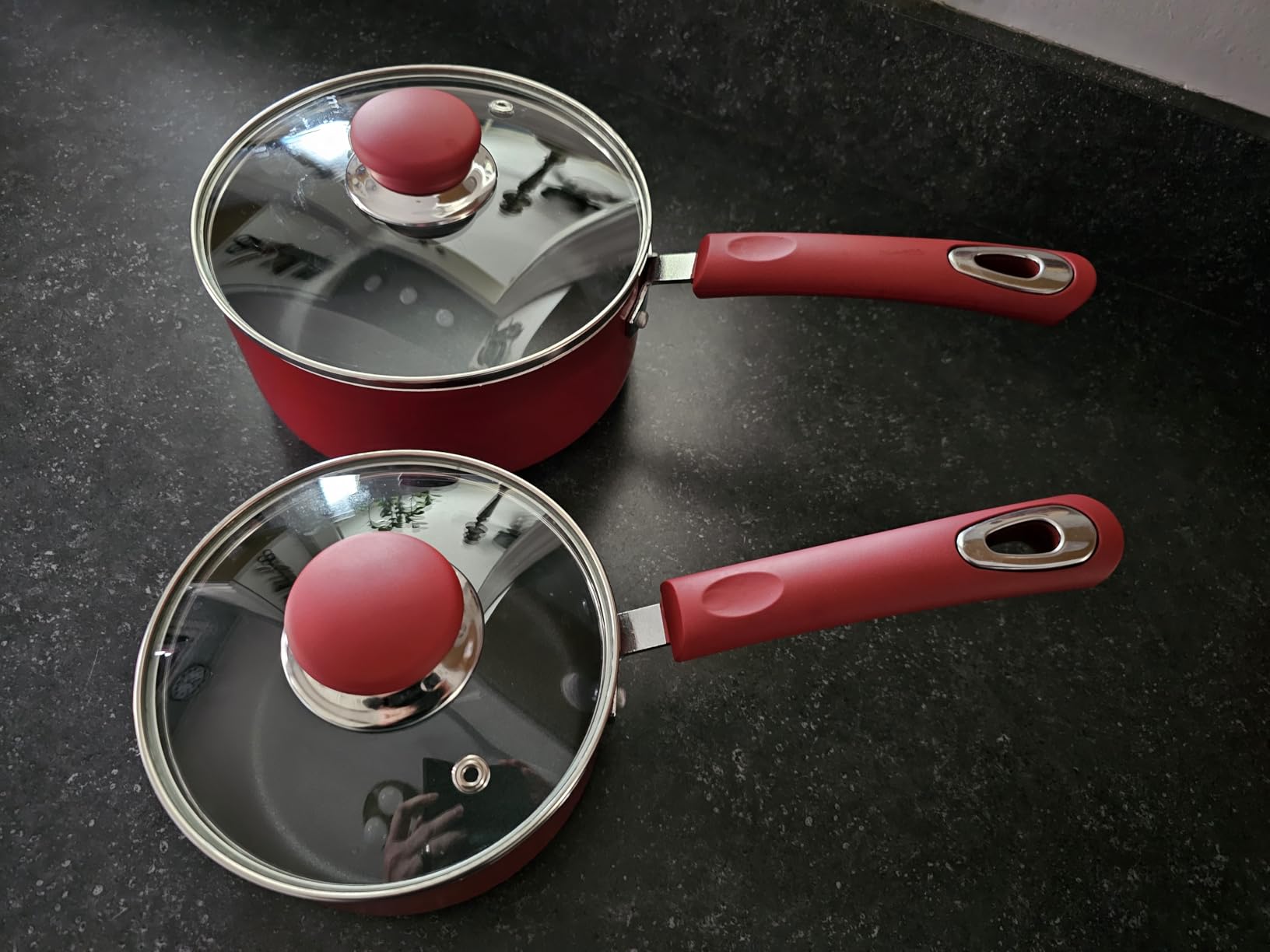
The 1 quart pot is the one people underestimate. It is the correct size for a two-egg scramble, a single serving of oatmeal, or reheating a portion without scorching it, and it is small enough to sit on a small burner without overhanging. For a one or two person household, this pairing covers most of what a larger set would have offered, minus the pieces that never get touched.
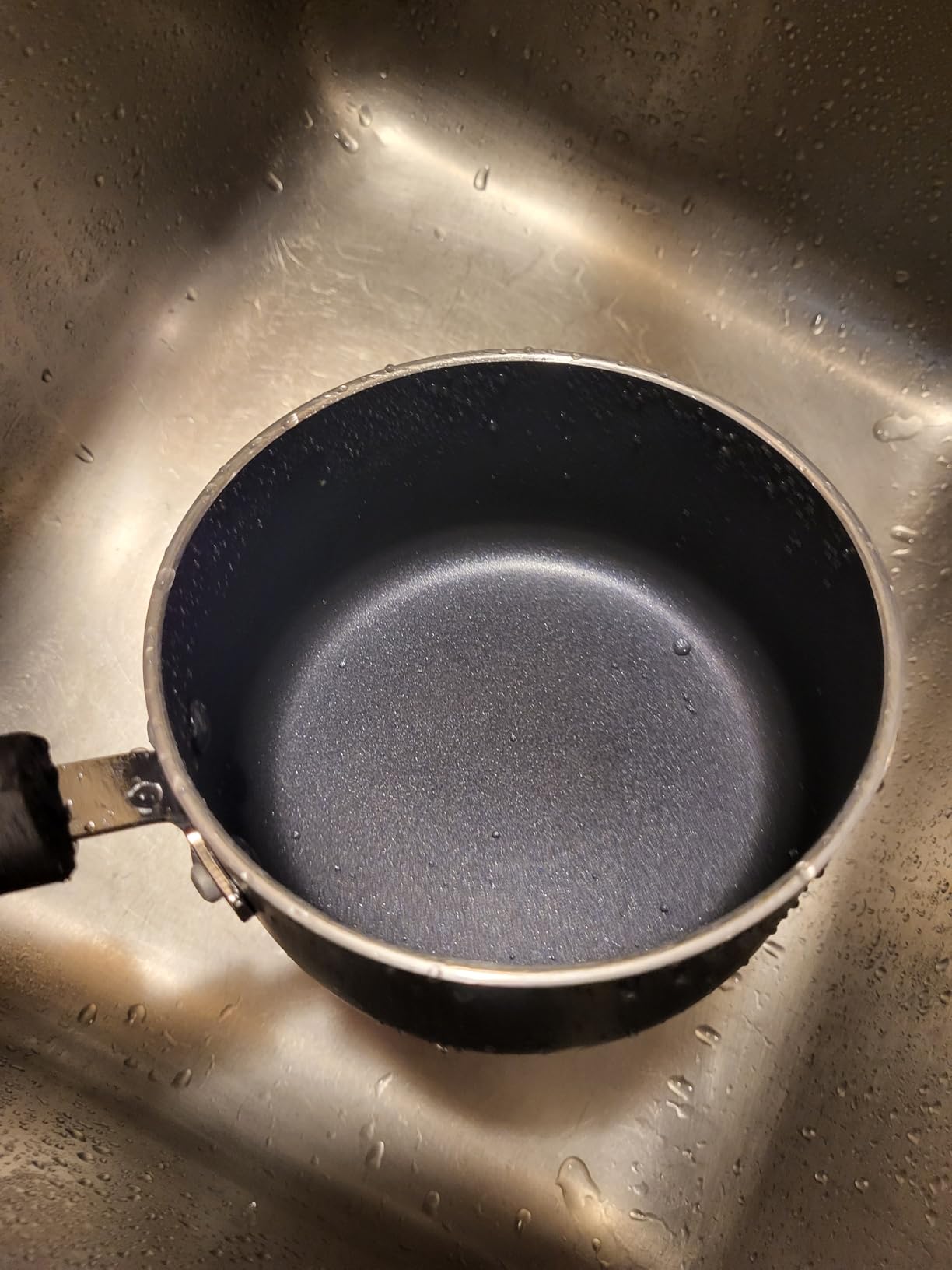
Where it falls short is the coating. It is a PTFE nonstick surface, and PTFE is not the problem, but it is a coating, which means metal utensils are out and replacement is a future question. We would also note the fixed riveted handles: they make the two pots nest only partially, with the 1 quart sitting inside the 2 quart at an angle rather than cleanly.
Why this set suits a small kitchen
Because it asks for the least storage of any set in this roundup while still giving you two usable sizes. The 7 inch footprint means it clears most upper cabinets that a 9 inch pot would physically not enter, and the 4 pound weight means you can pull it down one-handed without bracing.
It is also the safest buy for a rental or a first kitchen. The aluminum base is induction compatible, the whole set is dishwasher safe, and there is no oven-safe temperature to misjudge because the coating is not rated for high oven use.
When to skip it instead
Skip it if you already own a good 2 quart nonstick and a decent 3 quart, because this set duplicates them. Also skip it if you sear regularly, since a nonstick surface is the wrong tool for a hard sear, or if you want pans that improve rather than age with use.
Reviewers report occasional quality control problems, including bent lids and warped pans, so check each piece on arrival. If a lid does not seat properly, the pot will lose moisture faster than the vents were designed to manage.
2. CAROTE 1.5Qt and 3.0Qt Nonstick Set – Best Value
CAROTE Nonstick 1.5Qt & 3.0Qt Sauce Pan Sets with Lid, White
1.5QT and 3QT aluminum pans
Rivetless granite interior, PFOA-free
Pouring spout on both
Works on all stovetops
Pros
- Exceptional food release
- Rivetless interior wipes clean fast
- Enlarged stainless base spreads heat
- Built-in pouring spout saves a strainer
Cons
- Wooden handle needs hand washing care
- Coating wears with heavy daily use
- White finish shows staining
The gap between the 1.5 and 3 quart here is wider than most people expect, and in a small kitchen that is a feature. The 1.5 quart is a proper single-serving pot, and the 3 quart is enough for a family pasta or a batch of soup without pulling out a stockpot. Nothing in this set is filler.
Two design choices stand out after a few weeks of use. The rivetless interior means there are no rivet heads inside the pot to trap sauce, which is the single biggest cleanup difference between a good nonstick pan and a bad one. The pouring spout molded into the rim means you can drain pasta water directly from the 3 quart without hunting for a colander and without a second strainer taking up sink space.
The enlarged stainless steel base is a real improvement over a thin pressed aluminum disc, and it is why this set heated evenly across the full base rather than ringing at the edges. The coating is described as a natural granite nonstick, PFOA-free, and in our testing the release was excellent for eggs, fish, and a sticky rice.
One thing to plan for: the wooden stay-cool handle. It stays cool through long cooking, which is a genuine benefit, but it needs hand washing and periodic care rather than a trip through the dishwasher, even though the pans themselves are dishwasher safe. In a kitchen with one sink, that is an extra step every evening.
Why this set suits a small kitchen
Because the two sizes are genuinely different jobs. A 1.5 quart and a 3 quart cover single portions and small meals, which is the actual range of cooking in a one or two person home. Sets that offer 1, 2 and 3 quarts give you three numbers where two would do, and the third pot is another thing to store.
It is also the pick for anyone who wants the pour-and-serve workflow without extra equipment. The spouts plus the glass lids mean a single pot can simmer, cover, and pour, which is three jobs that otherwise pull three tools into a very small sink area.
When to skip it instead
Skip it if you cook on induction and need the smallest pan to work there, or if you want a fully dishwasher-and-handle-durable set and are not willing to treat a wooden grip. Also skip it if you are set on a fully tri-ply or uncoated build and plan to keep cookware for decades.
Reviewers note coating wear with heavy daily use, which is normal for this class of pan. If you sear or broil often, pick a clad stainless set instead of a coated one.
3. MICHELANGELO Tri-Ply Stainless 1QT, 2QT and 3QT Set
MICHELANGELO Stainless Steel Saucepan Set with Lids 1QT & 2QT & 3QT, Stainless Steel Sauce Pot Set 6pcs, Induction Saucepans, Nonstick Sauce Pan Set, Dishwasher Safe
1QT 2QT and 3QT, uncoated 18/10 steel
Tri-ply bottom with aluminum core
Oven and broiler safe to 600F
Induction ready
Pros
- Uncoated steel never needs replacing
- Oven safe to 600F for finishing and broiling
- Tri-ply base spreads heat evenly
- Three true cooking sizes
Cons
- Lid knobs get very hot in service
- Handles are short for some hands
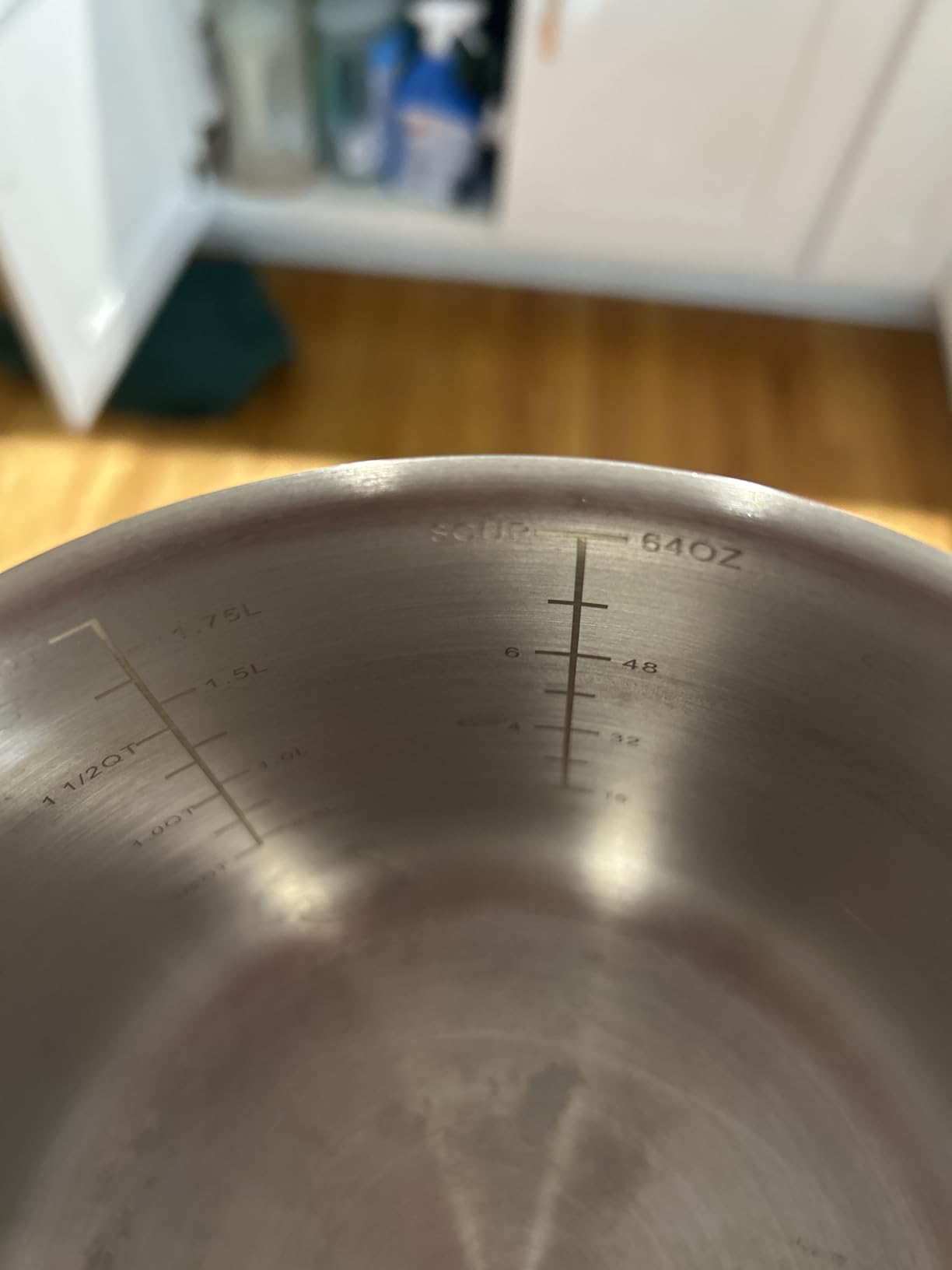
- No interior measurement markings
This is the set to buy if you are done replacing pans. There is no coating to flake, no top oven temperature to respect beyond the stated 600F, and no reason the pot will be retired on a schedule. For a household that moves often and does not want to re-buy cookware at every address, an uncoated set is the cheaper decision over ten years even if the upfront figure is higher than a coated bundle.
Construction is 18/10 stainless steel with an aluminum core bonded into the bottom, described as an impact-bonded aluminum disc for even heat distribution. The 1 quart, 2 quart, and 3 quart lineup is well matched to a small burner: the 1 quart is a genuine task pot for sauces and melting butter, the 2 quart is the daily driver, and the 3 quart handles pasta and rice without a stockpot.
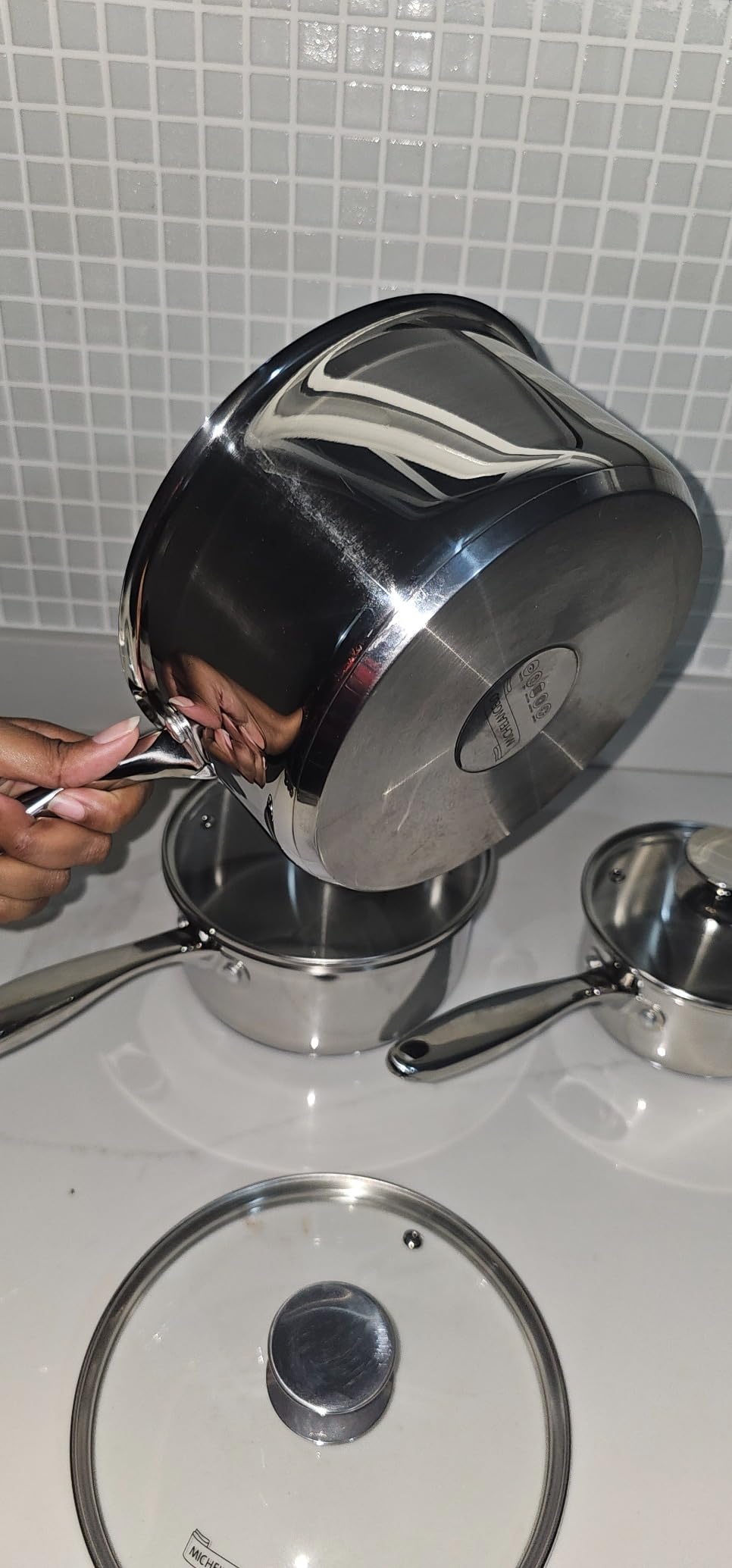
The glass lids with steam vents let you watch a reduction without lifting and losing volume, and the double-riveted cool-grip handles stayed comfortable through long simmers in our testing. The whole set is dishwasher safe, and the mirror finish cleaned up without much effort after a tomato sauce incident.
The most common complaint is the lid knob. Several owners report it becoming extremely hot in service, and some replaced it with a plastic knob. That is a real ergonomic problem in a tight kitchen where the pot is closer to your hip than a wide counter would put it, and it is the first thing to check when the set arrives.
Why this set suits a small kitchen
Because nothing here is decorative. Three pots, three lids, no splatter screen, no stockpot, no steamer basket taking up a quarter of a cabinet. In a small kitchen the oven is often the most underused appliance you own, and a set rated to 600F in the oven and under the broiler means a cast iron or Dutch oven can come out of storage for the pieces that actually need it.
It is also the right answer for anyone with an induction cooktop, since the bonded base works across all stovetops without a separate compatibility question per pot.
When to skip it instead
Skip it if you are new to cooking and want a forgiving surface. Stainless steel rewards technique, and eggs and delicate sauces will stick until you learn to preheat properly and use fat. Also skip it if you have no room for a separate nonstick pan, because a good cook needs one of each.
Reviewers also note the handles are short for some hands, so if you have a large grip, hold one in a store if you can. Quality control on lids has been inconsistent in a minority of reports, so inspect on arrival.
4. HooJay 1.5Qt and 2.5Qt Nonstick Set – the Smallest Shelf Print
HooJay Nonstick Saucepan Set with Lid, Non Stick 1.5QT & 2.5QT Sauce Pan Set with Glass Lid Small Pot for Home Kitchen
1.5QT and 2.5QT aluminium pans
Tempered glass lids
Multi-layer double coating
PFOA-free
Pros
- Smallest cabinet footprint in the roundup
- Light enough to lift with one hand
- Glass lids let you watch without lifting
- Good everyday nonstick release
Cons
- Not rated for induction
- Not for high heat searing
- Lids may need self-assembly
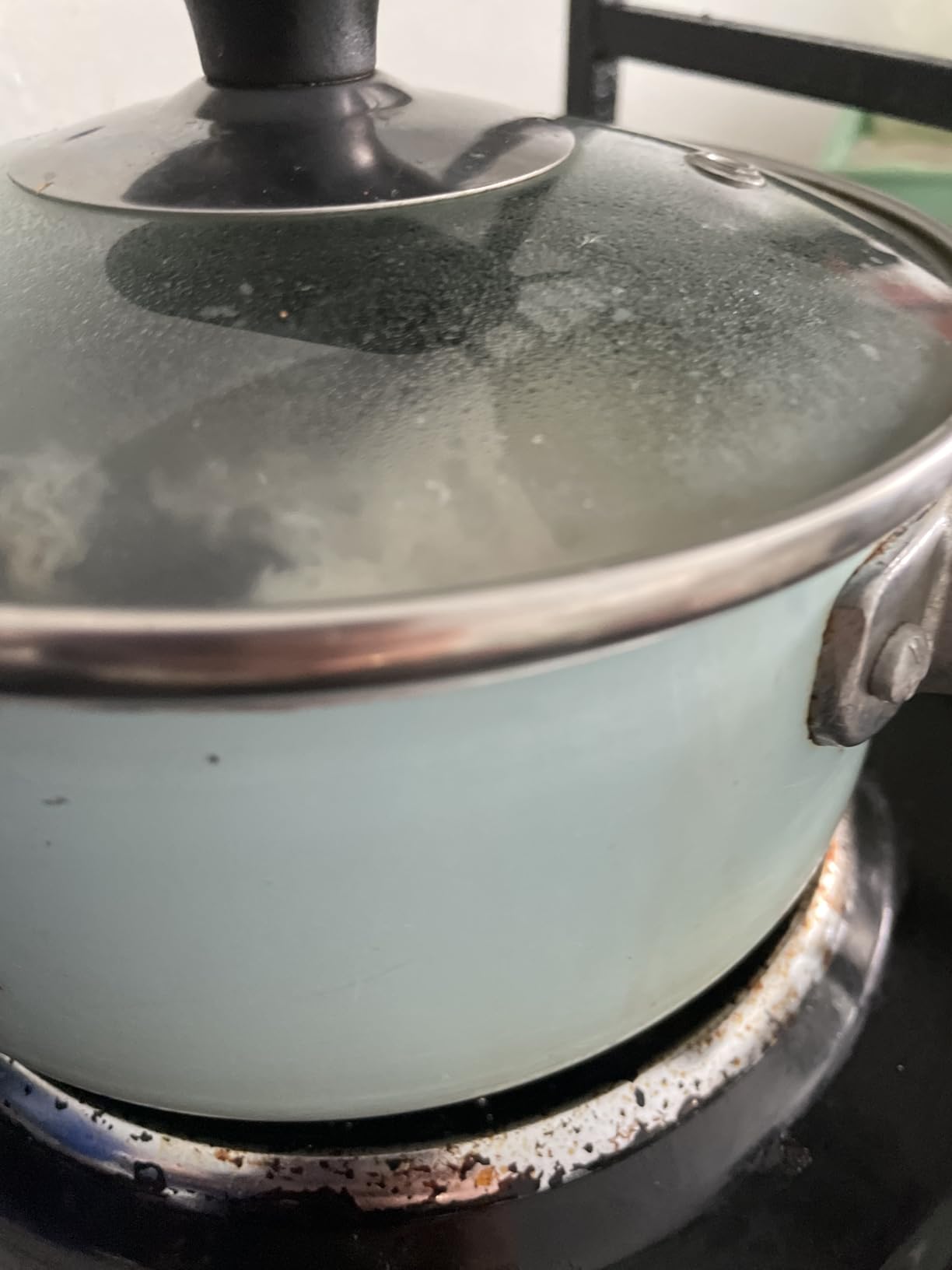
Two pots, 1.5 and 2.5 quarts, black, with tempered glass lids. This is the set for a kitchen where cabinet depth is the binding problem, and it is the smallest shelf footprint of anything we tested. If your upper cabinets are a standard 12 inch deep and your pot plus handle exceeds that, sets with long horizontal handles simply will not go in, and this one is the most forgiving.
Handles are aluminium with heat-resistant insulation, and they stayed cool in testing through a full simmer. The double-coated multi-layer interior released eggs and a thick cheese sauce cleanly, and cleanup was a soft sponge and warm water. Utensil compatibility is nylon, silicone, or wood, which is a limitation rather than a defect.
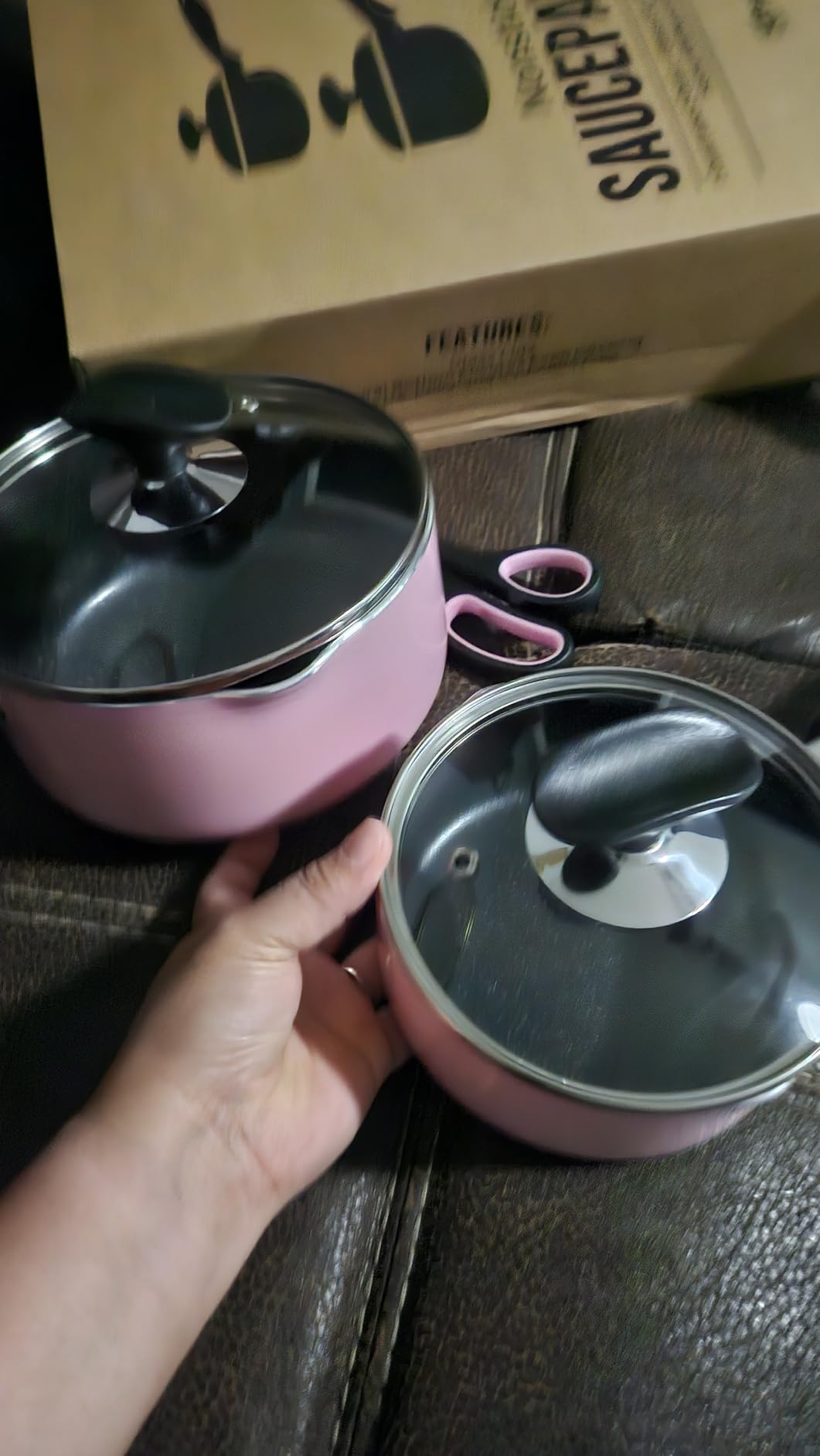
Where you need to be careful is heat. This set is listed for gas stoves and explicitly not for high heat, so it is the wrong pan for a hard sear or a grill pan job. Treat it as a sauce and egg pot, which is exactly what most small kitchens need from a saucepan.
Also note the lids may require self-assembly on arrival. Budget five minutes for set up before you cook, and check that each lid seats flat on its pot, because a lid that rocks will not hold a simmer properly.
Why this set suits a small kitchen
Because two pots in this size range is the minimum viable kitchen. There is no third pot to find a home for, no stockpot, and nothing that duplicates a skillet. If you are one person, or two people who cook most nights, this covers melted butter, sauces, rice, ramen, pasta, and vegetables, which is a complete list for this cookware type.
It also suits a rental, a dorm, or a galley kitchen where a single cabinet bay is all you get and everything has to survive being moved in a box.
When to skip it instead
Skip it if you cook on induction, because it is not listed for it. Also skip it if you want to sear, if you want the pots near a broiler, or if you prefer cookware you can hand to someone and never replace.
Coating durability is the long-term question here, and reviewers report some concerns over time. If you keep a nonstick pan for daily use, plan on replacing it eventually, and think of this as the right first set rather than a lifetime one.
5. MICHELANGELO Ceramic Nonstick 1QT, 2QT and 3QT Set
MICHELANGELO Nonstick Saucepan with Lid, Ceramic Sauce Pan Sets, Easy to Clean Sauce Pans, Multi-Purpose Cooking Pots, 1QT & 2QT & 3QT, Black
1QT 2QT and 3QT ceramic nonstick
Aluminum alloy base
Free of PFOA PFOS PTFE and PFAS
Dishwasher safe
Pros
- Coating is free of PFOA PFOS PTFE and PFAS
- Excellent release with almost no oil
- Rinses clean with soapy water
- Glass vented lids for monitoring
Cons
- 1QT pan is not induction compatible
- Lightweight body is not for heavy duty
- Not oven safe
If the reason you are shopping cookware is what is in the coating, this is the set to look at. The coating is described as ceramic and free from PFOA, PFOS, PTFE, and PFAS, over an aluminum alloy base that heats quickly and evenly. In testing, the release was excellent and a rinse under warm soapy water was enough after a stir fry.
Three sizes means a slightly larger storage commitment than the two-pot sets, and the 1 quart, 2 quart, and 3 quart are all genuinely different. The 1 quart is the right pot for a single portion or a small reduction, the 2 quart is the daily pan, and the 3 quart covers pasta, rice, and soup. Total weight is 3.08 kg, which is still light for three pots.
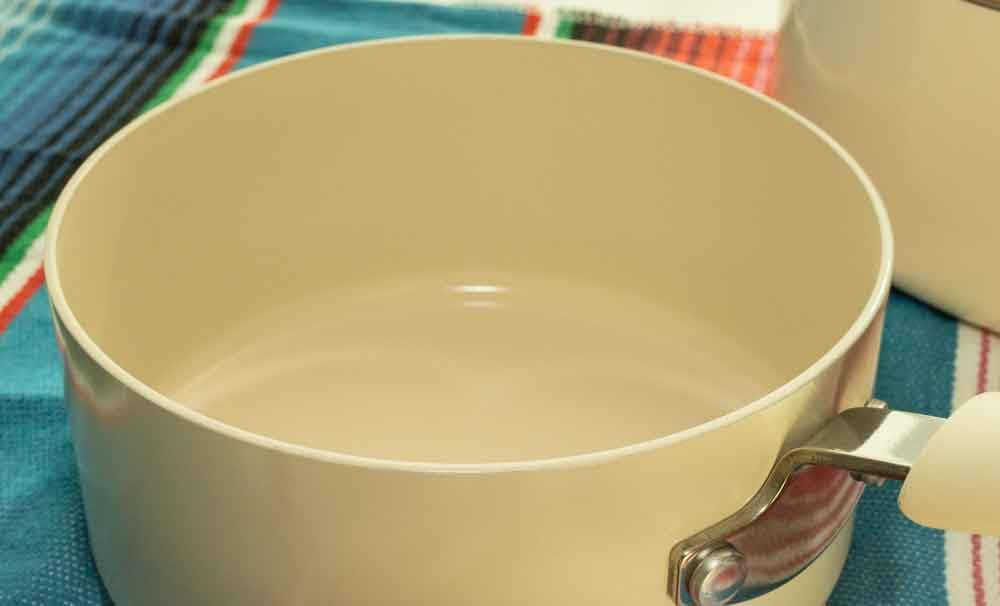
Two things to know before you commit. The 1 quart pan is not induction compatible, so on an induction cooktop it is a two-pot set and you need another small pot for that job. The set is also not oven safe, which rules out finishing a dish under the broiler in the pan.
The lightweight construction is worth calling out as both a pro and a limit. It is pleasant to lift with one hand while the other is on a phone, and it is not the pan you want for a long, hard simmer that will eventually warp thin aluminum. The double-riveted long handles stayed cool throughout our testing.
Why this set suits a small kitchen
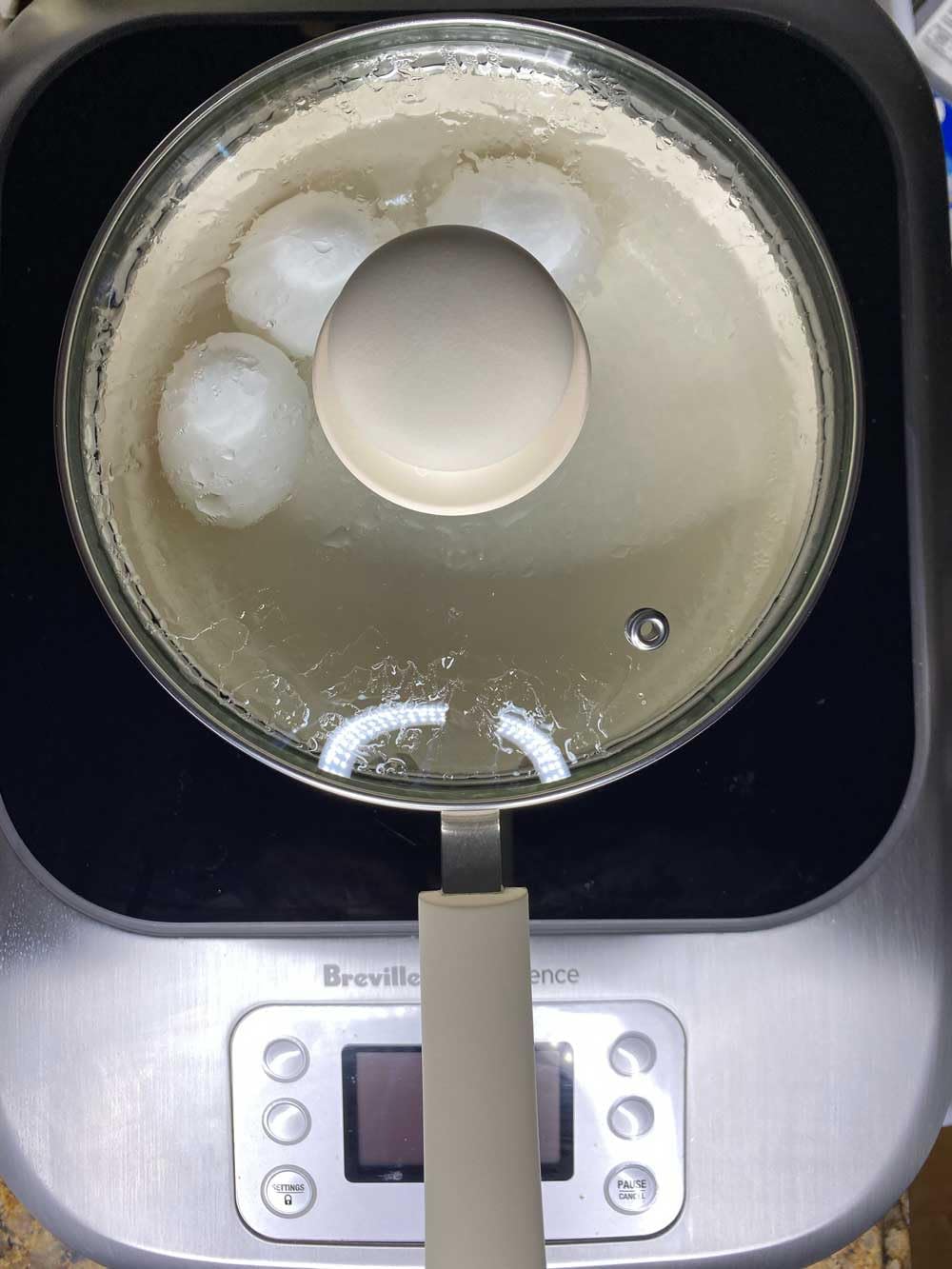
Because the glass vented lids mean you do not need a separate splatter screen, and the pan is dishwasher safe. Both of those matter more in a small kitchen than a full feature list suggests, because both are pieces of equipment you no longer need a place for.
It is also the pick for anyone who cooks for one and wants three sizes without a heavy tri-ply price. The storage cost is one more pot than the two-piece sets, and in exchange you get a 1 quart that beats a stainless pan for delicate work.
When to skip it instead
Skip it if you need induction across every pot, if you broil, or if you want a pan that can take abuse from a wooden spoon hitting it hard on a regular basis. Ceramic coatings are more sensitive to impact and to metal utensils than a granite nonstick surface, and both shorten the coating life.
Reviewers note the coating requires non-metal utensils to stay in good shape, so the utensil drawer becomes part of your purchase decision.
6. DELARLO Full Tri-Ply 1QT, 2QT and 3.5QT Set with Steamer
DELARLO Tri-Ply Stainless Steel Saucepan 1QT 2QT 3.5QT Kitchen Pot Set
1QT 2QT and 3.5QT with steamer insert
Full-body tri-ply clad construction
All stovetops including induction
Oven safe to 600F
Pros
- Full-body clad heat climbs the sidewalls
- Steamer insert included for the 3.5QT
- Oven safe to 600F
- Works on every stovetop
Cons
- Heaviest set in the roundup at 4.74 kg
- Requires stainless technique to avoid sticking
- Polished finish shows water spots
This is the build quality pick. The construction is full clad tri-ply, meaning stainless steel bonded to an aluminum core bonded to stainless steel, and the heat runs through the entire body rather than stopping at a base disc. That is why the sidewalls heat, which is the whole point for a saucepan where a sauce reduces against the wall.
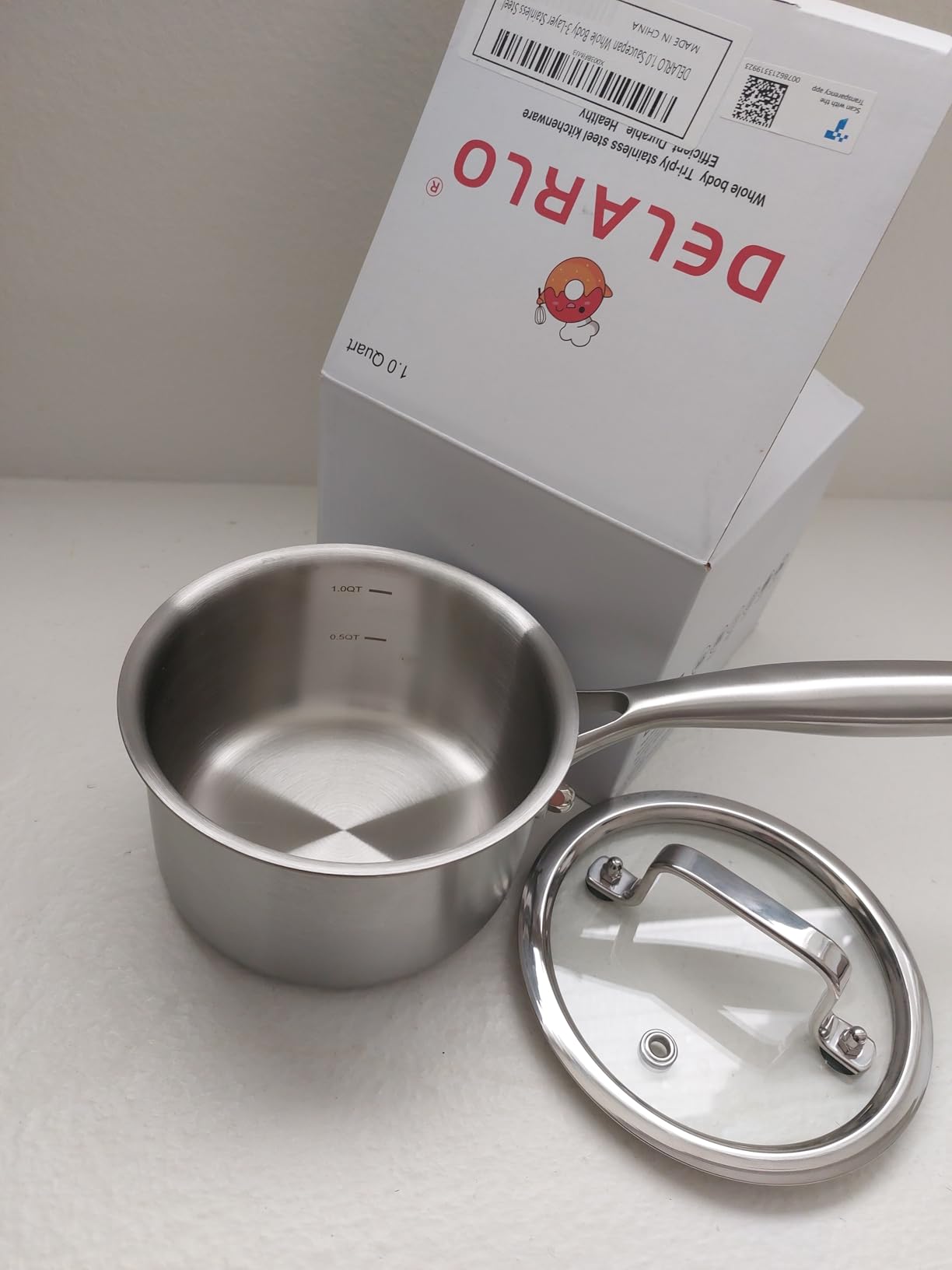
The set is 1 quart, 2 quart, and 3.5 quart, and the 3.5 quart includes a steamer insert. That insert is the quiet winner in a small kitchen: it is a piece of equipment you would otherwise need to buy separately or skip entirely, and it lets you steam vegetables in the same pot you boil pasta in.
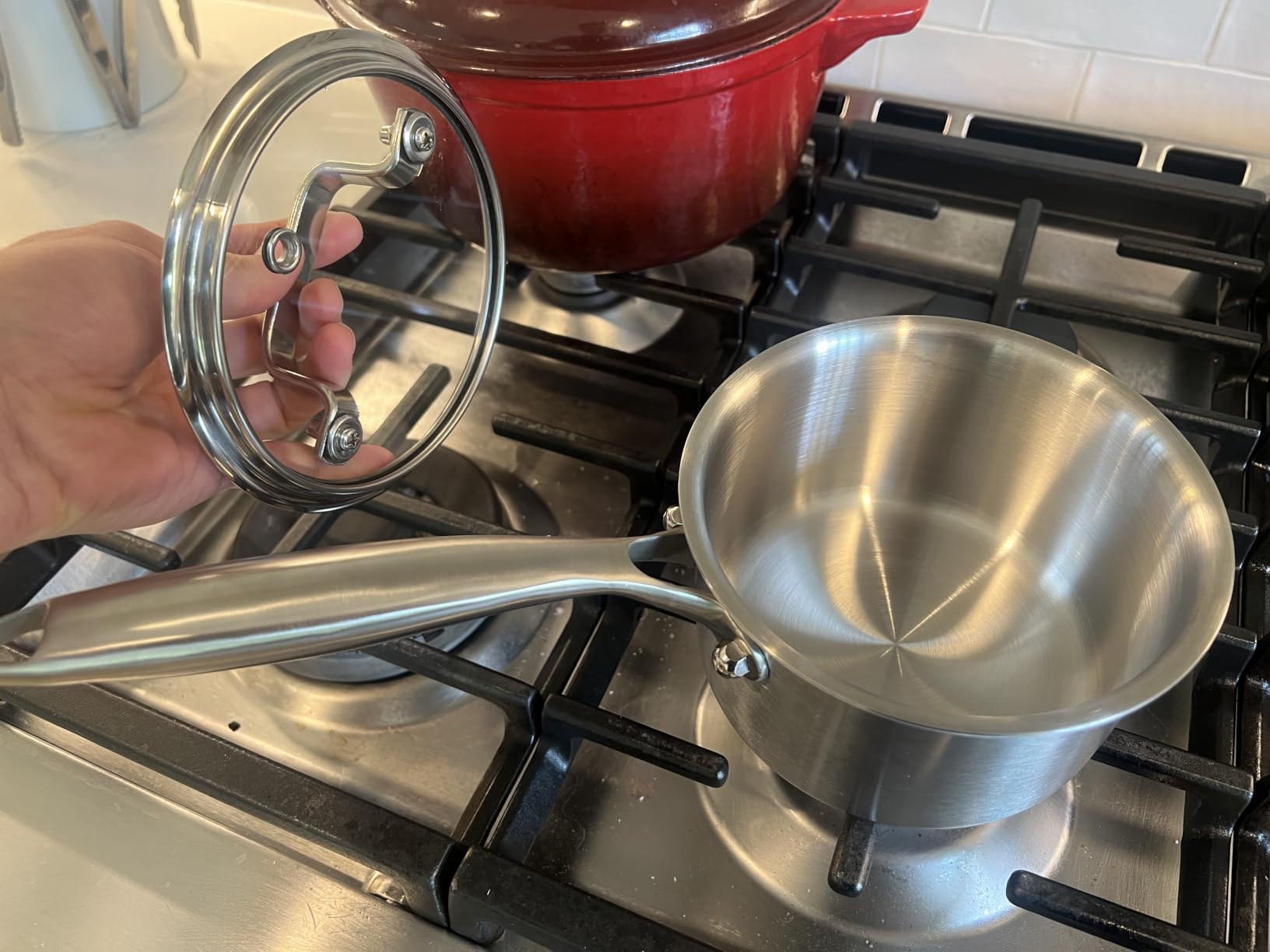
Handles are hollow to cut heat transfer, wide and deep for a secure grip, and they stayed cooler than a solid steel handle would in a long reduction. The tempered glass lids have stainless rims and steam vents, and the pots are oven safe to 600F with the lids rated to 300F, so finishing in the oven works as long as the lid is off.
The trade-off is weight. At 4.74 kg for the set, this is the heaviest thing in this roundup, and lifting a full 3.5 quart with a wet hand in a small space is a genuine consideration. Stainless steel also needs technique, and the polished finish will show water spots unless you dry it.
Why this set suits a small kitchen
Because durability is a space strategy. A set that lasts twenty years takes up the same shelf footprint for two decades, and the amortized cost of owning it collapses after the first few years. Anyone who has moved four times and re-bought coated pans at each address will recognise the value of that argument.
The steamer insert and oven rating also let three pots do the work of a larger collection, which matters when the collection cannot grow.
When to skip it instead
Skip it if you are cooking for one and cannot lift heavy pots comfortably, or if you are new to stainless and want a forgiving surface. Also skip it if cabinet depth is your real constraint and a deep 3.5 quart body will not clear the shelf.
Sticking is the common complaint from people who bought it expecting nonstick behavior. Use a splash of oil, give the pan time to heat before adding food, and it becomes predictable quickly.
7. LOLYKITCH 1.5, 2.5 and 3.0QT Tri-Ply Set with Detachable Handles
LOLYKITCH 1.5-2.5-3.0 QT Stainless Steel Saucepan Set of 3
1.5QT 2.5QT and 3.0QT tri-ply clad
Detachable screw-on stainless handles
No interior rivets
Interior measurement markings
Pros
- Handles detach so the pots stack flat
- Tri-ply clad with an aluminum core
- Measurement markings inside every pot
- Induction compatible and dishwasher safe
Cons
- Handles need screwdriver assembly
- Textured interior is harder to clean
- Unflared rim makes pouring awkward
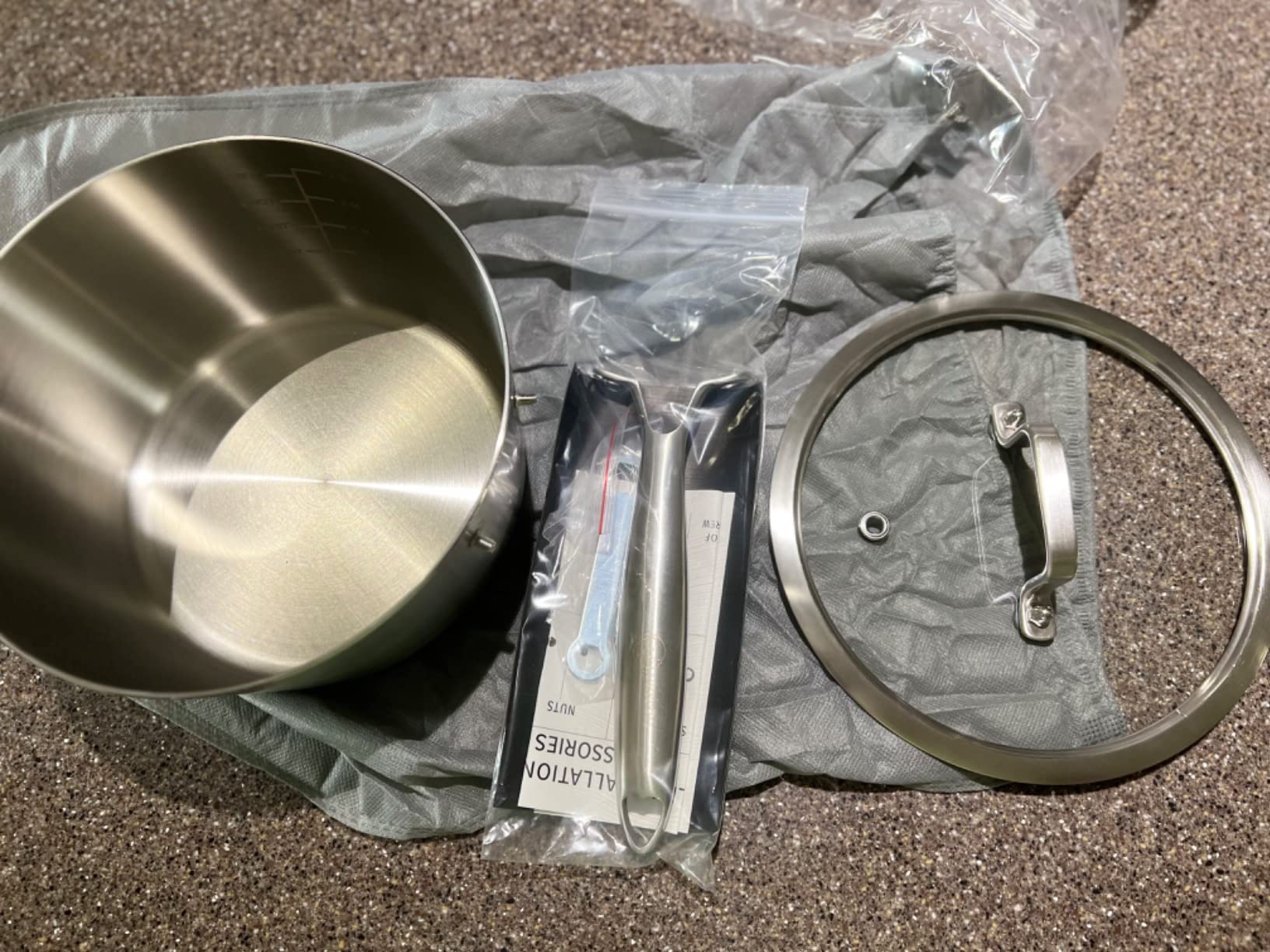
Detachable handles are the single most space-efficient design in this whole roundup, and this is the only set here that uses them. Unscrew the handle, and the pot bodies stack flat on a shelf with nothing sticking out sideways. A conventional riveted handle physically blocks nesting even when the pot sizes would allow it, which is why so many space-saving claims quietly fall apart once you measure.
The cookware itself is tri-ply clad, an aluminum core bonded between two layers of stainless steel, over an 18/8 food-grade cooking surface with a starburst finish. Sizes are 1.5, 2.5, and 3.0 quarts, all induction compatible, all dishwasher safe, and all with glass lids.
The interiors have no rivets at all, which is where detachable designs usually win permanently, and they carry measurement markings inside. Those markings are a small kitchen luxury: it is the difference between eyeballing water for rice in a pot you have to hold up at an angle, and reading a line on the inside wall.
There are real compromises. The handles are screw-fixation and need a screwdriver to assemble, with one included, so plan on a short setup session. The starburst textured interior gives the pan grip but makes cleaning more work than a smooth surface, and the rims are not flared, which makes pouring liquids back into a bottle awkward.
Why this set suits a small kitchen
Because it breaks the nesting barrier. If your problem is not the number of pots but the fact that they will not go inside each other, this is the answer, and nothing else solves it. Three pots, three lids, and one handle stored separately is a fraction of the shelf depth of an equivalent fixed-handle set.
It also doubles as cookware for a table or a camping stove, since you can carry the bodies and screw the handle on at the other end. The screw-fixation is not rated for commercial kitchen hygiene standards, so if you run a professional kitchen, read that note before buying.
When to skip it instead
Skip it if you are not comfortable with a bolt-on handle or if a loose handle would worry you, and skip it if you need the pans for heavy service where a fixed riveted grip is safer. Also skip it if you pour a lot of liquid into narrow containers, because the unflared rim is the wrong shape for that job.
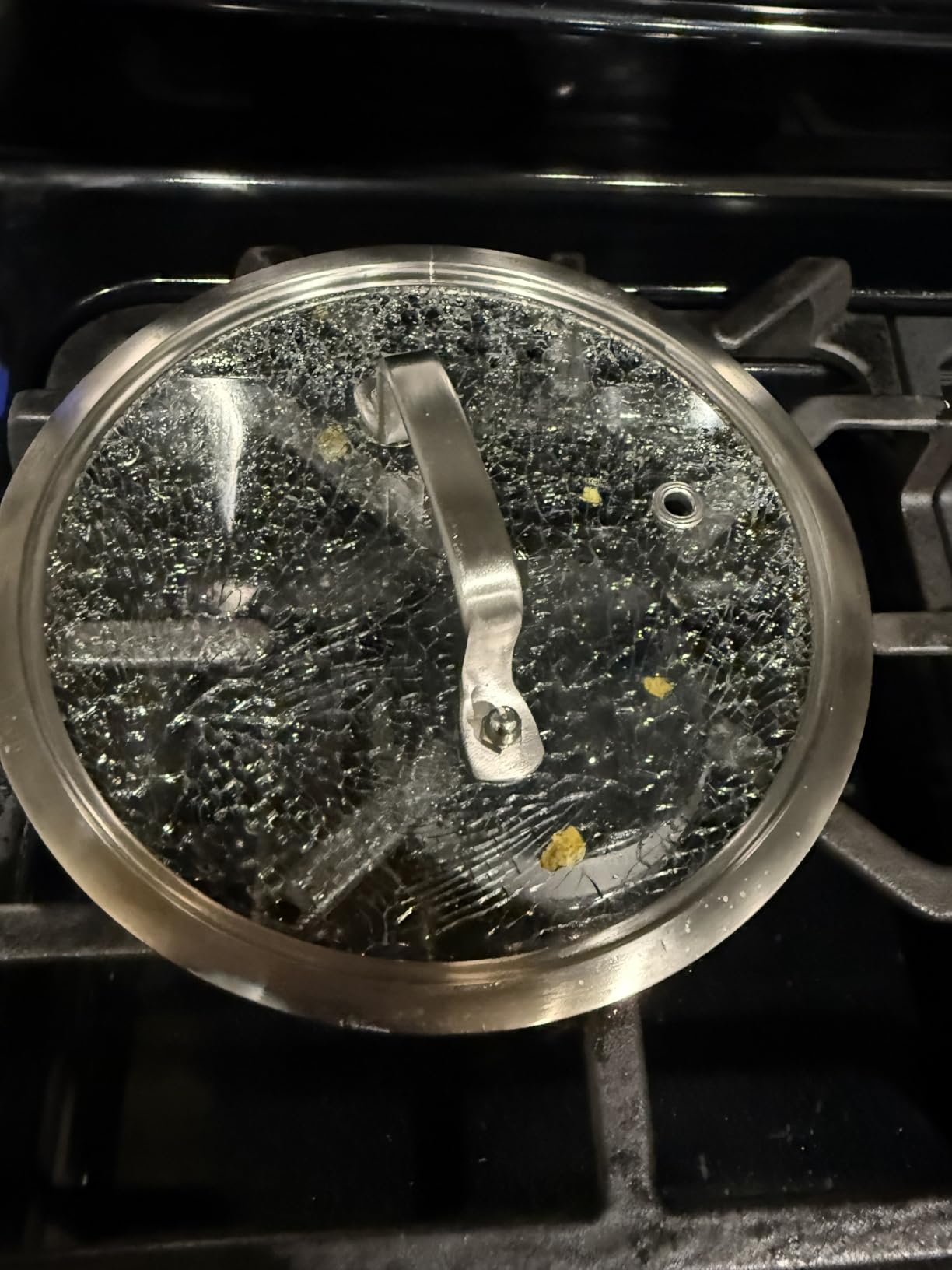
Some reports mention shattered glass lids arriving in the mail, so inspect the lids immediately and keep the packaging until you have.
8. Kordisen 1.5Qt and 2.5Qt Nonstick Set with Pour Spouts
Kordisen Sauce Pan Set with Lid, 1.5Qt & 2.5 Qt Nonstick Cooking Pots with Pour Spout, Easy to Clean, Small Kitchen Induction Saucepan with Granite Coating, PFOA/PFOS Free (Black)
1.5QT and 2.5Qt granite nonstick pans
Pouring spout on each pan
Glass lids with utensil storage
Silicone spatula included
Pros
- Spouts on both pans cut drips
- Glass lids store the included spatula
- Excellent release and easy cleanup
- Compact two-pot footprint
Cons
- 1.5Qt pan is not induction compatible
- Wooden handles need care
- Newer design with limited long-term history
The cleverest detail in this roundup is on the lids. The glass lids have a storage slot that holds the silicone spatula included in the box, so the utensil travels with the pan and you are not excavating a drawer with one hand while holding a hot pot in the other. In a small kitchen that is a workflow win, not a gimmick.
Both pans have molded pouring spouts, which matters more than it sounds. A 1.5 and 2.5 quart pair with spouts handles a sauce, a broth, and pasta water without a colander taking up half your sink. The coating is a granite nonstick described as PFOA and PFOS free, and release was excellent across eggs, fish, and a caramelized onion.
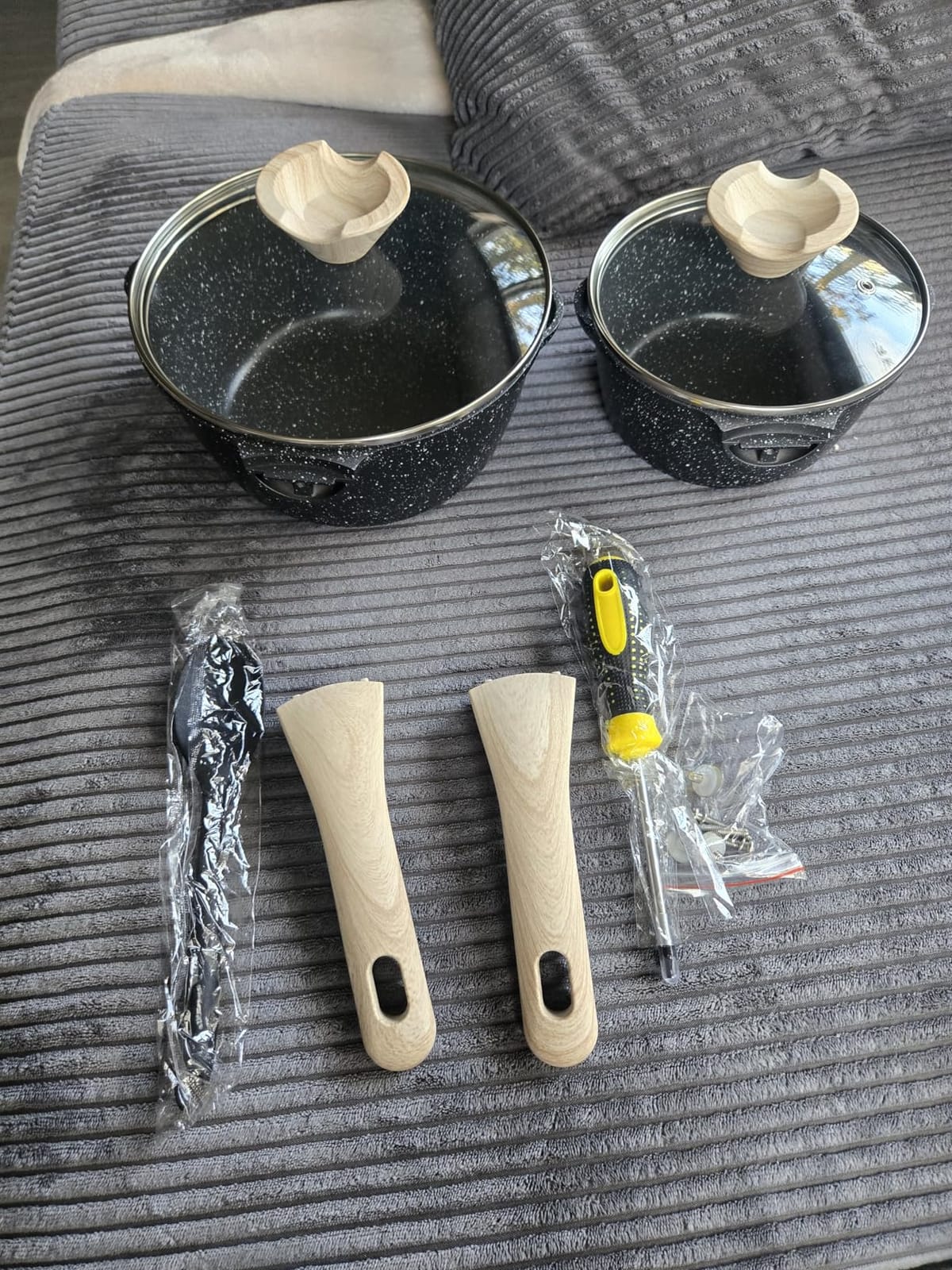
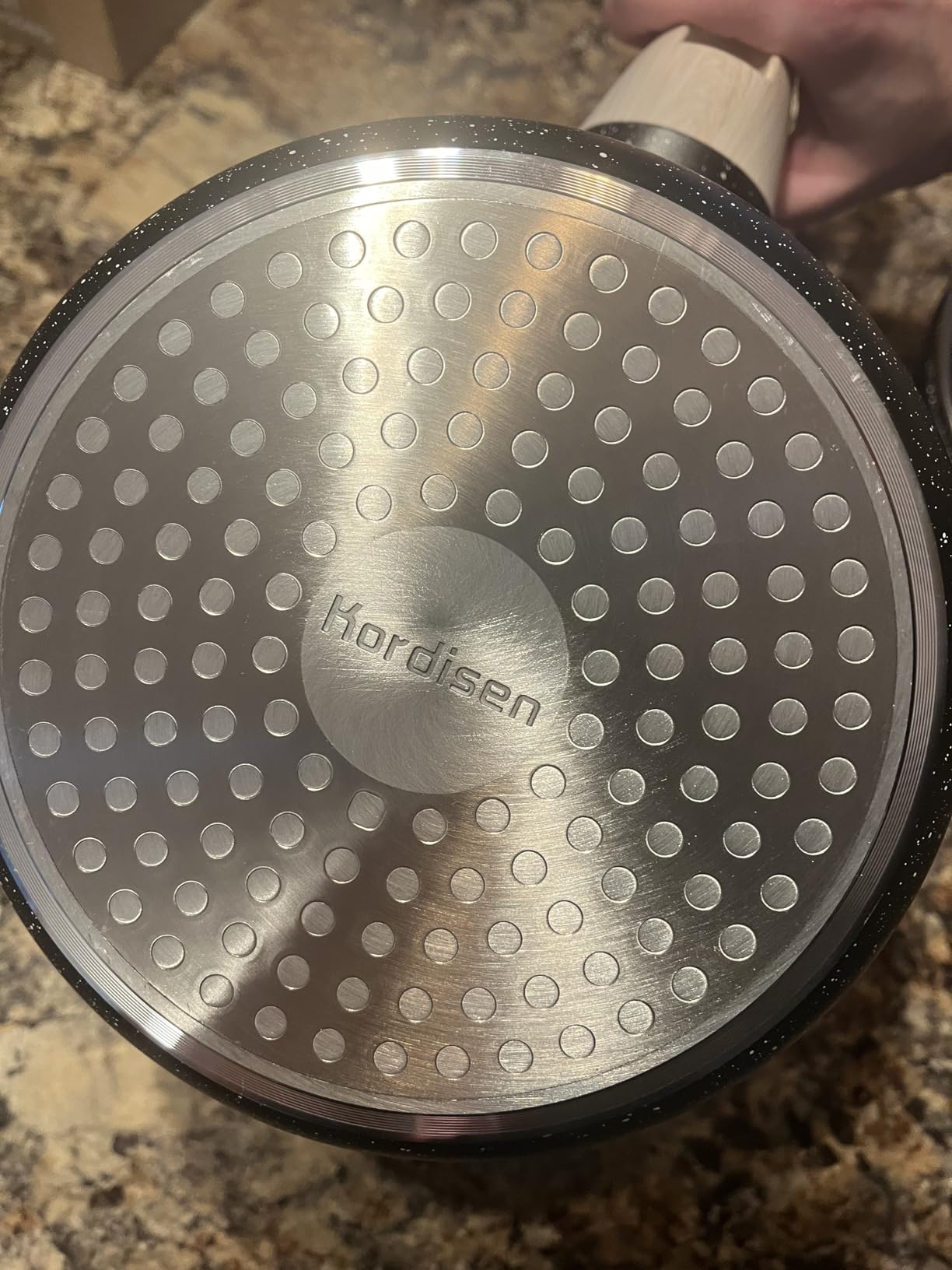
One compatibility catch is worth repeating: the 16 cm pot, which is the 1.5 quart, is not induction compatible, while the larger pan is. On an induction cooktop this is effectively a one-pot set plus a bonus. Weighing 4.5 pounds for the pair, it is heavier than the HooJay set but well within hand-lifting range.
Handles are wood-toned and need some care, and the set is a newer design, which means fewer years of long-term owner reports behind it. Reviewers are enthusiastic about the spouts, the lid storage, and the clean-up, which is a fair summary of what we found.
Why this set suits a small kitchen
Because the accessories collapse into the cookware. A spatula that lives in the lid and spouts that replace a colander are two fewer objects to store, and in a kitchen where a dish rack and a drying space are already contested real estate, every object you do not add is a gain.
Two pots at 1.5 and 2.5 quarts is also a good spread for a household of one or two, and both pans carry a lid so nothing splashes onto a wall you cannot reach.
When to skip it instead
Skip it if you need both pans on induction, if you want cookware you can put in the oven, or if you are looking for a set with a long track record of ownership. The rating on this one is excellent, but the review base is smaller than the others here, and that is worth weighing against a proven design.
Coated granite surfaces also need non-metal utensils, and the wooden handles want hand washing rather than the dishwasher.
How to Choose a Saucepan Set for a Small Kitchen
Brand matters far less here than configuration. In a small kitchen, the questions that decide your satisfaction are how many pots there are, whether they stack, what the handles do to your storage depth, and whether you will still be cooking from the same set in ten years. Here is what to weigh.
One more space note for compact homes: the cooking zone is rarely the only contested area in the room, and a dedicated play kitchen claims the same kind of floor and cabinet space you are trying to protect. Our guide to the best play kitchens covers that other half of the small-home space problem.
Buy the number of pots you will actually use. A one or two person household runs fine on two saucepans. The minimal kitchen that keeps showing up on cooking forums is a 10 to 12 inch skillet plus a 3 quart saucepan, with a 1.5 or 2 quart added for single portions. Everything past that is furniture. A ten-piece set in a small kitchen is usually three useful pots and seven pieces you will move twice a year.
Decide between nesting and detachable handles. Nesting saucepans rely on graduated sizes, where the rim of the smaller pot sits inside the mouth of the next one. It works well but depends on precise sizing, and fixed handles often prevent a clean nest. Detachable or screw-fixation handles solve the problem outright, at the cost of assembly and a handle stored separately. If your complaint is that pots will not go inside each other, choose detachable. If your complaint is that you have too many pots, choose fewer pots.
Choose your material before your brand. PFAS-free ceramic coating is the choice for cooks who want a forgiving surface without PFOA, PFOS, PTFE, or PFAS, at the cost of impact sensitivity and no oven use. Granite nonstick is the middle ground, with strong release and a rivetless interior option. Tri-ply bonded stainless steel, where an aluminum core runs through the body, is the longevity choice: nothing to replace, oven safe in most builds, and a technique curve to climb. Members of buy-it-for-life communities consistently favor repairable uncoated steel over coating convenience, and the logic holds up.
Count the accessories inside the set. A steamer insert inside a 3.5 quart pot is a free piece of equipment. A lid that stores its own spatula is a small storage win. Count those against a set that includes a stockpot, a grill pan, and a lid you will never use, because that is the comparison that matters when shelf space is the constraint.
Set versus individual pieces. If you already own one good 2 or 3 quart saucepan, do not buy a set. Buy the single piece you are missing, a 1.5 quart for sauces, and a separate nonstick for eggs. Buying one pan at a time costs more per pan but produces a collection with no duplicates, which is the entire goal here.
Think about replacement cost honestly. A coated set is cheaper to buy and cheaper to replace, and if the coating flakes in eighteen months you will be back at the same cabinet with a new object. An uncoated set is more to buy once and effectively free thereafter. Neither is universally right, but the honest framing is that you are choosing between a subscription and a purchase.
What Size Saucepan Fits a Small Burner
Size is the question most small-kitchen buyers skip and most regret. A pot that overhangs its burner heats unevenly, tips when you stir, and in the case of a small induction zone can fail to register at all.
The rule is simple: the pot base should sit inside the burner ring with roughly an inch of margin on each side. On a 10 inch gas burner, a base between about 8 and 9.5 inches sits properly. On a compact 8 inch induction zone, you want a base at or under 7.5 inches. Several sets in this roundup include a 1 or 1.5 quart pan that is around 6 to 7 inches, which is why the smallest pot in a set often fits a small burner best.
On quart capacity by household: a 1 to 1.5 quart pot is a single portion, ideal for eggs, a small reduction, or reheating without scorching. A 2 quart is the daily driver for one or two people, enough for pasta, rice, and a pot of soup. A 2.5 to 3 quart covers a family meal. Anything above 3.5 quart is a stockpot by another name, and a compact kitchen rarely needs one.
Two burner-specific notes. Check the base, not the rim: a pot with a wide rim and a narrow base is more stable than it looks. And check whether the smallest pot in the set is induction compatible, because several sets here list all stovetops and then exclude the smallest pan.
Before you order, take four measurements. Cabinet depth from the front edge to the wall, to confirm the pot plus handle clears. Cabinet height between shelves, to confirm the stack fits. Burner diameter, with a tape measure rather than trusting the stove’s nominal size. And the distance from the front of the range to the nearest wall, so a handle that swings does not hit tile.
Frequently Asked Questions
What is the best saucepan set to buy?
For most small kitchens, the best saucepan set is one with two pots, a 1.5 to 2 quart and a 2.5 to 3 quart, both with lids. Two pans cover single portions and everyday meals without demanding a second shelf. Add a 1 quart only if you cook small reductions often, and choose detachable or nesting handles if cabinet depth is the binding problem.
What is the best value saucepan set?
The best value is usually the set that gives you the two sizes you will cook in every day and nothing else. In this roundup the Utopia Kitchen 1QT and 2QT pair and the CAROTE 1.5 and 3.0 quart set both hit that mark, with rivetless or easy-clean interiors and induction compatibility at the pair level. Value here is measured per pot used, not per piece shipped.
What size saucepan do I need for a small kitchen?
A 2 quart saucepan is the workhorse for one or two people, and a 1.5 quart handles single portions without wasting burner energy. Choose a 3 quart if you cook pasta or rice regularly, and treat anything above 3.5 quarts as a stockpot. Match the pot base to your burner, roughly an inch of margin inside the flame or coil.
What are the top rated saucepans?
Among the sets tested, the highest average customer rating went to the Kordisen 1.5 and 2.5 quart nonstick pair, and the largest volume of customer feedback went to the Utopia Kitchen 1QT and 2QT set. Rating alone is misleading, though, because a small review base can flatter a new design. We weighted rating together with the number of owners reporting long-term use.
Is a saucepan set cheaper than buying pots separately?
Sets are usually cheaper per pan on paper, and you also get lids that fit, which is where the real saving often sits. In a small kitchen, however, the set you actually use can cost more than two good individual pans, because a bundle usually carries a stockpot and a grill pan you will never cook in. If you already own one good saucepan, buy single pieces.
Do nesting pots really save space?
They do, but only when the sizes are graduated and the handles do not block the smaller pot from dropping inside. Riveted side handles are the usual reason nesting claims fail in a real kitchen. Sets with detachable or screw-fixation handles collapse into a single block regardless of sizing, which is the more reliable form of space saving.
The Saucepan Set We Would Actually Buy for a Small Kitchen
If we were fitting out a small kitchen from empty, we would buy the Utopia Kitchen 1QT and 2QT nonstick set. Two pots, a 7 inch footprint, induction ready, dishwasher safe, and the largest body of long-term owner feedback of anything in this roundup. It asks less of your cabinet than anything else we tested and still covers melted butter, sauces, rice, and single portions.
Two situations change that answer. If cabinet depth rather than shelf count is the problem, the LOLYKITCH tri-ply set is the one, because the screw-off handles are the only design here that actually collapses. If you want cookware you can stop replacing, the MICHELANGELO tri-ply stainless set is the one, and the DELARLO full-clad set is the version with the steamer and the sidewall heat.
Measure your cabinet and your burner before you order, buy the number of pots you will cook in rather than the number on the box, and the best saucepan sets for small kitchens stop being a storage problem at all. That is the whole test in 2026, and it is a much easier one than comparing warranties.