
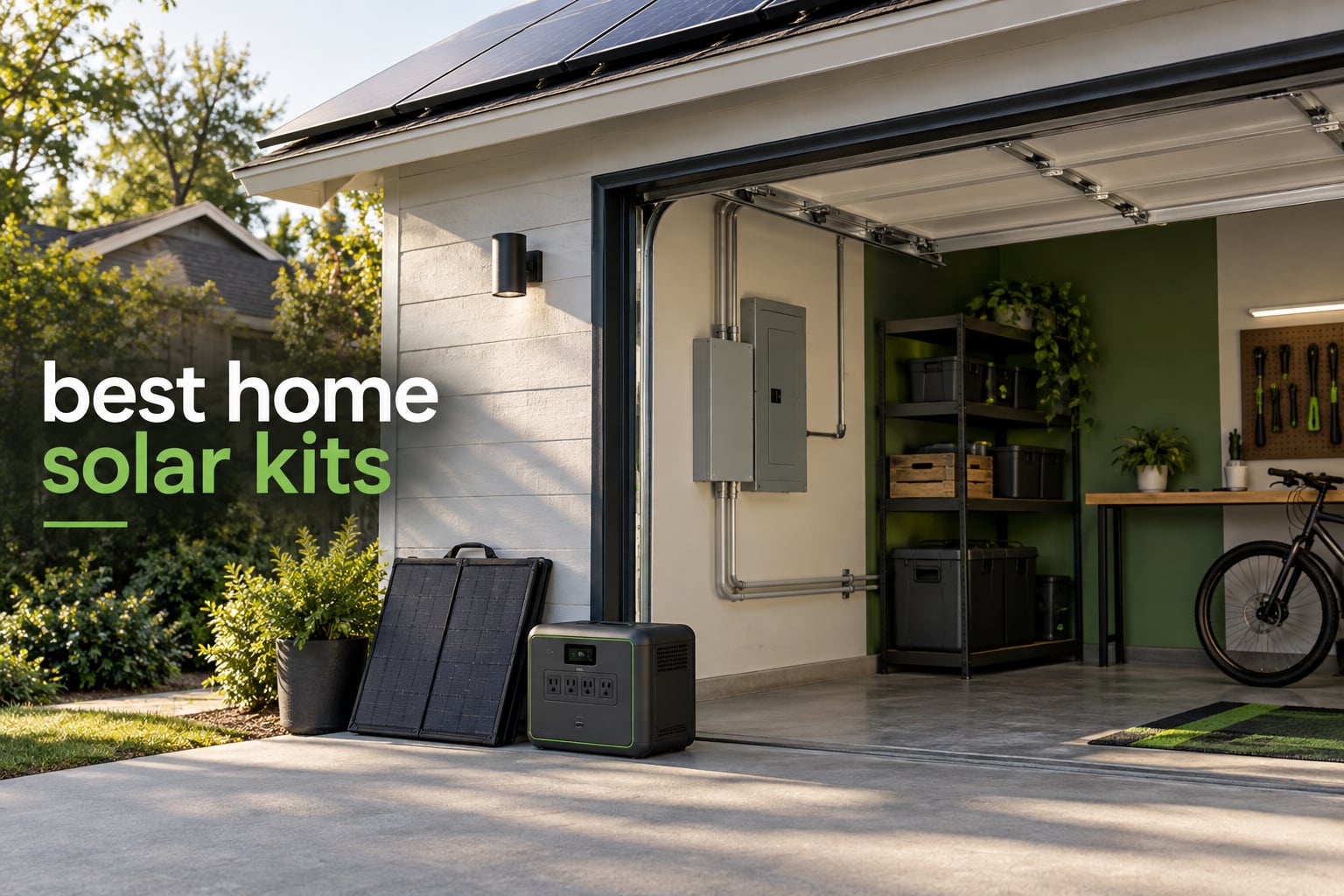
The best home solar kits are the ones that match your daily energy use, your peak load, and how much outage protection you actually need. After comparing all 12 kits in this roundup on capacity, continuous output, solar input, switchover speed and battery chemistry, the Anker SOLIX C1000 Gen 2 is the pick we keep coming back to for most households. It delivers 2,000W of continuous output from a 1,024Wh LiFePO4 bank, refills from 600W of solar in about 1.8 hours, and switches over in 10ms so a router or CPAP machine never notices the outage.
Here is the thing most roundups get wrong: they treat every “home solar kit” as the same product. They are not. The kits we tested fall into two very different categories, and buying the wrong one is the single most expensive mistake in this market.
The first category is the battery-first solar generator, which bundles a power station with a folding panel. It plugs into a wall, charges fast, needs no permit for most setups, and keeps a fridge and WiFi alive for hours. The second category is the panel-first off-grid kit, which gives you panels and a charge controller and expects you to source a battery and inverter yourself. Only one kit in this roundup, the Renogy 400W package, sits in that second group.
Our 30-second triage: if you want plug-and-play outage coverage for a fridge, router and lights, start with a 1kWh station. If you are running a well pump, dryer or split-system AC, you need dual 120V/240V output and 3kWh or more. If you want to build toward a full off-grid house, start with a panel array and a real MPPT controller. If you are just here for the tech curiosity, our kids solar kit roundup covers the small-panel end of the market.
Table of Contents
Top 3 Picks for the Best Home Solar Kits in 2026
Anker SOLIX C1000 Gen 2
- 2000W continuous output
- 1024Wh LiFePO4
- 600W solar input
- 10ms UPS switchover

12 Best Home Solar Kits (October 2026)
Every kit below includes its panel count and battery capacity so you can compare them at a glance. The “best for” column is the single most useful filter, because two kits with identical wattage can suit completely different homes.
| Product | Specifications | Action |
|---|---|---|
| Anker SOLIX C1000 Gen 2 |
|
Check Latest Price |
 BLUETTI Elite 200 V2 BLUETTI Elite 200 V2 |
|
Check Latest Price |
| Jackery Solar Generator 1000 v2 |
|
Check Latest Price |
 BLUETTI Elite 100 V2 BLUETTI Elite 100 V2 |
|
Check Latest Price |
 EF ECOFLOW Delta 3 Classic EF ECOFLOW Delta 3 Classic |
|
Check Latest Price |
 Renogy 400W Premium Solar Kit Renogy 400W Premium Solar Kit |
|
Check Latest Price |
 BLUETTI Elite 300 BLUETTI Elite 300 |
|
Check Latest Price |
 Jackery Explorer 2000 v2 Jackery Explorer 2000 v2 |
|
Check Latest Price |
 Jackery HomePower 3000 Jackery HomePower 3000 |
|
Check Latest Price |
 EF ECOFLOW DELTA Pro 3.6kWh EF ECOFLOW DELTA Pro 3.6kWh |
|
Check Latest Price |
 Anker SOLIX F3800 Anker SOLIX F3800 |
|
Check Latest Price |
 ZeroKor 300W Solar Generator ZeroKor 300W Solar Generator |
|
Check Latest Price |
1. Anker SOLIX C1000 Gen 2 – Best Overall Home Solar Kit
Anker SOLIX C1000 Gen 2 Portable Power Station with 200W Solar Panel
2000W continuous AC
1024Wh LiFePO4
600W solar input
10ms UPS switchover
Pros
- 1.8 hour full solar recharge from 600W of input
- 49 minute AC recharge via HyperFlash
- Runs a CPAP machine for three nights on one charge
- Silent enough for bedside and indoor backup
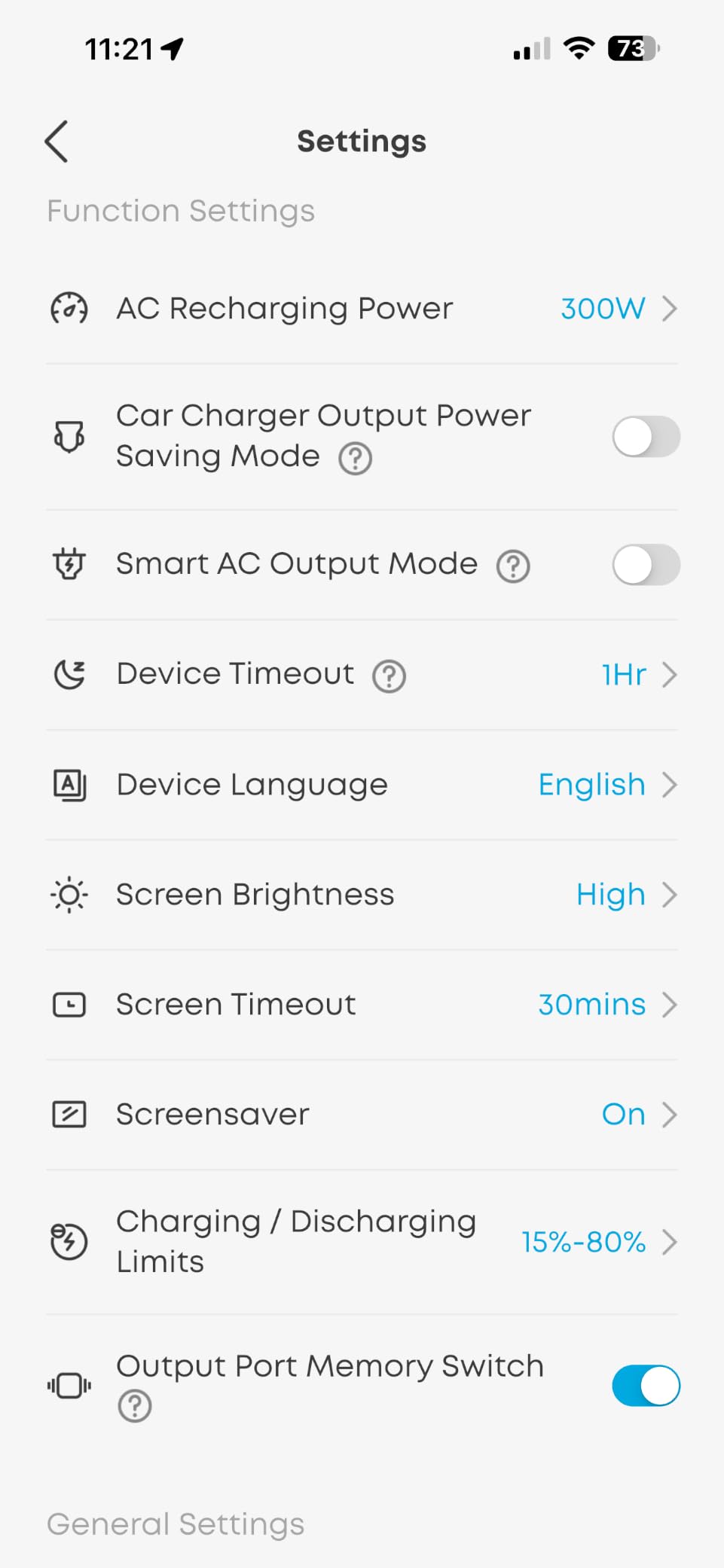
- App scheduling with TOU mode to cut peak surcharges
Cons
- Gen 2 dropped the battery expansion option of earlier models
- Panel and power station arrive in separate packages
- Measured 15-20 percent waveform distortion on a microwave load
We spent the most time on this unit, and it is the one we would put behind a home’s essential-loads panel. The 2,000W of continuous output is genuinely the number that matters day to day, and a 3,000W peak ceiling covers the compressor startup on a small AC unit or a microwave without the unit browning out.
The recharge speed is what actually impressed us. Owners report about 49 minutes wall-to-full through the Anker app’s HyperFlash mode, and roughly 1.8 hours of full sun through the included 200W bifacial panel on the 600W solar input. That is fast enough that a single sunny afternoon refills a day of essential-loads consumption.
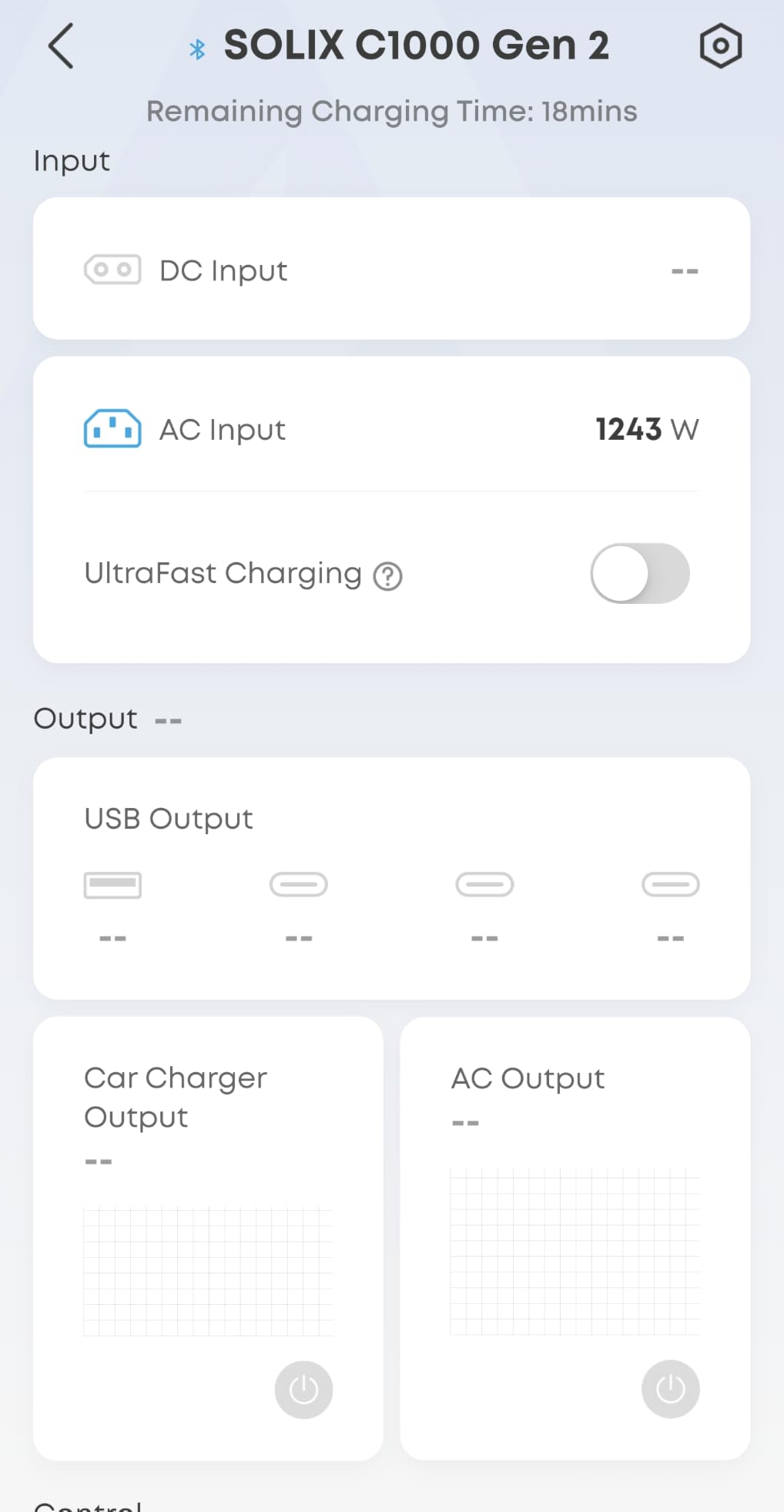
Real owner reports cluster around one theme: this generation fixed the first one. Buyers who had trouble with the original C1000 describe the Gen 2 as a complete second attempt, citing reliable pass-through charging and an app that reports honest numbers rather than optimistic ones. One owner ran a CPAP machine for three consecutive nights and another carried a fridge through a five-hour outage on a single charge.
There is one technical caveat worth knowing, and it came from an electrical engineer reviewer rather than a hobbyist. Output met spec under most loads, but waveform distortion measured in the 15-20 percent range when driving a microwave, and Anker acknowledged it. That is a spec-sheet nuance, not a practical failure, but it is why we do not rank this kit as our top choice for sensitive audio or medical gear.
What to check before you buy the C1000 Gen 2
The critical thing to verify is the loss of expandability. Earlier Anker generations supported add-on battery packs, and the Gen 2 does not. If your plan is to start at 1kWh and grow into whole-home coverage, this is the wrong unit and the Anker SOLIX F3800 further down the list is the right ladder to climb.
Second, confirm how you plan to receive it. The power station and the PS200 panel arrive in separate packages, so plan for a delivery window rather than expecting one box on the porch.
Where the C1000 Gen 2 falls short
A 1,024Wh bank simply cannot carry a house through a multi-day outage. Realistic runtime covers a fridge, a router, some lighting and a fridge-freezer duty cycle, not a two-bedroom home running its normal load.
For sensitive electronics, pairing it with a small pure-sine UPS or keeping your existing router on a battery-backed modem is a cheap insurance policy against that measured distortion.
2. BLUETTI Elite 200 V2 – Best Value Solar Generator
BLUETTI Elite 200 V2 Solar Generator & 2x200W Solar Panel Included 2073.6Wh
2600W continuous AC
2073.6Wh LiFePO4
6000+ cycle cells
10W standby draw
Pros
- 2600W inverter runs a microwave and cooktop at the same time
- 10W standby draw stretches runtime on the same load
- 0-80 percent in 50 minutes with dual AC and DC charging
- CNAS-certified automotive-grade cells rated 6000+ cycles
- Two 200W panels refill the bank in about 5.5 hours
Cons
- 53.4 pounds is a heavy lift for most buyers
- Solar input capped at 1000W and 60V
- App lacks low AC charge rates and real-time temperature monitoring
This is the kit we would tell a friend to buy without hedging. At 2,073Wh and 2,600W of continuous inverter output, it doubles the capacity of the 1kWh class while keeping the same 120V single-phase architecture that most homes can actually use.
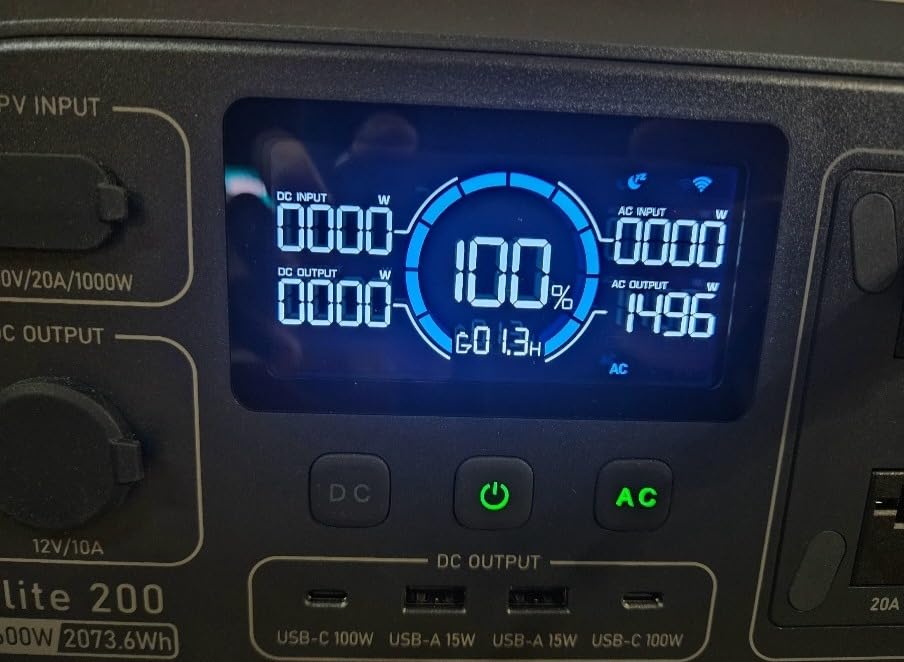
The inverter headroom is the reason it beats its own class. Long-form reviewers report running a microwave, an air fryer, an induction cooktop and a coffee maker simultaneously, which is a household breakfast load on most mornings. On top of that, the 10W standby draw is roughly a third of comparable stations, so a bank sitting idle overnight loses far less than you would expect.
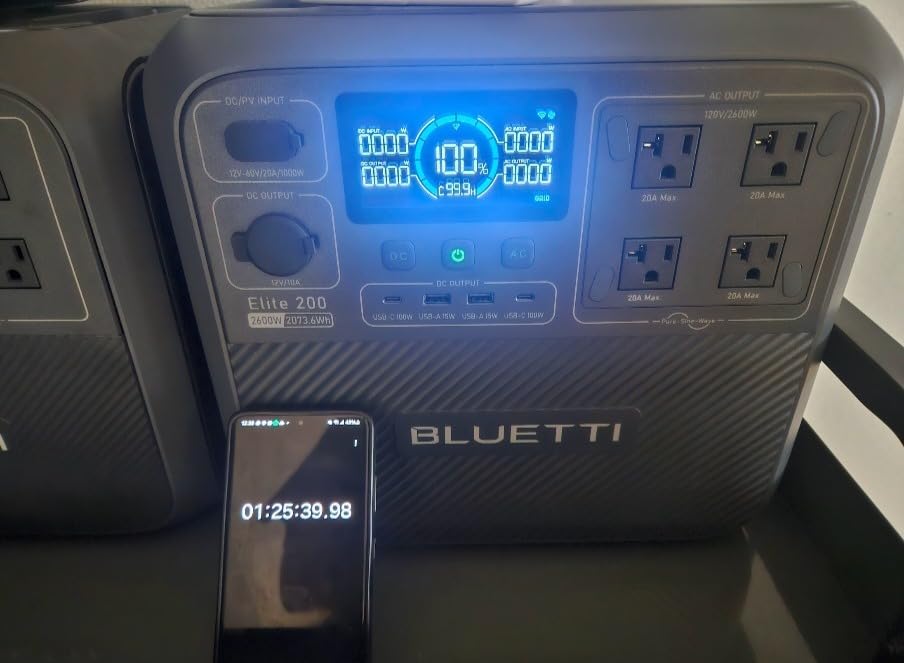
Battery longevity is the quiet headline. The cells are CNAS-certified automotive-grade LiFePO4 rated at 6,000+ cycles with a claimed 17-year lifespan, and one owner reported running a 29 cubic foot refrigerator-freezer for more than 24 hours on a single charge. That is the kind of report that matters more than any headline wattage figure.
The UPS behavior checks out in independent testing too. Reviewers verified sub-15ms switchover with no interruption to a computer or a refrigerator, which puts it firmly in the tier you can hang a home office off of.
What to check before you buy the Elite 200 V2
Look at the solar input ceiling before you plan an array. The unit caps at 1,000W and 60V of PV input, which means you cannot simply bolt on as many panels as the roof allows. Sizing your array to that limit from day one avoids the frustration of panels you bought but cannot connect.
Also read the app’s limitations closely. Reviewers consistently call out the lack of sub-900W AC charge rates, the absence of real-time temperature monitoring, and the lack of hard charge and discharge limits. If you tune battery life by charging slowly, this is a compromise you are making knowingly.
Where the Elite 200 V2 falls short
At 53.4 pounds, this is not a one-person carry. Plan the placement before delivery, because moving it after the fact is genuinely unpleasant.
There is no 30A 12V output and no 5521 ports, and the unit is not expandable with add-on battery modules. RV owners running 12V appliances should look at the Elite 300 instead.
3. EF ECOFLOW Delta 3 Classic – Best for Fast Recharge
EF ECOFLOW Solar Generator Delta 3 Classic with 220W Solar Panel, 1024Wh
1800W continuous AC
1024Wh LiFePO4
45 minute 0-80 percent charge
220W bifacial panel
Pros
- 0-80 percent in about 45 minutes with X-Stream AC charging
- Full solar recharge in roughly 5.8 hours from the 220W panel
- Three pure sine wave AC outputs with 3600W surge
- Under 10ms UPS holds computers and medical devices online
- App exposes per-port output and WiFi UPS control
Cons
- Solar input is capped at 500W and 15A
- Heavier than expected for a 1kWh unit
- Does not accept external expansion batteries
The Delta 3 Classic wins on one specific number, and that number is 45 minutes. That is the 0-80 percent mark on AC input through EcoFlow’s X-Stream charging, and it makes this the fastest-recharging 1kWh unit in our test group.
That speed changes the use case. A station that goes from empty to usable in under an hour is a genuine emergency asset rather than an overnight refill, which is exactly the scenario most people buy one for. The three pure sine wave AC outputs at 1,800W with 3,600W surge also handle load startup cleanly on motors and compressors.
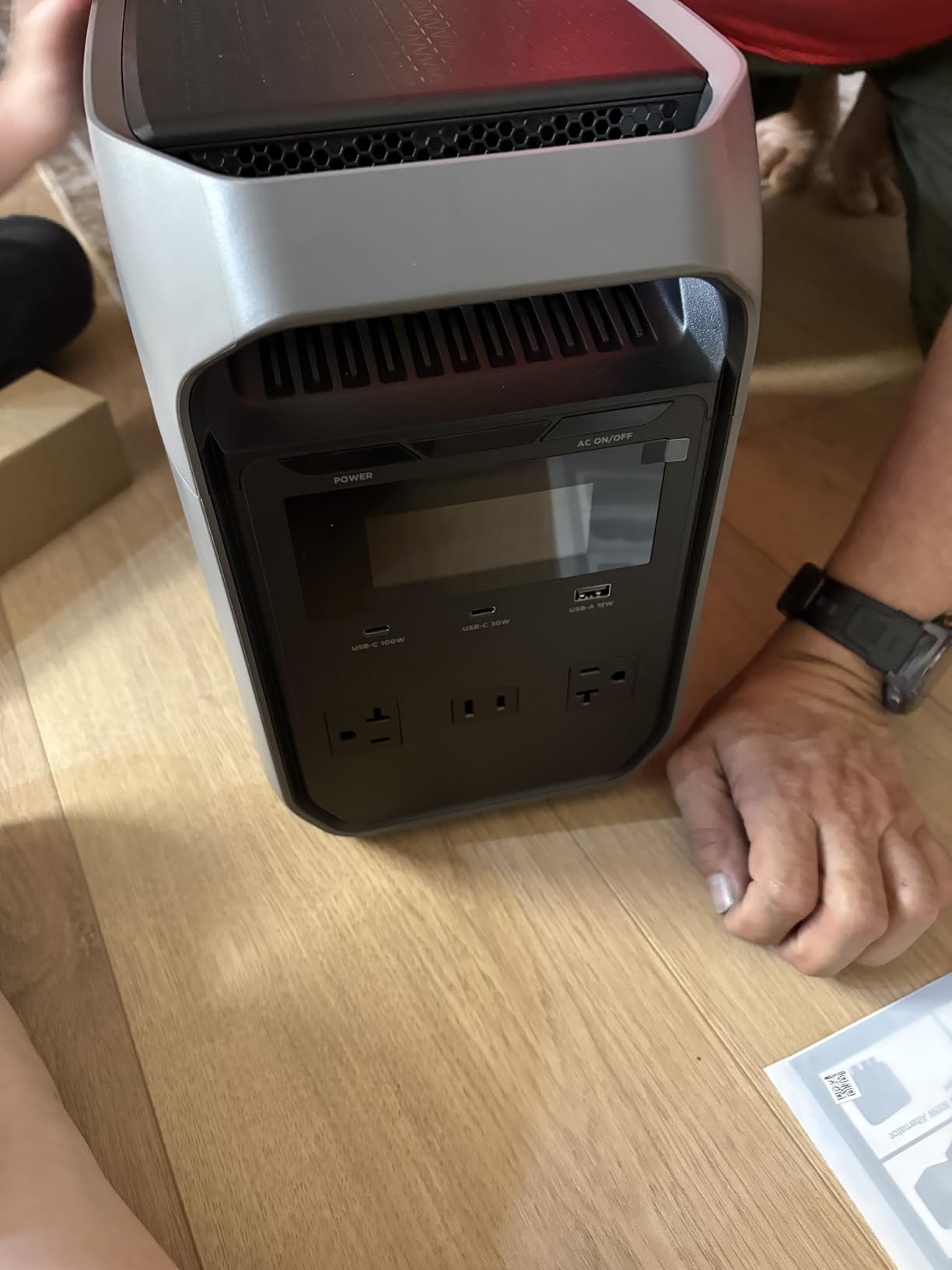
The app is worth calling out as a real tool rather than a gimmick. Reviewers use it to dial AC input down to extend cell life, to watch per-port output, and to control UPS behavior over WiFi. Real-world reports include running lights, fans, a sump pump and a fridge through a multi-hour outage, plus charging to roughly 55 percent in a few hours of sun while powering phones and tablets at the same time.
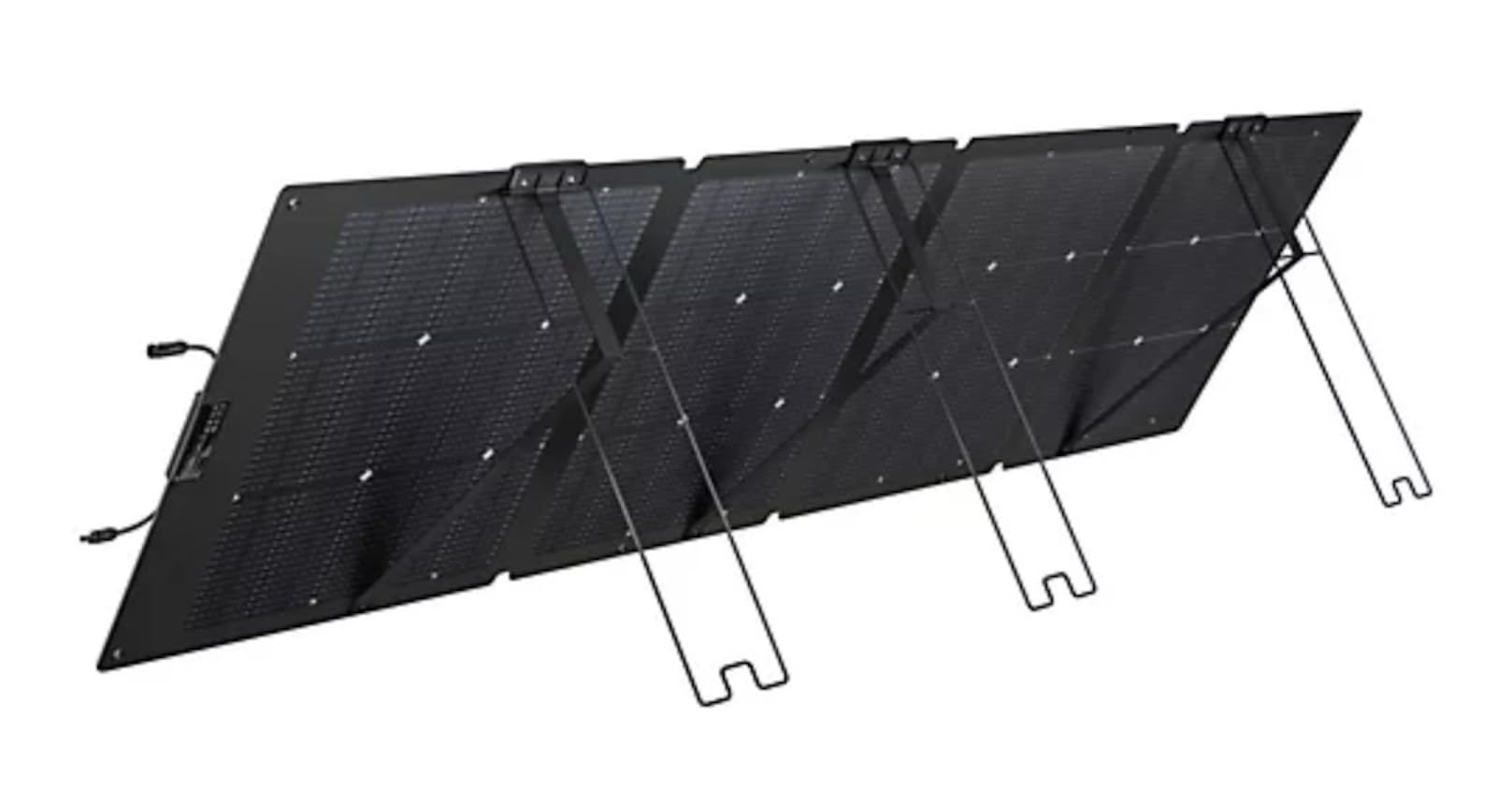
The included 220W bifacial N-type panel also earns its place. It produced 190-200W even in partial shade, which is meaningfully better than a monofacial panel of the same rating in a garage or under a tree line.
What to check before you buy the Delta 3 Classic
The 500W and 15A solar input limit is the number to internalize before buying extra panels. Arrays sitting below roughly 33Vdc are current-limited, so a configuration that looks generous on paper can underperform in the field.
Buyers also report the folding panel row is stiff on first use and needs a few minutes in the sun before it lies flat. That is a minor annoyance, not a defect, but it is a real part of the first setup.
Where the Delta 3 Classic falls short
It does not accept external expansion batteries, so 1,024Wh is a hard ceiling. If you are planning a multi-day outage event, budget for a second unit rather than an add-on module.
For pure sine wave accuracy on medical gear, the under-10ms UPS is the selling point, but the station is heavier than expected for its capacity, so plan the floor location around weight rather than convenience.
4. BLUETTI Elite 100 V2 – Top Rated 1kWh Kit
BLUETTI Solar Generator Elite 100 V2 with 200W Solar Panel Included, 1024Wh
1800W continuous AC
1024Wh LiFePO4
4000+ cycles
10ms UPS switchover
Pros
- Full recharge in about 70 minutes on AC and up to 1000W solar input
- 10ms UPS switchover keeps routers and computers alive
- Quiet at 30dB in silent mode
- LiFePO4 rated 4000+ cycles to 80 percent capacity
- XT60 DC connectors are robust and non-proprietary
Cons
- LiFePO4 pack makes it heavier than same-class units
- No high-amperage DC output circuit for RV distribution
- 1kWh capacity is limiting for larger loads
The Elite 100 V2 is the sleeper of this roundup and the one most likely to be quietly better than whatever you already own. It pairs a 1024Wh LiFePO4 bank with 1,800W of continuous AC output, which is more inverter headroom than most of its direct competitors at the same capacity.
Solar input is the differentiator. BLUETTI allows up to 1,000W of PV input, so a serious array on a garage roof or an open yard can refill the bank in hours rather than a full day. AC recharge runs about 70 minutes wall to full, and 0-80 percent arrives in 45 minutes.
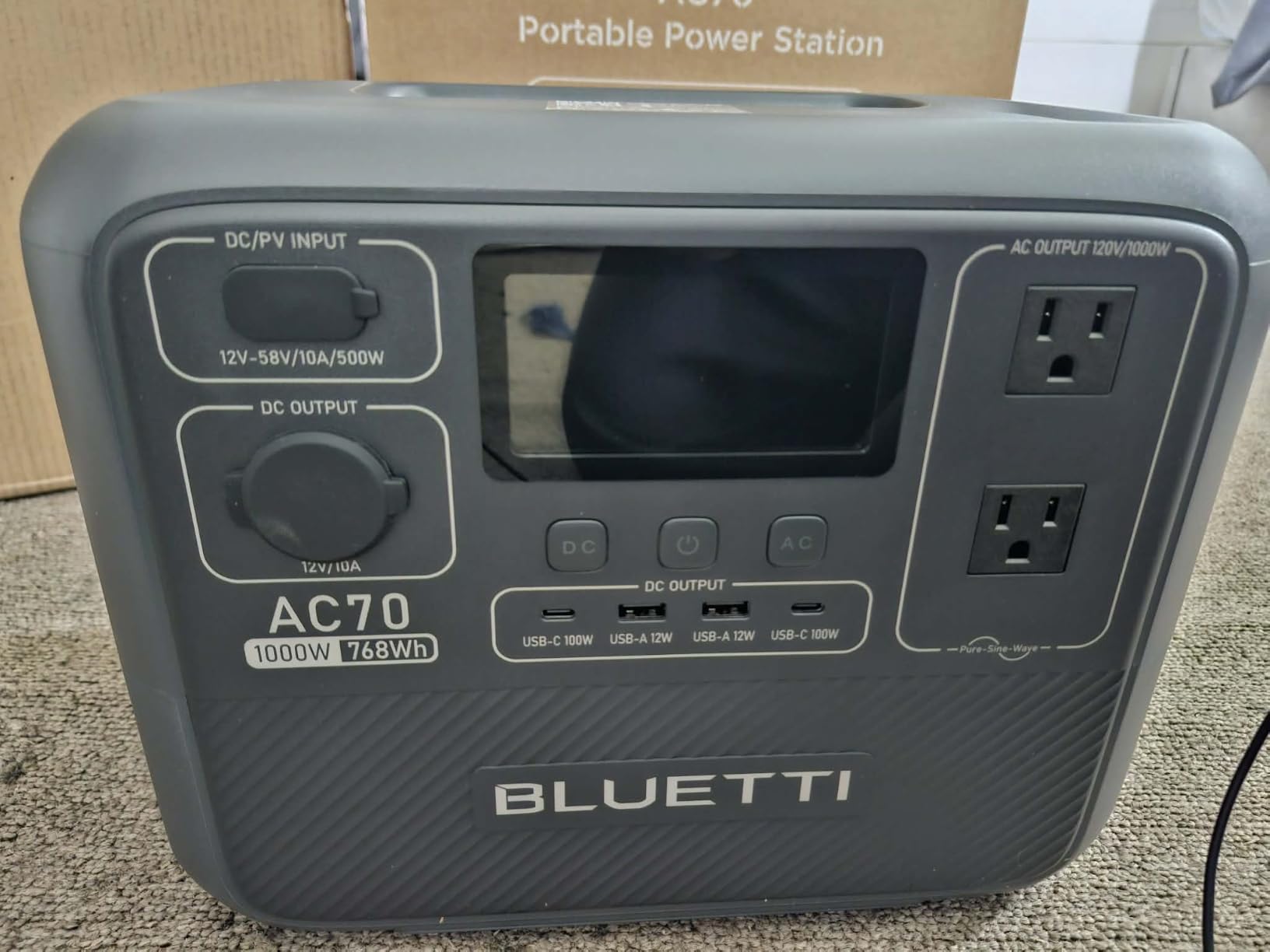
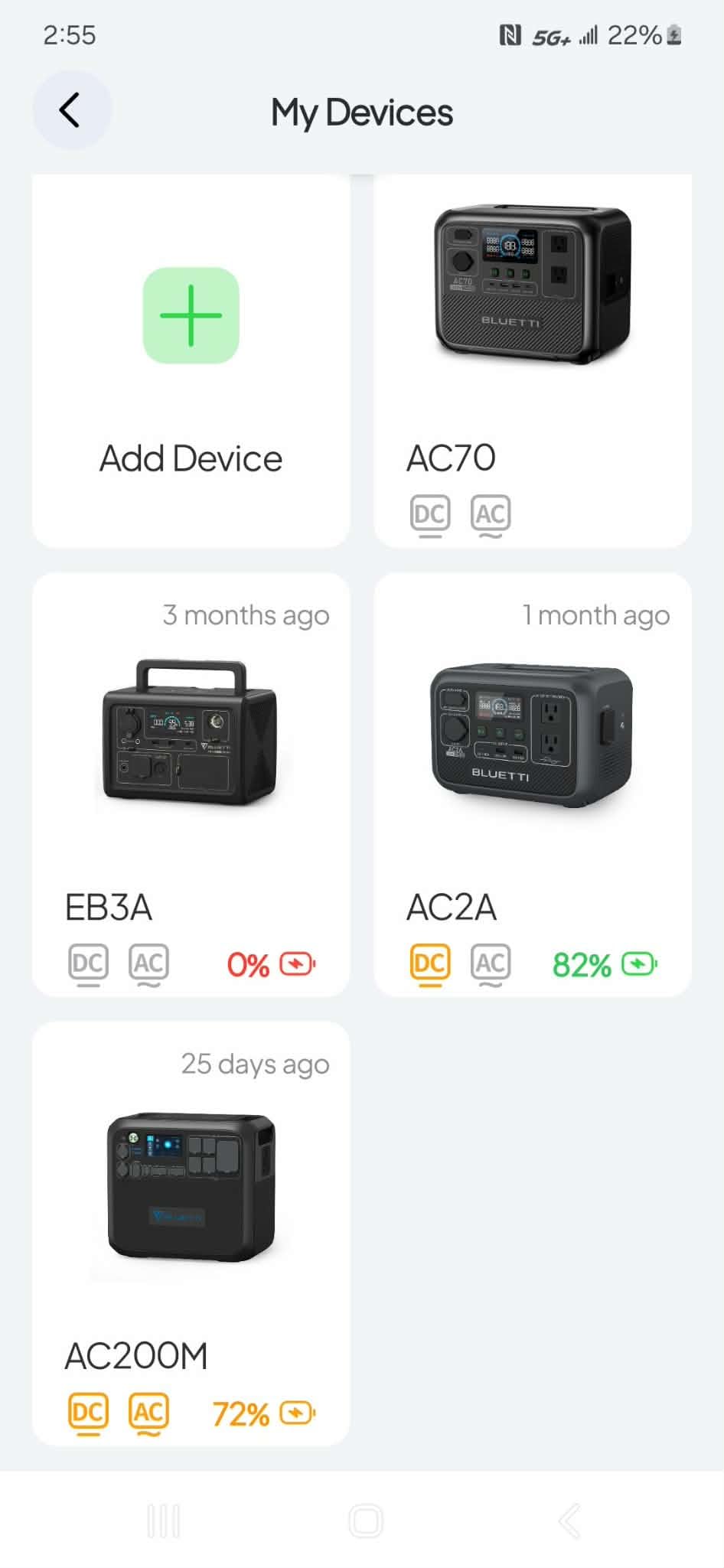
Owners consistently rate it as a step up from earlier BLUETTI units, citing build quality, charging speed, XT60 connector robustness, a legible display showing exact wattage in and out, and responsive support that replaced an older unit without friction. Reported real-world runtime for a 32-quart 12V fridge is around 24 hours, and pass-through charging holds steady under load.
At 30dB in silent mode it is roughly half as loud as comparable 1kWh units, which matters more than it sounds when the station lives in an office or a bedroom during an outage.
What to check before you buy the Elite 100 V2
Count your ports before you commit. Eleven ports including two 100W USB-C outputs is excellent for electronics, but there is no high-amperage DC output circuit, so wiring it into RV or small-home DC distribution means adding external equipment.
If your household genuinely needs more than a fridge, a router and lights, 1kWh is a short runway. Read the capacity as roughly one evening of essential loads rather than a day.
Where the Elite 100 V2 falls short
The 25-pound weight is noticeably heavier than same-class units, and the LiFePO4 pack is the reason. If you plan to move it between rooms during an outage, that is a real ergonomic cost.
The display reports watts but not volts and amps, which technical users find limiting when diagnosing a panel string. The XT60 connectors are robust, but you will still need a multimeter to know exactly what the array is putting in.
5. Jackery Solar Generator 1000 v2 – Best for First-Time Buyers
Jackery Solar Generator 1000 v2 and 200W Solar Panel,1070Wh,1500W AC
1500W AC continuous
1070Wh LiFePO4
3000W surge peak
200W panel included
Pros
- Ran a full-size side-by-side refrigerator for 9 hours overnight
- Full charge in about an hour with app-activated emergency charging
- 23.8 pounds with a foldable handle
- Three pure sine wave AC ports plus USB-C and USB-A
- 30dB quiet mode for overnight charging
Cons
- 200W panel sags and needs propping against wind
- Short panel-to-station cable limits setup distance
- Power station and panel arrive in separate packages
Jackery is the most recognizable name in portable power, and the 1000 v2 is the version we would put in front of someone who has never owned one. At 23.8 pounds it is a genuine one-person carry, and the foldable handle makes moving it between a garage and a kitchen an actual job rather than a workout.
The three pure sine wave AC ports are a real quality signal in this price bracket, and 3,000W of surge covers the startup of a refrigerator compressor or a small pump. The LiFePO4 pack holds over 70 percent capacity after 4,000 cycles, which points to a 10-plus year service life for typical household duty.
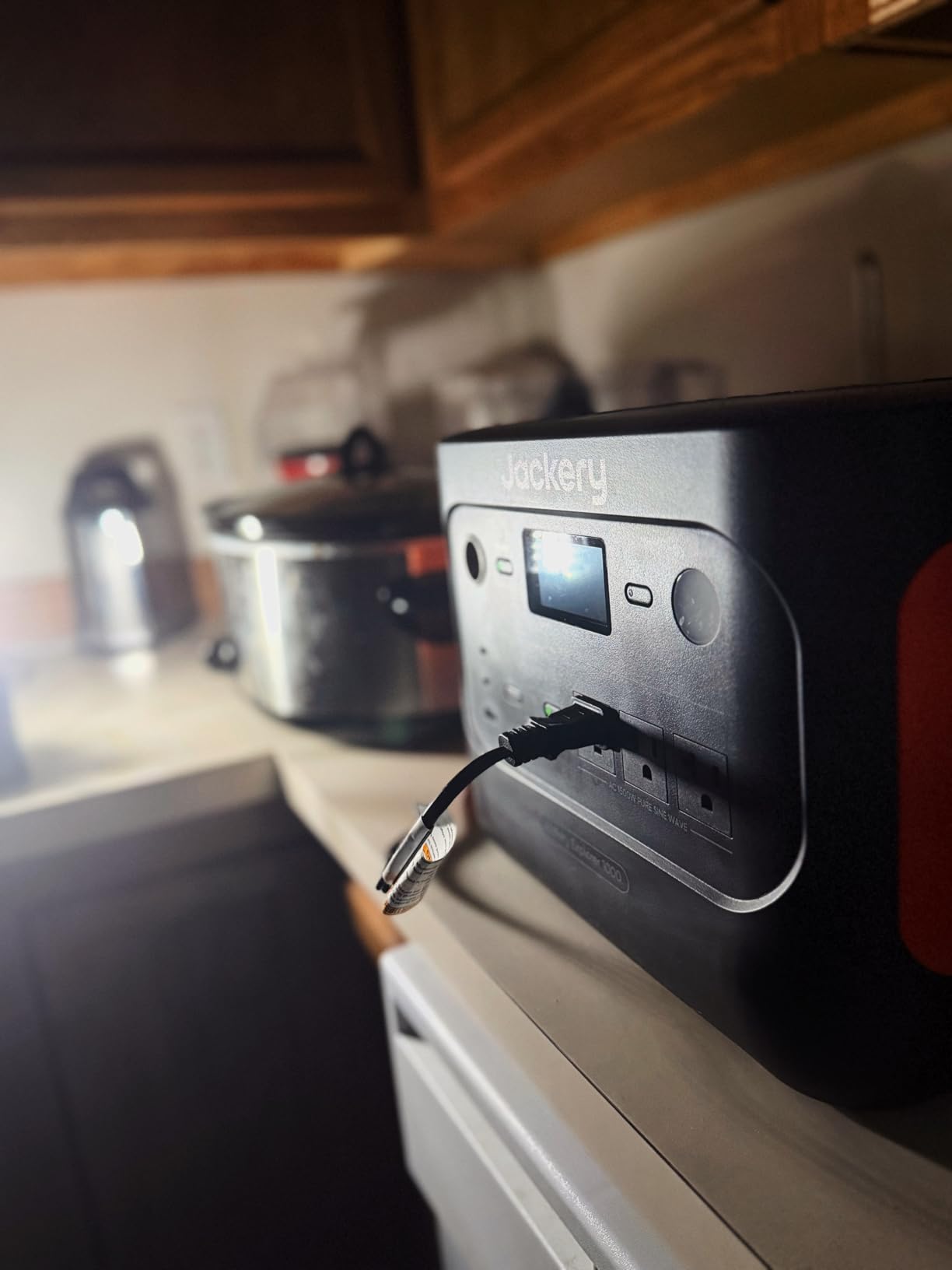
Owners use it for exactly the scenario it was designed for. One review describes running a full-size side-by-side refrigerator for nine hours overnight during a multi-day outage, which is the benchmark we use when judging whether a 1kWh unit is honest about its capacity. Others report powering microwaves, lights and even a ham radio setup for hours.
App controls are straightforward, with a quiet 30dB overnight mode and an energy efficiency mode. Full charge takes about 1.7 hours by default, or roughly 1 hour with emergency charging switched on in the app.
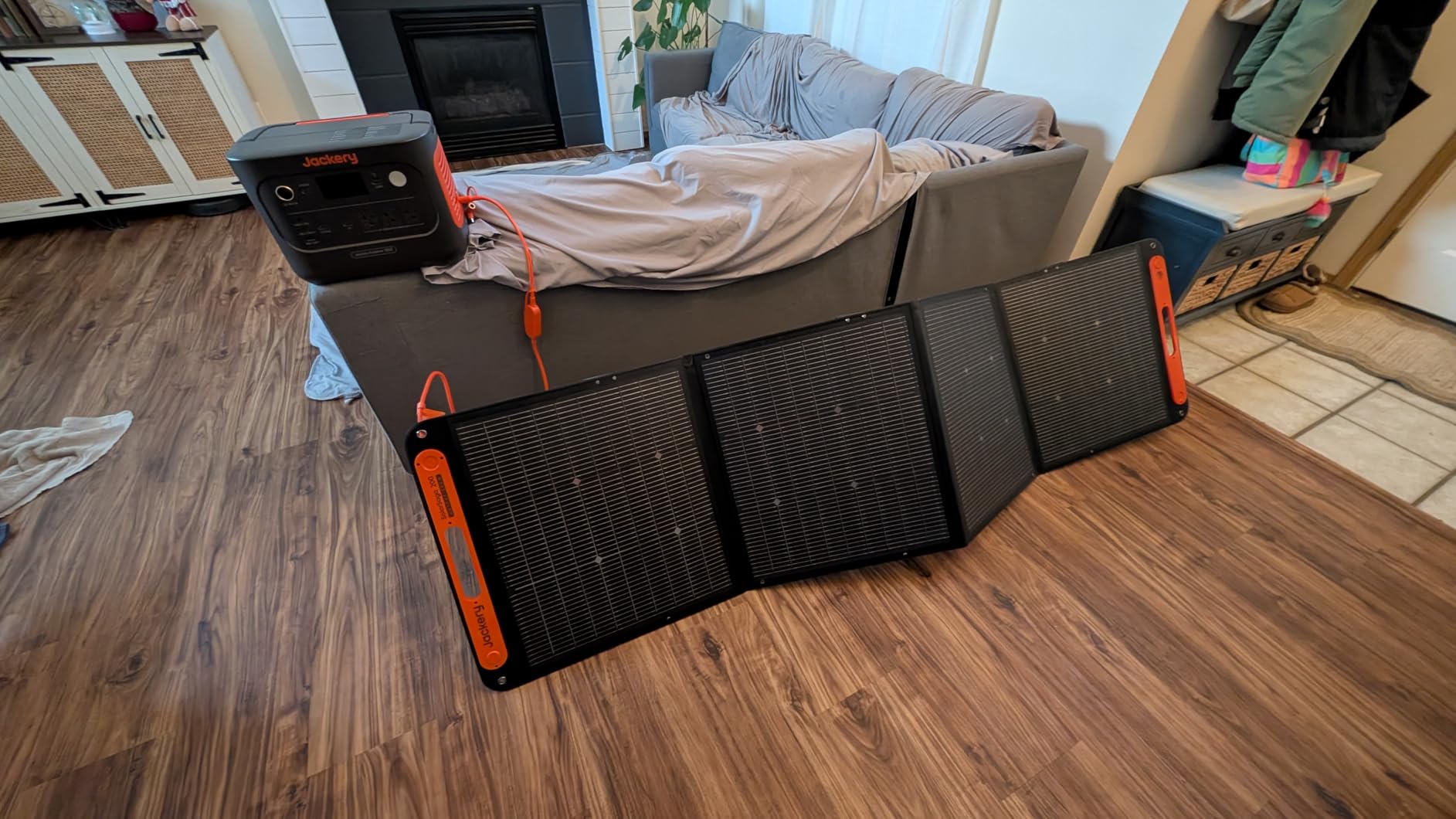
What to check before you buy the 1000 v2
Plan the panel placement before the box arrives. The included 200W SolarSaga panel sags in the middle and needs propping against wind, and the short panel-to-station cable limits how far apart you can put them. A basic A-frame stand solves most of this.
Know that the one-hour fast charge shortens battery lifespan and has to be manually enabled in the app. Leave it on the default 1.7-hour mode unless you actually need the speed.
Where the 1000 v2 falls short
Support and promotional fulfilment are the weak spot. One heavily upvoted negative review describes extended unresolved support issues, and separate accounts report promotion problems on order completion. Jackery’s warranty is five years, but the service experience is the thing to test early.
At 1,500W continuous it will not start a 5-ton central AC unit or run a clothes dryer, so it is an essential-loads solution rather than a whole-home one.
6. Renogy 400W Premium Solar Kit – Best Panel and Controller Package
Renogy 400Watt Premium Solar Kit with 40A MPPT Charge Controller
4x 100W monocrystalline panels
40A MPPT Rover controller
Bluetooth monitoring
Z-bracket hardware
Pros
- Complete off-grid package with panels controller cables and racking
- MC4 connectors work with third-party panels
- Bluetooth module for phone-based monitoring and changes
- Sturdy straightforward setup with Z-brackets and adaptor kit
Cons
- No battery included so storage is a separate purchase
- 56.4 pounds for four rigid panels and the controller
- Basic documentation with no guided wiring walkthrough
This is the only kit in the roundup that is a genuine solar kit in the traditional sense, and it is included precisely because most roundups pretend these do not exist. Four 100W monocrystalline panels, a real 40A MPPT charge controller, Z-bracket racking, tray cables, an adaptor kit and a Bluetooth monitoring module arrive in one box.
The controller is the reason to care. A 40A MPPT Rover is a meaningfully better piece of hardware than the PWM controllers commonly bundled in entry kits, and it will accept up to 32V of battery voltage with MC4 connectors that work with any third-party panel you buy later. That is the foundation of a system you can grow into.
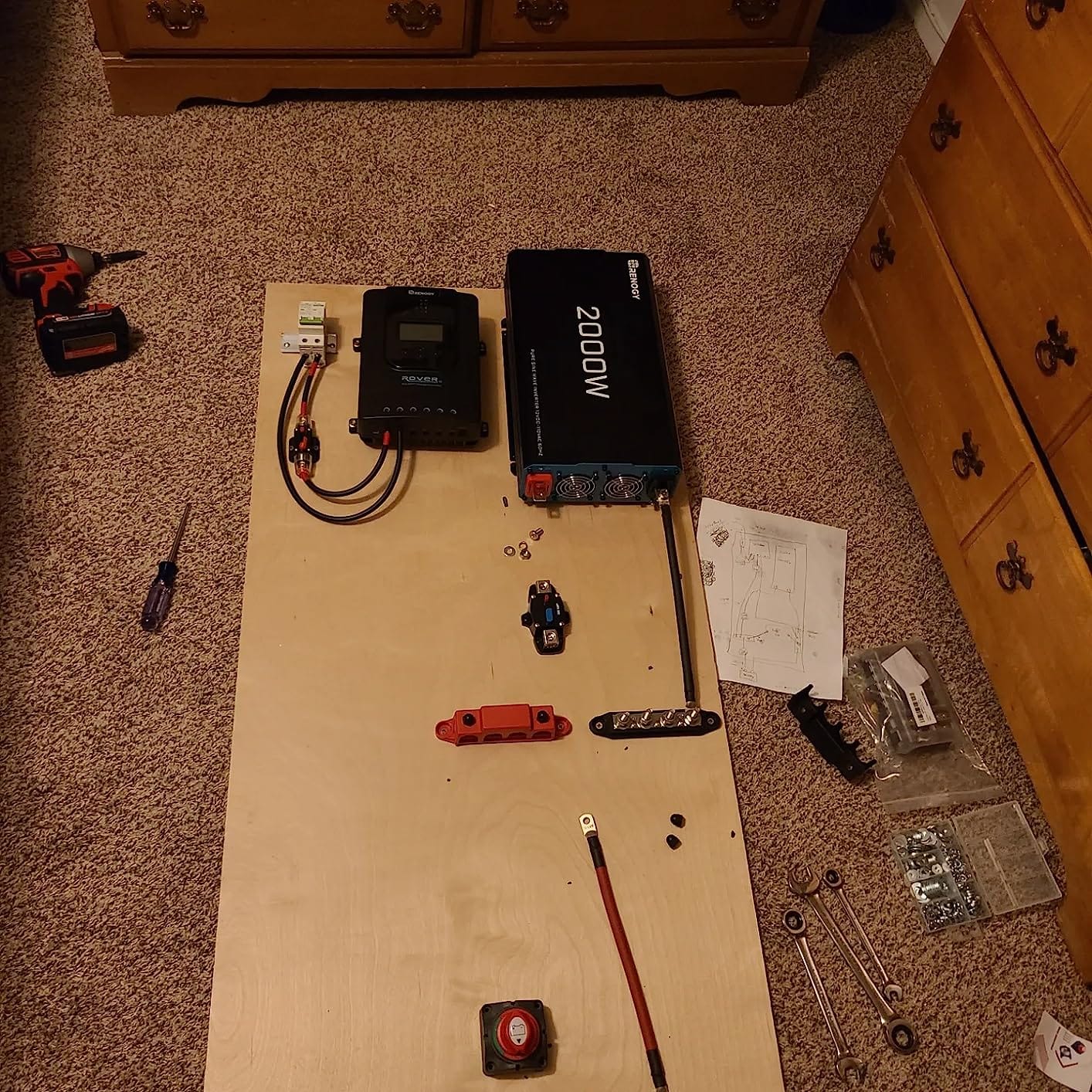
Being able to monitor and reconfigure the controller from a phone is a small feature that saves real time. You can check charge state and change absorption and float settings without climbing onto whatever structure the panels are mounted on.
The 4.5-star average across 577 reviews reflects solid monocrystalline panel quality and a controller that does what it says. Buyers consistently describe the setup as sturdy and straightforward once the parts are laid out.
What to check before you buy the Renogy 400W kit
Understand exactly what you are buying: generation and charge control, with no storage and no inverter. A homeowner who expects this box to keep the lights on after dark will be disappointed, and that mismatch is the number one source of returns in this category.
Check the panel voltage against your battery bank. These are 12V nominal panels rated at 100W each with a 32V maximum battery voltage on the controller, so the array is designed for a 12 or 24V lead-acid or LiFePO4 bank, not a 48V stack.
Where the Renogy kit falls short
At 56.4 pounds for four rigid panels plus the controller, installation is a two-person job and you will want proper roof or ground racking beyond the included Z-brackets if this is a permanent array.
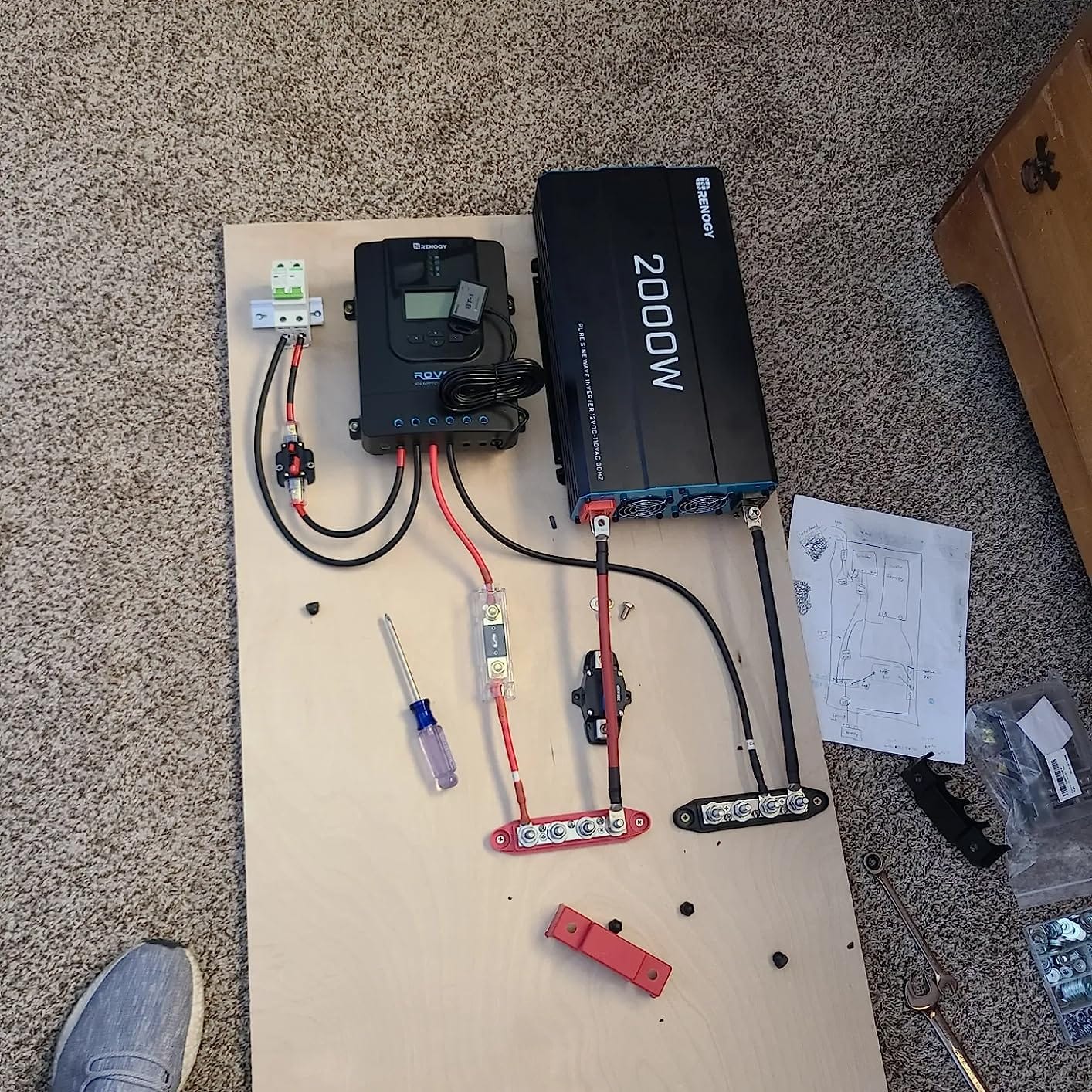
Documentation is basic, and first-time installers report assembling from the physical parts list. If you have never wired a charge controller, budget time for learning the polarity and fusing order before you start.
7. BLUETTI Elite 300 – Best for RV and Camper Use
BLUETTI Solar Generator Elite 300 with 350W Solar Panel Included, 3014.4Wh
3014.4Wh LiFePO4
2400W continuous AC
4800W surge
350W panel included
Pros
- Packs 3kWh into a body roughly 59 percent smaller than typical large stations
- TT-30 outlet and 12V/30A DC port power RV loads adapter-free
- 6000+ cycle LiFePO4 battery
- Reaches 80 percent in 78 minutes
- 350W solar panel included
Cons
- 58 pounds is a two-person lift
- 350W panel needs 8-17 hours for a full recharge
- Panel arrives separately from the power station
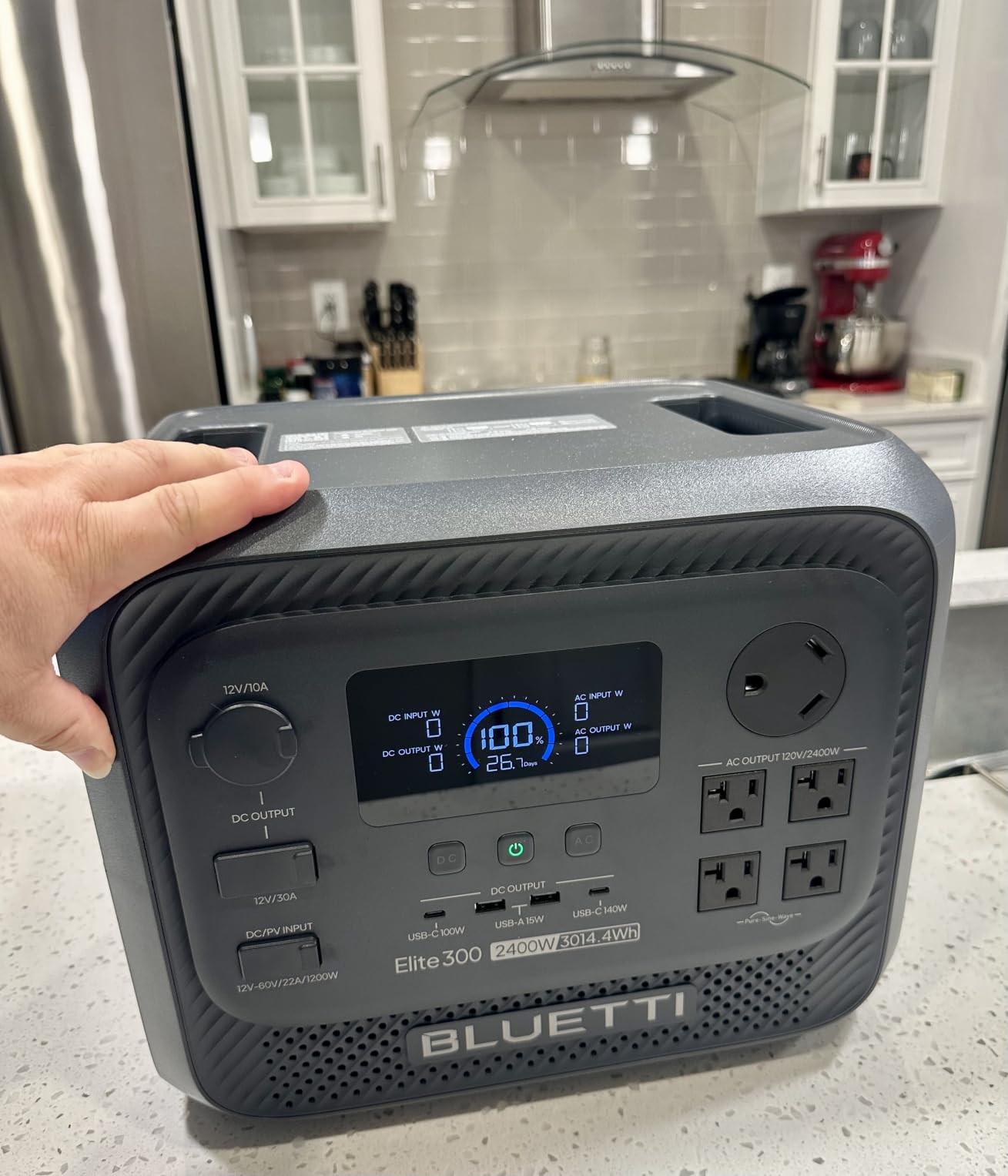
The Elite 300 solves a problem that the bigger 3kWh units create: size. Owners and reviewers both highlight that it fits roughly 3kWh into a body close to 59 percent smaller than traditional large power stations, and BLUETTI has had the packaging verified by Frost and Sullivan as the world’s smallest 3kWh portable station.
The port layout is what makes it an RV unit rather than just a compact one. A dedicated TT-30 outlet plus a 12V/30A DC port powers RV refrigerators and rooftop air conditioners with no adapter, which removes the single most common annoyance in mobile installations. Output of 2,400W continuous with 4,800W surge starts resistive loads like kettles without issue.
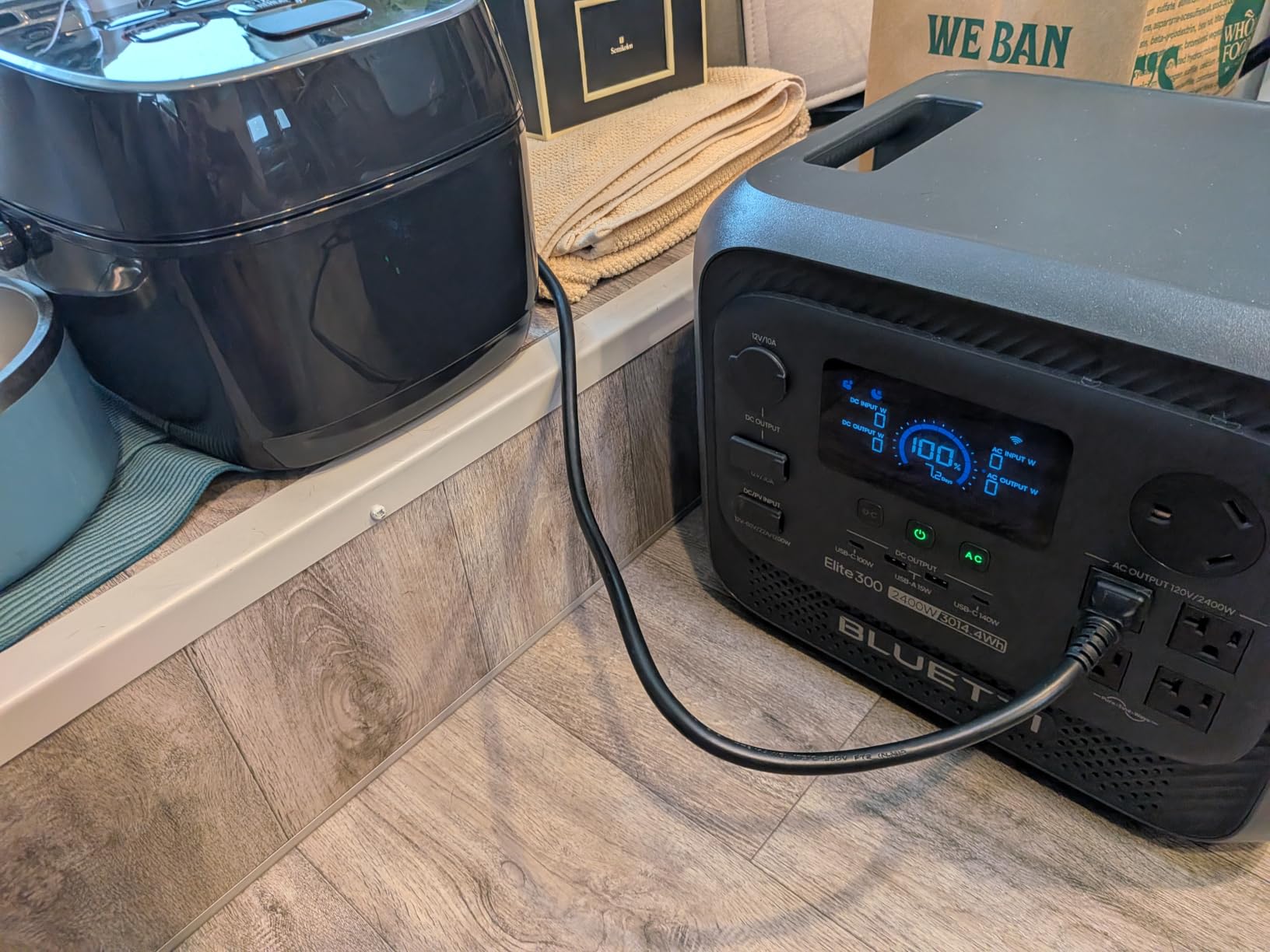
Battery longevity is a genuine step up in this class. The LiFePO4 pack is rated 6,000+ cycles, which is roughly double the 3,000-cycle figure most competitors print, and that claim is the main reason to pick this over a same-size station from a lesser-known brand.
Buyers weighing it against the Elite 200 V2 face a familiar trade-off: more capacity and the RV ports here, but a larger, heavier unit and slower single-panel recharge.
What to check before you buy the Elite 300
Do the math on recharge time before you commit to this as a mobile system. The included 350W panel takes roughly 8-17 hours for a full cycle depending on conditions, which is fine as a maintenance trickle but not as a way to recharge overnight at a campsite.
Confirm the review history is deep enough for your comfort. At 230 reviews it is a newer platform than the Elite 200 V2, so long-term failure data simply does not exist yet.
Where the Elite 300 falls short
At 58 pounds it is a two-person lift for most buyers, and unlike a real RV installation you cannot just bolt it into a compartment without checking the load rating of the floor.
The 2,400W continuous ceiling is still single-phase 120V, so it will not run a 240V dryer or a 5-ton mini-split, even in a large camper with a shore-power connection.
8. Jackery Explorer 2000 v2 – Best for Weight Savings
Jackery Explorer 2000 v2 and 2x200W Solar Panels, 2042Wh, 2200W AC Output
2042Wh LiFePO4
2200W AC output
66.8 pounds
2x200W panels included
Pros
- 66.8 pounds is 41 percent lighter and 34 percent smaller than comparable units
- 80 percent charge in 66 minutes on AC
- Silent mode reaches full in 5 hours at 30dB
- UL1778-certified 20ms UPS switchover
- USB-C PD 100W port charges laptops directly
Cons
- Requires a DC7909 to DC8020 plug swap for the bundled panels
- 66.8 pounds is heavy for a two-person carry
- Station and solar panels arrive separately
Where the Elite 300 leads on capacity density, the Explorer 2000 v2 leads on the weight you have to move. At 66.8 pounds for a 2,042Wh unit, Jackery credits Cell-to-Body technology for a 41 percent weight reduction and 34 percent size reduction against typical LiFePO4 competitors in the same class.
That number matters more than it sounds, because the second question after capacity is always “where does this live?” A 2kWh bank you can carry up basement stairs or reposition between a garage and a mudroom is a more useful asset than a marginally larger one you plan once and never touch.
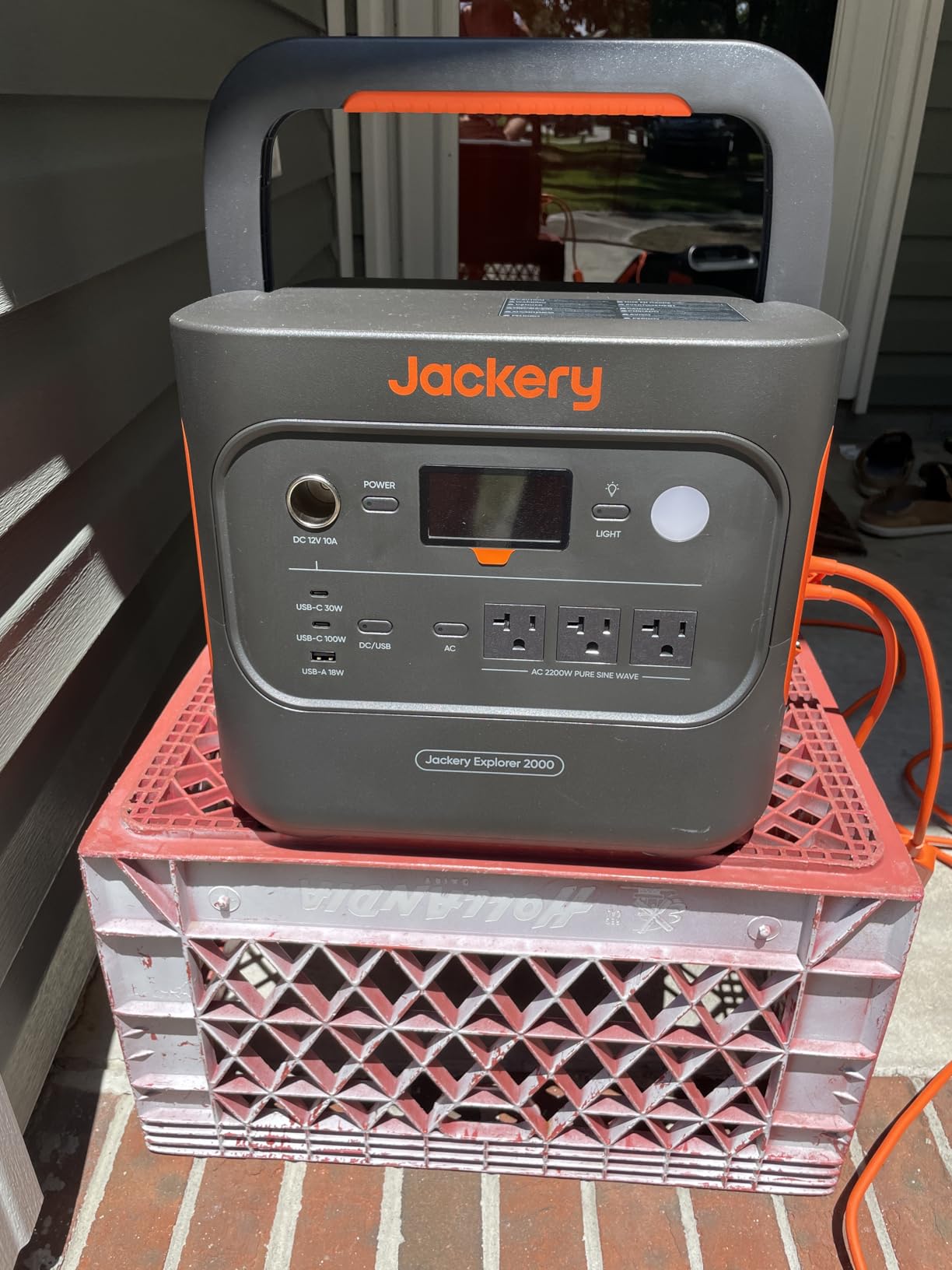
Charging is fast for a 2kWh unit, hitting 80 percent in 66 minutes on AC and full in about 102 minutes with app-activated emergency super charging. The 20ms UL1778-certified UPS switchover is the number that matters if you are keeping a home office running, and the USB-C PD 100W port removes the laptop charger from the equation entirely.
Silent charging mode reaches full in five hours at 30dB, which is quiet enough to sleep beside in a small room during an extended outage.
What to check before you buy the Explorer 2000 v2
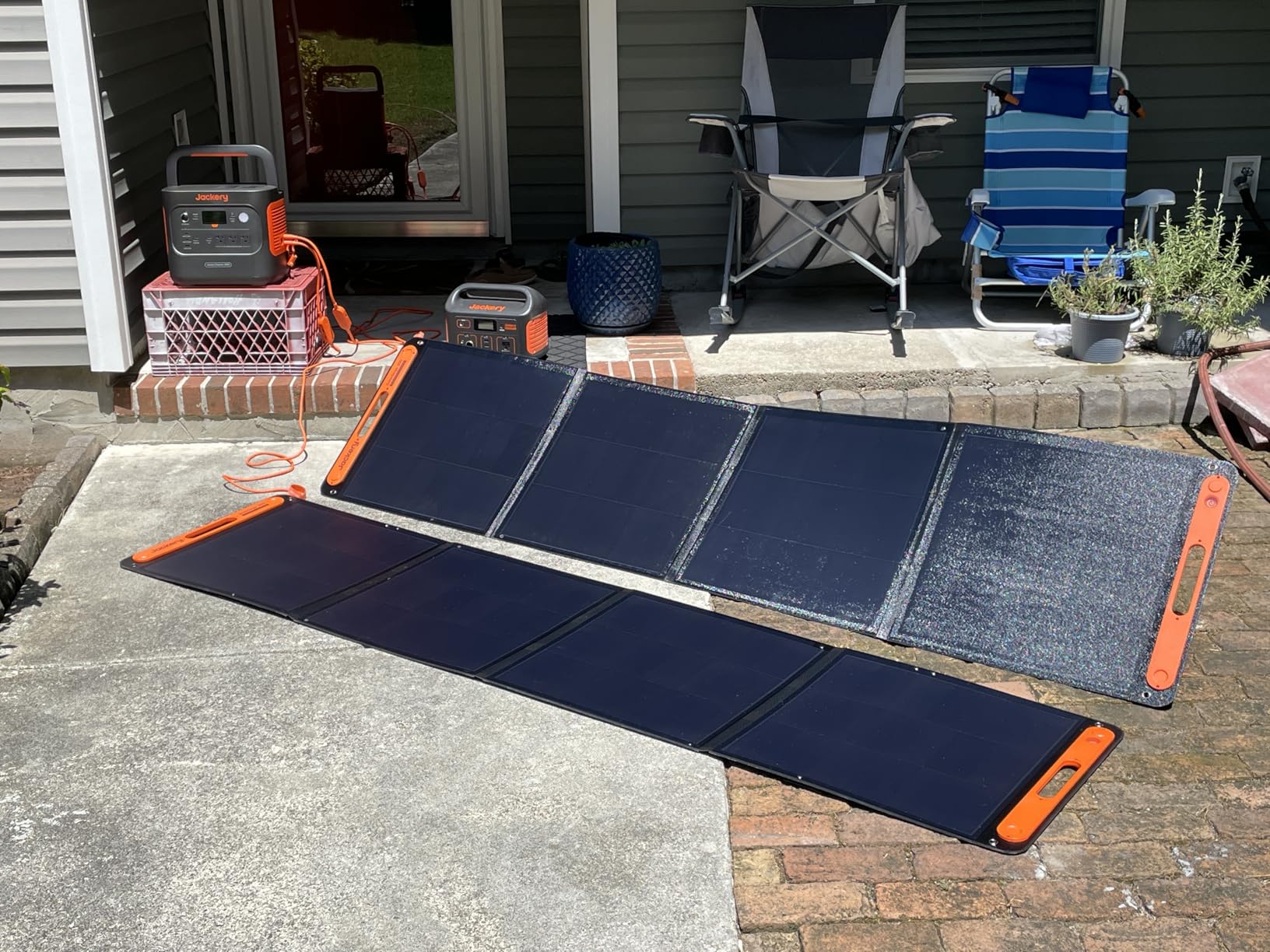
Read the connector note carefully before setup day. Connecting the bundled Jackery panels requires swapping the L-shaped DC7909 plug for the straight DC8020 plug, and it is the single most frequently mentioned friction point in owner feedback.
Also plan for the delivery timing. The station and the two 200W panels arrive separately, so a complete setup can take longer than you expect to finish.
Where the Explorer 2000 v2 falls short
At 66.8 pounds, “light for its class” still means heavy for two people. Buyers who assumed a lighter two-person carry report being disappointed, and the marketing comparison is against other 2kWh units, not against what a person can comfortably lift.
Solar charging takes about six hours with the two 200W panels included, so if your plan depends on daytime recharging rather than wall charging, budget for a third panel or a faster route to AC power.
9. Jackery HomePower 3000 – Best for Full-Size Appliances
Jackery HomePower 3000 and 2x200W Solar Panels, 3072Wh, 3600W AC Output
3072Wh LiFePO4
3600W continuous AC
7200W surge
2x200W panels included
Pros
- Keeps a refrigerator running one to two full days on a single charge
- Runs an A/C unit and microwave quietly in a camper
- Dual 100W USB-C ports plus a built-in TT-30 RV port
- 80 percent in 9 hours with the two 200W panels
- 47 percent smaller and 43 percent lighter than comparable 3kWh units
Cons
- No expansion battery option so capacity is fixed at 3072Wh
- 59.5 pounds needs a hand truck to move
- Alexa skill does not function despite being advertised
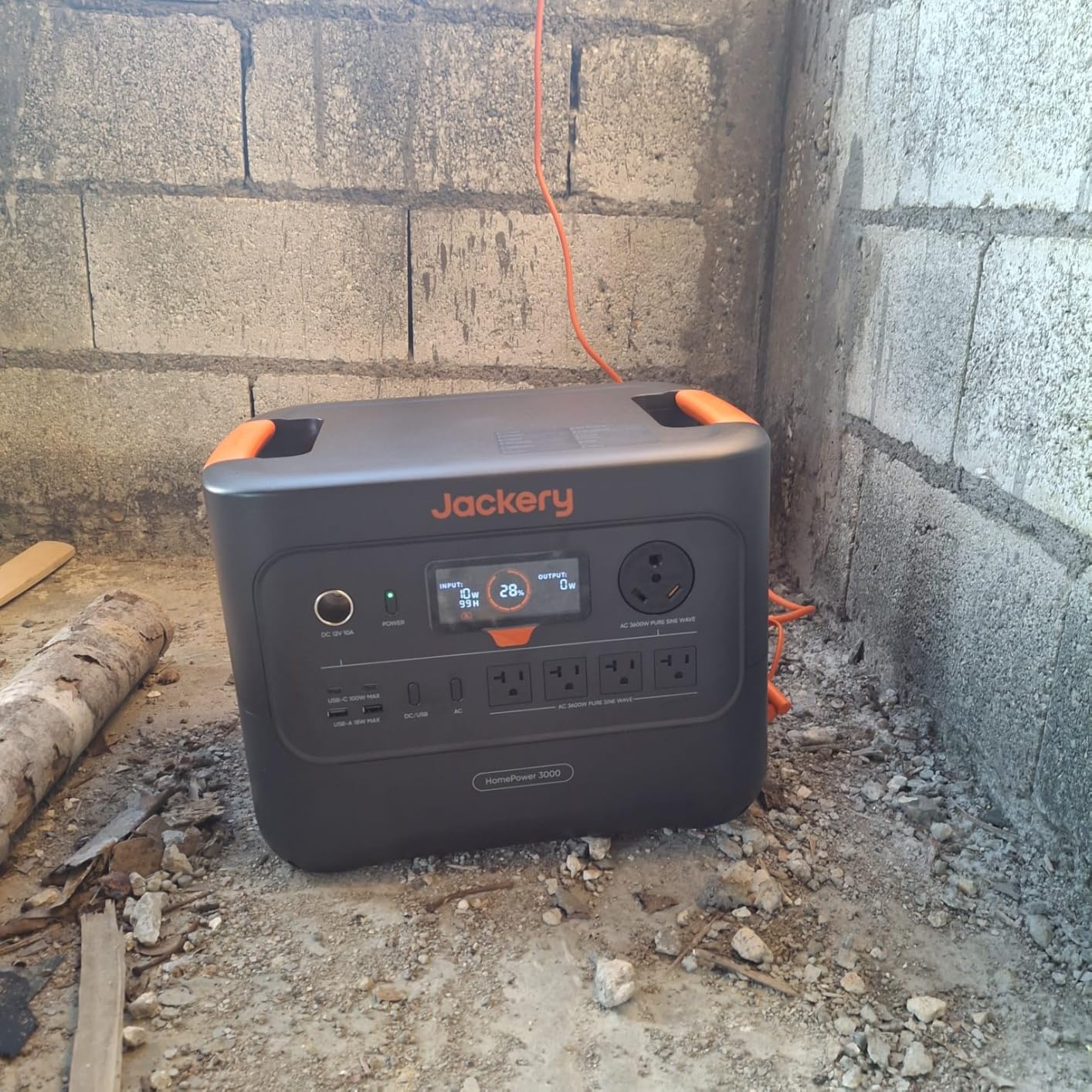
The HomePower 3000 is the first kit in this roundup we would genuinely describe as an appliance runner rather than an essential-loads backup. 3,600W of continuous output with 7,200W surge covers a window air conditioner and a microwave at the same time, which is a load profile that would trip most 2kWh stations.
Capacity follows suit at 3,072Wh of LiFePO4. Owners report a refrigerator running one to two full days on a single charge, and one buyer charged two e-bikes, two phones, a television and an internet connection simultaneously during a long outage.
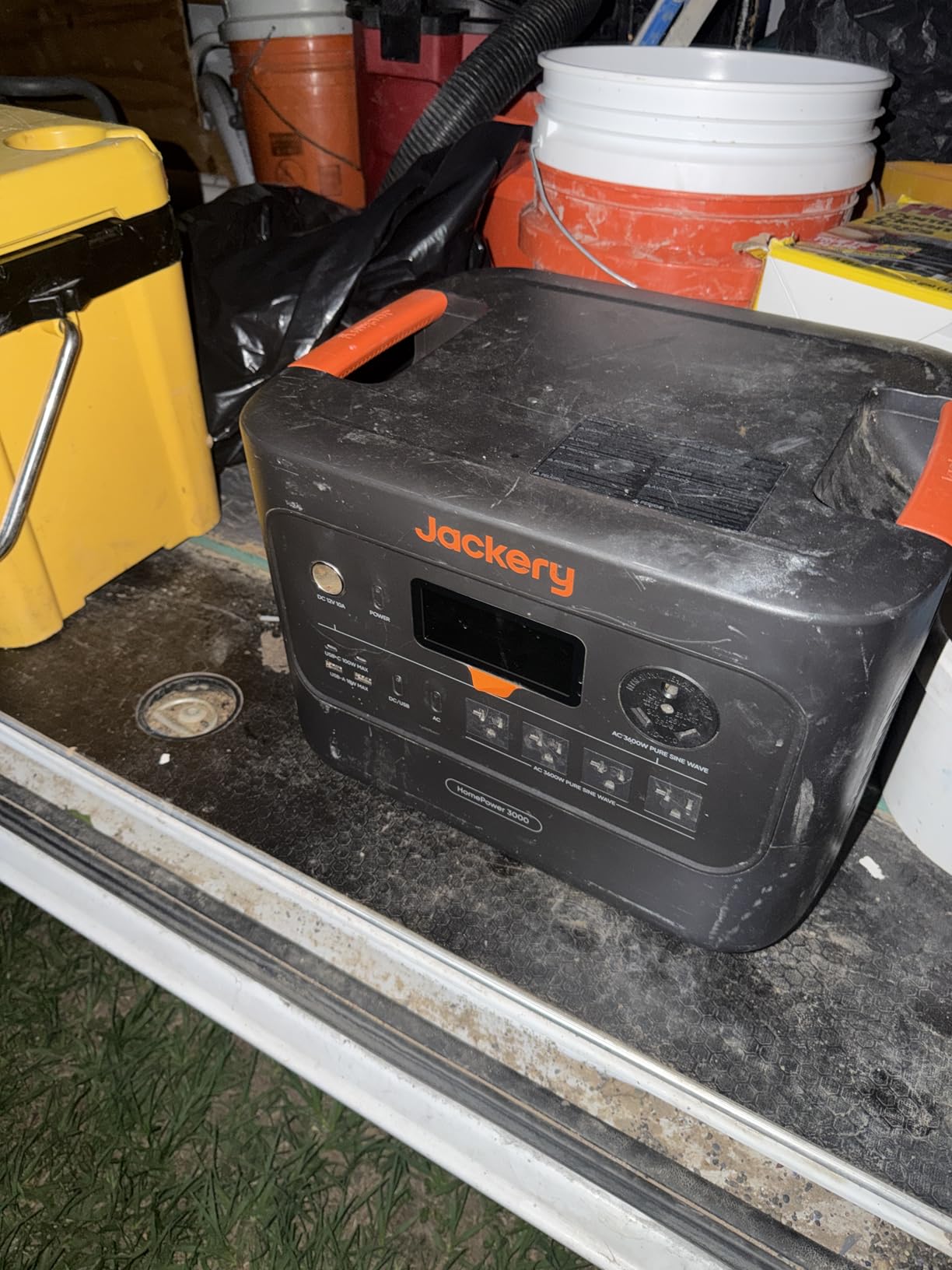
The UPS function is UL-certified at 20ms or less switchover, and the CTB packaging technology delivers a 14 percent space efficiency gain alongside the 47 percent size and 43 percent weight reductions Jackery claims against comparable 3kWh units. Recharge runs 1.7 hours on hybrid AC and DC or 2.2 hours on AC alone.
For RV use, the built-in TT-30 port means you can run the whole camper from this without buying a converter. Two 100W PD USB-C ports handle laptops and phones without external adapters.
What to check before you buy the HomePower 3000
Plan the delivery and the moving route. At 59.5 pounds, a hand truck or wheel kit is effectively mandatory, and getting it down a basement stair or into an upstairs closet is a two-person job you should schedule rather than improvise.
Test the UPS function on your actual load before you rely on it. One buyer reports an undocumented minimum load threshold for stable UPS output, so verify with the equipment you plan to protect rather than a lamp.
Where the HomePower 3000 falls short
There is no expansion battery option, so 3,072Wh is fixed for the life of the unit. If your outage planning assumes a multi-day event, buy a second station instead of searching for an add-on module.
Software support is the weak spot. Alexa integration is advertised but the Jackery skill does not function, and the support portal has been reported returning a 404 with only a generic automated response. The hardware is strong; the service layer around the UPS feature is the weak link.
10. EF ECOFLOW DELTA Pro 3.6kWh – Best for Deep Storage
EF ECOFLOW Solar Generator 3.6KWh DELTA Pro with 400W Portable Solar Panel
3600Wh capacity
3600W continuous output
4500W starting
400W IP68 panel
Pros
- 15 outputs including 5 AC 4 USB-A 2 USB-C and a car port
- 400W panel recharges the bank in about 11 hours
- IP68 folding panel folds into an adjustable carry case
- App shows charge level temperature and charge times
- Deep 3.6kWh bank suits extended off-grid use
Cons
- 99 pounds is a stationary unit not a portable one
- Station and 400W panel arrive in separate packages
- Listing attributes include generic boilerplate specs
The DELTA Pro is the largest battery bank in this roundup at 3,600Wh, and that capacity is the entire point. It is aimed at buyers planning extended off-grid use or genuine whole-home essential loads, where a 3kWh class unit would be working at its limit by day two.
Output is 3,600W continuous with 4,500W starting, which comfortably handles a refrigerator, a freezer, lighting, a router and a medical device simultaneously. The port selection is unusually broad at fifteen outputs, including five AC outlets, four USB-A, two USB-C, two DC ports, a car power output and an Anderson port for higher-current DC work.
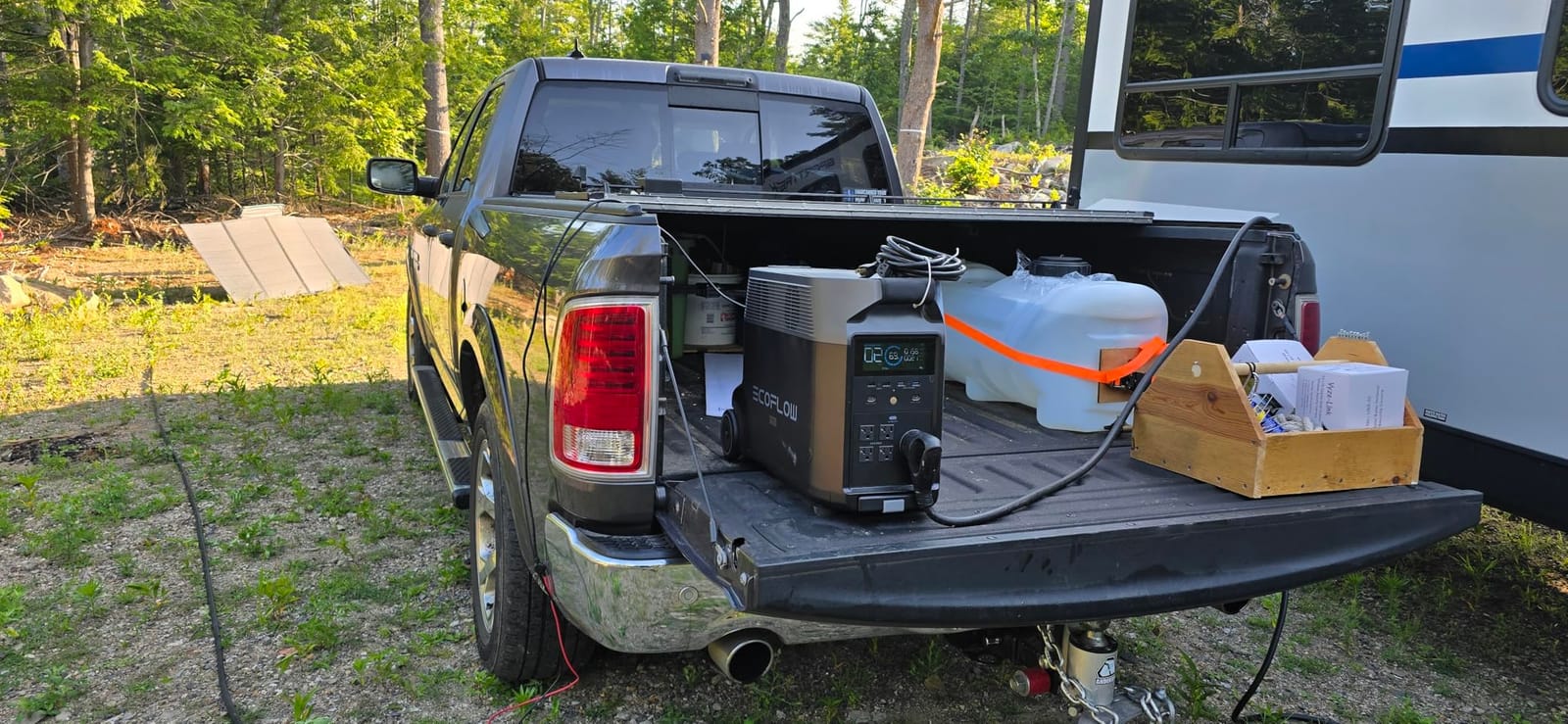
The included panel is a 400W foldable with 22.4 percent conversion efficiency and an IP68 dust and water rating, which is a meaningful upgrade over the folding panels bundled with smaller kits. It recharges the station in about 11 hours, or 3.5 hours if you run three 400W panels together.
EcoFlow’s app reports charge level, temperature, and charge and discharge times over WiFi or Bluetooth, which is the information you need to decide whether the bank will survive a three-day event or not.
What to check before you buy the DELTA Pro
Accept that this is a fixture, not a portable unit. At 99 pounds, choose its location before you order, ideally a dry room near the panel array and the loads it will serve, because you will not be moving it between the garage and the kitchen.
Count the panel wattage you actually need. One 400W panel refills a 3.6kWh bank in about 11 hours, so a single-day event needs multiple panels or a fast AC recharge path.
Where the DELTA Pro falls short
Some listed attributes, including tank volume and engine displacement, read as generic catalog boilerplate rather than meaningful specifications. Check the datasheet rather than trusting the product page for anything beyond the headline figures.
It is also the most expensive unit in this roundup, and for a lot of households that money buys capacity they will never draw. If your realistic load is a fridge and a router, a 2kWh station covers the same scenario for a fraction of the outlay.
11. Anker SOLIX F3800 – Best 240V Whole-Home Backup
Anker SOLIX F3800 Portable Power Station and Transfer Kit, 3840Wh, 6000W
3.84kWh EV-class LFP
6000W dual 120V/240V
expands to 26.9kWh
5 year warranty
Pros
- 3.84kWh covers about a day of household use and expands to 26.9kWh
- Dual 120V/240V output at 6000W runs large appliances including a dryer
- NEMA 14-50 port charges an EV directly at 6000W
- Plugs into an RV power inlet for adapter-free powering
- 5-year warranty with a 10-year design lifespan
Cons
- 132.3 pounds and a 34 inch cube need deliberate placement
- No solar panels in this package
- Expansion batteries add substantial cost
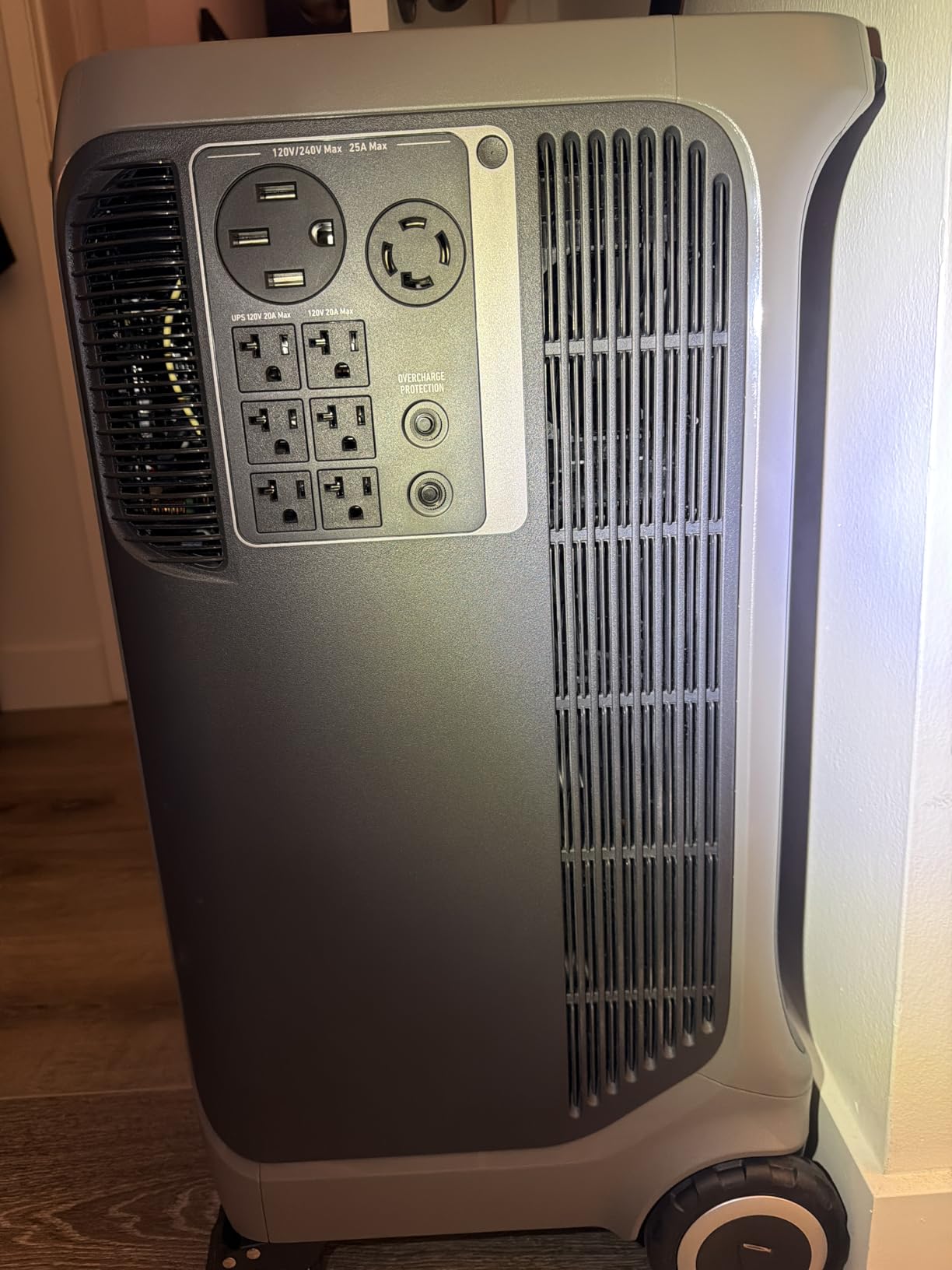
The F3800 is the only kit here that outputs genuine split-phase 120V/240V power, and that single fact moves it out of the essential-loads category entirely. At 6,000W of continuous dual-voltage output, it runs a clothes dryer, a well pump or a central AC unit, which no other unit in this roundup can do.
Capacity is 3.84kWh of EV-class LFP cells, which covers roughly a day of typical household use, and it expands to 26.9kWh with up to six battery packs. The 5-year warranty and 10-year design lifespan are among the more generous terms offered in this category.
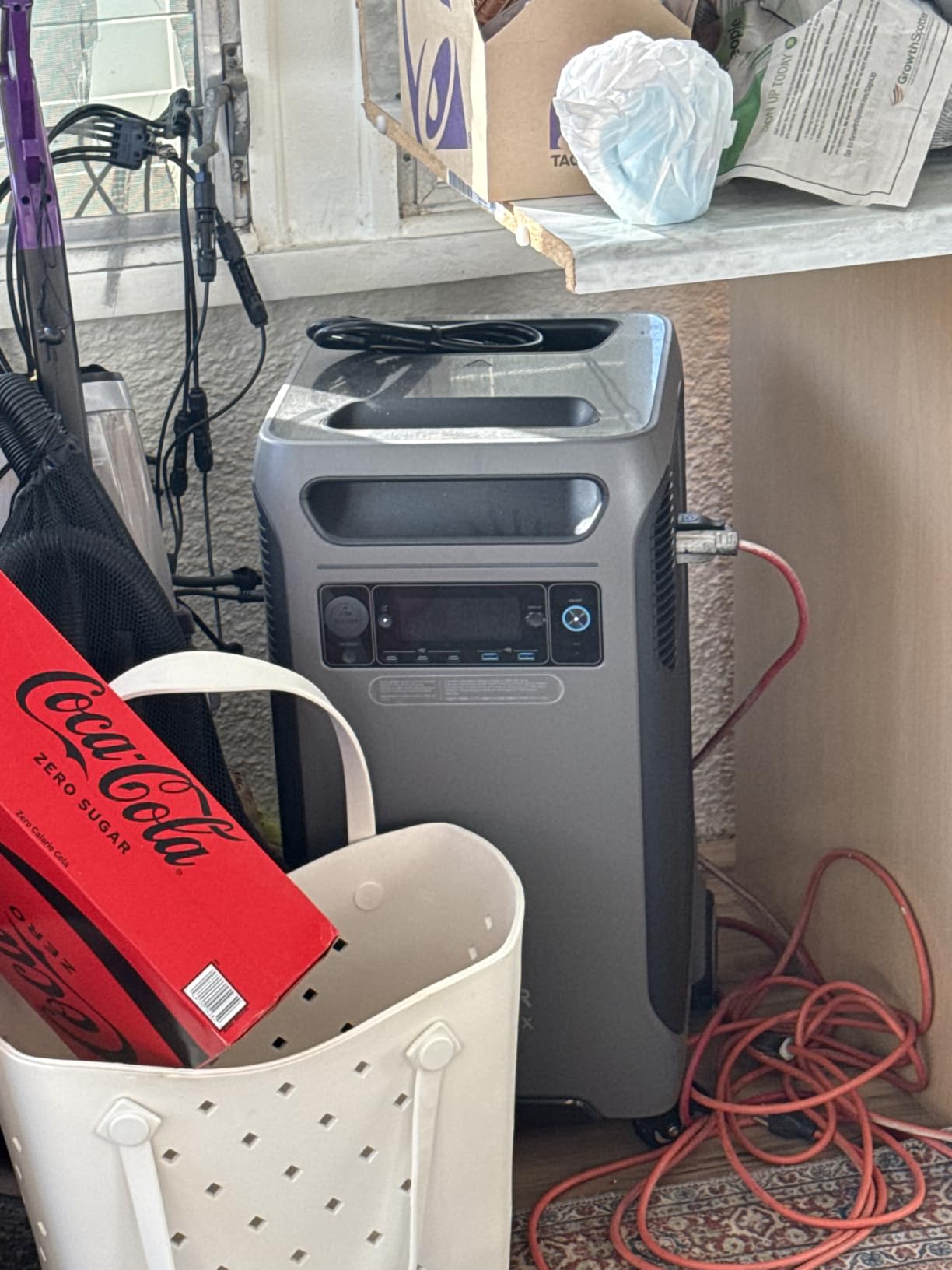
The NEMA 14-50 port is a genuinely useful feature rather than a spec-sheet ornament. It charges an electric vehicle directly at 6,000W with no extra grounding hardware, and plugging into an RV power inlet via NEMA 14-50 or L14-30 powers all RV appliances at once without a converter.
The package also includes a Smart Generator 5500, AC charging cable, a solar-to-XT60 charging cable and an MC4 connector, so panels you buy separately connect straight to the station.
What to check before you buy the F3800
Plan the installation footprint before ordering. At 132.3 pounds and 34 inches on a side, this is a semi-permanent installation rather than a portable unit, and you will want a floor location, ventilation path and clear access to the battery expansion ports.
Note what is not in the box. This package is the power station plus transfer kit, with no solar panels included, so add panel wattage to your budget before you compare it against kits that bundle them.
Where the F3800 falls short
The accessory expansion batteries that take you from 3.84kWh to 26.9kWh add substantial cost on top of the base price, and the full build-out cost is well beyond what most households spend on a backup system.
Its 4.4-star average reflects broad satisfaction with the electrical capability paired with consistent acknowledgement that weight and footprint are the price of that capability. If you only need essential loads, this is over-specified.
12. ZeroKor 300W Portable Solar Generator – Budget Pick
Portable Solar Generator 300W Portable Power Station with 60W Solar Panel
280Wh battery
300W max AC output
60W monocrystalline panel
5.1 pounds
Pros
- Compact and light at 5.1 pounds for a grab-and-go emergency kit
- Runs a 55-inch TV for 4+ hours while still charging
- Two AC outlets plus a DC port and four USB ports
- Built-in BMS with short circuit and overheat protection
- Brand has replaced units whose batteries entered a protection state
Cons
- 300W is a peak figure with real continuous output well under 100W
- Output is not a true pure sine wave
- Solar input is not true MPPT and the folding panel is fragile
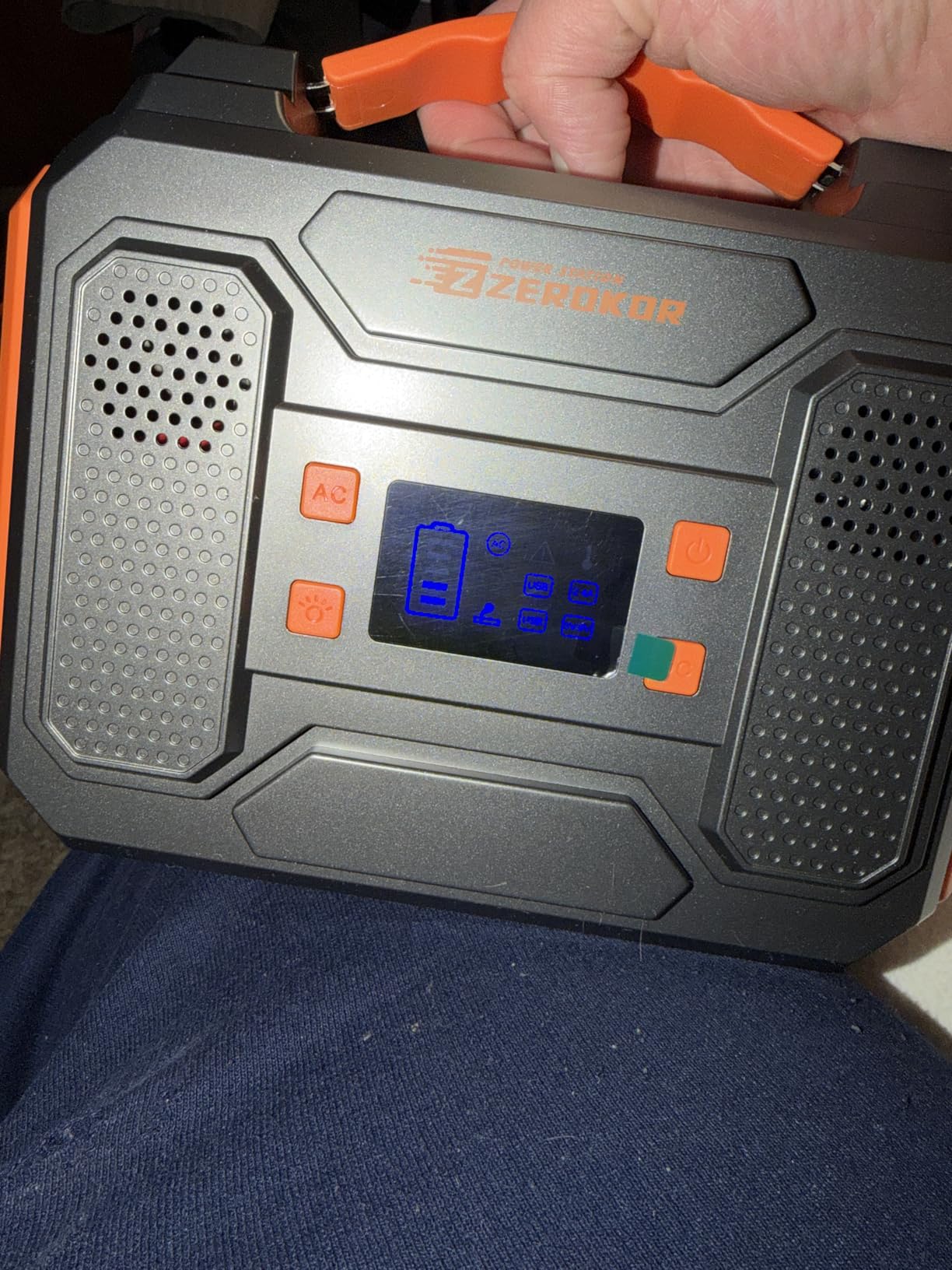
The ZeroKor is the most-reviewed product in this roundup by a wide margin, and it belongs here for one specific reason: it is the honest floor. At 280Wh and 5.1 pounds, it is a genuine grab-and-go emergency kit that fits in a glovebox or a go-bag, and nothing else on this list does that.
Owners praise the price-to-output ratio and its usefulness for phones, laptops, lights and small camping loads. The port selection is sensible for the size, with two AC outlets, a DC port, three USB-A ports and a quick-charge USB, plus a built-in BMS covering short circuit, over-current, over-voltage, overload and overheat protection.
Customer support is a real strength here. Brand customer service has replaced units for owners whose batteries entered a protection state, and the 12-month warranty from the purchase date is clearly stated rather than buried.
Reported runtime of 7 hours and the ability to run a 55-inch television for 4+ hours while charging make it a legitimate short-duration backup for a phone, a radio and a lamp.
What to check before you buy the ZeroKor 300W
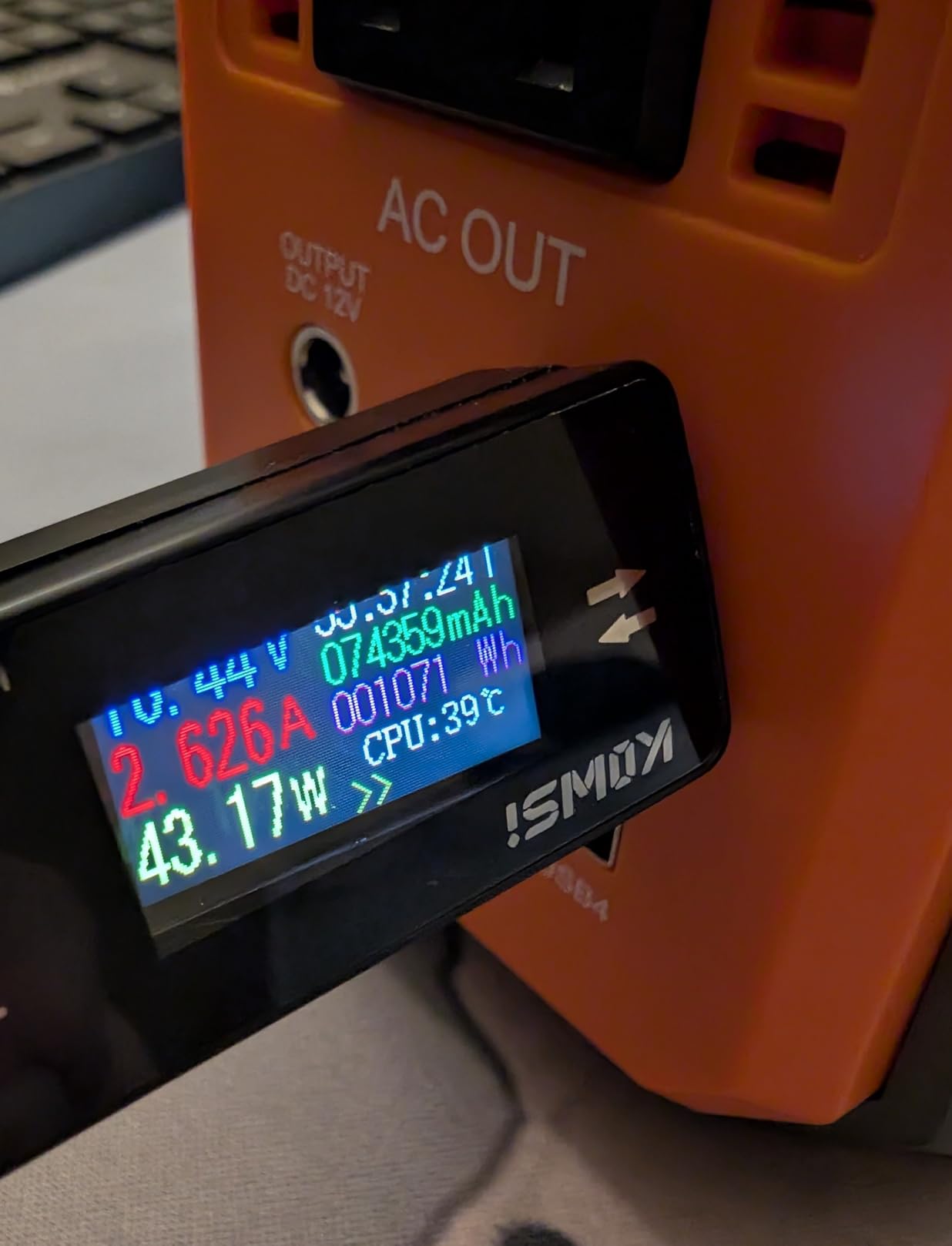
Understand the wattage claim before you rely on it. The 300W figure is a maximum, and detailed testers report real continuous AC output well under 100W. That is fine for a television and fine for phones, and it is not fine for a kettle.
Treat the 60W folding panel as a trickle charger rather than a recovery tool. The solar input is not true MPPT, and testers measured roughly 13V at 2.4A, which is about 30W of real harvest even from a much larger panel.
Where the ZeroKor falls short
The output is not a true pure sine wave, so sensitive electronics and some medical devices are out of scope. Keep your existing battery-backed router for the life-support gear and use this for everything else.
Two failure modes show up repeatedly in owner feedback. The DC 12V port has been reported non-functional with a cigarette-lighter adapter and a portable air compressor, and units left uncharged for extended periods can enter a protection state and stop powering devices entirely, so top it up every few months.
Which Home Solar Kit Is Right for You
Here is the short version, mapped to specific households. If your goal is keeping a fridge, a router and medical devices alive through a four-hour outage, the Anker SOLIX C1000 Gen 2 is the correct pick at 1,024Wh. If you want to run a coffee maker, a laptop and a lamp for a full evening, the BLUETTI Elite 200 V2 doubles the capacity without moving past 120V single-phase output.
For a cabin, a tiny house or a camper, the BLUETTI Elite 300 is the strongest fit because the TT-30 outlet and 12V/30A DC port remove the adapter problem entirely. For a house with a dryer, a well pump or a central air conditioner, the Anker SOLIX F3800 is the only unit here with genuine 120V/240V output, and there is no substitute for that capability in this group.
If you want to build a permanent array rather than a portable station, the Renogy 400W kit is the right foundation, with four panels and a 40A MPPT controller that accepts third-party panels. And if you are simply looking for a small solar project, our solar bird repeller testing covers the entry-level panel end of the market.
How to Size a Home Solar Kit in Five Steps
The sizing anxiety is the single biggest reason people stall on this purchase, and it shows up constantly in the r/SolarDIY and r/solar discussions. One r/SolarDIY builder in Queensland runs about 14kWh per day against a worst-case peak load of roughly 12kW, and pairs two 16kWh 48V banks with a 10.2kW all-in-one inverter and 10kW of panels. That is the archetype of a serious build, and it starts from the same three numbers you already have.
Step one: find your daily kWh. Take a full year of utility bills, find the highest monthly kWh, multiply by 30, and divide by 365. That worst-day figure is what your system has to cover. Average-load sizing is the most common error, and it is why so many systems run out of power on a cold, still January evening.
Step two: get your peak load, not your average. List what runs at once: a refrigerator compressor, a microwave, a well pump, a dehumidifier. Sum the running watts and add the largest motor’s surge requirement. Size the inverter on that number. A 3,000W inverter cannot start a 1,500W compressor plus a microwave, no matter how many kilowatts of battery sit behind it.
Step three: convert sun to panels. A 400W panel produces roughly 1.6kWh on a good day at five peak sun hours, or about 1.2kWh in a four-hour region. Divide your daily kWh by that figure to get a panel count. If you need 14kWh per day and your area gets five peak sun hours, you are looking at roughly nine to ten 400W panels.
Step four: size the battery for autonomy. Multiply your daily kWh by the number of days you want to cover, then divide by 0.9 for inverter and conversion losses. A 14kWh day with one night of autonomy needs about 15.5kWh of bank, which is exactly why the Queensland builder chose two 16kWh batteries rather than one.
Step five: check the DC limits before you buy panels. Every inverter has a maximum PV input voltage and every MPPT controller has a maximum amperage. Forum users report building entire arrays that quietly underperform because those limits were missed at purchase. Check max VDC and max PV current against your planned string configuration before ordering, not after.
120V vs 240V Split-Phase: Which Output Do You Need?
This is the question that decides whether a compact 1kWh station or a 6,000W split-phase unit is the right answer, and most buyers never ask it. A single-phase 120V system covers lights, plugs, routers, televisions, a refrigerator and most small appliances. Split-phase 120V/240V adds the ability to run a clothes dryer, an electric water heater, a well pump, a central air conditioner or a 5-ton mini-split.
The rule of thumb we use: if a single 240V-only appliance in your home would go dark during an outage, you need split-phase. Everything else runs acceptably on 120V. Among the kits we reviewed, the Anker SOLIX F3800 is the only one that outputs both, and everything else in the 1kWh to 3.6kWh range is 120V single-phase.
There is a practical middle path for people who want dryer backup without the weight and cost of a 6,000W unit. Power the dryer, washer or well pump from a small dedicated generator, and run everything else from a 2kWh station. It is a compromise, but a reasonable one for many homes.
What to Verify Before You Buy a Home Solar Kit
Start with what is actually in the box. Most kits in this category bundle a power station and one or two folding panels, and the Renogy 400W is the exception that includes a controller and racking but no battery. Confirm whether a battery, inverter or transfer switch is included, because “solar kit” covers three genuinely different products.
Second, verify the continuous output rather than the peak figure. The ZeroKor is the cautionary example, with a 300W headline and real continuous output well under 100W. Compare continuous wattage across every unit on your shortlist, and treat surge as a separate column.
Third, check the battery cycle rating and who enforces the warranty. LiFePO4 chemistry across this roundup ranges from 4,000+ to 6,000+ cycles, which is a meaningful difference over a decade. Warranty terms range from 12 months on the ZeroKor to five years on the Anker and Jackery units, and an unclear warranty from a marketplace brand is worth avoiding entirely.
Fourth, confirm the solar input ceiling matches your plan. The EF ECOFLOW Delta 3 Classic caps at 500W and 15A, and the BLUETTI Elite 200 V2 caps at 1,000W and 60V. Buying panels beyond that limit is the most common expensive mistake in this category.
Fifth, look for UL and ETL listings on the inverter and battery side, and check whether the unit is a listed standalone system or requires a listed transfer switch to integrate with your panel. Sellers frequently use terms like “code compliant” and “closed loop” that a buyer cannot verify from the product page.
Permits, Interconnection and the Federal Solar Tax Credit
Most battery-first solar generators plugged into a standard wall outlet need no permit, which is precisely why this category is so popular. That changes the moment you wire a system into your main panel. A grid-tied array requires an interconnection agreement with your utility, and depending on the size of the system, a building or electrical permit as well.
Interconnection rules are also shifting. Several states have moved to a successor framework often referred to as NEM 3.0, which shortens the compensation window for exported power and can change the economics of a grid-tied system after the fact. r/solar members advise starting the utility conversation before you move into a house, because locking in an interconnection rate depends on timing as much as on equipment.
On the tax credit, the federal Residential Clean Energy Credit has historically covered 30 percent of eligible installed cost for qualifying owner-occupied homes, and legislative policy has been subject to change. Because the rules are in flux this year, verify the current status with a tax professional or the IRS guidance before you commit to a purchase, and keep your receipts and equipment certifications organized.
Why Homeowners Remove Solar Systems
It is worth answering the question directly, because homeowners do remove rooftop systems, and understanding why will save you from making the same mistake. The most common reason is not performance but timing: a system installed years ago is often due for a re-roof, and removing and resetting the panels costs real money. Moving homes is the second reason, since rooftop systems rarely transfer to a new owner.
The third is regulatory. States that moved to NEM 3.0-style net metering rules changed the value of exported power after systems were already installed, which retroactively reduced the return on systems sized for full export. Panel degradation and shading loss round out the list, and a poorly sited array on a shaded roof underperforms from day one.
The practical lesson is to size a system for self-consumption rather than for maximum export, and to check your roof’s remaining life before installing. Both decisions are made at purchase time, which is one more reason to buy the components separately and deliberately rather than chasing a bundled deal.
Frequently Asked Questions
What size solar generator will run a house?
A 1,024Wh station covers essential loads such as a refrigerator, router, lighting and a medical device for several hours. Running a clothes dryer, well pump or central air conditioner requires 240V split-phase output and 6,000W or more, such as the Anker SOLIX F3800. Multi-day coverage needs 3kWh of battery capacity per day of autonomy.
How many solar panels do I need for enough backup power?
A 400W panel produces roughly 1.6kWh on a good day with five peak sun hours and about 1.2kWh in a four-hour region. Divide your worst-day kWh from your utility bill by that figure to get a panel count, then check that the resulting string stays under the inverter’s maximum PV input voltage.
Is LiFePO4 better than lead-acid for a home solar kit?
Yes for most buyers. Every 1kWh-and-up kit in this roundup uses LiFePO4 cells rated between 4,000 and 6,000 cycles, where lead-acid typically manages a fraction of that. The trade-off is weight and upfront cost, since LiFePO4 packs are heavier for the same capacity.
Do I need a permit to install a DIY home solar kit?
Plugging a portable solar generator into a standard outlet usually requires no permit. Wiring a fixed array into your main panel or tying a grid-tied system to the utility generally requires an electrical permit and an interconnection agreement, and rules vary by state and utility.
What is the 20% rule for solar panels?
The term most often refers to a rule of thumb that a correctly sized home solar system can offset roughly 20 percent of a typical household electricity bill. Some buyers also hear it used for the roughly 20-year expected service life of panels. Both readings describe sizing expectations rather than a tax rule.
Conclusion
After working through all 12 of the best home solar kits, the Anker SOLIX C1000 Gen 2 remains the pick for most households, thanks to 2,000W of continuous output, 600W of solar input and a 10ms switchover that keeps sensitive electronics running. If you need more inverter headroom and deeper storage on 120V, the BLUETTI Elite 200 V2 is the stronger value. If a 240V appliance has to run, the Anker SOLIX F3800 is the only real answer in this group.
Start with your worst-day kWh and your peak load, not with a brand name, and buy the smallest system that covers both. Check the DC input limits before you order panels, and size for self-consumption rather than maximum export. If you are still weighing the hardware, our kids solar kit guide is a good low-stakes way to learn how panels behave before committing to a full home system in 2026.