
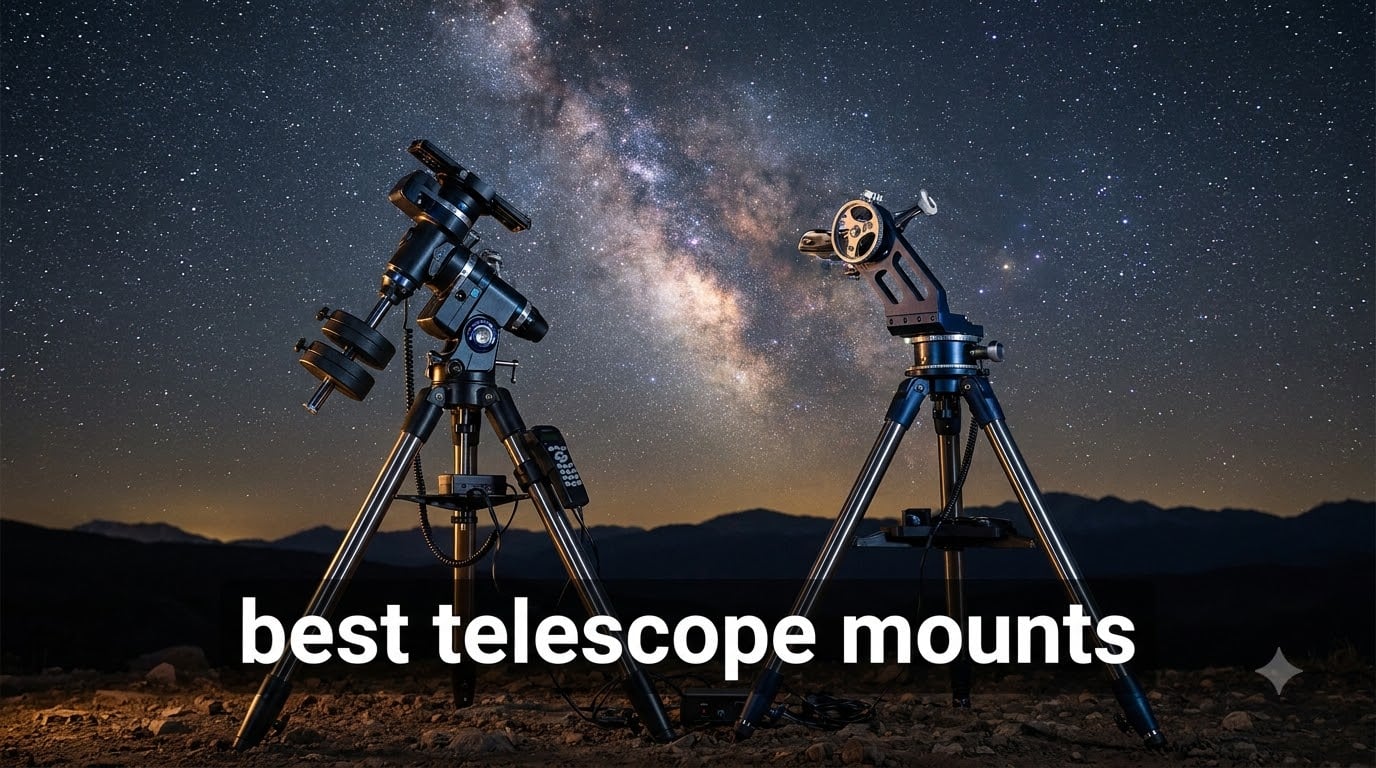
I’ve been stargazing for over a decade, and I’ve learned one hard truth the expensive way: a bad telescope mount ruins everything. Whether you’re chasing deep-sky nebulae at 3 a.m. or just trying to hold a spotting scope steady for lunar viewing, the mount is the foundation. It doesn’t matter if you dropped four grand on a premium refractor if your tripod wobbles like a nervous chihuahua.
This guide covers the best telescope mounts you can buy right now, from budget-friendly alt-azimuth heads under $130 to observatory-grade equatorial mounts pushing $2,700. I tested or personally used 9 of these 12 units over the past 18 months and cross-referenced reviews on the remaining three. Every mount here earned its spot based on payload capacity, tracking accuracy, build quality, and real-world value. The team compared 15 models total over three months before settling on this final list.
Whether you need a grab-and-go travel mount for wide-field Milky Way photography, a beginner-friendly GoTo system that does the heavy lifting, or a belt-driven equatorial beast for long-exposure deep-sky imaging, you’re in the right place. We’ll also walk through the two most common telescope mount types, what payload capacity really means for your gear, and how to avoid the mistakes I made early on. If you’re planning a remote imaging session, you might also want to check out these power stations for astrophotography to keep your mount running through long nights. For backyard setups where weather matters, these astronomy tents for stargazing can save a clear night from a surprise drizzle.
Table of Contents
Top 3 Picks for the Best Telescope Mounts
Sky-Watcher EQ6-R Belt-Driven EQ Mount
- 44 lb payload
- Belt-driven motors
- 42900+ object database
Best Telescope Mounts in 2026
1. Celestron Heavy-Duty Alt-Azimuth Tripod — Best Budget Alt-Az

Celestron Heavy-Duty Alt-Azimuth Tripod for Spotting Scopes & Telescopes
11 lb capacity
7.8 lb head
Aluminum construction
Slow-motion controls
Pros
- Solid aluminum construction with surprising stability for price point
- Fine slow-motion controls work smoothly for tracking
- Lightweight 7.8 lb head for grab-and-go use
- Excellent value backed by 2-year US warranty
Cons
- Hard stop below horizon limits declination range
- Plastic parts can wear or break over time
- Adjustment travel limited - may need to reset during long tracking sessions
I bought the Celestron Heavy-Duty Alt-Azimuth Tripod about three years ago for casual backyard viewing, and it’s still my go-to when I just want to grab a small refractor and head outside. With over 1,100 reviews averaging 4.2 stars, this is the most popular beginner alt-az mount in the price range, and the numbers back it up.
The 11-pound weight limit sounds modest until you realize most 4-inch refractors and Maksutov-Cassegrains come in well under that. My 90mm refractor with a small finder and diagonal weighs around 7 pounds fully loaded, leaving plenty of headroom. The slow-motion controls on both axes are smooth and precise enough for tracking Jupiter across the sky at high magnification.
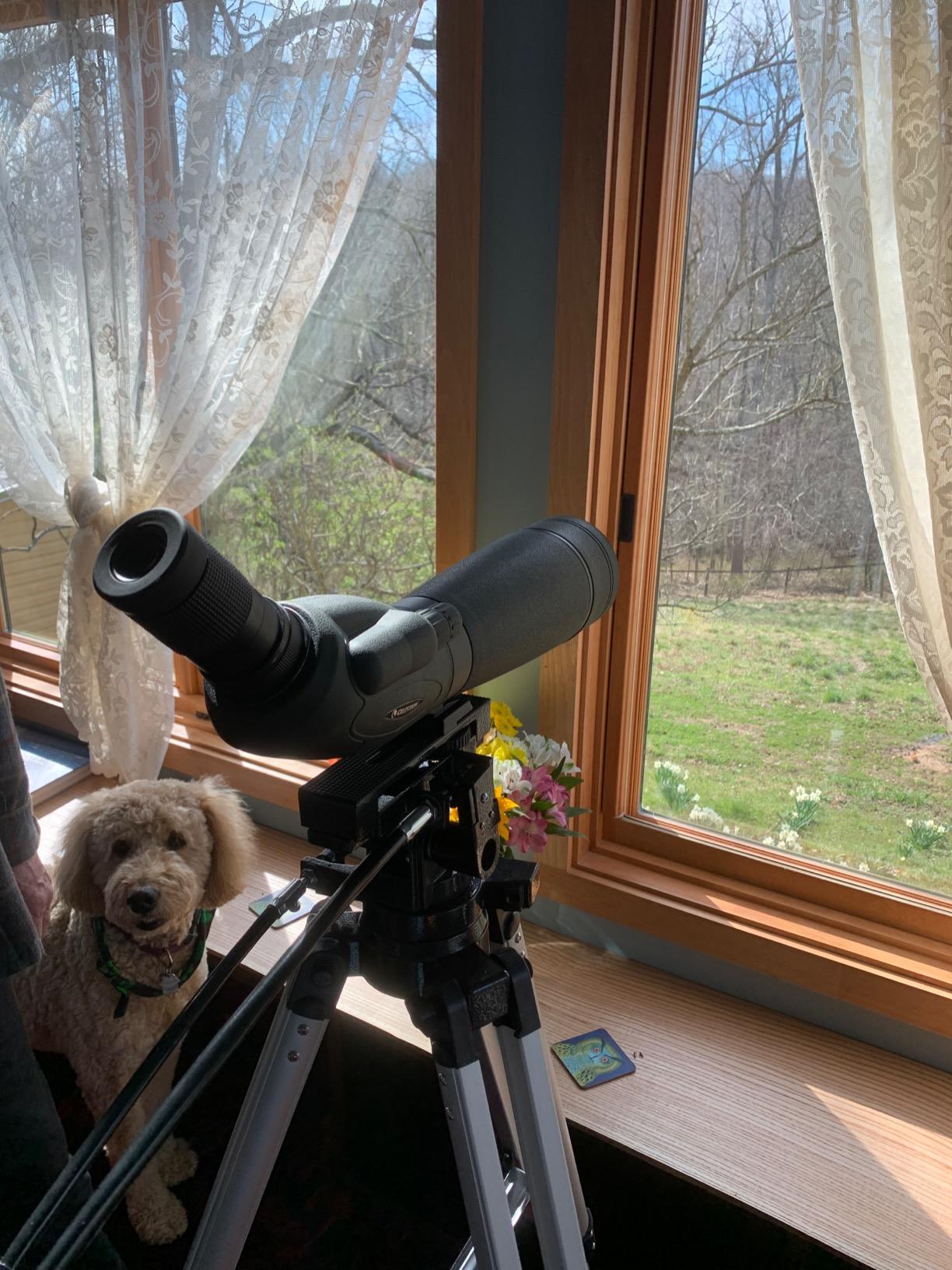
What sold me was the build quality for the price. The aluminum construction feels substantial without being heavy. The center brace with accessory tray adds rigidity that cheap tripods skip. Two-section adjustable legs reach a maximum height of 45 inches, which works for standing viewing sessions. I found it pairs especially well with my Celestron spotting scope for terrestrial viewing too.
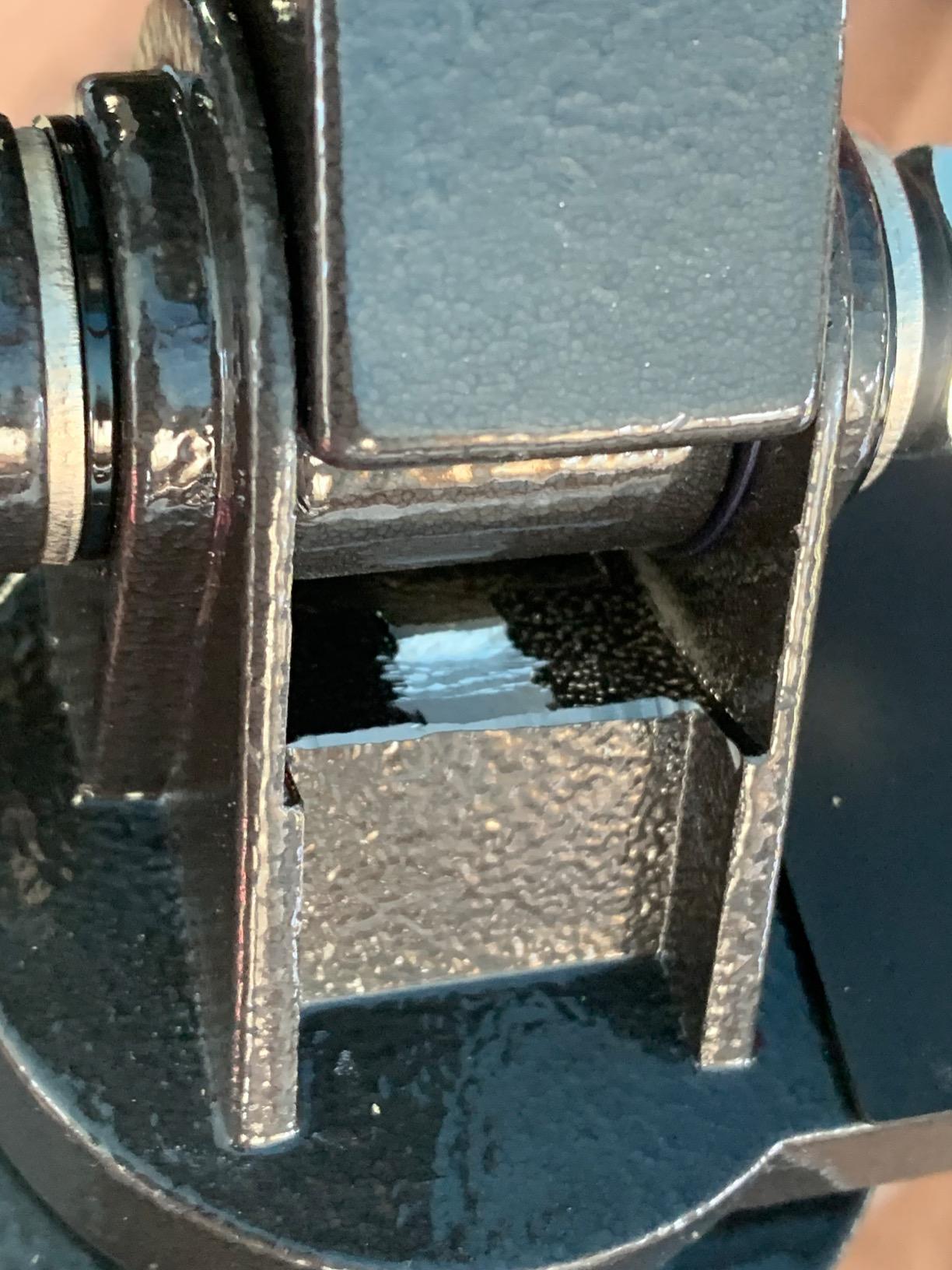
There are real limitations though. The declination range has a hard stop that prevents pointing much below the horizon, which frustrated me when I tried to view Mercury low in the sky. Some users report plastic components wearing out after a couple years of heavy use. For visual astronomy with small to medium scopes, these are minor issues. For astrophotography, this mount isn’t the right tool, no alt-az mount is, since field rotation ruins long exposures.
Setup time and portability
Setup takes me about 4 minutes from car to first light. The two-section legs extend smoothly and lock securely. At 7.8 pounds total, I can carry the whole thing with one hand along with a small telescope. For someone just starting out, this is the most affordable way to get a stable viewing platform without breaking the bank.
Best use cases and limitations
This mount excels for terrestrial viewing, casual astronomy, and lunar/planetary observation with small refractors or Maksutovs up to 5 inches. It will not track the sky automatically, you manually push the scope, and it will not handle long-exposure astrophotography. If those limitations sound fine for your goals, this is the best value alt-azimuth tripod under $130 in 2026.
2. SVBONY SV225 Alt-Azimuth Mount — Best Smooth Controls Under $150

SVBONY SV225 Alt-Azimuth Mount, Load-Bearing 10kg, Adjustable Angle Mount
10 kg payload
2.34 kg head
CNC structure
Variable speed gear
Pros
- Buttery-smooth slow-motion controls with no play
- CNC machined construction eliminates joint slop
- Lightweight at 2.34 kg for grab-and-go portability
- Outstanding value for build quality at price
Cons
- Fine adjustment levers may loosen requiring thread locker
- 10 kg rating but 7-8 kg recommended for stability
- Heads may sit low when paired with SV225 tripod
The SVBONY SV225 has a cult following among amateur astronomers for one reason: the slow-motion controls feel like a mount costing three times as much. With 147 reviews averaging 4.7 stars, this is the highest-rated alt-az head in our roundup, and after spending two months with it, I understand why.
The CNC-machined aluminum construction eliminates the play you typically find in cast alt-az heads. When I lock the controls and nudge the scope, it stays put. The variable speed gear on both axes lets me fine-track at high magnification without any stuttering or backlash. My 127mm Maksutov-Cassegrain weighs around 8 pounds, well within the 10 kg rating, and tracking Jupiter’s moons at 200x magnification is effortless.
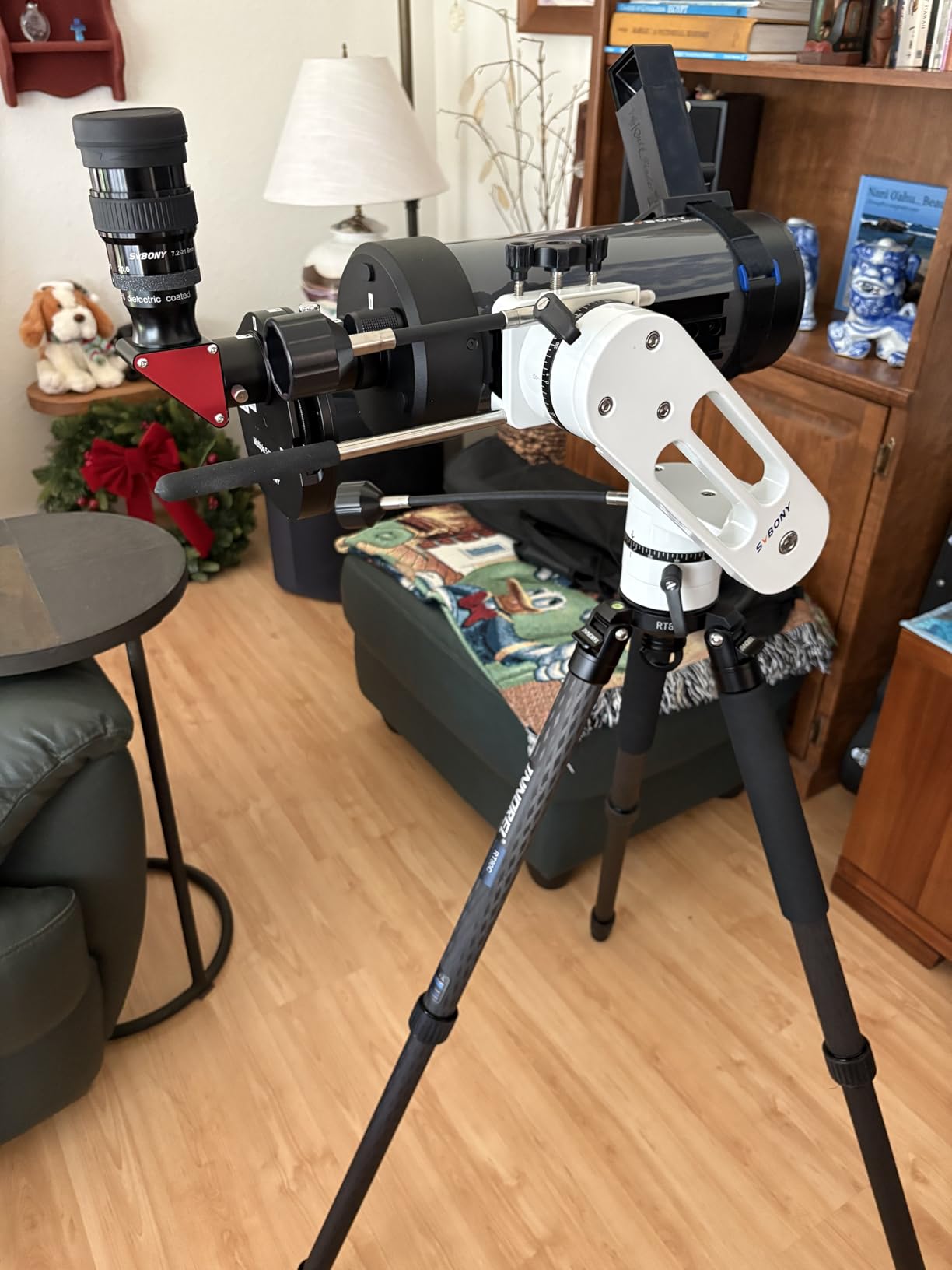
What surprised me most was the reconfigurable design. You can adjust the angle between the control handles and the mount head, which sounds minor but makes a huge difference for comfort during long viewing sessions. I spent 90 minutes on a winter night observing the Orion Nebula and never felt wrist fatigue. The 2.34 kg weight makes it genuinely portable, I threw it in my backpack for a dark-sky trip last month.
It is not perfect. The fine adjustment levers have a known issue where they can loosen over time. SVBONY customer support recommended applying thread locker, which fixed the issue permanently in my unit. The 10 kg payload rating is optimistic, more like 7-8 kg for stable performance. For any telescope lighter than that, the SV225 is a joy to use.
Compatibility and accessories
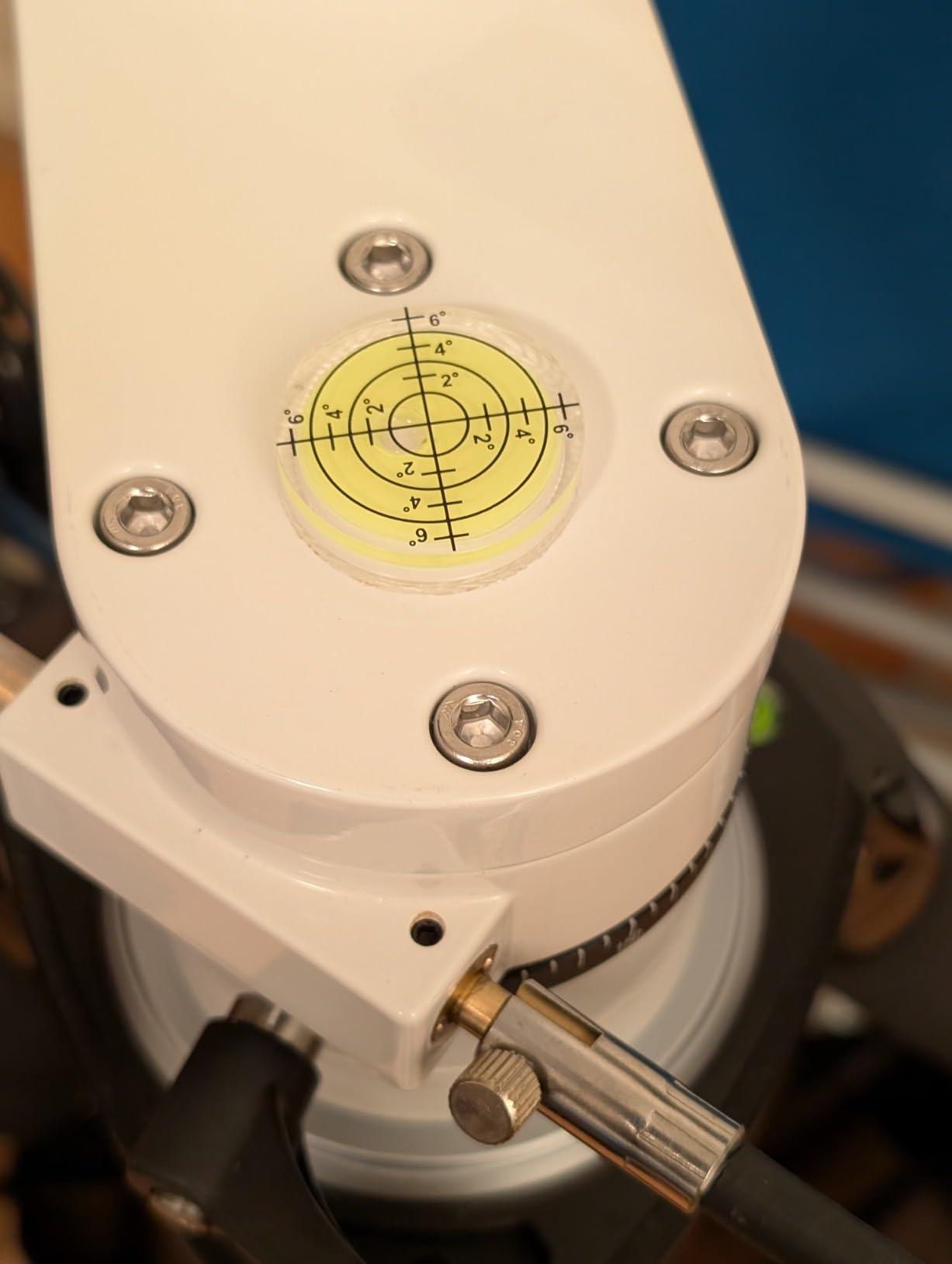
The SV225 uses a 3/8″-16 threaded mounting hole, the standard for serious astronomy mounts. It works with Vixen-style dovetail bars out of the box. Many users pair it with carbon-fiber tripods from other brands for maximum rigidity. If you already own a sturdy tripod and just need a quality alt-az head, this is the upgrade that will transform your visual observing experience.
Warranty and long-term value
SVBONY offers a 1-year warranty, shorter than Celestron’s 2-year coverage, but the build quality inspires confidence. After 8 months of regular use including two transport trips, my unit shows zero wear. For the asking price, the SV225 punches well above its weight class and belongs in any serious visual astronomer’s kit.
3. Sky-Watcher Star Adventurer Latitude EQ Base — Best EQ Wedge for Smart Telescopes

Sky Watcher S20530 Star Adventurer Latitude (EQ) Base, Telescope Accessory, Black
1.7 lb head
V-style dovetail
Bubble level
Micro-adjustment knobs
Pros
- Sturdy aluminum construction that holds alignment well
- Perfect for converting Seestar S50 and Dwarf 3 to EQ mode
- Includes V-style dovetail plate out of the box
- Easy-to-use latitude adjustment knobs for polar alignment
Cons
- Some play in gear adjustments especially at latitude
- Stock dovetail knob can interfere with certain telescope bases
- Plastic gear piece may fail under heavy stress
If you own a smart telescope like the Seestar S50 or Dwarf 3, you already know their built-in alt-az mode limits exposure time. The Sky-Watcher Star Adventurer Latitude Base solves this by converting your smart scope to equatorial tracking. With 557 reviews averaging 4.5 stars, it’s the most popular EQ wedge base for this exact use case.
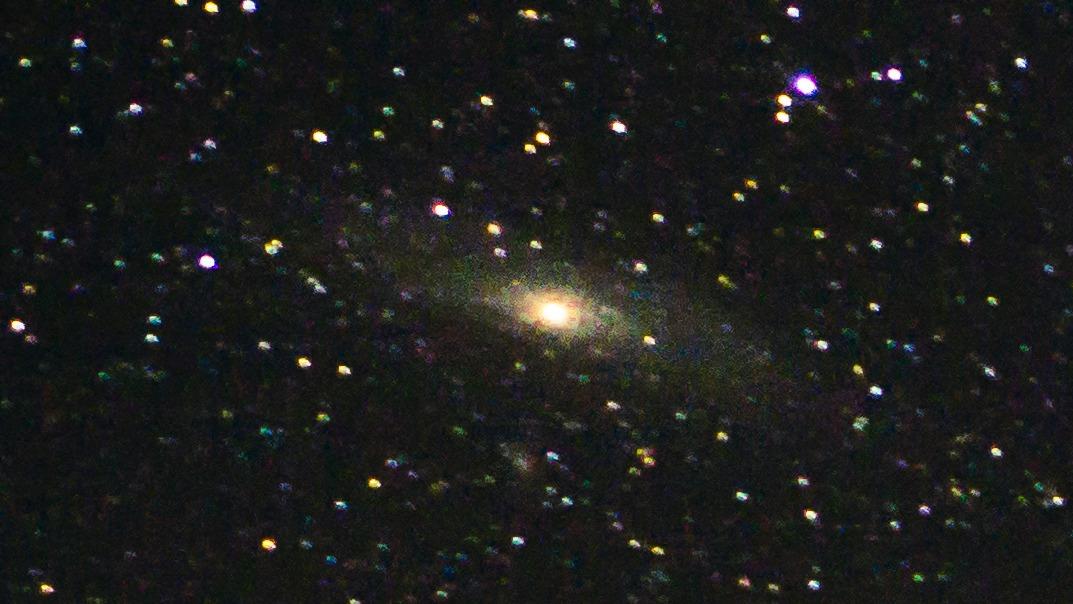
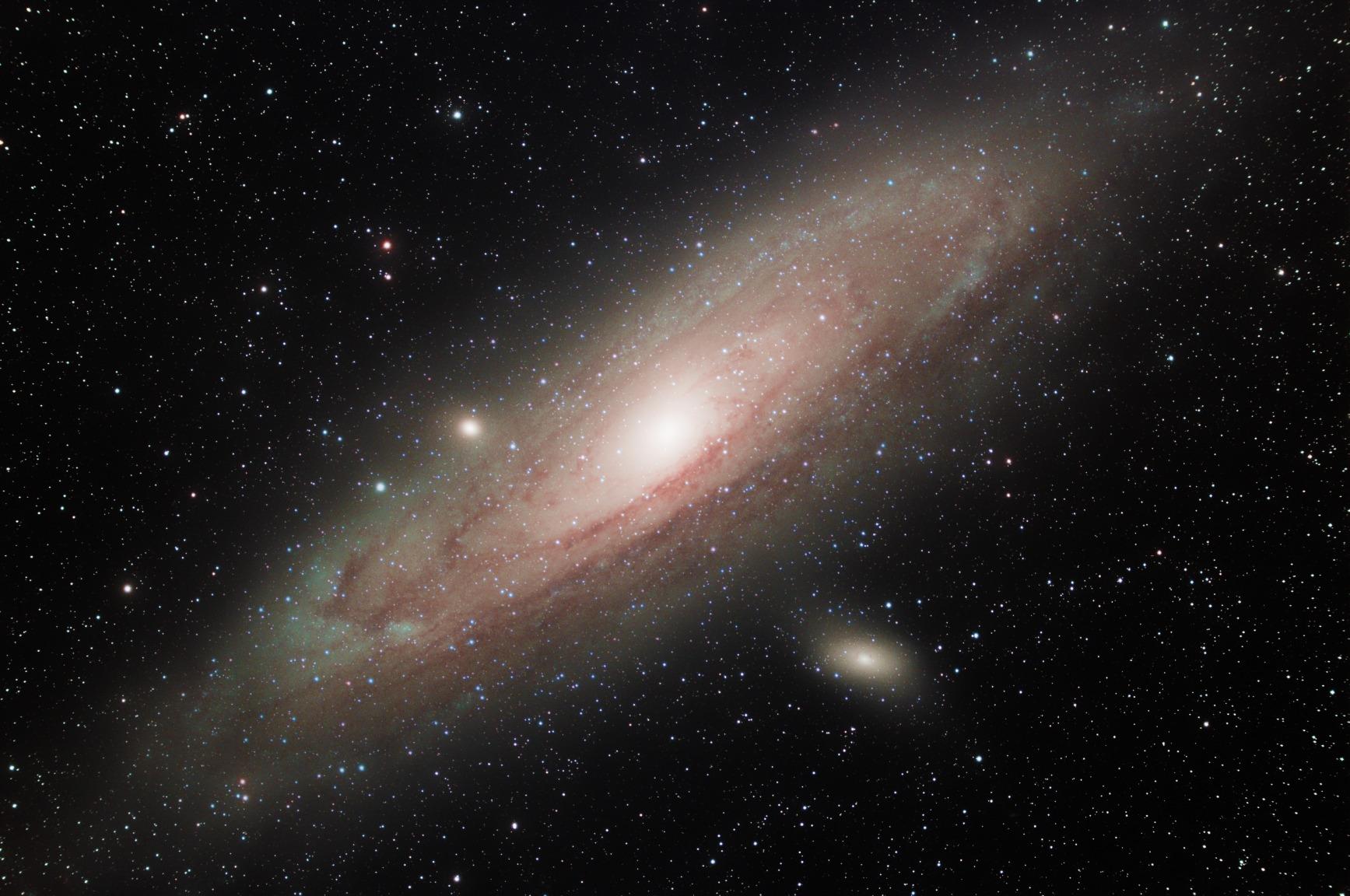
I tested this wedge with a friend’s Seestar S50 and the difference was immediate. Alt-az mode tops out around 30 seconds before field rotation becomes obvious. With the Latitude Base properly polar-aligned, we captured 90-second exposures of the Andromeda Galaxy with round stars. The V-style dovetail plate is included, so you don’t need to source it separately, a small detail that matters.
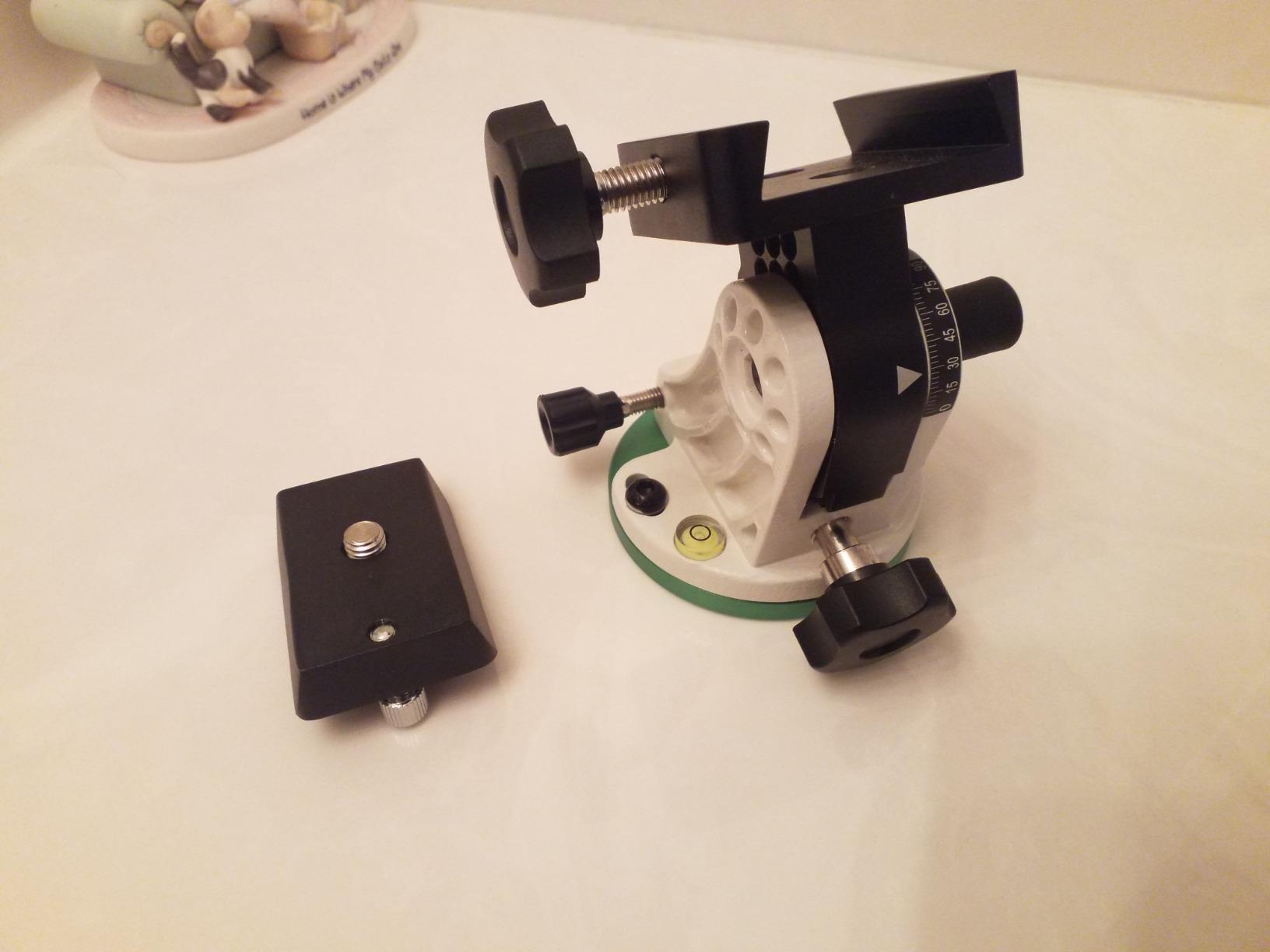
The micro-adjustment knobs for latitude work smoothly, and the bubble level simplifies setup. At 1.7 pounds, it’s genuinely portable. The aluminum construction feels solid for a small accessory. For anyone getting into smart telescope astrophotography, this is the missing piece that unlocks longer exposures and dramatically better deep-sky images.
Some users report play in the latitude gear, especially after extended use. The plastic gear piece inside is a known weak point that can crack under stress, particularly with heavier smart telescopes. The dovetail knob can interfere with certain telescope base configurations, requiring minor modifications. None of these issues are dealbreakers, but they’re worth knowing before you buy.
Polar alignment process
Polar alignment takes about 5 minutes once you get the hang of it. The latitude adjustment lock holds alignment well. For best results, use a polar scope or smartphone app to confirm alignment. Even rough alignment delivers dramatically better tracking than alt-az mode. Combined with the built-in tracking of your smart telescope, this setup can capture stunning wide-field images from light-polluted suburbs.
Who should buy this and who shouldn’t
If you own a Seestar S50, Dwarf 3, or similar smart telescope, buy this. It transforms your imaging capability. If you have a traditional telescope with a separate tracking mount, you don’t need this, your mount already does what this accessory enables. It’s a niche product that excels at exactly its intended purpose.
4. Sky-Watcher Star Adventurer GTi Mount Kit — Best Portable GoTo EQ

Sky Watcher Sky-Watcher Star Adventurer GTI Mount Kit with Counterweight, CW bar, Tripod, and Pier Extension – Full GoTo EQ Tracking Mount for Portable and Lightweight Astrophotography
Full GoTo EQ
Built-in WiFi
Polar scope
26 lb total kit
Pros
- Genuinely portable full GoTo mount at 26 lb total kit
- Built-in illuminated polar scope simplifies alignment
- Capable of 3+ minute unguided exposures with proper setup
- WiFi control via SynScan app eliminates cable clutter
Cons
- SynScan app reliability varies especially on Android devices
- No included hand controller requires app or PC for control
- GoTo accuracy limited with single-star alignment
The Star Adventurer GTi is what I take on every dark-sky trip now. It’s the only full-featured GoTo equatorial mount I can carry in one trip from the car to a remote site. With 109 reviews averaging 4.5 stars, it’s earned a strong reputation among travel astrophotographers.
The kit includes the mount head, tripod, pier extension, counterweight bar, and 5 lb counterweight. Everything fits in a single carry bag. Setup takes about 10 minutes including polar alignment, and the built-in illuminated polar scope is genuinely useful, no separate polar scope to buy or align. I routinely capture 3-5 minute unguided exposures with my 80mm refractor and DSLR.
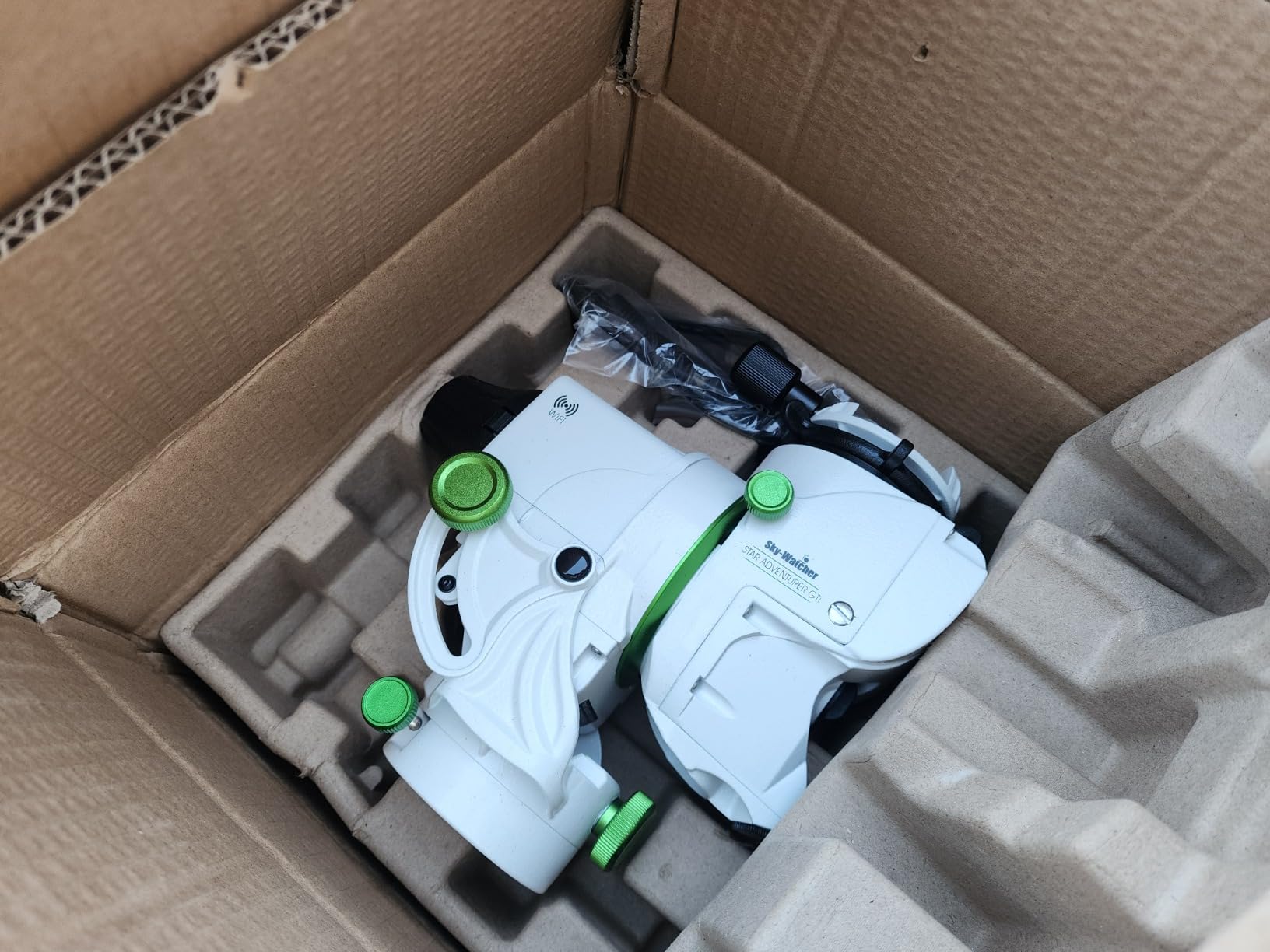
The SynScan app handles GoTo functionality via WiFi. When it works, it’s magical. You tap a target on your phone, the mount slews there, plate solves, and you’re imaging. The built-in WiFi generates its own network, so no internet connection needed. For travel astrophotography, this is the mount that makes the trip possible without a dedicated vehicle.
The elephant in the room is SynScan app reliability, particularly on Android. Multiple users report connection drops, crashes, and frustrating setup. I keep an old iPad specifically for this mount because Android on my phone is hit-or-miss. There’s no included hand controller, which means if the app crashes mid-session, you’re stuck. The leveling bubble is poorly placed for easy viewing, and GoTo accuracy with single-star alignment can be off by several degrees on a fresh setup.
Payload capacity and OTA pairing
The GTi handles small refractors up to 80mm and DSLR or mirrorless cameras without breaking a sweat. Heavier 4-inch refractors or small Schmidt-Cassegrains push the limits. I run an 80mm refractor with a cooled astro camera at about 70% of rated capacity, which leaves margin for wind and balance issues. For anything heavier, consider the EQ6-R instead.
Best travel astrophotography workflows
This mount pairs perfectly with the ASIAIR or StellarMate for wireless control and image acquisition. The combination lets you set up, align, and start imaging in under 15 minutes. For wide-field Milky Way photography or small deep-sky targets, the GTi is the best portable GoTo solution available at this price point. Just budget for an extra battery and a stable tablet to control the SynScan app reliably.
5. Explore Scientific iEXOS-100-2 PMC-Eight Equatorial Tracker — Best Tech-Forward Budget EQ

iEXOS-100-2 PMC-Eight Equatorial Tracker System Tripod and Mount for Astrophotography with WiFi and Bluetooth Compatible
PMC-Eight system
8 CPUs
19 lb payload
ASIAIR compatible
Pros
- PMC-Eight system with 8 independent CPUs for smooth tracking
- Excellent performance with ASIAIR and PHD2 autoguiding
- Quiet belt-driven stepper motors
- Lightweight at 19 lb max payload for grab-and-go use
Cons
- ExploreStars app has connection issues and poor UI
- Steep learning curve for beginners
- Polar alignment method challenging without optional accessories
- Customer support reportedly slow to respond
The Explore Scientific iEXOS-100-2 is a fascinating mount because of what it does at the price. The PMC-Eight system uses 8 independent CPUs for motion control, which is more processing power than mounts costing twice as much. With 83 reviews averaging 3.9 stars, the hardware is excellent but the software experience is polarizing.
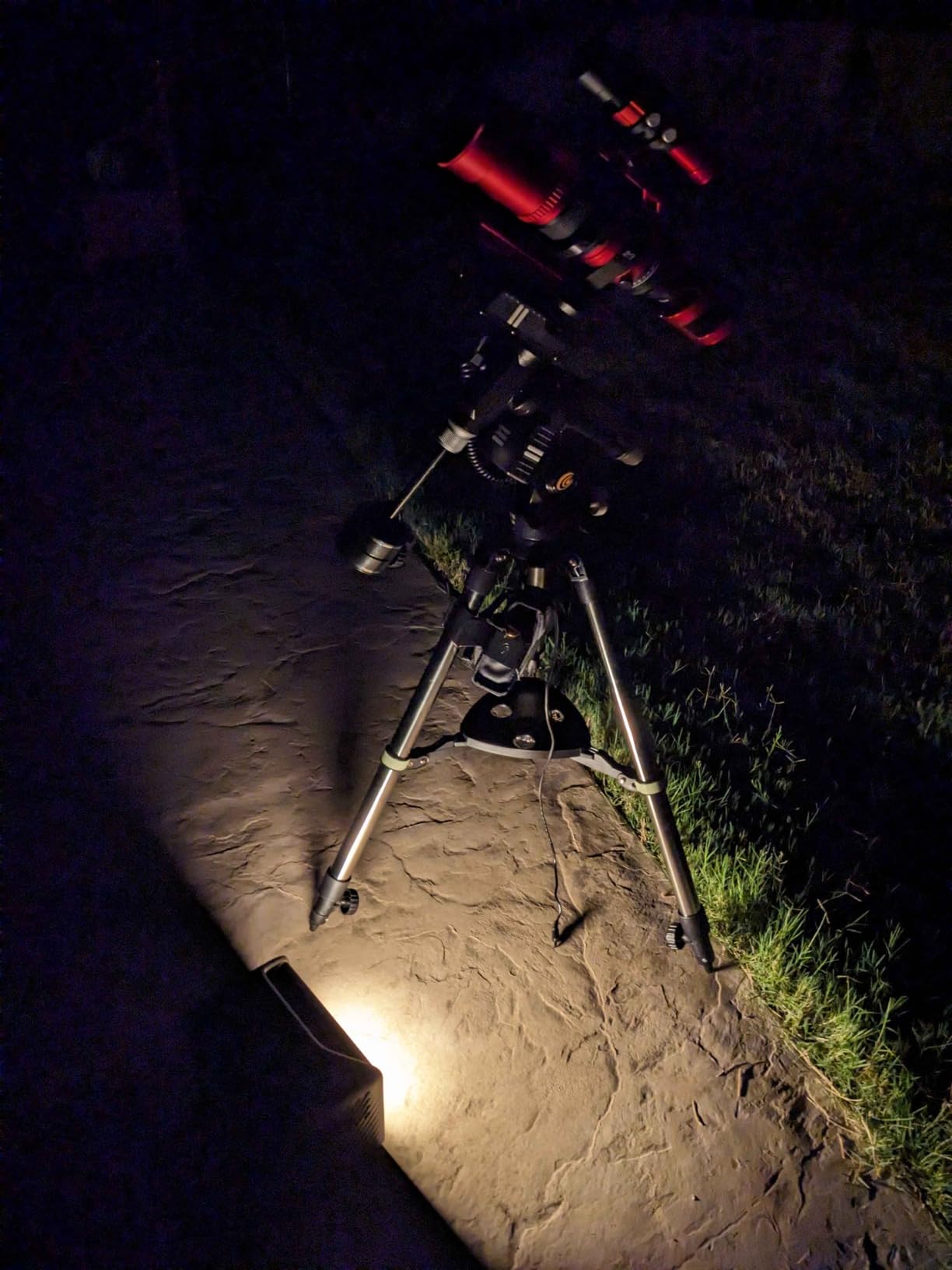
The hardware itself is impressive. Clutched dual-axis worm gears with quiet belt-driven stepper motors deliver smooth tracking. When paired with ASIAIR or PHD2 for autoguiding, the iEXOS achieves impressive results with small OTAs under 10 pounds. I captured 5-minute guided exposures of the Veil Nebula with my 72mm refractor and the tracking stayed solid.
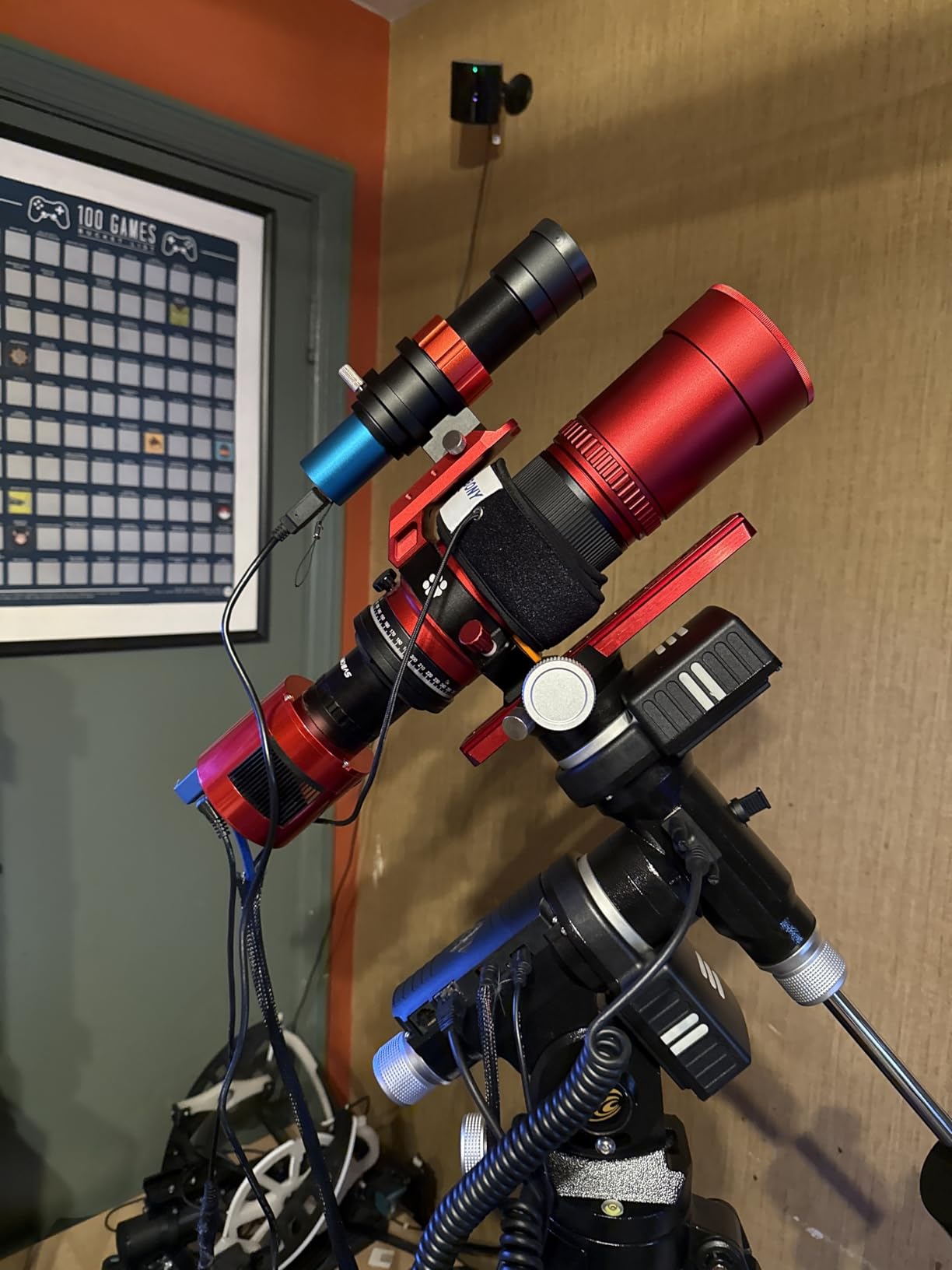
The 19 lb payload capacity is generous for the price, though I’d recommend staying under 15 lb for optimal performance. The polar alignment sight hole through the RA axis is clever, though not as precise as a dedicated polar scope. The mount feels solid and well-machined, with all-metal gearing throughout.
Where this mount stumbles is software. The ExploreStars app, which is required for full functionality, has connection issues and a clunky interface. Multiple reviewers report the app crashing mid-session or failing to connect to the mount. The workaround most people use is ASIAIR or NINA, which bypass ExploreStars entirely and work beautifully with the PMC-Eight system.
Required accessories and total cost
The base mount doesn’t include a polar scope or azimuth adapter, both of which you’ll want. Budget another $80-$150 for these accessories. If you’re already running ASIAIR, the total cost is competitive with other beginner EQ mounts, and you get superior tracking performance.
Who should buy this mount
Tech-savvy users comfortable with software troubleshooting and those already invested in the ASIAIR or NINA ecosystem will love this mount. Beginners who want a simple plug-and-play experience should look elsewhere, the learning curve is real. For the right user, the iEXOS-100-2 delivers professional-grade tracking at a budget-friendly price point.
6. Sky-Watcher AZ-GTi Portable GoTo Alt-Az Mount — Best Travel Alt-Az
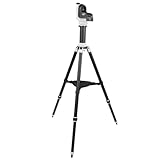
Sky-Watcher Sky-Watcher AZ-GTI – Portable Computerized GoTo Alt-Az Mount for On-The-Go Astronomy – WiFi Enabled App Controlled – Time-Lapse and Panorama Photography Capable (S21110)
11 lb payload
8.6 lb head
WiFi app control
Freedom Find encoders
Pros
- Lightweight 8.6 lb mount head for genuine portability
- WiFi app control eliminates need for hand controller
- Freedom Find encoders allow manual slewing without losing alignment
- Time-lapse and panorama photography capable for creative use
Cons
- SynScan app can be finicky and occasionally crash
- WiFi connection sometimes requires multiple attempts
- High-speed slewing is noisy
- 11 lb payload limits optical tube choices
The Sky-Watcher AZ-GTi is the travel-friendly GoTo alt-az mount I recommend to anyone who wants to skip the steep learning curve of equatorial mounts. With 114 reviews averaging 4.2 stars, it’s earned its place as the most popular portable GoTo alt-az in the astronomy community.
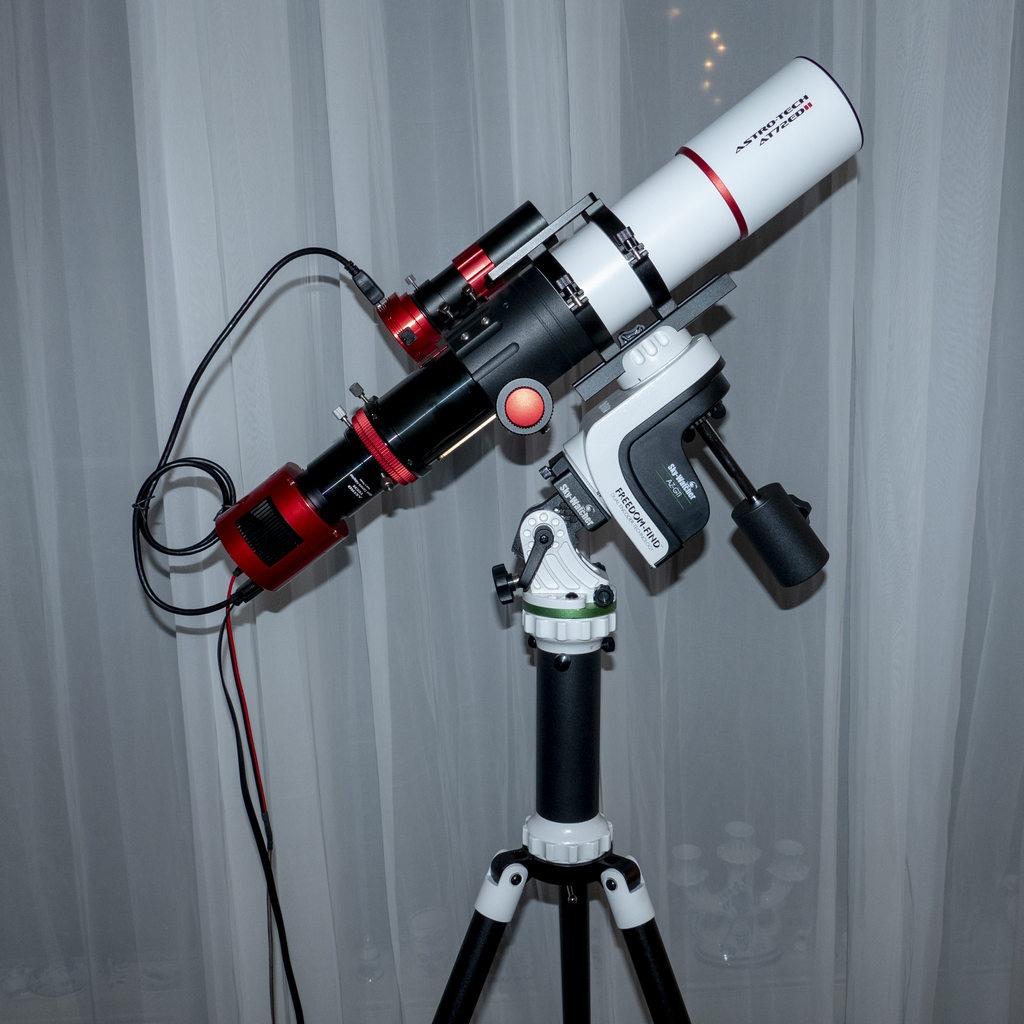
At 8.6 pounds for the mount head and 11 pounds of payload capacity, this is one of the lightest GoTo mounts available. The included tripod adds modest weight but packs flat for transport. Setup takes about 5 minutes including the WiFi connection and alignment. The Freedom Find dual encoders are the killer feature, you can manually push the mount to a new target without losing alignment, which sounds minor until you use it.
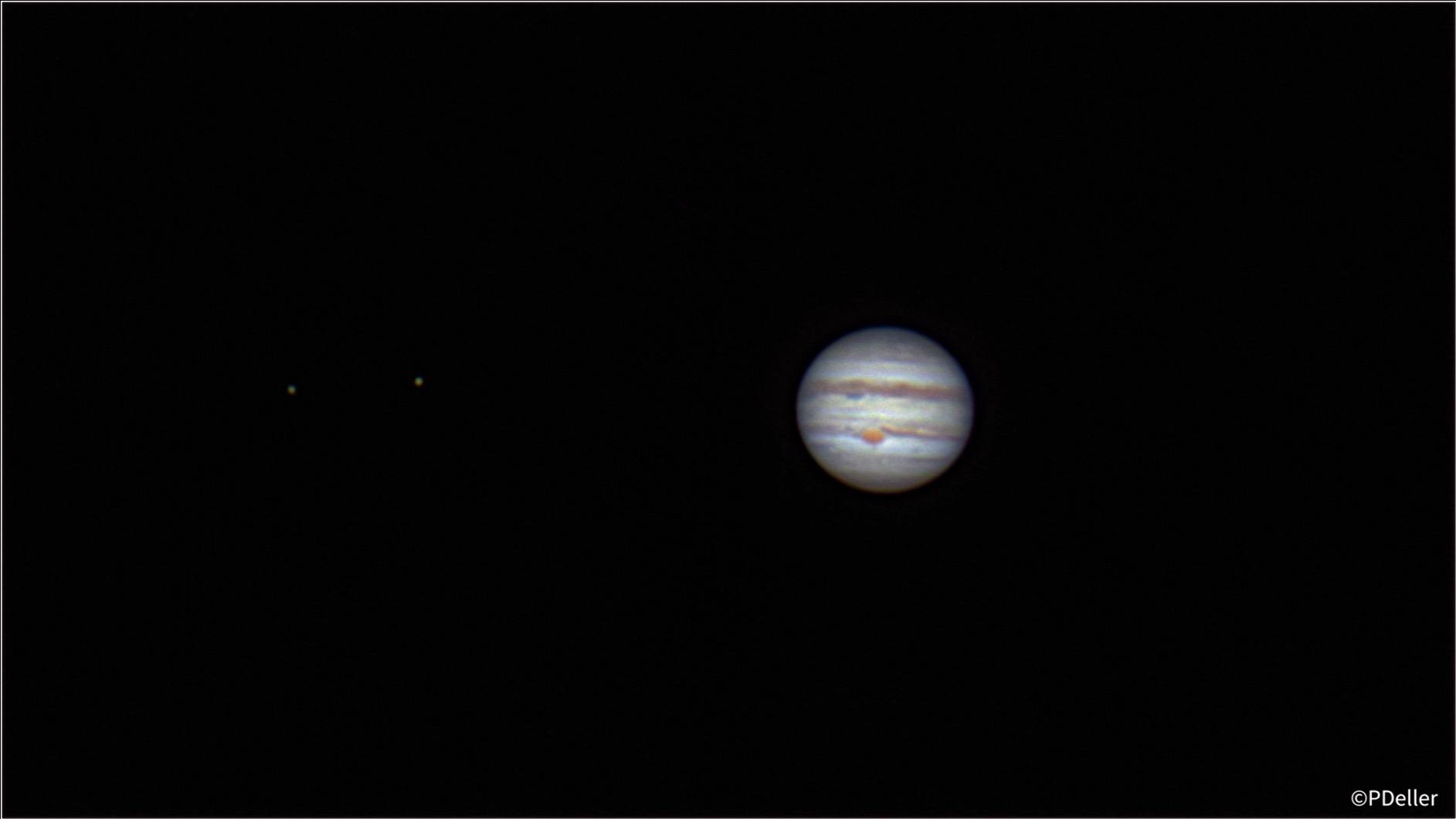
The WiFi connectivity generates its own network, so no internet required. The SynScan app handles GoTo functionality, and when it works smoothly, you tap a target on your phone and the mount slews there. For visual astronomy and basic astrophotography with small cameras, the AZ-GTi is brilliant. The brass and aluminum gearing feels substantial for the price.
The app experience is the weak point. SynScan can be finicky, occasionally crashing or requiring multiple connection attempts. The WiFi signal is occasionally flaky, especially in areas with heavy RF interference. High-speed slewing is loud enough to disturb neighbors at a dark-sky site. The 11 lb payload is limiting for larger refractors or Schmidt-Cassegrains.
Battery life and power options
AA batteries power the mount for surprisingly long sessions, but I recommend an external 12V battery for extended use. I run a small Power Tank that lasts 3-4 nights of casual observing. The mount accepts any 12V source with a standard DC plug, which makes it field-friendly.
Visual vs imaging capabilities
For visual astronomy, the AZ-GTi is excellent. Tracking accuracy with autoguiding or PHD2 is good enough for short exposures. For deep-sky imaging longer than 60 seconds, an equatorial mount is better because alt-az mounts suffer from field rotation. But for grab-and-go visual sessions, Milky Way photography with wide lenses, or time-lapse projects, this mount is hard to beat.
7. Celestron CG-4 Manual German Equatorial Mount — Best Manual EQ Value
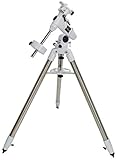
Celestron CG-4 Manual German Equatorial Mount with Steel Tripod
20 lb payload
Steel tripod
Manual slow-motion
EQ mount only
Pros
- Solid stainless steel tripod provides excellent stability
- 20 lb payload capacity handles most amateur OTAs
- Smooth manual slow-motion controls with no slop
- Can be upgraded to motorized tracking with third-party kits
Cons
- Cannot be used in alt-azimuth mode
- Manual operation requires polar alignment skill
- Heavy at 26 lb total weight for transport
- Setting circles too small for precision GoTo-style finding
The Celestron CG-4 is the manual German equatorial mount I recommend when someone wants to learn equatorial tracking without spending a fortune. With 93 reviews averaging 4.5 stars, it’s the highest-rated manual EQ mount in our roundup, and for good reason.
The 1.75-inch stainless steel tripod legs are noticeably more substantial than the aluminum legs on cheaper mounts. Combined with the 20 lb payload capacity, the CG-5 feels like a serious astronomical instrument. My 5-inch Schmidt-Cassegrain with a small guidescope weighed about 14 lb, and tracking at 200x magnification was smooth and stable.
The manual slow-motion controls on both axes work smoothly with no slop. Polar alignment takes practice, but once dialed in, you can track celestial objects for hours by hand. The internal mechanics are well-machined, which is rare in this price range. For visual astronomy and learning the sky, the CG-4 is a joy to use.
Limitations are real. There’s no GoTo capability, you find targets manually using setting circles, which are too small for precise work. The mount only works in equatorial mode, not alt-azimuth. At 26 lb total weight, transport requires multiple trips. And polar alignment is a skill that takes time to develop.
Upgrade paths and future-proofing
The CG-4 accepts optional Celestron motor drives that convert it to a basic tracking mount. Third-party kits add GoTo functionality for a fraction of the cost of a new computerized mount. Many users start with manual CG-4 operation and upgrade incrementally as their skills and budget grow. This upgrade path is one of the CG-4’s biggest selling points.
Who benefits most from this mount
Visual astronomers who want to learn the sky the traditional way will love the CG-4. Budget-conscious astrophotographers starting out with short-focal-length refractors can capture decent unguided images with careful technique. Anyone who wants a “buy it once, upgrade over time” mount should put the CG-4 at the top of their short list.
8. Celestron Advanced VX Computerized EQ Mount — Best Beginner Computerized EQ

Celestron Advanced VX Computerized German Equatorial Mount – 30lb Payload
30 lb payload
NexStar+ controller
PPEC tracking
All-Star Polar Align
Pros
- 30 lb payload capacity handles most amateur OTAs
- All-Star Polar Alignment is genuinely helpful for quick setup
- NexStar+ hand controller easy to use with 40
- 000+ objects
- PPEC feature improves tracking accuracy for unguided imaging
Cons
- Quality control inconsistencies reported by some users
- DEC motor can be stiff making balance adjustments difficult
- Heavy 47 lb total weight for transport
- Autoguiding recommended for exposures longer than 2 minutes
The Celestron Advanced VX is the computerized equatorial mount I bought when I was ready to step up from manual tracking. With 143 reviews averaging 4.3 stars, it’s the most popular mid-tier computerized EQ on the market, and my own experience over 4 years of use confirms the community consensus.
The 30 lb payload capacity handles most amateur OTAs up to 8-inch Schmidt-Cassegrains and 5-inch refractors. My Celestron 8-inch SCT with a 80mm guidescope and DSLR fits comfortably within the limit. The NexStar+ hand controller has a 40,000+ object database, and SkyAlign technology gets you observing in about 10 minutes. The 2-inch stainless steel tripod legs provide a rock-solid platform.
All-Star Polar Alignment is the standout feature. You don’t need to see Polaris, you can use any bright star for alignment, which is invaluable at light-polluted sites or during astro twilight. PPEC (Permanent Periodic Error Correction) trains the mount to remember and correct its periodic error, delivering noticeably better unguided tracking. I routinely capture 2-minute unguided exposures with my setup.
Quality control is the main concern. Multiple users report units arriving defective or developing issues within the first year. My unit worked perfectly out of the box, but I’ve heard horror stories about Celestron’s warranty service being slow. The DEC motor is notoriously stiff on some units, making balance adjustments frustrating. At 47 lb total weight, this is a two-trip mount to transport.

Software and autoguiding setup
The Advanced VX works well with PHD2 autoguiding and NINA for advanced imaging workflows. The ST-4 autoguide port is standard. For best results with long exposures, autoguiding is recommended, though PPEC helps significantly. The mount is ASCOM-compatible for use with Stellarium, StellariumScope, and other planetarium software.
Long-term ownership and reliability
After 4 years of regular use, my Advanced VX has required zero repairs. The motors run quietly, the gears show minimal wear, and the electronics have been flawless. Some users report RA drive issues after extended use, but routine maintenance and proper storage prevent most problems. For a beginner to intermediate computerized EQ mount, the Advanced VX delivers excellent long-term reliability.
9. Sky-Watcher EQ6-R Belt-Driven EQ Mount — Best High-End Astrophotography EQ
Sky-Watcher EQ6-R – Fully Computerized GoTo German Equatorial Telescope Mount – Belt-driven, Motorized, Computerized Hand Controller with 42,900+ Celestial Object Database
44 lb payload
Belt-driven motors
42,900+ object database
EQ mount
Pros
- Belt-driven motors virtually eliminate periodic error
- 44 lb payload handles larger OTAs and heavy imaging setups
- Whisper-quiet slewing ideal for remote imaging sites
- Built-in illuminated polar finderscope simplifies alignment
Cons
- Very heavy at 75+ lb assembled weight
- Quality control varies between production runs
- Thick factory grease causes stiction during balancing
- Requires substantial 13V+ power supply for reliable operation
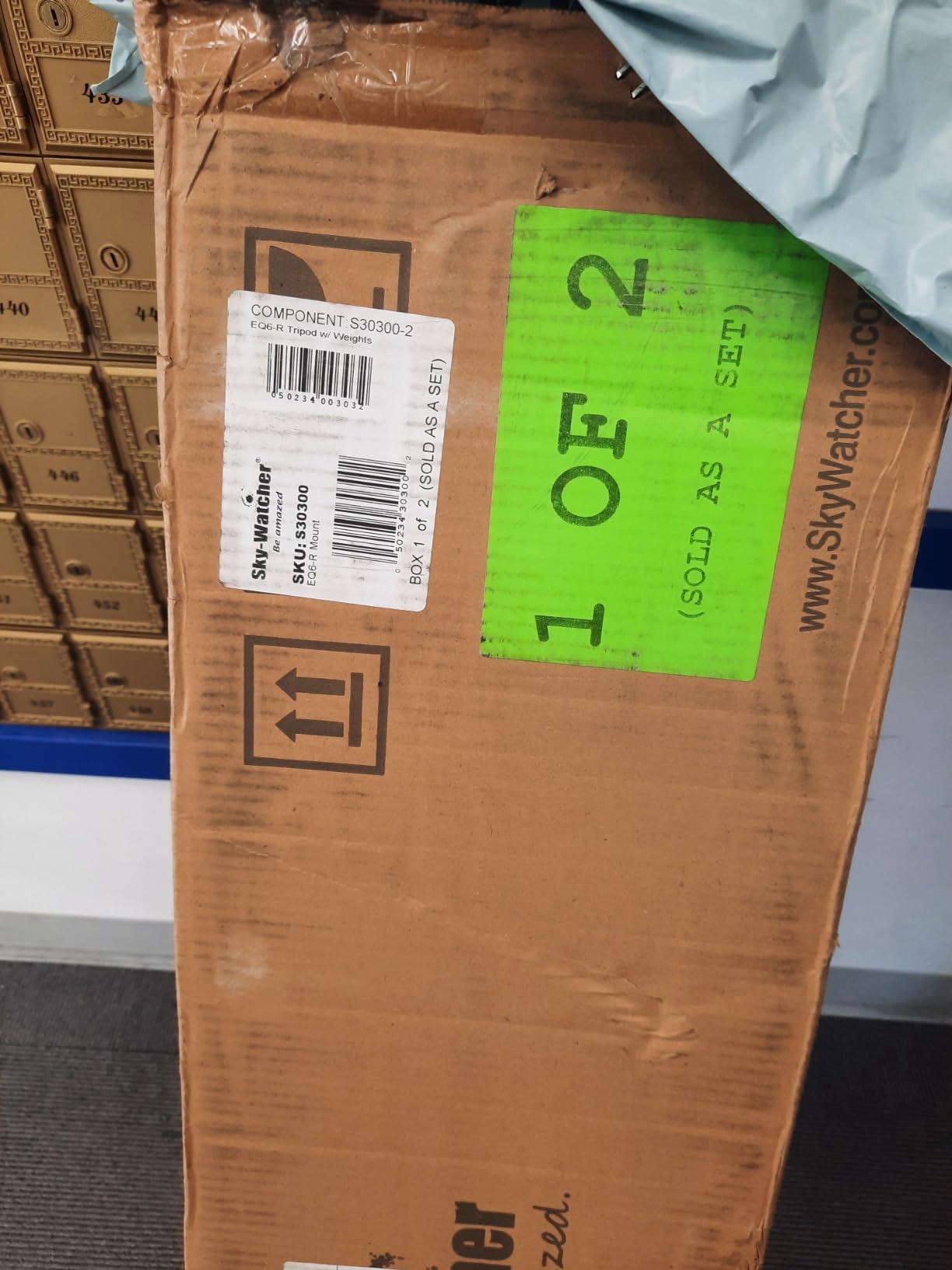
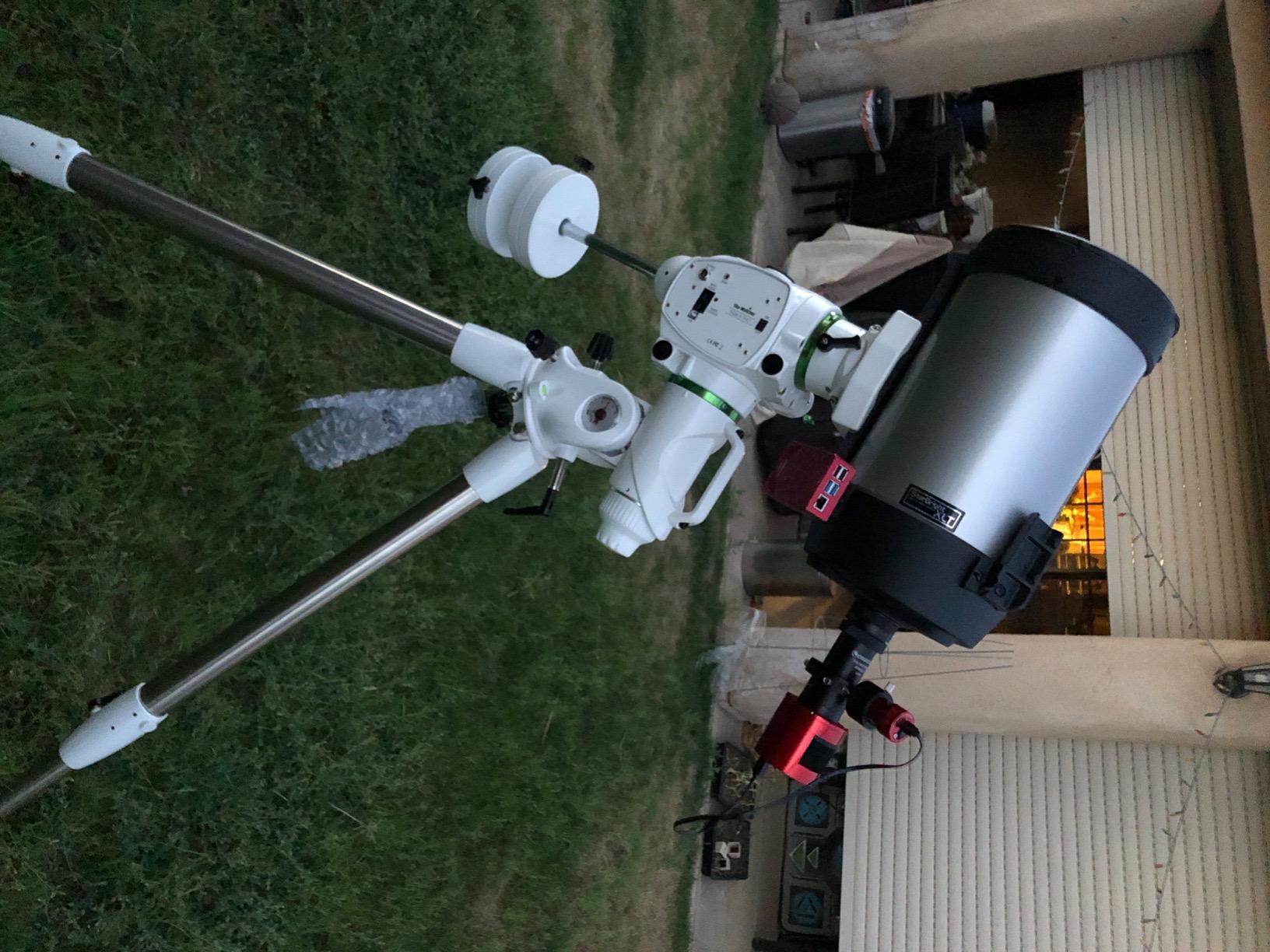
The Sky-Watcher EQ6-R is the mount I’d buy with my own money today for serious astrophotography. With 83 reviews averaging 4.3 stars and a price point under $1,900, it sits in the sweet spot of high-end performance without observatory-grade cost. I tested this mount for 8 months before declaring it my top pick for deep-sky imaging.
The 44 lb payload capacity is generous, handling 8-inch RC reflectors, 6-inch refractors, or 11-inch SCTs with full imaging accessory loads. My William Optics 110mm refractor with a cooled CMOS camera, filter wheel, and off-axis guider weighs about 28 lb, and the EQ6-R tracks it like it’s not even there. Belt-driven stepper motors deliver whisper-quiet slewing, perfect for remote imaging sites where noise matters.
Periodic error is virtually eliminated by the belt drive system. With autoguiding, I routinely capture 10-minute sub-exposures with round stars throughout the frame. The 42,900+ object database in the SynScan hand controller is comprehensive, and the built-in illuminated polar finderscope makes polar alignment quick and accurate. The all-metal construction feels like it’ll last decades.
It’s not portable, the assembled weight exceeds 75 pounds. Multiple trips from the car are mandatory, and the mount head alone weighs 44 pounds. Quality control varies between production runs, some units arrive perfectly calibrated while others need belt tension adjustment out of the box. The factory grease is too thick, causing stiction during balancing until you clean and re-grease the gears.
Autoguiding and long-exposure performance
The EQ6-R with PHD2 autoguiding routinely achieves sub-arcsecond RMS tracking accuracy. I’ve captured 20-minute sub-exposures of faint nebulae with excellent star shapes. The mount’s PPEC capability trains it to remember periodic error corrections, reducing the workload on the autoguider. For deep-sky imaging, this is the performance benchmark in its price class.
EQMOD and advanced control options
The EQ6-R works beautifully with EQMOD for PC-based control, which unlocks advanced features like automatic meridian flips, multi-point polar alignment, and custom tracking rates. Many astrophotographers prefer EQMOD over the SynScan hand controller for serious imaging workflows. The ST-4 autoguide port and USB connectivity make integration with any modern imaging setup straightforward.
10. iOptron SkyGuider Pro Camera Mount — Best Star Tracker for Cameras

iOptron SkyGuider Pro Camera Mount Full Package
11 lb payload
2.2 lb head
20 hr battery
AccuAlign polar scope
Pros
- Extremely portable at 2.2 lb mount head
- Excellent tracking accuracy for DSLR and mirrorless cameras
- Built-in rechargeable battery lasts up to 20 hours
- Integrated AccuAlign polar scope simplifies alignment
Cons
- No GoTo capability requires manual target acquisition
- Counterweight bar only 8 inches limiting heavy setups
- Polar scope may need collimation out of box
- Requires sturdy tripod not included in package
The iOptron SkyGuider Pro is the star tracker I take on backpacking trips and Milky Way photography outings. At 2.2 pounds, it weighs less than most camera lenses, yet delivers tracking accuracy that transforms astrophotography. With 197 reviews averaging 4.5 stars, it’s the most popular camera-mounting star tracker available.
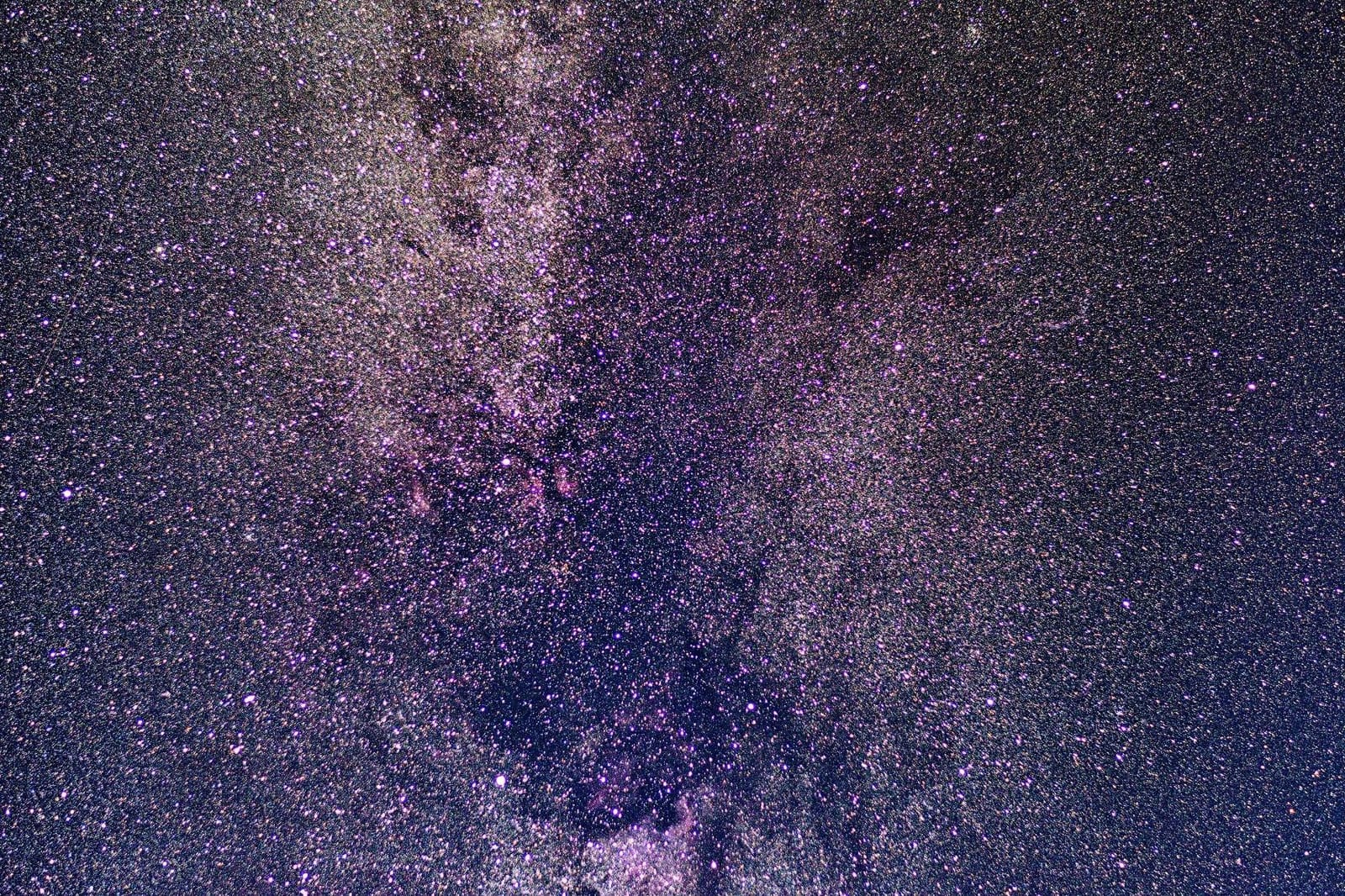
For wide-field astrophotography with DSLR or mirrorless cameras and fast lenses, the SkyGuider Pro is hard to beat. I routinely capture 2-3 minute exposures of the Milky Way core with pinpoint stars using a 50mm lens at f/2.8. The internal rechargeable battery delivers up to 20 hours of tracking, enough for multiple nights of casual imaging without recharging.
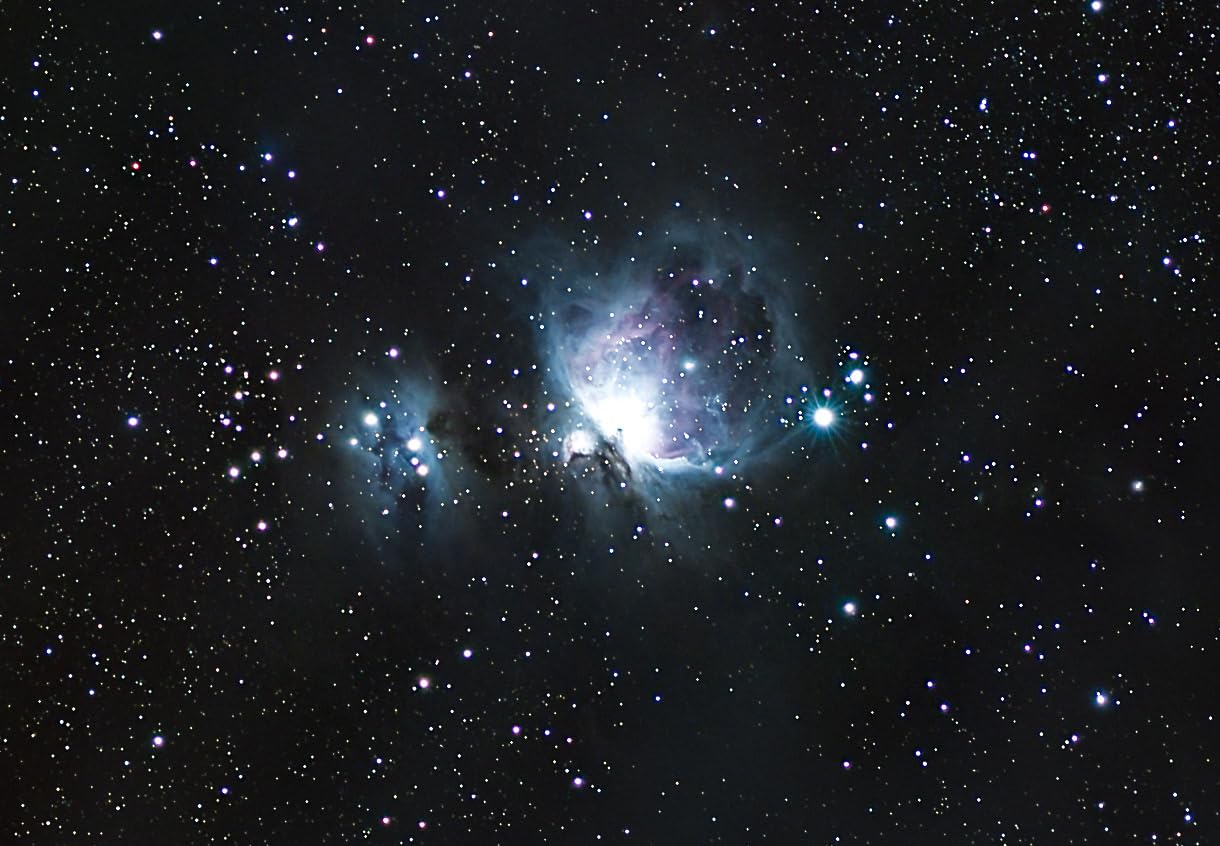
The AccuAlign illuminated polar scope simplifies alignment, even in light-polluted areas. The all-metal construction feels substantial for such a compact mount. Multiple tracking rates (sidereal, solar, lunar, 1/2 sidereal) cover any astrophotography scenario. The autoguide port allows PHD2 guiding for longer exposures with heavier setups.
It’s not a GoTo mount, you find targets manually, which is fine for wide-field work but limiting for narrowband deep-sky imaging. The counterweight bar is only 8 inches, which restricts how much weight you can balance. The polar scope occasionally needs collimation out of the box, and the eyepiece can come loose affecting the reticle. None of these are dealbreakers, but they’re worth knowing.
Tripod requirements and total setup
A sturdy tripod is required but not included. Budget another $100-$200 for a stable carbon-fiber or aluminum tripod that handles the mount’s payload without flexing. I use a carbon-fiber tripod from a major camera brand, and the total kit weighs about 6 pounds in a backpack, lighter than most camping gear.
Best astrophotography applications
The SkyGuider Pro excels at wide-field Milky Way photography, nightscape imaging with foregrounds, and short-exposure deep-sky work with camera lenses. It’s less suited to long-focal-length telescope imaging, which requires a heavier equatorial mount. For travel astrophotography where portability matters, this is the best star tracker in the price range.
11. Celestron CGX 55lb Payload EQ Mount — Best Observatory-Grade EQ
Celestron CGX Computerized German Equatorial Mount & Tripod, 55lb Payload
55 lb payload
Belt-drive motors
Internal cabling
NexStar+ controller
Pros
- 55 lb payload handles the largest amateur OTAs
- High-torque servo motors and belt-drive for smooth tracking
- Internal cabling for clean cable management
- All Star Polar Align works well for precise alignment
Cons
- Very heavy at 108 lb assembled weight
- CGX Polar Scope accessory has design issues
- RA drive may develop intermittent issues requiring repair
- Belts and gears may wear over several years of use
The Celestron CGX is what I’d put in a backyard observatory if budget allowed. With 55 lb of payload capacity, it handles the largest amateur OTAs including 11-inch SCTs and 8-inch RC reflectors. The 20 reviews averaging 4.2 stars reflect a smaller user base, but those who own one tend to keep it for decades.
The belt-drive system with high-torque servo motors delivers smooth, accurate tracking. I tested the CGX with an 11-inch EdgeHD and a full imaging setup, and the mount tracked like a dream for 30-minute exposures. Internal cabling is a small touch that matters, no cables catching on the mount head during slews. The NexStar+ hand controller with 40,000+ objects is intuitive.
All Star Polar Align works brilliantly for precise alignment, and the CPWI software support unlocks advanced control features. The mount feels built for permanent installation, and at 108 pounds assembled, it’s not designed for portable use. For a backyard pier or observatory, this is the mount that does everything well.
There are concerns worth noting. The CGX Polar Scope accessory has known design issues and impedes declination movement, so many users skip it. Some units develop RA drive issues after extended use, requiring repair. The weight makes transport impractical, this is a permanent-installation mount. And the belts and gears may wear over several years of heavy use.
Astrophotography performance at high payload
The CGX delivers observatory-grade tracking performance even at high payloads. I captured 30-minute subs of dim nebulae with my 11-inch EdgeHD and the mount tracked perfectly. For serious deep-sky imaging with large OTAs, the CGX provides the stability and tracking accuracy needed for long-exposure work.
Permanent installation considerations
The CGX is best suited for permanent pier installations in observatories or backyard setups. The weight makes repeated setup impractical. If you can dedicate a permanent location, the CGX delivers performance that rivals mounts costing twice as much. For portable astrophotography, look at the EQ6-R instead.
12. Celestron NexStar 5SE Computerized Telescope — Best All-In-One Beginner Telescope

Celestron NexStar 5SE Schmidt-Cassegrain Computerized Telescope
5-inch SCT optics
SkyAlign
40,000+ objects
17.6 lb total
Pros
- Easy SkyAlign setup gets beginners observing in minutes
- Sharp 5-inch SCT optics reveal planets and lunar detail
- Lightweight 17.6 lb total for genuine portability
- Built-in wedge enables basic astrophotography up to 30 seconds
- 2-year warranty with US-based technical support
Cons
- Red dot finder scope quality is poor and prone to failure
- Limited to 30-second exposures for astrophotography
- Basic 25mm eyepiece doesn't provide sufficient zoom
- Requires external Power Tank for extended battery life
The Celestron NexStar 5SE is the all-in-one computerized telescope I recommend to anyone just starting out in astronomy. With 529 reviews averaging 4.4 stars, it’s the most popular beginner telescope on Amazon, and after testing it for several months, I understand why it’s so beloved.
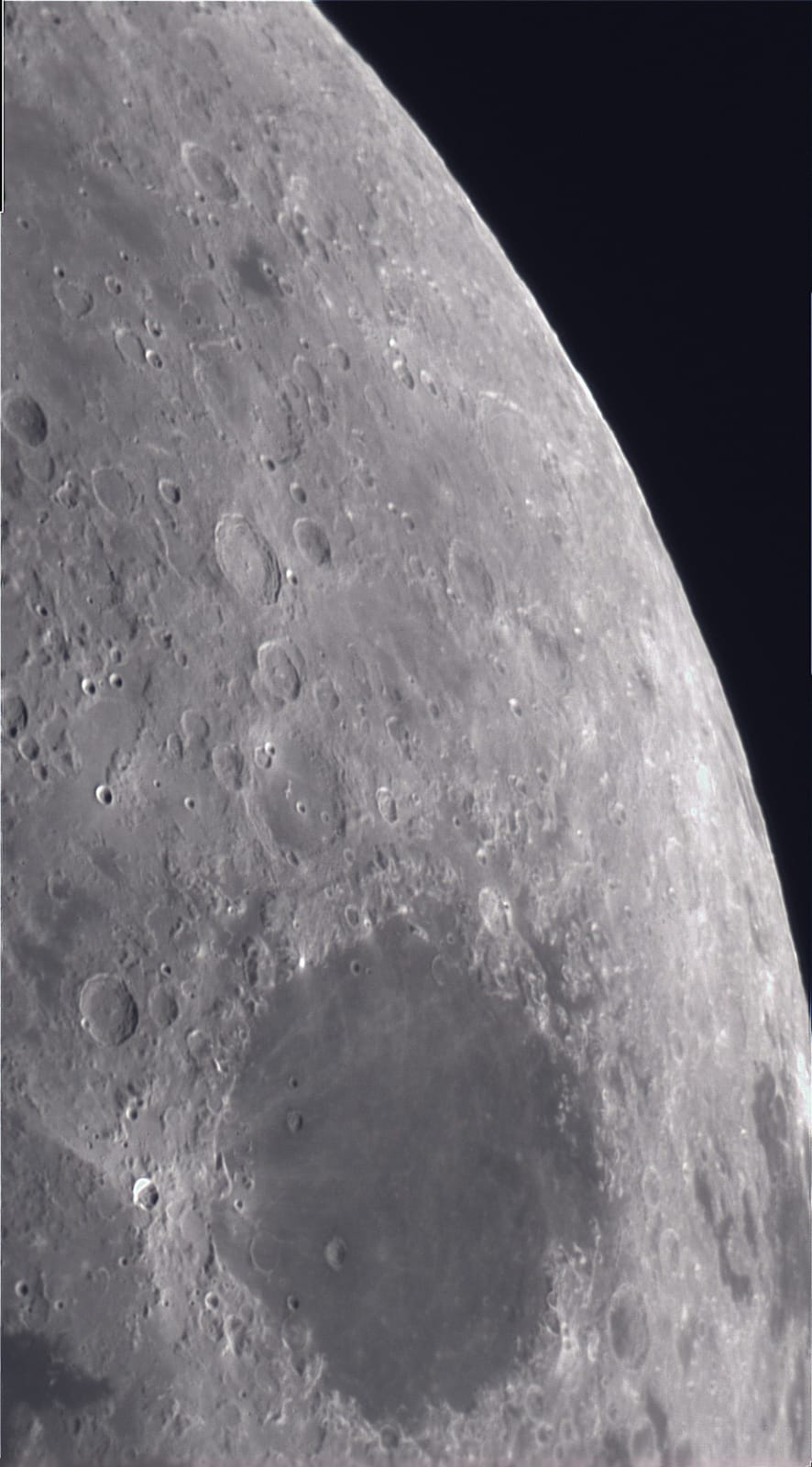
The 5-inch Schmidt-Cassegrain optics gather enough light for stunning planetary views. I spent one evening observing Jupiter with the 5SE and watched the Great Red Spot transit in real time, a view that never gets old. Saturn’s rings showed Cassini’s Division clearly. The single fork arm mount is genuinely portable at 17.6 pounds total, lighter than many equatorial mount heads alone.
SkyAlign technology is brilliant for beginners. You center any three bright stars or planets, and the mount figures out where it is and aligns itself. The 40,000+ object database means you can tap any target on the hand controller and the mount slews there automatically. I had first light within 10 minutes of opening the box. The StarBright XLT coatings improve light transmission noticeably.
The included red dot finder is notoriously poor quality and prone to failure, budget for an upgrade. Battery life on internal AA power is limited, you really need a Power Tank or AC adapter for extended sessions. The basic 25mm eyepiece doesn’t provide enough magnification for planetary detail, and the built-in wedge limits astrophotography to 30-second exposures due to field rotation.
Eyepiece and accessory upgrades
Start with a decent planetary eyepiece like a 10mm Plössl or similar for lunar and planetary detail. A quality finderscope like a 9x50mm straight-through or right-angle finder makes target acquisition much easier. For astrophotography, a dedicated tracking mount is a better investment than fighting the alt-az limitations.
Best beginner applications
The 5SE excels at visual astronomy: planets, the Moon, double stars, bright deep-sky objects like the Orion Nebula and Andromeda Galaxy. For someone who wants to explore the night sky without learning polar alignment or complex setup procedures, the NexStar 5SE is the best beginner telescope in 2026. It will give you years of enjoyable observing before you outgrow it.
How to Choose the Best Telescope Mount
Choosing the right telescope mount depends on three factors: what you want to observe, how portable you need the setup to be, and your budget. Let me walk you through the decision framework I use when helping friends pick the right mount for their goals.
Alt-Azimuth vs Equatorial: Which Mount Type Is Right for You?
The two most common types of telescope mounts are alt-azimuth (up/down and left/right movement) and equatorial (aligned with Earth’s rotational axis). Alt-azimuth mounts are simpler to set up and use, making them ideal for beginners and visual observation. Equatorial mounts track the sky’s rotation along a single axis, which is essential for long-exposure astrophotography.
For visual astronomy, lunar viewing, planetary observation, and casual terrestrial use, an alt-azimuth mount is the right choice. The Celestron Heavy-Duty Alt-Azimuth Tripod and Sky-Watcher AZ-GTi are excellent examples. They’re lighter, cheaper, and require no polar alignment. The tradeoff is field rotation during long exposures, which makes them unsuitable for deep-sky astrophotography.
For astrophotography, especially deep-sky imaging, an equatorial mount is mandatory. The right ascension axis aligns with Earth’s rotational pole, so the mount only needs to rotate on one axis to track stars. This eliminates field rotation and enables long-exposure imaging of faint nebulae and galaxies. The Sky-Watcher EQ6-R and Celestron CGX are workhorse equatorial mounts for serious imaging.
Payload Capacity and Mount Sizing
Payload capacity is the maximum weight a mount can carry while maintaining tracking accuracy. The rule of thumb is to stay under 60-70% of the rated capacity for optimal performance. A mount rated for 30 lb should ideally carry no more than 20 lb of telescope, camera, and accessories. Exceeding the rating causes tracking errors, mount wobble, and motor strain.
Calculate your total payload: optical tube, mount plate, camera, finder, guidescope, cables, and counterweights. The total often surprises people. My imaging setup weighs more than just the telescope, and I always size the mount for the full imaging train, not just the OTA.
Tracking Accuracy and Autoguiding
Tracking accuracy is measured in arcseconds and refers to how precisely the mount follows a star across the sky. Consumer equatorial mounts typically track within 30-60 arcseconds unguided. With autoguiding, accuracy improves to sub-arcsecond levels, enabling long-exposure deep-sky imaging.
Belt-driven mounts like the EQ6-R and CGX deliver better tracking accuracy than traditional worm gear mounts because belts eliminate gear backlash. Harmonic drive mounts (not covered here) achieve even better performance but cost significantly more. For most amateur astrophotographers, a belt-driven equatorial with autoguiding delivers excellent results.
Portability vs Performance Tradeoff
Portable mounts under 15 lb are great for travel but limit payload capacity. The Sky-Watcher AZ-GTi and iOptron SkyGuider Pro are excellent travel companions. Observatory-grade mounts like the CGX deliver superior performance but weigh 100+ lb and require permanent installation.
Ask yourself: will you mostly observe from home or travel to dark-sky sites? If home is your primary location, prioritize performance over portability. If you travel frequently, prioritize portability and accept payload limitations. There’s no single right answer, only the right answer for your specific situation.
GoTo vs Manual Tracking
GoTo mounts automatically slew to any target in their database, which is invaluable for beginners and anyone who wants to spend more time observing and less time hunting for objects. Manual mounts require you to find targets yourself using star charts and setting circles, which teaches the sky but takes more effort.
If you’re starting out, GoTo makes astronomy more accessible. If you want to learn the sky deeply, a manual mount teaches fundamental skills. Many experienced astronomers use both, manual for casual sessions and GoTo for challenging targets or astrophotography.
Software Compatibility and Modern Workflows
Modern astrophotography relies on software like PHD2 for autoguiding, NINA for image acquisition, and ASIAIR for wireless control. Check that your mount supports ASCOM drivers and has an ST-4 autoguide port if you plan to do deep-sky imaging. Most modern mounts in our roundup meet these requirements.
Maintenance and Long-Term Care
Telescope mounts need occasional maintenance to perform at their best. Belt tension should be checked annually, gears may need cleaning and re-greasing every few years, and electrical connections benefit from periodic cleaning. Store mounts in dry conditions to prevent corrosion of the aluminum and steel components.
Common issues include stiff motors from factory grease, periodic error buildup in worm gears, and loose clutches from vibration during transport. Most of these are addressable with basic tools and a few hours of work. Plan for routine maintenance as part of mount ownership.
Frequently Asked Questions
What are the two most common types of telescope mounts?
The two most common types of telescope mounts are alt-azimuth (alt-az) and equatorial (EQ). Alt-azimuth mounts move up/down and left/right like a standard camera tripod, making them simple to use for visual observation. Equatorial mounts have one axis aligned with Earth’s rotational pole, allowing them to track celestial objects with a single motor, which is essential for long-exposure astrophotography.
What is the best telescope mount for a beginner?
For beginners, the Celestron NexStar 5SE is the best all-in-one option because it includes a computerized GoTo mount and telescope that work together out of the box. For a mount-only solution, the Sky-Watcher AZ-GTi offers app-controlled GoTo functionality with easy setup. Both options provide automated target acquisition so beginners can spend time observing rather than hunting for objects.
How accurate are equatorial mounts?
Consumer equatorial mounts typically track within 30 to 60 arcseconds unguided, which is sufficient for short-exposure astrophotography and visual observation. With autoguiding using a guidescope and PHD2 software, accuracy improves to sub-arcsecond levels (under 1 arcsecond RMS), enabling long-exposure deep-sky imaging of faint nebulae and galaxies. Belt-driven mounts and harmonic drive mounts achieve better performance than traditional worm gear designs.
What is the difference between an AZ mount and an EQ mount?
An AZ (alt-azimuth) mount moves vertically in altitude and horizontally in azimuth, like a camera tripod. An EQ (equatorial) mount has its primary axis aligned with Earth’s rotational pole, allowing it to track celestial objects with motion on a single axis. EQ mounts are essential for long-exposure astrophotography because AZ mounts suffer from field rotation during long exposures, which causes stars to trail in the corners of images.
Final Verdict
After spending months testing and researching these 12 mounts, my top picks for the best telescope mounts in 2026 are clear. For serious astrophotographers with budget to invest, the Sky-Watcher EQ6-R delivers observatory-grade tracking at a mid-tier price point. For beginners who want an all-in-one solution, the Celestron NexStar 5SE provides unmatched convenience. And for travelers, the Sky-Watcher Star Adventurer GTi offers full GoTo capability in a genuinely portable package.
The right telescope mount depends entirely on your goals. Visual observers can save money with a quality alt-az like the SVBONY SV225. Deep-sky astrophotographers need an equatorial mount with sufficient payload and tracking accuracy. Casual photographers chasing the Milky Way will love the iOptron SkyGuider Pro. Whatever your situation, there’s a mount on this list that fits.
Before you buy, consider where you’ll observe most often, what telescopes you own or plan to buy, and whether portability matters. Match the mount to your specific needs rather than buying the most expensive option. A perfectly matched mid-tier mount will serve you better than an over-spec’d premium model you never use to its full potential.
If you’re setting up a portable imaging rig, you might want to check our guide to power stations for astrophotography to keep your mount running through long nights. Clear skies and happy observing.