
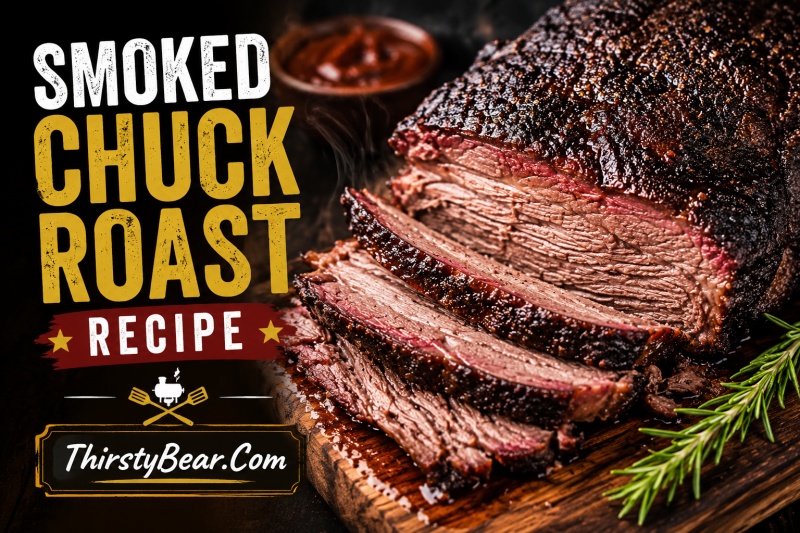
Smoked chuck roast delivers brisket-quality results without the brisket price tag or the stress. This cut comes from the shoulder section of the cow, loaded with rich beef flavor and enough connective tissue to create that melt-in-your-mouth texture when cooked low and slow.
I have smoked dozens of these over the past three years, and chuck roast has become my go-to recommendation for anyone starting their BBQ journey. It is forgiving, affordable, and feeds 4-6 people perfectly.
This smoked chuck roast recipe walks you through every step from selection to slicing. You will learn the exact temperatures, timing per pound, wrapping technique, and even which beers pair best with your finished roast.
Table of Contents
Quick Reference: Smoked Chuck Roast at a Glance
Smoke a chuck roast at 225-275°F for approximately 1.5 to 2 hours per pound until the internal temperature reaches 195-205°F. Wrap the roast in butcher paper once it hits 160-170°F internal to push through the stall while preserving your bark.
Rest the finished roast for 1-2 hours minimum before slicing. This allows juices to redistribute and collagen to set properly.
Best wood choices: Oak, hickory, or pecan. Oak gives the cleanest smoke flavor, hickory adds intensity, and pecan offers a milder, slightly sweet profile that works well for beginners.
Why Choose Chuck Roast Over Brisket
Chuck roast costs roughly one-third the price of brisket per pound. While a whole brisket can run you $50-80, a quality 4-pound chuck roast typically costs $15-25.
The real advantage is forgiveness. Brisket demands precise temperature control, careful trimming, and nerves of steel during the stall. Chuck roast needs none of that. You do not trim it. You do not babysit it. It powers through the stall faster and rarely dries out if you follow basic guidelines.
Size matters too. A full brisket feeds 15-20 people. Chuck roast feeds 4-6, making it ideal for family dinners or small gatherings without days of leftovers.
Selecting the Right Chuck Roast
Grade Matters More Than You Think
Choose Choice grade or higher. Select grade lacks the intramuscular fat needed for juicy results, and you will end up with dry, chewy meat regardless of your technique. Prime grade offers the best marbling but costs more. Choice hits the sweet spot for most home cooks.
Size and Shape
Target 3 to 5 pounds for optimal results. This size cooks evenly, retains moisture well, and fits most standard smokers without crowding. Avoid roasts under 3 pounds unless you read the troubleshooting section below. Small roasts behave differently and require modified techniques.
Look for uniform thickness. A roast that is 3 inches thick on one end and 5 inches on the other will cook unevenly. Flat, rectangular cuts work better than round, ball-shaped roasts.
Understanding the Fat
Chuck roast contains two types of fat. Intramuscular fat (marbling) melts during cooking and keeps the meat juicy. Intermuscular fat (the thick white seams between muscle groups) does not fully render and can create greasy pockets. Some fat between muscles is normal, but avoid roasts with massive fat deposits thicker than your thumb.
Ingredients and Equipment
What You Need
The Roast:
- 1 beef chuck roast (3-5 lbs, Choice grade or higher)
- 2 tablespoons yellow mustard (binder)
- 1/4 cup beef tallow or olive oil (optional, for added moisture)
Texas-Style Dry Rub:
- 2 tablespoons kosher salt
- 2 tablespoons coarse black pepper
- 1 tablespoon garlic powder
- 1 tablespoon onion powder
- 1 teaspoon paprika (optional, for color)
Equipment:
- Smoker (pellet grill, offset, or kettle with snake method)
- Reliable probe thermometer (wireless preferred)
- Pink butcher paper (not foil, not parchment)
- Spray bottle with water or apple juice
- Water pan (optional but recommended)
Mix the rub ingredients thoroughly. Store extra rub in an airtight container for up to six months.
How to Smoke a Chuck Roast: Step-by-Step
Step 1: Prep the Roast
Remove the roast from packaging and pat completely dry with paper towels. Moisture is the enemy of bark formation. If you have time, let the roast sit uncovered in the refrigerator overnight. This dry surface creates better smoke adhesion.
Apply a thin layer of yellow mustard as a binder. You will not taste it after cooking. It simply helps the rub stick and creates a tacky surface for bark development.
Season generously with your dry rub. Cover every surface including the sides and ends. Press the rub in firmly so it adheres. Let the roast sit at room temperature for 30-60 minutes while you fire up the smoker.
Step 2: Set Up Your Smoker
Preheat your smoker to 250°F. This temperature hits the sweet spot between speed and quality. You can go as low as 225°F for more smoke flavor or as high as 275°F if you are pressed for time.
Add your wood. For pellet grills, fill the hopper with oak, hickory, or pecan pellets. For offset smokers, use splits or chunks of the same woods. Avoid mesquite unless you want an intense, almost bitter smoke flavor.
Place a water pan in the smoker if you have room. This adds humidity, helps bark formation, and stabilizes temperature. Use hot water to avoid temperature drops when you add it.
Step 3: Smoke Until Bark Sets
Place the roast directly on the grates, fat cap up or down depending on your smoker type. On offset smokers, fat cap down protects the meat. On pellet grills, fat cap up lets the rendered fat baste the meat.
Insert your probe thermometer into the thickest part of the roast, avoiding fat pockets. Close the lid and let it smoke.
Spritz with water or apple juice after 2 hours if the surface looks dry. You want the bark dark and firm, not black and crunchy. The first 3-4 hours build your bark foundation. Do not rush this phase.
Step 4: Wrap at 160-170°F
Once the internal temperature hits 160-170°F, the roast enters the stall. Collagen begins converting to gelatin, evaporative cooling kicks in, and the temperature stops climbing. This is normal and expected.
Remove the roast and wrap tightly in pink butcher paper. The paper breathes, allowing steam to escape while protecting the bark from softening. Foil traps steam and turns your bark into mush. Never use foil for this cook.
Return the wrapped roast to the smoker immediately.
Step 5: Power Through to Final Temperature
Continue smoking until the internal temperature reaches your target. For sliced brisket-style servings, pull at 195-200°F. For pulled or chopped beef, go to 203-205°F.
Temperature alone is not enough. Test for probe tenderness by sliding your thermometer probe into the meat. It should slide in with little resistance, like pushing through softened butter. If you feel significant resistance, keep cooking.
Total cook time typically runs 6-9 hours for a 4-pound roast at 250°F.
Step 6: Rest Properly
Transfer the wrapped roast to a cooler or oven set to 170°F. Let it rest for at least 1 hour, preferably 2 hours. This is not optional. Resting allows juices to redistribute and collagen to firm up just enough for clean slicing.
If you slice too early, juices run everywhere and the meat falls apart. If you rest properly, you get clean slices that hold together while staying incredibly moist.
Temperature and Timing Guide
Smoker Temperature Comparison
225°F (Low and Slow):
Produces the deepest smoke flavor and darkest bark. Expect 2 hours per pound. A 4-pound roast takes roughly 8 hours total. Best for weekend cooks when time is not a constraint.
250°F (The Sweet Spot):
Balances smoke absorption with reasonable cook times. Expect 1.5 hours per pound. A 4-pound roast finishes in 6-7 hours. This is my default temperature for most cooks.
275°F (Hot and Fast):
Reduces cook time significantly with minimal quality loss. Expect 1.25 hours per pound. A 4-pound roast takes 5-6 hours. Bark may be slightly lighter, but the meat stays juicy. Ideal for small roasts under 3 pounds.
Key Temperature Milestones
- 160-170°F: The stall begins. Wrap in butcher paper now to protect bark and push through faster.
- 195-200°F: Slicing temperature. The meat holds together for brisket-style slices.
- 203-205°F: Pulling temperature. The meat falls apart easily for chopped beef sandwiches or tacos.
- Rest: Hold at room temperature or in a cooler for 1-2 hours before serving.
Butcher Paper vs Foil vs Parchment: Which Wrap Wins
Pink butcher paper is the gold standard for smoked chuck roast. It breathes, allowing steam to escape while protecting the meat from drying out. Your bark stays firm and develops that perfect bite-through texture.
Aluminum foil traps every bit of moisture and steam. The result is soft, pot-roast texture rather than BBQ bark. Some pitmasters call foil-wrapped meat “foil boiled” because that is essentially what happens. Avoid foil unless you absolutely must speed up the cook.
Parchment paper works in a pinch if you cannot find butcher paper. It breathes less than butcher paper but more than foil. Unbleached parchment is preferable to bleached white parchment.
Buy genuine pink/peach butcher paper labeled “unwaxed” and “uncoated.” Craft paper, freezer paper, or waxed paper will ruin your meat. Look for paper specifically sold for BBQ purposes from restaurant supply stores or online retailers.
Small Roast Troubleshooting: Under 3 Pounds
Small chuck roasts behave counterintuitively. You would expect a 2-pound roast to cook in half the time of a 4-pound roast. Reality is closer to 70-80% of the time, not 50%.
The problem is moisture loss. Small roasts have more surface area relative to their volume. They lose moisture faster, which actually slows cooking because evaporative cooling becomes more aggressive. The meat can stall harder and longer than larger cuts.
Solutions for Small Roasts
Wrap earlier. Instead of waiting for 160-170°F, wrap at 140-150°F to preserve moisture before the stall hits hard.
Consider the hot-and-fast method at 275°F. The higher temperature compensates for evaporative cooling and pushes through the stall faster.
Add a water pan if you were skipping it. Extra humidity helps small roasts retain moisture.
Monitor closely after wrapping. Small roasts can jump from 170°F to 200°F quickly once the stall breaks. Check every 30 minutes rather than every hour.
Rest for the full 1-2 hours regardless of roast size. Small roasts need this rest period just as much as large ones.
Slicing and Serving Your Smoked Chuck Roast
Finding the Grain
Chuck roast contains multiple muscle groups with different grain directions. Look closely at the meat surface before slicing. You will see lines running in a specific direction. Slice perpendicular to those lines.
If you slice with the grain, you get stringy, chewy bites. Against the grain gives you tender slices that pull apart easily.
Slicing vs Chopping vs Pulling
For brisket-style service, slice 1/4 to 1/2 inch thick. Pull at 195-200°F for best slicing results.
For chopped beef sandwiches, cook to 203-205°F and chop roughly with a chef’s knife or meat cleaver. Mix in some of the rendered fat and juices for moisture.
For pulled beef tacos, cook to 205°F and use two forks to shred. The meat should fall apart with minimal effort.
If you have leftover smoked chuck roast, learning how to reheat leftover smoked beef properly keeps it juicy for days.
What Beer to Pair with Smoked Chuck Roast
Smoked beef demands beers that can stand up to intense flavors without overwhelming them. The right pairing enhances both the meat and the beer.
Smoky Porters and Rauchbiers
These beers echo the smoke in your meat and create a harmonious flavor profile. German rauchbier, made with smoked malt, pairs beautifully with oak-smoked chuck roast. The smoke flavors compound rather than compete.
American smoked porters offer similar synergy with more roasted malt character. Serve at 50-55°F to let the smoke flavors bloom.
Amber and Vienna Lagers
When you want contrast rather than complement, reach for an amber lager. The malt sweetness balances the savory beef while the carbonation cleanses your palate between bites.
Vienna lagers offer toast and caramel notes that work with the bark on your roast. These are crowd-pleasers that suit guests who prefer lighter beers.
IPAs with Restraint
Avoid aggressive double IPAs that blast your taste buds. Look for West Coast IPAs with citrus and pine notes or New England IPAs with tropical fruit character. The bitterness cuts through fat while the fruit flavors add brightness.
Our guide to the best dark beers for stout and porter fans has specific recommendations that pair perfectly with smoked beef.
Serve all beers at proper temperature. Too cold and you miss the flavors. Too warm and they feel flat. Aim for 45-50°F for lagers and 50-55°F for ales and porters.
Side Dishes That Complete the Meal
Classic BBQ sides work perfectly with smoked chuck roast. Smoked mac and cheese carries the smoky theme through the entire meal. The richness complements the beef without competing.
Creamy coleslaw provides essential crunch and acidity. The cool, crisp texture contrasts the tender, rich meat. Vinegar-based slaw cuts through fat better than mayonnaise-heavy versions.
Potato salad is a must for any proper BBQ plate. Use Yukon Gold potatoes for the best texture. Dress them while warm so they absorb the flavors fully.
Do not forget pickles and white bread. The acidity of dill pickles resets your palate. White bread soaks up juices and makes instant sandwiches.
Planning a full BBQ spread? Check our BBQ drink station ideas for setup tips that impress your guests.
Leftover Smoked Chuck Roast Ideas
Leftovers rarely last long in my house, but when they do, I have favorite ways to use them.
Chopped beef sandwiches are the obvious choice. Pile chopped chuck roast on a soft bun with pickles, onions, and your favorite BBQ sauce. Toast the bun for extra texture.
Smoked beef tacos work beautifully. Warm corn tortillas, pile on chopped beef, top with diced onion, cilantro, and a squeeze of lime. Add salsa verde for heat.
Fried rice becomes extraordinary with smoked beef. Chop the meat small, crisp it in a hot pan, then add rice, vegetables, and soy sauce. The smoke flavor permeates the entire dish.
Store leftovers wrapped tightly in the refrigerator for up to 4 days. Freeze for up to 3 months if needed. Always reheat gently to avoid drying out the meat.
Frequently Asked Questions
Is a chuck roast good for smoking?
Chuck roast is excellent for smoking. It is often called ‘poor man’s brisket’ because it delivers similar texture and flavor at a fraction of the cost. The high collagen content breaks down during low-and-slow cooking, creating tender, juicy meat with a rich beef flavor. It is also more forgiving than brisket, making it ideal for beginners.
How long do I smoke a chuck roast at 225?
At 225°F, plan for 2 hours per pound. A 4-pound chuck roast takes approximately 8 hours total. Wrap the roast in butcher paper at 160-170°F internal temperature to push through the stall. Cook until the internal temperature reaches 195-205°F and the meat is probe-tender.
How do you smoke a chuck roast without drying it out?
Prevent dry chuck roast by choosing Choice grade or higher with visible marbling. Maintain steady smoker temperature between 225-275°F. Wrap in butcher paper at 160-170°F to retain moisture during the stall. Use a water pan for humidity. Pull the meat at 195-205°F when probe-tender, not by time alone. Rest for 1-2 hours before slicing.
Do you marinate a chuck roast before smoking?
Marinade is unnecessary and can actually hinder bark formation. Instead, apply a dry rub 30-60 minutes before smoking, or dry brine overnight by salting the meat and leaving it uncovered in the refrigerator. The salt penetrates deeply and helps create a better crust. A thin layer of mustard as a binder helps the rub adhere without adding flavor.
Final Thoughts on This Smoked Chuck Roast Recipe
Smoked chuck roast proves that great BBQ does not require expensive cuts or years of experience. This recipe gives you everything needed to produce restaurant-quality results in your backyard.
The key steps are simple. Choose Choice grade or higher. Season generously with a Texas-style rub. Smoke at 250°F until bark sets. Wrap in butcher paper at 160-170°F. Cook to 195-205°F until probe-tender. Rest for 1-2 hours. Slice against the grain.
Pair your finished roast with a smoky porter or amber lager. Serve with classic sides. Enjoy the satisfaction of serving brisket-quality BBQ without the brisket stress.
If you loved this smoked chuck roast recipe, explore more low-and-slow options like our pulled pork recipe or our fall-off-the-bone BBQ ribs. Both use similar techniques with deliciously different results.