
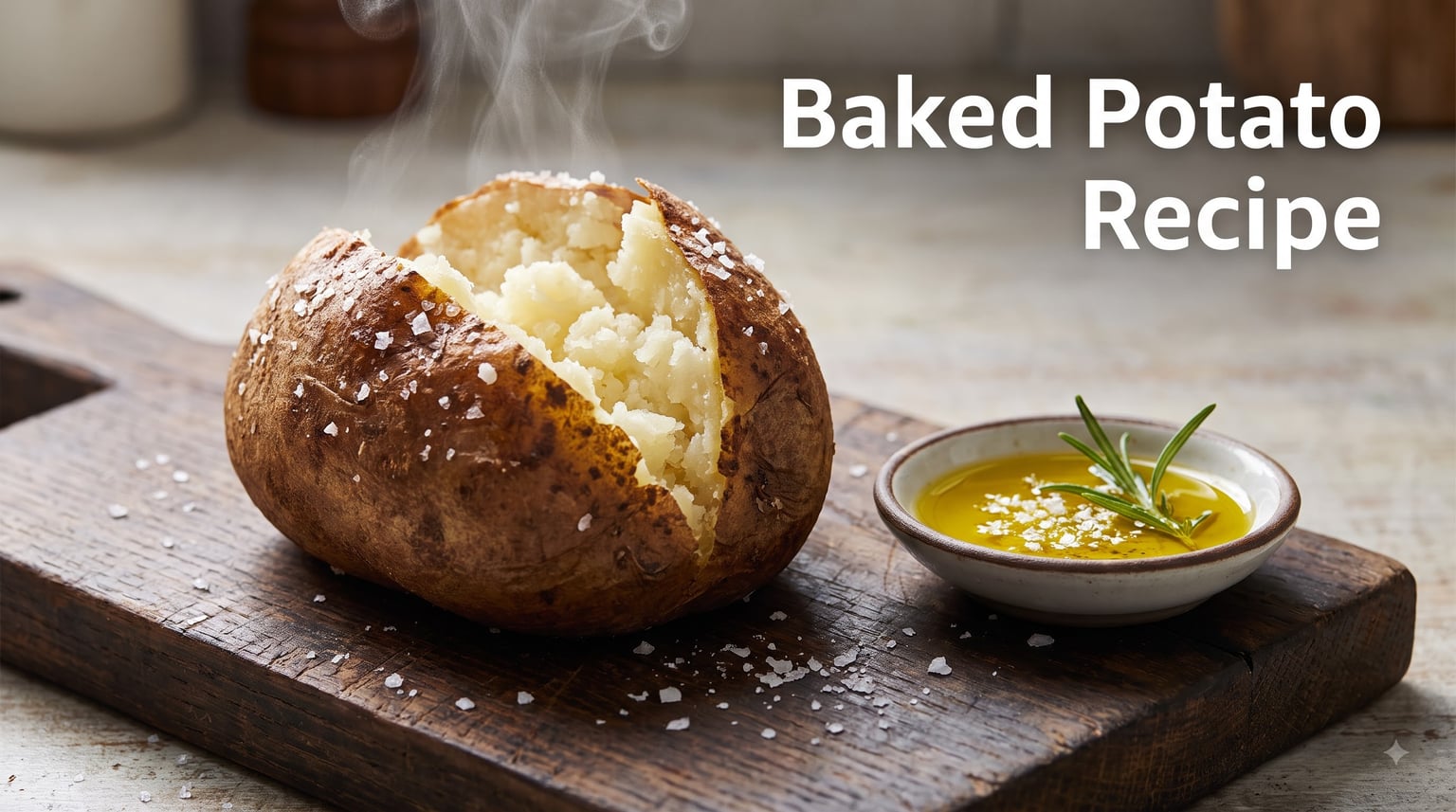
I have ruined more baked potatoes than I care to admit. Soggy skins, mealy centers, hard spots that never cooked through. After years of trial and error, and testing every method I could find, I finally cracked the code on a baked potato recipe that delivers restaurant-quality results every single time.
The perfect baked potato has two things working at once: a skin that crackles when you bite into it and an interior so fluffy it practically turns to clouds when you fork it. Most recipes get one right and blow the other. Getting both is about understanding the science of what happens inside a potato when dry heat hits it at the right temperature for the right amount of time.
In this guide, I am going to walk you through everything from picking the right potato to testing doneness with a thermometer. You will learn why temperature matters more than cooking time, how to settle the foil vs no-foil debate for good, and how to troubleshoot the problems that have been ruining your potatoes. If you want to branch out after mastering the basics, our loaded potato skins recipe is a great next step.
Table of Contents
The Perfect Baked Potato Recipe
The perfect baked potato recipe comes down to four things: russet potatoes coated in olive oil and kosher salt, baked directly on the oven rack at 400°F for 45 to 60 minutes until the internal temperature reaches 205°F. No foil, no wrapping, just dry heat doing its job. The result is a potato with shatteringly crisp skin and a fluffy, steamy interior.
That is the entire method in one paragraph. But if you want to understand why it works, and how to adapt it for different ovens, potato sizes, and cooking methods, the details below will get you there. I have organized this guide so you can follow it start to finish or jump straight to the section you need.
Here is what makes this baked potato recipe different from most you will find online: it is built around internal temperature, not cooking time. Time is a guess. Temperature is a guarantee.
Ingredients You Need
You only need four ingredients for a perfect baked potato. The simplicity is the point.
Russet potatoes: Look for medium-to-large russets with thick, netted skin. The russet variety has the highest starch content of any common potato, which is what creates that fluffy, separate-grain texture when baked. Waxy potatoes like Yukon Golds or red potatoes will give you a dense, creamy interior instead of a fluffy one. They are not wrong, just different.
Olive oil: A light coating of olive oil on the skin helps it crisp and brown in the oven. You can substitute avocado oil or vegetable oil if you prefer a neutral flavor, but olive oil adds a subtle richness that pairs well with the salt crust. About half a teaspoon per potato is plenty.
Kosher salt or sea salt: Coarse salt is essential. It sticks to the oiled skin, creates a flavorful crust, and draws out moisture to help the skin crisp. Table salt is too fine and will dissolve into the skin rather than forming a crust. I use about a quarter teaspoon per potato, rolled onto the skin after oiling.
Optional toppings: Butter, sour cream, shredded cheddar, chopped chives, crumbled bacon, black pepper. These are not ingredients for the recipe itself, but they are what transforms a side dish into a meal.
One important note on potato selection: always check your potatoes before cooking. If you want more detail on spotting problems, our guide on how to tell if a potato is bad covers the signs of spoilage in detail.
Equipment for the Best Results
You do not need much equipment, but the right setup makes a real difference in how your potatoes turn out.
Your oven: A standard conventional oven works perfectly. If you have a convection oven, the circulating air will actually give you crispier skin. Just reduce the temperature by 25°F from whatever a recipe calls for, since convection cooks faster and more evenly.
Wire rack: Baking potatoes directly on an oven rack allows hot air to circulate completely around each potato. If your oven rack spacing makes this awkward, you can set a wire cooling rack on top of a baking sheet and place the potatoes on that. The goal is airflow underneath the potato, not just on top.
Baking sheet: If you do not have a wire rack, a bare baking sheet works fine. Place a sheet of parchment paper or foil underneath the potatoes to catch any drips. The bottom of the potato will not get quite as crispy, but it will still be excellent.
Meat thermometer: This is the single most important tool for consistent baked potatoes. An instant-read thermometer tells you exactly when the potato reaches 205°F, which is the temperature at which the starches fully gelatinize and the interior turns fluffy. Without one, you are guessing.
Fork or skewer: For poking holes in the potato before baking. This lets steam escape and prevents the potato from exploding in the oven. More on that in the troubleshooting section.
Step-by-Step: How to Bake a Potato
Here is the complete baked potato recipe, broken down into clear steps. Follow these in order and you will get perfect results on your first try.
Step 1: Select your potatoes. Choose russet potatoes that are roughly the same size so they finish cooking at the same time. Aim for medium-to-large potatoes, about 8 to 10 ounces each. Avoid potatoes with green spots, sprouting eyes, or soft patches.
Step 2: Preheat the oven. Set your oven to 400°F and let it fully preheat. If your oven runs hot or cold, use an oven thermometer to verify the actual temperature. Preheating fully matters because the initial blast of heat starts crisping the skin immediately.
Step 3: Wash and dry the potatoes. Scrub each potato under running water to remove dirt. Then dry them thoroughly with a clean towel. Wet potatoes will steam instead of crisp, and the oil and salt will not stick properly to damp skin.
Step 4: Poke holes. Using a fork, poke each potato 6 to 8 times across all surfaces. Push the fork about half an inch deep. These holes let steam escape during baking so the potato does not burst. This step is not optional.
Step 5: Oil and salt the skin. Rub each potato with a thin layer of olive oil, about half a teaspoon. Then sprinkle generously with kosher salt, rolling the potato to coat evenly. The salt should stick to the oil and form a visible crust on the skin.
Step 6: Bake. Place the potatoes directly on the oven rack or on a wire rack set over a baking sheet. Bake at 400°F for 45 to 60 minutes. Medium potatoes will be done around 45 to 50 minutes, while large ones may need the full 60 minutes.
Step 7: Check for doneness. Insert an instant-read thermometer into the thickest part of the potato, avoiding the very center if possible. The internal temperature should read 205°F. If you do not have a thermometer, a fork should slide in with zero resistance and the skin should look wrinkled and slightly puffy.
Step 8: Rest and serve. Remove the potatoes from the oven and let them rest for 2 to 3 minutes. This lets the interior steam redistribute. To serve, slice lengthwise down the middle, squeeze the ends to push the fluffy interior up, and add your toppings.
Best Temperature for Baked Potatoes
The temperature you bake at changes everything about the final texture. I tested three temperatures side by side, and the differences were dramatic.
350°F: At this temperature, potatoes take 60 to 75 minutes. The skin stays relatively soft and the interior is creamy rather than fluffy. This works if you prefer a gentler, softer potato, but you will not get that steakhouse-style crackling skin.
400°F: This is my recommended temperature. Potatoes take 45 to 60 minutes, the skin gets crispy and slightly blistered, and the interior turns out fluffy and light. It is the sweet spot between texture development and reasonable cooking time.
450°F: At 450°F, potatoes cook in 45 minutes or less. The skin gets aggressively crispy with deep browning, almost like a roasted potato. The interior is fluffy but can dry out slightly faster at this temperature. This is the temperature most steakhouses use for that signature crackling skin.
The science behind this comes down to moisture evaporation and starch gelatinization. Higher temperatures drive moisture out of the skin faster, which crisps it. Inside, the starches gelatinize around 205°F regardless of oven temperature. So the oven temperature mostly affects the skin, while the internal temperature determines when the center is done.
For a convection oven, reduce any of these temperatures by 25°F. The fan circulates hot air and speeds up the process noticeably.
Foil vs No Foil: Which Is Better?
This is one of the most debated questions in home cooking, and the answer depends entirely on what you want from your baked potato.
Wrapped in foil: Foil traps steam around the potato, which means the skin will be soft and tender, not crispy. The interior cooks through fine, but you essentially get a steamed potato rather than a baked one. Foil is useful if you are serving a crowd and need to keep potatoes warm for an extended time, or if you specifically want soft skin.
Unwrapped (no foil): Baking unwrapped lets the dry oven heat hit the skin directly, which dehydrates the outer layer and creates that crispy, slightly chewy crust. This is the method I recommend for the best texture. The skin becomes a feature of the dish, not just a wrapper.
On Reddit forums, experienced home cooks overwhelmingly recommend skipping the foil. The most common advice I found was: if you want crispy skin, never use foil. If you want to keep potatoes warm for over 30 minutes before serving, wrap them in foil after baking, not during.
My recommendation: bake without foil for the best texture. Use foil only for holding if you need to delay serving.
How to Tell When a Baked Potato Is Done?
Relying on cooking time alone is the number one reason baked potatoes come out wrong. A 50-minute timer does not account for potato size, oven accuracy, or starting temperature. Here is how to know for certain.
The thermometer method (most reliable): Insert an instant-read thermometer into the center of the potato. It should read 205°F. This is the temperature at which the potato’s starches fully gelatinize and the texture becomes fluffy rather than dense. This is the method professional kitchens use.
The fork test: Slide a fork into the thickest part of the potato. It should go in with zero resistance and slide out cleanly. If you feel any hardness or friction, the potato needs more time.
Visual cues: The skin should look wrinkled and slightly puffy. When you gently squeeze the potato (use an oven mitt), it should give easily under pressure. If it feels firm, it is not done yet.
Always check the largest potato in your batch first. Smaller ones may be done while larger ones still need time. Remove finished potatoes and let the others continue baking.
How to Get Crispy Skin on a Baked Potato?
Crispy skin is the holy grail of baked potatoes, and it is also the thing most people struggle with. Forum users constantly ask why their skin turns out tough or leathery instead of crispy. Here is what actually works.
Oil the skin before baking: A thin coat of olive oil is essential. The oil conducts heat to the skin surface and promotes browning and crisping. Without oil, the skin dries out slowly and becomes tough rather than crispy.
Use coarse salt: Kosher salt or flaky sea salt draws moisture out of the skin while creating a crunchy crust. The coarse texture means the salt crystals sit on the surface rather than dissolving in.
Bake at 400°F or higher: Lower temperatures produce soft skin. You need dry heat at 400°F minimum to dehydrate the skin layer and create crispness. At 450°F, the skin gets even crispier and more deeply browned.
Skip the foil: As covered above, foil traps steam and prevents crisping. For crispy skin, the potato must be exposed to direct dry oven heat.
Dry the potatoes thoroughly: After washing, dry each potato completely with a towel. Any moisture on the surface will steam the skin instead of crisping it. This one step makes a bigger difference than most people realize.
Troubleshooting Common Baked Potato Problems
Even with a solid recipe, things can go wrong. Here are the most common problems I hear about, and how to fix them.
Why is my baked potato dry inside? Dry interiors usually come from overcooking or baking at too high a temperature for too long. The potato loses moisture faster than it can retain it. Check doneness with a thermometer starting at the 40-minute mark and pull the potato as soon as it hits 205°F.
Why is the skin tough instead of crispy? Tough skin means the potato was wrapped in foil or baked at too low a temperature. Remove the foil, raise the temperature to 400°F or above, and make sure the potatoes are completely dry before oiling and salting.
Why are there hard spots inside the potato? Uneven cooking happens when potatoes are crowded together or when one side sits flat against a baking sheet. Bake on a wire rack so air circulates fully around each potato. Rotate the potatoes halfway through baking for even more consistent results.
Why did my potato explode in the oven? Potatoes explode when trapped steam has no way to escape. This happens when you forget to poke holes before baking. Always poke each potato 6 to 8 times with a fork before it goes in the oven.
Why is my baked potato hard inside? If the center is hard, the potato is undercooked. This is common with larger potatoes or when the oven temperature is lower than expected. Keep baking and check the internal temperature. If it has not reached 205°F, it is not done.
How do I fix an overcooked potato? If the potato is overcooked and dried out, scoop out the interior, mash it with butter and milk, and stuff it back into the skin. You have essentially made a twice-baked potato, which is a delicious rescue. For a from-scratch version, try our loaded potato skins recipe for inspiration.
Alternative Cooking Methods
The oven is not your only option. Here are three alternative methods, each with its own strengths.
Air fryer baked potato: The air fryer is actually excellent for baked potatoes. It circulates hot air rapidly, which gives you crispy skin in less time than a conventional oven. Cook at 400°F for 35 to 40 minutes, depending on potato size. The interior comes out fluffy and the skin gets impressively crisp.
Microwave then oven method: If you are short on time, microwave the potatoes for 5 to 8 minutes, then transfer them to a 450°F oven for 10 to 15 minutes to crisp the skin. This cuts total cooking time nearly in half. The microwave cooks the interior while the oven finishes the skin. It is not quite as good as oven-only, but it is a practical weeknight shortcut.
Grill method: Wrap oiled and salted potatoes in foil and grill over medium heat for 45 to 60 minutes, turning occasionally. This gives the potatoes a subtle smoky flavor. The foil means you will not get crispy skin, so some cooks finish the potatoes directly on the grill grate for the last 10 minutes to add some char.
Slow cooker method: Wrap potatoes in foil and cook on low for 6 to 8 hours. This is convenient for hot days when you do not want to turn on the oven, but the skin will be soft rather than crispy.
Best Toppings for Loaded Baked Potatoes
A baked potato is a blank canvas. Here are topping combinations ranging from classic to creative.
The classic loaded baked potato: Butter, sour cream, shredded cheddar cheese, crumbled bacon, and sliced chives. This is the steakhouse standard for a reason. The combination of rich dairy, salty bacon, and sharp cheese is hard to beat.
Chili baked potato: Top with a ladle of hot chili, shredded cheese, and diced onions. The potato replaces the bowl. This turns a side dish into a full meal.
Broccoli and cheese: Steamed broccoli florets topped with melted cheddar or a cheese sauce. A lighter option that still feels indulgent.
Vegan toppings: Dairy-free butter, nutritional yeast for a cheesy flavor, avocado slices, black beans, salsa, and fresh cilantro. Cashew-based sour cream works beautifully as a substitute.
Build a potato bar: Set out a spread of toppings in small bowls and let everyone build their own. Include butter, sour cream, various cheeses, bacon, chives, chili, broccoli, caramelized onions, and hot sauce. This is one of the easiest ways to feed a crowd.
For a different take on potato appetizers, check out our loaded potato skins recipe for crispy, cheesy bites that use the same technique.
Storage and Reheating
Baked potatoes store well if handled correctly, which makes them great for meal prep.
Storing leftover baked potatoes: Let the potatoes cool completely, then wrap them individually in foil or store in an airtight container in the refrigerator for up to 4 days. Do not leave baked potatoes at room temperature for more than 2 hours.
Reheating in the oven: This is the best method for preserving texture. Preheat the oven to 350°F, place the potatoes directly on the rack, and heat for 10 to 15 minutes until warmed through. The skin will re-crisp nicely.
Reheating in the air fryer: Air fry at 350°F for 5 to 8 minutes. This is fast and restores much of the original crispness.
Reheating in the microwave: This works in a pinch but will soften the skin. Microwave for 1 to 2 minutes, checking at 30-second intervals.
For a creative way to use leftover baked potatoes, try cutting them into chunks and adding them to our stewed potatoes recipe for a comforting meal.
Nutrition Information
A plain baked potato is surprisingly nutritious, and much of the bad reputation potatoes carry comes from what we put on top of them.
A medium russet potato baked without toppings contains approximately 160 to 170 calories, 4 to 5 grams of protein, 37 grams of carbohydrates, and 4 grams of fiber. It is also a good source of vitamin C, potassium, and vitamin B6. In fact, a single baked potato contains more potassium than a banana.
Most of the fiber is in the skin, so eating the skin gives you the full nutritional benefit. The skin also contains concentrated amounts of minerals and vitamins compared to the flesh.
The calorie count changes dramatically once you add toppings. A fully loaded baked potato with butter, sour cream, cheese, and bacon can easily reach 500 to 700 calories. If you are watching calories, stick to a small amount of butter and load up on vegetable toppings like broccoli, salsa, or chives instead.
Baked Potato Variations and Regional Styles
Baked potatoes show up in different forms around the world, and exploring these variations is one of the most fun parts of cooking.
British jacket potatoes: In the UK, jacket potatoes are a beloved comfort food and street food. They are typically baked until the skin is crisp and the inside is fluffy, then split open and filled with hearty toppings like baked beans and cheddar cheese, tuna mayo, or chili con carne. Jacket potatoes are usually baked at a lower temperature for longer, giving them a distinctive texture.
Twice baked potatoes: These take the baked potato to the next level. After the initial bake, the fluffy interior is scooped out, mixed with butter, sour cream, cheese, and seasonings, then stuffed back into the skin and baked again until the top is golden. They can be prepared ahead and reheated, making them great for entertaining.
Steakhouse style: The steakhouse baked potato is large, wrapped in foil after baking to keep warm, and served with butter, sour cream, and chives on the side. The foil is used for holding, not baking, so the skin stays crispy until service.
Hasselback potatoes: These are sliced crosswise at regular intervals without cutting all the way through, then baked. The slices fan out and get crispy while the base stays soft. You can brush with butter or oil and add breadcrumbs or cheese between the slices for extra flavor.
Frequently Asked Questions
What is the secret to the best baked potatoes?
The secret is baking russet potatoes unwrapped at 400°F until the internal temperature reaches 205°F. Oiling and salting the skin before baking creates a crispy crust, while skipping foil allows dry heat to crisp the skin. Using an instant-read thermometer instead of relying on time alone guarantees a fluffy interior every time.
How long does it take to bake a potato in the oven at 400 degrees?
At 400°F, a medium russet potato takes 45 to 55 minutes. Large potatoes may need up to 60 minutes. The most reliable way to confirm doneness is checking that the internal temperature has reached 205°F with an instant-read thermometer.
Is it better to bake potatoes at 350 or 400?
400°F is better for baked potatoes because it produces crispy skin and a fluffy interior in 45 to 60 minutes. At 350°F, potatoes take longer and the skin stays softer with a creamier interior. If you want steakhouse-style results with crackling skin, go with 400°F or even 450°F.
Should you wrap baked potatoes in foil?
Do not wrap potatoes in foil during baking if you want crispy skin. Foil traps steam, which softens the skin and steams the potato rather than baking it. Use foil only to keep baked potatoes warm after they come out of the oven if you need to delay serving.
How do you know when a baked potato is done?
A baked potato is done when an instant-read thermometer inserted into the center reads 205°F. You can also test by sliding a fork into the thickest part with zero resistance, or by looking for wrinkled, puffy skin that gives easily when gently squeezed.
What is the best potato for baked potatoes?
Russet potatoes are the best choice for baking because their high starch content creates a fluffy, light interior with distinct separated grains. Their thick skin also crisps beautifully. Avoid waxy potatoes like red potatoes or Yukon Golds for traditional baked potatoes, as they produce a denser, creamier texture.
Why is my baked potato hard inside?
A hard interior means the potato is undercooked. This happens with larger potatoes, inaccurate oven temperatures, or pulling the potato out too early. Keep baking and check the internal temperature. It needs to reach 205°F for the starches to fully gelatinize and the center to turn fluffy.
Can you overcook a baked potato?
Yes, you can overcook a baked potato. If left in the oven well past 205°F internal temperature, the potato loses moisture and the interior becomes dry and mealy. Check doneness with a thermometer starting at 40 minutes and remove the potato as soon as it reaches 205°F.
Conclusion
The perfect baked potato recipe comes down to a few key principles: use russet potatoes, oil and salt the skin, bake without foil at 400°F, and cook until the internal temperature hits 205°F. That is it. No gimmicks, no complicated techniques, just an understanding of how dry heat transforms a potato into something with crackling skin and a cloud-like interior.
The biggest shift in my own cooking happened when I started using a thermometer. Once you stop guessing and start measuring, every potato comes out right. It removes the anxiety of wondering if it is done and eliminates the disappointment of cutting into a hard center or a dry, mealy interior.
Start with the basic recipe, then make it your own. Experiment with toppings, try the air fryer method for weeknight speed, or set up a potato bar for your next gathering. And if you want to keep exploring potato cooking, our stewed potatoes recipe and our Irish potato martini recipe are two more ways to enjoy this incredibly versatile ingredient.