
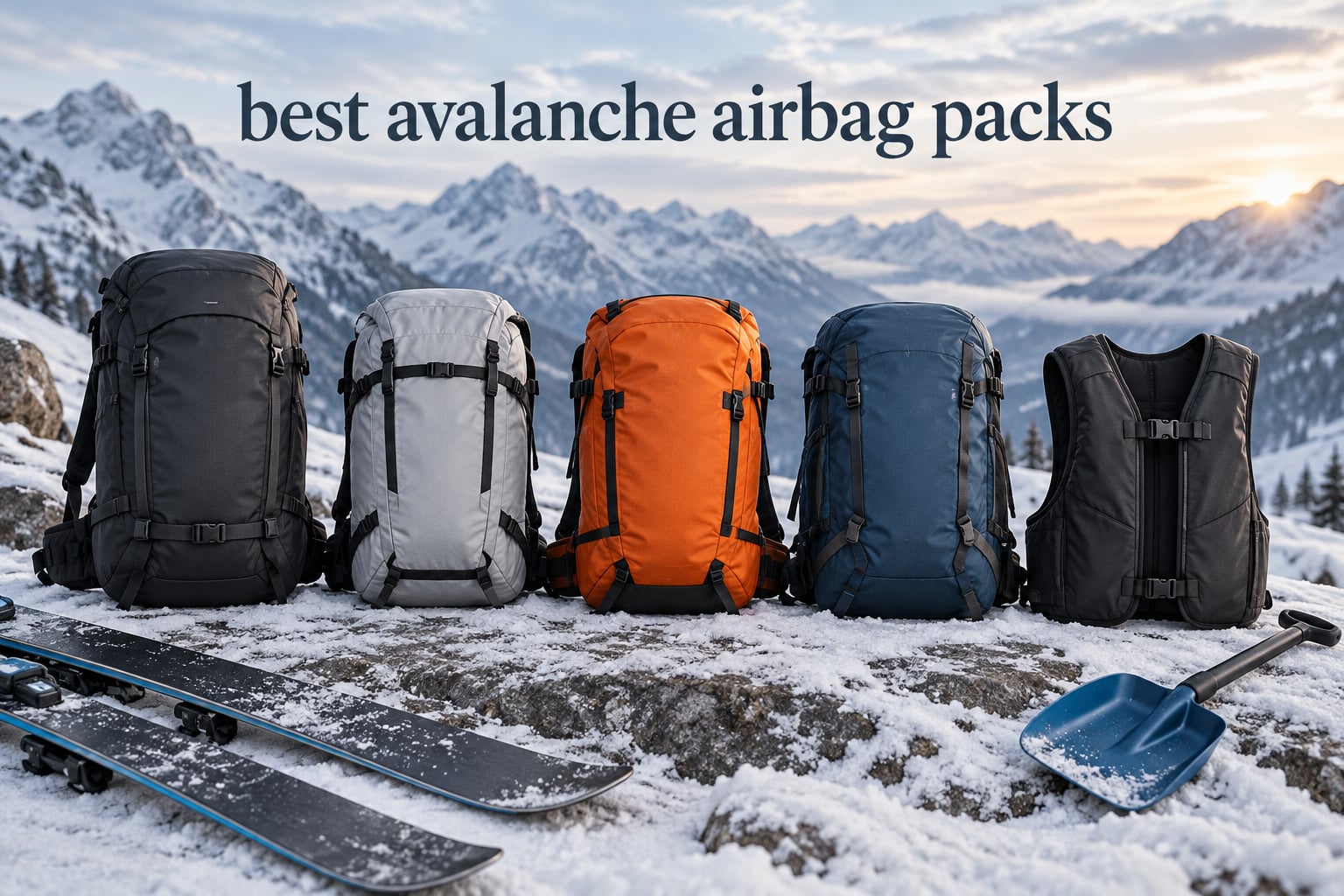
Short answer: For most skiers and splitboarders, the Deuter Alproof 32 is the best avalanche airbag pack of 2026, because it pairs a fully electric Alpride E2 supercapacitor system with a genuinely load-carrying harness and a large, well-organised safety compartment. Riders who prioritise mobility over pack volume should look at the vests. Tourers who care more about carry weight than capacity should read on.
An avalanche airbag pack is a backcountry ski or snowboard pack with a built-in inflatable airbag. When deployed in a slide, it holds the wearer near the snow surface, which lowers the odds of a full burial and buys extra time for a partner to dig. A trigger handle on a shoulder strap fires either a single-use compressed-air canister or a rechargeable fan that fills a large airbag around the head and torso in a few seconds.
What an airbag does not do is the more important half of the conversation. Most avalanche fatalities involve burial, and the window that matters is roughly fifteen minutes: after that, exhaled carbon dioxide builds up, oxygen drops, and an ice mask can form over the airway inside a snow cavity. An airbag is one layer on top of a transceiver, probe, shovel, a partner who can dig, and every terrain decision that came before the slide. Owners on forums like r/Backcountry are blunt about this, describing the airbag as a last resort rather than a ticket to ski harder terrain.
That is why this roundup does not open with hype. We looked at nine avalanche airbag packs and vests covering the full spread of use: full-length touring packs, low-volume sledding packs, and airbag vests for snowmobiles and helicopter-assisted skiing. Every capacity, weight, system type and rating below comes from published product specifications and owner review data, and where the evidence is thin we say so instead of filling the gap with adjectives. This is a safety category, so a thin review base is a fact you deserve to know before you buy, not a footnote.
Two quick definitions before the picks. A compressed-air canister is a carbon cylinder you inflate at a dive shop, and you get one deployment per fill, which is why practice inflation is awkward. A supercapacitor fan charges off a battery or mains power, spins up a small compressor, and can fire repeatedly without a refill. If you fly for your snow, that second category is close to a requirement rather than a preference, which is a subject we return to in the buying guide. If you want a primer on portable power while you are reading, our guide to Magsafe battery packs covers the charging side of multi-day kit.
Table of Contents
Top 3 Picks for the Best Avalanche Airbag Packs in 2026
Before the long list, here is the reasoning in three lines. The Deuter Alproof 32 takes the overall spot because it combines a 32-litre frame, an electric system rated to deploy at high pressure in freezing cold, seven pockets and a load-stabilising harness with hip fins, a waist belt and a leg strap. The Osprey Soelden Pro 32L takes the touring spot because its safety kit pocket opens from the front panel with built-in shovel and probe sleeves, and it carries boards three different ways. The BCA Float 15 Turbo takes the technical-terrain slot for a different reason entirely: at 15 litres it is by far the smallest volume pack in the group, and it is built around external shovel storage for tight, technical sledding lines.

Osprey Soelden Pro 32 E2
- Front-panel J-zip avy pocket
- 32L storage
- 6.4 lb
- All Mighty Guarantee

One caveat on the ratings in that box. A 4.9 average across thirteen owner reviews tells you more than a perfect 5.0 across two reviews, and two of the packs later in this roundup sit in that second category. Where a score looks impressive but the sample is two or three people, we treat it as an early signal rather than a verdict.
9 Best Avalanche Airbag Packs (October 2026)
The table below covers every pack and vest in the roundup with its defining characteristics. Two entries need an immediate note: the BCA Float 15 Turbo and the Dakine Poacher RAS Vest are both sold as bodies only, and the airbag unit itself is a separate purchase in each case. That is a deliberate modular design on the Dakine, and a cost decision on the BCA.
| Product | Specifications | Action |
|---|---|---|
 Deuter Alproof 32 Deuter Alproof 32 |
|
Check Latest Price |
| Osprey Soelden Pro 32L E2 |
|
Check Latest Price |
| BCA Float 15 Turbo |
|
Check Latest Price |
 Dakine Poacher RAS Vest Dakine Poacher RAS Vest |
|
Check Latest Price |
 Backcountry Access MtnPro Vest Backcountry Access MtnPro Vest |
|
Check Latest Price |
 BCA Float E2 35L BCA Float E2 35L |
|
Check Latest Price |
 Black Diamond Jetforce Pro 25 Black Diamond Jetforce Pro 25 |
|
Check Latest Price |
 KLIM Atlas 14 KLIM Atlas 14 |
|
Check Latest Price |
 Black Diamond Jetforce Tour 26 Black Diamond Jetforce Tour 26 |
|
Check Latest Price |
1. Deuter Alproof 32 – The Best Overall Avalanche Airbag Pack
Deuter Alproof 32 Avalanche Backpack – Khaki-Black
32L pack
6.9 lb item weight
Alpride E2 supercapacitor system
7 pockets
Pros
- Electric supercapacitor system deploys at high pressure in cold
- Multiple deployments with no cylinder refill
- Padded hip fins with waist belt and leg strap that stop load wobble
- Quick-access safety compartment with fleece-lined goggle pockets
- Compatible with the Deuter 3.0L Streamer Reservoir
Cons
- Heaviest full-length pack here at 6.9 lb
- Supercapacitor needs periodic recharging to stay ready
- Reservoir sold separately
The Deuter Alproof 32 is the one we keep coming back to. It is a full 32-litre pack listed at 6.9 pounds, which is a realistic figure for a frame of this size carrying an electric airbag. The shoulder straps and padded hip fins carry gear loops, and the waist belt, adjustable sternum strap and leg safety strap are all there to stop a loaded pack from shifting while you are riding.
The safety compartment is the part that impressed us most in the specification set. It is a dedicated compartment with a zippered valuables pocket and key clip inside, fleece-lined pockets for goggles, and two modular gear straps for diagonal ski and snowboard attachment. That is a genuine separation between rescue gear and everything else, which matters when you are opening it in a whiteout with gloves on.
The Alpride E2 system is the reason this is an electric pack rather than a canister pack. Deuter describes it as deploying reliably, quickly and at high pressure even in freezing temperatures, and that cold-pressure claim is the single most important spec on this list, because a system that inflates weakly at minus temperatures has lost most of its value exactly when it is needed. Owners report being happy with the system’s cold reliability, and the reviews also note that the supercapacitor does need a recharge cycle to keep deployment readiness current.
Who the Alproof 32 suits
It suits the skier or splitboarder doing a normal day tour who still wants to bring a second layer, a lunch and a thermos, because 32 litres is a real working volume rather than a nominal one. The seven-pocket layout and the goggle storage make it a comfortable choice for anyone who wears goggles on the ascent and does not want them crushed under a lid.
Hydration is a genuine plus here rather than a marketing line. It is compatible with the Deuter 3.0-litre Streamer Reservoir, and both shoulder straps carry insulated hydration tube sleeves so you can drink from either side. If the reservoir itself is not in your kit yet, that is a separate purchase, and the tubing runs in sleeves rather than through the airbag path, which is the detail that actually matters.
Where it falls short
The honest weakness is weight. At 6.9 pounds it is the heaviest full-length pack we cover, and on a human-powered ascent that is a number you feel over a full day. If your touring is short and fast, or if you are moving to a smaller pack, this is the one to think twice about.
The second weakness is the recharge discipline. A supercapacitor pack needs a regular charging habit, and owners do report confusion about how often that is. It also carries a PFC-free, snow-resistant and water-repellent body fabric with snow resistance on the back system, which handles weather well but is described as water repellent rather than waterproof. If your kit sits in a wet climate, put it in a liner.
2. Osprey Soelden Pro 32L E2 – The Best Avalanche Airbag Pack for Ski Touring
Osprey Soelden Pro 32L Men’s Ski and Snowboard Backpack with E2 Airbag System, Red Mountain
32L storage
6.4 lb item weight
Alpride E2 electronic system
6 compartments
Pros
- Front-panel J-zip opens straight into the avy kit pocket
- Built-in shovel handle and probe sleeves in that pocket
- A-frame diagonal and vertical board carry in one pack
- Stow-away helmet carry in front or top position
- Covered by the All Mighty Guarantee
Cons
- Airbag hardware adds noticeable weight over a plain ski pack
- Only one zipped hipbelt pocket
- Radio and GPS organisation is internal rather than external
The Soelden Pro is the pack we would hand to someone who tours four days a week and does not think about it. It is listed at 6.4 pounds with 32 litres of storage across six compartments, and the fit is described as snow-specific and gender-specific, which is a meaningful detail in this category, where one-size-fits-most harnesses leave small torsos swimming in adjustment strap.
The deciding feature is the front panel. A large J-zip opens directly into the avalanche safety kit pocket, and that pocket has built-in shovel handle and probe sleeves. It is the arrangement that owners repeatedly ask for and rarely get, because a two-way zip behind a compression strap is functionally useless when your hands are numb. The main compartment opens with a large U-zip and has an internal zip organisation pocket plus a GPS and radio pocket with mic harness attachment points.
Carry versatility is where this pack separates from the field. It handles A-frame or diagonal ski carry and a vertical front panel snowboard carry, and the A-frame and diagonal options mean it works whether you are on planks or on a split. The dual-position stow-away helmet carry folds away when you are not wearing one, which matters for riders on a dual-certified ski mountaineering helmet that needs external carry on a boot pack but not on a resort-accessed day.
Who the Soelden Pro suits
It suits riders who carry more than a shell layer, a beacon and a lunch, and who want every piece of that to have a home. The six-compartment layout and the U-zip main opening make it a fast pack to organise in the morning, which sounds minor until you are doing it at 05:00 in the dark.
It also suits anyone who values carry systems over raw capacity, because the pack gives you a real choice of ski and board attachment rather than forcing a single solution. The radio pocket with mic harness attachment is genuinely useful for guides and patrollers who run a handset all day.
Where it falls short
There is a single zipped hipbelt pocket and a single hipbelt gear loop, and for a pack carried above the snow line that is thin. Anything you need with one hand and no thought, a phone or a bar, has to live somewhere less convenient than a hip belt normally would.
Radio and GPS organisation is internal rather than externally accessible, so a handset is protected but not reachable. Owners also flag the same weight trade-off that every airbag pack carries, since the system adds weight compared with a non-airbag ski pack of the same size. At 4.3 across eighteen reviews, the evidence here is solid but not overwhelming, and it is worth checking the current owner feedback before you commit.
3. BCA Float 15 Turbo – The Best Avalanche Airbag Pack for Technical Sledding
BCA Float 15 Turbo Avalanche Airbag 2.0 – Warning red/Black
15L pack volume
6.0 lb with cylinder
Float 2.0 canister system
External shovel storage
Pros
- 15L volume keeps the pack out of the way on technical sledding
- 4.9 average across thirteen owner reviews
- External shovel storage for fast access mid-ride
- Compact 4 by 2 by 6 inch listed item dimensions
Cons
- Float 2.0 cylinder sold separately
- 15L limits you to a minimal kit
- Canister needs refilling rather than recharging
The Float 15 Turbo is the odd one out in this roundup, and that is exactly why it is here. At 15 litres it is a technical mountain sledding pack, not a touring pack, and the listed item dimensions of 4 by 2 by 6 inches tell you how little space it takes up between your body and the sled deck. On steep, technical lines a large pack is not a convenience, it is a problem, and this one is designed to stay out of the way.
It uses the Float 2.0 canister system, and the cylinder is sold separately. The pack itself is listed at 2 pounds, and 6.0 pounds with the cylinder fitted, so you should plan your load figure around the second number. External shovel storage is a feature that sledders care about disproportionately, because a shovel in a side pocket is reachable while the machine is stationary, unlike something in a main compartment.
The owner feedback is unusually positive for a pack this specialised. Thirteen reviews at a 4.9 average, with the recurring theme being strong approval of the compact low-volume shape and the external shovel carry for fast technical sledding. The most common caveat in those same reviews is that the cylinder is a separate purchase.
Who the Float 15 Turbo suits
It suits sledders on technical terrain who want a small airbag footprint and a reachable shovel, and who do not need to carry spare layers or a full day of provisions. It also suits riders who want an airbag and are not ready to commit to a large, heavier pack before they know how often they will use it.
It is a reasonable first airbag purchase for a sledder, because the outlay is lower than a full 32-litre electric pack and the pack itself is compact enough to wear in places a bigger pack would interfere with the machine or your body position.
Where it falls short
Fifteen litres is genuinely small. Owners cite it as the main limit, because it does not leave room for extra layers or a long day of gear, and anyone who tours rather than races technical terrain will find it tight immediately.
The canister format is the other limit. A single-use cylinder means you cannot practice inflation without spending a refill, and refills mean finding a dive shop or paintball shop, which is a recurring chore that the electric systems simply do not have. And the cylinder is not included in the pack as listed, so plan the full cost before you order.
4. Dakine Poacher RAS Vest – The Best Modular Avalanche Airbag Vest
Dakine Poacher R.A.S. Vest – Black – M/L
Vest body only
Mammut RAS 3.0 compatible
Roll-top closure
Recycled high-density nylon
Pros
- Roll-top closure accepts the Mammut Removable Airbag System 3.0
- Diagonal ski and vertical snowboard carry both included
- Compatible with an insulated hydration or radio handset setup
- Built from 100 percent recycled high-density nylon
Cons
- Airbag and spine protector both sold separately
- Vest format carries no pack volume of its own
- Only offered in Medium and Large
The Dakine Poacher is a shell, not a system, and understanding that is the whole point. It is compatible with the Mammut Removable Airbag System 3.0, which is sold separately, and the roll-top closure is what makes that pairing work. For a rider who already owns a removable airbag unit, or who wants to buy one unit and move it between packs, this is a genuinely clever way to build a kit: the airbag is a component and the pack is a component.
What the vest does carry is a competent carry system. Diagonal ski carry and vertical snowboard carry are both built in, and it is compatible with the DK Impact Spine Protector, also sold separately. The listing also notes compatibility with a two-way radio handset or an insulated hydration arrangement, which is the detail riders running comms care about, since both the radio and the hydration line need to route out of the airbag deployment path.
Owner feedback at 4.7 across thirteen reviews focuses on exactly that modularity. Buyers like the lower initial outlay, the roll-top compatibility with the Mammut Removable Airbag System 3.0 and the dual ski and snowboard carry. The dominant theme in the negative side of those reviews is that the vest is only half a system, because the airbag and the spine protector are both separate purchases, so the finished kit costs well above the vest alone.
Who the Poacher RAS suits
It suits riders building a kit incrementally, or riders who want one airbag unit shared across more than one carrier. If you are swapping between a sledding setup and a ski setup across a season, a removable system plus a shell that accepts it is a strategy that several brands now offer, and this is one of the cleaner implementations of it.
It also suits anyone whose priority is a lower initial outlay. Because the body is the inexpensive part of a modular airbag kit, you can enter the category without committing to a full pack, and you can add the airbag when the season justifies it.
Where it falls short
A vest carries no pack volume of its own, so if you need to bring a layer, a lunch and a repair kit, you need a separate bag or a different product. That is the deal you make for mobility, and it is a bad deal for overnight touring and an excellent one for fast, light days.
Sizing is also narrow, with only Medium and Large offered, so check the fit against your torso before you commit. And remember that the working configuration needs the Mammut airbag plus, if you want back protection, the DK Impact Spine Protector, so plan for a system rather than a vest.
5. Backcountry Access MtnPro Vest – The Best Avalanche Protection for Mechanized Skiing
Backcountry Access MtnPro Vest Avalanche Airbag – Black/Red X-Large/2X-Large
Vest format
Float 2.0 reduced cylinder
Integrated impact protection
Shoulder handle
Pros
- Vest form keeps movement unrestricted for sledding and heli skiing
- Impact protection built in front side and back rather than sold separately
- Reduced-size cylinder keeps the profile low
- Shoulder handle is easy to find under a jacket
Cons
- Only four owner ratings make long-term reliability hard to judge
- Vest carries no pack storage of its own
- Limited warranty compared with some competitors
The MtnPro Vest is built for the half of the airbag market that rides a machine or arrives by helicopter. The Float 2.0 system here uses a reduced-size compressed air cylinder, and the vest form itself is the reason it exists: with a low-profile design and a stable fit, you are not carrying a backpack that shifts when you twist, and that matters enormously on a snowmobile where your body position is fixed and your hands are busy.
The other thing this vest does that packs usually do not is include protection. Front, side and back impact protection is integrated into the vest rather than sold as an add-on, which matters on a snowmobile where low-speed impacts and torso contact with the machine are common. Deployment is via a shoulder-mounted handle designed to be fast and intuitive to locate, and it is reachable under a jacket without searching for it.
We want to be straight about the evidence here. There are only four owner ratings on this product, and reviewers do report strong satisfaction with the low-profile fit, the built-in impact protection and the easy shoulder-handle deployment. But the review data itself notes that because the sample is so small, firm conclusions about long-term durability cannot be drawn, and that is a fair description of what you are buying into.
Who the MtnPro Vest suits
It suits snowmobilers, especially anyone who wants the trigger on the shoulder opposite the throttle hand so the working hand never leaves the bars. Trigger position is the detail riders consistently name first, and this vest is built around that idea.
It also suits helicopter-assisted skiing groups and guides working mechanized terrain, where everyone descends at once and the burial risk in the staging area is real. The integrated impact protection is the feature that separates it from a bare airbag vest.
Where it falls short
Four ratings is not enough to make a confident long-term claim, and you should treat the 4.8 as encouraging rather than proven. If you are a sledder with a mostly day-trip pattern, the lack of storage means you are carrying a separate bag for anything beyond essentials.
The warranty position is also thinner than most of the group, with a limited warranty rather than the broad guarantee offered by other brands on this list. For a safety device you may carry for a decade, that is worth weighing against what you paid up front.
6. BCA Float E2 35L – The Best Avalanche Airbag Pack for Flying and Long Tours
Backcountry Access Float E2 Avalanche Airbag Pack (Black, 35 Liter MD/LG)
31L storage in 35L frame
6.1 lb in 35L
Alpride E2 supercapacitor
3-year warranty
Pros
- Supercapacitor removes the compressed cylinder so flying is straightforward
- Repeated deployment practice without a refill charge
- Waterproof polyurethane-coated nylon ripstop outer
- Side stash pocket for gloves goggles or a bottle
- Three-year manufacturer warranty
Cons
- Lowest average rating in this group at 3.4
- Heavier than expected once fitted with the system
- Supercapacitor and AA batteries sold separately
- Some owners rate internal access as worse than a sledding vest
The Float E2 is the pick for anyone who flies to their snow, and the reason is structural rather than cosmetic. The Alpride E2 supercapacitor system takes the compressed gas cylinder out of the picture entirely, which removes the single thing that makes canister packs impractical in an airport. There is nothing to declare, nothing to ship and nothing to buy back at the other end, and the rechargeable system lets you test deployments as often as you like without paying for a refill every time.
Capacity is the other argument. This is the 35-litre version, with storage listed at 1,891 cubic inches or 31 litres and a weight of 6.1 pounds, against 5.8 pounds for the 25-litre version at 1,281 cubic inches or 21 litres. Those two real storage figures are more useful than the 35-litre name, and they are a good illustration of the gap between a pack’s size label and its usable volume once the airbag hardware is in place.
We are including this pack with a clear warning attached, because it carries the lowest average rating in the group at 3.4. The positive reviews praise the cylinder-free E2 system, easy operation and travel-friendliness. The negative reviews report a unit arriving without the airbag, a sizing mix-up, weight that ran heavier than expected, and internal access that some owners rate as worse than a comparable snowmobile vest. A 3.4 across seven reviews is a signal to read the recent owner feedback carefully, not a reason to dismiss the pack.
Who the Float E2 35L suits
It suits anyone whose snow involves air travel, whether that is a season of heli-accessed skiing or a long drive to a range with a cheap flight in the middle. It is also a strong choice for multi-day tours where 31 litres of real storage means you can carry a warmer sleeping setup and a proper repair kit.
The polyurethane-coated nylon ripstop outer is a genuine benefit for anyone carrying the pack through a wet approach or a rain-splashed staging area, and the three-year manufacturer warranty is longer than the stated warranty on the other products here.
Where it falls short
Weight is the honest complaint. Owners report it running heavier than expected for its class once fitted with the airbag system, and if you are moving fast on a long ascent, that is where you will feel it.
Two logistics details catch people out. The supercapacitor unit and the AA batteries are both sold separately, so the pack body is not the whole system. And the internal access criticisms are worth taking seriously, because internal organisation that is convenient on a desk can be awkward when you are loading a wet glove in a storm at altitude.
7. Black Diamond Jetforce Pro 25 – The Best Electric System With Built-In Diagnostics
Black Diamond BD681322BLACKM_L Jetforce Pro 25 Backpack Black M_L
25L storage
Rechargeable JetForce system
Bluetooth updates
Auto self-diagnosis
Pros
- Rechargeable and travel-friendly with no cylinder to refill
- Automatic deflation and automated self-diagnosis
- Multiple deployments from one charge
- Avy-tool pocket plus tuck-away diagonal ski carry and helmet holder
- Bluetooth connectivity for software and system updates
Cons
- Only three owner reviews
- so the perfect score is thin evidence
- No published figure for the listed item weight
- Only offered in a single M/L configuration
The Jetforce Pro is the most technically sophisticated airbag on this list in one specific way: it tells you about itself. Bluetooth connectivity allows software and system updates from a smartphone, the system performs an automated self-diagnosis, and it deflates automatically after a deployment. For a rider who wants to know that their safety system is actually ready rather than hoping, that is a meaningful upgrade over a light and a click.
Black Diamond describes the redesigned JetForce technology as smaller, lighter and repositioned for better carrying capability, and built in as a rechargeable unit. The pack itself is 25 litres with three compartments and three pockets, and the feature list is well organised for a day tour: a dedicated avalanche tool pocket, a tuck-away diagonal ski carry, a helmet holder, a hipbelt stash, a leg strap carabiner clip and an adjustable deployment trigger.
The adjustability of the trigger is worth pausing on. Trigger complaints are the most common single issue in this category, particularly around pulling with gloves on and accidental activation while loading gear or riding lifts, and having a trigger you can reposition for your reach and your jacket layers is a real answer to that. Now the honesty: the rating here is 5 out of 5, but it is three reviews, all from the same period. The review data describes this as enthusiasm from a handful of owners rather than a broad consensus, and one owner does report the pack as noticeably lighter than a previous compressed-gas avalanche pack plus a successful at-home deployment test.
Who the Jetforce Pro 25 suits
It suits the rider who flies, who wants practice inflations without a refill bill, and who will actually use a phone app. The Bluetooth update path also means the system can improve after you buy it, which is a different kind of value from a heavier shell that never changes.
At 25 litres it is a day-tour volume, so it fits someone whose kit is a shell, a midlayer, food, skins and safety gear, without pretending to be an overnight pack. The tuck-away ski carry is also the right choice for anyone who does not want skis sitting close to the airbag deployment path.
Where it falls short
Three reviews cannot tell you how a system performs after five winters, and the automatic self-diagnosis is a diagnostic, not a deployment test. A perfect average from three owners is enthusiasm, not evidence of long-term reliability, and you should weight it accordingly.
It is also offered in a single M/L configuration only, which is a limitation if you are outside that size range or want a fitted option, and the published listing is thin on detailed specification, so treat the platform description with some care and confirm the fit before ordering.
8. KLIM Atlas 14 – The Best Avalanche Airbag Vest for Extreme Cold Snowmobiling
KLIM Atlas 14 Avalanche Airbag Snowmobile Vest Large – 3XL – Black – Castlerock
Vest
2041 g in Large
E2 supercapacitor
Waterproof nylon
Pros
- Built for extreme cold with a waterproof nylon construction
- Front zipper storm flap is designed specifically to stop zipper icing
- External radio pocket with ambidextrous cable routing
- Compact 1.19 L system footprint preserves riding room
- Total weight of 4.5 lb in Large
Cons
- Only two owner reviews
- Single colourway and two size groupings
- Snowmobile-specific design carries no pack volume
The Atlas 14 is the most purpose-built product here, and its purpose is machines in genuinely cold places. The total vest weight is listed at 1,933 grams or 4.26 pounds in Small and 2,041 grams or 4.5 pounds in Large, it is built from waterproof nylon and is rated for extreme cold, and the fit is described as true to size with EVA foam lining. This is a snowmobile vest, not a ski pack that happens to have an airbag.
Two details make it feel like it was designed by people who ride. The front zipper has a storm flap specifically to prevent icing, which is a failure mode that never appears in ski-packet reviews because a ski jacket zipper is rarely your hand-hold in a whiteout. And the external access radio pocket with ambidextrous cable routing lets you reach comms and run the cable from either side, which solves the problem of a pack whose radio access fights the steering position.
The airbag side uses the smaller E2 system, with the supercapacitor powering a radial compressor, and the whole unit occupies only 1.19 litres of space. In a vest where every litre is torso room, that compactness is the feature. Both owners rated it five stars and the sentiment around the snowmobile-specific engineering is strongly favourable, but two reviews is not a consensus and the product data is clear about that.
Who the Atlas 14 suits
It suits riders who spend their days at minus thirty and whose main failure worry is equipment icing or a pack system that blocks body movement. The 1.19-litre system footprint means you get an airbag without giving up the torso room you need to move on the machine.
It also suits riders who run a radio all day and have been frustrated by harnesses that route the handset cable to the wrong shoulder. The ambidextrous routing is a small thing that solves a daily annoyance.
Where it falls short
It is not a general-purpose product, and the feedback behind it is extremely thin. If you split your season between sledding and ski touring, this does nothing for the touring half, because it carries no pack volume for skis, layers or food.
Two reviews is a very thin basis, and the product is offered in a single Castlerock colourway across two size groupings, so if that colour is not for you, this is not for you. Treat the perfect rating as an early signal.
9. Black Diamond Jetforce Tour 26 – The Best Straightforward Electric Pack for Day Tours
Black Diamond Jetforce Tour Pack 26 Avalanche Airbag (MD-LG)
26L touring volume
Built-in rechargeable JetForce
Requires 3 AA batteries
Pros
- Built-in rechargeable system avoids carrying a refillable gas cylinder
- 26-litre volume is a practical size for day tours
- Rechargeable electric architecture simplifies flight and practice
- Zipper closure with nylon lining suits a packable touring setup
Cons
- Only two owner reviews
- so there is very little owner feedback
- Needs 3 AA batteries as well as the rechargeable cell
- Very little published feature or specification detail
- Only offered in an MD-LG configuration
The Jetforce Tour 26 is the straightforward entry point in the electric category. It is a 26-litre pack with a built-in rechargeable JetForce avalanche airbag system, which means no cylinder, no refills, and no cylinder to explain at the airport. Twenty-six litres is a sensible day-tour volume for someone who carries a shell, a midlayer, skins, food and safety gear and nothing more.
There is a catch worth understanding before you order, and it is a design decision rather than a flaw. The system requires 3 AA batteries. In practice that is the standard arrangement for this generation of electric packs, where the rechargeable cell supplies the supercapacitor and the AA cells serve as the backup supply, and reviewers of the same platform do report deploying successfully. But it is one more thing to pack and one more thing to check before a trip.
We are also going to be candid about the listing itself. The published descriptive copy for this product is minimal: nylon lining, zipper closure, hand wash only, and the battery requirement. Both owners rated it five stars, but the product data notes that any insight beyond rating comes mainly from the known electric rechargeable design of the JetForce platform rather than from detailed owner review text. We would not want you buying on a two-review sample with almost no published specification, so read the current listing and the current owner feedback before you commit.
Who the Jetforce Tour 26 suits
It suits a skier or splitboarder who wants an electric system and does not need the feature set of the Pro model. No Bluetooth, no self-diagnosis, no auto-deflation, just a rechargeable airbag in a touring-sized pack, which is exactly what many people actually want.
It also suits anyone who skis on a trip-hitting rhythm, where the pack lives in a boot locker or a car boot for a week at a time. A rechargeable system that is topped up whenever you are near mains power is far easier to keep deployment-ready than a canister you have to remember to refill.
Where it falls short
The evidence is thin. Two reviews at a perfect average is not a reliability signal, and the near-empty specification listing means you are making the decision on the platform reputation rather than on this product’s published detail.
Only an MD-LG configuration is offered, and the 3 AA battery requirement is a small ongoing task that some people will forget, which matters because a system that is not charged and not carrying backups is not ready. If you want a system that tells you its own status, the Pro model is the one to look at.
Airbag Systems Compared: Canister, Supercapacitor and Vest
The single most consequential choice you make is the airbag system, and it is not really a quality ranking. It is a trade between refill logistics, practice cost, air travel and what you can carry.
Compressed-air canister. A carbon cylinder holds a single deployment. It is the oldest architecture and it is still the one most proven in freezing cold, but it means your practice inflations cost money, which is precisely why owners end up with a system they have never once fired. Refilling means finding a dive shop or paintball shop, and if you do not live near one you pay for the inconvenience repeatedly. On the plus side, there is no battery to forget and no software to trust.
Supercapacitor fan. A small electric motor spins up a compressor that fills a larger airbag, and the supercapacitor bank recharges quickly enough to fire several times. The Alpride E2 unit in the Deuter, Osprey, BCA Float E2 and KLIM Atlas 14 belongs here, as do Black Diamond’s JetForce systems and the LiTRIC class of pack that competes with them. You can practice freely, you can fly, and you can deploy more than once. The costs are the recharge habit, the battery and electronics to keep charged, and a heavier system than a small canister.
Vest. A vest is not a system type, it is a carrier type, and it is the right answer when your movement matters more than your capacity. Snowmobilers, helicopter-assisted skiers and patrollers are the natural users. Vests can be canister or supercapacitor based, and the two in this roundup use a reduced-size Float 2.0 cylinder and the E2 system respectively, which tells you how much the category has converged on electric for the vest market.
Modular or fixed. A removable airbag system, such as the Mammut Removable Airbag System 3.0 that the Dakine Poacher accepts, is a different decision again. It costs more up front and buys you the ability to move one airbag between several carriers, or to replace a pack shell without replacing the system. For riders with more than one use case, that flexibility is worth real money over five years.
Cold behaviour and inflation path. Two things separate a good airbag from a bad one in the field, and neither is on the marketing gloss. The first is whether the system maintains pressure at temperature, because a bag that inflates weakly in cold does not hold you up. The second is whether your board, your hydration tube or your radio cable is sitting in the deployment path, which is an argument for tuck-away diagonal carry over A-frame and for routing drink and comms lines along the shoulder straps rather than through the middle of the pack.
How to Choose an Avalanche Airbag Pack in 2026
Start with an uncomfortable question: do you actually need an airbag? If you ski resort-accessed terrain inside a patrolled boundary, an airbag is a nice-to-have. If you ski avalanche-exposed terrain, take one. And remember what it replaces nothing: an airbag is a fourth layer after the beacon, probe and shovel, and a fifth after the partner who can dig. It also does not replace the forecast, the route, or the decision to turn around.
Choose your system by how you travel. If you fly for your snow, a supercapacitor system is close to mandatory, because a compressed-air canister is effectively unflyable and unshippable, and owners describe being forced into a second travel pack or a battery-only unit as the single biggest practical failure of the canister format. If you never fly and you live near a dive shop, a canister remains a legitimate and cold-reliable choice. If you want to practice inflation, only the electric systems make that free, and free practice is what turns an untested system into a system you have actually pulled the handle on at least once.
Pick capacity by use case, not by label. Fifteen to twenty-five litres is for fast sledding, a single skin track with the beacon and a layer, and anyone who wants to stay out of the way. Twenty-five to thirty-five litres is the general-purpose touring range and covers a day tour with a spare layer and a real repair kit. Thirty-five litres and above is for hut-to-hut traverses, ski mountaineering routes with overnight kit, and anyone carrying a shovel, probe, skins, food and warmer clothing. And read the published storage figure rather than the size name, because a 35-litre pack with 31 litres of storage tells you the hardware takes four litres, while a 25-litre pack with 21 litres of storage takes four.
Weigh the weight honestly. Airbag hardware is heavy. The full 32-litre electric packs in this roundup sit between 6.4 and 6.9 pounds, and a purpose-built sledding vest comes in around 4.5 pounds. If you are human-powered, that two-pound spread decides whether you keep the pack on your shoulders at the end of a long day. If you are mechanized, it is much less important, which is exactly why the vests exist.
Get the fit right, especially if you are a shorter torso. Airbag packs carry more structure than a normal ski pack, so a bad fit shows up as load movement and as trigger reach problems. Try the pack loaded, with your jacket on, and check that you can reach the trigger without taking the strap off your shoulder. Women-specific fits are rarer than they should be, but a pack described as gender-specific will have a harness built for a different torso shape than a one-size harness with a wide adjustment range. The Osprey Soelden Pro is one of the few in this roundup described that way, and owners generally rate its carry highly.
Check the rescue pocket before everything else. Look for a single-opening front panel with dedicated shovel handle and probe sleeves. A two-way zip behind a compression strap, or a pocket you can only reach by unpacking, is the most cited failure in owner complaints about this category. Then check the hip belt. Owners of packs in this category have reported hip belt buckles icing shut in real conditions, and a frozen buckle is a problem you do not discover until you are in it.
Test the carry against the airbag. An A-frame carry is stable and quick but sits close to the airbag, and a board strapped across the pack can sit in the deployment path. A tuck-away diagonal carry clears the system better and costs you a little stability. Vertical snowboard carry is the cleanest option for boarders. Whatever you choose, load the pack the way you will tour and check that nothing crosses the airbag path.
Place the trigger where your body can reach it. Snowmobilers generally want the handle on the shoulder opposite the throttle hand, so the working hand never leaves the machine. Skiers want it reachable through a jacket without looking, and they want to be sure it cannot be pulled while loading gear or riding a lift, which is what a lockable or repositionable trigger solves. Several packs here offer an adjustable trigger, and that is worth paying attention to.
Confirm hydration and radio routing. This is the most under-disclosed feature in the category and it is close to the most common forum question. You need a pack with a hydration sleeve, and you need the tube to run along a shoulder strap rather than through the middle of the bag, and you need a radio pocket that routes the cable to the side you ride on. The Deuter, Dakine and KLIM entries in this roundup all address this explicitly; others leave you guessing.
Budget for the full kit, not the pack. A complete system is a pack with an airbag, a transceiver, a probe and a shovel, and on many of these listings the airbag unit itself is a separate item. The pack body is the part you see in a product photo, so compare the finished system, not the shell. Our guide to battery packs for powering electronics covers the other side of the multi-day kit equation if you are mapping out what a long tour needs beyond the bag.
Pre-season practice checklist. Do these once a year, on the ground, in daylight, never on a slope. One: read the manufacturer’s deployment procedure for your specific unit, because trigger mechanics differ between models. Two: verify the system is charged, or the cylinder is live, before you leave the house. Three: for an electric unit, run the manufacturer’s diagnostic if the pack has one. Four: confirm the trigger locks on and off as specified. Five: know how to re-pack the airbag after a deployment, including where the deflation valve is, before you need to. Six: for a canister pack, plan your refill route and do it early rather than the night before. Seven: after any deployment, have the system inspected or serviced before the pack goes back into a rotation.
Buying secondhand, if you must. A used airbag pack is a risk-managed purchase, not a bargain. Check the airbag fabric for abrasion, tears and UV fading, especially around seams. Confirm the supercapacitor charges and the system reports ready, and treat any pack with a dead or unknown-charge supercapacitor as a parts donor. For a canister, check the cylinder date and never assume a fill. Check that the trigger mechanism is not gummed or rusted, and verify the pack has never been deployed. Replacement parts, including the core airbag and the electronic unit, are sold separately for most brands, which is exactly why a serviceable system is worth paying for at the outset.
Frequently Asked Questions
Which avalanche airbag pack is the best?
For most skiers and splitboarders the Deuter Alproof 32 is the best avalanche airbag pack, because it pairs a fully electric Alpride E2 supercapacitor system with a 32-litre frame, a load-stabilising harness with padded hip fins and a leg strap, and a dedicated safety compartment with fleece-lined goggle pockets. Riders on machines should consider an airbag vest instead.
Is an avalanche airbag worth it?
An airbag is worth it if you ski or ride in avalanche-exposed terrain, because it lowers the chance of a full burial and buys your partner time inside the roughly fifteen-minute window that matters after a slide. It is one layer and not a substitute. Beacon, probe, shovel, a partner who can dig, avalanche education and every terrain decision you made beforehand still matter more than the pack.
How effective are avalanche airbags?
Airbags work by holding the head and torso near the surface of the slide, which reduces burial probability and shortens the time a partner spends digging. They do not prevent being hit, they do not stop asphyxiation once you are buried, and they cannot help if the trigger cannot be pulled. Published studies consistently find that airbags reduce burial depth and mortality, but they are risk mitigation rather than risk elimination.
Can you fly with an avalanche airbag system?
You can fly with an electric airbag pack. Supercapacitor systems such as the Alpride E2 and Black Diamond JetForce contain no compressed gas, so there is no cylinder to declare or ship, and you can recharge at your destination. A compressed-air canister pack is the problem case, because a filled carbon cylinder is generally not permitted in hand or checked luggage, which is why many riders carry a separate travel pack or a second electric unit.
How long does an avalanche airbag take to inflate?
A modern avalanche airbag completes inflation in roughly three to five seconds from trigger pull to full deployment, which is why the trigger must be reachable without searching for it. Canister and supercapacitor systems both target this range. The number that matters for practice is that an electric supercapacitor unit can be recharged and fired again, while a canister system gives you one deployment per fill.
What does a complete avalanche airbag kit include?
A complete kit is an airbag pack or vest, a transceiver, a probe and a shovel, and on several packs the airbag unit itself is sold separately, so check whether the listing includes the system or only the pack body. Vests such as the Dakine Poacher RAS add a compatible removable airbag and a separate spine protector. Plan for the full system rather than the shell, and confirm the beacon is a three-antenna model you have practised with.
The Best Avalanche Airbag Pack in 2026 – Our Final Word
Our pick of the best avalanche airbag packs for 2026 starts with the Deuter Alproof 32, which wins on the combination of a cold-reliable electric system, a 32-litre frame that holds real gear, a harness built to stop load movement and a safety compartment that opens quickly. The Osprey Soelden Pro 32L E2 is the pick for anyone who tours constantly and wants the best rescue pocket and carry options in the category, and the BCA Float E2 35L is the pick for anyone who flies and wants 31 litres of real storage with no cylinder in the bag.
The rest of the field is specialist on purpose. The BCA Float 15 Turbo is for technical sledding on a small footprint. The Backcountry Access MtnPro Vest and the KLIM Atlas 14 are for snowmobiles and mechanized skiing, where integrated impact protection, radio routing and icing-resistant details matter more than storage. The Dakine Poacher RAS Vest is for building a kit modularly. The Black Diamond Jetforce Pro 25 is for someone who wants their airbag system to report its own status, and the Jetforce Tour 26 is the plain, rechargeable day-tour option.
Whichever one you choose, do the same three things before the season starts: test the trigger, confirm the system is charged or the cylinder is live, and practise digging with your partner until the shovel and probe are muscle memory. The airbag buys minutes. Your training is what spends them well. For the charging side of a multi-day kit, we keep a running comparison of Magsafe battery packs that is worth a look before you leave the trailhead.