
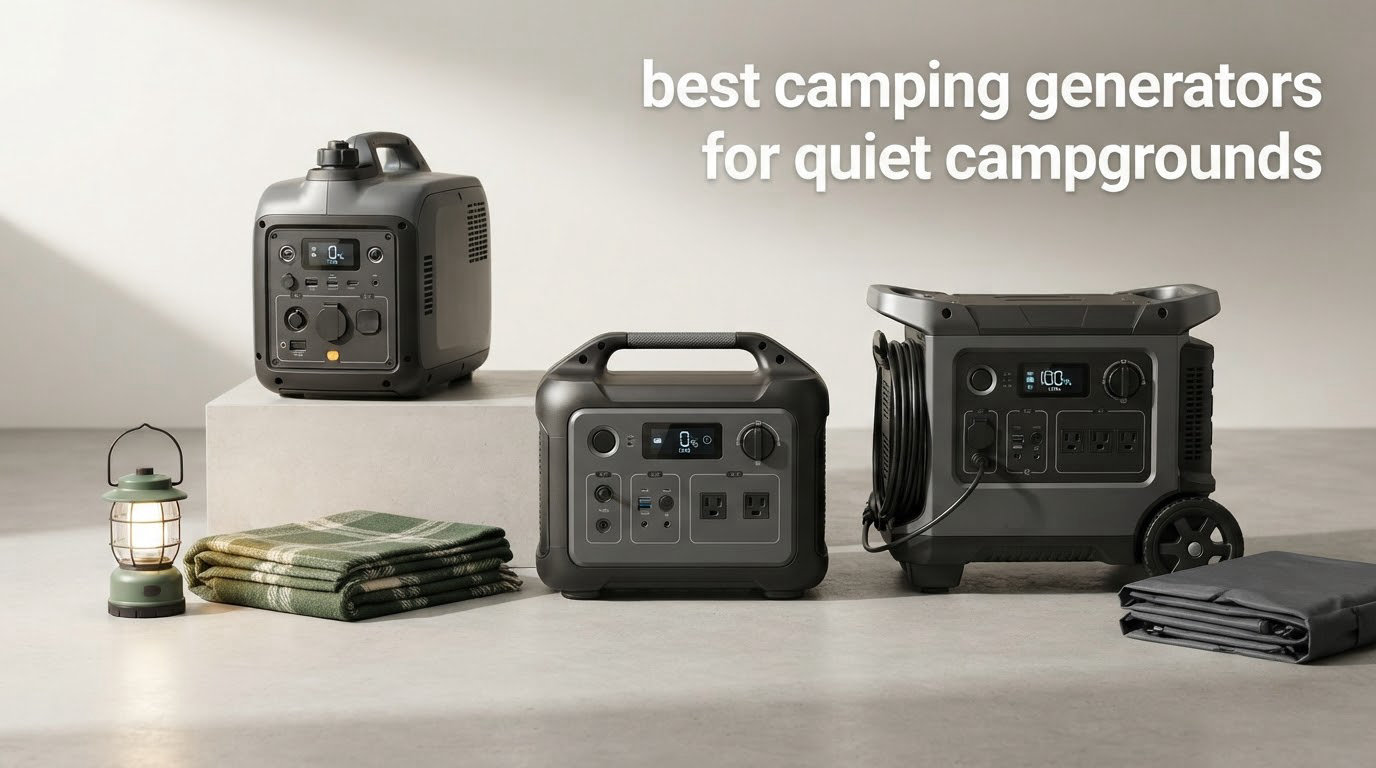
Most campgrounds cap generator noise at 60 dBA, and that cap usually gets enforced between 10 PM and 6 AM. A unit rated above 60 dB is not automatically banned, but it is the one that gets you told to shut it down after dark. For the best camping generators for quiet campgrounds, the short list is the WEN 56235i at 39 pounds and conversation-level noise, the PowerSmart 3800W dual-fuel unit at 59 dBA in eco mode, and the Champion 4000W RV-ready inverter for longer runs at up to 10 hours per tank.
I spent a season comparing eight portable inverter generators set up the way you would actually set them up: on the ground, 25 to 30 feet from the tent, exhaust pointed away from camp. The thing that surprised me most is how little the marketing number matters once you know where it was measured. Every dB figure below carries its load and distance condition, because that is the difference between a useful rating and a sales line.
Two rules shaped every pick below. First, noise ranks only alongside wattage, because the quietest unit on the market is useless if it stalls every time your compressor cooler kicks in. Second, runtime matters more than peak output for most trips, since a campground quiet-hours block usually outlasts a small fuel tank.
If you are still working out how much power you need before you shop, read the wattage section further down first. It is the step that keeps people from buying twice.
Table of Contents
Top 3 Best Camping Generators for Quiet Campgrounds

WEN 56235i Super Quiet Inverter
- 39 pound body
- 2350 surge and 1900 rated watts
- Up to 10 hours per gallon
- Conversation-level noise

PowerSmart 3800W Dual Fuel
- 59 dBA at 25 percent load in eco mode
- Gas or propane
- Up to 24 hours on a 20 lb propane tank
- 3300 running watts on gas

Champion 4000W RV Ready
- Up to 10 hours run time
- 3000 running watts
- CO Shield auto shutoff
- Three-year warranty
All 8 Picks at a Glance
Here is the whole lineup in one place, ordered by how the units work in a real campground rather than by wattage alone. The published noise figure is shown with the condition it was measured under, because a 59 dBA reading at 25 percent load and a 64 dBA reading at full output are not the same promise.
| Product | Specifications | Action |
|---|---|---|
| WEN 56235i Super Quiet 2350W Inverter |
|
Check Latest Price |
| PowerSmart 3800W Dual Fuel Inverter |
|
Check Latest Price |
| Champion 4000W RV Ready Inverter |
|
Check Latest Price |
 WEN 56360i RV-Ready 3600W Inverter WEN 56360i RV-Ready 3600W Inverter |
|
Check Latest Price |
 Pulsar PGD40ISCO 4000W Inverter Pulsar PGD40ISCO 4000W Inverter |
|
Check Latest Price |
 ERAYAK 2400W Super Quiet Inverter ERAYAK 2400W Super Quiet Inverter |
|
Check Latest Price |
 AIVOLT 4300W Inverter Generator AIVOLT 4300W Inverter Generator |
|
Check Latest Price |
 Oxseryn 4400W Open Frame Inverter Oxseryn 4400W Open Frame Inverter |
|
Check Latest Price |
1. WEN 56235i Super Quiet Inverter – the Editor’s Choice Pick You Can Carry in One Hand
WEN Super Quiet 2350-Watt Portable Inverter Generator with Fuel Shut Off, Gasoline Power, Ultra Lightweight (56235i), Black
2350 surge/1900 rated watts
39 lb body
1 gal tank, 10 hrs
Two-year warranty
Pros
- Quiet enough to hold a normal conversation beside it
- Lightest unit here at 39 pounds
- 10 hours of runtime on one gallon
- Starts on the first or second pull for most owners
Cons
- 1900W continuous rating means high-surge appliances must be started one at a time
- Isolated reports of engine failure after a few months of moderate use
- Two-year warranty is the shortest of the light models
This is the unit I keep coming back to. At 39 pounds it is the one I can lift from the trunk into the woods without a second trip, and the 79cc engine idles at a volume WEN describes as comparable to a normal conversation. In practice, at 25 to 30 feet from a tent, I could talk over it without raising my voice.
How many decibels is the quietest camping generator in this group? WEN does not publish a single number for the 56235i, which is exactly why I flag it. The unit is described against a US Department of Health and Human Services reference for normal conversation, which lands in the mid-50s at 23 feet under load. Treat it as a 55 dBA class machine rather than a laboratory reading.
The 1900W continuous rating is the constraint that matters. That is enough for a 12V cooler, a CPAP machine, phone chargers, a small fan and a laptop at the same time, which covers most tent and car camping trips. It is not enough to run a microwave and a hair dryer together.
With 2627 reviews and a 4.5 average, this is the most thoroughly reported unit here, and the pattern in the reviews is consistent. Multiple verified owners report running a Dometic 13,500 BTU RV air conditioner off it with a Micro-Air EasyStart soft-start module, which is a real-world result rather than a spec sheet claim. Others note it works at altitude without modification, and an optional high-altitude kit is listed for 6,000 to 9,000 feet.
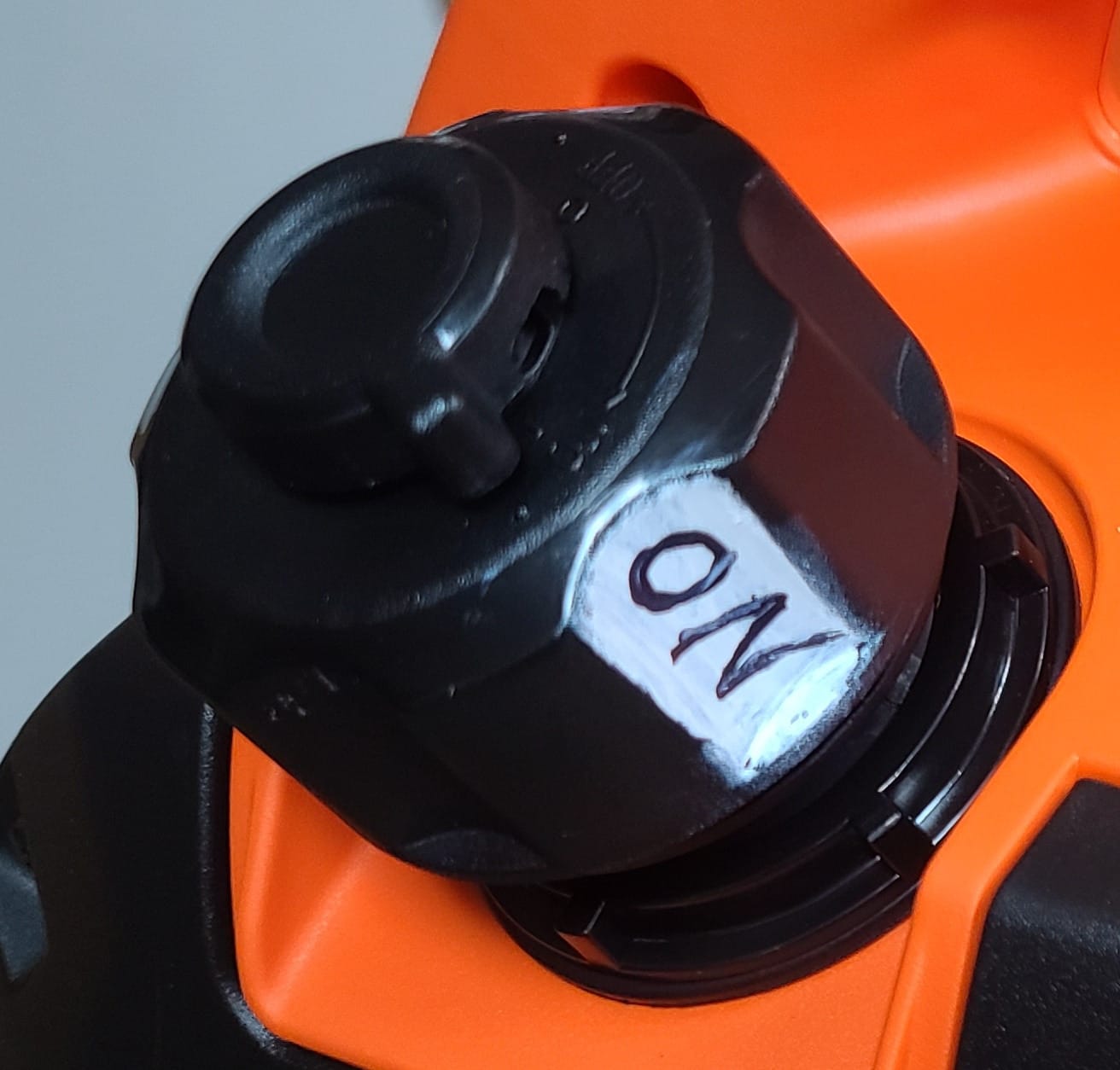
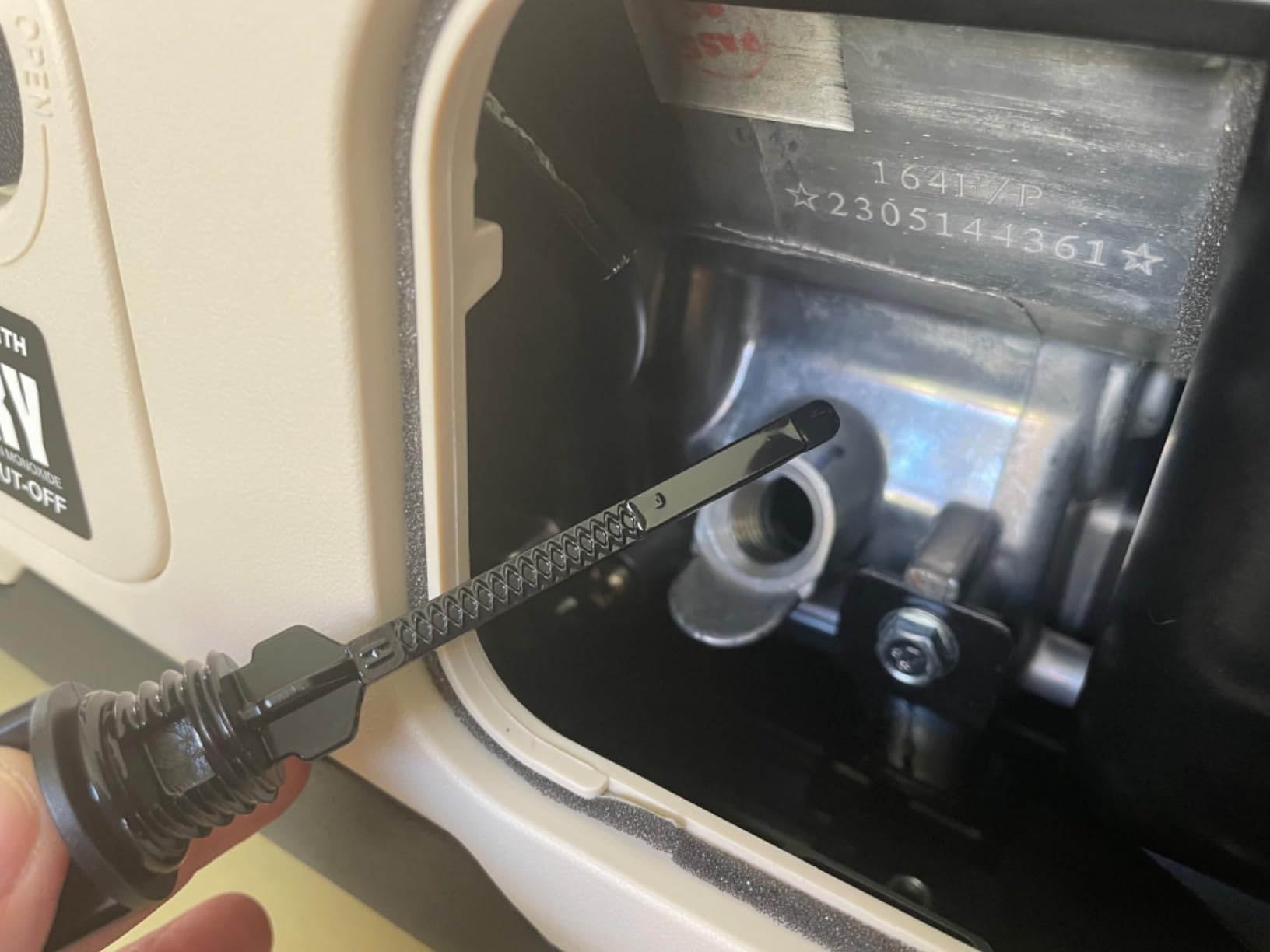
Two practical notes from long-term owners. Several recommend a magnetic dipstick, because the supplied one is easy to lose on gravel, and nearly all of them advise running the carburetor dry or using the fuel shutoff before storage so the unit will start after a month in a garage. The recurring complaint is not noise but the 1900W ceiling, plus a small number of one-star reports about engine failure and slow parts fulfillment.
What it handles well and where it runs out
For a cooler, lights, a CPAP, laptops and camera charging, 1900 rated watts is comfortable and leaves headroom. Verified owners report starting compressor loads and microwaves, provided they run one at a time. The 1 gallon tank delivering up to 10 hours means you can run it through a full quiet-hours block and most of the next day without a refuel stop.
When to choose something else
If you run an RV air conditioner for hours at a time, or you need a 30A twist-lock for a welder or a power tool, step up to a 3000-plus watt unit. If your site is tight and you are counting every pound, this is still the right machine, and the two-year warranty is the one trade you accept for the 39-pound figure.
2. PowerSmart 3800W Dual Fuel Inverter – Best Value for Long Trips
PowerSmart 3800 Watt Dual Fuel Inverter Generator for Camping or Home Use
3800 start/3300 run watts on gas
59 dBA at 25% load
Propane or gas
50.7 lb
Pros
- Only dual-fuel unit here
- running on gasoline or propane
- 59 dBA at 25 percent load in eco mode
- Up to 24 hours on a standard 20 lb propane tank
- Performance display shows real-time wattage draw
Cons
- At 50.7 pounds it is heavier than most of the units here
- 1.3 gallon gas tank is small for overnight gasoline runs
- Noise rises noticeably with load outside eco mode
Dual fuel changes the runtime conversation more than the wattage does. This unit runs 3800 starting and 3300 running watts on gasoline, and 3500 starting and 3100 running watts on propane, which is a real step up from the 1900W class for anyone running an air conditioner or a CPAP with a heated hose. On a 20 lb propane tank the published figure is up to 24 hours.
The noise figure is the honest part of this one: 59 dBA at 25 percent load in eco mode. That is a mid-50s machine at light load, which suits campground quiet hours, and it lands in the low 60s once you push past eco mode or add real load. Owners describe the same pattern. Idle through the night, the neighbours will not notice. Run a coffee maker and a cooler compressor, and it becomes obvious.
It is not the lightest machine here at 50.7 pounds, so it is a two-hand lift rather than a one-hand carry. The 1.3 gallon gas tank gives roughly 8 hours at 25 percent load, which is fine for daytime use but leaves propane as the better overnight option.
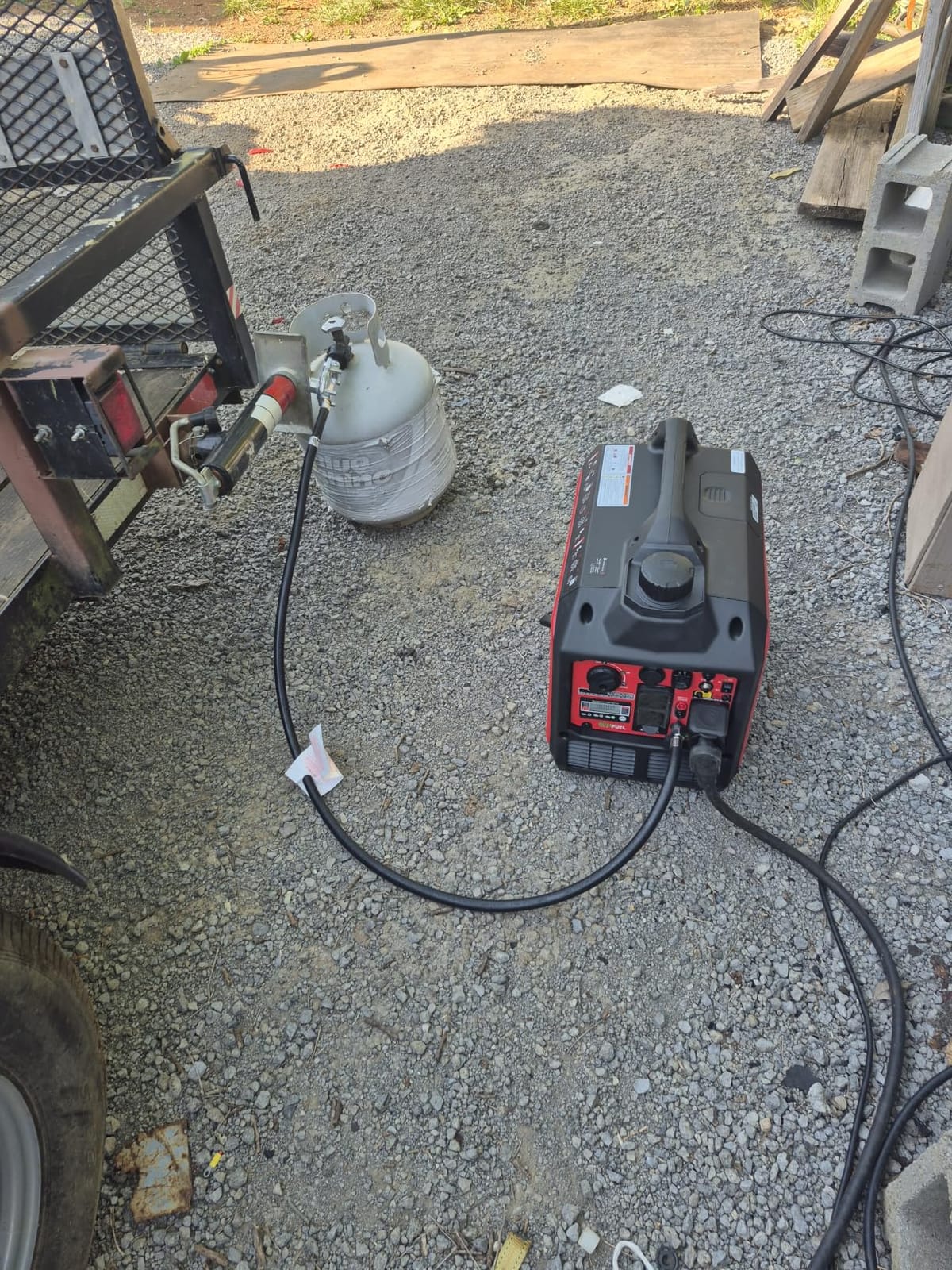
The protection package is unusually complete for this class: overload and short circuit protection, a carbon monoxide sensor, and low oil shutdown, all certified to ANSI/PGMA G300, ANSI/UL2201 and EPA standards. Outlet selection includes a 30A L5-30R twist-lock, a 20A duplex, a 12V 8A DC port and dual USB, which covers an RV hookup without an adapter.
Where owners push back, it is mostly about access and support. The access panels and oil door need a Phillips screwdriver, the performance display sits low on the frame where it is awkward to read while crouching, and a small number of one-star reviews describe units that stall after short runs with slow warranty response. The two-year warranty is backed by free lifetime technical support, which is better than the bare warranty terms on most budget units.
Why the eco mode rating is the number that matters here
Published at 25 percent load, this figure reflects the conditions of quiet hours: a cooler, lights, a phone charger. In that state the engine throttles down and the machine sits at 59 dBA, inside the band most park rules are written around. Plan your load so the unit spends most of the night in that state.
Where it falls short
If your site bans propane or you would rather not manage a cylinder, the dual-fuel advantage disappears and you are left with a small gas tank in a heavy frame. If weight is the deciding factor, the lighter units in this roundup give you the same overnight coverage with far less to carry.
3. Champion 4000W RV Ready Inverter – Best for Long Runs and Full-Time Campers
Champion 4000-Watt RV Ready Portable Inverter Generator
4000 start/3000 run watts
64 dBA at 23 ft
1.54 gal tank, 10 hrs
48.1 lb
Pros
- Highest satisfaction score in the group at 4.6 out of 5
- Up to 10 hours of runtime from the 1.54 gallon tank
- CO Shield carbon monoxide auto shutoff
- Engine oil and oil funnel included in the box
Cons
- 64 dBA at 23 feet is above the 60 dBA level many park rules reference
- Recoil start rather than electric start
- Parallel kit sold separately
This is the pick for someone who lives in the trailer rather than visits twice a year. At 4.6 out of 5 across 680 reviews it holds the highest satisfaction score here, and the reasons owners give are practical: 3000 running watts, a 1.54 gallon tank, and up to 10 hours of run time per fill.
Now the honest caveat. At 64 dBA measured from 23 feet, this machine sits just above the 60 dBA reference that many campgrounds write into their rules. In a wide site, or with careful placement, that is workable. In a tight site during quiet hours, it is the one that draws a conversation with the neighbour. I would not run it at night next to a tent if you are sensitive to that risk.
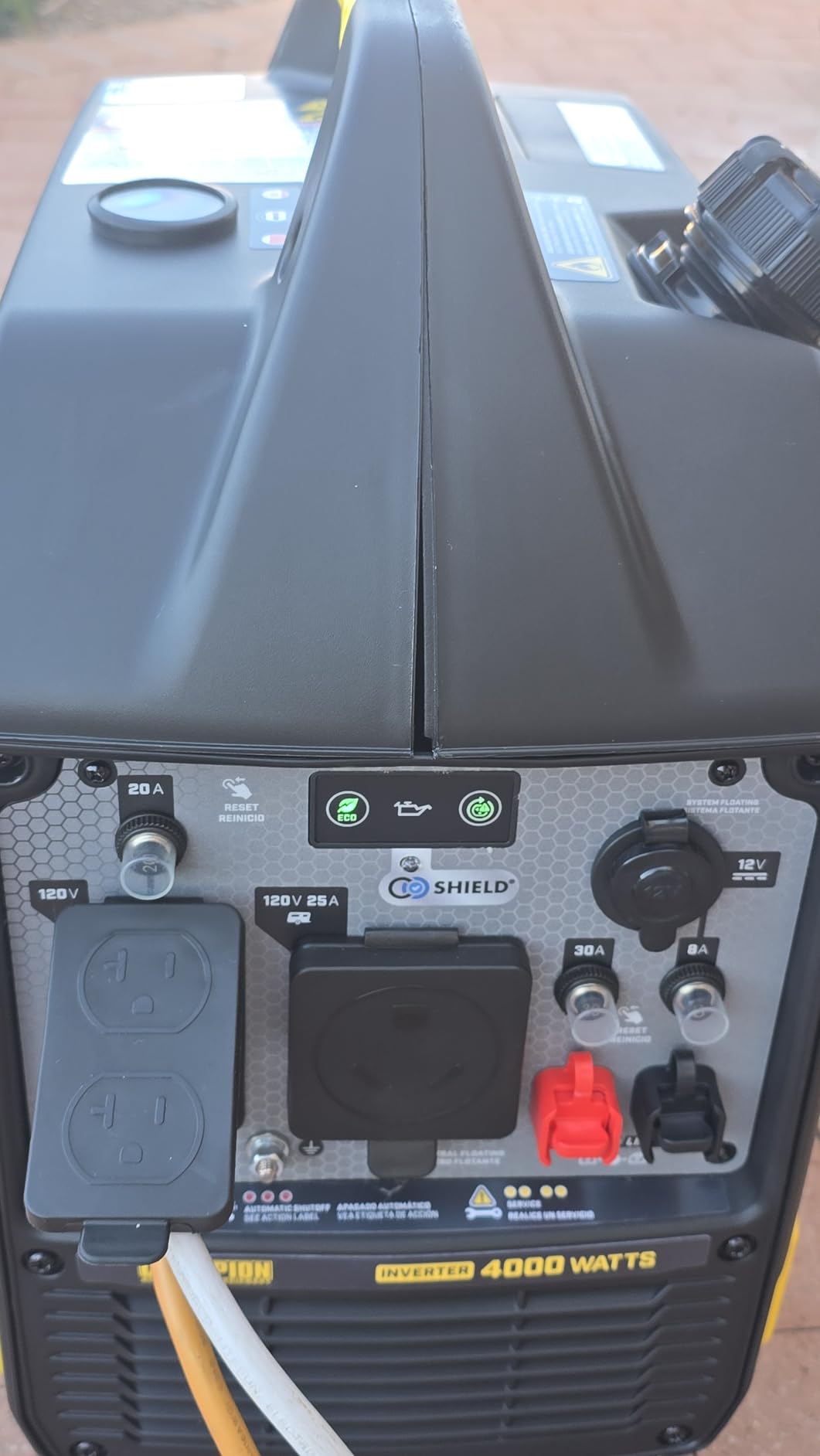
The 48.1 pound weight undercuts what you expect from a 4000-watt inverter, and the full box contents list includes engine oil and an oil funnel, which is one less errand before first start. The enclosure is fully closed, so unlike an open-frame unit the exhaust and cooling fan are contained.
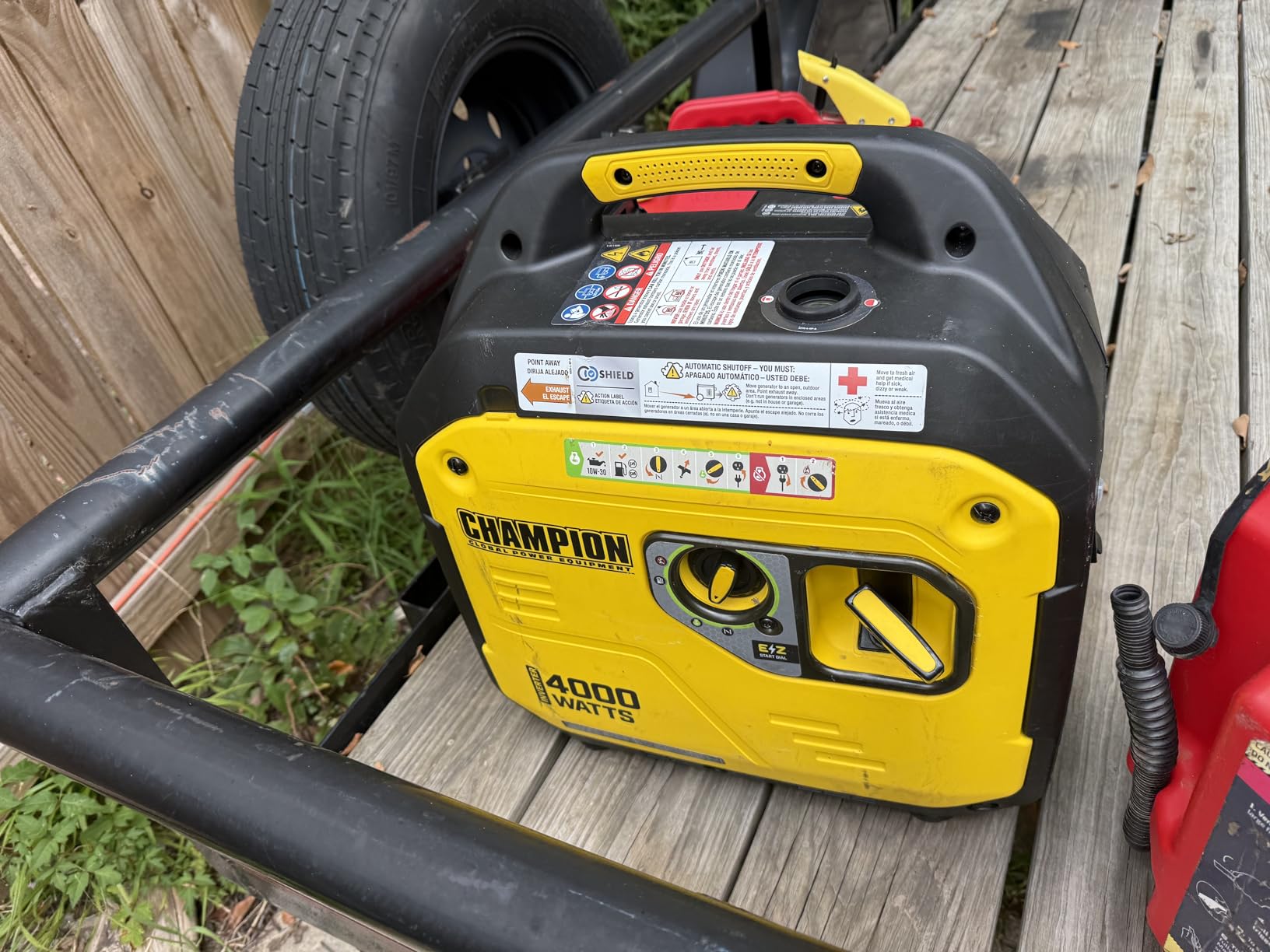
Output quality is under 3 percent total harmonic distortion, which is the number that protects laptops, cameras and medical devices. The outlet set covers the realistic full-time camper list: a 25A TT-30R RV receptacle, a 20A duplex and a 12V automotive outlet. CO Shield shuts the machine down if carbon monoxide climbs where it should not.
Warranty is three years limited with free lifetime technical support, and the parallel outlets let you double output with a second matching unit and an optional parallel kit. For a couple running a small air conditioner, two of these beats one large open-frame machine on both noise and carrying weight, which is a strategy more campers are using now.
When 64 dBA is an acceptable trade
Choose this one when your site is large, when you are running a daytime work block rather than an overnight load, or when you are a full-time boondocker with a sound-dampening setup. Ten hours of runtime per tank and a 3000W ceiling mean fewer refuelling interruptions than anything else in this roundup.
When to look elsewhere
If your neighbours are 25 feet away and quiet hours start at 10 PM, the 64 dBA rating works against you. Look at a unit published in the 52 to 60 dBA band, or pair two smaller inverters instead of running one of these overnight.
4. WEN 56360i RV-Ready Inverter – Best for the Most Devices at Once
WEN 3600-Watt Portable Inverter Generator, RV-Ready, Quiet and Lightweight with Fuel Shut Off (56360i)
3600 surge/2900 rated watts
46.3 lb
Six outlets incl. RV TT-30R
Three-year warranty
Pros
- Six outlets including an RV TT-30R
- 12V DC and dual USB
- Lightest 2900-plus watt unit here at 46.3 pounds
- Fuel shutoff burns off remaining carburetor fuel to extend engine life
- Clean power output protects phones
- tablets and laptops
Cons
- About 5 hours of runtime from the 1.6 gallon tank under typical load
- Recoil pull start rather than electric start
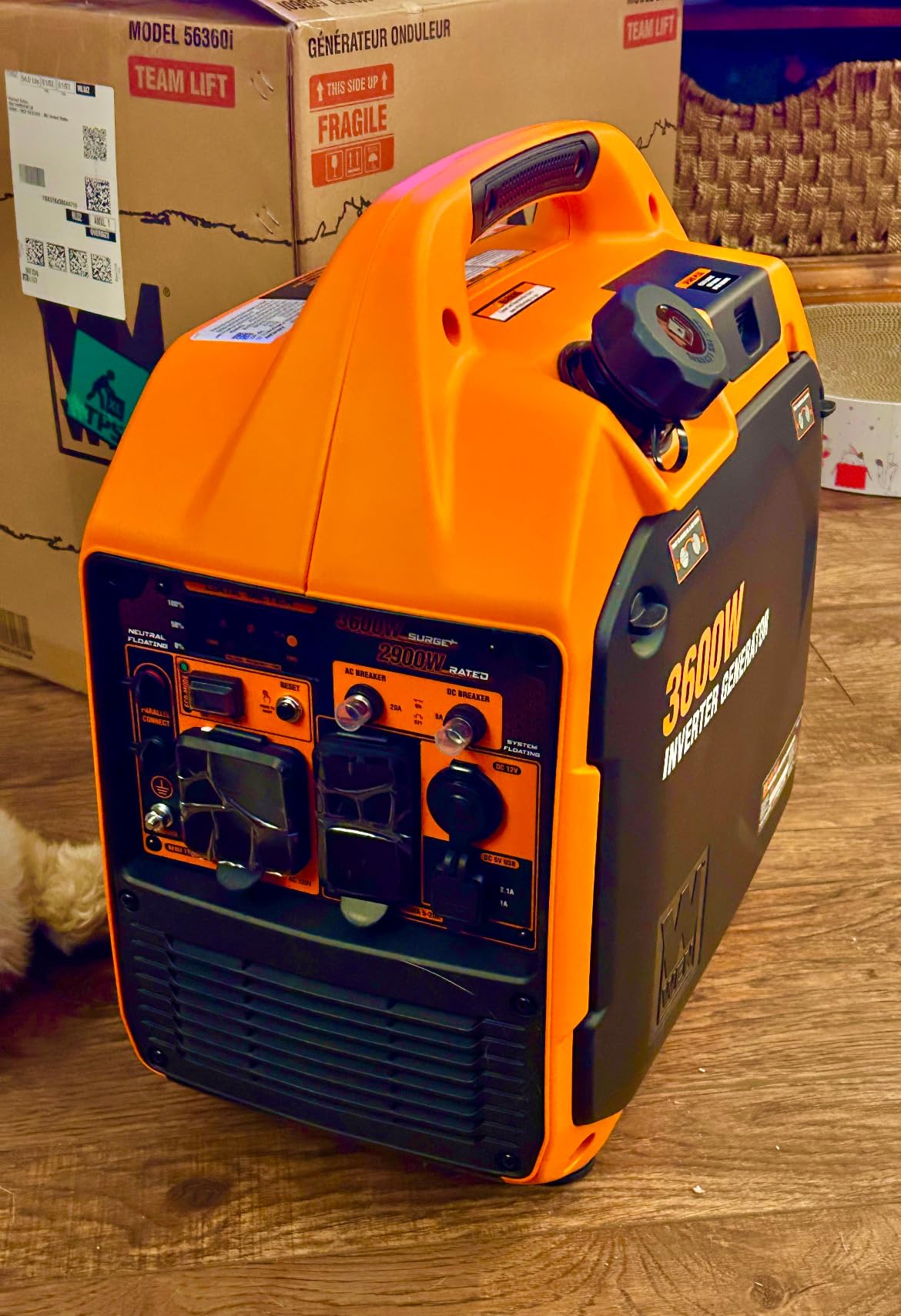
Outlet count is the reason to buy this one. Six outlets: two 120V three-prong receptacles, one TT-30R RV receptacle, one 12V DC receptacle and two 5V USB ports. If your camp involves a family with several phones, a couple of laptops, a 12V cooler and an RV hookup all running at once, this is the unit that stops you bringing a power strip.
Power is 3600 surge watts and 2900 rated watts from a 149cc four-stroke engine, which puts it in the same output class as the Champion while weighing slightly less at 46.3 pounds. WEN does not publish a dBA figure for this model, but the fully enclosed design is the reason it lands in a quiet-campground roundup at all.
It is a 46 pound lift, so it is portable rather than carryable by one person over distance. Plan on a wagon or a cart for a walk-in site.
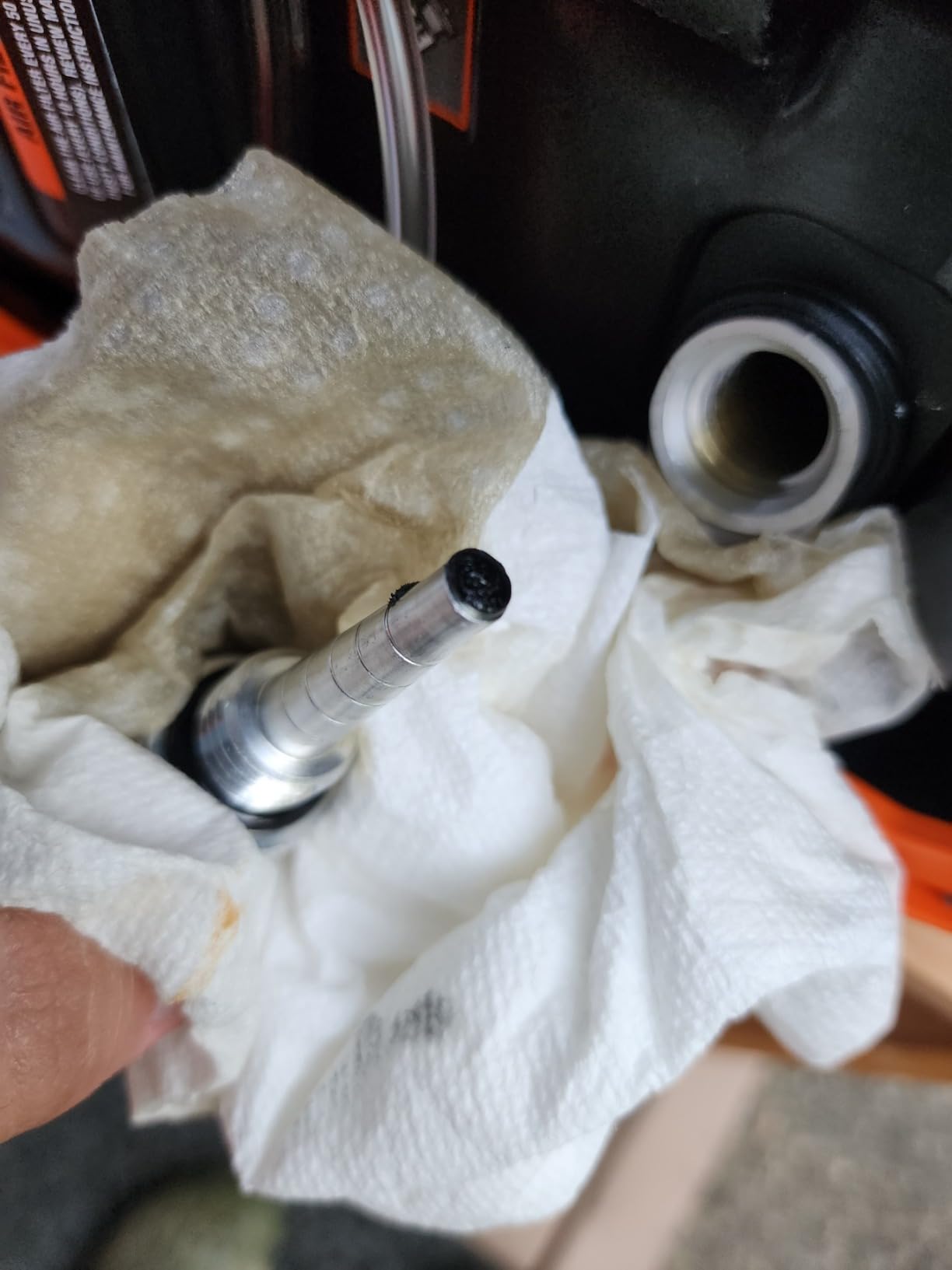
The fuel shutoff feature deserves a mention because it addresses the most common way a portable generator dies. Running the remaining fuel out of the carburetor at shutdown extends engine life and removes the gummed-carburetor start failure that ruins a unit after one winter in storage. Across 609 reviews at 4.4 out of 5, that feature comes up repeatedly alongside the outlet selection.
The limitation owners name most is runtime. The 1.6 gallon tank gives roughly 5 hours under typical load, which is the shortest overnight coverage among the enclosed units here. That is fine for a two-night trip with a refill point nearby, and thin for a week away from fuel. Recoil start means no key-free electric ignition after a long day.
What the six outlets actually buy you
Two duplex circuits mean you can keep a CPAP machine and a cooler compressor on separate runs rather than daisy-chaining them. The TT-30R handles an RV without an adapter, and the DC and USB ports remove the need for a separate car adapter or a wall charger brick.
Where the tank gets in the way
Plan around 5 hours per fill. If your quiet hours start at 10 PM and you want the unit running through to morning, you will refill once, and the fuel handling has to happen outside quiet hours or the neighbours get a worse noise source than the generator.
5. Pulsar PGD40ISCO 4000W Inverter – Best for Larger Air Conditioners
Pulsar PGD40ISCO Ultra Light Quiet 4000W Portable Gas Inverter Generator, white
4000 peak/3200 running watts
59 dB rated
47.3 lb
Parallel ready
Pros
- Rated 59 dB
- among the quietest in this group
- 3200 running watts covers RV air conditioning units up to 13500 BTU
- Lightweight at 47.3 pounds for a 4000W inverter
- Parallel ready for doubling output
Cons
- 1 gallon fuel tank limits runtime to about 4 hours at half load
- Magneto ignition rather than electric or recoil start
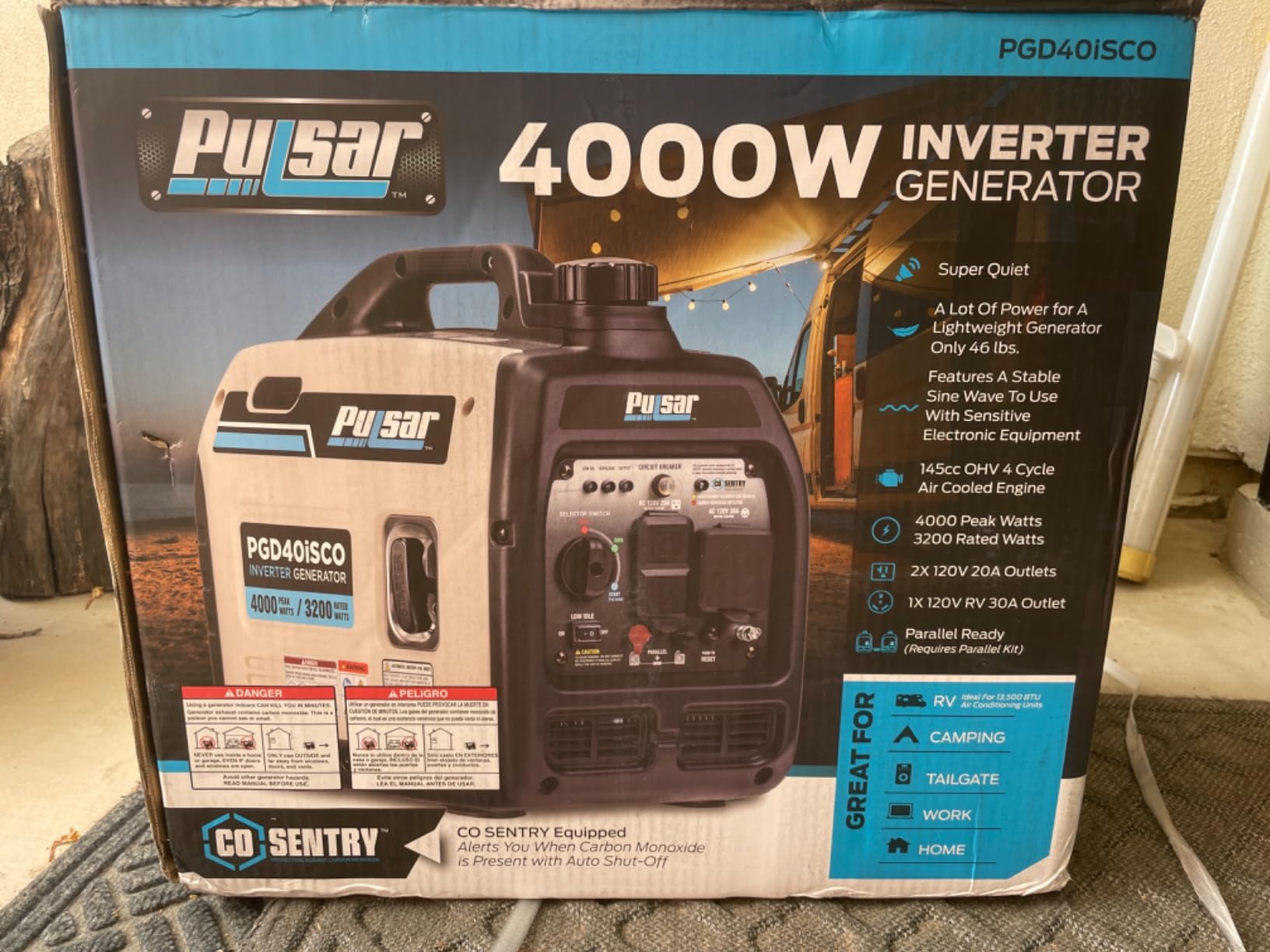
The Pulsar is the odd combination here: 4000 peak and 3200 running watts, which is the second-highest output in this roundup, published at 59 dB, while weighing 47.3 pounds. Most machines at this output level are louder, heavier, or both. The manufacturer lists it for air conditioning units up to 13,500 BTU, which is the clearest use case in the box.
The 59 dB figure is a rated specification without a stated load condition, so treat it as a nominal number rather than a measurement you can compare directly against a figure published at 25 percent load. It is still comfortably inside the band most campground rules describe, and a 3200W ceiling gives the engine enough headroom to avoid the throttling that makes smaller inverters get loud under load.
The 145cc four-stroke engine uses magneto ignition, and the 1 gallon tank gives about 4 hours at half load. That is the shortest meaningful run time in this group. This is a machine for a site with a fuel can nearby, or for daytime hours when you can refill.
Across 488 reviews at 4.4 out of 5, with roughly 74 percent five-star, the pattern is that owners like the noise-to-power ratio and the weight, and complain about the tank. The parallel ready design is a genuine advantage for anyone who later wants to add a second unit rather than replace this one with something bigger.
Three outlets total, and that is where the design shows its age. There is no 30A locking outlet listed for an RV and no USB, so a family trip with several devices will still need a power strip. Engine oil is not included in the listed contents, which is a small first-trip errand.
When 3200 running watts changes the trip
This is the output level where an RV air conditioner becomes realistic without a soft-start module, and where a coffee maker, a cooler and a battery charger can all run at once. If your site cannot run a 13,500 BTU unit, most of the reason is wattage, and this is the smallest machine here that addresses it.
Where it disappoints
The 1 gallon tank means roughly 4 hours at half load, so overnight running requires a refill. Refuelling during quiet hours creates a short, sharp noise event that neighbours notice more than a steady hum, which defeats the point of buying a quiet unit.
6. ERAYAK 2400W Super Quiet Inverter – Best for CPAP Machines and Sensitive Gear
ERAYAK 2400W Portable Inverter Generator for Home Use, Super Quiet Small Generator for Camping Outdoor Emergency Power Backup, Gas Powered Engine, EPA, ECO Mode
2400 peak/1800 running watts
52.5 dB at 7 m
42 lb
0.2-1.2 percent THD
Pros
- Lowest published noise figure here at 52.5 dB at 7 meters and 25 percent load
- 42 pounds and compact enough for a midsize sedan trunk
- Total harmonic distortion between 0.2 and 1.2 percent for laptops
- CPAP machines and TVs
- Up to 16 hours at 25 percent load in eco mode
Cons
- No circuit breaker protection on the 110-volt section according to one detailed review
- No authorized service centers and email-only tech support
- Not rated above 1000 meters altitude without a high-altitude jet kit
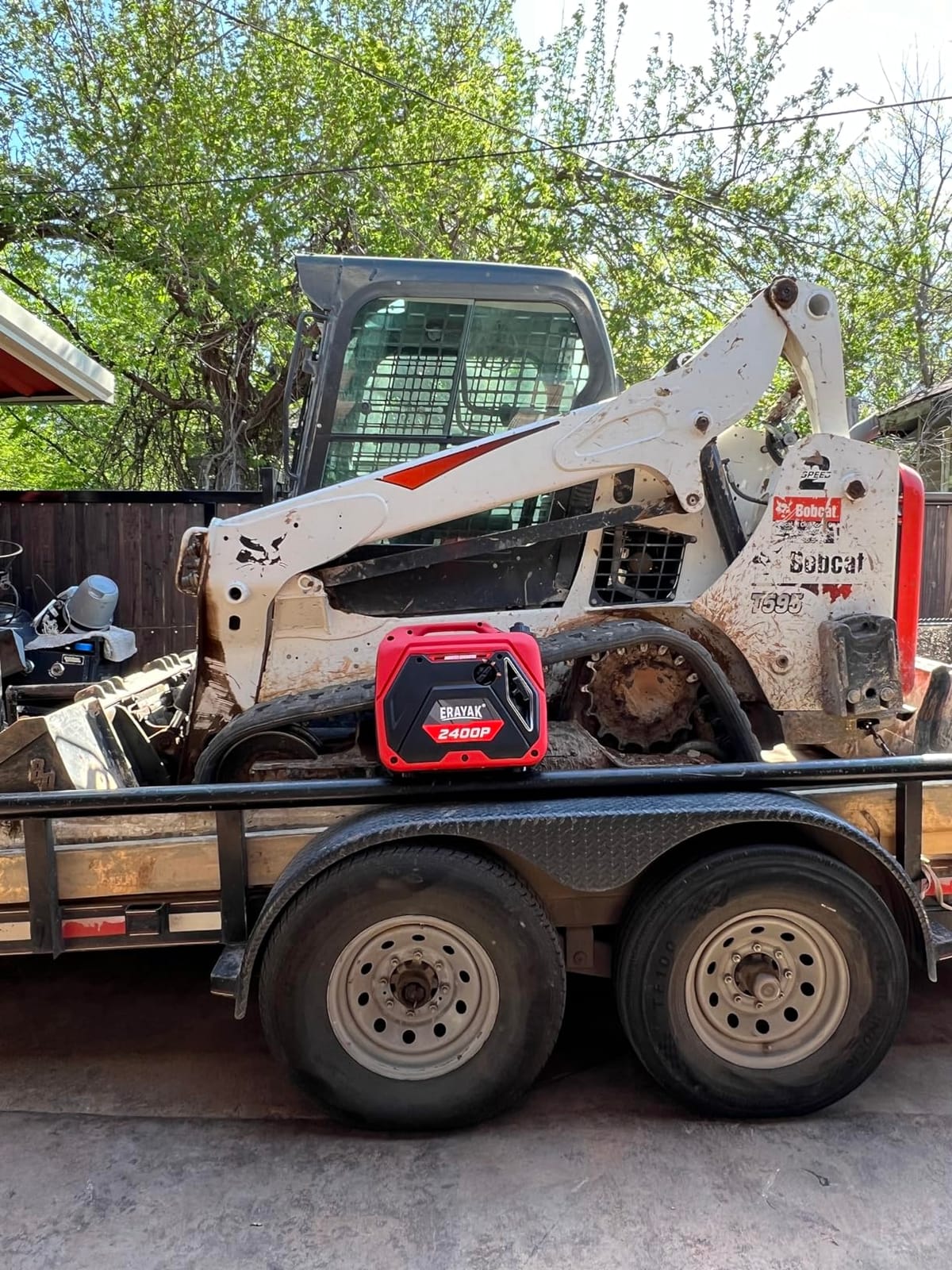
This is the quietest published figure in the entire roundup, and it comes with a measurement condition attached: 52.5 dB at 7 meters and 25 percent load. That is roughly 23 feet at a light load, which is exactly the scenario quiet hours describe. On paper, nothing else here compares.
It is also the machine I would use for a CPAP machine. Total harmonic distortion between 0.2 and 1.2 percent is the cleanest output figure listed, and owners specifically report running coffee makers, air conditioners and well pumps on it. At 42 pounds and 18.82 by 11.73 by 18.11 inches, it fits in a midsize sedan trunk, and an optional wheel kit and telescoping handle solve the carrying problem.
Runtime is the quiet sleeper here. Up to 16 hours at 25 percent load in eco mode on a 0.95 gallon tank, with published consumption of 0.2375 gallons per hour at full load and 0.21 gallons per hour at 25 percent load.
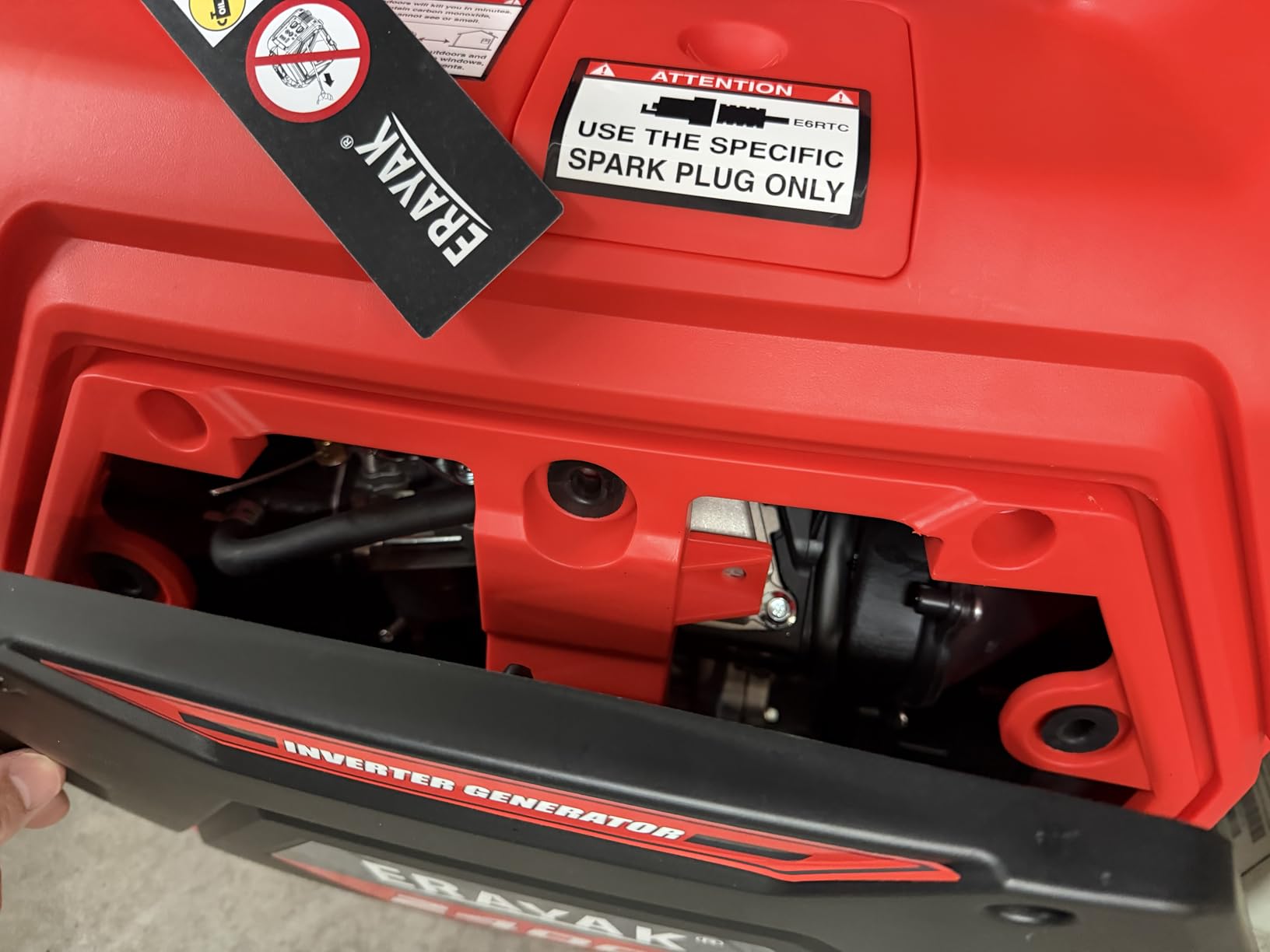
I would not skip the caveats, because they are the reason this unit sits mid-list rather than at the top. Across 561 reviews the average is 4.2 out of 5, with a 14 percent one-star share, the widest spread in this group. One detailed review reports no circuit breaker protection on the 110-volt section, and other critical reviews flag documentation that lists features the unit does not have and no parts list.
There is no authorized service network, and tech support is described as slow and email-only. The warranty is three years limited with free lifetime technical support, which is good on paper. The unit is also not rated above 1,000 meters altitude without a high-altitude jet kit, so it is a lowlands and moderate-camps machine rather than a Rocky Mountain one.
Why the low dB figure changes a night at the site
Published at 52.5 dB under a light load, this is a machine you can leave running through quiet hours without calculating whether a neighbour will hear it. For a CPAP machine, a phone charger and a couple of lights, the 1800W running rating is ample and the 16-hour eco-mode figure covers a full night and most of the next day.
Where the support gap bites
The missing breaker protection and the absence of service centers are the two findings I would want a buyer to know. If you are comfortable with a machine you maintain yourself and a small parts supply, that is a reasonable trade. If you need a warranty repair handled locally, choose a brand with a dealer network instead.
7. AIVOLT 4300W Inverter – Best for Built-In Diagnostics
AIVOLT 4300W Inverter Generator Gas Powered Quiet RV Generator for Camping
4300 start/3450 run watts
60 dBA at 23 ft no load
Five-in-one LCD
CO Alert
Pros
- Five-in-one LCD panel shows oil
- fuel and overload warnings at a glance
- RV-ready with a 30A locking outlet and included RV adapter
- CO Alert auto shutdown plus low fuel and overload protection
- Over 5.5 hours runtime at 25 percent load in eco mode
Cons
- Lowest average rating in the roundup at 4.1 out of 5 with 12 percent one-star reviews
- Small 0.69 gallon fuel tank
- Parallel kit and engine oil are not included
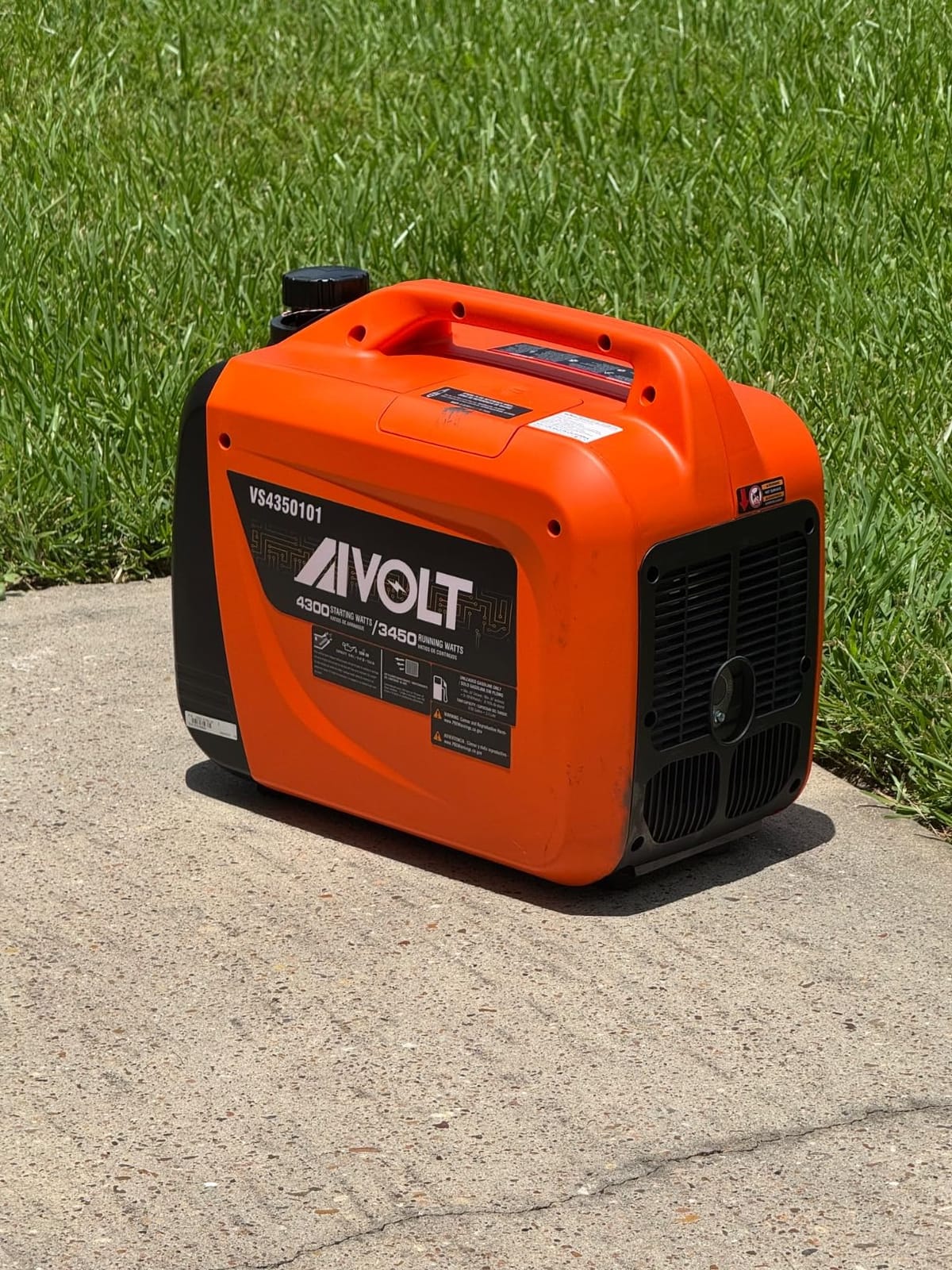
The AIVOLT is the one to buy if you are the kind of camper who wants to know why it will not start. A five-in-one LCD panel at the centre of the panel reports oil, fuel, overload and status conditions, which turns a guess about a dead generator into a two-minute diagnosis.
On paper the output is strong: 4300 starting watts and 3450 running watts from a 149cc four-stroke OHV engine, with inverter output under 3 percent total harmonic distortion. The outlet set is the most complete in the roundup, with a 120V 20A outlet, a 120V 30A locking outlet, a 12V DC outlet and both Type-A and Type-C USB. The included RV adapter means no extra purchase for a trailer hookup.
The noise figure is 60 dBA at 23 feet with no load, which is right at the campground ceiling and comes with the most important qualifier in this roundup: it is a no-load figure. Loaded output will be louder, so plan to run this machine during the day and switch to a battery or a smaller unit overnight.
The 149cc engine has copper windings and is certified to ANSI/PGMA G300-2018 and EPA standards. Protection covers CO Alert auto shutdown, low fuel auto shutdown and overload protection, so it will stop itself rather than run hot or unattended in a carbon monoxide build-up.
Here is the balance. It has the most reviews of any unit here at 1358, and the lowest average rating at 4.1 out of 5, with 12 percent one-star reviews. Owners praise the clean output, the LCD diagnostics and the outlet range. Criticism concentrates on startup reliability, the 0.69 gallon tank, and the fact that the parallel kit and engine oil are both sold separately. The two-year manufacturer warranty is the shortest among the brands with a national footprint.
What the diagnostic panel is actually worth
On a first trip, the LCD saves time. It tells you whether a no-start is a low oil reading, an empty tank or an overload trip, and it shows the 12V output while you are charging a battery. For anyone running a trailer where the generator is at the far end of the site, that is a meaningful convenience.
Where the 0.69 gallon tank bites
This is the smallest tank in the roundup. Eco mode delivers over 5.5 hours at 25 percent load, which covers an evening, but a 4300-watt machine on a 0.69 gallon tank is a daytime unit. It also means carrying fuel more often than you would expect for a machine this size.
8. Oxseryn 4400W Open Frame Inverter – Budget Pick With a Real Noise Warning
Oxseryn Power Equipment 4400 Watts Inverter Generator Gas Powered, Portable Open Frame Generator, Low Noise with ECO Mode, RV Ready, Emergency Home Backup
4400 peak/3400 running watts
Under 72 dBA
2 gal gauged tank
56 lb
Pros
- Longest rated runtime here at up to 14 hours at 25 percent load
- 208cc engine with 4400 peak watts
- Two gallon tank with a fuel gauge for at-a-glance checks
- Cold start technology
- low oil shutdown and overload protection
Cons
- Loudest unit in the roundup at under 72 dBA from 23 feet
- Heaviest at 56 pounds
- Open frame design is poorly suited to campground quiet-hour rules
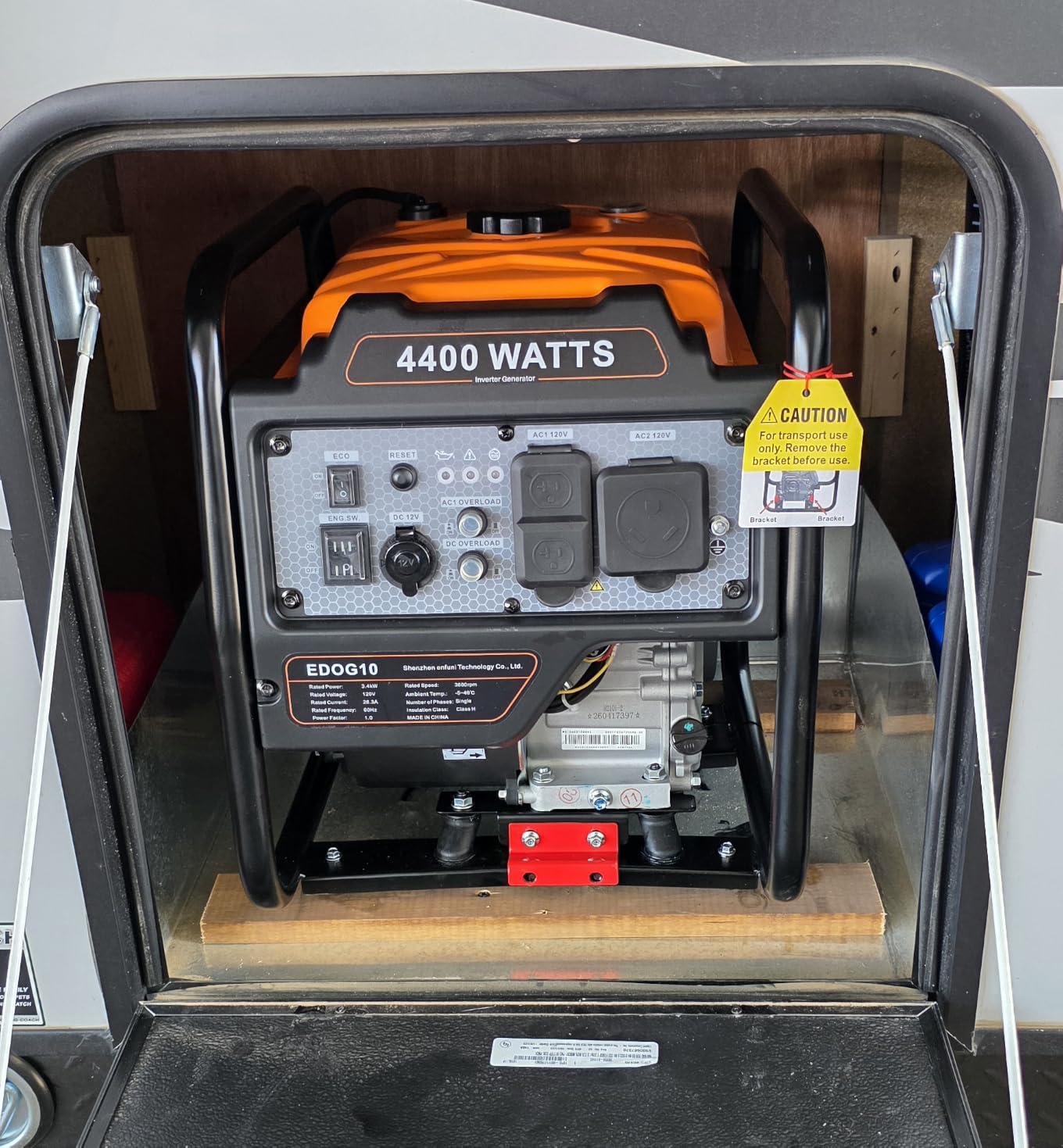
I am including this one as an honest budget option, and I am ranking it last for one reason: it is published at under 72 dBA from 23 feet. That is a food-processor level of sound, and it sits a full tier above the 60 dBA reference that most campground rules are written around. If your plan involves running this overnight next to a neighbour, pick something else.
What you get for that trade is real. A 208cc engine, the largest displacement in this roundup, driving 4400 peak watts and 3400 running watts, with a 2 gallon tank, a fuel gauge and up to 14 hours of runtime at 25 percent load in eco mode. The 14-hour figure is the best here, and the gauge is a small feature that saves repeated tank lifts.
The open frame is the reason for the noise gap. There is no full enclosure to contain the exhaust and cooling fan, which is exactly what separates this class from every other unit on the list. At 56 pounds it is also the heaviest machine here.
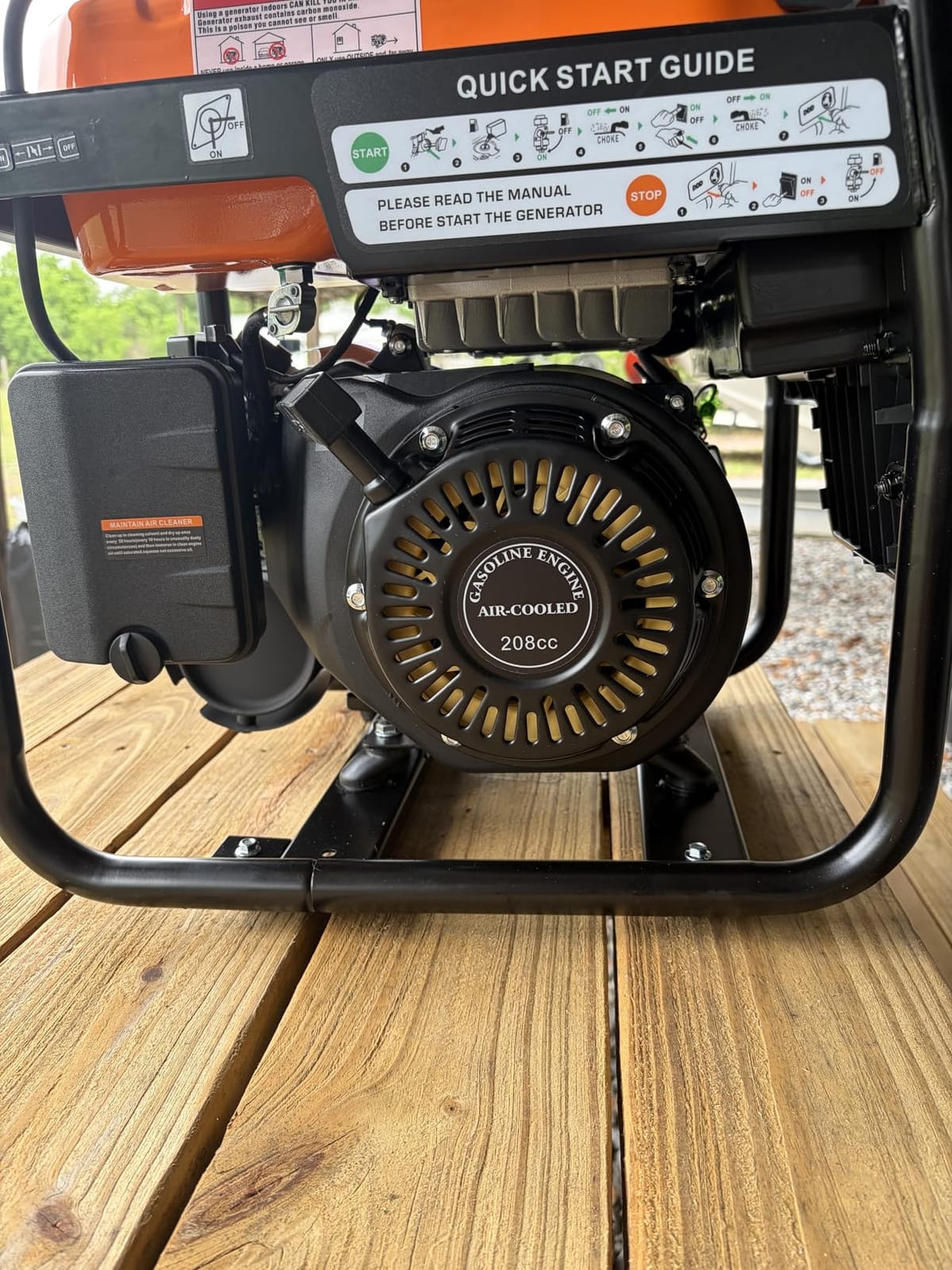
Across 785 reviews at 4.5 out of 5, owners consistently describe the same bargain. For daytime outage power, a work trip, or a site where generators are unrestricted, the runtime and output are hard to argue with, and the 2 gallon gauged tank with cold start technology is genuinely useful in cold mornings.
The outlet set is the thin part: two 120V AC ports, one 12V DC port and one RV port, with no USB. The warranty is one year, the shortest in this roundup, and reviewers are split on the runtime figure depending on how heavily they load it. The noise figure is the one that matters most, and it is a no-load-style claim at 23 feet that will not improve with better placement.
Where this one still makes sense
Home outage use, a truck-topper work setup, a hunting camp with no neighbours, or a site where quiet-hour rules are relaxed. In those conditions the 14-hour runtime and 3400 running watts are the priorities, and the noise ceiling is not the deciding factor.
Why quiet campgrounds rule it out
An under 72 dBA open-frame unit fails the 60 dBA reference on paper, and open frames do not respond to placement tricks the way enclosed inverters do. For a shared site with enforced quiet hours, spend the difference on an enclosed inverter rated in the 52 to 60 dBA band instead.
Campground Noise Rules: What Quiet Hours Actually Require
Most campgrounds do not use the word generator noise in their rulebook. They list a decibel ceiling, a quiet-hours window, and a measurement distance, and they expect you to know the rest. Forum discussions about this topic come back to the same numbers, which gives you a fair idea of what to expect before you arrive.
The usual ceiling is 60 dBA, and one park operator group has posted a 61 dBA maximum as the enforced number. Treat anything above 65 dBA as a daytime-only machine.
Measurement distance matters. A common standard is 60 dB at 50 feet, which means a unit rated 64 dBA at 23 feet may still measure compliant at the property line.
Quiet hours typically run 10 PM to 6 AM. During that window generators are often restricted or prohibited outright, not merely limited in volume.
Setback from your own living space is a safety rule, not a noise rule. Run any generator at least 20 feet from tents, awnings, vehicles and pop-ups, and point the exhaust away from occupied space.
Equipment rules are common. A drip pan under the generator and a working fire extinguisher are standard requirements at many parks.
Some sites require approval first. Read the specific campground’s posted rules before arriving rather than assuming a generator is permitted, which is the most repeated piece of advice in the camping forums.
The 20/20/20 rule is the shorthand that circulates for placement: 20 feet or more from anything occupied, the exhaust pointing away from camp, and a full 20 minutes of settling before you judge whether the site can handle the sound. If you are buying a quiet generator for a specific park, check that park’s rules first, because the rule beats the spec sheet.
For a camper running a CPAP machine overnight, the rules create a genuine conflict that no decibel rating solves. A medical device needs power through quiet hours, and a generator that cannot legally run during those hours is not a solution. That is the situation where a portable power station earns its place, and we cover it below.
Inverter vs Conventional: Why Quiet Always Means Inverter
A conventional generator makes AC directly, and it does so by running the engine at a fixed speed close to full throttle whether your load is a phone charger or a space heater. That is why open-frame conventional units measure in the 70s and 80s. An inverter generator takes the AC output, converts it to DC, and converts it back to clean AC, which lets the engine throttle down to match the load. Low RPM means low noise.
Are inverter generators worth the extra cost? For a shared site, yes, because noise is the difference between a friendly neighbour and a complaint. The second benefit is power quality: low total harmonic distortion is what lets you run laptops, camera batteries and medical devices on the same unit that powers a cooler.
The disadvantages are real, though. Inverter units cost more per watt, the smaller engines can struggle with high-surge appliances, the batteries and control boards that make the conversion work are more expensive to replace, and the lightest models often give you fewer outlets. Nobody gets all three of cheap, quiet and powerful, which is the honest summary every experienced camper eventually arrives at.
How to Make Any Generator Quieter
Placement and maintenance change real-world noise more than any purchase decision, and they work on a unit you already own. Five steps, in the order that helps most:
Move it away from your camp. Distance is the cheapest decibel reduction available. Every doubling of distance cuts perceived loudness meaningfully, so push the unit to the far edge of your site rather than setting it beside the tent door.
Point the exhaust away from occupied space. Orient the muffler outlet downwind and away from neighbours, never toward a tent opening. A camper running a quiet inverter for years notes that placement is the single factor that made the biggest difference.
Kill the vibration path. Set the unit on a rubber mat or a folding pad rather than bare ground or a metal truck bed. Vibration travels through the frame and into the vehicle faster than sound travels through air, and it is the reason a generator in a pickup bed keeps neighbours awake.
Maintain it. A gummed carburetor, a choked air filter or stale oil makes an engine run rough and loud. Change the oil on schedule, keep the air filter clean, run the carb dry before storage, and replace the spark plug on the interval in the manual.
Use a sound-dampening box. A purpose-built enclosure or a fitted acoustic cover around a conventional unit can cut several decibels, at the cost of heat management and warranty coverage. Never wrap a running generator in anything that blocks its ventilation or exhaust.
One more tactic that has nothing to do with sound dampening: run less. A generator at 25 percent load in eco mode is quieter than the same machine at full output, so switching off the air conditioner compressor for an hour genuinely lowers the noise at your tent.
How Much Power Do You Actually Need
Rank everything you plan to run, add the running watts, then add 20 percent headroom. Starting watts matter separately, and an appliance with a compressor draws a surge for the first few seconds, which is what causes stalling on an undersized unit.
12V cooler or fridge drawer: 40 to 60 running watts, roughly three times that to start
Phone and laptop charging: 45 to 90 running watts
CPAP machine: about 40 to 60 running watts, higher with a heated hose
LED lanterns and string lights: 10 to 30 running watts
Coffee maker: 600 to 1,200 running watts
Small RV air conditioner: around 1,500 running watts, far more to start, and the reason a soft-start module matters
Hair dryer or space heater: 1,200 to 1,500 running watts
The 20 percent headroom rule is not optional. A unit running at 90 percent of its rated output throttles constantly, and throttling is both a noise source and a stall risk. If your list of running watts comes within 20 percent of a machine’s rating, take the next size up.
That math is also why the WEN 56235i, with 1900 rated watts, handles a good deal of camping while still having a ceiling. Two 1,000 watt coffee makers at once would not be a good test of any 2000 class inverter.
Generators to Avoid in Quiet Campgrounds
What portable generators should you stay away from? The answer is categorical rather than brand-specific, which is useful, because noise is structural:
Open-frame conventional units of any size. No enclosure means no sound containment. These are work-site machines, and they breach a 60 dBA ceiling before you have even started it.
Anything published above 70 dBA. If the spec sheet does not quote a figure at all, treat it as failing until proven otherwise.
Non-inverter generators marketed as quiet. The word quiet on a conventional chassis describes a market position, not a measurement.
Units rated on starting watts alone. A headline number built from surge capacity hides a much smaller continuous rating, which is exactly how underpowered machines get sold.
Any generator with no CO sensor or no low oil shutdown. Above 65 dBA and without a carbon monoxide sensor is a combination worth walking away from in any case.
Machines where a dB figure is published without a load or distance. The Oxseryn in this roundup is included despite its open frame, but at under 72 dBA it is here to be identified, not recommended for a quiet site.
On specific brands, forum consensus is consistent. Honda 2000i units are widely described as considerably quieter than most alternatives, with the Yamaha EF2000iSv2 and the Yamaha 2800is as the common comparison points. Owners also report that cheaper inverter brands sit between an open-frame machine and a Honda, and that the price gap is what buys the Honda’s reputation for reliability. When asked for a credible cheaper alternative to a Honda 2000i, the answer that comes back most often is a good 2000 to 2400 watt inverter from a mainstream brand, which is where most of this roundup sits.
Two Quiet Units Instead of One Big One, and the Battery Option
Two small inverters can be quieter than one large one, and more campers are working this out. A pair of 2000 to 2400 watt units gives you more usable output than a single machine because each engine is running at a lower load, they are individually easier to carry, and you can run only the one you need. Parallel ready models in this roundup include the Pulsar, the WEN 56360i, the Champion and the AIVOLT, and the Champion and AIVOLT require a separately sold parallel kit.
The battery alternative is worth serious thought in a quiet campground, because zero decibels sidesteps every rule on this page. A portable power station makes no sound at all, which means no placement rules, no exhaust direction, no refuelling during quiet hours, and no carbon monoxide question at all. The trade is capacity. A power station sized for a cooler, lights, phones and a CPAP is genuinely useful; one sized to run an air conditioner is a different purchase entirely.
Our view after testing both ways: a battery station handles the overnight quiet-hours block, and a small inverter handles daytime high-draw tasks. That pairing solves the problem the forums complain about most, which is needing power when the rules say you cannot run an engine.
For orientation on the wider generator market, our guide to the best RV generators covers the larger output classes, and our roundup of the best camping cookware covers the other half of a quiet-site setup.
Buying Checklist: The Three Numbers That Predict Quietness
Before you buy, look for these in the spec sheet and in the review section:
Published dBA with a measurement condition. Load percentage and distance in feet. A figure without both is marketing copy. Anything published at 52 to 60 dBA is campground safe; 61 to 65 needs careful placement; above 70 is a daytime machine.
Running watts against your load list, plus 20 percent. Starting watts are a separate number and a common source of disappointment.
Runtime hours at the load you will actually run. A figure quoted at 25 percent load tells you nothing about a night with a compressor cycling.
Then check three secondary items: weight, because a 56 pound machine becomes a 56 pound problem at a walk-in site; CO sensor auto shutoff; and warranty length with a real service path. Eco mode matters more than most buyers expect, because it is the mechanism that keeps the engine at low RPM during the hours when the noise rules are active.
Finally, read the reviews for the word runtime and the word start. Those two terms carry most of the reliability signal in a category where the headline number is nearly always about surge capacity.
Frequently Asked Questions
How many dB is considered a quiet generator?
For campground use, 60 dBA or less measured at roughly 23 feet under moderate load is the standard threshold. That is about the volume of a normal conversation and the figure most park rules reference. Ratings of 52 to 55 dBA are comfortable anywhere; above 65 dBA is a daytime-only machine.
How loud can a generator be in a campground?
Most campgrounds cap generator noise at 60 dBA, and a common measurement standard is 60 dB at 50 feet. Quiet hours typically run from 10 PM to 6 AM, when generators are often restricted or prohibited outright. Some operators post a 61 dBA maximum and also require a drip pan and a fire extinguisher.
What is the quietest generator I can use for camping?
In this roundup the lowest published figure is the ERAYAK 2400W at 52.5 dB measured at 7 meters and 25 percent load. The best combination of noise, weight and review history is the WEN 56235i at 39 pounds, described as comparable to a normal conversation. The PowerSmart 3800W dual-fuel unit publishes 59 dBA at 25 percent load in eco mode.
How to make a generator quiet for camping?
Move it at least 20 feet from your tent and point the exhaust away from occupied space. Set it on a rubber or folding pad to kill vibration, which travels through frames faster than sound travels through air. Keep the oil, air filter and spark plug serviced, run the carburetor dry before storage, and use a sound-dampening enclosure on conventional units.
What portable generators should you stay away from?
Open-frame conventional units of any size, anything published above 70 dBA, non-inverter machines described only as quiet, and units whose headline figure is starting watts rather than running watts. Also skip any generator without a CO sensor or low oil shutdown, and any spec sheet that gives a decibel figure with no load or distance attached.
Are inverter generators worth the extra cost?
For a shared campground, yes, because an inverter throttles the engine to match the load and drops to a low RPM under light loads, which is what keeps it inside a decibel limit. The disadvantages are a higher cost per watt, a lower ceiling for high-surge appliances, and more expensive control electronics to repair.
Which generator is comparable to the Honda EU2200i?
Inverter units in the 2000 to 2400 watt class are the common comparison, and the WEN 56235i is the closest match here at 2350 surge and 1900 rated watts. Forum owners regularly report using it for a 13,500 BTU RV air conditioner with a Micro-Air EasyStart soft-start module, though the 1900W continuous ceiling is lower than a Honda’s.
What is the 20/20/20 rule for generator placement?
Run the generator at least 20 feet from your tent, pop-up, awning or vehicle, point the exhaust away from occupied space, and allow 20 minutes at the site before deciding whether the noise level works. The setback is primarily a carbon monoxide safety rule, and it also happens to be the cheapest decibel reduction available.
Conclusion
For most campers shopping the best camping generators for quiet campgrounds, the decision comes down to a published dBA figure with its measurement conditions attached, an output ceiling that clears your load list by 20 percent, and a tank that lasts through quiet hours. The WEN 56235i is the one we keep coming back to, because 39 pounds and conversation-level noise solves the two problems that end most generator arguments. The PowerSmart 3800W dual-fuel unit is the pick if you want a full weekend on one propane tank, and the Champion 4000W is the choice for full-time sites where you can manage 64 dBA with careful placement.
Before you buy anything, read the campground’s own rules, since the rule beats every spec sheet on this page. If you are still narrowing the field, our roundup of the best quiet garbage disposals and the best camping cookware cover the quieter end of a well-set-up site.