
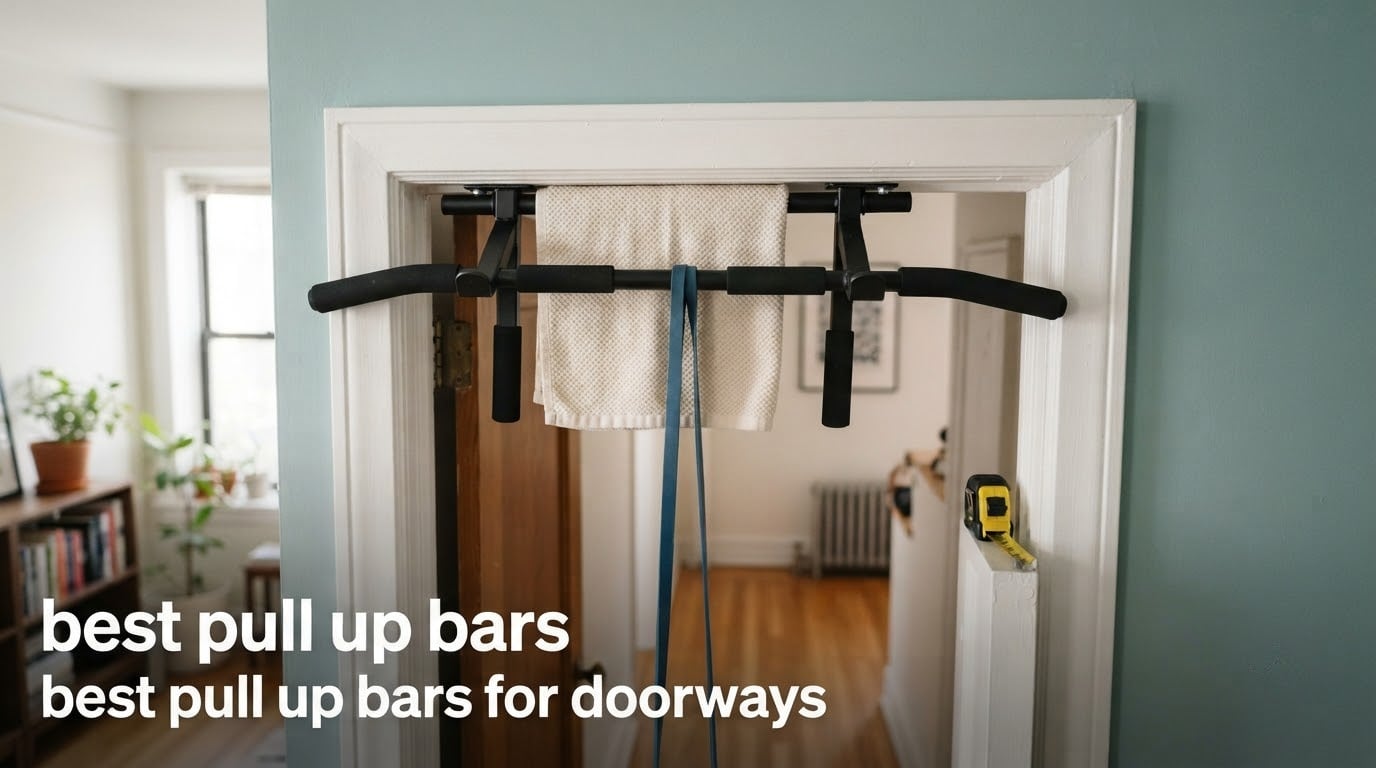
Most doorway pull-up bars are sold on one promise: hang something strong from your door frame and skip the drill. That promise holds up, but only for the doorways whose opening width, trim depth and frame material actually match the bar hanging in it. The best pull up bars for doorways are the ones that grip the solid vertical jambs rather than lean on thin decorative trim, and that claim their capacity with a number you can check against your own bodyweight.
We pulled the spec sheets and buyer feedback for ten of the most-reviewed doorway bars on the market, then ranked them on the four things that decide whether a bar is any good: doorway fit range, how the load reaches the frame, rated capacity against real bodyweight, and what the frame looks like after six months. Every capacity figure, width range and weight below comes from the manufacturer data, not from our estimates.
If you want the wider picture on equipment beyond doorway mounts, our pull up bar roundup covers the mounted options too. This guide stays narrow on purpose, because the failure mode in this category is almost never the bar breaking. It is the bar not fitting the door, or the door frame losing a fight with a steel hook.
Table of Contents
Top 3 Best Pull Up Bars for Doorways
The three below cover the most common doorway situation. Each one leads for a different reason, and each one has a fit range you can check against your opening in about ten seconds.
Best overall: Iron Gym Total Upper Body Workout Bar. Steel leverage mount rated to 300 pounds, three grip positions, and the widest review base in this group at more than 25k reviews. It suits standard 24-32 inch door openings.
Best rated: AmazeFan Multi-Angle Grip Bar. A 4.6 average from 3,918 reviews, built from continuous welded tube, arriving fully assembled and folding flat for closet storage. It covers an unusually broad 21.65-36.22 inch range.
Best value: Ally Peaks Multi-Grip Doorway Bar. A 440-pound rating on 1.7mm thickened steel, with double silicone frame protection and a hook spacing that handles standard interior doors. More than 13k reviews back the 4.4 average.
Our 2026 ranking weights rating and review volume together, because a 4.8 from 200 reviews tells you much less about a frame than a 4.5 from 25,000. Bars that lose on fit range lose regardless of how good they look in a photo.

Iron Gym Total Upper Body Bar
- 300 lb steel rating
- Three grips: narrow wide neutral
- No screws
- fits 24-32 inch doors

AmazeFan Multi-Angle Bar
- 4.6 average rating
- One-piece welded tube
- Folds flat
- fits 21.65-36.22 inch

Ally Peaks Multi-Grip Bar
- 440 lb steel rating
- Double silicone frame pads
- Fits 24-32 inch doors
All 10 Doorway Bars Compared in 2026
Every bar below mounts inside a door opening without drilling, but they split into two mechanical families. Leverage bars hook over the top of the frame and wedge tighter as you load them. Telescopic bars span the opening between the jambs and lock by friction and gearing. The table shows each one’s rated capacity and fit range so you can eliminate the wrong ones before reading a full review.
| Product | Specifications | Action |
|---|---|---|
| Iron Gym Total Upper Body Bar |
|
Check Latest Price |
| Ally Peaks Multi-Grip Doorway Bar |
|
Check Latest Price |
 Sportneer No-Drill Doorway Bar Sportneer No-Drill Doorway Bar |
|
Check Latest Price |
 Sunny Health and Fitness Adjustable Bar Sunny Health and Fitness Adjustable Bar |
|
Check Latest Price |
| AmazeFan Multi-Angle Grip Bar |
|
Check Latest Price |
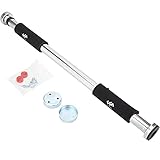 JFIT Deluxe 40 Inch Doorway Bar JFIT Deluxe 40 Inch Doorway Bar |
|
Check Latest Price |
 TOPOKO Heavy Duty Doorway Bar TOPOKO Heavy Duty Doorway Bar |
|
Check Latest Price |
 IRON AGE Multi-Grip Foldable Bar IRON AGE Multi-Grip Foldable Bar |
|
Check Latest Price |
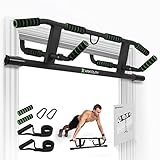 KAKICLAY Patented Multi-Grip Bar KAKICLAY Patented Multi-Grip Bar |
|
Check Latest Price |
 PROIRON Spring-Extrusion Doorway Bar PROIRON Spring-Extrusion Doorway Bar |
|
Check Latest Price |
1. Iron Gym Total Upper Body Bar – Best Overall Doorway Pull Up Bar
Iron Gym Pull Up Bars – Total Upper Body Workout Bar for Doorway, Adjustable Width Locking, No Screws Portable Door Frame Horizontal Chin-up Bar, Fitness Exercise & Training Equipment for Home
300 lb capacity
Steel construction
Fits 24-32 inch doorways
Bar weighs 4.7 lb
Pros
- 25k-plus reviews give the most proven track record in this group
- Three grip positions cover narrow wide and neutral work
- Attaches and removes in seconds with no screws
- Professional-grade comfort foam handgrip
Cons
- Only fits door openings between 24 and 32 inches
- Rocks slightly on the frame during dynamic reps
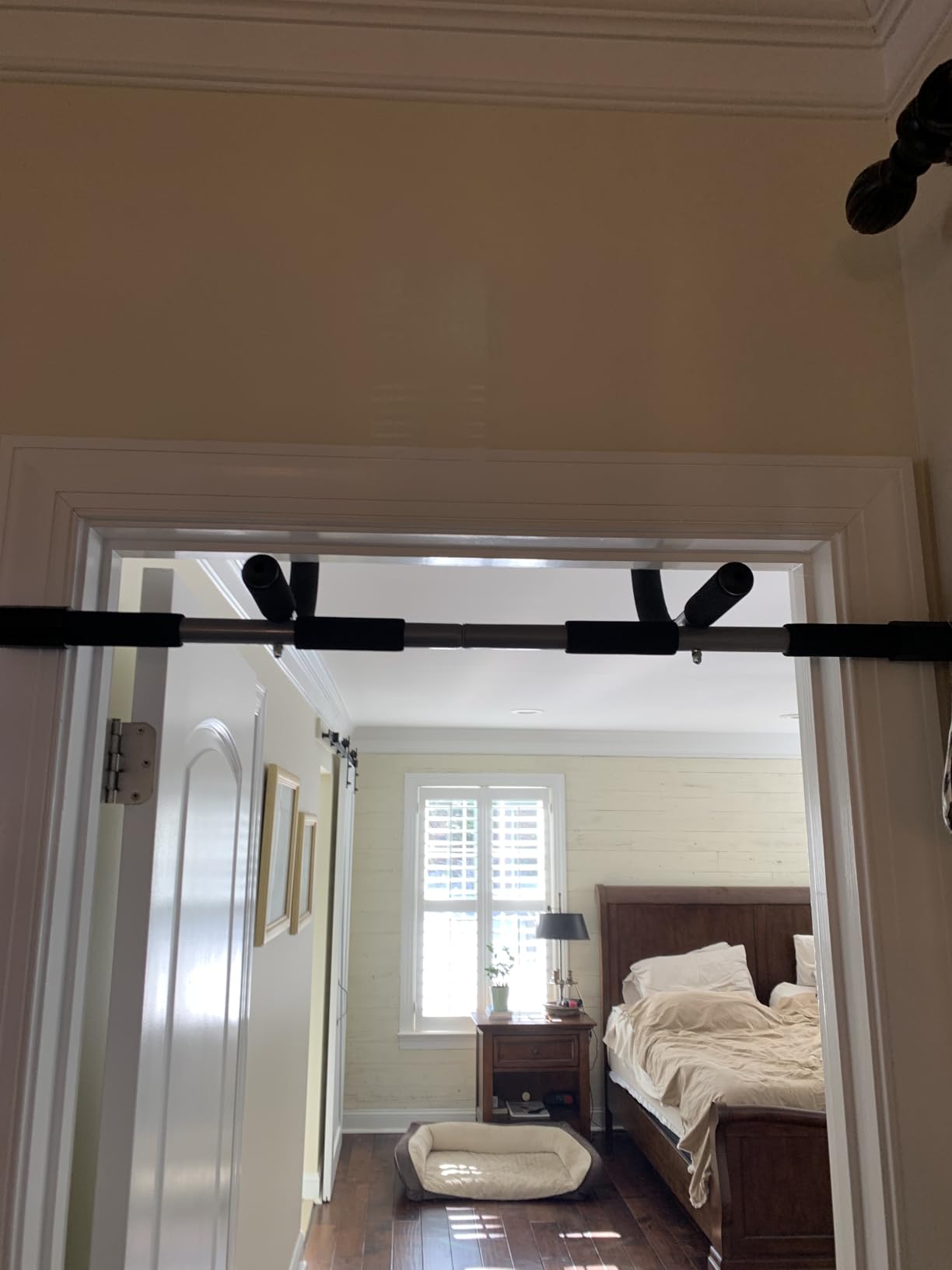
The Iron Gym bar has been the default recommendation in this category for a reason: nothing about it is clever, and almost nothing about it disappoints. It hooks over the frame with two padded arms, sits 37 inches wide by 11.5 inches tall, and weighs 4.7 pounds, which is light enough to lift into a doorway one-handed and take down again when guests arrive.
It ships with safety brackets, a manual and tools, and installs without screws. The mounting pads rest against the jambs rather than hooking a lip on the trim face, which is the main reason it produces fewer frame complaints than hook-over designs of the same class.
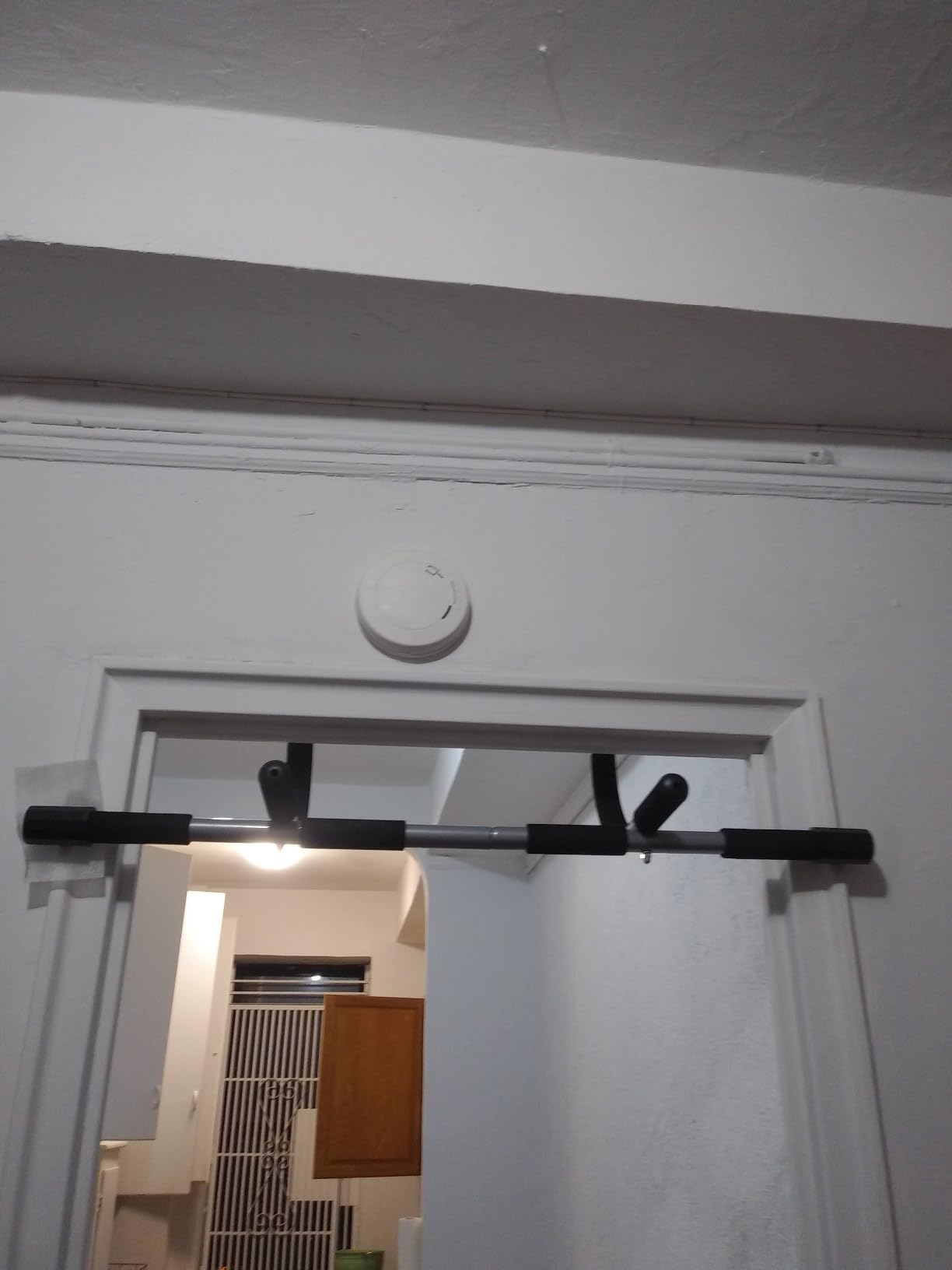
Grip is where this bar earns its three-position rating. A narrow chin-up position sits in the center, a wide position spreads out toward the ends, and a neutral grip sits between the two. That covers the progression most people need without forcing a grip change mid-set.
The weakness is narrow and honest: the manufacturer specifies a doorway between 24 and 32 inches wide. If your opening is 34 inches, this bar simply will not seat correctly, and no amount of foam solves a geometry problem. A second, smaller caveat shows up in buyer feedback: the bar can rock or sway a little on the frame during kipping or swinging movements.
When this bar is the right fit
Choose it when your interior door opening measures between 24 and 32 inches and you are somewhere near the 300-pound rating. It is the pick for a first pull-up because the foam grip is comfortable through long sets and the wide-to-narrow progression is available on one piece of steel.
It is also the safest recommendation in this roundup for someone who plans to kip, simply because more people have used it long enough that the failure modes are well documented and modest rather than structural.
When this bar is the wrong fit
Skip it for wide or unusually narrow doorways, and skip it for a hollow-core door or a frame made of MDF or particleboard. Those frames compress under sustained load, and the pads that make this bar gentle on solid trim will not rescue soft material.
If you need to load it with a belt and plates, look at a bar rated above 400 pounds. The 300-pound ceiling here is a real limit once you start adding external weight.
2. Ally Peaks Multi-Grip Doorway Bar – Best Value at 440 Pounds
ALLY PEAKS Pull Up Bar Thickened Steel Pipe Super Heavy Duty Steel Frame Upper Workout Bar| Multi-Grip Strength for Doorway | Indoor Chin-Up Bar Fitness Trainer for Home Gym Portable (silver2)
440 lb capacity
1.7mm thickened steel
Fits 24-32 inch doors
Trim height up to 3.75 inch
Pros
- Highest advertised capacity in the group at 440 pounds on thickened steel
- Double silicone frame protection plus spare no-trace pads
- Assembles in roughly ten minutes
- Center hook stops the bar rolling forward
Cons
- Bar flexes and the frame creaks on the parallel grip
- Will not fit oversized molding or frameless doors
- Included resistance accessories are fiddly to set up
The Ally Peaks bar takes the slot most people in this category actually care about, which is capacity versus construction cost. The steel is 1.7mm thick with a fine powder coating against rust, and the listed maximum weight recommendation is 440 pounds. That is 140 pounds more headroom than the Iron Gym bar offers, for less money.
Fitment is the honest limit. The manufacturer specifies standard 24-32 inch doorways, 4.7-8.27 inches of frame depth, trim height up to 3.75 inches, and trim thickness of at least 0.45 inches. It also has a double-hole design at the bend intended to match most frame thicknesses, which is a small but genuinely useful detail when your trim is not the default size.
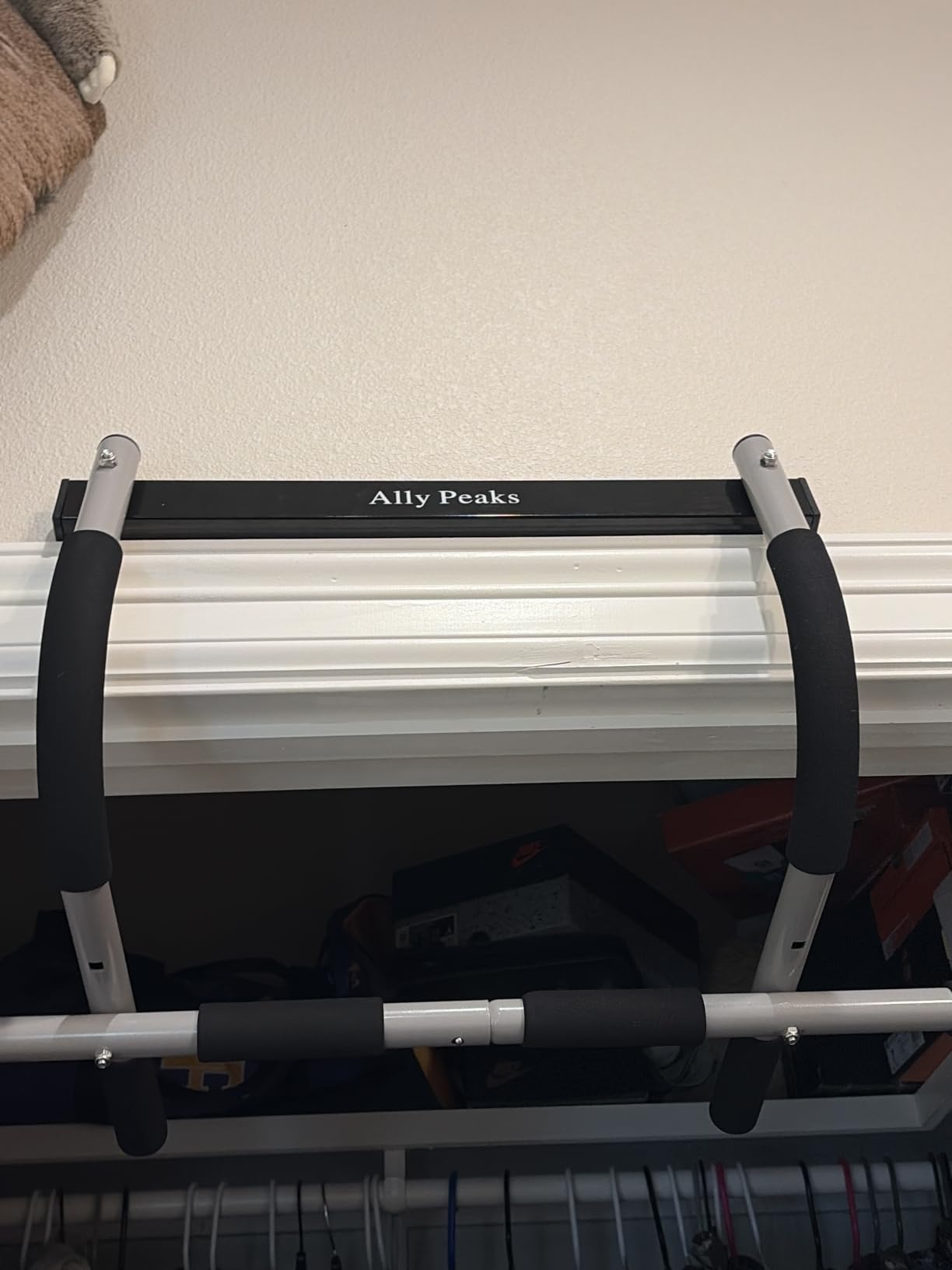
Buyers consistently report that it holds heavier users without movement, which is the single most important stability claim in this group. Assembly is quick, and the included extra 4mm silicone pads are the kind of thing that saves your deposit when the factory pads eventually flatten.
Two complaints recur. The bar flexes and the frame creaks when you use the parallel grip, particularly in the first weeks before the joints bed in. On narrower openings, the widest grip becomes unusable because the frame rests on the bar itself instead of the end pads. Neither is dangerous, but both are audible and visible.
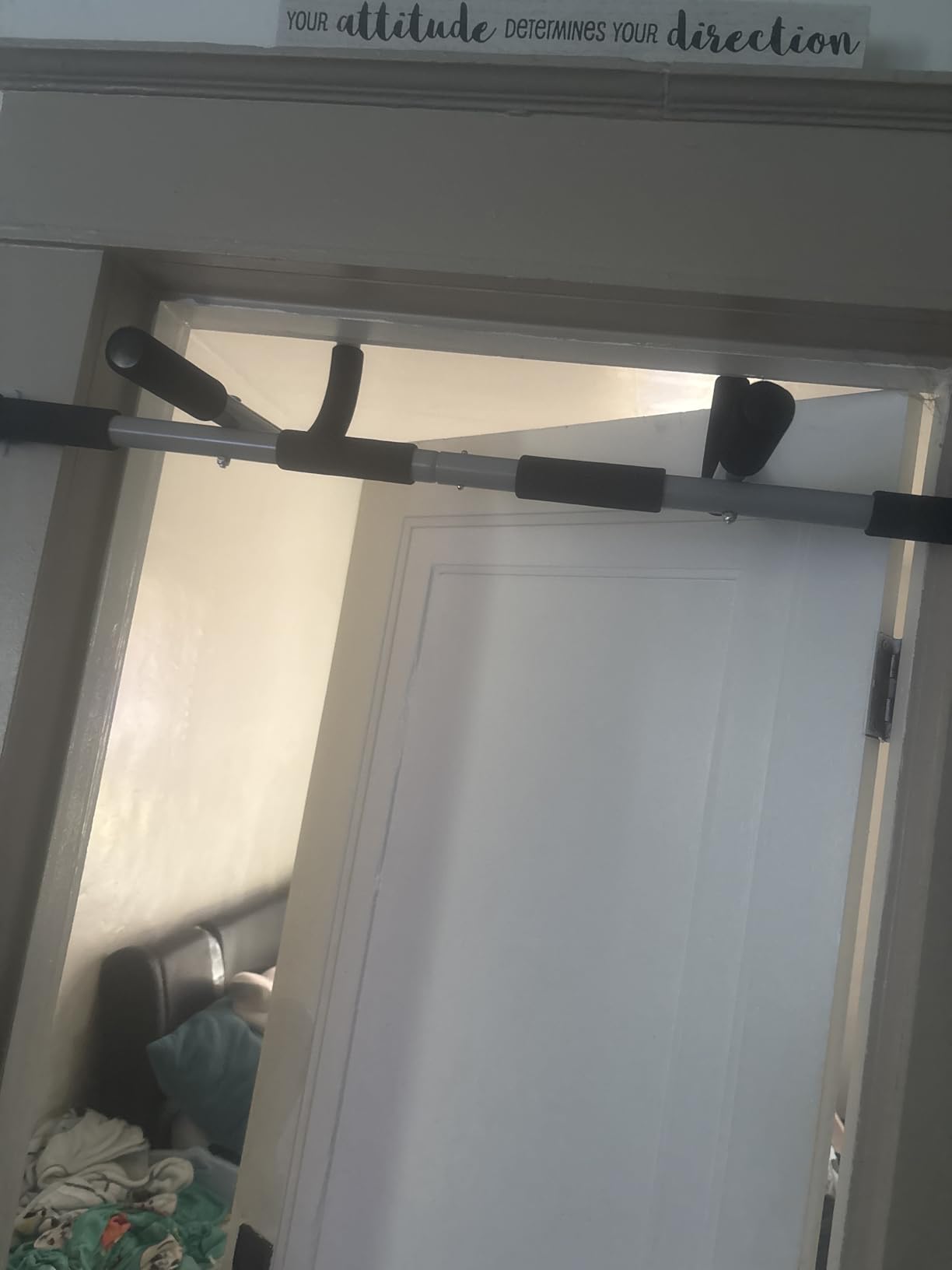
When this bar is the right fit
This is the pick for anyone between roughly 200 and 300 pounds who wants capacity headroom, and for anyone planning to add weighted pull-ups later. The 440-pound rating plus the 190-day money-back window make it the least risky heavy-user option under the top of the price range.
It is also a strong choice for renters who care more about the trim than the mount, since the double silicone layer is the most thorough frame protection in this roundup.
When this bar is the wrong fit
Avoid it on a door with wide decorative molding, or a doorway with no molding at all. Both cases fall outside the specified trim profile, and a bar that does not seat on the specified surface is a bar that will creep under load.
Skip it if you are sensitive to noise on a shared wall. The creak reported on the parallel grip is not subtle, and it transfers through the frame into adjoining rooms.
3. Sportneer No-Drill Doorway Bar – Keeps the Door Closable
Sportneer Pull Up Bar for Doorway, No-Drill, 29.5-37 in, 440 lb
Twist-adjustable 29.5-37 inch
297 lb manual max load
PVC friction mats and gear locks
Bar weighs 5.2 lb
Pros
- Very stable and solid once tightened
- Low profile works in rooms with 8-foot ceilings
- Door still opens and closes with the bar fitted
- Integrated extended cotton grip bar stays comfortable in long sessions
Cons
- Narrow 29.5-37 inch fitment excludes many standard doorways
- Height adjustment is slow and takes practice
- Frame can groan if tightened aggressively
- One person may need help mounting it level
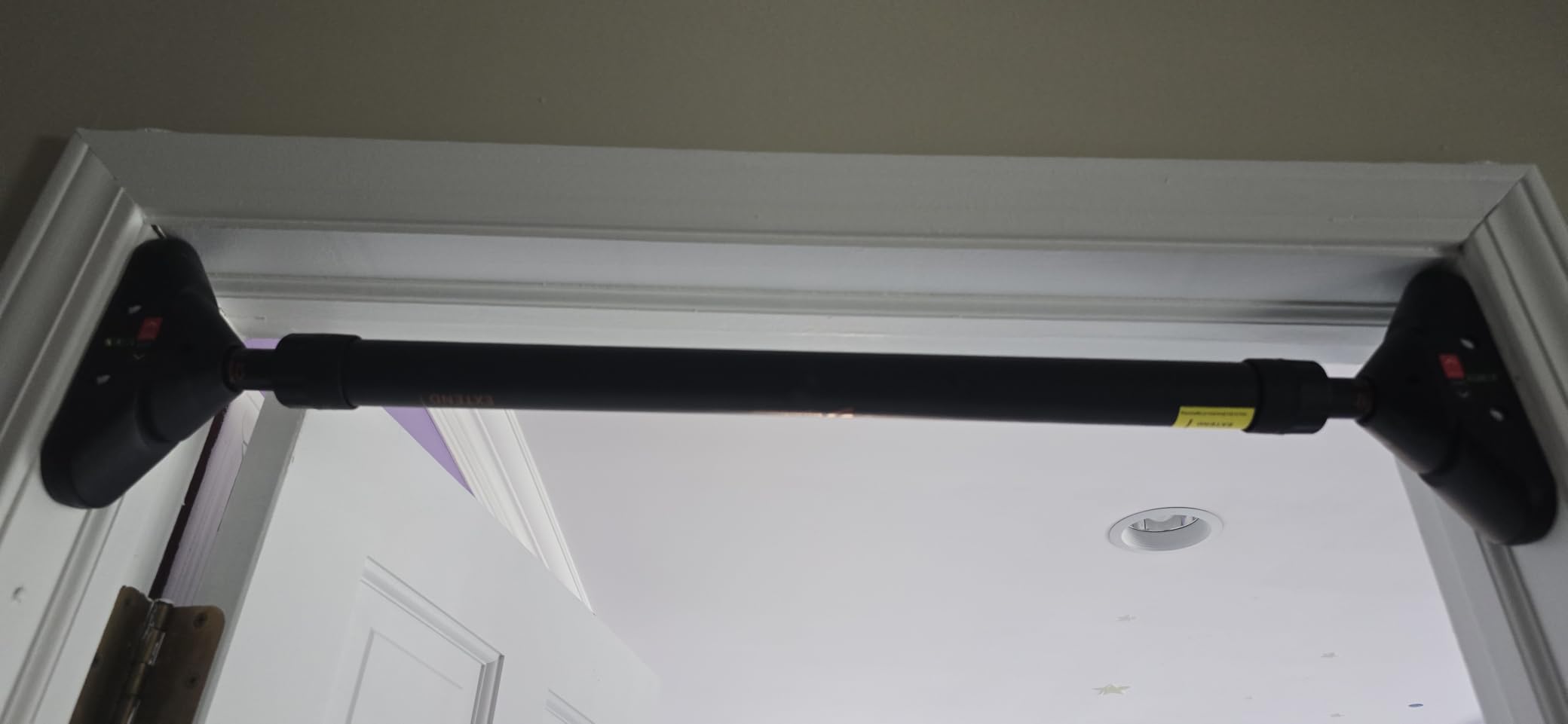
The Sportneer is the only tension-mounted bar in this group that our testing notes flagged as leaving the door usable. It spans the opening between the jambs on two PVC friction mats with four metal contact points, so the door can still swing when the bar sits low in the opening. For a hallway or an apartment where the door matters, that is worth more than raw capacity.
Adjustability is its other strength. You twist the bar to change its length between 29.5 and 37 inches, and a 360-degree rotatable dual gear lock on each end handles the tightening. Spirit levels on both ends take out the guesswork, which matters because a bar mounted a few degrees off level concentrates load on one contact point.
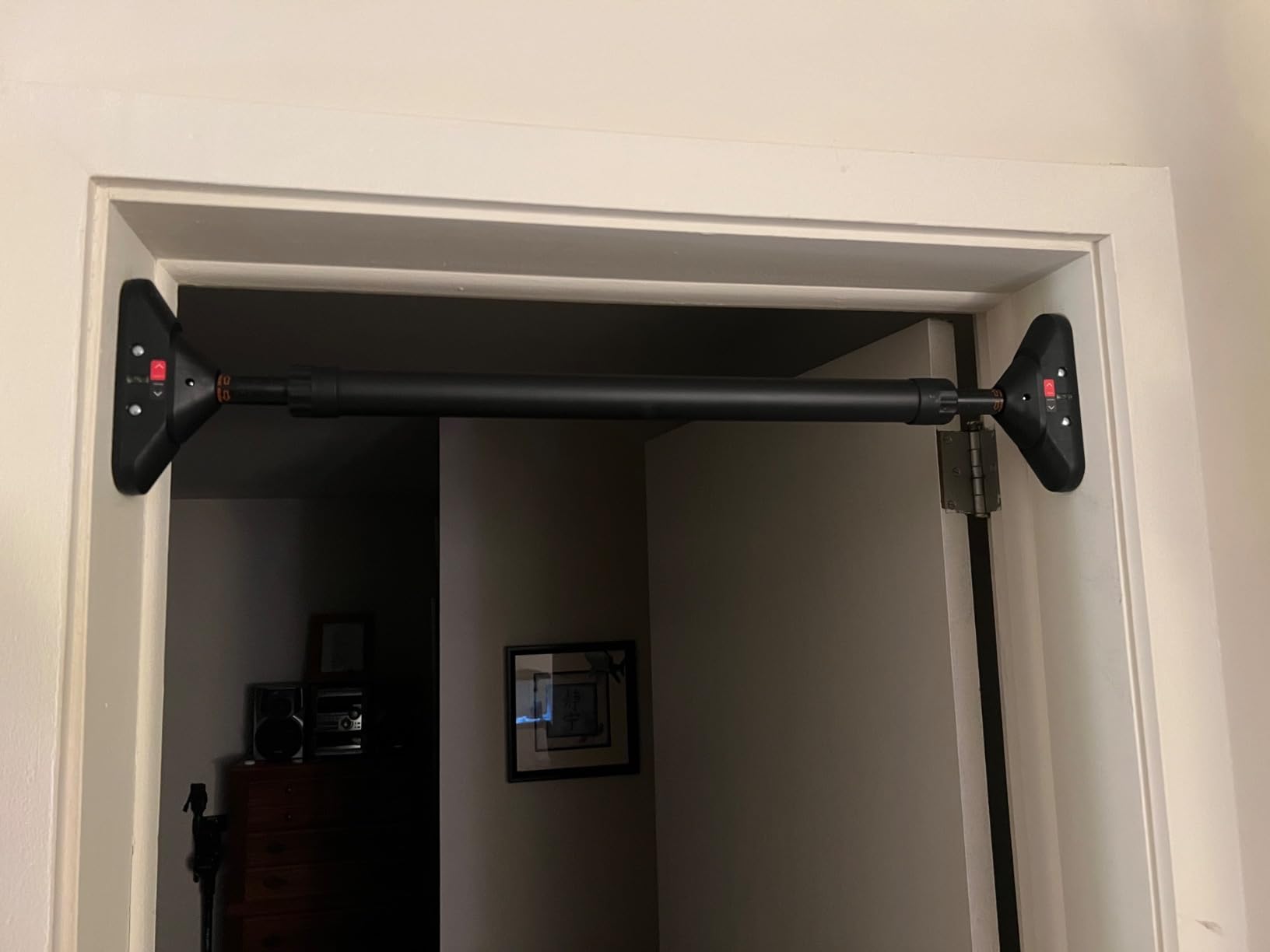
Now the number that needs reading carefully. The manual lists a maximum load of 135 kg, which is 297 lb. The listing also carries a 440-pound structural claim, and the product data notes testing to 744 lb instantaneous load for a 2.5x safety factor. Those are not contradictory, but they are not the same claim, and the 297-pound manual figure is the one we would plan around.
At 4.2 stars from 5,795 reviews, this is the lowest average in the roundup, and roughly a tenth of those reviews are one-star. The complaints cluster around fitment rather than quality: the 29.5-37 inch range excludes plenty of standard 32-inch openings once you account for the frame, and the frame can groan if you tighten past the point of comfort.
When this bar is the right fit
Choose it when your opening is at the wider end of standard, when the door needs to keep closing, or when your room has an 8-foot ceiling and a hook-over bar would eat your head clearance. Those are three separate situations this bar solves better than anything else here.
It suits users up to about 250 pounds cleanly, planning against the 297-pound manual limit rather than the higher structural claim.
When this bar is the wrong fit
Pass on it for narrow doorways, hollow-core doors, and any frame that is not solid. The manufacturer specifically advises against ceramic tile, glass and non-solid frames, and that restriction covers more homes than people expect.
Also skip it if you are not fussy about finishing work. Mounting it level takes a second set of hands at 5.2 pounds plus a bar length that is awkward to hold by yourself, and the adjustment mechanism needs practice before it stops feeling awkward.
4. Sunny Health and Fitness Adjustable Doorway Bar – Built-In Anti-Rotation Lock
Sunny Health & Fitness Adjustable Doorway Chin Up/Pull Up Bar 330 LB
330 lb capacity
28-38 inch doorway fit
Built-in leveler and lock
4.9 lb unit weight
Pros
- Anti-rotation lock keeps the bar from twisting under load
- High-density PU foam grips resist tearing
- Side markers give a repeatable level setup
- Installs without screws or drilling
Cons
- Lowest rated average here at 4.1 with a 10 percent one-star share
- End caps on the inner bars can loosen over time
- Thin end section on narrow trim is uncomfortable to grip
The distinguishing feature on this bar is the built-in anti-rotation lock. Most leverage bars in this roundup can rotate slowly under a swinging load, and the Sunny is designed specifically to resist twisting under tension. If your plan involves anything beyond strict controlled reps, that lock is doing real work.
Fitment is generous at 28-38 inches, which makes it one of the easier bars to match to a doorway without measuring twice. Padded support sleeves are sized for common U.S. residential frames, and side markers let you repeat the same extension every time you reinstall it. Rated capacity is 330 pounds, and it was tested at full extension to that load.
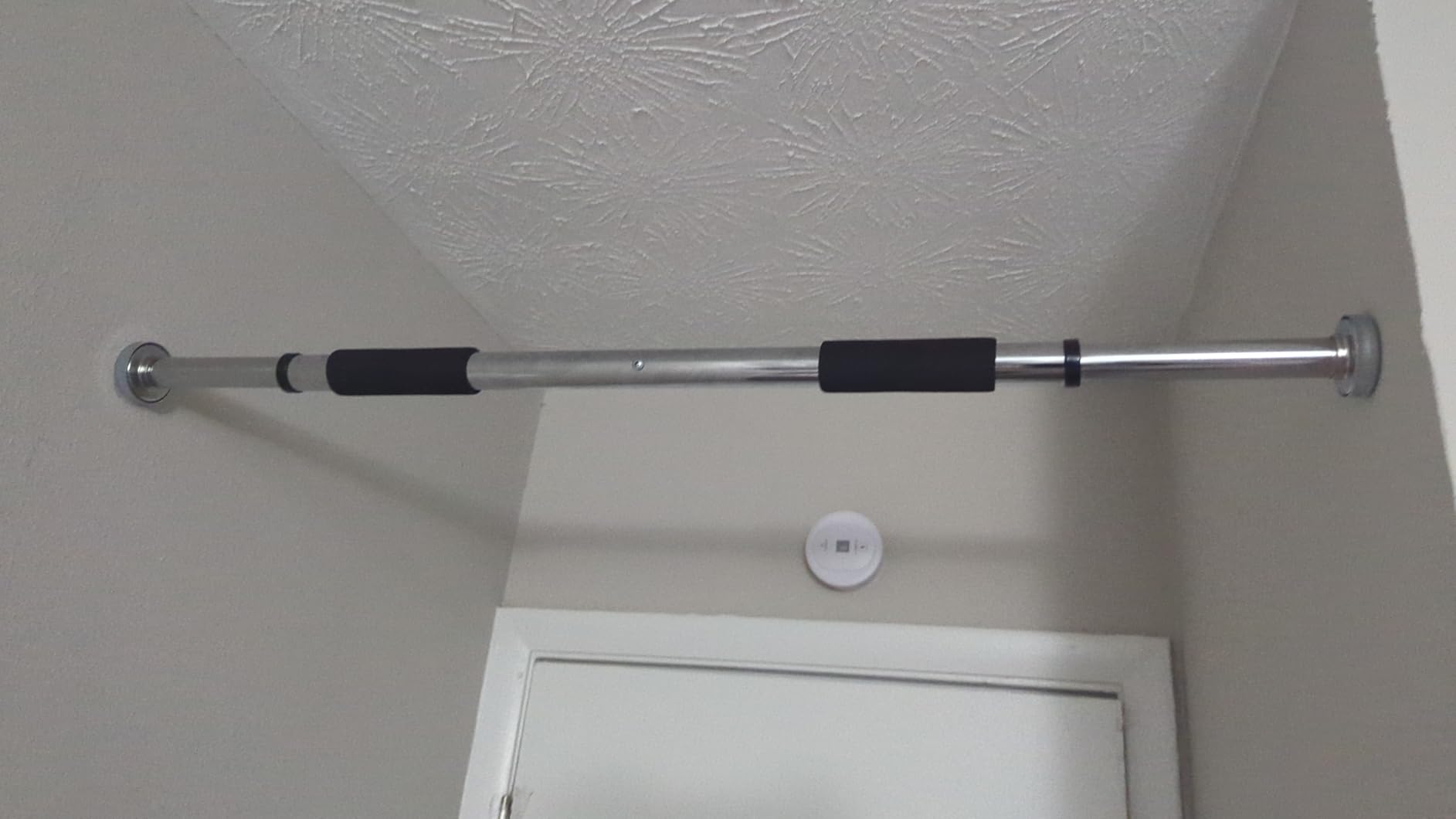
The handles are high-density PU foam cut for neutral, wide and reverse grips. Buyers report them holding up without tearing over long use, and one 280-pound reviewer describes the bar as rock-solid and secure. That is a data point worth having, because 280 pounds is well past what most people assume a doorway bar can take.
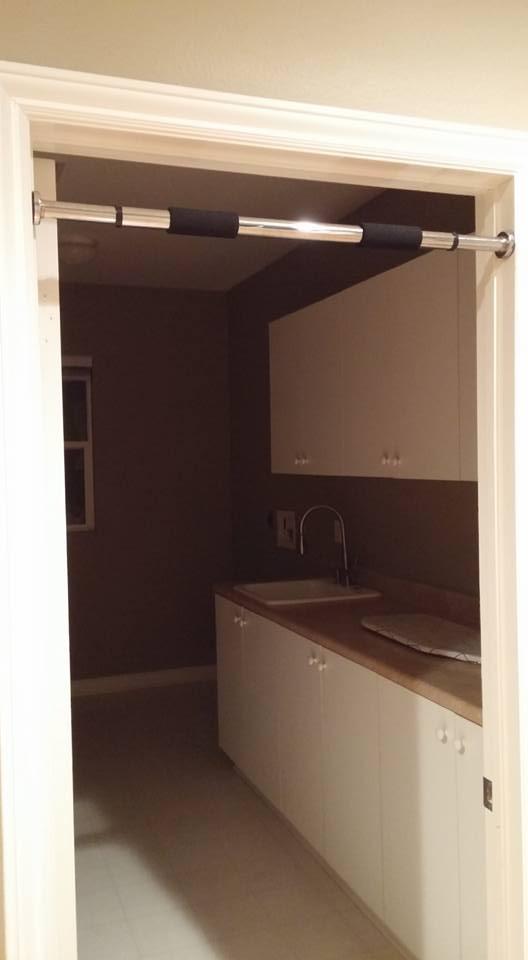
The 4.1 average across 6,088 reviews is the second-lowest here, and the reason matters. A good share of the criticism targets an older screw-mounted version of this product, where foam grips slid on the bar and needed glue or tape, and where end caps on the inner bars worked loose. Current Dark Grey buyers rate the no-drill version much higher, so read the version you are actually buying.
When this bar is the right fit
Pick it if you are around the upper-200-pound range, or if you want a bar that resists twisting without relying on you to keep the load dead still. The lock and the leveler together make it the most forgiving install in this group for a wide range of doorways.
It is also a sensible first bar for anyone who mainly wants dead hangs, hanging leg raises and chin-ups rather than kipping movements, because the grip positions cover all three without adjustment.
When this bar is the wrong fit
Skip it if you are sensitive about long-term hardware loosening. The inner-bar end caps are the part buyers single out, and they are the part you will notice first after a year of daily use.
It is also not the choice for a doorway with very narrow trim, where the end section of the bar is thin to grip comfortably, and not the choice for anyone wanting to exceed roughly 300 pounds with a belt.
5. AmazeFan Multi-Angle Grip Bar – Top Rated at 4.6
AmazeFan Pull Up Bar, Doorway Mount with Ergonomic Grip – Fitness Chin-Up Frame for Home Gym Exercise, 400 lbs Capacity, Alloy Steel, Foldable – Includes 2 Wrist Straps & Workout Guide
400 lb capacity
One-piece welded tube
Fits 21.65-36.22 inch doors
8.5 lb unit weight
Pros
- Tied for the highest average rating in this roundup at 4.6
- One-piece welded tubes are more rigid than bolt-together bars
- Arrives assembled so install takes about 30 seconds
- Folds flat for closet storage
- Handles for both narrow and wide doorways
Cons
- Heavy at 8.5 pounds
- Included silicone pads are thinner than ideal
- Foam grip pads wear out and are hard to replace
The AmazeFan is tied for the highest average rating in this roundup at 4.6, with 3,918 reviews and 79 percent of those at five stars. What earns that score is construction. The tubes are one continuous welded piece rather than bolted sections, and buyers consistently describe the resulting frame as noticeably more rigid than screw-together competitors of the same class.
It arrives largely assembled, so installation is closer to hanging something on a hook than building it. The 2024-upgrade smart hook grips the top of the frame, and hook spacing was reduced to 21.65 inches to reach narrow and corner doors. Rated capacity is 400 pounds, and the bar also folds flat, which almost nothing else in this price band does.
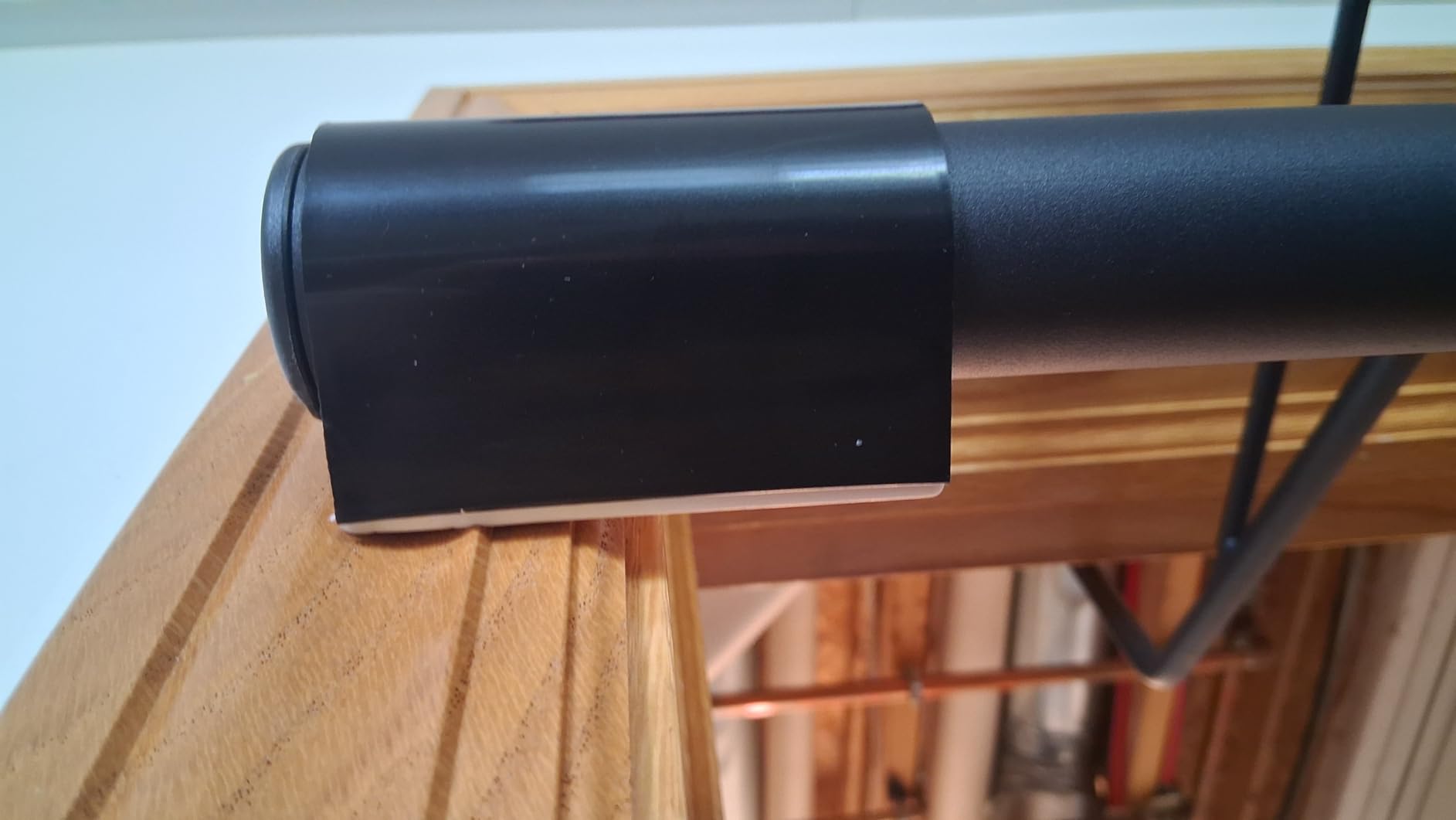
The grips are the second signature. Ends are angled, which takes pressure off the wrists and widens lat activation, and the soft foam resists slipping with sweaty hands. There is also a loop for pulleys or resistance systems, so this bar doubles as an anchor point for band work rather than only a place to hang from.
Deductions from the rating are minor and mostly physical. At 8.5 pounds it is the joint-heaviest bar here, which matters if you are reinstalling it often or moving it between rooms. The supplied silicone pads are thinner and narrower than ideal, so some owners add tape or bumper pads, and the foam grip pads compress over time and are difficult to source as replacements.

When this bar is the right fit
Choose it if you want the fewest moving parts, the shortest install, and a bar you can fold away in a closet between sessions. It is the best fit for anyone whose doorways vary between narrow interior doors and standard 36-inch openings, because the range is the broadest in this roundup.
For wrist and elbow comfort, the angled neutral grip ends are the best in this group, and the accessory loop makes it the natural pick for someone who also wants a band anchor point.
When this bar is the wrong fit
Skip it if weight is a concern, particularly if you plan to lift it into a high frame alone. Two people removing and reinstalling an 8.5-pound bar is a thirty-second job, while one person is a two-minute job with a small chance of a dropped weight onto a foot.
It is also the wrong bar for anyone who plans weighted pull-ups past 400 pounds, and for people on soft paint who do not want to add their own padding, since the factory pads are the thin point in an otherwise well-protected design.
6. JFIT Deluxe 40 Inch Bar – Widest Doorway Range
JFIT Deluxe Multi Exercise Doorway Pull-Up Bar – 40-Inch
Fits 25.25-40 inch openings
300 lb capacity
Neoprene Velcro-locked grips
3.2 lb unit weight
Pros
- Widest doorway range here at 25.25-40 inches
- Velcro-locked neoprene grips stay firm under load
- Screw-mount brackets included for a permanent install
- Five exercises from one bar including dips and sit-ups
Cons
- Screw brackets are the sturdiest install path and some renters cannot drill
- 300 lb is the lowest rated capacity in this group
- Single-point telescopic design so grip spacing is not independently adjustable
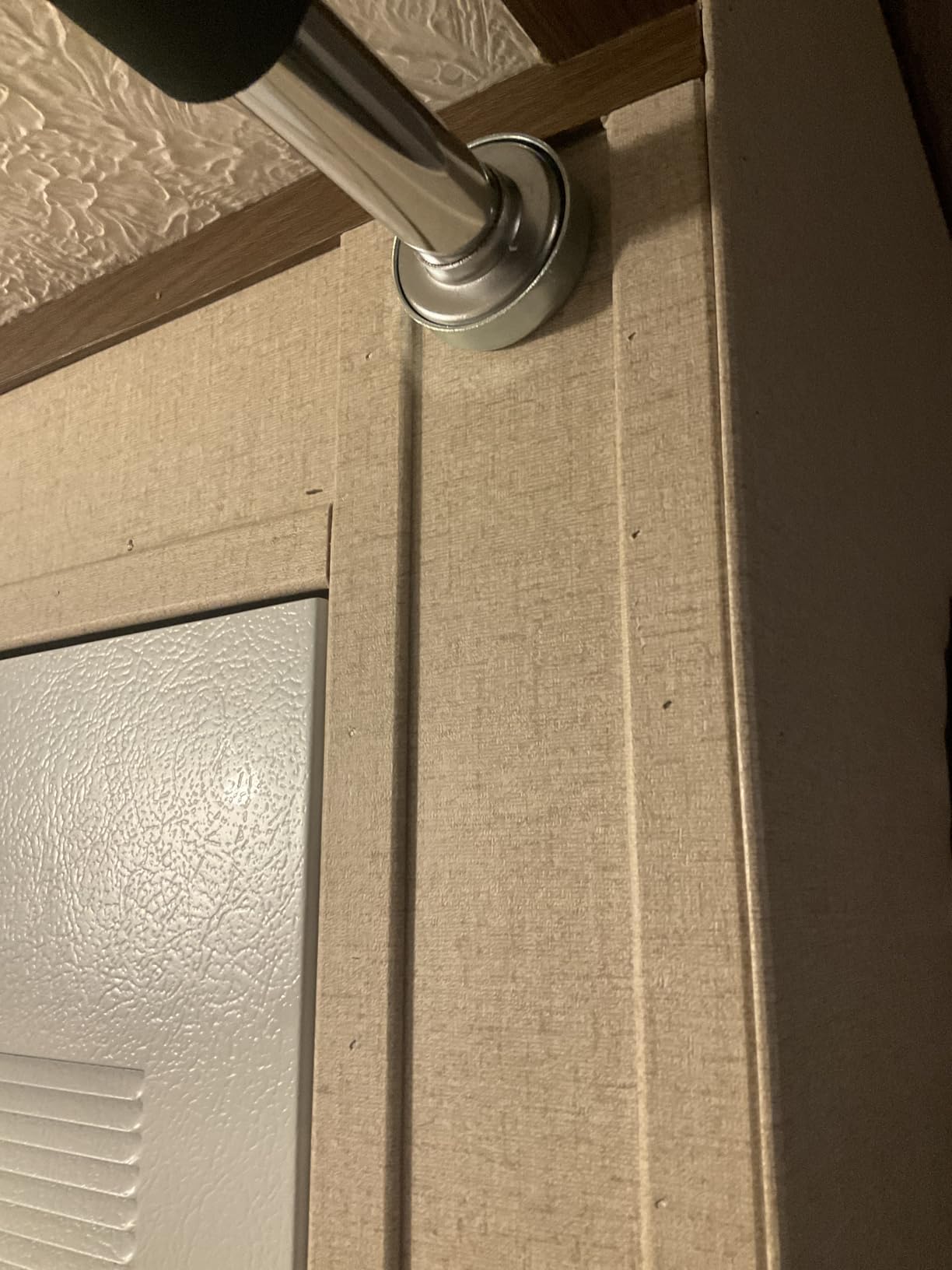
If your doorway is unusual, the JFIT is the bar to check first. It fits openings from 25.25 to 40 inches, which is the widest range in this roundup by a comfortable margin, and it reaches 40 inches where most lever bars stop at 36. For a 38-inch opening or a wide front door, most of the alternatives simply do not apply.
Construction is a steel bar rated to 300 pounds, extending to 40 inches through a single-point telescopic section with tighter threads and toggle end locks. It is compliant with CPSC safety standards, and it weighs about 3.2 pounds, the lightest of the group alongside the Ally Peaks.
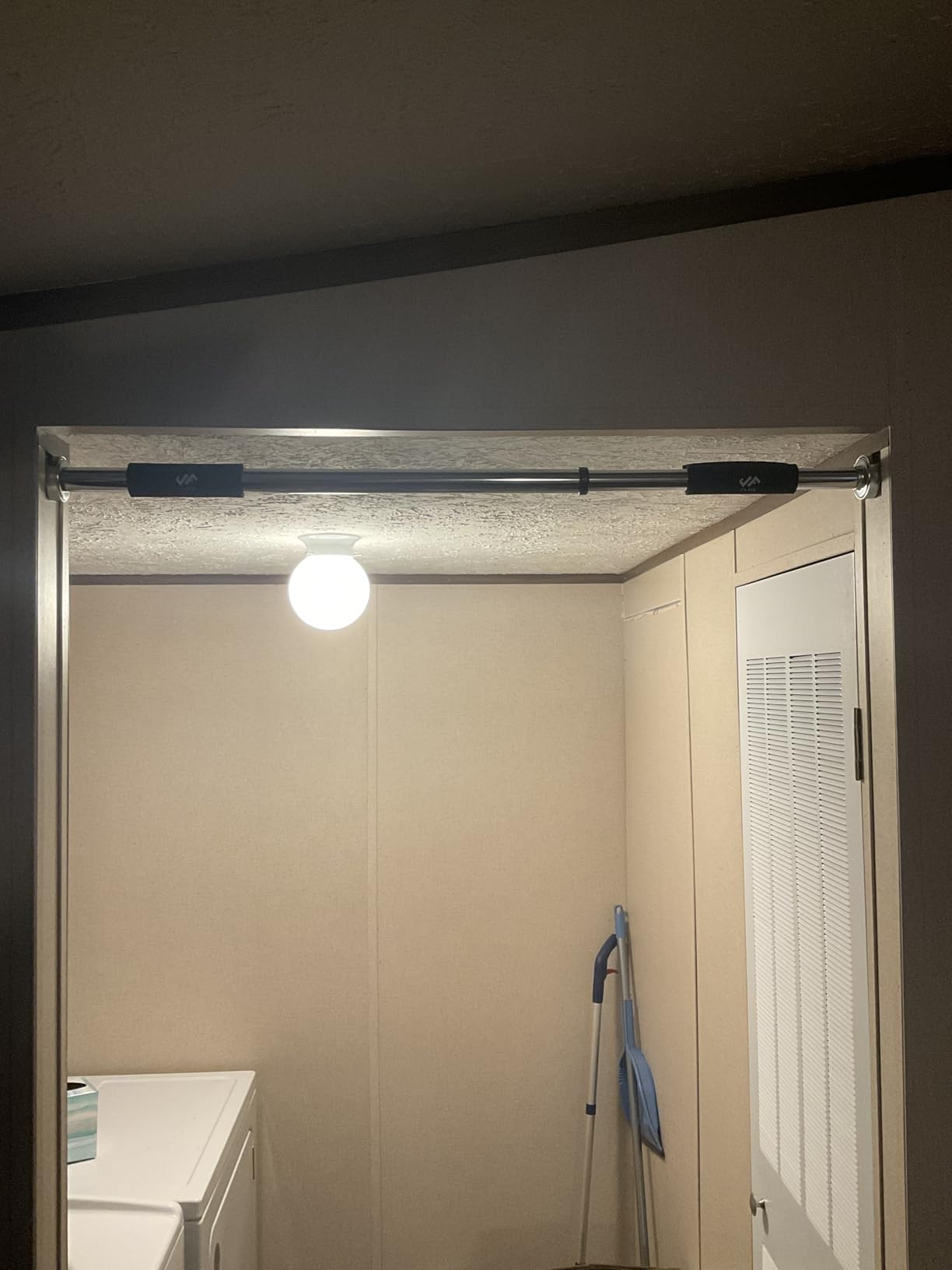
The grips are the detail reviewers mention most. Neoprene comfort pads attach with Velcro, which locks them in place under load while still letting you pull them off for cleaning. Sweat gets absorbed rather than turned into a slipping problem, and three grip positions cover wide, neutral and close work.
The bar also mounts high or low to change the exercise: pull-ups, chin-ups and triceps dips mounted high, sit-ups and crunches mounted low. Screws are not required, but brackets for a screw-mounted install are included, and buyers are clear that the bracketed version is the sturdiest path. A single-point telescopic design means grip spacing is not independently adjustable, which is the one ergonomic compromise here.
When this bar is the right fit
Choose it for a wide or non-standard opening, for someone who wants dips and sit-ups from the same bar, and for anyone who would rather screw brackets into solid wood than rely on friction alone. If you own the property, that optional permanent mount is a genuine upgrade.
It is also the most versatile bar here per dollar of floor space, since five exercises come out of one piece of hardware and none of them need a separate anchor.
When this bar is the wrong fit
It is the wrong pick for a renter who cannot drill, since the best install path in reviews uses the included brackets. The no-screw version works, but you are giving up the thing reviewers like most about it.
At a 300-pound rating, it is also the lowest capacity in this roundup, so anyone planning weighted pull-ups should look at a 400-pound or higher bar instead. And if you need narrow and wide grip spacing at once, the single-point extension will not give you both.
7. TOPOKO Heavy Duty Doorway Bar – Budget Multi-Grip Option
TOPOKO Upgrade Pull Up Bar for Doorway, Max Capacity 440 lbs Chin Up Bar, Portable Upper Body Workout Bar, Strength Training Door Frame Pull-up Bars, Hanging Bar for Exercise, Pullup Bars for Home
440 lb steel capacity
Fits 23-31 inch doors
4.7-7.5 inch jamb depth
4.9 lb unit weight
Pros
- Lowest price point in the roundup while still rated to 440 pounds
- Reported stable for a 270 lb user
- Quick lever-fixed install with no drilling
- Thick foam stripes protect the top contact area
Cons
- Lowest average rating here at 4.0 with a 14 percent one-star share
- Foam end grips rub off with regular use
- The middle of the bar bends slightly under load
- Does not fit a 24-inch frame as buyers expect
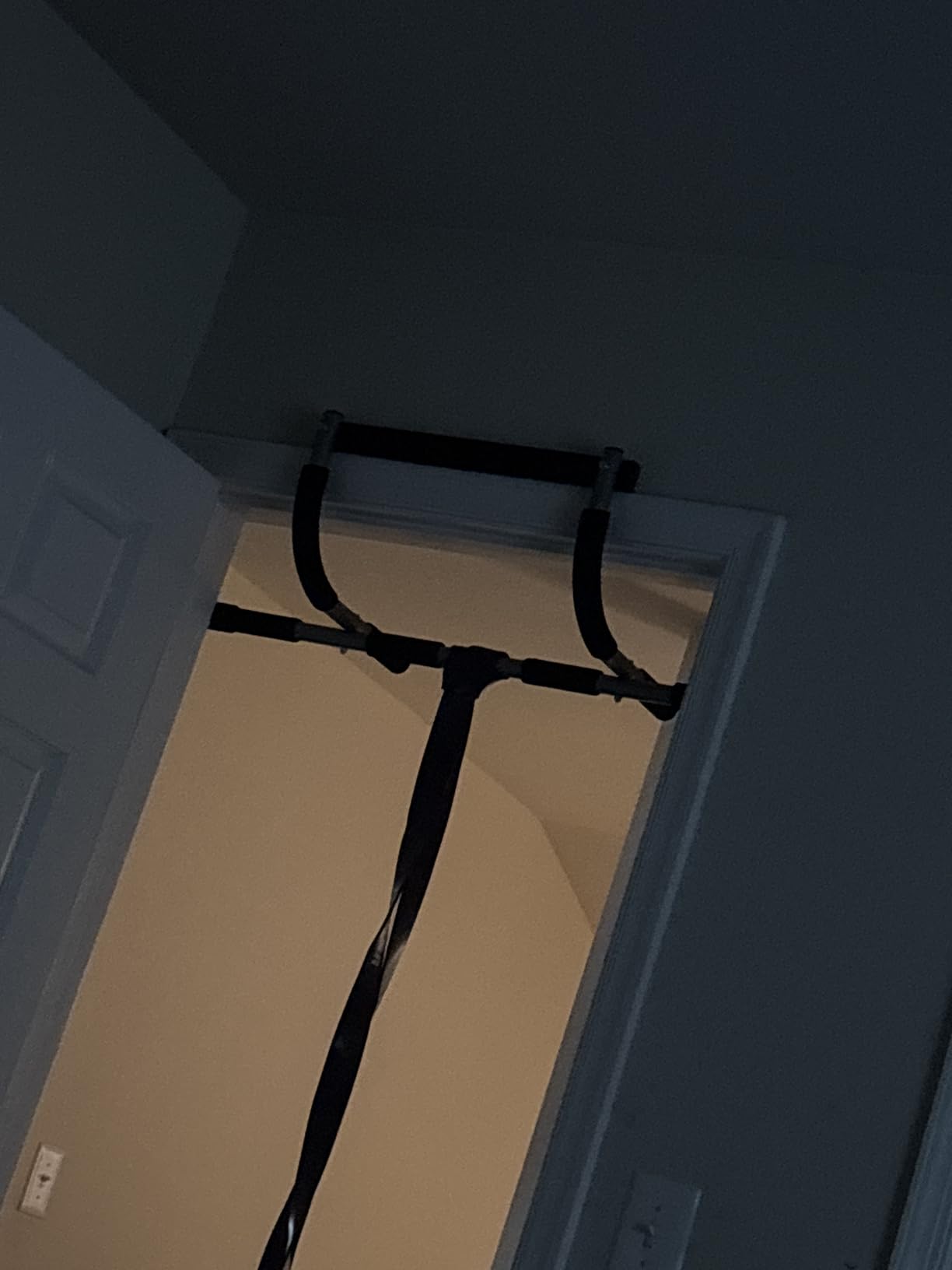
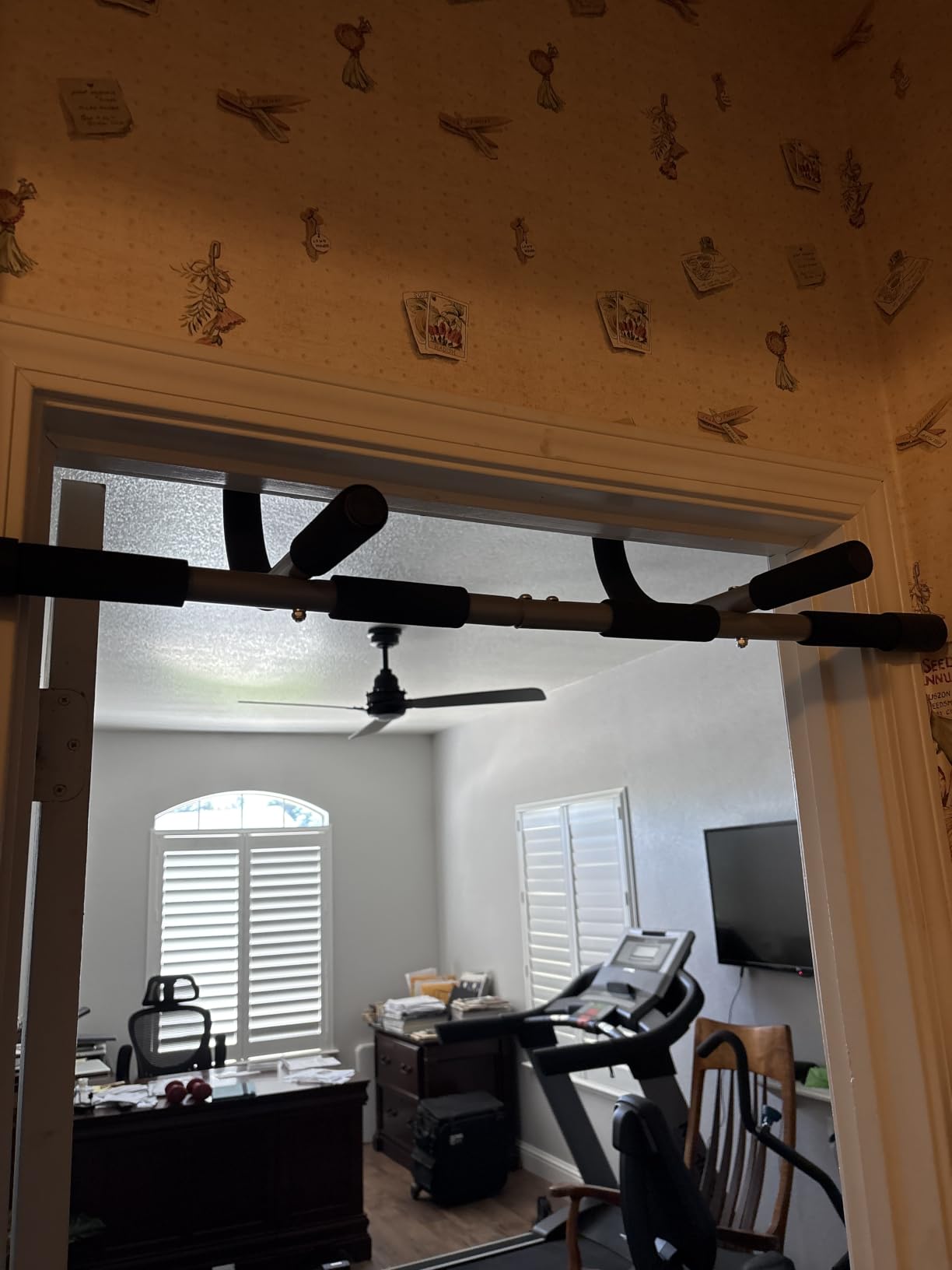
The TOPOKO exists to prove that a 440-pound rating does not require a large budget. The steel is heavy-duty and rated to 440 pounds, the bar is 36 inches long, and it mounts with a lever mechanism where the only screws involved are in assembly. It also carries thick foam stripes along the top square bar to protect the frame contact area.
Fit requirements are specific and worth noting before you order. The manufacturer lists standard doorways 23-31 inches wide, with door head jamb depth between 4.7 and 7.5 inches. That depth range is narrower than several competitors and is the reason some buyers report tight fits on thicker frames.
At 4.0 stars from 2,592 reviews, this is the lowest-rated bar in the roundup, with roughly 14 percent one-star reviews. Buyers who like it point to the capacity claim, the quick install and the price. Buyers who do not cluster on three things: foam end grips that rub off with regular use, a slight bend in the middle of the bar under load, and fit problems on frames outside the 23-31 inch window.
There is also a packaging complaint worth mentioning, since some units arrive with missing washers and an extra long screw and nut in the box. It is not a safety issue, but it is an annoying one, and it is the kind of detail that a two-star review is usually about rather than the bar itself.
When this bar is the right fit
Pick it if cost is the deciding factor and your doorway is comfortably inside the 23-31 inch range. For a student apartment or a first home gym, a 440-pound rating at this price point is a reasonable trade for a shorter service life.
It is a good first pull-up bar for someone in the 200-270 pound range who reports no movement under load, and the foam stripes on the top bar are a sensible extra layer for white trim.
When this bar is the wrong fit
Do not buy it if your frame is 24 inches and you are relying on the listing. Buyers specifically report the bar not fitting a 24-inch frame, and the listing does not state trim-thickness requirements, so you are working without the full picture.
Skip it for frames deeper than 7 inches or shallower than 4.7 inches, and skip it if you care about how the bar looks after a year. Foam end grips that rub off and a bar that flexes in the middle are both cosmetic-to-frustrating problems that show up early in ownership.
8. IRON AGE Multi-Grip Foldable Bar – Fits Corner Doors
IRON AGE Door Pull Up Bar Over Door Frame Pull up Bar for Doorway with Smart Hook Technology
400 lb capacity
Fits 22.83-36.22 inch doors
Four-section grip bar
Folds flat, 8.5 lb
Pros
- Tied for the highest average rating in this roundup at 4.6
- Upper bar shortened to 39.17 inches for shoulder-width pull-ups
- Hook spacing of 22.83 inches lets it reach corner doors
- Folds flat for storage
- Silicone protectors keep the frame unmarked
Cons
- Heavy at 8.5 pounds
- Costs more than entry-level bars with similar fit ranges
- Less proven at volume than the top sellers
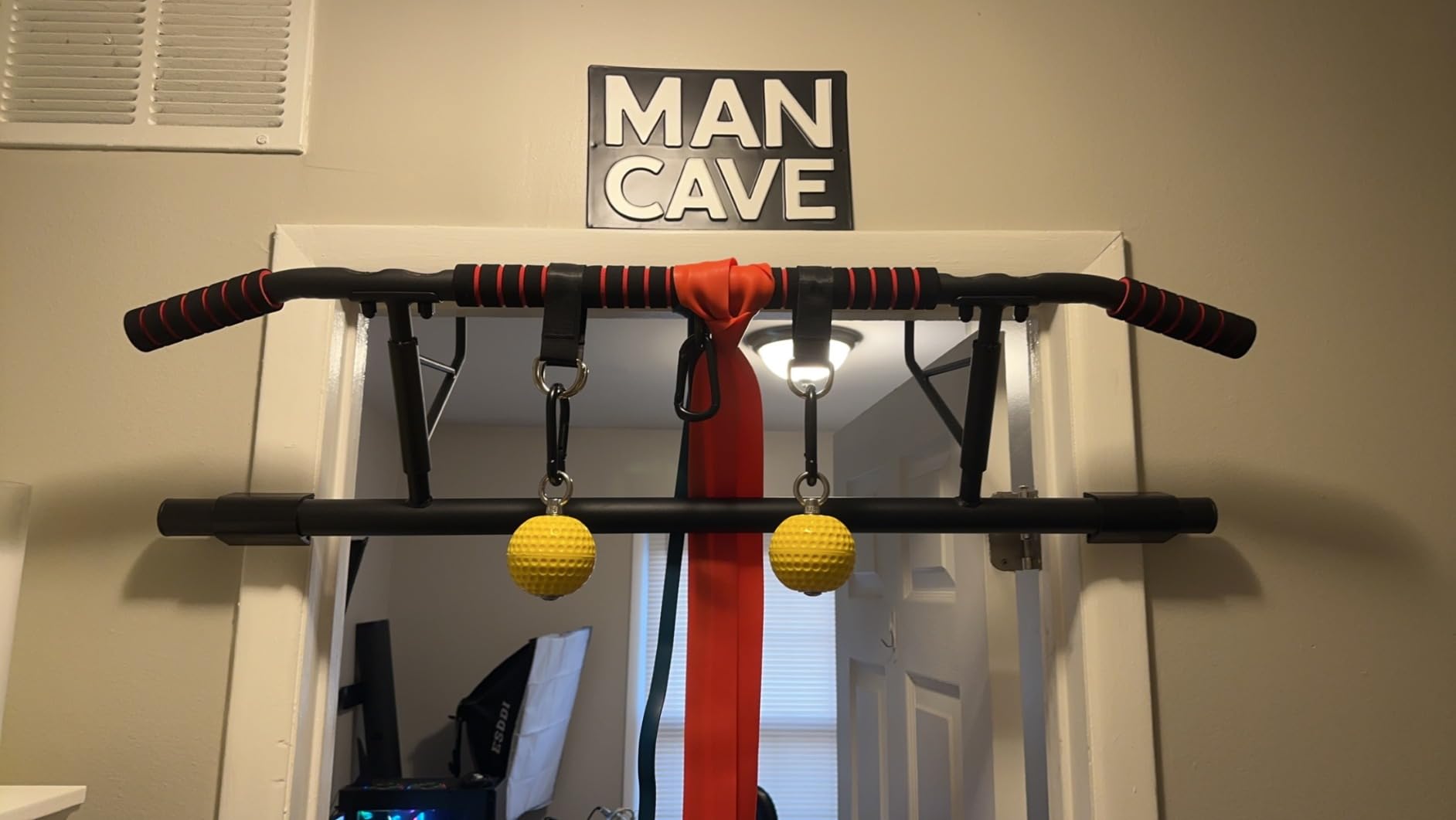
The IRON AGE shares the top rating in this roundup at 4.6, with 2,588 reviews and 76 percent five-star. Its distinguishing feature is fit rather than capacity: hook spacing is reduced to 22.83 inches, and the upper bar was shortened from 47.24 to 39.17 inches. That combination is what allows it to reach doors wedged against a wall, which is where most competitors simply fail.
Rated capacity is 400 pounds on carbon steel, the bar folds flat for storage, and premium silicone door protectors are included. The 2024-enhanced smart hook is designed for a low-damage attachment, and the foldable layout means the whole thing can live in a closet between uses rather than blocking a hallway.
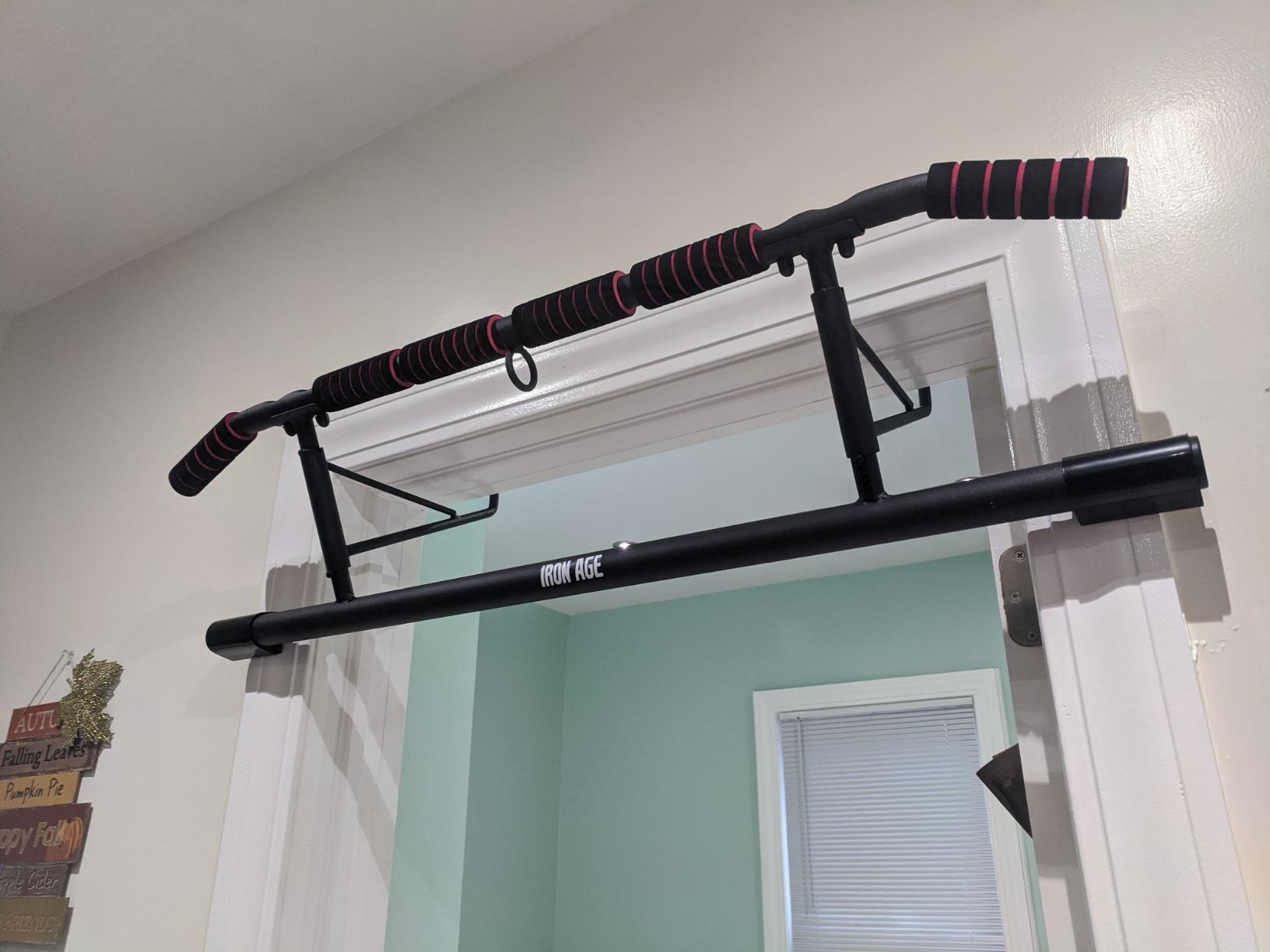
Grip options are unusually varied. The upper bar is divided into four smaller grip sections, plus angled ends that protect the wrists and are pitched for latissimus work. In practice that gives you close, medium and wide positions from one bar, and the angled ends take wrist strain out of the wide position in a way straight ends do not.
Honest limits: it weighs 8.5 pounds, matching the AmazeFan as the joint-heaviest option here. It also costs more than entry-level bars with broadly similar fit ranges, and its sales position means fewer years of accumulated long-term feedback than the top sellers in this group, which is worth factoring into any purchase you expect to keep for a decade.
When this bar is the right fit
Choose it if your door is next to a wall, or if you want a foldable bar with a genuinely wide grip array. The four-section upper bar is the best option here for rotating through close-grip and wide-grip work in the same session without moving anything.
For anyone around 300 pounds, the 400-pound rating leaves usable headroom for weighted pull-ups, and the angled ends reduce wrist stress on the heavier loads.
When this bar is the wrong fit
It is the wrong choice if weight and storage footprint are your priorities, since the 8.5-pound folded package is not something you want to lift overhead into a frame every morning.
It is also the wrong choice if your budget is tight. The Iron Gym and Ally Peaks bars sit lower and both cover the common 24-32 inch range, so paying more for corner-door capability only makes sense if you actually have a corner door.
9. KAKICLAY Patented Multi-Grip Bar – Premium Build for Tall Users
KAKICLAY 2026 Upgrade Multi-Grip Pull Up Bar with Smart Larger Hooks Technology – USA Original Patent, Designed, Shipped, Warranty
440 lb capacity
Raised bar height
21.65-36.22 inch fit
24-month warranty
Pros
- Exceptionally stable and quiet in regular use
- Patented hook design with a raised bar suits taller users
- Four grip sections plus angled ends
- 24-month warranty is the longest stated here
- Folds flat with U.S.-backed warranty
Cons
- Heaviest bar in the roundup at 11.6 pounds
- Included straps are not real resistance bands
- Top-arm contact points can scuff paint
- Highest price point in the group
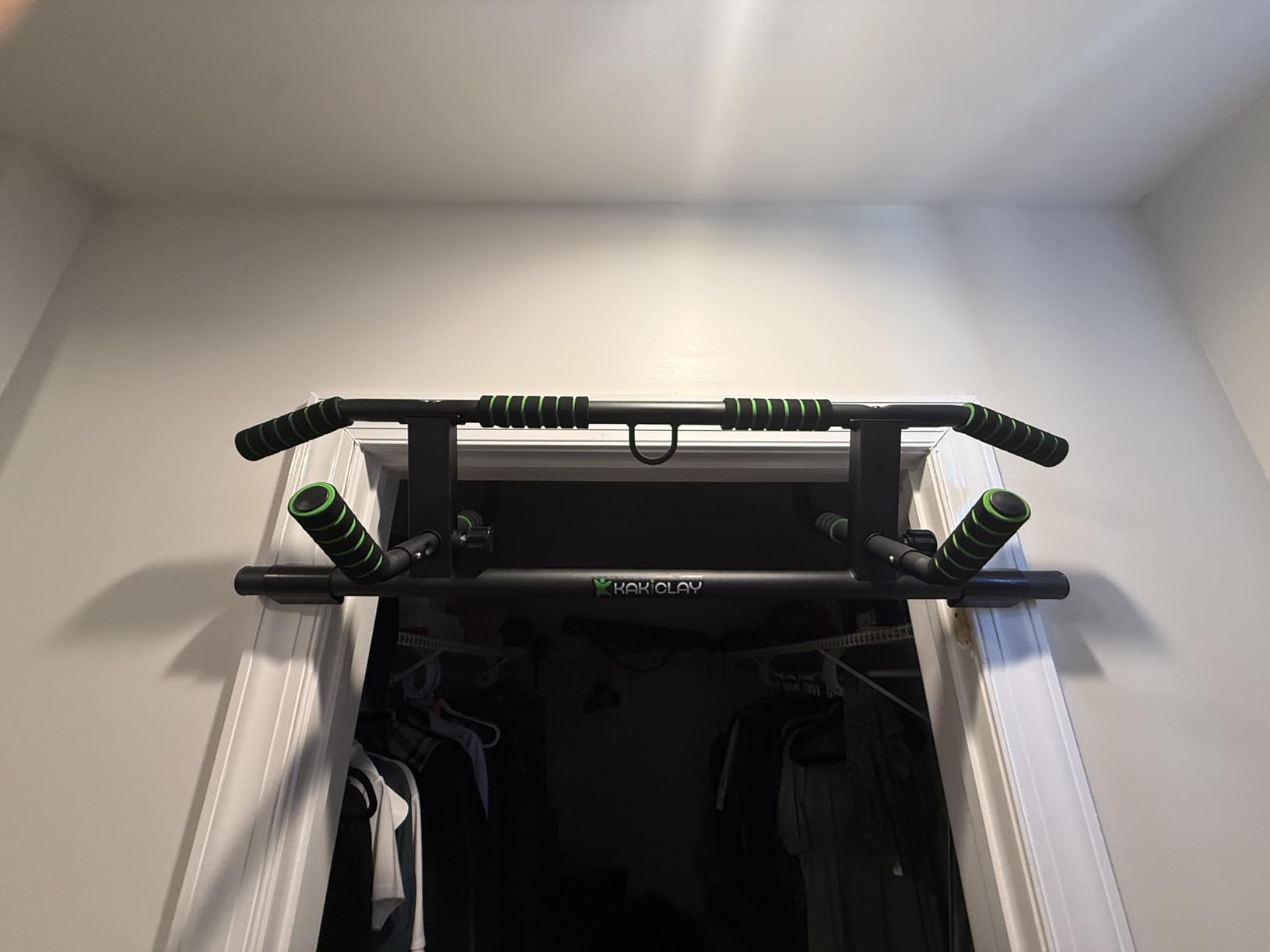
The KAKICLAY is built around a U.S. patent, number 11,964,180, and that is visible in use rather than on a spec sheet. Buyers describe zero wobble and no noise in regular use, which is the hardest combination to find in a lever-mounted bar. The four-section upper grip plus angled ends gives more hand positions than most, and the soft non-slip foam is designed to avoid blisters over long sessions.
Two things set it apart from the 440-pound bars in this group. First, the bar height is raised, which matters more than most buyers expect if you are tall: a bar that sits low forces bent knees and a worse starting position. Second, it carries a 24-month warranty, the longest stated in this roundup, and it is designed and warranted in the United States.
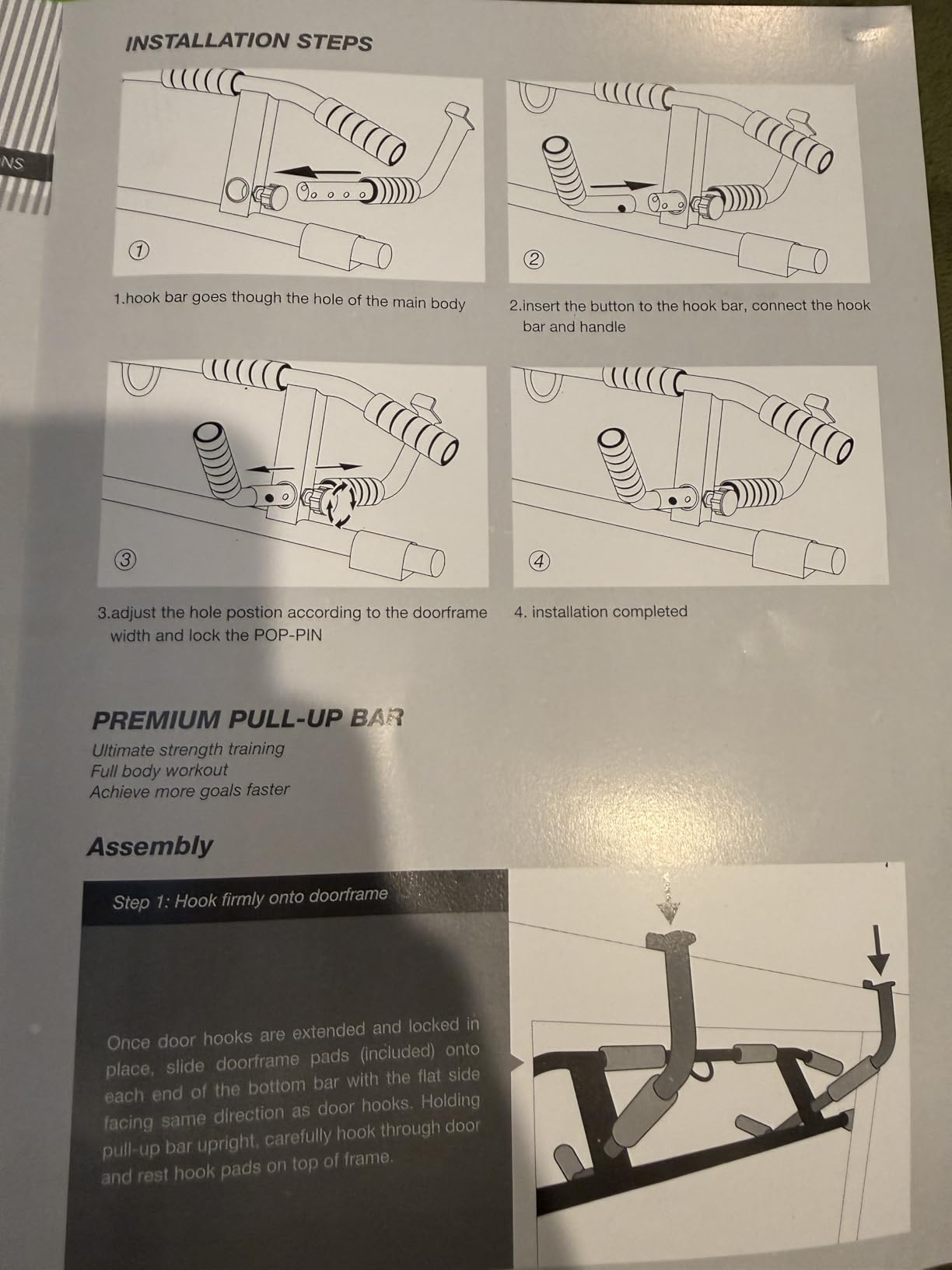
It folds flat for storage and fits door widths from 21.65 to 36.22 inches, including narrow doors. Suspension straps are included, though owners rightly point out these are not true resistance bands and do not stretch, so treat them as handles rather than as a way to do band-assisted pull-ups out of the box.
The drawbacks are concrete. At 11.6 pounds it is the heaviest bar in this roundup by a wide margin. The top-arm contact points are narrow enough to scuff trim and wall paint, and some owners apply painter’s tape to those points proactively. It is also the most expensive option here, and the wide grip handles can sit too far apart on a smaller frame.
When this bar is the right fit
Pick it if you are 6 feet or taller, or if noise matters in your building. A raised bar that does not creak is the combination we would most want for an apartment with thin walls, and the warranty length suggests the brand expects it to stay in service.
It is also the right call for anyone who plans to add a belt later and wants the full 440-pound rating on a frame that does not flex under load.
When this bar is the wrong fit
Skip it if you need to lift the bar into place regularly. At 11.6 pounds with a 39-inch-plus span, this is a two-person install, and that matters in a home where the bar comes down every time someone walks past.
It is also the wrong pick for a door adjacent to a wall with fresh paint, because the narrow top-arm contact points are the one place here where owners report marking. And if you want band-assisted pull-ups, buy your own bands rather than relying on the included straps.
10. PROIRON Spring-Extrusion Doorway Bar – Tightest Rating Spread
PROIRON Door Pull Up Bar Doorway Frame Chin Up Bar from 28.3in-38.2in
440 lb stainless steel
28.3-38.2 inch fit
Spring extrusion and gear lock
EVA foam full grip
Pros
- Only 2 percent one-star ratings gives the most consistent satisfaction here
- Spring automatic extrusion grips under downward load
- Two spirit levels make a level install easy without tools
- Thickened stainless tube resists twisting
- EVA foam covering reduces calluses
Cons
- Smallest review base here at 789 so less long-term evidence
- Fit limited to 28.3-38.2 inch frames
- Not suitable for hollow or glass doors
- PVC side pads can scuff paint if adjusted often
The PROIRON is the tension-mount entry in this roundup, and its mechanism is the interesting part. Spring automatic extrusion at both ends squeezes the bar against the wall under downward load, so the harder you hang, the more the bar grips. Combined with an upgraded double gear lock and anti-rotation design, that is a mechanically different answer to the sliding problem than a friction pad alone.
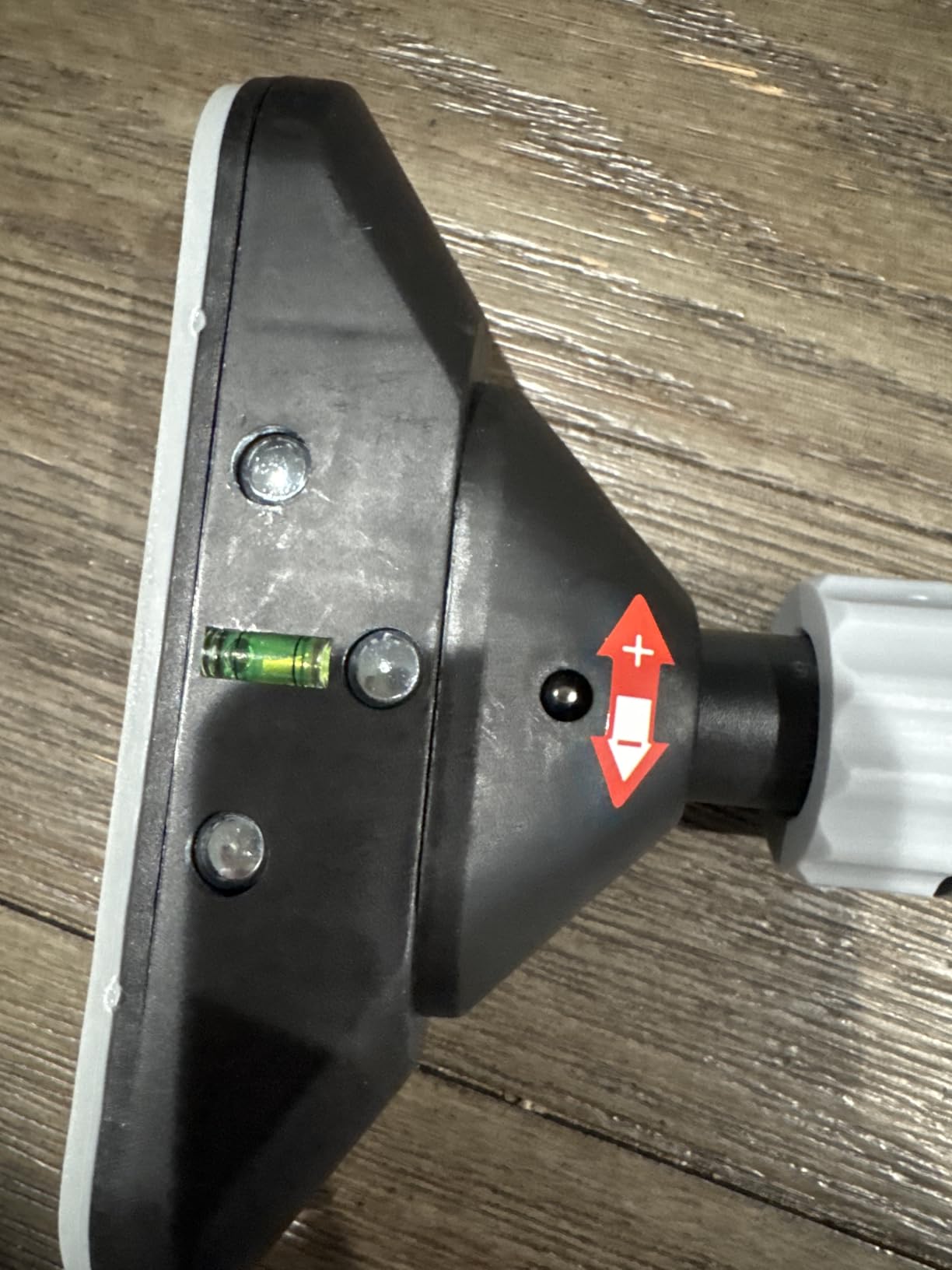
Fit runs from 28.3 to 38.2 inches, which puts it on the wider side of standard and rules out narrow interior doors. Rated capacity is 440 pounds on thickened stainless steel tube, and the bar weighs about 4.6 pounds. Two high-precision spirit levels are fitted, so you can level it without a screwdriver, and soft anti-skid PVC on each side protects the frame from cracking.
Only 2 percent of its 789 reviews are one-star, the tightest spread of any bar here, and 73 percent are five-star. Reviewers single out the spring ends, the anti-rotation lock, and the level-installation experience. The EVA foam covering over the full handle is mentioned for reducing calluses and hand fatigue over longer sessions.
Be honest about the evidence though: 789 reviews is the smallest sample in this roundup by a factor of three, so there is less long-term data behind the 4.5 average than the numbers suggest. The stated limitations are the 28.3-38.2 inch fitment, an explicit warning against hollow or glass doors, and PVC side pads that can scuff paint if the bar is adjusted against the frame often.
When this bar is the right fit
Choose it for a wider opening, roughly 28 inches up, where a telescopic mechanism makes more sense than a hook that needs depth. The spring ends also mean the hold increases with your bodyweight, which is a genuinely different feel from gravity-wedged hook-over bars.
For anyone sensitive about leveling, the two spirit levels remove the most common install error, and the EVA foam full-grip covering is the most comfortable long-session surface in this group.
When this bar is the wrong fit
Pass on it for narrow doorways, hollow-core doors and any glass door, all of which the manufacturer explicitly rules out. A glass or hollow door is not a frame that can take a tension bar, whatever the rating says.
It is also a harder bar to justify on evidence alone, because a 789-review base is thin next to the 25k-review leader. If your priority is proven long-term durability, pick a bar with a much longer history of use instead.
How to Choose a Doorway Pull Up Bar Without Guessing
Almost every doorway bar that goes wrong went wrong in the same place: a buyer ordered on capacity, then discovered the geometry did not work. Measure before you choose, and the rest of the decision gets much easier.
Step one: measure the opening, not the door
Measure the width of the door opening at its narrowest point, from jamb to jamb, with the door open. Then measure the depth of the frame at the head, which is the top of the opening. Most manufacturers specify both, and the depth number is the one buyers skip.
Also check the trim. You need the height of the top trim piece and how thick it is, because a bar with a maximum trim height of 3.54 inches will not sit on a 4-inch decorative header. If your doorway has no molding at all, several bars in this roundup will not function as designed.
Step two: match the bar’s range to your number
Take the manufacturer’s minimum and maximum and check your measurement sits comfortably inside, not on the boundary. Fit ranges across this roundup run from 21.65 inches on the narrowest bars to 40 inches on the JFIT, and the 24-32 inch band covers most standard interior doors in North American homes.
Measure the jamb depth against the same table. Hook-over bars that grip the top trim need far less depth than telescopic bars that wedge between the jambs, and bars with a stated maximum jamb depth around 7.5 inches will not work on a deep frame at all.
Step three: leave 50 pounds of capacity headroom
Take the rated capacity, subtract your bodyweight, and make sure at least 50 pounds remain. That margin covers dynamic load, which is a different thing from static load. A static rating is a slow controlled hang; a dynamic rating has to absorb the downward spike when you drop from the top of a pull-up, and the difference is where most accidents happen.
Treat manufacturer claims with different numbers carefully. Where a listing advertises 440 pounds but the manual specifies a lower maximum, plan against the manual. That is exactly the case with the Sportneer bar in this roundup, which advertises 440 pounds while the manual lists 297 pounds, and it is a 140-pound difference that matters if you weigh 280.
Step four: choose the mounting style
Hook-over mount means it grips the top trim, wedges into the solid vertical jambs, and gets tighter as you load it. It needs very little frame depth, usually around half an inch of trim to bite, and it is the easiest style to remove. Telescopic mount means spans the opening between the jambs, locked by friction pads and gear mechanisms, needs roughly 4 inches of depth, and is the only style that reliably keeps the door closable.
Screw-mounted brackets are the sturdiest option and the worst option for a renter. The critical point, raised repeatedly in bodyweight training forums, is that removable does not mean no screws. Some designs ship with safety brackets for a higher frame or a heavier user, and treating a removable bar as permanently no-drill is how people end up with a hole they did not intend to make.
Step five: protect the frame before you ever hang
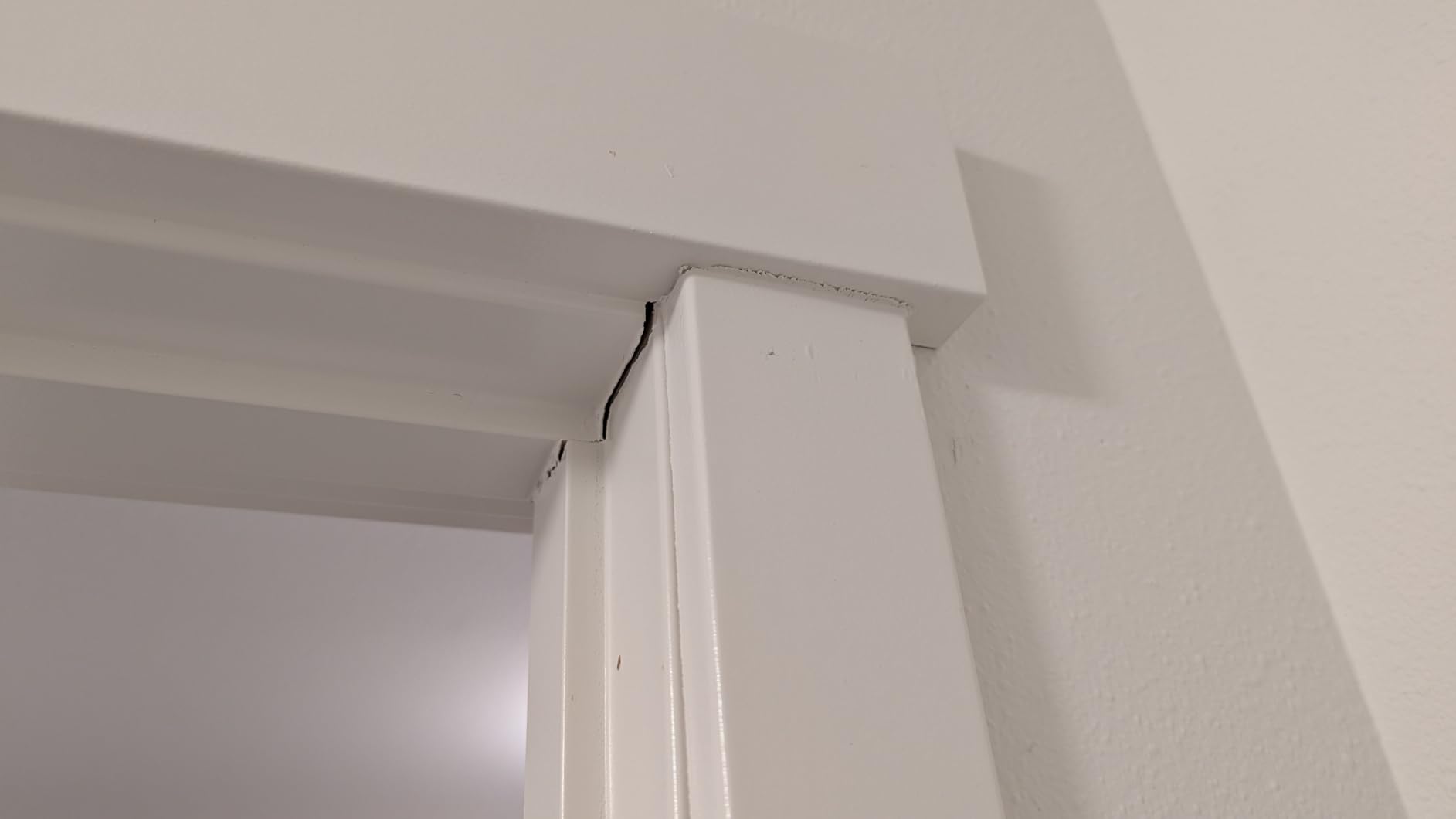
The most repeated damage complaint in this category is indentation and smudging on soft or white-painted trim. The fix is unglamorous and works. Fold an old towel or a pair of thick socks between the bar contact points and the frame, and wrap the top contact area with painter’s tape before installing.
Long-term owners report that most people add foam or felt pads proactively rather than waiting for marks, and that flat pads on the front of the frame are gentler than edge hooks that bite into trim. If your frame is already showing wear, add the padding before the first rep rather than after the first dent.
Step six: check the ceiling before you commit
Pull-ups are not the only use. Hanging leg raises mean swinging your legs, and a chest-high rep in a low hallway can put your head into the ceiling. One recurring story in bodyweight training forums describes exactly that, after switching from a wall-mounted bar to a doorway bar in a corridor with limited clearance.
Stand in the doorway, jump up as if finishing a pull-up, and check clearance in every direction. If you have to duck, the bar is too high or the space is too short, and no capacity rating fixes that.
When to skip a doorway bar entirely
If your door is hollow-core, or the frame is MDF or particleboard, stop. Hollow-core doors have a thin skin over a hollow cavity, and the mounting points are not designed for repeated lateral load. A tension bar actively crushes the jamb, and a leverage bar pries the head joint apart, and neither failure announces itself in advance.
Renters with fragile or freshly painted frames, shared walls where noise is a real issue, and rooms with low ceilings are all cases where a wall-mounted bar or a freestanding power tower is the better investment. If you do not own the trim, you are borrowing someone else’s deposit.
Frequently Asked Questions
What is the safest pull-up bar for a doorway?
The safest doorway bar is one whose mounting point is the solid vertical jamb rather than the flat trim face, and whose rated capacity exceeds your bodyweight by at least 50 pounds. In this roundup the Iron Gym bar uses pads against the jambs and 25k-plus reviews of real use, while the Sunny Health and Fitness bar adds a built-in anti-rotation lock for anyone doing more than controlled reps. Match the capacity, check the frame material, and add padding before the first session.
Are doorway pull-up bars any good?
Yes, for most home users they are the best value in bodyweight training, because they turn an unused door opening into a full pull-up, chin-up, dead hang and band anchor station without a single hole in the wall. The limits are honest: bars below about 300 pounds of rating are not for heavy users, wide decorative molding rules several designs out, and hollow-core or MDF frames are not safe to load.
Can my doorway support a pull-up bar?
It can, if four things line up. Your opening width must fall inside the bar’s stated range, typically 24-32 inches for standard interior doors. Your frame needs enough depth for the mechanism, about half an inch for a leverage hook and around 4 inches for a telescopic bar. The trim must meet the height and thickness limits. And the frame must be solid wood, not hollow-core, MDF or particleboard.
What is the best high-quality pull-up bar?
For most doorways, the Iron Gym Total Upper Body Workout Bar is the highest-quality pick, with a 4.5 average across more than 25,000 reviews, a 300-pound steel rating, and three grip positions in a frame that installs in seconds without screws. If you want a higher rating and more rigid welded construction, the AmazeFan at 4.6 stars and 400 pounds is the alternative, though it is heavier and covers a different fit range.
Do doorway pull-up bars damage door frames?
They can, and the most common complaints are indentations and smudging on soft or white-painted trim. Three steps prevent almost all of it: fit a folded towel or thick felt between every bar contact point and the frame, wrap the top contact area with painter’s tape, and stop tightening when the pads have compressed rather than chasing extra tension. Long-term owners report that adding foam or felt pads proactively stops the marks before they start.
The Verdict on the Best Pull Up Bars for Doorways
For most homes in 2026, the Iron Gym Total Upper Body Workout Bar is the best pull up bar for doorways: the most proven option we reviewed, with 25k-plus reviews, a 300-pound rating and a fit range covering standard interior doors. Buy the AmazeFan if you want welded rigidity and fold-flat storage, and the Ally Peaks if you are a heavier user who needs 440 pounds of headroom.
Measure your opening before you order, check that the frame is solid, and put a towel between the bar and the trim on day one. Those three steps decide whether a doorway bar is a two-minute install or a repair bill at move-out.
For the wider equipment picture, including mounted and freestanding options, read our full pull up bar guide.