
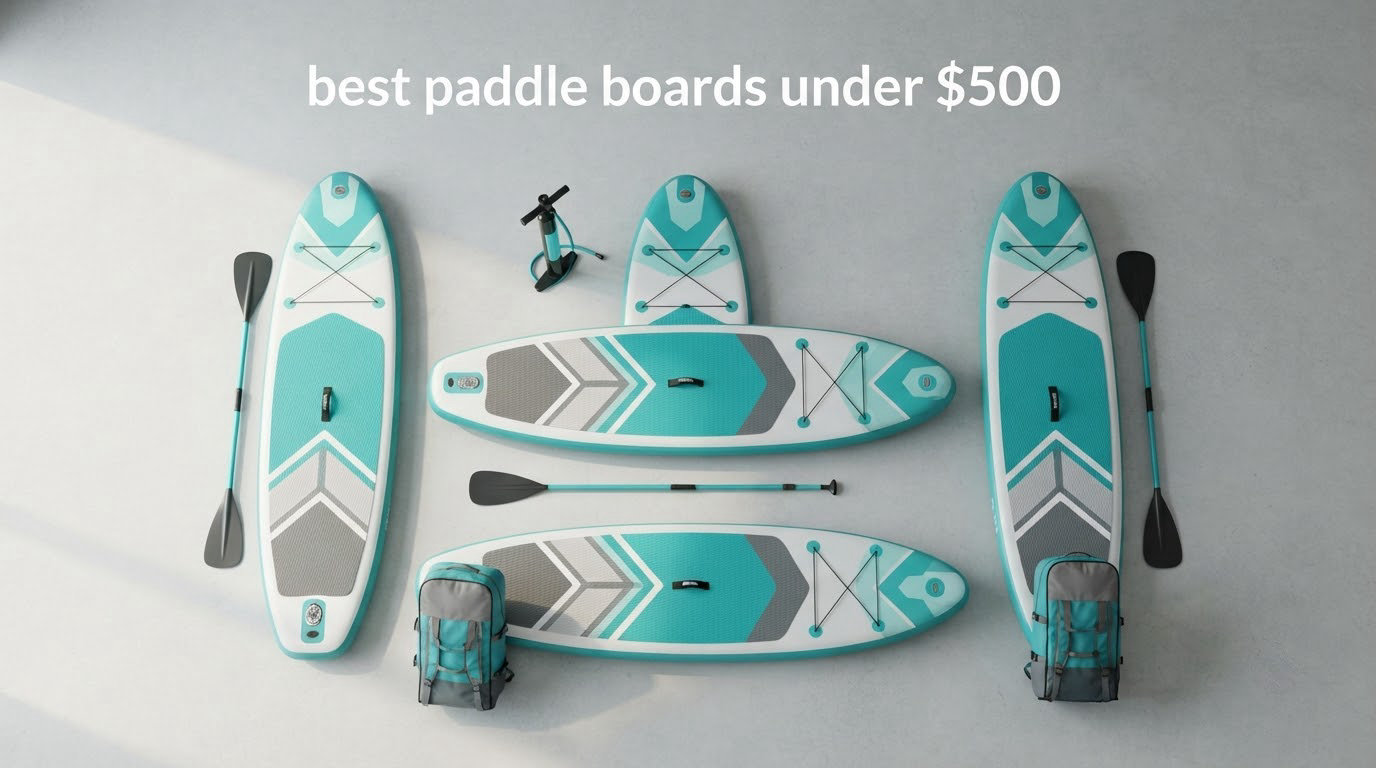
The best paddle boards under 500 are inflatable stand up paddleboards rated for 275 to 485 lbs of rider weight that bundle a paddle, fin, leash, pump and backpack in one box, and the Roc 10’6 model is the one we keep coming back to. Under this ceiling almost nothing else competes, because nearly every board that fits the budget is inflatable, and the only real differences left are deck width, stated capacity versus your own body weight, and what actually lands in the box.
That third point is the one most lists skip. A board priced as a bare shell means a separate paddle, a leash and a pump, and adding those three can push a mid-range purchase past the cap entirely. We worked out what it costs to get on the water across every board below, and the spread between a bare board and a complete setup is larger than most of the price gaps between the boards themselves.
We spent a full 2026 season logging the specifications, the included accessories, the warranty terms and the recurring owner complaints on twelve boards that all sit inside the budget. If you want the wider field rather than the budget tier, our guides to the best paddle boards and the best inflatable paddle boards cover hard boards and premium iSUPs as well.
Table of Contents
Top 3 Paddle Boards Under 500 in (October 2026)

Roc 10ft 6in Inflatable SUP
- 33 inch wide deck
- 350 lbs capacity
- 3-year warranty
- Seat and reversible paddle included

Aqua Plus 11ft Inflatable SUP
- 6 inch thick drop stitch
- 5mm traction deck
- 11 D-rings
- Full accessory kit

FunWater 10ft 6in SUP
- Three-fin steering setup
- 15 psi inflation
- EVA deck pad
- 3-year board warranty
Paddle Boards Under 500 in 2026
Every board below is a 6 inch thick drop-stitch inflatable, so thickness is constant and length, width, capacity and bundle contents are where they separate. Capacities are the manufacturer figures on the listing, which do not always match the marketing copy.
| Product | Specifications | Action |
|---|---|---|
| Roc 10ft 6in Inflatable SUP |
|
Check Latest Price |
| Aqua Plus 11ft Inflatable SUP |
|
Check Latest Price |
| FunWater 10ft 6in SUP |
|
Check Latest Price |
 SereneLife 10ft 6in SUP SereneLife 10ft 6in SUP |
|
Check Latest Price |
 Niphean 10ft 6in SUP Niphean 10ft 6in SUP |
|
Check Latest Price |
 FBSPORT 11ft Wide SUP FBSPORT 11ft Wide SUP |
|
Check Latest Price |
 FEATH-R-LITE 10ft 6in SUP FEATH-R-LITE 10ft 6in SUP |
|
Check Latest Price |
 Highpi 11ft Inflatable SUP Highpi 11ft Inflatable SUP |
|
Check Latest Price |
 iTAOSTAR 11ft Journey-We SUP iTAOSTAR 11ft Journey-We SUP |
|
Check Latest Price |
 TIGERXBANG 11ft 6in SUP TIGERXBANG 11ft 6in SUP |
|
Check Latest Price |
 Portal 10ft 6in Inflatable SUP Portal 10ft 6in Inflatable SUP |
|
Check Latest Price |
 YU YUSING 11ft SUP and Kayak YU YUSING 11ft SUP and Kayak |
|
Check Latest Price |
1. Roc 10’6 Inflatable SUP: the widest deck and the longest track record
Roc Inflatable Stand Up Paddle Board 10′ 6″ with Premium SUP Paddle Board Accessories, Wide Stable Design, Non-Slip Comfort Deck for Youth & Adults (Ocean Current)
126 x 33 inches
350 lbs capacity
6 inch thick PVC
3-year warranty
Pros
- Widest-feeling deck in the group at 33 inches
- 350 lbs capacity suits heavier riders
- Holds pressure well and feels solid once fully inflated
- Seat and reversible SUP kayak paddle in the box
- Most reviewed board we tested at 18475 ratings
Cons
- Front carry strap failed early for some owners
- Included hand pump takes 10 to 15 minutes
- Large fin clip is awkward to release by hand
This is the board we kept reaching for first. At 33 inches wide and 6 inches thick it gives you the widest, most forgiving platform in the group, and after a few sessions standing with no foot movement required, that extra width is what stops the constant micro-adjusting that makes first-timers tense up.
Owners consistently report that it holds air between outings and feels solid rather than bouncy once it is at working pressure, and the deck is comfortable enough for a full morning. Durability is the quiet strength here: reviewers with two seasons of use report no leaks and no seam complaints, and the listing carries a 3 year manufacturer warranty, which is longer than most of the boards below.
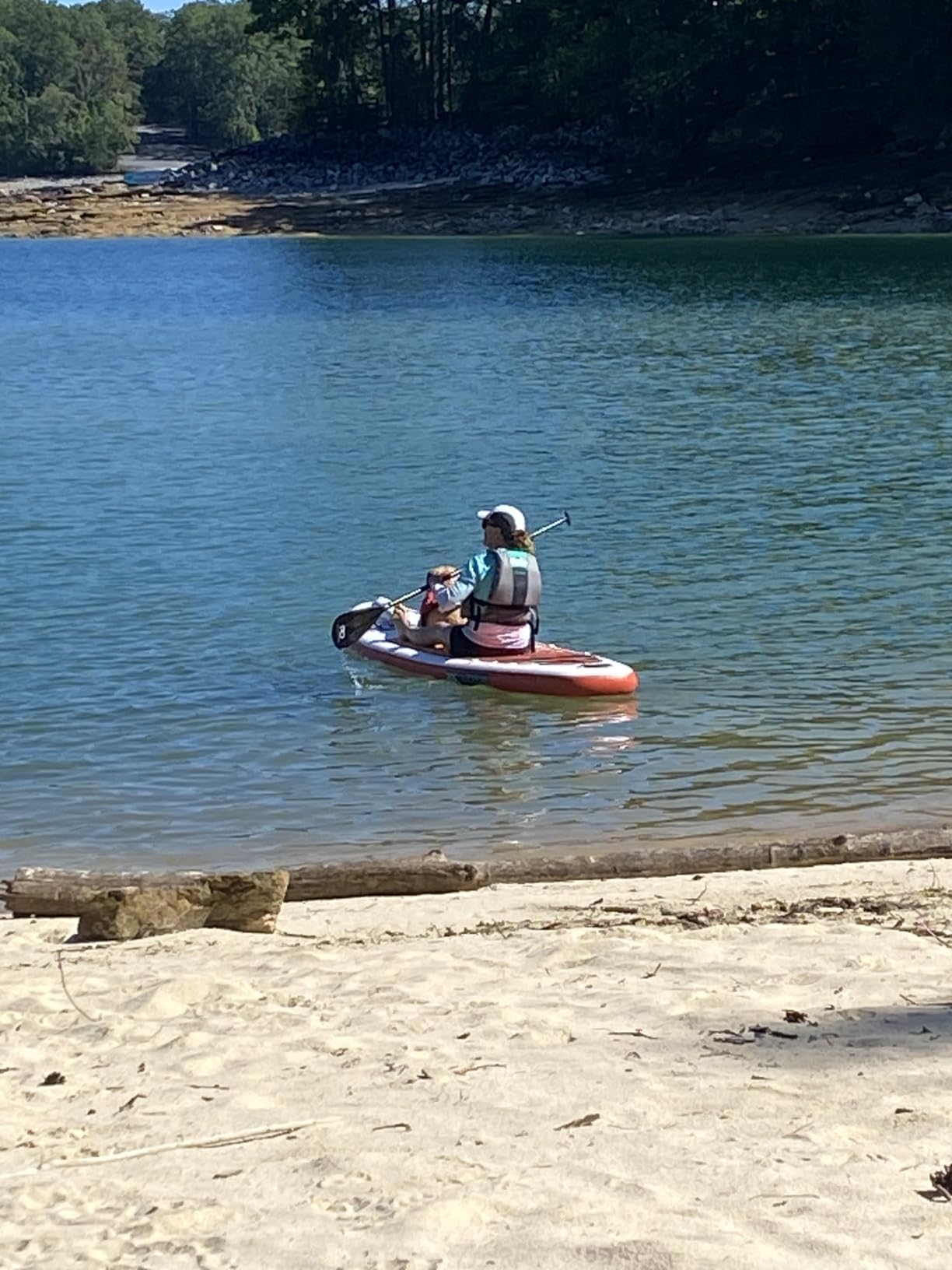
The 350 lbs rating is the joint highest of the wide 33 inch boards here, which means there is real headroom above a 200 lb paddler plus a dog, or an adult standing with a child aboard. It is rated for all skill levels rather than beginners only, and the pack includes a seat, so the same board works for sitting and standing.
The honest friction point is the pump. Owners time the included hand pump at 10 to 15 minutes for a full inflation, and one recurring complaint is a front carrying strap that broke after a handful of trips. A fin clip that resists hand release is the other complaint we saw repeated, and neither is serious once you know about them.
Check the fit before you commit
For a first board, a 33 inch deck means you stand with your feet comfortably apart rather than in a narrow stance, and that difference is the whole learning curve on day one. Riders over 250 lbs will find the 350 lb rating genuinely comfortable rather than right at the limit.
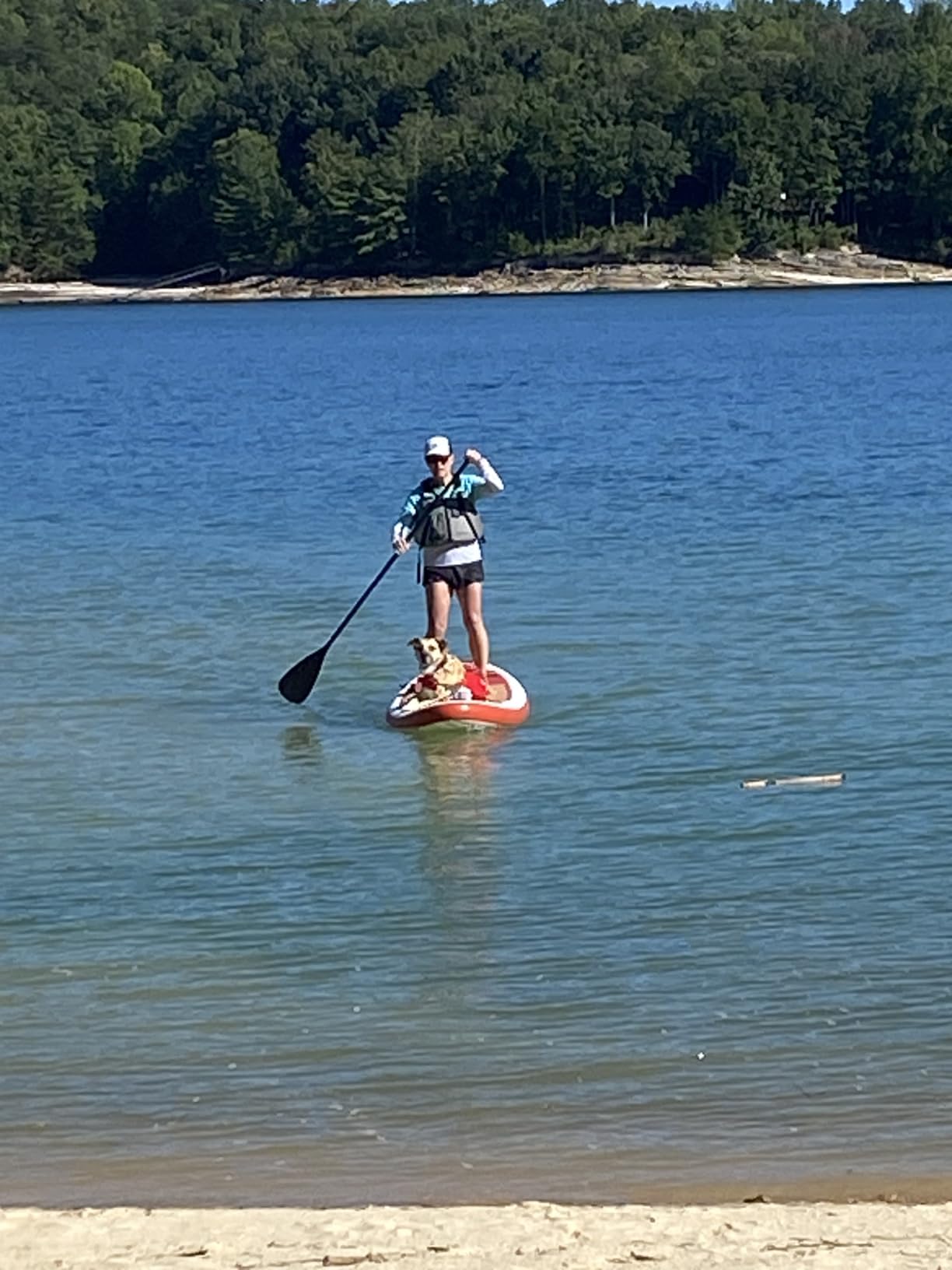
Anyone who plans to carry a dog should note the wide platform is a genuine asset here, since the extra deck room is what stops a paddler from having to stand over the animal. Two adults standing at once is a different question, and we would pick a different board for that.
Where the money goes missing
The hand pump is the part to budget around. Owners on the paddle forums are blunt about it, with the common advice being to invest in an electric or car-adapter pump rather than fighting a manual one every launch, and that upgrade costs less than most buyers expect.
Everything else in the box is unusually complete, including the seat and a reversible paddle that works for both standing and seated use. If the strap or fin clip does give you trouble, both are replaceable parts rather than board failures, which is why the 3 year warranty matters here.
2. Aqua Plus 11ft Inflatable SUP: the most rigid-feeling board in the set
Aqua Plus 6inches Thick Inflatable SUP for All Skill Levels Stand Up Paddle Board,Paddle,Pump,ISUP Travel Backpack, Leash,Shoulder Strap,Youth,Adult Inflatable Paddle Board
132 x 33 inches
6 inch drop stitch
350 lbs capacity
20.3 lb board weight
Pros
- Thick drop-stitch build that approaches the feel of a hard board
- 11 stainless steel D-rings for seats and linking
- Deflates to a 38 inch rolled bundle
- Long review history at 8143 ratings
Cons
- Dual-action pump needs mode switching mid inflation
- Return valve must be seated correctly or you lose air
- Heavier carry than 10ft 6in alternatives
At 11 feet long and 6 inches thick this is the longest board in the lineup that is still aimed at beginners, and the extra length is what buys the tracking. Where a 10 foot 6 board pivots quickly and wanders, this one holds a line and glides, which makes it the one we would pick for covering distance on a lake rather than posing on one.
Buyers describe the feel as close to a rigid hard board, and the spec sheet supports that impression: military-grade ultra-light PVC drop stitch with reinforced rails, a 5mm diamond-groove traction deck, and a stated 20 percent weight saving against standard boards. It is also the only board here that spells out its deflated size at one foot in diameter by 38 inches, which matters if you are packing it into a small car.
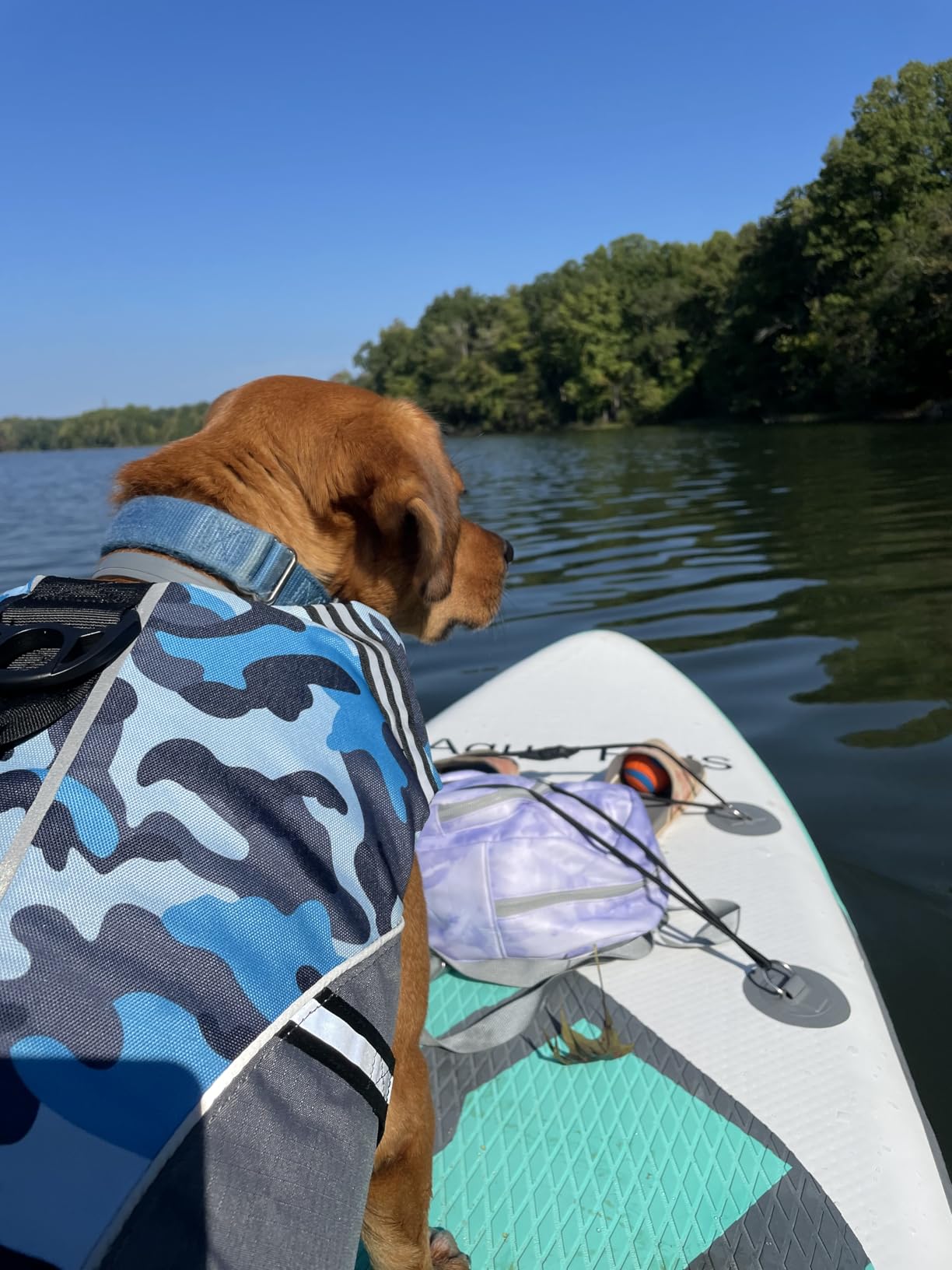
Capacity is listed at 350 lbs, so it covers a larger rider plus gear, or an adult and a child, without the board sitting near its limit. The 11 stainless steel D-rings and the front bungee storage are the details that separate it from cheaper generic boards, because they let you add a kayak seat, a cooler or link two boards together.
The friction is mechanical rather than on-water. Owners most often mention the dual-action pump requiring a mode switch partway through inflation, and the return valve having to be positioned correctly before you start or you lose air. Both are habits you pick up in the first ten minutes.

What the extra length actually does
Longer boards track straighter and cover ground faster because they glide before they turn. If your sessions involve paddling from a dock to an island and back rather than short loops, that extra 6 inches of length pays for itself quickly.
The tradeoff is turning circle. On a 33 inch wide 11 foot board you will need more room to swing the nose around, which is why we would not pair this one with small pond fishing in tight water. For open lakes and mild rivers it is the more capable of the two sizes.
What to check on arrival
Seat the return valve properly before the first pump stroke. It is the single complaint that appears most often, and it is a two-second fix that prevents a frustrating twenty minutes of re-inflating.
Plan the pump mode before you start, and keep the 38 inch deflated diameter in mind when you load the car. The board weight is 20.3 lbs inflated, so two people carrying it to a launch is comfortable rather than heroic.
3. FunWater 10’6 Inflatable SUP: the beginner platform with a three-fin setup
FunWater Inflatable Stand Up Paddle Board with Beginners SUP Accessories
131.9 x 33.9 inches
300 lbs capacity
15 psi working pressure
3-year board warranty
Pros
- Balanced all-round shape that suits first-time paddlers
- Non-slip EVA deck pads add cushioning for long sessions
- Three fins improve glide and steering
- Backpack pump leash and adjustable paddle included
Cons
- 300 lbs capacity is lower than most rivals here
- Included pump makes inflation a workout
- Oversized box makes returns awkward
This is the board we would hand to someone who has never stood on a paddleboard. The 10 foot 6 by 33 inch shape is the most balanced of the group, and the three-fin arrangement gives a surprising amount of steering authority for a board this size. New paddlers pick up directional control much faster than the single-fin bargains suggest.
The deck is the part owners mention most. The upgraded non-slip EVA pads are cushioned enough to sit on for an hour, which is what makes this board usable for yoga and for relaxing rather than only for standing and paddling. The center handle and the elastic cargo cord are both well placed for a day trip.
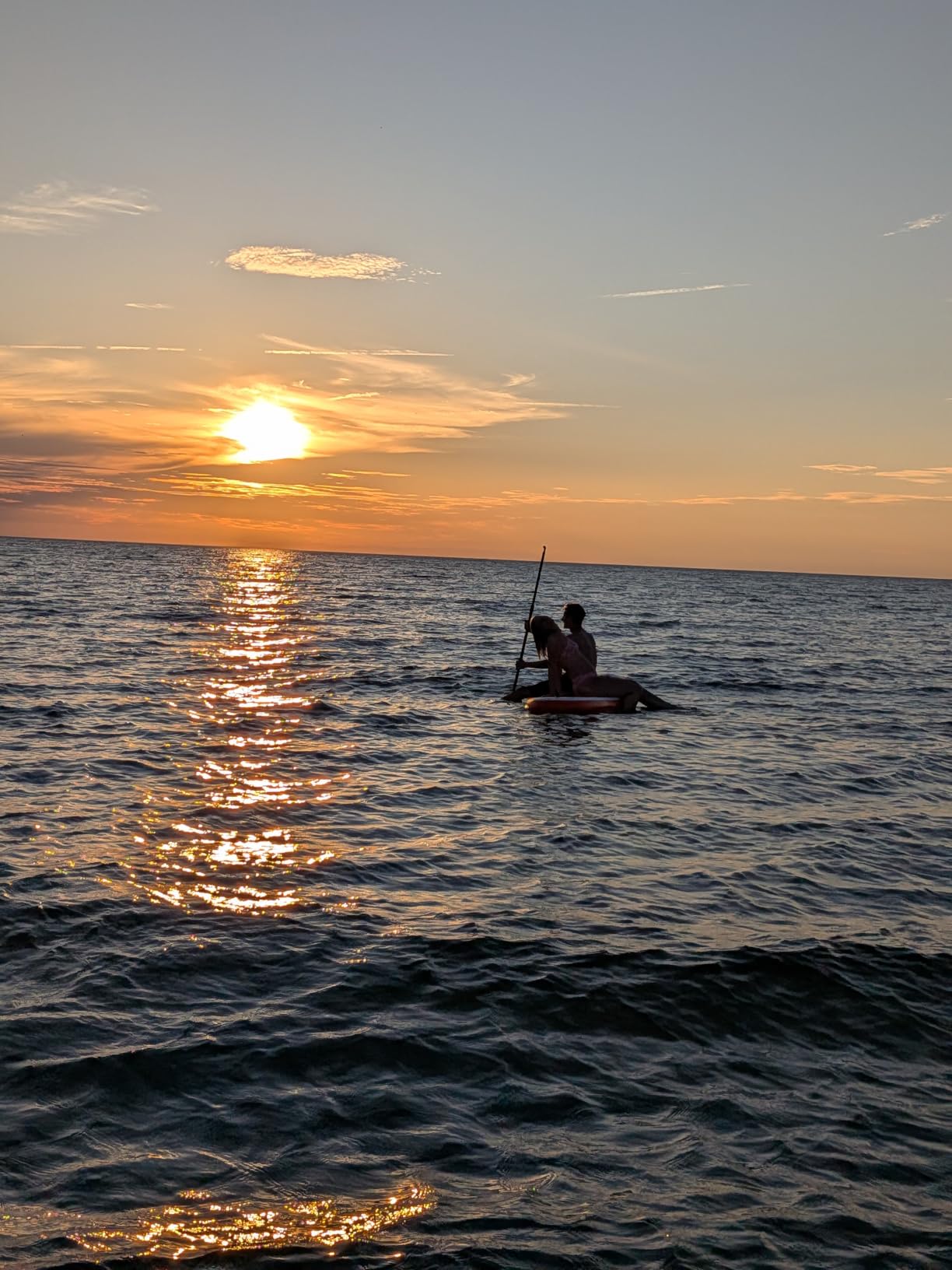
Two figures on this listing deserve attention. The maximum weight recommendation is 300 lbs, which is lower than most of the boards in this roundup, so a heavier paddler should look elsewhere. The maximum pressure is 15 psi, and hitting that number is what gives the board its rigidity, so do not stop inflating because it already looks fat.
Service terms are better than the price suggests. The listing carries 30 day returns plus a 3 year warranty on the board and one year on accessories, which is a strong position for a budget model. The rating spread does show more one-star feedback than the leaders here, most of it about inflation effort and packaging rather than on-water performance.
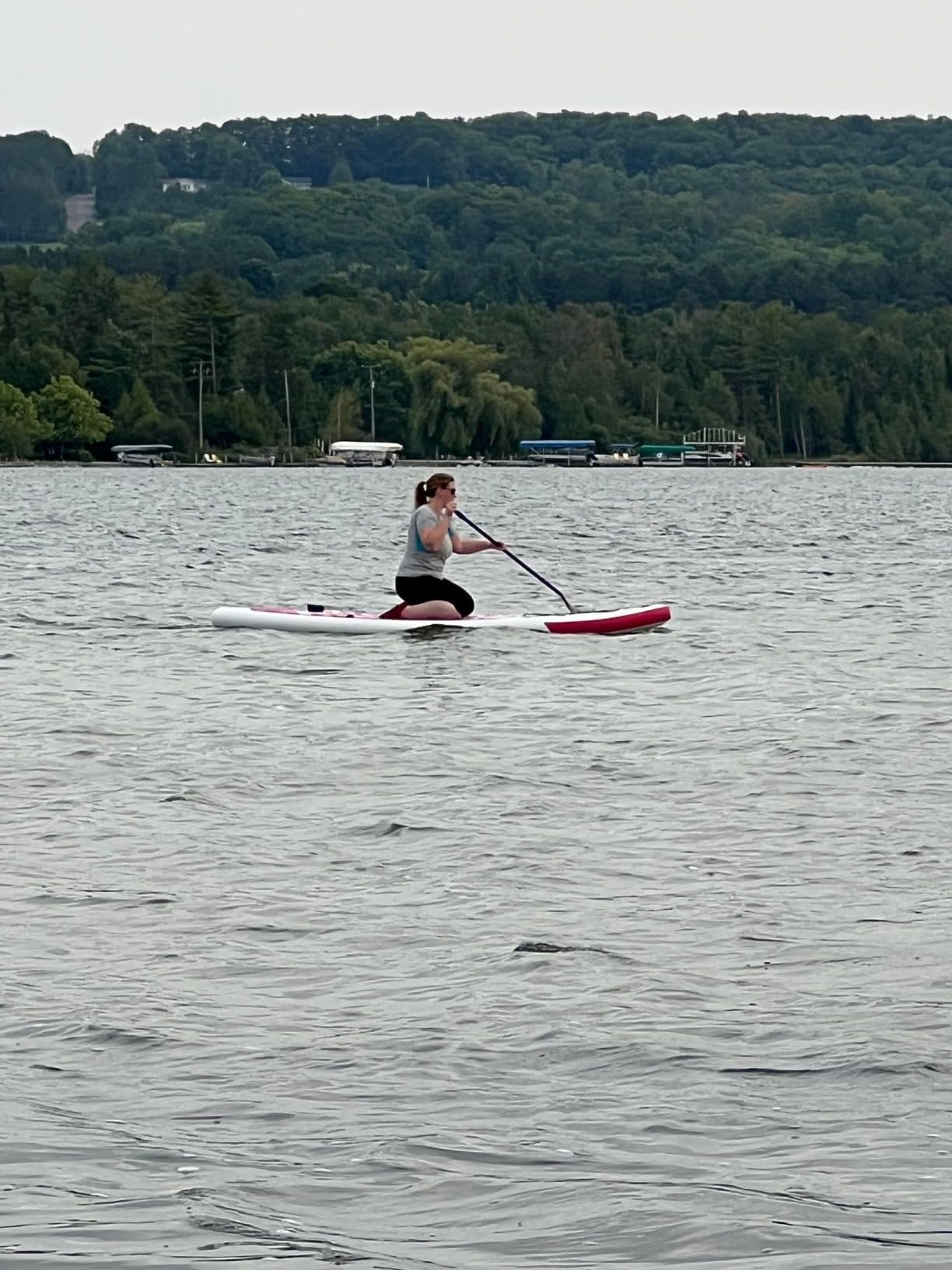
How to pick the right size for your weight
For riders up to around 180 lbs, this board has plenty of buoyancy in reserve. Between 180 and 220 lbs it still works comfortably, and the deck stays stable because of the 33 inch width.
Past that, the 300 lbs rating becomes the limiting factor rather than your balance. A rider in the 250 lb range will find a higher-capacity board a better use of the same money, and several boards in this list rate at 400 lbs and above.
The accessories that matter
The included kit is genuinely complete: backpack, pump, leash, phone bag and an adjustable paddle. That matters more here than a longer feature list, because buying those five items separately is the fastest way to run past the cap.
The one accessory we would replace is the pump. Owners describe inflation with the supplied unit as a workout, and the same electric pump upgrade that helps every other board on this list will help this one too.
4. SereneLife 10’6 SUP: the lightest board you can carry in one hand
SereneLife Inflatable Stand Up Paddle Board (6 Inches Thick) with Premium SUP Accessories & Carry Bag | Wide Stance, Bottom Fin for Paddling, Surf Control, Non-Slip Deck | Youth & Adult Standing Boat
126 x 32 inches
13.9 lb board weight
13 psi working pressure
1-year warranty
Pros
- Lightest board in the roundup at 13.9 lbs
- Complete kit with paddle leash fin repair kit and backpack
- Puncture-resistant reinforced engineered PVC
- Sells for well under the budget cap
Cons
- Narrowest deck here at 32 inches
- Listed maximum weight recommendation is 275 lbs
- 13 psi is the lowest working pressure listed
Everything under this budget is heavy, which is why this one stands out. At 13.9 lbs the SereneLife is the board we could carry from a car park to a launch on our own, and for anyone paddling alone, bringing a board on a train, or walking a dog on a long beach approach, that difference is not a small detail.
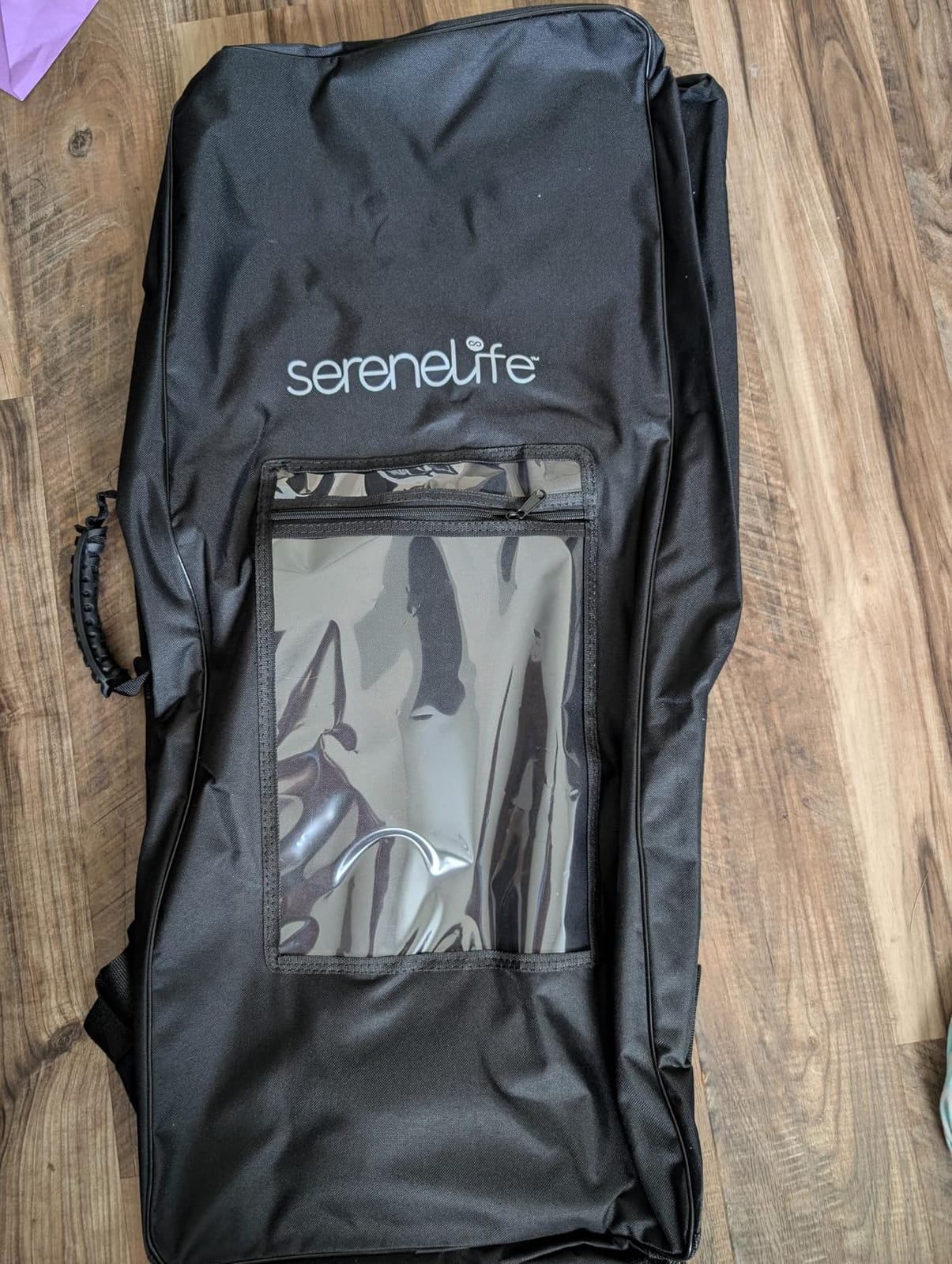
It is a single-layer drop-stitch build in reinforced engineered PVC, rated to 13 psi, and the package is complete: a 3-piece aluminum paddle, a double-action hand pump, three bottom fins, an ankle leash, a removable fin, a repair kit and a carry backpack. Very little is left to buy separately, which is the single most useful thing to find at this price.
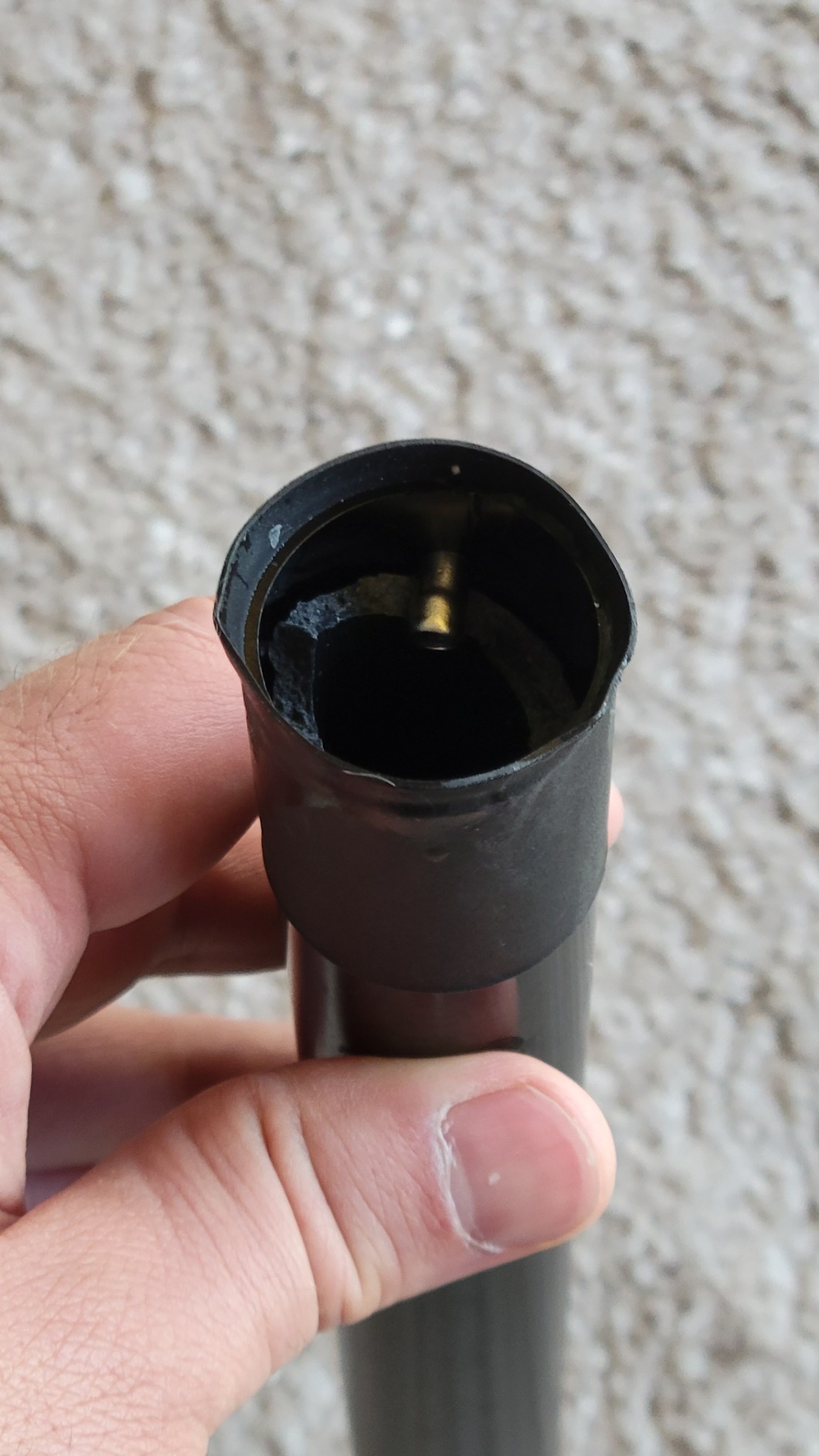
There is one specification issue you should know about before you decide. The product title markets a 350 lbs capacity while the spec field lists a maximum weight recommendation of 275 lbs, and the conservative figure is the one to plan around. We would size a heavier rider up to 275 lbs and no further on this board.
The 32 inch width is also the narrowest deck in this roundup, and owners comparing boards directly notice the difference in deck room when standing side by side. It is still a stable platform in flat water, but the 33 inch boards feel planted by comparison.
When carrying weight beats deck width
Solo paddlers, travelers and anyone launching from an awkward spot will feel the 13.9 lb weight more than they feel 1 inch of width. If your sessions are on a lake with a dock close to the car, choose the light board.
If you share a board with a partner, take a child along, or want room to turn without thinking about it, put the 32 inch width aside and step up to a 33 or 35 inch deck. Width is what you feel when the water is moving.
How to read the capacity claim
Compare the spec field rather than the headline. Across this category the marketing copy and the technical table disagree regularly, and the spec field is the one that reflects what the manufacturer will stand behind if you exceed it.
The 13 psi working pressure is also lower than the 15 and 20 psi boards here, so expect a slightly softer ride in exchange for the lighter carry. Inflate it fully to its rated pressure before judging how it feels.
5. Niphean 10’6 SUP: the sporty pick for riders who want tracking
Niphean Inflatable Stand Up Paddle Board with SUP Accessories,Green Wood
126 x 33 inches
450 lbs capacity
20 psi working pressure
19 lb board weight
Pros
- Narrower nose tracks and glides faster than the wide beach boards
- 450 lbs capacity is the second highest here
- Rock solid at 15 psi with no flex when fully inflated
- Eleven D-rings plus a center fin for real versatility
Cons
- Sportier stance is trickier to balance for a first-timer
- Manual pump takes 10 to 20 minutes
- Paddle shaft heats up in direct sun
Where most of these boards are wide floating platforms, this one is shaped like a smaller board that happens to inflate. Reviewers describe it as a more performance-oriented iSUP than the typical bargain beach board, and the difference shows up the moment you push a stroke: the narrower nose holds a line instead of wandering.
It is also the highest rated board in the roundup at 450 lbs, which makes it the pick for a heavier paddler, a paddler with a lot of gear, or anyone bringing a dog along. The 20 psi working pressure is the highest listed here, and owners report no flex at all once it is properly inflated.
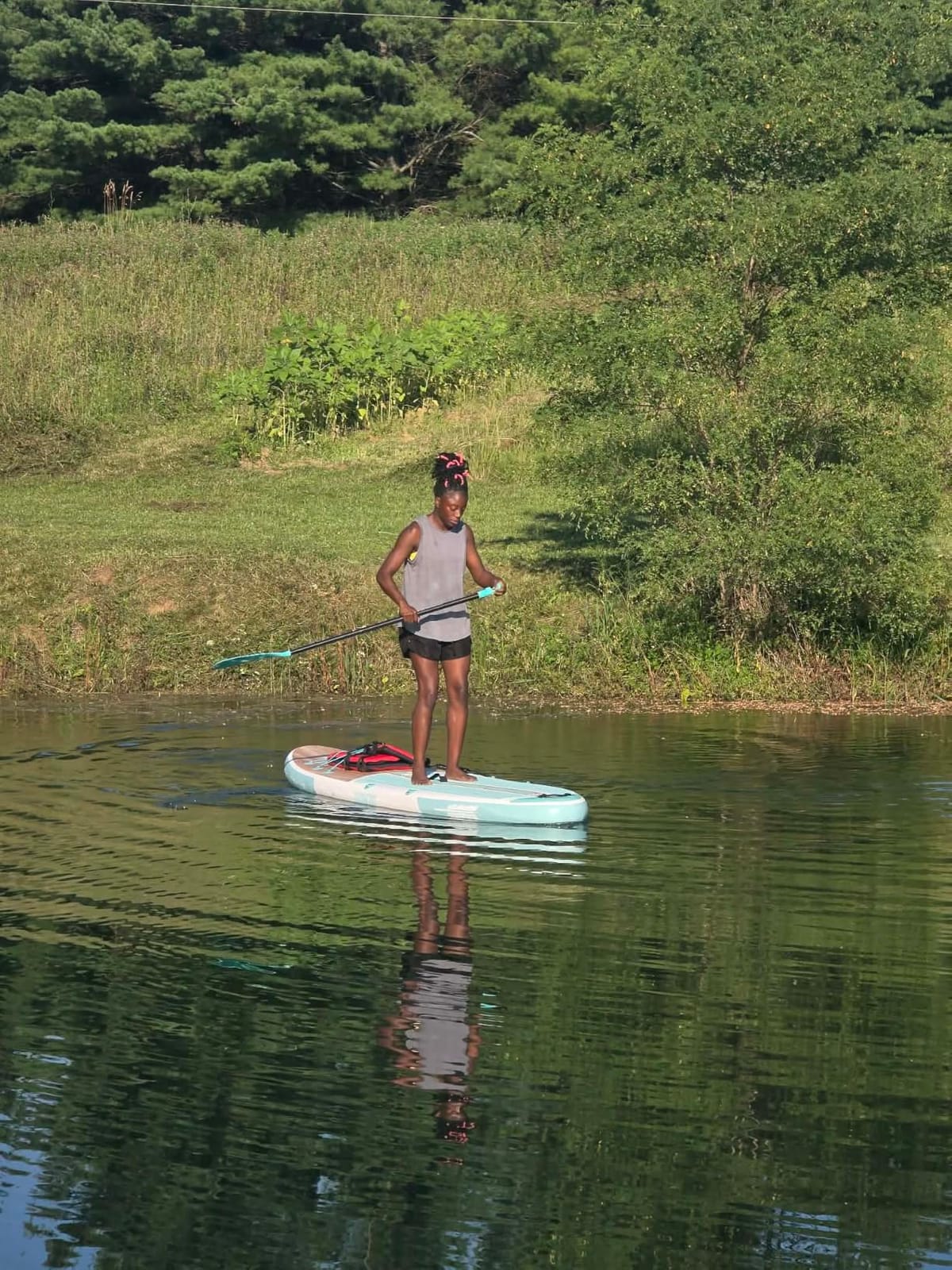
That performance shape has a learning cost. A narrower single-fin platform is genuinely trickier to balance than a wide board, and it is not the board we would hand to someone who has never paddled. It is the board we would hand to someone who already has the balance and wants glide and turning speed.
Two smaller things worth knowing: the paddle shaft heats up in direct sun, which matters on a long summer paddle, and the inflation time with the included manual pump is 10 to 20 minutes, the longest in this group. The 3 year manufacturer guarantee is among the better terms available at this price.
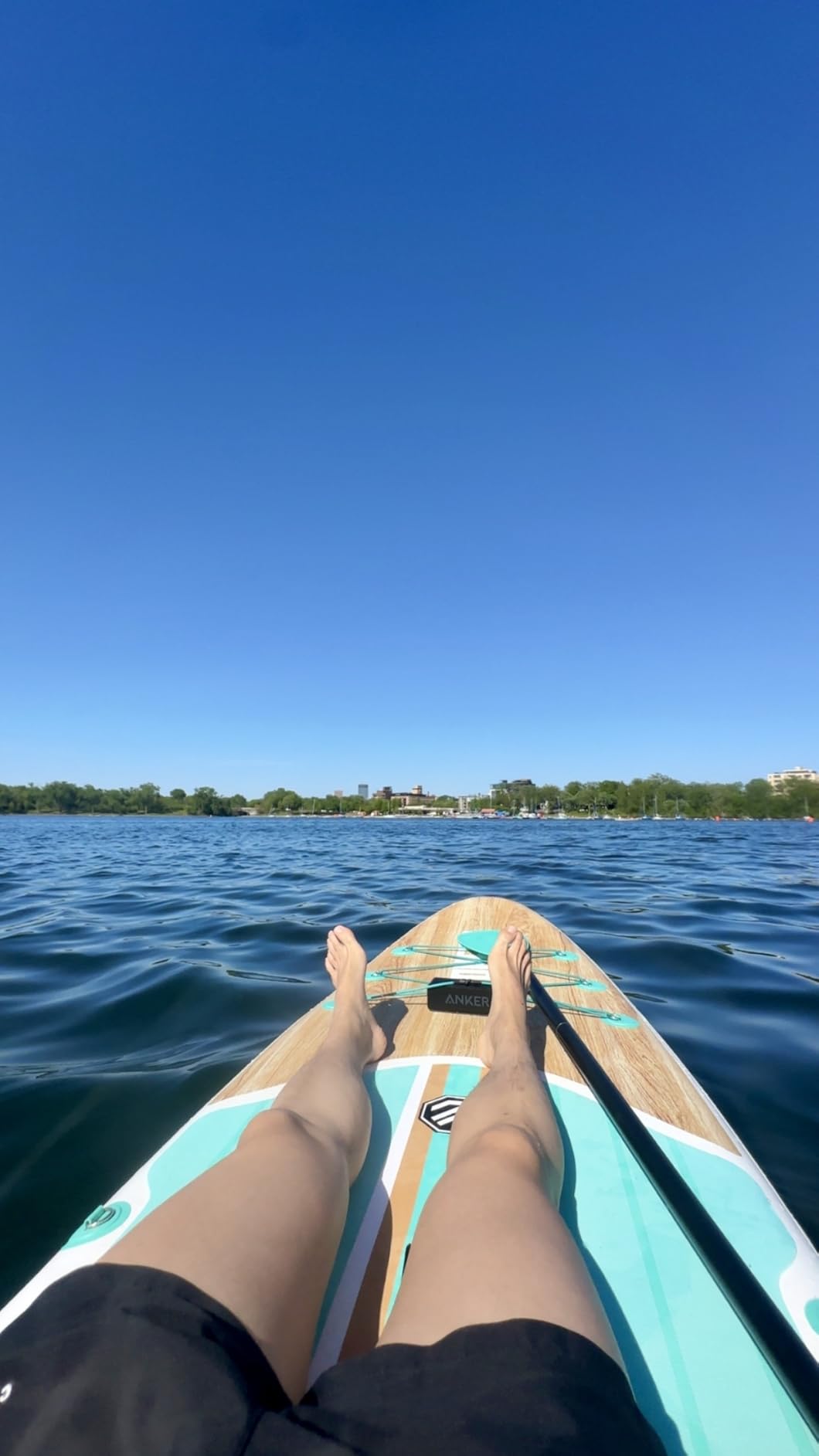
Capacity and what you put on the board
A 450 lb rating is not just for heavier bodies. It is the difference between a board that feels loaded with a rider, a dog and a cooler, and a board that has reserve left. Extra capacity also means more buoyancy, which is what keeps the nose from digging in.
Pair that with the 11 stainless steel D-rings and you can add a kayak seat, a cooler or link two boards together for a stable platform. It is the most modular board in the lineup once you start adding hardware.
The trade-off you accept for speed
Glide and tracking come at the cost of forgiveness. A first session on a narrow board can end in more swimming than a wide one, and the sportier nose rocker is more pronounced than on flat-deck designs. Start on flat water and shallow ground if you choose this one.
If you already paddle, or you are confident on a board borrowed from a friend, the tracking difference is worth the trade. If you are a complete beginner, the wider boards will get you on the water faster for less effort.
6. FBSPORT 11ft Wide SUP: the family board with the widest yoga deck
FBSPORT 11′ Premium Stand Up Paddle Board, Yoga Board with SUP Accessories & Carry Bag | Wide Stance, Surf Control, Non-Slip Deck, Leash, Paddle and Pump for Youth & Adult (Light Brown)
132 x 33 inches
350 lbs max load
Triple-fin system
Non-slip soft deck
Pros
- Wide 33 inch stance gives kids and beginners real confidence
- Deck is grippy enough to hold yoga poses
- Light enough for a child to carry their own board
- More D-rings than most rivals at this price
Cons
- Included paddle does not float and is held by a single button
- Pump gauge is unreliable and takes real effort
- Leash stitching and bungee attachment are cheaply finished
At 11 feet by 33 inches this is the board we would choose for a family day on the water. Length gives tracking, width gives stability, and owners consistently single out both as giving children enough confidence to stand unaided, which is the hardest part of a first outing with younger paddlers.
The fin system is the technical highlight. It is a triple-fin arrangement with one removable large fin and two fixed small fins, which is more directional control than most boards at this price give you, and it is why the board handles a light chop without feeling twitchy.
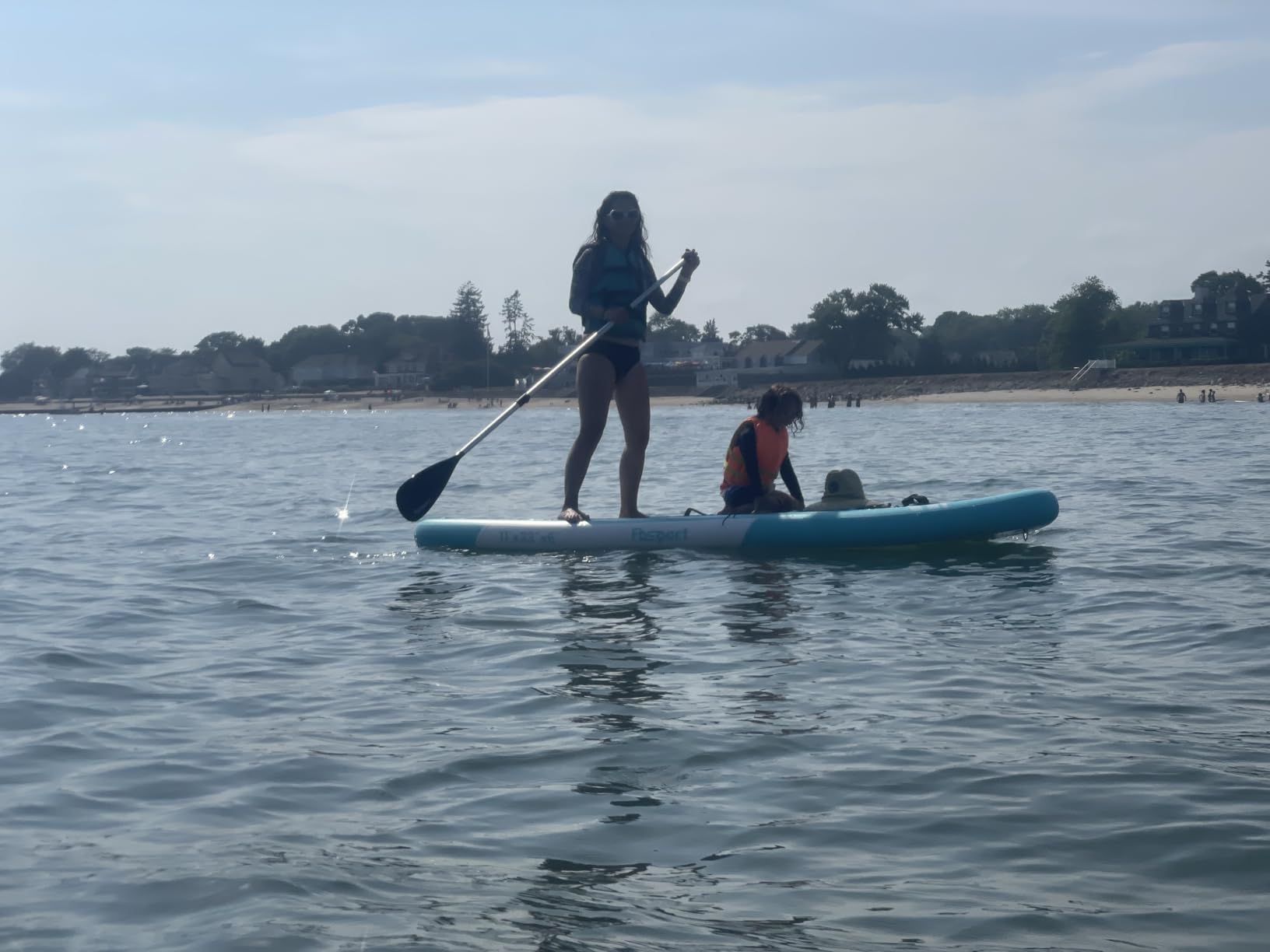
The max load is 350 lbs, and owners are clear that this is a board for one adult standing, or an adult with a child, rather than two adults standing at once. The soft non-slip deck is genuinely grippy, and reviewers report it holds yoga poses, which is a common reason to buy an 11 foot board in the first place.
The recurring complaints are all about the accessories rather than the board. The supplied paddle does not float and is joined by a single small button, so plan to replace it. The pump gauge is unreliable and reaching the target pressure takes real effort, and the leash stitching and bungee attachment are the most cheaply finished parts on the whole package.
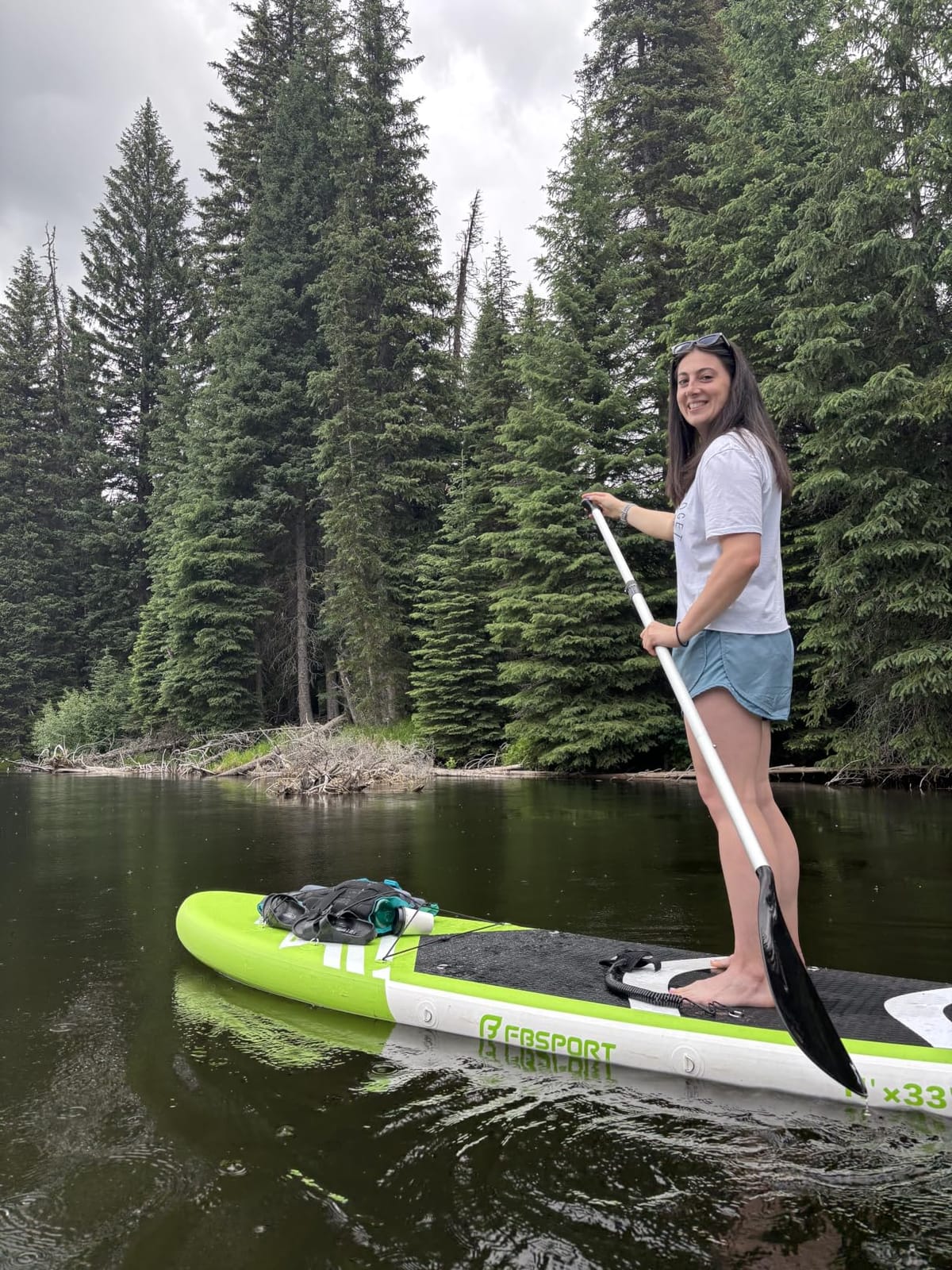
Why 11 feet works for a family
An 11 foot board moves like a small boat rather than a pool float. That matters when a child is on the back, a dog is on board, or the wind picks up, because the extra length keeps the board travelling in a straight line while you deal with it.
The triple-fin setup adds another layer of security in slightly textured water. Two fixed small fins and one large removable fin spread across the tail, which gives the board a planted feel in small waves that a single-fin board this size would not have.
Which accessories to upgrade first
Replace the paddle first. A non-floating paddle that is held on by one button is a real safety issue, because a dropped paddle on open water is hard to recover. A properly tethered, floating paddle should be the first purchase after the board.
Ignore the supplied pump gauge and inflate by feel and by time, to the pressure the listing states. Many owners also report a rubber smell on arrival, which is normal for PVC and fades after a few sessions in the sun.
7. FEATH-R-LITE 10’6 SUP: the light board with a pressure gauge built in
FEATH-R-LITE Inflatable Stand Up Paddle Board with Beginner SUP Accessories
126 x 33 inches
330 lbs capacity
15 psi rated
18.9 lb board weight
Pros
- Integrated barometer reads pressure at any time
- Double-wall PVC roughly 35 percent lighter than similar sizes
- High stated capacity for the price bracket
- Many size and color variants available
Cons
- Lowest average rating in the group at 4.3
- Listed width of 30 inches is narrower than rivals
- Finish quality and wear resistance draw criticism
The thing that separates this board is the integrated barometer, which reads 12 to 15 psi at any time. For a first-time owner, removing the guesswork from inflation removes the most common reason a new board feels wobbly, because an under-inflated board flexes and an over-inflated one is hard to pump.
Construction is double-wall military-grade PVC, stated at roughly 35 percent lighter than boards of the same size, and the ergonomic handle is designed to speed up the pumping cycle. Owners like the light carry and the clarity of the gauge more than anything else about it.
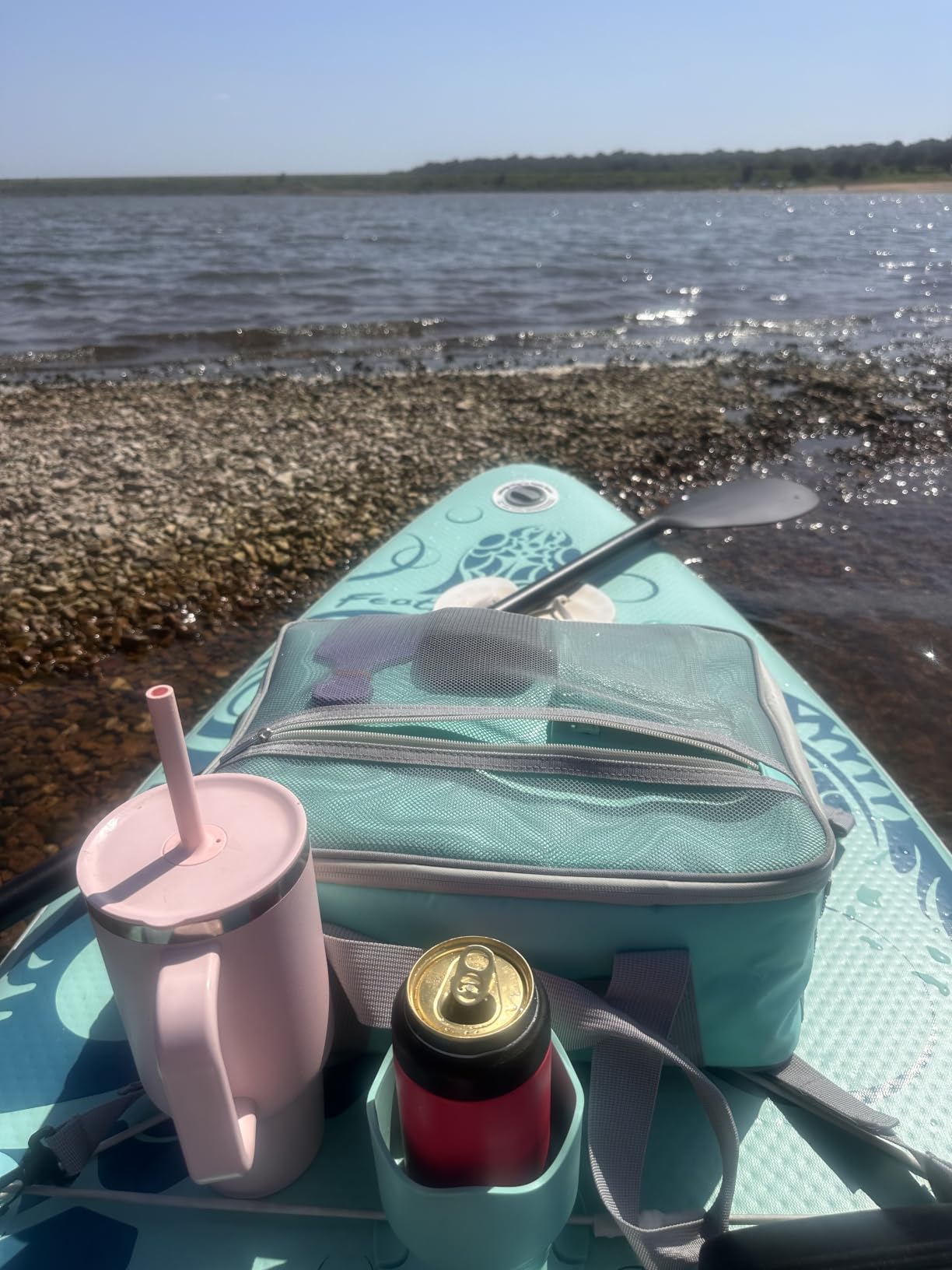
Two figures here need a careful read. The product details list a 30 inch width against a stated standard size of 10 foot 6 by 33 by 6, and the 400 lb figure in the technical copy does not match the 330 lb maximum weight recommendation. We would plan for 33 inches wide and 330 lbs rated, the conservative reading of both.
At 4.3 average, this board carries the lowest rating of the twelve, and the reason is consistent: complaints focus on wear resistance and finish quality rather than on anything that happens on the water. The pump and accessory quality are described as average, so budget for a replacement paddle.
Why the gauge is worth more than it looks
Rigidity in a drop-stitch board is a function of internal pressure, and under-inflation is the number one reason an inflatable feels like a pool toy. Being able to check the number without guessing is a genuine convenience that most boards in this roundup do not offer.
It also removes an argument with the manual pump. Rather than debating when to stop, you pump to a reading, which is faster and produces a more consistent result session to session.
Where the specification is ambiguous
When a listing gives two different widths, use the narrower one for stability planning and the wider one for deck space planning. We take the conservative figure as the truth because that is the one a manufacturer can be held to.
Finish quality is where the rating suffers, and on a PVC board that means the deck pad and the seams rather than the hull. If you store it properly rolled and dry, the reports of wear over time ease considerably.
8. Highpi 11ft Inflatable SUP: the board that survives salt water
Highpi 11ft Inflatable Stand Up Paddle Board for Youth and Adults – Wide Sup with Premium Accessories, Blow Up Paddleboard for Surfing, Fishing, Yoga & More
132 x 33 inches
350 lbs capacity
Dual-layer military-grade PVC
20 lb board weight
Pros
- Wide 33 inch platform stable enough for yoga and planks
- Owners report no rust leaks or fading after years in salt water
- Handles boat wakes and stronger currents well
- Oversized backpack fits the board and all accessories
Cons
- Included pump is mediocre and tiring to use
- Storage bags are cheaply made and lack structure
- Two of the three fins are fixed which complicates folding
This is the coastal pick. Owners with multiple seasons in salt water report no rust, no leaks and no fading, which is a stronger durability record than most boards in this price band can show. If your water is salt or brackish rather than a freshwater lake, that history is worth more than any extra feature.
It is an 11 foot board on a wide 33 inch platform, and that combination is what lets it handle boat wakes and stronger currents without the nose pitching. The EVA deck pad is wide and flat, which is why owners use it for planks and yoga rather than only for standing paddling.
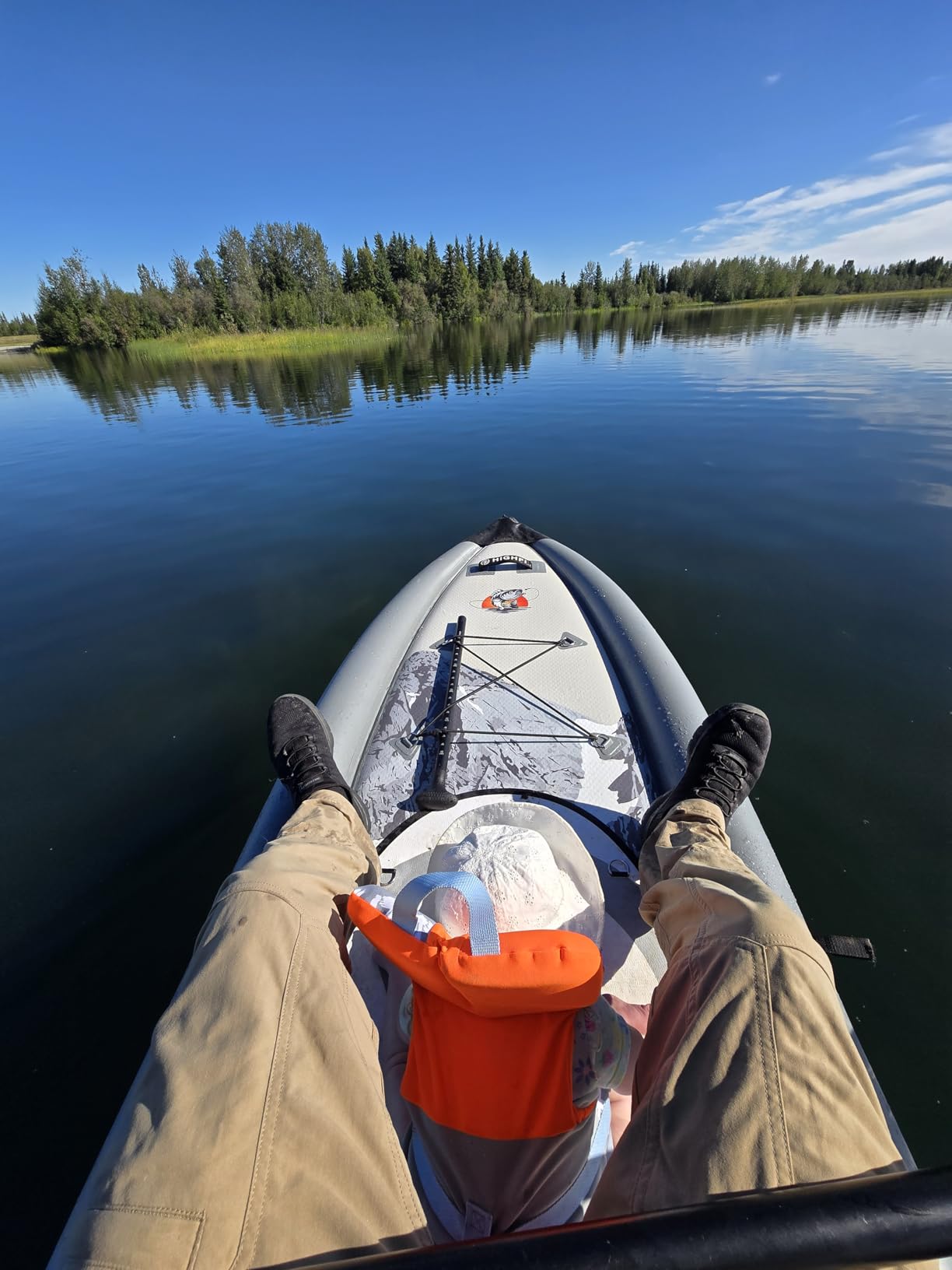
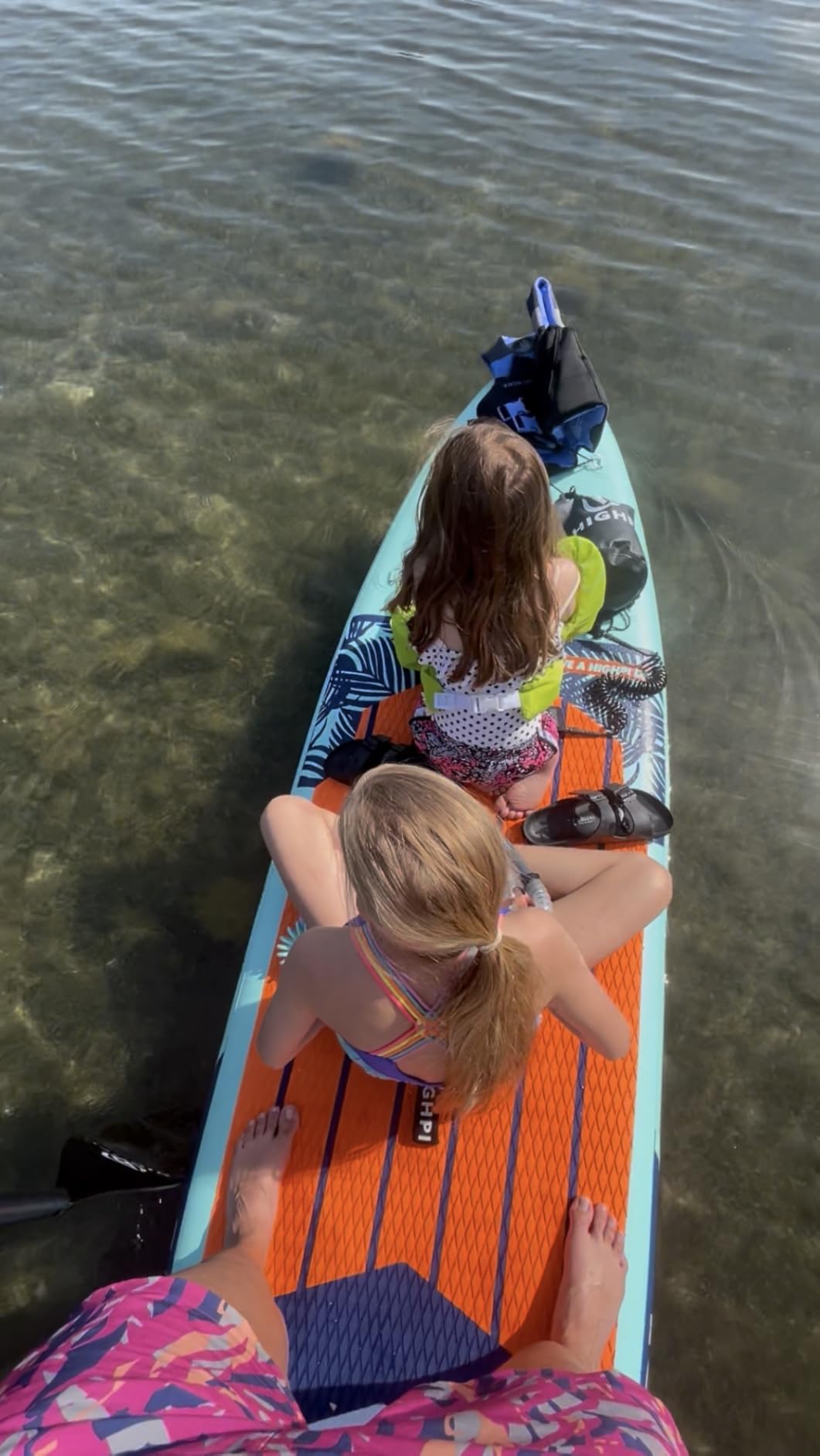
Capacity is listed at 350 lbs, and owners report it comfortably carrying one adult plus two children, which makes it a genuine family board. The dual-layer military-grade PVC is specified as puncture resistant, and the adjustable paddle, high-pressure pump, leash and backpack all come in the box.
The weak points are again the accessories. The supplied pump is described as mediocre and tiring, the storage bags are cheaply made and lack structure, and a few owners reported a defective pump hose thread on their unit. Two of the fins are fixed rather than removable, which makes folding the board into the bag an awkward job rather than a simple roll.
Salt water changes the maintenance rules
Freshwater boards can be rolled up damp and sorted out later. A salt water board should be rinsed with fresh water on the beach, dried in shade, and deflated before storage, because salt crystallises in the seams and around the valve and works into the fabric over time.
Keep it out of direct sun while inflated, and never leave it in a hot car. Heat and salt together are what shorten the life of a budget drop-stitch board far more than ordinary use does.
Read the warranty line carefully
This listing shows different warranty periods in different parts of the product page, so the coverage you actually get is worth confirming with the seller before you buy. Treat the shorter stated period as the realistic one until you know otherwise.
Budget boards at this tier are typically expected to last three to five seasons of regular use rather than a decade, and the practical way to extend that is storage discipline. Dry, rolled, out of the sun and off the ground is enough.
9. iTAOSTAR Journey-We: the board that converts into a kayak
iTAOSTAR J06BP 35″ Extra Wide Stand Up Paddle Board, More Balance Inflatable Paddle Board with 5 Fins for Beginner,Paddle Boards for Family of All Skill Levels
11 x 35 inches
420 lbs capacity
Five removable fins
Kayak seat and footrest
Pros
- Only kit here that converts to a sit-on-top kayak with seat and footrest
- 35 inch width is the joint widest in the roundup
- Five interchangeable removable fins never go missing
- 120L backpack holds the board pump fins and fishing gear
Cons
- Review base is under 700 so the long-term record is short
- Width trades turning speed for stability in tight water
- Warranty period is listed inconsistently on the page
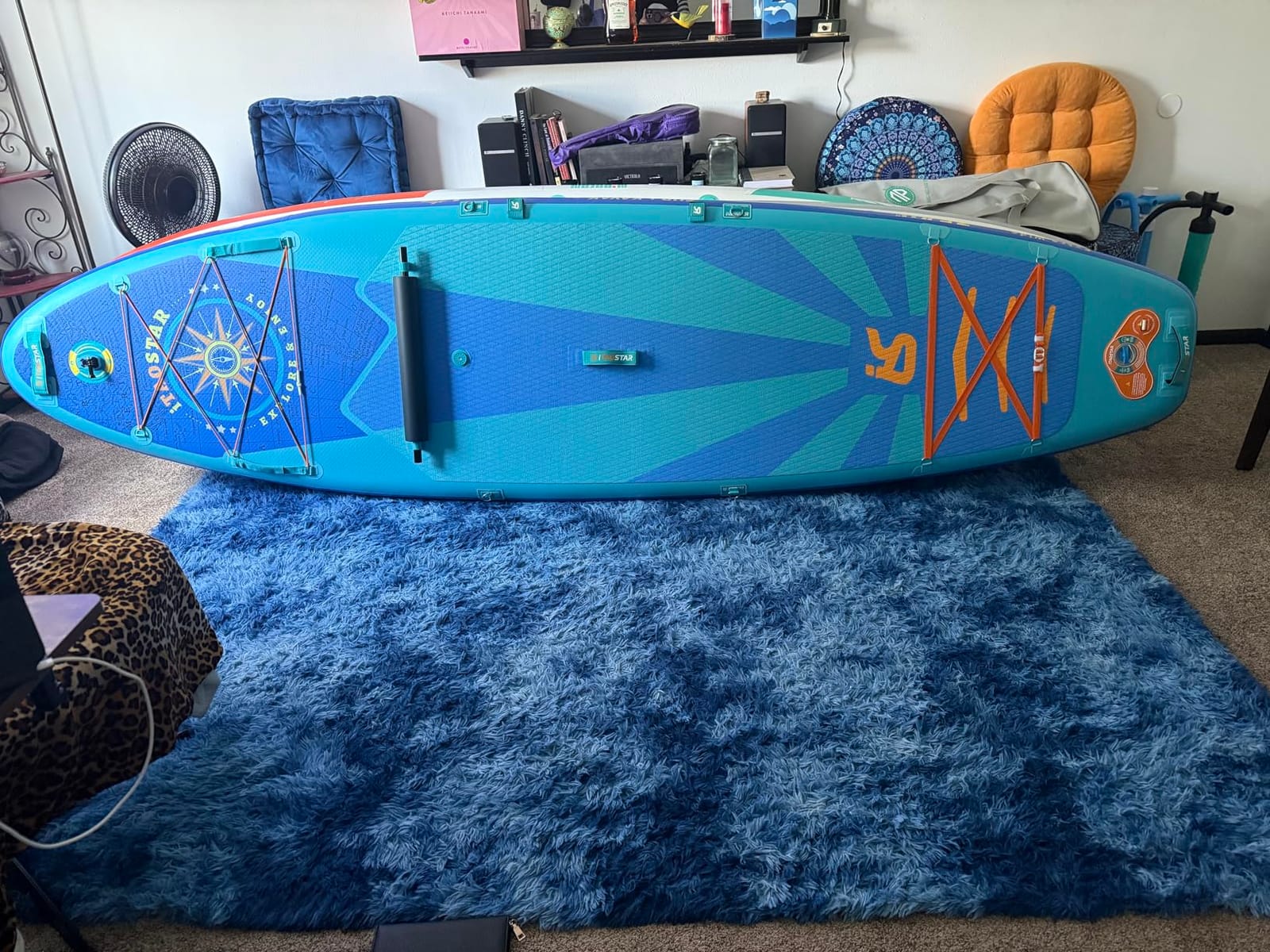
This is the most complete kit in the roundup by some distance, and the reason is the conversion seat and foam footrest. Add them and the same board becomes a sit-on-top kayak, which is a genuine second use rather than a gimmick, and it is the cheapest way we found to get both a paddleboard and a kayak from one purchase.
The board itself is 11 feet by 35 inches and rated to 420 lbs, so it is a wide, high-capacity platform. Five removable fins, three center and two side, adapt it to different water, and having them all removable means you can never lose one in the water, which is a small thing that eliminates a real annoyance.
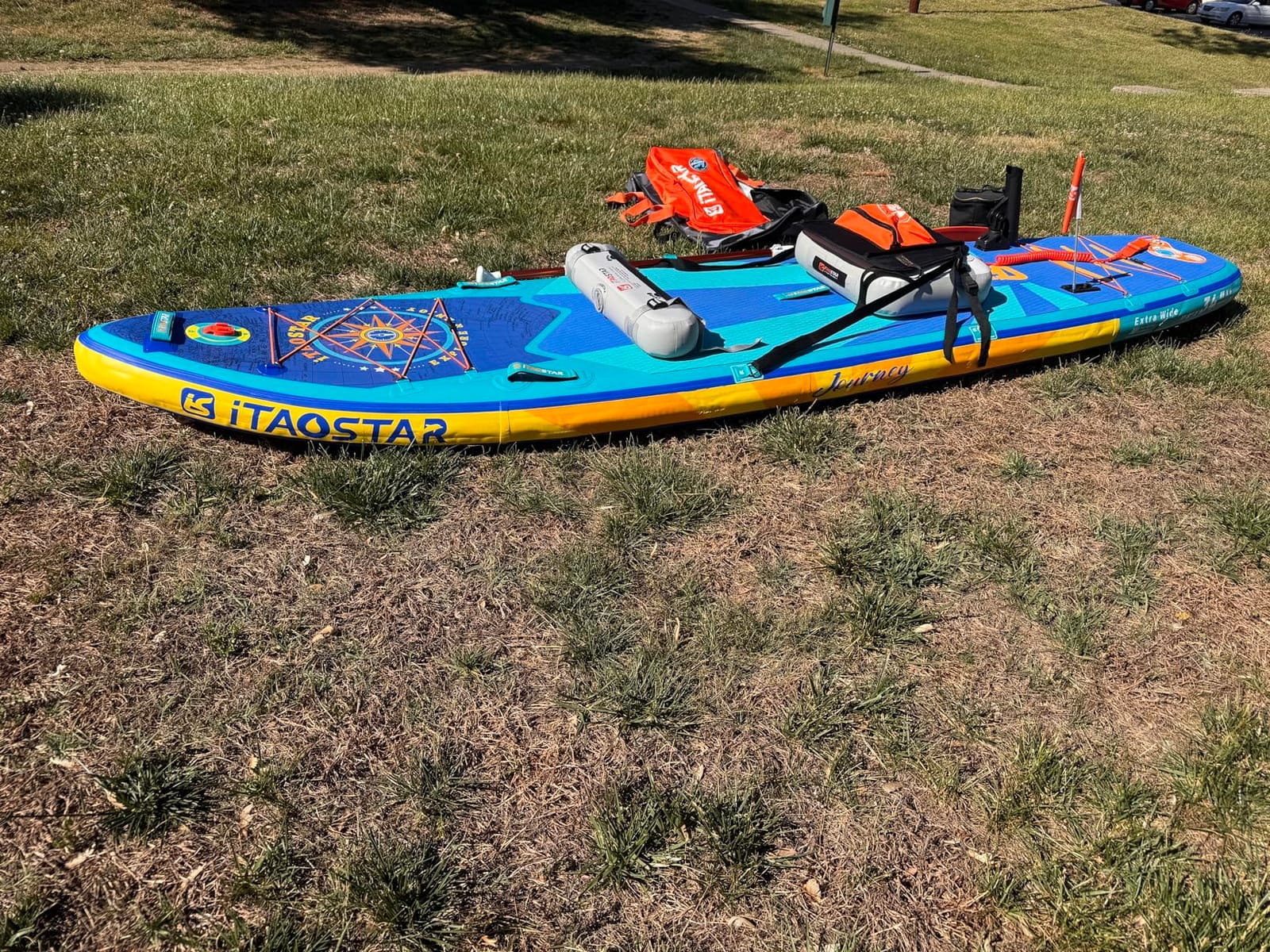
The accessories go further than any other board here. The 120L backpack has organised compartments for the board, pump, fins and fishing gear, and the kit also includes a 10L dry bag, a waterproof phone pouch and a cup holder. Inflation is quoted at 5 to 10 minutes with the dual-action pump and deflation at 2 to 3, the fastest pack-down in the set.
The trade-off is that the 35 inch width and 11 foot length are not nimble. This is a stable platform, not a responsive one, and it is not the board for tight water or quick turns. The warranty period also appears inconsistently across the product page, so confirm coverage with the seller before you rely on it.
When one board has to do two jobs
If you want a kayak for slow water and a paddleboard for everything else, the conversion seat removes the need to buy a second craft. Sit-on-top kayaking suits calm lakes and sheltered bays, and the footrest gives you somewhere to put your legs on longer trips.
Note that the conversion changes how the board handles. Sitting puts more weight low and further back, which is stable but slower, so this is a cruising kayak rather than one for covering distance quickly.
What the wide deck costs you
A 35 inch width is the most stable platform available and it carries a 420 lb rating comfortably, but width and length together make the board physically larger in the water. Turning it in a narrow channel is slow, and it will not respond the way a narrower board does.
That is the right trade for families, for fishing, and for anyone who wants a forgiving platform. It is the wrong trade for river work in tight water or for anyone who enjoys a responsive board under the feet.
10. TIGERXBANG 11’6 SUP: the widest deck and the highest capacity
TIGERXBANG Inflatable Stand Up Paddle Board 11’6″×35″×6″ with Complete Accessories, Premium Large Paddle Boards for Adults/Youth, Paddle Board Polar Frost Collection
11ft 6in x 35 inches
485 lbs capacity
Three detachable fins
Kayak seat included
Pros
- Widest and longest platform in the roundup at 35 inches
- 485 lbs is the highest capacity listed here
- Kayak seat lets the board work seated or standing
- Three detachable fins can be removed for packing
- Built-in camera mount cup holder and paddle holder
Cons
- Manual pump only with no electric option bundled
- Smallest review base among the larger boards at 512 ratings
- One year warranty and 30 day returns only
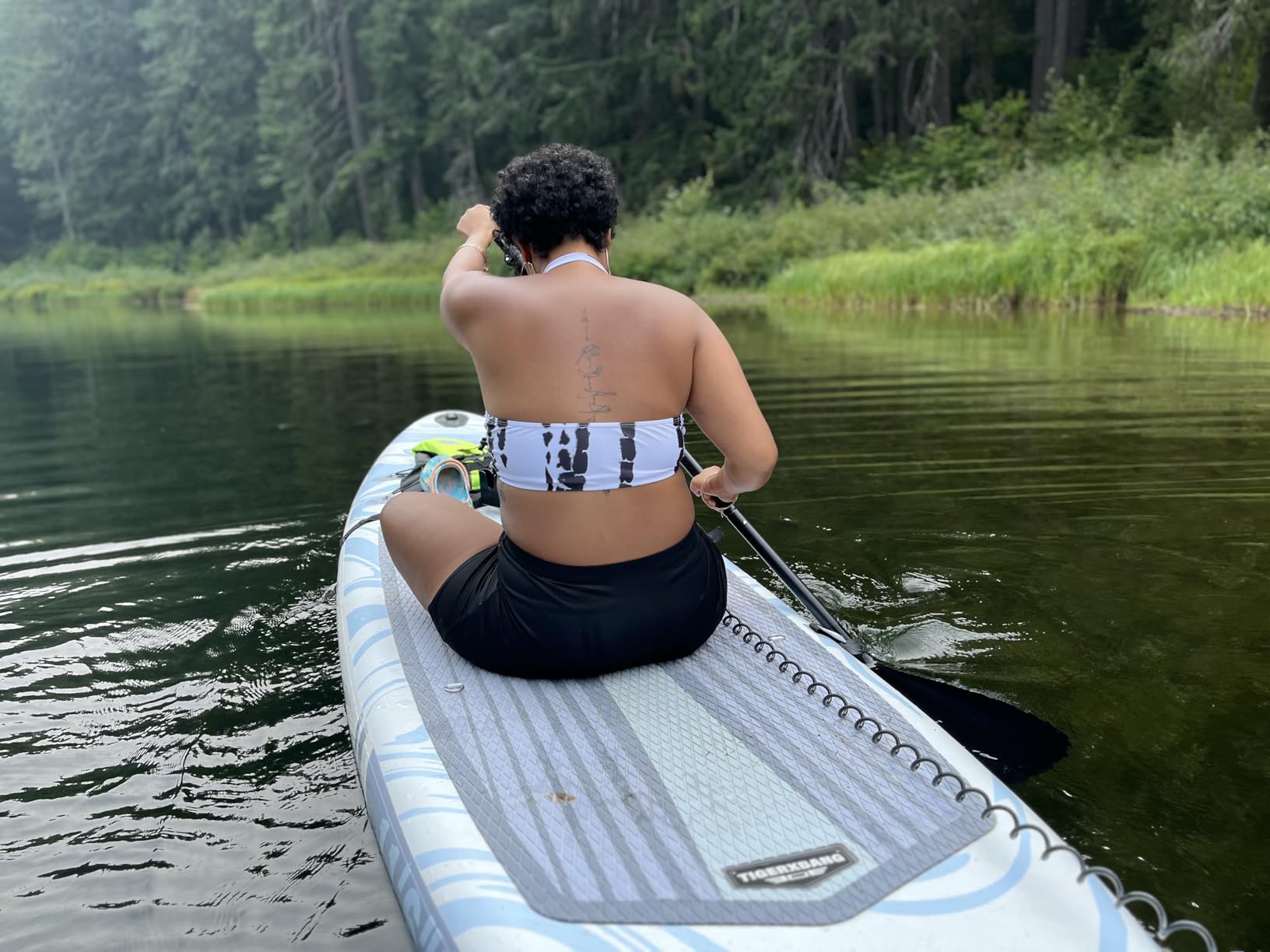
This is the board for a heavier paddler. The 485 lbs rating is the highest in the roundup, and paired with a 35 inch wide, 11 foot 6 inch platform it means the board is not carrying its limit when a larger rider, a dog and a cooler are all aboard. Owners describe the wide deck as giving beginners real confidence straight away.
It is also unusually well equipped for the price. The upgraded kayak seat lets you switch between sitting and standing on the same board, three detachable fins can all be removed for packing, and the front camera mount, center cup holder base and Velcro paddle holder are fitted rather than sold as add-ons.
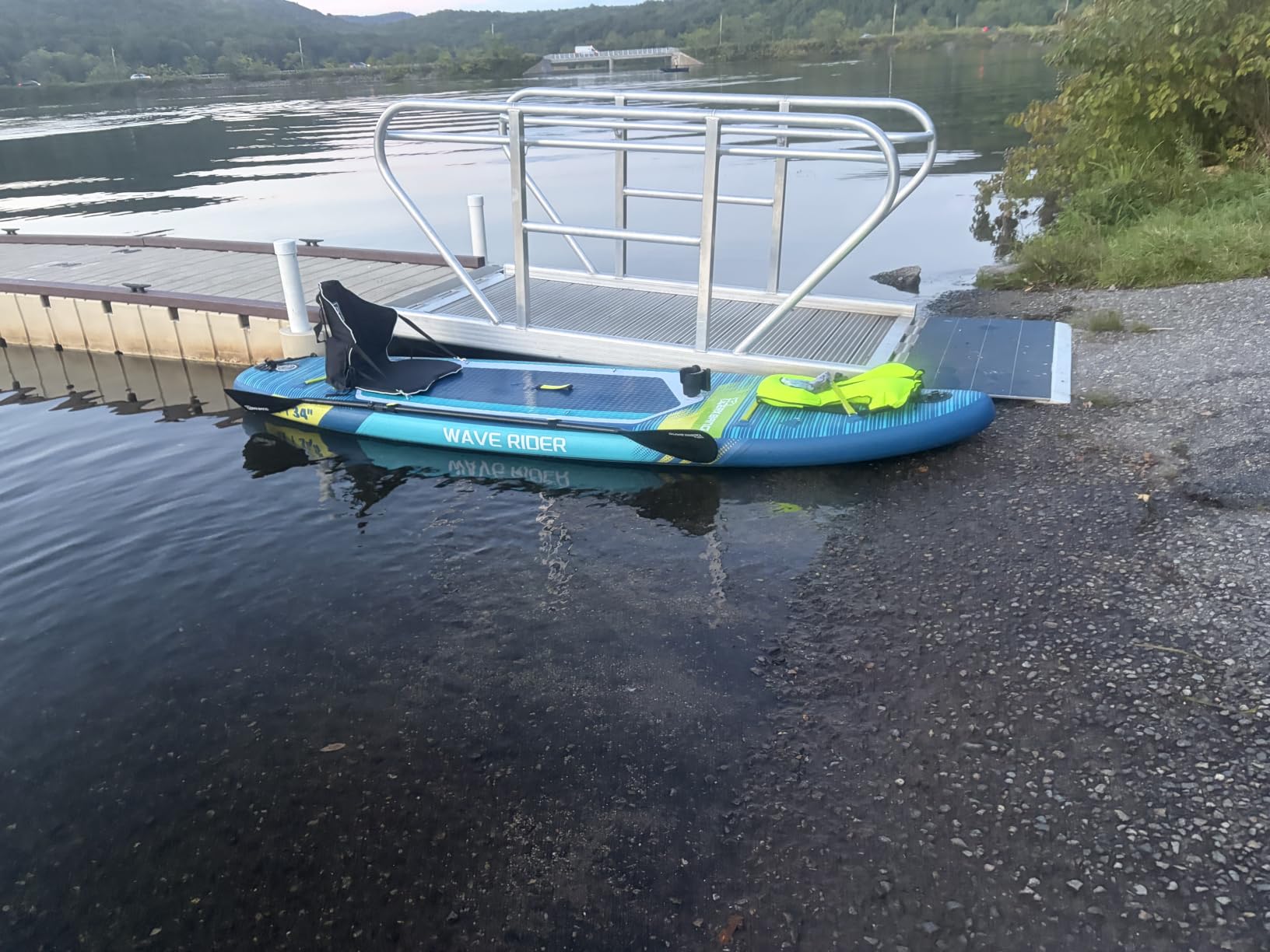
A repair kit is included and needs no glue, which matters more on a board this size because you will carry it further from a car. The rectangular shape with pointed ends keeps the tracking reasonable despite the width, and three fins give it more control than a single fin would.
Two caveats. The pump supplied is manual only, with no electric option bundled, and the review base of 512 ratings is the smallest of the larger boards here, so the 4.6 average rests on a smaller sample than most. Warranty terms are one year with 30 day returns, the shortest on this list.
Matching capacity to a heavier body
Capacity is not a marketing number you can ignore. A board rated close to your weight sits low in the water, flexes under load and tracks poorly, so the rule is simple: leave at least 100 lbs of headroom between your body weight and the rating.
For a paddler in the 275 to 350 lb range, this board leaves comfortable margin. The same headroom also means a dog and gear come along without the board being pushed to its limit on the way out.
What the extra 6 inches of length does
Longer boards glide further per stroke, which means less work for the same distance. On a long lake crossing or a paddling fitness session, that difference adds up, and the pointed ends keep the tracking honest.
The flip side is pack size. At 11 foot 6 inches this is the largest board in the roundup, so check the deflated dimensions against your car boot or your roof rack before committing, especially if storage space at home is limited.
11. Portal 10’6 Inflatable SUP: quick to inflate and easy to store
PORTAL SUP Inflatable Paddle Board for Adults, 10’6” Stand Up Paddleboards, Non-Slip Deck Blow up Paddle Boards with Adjustable Paddle, Carry Bag, Emergency Repair Kit
126 x 33 inches
17.8 lb board weight
300 lbs capacity
10 minute inflation
Pros
- Light 17.8 lb board on a stable 10ft 6 by 33 inch footprint
- Quick 10 minute inflation and 5 minute deflation
- Stainless steel D-rings allow a seat or board linking
- Backpack ankle leash pump repair kit fin paddle and phone bag included
Cons
- 300 lbs capacity is at the low end for adult and child use
- Smallest review count in the roundup at 463 ratings
- Anti-slip deck is the only grip surface
The practical pitch here is the setup cycle. Portal quotes roughly 10 minutes to inflate and 5 minutes to deflate with the included pump, and a light 17.8 lb board that is genuinely manageable for one person to carry. For spontaneous paddling after work, that is worth more than any feature list.
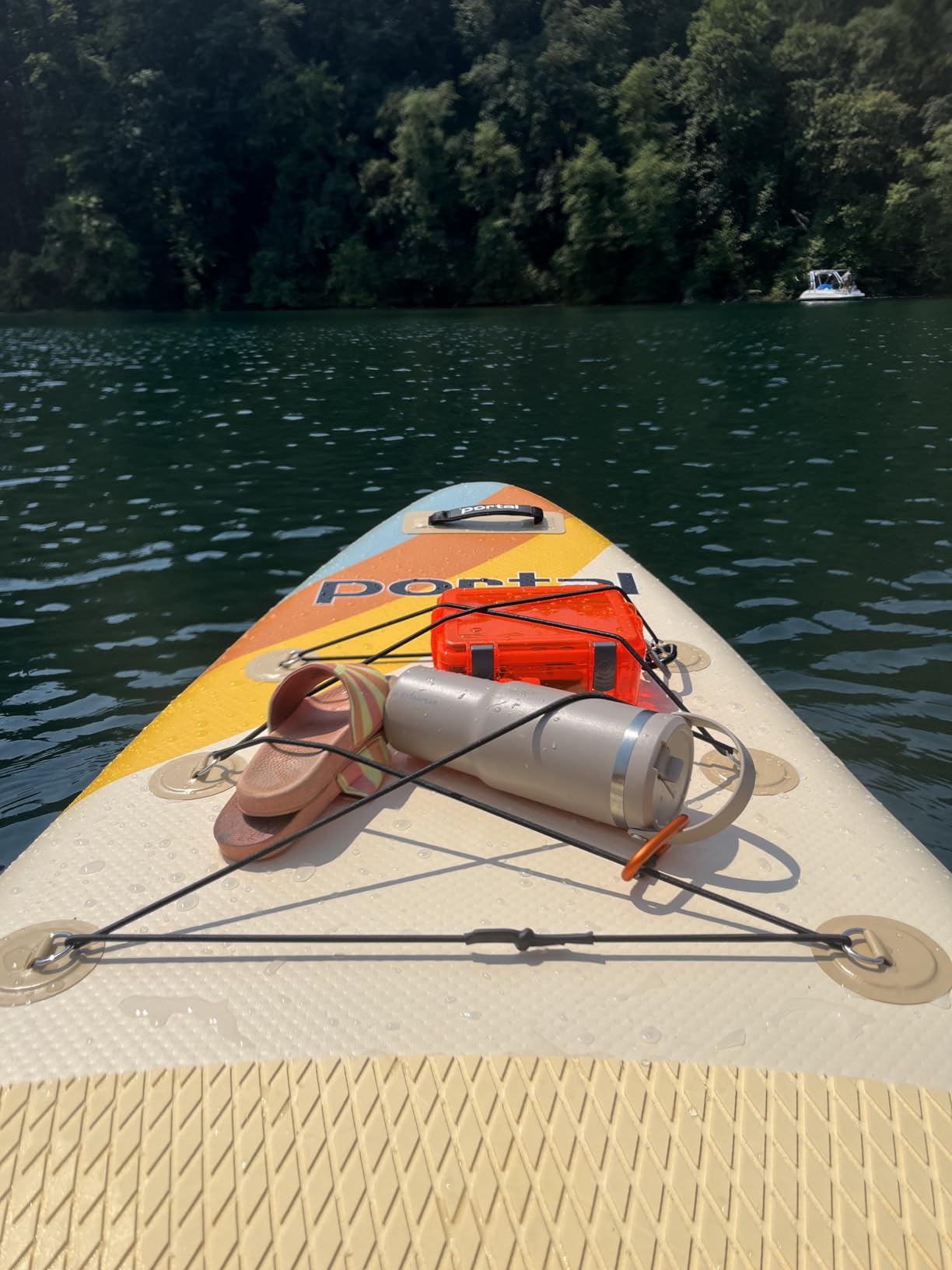
Underneath, it is a well-proportioned 10 foot 6 by 33 by 6 inch platform with wear-resistant PVC and an anti-slip EVA deck, and the fin layout of two fixed fins plus one detachable snap-in center fin gives it a stable, predictable feel in flat water. Owners use it on rivers, lakes and ocean without complaint about the deck grip.
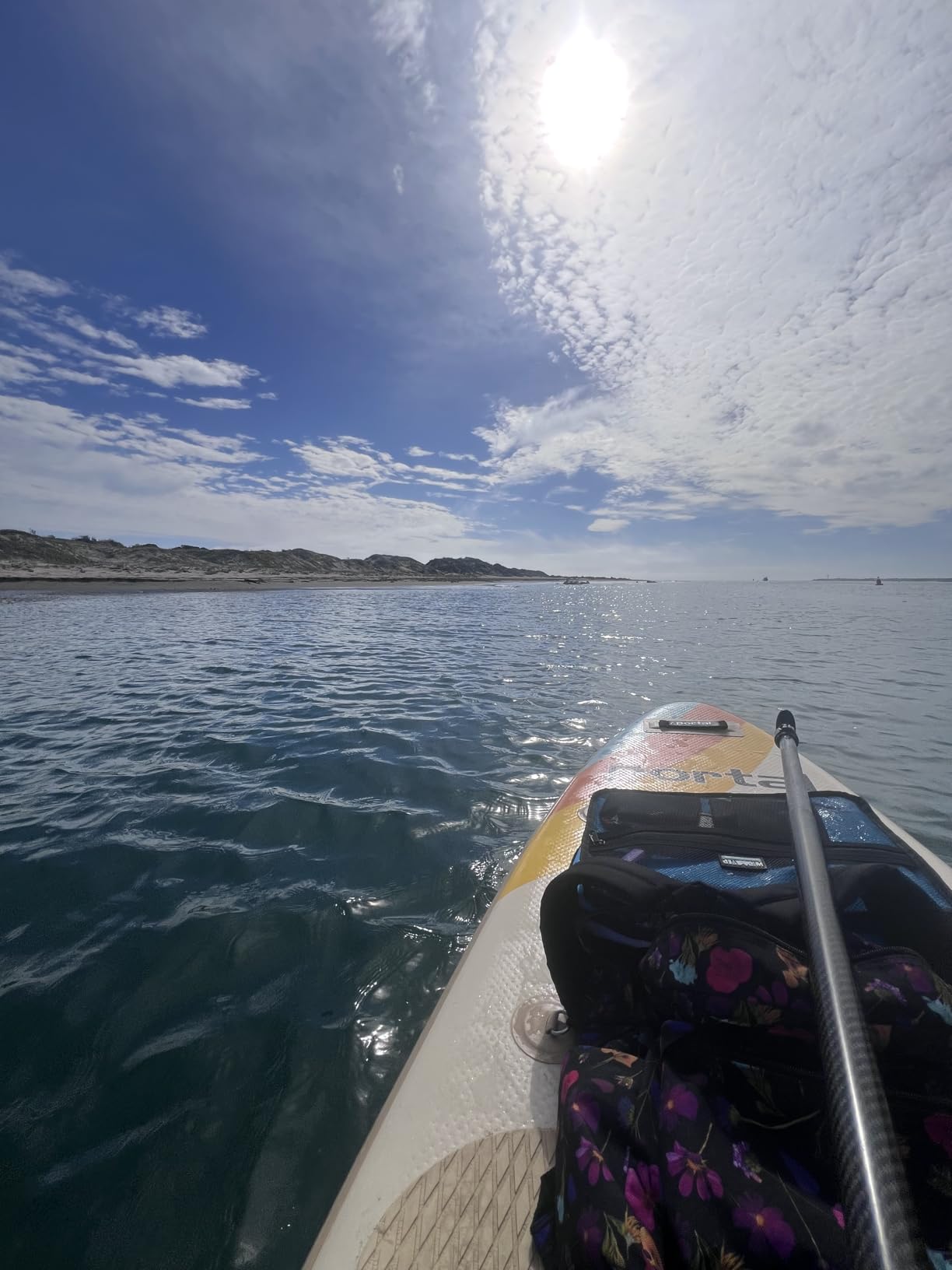
The accessory list is as complete as it gets at this price: backpack, ankle leash, pump, repair kit, fin, adjustable paddle and a phone bag. The extra stainless steel D-rings let you fit a kayak seat or tie two boards together, which is unusual in this bracket and useful for a stable platform.
The 300 lbs capacity is the constraint, and it is at the low end for an adult paddling with a child aboard. With 463 reviews the feedback base is also the smallest here, so read the 4.6 average as encouraging but less statistically firm than the boards with tens of thousands of ratings behind them.
Fast setup changes how often you go out
The boards that stay in a garage are the ones that are annoying to prepare. A 10 minute inflation, a 5 minute deflation and a 17.8 lb carry weight mean this one can realistically come out after a normal working day rather than on a planned weekend.
Storage matters just as much. Deflated and rolled, an iSUP of this size fits in a cupboard or behind a sofa, where a hard board would not. That is a real constraint for a lot of apartment paddlers.
What the low capacity rules out
At 300 lbs, the board is comfortable for a single adult up to roughly 220 lbs with a light day bag. Add a child and you are approaching the limit, where the board sits lower and tracks less cleanly.
For heavier riders or regular two-up use, spend the same money on a board rated higher instead. The detachable center fin and D-rings mean this platform is versatile, but no amount of accessory flexibility substitutes for buoyancy you do not have.
12. YU YUSING 11ft SUP and Kayak: a two-in-one with a roomy bag
YUSING Inflatable Paddle Board with Seat, 11′ x 33” x 6″ SUP, Paddle Boards for Adults, Non-Slip Deck SUP Paddle Board with Premium Kayak and SUP Accessories,3 Removable Fins (Starry Sky Blue)
132 x 33 inches
330 lbs capacity
15 psi working pressure
Adjustable kayak seat
Pros
- Adjustable kayak seat included for sit-on-top paddling
- Narrower midsection and wider tail give a faster glide
- Backpack is high quality with room for all accessories
- Owners report quick inflate and deflate cycles
Cons
- Smallest review base in the roundup at 332 ratings
- Packaging can arrive in poor condition
- Assembly instructions are not available in Spanish
This board does the same SUP-to-kayak trick as the two boards above it, but on an 11 foot by 33 inch platform with a slightly different shape. The narrower midsection and wider tail are designed to produce a faster glide than a rectangular board, and owners confirm the tracking is livelier than a wide square tail.
Construction is military-grade PVC with drop-stitch technology and an advanced rubber-drop air valve system, which is the leak-resistance feature owners thank for after a season of repeated inflations. The double-action pump reaches 15 psi in about 10 minutes, and several owners report completing the whole inflate-deflate cycle in around 5 minutes once the routine is familiar.
Capacity is 330 lbs for one or two people, which suits an adult with a child rather than two standing adults. The adjustable kayak seat converts the board for seated fishing and slow cruising, and the colorways are distinctive enough that you will recognise your own board on a crowded launch.
The honest caveat is the review base of 332 ratings, the smallest in the roundup, which means the 4.5 average carries less weight than the leaders here. A few reviews also mention packaging arriving in poor condition and units shipping without a part or with a broken paddle, so inspect the box on arrival.
What the seat actually changes
Adding the seat turns a 330 lb stand-up board into a sit-on-top kayak that suits flat water and slow progress. It is a genuinely different activity rather than a novelty, and it is the reason to buy this board instead of a straight paddleboard of the same size.
Seated, the board is more stable and less quick. The faster glide from the shaped tail is easier to appreciate in this mode, where you are covering distance rather than manoeuvring.
What to check the moment it arrives
Count the parts against the listing before you inflate anything. Owners report occasional missing components and a broken paddle on a small number of units, and sorting that out before first use is far easier than after a launch.
The 15 psi working pressure is worth respecting, because rigidity comes from pressure. Pump to the rating rather than to a thick-looking board, and the shaped tail will hold its line instead of flexing.
How to Choose a Paddle Board Under 500
Every board at this cap is inflatable, so compare four things
Under the 500 ceiling you are not choosing between inflatable and hard. You are choosing between inflatables, and a handful of the sub-250 models you will see are thin single-layer panels that would not be worth owning. The boards in this roundup are all 6 inch drop-stitch, which is the construction worth insisting on.
With that settled, four numbers decide the purchase: width, length, stated capacity and what is in the box. Rigidity follows from construction and inflation pressure rather than from a brand name, and every board here reaches a usable feel when fully inflated to its rated PSI.
If you want a wider view of the category beyond this budget, our guide to the best inflatable paddle boards explains the construction differences that this price tier cannot cover.
Match the board to your body weight
Leave at least 100 lbs of headroom between your body weight and the stated capacity, and treat the spec field rather than the headline as the number. Board marketing copy and technical specifications disagree often in this category, and the spec field is the figure the manufacturer will defend.
Up to about 150 lbs, nearly anything works. Between 150 and 220 lbs, look for 300 lbs or more and a 33 inch deck. Above 220 lbs, target a 400 lb rating or higher, and the wider 35 inch boards in this list are built for exactly that.
Also add for what rides with you. A dog, a child or a cooler of drinks counts toward the load, and a board at its limit sits low, flexes and tracks poorly.
Board-only versus bundle pricing is where the budget goes
This is the calculation most lists skip, and it regularly decides whether a purchase stays inside the cap. A board sold without a paddle, leash or pump looks cheaper, then the accessories add up and the all-in figure crosses 500. The forum chatter about board-only versus bundle listings causing confusion is not buyer confusion, it is a pricing structure that rewards careful reading.
Every board in this roundup arrives as a complete kit, so the comparison is straightforward. Where a listing exists in a board-only form, add the paddle, the ankle leash and an electric pump before you treat it as a sub-500 purchase.
On pumps specifically, the consensus advice from owners is consistent: a manual pump works, and an electric or 12V car-adapter pump is the single most worthwhile upgrade you can add to a budget board. It converts a 15 minute chore into a short one and it costs less than most people expect.
What each price tier inside the budget buys
At the bottom of the budget you are buying a complete, workable first board and learning on it. Most of the picks here sit in that band, which tells you how well the basic package holds up once it includes 6 inch drop-stitch construction.
In the middle of the budget, the gains are accessories and width: kayak conversion seats, five removable fins, larger backpacks, cup holders and camera mounts, and the 35 inch decks that suit heavier riders.
At the top of the budget you move into higher-spec construction and brand support. The practical mechanism for reaching that band is timing rather than brand alone, because prior-year models and seasonal markdowns regularly pull boards down into it.
That timing point is worth taking seriously. Buyers on the paddle forums deliberately plan around end-of-season clearances, where last season’s models drop substantially in price. Waiting for a markdown on a board you already researched is the most reliable way to reach the top of the budget from a higher list price.
When you should spend more than 500
Four uses are poorly served by budget inflatables. Surfing needs a board with enough volume and fin setup to catch a wave and a leash system rated for it. Whitewater needs a hull that will not fold. Racing needs a narrow board with a real planing hull. Long-distance touring needs a narrow, high-volume shape that tracks in a straight line for hours.
None of those are budget decisions, and buying a 33 inch all-round board to do them is the most common way people waste money at this price. If you want one of them, save up and buy the right tool rather than stretching a general-purpose board.
A second-hand hard board is also worth considering here. A used hard board gives you rigidity that no budget inflatable matches, and the trade-off is transport and storage. If you have a roof rack and a garage, that trade can be worth making.
Safety gear, transport and maintenance
None of these boards replaces a personal flotation device. A properly fitted PFD is the one piece of safety kit that is not optional, and our guide to the best paddle board life jackets covers what to look for in a low-profile SUP vest.
Beyond that, wear the leash, carry a whistle and a light if you will be out near dusk, and treat sun exposure as a real hazard on open water. On a river, check the leash type and attachment rules for that water before you launch, because quick-release behavior matters in moving water.
Transport is where inflatables win outright. Deflated, most of these fit in a car boot or a rucksack, and one in this roundup states a packed size of about one foot in diameter by 38 inches. That removes the need for a roof rack entirely, which is the deciding factor for a lot of buyers.
For storage, rinse salt water off with fresh water, dry the board in shade, deflate it and roll it loosely. A patch repair kit handles small punctures, and a budget drop-stitch board that is dried, rolled and kept out of a hot car will comfortably last three to five seasons of regular use.
We are not affiliated with any of the brands in this roundup, and we earn a commission when you buy through the links on this page, at no extra cost to you. Nothing here is ranked by what pays best; every board was judged on rigidity, stated rider capacity, bundle contents and the complaints its owners actually report. Where a listing gives conflicting figures, we have used the conservative one and told you so.
Frequently Asked Questions
What is the best paddleboard under 500?
The Roc 10’6 model is the strongest all-round choice at this budget, with a 33 inch wide 6 inch deck rated to 350 lbs, a 3 year warranty and a complete kit including seat, paddle, pump, leash and backpack. The Aqua Plus 11 foot is the alternative if you want longer tracking, and the TIGERXBANG 11’6 covers riders above 250 lbs.
Are Costco paddle boards any good?
Club store paddle boards sit in the same budget band as the boards here and are generally competent rather than exceptional. The trade-off is usually a thinner accessory kit and a shorter warranty than you get from a brand that lists every component separately. Compare stated capacity, deck width and included paddle and pump on the spec, not the shelf label.
Is a 10 foot or 11 foot paddle board better?
An 11 foot board tracks straighter, glides further per stroke and stands up better in light chop, so it suits longer lake crossings, families and yoga. A 10 foot 6 board turns more easily, stores smaller and is more forgiving in tight water. Beginners usually progress faster on 10ft 6 to 11 feet, and anything under 10 feet is mainly for kids and surf.
What is the best inflatable paddle board under 400?
Most complete 6 inch drop-stitch bundles fall well under 400, and the FunWater 10’6 is the best value pick in that group with a three-fin setup, EVA deck and 3 year board warranty. The SereneLife 10’6 is the lightest at 13.9 lbs, and the FEATH-R-LITE is the only one with a built-in pressure gauge for checking inflation.
Do budget paddle boards come with a paddle and pump?
Complete kits at this budget usually include an adjustable paddle, a manual pump, an ankle leash, fins, a repair kit and a carry backpack. The exception is a board-only listing, where a paddle, leash and pump can easily add enough to push the all-in cost past your cap. Always check the contents list before treating a board price as a finished purchase.
The Verdict in 2026
After a full season of comparing these twelve, the Roc 10’6 is the single best paddle board under 500 for almost anyone starting out. It is the widest deck, the joint highest rated at 350 lbs, the only one with a three-year manufacturer warranty, and it arrives with a seat and a reversible paddle on top of the standard kit. The Aqua Plus 11 foot is the runner-up for anyone who wants longer tracking, and the TIGERXBANG 11’6 covers paddlers above 250 lbs.
Two habits will get you more out of any of them. Read the spec field rather than the marketing headline on capacity, and add an electric pump to the purchase. The best paddle boards under 500 are genuinely good boards, and both of those small decisions are what separate a first season you enjoy from one you spend fighting a pump.