
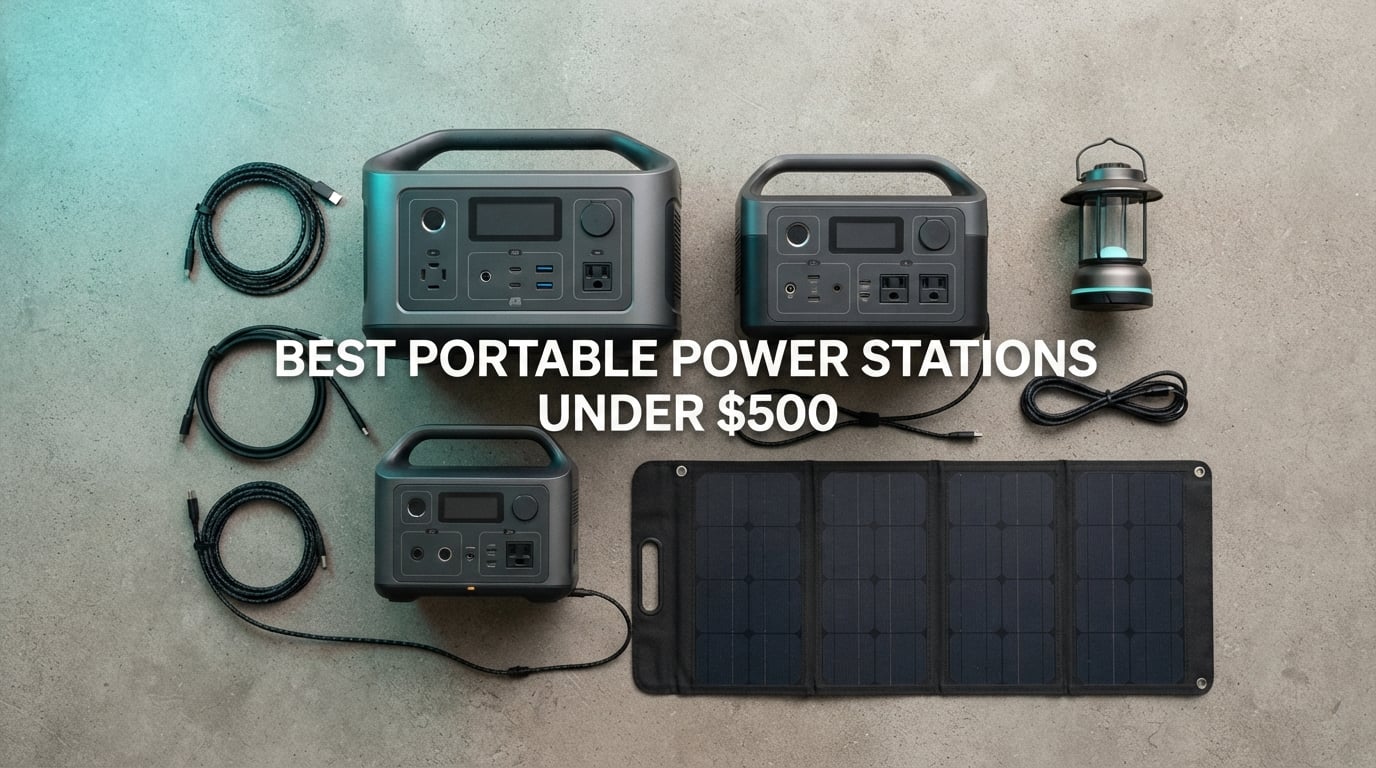
If you want one battery that covers phones, laptops, a CPAP machine, a small fridge and a router for a weekend trip or a two-night outage, the Jackery Explorer 500 v2 is the best portable power station under 500 dollars. It pairs 512Wh of LiFePO4 capacity with 500W of continuous AC output, weighs 13.3 pounds and holds a 4.7 star average across more than 8,800 ratings.
That verdict comes with a strict rule: every model below sits below the 500-dollar ceiling, with no over-budget unit slipped in for comparison. Budget power stations are a category where moving up one capacity tier changes what you can actually run, so the capacity and output lines matter as much as the wattage.
Across the eight picks here you will find three tiers: sub-300Wh models for electronics only, the 500- to 770Wh band that covers a fridge or a CPAP machine overnight, and the 1,000Wh-plus models that can start a fridge compressor, run power tools, or keep Starlink alive for most of a day. All eight use lithium iron phosphate cells rather than older NMC chemistry, and all eight are safe to operate indoors where a gas generator is not. Seven of the eight carry a five-year warranty; the Jackery Explorer 300 is covered for two years, and the Explorer 1000 v2’s published listing needs checking with the brand.
If you want the wider picture beyond this price band, our guide to the best portable power stations overall covers the 1,000Wh-plus class in depth, and our battery backup power station guide focuses on keeping a home running through multi-day outages.
Table of Contents
Top 3 Best Portable Power Stations Under $500 (October 2026)

The Explorer 500 v2 wins because it hits the two numbers that matter most under this ceiling: enough usable capacity to run a 45W mini-fridge for most of a day, and enough continuous output to start compressor motors. The BLUETTI AC180 pairs the largest battery in the group with the joint highest continuous output for anyone running tools or building a van system, and the Anker SOLIX C300 covers USB-C loads at the lowest carry weight of the high-output options.
Quick Picks: Every Station in This Guide at a Glance
| Product | Specifications | Action |
|---|---|---|
| Jackery Explorer 500 v2 |
|
Check Latest Price |
 Jackery Explorer 1000 v2 Jackery Explorer 1000 v2 |
|
Check Latest Price |
 BLUETTI AC180 BLUETTI AC180 |
|
Check Latest Price |
 Anker SOLIX C300 Anker SOLIX C300 |
|
Check Latest Price |
 BLUETTI Elite 100 V2 BLUETTI Elite 100 V2 |
|
Check Latest Price |
 Jackery Explorer 300 Jackery Explorer 300 |
|
Check Latest Price |
 EcoFlow RIVER 2 Pro EcoFlow RIVER 2 Pro |
|
Check Latest Price |
 EcoFlow RIVER 2 EcoFlow RIVER 2 |
|
Check Latest Price |
Direct answer for most readers: buy the Jackery Explorer 500 v2 for the best balance of capacity, output and carry weight, or the BLUETTI Elite 100 V2 if you want 1,000Wh in a box you can still lift with one hand. If your trip is phones, cameras and a laptop rather than appliances, the Anker SOLIX C300 is the right size.
How We Picked: Six Criteria and a Hard 500-Dollar Ceiling?
We scored every candidate on value per watt-hour, usable capacity after conversion losses, continuous and surge output, build and port selection, recharge speed, and warranty plus support. The price cap was applied before any other filter, which removed several popular models that show up on broader lists.
The single most useful calculation in this category is the usable-capacity discount. A station labelled 512Wh does not deliver 512Wh to an AC device: the inverter conversion, the battery management system and voltage losses together remove roughly 15 to 25 percent. Multiply the label by about 0.8 and you get a realistic working number, which is what we use in the runtime examples below.
Here is the arithmetic for the eight picks, using rated capacity times 0.8 as a planning figure:
Jackery Explorer 500 v2: 512Wh rated, about 410Wh usable
Jackery Explorer 1000 v2: 1070Wh rated, about 856Wh usable
BLUETTI AC180: 1152Wh rated, about 922Wh usable, and only 90 percent of rated capacity is usable by design
Anker SOLIX C300: 288Wh rated, about 230Wh usable
BLUETTI Elite 100 V2: 1024Wh rated, about 819Wh usable
Jackery Explorer 300: 292Wh rated, about 234Wh usable
EcoFlow RIVER 2 Pro: 768Wh rated, about 614Wh usable
EcoFlow RIVER 2: 256Wh rated, about 205Wh usable
Dividing those usable figures by a device draw gives the runtime estimates most buyers actually need. For a 45W mini-fridge: about 19 hours from the Explorer 1000 v2, 20 from the AC180, 18 from the Elite 100 V2, 13 from the RIVER 2 Pro, 9 from the Explorer 500 v2, and roughly 4.5 to 5 hours from each of the sub-300Wh models.
For a 10W CPAP machine, the same math gives about 85 hours on the Explorer 1000 v2, 92 on the AC180, 82 on the Elite 100 V2, 61 on the RIVER 2 Pro, 41 on the Explorer 500 v2, and around 20 to 23 hours on the four smallest stations. A 60W laptop or a Starlink terminal drawing 50 to 75W lands between those two, and a 127W room fan separates the small stations from the large ones quickly: about 6 to 7 hours on a 1,000Wh unit versus under 2 hours on a 290Wh unit.
Two criteria are worth calling out because most roundups skip them. The first is idle inverter draw. The AC180 alone reports pulling roughly 15 to 20W of overhead power whenever the inverter is powered on, which is harmless for an afternoon at the beach and significant across a three-day outage. The second is support responsiveness, which forum research repeatedly raises for BLUETTI and EcoFlow owners, so warranty length and service terms earned real weight in the ranking.
1. Jackery Explorer 500 v2: Best Overall Pick
Jackery Explorer 500 v2 Portable Power Station,512Wh,500W AC
512Wh LiFePO4
500W continuous, 1000W surge
13.3 lb
5-year warranty
Pros
- LiFePO4 chemistry light enough to move one-handed at 13.3 lb
- 6000 rated charge cycles
- 0 to 80 percent AC recharge in 52 minutes
- Pure sine wave output with 10ms UPS switchover
- 28 dB operation with a built-in LED light
Cons
- Only one AC outlet
- No USB-C ports for input or output
- Solar input uses a PWM charge controller rather than MPPT
This is the unit I keep coming back to because the spec sheet and the carry weight agree with each other. At 13.3 pounds it is one of the few LiFePO4 stations in this price band you can move from the trunk to the kitchen counter with one hand, and 512Wh of rated capacity lands right at the point where a 45W mini-fridge, a CPAP machine and a laptop can all be live at the same time.
The battery spec is unusually strong for the money. Jackery rates the LiFePO4 pack for 6,000 charge cycles with about 5 percent self-discharge after six months in storage, which is the highest cycle figure of any model on this list. Reviewers also point out that a portion of the owner base runs CPAP machines off this unit during outages, and the 10ms UPS switchover is short enough that a machine does not reset when the grid drops.
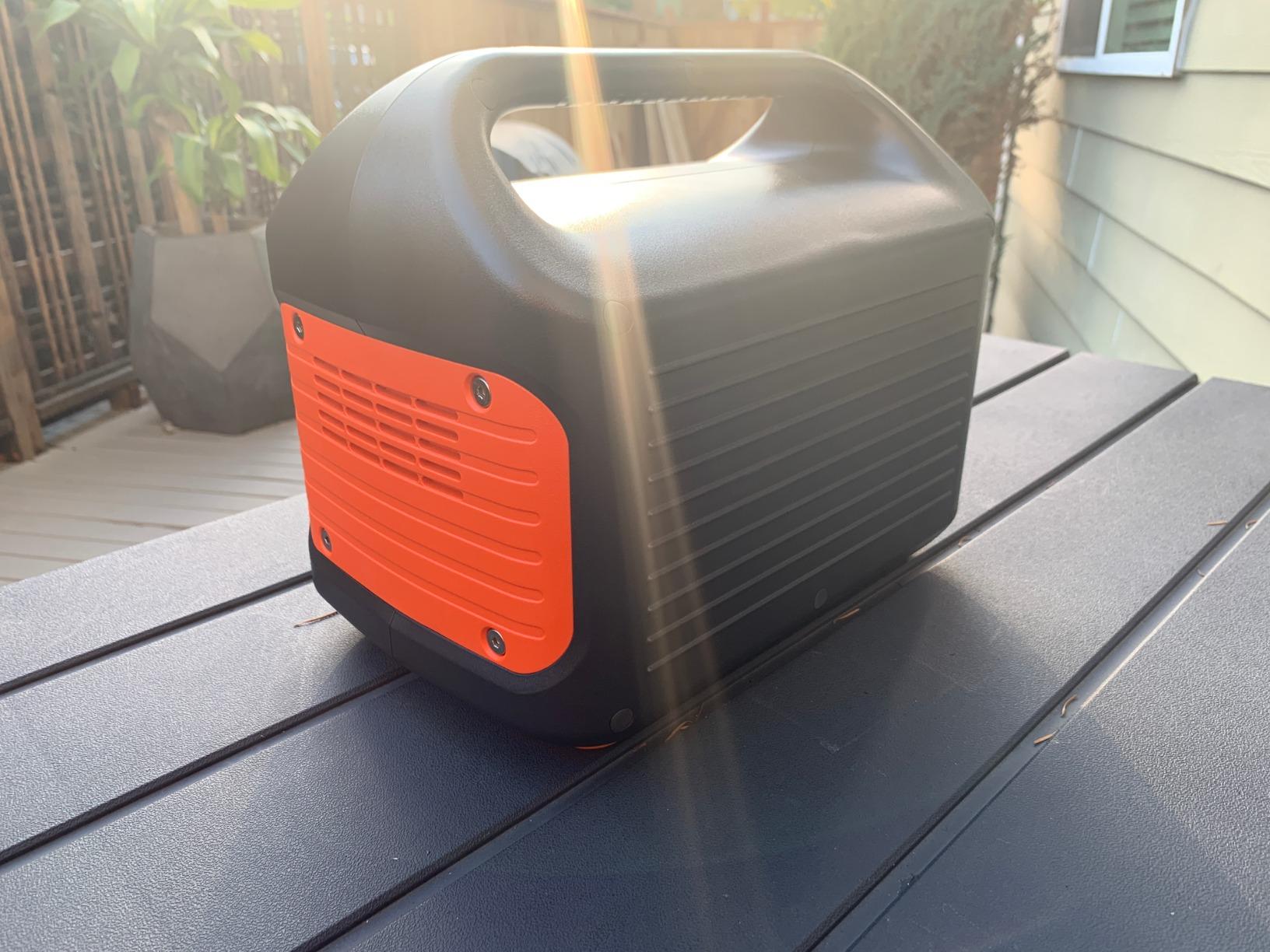
Recharge speed is the quiet strength here. The unit goes from 0 to 80 percent in 52 minutes from a wall outlet, and it accepts solar and 12V car charging as well. That matters less during an outage than before one, which is exactly the point forum users make about budget stations: the fast recharge is what lets you top the battery up between storms rather than after.
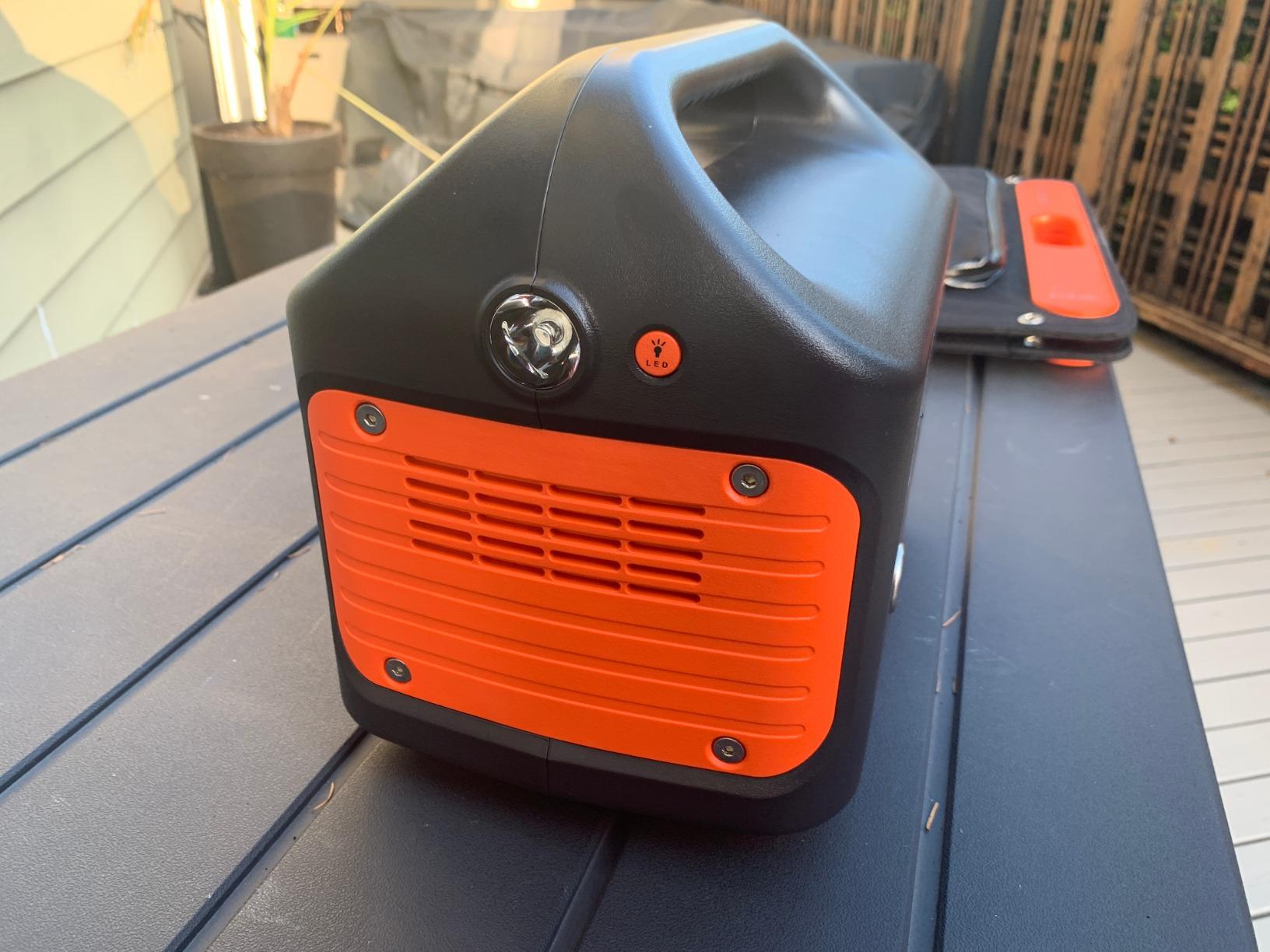
The port layout is where it loses points. There is a single AC outlet, so you cannot run a fridge and a laptop heater at the same time without an extension lead, and there are no USB-C ports at all, which means modern phones and laptops need an adapter. The solar charge controller is PWM rather than MPPT, so panel pairing is less efficient than on the BLUETTI models. The 12V car socket also has no protective cover, and the built-in flashlight is dimmer than buyers expect.
What you get for the money?
In the box you get the station, an AC charging cable, a 16.4-foot extension cable and a user manual. The output is a single 500W continuous pure sine wave AC circuit rated to 1000W surge, with USB-A ports and a 12V car socket for smaller loads.
At 500W continuous, this is the smallest unit here that can start a fridge compressor or a small power tool without tripping. That single fact is what separates it from the sub-300Wh models, all of which will run electronics happily but stumble on anything with a motor.
Where it falls short?
If your household needs to run two AC appliances at once, or if you want USB-C fast charging for a phone and a laptop without carrying adapters, the single outlet and missing USB-C will be an everyday annoyance. Budget buyers planning three or more people charging devices simultaneously should step up to the Explorer 1000 v2 or the BLUETTI Elite 100 V2.
Roughly 13 pounds also adds up after a walk from the car. It is a one-hand carry for the driveway and a two-hand carry for anything longer, and the PWM solar controller means a third-party panel will refill it more slowly than a matched MPPT setup would.
2. Jackery Explorer 1000 v2: Best for Big Loads
Jackery Explorer 1000 v2 Portable Power Station,1070Wh,1500W
1070Wh LiFePO4
1500W continuous, 3000W surge
23.8 lb
USB-C 100W x2
Pros
- Largest capacity tier under the cap at 1070Wh
- 1500W continuous output with 3000W surge
- Three AC outlets plus two 100W USB-C ports
- Retains over 70 percent capacity after 4000 cycles
- App control for charge modes and monitoring
Cons
- Solar charging limited to Jackery-branded panels
- One-hour fast charge must be enabled in the app each time
- 23.8 lb is heavy for solo carry-in trips
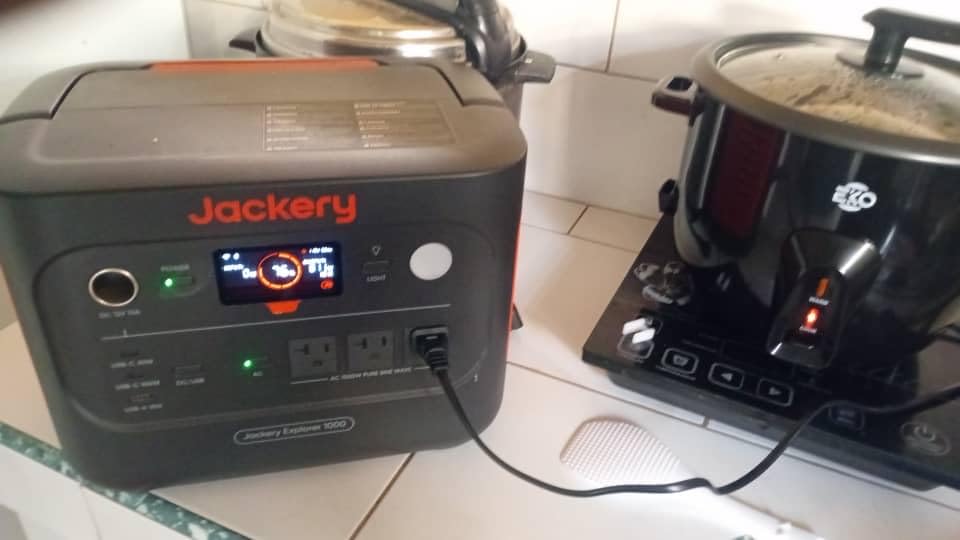
This is the largest capacity you can buy without crossing the 500-dollar line, and the spec sheet explains why: 1,070Wh of capacity driving 1,500W of continuous AC output with 3,000W of surge headroom. It runs a fridge, a router and a laptop simultaneously for most of a day without a top-up.
Port selection is the best in the group. You get three pure sine wave AC outlets, two 100W USB-C Power Delivery ports, one USB-A port and a DC car socket, seven outlets in total. For a household charging laptops and phones while a fridge runs, that layout removes the need for a power strip entirely.
Jackery rates the LFP pack at retaining more than 70 percent of capacity after 4,000 cycles, which works out to a lifespan beyond ten years of regular use. The station also has an emergency charge mode that fills it from 0 to 100 percent in about an hour through the app, with a 1.7-hour default cycle that exists to protect battery health.
Two practical notes before you commit. The one-hour emergency charge is not automatic; you have to switch it on in the app each time you want it, and several reviewers find that a step too easy to forget. Solar input is also restricted to Jackery panels, which is a recurring complaint in van-life forums where people want to mix a third-party folding panel with their existing kit.
Charging and daily use
ChargeShield 2.0 handles the battery management, and the app also exposes a 30 dB quiet mode and an energy efficiency mode alongside the charge settings. The 1,500W-class output is comfortably above what a fridge, an electric pot or a small air conditioner pulls, which is the reason most buyers in this tier buy it.
Check the warranty entry on the listing before you order. The published product data for this specific model carries a shorter warranty term than the five-year coverage listed on the Explorer 500 v2, and it is worth confirming the current terms with the brand rather than assuming the family policy applies.
Who should skip it?
At 23.8 pounds, this is not a backpacking or solo carry-in unit. Anyone moving it alone from a car to a picnic table will notice the weight, and the three AC outlets are more than most weekend campers will ever use.
It is also overkill for a phone and a laptop weekend. If your load is electronics-only, the 288Wh Anker SOLIX C300 does the same job at a fraction of the carry weight, and a 1,000Wh battery you rarely draw from ages for no reason.
3. BLUETTI AC180: Best for Power Tools
BLUETTI AC180 Portable Power Station 1152Wh 1800W LiFePO4 Solar Generator
1152Wh LiFePO4
1800W continuous, 2700W peak
37.4 lb
500W solar
Pros
- Largest battery capacity in the guide at 1152Wh
- 1800W output with app-activated 2700W power lifting
- Full charge in about one hour at 1440W AC input
- 500W solar input for a 2.8 to 3.3 hour refill
- 20 ms UPS plus app monitoring and 5-year warranty
Cons
- 37.4 lb is impractical to carry any distance
- 15 to 20W of inverter overhead on small loads
- Top wireless charging pad frequently fails
The AC180 is the box you buy when the load is a power tool rather than a phone. It carries the largest battery in this guide at 1,152Wh and 1,800W of continuous output, the joint highest rating on this list, with 2,700W of peak capability available through power lifting mode in the app. Circular saws, heaters and a kettle all fall inside that envelope.
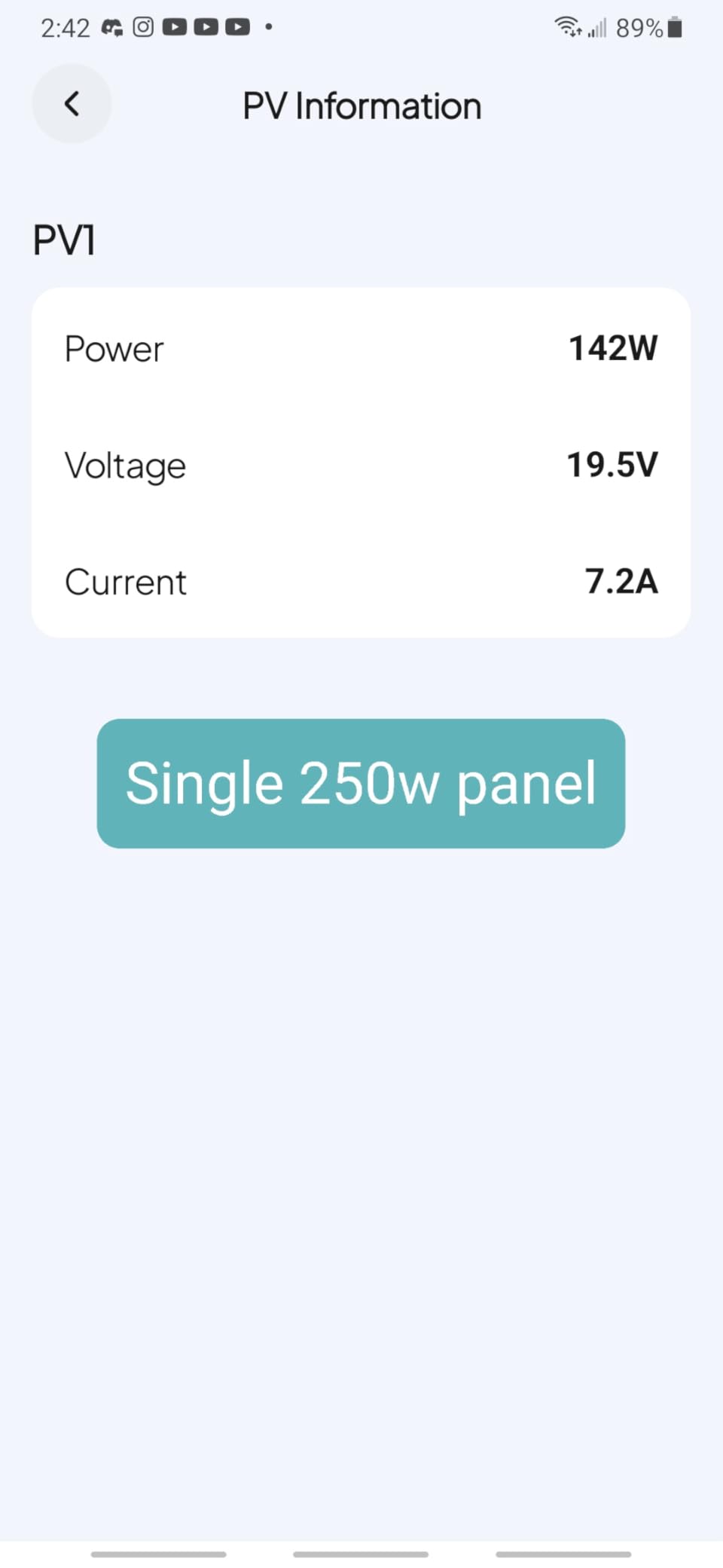
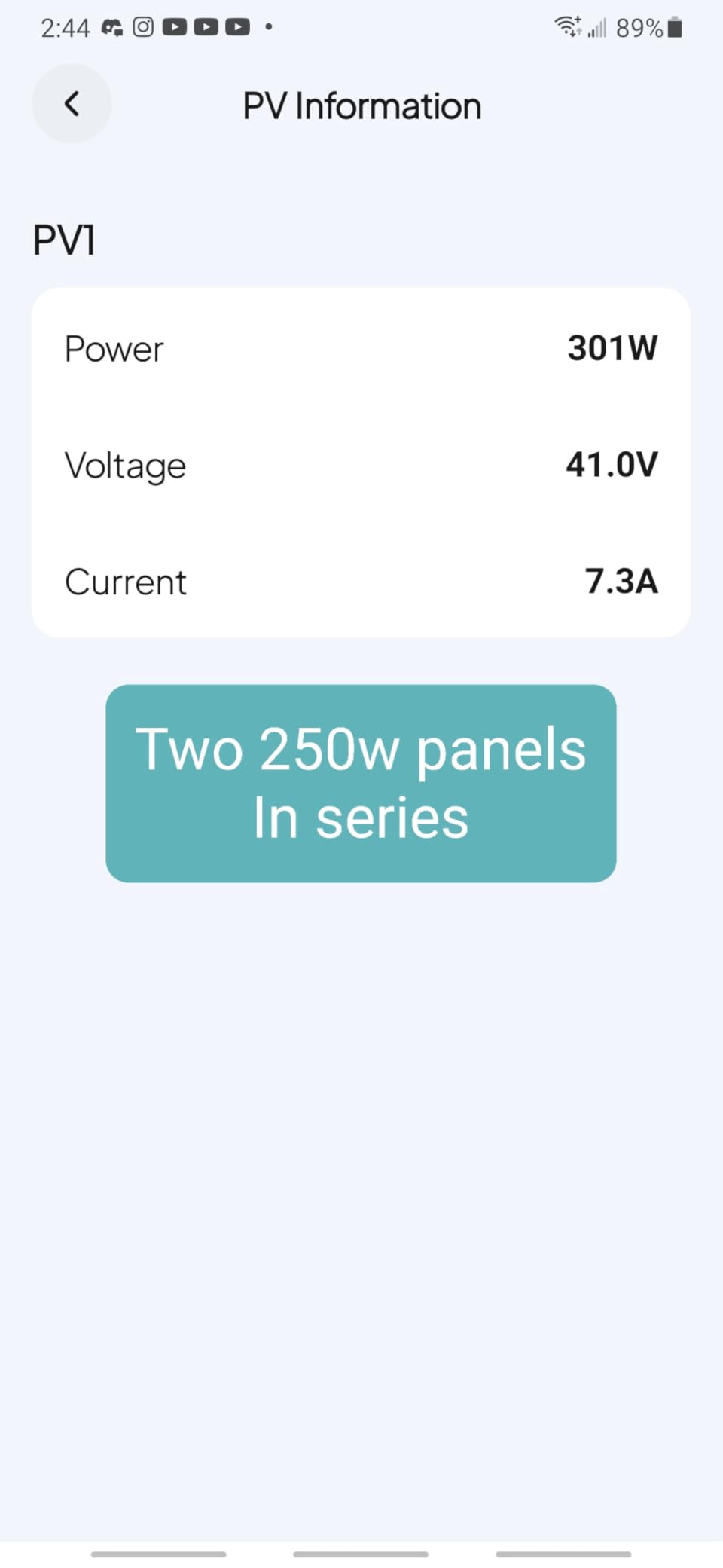
Charging is the other headline. The station accepts 1,440W of AC input and refills in roughly an hour, and the 500W solar input can bring it back from empty in about 2.8 to 3.3 hours in good conditions. That solar input is the highest in the group and the reason this model shows up on van-life builds that need off-grid headroom.
There are eleven outlets in total, including AC, USB, a car port and a wireless charging pad on top, plus a clear LCD showing live input and output. A 20ms UPS mode covers routers and small medical devices during short outages, and BLUETTI backs it with a five-year warranty.
The catch is weight. The heaviest unit here is the AC180 at 37.4 pounds, and the gap against the 25-pound Elite 100 V2 is obvious the moment you try to lift it into a vehicle alone. It is a stationary or car-adjacent box, not a carry device.
Watch the overhead draw
Reviewers consistently report 15 to 20W of overhead consumption whenever the inverter is powered, plus a design limit where only 90 percent of rated capacity is usable. On a 45W fridge load that overhead is noise; on a 10W CPAP overnight it eats real hours. Run this model in eco or pass-through mode overnight rather than leaving the inverter live.
The wireless charging pad on the top deck is the most repeated complaint, with owners reporting phones that will not sit and charge. Several users also found that firmware updates and a battery calibration resolved early underperformance, so it is worth completing setup before judging the unit.
Where the money goes?
You are paying for capacity and output here, and the watt-hour cost works out well against the smaller units. If your use case is a work truck, an RV or a job site where the station stays put, the AC180 does more per cycle than any other pick here.
If your station lives in a closet and comes out for weekend trips, the weight is dead money. The Elite 100 V2 gives up 128Wh of capacity and 30W of output for 12 pounds of saved carry weight, which is usually the better trade.
4. Anker SOLIX C300: Best for USB-C Devices
Anker SOLIX C300 Portable Power Station, 288Wh Solar Generator for Camping
288Wh LiFePO4
300W continuous, 600W surge
4.13 kg
25 dB
Pros
- Compact 288Wh travel form factor
- 300W across 3 AC outlets plus car socket and three USB-C ports
- 80 percent recharge in about 50 minutes from a wall outlet
- 25 dB operation suits indoor use
- LiFePO4 rated for 3000 cycles with 5-year warranty
Cons
- Shoulder strap sold separately
- Not compatible with several Anker solar panels including PS30 and PS200
- 288Wh capacity limits it to small electronics
- AC outlets share one 300W budget
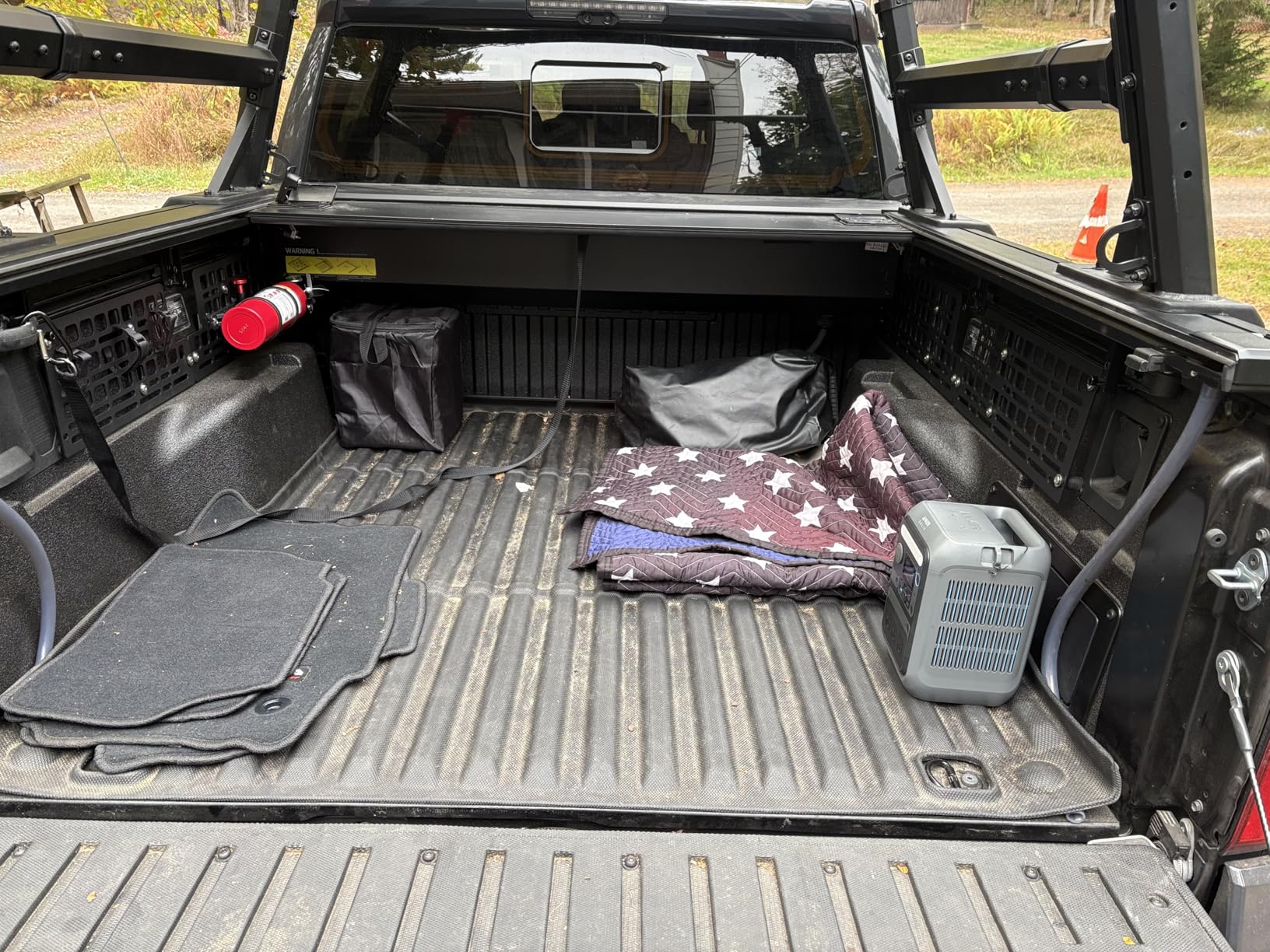
The C300 is the best portable power station under 500 dollars for anyone whose load is USB-C. It has two 140W USB-C ports, one 15W USB-C port, one USB-A, a 120W car socket and three AC outlets, in a 288Wh body that measures 6.46 by 6.34 by 9.45 inches and weighs 4.13 kg. Cameras, laptops, drones and phones are what it is built for.
It refills to 80 percent from a wall outlet in about 50 minutes, and it can also take solar, car charging or a PD 3.1 USB-C input. At 25 dB from 3.3 feet it is the lowest noise figure published for any model here, low enough to sleep next to in a tent or a bedroom during an outage.
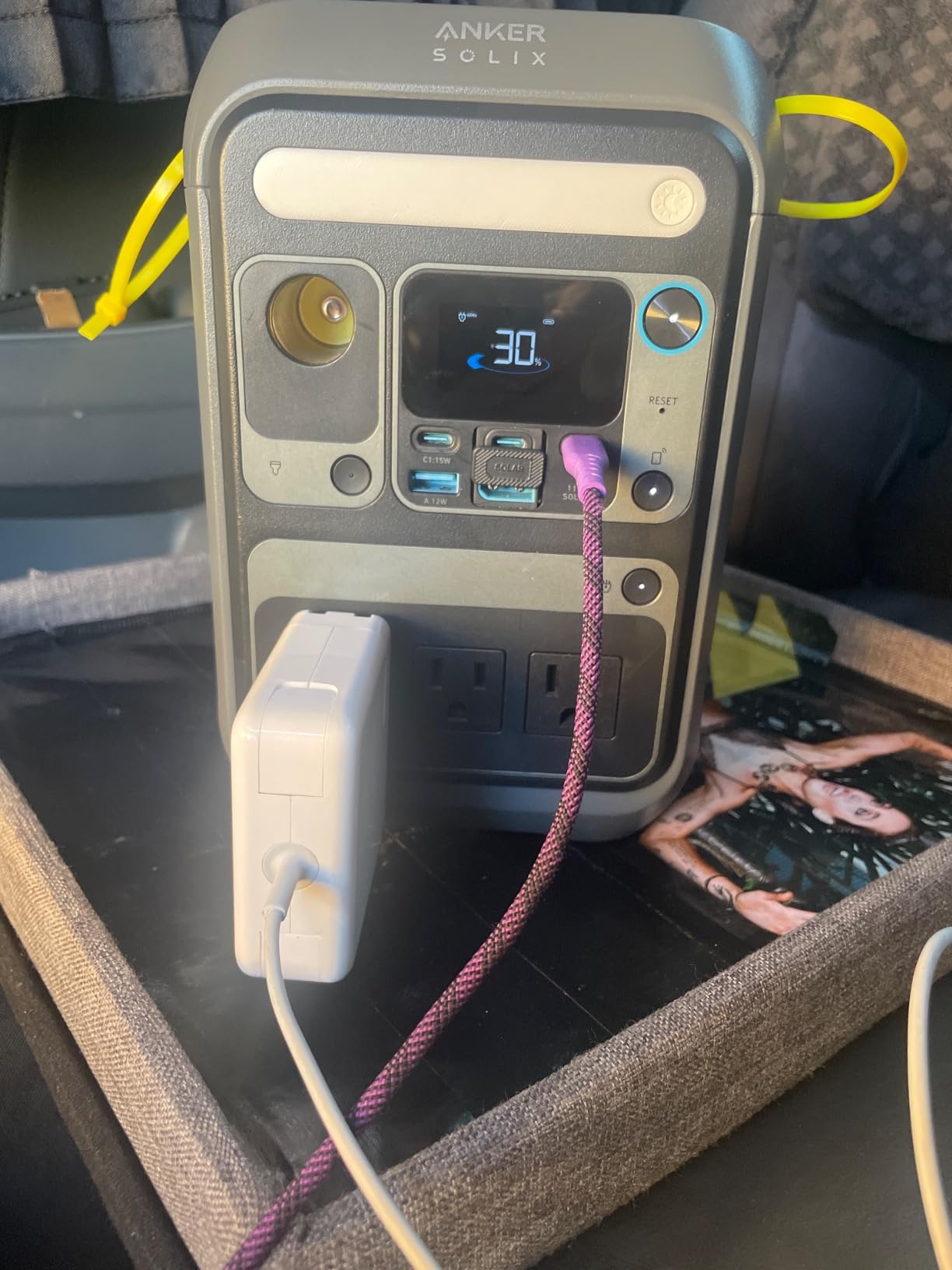
The LiFePO4 pack is rated for 3,000 cycles with temperature control and impact resistance, and Anker covers it with a five-year warranty with support that reviewers describe as responsive. That combination of port count and warranty is unusually good at this capacity level.
There are limits worth planning around. The 288Wh battery is not enough for a fridge or a CPAP machine overnight, and the three AC outlets share a single 300W total budget rather than each delivering 300W. If you plug in a kettle, the outlets will not also run a laptop charger.
Solar and carry trade-offs
Solar input is 100W and works with Anker 60W and 100W panels, but it will not accept several of Anker’s own smaller panels including the PS30, PS200 and PS400. If you already own a portable panel from another brand, check the connector before buying.
The shoulder strap is sold separately, so for a unit whose main selling point is portability you will likely want to add that. Otherwise the small footprint makes the C300 one of the easiest models here to move between a car, a desk and a campsite.
Who it suits?
Buy the C300 if your devices are all modern USB-C and your outages are short. It covers a night of phone charging, a full laptop charge, camera batteries and a router, and it does it quietly in a small box.
Skip it if you need to run anything with a motor, or if you want one battery to serve a whole weekend off-grid. The Explorer 500 v2 carries roughly twice the usable capacity for a reason that the port list alone does not explain.
5. BLUETTI Elite 100 V2: Best Compact 1KWh Setup
BLUETTI Elite 100 V2 Portable Power Station for Camping 1024Wh 1800W
1024Wh LiFePO4
1800W continuous, 3600W surge
25 lb
10ms UPS
Pros
- 1800W output with 3600W surge across 11 ports
- 0 to 80 percent in about 45 minutes on 1200W input
- 10ms UPS keeps routers and PCs alive
- 30 dB silent mode
- 17L design 35 percent smaller and 30 percent lighter than the prior generation
Cons
- 25 lb is heavy for one-handed carry over distance
- 12V car outlet runs warm above about 12W
- Low-wattage devices may not register on the power readout
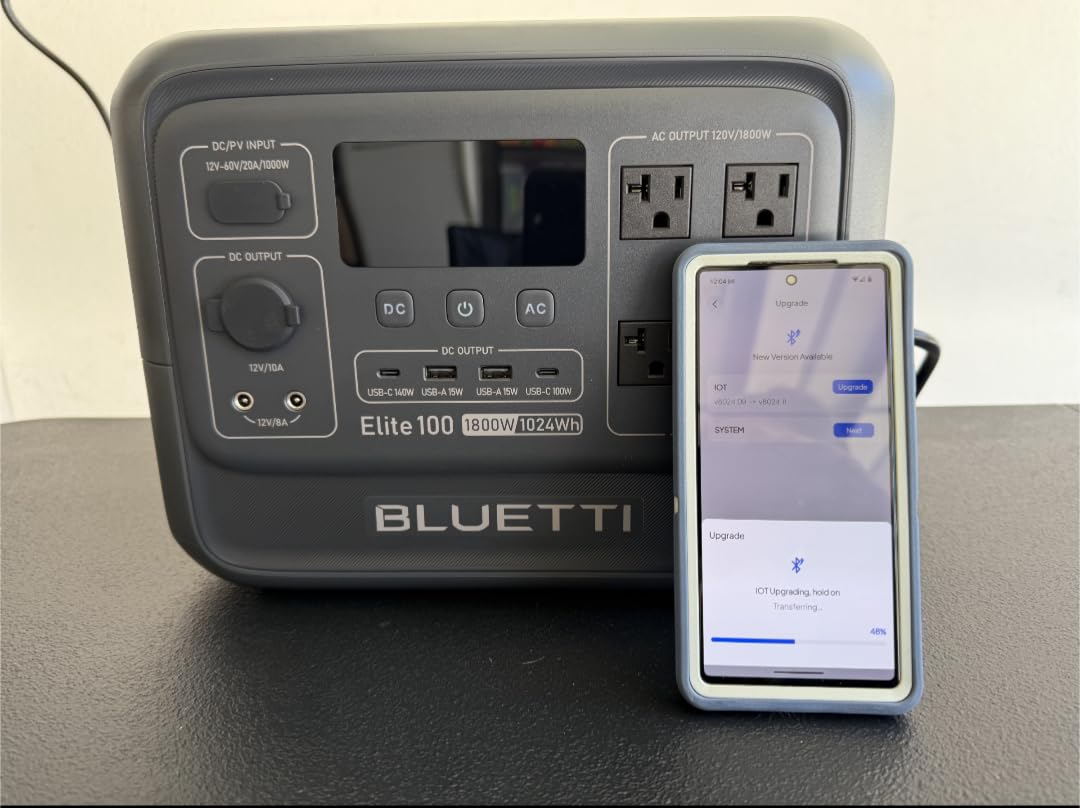
The Elite 100 V2 solves the problem that makes most 1,000Wh stations hard to live with: they are too heavy. At 25 pounds in a 17-litre body, it is 35 percent smaller and 30 percent lighter than the previous generation while still delivering 1,024Wh and 1,800W of continuous output with 3,600W of surge.
That output figure is tied for the highest continuous rating in this guide, and it is what lets the station run a portable fridge, a work-truck load or a small kettle without strain. The 1,800W power lifting mode extends the ceiling further for resistive loads, which is a genuine help when a device surges above its running draw.
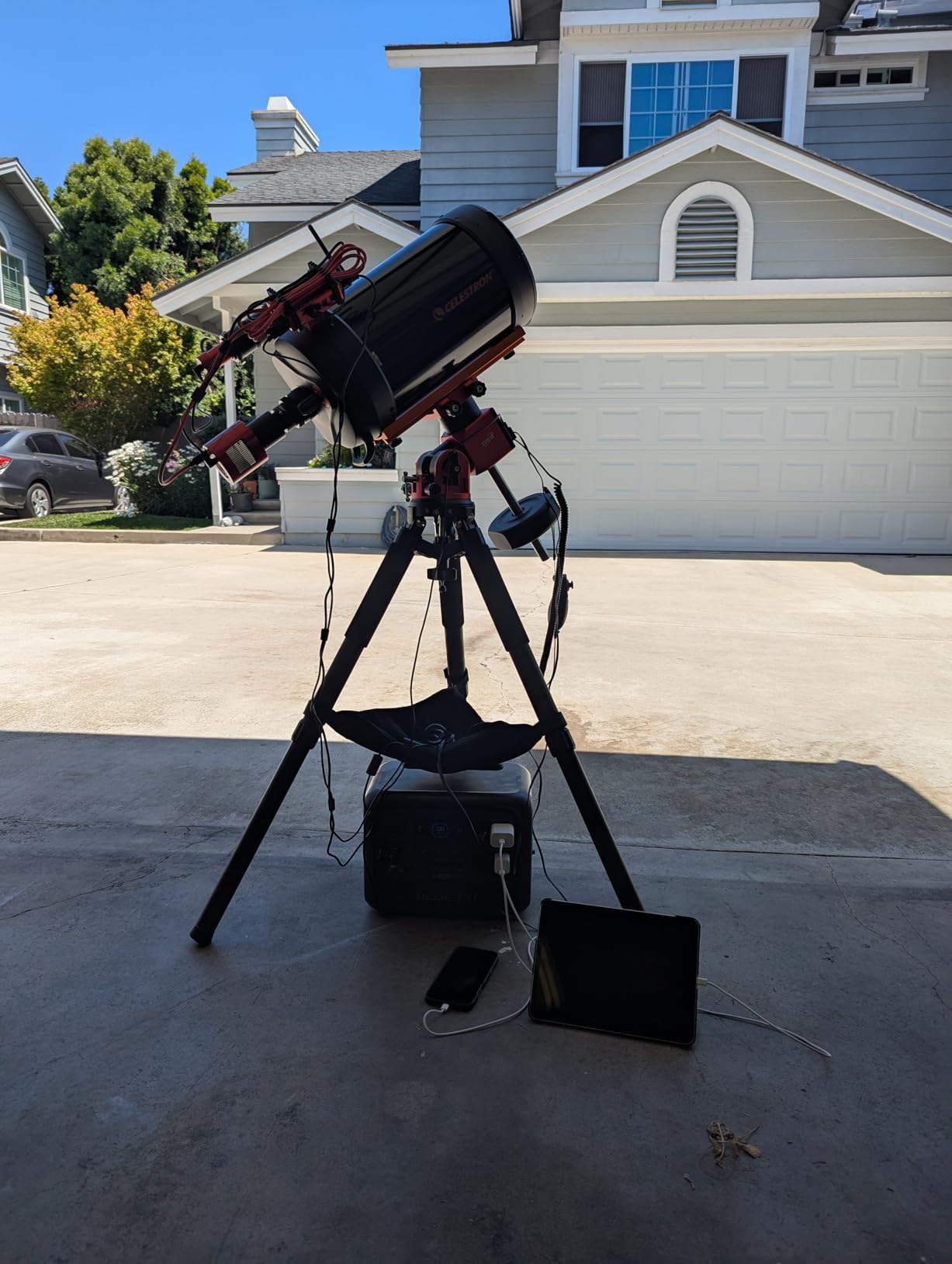
Charging is fast: 1,200W TurboBoost AC input takes it from 0 to 80 percent in about 45 minutes, and the BLUETTI Charger 1 can speed up vehicle charging by up to six times. The 10ms UPS switchover is among the tightest on this list, short enough to keep a router, a desktop PC or a network switch running through a flicker without a reboot.
Silent mode measures 30 dB, roughly half the noise of comparable 1,000Wh units, and the battery is rated for over 4,000 cycles to 80 percent, which supports a ten-year lifespan. A grounding screw ships in the box, and the app connects over Wi-Fi and Bluetooth for remote monitoring and updates.
Small faults worth knowing
At 25 pounds the built-in handle helps, but this is still a two-hand carry over anything more than a few steps. The 12V car outlet runs warm when drawing more than about 12W, and very low-wattage devices sometimes fail to register on the on-screen power readout, which matters if you plan to monitor a small CPAP draw closely.
There are also exposed DC barrel ports that can be shorted if a conductive object bridges them. Cap them when they are not in use, particularly in a van with loose tools or in a tent with metal gear.
How it stacks up against the AC180?
Against the AC180 you give up 128Wh of capacity and share the same 1,800W output rating, and in return you save 12.4 pounds, gain a tighter 10ms UPS switchover, and get a 45-minute charge against the AC180’s roughly 60 minutes. You also give up 500W of solar input. For most buyers that balance favours the Elite 100 V2.
The AC180 still wins on solar input at 500W and on raw capacity. If your panels are large and your station never moves, the AC180 is the stronger choice. If it moves at all, the Elite 100 V2 is the one.
6. Jackery Explorer 300: Most Versatile
Jackery Explorer 300 Portable Power Station,292Wh
292Wh LiFePO4
300W continuous, 600W surge
7.1 lb
2-year warranty
Pros
- 7.1 lb weight makes it one of the most portable units on the market
- 100W USB-C PD port plus two USB-A and a 120W car port
- Over 4000 charge cycles to 70 percent capacity
- 80 percent solar charge in about 2.8 hours on a 100W Jackery panel
Cons
- 292Wh limits it to small electronics
- Two-year manufacturer warranty is shorter than most rivals
- Solar panel sold separately
The Explorer 300 is the most-reviewed power station in this guide with more than 11,000 ratings, and that track record matters in a category where support quality varies widely. At 7.1 pounds with an integrated handle it is one of the easiest units here to carry, and it is the one most owners describe as a dependable travel companion.
For electronics it is well equipped: 292Wh of LiFePO4 capacity rated at over 4,000 cycles to 70 percent, 300W of continuous output with 600W of peak surge, two AC outlets, a 100W USB-C Power Delivery port, two USB-A ports and a 120W car socket. Recharge takes about four hours.
Solar is quick for its size, reaching 80 percent in about 2.8 hours on a 100W Jackery panel, though the panel is a separate purchase. Owners use it for phones, laptops, drones, cameras and CPAP machines while camping or travelling, and the 292Wh battery is the limiting factor in every one of those scenarios.
The two-year manufacturer warranty is the main gap. BLUETTI, EcoFlow and Anker all publish five-year terms on comparable hardware, and forum research treats five years as the quality benchmark. If you intend to keep this station for more than a few seasons, the shorter coverage is worth weighing against the lower entry cost.
Where 292Wh runs out?
Roughly 234Wh of usable capacity covers a laptop charge, a handful of phone charges, camera batteries and a router, and that is where it stops. A 45W mini-fridge will run about five hours, which is a long afternoon rather than a night, and anything with a compressor or heating element is out of range.
Be careful with look-alike models here. The Explorer 300, the Explorer 500 v2 and the Explorer 1000 v2 share a naming pattern and differ hugely in capacity, output and warranty. Check the model number on the listing rather than the product family.
Who should buy the cheapest one?
Buy the Explorer 300 if this is your first power station, your loads are USB-C and laptops, and you want a unit small enough to forget in a car until you need it. The cycle rating and review base give you a reasonable long-term bet at the lowest entry cost here.
Raise your budget if you need a CPAP machine covered overnight, since the runtime math leaves you near 23 hours with no margin for idle draw. That is where the Explorer 500 v2 earns its extra cost.
7. EcoFlow RIVER 2 Pro: Best Portable Mid-Size
EF ECOFLOW Portable Power Station RIVER 2 Pro, 768Wh 800W
768Wh LFP
800W continuous, 1600W X-Boost
17.2 lb
5-year service
Pros
- Full AC recharge in about 70 minutes
- 768Wh with 800W continuous and 1600W X-Boost
- 11 outlets including 4 AC plus USB-C and car ports
- Over 3000 cycles to 80 percent
- 220W solar input for a recharge in as little as 3.5 hours
Cons
- Heavy and bulky for its 768Wh class
- App and controls less intuitive than competing brands
- Fan noise noticeable during fast AC charging
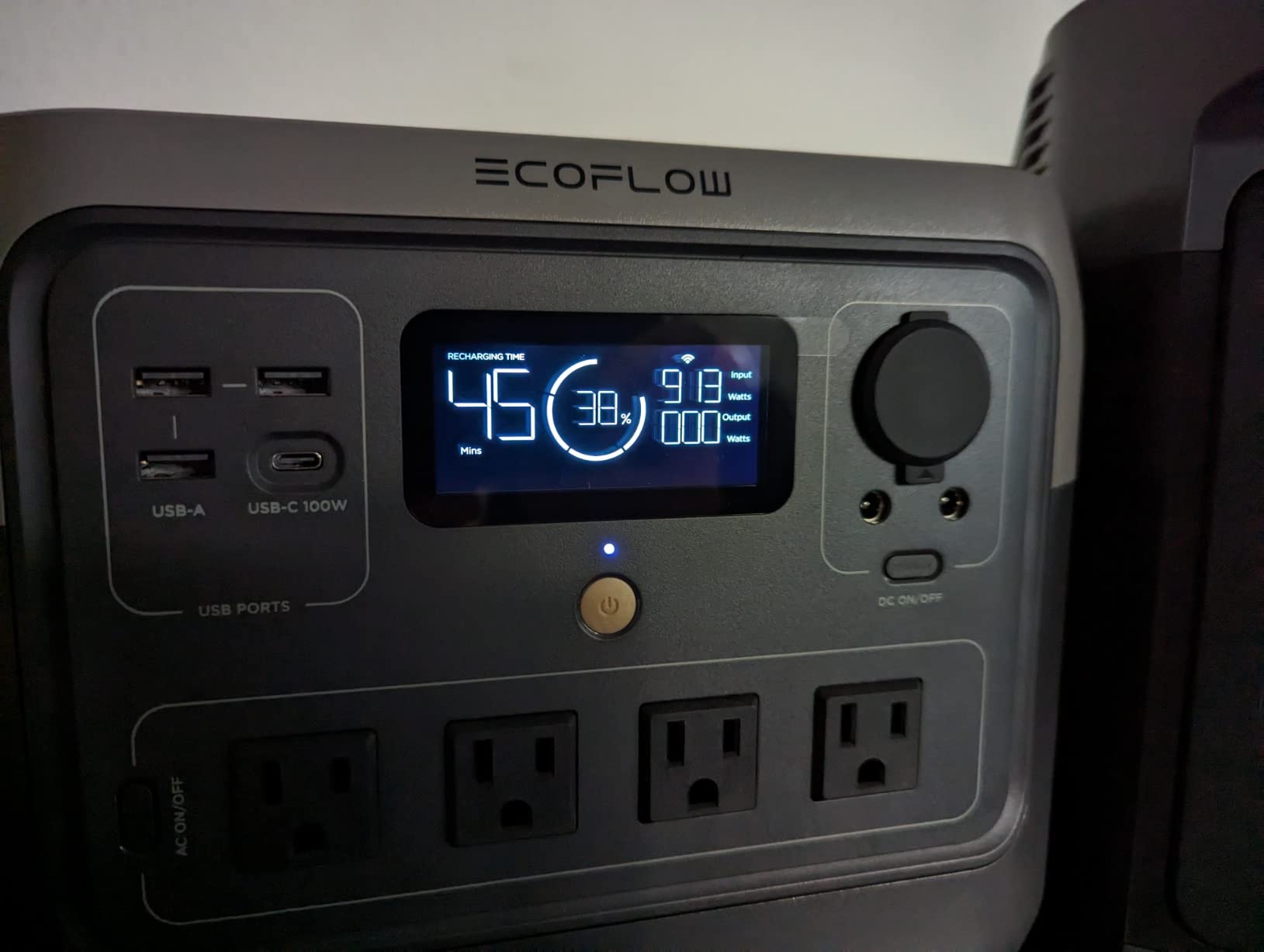
At 768Wh rated, about 614Wh usable and 17.2 pounds, it sits between the 512Wh carry-everywhere size and the 1,000Wh-plus units, giving a weekend camper roughly 13 hours of fridge runtime without dragging 25 pounds of hardware around.
Charging is the headline feature. A full AC recharge takes about 70 minutes, the 220W solar input can bring it back in as little as 3.5 hours, and the 800W continuous output doubles to 1,600W through X-Boost for resistive loads. The outlet count is the joint second best in the guide at 11, including four AC outlets.
The LFP cells are rated for over 3,000 cycles to 80 percent capacity, which works out to roughly a decade of regular use, and EcoFlow provides a five-year service term. That combination of cycle rating, warranty and recharge speed is why this model is the mid-size pick despite carrying an average rating below the rest of the group at 4.5.
The negatives are consistent. Buyers describe the RIVER 2 Pro as heavy and bulky for a 768Wh unit relative to same-capacity rivals, find the app and on-device controls less intuitive than competing brands, and note audible fan noise while it is charging at maximum speed.
What 768Wh covers?
Divide the 614Wh usable figure by a real load and the RIVER 2 Pro lands in a useful middle band: about 13 hours on a 45W mini-fridge, roughly 4.8 hours on a 127W fan, about 61 hours on a 10W CPAP, and close to 10 hours on a 60W laptop.
It will not start most power tools, which is where the BLUETTI models pull ahead, and 17.2 pounds is at the edge of one-hand carry. For a family of two running a fridge, a router and phones across a weekend, the trade is usually worth it.
Who should look elsewhere?
If support responsiveness is your top concern, EcoFlow is a brand forum buyers mention when describing slow warranty handling, so buy with that in mind and document the unit on arrival. If the fan noise matters for sleeping near it, the BLUETTI Elite 100 V2 at 30 dB is quieter by design.
For anyone who wants the same mid-size idea with a longer warranty history and a tighter 10ms UPS response, the Elite 100 V2 covers a similar role at higher carry weight.
8. EcoFlow RIVER 2: Best for Router and Phone Backup
EF ECOFLOW Portable Power Station RIVER 2, 256Wh 300W
256Wh LFP
300W AC, 600W X-Boost
7.7 lb
5-year warranty
Pros
- Full AC recharge in about one hour
- Only 7.7 lb with a built-in handle
- Over 3000 cycles to 80 percent capacity
- Solar recharge in as little as 2.3 hours on 110W input
- Pass-through UPS keeps devices alive while the unit charges
Cons
- Some units self-discharge to empty when stored fully charged
- Battery percentage readout reported as unreliable
- Only a single USB-C port
The RIVER 2 is one of the two lightest units here at 7.7 pounds, and its pass-through UPS behaviour is the feature that makes it a genuine backup box rather than a camp toy. You can run a router, a modem and a phone charger off it while it is plugged in and charging.
It refills from a wall outlet in about an hour, takes 110W of solar for a recharge in as little as 2.3 hours, and covers six outlets across AC, USB-A, USB-C and a car port. The 300W AC rating doubles to 600W through X-Boost for small resistive appliances.
The LFP battery is rated for over 3,000 cycles to 80 percent and comes with a five-year warranty, so the longevity story is sound. Most owners use it for phone and laptop charging, portable fridges on short trips, astrophotography gear and brief outages, and they consistently describe it as fine for small electronics.
This model carries the lowest average rating in the guide at 4.3, with 9 percent of reviews at one star, and the complaints are specific rather than general. Some units reportedly self-discharge to empty within a few days of sitting fully charged, and some owners report the battery management percentage readout drifting from what is actually in the pack.
Decide what the rating is telling you
Clustered durability and support complaints are what drag this score down, and 9 percent one-star reviews is a real signal rather than rounding error. The hardware is well regarded, but the experience after a problem is not, and slow warranty handling is a theme forum buyers raise about EcoFlow generally.
There is also an efficiency caveat that matters for small loads: AC output below 120V loses meaningful usable capacity to inverter overhead, so the already-modest 256Wh shrinks further when powering something small. There is only one USB-C port, and solar charging is unreliable with third-party panels under about 25W of output.
Best use for a 256Wh box
Router, modem, phone charger and a couple of lights is the honest brief. That covers an internet outage overnight, which is the scenario most households actually hit, and it fits in a drawer or a vehicle cubby between uses.
It cannot run a coffee maker, an air conditioner or a microwave, and owners say so repeatedly. If the idea is a fridge overnight, move up to the Explorer 500 v2 or the RIVER 2 Pro, which carry roughly triple the usable capacity.
What a Sub-500 Power Station Can and Cannot Run?
The fastest way to avoid disappointment is to match the device to the continuous output figure and to the usable capacity figure, not to the label. A 300W station running a 45W compressor fridge is fine on output and thin on hours; a 1,000Wh station running a 127W fan is fine on hours and may be wasted on a load that small.
Under this ceiling you can comfortably run phones, tablets and laptops, camera and drone batteries, a router and modem, LED lights, a 45W mini-fridge for a day, a 10W CPAP machine for one night, a Starlink terminal drawing 50 to 75W for roughly 6 to 16 hours depending on capacity, small monitors, and a kettle on the 1,000Wh-plus models.
You cannot run space heaters, hair dryers, microwaves, window air conditioners, full-size refrigerators, washing machines, or most power tools. Those loads start at 1,000W and climb from there, and a budget station will either refuse to start them or trip its inverter within minutes.
One risk deserves a mention because almost no roundup covers it. A powered inverter can draw 15 to 20W of overhead on its own, and across a three-day outage that overhead becomes a meaningful share of a small battery. If you are running on a sub-300Wh model through a multi-day event, use the lowest power-lifting or pass-through mode available and keep the unit switched off between uses.
Buying Guide: Sizing, Chemistry, UPS and Solar Inputs
Watt-hours are capacity, watts are output. Watt-hours describe how much energy the pack holds, which determines runtime. Watts describe how fast it can deliver that energy through the inverter, which determines which devices it can start. A station can be large in watt-hours and weak in watts, and that mismatch is the most common reason a fridge works but a kettle does not.
Continuous versus surge. Continuous output is what the station sustains; surge is a short burst for start-up. A fridge compressor, a pump or a power tool can draw two to three times its running wattage for a second or two at start-up, which is why a 300W station can run a 150W appliance but a 290Wh capacity still cannot run one for long. Check the surge rating against the startup draw, not the running draw.
Discount your capacity by about a fifth. Inverter conversion, the battery management system and voltage losses together remove roughly 15 to 25 percent of rated watt-hours before a device sees them. Some designs are more conservative still, with BLUETTI limiting the AC180 to 90 percent of rated capacity by design. Plan against the lower number.
LiFePO4 versus NMC. Every pick on this list uses lithium iron phosphate chemistry, and that is the single most important longevity decision you will make. LiFePO4 cells are rated here between 3,000 and 6,000 cycles, tolerate deeper discharge and handle heat better than the NMC lithium-ion used in older budget models, which is the chemistry forum owners report losing charge retention within one to three years. If a listing you are considering does not name the chemistry, treat that as a warning.
UPS mode and switchover time. UPS mode keeps a device running when the wall power drops, and the switchover time is what matters for sensitive equipment. A 10ms transfer on the Jackery Explorer 500 v2 and the BLUETTI Elite 100 V2 is tight enough for a CPAP machine, a router or a desktop PC. The BLUETTI AC180’s 20ms figure is still fine for most loads but is the loosest here. Always test the switchover with your actual device before you need it.
Solar input and connectors. The MC4 standard is the common denominator, but brands restrict compatibility in both directions. The Anker SOLIX C300 will not accept several of Anker’s own smaller panels including the PS30, PS200 and PS400, and the Jackery Explorer 1000 v2 is limited to Jackery panels. The BLUETTI AC180 accepts 500W of solar input and the RIVER 2 Pro accepts 220W, both far more flexible for van builds. Check panel compatibility before buying the station rather than after.
Expansion batteries. Some units in this class accept add-on packs that scale a build past its base capacity, and that is a better path than buying a larger station outright if you already own panels and cables. Confirm which expansion packs the model supports and whether they stack or replace the base battery, because the connector and firmware have to agree.
Grounded versus ungrounded outlets. A grounded AC outlet has a ground pin and a three-prong plug, and it gives you an equipment ground path. An ungrounded two-prong outlet does not. The difference is small for a phone charger and meaningful for a medical device or anything with a metal chassis, so check the outlet layout on the model rather than assuming it.
Warranty and support. Five years is the benchmark in this category, and most of these picks meet it. The Jackery Explorer 300 is the exception at two years, and the Jackery Explorer 1000 v2’s listing carries a shorter entry worth confirming. Forum research repeatedly raises BLUETTI and EcoFlow support as a friction point, so buy from a seller with a straightforward return path and photograph the unit on arrival.
Safety and indoor use. These are sealed lithium battery boxes with no combustion and no exhaust, so unlike a gas generator they can run inside a house during an outage. They still carry thermal management and should be kept away from direct heat and water. Every established brand on this list publishes NRTL or UL safety certification, which is one of the strongest reasons to avoid no-name units whose advertised capacity may deliver a fraction of that.
One last note on timing. Budget power stations are among the most volatile deal products in the category, with meaningful price swings around major sale events. Check the current figure on the button below before you commit, and if a deal does not materialise, the ranking in this guide does not change.
Frequently Asked Questions
What is the best portable power station under 500 dollars?
The Jackery Explorer 500 v2 is the best portable power station under 500 dollars for most people. It combines 512Wh of LiFePO4 capacity, 500W of continuous output, a 13.3 lb weight, a 10ms UPS switchover and a five-year warranty. For 1,000Wh of capacity choose the BLUETTI Elite 100 V2, and for USB-C-only loads the Anker SOLIX C300 is lighter and cheaper.
What is a cheaper alternative to Jackery?
BLUETTI and EcoFlow cover the same ground at similar money. The BLUETTI Elite 100 V2 gives 1,024Wh and 1,800W of output, and the EcoFlow RIVER 2 Pro gives 768Wh with 800W of output and a 70-minute recharge. Both carry five-year terms, so the Jackery name is the premium rather than a requirement.
Which is better, EcoFlow, BLUETTI or Anker?
BLUETTI leads on output and solar input, with 1,800W rated output and 500W solar acceptance on the AC180 and 1,800W with 1,024Wh on the Elite 100 V2. Anker leads on USB-C port selection and low weight, with the C300 offering two 140W USB-C ports in a 4.13 kg body. EcoFlow leads on recharge speed, with a 70-minute full AC recharge on the RIVER 2 Pro and a one-hour recharge on the RIVER 2.
Can a portable power station run a refrigerator?
Yes, if the fridge is small. A 45W mini-fridge needs about 410Wh of usable capacity for nine hours, which the Jackery Explorer 500 v2 provides, and the 1,000Wh-plus models stretch that to 18 to 20 hours. A full-size refrigerator pulls far more and needs a station above this price band. Plan against rated watt-hours times 0.8 rather than the label on the box.
Do I need LiFePO4 for a portable power station?
For any station you plan to keep more than a couple of seasons, yes. LiFePO4 cells are rated between 3,000 and 6,000 cycles on these models and hold capacity better over time than the NMC lithium-ion used in older budget units, which forum owners report losing charge retention within one to three years. Every model in this guide uses LiFePO4 chemistry.
Are portable power stations safe to run indoors?
Yes. They are sealed lithium battery boxes with no combustion, no exhaust and no noise, which makes them indoor-safe in a way a gas generator is not. They still use thermal management, so keep them away from direct heat, water and combustible materials, and choose a unit with published NRTL or UL safety certification rather than a no-name brand.
Final Verdict by Budget Tier
Buy the Jackery Explorer 500 v2 if you want one station that covers a fridge, a CPAP machine and a laptop in a package you can still carry. Step up to the BLUETTI Elite 100 V2 when you need 1,000Wh and 1,800W of output for a similar weight class, or to the BLUETTI AC180 when 500W of solar input and a raw 1,152Wh matter more than portability.
Drop to the Anker SOLIX C300 or the Jackery Explorer 300 when the load is USB-C electronics and a router. Choose the EcoFlow RIVER 2 Pro for the fastest turnaround in the mid-size tier, and the EcoFlow RIVER 2 only when the priority is the lightest backup box for internet and phone charging. Every one of these is among the best portable power stations under 500 dollars, and each fits a different outage.