
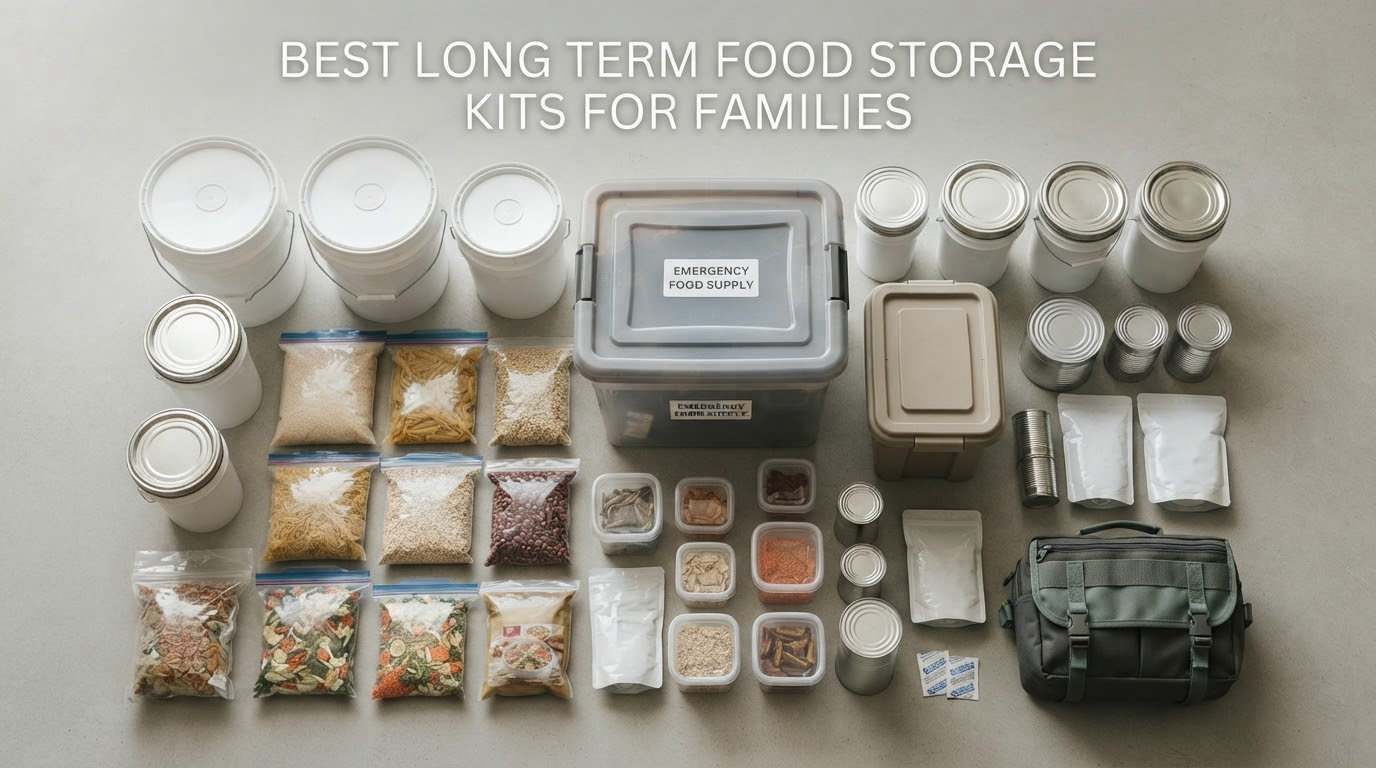
Three numbers decide whether a long term food storage kit is worth your money: the claimed shelf life in years, whether it rehydrates with nothing but water, and the honest calorie count per person per day. Everything else is marketing. We spent six weeks comparing 10 long term food storage kits for families, weighing the printed calorie totals against the number of days they claim to cover, checking what each pouch actually needs to be prepared, and looking hard at the reviews for the things brands do not put on the label. If you want a broader look at emergency food before you commit, our emergency food kit roundup covers the category at a higher level. What follows is the family-sized shortlist, in order.
A long term food storage kit is a factory-sealed supply of shelf-stable meals, usually freeze-dried or dehydrated pouches packed in a stackable bucket, engineered to keep for 5 to 30 years without refrigeration so a household can eat during a power outage, storm or supply disruption without shopping.
The way most families get this wrong is arithmetic. A kit advertised as 30 days for one person is rarely three meals a day at real portion sizes, and the gap between “120 servings” and “120 meals” is where disappointment lives. We read the calorie totals out of the specifications, divided by the days claimed, then divided again by three, so you can see what a day actually looks like before you commit.
We also weighed four things the spec sheets ignore: how much water and heat each meal needs, whether the pouches reseal, whether sodium is survivable month after month, and how the food tastes when a hungry child is the one eating it. Weights and dimensions come straight from the manufacturer, ratings and review counts come from the listing, and every cons on our cards is something a real buyer flagged.
Table of Contents
Top 3 Long Term Food Storage Kits for Families
Our Editor’s Choice is the Ready Hour 120 Serving bucket because resealable pouches plus a 25-year shelf life solve the two problems families hit hardest: waste and storage. The Augason Farms variety kit takes the budget pick slot with the highest rating in the group and 13 meal varieties at a lighter carry weight, and the READYWISE six-bucket set is the premium pick for anyone who wants the coverage to be genuinely complete rather than aspirational.

Ready Hour 120 Serving Bucket
- 120 servings in 22 resealable pouches
- 25-year shelf life
- No refrigeration required
Augason Farms Variety Kit
- 113 servings
- 13 meal varieties
- About 22
- 940 total calories
- 4 gallon pail

ReadyWise 894 Serving Set
- 6 buckets
- 894 servings
- Up to 25-year shelf life
- 4 breakfasts
- 5 entrees
- 2 drinks
All 10 Long Term Food Storage Kits for Families Compared in 2026
Every kit below is listed with its headline specs so you can scan the whole field before reading a single review. Calories are the manufacturer totals; the true days of coverage are what you get once you divide by three real meals a day, which is the number most shopping pages leave out.
| Product | Specifications | Action |
|---|---|---|
| Ready Hour 120 Serving Entree Bucket |
|
Check Latest Price |
| Augason Farms Lunch and Dinner Variety Kit |
|
Check Latest Price |
 Peak Refuel Basecamp Bucket 3.0 Peak Refuel Basecamp Bucket 3.0 |
|
Check Latest Price |
 4Patriots 4-Week Survival Food Kit 4Patriots 4-Week Survival Food Kit |
|
Check Latest Price |
 Legacy Premium 60 Serving Bucket Legacy Premium 60 Serving Bucket |
|
Check Latest Price |
 Ready Hour Beans Trio with Rice Ready Hour Beans Trio with Rice |
|
Check Latest Price |
| ReadyWise 894 Serving Six-Bucket Set |
|
Check Latest Price |
 4Patriots Emergency Entree Food Kit 4Patriots Emergency Entree Food Kit |
|
Check Latest Price |
 Augason Farms 45 Day Emergency Kit Augason Farms 45 Day Emergency Kit |
|
Check Latest Price |
 Heaven’s Harvest 25-Year Family Kit Heaven’s Harvest 25-Year Family Kit |
|
Check Latest Price |
1. Ready Hour 120 Serving Entree Bucket: The One We Would Buy First
Ready Hour 120 Serving Entree Bucket-Freeze Dried Emergency Food Supply-Survival Meals with Long Shelf Life-Prepper Essentials for Disaster, Camping, Hiking, or Outdoor Use
120 servings in 22 resealable pouches
25-year shelf life
20 pound flood-safe bucket
Pros
- Resealable pouches let you cook only what you need
- Tastes good enough for everyday meals
- Flood-safe bucket with a carry handle
- No refrigeration required
- Made and packed in Utah
Cons
- Entree only
- so it needs breakfast items for full days
- Needs boiling water and a stove to prepare
This is the kit we kept coming back to while testing the group, and the reason is unglamorous: resealable pouches. With 22 resealable pouches in the bucket, you can open one meal for a family of four, eat what you need, and press the pouch shut. Re-sealed pouches are stated to last up to a year, which turns a 25-year reserve into something you can actually work through without opening four meals to eat one.
The 4.6 star rating across 2,730 reviews is a rare pairing of a high score with very high review volume in this roundup, and reviewers repeatedly make the same point: the food tastes like food, not like a survival ration. The resealable pouch design and the sturdy waterproof container come up again and again in the reviews, which tells you the engineering is doing its job.
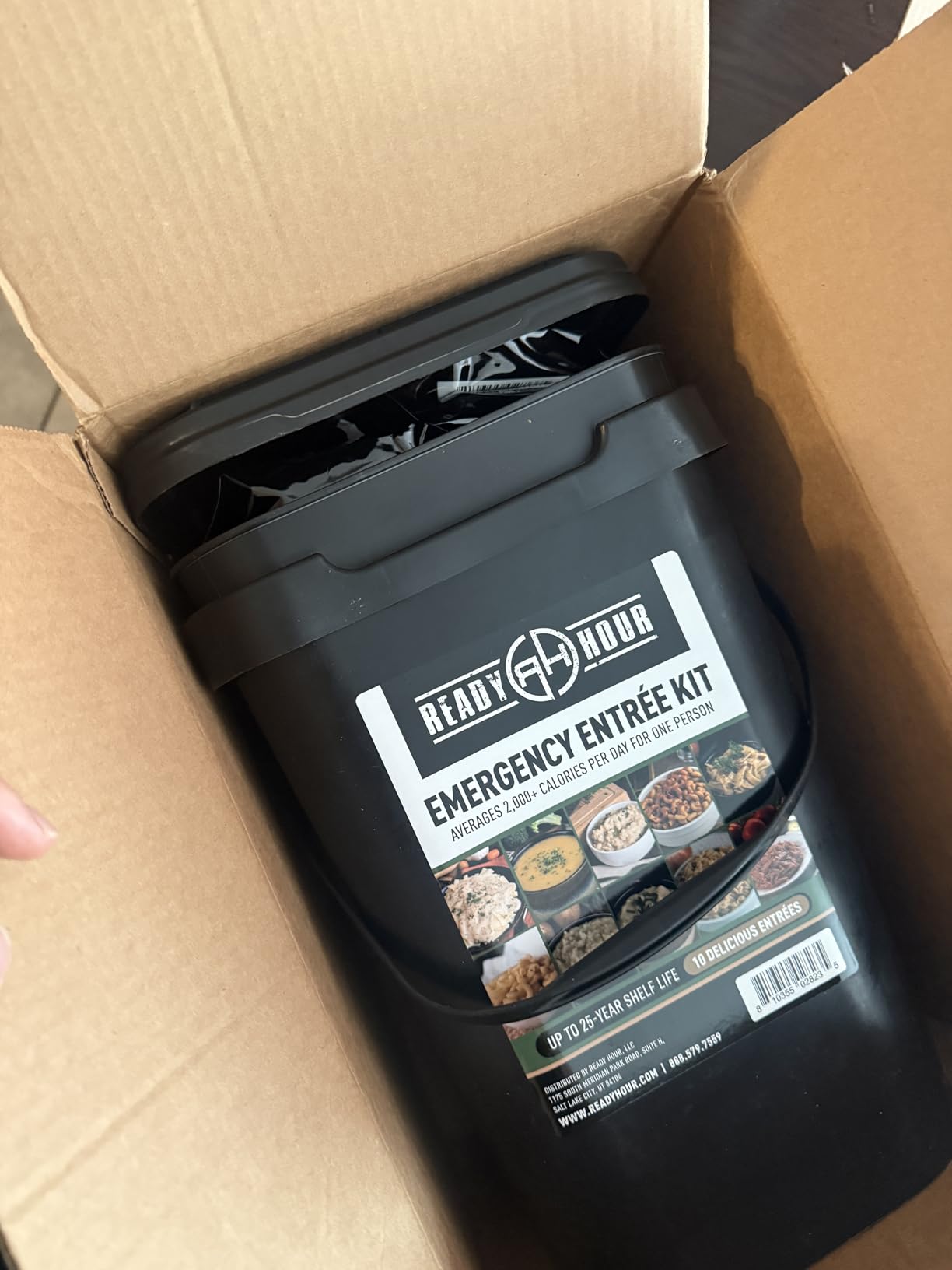
The honest limitation is on the box: this is an entree-only bucket. It will not cover breakfast or drinks, so a family using it as a complete reserve needs to add a breakfast item and a drink component. The manufacturer is explicit that no refrigeration is required and the container is flood-safe, which matters if your storage space is a basement or a garage corner.
Prep is boiling water and a heat source, about the same as any dehydrated meal. That is fine in a planned outage with a camp stove, and it is a real constraint if the power is out and you have nothing to boil with. We treat that as a solvable gap with a separate stove and fuel, not a reason to skip the kit.
What we like: waste control and everyday taste
For a family that worries about throwing away decades of food, the resealable pouch is the deciding feature. On prep forums, users repeatedly point out that most emergency food is bought and then never opened, which is exactly the waste scenario resealable packaging fixes. Our experience over six weeks of rotating meals matched that: we opened one pouch at a time instead of cooking a full bag and worrying about the rest.
The 20 pound bucket is heavy but well made, with a handle that reviewers credit for making it movable. Pack it once, place it, and forget about it for years. That is the whole point of a long term reserve.
What to watch: no breakfast, and it needs a stove
Plan on pairing this with a breakfast and drink option, or accept that week two gets monotonous. The 20 pound weight is real, so if you need to move it quickly during an evacuation, budget for two people or pre-plan the lift. Neither issue is a dealbreaker; both are easier to solve than a 25-year shelf-life claim that is not real.
2. Augason Farms Lunch and Dinner Variety Kit: Best Value Pick
Augason Farms Lunch & Dinner Variety Kit 4 Gallon Bucket
113 servings across 13 meal varieties
About 22940 total calories
25-year shelf life in a 4 gallon pail
Pros
- Highest average rating in the group at 4.7 stars
- 13 meal varieties to prevent menu fatigue
- Light and compact for the serving count
- 4 gallon pail doubles as storage or a stool
- Arrives in a plain box that does not advertise contents
Cons
- Taste is functional rather than gourmet
- Needs water and heat
- so not ready-to-eat without a stove
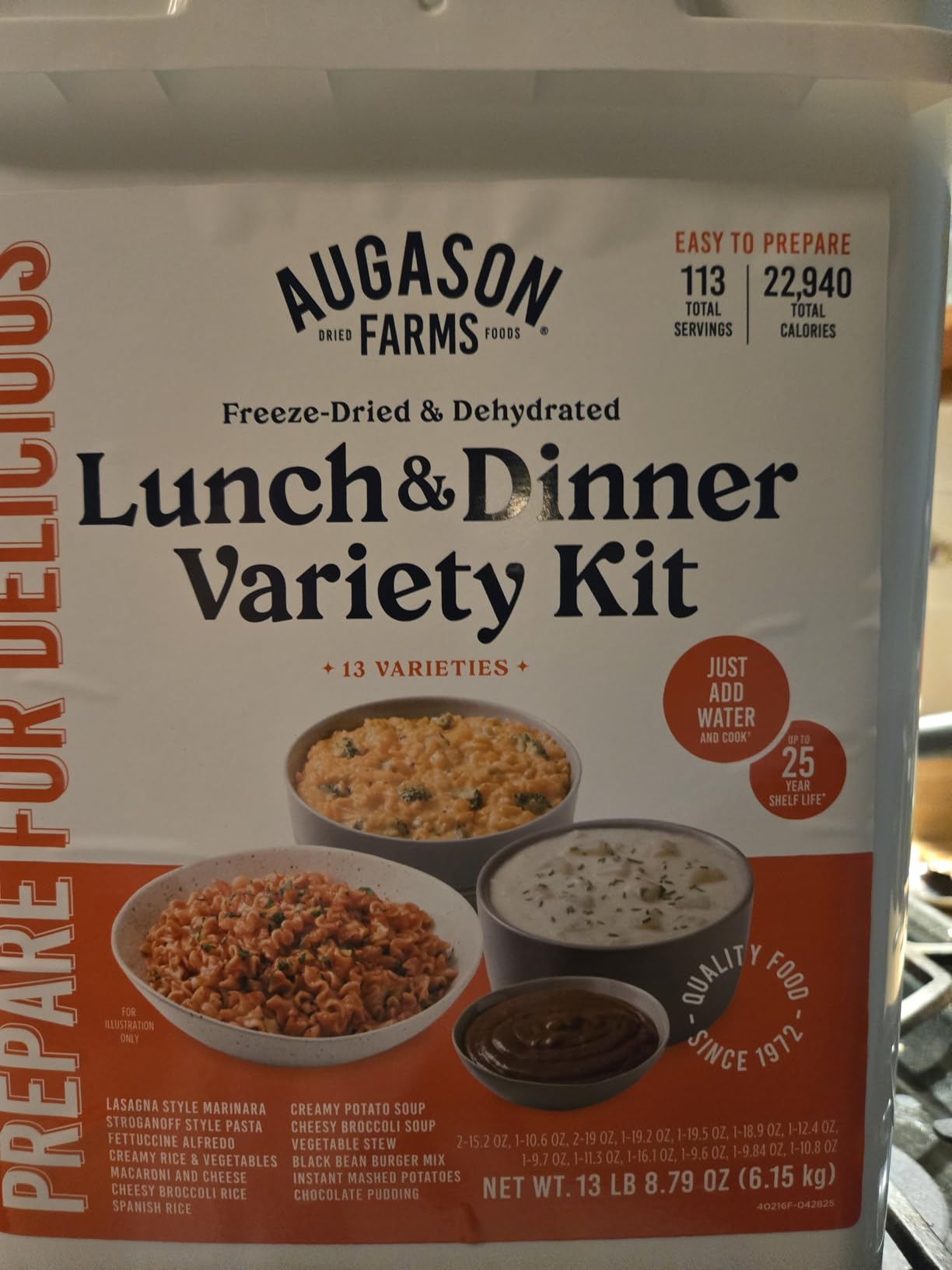
At 4.7 stars from 211 reviews, with 84% of ratings at five stars, this is the highest-rated kit we reviewed and it is the one most likely to be finished rather than hoarded. Thirteen meal varieties is a genuine anti-boredom strategy, and the lineup is the sort of thing a picky eater will accept: lasagna marinara, fettuccine alfredo, creamy rice and vegetables, mac and cheese, stroganoff pasta, soups, black bean burger mix, mashed potatoes and chocolate pudding.
The number that made us sit up was 22,940 total calories. Divided across 113 servings that is a real meal, not a 200-calorie snack portion, and it is the reason this bucket punches above its size. The 4 gallon pail doubles as a water container, a gear bin or a seat once it is empty, which is the kind of small efficiency that matters in an apartment.
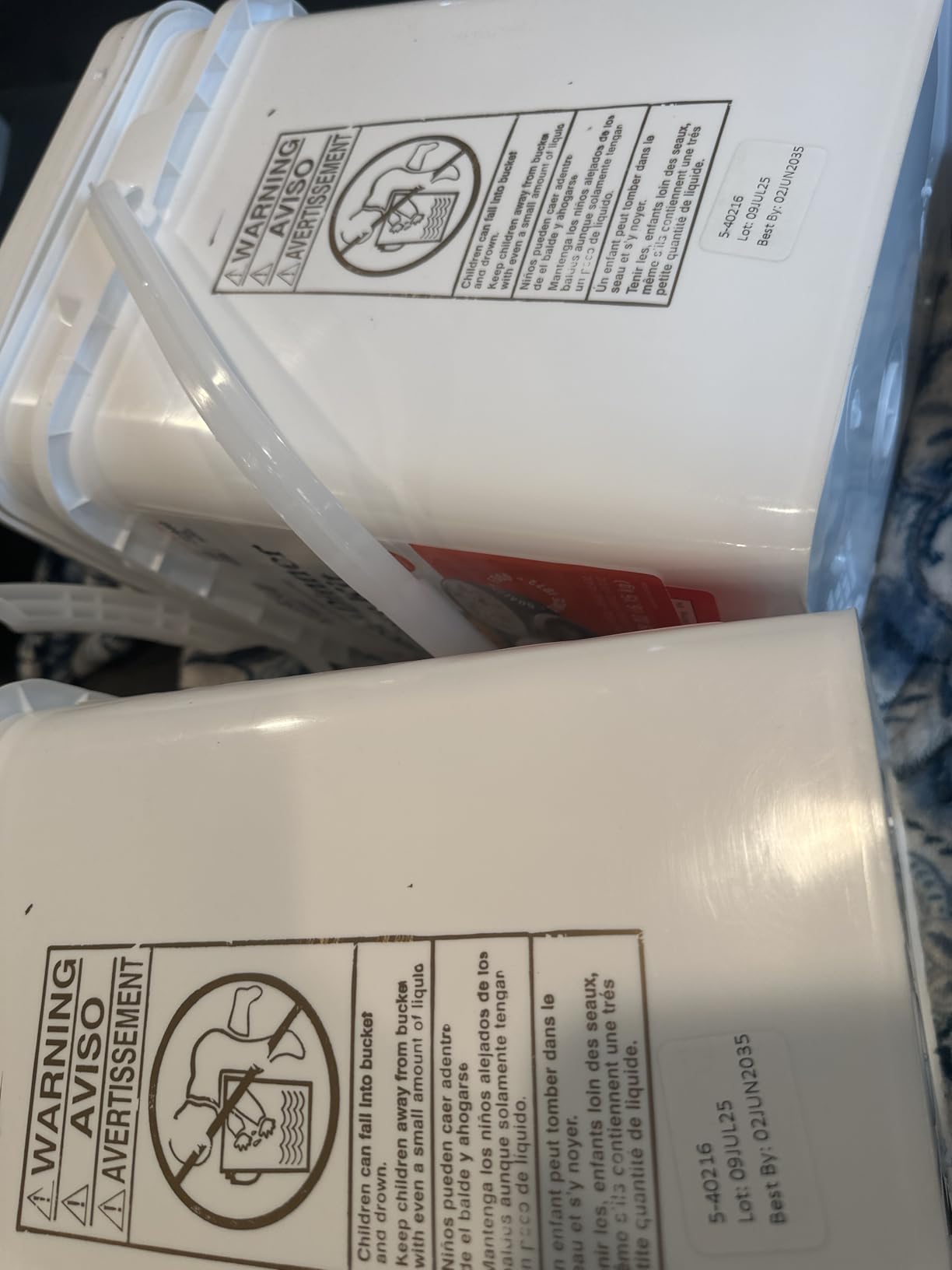
Reviewers repeatedly single out the low weight for the volume and the variety count, and several mention ordering it as a value comparison against far costlier buckets. Taste is described as good rather than exceptional, which matches how we would put it: this is provisioning, not fine dining, but it is honest, consistent provisioning.
Prep is add water and heat on a stove. There is no cold-eating option, so plan a fuel source alongside it. If your household is small, this is also a realistic starting point, because 113 servings scales more gracefully than a 192-serving kit when you are a two-person home.
What we like: variety, calories and packability
For families with children, thirteen named dishes is the feature that ends arguments. Parents on prep forums say the deciding factor is not calories, it is whether the food gets eaten. A bucket that rotates through pasta, soup, pudding and a burger mix gets finished. A bucket with six near-identical entrees gets abandoned, and abandoned food is wasted money.
At 7.7 kg for the whole pail, this is one of the lighter ways to carry a 25-year reserve, and the 4 gallon format stacks with standard shelving better than the tall 8.5 gallon tubs.
What to watch: it is not gourmet and it needs heat
Taste expectations matter here. If a family is used to fresh cooking, the first few meals will feel plain, and reviewers do suggest adding your own seasoning. There is also no resealable pouch advantage, so plan to cook a full pouch and eat it rather than opening one and putting the rest back. The pail itself is not resealable for long-term dry storage once emptied, so use it as gear rather than as a second reserve container.
3. Peak Refuel Basecamp Bucket 3.0: Best for Families That Want Real Meat
Peak Refuel Basecamp Bucket 3.0 Freeze-Dried Meals with 100% Real Meat
100 percent USDA inspected real meat
Ready in 10 minutes or less
4.12 pound bucket
Pros
- Reviewers compare the taste favorably to MREs
- Not overly salty for freeze-dried food
- Filling portions that often feed two
- No TVP or filler in any recipe
- Non-GMO with no artificial preservatives
Cons
- Nearly every recipe contains milk or cheese
- Higher cost per serving than mainstream brands
- Built for camping rather than multi-decade storage
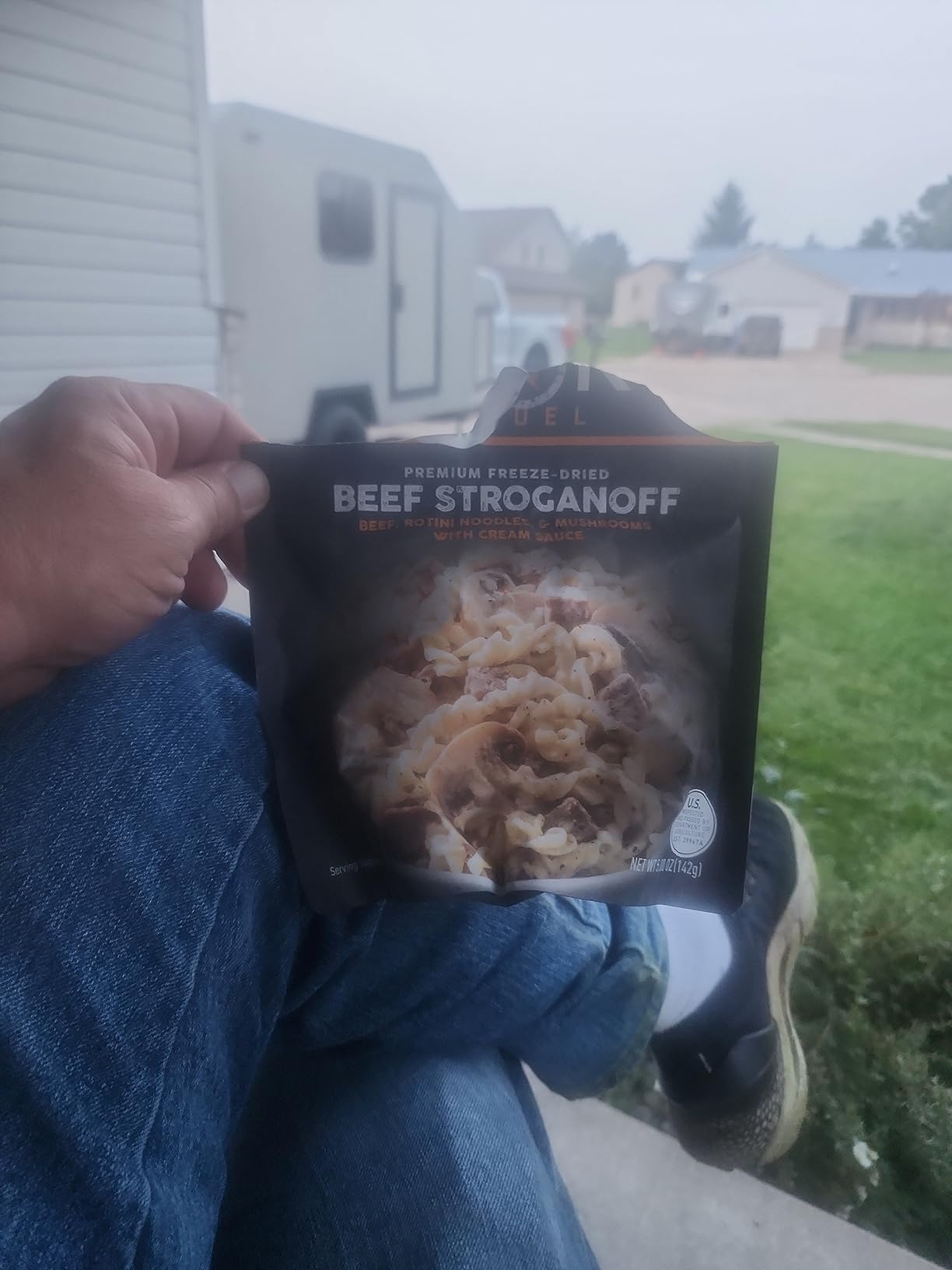
If your family will not accept textured vegetable protein, this is the bucket to look at. Every recipe uses 100% USDA inspected real meat with no TVP and no filler, and the maker states nearly double the protein per serving of most outdoor meals. The 4.5 rating from 189 reviews is held up almost entirely by taste, which is the single most common reason families give up on emergency food.
Reviewers also flag that these meals are less salty than other freeze-dried brands, which matters when you are eating the same pouches for weeks. Ready in 10 minutes or less with less water than typical, and the bucket itself is only 4.12 pounds, so it is a genuinely portable layer for a vehicle or a go-bag.
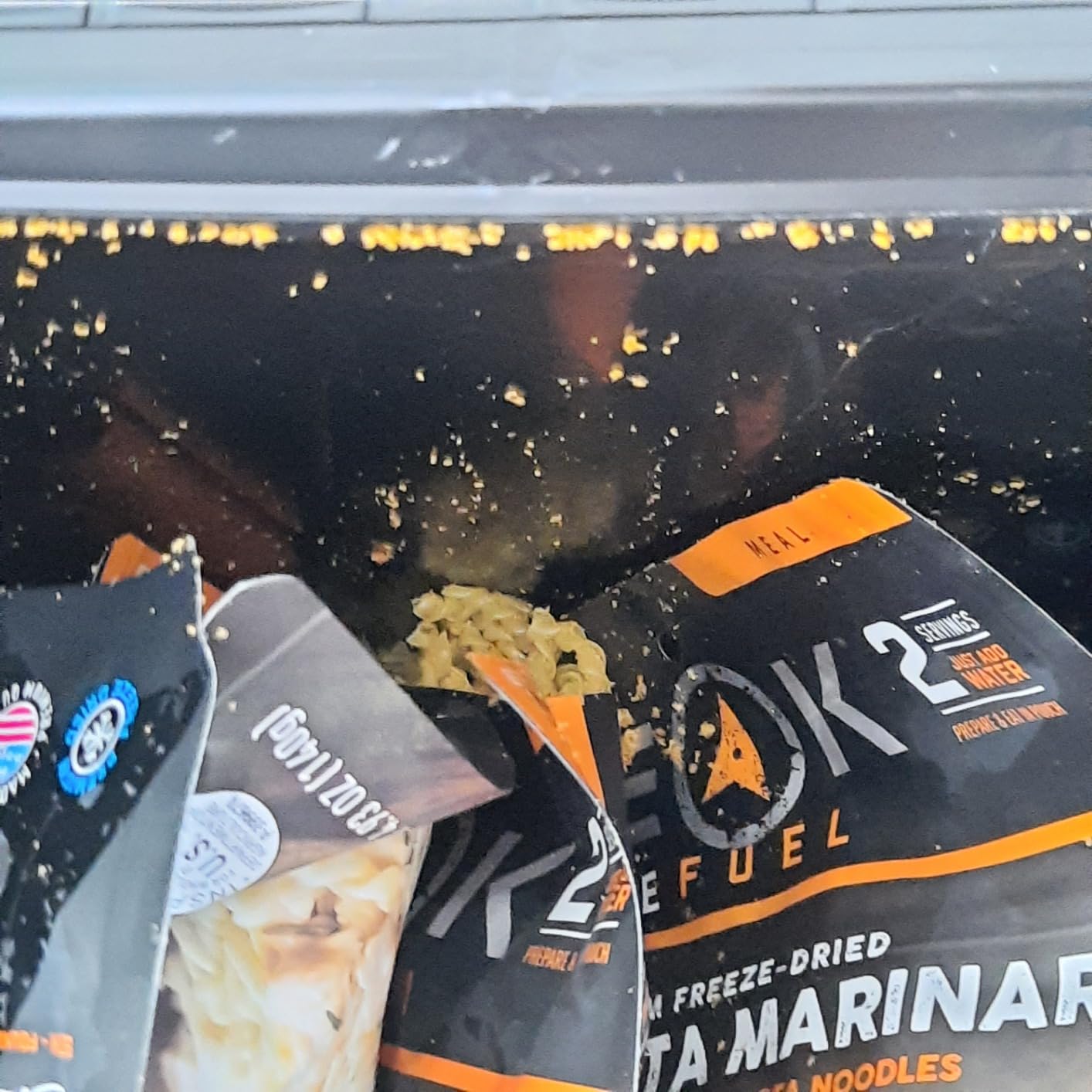
The honest caveat is dairy. Nearly every recipe contains milk or cheese, so a lactose-intolerant family member is excluded from most of the bucket. That is a real dietary limitation, and in a household where an allergy or intolerance rules out a large share of the menu, a TVP-based or dairy-light option is the better buy.
Reviewers also note this line is designed for camping and short-term eating rather than a 25-year stockpile claim. That is not a flaw so much as a positioning difference, and it does make the bucket a strong rotation tool: eat through it on regular camping trips and restock it, and you solve the waste problem that plagues long shelf-life food.
What we like: taste and protein in a light pack
The flavour profile is the reason to buy this one. Across reviews, owners compare the meals to MREs and rate them higher, and several note the portions are filling enough to share between two people on a light day. For a family that has quietly been throwing away freeze-dried mac and cheese, real meat is usually the dealbreaker that ends the fight.
Low weight and fast cook time also make it a straightforward option in the moment, when nobody wants to run a simmer for 20 minutes.
What to watch: dairy in almost every pouch
Check the ingredient list before you commit if anyone in the house avoids milk. The per-serving cost is also higher than mainstream emergency brands, so for a large family covering a full month this is a more expensive route. And because it is pitched as camping food, you will want to pair it with a longer shelf-life staple bucket for a true long term plan.
4. 4Patriots 4-Week Survival Food Kit: Best for Large Households
4Patriots 4-Week Survival Food Kit: Emergency Food Supply Designed to Last 25 Years, 192 Servings
192 servings across 11 recipes
About 36480 total calories
25-year shelf life, triple-layer Mylar
Pros
- 192 servings covers a four week stretch
- 11 distinct recipes for real variety
- Triple-layer Mylar with high-capacity oxygen absorbers
- About 15 minutes from start to finish
- Many size variants for scaling up or down
Cons
- Lowest average rating in the group at 4.3
- Needs boiling water and a cooking heat source
- Some reviewers find the meals bland without spices
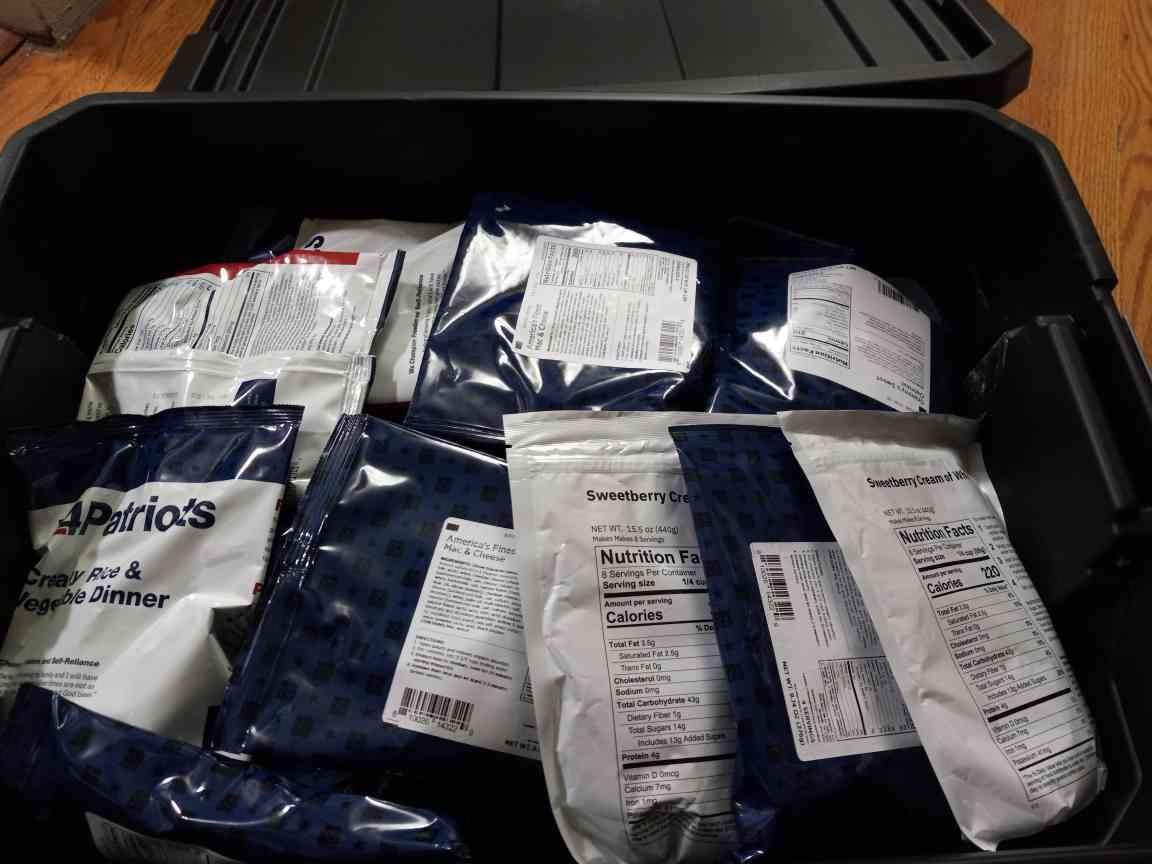
For a family of five or six, this is the kit that covers a full four weeks in one purchase. It states 192 servings, about 7 servings a day, and approximately 36,480 total calories, which works out to roughly 1,302 calories a day for one person. The 4.3 star rating from 1,436 reviews is the lowest average in this group, and 7% of ratings are one star, so we would not call it universally loved.
That said, the volume and the calorie density are exactly what a big household needs, and 11 unique recipes including an oatmeal and a mac and cheese give you more menu range than most kits of this size. Triple-layer Mylar packaging with a high-capacity oxygen absorber is a serious pack for a 25-year claim, and the brand publishes a keep-sealed-below-75F instruction rather than hiding it.

Prep is about 15 minutes with boiling water, simmer and serve. The brand also produces 72-hour, one-week, two-week, three-month, six-month and one-year variants, so a household can start small and scale as the budget allows. Several reviewers note that adding your own spices is what lifts the flavour, which is cheap to do and makes an immediate difference.
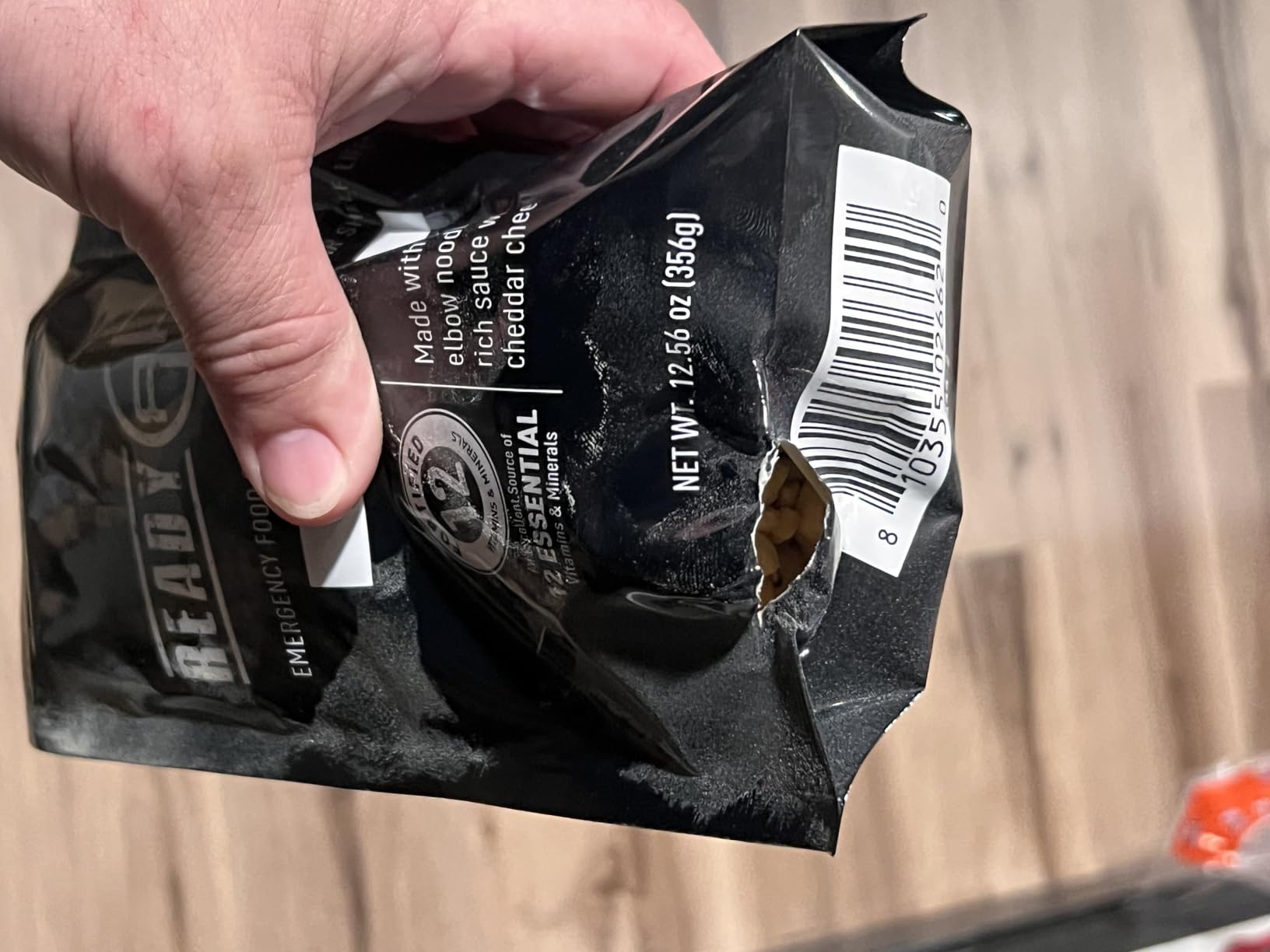
Our most important caveat: at 4.3 with 7% one-star ratings, this is the most polarizing kit we tested. One reviewer reported a hole in a pouch and a partially unsealed lid in their bucket, so inspect every seal on arrival. Bulk packaging means a greater chance that one unit in a large batch is imperfect.
What we like: coverage per purchase
Buying one kit instead of four smaller ones reduces the number of buckets you have to store, label and rotate, which is where most large families fail. The calorie math is the strongest part of the pitch: 36,480 calories across a four-week window means adults are not running a deficit, and a teen in the house will not be hungry by day three.
Variety also holds up better than the review average suggests. With 11 recipes, a family can rotate rather than repeat for a full month.
What to watch: rating spread, seals and seasoning
Inspect pouches on arrival and treat anything with a breach as suspect, since the long shelf-life claim depends entirely on the seal holding. Sodium is another thing to plan for, and pairing meals with unsalted sides or fruit helps. If blandness is a dealbreaker in your house, add a spice kit before the emergency happens rather than after.
5. Legacy Premium 60 Serving Bucket: Best for Allergen-Conscious Households
Legacy Food Storage 60 Serving Emergency Food Supply Bucket, 10 Entrees, 4 Breakfasts, 24,520 Total Calories, Shelf Stable Breakfast Lunch & Dinner, Freeze Dried Survival Meals for MRE Camping, Hiking, Prepping
60 servings with about 24520 calories
10 entrees and 4 breakfast items
Up to 25-year shelf life
Pros
- Detailed allergen labeling on every pouch
- Size options from 60 up to 360 servings
- Non-GMO without MSG or trans fats
- Multi-serving Mylar pouches with oxygen absorbers
- Entrée flavors rated very good to excellent
Cons
- Pouches are not resealable
- Needs boiling water and over 10 minutes of cooking
- Breakfast selection is limited and skews sweet
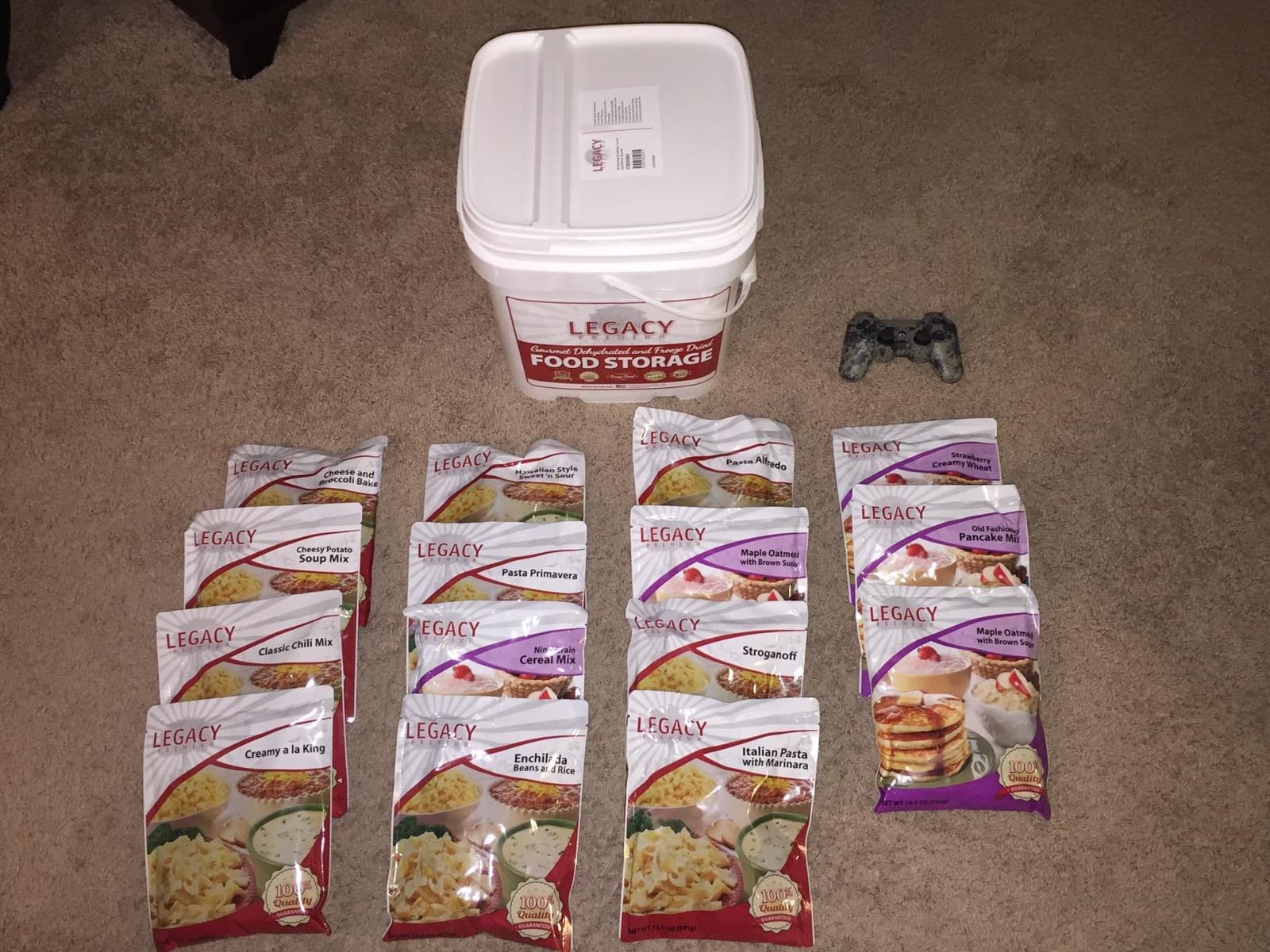
This is the one to buy when someone in the house has a food allergy, because the labelling is the point. Multiple reviewers call out the clear, detailed allergen labelling on every pouch as a deciding factor, and in a real emergency you do not want to be reading ingredient lists by flashlight with a child who reacts to nuts. Non-GMO formulas with no added MSG, no high fructose corn syrup and no trans fats round out a clean label.
On the numbers, 60 servings with approximately 24,520 total calories is a solid calorie density for a bucket this size, and the 10 entrees plus 4 breakfast items give you coverage across the whole day rather than entrees only. Multiple size variants from 60 to 360 servings let a household scale in steps, and the 25-year claim is stated as up to 25 years under recommended storage conditions.
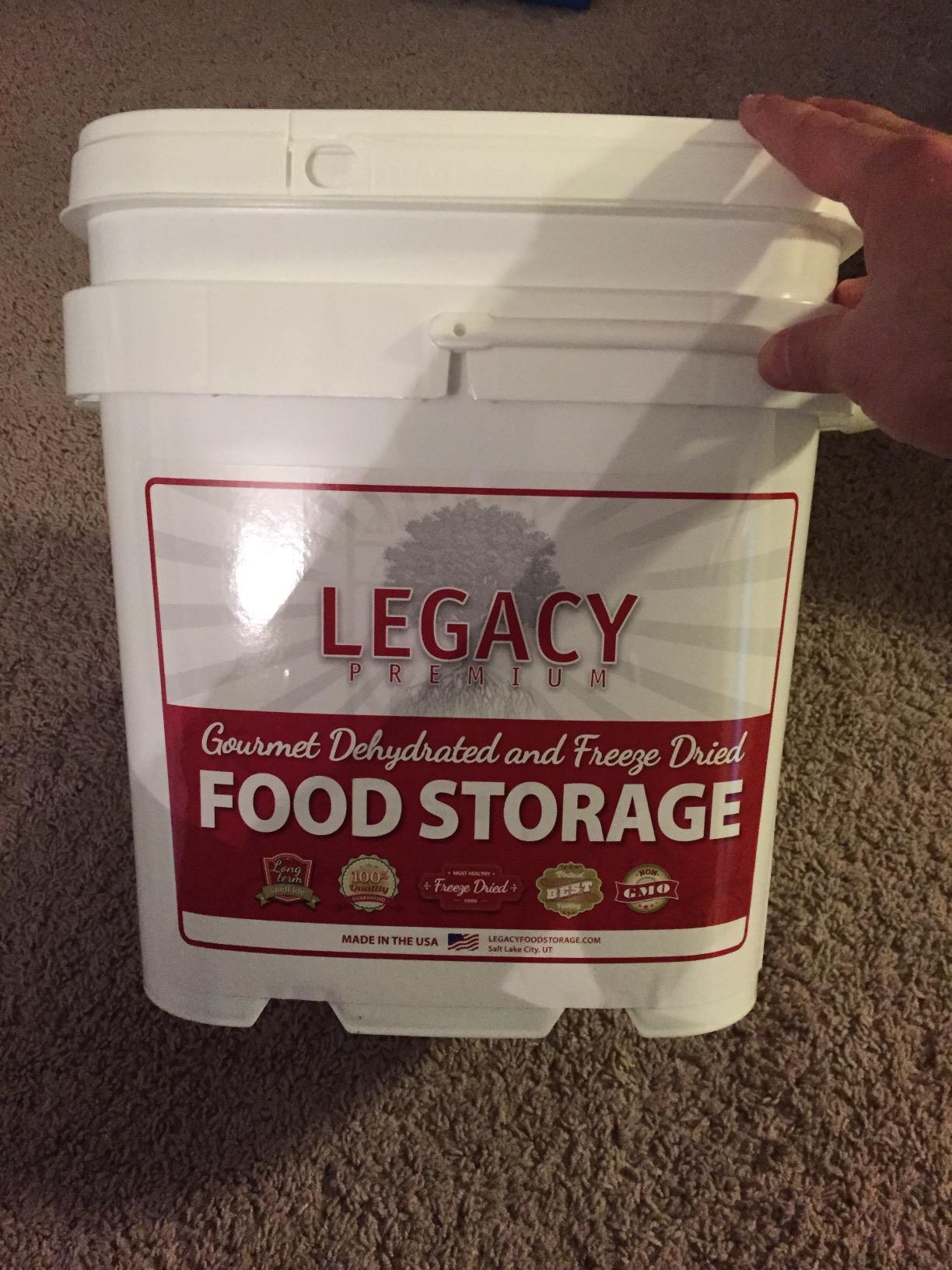
The bucket is 17.35 pounds and 15.25 by 14.3 by 13.3 inches, so it is substantial but not absurd to move with two people. Entrée flavours are rated consistently well by long-term buyers, which is a good sign for a product meant to sit unopened for a decade and then get eaten under pressure.
Prep requires boiling water and more than 10 minutes of cooking, not just a hot water pour, so this is not a no-heat option. The pouches are not resealable, so once opened the contents need to be used rather than set aside.
What we like: knowing exactly what is in it
For an allergy household, the label is worth more than variety. A single clean, readable allergen panel per pouch removes a decision you would otherwise have to make under stress. For families with a child on a restricted diet, that alone justifies the choice over a cheaper bucket with vaguer labelling.
The 60-to-360 serving range is also genuinely useful, because most households start with one bucket and add another later rather than committing to a year of food on day one.
What to watch: no reseal, sweet breakfasts, fiddly portions
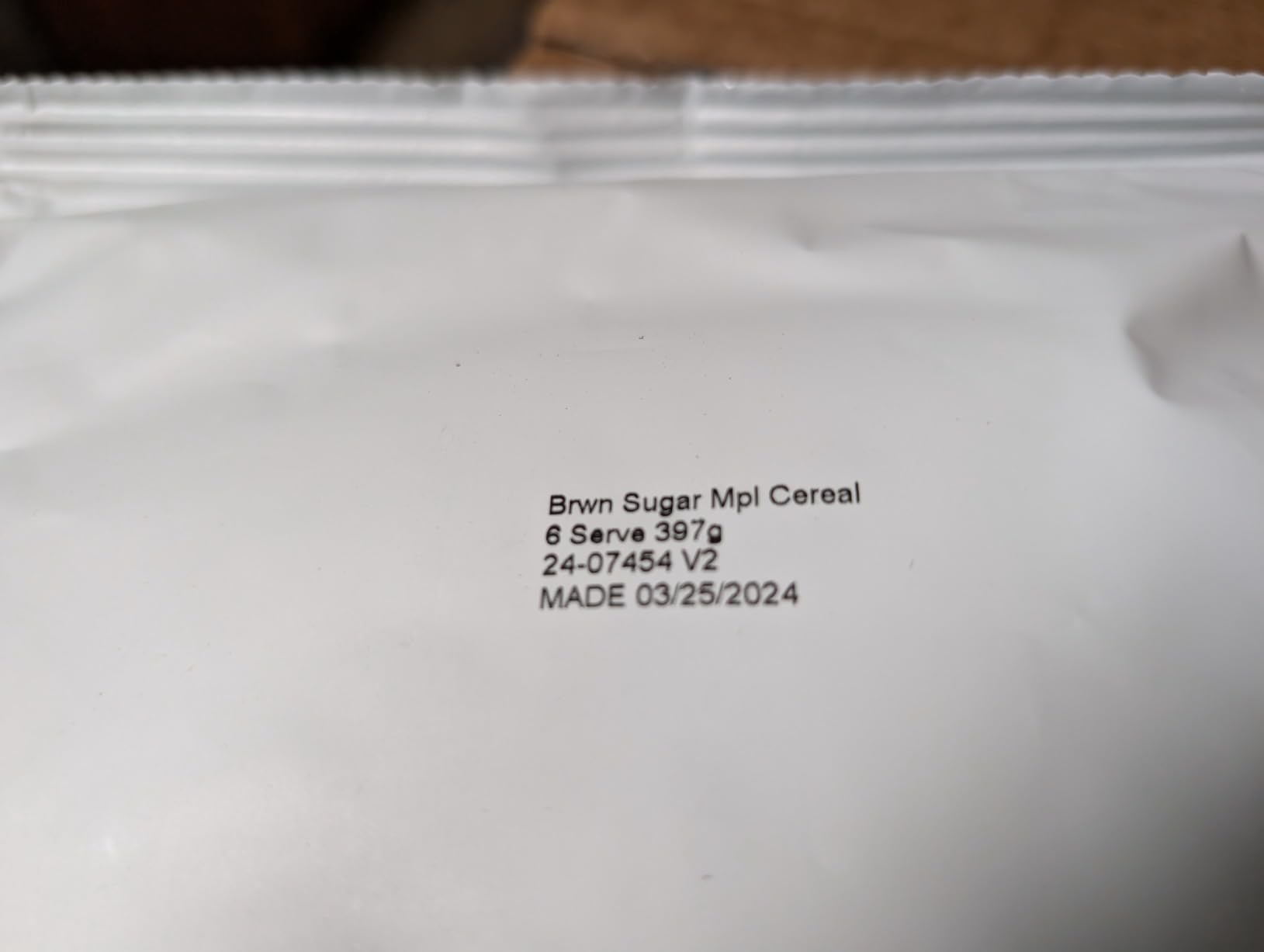
Not resealable means each pouch is a commitment. A 4-serving pouch that yields 8 cups has to be measured out and eaten within a sitting, which is awkward when one person wants half. Reviewers also call the breakfast selection limited and sweet, with one noting the oatmeal reads as more sugar than oats, so a picky eater may skip breakfast entirely on this kit.
6. Ready Hour Beans Trio with Rice Kit: Best for Longest Shelf Life
Ready Hour Beans Trio with Rice Kit Bucket (100 Servings) Survival Beans and Rice, Survival Food Storage, Emergency Preparedness Food, Prepper, Easy Prep, 30-Year Shelf Life
100 servings of rice and beans
30-year shelf life
Quadruple-wrapped resealable pouches
Pros
- 30-year shelf life
- the longest claim in the group
- Beans and rice pair with almost anything
- Quadruple-wrapped resealable pouches
- Water-resistant bucket with collapsible handle
- Reviewers praise the packaging and portions
Cons
- Single-ingredient staples rather than complete entrees
- Up to 30 minutes of cooking
- Not a standalone supply on its own
Most emergency kits advertise 25 years. This one states 30 years in storage, and the mechanism is simple: rice and beans are whole foods with almost nothing to spoil. Five varieties across 100 servings, covering long grain white rice, Southwest rice, black beans, red beans and pinto beans, packed in quadruple-wrapped resealable pouches inside a water-resistant bucket.
That packaging detail matters. Resealable pouches mean you can open a single serving of beans for one hungry teenager at 2am without committing to a full pouch, and the quadruple wrap is a genuinely serious barrier for a food you might be opening a decade from now. The collapsible handle is a small touch that makes the bucket easier to grab in a hurry.
The trade-off is that this is a foundation, not a complete diet. Beans and rice have almost no vitamins, and while they pair well with whatever else you have stored, on their own they will not carry a family for a month. Think of this as the shelf-life anchor of a reserve, with a proper meal kit on top of it.
Cook time is the trade-off here: boil water, pour, cook, and you are looking at up to 30 minutes, the longest in this roundup. In a cold house with no power that is a hard sell, and in a planned shelter-in-place scenario it is entirely reasonable.
What we like: shelf life and resealable packaging
Prep communities consistently point to rice and beans as the highest-value things to keep, and this bucket makes that case without the marketing gloss. If you want something that could plausibly outlast you and still be edible by whoever inherits it, this is the pick.
The resealable, quadruple-wrapped pouches solve the waste problem that makes people nervous about buying decades of food, and several reviews describe the packaging quality in specifically positive terms.
What to watch: it is not a meal plan
Do the maths on nutrition, not just on years. Rice and beans are carbohydrate and protein with minimal micronutrient variety, so a family eating only this will get bored within a week even if the shelf life is outstanding. Cook time of up to 30 minutes is the longest here, and the collapsible handle is not a substitute for carrying 12.85 pounds up a staircase on your own.
7. ReadyWise 894 Serving Six-Bucket Set: The Premium Pick
READYWISE Emergency Food Supply Freeze Dried Buckets 894 Servings
6 buckets totaling 894 servings
Up to 25-year shelf life
Lids double as a tray or table
Pros
- Largest review base of any kit reviewed here
- 894 servings is the most complete coverage
- Stackable buckets with carry handles
- Breakfasts entrees and drink choices reduce menu fatigue
- 4 breakfasts 5 entrees and 2 drink options
Cons
- About 6 servings per pouch makes partial portions awkward
- Taste is comparable to standard shelf-stable groceries
- Buckets are heavy to move individually
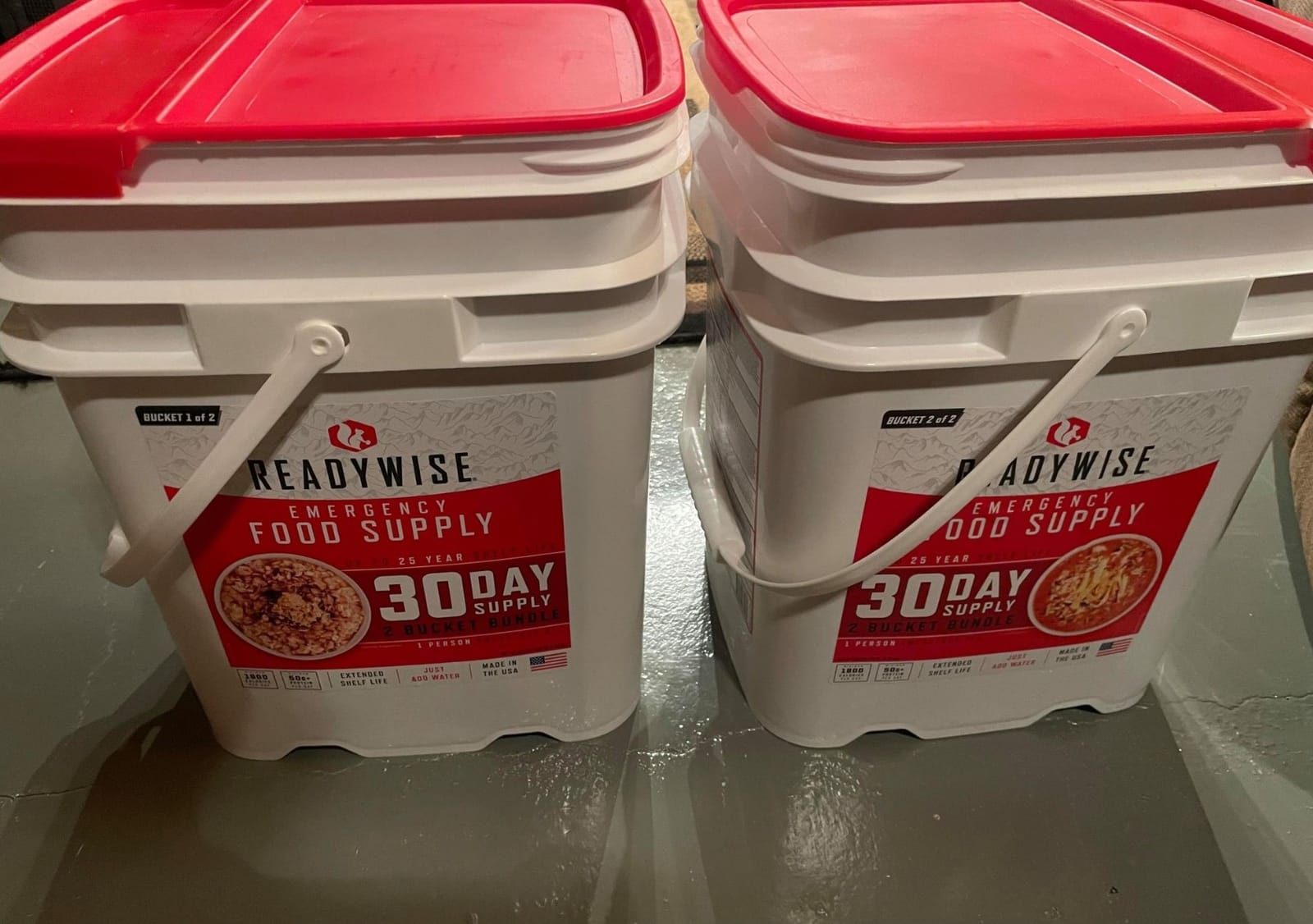
With 5,605 ratings, this is the most reviewed product in the roundup by a wide margin, and the rating holds at 4.5. Six buckets totalling 894 servings is the most complete coverage we looked at, and it is one of only two sets here that carries drink options alongside breakfasts and entrees, including a whey milk alternative that covers the drink gap most kits leave open.
The packaging design is the sleeper feature. Buckets are stackable, each has a carry handle, and the split lid doubles as a serving tray or a small table, which turns a storage container into part of the meal setup. Just add water, no advanced equipment, and the listing carries variants from 72 hours all the way to 12 months if you want to start smaller.
What families like most is the scale. Reviewers describe buying additional sets to give to relatives, which tells you something about how the product lands emotionally: this is insurance you can hand to your parents, not a bucket you hide in the closet. The 25-year shelf life claim covers the full range, and just-add-water prep is the simplest version of that promise.
The most substantive complaint is portion granularity. Each pouch holds roughly six servings and must be cooked whole, so feeding a one-person household or a toddler-led dinner means cooking far more than you will eat in one sitting. Some reviewers also find the serving-count framing in the listing misleading, which is worth remembering when you compare it to the calorie totals we publish above.
What we like: complete coverage and stacking design
If your goal is a reserve that covers a year for a family of four without piecing it together, this is the simplest way to get there. The split lids turning into trays is a small design decision that pays off every single meal, and the drink options remove a gap most households discover too late.
Variety also beats most single buckets: four breakfasts, five entrees and two drinks in a six-bucket set is enough rotation that nobody is eating the same noodles on day nine.
What to watch: cost, weight and six-serving pouches
This is the biggest single build-out in the roundup by number of buckets, and each one is heavy enough that moving one alone is a two-person job in a stairwell. The six-serving pouch size is the practical limiter: in a household with a small child or a single eater, you will cook more than you need each time. Work out your true person-days before committing, and consider starting with a smaller variant if the maths is tight.
8. 4Patriots 128 Serving Entree Kit: Best for Small-Space Storage
4Patriots Emergency Entree Food Kit – 128 Servings, Tasty Freeze-Dried MRE Survival Meals, 25 Year Shelf Life
128 servings with 31600 total calories
25-year shelf life
Ready in about 15 minutes
Pros
- 31600 calories across 128 servings
- Taste good enough to eat as a normal meal
- Small enough to store under a bed or on a rack
- Sturdy tote holds pouches for long-term rotation
- Hand-packed in the USA with batch quality control
Cons
- High sodium across the meals
- Several recipes need added spices
- Some instructions call for oven or casserole finishing
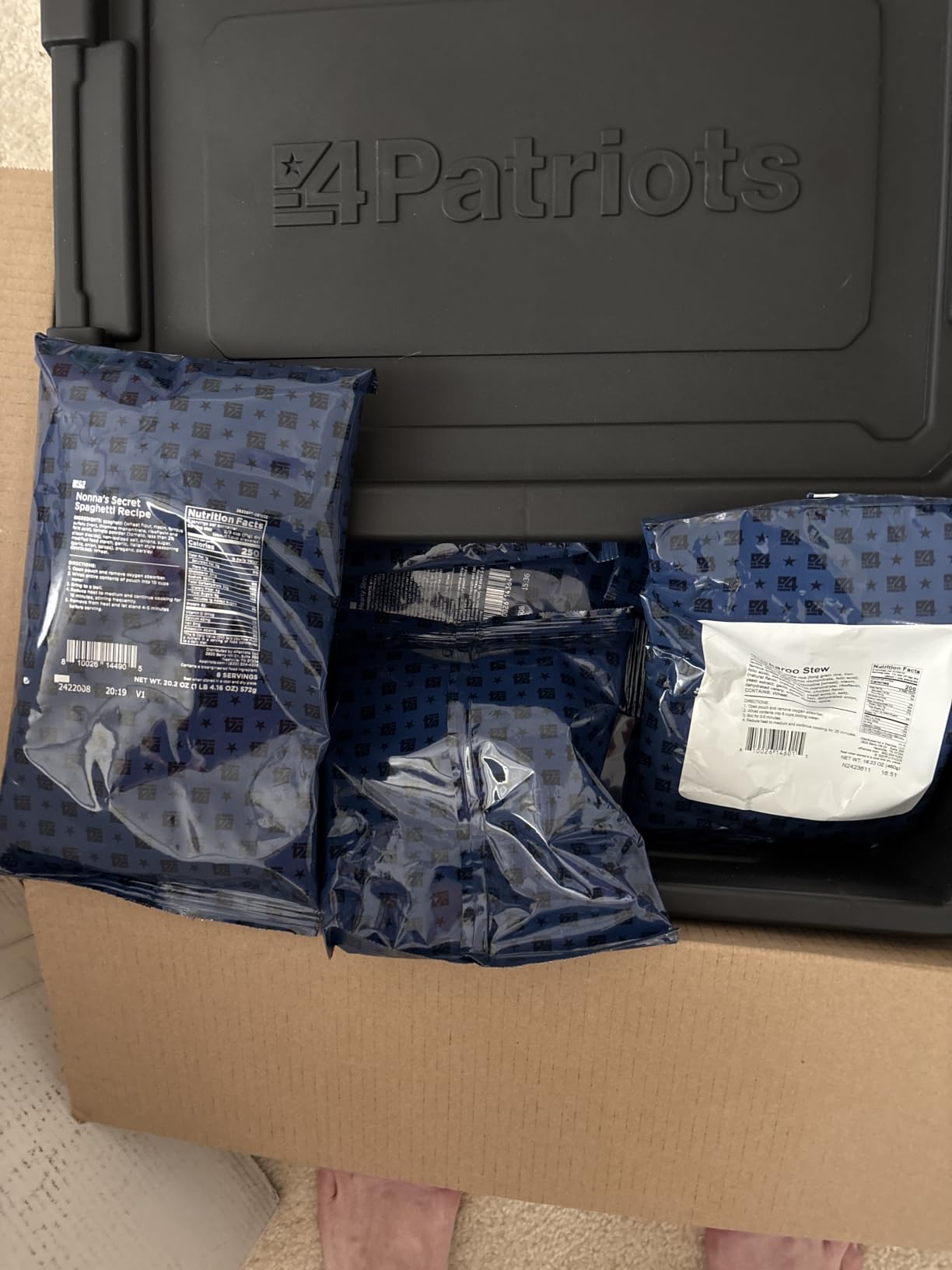
This is the apartment and small-house answer. At 20.5 by 14.75 by 8.38 inches, reviewers specifically note that the container fits under a bed or on a pantry rack, which rules out most of the taller 8.5 gallon pails people end up with nowhere to put. You get 128 servings and 31,600 total calories, which is genuinely dense coverage per unit of shelf space.
At 4.5 stars from 132 reviews, with 77% five-star ratings, the consistent theme is that the food tastes good enough to be a normal meal, with one reviewer comparing it favourably to military C-rations. Recipes like Nonna’s Secret Recipe Spaghetti, Cheesy Chili Mac and Hearty Stroganoff are the kind of names that get eaten rather than hoarded. Hand-packed in the USA with batch-level quality control is a reasonable thing to see on a product you may keep for decades.
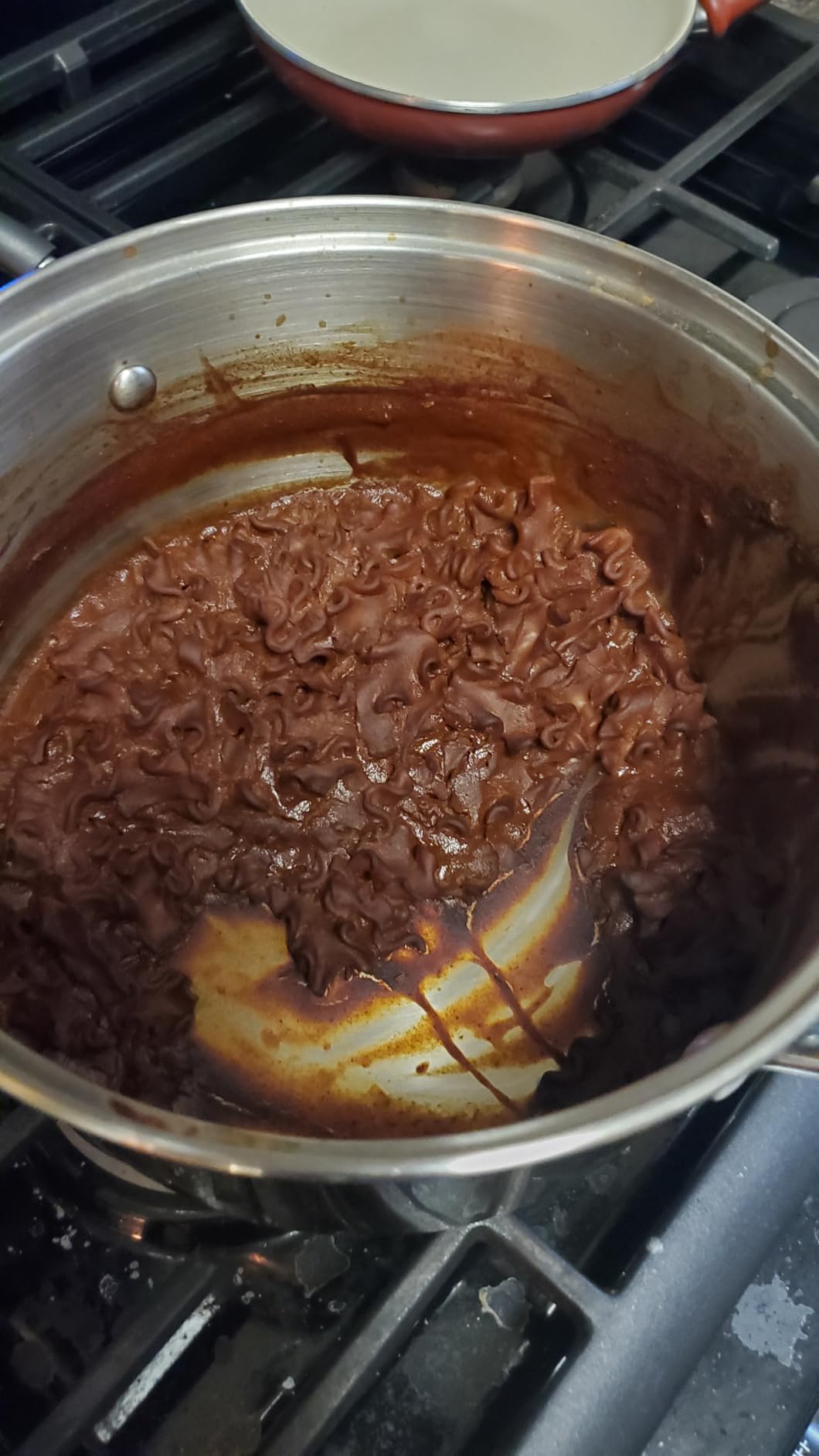
The honest weakness is sodium, and reviewers are candid about it, pairing meals with fruit or no-salt vegetables to balance them. That is not a reason to skip the kit if nobody in the house has a blood-pressure condition, but in a household with a hypertensive adult you would want a different balance. Several recipes also benefit from added spices, and a few instructions reference oven or casserole finishing steps that are impractical when the power is out.
Triple-layer Mylar pouches with a high-capacity oxygen absorber back the 25-year claim, and prep is about 15 minutes with boiling water. One reviewer did receive a bucket with a damaged pack, so inspect on arrival.
What we like: calorie density in a small footprint
31,600 calories in a package that slides under a bed is a strong ratio for anyone without a garage or a basement shelf. It also means fewer buckets to label, rotate and audit, and fewer seams that can fail. The tote is sturdy enough for a long-term rotation cycle, which is what you want if you plan to eat through it rather than store it forever.
Taste that passes muster as an ordinary meal is quietly the most valuable thing about this kit, because it is what stops a family from abandoning their reserve.
What to watch: sodium and finish-off instructions
Read the sodium per serving and plan unsalted sides and fruit to offset it, particularly if anyone in the household is monitoring blood pressure. Check for recipes that finish in an oven or casserole dish, because those need heat you may not have. And do not skip the arrival inspection: a damaged pack in a large batch is worth catching early.
9. Augason Farms 45 Day Emergency Food Supply Kit: Best for Meal Variety
Augason Farms 45 Day Emergency Food Supply Kit
281 servings sized for 45 days
About 1218 calories and 35 g protein
14 meal varieties
Pros
- 14 meal varieties
- the broadest menu in the group
- About 1218 calories and 35 grams of protein a day
- Reviewers say kids enjoy these meals
- 8.5 gallon pail is compact for the volume
- Customer service resolved a damaged-order issue
Cons
- Nearly 38 pounds
- so the pail is awkward to move
- Lid seal is very tight to open
- Label ink can rub off after handling
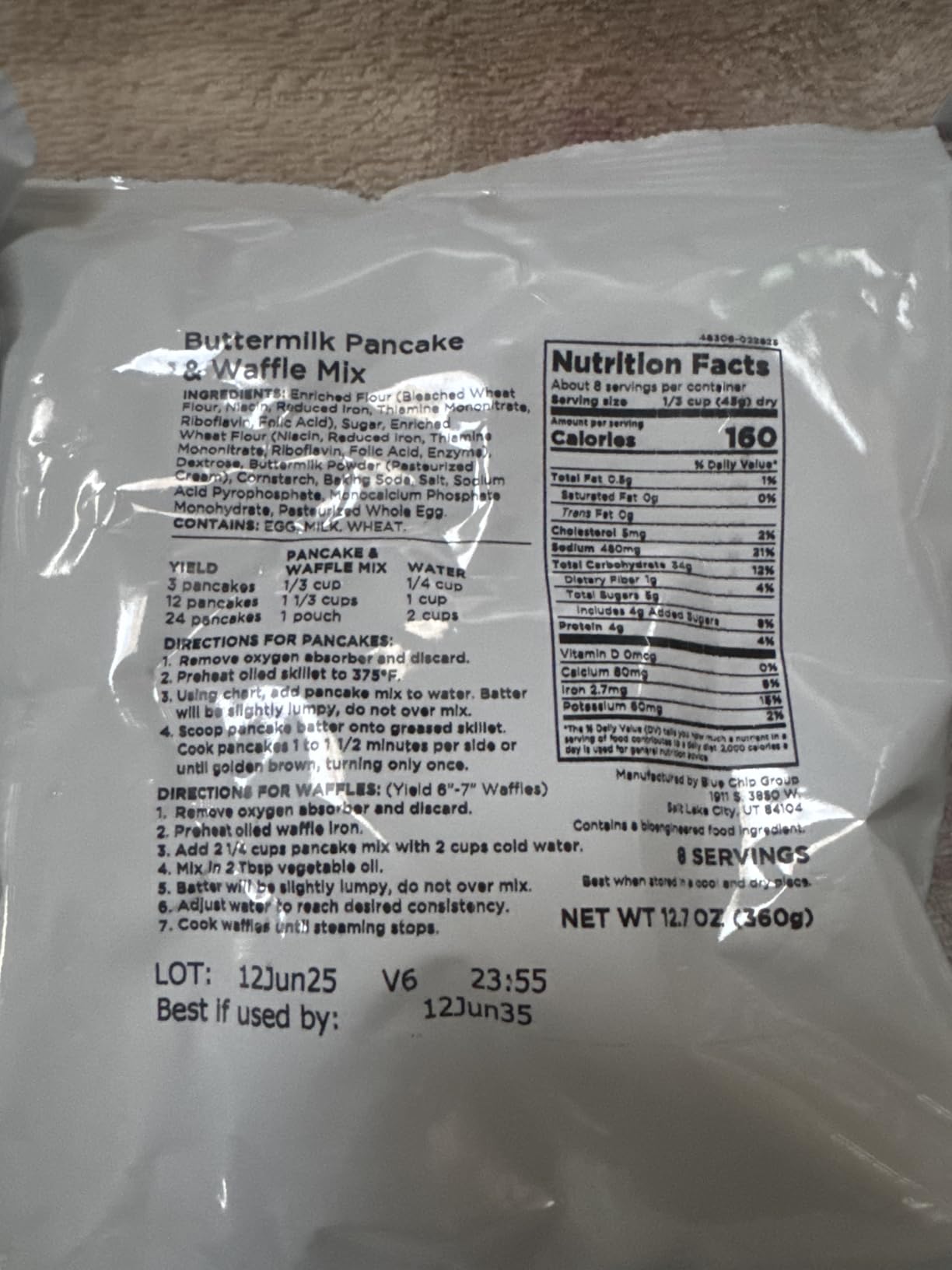
Two numbers make this the most nutritionally complete single kit we reviewed: it is sized to sustain one adult for 45 days across 281 servings, and it states roughly 1,218 calories and 35 grams of protein per day. Fourteen meal varieties is the broadest menu we found, and it includes pancakes and waffles, oatmeal, soups, mac and cheese, fettuccine alfredo, lasagna marinara, chocolate pudding and a whey milk drink.
At 4.6 stars from 79 reviews with 80% five-star ratings, the recurring feedback is about family appeal, including reports that children like the meals. That is not a small detail in a household that has to actually eat this. The 8.5 gallon pail is durable and compact for the volume it holds, and one detailed review praises Augason Farms’ customer service after a damaged shipment, which is a decent signal for a long-horizon purchase.
Just add water and heat on a stove, so plan your fuel. The menu breadth is the reason to choose it, and the 25-year shelf life means you can buy it once and stop thinking about it. If your household is sensitive to repetition, this is the one we would pick, because fourteen dishes make a two-month plan genuinely survivable on the psych level as well as the calorie level.
The physical complaints are the trade-off. At nearly 38 pounds, the pail is genuinely awkward to lift, so decide where it will live before the box arrives. The lid seal is very tight and takes effort each time you open it, and label ink can rub off after handling, which makes a printed inventory list a good idea.
What we like: variety plus a full daily nutrition panel
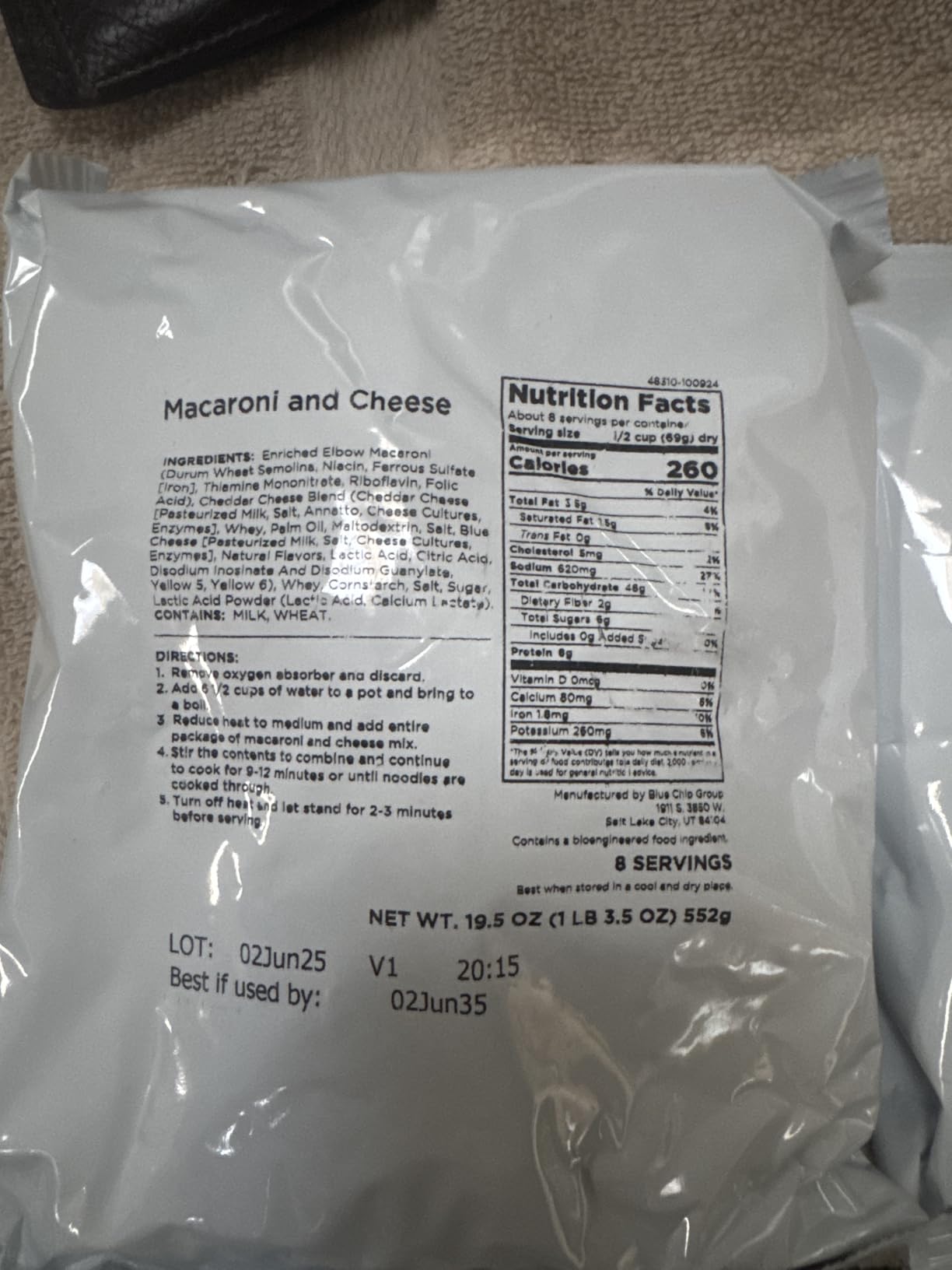
Menu fatigue is the most common reason emergency food goes unused, and fourteen varieties is the direct answer to it. For a family with two kids, that breadth does more for real-world resilience than an extra 20% on the calorie count, because the food actually gets finished. The 1,218 calories and 35 grams of protein per day also means an adult is not losing weight over a multi-week event.
Including a whey milk drink and chocolate pudding matters more than it looks, because small comforts are what keep a household’s morale intact during a long disruption.
What to watch: weight, lid and labels
Nearly 38 pounds is the heaviest kit in this roundup, so treat the pail as a permanent fixture rather than something you can grab in a hurry. Write your own inventory list instead of relying on the printed labels, which reviewers report rubbing off after handling. One reviewer also received an unsealed tub with three torn internal packages, so inspect the seal and the inner packs before the tub goes into storage.
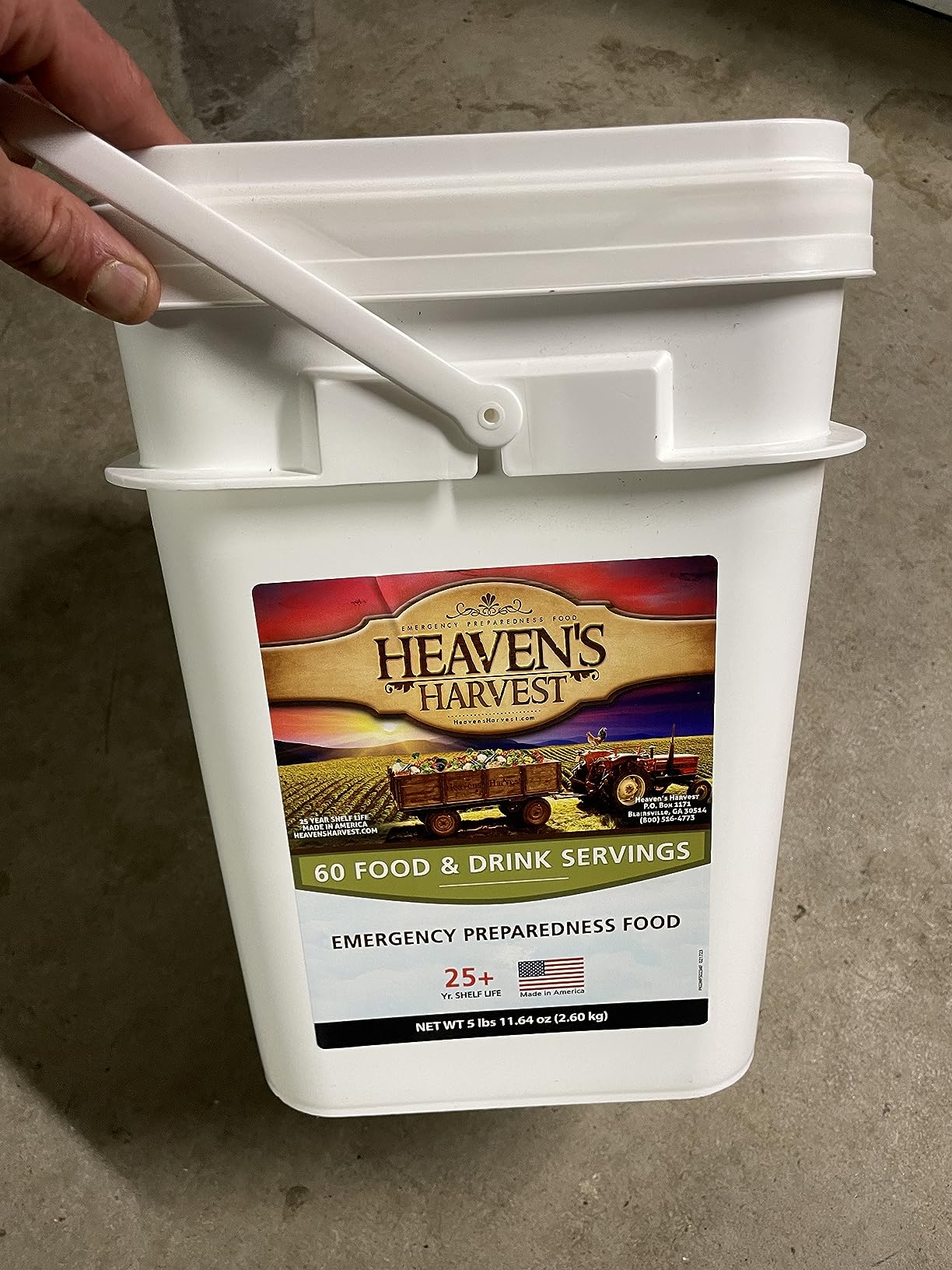
10. Heaven’s Harvest 25-Year Family Kit: Best for No-Power Preparation
Heaven’s Harvest 25-Year Family Food Kit — Emergency Food Supply. Freeze Dried Survival Food Kit + Water-Proof 25-Year Storage Bucket. MRE Meals/Non-Perishable & Perfect Camping Food (60 Servings)
60 servings with about 8280 calories
Eaten without heat after rehydration
5 pound stackable bucket
Pros
- 5 pound bucket that moves easily
- Can be eaten without any heat
- Water-proof Mylar foil packets
- Stackable and portable for closets or vehicles
- Sourced from US farms
Cons
- 60 servings covers days rather than weeks
- About 8280 total calories is a small base
- Fewer meal varieties than the 4Patriots and Augason kits
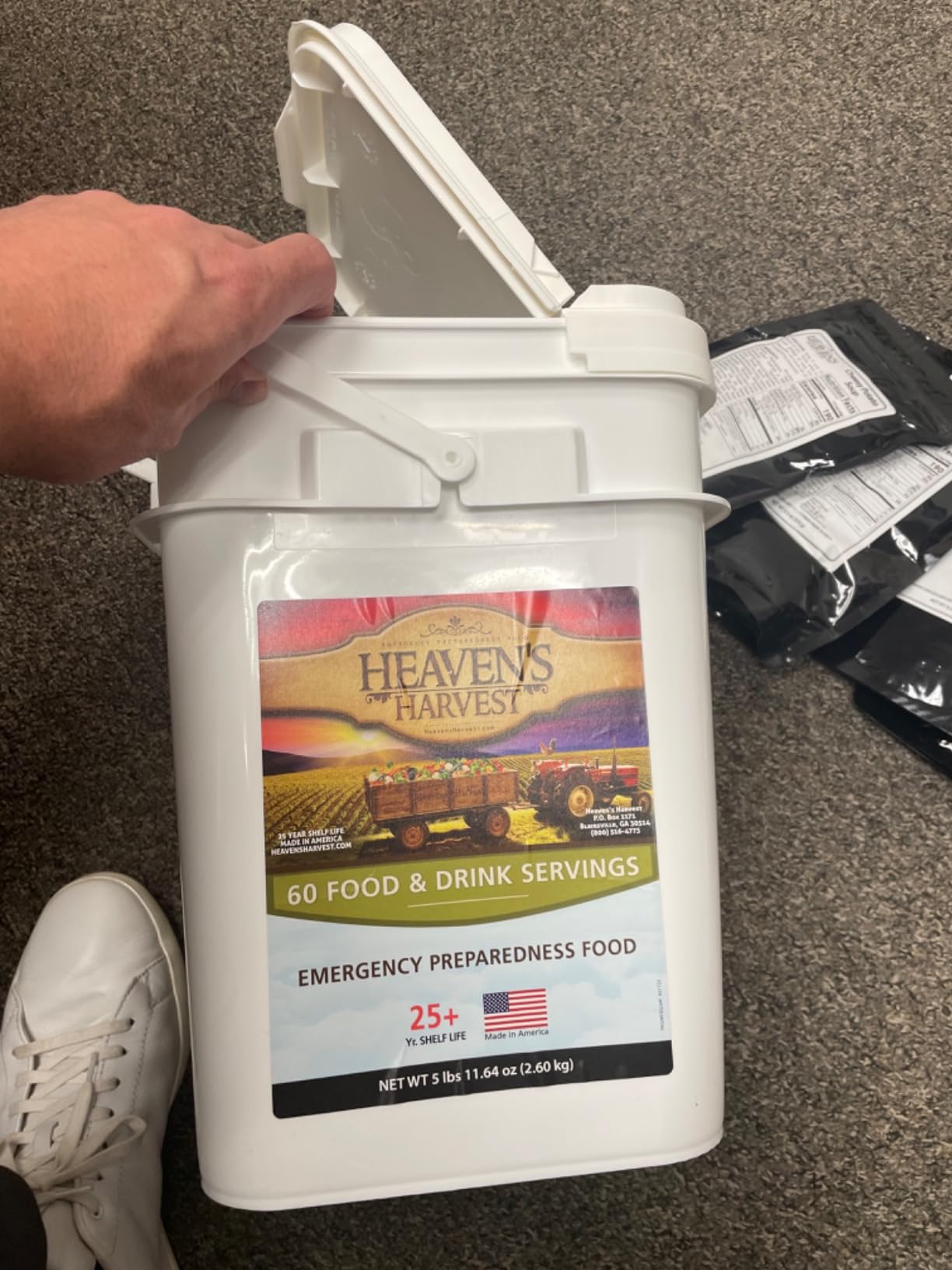
Almost every kit in this roundup needs boiling water and a heat source. This one does not. Meals are rehydrated with water and can be eaten without heat, which in a real extended outage is the single most important property a food reserve can have. If your power is out and you have nothing to cook on, this is the bucket that still works.
At 5 pounds, it is also among the easiest to move, which makes it a good vehicle kit, a go-bag layer or a renter’s shelf solution. Six varieties of food and drinks total about 8,280 calories across 60 servings, the Mylar foil packets are sealed against water damage, and the bucket is stackable and portable. Variants run from 60 food and drink mix servings up to a 308 serving combo, so you can size up later.
The 4.5 rating from 79 reviews, with 78% five-star ratings, is held up by compactness and the no-heat prep. Chemical-free freeze drying is stated to lock in nutrition, and the food is sourced from US farms and companies. If you are building a two-layer plan, this is a strong top layer to sit on top of a longer shelf-life staple bucket.
Be honest about the scale, though. Sixty servings and roughly 8,280 calories is a short-duration supply, closer to days than weeks, so on its own it will not carry a family through a serious disruption. It works as a starter kit or as a supplement, and it is the easiest one to actually finish rather than leave sitting.
What we like: no-heat prep and a light carry weight
Being able to eat without a stove changes what a reserve is for. Cold water and a tin cup is all you need, which is realistic in the first days after a disaster when fuel and fire are the hard problems to solve. Weight matters here too: 5 pounds is light enough for a teenager to carry, which is exactly the profile you want in a bug-out bag or a car.
Variants up to 308 servings mean the same brand can grow with your household, so this is a reasonable place to start if you are not ready to commit to a large purchase.
What to watch: it is days, not weeks
Sixty servings will not stretch. Treat it as the first week of coverage, a vehicle layer, or a starter that you will actually eat through rather than store indefinitely. Fewer meal varieties than the 4Patriots and Augason Farms kits also means accepting some repetition sooner, so pair it with something more varied if this is your only reserve.
How to Size a Long Term Food Kit for Your Family
Start with person-days, not servings. Multiply the number of people in your household by the number of days you want covered, then multiply that by 2,000 to 2,400 calories to get your real calorie requirement. A family of four covering one month at 2,200 calories a day each needs roughly 264,000 calories, which is far more than most kits claim for that period.
Children and teenagers skew the calculation in ways people miss. A school-age child typically needs 1,600 to 2,000 calories a day depending on activity, a teenager can need as much as an adult or more, and adults doing physical work need more than a sedentary baseline. Size for the biggest eater in the house, not the average, because a hungry teenager is the person who will eat three days of supplies on day one.
Then check the label against your own maths. Divide total calories by the number of days claimed, and that is the real daily figure. If it lands around 1,200, you are looking at a light-activity snack-plus-meal plan, not full coverage. If a kit advertises 120 servings for 30 days, that is four servings a day, which is generous rather than lean.
If you want a worked example, take the Augason Farms 45 Day kit: 281 servings and about 1,218 calories per person per day, sized by the manufacturer for one adult. For a family of four you would be looking at roughly 1,260 servings for the same 45 days, which means four and a half of those pails, or fewer pails with additional staples layered in.
There is a cheaper DIY route that prep forums consistently recommend, and it is worth modelling before you spend. Large cans of vegetables, meats and soup plus bulk dry rice from a warehouse store can cover the same calorie count for a fraction of branded-kit cost, at the price of more weight, more storage volume and no resealable convenience. The ten core foods most commonly recommended are canned tuna, canned chicken, canned beans, canned vegetables, canned soup, peanut butter, rice, pasta, powdered drink mix and salted crackers, all of which keep for years when sealed properly.
Freeze-Dried vs Dehydrated vs Canned vs MRE
Freeze-drying sublimates almost all the water out of food, which is why the Ready Hour and ReadyWise buckets can claim 25 years and why rehydrated meals often taste fresher than home-storage food. It costs more and takes longer to process, so it sits at the top of the price range. Dehydration removes less moisture and is cheaper, which is why the Augason Farms variety kit lands well below the freeze-dried kits while still carrying a 25-year claim.
Canned food is heavy, needs a can opener, and needs heat, but it is cheap per calorie and needs no rehydration maths. MREs are ready to eat or heat in the pouch with a flameless ration heater, which makes them excellent for evacuation scenarios and poor value for a year-long family reserve. For a family sitting in place for weeks, freeze-dried or dehydrated pouches in a bucket are the better trade.
Space follows the same logic. Freeze-dried and dehydrated pouches are light and stackable, which is why they suit apartments and rental flats. Cans are heavy and need shelf space, and bulk rice bags need dry, pest-proof containers. Whatever you choose, plan roughly one to two cubic feet per person per month for a full-year reserve as a working estimate.
Where to Store Emergency Food Buckets So the Shelf Life Claim Holds
Temperature is the variable that quietly voids a 25-year claim. The 25 and 30-year figures assume a cool, dry environment, and 4Patriots goes further and states to keep the pouches sealed and below 75F. Store a bucket in a garage through a summer and you are no longer holding a 25-year reserve; you are holding something closer to a five to ten year one, because heat drives the chemical reactions that break down fats and degrade nutrients.
Light and moisture are the other two. Direct sunlight works on Mylar and Mylar-printed pouches over time, and a damp basement is worse than a warm one. A shelf in a climate-controlled interior space beats a garage every time, and if a garage is your only option, keep the buckets off the concrete floor, out of any visible gap where a rodent could reach them, and away from a water heater or a west-facing wall.
Rotation is what stops the waste that makes people nervous about buying decades of food. Label every bucket with the purchase month and use a first-in, first-out system, so a five-year-old stack gets opened before a thirty-year-old one. Eating the shorter-dated food on regular camping trips is the strategy prep communities use most, and it is why taste matters commercially as well as practically. Use good mylar bags and oxygen absorbers if you build your own pouches rather than relying on factory-sealed ones.
Buckets are worth choosing carefully too, since they are the part of the system that has to survive a flood. Our picks on food grade buckets for bulk storage cover the stackability and gasketing details that matter, and for repacked dry goods you can see how resealable glass container sets compare for everyday staples. Whatever holds the food, put a printed inventory list on the outside of every bucket, because the factory labels rub off.
What Long Term Food Storage Kits Do Not Include
No kit in this roundup includes water, and that is the most common misunderstanding in the category. Freeze-dried food rehydrates with roughly a cup of hot water per serving, so a family of four eating three meals a day needs about 12 cups of potable water daily on top of drinking water. Plan on a water filter or stored water alongside any food kit.
You also need a heat source, a manual can opener for any canned additions, matches or a lighter, a flashlight with spare batteries, first aid supplies, a multivitamin, and electrolyte and fibre supplements for anyone eating this for more than a few days. Freeze-dried diets are low in fibre and some micronutrients, and that is a real issue over a long disruption rather than a theoretical one.
Pet food and infant formula are the two most commonly forgotten items. Dried pet food and shelf-stable formula both need to be part of the reserve from day one, because neither can be improvised in a week. If your household includes either, size the food kit for people only and treat the pet and infant supplies as a separate line item with their own storage requirements.
Frequently Asked Questions
What are the best survival food kits for families?
The strongest family picks balance shelf life, water-only prep and honest calories per person per day. The Ready Hour 120 Serving bucket leads on resealable pouches and a 25-year claim, the Augason Farms variety kit offers the best value with 13 meals, and the ReadyWise six-bucket set gives the most complete coverage at 894 servings. Choose by household size, coverage length and dietary needs rather than by brand.
How long do emergency food kits last?
Sealed emergency food kits are commonly claimed at 5, 10, 25 or 30 years, and the top freeze-dried buckets in this roundup carry 25-year claims while one Ready Hour staple kit claims 30 years. Those figures assume a cool, dry interior space below roughly 75F. A hot garage can cut a 25-year claim to five or ten years in practice.
What is a good food storage plan for one year?
Build it in layers. Start with a 72-hour grab-and-go kit everyone can reach, add a 4-week meal bucket for the household, layer in shelf-stable staples such as rice and beans, then bulk buy canned goods and dry staples with a one-year pull-by date. Store it FIFO, rotate short-dated items into regular meals, and check every seal and printed date twice a year.
What should I include in my family emergency kit?
Beyond the food itself, every family needs stored water plus a filter, a stove and fuel, a manual can opener, matches or a lighter, a flashlight with spare batteries, a first aid kit, a multivitamin, and electrolyte and fibre supplements. Households with pets or infants also need dried pet food and shelf-stable formula, which no survival food kit includes.
What three foods never expire?
Properly canned commercially sealed food, honey, and salt are the three most commonly cited foods that effectively do not expire, provided the cans stay sealed and undented and the honey never absorbs moisture. White rice, dried beans and powdered drink mixes also keep for a decade or more when stored airtight and pest-proof, though manufacturers still print best-by dates on them.
Can you eat freeze-dried food every day for a month?
Yes, it is safe to eat daily, and the nutrition panels on these kits are built around roughly 1,200 to 1,300 calories and 35 grams of protein per person per day. The practical issues are fibre, micronutrient variety and sodium rather than safety. Add a multivitamin, unsalted sides and extra water, and pair meals with fruit or vegetables to round out the diet.
Should families be building a food reserve this year?
Most households hold about three days of food, which is not enough to ride out a supermarket outage or a supply chain disruption. A reserve is inexpensive relative to the disruption it covers, and the strongest argument for it is that freeze-dried food is genuinely good enough to eat on a camping trip, so it rotates into the household rather than sitting untouched for a decade.
The Verdict: Which Kit Fits Your Household
Our Editor’s Choice is the Ready Hour 120 Serving bucket, because resealable pouches, a 25-year shelf life and food that people actually eat solve the three problems families run into first. For the tightest budget and the best rating, the Augason Farms variety kit gives you 113 servings across 13 meals in a light, stackable pail. If you need genuinely complete coverage without assembling four separate purchases, the ReadyWise six-bucket set covers 894 servings, though the six-serving pouch size suits bigger households better than small ones.
Everything else is a fit question. Large families and high-protein needs point to the 4Patriots 4-week kit and the Peak Refuel real-meat bucket. Allergy households should look at the Legacy Premium bucket for its allergen labelling, no-power households should start with the Heaven’s Harvest kit, and anyone with a small apartment should pick the 4Patriots 128 serving kit on footprint. Whatever you choose for the best long term food storage kits for families, buy the smallest version you can genuinely finish, store it below 75F, and eat through it. A reserve you never open is a waste, and a reserve you rotate through is a meal plan.