
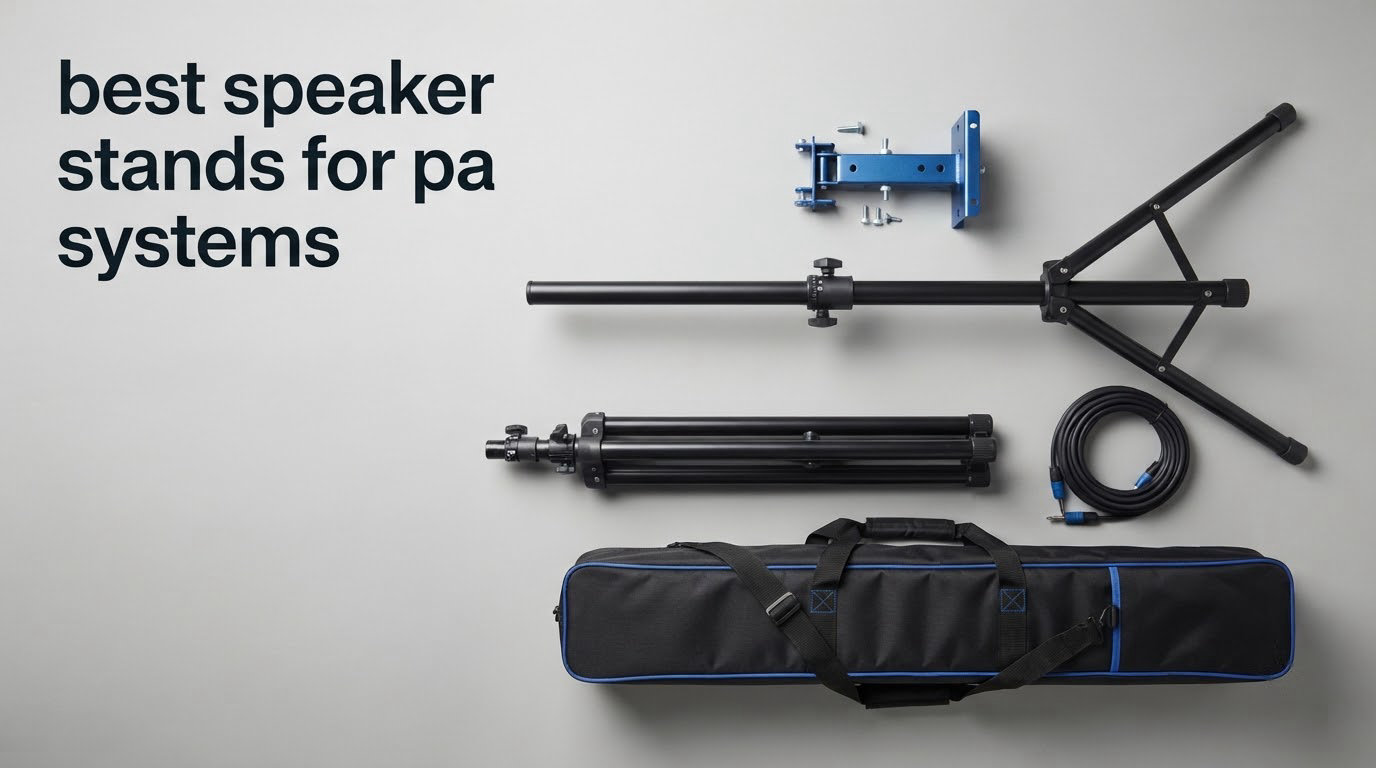
The Amazon Basics SB400L is the best PA speaker stand for most people: an all-steel tripod that holds up to 99.2 lb, adjusts from 52 to 73 inches, and carries the highest average rating of any stand in our test group at 4.8 across more than 3,200 reviews.
That matters more than it sounds. A speaker stand is not a nicety at the end of a cable, it is the difference between a cabinet that covers a room and one that blasts the first four rows. Put a powered top on the floor and it aims at feet, couples vibration into the stage, and gets kicked. Raise it to ear height on a correctly rated pole and the same cabinet does what you paid for it to do.
We spent weeks working through the specifications, user reviews and fitment notes on ten PA speaker stands, from budget steel tripods to air-lift pairs built for one-person load-ins. The field is narrower than the retail grids make it look. Almost everything on the market is a 35mm telescoping tripod, and the real differences are capacity, height range, how the shaft locks, and whether the pole diameter actually matches your speaker.
If you are still choosing the tops themselves, start with our picks for the best PA speakers and our guide to the best portable PA systems before you worry about hardware. Once the cabinets are chosen, this is the shortlist.
Table of Contents
Top 3 Best Speaker Stands for PA Systems 2026

Those three cover most situations. The SB400L is the default answer because it is the sturdiest simple stand here and it is rated correctly for the weight of most 10-inch and 12-inch powered tops. The Pyle PSTND2 carries more capacity for less money and has the largest review base we found, which means its weaknesses are well documented rather than a surprise. The Rockville RVES1 is the pick when you need a matched pair with a bag and you are working to a tight budget.
Quick Overview: All 10 PA Speaker Stands Compared in 2026
| Product | Specifications | Action |
|---|---|---|
| Amazon Basics SB400L |
|
Check Latest Price |
 Pyle PSTND2 Pyle PSTND2 |
|
Check Latest Price |
| Rockville RVES1 |
|
Check Latest Price |
 Pyle PSTND25 Pyle PSTND25 |
|
Check Latest Price |
 Pyle PSTK107 Pyle PSTK107 |
|
Check Latest Price |
 Gemini ST-Pack Gemini ST-Pack |
|
Check Latest Price |
 Rockville RVSS2 Rockville RVSS2 |
|
Check Latest Price |
 JBL Speaker Stand Set JBL Speaker Stand Set |
|
Check Latest Price |
 On-Stage SSP7900 On-Stage SSP7900 |
|
Check Latest Price |
 Rockville RVSS4AB Rockville RVSS4AB |
|
Check Latest Price |
Two numbers deserve a note before the individual reviews. First, every capacity figure in this article is per stand, not for the pair, so a 132 lb stand in a two-pack means 132 lb of cabinet on each pole. Second, four of these ten use a pole other than the common 35mm, which is the single most common reason a stand arrives and does not fit the speaker that was bought to go on it.
1. Amazon Basics SB400L – Best Overall Steel Tripod
Amazon Basics Adjustable Height Tripod Speaker Stand, Sturdy Steel, Holds up to 99.2 lbs, 52″ to 73″, Black
Capacity: 99.2 lb per stand
Height: 52-73 in
Weight: 8.5 lb
35mm steel shaft
Pros
- Highest average rating in the group
- All-steel tube handles heavy cabinets
- Expandable long tripod legs are stable
- Backed by a 1-year limited warranty
Cons
- 35mm shaft only so 38mm mounts need an adapter
- Shortest height range in the group at 52-73 in
- No carry bag included
The SB400L is the stand we ended up recommending to people who did not want to think about it. It ranks first in the Speakers Stands category on Amazon with a 4.8 average, and that rating has been earned over thousands of reviews rather than a handful. Steel tube, a safety pin, and legs that expand far enough to spread the load.
Its 99.2 lb rating is deliberately modest, and that is the right design decision. Most 10-inch and 12-inch powered tops in the 45 to 80 lb range leave proper headroom, and a stand rated far beyond what you will ever load is usually just a heavier stand you resent carrying.
The one real limitation is height. At 52 to 73 inches this is the shortest range in the group, which means it will not lift a large main up over a subwoofer. It also tops out at 99.2 lb, so a 100 lb full-range cabinet is out of range from the start. If your setup is a pair of subs on the ground with mains on top, look at the taller options further down.
There is no bag in the box. That is normal for a single stand and it is worth remembering when you price a pair, because you will need to buy transport for two of these or accept a scuffed van floor.
Is it the right stand for a solo load-in?
It is light enough at 8.5 lb for one person, and the pin-and-hole design means you can raise a cabinet without a second pair of hands once the legs are down. The pin is the only thing holding a loaded pole, so the habit worth building is dropping the pin before you let go of the cabinet, every time.
Owners of Yamaha DBR-series and similar 35mm speakers report that the stand folds and carries without complaint. The complaint that shows up in reviews is fitment, not failure, which is the profile you want from a stand.
When should you pick something else?
Skip it if your mains need to clear a tall sub stack, or if your cabinets run past 100 lb. The height range and the 99.2 lb rating are both non-negotiable numbers, and no amount of clever rigging changes them.
Also skip it if your speaker has a 38mm bottom hole. The shaft is 1.4 inches, which is 35mm, so you need a separate adapter for that fitment.
2. Pyle PSTND2 – Budget Pick with the Largest Review Base
Pyle Universal Speaker Stand Mount Holder Heavy Duty Tripod w/ Adjustable Height from 40” to 71” and 35mm Compatible Insert Easy Mobility Safety Pin and Knob Tension Locking for Stability, Black
Capacity: 132 lb
Height: 40-71 in
Weight: 6.9 lb
Pin and screw locks
Pros
- Largest review base we found at 5894 reviews
- 132 lb capacity at a budget price
- Retainer pin holds the shaft by pin not friction
- Collapses for one-person transport
Cons
- 35mm top plate only so 38mm mounts need an adapter
- Some buyers report brittle plastic fittings and soft metal after heavy cycles
- Occasional missing hardware on arrival
With 5,894 reviews at a 4.7 average, the PSTND2 is the most thoroughly owner-reported stand in this group, and that is an advantage in a roundup. When a product has thousands of owners, its weak points stop being theoretical. You already know where it bends and which fitting cracks.
On paper it is a very good budget buy. 132 lb of rated capacity, a 40 to 71 inch telescoping column secured by pin and screw, a center brace tying the tripod legs together, and a retainer pin that holds the shaft by mechanical pin rather than by clamping friction. It weighs 6.9 lb, which makes it easy to carry one at a time.
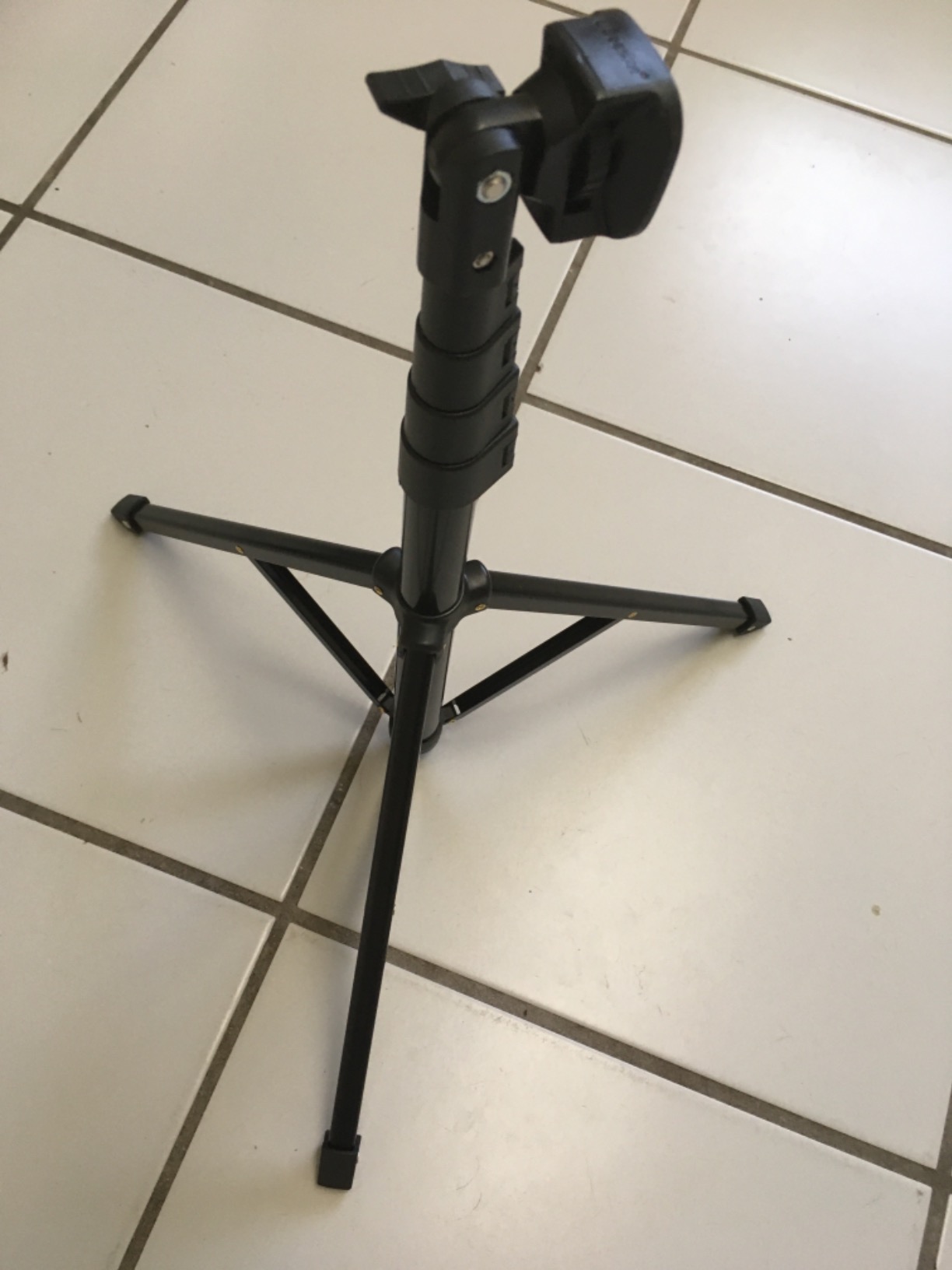
Owners of Yamaha DBR10, Bose S1 Pro and other 35mm cabinets describe it as stable and quick to fold. The knee-level leg clamps release with a knob, the shaft locks at a set of holes, and the whole thing collapses to a length that fits in a gig bag.
The documented weakness is material. A recurring minority of reviews describe plastic fittings and soft metal that strip or crack after repeated load-in and load-out cycles, which is exactly the failure pattern you would expect in a light, inexpensive tripod. If you play out weekly, that wear matters more than the capacity number.
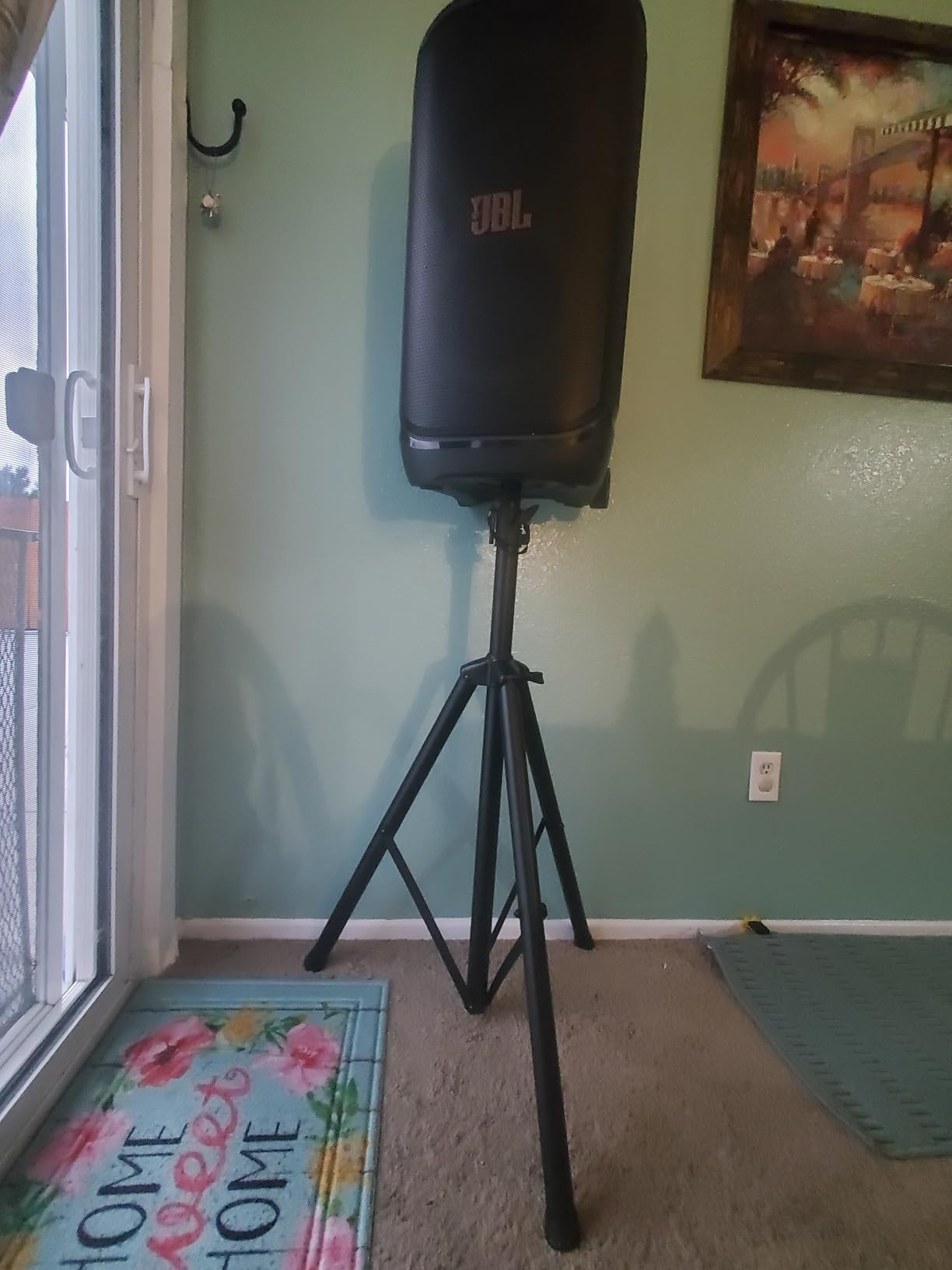
Does the retainer pin or the knob matter more?
The pin matters more. A knob-style tension lock works by friction against a shaft, and friction locks depend on clean, dry, unworn surfaces. A pin through a hole holds position regardless of grime, and on this stand the pin can be tethered so it does not disappear into a van.
Use both when you can. Set the pin, then tighten the knob to take the play out of the joint, and the stand will not creep downward under a cabinet that has a bass resonance around 60 Hz.
Who should buy a different stand?
If you need a stand that will never be questioned for headroom, this 132 lb rating has real margin over typical 45 to 60 lb mains. If you carry large 15-inch cabinets, or you run mains over subs and need height, this is too short at 71 inches.
It also will not take a JBL PartyBox 360 or any other 38mm mount without an adapter. Check your speaker before you commit.
3. Rockville RVES1 – Best Budget Pair With Carry Bag
Rockville RVES1 Pair Adjustable Tripod PA Speaker Stands with Carry Bag
Capacity: 100 lb per stand
Height: to 71 in
Pair weight: 12.6 lb
35mm socket
Pros
- Two matched stands plus a carry bag in one package
- All-steel build with wide tubing and solid locks
- Low center tube handles uneven outdoor ground
- Folds flat enough for a passenger seat
Cons
- Achieved leg spread measures about 31 in which is under the published figure
- No assisted lowering on a loaded stand
- Plastic knobs and pin cords degrade first
The RVES1 solves a problem that single stands do not: you need two of them, and they should be the same. This package gives you a matched pair of all-steel tripods rated at 100 lb each with a durable carry bag, which is the most straightforward complete answer to a working PA kit we found.
Buyers who gig regularly describe stable, well-braced stands that fold flat and travel well. The legs expand to a published 32 inch base spread, and the low center tube clearance means the stand tolerates uneven ground better than tripods with a higher hub, which is useful on grass, gravel and old parking lots.
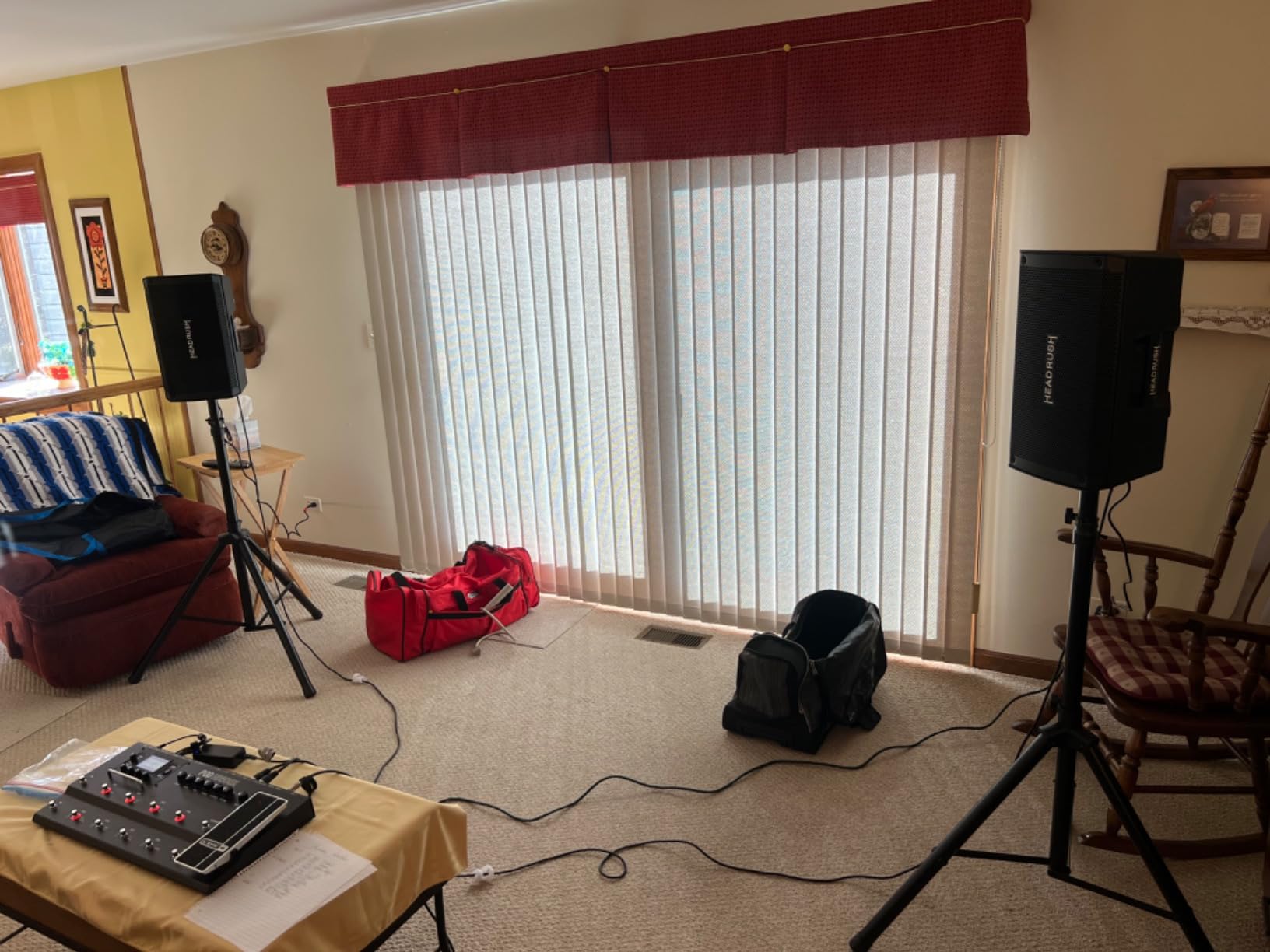
Reviewers report it holding 40 lb 1×12 cabinets, which is the typical weight of a compact active top, without complaint. At 100 lb per stand you have comfortable headroom for anything in that class and a little beyond it.
Two honest caveats come up repeatedly. Buyers who measured the deployed legs found about 31 inches rather than the published 32, and there is no gas-assist or weight-assisted lowering despite the marketing language, which means a loaded 70 lb cabinet is still a two-hand lift into position.
Can one person carry this pair?
One stand is about 6.3 lb, so a single person can carry one in each hand or one at a time. The full package at 12.6 lb for the pair is a comfortable solo carry for most people, though a long walk from a car park is where you start wishing for a cart.
Because the center tube sits low, the stands stay planted on sloped or uneven surfaces better than a taller-hub tripod at the same weight. For outdoor events on imperfect ground, that geometry is worth more to stability than a heavier leg profile.
Which jobs is this pair unsuited to?
Do not use it for mains over subs. At 71 inches maximum it will not lift a large top above a tall sub stack, and the 31 inch leg spread is narrower than the Gemini and RVSS1 alternatives if you are loading something heavy.
Treat the plastic knobs and the pin retention cords as consumables. On a stand that is loaded and unloaded constantly, those are the components that will need replacing first.
4. Pyle PSTND25 – Best for Home, Studio and Rehearsal Rooms
Pyle Universal Speaker Tripod Stand Mount – 6′ Sound Equipment Holder Height Adjustable Up to 70 Inches For Speakers w/ 35mm Compatible Insert Perfect for Home, On Stage or In Studio Use
Capacity: 130 lb
Height: 42.4-70 in
Weight: 6.7 lb
35mm insert
Pros
- Handles 80 lb speakers and 120-size cabinets
- Easy to raise and set single-handed
- Two-stage leg and extension adjustment
- Backed by a Pyle limited warranty
Cons
- No carry bag included
- 35mm insert only
- Occasional shipments missing a tightening nut
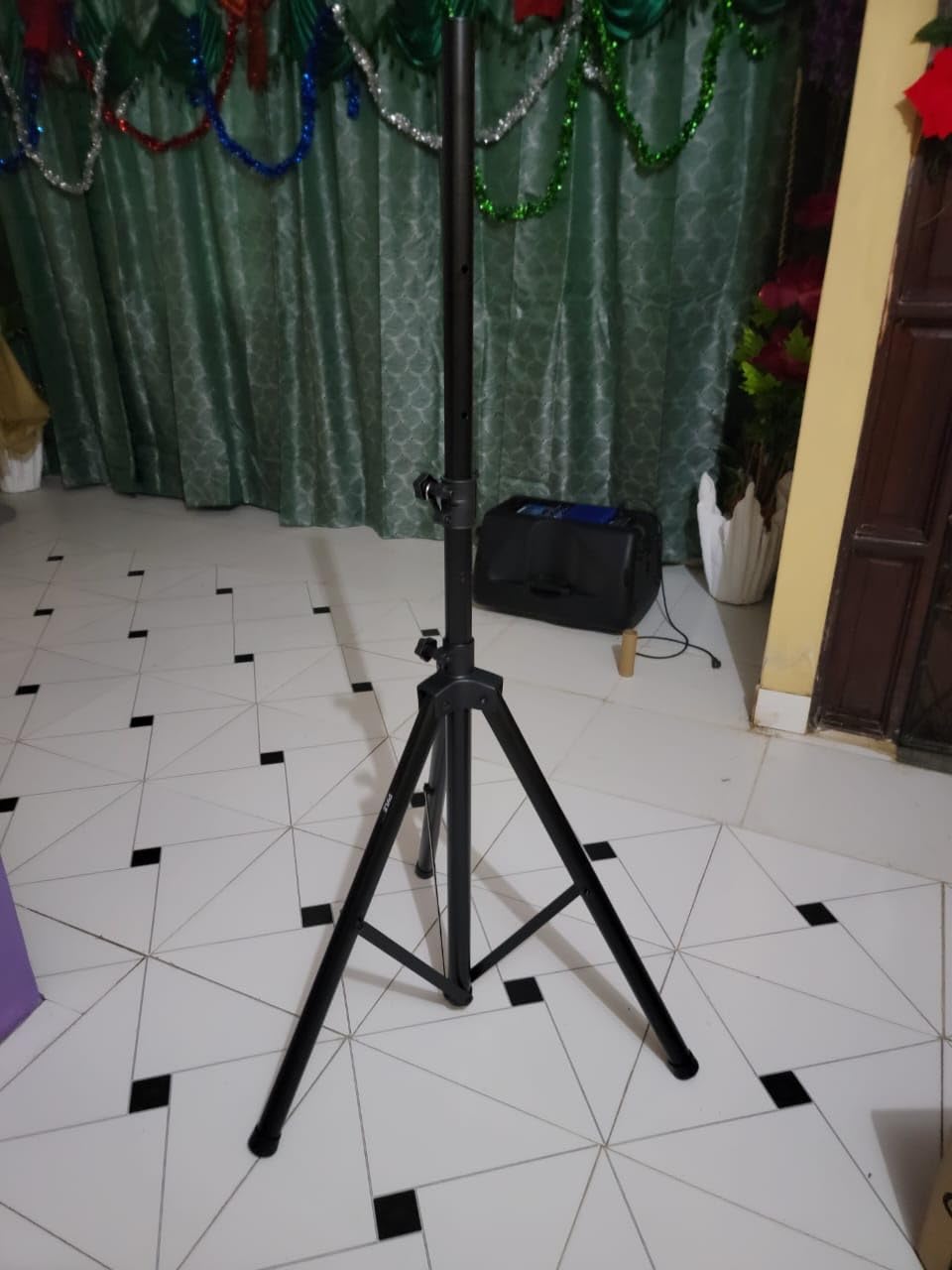
The PSTND25 is the stand for a rehearsal room, a small church, a classroom, or a home setup where the speakers come out of a closet a few times a month. It holds up to 130 lb, adjusts from 42.4 to 70 inches, and at 6.7 lb it is light enough to reposition with one hand while you are holding a cable in the other.
Two-stage adjustment on both the legs and the telescoping column gives a usable working range from roughly a meter to two meters. That range is the reason it works well in rooms with low ceilings, which is most rooms, and where the alternative is a single-position stand.
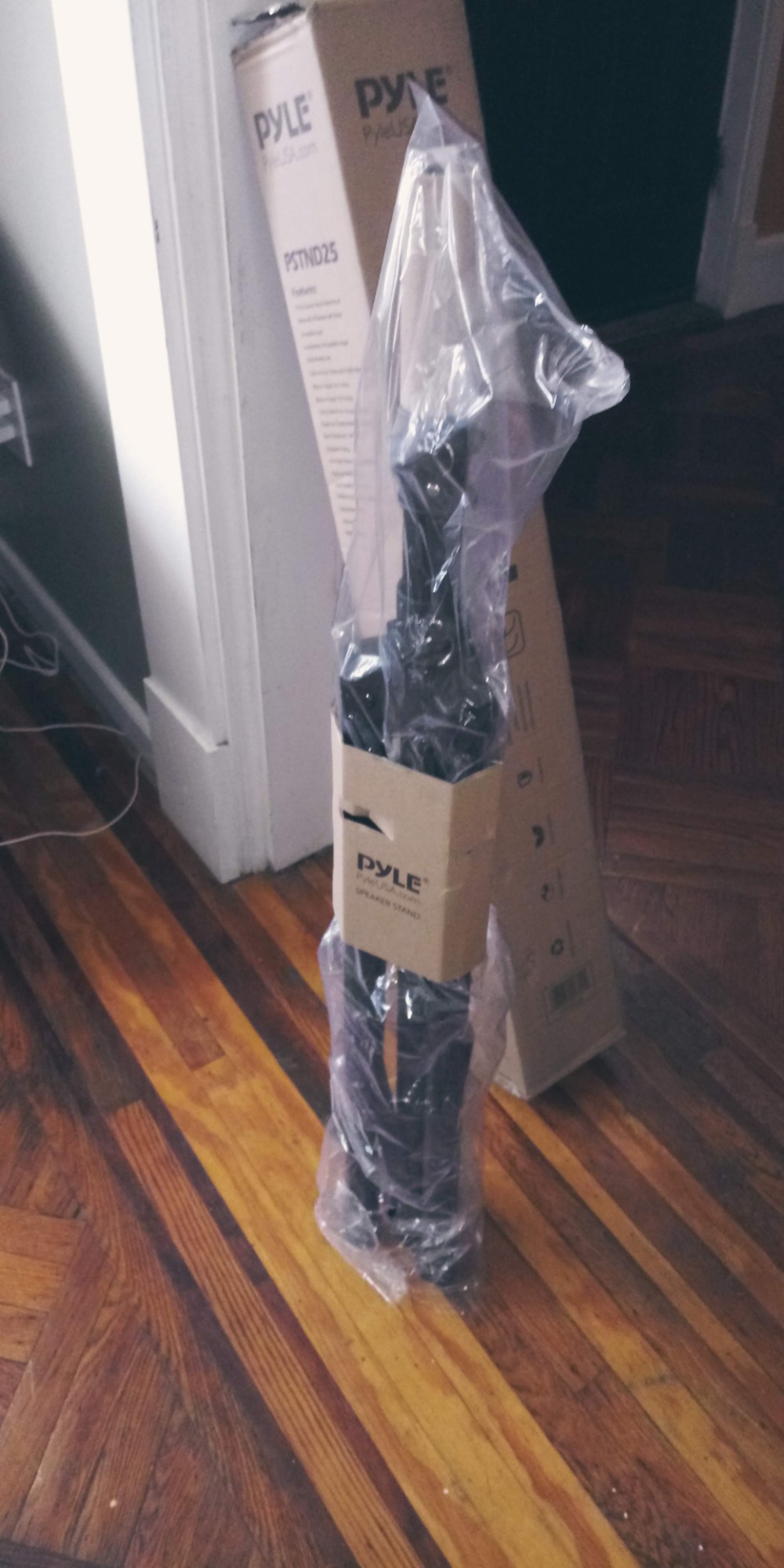
Reviewers use it with JBL PartyBox units, Eon One tops and 12-inch Harbinger cabinets, and the feedback centers on solid metal construction, a well-built hand screw and a locking pin that holds where you put it. Several owners bought a second unit after the first held up, which is the clearest endorsement a stand can get.
The gap most often named is the missing carry bag. In a fixed room that does not matter, because the stand lives there. In a car, it is the difference between a clean load-in and a stand lying loose in the footwell.
Is 130 lb rating realistic in a home room?
It is far more than most home and rehearsal systems need. A typical 10-inch active top in the 35 to 50 lb range leaves more than double the cabinet weight in reserve, and that headroom is what keeps the stand from creeping under sustained low-frequency output.
The number matters less than the fitment. Confirm your cabinet has a 35mm insert before you buy, because a 38mm bottom hole will not drop onto this shaft without an adapter.
What about the missing hardware reports?
A small number of arrivals have been missing a tightening nut, and it is an easy fix if you have one in a parts drawer and an annoying one if you do not. Check the leg clamps and the shaft screw the day the box arrives, while the packaging is still on the floor.
For a room where the stand will be set up regularly by whoever is on duty, the hand screw and pin combination is straightforward and requires no tools.
5. Pyle PSTK107 – Best Steel Pair for a Working Band PA
Pyle Universal Dual PA DJ Tripod 2 Speaker Stand Kit with Adjustable Height & Storage Bag Constructed with Heavy Duty Durable Steel & Lightweight for Easy Mobility Safety PIN Screw Locks PSTK107,Black
Capacity: 132 lb per stand
Height: 40-71 in
Pair weight: 14.4 lb
Pole 1.375 in
Pros
- Metal leg-to-pole flange instead of the plastic one cheaper stands use
- Folds to 42 in so both stands fit one vehicle
- Storage bag included
- Wide base handles 80 lb plus cabinets
Cons
- Not a true tall stand capped at 71 in
- 1.375 in pole blocks some 1 in insert adapters
- Bag is thin canvas and can arrive torn
The PSTK107 is the pair to buy when the stands get loaded into a van twice a week, because it fixes the joint that fails first on cheaper tripods. The leg-to-pole flange is metal rather than plastic, which is the single part that tends to snap on budget stands, and it comes as two stands with a storage bag.
Each stand is rated at 132 lb, adjusts from 40 to 71 inches with pin and screw locks, and folds to 42 inches so both stands sit side by side in one vehicle. Buyers cite the compact closed length and the flange as the two reasons they upgraded from an older, taller or flimsier set.
At 14.4 lb for the pair, you are carrying about 7.2 lb per stand, which is manageable solo. Reviewers use it for 12-inch PA speakers and for Behringer and Montarbo cabinets, and report the wide base and thick post handling 80 lb plus without complaint.
Why does the metal flange matter?
That flange takes the entire bending moment where the leg meets the upright. On stands where it is molded plastic, that is where fatigue cracks begin, usually after a season of being folded and unfolded in the cold. Metal there costs almost nothing and removes the most common failure point in the category.
It is not the only thing that decides longevity, but it is the part most often skipped and most often regretted.
Where does this pair fall short?
Height is the limit. Seventy-one inches is fine for a stage-side or front-of-house pair on flat ground, and it is not enough to lift large mains above a sub stack. If that is your configuration, this is the wrong shape of stand.
Also check your adapter needs. The pole is 1.375 inch, so a 1 inch insert arrangement will not fit without a reducer, and a few owners report the included canvas bag arriving torn, which is a packaging problem rather than a product failure.
6. Gemini ST-Pack – Best Heavy-Duty Stand for Large Mains
Gemini Sound DJ Speaker Stands, Set of 2, Steel Tripod, 60 lb (ST-Pack)
Capacity: 200 lb per stand
Height: 44-80 in
8.98 lb per stand
6-position safety pin
Pros
- Highest rated capacity in the group at 200 lb per stand
- Tallest range at 44-80 in
- Widest base spread at up to 48 in
- 2-year limited warranty from an established pro audio brand
Cons
- 38mm pole differs from the 35mm most budget stands use
- Lowest average rating here at 4.5 with a 5 percent one-star share
- Heaviest per-stand weight at 8.98 lb
The Gemini ST-Pack is the heavy-duty answer. At 200 lb per stand it is rated more than three times the weight of a typical powered main, and its 44 to 80 inch range is the tallest in this group, which makes it the pair to look at if you need real height as well as real capacity.
The base spread is the quiet advantage here. It expands from 32 to 48 inches, and a wide footprint is what stops a tall loaded stand from tipping when a low-frequency wave hits it or when someone walks past. A 200 lb rating on a narrow base is a number on a label; a 200 lb rating on a 48 inch spread is a stand you can load confidently.
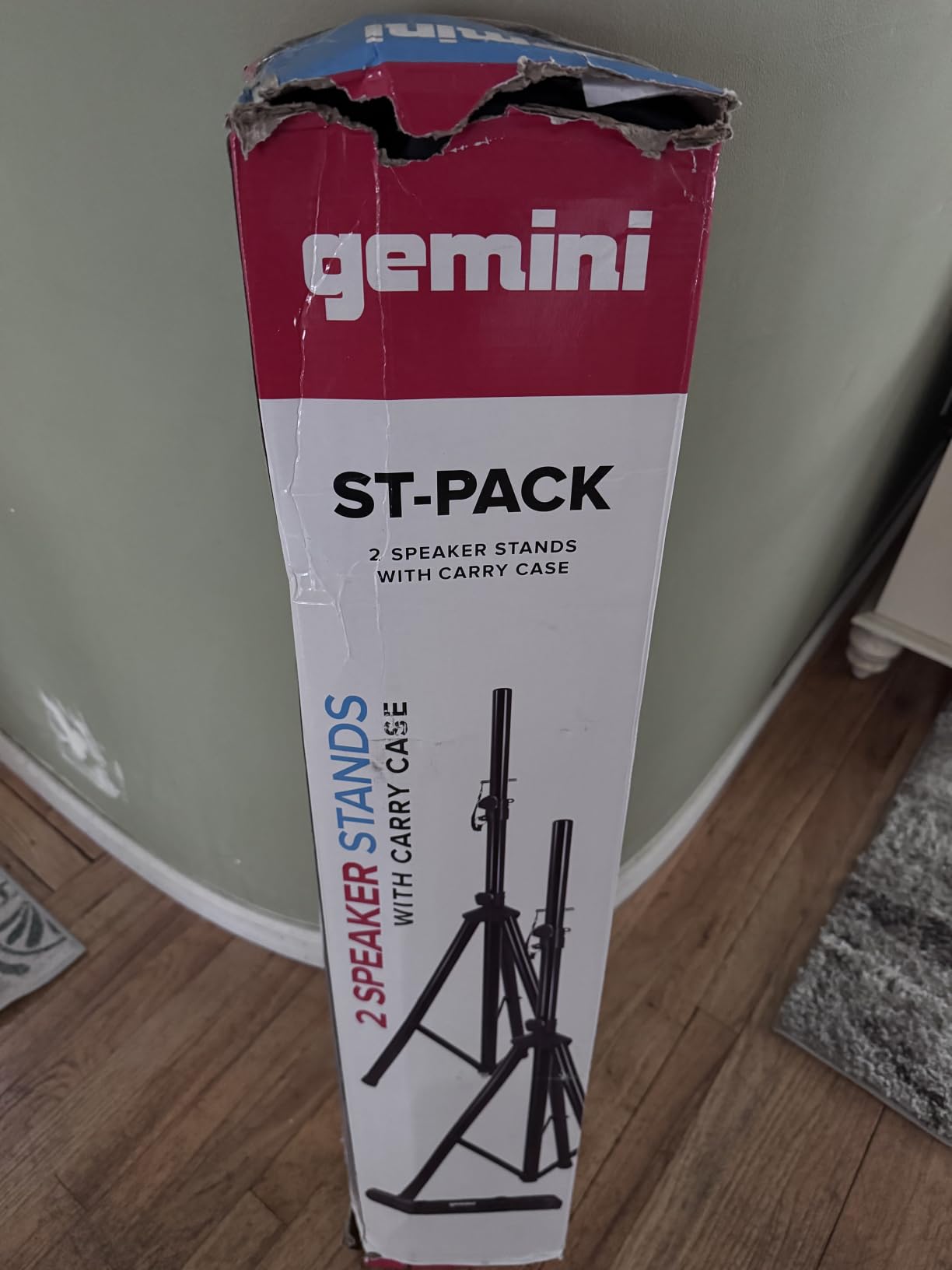
Height adjustment is hand-tightening with a six-position safety pin, and rubber foot caps handle slip. The 2-year limited warranty is the longest here apart from the JBL set, which tells you something about how the brand expects the product to be used.
At 8.98 lb per stand, this is the heaviest stand in the group. That weight is the cost of anodized steel tubing and a wide leg system, and it is a fair trade if you are lifting large cabinets rather than carrying stands up stairs between rooms.
Will a 38mm pole fit my speakers?
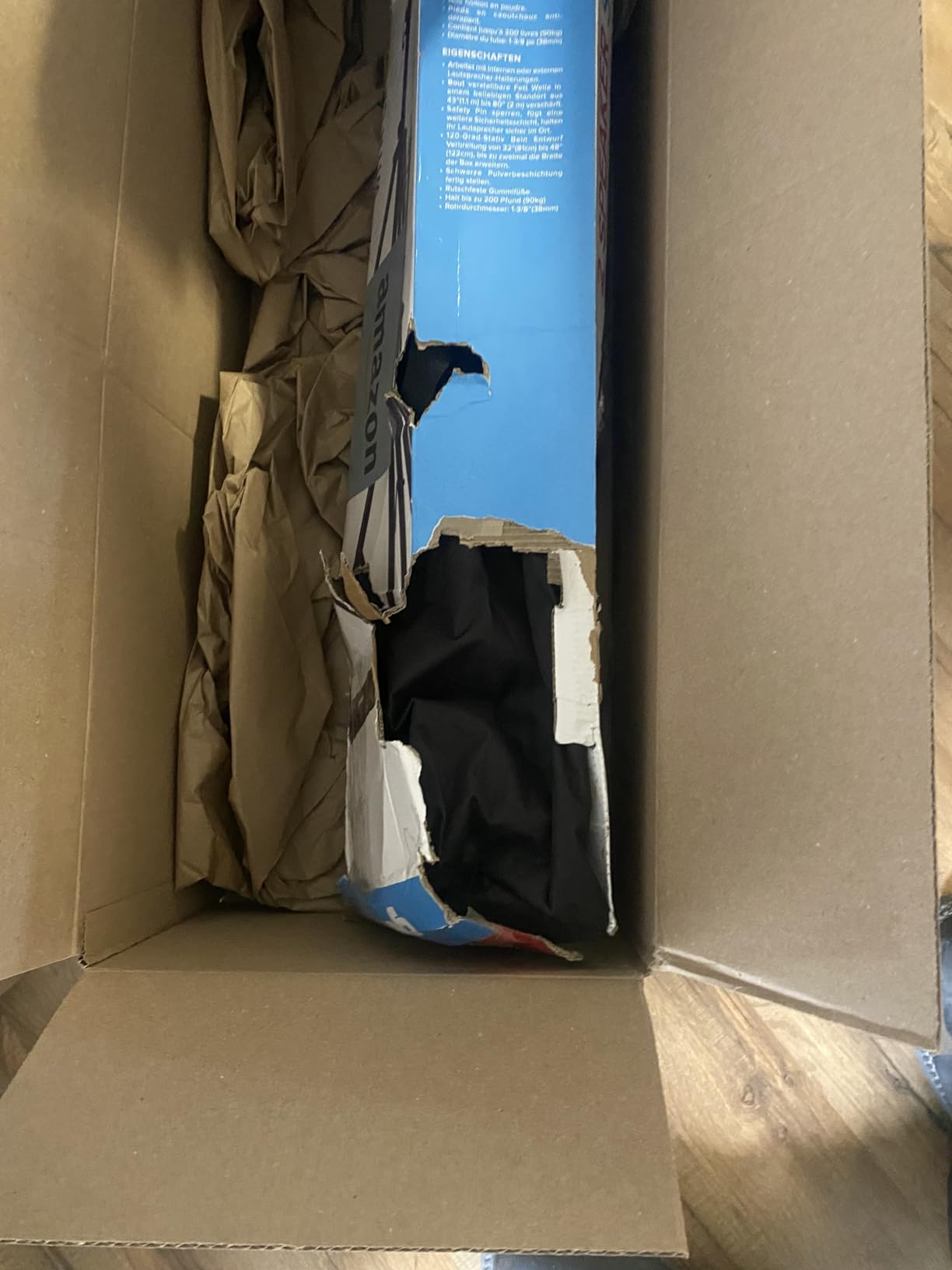
Sometimes, and this is the question to answer first. The tubing is 38mm, while most mid-range and budget PA cabinets use a 35mm insert, so a 35mm socket will not drop onto this pole. Speakers with 38mm inserts, or cabinets that were designed for this diameter, will fit directly.
Measure the inside diameter of your speaker’s bottom hole before you order a pair. Adapters exist in both directions, but relying on one is a poor substitute for checking.
Who should choose something lighter?
If you are moving stands solo, frequently, up stairs or across a venue, 8.98 lb each adds up quickly and the aluminum options further down weigh noticeably less. This pair is built for staying put once it is set.
Its 4.5 average is the lowest here, with a 5 percent one-star share, so expect more mixed feedback than the 4.8-rated Amazon Basics at the top of this list. The complaints cluster around fitment rather than structural failure, which is consistent with a stand that is genuinely built to its rating.
7. Rockville RVSS2 – Best Pair for 15 and 16 Inch Cabinets
Rockville RVSS2 Black Tripod DJ PA Speaker Stands Pair with Carrying Case
Capacity: 132 lb per stand
Height: 47-79 in
Pole 1.38 in
Dual-compartment case
Pros
- Tallest range among mid-priced pairs at 47-79 in
- Sturdy yet light enough to carry one-handed
- Carry case has dual compartments and is praised for quality
- Holds 15 and 16 in cabinets such as EV ZLX-15
Cons
- 1.38 in tube diameter differs from 35mm inserts
- Carry case can arrive with blemishes or handling marks
- 23 in base spread is narrower than the Gemini and RVES1
The RVSS2 is a pair of steel tripods that reaches 79 inches, and that extra reach is the reason to choose it. Where most budget stands stop at 70 or 71 inches, this one starts at 47 and runs to 79, so it can put a mid-size top noticeably higher in front of a crowd without moving to a tall-stand design.
It is also the pair reviewers most often use for larger full-range cabinets. Owners mention EV ZLX-15 units and Peavey PA speakers by name, and report the stands holding them with solid tightening hardware while staying light enough to move with one hand.
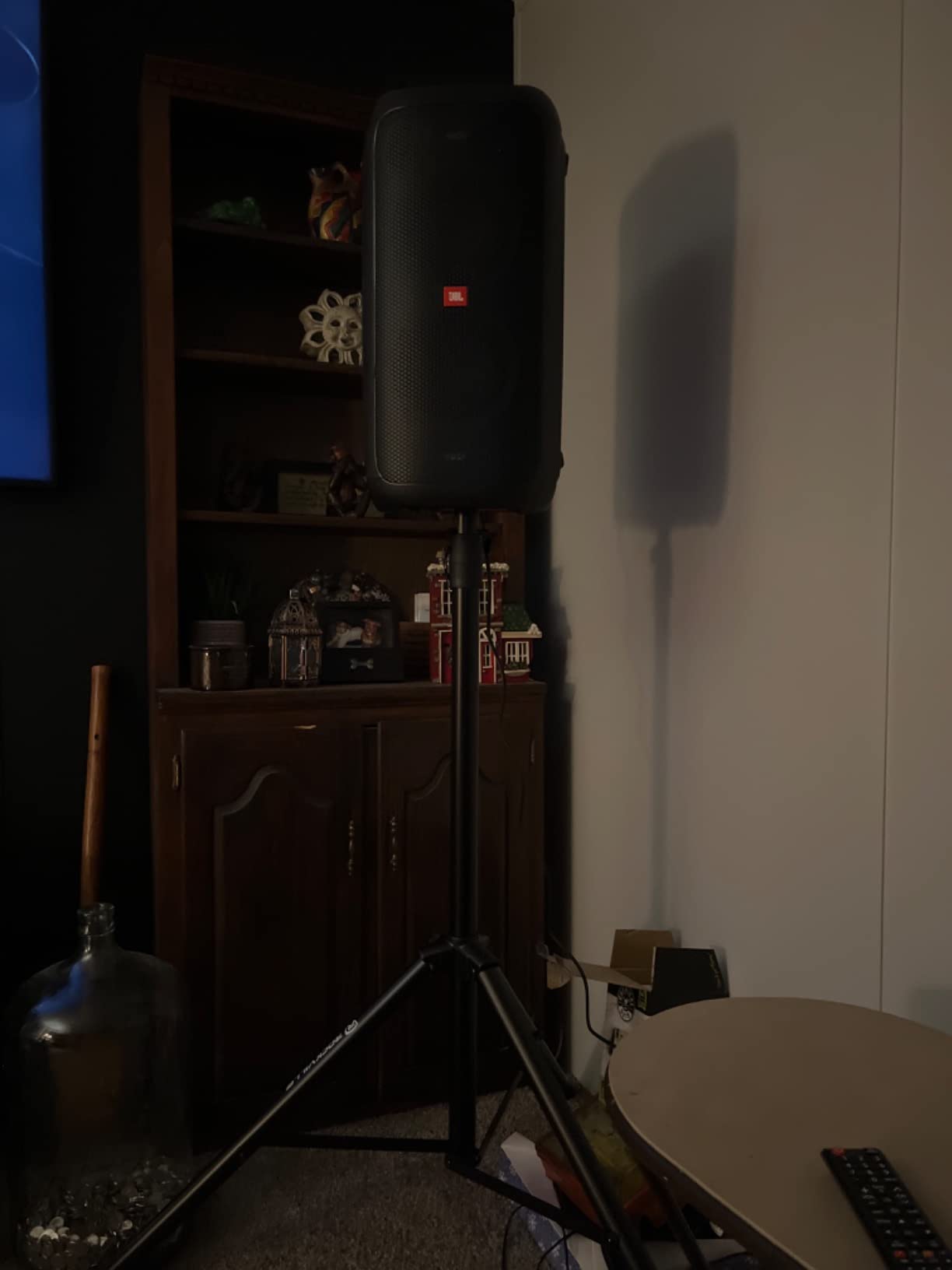
The carrying case is a real differentiator. It is nylon with dual compartments and snap straps, so both stands travel in one bag and neither knocks against the other. For a working pair that lives in a vehicle, that is a better use of money than a marginally heavier tube.
Height adjustment is quick and the legs lock securely. The legs are described as expandable with a locking mechanism, at a 23 inch base spread, which is the narrowest figure among the pairs we tested and the main reason we would not hang very heavy cabinets high on these.

Is 79 inches enough to clear a subwoofer?
For a typical 18-inch sub around 30 inches tall, a 79 inch pole with a shallow cabinet gives you useful clearance without being extreme. For tall double-stacked subs or large flown mains, you are still into dedicated tall-stand territory, and this pair is not it.
Where the extra height really pays is a small room with a low stage lip, where a few inches changes the front row coverage noticeably.
What about the 1.38 inch tube?
It is a compatibility question, not a defect. A 1.38 inch tube is close to but not identical with 35mm, and speakers designed for 35mm inserts will not drop onto it. Check the insert diameter on your cabinets before ordering.
Cosmetic blemishes on the arriving case are the other reported complaint. Inspect the bag at delivery and photograph it if it arrives damaged, since that is a packaging problem rather than a product one.
8. JBL Speaker Stand Set – Best Fit for Both 35mm and 38mm Mounts
JBL Bags Standard Speaker Stand Set with Adjustable Height and Dual Diameter Pole, Includes (2) Speaker Stands and Carry Bag (JBLSPKSTMASET)
Capacity: 60 lb per stand
Height: 48-81 in
Pole fits 35mm and 38mm
3-year warranty
Pros
- Dual-diameter pole is the only one here that fits both 35mm and 38mm mounts natively
- Tallest maximum height in the group at 81 in
- Lightweight aluminum at 6.4 lb per set listing
- 3-year limited warranty
- the longest coverage here
Cons
- Lowest load capacity in the group at 60 lb per stand
- Highest price point in the roundup
- Smallest review base at 228
Every other stand on this list forces a choice: 35mm or 38mm. The JBL set has a dual-diameter inner tube that accepts both, which removes the single most common reason a new stand will not accept the speakers you already own.
That is a genuinely useful thing to pay extra for, particularly if you own cabinets from more than one brand, or if you are buying stands before you settle on speakers. You are buying the elimination of an entire category of return.
It is also the tallest design here, running from 48 to 81 inches, and the lightest aluminum option at 6.4 lb. The bag is included, and the 3-year limited warranty is the longest in this roundup by a year.
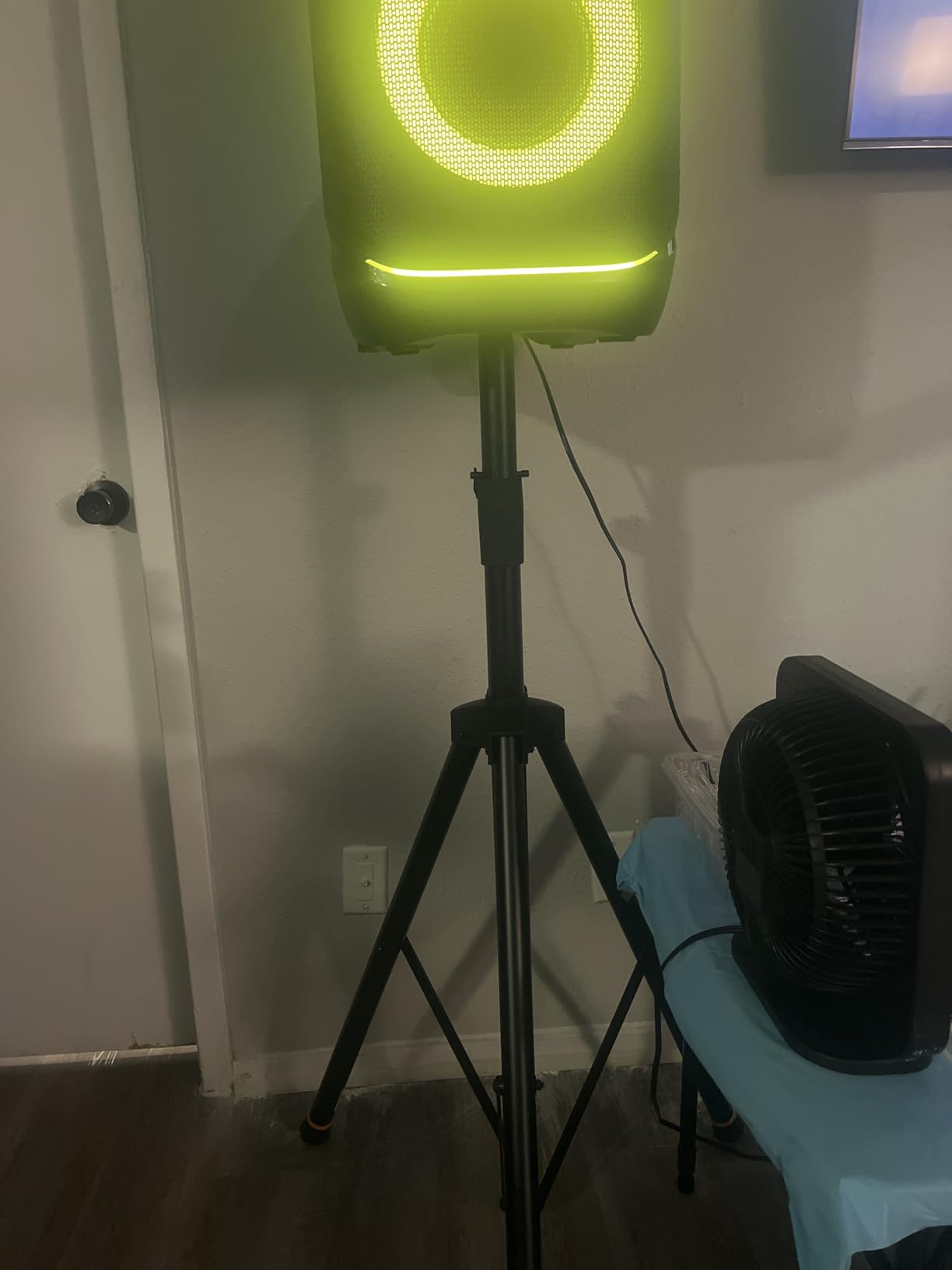
One detail worth knowing about: the stands have removable red safety trim on the feet. It is a visual marker for stage crews that these are live positions, and it comes off if you prefer a plain black base.
The 60 lb per stand rating is the trade-off. That is honest for most 10-inch and compact 12-inch active tops, and it is insufficient for anything approaching full-size 15-inch mains. This is a light-to-medium duty stand with premium fitment, not a heavy-duty one.
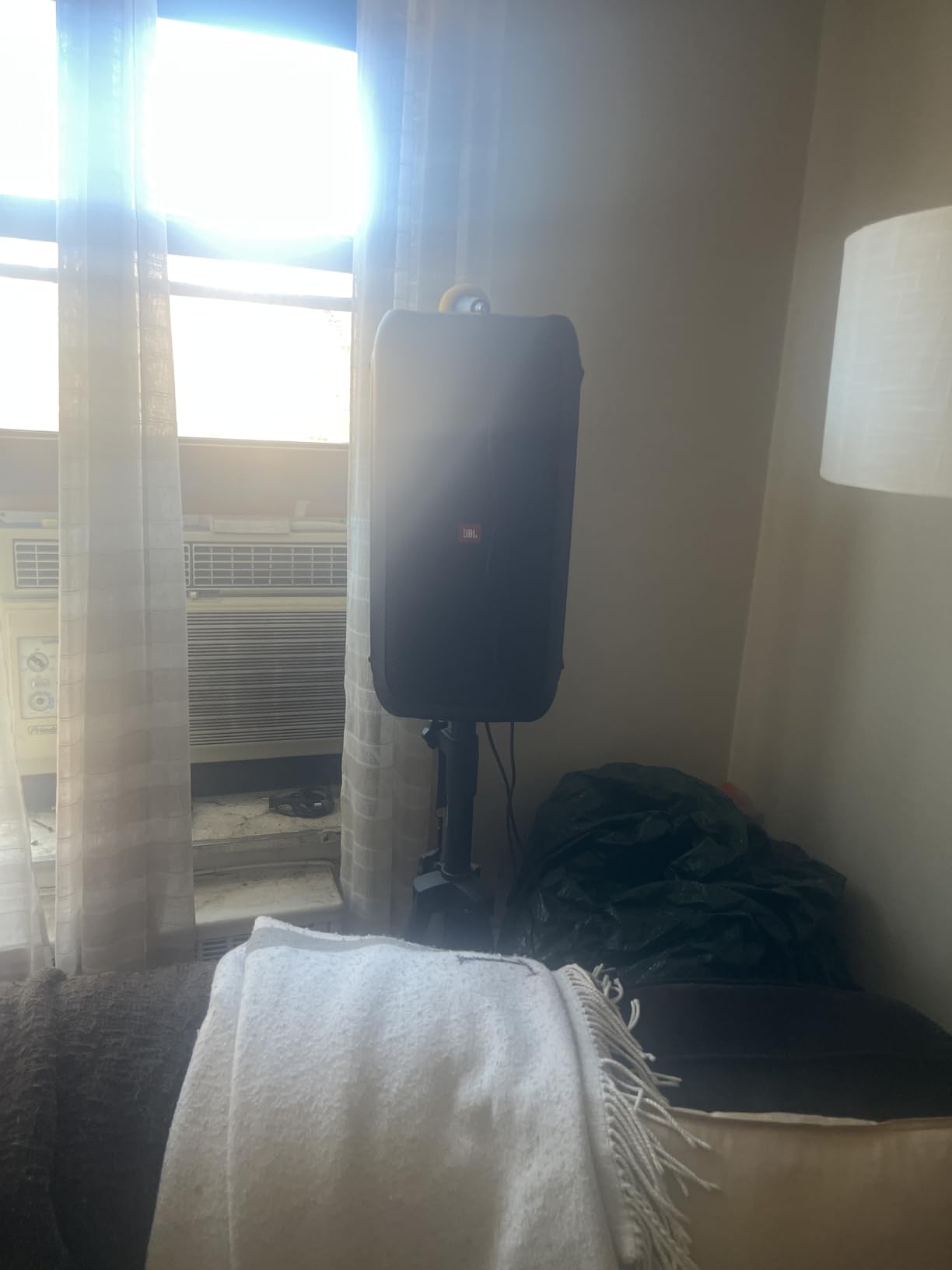
Does dual-diameter fitment justify the premium?
It does if you have mixed-brand cabinets, or if buying stands before speakers is your plan. A single mismatched stand discovered at a load-in is a wasted trip, and the adapters that fix it are small parts that are easy to forget at home.
It is harder to justify if you already know all your cabinets use 35mm, because every other stand on this list will then do the same job for less.
Who should skip the JBL set?
Anyone with cabinets over 60 lb. A 15-inch full-range or any large point-source main exceeds that rating outright, and no amount of build quality changes a published load limit.
It is also a set, so buying it gives you two. If you are running a single cabinet on a side-fill or a delay position, this is more stand than the job requires.
9. On-Stage SSP7900 – Best All-Aluminum Pack for Traveling Musicians
On-Stage SSP7900 All-Aluminum Speaker Stand Pack (Pair of Folding, Portable Stands, Tripod Base, Carry Bag, Height Adjustable, Nonslip Rubber Feet, 1 3/8″ Mounting Poles, 1 1/2″ Adapters, Black)
Capacity: 120 lb per stand
Height: 45-74.75 in
All-aluminum
1 1/2 in adapter included
Pros
- All-aluminum tubing holds 120 lb per stand at 8.5 lb for the set
- Includes a 1 1/2 in adapter sleeve alongside the 1 3/8 in shaft
- Strap plus locking pin at each height setting
- Carry bag has a shoulder strap
- drawstring and inner divider
Cons
- Lowest average rating in the group at 4.4 with a 7 percent one-star share
- Maximum height of 74.75 in is below the Gemini and JBL options
- Smallest review base at 178
The SSP7900 is the pack to choose if weight in the vehicle matters. All-aluminum tubing at 120 lb per stand keeps the pair light while still outrating every budget steel option on capacity, and aluminum does not carry the corrosion weight that bare steel picks up from a wet grass load-in.
The accessory thinking is good. You get a 1 3/8 inch shaft plus a 1 1/2 inch adapter sleeve in the box, so both common insert diameters are covered without a separate purchase. Height adjustment from 45 to 74.75 inches uses a strap and a locking pin together, which gives you two independent things holding the shaft at each setting.
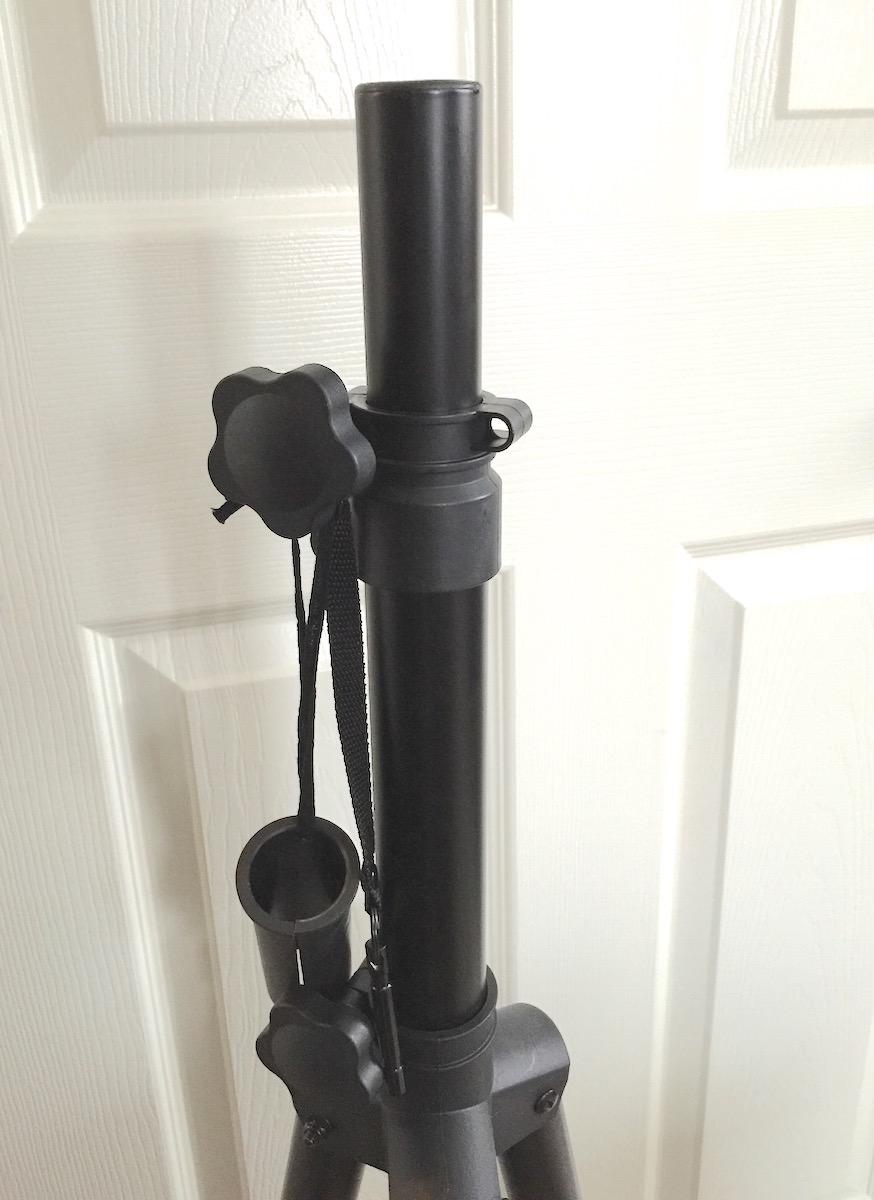
The carry bag has an adjustable shoulder strap, a drawstring closure and an inner nylon divider so the shafts do not scuff each other. It is the best-specified bag in this roundup and the kind of detail that tells you who the pack is aimed at.
The braced tripod base with nonslip rubber feet stays stable on irregular surfaces, which matters for the uneven ground you get at a park, a barn or an outdoor ceremony.
Be realistic about the feedback. Its 4.4 average is the lowest of the ten and its 7 percent one-star share is the highest, and the review base at 178 is thin. Buyers who expect the same consistency as a 3,000-review stand may be disappointed, and it tops out at 74.75 inches, below the two tall options here.
Is aluminum the right material for a band that tours?
For weight per pound of capacity, yes. Aluminum gives you more strength for less mass, and less mass is what you feel on a load-in with stairs, a long cable run and a full van.
Steel wins on one point, which is dent and scuff resistance. Aluminum tubing deforms more readily in a van, and a bent shaft can be a write-off that a steel tube would shrug off. Check your transport.
What do the low ratings come from?
With 178 reviews spread across 4.4, the pattern is thin and mixed rather than a specific defect. Expect some feedback about the shorter maximum height relative to the price, and expect the same plastic hardware complaints that appear on any stand in this price range.
The included adapter sleeve and the strap-and-pin lock are what separate it from the field. Judge it on those rather than on the review average alone.
10. Rockville RVSS4AB – Best Air-Lift Pair for One-Person Setup
Rockville RVSS4AB Tripod Speaker Stand, Black, Hydraulic Auto Lift, 2-Pack
Capacity: 154 lb per stand
Height: 42-79 in
Air-lift assist, 2 bags
28.8 lb per pair
Pros
- Air cartridge raises and lowers heavy tops without lifting them onto the stand
- 154 lb capacity per stand
- 42-79 in range with a twist-lock once elevated
- Each stand has its own custom-fit carry bag
- Composite steel and aluminum build
Cons
- Heaviest package here at 28.8 lb for the pair
- 23 in base spread is the narrowest of the pairs listed
- Smallest review base at 147
The RVSS4AB is the ergonomic pick. A built-in air cartridge provides lift assist, so you push a pin and the shaft rises or falls under its own power. You are not levering an 80 lb cabinet up a pole one-handed, which is the mechanism behind most crushed-finger load-out injuries in this category.
Each stand is rated at 154 lb and adjusts from 42 to 79 inches, with a twist-lock hold once you reach the height you want. Each one also has its own custom-fit travel bag, so the pair travels organized rather than tangled.
Pro-audio forum users make the same point about assist mechanisms in general: the real test is a solo load-in, and lifting one cabinet alone is the test. The counterpoint those same discussions raise is that an assist pole can recoil if the collar is released with a load on it, so keep your head clear of the shaft while you are working the pin.
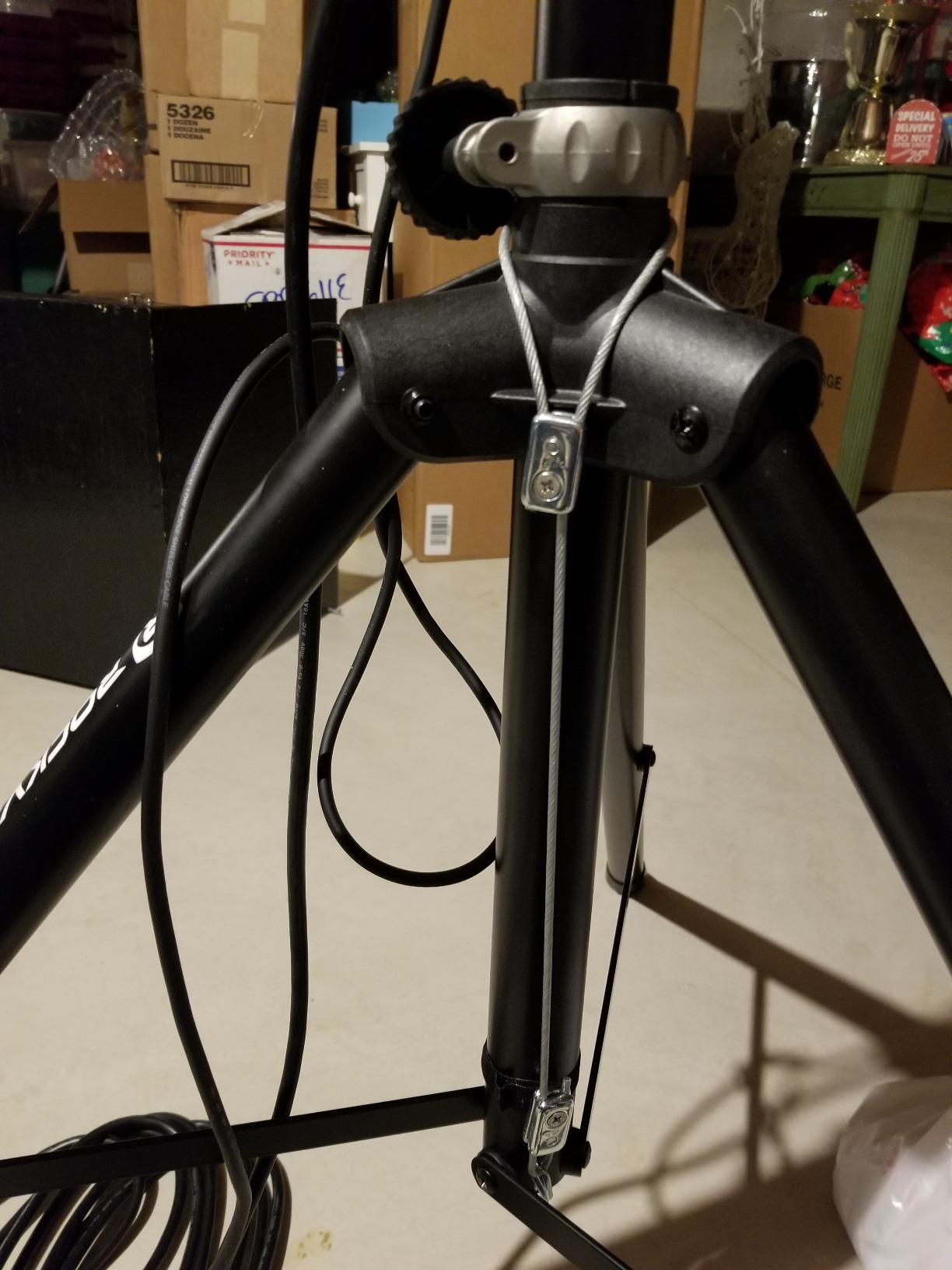
Construction is a steel and aluminum composite, which keeps weight lower than an all-steel stand of this size, and the folded design is compact for transport between gigs.
There are real costs. At 28.8 lb for the pair this is by far the heaviest package in the roundup, and for many people that is a two-person carry. The 23 inch base spread is also the narrowest of the pairs listed, so the stability margin is thinner than the capacity number suggests.
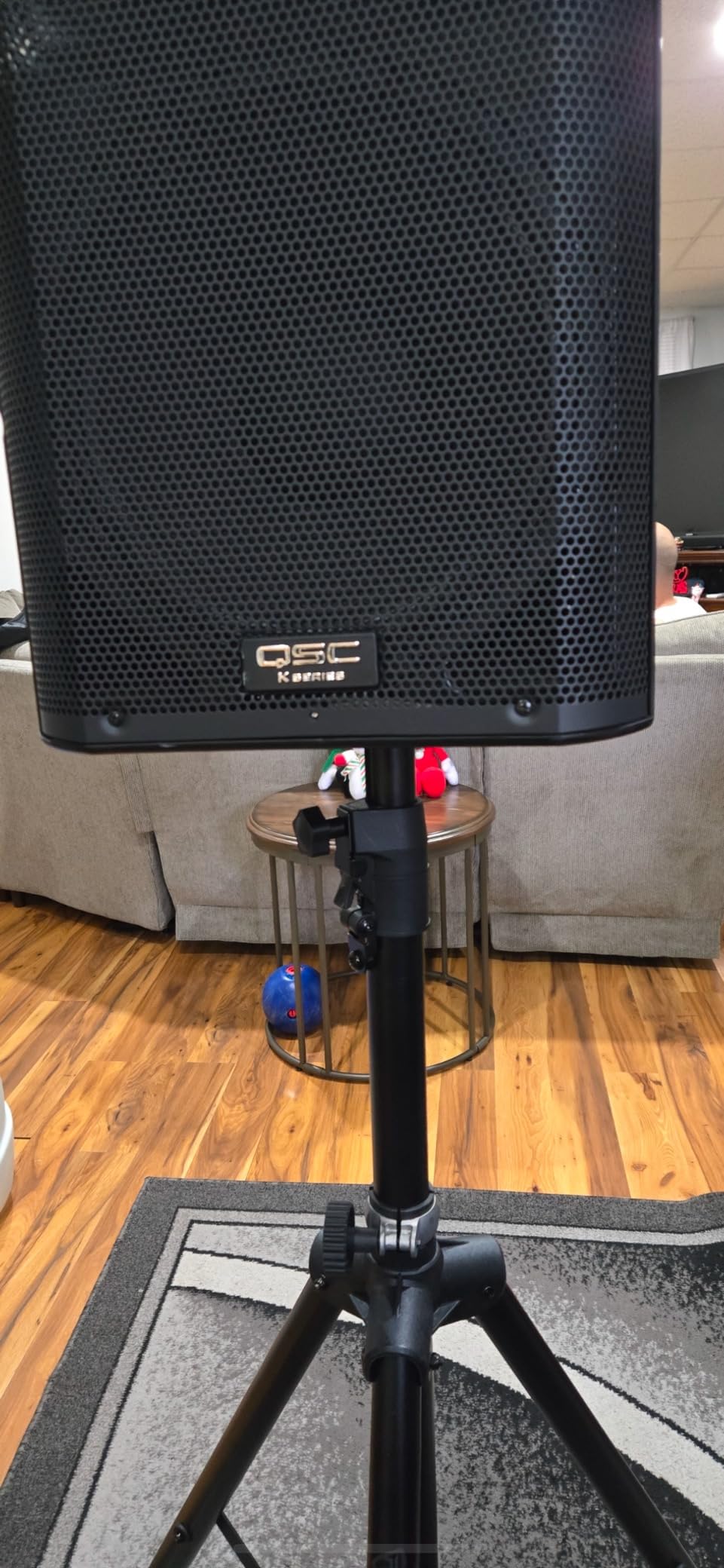
Is a lift-assist pole safe for a solo load-in?
The assist itself is safe and useful when the lock is engaged. The hazard is the release. Forum discussions of lift-assist stands repeatedly raise the same caution: a shaft under air pressure can drive upward if the collar is not set, and that is a head-strike risk, not a hypothetical.
Our rule for any stand with a pneumatic or air cartridge: keep your face out of the shaft’s path, set the collar before you let go of the cabinet, and never work the pin with a hand anywhere near the top of the pole.
When is 154 lb of capacity worth 28.8 lb of weight?
When you are lifting heavy mains alone, regularly, and the stands are loaded and unloaded more than they are carried between rooms. The assist converts a two-person lift into a one-person one, and that is a bigger gain than the extra capacity.
It is the wrong trade for a musician who walks their stands from a car to a stage at every gig. For that, an aluminum pair at under 9 lb is a much better day-to-day companion.
How to Choose a PA Speaker Stand
Choosing well means four numbers in a specific order: pole diameter, then required capacity, then adjustment mechanism, then height. Get the first one wrong and nothing else matters, because the stand simply will not accept your speaker.
Check the pole diameter before anything else
Most PA speakers use a 35mm insert, which is 1.375 inches, and that is the standard on most stands in this roundup. The exceptions are real: the Gemini uses 38mm tubing, the Rockville RVSS2 and RVSS4AB use 1.38 inch tubes, and the JBL set is the only design that accepts both diameters natively.
Measure the inside diameter of the bottom hole on your cabinet before you order, and if you are buying stands before speakers, buy the dual-diameter design or keep an adapter in the van. A 38mm speaker insert will not drop onto a 35mm pole without one, and discovering that at a load-in is a wasted evening.
Aluminum or steel: which material fits your load-in
Aluminum gives you more capacity per pound of stand, which is what you want if you carry stands up stairs, walk them across venues, or load a car by yourself. The On-Stage pack here holds 120 lb per stand at 8.5 lb for the pair. Steel gives you better resistance to dings and drops, and the heaviest-capacity option in this group, the Gemini at 200 lb per stand, is steel for exactly that reason.
The honest test is how often the stands move. A fixed room and a weekly touring act should make opposite choices, and a stand that sits in a rehearsal space is over-engineered if it weighs 9 lb per pole.
Safety mechanisms decide how a stand fails
There are four adjustment styles in this group, and they fail in different ways. A pin-and-screw lock, used on the Amazon Basics, the Pyle PSTND2 and PSTK107, and the Rockville RVES1, holds by mechanical pin and is the most forgiving design. A knob-style tension lock relies on friction, which works until the surfaces are dirty or worn.
An air-lift cartridge, as on the RVSS4AB, does the lifting work for you but adds a pressurized mechanism and a recoil risk if the collar is released under load. A strap-and-pin combination, as on the On-Stage SSP7900, gives you two independent things holding the shaft at each height setting, which is the most redundant arrangement available here.
Whichever you choose, the habit is the same: engage the lock before you release the cabinet, every single time.
Turn speaker weight into a capacity number
Add your speaker weight to the stand’s own weight, then add 25 to 30 percent headroom. A pair of 60 lb mains on an 8.5 lb stand gives 68.5 lb, and with 30 percent headroom you want a stand rated around 90 lb. That margin covers the transient peaks that arrive on a kick drum or a dropped bass note and that never show up on a spec sheet.
All the capacities in this article are per stand. A two-pack rated at 132 lb means 132 lb per pole, not 132 lb shared. Reading a pair rating as a single-load figure is the most common way people end up with a stand that is overloaded and wobbly.
Set your target height before you buy
Most stands in this group top out between 70 and 73 inches, which is fine for front-of-house positions on flat ground and wrong for anything stacked. The Gemini at 44 to 80 inches and the JBL set at 48 to 81 inches give you meaningful extra reach without moving to a dedicated tall stand.
If your mains go over subwoofers, measure the total height of your sub stack plus the cabinet itself, add a few inches, and buy against that number rather than against a marketing height. Height you cannot use is weight you carry for nothing.
Safe Load-In and Load-Out Checklist
Crushed fingers during teardown are the most common injury reported by people who use PA speaker stands, and they happen for one reason: the collar slipped and the speaker started to fall. Six habits prevent it.
Set the pin or engage the collar before you let go of the cabinet. The only moment a stand is safe to hold by the speaker alone is never. If you need to reach for something while a cabinet is on the pole, keep one hand on it.
Keep your face out of the shaft’s path on any assist or air-powered stand. Forum discussions of lift-assist designs raise this warning consistently, because a shaft that moves when you were not expecting it moves upward, and upward is where heads are.
Spread the legs fully before loading, not after. A partially spread tripod tips under a low-frequency load far more easily than a properly spread one, and the difference is invisible until the cabinet is already on.
Match the load to the rating per stand, not per pair, and leave at least a quarter of the rating unused. A stand at 95 percent of its rating is a stand that is being asked to fail.
On soft ground or grass, the feet here are rubber rather than spiked, and rubber is the right choice for indoor floors, decks and stage platforms. Outdoor event stands with spike feet exist as a separate category, and spikes on a hard venue floor are a slip hazard as much as a grip solution.
Finally, inspect the leg clamps, the shaft screw and the pin the first time you use a new stand, and again every few months. Loose hardware is the cheapest failure to prevent and the most expensive one to discover mid-show.
Frequently Asked Questions
What are the best PA speaker stands?
For most setups, the Amazon Basics SB400L is the best PA speaker stand. It is all steel, holds up to 99.2 lb per stand, adjusts from 52 to 73 inches, uses a standard 35mm shaft and has a safety pin. It also carries the highest average rating in our group at 4.8 across more than 3,200 reviews. For heavier mains, the Gemini ST-Pack rates 200 lb per stand and reaches 80 inches. For one-person load-ins, the Rockville RVSS4AB adds air-lift assist.
What pole diameter do PA speakers use?
Most PA speakers use a 35mm insert, which measures 1.375 inches, and that is the standard pole diameter across budget and mid-range speaker stands. Some designs use 38mm tubing instead, and a 35mm socket will not fit onto a 38mm pole. A handful of stands, including the JBL set in this roundup, use a dual-diameter tube that accepts both. Measure the inside of your speaker’s bottom hole before you buy so you know whether you need an adapter.
How much weight capacity should a PA speaker stand have?
Add your speaker weight to the weight of the stand itself, then add 25 to 30 percent headroom. A 60 lb main on an 8.5 lb stand totals 68.5 lb, which means you want a stand rated around 90 lb. That margin absorbs the low-frequency transients that never appear on a spec sheet. Remember that capacities are quoted per stand, so a pair rated at 132 lb handles 132 lb on each pole rather than 132 lb across both.
What is the difference between air cushioned and telescoping speaker stands?
A telescoping stand raises and lowers by sliding one shaft section inside another, and a pin, screw or knob locks the two together at a set height. It is light, inexpensive and reliable, and it is the mechanism on most stands in this roundup. An air cushioned stand uses a pressurized cartridge to assist the lift, so heavy cabinets rise and fall with a push of a pin instead of a two-handed lift. It is easier solo and heavier to carry, and the shaft can recoil upward if the collar is released under load.
Should speaker stands be heavy or light?
Neither, on its own. Judge a stand on capacity relative to its own weight, not on one number alone. A stand rated far beyond what you will ever load is usually just extra weight you carry for nothing, while a stand that is too light for the cabinet is unstable under low-frequency output. If you carry stands solo or up stairs often, aluminum gives more capacity per pound. If the stands stay put and absorb knocks in transit, steel deforms less.
Which PA Speaker Stand Should You Buy?
Buy the Amazon Basics SB400L if you want one decision and one answer. It is the sturdiest simple stand here, the best rated, and correctly sized for the weight of most 10-inch and 12-inch powered tops. If you already own 35mm speakers and expect to keep them, it is the safest choice on this list.
Buy the Pyle PSTND2 if you want more capacity for less and you do not mind documenting its known weak points. Buy the Rockville RVES1 if you need a matched pair with a bag on a budget. Buy the Gemini ST-Pack for heavy mains and real height, the Rockville RVSS2 for 15-inch cabinets, and the Rockville RVSS4AB when you lift alone.
Three questions decide the rest: how much do your speakers weigh, are you moving them solo or as a pair, and are they going over subwoofers? Answer those three and the right stand on this list becomes obvious.
If you are still building the system around them, our guides to the best portable PA systems and the best wireless outdoor speaker systems cover the cabinets and the power, and our broader speaker stand guide covers the home and studio end of the market.