
If you are picking a digital oscilloscope for the first time, the Siglent SDS1104X-E is the one we would put on the bench, with the Rigol DS1054Z as the runner-up for anyone who wants more memory depth. Both give you four channels, serial bus decoding, and enough bandwidth for 5 V logic, audio, and switching supply work. The real differentiators are memory depth, how many channels you can watch at once, and whether decoding is included without a license fee.
Below that line the field thins out fast, and the honest truth is that most hobbyists need far less bandwidth than the spec sheets imply. What decides whether a scope is worth buying is what happens when you clip a probe onto a live board.
This roundup covers ten scopes that span the whole hobby range, from a pocket multimeter-scope combo to four-channel bench instruments with Ethernet built in. We pulled the manufacturer specifications for each one, read the owner reviews in detail, and grouped them by what they actually let you do rather than by the size of the number on the box. Every pick below lists the work it suits and the work it will frustrate you on, because a scope that is wrong for your signals is wasted money no matter how good the display looks.
We keep this list current, and it was last checked in October 2026. We also update our other tested buying guides the same way, including our picks for the best digital pianos and the best digital mixers, where the same spec-sheet-versus-real-use gap shows up again and again.
Table of Contents
Top 3 Best Digital Oscilloscopes for Hobbyists (October 2026)

Siglent SDS1104X-E
- 100 MHz
- 4 channels
- 1 GSa/s on two channels
- I2C SPI UART CAN and LIN decoding included
- Ethernet web server for remote viewing
Rigol DS1054Z
- 50 MHz
- 4 channels
- up to 24 Mpts of memory
- 30000 wfms/s capture rate with intensity grading
- I2C SPI and RS232 decode in the base firmware

HANMATEK HO52
- 50 MHz 2-channel scope at 250 MSa/s
- True-RMS 4.5-digit multimeter with separate inputs
- Saves reference waveforms and CSV data
Those three cover the realistic range of hobby work. The Siglent is the strongest all-rounder we found. The Rigol is the smarter buy if memory depth is your priority, and the HANMATEK is the cheapest way to carry a real two-channel scope to a car or a clubroom.
Best Digital Oscilloscopes for Hobbyists in 2026 At A Glance
| Product | Specifications | Action |
|---|---|---|
| Siglent SDS1104X-E 4-Channel Scope |
|
Check Latest Price |
 FNIRSI 2C53T 3-in-1 Handheld FNIRSI 2C53T 3-in-1 Handheld |
|
Check Latest Price |
| Rigol DS1054Z 4-Channel Scope |
|
Check Latest Price |
| HANMATEK HO52 Handheld Scope |
|
Check Latest Price |
 FNIRSI DSO152 Handheld Scope FNIRSI DSO152 Handheld Scope |
|
Check Latest Price |
 FNIRSI DSO-510 Handheld Scope FNIRSI DSO-510 Handheld Scope |
|
Check Latest Price |
 YEAPOOK ADS5012h Handheld Scope YEAPOOK ADS5012h Handheld Scope |
|
Check Latest Price |
 ZOYI ZT-703 3-in-1 Scope ZOYI ZT-703 3-in-1 Scope |
|
Check Latest Price |
 EspoTek Labrador USB Scope EspoTek Labrador USB Scope |
|
Check Latest Price |
 Hantek DSO2C10 2-Channel Scope Hantek DSO2C10 2-Channel Scope |
|
Check Latest Price |
1. Siglent SDS1104X-E Review: Our Best Overall Pick For Hobbyists
Siglent Technologies SDS1104X-E 100Mhz Digital Oscilloscope 4 Channels Standard Decoder, Grey
100 MHz bandwidth
4 analog channels
1 GSa/s on 2 channels
I2C SPI UART CAN LIN decode
Pros
- Dual ADC gives higher sample rate than similarly priced rivals
- All common serial decoders unlocked with no license fees
- Built-in Ethernet web server for remote viewing
- Comes with four 100 MHz probes and a calibration certificate
Cons
- Select knob can jump to the next menu item
- Not real-time on long time bases
- MSO AWG and WiFi options need extra licenses
The SDS1104X-E is the scope we keep coming back to. Four analog channels, 100 MHz of bandwidth, and a dual ADC architecture that delivers 1 GSa/s on two channels and 500 MSa/s across all four. That sample rate headroom is the reason it holds up on fast digital edges where cheaper four-channel units fall apart.
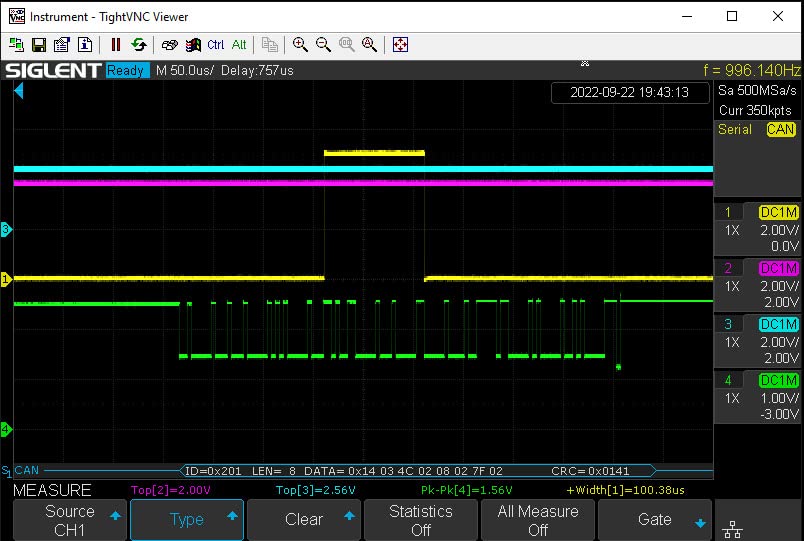
Serial decoding is the headline for hobby work. I2C, SPI, UART/RS232, CAN and LIN are all unlocked from the factory with no license fee, which removes one of the most annoying extras in this category. Owners consistently point out that a deep memory buffer and 20 setup save slots make long sessions easier to resume than they have any right to be at this tier.
One detail that gets missed in the spec lists: the built-in Ethernet web server. You can open the scope in a browser and view or share the screen without installing anything, which is genuinely useful for a classroom demo or a bench that lives in another room. The box also includes a quick start guide, a calibration certificate, four passive probes and a USB cable.
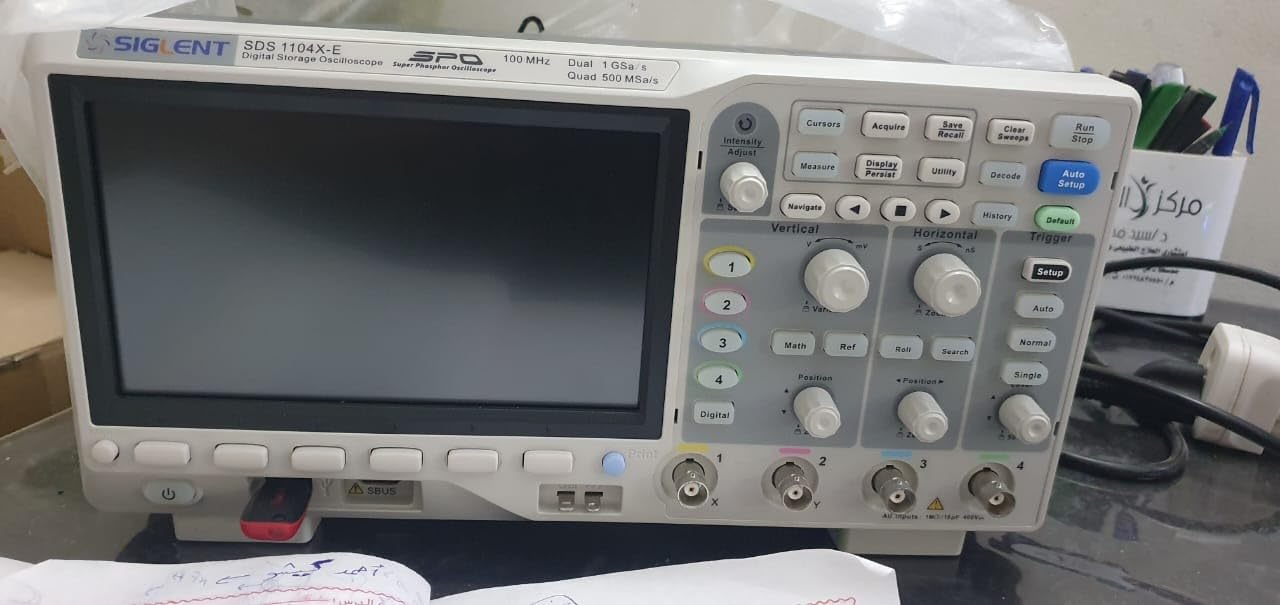
The complaints are consistent and narrow. The select and confirm knob is twitchy and can bounce to the next menu entry when you press it, which is the single most mentioned irritation. On long time bases the waveform update is not real-time, so you wait for the acquisition to finish before the display refreshes. Memory depth is respectable but not class-leading for heavier analysis work.
Also worth knowing before you buy: the MSO digital channel option, the USB arbitrary waveform generator module and WiFi are all separate paid upgrades. The cooling fan is audible at close working distance, and the tilt feet are not latched, so check it is stable on your bench surface. Channel 3 and channel 4 trace colours are similar, which matters more than it sounds when you are tracing a bus.
Who This Scope Suits Best
Buy the SDS1104X-E if you are working with more than two rails at a time, or you want to watch a clock and data line together while a third channel sits on a supply. Reviewers who compared it against the Rigol DS1054Z generally prefer the Siglent’s faster sampling, larger usable waveform area and display quality.
It is also the pick for anyone who decodes serial traffic regularly, because the CAN and LIN decoders arrive enabled. If you teach, stream a screen to a laptop, or work on embedded projects that involve timing relationships across three or four nodes, the four channels plus the web server justify the step up.
Who Should Buy Something Else
If you are on a very tight budget and your signals are 5 V logic and audio, the Rigol DS1054Z below gives you similar decoding for less, and you will get more memory depth with the money saved. Go the other way and look at the Siglent’s own optional modules only once you actually need the digital channels or a built-in generator.
The paid-license structure also matters if you plan to buy for someone else as a gift. The core instrument is complete, but a buyer who assumes the MSO and AWG are included will be disappointed. Body dimensions are 12.2 x 5.12 x 5.91 inches at 6.6 pounds, so it takes real desk space next to a pocket handheld.
2. FNIRSI 2C53T Review: Three Instruments In One Handheld
FNIRSI 2C53T 3-in-1 50MHz 2CH Oscilloscope Multimeter DDS Signal Generator
50 MHz 2-channel scope
19999-count DMM
DDS generator to 50 kHz
3000 mAh battery
Pros
- Three instruments in one body at a very low cost
- 4.5-digit 19999-count multimeter is genuinely useful
- Upgraded model adds math cursor and persistence modes
- One-click save with Type-C waveform export
Cons
- 2.8 inch display limits detailed waveform viewing
- 1 Kpts record depth is shallow
- Signal generator stops at 50 kHz
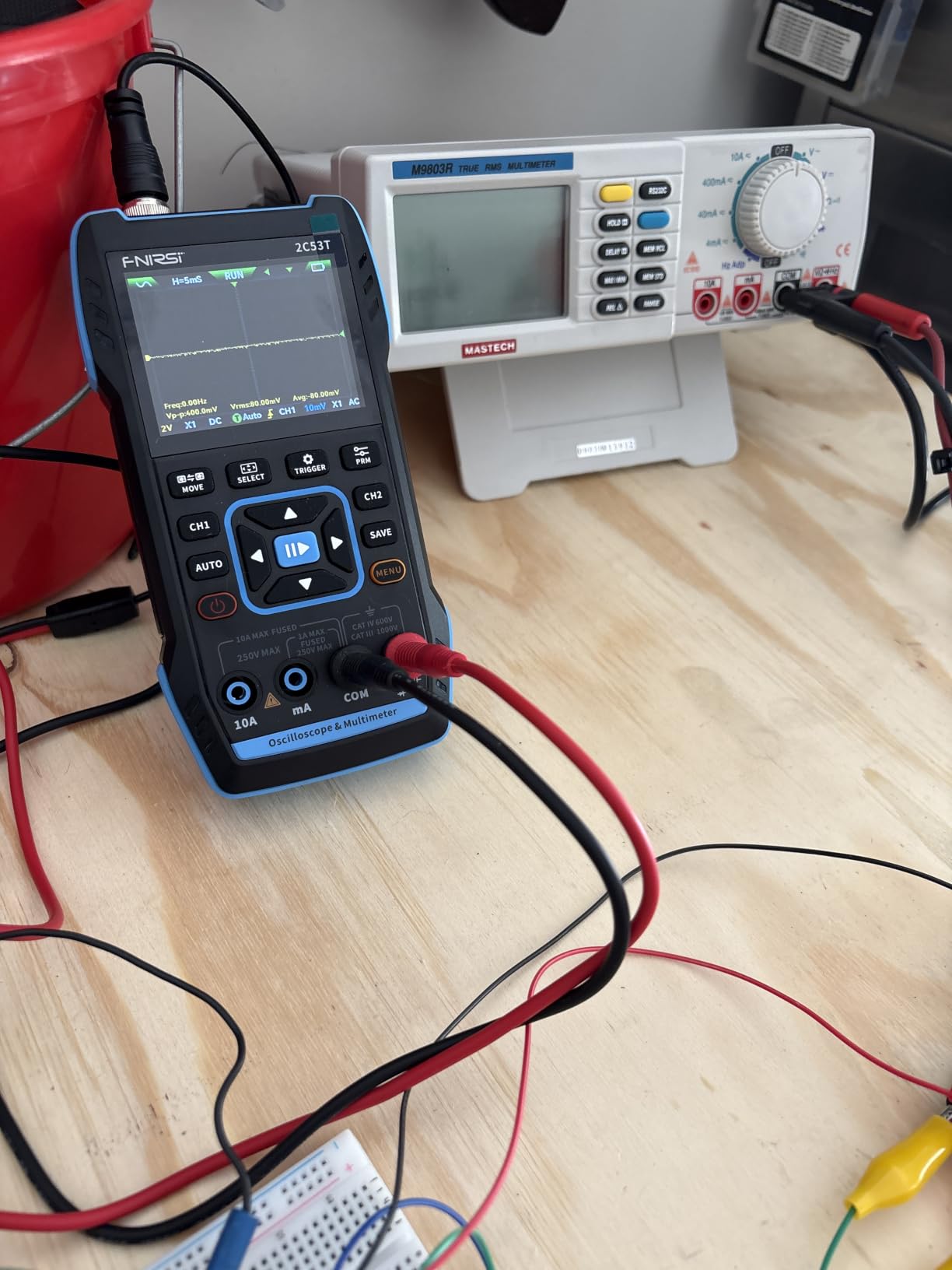
The 2C53T is not a bench scope and nobody should pretend otherwise. It is a 50 MHz two-channel scope at 250 MSa/s with 1 Kpts of record depth, fused with a 4.5-digit 19999-count multimeter and a DDS signal generator. What you are buying is the combination: one box in the toolbox instead of three.
Owners treat it as a field tool. The multimeter accuracy gets singled out repeatedly as a genuine surprise for a device in this bracket, and the built-in high-voltage protection on the FPGA and MCU architecture is what makes probing live circuits less nerve-wracking. The 2C53T is an upgrade over the earlier 2C23T, adding math operation, cursor measurement, persistence and XY mode.
Saving is easy. One-click capture with Type-C export lets you pull a waveform onto a computer and compare it against a reference on screen, which is more than most handhelds in this class offer. The switchable UI language and adjustable grid clarity are small touches that matter when you are squinting at a waveform in a car park.
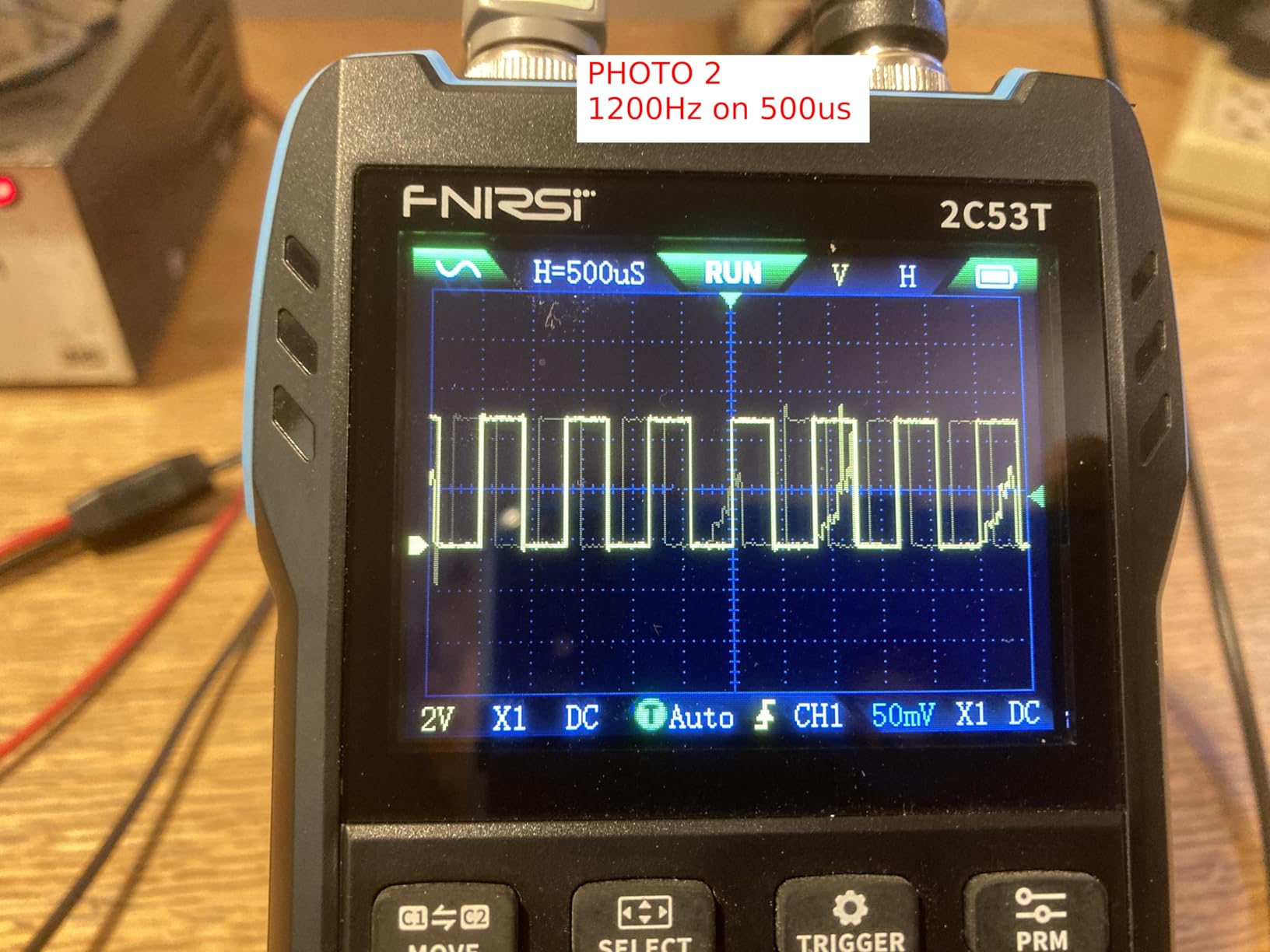
Where it stops is record depth. One thousand points is enough to see the shape of a signal and confirm a fault is present, and nowhere near enough to catch a rare burst, a startup transient or anything you want to decode. The 2.8 inch display is the other limit. It is readable, but reading a complex train of pulses means zooming a small screen.
Vertical sensitivity runs from 10 mV/div to 10 V/div with a 400 V maximum, which suits low-voltage logic and audio work. The generator tops out at 50 kHz, so it will not drive anything with real radio content. Battery life is around 6 hours of standby, and there are no rotary knobs, so every adjustment is a menu dive that needs practice.
Who This Scope Suits Best
It is built for the hobbyist who works away from a bench. Car electrical work, boat wiring, field repair, and general troubleshooting where the first question is “is this voltage or this signal right?” All three instruments share one charge, and the body is 6.57 x 3.5 x 1.38 inches at 400 g.
It also makes a cheap learning tool. A student can practise triggering, time base and volts-per-div without risking a repair. Reviewers note it ranks at the top of the Lab Oscilloscopes category, which reflects how many value buyers have landed on it.
Who Should Buy Something Else
Skip it if your work involves serial buses, switching nodes or any signal above a few megahertz. The shallow memory and modest sample rate will not get you a decode, and the waveform area is too small to zoom into detail comfortably.
Anyone intending to measure anything near mains voltage on a permanent board should understand that the probe is still a reference-ground design. See the safety notes in the buying guide before clipping anything earth-referenced to a live conductor.
3. Rigol DS1054Z Review: Best Memory Depth For The Money
Rigol DS1054Z Digital Oscilloscope, 50MHz, 4 Channel, 1GSa/s, Best Value
50 MHz bandwidth
4 channels
up to 24 Mpts memory
30000 wfms/s capture rate
Pros
- 24 Mpts of memory for the class
- 30000 wfms/s capture with intensity grading
- I2C SPI and RS232 trigger and decode included
- Built-in help explains every function
Cons
- Rotary encoder is mushy and can jump a step
- Cooling fan is noticeably noisy
- Supplied probes are mediocre and hard to tune
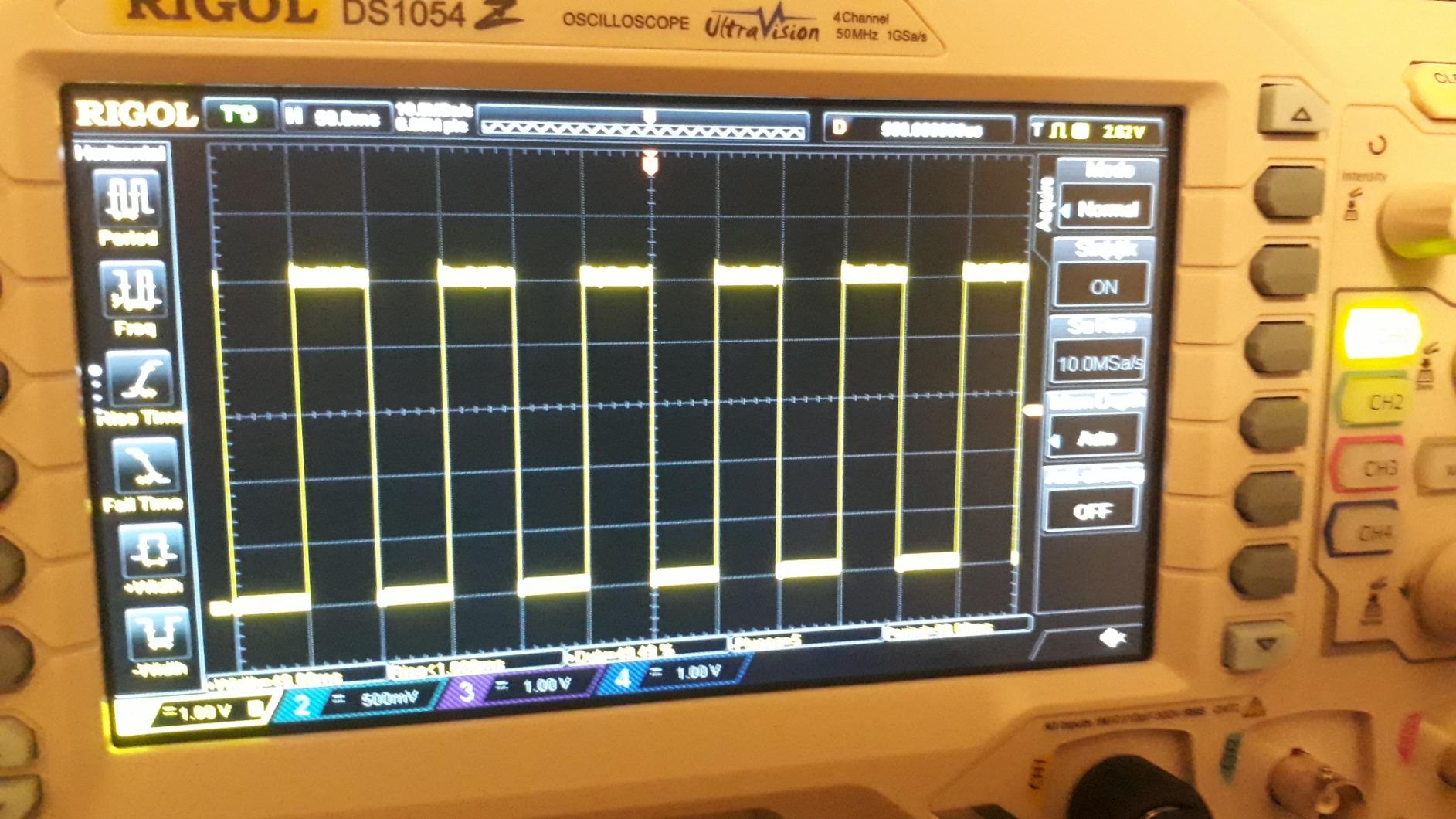
The DS1054Z has been the community default for years, and after reading a few hundred owner reviews it is easy to see why. Four channels, 50 MHz, and up to 24 Mpts of memory depth, dropping to 12 Mpts on two channels and 6 Mpts with three or four channels in use. That memory is the reason it is still the pick for anyone chasing a transient.
The 30,000 wfms/s waveform capture rate with an intensity graded display is the other half of the story. A scope that updates slowly can hide an intermittent glitch completely, because it never samples during the window when the glitch happens. This one shows you, and shades the trace by how often each point is hit.
Serial bus trigger and decoding for RS232/UART, I2C and SPI sit in the base firmware, along with FFT and filters. Interfaces cover USB Host, USB Device, LAN with LXI, and an AUX output for trigger out and pass/fail, which is enough to drive a documentation workflow. The built-in help system with walk-through explanations is genuinely useful when you are learning rather than recalling.
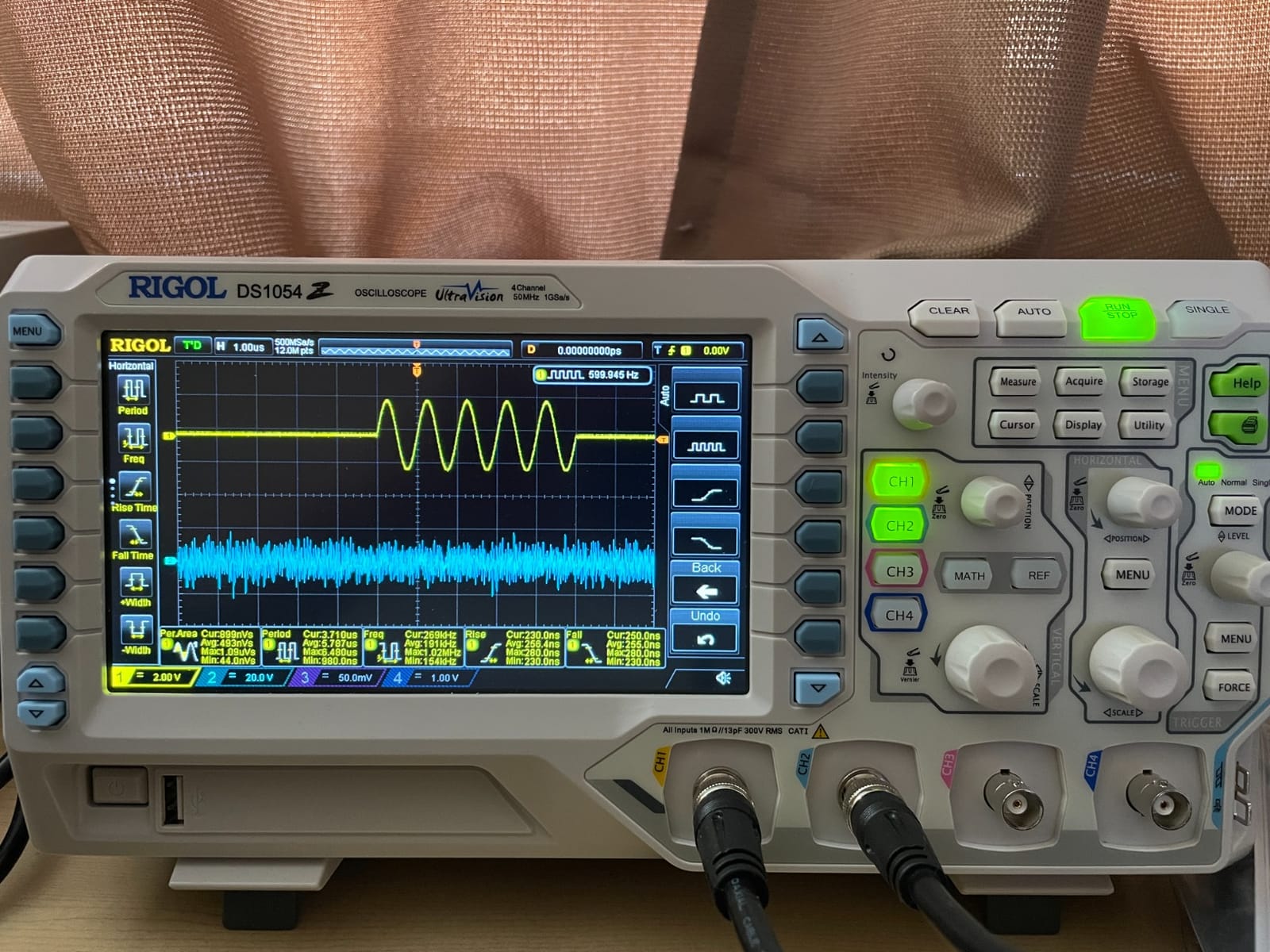
Long-term owners report the scope keeps working after five-plus years, and several compare it favourably to instruments costing several times as much. Long-term owner notes in hobbyist communities describe it as the safest scope in its price band for most people, and that reputation has held because the software has kept improving.
Now the negatives, and they are real. The cooling fan is the most repeated complaint across reviews, described as noticeably noisy on a quiet desk. The rotary encoder is mushy and often jumps a step when pressed, including while you are typing values into code entry, which is exactly when you do not want it.
Supplied probes are of mediocre quality and hard to tune. Channel 2 and channel 4 trace colours are hard to tell apart, and the channel 4 probe colour ring does not match the trace. There is no external trigger input, so you sacrifice a channel to trigger. The vertical amplitude range also limits how far you can zoom into a waveform, and the interface occasionally hangs, with older USB sticks sometimes not recognised.
Who This Scope Suits Best
This is the scope for a hobbyist whose projects involve capturing something that only happens sometimes. Motor start, switch-on transients, intermittent bus errors, a switching converter that only misbehaves under load. Twenty-four million points and a fast capture rate is the combination that finds them.
It also suits anyone learning digital protocols, since trigger and decode for I2C, SPI and RS232 are included with no extra purchase. Four channels means you can watch a microcontroller, its crystal reference, a reset line and a supply rail at once.
Who Should Buy Something Else
Skip it if noise on your bench is a genuine concern, or if you are the type who will be annoyed by an encoder that moves when you press it. The 50 MHz native bandwidth is also a ceiling if you plan to look at fast switching edges well beyond 50 MHz without a firmware modification, which carries its own warranty and licensing questions we do not recommend to beginners.
The mediocre bundled probes are the trap here. Budget for a better 10x probe before you judge the instrument, because a sharp scope behind a poor probe still gives you a poor trace. At 6.6 pounds and 13 x 7 x 5 inches it is a full-sized bench unit, not a portable one.
4. HANMATEK HO52 Review: Most Versatile For Working Away From The Bench
HANMATEK Handheld Digital Oscilloscope 50Mhz Bandwidth with 2 Channels HO52 3.5″ TFT Mini Oscilloscope, 2 in 1 Oscilloscope and Multimeter, Backlit Screen, Auto-Calibration Function, Memory Function
2-channel 50 MHz
250 MSa/s
8k dot record
true-RMS 4.5-digit DMM
Pros
- Genuinely portable 50 MHz two-channel scope
- Combines scope and true-RMS multimeter with independent inputs
- One-key AUTO set plus cursor measurement
- Saves reference waveforms screenshots and CSV files
Cons
- 8k dot record depth is very shallow
- Button-driven interface with no physical knobs
- Triggering is limited versus bench instruments
The HO52 is the pick if you want a real 50 MHz two-channel scope in a body you can put in a bag. It runs 250 MSa/s real-time sampling with a record length up to 8k dots and a waveform refresh rate up to 10,000 wfms/s with Auto, Normal and Single behaviour. A one-key auto set gets you a trace quickly, which matters more than raw specs when you are on a roof or in a car.
The second half of the device is a true-RMS 4.5-digit multimeter rated to 750 V AC and 1000 V DC, with resistance, diode, continuity, capacitance, autorange, relative and hold. Crucially, the oscilloscope and multimeter have independent inputs, so you are not fighting one shared socket for both jobs.
It also saves. Four settings, four reference waveforms, four images and four CSV waveform groups, with a Type-C port for power bank input, charging and PC transfer. A self-calibration function is included, which is worth running if you are chasing a small signal and want to be sure the offset is not misleading you.
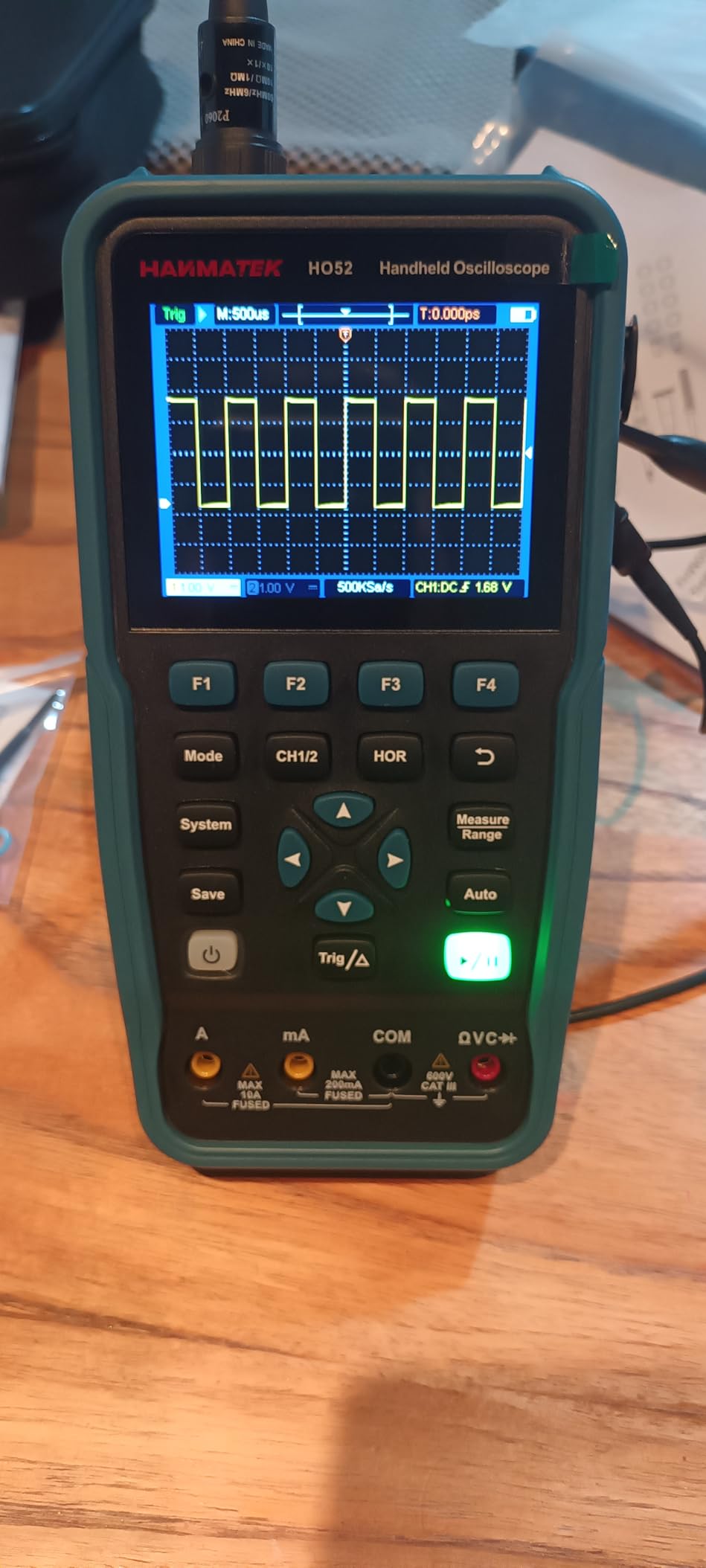
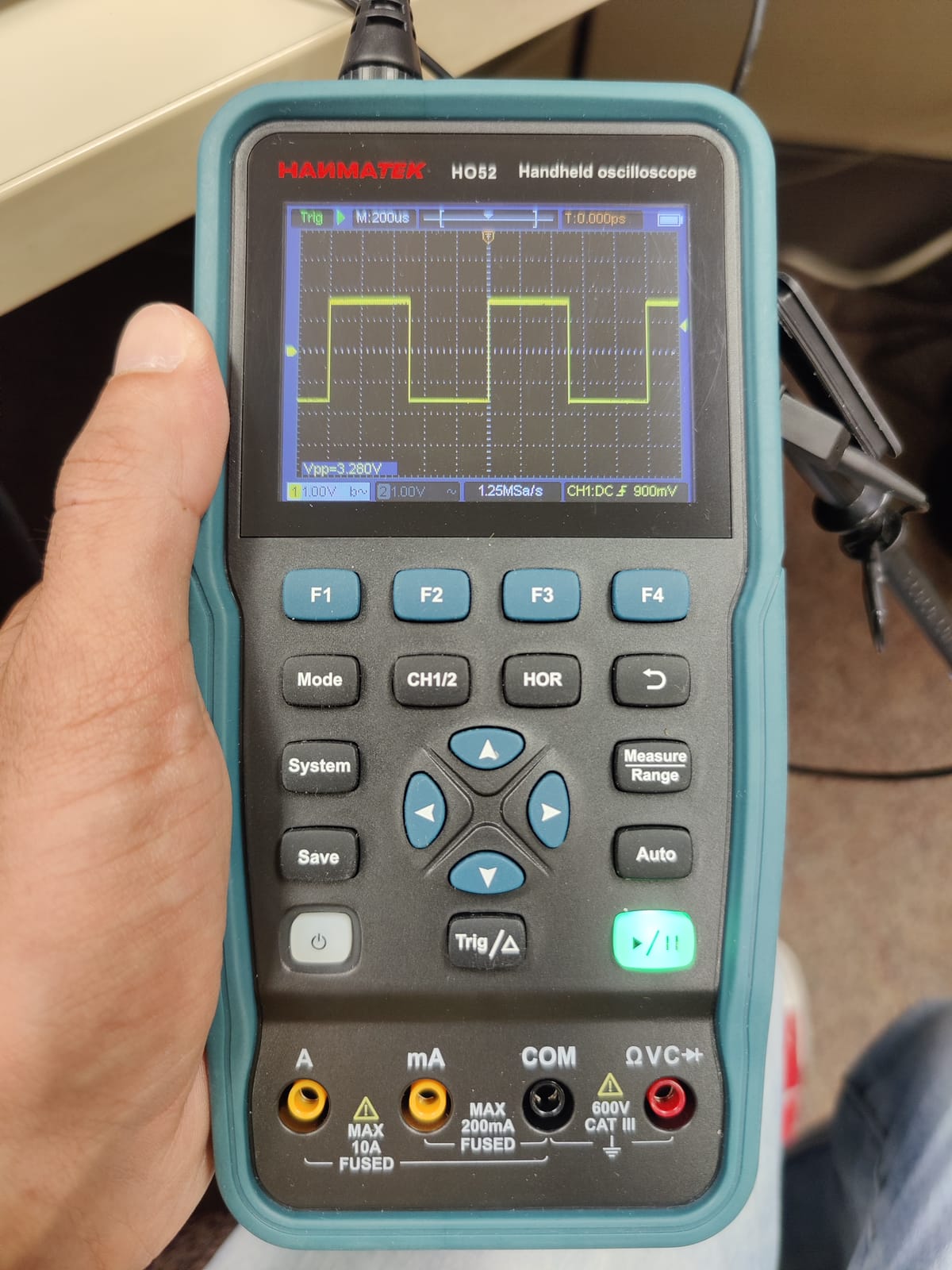
Reviewers like the combination of a true-RMS meter and a two-channel scope sharing one small, light body with separate inputs, and they rate the auto-set, calibration and CSV export as the features that make it practical rather than a toy. It is positioned for electronics repair, automotive work and teaching labs.
The constraints are the same ones every pocket scope shares. Eight thousand dots is very shallow for a long capture, so you will see the first few milliseconds and then lose the rest. Triggering behaviour is limited compared with a bench instrument, which means finding a stable display on an aperiodic signal takes more patience.
There are no rotary knobs at all, so every setting is a menu action, and the 3.5 inch screen limits how many measurements you can read at once. Expect class-appropriate accuracy rather than reference accuracy: this is a fast qualitative tool, not a metrology instrument. Dimensions are 7.83 x 1.54 x 3.94 inches at 16 ounces.
Who This Scope Suits Best
It fits automotive electrical diagnosis, appliance and appliance-adjacent repair, and any situation where the work happens away from a bench. The true-RMS meter means you can check a supply properly rather than guessing with a cheap meter, and the CSV export lets you archive captures for later comparison.
For students, a one-key auto set means the first hour is spent learning what a waveform is rather than fighting a menu tree. Reviewers in repair communities broadly agree that a low-cost 100 MHz to 200 MHz scope is sufficient for most hobby and repair work, and this fits that bracket.
Who Should Buy Something Else
Move up if you need to decode serial traffic, capture a long burst, or look at a fast edge. There is no protocol decoding here, and 8k points will not hold a message frame plus its surrounding activity in one acquisition.
Also consider a USB or PC-based scope if you only need to look at GPIO and slow serial lines, since those are cheaper and connect straight to a laptop. We apply the same testing discipline to computer-connected tools as we do to digital signage displays, where the software half decides whether the tool is any good.
5. FNIRSI DSO152 Review: The Cheapest Way To Learn Triggering
FNIRSI DSO152 Handheld Oscilloscope 200kHz Bandwidth, 2.5MS/s Sampling Rate
200 kHz bandwidth
2.5 MS/s sampling
320x240 2.8 inch LCD
Auto Normal Single trigger
Pros
- Lowest-cost way to learn waveform shape and triggering
- Finished assembled unit with no soldering
- One-key AUTO plus long-press baseline calibration
- Type-C handles charging data and firmware upgrades
Cons
- 200 kHz limits it to audio and very low frequency work
- Small 320x240 screen
- Single probe input so no dual-channel comparison
The DSO152 is the cheapest way to find out whether you actually enjoy this hobby, and for that purpose it works. It offers 200 kHz of bandwidth at 2.5 MS/s real-time sampling with full Auto, Normal and Single trigger modes, which is the part that matters most: you can learn how a trigger behaves on a periodic signal versus an aperiodic one, which is the single most confusing idea for a first-time user.
It arrives as a finished unit. No soldering, no assembly, no risk of a build error eating your weekend. A one-key AUTO sets every parameter, and a long press on AUTO calibrates the baseline, which matters because a drifting baseline makes every measurement look wrong.
Owners describe it as a first touch for beginners and students learning waveform shape, trigger behaviour and calibration. The 10x probe is rated to measure up to 800 Vpp, equivalent to 280 V AC, with voltages up to 400 V measurable, so a proportion of mains-adjacent checks are within its envelope.
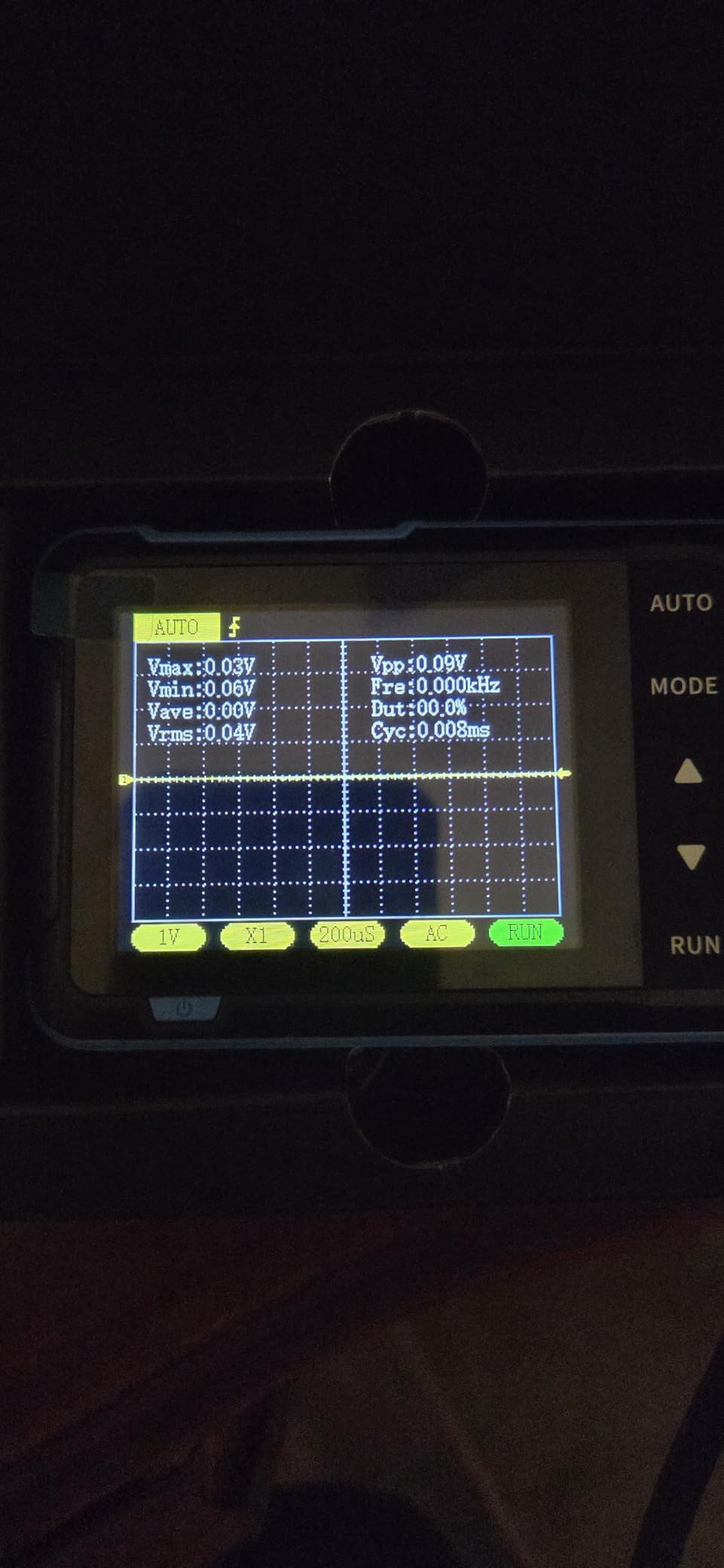
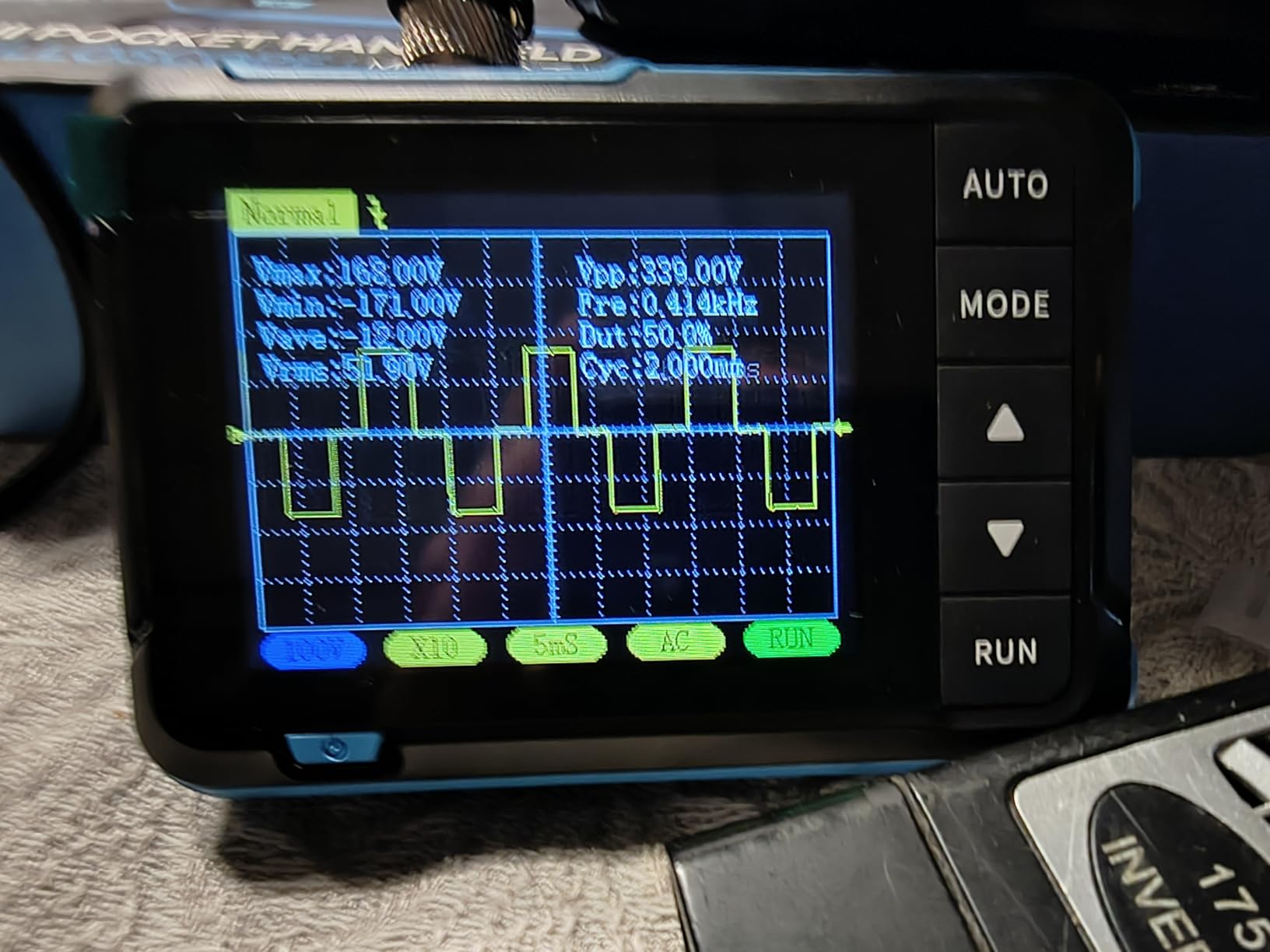
Be clear-eyed about the ceiling. Two hundred kilohertz is an audio-band instrument, not a digital one. It will show you a rectified waveform, a switching supply envelope at a crawl, and a low-frequency control signal. It will not show you an Arduino clock edge, an I2C transaction, or anything in the RF band.
There is a single probe input, so no dual-channel comparison. The 2.8 inch display at 320 by 240 limits reading detail, and the built-in 1000 mAh battery gives roughly 4 hours of continuous use, which is short for a long session. The Type-C port handles charging, data transfer and firmware upgrades, so it will not be stranded when the software improves.
Who This Scope Suits Best
This is for someone who has just soldered their first circuit and wants to see what the voltage is actually doing, or for a classroom set where each student needs a personal instrument. Audio electronics, power supply hum and ripple at low repetition rates, and teaching the vocabulary of time base and volts-per-div all fall in range.
Because it is cheap, it is also a low-stakes trainer. Learning to set a trigger on a device that cannot damage anything is a sensible way to build the habit before moving to a bench instrument.
Who Should Buy Something Else
Do not buy this as your only scope if you plan to touch microcontrollers. No single channel means you cannot compare an input against a reference, and 200 kHz will simply not show a digital edge. The 4 hour battery also means it lives near a USB port rather than in your bag.
If your interest is audio electronics, the ZOYI ZT-703 below covers the same ground with two channels and a proper 25000-count meter for a modest step up, and the YEAPOOK ADS5012h covers you if you need real bandwidth on the move.
6. FNIRSI DSO-510 Review: A Scope And Generator For Car Audio Work
FNIRSI DSO-510 2-in-1 10MHz Handheld Oscilloscope DDS Signal Generator
10 MHz bandwidth
48 MS/s sampling
DDS generator to 50 kHz
320x240 LCD
Pros
- Scope plus DDS signal generator in a very small body
- 48 MS/s gives a usable waveform for audio and car work
- Infinite afterglow and level display help catch transients
- Easy to carry in a toolbox or truck
Cons
- Generator output is inaccurate at higher setpoints
- Only a single probe channel
- Trigger mechanism is hard to master
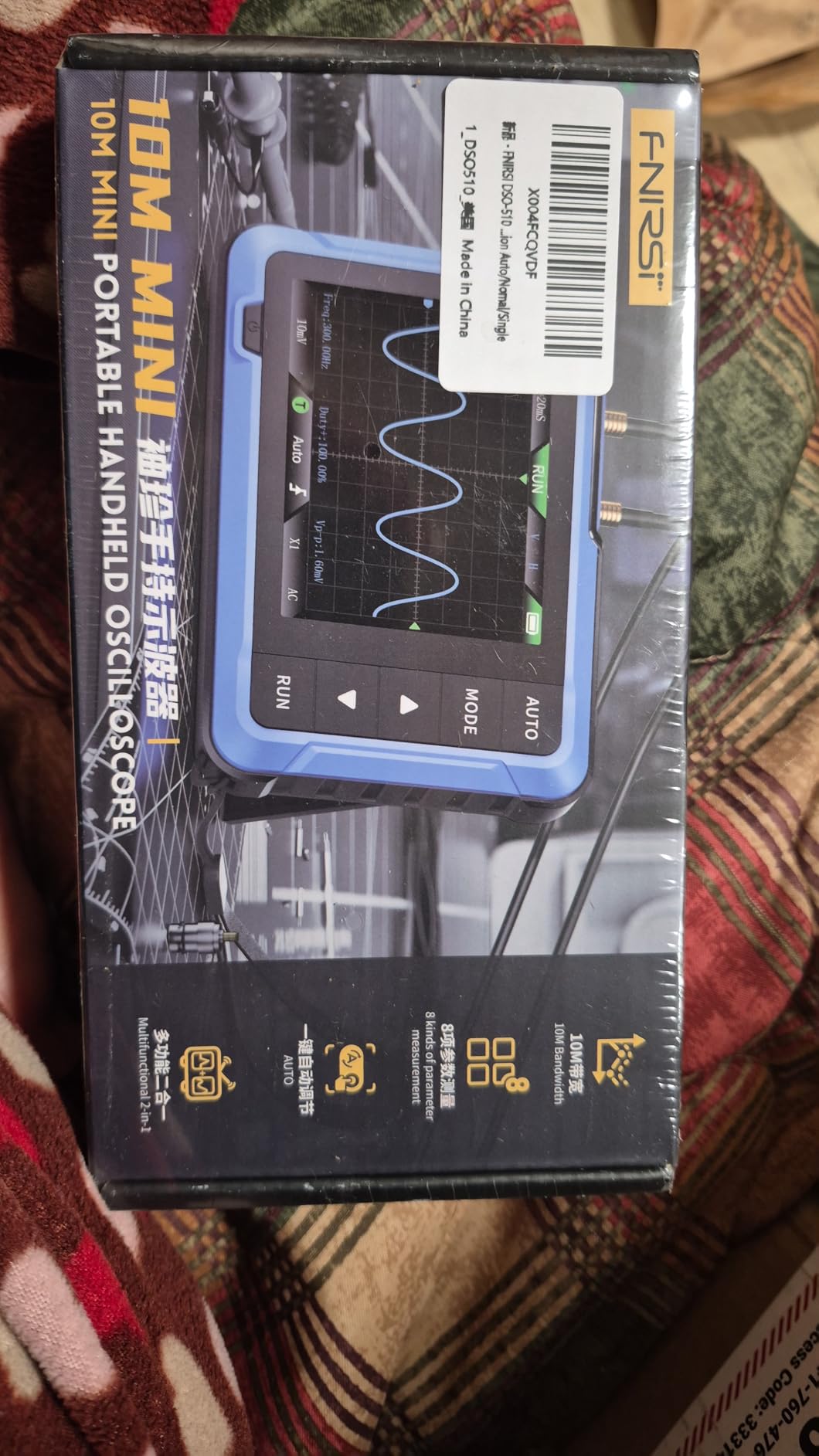
The DSO-510 pairs a 10 MHz scope sampling at 48 MS/s with a DDS signal generator offering 13 waveforms up to 50 kHz, and at 3.8 x 2.68 x 0.75 inches it is small enough to live in a glovebox. The time base runs from 50 ns to 20 s, which is a wide span for something this size and covers everything from a switching transient to a slow charge curve.
Owners use it mainly for car audio and basic automotive diagnostics, where its portability and clean sine-wave display are the draw. Several reviewers specifically mention the signal generator as a useful addition, since being able to inject a reference tone or a test waveform in a car changes the diagnostic completely.
Two capture features help. Infinite afterglow leaves a decaying trace so a brief event stays visible, and the level display highlights how far a signal sits above or below its average. Voltages up to 400 V are measurable, and waveform scaling, suspension, movement and image save functions are all present.
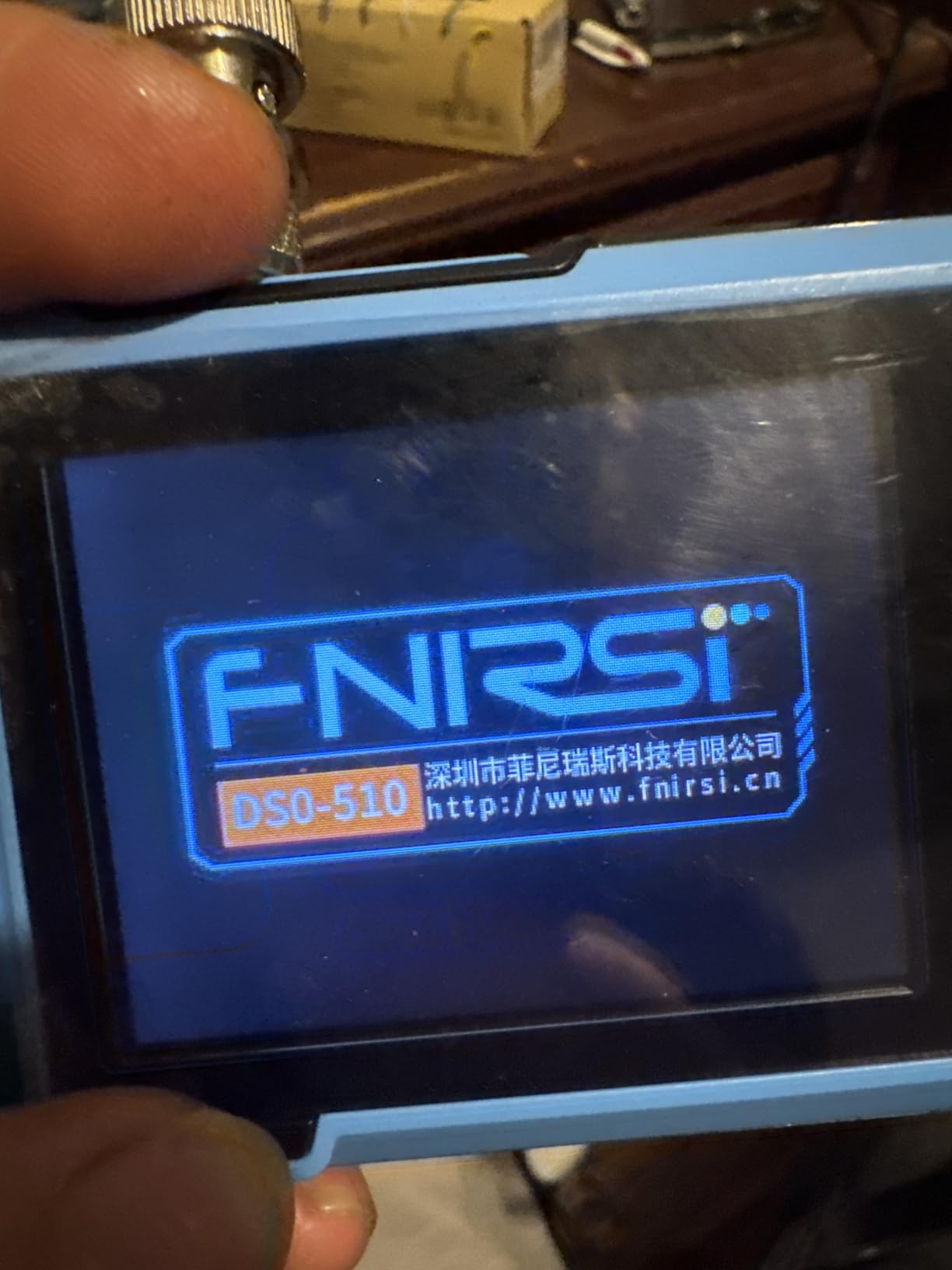
Reviewers are candid about the trade-off. The generator output amplitude and frequency are noticeably inaccurate at higher setpoints, and it resets to 1 kHz when you return to scope mode, so it is a diagnostic aid rather than a precision source. Only a single probe or channel is supported, which rules out any two-signal comparison.
The trigger mechanism is hard to master, and the probe calibration screw is fragile. Reviewers also note the scope is not accurate enough for high-importance troubleshooting, which is a fair summary at the budget end of this list, so treat it as a trainer and curiosity tool rather than a diagnostic instrument.
One real advantage for beginners: the handheld design has no reference ground lead, so probing circuits near mains is safer in principle than with a conventional earth-referenced probe. That does not make it safe in every case, so read the safety section below before any live measurement.
Who This Scope Suits Best
Car audio installers and anyone checking an alternator ripple, a dimmer, or a boost converter benefit from the combination of meter-sized portability and a generator you can take with you. A 1000 mAh lithium battery with Type-C charging keeps it usable away from a socket.
It also works as a second opinion instrument. When a larger bench scope tells you something surprising, carrying this in the car and re-checking on the spot is a fast way to separate a real fault from a measurement artefact.
Who Should Buy Something Else
Anyone working above a few megahertz should stop here. Ten MHz will not resolve a modern digital bus, and the single channel removes the basic ability to time one signal against another.
For measuring a signal against a reference, an alternator output, or any two-rail relationship, two channels is the minimum, which points to the ZOYI ZT-703 or the HANMATEK HO52. For a generator you can trust at higher frequencies, the two-channel Rigol or Siglent bench scopes include arbitrary waveform output as standard or as a documented module.
7. YEAPOOK ADS5012h Review: 100 MHz Bandwidth In Half A Pound
YEAPOOK ADS5012h Handheld Digital Portable Oscilloscope Mini Storage Oscilloscope Kit with 100MHz Bandwidth 500MS/s Sampling Rate 2.4” TFT LCD Display
100 MHz bandwidth
500 MSa/s sampling
128 kb record depth
0.5 pound body
Pros
- Exceptionally capable 100 MHz bandwidth at 500 MSa/s in a 0.5 pound body
- One-key AUTO reliably sets sweep and amplitude
- Triggering is stable once you learn the mode and cursor keys
- 64 MB flash holds up to 2000 waveform images
Cons
- Vertical shift limited to about plus or minus 4 divisions
- No zoom on a static waveform and no cursors
- Real usable bandwidth is well below the stated 100 MHz
The ADS5012h is the spec-sheet outlier in this list: 100 MHz of analog bandwidth at 500 MSa/s real-time sampling, with 128 kb of record depth, in a body that weighs half a pound. Owners who carry it for audio work, low-frequency RF, PC repair and household checks treat it as a capable grab-and-go instrument rather than a novelty.
Reviewers repeatedly confirm that the AUTO button and Normal-mode trigger adjustment work well, and that output matches bench Rigol and Siglent scopes for signals under roughly 10 to 20 MHz. That is the number worth remembering, because it reframes the 100 MHz headline honestly.
There are twelve automatic measurements including V-p-p, V-max, V-min, V-avg, V-rms, frequency, cycle, duty plus and minus, and timing for both polarities. The 64 MB of internal flash holds up to 2000 waveform images with a thumbnail browser for flipping and deleting, which is unusual storage for a device this small. The battery gives close to 8 hours of intermittent use.
The most cited limitation is the vertical shift, limited to roughly plus or minus 4 divisions. That sounds trivial until you try to measure ripple on a 12 V rail while zoomed in, because the trace simply cannot be moved to the centre of the screen, and ripple measurement is a core hobby task.
There is also no zoom on a static waveform and no cursors for measurement, so the twelve automatic readings are your only measurement route. The recessed micro-USB port needs a specific deep cable, and no power brick is included. Menu operations are undocumented in the manual, and the Mode button doubles as enter, which is a steep first hour.
One more honest note: usable bandwidth is well below the stated 100 MHz for many users, and there are occasional reports of units failing to power or charge. Manufacturer support is hard to reach, so check the return window carefully.
Who This Scope Suits Best
It suits the tinkerer who needs a working scope in the car, under a floorboard, in a loft, or at a club night, and who would never carry a bench unit. Half a pound and 4.5 x 2.9 x 1.4 inches change what you are willing to measure, and that is the honest value proposition here.
For audio and guitar pedal work, low-frequency RF checks, and general repair, the combination of bandwidth headroom and storage makes it the most capable pocket option in this roundup. Owners also praise how much more convenient it is than hauling a bench scope to a job.
Who Should Buy Something Else
Skip it for anything involving a high-offset supply ripple measurement, which is precisely where the vertical shift limit bites. It is also the wrong tool for protocol decoding, and for anyone who wants to zoom into a capture, the absence of cursors and static zoom is a daily annoyance rather than a minor one.
Also read the manual situation before buying. An undocumented menu system and a fragile micro-USB port are friction you will feel at the bench. If you can carry a 6.6 pound bench instrument, the Rigol DS1054Z gives you real memory depth and cursors for not much more, and we would take that trade every time for a fixed bench.
8. ZOYI ZT-703 Review: A Great Multimeter First, A Basic Scope Second
3 in 1 Handheld Oscilloscope Automotive Dual Channel 50MHz with Digital Multimeter and Signal Generator
Dual channel scope
25000-count DMM
128K storage
Type-C charging and data
Pros
- 25000-count auto-ranging multimeter is accurate with a very clear display
- Solid well-made construction and good key feel
- Compact and USB-C rechargeable so it works away from a bench
- Comes with a case two probes leads and a charging cable
Cons
- No rotary dials so divisions and cursors need menus
- On-screen and real bandwidth fall short of the stated 50 MHz
- Display sleeps in under 10 minutes
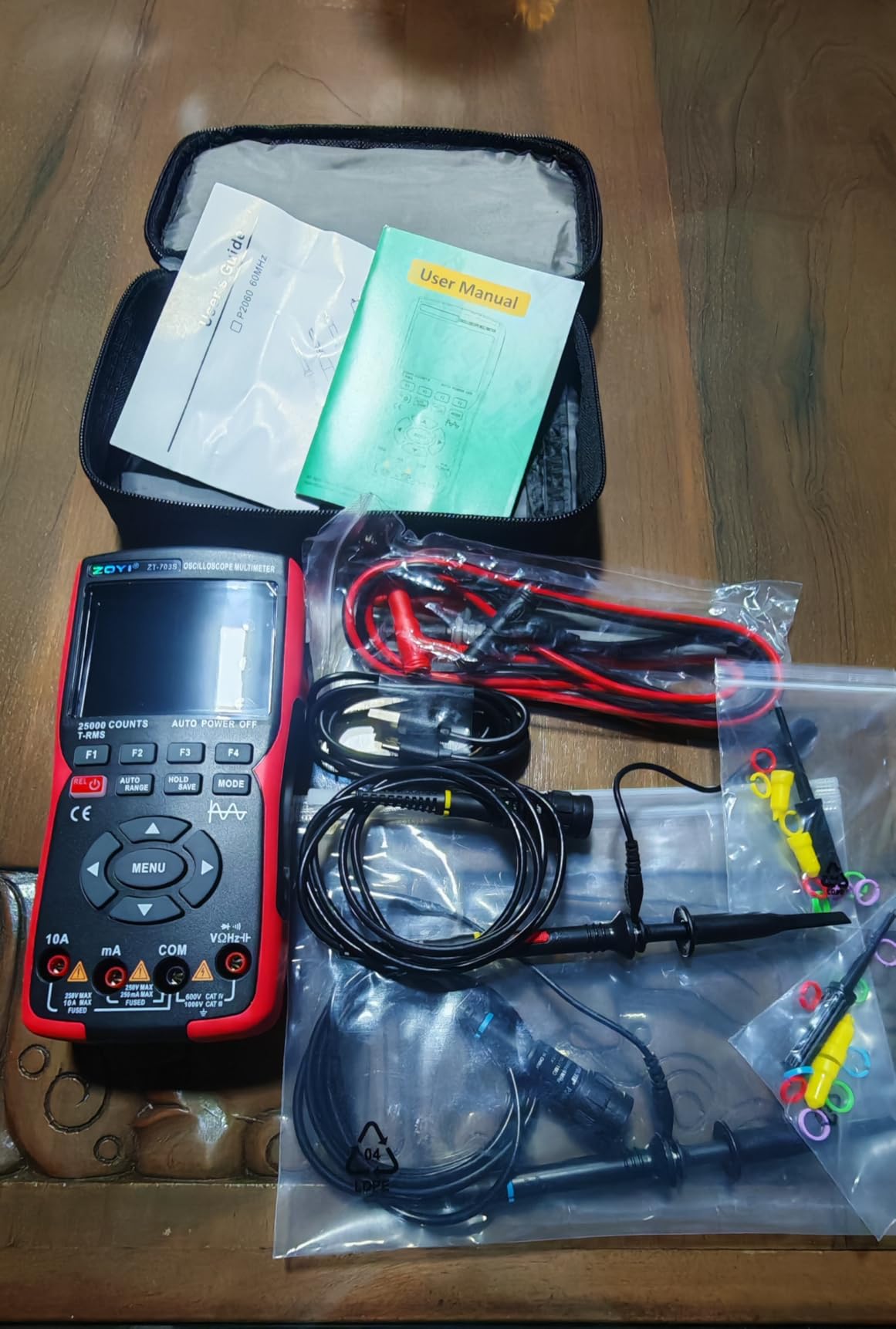
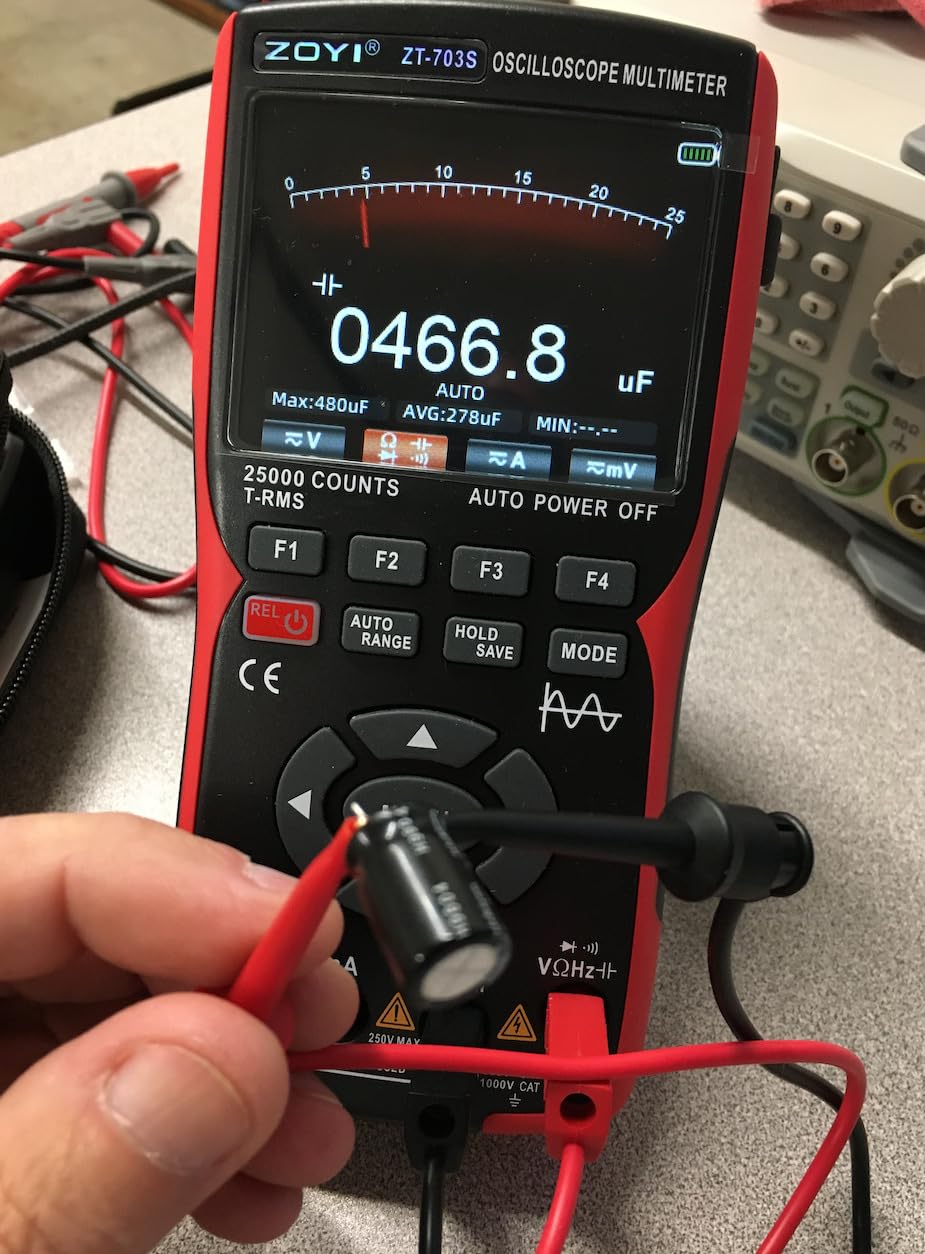
The ZT-703 is unusual in this list because the meter is the stronger instrument. A 25000-count auto-ranging multimeter covering resistance, capacitance, continuity, diodes and current, with a display reviewers repeatedly single out as clear. If your day job is checking things, this is the part you will trust most.
The scope section is a dual-channel unit with AUTO waveform recognition. In Normal mode it samples at 200 MSa/s with a 30 MHz maximum measurement bandwidth; in high-speed mode it samples at 280 MSa/s with a 50 MHz maximum. Storage depth is 128K, which is deeper than most handhelds in this shape factor.
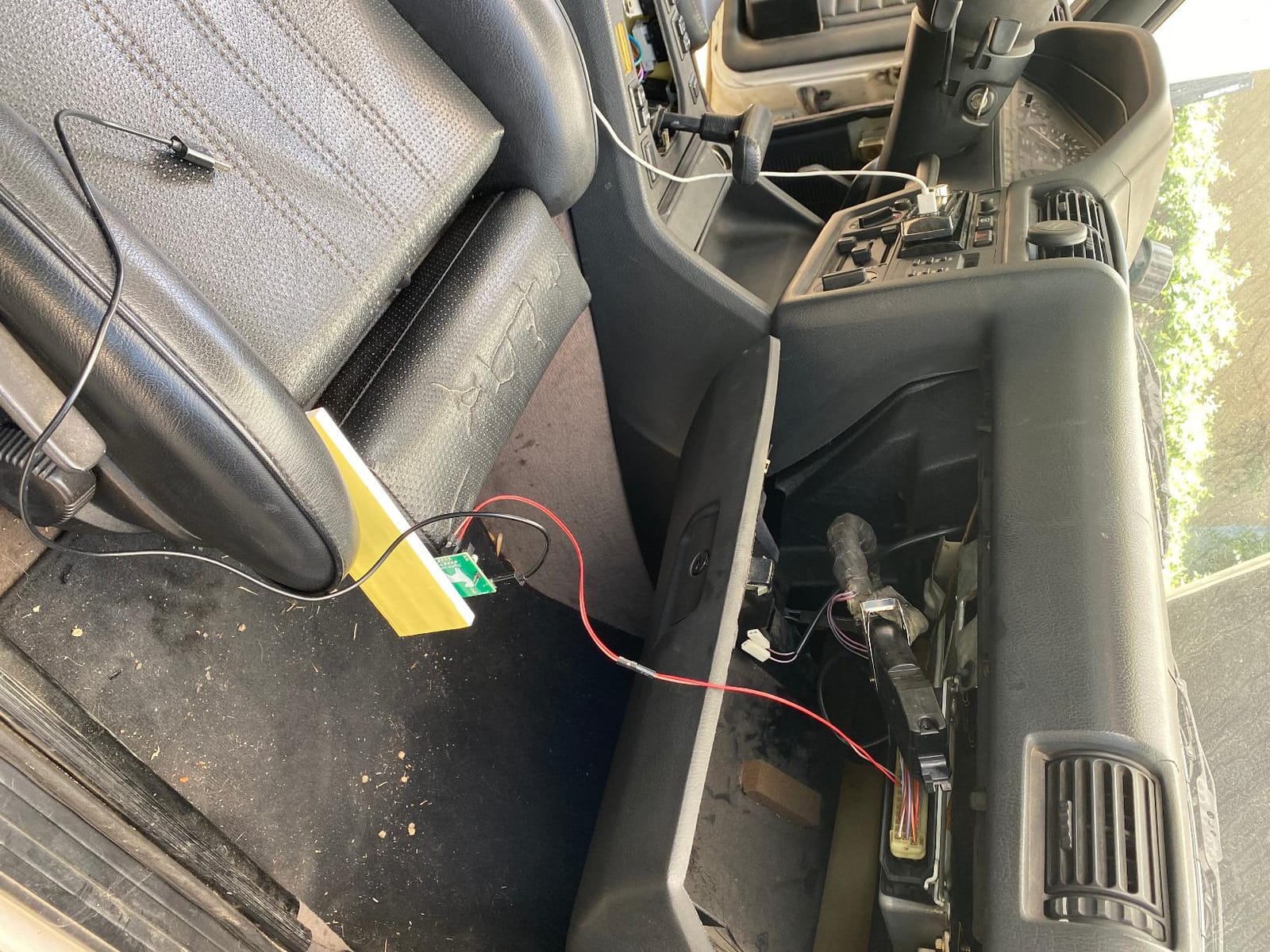
Owners frame it as a superb multimeter first and a basic scope second, using it for automotive diagnostics, speaker phase checks, PC board work and general field troubleshooting. The build feels solid in hand, and it is only 380 g with Type-C fast charging, so it is genuinely portable to a job site.
The consensus limit is honest rather than damning. On-screen and real bandwidth fall well short of the stated 50 MHz, landing around 10 to 20 MHz in practice for sine waves and roughly 5 to 10 MHz for square waves, whose edges and rise times look deformed at higher frequencies. Set your expectations at that level and it will not disappoint.
There are no rotary dials, so changing divisions and working the cursors means navigating menus, and the screen feels crowded for waveform work. The signal generator is limited to very tame sine, square and triangle waves, best treated as a self-test aid. The display also sleeps in under 10 minutes with limited timeout adjustment, which is irritating during a long diagnosis.
It does not measure temperature, which is a small gap if you are working on cooling systems or thermostat circuits. The box includes the scope, an oscilloscope probe, test leads, a charging cable and a cloth bag.
Who This Scope Suits Best
Automotive diagnostics is the standout use. A 25000-count meter plus a dual-channel scope in one rechargeable body covers alternator output, sensor signals, and continuity checks without a van full of gear. Speaker phase checks and PC board work are the other recurring uses owners describe.
It is also a good first instrument for someone who measures more than they oscillate. If most of your questions are answered by a meter and only occasionally by a waveform, the balance of features here is right for you.
Who Should Buy Something Else
Do not rely on it above about 10 MHz, and do not expect the 50 MHz figure on the box to translate into usable measurements on square waves. If your work is digital, the ZOYI has no protocol decoding and no bandwidth to run it.
Anyone who prefers turning knobs to working through menus will be frustrated, and a crowded screen hurts long sessions. For a fixed bench with digital work in front of you, the Hantek DSO2C10 below gives 100 MHz bandwidth with serial triggers and an arbitrary waveform output for a modest step up in money.
9. EspoTek Labrador Review: A Five-Instrument Kit That Runs From A Laptop
EspoTek Labrador: Easy-to-Use, Open-Source, All-in-One USB Oscilloscope, Signal Generator, Power Supply, Logic Analyzer, Multimeter for Windows, Mac, Linux, Android, Raspberry Pi
2-channel scope at 750 ksps
2-channel AWG
4.5 to 15 V power supply
open source
Pros
- Postage-stamp size and about 20 g for five instruments in one
- Open-source hardware and software with Windows Mac Linux and Pi builds
- Quick setup and calibration that removes input noise
- Two scope inputs plus two separate generator outputs
Cons
- No calibrated time base so it cannot substitute for a triggered scope
- Measurements between channels differ noticeably
- Android app is buggy and crashes often
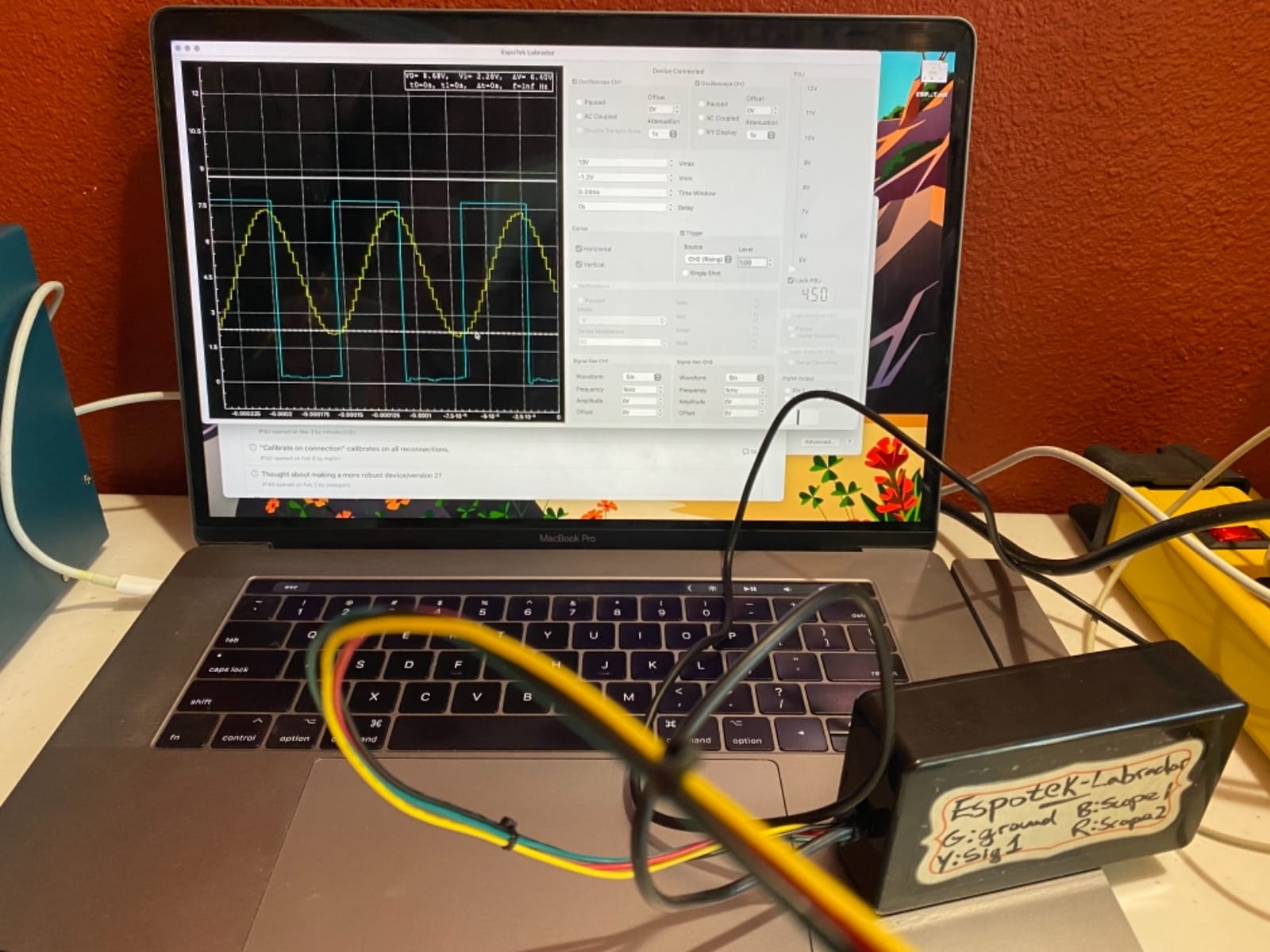
The Labrador packs five instruments into a board that weighs 20 g: a two-channel oscilloscope at 750 ksps, a two-channel arbitrary waveform generator at 1 MSPS per channel, a 4.5 to 15 V power supply with closed-loop feedback up to 0.75 W, a two-channel logic analyzer at 3 MSPS per channel with serial decoding, and a multimeter for voltage, current, resistance and capacitance.
It is powered and controlled entirely over USB, with software for Windows, Mac, Linux, Android and Raspberry Pi, and the hardware and software are open source. That combination is the appeal. For GPIO work, audio, and slow UART or I2C monitoring, it covers the ground a bench scope would, at a fraction of the money, with a full-size software display instead of a tiny screen.
Setup and calibration are quick, and the calibration routine removes input noise, which matters on a device this small. Two scope inputs plus two separate generator outputs give real test flexibility: you can inject a signal and watch the response in the same session.
Owners divide into two camps, and both sides are worth hearing. Enthusiasts value the open-source design, the tiny footprint, easy breadboard integration, and having all five functions available at once. Critics point to real limitations: the Android app is buggy, crashes often and feels abandoned, and measurements between the two channels, and against a multimeter, differ noticeably.
The fundamental limit is the one enthusiasts accept. There is no time-division or calibrated time-base display, so it cannot substitute for a true trigger-based scope, and pin spacing does not align with common protoboards, meaning power pins may need bending. Documentation is thin, settings do not persist between sessions, and you need a USB cable that carries data rather than just power.
Who This Scope Suits Best
This suits someone already working in software who wants a bench instrument that appears on the Raspberry Pi or laptop they are already using. It is a natural companion to a microcontroller dev board, and the logic analyzer with serial decoding makes it a sensible first purchase for Arduino and ESP32 projects where you mainly want to see a GPIO edge or a byte stream.
The bundled power supply and generator mean you can power and drive a small circuit in the same session, which removes a surprising number of bench accessories. If you have been reading that a logic analyzer might be a better first buy than a scope, this is that decision in one box, at a price that makes a bad purchase survivable.
Who Should Buy Something Else
Not if you need to time a fast edge, examine a switching node, or trust a measurement of a few millivolts. With 750 ksps and no calibrated time base, this is a logic-level companion, not a measurement instrument, and the channel-to-channel accuracy variance makes it a poor choice for comparing two rails.
Also skip it if you are on Android, where the app experience is the weakest. A Raspberry Pi or laptop is the intended environment. If you need real time-based measurement, step up to the HANMATEK HO52 for a 50 MHz two-channel handheld with an independent multimeter input, which costs less than many bench scopes.
10. Hantek DSO2C10 Review: The Step Up From A Pocket Scope
Hantek DSO2C10 Digital Storage Oscilloscope 100MHz Bandwidth 2CH
100 MHz bandwidth
2 channels
arbitrary waveform output
14 trigger modes
Pros
- 100 MHz bandwidth in a low-cost two-channel bench unit
- 14 trigger modes plus five serial protocol triggers and decodes
- Arbitrary waveform output built in
- Compact 4.2 pound footprint fits a small bench
Cons
- Only two channels which limits multi-rail debugging
- Entry-level build and screen quality versus larger brands
- Basic documentation
The DSO2C10 is the bridge between a handheld and a proper bench scope. A digital storage oscilloscope with 100 MHz bandwidth and two channels, at 4.2 pounds and 12.6 x 4.33 x 5.91 inches, so it is mains powered and stays on the bench rather than living in a bag. That is the single biggest quality-of-life change for regular work.
Two features stand out for the money. First, arbitrary waveform output is built in, which many rivals at this level charge extra for or omit entirely, so you can drive a circuit rather than only observe it. Second, fourteen trigger modes plus five standard serial protocol triggers and decodes, which is more trigger flexibility than most entry units offer.
Reviewers recommend it as a cost-effective 100 MHz two-channel scope for students, embedded hobbyists and service work, and position it as a step up from handheld pocket scopes and a cheaper route into 100 MHz measurement than the Siglent and Rigol benchmarks. It ranks eighth in the Lab Oscilloscopes category, reflecting steady demand in the mid-budget tier.
What you give up is channels and polish. Two channels means multi-rail debugging is awkward, and any comparison involving more than two signals has to be repeated. The build and screen quality are a clear step below Rigol, Siglent and Tektronix instruments of similar bandwidth, and the documentation is basic.
For a hobbyist this is usually an acceptable trade. Nothing in the spec list is misleading, the screen is adequate rather than impressive, and the arbitrary waveform output removes a real constraint when you are bringing up a power converter or driving an amplifier stage.
Who This Scope Suits Best
It suits embedded bring-up and education: students, electronics courses, and hobbyists who have outgrown a pocket scope and want 100 MHz with a real trigger system and mains power. A two-channel layout is comfortable for checking a clock against a data line, which is most serial work.
The arbitrary waveform output makes it a good companion for amplifier and power supply experiments, where you need to feed a known signal into a circuit under test. For anyone working on communication, aerospace, defence, embedded, computer, research or education commissioning, the feature set is aimed squarely at that work.
Who Should Buy Something Else
If you routinely need to watch three or four signals at once, do not buy a two-channel scope as your only instrument. The Siglent SDS1104X-E at the top of this list gives you four channels with decoding included, and the Rigol DS1054Z gives you the same channel count with far more memory.
If the display quality and firmware responsiveness matter to you, budget for a better instrument. Owners accept entry-level screen quality, but if you will be staring at this screen for hours, a sharper panel and faster menus are worth the step up. Remember also that the bundled probes are the usual weak point at this tier.
How To Choose An Oscilloscope For Hobby Work
Bandwidth, And The Five-Times Rule
Bandwidth is the headline number and the one beginners overspend on. The rule of thumb is to pick a scope with roughly five times the bandwidth of the highest frequency component you expect to measure. For 5 V microcontroller logic, edges settle in a few nanoseconds, so a 50 MHz scope has enormous headroom. For audio, 2 MHz is comfortable. For switching power supply work, target at least five times your switching frequency.
Applying the rule backwards is more useful. A 50 MHz scope handles the large majority of hobbyist work: 5 V and 3.3 V digital, I2C and SPI at hundreds of kilohertz, audio to 20 kHz, relay and motor transients, and mains-shaped signals. If your answer to “what am I measuring” does not include RF, high-speed serial, or a fast switching node, 50 MHz is not a compromise.
Sample Rate And Why 1 GSa/s Is The Comfortable Figure
Sample rate is how many points per second the instrument captures. You need at least five samples across the feature you want to resolve, so a 4 ns rise time wants roughly 1 GSa/s to look like a clean edge rather than a staircase. The dual ADC architecture in the Siglent is worth noting here: it delivers 1 GSa/s on two channels rather than halving its rate the moment you add a third.
Be wary of headline rates. Some cheap handhelds quote a maximum that applies only in single-channel mode, and several scopes in this roundup quote bandwidth figures that owners report as unreachable in practice. Where reviews contradict the box, we have said so in each review.
Memory Depth Is The Spec Nobody Sells But Everybody Needs
Memory depth decides how long a capture you can keep. A shallow buffer means the scope overwrites itself and the part of the record you needed is gone. Hobbyists regularly complain that a scope with very little memory cannot capture a burst or a startup transient no matter how good the bandwidth is.
Look for at least a few million points on a bench unit, and check what the depth is when all channels are active rather than in the headline single-channel figure. The Rigol DS1054Z leads this list with up to 24 Mpts. Among handhelds, the 128K of the ZOYI and the 8k of the HANMATEK are the difference between a record you can inspect and a trace you can only glance at.
Channels: Two Or Four
Two channels is enough for most beginners and for most single-rail repairs. Four channels is enough to watch a microcontroller, its reset line, a clock and a supply at the same time, which is the normal state of affairs for embedded work. If you work on multi-rail converters or anything timing-related across several nets, four channels will pay for itself quickly.
Our rule: buy two channels if your projects are analog, audio or single-rail. Buy four channels the moment you start timing relationships between signals. A scope that cannot watch a chip select and a clock together makes debugging an embedded project far slower than it needs to be.
Resolution: 8-Bit Versus 12-Bit In Plain English
Vertical resolution is how finely the instrument can see a small voltage on top of a large one. An 8-bit converter divides its range into 256 steps. A 12-bit converter divides it into 4096 steps, which is sixteen times finer. That matters when you are trying to see a 50 mV ripple on a 12 V rail.
Here is the part most roundups leave out: for the price tier of every scope in this list, 8-bit is fine. 12-bit becomes worth real money when you are chasing power supply ripple, low-amplitude audio, or sensor signals riding on small voltage swings. If your work is digital logic and timing, extra bits will not change your life.
Protocol Decoding: The Feature That Justifies A Step Up
Serial decoding turns a wall of bits into readable addresses, values and timing. If you work with I2C, SPI, UART or CAN, this is the feature that turns a scope from a curiosity into a debugging tool. I2C and SPI and RS232/UART decode are included in the base firmware of both the Rigol DS1054Z and the Siglent SDS1104X-E, and the Hantek DSO2C10 lists five standard serial protocol triggers and decodes.
Check whether decoding is included or licensed, because that determines the real cost. The Siglent includes CAN and LIN without a fee, which is a genuine advantage if you touch automotive or bus systems, and its MSO digital channel option is a separate purchase if you want to see logic states alongside analogue waveforms.
Probes Matter More Than You Think
This is the most common beginner regret and no competitor covers it properly. A 50 MHz scope used with a badly compensated probe gives you a trace that looks wrong, and the natural conclusion is that the scope is bad. The included probe is frequently the bottleneck, not the instrument.
Learn to adjust probe compensation using the small screw on the probe body and the square wave reference output on the scope. It takes two minutes and it is the difference between a clean flat top and a rounded or tilted one. Buying one good 10x probe is a better use of money than upgrading the scope itself, and it is the single highest-return accessory purchase in this hobby.
Triggers, And Why They Confuse Everyone
Auto, Normal and Single trigger modes appear on nearly everything in this list, and understanding them is the difference between a scope that works and a scope that flickers. Auto mode draws a trace whether or not a trigger fires, which is why it is the beginner default. Normal mode waits for a trigger, so the display only updates when your event occurs.
On aperiodic signals such as a motor start or a one-off glitch, Auto mode will happily show you a trace from a completely unrelated moment. Switch to Normal or Single, set the level, and you will see the event you were looking for. This is also why a fast waveform capture rate matters: a slow-updating scope may never sample during the window where your fault occurs.
Safety: Earth-Referenced Probes And Mains Measurements
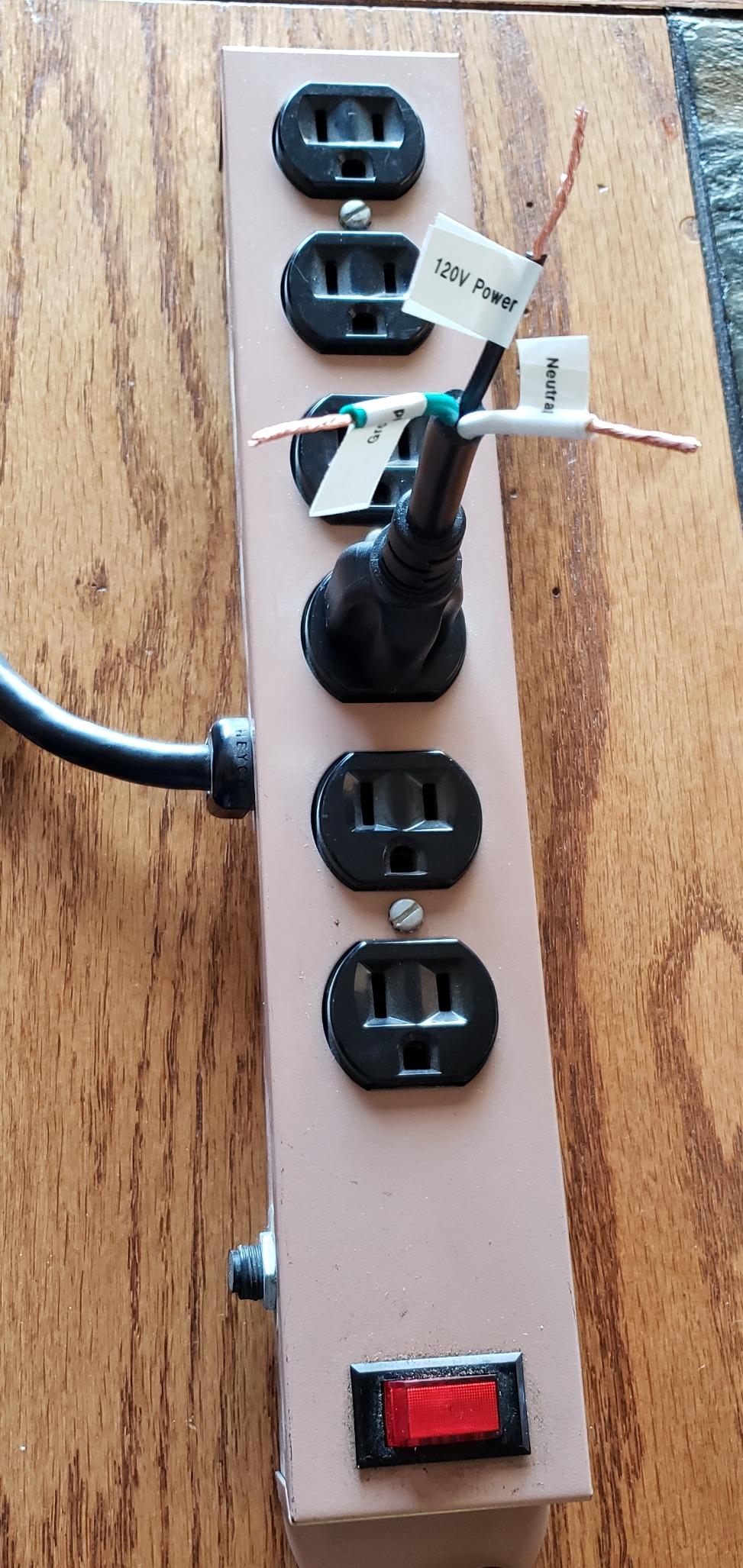
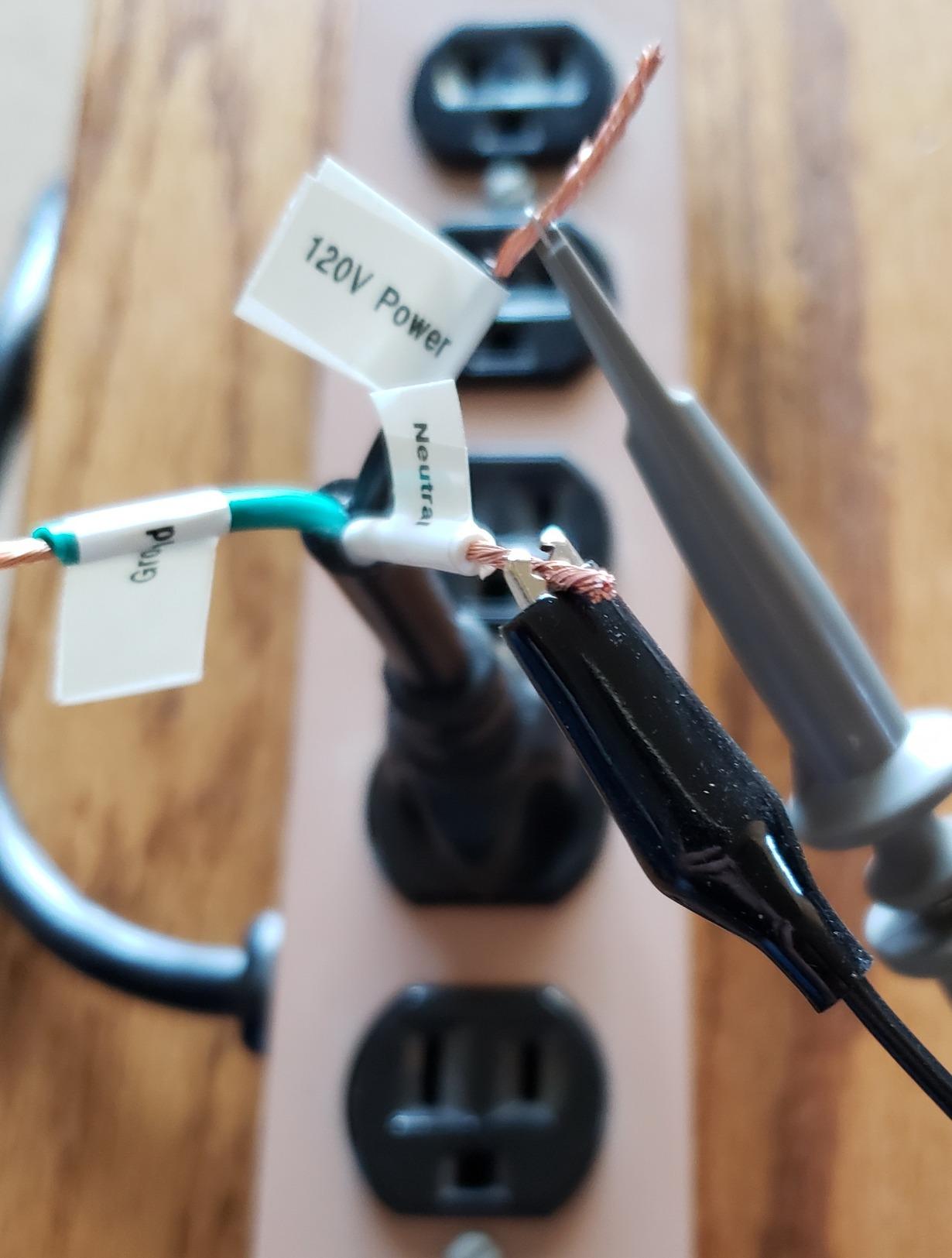
Almost every bench oscilloscope probe has its ground clip connected to the instrument’s earth-referenced ground. Clip that ground to a live mains conductor and you have shorted a lethal voltage to earth. This is not a theoretical warning; it is the single most dangerous mistake a beginner can make with a scope.
Safe approaches to mains-adjacent work are measurement with a properly rated differential probe, using a handheld or isolated instrument that does not reference earth, or using a current clamp around a single conductor. If you do not know which category your probe falls into, do not probe a live conductor with a bench scope. Battery-powered handhelds such as the FNIRSI DSO-510 in this list avoid the reference-ground problem by design, which is a real reason to own one even if it is only for occasional work.
Logic Analyzer Or Oscilloscope?
A logic analyzer answers a different question. It shows the state of many digital lines at once, over long periods, and decodes protocols accurately. An oscilloscope answers what the voltage actually did: how long the rise time was, how much overshoot there was, whether there is ringing or noise.
If your work is Arduino and ESP32 firmware, protocol traffic, or state machines, a logic analyzer is the better first purchase and costs a fraction of a scope. If your work involves analog behaviour, power supplies, audio, or the physical edge of a digital signal, the scope is the instrument you need. The EspoTek Labrador above contains both, which is a reasonable way to decide which one you actually rely on.
New Versus Used
Buying a used scope is a recurring recommendation in hobbyist circles, and buying a used one that has been abused is a common regret. A large share of secondhand units arrive with worn or mismatched probes, which is the same trap as buying a new scope with a bad probe. A self-calibration routine on many modern handhelds helps, but it does not restore a damaged probe.
Check what the unit does at boot, confirm every channel reads a known signal, run a probe compensation check, and confirm the waveform refresh is responsive. Physical fan noise, a sticky encoder, and a display with visible artefacts all point to a unit that has been run hard for years. We recommend buying new for a first instrument and considering used only if you already know the model you want.
While you are specing out a bench, it is worth keeping in mind that the same care over measured performance and honest review applies to any instrument you bring home. We take the same approach to bench metal lathes for hobbyists, where the published spec sheet tells you surprisingly little about what a tool is like to use after a month of evenings on it.
Frequently Asked Questions
What is a good oscilloscope for a hobbyist?
A four-channel scope with 50 to 100 MHz of bandwidth, at least a few million points of memory depth, and serial decoding included in the base firmware is the right starting point for most hobbyists. Our pick is the Siglent SDS1104X-E, with the Rigol DS1054Z as the alternative if memory depth matters more to you.
What is a good, cheap oscilloscope for hobbyists?
The HANMATEK HO52 gives you a genuine two-channel 50 MHz scope at 250 MSa/s plus a true-RMS 4.5-digit multimeter with independent inputs in one handheld body. The YEAPOOK ADS5012h offers 100 MHz bandwidth at 500 MSa/s in half a pound for anyone who needs more bandwidth on the move.
What is the best brand for oscilloscopes?
For a hobbyist bench, Siglent and Rigol offer the best balance of decoding support, memory depth, documentation and community knowledge at accessible prices. Hantek is a good lower-cost route into 100 MHz measurement. FNIRSI, ZOYI, HANMATEK and YEAPOOK cover the handheld and multi-instrument end of the market well, at the cost of shallower memory and less reliable bandwidth claims.
Is a 100 MHz oscilloscope enough?
Yes, for almost all hobbyist work. A 50 MHz scope already handles 5 V and 3.3 V microcontroller logic, I2C and SPI buses at hundreds of kilohertz, audio, relay and motor transients, and most power supply waveforms. You only need more when you are working in RF, high-speed serial links, or fast switching nodes well beyond 50 MHz.
Can I use my PC as an oscilloscope?
You can, with limitations. A sound card or a cheap USB test instrument will show you audio-band waveforms, which is useful for audio work and slow signals, but it cannot measure DC, cannot trigger accurately, and will not resolve digital edges. For logic-level and GPIO work, a USB device with a logic analyzer is a better PC-based choice than a sound card.
Do I need an oscilloscope or a logic analyzer?
You need a logic analyzer if your work is mostly protocol traffic, GPIO states, or firmware debugging, because it watches many lines over long periods and decodes them accurately. You need an oscilloscope if you care about analogue behaviour: rise times, overshoot, ringing, ripple, noise, or what a voltage actually did between the digital states.
Which Oscilloscope Should You Buy
The Siglent SDS1104X-E is the best digital oscilloscope for hobbyists in 2026 because it combines four channels, 100 MHz of bandwidth, a dual ADC that holds 1 GSa/s on two channels, and every serial decoder you are likely to need enabled from the factory. It also adds a large bright display, 20 setup memories, and a built-in Ethernet web server. Buy the Rigol DS1054Z instead if 24 Mpts of memory and a 30,000 wfms/s capture rate matter more to your work than the larger display and the faster sampling.
Below those two, the choice is about where your work happens. On a bench with mains power, the Hantek DSO2C10 gives you 100 MHz, two channels, 14 trigger modes and a built-in arbitrary waveform output. In a toolbox or a car, the HANMATEK HO52 pairs a two-channel 50 MHz scope with an independent true-RMS meter, and the YEAPOOK ADS5012h gets 100 MHz into half a pound. For a first instrument, the EspoTek Labrador or the FNIRSI DSO152 is a cheap way to learn before committing.
Whatever you choose, buy one good 10x probe and learn probe compensation on day one. That single habit resolves more disappointing first measurements than any upgrade to the instrument itself.