
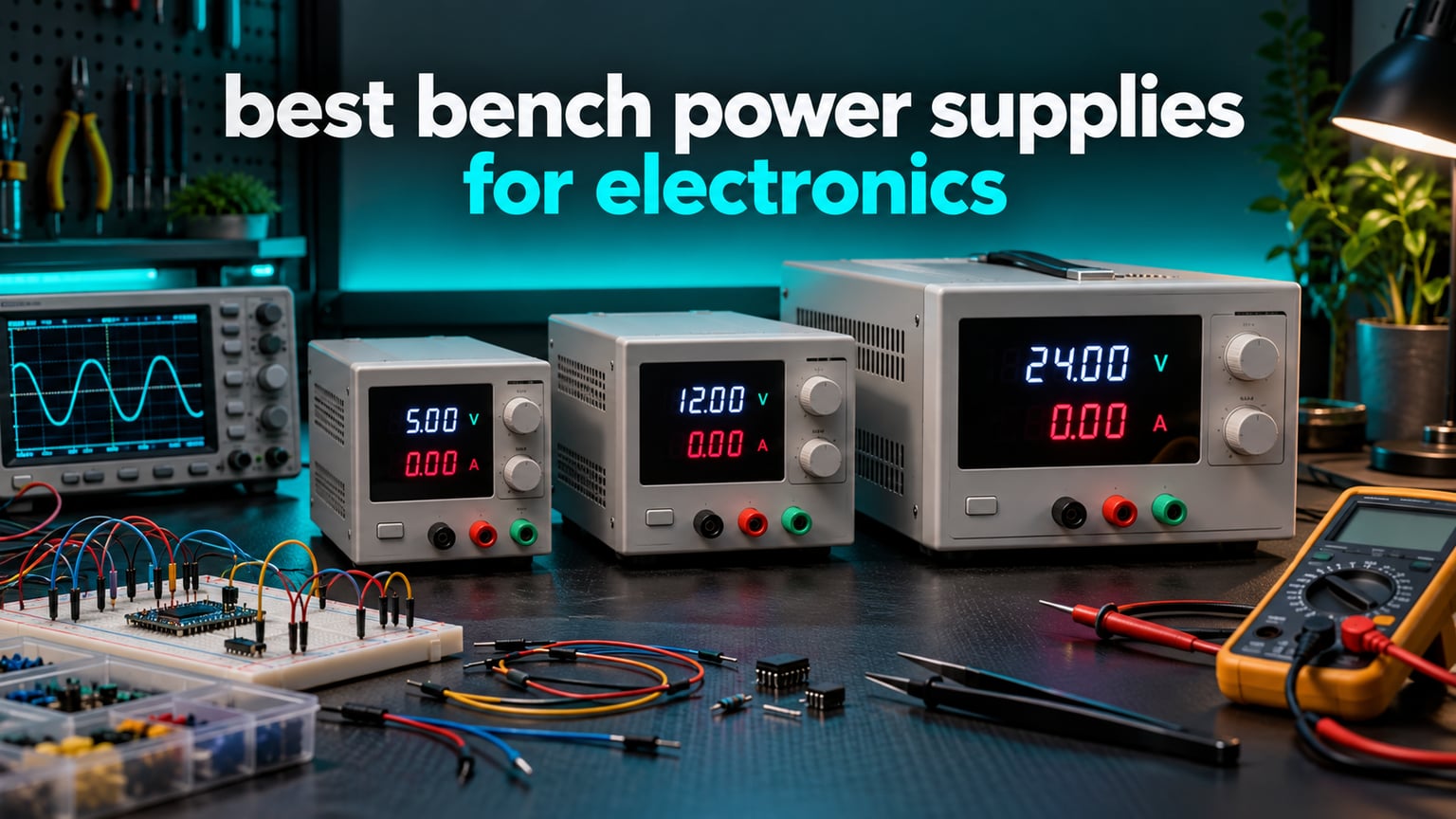
A bench power supply is an adjustable DC power supply that lives on your workbench and lets you dial in any voltage and current limit from zero up to around 30V. Instead of juggling batteries, wall adapters and hope, you set a ceiling, connect a circuit, and watch what happens. That single habit is why the best bench power supplies for electronics are the first tool most hobbyists buy after a multimeter.
My team has been putting adjustable supplies through real workbenches for years, and the pattern is consistent. Cheap switching units get the job done for microcontroller work, LED tests and battery charging. Linear units with a metal chassis win when noise matters, when you want the thing to survive a decade on the bench, and when you are chasing a fault that only shows up under a clean rail. Everything in this roundup was judged on that basis: measured output quality, protection features, whether it has a real output switch, and whether the controls are usable with greasy fingers.
Below are 12 models, from a 1.54 lb encoder-knob box that fits in a toolbox to a three-channel 220W linear unit. We update this list for 2026, and the top three appear first so you can stop reading if one of them is right. If you are still working out what you need, our guide to power supplies tested and compared covers the wall-adapter side of the same problem, and the kids electronics kits roundup is a good first step before you move up to bench gear.
Three things to know before you buy. First, current limit is the feature that saves your circuit, not raw wattage. Second, an output on/off button matters more than most buyers expect because it stops arcing when you rewire. Third, if you are feeding op-amps or anything with a negative rail, you need an isolated second channel, not a fixed 5V aux output.
Table of Contents
Top 3 Best Bench Power Supplies in 2026

KORAD KD3005D
- 0-30V / 0-5A linear output
- 300W class
- Dual 4-digit LED displays
- Switchable 110V/220V input

Kungber SPS3010B
- 0-30V / 0-10A switching output
- 300W max
- Intelligent charging mode with Ah readout
- 18W USB fast-charge port
Siglent SPD3303X-E
- Three isolated outputs
- 220W total
- Series and parallel modes
- Linear architecture
The KORAD KD3005D takes the top spot because it is the rare budget-adjacent unit that behaves like lab gear. Linear topology, a metal case, dual readouts and a switchable mains input in one 300W class package, and owners on the EEVblog forum keep recommending it years after buying it.
The Kungber SPS3010B takes the value slot on the numbers that matter for everyday bench work. Ten amps, 300W, an intelligent charging mode with a live amp-hour readout, and more than 2700 owner reviews behind the design.
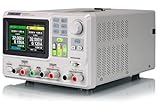
The Siglent SPD3303X-E is the pick when you genuinely need rails. Three independently controlled and isolated channels, a dedicated 2.5V/3.3V/5V low-voltage channel, and a linear design that keeps the output clean for audio and analogue work.
All 12 Bench Power Supplies Compared Side by Side in (October 2026)
| Product | Specifications | Action |
|---|---|---|
| KORAD KD3005D |
|
Check Latest Price |
| Kungber SPS3010B |
|
Check Latest Price |
| Siglent SPD3303X-E |
|
Check Latest Price |
 HYELEC HY3005S HYELEC HY3005S |
|
Check Latest Price |
 WANPTEK TPS-C 3010H WANPTEK TPS-C 3010H |
|
Check Latest Price |
 NICE-POWER SPS-E305 NICE-POWER SPS-E305 |
|
Check Latest Price |
 Jesverty SPS-3010 Jesverty SPS-3010 |
|
Check Latest Price |
 Kiprim DC310S Kiprim DC310S |
|
Check Latest Price |
 FNIRSI DPS-150 FNIRSI DPS-150 |
|
Check Latest Price |
 Rigol DP832 Rigol DP832 |
|
Check Latest Price |
 Tekpower TP-3005D-3 Tekpower TP-3005D-3 |
|
Check Latest Price |
 HANMATEK HM310T HANMATEK HM310T |
|
Check Latest Price |
Read the table as a shape rather than a ranking. Most of these are switching designs in a light plastic or metal case, three offer multiple output channels, and three use a linear architecture. The decision that matters most is whether your circuit cares about noise, and the second is whether you need a negative or second isolated rail.
1. KORAD KD3005D: The Linear Bench Default
KORAD KD3005D – Precision Variable Adjustable 30V, 5A DC Linear Power Supply Digital Regulated Lab Grade…
0-30V / 0-5A linear output
300W class
Dual 4-digit LED
Switchable 110V/220V
Pros
- Linear topology gives quieter cleaner output than switching units at this price
- Metal case and 9 lb chassis feel like proper lab gear
- Dual 4-digit displays show voltage and current at the same time
- Automatic mA/A readout switch is a genuine bench convenience
Cons
- Larger and heavier than the compact plastic switching units
- No encoder or fine digital adjustment
- Single output so multi-rail work needs a second supply
The KD3005D is the one I end up recommending to people who ask for a single supply and mean it. It is a linear 0-30V, 0-5A design in a metal case weighing 9 lb, and that weight is the first thing you notice when you set it down. It stays put, which is not something you can say for most plastic boxes at this output level.
Noise is the reason this unit keeps winning recommendations. On the EEVblog forum, Korad comes up repeatedly when people ask for a reliable general-purpose supply for a classroom or a long-lived bench, and Rigol is the other name that surfaces alongside it. The linear topology means the output sits quieter than a switching design of the same price, and for audio amplifiers, low-noise preamps and analogue sensor work that difference is audible on a scope even when it is not audible to the ear.
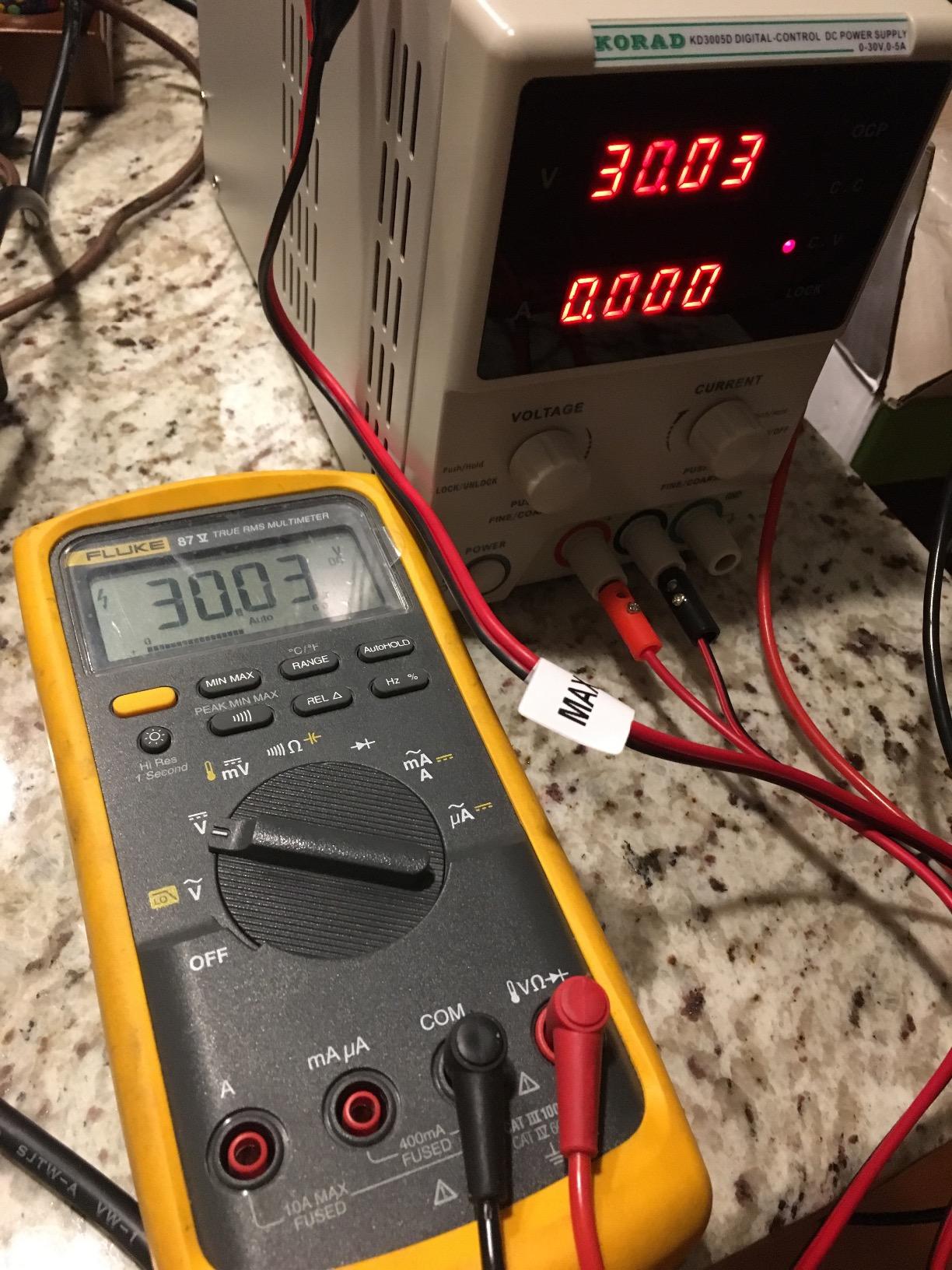
Both 4-digit LED readouts show voltage and current simultaneously, and the display automatically switches between milliamps and amps depending on load. That sounds minor until you are pulling 40mA into a sensor and squinting at a reading that shows 0.0 amps. A switchable 110V and 220V AC input means you can move the same box between benches in different countries.
Protection covers overload, short circuit and over-temperature. The box includes 5A test leads, a power cord and a manual, so you are not hunting for banana plugs on day one. Over 367 owner reviews averaging 4.5 stars, complaints cluster on size, single-channel output and the absence of a digital fine-adjust encoder, not on output quality.
My honest limitation is that this is a 1980s-style control panel. There is no encoder, no preset memory and no usable USB port for firmware-based remote control. If you need repeatable setpoints, the Kiprim or the HANMATEK do that job properly.
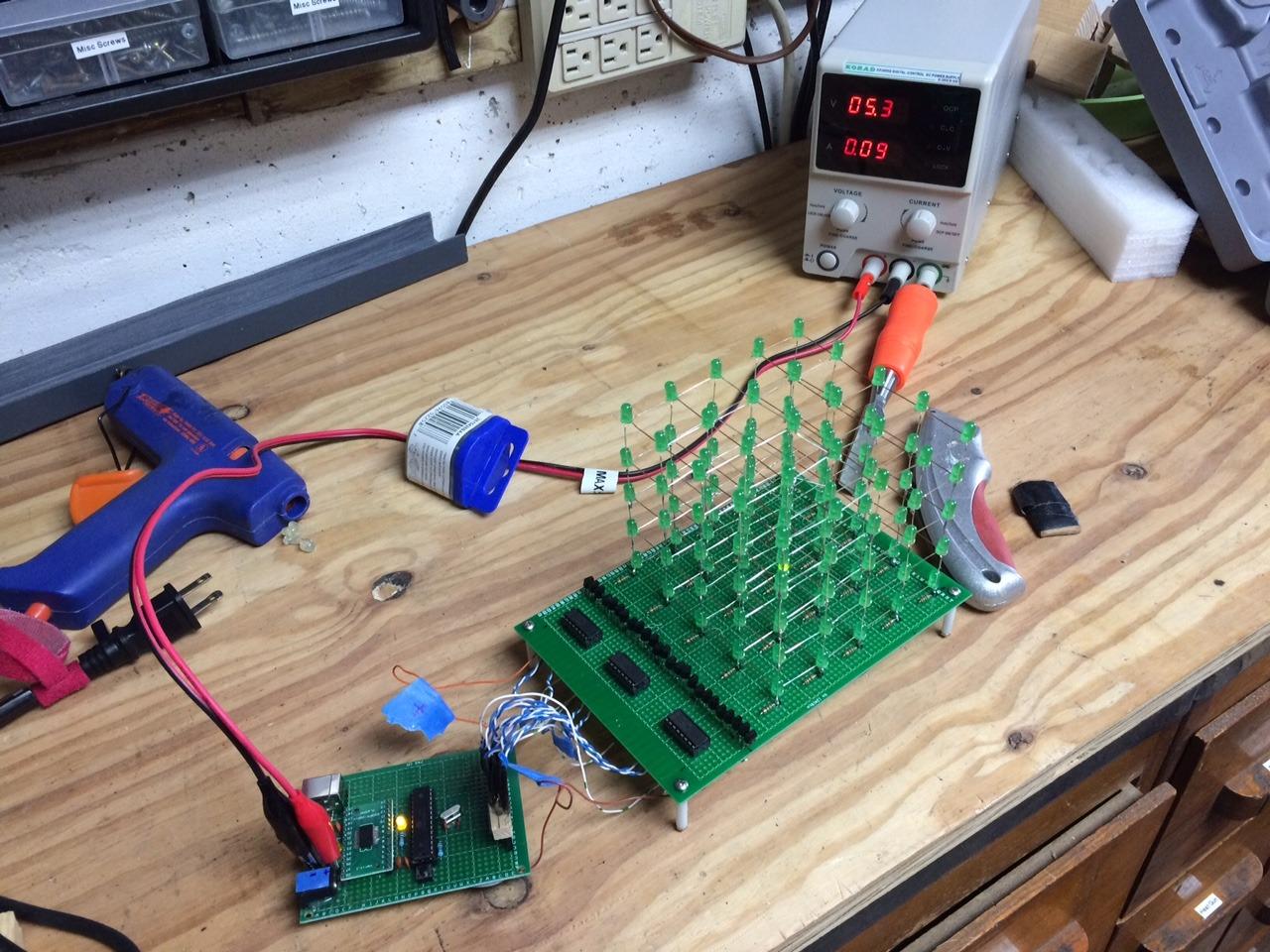
Why the KD3005D suits a permanent bench
A metal chassis with real thermal mass runs cool and lasts, which matters when a tool sits powered for eight hours a day. Switchable mains input removes one more reason to buy twice.
The linear topology also means less audible hum near sensitive analogue circuits, so audio and instrumentation work goes straight onto this list.
Where it will frustrate you
Single output means a plus and minus rail project needs a second box, and the basic panel has no memory presets. If you plan to script power sequences, look higher up this list.
At 9 lb and 14 x 10 x 10 inches, it eats bench space that a 1.5 lb switching box would leave free.
2. Kungber SPS3010B: The 300W Value Pick
DC Power Supply Variable, 30V 10A Adjustable Switching Regulated DC Bench Power Supply with Intelligent Charging Mode, 18W USB Interface, Precision Encoder Knob (Black)
0-30V / 0-10A switching
300W max
18W USB port
Charging mode with Ah readout
Pros
- Compact and lightweight for a 300W switching supply
- Intelligent charging mode with a charge-level readout
- Encoder knob gives precise digital setpoint entry
- Useful 18W USB charging port on the front panel
- Comprehensive short-circuit overload and thermal protection
Cons
- Switching design adds audible noise versus a linear bench supply
- Light plastic housing slides on a crowded bench
- No published ripple figures in the owner feedback
Ten amps and 300 watts in a 2.3 lb plastic box is the headline here. The SPS3010B measures 7.59 x 3.35 x 6.1 inches, which means it disappears next to a laptop, and it is the highest-reviewed supply in this roundup with more than 2700 owner ratings behind it.
The feature I did not expect to care about is the intelligent charging mode. It shows real-time amp-hours on the display and stops the output when the battery is full, which turns a supply into a competent charger for 3.7V cells and small packs without you babysitting the process. A dedicated OCP button arms an overcurrent alarm with output cutoff, and the encoder knob lets you dial in a setpoint digit by digit instead of hunting with a potentiometer.
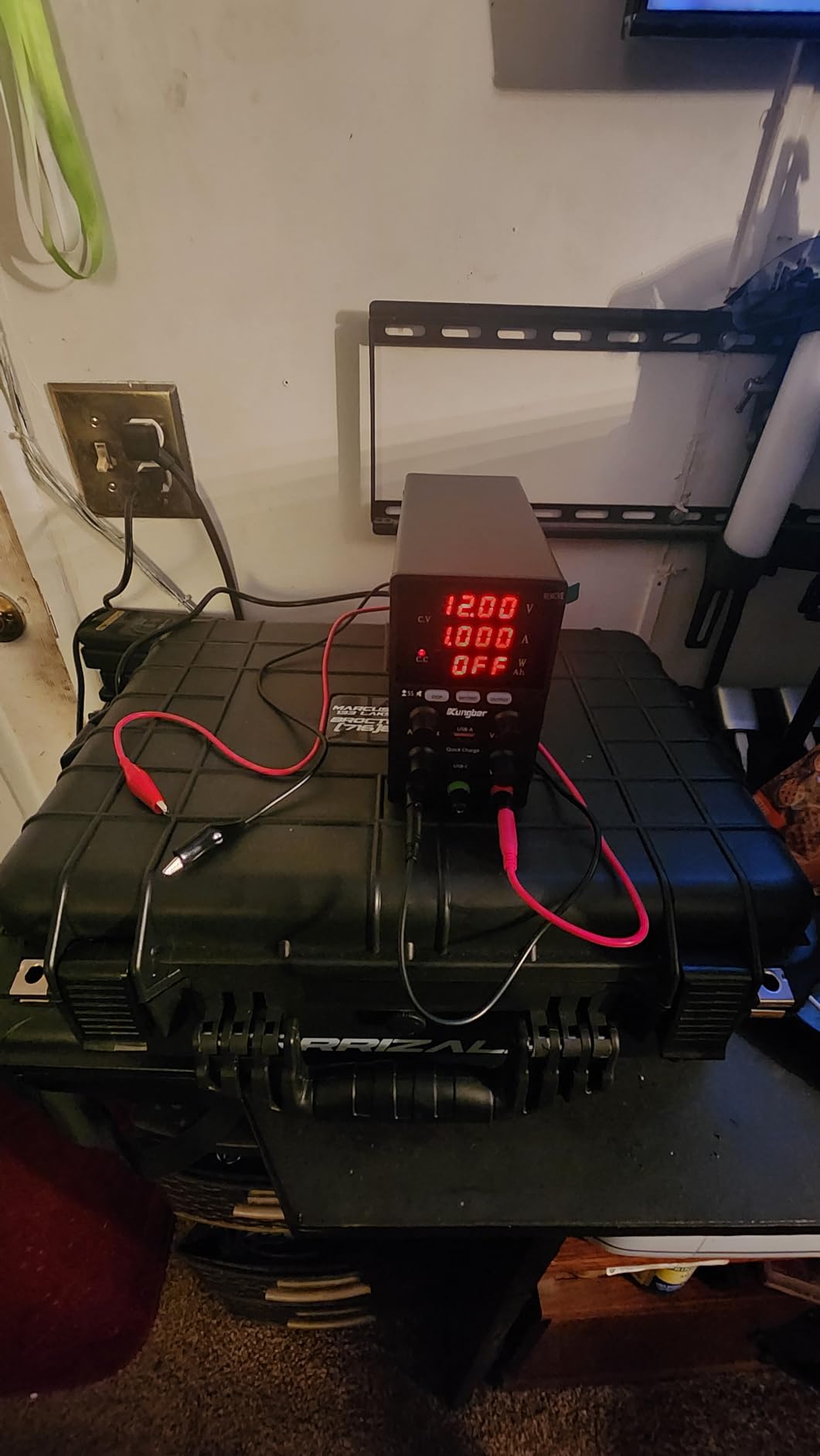
Protection is unusually complete for the tier: grounding, leakage, thermal, voltage overload, power overload and short circuit, with a cooling fan that only kicks in above 122F. There is also an 18W USB fast-charge port on the front, which is a genuinely useful bench convenience for topping up a phone while you work.
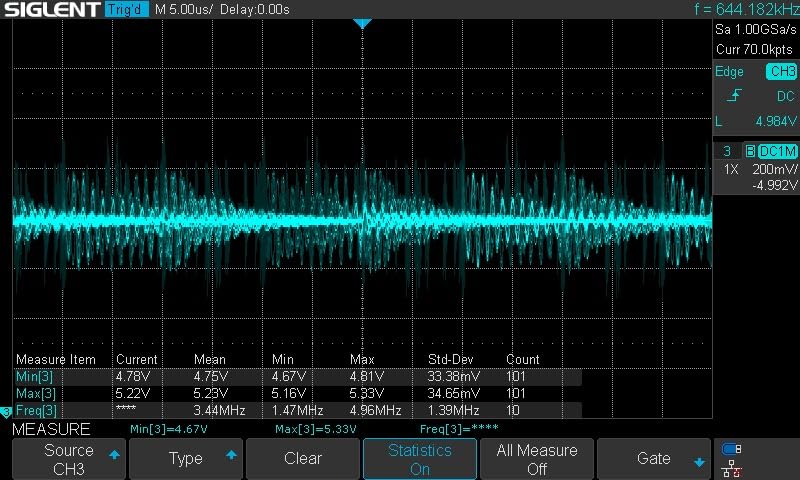
The compromises follow directly from the design. It is a switching supply, so there is more ripple than a linear unit and the fan becomes audible under sustained heavy load. The plastic case is light, which means it slides when you lean on the encoder, and none of the owner feedback in the sample speaks to measured ripple or load regulation, so treat the 300W figure as a headline rating rather than a verified continuous number.
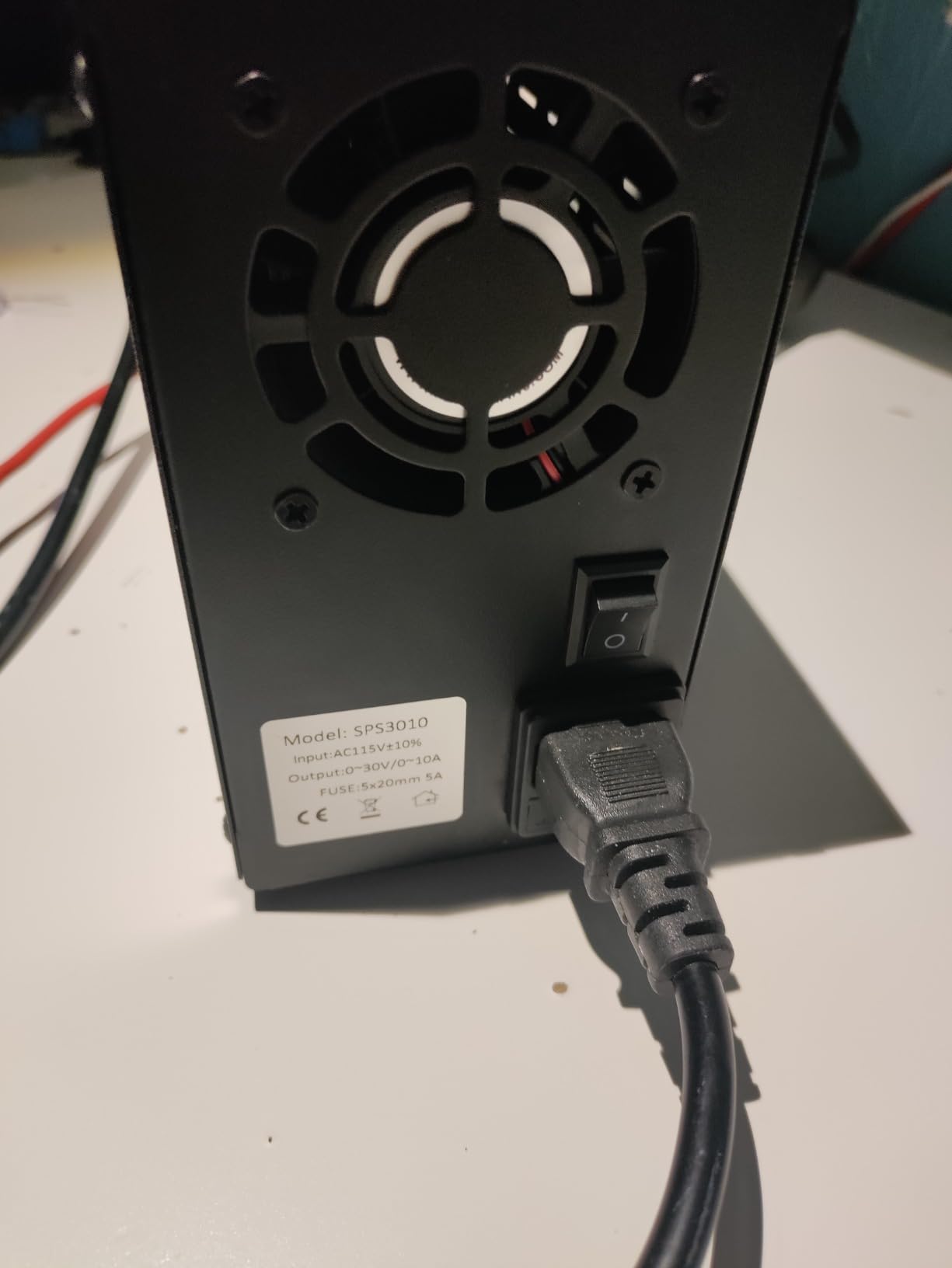
Why it earns the value badge
You get two thirds more current than the 5A units for a compact footprint, plus charging mode and USB output, with the deepest review base in the group behind it. That combination is rare at the low end of the market.
It is the supply to buy if you run motors, LED strips, 5V and 12V rails and small battery packs rather than sensitive analogue circuits.
Where it will frustrate you
Switching ripple is the dealbreaker for audio, RF and low-level analogue work where a linear unit is worth the extra cost.
The light plastic housing is not what you want next to a breadboard that gets nudged constantly, so tape it down or buy something heavier.
3. Siglent SPD3303X-E: Three Isolated Rails Done Properly
Siglent Technologies SPD3303X-E Triple Output Power Supply
Three isolated channels
220W total
Linear design
Series and parallel modes
Pros
- 4.6 average across 381 reviews with 80% five-star ratings
- Three genuinely isolated and independently controlled outputs
- Linear architecture delivers cleaner output than switching budget units
- Dedicated 2.5V/3.3V/5V low-voltage rail for CPU and logic work
- Series and parallel modes plus a 3-year warranty
Cons
- Very heavy at 17.6 lb so it is not a portable tool
- 3A per channel limits use with high-draw power-hungry boards
- Trending graphs are less capable than modern PC-controlled supplies
If you build circuits with more than one rail, this is the supply that removes the compromises. Two channels deliver 32V at 3.2A each, a third handles 2.5V, 3.3V or 5V at up to 3.2A, and the three are isolated from one another. Total output is 220W in a linear design.
Isolation is the feature that matters. You can run one channel as a positive rail and another as a negative rail to make plus and minus 15V for op-amp circuits, or you can tie channels together in series for a higher combined rail or in parallel for more current. No other supply in this roundup offers those combinations without a second box.
The SparkFun community threads on choosing a good bench variable supply single out Siglent alongside Rigol as a solid, reasonably priced name, and that reputation tracks what owners report here. A timing output function logs how voltage and current behave over a test with trending graphs, which saves you pointing a camera at a scope screen during soak tests. The warranty runs three years, double most of what competitors in this list offer.
It is also the second-heaviest thing we tested at 17.6 lb, behind the metal-chassis Rigol, and the 3A ceiling per channel is real. A development board that pulls close to 3A with a motor attached will push you into constant-current mode, and the front panel looks dated next to the colour screens on modern switching units.
Why it suits multi-rail and analogue work
Three isolated channels cover op-amp rails, logic-level supplies and analogue references from one box, and the linear design keeps the noise floor down for audio and instrumentation.
A three-year warranty and a timing function make it a good long-term purchase for teaching or repair work where units get moved between benches.
Where it will frustrate you
At 17.6 lb it is a fixed installation, not a portable tool, and the dated front panel means no encoder menus or modern graphics.
The 3A per channel limit means high-draw boards need the switching units in this list instead, so buy for your worst-case load, not your typical one.
4. HYELEC HY3005S: Best First Bench Supply
DC Power Supply Variable 30V 5A, Hyelec Adjustable Switching Regulated Power Supply with 4-Digit LED Display, Coarse and Fine Adjustments,5V2A USB Interface,110V Input Voltage
0-30V / 0-5A switching
Output enable button
4-digit 0.01V display
5V/2A USB
Pros
- Highest average rating in the roundup at 4.7 across 181 reviews
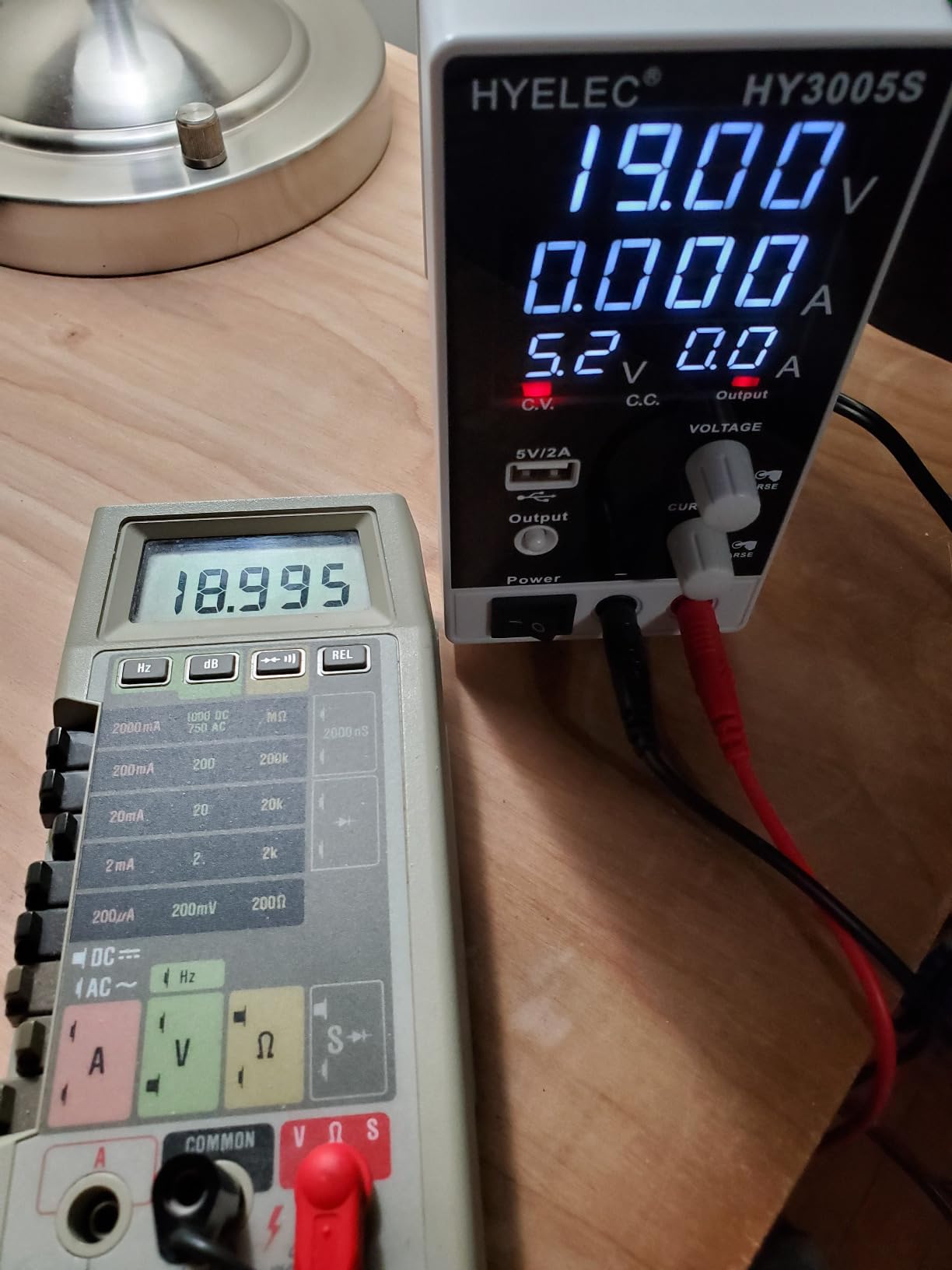
- Independently verified accuracy with a reference meter reading 19.995V against a 20.00V setpoint
- Digital encoder controls do not drift like analog potentiometers
- Dedicated OUTPUT enable button for setting limits before applying output
- 5V USB output doubles as a second source for test-clip prototyping
Cons
- Very light chassis so the box slides when pressing buttons
- 110V input only with no mains selector
- Switching topology means more ripple than the linear options
The HY3005S is the one I hand to someone building their first bench, because the output enable button removes the single most common beginner mistake. You can set voltage and current while the output is off, confirm the numbers on the four-digit display, then press OUTPUT to energise. Nothing sparks, nothing gets fried by a forgotten current limit.
Accuracy is the quiet headline. One owner validated the output against a Fluke voltmeter and read 19.995V from a 20.00V setting, which is the kind of verification most budget supplies never get. The display resolves to 0.01V and 0.001A without jumping around, and the encoder knob uses a code-type potentiometer for genuine coarse and fine adjustment rather than the drift-prone analog pots found in older units.
Across 181 reviews the average sits at 4.7 with 85% five-star, the strongest rating profile in the group. Protection includes a temperature-controlled fan, short-circuit, over-temperature and overload handling, and a 5V/2A USB output that gives you a fixed second source for a 3.3V or 5V reference without a second tool.
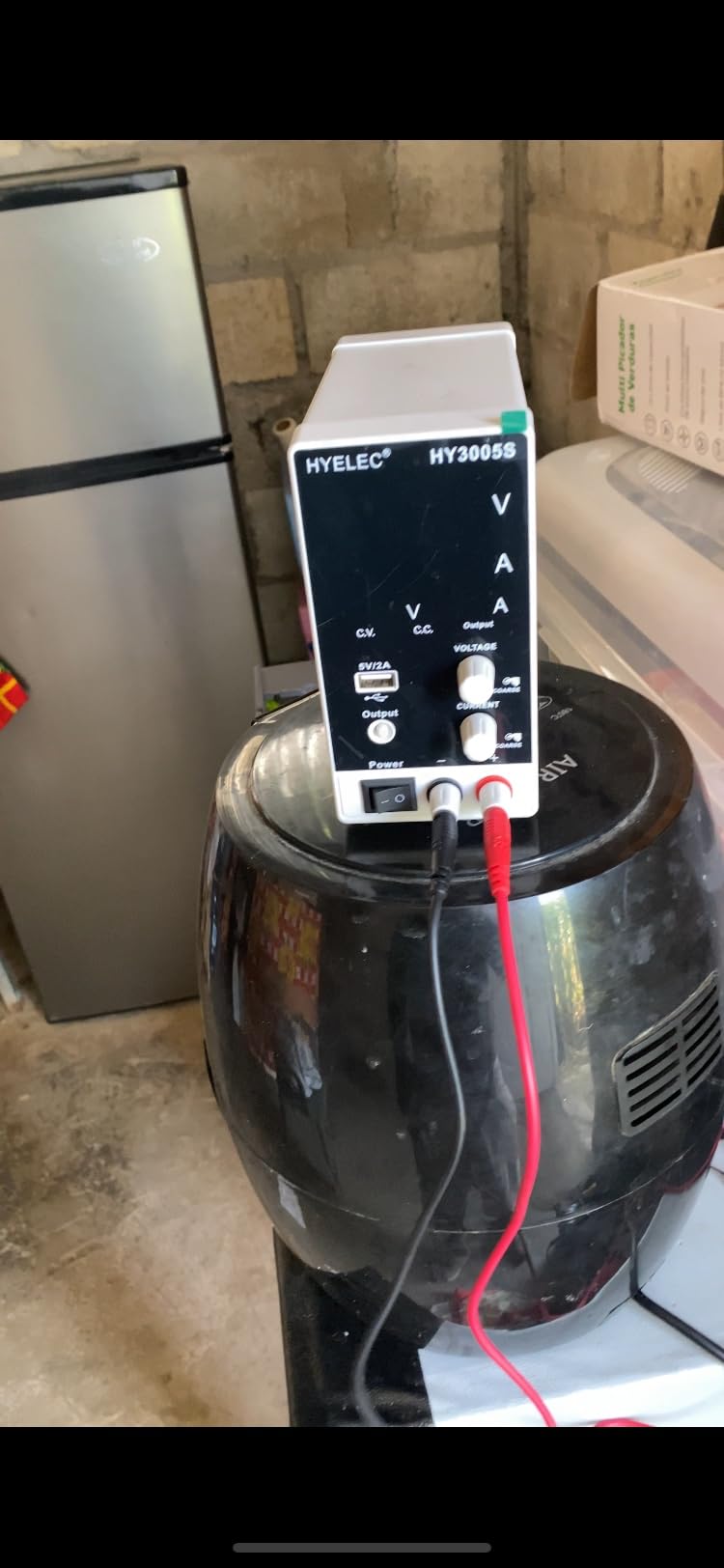
Newer versions ship with five-way binding posts instead of banana jacks, which matters on a breadboard where a loose banana plug is a bad connection. The repeated gripe across the reviews is weight, at about 1.65 lb, so the unit slides when you press the encoder, and there is no mains selector, meaning it is fixed to 110V input.
Why it suits a first-time buyer
The output enable button plus verified accuracy means you cannot accidentally destroy a board on your second afternoon, which is the whole point of buying one of these.
It stays accurate across the range, so you can trust readings while learning to calibrate, and the 5V USB output covers a second rail cheaply.
Where it will frustrate you
It is a switching design, so ripple is higher than the linear units and it is a poor match for audio or low-noise analogue front ends.
With 110V-only input it is not portable across countries, and the light chassis needs a sticky mat or a bench screw to stay put.
5. WANPTEK TPS-C 3010H: The Repair Bench Workhorse
WANPTEK DC Bench Power Supply 30V 10A, Regulated Variable Lab Power Supply with Memory Presets, Encoder Knob,OCP Protection, Output Switch, 4-Digit LED, USB Fast Charge and Key Lock for Repair
0-30V / 0-10A regulated
Three memory presets
Output ON/OFF switch
Key lock
Pros
- Memory presets make repetitive repair and battery-charging tests much faster
- Encoder returns to 0.1V increments after a pause which owners specifically praise
- Continuous current measurement shows real draw rather than the set maximum
- Output ON/OFF switch prevents sparking when rewiring
- Quiet fan and compact 8.27 x 5.71 x 3.15 inch horizontal footprint
Cons
- Power-on beep is loud and cannot be disabled
- Supplied leads are ring terminals rather than banana plugs
- Short roughly 3 foot power cord and no earth terminal reported
This is the unit I reach for when the job is fault-finding rather than building. It delivers 0-30V at up to 10A, 300W, from a horizontal benchtop body of 8.27 x 5.71 x 3.15 inches that sits flat and leaves the top of the bench free.
Three memory presets change how you work. Set a 5V rail for a phone repair bench, a 12V rail for a router, and a 3.7V charge profile, then recall them with one button instead of typing numbers each time. The encoder adjusts voltage and current digit by digit, then settles back to 0.1V steps after a pause, so a small nudge does not throw you 2V off target.
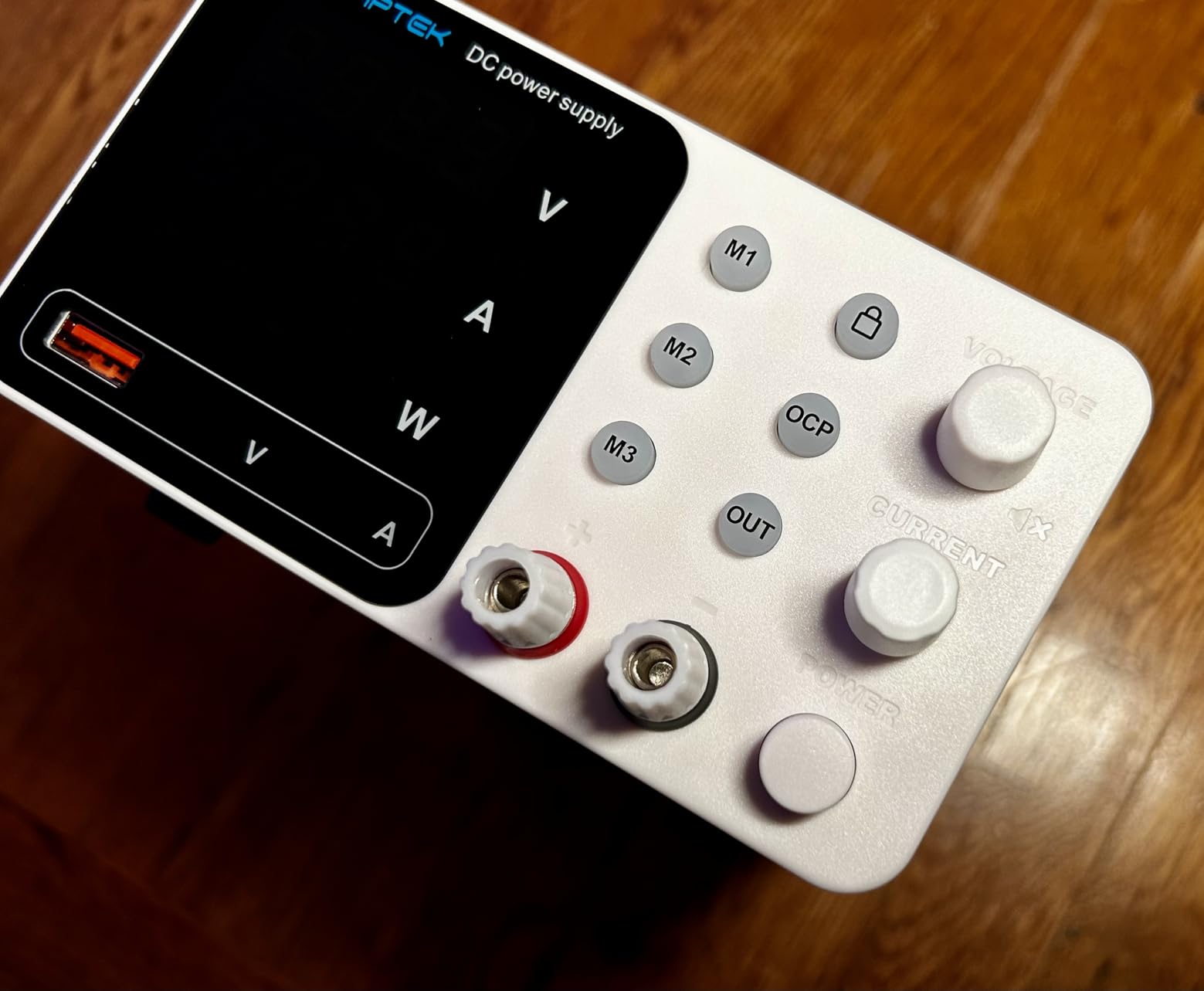
It also measures current continuously rather than showing only the set maximum, so you can watch a short develop in real time. Combined with the output ON/OFF switch, OCP auto-recovery and a one-key panel lock, that is a feature set aimed squarely at someone who will be reclipping leads all day. A built-in USB fast-charge port and a key lock round out the safety side.
Owners report quiet running at low to mid load across 273 reviews at 4.5 stars. The annoyances are practical: the power-on beep is loud with no way to mute it, the supplied leads terminate in ring terminals rather than banana plugs, which is awkward on a breadboard, and the included power cord is short at roughly 3 feet. One buyer also reported no earth terminal, and the rear 115V/230V selector must be set correctly before first use or the box will not hold higher voltages.
Why it suits repair work
Presets, a real output switch and continuous current readback remove the three friction points that slow down a repair bench: retyping setpoints, sparking when reclipping, and guessing at load.
The key lock stops accidental presses wiping a setup mid-test, and the horizontal form factor leaves bench space above the supply.
Where it will frustrate you
The ring-terminal leads mean you will want to buy proper banana test leads before the first breadboard session, and the short cord may not reach your wall socket.
The unmutable power-on beep gets old in a shared room, and there is no earth or ground terminal for bench work that needs one.
6. NICE-POWER SPS-E305: Smallest Useful Box
NICE-POWER DC Power Supply Variable, 30V 5A Adjustable Switching Regulated Power Supply with Encoder, Upgraded 3-Digits LED Display, Electroplating DIY LED Test Mini Regulated DC Bench Power Supply
0-30V / 0-5A switching
150W max
Encoder with digit select
1.54 lb body
Pros
- Rated 4.6 across 343 owner reviews with 81% five-star
- Encoder knob makes precise digit-by-digit setting quick
- Extremely light at 1.54 lb in a 6.5 x 4.0 x 3.2 inch body
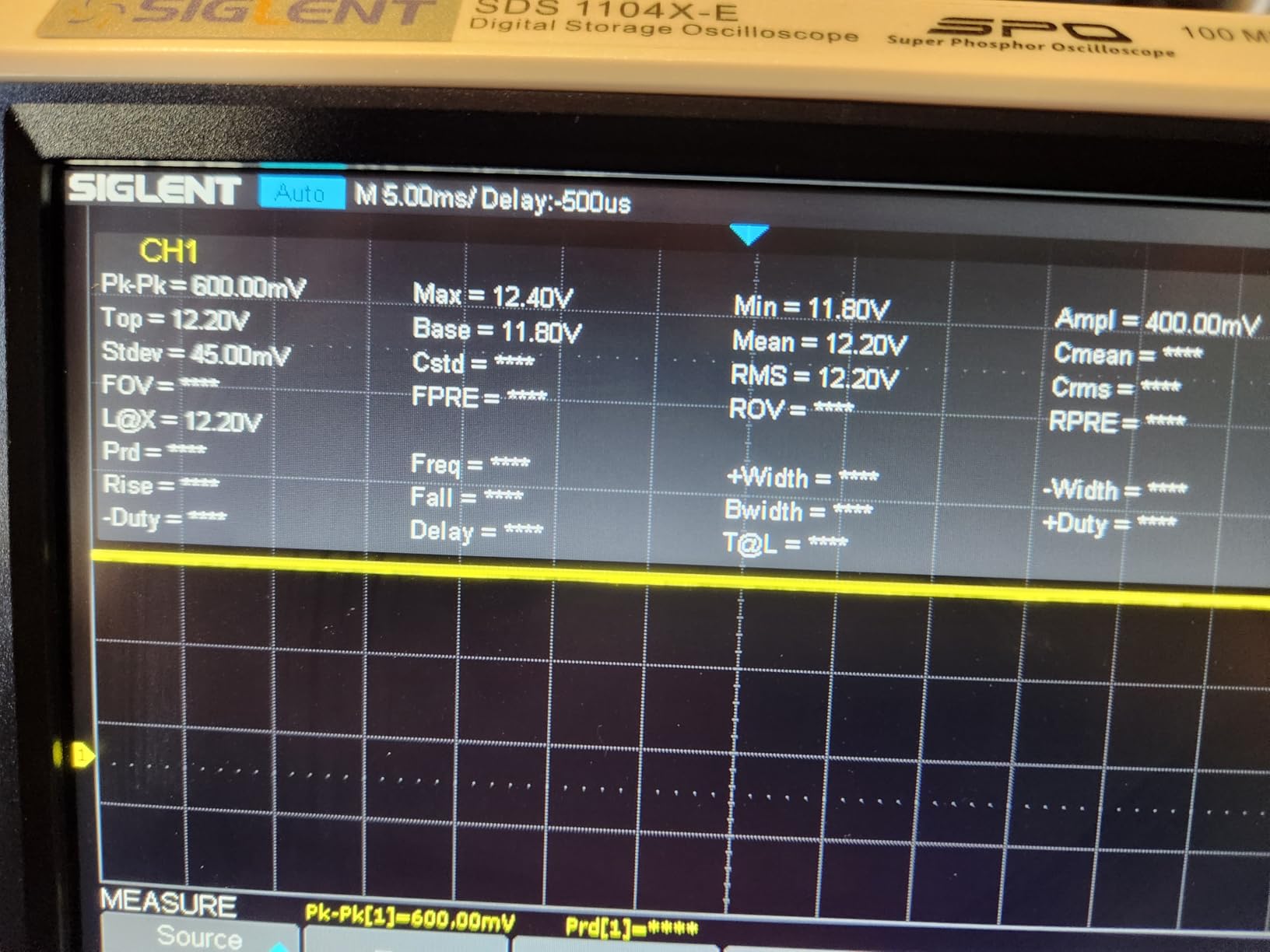
- Owners verify it holds rated output into a 30V/5A load with a couple hundred mV of noise
- 12-month repair policy from the seller
Cons
- Output is not stable below roughly 0.7-0.9V
- so sub-1V work needs a divider
- Cooling fan runs continuously and is noticeably loud
- Three-digit display is coarser than the four-digit competitors
At 1.54 lb and 6.5 x 4.0 x 3.2 inches, this is the supply that goes in the toolbox. It still delivers a full 0-30V at 0-5A across a 150W maximum, and across 343 owner reviews at 4.6 stars with 81% five-star, people consistently report that it holds its rated output into a 30V/5A load with only a couple hundred millivolts of noise.
The upgraded encoder knob is the reason this outclasses its direct competitors. You select the digit you want to change and step through it, which is far better than the potentiometers used in older budget units. Display resolution is 0.1V and 0.01A on a back-lit three-digit LED, with 100-240V universal input and FCC and CE certification, plus protection for over-voltage, over-current, over-power, over-temperature and short circuit.
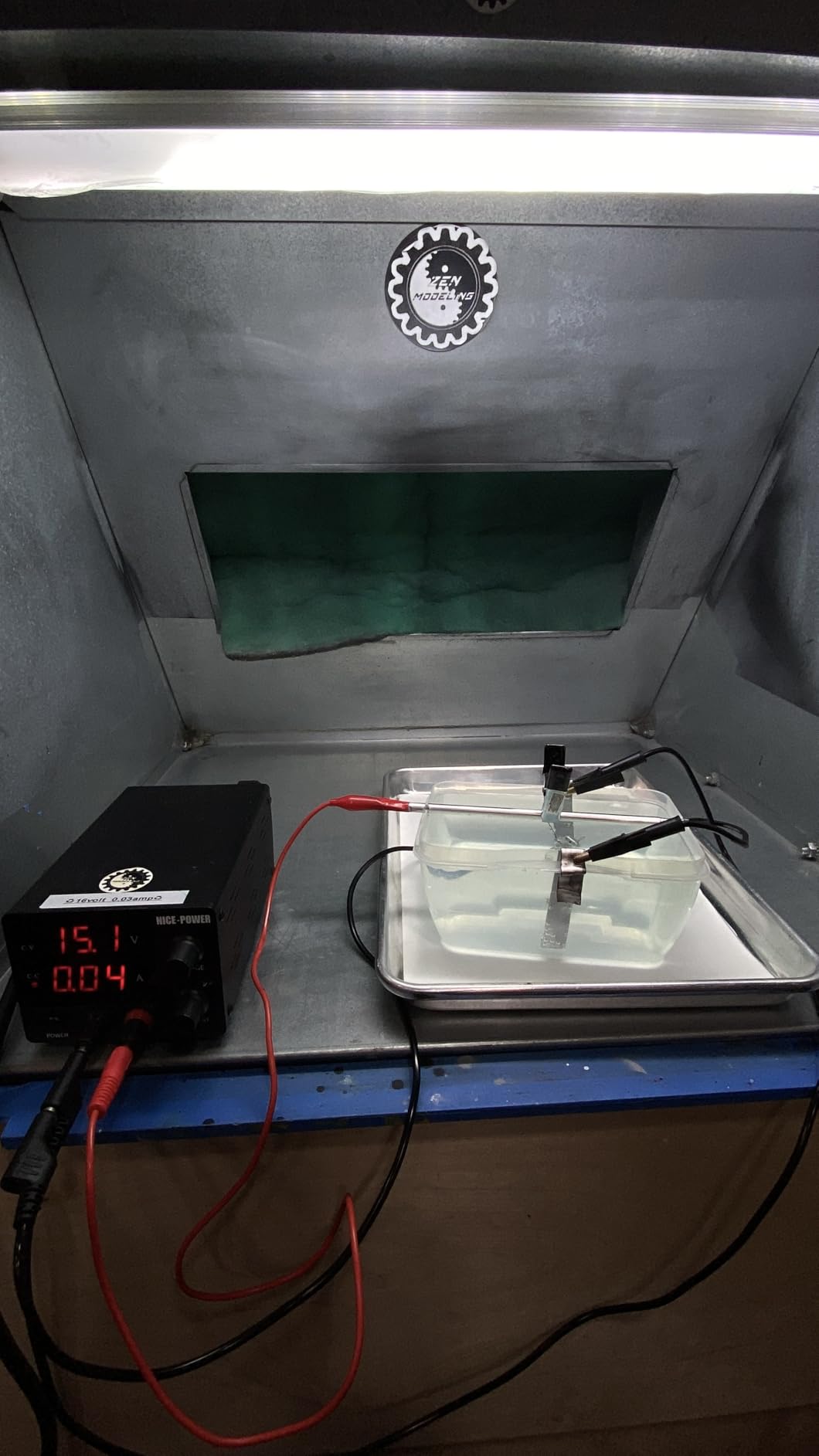
There is a quirk worth knowing before you buy. Rotating the knob ten times increments the first decimal place, so there is effectively a hidden fourth digit that only appears when you need coarse range. It is confusing the first time and invisible after that.
The real limitation is the low end of the range. Output is not stable below roughly 0.7 to 0.9V, and accuracy drifts a percent or two between 0.7V and 3.3V, so if you are calibrating a low-voltage reference or running a 1.2V cell you will need a resistive divider. The cooling fan also runs continuously and is louder than you would expect from a 150W supply.
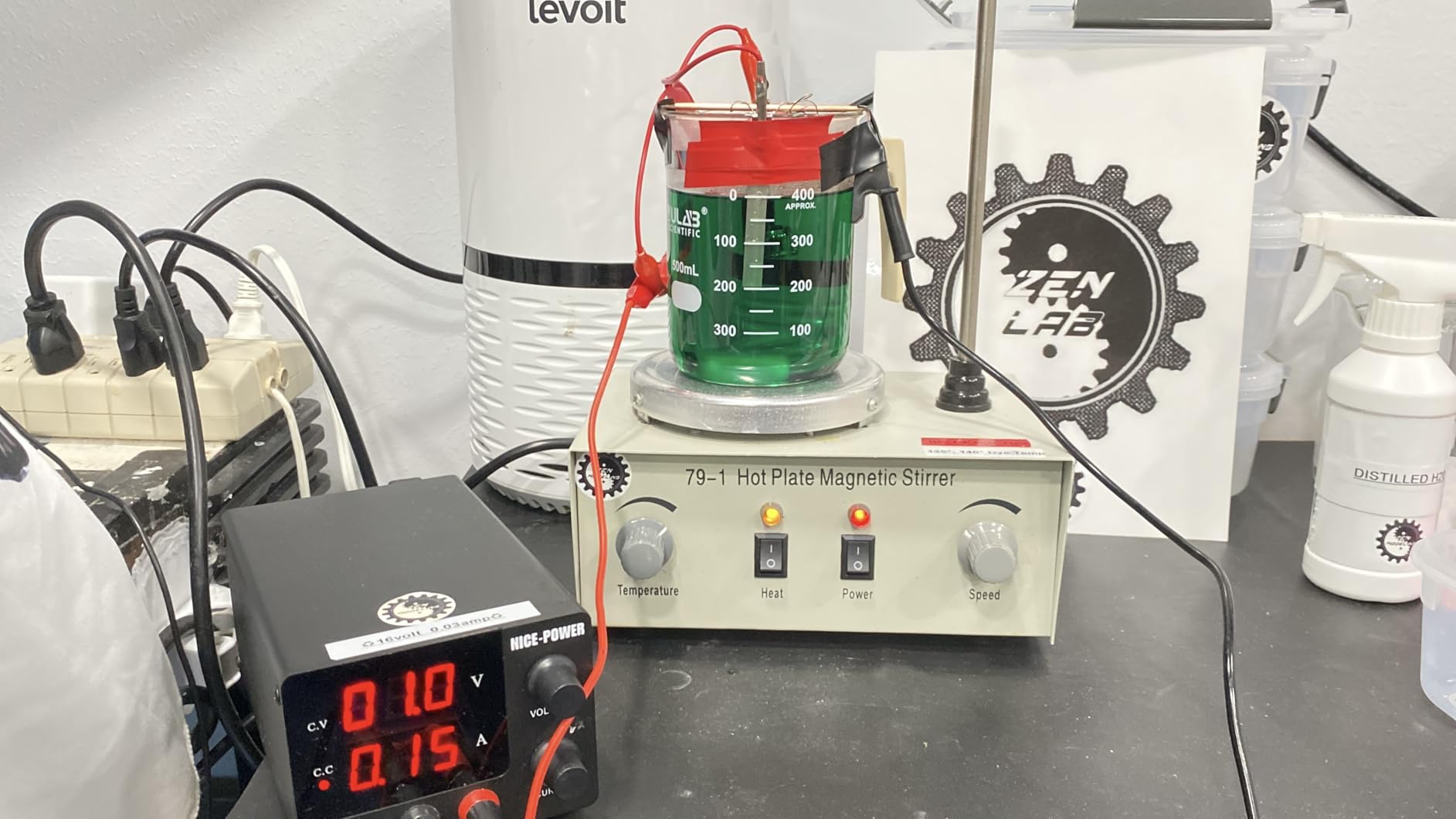
Why it suits a cramped workspace
It is one of the two smallest 30V/5A options here, so it fits a crowded bench, a field kit or a drawer without dominating the space.
The encoder makes setpoint entry fast and repeatable, and owners confirm it pushes a genuine 30V/5A rather than sagging under load.
Where it will frustrate you
Anything below about 0.9V is outside its comfort zone, which rules it out for low-voltage calibration and single-cell work without a divider.
The always-on fan is loud in a quiet room, and a three-digit display means you lose one digit of the reading compared with the four-digit units.
7. Jesverty SPS-3010: The Volume Seller
Jesverty DC Power Supply Variable, 0-30V 0-10A Adjustable Switching DC Regulated Bench Power Supply with High Precision 4-Digit LED Display, 5V/2A USB Port, Coarse and Fine Adjustment SPS-3010
0-30V / 0-10A switching
300W max
Auto CV/CC crossover
5V/2A USB port
Pros
- Ranked number one in Lab Power Supplies and Life Science Supplies categories
- Big bright four-digit LED showing live voltage current and power
- Automatic CV/CC switching makes battery charging safer
- Compact and light enough to move around a bench
- Includes test leads and a full accessory set
Cons
- Included test leads are described by the maker as give-away grade for sustained high-current work
- Tower-form plastic enclosure is light enough to shift when pressing buttons
- Red LED display has lower contrast than IPS or colour screens
The Jesverty SPS-3010 is the unit most people end up owning by accident, because it sits at the top of its category on volume alone. More than 1600 owner reviews at 4.5 stars, a bright four-digit LED showing live voltage, current and power at 0.01V, 0.001A and 0.1W resolution, and a 300W switching output in a 2.4 lb tower.
The feature that makes it the charging pick is automatic constant-voltage and constant-current crossover. As the load changes, the supply hands over between modes on its own, which is exactly the behaviour a battery charge profile needs, and it is why people reach for this box rather than a bare charger.
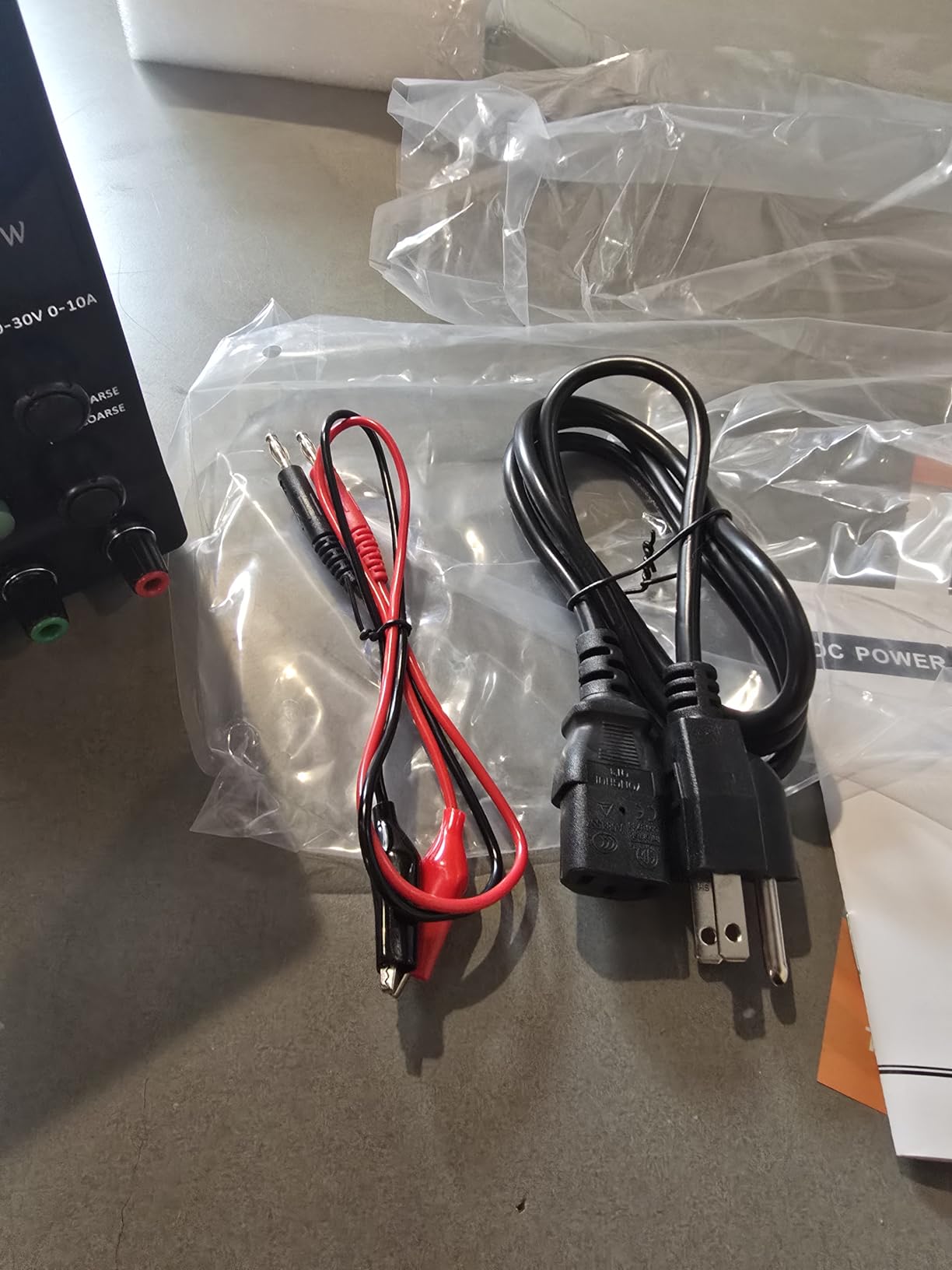
Protection covers short circuit, overload, grounding and a temperature-regulated fan. A 5V/2A USB port handles small device charging, and the box includes the unit, power cord, test leads and a manual with technical support behind it. For anyone who needs something that simply works every time without reading a manual first, that matters.
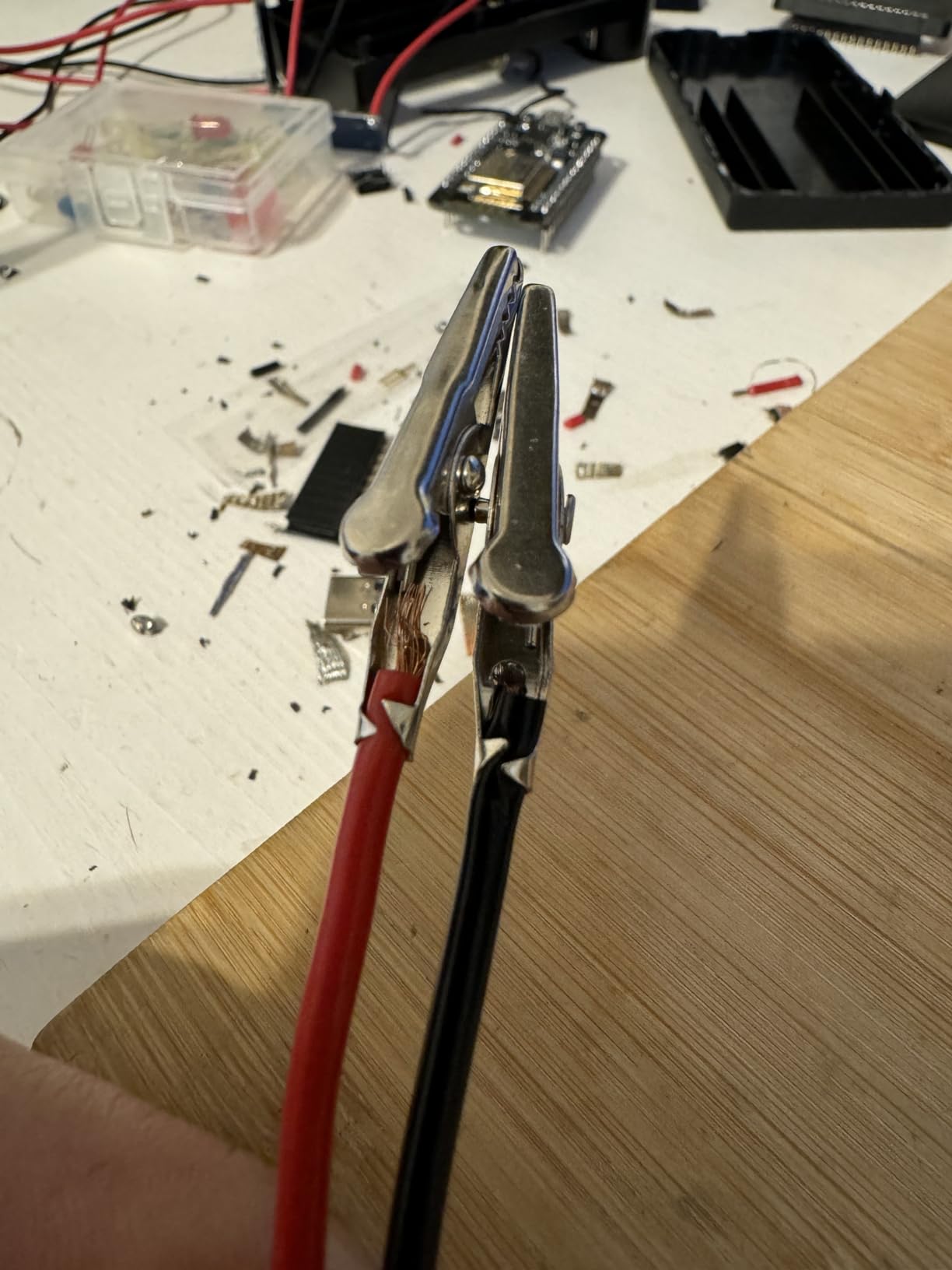
Two cautions from the review record. The supplied test leads are described by the maker as give-away grade, so do not run sustained 10A loads through them; buy proper leads before heavy work. The tower-form plastic case is light enough to shift when you press the buttons, and the red LED display has noticeably lower contrast than the IPS and colour screens found on newer rivals.
Why it suits battery charging and general bench work
Automatic CV/CC crossover is the correct behaviour for charging cells and packs, and the live power readout tells you how the charge is progressing.
It is the safest buy for a first project because the accessory set is complete and the controls have no hidden modes.
Where it will frustrate you
The included leads are not rated for sustained high-current work, so budget for a proper set of banana test leads straight away.
Switching ripple is higher than the linear units, which makes it a poor fit for audio and low-noise analogue testing.
8. Kiprim DC310S: Colour Screen and PC Control
DC Power Supply, 0-30V 0-10A Adjustable Regulated Power Source, 110V Input, High Precision 4-Digit Display, Multiple Safety Protections, PC Software Control & Dual USB Ports
0-30V / 0-10A regulated
2.8-inch color LCD
Four memory presets
PC control over USB
Pros
- Colour LCD with curve plotting is far more readable than seven-segment LEDs
- Four memory presets plus editable waveforms support repeatable test sequences
- PC software control over USB for automated bench workflows
- Customizable overvoltage overcurrent and overheat thresholds
- Front 5V 1A USB port is handy for charging a phone at the bench
Cons
- The premium buys the screen and programmability rather than raw output quality
- Rear-only PC connection means the front USB port cannot carry data
- Compact footprint limits airflow in a stacked bench
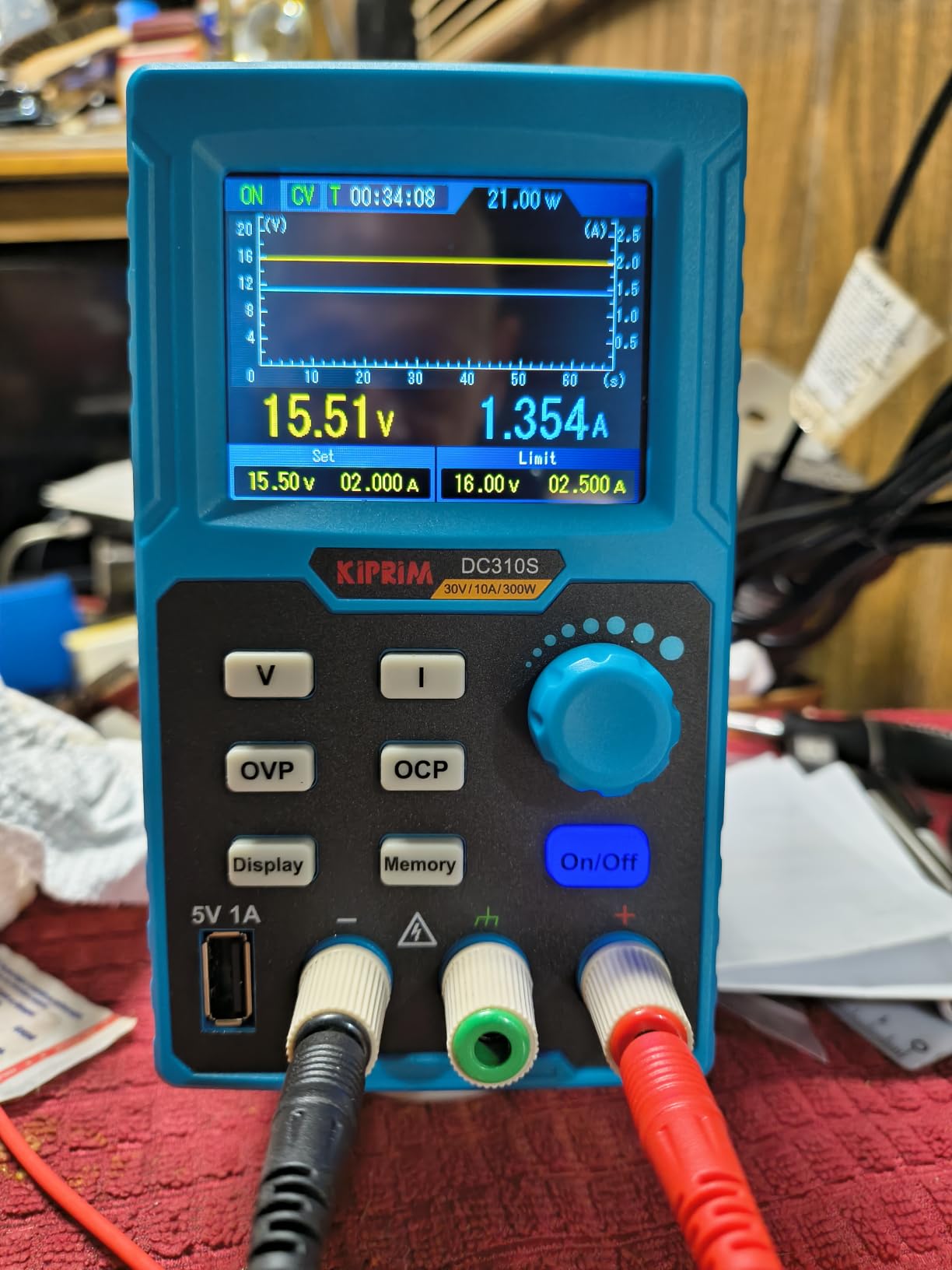
The Kiprim DC310S is what the switch from LEDs to a screen looks like. A 2.8-inch colour LCD shows set and actual voltage, current, power, runtime and channel status, and it can plot the output as a curve rather than a number. At 10mV and 1mA resolution you can watch a load step in real time, which is the difference between guessing and measuring.
It is also programmable in a way that most supplies at this level are not. Four stored parameter sets labelled M1 to M4 cover most of what a bench needs, and there are ten-point editable waveforms on top of that. Overvoltage, overcurrent and 85C overheat thresholds are all adjustable, so the protection matches your circuit rather than the factory default.
PC control runs through the rear USB port using the bundled software, which is what makes this a good fit for logged test sequences. Note that the front USB port is charge-only at 5V 1A; data connections live at the back. The accessory set is complete, with the unit, manual, spare fuse, a banana-to-alligator cable, power cable and software disc.
Be clear about what the premium buys. Owners note that the extra money goes on the screen and programmability rather than on cleaner output. At 8.9 x 3.23 x 5.59 inches the body is compact, which is convenient but limits airflow if you stack something on top of it.
Why it suits scripted and logged testing
Curve display plus PC software means you can capture a charge or load profile to a file instead of transcribing numbers from a display, which is what makes it valuable for repeat testing.
Editable waveforms and four presets remove setup time between similar boards, and adjustable protection thresholds stop the supply tripping on an inrush you expected.
Where it will frustrate you
The cost per watt is poor compared with the plain switching units, and you are paying for the display rather than for quieter output.
Stacked setups restrict cooling, and the front port will not carry data, so the cable routing needs to reach the back of the bench.
9. FNIRSI DPS-150: Ripple You Can See on Screen
FNIRSI DPS-150 DC Power Supply Variable 30V 5A, 4-Digit IPS Flip Display
0-30V / 0-5A / 150W
Under 20mV ripple
IPS flip screen
PD / QC / DC input
Pros
- Colour IPS screen with a 90-degree flip is rare at this level
- Under 20mV ripple keeps sensitive circuits stable
- Runs from USB-C PD
- QC or a DC barrel source so it is genuinely portable
- Six preset parameter groups plus PC programmability
- Three connection styles bundled for different prototyping setups
Cons
- Needs a capable USB-C PD or DC source which is an added dependency
- 150W ceiling is half the output of the 30V/10A options
- Display width limits how many digits are visible despite the screen size
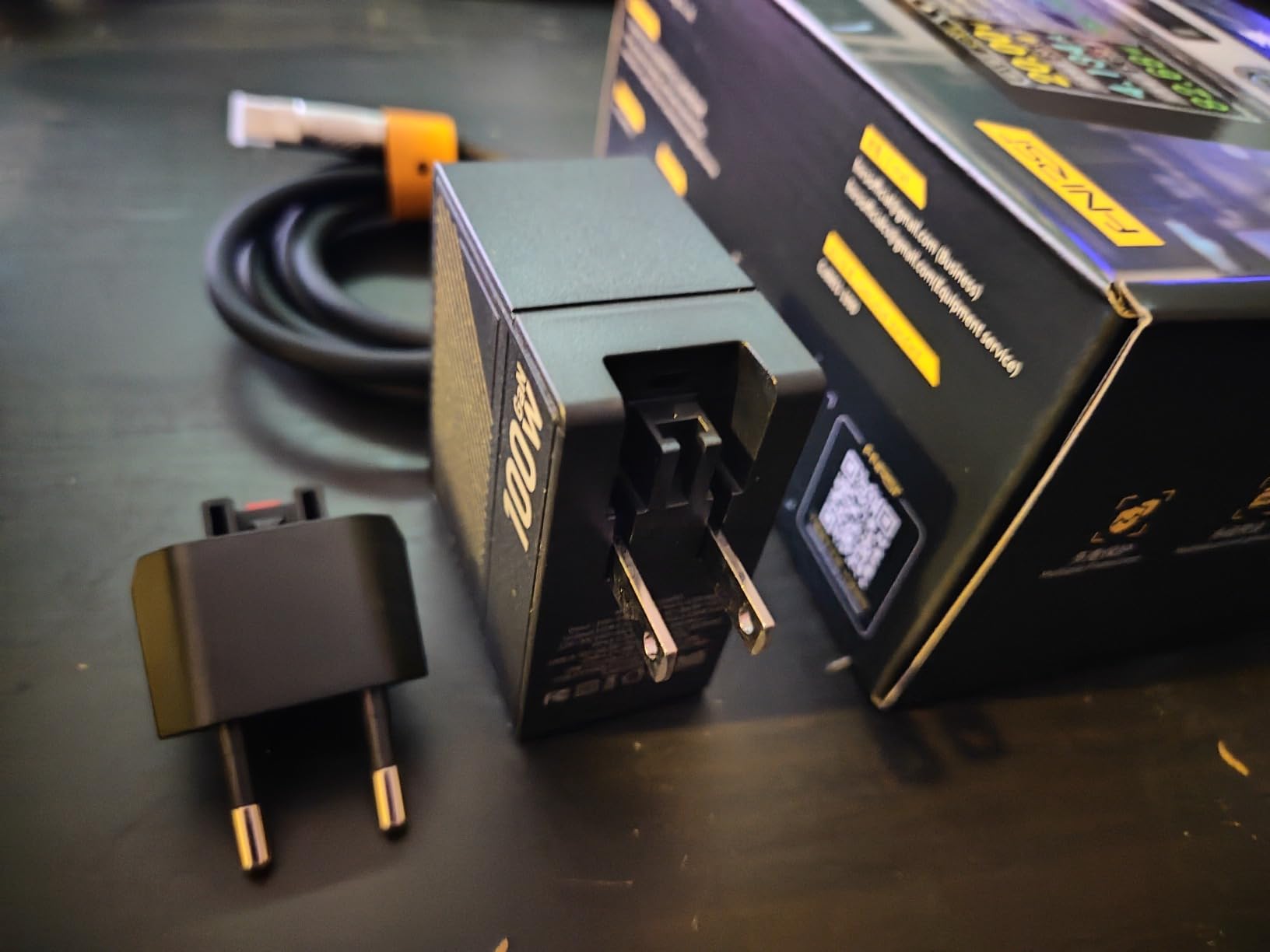
The FNIRSI DPS-150 is the odd one out, and that is why it is interesting. Instead of a mains input it runs from USB-C PD, QC or a DC barrel source, so you can power it from a laptop, a power bank or a car adapter. It still delivers 0-30V at 5A and 150W, which is enough for almost any microcontroller, sensor or small module work.
It also publishes a ripple figure, and that is the number to hold it to. The stated output is under 20mV ripple under load, with automatic CC and CV mode switching. The 2.8-inch IPS colour screen flips through 90 degrees so you can read it mounted, at a bench, or held in one hand, and it switches between numeric and curve display modes.
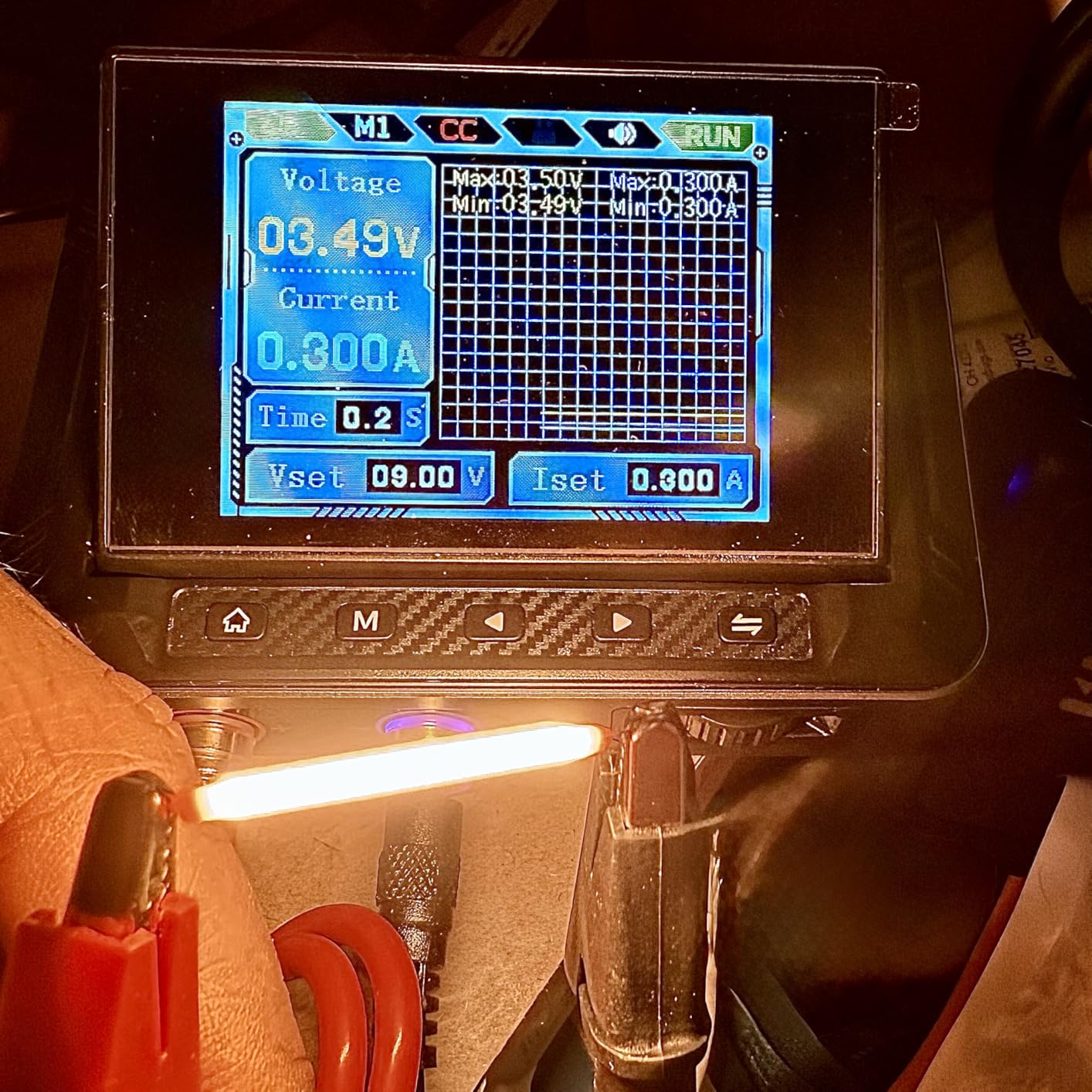
There are six groups of preset output parameters and PC programmability, plus eight built-in protection mechanisms. The connection bundle is unusually generous for a unit this small, including 4mm banana heads, U-shaped terminals and fine copper wire, so you can pick the right termination rather than hunting for an adapter. A one-year manufacturer warranty is included.
Owner feedback across 182 reviews at 4.4 stars is the most mixed of the modern units here, with a 9% three-star band. The recurring issues are the dependency on a capable power source, the 150W ceiling being half what the 10A units deliver, and the display width showing only about three digits at a time despite the large panel.
Why it suits portable and low-noise work
Under 20mV ripple makes it viable for analogue and low-level signal work where budget switching units are not, and PD or QC input means it works off a laptop.
The flip screen is genuinely useful on a cramped bench, and the three bundled connector styles save a trip to the parts drawer.
Where it will frustrate you
It cannot deliver the 300W that a 30V/10A unit does, so motors, heated loads and multi-board builds are out of scope.
You need a power source capable of feeding it, and a cheap USB charger that cannot sustain the draw will make it behave oddly.
10. Rigol DP832: Isolated Triple Output for Serious Labs
Rigol DP832 Triple Output 195 Watt Power Supply
Three isolated channels
195W total
Metal benchtop chassis
OVP / OCP / OTP
Pros
- Three fully isolated channels allow independent rail testing
- Metal benchtop chassis built for sustained lab use
- Low ripple and fast transient response suit sensitive prototyping
- OVP OCP and OTP protection cover the usual failure modes
- 195W of total output from a compact three-channel design
Cons
- Heaviest option in the group at 9.15 kg
- Front panel is dated next to colour-screen competitors
- Small 71-review base offers less field feedback than the budget units
The Rigol DP832 is a lab-grade three-channel unit with channel isolation across all three outputs and 195W of total power in a metal benchtop chassis. If your work involves testing rails independently, or you need to float one channel relative to the others, this is built for that job rather than adapted to it.
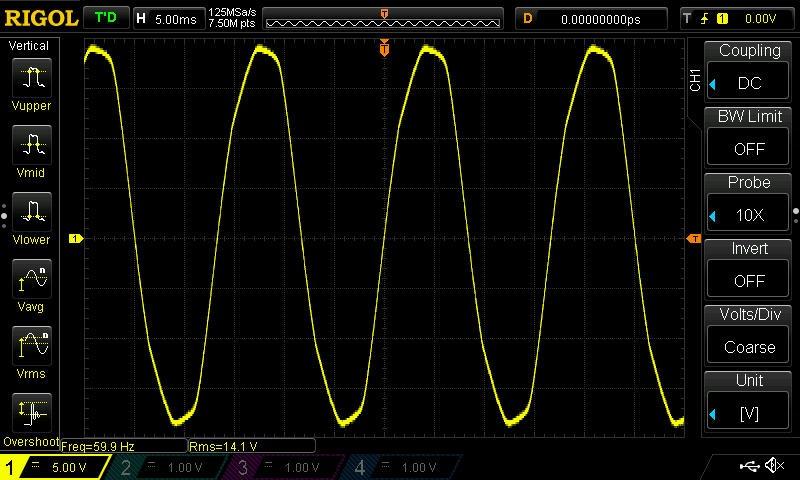
Rigol comes up constantly in community recommendations for reliable general-purpose supplies. On the EEVblog forum it is named alongside Korad as one of the brands worth committing to, and on SparkFun threads Rigol and Siglent are singled out as the lower-priced names that still hold up. The published spec sheet here emphasises low ripple noise and fast transient response, which is what you want for sensitive prototyping where a load step should not ring.
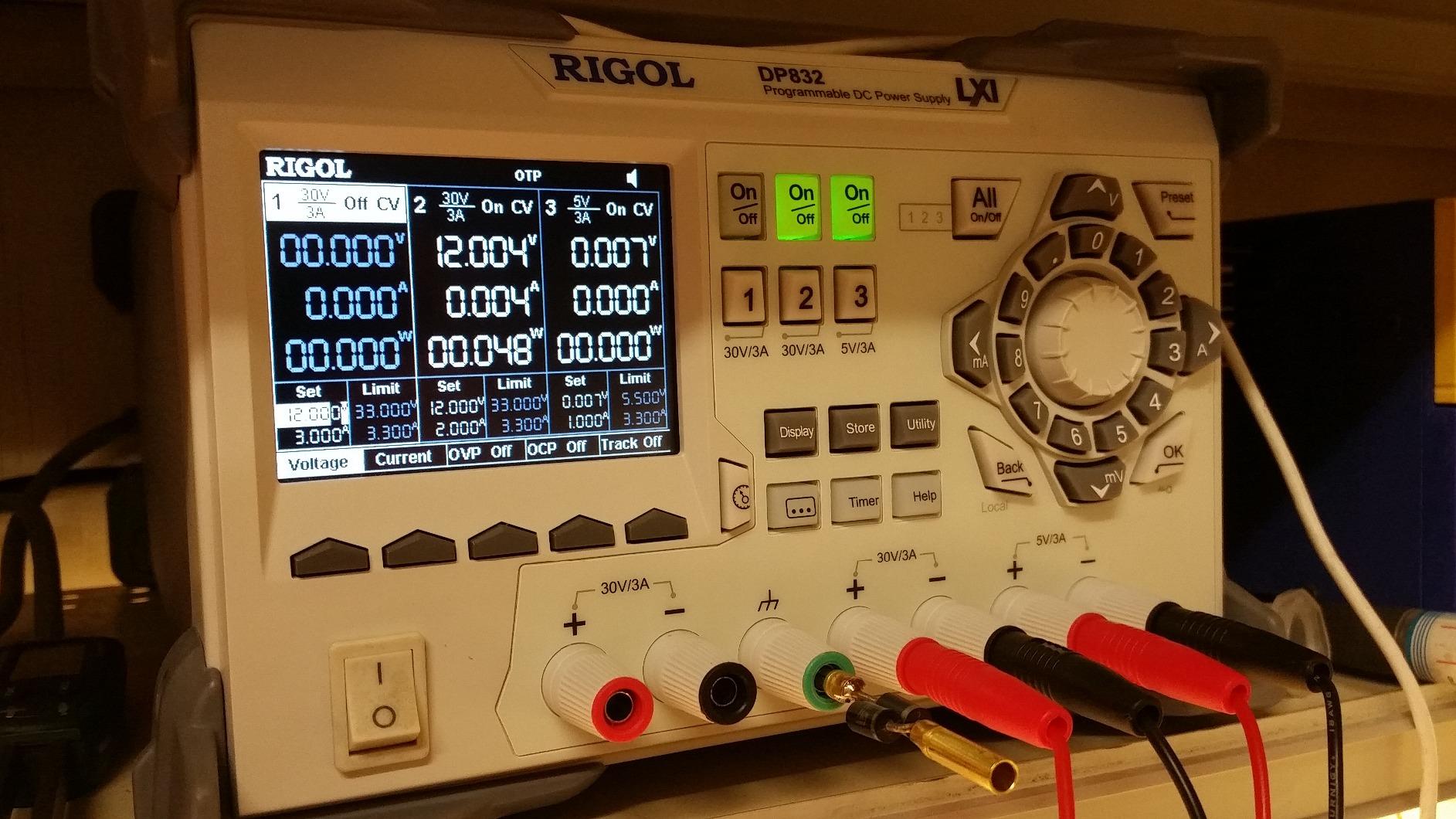
Protection covers over-voltage, over-current and over-temperature, and the metal case handles sustained duty far better than the plastic units elsewhere in this list. That chassis is also why it is heavy, at 9.15 kg, so plan shelf space before you commit.
The honest limitation is the feedback base and the panel. Seventy-one reviews averaging 4.3 is thin next to the multi-thousand review counts on the budget units, so you are buying on the brand’s lab reputation rather than on a large body of user reports. The front panel is also dated compared with the colour-screen competitors, and there is a notable 13% three-star band in the ratings that mostly reflects interface complaints.
Why it suits lab and teaching environments
Full channel isolation means you can float a rail or test outputs independently, which no single-channel supply in this roundup allows.
The metal chassis and low-ripple specification are what you want for sustained daily use and for students who will leave it running.
Where it will frustrate you
At 9.15 kg it is a bench fixture and not something you carry between rooms, and the dated panel slows down users used to colour screens.
With only 71 reviews there is far less published owner experience to lean on than with the heavily reviewed budget units.
11. Tekpower TP-3005D-3: Three Linear Channels in One Box
Tekpower TP-3005D-3 Digital Variable Triple Outputs Linear-Type DC Power Supply, 0-30 Volts @ 0-5 Amps
Triple linear outputs
0-30V at 0-5A
Back-lit LCD
CV and CC modes
Pros
- Triple outputs give multi-rail capability without a second supply
- Linear topology keeps output noise low
- Back-lit LCD with 0.1V and 0.01A resolution reads well on a dim bench
- Thermo-sensor fan control means the fan is not running constantly
- 1-year warranty from a long-standing brand
Cons
- Oldest-looking industrial beige enclosure in the roundup
- 110V AC input only with no mains selector
- Barrel jack connectors instead of binding posts or banana jacks
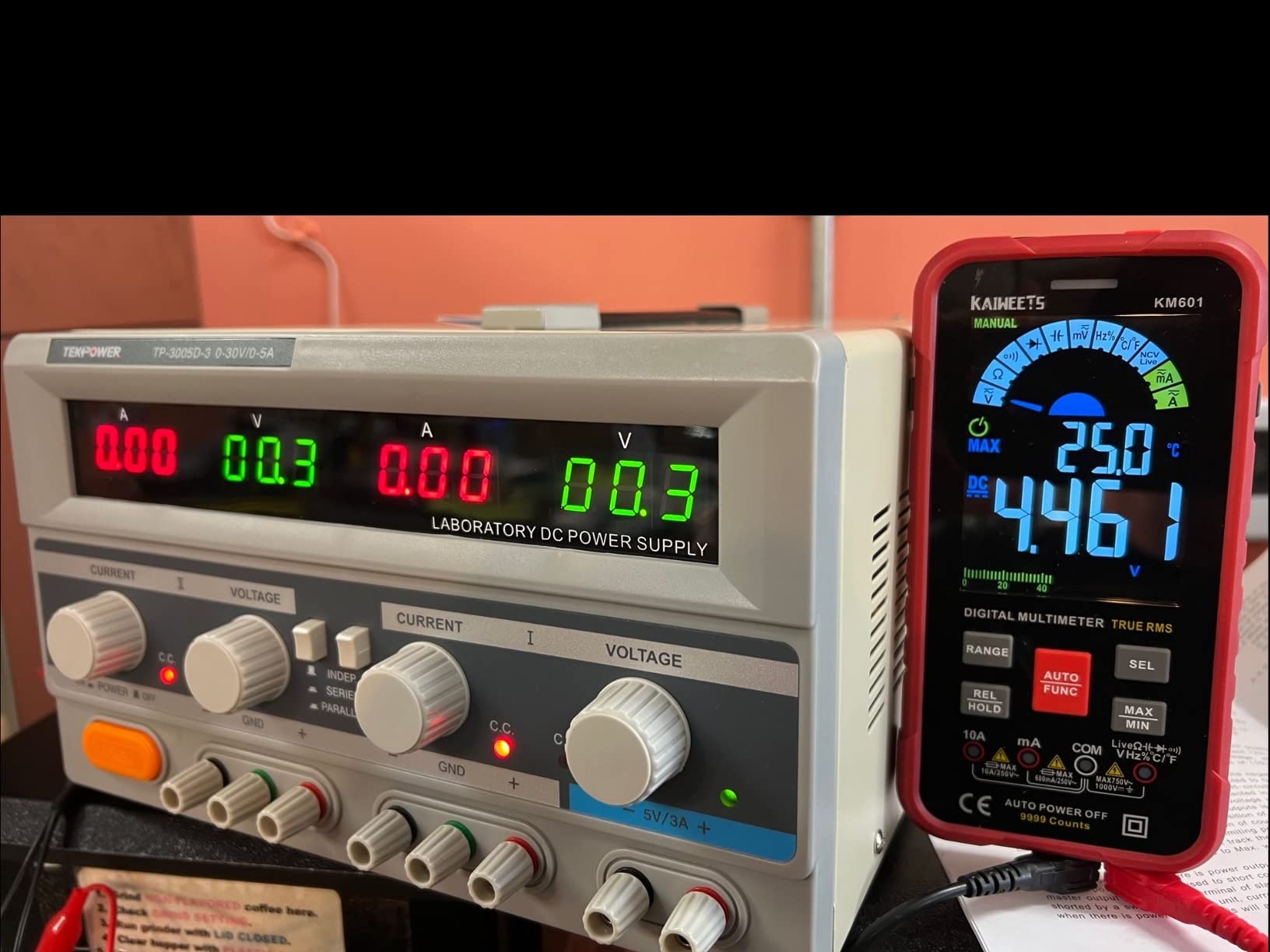
The Tekpower TP-3005D-3 does something rare: three linear outputs in one affordable box. Each channel runs 0-30V at 0-5A, and because the design is linear rather than switching, the output stays quiet enough for audio and analogue experiments. Total rated output is 150W per the specification.
The back-lit LCD shows 0.1V and 0.01A resolution, which is readable on a dim bench, and a thermo-sensor triggers the cooling fan only when the internal temperature climbs, so the unit sits silent until it needs to work. Constant-voltage and constant-current modes cover the standard bench behaviours, and a one-year warranty comes with it.
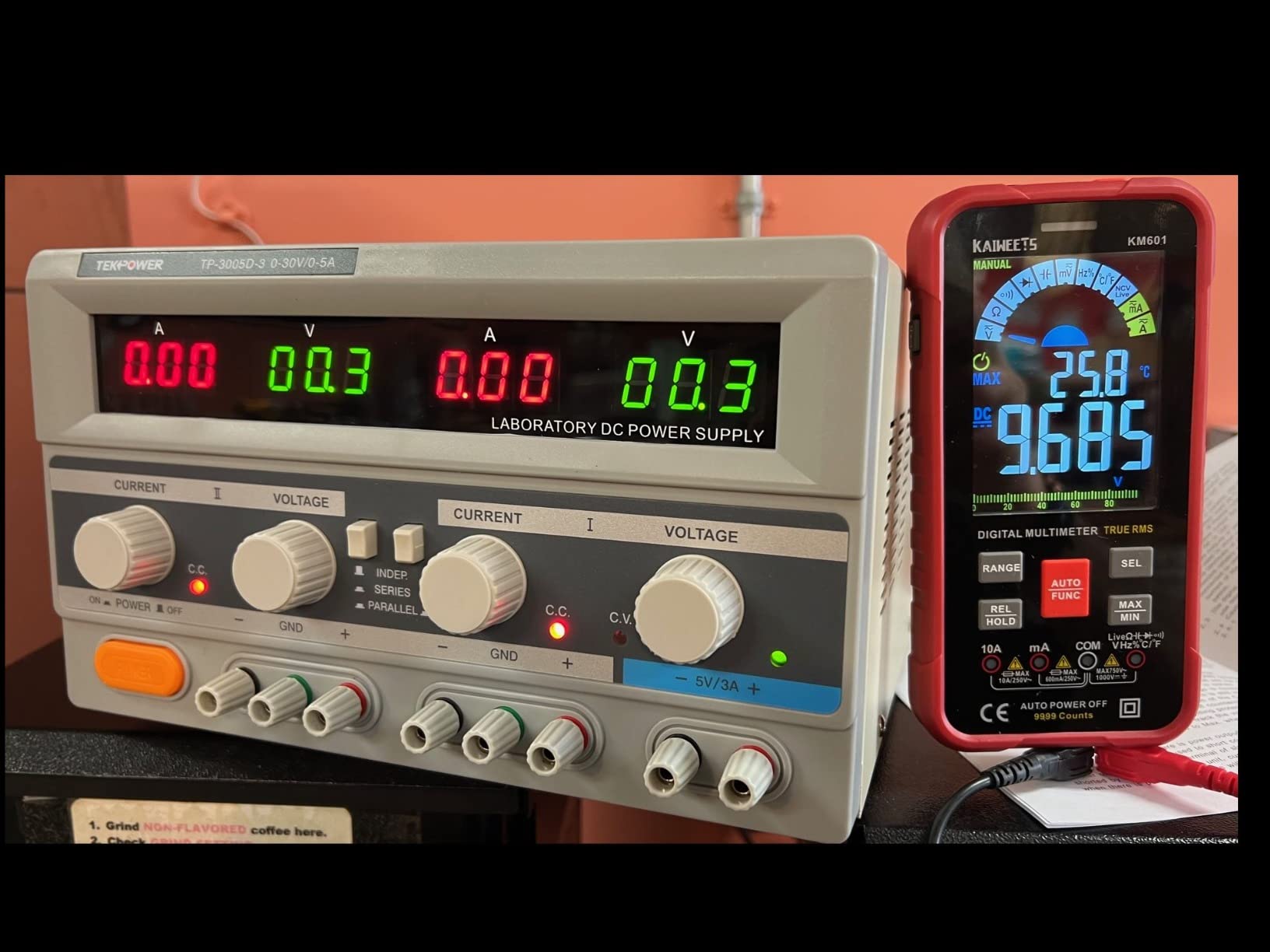
There is an important distinction here. Triple output is not the same as isolated output. This unit gives you three channels, which is a genuine convenience for teaching or for powering a logic board and a sensor together, but you should confirm with the manufacturer whether the channels float relative to each other before you count on it for an op-amp negative rail. The Siglent SPD3303X-E is the pick in this roundup when isolation is a hard requirement.
Ownership feedback is tight and mostly positive across 104 reviews at 4.4 stars, with 60% five-star and 28% four-star. The drawbacks are physical: the beige industrial enclosure looks like it was designed in the 1990s, the input is fixed at 110V with no selector, and the outputs use barrel jack connectors rather than binding posts, which limits what you can attach directly.
Why it suits teaching and multi-rail set-ups
Three channels from one box is exactly what a classroom bench needs to run a project, a reference rail and a load at the same time.
The linear design keeps noise down for analogue demos, and the thermo-sensor fan means the box is quiet when students are listening to a signal.
Where it will frustrate you
Triple output is not guaranteed isolation, so confirm before relying on a floating or negative rail.
Barrel jack outputs and 110V-only input limit both the accessories you can use and where you can deploy the unit.
12. HANMATEK HM310T: Programmable, With a Software Caveat
Programmable DC Power Supply (0-30 V 0-10 A) HM310T High Precision 4-Digit Voltage Current Power Time Display Variable Switching Digital Power Supply with PC Software and USB Interface
0-30V / 0-10A programmable
Modbus over rear USB
4-digit V/A/W/time
Five protections
Pros
- Only supply here with documented Modbus programmability and sequence output
- Six parameter storage groups plus bundled PC control software
- Five separate protections including over-power and overheat
- Front panel time display is useful for timed charge and discharge tests
- One-key output enable and keypad lock reduce bench mistakes
Cons
- Lowest average rating in the roundup at 4.1 with 13% one-star reviews
- Firmware and bundled PC software are dated against newer rivals
- Switching design produces more ripple than the linear options
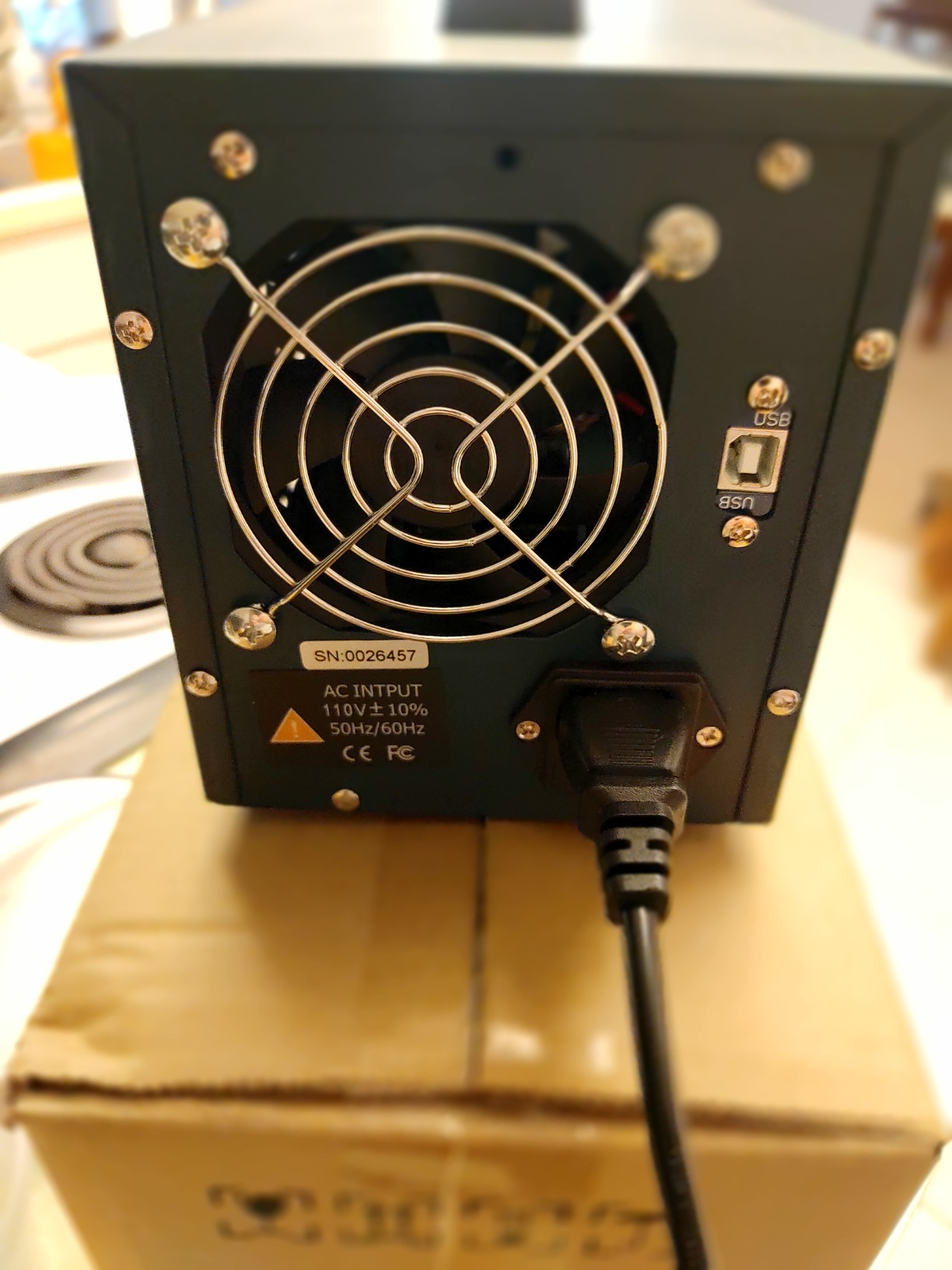
The HM310T is the most genuinely programmable supply in this roundup, and also the one that needs the most caveats. It outputs 0-30V at 10A with 10mV and 1mA resolution, and the rear USB interface speaks the Modbus instruction set, so you can drive setpoints from your own script rather than from a vendor GUI. Six groups of quick parameter storage and programmable sequence output sit on top of that.
There are five protection functions here, more than anywhere else in the list: over-voltage, over-current, over-power, over-temperature and short circuit, with a temperature-controlled fan starting above 45C. The four-digit display shows voltage, current, power and elapsed time, and that timer is genuinely useful for timed charge and discharge tests. One-key output on/off and a keypad lock reduce the chance of a stray press ruining a run.
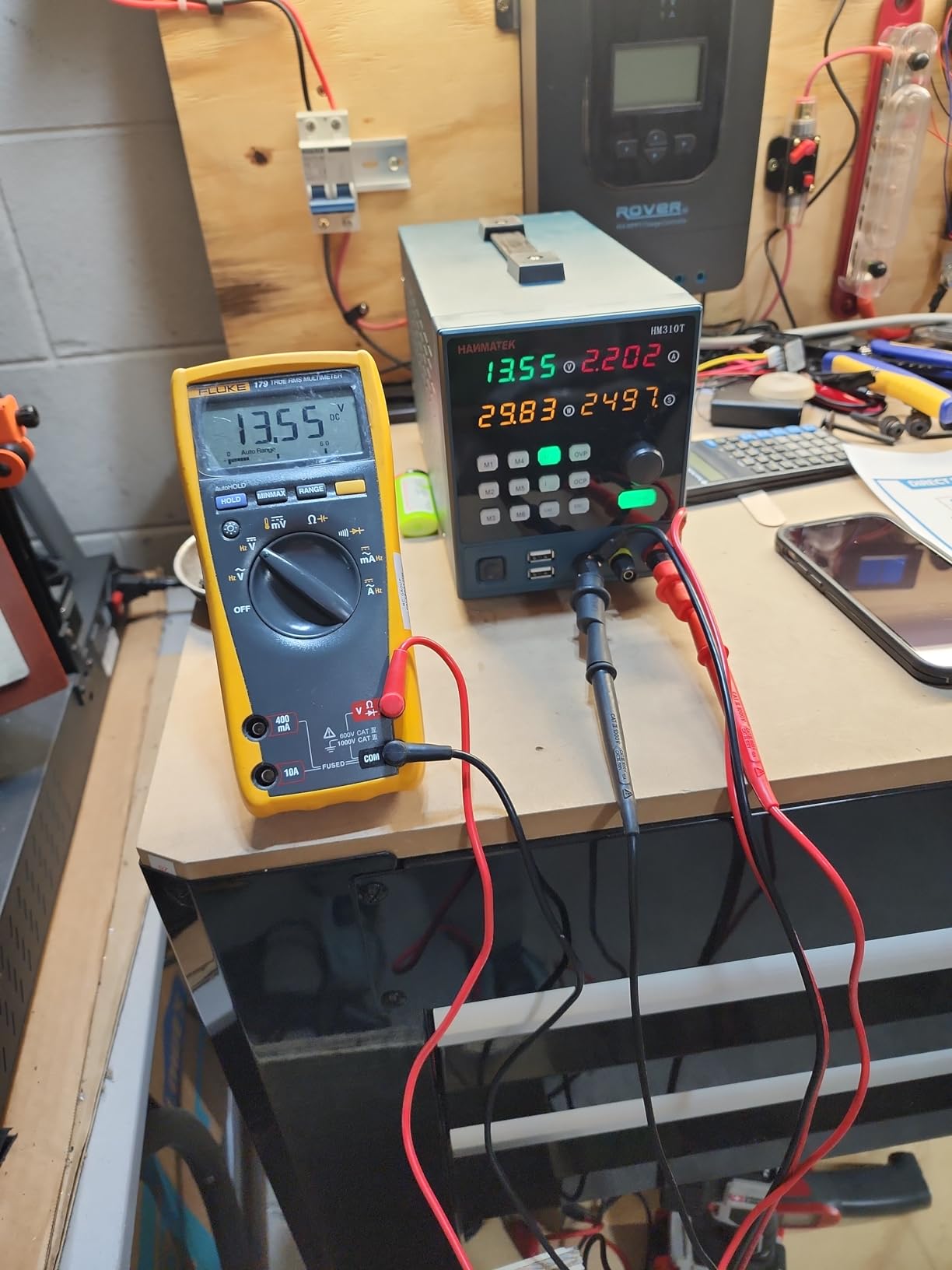
Now the honest part. Across 527 reviews the average is 4.1, the lowest in the roundup, with 64% five-star but a 13% one-star band by far the highest. Owners single out the firmware and the bundled PC software as the source of most complaints, and the software is dated next to the interface on the Kiprim or the colour-screen units. If automation is your main reason for buying, test the software before you commit rather than after.
Because it is a switching design, ripple is higher than the linear options, and owner feedback does not verify the 10A rating at sustained high load. A front dual 5V 1.5A USB charging interface and a supplied CD with control software complete the package.
Why it suits scripted power sequences
Modbus over rear USB means you can script setpoints from your own tooling, which no other supply in this roundup offers at this level.
Six storage groups, a front panel timer and five protection functions cover repeatable charge and discharge testing without manual intervention.
Where it will frustrate you
The software and firmware attract the worst reviews in the group, so test them against your workflow before buying.
Higher ripple and an unverified 10A figure at sustained load make it a poor match for analogue work or heavy continuous current.
How to Choose a Bench Power Supply (Step by Step)
Start with the load, not the price. Work out the highest voltage your circuit needs and the highest current it will draw, then buy something with roughly 30 percent headroom above both. A supply at its limit runs hot, sags under load and shuts down at the worst moment.
Step one is voltage and current range. Almost everything in this roundup covers 0-30V, which suits 5V, 9V, 12V and 24V work. If you are running 3.3V logic or a 1.2V cell, check the low end carefully, because the NICE-POWER is not stable below roughly 0.9V.
Step two is constant-voltage and constant-current modes. In CV mode the supply holds the voltage you set and the current rises with the load. In CC mode it holds the current you set and the voltage collapses, which is exactly what protects a shorted circuit and what a battery charge profile needs. Any supply worth owning does both and switches between them automatically.
Step three is topology. Linear supplies use a large transformer and a regulator, run heavier, and produce very low noise at the cost of size, heat and price. Switching supplies use a high-frequency converter, run small and cool, and cost less, but carry more ripple. Forum discussion on this point is endless, and the honest answer is workload-dependent: linear for audio, RF-adjacent and low-level analogue work, switching for digital, LED, motor and charging work.
Step four is output channels. Single output covers most one-off builds. Dual output helps when you need a core and an I/O rail. Triple output is what you want for op-amp work, teaching benches and anything with a 2.5V, 3.3V or 5V logic rail alongside a higher main rail. Crucially, ask whether the channels are isolated, because three non-isolated channels will not give you a clean negative rail.
Step five is protection. Look for over-current, over-voltage, short-circuit and over-temperature handling at minimum, and treat the ability to set your own thresholds as a bonus that pays off on inrush loads. Step six is control ergonomics: an output on/off switch so you can rewire without arcing, a key lock so a stray press cannot ruin a test, and an encoder knob if you will be changing setpoints often rather than setting one value for a week.
Step seven is the boring stuff that blocks purchases. Confirm the output connectors, since barrel jacks and ring terminals are more annoying than banana plugs or five-way binding posts. Confirm the mains input, because 110V-only units cannot travel. And read the included lead ratings, because a give-away test lead can be the weakest link in a 10A chain. Our power rack roundup covers how to organise distribution once you have more than one supply on the bench.
Why Are Bench Power Supplies So Expensive?
The price gap comes down to what is inside. A linear supply at 30V and 5A needs a large mains transformer, a heatsink and enough metal to dissipate the difference between its input power and its output power, and all of that costs money in material and shipping. A switching supply achieves the same rating in a much smaller box, which is why the compact models cluster well below the Korad and the Kiprim in cost.
The rest of the gap buys regulation quality, calibration accuracy, isolation hardware, real protection circuits, a warranty you can rely on and a chassis that survives being moved. The three-channel Siglent costs several times what the single-channel switching units cost because you are paying for three independent isolated channels and a linear architecture, not for extra wattage. None of that is padding, but it is also why a supply that measures 0.01V accurately and holds regulation under load is worth more than a bigger number on the box.
Which Bench Power Supply for Which Job?
For Arduino, ESP32 and general microcontroller breadboarding, the HYELEC HY3005S is the best fit, because the output enable button and verified accuracy protect a board that costs more than the supply did. If you are running several boards at once, the Jesverty SPS-3010 gives you 10A and automatic CV/CC handover at the same time.
For audio amplifier repair and low-noise analogue work, use the KORAD KD3005D for a single rail or the Siglent SPD3303X-E when you need a plus and minus supply. Both are linear, and the difference in audible hum between these and a switching unit is measurable on a scope before it is audible through a speaker.
For RF-adjacent and instrumentation set-ups, the Rigol DP832 is the pick for published low ripple and fast transient response, with the caveat that you are buying on spec sheet reputation more than on a large volume of owner reports. The FNIRSI DPS-150 is a credible second choice at under 20mV ripple in a package small enough for field work.
For LED strips, motors and electroplating, the Kungber SPS3010B and the Jesverty SPS-3010 both handle 300W with 10A available, and the Kungber adds a charging mode with an amp-hour readout. For battery charging, pick automatic CV/CC crossover, which is why the Jesverty and the Kungber lead this category. If the loads live away from the bench, our marine electronics picks cover the 12V DC side of the same problem.
For op-amp rails needing plus and minus voltage, you need genuine isolation, so the Siglent SPD3303X-E is the pick. For PC-controlled test sequences, the Kiprim DC310S has the more capable bundled software, while the HANMATEK HM310T is the only unit here speaking Modbus for custom scripting. For teaching a room of students, the Tekpower TP-3005D-3 gives three channels from one box.
First Power-Up: Set the Current Limit Before You Connect
Every good bench supply is a bench supply you can get wrong safely, and that comes down to a three-step routine. First, with the output off, set your target voltage and then set the current limit to roughly double what your circuit is expected to draw. If you are unsure, start at 100mA and raise it deliberately.
Second, verify with a multimeter before you trust the panel. Measure the actual output voltage with nothing attached and confirm it matches the setpoint, because a supply with no load can read slightly high. Third, connect the load with the output still disabled, then press the output switch to energise. Watching the current readout as it rises tells you immediately whether the circuit is drawing what you expect.
Never connect a supply across a battery that is already connected to something else, and never assume a terminal is an earth. Supplies with an output on/off switch, which is most of the ones in this roundup, let you do all three steps without arcing or accidental contact.
Frequently Asked Questions
What is the most reliable power supply brand?
For bench power supplies, the names that come up most often in long-term community use are Siglent and Rigol for multi-channel and isolated work, and Korad for single-channel linear performance. The KORAD KD3005D and the Siglent SPD3303X-E both carry three-year or better reputations among owners on forums like EEVblog and SparkFun, while Rigol is repeatedly recommended for classroom and lab duty. Reliability tracks the chassis, the protection circuitry and the warranty more than it tracks the wattage on the box.
How do I choose the right bench power supply voltage and current?
Choose the highest voltage your circuit needs and the highest current it will draw, then add roughly 30 percent headroom to both. A 0-30V supply covers 5V, 9V, 12V and 24V work. Running at the very top of the rating causes heat, sag under load and shutdowns, so the 30V/10A switching units suit motors, LED strips and multi-board builds, while a 0-30V/5A unit is enough for most microcontroller and analogue projects.
Is a switching bench power supply good enough, or do I need a linear one?
For digital work, microcontroller development, LED testing and battery charging, a switching supply is good enough and costs far less. For audio amplification, low-level analogue signals, instrumentation and anything where the noise floor shows up on a scope, a linear supply such as the KORAD KD3005D or the Siglent SPD3303X-E is worth the extra size, heat and cost. The FNIRSI DPS-150 sits in between with a stated ripple figure under 20mV.
Do I need multiple outputs for Arduino projects and op-amp circuits?
For a single Arduino or ESP32 board, one channel is enough. Op-amp circuits that need plus and minus rails require a supply with two isolated outputs, or a second supply, and the Siglent SPD3303X-E is the pick in this roundup because its three channels are genuinely isolated and can be wired in series or parallel. Watch out for triple-output units that are not isolated, such as the Tekpower TP-3005D-3, and confirm with the manufacturer before counting on a floating negative rail.
What are some bench power supply brands to buy at your own risk?
Rebadged marketplace units with no printed manufacturer, no certification markings and no stated warranty are the ones to approach carefully, particularly for anything mains powered or high current. Within known brands, treat unreviewed or very lightly reviewed models as unproven, and note that the HANMATEK HM310T holds the lowest average rating in this roundup at 4.1 largely because of firmware and software complaints. Always check the mains input selector on units that have one before first use.
The Verdict: Which Bench Power Supply Should You Buy?
Buy the KORAD KD3005D if you want one supply to do almost everything well. Linear output, a metal case, dual readouts and a switchable mains input make it the pick for a permanent bench, and the community backing behind it is decades deep. It is our editor’s choice in 2026 for exactly that reason: it is the one people stop shopping around for.
Buy the HYELEC HY3005S if you are starting out and want the safest possible first tool, or the NICE-POWER SPS-E305 if bench space is tight. Buy the Kungber SPS3010B or the Jesverty SPS-3010 if you need 10 amps for motors, LED strips and charging, and buy the Kiprim DC310S if you want a screen, curve plotting and PC control. If your circuits need a negative rail or genuinely isolated channels, the Siglent SPD3303X-E is the only pick here that gives you that without a second box.
Whichever you choose, buy the leads and the banana plugs at the same time, set the current limit before you connect anything, and check that mains selector on the back before the first power-up. The best bench power supplies for electronics are the ones you will still be using in five years, and those three habits are most of the reason.