
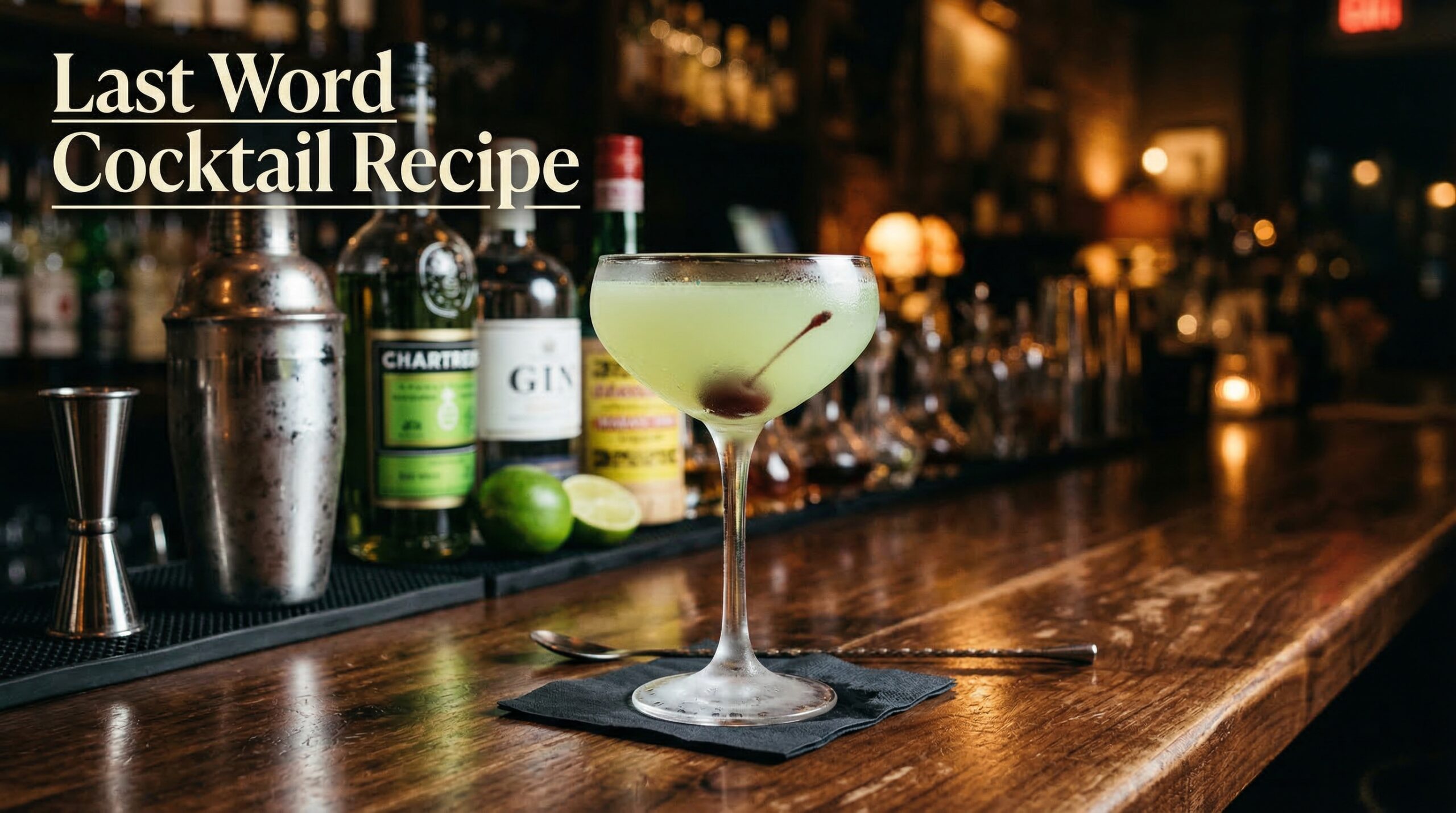
The Last Word cocktail recipe is one of the most perfectly balanced drinks in the classic cocktail canon. This Prohibition-era masterpiece combines four ingredients in equal parts: gin, green Chartreuse, maraschino liqueur, and fresh lime juice. The result is a stunningly complex yet approachable drink that has captivated cocktail enthusiasts for over a century. In this guide, I’ll walk you through everything you need to know to make this classic at home, from the exact measurements to the fascinating history behind its creation. If you enjoy exploring gin cocktail recipes, this one belongs in your repertoire.
Table of Contents
What Is the Last Word Cocktail?
The Last Word is a classic cocktail invented around 1916 at the Detroit Athletic Club. It features equal parts of four ingredients: London dry gin, green Chartreuse, maraschino liqueur, and freshly squeezed lime juice. This equal-parts formula creates an incredibly balanced drink with herbal, sweet, and tart notes all working in harmony.
The flavor profile is complex and layered. The gin provides a clean botanical foundation, while the green Chartreuse adds intense herbal complexity from its 130 botanical ingredients. Maraschino liqueur contributes a subtle sweetness with cherry and almond notes, and the fresh lime juice brings brightness that ties everything together. Despite its 110-proof Chartreuse content, the drink tastes surprisingly balanced and refreshing.
What makes this cocktail special is its perfect equilibrium. No single ingredient dominates. The equal-parts template has inspired countless modern variations, making the Last Word one of the most influential cocktails in the modern revival of classic drinks.
Last Word Cocktail Ingredients
Here are the four ingredients you’ll need to make a proper Last Word cocktail. Each is measured in equal parts, making this recipe easy to remember and scale.
Ingredients (serves 1):
- 3/4 oz (22 ml) London dry gin
- 3/4 oz (22 ml) green Chartreuse
- 3/4 oz (22 ml) maraschino liqueur (Luxardo recommended)
- 3/4 oz (22 ml) fresh lime juice, freshly squeezed
Garnish:
- 1 brandied cherry or Luxardo maraschino cherry
Understanding Your Ingredients
London Dry Gin: A classic London dry gin works best here. Plymouth, Tanqueray, or Beefeater are excellent choices. Avoid heavily floral gins like Hendrick’s, as the cucumber and rose notes can clash with the Chartreuse. You want a gin with clean juniper and citrus notes that will stand up to the other bold ingredients.
Green Chartreuse: This is the star ingredient that makes the Last Word unique. Green Chartreuse is a French herbal liqueur made by Carthusian monks since 1764. It contains 130 different botanicals and clocks in at 110 proof (55% ABV). Its intense herbal character defines this cocktail.
Important note on Chartreuse availability: Due to production limitations and global demand, green Chartreuse has become increasingly difficult to find in recent years. The monks have limited production to prioritize their monastic life over commercial expansion. If you cannot find green Chartreuse, consider these substitutes: Genepy des Alpes (a similar herbal liqueur from the Alps), Izarra Green (slightly sweeter but similar profile), or a combination of yellow Chartreuse with a few drops of herbal bitters.
Maraschino Liqueur: Not to be confused with the bright red syrup from jarred cherries, real maraschino liqueur is clear and made from Marasca cherries and their pits. Luxardo is the gold standard and widely available. It adds a subtle sweetness with cherry and almond notes from the crushed cherry pits.
Fresh Lime Juice: Always use freshly squeezed lime juice. Bottled lime juice lacks the brightness and aromatic oils that fresh juice provides. One medium lime typically yields about 3/4 oz of juice, so you’ll need one lime per cocktail.
How to Make a Last Word Cocktail
Follow these steps to create a perfectly balanced Last Word cocktail at home.
Step 1: Chill Your Glass
Place a coupe glass or Nick & Nora glass in the freezer for at least 5 minutes before making your drink. A chilled glass keeps your cocktail at the optimal temperature from the first sip to the last.
Step 2: Measure Your Ingredients
Using a jigger, measure 3/4 oz each of London dry gin, green Chartreuse, maraschino liqueur, and fresh lime juice. Add all ingredients to your cocktail shaker. The equal-parts measurement makes this recipe easy to memorize and scale up for multiple servings.
Step 3: Add Ice and Shake
Fill your shaker with ice cubes. Shake vigorously for 12-15 seconds. You want to dilute the drink properly and chill it thoroughly. The Last Word contains no built-in dilution from stirring, so a good shake is essential. You should see frost forming on the outside of your shaker when it’s ready.
Step 4: Double Strain
Strain the cocktail through a fine-mesh strainer into your chilled coupe glass. Double straining removes any ice chips and lime pulp, giving you a silky smooth texture. This step is especially important for cocktails with fresh citrus juice.
Step 5: Garnish and Serve
Garnish with a brandied cherry or Luxardo maraschino cherry. Drop the cherry gently into the glass or place it on the rim. Serve immediately while the drink is at its coldest.
Pro tip: The Last Word is a strong drink, typically around 24% ABV (48 proof) when finished. Sip slowly and enjoy how the flavors evolve as the drink warms slightly in your glass.
The History of the Last Word Cocktail
The Last Word has one of the most fascinating origin stories in cocktail history. Its journey from pre-Prohibition Detroit to modern cocktail bars spans over a century and includes near-extinction and dramatic revival.
Birth at the Detroit Athletic Club (1916)
The Last Word was first served at the Detroit Athletic Club around 1916, just before the United States entered Prohibition. The drink was created by Frank Fogarty, a vaudeville performer known as “The Dublin Minstrel.” Fogarty was a regular at the Detroit Athletic Club and reportedly developed the recipe with the club’s bartenders.
The cocktail’s creation during this era is significant. Pre-Prohibition America was experiencing a golden age of cocktails, and the Detroit Athletic Club was at the center of high society. The equal-parts formula was innovative for its time, creating a perfectly balanced drink that stood out from the sweeter cocktails popular in that era.
The Prohibition Era and Beyond
When Prohibition began in 1920, the Last Word largely disappeared from public consciousness. Like many great cocktails, it went underground, surviving only in the memories of bartenders and the pages of recipe books. The cocktail landscape changed dramatically during Prohibition, with many classic recipes lost to time.
Rediscovery in 1951
The Last Word reappeared in Ted Saucier’s 1951 book “Bottoms Up,” a collection of cocktail recipes from various establishments. Saucier credited the Detroit Athletic Club as the source, preserving the drink’s origin story. However, this publication didn’t spark widespread adoption of the cocktail.
The Modern Revival: Murray Stenson and Zig Zag Cafe
The Last Word remained largely forgotten until the early 2000s, when bartender Murray Stenson rediscovered it while working at the Zig Zag Cafe in Seattle. Stenson found the recipe in old cocktail books and began serving it to customers. The drink quickly developed a cult following.
This revival coincided with the broader craft cocktail renaissance. Bartenders across the country began experimenting with forgotten pre-Prohibition recipes, and the Last Word became one of the stars of this movement. Its perfect balance and complex flavor profile made it a favorite among cocktail enthusiasts and bartenders alike.
Murray Stenson’s role in popularizing the Last Word cannot be overstated. He championed the drink at Zig Zag Cafe, and as other bartenders visited Seattle and tasted it, they brought the recipe back to their own bars. By the late 2000s, the Last Word had become a staple on cocktail menus across America.
Why the Name “Last Word”?
The origin of the name remains somewhat mysterious. Some believe it refers to the drink’s potency, implying that after one of these strong cocktails, you’d have trouble speaking coherently. Others suggest it was a marketing term meant to position the drink as the ultimate cocktail. Frank Fogarty, the vaudeville performer credited with its creation, may have named it himself, but no definitive historical record confirms this.
What we do know is that the name has proven fitting. The Last Word has indeed had the final say in the cocktail revival, becoming one of the most influential drinks of the modern era.
Popular Last Word Variations
The equal-parts template of the Last Word has inspired numerous variations. Once you understand the formula, you can create your own riffs by substituting different base spirits and modifiers.
Paper Plane
Created by bartender Sam Ross in 2008, the Paper Plane substitutes bourbon for gin and Amaro Nonino for green Chartreuse. The recipe is equal parts bourbon, Amaro Nonino, Aperol, and fresh lemon juice. This modern classic has become almost as popular as the original Last Word.
Final Ward
Created by the late Sasha Petraske of Milk & Honey fame, the Final Ward uses rye whiskey instead of gin and yellow Chartreuse instead of green. It also substitutes lemon juice for lime. The result is a slightly warmer, spicier take on the original.
Naked and Famous
This variation combines mezcal, Aperol, yellow Chartreuse, and fresh lime juice in equal parts. The smoky mezcal adds an entirely different dimension, creating a more savory, complex drink. It’s an excellent choice for mezcal enthusiasts.
Why the Equal-Parts Formula Works
The genius of the Last Word’s formula lies in its simplicity and balance. With four ingredients in equal proportions, the drink achieves a harmony that’s difficult to improve upon. Each ingredient plays a specific role: the spirit provides the base, the herbal liqueur adds complexity, the sweet liqueur rounds out the flavors, and the citrus provides brightness and balance.
This template has proven remarkably flexible. As long as you maintain the basic structure of spirit + herbal component + sweet component + citrus, you can create countless variations. The key is choosing ingredients that complement rather than compete with each other.
Tips for the Perfect Last Word
After making countless Last Word cocktails, I’ve learned a few things that can make the difference between a good drink and a great one.
Common Mistakes to Avoid
Using bottled lime juice: Fresh lime juice is non-negotiable. The aromatic oils in fresh lime zest and juice provide brightness that bottled versions simply cannot match. Squeeze your limes right before making the drink.
Over-shaking or under-shaking: Shake for 12-15 seconds with plenty of ice. Under-shaking leaves the drink too warm and not properly diluted. Over-shaking can make the drink too watery and dull the flavors.
Skip the fine strainer: Double straining removes ice chips and lime pulp that can make the texture gritty. Take the extra few seconds to strain through a fine-mesh sieve.
Using the wrong gin: Heavily flavored gins with strong floral or cucumber notes can clash with the Chartreuse. Stick with classic London dry gins that have clean juniper and citrus profiles.
Adjusting to Your Taste
While the classic equal-parts recipe is beautifully balanced, some people prefer slight adjustments. If you find the maraschino too prominent, try reducing it to 1/2 oz and increasing the gin to 1 oz. This small change makes the drink slightly drier and lets the gin shine through more.
If the drink tastes too tart, your limes might be particularly acidic. Try adding a quarter ounce of simple syrup to balance it out. The goal is to find the balance point where no single flavor dominates.
Choosing Your Gin
Based on community feedback and my own testing, here are some gin recommendations for the Last Word:
- Plymouth Gin: Slightly softer and more citrus-forward than London dry, Plymouth works beautifully in this cocktail.
- Tanqueray: A classic choice with strong juniper notes that stands up well to the Chartreuse.
- Beefeater: Another London dry staple with a balanced profile that works in almost any gin cocktail.
- Damrak: A Belgian gin with citrus and floral notes that some enthusiasts prefer in the Last Word.
Avoid gins like Hendrick’s or The Botanist for this particular cocktail. Their distinctive floral and cucumber notes tend to clash with the herbal Chartreuse.
FAQs
Why is it called the Last Word?
The origin of the name remains uncertain. Some believe it refers to the drink’s potency, suggesting that after one strong cocktail, you’d have trouble forming coherent sentences. Others think it was a marketing term positioning the drink as the ultimate cocktail. The vaudeville performer Frank Fogarty, credited with creating the drink at the Detroit Athletic Club around 1916, may have named it himself, but no definitive historical record confirms this.
What does a Last Word taste like?
The Last Word is remarkably balanced with complex herbal, sweet, and tart notes. The gin provides a clean botanical foundation, green Chartreuse adds intense herbal complexity, maraschino liqueur contributes subtle cherry and almond sweetness, and fresh lime juice brings bright acidity. Despite its high-proof ingredients, the drink tastes surprisingly smooth and refreshing.
Can I substitute green Chartreuse in a Last Word?
Yes, though substitutions will change the character of the drink. The best options include Genepy des Alpes (a similar herbal liqueur from the Alps), Izarra Green (slightly sweeter but similar profile), or a combination of yellow Chartreuse with a few dashes of herbal bitters. Green Chartreuse is unique with its 130 botanical ingredients, so no substitute perfectly replicates it, but these alternatives can work well.
How strong is a Last Word cocktail?
A properly made Last Word has an ABV of approximately 24% (48 proof). This is stronger than many shaken cocktails because green Chartreuse is 110 proof (55% ABV) and there’s no dilution from stirring. The drink is deceptively strong, so sip slowly and enjoy how the flavors evolve as it warms slightly.
Conclusion
The Last Word cocktail recipe represents everything great about classic cocktails: simple ingredients, perfect balance, and a fascinating history. This Prohibition-era drink has earned its place in the cocktail canon through its remarkable flavor and the equal-parts template that has inspired countless modern variations. Whether you’re a seasoned home bartender or just starting to explore classic cocktails, the Last Word deserves a spot in your repertoire. With just four ingredients in equal parts, it’s easy to memorize and even easier to love.