
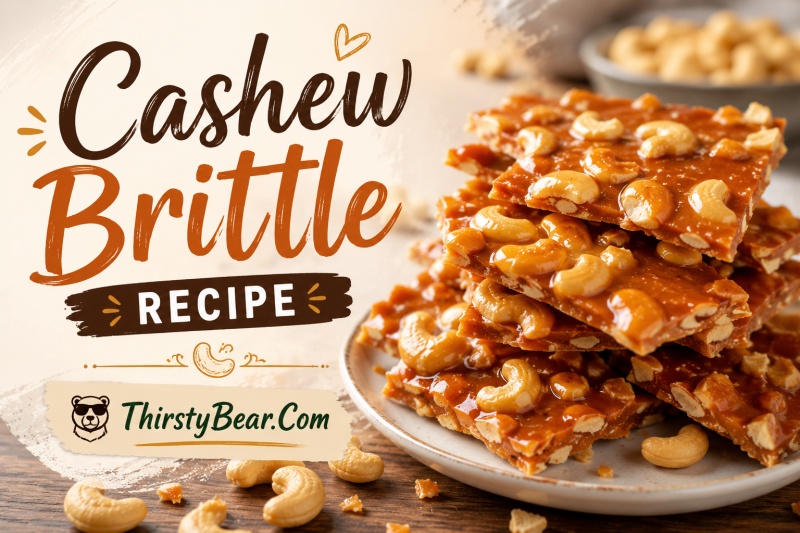
Making cashew brittle at home is easier than you think. I have tested this recipe dozens of times to get the texture just right – that perfect snap when you bite into a piece, followed by the rich butter flavor and crunch of roasted cashews.
This guide walks you through every step of making cashew brittle from scratch. You will learn the exact temperatures to hit, why that small amount of baking soda makes such a big difference, and how to troubleshoot the most common problems like chewy or sticky brittle.
Before we start, here is a fascinating fact about your main ingredient: cashews are the only nut never sold in their shell. The shell contains a toxic resin related to poison ivy, so cashews are always shelled and roasted before they reach stores. Now let us make some candy.
Table of Contents
What Is Cashew Brittle Made Of?
Cashew brittle is a traditional candy made from sugar, corn syrup, butter, and cashews cooked together until the sugar reaches the hard crack stage. The hot mixture is poured onto a baking sheet where it cools into a thin, crunchy sheet of candy.
The basic ingredients are simple: granulated sugar provides sweetness and structure, light corn syrup prevents crystallization, butter adds richness, vanilla enhances flavor, roasted cashews provide crunch and nuttiness, and baking soda creates the characteristic airy texture.
When heated to the right temperature, the sugar transforms from a liquid into a hard, glass-like candy that shatters when you bite it. The cashews become suspended in this sugar glass, creating that addictive combination of sweet and salty.
Cashew Brittle Ingredients
Gather these ingredients before you start. Candy making moves quickly once the sugar reaches temperature, and you cannot stop to measure anything mid-process.
Main Ingredients
- 2 cups granulated sugar – Regular white sugar provides the base structure
- 1/2 cup light corn syrup – Prevents sugar crystallization and keeps brittle clear
- 1/2 cup water – Helps dissolve the sugar initially
- 1/2 cup salted butter – Adds richness and that classic buttery flavor
- 2 cups roasted salted cashews – The star ingredient, already roasted for best flavor
- 1 teaspoon vanilla extract – Enhances the overall flavor profile
- 1 teaspoon baking soda – Creates the airy, bubbly texture
Why Each Ingredient Matters
Granulated sugar is the foundation of all brittle. When heated to the hard crack stage, it becomes a hard, glass-like candy. Light corn syrup is essential because it interferes with sugar crystallization. Without it, your brittle could turn grainy instead of smooth.
Butter adds flavor and helps create a more tender brittle. Salted butter is preferred because the salt balances the sweetness perfectly. Baking soda is the secret ingredient – it reacts with the hot sugar to create thousands of tiny air bubbles, giving brittle its characteristic light, crunchy texture rather than a hard, tooth-breaking candy.
Equipment You’ll Need
Having the right tools makes candy making much easier and safer. Here is what you need:
- Heavy-bottomed 3-quart saucepan – Distributes heat evenly to prevent burning
- Candy thermometer – Essential for hitting the hard crack stage (295-309F)
- Wooden spoon or silicone spatula – For stirring without scratching your pan
- Baking sheet (half sheet size, 18×13 inches) – Gives you the right thickness
- Parchment paper or silicone baking mat – Prevents sticking
- Oven mitts – The sugar mixture reaches extremely high temperatures
- Measuring cups and spoons – For accurate ingredient portions
If you do not have a candy thermometer, you can use the cold water test. Drop a small amount of the hot syrup into a cup of ice water. At the hard crack stage, it will form brittle threads that crack when bent. However, a thermometer gives you much more accuracy and consistency.
How to Make Cashew Brittle: Step-by-Step Instructions
Read through all the steps before you begin. Once the sugar starts cooking, the process moves fast and you need to be ready.
Step 1: Prepare Your Workspace
Line your baking sheet with parchment paper or a silicone mat. Have your cashews measured and ready in a bowl. Measure out your vanilla and baking soda into a small dish – you will need these quickly at the end.
Clear plenty of counter space near your stove. You will be moving a hot, heavy pot and pouring molten sugar, so make sure pets and children are at a safe distance.
Step 2: Combine Sugar, Corn Syrup, and Water
In your heavy-bottomed saucepan, combine the granulated sugar, light corn syrup, and water. Stir gently just until the sugar is moistened. Attach your candy thermometer to the side of the pan, making sure the bulb is submerged but not touching the bottom.
Place the pan over medium-high heat. Let the mixture come to a boil without stirring. Stirring at this stage can cause sugar crystals to form on the sides of the pan, which can make your brittle grainy.
Step 3: Cook to 240F (Soft Ball Stage)
Let the mixture boil, washing down any sugar crystals on the sides of the pan with a wet pastry brush. When the temperature reaches 240F, add the butter all at once. The temperature will drop temporarily – this is normal.
Continue cooking over medium-high heat. The mixture will start to turn golden as the temperature climbs again. Watch your thermometer closely now.
Step 4: Add Cashews at 280F
When the mixture reaches 280F (soft crack stage), carefully add the roasted cashews all at once. Stir thoroughly to coat the nuts with the hot sugar mixture. Continue cooking and stirring constantly until the thermometer reads 295-300F.
Keep stirring to prevent the cashews from scorching on the bottom of the pan. The mixture will bubble vigorously and turn a deep amber color.
Step 5: Reach Hard Crack Stage (295-309F)
The target temperature is 300F, which is the hard crack stage. At this temperature, the sugar syrup contains only 1% water and will set into a hard, brittle candy when cooled. Do not go above 310F or your brittle will taste burnt.
Remove the pan from heat immediately when you hit 300F. The temperature will continue to rise slightly from residual heat, so pulling it at exactly 300F prevents burning.
Step 6: Add Vanilla and Baking Soda
Working quickly, stir in the vanilla extract. Then add the baking soda and stir vigorously. The mixture will foam up dramatically as the baking soda reacts with the hot sugar – this is exactly what you want. The foam creates the thousands of tiny bubbles that make brittle crisp instead of rock-hard.
Stir just until the baking soda is fully incorporated, about 10-15 seconds. Do not over-stir or you will deflate the bubbles.
Step 7: Pour and Spread
Immediately pour the hot mixture onto your prepared baking sheet. Use the back of your spoon or spatula to spread it as thin as possible. The thinner you spread it, the more brittle it will be.
Work quickly – the mixture starts hardening within minutes. If you want a smoother surface, you can use a second piece of parchment paper on top and gently roll with a rolling pin, but this is optional.
Step 8: Cool Completely
Let the brittle cool at room temperature for at least 1 hour. Do not refrigerate it – the moisture from the fridge will make it sticky. The brittle is ready when it is completely hard and cool to the touch.
Once cooled, break into pieces using your hands or the back of a spoon. Store in an airtight container.
Why Baking Soda Makes Better Brittle
The small amount of baking soda in cashew brittle is responsible for its characteristic texture. Without it, you would have a hard, dense candy that could break a tooth. With it, you get a light, airy, crunchy treat.
Here is the science: when baking soda (sodium bicarbonate) meets the hot sugar mixture, it undergoes a chemical reaction that produces carbon dioxide gas. This creates thousands of tiny bubbles throughout the hot sugar. As the mixture cools and hardens, these bubbles become trapped, giving brittle its porous, crunchy structure.
The timing matters. You add baking soda at the very end, after removing the pot from heat, because the reaction happens instantly. You need to pour and spread the mixture quickly before the bubbles pop and the foam settles. That is why you must have everything ready before you start cooking.
Baking soda also slightly raises the pH of the candy, which helps create that golden amber color we associate with perfect brittle. The combination of color, texture, and flavor makes baking soda essential to the recipe.
Understanding the Hard Crack Stage (295-309F)
Candy making is chemistry, and temperature determines the final texture. Different temperatures create different types of candy, from soft caramels to hard lollipops.
Candy Temperature Stages
- Soft ball (235-240F) – Fudge, fondant
- Firm ball (245-250F) – Caramels
- Hard ball (250-265F) – Marshmallows, gummies
- Soft crack (270-290F) – Taffy, butterscotch
- Hard crack (295-309F) – Brittle, toffee, lollipops
For cashew brittle, you must reach the hard crack stage. At 300F, the sugar syrup has lost almost all its water content. When it cools, it becomes hard and brittle – literally. If you stop at the soft crack stage (around 280F), your candy will be chewy and sticky instead of crisp.
Testing Without a Thermometer
If you do not have a candy thermometer, use the cold water test. Keep a cup of ice water next to your stove. Drop a small spoonful of the hot syrup into the water.
At the hard crack stage, the syrup will form threads in the water that are brittle and break when you try to bend them. They should snap cleanly with a cracking sound. If the threads bend without breaking, keep cooking. If they dissolve, you are not hot enough yet.
Why Is My Cashew Brittle Chewy? Troubleshooting Guide
Even experienced candy makers sometimes end up with chewy brittle. Here are the most common problems and how to fix them.
Problem: Chewy Brittle
Chewy brittle almost always means you did not cook the sugar mixture to a high enough temperature. The hard crack stage is 295-309F, and if you stop even a few degrees short, the candy will be chewy instead of crisp.
Solution: Use a reliable candy thermometer and cook to exactly 300F. If you are using the cold water test, make sure the threads truly snap and crack before removing the pot from heat.
Problem: Sticky Brittle
Sticky brittle usually happens when humidity is high or the brittle was not cooked long enough. Sugar is hygroscopic, meaning it absorbs moisture from the air.
Solution: Make candy on dry days if possible. Cook to the full 300F to evaporate as much water as possible. Store finished brittle in an airtight container with a desiccant packet if you live in a humid climate.
Problem: Burnt or Bitter Taste
Burnt sugar happens when the heat is too high or you cook past 310F. Sugar can go from perfect to burnt in just a few degrees.
Solution: Use medium-high heat, not high. Watch your thermometer closely as you approach 300F. Remove the pot from heat immediately when you hit temperature.
Problem: Grainy or Crystallized Brittle
Grainy brittle happens when sugar crystals form during cooking. This can be caused by stirring the sugar mixture while it boils or having undissolved sugar on the sides of the pan.
Solution: Do not stir once the mixture starts boiling. Wash down the sides of the pan with a wet pastry brush at the beginning to remove any sugar crystals. Use corn syrup as specified – it prevents crystallization.
Problem: Brittle Too Thick
Thick brittle is hard to bite and not as pleasant to eat.
Solution: Spread the hot mixture as thin as possible on your baking sheet. Use a larger pan if needed. You can place parchment paper on top and roll gently to achieve uniform thickness.
Ingredient Substitutions and Variations
Once you master the basic recipe, you can customize it to your taste or dietary needs.
Corn Syrup Alternatives
If you prefer not to use corn syrup, you can substitute golden syrup, honey, or maple syrup. Each will add its own flavor. Agave nectar works but may make the brittle softer. Do not reduce the amount – the liquid sugar is essential for preventing crystallization.
Different Nuts
This recipe works beautifully with any roasted nut. Try:
- Classic peanut brittle – use roasted peanuts
- Almond brittle – sliced or whole roasted almonds
- Pecan brittle – rich and buttery
- Mixed nut brittle – combine cashews, almonds, and pecans
- Macadamia nut brittle – luxurious and expensive but worth it
Flavor Variations
Add extra flavors to customize your brittle:
- Maple cashew brittle – replace 1/4 cup sugar with maple sugar or add 1 tablespoon maple extract
- Chocolate-dipped brittle – dip cooled pieces in melted dark chocolate
- Spicy brittle – add 1/4 teaspoon cayenne pepper with the cashews
- Coconut brittle – add 1/2 cup toasted coconut flakes
- Sea salt brittle – sprinkle flaky sea salt on top immediately after pouring
How to Store Cashew Brittle
Proper storage keeps your cashew brittle crisp and fresh for weeks. The key is protecting it from humidity.
Store cashew brittle in an airtight container at room temperature. A tin, glass jar with a tight lid, or plastic container with a snap seal works well. Do not store in the refrigerator – the moisture will make it sticky.
Under ideal conditions, cashew brittle stays fresh for up to 3 weeks. If you live in a humid climate, add a food-safe desiccant packet to the container. You can also layer pieces between sheets of parchment paper to prevent sticking.
For longer storage, you can freeze cashew brittle. Wrap pieces tightly in plastic wrap, then place in a freezer bag. Thaw completely at room temperature before opening the package to prevent condensation from making it sticky.
FAQs
What is cashew brittle made of?
Cashew brittle is made from sugar, light corn syrup, butter, roasted cashews, vanilla extract, and baking soda. The sugar and corn syrup are cooked to the hard crack stage (300F), then baking soda is added to create a light, airy texture before the mixture is poured over cashews to cool and harden.
Why is my cashew brittle chewy?
Chewy brittle means the sugar mixture was not cooked to a high enough temperature. You must reach the hard crack stage at 295-309F (ideally 300F) for brittle to set properly. Undercooked sugar results in a soft, chewy candy instead of crisp brittle. Use a candy thermometer for accuracy.
What nut is never sold in its shell?
Cashews are the only nut never sold in their shell. The cashew shell contains a toxic resin called urushiol, which is related to poison ivy. This resin can cause severe skin irritation and must be removed through roasting before the nuts are safe to eat and handle.
Can I make cashew brittle without corn syrup?
Yes, you can substitute golden syrup, honey, or maple syrup for corn syrup. These alternatives will prevent sugar crystallization just like corn syrup, though they may add their own flavors. Do not omit the liquid sweetener entirely or your brittle may turn grainy.
How do I store homemade cashew brittle?
Store cashew brittle in an airtight container at room temperature for up to 3 weeks. Do not refrigerate as moisture will make it sticky. In humid climates, add a desiccant packet to the container. For longer storage, wrap tightly and freeze, thawing completely before opening.
Why do you add baking soda to brittle?
Baking soda creates a chemical reaction with hot sugar that produces carbon dioxide gas. This forms thousands of tiny air bubbles throughout the candy, giving brittle its characteristic light, crunchy texture instead of a dense, hard candy. It also helps create the golden amber color.
Conclusion
You now have everything you need to make perfect cashew brittle at home. The key is hitting that hard crack stage at 300F and working quickly once you add the baking soda. With a little practice, you will be turning out batches of professional-quality candy.
This cashew brittle recipe makes a wonderful holiday gift. Package pieces in decorative tins or cellophane bags tied with ribbon. Include a small note with storage instructions so your friends and family can enjoy their treat for weeks to come.
Try the recipe this weekend. Once you taste that first piece of homemade, buttery, crunchy cashew brittle, you will never buy the store-bought version again.