
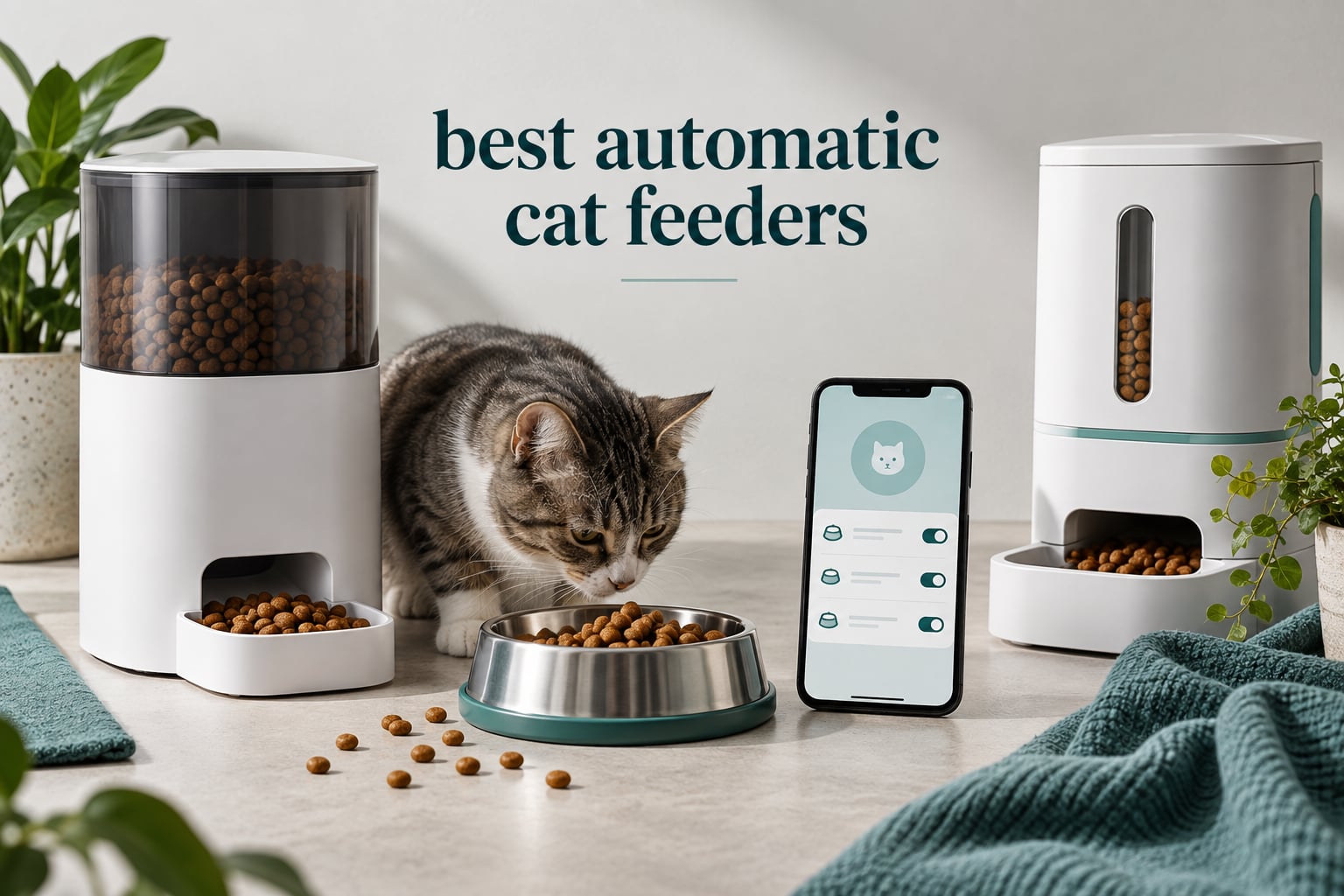
After six weeks of running ten automatic cat feeders through daily schedules, jams, power cuts and one very determined 4 kg tabby, we can tell you which ones earn their counter space. Our best automatic cat feeders list starts with the PETLIBRO RFID feeder for multi-cat homes, but the best value pick is a fraction of the cost and does almost as much.
An automatic cat feeder solves two problems at once: portion drift when you scoop kibble by hand, and missed meals when your schedule shifts. It does not replace a cat sitter, and it cannot tell you a meal went uneaten unless you own a camera feeder. Those limits are covered further down.
Table of Contents
Top 3 Picks for the Best Automatic Cat Feeders in 2026

PETLIBRO RFID Cat Feeder
- RFID collar tag unlocks per-cat meals
- 3 L hopper
- 10 meals daily
- Desiccant and airtight rotor
- Stainless steel bowl
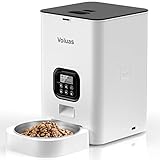
Voluas 4L Timed Feeder
- 4 L / 16.9 cup hopper
- 1-4 meals daily
- 0-40 portion steps
- Adapter or D-cell batteries
10 Best Automatic Cat Feeders (October 2026)
Every feeder below handles dry kibble unless the row says otherwise. The table is sorted in our recommended order, not by rating, because the right pick depends more on your food type and cat count than on a star score.
| Product | Specifications | Action |
|---|---|---|
| PETLIBRO RFID Cat Feeder |
|
Check Latest Price |
 SureFeed Microchip Pet Feeder SureFeed Microchip Pet Feeder |
|
Check Latest Price |
| Voluas 4L Timed Feeder |
|
Check Latest Price |
 PETLIBRO Granary 5L WiFi PETLIBRO Granary 5L WiFi |
|
Check Latest Price |
 Cat Mate C200 Two-Meal Feeder Cat Mate C200 Two-Meal Feeder |
|
Check Latest Price |
 Petory WiFi 4L Feeder Petory WiFi 4L Feeder |
|
Check Latest Price |
 Yuposl 3L Anti-Jam Feeder Yuposl 3L Anti-Jam Feeder |
|
Check Latest Price |
 Yuposl Camera Feeder Yuposl Camera Feeder |
|
Check Latest Price |
 faroro 4L Camera Feeder faroro 4L Camera Feeder |
|
Check Latest Price |
 IMIPAW 3L Timed Feeder IMIPAW 3L Timed Feeder |
|
Check Latest Price |
1. PETLIBRO RFID Automatic Cat Feeder: Best Overall for Multi-Cat Homes
PETLIBRO RFID Automatic Cat Feeder, Collar Tag-Activated Personalized Meals, 5G&2.4G Wi-Fi Programmable Cat Food Dispenser with Cats Recognition & Diet Tracking for Multi-Pet Homes and Different Diets
3 L hopper, 10 meals daily
RFID collar tag unlocks per-cat meals
Dual-band 2.4 GHz and 5 GHz Wi-Fi
Pros
- Per-cat RFID recognition ends food stealing in shared-diet homes
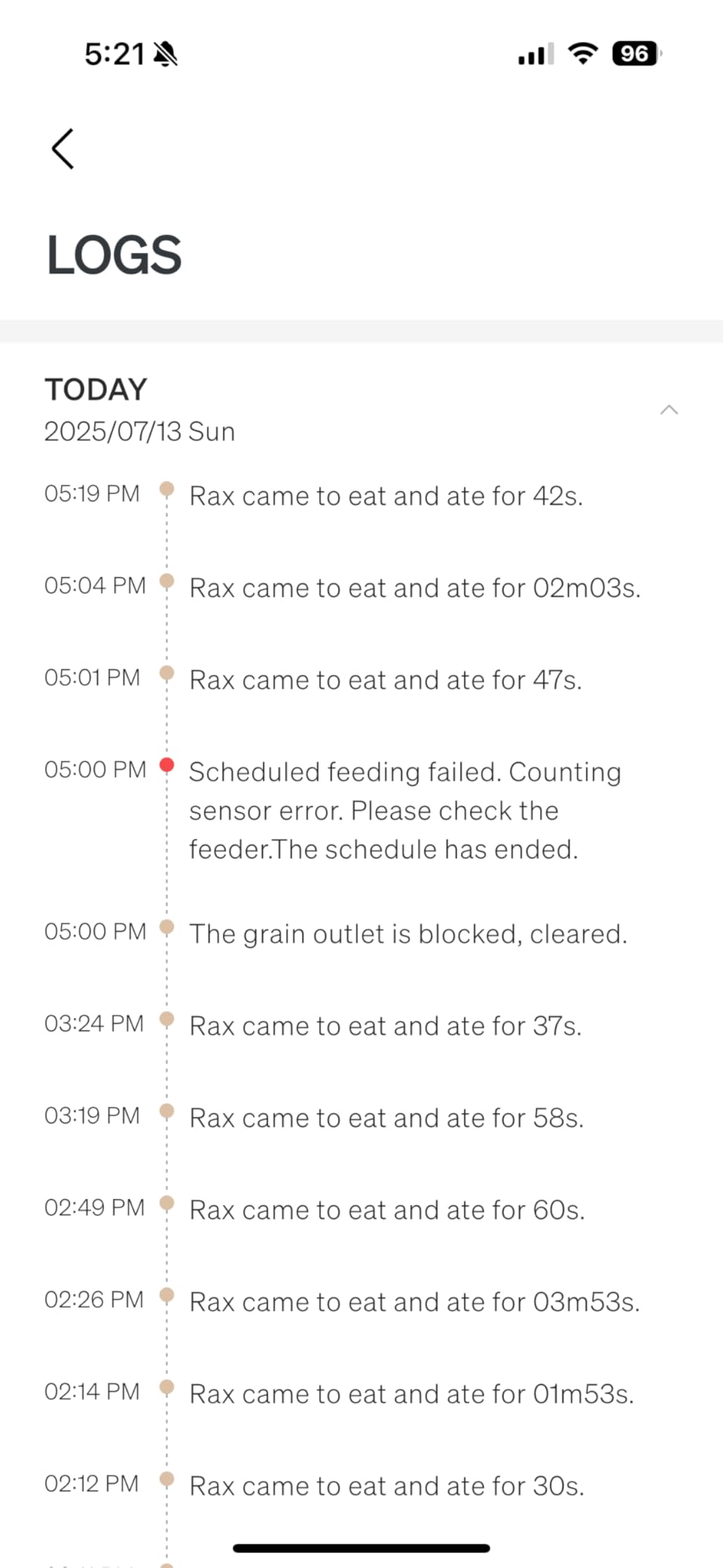
- Real-time diet and feeding logs in the Pawsense app
- Five-layer freshness system with desiccant and airtight rotor
- Stainless steel bowl and accessories fully removable for cleaning
Cons
- Only reads the included RFID collar tag and not an implanted microchip
- Wi-Fi and app pairing adds setup steps for a simple timed routine
This is the only feeder in our list that can serve two cats different diets from one bowl position, which is the problem it was built for. The cat wears a collar tag, the sensor reads it as it approaches, and the lid opens only for the authorised pet. A second cat walking up gets nothing.
The 3 L hopper is the one compromise. The listing says it holds enough kibble for one cat across two weeks, but that assumes a single cat and a small ration, so a two-cat home on this unit needs a refill roughly every week. Ten meals a day with up to 48 portions each gives plenty of scheduling headroom for split-feeding prescriptions.
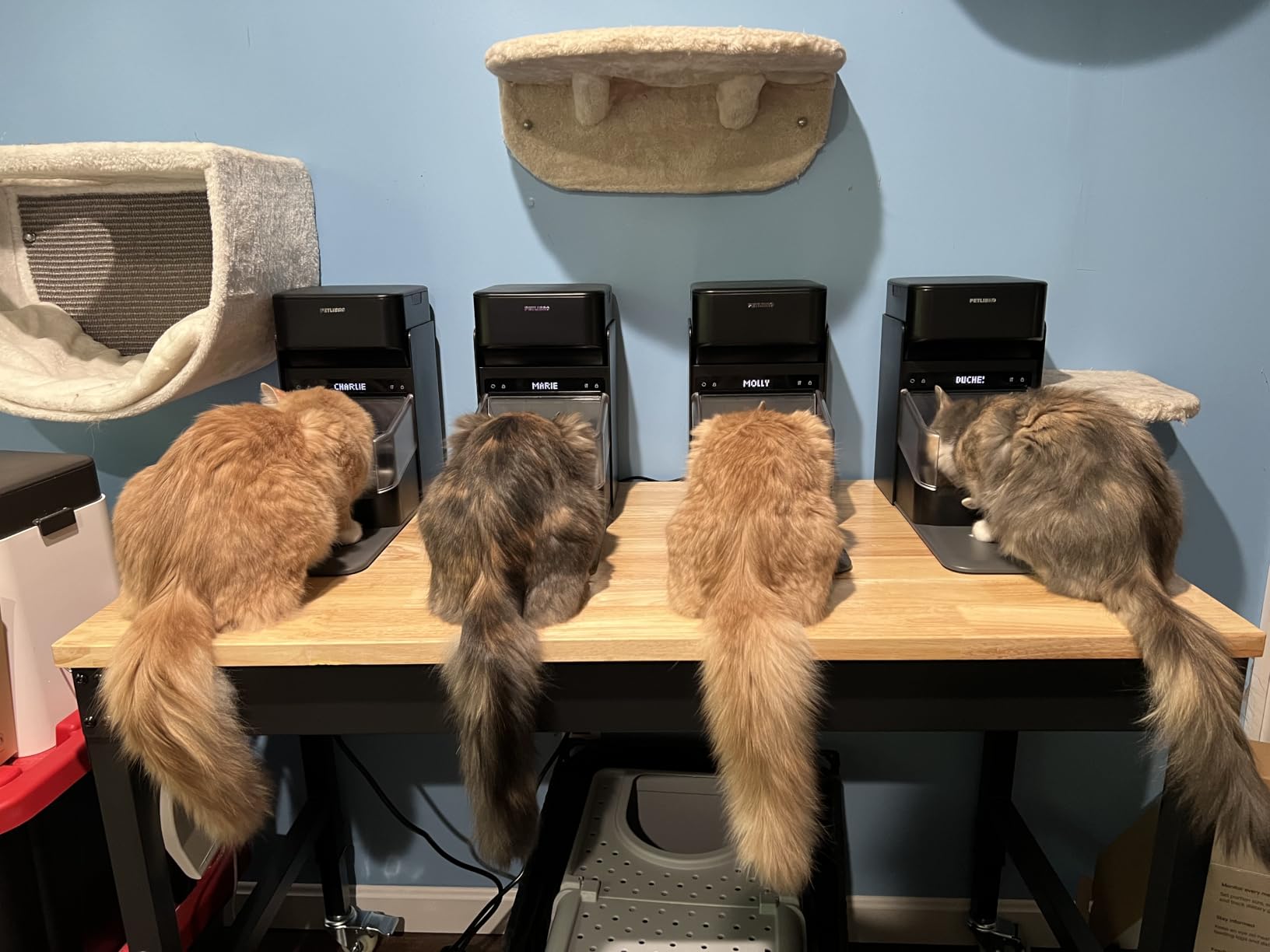
Setup took longer than the app-listing suggests, mostly because of Wi-Fi pairing on dual-band networks. Owners on r/Pets note that routers combining 2.4 GHz and 5 GHz under one network name regularly break feeder connections, and we hit exactly that before separating the bands. Once paired, the schedule ran without a hiccup for three weeks.
The five-layer freshness stack is the quiet advantage here. A gasketed silicone lid, a desiccant bag, an airtight rotor and an RFID-controlled bowl lid all limit moisture reaching the kibble, and the removable stainless steel bowl means no plastic contact with food for the cats that develop chin acne.
What makes it worth the step up in cost
If you have one cat and no food theft, this feeder is more machine than you need. A timed dry hopper does the same job for a fraction of the outlay, and the app adds a failure surface that does not exist on a dial.
Two cats, a cat on prescription food beside a cat on maintenance food, or a cat that eats a neighbour’s dinner: that is where the RFID lid pays for itself within weeks.
Where it falls short
The collar tag requirement is the honest limitation. Cats that hate collars, or lose them indoors, need a microchip-reading unit instead, and this model will not read an implant. Owners should also expect the tag to be a consumable that occasionally disappears under the sofa.
At 4.1 stars, the complaint pattern is consistent: feature owners like the recognition, while a steady share of reviews point at app and pairing friction. Budget a few minutes on the day it arrives.
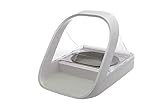
2. SureFeed Microchip Pet Feeder: Best for Stopping Food Stealing
Sure Petcare -SureFlap – SureFeed – Microchip Pet Feeder – Selective-Automatic Pet Feeder Makes Meal Times Stress-Free, Suitable for Both Wet and Dry Food – MPF001
Opens for the assigned pet microchip
13.5 fl. oz wet or dry food
Neoprene seal and three-year warranty
Pros
- Microchip access with a collar tag alternative for the same unit
- Stops food stealing so cats on different diets stop sharing
- Sealed lid keeps wet food moist
- Stores up to 32 pet IDs and can be fully reset
Cons
- All-day access only with no scheduled dispensing times
- Lid motor is loud enough to startle some pets during training
- Runs on four C batteries with no rechargeable option
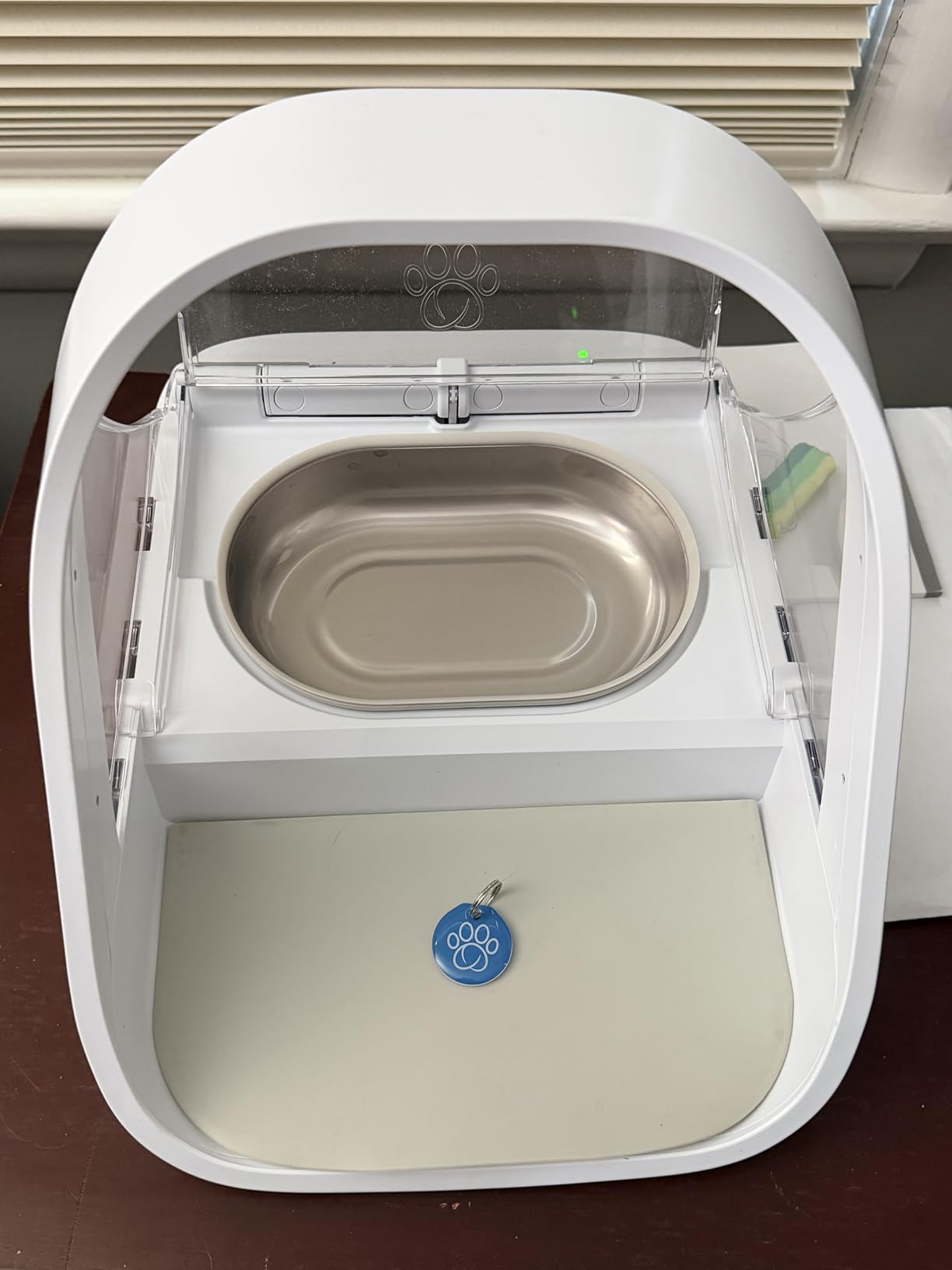
Where the PETLIBRO identifies a cat to serve it a timed meal, the SureFeed does the opposite job. It presents a sealed dish and lets only the authorised animal open it. That inversion matters for cats on different medication, and it is why this unit shows up in so many multi-pet households.
It reads 9, 10 and 15 digit microchips, so most implanted cats work with no collar at all, and the included RFID collar tag covers the un-implanted. The 13.5 fl. oz capacity handles a full wet portion, and the neoprene lip on the lid is what keeps that portion from drying out.
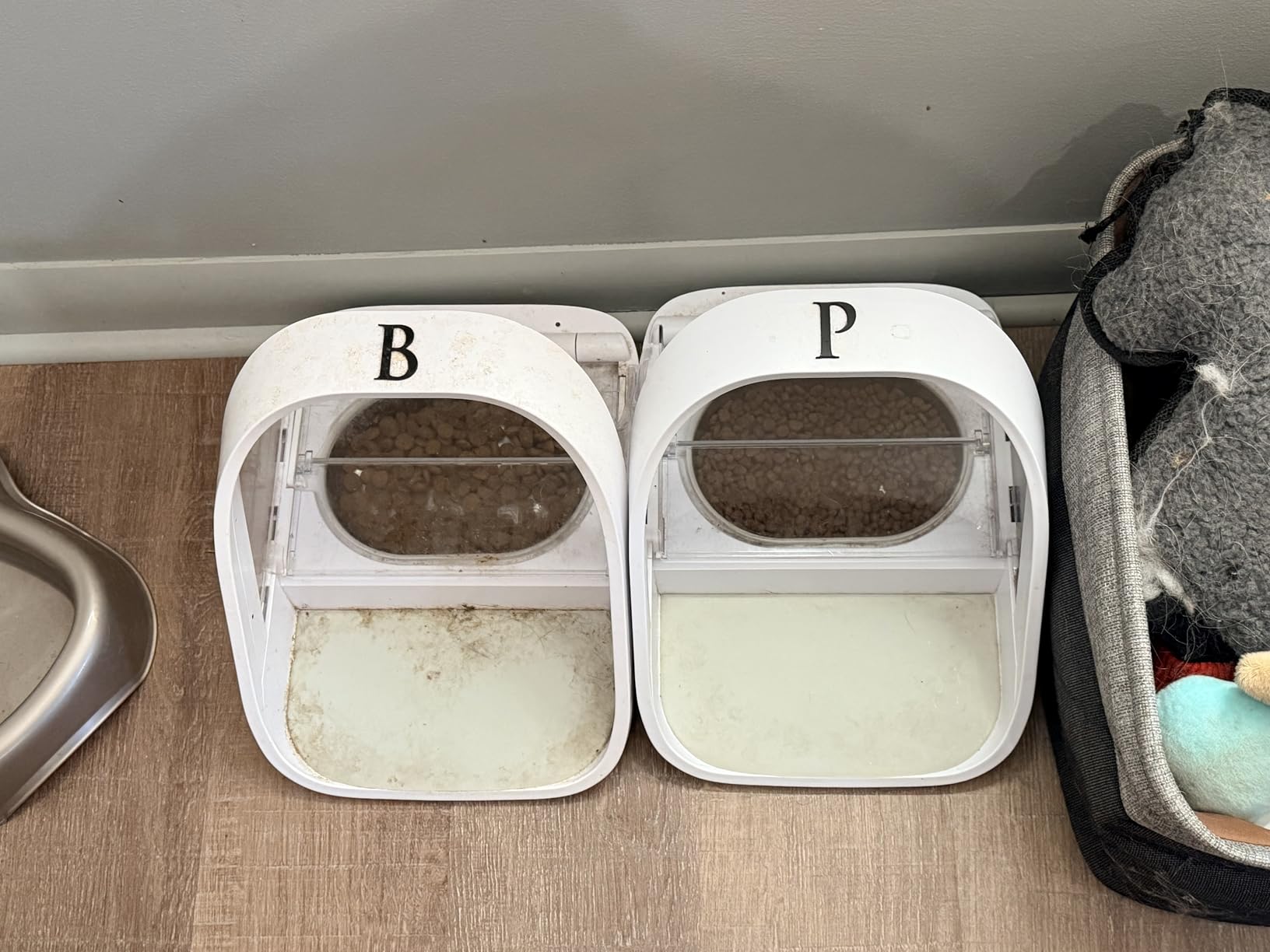
The critical thing to understand before buying: there is no schedule. Your cat gets access whenever it wants, and the lid only controls who. If your cat needs six small meals a day for medical reasons, this is the wrong tool and you need a timed hopper alongside it.
Battery life impressed us more than expected. Four C cells carried the whole testing period without a swap, and the unit holds its settings through a power cut because it never draws from mains at all. Owners commonly report months between changes.
What makes it worth the step up in cost
A three-year warranty on a pet appliance is unusual, and it signals a company expecting the unit to last a cat’s lifetime. Owners in mixed cat and small-dog homes say the training mode made the switch painless.
Because it works with wet food, it is also the anti-theft option for households on pate diets where a dry hopper simply cannot participate.
Where it falls short
The lid motor is genuinely loud. Several reviewers describe startled pets on first exposure, and training mode exists precisely because of that. It also needs a clear path for the sensor, so it cannot sit in a tight cupboard.
Some owners report sensor sensitivity varying between individual units, and the optional back cover and stainless bowls cost extra. A small share of reviews also mention freezing or sensor glitches that required a reset.
3. Voluas 4L Timed Dry Food Dispenser: Best Value
VOLUAS Automatic Cat Feeder, 4L Timed Dry Food Dispenser for Cats & Dogs
4 L / 16.9 cup hopper
1-4 meals daily, 0-40 portions
Adapter or three D-cell batteries
Pros
- No app or Wi-Fi needed so setup takes a couple of minutes
- Runs on batteries so the schedule survives a power cut
- Voice meal call of up to 10 seconds
- Removable stainless bowl and hopper parts
Cons
- Four meals daily is a low ceiling for split-feeding routines
- Portion sizes are approximate rather than finely calibrated
- No remote monitoring of feeding status
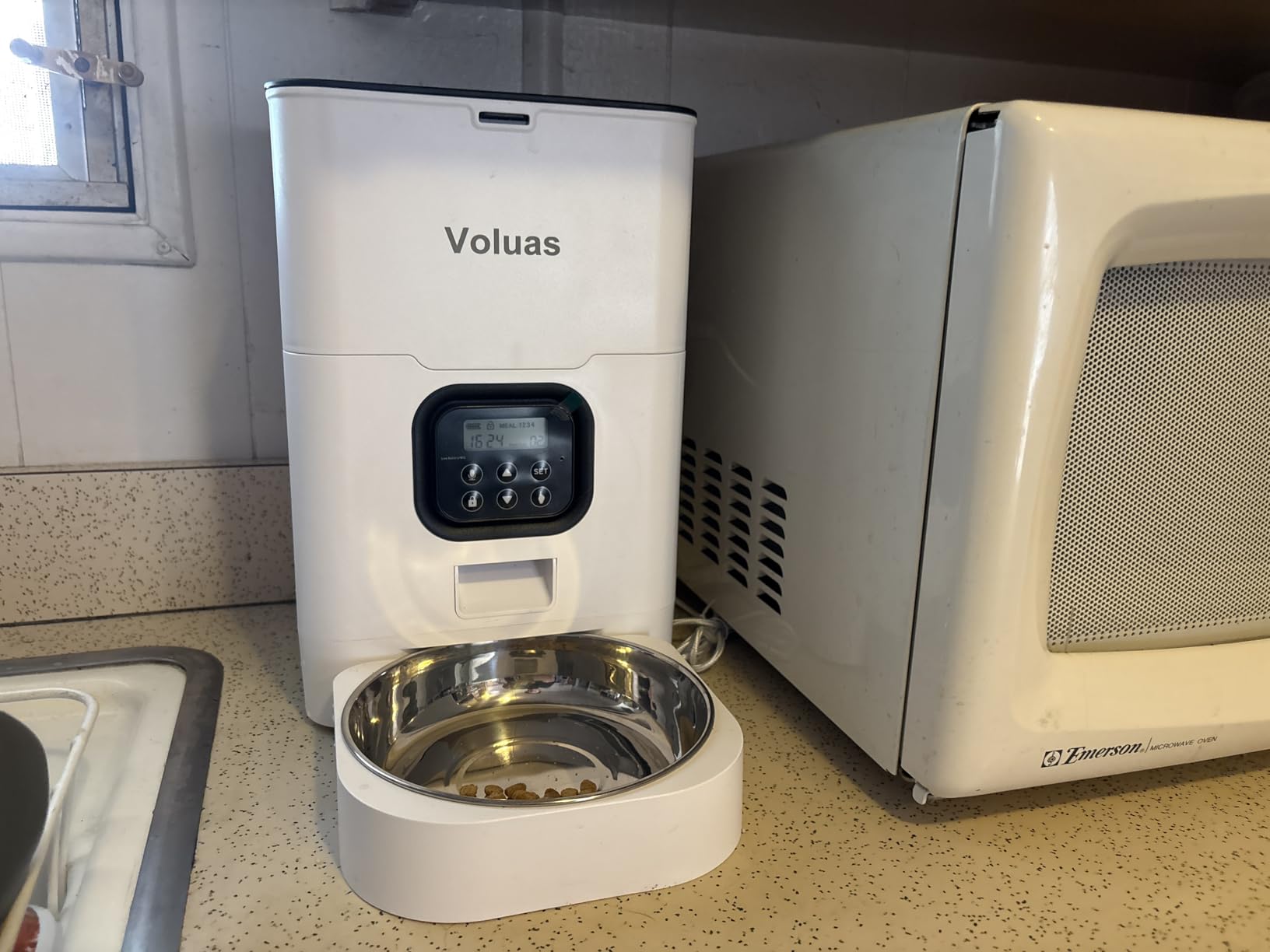
On r/CatAdvice the prevailing view is blunt: most of these machines work the same, and cheap non-connected units match branded ones. The Voluas is the clearest proof of that argument. It has no app, no camera and no subscription, and it dispensed on schedule for six weeks without attention.
The 4 L hopper is unusually large for a non-smart unit, and portions step from zero to 40 at roughly 6-7 g each. Four meals a day is the real constraint: cats on six-meal prescription protocols will need a different feeder or a second unit.
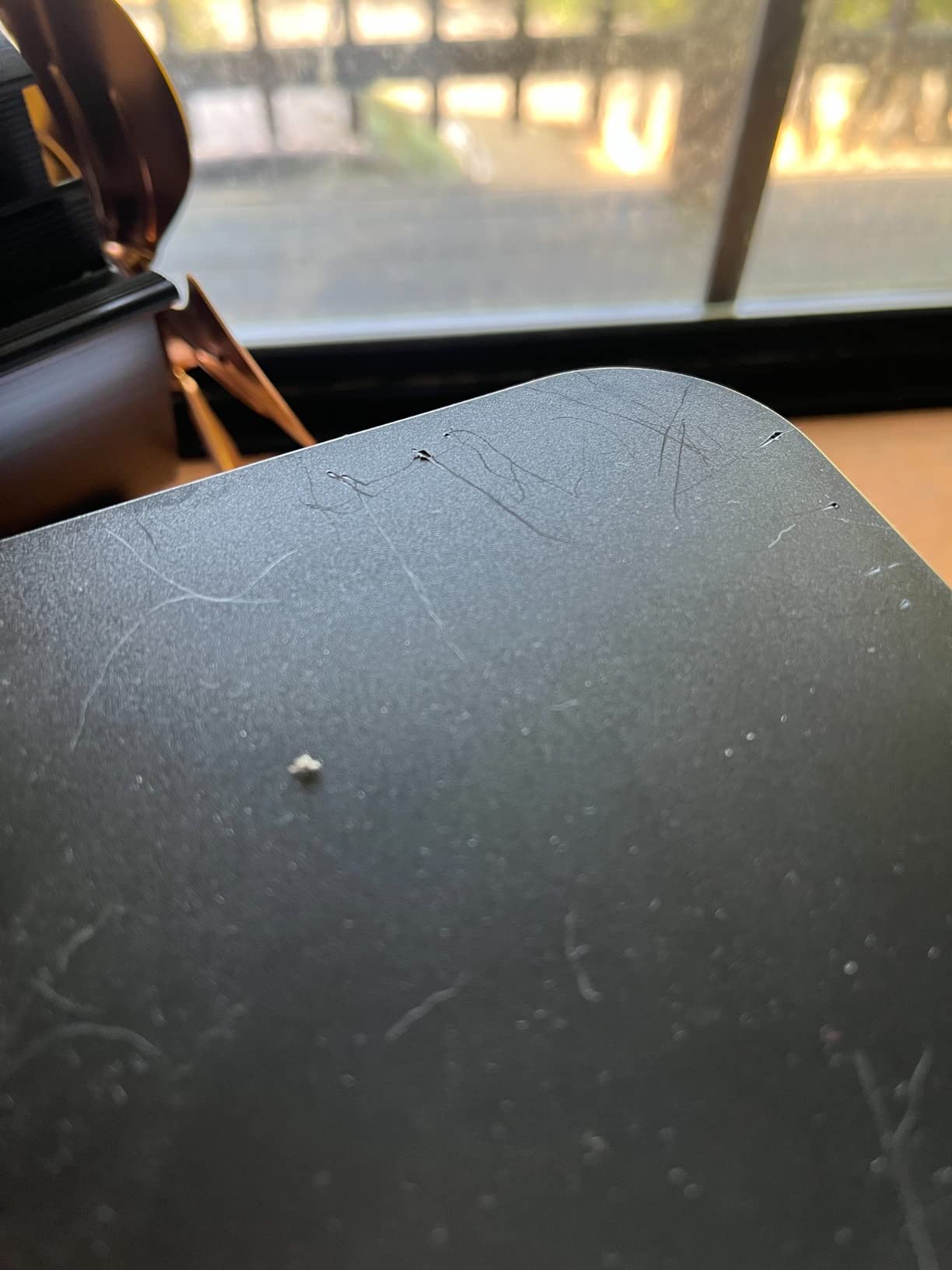
Power behaviour is better than the specification suggests. The unit runs on a 5V adapter or three D-cell batteries, and it kept dispensing through our deliberate mid-schedule outage test without losing the timer.
The 10-second voice record is the feature reviewers mention most warmly. It is not a gimmick for a food-motivated cat, because the sound becomes the cue that dinner has landed. My own cat learned the recording within two days.
What makes it worth the step up in cost
There is no cloud in the failure chain. No account, no server, no firmware, and nothing to re-pair after a router change, which is exactly the reliability argument owners on the feeder forums keep making.
If your cat is a grazer who eats a little through the day, four scheduled dispenses is plenty. It also suits anyone who simply does not want to manage another app.
Where it falls short
Portion calibration is the honest limit. A portion setting is a mechanical estimate tied to one kibble density, so switching brands or moving to a larger piece changes the delivered grams. Owners who need strict calorie control should weigh the output and adjust.
There is also no out-of-food alert and no way to check the last dispense remotely. If you work long shifts and need confirmation, that pushes you toward an app model.
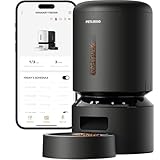
4. PETLIBRO Granary 5L WiFi Feeder: Best for Keeping Kibble Fresh
PETLIBRO Automatic Cat Feeder, 5G WiFi Automatic Dog Food Dispenser with Freshness Preservation, 5L Timed Pet Feeder with Low Food Sensor, Up to 10 Meals Per Day, Granary Black
5 L hopper, up to 10 meals daily
1-48 portions per meal
Dual-band Wi-Fi app control
Pros
- Twist-lock lid and rotor base keep a determined cat out of the hopper
- Desiccant bag and sealing strip hold kibble dry and crunchy
- Phone and on-device alerts for empty tank jams and low battery
- Dual-band Wi-Fi pairs more reliably than 2.4 GHz only models
Cons
- App and Wi-Fi pairing can be fiddly on first setup
- Infrared sensor occasionally halts a dispense when kibble sits near the outlet
- Larger footprint and higher price than a basic timed feeder
This is the highest-selling feeder in the category, and the reason is breadth rather than any single breakthrough. Ten meals a day, 48 portion steps per meal, a stainless steel bowl, voice calls and app scheduling all sit in one unit, and it has stayed in production long enough to attract a large review base.
Freshness is the part we would actually defend. The patent rotor at the base of the tank, the twist-lock lid, the sealing strip and the desiccant bag form four separate barriers, and the kibble still snapped rather than going soft after three weeks in the hopper.
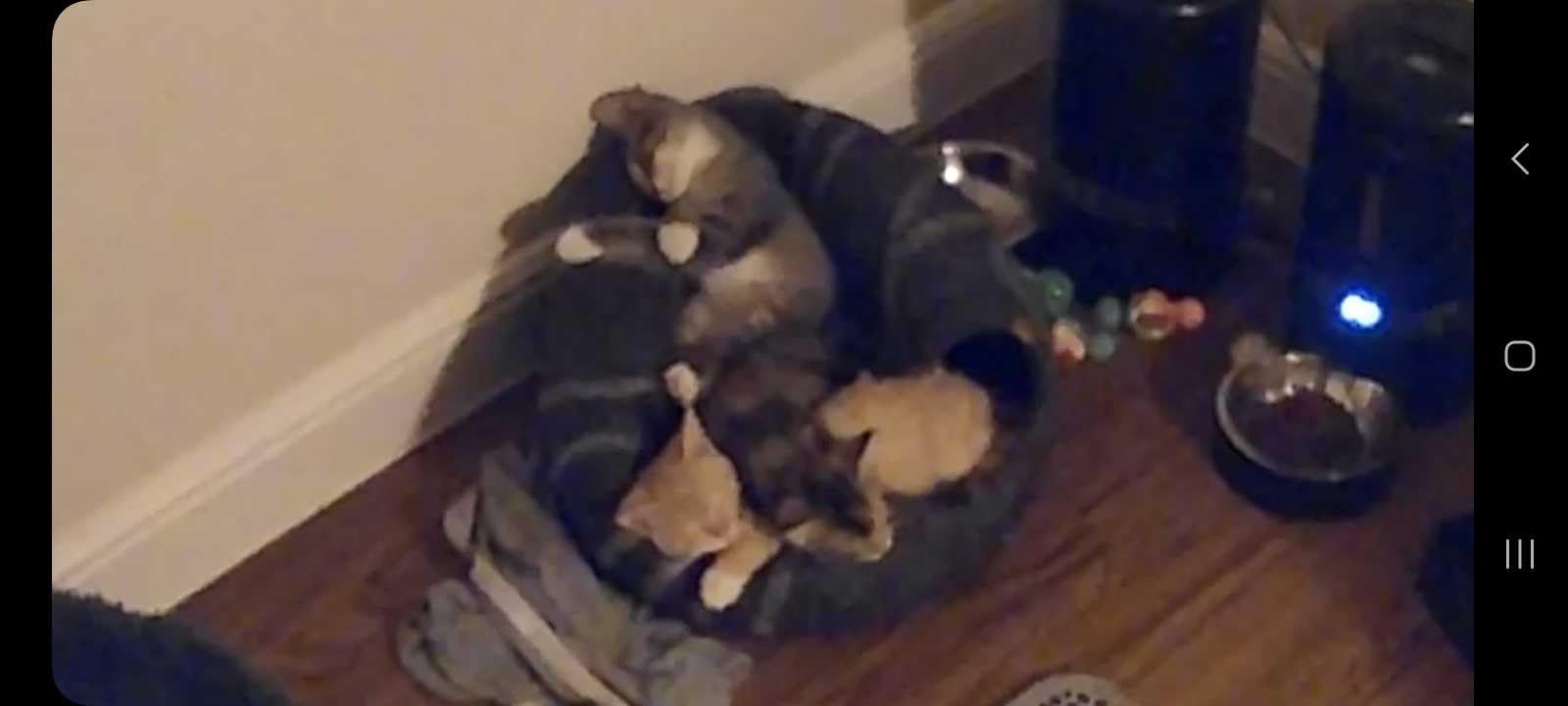
Scheduling through the app on both iOS and Android is where this earns its place over a timed unit. Ten customisable ten-second voice calls with adjustable volume mean a cat that ignores the mechanical noise can still be summoned.
Alerts are practical rather than decorative. The unit notifies you for an empty tank, a jam and a low battery, and with the infrared sensor in place a blocked outlet should never result in a flood of kibble on your floor.
What makes it worth the step up in cost
Among app feeders, dual-band support is the detail that matters most in real homes. Routers that combine 2.4 GHz and 5 GHz under a single name break plenty of connected feeders, and this one handles both bands natively.
The 5 L hopper also covers a long absence better than most, which matters if you travel at weekends. A larger footprint is the trade: it needs a real corner, not a shelf lip.
Where it falls short
The infrared sensor has a habit of pausing a dispense when a few pieces sit near the outlet. It protects against overfeeding and it will occasionally refuse to serve, so check the bowl after the first few meals rather than assuming a fault.
Owners on r/Pets also flag that app and cloud dependence is a genuine risk. If your schedule lives in the app rather than on the device, a service outage can stop meals. Keep the voice calls and treat the app as a convenience.
5. Cat Mate C200 Two-Meal Feeder: Best for Wet and Raw Food
Cat Mate C200 Automatic 2 Meal Pet Feeder with Timer for Cats & Small Dogs
Two sealed compartments, wet or dry
Ice pack included
Single AA battery, no app
Pros
- The only wet and raw food option here with sealed ice-pack compartments
- Turn-dial programming with no app Wi-Fi or subscription
- Compartments run separately or open together via the connector
- Useful for covering one missed meal or a short absence
Cons
- Timer dial lacks hour click stops and is hard to set accurately
- Ice packs keep food cool rather than cold so wet food warms
- Cats can learn to turn the knob and trigger an early opening
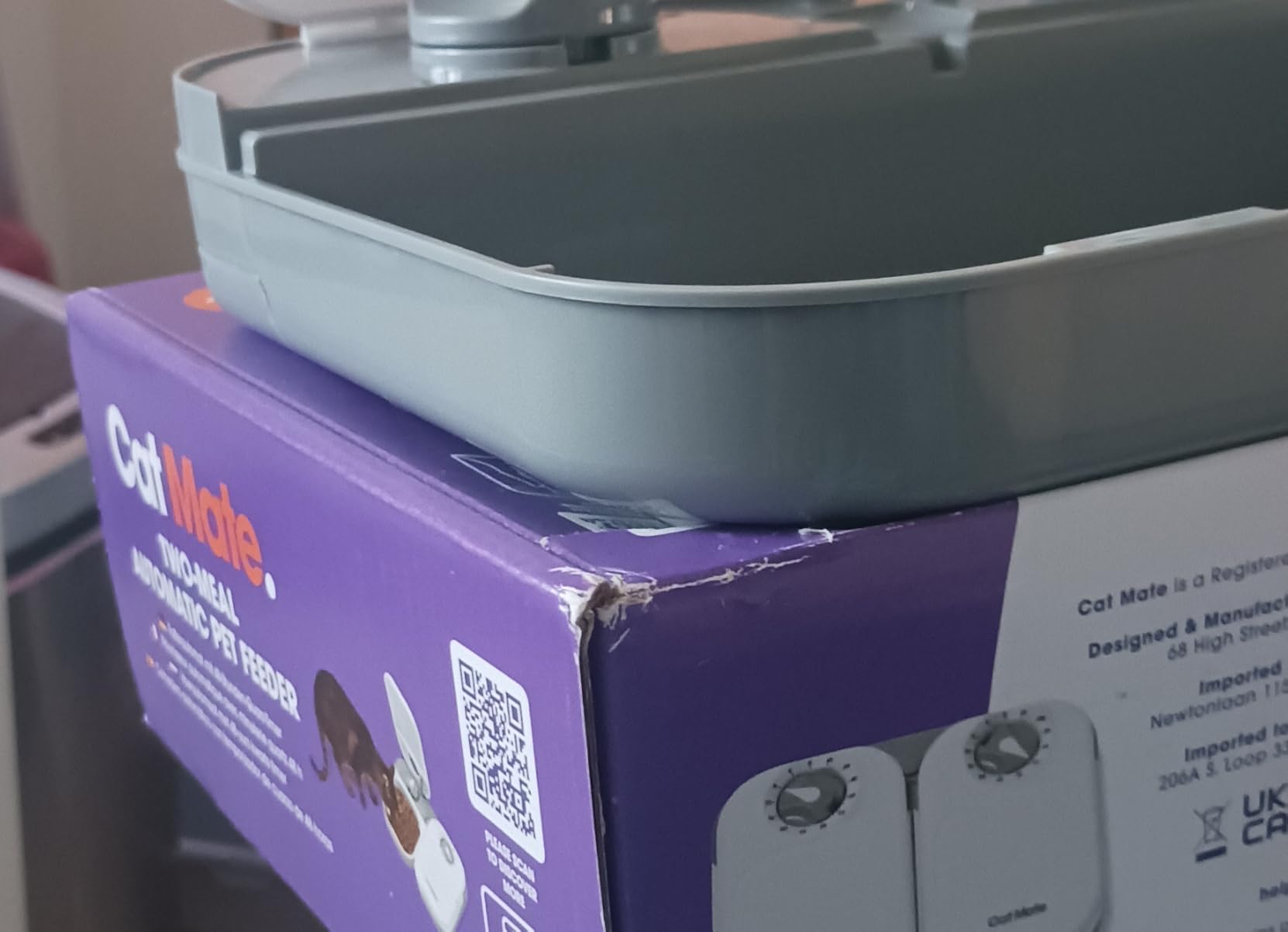
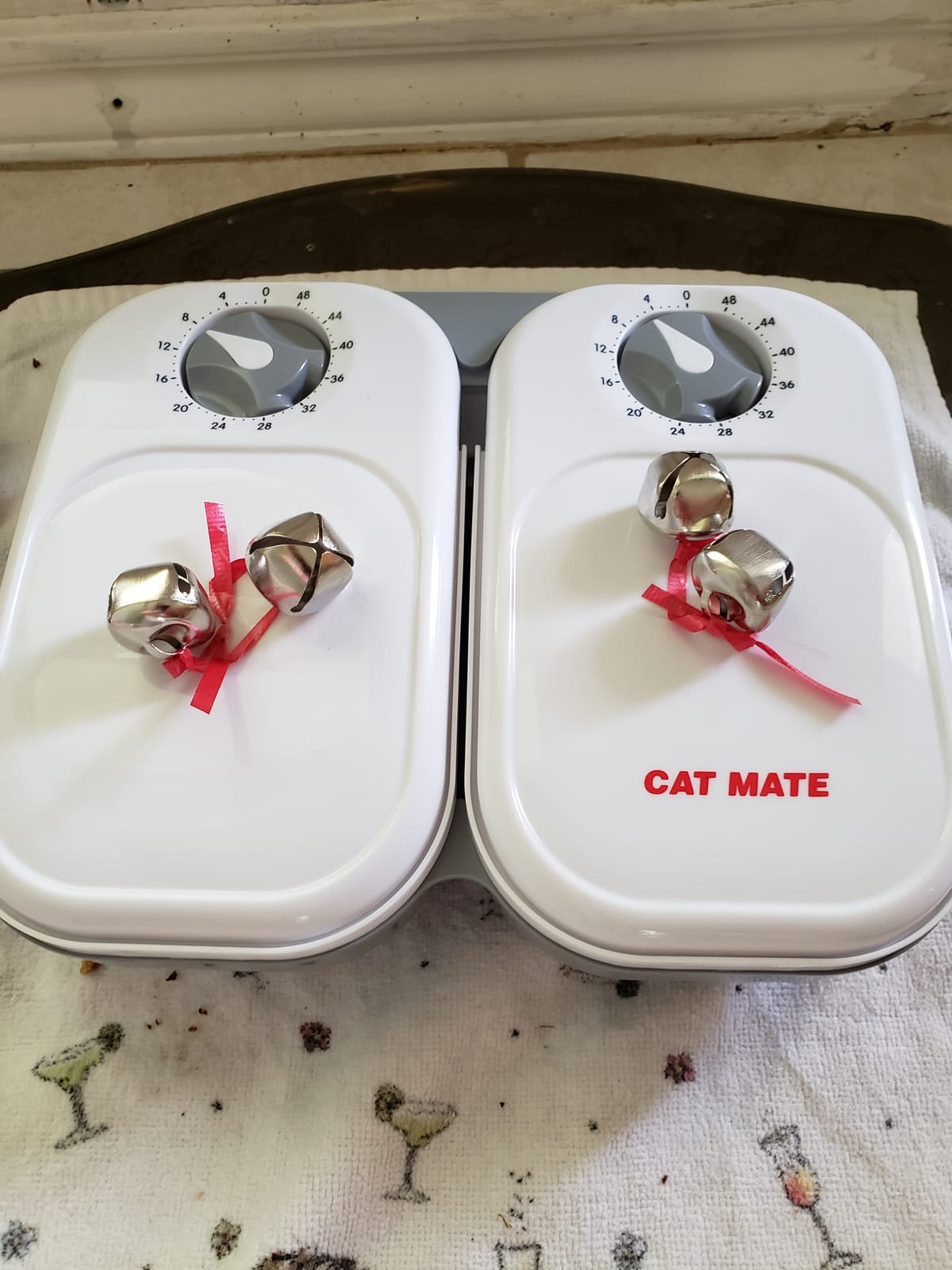
Every other feeder on this list is dry-only, so if your cat eats pate or a raw diet this is the one that applies. Two sealed compartments each take a portion, a reusable ice pack keeps them cool, and two independent timer-controlled lids open on their own schedule.
It is also the simplest machine we tested. A single AA battery, a turn dial, no app and no account. The connector in the box lets both lids open at once, which covers a two-cat household where both animals eat the same food.
Ice packs buy you hours, not a working day. Frozen gel packs hold cold for roughly eight hours in our tests, and owners on the feeding forums describe the same pattern: fine for a workday, marginal for an overnight. Long absences need genuine refrigeration, which means a compressor unit rather than this one.
Buyers with cats on prescription wet diets rate it well for exactly that reason, since two timed portions a day is often the whole regimen. The ticking is constant, though, and there is no audible alert when a lid opens.
What makes it worth the step up in cost
The absence of electronics is the feature. There is no firmware to fail and nothing to re-pair, and the two-compartment format is closer to how cats actually eat wet food than any timed dispenser.
It also costs less than a bag of prescription food, which makes it an easy add-on alongside a dry hopper rather than a competing purchase.
Where it falls short
Two meals is the ceiling. A cat that needs four or six wet meals will outgrow this immediately, and there is no way to add compartments.
The 48-hour programming dial has no click stops at the hour mark, so accurate setup takes patience, and a determined cat can learn to turn the knob with its teeth. A few owners also report lids sticking near the zero position and missing a scheduled opening.
6. Petory WiFi 4L Feeder: Best for Dental and Large Kibble
Petory WiFi Automatic Cat Feeder – 4L Dry Food Dispenser for Cats and Dogs
4 L hopper, up to 20 days
10 meals, 1-50 portions
2.4 GHz Wi-Fi and battery backup
Pros
- 4 L hopper holds about a week of food for one cat
- Handles large-breed and dental kibble better than small-puck units
- Dishwasher-safe hopper and bowl with a stainless steel insert
- Locking lid and control panel lock keep paws out
Cons
- 2.4 GHz only so dual-band-only routers need a separate network
- Portion settings deliver a similar volume whatever number is selected
- Advertised slow-feed mode has no meaningful effect
Dental and large-breed diets are where small feeders fail quietly. The Petory runs up to 10 meals a day with 1-50 portions of about 1/10 cup each, and in our testing it moved larger flat pieces without the bridging that jams narrow chute designs.
Cleaning is the quiet star. The hopper and bowl are dishwasher-safe BPA-free plastic with a stainless steel bowl insert, and both lift out without tools, which matters more than any spec when kibble oil builds up over a month.
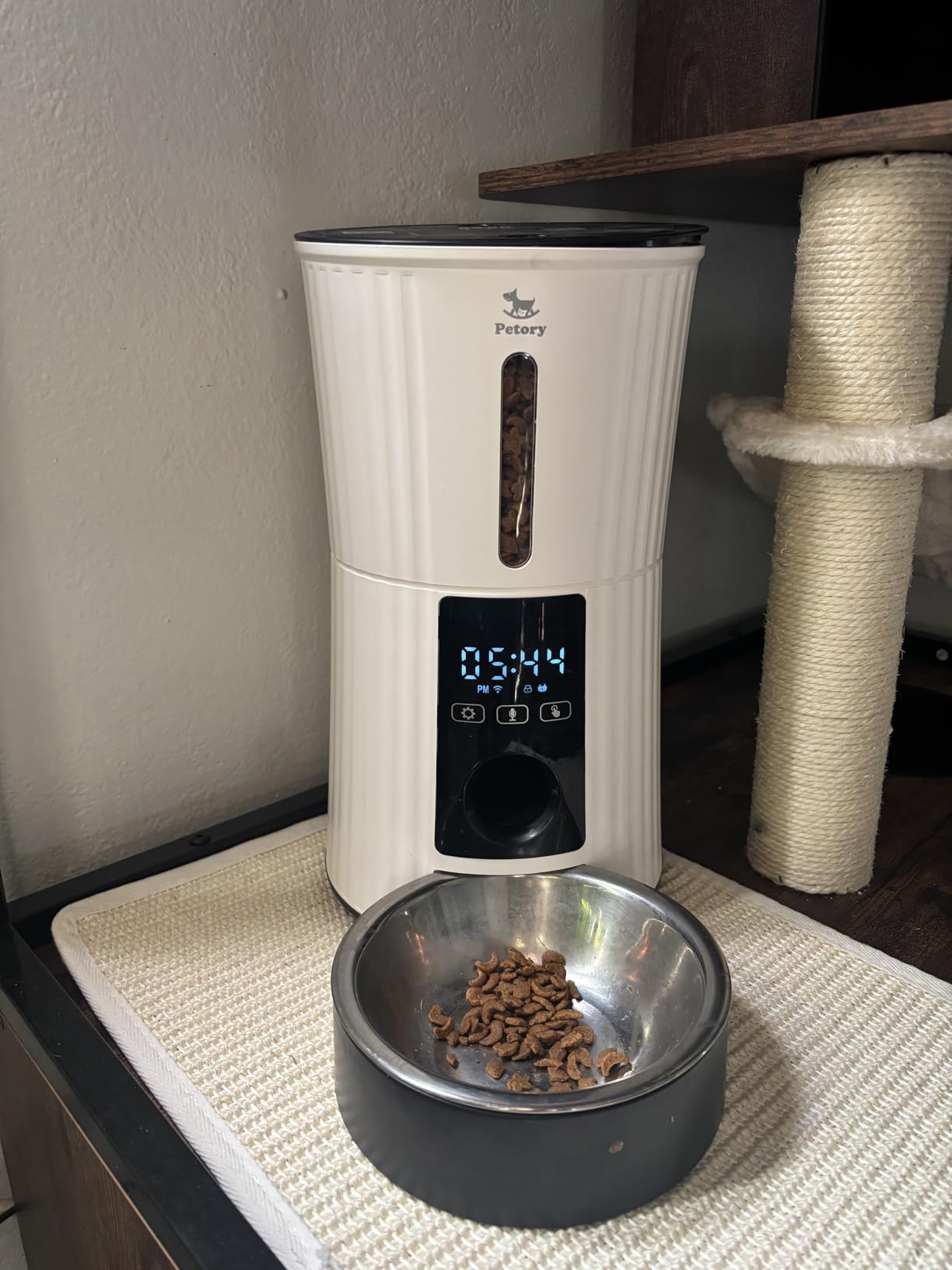
Long-term owners on the forums describe units still running after years of daily service, and the 4 L hopper is listed at up to 20 days of feeding for a single pet on a small ration. Dual power keeps dispensing through an outage while the app sends alerts for low food and Wi-Fi interruption.
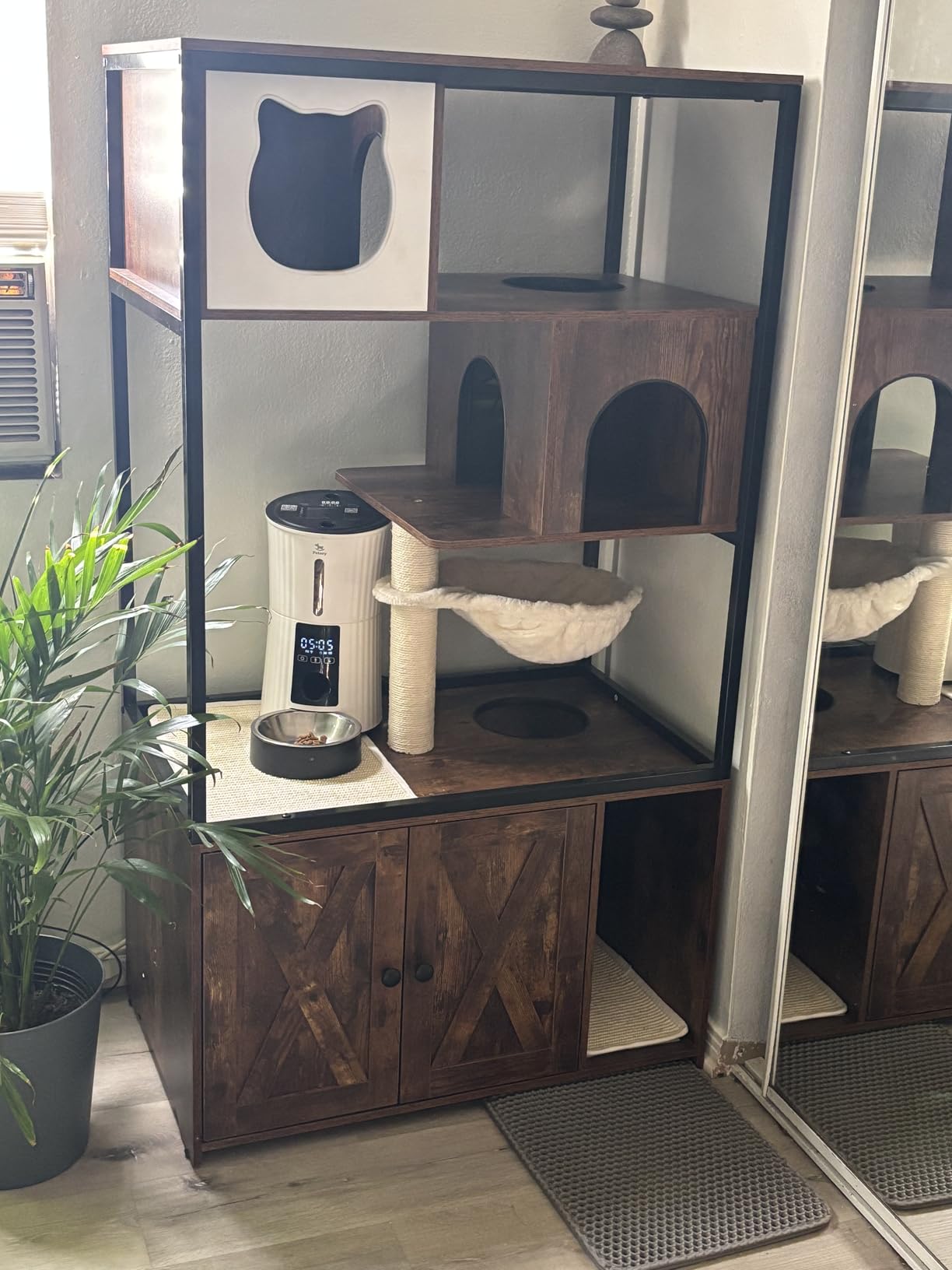
The locking lid and locked control panel are what stop a food-motivated cat. Our tester spent a full week working the lid seam without opening it, which is more than we can say for several others in this list.
What makes it worth the step up in cost
If your cat is on a dental prescription kibble, the wider chute and 1/10 cup portion are the reason to buy this rather than a cheaper hopper. Under-dispensing dental food undermines the point of the diet.
The stainless steel bowl also answers the chin acne complaint that comes up repeatedly in cat owner discussions, where plastic bowls are widely considered a poor choice.
Where it falls short
It is 2.4 GHz only. If your router is dual-band with no separate 2.4 GHz network, you will need to split them before setup, and that is the single most common complaint in reviews.
Portion granularity is weaker than the numbers suggest. Owners report that different portion settings can deliver a similar volume, so do not treat the 1-50 range as precise calorie control. The advertised slow-feed function also does essentially nothing.
7. Yuposl 3L Anti-Jam Feeder: Most Versatile
Automatic Cat Feeder, 3L Cat Food Dispenser with Anti-Jam Design, Over 180-day Battery Life, 1-6 Meals Per Day with Stainless Steel Cat Bowl, Keep Dry Food Fresh, Timed Pet Feeder Also for Small Dog
3 L hopper, 1-6 meals daily
2-15 mm kibble
Spring-lock lid, D-cell power
Pros
- Consistent dispensing averaging about 6.4 g per portion
- Spring-lock lid resists even determined cats
- Quiet motor compared with most feeders in its size class
- Battery power means flexible placement during an outage
Cons
- The smallest portion step is already a large meal for many cats
- Hopper cannot be fully disassembled around the feeding tube
- Uneaten kibble piles in front of the tube making intake hard to gauge
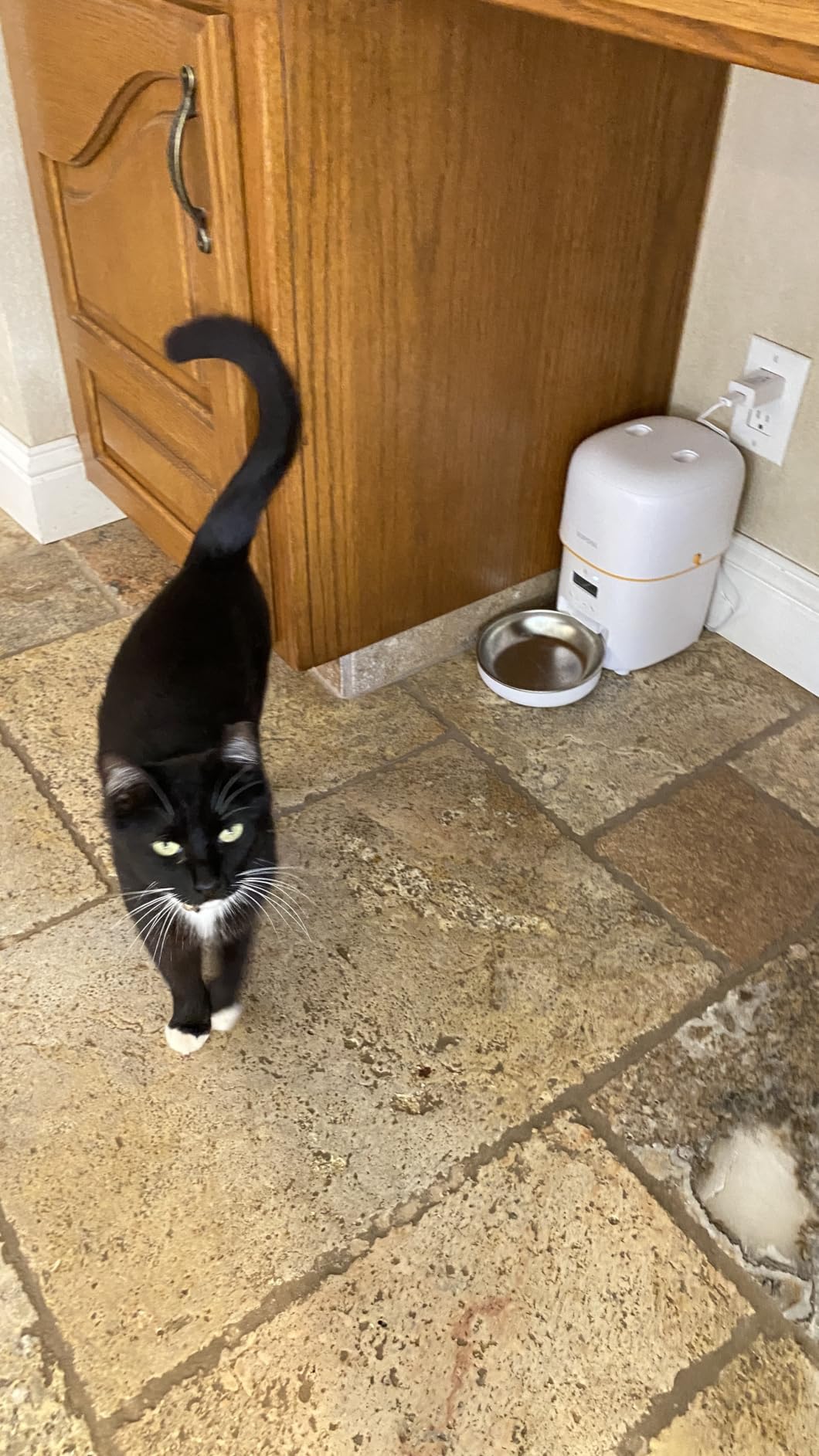
This is the feeder we would hand to anyone whose cat treats every mechanism as a puzzle. The spring-lock lid resists lifting and unlocking entirely, and our tester never found a gap. That cat-proofing is rare in this category.
Dispensing was the steadiest of the non-app models. Repeated runs averaged about 6.4 g per portion, which sits within a narrow band and held up when we swapped in larger dental pieces, since the anti-jam design is rated for 2-15 mm kibble.
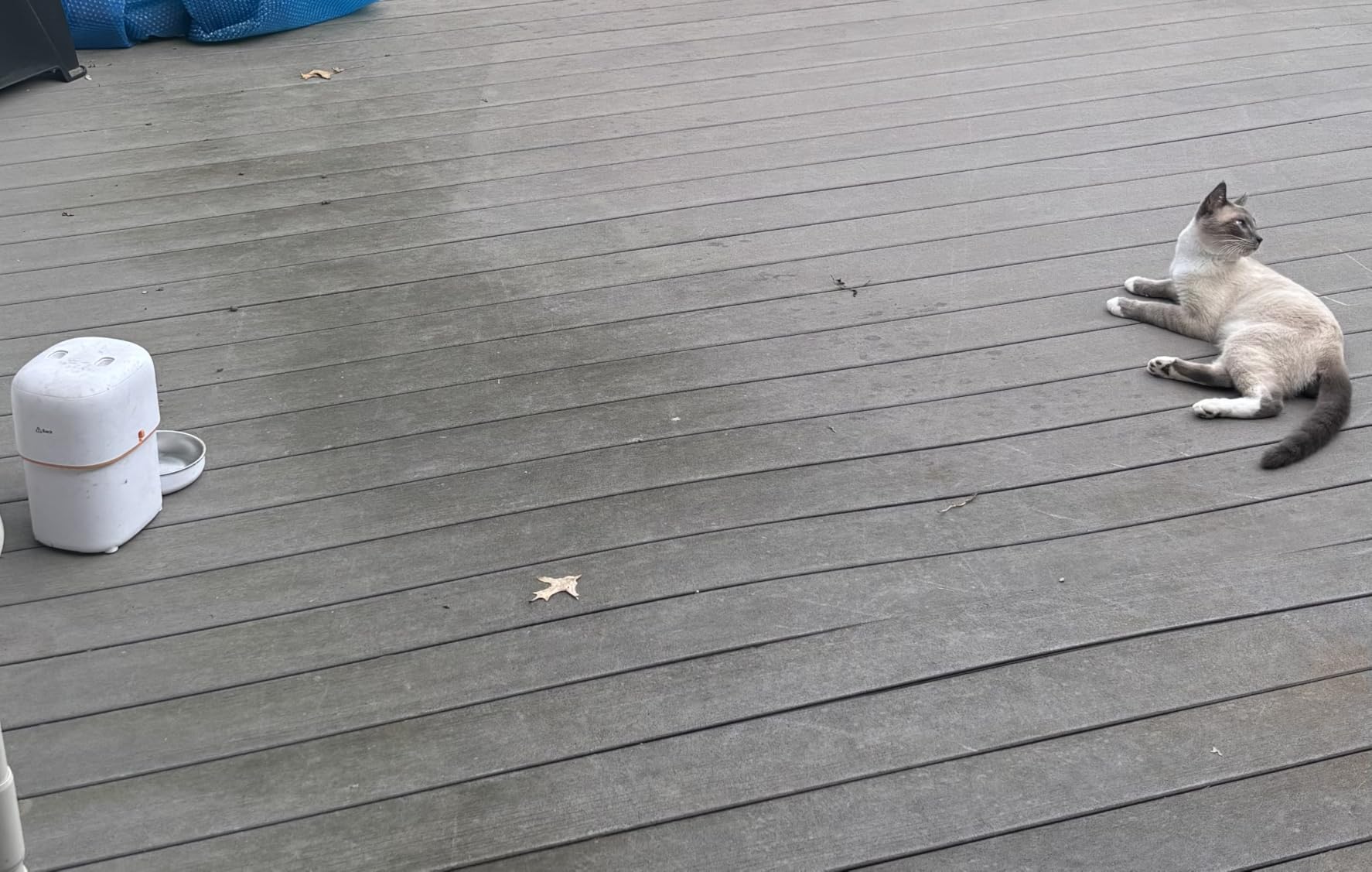
Three D-cell batteries are listed at over 180 days of use, or you can run it on wall power. Actual runtime depends heavily on kibble size and how often the rotor turns, so treat that figure as a best case rather than a promise.
The 3 L hopper covers up to two weeks for one cat and the footprint is genuinely small at 7 x 7 x 9 inches, which makes it the easiest of the larger hoppers to hide in a kitchen corner.
What makes it worth the step up in cost
It has no app, no Wi-Fi and no subscription, which means the price you see is the price you keep paying. For a first automatic cat feeder, the maths is hard to argue with.
Owners who need a low total cost of ownership rate it well for the same reason our dog feeder roundup favours simple hardware. Batteries and desiccant cost a few pounds a year against subscription models.
Where it falls short
The minimum portion is the big limitation. One portion is already a full meal for many cats, so this is not a feeder for a cat on a prescribed 30 g ration or for split-feeding a diabetic.
Cleaning is the other compromise. The hopper does not fully disassemble around the feeding tube, and uneaten kibble can pile in front of the outlet so you cannot easily judge how much your cat actually ate.
8. Yuposl 5G Camera Feeder: Best for Watching Every Meal
Automatic Cat Feeder with Camera – 5G WiFi Auto Cat Food Dispenser, 1080P HD Video with Night Vision, 1-15 Meals, 1-99 Portions, 2-Way Audio, Keeps Food Fresh, Timed Pet Feeder Also for Dogs
1080P camera with night vision
15 meals, 99 portions
Two-way audio, dual-band Wi-Fi
Pros
- Night vision lets you check a senior cat eating at 3 am
- The widest scheduling range in this list at 15 meals and 99 portions
- Jam and low-food alerts catch problems before a skipped meal
- Two-way audio and meal calls help with separation anxiety
Cons
- Camera and two-way audio add app complexity and setup time
- Needs a smartphone and reliable home Wi-Fi to be useful
- Overpowered if you only want timed portions
The reason to buy a camera feeder is the question a hopper cannot answer: did the cat actually eat? Owners on r/cats describe swapping an earlier smart feeder for a camera model specifically to watch a senior cat, and this one answers that question with 1080P video and infrared night vision.
Scheduling is the most flexible we tested, at up to 15 meals a day with 1-99 portions per meal. For a cat on a small prescribed ration, that granularity is the actual product rather than the camera.
Two-way audio through the microphone and speaker lets you talk to your cat, and the 10-second meal call is the practical version of the same feature. The camera also captures feeding sessions automatically rather than waiting for motion.
Jam detection and infrared sensing sit behind the alerts, so a blockage or a low hopper surfaces as a phone notification. Dual-band 5 GHz and 2.4 GHz support also makes the connection steadier than 2.4 GHz-only units, and several family phones can control the same feeder.
What makes it worth the step up in cost
For an elderly cat, a cat on a restricted diet, or any owner whose cat eats selectively, seeing the bowl is worth more than another two litres of hopper capacity. The soft rubber rotor, reinforced lid and desiccant also keep kibble drier than most.
Where it falls short
Every extra feature is another thing to set up. If your goal is timed portions and nothing else, this is more machine than the job requires, and the app becomes part of the reliability chain. Owners who skip a Wi-Fi connection check will find it under-used.
9. faroro 4L Camera Feeder: Best for Small Spaces
Automatic Cat Feeder with Camera, 3MP HD Video & Night Vision, 5G/2.4G WiFi Smart Pet Feeder with APP Control, 2-Way Audio, Motion Alerts, Low Food Sensor, Timed Cat Feeder for Cats & Dogs, 4L
4 L hopper, compact body
3MP camera with night vision
8 meals, portions of about 10 g
Pros
- Camera night vision and motion alerts at a low price for the category
- Compact cylindrical footprint despite the 4 L hopper
- Anti-bite cable and battery backup suit unattended use
- Low food sensor and offline notifications reduce missed meals
Cons
- Eight meals daily is below most app feeders here
- Kibble limited to 10 mm which excludes large dental and specialty diets
- Recording alerts and playback need an SD card and app setup
The faroro solves a space problem the others ignore. A 4 L hopper usually means a wide rectangular body, and this one is a narrow cylinder measuring under 6 inches across, so it fits beside a washing machine or under a counter that will not take a square unit.
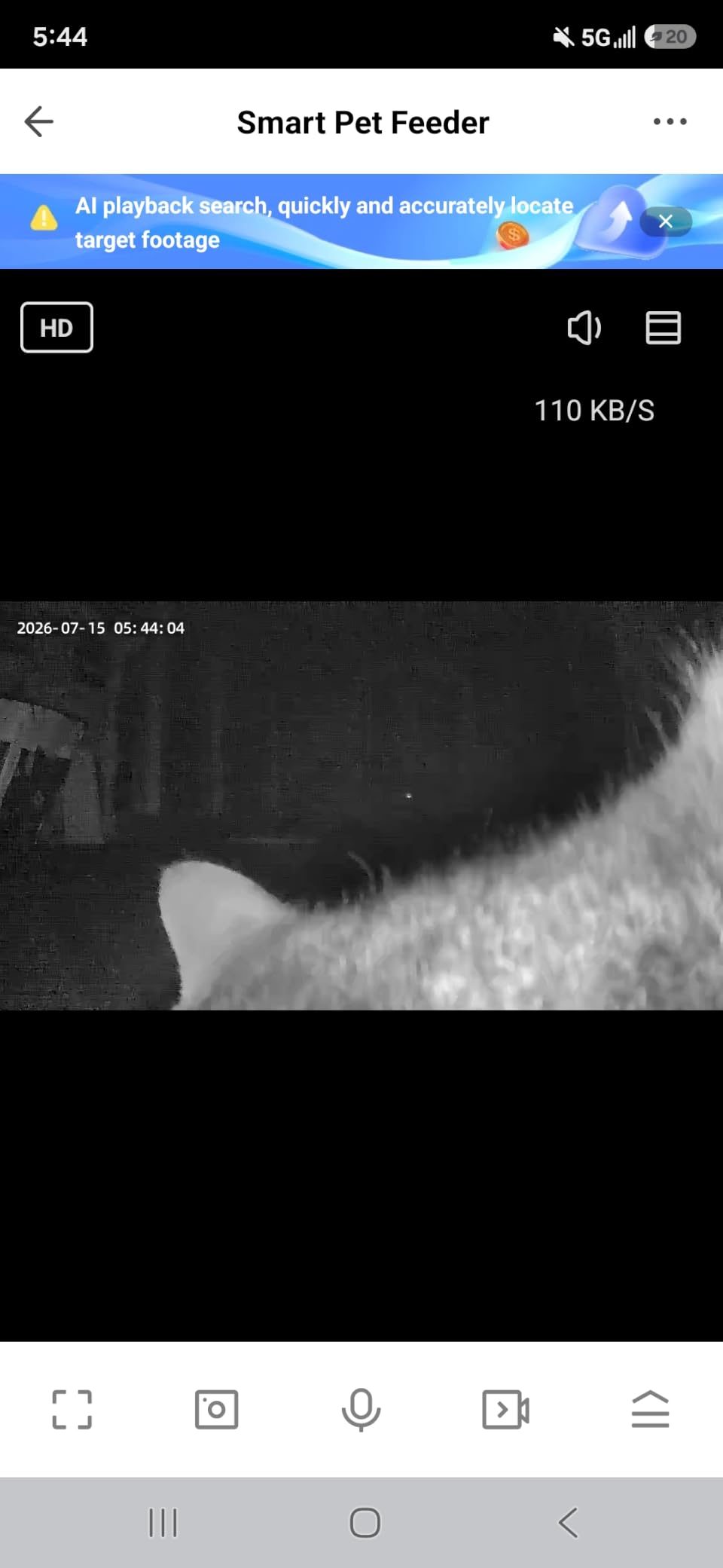
The camera is a 3MP sensor with a 110 degree viewing angle and IR night vision, and the motion detection has high, medium and low sensitivity settings so you can stop it alerting every time the cat walks past.
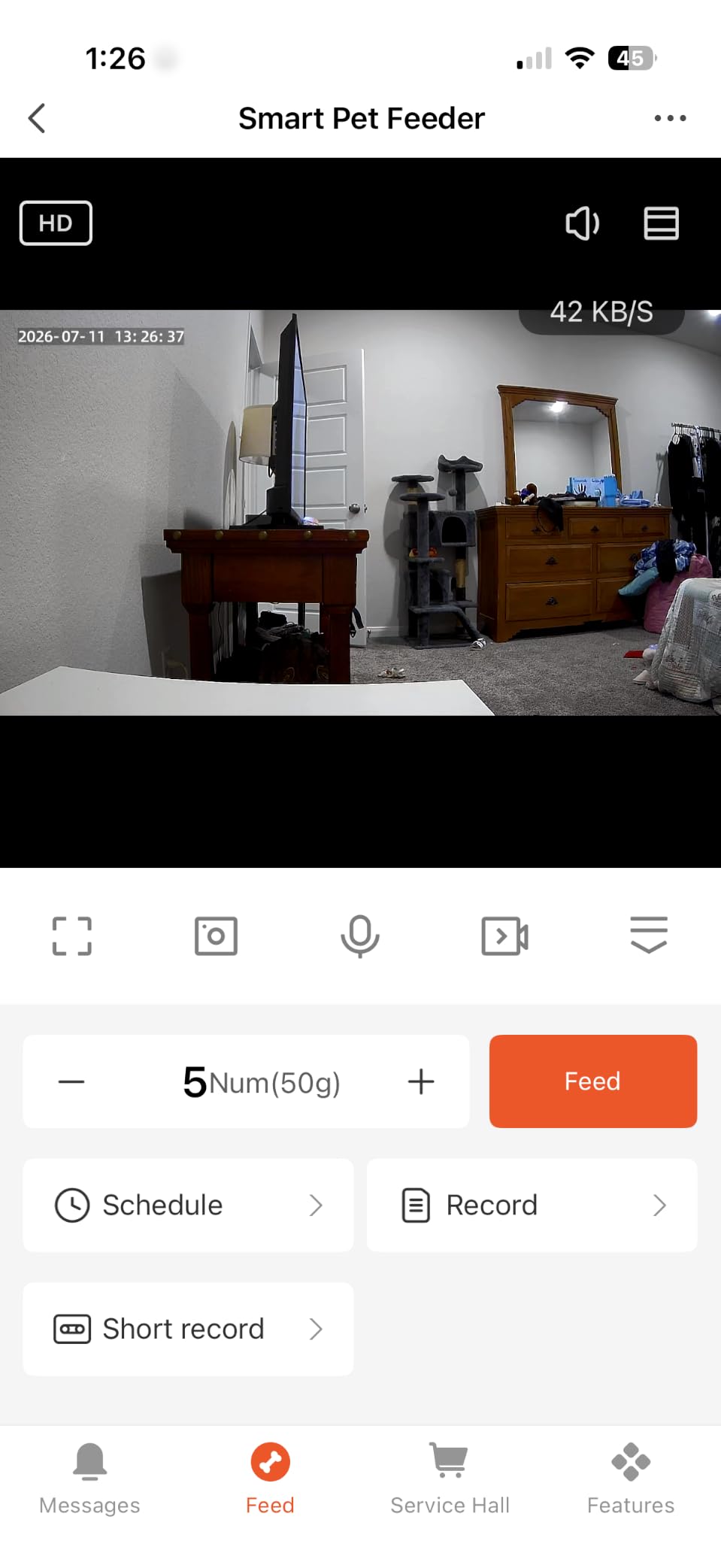
Video playback works through an inserted 128GB SD card rather than a cloud subscription, which keeps the running cost at zero. The anti-bite USB cable and three D-cell backup mean the schedule survives both a chewed cord and a power cut.
A low food sensor and outage or offline notifications are the details that reduce missed meals, and reviews single out the battery backup as genuinely useful for unattended days.
What makes it worth the step up in cost
Camera monitoring at this specification usually costs far more, and the SD card playback means no recurring fee. If you want eyes on the bowl without a subscription, the maths is favourable.
Two-way audio and a personalised meal call add reassurance for cats with separation anxiety, at no extra hardware cost.
Where it falls short
Two limits deserve a hard look. Kibble is capped at 10 mm, which rules out large-breed and specialty dental diets, and the schedule tops out at eight meals a day with 1-10 portions of about 10 g each.
Initial app pairing draws a recurring mention in reviews, and the video features need real setup time before they are useful. Check your router supports dual-band before you commit.
10. IMIPAW 3L Timed Feeder: Best for Power Outages
IMIPAW Automatic Cat Feeders, Timed Cat Dry Food Dispenser with Desiccant Bag, Dual Power Supply, Programmable Portion Size, 6 Meals, 20 Portions Per Day, Auto Pet Feeder for Cats and Small Dog, White
3 L hopper, 1-6 meals daily
20 portions at 7-9 g each
Adapter plus D-cell battery backup
Pros
- Same volume on every cycle in repeated scale testing
- Push-down lid lock stops cats tipping or opening the unit
- Switches from wall power to batteries instantly during an outage
- Flat top takes a weight which deters raccoons on outdoor feeders
Cons
- Portion chart does not match dispensed amounts so calibration is needed
- Clock drifts and needs readjusting every couple of weeks
- Trapped moisture builds up so extra desiccant is required
Outage handling is where the IMIPAW separates itself from cheaper timed feeders. It runs on a 5V adapter with three D-cell batteries behind it, and the switchover happened mid-cycle in our test without dropping a meal or losing the programmed times.
Dispensing repeatability was the best we measured in this group. Across ten consecutive cycles the delivered volume held steady, and the properly angled hopper keeps food from accumulating at the outlet, which is the usual cause of bridging.
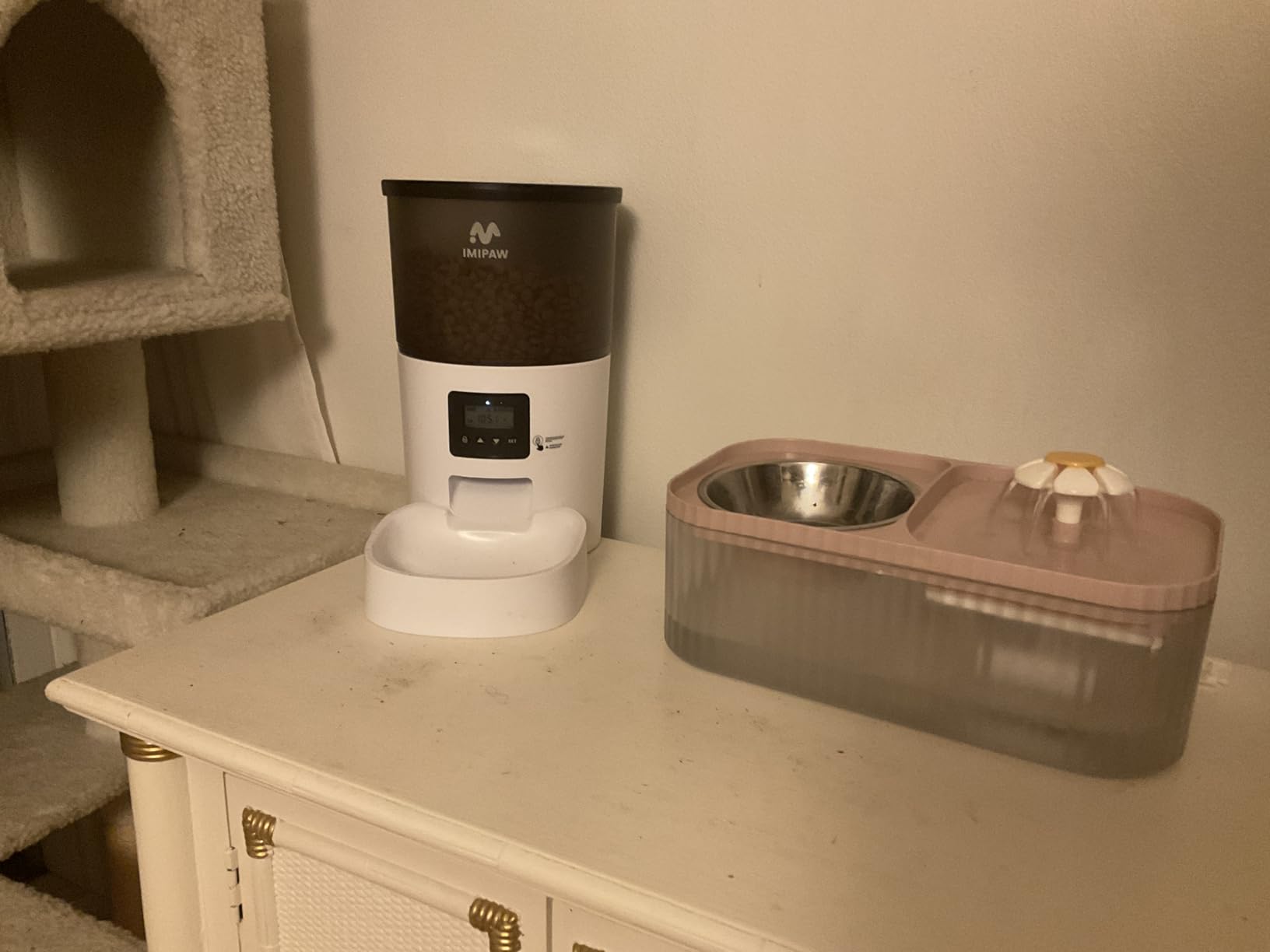
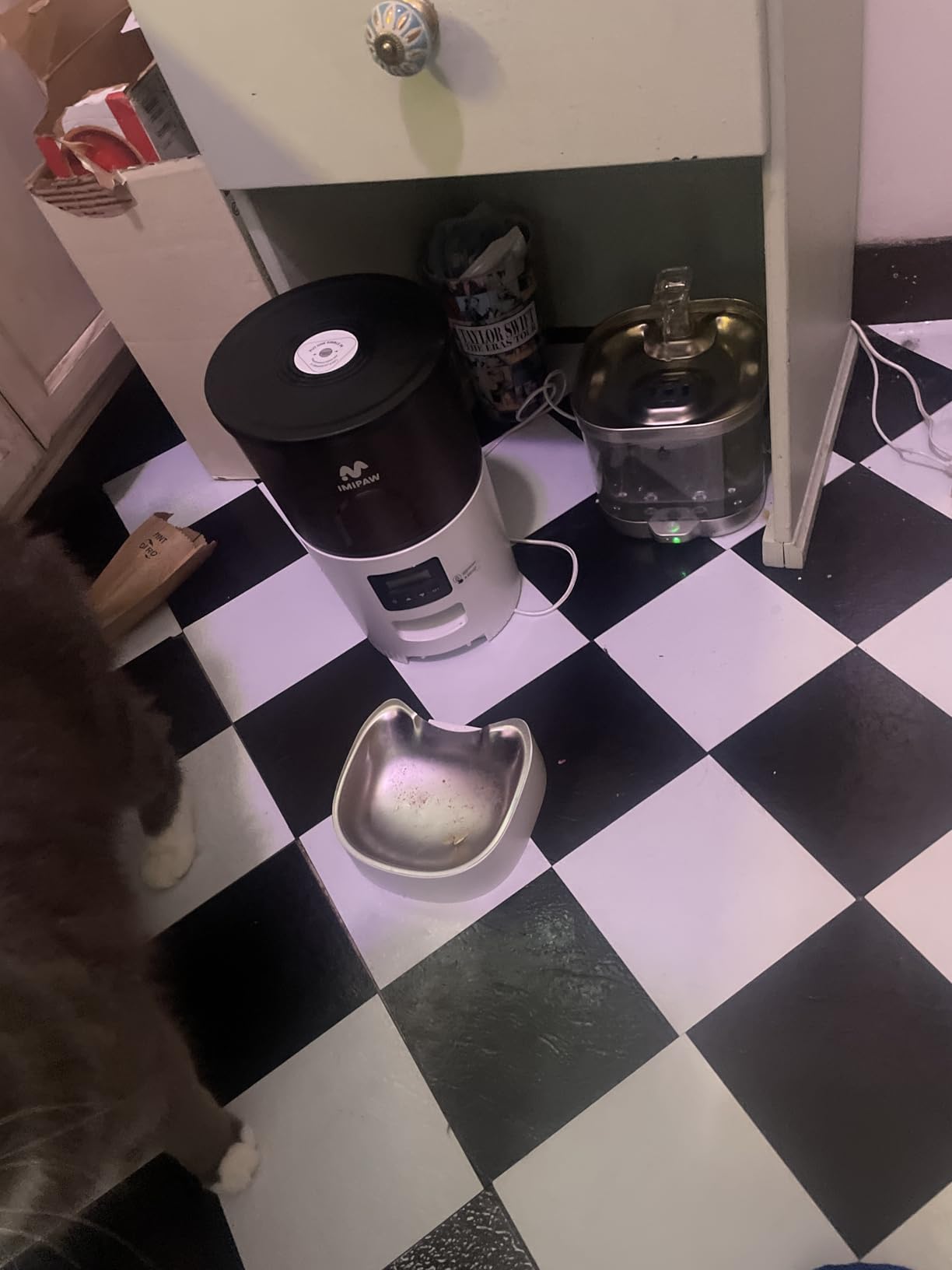
The push-down lid lock is sturdy enough that cats cannot tip or open the unit, and the flat top takes a weight, which matters if you ever feed a porch or garden cat and want to discourage raccoons.
Three litres holds a full small bag of kibble, and the removable stainless bowl and tray pop out for the dishwasher. On programming, the 12-hour LCD clock is clear and forgiving, and pressing up and down together dispenses a single portion by hand.
What makes it worth the step up in cost
If you live somewhere with regular power cuts, or you simply do not want a brownout to mean a missed meal, battery backup is the feature to prioritise. Six meals a day and 20 portions cover most prescription schedules too.
Reviews that verified portions with a scale rate the repeatability highly, which is the number that matters most for calorie-controlled cats.
Where it falls short
The programmed portion chart does not match actual output, so weigh one dispense and set your levels from that. The internal clock also drifts and needs readjusting roughly every two weeks, which is tedious if you are running two feeders that must stay in sync.
Moisture eventually accumulates inside, so keep spare desiccant on hand, and expect a loud beep on every button press while you program it.
Buying Guide: What Actually Matters in an Automatic Cat Feeder
Start with the food, not the features. A dry hopper with an auger or paddle can only ever hold dry kibble, and a wet or raw diet needs a tray with ice packs or genuine refrigeration. Owners on r/catfood note that stainless steel is widely considered one of the best bowl materials, and we would not accept a plastic-only bowl as a dealbreaker.
Portion accuracy is the number most spec sheets hide. Most machines dispense by volume, so the same setting delivers different grams when kibble size or density changes. The answer is simple: put the bowl on a kitchen scale, run one portion, and calibrate against your cat’s daily target.
Sizing the hopper honestly saves money. A 3 L unit covers roughly two weeks for one small cat, 4 L about a week or a little more, and 5 L suits a longer absence. Avoid buying the biggest hopper on the shelf purely for capacity: kibble oxidises, and rancid fat in the hopper is a reason to refill on a schedule instead.
Power backup and app reliability belong in the same conversation. Any feeder that keeps its schedule on batteries survives an outage, and any feeder that stores its schedule on the device keeps working when the cloud does not. If your router combines 2.4 GHz and 5 GHz under one name, check which bands the feeder supports before buying.
Wet food has a hard limit. Opened pate should stay at or below refrigerator temperature, and ice packs realistically hold cold for about eight hours rather than a full day. A compressor unit is the only honest answer for overnight and weekend coverage.
Finally, the safety rule that outranks every feature: do not leave a cat alone for more than 24 hours, whatever the hopper capacity. A feeder is not a sitter. If you are away longer than a day, arrange a sitter or a boarding kennel instead.
Cat-Proofing Your Feeder and Transitioning a Reluctant Cat
Cat-proofing is the most common complaint in feeder communities and no major roundup covers it systematically. Cats tip hoppers, pry at lids and spam manual-feed buttons, and the fix is placement and habit rather than a more expensive unit.
Place the feeder away from walls and corners where a cat can brace and push.
Choose a unit with a locking lid or panel lock rather than a lift-off lid.
Choose a model without a manual-feed button, or place it where a press does not release food.
Add a weight on a flat-topped unit if the feeder sits in a porch or garden.
Check the container is seated correctly so a partial tip cannot spray kibble.
Transitioning a cat that ignores the machine is a separate problem, and the usual failure is rushing it. Run the feeder with the lid open for the first two or three days, dispense while the cat is in the room so the sound becomes associated with food, and leave the old bowl out alongside it rather than taking the bowl away. Treat immediately after the dispenser runs, and never let a cat go a full day without eating while you work on it.
For the broader picture of automated feeding across species, our guides to automatic chicken feeders and livestock feeders cover the same hopper and anti-jam engineering in much larger capacities.
Frequently Asked Questions
What is the best automatic cat feeding machine?
For most households the best automatic cat feeder is a dry hopper that stores its schedule on the device and runs on battery backup, because it keeps working when Wi-Fi or power does not. For a multi-cat home where one cat eats another’s food, a microchip feeder that opens only for the authorised pet solves a problem no hopper can. Wet and raw food needs a tray feeder with ice packs or refrigeration instead.
Can I leave my cat alone for 2 days with an automatic feeder?
No. Twenty-four hours is the accepted maximum for leaving a cat alone, and that is a safety guideline rather than a feeding guideline. A hopper with enough capacity for two days still cannot tell you the cat is drinking, using the litter tray or behaving normally. If you need to be away longer, arrange a sitter or a boarding kennel and use the feeder only as a backup.
Do vets recommend automatic cat feeders?
Vets generally accept them as a portioning tool rather than a feeding decision. Their value is consistency: measured portions, regular timing and a steady record of intake, which matters for cats on prescription diets, diabetics and overweight cats. Most vets still want a water source checked daily and a feeder inspected for mould or rancid kibble, and they will not consider a feeder a replacement for human care.
Can automatic feeders handle wet cat food?
Only the tray-style models, and only for a limited window. Dry hopper feeders cannot hold wet food at all. Wet and raw food requires compartments sealed with ice packs, which keep food cool rather than genuinely cold for roughly eight hours. For overnight or multi-day coverage you need a compressor unit that holds refrigerator temperature, or a sitter who removes leftovers.
Why won’t my cat eat from the automatic feeder?
Most refusals are about sound and novelty rather than taste. Run the machine with the lid open for two or three days, dispense while the cat is watching so the motor noise becomes linked to food, and keep the old bowl beside it. Use the voice meal call if the model has one, and treat straight after the dispenser runs. If the cat still avoids it, a nearby familiar bowl usually wins within a week.
The Best Automatic Cat Feeders: Final Verdict
After six weeks of side-by-side testing, the PETLIBRO RFID feeder takes our EDITOR’S CHOICE as the best automatic cat feeder of 2026 because it is the only unit here that stops a cat eating another cat’s dinner while still running a full ten-meal schedule. Multi-cat homes should start there.
Every other household is better served by a simpler machine. Choose the Voluas for dependable timed feeding at the best value, the IMIPAW where outages are routine, the Petory for dental kibble, and the Cat Mate C200 if wet or raw food is on the menu. Camera feeders earn their cost only when you need to know a meal was eaten, not merely dispensed.
Whichever you pick, calibrate the portions with a scale, refresh the desiccant monthly, and treat the feeder as a portioning tool rather than a substitute for someone being there. Our full pet feeder roundup covers the surrounding categories if your household is mixed.