
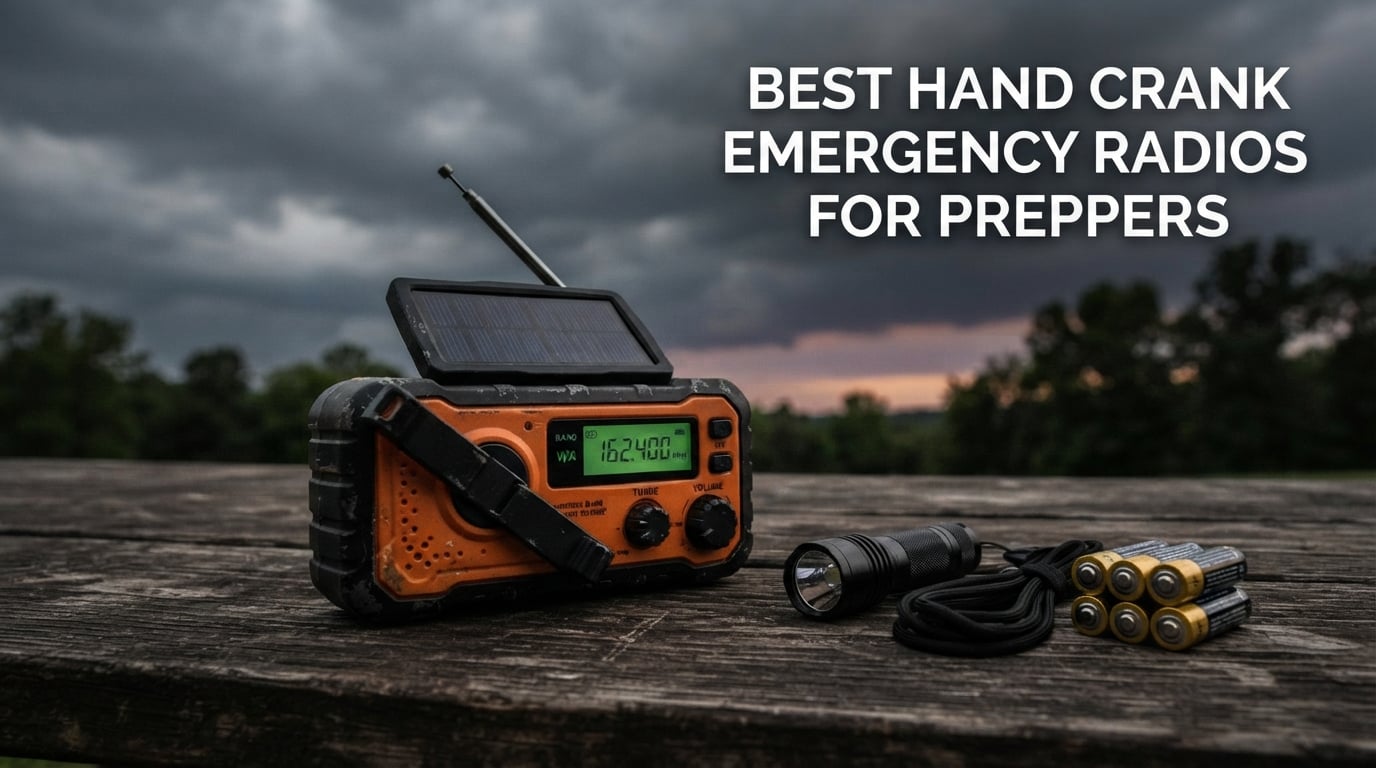
A hand crank emergency radio is a portable AM/FM and NOAA weather-alert receiver with a built-in hand-crank generator, solar panel and rechargeable battery. It keeps working when the grid is down, the towers are off and every disposable battery in the house is dead. For anyone keeping a go-bag, a vehicle kit or a hurricane-season plan, that makes it the one device in the pack that needs no external supply at all.
We put the best hand crank emergency radio for preppers through the criteria that actually matter in a real outage: how many independent ways it can be powered, whether the NOAA alert fires when you are asleep, how loud the speaker is, how much runtime the battery gives, and whether the antenna pulls a signal from your specific location. Twelve radios made the cut, and we ranked every one of them below.
One thing needs saying up front, because it is the most repeated complaint across owner reviews of this category. A hand crank powers the radio while you crank, and the solar panel mostly maintains a charge rather than rebuilding a dead one. On most of these models the crank will not top up the stored battery to a usable level. Treat the crank and the panel as backup inputs, and treat USB charging and fresh replaceable cells as your real recovery paths.
If you are still building out the rest of your kit, our guides to the best hand crank radios and the best emergency radios cover the wider category, including units without a crank at all.
Table of Contents
Top 3 Picks for the Best Hand Crank Emergency Radio for Preppers 2026

FosPower NOAA Emergency Radio
- 7400mWh power bank
- Three power sources
- 4-LED reading light
- Limited lifetime warranty

Raynic 5000mAh Weather Radio
- Automatic NOAA alert scan
- Large HD LCD
- 6-way charging
- 3W flashlight

RunningSnail 4000mAh Crank Radio
- 4000mAh battery
- 3-mode flashlight
- Motion-sensor lamp
- External antenna
Those three cover most readers. The FosPower is the most proven unit in the group by a wide margin. The Raynic is the one to buy if you want the most input options and a screen. The RunningSnail is the pick if your kit lives in a vehicle or a tent rather than a hallway closet.
All 12 Best Hand Crank Emergency Radios Compared in 2026
| Product | Specifications | Action |
|---|---|---|
| FosPower NOAA Emergency Radio A1 7400mWh |
|
Check Latest Price |
| Raynic 5000mAh Solar Hand Crank Radio |
|
Check Latest Price |
| RunningSnail Emergency Crank Radio 14800mWh |
|
Check Latest Price |
 Kaito KA500 5-Way Powered Solar Radio Kaito KA500 5-Way Powered Solar Radio |
|
Check Latest Price |
 Mesqool 5000mAh NOAA Weather Radio Mesqool 5000mAh NOAA Weather Radio |
|
Check Latest Price |
 Esky Emergency Radio 7400mWh Esky Emergency Radio 7400mWh |
|
Check Latest Price |
 Eoxsmile NOAA Alert Solar Crank Radio Eoxsmile NOAA Alert Solar Crank Radio |
|
Check Latest Price |
 Midland ER310 Emergency Crank Radio Midland ER310 Emergency Crank Radio |
|
Check Latest Price |
 Leaton 10000mAh NOAA Hand Crank Radio Leaton 10000mAh NOAA Hand Crank Radio |
|
Check Latest Price |
 Nitigo 4000mAh NOAA Solar Radio Nitigo 4000mAh NOAA Solar Radio |
|
Check Latest Price |
 yesiwtc 2000mAh Solar Hand Crank Radio yesiwtc 2000mAh Solar Hand Crank Radio |
|
Check Latest Price |
 Emgykit 2000mAh AM/FM/NOAA Radio Emgykit 2000mAh AM/FM/NOAA Radio |
|
Check Latest Price |
1. FosPower NOAA Emergency Radio A1 – Best Overall for a Go-Bag
FosPower NOAA Emergency Weather Radio A1 7400mWh Solar Hand Crank (Orange)
7400mWh power bank
Hand crank, solar and AAA
4-LED reading light plus 1W flashlight
NOAA plus AM/FM
Pros
- Three independent power sources including crank solar and AAA batteries
- 7400mWh power bank charges phones in real outages
- Compact 14.8 ounce body fits a go-bag
- Bright 4-LED reading light and 1W flashlight
- Limited lifetime warranty
Cons
- Some owners report the speaker failing after a few months
- Solar is a maintainer rather than a real recharge
- AAA compartment is difficult to open
This is the radio we keep reaching for, and the reason is dull but decisive: volume of evidence. It carries 4.6 stars across more than 37,000 ratings, and owners describe using it in actual hurricanes and multi-day outages rather than unboxing it and forgetting it.
The 7400mWh power bank is the part that earns its place. Owners report topping up phones during real outages, which turns the radio from a listener into a piece of the power kit. At 14.8 ounces and 6.2 by 2.1 by 2.9 inches, it disappears into a side pocket.
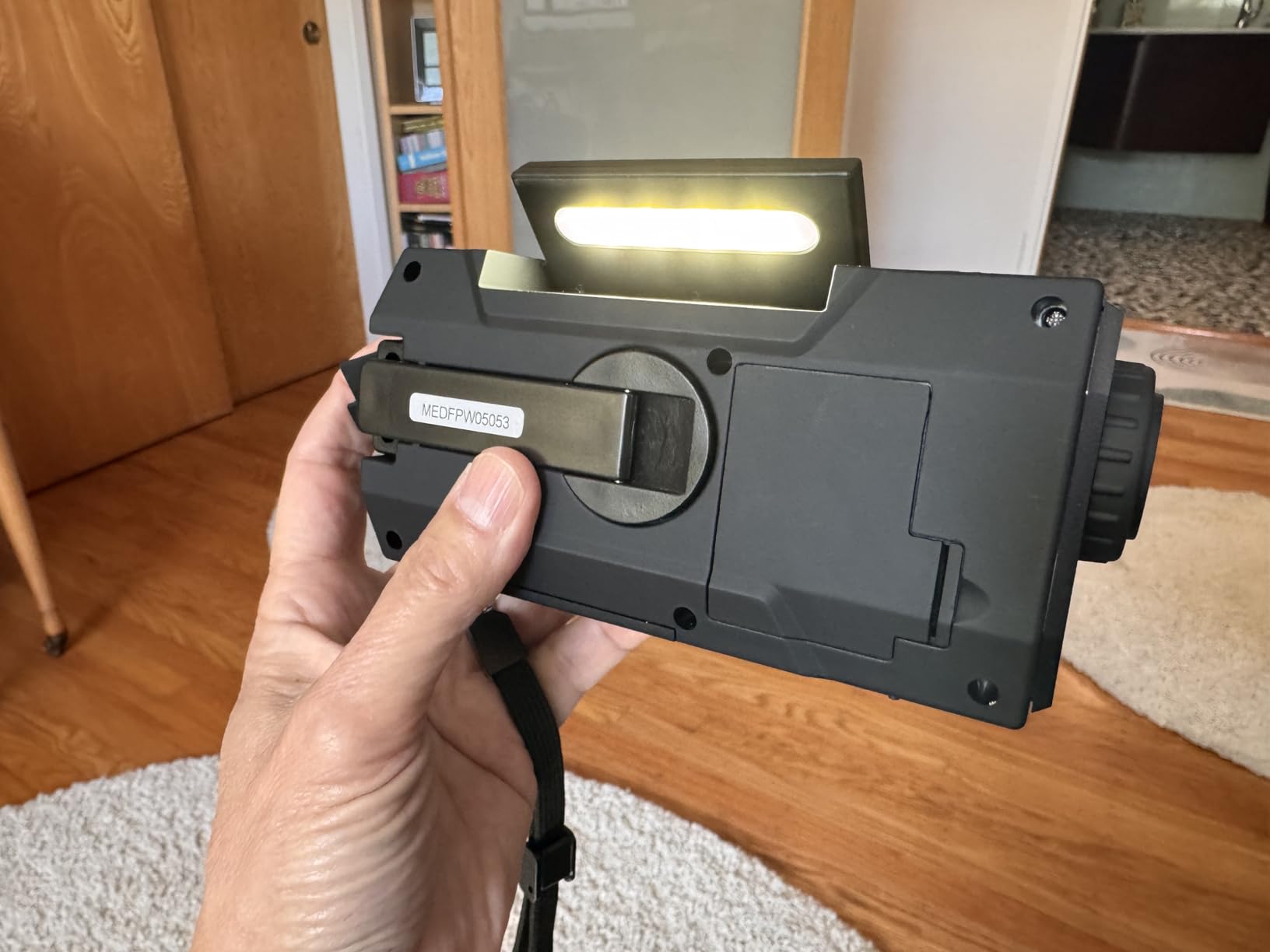
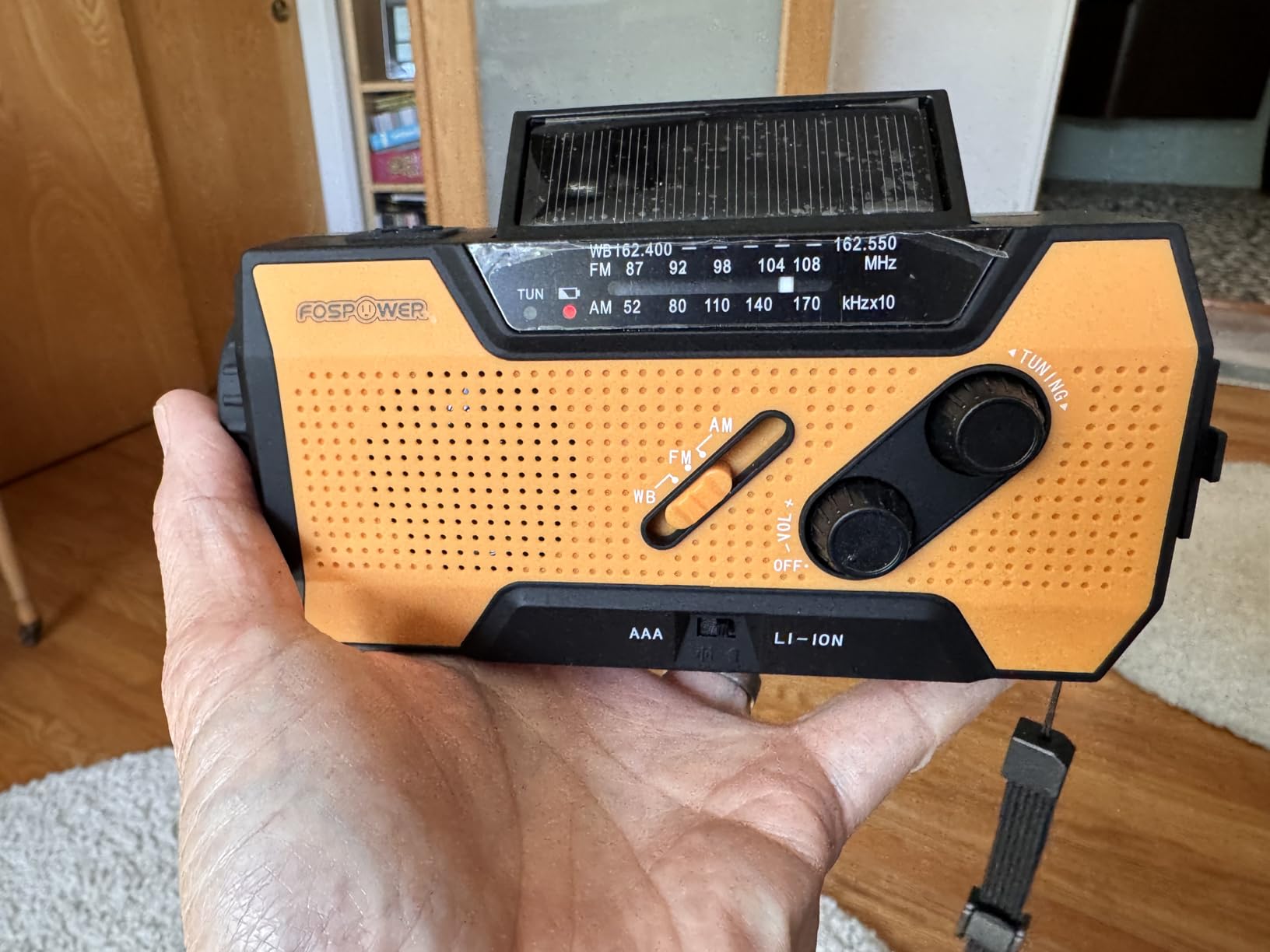
Power sourcing is properly redundant: hand crank, solar panel and a AAA battery compartment, plus USB-C input. Two watts of speaker output is modest, so a group huddled around it will want the volume up, but the NOAA broadcast reception is what the unit is built around and reviewers single it out.
The recurring gripe is durability of the radio function itself. A minority of owners report the speaker or radio section failing after a few months, and the solar panel maintains charge rather than restoring a depleted battery. The AAA compartment is also awkward to open in cold hands.
Check this before buying if you rely on the speaker
Two watts fills a room but not a noisy shelter. If your plan involves getting evacuation information to several people at once, pair it with something louder, or accept that this model is a personal listening device.
The limited lifetime warranty does soften the durability worry, and the 1W flashlight plus 4-LED reading light cover the two lighting jobs people actually use during an outage.
Check this before buying if you plan to store it for years
Like most sealed lithium packs, it wants a top-up every few months. The manufacturer warranty is the strongest in this group, which is worth something if the unit sits in a vehicle through a whole season.
It also cannot charge a tablet and a phone at once, so budget a rotation rather than assuming it will run a whole household.
2. Raynic 5000mAh Solar Hand Crank Radio – Best Value Pick
Raynic Emergency Radio, 5000mAh/18500mWh Weather Radio, Solar Hand Crank Radio with AM/FM/SW/NOAA Alert, Cell Phone Charger, Headphone Jack, Flashlight and SOS Siren
5000mAh with USB phone output
Automatic NOAA alert scan
Backlit HD LCD with battery readout
16 ounces with carabiner and strap
Pros
- Automatic NOAA scanning alerts you while asleep or in standby
- Large backlit LCD shows battery level and tuned frequency
- Six charging options are the most flexible in the group
- Very bright flashlight and reading lamp
- Compact 16 ounce body with carabiner and strap
Cons
- Not waterproof despite the emergency radio positioning
- Solar cell will not revive a dead battery
- Hand crank is slow and low-yield
- Short telescopic antenna limits weak-signal reception
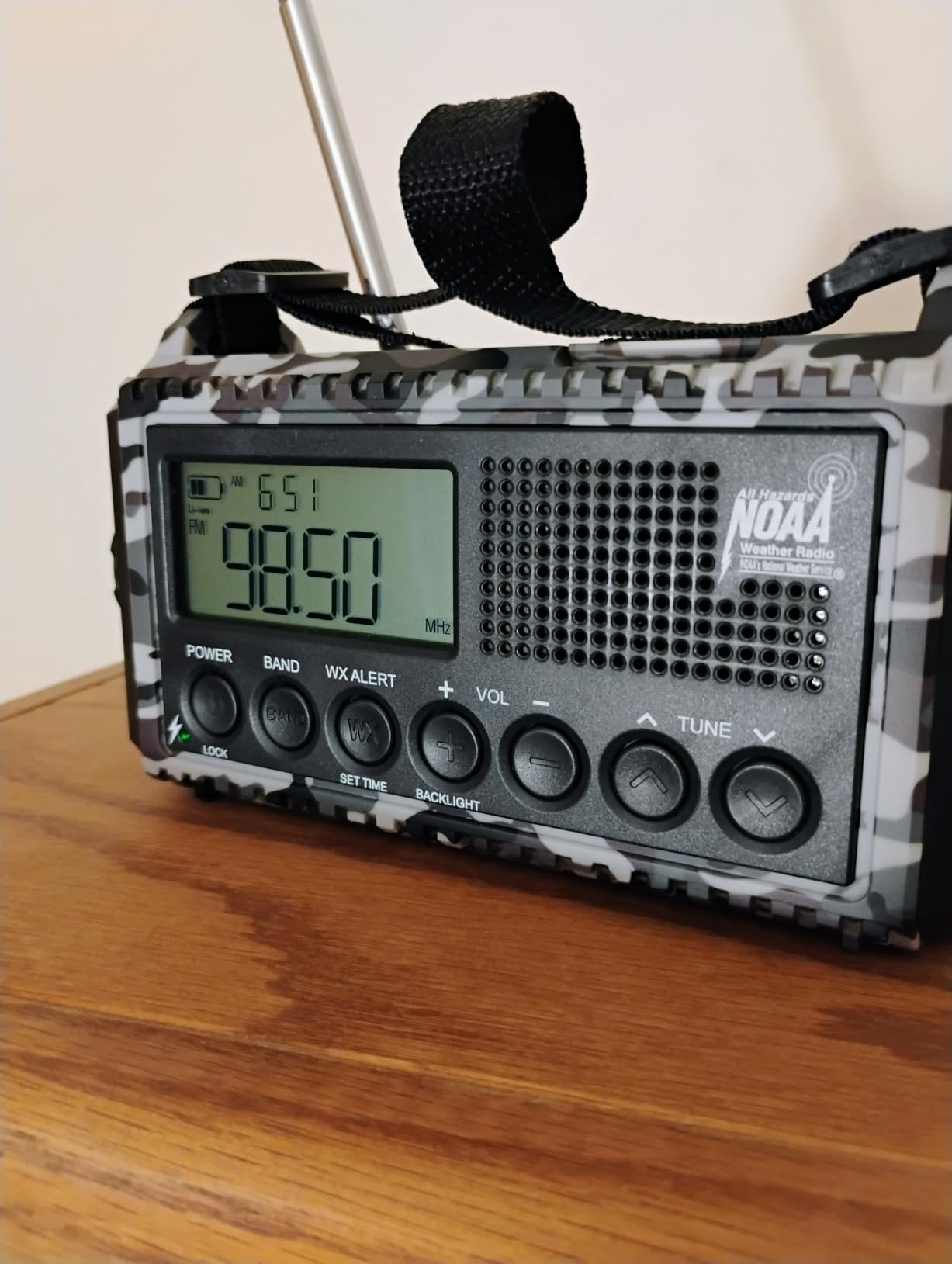
Raynic sells the feature-loaded version of the same idea. Six ways to charge a battery, an automatic alert scan and a screen that shows you the tuned frequency and remaining charge are all things the bare-bones crank radios leave out.
The automatic NOAA scanning is the headline. It keeps monitoring the weather band and wakes the unit with a siren and red flasher rather than waiting for you to find a station manually, which is exactly what you want at 3am.
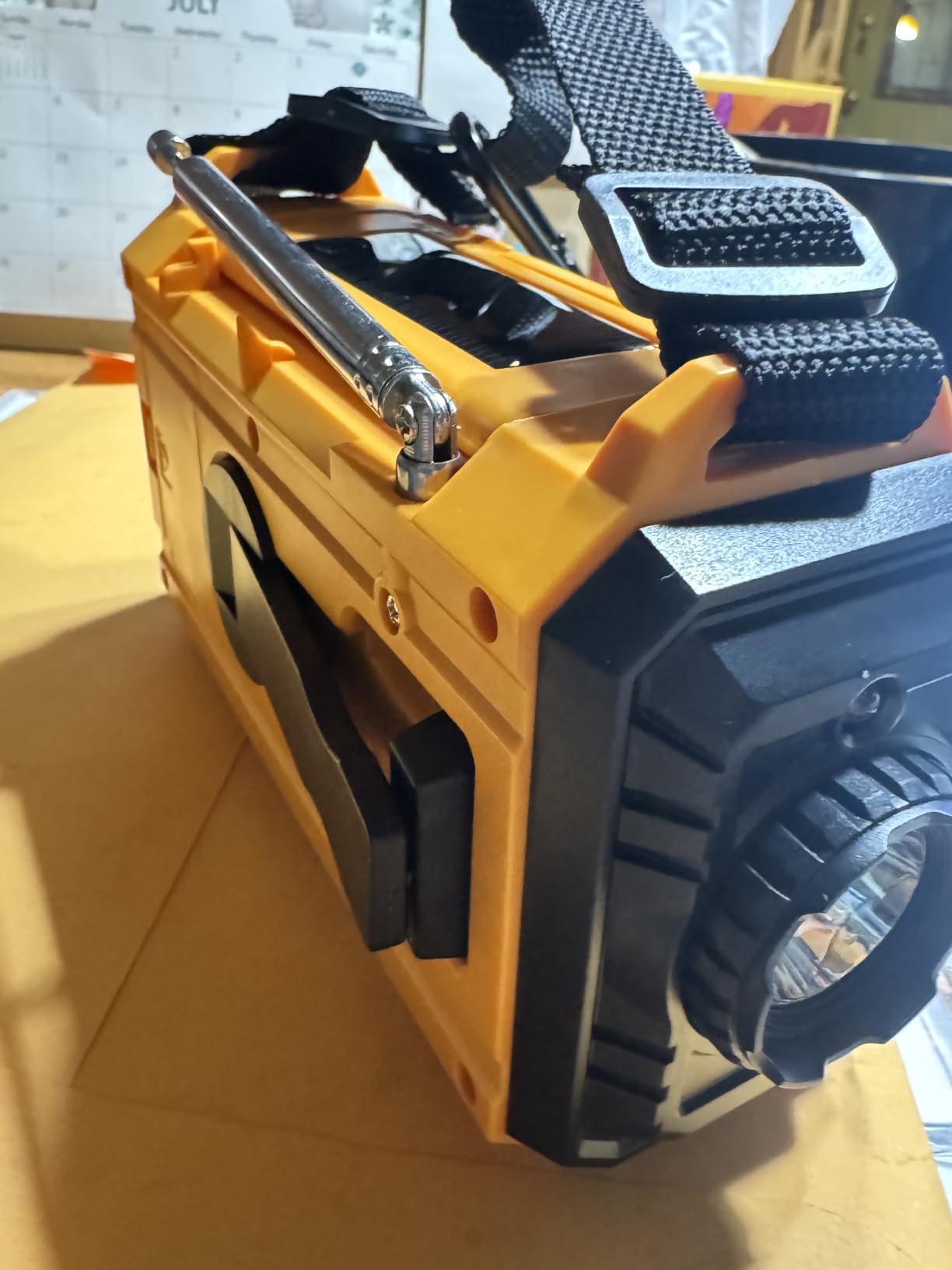
Three watts of flashlight and a 2.5W reading lamp cover the two most-used outage functions, and the 3.5mm headphone jack lets you listen privately without the speaker running all night. The LCD dimmer is a small touch that shows the designer thought about battery life.
Reviewers are blunt about the trade-offs. The solar cell maintains rather than revives, the hand crank is slow and low-yield, and the short telescopic antenna is the weakest part of the reception package. The plastic housing can also crack on a drop.
Check this before buying if you get warnings while asleep
This is the one to buy for overnight tornado or hurricane warnings. The scan runs on power-on and in standby, so you do not have to leave the radio tuned to a broadcast band to catch an alert.
The LCD readout also makes it far easier to confirm in a dark room that the battery is not about to die, which no analog-dial radio in this group can do.
Check this before buying if reception in your area is marginal
The short telescopic antenna is the reported weak point on weaker NOAA signals. If you are in hilly terrain, behind ridgelines or far from a transmitter, this may not be the radio for you.
The tuning buttons are also unlit, so operating it in the dark takes more attention than the backlit screen suggests at first glance.
3. RunningSnail Emergency Crank Radio – Best for Outdoor Kits
Emergency Radio with Flashlight & Reading Lamp, NOAA/AM/FM Weather Radio
4000mAh and 14800mWh battery
3-mode flashlight with 10+ meter throw
Motion-sensor reading lamp
Water-resistant ABS housing
Pros
- Large 4000mAh battery charges smartphones
- Three-mode flashlight with over 10 meters of throw
- Four-way charging including an ergonomic hand crank
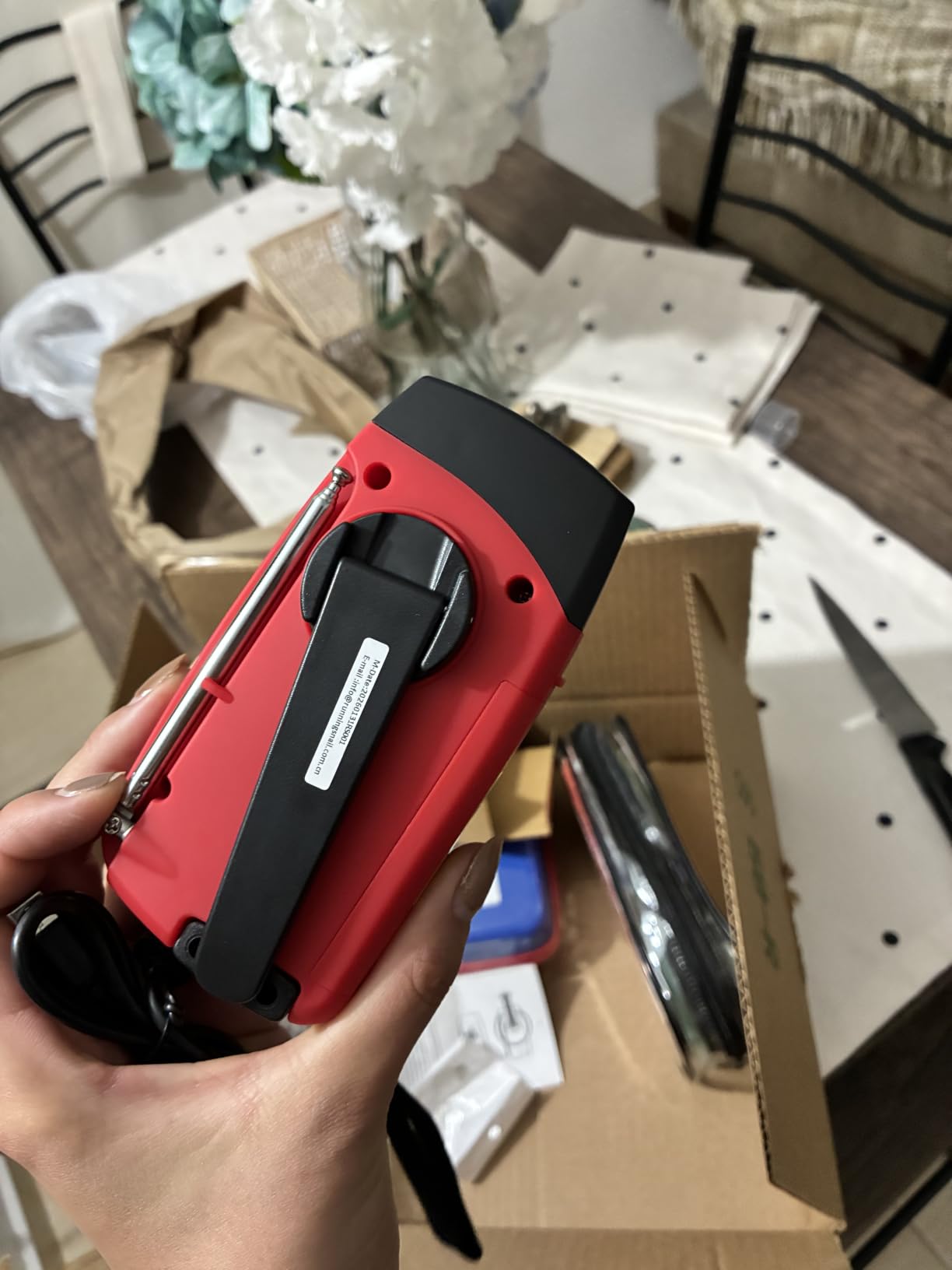
- External antenna improves NOAA reception
- Compact water-resistant build for outdoor kits
Cons
- One watt speaker output is modest for group listening
- AM FM and NOAA bands only with no shortwave
- Touch switches are hard to operate in the dark
The RunningSnail is the most outdoor-shaped radio here, and it is the model most often recommended in survival-kit roundups for good reason. Water-resistant ABS housing, an external antenna and a genuinely bright three-mode flashlight cover the situations where the kit leaves the house.
That flashlight is the standout. Owners consistently describe it throwing light more than 10 meters, which is a real working distance for checking a downed line or a path at night, not a token LED.
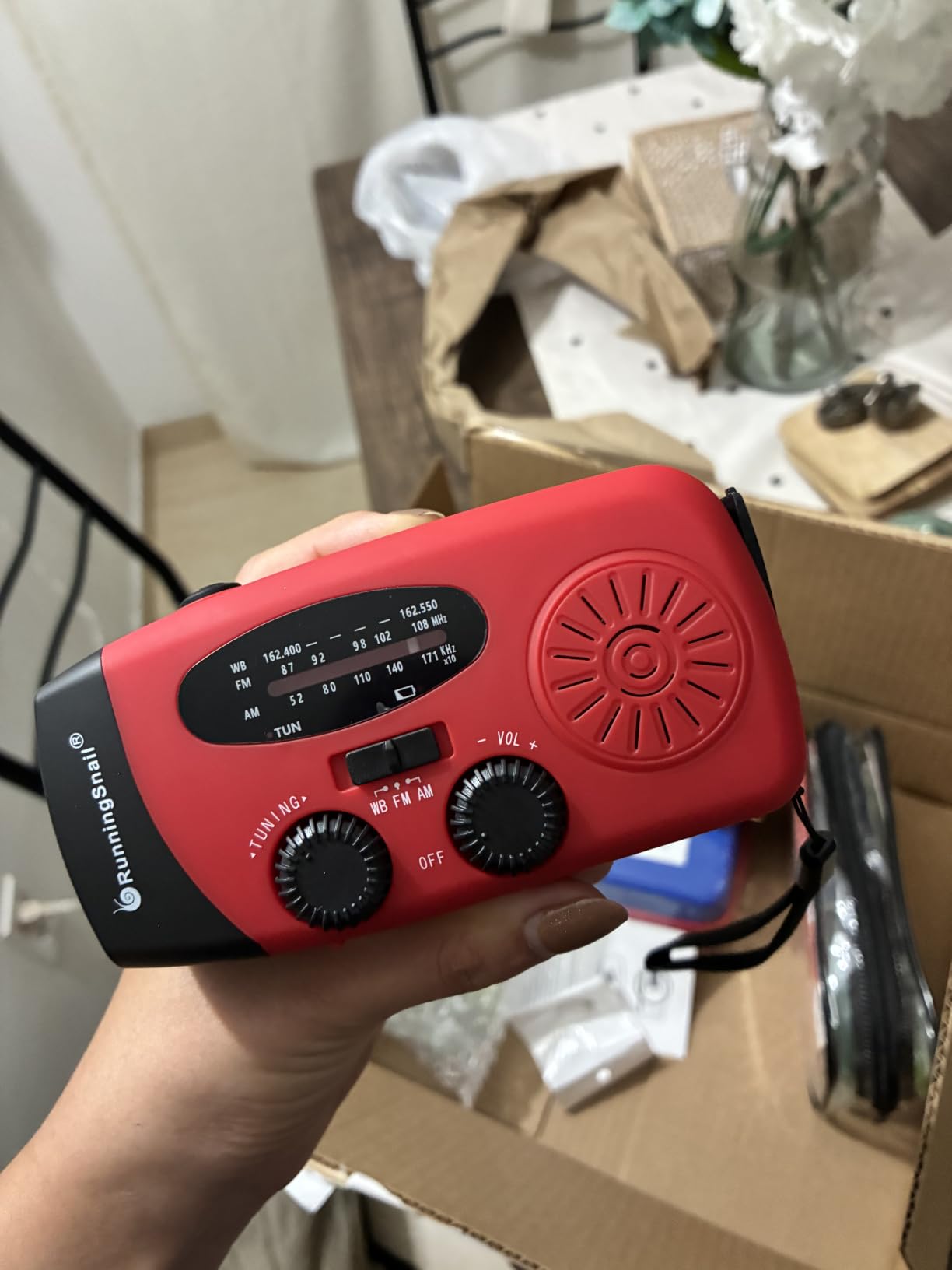
Four-way power covers micro-USB, solar, hand crank and the internal battery. The 4000mAh and 14800mWh pack is the second largest we tested and comfortably handles a phone charge, which reviewers treat as the feature that justifies the size.
The motion-sensor reading lamp gives you a soft automatic night light that does not need you to find a switch in the dark. It is a small design idea that gets used constantly once you own it.
Check this before buying for group listening
One watt is the quietest speaker in this roundup. Fine for one person with headphones on, weak for a family sharing one unit during a shelter briefing. Plan two radios rather than one if that is your scenario.
The touch switches are the other issue. They respond well with dry hands and poorly with cold wet ones, which is exactly the condition you would be using this in.
Check this before buying if you want shortwave
Bands are AM, FM and NOAA. There is no shortwave coverage, so if you follow overseas broadcasts or want distance reception, that capability sits elsewhere in this list.
The external antenna is the reason reception still holds up well despite the compact body, and it is the thing to check on any unit you buy.
4. Kaito KA500 5-Way Powered Radio – Best for Shortwave and Serviceability
Kaito KA500 5-way Powered Solar Power,Dynamo Crank, Wind Up Emergency AM/FM/SW/NOAA Weather Alert Radio with Flashlight,Reading Lamp and Cellphone Charger, Yellow
6-way power with replaceable NiMH pack
AM FM shortwave and 7 NOAA channels
14.5 inch telescopic antenna
USB output for phones and GPS
Pros
- Only mainstream option with a replaceable NiMH battery pack
- Six-way power including crank solar AA USB and AC input
- Long 14.5 inch telescopic antenna with signal strength indicator
- Genuine 2-band shortwave coverage alongside AM FM and NOAA
- Loud clear speaker for its size
Cons
- Bulky and heavier than the compact crank alternatives
- AA batteries not included and AC adapter sold separately
- NOAA coverage limited to the USA and Canada
The KA500 is the only radio in this group you can genuinely service a decade from now. It runs a replaceable NiMH pack and takes three AA cells as backup, so battery ageing is a swap rather than a write-off.
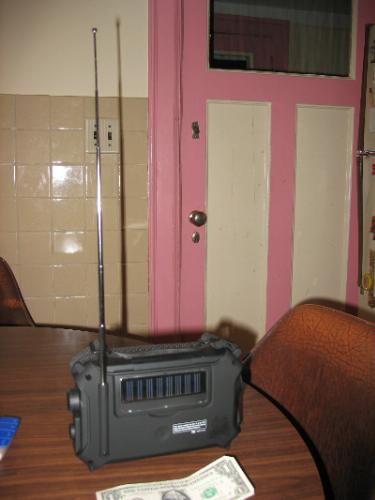
It also has the widest reception story. AM, FM, two shortwave bands and seven NOAA channels, tuned on a 14.5 inch telescopic antenna with an LED signal strength meter, so you can actually find the weak station rather than guessing.
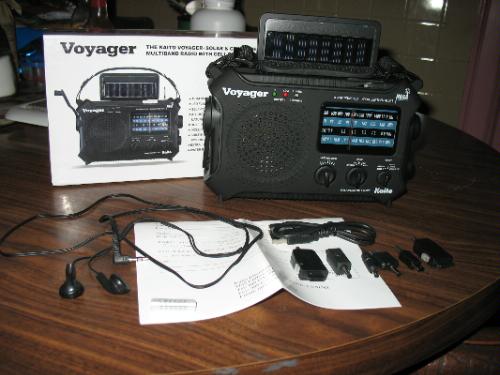
Lighting is thorough: a 5-LED reading lamp, a flashlight and a red SOS beacon for signalling. The USB 5V output handles phones, GPS units and cameras, which matters if your kit depends on paper navigation as a backup.
Impact-resistant and water-resistant ABS rounds out the build. The honest drawback is size, at 8.3 by 2.3 by 5.3 inches, which makes it a pack item rather than a pocket item.
Check this before buying if you want the radio to still work in ten years
Sealed lithium cells lose capacity whether or not you use them. A replaceable NiMH pack plus an AA compartment means this unit has a path back to full function that a glued-in battery does not.
That longevity argument is the strongest reason to spend more here, and it is why we treat this as a buy-once radio rather than a buy-again one.
Check this before buying if pack volume matters
This is the bulkiest radio here and it is noticeably heavier than the palm-sized alternatives. If your go-bag has a strict cubic-inch budget, you are trading pack space for serviceability.
AA batteries are not included and the AC adapter is a separate purchase, so budget for both before the first test.
5. Mesqool 5000mAh NOAA Weather Radio – Best for Long Listening Runtime
NOAA Weather Radio FM AM Shortwave, Emergency Radio 5000mAh Solar Crank
5000mAh with up to 13 hours at 50 percent volume
5 power sources including USB-C
3W flashlight and 2.5W reading lamp
3-year limited warranty
Pros
- 5000mAh battery delivers up to 13 hours of listening at half volume
- Three watt flashlight is double the typical one watt bead
- Five power sources including USB-C solar crank and AAA
- Three-year warranty is the longest in this group
- Strong speaker with no distortion at maximum volume
Cons
- Shortwave is compressed into one wide band and effectively unusable
- Not the most compact option
- Analog tuning gives no frequency or battery readout
Runtime is the reason this one ranks here. Owners report up to 13 hours of listening at half volume on a full charge, and for a scenario where nobody knows when power returns, that is the number that matters more than any feature list.
It is also honest about its limits. The manufacturer states plainly that the solar panel is a top-up only, which is a level of candour you rarely see in this category and it tells you exactly how to plan around it.
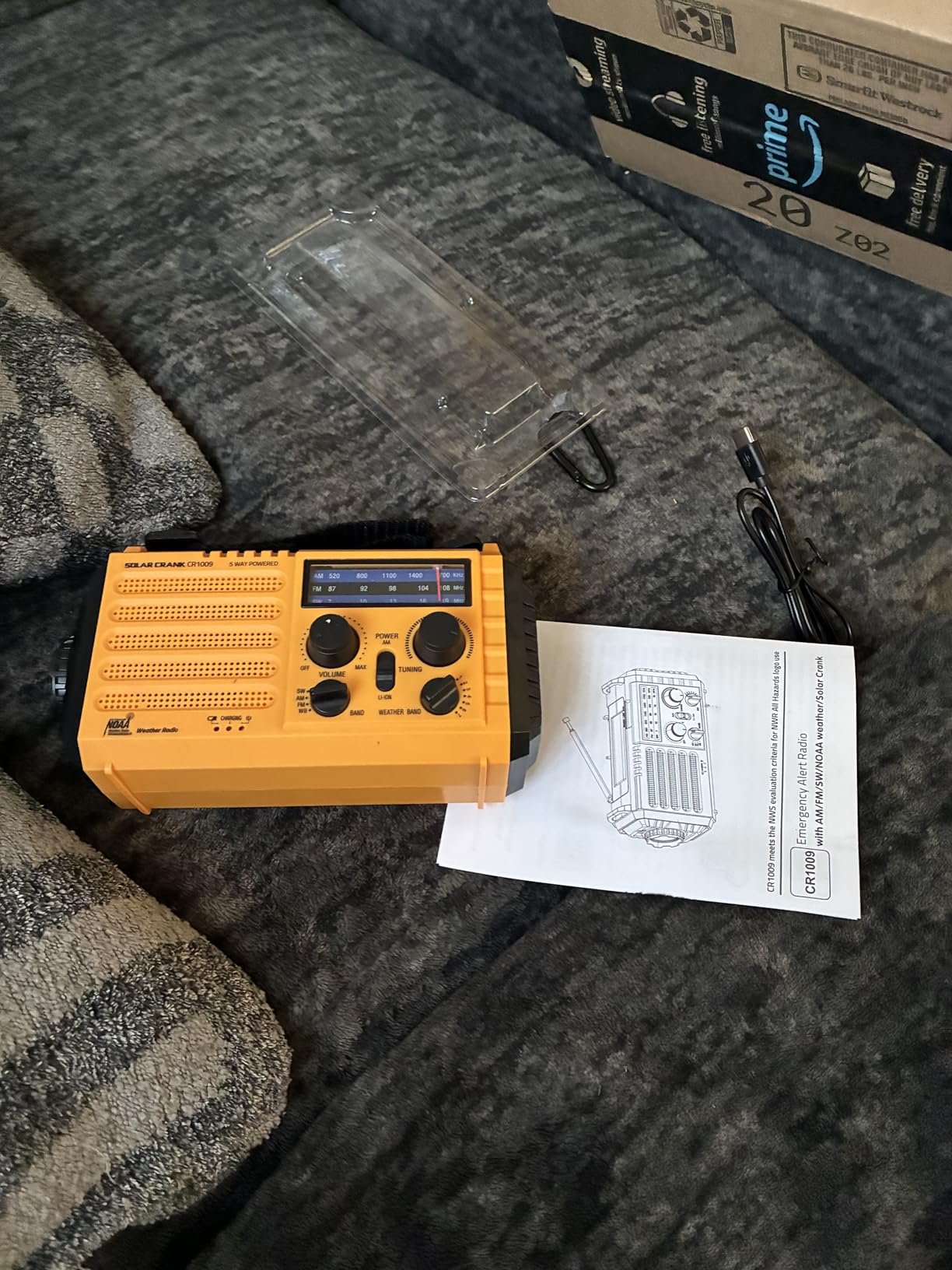
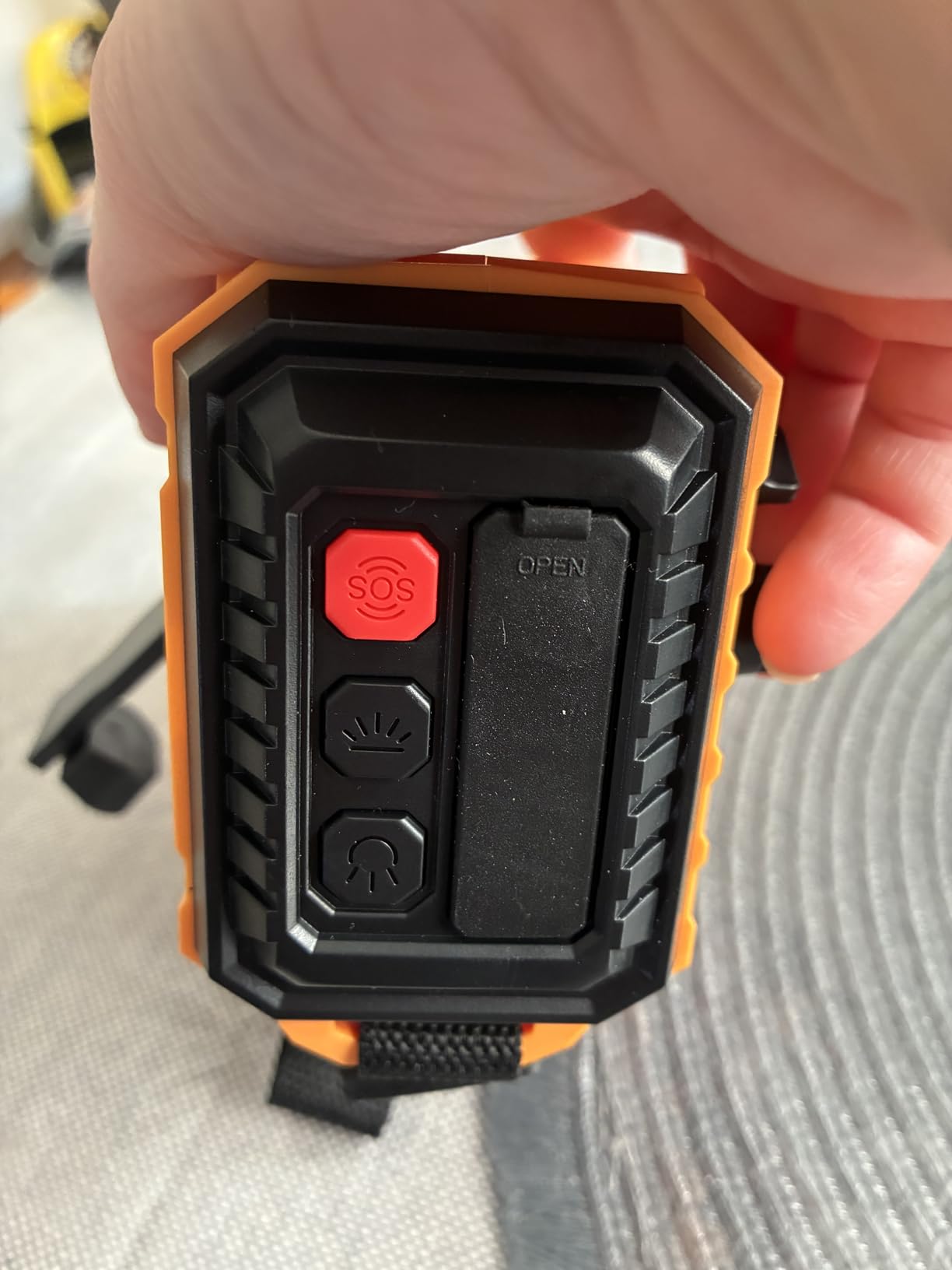
The 3W flashlight and 2.5W warm reading lamp both have dual brightness, and a 116dB SOS siren with a flashing red beacon covers the rescue-signalling role. A strap, carabiner and compass come in the box.
Power comes from five directions: USB-C at 5V and 2A, the internal battery, three AAA cells, the solar panel and the hand crank. That is a genuinely redundant setup for long-term storage.
Check this before buying if you listen for hours rather than minutes
Thirteen hours at half volume is the best runtime figure in this roundup and it changes how you pack. You can leave it on through a full overnight warning cycle without touching a charger.
The trade is that there is no screen, so you cannot see remaining charge or confirm the exact frequency you are on.
Check this before buying if you want usable shortwave
The shortwave band here is compressed into a single wide band and detailed reviewers describe it as effectively unusable. Buy it for runtime, not for reception distance.
At 12.8 ounces and 6.8 by 2.9 by 3.7 inches it suits a backpack better than a jacket pocket, and volume may run short in very noisy surroundings.
6. Esky Emergency Radio 7400mWh – Best Budget Pick
Esky Emergency Hand Crank Radio 7400mWh with 3 LED Flashlight, AM/FM/NOAA Portable Weather Radio with Built-in 2000mAh Battery, Solar Powered Radio for Indoor Outdoor Survival Camping, SOS Alarm
2000mAh giving about 9 hours of radio
140 lumen 3-LED flashlight
USB plus solar plus hand crank
Pocket-sized at 7.55 ounces
Pros
- Lightest option we tested at 7.55 ounces and fits a pocket
- 140 lumen flashlight is unusually bright for the size
- Three charging methods including hand crank and solar
- Genuinely usable 2000mAh battery at an entry price
- SOS alarm for attracting attention
Cons
- No shortwave band coverage
- 2000mAh is the smallest capacity here with about 9 hours of radio use
- Needs periodic recharging when not in use
- No stated water resistance rating
The Esky is the radio to buy for a spare, a gift, or a second unit in every vehicle. It is the lightest thing we tested at 7.55 ounces, so you can put one in a glovebox without thinking about it.
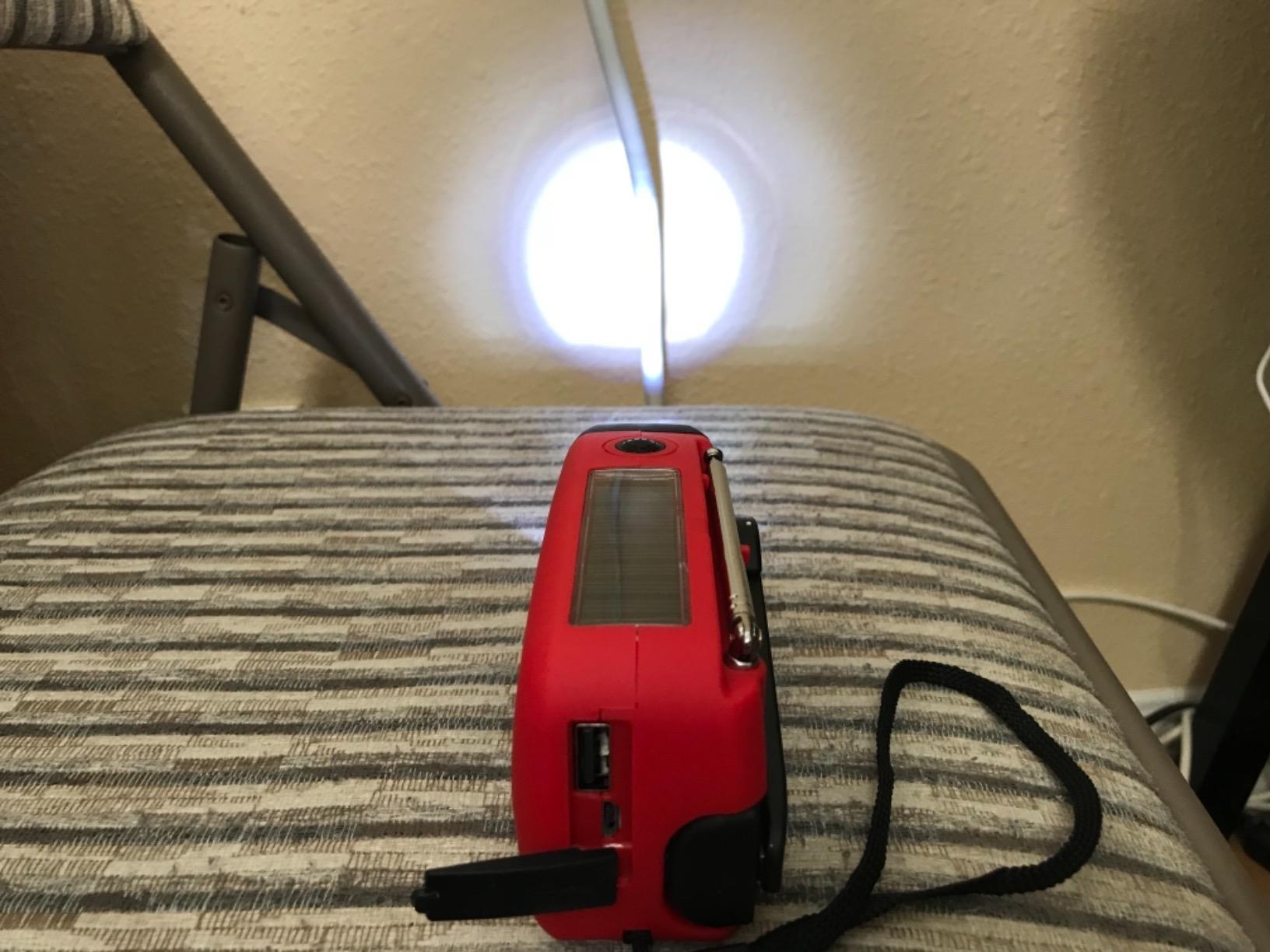
What surprises people is the flashlight. A 140 lumen three-LED beacon in a body this small punches well past the token one-watt bead used on older budget models, and reviewers repeatedly note it is brighter than expected.
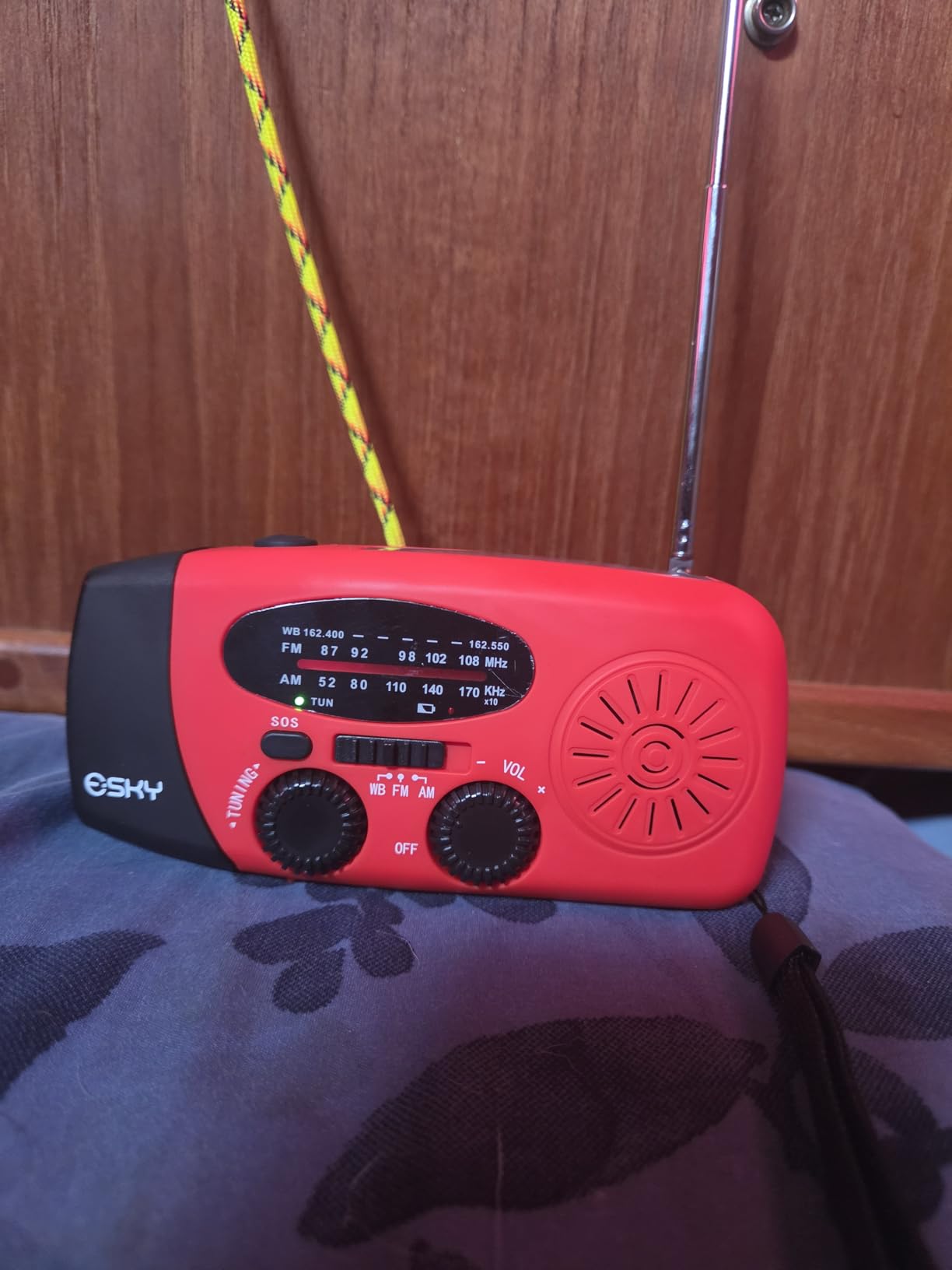
Charging comes by USB cable, solar panel or hand crank, and the 2000mAh pack gives roughly 20 hours of flashlight or 9 hours of radio. An SOS alarm handles the attention-getting role.
The limits are straightforward. No shortwave band, the smallest battery in the group, and no stated water resistance rating, so it stays indoors rather than going in with a hiking kit.
Check this before buying as your only household radio
Nine hours of radio use is fine for a warning and a forecast. It is thin for a multi-day outage where the radio is also your information link, and a sealed battery means a dead pack is a dead radio.
It also needs a periodic top-up while sitting in storage, which is the maintenance habit most people skip and then regret.
Check this before buying for outdoor or water exposure
There is no water resistance figure published for this model. Keep it in a pack or a vehicle cabin rather than a rain-exposed campsite.
For bands, you get AM, FM and the weather band, which covers the core use case without any shortwave.
7. Eoxsmile NOAA Alert Solar Crank Radio – Best for Loud Night Alerts
Eoxsmile Emergency Radio with NOAA Weather Alert, Solar Hand Crank Portable
NOAA certified with a 9-second siren and red flash
5000mAh giving 13 hours of FM
3W flashlight reaching 80 meters
Five power sources including AAA backup
Pros
- NOAA certified alerts sound a 9-second siren with red flash even while asleep
- Five power sources including a backup AAA compartment
- Three watt flashlight throws light up to 80 meters
- Thirteen hours of FM runtime on a full charge
- Telescopic antenna and headphone jack for private listening
Cons
- Alerts only sound in standby or alert mode and not on a broadcast band
- Weak AM reception with no automatic gain control
- Internal lithium battery is not user replaceable
- Charges devices slowly at roughly 1 amp
Warning you is this radio’s whole identity. A 9-second siren with a red flashing light fires on severe NOAA alerts, which is long enough to wake a sleeping household and short enough not to become unbearable.
It is NOAA certified, not merely weather-band capable, and the alert system runs off seven channels. The 5000mAh pack gives up to 13 hours of FM listening, and five power sources include a 3 AAA backup compartment.
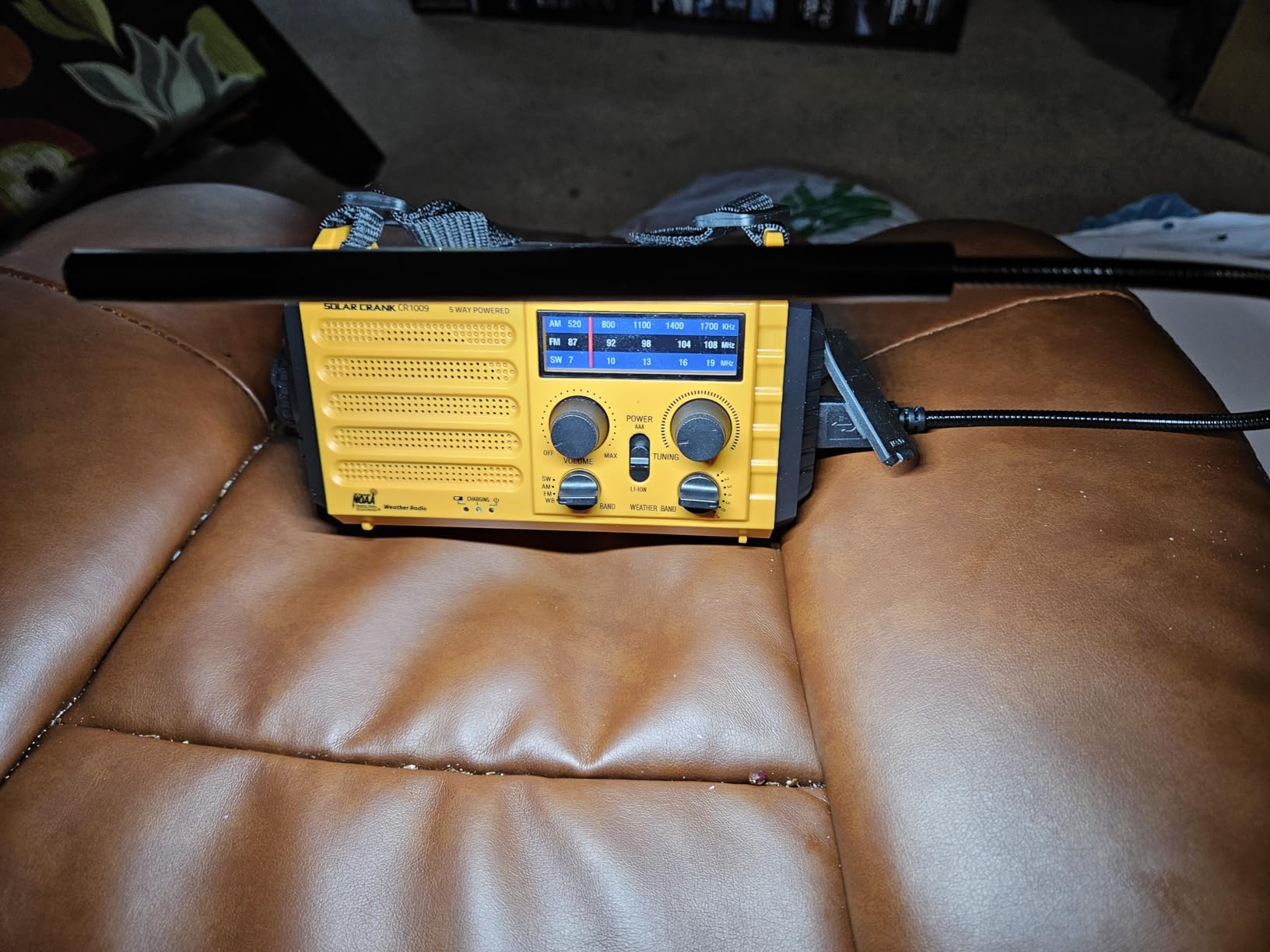
The 3W LED flashlight is specified to reach up to 80 meters, far beyond anything else in this group, and the 2.5W reading lamp lights a 20 square meter area across six LEDs on two brightness levels.
A telescopic antenna, a 3.5mm headphone jack and an included compass make it a complete grab-and-go unit. USB output can charge more than one phone, though slowly at around 1 amp.
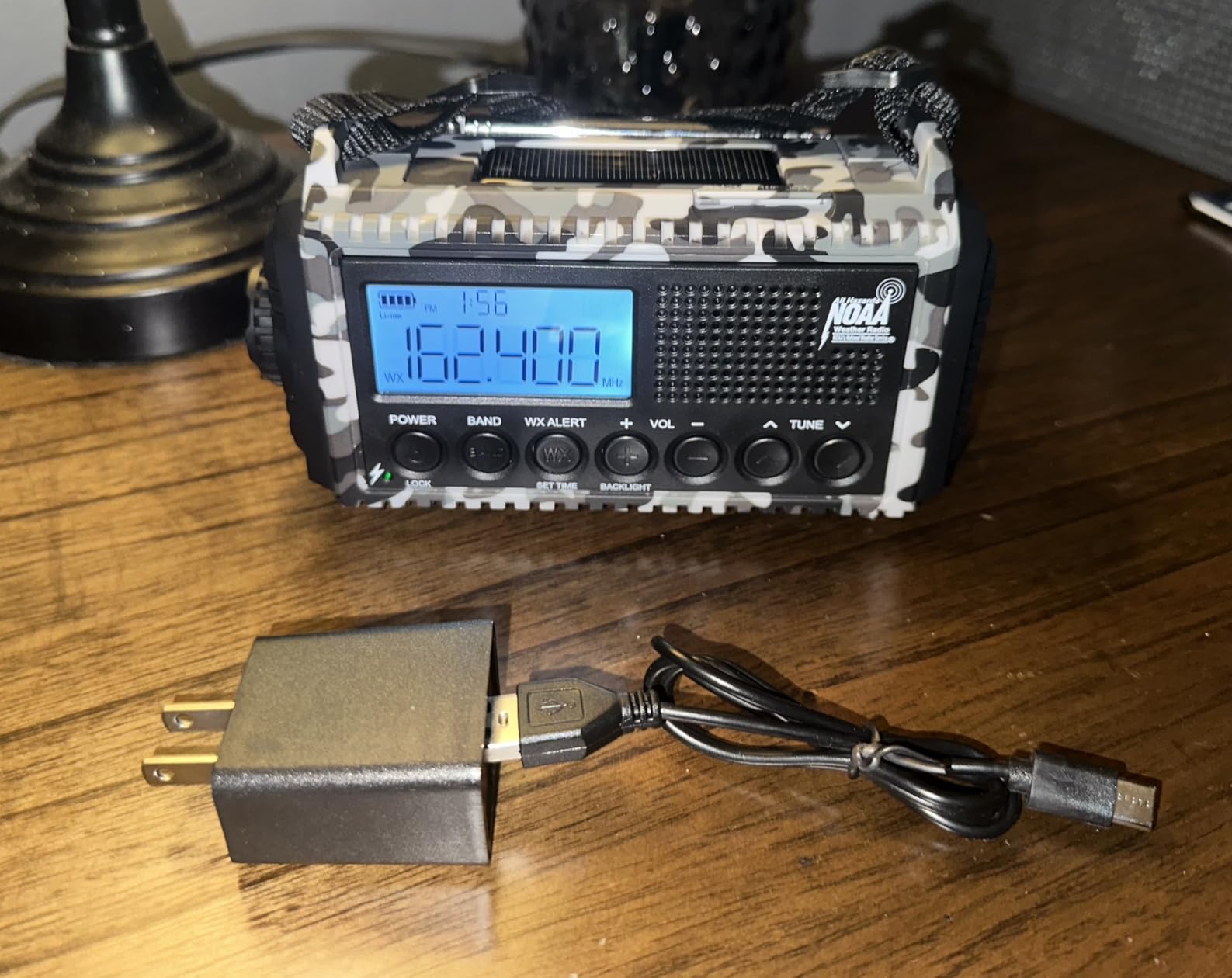
Check this before buying if you listen to radio constantly
This is the one limitation to understand before buying. The NOAA alert only sounds in standby or alert mode, so if you leave it tuned to a broadcast band you will not get the warning.
That single behaviour matters more than any spec here, so read the manual and set it to standby the moment you put it away.
Check this before buying for long-term storage
The internal lithium battery is not user replaceable, so once it ages the radio is finished. The AAA compartment is a genuine backup path, but only if you install those cells deliberately.
AM reception is weak with no automatic gain control, so volume needs readjusting between stations. The warranty is one year with a three-month replacement window.
8. Midland ER310 Emergency Crank Radio – Best for AA Battery Simplicity
Midland – ER310, Emergency Crank Weather AM/FM Radio – Red/Black
6 included AA batteries
NOAA scan and alert with SOS flashlight
Alerts sound over broadcast listening
Large 9.6 inch body at 16 ounces
Pros
- Established US emergency radio brand with a long NOAA track record
- NOAA alerts can sound while you are listening to a broadcast band
- Uses standard AA batteries which are easy to source in a crisis
- Built-in SOS flashlight and ultrasonic dog whistle
- Large form factor is easy to operate with gloves or in the dark
Cons
- Most expensive unit in this group
- AM and FM only with no shortwave coverage
- Cannot be operated while plugged in for charging
- Not water resistant
Midland is the established name in US emergency radio, and the ER310 is what many households end up owning after a hurricane. Buyers choose it for brand trust and proven NOAA behaviour rather than feature count.
The behaviour that matters is exactly the one that trips up other models here. NOAA alerts sound while you are listening to a broadcast band, so you can leave it on local radio and still get a warning.
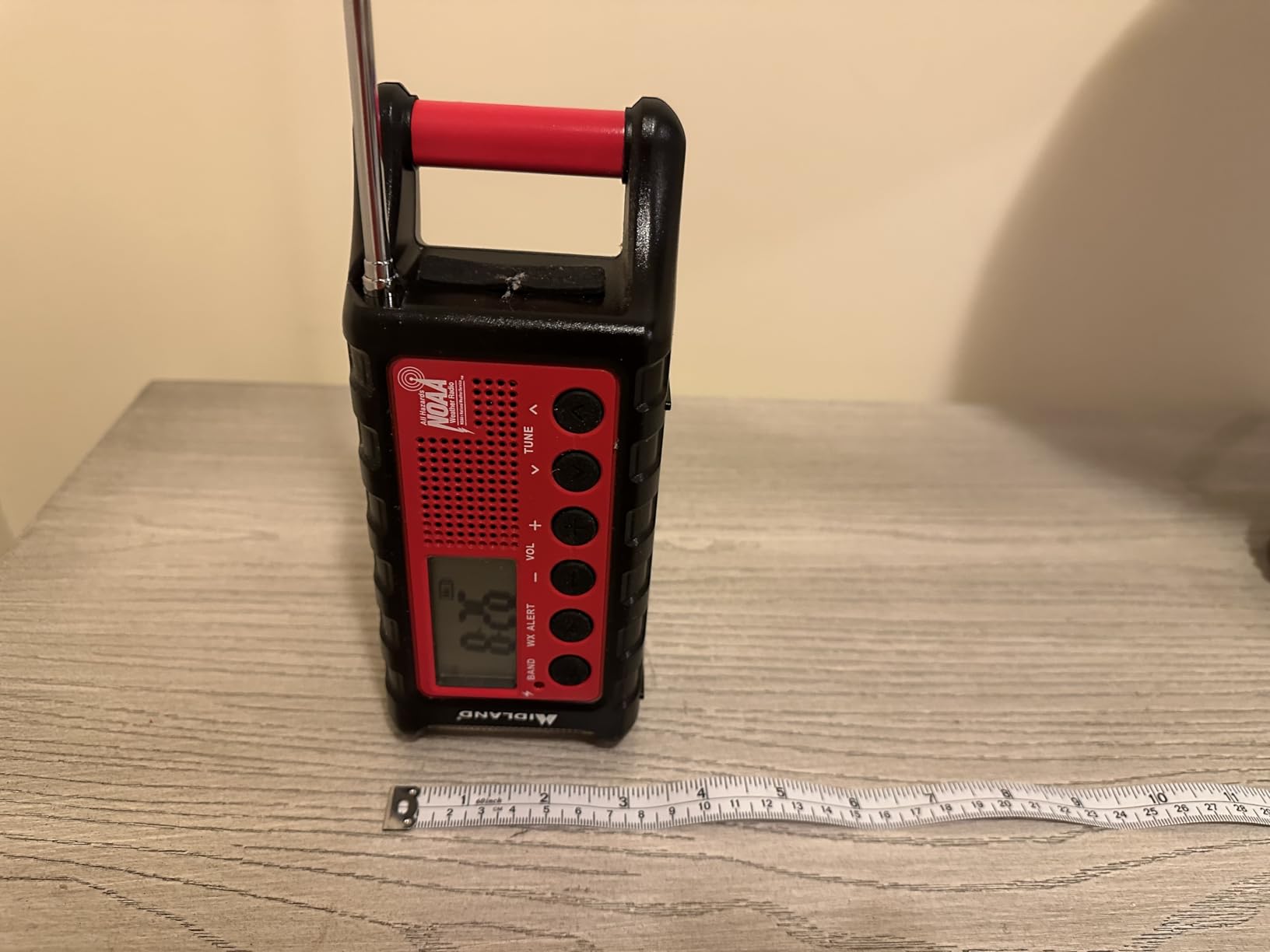
Power comes from a hand crank, solar panel and six AA batteries that are included in the box. Standard cells are the most available power source on earth during a crisis, and that is a genuine resilience argument.
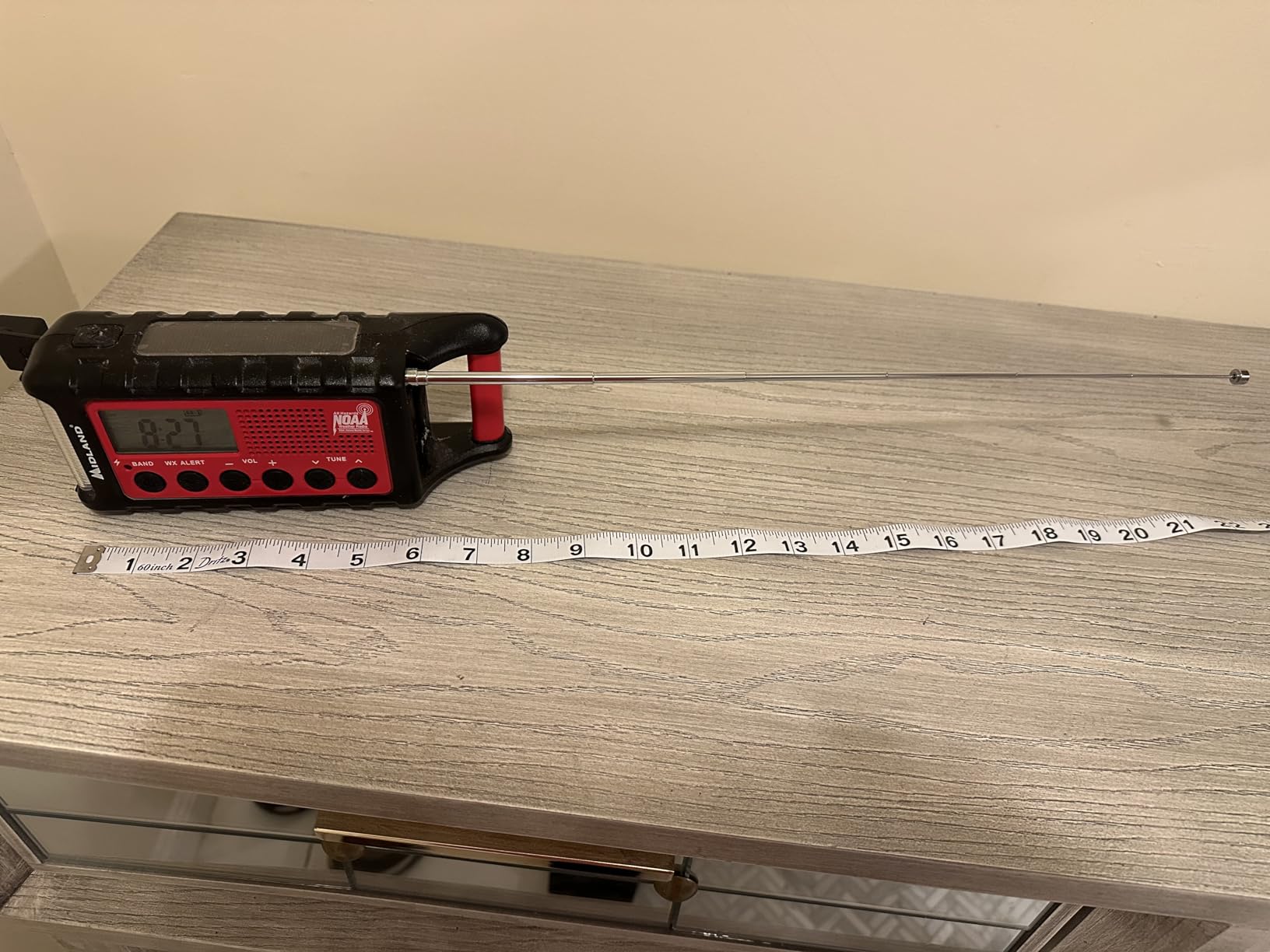
At 9.61 by 2.95 by 6.85 inches and 16 ounces it is the largest radio here, and the physical size is a feature: big controls are easy to work with gloves on or in the dark.
Check this before buying on value alone
This is the most expensive radio in the roundup and you are not paying for extra features. You are paying for a certified brand, a predictable NOAA alert path and a battery type you can buy anywhere.
If your budget is fixed and flexible, a mid-range model gives you more runtime and more light for less money.
Check this before buying if you need shortwave or water resistance
Bands are AM and FM only, with no shortwave coverage, and the unit is explicitly not water resistant, so it belongs indoors or in a covered vehicle cabin.
It also cannot be operated while plugged in for charging, which is a small operational quirk worth knowing before you need it.
9. Leaton 10000mAh NOAA Hand Crank Radio – Best for Outage Power
Leaton Hand Crank Emergency Radio, NOAA Weather Radio AM/FM,10000mAh
10000mAh internal battery
IPX6 splash and spray resistance
3-mode flashlight with SOS
3 charging modes including USB-C
Pros
- Largest battery capacity in the group at 10000mAh for 1-1.5 phone charges
- IPX6 splash resistance is the best water rating among the compact models
- Large tuning knob and controls are easy for seniors and families
- USB-C charging is faster and more convenient than older micro-USB
- Built-in compass and carry strap included
Cons
- Solar panel is largely ineffective even after days of sun
- No SAME automatic alert capability so alerts are not location specific
- No headphone jack and no shortwave band
- AM reception is weaker and works best outdoors
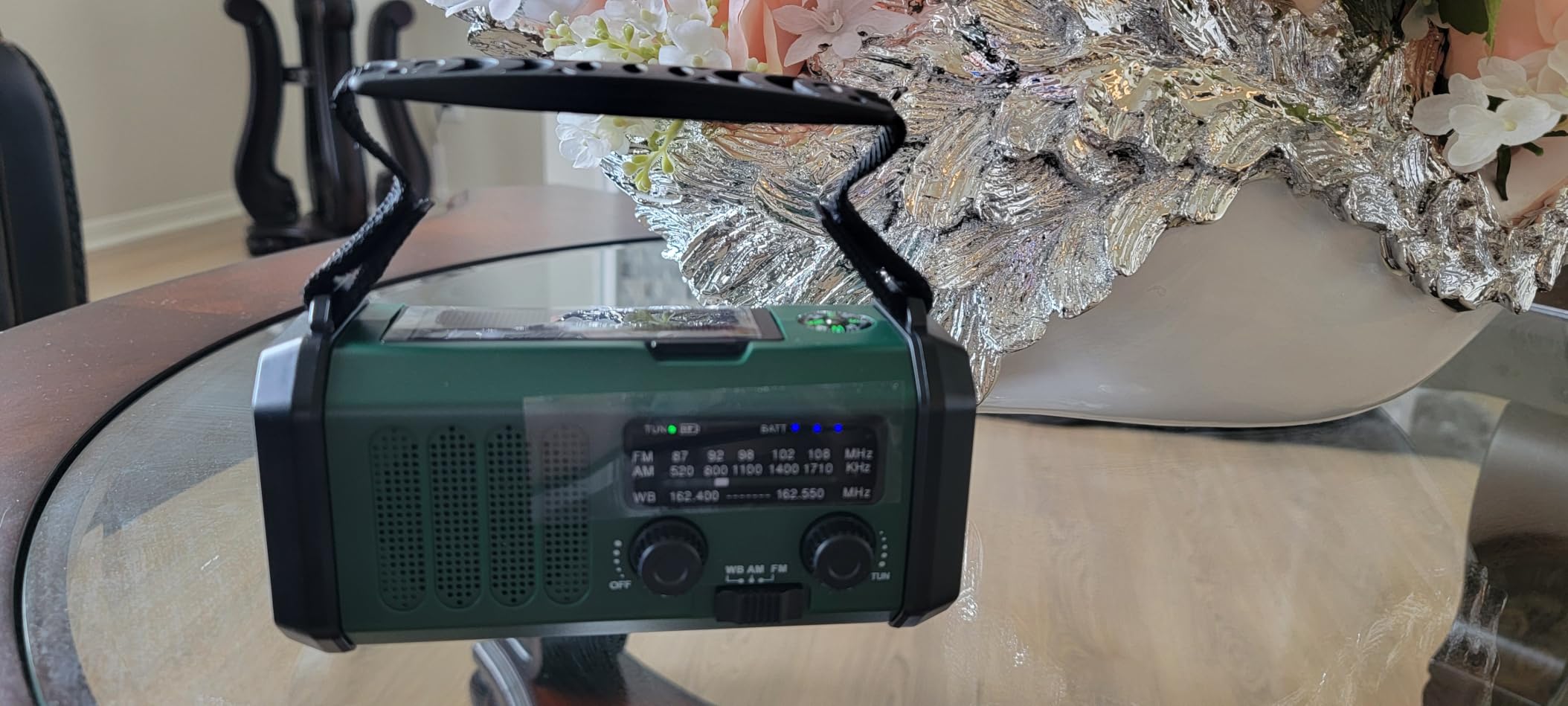
The Leaton wins on raw capacity. A 10000mAh internal battery is the largest here and works out to roughly one to one and a half iPhone 14 charges, which changes what a radio can do during a long outage.
It is also the best water-protected compact unit we tested, with an IPX6 rating for splash and spray resistance. That rating is a genuine step up from the vague water-resistant language most brands use.
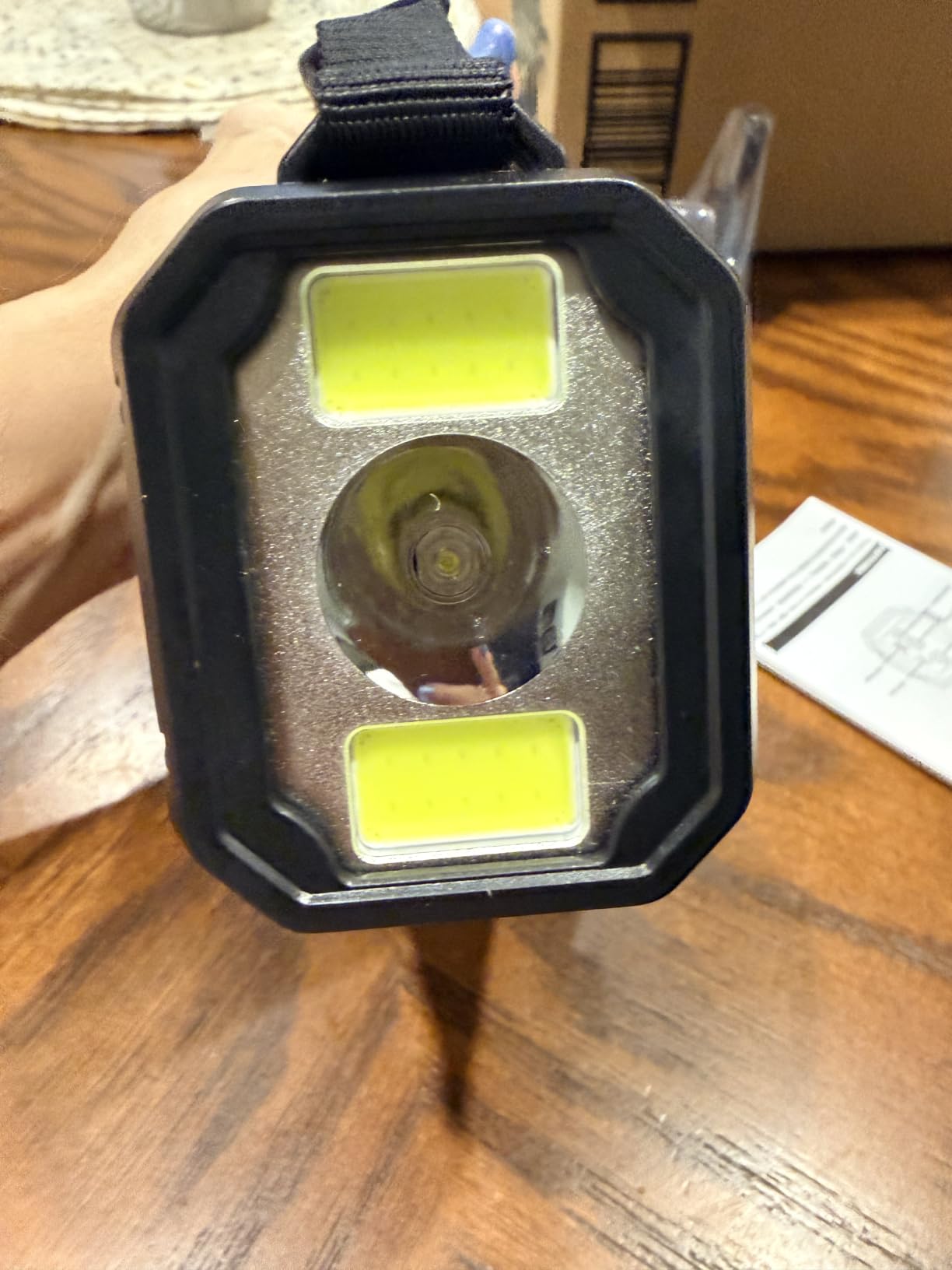
Controls are deliberately simple. A large tuning knob, a high-sensitivity antenna, a three-mode flashlight with SOS signalling and a 1.3W reading lamp, and manual tuning means nothing to learn at 2am.
USB-C replaces the older micro-USB on most competitors and charges faster. A USB-C cable and manual are in the box, and the maker advises recharging every 3 to 6 months during storage.
Check this before buying if you need automatic local alerts
There is no SAME capability, so the alerts are not filtered to your location. In a county where your own warning is the only one that matters, that is a real gap.
You will need to stay on the relevant channel manually rather than trusting a targeted alert to reach you.
Check this before buying if you plan to rely on solar
Owners report the solar panel is largely ineffective, with multiple days of sun producing a fraction of a charge. Budget for USB-C charging as your only real top-up path.
There is no headphone jack, no shortwave, and AM reception is weak, working best outdoors where the antenna clears obstructions.
10. Nitigo 4000mAh NOAA Solar Radio – Best for Antenna Reception
NITIGO Emergency Weather Radio, 4000mAh NOAA Weather Radio Solar Charging
4000mAh with USB output for phones
Adjustable high-gain antenna
Retractable 180-degree reading lamp
Waterproof body at 300 grams
Pros
- Adjustable high-gain antenna gives noticeably strong reception
- 4000mAh battery for emergency phone and tablet charging
- Retractable 180-degree rotating reading lamp is genuinely useful
- Three continuous power options including solar crank and USB
- 3.5mm headphone jack for private listening
Cons
- No shortwave band coverage
- Lacks SAME automatic location-based alerts
- Newer listing with a much smaller review base than established models
The Nitigo is the one to look at if NOAA reception in your area is the deciding factor. Its adjustable high-gain antenna is the most substantial antenna in the compact group, and owners consistently single out reception quality as the reason they keep it.
Antenna matters more than most spec sheets admit. Transmitter distance and terrain decide whether you hear a warning, and a tunable antenna is the cheapest way to improve your odds.
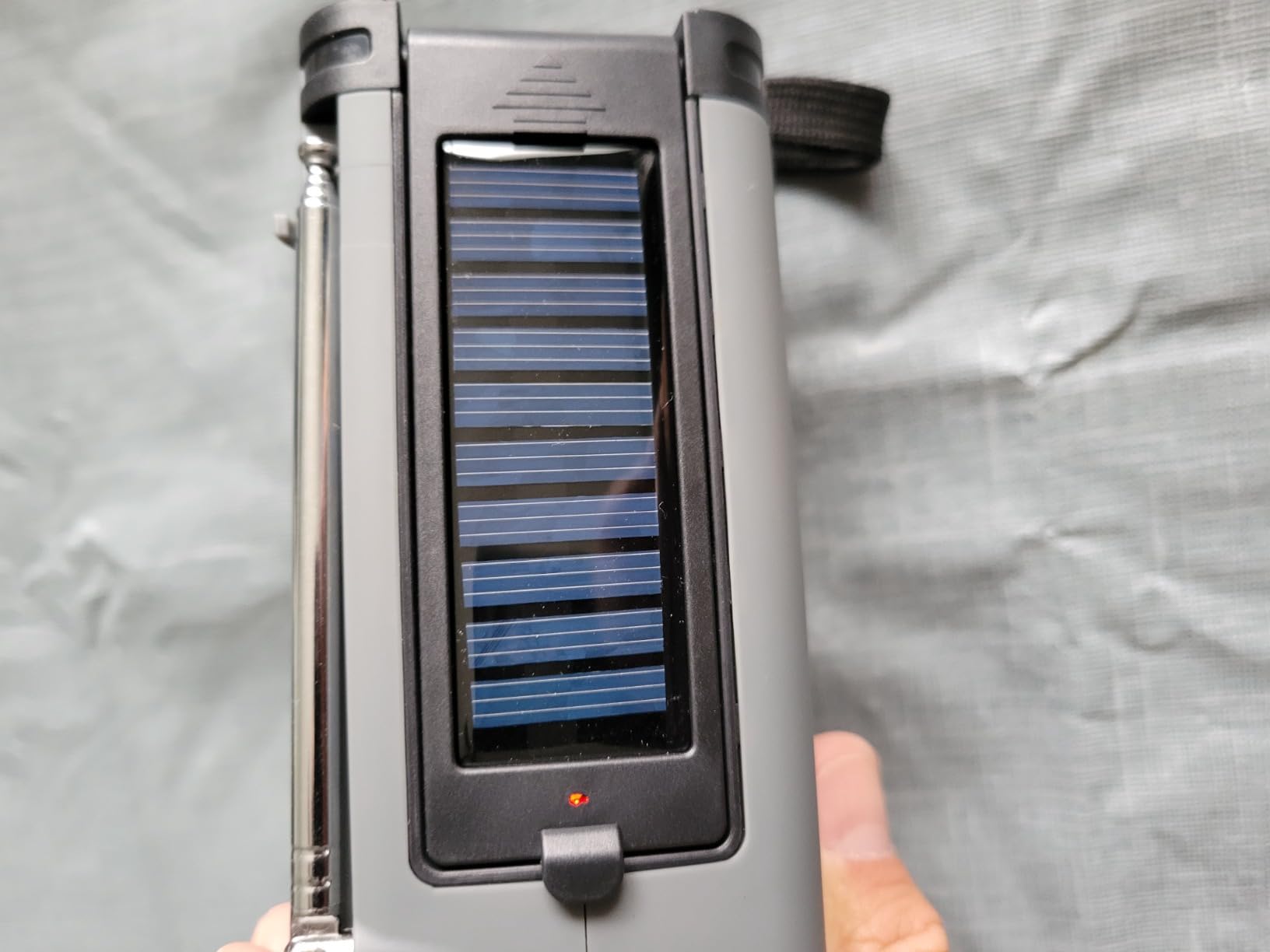
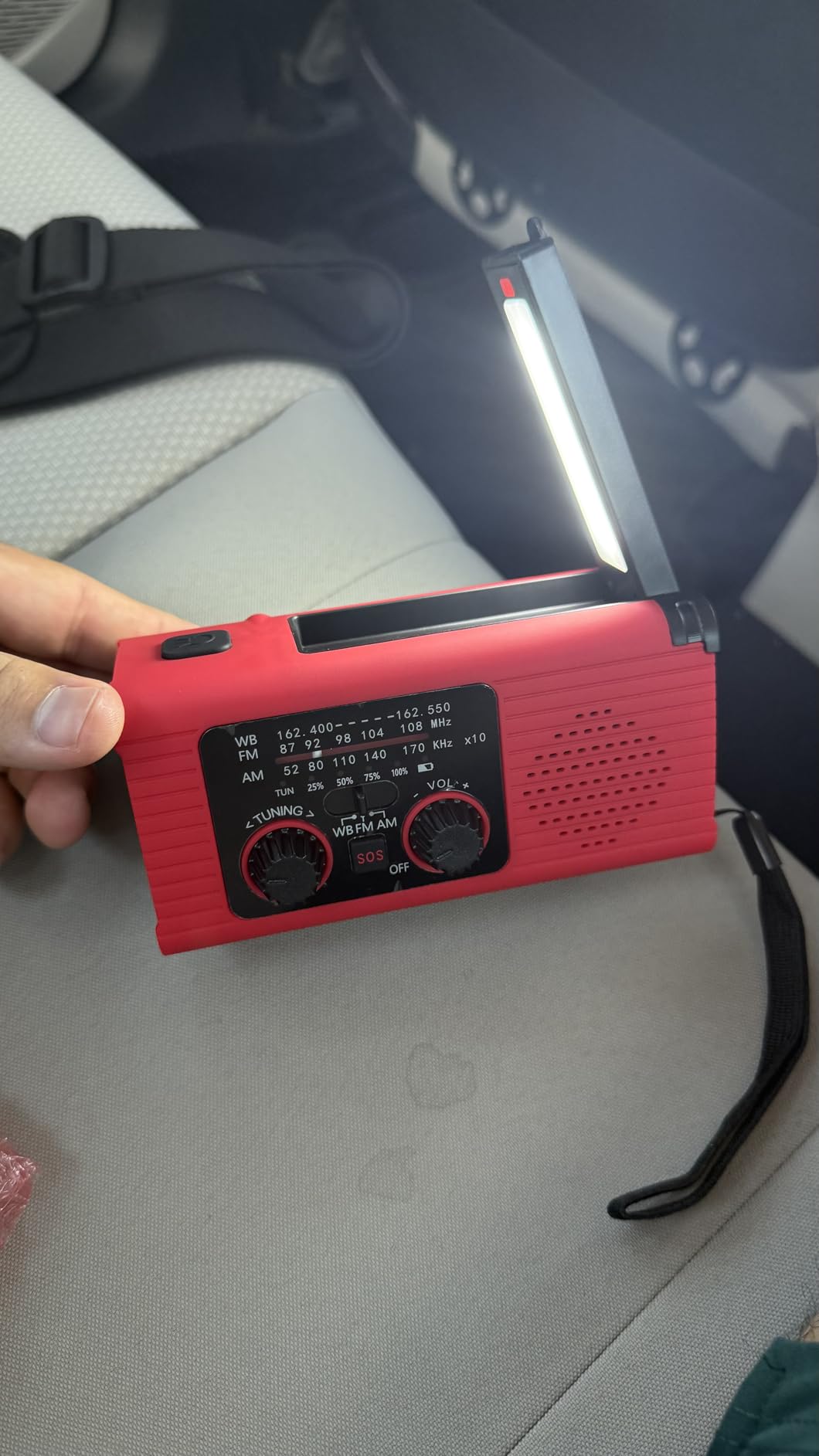
The 4000mAh and 14800mWh pack outputs USB for phones and tablets, and the rotating 180-degree retractable reading lamp is a better design than a fixed panel, letting you aim light rather than guess at it.
Solar, hand crank and USB give three continuous power options. There is a loud SOS alarm with a flashing light, a 3.5mm headphone jack, and the body is listed as waterproof at 300 grams.
Check this before buying if warning coverage at home is uncertain
Listen to a NOAA broadcast at your kitchen table before you commit. If the signal is weak where you sleep, a high-gain antenna is the feature that fixes it, and this unit leads the group there.
It lacks SAME automatic location-based alerts, so the reception improvement has to be paired with your own channel discipline.
Check this before buying if buying power of proven history matters
This is a newer listing with 1668 ratings, far fewer than the established names here. That means less long-term durability feedback, which is a real consideration for a device you may keep for a decade.
There is no shortwave band, and the review base being smaller is the single biggest reason this sits at number ten rather than higher.
11. yesiwtc 2000mAh Solar Hand Crank Radio – Best Built-In Cable Set
Hand Crank Emergency Radio 7400mWh (2000mAh) Solar Hand Crank Radio
2000mAh with 3 built-in charge cables
Extended antenna with DSP chip
3-mode flashlight and 6 reading LEDs
4 power sources including AAA
Pros
- Three built-in charging cables mean no cable hunting in an emergency
- Durable casing that survived multiple drops
- Internal battery lasts close to 22 hours of combined radio and light use
- Solar panel doubles as a bright reading light
- AAA battery backup compartment
Cons
- 2000mAh capacity is small and drains quickly once a phone is charged
- Solar panel produced about one bar of charge after a full day of sun
- Only AM FM and weather band with no shortwave
- Li-ion battery is not user replaceable
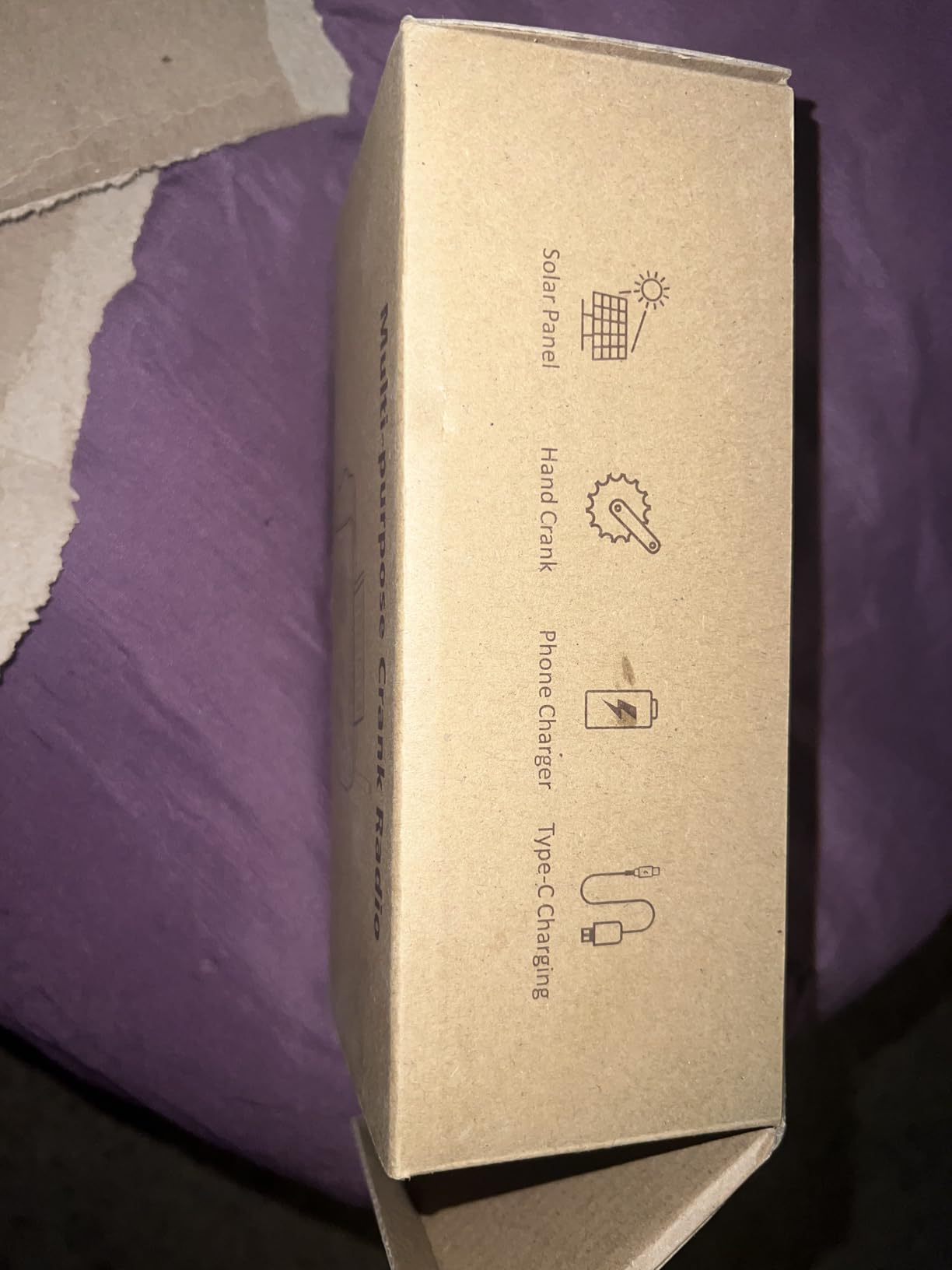
The detail that makes this one stand out is the three built-in charging cables. Lightning, USB-C and micro-USB are stored in the body, so during an outage nobody wastes twenty minutes hunting a cable in a dark drawer.
Owners who live through hurricane seasons buy multiples specifically for that reason, and also for the drop durability, which several describe as surviving multiple falls without damage.
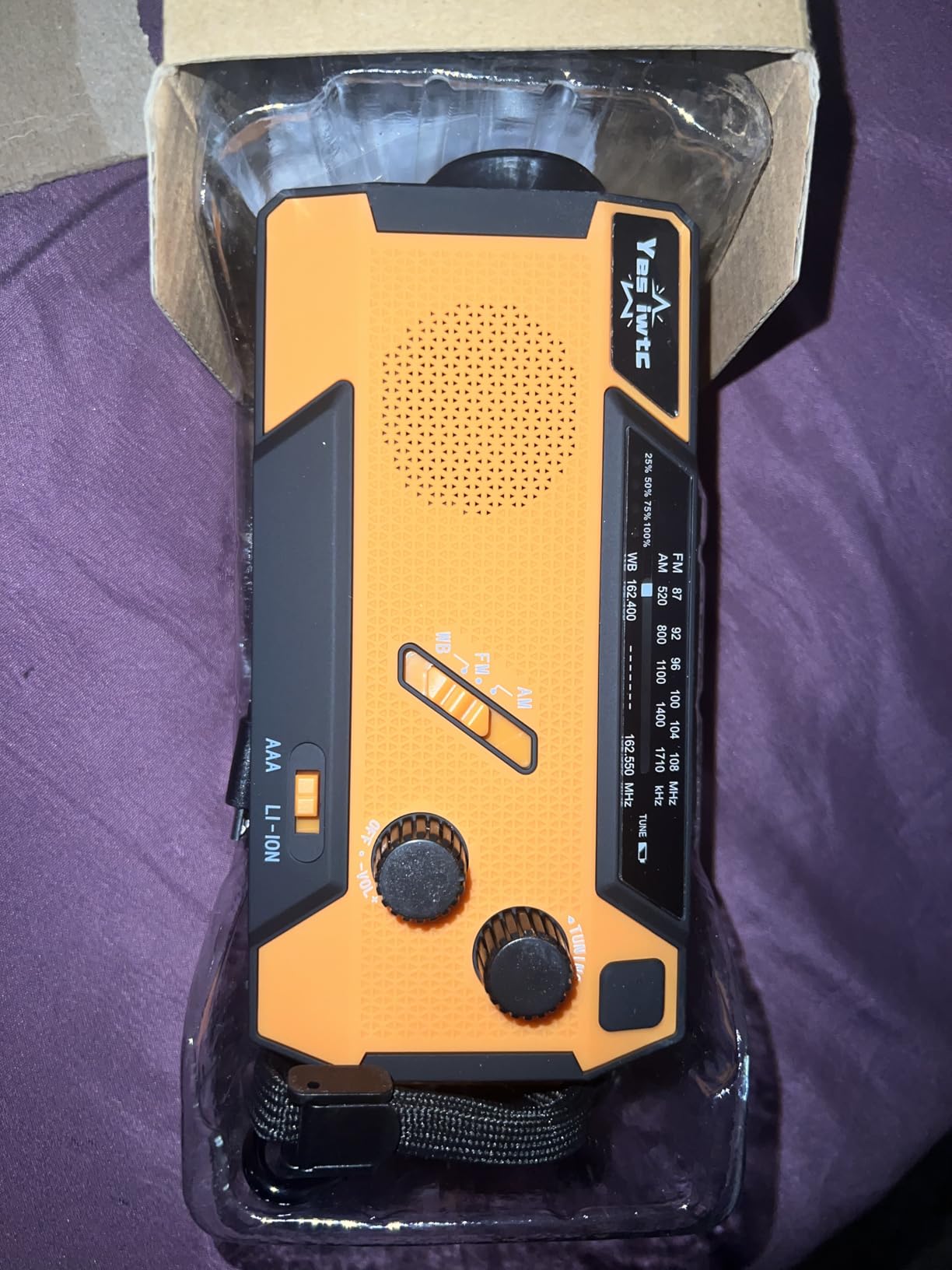
Reception uses an extended antenna with a DSP chip for NOAA, AM and FM, which tends to make marginal signals more usable than a plain analog tuner. The 3-level flashlight and six LED reading lights cover lighting, and the solar panel doubles as a bright reading surface.
Runtime is the weak side. The 2000mAh pack gives close to 22 hours of combined radio and light use, but that figure drops fast once a phone is plugged into it.
Check this before buying if phone charging is your main goal
Two thousand milliamp-hours is enough to bring a phone partway up, not enough to fully charge one and then keep listening. If the radio is your main outage power, choose a larger cell.
The good news is the cables are the right ones. A partial charge from a device you can plug straight in is often more useful than a full charge you cannot connect.
Check this before buying if you rely on solar or want shortwave
Owners report roughly one bar of charge after a full day of sun, so treat the panel as decoration in a long emergency. The AAA compartment is the fallback that actually works.
There is no shortwave band and the lithium cell is not user replaceable, and the warranty is an 18-month replacement rather than a multi-year term.
12. Emgykit Hand Crank AM/FM/NOAA Radio – Best Budget Flashlight Output
Emgykit Hand Crank Radio with AM/FM/NOAA Weather Band,for Emergencies
140 lumen 3-LED flashlight
80 decibel SOS siren
Hand crank plus solar plus Type-C
2000mAh battery at 0.51 lb
Pros
- 140 lumen 3-LED flashlight is far brighter than the one watt bead on older models
- Best radio reception in the budget category and praised against car radios
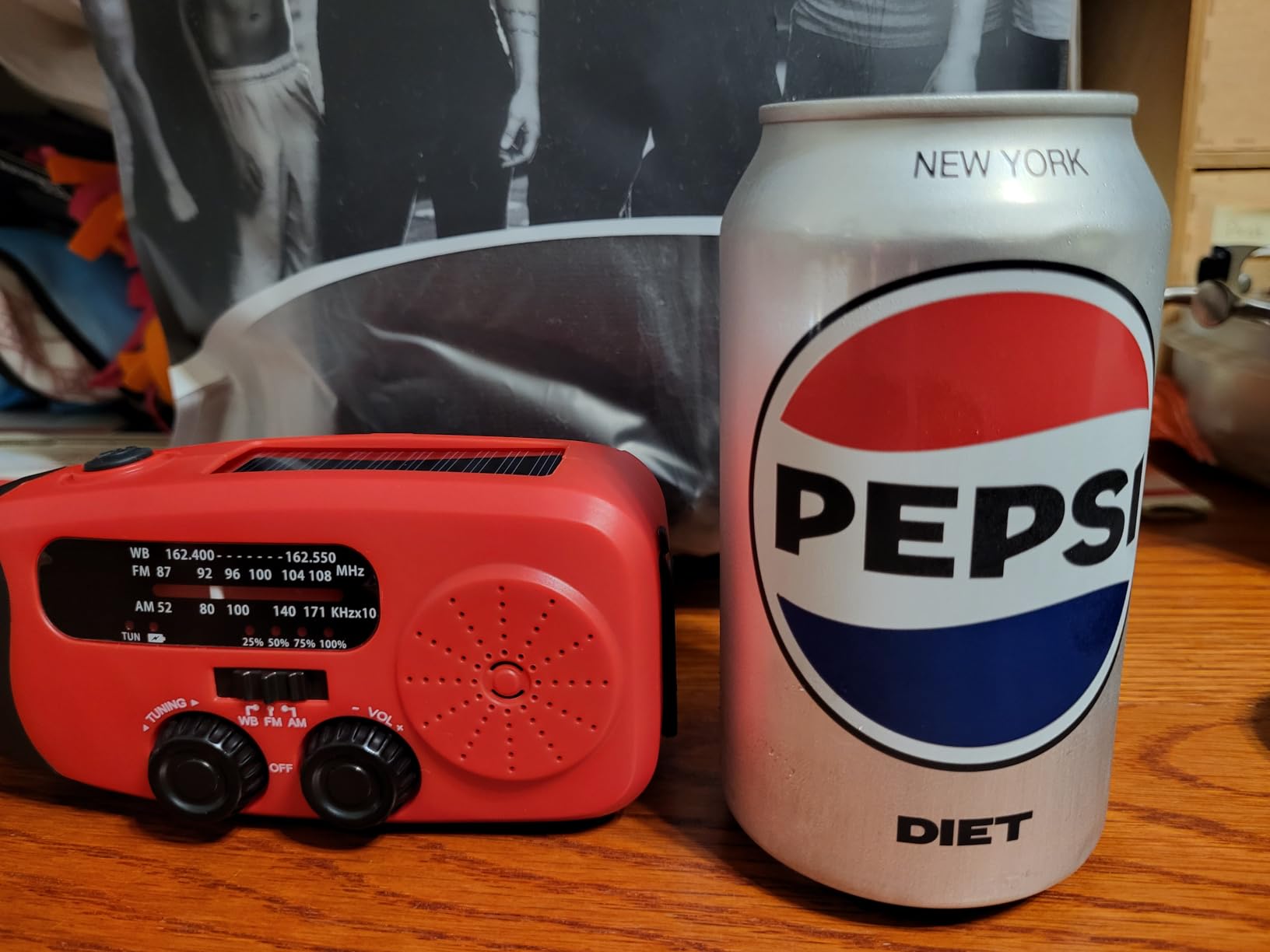
- Compact at 0.51 lb and easy to store in a go-bag
- Three charging methods including hand crank and solar
- Phone charging rescued a real household outage
Cons
- Short-range flashlight output on some copies
- no water resistance rating
- and slow solar and general charging taking 5-6 hours initially
The Emgykit is the reception value pick of this group. Owners compare its signal favorably against car radios, which is a surprisingly high bar for a compact unit and the most common thing reviewers praise.
It also carries an upgraded 3W three-LED flashlight bead at 140 lumens, the same figure as the Esky, and a 2000mAh and 7400mWh battery that can charge a phone.
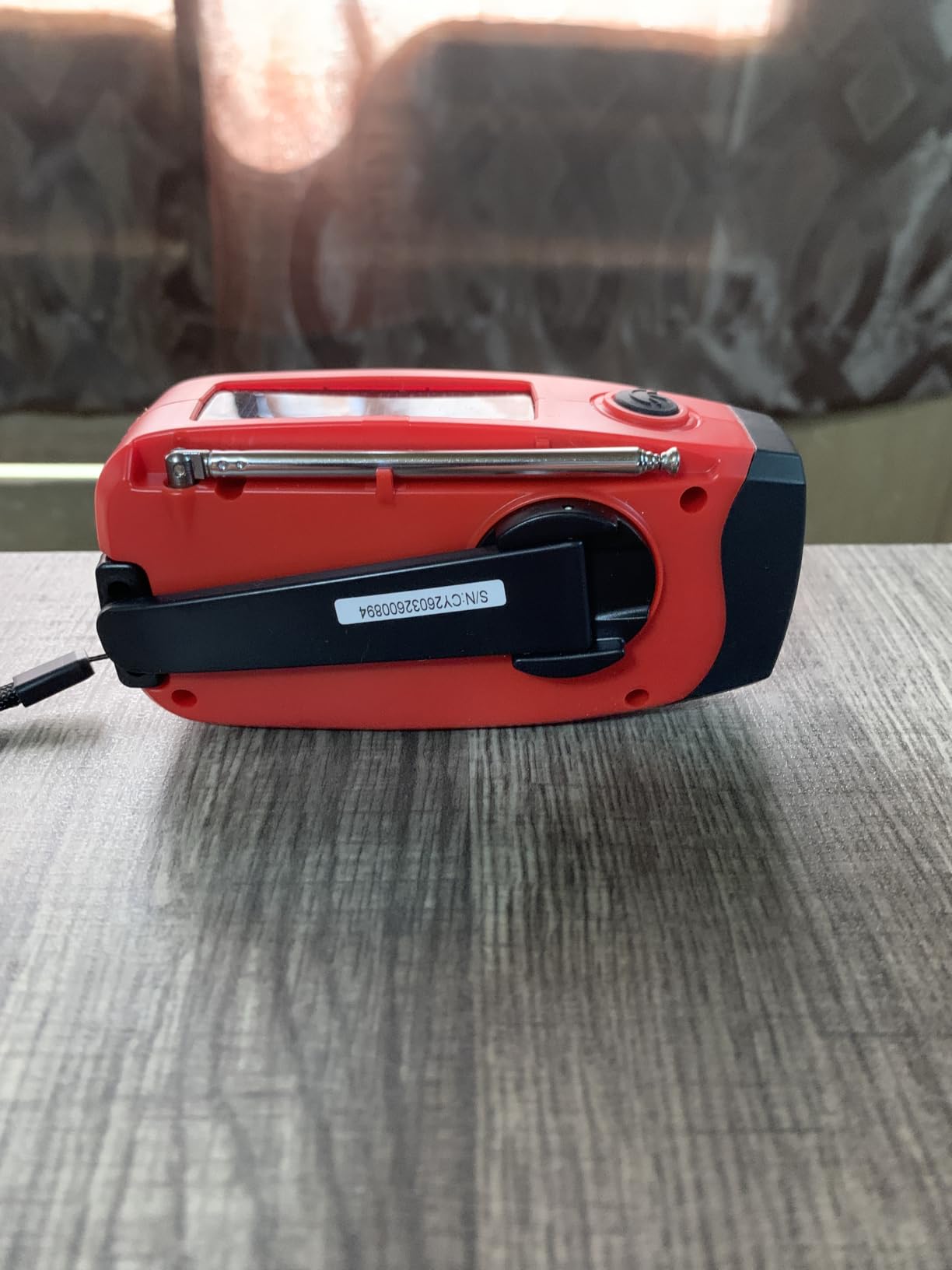
Power comes by hand crank, solar panel and Type-C charging, and the SOS distress siren fires over 80 decibels when you hold the button for three seconds. At 0.23 kg it is one of the easiest units here to carry.
Several owners describe using the phone charging during a real household outage, which is the sort of field report that tells you more than a spec sheet.
Check this before buying if signal quality is your main worry
Reception is the headline here, and it holds up against far more expensive radios in informal owner comparisons. That makes it a strong second or third unit for a house in a weak-coverage area.
The catch is that the build is plain ABS plastic that looks inexpensive, so it is a radio to keep dry and out of impacts rather than one to abuse.
Check this before buying if you need water resistance or fast charging
There is no published water resistance rating, and charging is slow, taking five to six hours initially and longer in weak sun. Plan a power bank alongside it rather than relying on the panel.
Flashlight output is short-range on some copies despite the 140 lumen headline, and bands are limited to AM, FM and NOAA.
Buying Guide: How to Choose a Hand Crank Emergency Radio in 2026
Most of the wrong purchases in this category come down to two misunderstandings. The first is that a hand crank recharges the battery. The second is that a weather radio and a two-way radio do the same job. Sorting both out first will save you more than any spec comparison.
Crank reality check: power versus charge
Turning the crank spins a dynamo that produces enough current to run the receiver and light. On most of the models here, that current goes to the device and not into the stored battery. The solar panel has the same problem: it maintains a charge and generally will not revive a dead one. Reviews of several units in this roundup describe multi-day sun producing only a fraction of a charge.
So plan your recovery path around USB charging and replaceable cells. The radios with AAA or AA compartments, including the Midland ER310 and the Kaito KA500, are the ones that can be brought back from flat years later.
NOAA radio versus two-way handheld radio
A NOAA weather radio is a one-way broadcast receiver. It receives official alerts and forecasts and it does not transmit. A two-way handheld radio lets you talk to other people, which is a genuinely different use case and worth researching separately if you want that capability.
Neither substitutes for the other. If you want to coordinate with others rather than receive warnings, our guides to the best GMRS radios and the best ham radios cover that side. For long-distance broadcast listening, see our best shortwave radios guide.
How to test a hand crank emergency radio monthly
Turn it on and tune your local NOAA station by hand so you know the frequency before you need it. Run the battery indicator and note the level. Send a test charge over USB so the internal cell stays healthy while it sits in storage. Listen for your local alert tone and confirm the siren wakes you. And ask a family member to find the radio without you, because an unreachable device is the same as no device.
Battery type: sealed lithium versus replaceable cells
Sealed lithium gives you more capacity and USB phone charging, which is why most people choose it. The cost is a fixed lifespan. Replaceable NiMH or AA compartments, found on the Kaito and Midland models here, mean a battery problem is a ten-minute fix rather than a replacement device.
For a kit intended to last a decade, weigh that against raw capacity. If the radio is a backup that only runs during an emergency, serviceability often wins. If it is also your outage power bank, capacity wins.
What actually matters before you buy
Start with reception in your own location, because a radio that cannot hear a transmitter is useless regardless of its other features. Then confirm the alert behaviour, since some units only sound NOAA warnings in standby mode. After that look at independent power inputs, speaker wattage for the size of your group, and whether the battery can be replaced.
Check water resistance only if the radio will live outside or in a vehicle. Finally, confirm the radio fits where it will actually live, since a large unit parked in a closet is a unit nobody reaches in time.
Frequently Asked Questions
What is the best handheld radio for preppers?
For receiving official warnings, the best handheld radio for preppers is a NOAA weather radio with multiple independent power inputs. Our top pick is the FosPower A1 at 4.6 stars from more than 37,000 ratings, offering crank, solar, AAA backup and a 7400mWh phone-charging output. If you also want to talk to other people rather than only receive alerts, add a two-way handheld radio, which does a different job entirely.
What is the top-rated hand-crank emergency radio?
The FosPower NOAA Emergency Radio A1 is the top-rated hand-crank emergency radio here at 4.6 stars across more than 37,000 ratings, a review base far larger than anything else in the group. It runs a hand crank, a solar panel and a AAA compartment, and its 7400mWh power bank can bring a phone partway up during an outage.
What is the best radio to have in an apocalypse?
Scenario fit beats spec ranking. For a household listening for warnings, pick a radio with automatic NOAA scanning and a loud siren such as the Raynic. For outdoor kits pick the RunningSnail with its water-resistant body and three-mode flashlight. For a radio that must still work years from now, pick the Kaito KA500, which takes a replaceable battery pack and standard AA cells.
What is the most reliable emergency radio?
Reliability comes from three things: reception in your own location, alerts that fire without you touching the controls, and power inputs you can restore years later. No single model wins all three. The Midland ER310 alerts over broadcast listening and runs AA cells, while the Leaton has a 10000mAh battery and an IPX6 splash rating. Test reception where you sleep before deciding.
How long does a hand crank radio take to charge, and can it charge a phone?
Treat the crank as a power source rather than a charger, because on most models it runs the radio and light without topping up the stored battery. Solar panels maintain charge and rarely revive a dead one. Phone charging is real but slow, roughly 1 amp on several models, and a 2000mAh pack gives a partial charge while a 10000mAh pack gives one to one and a half full charges.
How often should I test my emergency radio?
Test it monthly. Tune your local NOAA station so you know the frequency in advance, check the battery indicator, send a maintenance charge over USB so the stored cell stays healthy, and confirm the siren wakes a sleeping family member. Also give the radio a home you will actually reach, such as a hallway cabinet and a vehicle glovebox, and put a second unit in your go-bag.
Conclusion: The Best Hand Crank Emergency Radio for Preppers in 2026
After working through twelve radios, the FosPower A1 remains our best hand crank emergency radio for preppers because it combines the largest proven review base in the group with a genuinely usable phone-charging output and three independent power inputs. It is not the loudest radio here and not the most rugged, but it is the one with the least uncertainty attached to it.
Buy the Raynic if you want automatic alert scanning and a screen. Buy the Kaito if you want a radio that can still be repaired a decade from now. Buy the Leaton if you need the most outage power in the smallest package, and the Esky or Emgykit if you want a cheap spare for every vehicle in the drive.
Whichever you choose, put it where you can reach it, test it monthly, and know your local NOAA frequency before the lights go out.