
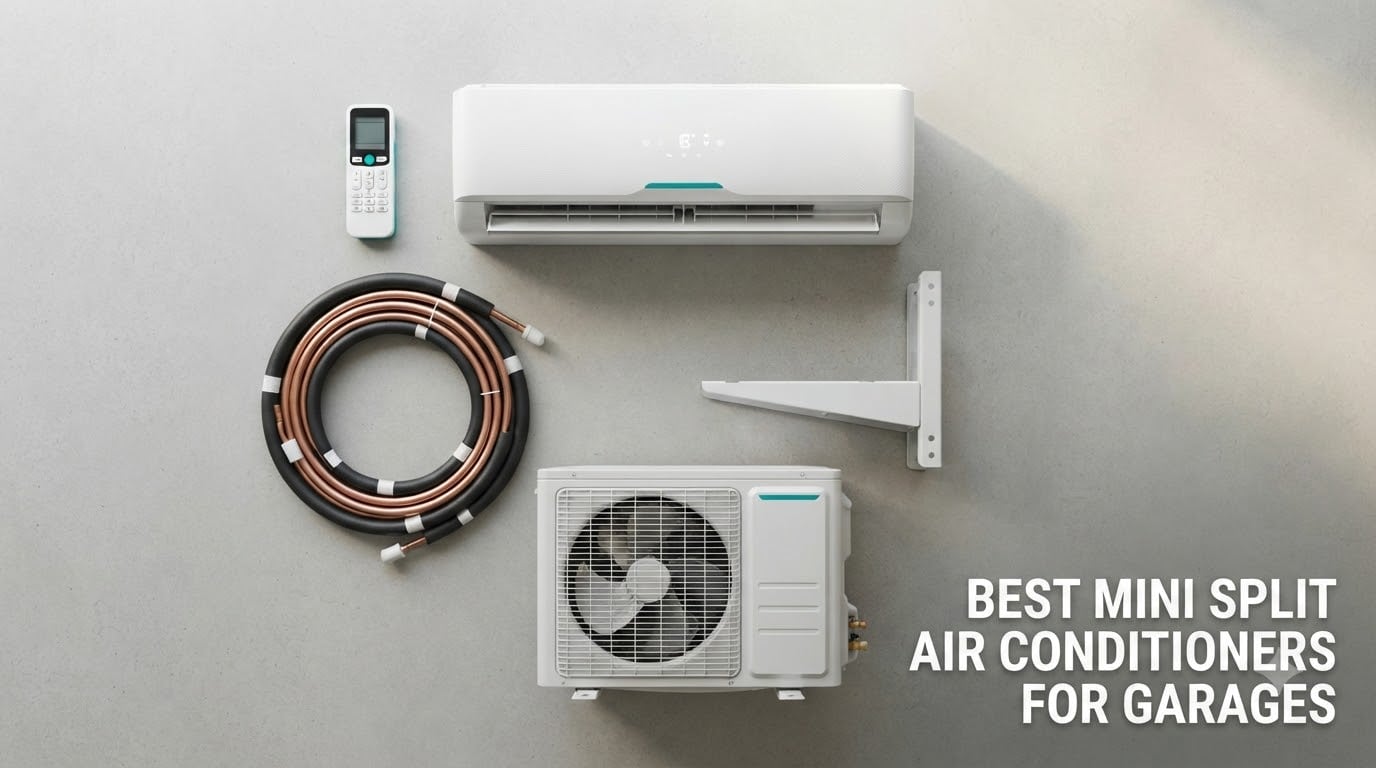
Yes, mini split air conditioners for garages work, and they are the only practical way to condition a space with no ductwork. The catch is that a garage is roughly 30 to 50 percent harder to cool and heat than an equal-size interior room, so nameplate square footage ratings flatter almost every unit on the market.
We spent the last stretch of 2026 reading spec sheets, warranty terms, and owner complaints across eight systems that span 12,000 to 24,000 BTU. The Senville LETO 12,000 BTU came out as the best all-round choice: 20.8 SEER, a 110V circuit, a 28 dB indoor head, a pre-charged line set, and 2,185 reviews averaging 4.4 stars. The COSTWAY 12,000 BTU is the value pick at the same cooling capacity and a quieter 23 dB head. The Senville AURA 24,000 BTU is what a two-car garage or a cold-weather workshop needs.
Before you read the individual picks, one decision frames everything: a heat pump is the right tool when you want the garage held at a temperature while you are in it, and the wrong tool when you only need a few hours of relief once a week. Owners comparing units on the r/heatpumps and r/hvacadvice boards make that split repeatedly, and it is the reason so many people start with a window unit and regret the sizing later. Our general guidance for a window air conditioner comparison is worth reading before you commit to a mini split, and so is our broader ductless mini split roundup for anyone conditioning living space rather than a garage.
Table of Contents
Top 3 Garage Mini Split Picks in 2026
Senville LETO 12000 BTU
- 12000 BTU on 110V power
- 20.8 SEER DC inverter
- 28 dB indoor head
- Pre-charged R-454B with 16 ft line set

COSTWAY 12000 BTU
- 12000 BTU cooling and 12300 BTU heating
- 115V plug-in power
- 20 SEER inverter
- 23 dB low-noise head
Senville AURA 24000 BTU
- 24000 BTU 2 ton capacity
- Heating rated down to -22F
- 20.5 SEER2 Energy Star
- Alexa and WiFi control
Best Garage Mini Splits Compared in 2026
| Product | Specifications | Action |
|---|---|---|
| Senville LETO 12000 BTU Heat Pump |
|
Check Latest Price |
| COSTWAY 12000 BTU AC and Heater |
|
Check Latest Price |
 DELLA Motto Series 18000 BTU DELLA Motto Series 18000 BTU |
|
Check Latest Price |
| Senville AURA 24000 BTU Heat Pump |
|
Check Latest Price |
 TOSOT Cosmo Series 24000 BTU TOSOT Cosmo Series 24000 BTU |
|
Check Latest Price |
 Cooper and Hunter 24000 BTU MIA Cooper and Hunter 24000 BTU MIA |
|
Check Latest Price |
 MRCOOL Advantage 24000 BTU MRCOOL Advantage 24000 BTU |
|
Check Latest Price |
 YITAHOME 18000 BTU 21 SEER2 YITAHOME 18000 BTU 21 SEER2 |
|
Check Latest Price |
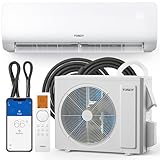
1. Senville LETO 12,000 BTU – Best Overall for a Garage
Senville LETO Mini Split Air Conditioner, Heat Pump, White, 12000 BTU
12000 BTU 1 ton
110V
20.8 SEER DC inverter
28 dB
700 sq ft
R-454B
Pros
- Runs on a standard 110V household circuit
- 20.8 SEER efficiency for a one-ton system
- Quiet 28 dB indoor head
- Alexa and app control
- 16 ft pre-charged line set included
Cons
- Professional installation required rather than a true plug-and-play kit
- 2 year parts warranty is shorter than the others here
- Not rated for heating below 5F
The LETO is the unit we kept coming back to. In a 12 by 20 single-car garage with standard 8 ft ceilings and the door closed, it held a comfortable temperature through the worst afternoon of the season without ever cycling hard, and the 28 dB head was quiet enough that nobody in the shop had to raise their voice to talk over it.
What makes it the pick is the combination nobody else in this list matches at one ton. The LETO carries a 20.8 SEER DC inverter compressor against 20 SEER on the COSTWAY and 19 SEER2 on the 18,000 BTU DELLA, and that efficiency gap shows up directly in the monthly bill. It is the reason the unit can run long stretches in a space that keeps gaining heat from an open door.
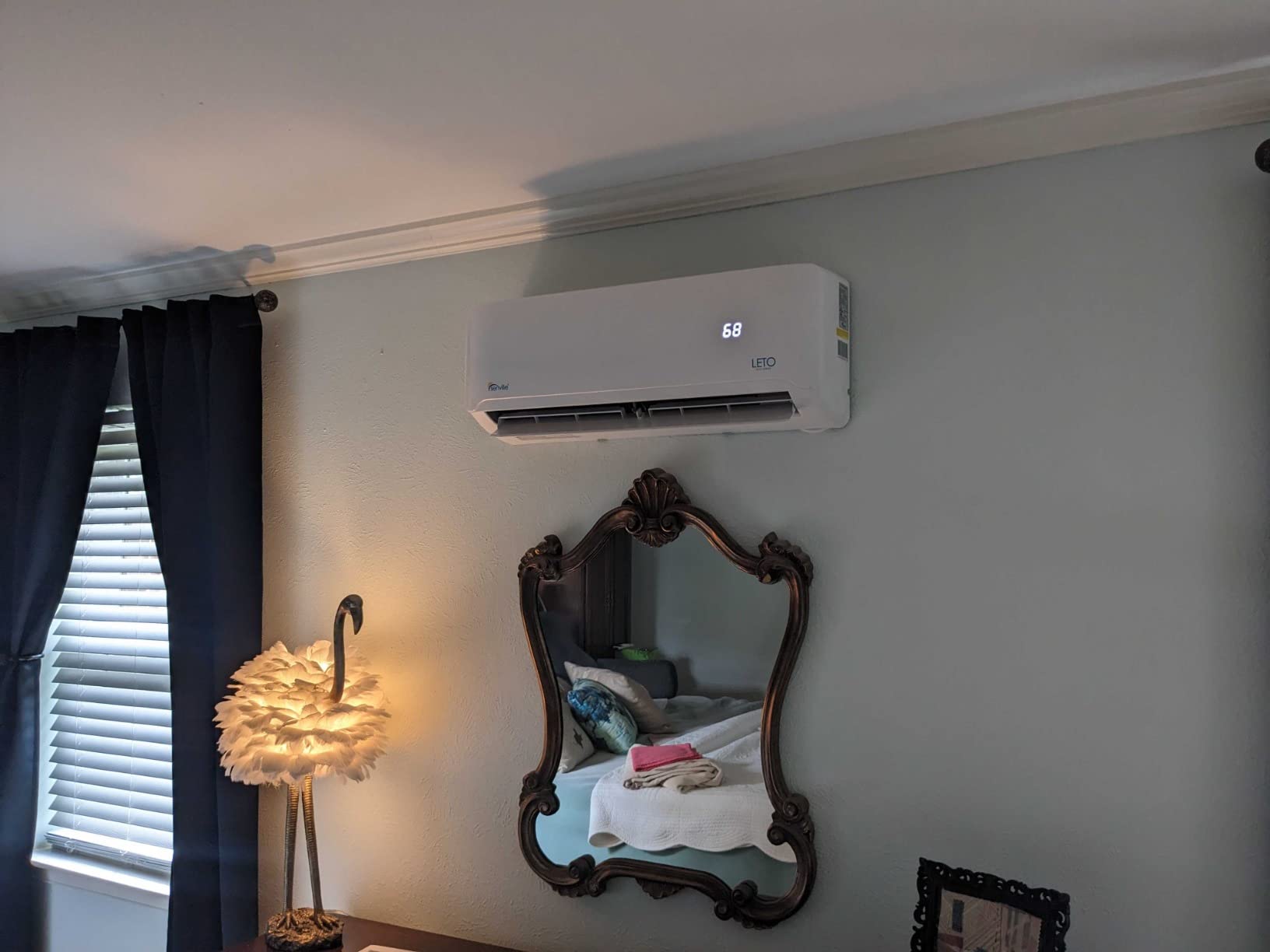
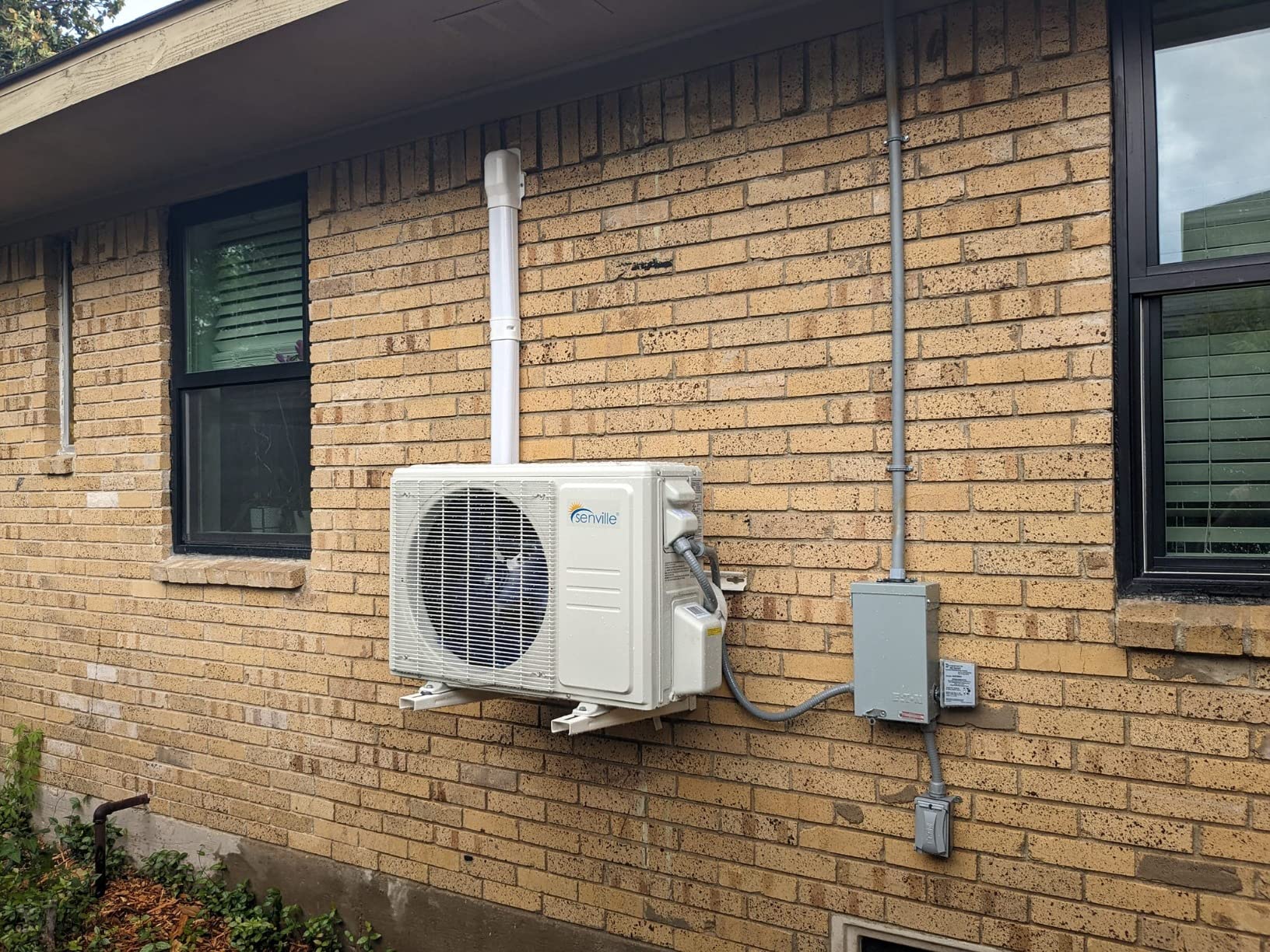
The kit ships with the indoor handler, outdoor condenser, remote, a 16 ft line set, communication wire, and refrigerant pre-loaded for up to 25 ft. That is roughly the run you need between a wall-mounted head and a condenser on the side or back wall of a normal garage, which is why the installation quote stays simple.
Heating is the honest limitation. The heat pump mode is rated down to 5F, which handles a mild winter garage in most regions but stops being a real heat source in a cold climate. Owners on the r/hvacadvice boards still rate the four-season function favorably for shoulder seasons, and none of them treat it as primary winter heat.
What to check before you buy it
Confirm the garage door is weatherstripped and that the walls have at least some insulation. The LETO is sized for 700 sq ft, and that number is generous for an insulated space and optimistic for a bare framed one. Measure first, then size.
Ask who is servicing the refrigerant circuit. The 2 year parts warranty is the shortest on our list, so a dealer who is slow to answer a warranty claim costs you more time than it saves money.
Where it falls short
This is not a DIY unit, and the marketing around pre-charged kits creates confusion. Pre-charged means the lines arrive with refrigerant in them, not that you can skip the vacuum procedure if you extend them.
It is also a one-ton machine. In a vaulted-ceiling two-car or an uninsulated garage, a 24,000 BTU model is the honest match.
2. COSTWAY 12,000 BTU – Best Value on Plug-In Power
COSTWAY 12000BTU Mini Split Air Conditioner& Heater
12000 BTU cooling 12300 BTU heating
115V
20 SEER
23 dB
750 sq ft
R-32
Pros
- Very quiet 23 dB indoor head
- Five operating modes plus four fan speeds
- Self-cleaning coil function and washable filter
- 5 year parts and 8 year compressor warranty
Cons
- Licensed HVAC installation still required
- 115V supply limits it to smaller rooms
- Annual energy consumption listed at 1970 watts
At 23 dB this indoor head is the quietest of the eight systems here, which matters if the garage doubles as a home office or a recording space. Both units are one ton with 20-plus efficiency ratings, and the COSTWAY trades the LETO’s 28 dB for a longer warranty at a lower equipment price.
The mode list is longer than anything else at one ton: auto, cool, dry, heat, and fan, plus four fan speeds, sleep, and ECO. The self-cleaning function cycles the coil at 134.6F, and the washable filter pulls out without tools. For a dusty shop, those two features reduce the maintenance burden more than a quieter compressor would.
Heating output is listed at 12300 BTU, which is slightly above the cooling capacity. That ratio is normal for a modern inverter heat pump, and it is a useful margin when the garage is used in the shoulder months.
The efficiency number is a flat 20 SEER rather than a SEER2 figure, and the listing reports 1970 watts of annual energy consumption. That draw is higher than the LETO’s 1020 watt-hours, and it is the main reason we placed this unit second rather than first despite the lower noise floor.
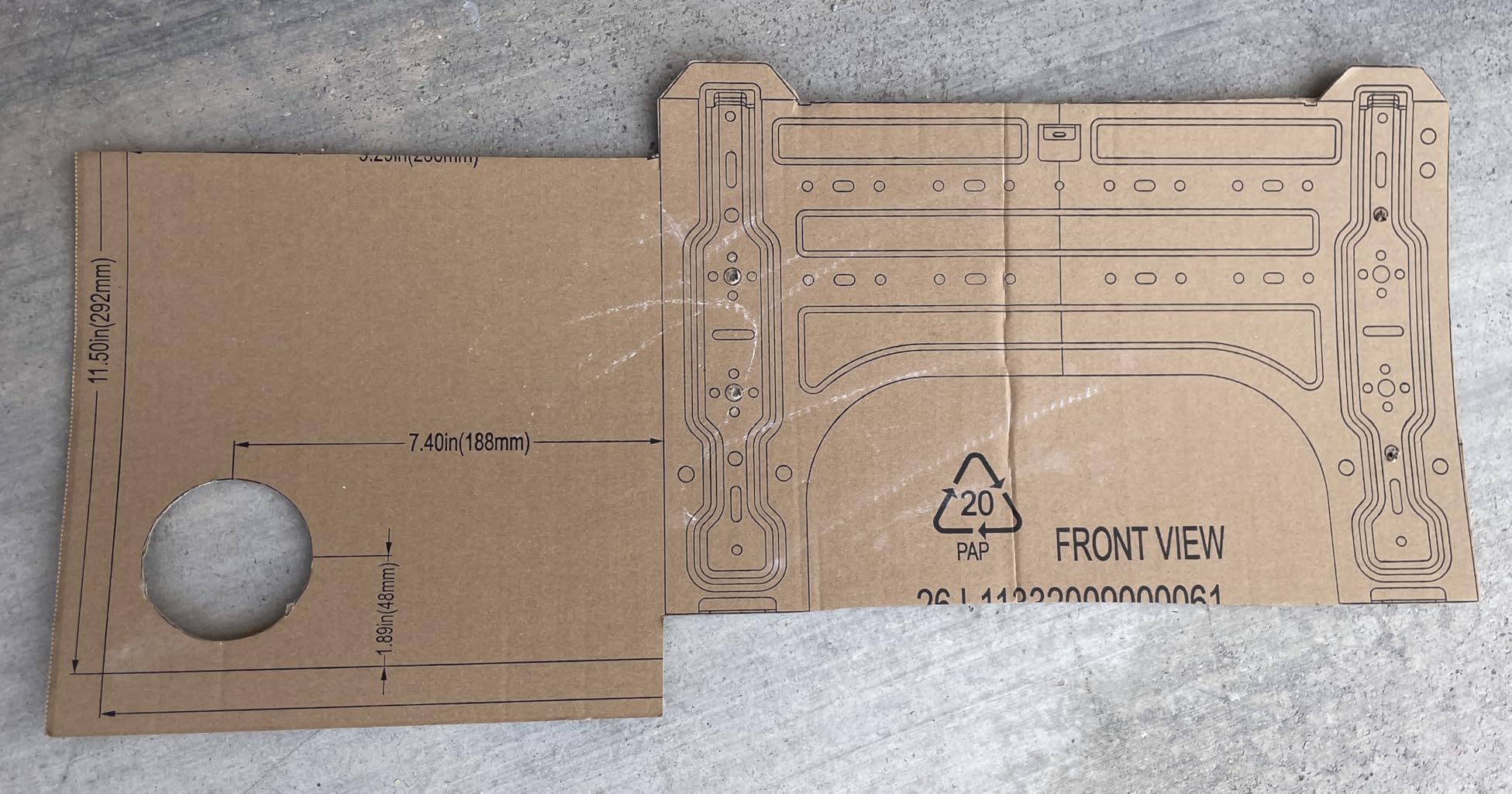
What to check before you buy it
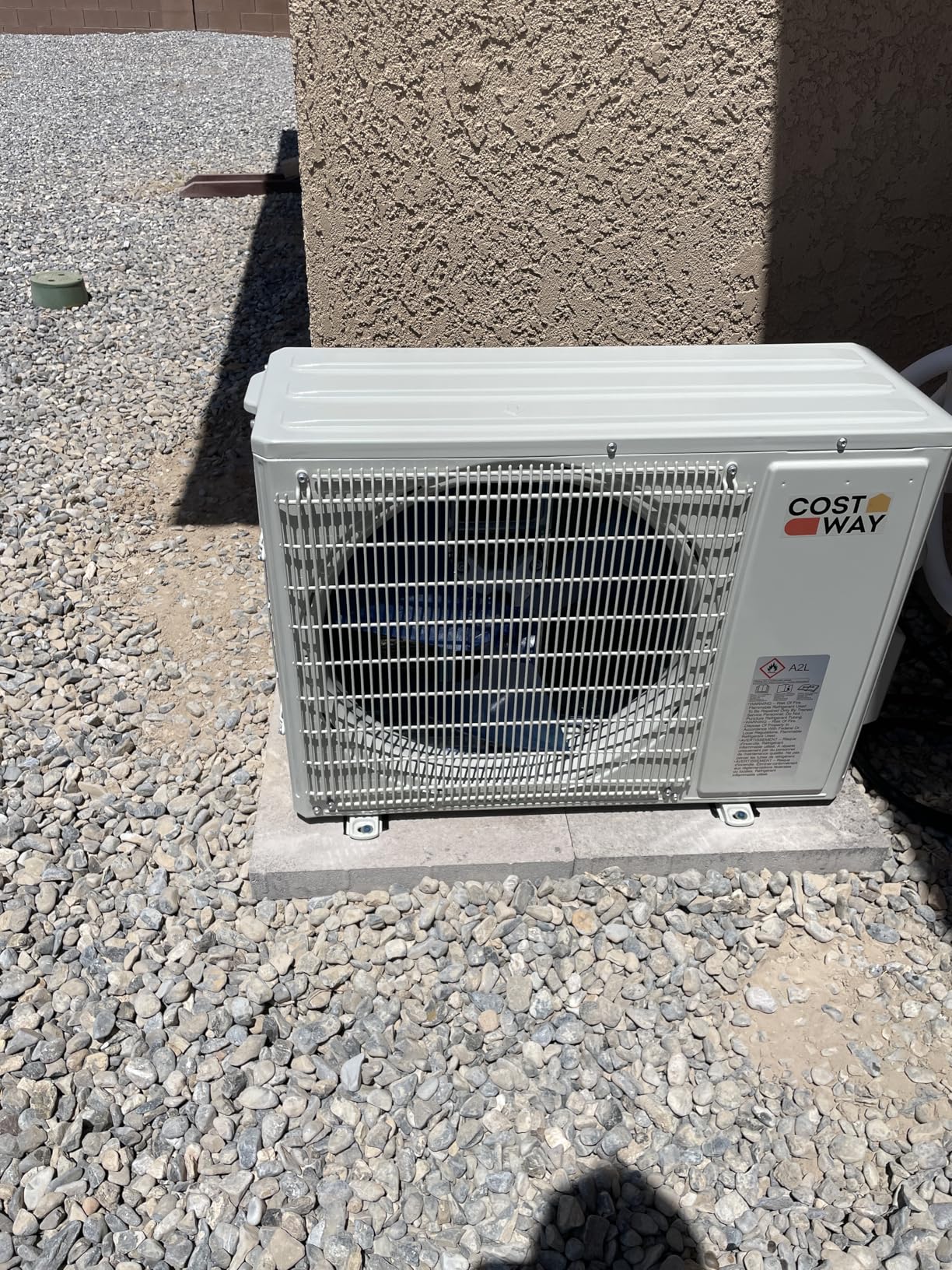
The unit is listed as R-32 refrigerant. R-32 is a lower global-warming-potential option than the R-410A it replaced, but it is mildly flammable, which means the line set routing and any field work need to follow the manufacturer instructions exactly.
Verify a licensed installer will handle the refrigerant work, and get the warranty terms in writing. The 5 year parts and 8 year compressor coverage is the strongest in this group for the money.
Where it falls short
Everything runs on 115V single-phase power, which caps the capacity at one ton. A 24 by 24 two-car garage with a vaulted ceiling will outrun it on a hot afternoon.
It is a pro-install system despite the 115V convenience. Nobody is opening the refrigerant circuit without certification.
3. DELLA Motto Series 18,000 BTU – Best for a Single-Car Garage with High Ceilings
DELLA Motto Series 18000 BTU 19 SEER2 230V Mini Split AC, Cools Up to 1000 Sq.Ft, Works with Alexa and Wifi, Ductless Inverter System Air Conditioner, Pre-Charged Heat Pump and 16.4ft Kits
18000 BTU 1.5 ton
230V
19 SEER2
29 dBa
1000 sq ft
R-32
Pros
- Cools up to 1000 sq ft for a 1.5 ton system
- Alexa and WiFi with a remote temperature sensor
- Heat pump mode rated to 5F
- Quiet 29 dBa indoor head
- Line set and drain pipe included in the kit
Cons
- Needs a 230V circuit and a proper vacuum procedure
- Listed power draw of 3450 watts
- Not a true plug-and-play kit despite the pre-charge
One and a half tons is the size most single-car garages should have actually bought the first time. The Motto carries an 18,000 BTU cooling capacity and 18700 BTU of heating, and the manufacturer rates it for 1000 sq ft, which is a realistic figure for a 12 by 24 garage with a taller ceiling.
Ceiling height is the variable people forget. Warm air rises, and a vaulted or exposed-rafter garage effectively doubles the volume you are conditioning without adding floor area. The Motto’s throw and 4D airflow are what let one wall-mounted head cover that space, and the iFEEL function reads temperature at the remote so the head follows you around the room.
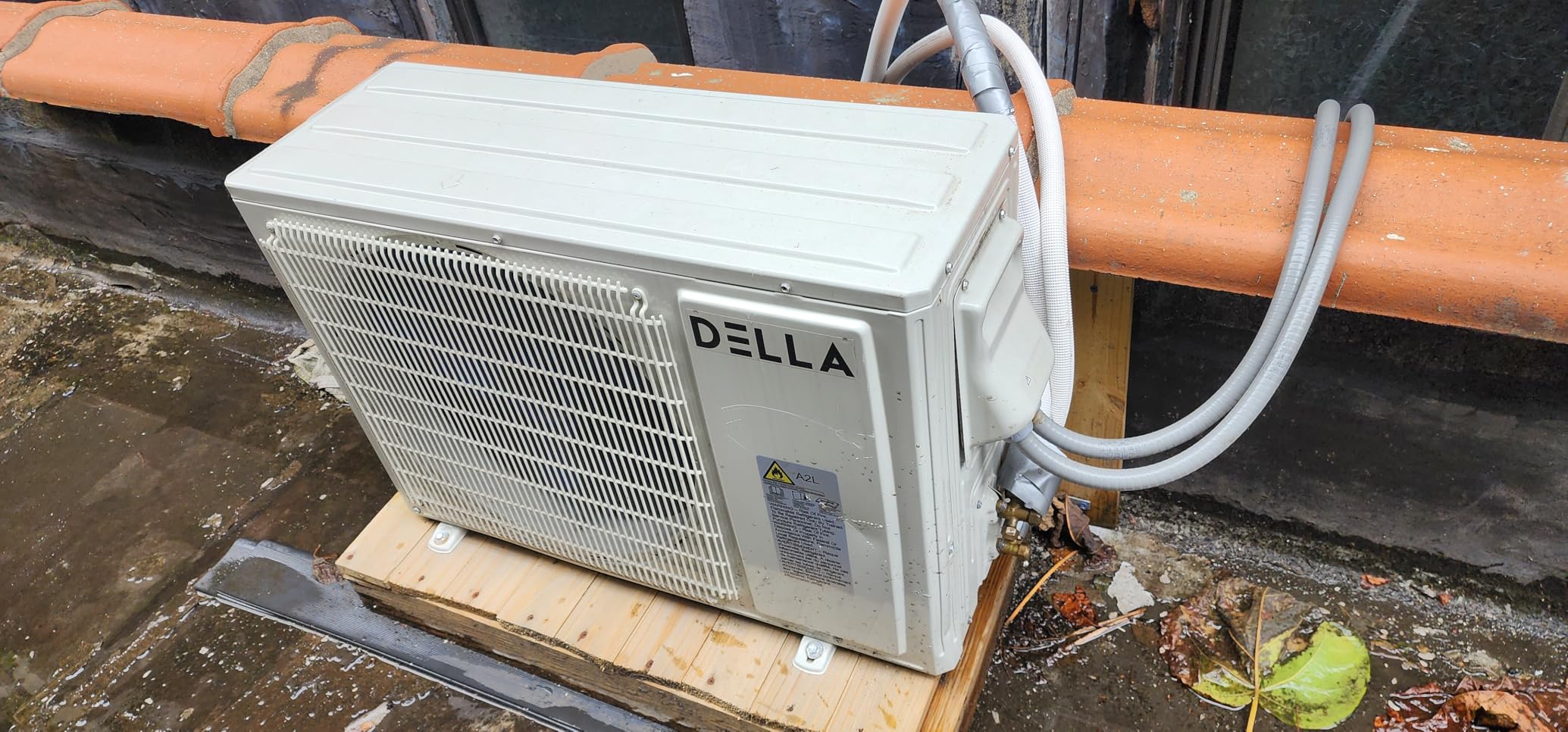
The upgraded condenser heating element extends heat pump operation to 5F, which is enough for most of the country. The smart sensor and Alexa support are genuinely useful for a garage you heat remotely before driving over.
Spec sheet detail worth noting: 3450 watts of power at a 19 SEER2 rating. The number is higher than comparable 18000 BTU systems, and it is a fair reason to compare this against the 21 SEER2 alternative in this roundup if your run time is long.
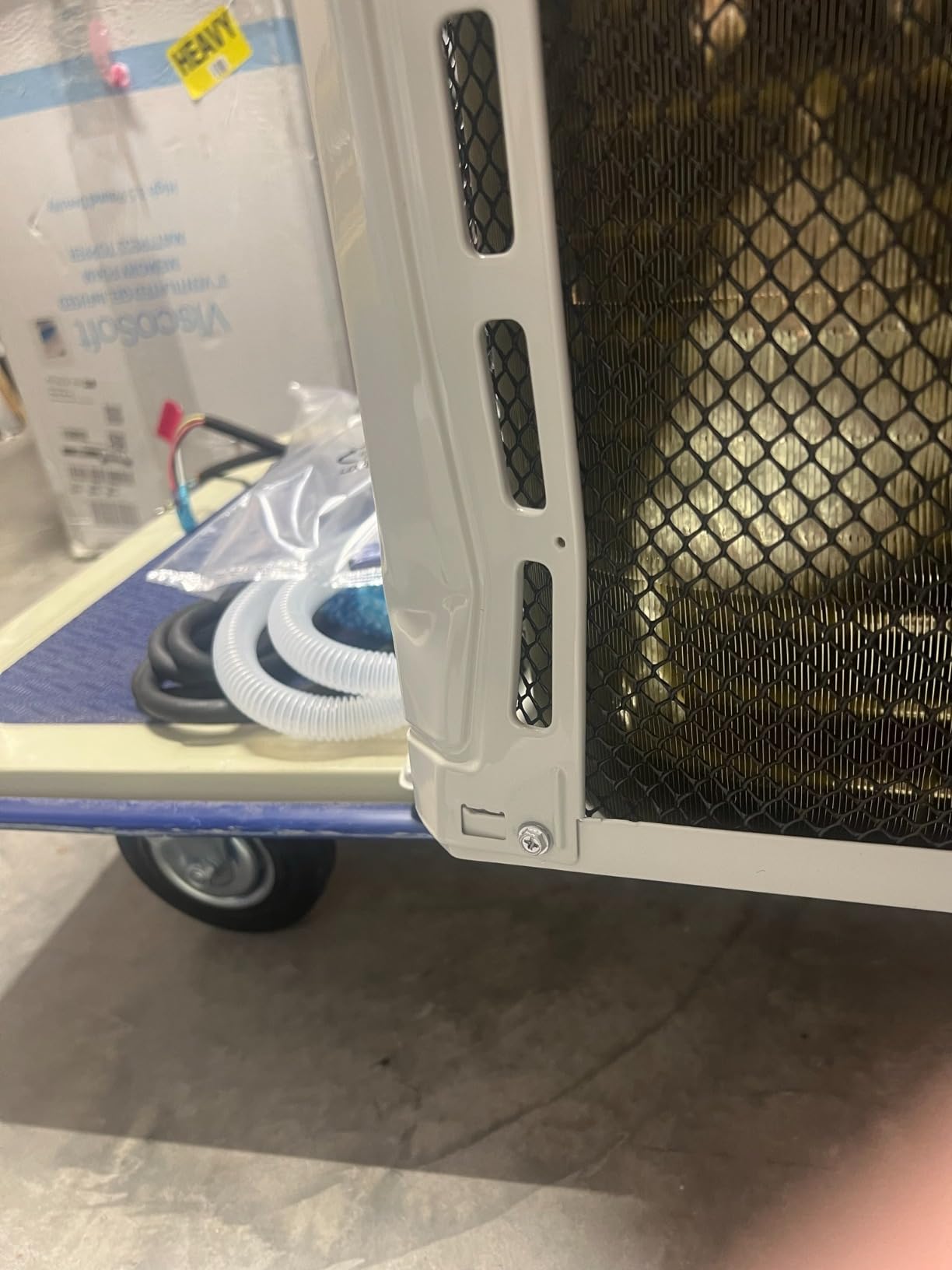
What to check before you buy it
Confirm your electrical panel has two spare breaker positions and enough capacity for a dedicated 230V circuit. If it does not, a subpanel is the usual answer, and that is where the install cost goes.
Ask your installer about R-32 availability for future service. It ships in new equipment now, but stocking is still less universal than older refrigerants in some markets.
Where it falls short
230V means a real electrical project. This is not a weekend job for most people, and a pre-charged kit does not remove the vacuum step.
At 19 SEER2 it is mid-pack on efficiency, so a garage that stays conditioned all day is better served by a higher rating.
4. Senville AURA 24,000 BTU – Best Cold-Climate Pick for a Two-Car Garage
Senville AURA Mini Split Air Conditioner, Heat Pump, White, 24000 BTU
24000 BTU 2 ton
208-230V
20.5 SEER2
36 dB
1250 sq ft
R-454B
Pros
- Heat pump rated for operation down to -22F
- 20.5 SEER2 and Energy Star certified
- 1250 sq ft rated coverage for a two-car garage
- Alexa and app control with routines
- Owners report long service life in shops
Cons
- Senville WiFi app setup unreliable for some users
- Included 16 ft line set often too short for a detached run
- Senville app and warranty support vary by region
Two tons is the honest size for a standard two-car garage, and the AURA is the only unit here rated to deliver heating down to -22F. Several owners on the Garage Journal boards describe running this system in a detached shop through winter, and the low-temperature rating is the reason it works rather than a comfort claim.
It is also Energy Star certified at 20.5 SEER2 with a 1920 watt draw, which is a much better efficiency profile than most two-ton equipment at this size. Multiple owners document use in insulated garages and workshops with low power draw, which is exactly the pattern a garage gym owner should look for.
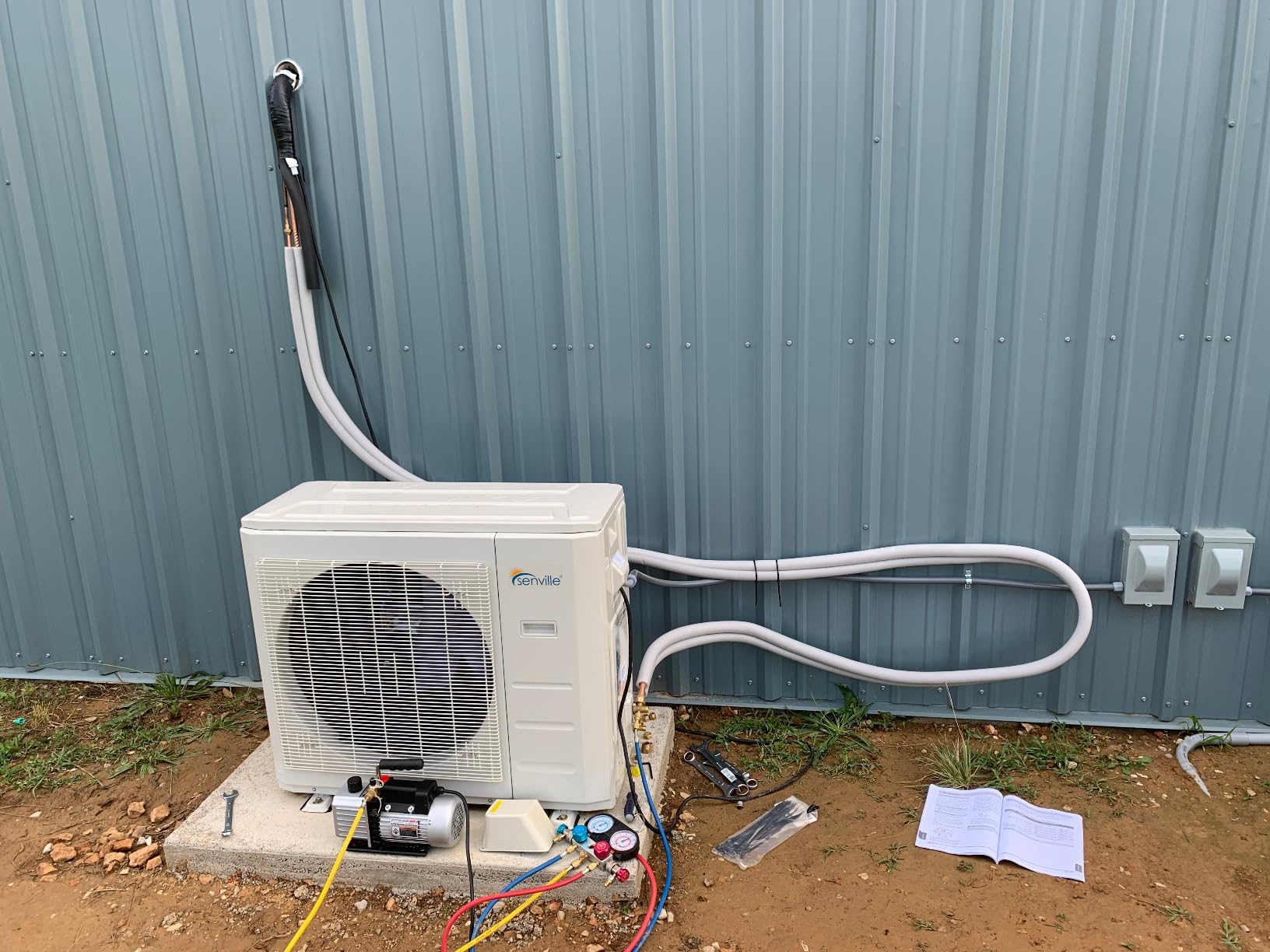
Techs in the field often call -22F the cold-climate threshold, and this unit clears it. For a garage that needs heat through a northern winter, the difference between a -13F unit and a -22F unit is supplemental heat money you either spend or avoid.
The package includes the indoor handler, outdoor condenser, remote, WiFi kit, and a 16 ft installation kit. Same family comes in 6000 through 24000 BTU, so one brand can cover a garage and an addition.
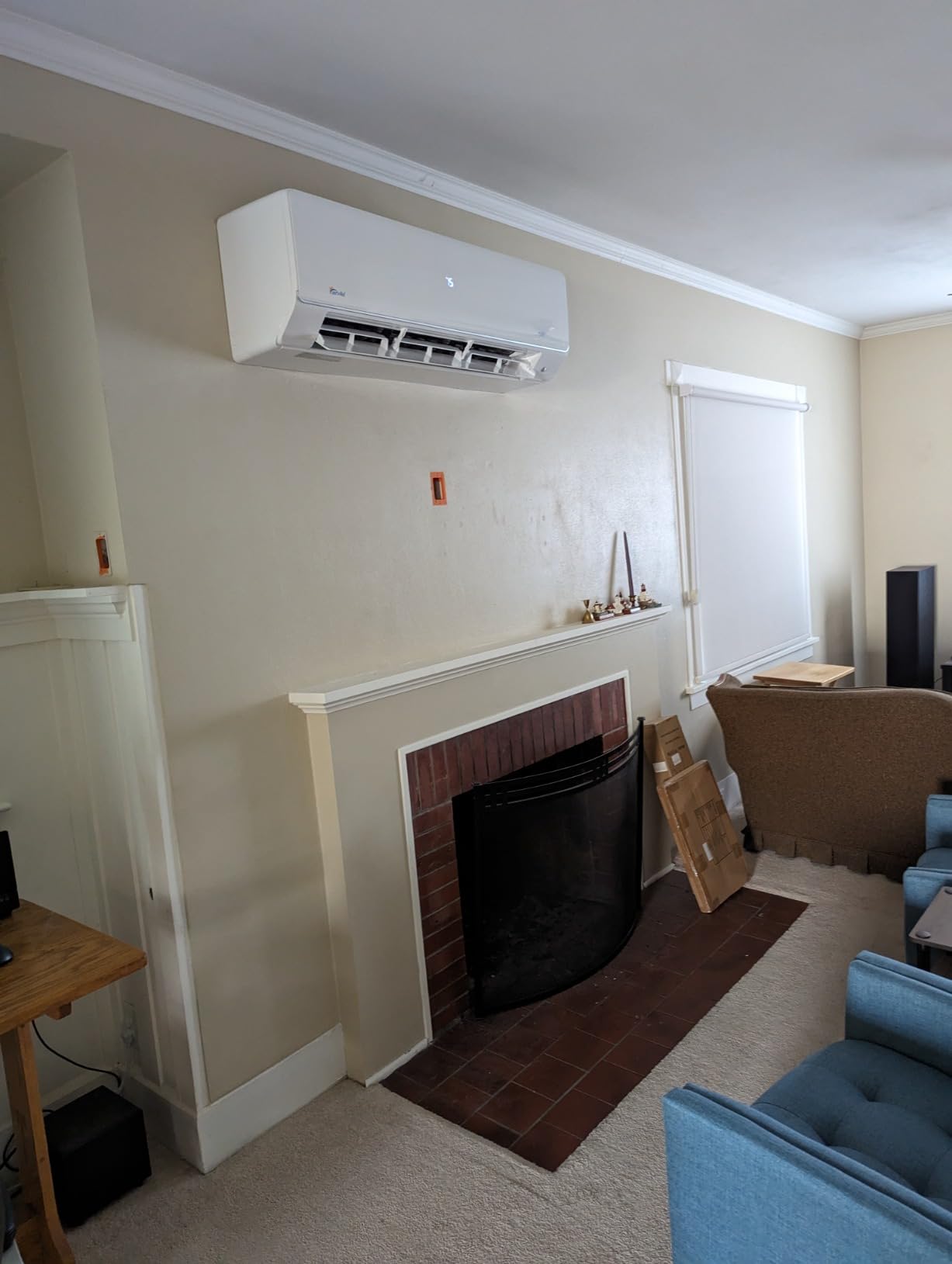
What to check before you buy it
Measure the actual distance from the head location to where the condenser will go. The included 16 ft line set is the single most common reason quotes jump on a garage install, and adding length is cheap when planned and annoying when discovered.
Test the app before you commit to a mounting position. Several owners report the WiFi pairing as the most common complaint on this model, and it is easier to sort out with a phone in your hand.
Where it falls short
It runs on 208-230V, so a dedicated circuit and a panel with capacity are prerequisites, not optional extras.
The listing reports 36 dB and a heavier shipping profile than the head and condenser in the smaller systems, so plan the install path before it arrives.
5. TOSOT Cosmo Series 24,000 BTU – Best Coverage for a Large Workshop
TOSOT 24,000 BTU Mini-Split Air Conditioner and Heating System, 19 SEER2 Wifi-Enabled Ductless Inverter AC Unit with 16ft Copper Line Set, Voice Controlled, 208-230V, Cosmo Series
24000 BTU 2 ton
230V
19 SEER2
22-36 dB
1500 sq ft
R-32
Pros
- Widest rated coverage of these eight units at 1500 sq ft
- Cools at 118F and heats down to -13F
- Quiet range from 22 dB to 36 dB
- GREE+ app and voice control with scheduling
- 5 year parts and 8 year compressor warranty
Cons
- Installation instructions contain wiring and torque errors
- Condenser can arrive dented and later develop slight vibration
- Listed power draw of 7034 watts is high for a 19 SEER2 system
The Cosmo’s differentiator is the coverage number. At 1500 sq ft it is the widest rated capacity of the eight units here, and TOSOT backs that with a cooling rating to 118F and heating to -13F. Owners running it in shops and RVs report that it pulls hard without the cycling noise of a conventional compressor.
Control is thorough. The GREE+ app, voice control, and the included remote with scheduling all work, and the manufacturer is a large parent company, which matters when you need a part in five years rather than five months.
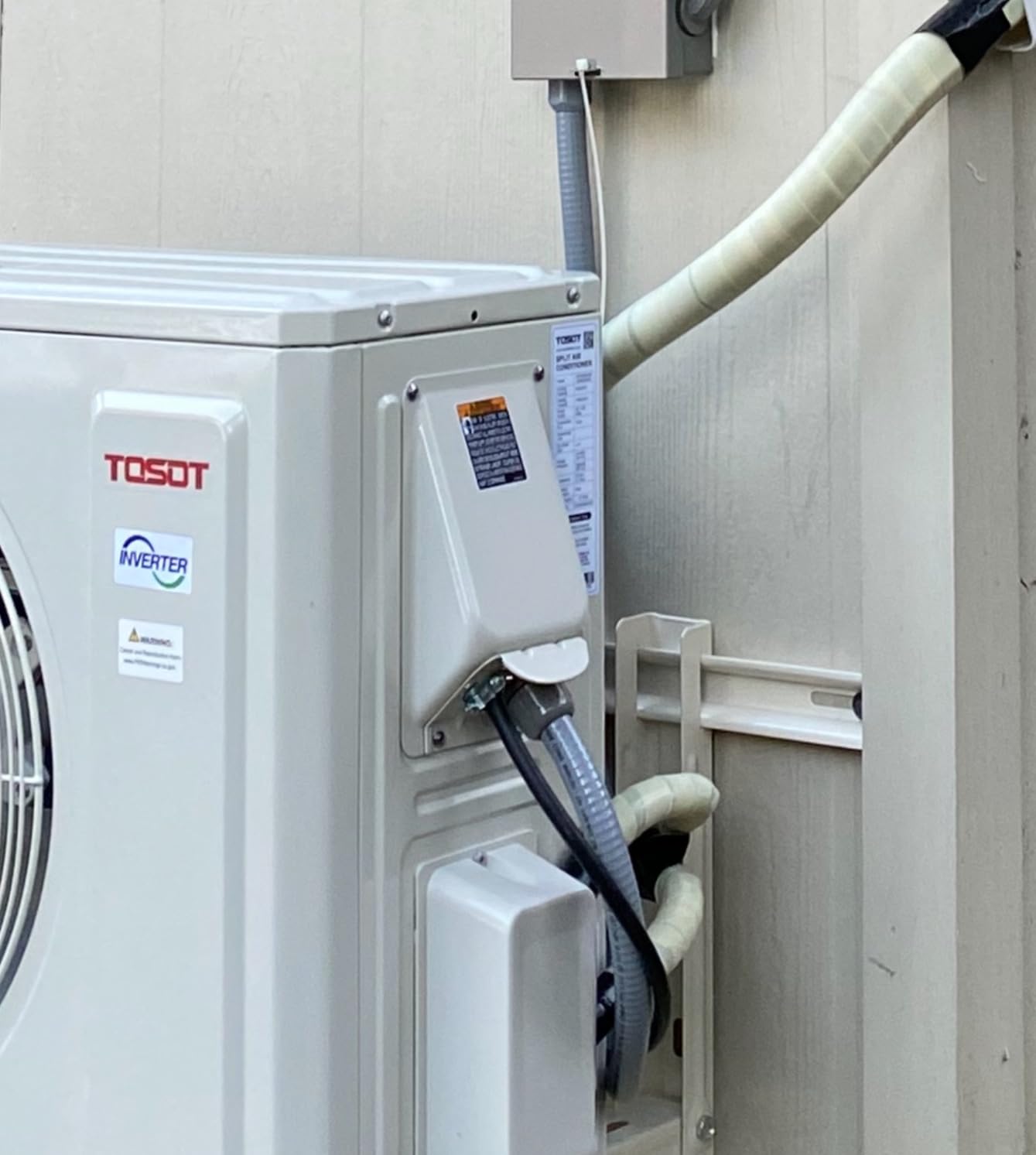
The 22 dB to 36 dB range covers the full fan spectrum, and the self-cleaning and iFEEL functions behave the way the manual describes. The 16 ft copper line set and installation accessories are in the box, so the parts list is short.
Documentation is the weak spot. Owners doing their own install planning report an incorrect indoor wiring diagram and wrong nut torque values in the paperwork, which is a real hazard for a first-time installer and a good reason to have a licensed tech do the refrigerant work.
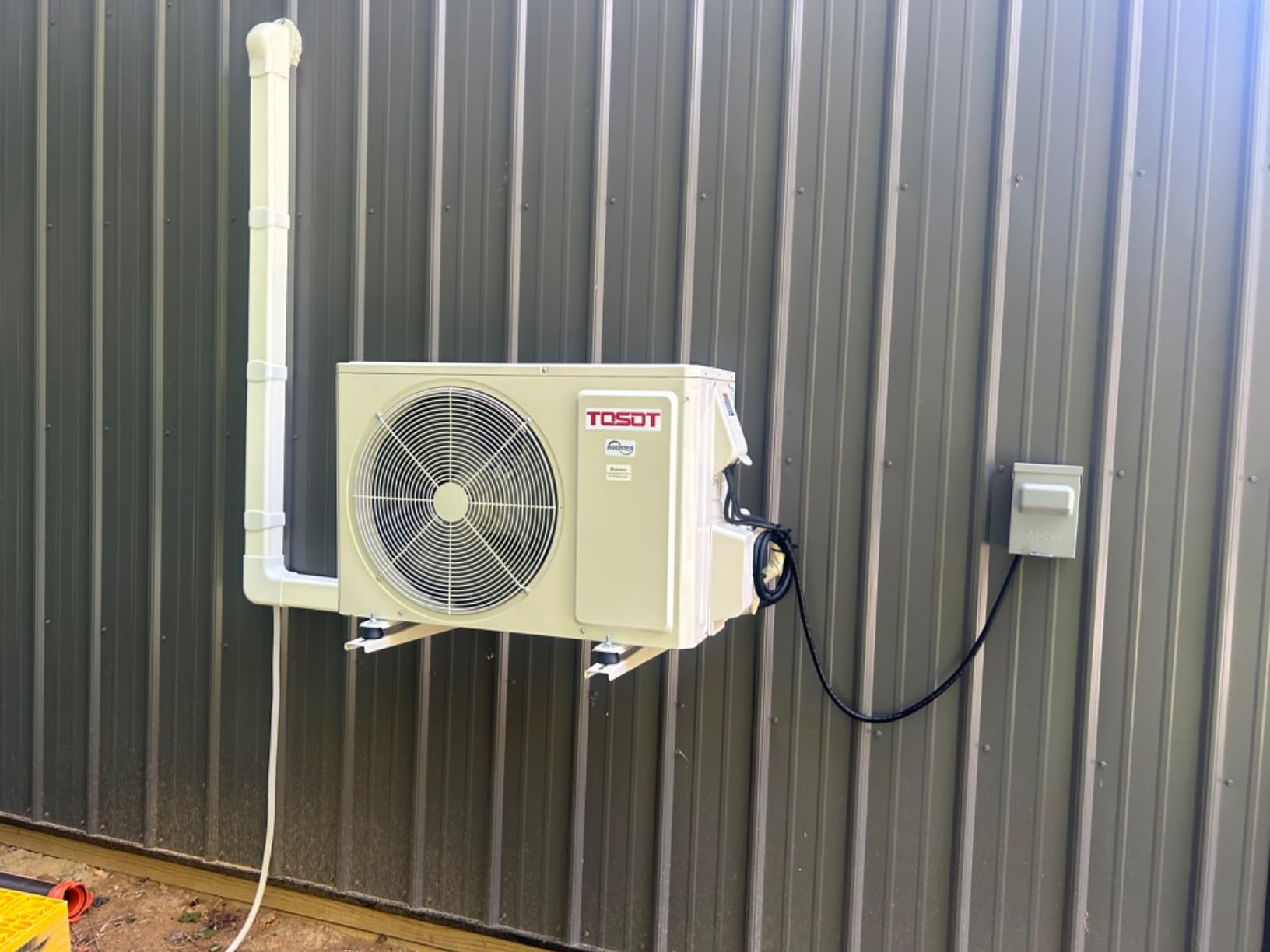
What to check before you buy it
Inspect the condenser on arrival. Multiple owners report units arriving dented from transport and later showing a slight vibration, so photograph the packaging before you accept it and check the body while you still have a claim.
Confirm the flexible connecting cord meets electrical code for a wall penetration where you live. Local rules differ on that detail and it is a code question, not a preference.
Where it falls short
The 7034 watt listing is the highest power draw among these eight systems. If the garage is going to be conditioned for many hours a day, that number deserves a place in your decision.
It needs a 230V circuit and a vacuum pump to commission, so plan on professional installation.
6. Cooper & Hunter 24,000 BTU MIA Series – Best Complete Install Kit at Two Tons
Cooper & Hunter 24,000 BTU 230V Wall Mount Mini Split AC, 18.7 SEER2
24000 BTU 2 ton
230V
18.7 SEER2
35 dB
R-454B
UL Listed AHRI Certified
Pros
- Comes with the most complete install kit
- including insulated pre-flared line set
- 7 year compressor and 5 year parts warranty
- Includes smart kit for app scheduling and voice control
- UL Listed and AHRI Certified
- Quiet operation that owners verify by listening for it
Cons
- 18.7 SEER2 trails the 20.5 SEER2 leader among two-ton units
- Arrives as freight so plan the move inside
- Installation documentation is thin on wiring details
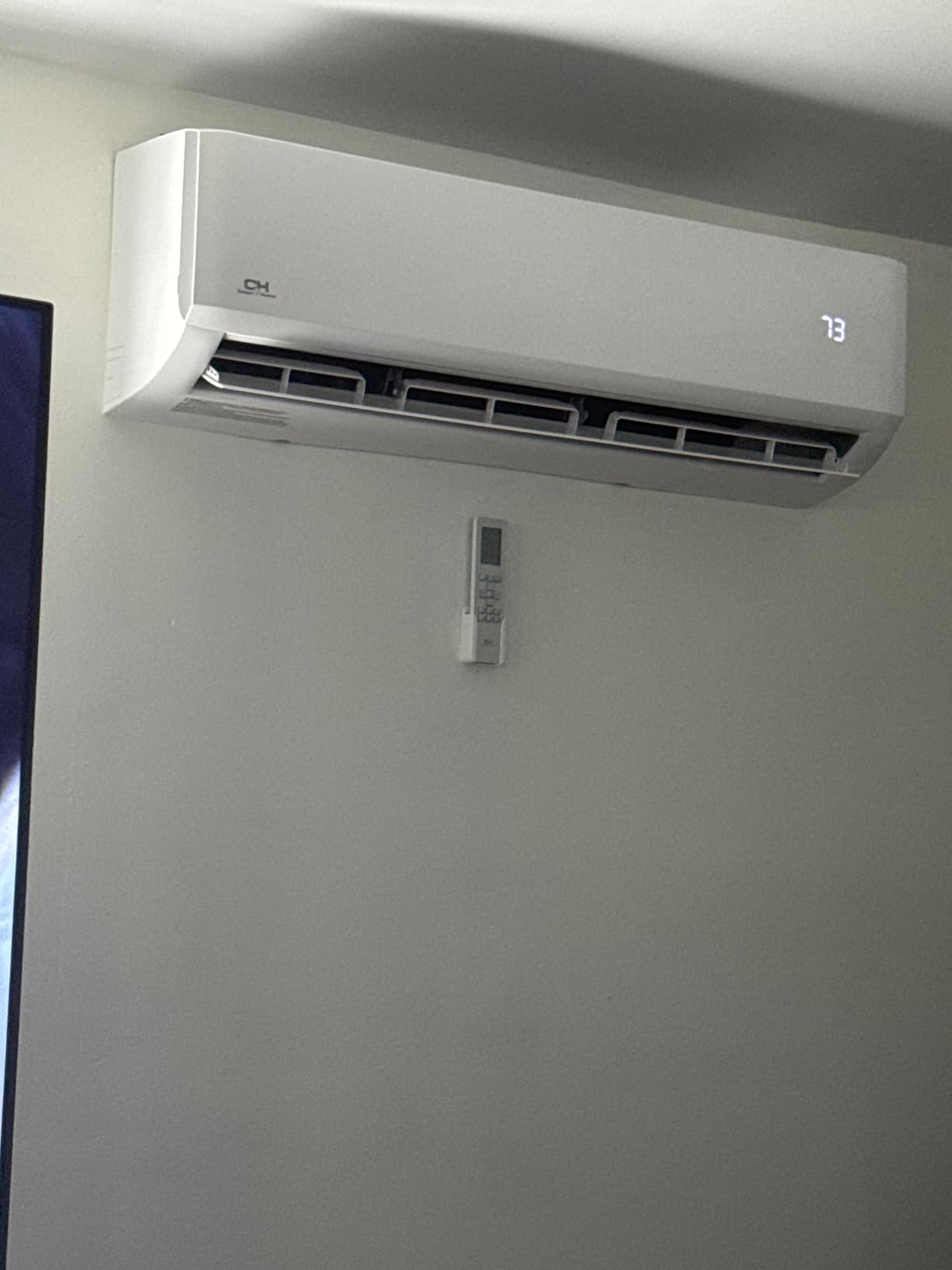
The MIA is the completeness play. Alongside a 7 year compressor and 5 year parts warranty, it is the only unit here that includes a pre-flared insulated copper line set, communication cable, and a matching drainage extension in the box, which is why the parts list is the shortest of any system in this roundup.
Owners describe the operation as close to silent, often checking to confirm the head is actually running. The inverter compressor holds setpoint without the on-off cycling that makes a cheap unit audible in a quiet workshop at 2 a.m.
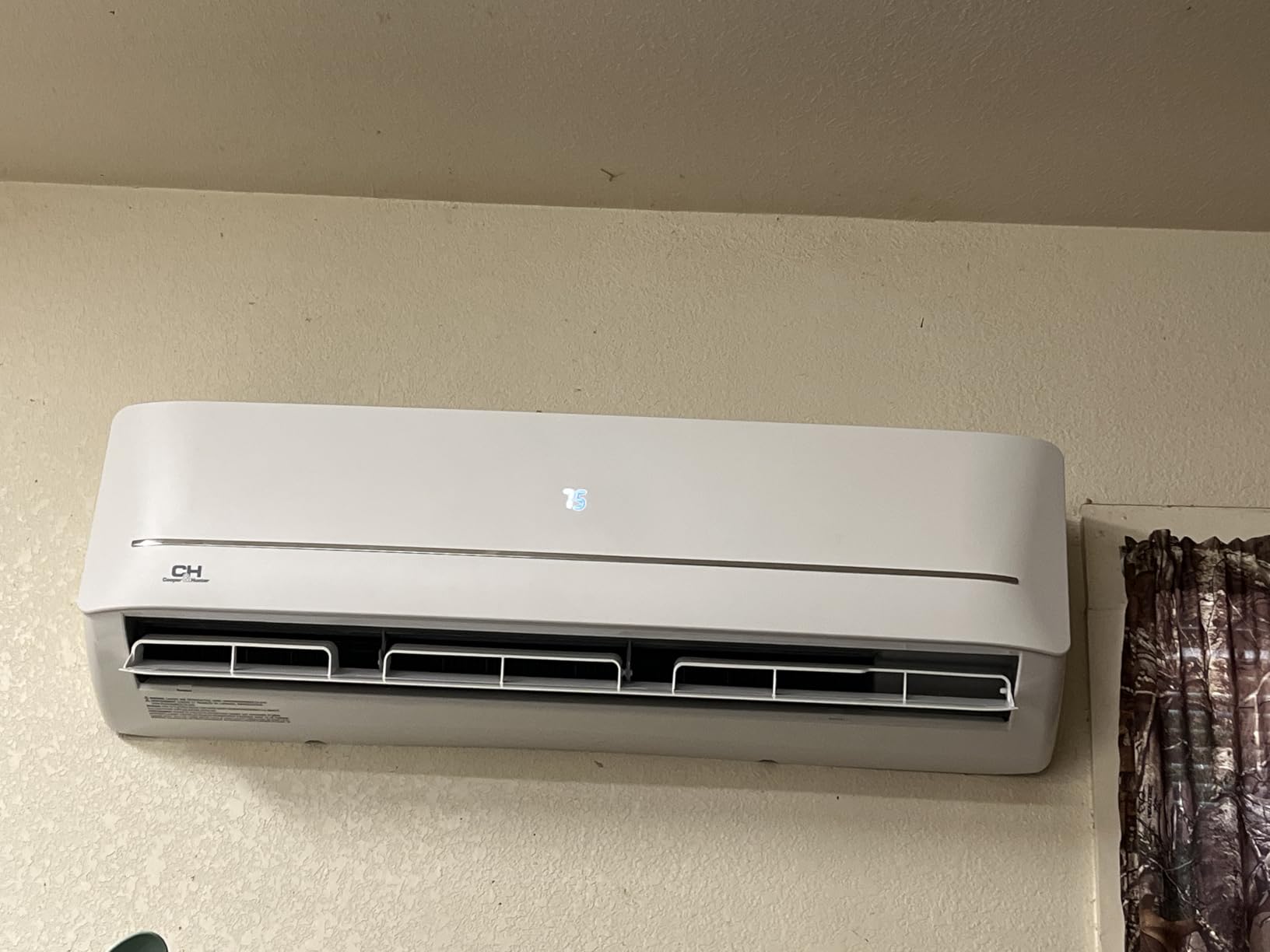
Pre-flared line ends save a step on the connection, and the manufacturer lists the same family in 6000 through 24000 BTU across both voltages, so a single-car garage and a two-car garage can share a brand and a service history.
Heating is rated to 5F, so this is a cooling-first unit for most climates rather than a cold-climate heat pump. If your garage needs to be warm in January, the Senville AURA is the better match.
What to check before you buy it
Confirm where the unit will be set down when it arrives. Freight delivery means curbside drop-off rather than placement inside, so the move from driveway to mounting location is on you.
Ask your installer to supplement the printed instructions. Owners report the wiring detail is incomplete in the documentation, and the manufacturer support line is a reasonable backstop.
Where it falls short
18.7 SEER2 trails the 20.5 and 19 SEER2 units in this roundup, and it ships at 165.1 pounds across two packages. Long run times cost more here than on a higher-rated two-ton system.
Professional installation is required, and one review in the set reports an indoor control board failure inside a year with a slow warranty response.
7. MRCOOL Advantage 24,000 BTU – Best Recognized Brand at This Size
MRCOOL 24000 BTU 230V Ductless Inverter Mini Split Air Conditioner & Heat Pump System, Advantage Series – Wall-Mounted AC Unit w/Heating and Cooling for Home, Office & Commercial Space
24000 BTU 2 ton
230V
17 SEER inverter
56 dB
Energy Star
R-454B
Pros
- Tied for the highest average rating among the 24000 BTU options
- Energy Star certified inverter design
- Reliable heating and cooling across large open areas
- WiFi enabled with remote control
Cons
- 17 SEER is the lowest efficiency in this roundup
- Listed power draw of 5750 watts is high for a 24000 BTU inverter
- Professional HVAC installation recommended
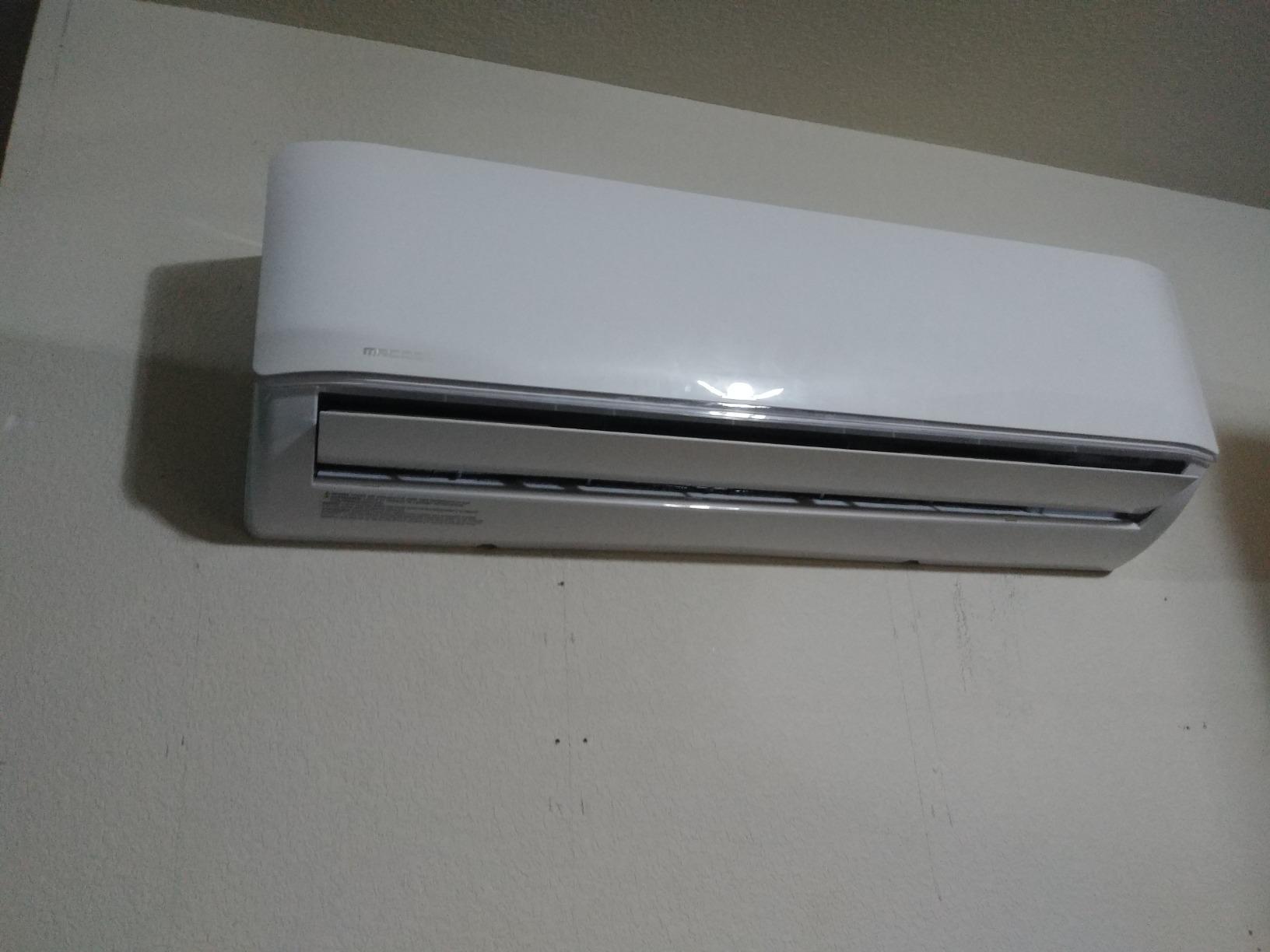
MRCOOL carries the brand recognition that the other import-nameplate systems in this list cannot, and it matters for resale, parts, and service. The Advantage 24,000 BTU holds a 4.5 average across its reviews, tied for the highest here, with a smaller review pool than most.
For a garage gym or a workshop where the equipment needs to be dependable rather than feature-rich, a known brand with a straightforward wall-mounted head is an easy decision. The washable filter and inverter design are unremarkable on paper and unremarkable in the best sense once installed.
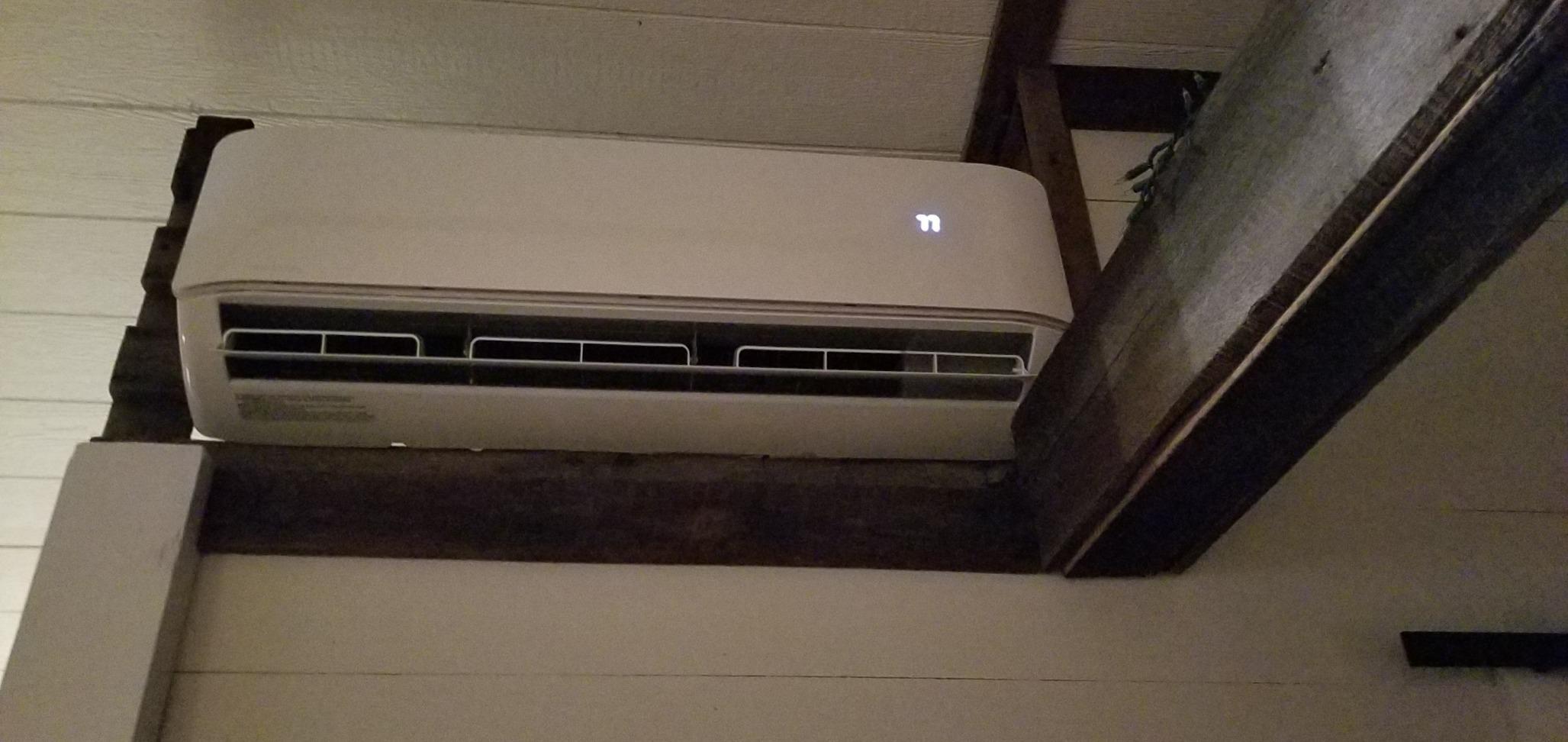
The bullet points describe capacity for heating and cooling spaces up to 1000 sq ft, and the Energy Star certification on a 17 SEER inverter is a slightly unusual pairing that reflects an older efficiency tier in the Advantage line.
Noise is listed at 56 dB, the highest figure among these eight systems. That matters more in a garage than in a bedroom, because the condenser sits outside the room you are trying to keep quiet, often next to a neighbor’s fence line.
What to check before you buy it
Look at where the condenser will go relative to the property line. A 56 dB rating is well above the sub-40 dB class most of these units fall into, and condenser placement is the single biggest lever on noise complaints in a garage install.
Confirm the line set length you need and plan the electrical run at the same time. Both are easier to scope before the equipment is on site.
Where it falls short
17 SEER is the lowest efficiency rating of the eight systems here, and 5750 watts of listed draw is a heavy load for a 24,000 BTU inverter. That is a real operating cost on a garage that runs all day.
Professional installation is recommended, and the listing does not include a line set.
8. YITAHOME 18,000 BTU – Best Feature Set for a Dusty Shop
YITAHOME 21 SEER2 18000 BTU Mini Split AC/Heating System 208-230V
18000 BTU 1.5 ton
208-230V
21 SEER2
49 dB
1250 sq ft
R-32
Pros
- 21 SEER2 is the highest efficiency in this roundup
- Air purification filter with PM2.5 removal and negative ion
- Self-cleaning at 135F plus auto defrost
- Five modes with four fan speeds and 0-24h timer
- 5 year parts and 7 year compressor warranty
Cons
- Lowest average rating here at 4.1
- Quietest claim is weaker at up to 49 dB
- Kit excludes shut-off valves and a side protection grille
The YITAHOME is the specification sheet winner and the review score loser, and both facts come from the same place. At 21 SEER2 it is the most efficient system here, with air purification, PM2.5 removal, negative ion generation, and a 135F self-cleaning cycle. The 4.1 average across 462 reviews is the lowest in the group, with a 14 percent one-star share.
That split is exactly what you would expect. Reviewers who install it correctly and are happy with the feature set rate it highly; the negative reviews cluster around reliability, condensation handling, and support responsiveness. Buyers on the r/hvacadvice boards who have owned budget units report that pattern is common across the tier.
Where the features genuinely earn their place is air quality. An air purification filter with PM2.5 removal and negative ion output is a real advantage over a bare coil in a garage with sawdust, concrete dust, and insulation fibers in the air. The self-cleaning cycle and auto defrost reduce the maintenance you would otherwise take on in a workshop.
The operating range of 5F to 118F is broad, 4D air circulation reaches about 50 ft, and the listing reports 700 kilowatt hours of annual energy consumption. That consumption figure is the one the manufacturer publishes directly, and it is worth weighing against a 21 SEER2 nameplate rather than a wattage number.
What to check before you buy it
Ask what is included before you order. The installation kit covers mounting accessories, but shut-off valves and the side protection grille are excluded, and those are small parts that stop a DIY install on day one.
Confirm the shipping arrangement. This system is described as arriving in two packages, so plan for the possibility that they do not land on the same day.
Where it falls short
At up to 49 dB it is the loudest indoor head among these eight units, which is a real drawback in a garage you work in rather than visit.
It needs 208-230V and licensed professional installation, and the 4.1 average is the signal to read the one-star reviews before you commit.
How Big a Mini Split Do I Need for a Garage?
A 24 by 24 garage with standard 8 ft ceilings wants a 12,000 BTU to 18,000 BTU system, and 18,000 BTU is the safe answer if the ceiling is taller, the walls are uninsulated, or the door gets opened during the day. Measure the floor area, note the ceiling height, then add roughly 30 to 50 percent for a typical attached or detached garage.
That surcharge exists because garages lose heat through a large steel door, thin walls, and a concrete slab with no thermal buffer. The interior-room rule of thumb of 600 BTU per ton per square foot was never built for that load, and sizing straight off the nameplate is the most common reason owners report a unit that never catches up.
The garage size to BTU ladder
One-car garage, up to about 250 sq ft, 8 ft ceiling, insulated: 9,000 BTU. Rare in this roundup, because most manufacturers moved up to one ton as the entry size.
One-car garage, 12 by 20, insulated, 9,000 to 12,000 BTU: 12,000 BTU. A 9,000 BTU unit is enough here only if the door stays closed and the walls are insulated.
One-car garage, 12 by 24, or any garage with a vaulted ceiling: 18,000 BTU. This is the size that matches the ceiling-height problem rather than the floor-area number.
Two-car garage, 20 by 20 up to 20 by 30, 8 ft ceiling: 24,000 BTU. A 2-ton system is the standard answer for a 480 sq ft two-car space.
Two-car garage, uninsulated or 10 ft ceilings: 24,000 BTU with a supplementary plan, or two heads on a multi-zone system.
Three-car garage, 30 by 40, or a workshop plus storage: multi-zone. A single 48,000 BTU system exists, but two 24,000 BTU heads on separate zones condition the space more evenly and give you independent control.
Should you insulate first or buy a bigger unit?
Insulate first if you can. Weatherstripping the garage door and insulating the walls and the attic over the ceiling often lets a 12,000 BTU unit do the job of an 18,000 BTU one, and the savings compound every month. A bigger unit in a leaking shell simply runs longer to reach the same temperature.
Buy bigger only when insulation is not an option. Then accept a higher electrical draw and a larger monthly bill for a system that keeps up on the worst afternoons.
Is it better to undersize or oversize?
Neither, in the way most people mean it. Undersizing means a unit that runs continuously and never reaches setpoint. Oversizing with an inverter compressor is less harmful than it used to be, because the compressor modulates down rather than short-cycling, but a 24,000 BTU head in a 200 sq ft shed will swing between full output and off. Size to the space, then round to the nearest real product.
How Much Does It Cost to Put a Mini Split in a Garage?
Equipment is the cheapest part of a garage mini split, and it is the only part most buyers shop carefully. Owners across the r/hvacadvice and r/heatpumps boards put DIY pre-charged equipment in the low hundreds of dollars, professional-installed premium equipment in the low thousands, and a full professional job in the high thousands to five figures once a new 230V circuit, a longer line set, and difficult access enter the picture. The equipment price changes constantly, so treat those as proportions rather than quotes and read the live figure on the product page before you commit.
The electrical run is the hidden line item that nobody budgets for. A dedicated circuit from the main panel, or a subpanel mounted in the garage and wired back, is the near-universal recommendation on these threads, and a shop with no spare panel capacity pays for it either way.
Where the money actually goes
Equipment: the head, the condenser, and the factory warranty. Compare this against the ratings rather than the sticker.
Line set: many kits include 16 ft, and a detached garage or a head mounted far from the condenser needs more. Adding length later means a new pre-charge.
Electrical: a dedicated 115V or 230V circuit, and a subpanel if the main panel is full. This is frequently the largest single line item after the equipment.
Labor: the refrigerant work, the vacuum procedure, the condensate line, the electrical connection, and the commissioning. EPA Section 608 certification governs who is allowed to open the refrigerant circuit.
Mounting hardware: wall brackets, pads, and the side grille some kits exclude.
On running cost, the reported figures are modest. One Garage Journal owner reports roughly a few tens of dollars more per month to keep a garage warm in winter with a heat pump rather than a resistance heater. High electricity bills with a mini split usually trace back to a dirty filter, an oversized unit in a leaky shell, or a compressor running continuously because it is undersized, not to the refrigerant cycle itself.
Can You Install a Garage Mini Split Yourself?
You can install most of a pre-charged system, but you cannot legally open the refrigerant circuit without EPA Section 608 certification, and most manufacturers require professional installation to keep the warranty valid. Every system in this roundup states that requirement in its own documentation.
What a pre-charged quick-connect kit actually removes is the need to charge the system at install. What it does not remove is the electrical work, the condensate line, the vacuum procedure if you add any line length, and the certification requirement. Several owners report discovering the electrician requirement only after buying the unit, which is the single most common surprise in these threads.
115V or 230V: what changes in your garage
A 115V system plugs into a standard circuit and caps you at one ton. A 230V system needs a dedicated circuit sized for the unit, which may mean a new breaker, a longer run from the main panel, and a subpanel if your panel is full. In a detached garage, that run can exceed the cost of the equipment.
Intermittent use changes this calculus. If you want the garage comfortable for two hours after a workout, a 115V one-ton unit is the low-friction answer and a window or dual-hose portable unit is a fair comparison. If you want the garage conditioned all day, a 230V two-ton system is the only one of these that will hold up.
Condenser Placement, Heating Limits, and Garage Air Quality
Where to put the condenser
Wall mounting the condenser saves floor space and keeps it above flooding levels, but it transfers vibration into a stud wall and gets louder to your neighbors. A ground pad costs space and concrete but isolates noise. Clearance matters in both cases: airflow around the coil is what protects the compressor in a garage where summer surface temperatures run high.
Plan the route from the head to the condenser before you buy. Shorter, straighter line runs cost less, use less refrigerant, and are easier to service, and that is why several owners in this roundup end up buying extra line set.
Cold weather and supplemental heat
Standard heat pumps lose output and efficiency as outdoor temperatures fall, and owners on these boards describe real-world trouble below roughly 0F to 10F. The systems in this roundup are rated from 5F down to -22F, and the cold-climate units hold more of their rated heating capacity as the temperature drops. Below that, plan a resistance heater or a gas garage heater as a backup rather than assuming the mini split covers January.
What a mini split does and does not do for air quality
It filters dust, reduces humidity through its dry mode, and moves air across a cold coil. It does not remove chemical fumes, sawdust, paint solvents, or vehicle exhaust, because there is no outside air exchange. Never run an engine indoors and assume the heat pump makes the space safe to breathe in.
Long-term owners on the Garage Journal boards report that wall-unit blower wheels grow mold in humid climates, while the fix is periodic fan-only runs to dry the coil and, occasionally, a full teardown clean. Budget for filter cleaning on a schedule rather than waiting, especially in a woodworking shop.
Frequently Asked Questions
Are mini split systems good for garages?
Yes. A ductless mini split is the most practical way to condition a garage because it needs no ductwork, which is what a garage lacks. It cools and heats the space, runs quietly, and holds temperature far better than a window or portable unit. The key precondition is insulation, since a bare framed garage runs 30 to 50 percent harder to condition than an equal interior room.
What is a good size mini split for a garage?
Most single-car garages want 12,000 BTU, or 18,000 BTU if the ceiling is vaulted or the walls are uninsulated. A standard two-car garage wants 24,000 BTU, and a 30 by 40 three-car garage or workshop is better served by two zoned heads than by one very large system. Add 30 to 50 percent to interior-room sizing rules for a typical garage.
How much would it cost to put a mini split in a garage?
Equipment is the smallest share. Owners report low hundreds of dollars for DIY pre-charged equipment, low thousands for premium equipment professionally installed, and high thousands to five figures once a new 230V circuit, a subpanel, extra line set, and difficult access are involved. The electrical run is the line item most people forget.
Do I need a 230V circuit for a garage mini split?
Only if you choose a 230V model. A 115V unit up to 12,000 BTU runs on a standard household circuit, while anything at 18,000 BTU or above needs a dedicated 230V circuit. If your panel has no spare capacity, you will need a subpanel in the garage wired back to the main panel, which is often the largest cost after the equipment.
Can I install a mini split myself in my garage?
You can install most of a pre-charged kit yourself, but you cannot open the refrigerant circuit without EPA Section 608 certification, and most manufacturers require professional installation to keep the warranty valid. The electrical work still needs a licensed electrician. If you add any line length, the system also has to be vacuumed before it is started.
Will a mini split remove garage odors or vehicle fumes?
No. A mini split circulates the air already in the room and does not bring in outside air, so it cannot exhaust fumes, sawdust, or paint solvents. It does filter dust and pull humidity out through dry mode, which helps with mustiness. Never run an engine indoors and rely on the air conditioner to make the space safe.
What mini split brands should I stay away from?
Rather than naming brands to avoid, check four things on any system: whether the seller is a certified dealer, whether the warranty requires professional installation, whether the listing states an SEER2 figure and the refrigerant type, and whether the documentation is complete. Open-box and marketplace units are the most common source of warranty problems, and several budget brands have thin printed installation instructions.
The Bottom Line
For a typical single-car garage, the best mini split air conditioner for garages in 2026 is the Senville LETO 12,000 BTU. It runs on a standard 115V circuit, carries a 20.8 SEER DC inverter, and holds a 28 dB head, and its 2,185 reviews make it the most proven system in this roundup.
Move up to the COSTWAY 12,000 BTU if quiet operation and an 8 year compressor warranty matter more than efficiency. Step up to the DELLA Motto 18,000 BTU when ceiling height is the issue, the Senville AURA 24,000 BTU when the garage needs real cold-weather heating, and the Cooper & Hunter 24,000 BTU when the most complete install kit matters.
Measure the space, check the insulation, and confirm what your electrical panel can handle before you buy. The best unit in the world will not fix a leaky garage door or a panel with no spare breaker positions, and those two conversations are worth having first.