
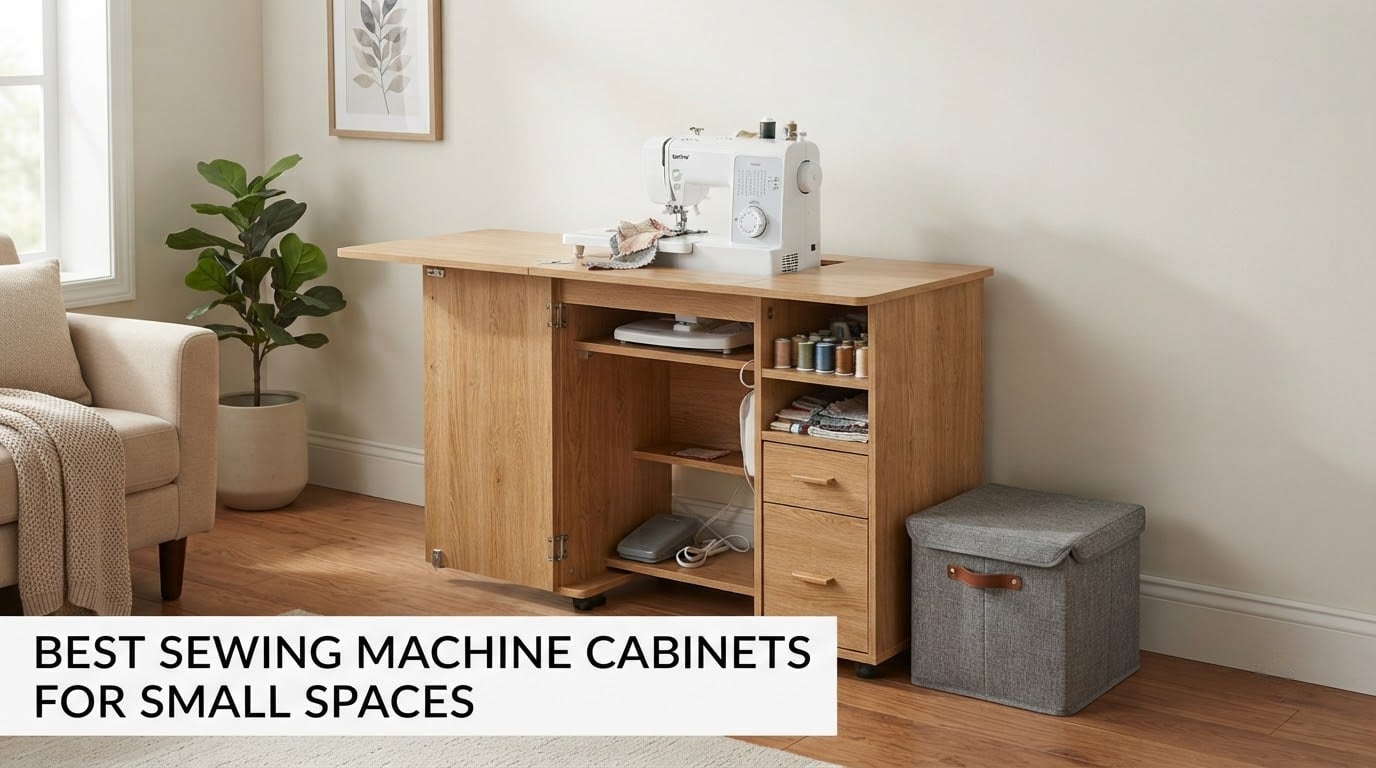
Most people who need a sewing cabinet do not have a room problem. They have a tidy-up problem. The machine, the fabric, the notions caddy and the half-finished quilt own the corner of the living room, and packing all of it back into totes after every session is the part nobody enjoys. If you are searching for the best sewing machine cabinets for small spaces, the pick we keep coming back to is the Sauder Miscellaneous Storage Sewing Cart — it folds to under 20 inches deep, rolls on two locking casters, and closes up with raised panel doors so the whole setup reads as furniture rather than a project.
We spent several weeks working through ten folding tables and rolling cabinets for this guide, measuring published dimensions, comparing machine platforms against machine footprints, and reading what owners actually say after a year or more of use. Everything below is filtered on one question first: how much floor space does this give back when you are not sewing? Second question: does the machine disappear, or do you still need a cover over it?
This is a furniture category, not a gadget category, so the details that decide the purchase are boring and important. Collapsed depth in inches. The width of the machine platform. The weight rating. Whether the casters lock. Assembly time. A thread from our sewing table roundup made the same point from the other direction: a fold-away table stows the machine but shrinks your work surface while it is standing up, and buyers routinely underestimate that trade.
One honest note before we start. A r/sewing poster asking for compact cabinet recommendations named cats as the reason he did not want supplies sitting out in the open, and pointed toward brands that make cabinets which close up when not in use. That is the standard this roundup is built to: if your setup needs to vanish between sessions, doors and enclosed bins are not a nice-to-have.
Table of Contents
Top 3 Sewing Machine Cabinets for Small Spaces in 2026
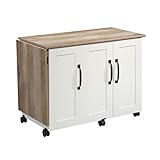
Sauder Storage Sewing Cart
- Folds under 20 in deep
- Drop leaf adds 16 in
- Two locking casters
- Enclosed doors

Best Choice Products Folding Table
- Closes to 23 x 14.75 in
- 46 in surface when open
- Pegs and storage trays
- Lockable wheels

Sew Ready Folding Multipurpose Table
- Powder-coated steel frame
- 47.5 in work surface
- Adjustable machine shelf
- 20 lb platform limit
10 Best Sewing Machine Cabinets for Small Spaces (October 2026)
| Product | Specifications | Action |
|---|---|---|
| Sauder Miscellaneous Storage Sewing Cart |
|
Check Latest Price |
| Best Choice Products Folding Sewing Table |
|
Check Latest Price |
| Sew Ready Folding Multipurpose Sewing Table |
|
Check Latest Price |
 GIANTEX Folding Sewing Table with Charging Station GIANTEX Folding Sewing Table with Charging Station |
|
Check Latest Price |
 Vividwood Folding Sewing Table Rustic-Brown Vividwood Folding Sewing Table Rustic-Brown |
|
Check Latest Price |
 Sew Ready Rollaway II Portable Foldable Table Sew Ready Rollaway II Portable Foldable Table |
|
Check Latest Price |
 VIVOHOME Folding Sewing Table VIVOHOME Folding Sewing Table |
|
Check Latest Price |
 Sew Ready Dart Workstation Desk Sew Ready Dart Workstation Desk |
|
Check Latest Price |
 Vividwood Sewing Table with Adjustable Platform Vividwood Sewing Table with Adjustable Platform |
|
Check Latest Price |
 COSTWAY 62.5 inch Foldable Sewing Table COSTWAY 62.5 inch Foldable Sewing Table |
|
Check Latest Price |
1. Sauder Miscellaneous Storage Sewing Cart — Best Overall for Small Spaces
Sauder Miscellaneous Storage Sewing Cart, Drop-Leaf Craft Table, Sewing Table with Storage – Soft White Finish
19.5 in D x 38.5 in W x 28.5 in H
Rated to 75 lb
3 shelves, 2 doors
5-year warranty
Pros
- Collapses to under 20 in deep for tight rooms
- Drop leaf adds about 16 in of workspace when you need it
- Two of the casters lock so it stays put while you stitch
- Enclosed doors and door bins hide the machine and fabric between sessions
Cons
- Soft white finish shows fingerprints and smudges
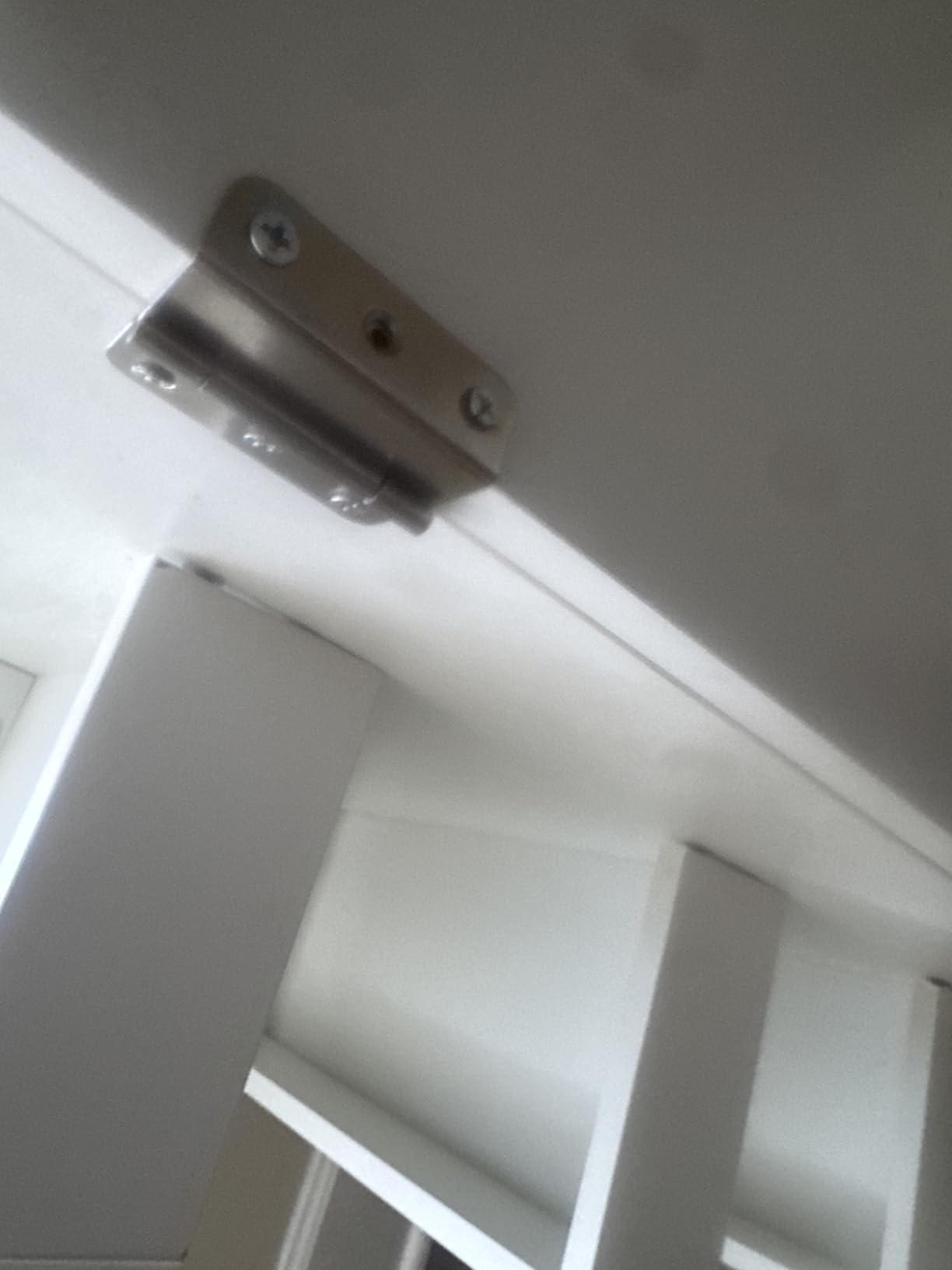
- Drop leaf hinge can loosen with use
- Assembly runs close to two hours and helps to have two people
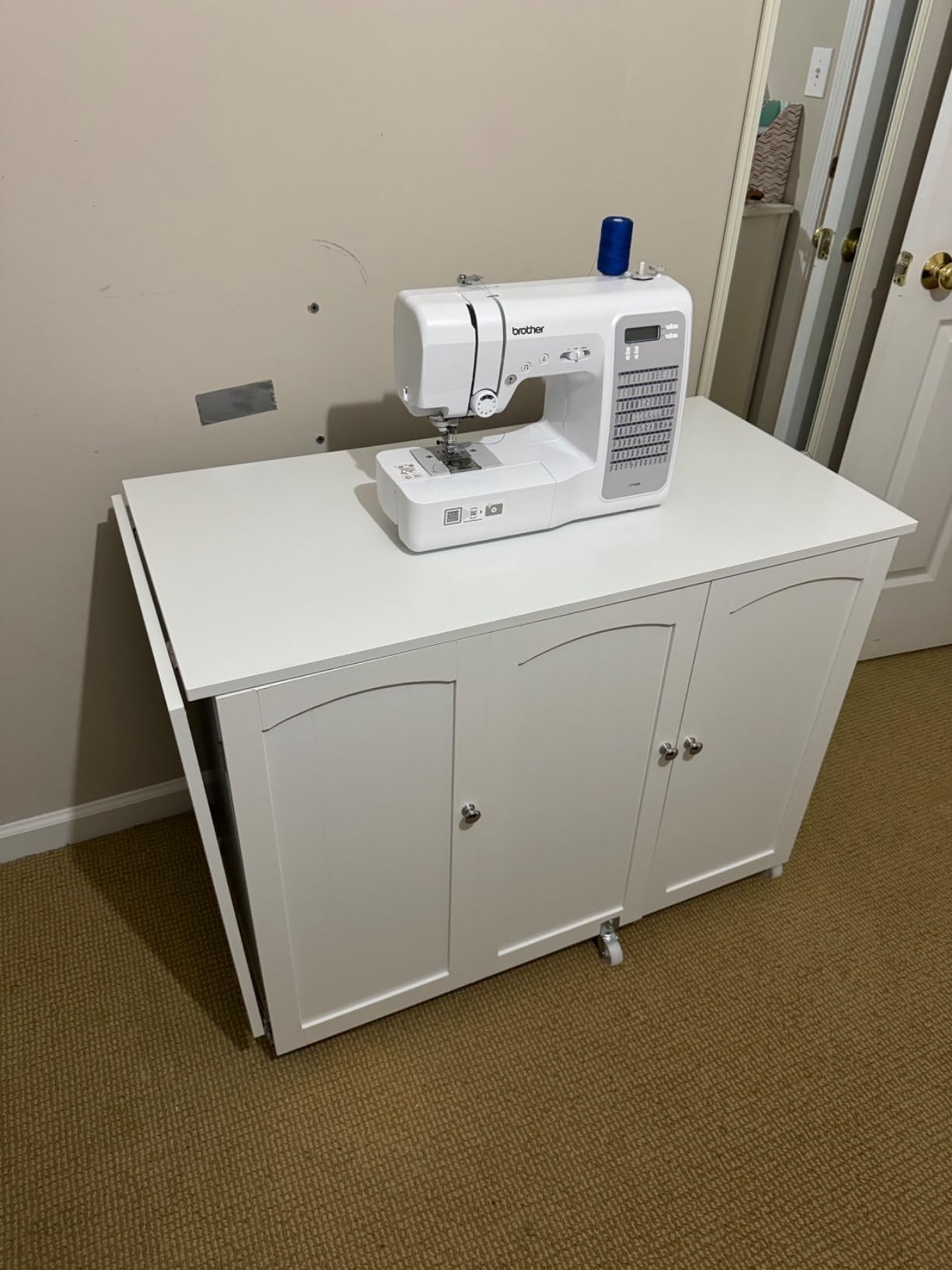
This is the only unit in our group that does both things a small-space sewist actually needs. It rolls away to a 19.5 inch depth, and when it is parked in a corner the raised panel doors make it look like a sideboard instead of a sewing station. The drop leaf is the part that sold us: a 38.5 inch closed top is too narrow to spread out a pattern, and the leaf adds roughly 16 inches when you need it, then disappears again.
Storage is the quiet strength. There is a hidden shelf sized for a sewing machine, two removable bins mounted inside the front doors, and adjustable shelving above for craft supplies. Because the machine lives on an interior shelf rather than on the open top, you can lay fabric across the work surface without the machine taking up a third of it.
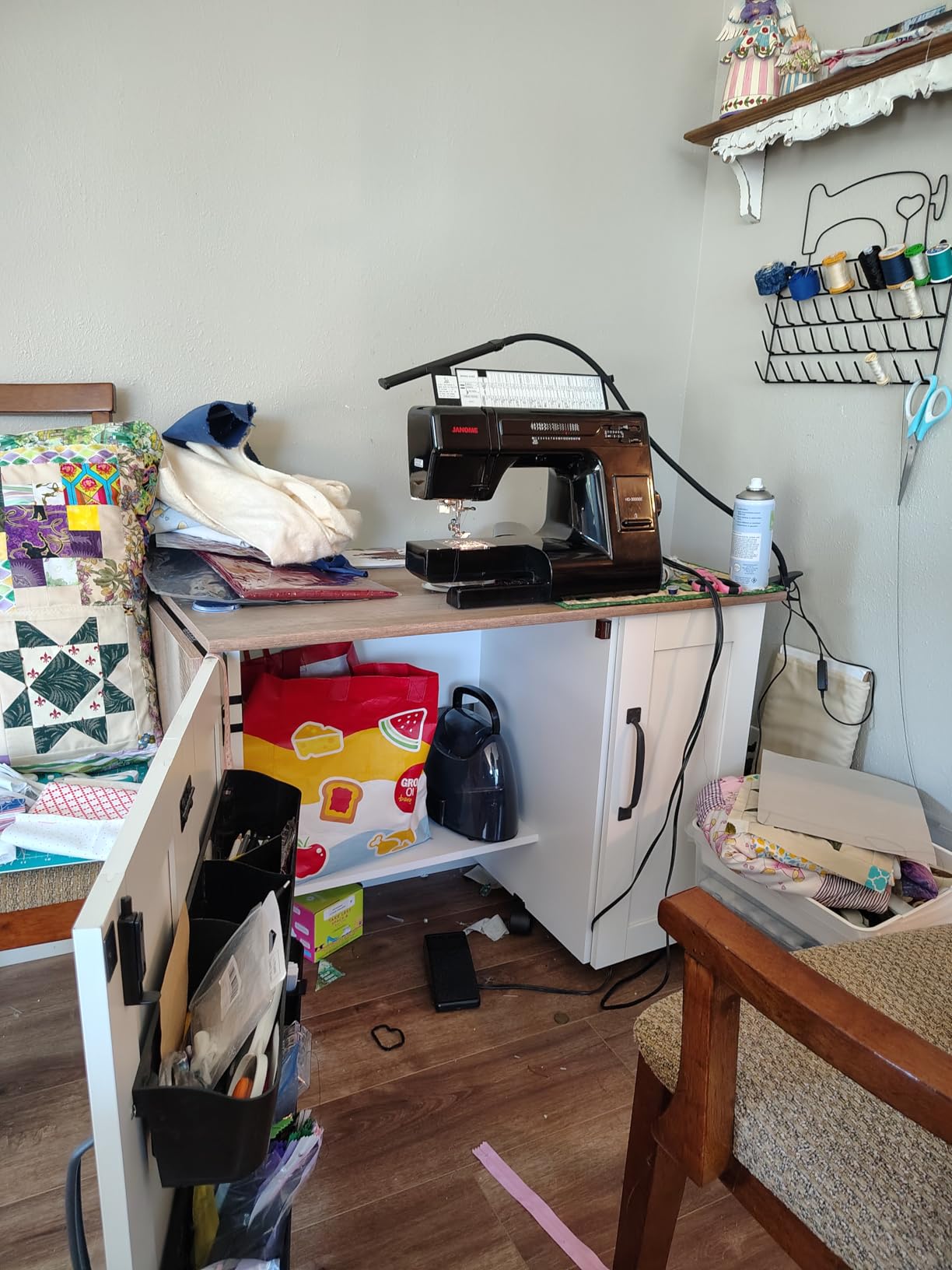
Owners consistently describe this cart as furniture that disappears into a guest room, and heavy users report it surviving years of service and a move. The 75 lb weight rating is the most generous load figure among the enclosed options we looked at, which matters if your machine is a heavy mechanical model. Two of the four casters lock, so you can pin it in place and push fabric through without drift.
The honest complaints are cosmetic and mechanical. A soft white finish shows fingerprints quickly, which matters in a room where the piece is visible rather than tucked in a garage. The drop leaf hinge is the failure point to watch, tightening it every few months keeps it from sagging. And owners consistently budget two hours for assembly, ideally with a second pair of hands.
Why it works for a shared room
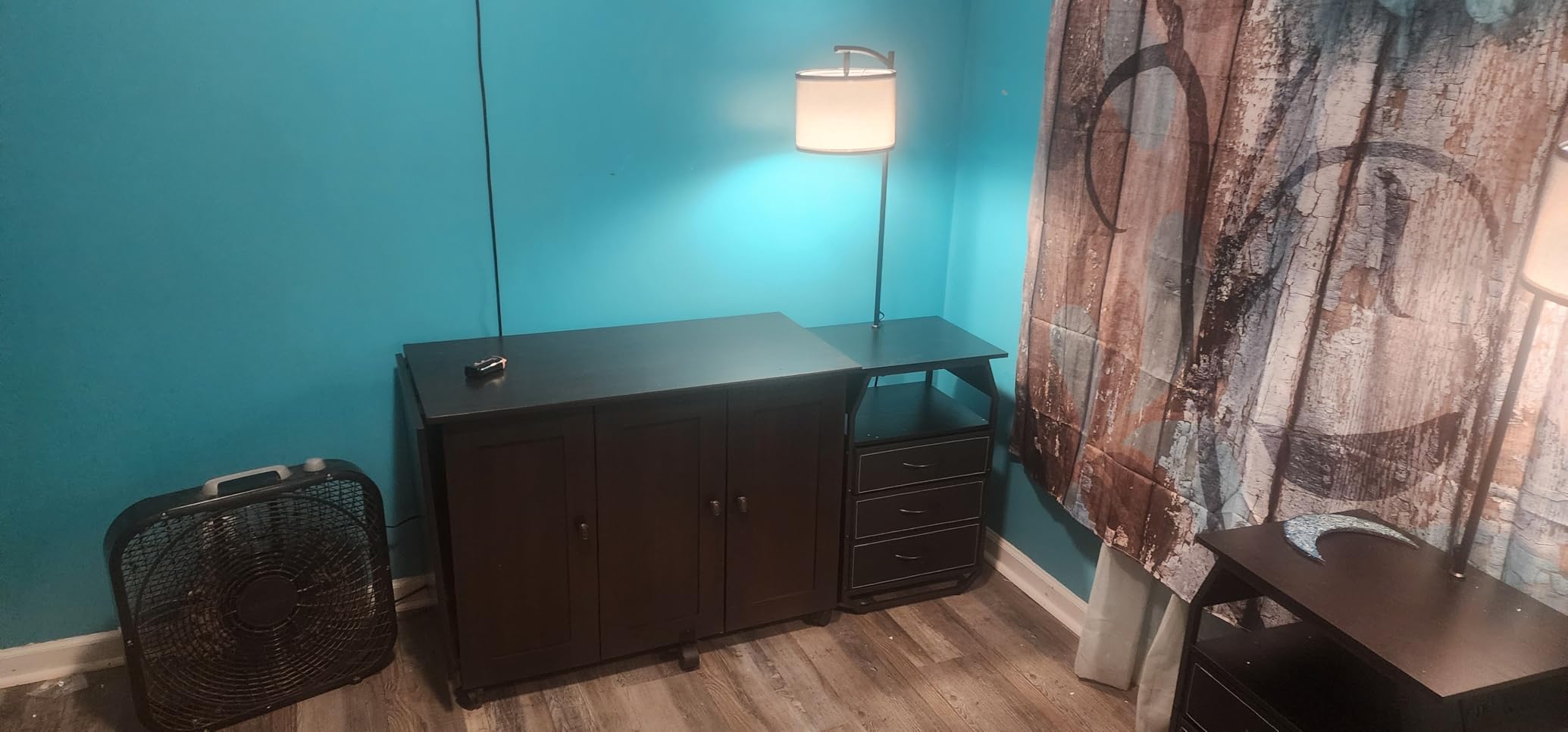
Two locking casters and a 19.5 inch closed depth mean one person can roll it down a hallway and park it flush against a wall or beside a bed. At 28.5 inches tall it works as an occasional side table or a place to stage a project, which is how it earns its floor space back. Doors that close properly are the difference between a room that looks finished and a room that looks like a craft space.
For a modest premium over the cheapest carts in this roundup, you get a five-year limited warranty, a machine shelf that is actually sized for a machine, and a finish that suits a living room. That combination is why it is our top pick for 2026.
Where it falls short
The enclosed interior means you trade convenience for tidiness. Every thread change and every bobbin refill now involves opening a door, and the interior shelf is snug, so a bulky machine may need the adjustable shelf moved first. Storage volume is honest but modest, which is the wrong choice if you quilt with a large working project in progress.
It is also the heaviest enclosed option here at 68.9 pounds, so it is a two-person move rather than a solo carry. If your small space is a walk-up or you plan to move rooms often, the lighter steel-frame tables further down handle that better.
2. Best Choice Products Folding Sewing Table — Best for the Tightest Folded Footprint
Best Choice Products Folding Sewing Table Multipurpose Craft Station & Side Desk with Compact Design, Wheels, Shelves, Storage Trays, Pegs, Magnetic Doors, Metal Doorknobs – White
Open 46 in x 14.75 in x 30.5 in
Closed 23 in x 14.75 in x 31 in
Weighs 41 lb
MDF with metal hinges
Pros
- Converts from a 46 inch work surface to a 23 inch side table
- Two rows of pegs plus two storage trays for notions
- Lockable wheels and magnetic door locks keep supplies secure when moving
- Doubles as a desk or craft station when not sewing
Cons
- MDF build is less rigid than solid wood or a steel frame
- 14.75 inch depth is narrow for bulky machines
- Rating is lower than comparable carts with a visible share of one-star reviews
This is the smallest closed unit we found among the enclosed carts, at 23 inches by 14.75 inches, and that number is why it makes this list. If your corner is measured in spare inches rather than spare feet, a table that opens to 46 inches and shuts to 23 is the whole idea in a single product.
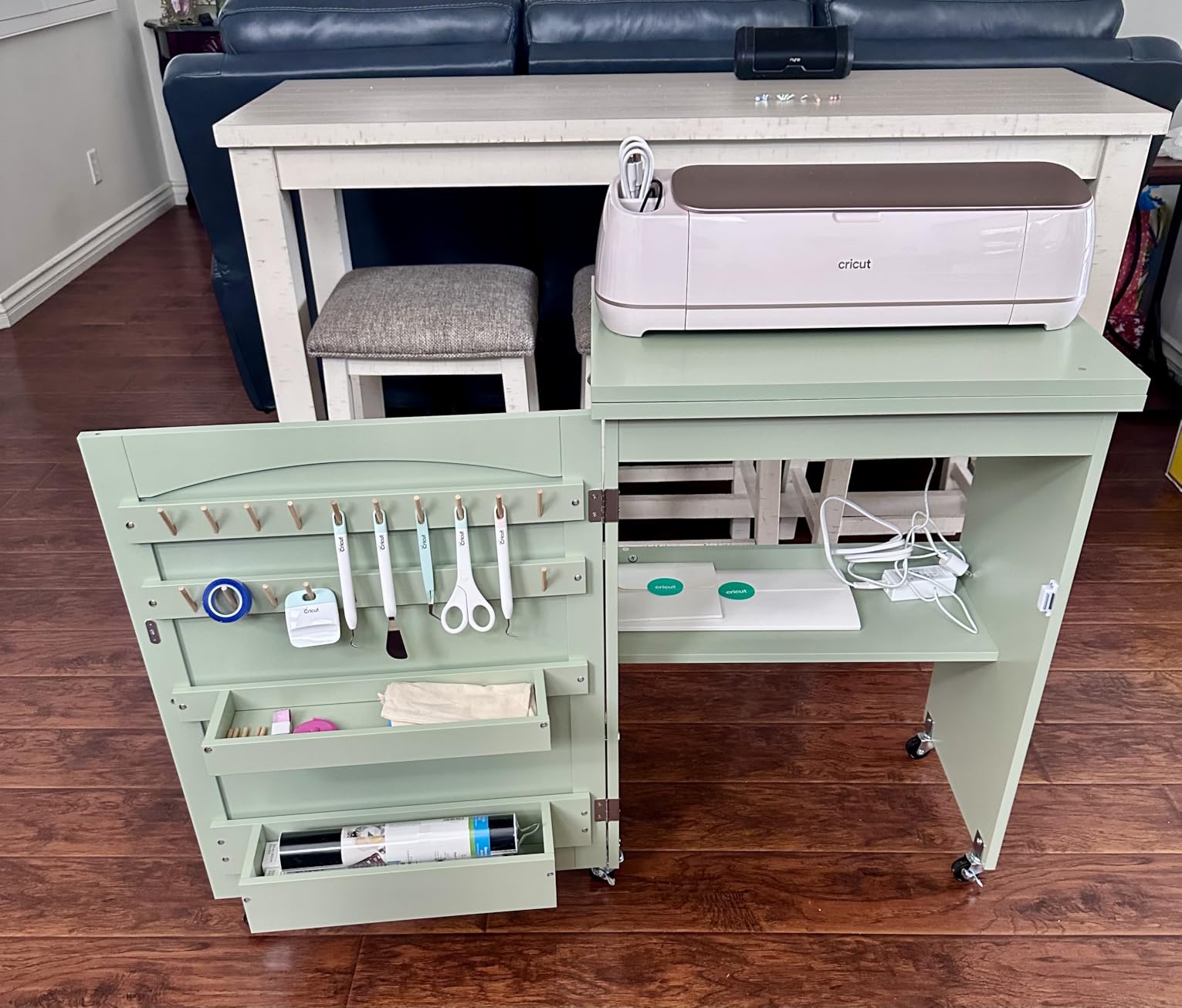
Organization is better than the price suggests. Two rows of pegs and two attached storage trays put notions within arm’s reach, and a large interior shelf takes the machine when you close the magnetic doors. Reviewers frequently single out the peg-and-tray layout as the thing that makes the difference day to day.
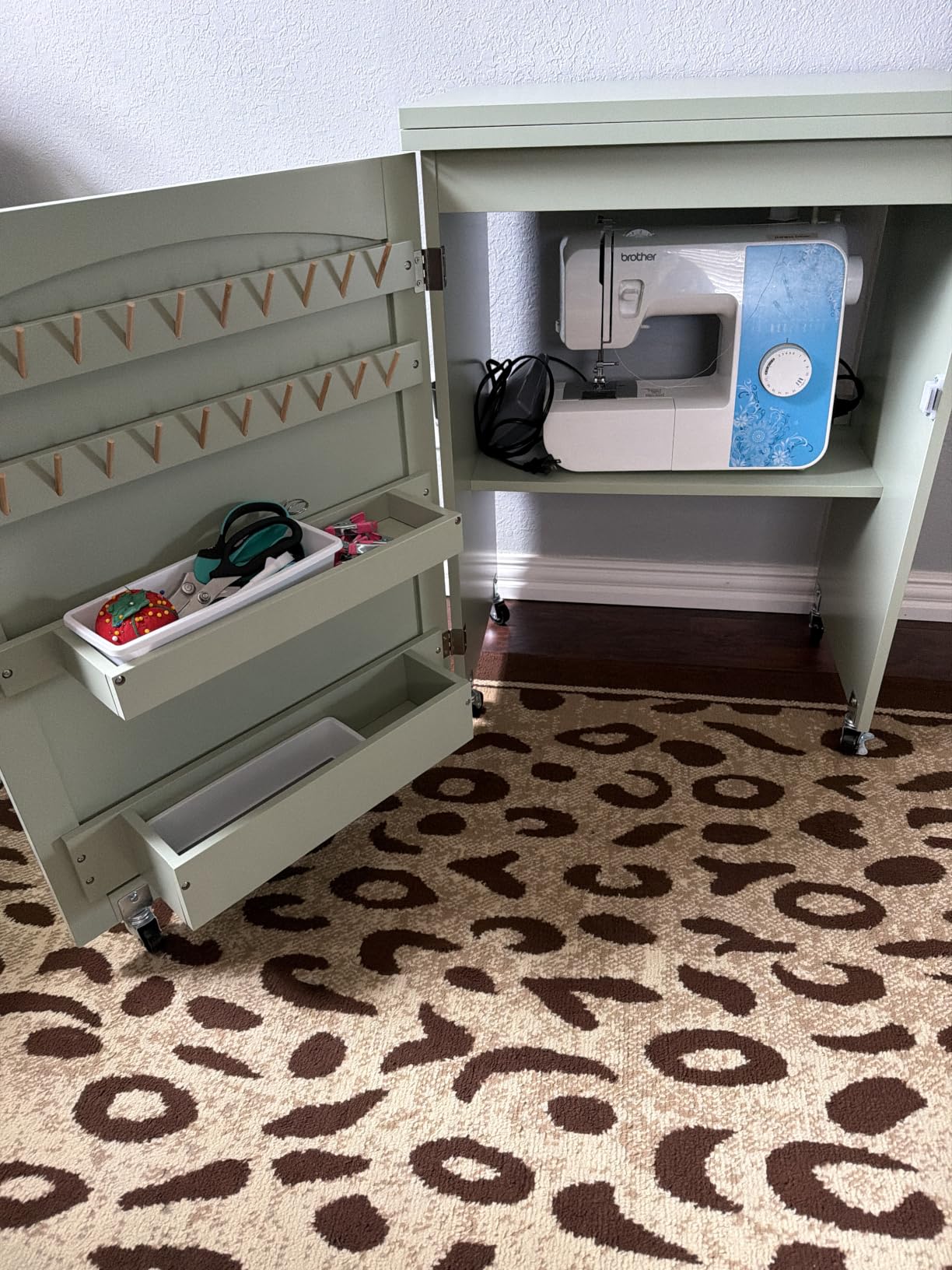
Build quality is the trade. MDF panels with metal hinges give you a clean hinge action and a wobble-resistant feel, but the board itself is lighter and less rigid than a steel frame or solid wood, and a noticeable share of buyers land in the one-star column. If you press hard on the surface while cutting heavy interfacing, you will feel it move more than you would on the Sew Ready steel tables.
The 14.75 inch depth is the other limit worth planning around. A machine base wider than that overhangs the back edge, and the top itself is slim, so large quilting pieces feel cramped. This is a machine, notions, and small-projects table rather than a fabric-cutting table.
When this one wins the corner
Choose it if your available space is a narrow gap between a sofa arm and a wall, or a dorm room where the desk doubles as a sewing station. The magnetic door locks are the detail that matters most in a shared space: they stop notions from falling out when you roll the unit across a threshold or around a corner.
It also works as a genuine second desk, which spreads the cost across everything you do in the room. If you sew four hours a week and want a craft surface the rest of the week, the multipurpose framing is honest rather than a marketing trick.
When to look elsewhere
Skip it if you own a heavy machine, quilt thick layers, or plan to leave fabric spread across the surface for hours at a stretch. The lighter board and the low 4.2 rating mean the durability case is weaker than the featured pick, and the narrow depth will not grow to fit a bigger machine later.
It is also a two-inch-deep compromise that only pays off if you actually close it between sessions. Left open permanently, you have a 46 inch table with 14.75 inches of depth and no more usable surface than a standard desk.
3. Sew Ready Folding Multipurpose Sewing Table — Best for Steel Frame Stability
Sew Ready Folding Multipurpose Sewing Table – 47.5″ W x 28″ D Foldable White Hobby and Sewing Machine Table with Adjustable Shelf – Can Also Be Used as Computer Desk
47.5 in W x 28 in D x 30 in H
Powder-coated alloy steel frame
Platform 22 x 10.5 in, 20 lb
Weighs 39 lb
Pros
- Powder-coated steel frame feels far more stable than wood-and-MDF carts
- 47.5 inch top handles wide projects and fabric cutting
- Adjustable machine shelf supports several machine base heights
- Folds flat for closet storage and doubles as a computer desk
Cons
- 47.5 inch top is among the widest footprints here
- One shelf only
- so storage is minimal against cabinet-style carts
- Rated 4.0 with a 13 percent one-star share
This is the sturdiest build in the roundup, and for a lot of sewists that is the deciding feature. A powder-coated alloy steel frame does not rack the way particle board does when you lean across the table to pull a long fabric length, and the frame is paired with a one-inch engineered wood top rather than a thin skin.
The 47.5 inch by 28 inch surface is genuinely large. That is a real advantage if you cut yardage or work on garment panels, and it is also why it made the list on stability rather than on footprint. Four floor levelers handle uneven floors, and the fold-in legs lock for safety before you trust the top with a machine on it.
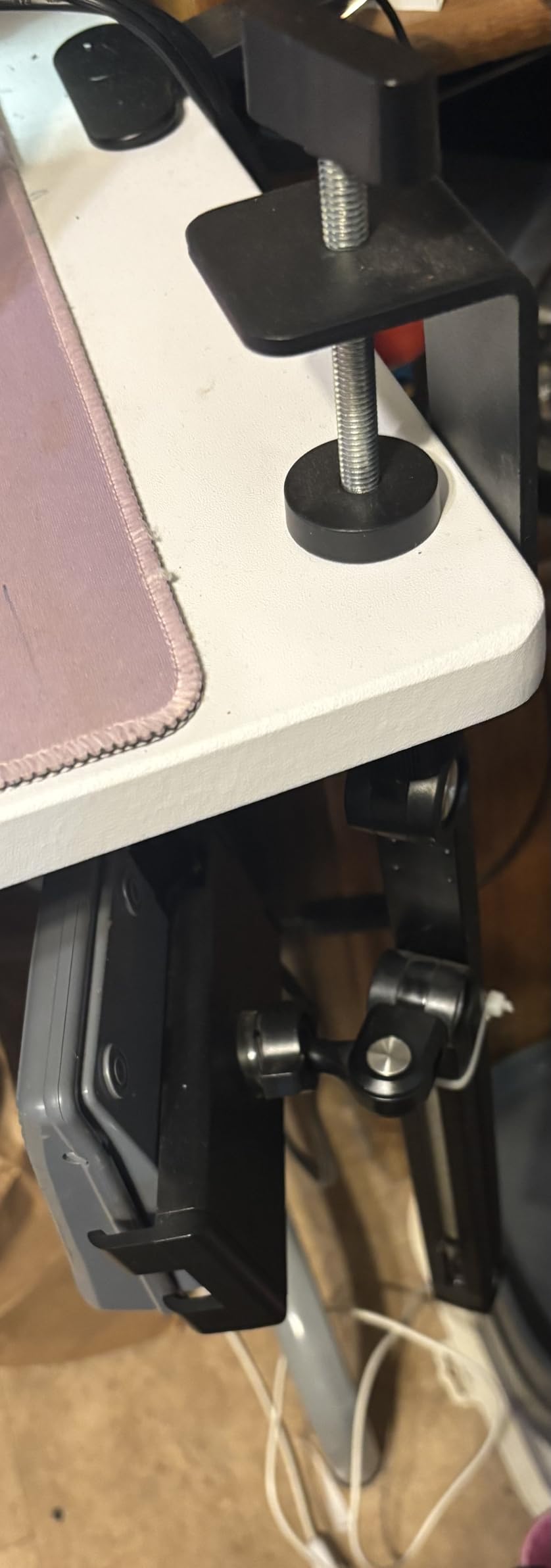
The adjustable sewing machine platform measures 22 inches by 10.5 inches and offers six height positions with a 20 pound limit. That shelf doubles as a keyboard tray, which is how this table earns a place in a room that is not a dedicated craft space. Reviewers like the steel frame and the generous top, and many use it as a second office desk.
Critiques are consistent and specific. One shelf is the entire storage story, so the machine either lives on the platform permanently or goes on the floor. The 47.5 inch width is among the largest open footprints here, which is a poor fit for a genuinely narrow wall.
Why the frame matters more than the surface
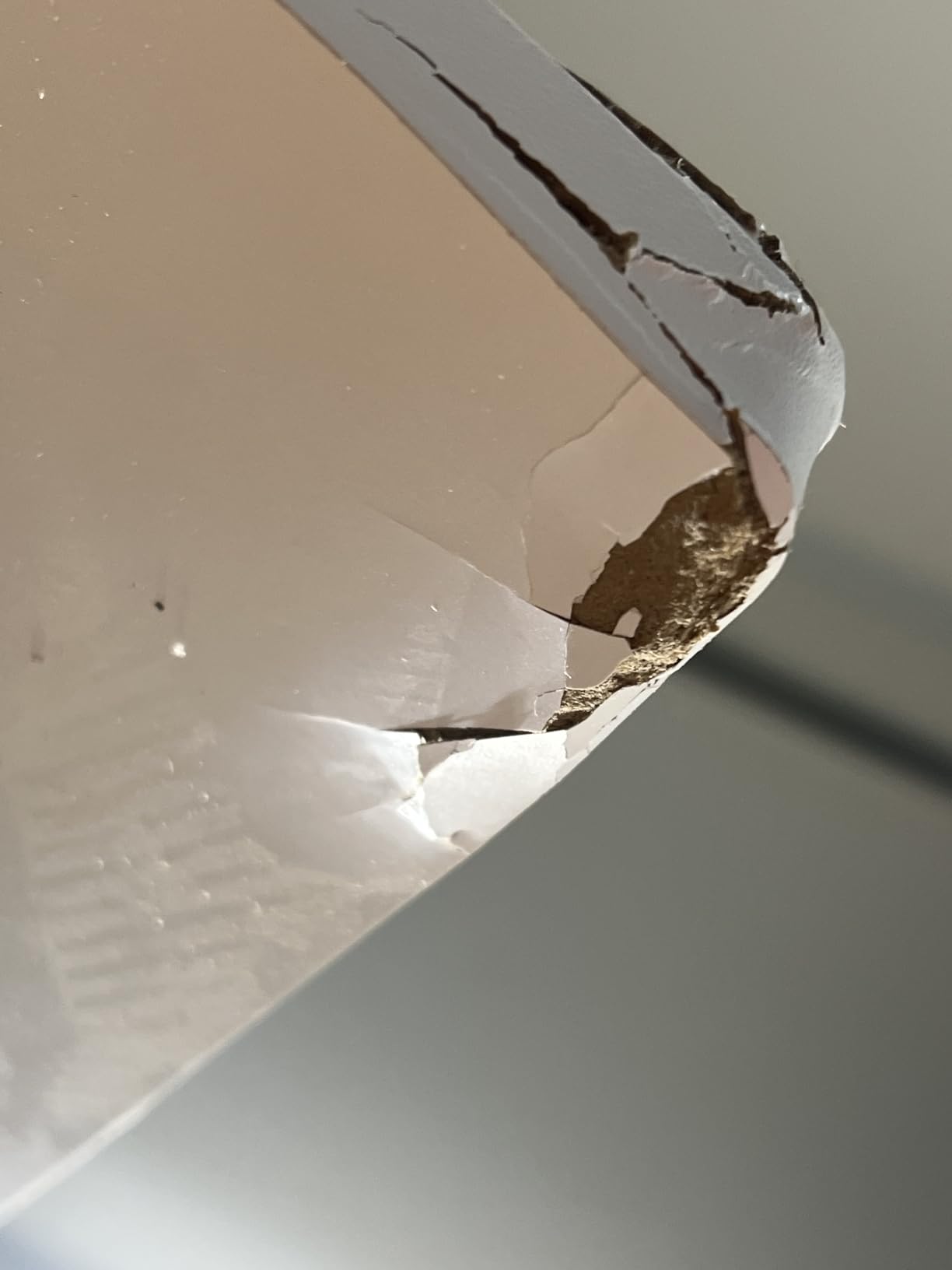
Small-space rooms are shared rooms, and shared rooms get bumped. A steel frame with locking legs tolerates being moved, braced against, and reassembled, which is a real difference over the MDF carts. If you quilt, cut thick interfacing, or press fabric against the edge, the stiffer frame keeps the machine from bouncing mid-stitch.
For anyone who wants one table to do sewing, cutting, and a second office desk, this is the most versatile pick in the group. The trade is storage: one shelf means you are managing notions in bins under the table rather than built-in drawers.
Where the footprint bites
Forty-seven and a half inches is wide. In a room where that is against a wall with a window, you are giving up a substantial stretch of the room to keep the table assembled. Folding it flat solves storage in a closet, but not a working surface in a small bedroom.
Assembly is recommended for two people, and the 4.0 rating with a 13 percent one-star share is the second-lowest here. For a heavy machine the 20 pound platform limit is worth checking against your machine’s weight before you commit.
4. GIANTEX Folding Sewing Table with Charging Station — Best for Built-In Power
GIANTEX Folding Sewing Table with Charging Station, Storage Trays & Shelf
45.5 in L x 16 in W x 31 in H open
Folded 35 in L x 20 in W x 31 in H
2 outlets, USB and Type-C
45 lb rating
Pros
- Built-in charging station with two AC outlets
- USB and Type-C removes cord clutter from the work surface
- Folds from a 45.5 inch workspace down to a 35 inch footprint
- Three side bins plus a large open shelf for fabric and supplies
- Five casters with three lockable wheels make repositioning easy
Cons
- Only 16 inches deep when open
- so large pieces need the folded configuration
- Laminated particle construction is less rigid than a steel frame
- Assembly takes a couple of hours and some buyers report missing hardware
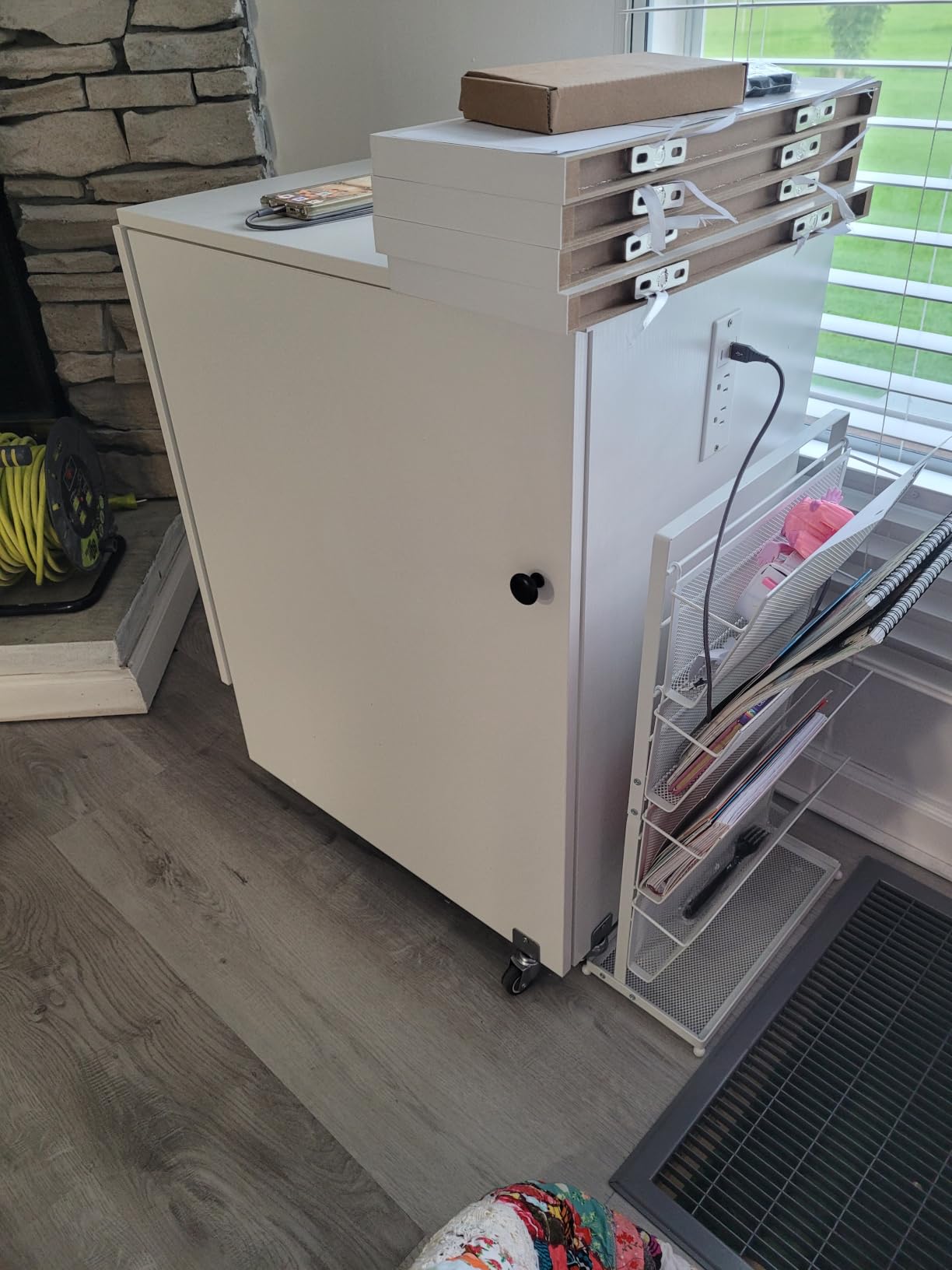
The charging station is the reason this table shows up in small-space roundups at all. Two AC outlets plus one USB and one Type-C port sit on the side panel, which means your machine, lamp, and phone charger plug into the furniture instead of running extension cords across the floor. In a rented room you cannot drill into, that is a real convenience.
The fold is a genuine fold, not a drop leaf. It goes from 45.5 inches by 16 inches open down to 35 inches by 20 inches folded, so the closed depth is deeper than the open depth, which is unusual and worth understanding before you measure your gap.
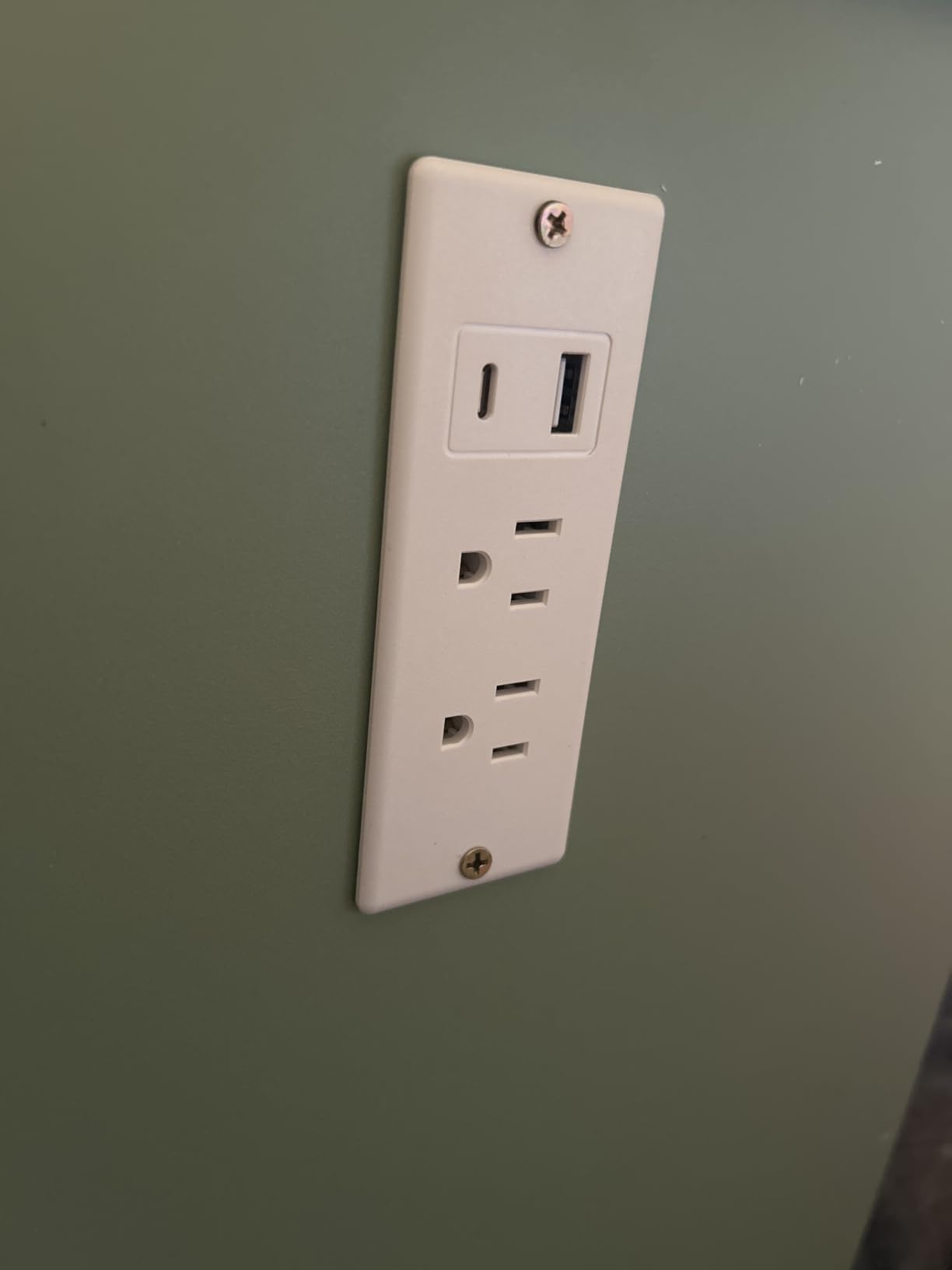
Reviewers single out the power strip as the signature feature, along with the balance of storage in a small folded footprint. Three built-in side bins, one large open shelf, and three drawers give it more storage than most folding tables in this group, and three of the five casters lock so you can pin it while stitching.
What you give up is depth and rigidity. Sixteen inches when open is shallow, and owners of large quilted pieces report working with the leaf in a specific configuration to get around it. The laminated particle construction is lighter and less rigid than the steel-frame options, and assembly has produced a handful of missing-hardware complaints.
Where the power station changes the routine
If your machine is the kind that needs a dedicated outlet and you are working around a shared floor plan, a furniture-mounted power strip is a small thing that removes a real problem. It also means the machine can be plugged in and stowed without unplugging, which shortens the setup time at the start of a session.
It doubles as a craft desk, computer workstation, or side storage cabinet, so the same footprint earns its place on days you are not sewing at all. For a home office that needs a second work surface on demand, that flexibility is the argument.
When the shallow top is a problem
Sixteen inches of depth is genuinely limiting. Pattern pieces, a cutting mat, and a machine that all need to be flat at once will not fit, and the folded configuration is a work-around rather than a solution. Measure the widest thing you need to lay out flat before choosing this.
At 43 pounds it is light enough to move around, but the particle build means less lateral rigidity than the steel tables. If you quilt thick layers or press hard, look at a heavier frame instead.
5. Vividwood Folding Sewing Table Rustic-Brown — Best for Bobbin and Spool Storage
Vividwood Folding Sewing Table, Multipurpose Sewing Machine Table with Compact Design, Wheels, Shelves, Bins, Pegs, Magnetic Locks (Rustic-Brown)
Open 46 in x 15.8 in x 30.5 in
Closed 23 in x 14.8 in x 30.5 in
10 bobbin holders, 2 bins
Weighs 42 lb
Pros
- Folds to roughly an end-table footprint for very small rooms
- Ten bobbin holders plus two bins and a large interior shelf hold a machine and a work in progress
- Two of five casters lock to steady it while sewing
- Magnetic locks hold the door and drop leaf closed when the unit is moved
Cons
- Pegs fit large spools only
- not standard thread spools
- Tight interior clearances with the lower shelves installed
- Lightweight MDF can tip if you lean on the open leaf
Ten bobbin holders is an unusual amount of dedicated hardware, and it is what separates this cart from the rest of the folding group. Sewers working in small spaces consistently ask where the machine plus the work in progress plus the supplies go, and this is a unit that answers the middle question specifically.
Closed, it measures 23 inches by 14.8 inches, which puts it in the same tier as the other compact carts. Open, the 46 inch by 15.8 inch top gives a long narrow surface. Five casters, two of them lockable, and magnetic locks on the door and leaf keep everything secure when you roll it.
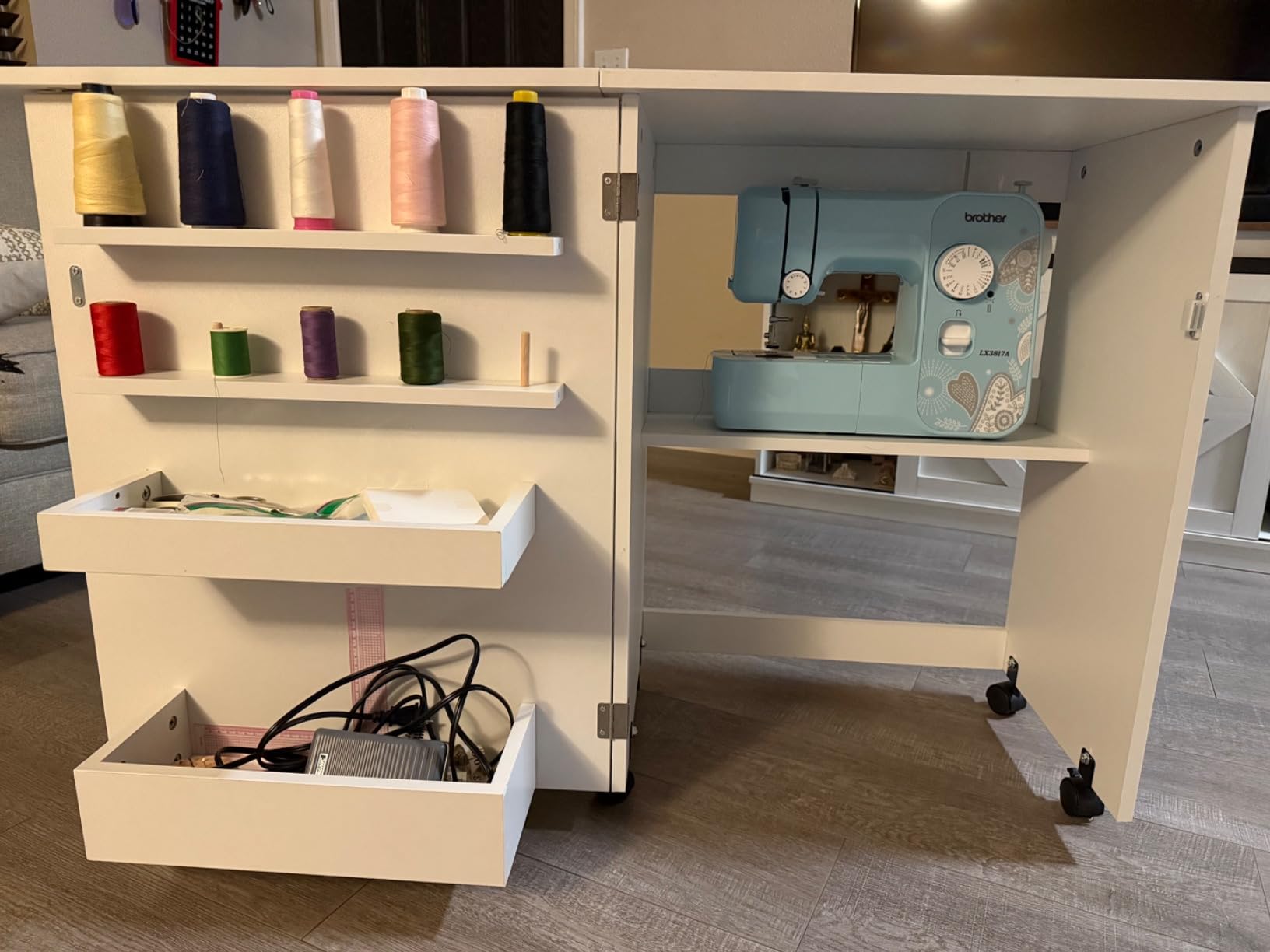
Assembly is the quiet strength here. The components are numbered and a tool is included, which owners in small-space situations mention as the reason this one went together without a fight. The MDF board uses solid metal hinges and magnetic locks rather than plastic catches, which is the right choice on a unit that will be folded and unfolded repeatedly.
The pegs are the recurring gripe. They fit large spools but not standard Coats and Clark spools, so if your thread habit is mainstream, expect to hang your everyday spools elsewhere. Lower shelves also limit interior clearance once a machine is stored inside, and there are reports of wheels and doors misaligning during assembly along with occasional panel defects.
Why bobbin storage decides this for some people
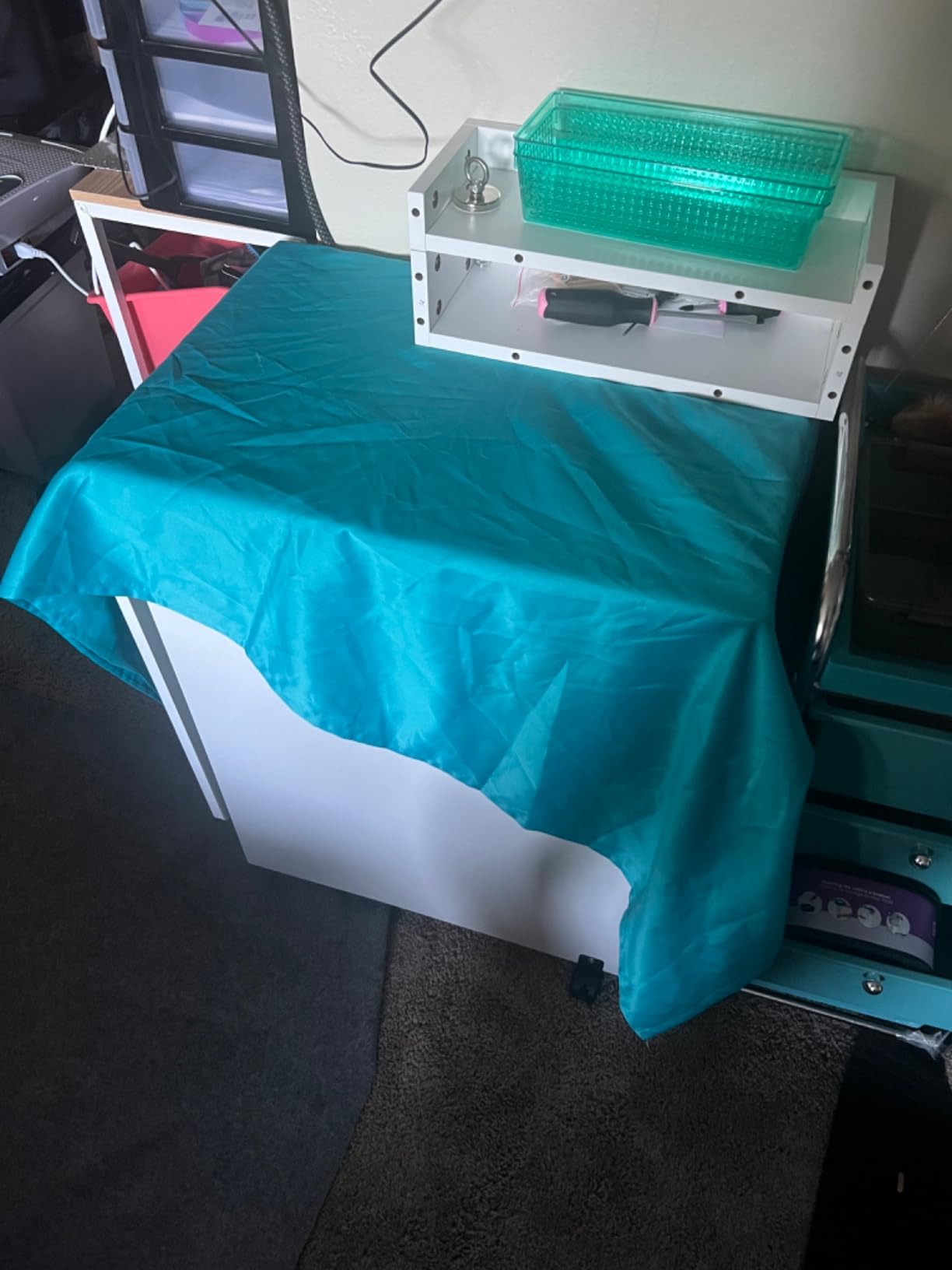
If you work in a color rotation, thread changes become the bottleneck, not the machine. Having ten bobbins visible on the inside of a door that closes means a full color plan is ready to run the moment you open the unit, which is why this table earns its place in a very small footprint.
Numbered parts also matter more than they sound. In a studio apartment you may be assembling on a bed, in stages, over a weekend, and clearly labeled hardware is the difference between that and an abandoned project in a box.
Where it frustrates owners
Standard thread spools do not fit the pegs, and the lower shelves cut into the interior volume that a machine needs. Lean on the open drop leaf and this lighter MDF body can tip, so treat the extended surface as a temporary extension rather than a work platform.
Fit and finish are also uneven in a way other units are not. Owners report cosmetic scratches and the occasional defective panel, which is a fair warning to inspect the package before you start assembly.
6. Sew Ready Rollaway II Portable Foldable Table — Best Ready to Use
Rollaway II Compact Portable Folding Sewing Table, Silver/White
40.5 in W x 20 in D x 28.25 in H
Weighs 24 lb
Rated to 50 lb
Adjustable platform 17.75 x 7.5 in
Pros
- Arrives fully assembled
- so there is no build step at all
- Lightest unit here at 24 pounds
- so one person can carry it between rooms
- Folds flat and rolls on two wheels for closet storage
- Top printed with inch and centimetre measurement stickers
- Backed by a lifetime warranty
Cons
- No enclosed storage
- so the machine must be lifted to the top or covered
- Only two wheels
- so it is rolled rather than steered
- 40.5 inch top is smaller than the 47.5 inch Sew Ready folding table
This is the highest-rated unit in the group, and the reason is not a feature list. It arrives fully assembled. For anyone in a small apartment, that removes the single most common complaint we saw across ten products, which is a two-to-three hour build on a floor you also eat on.
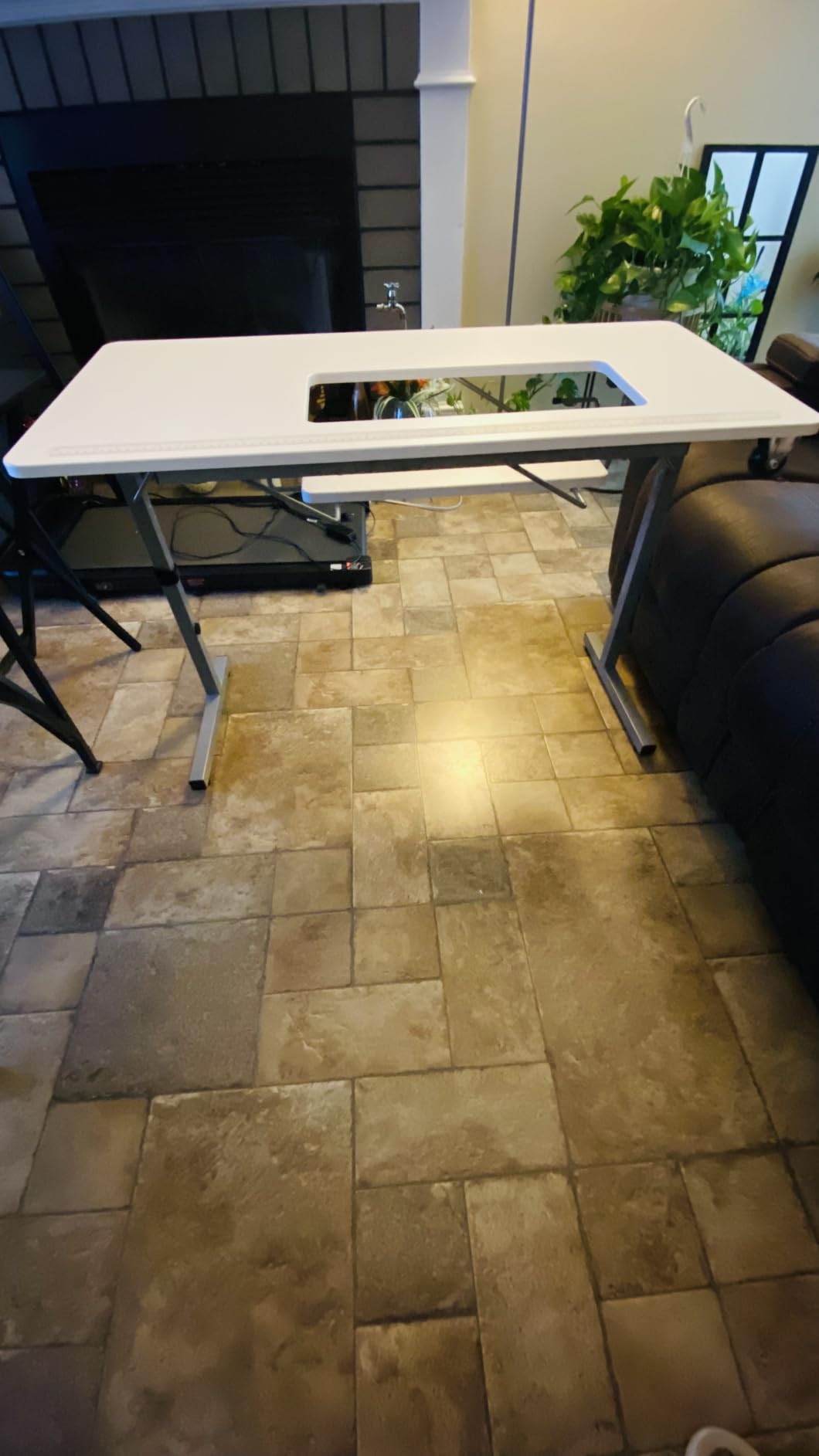
At 24 pounds it is the lightest thing here by a wide margin, so you can carry it up stairs or between rooms yourself. The 40.5 inch by 20 inch top folds flat with two wheels tucked underneath, which means it disappears into a closet between sessions rather than living in the corner of your living room.
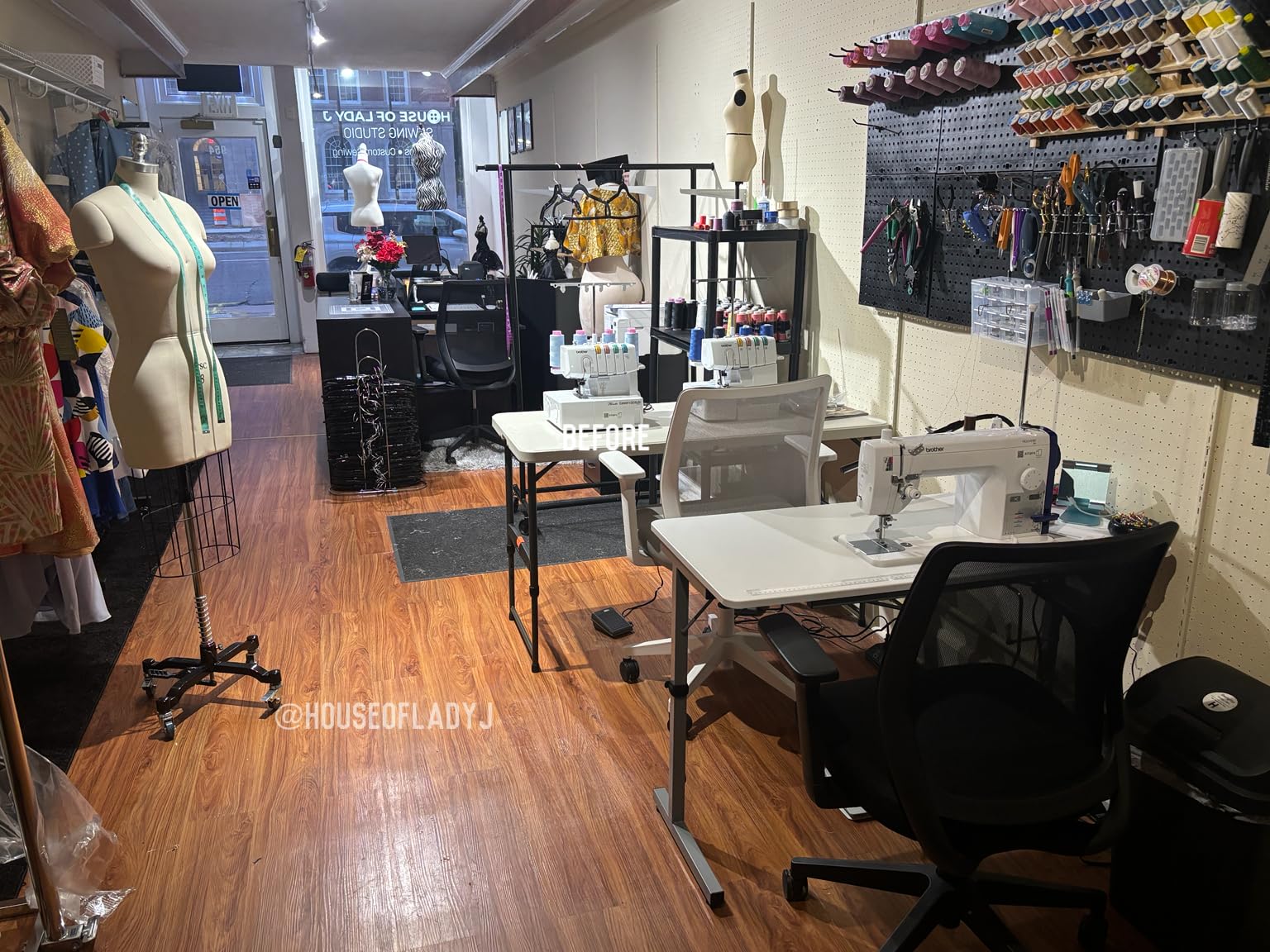
There are thoughtful touches. The tabletop is printed with inch and centimetre measurement stickers, which saves you finding a tape measure every time you lay out a pattern. The powder-coated steel frame has four floor levelers, and the adjustable machine platform measures 17.75 inches by 7.5 inches to accommodate different machine base heights. Rated to 50 lb.
The tradeoff is that this is a table, not a cabinet. There is no enclosed storage, so the machine has to be lifted onto the top or covered with a dust cover to hide it. Two wheels means you roll it in a straight line rather than steering it around a corner.
Why the lifetime warranty is the real headline
For furniture, warranty length is a proxy for how long the manufacturer expects the hardware to work. A lifetime warranty on the folding frame and the casters tells you the steel and the hinges are built to be folded and unfolded many times over, which is exactly the duty cycle a small-space owner imposes.
Combined with the 24 pound weight, it is the easiest unit in the roundup to move. A single-person setup is the difference between a table that lives in the room and one that gets folded into a closet at the end of every project.
Where the open frame shows its limits
An exposed machine is the main issue in a shared room. Without doors, you need a cover, and fabric left on an open table collects dust and pet hair. If the room has to look finished when you are not sewing, this is the wrong shape of answer.
The 17.75 inch by 7.5 inch platform is also smaller than the ones on the heavier tables here, so check it against your machine’s base before buying. It is a strong choice for an occasional sewist on a tight budget, and a weaker one for a long quilting session.
7. VIVOHOME Folding Sewing Table — Best for Studio Apartments
VIVOHOME Folding Sewing Table for Sewing Machine, Sewing Desk with Storage
Extends to 46 x 16 x 31 in
Folds to 23 x 16 x 31 in
3 hidden bins, 1 shelf
Weighs 46 lb
Pros
- 23 inch folded footprint suits studio apartments and single rooms
- Three hidden bins plus a shelf hold notions and a machine
- Lockable swivel wheels keep the cart fixed while working
- Pre-drilled holes simplify assembly compared with self-tapping furniture
Cons
- Door-mounted bins overlap the interior shelf
- so a full-size machine may not fit inside with the door closed
- Assembly can take two to three hours and needs a careful read of the instructions
- Particle board with mixed brass and chrome hardware
The 23 inch by 16 inch folded footprint is what earns this cart its place. In a studio where the same square feet serve as bedroom, kitchen, and office, a sewing unit that shrinks to the size of a large side table is a genuinely different proposition from one that occupies 40 inches of permanent wall.
Open, it extends to 46 inches by 16 inches. Three hidden storage bins and one interior shelf take the bulk of your supplies, and five swivel casters with two lockable wheels let you pin it in place once you have found your spot.

Build details that usually cost extra are present here. Pre-drilled holes mean no self-tapping screws fighting particle board, and illustrated instructions go with them. Metal fittings, flexible hinges, a solid handle, and a magnetic button closure are all sensible choices on a unit designed to be folded open and shut regularly.
The critical limitation is internal, and it is the same one reviewers mention most: the door-mounted storage bins overlap the interior shelf. That means a full-size sewing machine often cannot be stored inside with the door closed, which defeats the primary reason to buy an enclosed cart in a tiny room.
Check the door bin before you commit
Before buying, take the measurement of your machine and add an inch in each direction, then look at whether the interior shelf clears that with the door bins installed. If it does not, you are choosing a closed cart for a machine that will end up sitting on top, and the Sauder or the Vividwood rust unit solves it properly.
Used as an open craft cart with the machine on top and the bins below, though, this is a well-organised and compact unit. That is a legitimate use in a studio apartment, and the folded profile keeps it out of the way between sessions.
Other things to weigh
Assembly is reported at two to three hours, so budget an evening. Mixed brass and chrome hardware is a minor quality signal that reviewers do mention, and a few buyers received panels with misaligned drilling, which is worth checking the moment the box opens.
At 46 pounds it is heavier than the steel folding tables, so moving it alone across carpet or a threshold takes a little care. The lockable casters are the reason it stays steady once it is parked.
8. Sew Ready Dart Workstation Desk — Best for Shallow Room Depth
Sew Ready Dart Wood/Metal Multipurpose Machine Table Workstation Desk with Folding Top for Crafts, Sewing, Computers, Laptops, Games, Black Graphite/White 23D x 41W x 30H in
23 in D x 41 in W x 30 in H
Weighs 29 lb
Platform rated 20 lb
Folding shelf 23.5 x 9.5 in
Pros
- Folding top shelf converts a split work surface into one continuous flat span
- Steel frame with rear crossbars is noticeably more rigid than particle-board carts
- Compact 23 inch depth suits narrow rooms while still giving 41 inches of width
- Light enough to move alone
- with a 10-year warranty
Cons
- No enclosed cabinet
- so the machine and supplies stay exposed
- Weight limits are modest at 25 lb for the top and 20 lb for the platform
- Folding shelf and platform hardware need tightening to stop vibration
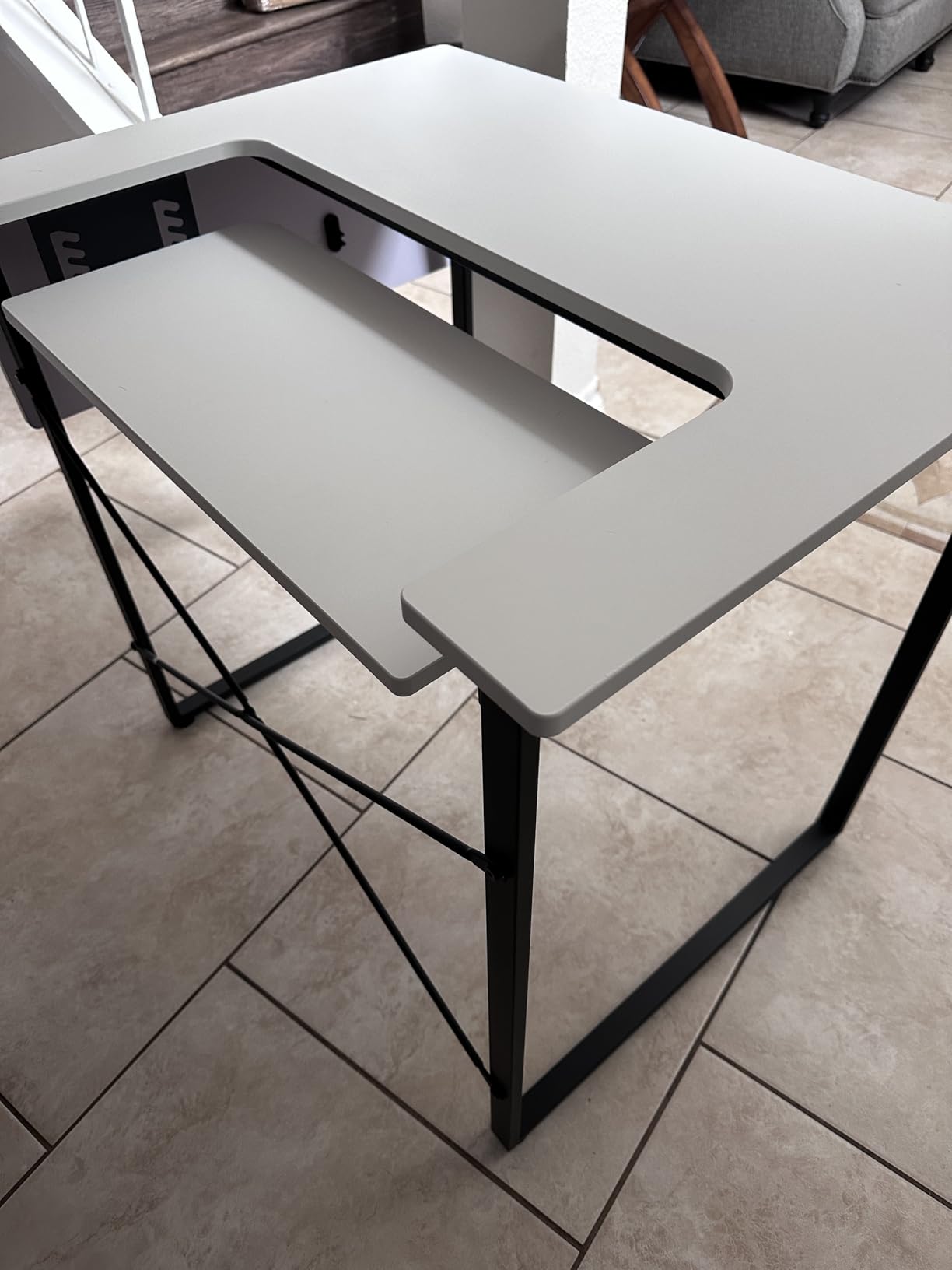
Depth is the constraint this table solves. At 23 inches deep and 41 inches wide, it gives you a wide cutting surface in a room where the wall-to-wall dimension is the limiting factor. The other cabinets here are long and shallow; this one is the opposite shape, which suits a room that is wide rather than deep.
The folding top shelf measures 23.5 by 9.5 inches and drops down to create one flat full-length surface. That is the feature owners point to: without it, a 41 inch top is split into two working zones; with it, you have a continuous span for yardage.
Underneath, the frame is a powder-coated steel structure with rear crossbars, which is why this 4.6-rated unit feels more solid than its weight suggests. Four floor levers handle uneven surfaces, and six height positions on the machine platform let you set the base at the right level for your machine and your seated height.
Weight limits are the honest limitation: 25 lb on the top, 15 lb on the side panel, and 20 lb on the sewing platform. That is fine for a typical domestic machine and short of what a heavy quilting frame needs. A few owners also mention tightening the folding shelf and platform screws to stop vibration, which is ordinary five-minute maintenance.
Where a 23 inch depth changes the room
A shallow footprint means you can push the table against a wall that has a radiator, a shallow window reveal, or a walkway you have to cross. The 10-year warranty also carries weight here: it covers a frame meant to be raised and lowered repeatedly rather than a static piece of furniture.
At 29 pounds it is one of the easiest to move alone, so it suits a room that changes function. It is a workstation first, with the sewing platform as an addition, and that is a better fit for someone who cuts fabric as much as they stitch.
When an open frame is the wrong answer
There is no enclosed cabinet, so privacy and dust protection are unsolved. A machine cover is the minimum, and if the room needs to look finished when you are not sewing, this is the wrong shape. The same applies in a home with pets, where a cat on an open machine is a real risk.
The modest weight ratings also rule it out for heavier machines. Check your machine’s weight against the 20 lb platform figure before you commit, and expect to retighten hardware after the first few sessions.
9. Vividwood Sewing Table with Adjustable Platform — Best for Heavy Machines
Vividwood Sewing Table, Large Sewing Machine Table with Adjustable Platform and Storage Shelf – White
45.5 in W x 23.5 in D x 30 in H
Platform 23 x 10.75 in
Steel legs, 1.25 in top
Lower shelf with foot clearance
Pros
- Generous 45.5 inch top with a 9.5 inch foldable side shelf for large fabric pieces
- Adjustable platform can be tightened to keep fabric level with the work surface
- Lower shelf sits high enough to leave clear foot space underneath
- Heavy gauge steel legs and a thick top feel sturdy for heavy machines
Cons
- Adjustable platform is not perfectly flush with the tabletop
- Included tool is too short for some screws
- so a full screwdriver helps
- No enclosed cabinet
- so the machine stays visible when stored
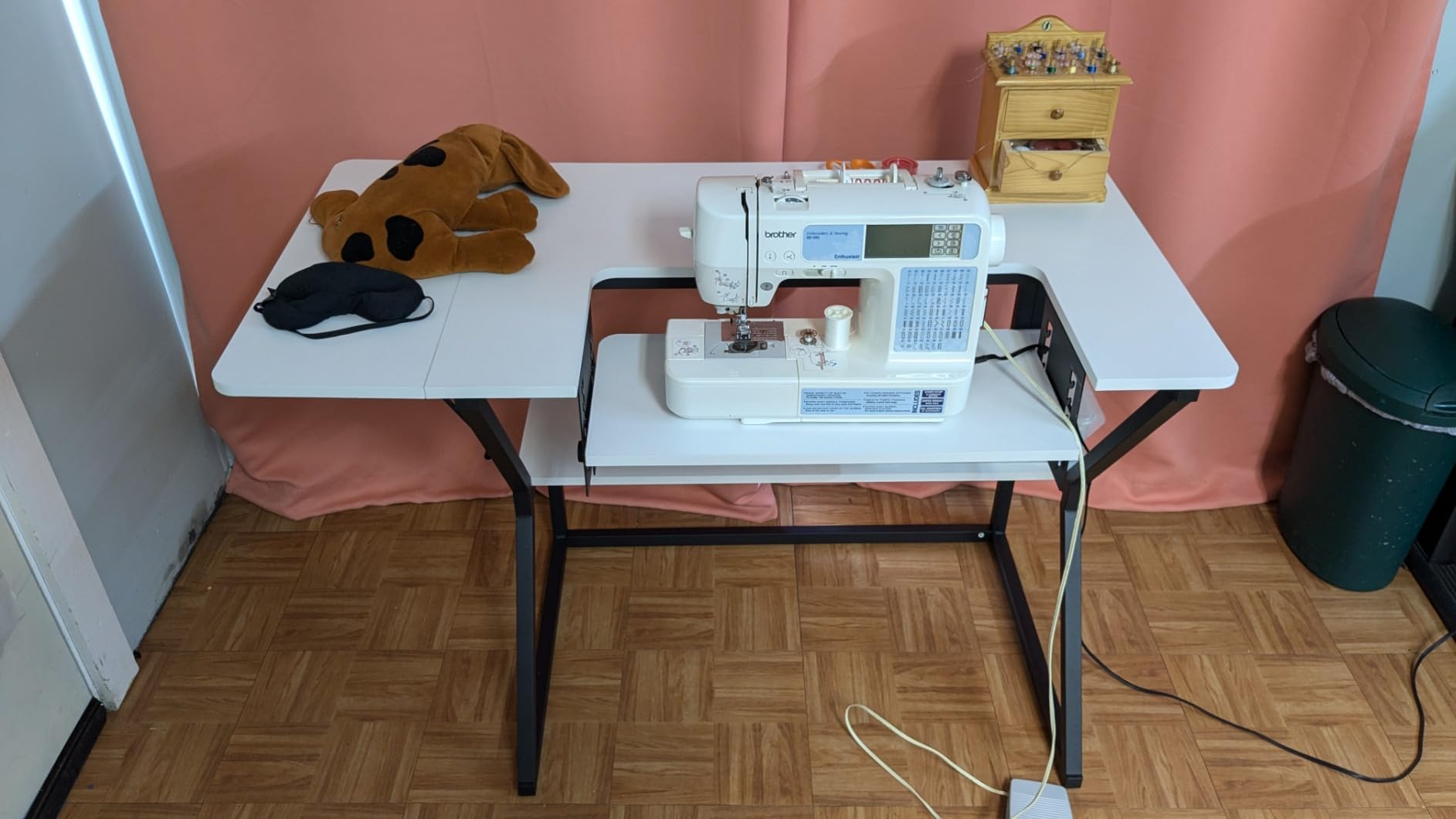
This is the table to look at if your machine is heavy. Reviewers specifically call out how well larger machines sit on the adjustable platform, and the build is heavier than the particle carts: heavy gauge steel legs under a 1.25 inch engineered wood top, with four floor levelers for stability.
The platform measures 23 inches by 10.75 inches and has upgraded bracing intended to reduce shaking. That bracing matters more than it sounds, because a machine that bounces during a straight seam shows up as a wavy stitch line. Owners can tighten the platform so fabric feeds level with the work surface.
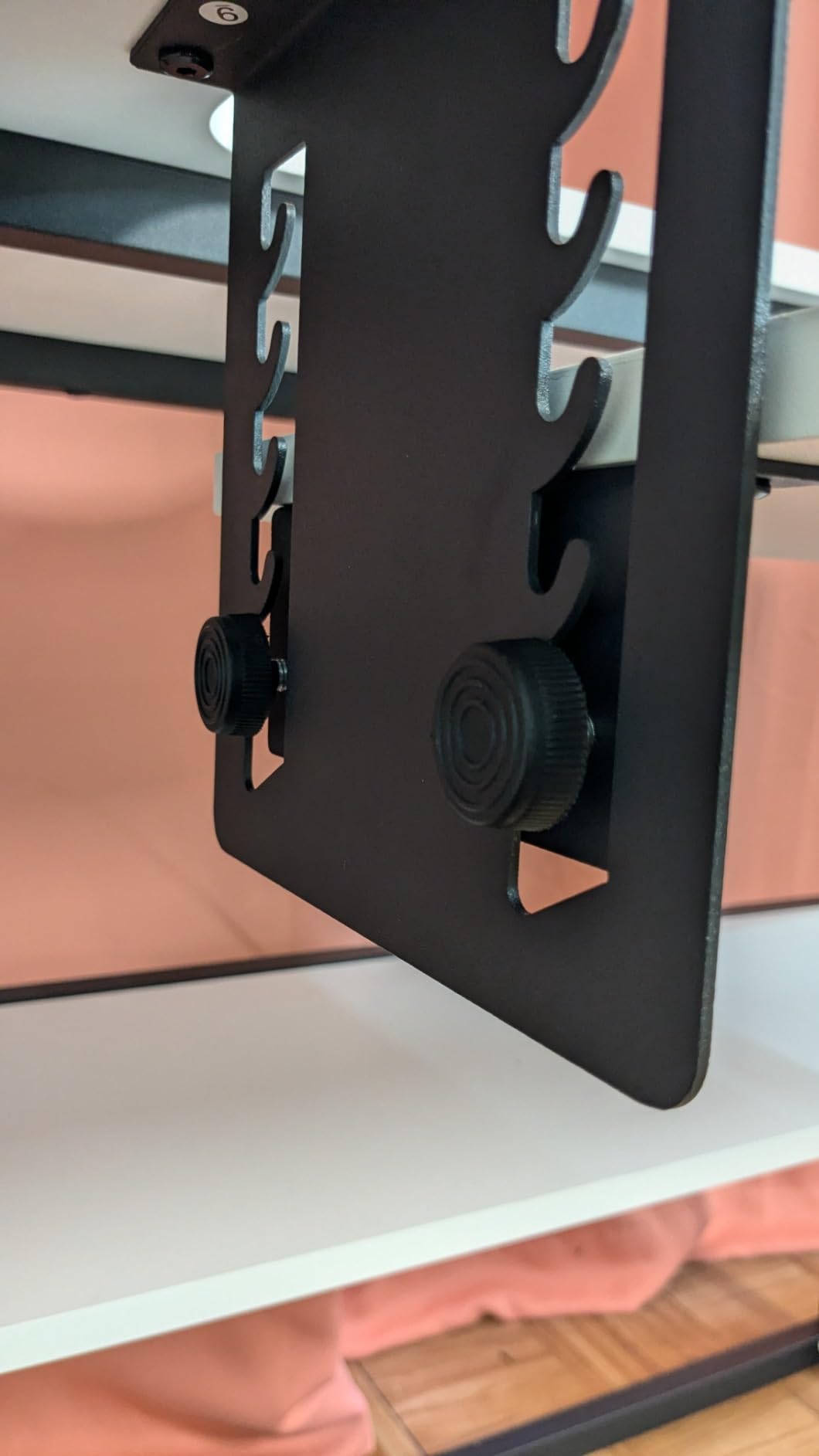
Storage is handled with a lower shelf measuring 31.5 inches by 11.75 inches, positioned 15.35 inches above the floor so your feet still fit underneath. The 9.5 inch foldable side shelf gives a little extra width when you are cutting long pieces, and detailed instructions plus an installation video are included.
The recurring notes are modest. The platform is not perfectly flush with the tabletop, which some sewists compensate for with a cutting mat. The included tool is too short for some screws, so having a full screwdriver on hand makes assembly easier. One buyer attributed machine bounce to a light frame, though most reviewers do not report that experience.
Why heavy gauge legs matter with a heavy machine
Machine weight puts downward force on a narrow platform, and that load is what bends cheaper frames over time. Heavy gauge steel legs with a 1.25 inch top and four floor levelers are the parts of this table that will still feel right in five years, and the 4.5 rating reflects a build that owners generally find solid.
The foot clearance under the lower shelf is a small-space detail that gets overlooked. A shelf at floor level forces you to store bins where your feet go, which is uncomfortable for a long session and turns the space under the table into unusable floor area.
When to skip it
There is no enclosed cabinet, so the machine stays visible when the table is not in use. If tidiness between sessions matters, pair it with a cover or look at an enclosed cart instead.
It is also a two-person assembly by the manufacturer’s recommendation, and at 45.5 inches by 23.5 inches it is not the narrowest option here. The Dart table is the better fit when depth is the problem; this one is the better fit when machine weight is.
10. COSTWAY 62.5 Inch Foldable Sewing Table — Best for the Largest Cutting Surface
COSTWAY 62.5″x 20″ Foldable Sewing Table w/Storage Shelves, Natural & White
Open 62.5 in L x 20 in W x 29.5 in H
Folded 38.5 in L x 20 in W x 29.5 in H
Rated to 165 lb
Weighs 70 lb
Pros
- Widest surface in the group at 62.5 inches
- ideal for cutting and large projects
- Folds down to 38.5 inches to free up floor space
- Door cabinet with three hidden bins
- an adjustable shelf and a bottom open shelf
- Handles a heavy machine and carries the highest total load rating here
Cons
- Largest and heaviest option at 70 pounds
- so it suits a bigger room
- Chipboard panels can make the finished unit wobble
- Small interior shelf screws and thin boards can pull loose under load
This is the opposite of a small-space pick and it is here deliberately, because it shows the shape of the decision. If your constraint is cutting area rather than floor area, 62.5 inches is a real advantage: it is the widest surface in the group and it folds down to 38.5 inches when the project is finished.
It also has the highest load rating here at 165 lb, and owners report it handling a heavy machine comfortably. Storage is unusually generous for a folding table: a single door cabinet with three hidden bins, an interior shelf that adjusts to three positions in 2.5 inch steps, and a bottom open shelf. Six universal wheels, two of them locking, keep it mobile.
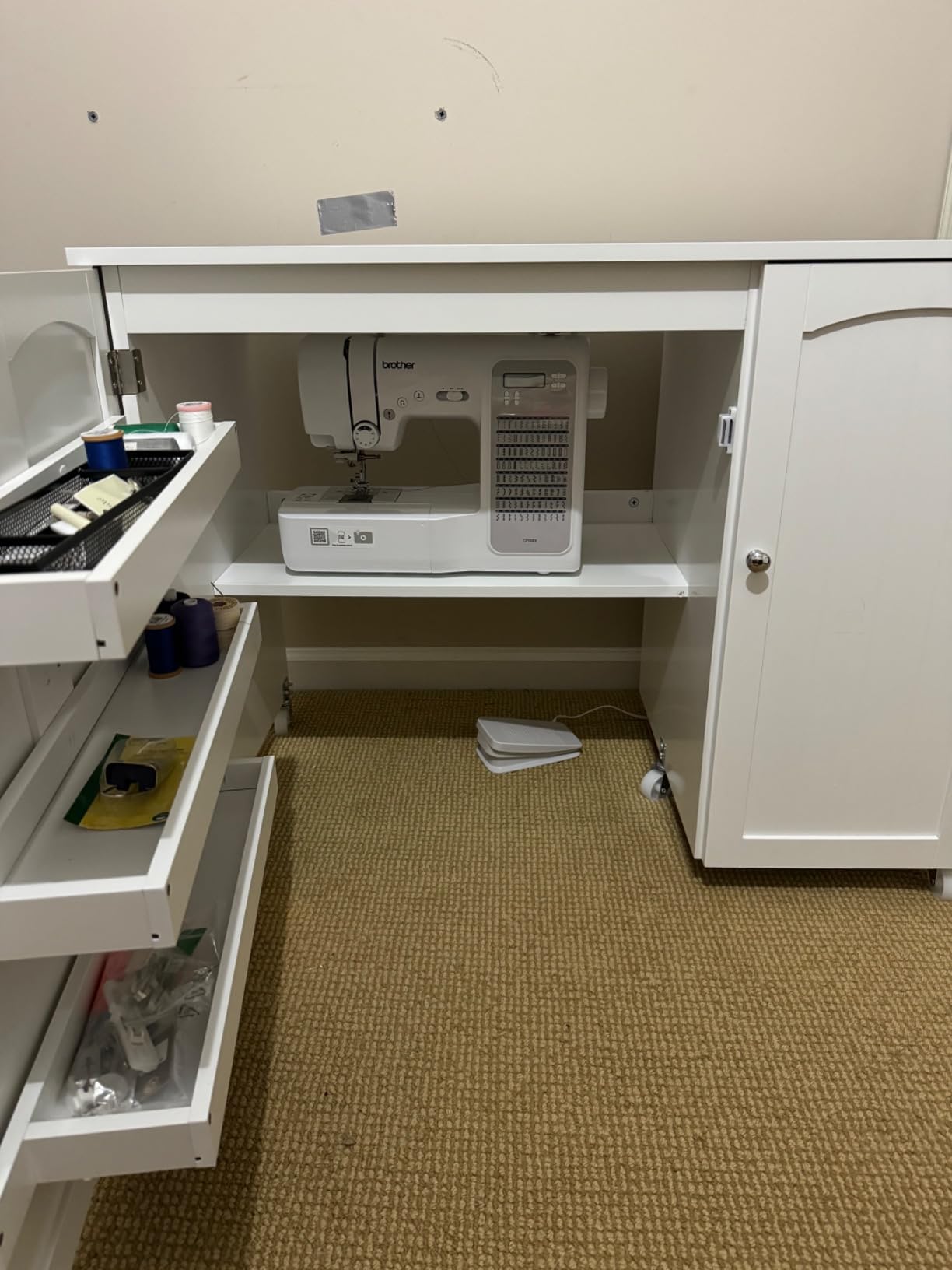
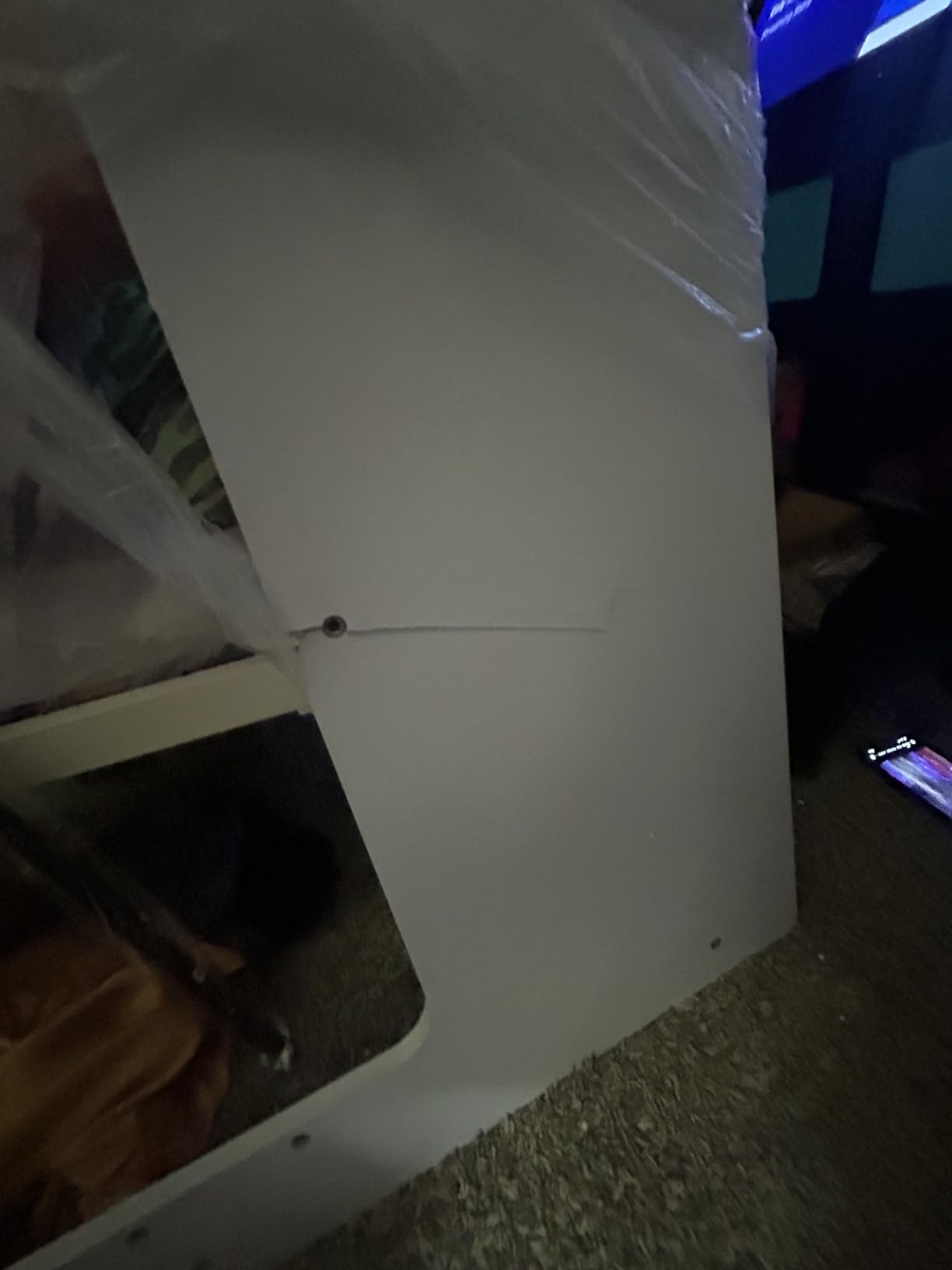
Now the warnings, because they are consistent. Chipboard panels produce a finished unit that wobbles, the small interior shelf screws and thin boards can pull loose under load, and the raised leaf is unsupported at the rear corner, so pressure there can break it. The 4.1 rating is the second-lowest in this roundup and it reflects real build complaints.
At 70 pounds this is not a one-person move, and the instructions are dense enough that first-time assemblers report difficulty. We would not call this a small-space pick; we would call it the answer to a different question, and the reason it is worth naming is that the folded width of 38.5 inches is still more floor space than most of the carts in this list take when open.
Who should actually buy this
Someone with a generous room, a long cutting table, and a project that involves yardage. The interior shelf adjustment in 2.5 inch steps lets you configure for a machine, a stack of fabric, or a stack of batting, and the 165 lb total rating means you are not rationing what goes on the surface.
Owners who want a dedicated cutting surface report satisfaction with the storage cabinet and the speed of the fold. It earns its floor space by doing two jobs well, which is the same argument as the steel tables in a different key.
Why it is last in a small-space roundup
Seventy pounds and a 62.5 inch open span defeat the purpose here. Even folded it occupies 38.5 inches of length, and the chipboard wobble is the kind of complaint that grows rather than fades with use.
If you have a larger room and sew big pieces, it is a capable machine. If you are optimizing a corner of a small apartment, every inch of that open span is a problem, not a feature.
How We Picked Sewing Cabinets for Small Rooms
Every product in this roundup had to clear four filters. We started with closed footprint, because that is the only spec that answers the question this category is actually asked about. Then machine fit. Then build and storage. Then the practical logistics of small-space life.
Closed footprint means the depth of the unit when it is folded or shut, measured from the published dimensions, not estimated. We wanted something under roughly 20 inches deep or under about 32 inches wide once closed, and we noted explicitly where a product folds narrower than it is tall so you are not surprised.
Machine fit means the platform or shelf dimensions compared against real machine footprints, plus a stated weight rating. Any unit that folds to a very small number but has no way to accept a machine inside it did not make the list. That distinction is where the VIVOHOME door-bin conflict mattered.
Build and storage covers material, weight ratings, caster locking, and whether storage is enclosed. Community recommendations repeatedly named specialist brands and the hardware reliability that comes with them, and long-term ownership reports mattered more to us than first impressions.
The last filter was logistics: can one person move it, does it clear a doorway, does it roll over carpet, and does it need drilling. This is a category where the wheel and hinge design is the durability story, and we weighted the two-year-plus owner reports accordingly.
How to Measure Your Space Before You Buy
Measure the space twice: once with the unit closed and once with the leaf or shelf down. A fold-down table that fits your corner when open may not clear the wall when the leaf is extended, and side clearance is the most common fit complaint we saw. Leave at least a few inches of side clearance for the leaf to swing and for you to stand beside it.
Then check the three numbers nobody checks. Your doorway width, compared against the folded width of the unit, matters more than the room measurement. The height of the nearest outlet compared against the cord reach of your machine, or the table’s own power station, matters more than people expect. And the threshold or transition strip height, compared against the caster diameter, decides whether you can roll it at all.
Do not skip the open height. Several units here are 30 to 31 inches tall, which is fine for seated sewing and tight for some people standing at a cutting surface. If you alternate between sitting and standing, the height of the machine platform matters as much as the table height.
If you rent, the no-drill constraint is a genuine filter. Every unit in this roundup is freestanding and casters are the only thing touching your floor, which is the good news in a category that also sells wall-mounted shelves and pencil cabinets you are not supposed to screw into rental walls.
Will Your Sewing Machine Actually Fit?
No, and this is the question to settle before anything else. A machine has to fit the platform or cutout in two dimensions, and the surface has to be rated for the machine’s weight plus the pressure of your hands pushing fabric. A machine that physically fits but exceeds the platform rating is the more common mistake, and it is not obvious from the outside.
Measure three things. The base plate width and depth of your machine, taken at the widest point including any feet or attachments. The machine’s weight, usually printed on the base or in the manual. And, if the machine lives in a hard case, the case dimensions, because that is the space that has to clear the opening when you load and unload.
Compare those against the platform figures in each review. In this group they range from 17.75 by 7.5 inches on the Rollaway II up to 23 by 10.75 inches on the Vividwood platform table, and weight ratings run from 20 lb on the folding Sew Ready shelves to 165 lb on the COSTWAY. Those two numbers, not the price or the styling, decide whether the unit works.
For a beginner with a small machine, nearly all of these work. For a heavy mechanical machine or a quilting setup, you want the larger platforms and the higher weight ratings, which pushes you toward the steel-frame tables and away from the smallest folded carts. Our guide to the best sewing machines for small spaces covers how the machine footprint changes the table decision.
Folding Table vs. Cabinet vs. Rolling Cart
The choice is really about whether the machine has to disappear. If the answer is yes, because the room has to reset to a guest room, a bedroom, or an office, you need doors and enclosed bins, and that narrows the field to the Sauder cart, the Vividwood rust unit, and the two narrow folding carts.
If the answer is no, because you sew in a dedicated corner and the machine can sit under a cover, a folding table gives you more surface, a stiffer frame, and a lower price. The Rollaway II, the Dart workstation, and the two Sew Ready tables all fall here, and they are the ones that handle heavy fabric and long sessions best.
A rolling cart is the middle path, and the only real question is whether your machine fits inside once the door is shut. Verify that specifically, because bins mounted on the door can consume the interior space you assumed was free. The Sauder cart avoids the problem with bins inside the door face and a dedicated machine shelf.
And the decision rule is about frequency. Sewing a few hours a week, closed most of the time, tidiness dominates and you should pay for doors. Sewing daily, the room is already a craft room, surface and rigidity dominate and you should pay for steel.
Apartment and Renter Checklist
Measure the folded footprint against your doorway before you buy, not the room footprint. Most apartment doors are 32 to 36 inches wide, and a unit that is 38.5 or 46 inches long has to be assembled in the room rather than carried in, which is a normal and not a terrible outcome as long as you have floor space to work on.
Test the casters before you commit. A table on two wheels rolls forward and back; a table on five swivel casters steers. Over carpet, a small caster that does not have a swivel will drag, and over a raised threshold it can tip the whole unit, so casters with a decent diameter and at least two locks are the safe choice.
Check outlet proximity before the furniture, not after. The machine’s cord reach plus your lamp plus a charge cable is what determines whether you need a floor cord cover, a power strip, or the built-in charging station on the GIANTEX. In a room you cannot drill into, a furniture-mounted power strip solves a problem you would otherwise solve with tape.
Enclosed storage is a pet and child question as much as a tidiness question. If a cat or a toddler is part of the household, open shelving means small parts and a reachable machine. Doors with magnetic catches, bins inside the door face rather than hanging bins on the outside, and a lockable door all reduce that risk, and only a handful of units here have doors at all.
Finally, decide how often the room resets. If it resets weekly, weight matters more than you expect, because someone will be moving this thing alone every time. Our featured pick is 68.9 pounds, and the 24 pound Rollaway II is the easiest single-person move in the group for exactly that reason.
Three Tiers of Sewing Furniture and What Each Adds
The clearest way to understand this category is as three tiers with different failure points. The budget folding cart tier is dominated by marketplace sellers and wins on price and on how much it stows when closed. Its common complaints are MDF rigidity, narrow depth, and hardware missing from the box.
The mid-tier workhorse table tier is where the steel frames live, and this is where you buy for surface area, weight rating, and build rather than for storage. Foldable sewing tables in the 40 to 48 inch range with adjustable machine platforms are the best value in the category for anyone sewing more than a few hours a week.
The premium drop-in cabinet tier is a different purchase, aimed at someone who wants a hydraulic or air lift and a machine that disappears into a cutout with the surface clear. Those cabinets are excellent and expensive, and none of them are small enough to belong in this roundup, which is worth saying plainly rather than pretending a premium cabinet solves a small-space problem.
The honest takeaway is that the small-space constraint and the premium cabinet tier do not overlap. If you are shopping for a machine cabinet because your room is small, the products in this roundup are the right shape, and spending more does not buy you a smaller footprint.
Vintage Cabinets, IKEA Conversions, and Sit/Stand Desks
There are routes outside buying new. Experienced sewists on sewing forums recommend 1960s Singer cabinets and older library tables, and the appeal is obvious: a solid wood cabinet with a lift and a proper work surface, for very little, if you are willing to restore it. Check the lift mechanism carefully, since those are the parts most likely to be seized or missing.
The IKEA conversion is the other community favourite. A drawer unit plus a desk with a machine platform, or a desk with a lift, gives you a multi-use surface that folds away, and the advantage over buying is that the pieces are useful whether or not you ever sew on them. If you already own a desk, this is genuinely the cheapest way to solve the problem.
A sit/stand desk is floated in discussions as a solution for the same reason, one surface that cranks up for cutting and lowers for sewing. It is not a cabinet and it will not hide a machine, but if your real constraint is desk space rather than storage, it solves the constraint without buying a second piece of furniture.
We mention these because a roundup that only answers with products is not a complete answer. If you already own the machine and the space is genuinely the problem, a conversion route may serve you better than anything on this list.
Care and Maintenance for Folding Sewing Furniture
Check the folding hinges and caster screws every few months. These are the two points that actually fail, and both are fixable with a screwdriver before they become a wobble in the middle of a seam. Owners of the featured cart report tightening the drop leaf hinge as routine maintenance rather than a repair.
Wipe surfaces with a damp cloth and dry them. Do not put solvent-based cleaners on a laminated or melamine top, and do not leave a hot iron face-down on a surface even with a heat-resistant finish, because the guarantee covers finishes against heat and stains, not against leaving heat on them overnight.
Do not eat on the work surface, and do not use the machine platform as a general storage shelf. Weight ratings are for the machine and the normal pressure of sewing, not for a stack of fabric boxes sitting on the platform all week. That is the fastest way to loosen a platform and a joint at the same time.
Roll rather than lift when you move a unit, lock the casters when you park it, and lift with two people anything over 50 pounds. Everything in this roundup that folds flat is designed to be folded repeatedly, but the casters and the frame wear faster if the cart is dragged sideways across carpet.
Frequently Asked Questions
What is the best sewing table for small spaces?
The Sauder Miscellaneous Storage Sewing Cart is the best overall pick for small spaces because it folds to under 20 inches deep, rolls on two locking casters, and closes with raised panel doors so the machine and fabric disappear between sessions. The Best Choice Products folding table is the alternative if your space is even tighter, closing to 23 by 14.75 inches.
Can you put any sewing machine in a cabinet?
No. A machine has to fit the platform or cutout in both width and depth, and the surface must be rated for the machine’s weight plus the pressure of your hands. Measure the base plate of your machine at its widest point, weigh the machine, and compare both figures against the platform dimensions and weight rating published for the unit.
What size sewing table do I need for a small sewing room?
For small projects a 24 to 30 inch work surface is workable, and 40 inches or more is what you want for spreading out fabric or quilts. Measure the room with the leaf or drop shelf extended, not folded, because the extended configuration is what you will use. Leave a few inches of side clearance so you can stand beside the table and so the leaf has room to swing.
Are foldable sewing tables sturdy enough?
It depends on the frame. The steel-frame folding tables here, such as the Sew Ready multipurpose table and the Dart workstation, are noticeably more rigid under lateral pressure than the MDF and particle-board carts, and they are the better choice for heavy machines and quilting. The lighter carts are fine for a small machine and small projects, provided you are not leaning on the surface.
What are good sewing storage ideas for a small space?
Prioritise enclosed storage over open shelving, then add vertical space. A cart with a dedicated machine shelf plus bins inside the door face keeps a machine and a work in progress out of sight in one unit. Above it, a pegboard or a wall rail for tools and a shallow shelf for batting and interfacing adds storage without adding floor space. Use lidded bins rather than open baskets if pets or children are in the room.
Do sewing cabinets need to be assembled?
Most do. The Sauder cart, the Best Choice Products table, and the VIVOHOME cart arrive flat-packed and take roughly two to three hours, with some owners reporting a second pair of hands is needed. The Sew Ready Rollaway II is the exception here, arriving fully assembled with no tools required, which is the single biggest convenience difference in this roundup.
The Best Sewing Machine Cabinet for Small Spaces
The best sewing machine cabinets for small spaces are not the biggest or the most expensive. They are the ones that give back floor area when you are not sewing, keep the machine inside instead of on top, and can be moved by one person across a room. On all three counts the Sauder Miscellaneous Storage Sewing Cart is the one we would put in a small room first.
Its runner-up is the Best Choice Products folding table if your space is measured in spare inches rather than spare feet, and the Sew Ready Rollaway II if you would rather skip assembly entirely and can live with covering the machine. If you sew large pieces rather than small ones, a steel-frame table such as the Sew Ready multipurpose table or the Vividwood platform table will serve the work better than any small cart. Our sewing table roundup goes deeper on the frame and surface trade-offs if you want the wider picture.
Whatever you choose, measure twice: once folded and once with the leaf down, and once with the machine in hand. That is the part that decides whether the unit works for you, and it takes five minutes.