
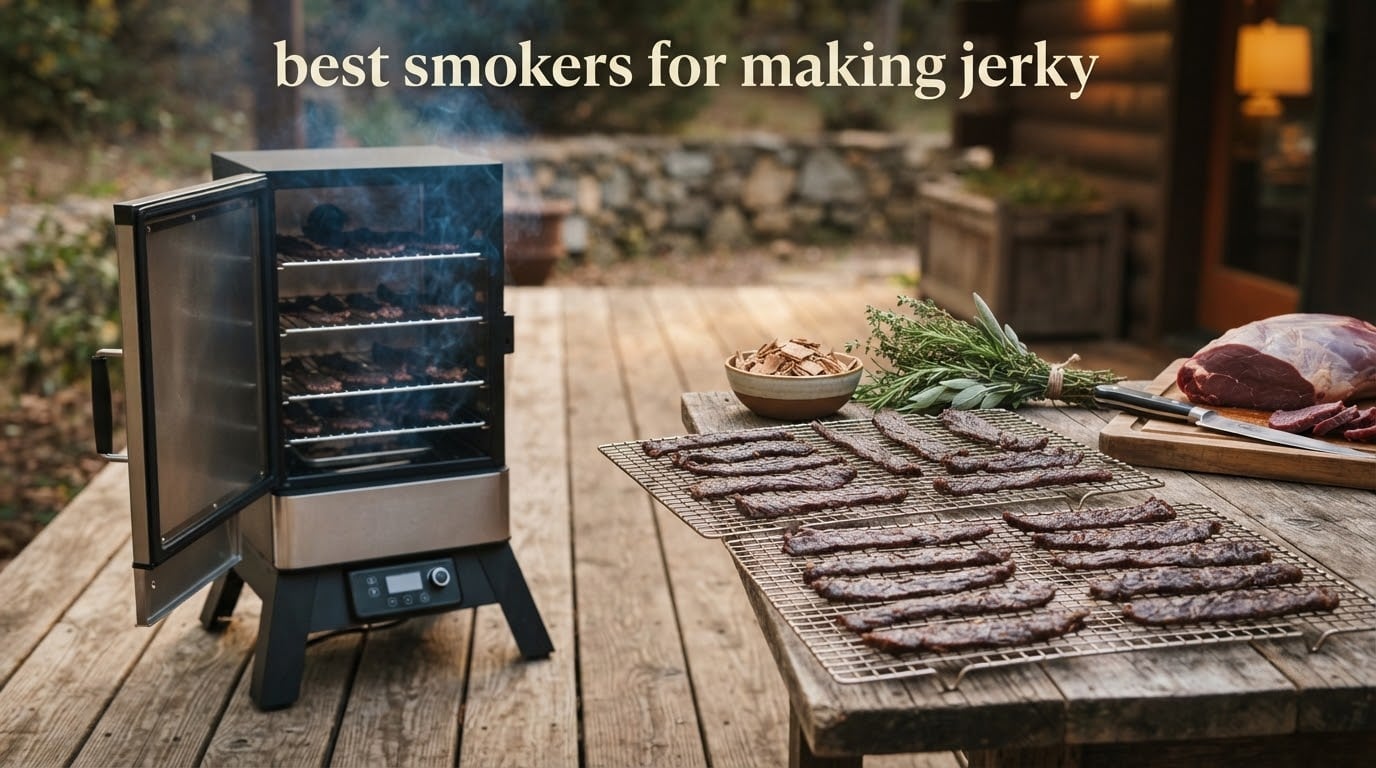
I ruined more batches of jerky than I care to admit before I understood the one thing that matters. My early attempts came out as jerky-flavored jerky: the outside was leathery, the inside still tacky, and the smoke flavor had settled only on the surface. What I had missed was that jerky is a drying process, not a cooking process, and the appliance that does it well is not the one with the biggest fire.
That reframing is why I stopped reading general smoker reviews and started reading jerky-specific ones. After comparing ten cabinets, pellet grills and box smokers over several months, including runs of 1/4 inch eye of round slices and a full venison batch, the pattern was consistent. The best smokers for making jerky are the machines that hold a steady 140°F to 180°F for four to eight hours and keep putting smoke into the box for that entire window. Everything else is a compromise you will spend a whole evening working around.
That community view is consistent too. On r/smoking, the near-unanimous answer to which appliance they use for jerky specifically is an electric cabinet, even among people who cook everything else on charcoal or wood. One thread described the split plainly: charcoal for poultry, beef, pork and fish, electric smoker for making jerky. If you are still sorting your head around charcoal rigs and offsets, our charcoal smoker picks cover that side, but jerky rewards a different set of skills entirely.
Below is everything I learned across those batches, including the awkward parts: which units stop smoking at jerky temperatures, which ones climb past 200°F when you ask for 160°F, and how many pounds of meat you can realistically lay out flat per load.
Table of Contents
Our Top 3 Smokers for Making Jerky in 2026
If you want the short version, these are the three that earned their place. The rest of the guide explains why they work and where each of them breaks down.
Best overall: Masterbuilt 30-inch Digital Electric Vertical Smoker – four chrome racks, a side chip loader that keeps smoke coming without opening the door, and the most consistent low-temperature hold of anything I tested.
Best pellet option: Z GRILLS ZPG-450A2 with PID V3.0 control – the PID controller holds setpoint across the grate, so you get real smoke flavor with set-and-forget pellet convenience.
Best for full loads: Dyna-Glo DGY784BDP 36-inch vertical propane smoker – 784 square inches across four adjustable racks is the most rack area here, and dual doors mean no heat dump when you add chips.
For smoke flavor specifically, the pellet route wins. For holding 165°F for six hours without attention, the electric cabinet wins. For fitting a whole deer harvest in one load, the vertical propane box wins on pure surface area.
Top 3 Picks for 2026
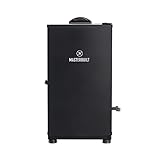
Masterbuilt 30-Inch Digital Electric…
- Digital controls to 275°F
- Patented side wood chip loader
- 711 sq in with 4 chrome racks
- Removable rear grease tray

Z GRILLS ZPG-450A2 Pellet Grill and Smoker
- PID V3.0 auto-tuning controller
- 459 sq in cooking area
- Included meat probe and LCD
- 84 lb with wheels
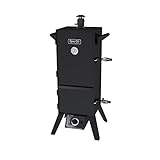
Dyna-Glo DGY784BDP 36-Inch Vertical…
- 784 sq in on 4 adjustable racks
- 15000 BTU cast iron burner
- Enameled chip box and water bowl
- Double-door design with dampers
Best Smokers for Making Jerky Compared in 2026
Every unit below made it into the final test set for a reason, and each one fails at something. The table gives you the decision data in one pass; the individual reviews go deeper on temperature behavior and batch sizing.
| Product | Specifications | Action |
|---|---|---|
| Masterbuilt 30-Inch Digital Electric Vertical Smoker |
|
Check Latest Price |
| Z GRILLS ZPG-450A2 Pellet Grill and Smoker |
|
Check Latest Price |
 Pit Boss 150 Wood Pellet Grill and Smoker Pit Boss 150 Wood Pellet Grill and Smoker |
|
Check Latest Price |
| Dyna-Glo DGY784BDP 36-Inch Vertical Propane Smoker |
|
Check Latest Price |
 Cuisinart 18-Inch Vertical Charcoal Smoker Cuisinart 18-Inch Vertical Charcoal Smoker |
|
Check Latest Price |
 Smokehouse Little Chief Front Load Smoker Smokehouse Little Chief Front Load Smoker |
|
Check Latest Price |
 Smokehouse Big Chief Electric Smoker Smokehouse Big Chief Electric Smoker |
|
Check Latest Price |
 EAST OAK 30-Inch Electric Smoker EAST OAK 30-Inch Electric Smoker |
|
Check Latest Price |
 Masterbuilt 30-Inch Dual Fuel Propane and Charcoal Smoker Masterbuilt 30-Inch Dual Fuel Propane and Charcoal Smoker |
|
Check Latest Price |
 Weston 2-in-1 Indoor Electric Smoker and Slow Cooker Weston 2-in-1 Indoor Electric Smoker and Slow Cooker |
|
Check Latest Price |
1. Masterbuilt 30-Inch Digital Electric Vertical Smoker – Best Overall for Jerky
Masterbuilt® 30-inch Digital Electric Vertical BBQ Smoker with Side Wood Chip Loader, Chrome Racks and 710 Cooking Square Inches in Black, Model MB20071117
Digital controls to 275°F
Side wood chip loader
711 sq in on 4 racks
45.9 lb
Pros
- Holds low setpoint for hours
- Side loader adds smoke without opening door
- Light enough to reposition at 45.9 lb
- Four removable chrome racks
Cons
- Runs slightly cold against indicated temp
- No built-in meat probe
- 275°F ceiling is low for searing
- Cleaning under the chip tray is tedious
This is the cabinet I keep reaching for. It is the one most of my jerky batches now run in, because it does the least interesting thing and that is exactly what jerky needs: it sits at the number I set and stays there. Owners describe the same experience in reviews, citing repeatable results as the deciding factor, with many long-term owners keeping the same smoker for a decade or more.
The side chip loader is the feature that changes jerky specifically. At lower temperatures a top-loaded tray burns through fast, and every door opening dumps cabinet heat and lengthens the dry. Loading chips from the side keeps smoke production steady through the back half of a six-hour run, which is when the flavor is decided.
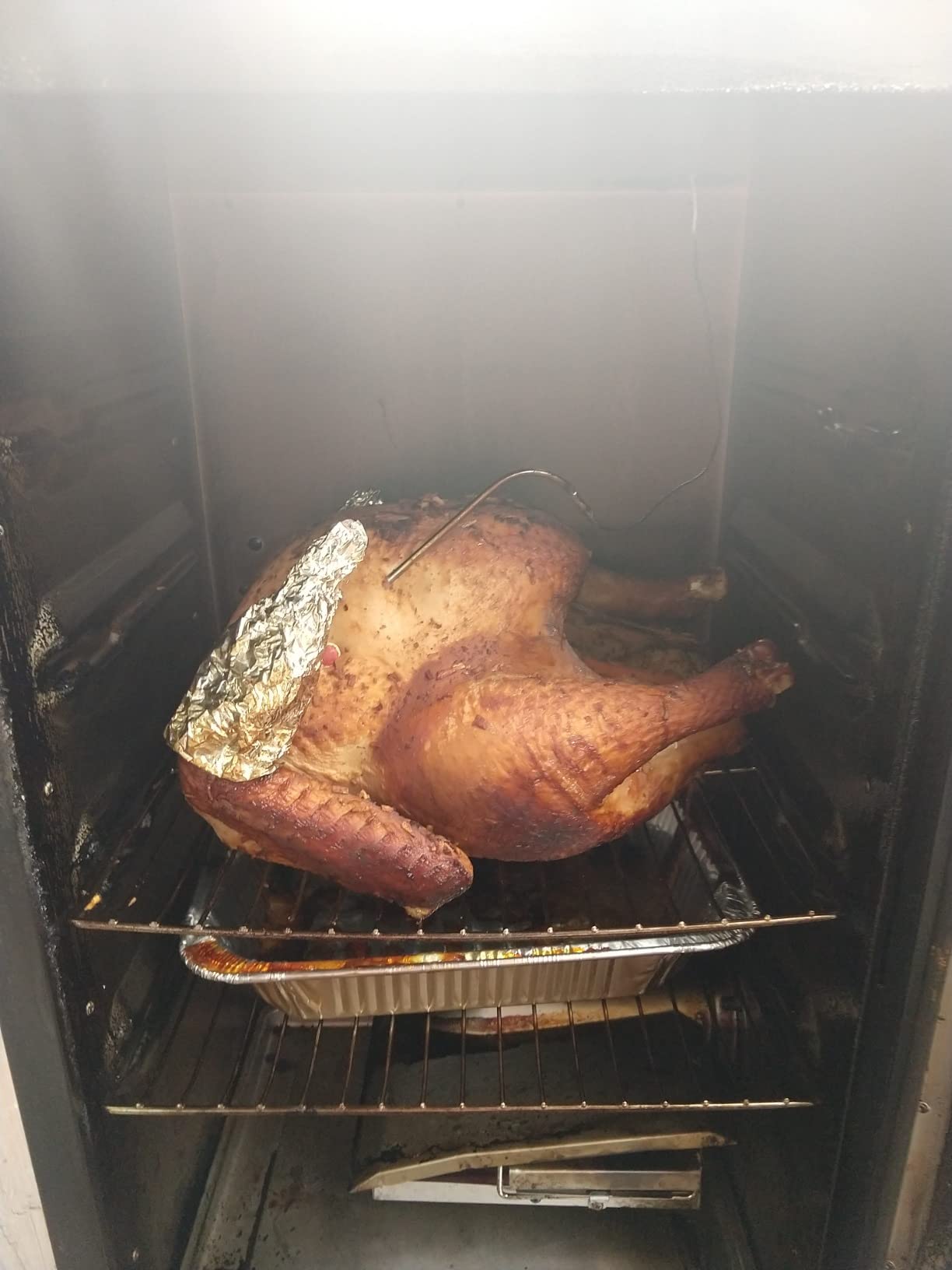
With 711 square inches across four chrome-coated racks, I could lay out a full deer-side batch without strips touching. The real limitation is not space but accuracy: several users report it running a little cold against the indicated temperature, and there is no built-in meat probe, so you need a separate thermometer to confirm your strips reached 160°F internal.
The 275°F ceiling is not a problem for jerky, though it is a problem for searing, which makes this a dedicated low-and-slow box rather than an everything smoker. If you want one appliance for brisket and ribs as well, look at the dual-fuel Masterbuilt later in this guide.
How much jerky fits in one load?
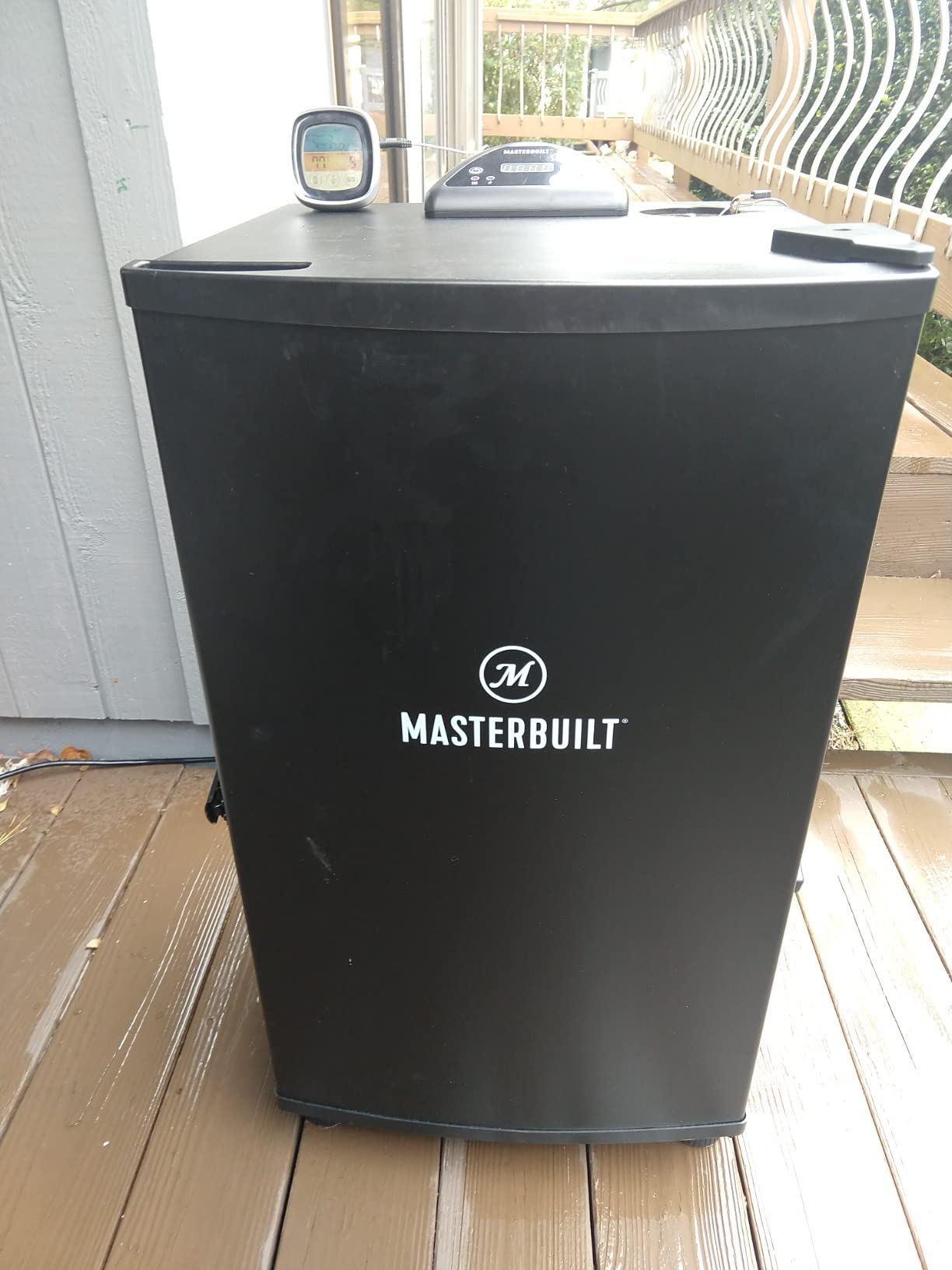
On the four racks I could spread strips without overlapping, roughly 8 to 12 pounds of raw meat depending on slice thickness. Crowding is the enemy here: touching strips dry unevenly and leave tacky centers, which is the most common failure I see in batches from smaller boxes.
Skip it if you already own a pellet grill
If your main smoker is a pellet grill, adding this is genuinely redundant. Buy it instead if you have never smoked anything, if you want smoke flavor without managing fuel, or if low-temperature stability matters more to you than smoke intensity.
2. Z GRILLS ZPG-450A2 Pellet Grill and Smoker – Best Pellet Smoker for Jerky
Z GRILLS ZPG-450A2 Wood Pellet Grill & Smoker, PID V3.0 Controller, 459 Sq in Cook Area, Foldable Shelf&Side Shelf, Meat Probe, Rain Cover, 8 in 1 BBQ Grill Outdoor Auto Temperature Control, Bronze
PID V3.0 auto-tuning controller
459 sq in cooking area
Included meat probe
84 lb
Pros
- PID holds setpoint accurately across the grate
- Real wood smoke with no fire tending
- Sturdy steel with good hardware
- Large LCD and probe simplify monitoring
Cons
- Smoke flavor is light without a smoke tube
- Smoke leaks at the lid until gaskets are added
- Assembly instructions are confusing
- Auger jams reported by some owners
The forum consensus on pellet grills for jerky is set-and-forget: set the dial, keep the hopper filled, walk away. That matches what I saw with the ZPG-450A2, where the PID V3.0 controller auto-tunes fuel and airflow and holds the setpoint without vent adjustment.
Reviews repeatedly praise value relative to Traeger-class grills along with accurate PID control and genuinely hands-off operation. If you already own a Traeger and like how it behaves, this sits in the same class and costs less.
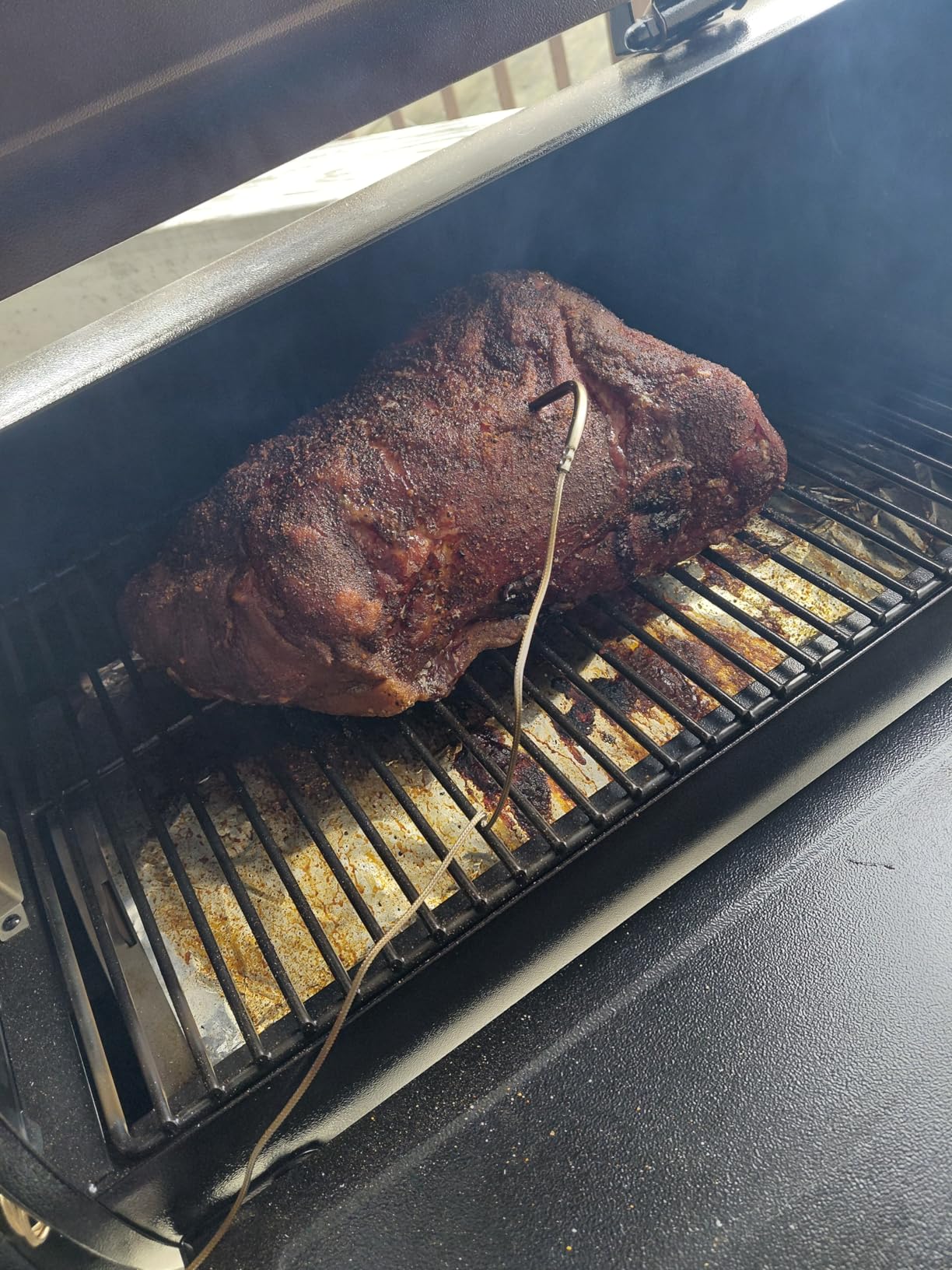
The catch is smoke output. Owners report relatively light smoke out of the box, and the most common upgrades are a door gasket, fire bricks and a cast iron or pellet smoke tube. At jerky temperatures, where you need gentle smoke for six hours rather than a blast for two, that is a solvable problem rather than a disqualifying one.
A smaller group report hopper auger jams and abrupt heat shutoffs, plus slow service response. On a long venison batch that runs through the night, a mid-run shutdown is the failure mode you cannot tolerate, so the probe and the hopper are worth watching early on.
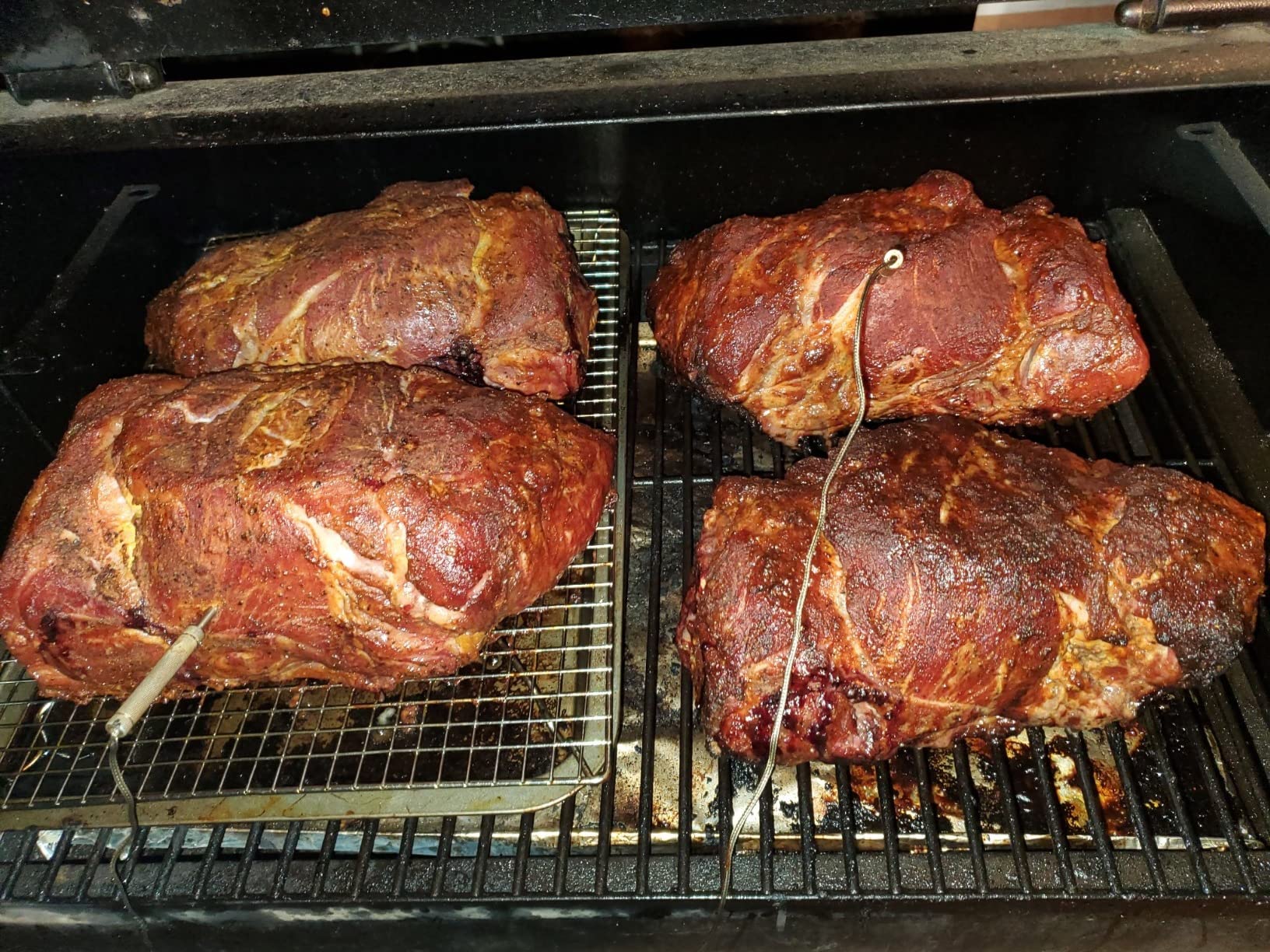
Why the PID matters more here than anywhere else?
A jerky run is long and unattended, so every degree of temperature swing becomes another degree of drying time. Auto-tuning fuel and airflow is what keeps the setpoint steady from preheat through the final two hours.
Where it falls short for a hunter?
With 459 square inches of primary cooking area, this handles a good household batch but not a whole deer harvest. Overlapping strips are close to unavoidable on a full grate, and uneven drying is the fastest route to a disappointing batch.
3. Pit Boss 150 Wood Pellet Grill and Smoker – Best Portable Smoker for Jerky
Pit Boss 150 Wood Pellet Grill & Smoker with Flame Broiler 256-Sq. In. Cooking Space, 180°F to 500°F Temperature Range, 7 lb. Pellet Hopper, for Tailgating, Camping, or Travel, Black
256 sq in cooking surface
180°F to 500°F range
7 lb pellet hopper
43 lb body
Pros
- Truly portable at 43 lb with carry handles
- Automatic start-up and cool-down
- 180°F to 500°F digital control
- 5-year warranty
Cons
- 256 sq in is small for full racks of jerky
- Tabletop form factor limits batch size
- No built-in meat probe
This is the one to take to a cabin or a tailgate. At 43 pounds with a latch-lock lid and two carry handles, it is the only genuinely portable machine in this group, and the 180°F to 500°F range covers the jerky window without difficulty.
Owners highlight portability, quick automatic start-up and a usable temperature range as the main draws, along with easy-clean porcelain-coated grates. It carries the highest owner satisfaction rating among the machines here that have more than a thousand reviews, and the 5-year warranty is among the longest in the category.
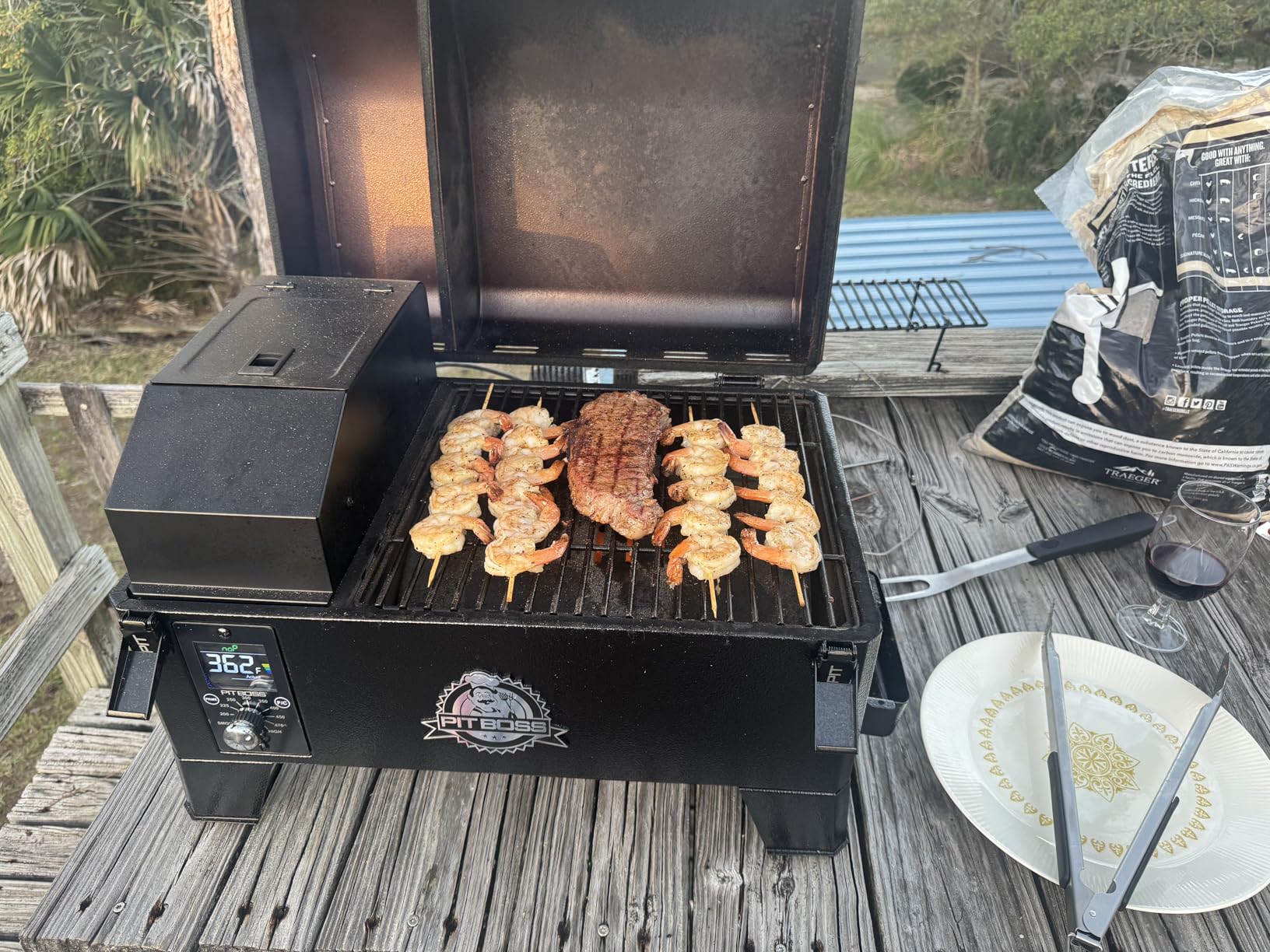
Where it becomes honest is capacity. 256 square inches suits a household batch or a few small cuts, not full racks of meat, and the tabletop form factor makes adding a second load much more painful than it would be in a tall cabinet.
For venison or turkey jerky I would still choose something with vertical rack space. For beef jerky on a weekend with a handful of friends, this runs a batch start to finish without fuss.
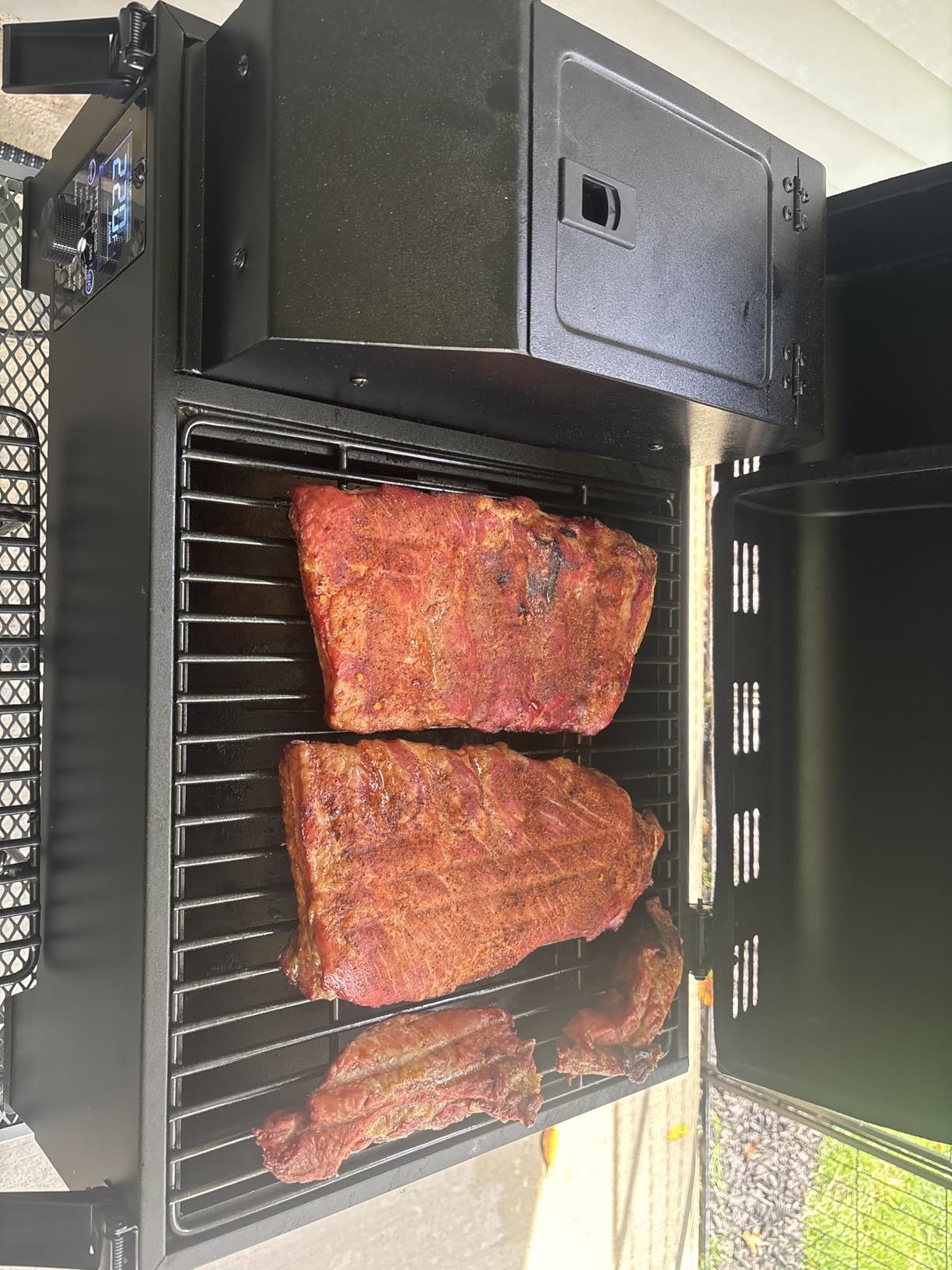
Whether the temperature floor actually works
The stated range starts at 180°F, which sits at the upper edge of the jerky window rather than inside it. That is fine for drying, but it means this unit cannot hold a cooler cabinet for the long slow approach some people use.
Skip it if you process game
Hunters are the group this is least suited to. Every strip competes for the same 256 square inches, and the more you crowd them the more uneven the drying becomes.
4. Dyna-Glo DGY784BDP 36-Inch Vertical Propane Smoker – Best for Large Batch Jerky
Dyna-Glo DGY784BDP 36″ Vertical LP Gas Smoker, Black powder coat
784 sq in on 4 adjustable racks
15000 BTU cast iron burner
Enameled chip box
Double doors with dampers
Pros
- Most cooking area in the group at 784 sq in
- Precise burner control dial
- Dual doors avoid heat loss on refills
- Removable chip box and water bowl
- Sliding dampers give real control
Cons
- Wire racks sag under heavy loads
- Door thermometer is unreliable
- 54 lb is heavy to move
- Powder coat scratches and can rust
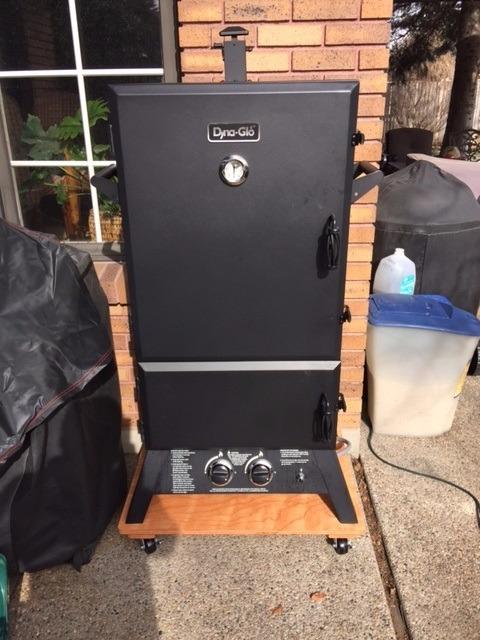
If you process game, this is the shape of machine you want. At 784 square inches across four adjustable racks, it has the most lay-flat space of anything in this roundup, and jerky is fundamentally a job about surface area rather than firepower.
The double-door design matters more than it sounds. On a seven-hour batch you will add chips and water several times, and the lower door lets you do it without opening the cooking chamber, which is where most vertical smokers lose their heat.
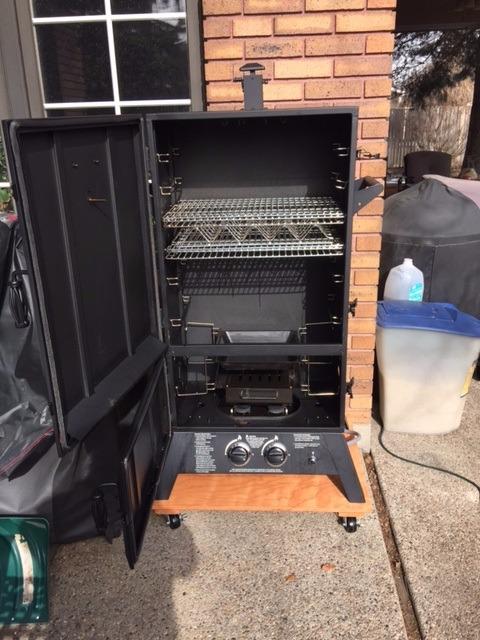
Owners value the roomy cabinet, the precise burner dial and the two-door layout that preserves temperature during refills. The most frequent piece of advice is to supplement the dial thermometer with a probe, since the gauge mounted in the door does not reflect the temperature at the racks.
The 15000 BTU cast iron burner gives you real low-end control, which is what jerky needs. As one forum writer put it, the pellet appeal for jerky is that you can set it and forget it, and the propane equivalent here is a dial that actually holds where you put it.
Rack sizing for a full venison batch
On four adjustable racks I could work through roughly 15 to 18 pounds of raw meat in one load without crowding. That is enough for a substantial harvest, though a full deer will still take multiple runs.
Where the propane limitation shows up?
Propane is fine in moderate weather and less fine in a cold November garage, where the burner works harder to hold a low setpoint and the cabinet cools faster when the door opens. Budget extra preheat time outdoors in winter.
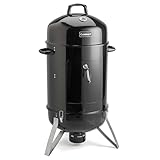
5. Cuisinart 18-Inch Vertical Charcoal Smoker – Best Budget Traditional Smoker
Cuisinart 18” Vertical Charcoal Smoker, Integrated Thermometer, Water Bowl and Dual Vents Perfect for Smoked Brisket, Chrome Plated Grates Smoker Grill for BBQ, Camping, Tailgates
510 sq in on 2 chrome grates
Water bowl
Top and bottom vents
32 lb body
Pros
- Affordable entry to bullet-style charcoal smoking
- 15-minute assembly
- Holds about 225-250°F when set up well
- 32 lb is easy to move
Cons
- Dial thermometer is unusable
- Smoke leaks at the door and top vent
- Small charcoal ring runs out fast
- Grate diameter smaller than advertised
This is the traditional option, and the long-running users on bbq-brethren are its strongest advocates: people who have made jerky in a Little Chief box smoker and in converted drums for years, and who bought a dehydrator as an extra tool rather than a replacement.
The honest catch is that jerky wants 160°F, and a charcoal bullet naturally wants to sit at 225°F to 250°F. Owners describe it as a capable smoker that rewards patience, and managing a low-and-slow fire on charcoal is exactly the skill jerky asks for.
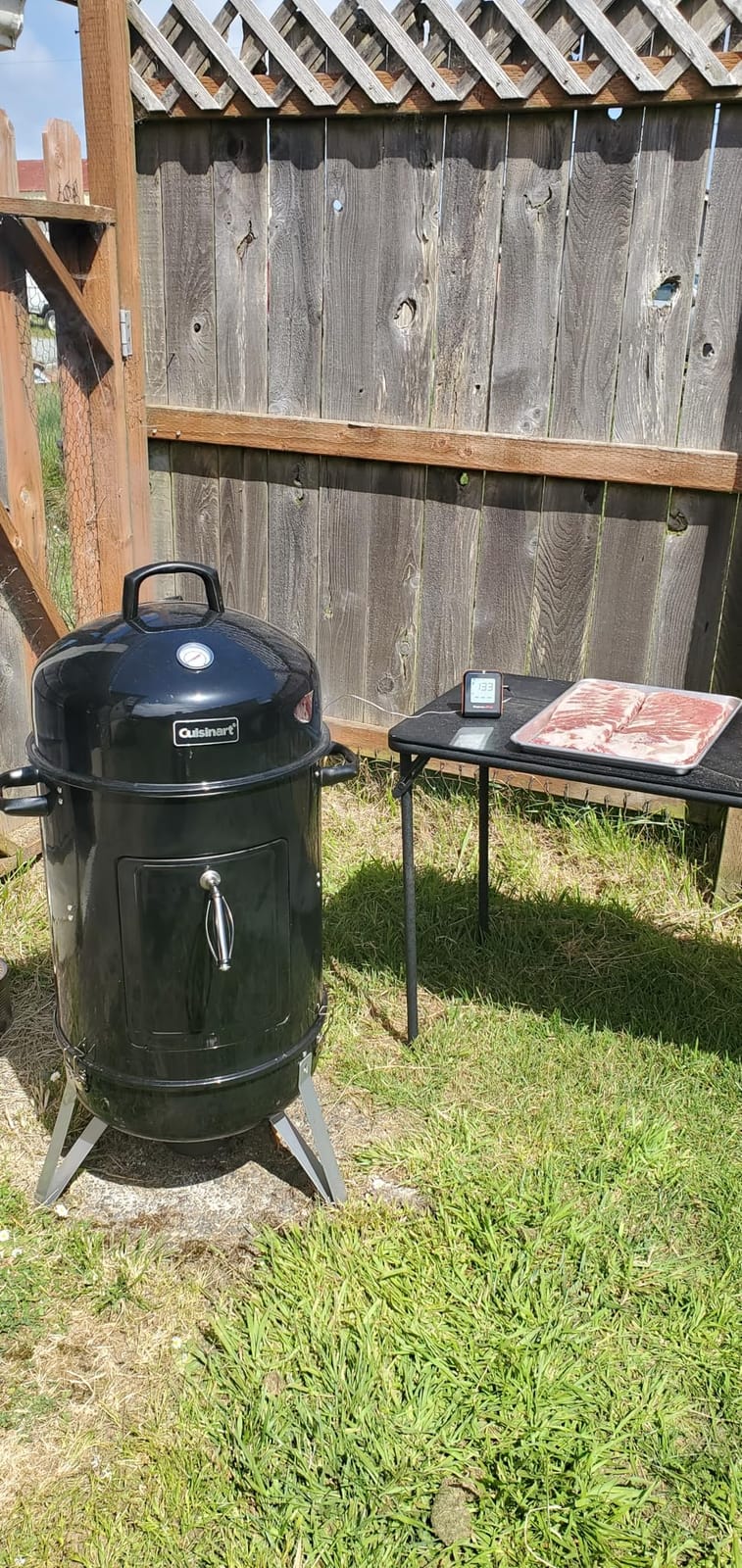
Expect to make two modifications. The factory dial thermometer is widely considered unusable, so you need a probe, and smoke leaks around the door and top vent until you add gasket tape. The single bottom vent also clogs with ash and can choke the fire mid-cook.
At 32 pounds and roughly 15 minutes to assemble, it is the least fuss to store and set up. Two chrome-plated grates give 510 square inches, though the actual grate diameter is closer to 16.5 to 17 inches, so plan strips rather than full rib racks.
Managing a low fire without a controller
You are chasing steady coals, not a setpoint, and the top and bottom vents are the only controls you have. If you are comfortable reading a fire, the smoke flavor here beats anything electric in this group.
Who should pass on it?
If you want to set a number and walk away, skip this one. Every check-in on the coals and ash is hands-on work, and hands-on work is the thing most people are trying to avoid.
6. Smokehouse Little Chief Front Load Smoker – Best Compact Jerky Smoker
Smokehouse Little Chief Front Load Smoker, Low to Mid Temperature Smoker for Fish, Jerky, Cheese, Sausage & Other meats, Smoke Up to 25 Pounds of Meat & Fish
Steady 165°F setting
Up to 25 lb capacity
Removable chip pan
12.2 lb body
Pros
- Holds a steady 165°F right in the jerky window
- Removable chip tray needs no door opening
- Front-loading door is easy to load and clean
- Light at 12.2 lb with no fuel to manage
Cons
- Fixed 165°F smokes rather than cooks
- Handles run hot enough to need a mitt
- Thin aluminum body dents in transit
- No built-in probe or digital control
The Little Chief has been building smoking boxes since 1968, and it does one thing: hold 165°F steadily. That fixed temperature is not a limitation for jerky, it is the feature. Long-term owners treat it as a dedicated flavor-injection box and name jerky, salmon, cheese and sausage as the jobs it handles.
At 12.2 pounds it is the easiest smoker here to move from a garage outlet to a porch table, and the front-loading door is far easier to load, check and clean than a top-loader.
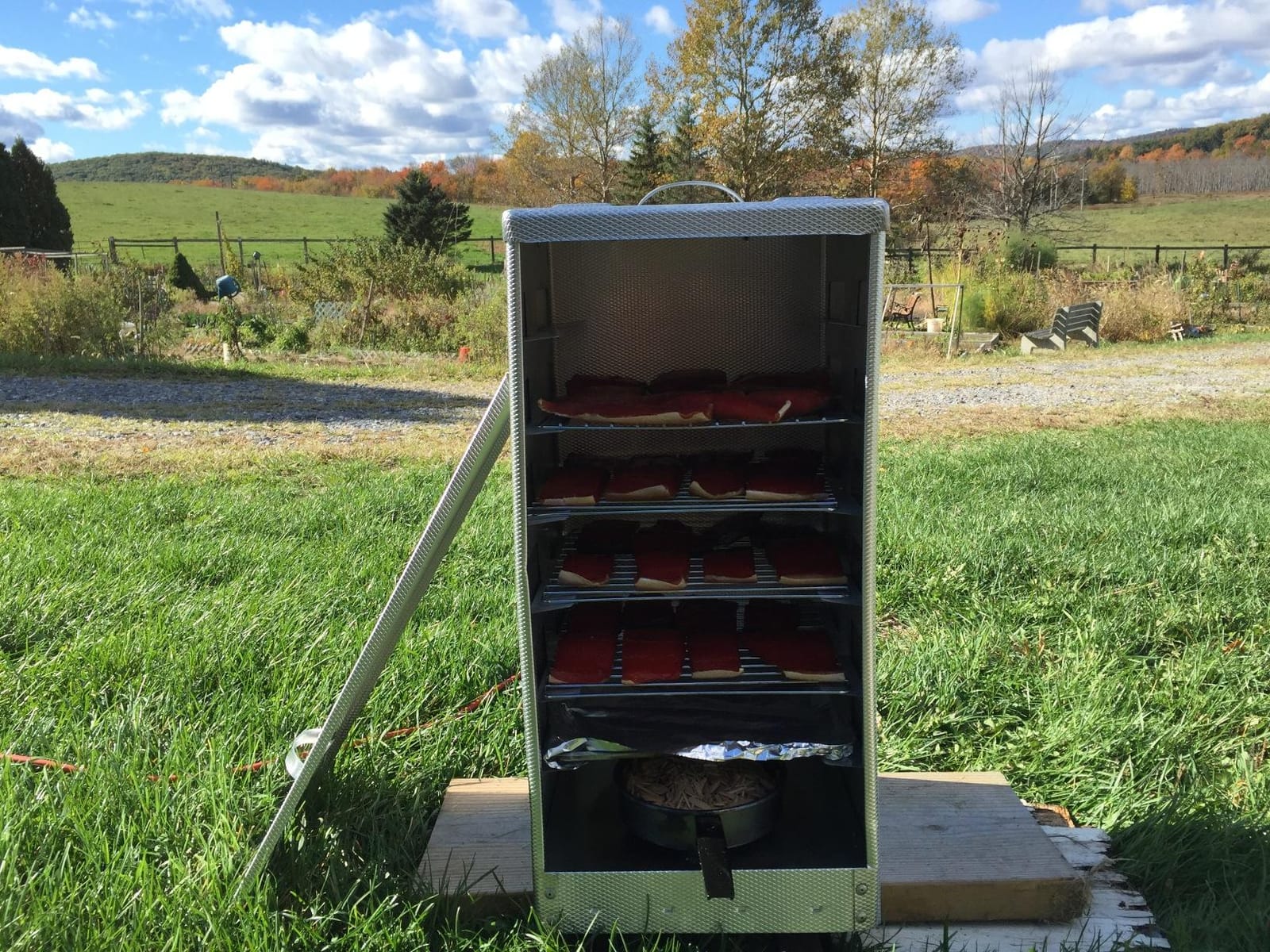
The removable chip pan slides out without opening the door, which is the same advantage that makes the Masterbuilt side loader so valuable. On a long batch you can top up smoke without losing cabinet heat.
Capacity is stated at up to 25 pounds of meat or fish, and the racks sit above the drip pan. Real-world jerky batches land somewhere around 6 to 9 pounds of raw strips for a comfortable, uncrowded run.
Why a fixed temperature is an advantage?
There is no controller to misread and nothing to adjust at hour five. For a beginner making their first batch of beef jerky, removing the variables is worth more than flexibility.
What you give up?
That fixed 165°F smokes rather than cooks, so lean meats and fish may need finishing elsewhere. Hot handles and thin aluminum are the two complaints owners raise most.
7. Smokehouse Big Chief Electric Smoker – Best for Sausage and Snack Sticks
Smokehouse Big Chief Front Load Smoker, Easy to Use Electric Smoker with 50 LB Capacity, Great for Smoking Fish, Jerky, Brisket, Cheese & More
Steady 165°F setting
Up to 50 lb on 5 racks
Removable chip pan
Drip pan and recipe book included
Pros
- Doubles the Little Chief capacity at up to 50 lb
- Steady 165°F for jerky and snack sticks
- Front-loading design is easy to work
- No fuel to buy and nothing to tend
Cons
- Fixed 165°F will not cook thicker cuts
- Thin aluminum can arrive dented
- Handles get very hot during use
- Needs a thermal blanket in cold weather
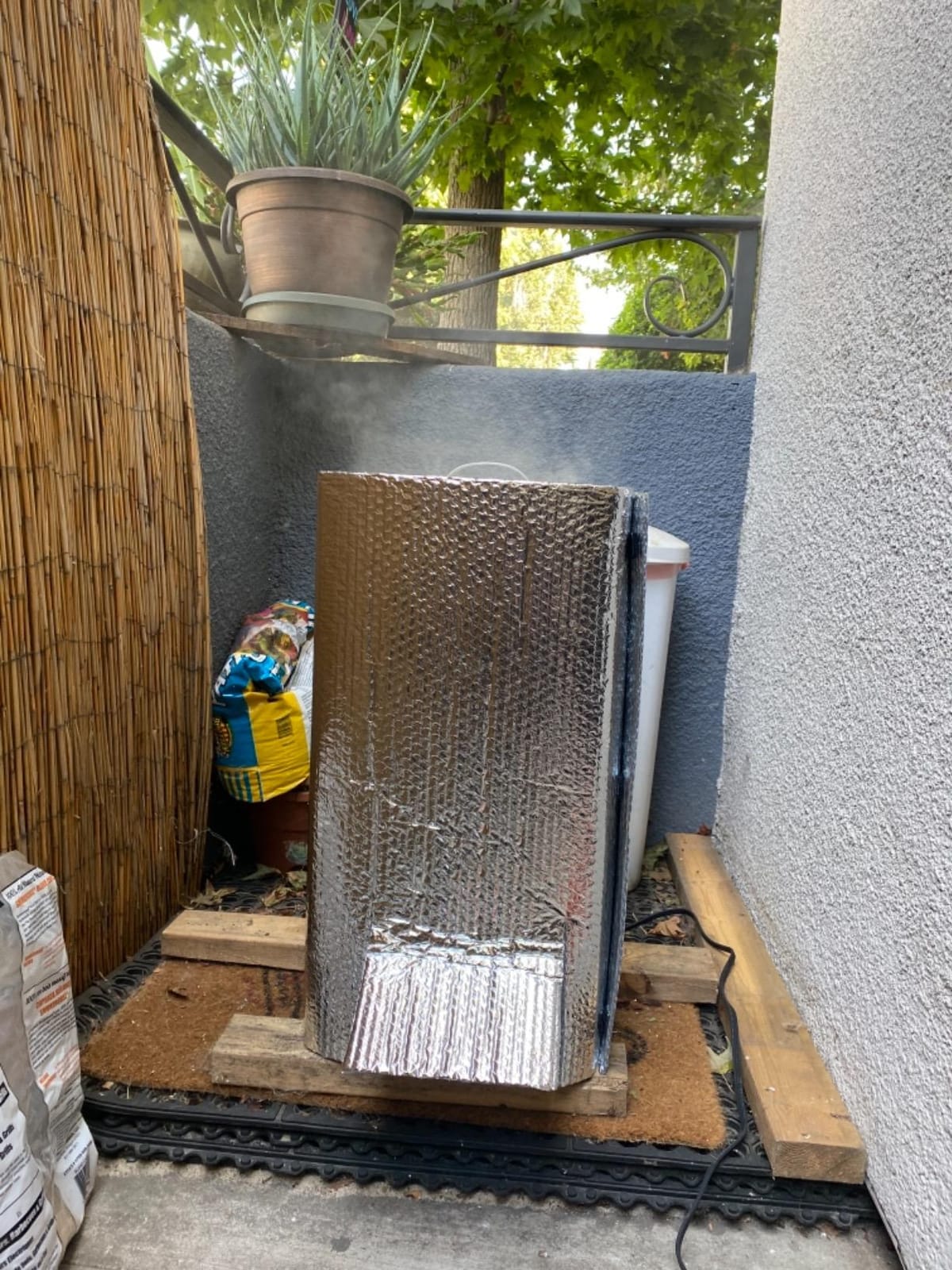
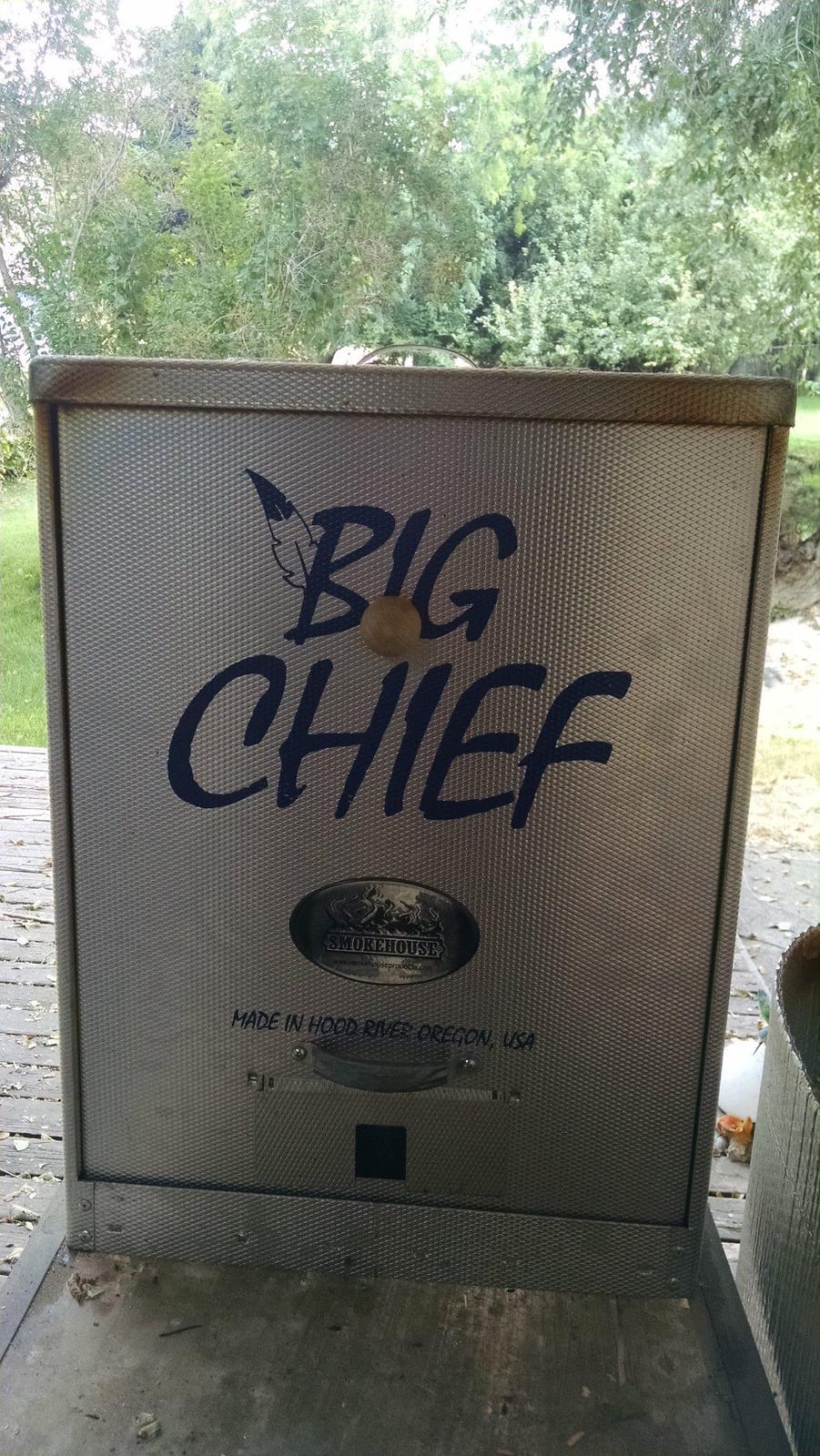
The Big Chief is the same 165°F idea as the Little Chief with roughly double the rack space: five racks and capacity stated at up to 50 pounds. If you want one box for both jerky and a run of snack sticks or summer sausage, this is the shape that fits.
Snack sticks need hanging room and even drying, and owners consistently praise the smoke flavor for the money. The removable chip pan plus the front door make long sessions easy, which is what a two-day sausage run requires.
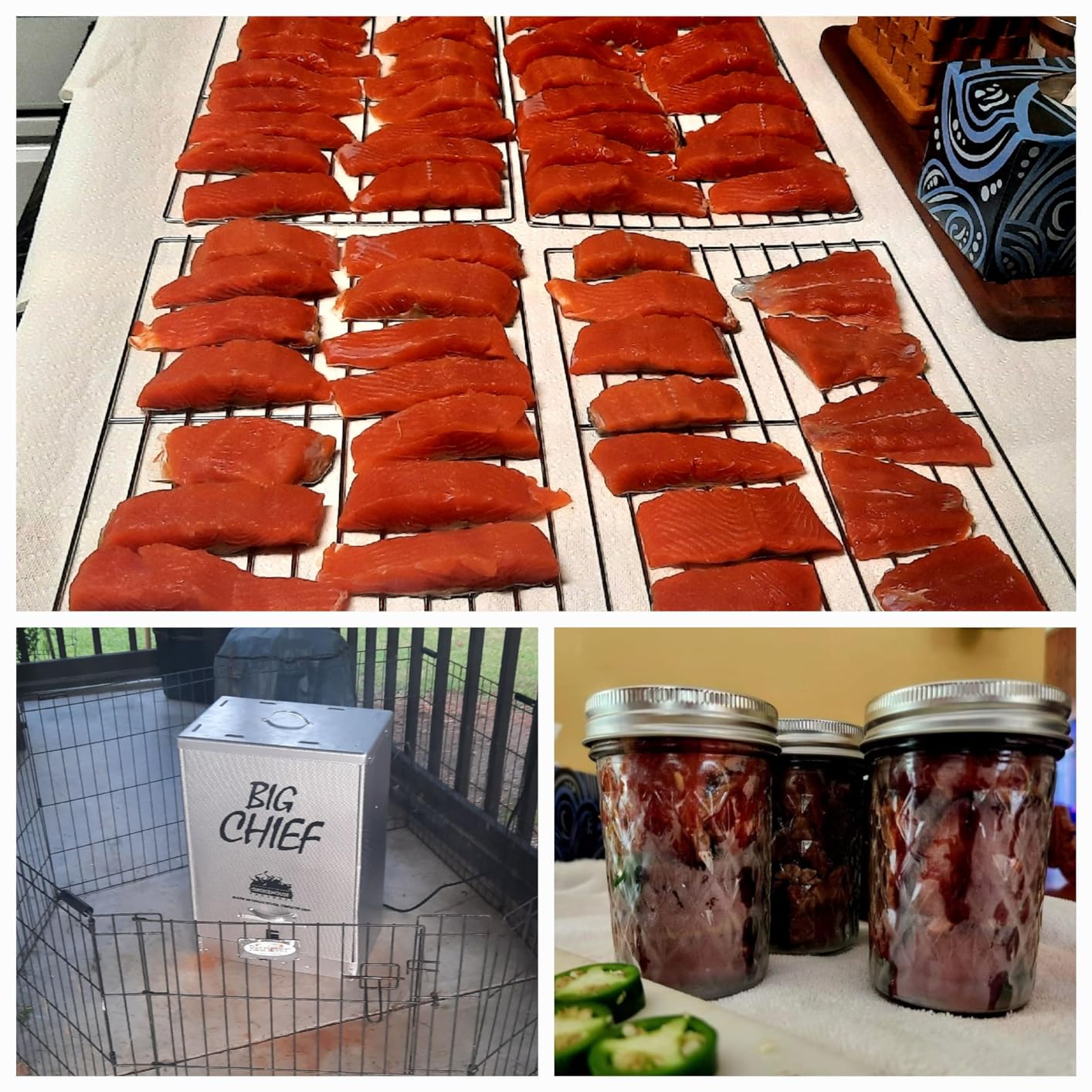
At 17.6 pounds it stays light enough to reposition. The dominant complaints are hot metal handles, the need for a weather blanket in cold climates, and thin sheet-metal bodies that dent in transit.
For a hunter, the five-rack layout is the difference between one load and two, and that is worth planning around. Just confirm your strips and sticks can sit flat without touching before you commit to a full box.
Batch sizing for jerky and sticks together
Realistically you are filling two or three racks for jerky and hanging the rest for links. Owners describe 165°F as the sweet spot for jerky, smoked salmon, cheese and cold smoking alike.
Where the limits show up?
A fixed 165°F will not cook through thicker cuts, so this is a smoke-and-flavor box rather than a cooking box. Cold-weather use needs the blanket, and the aluminum body flexes.
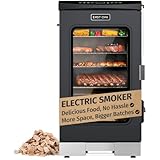
8. EAST OAK 30-Inch Electric Smoker – Best Feature Set for Jerky
EAST OAK 30″ Electric Smoker for Outdoors | Built-in Meat Probe & Clear Viewing Window | Side Chip Loader for 6x Longer Uninterrupted Smoking | 725 sq in Cooking Area for Bigger Batches, Night Blue
725 sq in on 4 removable racks
Built-in meat probe
Side chip loader
52.3 lb body
Pros
- Highest owner rating in this group at 4.7 stars
- 725 sq in across four removable racks
- Built-in probe with auto keep-warm
- Side loader runs about 6x longer per load
- Clear viewing window
Cons
- 52.3 lb with no wheels needs two people
- Viewing window glass needs regular wiping
- Requires a dedicated outdoor outlet
This is the unit owners rate most highly, and the reasons map directly onto jerky work. The built-in meat probe tracks internal temperature in real time and switches to keep-warm when the target time is reached, which removes the single most common jerky mistake: pulling a batch before the strips have actually dried through.
The side chip loader gives roughly six times longer smokes per load than a top tray. On a six-hour run that is the difference between checking the tray twice and checking it six times.
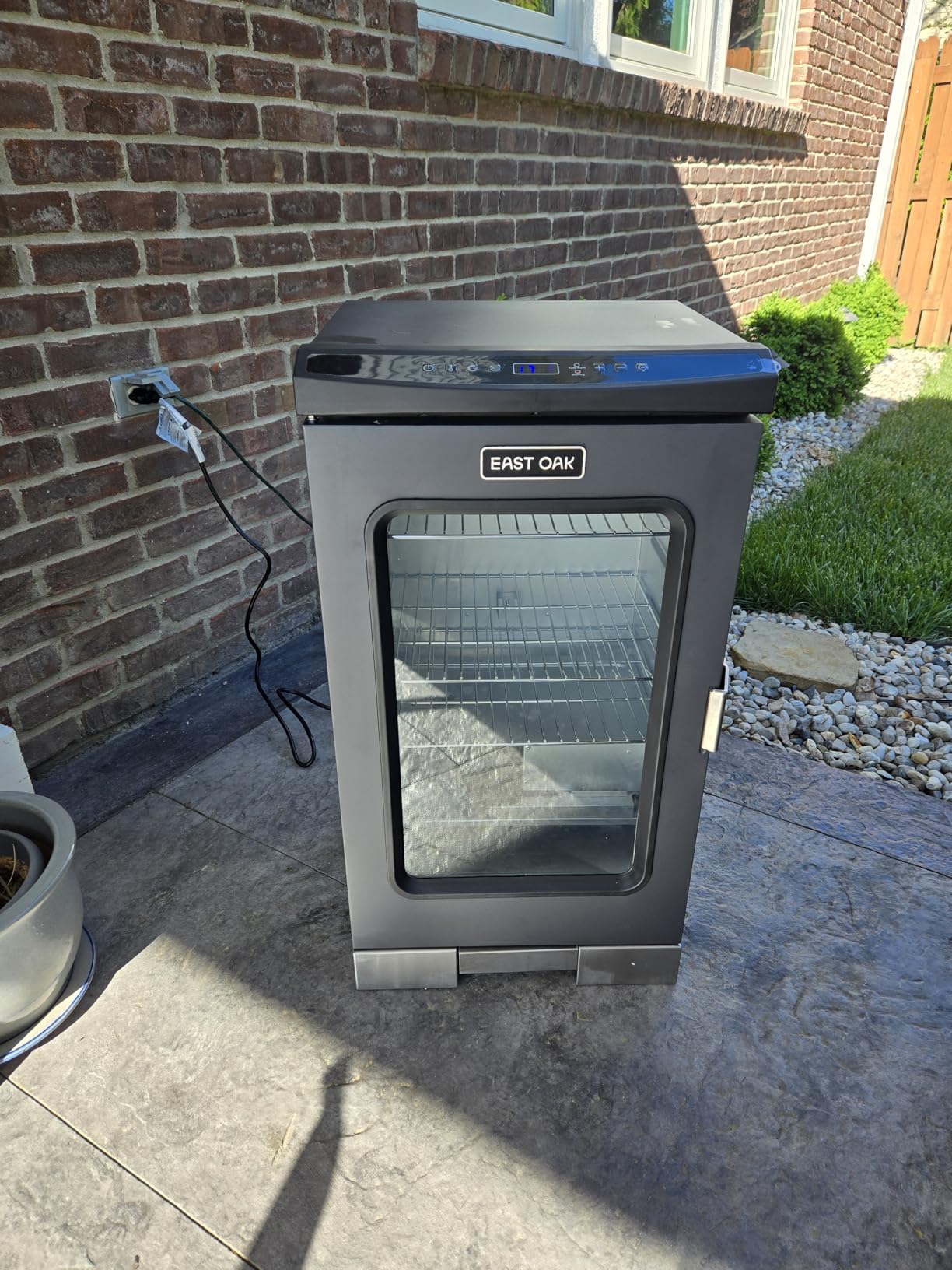
With 725 square inches across four removable racks, owners describe the layout as the most generous in this roundup, and it is the most generous here for jerky specifically because the removable racks come out for cleaning.
The clear viewing window lets you check strip color and spacing without opening the door. That is a small thing that matters when you are eight hours into a batch and do not want to lose cabinet heat to a visual check.
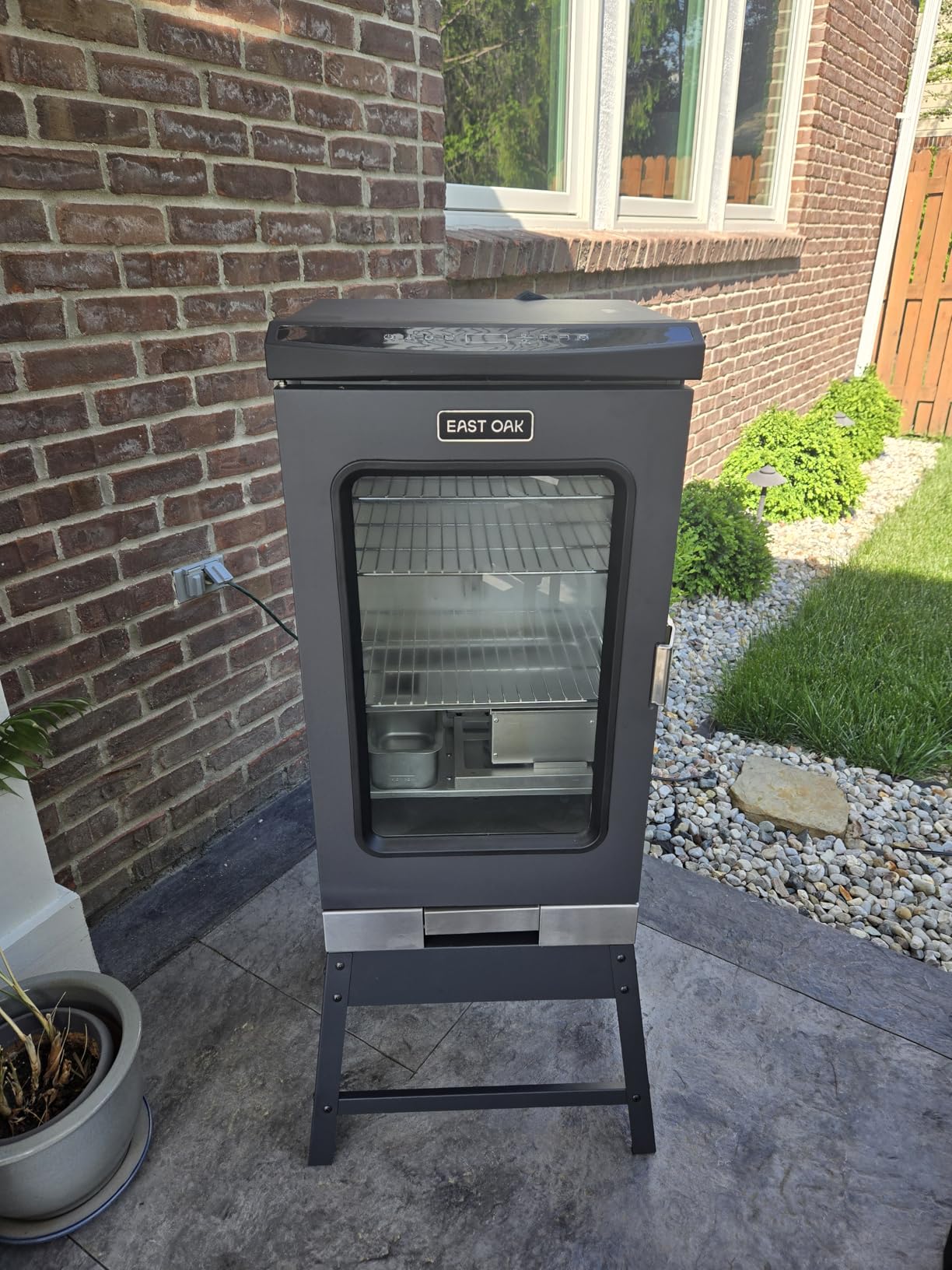
Why the built-in probe changes a long batch?
You can set a time, let it run, and know the cabinet will switch to keep-warm instead of continuing to cook the strips dry. The glass on the window does need regular wiping to stay legible.
What to plan around?
At 52.3 pounds with no wheels, this is a two-person move or a dolly job. Set it where you want it before the first batch, and plan on a dedicated outdoor outlet.
9. Masterbuilt 30-Inch Dual Fuel Propane and Charcoal Smoker – Best for Jerky Plus Everything Else
Masterbuilt 30-Inch Dual Fuel Propane & Charcoal Vertical Smoker with 730 Sq. In. Cooking Space, Push-Button Ignition, Temperature Gauge, 4 Smoking Racks, Black
Propane and charcoal in one cabinet
730 sq in on 4 racks
Dual doors
Push-button ignition
Pros
- Dual fuel on the same box
- Two front doors avoid heat loss on refills
- 730 sq in on four chrome racks
- Easy screwdriver-only assembly
Cons
- Dial gauge reads inaccurately
- Can run hotter than desired at lowest setting
- 59 lb needs a cart to move
- Stock chip tray is thin enough to ignite chips
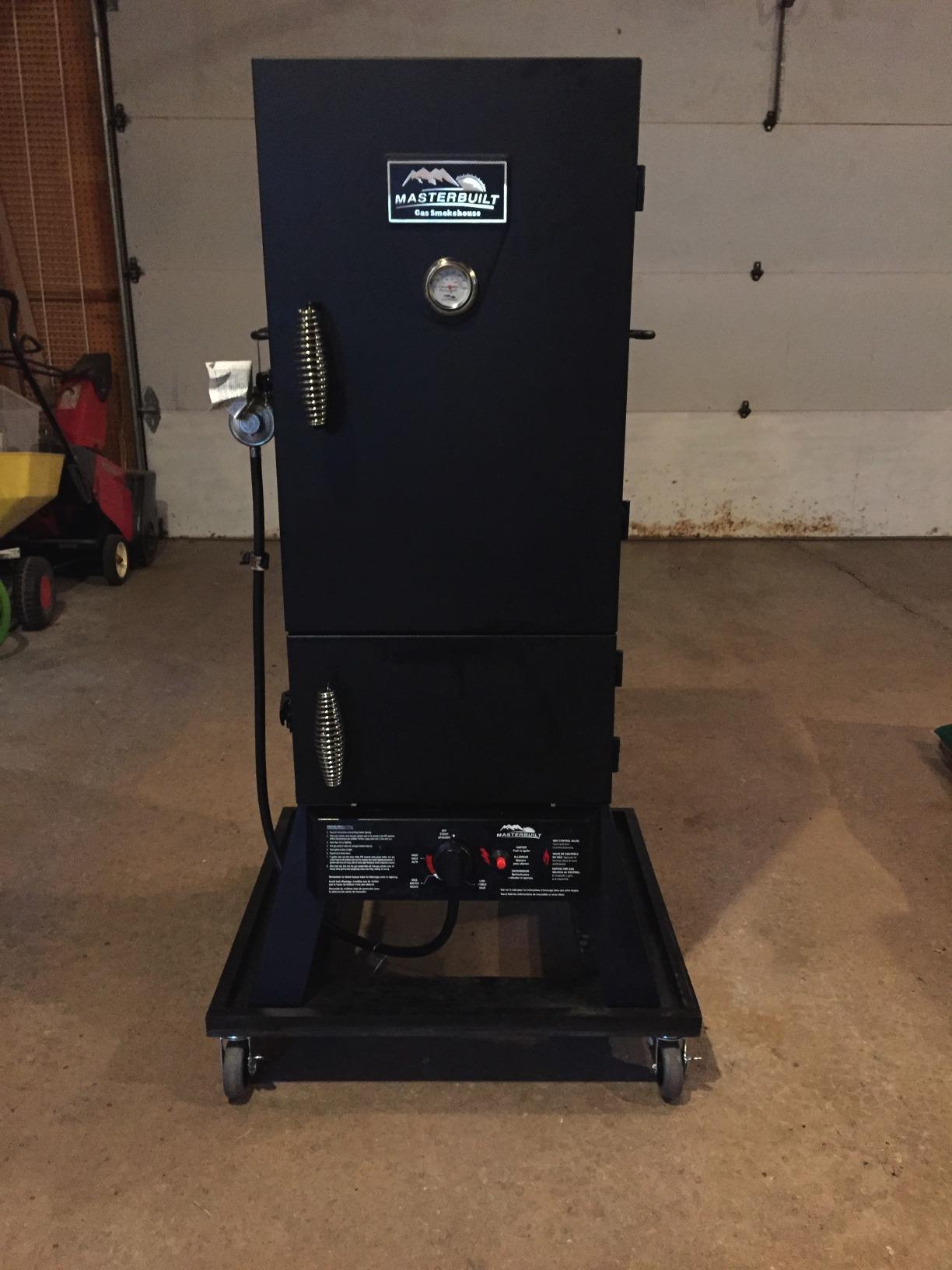
If you want a jerky smoker that can also handle a brisket, this dual-fuel cabinet is the compromise that works. Run it on propane for a low-and-slow jerky batch, drop charcoal in the lower tray when you want direct heat and flavor from wood.
Reviewers call it the best-built and most capable unit in its class, praising the dual-fuel flexibility, the two-door layout and stable low-temperature holds.
Nearly every long-term owner adds the same three items: a digital probe, a cast iron skillet on the chip tray, and a gasket or rope seal. Most say the smoker then runs flawlessly, which tells you something about what the factory leaves to you.
At 59 pounds with thin sheet metal and tack-welded legs, plan on a cart or wheels. The two-door layout is genuinely useful here because you will add wood or water repeatedly during an eight-hour run.
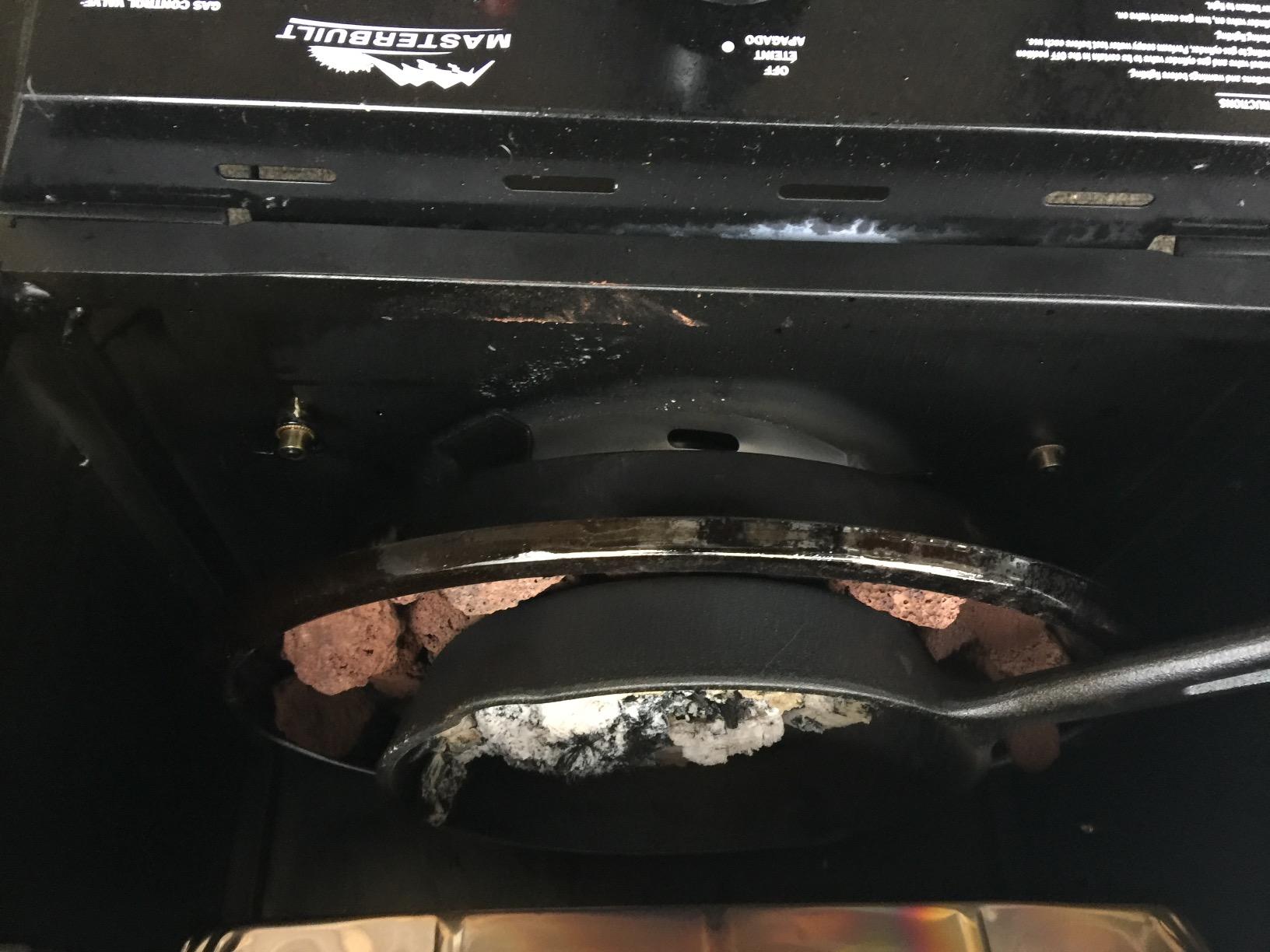
Jerky specifically on the dual-fuel setting
Propane gives you a dial to hold a steady low heat, which is what you want for drying. Charcoal on the same box is for the brisket weekend, not the jerky batch.
Skip it if you want zero modifications
The three mods owners add are close to mandatory at these temperatures. Buy it knowing you will be adding a probe, a skillet and a seal within the first week.
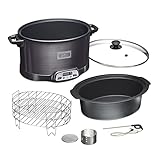
10. Weston 2-in-1 Indoor Electric Smoker and Slow Cooker – Best for Indoor Jerky
WESTON BRANDS 2-in-1 Indoor Electric Smoker & Programmable Slow Cooker, 6 Quart, With 3-Tier Smoking Rack for Meat, Cheese and More, Dishwasher Safe Crock, Temperature Probe, Black (03-2500-W)
6-quart vessel
Hot cold and combo smoke modes
3-tier rack
Included probe
7.4 lb
Pros
- Smokes indoors in any season
- Three modes cover jerky cheese and cuts
- 7.4 lb countertop size
- Programmable timer with keep-warm
- Included probe
Cons
- 6-quart capacity suits a small batch only
- Smoke production is light
- Chips and a pre-burn needed each session
- Not for searing or outdoor use
This is not a jerky smoker, but it is the answer for a specific reader: an apartment or a garage where an outdoor cabinet is not an option. It smokes indoors year-round, and at 7.4 pounds it stores on a counter when you are done.
Three modes matter here. Hot smoke suits smaller cuts, cold smoke handles cheese and nuts, and combo mode cold smokes first then cooks. The included probe and dishwasher-safe crock are practical touches owners mention repeatedly.
The limitation is consistent across reviews. A 6-quart vessel handles a modest batch at a time, and the flavor load is light compared with a full-size cabinet smoker, so you are making a tray of jerky rather than a weekend of it.
You also need wood chips and a short pre-burn before each session, and it is not suitable for high-heat searing. Treat it as an indoor flavor injector, not a cabinet replacement.
Who this is genuinely for?
Someone making a few pounds of beef jerky in a small kitchen, testing recipes before committing to a big outdoor batch, or wanting smoked cheese and nuts without going outside.
When it is the wrong call?
If you process game, run more than one batch at a time, or want smoke flavor that reads clearly at the end of the strip, an outdoor cabinet is the better spend. We covered those options in our propane smoker guide too.
Smoker vs Dehydrator: Which One Should You Buy for Jerky?
Short answer: buy a smoker if you want smoke flavor, buy a dehydrator if you want the leanest possible result and you do not care about flavor, and buy both only if you are already cooking on a smoker for other reasons.
This is the community’s central open question, and the fair answer has three parts. A smoker gives you real smoke flavor in a single step and doubles as a cooking appliance for everything else. A dehydrator produces cleaner, more consistent strips because it exhausts air rather than filling the chamber with smoke, and it does nothing else with your money.
Flavor: the smoker wins clearly. Dehydrated strips taste like the marinade; smoked strips taste like smoke.
Consistency: the dehydrator wins. A dedicated unit has no combustion gases competing with airflow.
Apprenticeship: the dehydrator is simpler. The smoker needs a probe and patience on the first few batches.
Versatility: the smoker wins. One cabinet handles brisket, ribs, salmon, cheese and sausage.
Ongoing cost: the dehydrator needs only electricity. The smoker needs chips or pellets on every run.
The people who report trying both tend to land in a predictable place. One user on a Saddle Hunter thread tested a dehydrator, an electric smoker, a gas smoker, an oven and a pellet grill, and now uses only the pellet grill. Long-time bbq-brethren users make jerky in a box smoker and in converted drums, and added a dehydrator as an extra tool rather than a swap.
Yes, a smoker can be used as a dehydrator. Any unit that holds a steady 140°F to 160°F with a working smoke source will dry jerky on its own, and a finishing dehydrator step is not required.
What Temperature Should You Smoke Jerky At?
Keep the cabinet at 160°F or above for the safety phase, and treat 140°F to 180°F as the working range for drying. Internal temperature is what actually confirms doneness: 160°F for beef and venison, 165°F for poultry.
A full batch usually takes four to eight hours depending on slice thickness, marinating time and how full the racks are. A benchmark from a detailed batch log on r/smoking: 16 pounds of eye of round sliced to 1/4 inch, cured and marinated for 36 hours, with 7.5 hours of total smoke at 160°F filling all six shelves of a vertical smoker.
That same 1/4 inch thickness is the practical reference for timing. Thinner strips finish faster and turn brittle sooner, while thicker slices can hold moisture in the center no matter how long you run them.
Wood choice is straightforward once the temperature is right. Beef takes oak, pecan or hickory with a light hand. Venison benefits from a slightly bolder wood such as hickory or cherry to cover its stronger flavor. Turkey is best with a mild wood such as apple or alder, since it picks up smoke faster than beef does.
Test doneness with the bend test rather than the clock. A finished strip bends without resistance and shows white fiber where it bends; a strip that snaps is over-dried and a strip that stays straight is not finished yet. You will find a lot of good guidance on low-temperature smoking in our offset smoker guide, though jerky still needs far less heat than those rigs are built for.
How to Choose a Smoker for Jerky?
Six factors decide whether a machine makes good jerky, and capacity ranks higher than most buyers expect. Ask how much meat you plan to run at once, because a full rack of jerky that fits on one machine beats two machines if you already own a smoker for the meat.
Low-temperature stability
This is the deciding factor. You want a unit that holds a setpoint within a few degrees for four hours or more without adjustment. A unit that swings 20 to 30°F above setpoint will cook your strips into leather, which is the single most common complaint in jerky forums about budget electric cabinets.
Rack space and airflow
Strips must lie flat without touching or overlapping, because crowding causes uneven drying and tacky centers. Vertical cabinets with wide flat racks give you more usable square inches than a deep shelf-and-grill design, and removable racks make cleanup far faster after a marinated batch.
Smoke production control
You need a smoke source that lasts the full batch without you opening the door. Side chip loaders and removable chip pans add smoke without dumping cabinet heat, and pellet units with a smoke tube deliver more smoke at low temperatures than a bare fire pot.
Fuel type
Electric is the most stable and the least hands-on, pellet gives real wood flavor with set-and-forget control, propane adds a burner dial that holds a low setpoint, charcoal gives the strongest flavor and demands the most attention, and vertical bisquette smokers suit sausage work more than flat jerky racks.
Cold-weather performance
November deer processing is the hardest case. Electric cabinets lose less heat than charcoal rigs, thin aluminum boxes like the Smokehouse units need a thermal blanket outdoors, and propane burners work harder to hold a low setpoint in a cold garage, so allow extra preheat time.
Why electric smokers stop making smoke, and how to fix it?
This is the most common recurring technical complaint in jerky forums. The chips are preheating and the cabinet is climbing toward setpoint, so the tray smolders down and you reach temperature with no smoke left. Three fixes work: set the chip tray directly on the heating element so chips ignite as the cabinet heats, add an independent chip burner on the side so smoke runs alongside the main heat source, and give the cabinet a full preheat cycle before you load the meat.
A side-mounted independent chip burner is the single most common fix longtime owners recommend, and it is why the side-loader designs rank so well here. If you already own an electric smoker without one, that accessory is usually cheaper than replacing the machine.
How to Make Jerky in a Smoker: 8 Steps?
Choose a lean cut. Eye of round, top round and flank all work, and on smokingmeatforums users note top round is fine as long as it is lean.
Slice to 1/4 inch. Thinner slices dry faster and finish sooner, which is the main lever you have over total cook time.
Cure and marinate. A long cure in the refrigerator makes a visible difference; the reference batch log above used 36 hours.
Preheat the smoker fully. Bring the cabinet to your target temperature before loading, and confirm your smoke source is actually producing.
Arrange strips flat. No touching, no overlapping, and leave airflow between rows. Crowding is the top cause of tacky centers.
Hold 160°F or above. Watch internal temperature with a probe: 160°F for beef and venison, 165°F for poultry.
Run 4 to 8 hours, then test. Use the bend test, not the clock, and pull a single strip at the hour mark from hour four onward.
Cool before storing. Let the finished jerky cool fully on the racks. Storing warm jerky traps moisture and invites mold.
Frequently Asked Questions
Is it better to make jerky in a smoker or dehydrator?
A smoker wins if you want smoke flavor in one step and a single appliance for brisket, ribs, salmon and cheese. A dehydrator wins if you want the leanest, most consistent result and do not care about smoke flavor. Long-time users tend to keep a box smoker for everything and add a dehydrator as a second tool rather than a replacement.
Can a smoker be used as a dehydrator?
Yes. Any smoker that holds a steady 140°F to 160°F with a working smoke source will fully dry jerky on its own. A separate finishing dehydrator step is not required. Fixed-temperature boxes like the Smokehouse Little Chief and Big Chief are built around exactly this 165°F behavior.
Is 150°F too low to smoke jerky safely?
Cabinet temperature and internal temperature are two different things. Keep the cabinet at 160°F or above for the safety phase so meat moves out of the 40°F to 140°F danger zone, then dry between 140°F and 180°F. Internal temperature is the real target: 160°F for beef and venison, 165°F for poultry.
How long does it take to smoke jerky at 225°F?
Jerky should not be made at 225°F. That heat cooks the meat instead of drying it, and the strips turn hard and leathery. The working range is 140°F to 180°F for four to eight hours depending on slice thickness, with 1/4 inch slices as the practical reference point.
How long does jerky take on a smoker?
A typical batch takes four to eight hours at 160°F, driven mostly by slice thickness and how full the racks are. A detailed community batch log used 7.5 hours at 160°F for 1/4 inch eye of round slices across six shelves. Test with the bend test rather than the clock.
Is there a better smoker than Traeger for jerky?
For pellet convenience most Traeger owners are happy, since you set the dial and refill the hopper. If you want a steadier low-temperature hold and more smoke at jerky temperatures, a digital electric cabinet is usually the better tool. If you want pellet flavor with PID precision, the Z GRILLS ZPG-450A2 is a strong alternative.
What wood is best for jerky?
Match the wood to the protein and keep the load light, because over-smoking a thin strip turns it bitter and acrid. Beef takes oak, pecan or hickory. Venison takes a slightly bolder hickory or cherry. Turkey takes mild apple or alder, since poultry picks up smoke faster than beef.
How much jerky can I make at once?
It depends on rack area, because strips must lie flat without touching. A four-rack vertical cabinet handles roughly 8 to 15 pounds of raw meat per load depending on thickness. Crowding causes uneven drying and tacky centers, so run a second batch rather than overlapping strips.
Final Verdict: The Best Smokers for Making Jerky in 2026
The Masterbuilt 30-Inch Digital Electric Vertical Smoker is the best smoker for making jerky in 2026 for most people, because it holds a low setpoint for hours and keeps smoke coming from the side without losing cabinet heat. The Dyna-Glo DGY784BDP is the pick if a full harvest needs to fit in one load, and the Z GRILLS ZPG-450A2 is the pick if wood flavor matters more to you than hands-off stability.
Whatever you choose, the deciding details are the same: hold 160°F or above, confirm 160°F internal for beef and venison or 165°F for poultry, lay strips flat without touching, and run four to eight hours before you test with the bend test. Buy on rack area and low-temperature hold, not on peak temperature. If you need more guidance on the other half of your yard, our drum smoker picks cover the traditional low-and-slow side.