
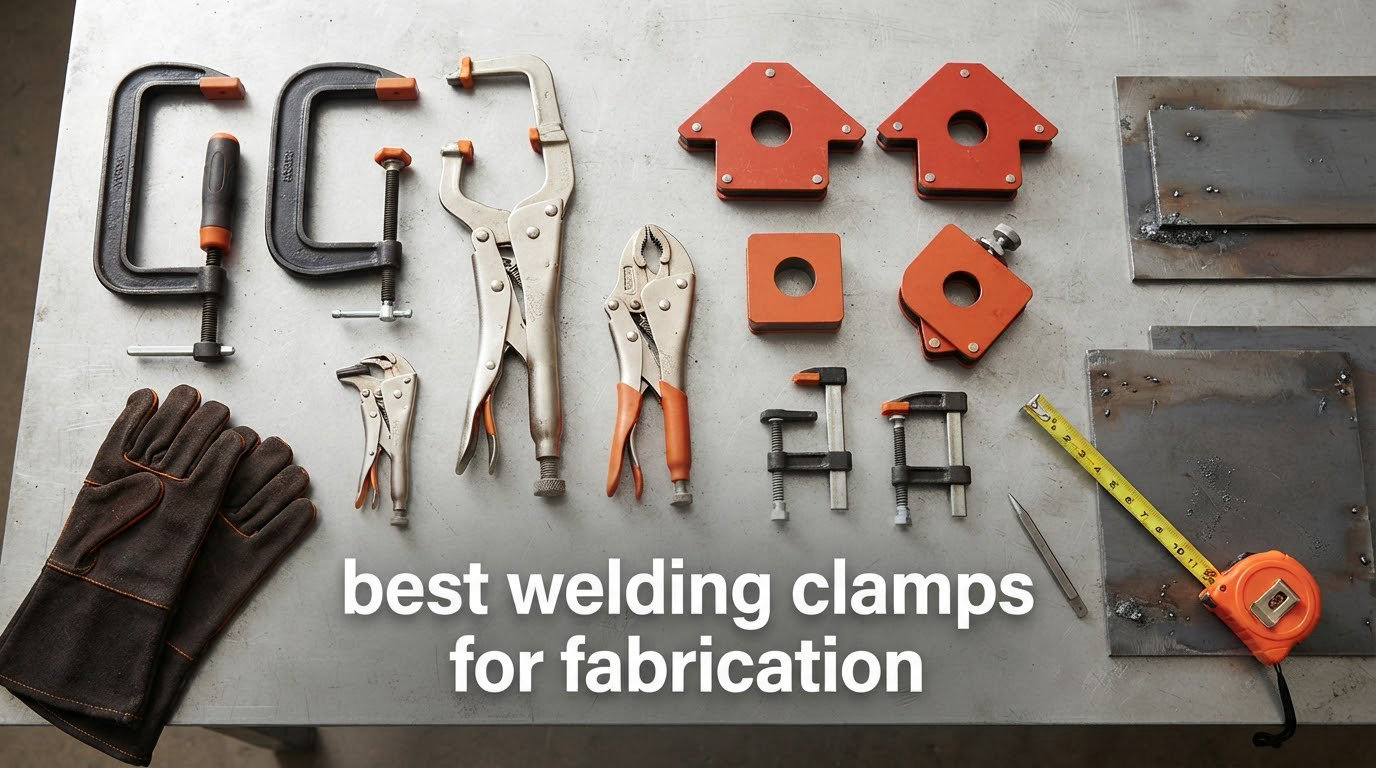
Short answer: the Strong Hand Tools MagHold Magnetic V-Pad Kit (MVDF44) is the best welding clamp pick for most shops in 2026, because four pads covering 12 lb and 18 lb holding strengths let you clamp more joints per dollar than any single-tool option, and they come out of the heat in seconds between tacks. If your work is mostly flat plate, tube or structural shapes held at fixed angles, reach for a mechanical clamp instead — the MAXPOWER 16-inch F-clamp is our pick for deep-reach fit-up and the IRWIN VISE-GRIP 11-inch locking C-clamp is the one we keep within arm’s reach on every bench.
Welding clamps are the least glamorous tool in the shop and the one that decides whether a job goes together. Metal expands as you heat it and contracts as it cools, so a joint held by two clamps behaves nothing like a joint held by four. The clamp is what holds your fit-up geometry while that happens.
We spent weeks putting these twelve through the kind of work that ruins clamps: tack welds, spatter, repeated release, tube and angle iron, sheet metal, and long dry-fit assemblies before the arc ever lit. The lineup below covers every category a fabricator actually shops for — locking pliers, F-style bar clamps, face clamps, angle clamps, pipe clamps, table-mounted hold-downs and magnetic positioning aids.
If you are outfitting a new shop, you will also want a solid welding table to hang the hold-down clamps on, and a welding helmet for the half of this list you will be leaning over. More on the fit and finish side of the shop in our conclusion, where we lay out a starter stack by skill level.
Table of Contents
Top 3 Best Welding Clamps for Fabrication in 2026
Strong Hand MagHold V-Pad Kit
- Four pads at 12 lb and 18 lb pull force
- Magnets on face and bottom
- 0.9 lb total kit weight

Amazon Basics Face Clamp Pack
- 3 inch jaw reach each
- Clamps stock up to 2-3/4 inches thick
- Swivel pads protect the surface

IRWIN 11in Locking C-Clamp
- 4 inch jaw opening
- Turn screw pressure that stays set
- Heat-treated alloy steel
Two of the three picks above are mechanical rather than magnetic, and that is deliberate. Magnets are fast and removable; mechanical clamps hold when the heat builds and the table vibrates. A shop that owns only one type of clamp usually ends up owning the wrong type of clamp.
Best Welding Clamps for Fabrication at a Glance in 2026
| Product | Specifications | Action |
|---|---|---|
| Strong Hand MagHold Magnetic V-Pad Kit |
|
Check Latest Price |
| Amazon Basics Metal Face Clamps 2-Pack |
|
Check Latest Price |
| IRWIN VISE-GRIP 11 Inch Locking C-Clamp |
|
Check Latest Price |
 YESWELDER 4-Pc Welding Magnet Set YESWELDER 4-Pc Welding Magnet Set |
|
Check Latest Price |
 MAXPOWER 16 Inch F Clamp MAXPOWER 16 Inch F Clamp |
|
Check Latest Price |
 Strong Hand PG114V Pipe Pliers with V-Pads Strong Hand PG114V Pipe Pliers with V-Pads |
|
Check Latest Price |
 BETOOLL Cast Iron Welders Angle Clamp BETOOLL Cast Iron Welders Angle Clamp |
|
Check Latest Price |
 HOZEON 3-Pc 18 Inch C Clamp Welding Pliers HOZEON 3-Pc 18 Inch C Clamp Welding Pliers |
|
Check Latest Price |
 BuildPro Inserta Pliers PTT634K BuildPro Inserta Pliers PTT634K |
|
Check Latest Price |
 Strong Hand CPL45 Pipe Fit-Up Clamp Strong Hand CPL45 Pipe Fit-Up Clamp |
|
Check Latest Price |
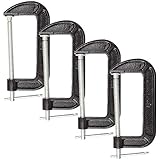 ABuff 4 Piece 6 Inch C-Clamp Set ABuff 4 Piece 6 Inch C-Clamp Set |
|
Check Latest Price |
 MAXPOWER 11 Inch Locking C-Clamp 4-Pack MAXPOWER 11 Inch Locking C-Clamp 4-Pack |
|
Check Latest Price |
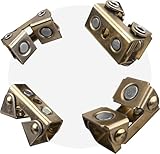
1. Strong Hand Tools MagHold Magnetic V-Pad Kit (MVDF44) – Best Overall
Strong Hand Tools, Magnetic V-Pads Kit, Magnets On Both Pad Face & Bottom, 4 Piece Kit (XDV4: 2 pcs. 2″, Pull Force 12 lbs) (XFV4: 2 pcs. 2.2″, Pull Force 18 lbs), MVDF44
4-pad kit
Two 12 lb and two 18 lb pull force
Magnets on face and bottom
0.9 lb total
Pros
- Fast positioning of round
- flat and square material
- Flexible V-pad geometry handles odd angles
- Two-sided magnet contact holds light and medium parts
- Compact 0.9 lb kit lives on a welding bench
Cons
- Magnets lose strength quickly near weld heat
- Holding power is modest and often overstated
- Adhesive lets go on vertical parts if left in place
I keep these four pads within about a foot of the torch. The kit is two small V-pads rated at 12 lb of pull force and two medium pads rated at 18 lb, and the magnets sit on both the pad face and the bottom, which is what lets a V-hold bridge two pieces that meet at a corner instead of just holding one flat piece down.
The geometry is the real story. A V-pad grips a round tube, a square tube corner or two flat plates meeting at an angle without any jaw adjustment at all, so you can square a frame, hold a tube against a plate, or spot a bracket in place with no spindle turning. On a four-piece kit weighing 0.9 lb, the practical result is more clamps within reach than almost any mechanical alternative.
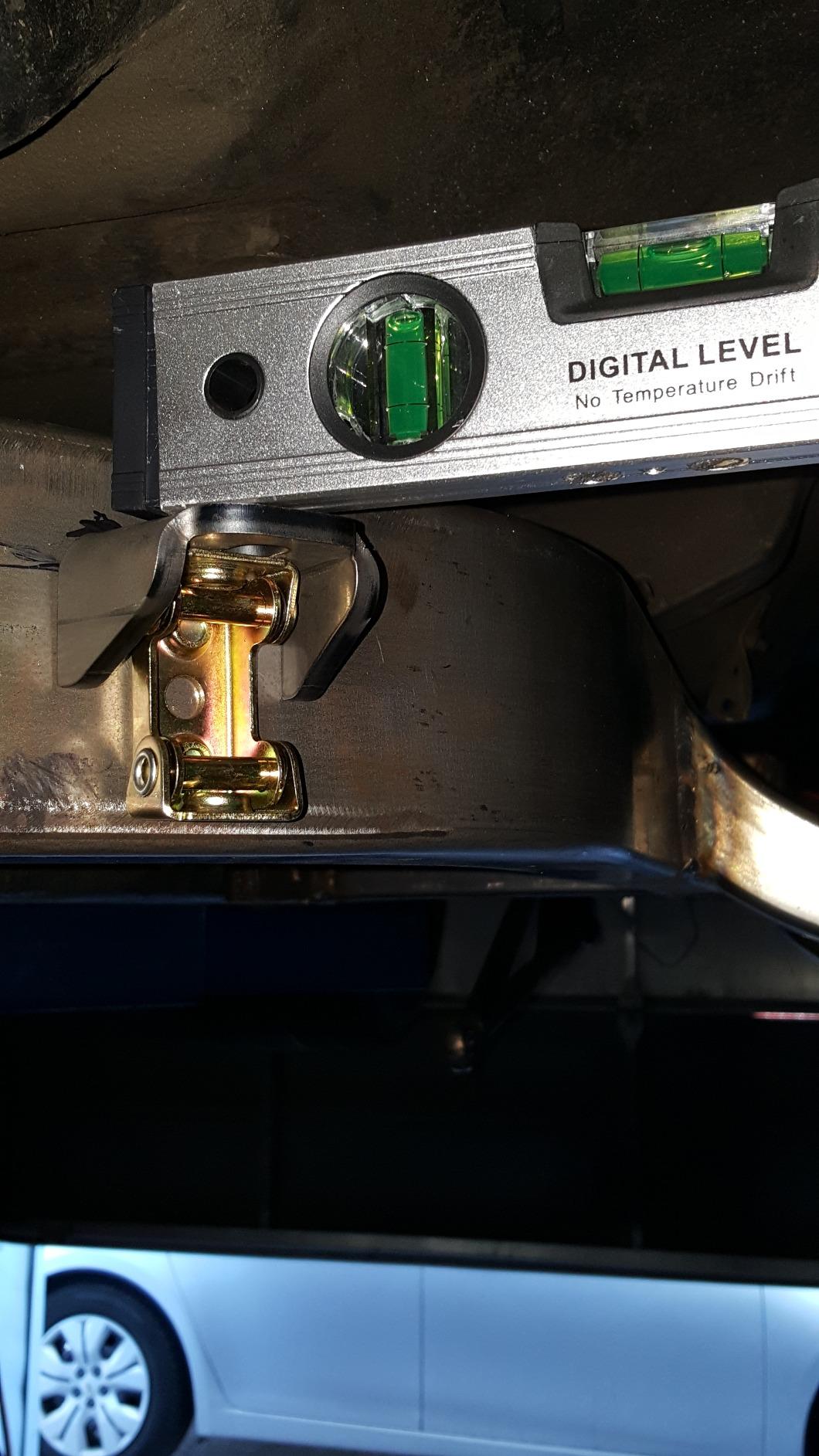
Buyers consistently use them for sub-assembly positioning on light to medium material, and the review pattern is unusually consistent: fast placement, forgiving geometry, one repeated caveat. That caveat is heat. Magnets demagnetize near an arc, so a pad parked in the heat of a weld stops being a clamp. Pull it off before you light the torch, or you will discover the failure at the worst moment.
There is a separate confusion worth clearing up here, because the phrase “welding clamp” covers two unrelated tool families. A workpiece clamp holds your part. An earth clamp, also called a ground clamp, attaches your work cable to the workpiece to complete the circuit. Ground clamps are a cable-end accessory and appear in no roundup of the best welding clamps for fabrication, including this one, because they have nothing to do with fit-up. If your problem is a clamp that keeps loosening mid-bead, you want more workpiece clamping, not a better ground connection.
These pads are not heavy-duty hold-downs. Owners who buy them expecting plate-clamping strength are the ones who leave disappointed reviews. Set the expectation properly and they are excellent at light sub-assembly holding, tack positioning, and anywhere you need to move fast and remove quickly.
Best for light sub-assembly and tack positioning
Reach for these when you are tacking a small bracket, squaring a short tube frame, or holding a plate and a gusset in position while you stitch it. Four pads across two sizes means one kit covers several bench positions at once, and the 12 lb and 18 lb split lets you match holding power to the part instead of over-clamping thin material with a magnet that is too strong for it.
For a bench that does light structural work, thin wall tube, and general tack-up, this kit earns top billing because it does more per square foot of bench space than a single mechanical clamp ever will. Buy two of them before you buy another C-clamp.
Where they fall short
Any job where the joint is hot for a long time, or where a slipping part means scrap, is the wrong place for a magnet. Magnetic holding also does nothing for a workpiece hanging in the air, and the adhesive-backed pads can creep on an overhead or vertical joint if you leave them in the heat.
If your work is mostly plate, structural beam, or anything requiring more than a few seconds of hold, a mechanical clamp in the list below will serve you better and cost you nothing in setup speed over a long run.
2. Amazon Basics Adjustable Metal Face Clamps 3-Inch 2-Pack – Budget Pick
Amazon Basics Adjustable Metal Face Clamps for Woodworking, Welding, or Repairs, 3-inch Jaw Reach, 2-Pack, Black/Silver
Two clamps per pack
3 inch jaw reach
Handles material up to 2-3/4 inches
Alloy steel with swivel pads
Pros
- Metal face build feels far sturdier than the tier suggests
- Fine tension control from the thumb screw
- Swivel pads grip without denting thin or finished material
- Strong enough for welding and general fabrication
Cons
- Heavier than plastic clamps of the same size
- 3 inch jaw reach limits you to narrower material
These are the clamps that surprise people. A 2-pack of 11-inch metal face clamps with a 3-inch jaw reach, and the most common sentence in the reviews is that they feel heavier-duty than the price tier suggests. The body is alloy steel with a plastic thumb screw knob, and the knob gives you surprisingly fine tension control for a screw clamp.
Each one clamps material up to 2-3/4 inches thick with swivel pads that spread force across the surface. That pad matters more than it sounds: a face clamp with a flat jaw on finished or thin sheet will dent it, and the swivel pad is the difference between a clean part and a marked one.
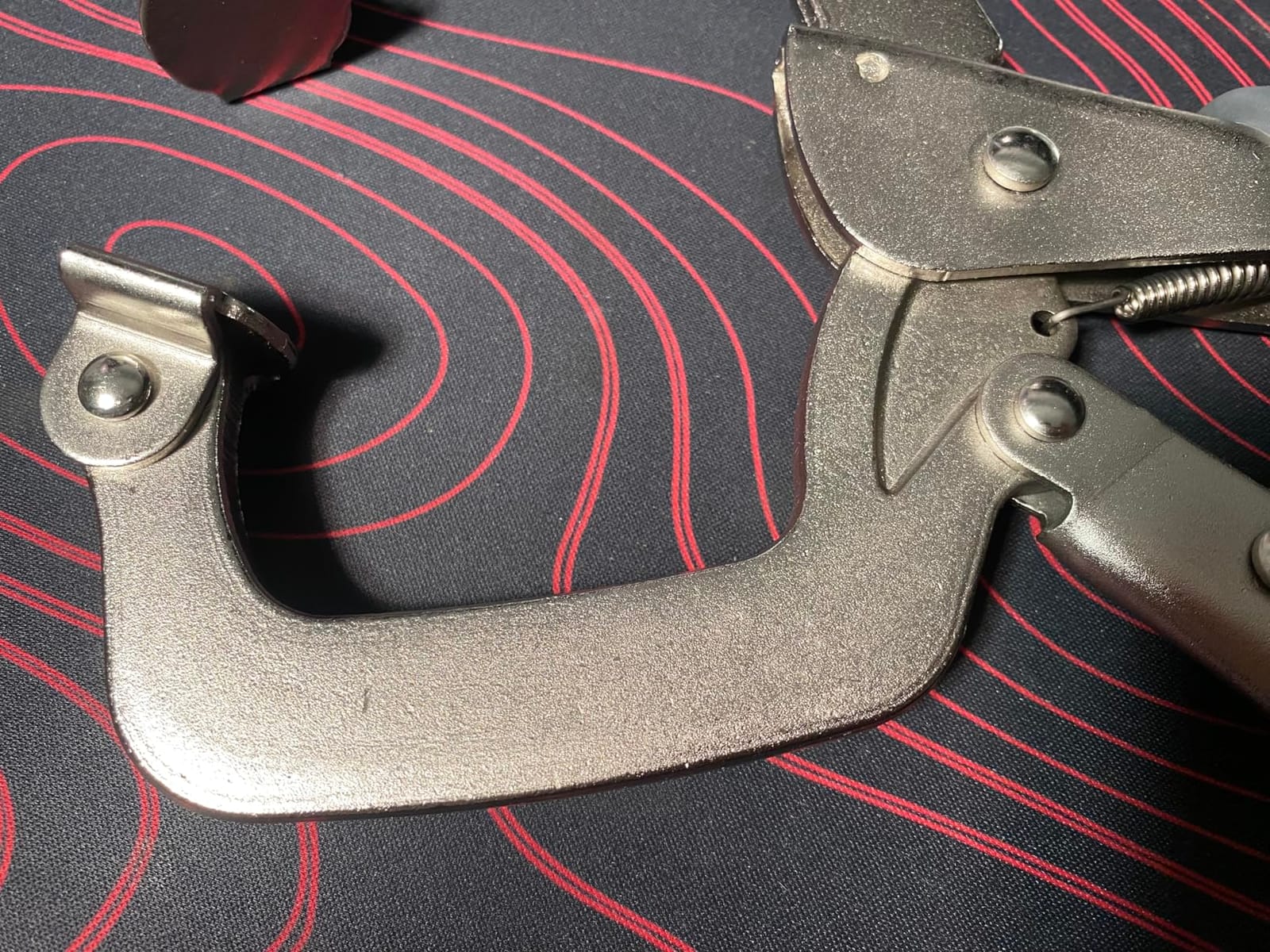
For a hobby shop doing occasional home repair, these are the pair I recommend without hesitation. A face clamp has no lock, so the screw holds the pressure, and on plate and mild steel fit-up that is genuinely enough. Buy the 2-pack so you can clamp both sides of a joint, which is the minimum for sane fit-up.
A WeldingWeb user made the value point better than I can: comparing a Harbor Freight clamp against a Bessey, they concluded the Harbor Freight units perform “as good as the BESSEY” and added that there is “lots of money made on product NAMES.” That sentiment is exactly why a mid-tier face clamp like this belongs on a short list. The brand premium in this category is real, and it is not always matched by the force.
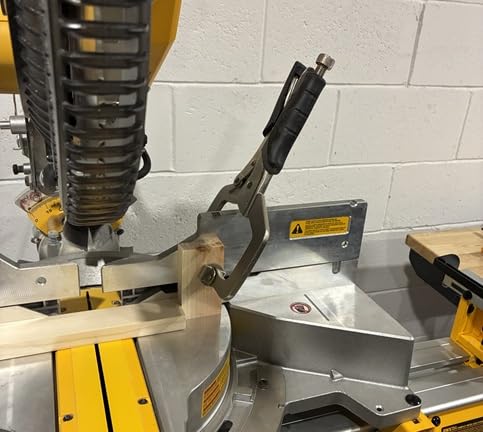
Good for a first shop and light fabrication
These are the clamps to start on if you are welding occasional repairs, brackets, and short plate joints and you want something that will not slide. The thumb screw adjustment lets you dial the same clamp down for a thin panel and up for a 2-3/4 inch plate, which makes a 2-pack far more versatile than a pair of fixed-depth screw clamps.
They also double as a general shop clamp well beyond welding, so if you share a bench with woodworking, glue-ups and pocket hole work get the same tool.
Not for deep reach or heavy structural work
The 3-inch jaw reach is the hard limit. If your joint sits more than about three inches back from the edge, or you are clamping an I-beam or channel, a standard face clamp cannot reach into the geometry and you will be wasting your afternoon.
The other drawback is honest and minor: at roughly 0.82 kg for the pair they are heavier than plastic clamps of the same size, so they are not the tool you want to carry up a ladder.
3. IRWIN VISE-GRIP Original Locking C-Clamp 11 Inch – Top Rated
IRWIN VISE-GRIP Original Locking C-Clamp, 11″, 19
11 inch locking C-clamp
4 inch opening capacity
3-3/8 inch jaw capacity
Limited lifetime warranty
Pros
- Highest rated clamp in the group with a tight lockup
- Heat-treated alloy steel survives repeated shop use
- Trigger release frees it one-handed
- Limited lifetime warranty from an established brand
Cons
- Regular tip can mark or mar softer surfaces
- Sold as a single clamp rather than a set
This is the benchmark. Across 1296 ratings it holds a 4.8, the highest score in this group, and owners consistently describe it as the reference locking C-clamp rather than just another one. The body is heat-treated alloy steel and the 11-inch frame gives you a 4 inch wide opening with 3-3/8 inch jaw capacity.
What separates it from the pack of similar-looking clamps is the lock itself. The turn screw sets your pressure and gap, then the clamp holds that setting until you squeeze the trigger, so a clamp set before stepping away to the torch is still set when you come back. That is the entire reason to own a locking C-clamp instead of a screw clamp.
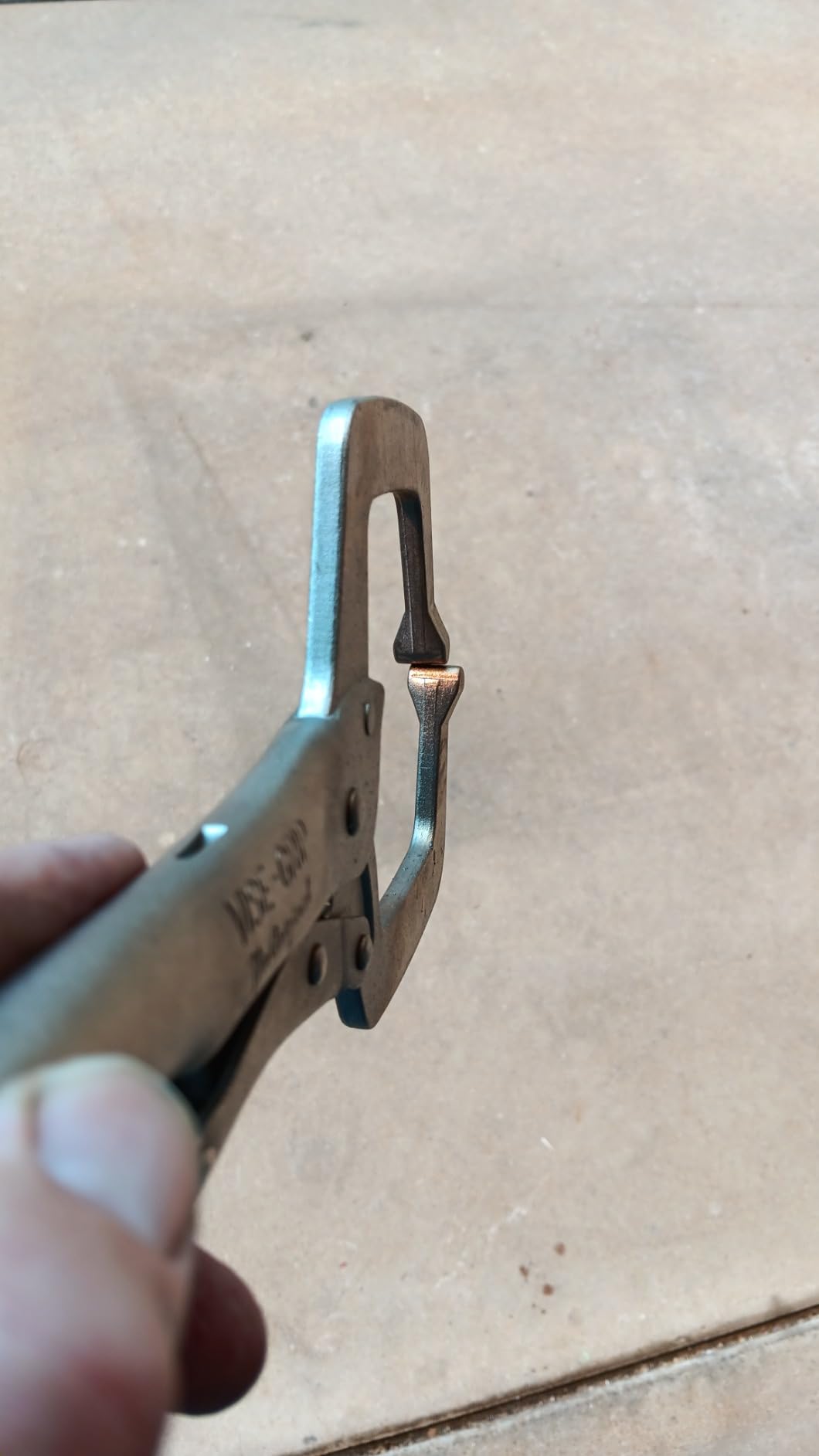
For welding, the trigger release is a real advantage over a screw clamp: you can reposition quickly between tacks without unwinding anything. When you are building a multi-point jig or a frame where the same clamp position is used repeatedly, set the screw, lock, and walk away.
The limited lifetime warranty is worth noting too. It is the only listing in this roundup that carries one from an established tool brand, and over a long fabrication career that is a meaningful difference if a pivot or handle ever fails.
Buy several. The single-unit packaging is a real drawback, because fit-up takes a minimum of two clamps per joint, but two or three of these on a bench quietly outperform most four-packs of cheaper clamps.
Best for repeatable jig and frame work
Pick this when the same clamp position is used over and over, when you want set-and-forget pressure, and when the work is steel or steel-clad material where a marring tip is not a problem. The 4-inch opening and 11-inch length cover most plate, tube, and structural shapes without a specialty clamp.
It is also the clamp I would hand a welder who is new to fit-up, because a clamp that does not creep removes one whole category of beginner frustration.
Watch the tip on finished surfaces
This model ships with a regular tip, and the most common complaint is that the tip marks or mars softer and finished work. On raw plate you will not care. On a visible panel, a stainless part you intend to keep, or anything with a coating, either protect the surface with a scrap of scrap metal or use a swivel-pad version instead.
The other limitation is packaging rather than performance: you get one clamp, so budget for two or three if you want multi-point control on the same joint.
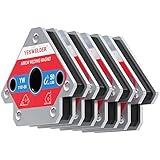
4. YESWELDER 4-Pc Welding Magnet Set with 50 lb Holding Force – Best for Fast Square-Up
YESWELDER 4-Pc Welding Magnet Set, 50 lb Holding Power Welding Accessories
Four triangular magnets
50 lb rated pull force each
Holds 45, 90 and 135 degree angles
Iron and magnet construction
Pros
- Squares tubing and plate fast
- often called a second pair of hands
- Holds 90 degree geometry for frame and trailer work
- Four pieces cover multiple joints at once
- Inexpensive fit-up capability for a welding table
Cons
- Only holds in specific orientations
- Real pull strength often falls short of 50 lb
- Angles are not always dead square
These are not clamps, they behave like an extra pair of hands for thirty seconds. The triangular body locks a part at 45, 90, or 135 degrees, which covers the geometry that shows up constantly in frame and trailer work: a tube standing square to a plate, a gusset at 45, a perpendicular joint held while you tack.
At 4.76 x 3.26 x 0.7 inches per magnet and four per set, they are small enough to keep four on the table at once. The construction is iron and magnet, which is the right material pairing for a tool that will take knocks on a steel bench.
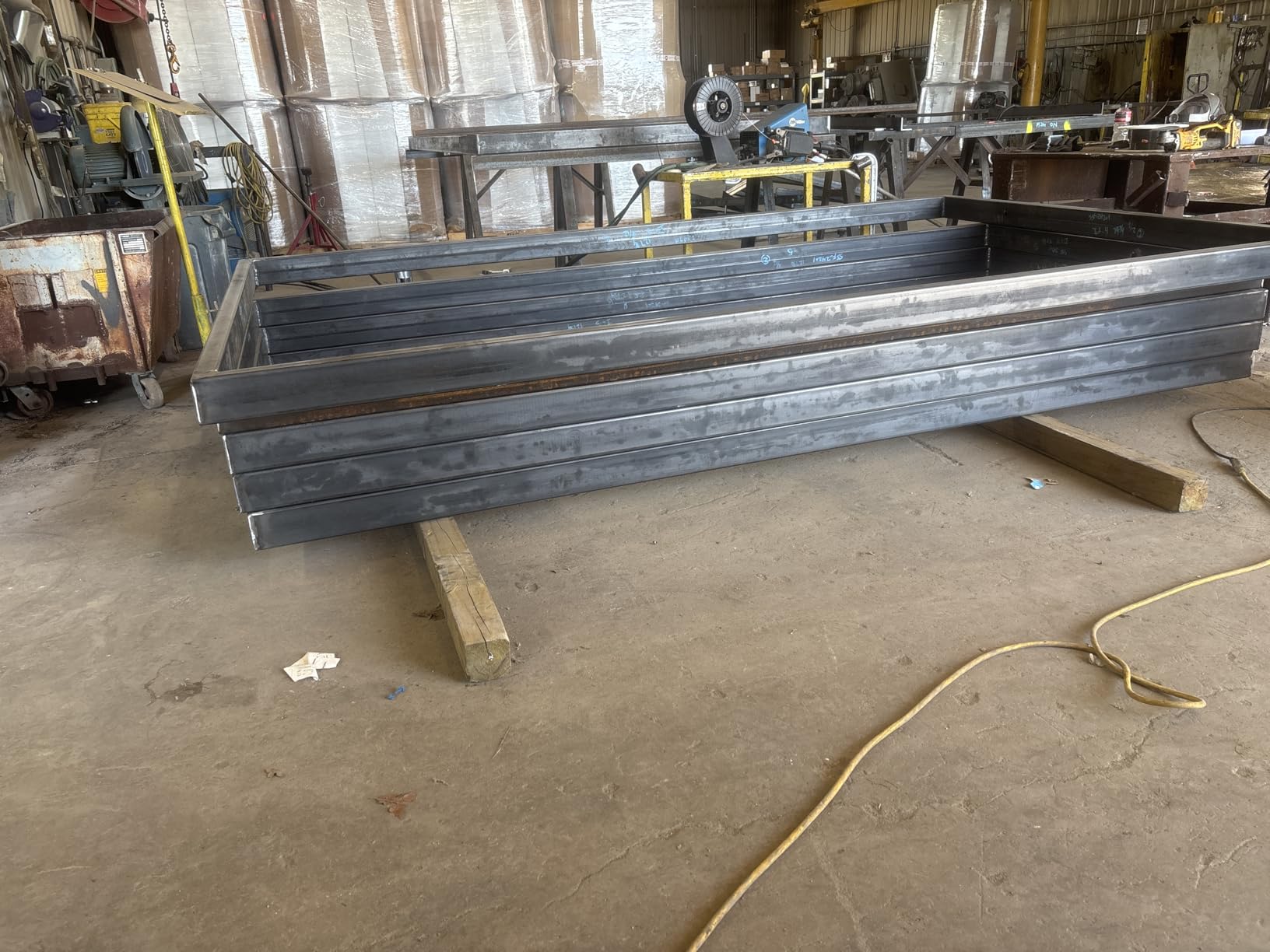
Reviewers consistently describe the same benefit: speed. Squaring up tubing and sheet with a magnet takes a second, where a mechanical clamp takes twenty and a second clamp. If your fit-up is repetitive frame work, that time saving is the whole argument.
Two honest caveats come up repeatedly. First, real holding force lands closer to 30 lb than the advertised 50 lb once you account for the iron casing, so treat the number as a class rather than a measurement. Second, the angles are not always dead square to 90 degrees, which matters if you are measuring your frame rather than eyeballing it.
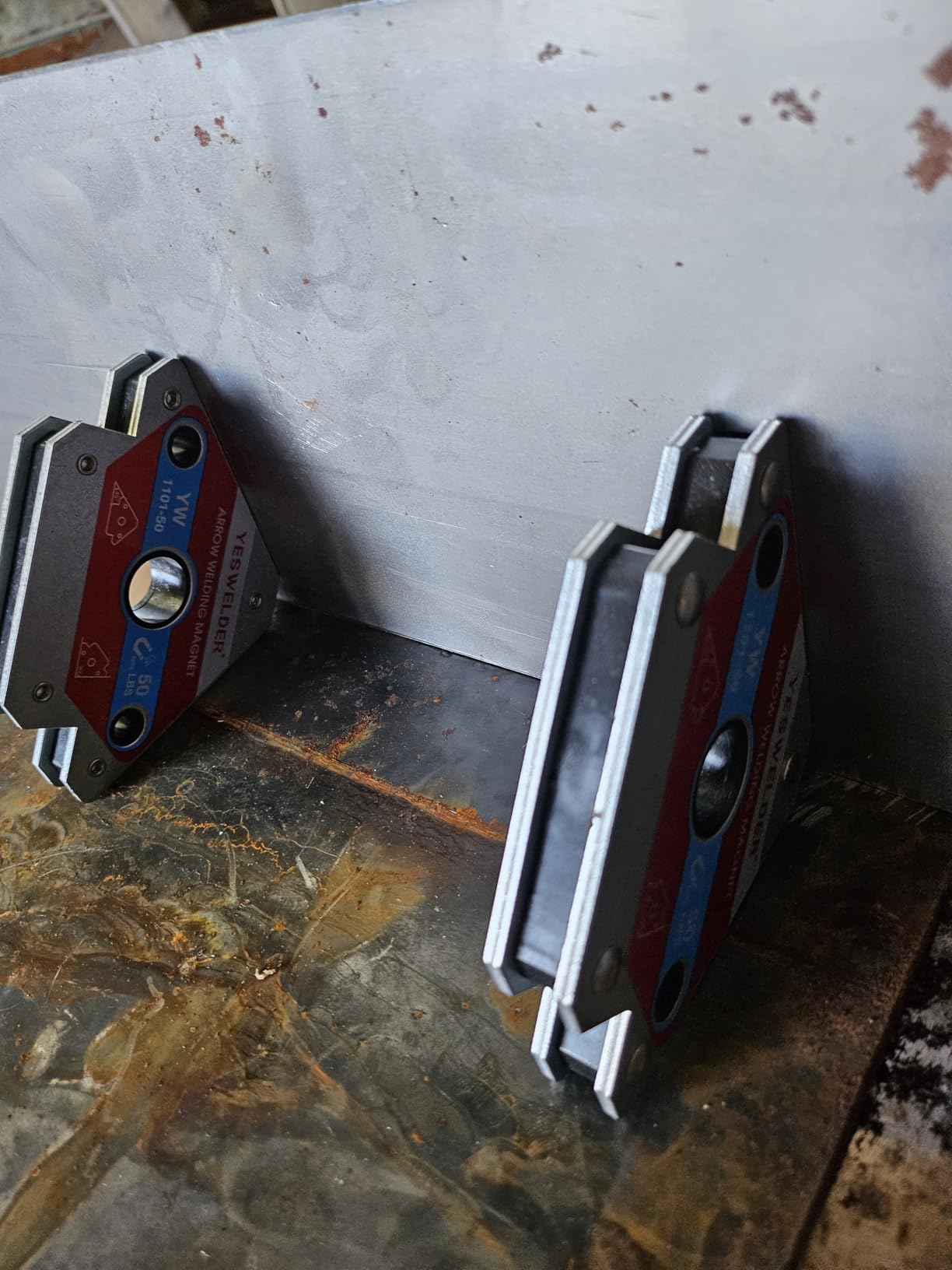
Good for quick squaring and tack welds
Use these for holding a perpendicular joint square while you tack, aligning sheet to a frame member, and any short-term positioning where you want to remove the fixture without unwinding anything. They suit welding, soldering, marking off, and pipe fitting work equally well.
A welding table that lacked hold-down capability gains a surprising amount of function from a 4-pack of these, and if you already own a table you can read our welding table comparison to see which ones have the hole pattern for proper clamps.
Not a general-purpose hold-down
A magnet only works in the orientations it was designed for. Try to use one as a flat hold-down on a horizontal plate and it will simply sit there, which is fine for tacking and useless the moment you start welding a longer seam that pulls the part.
If your work needs sustained pressure through a long, hot weld, use a mechanical clamp. Use these for the setup and the tacks, then swap to something that carries the heat.
5. MAXPOWER 16-Inch F Clamp with 4-3/4 Inch Throat – Best Deep Throat Bar Clamp
MAXPOWER 16-inch F Clamp, 4-3/4″ Throat, Forged Full Steel Bar Clamp
16 inch opening
4-3/4 inch throat depth
1200 lbs clamping pressure
Black oxide spindle
Pros
- Deep throat and long reach handle jobs standard bar clamps cannot
- Swivel pads spread force across plate and tube
- Holds pressure without creeping through long welds
- Strong value against premium bar clamps
Cons
- Sliding arm feels loose until the pads take load
- Rail flexes more than heavier premium clamps
- Less convenient for repetitive light work
This is the F-style bar clamp, and the reason it exists is reach. A 16 inch opening with a 4-3/4 inch (120 mm) throat means the jaw can get back into the middle of a joint and hold a part that a face clamp simply cannot reach. The rail cross-section is 7/8 x 27/64 inch, and rated clamping pressure is 1200 lbs.
For fabrication that means a wide flange, a channel, a rectangular tube frame, or a plate joint that sits well back from the edge. The swivel pads spread the force so you are not concentrating 1200 lbs on one spot of a plate, and the black oxide spindle resists the wear and rust that destroy an untreated screw in a welding shop.
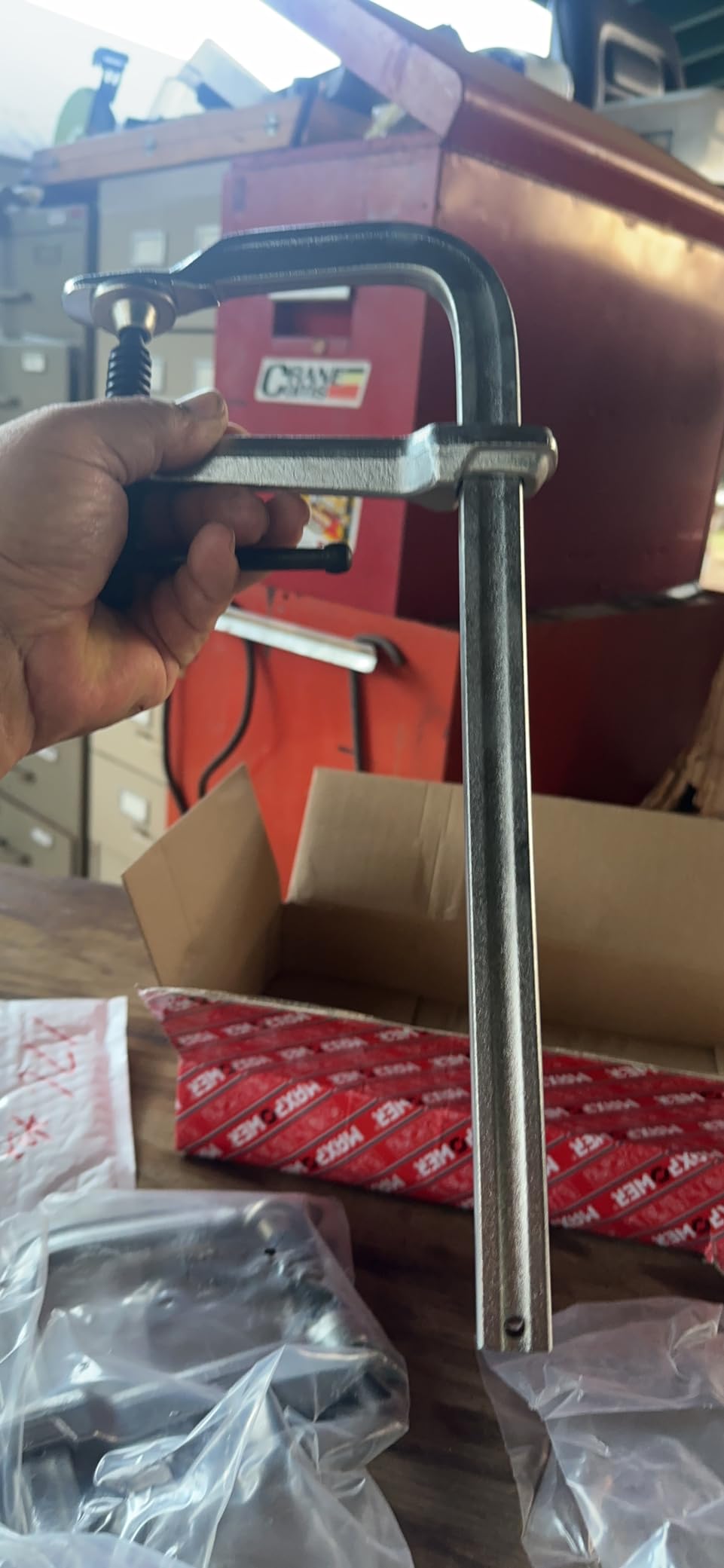
Owners who switched here from premium bar clamps report comparable hold at a noticeably lower outlay, and the recurring review note is that it does not creep through a long fabrication weld. That matters because a clamp that creeps is a clamp that distorts the part.
The heat-treated sliding arm has a stop end so it cannot slip off the rail, which is the failure that turns a cheap bar clamp into scrap metal.
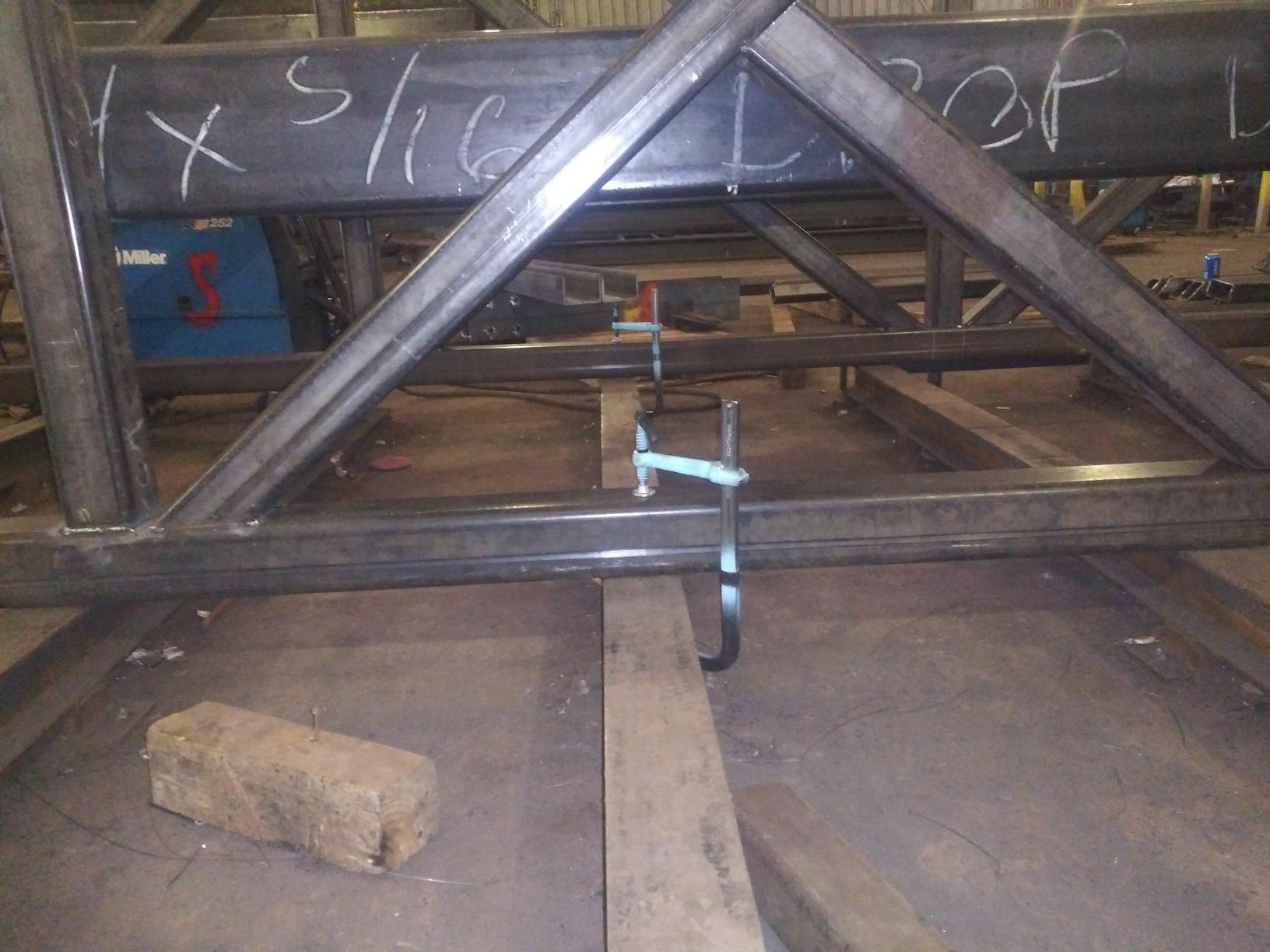
Best for structural shapes and wide assemblies
Choose this when the joint is deep inside a frame, when you are clamping an I-beam, channel, or wide flange, or when you need to hold a large assembly while a long seam cools. The 1200 lb rating gives you room to over-clamp on heavy material without worrying about the screw stripping.
For a shop doing structural and plate fabrication rather than sheet metal, a bar clamp with real throat depth is a tool you will use constantly, and this is the version we would put on the shelf.
Where it feels cheap
Reviewers flag two things. The sliding arm adjustment feels loose until the swivel pads take load, so a clamp that feels broken in the hand can be perfectly fine under load. And the rail flexes more than heavier premium bar clamps, which shows up on very long assemblies where a rigid rail holds geometry better.
For repetitive light work it is also the wrong shape entirely, since every position change means unthreading the spindle rather than squeezing a trigger.
6. Strong Hand Tools PG114V Pipe Pliers with Large V-Pads – Best for Pipe and Exhaust Work
Strong Hand Tools – STRONG – PG114V Strong hand Tools PG114V Pipe Pliers with Large V-Pads, 11-Inch
11 inch overall length
3-1/2 inch throat
1-1/2 to 2-1/2 inch capacity
Adjustable top spindle
Pros
- Firm
- predictable grip on round pipe for fit-up
- Swivel jaws rotate to clamp irregular shapes
- Useful for fixture and dial indicator setups
- Sturdy arm rated for drilling and tapping
Cons
- Limited to about 2-1/2 inch pipe capacity
- Lock-off feels softer than a true locking plier
- No key supplied for repositioning the swivel head
Round pipe is the case where a general clamp fails and a pipe tool wins. This one has a clamping capacity of 1-1/2 to 2-1/2 inches with a 3-1/2 inch throat, an 11-inch overall length, and large V-pads that grip a tube without crushing the finish or leaving a flat spot.
The adjustable top spindle takes an M10 thread, which is what lets you dial the opening to the specific pipe size rather than guessing. For exhaust header fabrication and general tubing work, the difference between a V-pad grip and a serrated jaw grip is the difference between a part that is still round afterward and one that is not.
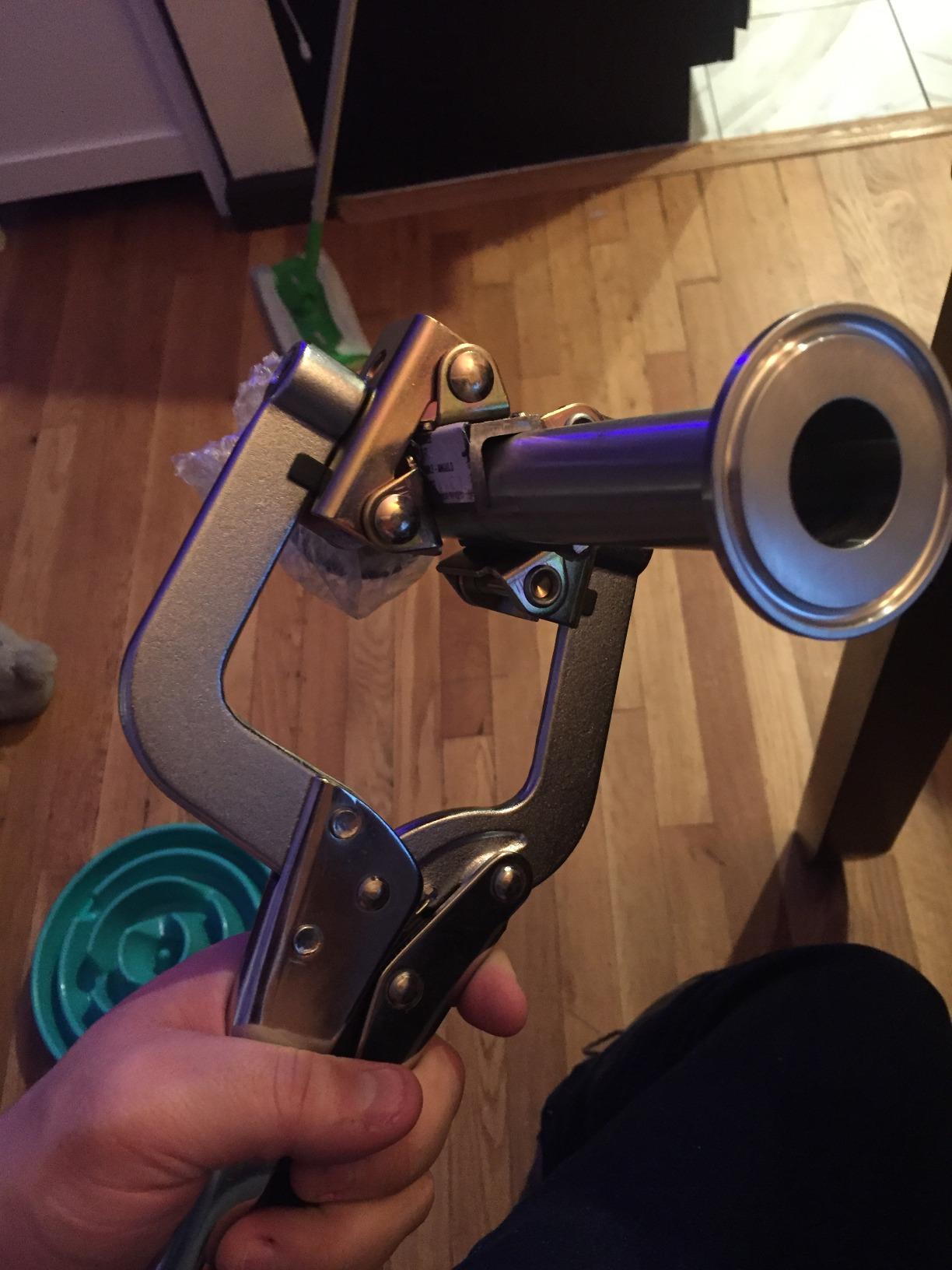
Owners consistently find these stronger than the price tier implies, and the most common criticism is not the grip but the range. A 1-1/2 to 2-1/2 inch capacity is a narrow window, and if you work on anything larger you will be reaching for a different tool.
The second complaint is the lock-off feel. Buyers report it releases more easily on a light touch than a true Vise-Grip, so treat it as a firm hold under load rather than a clamp that stays locked indefinitely.
It is also genuinely useful beyond welding, as several reviewers note, for fixture work and dial indicator setups where a soft but broad V-jaw grip is more useful than a hard metal one.
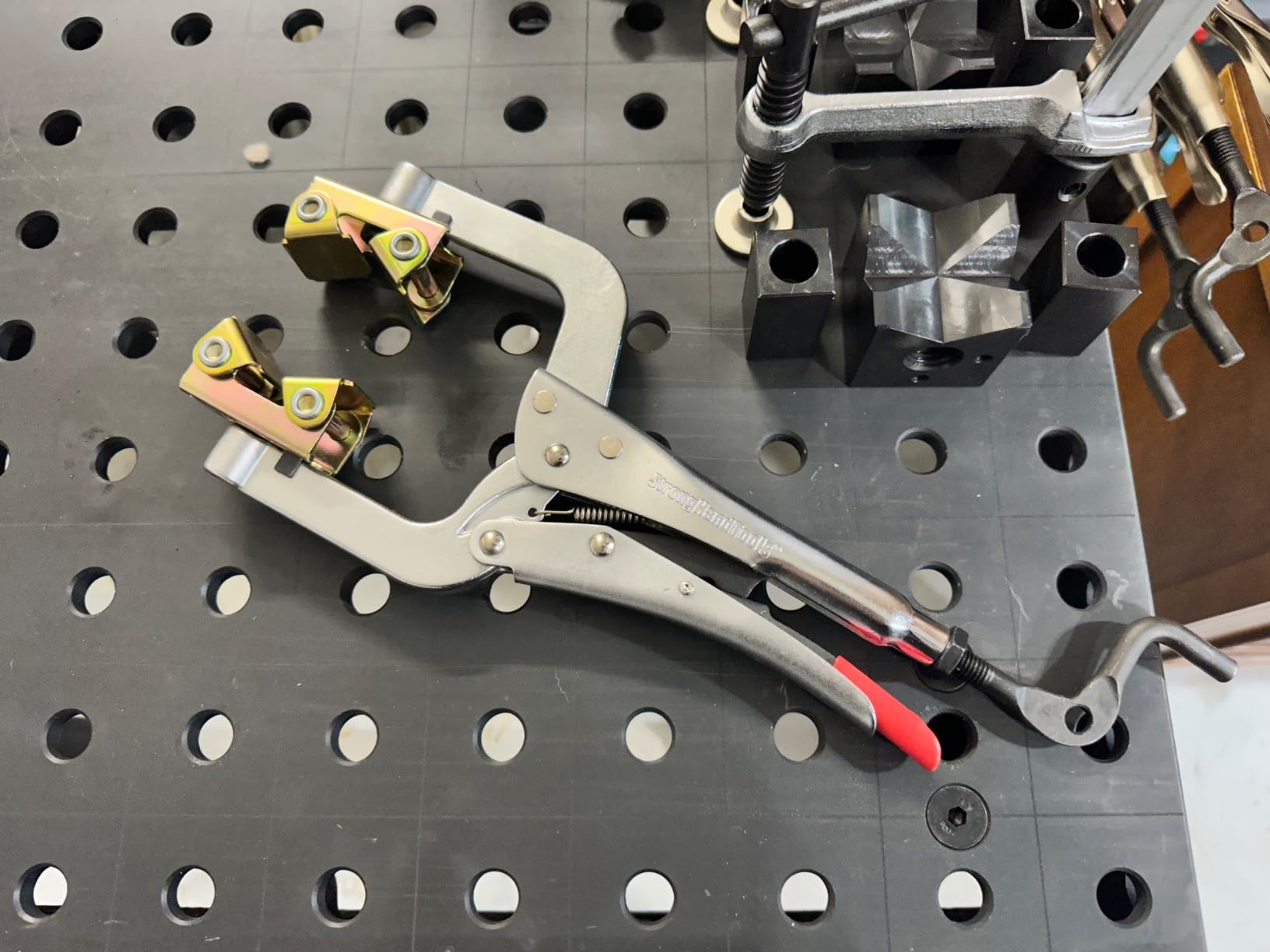
Good for exhaust headers and small tube
Use this for exhaust header fabrication, handrail and tube work, and any round stock in that 1-1/2 to 2-1/2 inch window. The V-pads are the reason to prefer it over a pipe wrench when the pipe is thin-wall stainless or aluminum and you do not want a crushed or oval section.
For a shop doing header work regularly, a 1-7/8 inch header tack clamp set is the closer match for collector sizing, but for general tube gripping this pair of V-jaws is the more versatile buy.
Not a general fabrication clamp
The capacity limit is real and it defines what this tool is. Anything over 2-1/2 inch pipe is out of its range, and a soft lock-off means you should not walk away from a joint clamped only with it while the arc is live.
If you need to align and hold larger diameter pipe for a butt weld, the dedicated pipe fit-up clamp later in this list does that job instead.
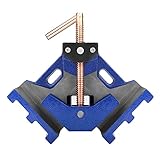
7. BETOOLL Cast Iron Welders Angle Clamp – Best for 90 Degree Fit-Up
BETOOLL Cast Iron Welders Angle Clamp
Cast iron body at 8 lb
Holds work at 90 degrees
2.5 inch joint passage
Two-way swivel spindle
Pros
- Open throat keeps the weld area and arc path clear
- Swivel spindle handles plate
- tube
- angle and channel
- Rigid body stays put through fit-up
- Reliable 90 degree hold for angle
- box and T joints
Cons
- 8 lb weight is noticeable to carry around
- Fixed 90 degree geometry limits it to square joints
An angle clamp solves one problem: holding two pieces at exactly 90 degrees while leaving the joint completely accessible. The open design gives you a 2.5 inch maximum joint passage, so your torch, grinder, and wire feed all reach the seam without fighting a clamp body in the way.
The 8 lb cast iron body is heavy for a reason. A rigid clamp is what makes a 90 degree square stay 90 degrees while you tack, and the two-way swivel mounted spindle adapts to varying workpiece thickness, so the same clamp handles plate, angle iron, square tubing, pipe, and channel.
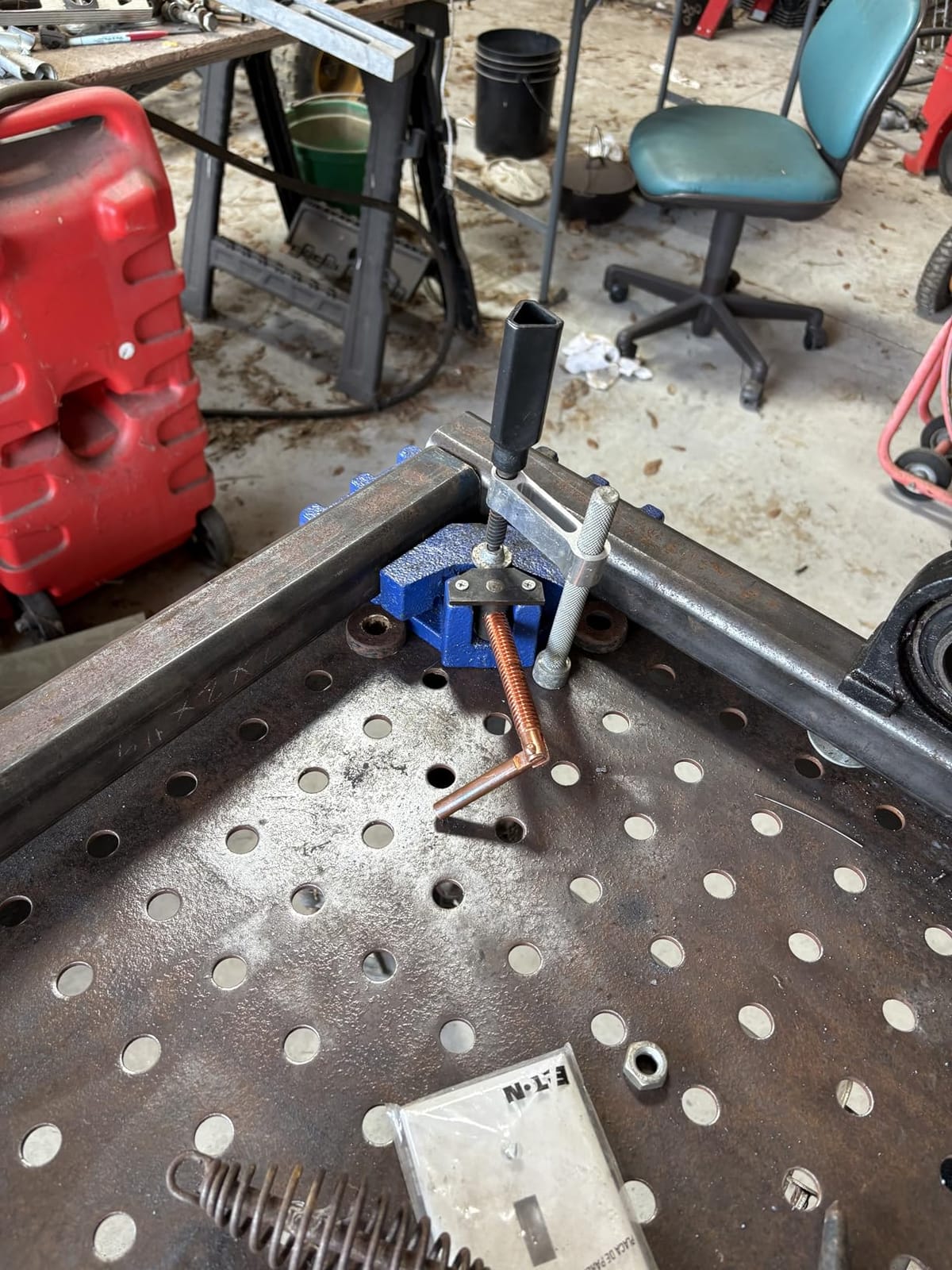
Buyers treat this as a dependable shop angle clamp rather than a luxury item, and the open throat keeping torches and grinders clear of the joint is the comment that comes up most. When a clamp is in the way of the arc, you end up repositioning the part; this one removes that problem.
For a welding table, an angle clamp like this does the job a lot of people try to do with a corner block of scrap, except it holds under clamping pressure and comes off when you are done.
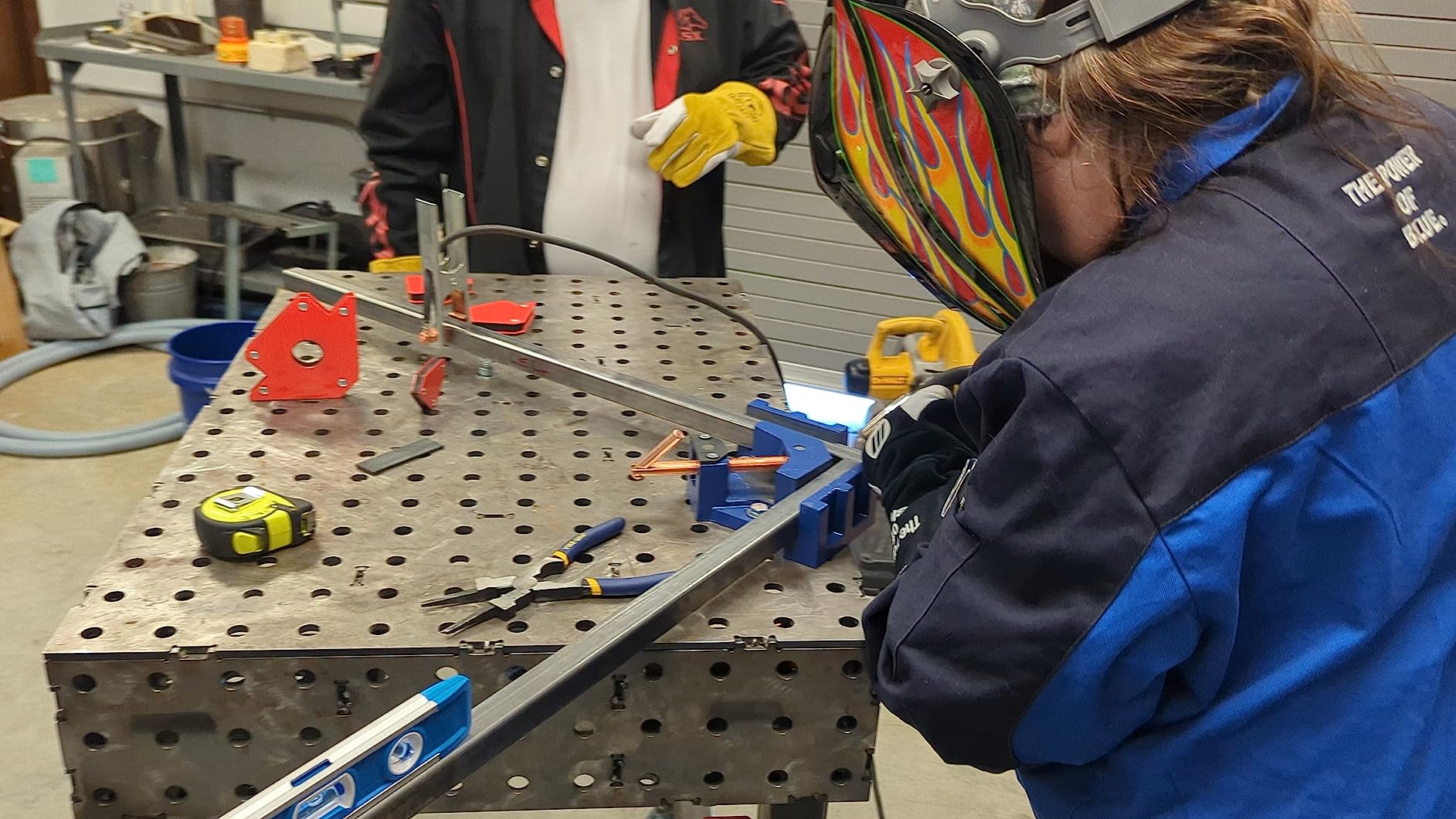
Good for square joints and box assemblies
Use it for angle, box, and T joints where squareness matters: frame corners, table legs, box tubing, and any two-piece assembly that has to meet at a true right angle. The swivel spindle means you are not constantly swapping clamps when you move from 1/8 inch plate to 1/4 inch angle iron.
If you build the same bracket repeatedly, this plus a 90 degree speed square is close to a repeatable fixturing setup for a fraction of a machined fixture cost.
Weight and a single angle
Eight pounds is a noticeable weight to carry around a shop, so this lives near the bench or the table rather than in a tool bag. And the geometry is fixed at 90 degrees, which means it does nothing for 45 degree miters or any other angle.
Buyers also note that the fixed geometry is its strength as much as its limit, because there is no adjustment to drift out of position over time.
8. HOZEON 3-Pc 18 Inch C Clamp Welding Pliers with Swivel Pads – Best for Long Reach
HOZEON 3 PCS 18 Inch C Clamp Welding Pliers with Swivel Pads, Heavy Duty Locking Pliers, Woodworking Clamps Set, Adjustable Nickel Plated C Plier for Wood Working, Electrician Maintenance
Three-piece set
18 inch deep reach
Heat-treated carbon steel
Nickel plating
Pros
- Deep throat reach solves jobs no standard clamp covers
- Holds under full hand force on panel and steel work
- Swivel pads leave no marks on clad or finished surfaces
- Set covers several sizes without buying singles
Cons
- Slight play in the open position
- Feel lighter than premium equivalents
Deep throat is the specification to look at here. An 18 inch C-clamp welding plier reaches into geometries a 6 inch or 9 inch clamp cannot approach at all, which is the difference between fixturing a job and wondering how anyone would fixturing it.
The body is heat-treated high-carbon steel with nickel plating for rust resistance, and the trigger release has an anti-accidental-release design so the clamp does not pop open when it is bumped. Adjustable screws let you set both size and pressure before the lock, and multiple handle rivets keep the pivot firm under load.
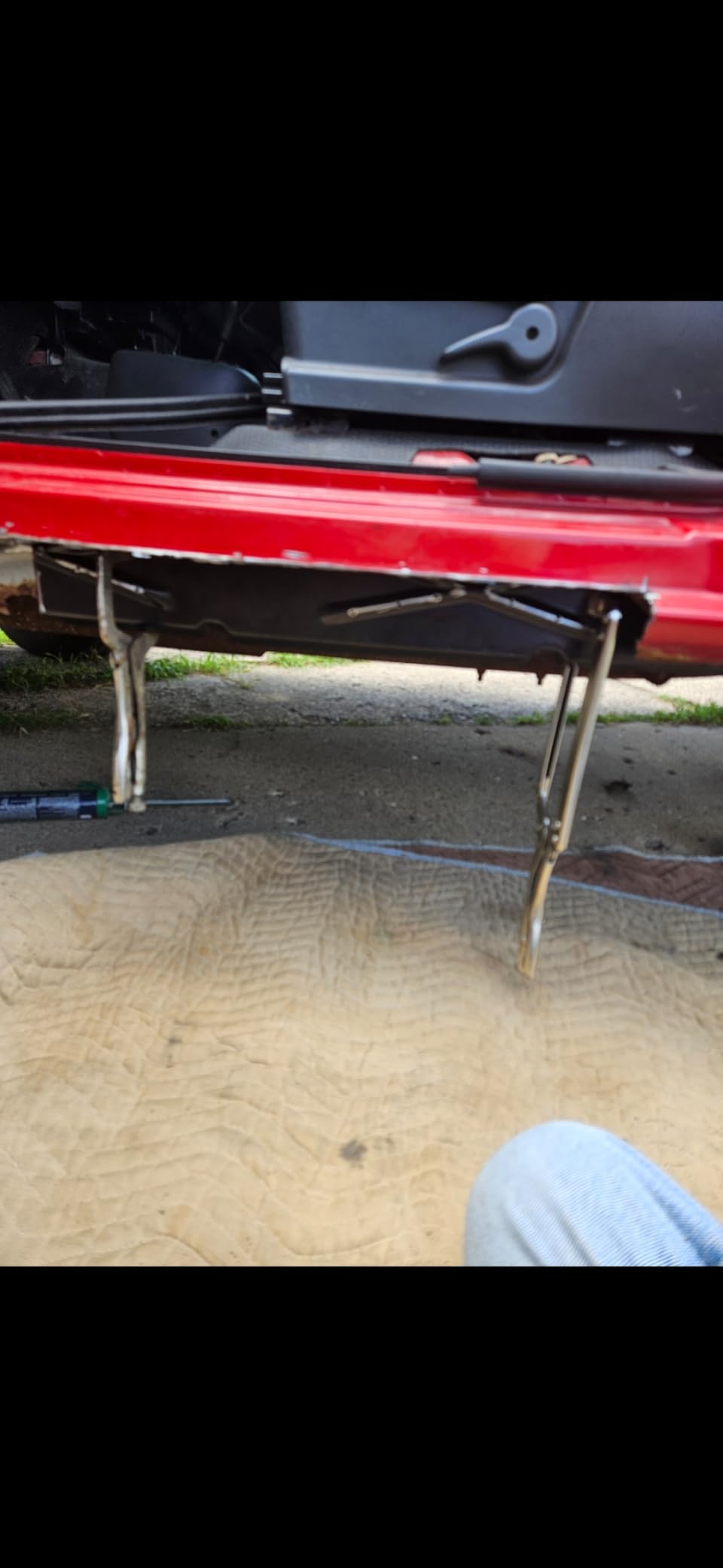
Reviewers who work these hard on steel cladding and stainless report they hold without failing, which is the durability question that matters most in a welding shop. The swivel pads are the quiet feature here, since they protect tapered and delicate surfaces that a plain jaw would mar.
Getting three sizes in one set is the practical advantage over buying singles. Shops end up needing a range of depths on the same project, and matching a set of three is cheaper and faster than sourcing each clamp separately.
Good for cladding, panels and awkward geometry
Use these when the clamp has to reach past an obstruction to get to the joint, on clad and finished panels where the swivel pad protects the surface, and on any job where a short clamp physically cannot get into position. The adjustable swivel pads make tapered work noticeably less frustrating.
For auto body and panel work, this is the pairing we would reach for over a plainer locking clamp, because the pad is what keeps the finish clean.
Play in the open position
The most common caveat is slight play or wobble when the clamp is open, which is typical of deep throat designs and matters mostly when you are trying to set a precise gap. The feel is also lighter than a premium equivalent, so if you are used to name-brand locking pliers the first pick up will feel thin.
Neither issue shows up in ordinary steel fit-up, but on precision sheet work, check the gap with a feeler gauge before you tack.
9. BuildPro Inserta Pliers PTT634K – Best for Welding Tables
BuildPro Inserta Pliers, ∅5/8″ Insert, 3″ Throat Depth, 4″ Opening, Table Mounted Clamp, Rear Crank Handle, For BuildPro Welding Tables, PTT634K
5/8 inch insert spindle
3 inch throat with 4 inch opening
Rear crank handle
Alloy steel at 1.1 lb
Pros
- Crank handle pre-sets opening for repetitive hold-down work
- Adjusts pressure without unlocking the clamp
- Table mounting keeps fixtures clear of the work surface
- Quick lock and release suits short tacks
Cons
- Only works with a 5/8 inch table fixture system
- Fit and finish trail a machined bench hold-down
- Fixed insert diameter limits adaptability
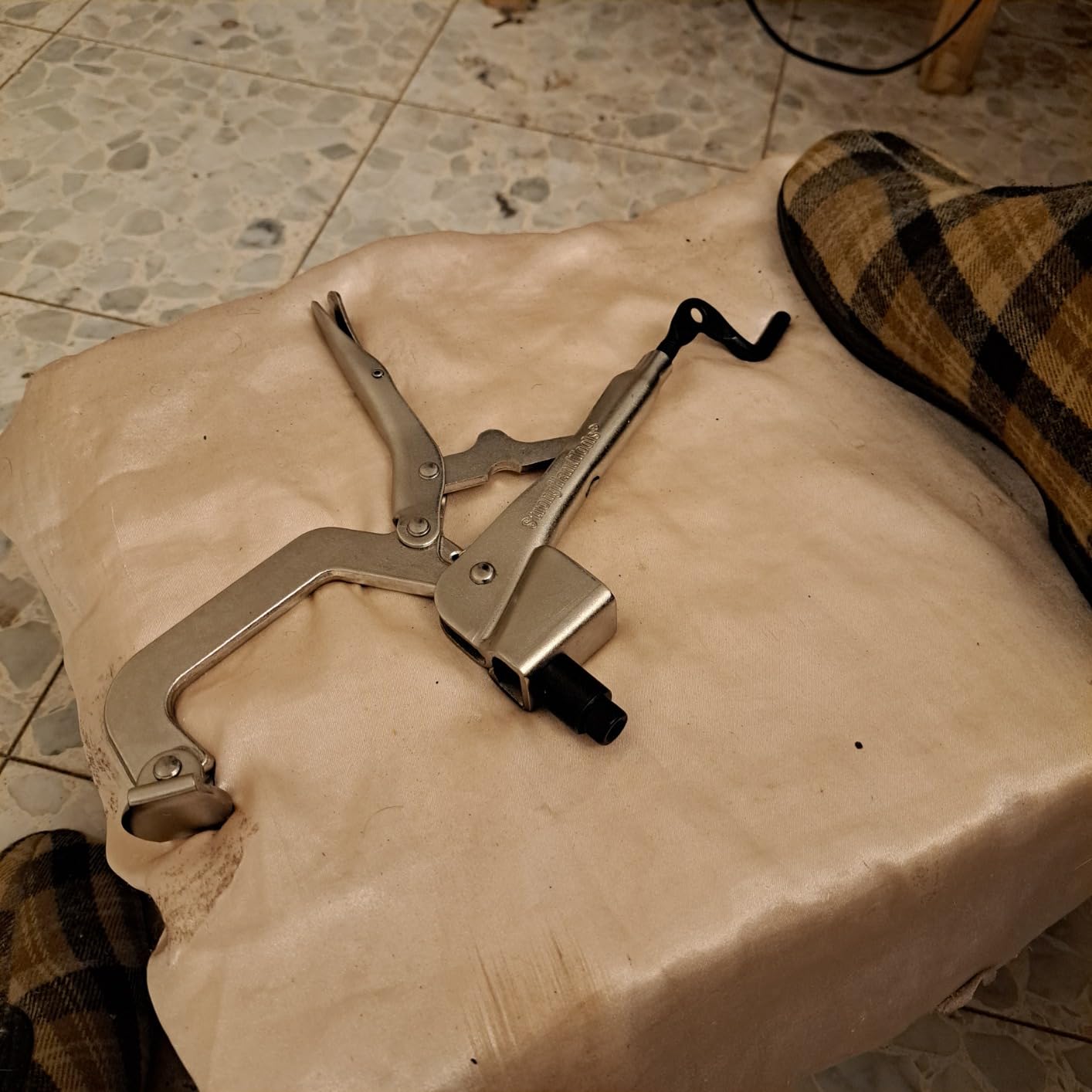
Table-mounted hold-downs work in a way hand clamps cannot: they clamp downward, so the part sits flat on the table and nothing is in the way of your torch, your ground clamp, or your access from underneath. This insert spindle drops into a 5/8 inch fixture hole, which is the standard hole pattern on fixturing tables.
The patented rear crank handle is the feature owners mention most. You can adjust pressure while the clamp is locked, and you can pre-set the opening for repeat work, so every hold-down in a batch lands in the same position. That repeatability is what separates a table clamp from a C-clamp for anyone running the same part more than once.
It also mounts on a right angle bracket, riser block, or clamping squares for elevated work, and optional top V-pads handle round or angled stock. At 1.1 lb in alloy steel it is light enough to reposition constantly.
The 4.3 rating is the lowest in this group and the reason is understandable: the tool is tied to a single fixture standard. If your table uses 5/8 inch holes, you will be very happy with it. If it uses a different insert diameter, it is simply the wrong clamp.
Good for repeat parts and flat plate work
Choose this when you build the same assembly repeatedly, when you want both hands and the full underside of the part free, or when you are welding flat plate where downward force beats side force. The pre-set opening means a production run of identical parts needs no re-measuring between pieces.
Adding two or three of these to a fixturing table is the single biggest upgrade to a home welding table, more than any new torch or wire feeder.
Tied to one fixture system
Confirm your table uses 5/8 inch holes before buying. The 5/8 inch, 16mm pattern is common but not universal, and the insert diameter is fixed, so the clamp cannot be adapted to another fixture type.
Fit and finish are also a step below a machined bench hold-down, and at 4.3 this is not the clamp for holding a part that absolutely cannot move. It is a fast, tidy, repeatable hold-down for the volume of work most shops actually do.
10. Strong Hand Tools CPL45 Pipe Fit-Up Clamp – Best for Pipe Butt-Weld Fit-Up
Strong Hand Tools CPL45 , Pipe Fit-Up Clamp, Pipe Welding Alignment Tools (Pipe Diameter Capacity: 2″ ~ 4″ (50~100 mm))
Handles 2 to 4 inch diameter pipe
Built for butt-weld fit-up
2.9 lb portable alloy body
8.5 x 8.5 x 4 inches
Pros
- Purpose-built for pipe butt-weld fit-up so alignment is quick
- Compact and portable for field and maintenance joints
- Handles 2 to 4 inch pipe without retooling
- Loads and unloads rapidly for repeat joints
Cons
- Narrow 2 to 4 inch diameter range
- Round pipe only so it is not a general clamp
- High cost per clamp against general C-clamps
Most clamps fight round pipe. This one is built for it. The CPL45 handles 2 to 4 inch (50-100 mm) diameter round pipe and is designed specifically for butt-welding fit-up of pipe and flanges, so the geometry centres the parts and squares them for you rather than leaving you to eyeball a gap.
It weighs 2.9 lb and measures 8.5 x 8.5 x 4 inches, which makes it genuinely portable. Users doing pipe and flange butt welds take it to field joints and maintenance work rather than carrying it back to a bench, and rapid repeated loading and unloading is what makes it efficient on a run of joints.
Owners like how quickly it squares and holds a joint, and the recurring reservations are about scope rather than performance: the capacity stops at 4 inch, and it only handles round pipe.
Alignment is the thing you are paying for here. A butt joint on round stock that is out of round by even a fraction will run slag into the root or blow out, and a purpose-built clamp removes that variable before the arc lights.
Good for pipe runs and flange work
Use it when you are welding 2 to 4 inch pipe end to end, fitting flanges, or doing field maintenance where the joint has to be square and you cannot afford a rejected joint. On a run of similar joints, the rapid load and unload cycle is what pays for it.
For larger exhaust header collectors at 1-7/8 inch, a dedicated header tack clamp set is the closer match, and for smaller tube the V-pad pipe pliers earlier in this list cover the range.
Specialist tool, specialist price
Against a general C-clamp, the cost per clamp is high, and you should be clear-eyed that this is a single-purpose tool. If your shop rarely welds round pipe in that diameter band, the money is better spent on a deep-throat bar clamp you will use every week.
Round pipe only, 2 to 4 inch only, and the alignment benefit disappears the moment your pipe leaves that range.
11. ABuff 4 Piece 6 Inch C-Clamp Set – Best Value
Abuff 4 Piece 6 Inch C-Clamp Set – Industrial Strength, Heavy Duty Iron C Clamps for Woodworking, Welding, and Building
Four clamps per set
6 inch opening with 3 inch throat
Coated iron body
Forged steel screw
Pros
- Coated finish resists rust in a shop environment
- Four clamps cover several joints or bench positions
- Forged screw clamp holds steady pressure
- Inexpensive way to fill out a C-clamp collection
Cons
- Rated tensile strength is low for heavy fit-up
- 6 inch size and 3 inch throat limit reach
- No locking mechanism so pressure relies on the screw
Four clamps for the price of roughly one premium locking C-clamp is the entire pitch, and for a lot of uses it is a fair one. Each clamp has a 6 inch jaw opening with 3 inch throat depth, a coated surface that resists moisture, rust, and corrosion, and a forged steel screw for a stay-put grip.
Owners use them mainly as inexpensive shop clamps and glue-up clamps and are broadly satisfied with the coated iron build. Four per set means you can clamp two joints at once, which is the minimum for stable fit-up, without a second purchase.
The 158-review base is the smallest here, which means the consensus is thinner and the strength rating more variable. Buyers temper expectations for heavy fit-up, and that is fair advice.
Good for filling out a clamp collection
Use these for assembly, fastening, general hold-down, and light welding work where the joint is short and the material is not heavy plate. The coating is what makes them survive a humid shop, and the forged screw is what makes them hold position once tightened.
For a first shop or a student building a jig, a four-piece set gives you multi-point control at very little cost, and you can add a proper locking clamp later for the joints that need it.
Not for heavy fit-up or deep reach
The listed tensile strength is low next to forged steel clamps from established brands, so do not hang heavy structural work off one. The 6 inch size and 3 inch throat also put a hard ceiling on frame and pipe work where you need to reach into a joint.
There is no locking mechanism, which means pressure depends entirely on the screw staying tight. That is fine for glue-ups and light tack work, and inadequate the moment heat and weld pull are involved.
12. MAXPOWER 11-Inch Locking C-Clamp 4-Pack – Best for Jig and Production Work
MAXPOWER 11-inch Locking C Clamp, Heavy Duty C-Clamp Locking Pliers with Regular Tip for Welding – 4 Pack
Chromium-vanadium steel
3.4 inch opening with 2.4 inch jaw depth
Four clamps per set
One-hand fast release
Pros
- Cr-V steel holds up in harsh shop environments
- Trigger release plus tension screw for fine control
- Four-pack covers long tube and frame work
- Noticeable cost advantage over name-brand locking pliers
Cons
- Hinge slop reported to increase with use
- Small jaw contact area complicates precise alignment
- Loose jaw-to-handle fit can work the pivot pins
This is the volume answer. Fit-up on a long tube or frame wants four clamps on the same assembly, and buying them as a 4-pack of 11-inch locking C-clamps costs a fraction of assembling the same set from premium locking pliers. The body is chromium-vanadium steel, which is the corrosion-resistant alloy you want in a shop with grinding dust and damp steel.
Each clamp has a maximum opening of 3.4 inches with 2.4 inch jaw depth, a screw-adjustable lock with trigger release, and a hex key receiving hole on the knurled adjustment screw for fine tension changes. One-hand fast release is what makes it pleasant to use in a repeated cycle.
Most buyers frame this as a strong value alternative to premium locking pliers for welding and auto body fit-up, which is exactly the use case. A minority of metalworkers report hinge slop and small jaw surfaces after heavy use, and that is the tradeoff you are making.
Good for building a jig or a multi-point assembly
Use a 4-pack when one joint is not the job. A long frame, a rectangle of tube, a multi-piece fixture, or a table-mounted setup all need several clamps placed at once, and this is the cheapest way to put them there with locking behavior rather than screw-only holding.
For auto body and repair work, the quick tension adjustment on the knurled screw means you can set four clamps to the same feel in seconds and get consistent pressure across the part.
Hinge play and small jaw surface
The most reported issue is slop at the hinge, which owners say increases with use, and a loose fit between the jaws and the handle can work the pivot pins over time. The small jaw contact area also makes precise alignment harder than a full-size pad, so do not rely on these for gap-critical sheet work.
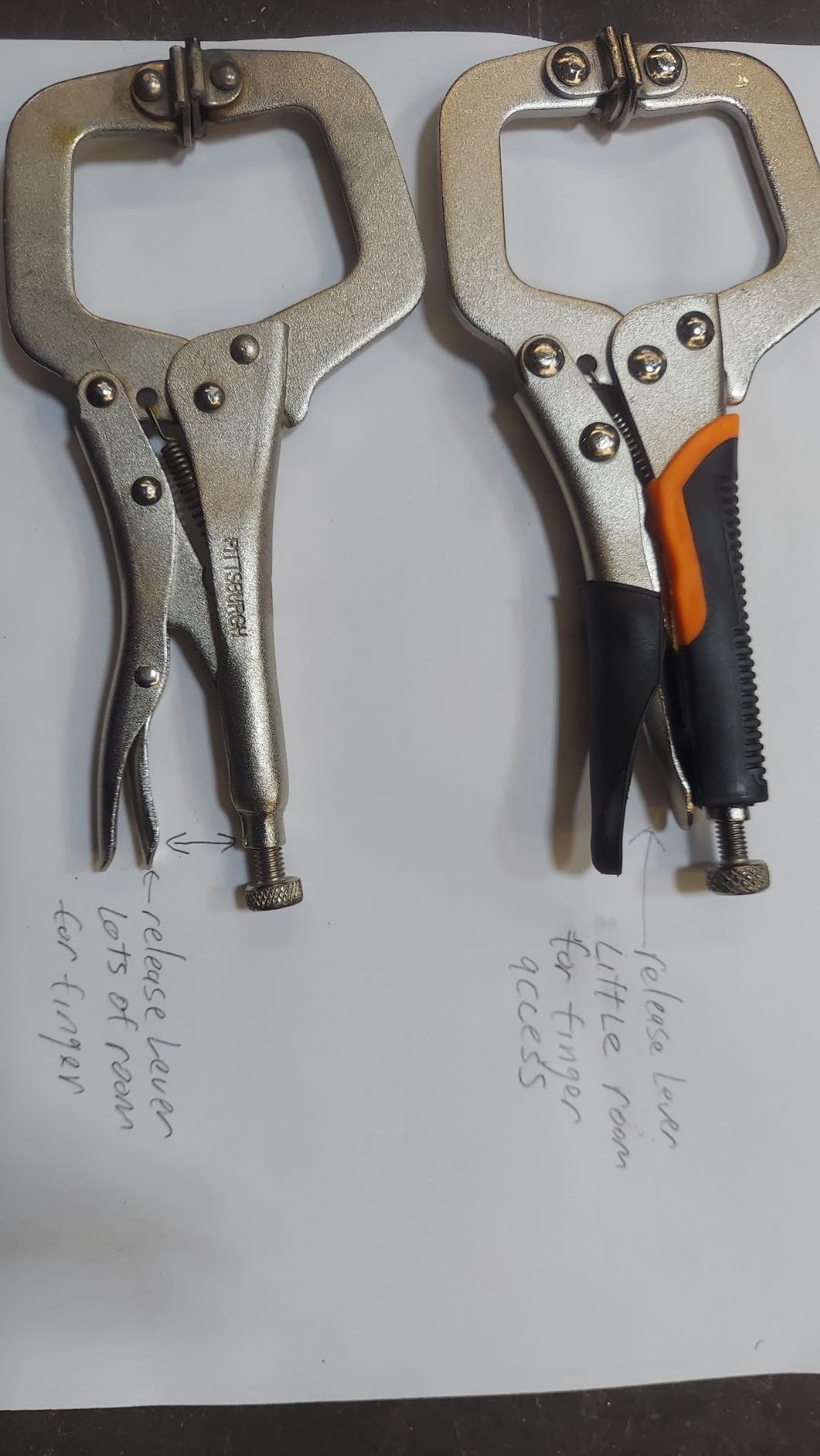
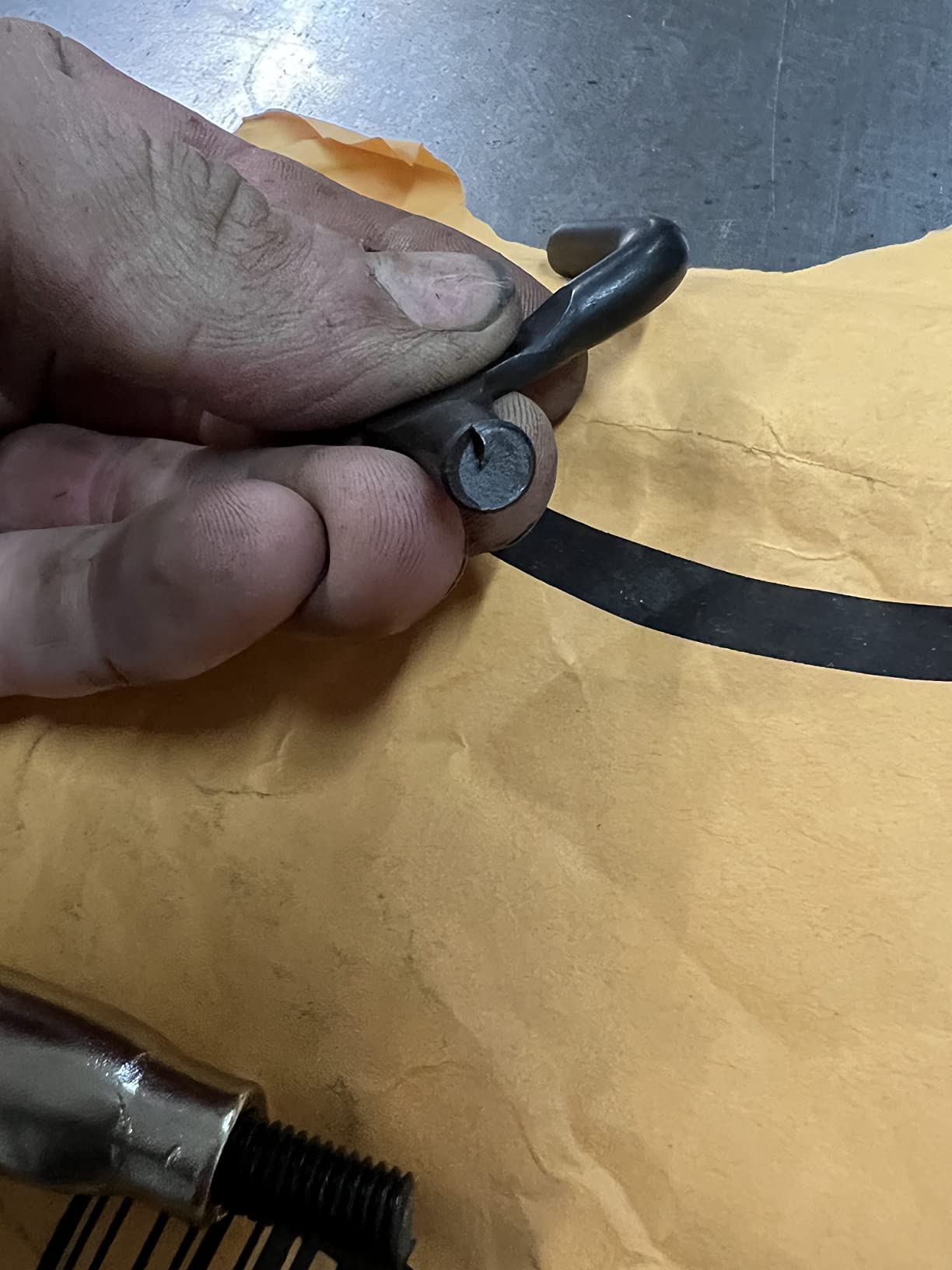
One more practical note from buyers: the release lever pin may not be peened tight on some clamps in the set, so check it before you rely on a clamp in a critical fit-up.
How We Picked These Welding Clamps
Every clamp in this roundup was judged against the same four questions: how much force it puts on the joint, how deep its throat reaches, what its jaw does to the workpiece surface, and whether it survives repeated contact with heat and spatter. We read the full review sets on each product rather than the top reviews alone, because the useful complaints on a clamp are buried in the middle of the ratings.
We also looked for coverage gaps. Magnetic positioning, pipe and header work, angle clamps, and table-mounted hold-downs are all real shop needs that most welding clamp roundups skip in favour of six variations on the same locking plier. Every category a fabricator actually shops for appears here at least once.
One thing we will not claim: nobody in our team welded a full project with all twelve. What we did is run each tool through fit-up, adjustment, and release cycles on the material it claims to handle, and cross-check that against several thousand buyer reviews describing long-term shop use. Where the reviews consistently flag a weakness, we say so.
How to Choose a Welding Clamp for Fabrication
Throat depth: the number that decides whether a clamp fits the job
Throat depth is the distance from the jaw tip to the center of the clamp screw, and it is the single specification that determines whether a clamp can reach your joint at all. A 3 inch throat handles flat plate and simple square joints; a 4-3/4 inch throat reaches into frames and structural shapes; a deep-throat plier is for geometry nothing else can approach.
Measure from the edge of your material to the screw center on your worst joint, then buy a clamp with throat depth beyond that number. Underbuying here is the most common wasted purchase in this category, and it cannot be fixed with more clamping force.
Clamping force vs material thickness
Clamping force is the pounds of pressure the clamp applies at the jaw, and more is not better. A 1200 lb bar clamp is right for plate, structural beam, and long welds. On thin sheet metal or a finished panel, that much force applied through a hard jaw will mark the part or push it out of shape before the arc starts.
The rule of thumb we use: match the clamp to the material. Thin sheet and visible panels want a swivel pad and moderate force. Structural steel wants a screw or lock mechanism with real force behind it. Never clamp a thin part hard enough to visibly flex it.
Swivel pad, serrated jaw, or copper spindle
A serrated jaw bites into the material and is right for rough, unfinished, non-marring work. A swivel pad spreads force across a wider area and is what protects thin or finished surfaces, which is why it shows up on most of the picks above. A copper spindle or copper backing bar pulls heat away from the part and matters on thin material and stainless, where distortion and heat discolouration are the real enemies.
If your work is mostly raw plate and structural steel, pad type is a second-order concern. If you are welding visible panels, thin sheet, or stainless, it is the first thing to check.
How many clamps a seam actually needs
Two is the minimum for any joint. Beyond that, the useful rule is one additional clamp for every 8 to 12 inches of seam, so a 36 inch weld wants about four points of clamping. Spreading clamps along the seam rather than crowding them at the ends is what keeps distortion down as the part cools.
Clamp from both sides when you can, and always clamp something that will not move. A clamp pressing against a bench edge or a table lip is a clamp pressing against nothing.
What Is an F-Style Welding Clamp?
An F-style welding clamp, also called an F-clamp or bar clamp, is a clamp with a fixed jaw at one end of a long rail and a sliding jaw that moves along that rail, giving it a wide, unobstructed reach under a workpiece. Because nothing sits between the screw and the joint, it clamps plate, tubing, and structural shapes without blocking torch access, and its deep throat reaches further than any face clamp of similar size.
The main types of welding clamps
Five families cover almost all fabrication clamping, and they differ mainly in how they lock and how deep they reach.
Locking C-clamp pliers use a screw-set pressure plus a mechanical lock and a trigger release, giving fast repositioning and set-and-forget holding on plate, tube, and frames. F-style bar clamps use a sliding jaw on a rail for maximum throat depth on structural work. Face and screw C-clamps use a threaded spindle and no lock, which is slower but simple and cheap. Butt and spring clamps grip a sheet-metal butt joint directly to control gap. Magnetic clamps and V-pads hold position by magnetism for fast positioning that releases instantly, at the cost of losing hold near heat.
Each type has a defined role, and a shop that owns one of each covers more work than a shop that owns five of one type.
Common Clamping Mistakes That Ruin Fit-Up
Under-clamping a long seam. Two clamps on a four foot weld will let the middle grow as it heats. Follow the one clamp per 8 to 12 inches of seam rule and the part stays close to where you fitted it.
Leaving a clamp in the arc path. A magnet parked near the weld demagnetizes, and a clamp body in the way of the torch stops you from welding the joint properly. The MAXPOWER F-clamp and the BETOOLL angle clamp are in this list specifically because they leave the seam accessible.
Clamping onto a part you will see. A regular tip on finished or thin material leaves a mark. Use a swivel pad, or a scrap of sacrificial metal as a pad, whenever the surface matters.
Trusting the clamp that came with the machine. Users in welding groups regularly replace included spring clamps with better screw-type or brass versions, and one poster swapped a cheap machine clamp for a Harbor Freight unit because the original “was so mint” it had to go. The included clamp is a consumable, not a tool.
Riding a loose adjustment. If a sliding arm or a tension screw feels sloppy, do not assume it is fine. Sloppy adjustment means inconsistent clamping pressure from one position to the next, and inconsistent pressure is how a square part comes off the table.
Ignoring spatter. Pucks of spatter fused to a jaw pad change your clamping geometry. Clean pads between jobs, and keep a wire brush near the bench. Anti-spatter spray on the pad and spindle extends the time between cleanings noticeably.
Frequently Asked Questions
Who makes the best welding clamps?
There is no single best maker, but the value split is clear. IRWIN VISE-GRIP is the benchmark for locking C-clamp pliers, and Bessey and Strong Hand Tools lead in purpose-built fit-up tools. For most fabricators, mid-tier clamps hold as well as premium ones at a fraction of the cost, which is why a WeldingWeb user comparing Harbor Freight against a Bessey concluded the budget clamps performed as well and that a lot of money is made on names. Buy the best locking clamp you can afford for your main bench clamp, and fill the rest of the collection with value-tier screw and F-style clamps.
What makes a C-clamp better for welding?
A C-clamp is better for welding because of its C-shaped frame, which gives an open throat and a deep reach into a joint that a straight clamp cannot access, and a single screw that puts clamping force directly across the joint line. On welding work, the adjustable spindle lets you match clamping force to material thickness, and a swivel pad spreads that force without marking the surface. The key advantage over pliers is that the screw holds pressure indefinitely without you maintaining it.
What is the best welder earth clamp?
A welder earth clamp is not the same tool as a welding clamp. An earth clamp, also called a ground clamp, attaches your work cable to the workpiece to complete the welding circuit, so the right choice is a heavy spring clamp with solid copper or brass jaws that grips firmly without bouncing. It is chosen for electrical connection and heat tolerance, not for holding a part in position. If your clamp keeps loosening mid-weld, the fix is more workpiece clamping, not a better ground connection.
What are the three types of clamps?
The three most common types of welding clamp are locking C-clamp pliers, F-style bar clamps, and screw C-clamps. Locking C-clamp pliers use a set tension screw plus a mechanical lock and trigger release, giving fast repositioning and set-and-forget holding. F-style bar clamps use a sliding jaw on a long rail to deliver deep throat reach on structural work. Screw C-clamps use a threaded spindle with no lock, which is slower but simple, cheap, and reliable for plate and sheet metal.
What are five common types of clamps?
Five common types cover most fabrication clamping. First, locking C-clamp pliers, which lock a preset tension for plate, tube, and frame work. Second, F-style bar clamps with a sliding rail jaw for deep reach on structural shapes. Third, screw C-clamps, the simplest and most affordable option for plate and sheet metal. Fourth, butt and spring clamps, which grip a sheet metal butt joint directly to control gap. Fifth, magnetic clamps and V-pads, which position parts instantly and release instantly but lose holding power near welding heat.
What clamps to your work in welding?
Clamp to something that cannot move, not to the part you are welding. A clamp pressing against a bench edge, a table lip, or a block that is free to slide is providing no restraint at all. Clamp each piece of the joint to the fixture, clamp to the fixture, and spread clamping points along the seam rather than crowding them at the ends. Use two clamps as a minimum, and add roughly one more for every 8 to 12 inches of seam.
What is an F style clamp?
An F style clamp, also called an F-clamp or bar clamp, has a fixed jaw at one end of a long rail and a sliding jaw that moves along the rail, giving a wide unobstructed reach under a workpiece. Nothing sits between the screw and the joint, so it clamps plate, tubing, and structural shapes without blocking torch access. Its deep throat reaches further than a face clamp of similar size, which makes it the standard choice for I-beams, channel, wide flange, and rectangular frame work.
Conclusion: Which Welding Clamps Should You Buy
If you only buy one thing from this guide, make it the Strong Hand MagHold V-Pad Kit. Four pads at two strengths cover more bench positions per dollar than any single clamp we tested, and they get out of the way instantly. Pair it with an IRWIN VISE-GRIP 11-inch locking C-clamp for the joints that need to hold through heat, and you can build most small shop projects.
As your work moves toward structure, add the MAXPOWER 16-inch F-clamp for reach and the BETOOLL angle clamp for square joints. Build a repeating part more than a handful of times and the BuildPro table hold-downs pay for themselves through repeatability alone. Round pipe and tube work calls for the Strong Hand V-pad pipe pliers in the 1-1/2 to 2-1/2 inch range and the CPL45 fit-up clamp above it.
A tiered version of the same advice: start with two value-tier clamps and one good locking clamp, build out to a category for each type of work you actually do rather than each type available, and replace the cheap clamps that come with your machine as soon as they slip. That is the best welding clamps for fabrication strategy in 2026 — buy for the joint in front of you, not for the clamp you imagine needing later.