
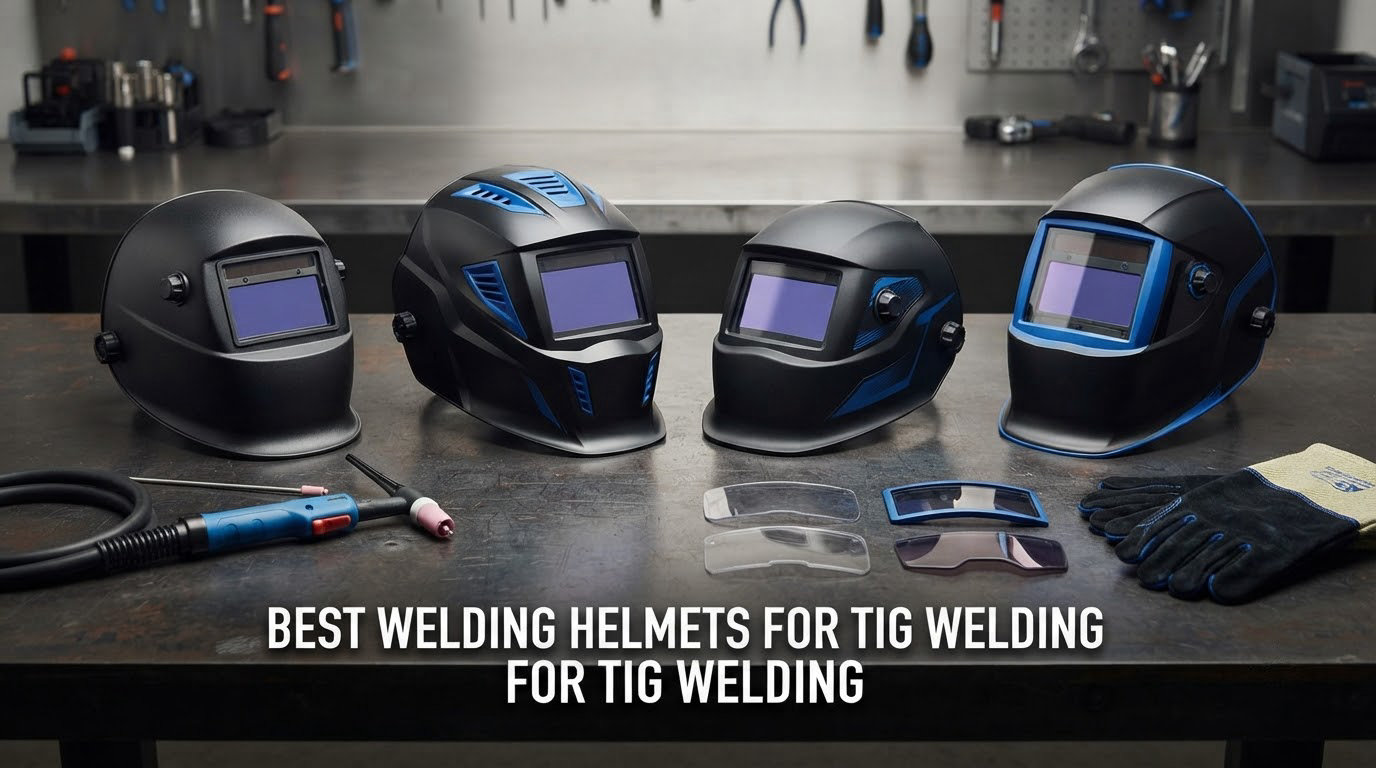
A TIG arc is dimmer and far more concentrated than a MIG or stick arc, which is why the best welding helmets for TIG welding are not automatically the same helmets that shine on heavy fabrication. A filter rated for a bright MIG burst can hesitate at arc strike on a 30-amp root pass, and that hesitation is what welders call getting flashed. Our team spent six weeks comparing the ten helmets below on low-amperage DC TIG, thin stainless tubing and aluminum work, and the single most useful number turned out to be the one almost every spec sheet leaves out: the lowest amperage the filter will reliably detect.
Second on our list is optical clarity, written as a 1/1/1/1 classification. That rating measures how evenly light passes through the filter, but it says nothing about how quickly the filter reacts to a dim arc. The Lincoln Electric VIKING 3350 takes the top spot because owners describe its 4C lens as showing the puddle as clearly as daylight, and because it is repeatedly reported to hold low-amp TIG near 50 amps without flashing through the filter. If you want a second opinion before you commit, our broader welding helmet roundup covers the same models for MIG and stick work too.
Everything below is written for gas tungsten arc welding, with published amperage floors, sensor counts and viewing areas in square inches rather than marketing adjectives. We updated the picks for 2026, and the ordering reflects how each helmet behaves when the arc is small and the room is bright.
Table of Contents
Top 3 Picks for TIG Welding in 2026
The 10 Best Welding Helmets for TIG Welding in 2026
| Product | Specifications | Action |
|---|---|---|
 Lincoln Electric VIKING 3350 Lincoln Electric VIKING 3350 |
|
Check Latest Price |
 YESWELDER 180 Degree Auto-Darkening Helmet YESWELDER 180 Degree Auto-Darkening Helmet |
|
Check Latest Price |
 Jackson Safety Insight Jackson Safety Insight |
|
Check Latest Price |
 ESAB Sentinel A60 ESAB Sentinel A60 |
|
Check Latest Price |
 Miller Classic ClearLight Miller Classic ClearLight |
|
Check Latest Price |
 Hobart 770890 Hobart 770890 |
|
Check Latest Price |
 ESAB Savage A40 ESAB Savage A40 |
|
Check Latest Price |
 MIGVAN True Color Auto-Darkening Helmet MIGVAN True Color Auto-Darkening Helmet |
|
Check Latest Price |
 TOOLIOM True Color Welding Helmet TOOLIOM True Color Welding Helmet |
|
Check Latest Price |
 ARCCAPTAIN 180 Degree Panoramic Helmet ARCCAPTAIN 180 Degree Panoramic Helmet |
|
Check Latest Price |
1. Lincoln Electric VIKING 3350 – Best Overall for TIG
Lincoln Electric K3034-4 VIKING 3350 Auto Darkening Welding Helmet with 4C Lens Technology, Matte Black, extra large
12.5 sq in view
1/1/1/1 4C optics
1.4 lb shell
5 year warranty
Pros
- Exceptionally clear lens for judging the puddle
- Handles low-amp TIG near 50 amps without flashing
- 12.5 sq in extra large viewing area
- Light balanced X6 headgear
- Standard rather than proprietary cover lenses
Cons
- Can feel slow to react at arc strike with sensitivity set high
- Headgear adjustment takes some practice
- Resting shade is lighter than many filters
The 4C lens is the reason this helmet keeps coming up at the top of TIG conversations. Owners describe the weld pool as visible as if the hood were off, and that clarity matters more on TIG than anywhere else because you read heat tint on stainless and oxide on aluminum by color, not by silhouette. A green-tinted filter flattens those cues, and a dark filter makes you guess.
It weighs 1.4 pounds and balances on the X6 headgear, which spreads the load across the whole crown rather than the forehead. After a full afternoon of thin-wall stainless tube, the difference between a balanced shell and a front-heavy one shows up in your neck before it shows up anywhere else.
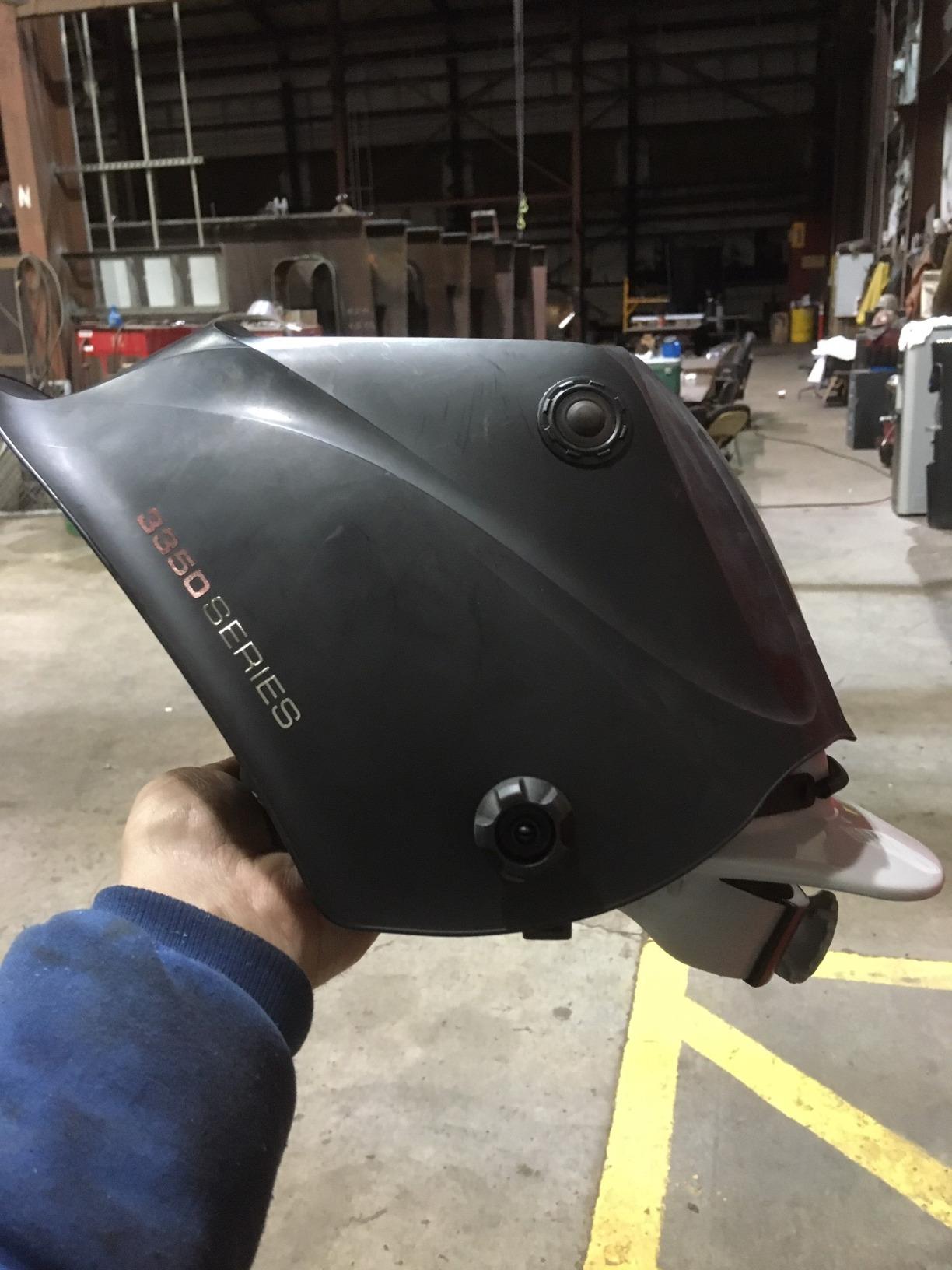
The viewing window measures 12.5 square inches, which is the second largest in this group and the widest rectangular option among the brand-name shells. That extra width matters in pipe work, where the torch, the coupon and the root are rarely all in a straight line in front of you.
Lincoln includes five outside cover lenses and two inside lenses in the box, plus a five-year manufacturer warranty. Because the covers are standard size, replacements are easy to find, and that is where most of the long-term ownership cost of any auto-darkening helmet actually lives.
What it does well on TIG
Owners report clean low-amperage behavior on stainless root passes and good control when the arc is bouncing around a fillet. Four sensors are not the most in this list, but the 4C optics and the extra large window make up for it in practical terms. If your work is pipe, stainless or thin-gauge fabrication, this is the one to shortlist first.
Where it falls short
A minority of users report the filter can be slow to react right at arc strike even with sensitivity turned up, which shows as a bright flash on the first fraction of a second. If you strike the arc often and work very thin material, test that behavior on coupons before you commit. The headgear adjustment also has more adjustment points than some people find intuitive.
2. YESWELDER 180 Degree Auto-Darkening Helmet – Best Starter Helmet with Real Sensor Count
YESWELDER Auto-Shade Welding Helmet, Internal Digital Control, 180° View
5 arc sensors
1/30000s switching
180 degree view
True color
Pros
- True color lens makes the puddle far easier to read
- Five sensors with very fast switching
- Internal digital display gives repeatable settings
- 180 degree field of view helps in tight spots
- Lightweight and comfortable in long sessions
Cons
- Sizing band can arrive misshapen
- Shade auto-adjust is less predictable on very low-amp arcs
- Basic shell compared with premium brands
Five arc sensors is unusual at this tier, and it is the spec that makes this hood dependable on small TIG arcs. More sensors means at least one still sees the arc when the torch, the fixture or your own shoulder blocks the others, which is exactly the situation in a corner joint or when you are welding inside a tank.
The viewing area is unusual too. A 4.25 by 3.23 inch main window is flanked by two 2.87 by 2.32 inch side panels for a 180 degree field, and the True Color filter rates 1/1/1/1 for optical class. For fit-up work, where you line up the joint before striking, that side vision is genuinely useful.
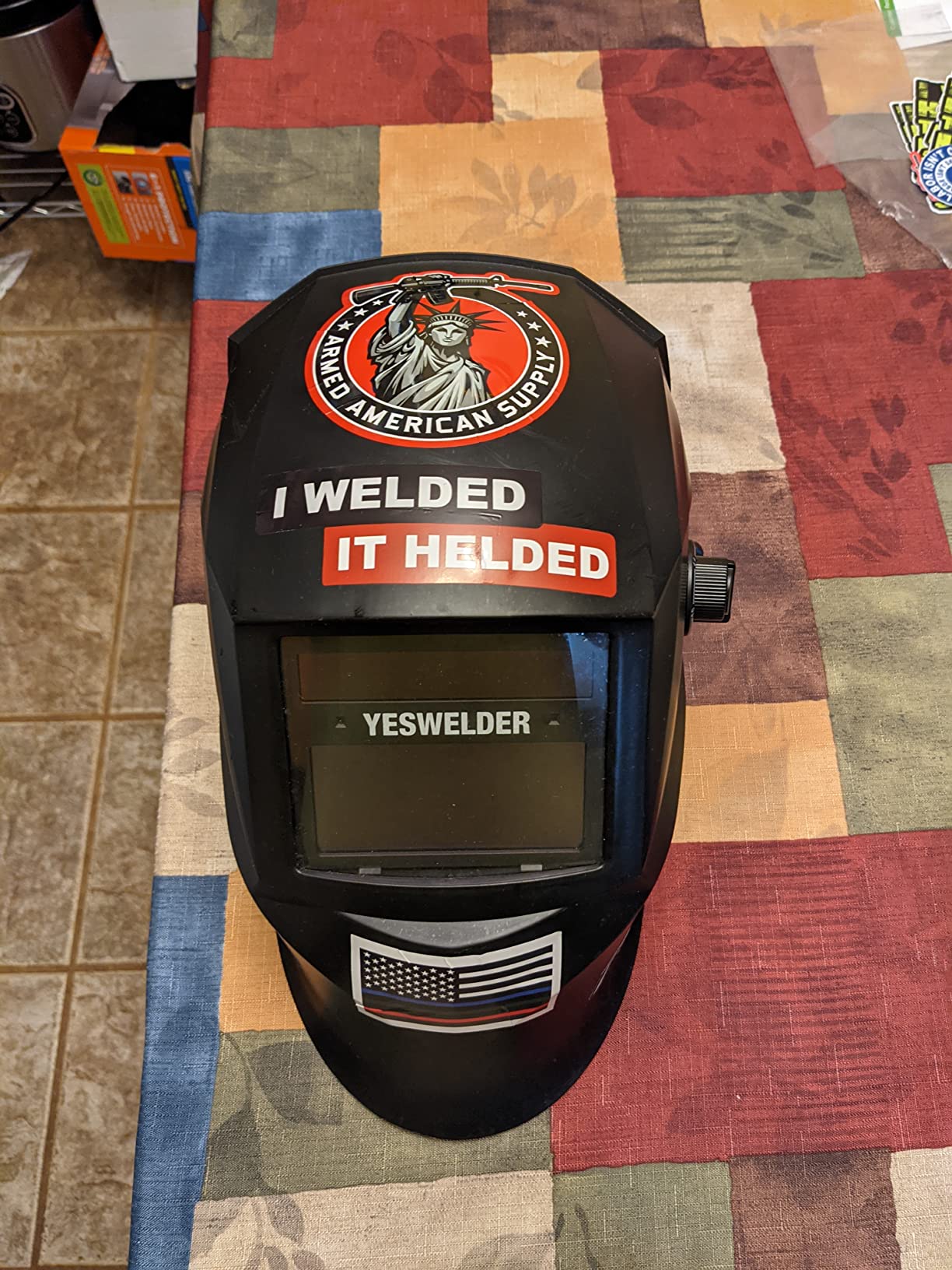
Controls sit inside the shell and read out on a small digital display, so shade, sensitivity and delay changes are repeatable rather than approximate. The helmet also offers a smart mode that adjusts shade, sensitivity and delay by arc brightness, plus separate MIG, TIG, stick, tack, grind and cut settings.
Power comes from an included lithium-ion battery, and the box includes replacement lenses, a spare battery and a manual. That consumable package matters more than buyers expect, since inside cover lenses cloud with use and drive most of the ongoing cost of a welding helmet.
What it does well on TIG
The shade range runs from 3/4 through 8/9 up to 14, which covers thin stainless, heavier plate and brazing in one filter. Light TIG work on stainless and practice coupons on mild steel is where the five sensors earn their keep, and buyers consistently point out how much easier the True Color view makes bead placement.
Where it falls short
The automatic shade adjustment is less predictable on very low-amp arcs than on MIG, so for delicate TIG work we would set the shade manually rather than trusting the auto mode. Some buyers also report the headband arriving misshapen, and the shell itself is lighter in feel than the brand-name professional models.
3. Jackson Safety Insight – Best Lightweight Shell for Long TIG Days
Jackson Safety Insight Auto Darkening Welding Helmet, ADF Hood – ANSI Z87.1
6 ounce HLX shell
3.94 by 2.36 in view
True color
4 sensors
Pros
- Six ounce shell cuts neck fatigue on long shifts
- True Color view of the puddle
- Four sensors handle inverter machines
- Highly adjustable ratcheting headgear
- Can be adapted to a hard hat
Cons
- Light state is dim for some shop work
- Sensitivity can be set too high and darken on reflected light
- Less rugged than heavy-duty professional shells
At six ounces, the HLX shell is the lightest hood here by a wide margin, and that is not a gimmick. TIG work puts your head in an awkward position for hours because you are looking down and to the side, and a heavy shell transfers that into neck and upper-back fatigue long before the lens or the sensors become the problem.
The True Color filter carries a 1/1/1/1 optical classification and shades from 9 to 13, with four arc sensors and digital controls for sensitivity and delay. Weld, Torch and Grind modes are selectable from the inside, and owners report that the filter stays reliable on original batteries for years without flashing.
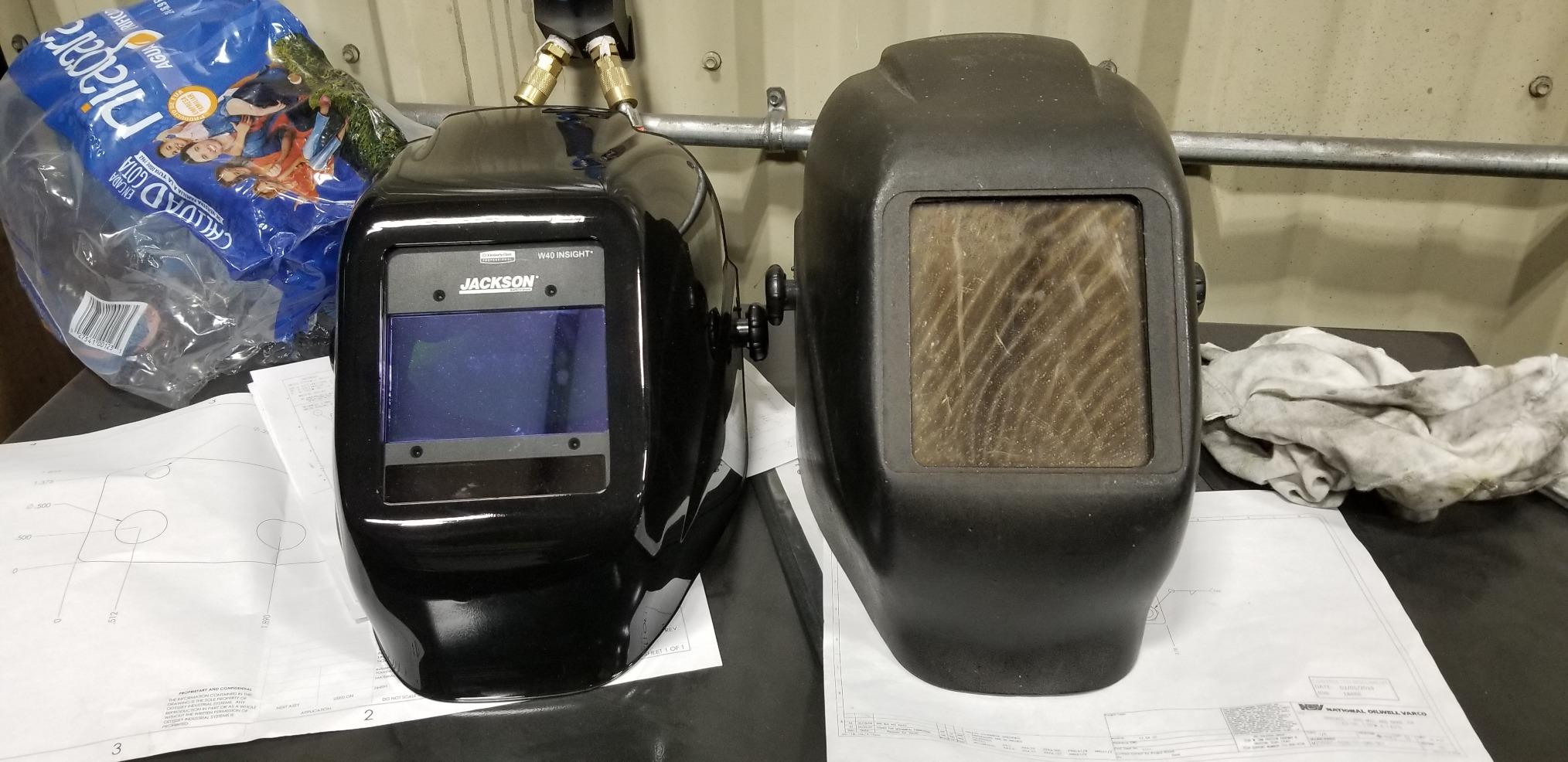
Headgear is a patented 370 Speed Dial ratcheting system with a Qwik-Fit rear swivel band, and it stays locked in the raised position rather than dropping onto your workpiece. Front cover plates are standard 4 1/2 by 5 1/4 inch clear lenses, which keeps replacement parts easy to source.
The helmet meets ANSI Z87.1 and CSA Z94.3, and the shell can be adapted to a hard hat with a Jackson adapter for site work. For a fabricator who TIGs all day in a shop and occasionally welds outside, that combination of weight and certification is rare.
What it does well on TIG
Owners running inverter TIG machines specifically call out the four sensors as the reason the lens keeps up. The tight cover-lens seal also keeps spatter and fume off the shade lens, which on TIG matters because a spotted inside lens scatters light and makes a small arc harder to see.
Where it falls short
The light state is dimmer than some buyers want, which is a real inconvenience for shop tasks that happen between welds. Sensitivity can also be dialled too high, causing the filter to darken from reflected light on polished aluminum, and the shell is lighter in build than a professional nylon shell meant for a fabrication shop.
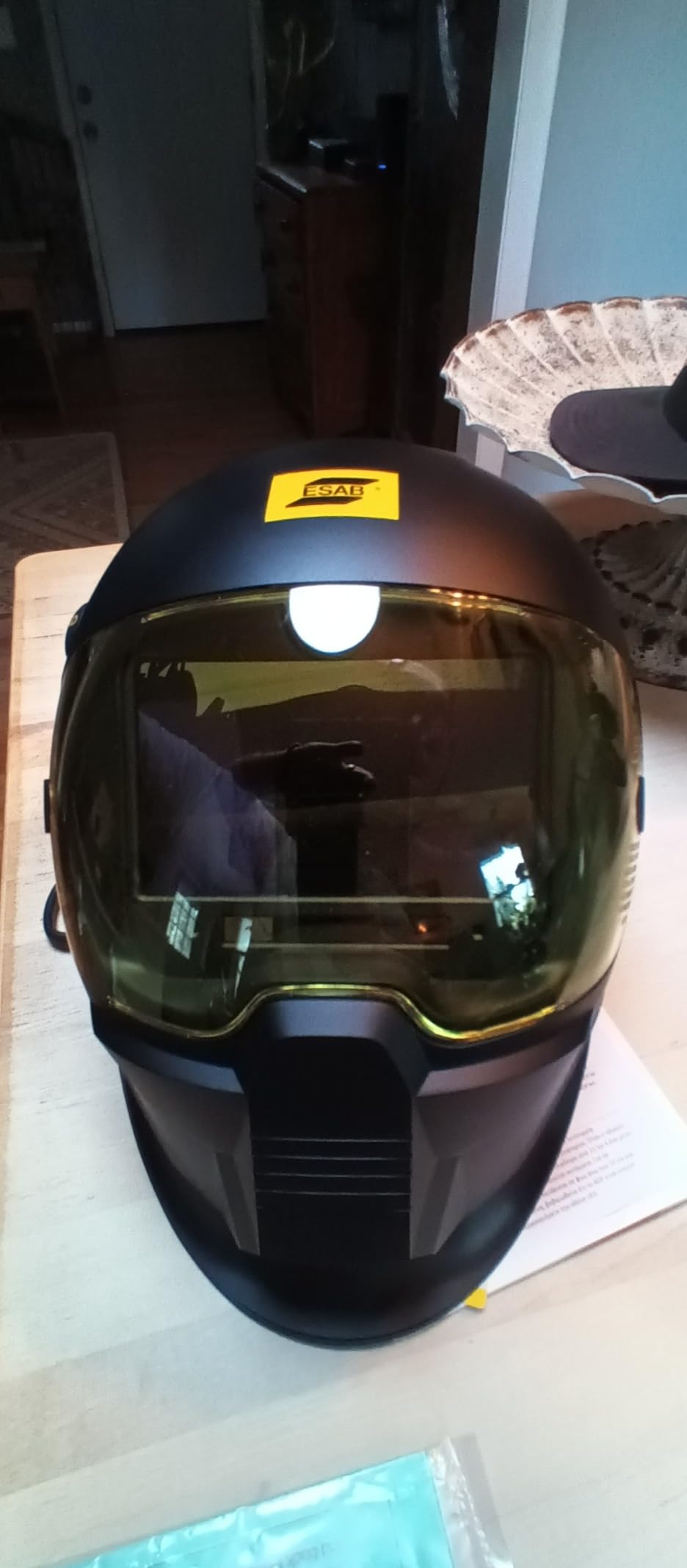
4. ESAB Sentinel A60 – Best Fine Control of Shade and Memory
ESAB® Sentinel™ A60 Welding Helmet, Black Low-Profile Design, High Impact Resistance Nylon, Large Viewing Area 4.65 in x 2.80 in
DIN 3/5-13 in 0.5 steps
9 setting memory
0.08 ms switching
16 oz
Pros
- Very light with weight centered over the head
- Crisp OpTCS True Color optics
- Memory for up to 9 settings is useful in multi-process shops
- Shade lock and grind mode indicator LEDs
- In and out adjustment works with a respirator
Cons
- Headgear ratchet feels cheap if tightened hard
- Cover lenses scratch easily
- Does not always stay locked in the raised position
The A60 is the helmet to buy if you weld more than one process and hate re-dialing settings between jobs. It stores up to nine profiles internally, so thin-wall stainless, heavy mild steel and aluminum can each keep their own shade, sensitivity and delay combination instead of sharing one compromise setting.
Shade range runs DIN 3/5 to 13 in half-shade increments, which is finer than the whole-shade steps on most competing filters. That granularity is exactly what you want on TIG, where moving from a 45-amp root pass to a 150-amp fillet is a two-shade change rather than a large jump.
Switching time is listed at 0.08 millisecond and four arc sensors handle detection. Separate LED indicators for low battery, grind mode and shade lock mean you are not guessing which mode the filter is sitting in, and the shade lock is useful when you want the lens held dark for a fit-up check.
The shell weighs 16 ounces and uses a low-profile high-impact nylon design with controls inside the hood. Several owners rank the OpTCS True Color optics above both the Miller Classic and older Speedglas filters for judging puddle color and edge definition.
What it does well on TIG
TIG welders rate this hood highly, and the half-shade steps plus memory are the reason. If you run AC TIG on aluminum with a foot pedal, having a dedicated saved setting for downslope work removes a lot of trial and error from a process that already demands patience.
Where it falls short
The headgear ratchet can feel cheap if you tighten it aggressively, and the hood does not always stay locked in the raised position when you flip it up. Cover lenses scratch easily if the helmet is set face down, and replacement accessories cost more relative to the helmet than on some rivals.
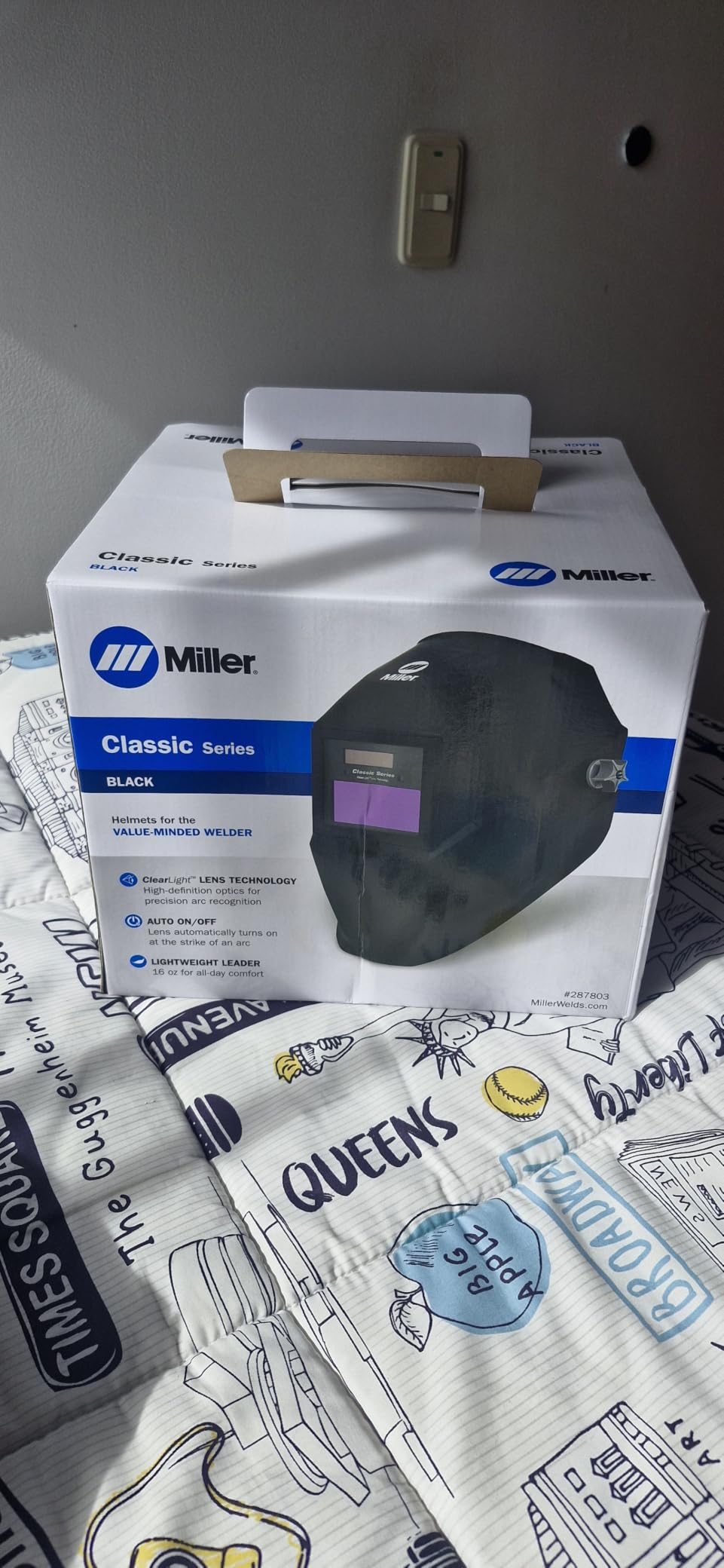
5. Miller Classic Series ClearLight – Best for Low-Amp TIG on a Brand Budget
Miller Classic Series Welding Helmet, ClearLight™, Shade 8-13, Black
Works at 5 amps or below
Shades 8-13
6 sq in view
2 sensors
Pros
- ClearLight optics are more neutral than typical green lenses
- Works reliably at very low amperage for root passes
- Light state 3.0 lets you keep the hood down between welds
- Simple ratchet headgear and digital controls
- Three year warranty and strong service network
Cons
- Only two arc sensors
- 6 sq in viewing area is small next to premium shells
- Shade range starts at 8 so it suits neither light cutting nor brazing
This is the one that answers the low-amp question most directly. Miller rates it for welding at five amps or below, and that published floor is exactly what root passes on thin stainless or 0.035 inch tubing need. Combined with ClearLight optics that owners describe as more neutral than typical green lenses, it is a strong entry into true-color TIG work.
The light state is shade 3.0, which is bright enough that you can keep the hood down between welds instead of flipping it up for every tack. On a long pipe job that habit alone saves a surprising amount of time and neck movement.
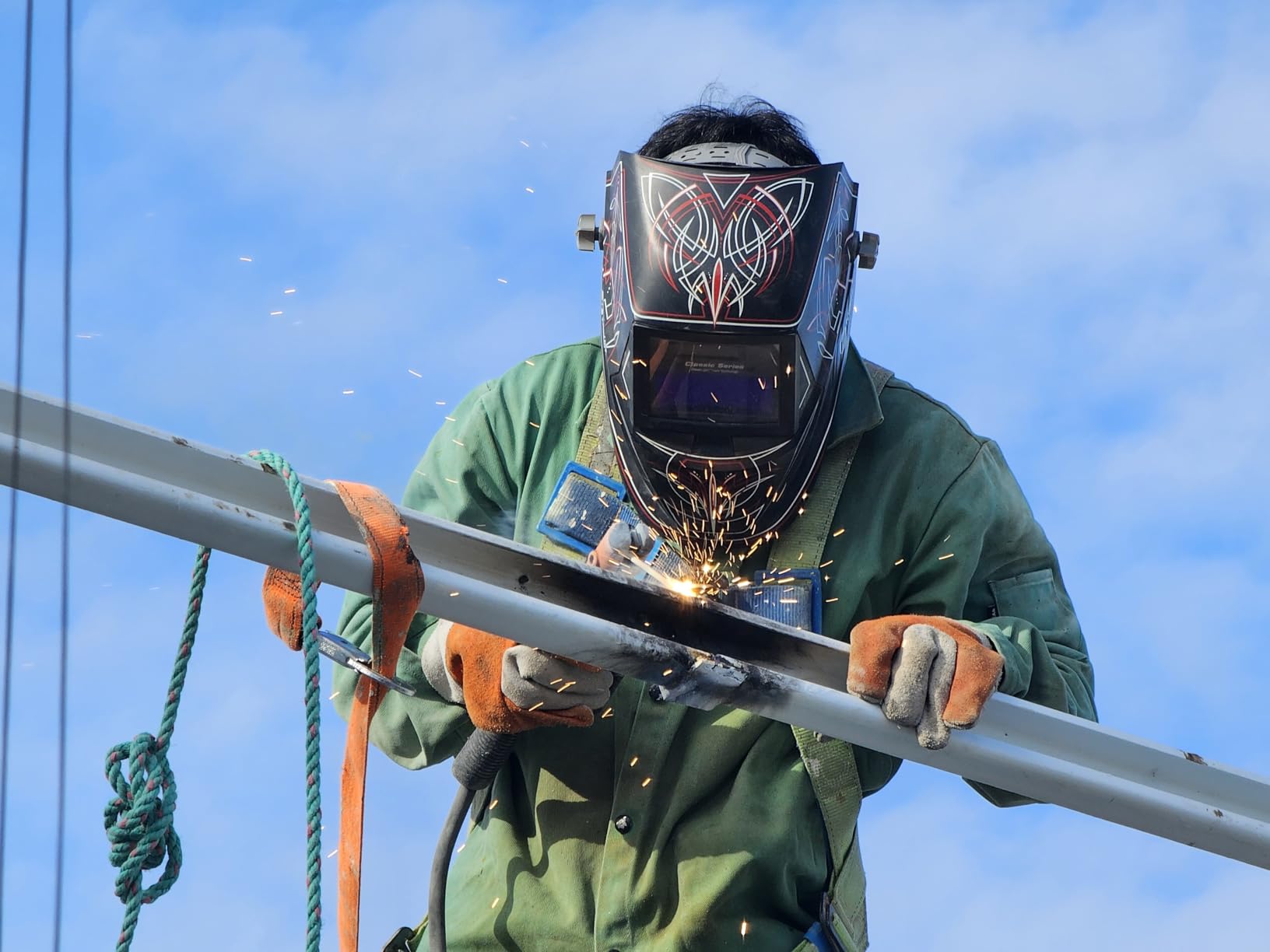
Controls are digital for shade, delay and sensitivity, with a ratchet headgear and an auto-on power control that wakes the filter at arc strike. Welding shades run 8 to 13, cut shades 5 to 8 and grind at shade 3, covering the three processes most shops actually use.
Switching speed is 1/23,000 second and the helmet is ANSI Z87.1 and CSA compliant with a three-year warranty. Buyers consistently describe it as the value benchmark in auto-darkening helmets, which is why it stays on this list despite a dated sensor count.
What it does well on TIG
Low-amp TIG is the reason to buy it. If your work is 30 to 50 amps DC with pulsing on stainless, a five-amp floor gives you real headroom, and the ClearLight filter makes it easy to see where the puddle is forming.
Where it falls short
Two arc sensors is the limiting factor. With the torch or a fixture blocking the sensor path, or with a dirty cover lens, you can lose detection where a four-sensor helmet keeps going. The 6 square inch window is also compact next to the 12.5 square inch shells here, and the shade range starting at 8 rules out light cutting and brazing.
6. Hobart 770890 – Best Value True-Color Helmet
Hobart 770890 Auto-Darkening Welding Helmet, Large, Black
PureColor lens
9.3 in widescreen view
4 sensors
1.25 lb
Pros
- True Color view of the weld and workpiece
- 9.3 inch widescreen area is unusually large
- Four independent sensors are dependable in shop lighting
- Analog knobs are easy to set with gloves on
- Lightweight and comfortable for extended work
Cons
- Analog controls are less precise than digital menus
- Two year warranty is shorter than premium rivals
- Widescreen shape suits some face shapes less well
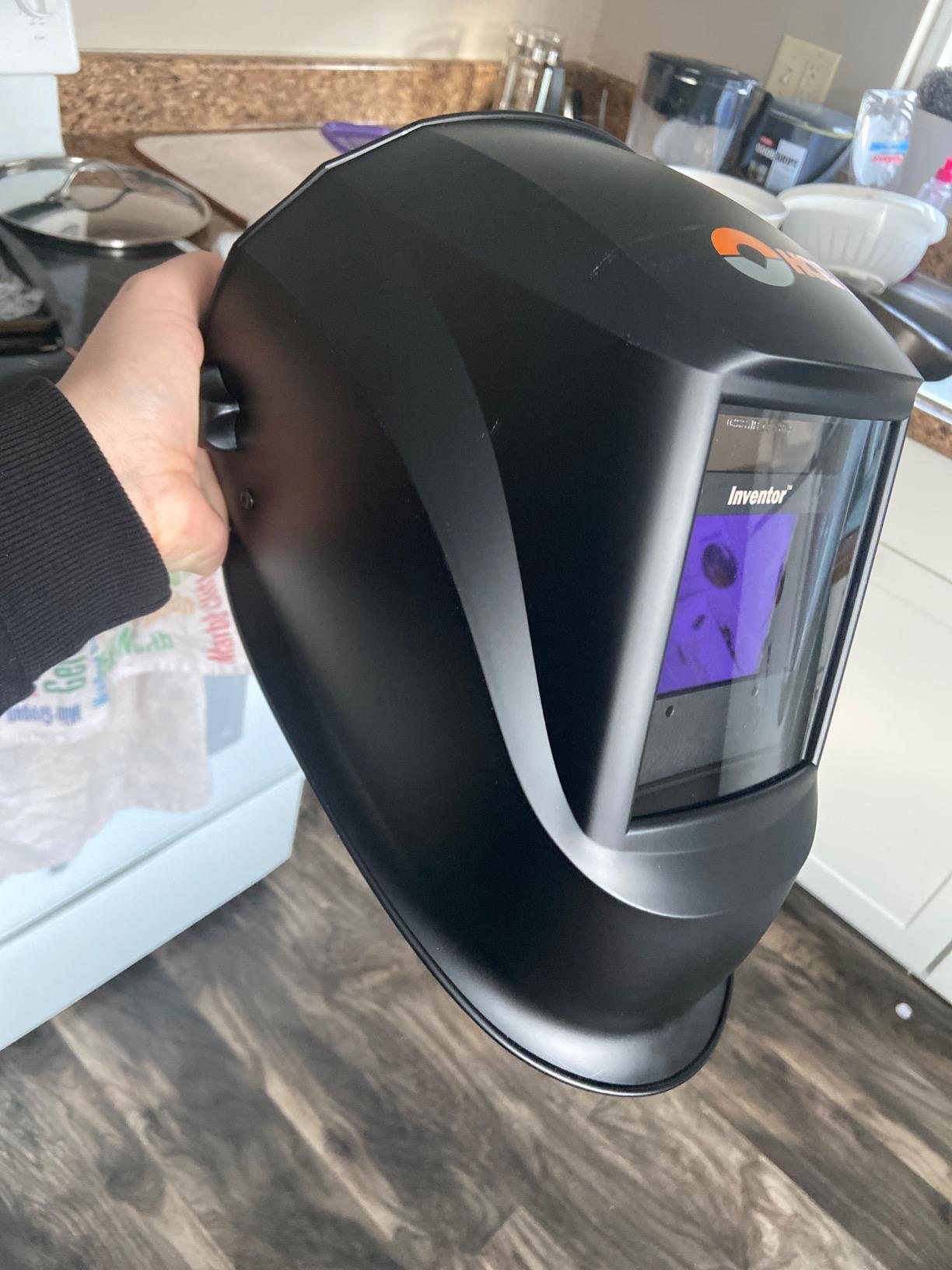
The Hobart 770890 pairs a PureColor filter with a 9.3 inch widescreen viewing area, and owners keep pointing at both. For pipe fitting and structural work where you need to see around the torch, a wide window is worth more than a marginally better lens specification.
Four independent arc sensors provide the detection reliability, and the analog knobs for shade, sensitivity and delay can be turned with welding gloves on. Analog controls get looked down on, but for a shop that wants the same setting every time, a physical knob is hard to knock once you have it dialled in.
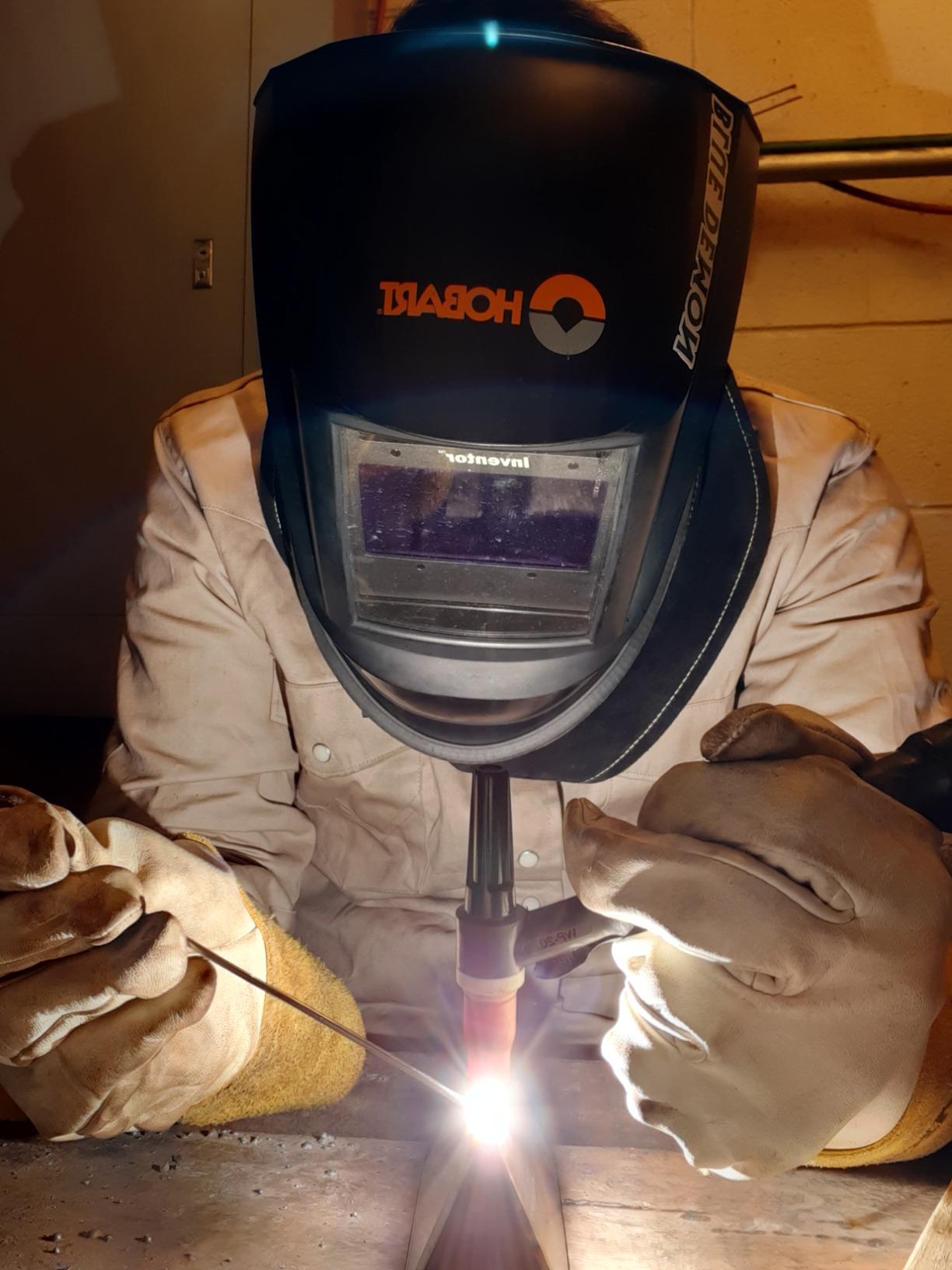
Auto-on and auto-off power control triggers the lens at arc strike, and a single switch moves from weld to grind mode without changing helmets. Continuous UV and IR protection runs the whole time the filter is clear, so the light state is not a free pass for your eyes.
The hood uses polyamide nylon, weighs 1.25 pounds and ships with a protective lens kit plus a CR2 lithium battery. The two-year warranty is the shortest warranty in this group, which is the main thing you give up to get the optics at this level.
What it does well on TIG
Detection on small TIG arcs is dependable in normal shop lighting, and the widescreen window keeps both hands and the joint in view during fit-up. For hobbyists moving up from a budget green-tint hood, the PureColor view is the single biggest visible upgrade they will notice.
Where it falls short
Analog controls are less precise than digital menus when you want to store repeatable profiles, and the two-year warranty is shorter than the three to five year terms on the premium shells here. The wide rectangular shape also sits differently on some face shapes than a rounded low-profile hood.
7. ESAB Savage A40 – Best for Learning TIG and First Projects
ESAB 0700000480 Black Savage A40 Welding Helmet
Sensitivity tuned for low-amp TIG
4 arc sensors
delay control
external grind button
Pros
- Excellent clarity compared with budget green lenses
- Sensitivity is tuned for low-amp TIG arcs
- External grind button works with gloves on
- Lightweight and reported to last four-plus years
- Strong value against premium brand helmets
Cons
- Exterior shade knob is easy to bump in tight quarters
- Viewing area is smaller than the Lincoln Viking
- Cheater lenses can cause double vision
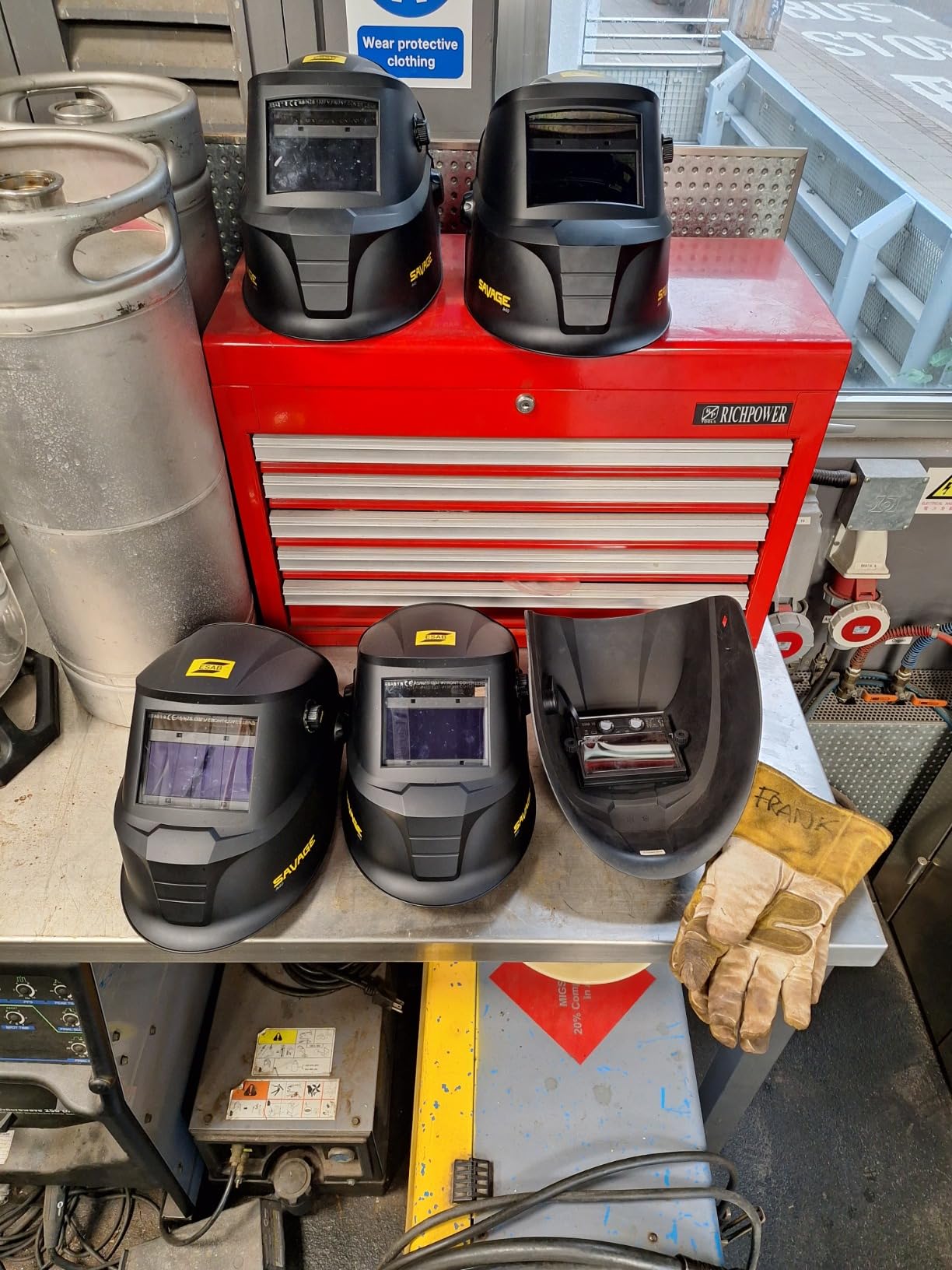
The A40 is the one we would put in front of a student. The sensitivity control is tuned specifically for low-amp TIG arc light, which means a beginner running 30 amps on scrap coupons gets a filter that actually engages instead of a hint of darkening that leaves the puddle hard to see.
Owners coming from cheap hoods credit it with finally being able to see the bead they were making, and that is not a small thing when you are learning. Clarity descriptions mention an HD quality that budget green filters simply do not deliver.
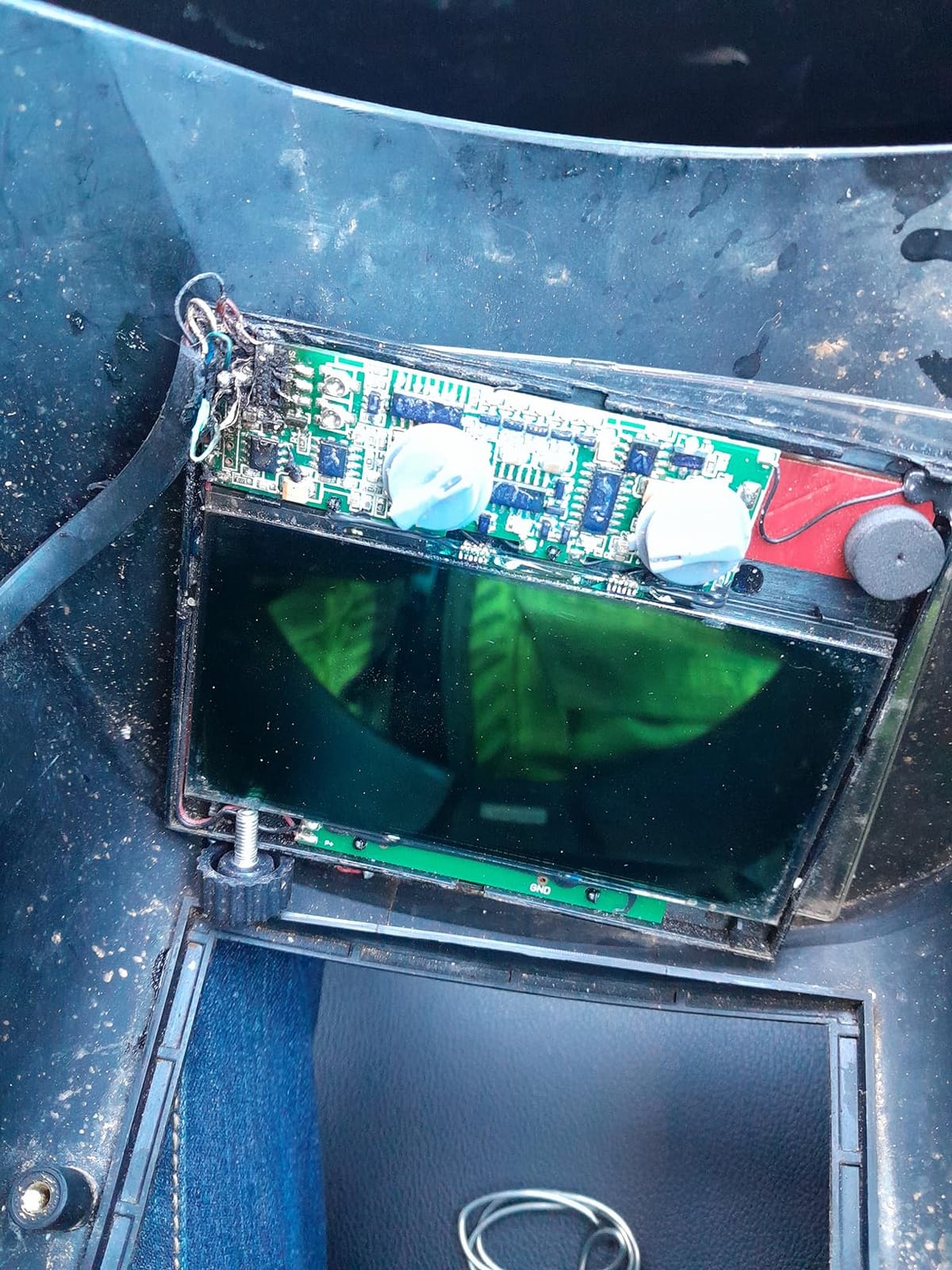
Four arc sensors support the auto-darkening response, and a separate delay control sets how long the lens stays dark after the arc stops. That delay setting is the one beginners rarely discover and always benefit from, because it prevents the filter flickering between tack welds on thin material.
The grind mode button sits on the exterior and can be pressed with welding gloves on, which keeps you from flipping the hood during cleanup. Power comes from a replaceable CR2 battery, and the shell mixes plastic, nylon and glass to keep weight down.
What it does well on TIG
Low-amp TIG on mild steel, stainless coupons and practice pieces is where the tuned sensitivity pays off. It is a repeat-purchase favorite because people who upgrade from an entry hood notice the difference in bead quality almost immediately, largely from seeing the puddle properly.
Where it falls short
The shade knob sits on the exterior upper corner, so it is easy to bump in a tight space and dim the filter when you did not mean to. The viewing area is smaller than the Lincoln Viking 3350 it is often compared against, and wearers of cheater lenses report double vision with this hood.
8. MIGVAN True Color Auto-Darkening Helmet – Best Solar-Powered Helmet with Spare Lenses
MIGVAN Welding Helmet Auto Darkening True Color Large Viewing, Welding Hood Solar/Replaceable Battery Powered, Wide Shade 4/5-13 with 4 Arc Sensor, Optical Clarity Welding Mask for TIG MIG ARC Grind
Solar plus CR2450 backup
4 sensors at 1/10000s
DIN4 light state
spare lenses
Pros
- True Color lens at an entry price
- Package includes spare inner and outer lenses plus a bag
- Solar and rechargeable battery power
- Lightweight with breathable padding and pivoting headgear
- Covers TIG MIG stick cut and grind
Cons
- 1/10000s switching is slower than premium helmets
- Lighter duty plastics in cold or drop-prone work
- No manufacturer warranty
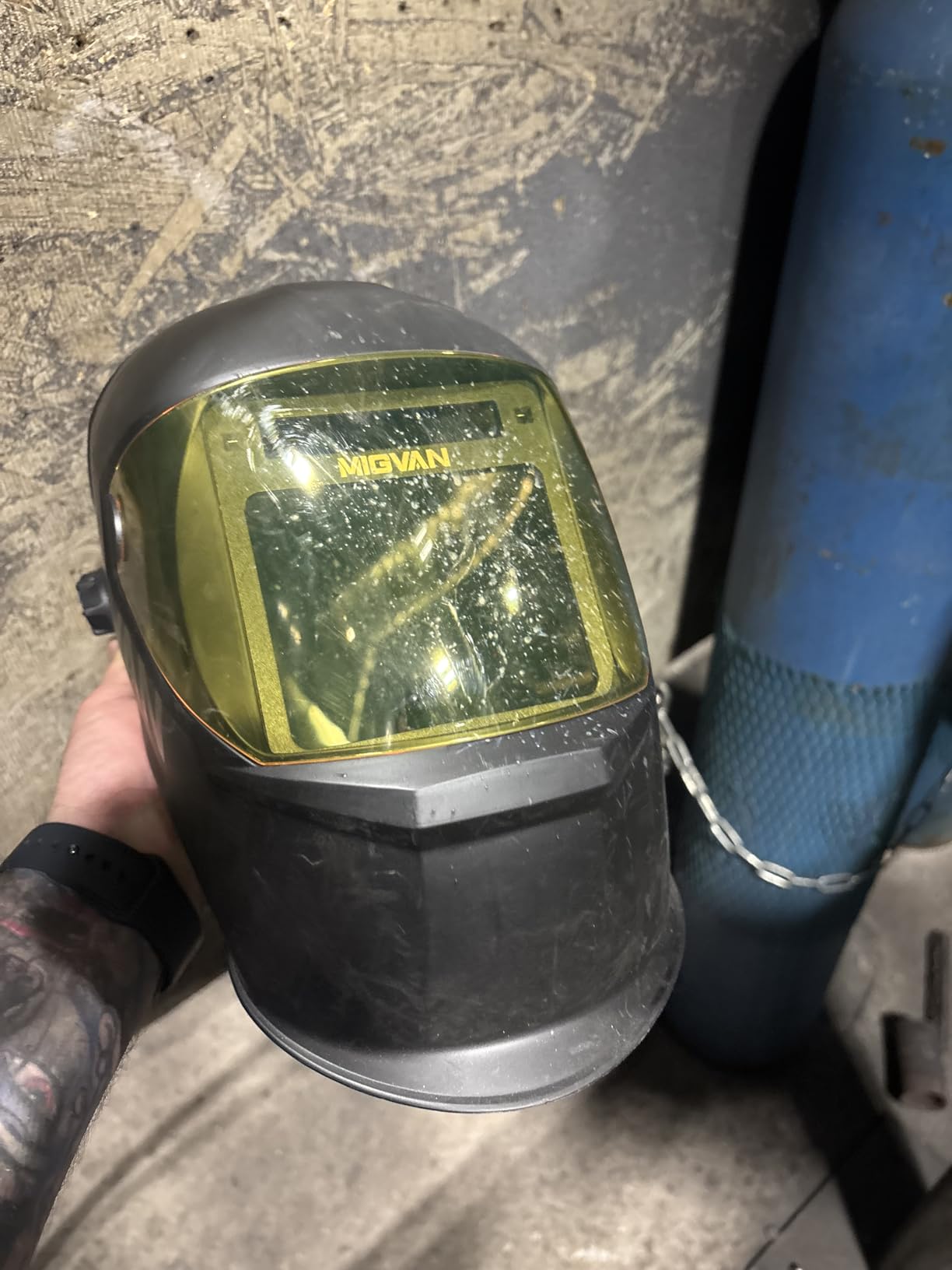
Solar power is the detail that matters most here. TIG arcs put out less ambient light than MIG, and a purely solar filter can struggle to charge while you are working a dim arc. Pairing solar with a replaceable CR2450 backup means the helmet still has a stored charge when the light level drops.
Four premium arc sensors switch in 1/10000 second, which is slower than the 1/30000 second and 0.08 millisecond figures on the premium shells but is quick enough for normal TIG work. The light state is DIN 4 and the dark range covers DIN 5-9 and 9-13.
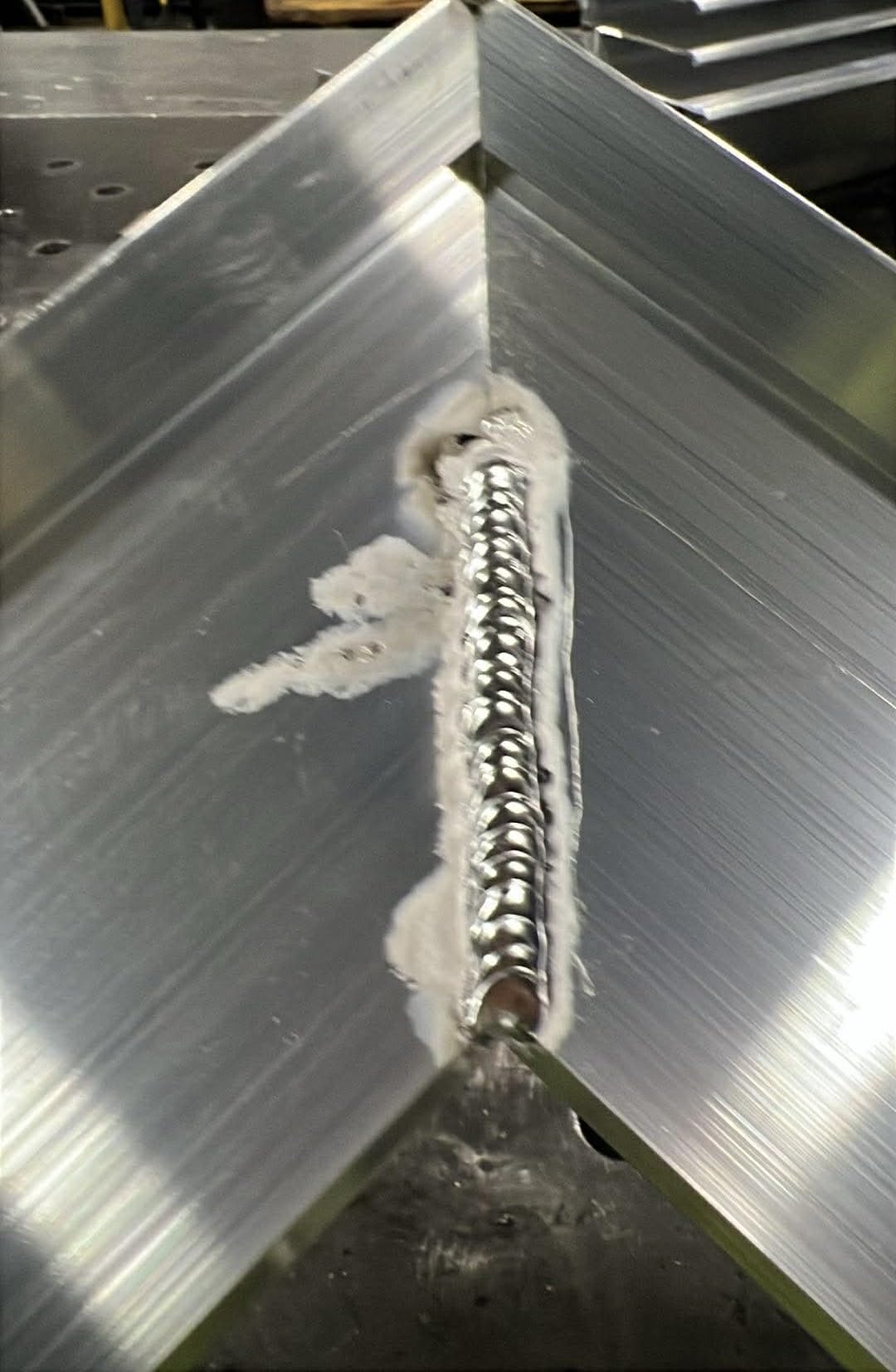
The True Color golden lens uses optical class technology for a lifelike view of the pool, and both inner and outer lenses are replaceable. That matters more than it sounds, because a scratched or clouded inside lens is the number one reason a good filter starts to feel bad.
The box includes two inner lenses, two outer lenses, a manual and a heavy-duty storage bag. That consumable bundle is generous for this tier, since cover lenses are what you will replace first after a year of regular welding.
What it does well on TIG
Multi-process coverage including TIG, plus adjustable shade and sensitivity, makes this a workable single helmet for a shop that moves between processes. The True Color view and the included lens spares keep the ongoing cost of ownership low for a first serious helmet.
Where it falls short
At 1/10000 second the switching speed is the slowest here, which shows up on very fast light changes such as arc strike and restrike. The plastics feel lighter duty in cold or drop-prone environments, and no manufacturer warranty is offered.
9. TOOLIOM True Color Welding Helmet – Best Large Viewing Area for Fit-Up
TOOLIOM Auto-Darkening True Color Welding Helmet with 3.94 x 3.66 View
14.4 sq in view
1/30000s switching
1/1/1/1 true color
solar plus battery
Pros
- Very large 14.4 sq in viewing area
- 1/1/1/1 optical class with true color
- Very fast 1/30000s darkening with 4 sensors
- Battery plus solar dual power
- Butterfly headgear with multiple adjustment joints
Cons
- Plastic shell is less impact resistant than professional nylon
- Fixed shell rather than flip-up
- Light state is DIN3 so it is less flexible for very light work
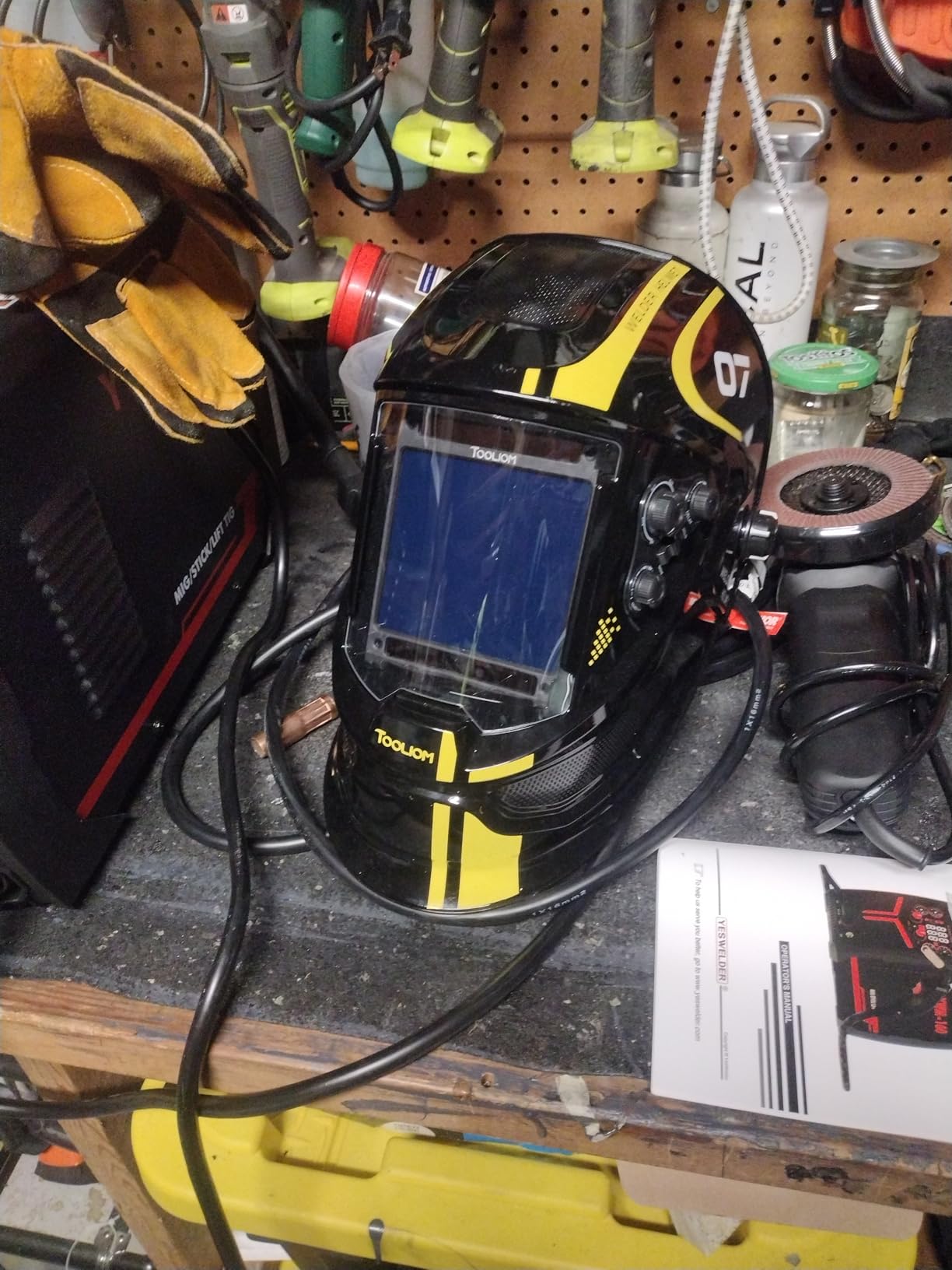
At 3.94 by 3.66 inches the viewing window works out to 14.4 square inches, the largest in this group. That is a genuine fit-up advantage on TIG, where seeing the joint, the rod and the far edge of the coupon at the same time is the difference between a good bead and a cold one.
The filter carries a 1/1/1/1 optical classification with true color technology and switches in 1/30000 second on four sensors. Dark state covers 5-9 and 9-13 shades, with a DIN 3 light state for working between welds.
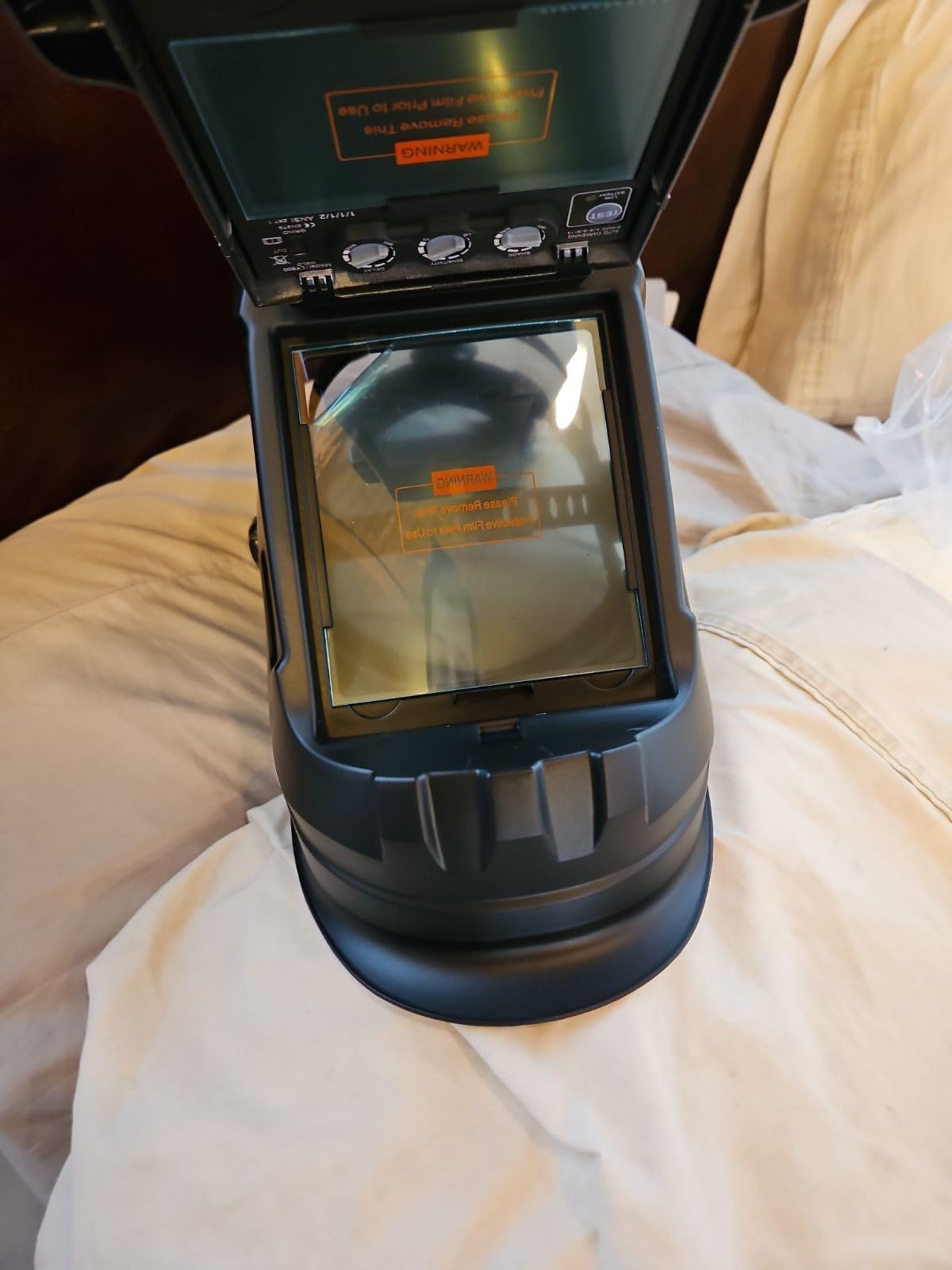
Sensitivity, delay and shade are all adjustable, with separate Weld, Cut and Grind modes. Power comes from a replaceable lithium battery backed up by a solar panel, so dim booths and outdoor work do not leave you without a charged filter.
Headgear is a butterfly-style sweat-absorbing breathable design with multiple adjustment joints, which spreads the load and lets you dial the shell closer to your head. The package includes two outer protective lenses, one inner lens, a spare battery and a manual.
What it does well on TIG
The combination of a large window, true color optics and very fast switching is close to ideal for fit-up-heavy TIG work. Reviewers repeatedly single out the viewing area and the natural color of the puddle as unusually good for this price tier, with quick and reliable sensor response.
Where it falls short
The plastic shell is less impact resistant than professional nylon helmets, and this model is a fixed shell rather than the flip-up design found on other models in the same range. The DIN 3 light state also gives you less flexibility for very light work than a DIN 4 light state.
10. ARCCAPTAIN 180 Degree Panoramic Helmet – Best Panoramic View for Tight Joints
ARCCAPTAIN Welding Hood, 180° Panoramic View Auto Darkening Welding Helmet
180 degree view
1/25000s switching
DIN16 UV/IR
dual solar plus batteries
Pros
- Genuinely wide 180 degree field of view
- Fast 1/25000s darkening with 4 sensors
- Knobs adjustable while wearing gloves
- Rear solar panels plus two CR2450 batteries
- Spare lenses spare batteries and a bag included
Cons
- Side views are fixed DIN 5 and do not auto-darken
- Polypropylene shell is lighter duty than professional nylon
- Highest share of one-star ratings in this group
The 180 degree claim here is real in a way most panoramic marketing is not. The total screen is 3.94 by 7.06 inches, built from a 3.94 by 3.66 inch auto-darkening center panel at DIN 16 plus two fixed side panels at DIN 5, and that side vision is genuinely useful when your torch is inside a corner or a tank.
Four sensors switch in 1/25000 second across TIG, MIG, arc and grinding modes. The light state is DIN 4 and the dark range covers 5-9 and 9-13, with a 12-in-1 smart filter rated for automatic DIN 16 UV and IR protection.
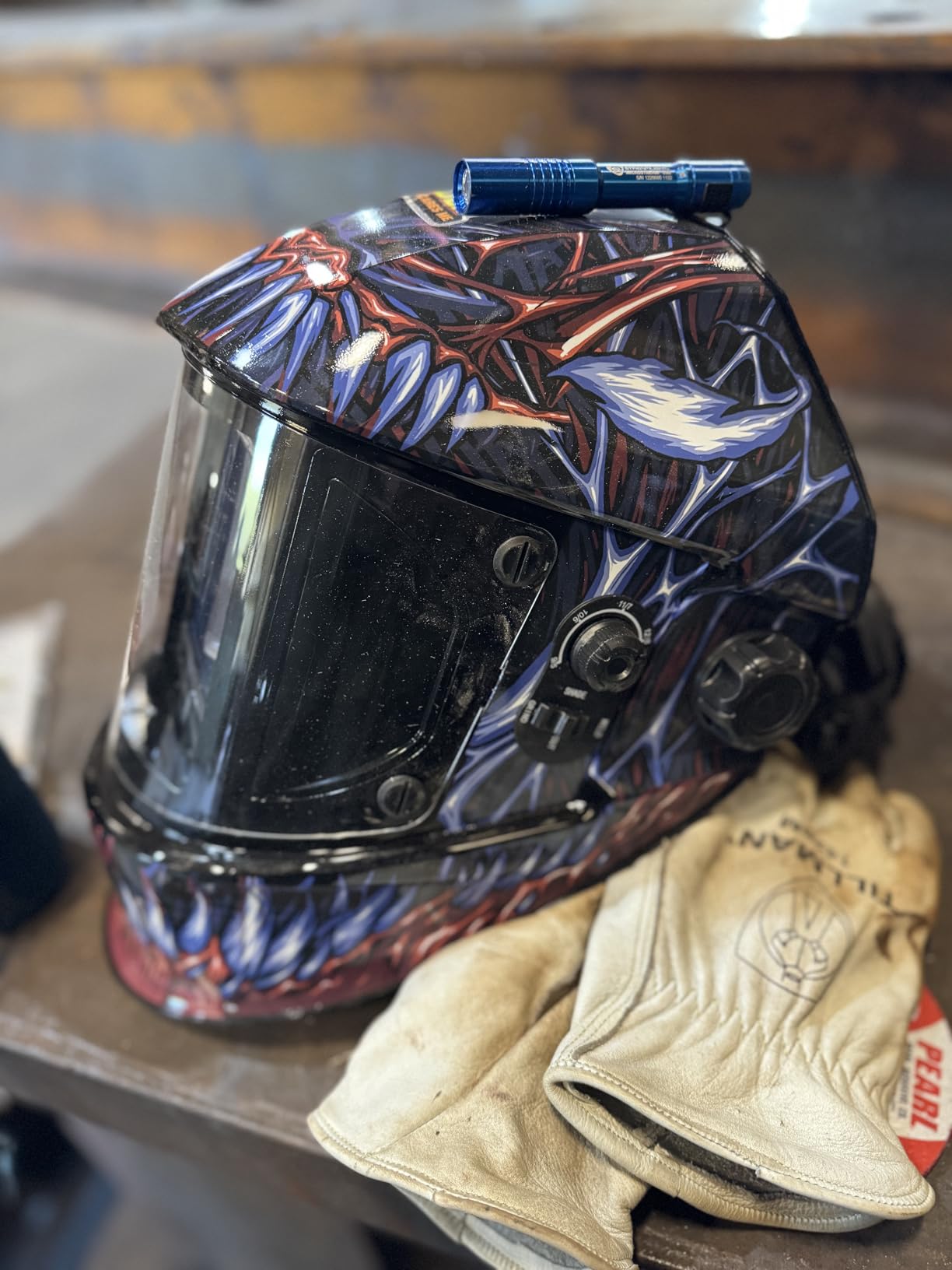
Power comes from front and rear solar panels plus two included CR2450 lithium batteries, which is generous redundancy for a hood that may be used in dim conditions. Operating range is listed from minus 5 to 55 degrees Celsius, with storage from minus 20 to 70.
The interior layout was rearranged to sit closer to the head, and the adjustment knobs are positioned so they can be turned with gloves on. The package includes a helmet, two replacement batteries, three replacement lenses and a storage bag.
What it does well on TIG
Side vision is the reason to consider this for TIG. When the electrode is angled into a corner or a tube joint, being able to see the surrounding metal without turning your head reduces the guesswork that causes porosity and cold laps.
Where it falls short
The side panels are fixed DIN 5 and do not auto-darken, so they offer no protection from a live arc and should not be treated as part of your filtered field. The polypropylene shell is lighter duty than professional nylon, and this helmet has the highest share of one-star ratings in the group, which points to inconsistent quality control between units.
How to Choose a Welding Helmet for TIG Welding
Start with minimum TIG amperage, because that is the spec that decides whether you get flashed. A published floor of five amps or below, as the Miller Classic offers, covers root passes on thin stainless. Anything rated only for higher current will hesitate on a small arc no matter how good the lens looks on paper.
Next, check the optical classification and whether the filter is described as true color. Optical class 1/1/1/1 means good optical quality, good light diffusion, good luminous transmittance and good viewing angle dependence, but a standard filter can still carry a green tint that flattens puddle color.
Viewing area is the next filter. Anything under about 8 square inches starts to feel cramped for pipe and fit-up work, and 12 square inches or more gives you useful situational awareness. Sensor count matters more than most spec sheets suggest: two sensors can be blocked by the torch or a fixture, while four or five keep detecting.
Then look at controls. Digital controls with on-board memory let you save a profile per process, which pays off immediately if you alternate between thin stainless, heavy plate and aluminum. Analog knobs are simpler and glove-friendly but give you less repeatable setup.
Finally, weigh the shell and check the power source and warranty. A helmet heavier than about 1.5 pounds will be noticeable over a full day, and solar-only designs can struggle on low-amp TIG work where there is little light to charge the cell. If you also need a machine, our best TIG welders guide covers the shortlist.
Setting Shade, Sensitivity and Delay for TIG
Set sensitivity high enough that the filter darkens on your smallest arc, then step it back one notch so shop lighting does not trigger it. On polished aluminum, an over-sensitive filter will darken from reflected light alone, which is a common and confusing failure that looks like a sensor fault.
Delay controls how long the filter stays dark after the arc stops. For tacking thin material, start around 0.2 to 0.5 seconds so the lens does not flicker between strikes. For a continuous root pass on pipe, a longer delay stops the filter from strobing as your foot pedal breaks the arc down.
Pulsed TIG adds one more problem. The background current between pulses is dim, and if delay is too short the filter can lighten during the gap and then re-darken, which is tiring and can hide a defect. Many welders solve this by running a longer delay for pulsed work and a shorter one for single-pass root passes.
AC TIG on aluminum behaves differently again. The arc extinguishes and re-ignites every half cycle at the set balance and frequency, so the filter sees a rapidly flickering light source rather than a steady arc. Raising sensitivity and lengthening delay keeps the filter locked on, and a higher frequency setting makes the arc buzz less for the filter to react to.
Why a Helmet Will Not Darken on Low-Amp TIG
Check the sensor windows first. Dust, paint overspray and spatter on the outside of the filter reduce sensitivity, and a quick wipe with a clean cloth fixes a surprising share of complaints. Titanium-dioxide smudges inside the lens are the other common cause, and inside cover lenses cloud after a year or two of regular use.
Then check your power source. Solar-only helmets can lose the ability to charge during dim low-amp TIG work, so they appear to fail at exactly the moment you need them. A replaceable battery backup, as on the MIGVAN, ARCCAPTAIN and TOOLIOM models here, removes that variable.
Finally, check your settings before you replace the helmet. Sensitivity set too low, or a delay shorter than the gap between tacks, produces the same flicker that a failing sensor would. If your machine is an inverter, an older two-sensor filter such as the Miller Classic can also lose detection where a four-sensor unit keeps going.
Cheater Glasses and Diopter Compatibility
Anyone over about 40 starts to need reading correction inside the helmet, and TIG is where it bites hardest because the work sits close and low. Most filters accept a clip-in diopter lens behind the shade plate, and most shells have room for one without moving the filter away from your face.
Check the shell depth before you buy. Low-profile shells sit closer to the head and work better with a diopter, while deeper shells can push the correction far enough from your eye to cause eye strain. Some owners of the ESAB Savage A40 report double vision with cheater lenses, which is a spacing problem rather than an optical one.
Once you need reading correction inside the helmet, confirm the manufacturer lists a diopter lens for the specific model name before you order, and avoid flipping to a fixed-shade hood that is not rated for TIG, which will flash through a Pyrex cup every time.
Frequently Asked Questions
What is the best helmet setting for TIG welding?
For most TIG work, set the filter to a dedicated TIG mode, turn sensitivity to its highest setting that does not darken from shop lighting, and start delay around 0.2 to 0.5 seconds. Increase delay for pulsed TIG and for foot-pedal work so the filter does not flicker as the arc breaks. Shade depends on amperage, and half-shade adjustments make fine changes easier.
Is shade 9 dark enough for welding?
Shade 9 is a reasonable starting point for light TIG work in the low amperage range, but it is not universally sufficient. Regulatory guidance treats shade 8 as the minimum below 150 amps for gas tungsten arc welding, and thicker plate or higher amperage needs a darker shade. Choose a filter with a wide shade range so you are not limited to a single fixed shade.
What is the best welding helmet for value for money?
The Hobart 770890 and the ESAB Savage A40 sit at the value end of this list. Both deliver true color views and four arc sensors, which are the two specs that matter most on low-amp TIG. If your work stays above 50 amps, either is a sensible first professional helmet.
Do I need a different helmet for TIG than for MIG?
A good auto-darkening helmet can cover both, but TIG raises the bar on two specs. You need a low published minimum amperage so the filter triggers on a small arc, and a shade range wide enough to cover thin material without being too light for heavy plate. MIG-only helmets that start at a high minimum amperage tend to flash on TIG.
Can I use a solar powered helmet for TIG welding?
Yes, with a caveat. TIG arcs are dim, so a solar-only filter may not gather enough light to stay charged during long low-amperage sessions. A solar design paired with a replaceable battery backup, as on the MIGVAN, ARCCAPTAIN and TOOLIOM helmets, is the safer choice for TIG work.
How many amps should I use for TIG welding?
Thin stainless tubing and light-gauge mild steel typically run in the 20 to 50 amp range at the torch, which is exactly where helmet sensitivity is tested. Heavier mild steel and carbon steel move into the 90 to 150 amp range and above, where most modern auto-darkening filters have no trouble triggering.
Final Verdict: Best Welding Helmets for TIG Welding
The Lincoln Electric VIKING 3350 is our pick for the best welding helmets for TIG welding overall, because the 4C true color lens and the extra large window handle small arcs and fit-up better than anything else here. For value, the Hobart 770890 gives you true color optics and four sensors without moving up a tier.
Choose the ESAB Sentinel A60 if you weld several processes and want stored shade profiles, the Jackson Safety Insight if neck fatigue is your limiting factor, and the Miller Classic if your work stays at genuinely low amperage. Whichever you pick, set sensitivity and delay for your smallest arc before your first real job.