
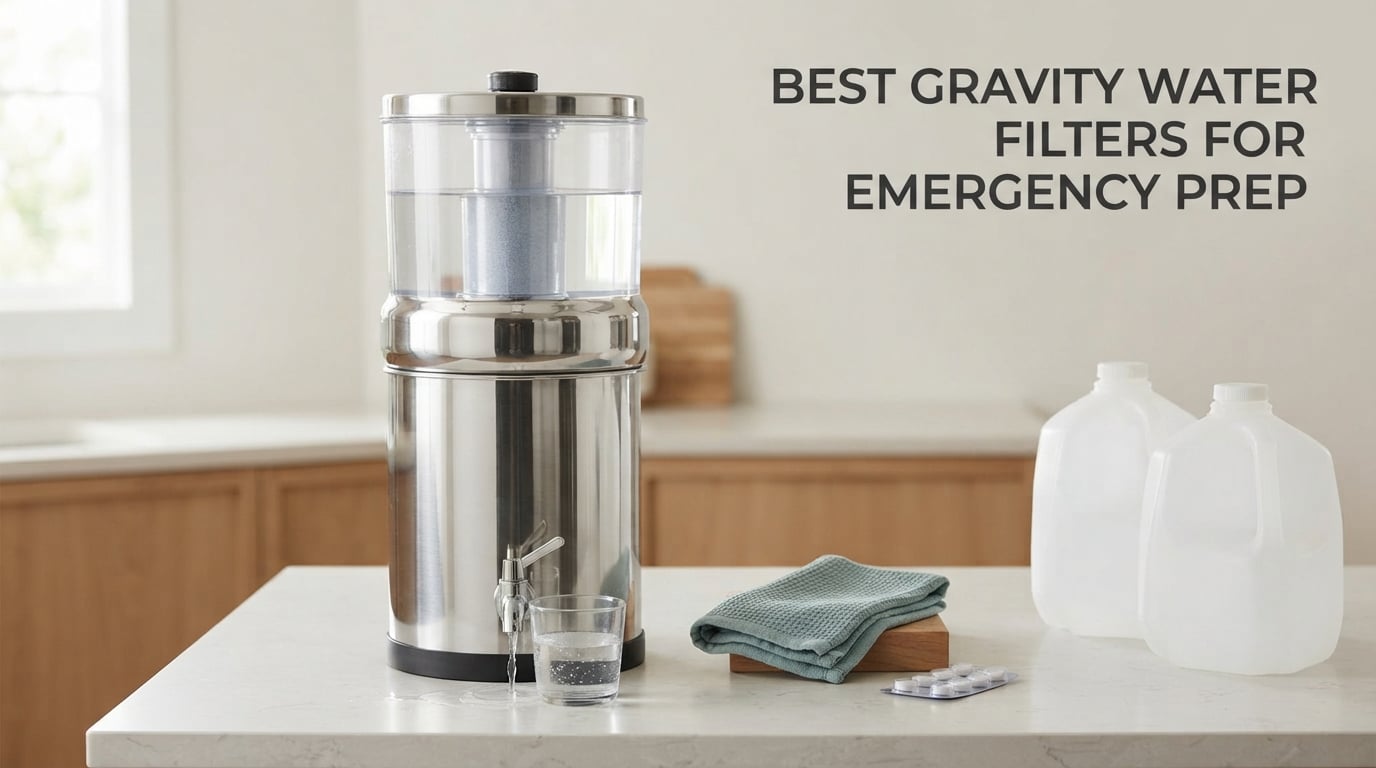
The best gravity water filters for emergency prep are the ones that keep working when nothing else does. No power, no pump, no plumbing connection, no replaceable cartridge that goes on backorder. You pour water in the top, gravity does the rest, and treated water collects below.
That simplicity is why preppers, hurricane households, and RV travelers keep coming back to this category, and why the search results for it are so thin. Most roundups list pore sizes and flow rates and then stop. They never tell you that a standard 0.1-micron element does not stop viruses, they never convert a reservoir size into the number of people it will actually serve, and they never mention that a filter stored untouched for eleven months is the piece most likely to fail you.
Here is the short answer: gravity filters remove bacteria and protozoa, including E. coli, Giardia, and Cryptosporidium. They do not remove viruses, which are smaller than a 0.1-micron pore, and they do not remove chemical contamination. Treat a gravity filter as a first-stage tool you pair with chlorine dioxide tablets, a boil, or a UV wand.
We spent six weeks working through ten of the leading units across countertop stainless steel systems, bag-and-straw systems, and higher-spec purifiers. Last updated for 2026, this roundup is built around the question that actually decides your purchase: what kind of emergency are you stocking for?
Table of Contents
Top 3 Best Gravity Water Filters for Emergency Prep
The three below cover the most common kit types. The stainless steel unit is the household workhorse, the bag-and-straw system is the go-bag answer, and the higher-spec unit is the only one on this list that treats viruses.

Big Berkey 2.25 Gallon
- Stainless steel countertop unit
- Pairs rated to 6000 gallons
- No power or plumbing
All 10 Filters Compared in 2026
Every filter in the table below runs on gravity alone. Pore size, reservoir size, and rated lifespan are the three numbers that decide whether a unit suits your kit.
| Product | Specifications | Action |
|---|---|---|
| Big Berkey 2.25 Gallon System with BB9-2 Elements |
|
Check Latest Price |
| Waterdrop Gravity Water Filter Straw 0.1 Micron |
|
Check Latest Price |
 Travel Berkey with 2 Black Berkey Elements Travel Berkey with 2 Black Berkey Elements |
|
Check Latest Price |
 Purewell 3-Stage 0.01 Micron PW-OB Countertop System Purewell 3-Stage 0.01 Micron PW-OB Countertop System |
|
Check Latest Price |
 SimPure Portable Gravity-Fed Filter with 3L Bag SimPure Portable Gravity-Fed Filter with 3L Bag |
|
Check Latest Price |
| LifeStraw Family Gravity Purifier 12 L |
|
Check Latest Price |
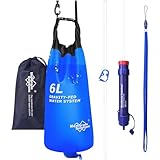 Membrane Solutions 6L Gravity Water Filter Pro Membrane Solutions 6L Gravity Water Filter Pro |
|
Check Latest Price |
 Waterdrop TK-FS Gravity Water Filter System Waterdrop TK-FS Gravity Water Filter System |
|
Check Latest Price |
 Purewell 2.25G PW-KS with Water Level Window Purewell 2.25G PW-KS with Water Level Window |
|
Check Latest Price |
 Alexapure Pro Stainless Steel Filtration System Alexapure Pro Stainless Steel Filtration System |
|
Check Latest Price |
1. Big Berkey 2.25 Gallon – the household unit that outlasts the crisis
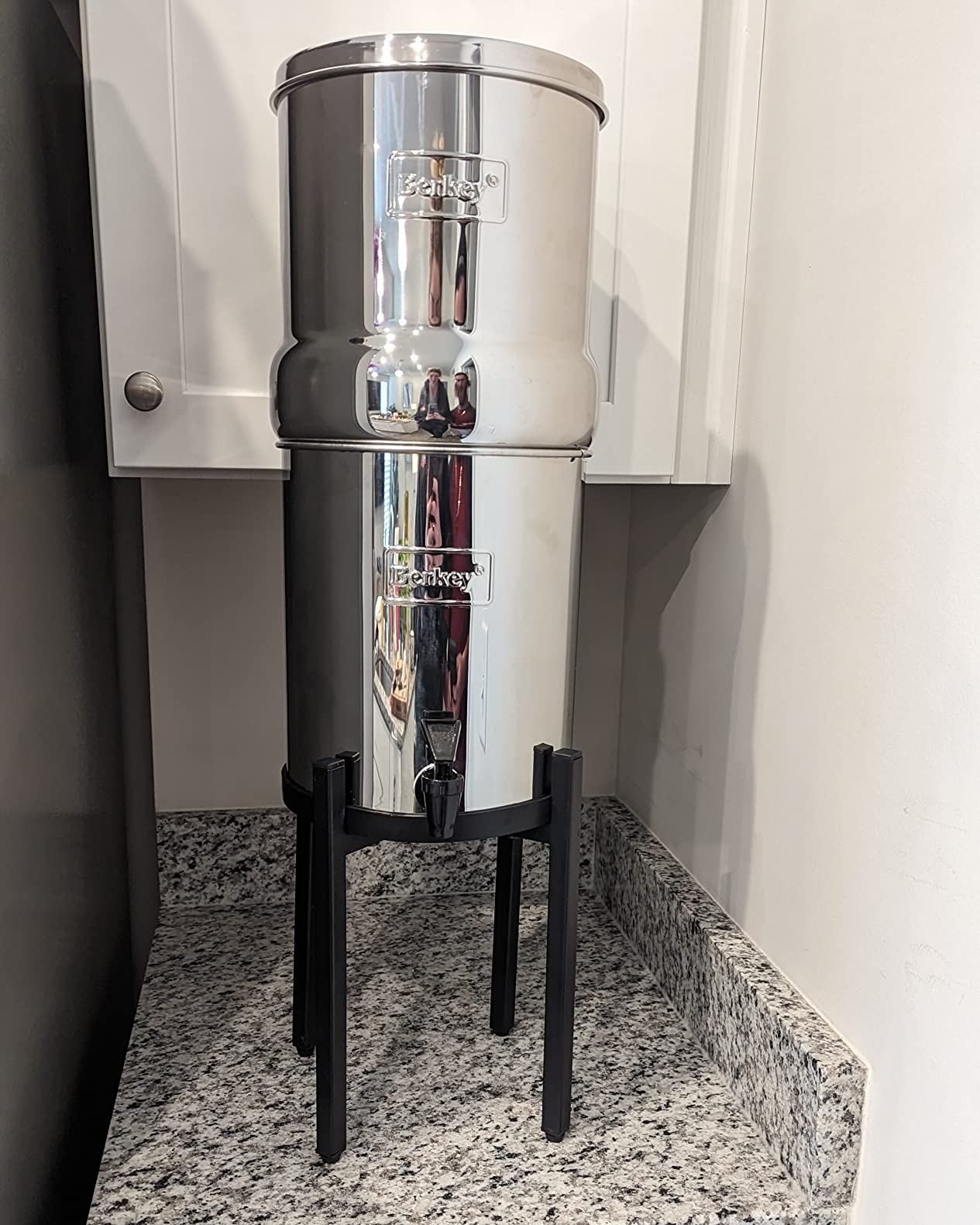
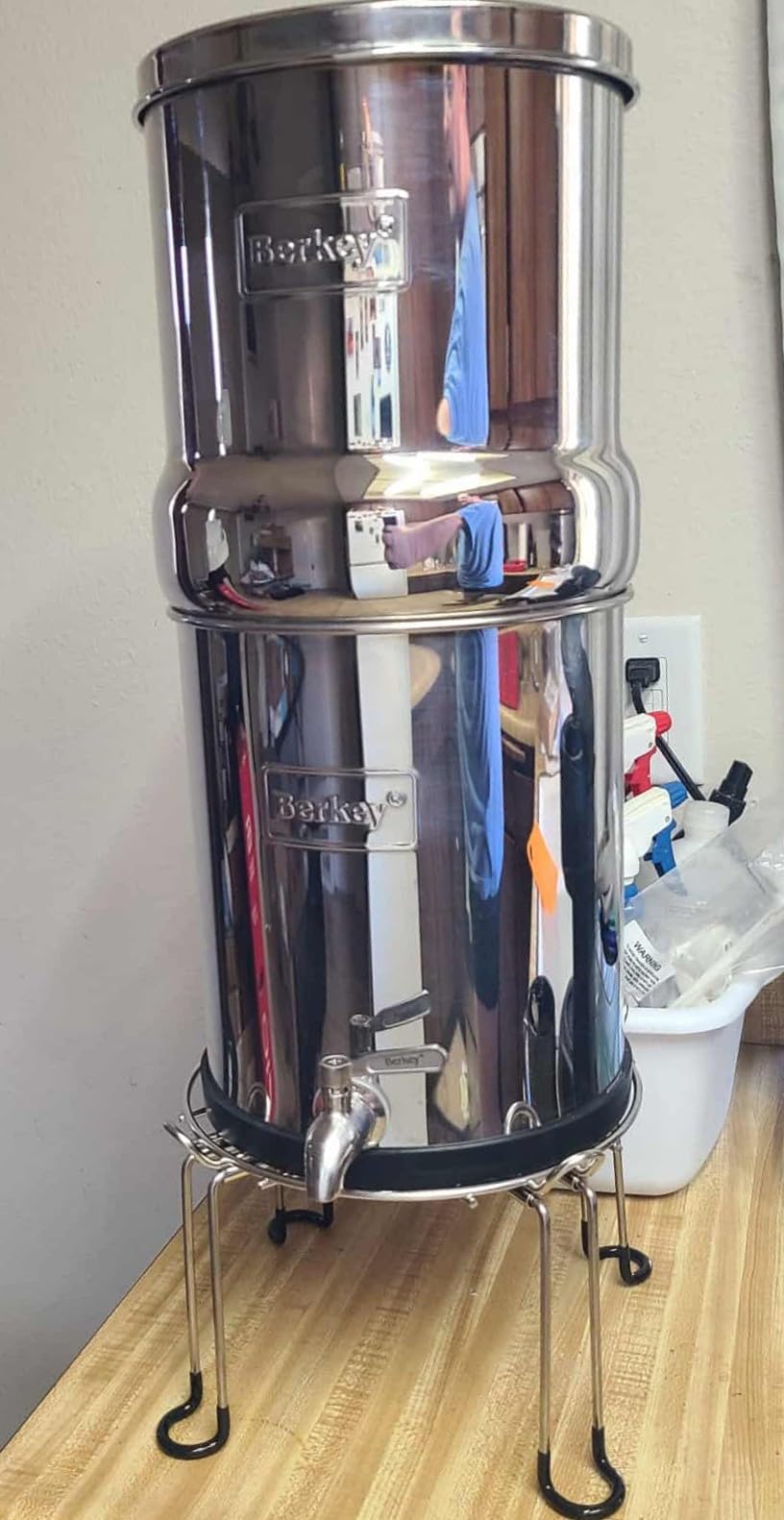
Big Berkey 2.25 Gal Gravity Water Filter System with BB9-2 Filters
8.5 liter reservoir
0.03 gpm flow
Pair rated to 6000 gallons
AISI 304 stainless steel
Pros
- No electricity
- plumbing or water pressure
- Long element life at up to 6000 gallons per pair
- Stainless steel build that suits daily use
- Upper chamber nests for compact storage
Cons
- Priming is fussy and the printed instructions are unclear
- Included rubber washers can add a rubber taste
- Small upper reservoir for a 2.25 gallon rating
We ran the Big Berkey for a month of near-daily use and it kept doing one thing without complaint. Fill the upper chamber, wait, draw from the spigot. There is nothing to plug in, nothing to remember, and the stainless steel body is the kind of hardware that survives being moved between a kitchen counter and a garage shelf.
Taste improvement is the most common thing owners report, and reviewers frequently describe replacing bottled water entirely once the unit is in place. At 4.5 stars across more than 4200 reviews, it is the most thoroughly proven filter in this roundup.
The honest catch is the priming ritual. Black Berkey elements must be primed before first use, the flow slows dramatically if they are re-primed badly after storage, and the included instructions do not explain the process well. Budget an evening the first time, and re-prime before any trip if the unit has been sitting.
Two structural details matter in a disaster. The vertical orientation of the element means the bottom of it clogs first when you feed it silty water, and the upper reservoir is small relative to the 2.25 gallon total capacity, so you are topping up more often than the number suggests.
Is the Berkey a fit for your water source?
It handles typical freshwater sources well, including lakes, ponds, and streams, and the Black Berkey elements are tested by accredited third-party labs against more than 200 contaminants. It is a good match for households on chlorinated municipal water that goes off, and for rainwater collection.
It is a poor match for heavily silty flood water unless you pre-filter first, because that vertical element will choke. A cloth pre-filter over the fill port is not optional in that scenario.
What does it cost you in maintenance?
Follow the 6000 gallon figure rather than the calendar. A household filtering two gallons a day uses those elements for years, and owners with multi-year daily use report a single element change across most of that span.
The 8.5 liter upper chamber and 19.25 inch height mean it claims real counter space, and the chambers nest for storage. Plan the location before you buy, not after.
2. Waterdrop Gravity Straw – the fastest filter we tested
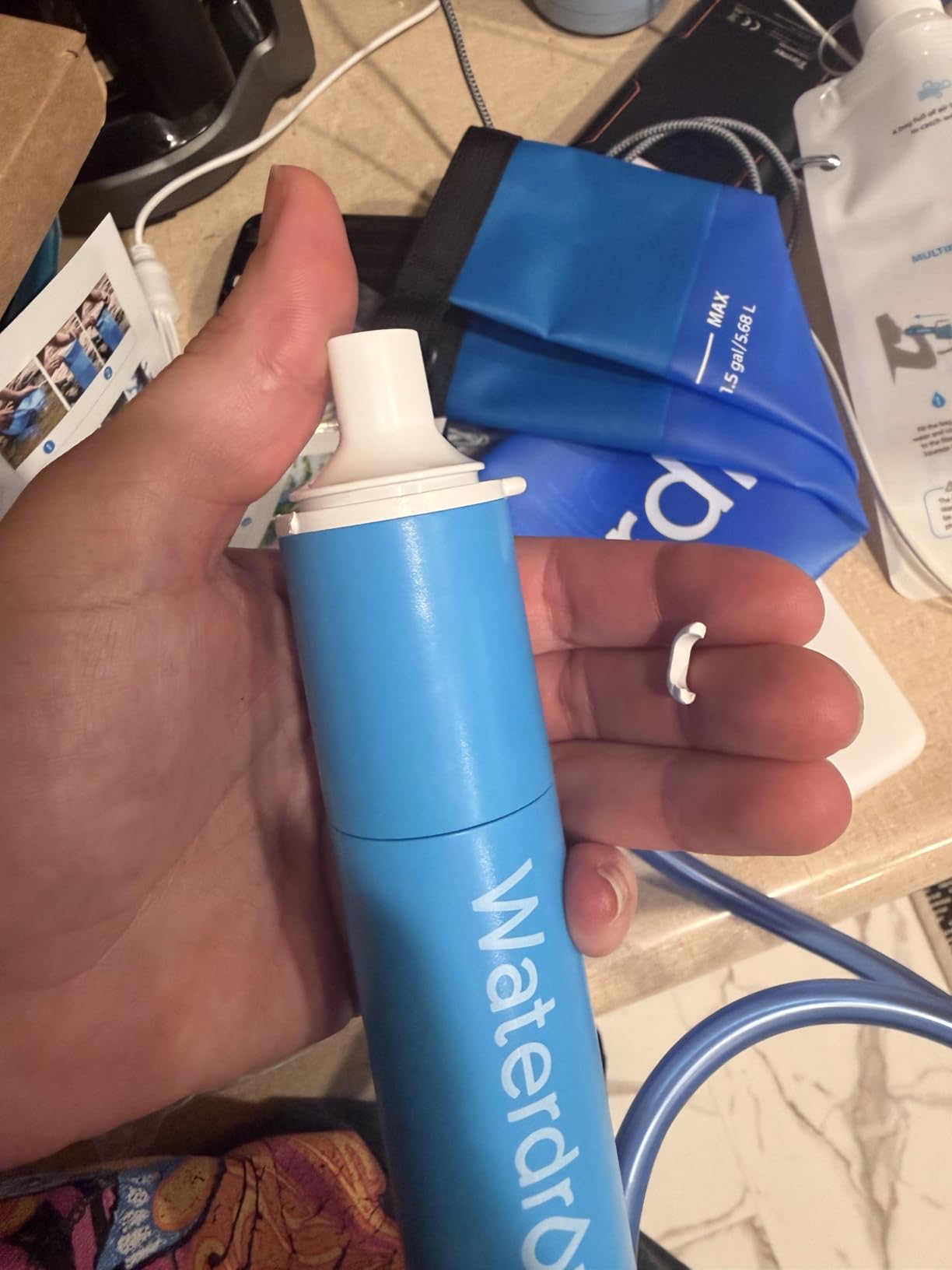
Waterdrop Gravity Water Filter Straw, Camping Water Filter, 0.1 Micron
0.1 micron hollow fiber
700 ml per minute
1400 gallon rated life
1.5 gallon bag included
Pros
- Very fast gravity flow at up to 700 ml per minute
- Backflush function keeps the element clean
- Straw and both bag ends fully disassemble
- Rated to 1400 gallons
Cons
- TDS support listed only to 300 ppm
- Each fill is limited to the 1.5 gallon bag
- Some assembly of the straw connection
Flow rate is the reason this one wins on speed. At up to 700 milliliters per minute, it moves water several times faster than a typical countertop unit, which matters when you are filtering for four people and the source is nearby.
The whole assembly packs down small, which is what earns it a place in a go-bag. It includes a 1.5 gallon gravity-fed bag, a 16 ounce pouch, and a straw that disconnects at both ends so you can run it from a bag, a bottle, or a jug.

Two limits deserve attention before you commit. The listed TDS support tops out at 300 ppm, well below the 500 to 1000 ppm figures most systems in this roundup carry, and a 0.1-micron membrane does nothing for dissolved minerals or chemicals regardless of what the label implies.
The backflush function is the feature that extends its life. Removing the mouthpiece and flushing the interior when flow drops keeps the element clear, and reviewers consistently credit it with maintaining output over long stretches of intermittent use.
Will it handle dirty source water?
Only after pre-filtering. A 0.1-micron hollow fiber element will clog quickly on silty or tannic water, and the fix is the same one forum users describe: a cloth or sock over the fill port, and letting sediment settle before you draw.
It is fast enough that pre-filtering is worth the extra two minutes. Cleaning up the water first keeps the backflush from becoming a daily chore.
Does it belong in a go-bag or a home kit?
A go-bag, or a vehicle kit. The weight is negligible and the whole thing collapses flat, but the 1.5 gallon bag is the ceiling on every single fill, so it is a drinking-water tool rather than a household water system.
For drinking and cooking for two or three people over a day or two, it is genuinely enough. For a family of five for a week, you will be refilling constantly.
3. Travel Berkey – stainless steel that fits beside a sink
Travel Berkey 1.5 Gal Gravity-Fed Water Filter System with BB9-2 Filters
1.5 gallon stainless steel
0.05 gpm flow
Pair rated to 6000 gallons
18 inch tall
Pros
- Compact 1.5 gallon size suits 1 to 3 people
- No electricity
- tools or plumbing
- Same Black Berkey elements rated to 6000 gallons
- Good record of multi-year reliability
Cons
- Priming tool and instructions often disappoint
- Stock spigot and gasket rings reported to smell
- No water level indicator on the base unit
This is the same element technology as the Big Berkey in a package that actually travels. At 18 inches tall and 7.5 inches across, it fits beside a kitchen sink, on an RV counter, or on a folding table in a shelter, and reviewers with eight-plus year units report it still performs.
For a household of one to three, or for an RV that already carries water, 1.5 gallons is a workable reservoir. It refills a few times a day rather than once, which is the trade you make for the smaller footprint.
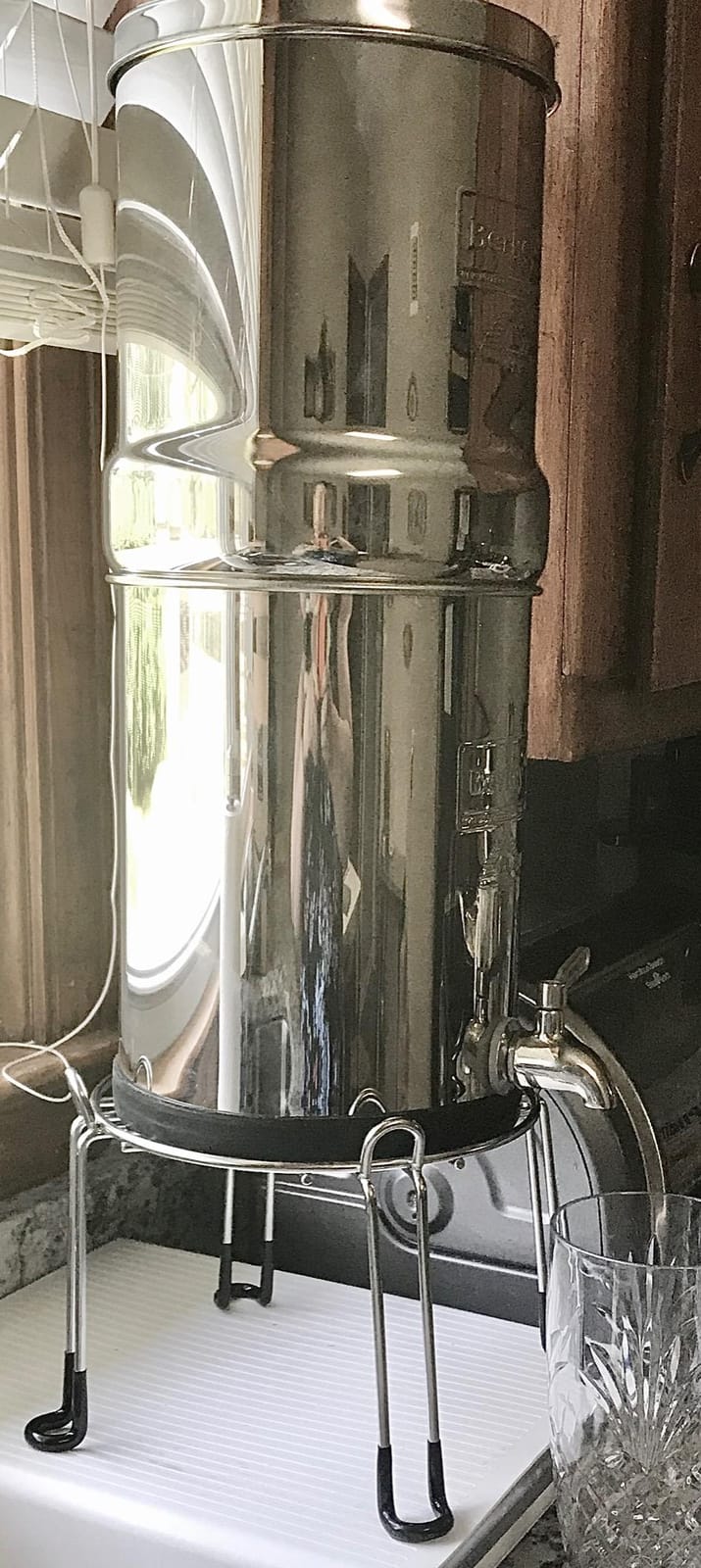
Assembly is where the first-time experience gets rough. Owners report the same pattern: the unit performs well, but the priming instructions are hard to follow and the included priming tool often does not work well. Have a video open on your phone the first time.
The included plastic spigot and rubber gasket rings also draw repeated complaints about a chemical smell in early draws. Some owners replace them, which is a small job, but budget for it if you are sensitive to taste.
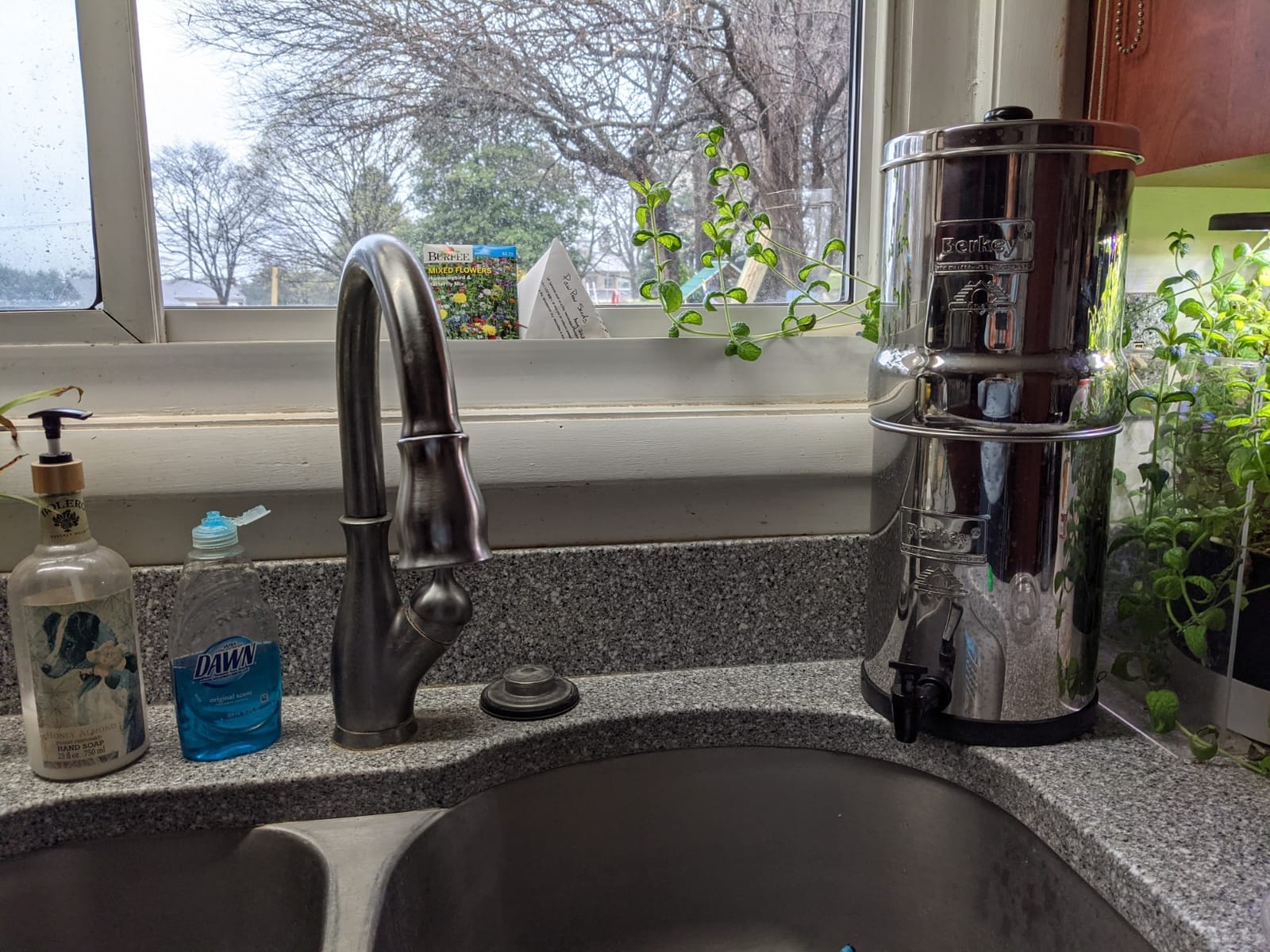
Travel Berkey or Big Berkey for the same household?
Choose the Travel Berkey if counter space is tight, the unit may travel, or you are filtering for one to three people. Choose the Big Berkey if you want fewer refills and a larger reservoir for a family.
Both use interchangeable Black Berkey elements, so you can standardize on one cartridge type across two locations and only stock one spare.
What breaks first, and does it matter?
Nothing structural. The recurring problems are consumables and documentation: the spigot, the gasket rings, and the priming step. Element longevity is not the weak point, since each pair is rated to 6000 gallons.
The nozzle fittings in the bottom of the upper chamber also make the unit awkward to set down or carry when full. Pour slowly into a separate container if you are moving it.
4. Purewell 3-Stage 0.01 Micron – tightest pore size on the counter
Purewell 3-Stage 0.01μm Ultra-Filtration Gravity Water Filter System, NSF/ANSI 42&372 Certification, 304 Stainless Steel Countertop System with 2 Filters and Stand, Reduce 99% Chlorine, 2.25G, PW-OB
0.01 micron hollow fiber
4 gallons per hour
2.25 gallon capacity
NFS 42 and 372 certified
Pros
- 0.01 micron pore size with silver ion and carbon stages
- Certified to NSF/ANSI 42 and NSF/ANSI 372
- Stainless spigot and non-slip stand included
- No electricity required
Cons
- Does not reduce TDS
- Leaks if you top up while the lower chamber is full
- Elements recommended at 6 months regardless of gallons
A 0.01-micron hollow fiber ultrafiltration element is finer than anything else in this roundup, and it is paired with a silver ion membrane and an activated carbon block for three-stage filtration. The result is a very fine sieve that still holds 4 gallons per hour.
That combination of tight pores and a full accessory set is unusual at this level. The 304 stainless steel housing, matching spigot, and non-slip stand all arrive in the box, so there is nothing else to buy before the first fill.
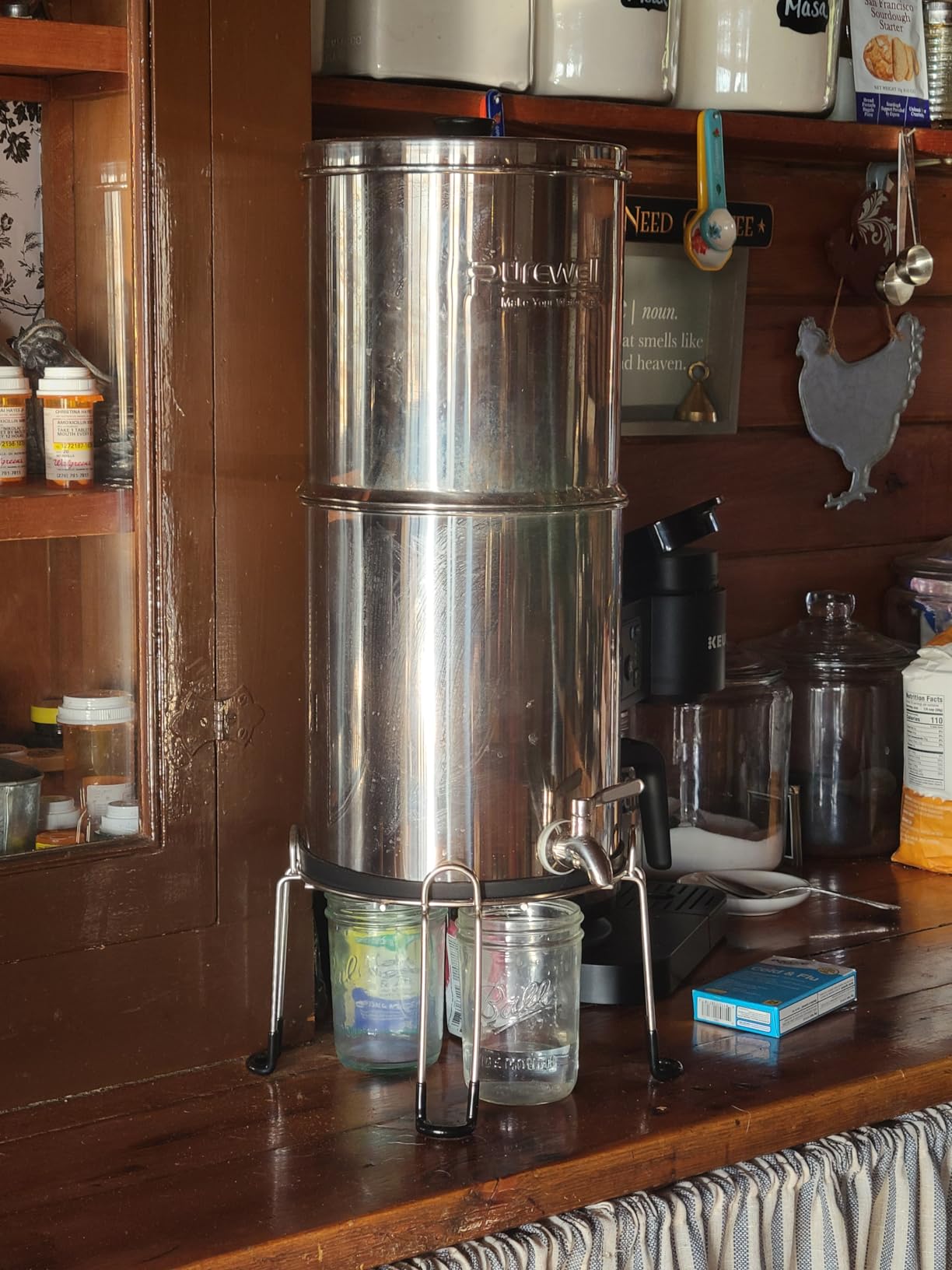
Fine pores do not mean virus removal. Even at 0.01 micron, the manufacturer does not claim a purifier rating, and this unit belongs in the same category as the rest of the list for viral safety. Pair it with tablets or a boil near contaminated sources.
Two handling rules matter. Water added to the top chamber while the lower chamber still holds filtered water causes leaking, and the manufacturer recommends replacing elements every 6 months whether or not you have filtered a full reservoir of water.
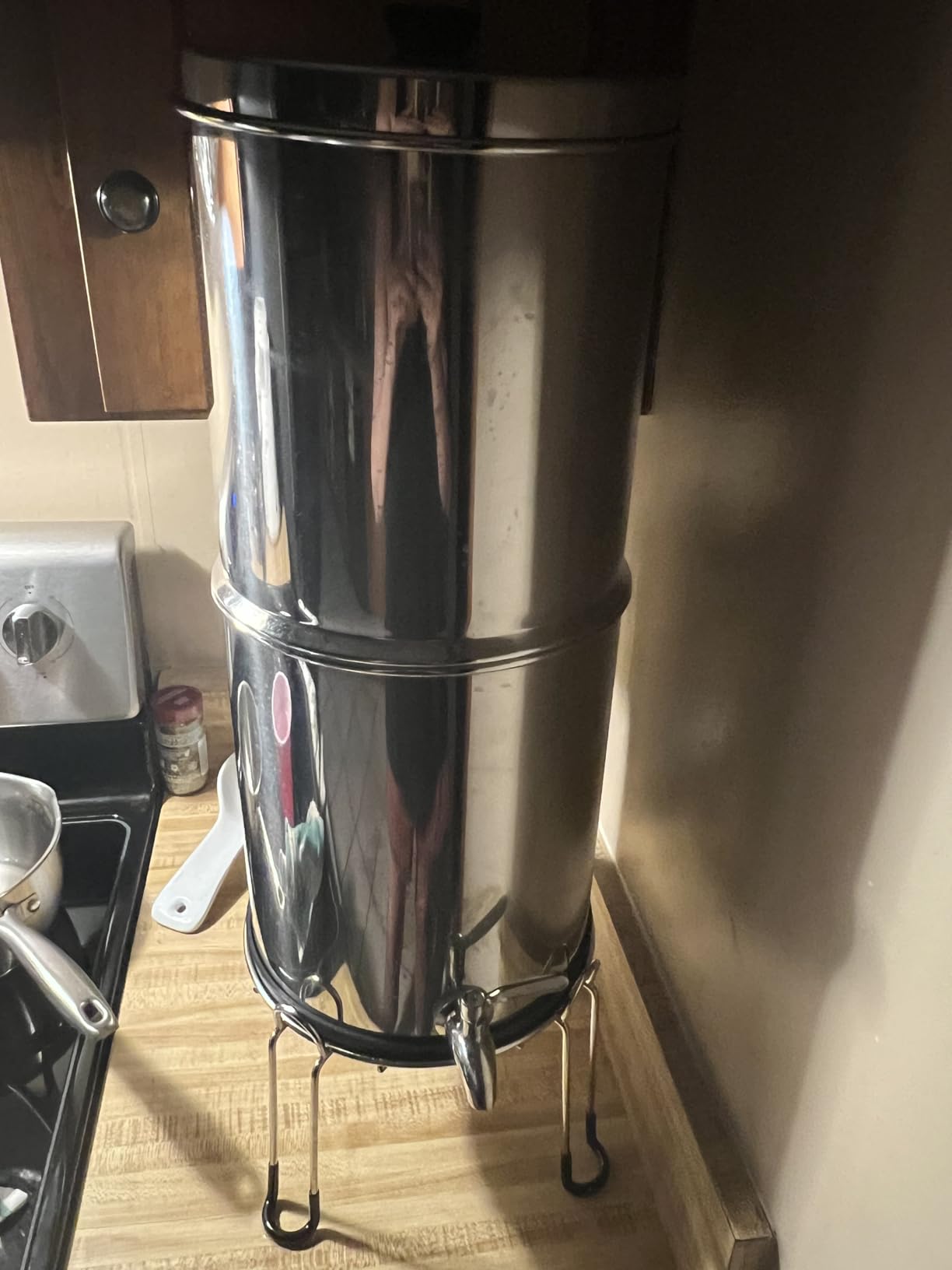
Is 0.01 micron worth it over 0.1 micron?
For drinking water quality and taste, yes, it removes finer particulate and does more with odor and chlorine. For bacteria and protozoa, a 0.1-micron element already handles the job at several times the flow rate.
The practical cost of the tighter pore here is the 6-month replacement interval, which you pay on the calendar rather than on gallons filtered.
How does it handle household demand?
The 2.25 gallon capacity and 8.9 inch footprint suit a household of roughly one to four people, filling a few times a day. At 4 gallons per hour, a full reservoir takes around half an hour of draining.
TDS passes straight through, so if you are on hard well water or have fluoride concerns, this is not a mineral solution. We covered that case in our guide to well water filter options.
5. SimPure 3L Bag – the lightest kit you can carry
SimPure Portable Gravity-Fed Water Filter with 3L Bag
0.1 micron hollow fiber
27 liters per hour
3 liter bag
2.8 ounce weight
Pros
- Weighs 2.8 ounces and rolls down small
- 27 liters per hour is fast for a gravity system
- Tree strap for hands-free filtering
- Works as a straw
- tube
- or bottle filter
Cons
- Actual bag volume falls short of the 3L label
- Trapped air makes the first draw difficult
- One reviewer reported a chemical taste
At 2.8 ounces, nothing else in this roundup disappears into a pack the way this one does. It includes a 3 liter TPU gravity-fed bag and a tree strap, so you hang the bag, walk away, and collect clean water when it is done.
Flow is the second advantage. At 27 liters per hour, it moves water faster than any countertop unit on this list, which is why it ranks near the top in Camping and Hiking Water Purifiers.
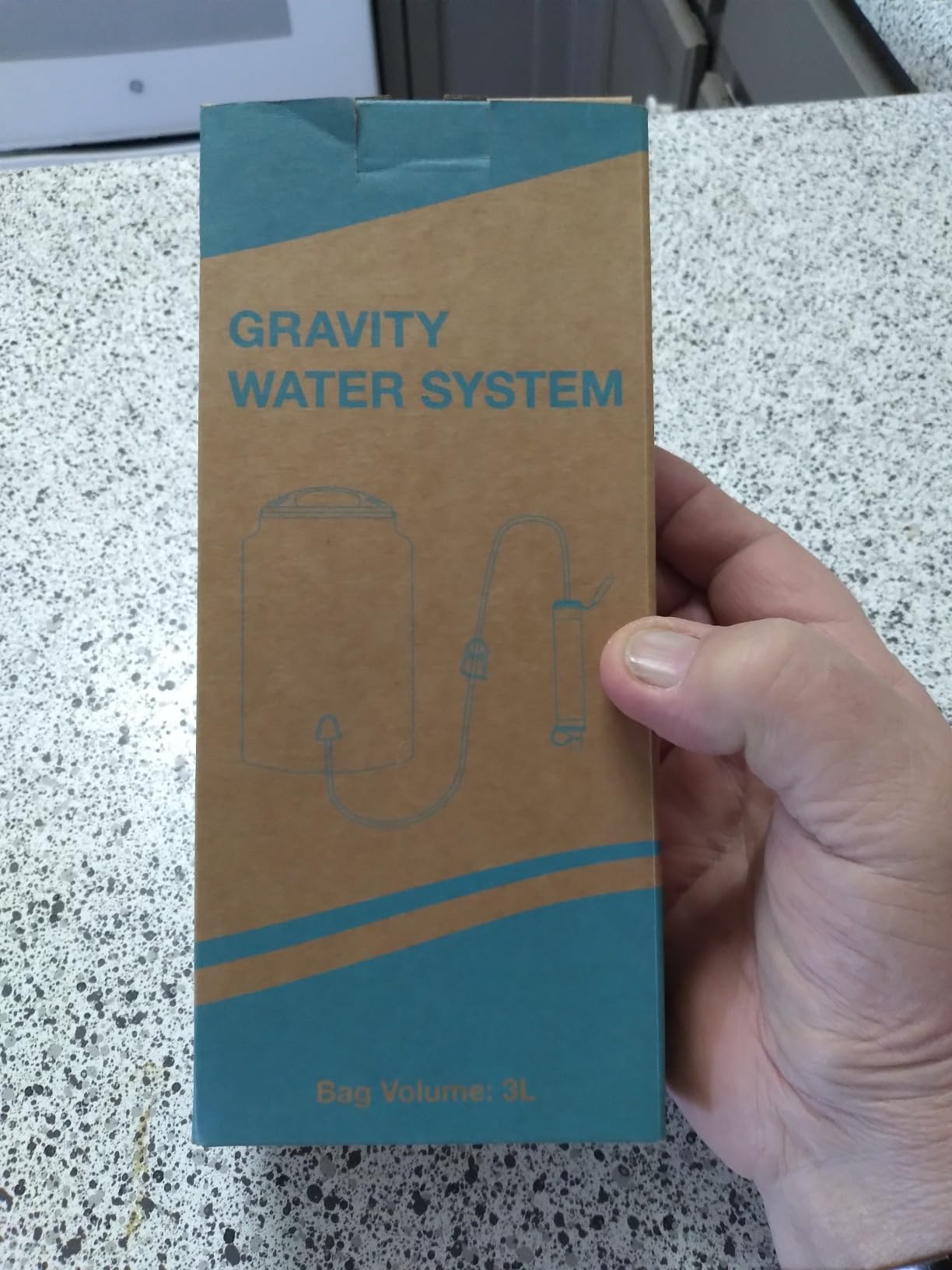
Getting it started takes patience. Air trapped in the line and in the element makes the first draw difficult, and you have to work the flow before it settles into a steady stream. Owners also report that a full bag is a bit short of the 3 liter label.
Cleaning is the third quirk. The narrow bag is hard to dry fully after washing, and one reviewer reported a chemical or plastic taste in the output. If you are filtering unfamiliar water, run a first batch through and discard it.
Is it big enough for real emergency use?
For one or two people, absolutely. The rated lifespan of 5000 liters covers about 3.5 years of use by a family of four on the manufacturer’s own math, though real-world output depends entirely on how clean the source is.
It is a supplementary unit, not a household system. Nobody is filtering a family of five’s drinking and cooking water through a 3 liter bag in one sitting.
How do you configure it?
Three ways. Use it as a personal straw, add the 29.5 inch extension tube for more distance drinking, or connect it to a standard water bottle. The versatility is the reason it earns a permanent spot in a hiking kit.
For hiking and backpacking specifics, our backpacking water filter guide goes deeper on weight and pump-versus-gravity trade-offs.
6. LifeStraw Family 12 L – the only unit here that treats viruses
LifeStraw Family Gravity Water Purifier with Virus Removal, 12 L, Blue
0.02 micron rating
18000 liter capacity
9 to 12 liters per hour
Gravity fed sealed bag
Pros
- Only unit in this roundup with a virus removal claim
- Removes 99.99 percent viruses and 99.9999 percent bacteria
- 18000 liter capacity for a family of four
- Arrives sealed in a bag suited to emergency storage
Cons
- No dedicated storage case once opened
- Replacement bulb and clamp rings not sold separately
- Slow flow that needs a high hanging point
This is the one filter here rated to 0.02 microns, which is the threshold forum discussions keep naming as the difference between a filter and a purifier. It is the highest-rated product in the roundup at 4.7 stars, and owners consistently cite virus removal as the reason they bought it rather than a cheaper 0.1-micron straw.
The capacity figure is the other draw. At 18000 liters, that is roughly three years of drinking water for a family of four, with no iodine, chlorine, or other chemicals involved in the process.
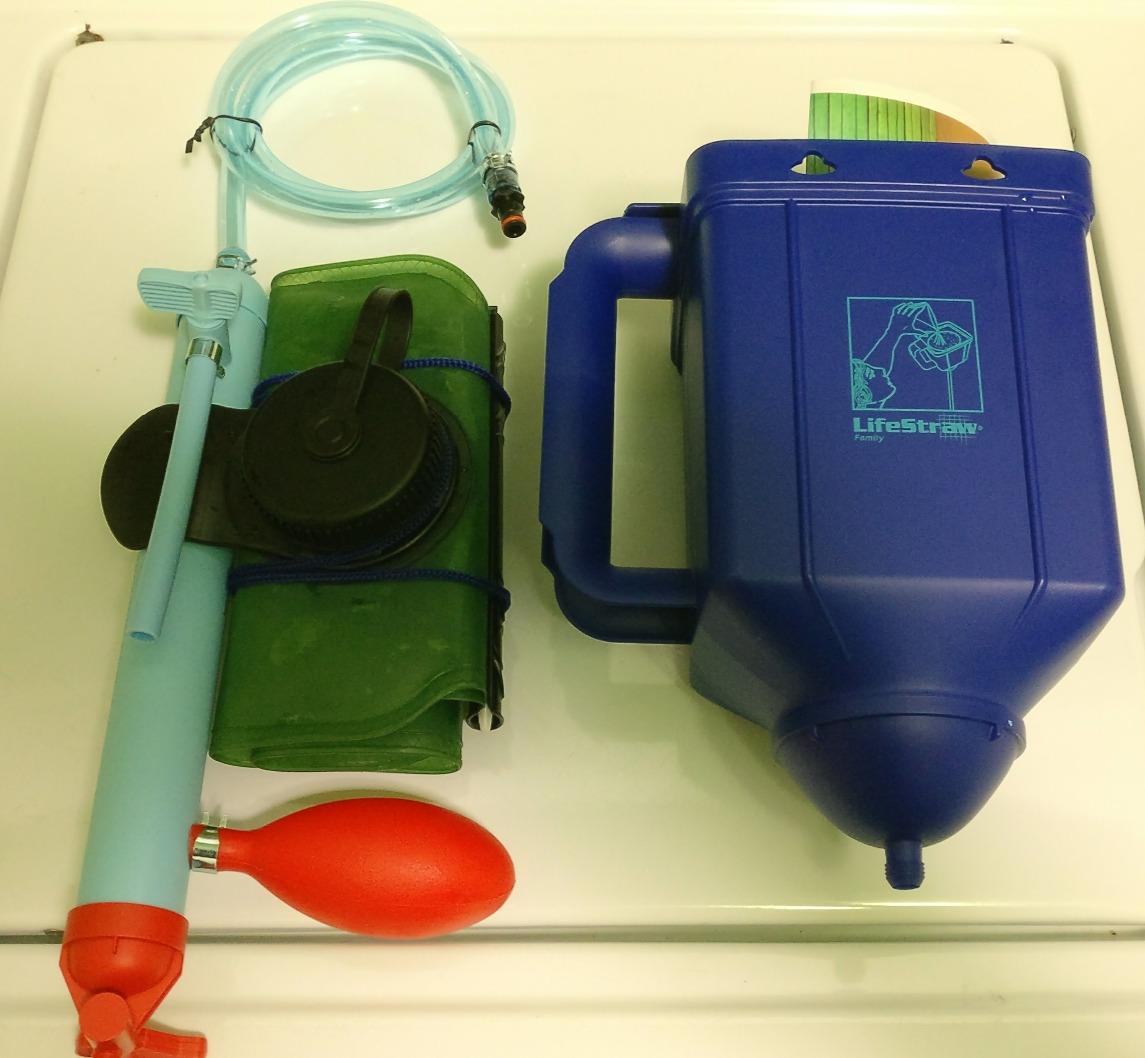
Read the contaminants claim carefully rather than treating it as a blanket guarantee. The stated reductions are 99.99 percent for viruses, 99.9999 percent for bacteria, and 99.9 percent for protozoan cysts, which is a different and narrower claim than the certified 0.1-micron units make.
Several flushing cycles are needed before manufacturing residue clears, so fill it, run it, and discard the first output. After that it settles into a steady gravity-fed stream.
When is this the right pick?
When the water source is plausibly near human contamination. Forum guidance on hurricane retention ponds is blunt about that scenario, describing the water as contaminated with fecal matter, and that is exactly the case a 0.1-micron straw handles badly.
If your sources are lakes, tanks, and rainwater, a standard 0.1-micron filter is enough and this unit is over-specified. Buy it when the risk model includes sewage.
What about the drawbacks?
It is bulkier and less portable than a straw filter, and the slow flow rate means it should be hung high to keep the tube vertical. The sealed bag that makes it good for storage stops serving that purpose once you open it.
Replacement pieces such as the squeeze bulb and clamp rings are not sold separately, which is the frustration owners report most often. Plan on treating a broken part as a unit replacement.
7. Membrane Solutions 6L Pro – group capacity at backpack weight
Membrane Solutions 6L Gravity Water Filter Pro for Group Camping
6 liter gravity bag
0.1 micron hollow fiber
500 ml per minute
1320 gallon rated life
Pros
- 6 liter bag serves 3 to 6 people
- Independently tested to NSF/ANSI 42
- 372 and 401
- Four stage filtration with dual PP pre-filters
- Puncture resistant BPA-free construction packs down
Cons
- 0.5L per minute is slower than competing gravity filters
- Bag-only format needs a hanging point
- Should be rinsed before first use
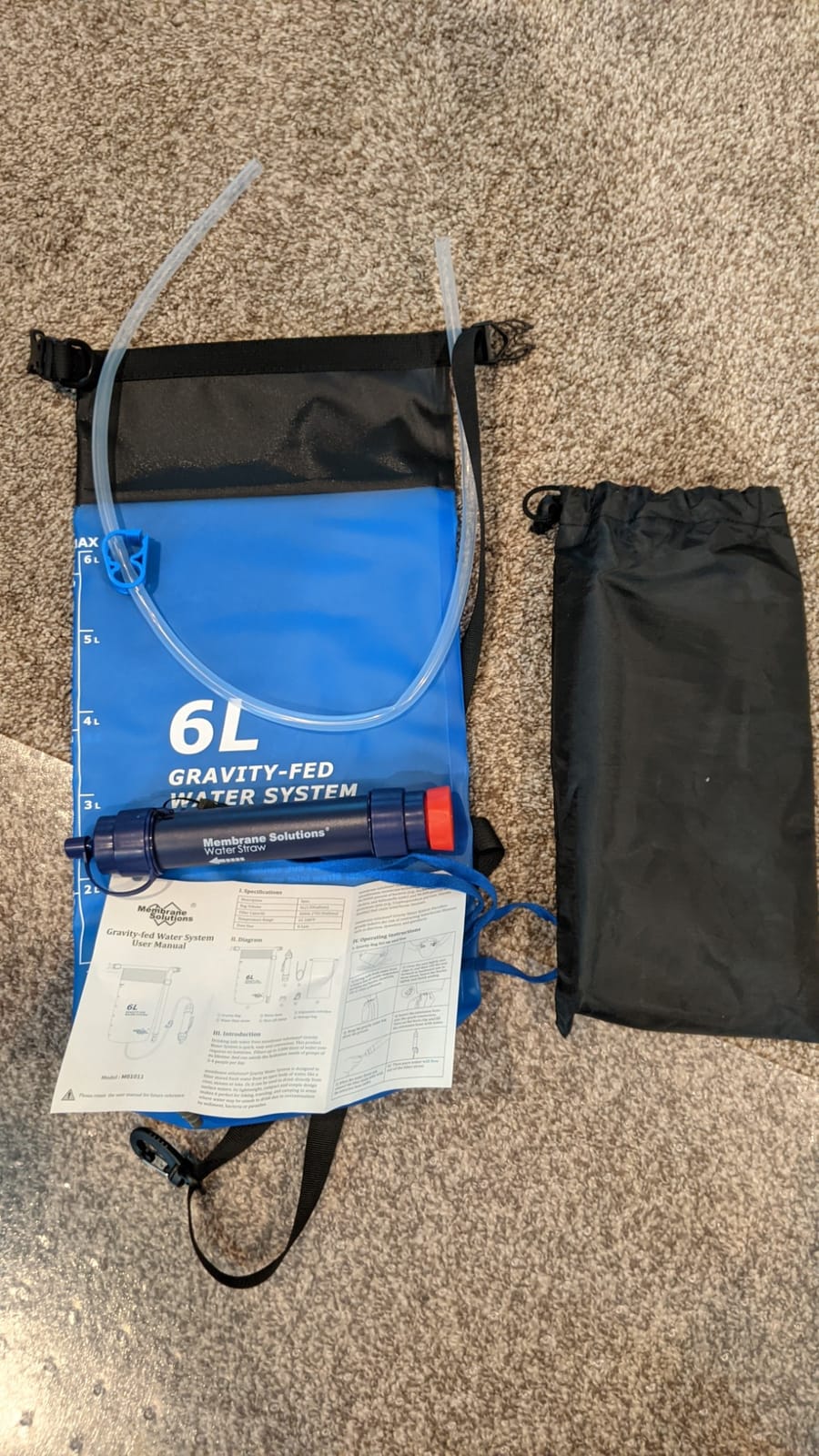
Six liters is the largest reservoir in the portable class on this list, and the manufacturer states it serves 3 to 6 people. That is the difference between a personal filter and a basecamp filter, and it is the reason this one keeps appearing in group kit lists.
Certification is the other strength. It is independently tested by NSF and SGS against NSF/ANSI 42, 372, and 401, which is broader than most competing bag systems and gives you an independent performance record rather than a marketing claim.
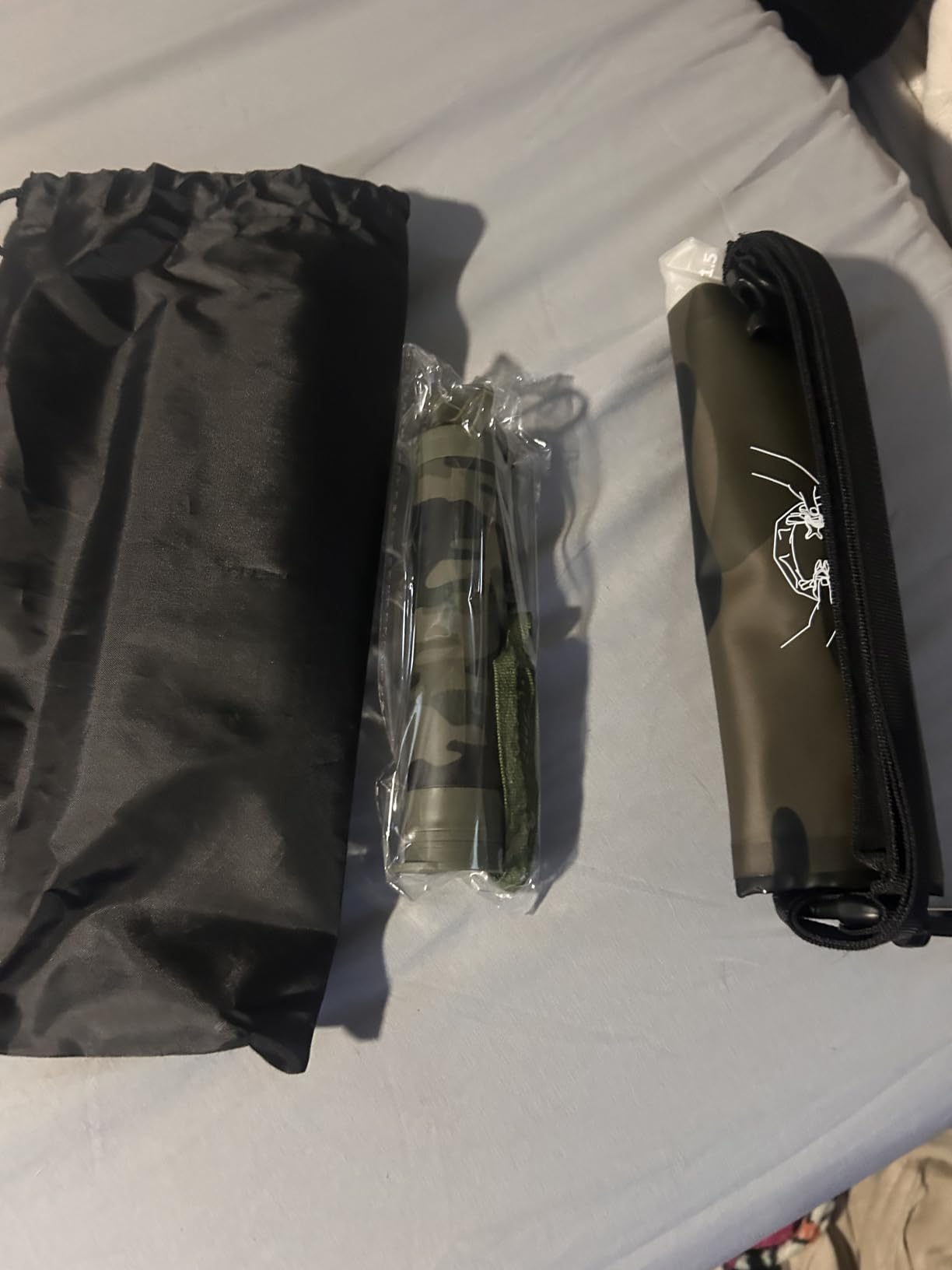
Filtration runs through four stages: a 0.1-micron hollow fiber membrane, coconut shell activated carbon, and dual PP pre-filters. Those pre-filters are doing real work on turbid input, which is exactly the failure mode that kills cheap straw systems.
The rated life is 1320 gallons, or 5000 liters, and the reinforced hanging strap plus collapsible design let it pack into a backpack between uses.
Is the flow rate too slow?
At 0.5 liters per minute it is the slowest portable unit here, so plan the collection around it. Fill the bag in the morning, hang it, and draw from it through the day rather than waiting on a single pour.
Users comparing it against straw filters tend to come away satisfied precisely because they are not waiting on output. The trade is time for capacity.
Does it store well in a vehicle or closet?
Yes, and that is where it earns its place. It is the unit we would pick for a basecamp kit, a volunteer relief bundle, or an RV closet, because the bag collapses and the element does not need priming after long storage the way a hollow fiber countertop unit does.
It is still a bag format, so it is not a countertop appliance. Rinse it and let it run before first use, per the manufacturer.
8. Waterdrop TK-FS – carbon media for chlorinated supply
Waterdrop TK-FS Gravity Water Filter System, NSF/ANSI 42&372 Standard
2.25 gallon stainless steel
NFS/ANSI 372 certified
Coconut activated carbon
Four replacement filters included
Pros
- Stainless steel body with a metallic water level spigot
- Coconut activated carbon reduces chlorine by up to 99 percent
- Four replacement filters ship in the box
- Targeted at heavy metals and impurities
Cons
- Activated carbon does not reduce dissolved solids
- Only two installation holes in the upper chamber
- Replacement cartridges are a recurring cost
This is a carbon-first system rather than a membrane-first one, and that design choice determines what it is good at. Natural coconut activated carbon in the tank cuts chlorine by up to 99 percent and targets heavy metals and impurities, which is the profile you want when a municipal supply goes off and the water still tastes like a swimming pool.
The stainless steel 304 body and metallic water level spigot are nice touches at this size, and the fact that four replacement filters are included means you are not ordering cartridges the week you buy it.
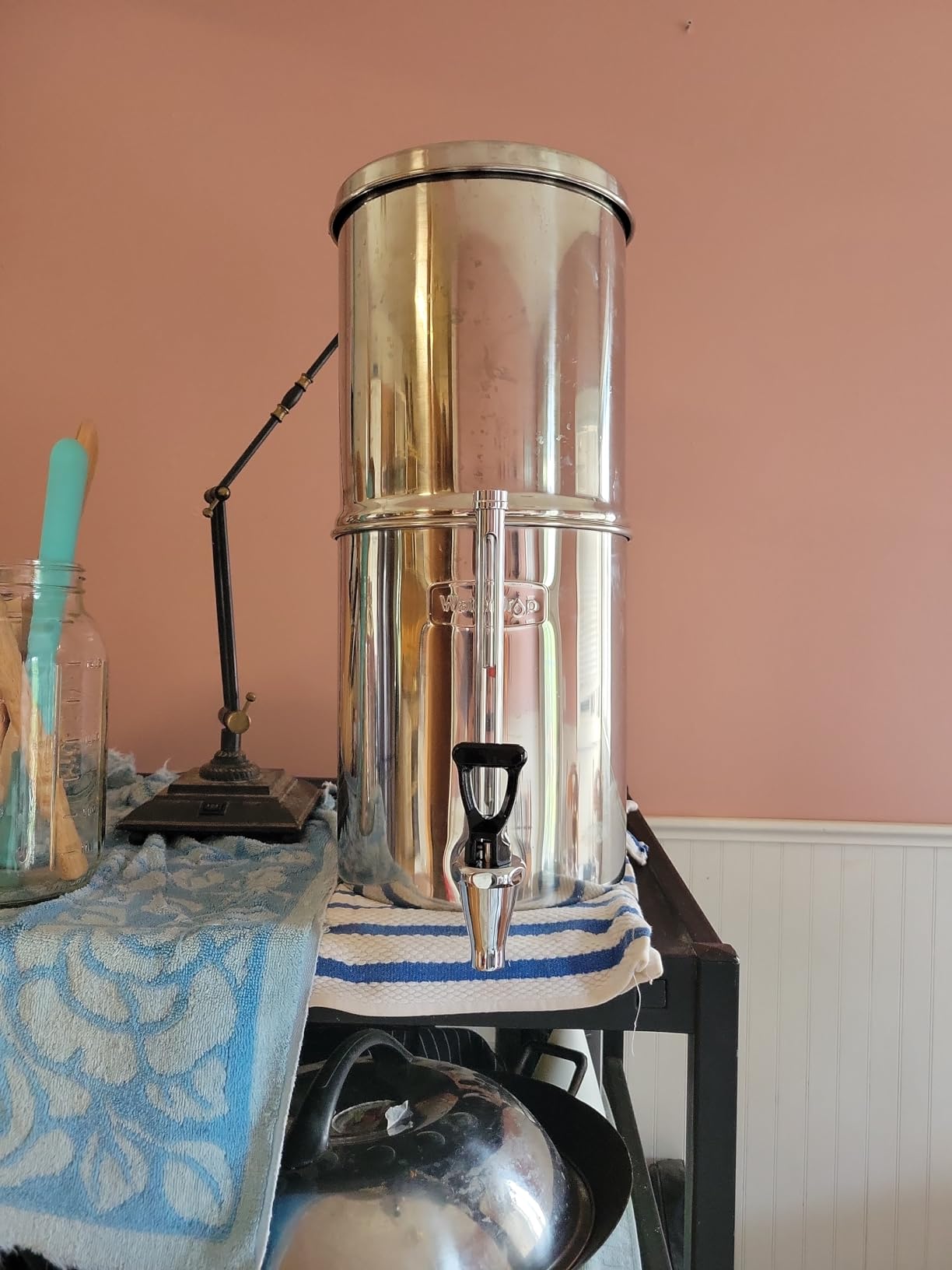
Two structural limitations are worth understanding. The upper chamber has only two installation holes, which caps it at two carbon filters or two fluoride filters and rules out doubling up media types in the same run.
Carbon media also does nothing for dissolved solids, and the listed TDS support tops out at 500 ppm. For more on what that ceiling means in practice, our iron water filter comparison covers the mineral side in detail.
Carbon or hollow fiber for an emergency?
Carbon is the better answer when the threat is taste, odor, chlorine, and metals, which describes a lot of urban outage scenarios. Hollow fiber is the better answer when the threat is sediment and protozoa in untreated surface water.
If you can only own one filter and your water could come from either a tap or a creek, a membrane-based unit is the safer default.
How does the filter budget add up?
The two carbon filters are rated to 6000 gallons and the two fluoride filters to 1000 gallons, so the replacement schedule depends on which media you install. Carbon is the long-run option; fluoride filters are for a specific local problem.
Reviewers like the bundle of four included cartridges, and the recurring complaint is simply that you keep buying more over the years.
9. Purewell 2.25G PW-KS – a sight window you will actually use
Purewell 2.25G Gravity Water Filter System with Water Level Window, 3-Stage 0.01μm Ultra-Filtration Stainless Steel Countertop System with 2 Filters and Stand, Reduce 99% Chlorine, PW-KS
Water level window
0.01 micron three stage
0.06 gpm flow
2.25 gallon capacity
Pros
- Transparent window shows the water level without opening the unit
- 0.01 micron three stage composite filtration
- Stainless steel build with spigot and stand
- 4 gallons per hour flow despite fine pores
Cons
- Does not lower TDS value
- Topping up over a full lower chamber causes leaks
- Elements replaced at 6 months even with light use
The water level window is the reason to choose this over the sibling Purewell unit, and it is a genuinely useful upgrade once you are filtering for several people. You can see how much filtered water you have without lifting a 20 inch chamber off its stand.
Underneath, the filtration is the same three-stage composite: a 0.01-micron hollow fiber UF membrane, a silver ion membrane, and an activated carbon block. Flow holds at 4 gallons per hour and maximum flow rate is listed at 0.06 gpm.
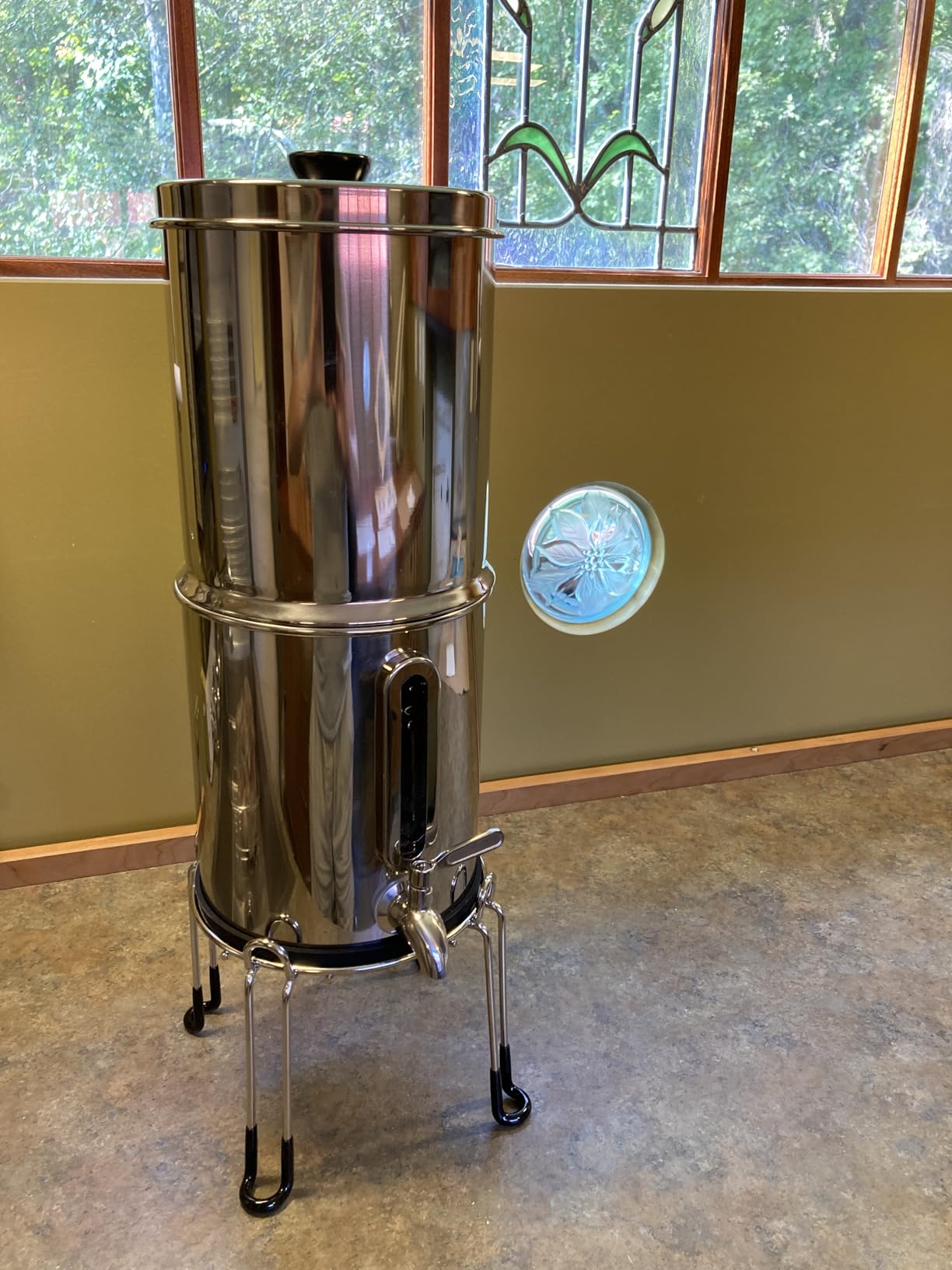
The handling rule catches people out. Adding water to the top chamber while the bottom chamber is full causes leaking, so you always drain the lower chamber before a refill, no matter how inconvenient that feels mid-crisis.
Like the other Purewell system, it does not lower TDS and the manufacturer recommends replacing elements every 6 months regardless of how much water has passed through.
Is the window worth choosing one over the other?
If you are refilling several times a day for a household, yes. If the unit will sit mostly idle as part of an emergency cache, the window matters less than the size of your stored water reserve.
Window aside, this is the same filtration platform, so pick on capacity and on how often you will actually be standing in front of it.
Where does it fit in a kitchen or RV?
At 8.8 inches square and 20 inches tall it is a full-footprint countertop unit, similar to the other 2.25 gallon systems. It needs no electricity, so it works in a room without power during an outage.
For a fixed installation, our countertop water filter roundup compares the fixed-location options side by side.
10. Alexapure Pro – a large carbon system for well and iron water
Alexapure Pro Stainless Steel Water Filtration System – 200 Gallon Capacity
200 gallon rated capacity
Carbon block media
Stainless steel body
Slow spigot flow
Pros
- Rated for 200 gallons of treated water
- Targets lead
- viruses
- cysts
- chlorine and fluoride
- Owners report strong results on iron-heavy well water
- Stainless steel body looks well made
Cons
- Spigot flow is slow and silicone washers have leaked
- Middle seal can leak if the top is overfilled
- Replacement filters are expensive
Owners consistently single out one scenario for this system: iron-heavy well water and brown water. Several report the unit correcting chlorine smell, iron content, and discolored output that other filters in this roundup were not designed to address.
The listed contaminant coverage is broad, naming lead, viruses, cysts, chlorine, and fluoride among 200-plus common contaminants. The 200 gallon rating and stainless steel body make it a plausible long-term home installation.
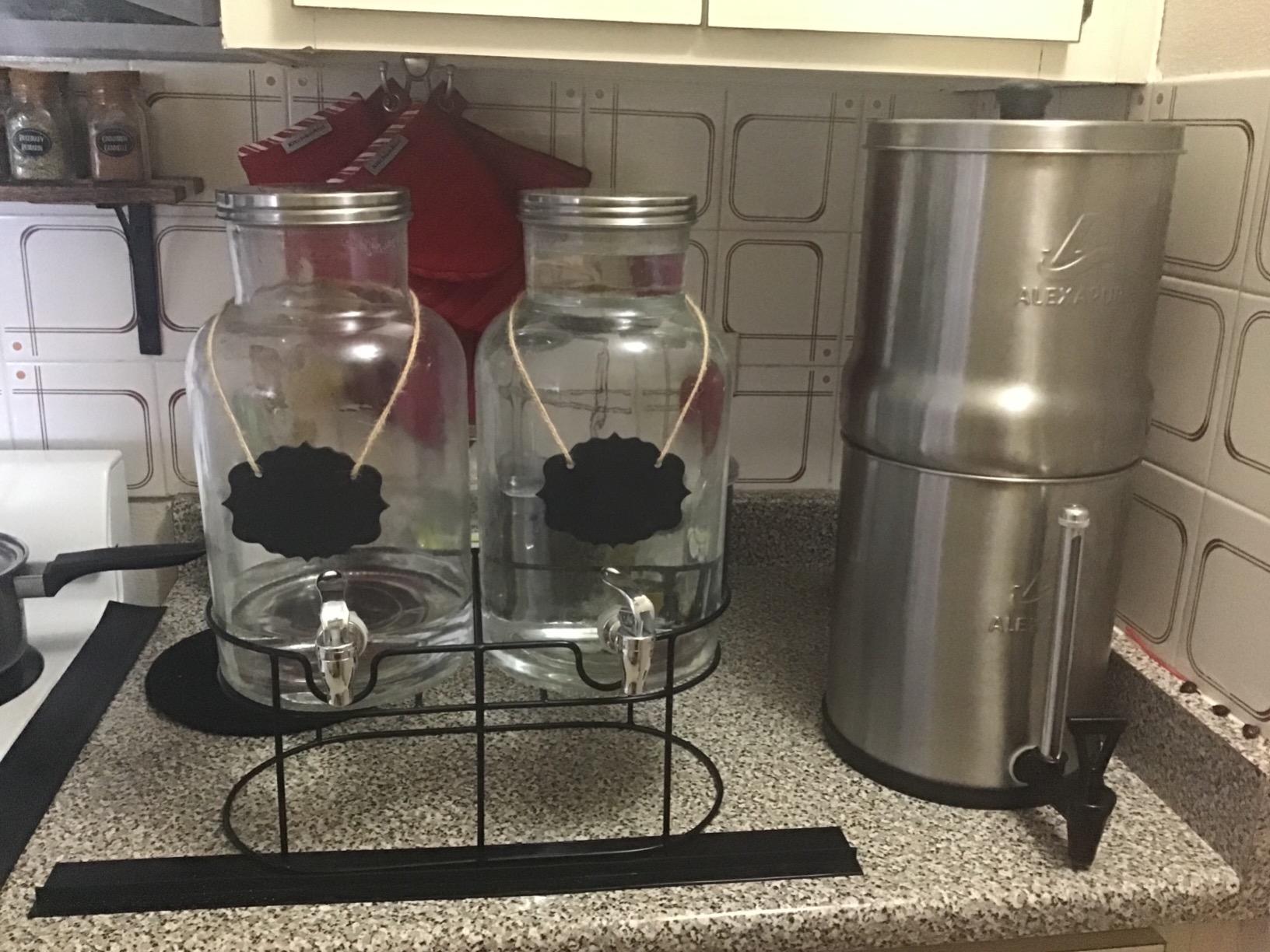
Read the claim language with care. Marketing that names viruses is a manufacturer statement, and the tap seal design described below is the first thing owners complain about, so treat this as a home well and taste system rather than a certified emergency purifier.
Replacement filters are the running cost people mention most, and the long-term figure is what makes the 200 gallon rating meaningful in the first place.
Is this a go-bag filter?
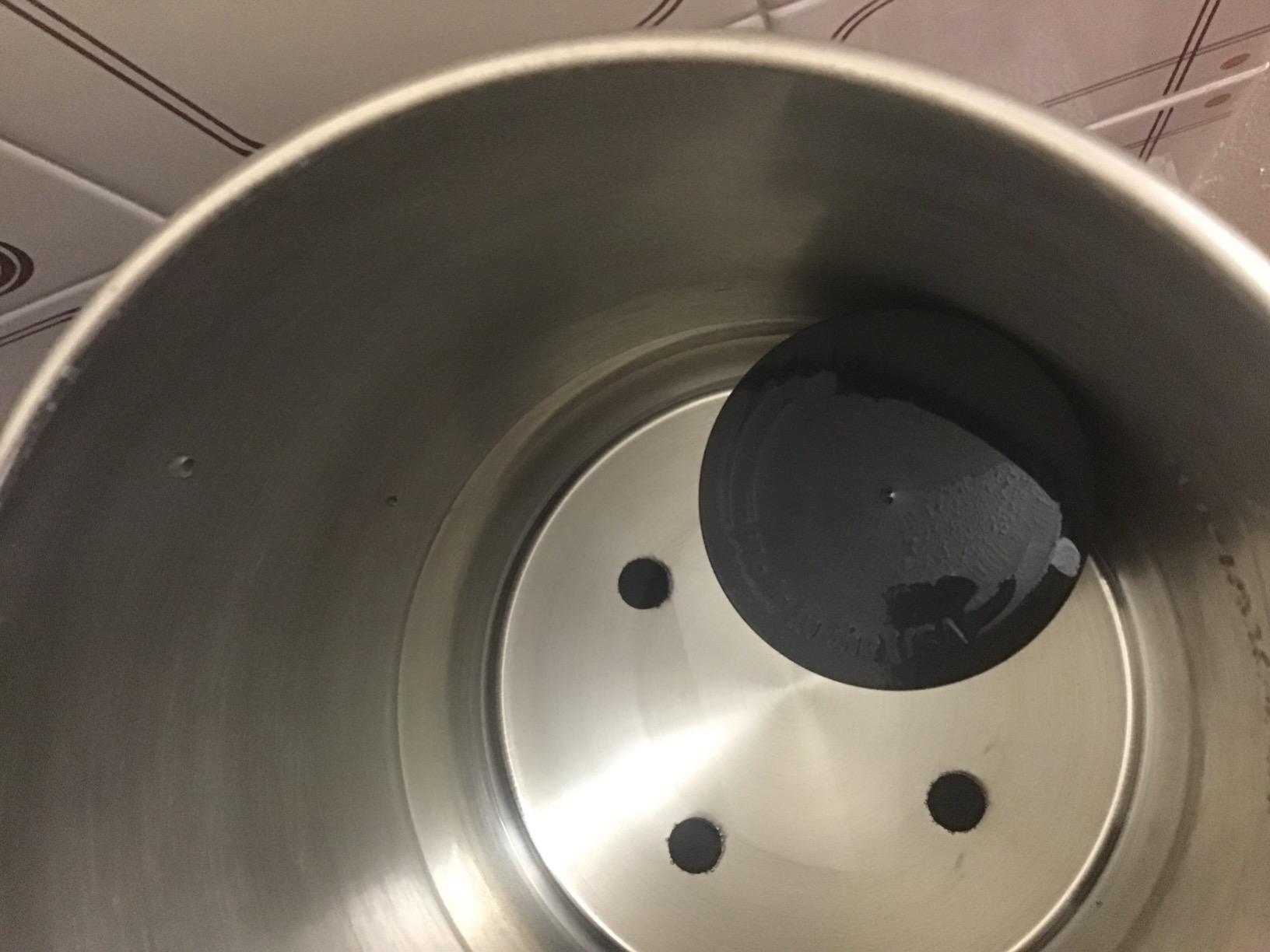
No. At 14 by 9 by 9 inches and 3.1 kilograms, this is a countertop unit that stays put. One long-term owner notes it is tall enough to interfere with overhead cabinet doors, so measure your counter clearance before committing.
It belongs in a household that draws from a private well, not in a bag you grab when the grid goes down.
What do owners report breaking?
The spigot. Flow is slow and the tap assembly is sealed only by silicone washers that have leaked on some units. The top and bottom tanks can also leak around the middle seal if you overfill the top while the lower chamber still holds filtered water.
Some units develop red rust or bacteria marks in scratch lines on the upper tank rim, so rinse and dry the rim rather than let water sit on it.
How Much Water Do You Actually Need?
Reservoir capacity in gallons means nothing until you convert it to people-days. Plan on one gallon per person per day for drinking and cooking, and about half that for bathing and hygiene if you can stretch it.
One person, 72 hours: 3 gallons of reserve plus whatever the filter turns during the event.
Two adults, 72 hours: 6 gallons of reserve, so at least three full 2.25 gallon reservoir cycles.
Family of four, one week: 28 gallons, which no countertop unit holds, so your filter is refilling continuously while stored water covers the gap.
Add a personal reserve: forum advice is to rotate stored water regularly and keep at least one container per person that you do not touch.
The practical takeaway is that a 2.25 gallon countertop unit is sized for a family of one to four for a day, while a 3 to 6 liter bag system is a supplement rather than a household supply. Sizing the stored reserve and the filter separately is the mistake people make.
Filter vs Purifier: What a Gravity System Can and Cannot Do
Every filter in this roundup except one removes bacteria and protozoa and stops there. E. coli, Giardia, and Cryptosporidium are large enough to be strained out by a 0.1-micron hollow fiber element, which is the entire reason gravity filters work so well on freshwater.
Viruses measure roughly 0.02 to 0.08 micron and pass through those pores. Removing them takes a 0.02-micron element, UV light, or chemical treatment, and the LifeStraw Family unit on this list is the only one making that claim. Chemical contamination is a different problem entirely, and no gravity filter on the market addresses it.
The forum consensus is consistent: near human contamination, a filter alone is not enough. Treat retention pond water and flood water as contaminated with human waste, and use this stack instead of one filter:
A cloth or sock pre-filter over the fill, or let sediment settle and pour off the top layer.
The gravity filter for bulk water, which handles bacteria and protozoa.
Chlorine dioxide tablets, a boil, or a UV wand for virus cover.
Stored water you rotate on a schedule, rotated before it ages out.
Which Kit Is the Filter For?
Match the unit to the kit, not the other way around. A 72-hour go-bag wants the lightest thing that works, and a family of four for a week wants capacity plus a stored reserve that the filter continuously tops up.
72-hour go-bag: the SimPure 3L at 2.8 ounces, or the Waterdrop Gravity Straw for its 700 ml per minute flow. Both pack flat, both run on gravity, and both fit alongside tablets in a duffel.
Home backup, one to four people: the Big Berkey 2.25 Gallon, or the Purewell PW-KS if you want the water level window. Stainless steel, no electricity, and enough reservoir to cut down on refills.
RV or apartment with no plumbing: the Travel Berkey at 1.5 gallons is the compact fixed option, and our RV water filter guide covers the rest of the vehicle-side kit.
Group basecamp or volunteer relief bundle: the Membrane Solutions 6L Pro, with the widest independent certification and the largest portable reservoir here.
Any scenario involving sewage risk: the LifeStraw Family 12 L, plus tablets, without debate.
Priming, Backflushing, and Storing a Filter You Rarely Use
The real failure mode in emergency water gear is not a bad filter. It is a filter that sat in a closet for eleven months, froze, or dried out, and you found out at the worst possible time.
Prime hollow fiber systems before first use. Fill the upper chamber, let it drain through the element until the effluent runs clear, and discard the first gallon. Prime once before storing the unit, and again before a trip if it has been sitting for months. Ceramic elements are cleaned by backflushing with clean water rather than primed.
Backflushing matters more than most people expect. Reversing the flow through the element clears sediment that would otherwise cut your output to a trickle. The Waterdrop straw has a backflush function built in, and other systems use a syringe or plunger attachment. Do it after every use on dirty water.
For storage, drain the unit completely, pack the chambers so the seals are not pinched, and keep it somewhere it cannot freeze. Check the element date before you rely on it, because elements have a shelf life independent of how much water you have run through them.
What We Would Skip
Three setups come up repeatedly in forum threads as things that fail people, and we would steer you away from all of them.
Sub-2-liter jugs. Forum reviewers describe constant refills as the defining complaint with small units, and a filter you refill every twenty minutes is a filter you will stop using.
Any system with no pre-filter path. If your water will be silty, you need a cloth, a sock, or a coffee filter in the chain. This is the deal breaker that ends a filter early more often than any other.
Straws with a 30-day warranty. A short element warranty tells you what the manufacturer expects, and reviewers treat it as a red flag. Every unit on this list has an element rated in the thousands of gallons, which is what a long-horizon emergency filter should look like.
Frequently Asked Questions
Do gravity water filters actually work?
Yes, for bacteria and protozoa. Standard 0.1-micron hollow fiber elements are far larger than E. coli, Giardia, and Cryptosporidium, so those organisms are physically strained out of the water. Gravity filters do not remove viruses, which pass through those pores, and they do not fix chemical contamination. Treat a gravity filter as a first-stage tool paired with chlorine dioxide tablets, a UV purifier, or a boil.
Can a gravity water filter remove viruses?
Not at standard pore sizes. Viruses measure roughly 0.02 to 0.08 micron and pass through 0.1-micron hollow fiber elements. Removing them requires a 0.02-micron purifier such as the LifeStraw Family unit in this roundup, UV light, or chemical treatment. In North American freshwater the realistic risks are bacterial and protozoan, which standard filters do handle.
How much water does one person need per day in an emergency?
Plan on one gallon per person per day for drinking and cooking, and about half that for bathing and hygiene if you can stretch it. A 72-hour kit is three gallons per person, so a two-person household needs a 6 gallon reserve plus a filter that can refill it repeatedly through the day.
Do I need a filter or a purifier for emergency prep?
A filter is enough for lakes, streams, rainwater, and chlorinated tap water, because bacteria and protozoa are the realistic threats. A purifier earns its place when sewage or human contamination is plausible, such as retention pond water or flood water. Buying a filter and keeping chlorine dioxide tablets covers both cases without a second expensive unit.
How long can a gravity water filter be stored before use?
Store it drained and packed so the seals are not pinched, somewhere it cannot freeze. Prime the element once before storing and again before a trip if the unit has been sitting for months. Elements also have a shelf life of their own, so check the date before you depend on a unit you have never run.
Can I use a gravity filter on muddy water?
Only after sediment control. Let the water settle and pour off the top layer, then pass it through a cloth, sock, or coffee filter before it reaches the element. Skipping that step is the most common reason hollow fiber filters clog and lose flow, and a pre-filter costs almost nothing.
How often should I replace a gravity filter cartridge?
Follow the rated gallon or liter figure rather than the calendar. Countertop elements on this list are rated from 3000 to 6000 gallons, while portable elements run around 1320 to 1400 gallons. A filter used only during emergencies can last years, but a manufacturer that specifies a 6 month interval, as Purewell does, expects you to follow it.
Final Verdict
The best gravity water filters for emergency prep are not the ones with the longest specification sheet. They are the ones that start working the moment you fill them, keep working for years without power, and sit in a bag or a closet without quietly degrading.
The Big Berkey 2.25 Gallon takes our top spot for proven longevity and a 6000 gallon element rating, and the LifeStraw Family 12 L is the pick for anyone whose water sources might be near sewage. Whatever you choose, budget the extras nobody sells you: chlorine dioxide tablets, a cloth for pre-filtering, a separate clean container, and a written rotation schedule for stored water. That kit is what turns a filter into an emergency water plan. Updated for 2026.