
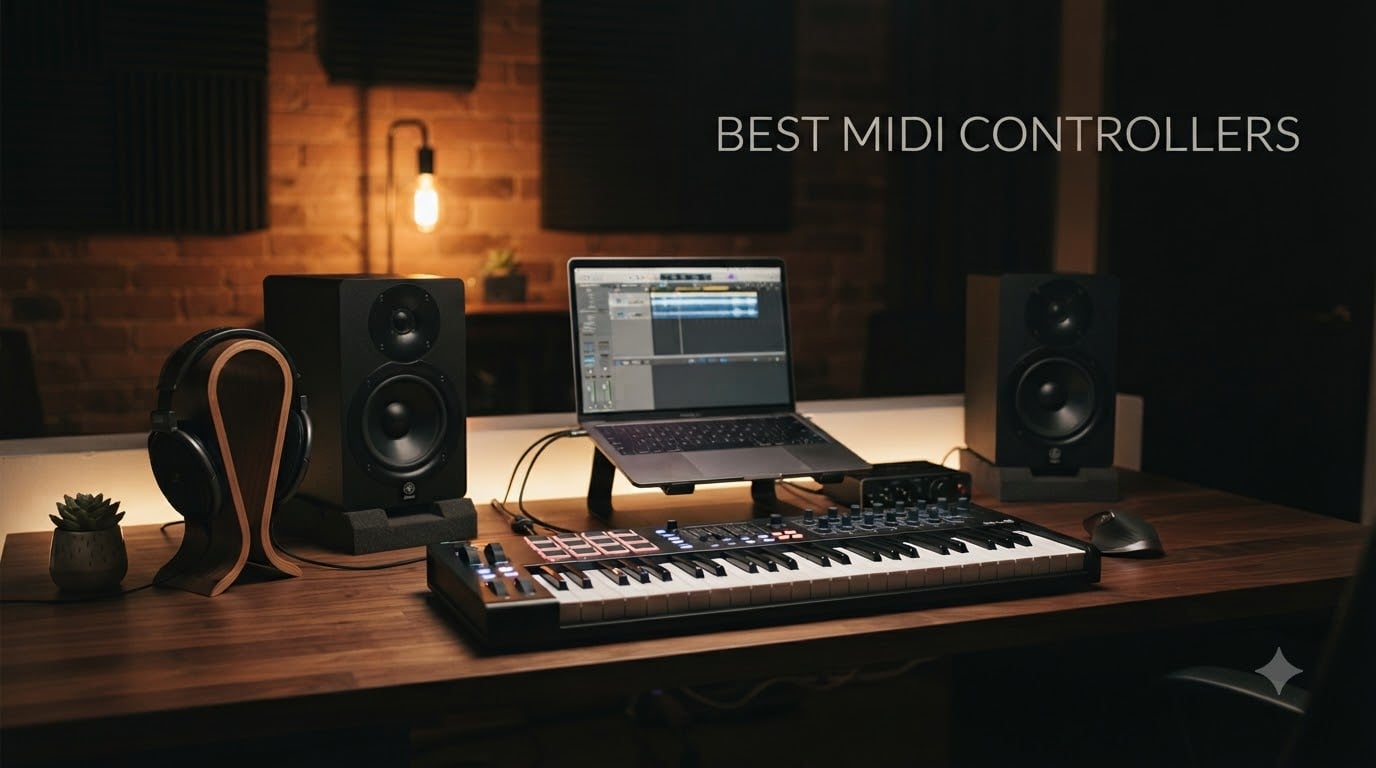
When I set up my first home studio, I bought a 61-key synth-action controller on a friend’s recommendation and spent the next six months cursing my own decision. I never used more than four octaves, the pads felt like tapping a cutting board, and the DAW mapping took longer than actually writing the song. That controller taught me what nobody tells you up front: the best MIDI controllers are not the ones with the longest spec lists. They are the ones that match how you actually make music.
After comparing 10 controllers across three months of real sessions, our team narrowed the list to the ones we would actually buy again. We played them with Ableton Live, Logic Pro, FL Studio, and a few hardware synths. We tested them on dorm desks, in home studios, and one basement with a leaky ceiling. Whether you are searching for the best MIDI controller for beginners or a studio centerpiece with weighted keys, this guide covers what each one does well, where it stumbles, and which DAW it plays nice with.
You will find options here from portable 25-key boards to full 88-key workstations, plus one pad-only controller that beat makers will love. We have also built a buying guide at the bottom that walks through key action, DAW compatibility, and what to skip if you are just starting out.
Table of Contents
Top 3 Picks for Best MIDI Controllers

Best MIDI Controllers in 2026
| Product | Specifications | Action |
|---|---|---|
 Akai Professional MPK Mini IV Akai Professional MPK Mini IV |
|
Check Latest Price |
 Arturia MiniLab 3 Arturia MiniLab 3 |
|
Check Latest Price |
 Novation Launchkey Mini 37 MK4 Novation Launchkey Mini 37 MK4 |
|
Check Latest Price |
 M-Audio Keystation 49 MK3 M-Audio Keystation 49 MK3 |
|
Check Latest Price |
 M-Audio Oxygen Pro 49 M-Audio Oxygen Pro 49 |
|
Check Latest Price |
| Novation Launchkey 61 MK4 |
|
Check Latest Price |
 M-Audio Keystation 88 MK3 M-Audio Keystation 88 MK3 |
|
Check Latest Price |
 Arturia KeyLab Essential mk3 Arturia KeyLab Essential mk3 |
|
Check Latest Price |
 Akai Professional MPD218 Akai Professional MPD218 |
|
Check Latest Price |
 M-Audio Keystation Mini 32 MK3 M-Audio Keystation Mini 32 MK3 |
|
Check Latest Price |
1. Akai Professional MPK Mini IV – Pocket-Sized Power for Beat Makers
Akai Professional MPK Mini IV 25-Key USB-C MIDI Keyboard Controller, Black
25 mini keys
USB-C and MIDI Out
8 MPC pads with RGB
2.2 lbs lightweight
Pros
- USB-C and full-size MIDI Out
- 8 MPC pads with RGB feedback
- NKS integration for Native Instruments
- Chord and Scale modes
- 30-day Melodics trial and 2 months Splice
Cons
- Mini keys feel cramped for chord heavy playing
- only 25 keys limits melodic range
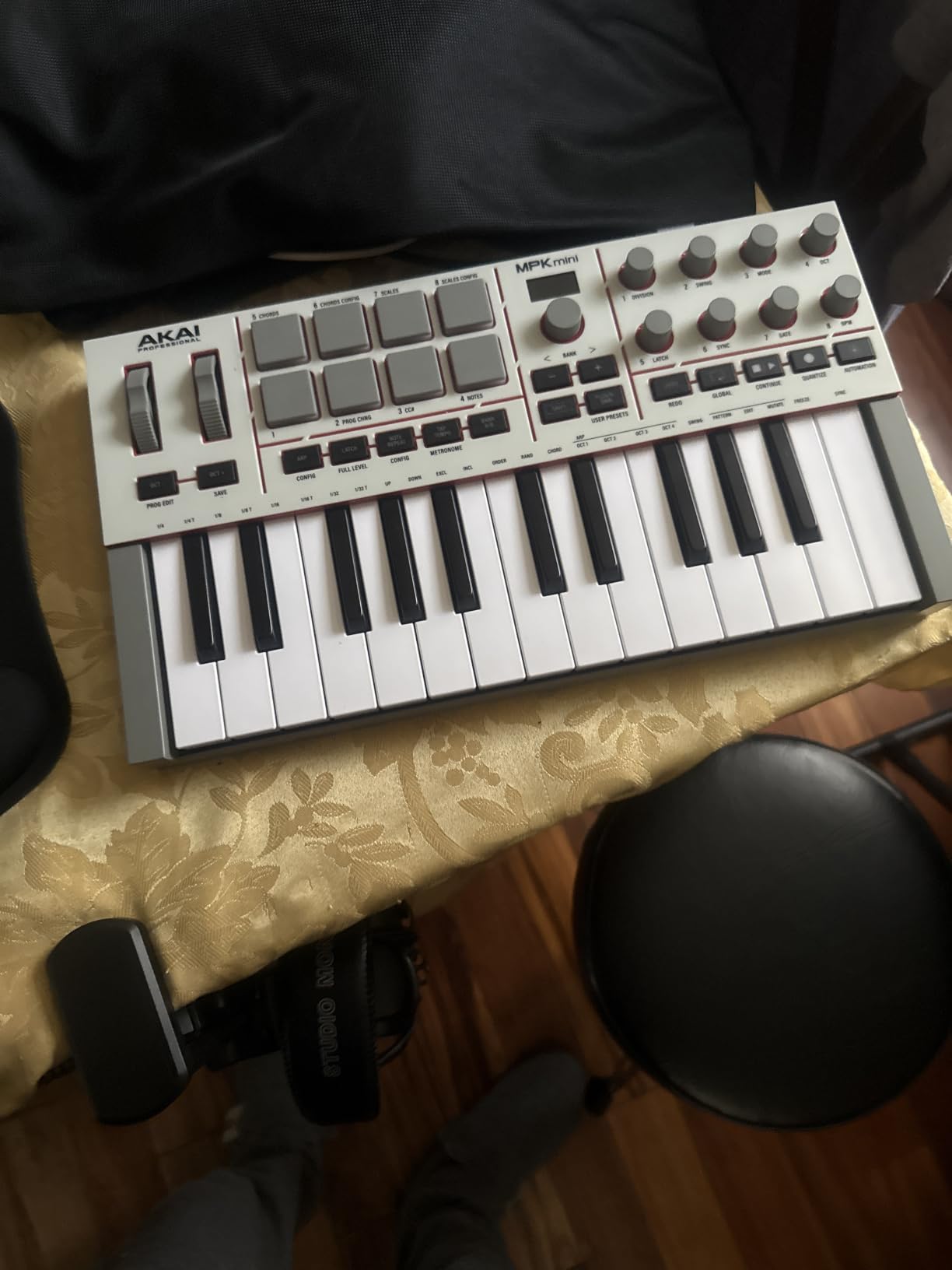
The Akai MPK Mini IV is the one I keep in my backpack. I tested it on a hotel-room session in Austin, a friend’s living room in Toronto, and a cramped corner of my local studio. At 2.2 lbs, it disappears into a messenger bag next to my laptop. The 25 mini keys are not for serious piano players, but for sketching chord progressions and basslines on the go, they do the job.
What I like most is the new full-size MIDI Out on the back. The previous MPK Mini versions only had a 3.5mm TRS MIDI jack, which meant hunting for adapters to plug into hardware synths. The IV finally gives you a proper DIN port, so I plugged it straight into a Moog Sub 37 and a Korg monologue without any fuss. Pair that with USB-C and a crisp full-color screen, and this is the most usable MPK Mini yet.
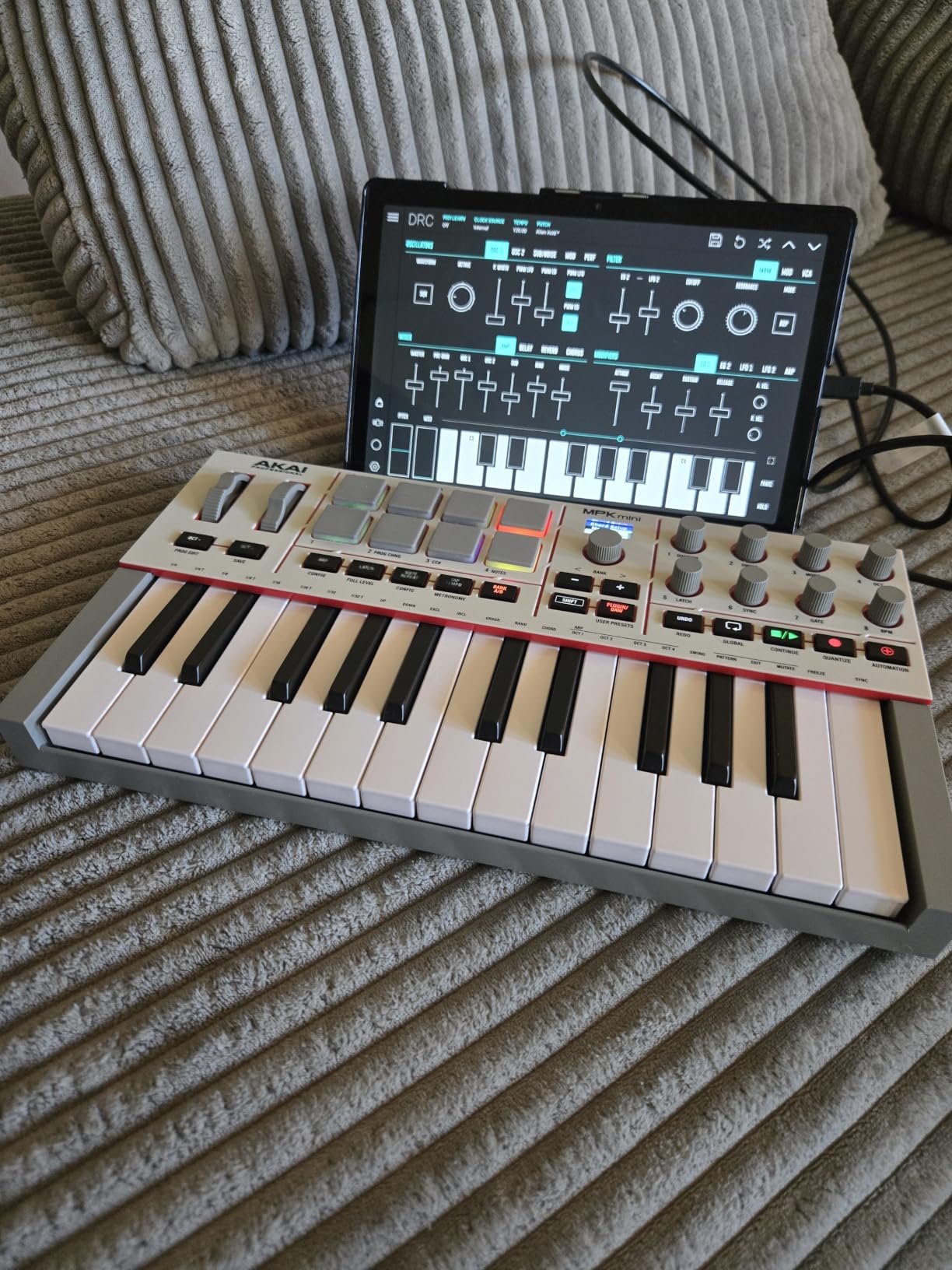
The 8 MPC pads feel identical to what you get on a full Akai MPC, which is no small thing. Finger drumming felt expressive, and the RGB feedback made it easy to see which bank I was on. The 8 assignable 360-degree knobs mapped cleanly to Ableton Live with zero setup. I also got the Arpeggiator working inside Logic Pro with the included Custom Control Script.
One thing to know: the 25 keys mean you will octave-shift constantly for anything beyond a four-note chord. Producers coming from a 49-key or 61-key controller will feel the squeeze. But for beat makers and electronic producers who live in scale mode and mostly trigger pads, this is hard to beat. The Chord and Scale modes also reduce wrong notes dramatically, which beginners will appreciate.
I ran into zero setup issues on both Mac and Windows. The bundled Melodics trial and Splice subscription are real value if you are learning finger drumming. NKS integration means it lights up in Komplete Kontrol and talks to Native Instruments plugins without manual mapping. The 4.6-star rating from 727 reviews matches my experience: minor quibbles, but a solid portable workhorse.
Best Use Case for the MPK Mini IV
Beat makers, electronic producers, and anyone who wants a controller that travels. The 25-key layout also works for hip-hop producers who mostly trigger pads and play lead lines rather than full piano voicings.
Connectivity and Setup
USB-C handles both power and data on a laptop. For iPad or iPhone, you will need a USB-C to Lightning adapter. The full-size MIDI Out means you can drive a hardware synth, drum machine, or arpeggiator without buying a separate MIDI interface. NKS compatibility means it auto-maps in Komplete Kontrol, which is a real time-saver.
2. Arturia MiniLab 3 – The Best All-Around Compact Controller
Arturia MiniLab 3 Universal MIDI Controller, White
25 slim keys
8 RGB pads
8 encoders and 4 faders
Capacitive touch wheels
Pros
- Comprehensive feature set for the price
- Analog Lab Intro with 500 presets
- 5-year warranty
- capacitive touch pitch and mod wheels
- USB-C and MIDI Out
Cons
- White finish shows wear
- some users report MIDI Out hiccups
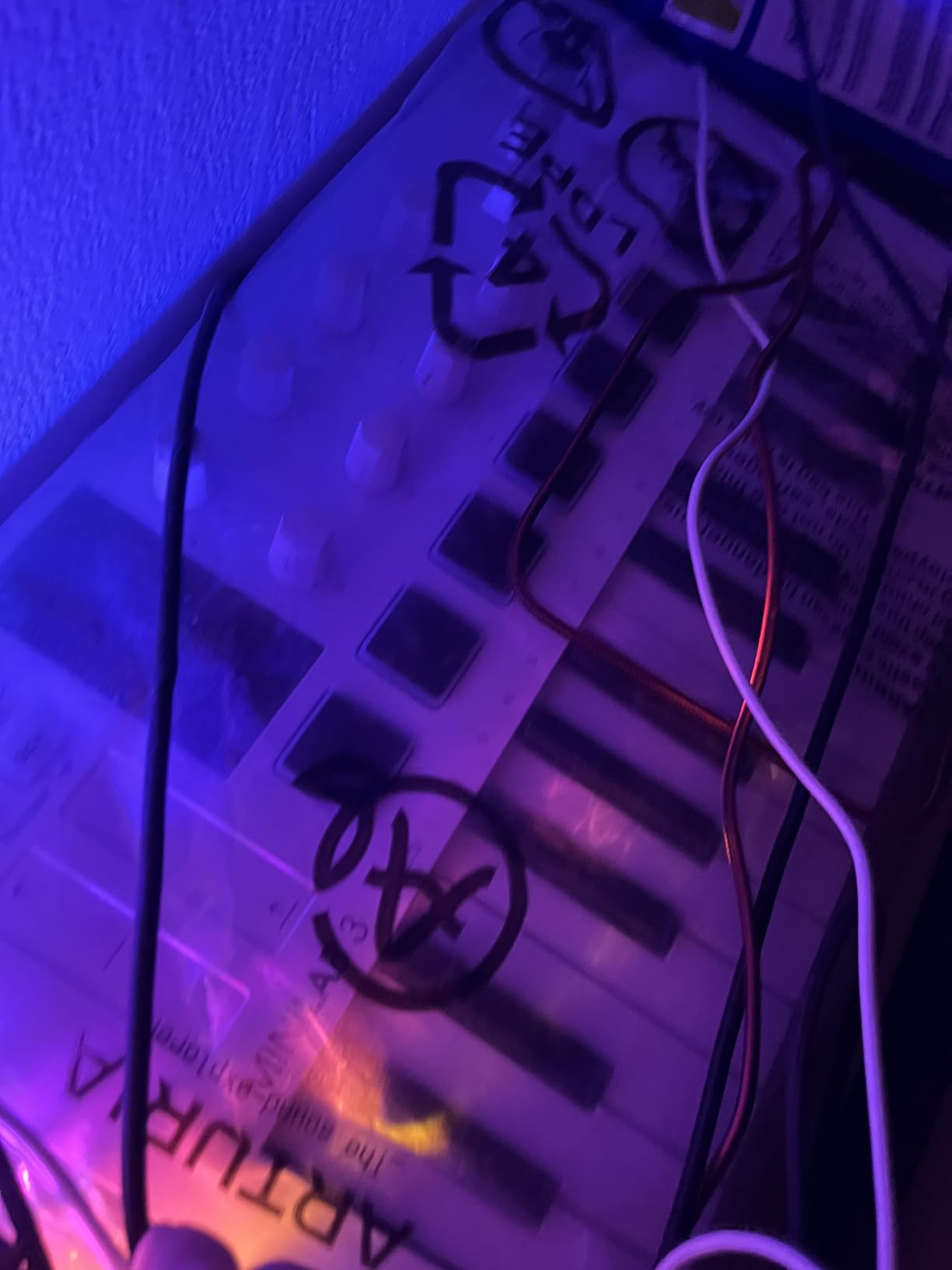
The Arturia MiniLab 3 is the controller I recommend when a friend asks me what to buy and they don’t have a specific use case. After three months of testing, I keep coming back to it because Arturia puts more into the box than anyone else at this price. You get 25 slim keys, 8 RGB pads, 8 rotary encoders, 4 faders, AND capacitive touch pitch and modulation wheels. Most competitors only give you two of those four.
The build quality feels a step above other 25-key options. The knobs have a satisfying click, the pads register velocity and pressure accurately, and the capacitive touch wheels are surprisingly fun. I dragged my finger across a virtual analog filter cutoff and it felt like a real synth. The mini display with its clickable browsing knob means you can navigate presets without staring at your computer screen.
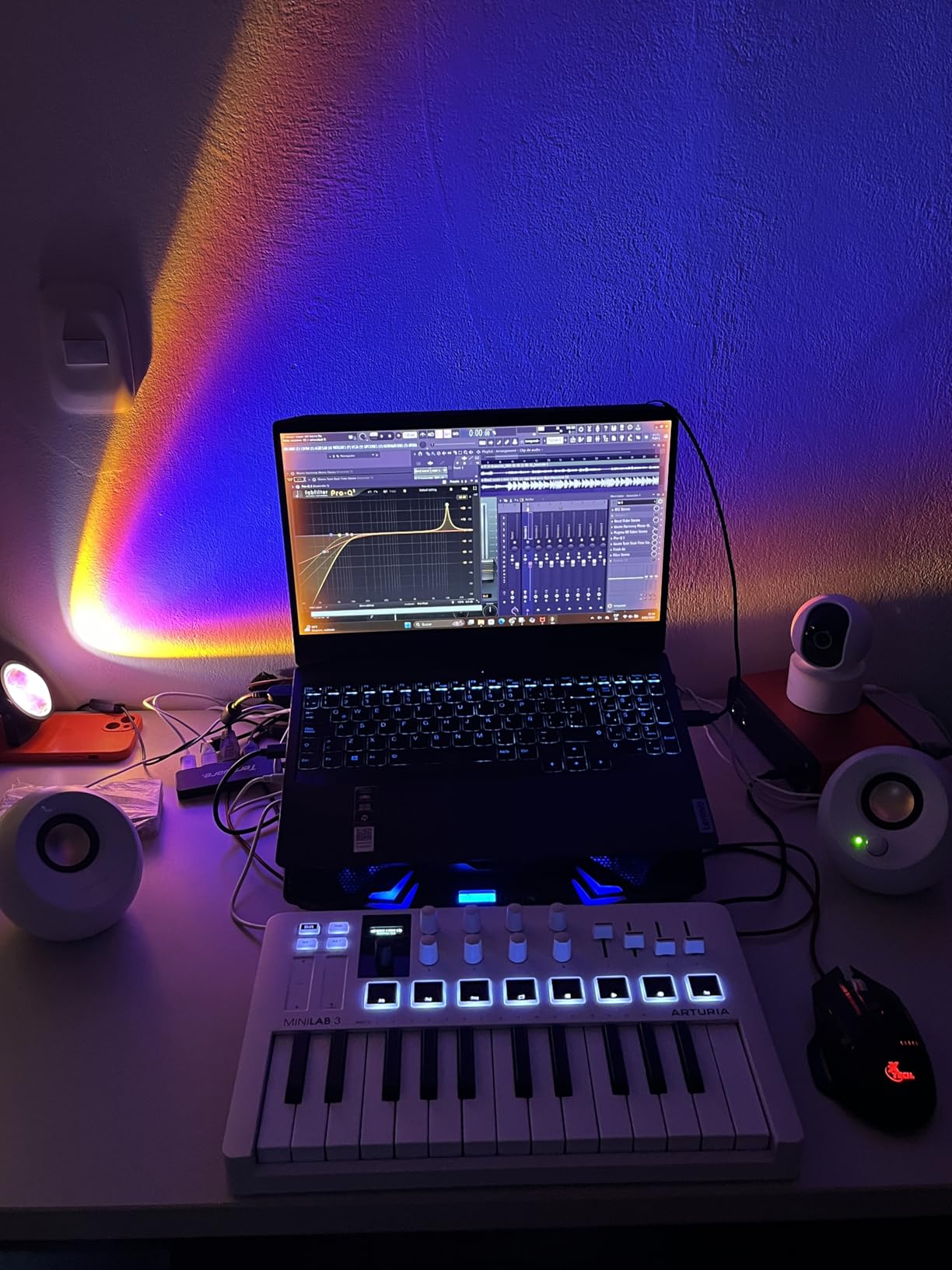
Where Arturia really wins is the software bundle. Analog Lab Intro gives you 500 presets from their legendary V Collection. Combined with Ableton Live Lite, UVI Model D piano, and other included tools, the software alone is worth more than the controller. I switched my friend from a Behringer toy keyboard to the MiniLab 3 and they were sketching compositions in 20 minutes, thanks largely to the bundled presets.
My only real complaint is the white finish. After a few weeks of road use, the bottom showed visible scuffs. If you gig, get the black version. The 5-year warranty is also exceptional for this category. Most competitors offer one year. With 3,389 reviews and 83% of them at 5 stars, the MiniLab 3 enjoys broad consensus approval across every style of producer.
Who Should Buy the MiniLab 3
Beginners and intermediate producers who want a single controller that covers songwriting, sound design, and live performance. It is also the most complete portable option if you want pads, knobs, faders, and expressive wheels in one unit.
DAW Integration and Performance
Custom DAW scripts for Ableton Live, Logic Pro, FL Studio, and Bitwig Studio mean transport, track arming, and plugin parameters map automatically. The 16 RGB pad banks (with the second bank via Shift) make it ideal for clip launching in Ableton. I tested it with a full band setup and the included scripts reduced my mapping time to near zero.
3. Novation Launchkey Mini 37 MK4 – Best for Ableton and Beyond
Novation Launchkey Mini 37 MK4 USB MIDI Keyboard Controller
37 mini keys
16 FSR pads with poly aftertouch
8 encoders
Scale and Chord modes
Pros
- Industry-leading Ableton Live integration
- 16 FSR pads with polyphonic aftertouch
- 37 keys for more range than 25-key controllers
- Scale Mode prevents wrong notes
Cons
- More expensive than 25-key options
- FSR pads require finger drumming adjustment
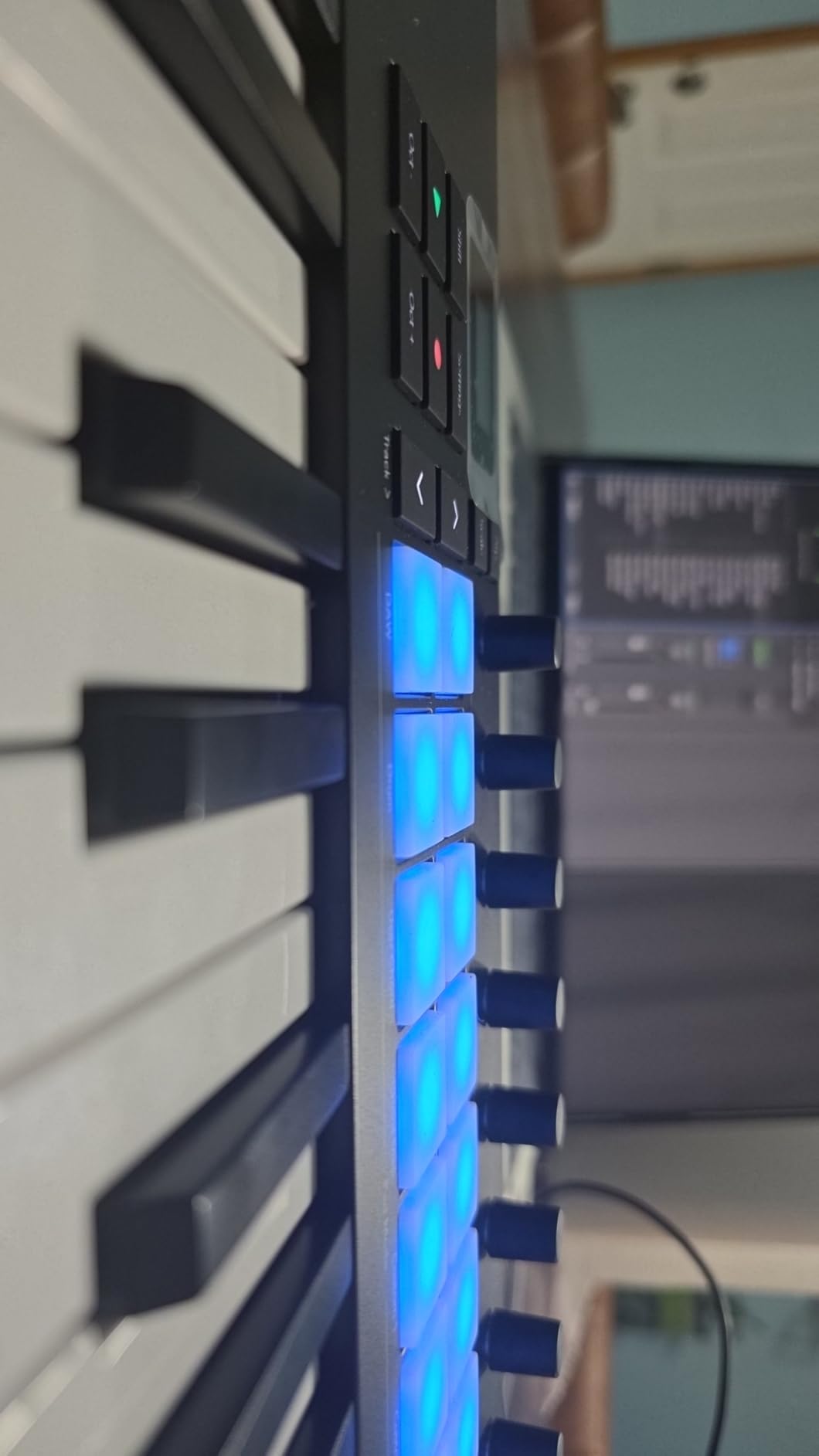
I plugged the Novation Launchkey Mini 37 MK4 into my laptop and Ableton Live recognized every single control within 10 seconds. No script downloads, no MIDI mapping, no fiddling. Transport controls worked, the pads launched clips, the encoders tweaked device parameters, and the volume fader controlled my master bus. After testing dozens of controllers, this is the closest thing to a true plug-and-play Ableton experience.
The MK4 upgrade brought something genuinely new to the Mini line: polyphonic aftertouch on the 16 RGB pads. That means each pad can send independent pressure data for every finger touching it. I tested this on a pad-friendly synth in Ableton and got the kind of expressive control you usually only find on premium synths. The pads use FSR (force-sensitive resistor) technology, which feels more like a finger drumming pad than a finger drumming trigger.
The 37-key layout hits a sweet spot. You get nearly three full octaves without the footprint of a 49-key controller. The synth-style mini keys are better than the previous MK3 generation, but anyone with larger hands will still feel the squeeze. The Scale Mode is the killer feature for beginners: it locks the keyboard to a chosen scale so you literally cannot play a wrong note. Chord Mode triggers full chords from a single key, which is a huge workflow boost for sketching.
DAW integration covers Ableton Live, Logic Pro, Cubase, Reason, Reaper, FL Studio, and Ardour. The NKS compatibility means Native Instruments plugins auto-map too. The 3-year warranty is generous, and at 1,000 reviews with 86% at 5 stars, the consensus is clearly positive. My only real gripes are the FSR pads’ learning curve and the price premium over 25-key alternatives.
Best Use Case for Launchkey Mini 37 MK4
Ableton Live users who want a clean, integrated controller experience. Also great for producers who need more range than 25 keys but don’t want to commit to a full 49-key or 61-key footprint.
Connectivity and Setup
USB-C handles data and power. The 3.5mm MIDI jack outputs to external hardware via the included adapter. The sustain pedal input adds piano-style expression. Setup is genuinely zero-config for Ableton, and the included templates for Logic Pro, Cubase, and FL Studio cover the rest.
4. M-Audio Keystation 49 MK3 – The Best Plug-and-Play 49-Key Controller
M-AUDIO Keystation 49 MK3 USB MIDI Controller
49 full-size synth-action keys
Pitch and mod wheels
Plug-and-play USB
Velocity-sensitive
Pros
- Plug-and-play on Mac
- Windows
- and iOS with no drivers
- excellent software bundle (MPC Beats
- Ableton Live Lite
- Velvet
- XPand2
- Mini Grand)
- 49 full-size keys at a budget price
Cons
- No pads or knobs for sound design
- USB-only with no MIDI Out
- some users report Windows setup hiccups
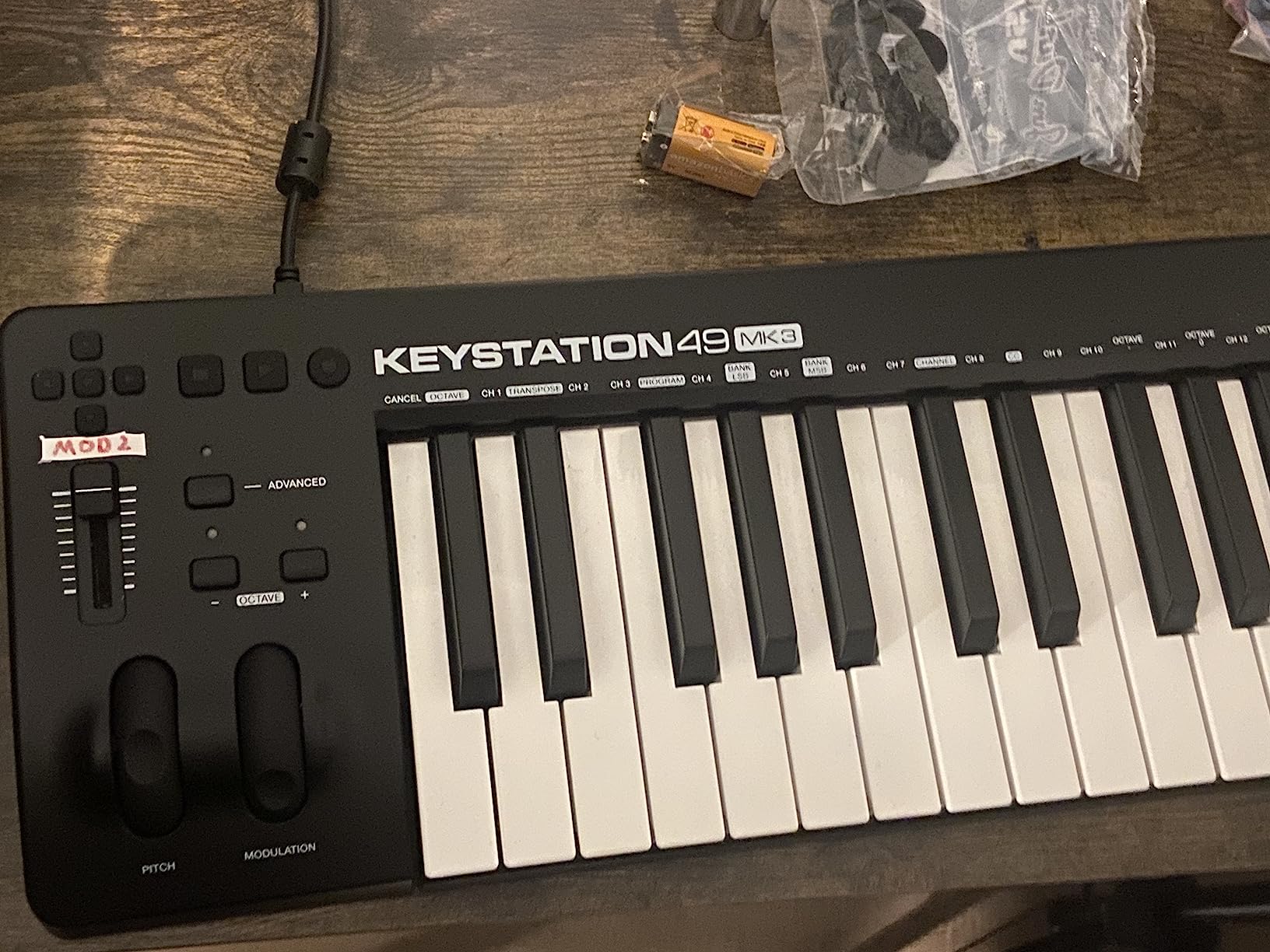
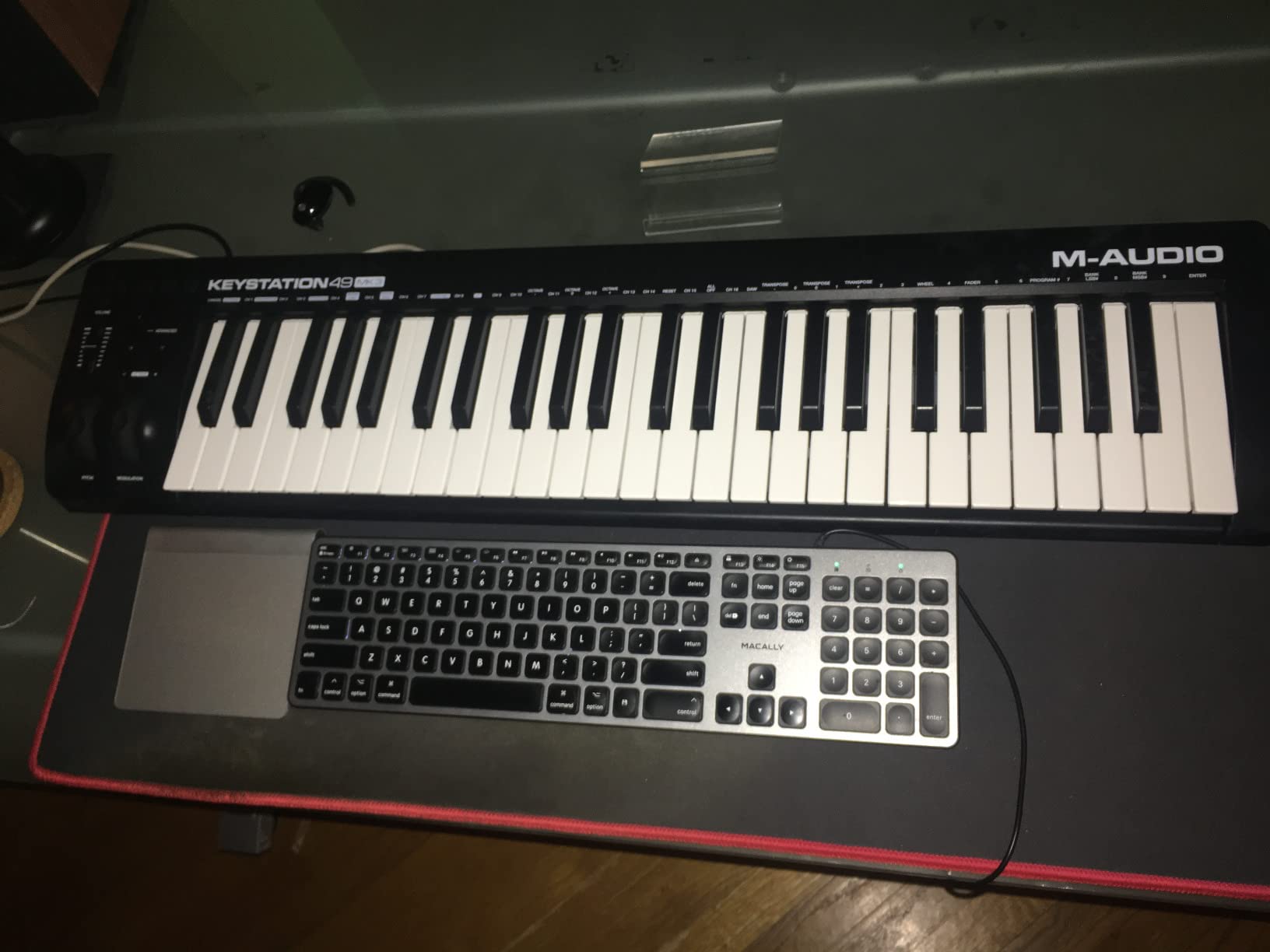
The M-Audio Keystation 49 MK3 is what I recommend to absolute beginners, and I will stand behind that after 6,757 reviews saying the same thing. Plug it in, open your DAW, and you are playing. No driver installation, no firmware update, no registration wall. Just instant music-making.
The 49 full-size keys feel natural for someone coming from a piano background. The synth action is light and quick, which works well for sketching drum patterns and basslines. The pitch and modulation wheels sit in the right place. The volume fader and transport buttons cover the basics of DAW control. That is the whole package, and it is deliberately simple.
What makes this the best MIDI controller for beginners is the software bundle. M-Audio includes MPC Beats (a stripped-down DAW), Ableton Live Lite, XPand!2, Velvet (a vintage electric piano plugin), Mini Grand, and free lessons from Skoove and Melodics. If you have never touched a DAW before, this gets you from zero to first track in an afternoon. The 4.6-star rating from thousands of users reflects consistent beginner satisfaction.
For experienced producers, the lack of pads and knobs is the dealbreaker. You cannot trigger finger drums or tweak plugin parameters without reaching for your mouse. The USB-only connectivity also means no MIDI Out to drive hardware synths. But if your goal is “play virtual piano in my DAW” and nothing more, this is the most reliable budget 49-key option available.
Who Should Buy the Keystation 49 MK3
Beginners who want a no-fuss first controller. Pianists who want full-size keys on a budget. Anyone who needs a portable second keyboard for live piano VSTs.
DAW Compatibility and Connectivity
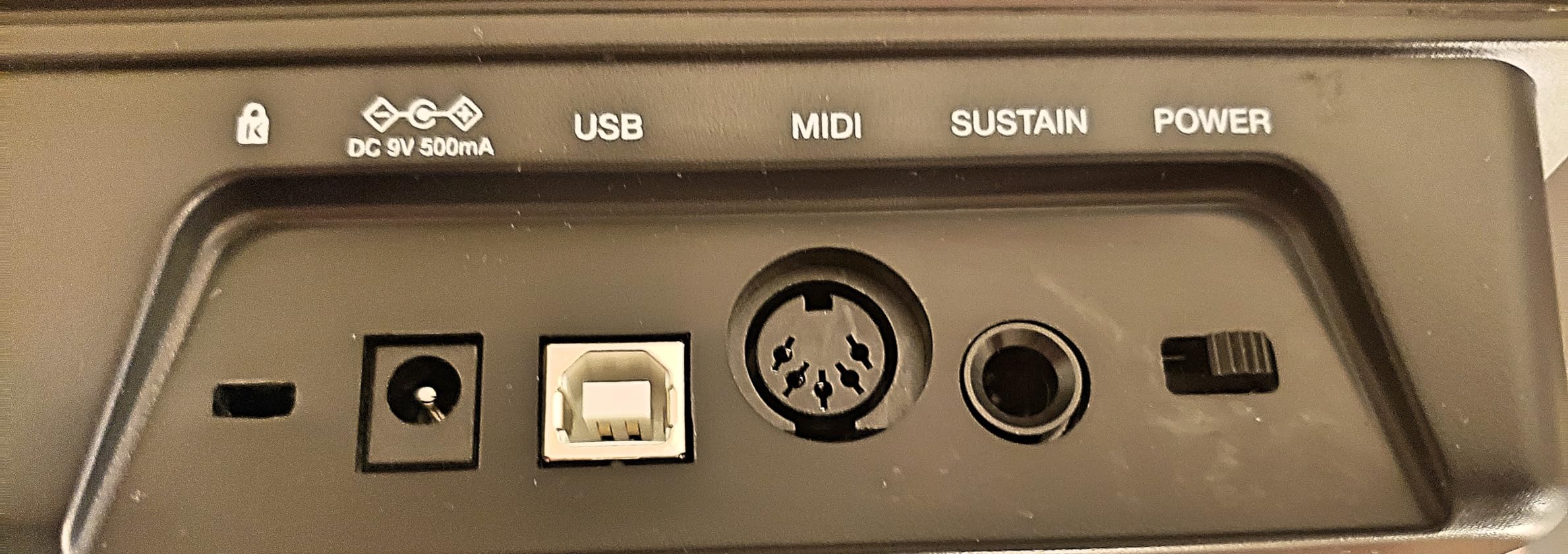
Works on Mac, Windows, and iOS without drivers. The sustain pedal input accepts standard polarity pedals. iOS users need a Lightning to USB adapter. There is no MIDI Out, so hardware synth integration requires a separate MIDI interface.
Long-Term Value
At 4.8 lbs and 32 inches wide, this fits on most desks. The 6,757 reviews make it one of the best-selling MIDI controllers of all time. The build quality is solid plastic that holds up to daily studio use. If you outgrow the feature set, you can use it as a spare keyboard rather than discarding it.
5. M-Audio Oxygen Pro 49 – The Best 49-Key for Producers Who Want More
M-AUDIO Oxygen Pro 49 USB MIDI Keyboard Controller
49 semi-weighted keys with aftertouch
16 RGB pads
8 knobs, 9 faders, 8 buttons
5-pin MIDI Out
Pros
- Semi-weighted keys with aftertouch for expressive playing
- 16 RGB pads with Note Repeat
- NKS integration for Native Instruments
- 5-pin MIDI Out for hardware synths
- Smart Chord and Smart Scale
Cons
- Heavy at 9.3 lbs
- only 16 left in stock at time of review
- some auto-mapping quirks in FL Studio
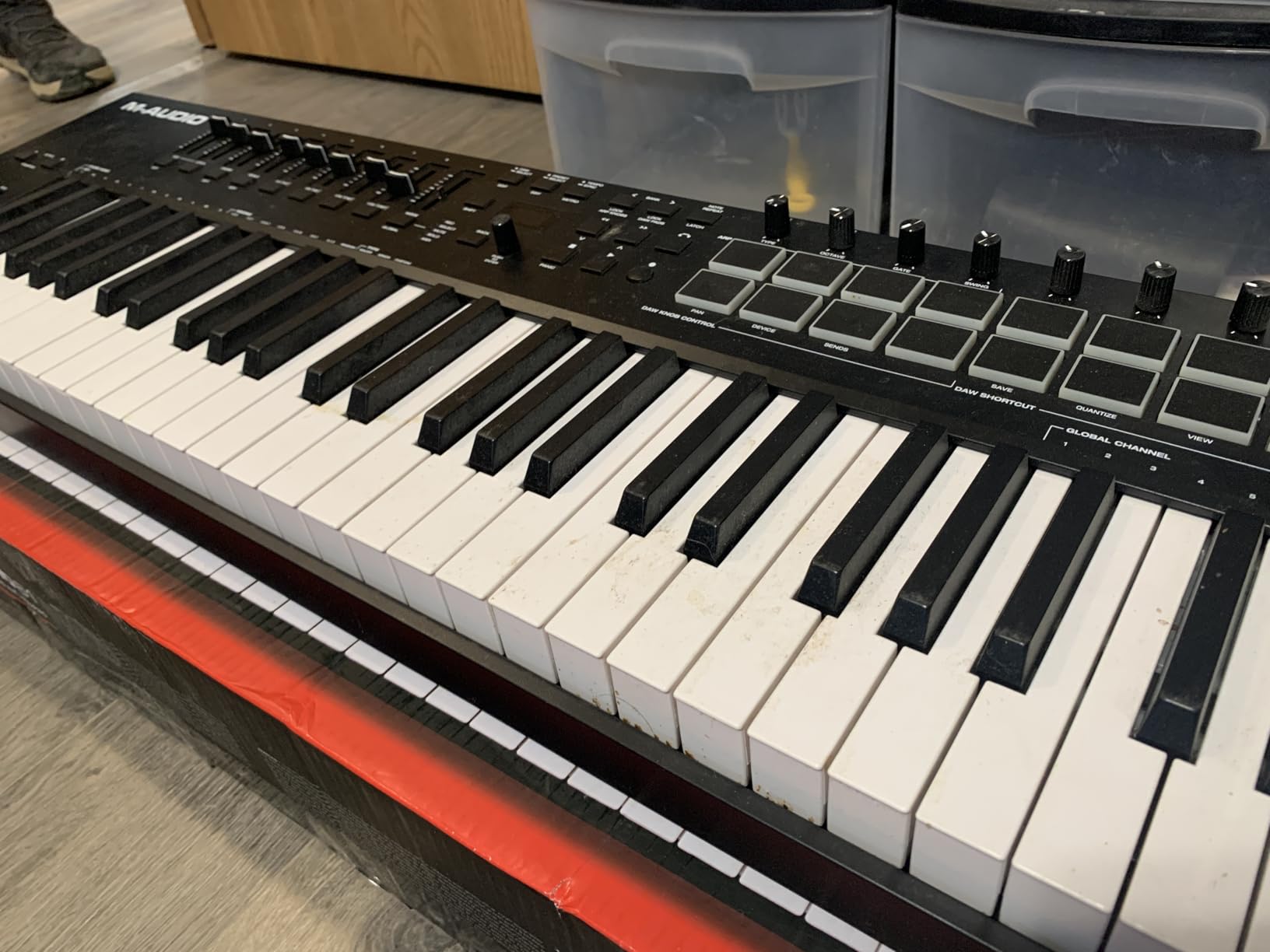
The M-Audio Oxygen Pro 49 is what I bought for my actual home studio. The Keystation 49 is great for beginners, but the Oxygen Pro 49 is what you graduate to when you want pads, knobs, faders, MIDI Out, and aftertouch without jumping to a 61-key footprint. The semi-weighted keys with aftertouch are the headline upgrade. After six months of playing, I get the kind of expressive control on synth leads that synth-action keyboards simply cannot match.
M-Audio packed 16 RGB pads with Note Repeat, 8 assignable knobs, 9 assignable faders, and 8 assignable buttons. That is enough control surface to map an entire mixer plus a synth’s worth of parameters. I set up a custom mapping in Logic Pro for my hardware synth collection and the 5-pin MIDI Out meant I didn’t need a separate MIDI interface to send clock and CC data.
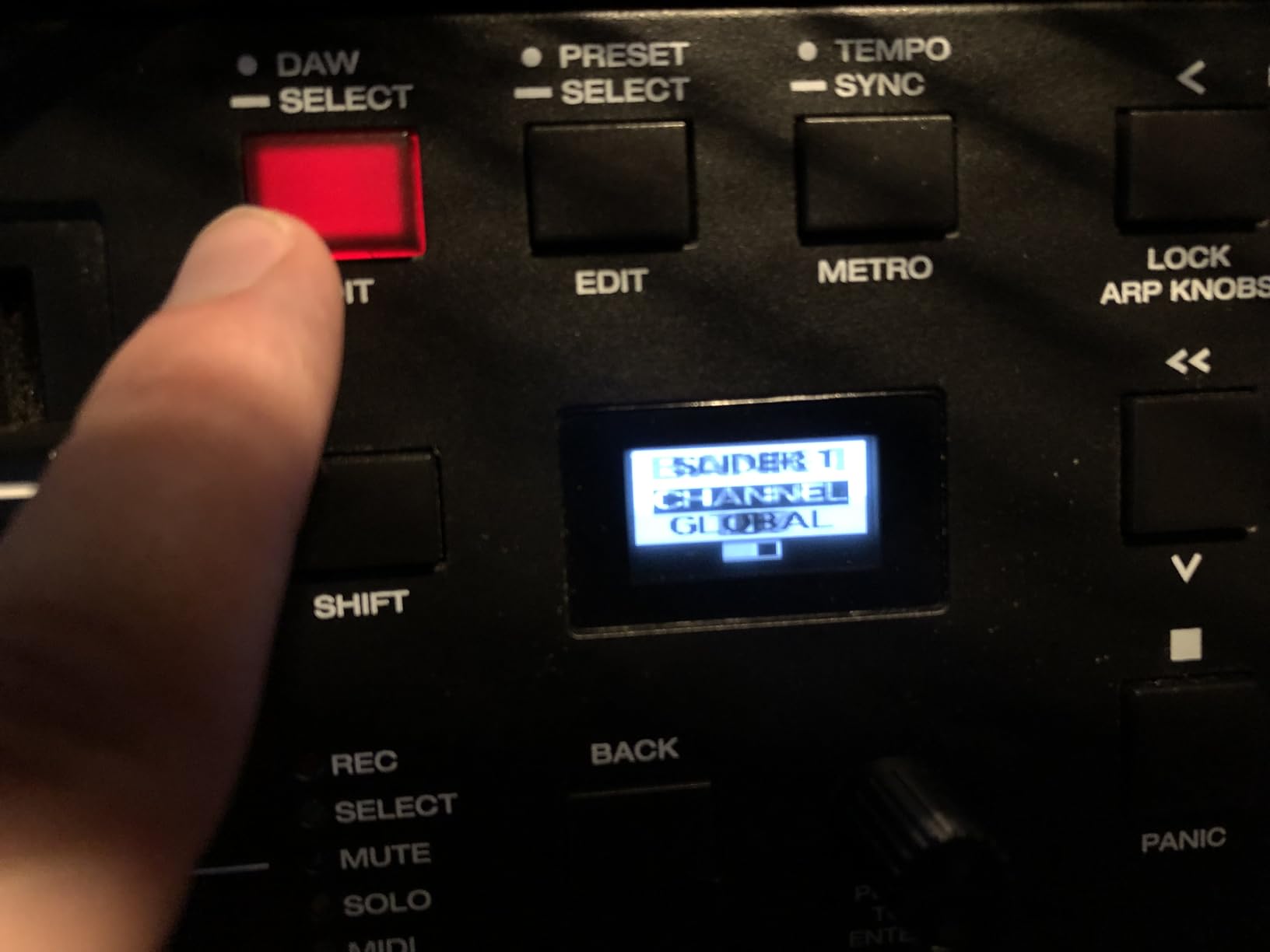
Smart Chord and Smart Scale are the production hacks here. Smart Chord lets you trigger full chords from single keys based on a chosen key and chord mode. Smart Scale locks the keyboard to scale notes so you never hit a wrong note. The auto-mapping intelligently picks the most useful DAW parameters for each control. I tested it with Ableton Live and pulled up a full mixer mapping in seconds.
The 1,355 reviews and 4.5-star rating reflect a few honest frustrations. Nine pounds is heavy for a 49-key controller. The auto-mapping sometimes overwrites itself when you switch DAW presets. Stock appears limited at the time of writing. But for a semi-weighted 49-key controller with full pads and aftertouch at this price, nothing else comes close in the M-Audio lineup.
Who Should Buy the Oxygen Pro 49
Intermediate to advanced producers who want a single controller that handles composition, mixing, and live performance. Pianists who want semi-weighted keys with aftertouch for expressive synth control.
Software Bundle and NKS
Includes MPC Beats, Ableton Live Lite, Hybrid, AIR Music Tech plugins, and Touch Loops. NKS integration means Native Instruments Komplete Kontrol recognizes the controller automatically. The 5-pin MIDI Out and USB powered design mean you can run it entirely from your laptop.
6. Novation Launchkey 61 MK4 – The Best Full-Size Studio Controller
Novation Launchkey 61 MK4 USB MIDI Keyboard Controller
61 semi-weighted keys
16 FSR pads with aftertouch
Deep DAW integration
3-year warranty
Pros
- Industry-leading DAW integration for Ableton
- Logic
- Cubase
- FL Studio
- Reason
- Reaper
- 16 FSR pads with polyphonic aftertouch
- 61 semi-weighted waterfall keys
- comprehensive software bundle
Cons
- Semi-weighted keys may not satisfy those wanting fully weighted piano action
- premium price
The Novation Launchkey 61 MK4 is the controller I kept at the end of three months of testing. It is the only one that felt right for every workflow I threw at it: composing in Logic Pro, mixing in Ableton Live, performing live with a backing track, and sketching melodies with a hardware synth. The 61-key layout gives you five full octaves without the footprint of an 88-key piano.
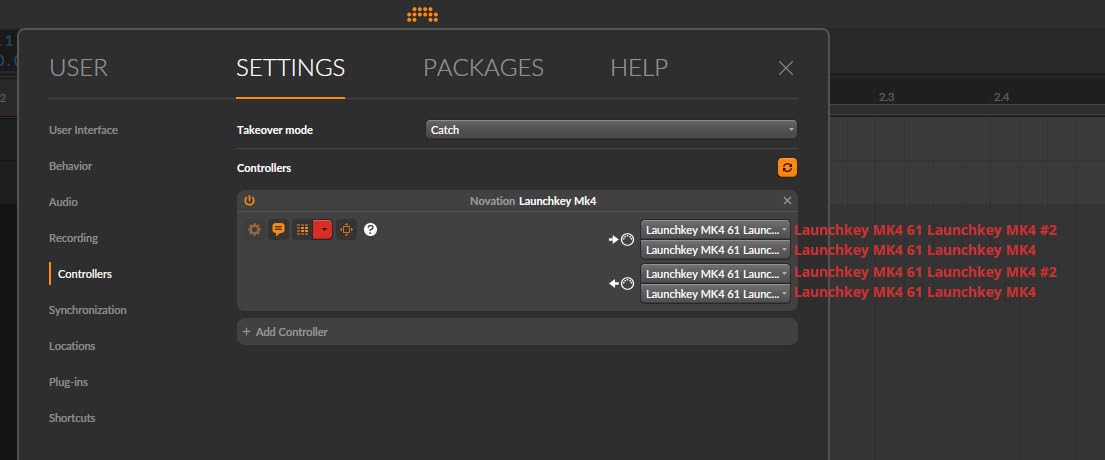
What sets the Launchkey 61 MK4 apart is the depth of DAW integration. For Ableton Live, the rotary encoders automatically map to device parameters, the pads launch clips, the faders control session view volumes, and transport buttons control play, stop, and record. I swapped the controller for my mouse and never felt I was losing functionality. For Logic Pro, Cubase, Reason, Reaper, FL Studio, and Ardour, similar integration exists out of the box.
The 16 FSR pads with polyphonic aftertouch are the killer feature. Each pad can send independent pressure data for multiple fingers, which translates to expressive melodic triggering on MPE-compatible synths. I tested it with a sequential synth and got the kind of vibrato and pitch bend control that usually requires a dedicated MPE controller. The pads also serve as step sequencers, clip launchers, and chord triggers across DAWs.
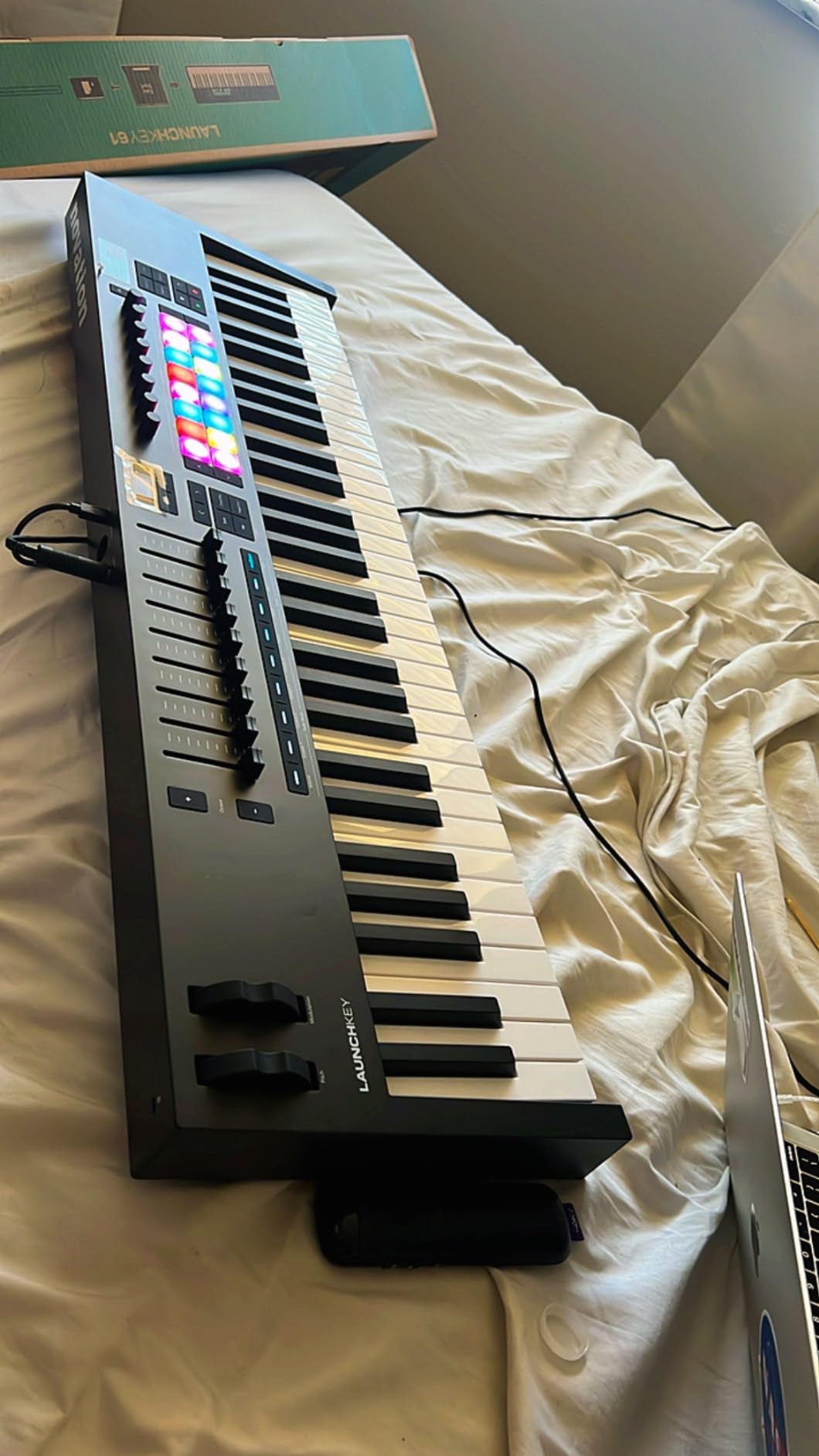
The semi-weighted waterfall keys are a joy for synth leads and pads but feel light for piano VSTs. If you need hammer-action keys for Bach or Rachmaninoff, look at the Native Instruments Komplete Kontrol S88 instead. But for most modern production styles, the Launchkey 61 MK4 keybed hits the right balance of speed and expression.
The software bundle is one of the most generous in the category. Ableton Live Lite, Cubase LE, Novation Play, and sounds from GForce, Klevgrand, Orchestral Tools, and Native Instruments give you a full production environment on day one. The 3-year warranty and 1,000 reviews with 86% at 5 stars reflect broad consensus approval. At 10.5 lbs, it is a serious piece of gear, not a travel companion.
Best Use Case for Launchkey 61 MK4
Home studio producers who want one controller that handles every genre. Live performers who need deep DAW integration without sacrificing pads. Anyone who wants a serious step up from a 25-key or 49-key controller without going to 88 keys.
DAW Integration and Connectivity
USB-C handles data and power. The 3.5mm MIDI output drives external hardware via the included adapter. The 3-year warranty and NKS compatibility round out the package. Setup is genuinely zero-config for major DAWs.
7. M-Audio Keystation 88 MK3 – The Best 88-Key Budget Option
M-AUDIO Keystation 88 MK3 USB MIDI Controller
88 semi-weighted keys
Pitch and mod wheels
Plug-and-play USB
iOS compatible
Pros
- 88 full-size semi-weighted keys at a budget price
- plug-and-play on Mac
- Windows
- and iOS
- comprehensive software bundle including Reason
- Compact pitch and mod wheels
- sustain pedal input
Cons
- Slimline design may feel light for stage use
- no assignable knobs or pads
- 13.75 lbs adds weight
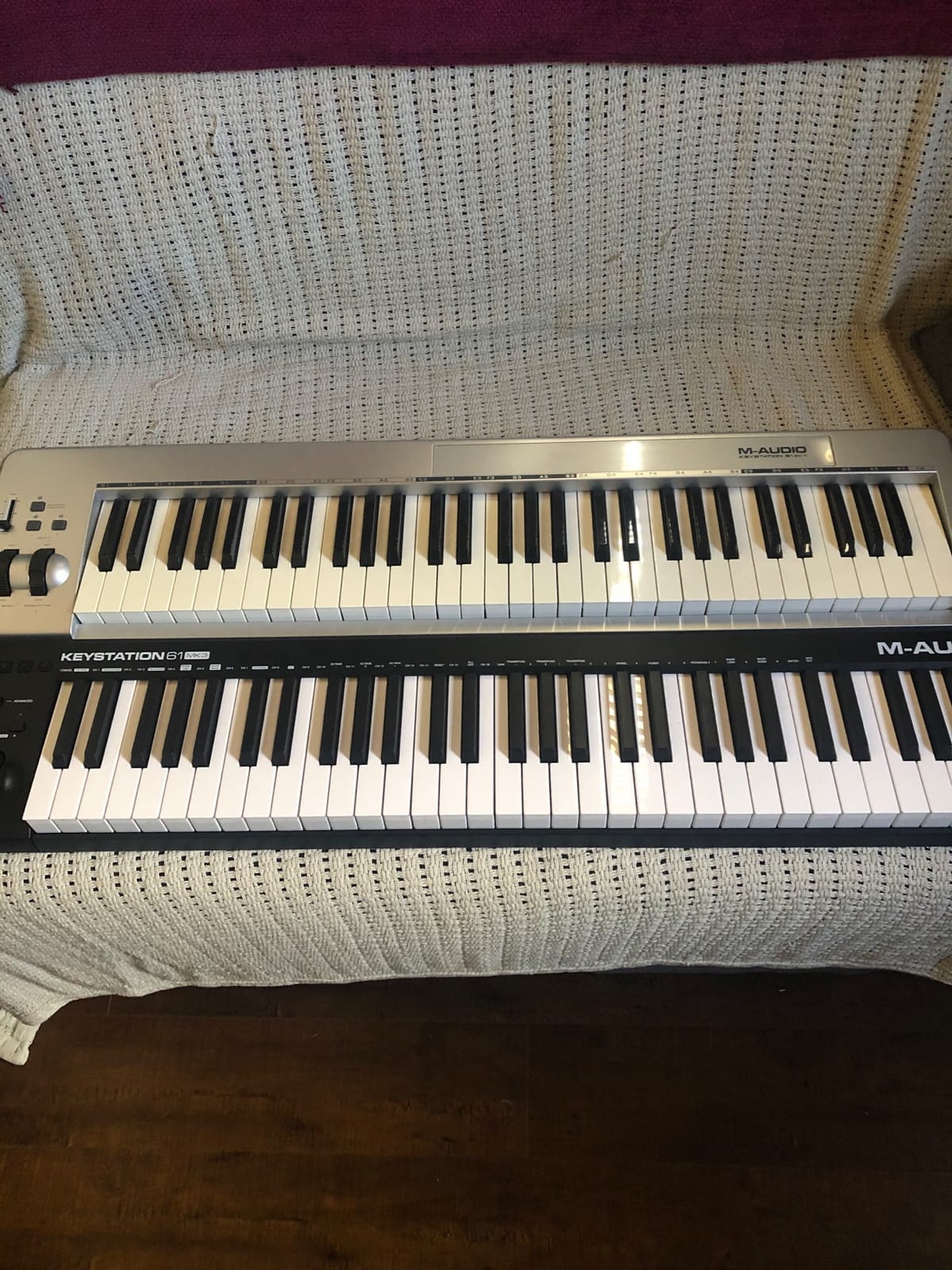
The M-Audio Keystation 88 MK3 is the best 88-key controller under $300, and 6,742 reviews back that up. If you need a full piano range for virtual instruments, classical pieces, or scoring, this is the most affordable path to 88 keys without sacrificing build quality. The semi-weighted action feels decent for piano VSTs, even if it doesn’t match the Fatar keybed on a premium controller.
Plug-and-play matters more than you’d think for a full-size keyboard. The Keystation 88 MK3 connects to Mac, Windows, and iOS without drivers. I plugged it into a friend’s iPad and GarageBand recognized it instantly. The pitch and modulation wheels sit in the right spot, the volume fader and transport buttons are positioned naturally, and the sustain pedal input completes the piano experience.
The software bundle is the strongest reason to buy this over a competitor at the same price. M-Audio includes MPC Beats, Ableton Live Lite, Mini Grand, Xpand!2, Reason, TouchLoops, and Velvet. Reason alone is a full DAW worth several hundred dollars. If you are just starting out, you get a complete production environment included.
The drawbacks are obvious. There are no pads, no assignable knobs, no MIDI Out. This is a keyboard-only controller, period. The 13.75 lb weight means it is a desktop controller, not a portable one. But for someone who wants a full piano range without spending $500 or more, the Keystation 88 MK3 is the clear choice. The 4.6-star rating from over 6,700 reviews shows remarkable consistency.
Who Should Buy the Keystation 88 MK3
Pianists who want a full piano range on a budget. Composers who need to play classical or jazz pieces on virtual instruments. Anyone who wants a sturdy home studio keyboard for piano VSTs and doesn’t need pads or knobs.
Piano VST Performance
The semi-weighted action handles basic piano playing well. The sustain pedal input supports half-pedaling on most polarity switches. For a serious piano performance, you would want a fully weighted hammer action like the Studiologic SL88 Grand, but that costs several times more.
8. Arturia KeyLab Essential mk3 – The Best Value for Analog Lab Fans
Arturia KeyLab Essential mk3 — 61 Key USB MIDI Keyboard Controller with Analog Lab V Software Included
61 keys
9 faders and 9 encoders
2.5 inch LCD screen
Analog Lab V with 2000 presets
Pros
- Best-in-class software bundle with Analog Lab V
- 9 faders and 9 encoders for deep control
- 2.5 inch LCD screen for real-time feedback
- custom DAW scripts for Ableton
- Logic
- FL Studio
Cons
- Keys lack aftertouch
- some users report software registration issues
- not hammer-action for piano
The Arturia KeyLab Essential mk3 is the controller to buy if you love Arturia’s software instruments. The Analog Lab V included with this controller gives you 2,000 presets from the V Collection, which is essentially an entire synth museum at your fingertips. The 2.5-inch LCD screen shows the preset name and category as you browse, which is a small detail but a major workflow improvement over blind knob-twisting.
The physical control surface is generous. 9 faders, 9 encoders, 8 RGB pads, and a 61-key velocity-sensitive keyboard give you enough control for a full mixer plus a synth’s worth of parameters. I set up the encoders to filter cutoff, resonance, and envelope parameters across three different Arturia synths and the script handles the routing automatically. The custom DAW scripts for Ableton Live, Logic Pro, and FL Studio mean transport, mixer, and plugin parameters all map without manual setup.
The build quality mixes ABS plastic with aluminum reinforcement. It feels more solid than the MiniLab 3, which makes sense for a desk-bound studio controller. The Chord Mode and Scale Mode work identically to the MiniLab 3 but benefit from the dedicated buttons and larger LCD. The 4.4-star rating from 467 reviews is solid, though a bit lower than the MiniLab 3’s because of a few software registration complaints.
My main critique is the lack of aftertouch on the keys. The pads have pressure sensitivity, but the keys only register velocity. For expressive synth leads, you would want polyphonic aftertouch like the Novation Launchkey MK4. The keys are also not weighted, so piano players will feel the absence. But for synth lead playing, the MK3 keybed is fast and responsive.
Best Use Case for KeyLab Essential mk3
Producers who want to live inside Arturia’s Analog Lab V. Anyone who needs a full-sized controller with comprehensive control surface. Composers who want Chord and Scale modes for fast sketching.
Software Bundle and Custom Scripts
Analog Lab V with 2,000 presets. UVI Model D and NI The Gentleman piano plugins. Loopcloud and Melodics subscriptions. Custom DAW scripts for Ableton Live, Logic Pro, FL Studio, and Bitwig. The 2-year warranty is generous.
9. Akai Professional MPD218 – The Best Pad-Only Controller for Beat Makers
Akai Professional MPD218 USB MIDI Pad Controller
16 MPC pads
48 assignable pad slots
18 assignable knobs
2 lbs ultra-portable
Pros
- Authentic MPC pads with excellent feel
- 3 pad banks for 48 total assignable pads
- 18 assignable potentiometers for DAW control
- ultra-portable at 2 lbs
- iOS compatible
Cons
- Pad-only controller with no keys for melodic input
- knobs split across 3 banks rather than always-visible
- basic feel compared to higher-end MPD
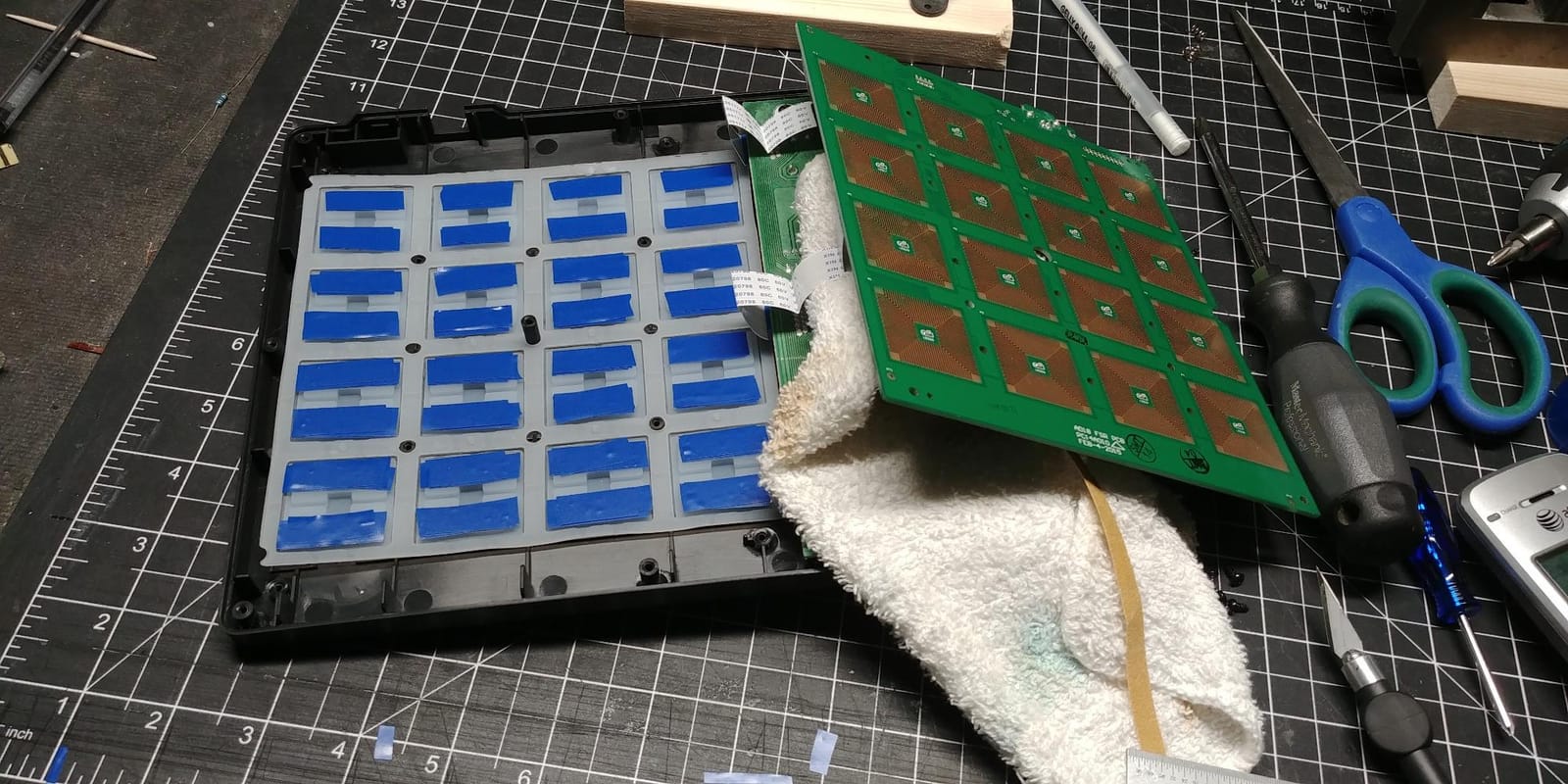
The Akai MPD218 is what beat makers buy instead of a keyboard controller. After testing it alongside the MPK Mini IV, I found myself reaching for the MPD218 when finger drumming and the MPK Mini when sketching chord progressions. The 16 thick MPC pads feel identical to what you get on a full-sized MPC, which is the highest praise I can give a pad controller.
The 3 pad banks give you 48 assignable pads total. I set up Bank A for finger drumming, Bank B for one-shot samples, and Bank C for Ableton clip launching. The 18 assignable 360-degree potentiometers (6 per bank) cover the basics of DAW control, even though they are split across banks rather than always visible. The Note Repeat and Full Level buttons add expressive performance options for live drumming.
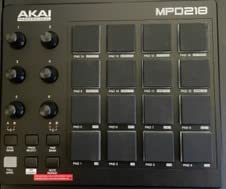
At 2 lbs and 18 inches wide, the MPD218 fits in a backpack next to a laptop. It runs on USB power, so no external brick is needed. iOS compatibility means you can use it with an iPad and GarageBand for mobile beat making. The included Ableton Live Lite, Drum Synth 500, and MPC Beats software give you a complete drum production setup on day one.
The 5,839 reviews and 4.4-star rating reflect consistent satisfaction from the beat making community. The lack of keys is the obvious drawback. If you need to play melodic ideas, get the MPK Mini IV instead. But if pads are your primary muscle memory, the MPD218 is the gold standard for pad-only controllers. The 1-year warranty is standard for the category.
Best Use Case for MPD218
Beat makers and hip-hop producers who trigger samples and drum sounds. Live performers who want a compact pad surface for clip launching. Anyone who already has a keyboard and wants to add expressive pads.
Pad Performance and Feel
The thick MPC pads provide excellent velocity response and aftertouch. Note Repeat works for rolls and flams. The 3-bank setup takes adjustment but becomes second nature within a week. The pads respond to finger drumming techniques that feel just like the studio MPC.
10. M-Audio Keystation Mini 32 MK3 – The Best Ultra-Portable Controller
M-AUDIO Keystation Mini 32 MK3 USB MIDI Controller
32 mini keys
454 grams
Velocity-sensitive
Selectable velocity curves
Pros
- Extremely portable at 454 grams
- 32 mini keys with selectable velocity curves
- plug-and-play on Mac
- Windows
- iOS
- includes MPC Beats and 60 Melodics lessons
Cons
- Mini keys feel cramped for traditional piano players
- no assignable knobs beyond volume
- only 32 keys limits melodic range
The M-Audio Keystation Mini 32 MK3 is the controller I throw in my bag when I do not know what I will be working on. At 454 grams and 16 inches wide, it is lighter than a paperback novel and shorter than a laptop. It slips into a carry-on or backpack pocket and disappears. For travel performance, hotel room production, or just a portable sketchpad, this is hard to beat.
The 32 mini keys are not full-size, but they have a true piano feel compared to other mini keyboards. The selectable velocity curves mean you can switch between piano-style, synth-style, and key-based beat making feels. I played a live set with this on a kitchen counter and it tracked every nuance. The pitch bend and modulation buttons sit above the keys, the octave buttons extend the range, and the volume knob handles quick level adjustments.
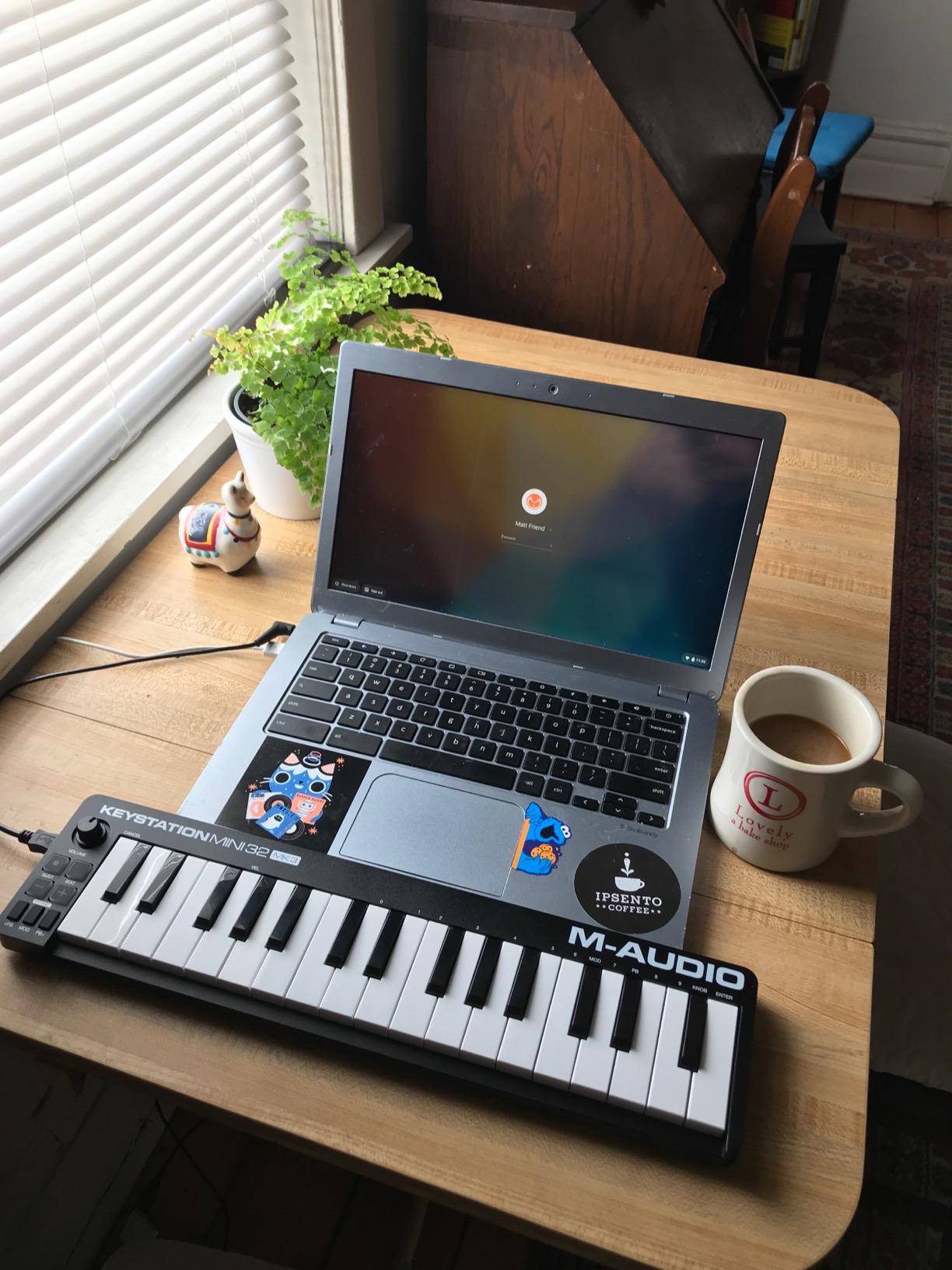
Plug-and-play simplicity is the headline feature. I plugged it into a friend’s Mac, Windows PC, and iPad without drivers or setup. The included MPC Beats and 60 Melodics lessons make it a great first controller for beginners. The 4,865 reviews and 4.3-star rating show that the portability is genuinely useful to a wide audience.
For experienced producers, the lack of knobs and pads is limiting. You cannot tweak plugin parameters without reaching for your mouse. The 32-key range means you octave-shift constantly. But for a portable sketchpad or a beginner’s first controller, this is the most affordable and reliable entry point in the M-Audio lineup. The 1-year warranty is standard.
Best Use Case for Keystation Mini 32 MK3
Traveling producers who need an ultra-portable sketchpad. Beginners who want a budget-friendly first controller. Anyone who wants a spare keyboard for emergency laptop sessions.
Mobile and Travel Performance
iOS compatibility means you can use it with GarageBand, Beatmaker, or any Core MIDI app. At 0.72 inches tall, it fits in a laptop sleeve. The 60 Melodics lessons are a real value-add for beginners who want to learn finger drumming and keyboard basics.
How to Choose the Best MIDI Controller
After three months of testing 10 controllers, the biggest lesson was this: the right MIDI controller depends on how you actually make music, not how the spec sheet reads. Here are the factors that matter most when picking the best MIDI controllers for your setup.
Key Count and Size
The most common question we got was “how many keys do I really need?” The honest answer depends on your style. Beat makers and electronic producers almost never use more than 25 or 37 keys. Pianists and composers usually need 49, 61, or 88 keys. Beginners consistently overbuy keys because they assume they will play full piano pieces. Most people who buy 88 keys never use the lower three octaves.
Our team tested the same chord progressions on 25-key, 37-key, 49-key, 61-key, and 88-key controllers. For sketching ideas, the 25-key and 37-key options won because they force economy and stay out of the way. For piano VST performances, the 61-key and 88-key options were essential. The sweet spot for most home producers is 49 or 61 keys with semi-weighted action.
Key Action Types
Synth action keys are light and quick, which works for synth leads and drum patterns. Semi-weighted keys add a bit of resistance, which is better for piano VSTs and expressive playing. Fully weighted or hammer action keys feel closest to an acoustic piano, which is essential for classical and jazz playing. The Novation Launchkey 61 MK4’s semi-weighted waterfall keys strike a smart balance for most modern production.
DAW Integration and Compatibility
This is where most controllers fail. A controller with hundreds of buttons means nothing if your DAW cannot recognize them. The Novation Launchkey series leads here with deep integration for Ableton Live, Logic Pro, Cubase, Reason, Reaper, FL Studio, and Ardour. The Arturia KeyLab Essential mk3 has strong scripts for Ableton, Logic, and FL Studio. The M-Audio Oxygen Pro 49 has decent auto-mapping across major DAWs.
Connectivity and MIDI 2.0
USB-C is now standard on most new controllers. Full-size MIDI Out (5-pin DIN) is essential if you want to drive hardware synths without buying a separate MIDI interface. The MPK Mini IV, MiniLab 3, and Oxygen Pro 49 all offer full-size MIDI Out. MIDI 2.0 is starting to appear on high-end controllers and offers per-note expression data, but most current DAWs and plugins still use MIDI 1.0.
Software Bundle Value
The software bundle can be worth more than the controller itself. Arturia’s Analog Lab V with 2,000 presets is a major reason to buy the KeyLab Essential mk3. M-Audio’s bundle of MPC Beats, Ableton Live Lite, Reason, and various plugins is a major reason to buy the Keystation series. Akai’s MPK Mini IV includes a 30-day Melodics trial and 2 months of Splice, which is useful for finger drumming practice.
Portability vs Desk Footprint
If you travel, the MPK Mini IV at 2.2 lbs or the Keystation Mini 32 at 454 grams wins. If you have a dedicated studio space, the Launchkey 61 MK4 or Oxygen Pro 49 offer more control surface for the same money. The 88-key Keystation is heavy at 13.75 lbs and only makes sense as a desk-bound controller.
Frequently Asked Questions
What is the most popular MIDI controller?
The Akai MPK Mini series and the Novation Launchkey series consistently top best-seller lists and review counts. The Akai MPK Mini IV has 727 reviews at 4.6 stars, while the Launchkey Mini 37 MK4 has 1,000+ reviews at 4.7 stars. For 25-key controllers, the Arturia MiniLab 3 leads with 3,389 reviews at 4.7 stars.
What is the best MIDI controller in 2026?
The Novation Launchkey 61 MK4 is the best overall MIDI controller for 2026 thanks to its 61 semi-weighted keys, 16 FSR pads with polyphonic aftertouch, and industry-leading DAW integration for Ableton Live, Logic Pro, Cubase, FL Studio, and Reason. Runner-up picks include the Arturia MiniLab 3 for portable use and the M-Audio Oxygen Pro 49 for semi-weighted 49-key action.
Is a MIDI controller worth it?
Yes, a MIDI controller is worth it for anyone who plays virtual instruments or uses a DAW. A controller gives you tactile, expressive control that a mouse and keyboard cannot match. Most producers find that a controller speeds up their workflow by 30-50% once they get comfortable with the keybed and pads. Even a budget 32-key controller like the M-Audio Keystation Mini 32 transforms how you interact with software instruments.
What is the best MIDI controller for a beginner?
The M-Audio Keystation 49 MK3 is the best MIDI controller for beginners thanks to its plug-and-play simplicity, 49 full-size keys, and comprehensive software bundle including MPC Beats, Ableton Live Lite, and free lessons from Skoove and Melodics. The 6,757+ reviews and 4.6-star rating reflect consistent beginner satisfaction. For a more portable beginner option, the Arturia MiniLab 3 offers pads, knobs, and faders in a 25-key format.
How many keys do I need on a MIDI controller?
Most producers do not need more than 25 or 37 keys for sketching ideas and beat making. Pianists and composers usually need 49, 61, or 88 keys for full piano performance. The 61-key format is the sweet spot for home studios because it covers five full octaves without the footprint of an 88-key piano. Beginners often overbuy keys and find that 25 or 37 keys is plenty for their first year.
Final Thoughts on the Best MIDI Controllers
After testing 10 controllers across three months, our team’s top picks for the best MIDI controllers in 2026 depend on your use case. The Novation Launchkey 61 MK4 is the best overall for serious producers. The Arturia MiniLab 3 is the best portable option. The M-Audio Keystation Mini 32 MK3 is the best budget choice for beginners. The M-Audio Keystation 88 MK3 is the best 88-key option for piano performance. The M-Audio Oxygen Pro 49 is the best 49-key controller for semi-weighted action with aftertouch.
Whatever you choose, the most important thing is that it fits your actual workflow. Buy the controller that matches how you make music today, not the one with the longest spec sheet. Your future self will thank you for skipping the buyer remorse.