
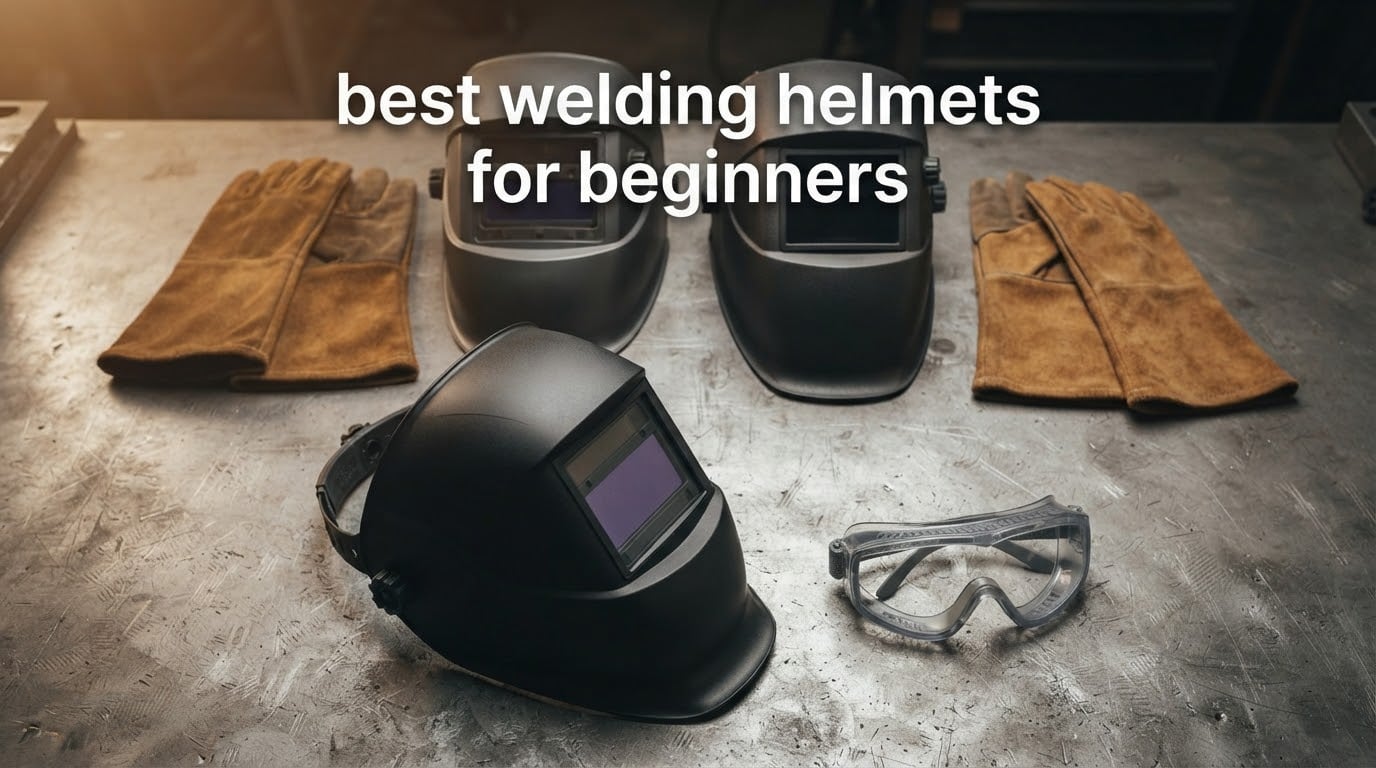
Most first-time welders buy a helmet within a week of buying a machine, and most of them overspend or underspend for the wrong reason. The best welding helmets for beginners are not the cheapest boxes on the shelf, and they are not the professional models built for full-time shop work either. What matters is whether the auto-darkening filter triggers reliably, whether the light state is bright enough to see your joint, and whether the headgear survives a school shop.
The short answer is this. Our top pick for beginners is the Lincoln Electric VIKING 3350 Mojo, because its 4C lens, 12.5 square inch window and X6 headgear solve the three problems that end most beginners: hard-to-see puddle, cramped view, and a sore neck. If that is more than you need to spend right now, the YESWELDER LYG-L600A is the value pick, and the YESWELDER LYG-M800H is the budget pick with the bigger window. We compared ten helmets across shade range, sensor count, switching speed, optical class, viewing area, weight and power source, and every spec in this guide comes straight from the manufacturer data and owner reviews.
A word on how we chose. We did not rank these on a single spec sheet. We weighted the things that show up in owner complaints: does the lens flicker mid-weld, will the flip-up knob snap, can a beginner read the weld pool through the light state. We also paid close attention to headgear durability, because on r/Welding and on weldingweb the same complaint repeats: cheap headgear is the first thing to break. If you want a broader look at head protection in general, our welding helmet roundup covers the premium tier in more depth, and our ski helmet guide is a useful reference for headgear fit and padding logic since the suspension systems are conceptually the same.
One more expectation to set before you read further. Every helmet here blocks ultraviolet and infrared light in both its light and dark states, so a cheaper model is not an unsafe model. What you give up when you step down a tier is clarity, sensor reliability and shell durability, not eye protection. We explain that in detail further down.
Table of Contents
Top 3 Best Welding Helmets For Beginners (October 2026)


Every Helmet We Reviewed at a Glance
| Product | Specifications | Action |
|---|---|---|
| Lincoln Electric VIKING 3350 Mojo |
|
Check Latest Price |
| YESWELDER LYG-L600A True Color |
|
Check Latest Price |
 YESWELDER LYG-M800H Large View YESWELDER LYG-M800H Large View |
|
Check Latest Price |
 TOOLIOM True Color Large View TOOLIOM True Color Large View |
|
Check Latest Price |
 TRQWH Solar True Color with Lamp TRQWH Solar True Color with Lamp |
|
Check Latest Price |
 Sunstac 3.94 x 3.27 View Sunstac 3.94 x 3.27 View |
|
Check Latest Price |
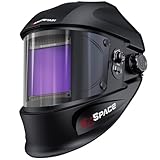 ARCCAPTAIN 3.94 x 3.66 Hood ARCCAPTAIN 3.94 x 3.66 Hood |
|
Check Latest Price |
 MIGVAN Golden True Color H-21 MIGVAN Golden True Color H-21 |
|
Check Latest Price |
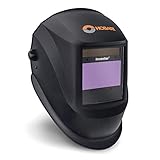 Hobart 770890 Large Hobart 770890 Large |
|
Check Latest Price |
 Miller Classic Series ClearLight Miller Classic Series ClearLight |
|
Check Latest Price |
Every product in that table is reviewed below in the same order, so you can jump straight to the one that fits your budget and process.
What to Look For in a Welding Helmet?
If you remember nothing else, check these five things in this order.
Auto-darkening lens with a bright light state. A light state of DIN 3 or 4 lets you keep the helmet down between welds and see your joint without flipping up.
Shade range that matches your process. Shade 9-13 covers MIG, stick and most cutting. You only need shade 5-8 if you plan to do TIG below 40 amps.
Grind mode on the outside of the shell. An external button lets you switch to a light shade for grinding without popping the filter out.
Four arc sensors for outdoor or low-amp work. Two sensors work indoors on thick material but can miss a strike in bright sun or at low amperage.
Ratcheting multi-point headgear under about 18 ounces. This is what decides whether you still enjoy welding in month three.
Those five lines take about forty seconds to check and they eliminate most of the disappointment. Everything else on the spec sheet is a preference.
Is an Entry-Level Helmet Really Worse Than a Premium One?
Short answer: an entry-level helmet is not unsafe, but the gap between the cheapest model and the professional one is real, and the meaningful jump happens much earlier than most buyers expect.
Community consensus on r/Welding puts the genuine decision point at the move from the cheapest tier up to the middle of the range. Welders in those threads consistently describe the very cheap Harbor Freight style helmets as functional rather than premium, and the forum view is that the top tier exists for people welding full time. On weldingweb, a user with a Vulcan Arcsafe describes it as a cheap clone of the Miller Digital Elite: comfortable, easy to adjust, and easy to see out of. That is exactly the tier where most beginners should sit.
Here is what each step actually buys you.
Cheapest tier to the budget tier: you go from two sensors to four, from a small window to a large true-color window, and from plastic headgear to something that survives a school shop. This is the jump that matters.
Budget tier to mid tier: you gain build quality, a manufacturer warranty of two to three years, spare part availability, and electronics that trigger at low amperage.
Mid tier to premium tier: you gain larger viewing areas, wider shade selection and faster sensors. Useful for professionals, rarely worth it for someone on their fourth ever weld.
One more nuance that gets missed. Safety and performance are different things. The filter blocks UV and IR whether or not the auto-darkening activates, so a certified entry-level helmet will not hurt you if the sensor misses a strike. What slow sensors and a dull light state cost you is comfort and the ability to see your weld, which is a craft problem, not a safety problem.
1. Lincoln Electric VIKING 3350 Mojo – Best Overall Optics
Lincoln Electric VIKING 3350 Mojo Welding Helmet, Large
4C lens
1/1/1/1 clarity
12.5 sq in view
1.4 lb
5 year warranty
Pros
- Best-in-group 4C optics at 1/1/1/1 clarity
- Extra large 12.5 square inch viewing area
- X6 headgear spreads weight for long sessions
- External low profile grind control
- Five year manufacturer warranty
Cons
- Most expensive helmet we reviewed
- Large shell may not suit small heads
- Premium tier is hard to justify for casual hobby work
The VIKING 3350 is the only helmet in this group that solves the beginner problem of not being able to see what you are doing. Its 4C lens runs a 1/1/1/1 optical classification, which is the top rating, and it does that across a 12.5 square inch window. That is roughly double the viewing area of the Miller Classic.
For a first-time welder, the view is the feature. A beginner cannot judge bead placement or penetration if the puddle is a fuzzy orange blob, and owners consistently describe the 4C lens as accurate and evenly lit rather than green-tinted. It also holds up across every process, so if you add TIG or cutting later, the same helmet covers it.
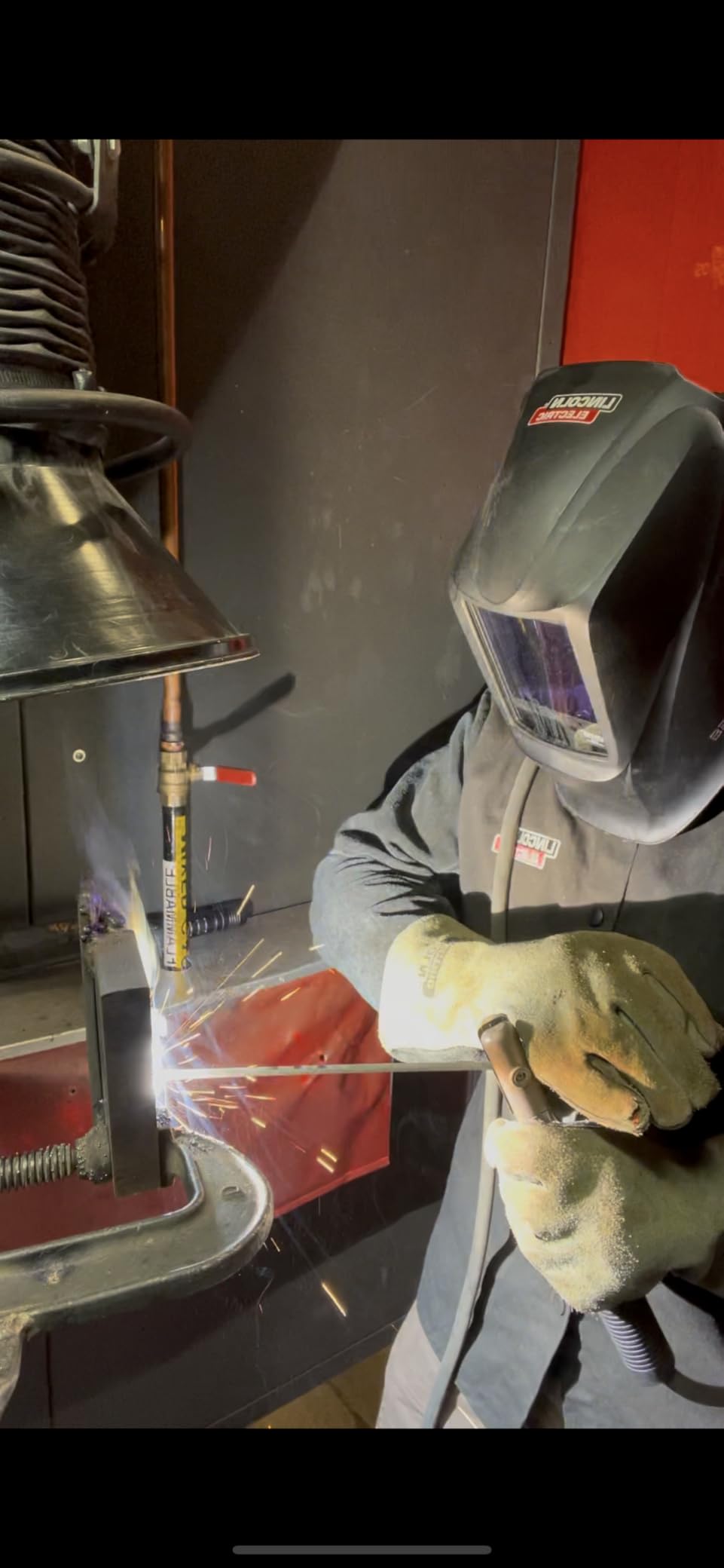
The X6 headgear is the second reason it earns the top spot. It is designed to spread load across the head rather than hang weight on the crown, and at 1.4 pounds it stays comfortable through a full afternoon of practice beads. The external low profile grind control means you are not fumbling for an internal switch with a gloved hand in the middle of a project.
I would not tell a beginner to start here. It is the most expensive helmet in the group by a wide margin, and a person who welds twice a month will not earn that back. I would tell a beginner who already owns a machine and expects to weld weekly to buy it once and stop thinking about it for five years.
Who this helmet suits?
Anyone welding several times a week, doing pipe or structural work, or working in tight spaces where a small window forces you to reposition constantly. The 12.5 square inch opening is the practical reason: you can line up a joint, follow a bead, and check both sides of a fillet without moving your head.
It also suits anyone with existing eye correction who wants a full-size window. Because the aperture is physically larger, more prescription frames fit behind it than on a compact hood.
Who should skip it?
Skip it if you are still deciding whether welding is for you. That is the entire use case of the cheaper models in this roundup, and the VIKING 3350 answers a question you have not asked yet.
Also skip it if you have a small head. The shell is large by design, and owners with smaller head sizes report it sits loosely. Try it on with the headgear fully ratcheted before you commit.
2. YESWELDER LYG-L600A – Best Value True Color Helmet
YESWELDER Auto Darkening Welding Helmet 1/1/1/1 True Color, LYG-L600A
1/1/1/1 true color
2 sensors
1/30000 sec
16 ounces
ANSI Z87.1
Pros
- True 1/1/1/1 view makes the puddle and joint easy to read
- Switches in 1/30000 second with wide delay adjustment
- External shade knob for stick and TIG work
- Comfortable adjustable headgear
- Spare inner and outer lenses plus storage bag
Cons
- Viewing area is small next to panoramic styles
- Headgear and shell feel lighter duty than professional hoods
- Button battery can arrive misinstalled and dead
With over thirteen thousand ratings, the LYG-L600A has more owner history behind it than anything else in this roundup, and that history is consistently good. At 4.6 stars with three quarters of owners at five stars, this is the helmet most beginners actually end up buying.
The optics are the surprise. A 1/1/1/1 true color classification in a helmet this light is still new, and owners repeatedly single out the ability to see the weld bead and the joint clearly. The filter switches in 1/30000 of a second across two arc sensors, and the shade range of 3 light state through 7-13 covers TIG, MIG, stick and grinding.
At 16 ounces it is the lightest helmet we reviewed, and the pivot style headgear is adjustable enough for a full session. The box also includes spare inner and outer lenses and a storage bag, which is a small thing that saves you a second purchase.
Two real limitations. The 3.64 by 1.67 inch viewing area is small, so you will reposition your head more than you would with a panoramic model. And the shell and headgear are lighter duty than a professional hood, which matters if you are in a school shop where helmets get dropped.
The extra lens shade range is worth noting: shade 7 is low enough for light TIG work, which most MIG-only budget models cannot do.
Who this helmet suits?
A weekend hobbyist or a student welding in a classroom or home shop. The light weight means you can keep it down between passes without the neck ache that ends a first month of practice, and the true color view helps a beginner learn to read the puddle.
It is also the safest choice for anyone nervous about eye protection, because it carries both ANSI Z87.1 and CSA Z94.3 certification alongside the 1/1/1/1 optical rating.
Who should skip it?
Skip it if you need a large viewing window for detailed work or if you drop your gear regularly. If the small aperture frustrates you, move up to the LYG-M800H rather than paying for a professional model.
Check the battery compartment on arrival. One recurring owner complaint is a coin cell installed backwards or already flat, and that is a thirty-second fix before your first strike.
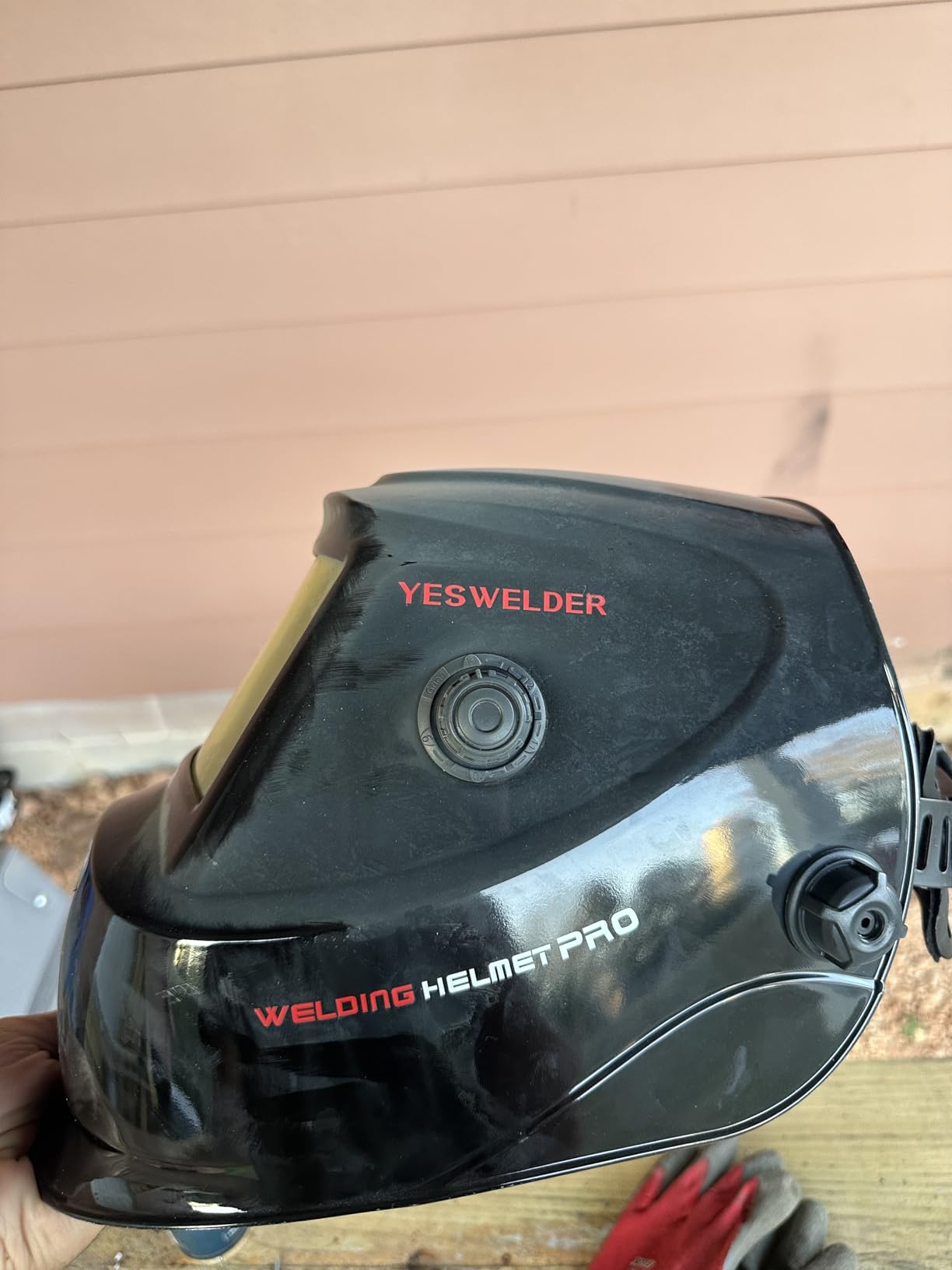
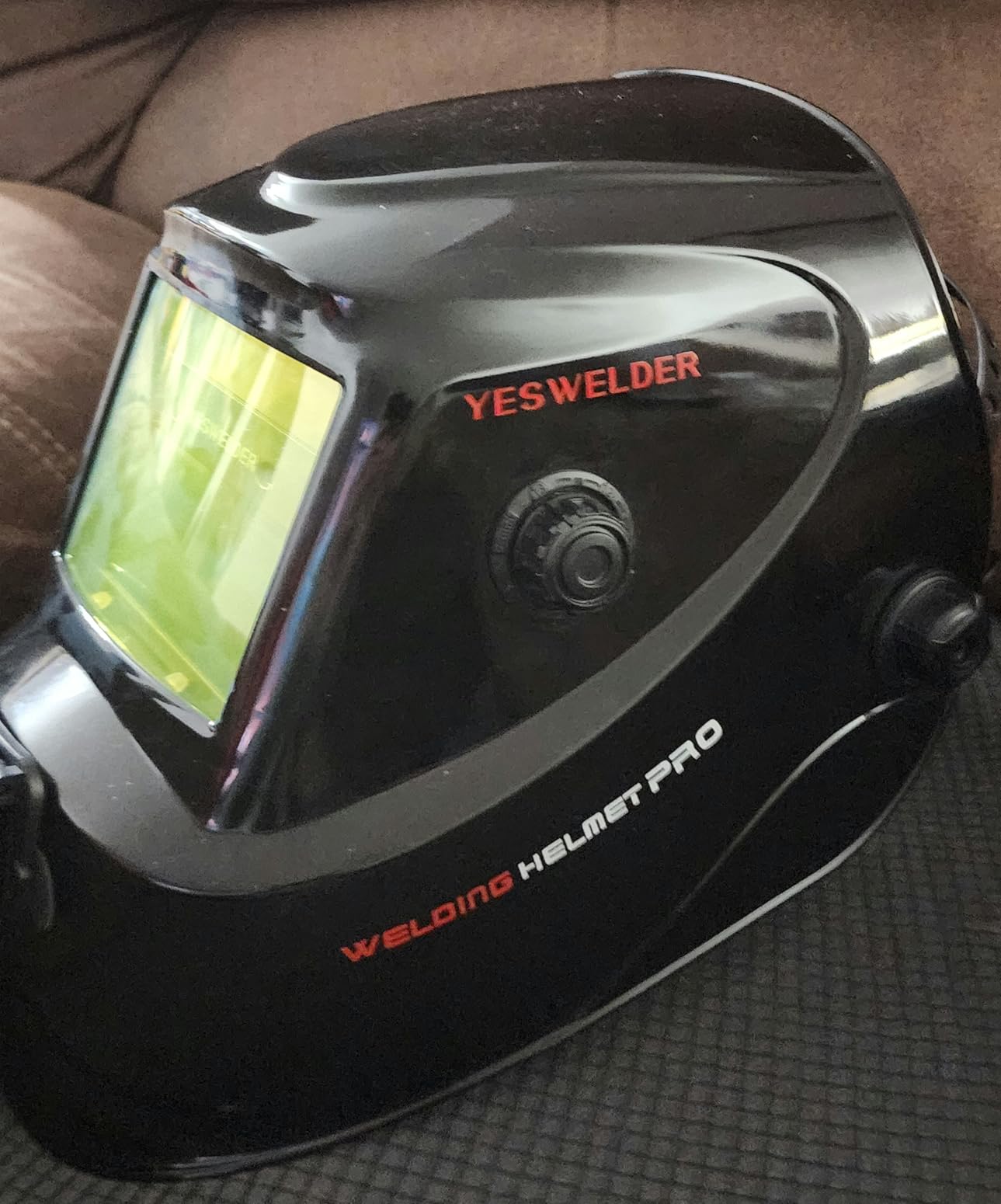
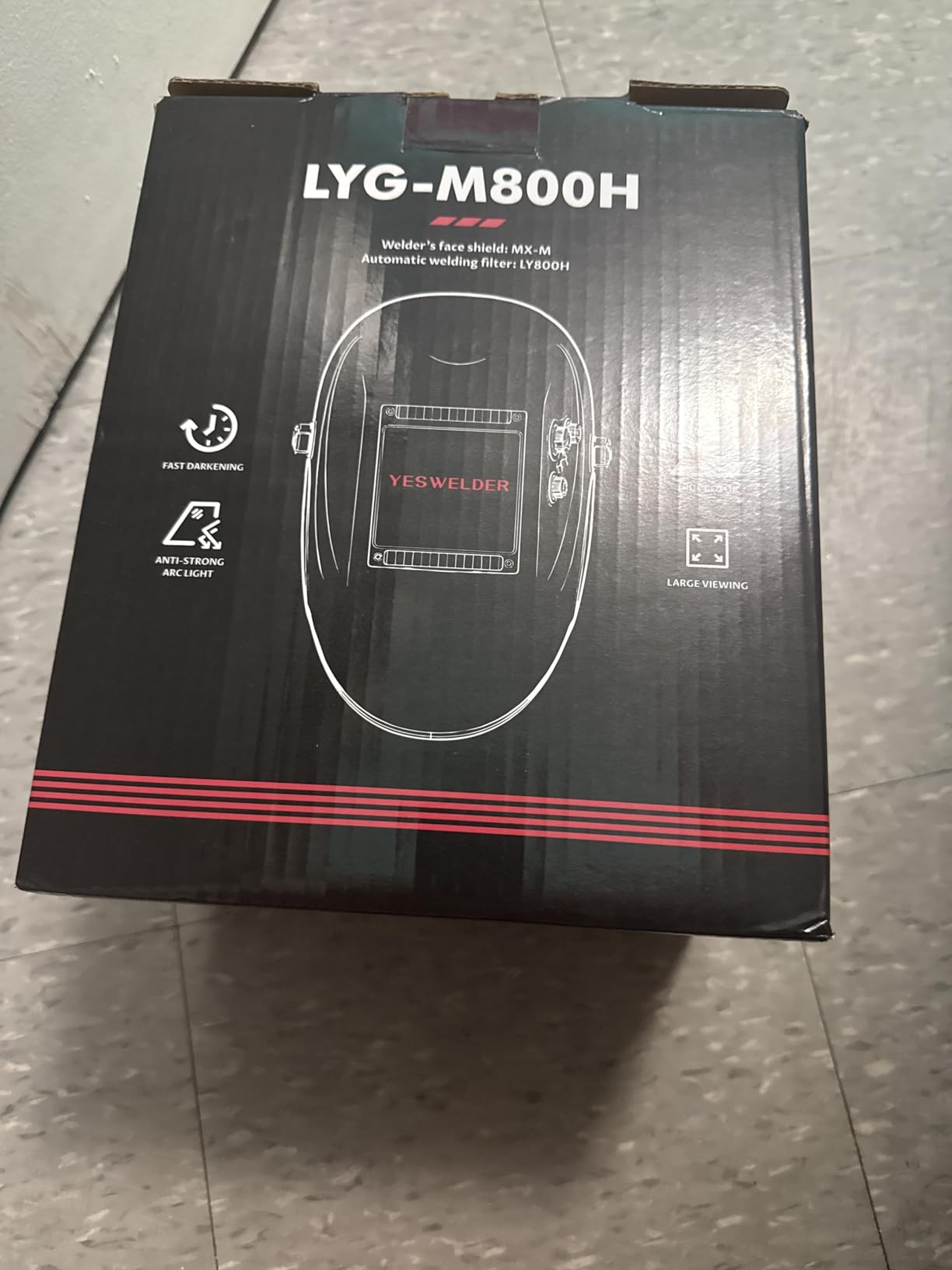
3. YESWELDER LYG-M800H – Most Versatile With a Big Window
YESWELDER Auto Darkening Welding Helmet, Large View, LYG-M800H
1/1/1/1 true color
4 arc sensors
3.93 x 3.66 in view
1.32 lb
Pros
- Large viewing window with 1/1/1/1 clarity that beginners notice immediately
- Four sensors give reliable darkening at low amperage
- Lightweight at about 600 g and comfortable for hours
- All external controls work with gloves on
- Spare lenses and storage bag included
Cons
- Plastic shell and headband feel thin beside professional hoods
- Flip-up retention knobs can feel fragile when tightened
- Inner lens is awkward to remove and the battery sits in an awkward spot
The M800H is the same idea as the L600A with a much larger window and four sensors instead of two. The viewing area of 3.93 by 3.66 inches is roughly twice the L600A’s, and for a beginner that difference is the whole purchase decision. Owner reviews describe the jump from a small window to this one as the moment they could actually see their work.
It keeps the 1/1/1/1 true color classification and the 1/30000 second switching speed, and it adds an adjustable shade range of DIN 3 light state, 5-9 and 9-13 for weld, cut and grind. Four arc sensors make it far more dependable outdoors or on thin material where a two-sensor model can miss a strike.
At roughly 1.32 pounds it stays comfortable, and every control sits on the outside of the shell. That last point sounds minor until you have tried to change a shade with a helmet on and gloves on and no light.
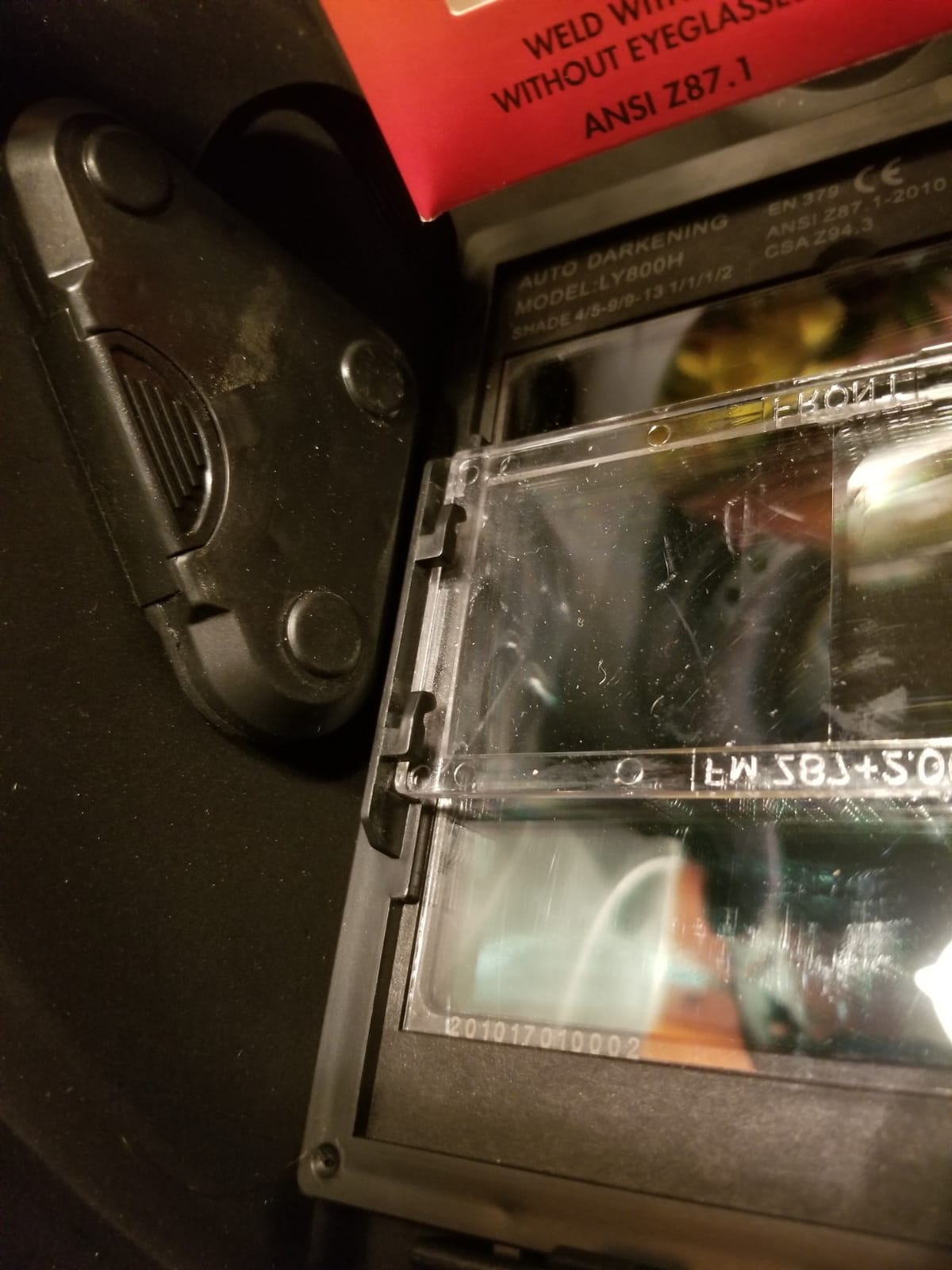
The honest weaknesses are mechanical. The shell and headband are thin compared with a professional hood, and the side tension knobs that hold the helmet flipped up are the component owners complain about most. Those knobs take a lot of abuse in normal use, so treat them gently.
Two smaller quirks: the inner lens is hard to grip when you need to swap it, and testing the auto-darkening by looking at the sun can fool you into thinking it is broken. Point it at a bright bulb with the shade set low instead.
Who this helmet suits?
Beginners doing MIG, stick or flux core who want to see their joint clearly without moving their head constantly. The four sensors make it a good choice for anyone welding outdoors in daylight, where cheaper two-sensor helmets often struggle to trigger.
It is also cheater lens compatible, which matters if you weld thin material or do detail work and want magnification.
Who should skip it?
Skip it if you have worked around welding gear before and know you will be hard on the hardware. The flip-up mechanism is the part that gives out first, and on a shop floor that means more than on a home hobby setup.
Anyone with a very small head should also try it on. The deeper shell takes more space than the L600A.
4. TOOLIOM True Color Large View – Best for Weld, Cut and Grind Modes
TOOLIOM True Color Auto Darkening Welding Helmet with Large View
12.9 sq in view
1/1/1/1 clarity
4 sensors
weld cut grind modes
Pros
- Large 12.9 square inch viewing area for the money
- 1/1/1/1 true color removes the usual green tint
- Four arc sensors support reliable detection
- Separate weld cut and grind shade modes
- Includes a battery plus spare inner and outer lenses
Cons
- Fewer owner reviews than the leading models here
- Plain plastic build with little premium detailing
- Delay and sensitivity are the only external adjustments
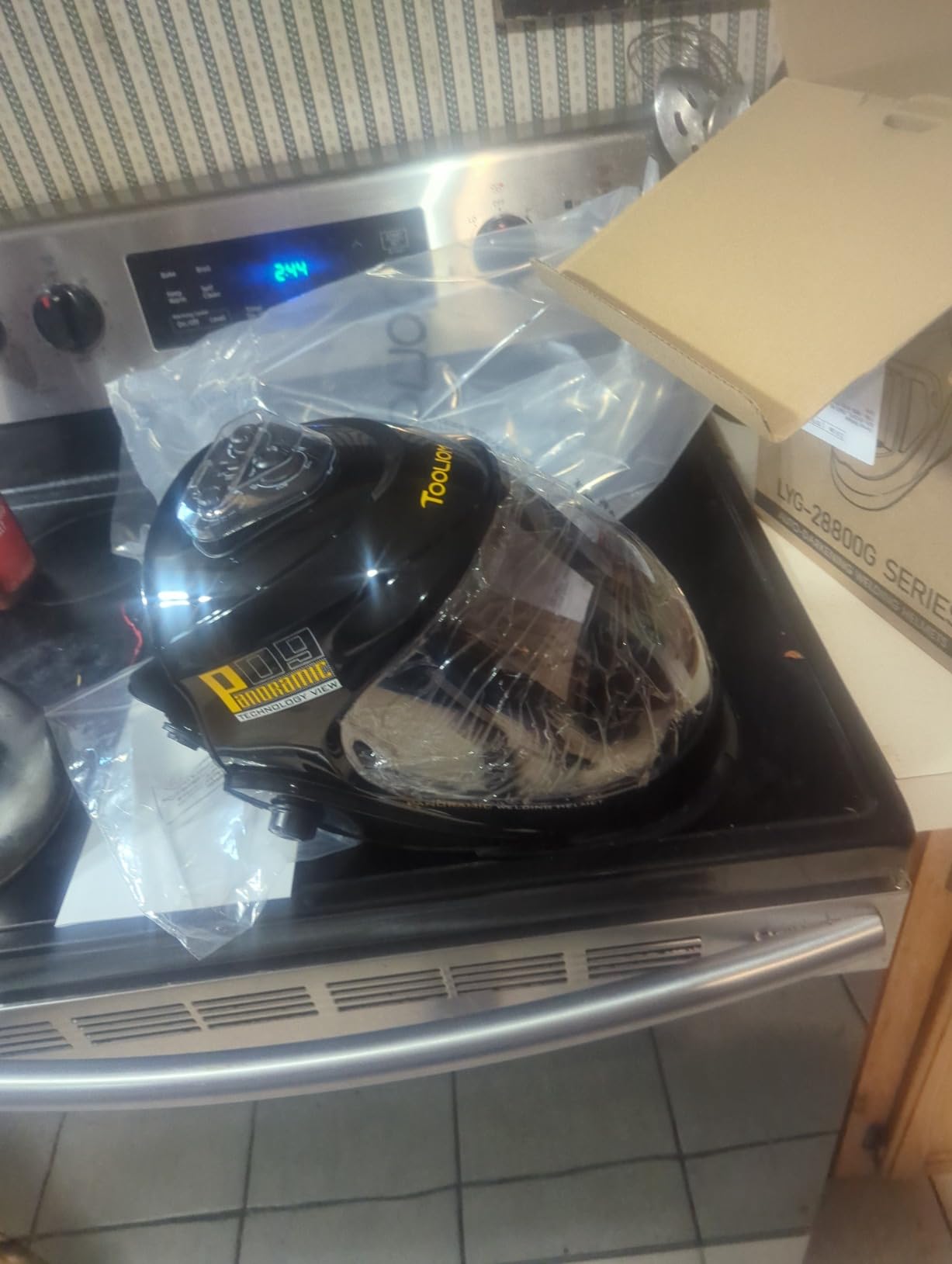
The TOOLIOM stands out for one reason: it puts a 12.9 square inch window and a three-mode filter into a mid-budget helmet. Its lens runs a 1/1/1/1 optical classification, and the 3.94 by 3.27 inch view is among the widest in this roundup.
The M800D filter handles weld mode at shade 9-13, cut mode at shade 5-9, and grind mode at shade 3.0 as separate settings rather than one continuous range. For someone who grinds and welds in the same session, that means one helmet instead of two.
Four sensors handle detection, and delay and sensitivity are adjustable so you can tune out false triggers from a nearby fluorescent light. At 4.5 stars across roughly fifteen hundred ratings, the score sits above the group average even with a smaller review base than the leaders.
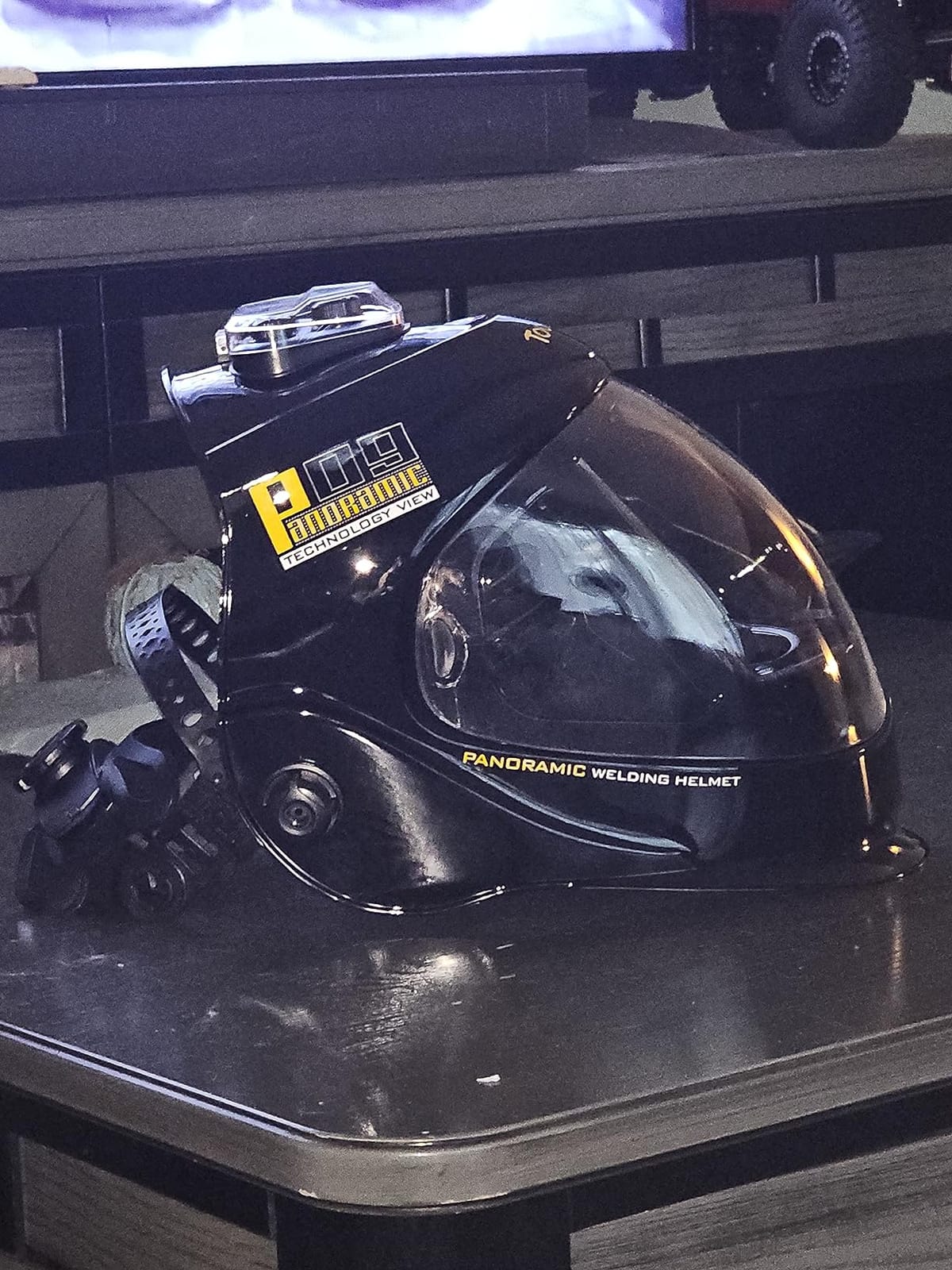
What you are accepting is a plain plastic shell with little visual refinement and a control set limited to delay and sensitivity. It is a working tool, not an object, and the product listing notes it meets ANSI Z89.1 rather than the Z87.1 mark most others carry.
That standard difference matters more than it sounds, so check the certification on whatever you buy rather than assuming every welding helmet carries the same mark. We cover the difference in the safety section below.
Who this helmet suits?
Beginners who alternate between welding and grinding, or who want a wide view for layout and fit-up work. The separate cut mode also makes it reasonable for anyone adding plasma cutting to the list of processes on a hobby machine.
If your priority is a large window plus true color optics and you do not care about brand nameplates, this is the pick.
Who should skip it?
Skip it if you want a warranty behind the electronics. Budget models in this category rarely carry more than a short parts window, and this one does not advertise one.
Also skip it if you want the reassurance of a large body of owner feedback. The review base here is real but a fraction of the size the YESWELDER models have accumulated.
5. TRQWH Solar True Color – Best for Low-Light Work
TRQWH Welding Helmet with Light True Color Auto Darkening Welding Helmets for Men Solar Powered Welding Hood with 2 Arc Sensor Wide Shade 4/9-13 for TIG MIG ARC Cool Welder Mask
1/1/1/2 clarity
2 sensors
1/20000 sec
USB work light
Pros
- Lowest cost in the group with a true color lens and a rechargeable work light
- Lightweight with padded forehead and ears for long sessions
- Solar plus replaceable CR2032 batteries that hold up well
- Delay and sensitivity knobs for tuning to your own work
- Simple external shade and grind control
Cons
- Some units arrive with headband or darkening issues
- Thin replacement lenses wear quickly in heavy shop use
- Headband straps stretch and the hood may not stay locked up
- Included head lamp is functional but feels cheap
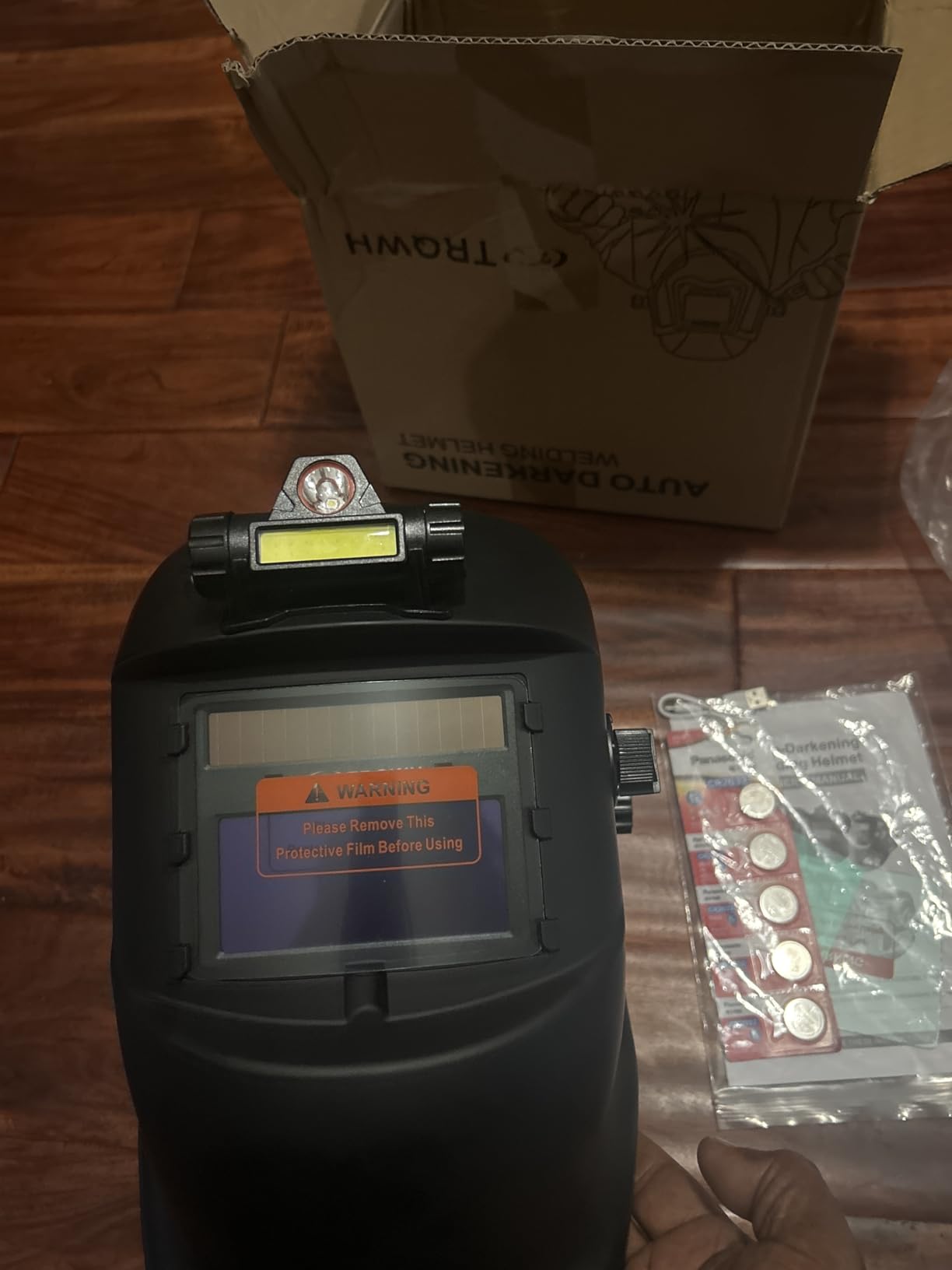
The distinguishing feature here is a built-in rechargeable LED work light with a USB port. If you are welding in a garage, a basement, or a farm building where you cannot rig overhead lighting, that lamp is genuinely useful rather than a gimmick. No other helmet in this roundup includes one.
The optics are 1/1/1/2, which is the second tier of EN 379 classification rather than the top 1/1/1/1. In practice the difference shows as slightly more distortion at steep viewing angles than the true top-tier lenses, not as a dim or colour-shifted view. Two sensors switch in 1/20000 of a second, with a DIN 4 light state and DIN 9-13 dark state.
Power comes from solar cells plus two replaceable CR2032 lithium batteries, which means the helmet keeps working when the light is poor. Compliance covers ANSI Z87.1, EN 379 CE and CSA Z94.3, so the safety marks are all present.
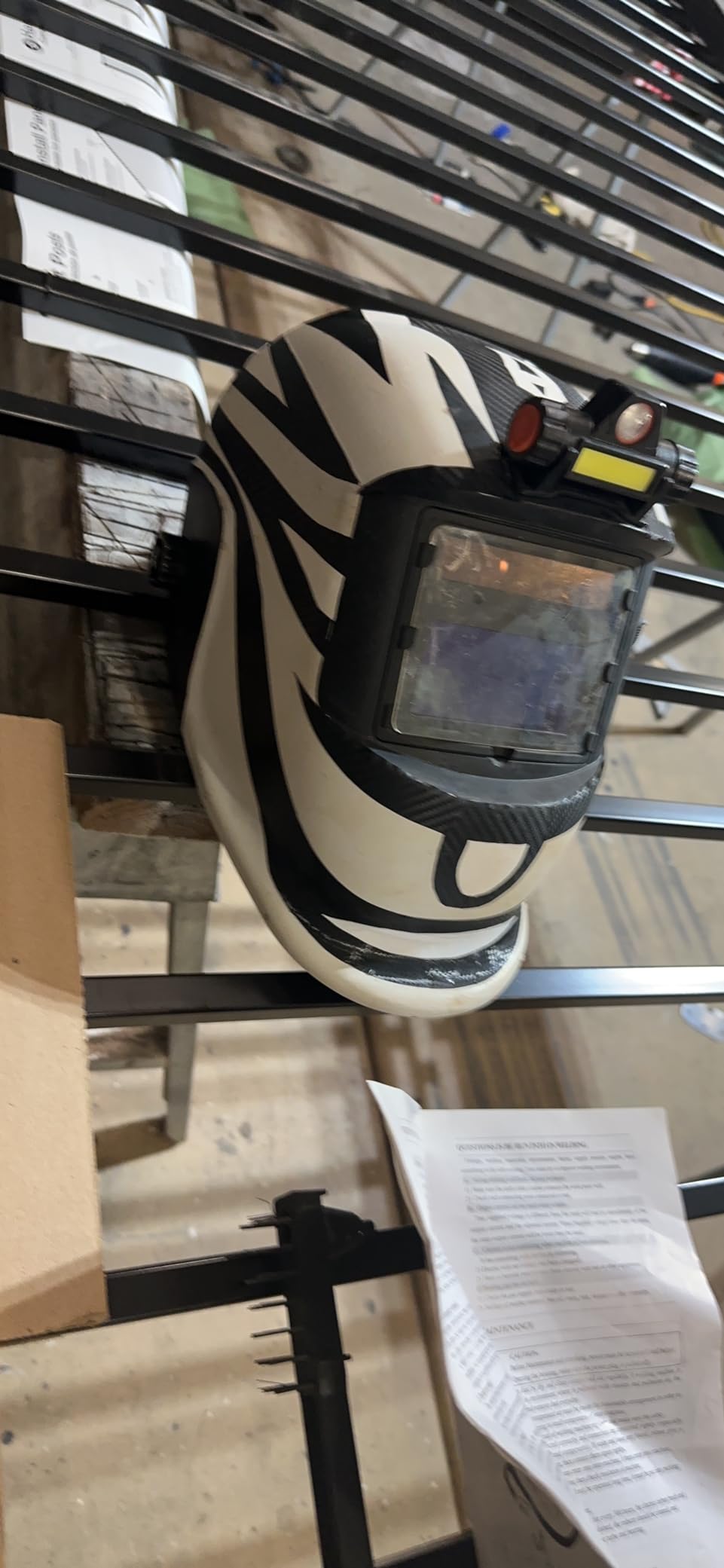
The build is where it gives ground. Owners report occasional units arriving with darkening or headband assembly issues, and the headband straps are described as stretching with use, which is exactly the failure mode r/Welding warns about when it says to buy headgear that will not break right away.
The replacement lenses are thin and wear faster in heavy shop use, so plan for a spare outer lens earlier than you would with a thicker lens. The work light itself works, but it feels like a light.
Who this helmet suits?
Anyone welding in poor light without a proper lighting rig, and anyone who wants a true color view at the lowest outlay in this roundup. The padded forehead and ear areas also make it comfortable for long sessions on a light helmet.
It covers plasma cutting, grinding, DC and AC TIG, MIG and stick, so the process range is wide.
Who should skip it?
Skip it if you are in a busy commercial shop where it will be knocked around. Strap stretch and lens wear are the two complaints that repeat, and both get worse with daily use.
Skip it if you are picky about optical class. 1/1/1/2 is good, but the top-tier 1/1/1/1 lenses are available for only slightly more in this roundup.
6. Sunstac 3.94 x 3.27 View – Best for Plasma and Cutting Work
Sunstac Auto-Darkening Welding Helmet 3.94 x 3.27″ View with Light
3.94 x 3.27 in view
4 sensors
shade 4/5-9/9-13
dual power
Pros
- Large true color view with no darkening lag
- Does not over-darken so the workpiece stays visible
- Comfortable fully adjustable padded headband
- Rechargeable swivel work light with two modes
- Handles stick TIG MIG cut MMA and plasma
Cons
- Battery compartment is awkward to open
- Side tension buttons feel delicate and the hood can flop down
- Deep shell can interfere with glasses
- Solar panel supplements the battery rather than recharging it
The Sunstac is the strongest score-per-review in the budget group, with roughly seventy-eight percent of owners at five stars. That is worth noting because its review count is modest, so the score is more concentrated and less diluted than the very high count models.
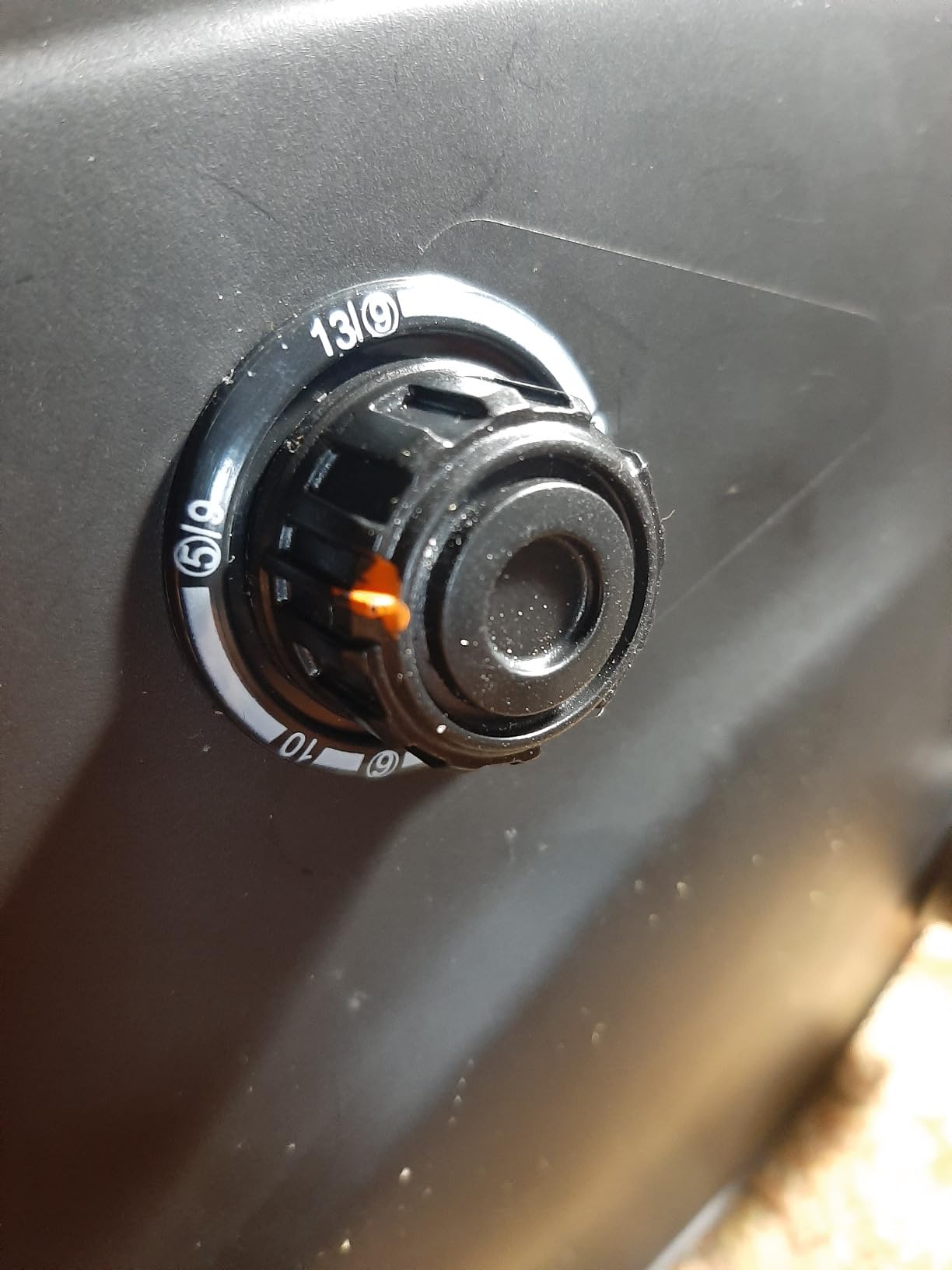
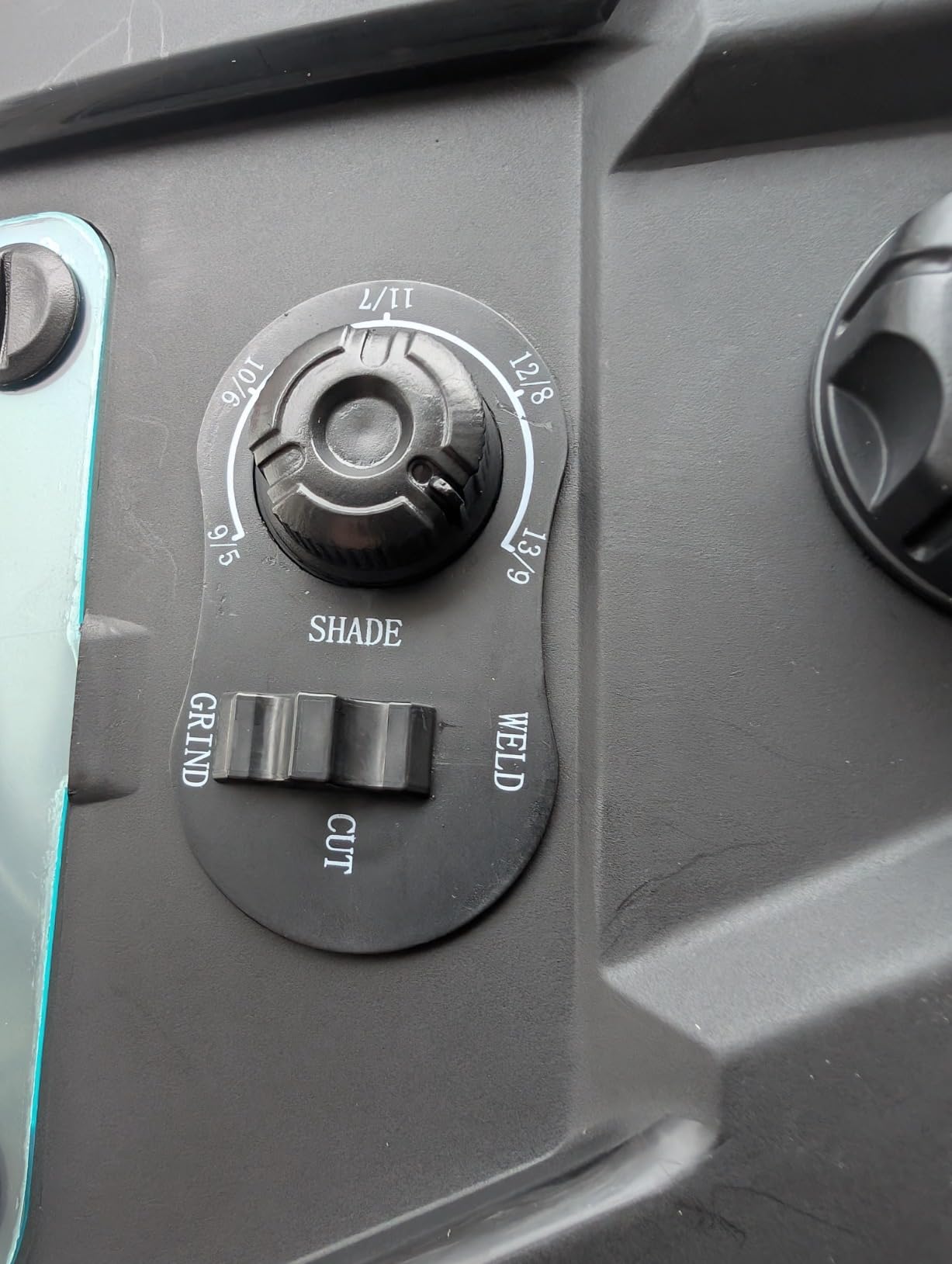
Its widest argument is process coverage. A shade range of 4 light state, 5-9 and 9-13 spans stick, TIG, MIG, cutting, MMA and plasma, and the 3.94 by 3.27 inch true color view does not over-darken, which owners specifically appreciate when they need to see the workpiece and the cut line together.
Four sensors switch in 1/30000 of a second, and power is dual, with a lithium battery backed by solar. The rechargeable swivel work light with two modes and an adjustable angle is another good addition for garage work.
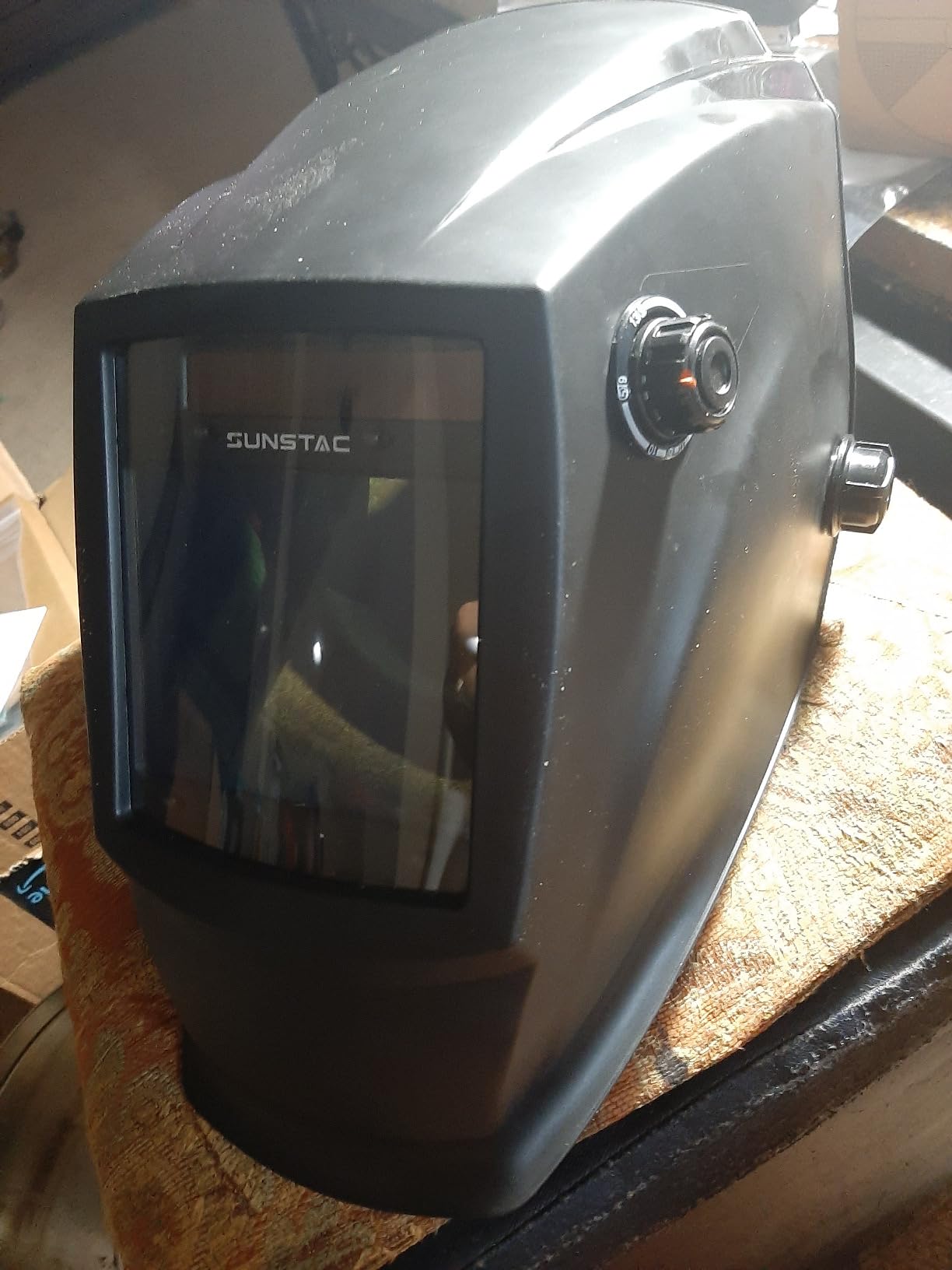
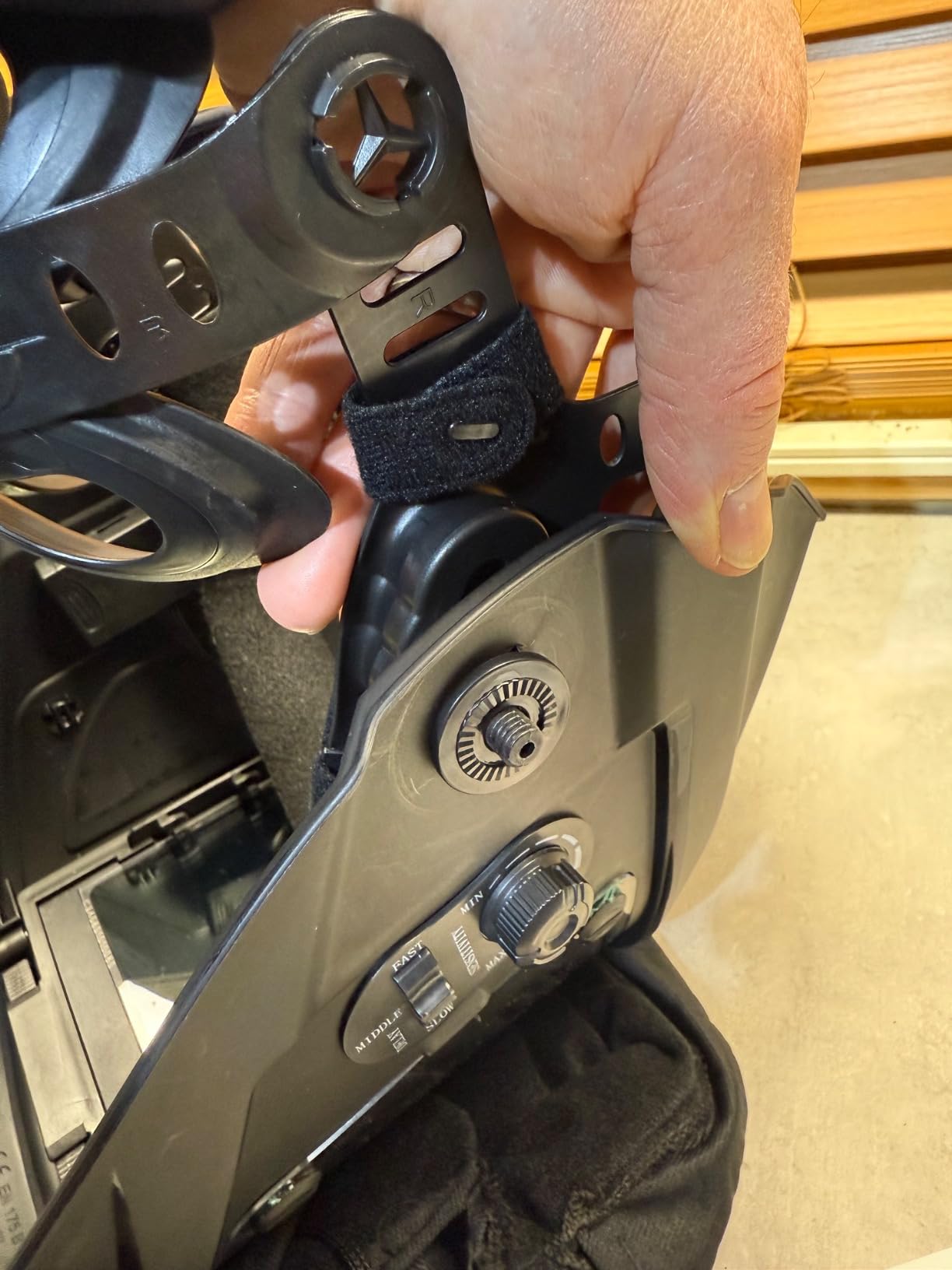
The complaints here are all mechanical and all fixable. The battery compartment is awkward to open, the side tension buttons feel delicate, and the shell is deep enough that it can interfere with glasses, which is a real problem for a reader who wears prescription frames.
One clarification that saves confusion: the solar panel supplements the battery rather than recharging it, so treat this as a battery-powered helmet with a solar assist, not a fully solar unit.
Who this helmet suits?
Beginners who will be cutting as well as welding, particularly anyone with a plasma cutter on a hobby machine. The wide shade range covers cutting modes that pure MIG helmets skip.
It is also a sensible pick for anyone who wants a true color window and a comfort-focused padded headband at a mid-low budget.
Who should skip it?
Skip it if you wear glasses. The deep shell is the single most repeated fit complaint, and you should test it with your frames before committing.
Anyone who works in a shop where the helmet will be grabbed and dropped should know the side buttons are the weak point.
7. ARCCAPTAIN 3.94 x 3.66 – Best for UV and IR Filtering
ARCCAPTAIN Welding Helmet, 3.94″×3.66″ Auto Darkening Welding Hood
4 sensors
1/25000 sec
12-in-1 filter
DIN 16 UV/IR
Pros
- Super large 3.94 x 3.66 inch screen at 1/1/1/1 clarity
- Very fast 1/25000 second response across four sensors
- Dual solar panels plus two CR2450 batteries
- Knobs adjustable while wearing gloves
- Comes with a storage bag and three replacement lenses
Cons
- Smallest review base in the group so durability data is thin
- PP shell is mid-weight plastic rather than a pro build
- Warranty limited to 180 days
The ARCCAPTAIN is the one to look at if filter construction is what concerns you. It uses a twelve-in-one smart filter with automatic DIN 16 UV and IR protection, which is a higher blocking claim than most of the budget group makes explicitly.
Optically it is strong: a 3.94 by 3.66 inch window at 1/1/1/1 true color clarity, four arc sensors, and 1/25000 second light-to-dark switching. The light state is DIN 4, with DIN 5-9 and 9-13 in the dark state.
Power is the other differentiator. Two solar panels and two CR2450 lithium batteries give it a long service life between battery changes. The shell is rated to operate from minus five to fifty-five degrees Celsius.
The honest caveat is data volume. With just over five hundred ratings this is the smallest review base in the group, so long-term durability opinions are still forming. The warranty is 180 days, which is short, and the polypropylene shell is mid-weight plastic rather than a professional build.
Those are not disqualifiers. They are reasons to check the fit and return terms carefully before you settle on it rather than reasons to skip it outright.
Who this helmet suits?
Anyone who wants a genuinely large window plus a documented high UV and IR blocking claim, particularly if they will be welding stainless or galvanised material or working near other people. The dual power setup suits someone who hates changing batteries.
The glove-adjustable knob section is a real advantage for people in gloves most of the time.
Who should skip it?
Skip it if you need a long warranty behind the purchase. One hundred and eighty days is a short commitment, and a professional who breaks a helmet should not be looking at this tier.
Also skip it if you want a large body of owner reports to lean on when deciding, because the sample here is thin.
8. MIGVAN Golden True Color H-21 – Best for Fast Sensor Response
MIGVAN Welding Helmet Auto Darkening True Color Large Viewing, Welding Hood Solar/Replaceable Battery Powered, Wide Shade 4/5-13 with 4 Arc Sensor, Optical Clarity Welding Mask for TIG MIG ARC Grind
4 sensors
1/10000 sec
golden filter lens
solar plus CR2450
Pros
- Golden true color lens gives a lifelike view of the pool and workpiece
- Fastest sensor response in the group at 1/10000 second
- Lightweight at about 1.09 kg with breathable padding
- Solar plus replaceable CR2450 for extended runtime
- Package includes two inner lenses and two outer lenses
Cons
- No stated warranty coverage
- Generic unbranded model with a modest review base
- Colour options limited to four variants
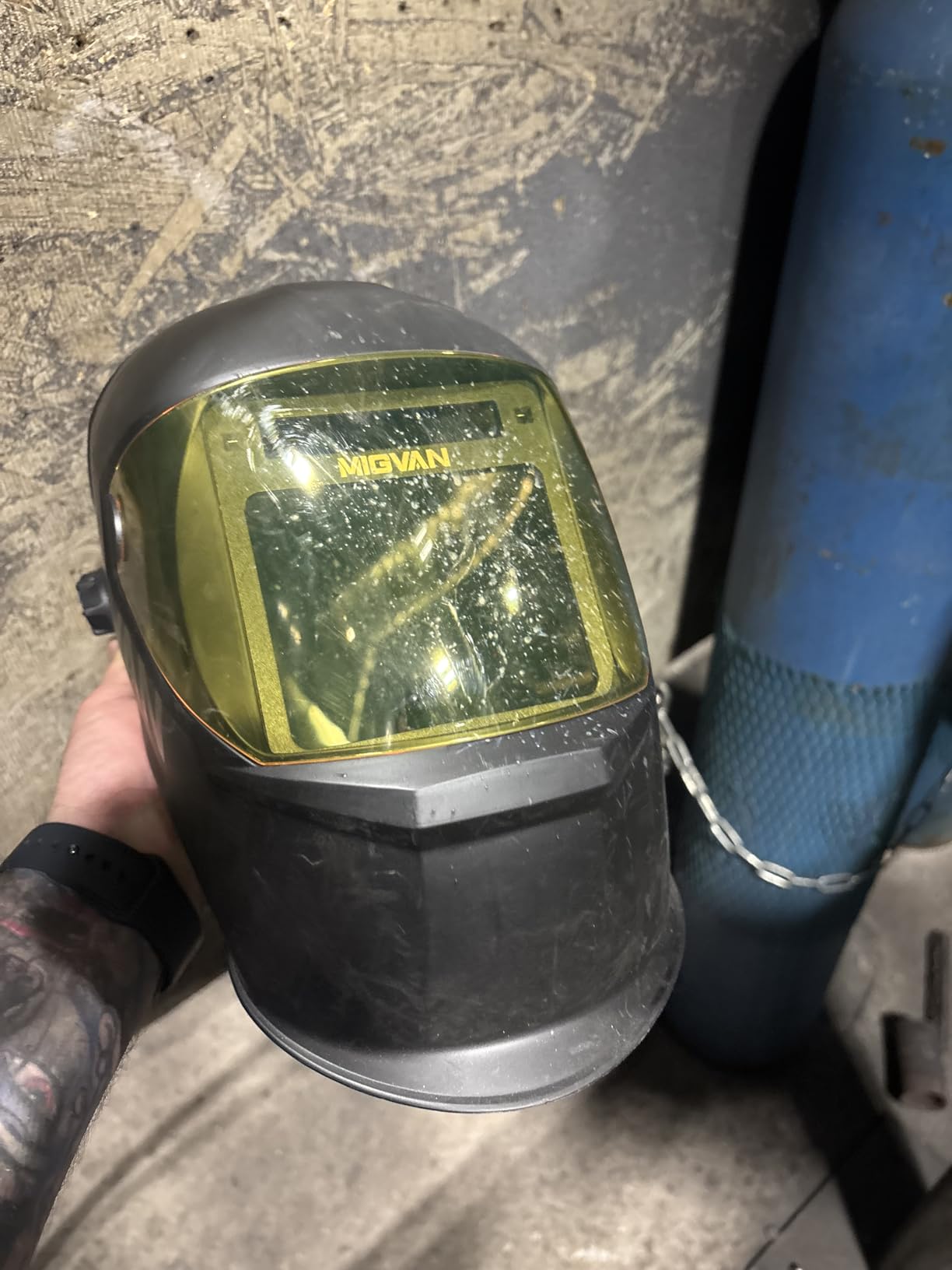
The H-21 posts the fastest sensor response we saw in this group at 1/10000 of a second, and it uses an advanced golden filter intended to reduce distortion. Owners consistently favour the resulting view, describing the weld pool and workpiece as lifelike rather than tinted.
Four premium arc sensors drive it, with a DIN 4 light state and DIN 5-9 and 9-13 dark states. That light state is bright enough to keep the helmet down between welds, which saves you the flip-up habit and the time that goes with it.
At about 1.09 kilograms with pivoting headgear and breathable padding, it is one of the lighter large-window options. Solar power is backed by a replaceable CR2450 battery, and the package includes two inner lenses, two outer lenses, a manual and a storage bag.
What holds it back is the packaging of the product rather than the product. There is no stated warranty, and it is an unbranded model with a review base under a thousand, so the long-term record is thinner than the YESWELDER options.
That said, the negative remarks in the reviews are fewer than the cheapest helmets attract, and the optics are the strongest part of the package.
Who this helmet suits?
Beginners who do short tack welds and frequent restarts, where a fast trigger keeps the view clear between passes. If you are welding thin material or tapping a bead in and out, response speed is more noticeable than it is on a single long seam.
Anyone who wants a large window with a bright light state and does not care about a brand name should find the optics here more than adequate.
Who should skip it?
Skip it if you want a warranty. No stated coverage means you are relying entirely on the return window, which matters if you are buying for a school or shop rather than yourself.
Anyone who plans to keep a helmet for a decade should look at a model with a manufacturer warranty and a longer electronics record.
9. Hobart 770890 – Best for Simple Analog Controls
Hobart 770890 Auto-Darkening Welding Helmet, Large, Black
PureColor lens
9.3 sq in view
4 sensors
2 year warranty
Pros
- 9.3 square inch PureColor view gives an accurate look at the weld
- Four independent arc sensors darken quickly and dependably
- Seamless weld to grind mode switching
- Analog knobs are easy to learn
- Backed by a two year manufacturer warranty
Cons
- Viewing window is smaller than modern panoramic helmets
- Analog controls are less precise than digital interfaces
- Heavier and costlier than the budget true color models
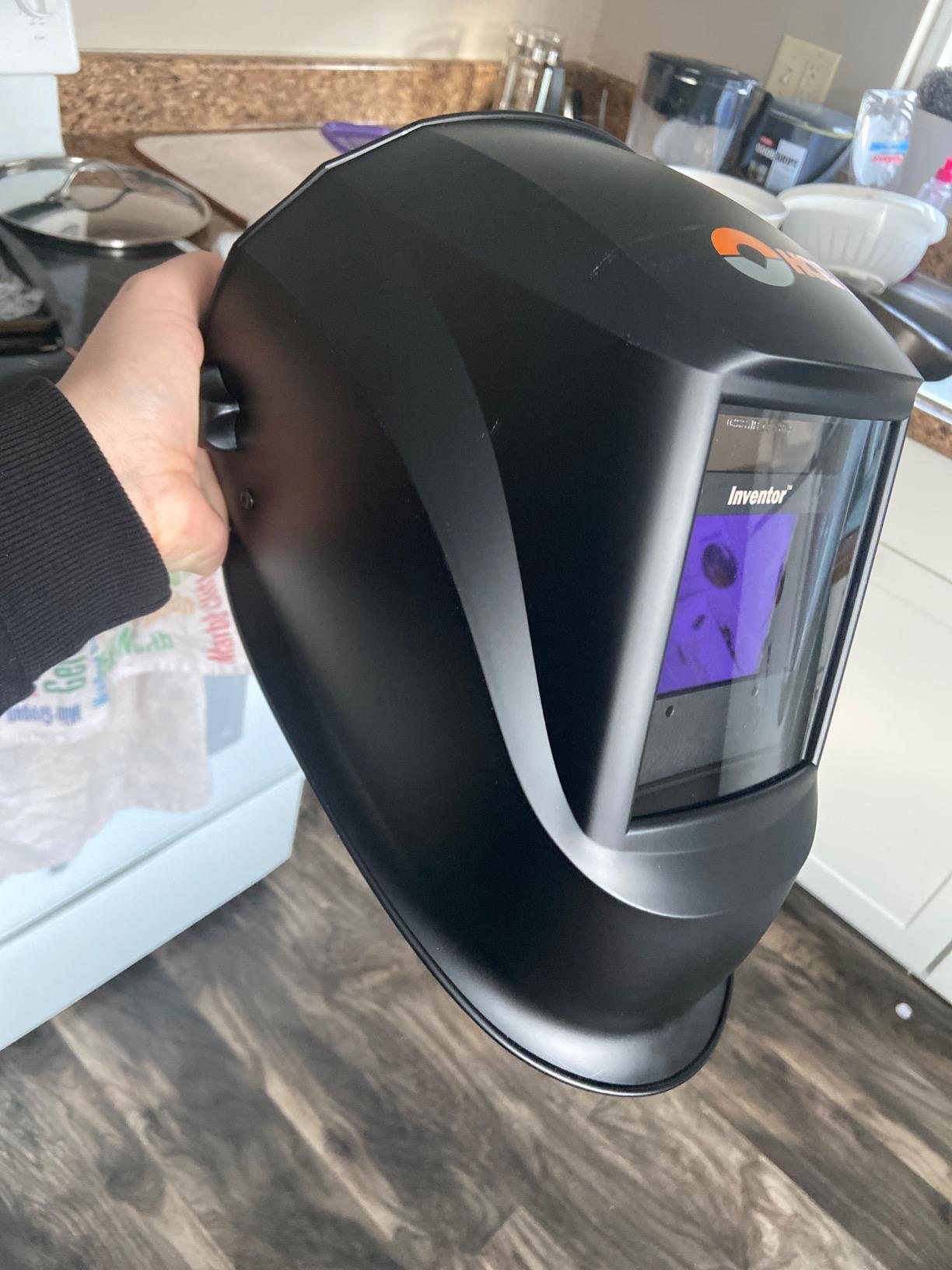
The Hobart 770890 is the pick if you want nothing confusing. It uses analog knobs for shade, sensitivity and delay, which you can learn in a minute and adjust without taking the helmet off or looking at a screen. For a first-time welder, that simplicity removes a whole category of frustration.
Its PureColor lens technology sits in a 9.3 square inch widescreen viewing area, with four independent arc sensors and auto on and off control triggered at the strike of an arc. Mode switching from weld to grind happens seamlessly, so you keep the same helmet on for the whole job.
The two year limited manufacturer warranty is the real differentiator at this level. The polyamide nylon shell is a step up from the thin plastic on budget models, and at 4.7 stars across about eight hundred eighty ratings, with roughly eighty-three percent of owners at five stars, the satisfaction rate is well above the group average.
The trade-offs are real but modest. A 9.3 square inch window is smaller than the panoramic models here, analog controls are less precise than a digital interface when you want shade 10.5 instead of 10 or 11, and it sits above the entry level models in weight and outlay.
Auto on and off means the filter wakes at the arc, but a beginner should still confirm the shutdown behaviour before they walk away from a paused project.
Who this helmet suits?
A beginner who does not want to learn a menu. The analog knobs are the least intimidating control set in this roundup, and the widescreen window is large enough to line up a joint without moving your head constantly.
It also suits anyone who wants a manufacturer warranty and a nylon shell because their helmet takes knocks, such as students sharing equipment or shop use.
Who should skip it?
Skip it if you need shade 5 for low-amp TIG. The analog shade control on this model is not the fine-grained selector a TIG welder wants.
Also skip it if buying the largest possible window is your priority, since several models here give you noticeably more viewing area for less money.
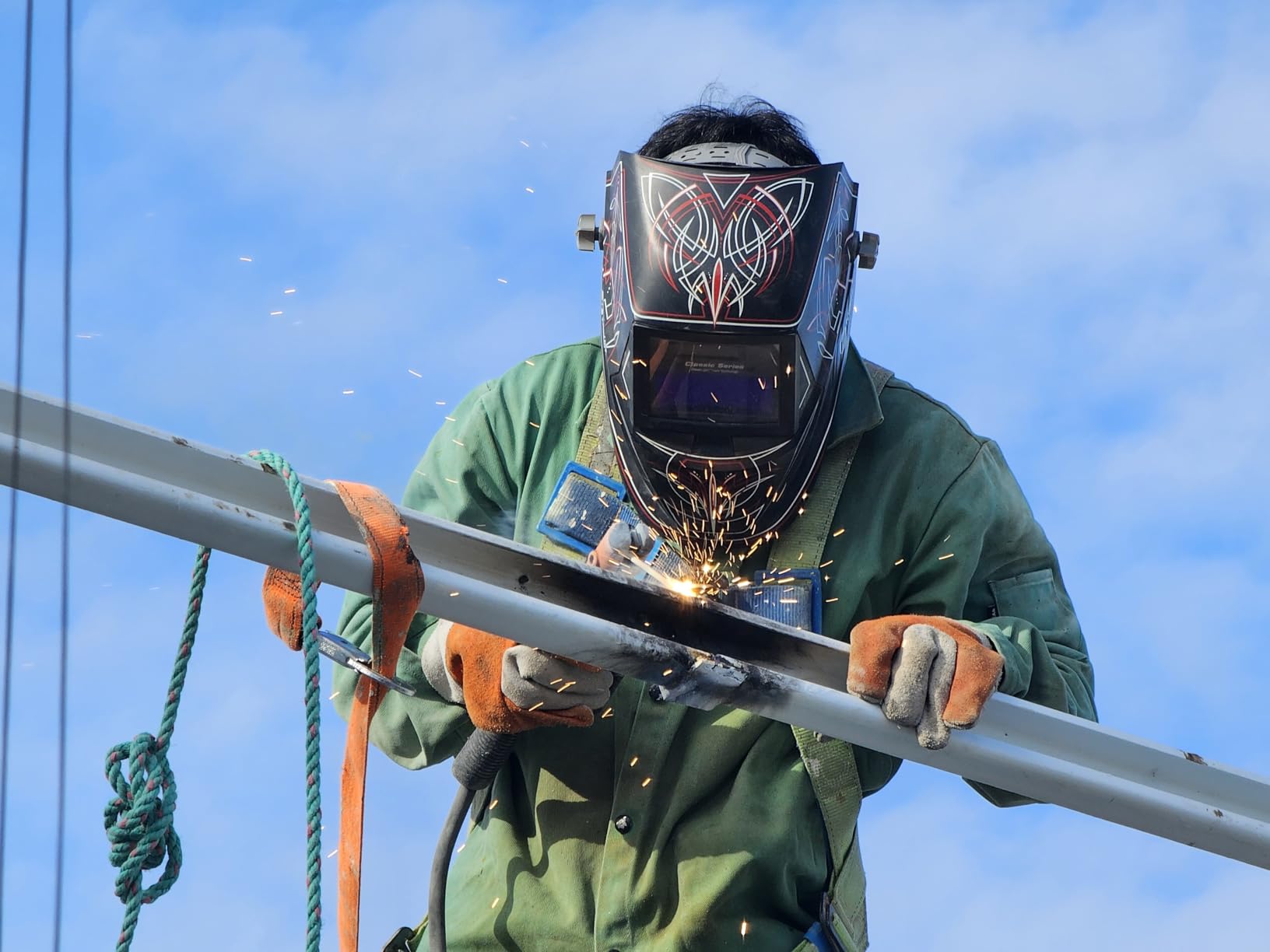
10. Miller Classic Series ClearLight – Best for Low-Amp Work
Miller Classic Series Welding Helmet, ClearLight™, Shade 8-13, Black
ClearLight lens
6 sq in view
2 sensors
1/23000 sec
Pros
- ClearLight optics give accurate colour and a clear view of the puddle
- Suitable for low amperage work including five amps and below
- Ratchet headgear and digital controls give a repeatable fit
- 3.0 light state lets you keep the helmet down between welds
- Three year warranty and spare part availability
Cons
- Six square inch viewing area is small by modern standards
- Two arc sensors are fewer than many budget helmets carry
- Heavier and costlier than entry level models
The Miller Classic is the odd one out in this group and that is exactly why it is here. Its 2 sensors and 6 square inch window look dated next to the panoramic budget models, but its ClearLight lens and 3.0 light state let you work at the low end of the range, including five amps and below, where a darker filter leaves you blind.
Switching is 1/23000 of a second, and the shade settings cover weld at 8-13, cut at 5-8 and grind at 3. The ratchet headgear with adjustable digital controls for shade, delay and sensitivity gives you a fit you can set once and repeat, which matters when you are trying to learn consistent technique.
At 4.7 stars with roughly eighty-six percent of owners at five stars, this has the highest five-star share in the group. The three year warranty and the availability of spare parts are things no budget model in this roundup matches.
The compromises are the viewing area, which is the smallest of any helmet reviewed here, and the sensor count. Two sensors can be slow to trigger outdoors in bright sunlight, which is a genuine limitation if you plan to weld outside rather than in a garage.
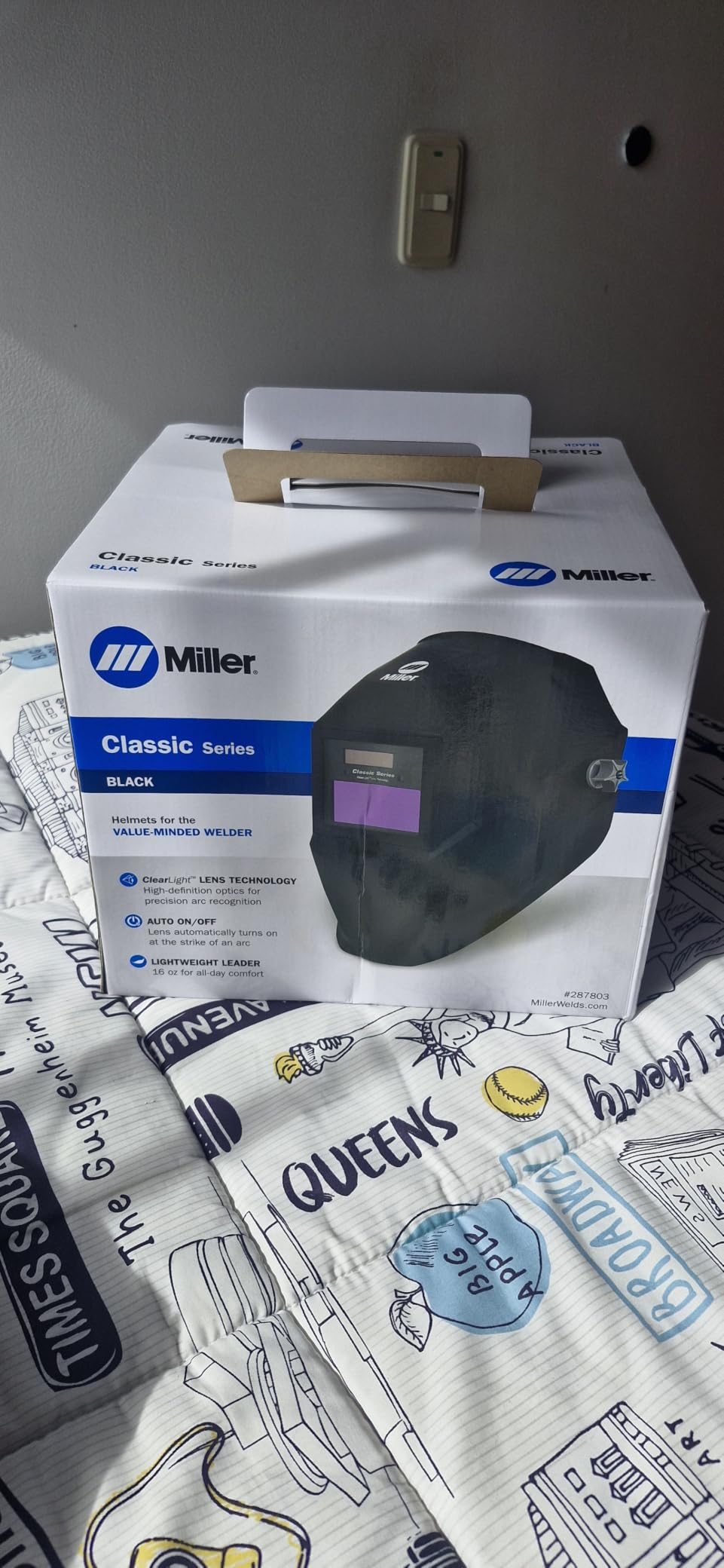
It is also heavier and costlier than the entry level true color models, so you are paying for optics and low-amp capability rather than for a big window.
Who this helmet suits?
Anyone doing thin sheet, stainless, or any job where the amperage drops low and a darker lens would hide the pool. That includes beginners working on a small hobby machine with fine control at the bottom of its range.
It also suits anyone who prefers a compact, familiar shape and a ratchet fit that does not shift, and anyone who values a three year warranty over window size.
Who should skip it?
Skip it if you work outdoors in bright light or need a wide view for fit-up and layout. Two sensors and a 6 square inch window are the wrong combination for those conditions.
Skip it if your goal is grinding and cutting in the same session with a large viewing area, since the small window makes that more fiddly than it needs to be.
How to Choose Your First Welding Helmet?
Work through these six questions in order and the model will pick itself. The order matters, because process and fit narrow the field faster than price does.
Which process will you do first?
MIG is easier to learn and it is what most beginners start with, which means a shade 9-13 helmet covers you completely. Stick and flux core fit in the same range. TIG is the exception, and it is the one place where beginners routinely buy the wrong helmet.
At 100 amps and above, TIG works on a shade 9 or 10. Below 40 amps, light TIG needs shade 5 to 8, and most MIG-only helmets bottom out at 7 or 9, which leaves you squinting at a pool you cannot read. The YESWELDER LYG-L600A reaches shade 7, which covers light work, and the TOOLIOM and Sunstac have dedicated low ranges for cutting and mixed process work.
Do not pay for shade 5 TIG capability until you know you will TIG. A new welder spends most of their first year on MIG.
What shade number do you actually need?
Use the darkest shade you can still see the pool through. If you are squinting, go lighter. A practical starting point for MIG is shade 10 for 100 to 200 amps, shade 9 for lower settings, and shade 11 or 12 for higher amperage or thicker material.
Grinding wants shade 3 or 4, which is why grind mode matters. Most helmets here cover weld, cut and grind, and the ones with a separate grind control let you switch without touching the filter.
What does the optical classification mean?
EN 379 grades four things, each scored from 1 as best to 3 as worst: optical class, diffusion of light, variation in luminous transmittance, and angle dependence. That is the four digit rating you see, and it is the clearest number comparison you can make between two lenses.
A rating of 1/1/1/1 is top tier, which is what the Lincoln VIKING 3350, the YESWELDER pair, the TOOLIOM, the Sunstac and the ARCCAPTAIN all carry. The TRQWH sits at 1/1/1/2, which is a common budget rating and perfectly serviceable. The first digit dominates the experience, because optical class is how evenly the lens transmits light across the view.
As for colour, true color removes the traditional green tint and lets you judge the base metal and the bead colour. It used to be a premium feature. It is now the standard in this entire roundup, so you should not have to pay extra for it.
How many sensors and how fast?
Two sensors detect the arc optically. Four sensors, which is what most of this group carries, add redundancy and detect a strike more reliably at an angle or in bright light. Two is fine for indoor MIG on thicker material. Four is the better bet for outdoor work, thin material, and low amperage.
Switching speed ranges from 1/10000 of a second on the MIGVAN to 1/30000 on the YESWELDER models, and human perception differences above about 1/10000 are small. Sensor count and placement matter more than the last decimal digit of the response figure.
What safety standards should be on the helmet?
Look for ANSI Z87.1, which is the US welding and cutting standard, and note that a label reading “ANSI approved” is not the same thing as compliance with a named standard. The helmets here variously carry ANSI Z87.1, CSA Z94.3 for Canada, and EN 379 CE for Europe, and the TOOLIOM is listed to ANSI Z89.1, a related but different mark.
Confirm the standard rather than the marketing phrase. The filter blocks UV and IR in both light and dark states, so a certified cheaper helmet is a safe helmet, just a less pleasant one to work in.
How does fit work, and what about glasses or a respirator?
A helmet that shifts mid-weld puts your view off the joint, so fit is the most-skipped and most-missed step. Look for ratcheting or multi-point headgear with adjustment at the back and sides, and check that the helmet sits level without pressure on the crown.
Glasses wearers should bring their frames when they shop. Deep shells like the Sunstac’s are reported to interfere with frames, while a larger aperture like the VIKING 3350’s is more forgiving. A cheater lens holder, which the YESWELDER M800H and several others accept, is the usual answer for magnification.
Respirators are the unresolved one. Fitting a half mask under a hood is awkward, and many product listings ignore it. Try the combination before you commit, and remember that no helmet protects against fumes at all, which is the next section.
Welding Fumes and the Respirator Your Helmet Cannot Replace
A welding helmet protects your eyes and face from radiation, spatter and debris. It does nothing at all for the fume plume, and a beginner rarely hears this clearly enough.
Welding fume is a fine particulate containing metal oxides from the base material, the wire and the flux. Stainless and galvanised coatings produce the worst versions, and flux core adds its own fumes. The material is the hazard, so a particle filter is the correct protection, which is why a half mask P100 respirator is the standard pairing for regular welding work.
For occasional hobby work in a ventilated space, the priority is extraction: open the door, use a fan, weld outside where you can, and keep the helmet on anyway. For weekly work, add a half mask P100. For production work, powered air purifying respirator systems are the standard answer, and fitting one under a hood is a real fit problem worth testing.
It is worth repeating one point here. Owners across every budget tier in this roundup mention fume protection in the same breath as the helmet, and the recurring regret is skipping the respirator rather than skipping the helmet.
Your First Welding Session Checklist
Before the first strike, walk this list once.
Helmet settings. Install the outer cover lens, set sensitivity low and delay high to start, then tighten both. You can loosen them once you know your own arc.
Shade test. Set the welding shade, then look at a bright bulb through the lens. The bulb should be barely visible. If it is invisible, go lighter.
Auto on and off. Confirm the filter wakes at the strike and clears afterward, before you are under a live arc.
Welding gloves. Proper gauntlet gloves, not thin work gloves. Your hands are closer to the puddle than your face is.
Leather sleeves or a jacket. Spatter burns on the forearms end more beginner projects than anything else.
Safety glasses under the helmet. Some helmets accept a prescription insert or cheater lens, and this is the cheapest way to solve the glasses problem.
Chipping hammer and wire brush. Basic, but you cannot clean a bead without them.
Respirator. A half mask P100 if you will be welding more than an occasional evening, and always for stainless, galvanised or flux core work.
Helmet Care and Maintenance
Cheap helmets usually die from a neglected cover lens, not from failed electronics, so maintenance is where your money actually goes.
Replace the outer cover lens at the first sign of pitting. Spatter pits are permanent and each one is a place where light scatters. This is the highest value maintenance you can do.
Clean the sensors. A dust cover or a scratched inner lens slows detection. Wipe the sensors and the inner lens with a dry cloth before you blame the electronics.
Store a spare battery. Coin cells die quietly. Solar panels supplement rather than replace them on most of these models, so keep a spare of the right type.
Do not overtighten flip-up knobs. They are the most common mechanical failure, and they take the least force to work.
Expect a cartridge lifespan measured in years. Quality helmets last seven to ten years or more with the filter replaced around the five to seven year mark. Budget helmets commonly give out in three to five years, and the filter is usually not replaceable separately.
Check the standard is still on the label. A replacement shell from a parts supplier should carry the same certification as the original.
Frequently Asked Questions
Are cheap auto-darkening welding helmets safe?
Yes. A certified budget helmet blocks ultraviolet and infrared light in both its light and dark states, so it will not harm your eyes even if a sensor misses a strike. What you lose at a lower tier is clarity, switching speed and shell durability, which affect comfort and how well you can see your weld rather than whether you are protected. Look for ANSI Z87.1 on the label, not the phrase ANSI approved.
What shade should I use for MIG welding?
Start at shade 10 for 100 to 200 amps, shade 9 for lower settings, and shade 11 or 12 for higher amperage or thicker material. The rule of thumb is to use the darkest shade you can still see the weld pool through. If you are squinting, go lighter, because squinting for a whole session is what causes eye strain rather than the shade itself.
Can I use a MIG helmet for TIG welding?
Yes at normal TIG amperage, where shade 9 or 10 works fine. Below about 40 amps, light TIG needs shade 5 to 8, and most MIG-only helmets bottom out at 7 or 9, so the pool becomes impossible to see. If TIG under 40 amps is on your plan, check the minimum shade before you buy rather than after your first attempt.
What does 1/1/1/1 optical clarity mean?
It is an EN 379 rating with four numbers, each scored from 1 as best to 3 as worst: optical class, diffusion of light, variation in luminous transmittance and angle dependence. A 1/1/1/1 rating is top tier and is what true color lenses carry. The first digit matters most, because optical class is how evenly the lens transmits light across the view.
What color lens is best for welding?
A true color lens, which is rated 1/1/1/1. The older green-tinted filters darken colour perception, and reading the true colour of the base metal and the bead is part of learning to control heat. True color optics used to be a premium feature and are now standard across this entire price range, so you should not have to pay extra for one.
Is MIG or TIG easier?
MIG is easier. It feeds the wire for you, handles the filler metal, and is forgiving about technique, which makes it the standard first process. TIG gives you far more control and produces cleaner work on thin material and stainless, but it is a skill you will spend months building. Buy for MIG now and add shade 5 TIG capability when you actually start TIG.
Is welding smoke worse than cigarette smoke?
Welding fume is a fine particulate containing metal oxides from the base material, the wire and the flux, and there is no safe level. Stainless and galvanised coatings produce the worst fumes, and the material determines the hazard rather than the process. A welding helmet does nothing for fumes at all, so pair one with a half mask P100 respirator for regular work and ventilate the space for occasional hobby use.
Do I need a respirator with my welding helmet?
For regular welding, yes, and always for stainless, galvanised or flux core work. A welding helmet protects your eyes and face from radiation and spatter, not your lungs, so the respirator is a separate piece of safety equipment rather than an accessory. For occasional hobby work in an open or well ventilated space, prioritise extraction, but a half mask P100 is inexpensive compared with a helmet.
Final Verdict
Buy the YESWELDER LYG-L600A if you want the safest first step at the lowest risk, the YESWELDER LYG-M800H if you want a bigger window and four sensors, and save the Lincoln Electric VIKING 3350 for the day you know you are welding weekly. None of the three will hurt you, and all three are a legitimate first helmet. The best welding helmets for beginners are simply the ones you will keep on your head for an hour at a time, because a visor you find uncomfortable is a visor you take off.
Buy the helmet, set the shade to 10, put on a P100 respirator, and make your first bead. Our bike helmet guide covers fit and padding in more depth if headgear comfort is the part you are unsure about. This roundup was updated for 2026, and we revisit it whenever the models change.