
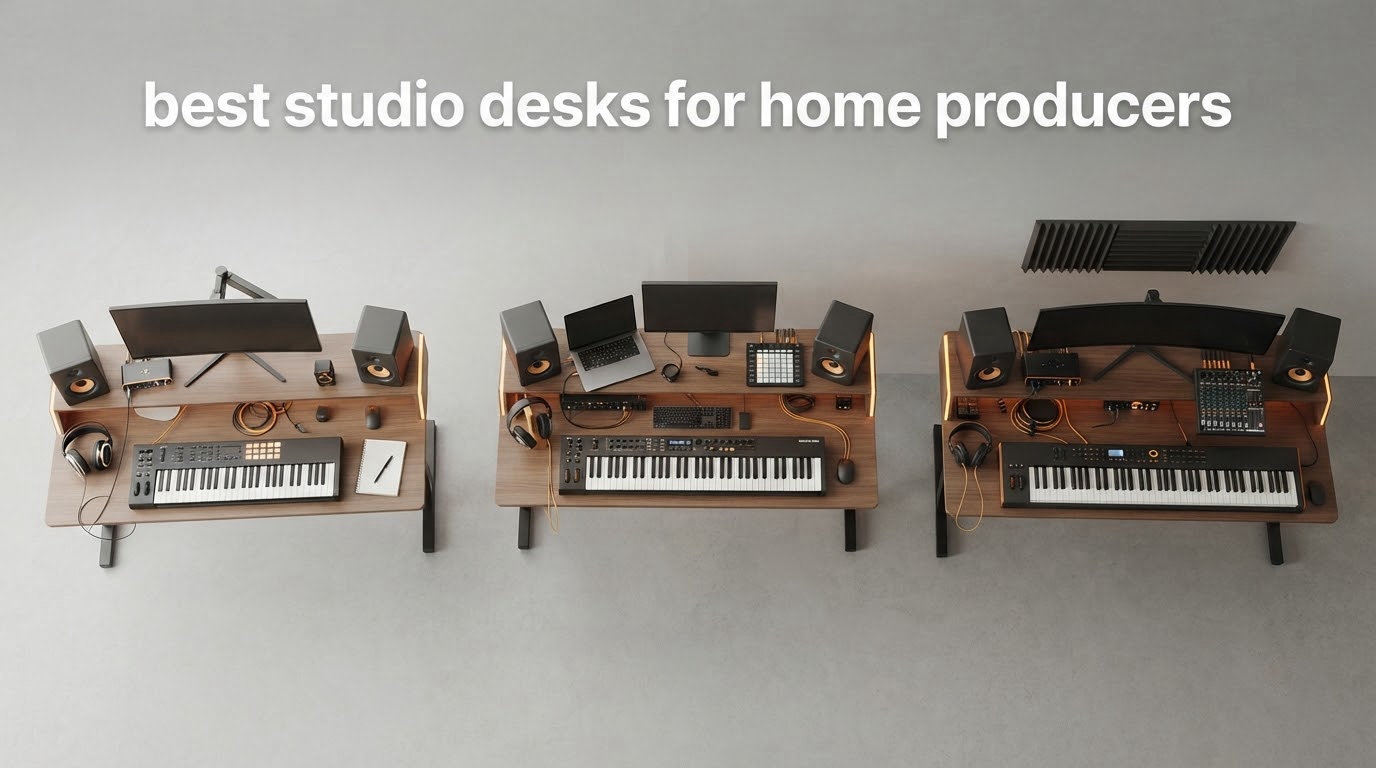
Most home producers do not need a professional console desk. They need a surface at the right height, a place to put the screen and the nearfield monitors, somewhere for the controller, and enough structure underneath that the setup stops shifting every time you lean on it. That is the whole job, and plenty of desks solve it for a fraction of what the pro-audio catalogues charge.
The short answer: the On-Stage WS7500 is the best studio desk for most home producers. It has a 175 pound steel frame, a two-tier layout that lifts your screen and speakers to a seated listening position, and a sliding keyboard tray, and it holds a 4.5 star average across more than 800 reviews. If you have a small room, the Acme 47-inch Suitor is the stronger buy, and if you want to stand while you work, the EUREKA ES71 is the only sit-stand option in this group.
What makes a studio desk different from the table you are using now comes down to three things. A raised tier puts your display and monitors near ear height instead of forcing you to look down or up. A pull-out tray keeps a 49, 61 or 88 key controller at playing height rather than on the floor. And rack bays, where they exist, let outboard gear sit at arm’s length instead of on a separate trolley in the corner.
There is a healthy counter-argument, and it comes from the Gearspace veterans who have spent decades in real rooms: a large flat worktop throws early reflections straight back at your listening position, and the long-standing advice is that the best desk is no desk. Find the smallest one that does the job. Everything below is written with that in mind, so each section tells you not just who a desk suits but who should walk past it.
Before you read further, it helps to have the rest of your room sorted. Our guides to the best studio monitors and the best studio microphones for home recording cover the two pieces of gear that matter more to your sound than any desk will.
Table of Contents
Top 3 Best Studio Desks for Home Producers (October 2026)
On-Stage WS7500
- 175 pound steel Z-frame
- Two-tier raised monitor shelf
- Sliding keyboard tray


EUREKA ES71 Standing Desk
- 29 to 48 inch dual-motor lift
- 72 inch wing-shaped top
- Reconfigurable LED shelves
Those three cover the majority of home studios. The WS7500 is the safe all-rounder, the Acme Suitor is the one to buy if rack gear is coming and the budget is tight, and the ES71 is the only genuine sit-stand option here, with a 29 to 48 inch range and a 220 pound capacity.
Studio Desks for Home Producers in 2026
Twelve desks, ordered by how well they fit a typical bedroom or spare-room setup rather than by price. Read the Key Features column as the short version, then jump to the full section for the caveats nobody puts in a product listing.
| Product | Specifications | Action |
|---|---|---|
| On-Stage WS7500 Workstation |
|
Check Latest Price |
| Acme 47 Inch Suitor Desk |
|
Check Latest Price |
 Armocity Studio Workstation Armocity Studio Workstation |
|
Check Latest Price |
| EUREKA ERGONOMIC ES71 Standing Desk |
|
Check Latest Price |
 Monoprice Stage Right Desk Monoprice Stage Right Desk |
|
Check Latest Price |
 Acme 83 Inch Eleazar Workstation Acme 83 Inch Eleazar Workstation |
|
Check Latest Price |
 Musiea BE200 Workstation Musiea BE200 Workstation |
|
Check Latest Price |
 Glorious Sound Desk Pro Glorious Sound Desk Pro |
|
Check Latest Price |
 Glorious Sound Desk Compact Glorious Sound Desk Compact |
|
Check Latest Price |
 LYYL Workstation 88 LYYL Workstation 88 |
|
Check Latest Price |
 Musiea IM100 Workstation Musiea IM100 Workstation |
|
Check Latest Price |
 Acme 71 Inch Eleazar Desk Acme 71 Inch Eleazar Desk |
|
Check Latest Price |
1. On-Stage WS7500 – The Best All-Round Studio Desk for Home Producers
On-Stage WS7500 Series Wood Studio Workstation – Black
43 inch wood top
Alloy steel Z-frame
175 pound load rating
Raised monitor tier
Pros
- Steel Z-frame rated to 175 pounds
- Two-tier layout raises screen and speakers
- Keyboard tray slides clear when unused
- 43 inch top fits real gear without crowding
- Expands with OnStage rack and corner accessories
Cons
- Wood top and steel frame sold as separate pieces
- Only one keyboard tray for extra controllers
- Laminated finish wears at the edges
This is the desk we keep coming back to. The Z-frame is the reason it feels solid: it is alloy steel, and it is rated to 175 pounds, which is more than a pair of 8-inch nearfields plus an interface plus a 61-key controller will ever put on it. At 21 pounds the whole thing is light enough to move between a bedroom and a spare room without a second person.
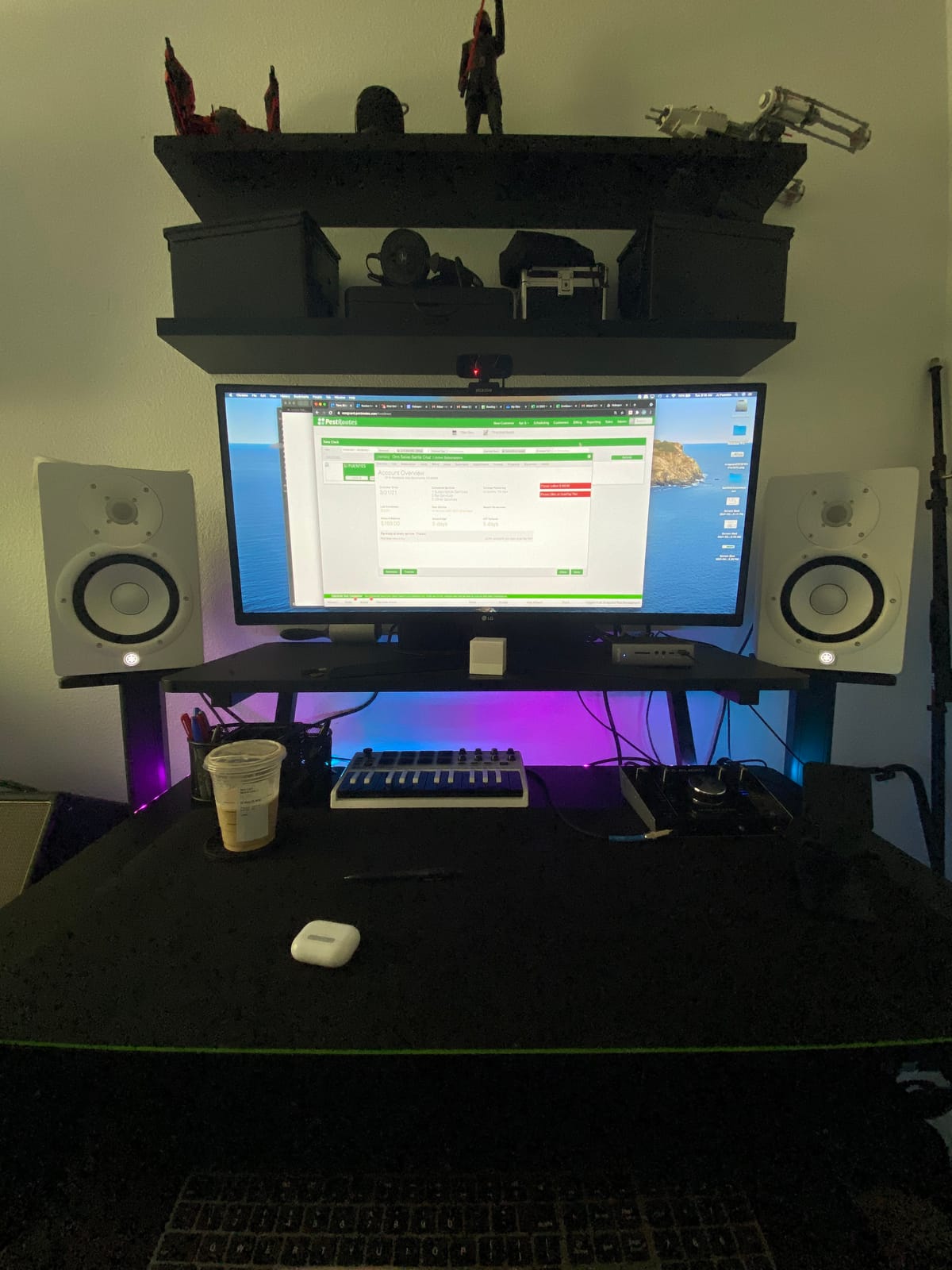
The two-tier layout is the quiet hero. The main wooden surface sits 29 inches off the floor, which gives real legroom, and the upper worksurface carries your display and your monitors at a height that works for a seated listening position. A producer on r/audioengineering described frames advertised at 80 kilograms still shifting their monitor stands when they rested their forearms on the top. A fixed steel frame like this one does not have that failure mode.
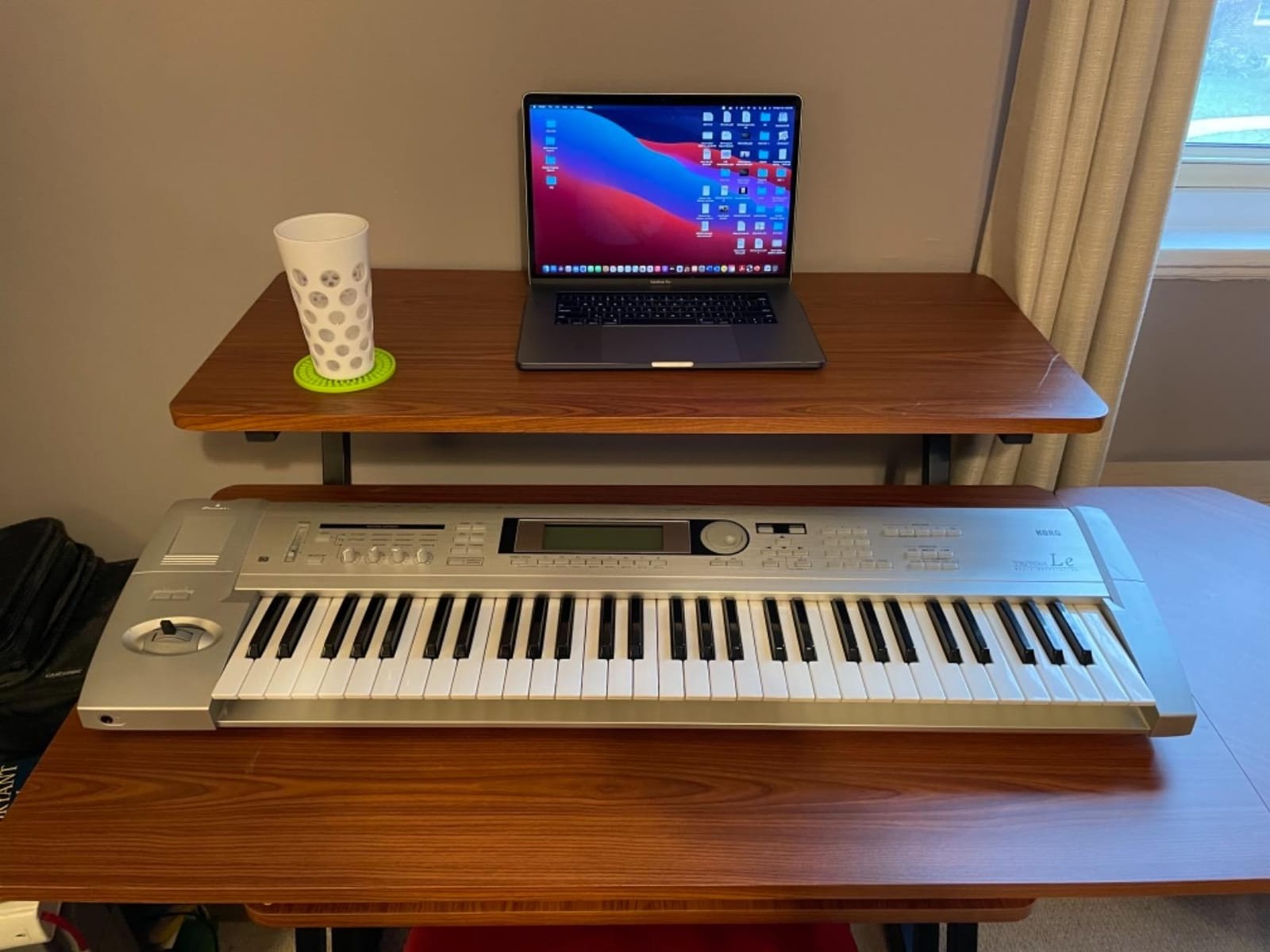
The keyboard tray is a straightforward slide-out that takes a keyboard, a mouse or a small micro controller, and it disappears underneath when you are mixing. At 43 inches wide and 32.5 inches deep the footprint is genuinely compact, which matters more than any spec sheet admits: a 43 inch desk fits a room that a 70 inch desk simply will not.
Two details are worth knowing before you commit. The wooden top and the steel frame are listed as separate components in the range, so finishes can differ slightly between tiers. And the design is built to expand, with a corner attachment, a rack cabinet and a rack mount all available, so the rack-first route is open to you later even though the base desk has no bays.
Will the WS7500 fit your room and your rig?
Measure your wall before anything else. The listed dimensions are 43 inches wide, 38 inches high and 32.5 inches deep, and the working surface has a 51 inch diagonal, so you get a genuinely usable rectangle rather than a marketing number. A 43 inch width fits a dual monitor arm with room to spare, and it will hold a 61-key controller across the front when the tray is pulled in.
For listeners who use stands already, the raised tier is optional rather than essential. Plenty of owners put monitors on isolation pads on the top surface and use the upper tier purely for the screen. Just check the height: the point of the second tier is that you look slightly down at your display rather than up at it.
Who should walk past the WS7500?
Skip it if you are running a full 88-key weighted controller. The tray is designed for a keyboard, mouse or compact controller, and a digital piano on a separate stand is the more honest arrangement at that end of the market. The headphones and monitoring setup we recommend is not affected either way, since the tray height does not dictate where you sit.
Skip it too if you already own rack gear and need it at the desk. There are no rack bays in the base unit, and the accessory rack is a separate purchase. In that situation the Acme 47-inch Suitor or the Musiea BE200 puts the gear where you can reach the knobs without getting up.
2. Acme 47 Inch Suitor – Best Value Studio Desk With Rack Space
Acme 47″ Inch Music Recording Studio Computer Gaming Wooden Desk with Sliding Keyboard Tray & Cup Holder, Wooden Top Shelf & Botton Metal Frame, Casters Included, Easy Assembly, White & Black Finish
47 inch surface
Integrated 19 inch rack bays
50 pound desk load
Keyboard tray and casters
Pros
- Rack bays hold outboard gear at the desk
- Cable management built into the frame
- Lockable swivel casters on all four corners
- Assembly parts clearly numbered
- Strong 4.6 star average across 788 reviews
Cons
- Some owners report side-to-side wobble under force
- Rack area tilts backward so deep units protrude
- Front-mounted tray eats legroom for tall users
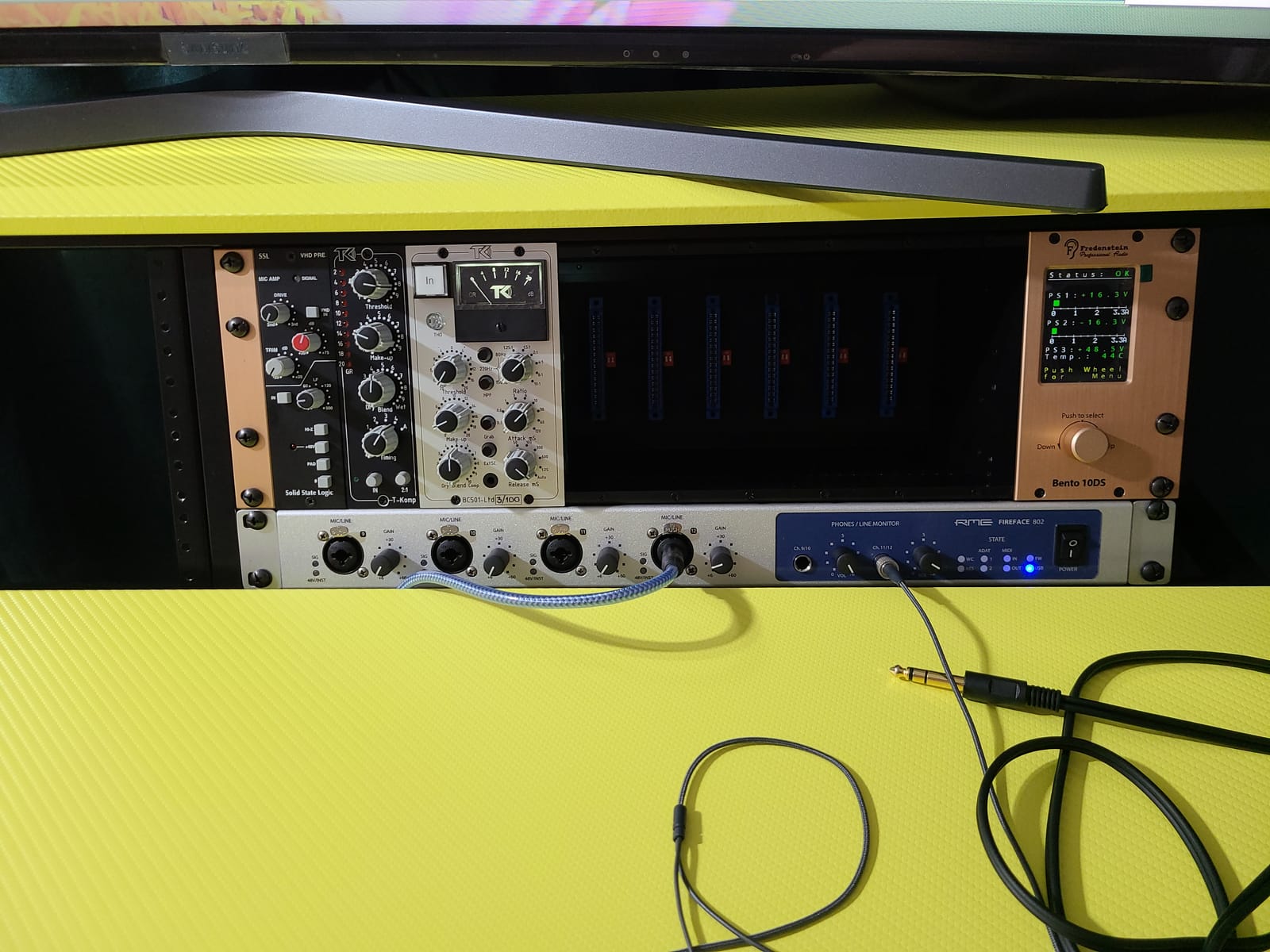
At 47 by 28 inches this is one of the few budget desks that gives you actual 19-inch rack bays rather than a shelf where a rack might one day go. That is the feature that separates it from the plain tables in this list, and it is why it ranks where it does. A 40 inch keyboard tray runs underneath, and the desk is rated to 50 pounds with a 10 pound shelf rating.
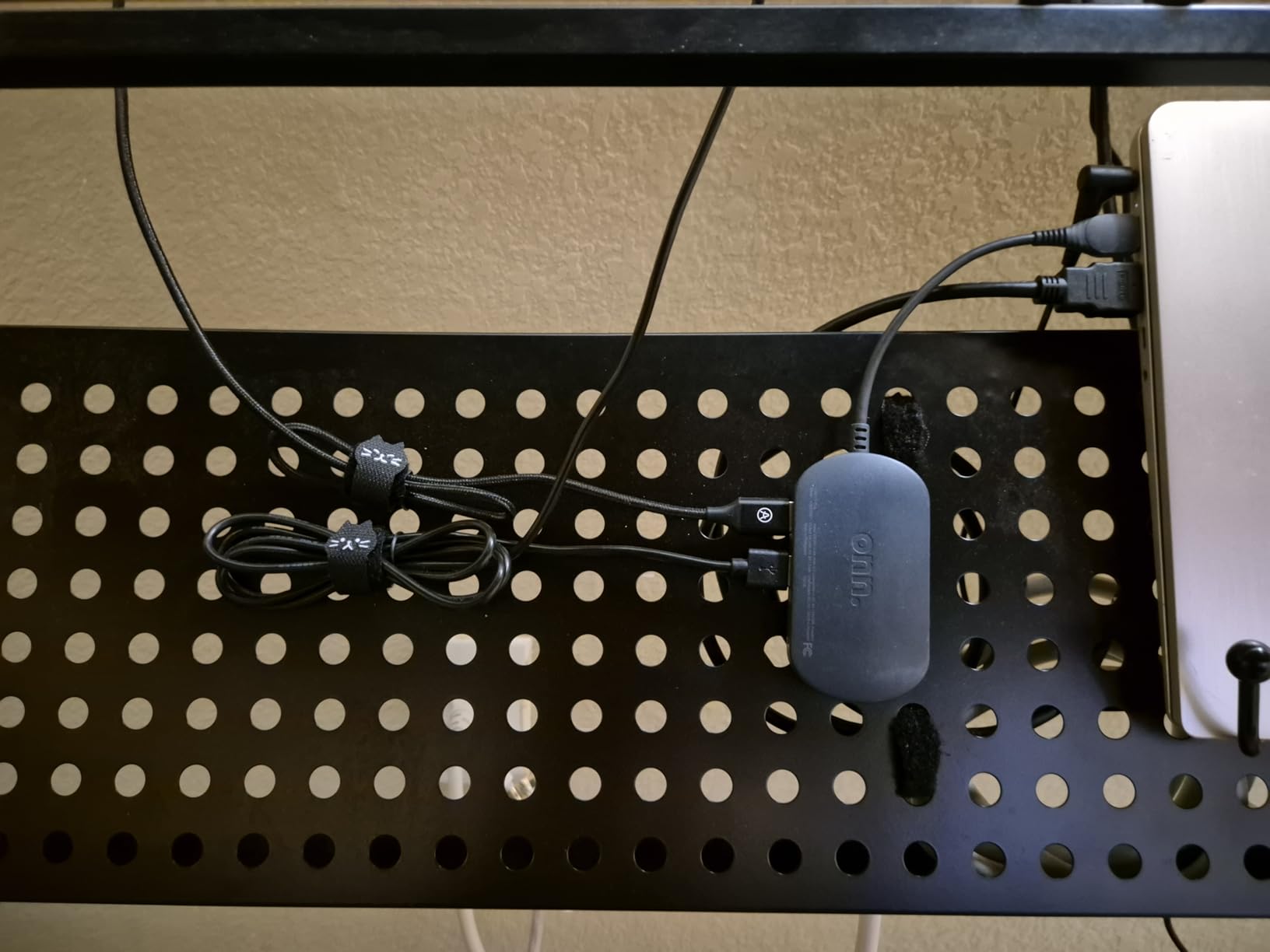
The rest of the design is genuinely thoughtful for the money. There is a cup holder, a headset hook, open caster wheels and a back panel for cable management, and the upper shelf is stiff enough to carry two heavy screens on arms plus medium speakers. Assembly is full, and the instructions call for two people, but every part is numbered and all hardware is in the box.
Owners consistently describe it as one of the best value studio desks in its class, and the 4.6 average across 788 reviews backs that up. It also works as a general computer desk, which is a useful hedge if your studio is also where you edit video or write.
The honest caveat is the wobble. A small number of owners report side-to-side movement during forceful typing or when playing a controller hard. The frame is metal tube steel with MDF and a PVC veneer, so it is a step below the On-Stage in terms of solidity, and there are occasional reports of transit damage on arrival, which is worth checking for the moment it arrives.
Does the Suitor work in a small bedroom studio?
It is narrow for a music desk. The listed dimensions are 47 inches long, 28 inches wide and 38 inches high, and the leg space is 42 by 20 by 24 inches, so the keyboard tray eats a meaningful chunk of what little room you have under the top. The tray is front-mounted, which is exactly where taller users report feeling crowded. If you are over six feet, sit at it before you commit.
The rack tilt is the other thing to check. Deep 19-inch units will lean back and protrude behind the desk line, so measure the gap between the back of the worktop and your wall before the deep gear arrives. Shallow units such as a patchbay or a compact interface sit flat without any issue.
Who should walk past the Acme 47 Inch Suitor?
Skip it if you are buying as a permanent centrepiece. The 30 day parts and labour warranty is the shortest meaningful cover in this group, and the wood and steel combination is the first thing to show its age. If the desk has to survive a move or a house sale, the On-Stage WS7500 or the Glorious Sound Desk Compact is a safer bet.
Also skip it if you have no rack gear and no plans to buy any. There is a strong argument for spending that money elsewhere. A producer on r/AdvancedProduction laid out the case plainly: no rack-mounted gear, no intention of buying any, two analog synths and a laptop to fit. For that setup the Armocity is a closer match, and a plain table on a sit-stand frame is closer still.
3. Armocity Studio Workstation – Best for Budget Setups With No Rack Gear
Armocity Music Studio Desk Production Workstation – Recording Studio Desk
47 inch raised shelf
3 USB ports and 2 AC outlets
Pull-out keyboard tray
Z-frame metal legs
Pros
- Built-in USB ports and mains outlets in the frame
- 47 inch shelf fits two displays at eye level
- Velcro strap included for cable tidy-up
- Two year warranty
- Tidy choice for DJ
- study and podcast corners
Cons
- No rack mounting at all
- Felt top marks from hot cups and gear
- Open shelf has no side guards
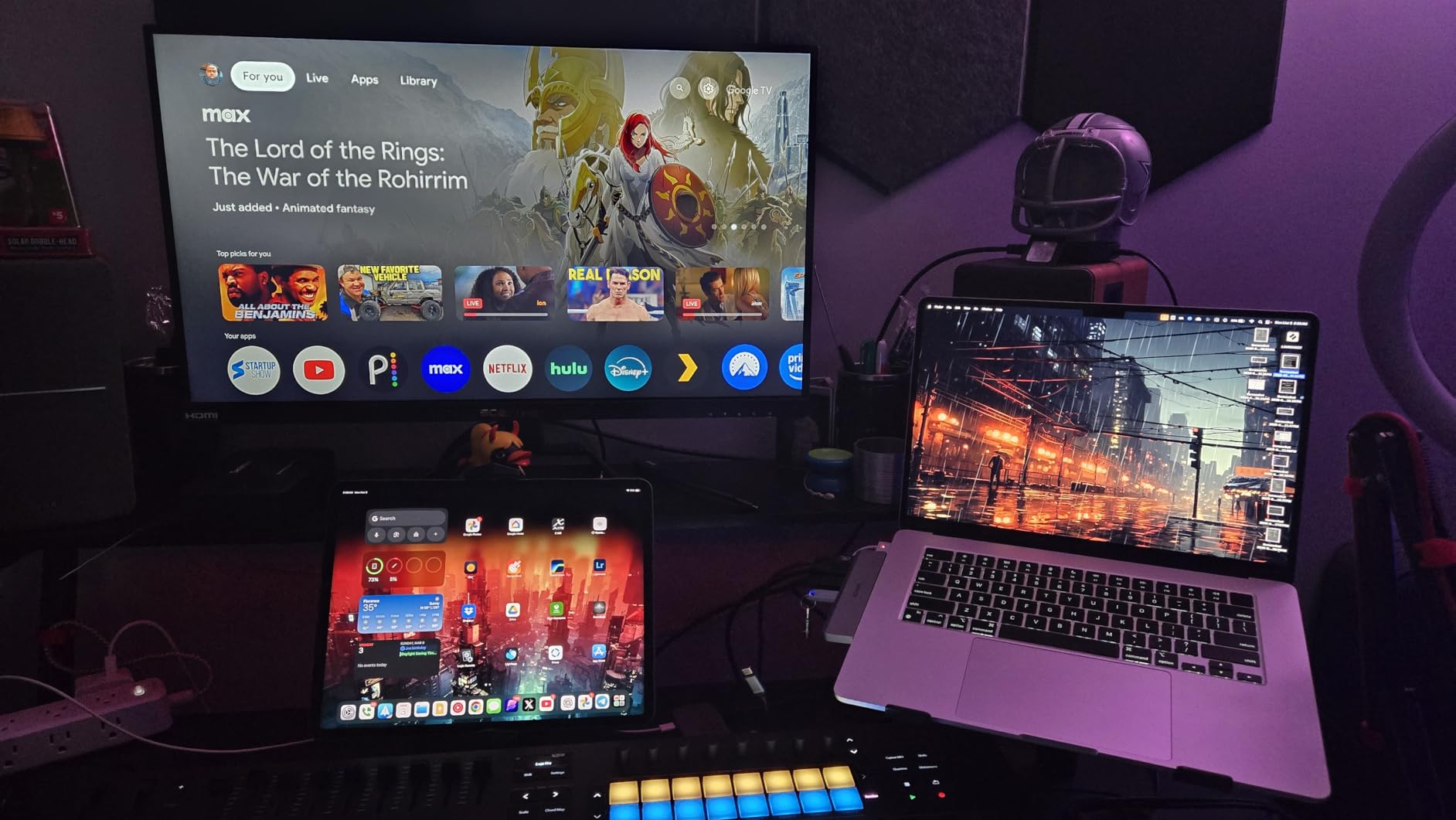
What separates this from a generic table is the built-in power. Three USB ports and two mains outlets sit in the frame, so your interface, laptop and tablet all charge without a separate charging brick taking up desk space. For a producer working in a bedroom where every surface is already spoken for, that is worth more than another shelf.
The 47 inch raised shelf takes two monitors, and the pull-out tray underneath clears the main surface when you are not playing. Z-shaped metal legs with a brace bar give a wide, steady base, and at 20 pounds it is one of the easier desks in this group to reposition when the season changes and the studio moves back to the bedroom.
It ranks first in its category and holds a 4.4 average across 260 reviews, and it is regularly recommended as an affordable home production, study or DJ desk. The instructions are well written and the parts are labelled, which sounds minor until you are half way through a flat-pack build at midnight.
The felt-top engineered wood is the weak point. Owners report marking and ringing from hot cups and from gear resting on it, and the open shelf has no side guards, so a misplaced controller can go over the edge. Neither is a dealbreaker at this end of the market, but both are reasons to put a mat down.
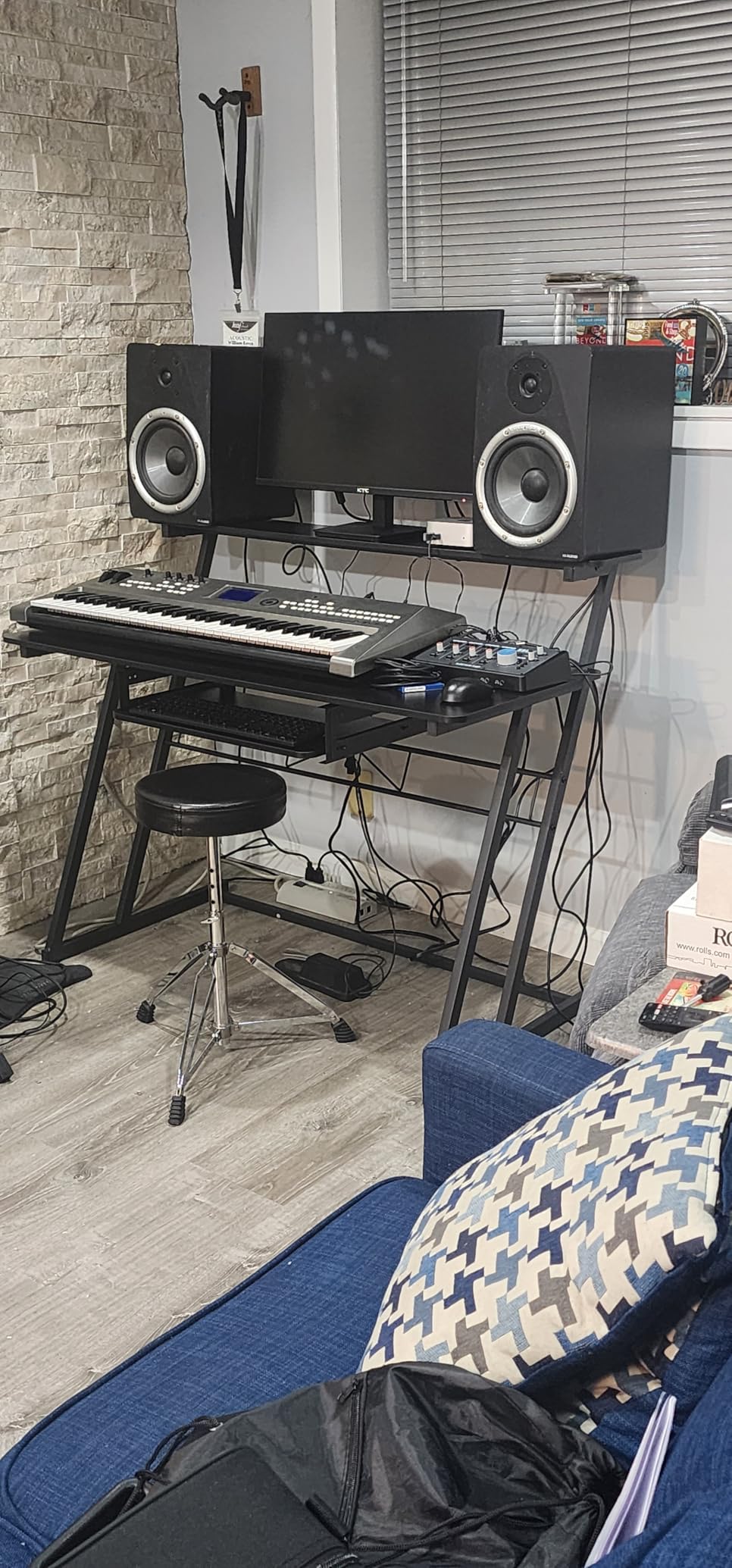
Is the Armocity wide enough for a 61-key controller?
Yes, comfortably. At 47.3 inches wide and 22.8 inches deep, the top surface takes a full-size 61-key controller laid across the front with room either side, and the tray underneath takes it again when you want the surface clear. It also takes two analog synths, which is the setup described on r/AdvancedProduction as a reason to buy something purpose-built rather than a table.
The depth is the constraint, not the width. At 22.8 inches you have space for a controller and a small mixer, but not for a 49 inch screen sitting behind a spread of outboard gear. Speakers go on stands beside the desk, or on the shelf if they are small enough.
Who should walk past the Armocity?
Skip it if outboard gear is on your shopping list. There is no rack mounting of any kind, so an interface and a couple of preamps end up on a separate shelf, and a cable run from a shelf behind the desk to the interface is a worse workflow than a rack bay. The Acme 47-inch Suitor solves the same footprint with bays included.
Skip it if you are rough on furniture. The felt surface and the two year warranty are the two points to weigh. A heavier top that survives coffee and gear, like the On-Stage, costs more but ages better in a room that doubles as a workspace.
4. EUREKA ERGONOMIC ES71 – Best Standing Studio Desk for Music Production
EUREKA ERGONOMIC Standing Desk with Keyboard Tray, Large Music Studio Gaming Desk, Wing Shaped Sit Stand Table 72”, LED Convertible Shelves, Dual Motor&Slot, Maple
29 to 48 inch height range
Dual motor 220 pound lift
72 inch wing-shaped top
Three reconfigurable LED shelves
Pros
- Dual motors lift quietly across 29 to 48 inches
- Four height presets plus anti-collision sensor
- Keyboard tray rotates 360 degrees and tilts 15 degrees
- Wing shape frees arm and abdomen room
- Carbon fiber textured top resists water and heat
Cons
- Large 72 inch footprint dominates a small room
- Arrives as two separate boxes
- Cable holders and hangers are optional add-ons
This is the only genuine sit-stand desk in the group, and that alone puts it in a category of its own. The dual motors move the surface quietly from 29 to 48 inches, four presets drop in your working heights, and a hall-sensor anti-collision system stops the frame if anything is in the way. Capacity is 220 pounds, which is the highest figure anywhere in this list.
The wing shape matters more than the motor. A 72 by 23.6 inch surface with cut-ins either side gives you room to bring your forearms in without pushing the desk away, and the keyboard tray rotates a full 360 degrees horizontally and tilts 15 degrees vertically, with a full-desk mouse pad built into it. That combination is what makes standing work possible rather than merely possible.
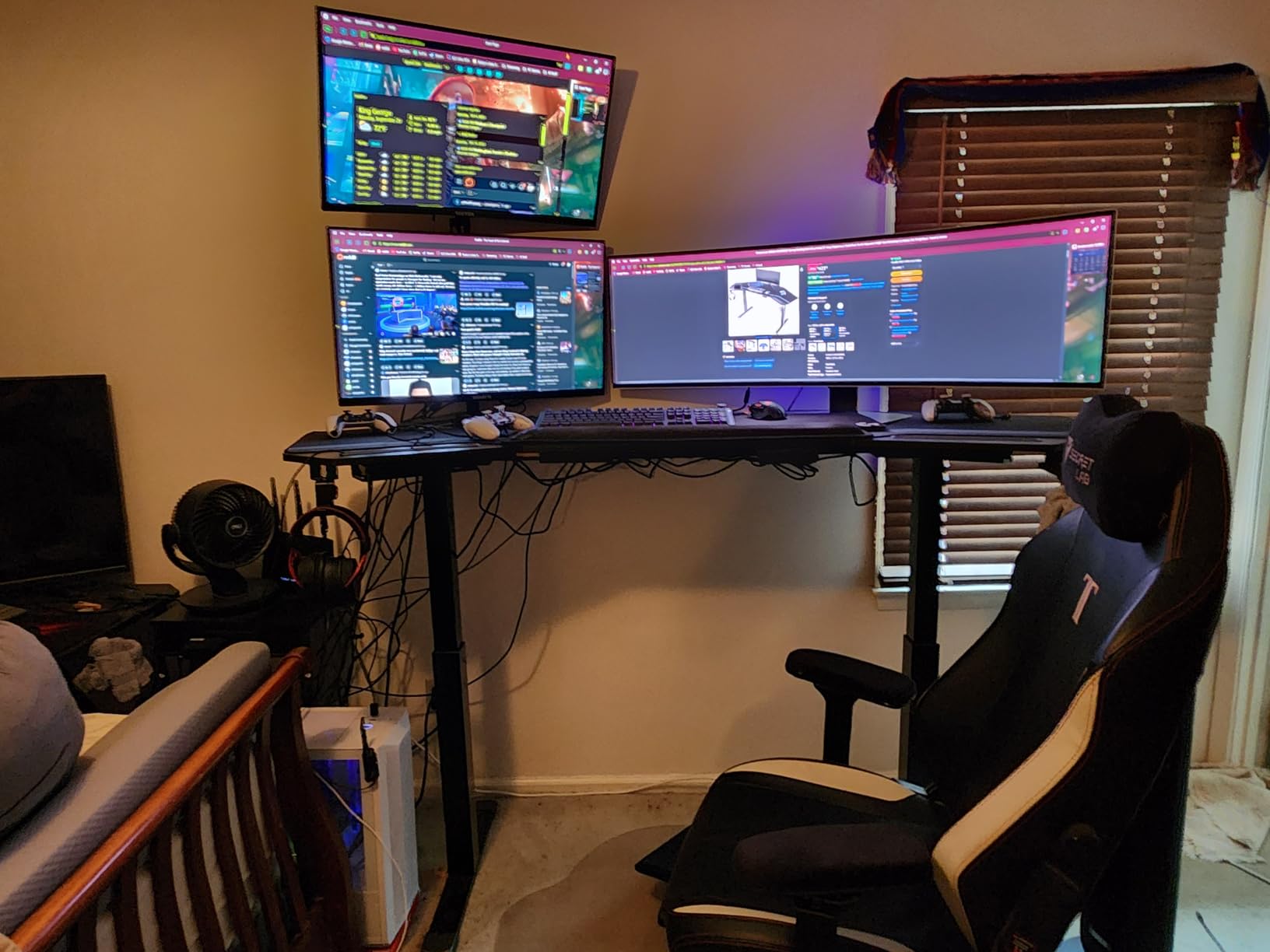
The three shelves reconfigure three ways. Set the middle one as a monitor shelf and you have a conventional two-tier layout. Swing them out to the sides and you have storage and display space. Put them along the back and you can run three to four widescreen panels, and the LED lighting gives you six RGB colours plus white, which is a working feature for streaming rather than a gimmick.
Owners rate the quietness of the lift and the anti-collision sensor highest, and the 4.6 average across 165 reviews reflects that. Under the desk there is a cable management system with socket holders, plus dual headphone hangers and a rotatable cup holder, so the furniture side of the design is properly thought through.
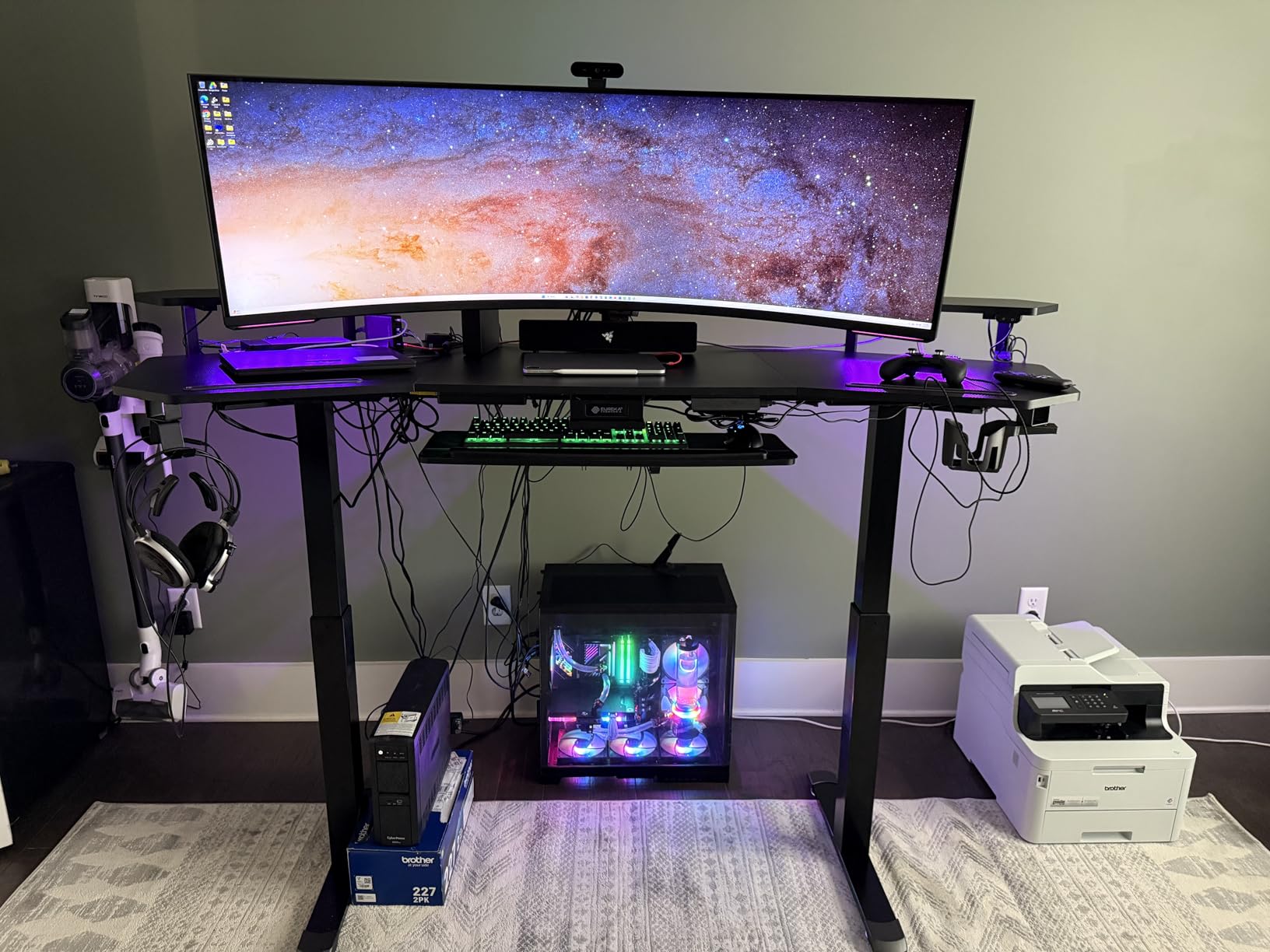
Are standing desks actually good for music production?
They can be, and the honest answer depends on your frame of reference. The top-voted answer in the r/AdvancedProduction thread on studio desks recommends a plain table on a Vivo motorized sit-stand frame, with the owner saying it improved workflow enormously simply by being able to stand. The principle is sound: alternating between sitting and standing is good, and a desk that does both without tools is the cheapest version of that.
The catch is weight. A producer on r/audioengineering reported an 80 kilogram rated frame still shifting monitor stands once forearms rested on the top, and warned that a load rating alone means little if the frame geometry is weak. This desk addresses that directly: 220 pounds, a dual-motor lift and a full-length cross member. Push on it hard and it stays put.
Who should walk past the ES71?
Skip it if you are working in a small room. A 72 inch wing-shaped footprint needs a wall of its own, and while you get a lot of surface for it, the depth of 30 inches is not a problem but the width is. This is a spare-room or dedicated-studio desk, not a bedroom corner desk.
Skip it if you travel or move often. At 30 kilograms and two packages, this is not something you want to carry up a staircase twice a year. The fixed-frame desks in this list are lighter and simpler for that reason.
5. Monoprice Stage Right – Best Studio Desk for a Very Small Room
Monoprice Recording Studio Desk – with Raised Platform and Keyboard Tray, Black – Stage Right
31.5 inch width
24 inch total depth
38 inch raised platform
175 pound support
Pros
- Tiny 31.5 inch footprint suits apartments
- 38 inch platform means no speaker stands needed
- Under 30 pounds yet supports 175 pounds
- All tools and hardware included
Cons
- All-metal surface can ring during loud playback
- Shallow 19 inch upper shelf limits screen depth
- Too narrow for a 61-key controller plus mouse
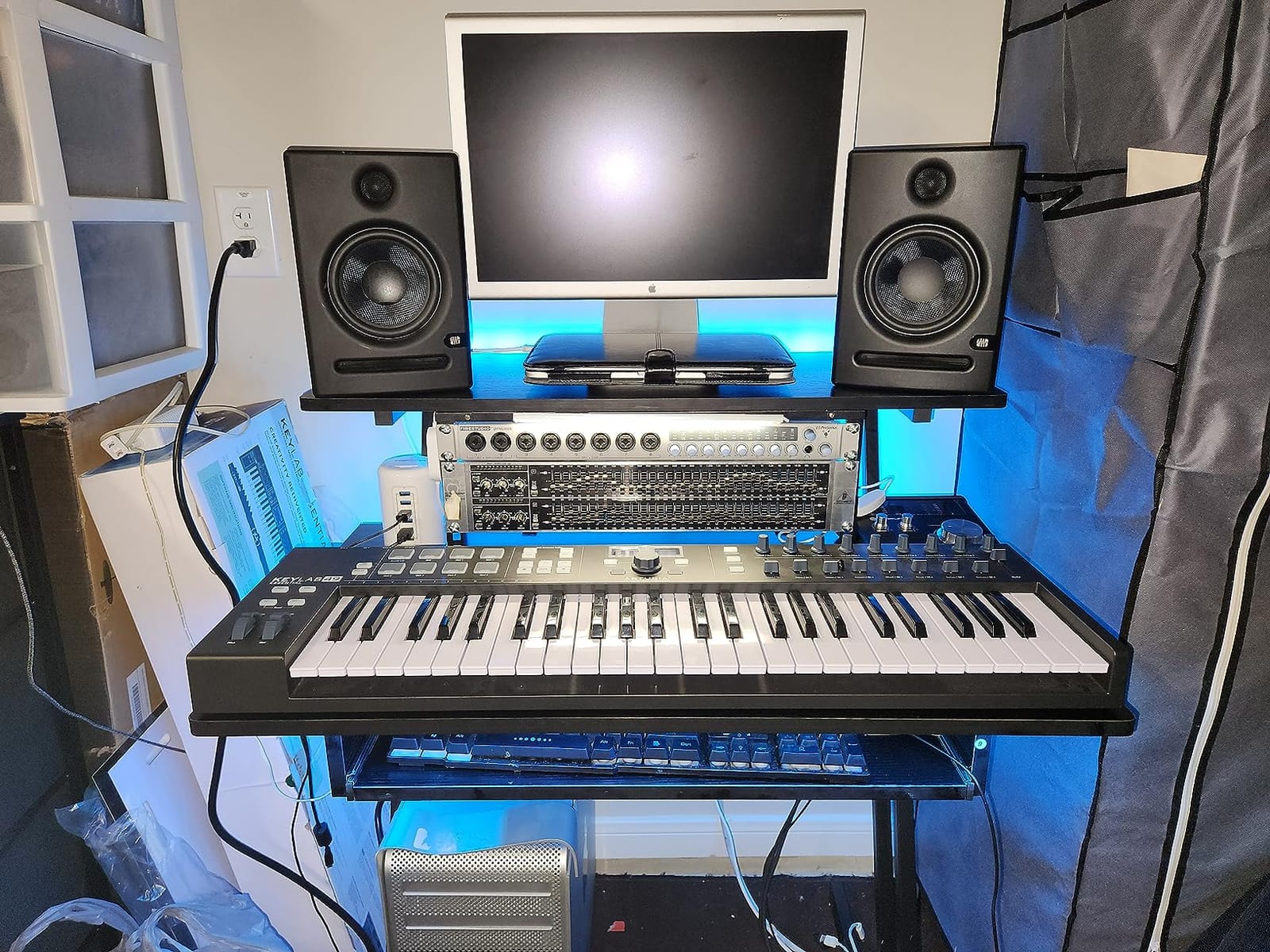
At 31.5 inches wide and 24 inches deep, this is the smallest desk here by a distance, and in a room where every centimetre is contested that is the feature. The raised platform sits at 38 inches from the floor, so your monitors go straight on it and you never need stands, which saves floor space as well as money.
The frame is still rated to 175 pounds despite the whole thing weighing under 30, and all tools and hardware are included, so assembly takes minutes rather than an evening. The pull-out keyboard tray tucks away completely when you are not playing, which matters when the desk is also your writing desk.
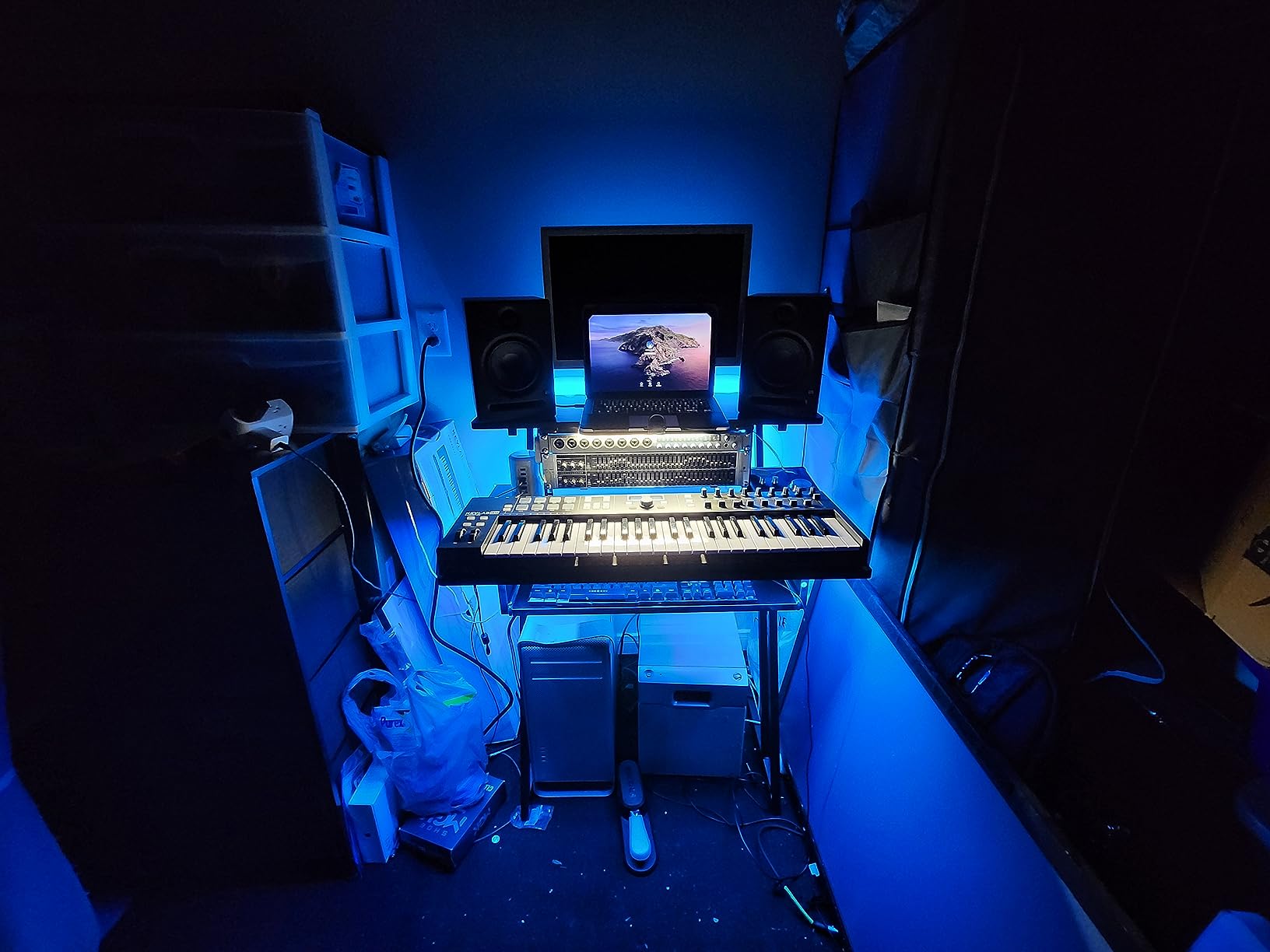
It holds a 4.3 average across 137 reviews and ranks near the top of its category, which is respectable given how cheap it is compared with the alternatives. Buyers consistently mention the small footprint and the platform height as the reasons they are happy.
The metal working surface is the compromise. Owners report it can ring or transmit vibration at high playback levels, and the upper shelf is 19 inches deep, which is shallow for a large display. If you mix at volume on nearfields rather than on headphones, that is worth thinking about.
Will a 31.5 inch desk fit a full studio setup?
It fits a 49-key controller and a compact screen, comfortably. That is the honest ceiling. A 61-key controller laid across the top leaves you nowhere for a mouse, and the 19 inch deep upper shelf is tight for anything bigger than a 24 inch display. For a laptop, a small interface and a 49-key controller, it is genuinely enough.
There is also no warranty on this one, which is worth weighing if you are buying it as a long-term fixture. On the other hand, the simplicity is real: a metal frame, a shelf and a tray have far less to go wrong than a rack-equipped desk.
Who should walk past the Stage Right?
Skip it if you are a keyboard player first. The width is the whole story, and if you need a 61 or 88 key instrument in front of you, you need the 47 inch class of desk at minimum. The LYYL Workstation 88 is built specifically for the full-size case.
Skip it if you mix loud on nearfields. Vibration through an all-metal surface is a real, reported issue, and a room where you are fighting low-end build-up is the wrong place to add a resonant top. A wooden desk such as the On-Stage avoids it.
6. Acme 83 Inch Eleazar – Best Studio Desk for Heavy Rack Gear
Acme 83″ Inch Music Recording Studio Computer Gaming Desk with Wood Storage Keyboard Tray, Wing Shaped & 3 Stands Tray & Botton Shelf Metal Frame, Casters Included, Easy Assembly, Black Oak Finish
83 inch wing-shaped top
12RU of integrated rack space
Three upper stands
Casters included
Pros
- 12RU of rack space built into the frame
- 83 inch surface takes large screens and full monitors
- Heavy construction resists flex
- Caster wheels make a huge desk movable
Cons
- Two very heavy boxes need at least two people
- Keyboard tray sits low and can hit knees
- Only 24 rack screws included for 12 bays
If your outboard gear list is long, this is the desk built for it. Twelve rack spaces sit in the frame, enough for a preamp, a compressor, a patchbay, converters and a headphone amp without a single piece standing on a shelf, and the 83 inch wing-shaped top gives you room for a large display, a full-size monitor pair and a controller at the same time.
The build is the other argument. Owners describe it as very heavy and solid feeling, with steel and MDF that resists flex, and the 91.5 inch working diagonal means the surface is a real workspace rather than a shelf with a lip. Caster wheels are included, so a desk this size can still be repositioned inside a room.
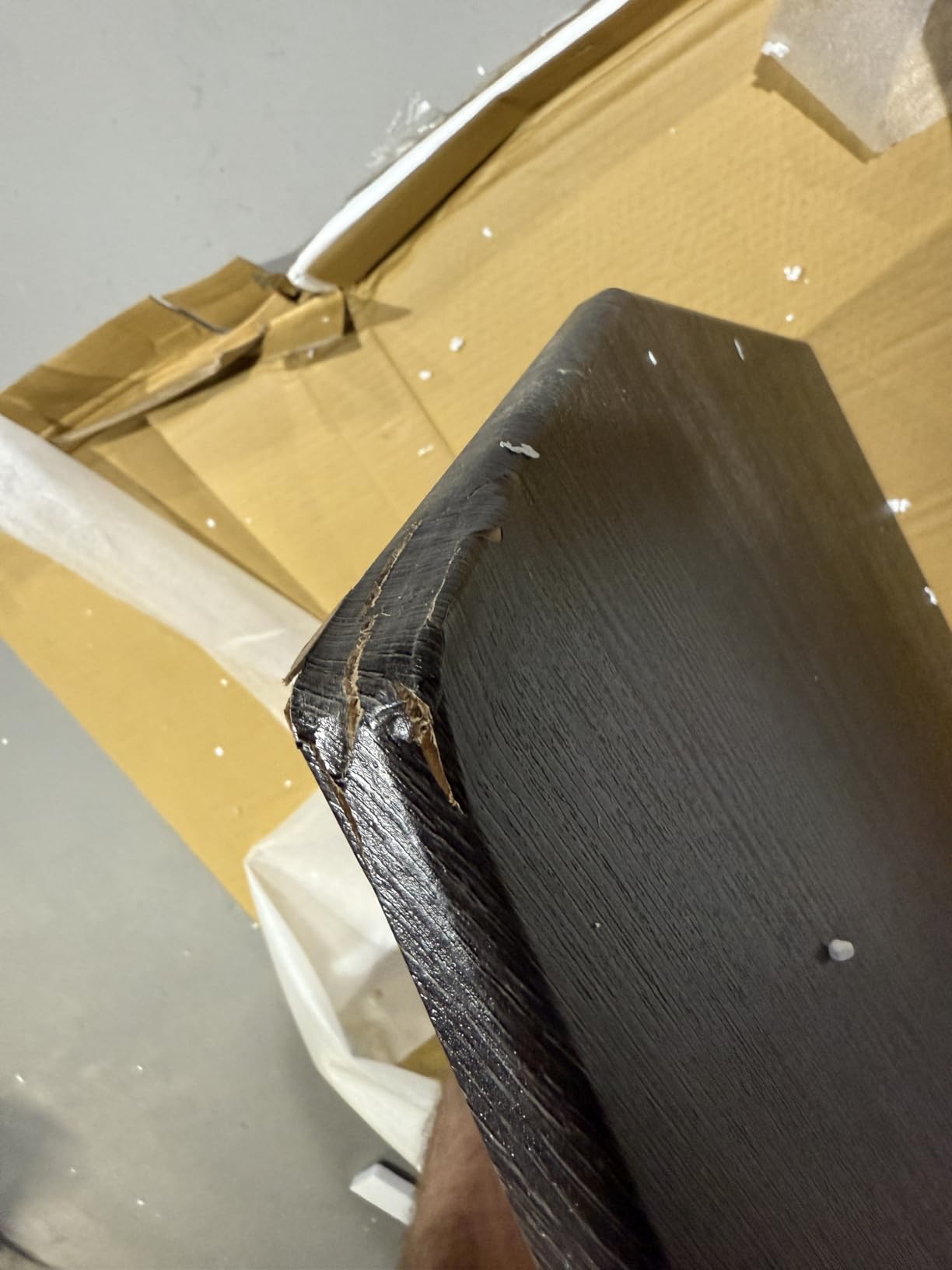
At 4.4 stars from 216 reviews, and frequently bought for dedicated home studios, it earns its reputation on surface area and rack capacity. The cable tray and three upper stands give plenty of gear organisation on top of the rack capacity below.
Two logistics points are worth planning around. It arrives in two very heavy boxes and the listed guidance is three people for assembly, so clear the floor before you start. And only 24 rack screws are included for up to 12 spaces, so buy blanks if you are not filling every bay.
Is an 83 inch desk too big for a home studio?
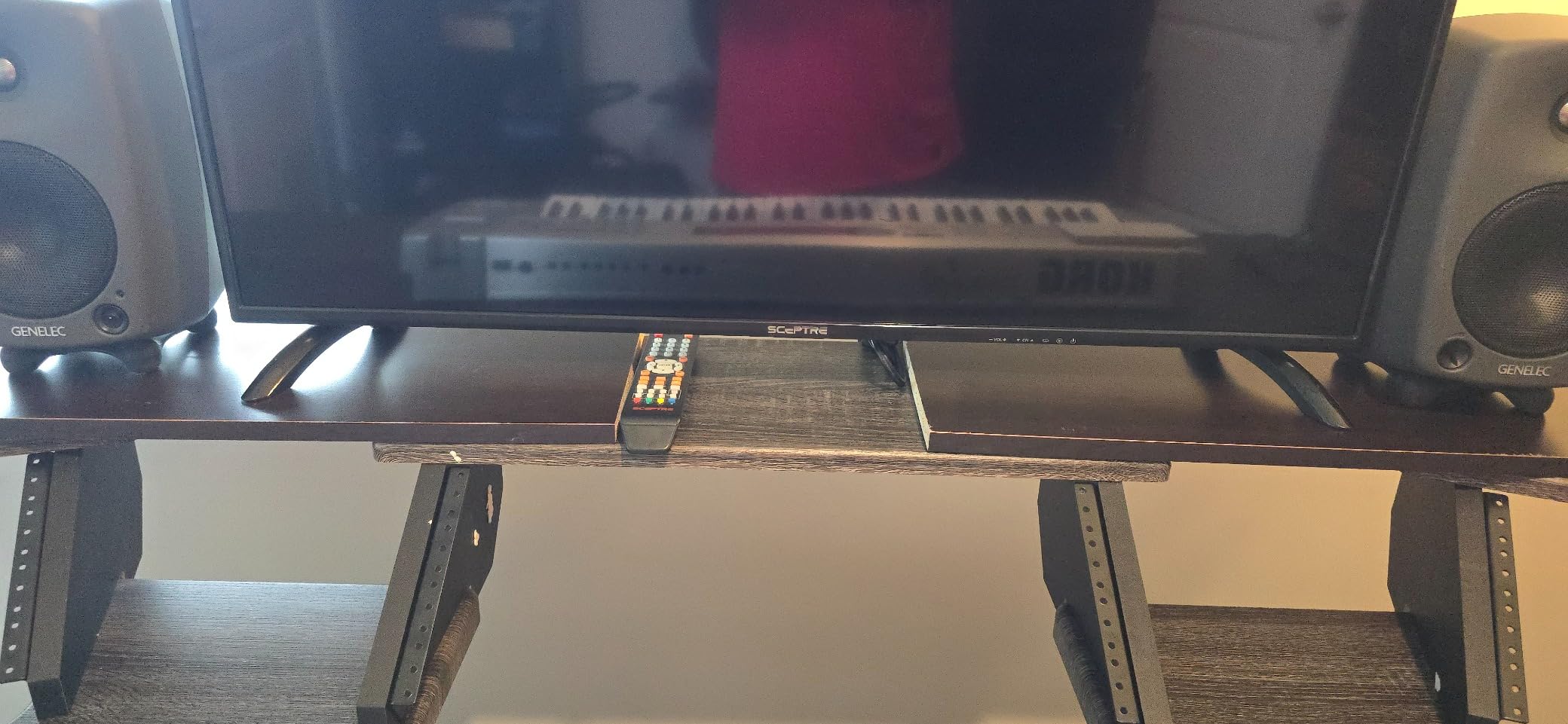
Sometimes, yes. The listed dimensions are 83 inches wide, 40 inches deep and 37 inches high, and 40 inches of depth is deep enough that you need to push your chair in and around rather than sit square. It also needs a wall of its own and a clear path to get the two boxes through the door.
Set against that, the 71 inch Acme Eleazar gives you a similar layout at a smaller size, and the Musiea BE200 does the rack job in 47 inches. If your room can take it, though, nothing else here gives you this much usable surface with 12 rack spaces built in.
Who should walk past the 83 Inch Eleazar?
Skip it if you are still deciding what gear you want. Twelve rack spaces is a lot of commitment, and plenty of home producers never get past four or five devices. The Gearspace consensus is worth repeating here: the best desk is the smallest one that will fulfil your needs.
Skip it if you play a lot of keyboard. The keyboard tray sits low and owners report it can hit your knees when seated. If the instrument is the centre of your workflow, the LYYL Workstation 88 or the Glorious Sound Desk Pro is a better shape for you.
7. Musiea BE200 – Best Studio Desk for a Full 61-Key Tray
Musiea BE200 Series Music Studio Desk Workstation with 2 x 4U Rack (Black)
Two 4U rack bays
Full 61-key cutout tray
Hidden wire gully
Two headphone hangers
Pros
- 61-key tray with cutout keeps legs clear
- Hidden cable gully behind the desk
- Two 4U racks mount gear at arm's length
- Veneer finish looks dearer than it is
Cons
- Sways side to side until the racks are filled
- Low overall height for taller users
- One assembly step has no clear diagram
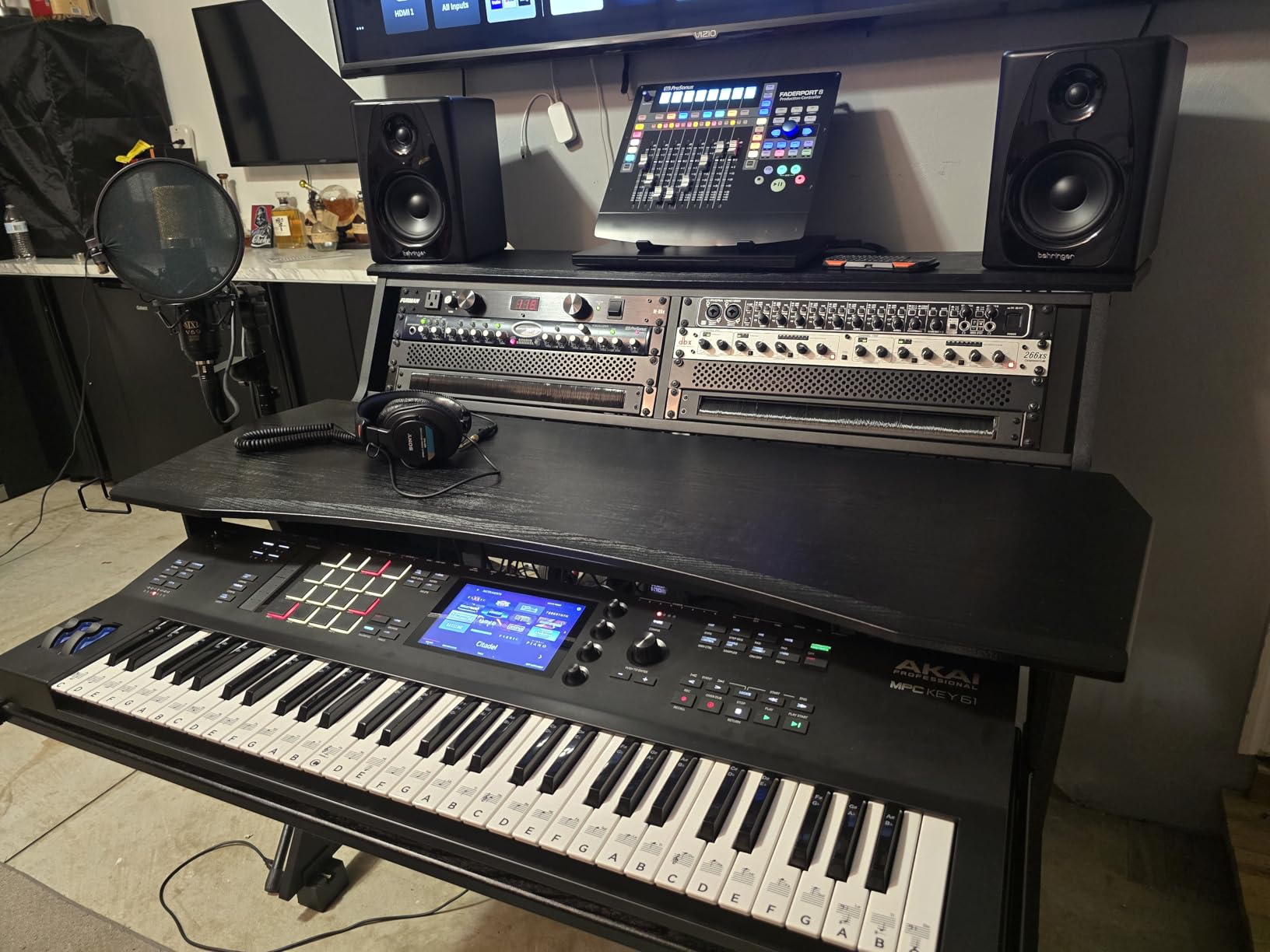
This is the desk for a producer whose instrument is a 61-key controller and whose signal chain is growing. The tray takes a full 61 keys with a cutout design, so you can actually sit down and play without your knees hitting a solid box, which is the single most common complaint about cheaper studio desks.
Two 4U rack bays give you eight rack spaces, enough for an interface, a preamp, a patchbay and a small monitor controller without a trolley in the corner. The hidden wire gully behind the desk is the feature reviewers mention most, because it turns cable routing from a chore into a thirty-second job, and there are headphone hangers on both sides plus velcro organisers.
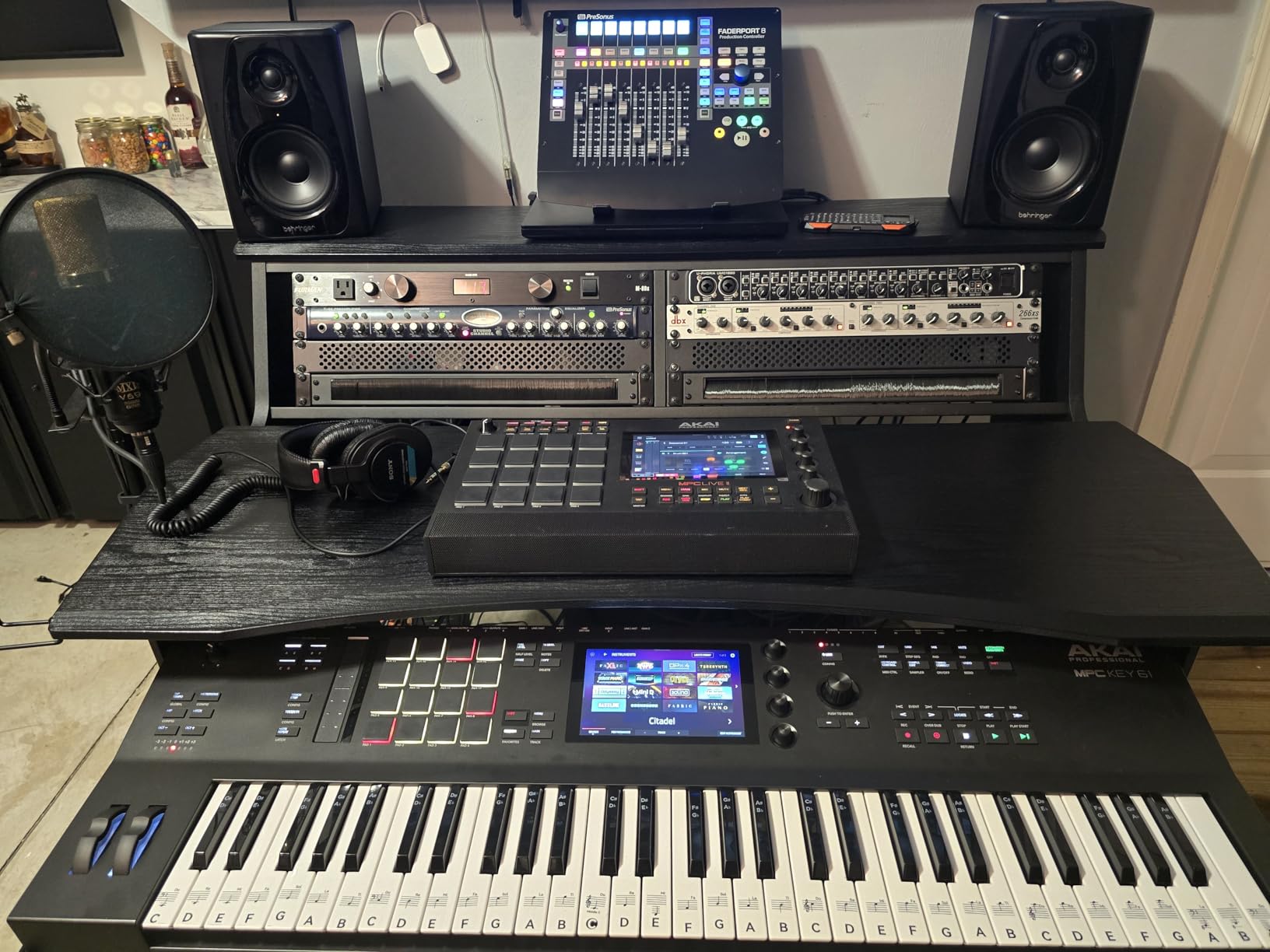
The two-layer layout puts two monitors and a pair of speakers on the top shelf at an angle that helps with placement, and the MDF core with a premium wood veneer looks more expensive than the ticket suggests. At 69 pounds it is heavy in the way a solid desk should be.
There is a catch, and owners are clear about it. Because the frame is MDF, it can sway side to side until the racks are loaded with gear, so fill them early or brace it against the wall. The desk also sits low overall, and taller users report needing risers to fit their legs under the top.
Does a 61-key tray actually change how you work?
Considerably. A 61-key controller on a stand in front of the desk pushes your listening position back and puts your screen further away, so you end up leaning forward. In the tray the controller is at playing height, directly below the monitors, and the screen sits above and behind it, so your ear, hand and eye positions stay in one place.
Be honest about the size though. At 47.24 inches wide and 30.51 inches deep, this is a mid-size desk. It suits a spare room or a half-dedicated corner. If your 61-key is a weighted instrument rather than a controller, read the tray height carefully and test before you commit.
Who should walk past the Musiea BE200?
Skip it if you are over six feet tall. The listed maximum height is 38.3 inches, and while the tray is cut away for legroom, taller users report that the overall height still forces risers. The EUREKA ES71, which goes to 48 inches, is the answer to that specific problem.
Skip it if you are a very light touch user who plans to add rack gear slowly. The sway before the racks are filled is genuinely noticeable, and it will bother you long before your outboard collection justifies the space. The Acme 47-inch Suitor is steadier from day one.
8. Glorious Sound Desk Pro – Best for Three-Level Working
Glorious Sound Desk Pro Professional Studio Workstation in Black
Three working levels
Two 3U rack sections
Pull-out drawer to 88 keys
Cable ducts top to floor
Pros
- Work on three levels at once
- Two integrated 3U racks for outboard gear
- Drawer takes keyboards up to 88 keys and adjusts to four heights
- Cable ducts on top inside and at floor level
Cons
- Some buyers report missing or broken tray rails
- 20 kilogram top load is low for large monitor setups
- Tray height of 125 millimeters will not clear many 88-key pianos
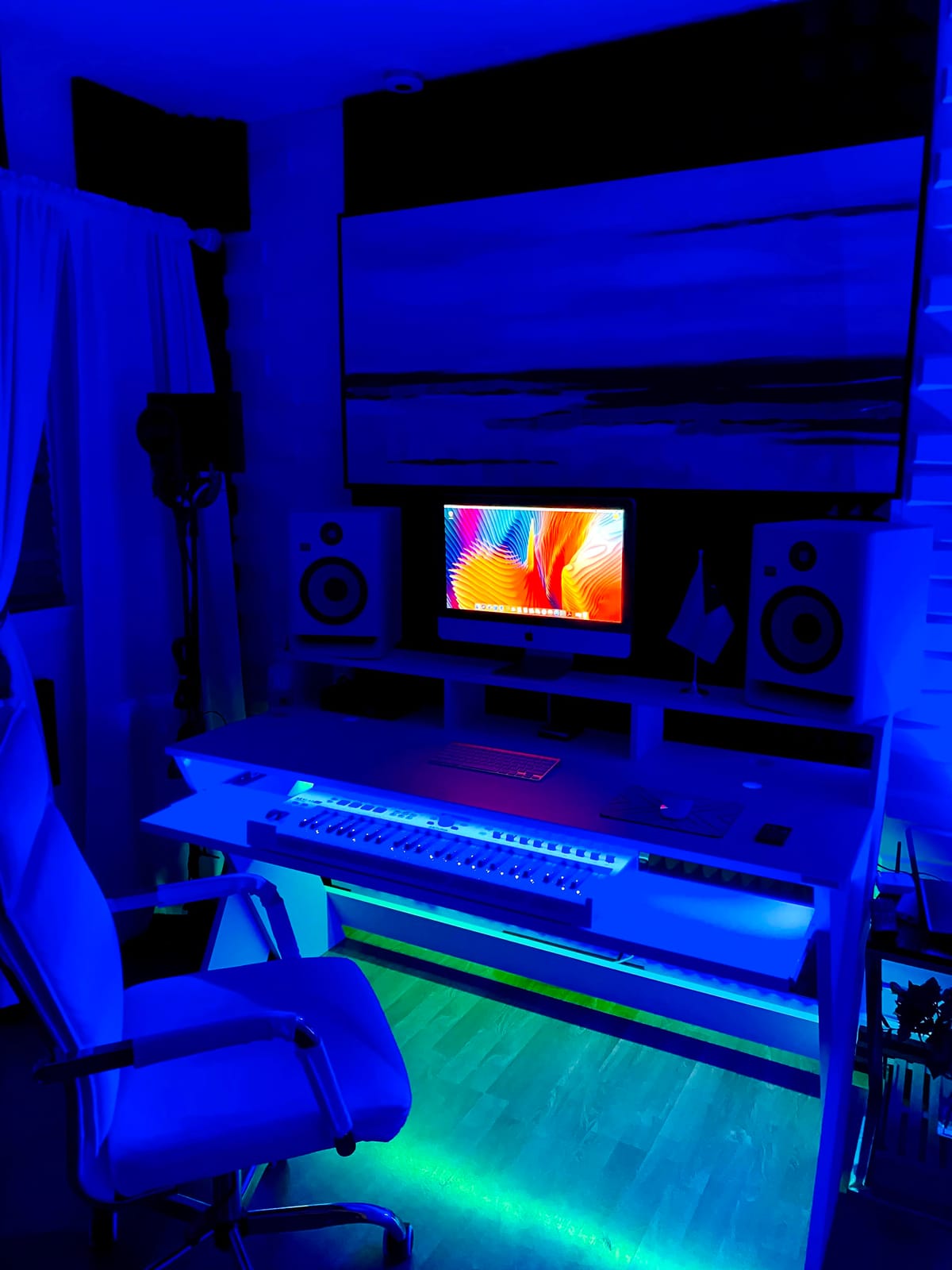
The concept here is different from everything else in this list. Rather than a flat top with a shelf above it, the Glorious gives you a large working surface, a centre storage compartment and a middle level, so you can have a laptop, an interface and a display visible at once. It is built for the producer who has a lot of small things to keep in reach.
Two integrated 3U rack sections hold 19-inch outboard gear without a separate rack, and the pull-out drawer takes keyboards up to 88 keys with four height positions. Cable ducts run on the top, inside and at floor level, which is the most complete routing provision of any desk here. Additional struts give it a stable build for the money.
It is regularly described as an affordable alternative to full professional studio desks, and at 3.9 stars from 95 reviews it is the lowest-rated product in this group by some distance. That rating reflects specific, fixable problems rather than a bad concept.
First, shipping damage. Several buyers report arriving with missing or broken keyboard tray rails, which makes the tray unusable, so inspect the box on arrival. Second, the pressboard and particleboard construction is thinner than solid wood. Third, the documented top load tolerance is around 20 kilograms, which is low if you are running a large monitor pair on stands at the top.
Can this desk really take an 88-key keyboard?
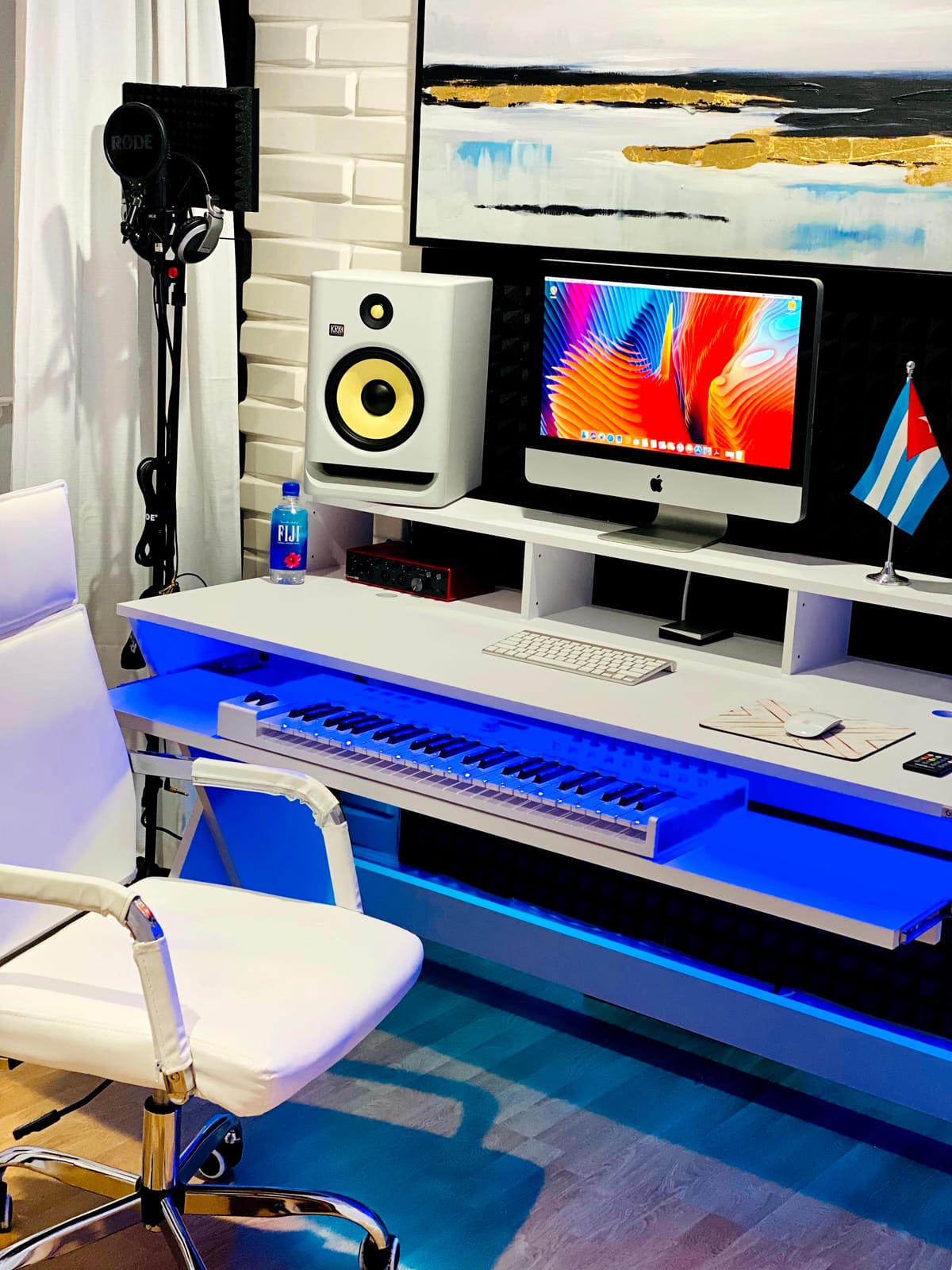
The drawer is dimensioned for up to 88 keys, and the four height positions are the useful part. What the specification does not say is clearance, and that is the catch: the tray height of 125 millimeters will not clear many popular 88-key digital pianos. A slim 88-key controller sits fine. A weighted 88-key action instrument does not.
If your 88-key is a weighted controller, look at the LYYL Workstation 88 instead. Its rail system is rated to 55 pounds on the tray and offers four height options, which is a stronger answer to the same question.
Who should walk past the Sound Desk Pro?
Skip it if support matters to you. This desk routes support through a third-party distributor and replacement parts are hard to source, which turns a missing rail from a five-minute fix into a much longer problem. Compare that with the two year warranty on the Armocity or the On-Stage.
Skip it if you run heavy monitors close to the weight limit. A 20 kilogram top rating is fine for a 49-key controller and a small display. It is tight for two large screens on arms plus a pair of studio monitors, which is exactly what the shelf above a top surface invites you to do.
9. Glorious Sound Desk Compact – Best Studio Desk for Small and Medium Rooms
Glorious Sound Desk C Studio Workstation with Pull-Out Keyboard Compartment
Compact footprint
Two 3U rack sections
Ball-bearing keyboard drawer
Two year warranty
Pros
- Genuinely compact without feeling cramped
- Two well-aligned 3U rack sections
- Single box under 65 pounds
- Thick pressed wood with a grippy painted finish
Cons
- Instructions use faint grey diagrams
- Drawer ships mounted higher than most controllers
- No hinged door on the cable cubby
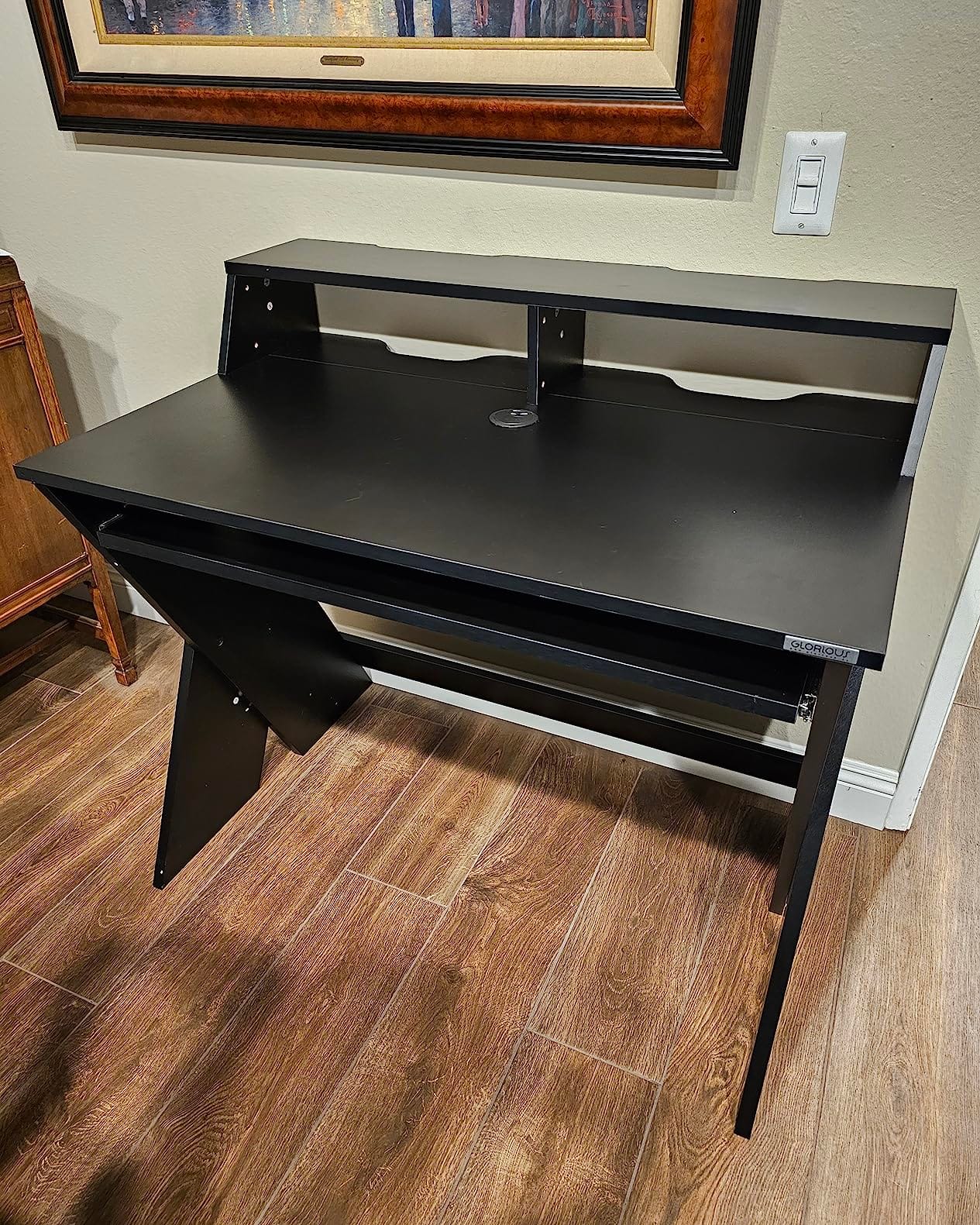
This is the smaller sibling of the Sound Desk Pro, and it fixes most of what made its big brother hard to recommend. At 39.88 by 25.59 by 36.69 inches it is compact without feeling cramped, and the 4.8 star average across 24 reviews is the highest rating of any product in this roundup.
The build is where it improves. Two 3U rack sections mount well-aligned rack gear on either side, the ball-bearing pull-out keyboard drawer slides smoothly and holds a controller properly, and the thick coated pressed wood gives a solid, heavy feel with a finish that resists scratching. It comes in black, white and walnut.
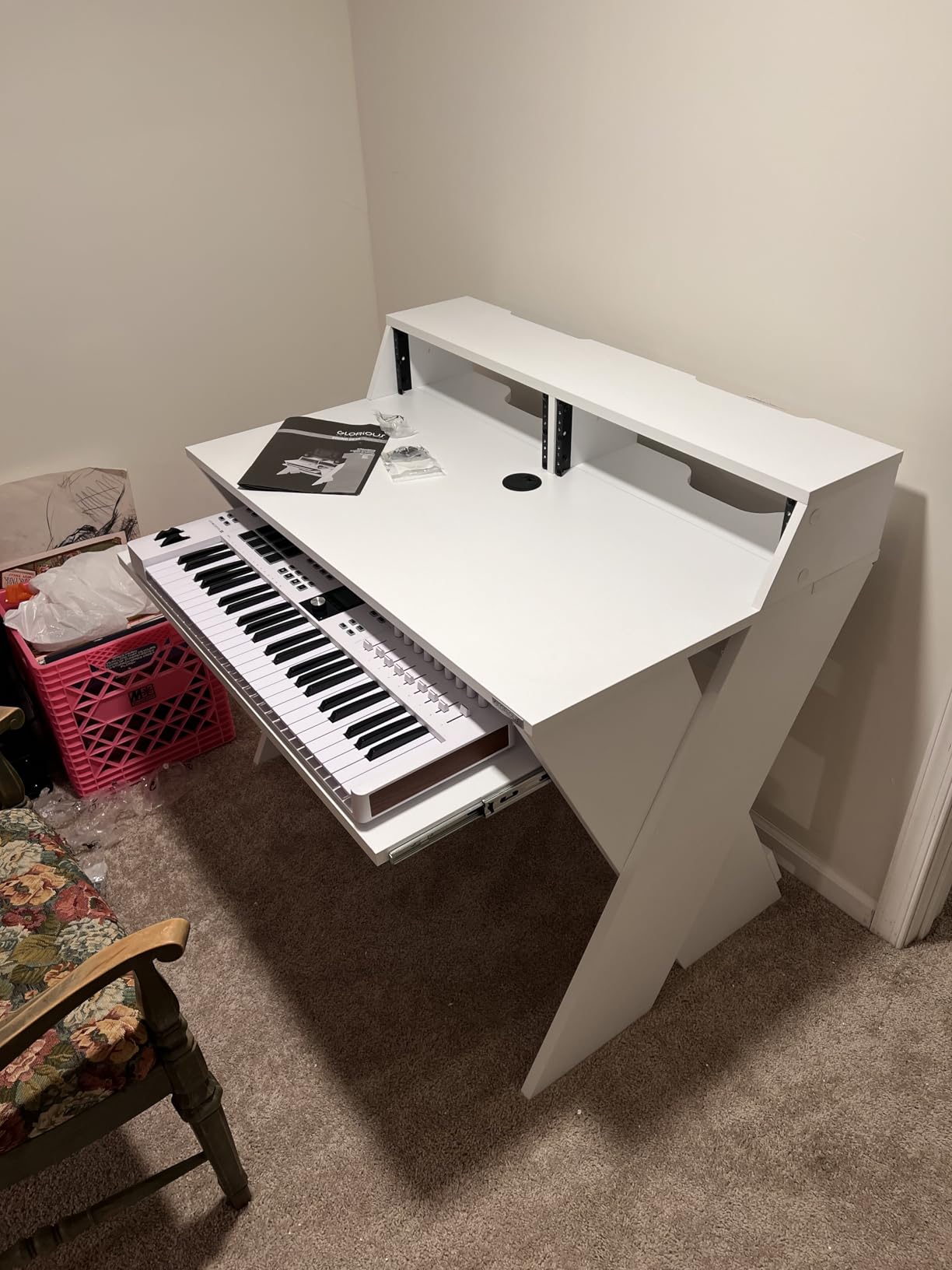
The practical advantage owners mention most is logistics. It arrives in a single box under 65 pounds, which for anyone without a second person to help is not a minor detail. The maximum recommended weight is 35 kilograms across the whole desk, which is a healthier figure than the Pro.
Two things to plan around. Assembly takes roughly two hours, and the printed instructions use faint grey diagrams, so read them properly before starting rather than working from memory. And the drawer ships mounted higher than most MIDI controllers clear, so plan to lower the rails before fitting the top.
Is a compact studio desk worth the smaller surface?
For most home studios, yes. The Gearspace consensus is that the best desk is no desk, and the search for the smallest one that fulfils your needs, which is exactly the logic behind a 40 inch footprint. At this size you are more likely to be disciplined about what sits on it.
The limit is a single large display plus a monitor pair without much spare room. If your workflow depends on an 88-key controller, a control surface and a large screen all at once, you will feel the constraint. In that case the Musiea BE200 gives you a 61-key tray and two screens for a similar footprint.
Who should walk past the Sound Desk Compact?
Skip it if you are over six feet. The lowest drawer setting can restrict knee room for taller users, and the desk is not height adjustable. The ES71 is the only model here that solves that properly.
Skip it if you need enclosed cable storage. The cable management cubby has side access only, with no hinged door, and there is no built-in headphone hanger, so a stick-on hanger is a common addition. Neither is serious, but both add up in a tidy-room-versus-messy-room comparison.
10. LYYL Workstation 88 – Best Studio Desk for a Full 88-Key Controller
LYYL Music Studio Desk with Keyboard Tray and Height Adjustment Bracket, for Full 88 Keys (Music Producer Desk) (Black, 88 Keys)
Full 88-key tray
Patented 3-way rail system
55 pound tray rating
Four tray heights
Pros
- Rail system supports up to 55 pounds on the tray
- Four tray heights plus a desktop height bracket
- Tray hooks onto bolts so one person can build it
- Hafele rails with CARB Phase 2 MDF and steel
Cons
- Cable tray sold separately
- Only six months warranty
- 61.4 inch steel frame is hard to move alone
Almost every desk in this roundup treats an 88-key controller as an afterthought. This one is built around it. The keyboard tray runs on a patented three-way rail system rated to 55 pounds, which is the number that matters: a full-size 88-key controller is heavy, and most trays flex or creep under that load.
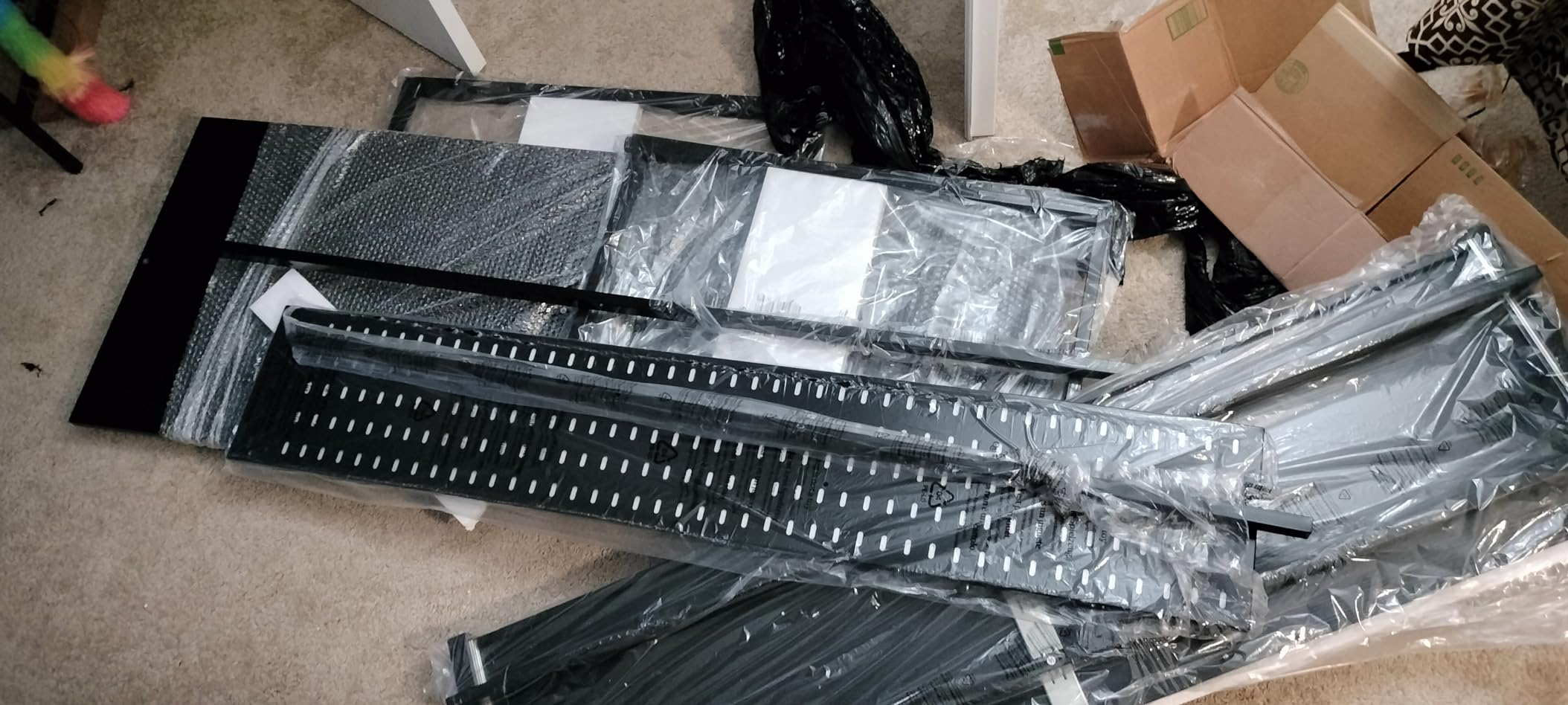
You also get four tray height options, and a matching height adjustment bracket that raises the primary desktop so the screen and keyboard tray sit in proportion. The tray hooks onto pre-set bolts, so assembly is genuinely a one-person job, which is unusual for a steel-framed desk of this size. Materials are Hafele rails, CARB Phase 2 compliant MDF and industrial grade steel.
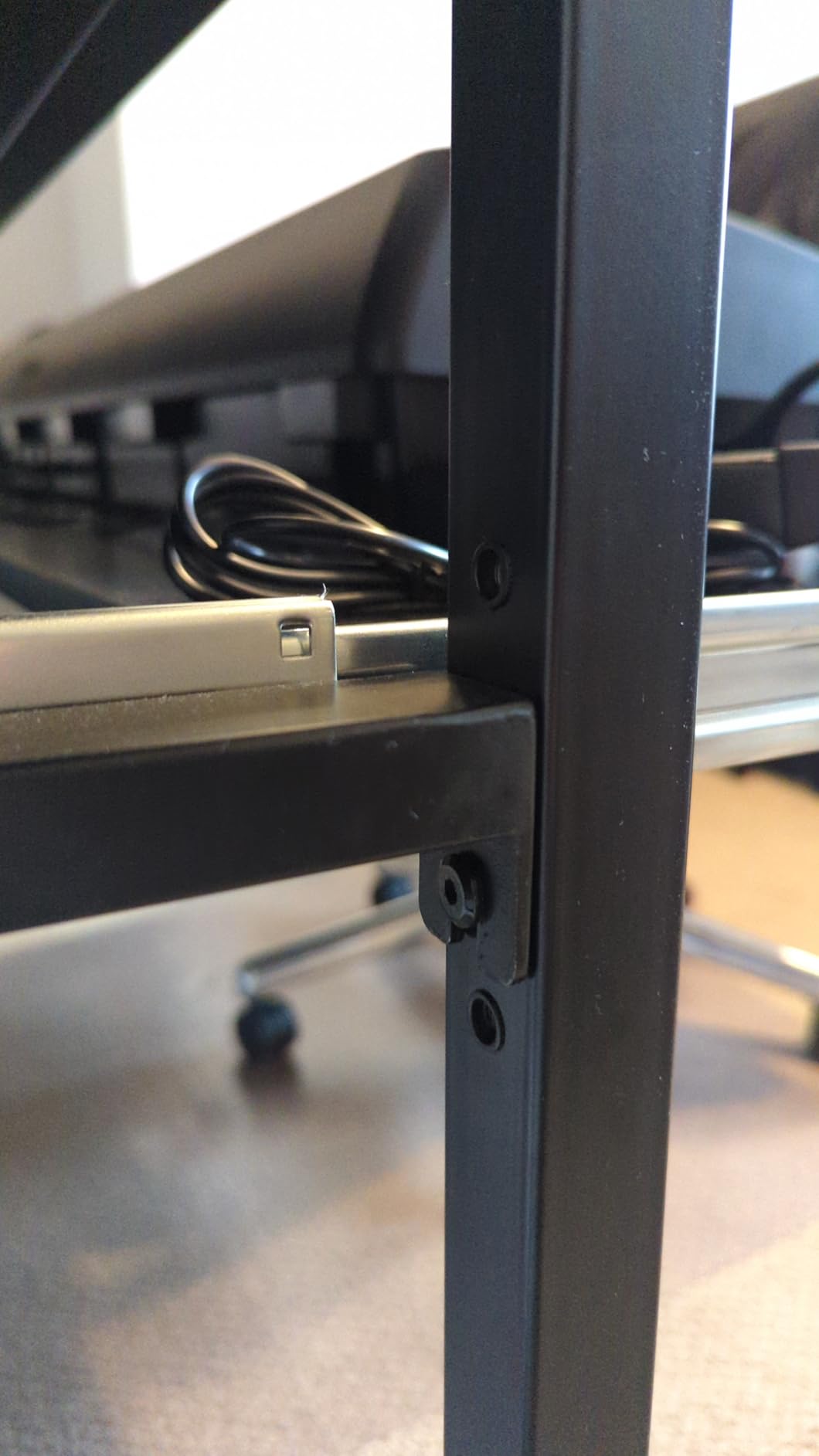
The multi-panel design keeps a cable tray system option open, though the tray itself is a separate order, so add it at the same time rather than realising later. Rounded corners on the frame improve safety and take the harsh edge off the steel.
At 4.2 stars from 58 reviews, the reservations are consistent: the separately sold cable tray, a six month warranty that is the shortest of any product here, and the sheer size. At 61.4 inches wide, 23.6 deep and 74.8 pounds, this is a two-person move.
Is a dedicated 88-key desk worth it?
If you play one regularly, yes, and the reason is physical rather than cosmetic. A full 88-key controller laid across a normal desk pushes your screen to the back and your monitors out wide, which changes your listening distance. In a proper tray the controller sits under the work surface, the screen stays close, and the monitors keep their toe-in angle.
Check the width before you commit. At 61.4 inches this needs a wall, and 23.6 inches of depth is shallow, so it pairs better with stands for your monitors than with a shelf above. The height adjustment bracket helps reconcile that by letting you raise the main surface.
Who should walk past the LYYL Workstation 88?
Skip it if you own outboard gear. There is no rack mounting at all, so a signal chain that is more than an interface and a controller belongs on a different desk. The Musiea BE200 or the Glorious Sound Desk Compact give you racks in a smaller footprint.
Skip it if a one year warranty matters to you, because this one is six months and the frame is heavy enough that a shipping or build problem is not impossible. The two year cover on the On-Stage or the Glorious Compact is the more comfortable position.
11. Musiea IM100 – Best for Speaker Placement and Large Racks
Musiea IM100 Series Music Studio Desk Workstation with 2 x 4U Rack (Cherry)
Two 4U rack bays
76-key cutout tray
Swivel speaker mounts
Locking caster wheels
Pros
- Two swivel mounts make speaker placement far easier
- 76-key tray with a cutout for leg clearance
- Locking casters stabilise a very large desk
- Solid heavy build with accurately drilled holes
Cons
- Very hard to move without the wheels
- Thin packaging leads to transit dents
- No printed manual in the box
The swivel mounts are the reason to look at this one. Two mounts let you change the angle of your speakers without lifting them, which sounds minor until you have spent an afternoon trying to get the toe-in right on a desk with no adjustment at all. For a mixing-focused producer, that alone is worth more than another shelf.
Everything else is generous. Two 4U rack bays give plenty of mounting for outboard gear, the keyboard tray takes up to 76 keys with a cutout for leg clearance, and the top shelf holds two monitors and a pair of speakers. At 69.44 inches wide by 30.94 deep with a 57 inch working diagonal, it gives you a proper workstation footprint.
Owners describe the build as very solid and heavy with accurately drilled holes, and the cherry wood veneer looks high-end for the money. The locking caster wheels are the detail that makes a desk this large manageable: two of the four lock, so it rolls when you need it and stays put when you do not.
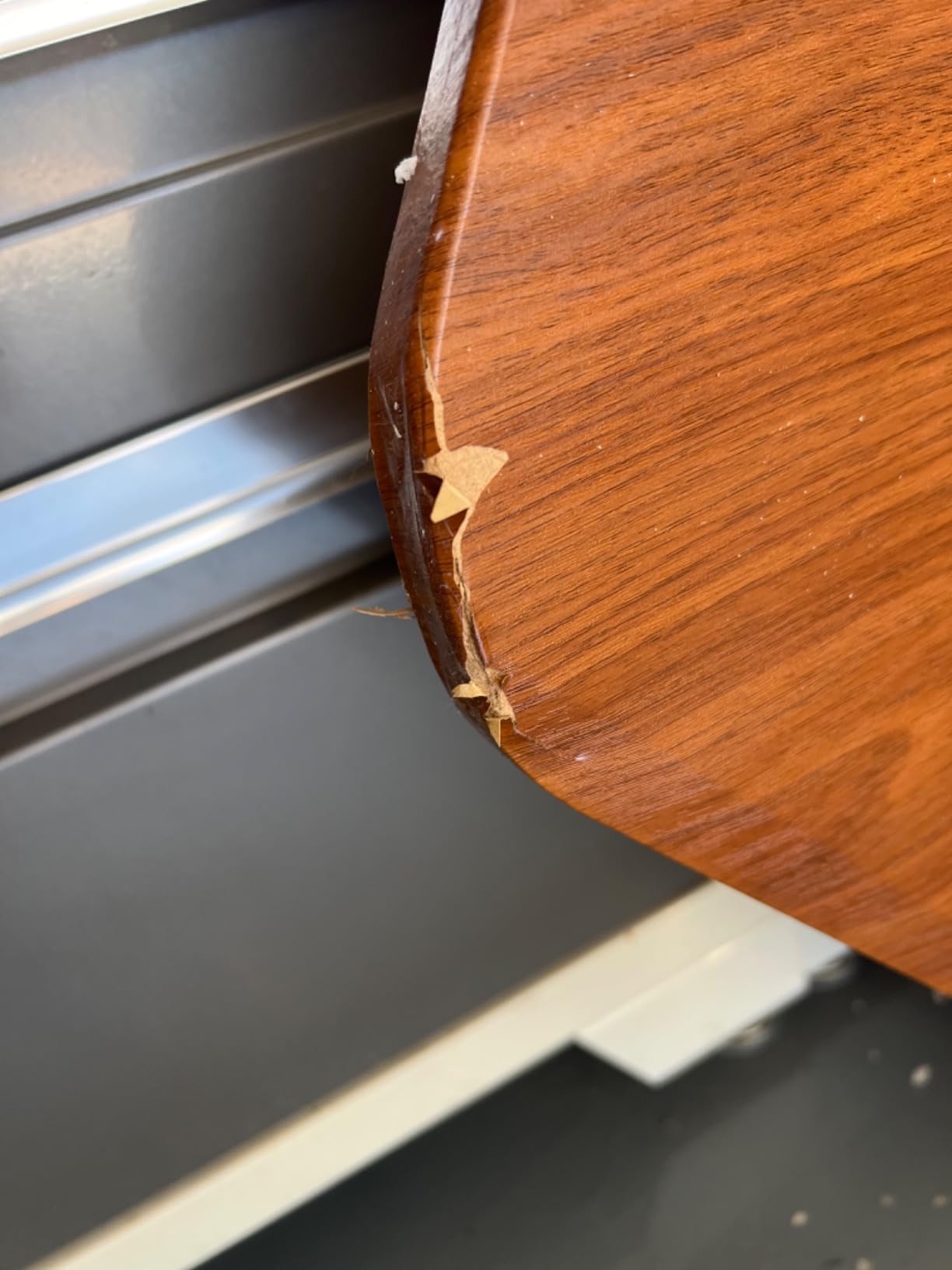
Packaging is the weak point. Owners report transit dents on the pointed ends caused by poorly padded packaging, so check the corners on arrival. There is also no printed manual in the box, meaning you download it from the maker, and filling both bottom rack spaces leaves the under-desk area cluttered.
Do swivel mounts actually improve a mix?
They make it easier, which is not the same thing. Speaker placement relative to your listening position has a real effect on what you hear, and the frustrating part is that most desks give you no way to adjust it once the speakers are down. Swivel mounts let you move from a symmetric setup to a wider one in about a minute, which is exactly the kind of change you want to make between tracking and mixing.
They will not correct a bad room. Placement works alongside treatment, not instead of it. The best available guidance on this question is still that acoustic panels and correct monitor distance do more than any desk feature ever will.
Who should walk past the Musiea IM100?
Skip it if you move often. The desk is difficult to reposition without the wheels, and the wheels are the only realistic way to move it. In a rented room that might change every year, a lighter desk such as the Armocity is a more sensible choice.
Skip it if you play an 88-key instrument. The tray tops out at 76 keys, and while that covers most controllers, the LYYL is built for the full size and its rail system is the more substantial of the two.
12. Acme 71 Inch Eleazar – Best for a Dedicated Spare-Room Studio
Acme 71″ Inch Music Recording Studio Computer Gaming Desk with Wood Storage Keyboard Tray, Wing Shaped & 2 Stands Tray & Botton Shelf, Metal Frame, Casters Included, Easy Assembly, Black Oak Finish
71 inch wing-shaped top
4U rack under each speaker stand
39 inch keyboard tray
50 pound desktop rating
Pros
- Integrated 4U rack space under each speaker stand
- Large wing-shaped top for dual monitors and speakers
- Metal frame with wooden top and base for stability
- Caster wheels included for rearranging the room
Cons
- 71 inch footprint may not fit through doorways
- Tabletop thickness of 0.2 inches is thin for rack equipment
- Two-box build takes time even with included hardware
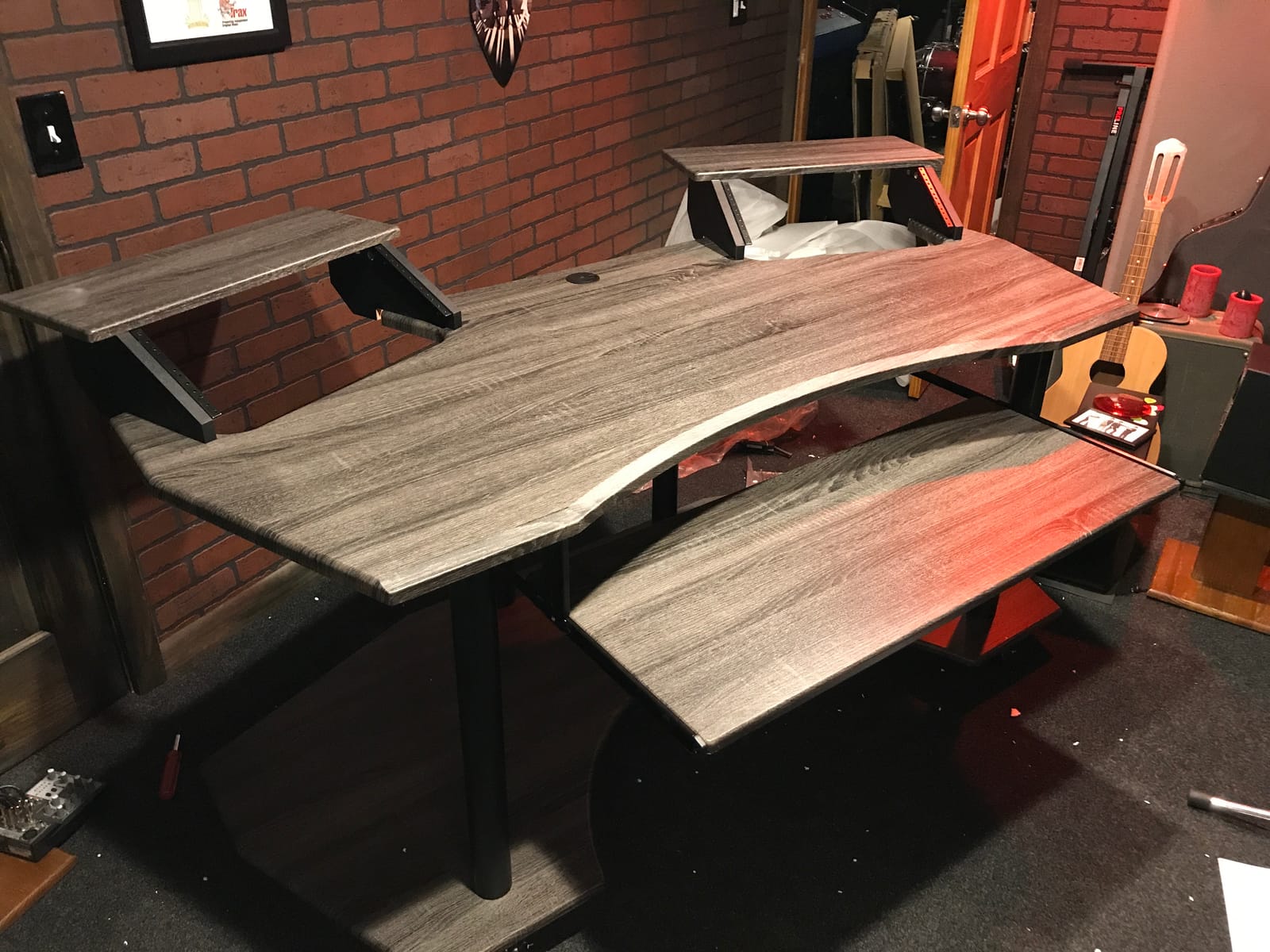
This is the sweet spot between the 47 inch Acme and the 83 inch version. At 71 inches long by 40 deep it gives you a large wing-shaped surface for dual monitors, a pair of studio monitors and a keyboard, and the two speaker platforms are not just shelves. Each has a 4U rack space underneath, so your interface and a couple of outboard units live inside the platform rather than on the floor.
The structure is a metal frame with a wooden top and base, which gives better stability than a metal-only build when you have heavy gear in the racks. The desktop is rated to 50 pounds and the lower shelf to 10. Casters are included, and the rating distribution among owners is strong, with 77 percent five star.
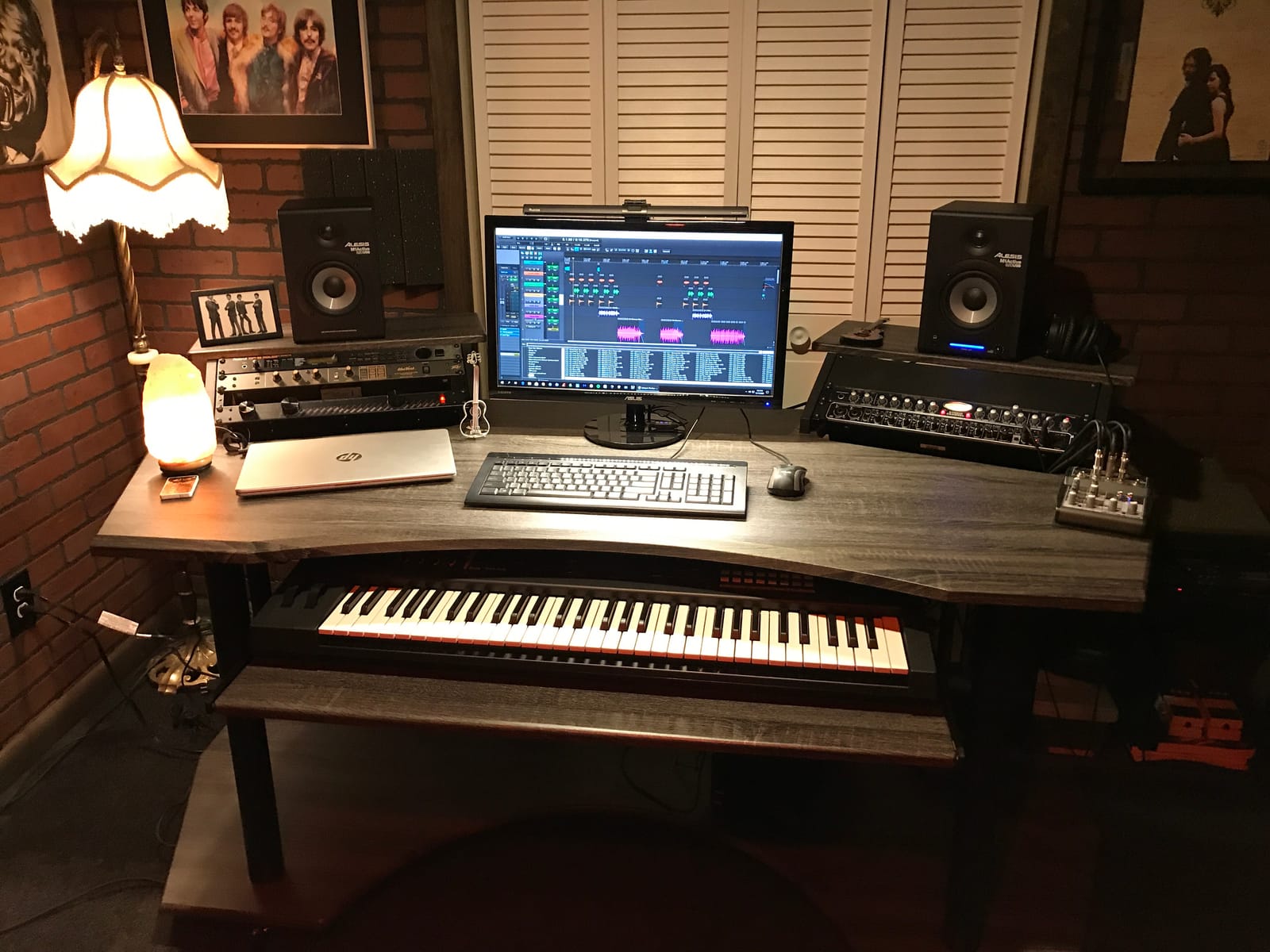
It holds a 4.6 average across 290 reviews, and the small share of critical feedback is mostly about fit and assembly rather than quality. People buying a 71 inch desk are usually buying it for a dedicated room, and that is exactly the use it serves best.
Two practical warnings. The tabletop thickness is listed at 0.2 inches, which is thin for a desk that will hold rack equipment directly, so distribute weight rather than concentrating it. And it arrives in two boxes, so have a second person available before you start.
Is a 71 inch wing-shaped desk worth the space?
In a room you can give up to production, yes. The wing shape means the surface is deep where you need it, at the screen and monitor end, and pulls back at the front so your forearms have somewhere to go. That is a genuine ergonomic improvement over a plain rectangle of the same length.
Measure your doorway before you order, though. A 71 inch desk is not always a 71 inch problem, since it often arrives as two pieces, but the finished top has to get through the door and turn into the room. The 47 inch Suitor avoids that entire conversation.
Who should walk past the 71 Inch Eleazar?
Skip it if your studio is a corner of a room that also has a bed in it. At 40 inches deep it takes up more of a small room than you will expect, and the depth means you sit at the desk rather than pull up to it. The Armocity at 22.8 inches deep is the compact counterpoint.
Skip it if you are a heavy keyboard player. The keyboard tray is listed at 39 inches long, which suits a 49 or 61 key controller but not a full 88, and the tray is fixed rather than height adjustable.
How to Choose a Studio Desk
Start from the gear you own, not the desk you want. Write down what has to be on the surface, what has to be within reach, and what does not need to be at the desk at all. That single exercise removes most of the ambiguity, and it stops you buying rack bays you will never fill.
What is the best studio table for music production?
A plain table plus a riser shelf is a legitimate answer, and in a small room it is often the best one. The top-voted response in the r/AdvancedProduction thread recommends exactly that approach, with the owner reporting that being able to stand improved workflow enormously. What you must add is any of these: a riser shelf for the back portion of the desk, a pull-out tray for the controller, and cable management that keeps the floor clear.
As for width, aim for 47 inches as the practical minimum for anything beyond a laptop and a 49-key controller. That figure fits two screens plus a controller across the front, and it is the size the most popular desks in this roundup cluster around. Below that, every choice becomes a compromise on the surface.
Do I need rack space in my studio desk?
Only if you own 19-inch rack gear now or will within the year. If your chain is an interface, a controller and a laptop, rack bays are wasted footprint and wasted money, and the producer who asked this question on r/AdvancedProduction got exactly the right answer: no rack gear, no plans for any, and a desk with rack space would have been the wrong purchase. Count your actual rack devices, subtract the ones you are only imagining, and buy bays for the number that remains.
Should studio monitors be on the desk or on stands?
Stands, in most cases. The loudest complaint in any studio desk discussion is the monitor shelf, and the reason is height: a raised tier that puts your display at 36 inches or more forces you to look upwards for hours. That is the failure that made one Gearspace user ditch a studio desk entirely and settle on flat tables with adjustable risers, neck strain solved.
The rule of thumb we use is simple. Sit in your normal position, note your eye level, and check the top of the raised tier against it. If the screen sits above eye height, use the shelf for storage and put the screen and monitors on stands. A bedroom producer on r/edmproduction does exactly that, with monitors positioned independently of the desk.
Are standing desks good for music production?
They are good for you, provided the frame is stiff enough. Load ratings are marketing until you test them: a producer on r/audioengineering reported an 80 kilogram rated frame shifting monitor stands once their forearms rested on the top, and pointed out that a missing rear horizontal support bar across the legs is the real tell. Check for that brace, then lean on the desk with both forearms and see whether anything moves.
Beyond stiffness, the standing advantage is genuinely useful for a mixing workflow. Standing gives you a second listening distance, which is a free second reference point when a mix feels wrong and you cannot work out why. It costs you a very large desk, though, so treat it as a room-to-grow purchase.
Is a big desk bad for studio acoustics?
It can be, and this is the point most roundups skip. A large flat worktop in front of your listening position throws early reflections straight back at you, which can colour what you hear, and the long-standing pro advice is to angle console surfaces 12 to 15 degrees so reflections go somewhere else. One Gearspace user put it bluntly: the best desk is no desk, so find the smallest one that will fulfil your needs.
The counter-argument deserves equal weight. The same community acknowledges that a well-designed desk with side and rear cable channels improves workflow enough to outweigh the reflections it adds. In practice, the effect is usually small compared with room treatment and monitor placement, so choose the desk that suits your gear and control the acoustics properly.
How do I check build quality before I buy?
Look for four things. A rear horizontal support bar across the legs, which is the strongest single indicator of frame geometry. A published load rating, plus a stated rating for the shelf or tier rather than just the top. Wheels that lock, since an unlocked desk is a desk that moves when you type. And assembly tooling, because a desk that needs tools you do not own is a bad first impression of how it was built.
Then check two numbers. Whether the keyboard tray suits your controller, and whether the raised tier suits your eye level. Those two mismatches cause more returns than any structural fault, and neither is obvious from a product photo.
What are the best studio furniture brands?
Specialist names dominate the professional end: StudioRTA, Quik-Lok, Zaor, Glorious, Wavebone and Ultimate Support build for studios and control rooms, and their desks cost several times what is here. Mid-market brands such as Acme, Musiea and EUREKA ERGONOMIC cover the home producer properly. Mass-market furniture brands do not specialise in this and it shows in the load ratings.
Our guides to the best studio monitors and the best studio headphones cover the gear that will change your sound far more than the furniture will, so finish the desk last rather than first.
Frequently Asked Questions
What is the best studio desk for music production?
For most home producers the On-Stage WS7500 is the best studio desk, because a 175 pound steel frame, a two-tier raised shelf and a sliding keyboard tray solve the three problems that matter: monitor height, controller placement and stability. If you have outboard gear to mount, the Acme 47-inch Suitor adds integrated rack bays at a lower cost, and if you want to work standing, the EUREKA ES71 is the only sit-stand option in this group.
What are some good studio desks for music production?
Good options include the On-Stage WS7500 for most setups, the Acme 47-inch Suitor and 71-inch Eleazar for rack gear, the Musiea BE200 for a full 61-key tray, the LYYL Workstation 88 for an 88-key controller, the Glorious Sound Desk Compact for small rooms, and the Armocity workstation for budget setups with no rack gear. Each of the twelve we tested is listed above with its measurements.
How much should a home studio desk cost?
A workable studio desk starts around the entry models in this roundup, where you get a raised shelf, a keyboard tray and a steel frame but no rack bays. The middle of the range adds integrated 19-inch rack space, cable management and casters. The top of the range adds height adjustment, wider surfaces and heavier frames. You do not need the most expensive option, and a plain table on a motorized sit-stand frame is a legitimate budget route that owners report improves workflow.
Do I need rack space in my home studio desk?
Only if you already own 19-inch rack gear or plan to within the year. If your signal chain is an interface, a MIDI controller and a laptop, rack bays are wasted footprint and wasted money, and a wide desk with no rack space serves you better. Count the rack devices you actually own rather than the ones you might buy, then choose a desk with roughly that much mounting.
Should my studio monitors be on the desk or on stands?
Stands, in most cases. A raised monitor tier can push your display above seated eye level, and looking upwards for hours is the most reported complaint about studio desks. Sit in your working position, compare the top of the tier with your eye level, and if the screen sits above it, use the shelf for storage and keep your screen and monitors on stands at the correct listening height.
Is a big desk bad for my studio acoustics?
A large flat worktop in front of your listening position throws early reflections back at you and can colour your mixes, which is why professional consoles angle the work surface 12 to 15 degrees. The counter-argument is that a desk with good cable routing improves workflow enough to outweigh it. Control the acoustics with panels and correct monitor distance rather than by choosing a small desk, and treat the surface as a secondary factor.
Our Verdict on the Best Studio Desks for Home Producers
Buy the On-Stage WS7500 if you want one desk to do everything. The 175 pound steel frame, the 29 inch working height and the two-tier layout handle a computer, a 61-key controller and a pair of monitors in a 43 inch footprint, and the 4.5 star average across more than 800 reviews says it has survived that test in thousands of rooms.
Buy the Acme 47-inch Suitor instead if outboard gear is coming, and the EUREKA ES71 if you want to work standing. For a small room, the Monoprice Stage Right and the Glorious Sound Desk Compact are the two that fit. For an 88-key controller, the LYYL is the only purpose-built answer here.
And if you are still not sure you need a studio desk at all, that is a reasonable position. Measure your gear, count your rack devices and check your eye level against that raised tier before spending anything. The right desk is the one that fits your equipment and your room, not the one with the most features. Compare the picks above against your setup in 2026, and you will know within a minute which one is right for you.