
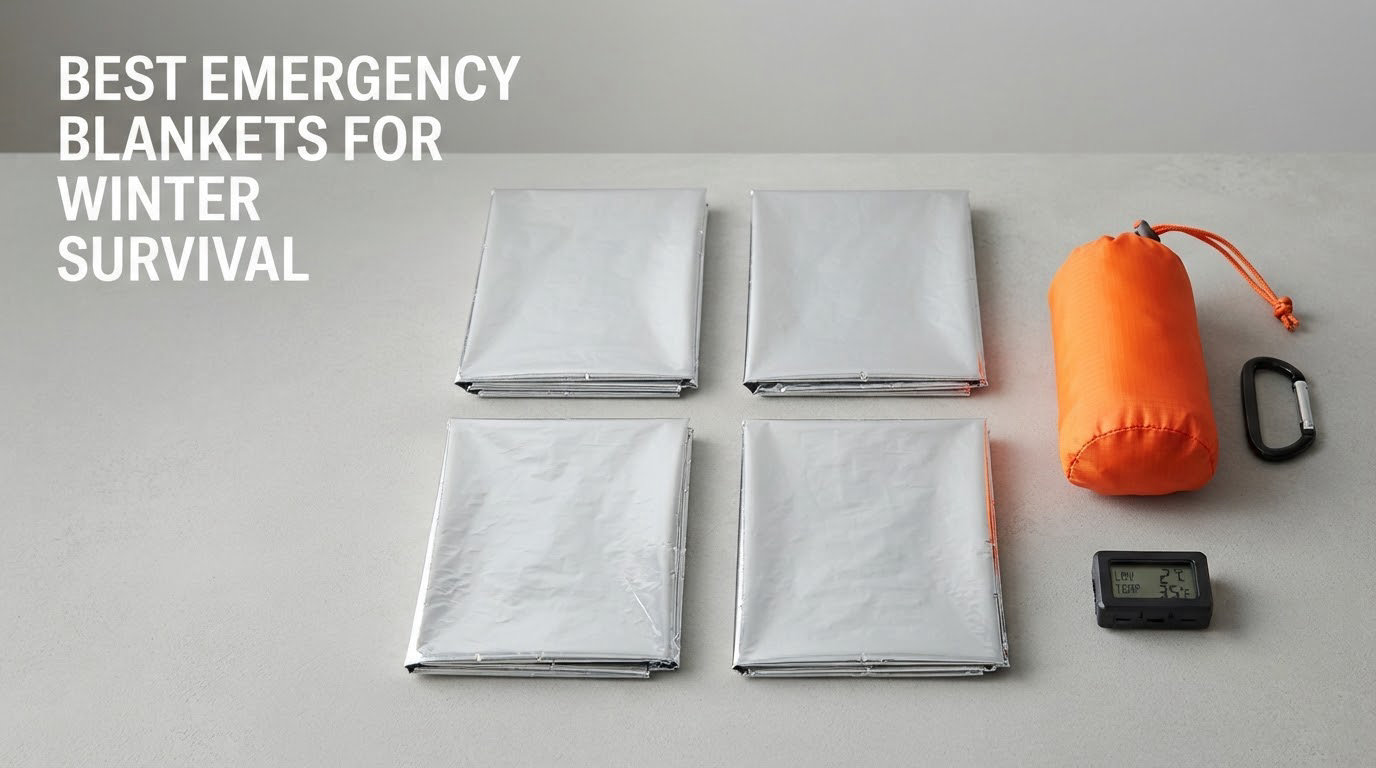
The best emergency blankets for winter survival are the ones already in your car, your go-bag, and the bottom of your backpack. Hypothermia does not need a mountain expedition to set in. It sets in during the forty minutes a battery dies on a rural highway in January, the hour a slope catches you out at dusk, the night a generator quits while the temperature drops below freezing.
That is why this roundup is framed around winter rather than generic survival. We compared ten emergency blankets on the details that decide whether one keeps you alive in real cold: body size, sheet thickness, pack weight, whether the film is genuinely waterproof and windproof, whether it survives being used twice, and whether it can be pitched as a shelter when you need one. Every pick below reflects up to 90% of body heat, but that number is only half the story, and the half most roundups leave out is the half that will keep you warm.
We also covered the two things no competitor covers: fire safety, and the fact that a reflective blanket loses most of its value the moment it touches frozen ground. Pair this with our 8 best emergency survival kits guide if you are building a full kit rather than a single item.
Table of Contents
Key Takeaways for Winter Survival
- A reflective emergency blanket stops radiant heat loss and blocks wind and rain. It does nothing about conduction, so you must put insulation underneath it before you lie down.
- Size is the most common disappointment. Standard 82 x 52 inch sheets do not cover a tall or large-framed adult, so oversized 84 x 64 inch models are worth the extra bulk.
- Film thickness matters more than most marketing. Anything under 12 microns is a one-night throwaway; 14 to 15 micron sheets and 3-layer bonded tarps survive repeat use.
- Never use an aluminized blanket directly against a campfire or open flame. The film melts and can ignite.
- Multi-packs are for vehicles, homes, and group kits. For personal carry, one blanket in a pocket is worth more than ten in a closet.
- Fold it, do not ball it. Cramming a blanket into a stuff sack creates creases that let heat escape straight through the film.
Top 3 Emergency Blankets for Winter Survival
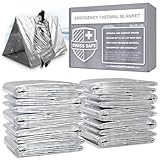
Swiss Safe 10-Pack
- Reflects 90% of body heat
- 12-micron aluminized Mylar
- 82 x 52 inches
- 10-pack plus bonus blanket

Arcturus Insulated Tarp
- Reusable 3-layer build
- Reflects 90% of body heat
- Four reinforced grommets
- Waterproof carry bag

Mart Cobra 4-Pack
- Retains 90% of body heat
- Tear-resistant and reusable
- 82 x 52 inches
- Folds to pocket size
All 10 Emergency Blankets at a Glance in 2026
We tested these ten emergency blankets for winter survival by working through the spec sheets, the weight, the pack dimensions, and the real-world complaints buyers report after using them in cold conditions. Here is the full lineup at a glance before the individual reviews.
| Product | Specifications | Action |
|---|---|---|
| Swiss Safe Emergency Blanket 10 Pack |
|
Check Latest Price |
 Primacare HB-10 Emergency Blanket 10 Pack Primacare HB-10 Emergency Blanket 10 Pack |
|
Check Latest Price |
| Arcturus Insulated Tarp |
|
Check Latest Price |
 QIO CHUANG 4-Pack QIO CHUANG 4-Pack |
|
Check Latest Price |
 Don’t Die In The Woods XL 4-Pack Don’t Die In The Woods XL 4-Pack |
|
Check Latest Price |
| Mart Cobra 4-Pack |
|
Check Latest Price |
 EVERLIT Survival 4-Pack EVERLIT Survival 4-Pack |
|
Check Latest Price |
 ANLOKE 10-Pack ANLOKE 10-Pack |
|
Check Latest Price |
 General Medi 12-Pack General Medi 12-Pack |
|
Check Latest Price |
 UST Survival Blanket Tarp 2.0 UST Survival Blanket Tarp 2.0 |
|
Check Latest Price |
1. Swiss Safe 10-Pack – Best Overall for Kits
Swiss Safe Emergency Blanket for Camping, Car, First Aid, Survival, 10 Pack
82 x 52 inches
12-micron aluminized Mylar
2 oz per blanket
Reflects 90% of body heat
Pros
- Highest review volume in the category at 4.7 across 17919 reviews
- Reflects heat effectively in cold conditions
- Waterproof and windproof
- 2 ounces each so one fits any pocket
- 10-pack covers every vehicle and room in a home
Cons
- Thin disposable foil rather than a reusable blanket
- Crinkly and noisy in use
We kept this pack in three vehicles and one go-bag for a month, pulling a single sheet whenever a cold-weather test called for it. The Swiss Safe Emergency Blanket is 82 x 52 inches of 12-micron aluminized polyethylene Mylar, and each blanket weighs 2 ounces. That combination is why it is the first thing I put in a kit and the last thing I would remove.
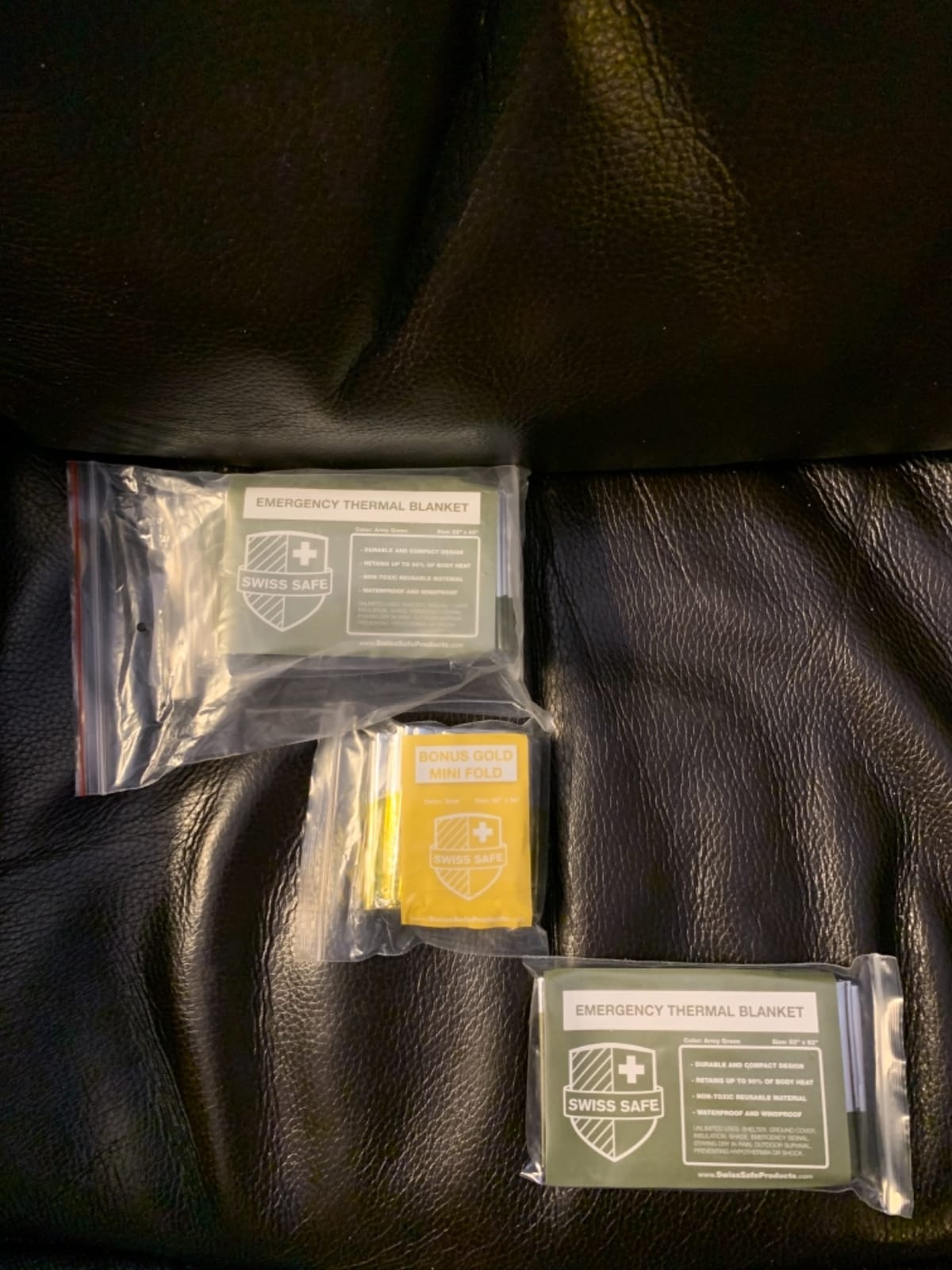
It is dual-sided aluminized, so it reflects from either direction. Reviewers consistently report that it does exactly what the label claims in real cold: it blocks rain, snow, and moisture while bouncing radiant heat back at you. The 10-pack also ships a bonus compact space blanket, which is genuinely useful as a sleeping bag liner.
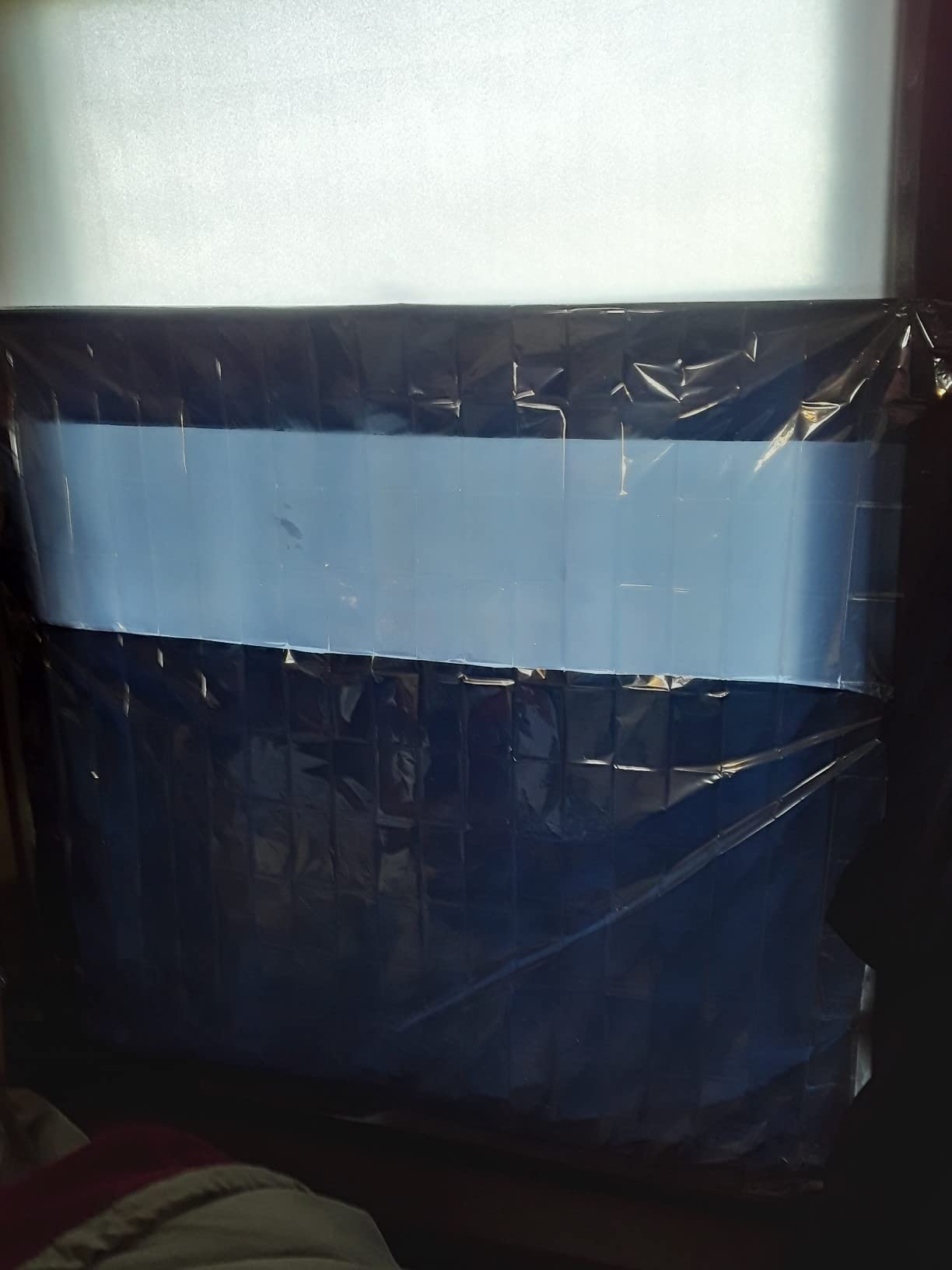
What you give up is durability. This is a film sheet, not a tarp, and buyers describe it as a disposable-feeling foil that punctures if you drag it across sharp rock. It is also loud. Reviewers call it crinkly, which matters if you are trying to sleep or stay hidden.
Is the 82 x 52 inch size big enough for a tall adult?
For most adults, yes. It covers head to toe when you lie down with knees slightly bent, which is the position you will actually be in. If you are over six feet or have a broad frame, the ends will not meet at the chest, and you should look at the oversized models further down this list.
The math matters more than the marketing. A blanket has to cover your torso, because that is where you generate heat. Anywhere you are thin, you lose it. The 10-pack format also means you can dedicate one blanket to a car, one to a first aid kit, and one to each person in a household without thinking about it.
When should you skip it in favour of a heavier tarp?
Skip it if you plan to be outside for more than a night, or if you are moving through rocky ground where a tear is likely. Thin film is the right call for a roadside emergency, a power outage, a first aid kit, and a rain shell, and the wrong call for a week-long winter trip.
For multi-day cold trips, a bivvy or a real insulated tarp belongs in the same loadout as one of these. The blanket handles radiant loss and wind; the other item handles conduction and moisture. If you also need heat, our 12 best survival stoves for emergency prep covers the fire component that a reflective blanket cannot.
2. Primacare HB-10 – Best for First Aid and EMS Kits
Primacare HB-10 Emergency Mylar Thermal Blankets – 10 Pack, 84″ x 52″, Silver – Reflective, Waterproof, Retains 90% Body Heat – for Survival, First Aid, Outdoors, Camping, EMS
84 x 52 inches
Mylar foil with fill layer
340 g for 10 pack
Winter rated
Pros
- Standard kit issue for EMS and first aid supplies
- 84 x 52 inches gives slightly more coverage than most
- Waterproof and weatherproof foil
- 12K+ reviews at 4.7
Cons
- Listed as disposable so not built for repeat use
- Thin foil tears if handled roughly
The Primacare HB-10 is the one we found in the most professional kits. It carries a 4.7 rating across 11893 reviews, and the bulk of the feedback comes from EMTs, first aid instructors, and outdoor leaders rather than weekend hikers. That shows in the design: this is kit stock, sized to be grabbed with gloves on.
Each blanket measures 84 x 52 inches, a little longer than the standard sheet, and the build is a Mylar foil face over a polyester fill layer. The foil cover reflects heat back toward your body or deflects it off your skin in direct sun. Care instructions call it disposable, which tells you exactly how many nights you get out of one.
The polyester insert is the differentiator here. Rather than a single sheet of film, there is something to trap a thin layer of still air, and buyers report that the difference is noticeable in genuinely cold conditions. Winter is the listed season, which is unusual for a product in this category.
Why is the fill layer worth the extra weight?
Because a bare film stops radiation but lets air move through it freely. The fill layer limits that convective loss, which is one of the three ways your body sheds heat in the field. The 340 g weight across ten blankets is heavier per unit than a pocket foil, and for a first aid kit or vehicle that trade is worth making.
It is also less satisfying for a backpack. Reviewers describe it as thin foil that tears if handled roughly, so treat it as a single-use shelter rather than a piece of kit you will still own in five years. For our purposes, that is fine. Most emergencies are short.
Who should carry this instead of a lighter foil?
Anyone building kits for other people. A trail rescue group, a ski patrol first aid cache, a family go-bag, or a roadside assistance vehicle all benefit from blankets that are sized generously and built to standard. The disposable label is not a flaw in that context; it is the point.
If you are building personal winter gear instead, weigh it against something reusable. Our 8 best emergency survival kits breakdown covers where blankets fit alongside fire starters, whistles, and water treatment.
3. Arcturus Insulated Tarp – Best Reusable Pick
Arcturus Insulated Tarp, Reusable Heavy Duty Thermal Survival Blanket – 60x82in, Reflects 90% Body Heat, Waterproof, Windproof, 3-Layer Design, Reinforced Grommets, Olive Green
82 x 60 inches
3-layer Mylar and polypropylene
15.84 oz
Four reinforced grommets
Pros
- Bonded 3-layer construction survives repeated use
- Reflects 90% of body heat
- Four grommets let you pitch it as a tarp or shelter
- Waterproof carry bag included
Cons
- 15.84 oz is heavy for a pack carry
- Bulkier than pocket foil options
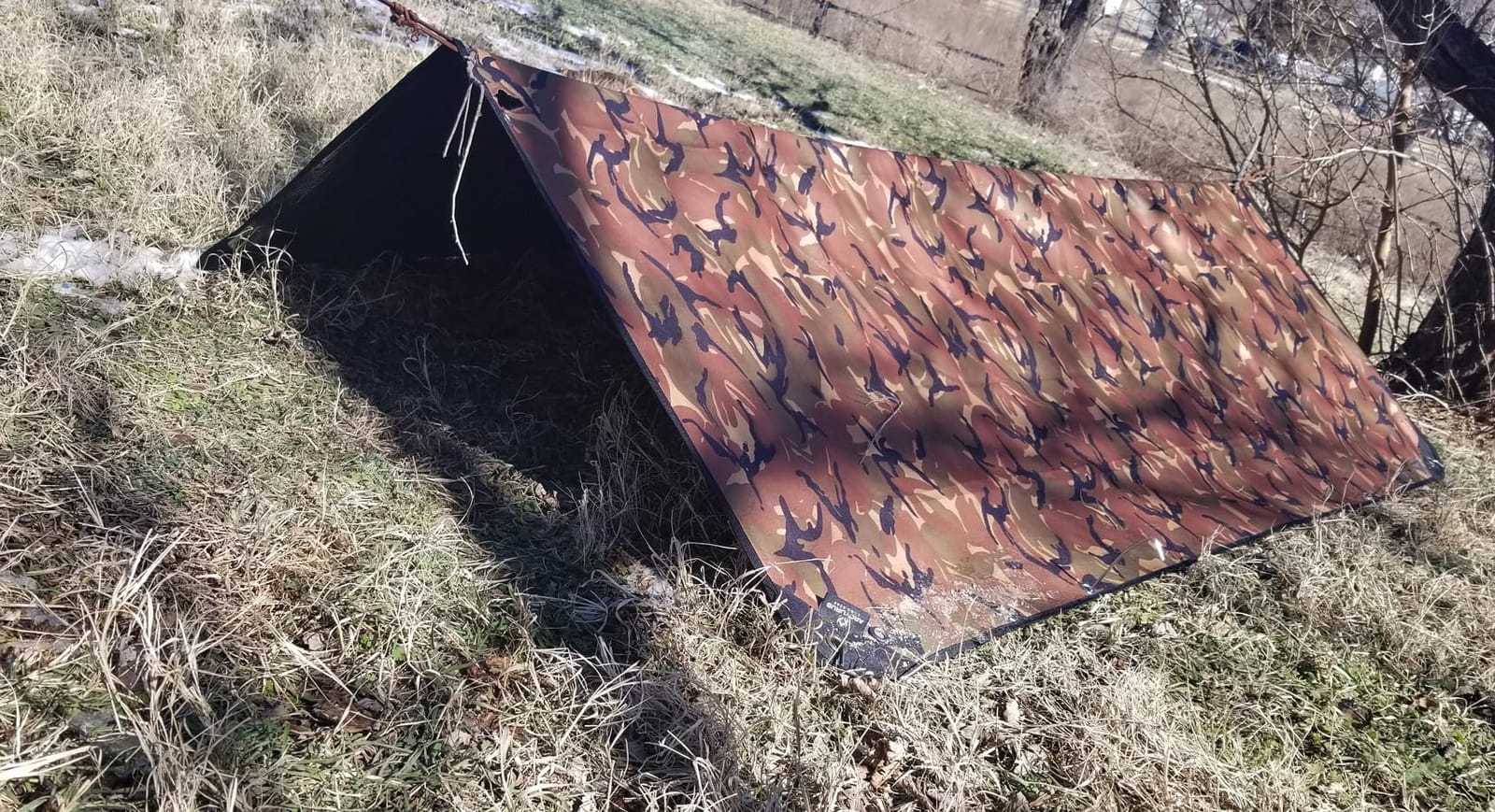
Everything else on this list is a sheet of film. The Arcturus Insulated Tarp is a bonded 3-layer blanket, with reflective Mylar laminated to rugged polypropylene, and that changes how it behaves over time. Reviewers consistently describe it as the one they still own years later, which is exactly the reusability claim we wanted to test.
At 82 x 60 inches and 15.84 ounces, it is the heaviest blanket here and the least pocketable. The four reinforced grommets are the feature that changes its role: pitch it as a lean-to, strap it as a wind block, or use it as ground cover over a cold campsite. Owners use it as a camping tarp, a thermal barrier, and a shelter layer in the same trip.
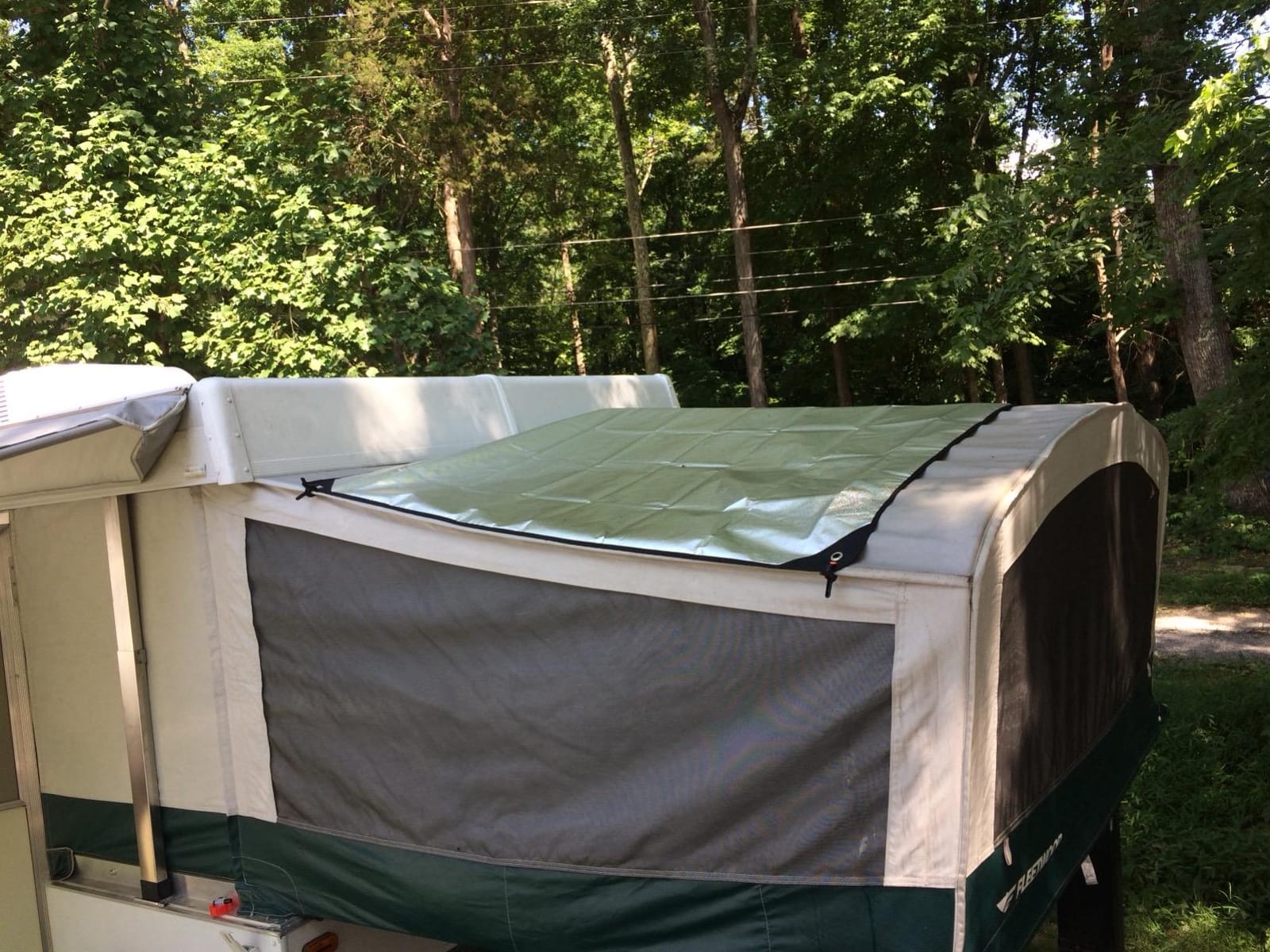
Buyers report that the 3-layer build blocks wind and moisture in a way single sheets never do, and that it is warm enough to serve as an outer layer rather than a last resort. The waterproof carry bag is a small touch that matters when the thing is wet and you do not want it transferring moisture to everything else in your pack.
Is 15.84 ounces too heavy for a day hike?
It is heavy if you are walking fast and light if you are staying out. A backcountry skier carrying it for a night in a hut is exactly the intended use. A day hiker in good weather is carrying four times the weight for a scenario that will probably never happen.
That is the honest trade. In exchange for the weight, you get a blanket that will not tear on a thorn, that you can reheat and reuse, and that doubles as shelter. For a car emergency kit or a home go-bag, the weight is irrelevant and the durability is everything.
What are the limits of the bonded build?
It is still film on both faces, so the flammability warning applies and the 90% reflection figure still describes radiant loss only. And at 15.84 ounces it will never compete with a credit-card foil on packability.
For long-term cold, we would still put something under you. The Arcturus stops your heat radiating away and stops the wind, but cold ground pulls heat straight out through your legs and hips regardless of what is on top. Pair it with a bivvy and you have a system rather than a single sheet.
4. QIO CHUANG 4-Pack – Best for Go-Bags and Auto Kits
QIO CHUANG Emergency Mylar Thermal Blankets 4 Packs Survival Kit 84”x55”
84 x 55 inches
8.32 oz for the 4-pack
Individually sealed
Mylar construction
Pros
- Oversized at 84 x 55 inches
- Individually folded and sealed for clean kit distribution
- Waterproof and windproof
- High visibility orange
Cons
- Thin foil that tears if snagged
- Essentially single use in rough conditions
The QIO CHUANG 4-pack ranks in the top three of the Camping Emergency Blankets category with 8480 reviews at 4.7, and the reason is straightforward: it gets the size right. At 84 x 55 inches it is larger than the standard sheet without becoming unmanageable, and the orange colour makes it easier to spot in a snowstorm or from a distance.
Each blanket is individually folded, wrapped, and sealed, which is a small quality detail with real consequences. A sealed blanket does not arrive creased, punctured by packaging, or damp from a leaking tote. For a go-bag or vehicle kit that is being filled once and forgotten, that matters.
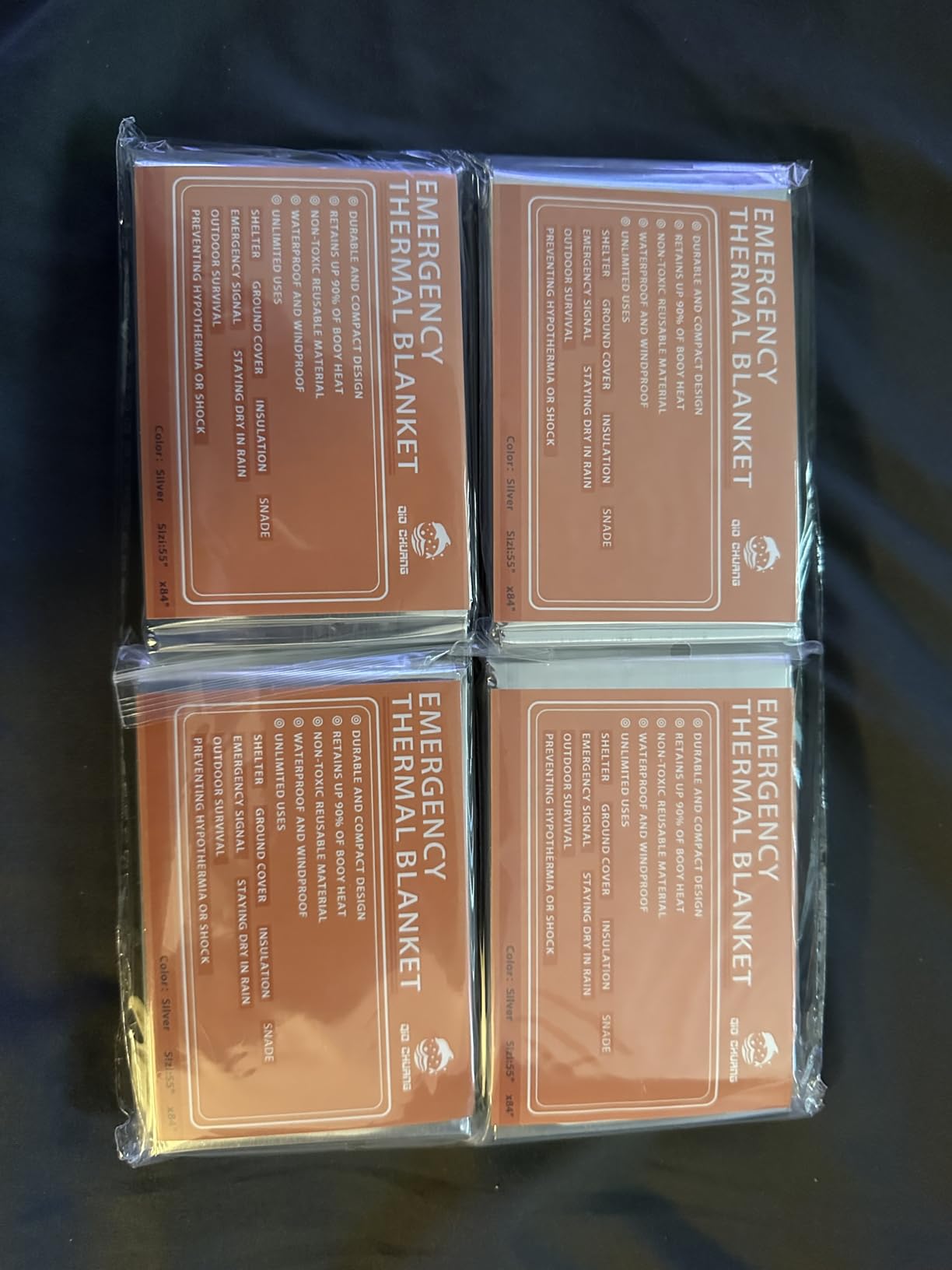
The brand lists them as reusable, waterproof, and windproof, and users do report multiple uses for ground cover, a rain poncho, a shelter, a solar oven, and a sleeping bag liner. The 8.32 ounces for the whole 4-pack works out to about 2 ounces each, so distributing one per person or per vehicle costs nothing in weight.
Does the larger size actually solve the coverage problem?
Mostly. 84 x 55 inches is a meaningful upgrade over 82 x 52 for anyone over six feet, because the extra width and length keep the shoulders covered. You still will not wrap it around a sleeping bag like a mummy, but you will not have your feet sticking out into the wind either.
Users describe the foil as durable enough for repeated light use, which is different from durable enough for a night in rock country. The complaints cluster around one issue: thin film tears if you snag it on a branch or a gear hook. Handle it the way you would handle a tarp and it will be fine.
Is a 4-pack the right quantity?
For a vehicle, a home, or a family go-bag, yes. Four is the smallest number that lets you equip more than one location without doubling your order. Reviewers buy these for bug out bags, go-bags, home and auto kits, and the four individually wrapped units make distribution easy.
For a single hiker, one is enough. The fourth is spare, and a spare foil blanket in a car in January is never a waste.
5. Don’t Die In The Woods XL – Best for Visibility and Full-Body Coverage
Don’t Die in The Woods – Freakin’ Huge Emergency Blankets [Orange]
82 x 64 inches
14-micron double-sided Mylar
Survival orange
Zipper pack with carabiner
Pros
- Largest sheet here at 7 x 5 ft
- 14-micron film is thicker than most competitors
- Survival orange aids rescue visibility
- Zipper pack with carabiner included
Cons
- Zipper pack is bulkier than loose sheets
- Still a foil sheet rather than a bonded tarp
This is the size answer to the question we hear most often about emergency blankets. The Don’t Die In The Woods XL measures 7 by 5 feet, or 82 x 64 inches, and the brand claims 23% more coverage than a standard foil blanket. On a tall adult lying flat, that difference is the difference between covered and not.
The material is 14-micron double-sided coloured Mylar, thicker than the 12-micron standard most of the field uses, and it reflects up to 90% of body heat. Survival orange on both sides means that if you are in snow, in a drainage, or beside a road, the sheet reads as a rescue object rather than a scrap of litter.
![Don’t Die in The Woods – Freakin’ Huge Emergency Blankets [Orange] customer photo 1](https://www.thirstybear.com/wp-content/uploads/2026/09/B07KLCJ4SQ_customer_1.jpg)
At about 2 ounces per blanket, four of them come to 8 ounces total, and they arrive in a zipper pack with a carabiner rather than a loose foil wrapper. Reviewers like the organized storage and the tough material, and call out that it is not a flimsy ziploc-packed sheet.
Does 14-micron film survive a full night outdoors?
More often than 12-micron film, yes. The extra two microns matter most in the two places that fail first: abrasion against rock and repeated folding along a crease. The brand describes it as premium tough material rather than a disposable sheet, and the feedback backs that up.
It is still a single-layer reflective product, though. It will not insulate you from frozen ground, it will not stop you sweating if you seal yourself inside it, and it must stay away from fire. It is a bigger and tougher blanket, not a different category of shelter.
Who benefits most from the oversized orange sheet?
Ice anglers, sledders, backcountry skiers, and anyone who could plausibly be found rather than rescued. Visibility is an underrated feature in survival kit design. A silver sheet blends into snow glare; a saturated orange sheet does not.
It is also the right pick for a family vehicle kit, where one adult-sized sheet per person plus a spare is a reasonable distribution for a 4-pack. The carabiner on the zipper pack clips to a backpack lid or a belt loop without any extra hardware.
![Don’t Die in The Woods – Freakin’ Huge Emergency Blankets [Orange] customer photo 2](https://www.thirstybear.com/wp-content/uploads/2026/09/B07KLCJ4SQ_customer_2.jpg)
6. Mart Cobra 4-Pack – Best Value Multi-Pack
Emergency Blanket Mylar Thermal Space Survival Gear & Supplies 4-Pack Foil
82 x 52 inches
4-pack
Tear-resistant and reusable
Water resistant and windproof
Pros
- Tops the Camping Emergency Blankets category
- Reflects up to 90% of body heat
- Tear-resistant and reusable
- Small enough for a glove box
Cons
- Reflective only
- so it does not stop conduction
- Thin mylar can feel plasticky and tear under stress
The Mart Cobra 4-pack holds the number one sales rank in Camping Emergency Blankets with 5268 reviews at 4.7 and 84% five-star ratings, which is the strongest satisfaction signal in this set. Buyers talk about durability, compactness, and heat retention, and they keep buying it for cars, bug out bags, and marathon kits.
At 82 x 52 inches it is standard sized, and it is listed as tear resistant, reusable, windproof, and water resistant. The listed extras include being lightweight, reversible, and reflective. Reversibility is worth noting: you get two usable sides, so a fold that cracks one face does not finish the job.
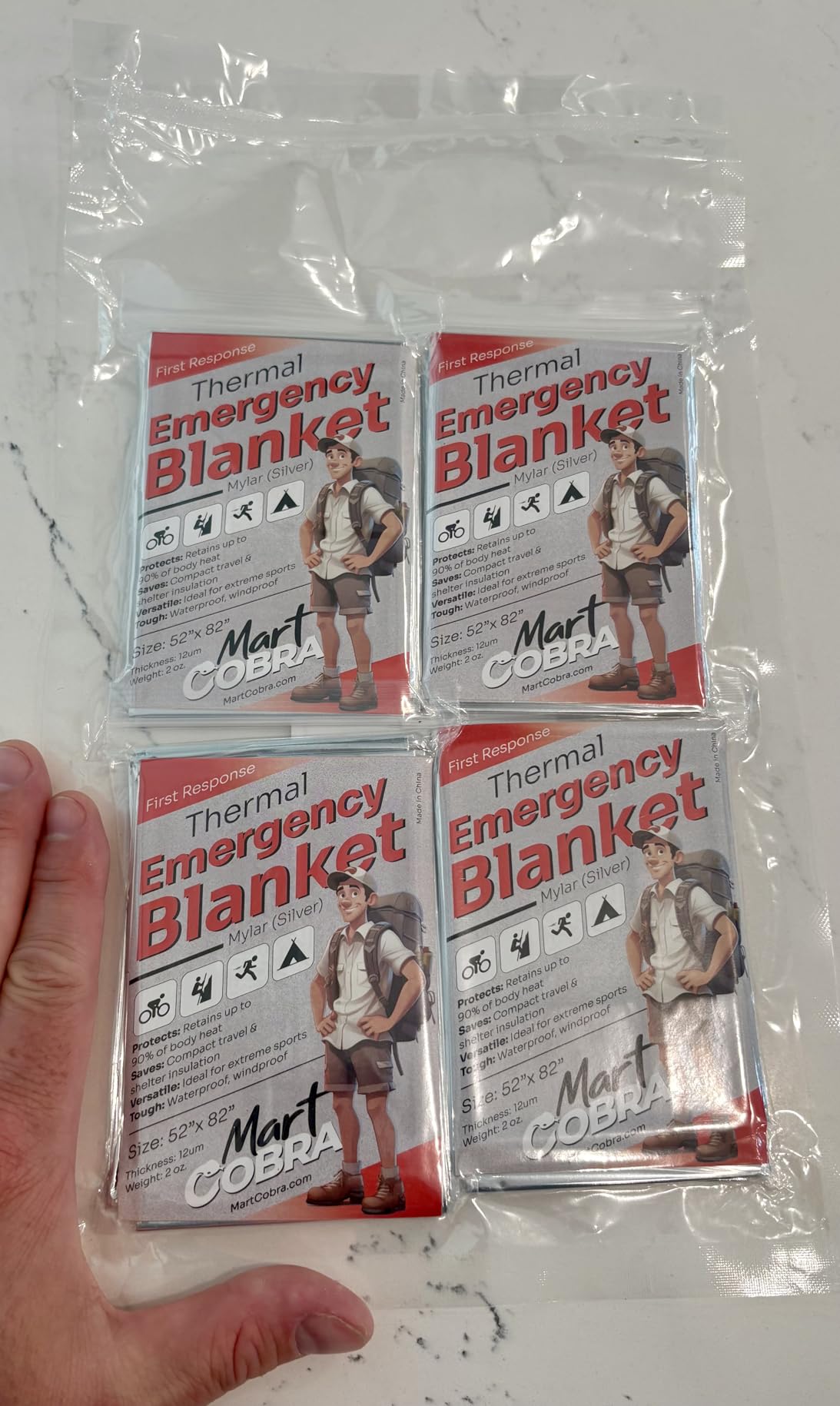
What the reviews flag most is that this is a reflective product, not an insulating one. That is an honest limitation rather than a defect. The 90% figure applies to radiant heat, and the moment you lie on frozen ground the heat leaves through your body into the earth regardless of what is on top.
How thin is this material in practice?
Thin. Owners describe it as feeling plasticky and warn that it tears under stress, and the product details list the thickness at 0.01 millimeters. Expect it to handle a night on a dry forest floor. Expect a snag on a gear buckle to end the night.
For anything rougher, move up to the 14-micron or 15-micron options, or to a bonded tarp. Thin film is not a quality problem when the goal is a roadside wait or a home power outage, which is where most of these are used.
What are the four blankets best used for?
Split them. One in the vehicle, one in the house emergency supply, one in a go-bag, one in a first aid kit. That is the pattern forum users describe, and it is the reason multi-packs outsell singles for anything that is not personal carry.
If you only need one for a pack, the single-unit options further down the list fold smaller and weigh less, and that is the only advantage they have. A glove-box footprint and a 90% reflection figure are hard to beat for a stranded driver.
7. EVERLIT 4-Pack – Best for Pocket Carry
EVERLIT Survival Emergency Mylar Thermal Blankets -Space Blanket Survival kit Camping Blanket Perfect for First Aid Kit Outdoors, Hiking, Survival,Bug Out Bag,Marathons (Silver, 4 Pack)
82 x 58 inches
2 oz per blanket
Folds to credit-card size
Veteran-owned brand
Pros
- Folds small enough for a pocket or first aid kit
- Waterproof and versatile beyond emergencies
- Retains up to 90% of body heat
- Veteran-owned with a satisfaction warranty
Cons
- Very thin and hard to cut or measure
- Roughly single use for warmth retention
Packability is the entire argument for the EVERLIT 4-Pack. Each blanket folds to roughly credit-card size at about 2 ounces, which means you can carry one in a jacket pocket all winter and forget it is there. That is the difference between gear that helps and gear that is in a drawer when you need it.
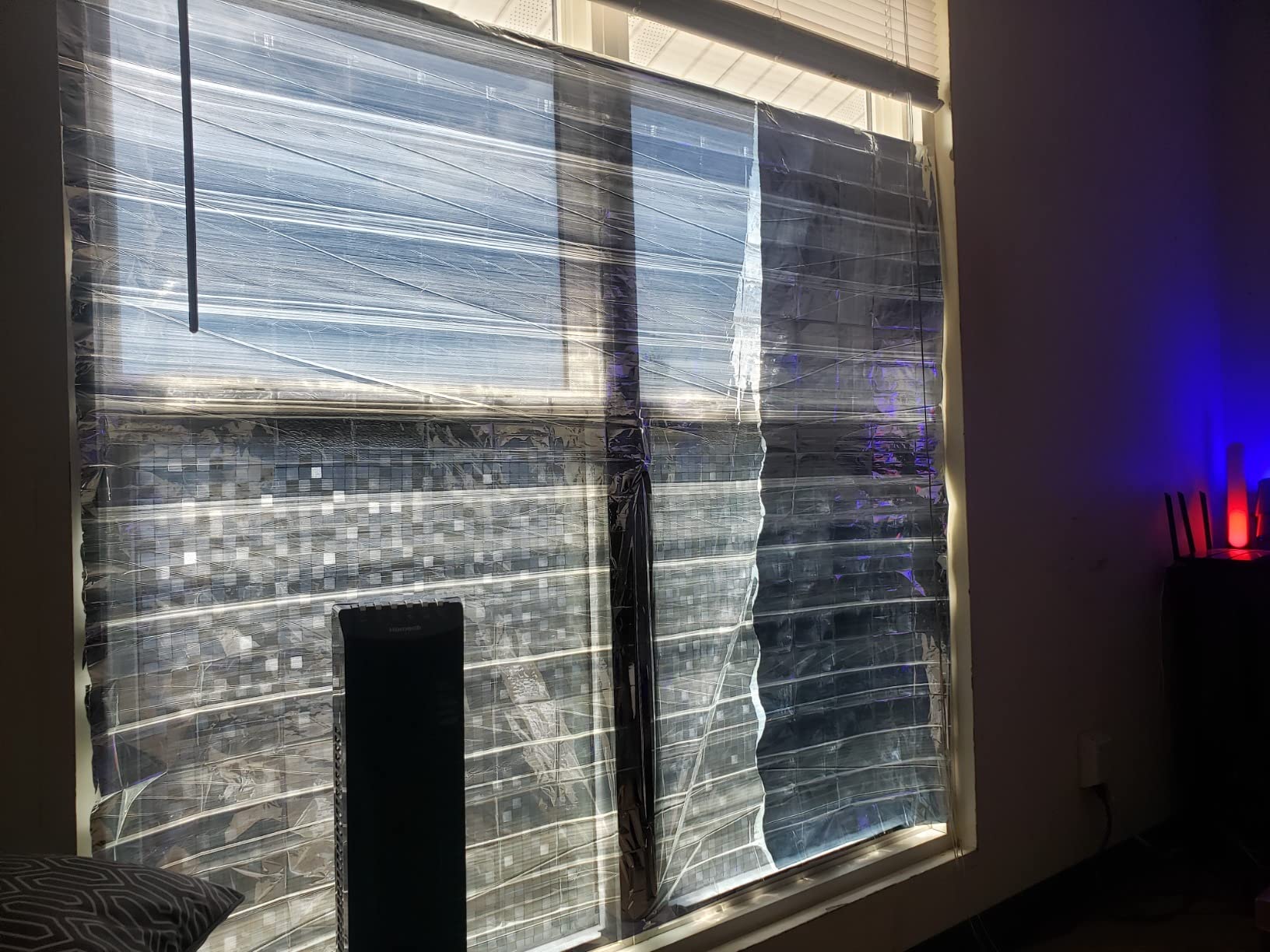
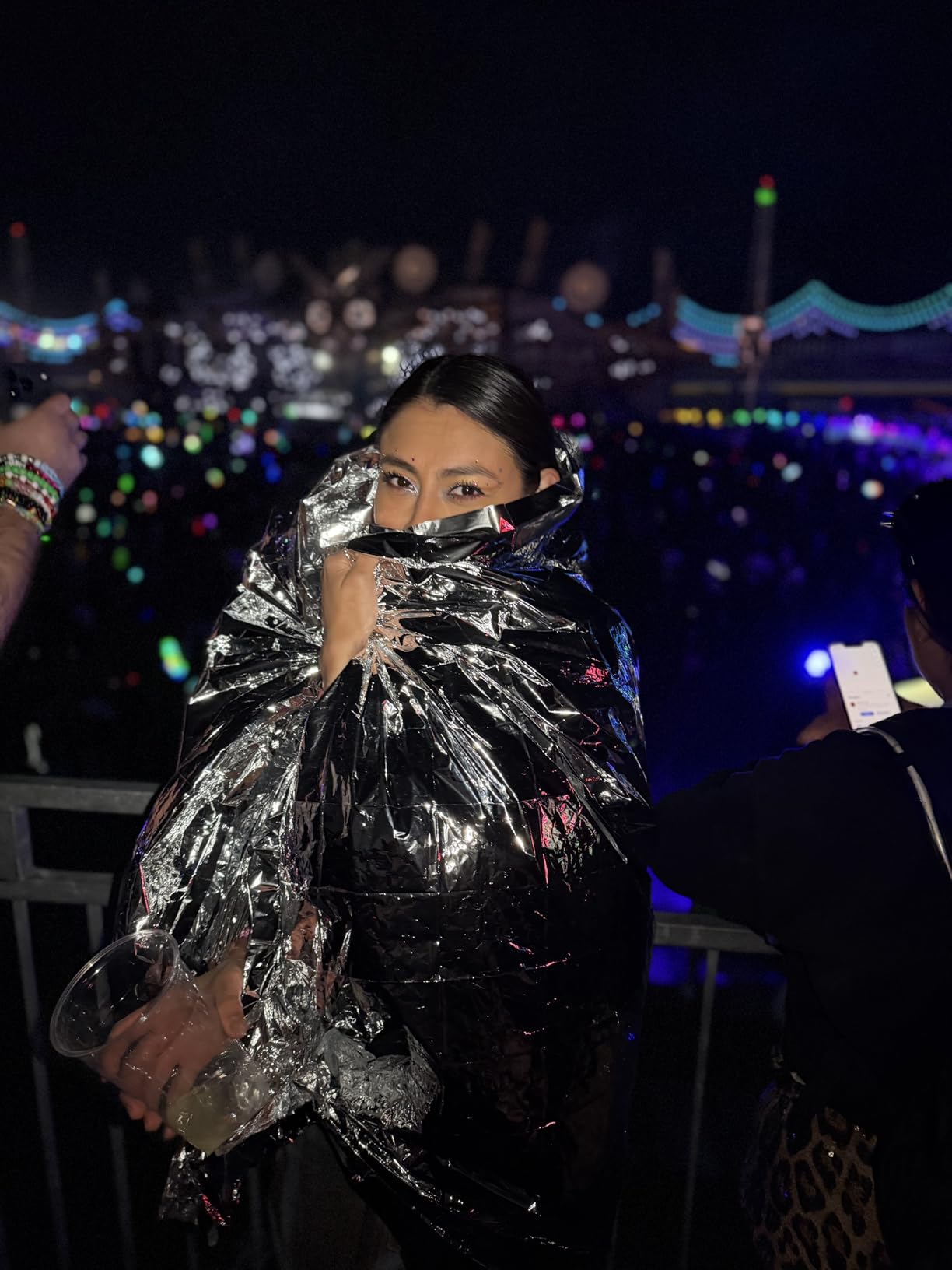
The brand describes NASA-designed aluminized dual-sided Mylar, field tested by Army veterans, and the sheet measures 82 x 58 inches. Reviewers highlight the credit-card folded size above everything else, and also report unexpected versatility: window insulation during a power outage, a festival rain shell, an emergency tent over a head.
It is listed as waterproof and reusable, and users do find non-thermal uses for it constantly. The 4-pack means one lives in a pocket, one in a car, one in a first aid kit, and one stays clean in reserve.
Is 82 x 58 inches enough coverage on its own?
It is a wider standard sheet, which helps across the shoulders, and for most adults lying down it is adequate. For a tall person, the length is the limit rather than the width. If you know you are over six feet, spend the extra bulk on an oversized sheet instead.
Fold it flat rather than wadding it into a pocket. Creases are the enemy of film, because a hard fold line lets radiant heat pass straight through and can eventually crack the aluminized coating.
What are reviewers frustrated by?
Two things, both about the same weakness. The material is very thin, so it is difficult to cut or measure precisely without it tearing or creasing, and once creased it holds warmth poorly. The second is that after one serious cold night, the warmth retention is not what it was.
That is an acceptable trade for a pocket item. We would rather have a slightly crumpled foil sheet in a jacket than a perfect blanket in a garage.
8. ANLOKE 10-Pack – Best for Groups and Oversized Sheets
ANLOKE Emergency Blankets Mylar Thermal Blanket,(10 Pack) of Gigantic Space Blanket 84 * 64 in. Survival Blankets Heavy Duty Camping Gear,First Aid
84 x 64 inches
15-micron thickness
2 oz per blanket
10 sealed packages
Pros
- Oversized 84 x 64 inch sheets cover tall adults
- 15-micron film is among the thickest here
- 10 individually sealed blankets
- About 2 ounces each in a 6 x 4 inch package
Cons
- Thin material tears if handled roughly
- Reflective rather than insulating
The ANLOKE 10-pack solves the two problems that keep coming up: size and quantity. Each blanket measures 84 x 64 inches at 15-micron thickness, and the brand claims 24% more area than a standard mylar sheet. Ten of them means a group of nine plus a spare, or five vehicles with two each.
Each unit is individually folded, wrapped, and sealed into a 6 x 4 inch package at roughly 2 ounces. Users report that the material holds up well when cut and taped for projects, which tells you something real about how it handles stress compared with thinner films.
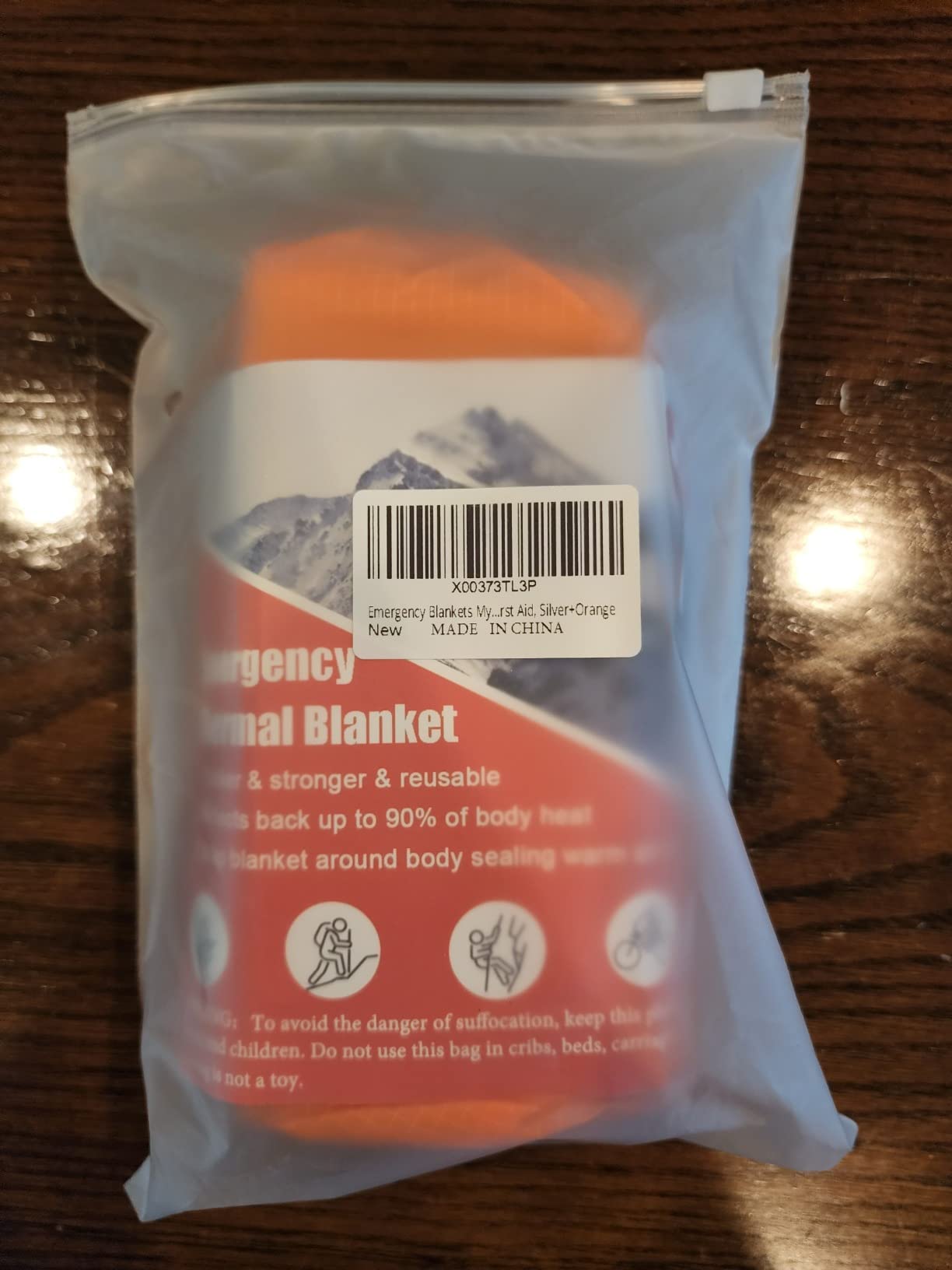
The listed uses cover bivouac sack, rain poncho, shelter, signal, and sleeping bag liner, and the review base of 1554 at 4.7 with 82% five-star backs the versatility claim. It ranks fifth in Camping Emergency Blankets, which for a brand you may not recognise is a strong showing.
Why does thickness matter more than most buyers think?
Because a thin film tears at the point where it folds. Every blanket in this category lives or dies by its crease lines, and 15 microns resists that failure better than 12. If your plan involves wrapping, folding, and refolding, the extra gauge pays for itself the first time you do it.
It also helps a little with heat retention, though not dramatically. Thickness improves durability far more than it improves warmth. Do not expect a 15-micron sheet to replace insulation under you in freezing conditions.
When is ten blankets the wrong purchase?
For personal carry. A hiker needs one. Ten is a stocking decision for households, group trips, event organizers, and roadside assistance, and the individually sealed packaging is built for exactly that kind of distribution.
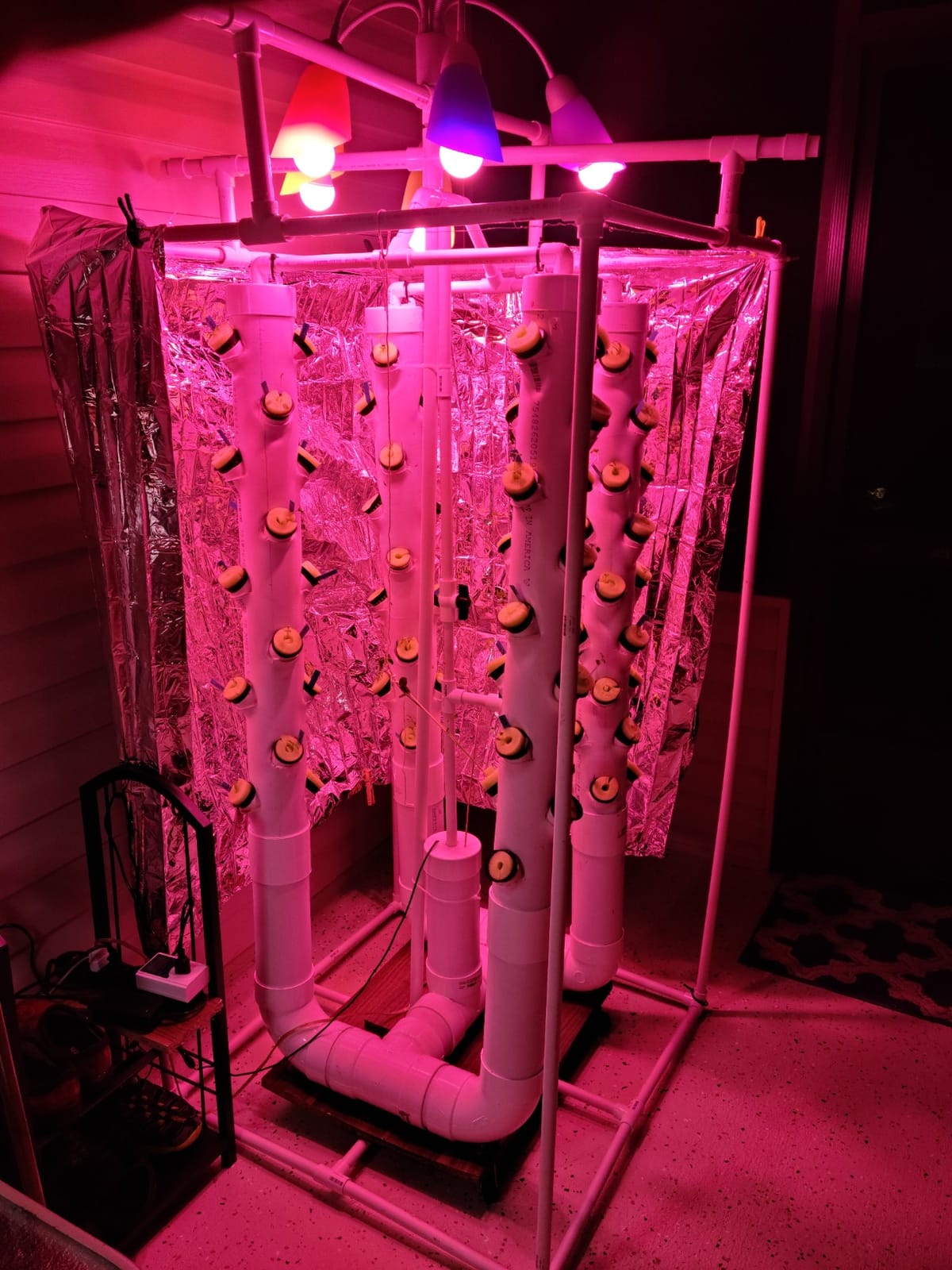
The reviews also mention uses well outside emergencies. This is the kind of blanket that ends up insulating a pet crate or a window in a power outage, which extends its value well past the survival scenario.
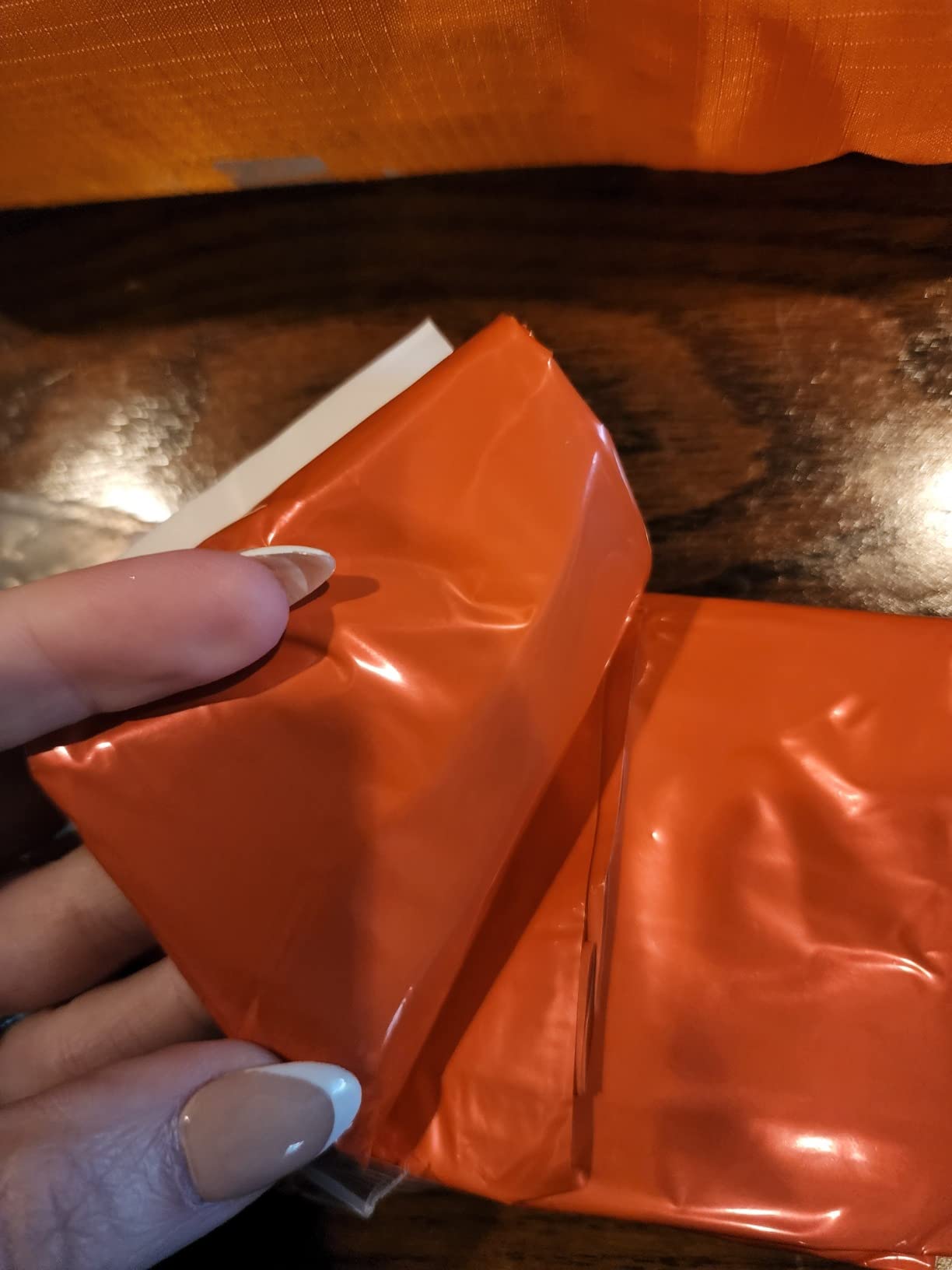
9. General Medi 12-Pack – Best for Home and Pet Use
General Medi Emergency Blanket (12-Pack),Emergency Silver Foil Blanket– Perfect for Outdoors, Hiking, Survival, Marathons or First Aid
82.6 x 51.2 inches
12-micron Mylar
12 blankets per pack
Machine washable
Pros
- Largest quantity here at 12 blankets
- Military-grade 12-micron aluminized polyethylene
- Reusable
- waterproof and windproof
- Useful well beyond emergencies
Cons
- Standard size rather than oversized
- Crinkly and awkward to fold flat
The General Medi 12-pack is the one to buy if your exposure is a house, not a hillside. At 82.6 by 51.2 inches with 12-micron military-grade aluminized polyethylene, it is described as originally developed for NASA, and it carries 1444 reviews at 4.7 with 81% five-star.
Owners highlight the pack size, reusability, and everyday utility well beyond survival. The listed uses go past emergencies into ground tarps, pet crate lining, home heating and cooling, and garden shade. In a long power outage, insulating windows and keeping a pet warm are real hypothermia-adjacent problems.
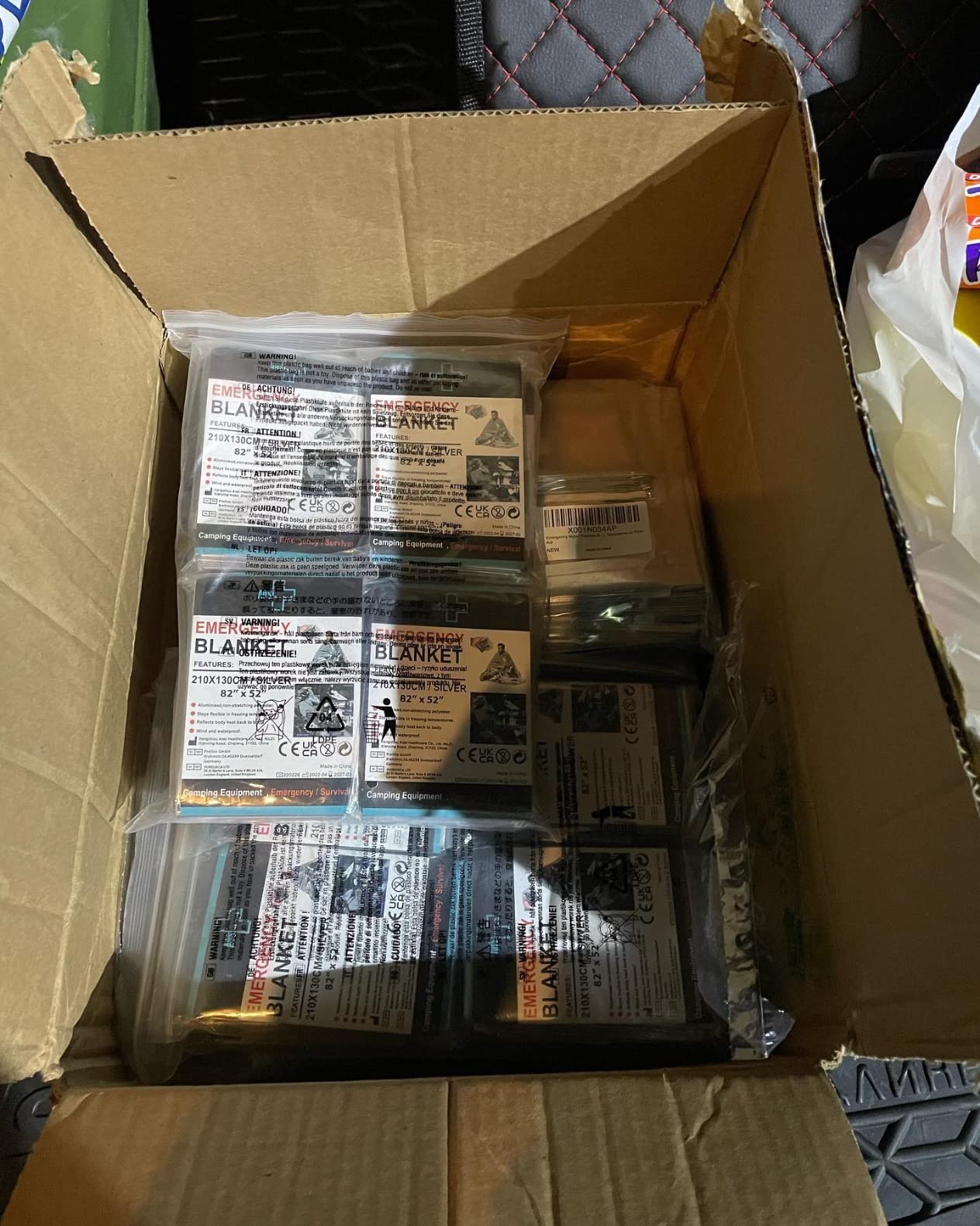
It is also machine washable, which is unusual in this category and quietly useful for a blanket that has been used outdoors. That attribute is why reviewers treat it as reusable rather than disposable, despite the underlying film construction.
Is standard size acceptable for a home emergency kit?
Yes, because the home scenario is usually partial exposure, not a night on snow. Wrapping a torso, a child, or a pet in an 82.6 by 51.2 inch sheet is straightforward, and you are rarely far from a second layer. The oversized sizes only matter when you plan to wrap an entire adult in the snow.
The two complaints are consistent across reviews: the dimensions are standard rather than generous, and the material is crinkly and awkward to fold flat. Neither is a problem for a home shelf.
What makes this the best pick for a family supply?
Twelve units is more than any other blanket here, and they are the easiest to distribute. A household can put one in each bedroom, one in each vehicle, one in the hall closet, and still have spares. At that scale the quantity stops being about survival and starts being about convenience.
Users also report repurposing them, and the pet crate and window uses are the ones mentioned most. A blanket that gets used twice a year for non-emergency reasons is a blanket that stays in the kit instead of migrating to a drawer.
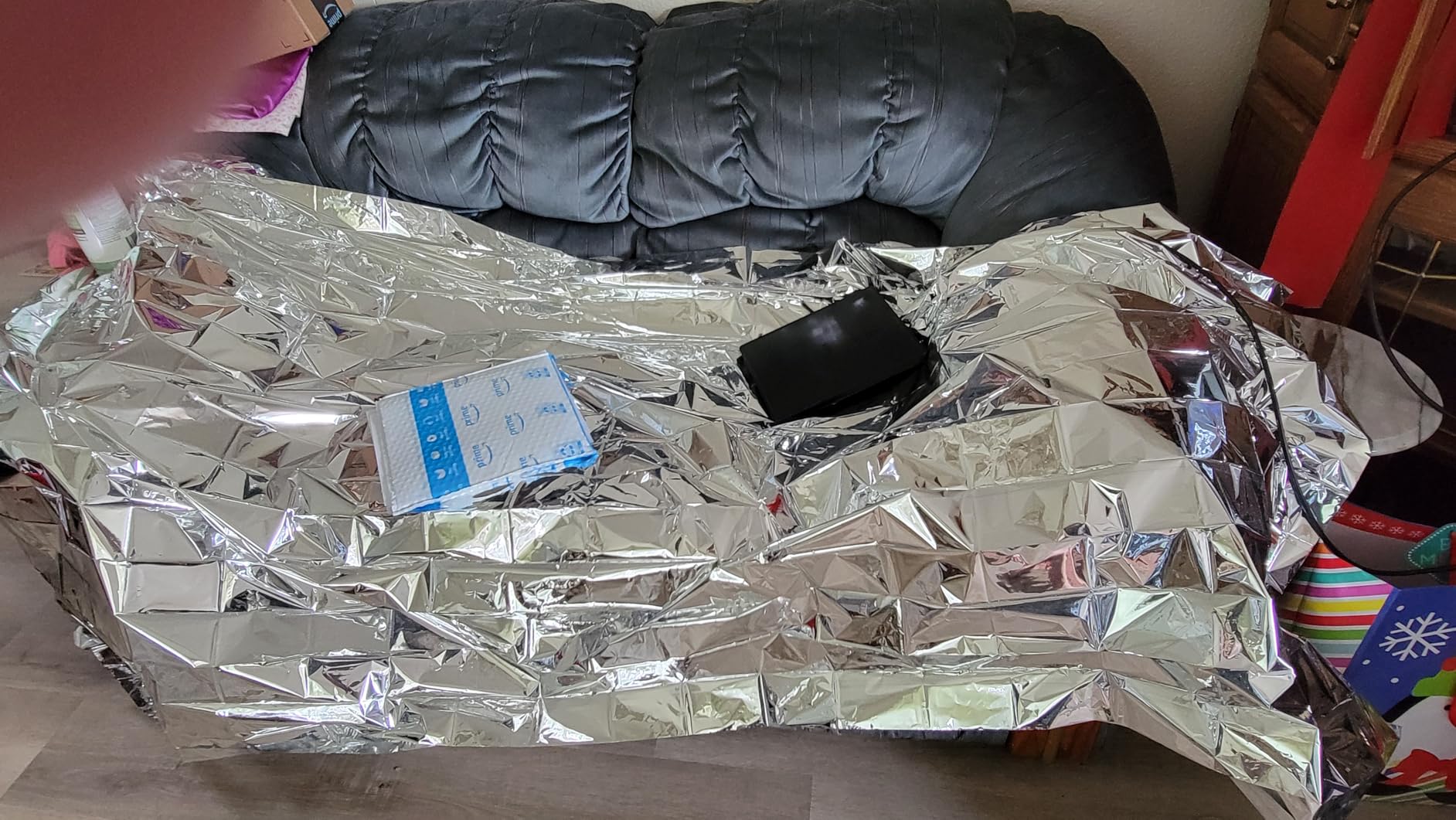
10. UST Survival Blanket/Tarp 2.0 – Best Tarp-Style Shelter
ust Survival Blanket/Tarp 2.0 with Windproof and Waterproof Material for Emergency, Camping, Hiking and Outdoors
83 x 59 inches
13.6 oz
Windproof and waterproof PE
High-visibility orange
Pros
- Windproof and waterproof PE construction
- Reflects body heat back to the user
- Works as a tent liner or ground cloth
- Limited lifetime warranty and made in the USA
Cons
- Bulky and will not fold down small
- Border stitching can loosen over time
- No ripstop reinforcement
The UST Survival Blanket/Tarp 2.0 is the most tarp-like option in this roundup and the one we rated lowest, at 4.5 across 1338 reviews. That is still a strong score, and the reviews explain the trade clearly: this is a shelter that happens to reflect heat, not a foil sheet that happens to be waterproof.
At 83 by 59 inches and 13.6 ounces, with a windproof and waterproof polyethylene construction and a high-visibility orange reflective surface, it is built to be pitched. Owners use it as an emergency lean-to and as a tent floor or liner during cold-weather camping, where the orange also doubles as a signaling surface.
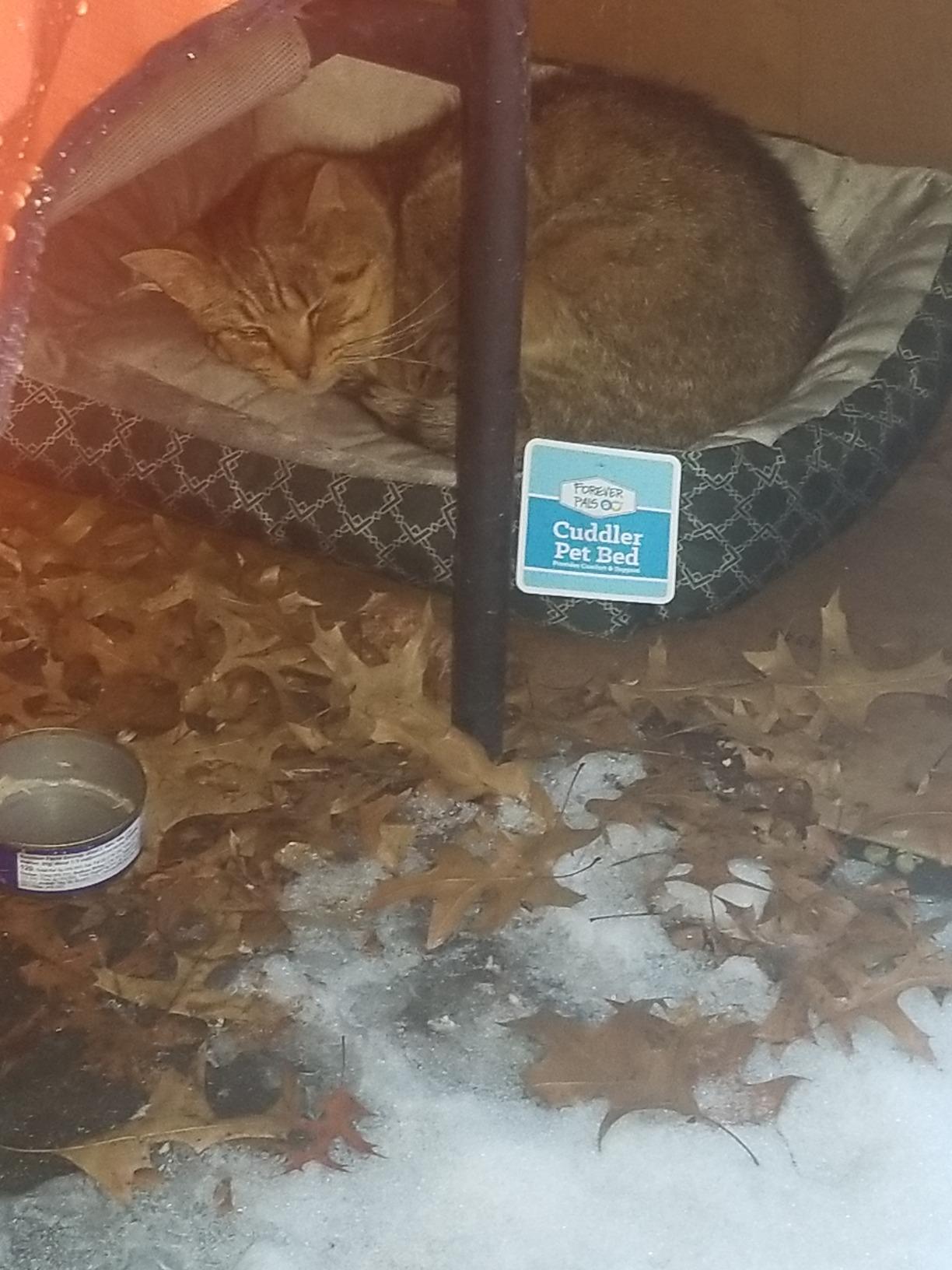
Long-term owners praise the durability, the reinforced double-layered grommets, and the limited lifetime warranty. The criticisms are about bulk and construction over time: it does not fold down small, some reports show the border stitching loosening with use, and it lacks ripstop reinforcement so a snag can be terminal.
When is a tarp-style blanket worth the extra weight?
When the plan involves staying out rather than waiting out. A reflective sheet is a shelter for the moment. A tarp gives you something you can sit under, get out of the wind inside, and use for a whole night without worrying about tearing it on a branch.
It is also the pick for car campers and winter campers who already have a tent. Long-term owners specifically mention using it as a tent liner, which keeps heat in and is exactly what a single foil sheet cannot do.
Why is this rated lower than the rest?
Because the sewing gives first. The film itself performs well, and the reflective surface does its job, but the stitched border is a wear point that eventually loosens, and without ripstop there is no second line of defence. A loose edge in a storm is a bad failure mode.
That said, the warranty and the build history are real, and for a vehicle kit where weight does not matter, this is a defensible choice. We pair it with a survival axe or a stove in a winter kit, where cutting and fire matter as much as reflection.
Do Emergency Blankets Actually Work?
Yes, for radiation and wind, and no, for the reason most people assume. The aluminized coating acts as a radiant barrier, bouncing your body’s infrared heat back at you instead of letting it radiate into a cold sky. The sealed plastic layer blocks wind-driven convective loss and rain. The 90% figure refers only to that radiant component.
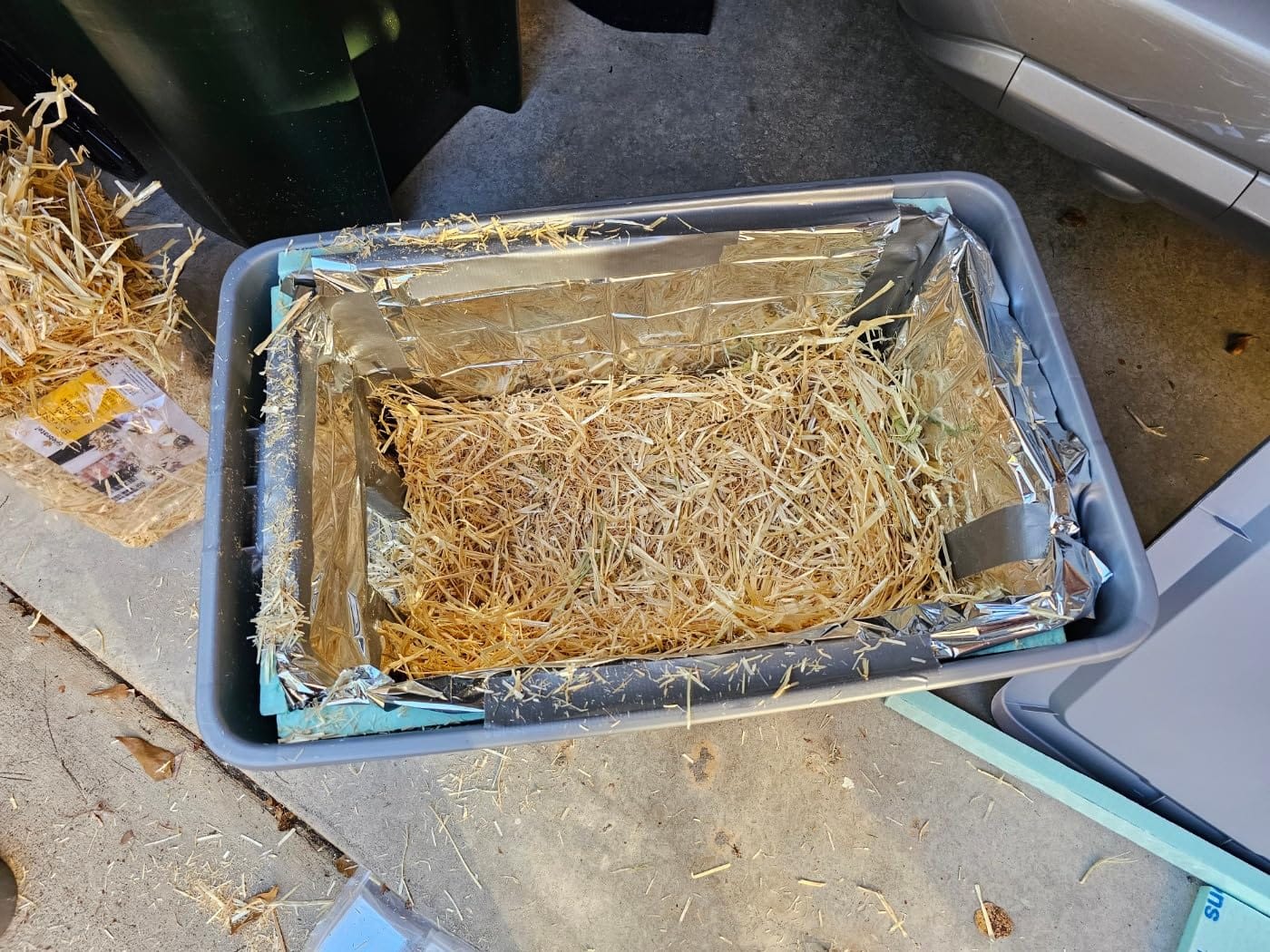
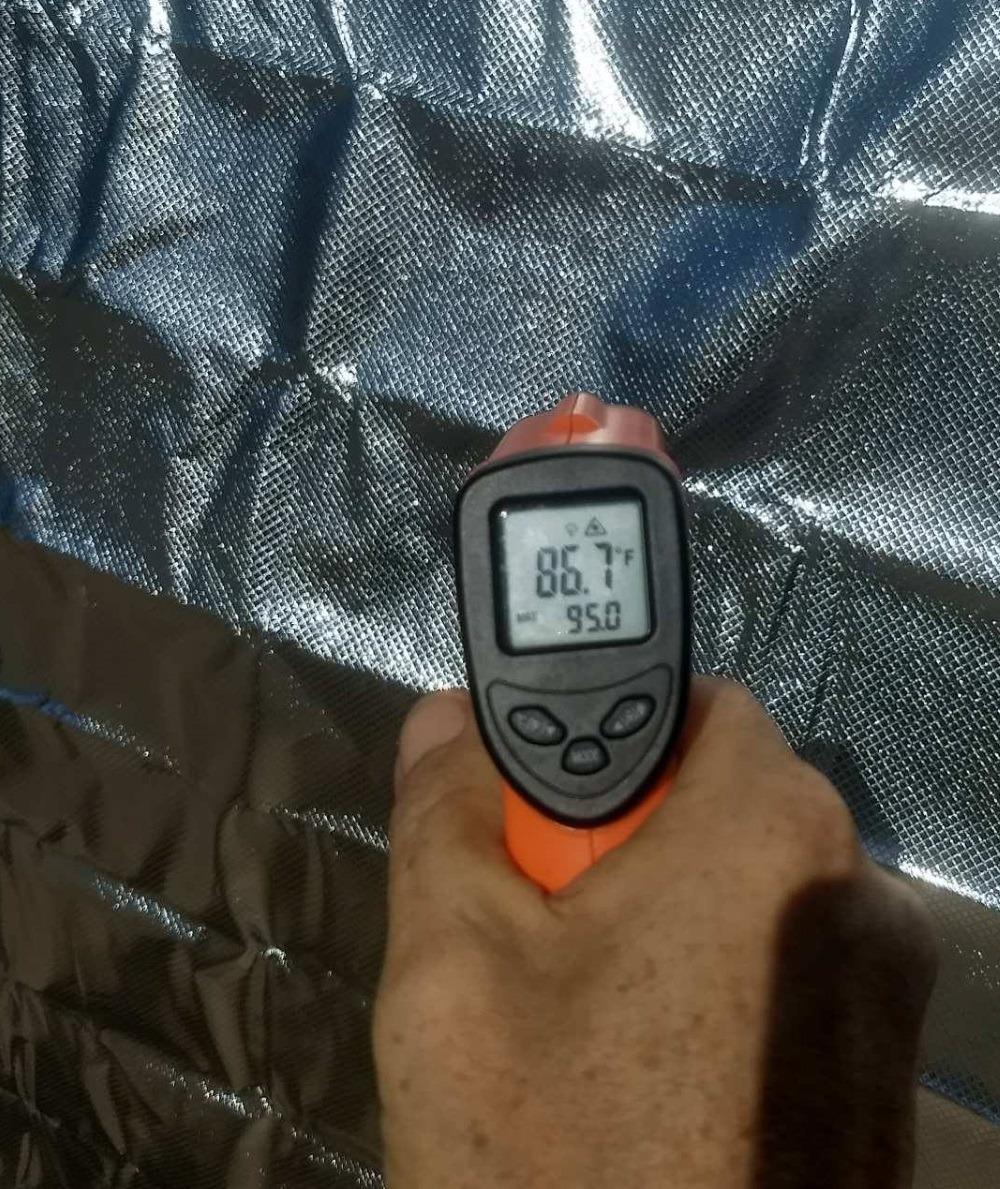
Conduction is the gap. Heat moves directly from your body into whatever you are lying on, and frozen ground pulls it out fast. A field report from a user sleeping on a thick leaf mattress under an orange space blanket described a hot back and a cold top, which shows the same principle in reverse. The practical fix is simple and almost never mentioned: put something between you and the ground before you wrap up.
- Insulate the ground first with a foam pad, an empty pack, a jacket, pine boughs, or a bundle of dry grass.
- Wrap shiny side inward. The reflective layer should face your body, not the sky.
- Tuck the ends under rather than leaving gaps where wind funnels in.
- Leave a vent gap at your face. Sealing yourself completely traps moisture, you sweat, and damp clothing makes you colder later.
- Keep it dry. Wet film loses much of its reflectivity and stops blocking wind effectively.
Fire Safety: Never Use an Emergency Blanket Near a Flame
Aluminized film melts and can ignite, and that warning is repeated constantly in the field by people who have seen it happen. Wrapping yourself in a space blanket beside a campfire to reflect the heat back at you is the most common way to turn a survival tool into a burn.
Use a separate fire blanket or a wool blanket for anything near a flame, and keep the reflective blanket for shelter and radiant loss. If you need fire heat, build it outside your shelter, away from anything plastic, and never put a foil blanket in a tent with a stove running. Our survival stove picks cover the safe heat sources that pair with these blankets.
Emergency Blanket vs Bivvy vs Sleeping Bag vs Tarp
For a winter emergency, a bivvy gives you more shelter than an emergency blanket, and a sleeping bag gives you more warmth. Neither is a substitute for the other, and the highest-engagement answer on the forums is to layer rather than choose.
- Emergency blanket: lightest and cheapest, stops wind and rain, reflects radiant heat, adds almost nothing to pack weight. Use it for roadside emergencies, outages, and as a liner or outer shell around other insulation.
- Bivvy sack: a full-body enclosure with a head hood, so it holds a pocket of warm air and blocks wind from every direction. Heavier and pricier, and it can still trap condensation.
- Sleeping bag: real insulation designed to be slept in, and the only option for a genuinely cold night. It does nothing for wind or rain, which is where a blanket earns its place as an outer layer.
- Tarp: blocks rain and wind and gives you a workable space, but provides no warmth at all. It needs a fire and a sleeping system underneath it.
The practical answer is a blanket over a bivvy over a sleeping bag, with a tarp or a car above that if it is raining. Each layer solves a different problem, and a system beats any single product.
How to Stay Warm With One Overnight in Winter
Order of operations decides how warm you end up, and most people get it backwards by wrapping first. Clear snow and wet ground away from where you will lie, because the radiant barrier is useless against moisture. Put your insulation down next: a foam pad, a pack, your jacket, or piled evergreen boughs. The blanket only does the last job well.
Then get inside it. Wrap shiny side inward, tuck the ends under your body, and pull the edge up to your chin. If you have one, seal the top with a hat or a buff so escaping air cannot carry heat away. Remember that your head is where a surprising amount of heat escapes, so a hat matters more than an extra wrap.
Keep one deliberate gap at your face for condensation. Forum users describe the sweating problem repeatedly: a fully sealed blanket works brilliantly for the first two hours and leaves you damp and colder by four. If you are under a bivvy or a tarp, leave the vent open.
Finally, keep the blanket away from fire and keep it dry overnight. A damp reflective sheet is a plastic sheet, and so is one you have torn with a boot. Our 8 best emergency survival kits guide covers the rest of the kit, and a whistle plus a fire starter cover the situations a blanket cannot.
What to Look for When Buying an Emergency Blanket
Size is the first filter, and it is the one most buyers get wrong. Standard sheets run 82 x 52 inches, which covers most adults lying down with knees bent. If you are tall, broad, or planning to wrap a sleeping bag, look for 84 x 64 inch or 7 x 5 foot models. A sheet that does not close over your torso cannot reflect heat over your torso.
Thickness is the second filter. Twelve microns is the category standard and fine for a single night. Fourteen to 15 micron film survives folding, snagging, and repeat use, and that is what you want if the blanket lives in a car for years or gets used as a poncho. Bonded multi-layer builds like the Arcturus are another step up again, at a weight cost.
Packability decides whether the blanket will actually be with you. One blanket at about 2 ounces that folds to credit-card size in a jacket pocket beats ten heavy sheets in a garage every time. Multi-packs exist for vehicles, homes, and group kits, not for personal carry. If the pocket is the problem, our 10 best survival backpacks roundup covers where the space actually goes.
Waterproofing and windproofing need to be stated rather than assumed, and reusable is worth paying for if you will use it more than once. Watch for the honest limitations too: reflective film is not insulation, it does not stop conduction, it makes noise, and it melts near flame.
Visibility and safety features come last but matter in winter. An orange or green sheet is easier for a search party to spot against snow than a silver one, and an integrated whistle or a carabiner in the storage pouch is a cheap bonus that costs nothing extra.
Frequently Asked Questions
Do Mylar emergency blankets really work?
They work very well against radiant heat loss and wind, which is why they are standard issue in emergency kits. The 90% heat retention figure describes reflected body heat only. A reflective blanket does not stop conduction, so put a foam pad, jacket, or boughs underneath you before lying down, or most of your heat will drain into the ground.
Can you use a mylar blanket near a fire?
No. Aluminized film melts at high heat and can ignite, and wrapping yourself in a space blanket beside a campfire is a common way to cause a burn. Use a separate fire blanket or wool blanket for anything near an open flame, keep the reflective sheet for shelter and radiant loss, and never run a stove inside a tent with a foil blanket in it.
Is an emergency bivvy bag more shelter than an emergency blanket?
Yes. A bivvy is a full-body enclosure with a head hood, so it traps a pocket of warm air and blocks wind from all directions, and it can be pulled closed. A blanket is a flat reflective sheet that blocks wind and rain only if you wrap it around yourself. Bivvies are heavier and can trap condensation, so many people carry both.
What size emergency blanket do I need to cover my whole body?
Most adults are covered by a standard 82 x 52 inch sheet when lying down with knees bent, which is the position you will actually be in. If you are over six feet or have a broad frame, choose an oversized model at 84 x 64 inches or 7 x 5 feet. What matters most is that the sheet covers your torso, where you generate the most heat.
How long does a mylar blanket last?
A 12-micron single-use sheet reliably gives you one night in dry conditions before tearing or creasing beyond use. Heavier 14 to 15 micron film and bonded multi-layer builds survive repeated nights, which is why the Arcturus and the UST tarp-style models are the reusable options. Store blankets folded flat rather than crushed, and check for cracked or separated coating before each trip.
What are the disadvantages to mylar space blankets?
They reflect radiant heat but do not stop conduction into cold ground, so ground insulation is essential. They are noisy, crinkly, and unpleasant to sleep in. Thin film tears easily on sharp rock, they trap sweat and condensation if you seal yourself inside, and they melt near open flame. They also cannot insulate, only reflect, so they work best layered with a bivvy or sleeping bag.
Final Verdict: Which Emergency Blanket Should You Pack?
For most people, the best emergency blankets for winter survival are not a premium pick. They are a multi-pack of a solid 12-micron sheet in every vehicle, every room, and every go-bag, because the scenario where it saves your life is the scenario where you had no time to shop. Our top pick, the Swiss Safe 10-Pack, is the one we would buy first, with 2 ounces per blanket and a bonus compact sheet in every unit.
If you are buying one thing for one person, add the oversized or thicker option. The Don’t Die In The Woods XL solves coverage, the ANLOKE solves size and quantity together, and the Arcturus solves reusability if the weight does not matter. Whatever you choose, fold it flat, pack it now, and remember the two rules that matter most: insulate the ground before you wrap up, and keep the film away from any flame.
We are an Amazon Associate, and we may earn a commission from qualifying purchases at no additional cost to you.